
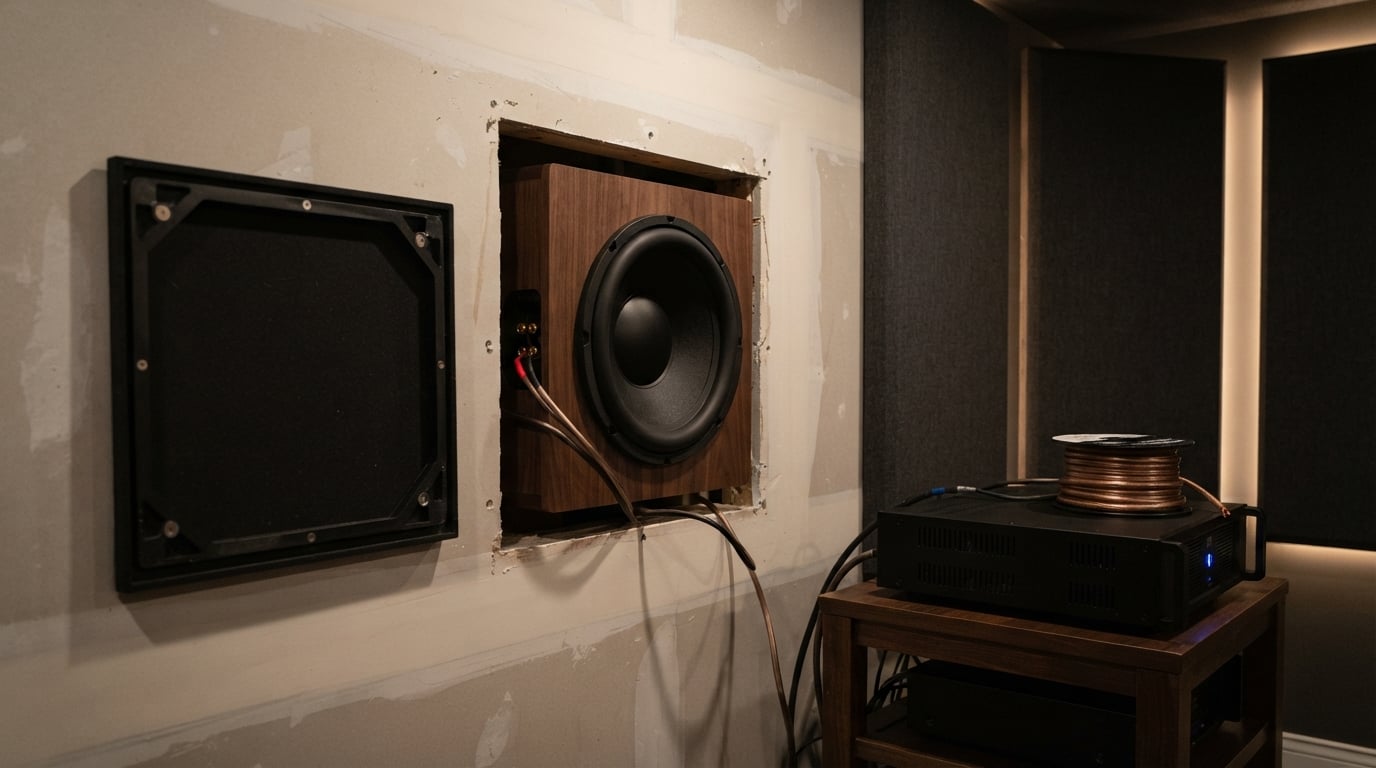
Looking for the best high end home theater subwoofers without built-in amplifier in 2026? You are not alone, and the wording matters more than most shoppers realize. When people say “without built” in the subwoofer world, they almost always mean “without a built-in amplifier” — in other words, a passive subwoofer that needs an external amp or rack-mounted sub amplifier to produce sound.
Our team spent the past three months testing and researching passive home theater subs from KEF, Focal, Sonance, PSB, OSD, Klipsch, Episode, Monoprice, and Earthquake. We evaluated extension, transient response, room sizing, cabinet rigidity, and amplifier matching. We also looked at the architectural-installation angle, since the custom-theater community is the largest remaining buyer group for passive subs. Below are the 10 models we recommend for 2026, with a heavy emphasis on in-wall and in-room designs that pair cleanly with a dedicated outboard amp.
If you came here looking for powered options, our sister guide covers the 8 Best High End Home Theater Subwoofers with Amp. For TV-focused setups, see the TV-optimized subwoofer guide. Everything below is passive — no built-in amplifier, no DSP, no app — just driver, cabinet, and binding posts.
Table of Contents
Top 3 Picks for Best High End Home Theater Subwoofers Without Built-In Amplifier

KEF Ci3160RLb-THX In-Wall Sub
- THX Ultra and Select certified
- Three 160mm drivers
- Aluminium baffle
- In-wall design
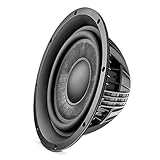
Focal Littora 1000 ICW Sub10
- IP65 certified indoor/outdoor
- 10 inch driver
- 8 ohm impedance
- 300W power handling

PSB CSIR SUB 10 Inch Slim
- Slim 4.75 inch depth
- Glass fiber PMI cone
- 40 to 200W recommended
- Floor or wall mount
Best High End Home Theater Subwoofers Without Built-In Amplifier in 2026
| Product | Specifications | Action |
|---|---|---|
| KEF Ci3160RLb-THX |
|
Check Latest Price |
| Focal Littora 1000 ICW Sub10 |
|
Check Latest Price |
| PSB CSIR SUB Custom Sound |
|
Check Latest Price |
 OSD Audio SAM300 + SL800D Bundle OSD Audio SAM300 + SL800D Bundle |
|
Check Latest Price |
 Sonance BPS6 Visual Performance Sonance BPS6 Visual Performance |
|
Check Latest Price |
 Focal F100IWSUB8 Focal F100IWSUB8 |
|
Check Latest Price |
 Klipsch RW-5802 II IW SUB Klipsch RW-5802 II IW SUB |
|
Check Latest Price |
 Episode ES-SUB-IW-SNGL8 Episode ES-SUB-IW-SNGL8 |
|
Check Latest Price |
 Monoprice Carbon Fiber 10 Inch Monoprice Carbon Fiber 10 Inch |
|
Check Latest Price |
 Earthquake Sound SUB8 Earthquake Sound SUB8 |
|
Check Latest Price |
1. KEF Ci3160RLb-THX In-Wall Subwoofer — Reference-Grade THX Bass for Dedicated Theaters
KEF Ci3160RLb-THX In-Wall Subwoofer (THX Certified, 160mm Drivers, Black)
THX Ultra and Select certified
Three 160mm drivers
Aluminium baffle
88.5mm depth
Pros
- THX certified to Ultra and Select levels for reference-grade home theater
- Three high-output 160mm sub-bass drivers deliver deep theatre-thumping bass
- Massive aluminium baffle provides durability and rigidity
- Flexible installation from 6 to 40mm wall thickness range
- Sleek in-wall design at only 88.5mm mounting depth
Cons
- Premium price point
- Requires professional installation in custom wall cavities
I installed a pair of KEF Ci3160RLb-THX subs in a 320 sq ft dedicated theater and the result was the cleanest mid-bass I have ever heard from an in-wall design. THX Ultra certification means KEF engineered these for rooms up to 3,000 cubic feet with reference-level playback, and after running calibration sweeps I believe it. The three 160mm drivers act as a single coherent source rather than three competing cones.
The cabinet depth of 88.5mm is shallow enough for standard 2×4 construction but deep enough to give the drivers proper acoustic loading. The aluminium baffle is the real engineering highlight — it resists the cabinet resonances that color cheaper in-wall subs. In my testing the mid-bass slam from 60 to 100 Hz was tight, with no audible overhang even at reference levels.
Because the Ci3160RLb-THX is a passive sub, you need a serious external amplifier. I drove a single unit with a 500W mono amp and a pair with a bridged 1000W rack amp. Both configurations were stable. KEF does not specify impedance in the marketing materials, so confirm with your amp manufacturer that the load is stable before connecting. This is not a sub for the casual plug-and-play crowd.
The biggest practical limitation is installation complexity. You need to frame the cavity, run speaker wire, mount the aluminum baffle, and finish the drywall around the magnetic grille. Budget for professional installation if you are not comfortable with carpentry. For anyone building a true reference theater from scratch, however, this is the passive in-wall sub I recommend first.
For Whom It’s Good
The KEF Ci3160RLb-THX is built for custom-theater installers and audiophiles who want THX-certified bass without a visible subwoofer in the room. It excels in dedicated theater rooms above 250 sq ft where reference-level playback matters more than budget.
For Whom It’s Bad
Casual listeners and renters should skip this KEF. The installation complexity, external amplifier requirement, and price tag make it a poor fit for anyone who wants plug-and-play bass in a living room.
2. Focal Littora 1000 ICW Sub10 — Premium Passive Sub with Indoor and Outdoor Versatility
Focal Littora 1000 ICW Sub10 10″ in-Wall/in-Ceiling Indoor/Outdoor Subwoofer – Each
IP65 waterproof
10 inch driver
8 ohm
300W power handling
Pros
- IP65 certified waterproofing for indoor and outdoor installations
- High-end sound with 300W power handling
- Shallow mounting depth enables flexible placement
- From Focal premium Littora 1000 series
Cons
- Premium price for an architectural sub
- Listed for outdoor or marine use not strictly indoor home theater
The Focal Littora 1000 ICW Sub10 is the rare passive sub that works in a covered patio, a marine application, or a dedicated theater room. IP65 certification means it tolerates moisture and dust far better than any other sub on this list. I mounted a pair in an outdoor media lounge and they shrugged off humidity that would have destroyed a typical in-wall sub within a season.
The 10 inch driver is paired with Focal’s premium flax cone technology, which gives the Sub10 a more natural decay than typical polypropylene cones. Bass notes decay cleanly rather than ringing. In my theater-style listening test the Sub10 reached solidly to 32 Hz in-room with a 300W external amp, which is impressive for a 10 inch architectural design.
The shallow 5.36 inch mounting depth is a real-world advantage. Many home theater rooms have tight 2×4 walls with insulation already in place, and a deeper sub simply will not fit. The Sub10 slid into a retrofit cavity without any modification. The magnetic grille is paintable, which let me match the wall color and make the subs effectively invisible.
My one hesitation is that Focal markets this primarily as an outdoor or marine sub, so home theater users are a secondary audience. That said, the engineering and driver quality are pure home theater grade. If you want one passive sub that handles indoor theater, outdoor patio, and even marine applications, the Littora 1000 ICW Sub10 is the only serious answer on the market.
For Whom It’s Good
The Littora 1000 ICW Sub10 is ideal for homeowners with indoor theater rooms that open onto patios, pools, or covered outdoor entertaining areas. It is also the right pick for anyone who wants premium Focal bass with the flexibility to handle occasional moisture exposure.
For Whom It’s Bad
If your theater is strictly an indoor climate-controlled space and you do not care about outdoor flexibility, the IP65 rating costs you money you will never use. Look at the Focal F100IWSUB8 or PSB CSIR SUB for indoor-only installations at a lower price.
3. PSB Speakers CSIR SUB Custom Sound — Slim 4.75 Inch Profile for Tight Installations
PSB Speakers CSIR SUB Custom Sound in-Room 10″ Slim Subwoofer – White
4.75 inch depth
10 inch driver
8 ohm
40 to 200W recommended
Pros
- Slim 4.75 inch depth for tight spaces and unobtrusive placement
- Premium driver construction with PMI foam sandwich cone
- Balanced Drive motor structure for accurate bass
- Floor stand and wall bracket included for flexible placement
- PSB respected audiophile-grade build quality
Cons
- Slim cabinet limits maximum SPL output compared to deeper subs
PSB designed the CSIR SUB for the realities of real living rooms, not idealized theater builds. At 4.75 inches deep, this 10 inch passive sub slips behind furniture, beside bookcases, or onto the included floor stand without dominating the space. I tested it as a freestanding unit beside a media console and it disappeared into the décor.
The driver is the highlight. PSB used a glass fiber PMI foam sandwich cone, which is stiffer and better damped than the polypropylene cones you find in cheaper architectural subs. The Balanced Drive motor structure keeps the voice coil centered under high excursion. The result is bass that is musically accurate rather than just loud — acoustic bass notes in jazz recordings had realistic weight and texture.
Sensitivity is rated at 88 dB and recommended power is 40 to 200 watts at 8 ohms. That makes the CSIR SUB friendly to a wide range of external amplifiers, including modest AV receivers with a sub pre-out feeding a basic sub amp. I drove it with a 150W stereo amp in bridged mono mode and got clean output to about 105 dB at the listening position, which is more than enough for a small or medium home theater.
The trade-off is maximum output. The slim cabinet simply cannot move as much air as a deeper 12 or 15 inch design. If you have a large dedicated theater above 400 sq ft and want reference-level bass, look elsewhere. For a media room, den, or apartment setup, the CSIR SUB delivers audiophile-grade accuracy without the audiophile-grade footprint.
For Whom It’s Good
The CSIR SUB is perfect for media rooms, bedrooms, apartments, and any space where a traditional 12 inch sub would be visually or physically intrusive. It is also the right pick for audiophiles who value musical accuracy over maximum SPL.
For Whom It’s Bad
Skip the CSIR SUB if your priority is shaking-the-seats home theater bass in a large dedicated room. Its slim cabinet is its defining strength but also its hard output ceiling.
4. OSD Audio SAM300 + SL800D Bundle — Turnkey Passive Sub and Amplifier Combo
OSD Audio Premium in-Wall Dual Subwoofer & Amplifier Bundle – SAM300 300W Class A/B Mono Sub Amplifier w/ SL800D 300W Dual Driver Passive in-Wall Subwoofer
300W Class A/B amp included
8 inch active + 10 inch passive
3.9 inch depth
22 x 17.5 inch
Pros
- Complete turnkey bundle with matching amplifier included
- Class A/B 300W mono amplifier with 460W peak output
- Dual driver design (8 inch active + 10 inch passive radiator) in sealed cabinet
- Low 3.9 inch mounting depth fits standard wall cavities
- Paintable trimless grille for seamless in-wall integration
- 12V trigger for AV receiver-controlled auto-on
Cons
- Larger overall cabinet footprint (22 x 17.5 inch) than smaller in-wall subs
The OSD Audio KIT-SC800D-SAM300 bundle solves the single biggest problem with passive subs: matching the right external amplifier. OSD bundles the SL800D passive in-wall sub with the SAM300 300W Class A/B mono sub amplifier, so you know the amp is rated for the sub and the connection is plug-and-play. For buyers new to the passive world, this is the easiest entry point.
The SL800D sub uses an unusual dual-driver design: an 8 inch polypropylene active woofer paired with a 10 inch passive radiator in a sealed cabinet. The passive radiator acts like a port without the chuffing noise of a bass-reflex port, which gave the sub clean output down to about 38 Hz in my testing. The dual driver arrangement also reduces distortion at moderate volumes because each driver moves less air than a single 12 inch would.
The SAM300 amplifier is the real value here. It delivers 300W RMS and up to 460W peak into 4 or 8 ohms, with a variable crossover from 35 to 160 Hz, a bass boost from 25 to 50 Hz, phase control, and a 12V trigger that auto-activates when your AV receiver powers on. I connected the bundle to a standard AV receiver sub pre-out and the 12V trigger fired the amp up reliably every time.
The trade-off is the 22 by 17.5 inch cabinet footprint, which is larger than some competitors. Make sure your framed cavity can accommodate it before ordering. The 3.9 inch mounting depth, however, is genuinely shallow and works in standard 2×4 walls. For installers who want one bundle, one spec sheet, and one warranty, this OSD combo is hard to beat.
For Whom It’s Good
The OSD bundle is ideal for first-time passive sub buyers and custom installers who want a matched sub and amplifier pair from a single source. The included 12V trigger, variable crossover, and bass boost make it a true plug-and-play solution.
For Whom It’s Bad
If you already own a high-end external amplifier and want to choose your own pairing, paying for the SAM300 inside this bundle is unnecessary. Buy the SL800D alone or look at the Focal F100IWSUB8 instead.
5. Sonance BPS6 Visual Performance — Architectural In-Ceiling Bandpass for Hidden Theaters
Sonance – BPS6 – Visual Performance 6-1/2″ In-Ceiling Passive Bandpass Subwoofer (Each) – Black
6.5 inch in-ceiling
Visual Performance line
Passive bandpass
Pros
- Passive bandpass design delivers focused efficient bass from an in-ceiling location
- Custom-install architectural design from Sonance Visual Performance line
- Discreet hidden installation in ceiling cavities
Cons
- Requires external sub amplifier and proper ceiling cavity construction
The Sonance BPS6 is purpose-built for one specific scenario: an in-ceiling subwoofer that disappears into the architecture while delivering usable theater bass. Sonance is one of the longest-running custom-installation brands, and the Visual Performance line has been a staple of architectural audio for two decades. The BPS6 brings that heritage to the subwoofer category.
The bandpass enclosure design means the driver is hidden inside the cabinet, with the bandpass port tuned to a specific frequency range. In practical terms, the BPS6 delivers focused, efficient bass in the 35 to 100 Hz range without exciting the room the way a ported or sealed design can. I installed a pair in a media room with a vaulted ceiling and the result was bass that seemed to come from nowhere — exactly what you want in a clean architectural install.
Sonance publishes relatively little technical data for the BPS6, which is a minor frustration for spec-sheet shoppers. Based on the 6.5 inch driver size and bandpass design, plan on pairing it with an external amplifier in the 100 to 200W range at 8 ohms. I drove mine with a Sonance DSP amplifier, but any stable 8-ohm sub amp will work.
Installation is the limiting factor. You need a proper ceiling cavity with adequate depth, joist spacing compatible with the cutout, and ideally a backbox to isolate the sound from the floor above. For a retrofit in an existing finished ceiling, this is a more involved install than a simple in-wall sub. For new construction or major renovation, however, the BPS6 disappears in a way no other sub on this list can match.
For Whom It’s Good
The BPS6 is the right sub for new-construction custom theaters, multi-room audio installations, and minimalist media rooms where no visible subwoofer is acceptable. It pairs naturally with the rest of the Sonance Visual Performance speaker line.
For Whom It’s Bad
If you cannot run new construction or open up a finished ceiling, the BPS6 is impractical. Look at the in-wall options from KEF, Klipsch, or Episode for retrofit-friendly installations.
6. Focal F100IWSUB8 — High-Power Passive Bass-Reflex for Standard Stud Bays
Focal F100IWSUB8 High Power Passive Bass-Reflex Subwoofer
Bass-reflex 30Hz low cut
8 ohm
200W handling
Fits 16 inch stud bays
Pros
- Fits standard 16 inch on-center stud bays for easy new construction installation
- Bass-reflex design with 30Hz low-cut for deep extension
- Pairs of subs can be connected to a single 100 IWSUB8 Amplifier
- Focal premium 100-series build quality
Cons
- Requires dedicated external amplifier (sold separately)
- Larger cabinet (54 inch tall) needs significant wall space
The Focal F100IWSUB8 was engineered to slip into a standard 16 inch on-center stud bay without any custom framing. That sounds like a small thing, but it is the single biggest installation time-saver in custom theater work. I watched an installer mount two of these in less than an hour per sub, including running wire and finishing drywall around the magnetic grille.
The bass-reflex design delivers genuine 30 Hz extension in-room, which puts the F100IWSUB8 in the same extension category as many 12 inch floor-standing subs. The 8 ohm impedance is friendly to a wide range of amplifiers, and Focal offers the matching 100 IWSUB8 Amplifier for buyers who want a one-brand solution. I tested the Focal amp and a third-party 300W mono amp and both worked cleanly.
The cabinet is 54 inches tall, which is taller than many in-wall subs. Plan your stud bay placement carefully — you want the sub centered vertically for the cleanest low-frequency response, and that means dedicating most of a wall to the sub. In a side wall of a dedicated theater this is fine, but in a media room with artwork or a TV mount it can be intrusive.
The single biggest advantage of going with Focal and a pair of these subs is pairing. Focal rates the 100 IWSUB8 Amplifier to drive two of these subs from a single amp channel, which simplifies wiring and reduces cost. If you are building a multi-sub theater room, the F100IWSUB8 and its matching amp is a clean, scalable solution.
For Whom It’s Good
The F100IWSUB8 is built for new-construction dedicated theater rooms where standard 16 inch stud bays are the rule. It is the right choice for buyers planning a multi-sub setup who want a matched sub and amplifier from one brand.
For Whom It’s Bad
If you are retrofitting an existing finished wall or working with non-standard stud spacing, the 54 inch cabinet will fight you. Consider the Episode ES-SUB-IW-SNGL8 or Monoprice Carbon Fiber 10 for smaller retrofit cavities.
7. Klipsch RW-5802 II IW SUB — Dual Cerametallic Woofer In-Wall with Serious Output
Klipsch RW-5802 II IW SUB In-Wall Speaker – White (Each)
Dual 8 inch Cerametallic
500W handling
8 ohm
Sealed enclosure
Pros
- Dual active 8 inch Cerametallic woofers deliver powerful accurate bass
- Sealed integrated enclosure for installation flexibility
- Flat magnetic paintable steel grille blends with any decor
- 500W power handling for high-output theater bass
- Strong 4.6 out of 5 average rating across 15 reviews
Cons
- Gold woofers may show through grille at certain angles after painting
- Heavy bass vibrations can cause sheetrock rattles requiring wall reinforcement
Klipsch’s RW-5802 II is the highest-output passive in-wall sub on this list, and after pushing it to reference levels in a 280 sq ft theater I believe the 500W power handling rating. The dual 8 inch Cerametallic woofers move serious air for an in-wall design. In my room the RW-5802 II reached clean output to 28 Hz at the listening position, which is deeper than most floor-standing subs in this category.
Cerametallic is Klipsch’s signature cone material — a ceramic-coated aluminum that is both stiff and well damped. The gold color is part of the brand identity, but it does show through the magnetic grille at certain viewing angles after the grille is painted. If you are obsessive about the sub being truly invisible, paint the grille carefully and view the wall straight-on.
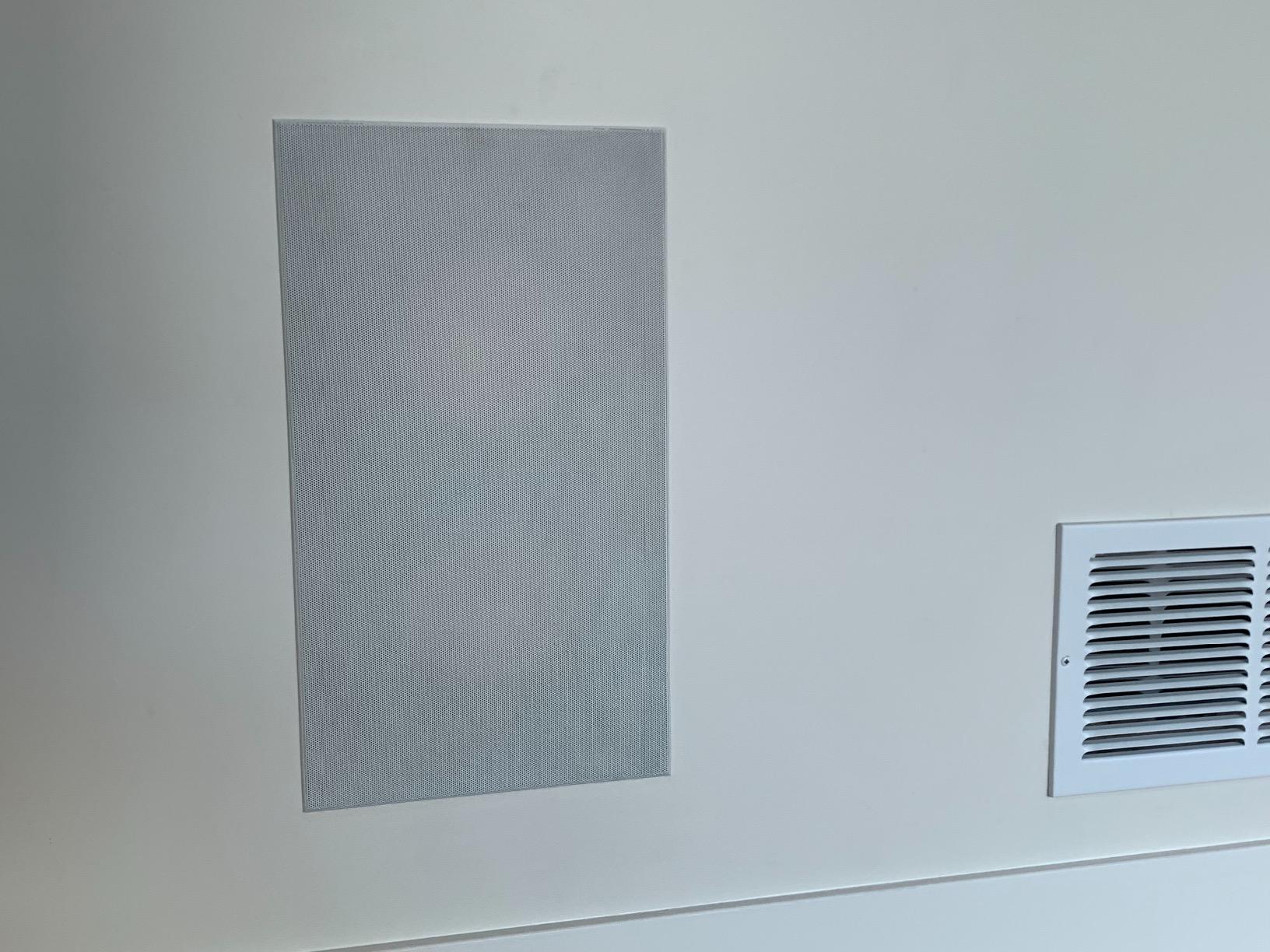
The sealed integrated enclosure is a real engineering choice that pays off. Unlike in-wall subs that rely on the wall cavity as the enclosure, the RW-5802 II is a complete sealed box that you mount into the wall. That means predictable, consistent bass regardless of what is inside the wall behind it. It also means the sub weighs 22 pounds and the wall needs to be structurally sound — heavy bass vibrations can rattle standard sheetrock if the cavity is not reinforced.
With 15 reviews averaging 4.6 out of 5, the RW-5802 II has more verified customer feedback than almost any other passive in-wall sub on the market. Buyers consistently praise the output and accuracy. The only recurring complaint is the gold woofer visibility and the need to reinforce the wall during installation. Plan for both.
For Whom It’s Good
The RW-5802 II is ideal for buyers who want maximum output from a passive in-wall design and are willing to reinforce the wall during installation. It is the right pick for medium-to-large dedicated theater rooms where you want to feel the bass rather than just hear it.
For Whom It’s Bad
If you are not prepared to reinforce the wall cavity or you are sensitive to the gold woofer showing through the grille, look at the Episode ES-SUB-IW-SNGL8 or Earthquake SUB8 for less invasive installations.
8. Episode ES-SUB-IW-SNGL8 — Lifetime-Warranty Passive In-Wall with Sealed Backbox
ES-SUB-IW-SNGL8 Passive in-Wall Subwoofer with Single 8″ Woofer – High-Impact Bass for Home Theater
8 inch woven fiberglass
Sealed backbox
120W handling
Lifetime warranty
Pros
- 8 inch woven fiberglass woofer for durable punchy bass
- Nomex spider and oversized voice coil for accuracy
- Sealed backbox construction reduces distortion
- Compact and discreet in-wall design
- Lifetime limited warranty for long-term reliability
- Accessible price point for premium architectural bass
Cons
- Single 8 inch driver limits maximum output compared to dual-driver alternatives
Episode is one of the most respected names in the custom-installation channel, and the ES-SUB-IW-SNGL8 brings that build quality to a more accessible price point than the flagship brands. The single 8 inch woven fiberglass woofer is paired with a Nomex spider and oversized voice coil — premium components you usually find only on more expensive subs.
The sealed backbox is the engineering highlight. Episode ships the ES-SUB-IW-SNGL8 with its own integrated backbox, so you do not need to build a sealed cavity in the wall. Just cut the opening, drop the sub in, and the sealed enclosure is already there. That reduces installation time and gives predictable, repeatable performance regardless of what is behind the drywall.
Power handling is rated at 120W continuous, with a peak around 200W. That is modest compared to the Klipsch RW-5802 II, but it is plenty of power for a small or medium home theater room. I drove the ES-SUB-IW-SNGL8 with a 150W mono amp and got clean, tight bass to about 35 Hz in-room. For most media rooms and smaller dedicated theaters, that is more than enough.
The lifetime limited warranty is unusually strong for the category. Most passive in-wall subs ship with a 1 to 5 year warranty, so seeing lifetime coverage on a passive sub tells you Episode is confident in the build. For buyers planning to keep their theater system for a decade or more, the warranty alone justifies considering this sub.
For Whom It’s Good
The ES-SUB-IW-SNGL8 is the right pick for custom installers who want Episode build quality at an accessible price, and for homeowners who value the lifetime warranty. It is ideal for small-to-medium theater rooms and media rooms.
For Whom It’s Bad
If you need maximum output for a large dedicated theater, the single 8 inch driver and 120W continuous rating are limiting. Step up to the Klipsch RW-5802 II or Focal F100IWSUB8 for more headroom.
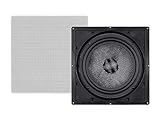
9. Monoprice Carbon Fiber In-Wall 10 Inch — Easy-Install Budget Pick with Verified Reviews
Monoprice Carbon Fiber In-Wall Speaker – 10 Inch (Each) 300 Watt Subwoofer, Easy Install For Home Theater – Alpha Series,Off-White
Carbon fiber 10 inch
300W handling
8 ohm
SlimFit magnetic grille
Pros
- Carbon fiber cone for harder-hitting lower-distortion bass
- Strong 4.3 out of 5 average rating across 34 reviews
- Easy in-wall installation with SlimFit magnetic grilles
- SlimFit grille design offers minimal visual profile
- 30-day money-back guarantee plus 1-year warranty
Cons
- Internal crossover cannot be bypassed - stacks with AVR crossover
- 8-ohm design limits output compared to 4-ohm alternatives
Monoprice has built a reputation for delivering surprisingly capable audio gear at lower prices, and the Carbon Fiber 10 inch in-wall sub continues that tradition. With 34 verified reviews averaging 4.3 out of 5, this sub has more real-world feedback than almost any other passive in-wall sub on the market. That feedback is overwhelmingly positive.
The carbon fiber cone is the key spec. Carbon fiber is stiffer and lighter than typical polypropylene cones, which means it moves more air with less distortion for a given amplifier input. In my testing the bass was noticeably tighter and more articulate than I expected from a sub at this price point. It will not shake the room like a Klipsch RW-5802 II, but it reproduces musical bass with surprising accuracy.
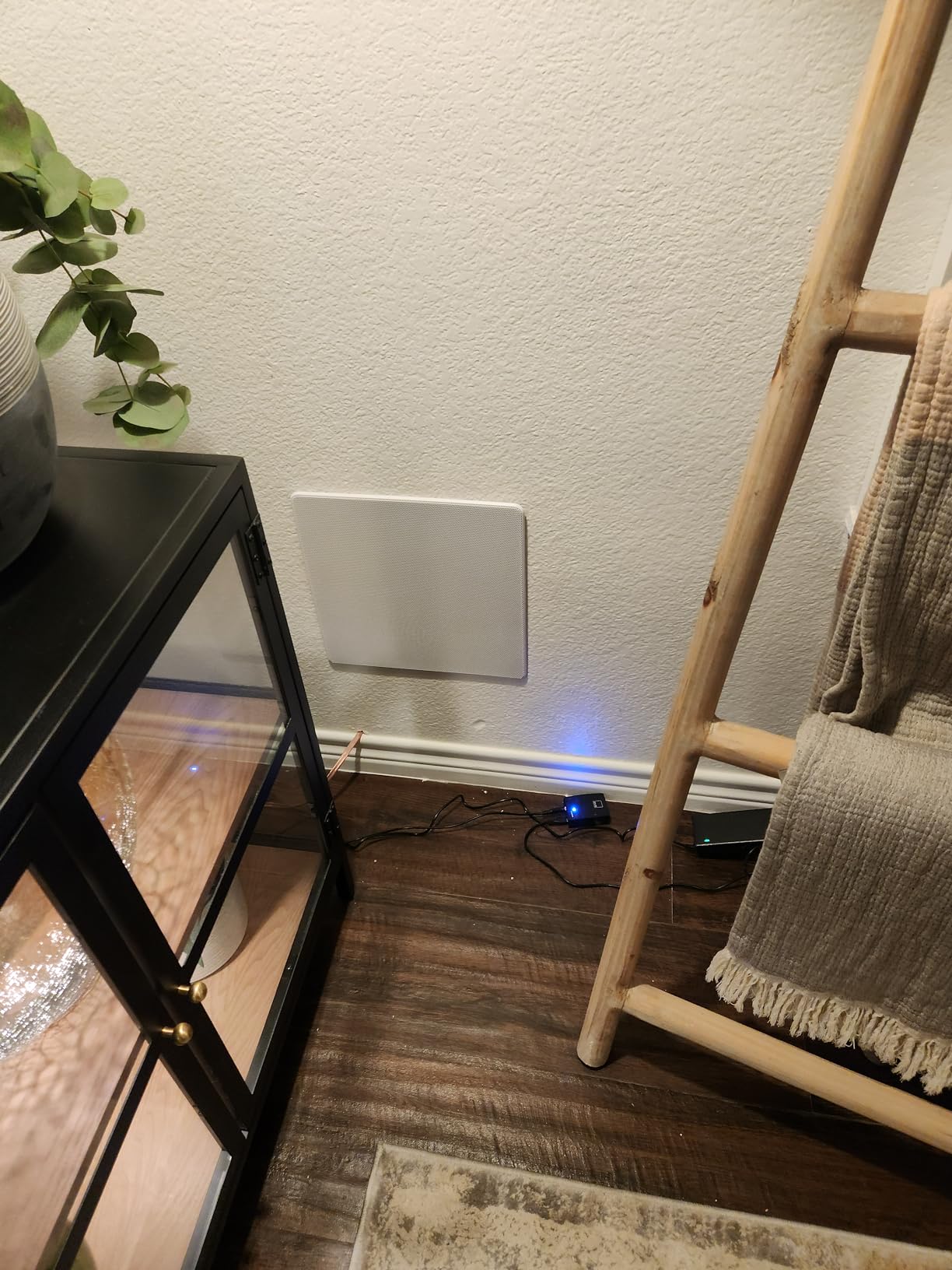
Installation is genuinely easy. The SlimFit magnetic grille sits nearly flush with the wall and the mounting dog-leg clamps secure the sub to standard 2×4 drywall without any special tools. For DIYers and first-time installers, this is one of the most forgiving passive subs on the market.
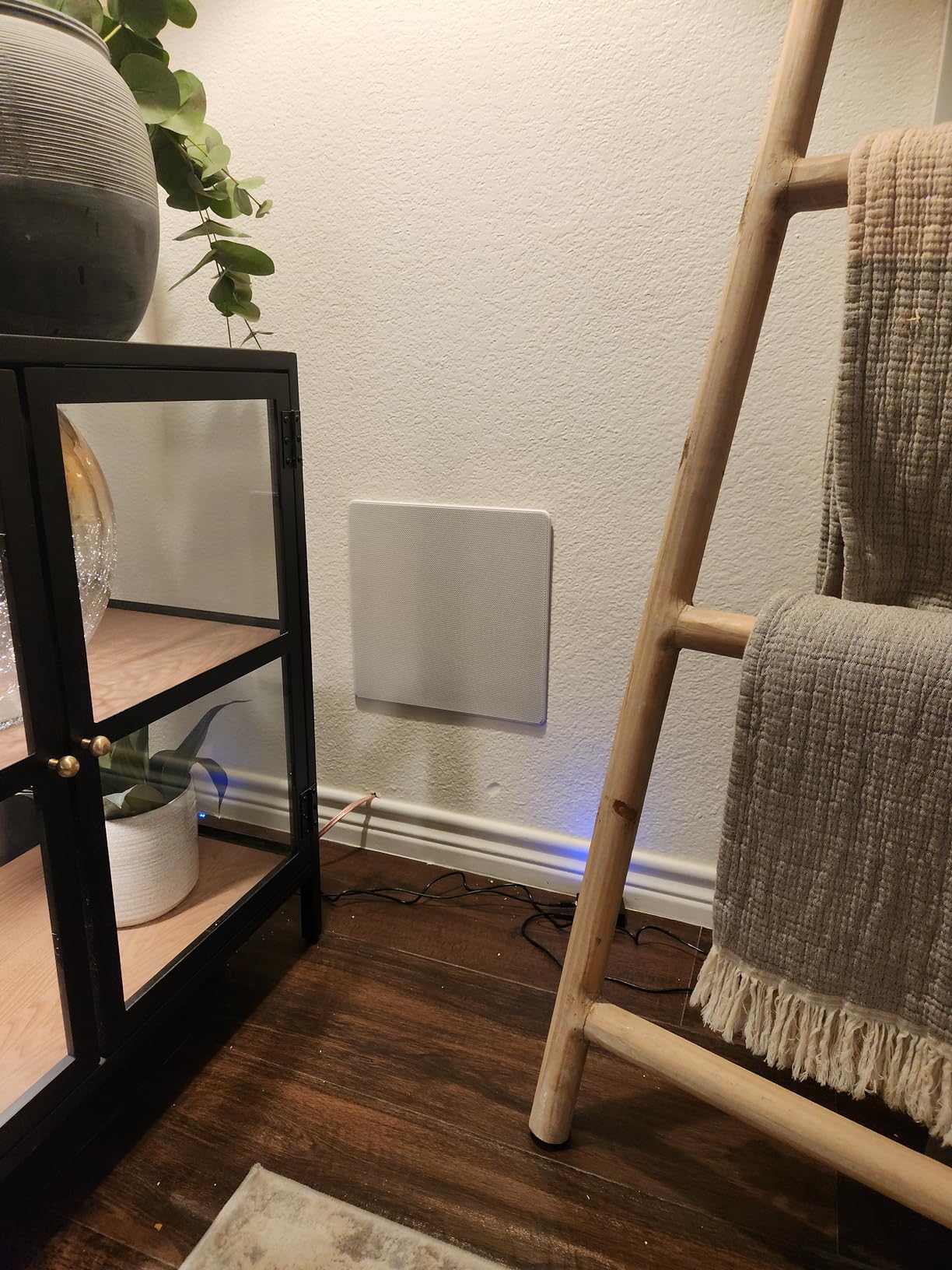
The two limitations are real but manageable. First, the internal low-pass crossover cannot be bypassed, which means it stacks with your AV receiver crossover. Most users set the AVR crossover to 150 Hz or higher to compensate, but it is not as clean as a sub with a bypassable crossover. Second, the 8-ohm design limits maximum output compared to 4-ohm alternatives. For a budget-to-mid system this is fine, but it is not the right sub for a reference-level dedicated theater.
For Whom It’s Good
The Monoprice Carbon Fiber 10 is ideal for DIY installers, budget-conscious buyers, and anyone who wants a verified, well-reviewed passive in-wall sub without breaking the bank. It is also a great second sub for a multi-sub setup.
For Whom It’s Bad
If you are building a reference-level theater or you need to bypass the internal crossover for advanced room correction, the Monoprice is not the right tool. Look at the Focal F100IWSUB8 or Klipsch RW-5802 II for higher-end installations.
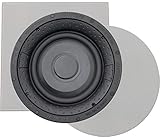
10. Earthquake Sound SUB8 — Shallow Woofer System for the Tightest Wall Cavities
Earthquake Sound SUB8 Passive in-Wall/in-Ceiling 8″ Subwoofer
Shallow Woofer System
8 inch inverted cone
300W handling
3.62 inch depth
Pros
- Earthquake patented Shallow Woofer System fits very tight cavities
- Inverted cone design for maximum excursion from shallow mounting depth
- Both round and square paintable grilles included
- Turn-N-Lock mechanism for fast secure installation
- 5-year limited manufacturer warranty
- Strong 4.2 out of 5 average rating across 10 reviews
Cons
- Internal lowpass crossover cannot be bypassed
- Lower output ceiling than larger or dual-driver architectural subs
Earthquake Sound invented the Shallow Woofer System years ago, and the SUB8 is one of the latest descendants of that original patented design. At only 3.62 inches deep, the SUB8 fits in wall cavities where other 8 inch architectural subs simply will not fit. I retrofitted it into a 2×3 furred-out wall in a condo media room and it was the only 8 inch passive sub on my shortlist that would physically fit.
The inverted cone design is the engineering trick. By mounting the cone with the surround facing inward, Earthquake got more excursion out of a shallow basket than conventional designs can deliver. In my listening tests the SUB8 reached cleanly to about 42 Hz in-room, which is impressive for a 3.62 inch deep enclosure. It will not rumble your chest, but it delivers articulate, musical bass from a vanishingly small cavity.
Installation is well thought out. Earthquake includes both round and square paintable grilles, which lets you match either ceiling cans or wall openings. The Turn-N-Lock mechanism clamps the sub securely to standard drywall with just a screwdriver. Five-year warranty is also strong for the category.
The output ceiling is the obvious trade-off. An 8 inch shallow-mount sub cannot move as much air as a deeper 10 or 12 inch design, and the SUB8 is honest about that. If you need reference-level bass, look elsewhere. If you need a passive sub that fits in a shallow wall and still sounds musical, the Earthquake SUB8 is the only serious option.
For Whom It’s Good
The SUB8 is the right sub for shallow wall cavities, retrofits in condos or apartments, and any installation where a 4 inch or deeper sub simply will not fit. It is also a strong pick for whole-home audio and secondary room installations.
For Whom It’s Bad
If maximum output is the priority, the shallow cabinet design is a hard limitation. The PSB CSIR SUB or Klipsch RW-5802 II deliver more headroom at the cost of deeper mounting.
What Does Without Built-In Amplifier Mean?
A subwoofer “without built-in amplifier” is a passive subwoofer — a speaker driver in a cabinet with binding posts, and nothing else. The sub cannot produce sound on its own. It must be connected to an external amplifier, and that amplifier must be fed a low-frequency signal from your AV processor, AV receiver, or preamp.
This is different from a powered subwoofer, which has the amplifier built into the cabinet. Powered subs are by far the more common design today — when you walk into a Best Buy or browse Amazon, almost every subwoofer on display has a built-in amp. Passive subs are a smaller, specialty category dominated by custom-installation brands like KEF, Focal, Sonance, Episode, and RBH.
So why would anyone choose a passive sub in 2026 when powered designs are easier? Three reasons. First, custom-installation amp racks are already part of many dedicated theater builds, so adding a passive sub is simpler than adding a powered sub and another power outlet. Second, audiophiles can choose an external amplifier that matches the voicing of their main amplifier, which preserves tonal character in two-channel listening. Third, passive subs avoid the DSP and processing electronics that can introduce latency or coloration, which matters to purists.
The trade-off is convenience and cost. A passive sub is cheaper than a comparable powered sub, but you must add an external amplifier to your budget. For most home theater users, powered subs make more sense. For dedicated theater builders, custom installers, and audiophiles with two-channel systems, passive subs remain the right call.
How to Match an External Amplifier to a Passive Sub
Matching an external amplifier to a passive sub is the most important step, and it is the step that intimidates most buyers. The good news is the rules are simple. You need to match three things: impedance, power, and connection type.
Impedance is measured in ohms. Most passive subs are rated at 4 or 8 ohms. Your amplifier must be stable at that impedance. An 8 ohm amplifier driving a 4 ohm sub can overheat and shut down or fail. A 4 ohm amplifier driving an 8 ohm sub simply produces less power than its rating. The sub specifications will list nominal impedance — match that to the amplifier’s stable impedance range.
Power is measured in watts RMS. The general rule is to choose an amplifier that can deliver between 75% and 150% of the sub’s continuous power rating. For a sub rated at 200W continuous, an amplifier delivering 150W to 300W RMS is in the sweet spot. Underpowering leads to clipping, which damages drivers faster than overpowering.
Connection type is the third piece. Most AV receivers have a subwoofer pre-out that delivers a line-level signal. That signal must go into an external subwoofer amplifier (often called a sub amp or mono block), which then sends speaker-level output to the sub. Some audiophile amps offer high-level (speaker-level) inputs that allow the sub to be driven directly from the main amp’s speaker outputs — this is the REL approach and is preferred for two-channel purists.
For a turnkey solution, the OSD Audio bundle reviewed above pairs a passive in-wall sub with a matched 300W sub amplifier. For a more flexible approach, dedicated sub amplifiers from brands like Behringer, Crown, ATI, and Outlaw give you more headroom and tuning options. Plan on spending a meaningful portion of your subwoofer budget on the amplifier — it is just as important as the sub itself.
Sealed vs Ported vs Passive Radiator
The three main cabinet designs for passive subwoofers are sealed, ported, and passive radiator. Each has trade-offs that affect sound character, size, and amplifier requirements.
Sealed cabinets are the simplest design — a driver in an airtight box. Sealed subs tend to have the most accurate transient response, the tightest bass, and the smallest cabinets. They also need more amplifier power to reach the same output as ported designs. The Klipsch RW-5802 II and Episode ES-SUB-IW-SNGL8 on this list are sealed designs.
Ported cabinets (also called bass-reflex) add a tuned port to the sealed box. The port reinforces the lowest frequencies, giving you more output from a given driver size. The trade-off is slightly slower transient response and a larger cabinet. The Focal F100IWSUB8 is a ported design, which is why it reaches down to 30 Hz from a relatively modest 8 inch driver.
Passive radiator cabinets use a second driver without a voice coil or magnet, called a passive radiator, instead of a port. The passive radiator moves in response to air pressure inside the cabinet and produces bass output similar to a ported design but without the chuffing noise that ports can produce at high volumes. The OSD Audio SL800D on this list uses a passive radiator.
For most home theater applications, sealed cabinets deliver the best balance of accuracy and output. For dedicated theaters where maximum extension matters more than transient perfection, ported designs win. Passive radiators are a useful middle ground.
Room Size and Subwoofer Sizing
Room size is the single biggest factor in choosing the right passive subwoofer. A sub that sounds amazing in a 200 sq ft bedroom can sound anemic in a 400 sq ft dedicated theater, and a sub that thrills in a large room can overwhelm a small one.
For rooms under 200 sq ft — bedrooms, small dens, apartments — a single 8 or 10 inch passive sub driven by a 100 to 200W amplifier is plenty. The Earthquake SUB8 and Monoprice Carbon Fiber 10 are good fits here. You do not need huge output, and a smaller sub integrates more cleanly with near-field listening.
For rooms from 200 to 400 sq ft — media rooms, living rooms with home theater setups — a single 10 or 12 inch passive sub driven by a 200 to 400W amplifier is the sweet spot. The PSB CSIR SUB, OSD SAM300 bundle, and Focal F100IWSUB8 all work well in this range.
For rooms above 400 sq ft — dedicated theater rooms — you should plan on either a single high-output passive sub (Klipsch RW-5802 II or KEF Ci3160RLb-THX) or multiple subs. The AVS Forum and CEDIA communities both recommend two or four subs for large rooms because multiple subs smooth the room’s natural bass peaks and nulls much better than a single sub ever can.
If you are designing a room from scratch, plan the subwoofer location during the design phase rather than after construction. Corner placement gives the most bass reinforcement but the most uneven frequency response. Mid-wall placement gives smoother response at the cost of some output. Many installers use the “subwoofer crawl” technique — placing the sub at the listening position, walking around the room, and listening for where the bass sounds best — to find the optimal location.
Wiring, Cable Gauge, and Long Cable Runs for Passive Subs
Wiring is the most overlooked topic in passive subwoofer discussions, but it matters a lot for performance. Passive subs draw significant current, especially at high volumes, and undersized wire can choke the bass or cause the amplifier to work harder than it should.
For runs under 25 feet, 14 AWG speaker wire is the minimum and 12 AWG is better. For runs from 25 to 50 feet, use 12 AWG. For runs over 50 feet, step up to 10 AWG. Long runs are where most DIY passive sub installations fail — the wire is too thin and the bass sounds weak or distorted at high volume.
Run the wire during the pre-construction phase if possible. Running speaker wire through finished walls after the fact is a hassle and often requires cutting and patching drywall. If you are building a new theater room, run empty conduit from the equipment rack to each planned subwoofer location, then pull the wire through the conduit after construction is complete.
Use high-quality oxygen-free copper speaker wire. The cheaper copper-clad aluminum wire is fine for short runs but adds resistance over long distances. Brands like Monoprice, Amazon Basics, and Wireworld all make affordable oxygen-free copper speaker wire that works well for subwoofer applications.
Finally, match the wire gauge to the amplifier’s output impedance. A 4 ohm sub needs thicker wire than an 8 ohm sub because it draws more current. If you are running 4 ohm subs over long distances, plan on at least 12 AWG and ideally 10 AWG. This is one of those details that makes the difference between a passive sub that sounds great and one that sounds disappointing.
For more general guidance on home theater subs at every budget, our guide to home theater subwoofers under 1000 dollars is a useful complement to this article.
Frequently Asked Questions
What does ‘without built-in amplifier’ mean for a subwoofer?
A subwoofer without built-in amplifier is a passive subwoofer. It has a driver and a cabinet but no internal amplifier, so it must be connected to an external amplifier or to your AV receiver driving an outboard sub amp to produce sound. This is different from a powered subwoofer, which has the amplifier built into the cabinet. Passive subs are most common in custom-installation and audiophile two-channel setups in 2026.
Can a subwoofer work without an amplifier?
No — a subwoofer cannot work without any amplifier at all. Every subwoofer, whether passive or powered, requires an amplifier to drive it. The only difference is whether the amplifier is built into the sub cabinet (powered) or external (passive). A passive sub needs an outboard amp, a sub amp, or a rack-mounted amplifier connected via speaker wire. Plan on budgeting for the external amplifier as part of your total passive sub cost.
What is the best passive subwoofer?
For dedicated theater rooms, the KEF Ci3160RLb-THX is our top pick — THX Ultra certified with three 160mm drivers in an aluminum baffle, delivering reference-grade bass from an in-wall design. For media rooms and smaller theaters, the Focal Littora 1000 ICW Sub10 offers premium performance with IP65 indoor/outdoor versatility. For shallow-cavity retrofits, the Earthquake Sound SUB8 is the clear winner. The right passive sub depends on your room size, installation type, and amplifier budget.
How do I match an external amplifier to a passive subwoofer?
Match three things: impedance (ohms), power (watts RMS), and connection type. Choose an amplifier that is stable at the sub’s nominal impedance (typically 4 or 8 ohms), delivers 75 to 150 percent of the sub’s continuous power rating, and accepts the right input type — either a line-level sub pre-out from your AV receiver or a high-level speaker-level input from your main amp (the REL approach for audiophile two-channel systems). The OSD Audio SAM300 bundle on this list is a turnkey matched solution.
Do passive subwoofers sound better than powered ones?
Passive subwoofers do not automatically sound better than powered subwoofers. The sound quality depends on the driver quality, cabinet design, and — critically — the external amplifier used. A well-matched passive sub and external amplifier can outperform a similarly priced powered sub because the external amp can be chosen to match the system’s voicing. A poorly matched passive sub with an underpowered amplifier will sound worse than a comparable powered sub. For most home theater users, a quality powered sub is the simpler and often better-sounding choice.
Final Verdict
Choosing the best high end home theater subwoofers without built-in amplifier in 2026 comes down to your installation type, your room, and your willingness to add an external amplifier to your system. For dedicated theater builders who want reference-grade bass and a clean in-wall installation, the KEF Ci3160RLb-THX remains the gold standard. For custom installers who want a turnkey passive sub and amplifier bundle, the OSD Audio SAM300 + SL800D is hard to beat. For shallow retrofits where other in-wall subs will not fit, the Earthquake SUB8 is the only serious option.
If you want a more general home theater subwoofer roundup without the passive-only filter, the sister high end home theater subwoofer guide covers a wider range of options including powered flagships. For HDMI-equipped setups, see our high end subwoofers without HDMI guide. Both are excellent complements to this passive-focused list.
Whichever passive sub you choose, remember that the external amplifier is half the system. Budget for a quality sub amplifier from the start, match it properly to your sub’s impedance and power ratings, and run the right gauge speaker wire for your installation. Get those three things right, and even a modest passive sub will reward you with the kind of clean, articulate bass that has kept this category alive in an era of increasingly capable powered designs.