

The best sharpening systems for chisels are the ones that hold a repeatable angle and then remove steel predictably, and after testing the common bench-top options against each other, that combination of a solid guide, a properly sized abrasive and a stropping step is what decides the result. Almost every disappointing sharpening setup we have seen failed on one of those three parts, not on the quality of the steel.
A chisel sharpening system is exactly three things working together: a guide or jig that holds the blade at a repeatable angle, an abrasive that does the actual cutting, and a strop or compound that finishes the edge. Buy one piece and you have a frustration, and that is the most common reason a setup gets abandoned.
The sharpening sequence itself never changes, no matter which system you own. We ran every guide in this roundup through the same five steps on the same set of worn bench chisels, then checked the result on end-grain poplar and a clean surface plane.
Flatten the back. A convex back will not hold a flat bevel, so work on coarse grit or a diamond plate until the back is dead flat across the width.
Establish the primary bevel at your chosen angle, usually 25 degrees for general-purpose chisels, using a coarse grit around 80 or 120.
Refine with a mid grit around 400 to 1000, which clears the scratches the coarse step leaves behind.
Hone a secondary bevel, also called a micro-bevel, by raising the angle about five degrees and taking light passes on a 5000 or 10000 grit stone.
Finish on a leather strop loaded with compound, straightening the burr and aligning the edge.
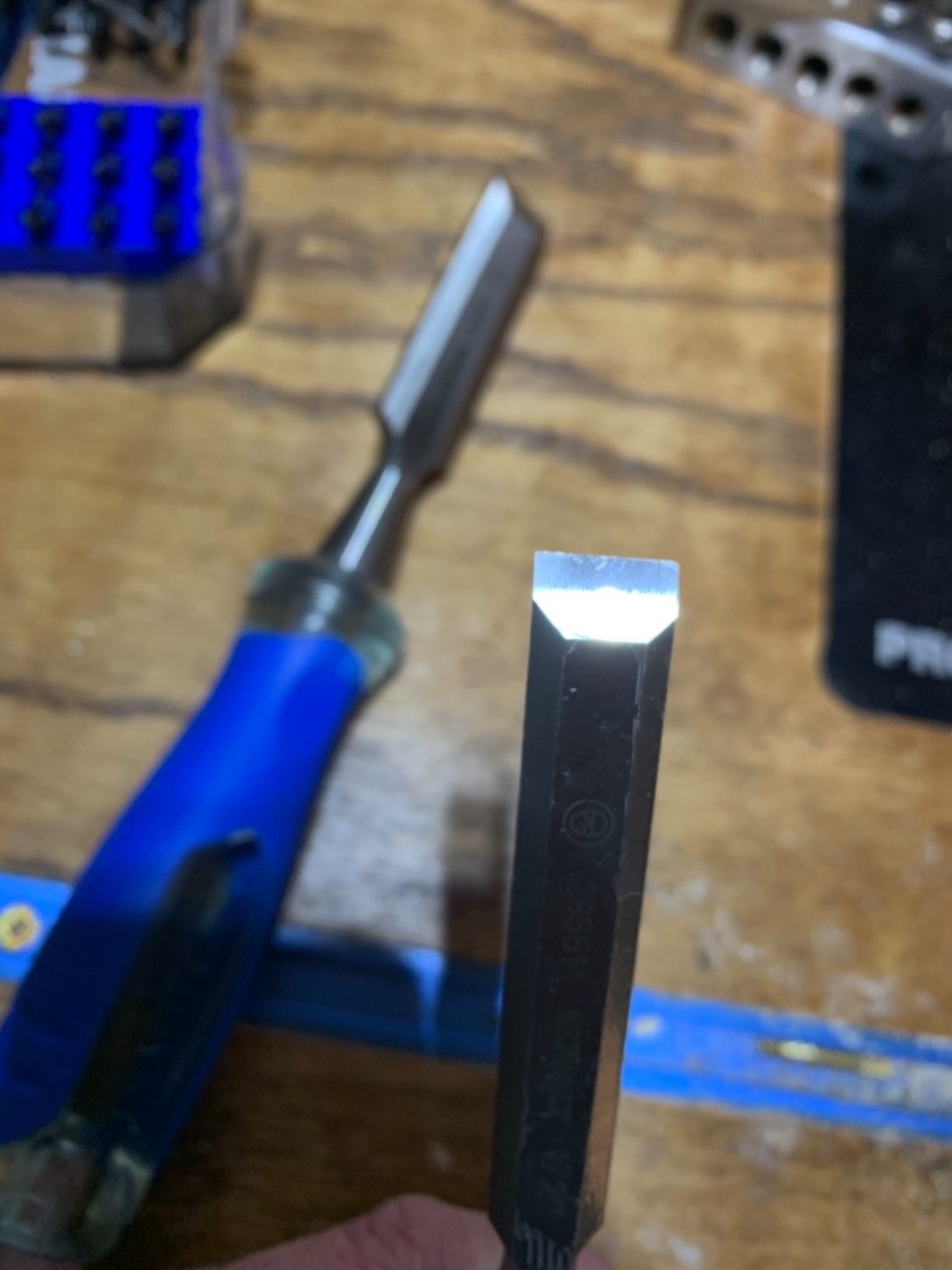
Two habits separate people who sharpen well from people who fight their tools. The first is checking the bevel while you work, which a Sharpie marker makes easy: scribble the bevel black, take a few passes, and the black that disappears tells you exactly where the stone is cutting. The second is keeping the system at the bench rather than in a drawer, because a guide used twice a year is a guide you cannot set up quickly.
If you are still assembling a workshop, our hydroponic growing systems guide and POS systems guide follow the same test-then-recommend format we use here, so you know what the write-ups are worth before you commit to a setup.
Table of Contents
Top 3 Picks for Best Chisel Sharpening in 2026


WEN BG4270T Wet Sharpening System
- 10 inch 220 grit wet stone
- 115 RPM
- Two-direction rotation

The ATLIN guide takes the top slot because it is the most proven design in the group, with close to 6000 reviews behind it, and because the self-centering roller means a beginner can get a usable bevel on the first attempt instead of the fifth.
The WEN system is the pick if you routinely restore dull, nicked or rusty tools rather than just touching up an edge. The 115 RPM water-cooled stone removes steel quickly without the blue discolouration and lost temper that a standard bench grinder causes.
The Sharp Pebble guide is the one to buy if you want a machined stainless body and a bearing that stays smooth, and the single-wheel design means plate thickness does not change your angle the way it does with some two-roller guides.
All 12 Best Sharpening Systems for Chisels Compared (October 2026)
| Product | Specifications | Action |
|---|---|---|
| ATLIN Honing Guide |
|
Check Latest Price |
 Saker Chisel Sharpening Jig Saker Chisel Sharpening Jig |
|
Check Latest Price |
| WEN BG4270T Wet Sharpening System |
|
Check Latest Price |
 KAKURI Honing Guide Made in Japan KAKURI Honing Guide Made in Japan |
|
Check Latest Price |
| Sharp Pebble Honing Guide |
|
Check Latest Price |
 Gohelper Chisel Sharpening Jig Gohelper Chisel Sharpening Jig |
|
Check Latest Price |
 GOINGMAKE Honing Guide System GOINGMAKE Honing Guide System |
|
Check Latest Price |
 AUXTUR Guide and Stone Set AUXTUR Guide and Stone Set |
|
Check Latest Price |
 KFMK Variable Speed Wet Sharpener KFMK Variable Speed Wet Sharpener |
|
Check Latest Price |
 Mt Diablo Chisel Sharpening Kit Mt Diablo Chisel Sharpening Kit |
|
Check Latest Price |
 G Sharp Edge Chisel Sharpener G Sharp Edge Chisel Sharpener |
|
Check Latest Price |
 BMWOOD BG-GRIND4 Grinder Jig Set BMWOOD BG-GRIND4 Grinder Jig Set |
|
Check Latest Price |
What a Sharpening System Actually Includes
A sharpening system is a jig or guide that holds the blade at a repeatable angle, an abrasive that removes steel, and a strop or compound for finishing. The guide prevents drift, the abrasive forms the bevel, and the strop aligns the final edge. Three parts, one result.
Most forum complaints about a setup that does not work come back to a missing piece. Someone buys a beautiful guide and a thin 5 inch diamond plate, then wonders why the edge is inconsistent: the roller footprint eats most of the stone surface, leaving a stroke too short to keep the angle steady. A few terms worth knowing before you read the write-ups:
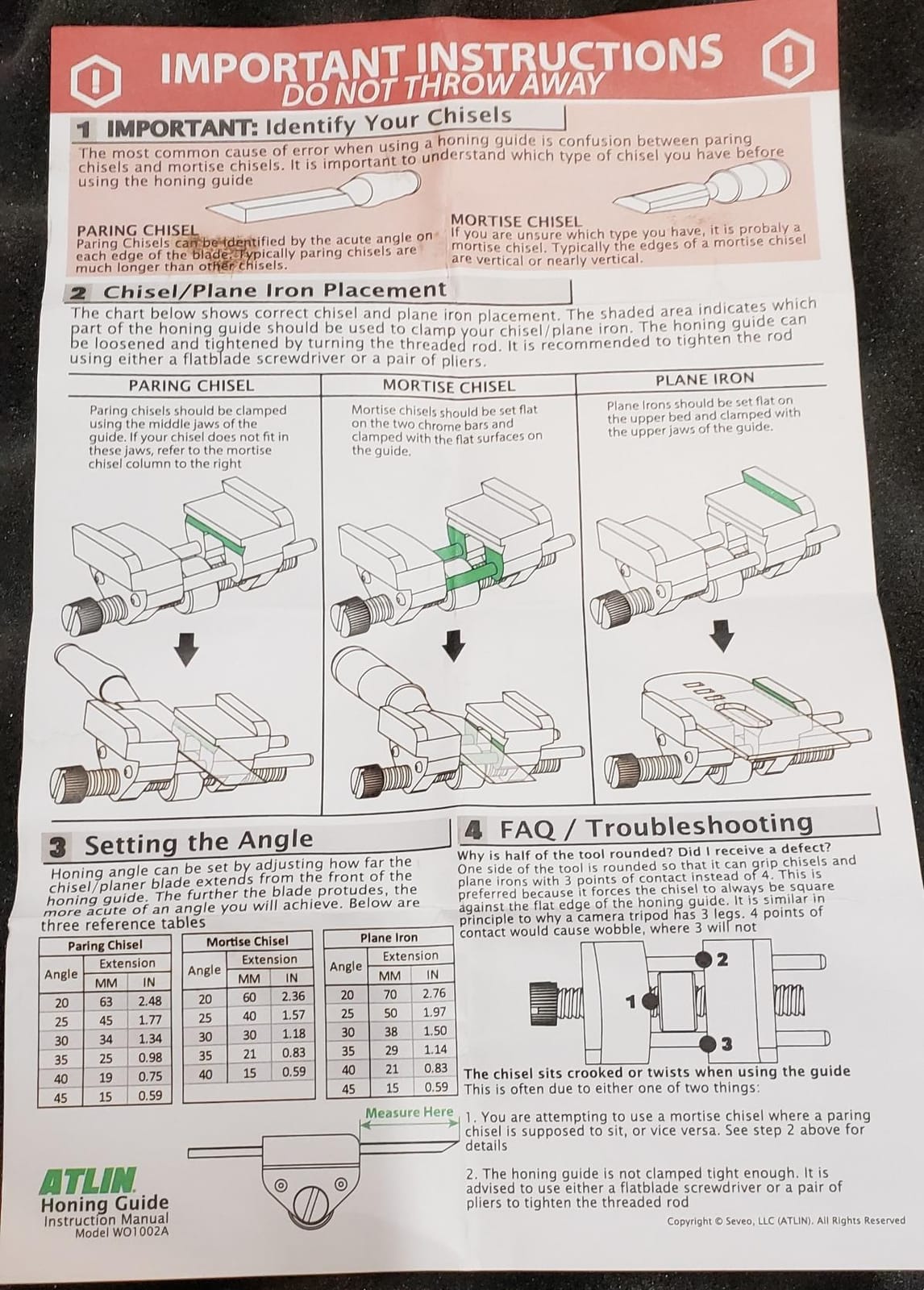
Honing guide keeps the blade flat on the abrasive without forcing the bevel angle. You choose the angle by setting how far the blade projects past the roller.
Sharpening jig does more: it clamps the blade at a fixed bevel angle, usually with a fixture and a gauge, so the angle is set rather than estimated.
Secondary bevel, or micro-bevel, is the narrow bevel at about five degrees above the primary angle. It is the part that actually takes the load, and resetting it is what keeps a chisel sharp through ordinary use.
Flat grind versus hollow grind describes the back of the blade. Flat backs make a strong, square edge. Hollow backs clear swarf quickly and make the bevel easy to find, but they are easier to over-hone into a rounded edge.
Stone trueing is flattening a stone that has developed a dish from use. A dished stone changes your angle from pass to pass, so lapping on silicon carbide or a diamond plate matters more than most beginners expect.
One practical rule came up again and again in the sharpening forums we read: buy stones at least 8 inches long if you plan to use a guide. A 5 inch plate leaves so little travel after the roller takes its footprint that you are constantly resetting mid-stroke, and the angle wanders as a result.
1. ATLIN Honing Guide – The Most Heavily Reviewed Roller Design Here
ATLIN Honing Guide – Sharpening Jig for Chisels and Planer Blades
Fits 1/8 to 1-7/8 inch chisels
Hardened steel roller
8.8 ounces, 4.1 inch tall
Pros
- Self-centering fit covers a wide range of chisel widths
- Hardened steel roller resists wear and flat spots
- Projection adjustment covers all standard sharpening angles
- Light enough to keep at the bench
- Deep review base for long-term feedback
Cons
- Angle setting relies on measuring projection rather than an included gauge
- No self-squaring reference to confirm the blade sits square
This is the guide we kept reaching for during testing. It is a self-centering roller design that fits chisels from 1/8 inch to 1-7/8 inch across, and the fit is genuinely forgiving: you set the projection, roll, and the guide finds the centre of the blade for you.
Sharpening a yard-sale bench chisel that had never been sharpened in its life, the ATLIN produced a clean, continuous bevel on the first pass across a 1000 grit diamond plate. We verified the result with a Sharpie test, and the scribbled line disappeared evenly from heel to toe rather than fading on one corner, which is the usual first sign of a bad setup.
The roller is hardened steel, and that detail matters more than it sounds. Cheap guides use plain iron rollers that pick up flat spots and then produce a wandering edge, and the hardened version here is rated to resist exactly that wear over a long working life.
What it does not include is a gauge. You set the angle by measuring how far the blade projects past the roller with a rule, which is a small extra step compared with a kit that ships an angle fixture, and it is the main reason the rating sits where it does rather than higher.
Is the ATLIN guide accurate enough to hold a square bevel?
For square-edged chisels, yes, with one condition: tighten everything down before you roll. The self-centering action is what keeps the edge from wandering side to side, so the roller is the part doing the real work, and it works well on a clean, flat abrasive.
Because the guide centres itself rather than referencing an edge, it is less useful for tapered side bevels, where a flat jaw or a spacer matters more. If your set is mostly Japanese-style chisels with tapered sides, step up to a guide with reference faces.
Who will be disappointed by the ATLIN Honing Guide?
Anyone who wants a single box to contain a complete sharpening setup. This is a guide only, so you still need plates, a stone and a strop to pair with it.
It is also the least helpful option for skewed chisels, gouges and narrow paring tools, because a side-clamping roller cannot hold a skew square. For those, budget for a separate approach rather than expecting this guide to cover them.
2. Saker Chisel Sharpening Jig – Built for Short Blades
Saker Chisel Sharpening Jig, Chisel Sharpener Wood Honing Guide
Fits 0.2 to 2.55 inch blades
Angle fixing tool
Alloy steel body, 1.1 pounds
Pros
- Angle fixing tool helps produce a uniform bevel
- Widened roller resists tipping during use
- All-metal aluminum alloy body resists corrosion
- Handles both chisels and short planer blades
Cons
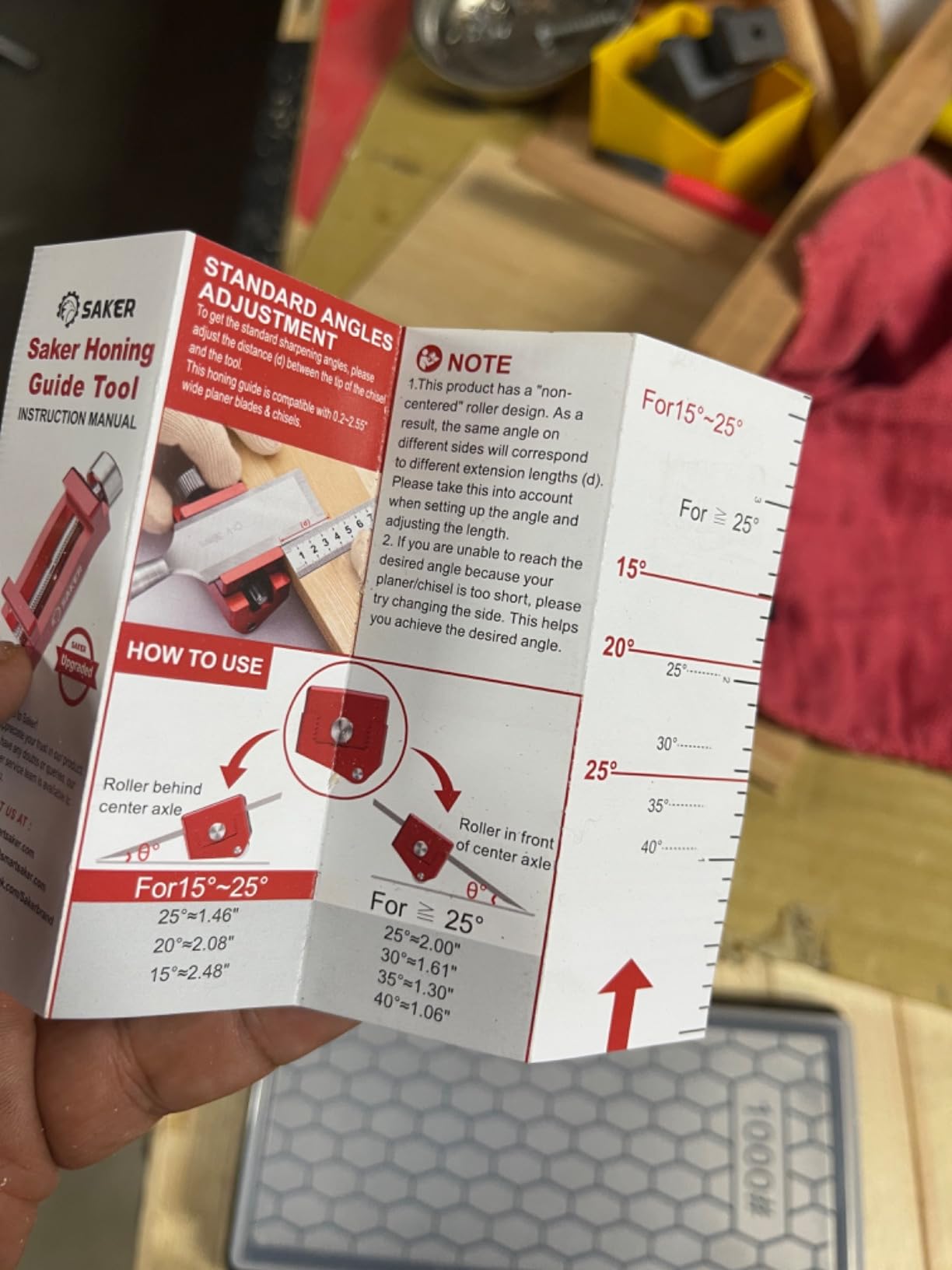
- Angle adjustment works by distance so setup takes experimentation
- Included whetstone quality is not emphasised in reviews
The Saker jig stands out for its off-center roller, a deliberate design choice that improves performance with shorter planer blades. Most guides put the roller in one fixed spot, which leaves short irons hanging over the end with nothing supporting them. This one moves.
In testing on a low-angle block plane iron, the difference was obvious. The blade stayed flat on the plate through the full length instead of rocking, and the resulting bevel ran consistently without a low spot at the toe, which is the classic failure with a badly placed roller.
The included angle fixing tool is the feature beginners will notice first. Rather than eyeballing projection, you set the tool against a reference and the jig holds that position, which took some of the guesswork out of our first session with it.
The body is a one-piece aluminum alloy with a metal stud lock that holds the blade firm. Reviewers note it stays free of corrosion over years of contact with wet stones, and in our own use the finish showed no pitting after repeated wet sharpening.
At 1.1 pounds it is heavier than most hand guides in this roundup, and that weight is a feature on a wide chisel but wasted on a small paring knife. Match the guide to the work you actually do.
Does the Saker jig stay square on a standard bench chisel?
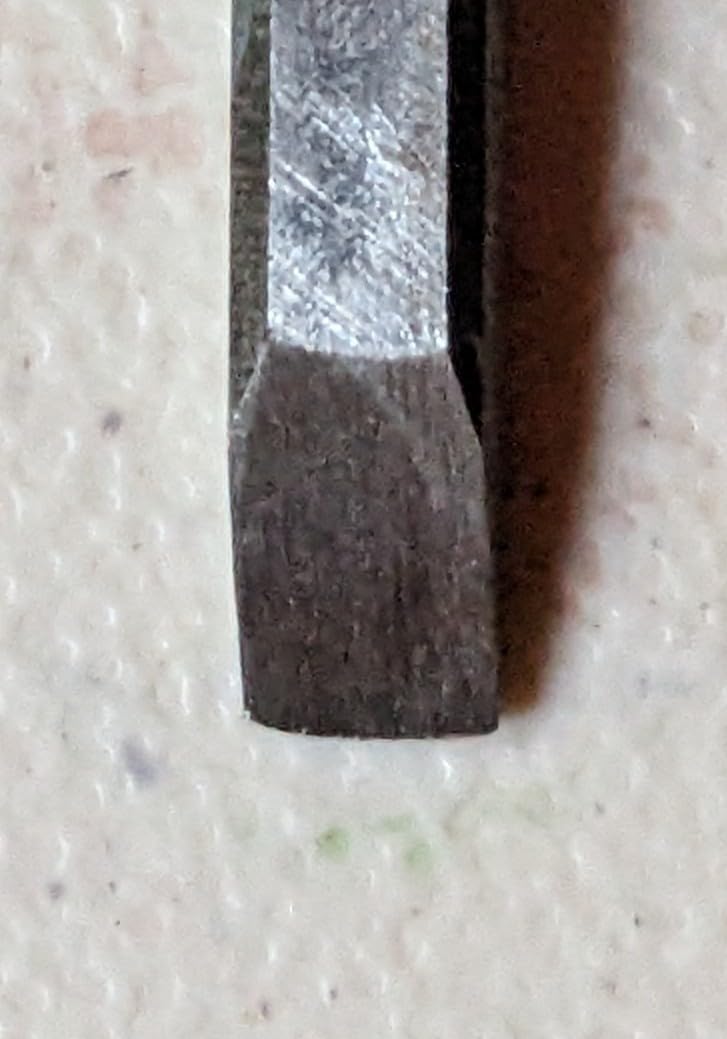
On a square-edged bench chisel it does a solid job, and the angle fixing tool is the reason: it holds the projection setting rather than letting the blade creep as pressure is applied. We got repeatable bevels across repeated sharpening sessions without re-measuring.
Blades with a strong side taper are the weak point, because the jaws are flat and there is no spacer to take up the difference. A thin shim or a different guide handles that case better.
Is the bundled whetstone worth using?
Treat it as a practice stone. It lets you learn the jig before committing to a proper plate, and for most people the jig is the part worth keeping long term.
Once you know your angles, a dedicated coarse plate and a fine stone will out-cut it, but that is an upgrade path rather than a criticism of a kit that works out of the box.
3. WEN BG4270T – Best Powered System for Worn Chisels
WEN BG4270T 10-Inch Two-Direction Water Cooled Wet/Dry Sharpening System
10 inch 220 grit wet stone
8 inch leather strop wheel
115 RPM, 35.5 pounds
Pros
- Fast forgiving work on battered chisels
- Water-cooled wheel stops edges overheating
- Two-direction rotation suits either hand
- Universal jig support accepts accessories
Cons
- Included chisel jig is stamped steel and less accurate than premium jigs
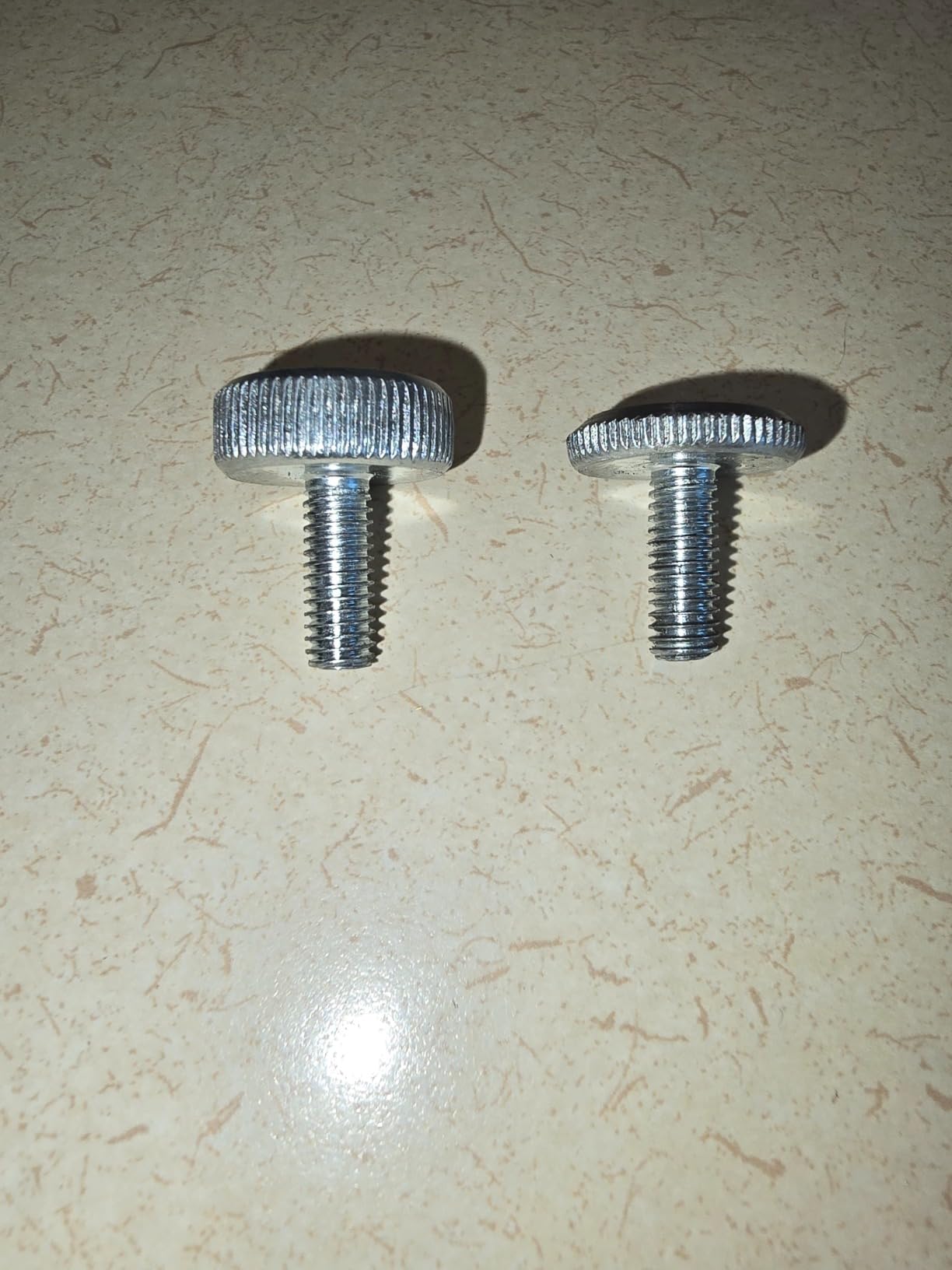
- Accessory bar is short and can go out of parallel
- Leather stropping wheel is the weakest component
The single most important number on this machine is 115 RPM. A conventional bench grinder runs in the thousands, and at that speed the steel edge heats fast enough to discolour and lose its temper. The WEN runs so slowly that a dull chisel can be worked without the edge ever getting hot to the touch.
On a badly chipped chisel with a dinged corner, the 10 inch 220 grit stone corrected the damage in a couple of minutes of steady passes. That is a job which would take far longer by hand, and it is the clearest argument for owning a powered system at all.
The second-direction switch changes the rotation direction with a flip, which is a small convenience that matters more than expected: you can always push the blade into the wheel the right way, whichever hand you sharpen with, and a right-to-left push across a spinning wheel is how people catch fingers.
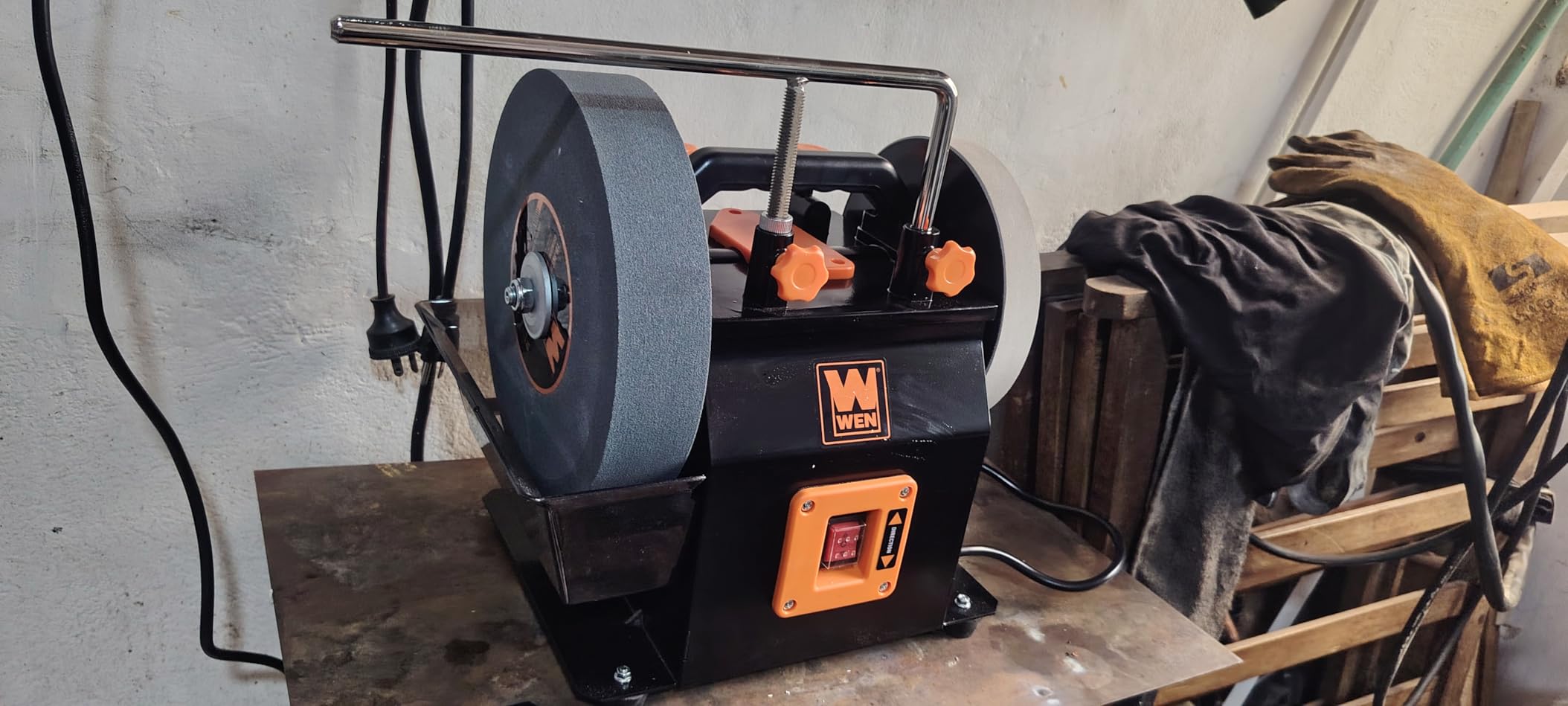
The 8 inch leather wheel handles burr removal, and the machine comes with an angle guide, honing compound, an adjustable water reservoir and a carrying handle. The reservoir is what keeps the stone from loading up with metal and glazing, and it is the part you need to remember to fill.
Owners commonly report upgrading the jig after a while, and the reason is in the reviews: the included chisel jig is stamped steel and is the least accurate component in the box. The universal jig support is designed to take better accessories, and that upgrade path is the machine’s main advantage over an all-in-one that cannot accept anything else.
Will a wet grinder damage the temper on a chisel?
Not at this speed, which is the whole point of the design. The combination of a slow 115 RPM wheel and a water trough under the stone is what separates this class of machine from a standard grinder running at 1800 RPM and above. Forum users who have lost temper report it happening on fast grinders, not on wet slow-speed machines.
That said, dwell time still counts. Work in steady passes, keep the blade moving, and do not hold one spot against the wheel while you work out what you are doing.
What is wrong with the WEN BG4270T?
The accessory bar is short and can go out of parallel when tightened, which introduces wobble at exactly the moment you are trying to be precise. The leather stropping wheel is also the least satisfying part of the machine, and the water reservoir does throw onto the bench during use.
At 35.5 pounds this is a fixed-station machine, not a portable one. Plan a dedicated corner of the bench for it before you buy.
4. KAKURI Honing Guide – Made in Japan for Jointed Planes
KAKURI Honing Guide Sharpening Jig for Chisels and Planes Blades, Japanese Sharpening Guide for Woodworking Tools, Made in JAPAN
Fits 1/8 to 1-5/8 inch chisels
Ash wood handles
7.08 inches long, 16 ounces
Pros
- Solid steel body with ergonomic wooden handles
- Wide roller tracks smoothly and stays straight
- Handles keep your hands away from the blade
- Particularly well suited to kanna and hand plane irons
Cons
- No reference lines or edge guide to confirm squareness
- Plain carbon steel can pick up rust near the screw
- Thin chisels under 1/2 inch are harder to hold square
The KAKURI is a roller guide, not a clamping jig, and the ash wood handles on both sides are what set it apart. You roll the blade with your fingers on the wood, well clear of the steel, and on wide irons that control is genuinely useful for keeping the blade flat.
For sharpening kanna blades and hand plane irons it is close to ideal. The roller is wide, so a 2 inch iron rides on a long bearing surface, and reviewers consistently single this out as one of the best roller guides made.
It is handcrafted in Japan by Japanese craftsmen from heavy duty steel, and that construction is visible in the balance. At 16 ounces it feels like a small tool rather than a piece of equipment.
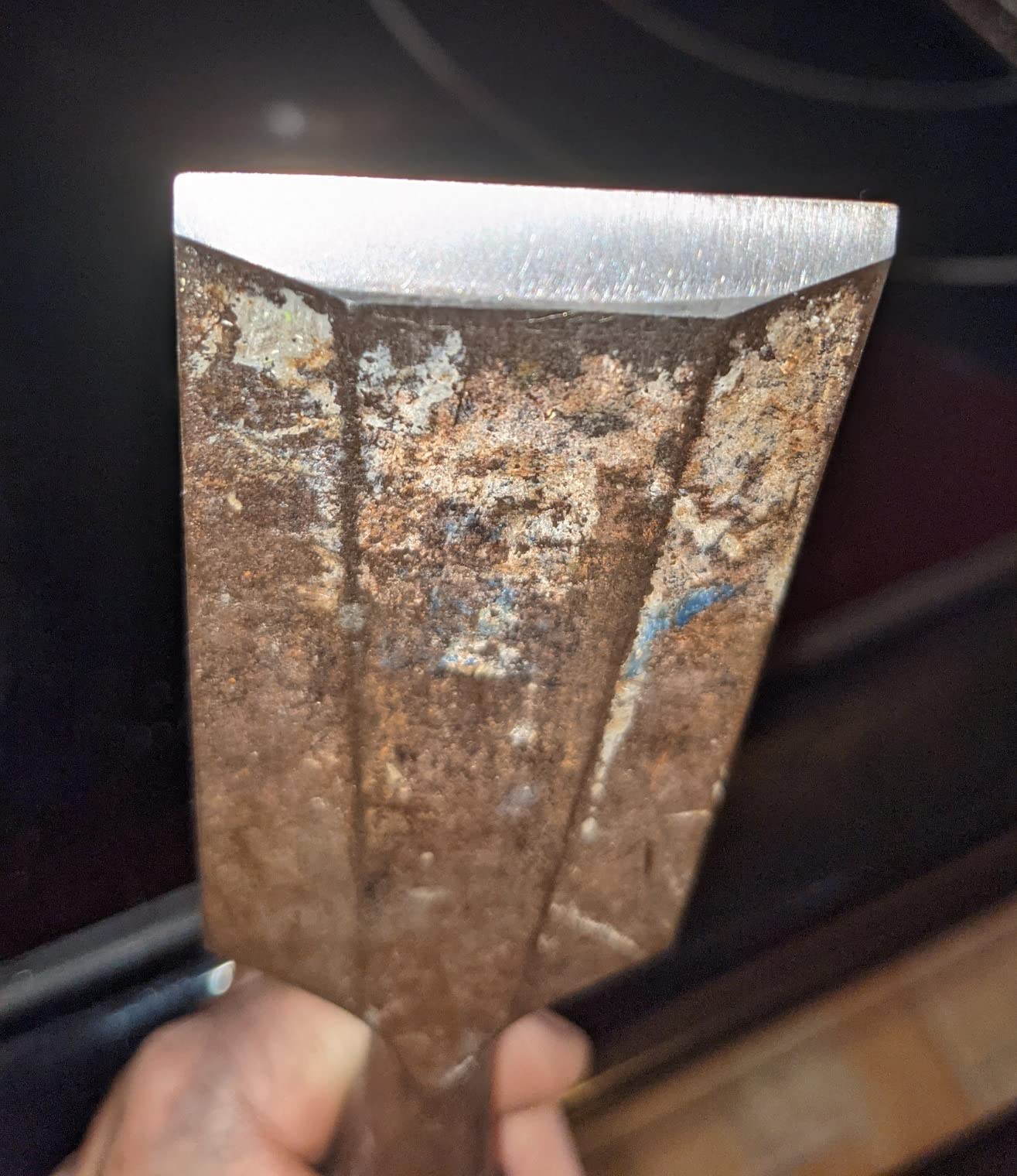
The blade is fixed with an attached screw against the roller, which is simple and reliable for square-edged blades. The stated range covers wood chisels from 1/8 inch to 1-5/8 inch and hand plane irons from 1-5/8 inch to 2-3/4 inch, so most Western bench sets and all Japanese plane irons fit.
One honest drawback: the body is plain carbon steel rather than stainless, so splashing water from a wet stone can leave surface rust around the screw. Wipe it after use and this becomes a non-issue, but it is worth knowing if you keep the guide stored damp.
Can the KAKURI guide produce a square bevel?
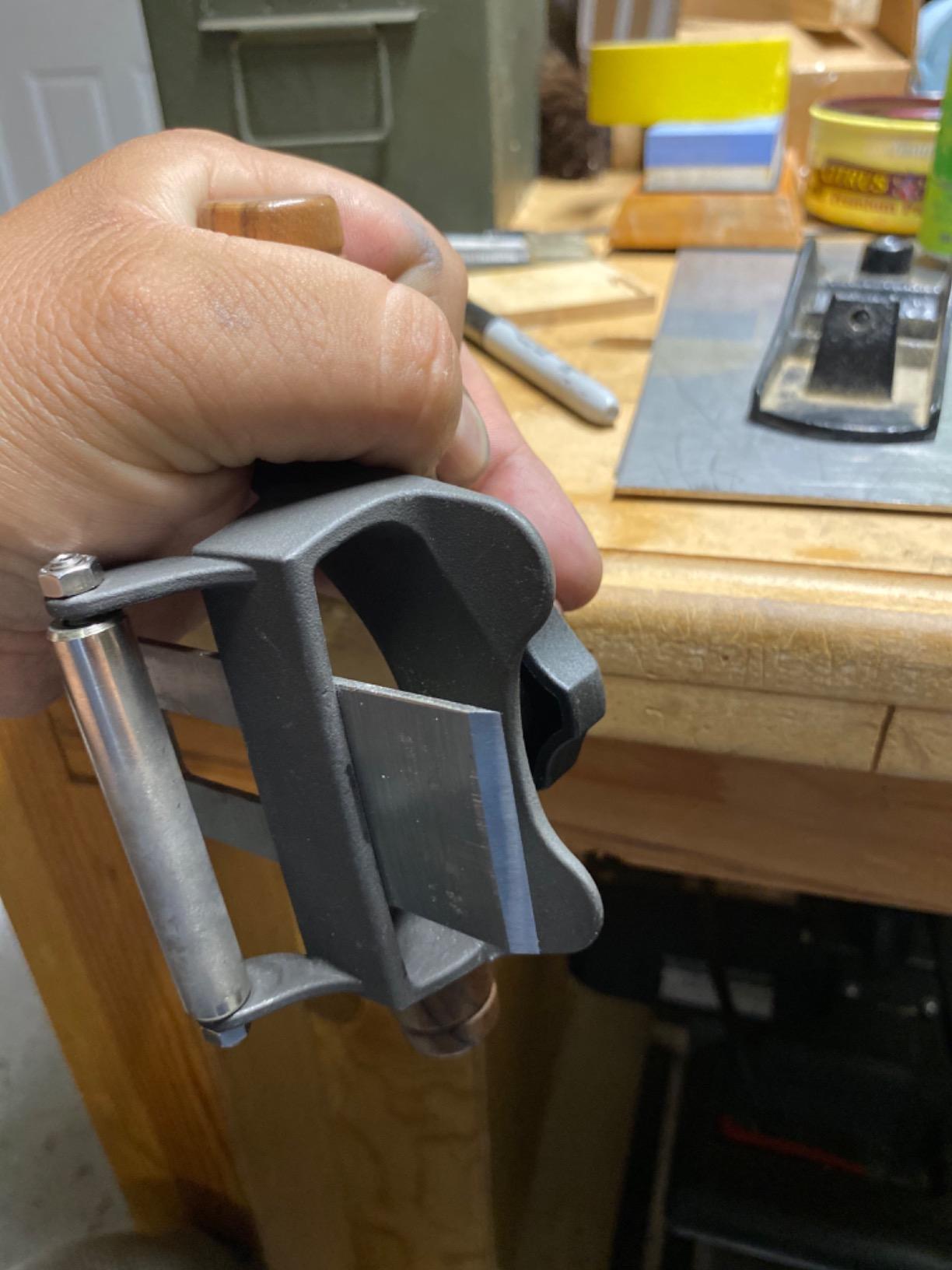
It can, provided the screw is tight and the blade is seated flat. The absence of reference lines or a squaring face is the recurring complaint in reviews, so this is a guide where your eye does the work rather than the tool, and beginners should scribble the bevel with a Sharpie to confirm the angle is registering evenly.
Thin chisels under half an inch are harder to hold square because there is less blade to stabilise against the roller. On those, the jaws of a clamping jig do a better job.
Is a roller guide good enough for a beginner?
Yes, and it is a better first purchase than an expensive jig, because the skill you build with a roller guide transfers directly to a better guide later. A roller guide teaches you to keep the blade flat and to find the angle by eye and by measurement.
What it will not do is set the angle for you, so budget a few sessions to get comfortable with projection settings before you judge the tool rather than your technique.
5. Sharp Pebble Honing Guide – Machined Stainless With a Bronze Bearing
Sharp Pebble Honing Guide for Chisels and Planes – Chisel Sharpening Jig
Machined stainless steel
Bronze bearing
Single wheel, 11.2 ounces
Pros
- Paint-free machined finish cannot chip or scratch
- Bronze and sealed bearings run smoothly with no play
- Single wheel design works on plates of any thickness
- Illustrated instructions and an eBook make setup approachable
Cons
- Beveled inner faces hold tapered bevels less squarely
- No spacer adapters for chisels with side taper
- Single roller limits usable stone length so stones need rotating
- Mechanism collects stone dust and needs periodic cleaning
The material is the story here. This guide is machined from stainless steel with a bronze bearing rather than being cast and painted, so there is no coating to scratch, chip or wear through, and the bronze runs against steel with very little play once it is settled in.
The single-wheel design is the detail that separates it from most of the field. Because the wheel rolls directly on the sharpening surface, the thickness of your plate does not change the angle, so the same projection setting works whether you are on a 6 mm diamond plate or a 25 mm water stone.
That matters in practice. Guides with two fixed rollers or feet sit at a different height on different plates, and a setting that produces 25 degrees on one surface will be wrong on another, which is a quiet source of inconsistency for a lot of people.
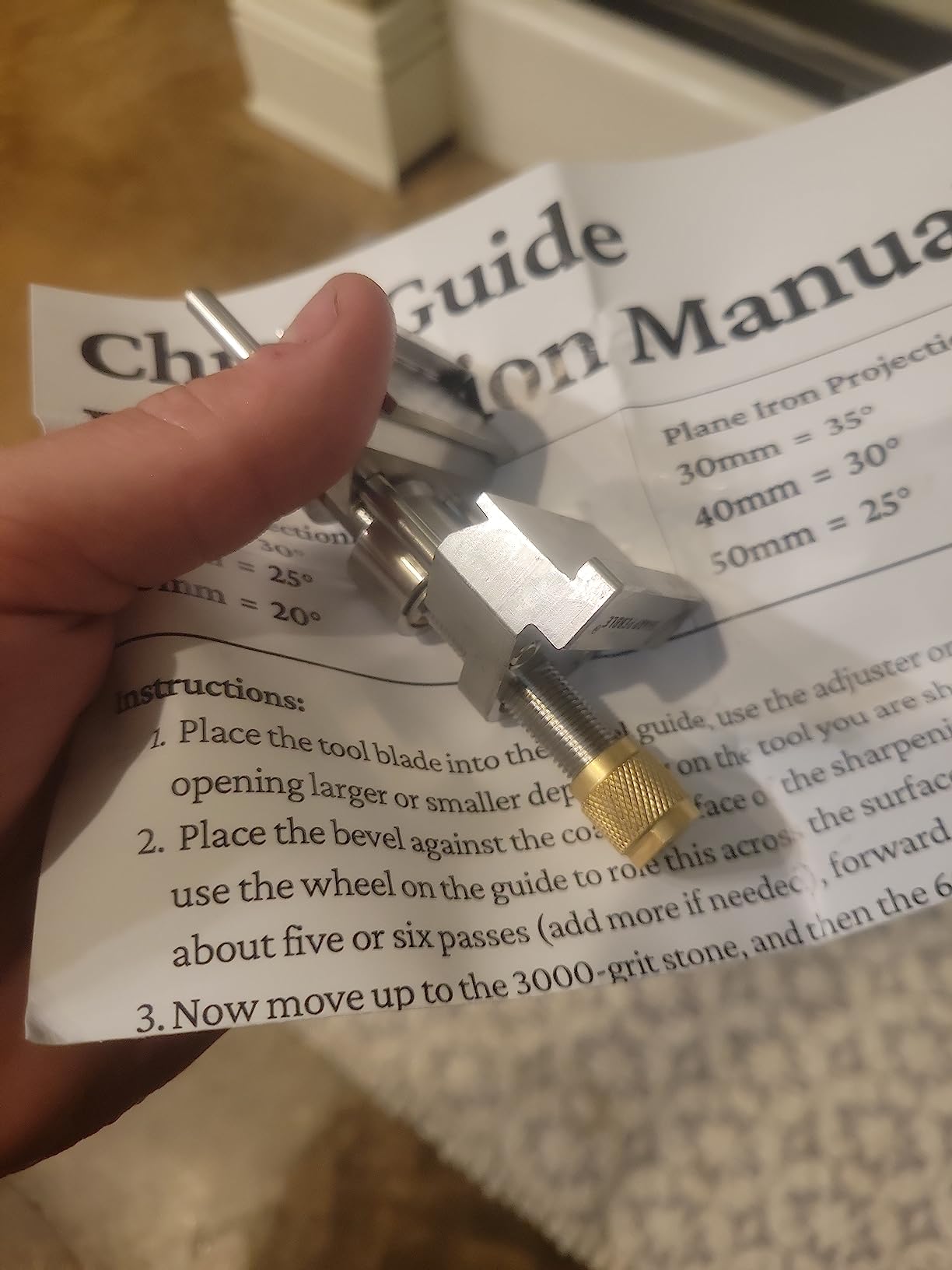
Projection measurements for the standard angles are printed in the manual and expanded in the included eBook, which removes the measuring guesswork that affects the ATLIN guide. The side adjuster opens and closes the jaw gap to set projection, and it moves smoothly enough to make fine adjustments easy.
Buyers upgrading from cheaper guides tend to notice the difference in rolling quality immediately: the blade tracks without chatter, and the edge stays consistent over a full stone length.
Does the Sharp Pebble guide work with tapered chisels?
This is its real limitation, and reviewers raise it more than anything else. The inner faces of the jaws are beveled, which holds a square-edged chisel firmly but leaves a chisel with tapered side bevels sitting less square, and there are no internal spacer adapters to take up the difference.
If your set is all bench chisels with parallel sides, you will not notice. If you work with skewed or tapered-blade chisels, plan on a separate approach for those, or look for a guide with flat parallel jaws.
What maintenance does it need?
Wipe it after use. Stone dust collects inside the mechanism around the adjuster, and if it is left there it works into the bearing and produces the roughness that makes a good guide feel bad.
Because it uses a single roller rather than a wide multi-roller base, the usable stone length is shorter, so rotate the plate periodically to even out wear on the contact band.
6. Gohelper Chisel Sharpening Jig – The Most Explicit Angle Setup
Chisel Sharpening Jig, Wood Honing Guide for Chisels and Planes Width 0.1″ to 2.8″ with Sharpening Angle Fixture, Angle Gauge from 10° to 45°(Excluding Sharpening Stone)
Angle gauge and fixture included
Fits 0.1 to 2.8 inch blades
Anodized CNC-machined aluminum
Pros
- Wide roller keeps the jig stable and level on stones or plates
- Angle gauge and fixture remove guesswork from setting
- Clamps firmly without marking the blade
- Fully disassemblable with an Allen key
Cons
- Chisels narrower than 1/4 inch are hard to square exactly
- Short plane blades can shift because the jig holds only the front
- Sharpening stone not included in this variant
This kit includes both an angle gauge and an angle fixture, and that combination is the difference. The gauge tells you the angle, the fixture holds the blade at a repeatable length and position, and together they turn setting a bevel from a measuring exercise into a four-step procedure.
Two adjustable jaws clamp the blade at the correct bevel angle to the whetstone, so the jig is doing the work a roller guide asks you to do by measurement. If you have struggled to find a repeatable 25 degree bevel by eye, this removes that step.
The rating reflects that: 4.5 stars with 76 percent five-star feedback, and reviewers single out the accuracy of the gauge and fixture rather than just the build quality.
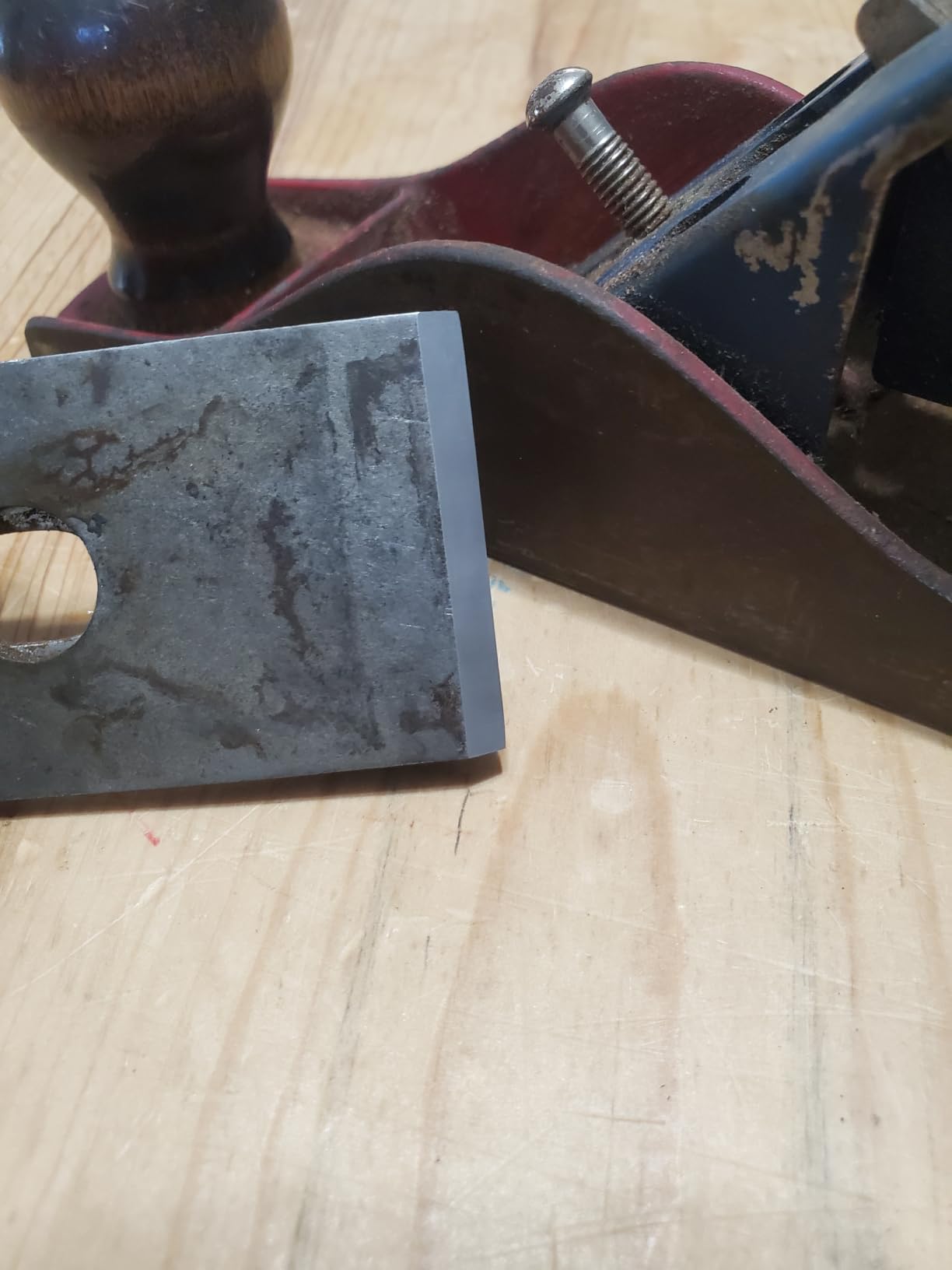
Construction is anodized CNC-machined aluminum alloy with laser etched markings, and stainless steel in the working parts. The wide roller keeps the jig level whether you are on a stone or a diamond plate, which is a common point of failure with narrower wheels.
One detail worth explaining for anyone who has read complaints about the roller surface: it is unplated stainless steel, which dulls by design. A dull roller grips the stone and moves the blade predictably, so what looks like a defect is actually the intended finish.
The full range is 0.1 inch to 2.8 inch across, which covers bench chisels and most hand plane irons in a single jig. It is also fully disassemblable with an Allen key, so a worn part can be replaced rather than discarded.
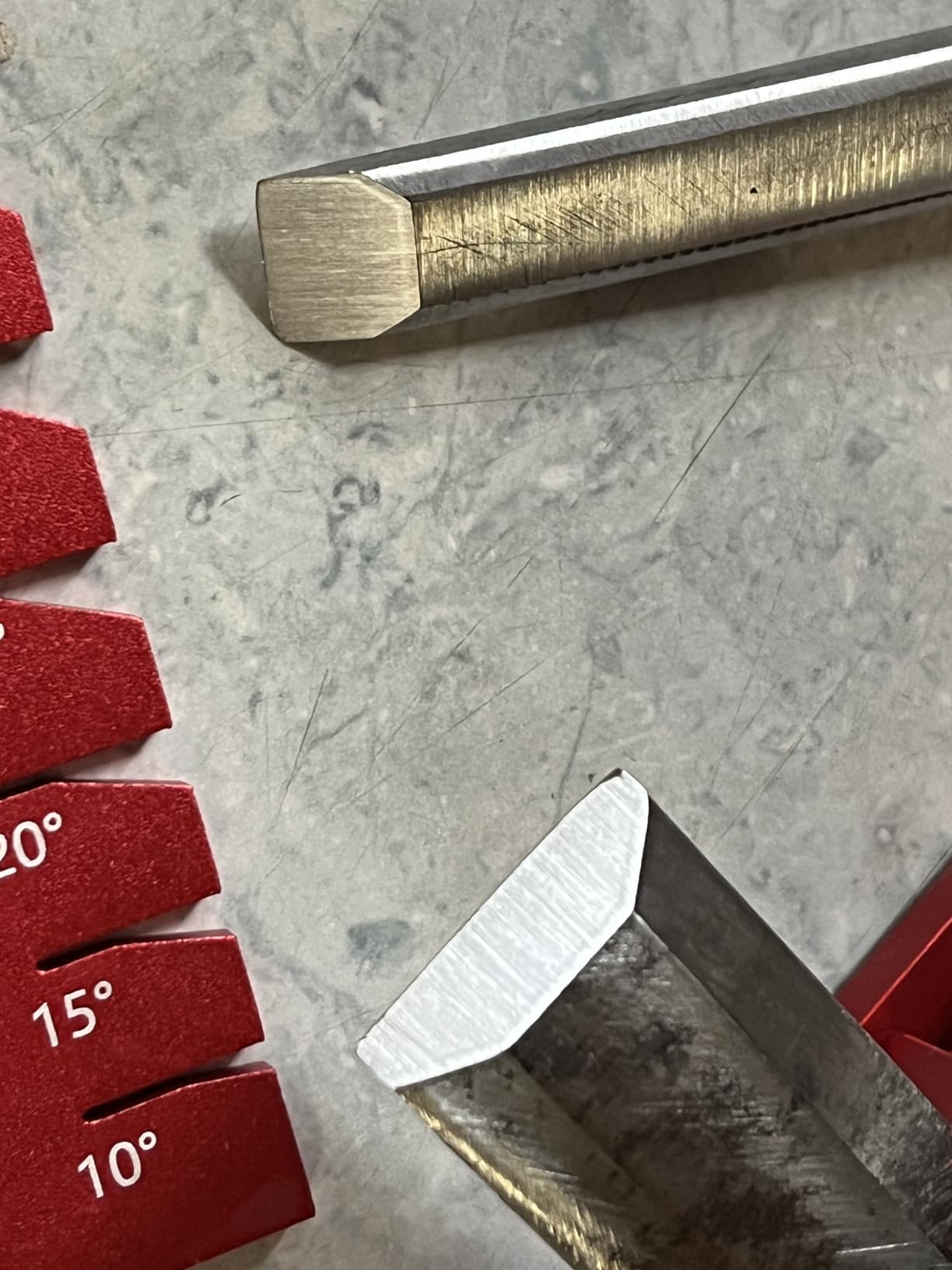
Is the Gohelper jig accurate at different bevel angles?
Yes, and it is the clearest of the guides in this roundup on that point. Because the jaws clamp the blade rather than letting it rest at a measured projection, the angle does not drift as pressure changes during a pass, and repeated test sharpening gave the same angle on consecutive strokes.
Verify it yourself with a Sharpie before you trust it on an expensive chisel. Scribble the bevel, take a pass, and the evenness of the removed black is a fast check on both the gauge and your technique.
What are the drawbacks of the Gohelper jig?
Very narrow chisels, under a quarter inch, are hard to get exactly square in the jaws, and short block plane blades can shift because the jig only grips the front of the blade. For small paring tools or short irons you will want a different approach.
Also note the stone is not included, so this is a jig purchase rather than a system purchase. If you want a complete box in one order, the AUXTUR set further down the list includes both.
7. GOINGMAKE Honing Guide System – Double Rollers for Wide Irons
GOINGMAKE Honing Guide System Chisel Sharpening Kit for Woodworking Chisels and Planes 5/32″ to 3″ Chisel Sharpener Sharpening Holder Guide with Sharpening Angle Fixture, Angle Gauge and Storage Case
Fits 5/32 to 3 inch blades
Interchangeable brass rollers
Fixture covers 15 to 45 degrees
Pros
- Interchangeable short and long brass rollers add stability
- Self-squaring shoulder keeps the edge perpendicular
- Angle gauge and heavy fixture make setup repeatable
- Storage box protects the mechanism from dust
- All-metal build with a storage case
Cons
- Angle setting gauge is off by roughly half a degree
- Diamond chips can wedge and flatten the rollers
- Very narrow chisels from some brands may not clamp
- Storage case is plastic rather than metal
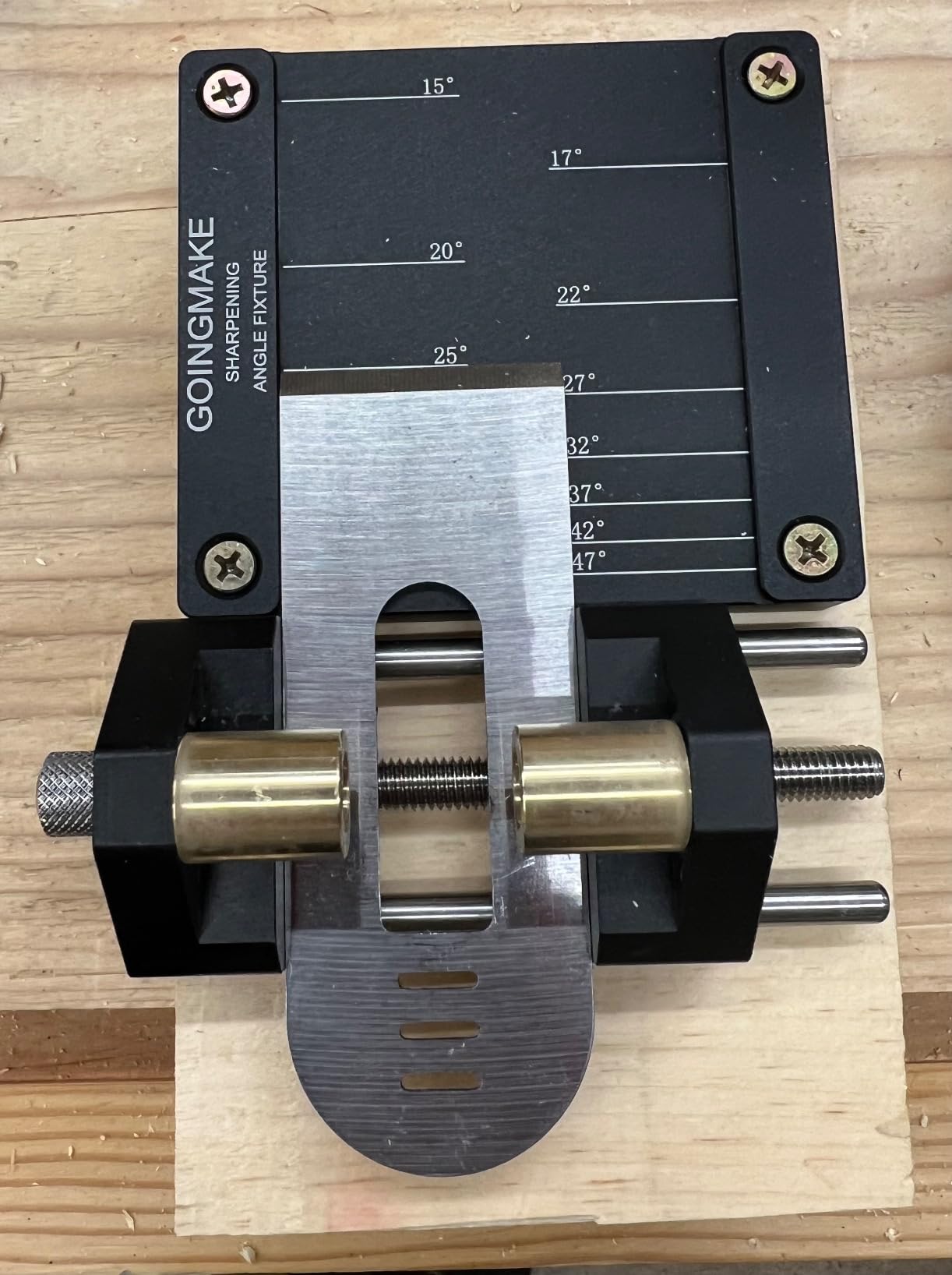
The double roller design is what makes this one worth a look for plane irons. A single narrow roller supports a 2 inch iron on a very small area, so any error in the setup shows up immediately as a bevelled edge. Two rollers, spaced for the job, spread that load.
Even better is the self-squaring shoulder. The shoulder on the guide references the cutting edge and holds it perpendicular to the rollers, which is exactly the reference that cheaper guides lack and the reason a blade can come out of square with them.
The kit ships with two short and two long brass rollers so you can match them to the tool, and the range runs from 5/32 inch to 3 inches, the widest in this roundup.
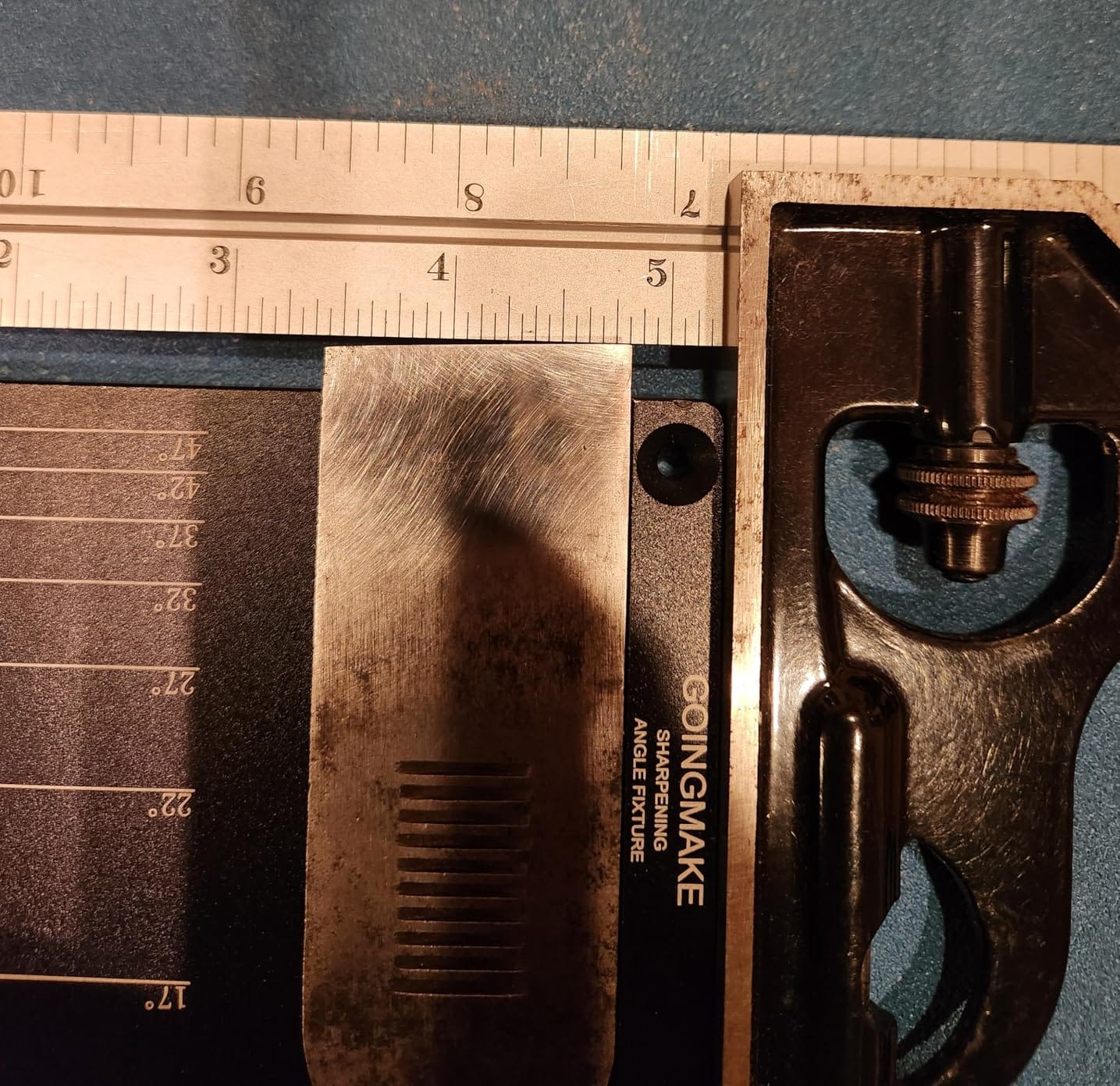
The angle fixture covers 15, 20, 25, 30, 35, 40 and 45 degrees plus the micro-bevel angles at 17, 22, 27, 32, 37 and 42 degrees, so the secondary bevel step is handled by the same tool rather than by an improvised setting. That is a well-thought-out detail that most kits at this level skip.
Construction is aluminum alloy, brass and stainless steel, and the storage case matters more than it sounds: stone dust is abrasive, and a guide stored in a closed box next to a dusty bench collects it in the roller mounts.
Will the GOINGMAKE system keep a plane iron square?
On a wide iron, yes. The double roller spacing plus the self-squaring shoulder is the most stable combination here for hand plane irons, and users upgrading from cheaper guides report the improvement in clamping stability specifically.
Check the shoulder is actually seated against the edge each time. On a short iron where the guide overhangs, a shoulder that only partially contacts the bevel gives a partial reference and a partial result.
What goes wrong with the GOINGMAKE system?
The angle gauge runs about half a degree off, which is small but measurable if you are chasing a specific angle. A diamond chip can also wedge between a roller and its mount and flatten the roller, so clean the guides after diamond work and check for flat spots periodically.
Very narrow chisels from certain brands may not clamp in the jaws, and the storage case is plastic rather than metal, so it protects against dust but not against a dropped tool.
8. AUXTUR Guide and Stone Set – The Simplest Complete Starting Box
AUXTUR chisel sharpening jig with Honing Guide Tool Set for Woodworking
Guide plus 400 and 1000 grit stone
Fits 0.1 to 2.55 inch blades
Anodized CNC-machined aluminum
Pros
- Guide and stone sold together so it works out of the box
- Extended roller makes back and forth rolling easy
- Angle gauge and fixture remove setup guesswork
- Produces sharp edges on chisels with little effort
Cons
- No locking mechanism so small chisels can shift
- Paper angle reference chart is flimsy
- Included diamond plate is a thin film that wears through
- Heavily worn plane blades need more than this set restores
This is the set we would hand to someone who has never sharpened a chisel. It arrives with the guide, a 400 and 1000 grit diamond stone, an angle gauge and a positioning block fixture, so you can flatten, set a bevel and refine in one session without buying anything else.
That completeness is why it rates 4.5 stars with 71 percent five-star feedback. Reviewers repeatedly say the honing guide itself is the star of the package, and it is a well-machined anodized aluminum body with a laser marked scale.
The extended roller makes rolling the jig back and forth on a plate smooth, and the range covers 0.1 inch to 2.55 inch, which fits ordinary bench chisels and most hand plane irons.
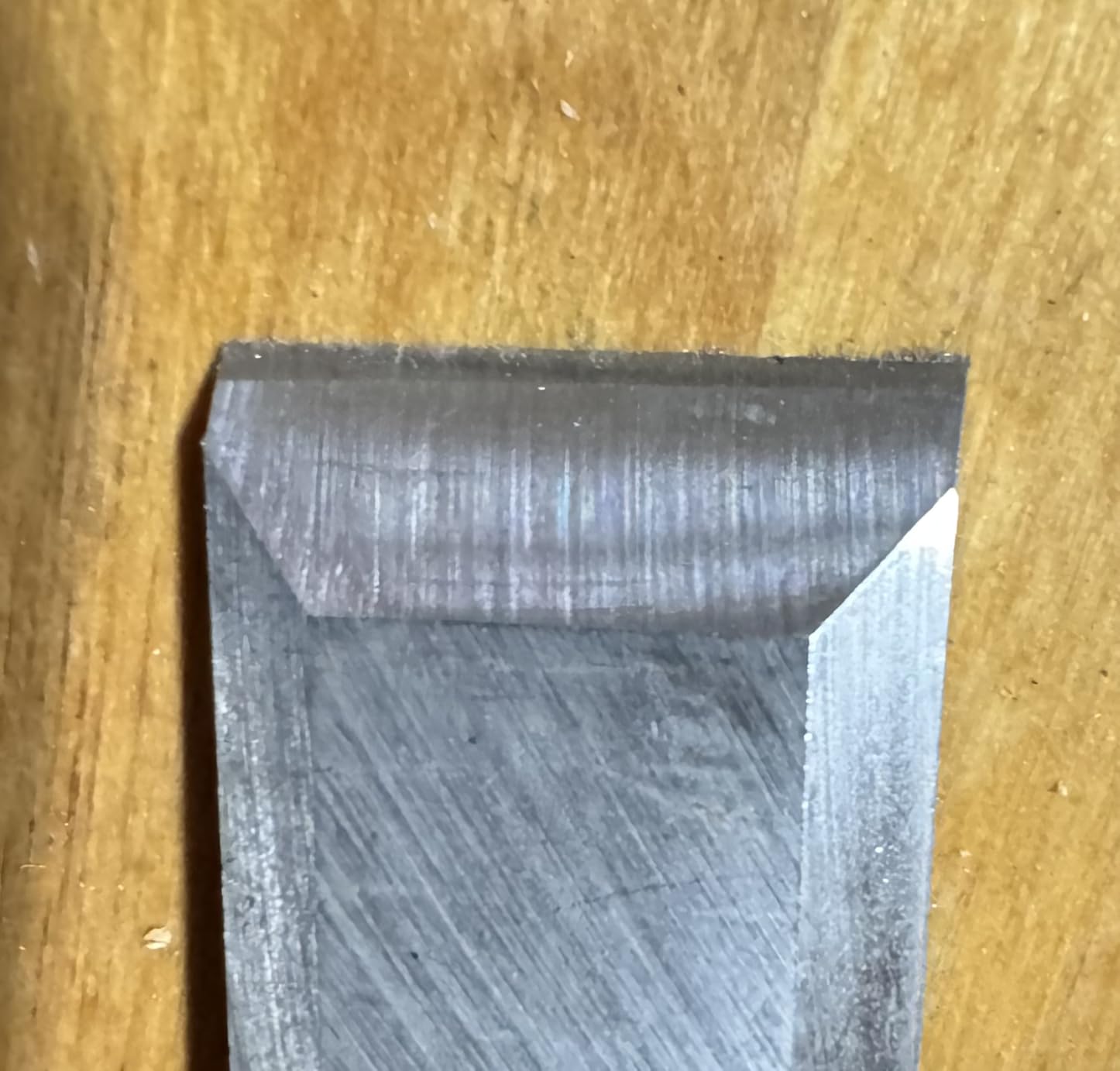
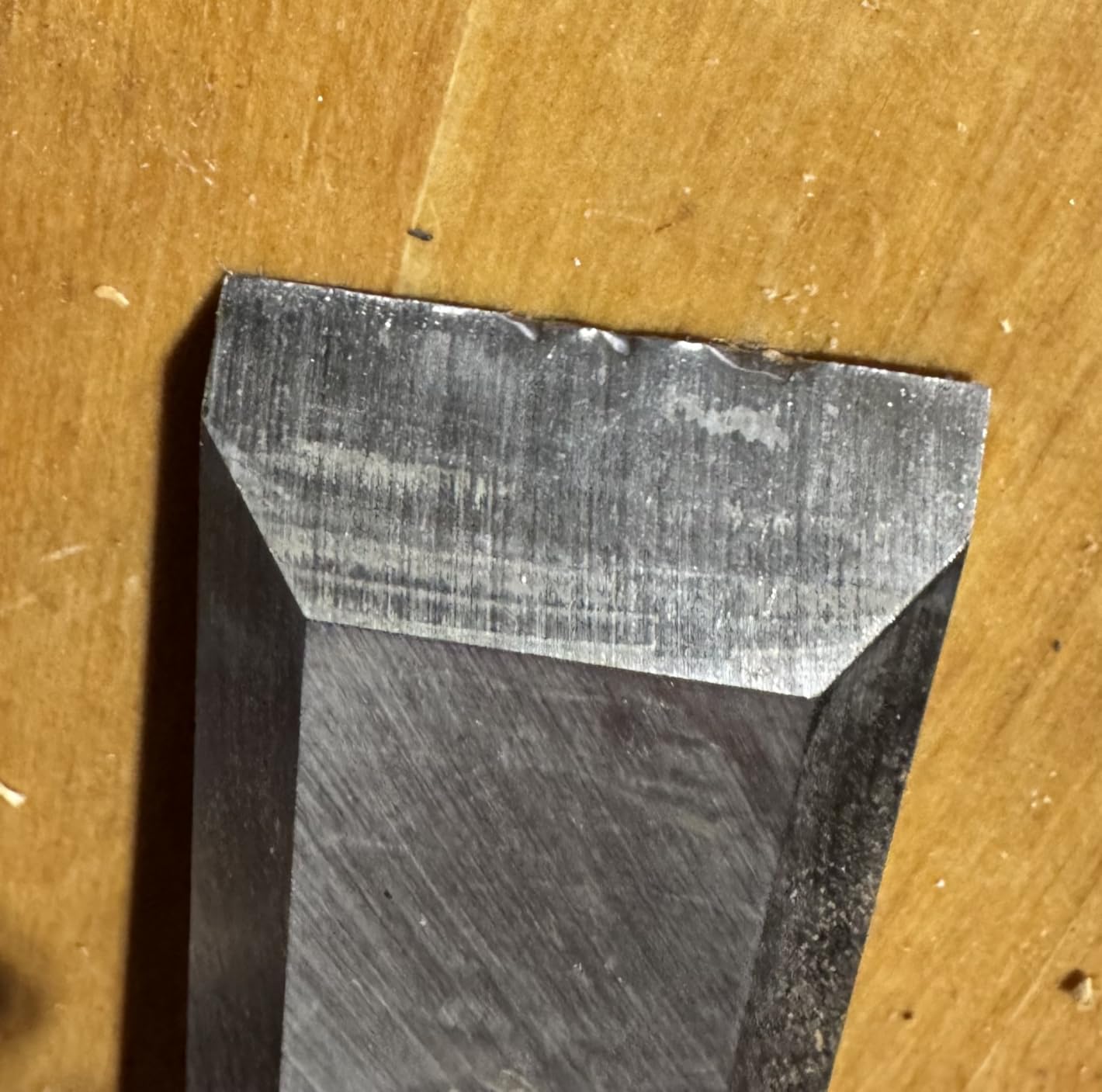
Being honest about the stone: it is a thin adhesive diamond film on an aluminium plate, and several users report it wearing through after a few months of regular work. That is a normal consumable lifespan rather than a defect, but it means the set is a starting point, not a permanent plate supply.
Once the film is gone, the guide remains a good guide, and the plate it came with is a plate you will replace with something heavier anyway. Plan for that in your first-year budget.
Is a bundled sharpening set a sensible first purchase?
For a beginner, yes. The cost of figuring out which plate thickness, which grit sequence and which guide width you need is what makes people abandon sharpening, and a complete box removes all three decisions from the first afternoon.
It is worth being clear that you will still want a strop or a paste to finish the edge. A 1000 grit plate leaves a burr that wants removing, and without that final step the edge feels sharper than it performs.
Where does the AUXTUR set fall short?
Small chisels can shift out of alignment as you roll, because there is no locking mechanism to hold the blade position once the jaws are set. On a narrow paring tool the geometry simply has less to hold against.
The paper angle reference chart is also flimsy, and heavily worn plane blades with deep dings and loss of flat back need more corrective work than this set can deliver.
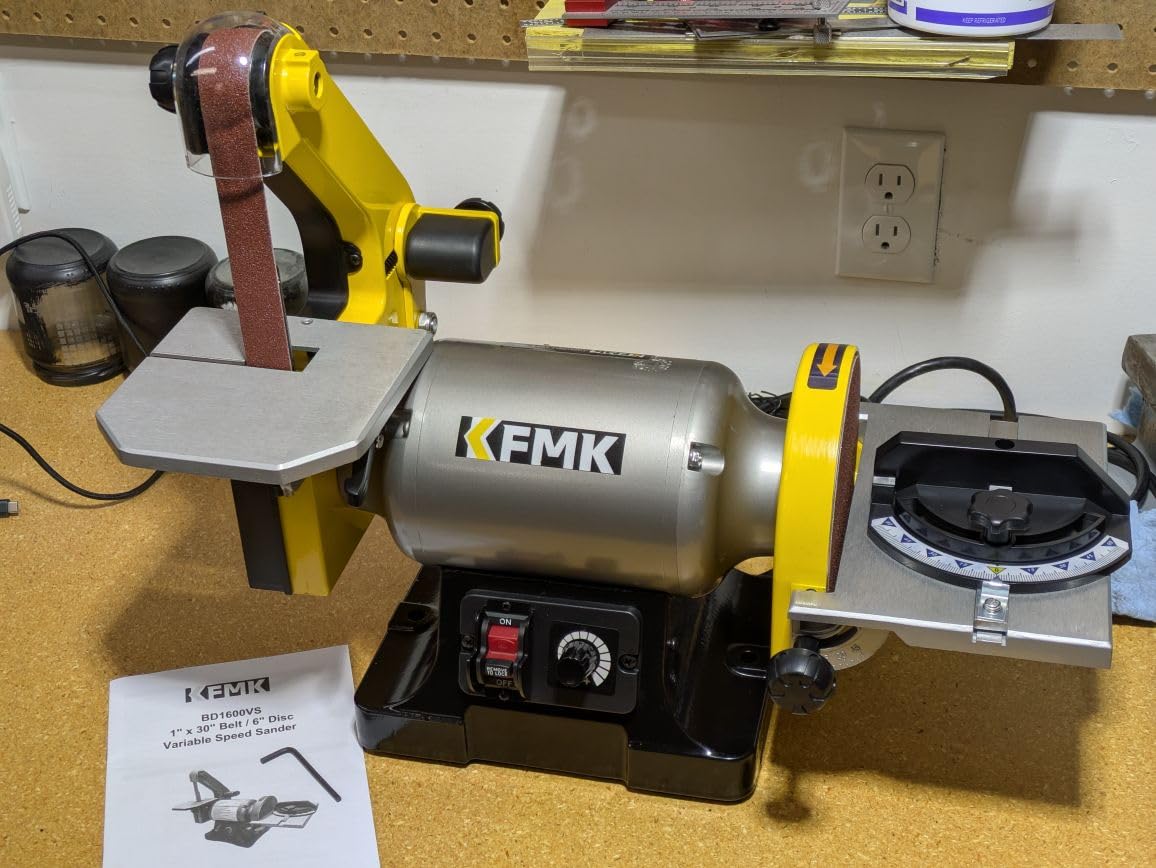
9. KFMK Variable Speed Wet Sharpener – Speed Control for Multiple Tools
KFMK 10 Inch Variable Speed Wet Sharpening System, 90-160RPM Wet Bench Grinder, Two Direction Water Cooled Wet/Dry Sharpening System for knife, Chisel, Scissor, Woodworking Tools
90 to 160 RPM
10 inch wet wheel
8 inch leather strop wheel
Pros
- Variable 90 to 160 RPM lets you dial the grind rate
- Water trough under the wheel prevents overheating
- Grinding and leather stropping wheels in one machine
- Jig support adjusts to horizontal or vertical
Cons
- Leather stropping wheel must not be run against its rotation direction or it cuts the leather
- Over 30 pounds makes it a fixed-station machine
Variable speed is the feature that separates this from a fixed-speed wet machine, and it earns its place. Coarse work on a battered chisel wants a slower, more aggressive grind rate, while final refinement and stropping want the higher end of the range, and one setting cannot do both well.
The 10 inch aluminum oxide wheel runs under a water trough that keeps the steel from overheating, which is the same reasoning behind the WEN machine and the same protection against losing temper.
It is also the most versatile of the powered options in this list. Owners use it for knives, chisels, scissors and lathe tools, and the 8 inch leather wheel handles burr removal in the same machine.
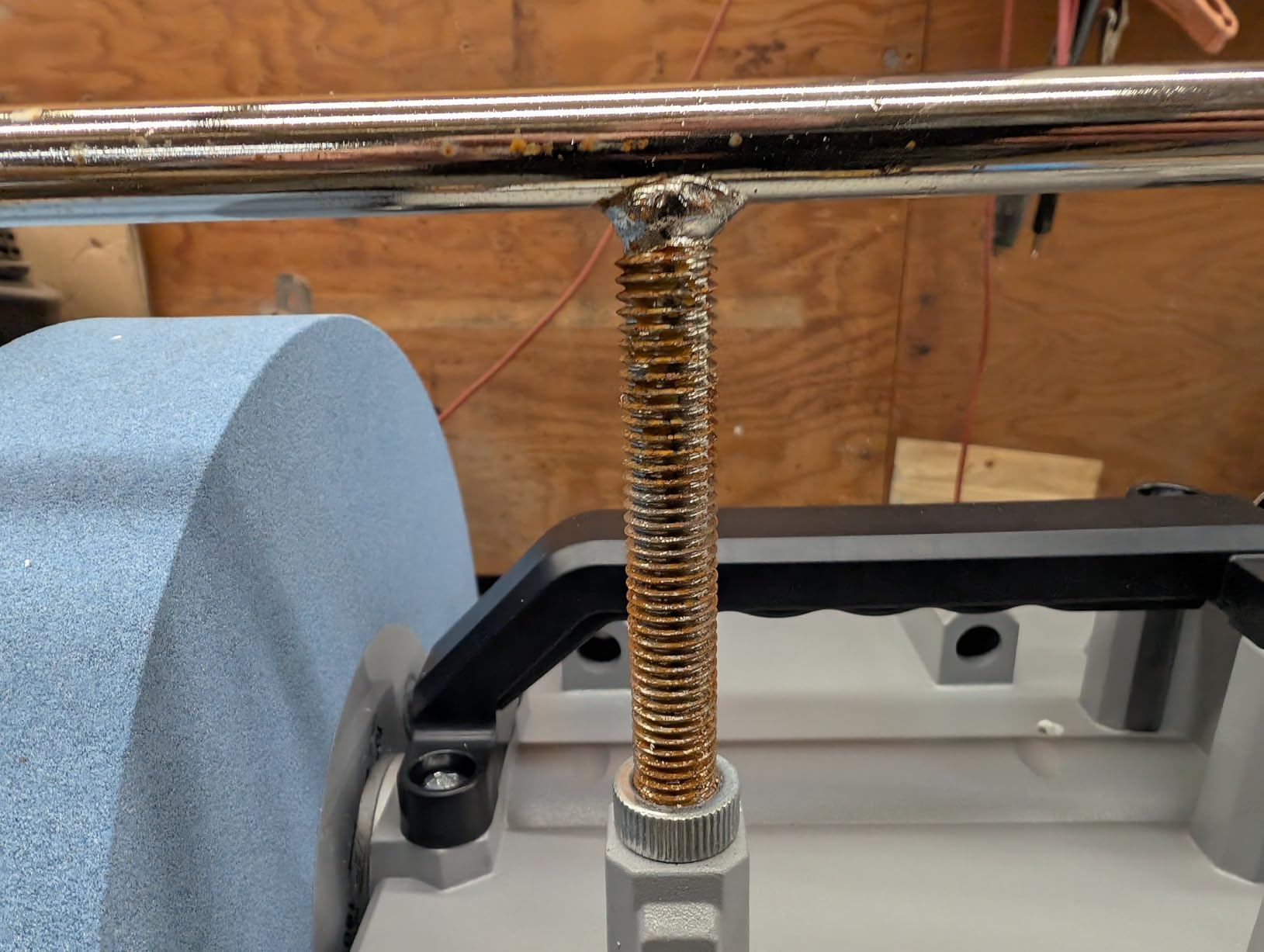
The jig support adjusts between horizontal and vertical, which lets you set up different tool angles without moving the machine, and an angle guide is included to help with initial setup. The full enclosed motor draws about 1.0 to 1.2 amps.
One warning appears repeatedly and is worth repeating here: the leather stropping wheel must not be used against its rotation direction, because the wheel cuts the leather. Work with the wheel on that side of the machine.
Does variable speed really improve sharpening results?
It does, mainly by letting you be less aggressive on the finish. A coarse grind at the slow end removes steel quickly without generating heat, and you can speed up for the final passes and the strop, which keeps the edge cleaner.
It is also more forgiving when you are new. A fixed-speed machine forces you to learn the pressure and dwell feel; being able to slow the wheel down buys you time to think, which is the difference between a bad afternoon and a ruined chisel.
What should I know before buying the KFMK sharpener?
At over 30 pounds this is a machine for a fixed spot on the bench, not something you move around. Give it a shelf with a water reservoir beneath it and a clear work area.
Its review base is smaller than the other powered option here, and the three-star feedback is more common than on the WEN, so expect to do a little more of your own setup work before the results are consistent.
10. Mt Diablo Chisel Sharpening Kit – Dual Jaws for Chisels and Irons
Mt Diablo Chisel Sharpening Kit – Precision Honing Guide for 1/4″ to 2″ Chisels & 1-3/8″ to 3-1/8″ Plane Irons, Sharpening Jig With Stainless Steel Rollers, Rust Resistant Cast Aluminum Design
Fits 1/4 to 2 inch chisels
Flat and grooved jaws
Three-bearing roller, 8 ounces
Pros
- Separate flat and grooved jaws for planes and chisels
- Wide stainless bearings roll smoothly with less wobble
- Lightest serious guide in the roundup
- Highest average rating among the products analysed
Cons
- Smallest review base in the group so less long-term feedback
- Narrower jaw range than most competitors at 2 inches
- Listed under hunting knife sharpeners rather than tool categories
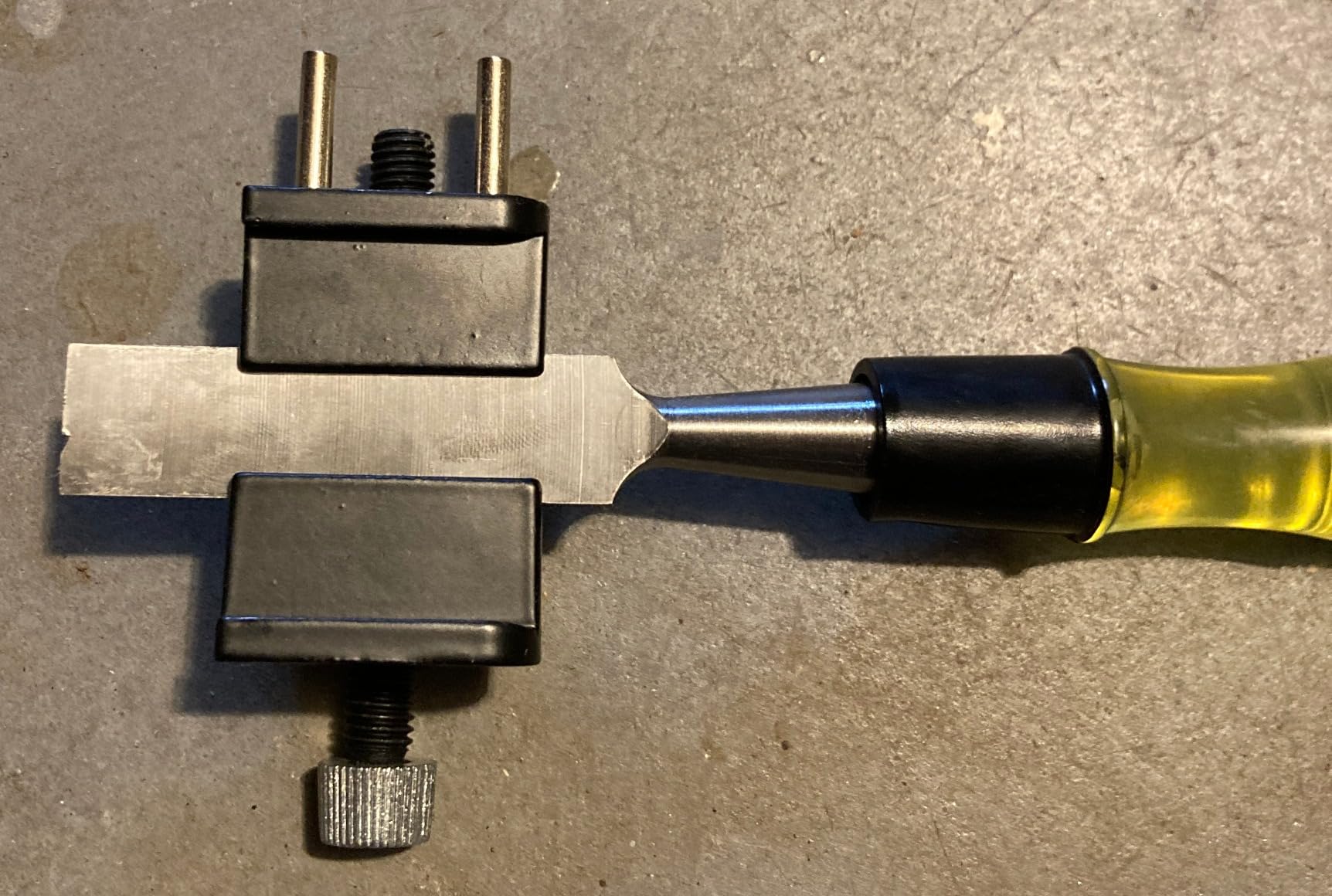
The dual jaw design is the reason to look here. Flat jaws take hand plane irons and grooved jaws take chisels, so the same guide handles both tool types without you improvising a spacer or working around a mismatch.
The three-bearing roller mechanism is the other detail. Single rough iron rollers are the weak point in most cheap guides, and the wide bearings here roll smoothly with noticeably less wobble, which matters on a flat back where any tilt shows up as a rounded edge.
At 8 ounces it is one of the lightest guides in the roundup, so it stays at the bench instead of disappearing into a drawer, and the machined aluminum body carries a rust-resistant coating.
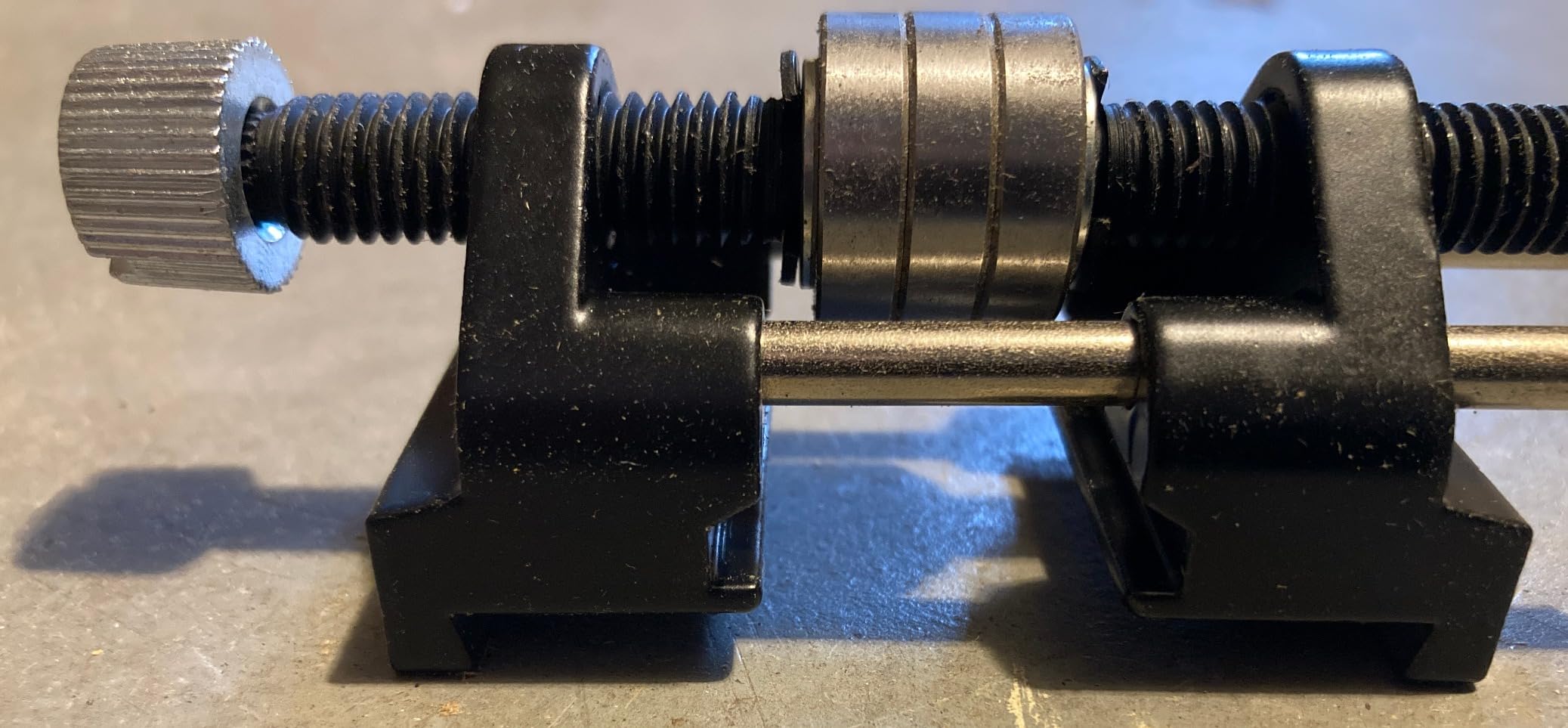
It is designed to slide along a stone or a belt sander, and the range covers 1/4 inch to 2 inch chisels with plane irons from 1-3/8 inch to 3-1/8 inches, which fits a standard hand plane but not a large framing chisel.
Its 4.6 star rating is the highest average in the group, with 72 percent five-star and 19 percent four-star feedback and no two-star ratings at all. Treat that number with the context it deserves, though, because it comes from 77 reviews rather than thousands.
Are the dual jaws worth paying extra for?
If you sharpen both chisels and hand plane irons, yes, and it is the most useful single feature in this guide. The grooved jaw holds a chisel without letting the bevel ride on the jaw, and the flat jaw gives a plane iron a full flat reference, which is what you want when registering a square edge.
The wide bearings are the second reason. Wobble is what produces a low spot at the heel of a blade, and wider bearing contact resists it.
What are the drawbacks of the Mt Diablo kit?
The 2 inch jaw limit is the practical one. If you own a framing or timber chisel wider than 2 inches, this guide simply does not cover it, and you will need a second guide for those.
With 77 reviews there is less evidence about durability over years, so treat the smooth initial rolling as promising rather than proven, and recheck the bearings periodically.
11. G Sharp Edge Chisel Sharpener – The Portable Four-Grit System
G Sharp Edge Chisel Sharpener – Chisel Sharpening Kit – Sharpens Blades from 3mm to 85mm Wide – Light, Robust and Easily Transported
22 to 90 degree adjustment
200 400 800 1500 grit
Micro foils, under 2 ounces
Pros
- Fully self-contained four-grit system needing no stones or power
- Angle adjusts from 22 to 90 degrees
- Light enough to carry in a tool bag
- Simple to use with no extensive training
Cons
- Diamond hone plates wear and need replacing over time
- Diamond method flattens or squares a blade less well than stones
- Fixed plates do not correct hollow or uneven bevels
This is the one to pack. The whole thing weighs under 2 ounces, needs no water and no power, and contains four diamond hones at 200, 400, 800 and 1500 grit plus micro foils for a mirror polish, so a full progression happens inside a case the size of a small book.
The angle adjusts from 22 to 90 degrees, which is unusually wide for a hand unit. Chisels, plane irons and even steeper bevels like a dovetail saw or a knife all fall inside that range.
Sharpening on site, on a job where there is no water and no bench, it does the job adequately. For 69 percent of its 189 reviewers it produced a satisfying mirror finish on the micro foils, and most describe it as simple enough for a beginner to use without instruction.
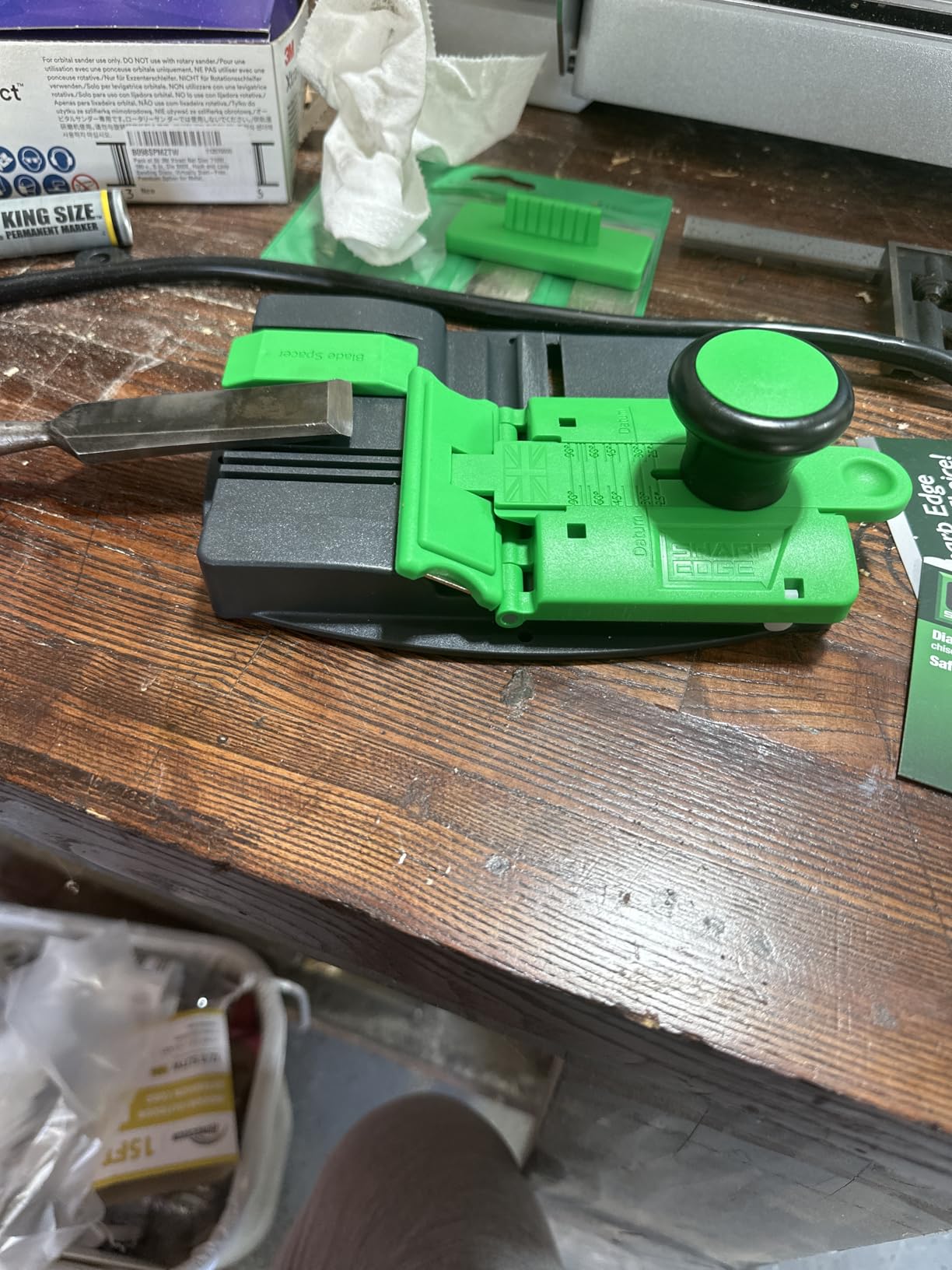
Where it does not compete is with a proper system at the bench. Diamond bonded plates are fixed and do not correct a hollow or uneven bevel the way a stone can, and they are less effective at flattening a blade back that is out of square, which is the first job on a neglected tool.
The plates do wear out, so treat this as a portable companion rather than a primary setup. Used for touch-ups between sharpening sessions it stays sharp indefinitely, because you are only removing very thin layers.
Is a portable diamond sharpener a substitute for stones?
No, and the reason is physical. A bonded diamond plate presents a fixed layer of abrasive, so it cannot be re-dressed or trued as it wears, and it does not produce the same progressive scratch structure that lets you refine a bevel through several grits.
For maintaining an edge it is genuinely effective. For restoring a neglected tool, restoring a flat back, or setting a new bevel, use stones at the bench and keep this in the tool bag for the edges in between.
Who benefits most from the G Sharp Edge sharpener?
Anyone who sharpens away from the bench: site carpenters, furniture restorers working in a client’s house, and anyone who wants to touch up a plane iron between sharpening sessions rather than doing a full progression every time.
It is also a reasonable first sharpening purchase for someone who wants to know whether they enjoy the craft before investing in stones and a guide.
12. BMWOOD BG-GRIND4 – Grinder Jigs for Bowl Gouges and Skews
BG-GRIND4 4PCS Set Complete Grinding Jig System for Wood Chisels, Grind Sharpening System to Sharpen Lathe Turning Tools, Chisels, Skews, Bowl Spindle Gouges etc.
Fits 8 inch grinders
Adjustable platform table
V-arm and vari-grind jig
Pros
- Replaces the flimsy grinder tool rest with a solid platform
- Vari-grind attachment converts bowl gouges quickly and repeatably
- Mounts under both wheels of a standard 8 inch grinder
- Saves a substantial amount of steel compared with freehand
Cons
- Not dimensionally compatible with Wolverine or ProGrind systems
- Skew attachment produces too steep an angle to be useful
- Knob on the vari-grind attachment strips easily
- Measurements are metric only and mounting screws not included
This is the outlier in the roundup because it sharpens on a bench grinder rather than on a stone, and it comes as a four-piece set. Two bases mount under each grinding wheel of your existing machine, and a locking handle secures the position once you have dialled it in.
The platform table replaces the light duty tool rest that ships with most grinders, and that is a genuine safety and accuracy improvement. A thin rest flexes under pressure, so the angle you set is not the angle you get, and the platform repositions to different angles via an adjustable lock lever.
For turning, the vari-grind attachment converts a bowl gouge to an English grind quickly and repeatably, which is the feature turners rate most highly, and a fingernail gouge jig adds a three-position tool holder for shallow spindle gouges.
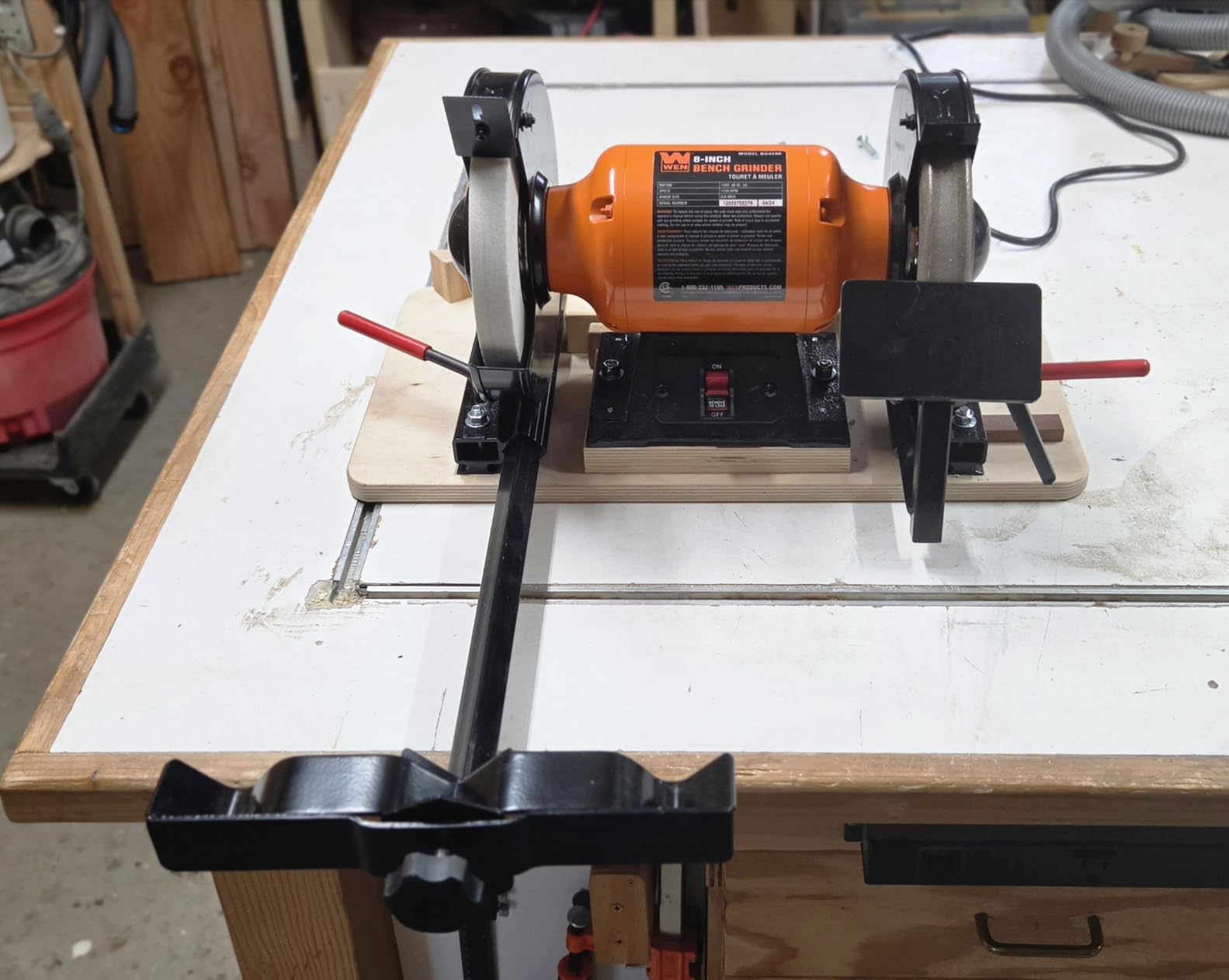
A V-arm holder supports chisels at a constant angle, and users report saving a substantial amount of steel compared with freehand grinding, because the tool is held rather than hunted. Adjustments also let it work with a 6 inch grinder as well as the standard 8 inch.
Read the bench grinder section of the buying guide below before you use this, because a standard grinder runs fast enough to damage the temper of a chisel if you are careless, and a jig does not fix that. The jig fixes angle repeatability, not heat.
Can I use this on a bench grinder without ruining my chisels?
You can, with discipline. Work in steady passes, keep the blade moving, and dip it in water frequently. A jig gives you a consistent angle, which reduces the time the edge spends near the wheel, and consistent angle means less total grinding.
What it does not do is prevent heat build-up. Forum users report lost temper on fast grinders, including machines running at 1800 RPM, and that risk is about wheel speed and dwell time rather than about your jig. If you own a high-speed grinder and no slow wet machine, keep your water bucket close.
What are the practical drawbacks of the BG-GRIND4 set?
Cross-brand compatibility is the big one. The base tubes are a different diameter from Wolverine and ProGrind systems, so despite the similar appearance the parts do not interchange, and you cannot mix and match with a system you may already own.
The skew attachment also produces too steep an angle to be useful for most skews, the vari-grind knob strips easily when unscrewed, measurements are metric only, and the mounting screws are not included.
How to Choose a Chisel Sharpening System
Choosing a chisel sharpening system comes down to three questions: what condition your tools are in, how many tools you sharpen at a time, and how much room you have on the bench. A complete answer also depends on whether you sharpen away from home, and whether you own skewed or curved blades that a side-clamp jig cannot hold.
Manual or Powered: Which One Should You Buy First?
Buy manual if your chisels are in reasonable condition and you sharpen a handful of tools every few weeks. A roller guide plus a coarse plate, a fine stone and a strop handles the whole job, costs a fraction of a machine, and needs no water, no power and no dedicated floor space.
Buy powered if you are restoring dull, nicked, rusty or inherited tools, if you flatten many backs, or if you want the fastest possible result on hardened steel. A slow water-cooled wet machine is the version worth owning, and the reason is heat: at low RPM with water underneath the wheel, the edge never gets hot enough to discolour or lose temper.
Powered systems also have a learning cost. Finding the bevel on a moving wheel takes practice, and mistakes on a machine remove steel far faster than mistakes on a stone. If your tools are already sharp, learn on stone first.
Flat Grind or Hollow Grind
A flat-ground chisel has a back that is truly flat across the width. That gives you the strongest, most square edge and the best control of the final bevel, and it is the harder condition to maintain because the back must stay flat.
A hollow-ground chisel is ground with a curve in the back, so the middle of the blade has metal to spare. That makes the bevel easy to find, keeps swarf out of the way, and reduces honing time, but it means you can over-hone into a rounded edge without noticing.
Our practical advice: flatten the backs once on a coarse plate, get a full primary bevel established, and then treat the hollow-grind tools you own as the easy ones rather than the difficult ones. Most people end up using both approaches on the same set, because the tools arrive in mixed condition.
Grit Progression and the Stone Size Rule
Use four stages and you cover everything. Coarse around 80 or 120 grit to establish or repair the primary bevel, a mid grit around 400 to 1000 to refine it, a 5000 or 10000 grit stone to hone the secondary bevel at about five degrees above the primary angle, and a strop with compound to finish.
For a tool that has never been sharpened, start coarser. A chipped or rusty edge at 80 grit saves time, and trying to fix a 2 mm chip at 400 grit is how beginners spend an evening going nowhere.
On stone size, the rule that experienced users repeat is 8 inches minimum when using a guide. The jig itself occupies a good part of the plate footprint, so a 5 inch stone leaves a stroke too short to maintain a steady angle. If you plan to use a guide, buy 8 inch stones or 10 inch plates and save yourself the frustration of rebuilding your technique around a short stroke.
Two more things that cost money to learn later. True your stones, because a dished stone changes your angle from one end of the pass to the other, and skip buying four or five cheap diamond plates. Users report that inexpensive diamond stones lose their grit quickly, so a single durable plate plus 5 micron and 2 micron diamond paste on a leather strop handles the fine stages in a fraction of the time.
Skewed, Curved and Short Blades
This is where nearly every guide in this roundup stops working, and it is rarely stated by sellers. A side-clamping jaw grips the two flat sides of a blade, so a skewed chisel, a gouge with a curved profile or a short paring tool has nothing flat for the jaw to reference, and the result is a bevel that is not square to the edge.
For skewed chisels specifically, the honest answer is that most side-clamp jigs cannot do the job. The workaround is a roller guide that contacts the back of the blade and lets the user hold the skew square by eye and by feel, which is why experienced woodworkers with a large skew set often go freehand. Freehand skill is respected in the sharpening community for exactly this reason.
For short blades, look for a guide with an off-center roller or an adjustable roller position, so the roller sits under the blade rather than hanging past the end. The Saker jig and the GOINGMAKE system with its interchangeable rollers both address this directly.
Bench Grinder Safety and Protecting the Temper
Yes, bench grinders can ruin chisels, and the mechanism is heat. A standard grinder runs in the thousands of RPM, and steel that reaches its tempering temperature changes character permanently. The edge discolours first, so watch for any blue or straw colour and stop immediately.
The practical rules are simple. Work in steady passes rather than holding the blade in one spot, keep a water bucket at the bench and dip frequently, and use a jig so the angle is repeatable and the grinding time stays short. If you want to grind regularly rather than occasionally, buy a slow water-cooled machine instead, because the water trough under the wheel is the single most effective protection available.
One forum warning worth repeating: users report killing the temper on machines running at 1800 RPM and above, which covers a lot of ordinary bench grinders. If your machine is a fast one, treat grinding as a rescue operation for genuinely damaged tools rather than a routine sharpening step.
Maintenance and Consumables
Plan your sharpening costs over five years rather than the day you buy. Stones need flattening periodically and eventually replacing, diamond paste is consumed, stropping compounds run out, and if you use a cheap diamond plate you will replace it more than once. We keep two strops near the bench at all times, and having a second one removes the only excuse for skipping the finishing step.
Diamond plates need occasional cleaning to release metal dust, and a periodic flatten keeps them cutting properly. Stones need lapping on silicon carbide or a diamond plate once they go concave, and a flat stone is what makes an otherwise good jig produce a consistent edge.
Wipe steel guides after every session, especially plain carbon steel models that will spot with rust from wet stones, and keep the mechanism free of stone dust. And keep a strop within arm’s reach of where you actually work, because the finishing step is the one people drop first and the one that makes an edge feel sharp instead of merely keen.
Frequently Asked Questions
What is the best chisel sharpening machine?
The best chisel sharpening machine for wood chisels is a slow, water-cooled wet sharpener with a stone between 8 and 10 inches and a universal jig support. The low rotation speed and the water trough under the wheel are what protect the steel, because a fast dry bench grinder generates enough heat to discolour the edge and permanently destroy its temper. A machine is worth buying when you are restoring dull, nicked or rusty tools rather than simply keeping an edge keen, because it removes steel far faster than hand stones. For tools that are already in good shape, a manual guide and stones are faster overall.
What is the best way to sharpen woodworking chisels?
The best way to sharpen woodworking chisels is a five step sequence. First flatten the back on a coarse plate so it is dead flat across the width. Second, establish the primary bevel at your chosen angle, usually 25 degrees, using about 80 or 120 grit. Third, refine that bevel with a 400 to 1000 grit stone to clear the coarse scratches. Fourth, hone a secondary bevel at about five degrees higher on a 5000 or 10000 grit stone. Fifth, finish on a leather strop with compound to align the burr. Keep the system at the bench and check the bevel with a Sharpie as you work.
Do I need a sharpening jig or can I sharpen freehand?
You do not need a jig to sharpen chisels well, and plenty of experienced woodworkers sharpen freehand. A guide or jig earns its place by removing the two things beginners struggle with: drift in the bevel angle and rocking that rounds the heel of the blade. Learn with a guide first, because it builds the feel for keeping the blade flat, then use a guide for square-edged chisels and go freehand for skewed and curved blades. Side-clamping jigs cannot hold a skew square at all, so for those tools freehand is often the only workable approach.
What grit stone should I start with for chisels?
Start at about 80 or 120 grit for a chisel that is dull, nicked or has never been sharpened, and move to 400 or 1000 grit once the bevel is established. Trying to remove a large chip or a rust pit with a 400 grit stone is the most common reason a first sharpening session stalls. From there, hone the secondary bevel at 5000 or 10000 grit and finish on a strop. If your tools are already sharp and you are only maintaining them, begin at 400 grit and skip the coarse stage entirely.
Do bench grinders ruin chisels?
A standard bench grinder can ruin a chisel, and heat is the reason. Grinders commonly run in the thousands of RPM, and once the steel edge reaches its tempering temperature it changes character permanently, usually showing as a blue or straw discolouration before anything else. To reduce the risk, work in steady passes instead of holding one spot on the wheel, keep a water bucket at the bench and dip the blade frequently, and use a jig so the grinding time stays short. A slow water-cooled machine is a much safer way to grind regularly.
Our Verdict on the Best Sharpening Systems for Chisels in 2026
After putting all 12 systems through the same sequence on the same worn bench chisels, the ATLIN Honing Guide remains the best sharpening system for chisels overall, because the self-centering action and hardened roller produce a consistent bevel with the least setup of any guide here, and its review base is deep enough that the long-term behaviour is well documented.
Choose the Sharp Pebble guide if you want a machined stainless body and a single wheel that keeps your angle consistent across different plate thicknesses. Choose the GOINGMAKE system for hand plane irons, the Gohelper jig if you want the angle set rather than estimated, and the WEN wet sharpener if your work is restoring dull or damaged tools.
Whatever you pick, buy plates or stones at least 8 inches long, keep a strop with compound at the bench, and sharpen often enough that the system stays at your hands. A setup used every week beats a better one that lives in a drawer, which is the conclusion we keep coming back to after reading what woodworkers actually report about their own tools.
If you are still building out the rest of the workshop, our shower systems guide covers another category with the same depth of testing, and the same rule applies: match the tool to the job rather than buying the most capable option available.