
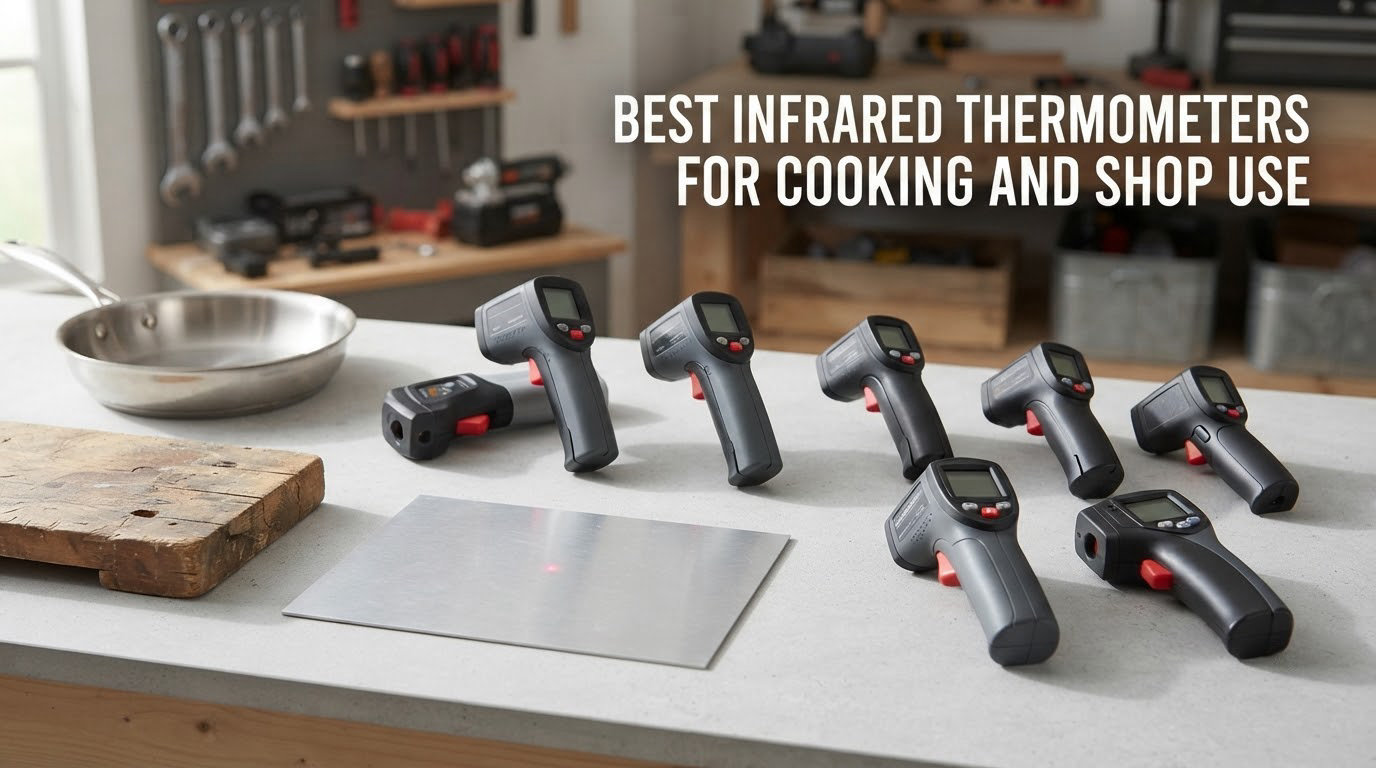
The best infrared thermometer for cooking is the one that holds a repeatable reading on a matte surface at the distance you actually work at. After comparing ten of the most-reviewed non-contact temperature guns on the market, the Etekcity Lasergrip 774 is the safest all-round buy for griddles, ovens and vents, the Fluke 62 MAX is the most reliable for workshop and HVAC diagnostics, and the TempPro TempScan TP30 is the one to get if you want adjustable emissivity without a big jump in cost.
That is the short answer. The longer truth is that an infrared thermometer is the only cooking thermometer that can tell you how hot a griddle plate, a pizza stone or a breaker panel actually is, without touching it and without waiting. That is why the tool has become a permanent fixture on restaurant pass-throughs and in home workshops alike.
This roundup covers both halves of the question: what works in the kitchen and what works in the shop. Every pick below was judged on temperature range, distance-to-spot ratio, emissivity control, accuracy, response time, display quality and build, then weighted by how many owners have actually lived with the tool. All of them read surface temperature only, none of them are designed to measure food internally, and every one of them is a non-medical device.
If you also want to outfit a garage or workshop properly, our shop vacuum roundup and quiet shop vacuum picks for workshops cover the cleanup side of the same space. The infrared thermometer is the diagnostic side.
Table of Contents
How We Picked These Thermometers?
We narrowed the field to ten guns with meaningful owner feedback, then compared the published specifications side by side: measurement range, optical resolution, emissivity settings, stated accuracy, response time, power source and physical build.
Where two products look identical on paper, we leaned on what owners report in practice. Repeatability matters more than a headline accuracy figure, because an IR gun that drifts between sessions is useless for judging a preheat or spotting a failing bearing.
Every unit in this roundup is a surface thermometer. If you need internal doneness for a steak, that is a probe job, and we cover the split in the how-it-works section below.
Top 3 Picks for Best Infrared Thermometers in 2026


The Etekcity wins on evidence rather than on paper. More than 51,000 ratings at 4.6 stars is a much larger sample than anything else here, and owners repeatedly cite the same three things: it answers the trigger in half a second, the backlit screen stays readable in a smoky kitchen, and the 12:1 ratio lets you check a hot grate from a safe arm’s length.
The Fluke 62 MAX is the pick when the answer has to be defensible. Owners running HVAC diagnostics, motor checks and panel inspections say its readings agree with other calibrated instruments, which is the one thing they cannot say about the cheaper guns.
The TempPro TP30 is the value pick because adjustable emissivity is the single feature that fixes the most common complaint in this category, and this gun has it at a step above the bare-bones models. More on all three in the individual reviews.
Best Infrared Thermometers at a Glance (October 2026)
| Product | Specifications | Action |
|---|---|---|
| Etekcity Lasergrip 774 |
|
Check Latest Price |
| TempPro TempScan TP30 |
|
Check Latest Price |
 Soonkoda GM50 Soonkoda GM50 |
|
Check Latest Price |
 Klein Tools IR1 Klein Tools IR1 |
|
Check Latest Price |
 KNINE OUTDOORS TG-2024-OG KNINE OUTDOORS TG-2024-OG |
|
Check Latest Price |
| Fluke 62 MAX |
|
Check Latest Price |
 DEASOMIYE JD-04 DEASOMIYE JD-04 |
|
Check Latest Price |
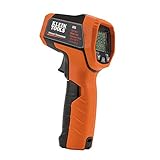 Klein Tools IR5 Klein Tools IR5 |
|
Check Latest Price |
 Temirup IR02C-OR Temirup IR02C-OR |
|
Check Latest Price |
 TempPro TempScan PLUS TP420 TempPro TempScan PLUS TP420 |
|
Check Latest Price |
How Infrared Thermometers Work
An infrared thermometer does not touch anything. It reads the infrared heat radiation that every warm surface radiates, focuses it through a lens onto a thermopile sensor, and converts that energy into a temperature number on the display. The whole process happens in roughly half a second, which is why these tools work on a forge, a flat-top griddle or a live electrical panel without any warning.
Emissivity is the setting that decides whether that number is right. Every material radiates infrared energy at a different rate, and the gun has to be told what it is looking at. Most cheap guns ship with a fixed 0.95 setting, which is correct for most matte and rough surfaces: bread, seared meat, cast iron seasoning, painted metal, wood and unglazed ceramic tile.
Shiny surfaces are where things go wrong. Polished stainless steel, bare aluminum, chrome, foil and black gloss finish all behave like mirrors at the infrared end of the spectrum, so the gun picks up reflected radiation from the room instead of the true temperature of the metal. On those surfaces an adjustable-emissivity model will get close if you dial it to roughly 0.1 to 0.3, or you mask the target with matte tape or a strip of painter’s tape and read the tape.
Distance-to-spot ratio, written as D:S, tells you how narrow the cone of measurement is. A 12:1 gun measured from 12 inches from the target averages a spot roughly 1 inch across. From 24 inches it averages about 2 inches. The Fluke 62 MAX at 10:1 needs 10 inches for a 1-inch spot, and the DEASOMIYE JD-04 at 50:1 covers the same ground from 50 inches, which is why it is the one to reach for when you want to read a furnace mouth or a kiln from across the shop.
Accuracy is advertised as a percentage of reading, commonly plus or minus 1.5 percent or plus or minus 1.5 degrees, and that figure assumes you are pointing at a matte surface, at the right distance, with a clean lens. Hold the gun too far back and you average the pan, the air above it and the counter behind it. Read through a window, through smoke, or through rising steam and the result is simply a room temperature number with a decimal on it.
IR and probe thermometers answer different questions. A probe goes into the food and tells you what is happening at the center of a steak. An infrared gun reads only the top surface, from a distance, in half a second. For checking a griddle zone, a pizza stone, a pan handle, a vent or a motor bearing, nothing else is faster. For doneness, a probe is the only honest answer, and no infrared thermometer can substitute for one at a cook or on a grill.
1. Etekcity Lasergrip 774 – The Most Proven All-Round IR Gun
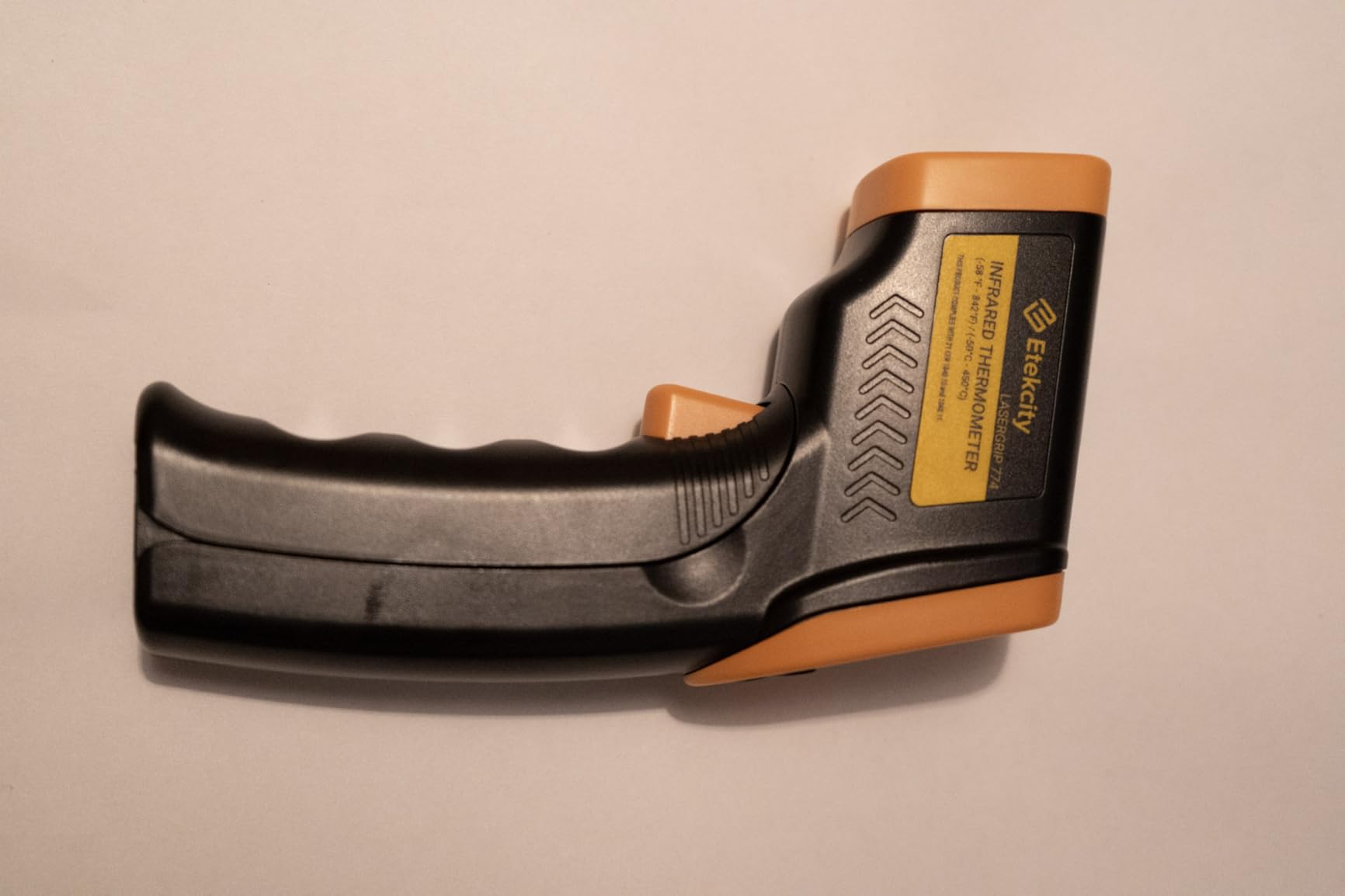
Etekcity Infrared Thermometer Laser Temperature Gun 774
-58F to 842F range
12:1 distance-to-spot
0.5 second response
4 ounce body
Pros
- Half second trigger-to-reading response
- Readable backlit LCD with max temperature mode
- 12:1 ratio keeps you back from a hot grate
- Only 4 ounces for long scanning sessions
- Two year warranty
Cons
- Fixed emissivity so shiny metal reads wrong
- Surface only so small targets get averaged with background
I keep an Etekcity in the drawer by the grill and it is the one I hand to friends first. The Lasergrip 774 answers in about half a second from the moment the trigger moves, which sounds like a small detail until you are checking six griddle zones while flipping burgers.
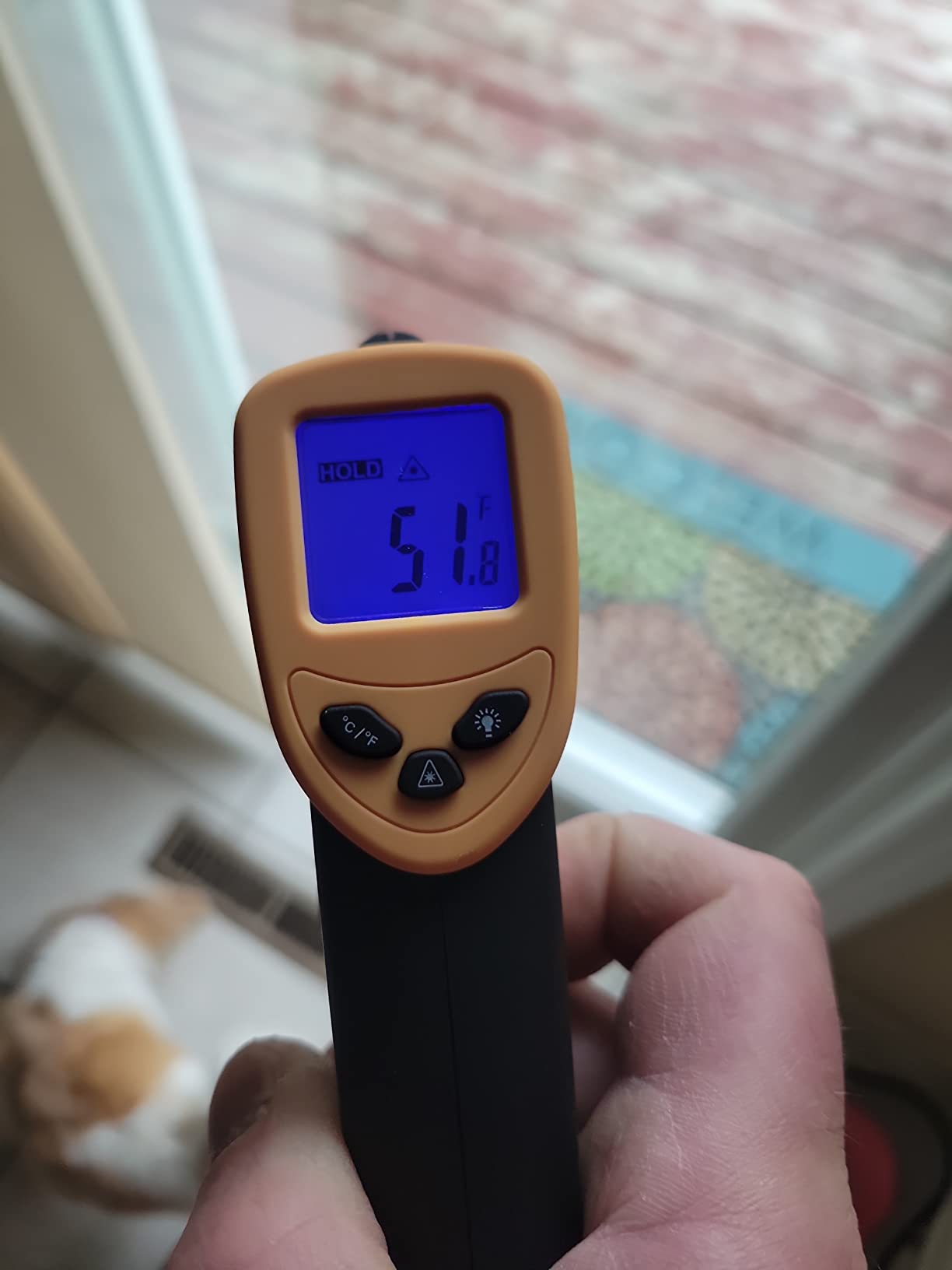
The screen is the reason it survives real kitchens. It is a large backlit LCD, and the max temperature mode holds the highest reading of a scan so you can find a hot corner on a flat-top without guessing where to look.
The 12:1 optical ratio is the practical reason to like it. Held at about 14 inches, as the manufacturer suggests, the spot covers roughly an inch and a bit, which is small enough to isolate one burner on a Blackstone and large enough to be forgiving on a pizza stone. The stated range runs from -58F to 842F, so a freezer check and a screaming-hot griddle both fall inside it.
At 4 ounces, it is the lightest gun in this roundup, and that matters more than it sounds on a long cook when you are also holding a spatula. It ships with two AAA batteries and a two year warranty.
The one real limitation is fixed emissivity. On a polished griddle plate or bare stainless you will need tape or matte paint as a target. The other limitation is universal: it reads surfaces, so a probe is still the right tool for a thick roast.
Who the Etekcity Lasergrip 774 works for
This is the gun for someone who cooks most days on a griddle, grill or flat-top and does not need anything beyond a surface reading. It is also a perfectly serviceable first tool for a garage, since the range and the backlight cover oven thermostats, hot pipes, radiator output and engine covers.
Owners with the largest review base in this category use it for exactly that mix: cooking surfaces, automotive checks and HVAC work, with the same unit moved between the kitchen and the shop.
Who should skip the Etekcity Lasergrip 774
Skip it if your surfaces are predominantly polished or reflective and you refuse to mask them with tape. If you need documentation-grade agreement with a calibrated instrument, or if you are regularly working with stainless, this gun will disappoint you and cost you time.
Also skip it for internal temperature. Nobody sells an infrared gun that does that job, and any listing that implies otherwise is misleading you.
2. TempPro TempScan TP30 – Best Value With Adjustable Emissivity
TempPro TempScan Infrared Thermometer Gun for Pizza Oven Griddle HVAC
Emissivity 0.1 to 1.0
-58F to 1022F range
12:1 ratio
Under 500ms response
Pros
- Adjustable emissivity fixes readings on stainless and cast iron
- MAX MIN AVG display finds hot spots fast
- Bright orange backlit screen with large numbers
- Range covers freezers through pizza stone temps
- Users confirm agreement with probe thermometers
Cons
- MAX MIN AVG readout cannot be switched off
- Tight battery compartment
- Readings drift if you change your working distance
The single most common complaint about cheap infrared thermometers is that they read wrong on metal. The TempPro TempScan TP30 fixes that with an emissivity dial from 0.10 to 1.00, and for cooks who work on cast iron and stainless it is the feature that makes the difference between a number you trust and a number you ignore.
It covers -58F to 1022F, which spans a frozen food check and a hot pizza stone in the same device. Response is under 500 milliseconds, and the resolution is listed at 0.1 degrees Fahrenheit, so small changes on a cast iron zone are visible rather than rounded away.
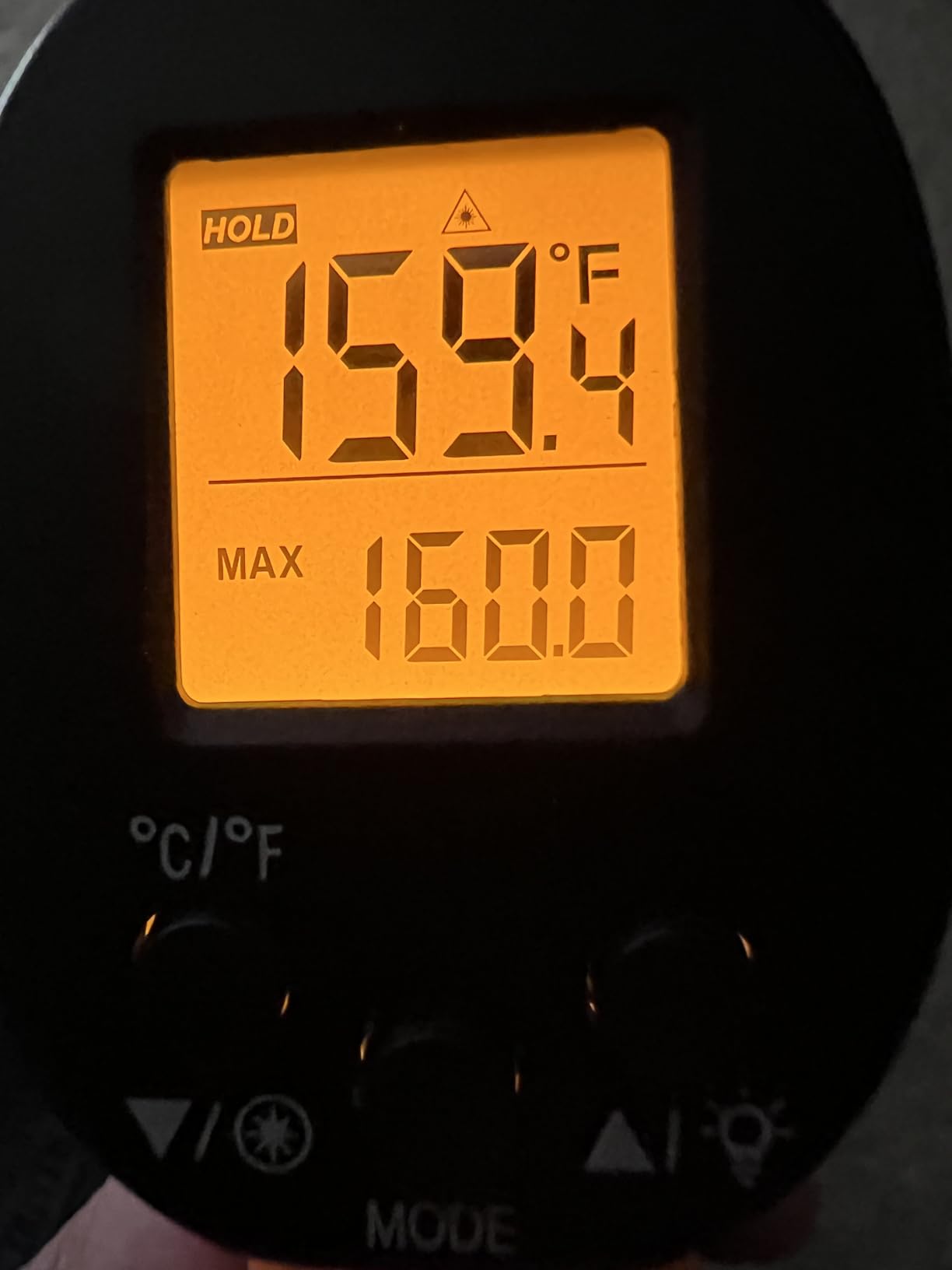
The MAX, MIN and average readout is what I like most for griddle work. Sweep the plate once, pull the trigger, and the display holds the hottest point of the sweep, which tells you whether you have a dead zone without having to re-aim five times.
Owners report readings that match probe thermometers in frying oil and on cast iron once the emissivity setting is right. Several also use it for engine blocks and HVAC vents, where the same dial does the same job.
Two small annoyances. The statistics readout cannot be turned off, so there are two sets of numbers on screen and you have to read past one of them. And the battery compartment is tight enough that some owners find it fiddly with cold fingers.
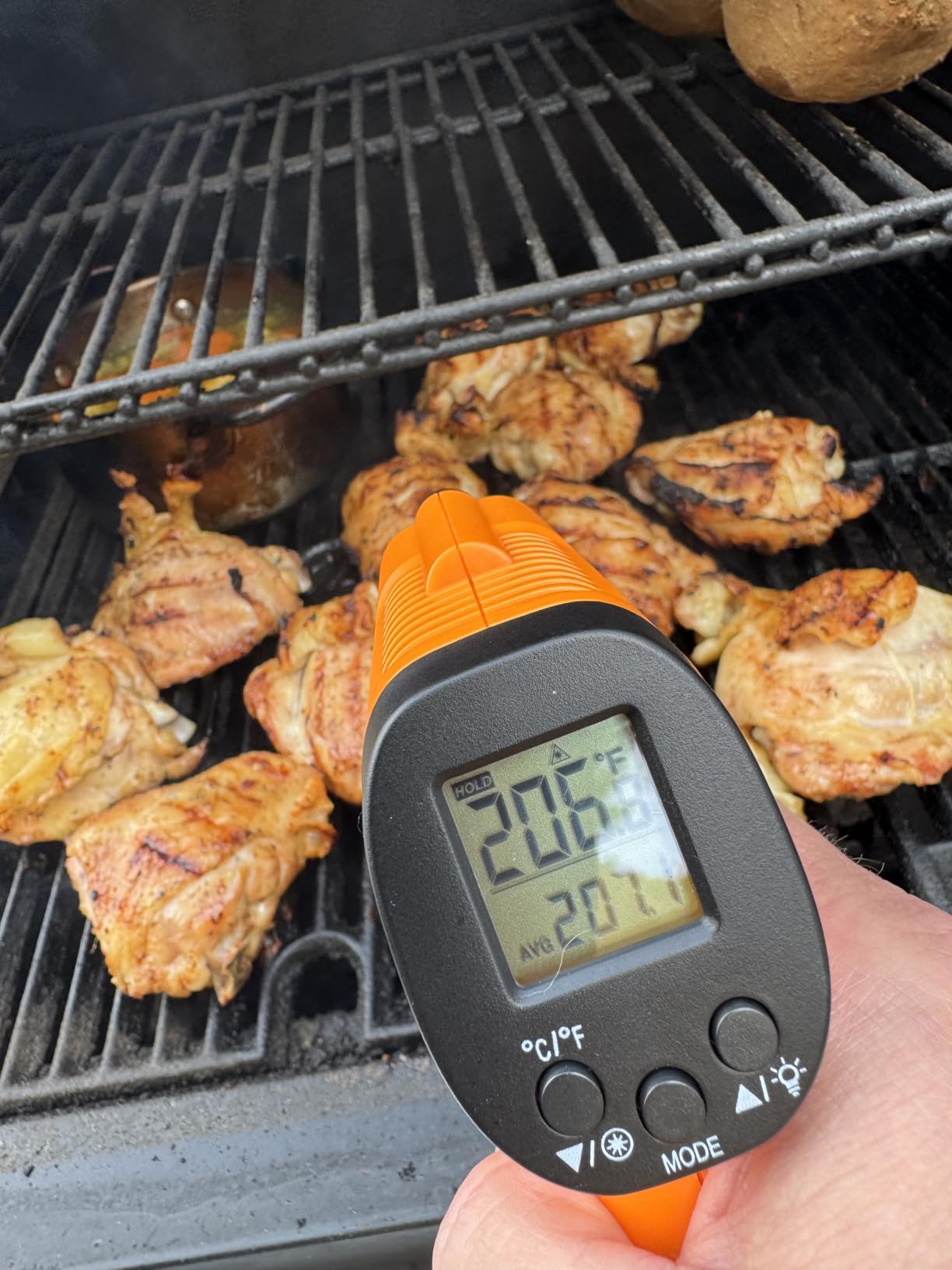
Why the TempPro TP30 beats cheaper fixed-emissivity guns
Everything the bare-bones models do, this does too, plus the dial that lets you measure the surfaces those models get wrong. If your cooking involves cast iron, polished stainless cookware or a stainless griddle top, the extra step of setting emissivity is the whole reason to spend more.
It is also a legitimate shop tool. The 1022F ceiling covers most engines, exhaust manifolds, electrical panels and duct work, and the bright orange backlight stays readable in a dark basement or a garage.
Where the TempPro TP30 falls short
The 12:1 ratio is modest, so on a large griddle you must stand close, and on a small cast iron skillet the spot can end up wider than the pan. That is physics rather than a defect, but it is a real limitation for fine zone work.
If you need alarms, or min and max and average together, or you want to stare down a furnace from across a room, this is not the gun. Go up an option or across to a 50:1 model.
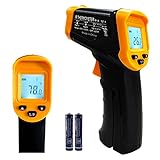
3. Soonkoda GM50 – A No-Frills Gun for Grills, BBQ and Pizza Ovens
Digital Infrared Thermometer gun for cooking,BBQ,Pizza oven,Ir Thermometer with Backlight,-58℉~932℉(-50℃~500℃) Handheld Non Contact Heat Laser Temperature Gun (Not for Human)
-58F to 932F range
Fixed 0.95 emissivity
5.83 inch body
2 AAA powered
Pros
- Covers freezer checks through pizza oven stone temps
- Backlit LCD works at night
- Trigger data hold keeps the reading on screen
- Compact body with 0.1 degree display resolution
- Light and simple to learn
Cons
- Emissivity fixed at 0.95 so shiny metal is unreliable
- No MAX MIN AVG and no second laser
- Needs tape or matte paint on reflective targets
The Soonkoda GM50 is the entry point in this roundup and it does one thing well: it reads matte surfaces quickly and cheaply. Grills, BBQ grates, oven walls, pizza stone, cardboard boxes, duct vents and refrigerator coils are all within reach of a -58F to 932F range.
Data hold is the feature owners mention most. Pull the trigger and it scans, release and it holds the number on screen, which lets you pull the gun away from the heat and still read the value. It also includes a Celsius and Fahrenheit selection and an eight second auto power off.
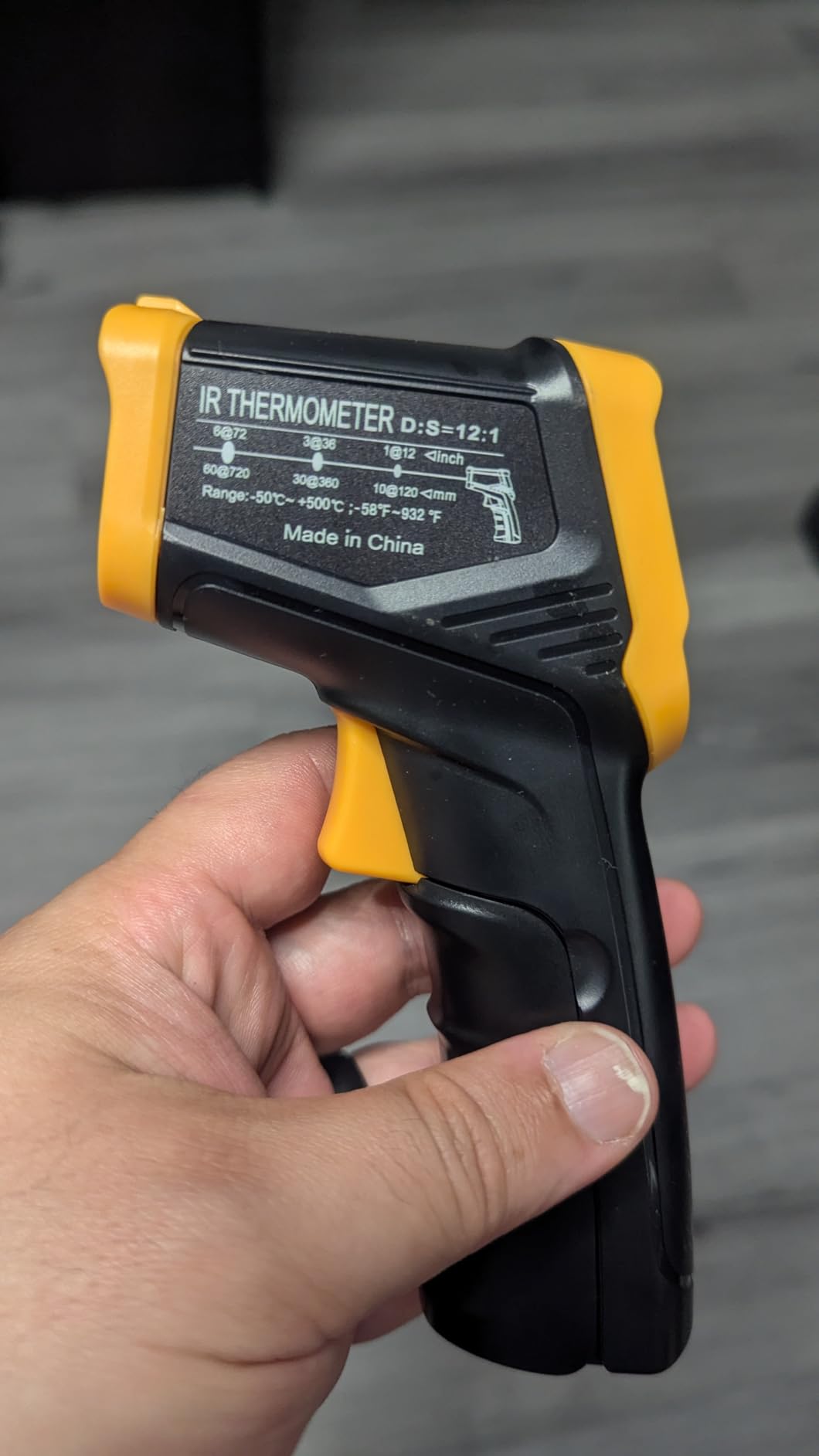
At 0.1 degree display resolution the readout is precise enough to watch a cast iron pan come up to temperature, and the backlit LCD is what makes it usable outdoors after dark.
The catch is fixed 0.95 emissivity. The manufacturer’s own guidance is to place tape or matte paint on a reflective target, and that is exactly what you will have to do on polished stainless or foil. There is no MAX, MIN or average memory, and no second laser to help you isolate a small spot.
This is a gun for casual surface checks, not for diagnosing a furnace or verifying a bearing. The listing itself is clear that it is not a body temperature device, and none of the readings here should be used on people.
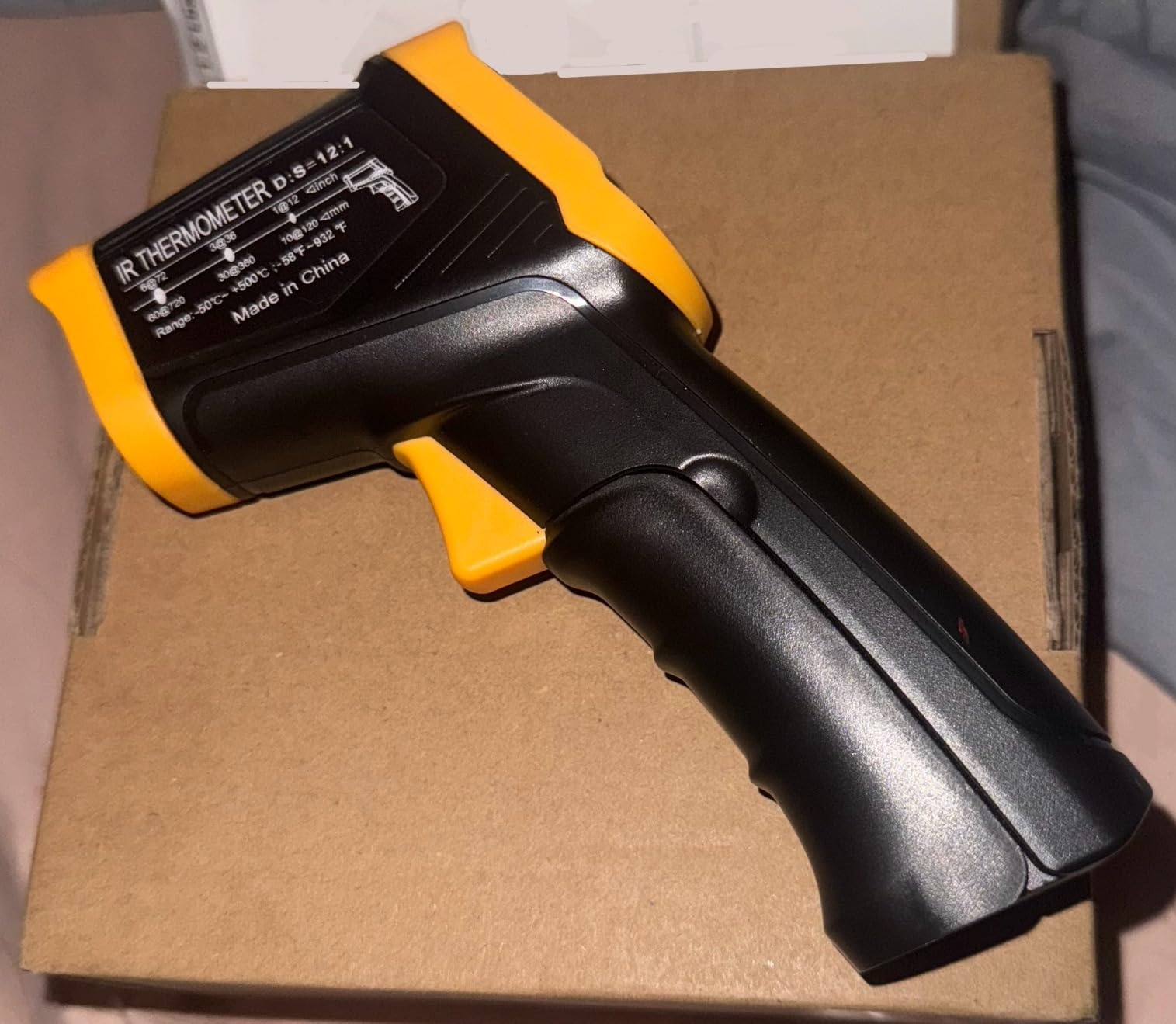
Who the Soonkoda GM50 suits
Buy this if you cook outdoors a lot, own one griddle or one smoker, and just want a cheap way to answer “is this zone actually hot yet” without unpacking anything. It is also a reasonable secondary gun to keep in a garage for spot checks on vents and appliances.
The backlight and data hold make it more pleasant to use than its simplicity suggests, and owners across thousands of reviews use it exactly this way.
Who should skip the Soonkoda GM50
Skip it if you cook on polished stainless or have a shiny griddle top and do not want to keep tape on hand. Also skip it if you need a spot narrower than your cooking zone, or if you want to read a small cast iron pan without averaging in the counter around it.
For anyone doing real diagnostic work, put the money into a gun with adjustable emissivity instead. It costs a step more and removes the most common source of bad readings.
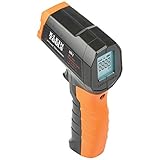
4. Klein Tools IR1 – Rugged Single-Laser Gun for HVAC and Electrical
Klein Tools IR1 Infrared Thermometer with Targeting Laser, Auto-Hold, More
-4F to 752F range
10:1 distance-to-spot
6.6 ft drop protection
Includes pouch
Pros
- Turns on and reads in about a second
- Laser pointer targets a specific spot
- 6.6 foot drop protection and tool bag ready build
- Custom storage pouch included
- Backlit display readable in garages
Cons
- Fixed 0.95 emissivity on reflective surfaces
- Celsius and Fahrenheit toggle is awkward
- Uses a 9V style battery instead of AA cells
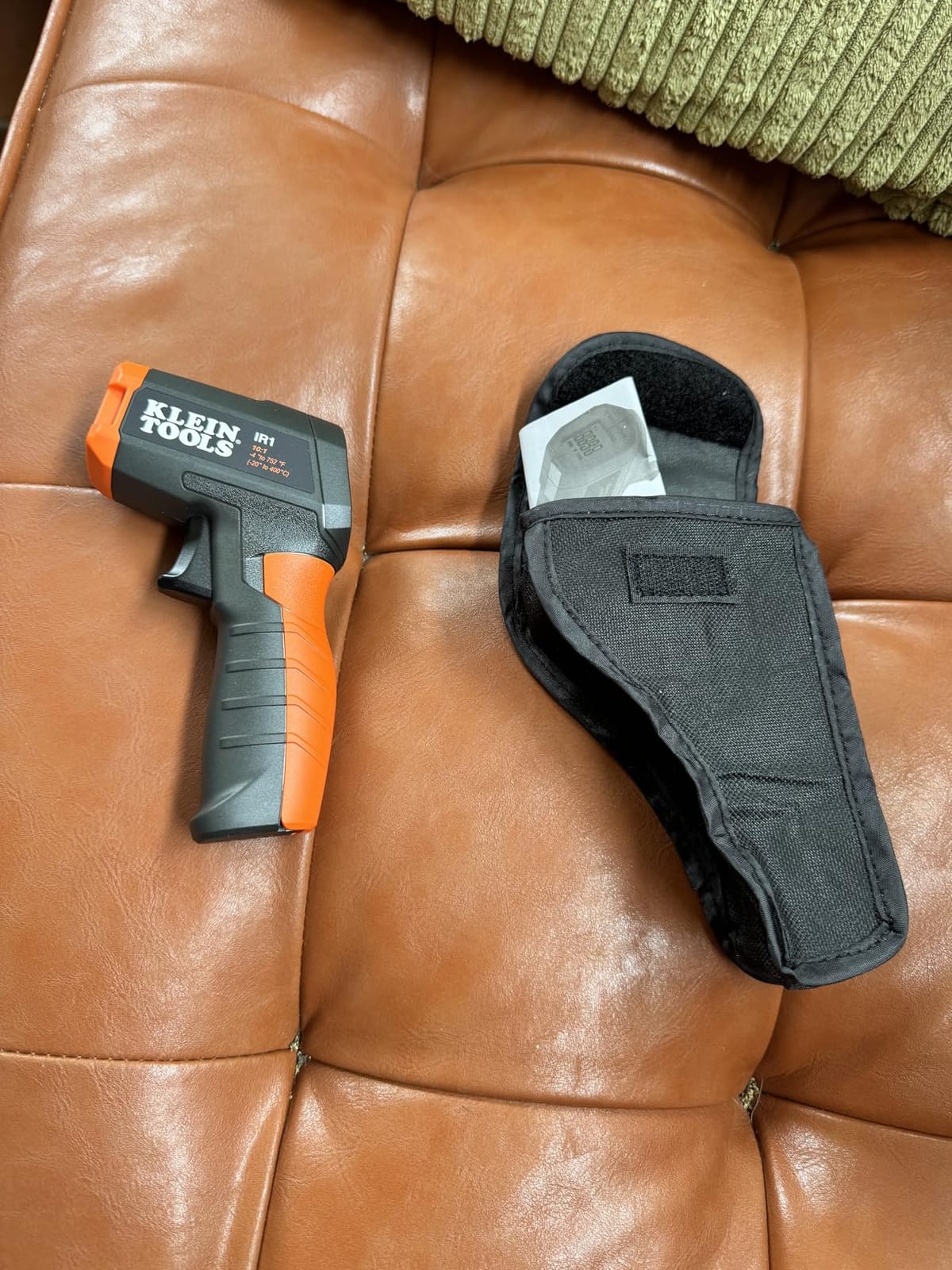
The Klein IR1 is built like a tool rather than a kitchen gadget. It has a 6.6 foot drop rating, a housing that feels solid in the hand, and a custom pouch so it lives in the tool bag instead of rolling around loose.
That build quality is the reason it shows up in HVAC and electrical work. It covers -4F to 752F, which is more than enough for duct temperatures, registers, radiators, panel enclosures, motor housings and outlet boxes, and it powers from a single included 9V battery.
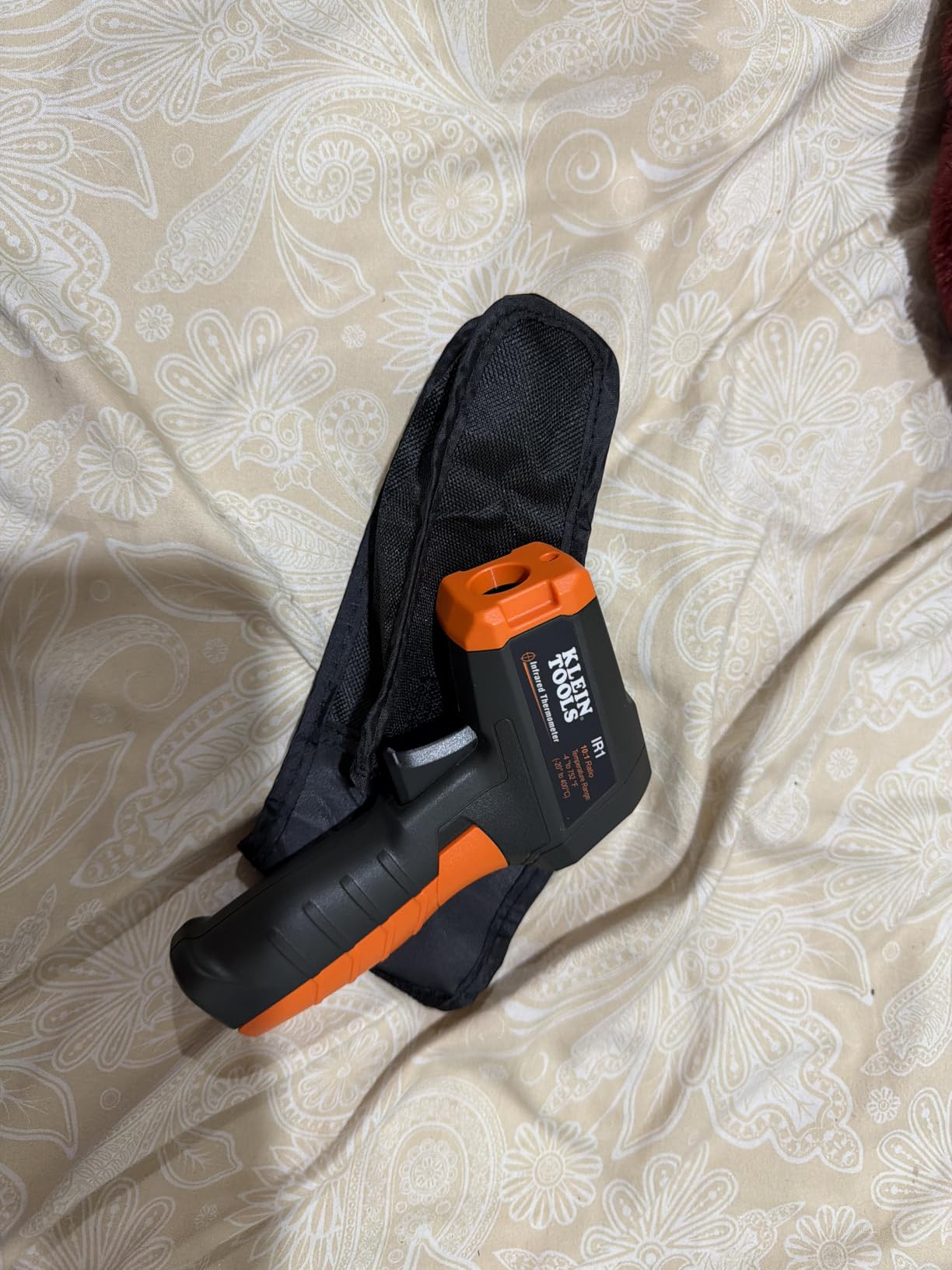
Owners cite fast trigger response. The gun powers on in about a second and reads immediately, which is what you want when you are walking a mechanical room with a list of readings to collect.
The laser pointer helps you aim at a specific point on a surface, and the backlit display keeps the number readable in a dark mechanical room or a garage with the lights off.
Two complaints recur. Emissivity is fixed at 0.95, so shiny metal needs a taped target. And several owners find the Celsius and Fahrenheit switch fiddly to reach, which is annoying if you think in both scales.
What the Klein IR1 does well in a shop
This is a scanning tool. Ten-to-one optics, a laser to aim with and a backlit screen are the combination you want for checking a whole supply duct, a run of outlets or a set of motor bearings in sequence and noting anything that reads high.
It is explicitly a non-medical device, so it will never be confused with a fever gun, and the drop rating means an ordinary trip off a ladder does not end the purchase.
Where the Klein IR1 is the wrong tool
Its 752F ceiling and fixed emissivity rule it out for high heat shop work such as forging or pizza oven stone checks at peak heat, and out for anyone who needs to measure polished or mirror-finish metal accurately.
For cooking, it works, but the battery style and the emissivity setting make it a second choice next to a gun with adjustable emissivity. If you want one tool for both kitchen and shop, look at the Klein IR5 instead.
5. KNINE OUTDOORS TG-2024-OG – Adjustable Emissivity for Hot Pizza Stone
KNINE OUTDOORS Infrared Thermometer Gun, -58℉ to 1112℉
-58F to 1112F range
12:1 distance-to-spot
1 year warranty
Two AAA powered
Pros
- Emissivity adjustable from 0.1 to 1.0
- Wide range covers ovens engines vents and candy
- Large backlit eye-protect LCD
- Compact body fits a toolbox
- Hold trigger for a continuous read
Cons
- No MAX MIN AVG and no high low alarm
- Single laser takes practice on small targets
- Manual is worth reading before first use
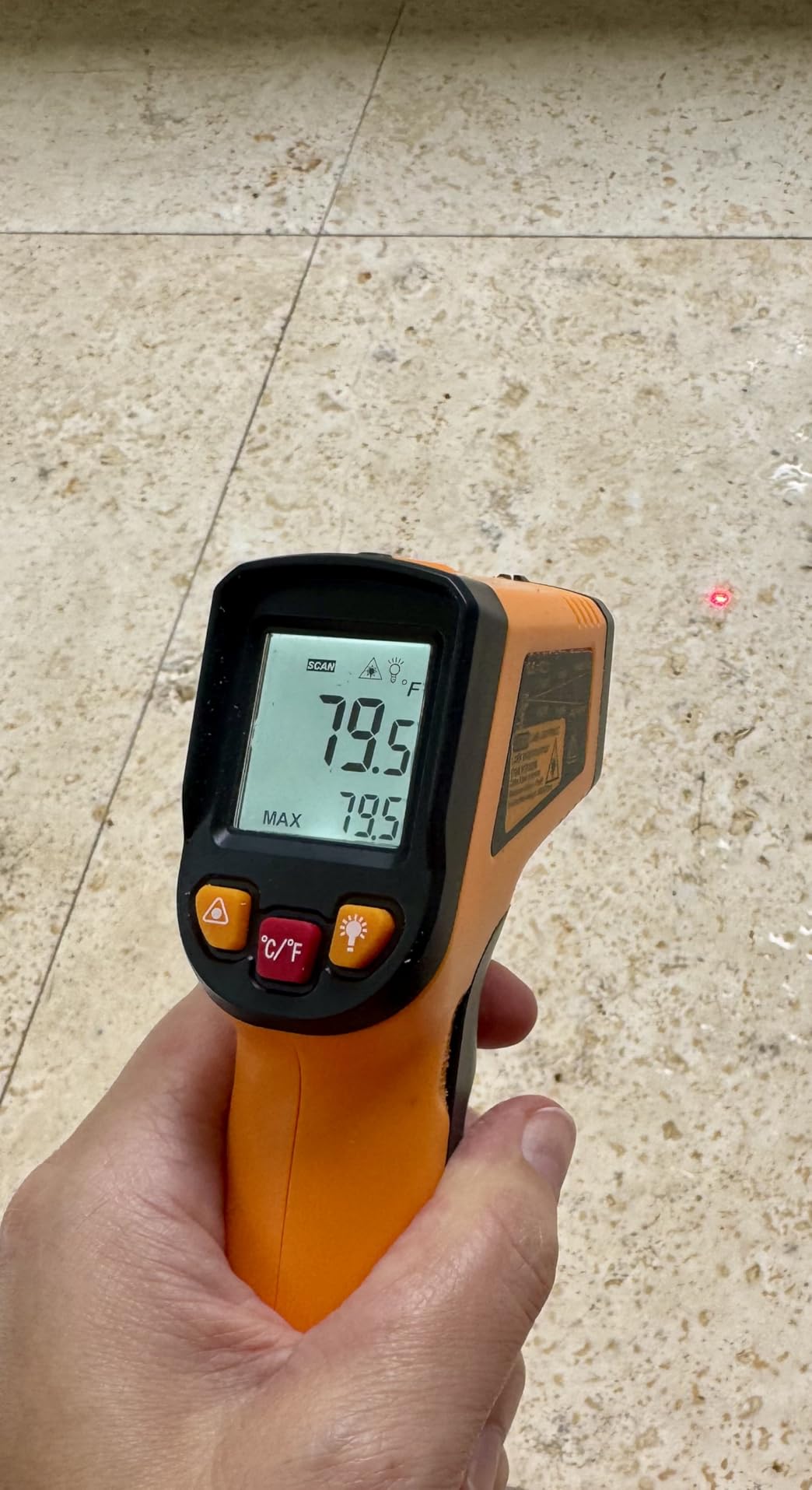
The KNINE OUTDOORS gun is the one I would pick for a home pizza oven, because of the combination of a -58F to 1112F ceiling and an emissivity dial. A brick or stone floor reaches temperatures that flatter a lot of mid-range guns, and being able to correct for the surface finish matters when you are chasing a target bake temperature.
Reviewers use it across a wide spread: griddles, grills, HVAC vents, engines, tire checks and even reptile basking spots. A 12:1 ratio is a sensible middle ground for that range of jobs.
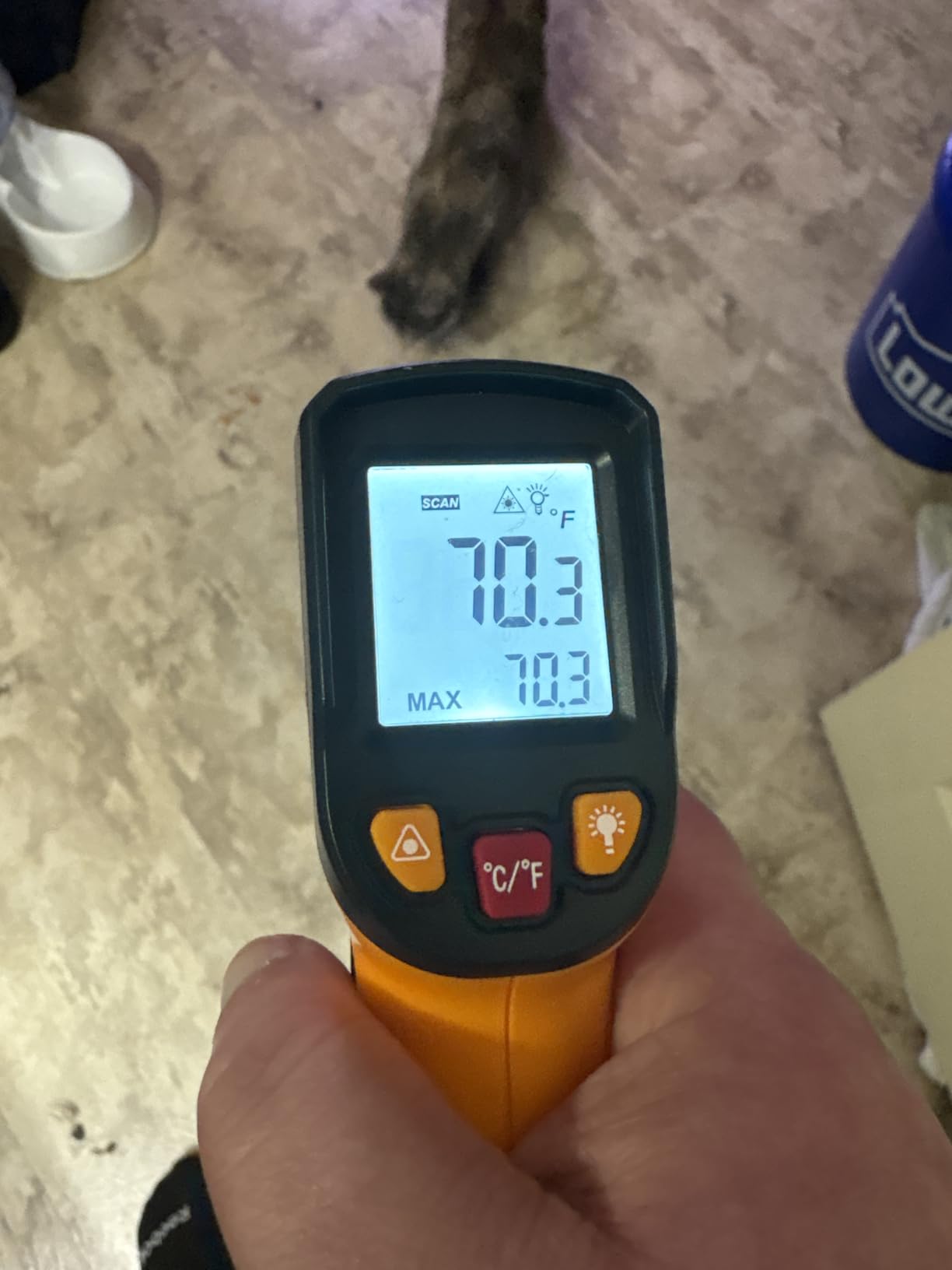
Holding the trigger gives a continuous read, which makes a slow sweep across a cooktop or a brake disc much easier to interpret. The display is described as eye-protect, and the backlight is what you notice at night on an outdoor kitchen.
The 0.1 degree Celsius and Fahrenheit resolution is finer than most of the direct competition, so you can see small changes rather than watching a number jump by two degrees.
Where it stops is statistics and alarms. There is no MAX, MIN or average and no high and low alarm, so if your diagnostic question is “is any part of this equipment running hotter than the rest”, you will be doing that comparison yourself.
Why the KNINE OUTDOORS suits high-heat cooking
A 1112F ceiling leaves room for a fully preheated pizza oven, a deep smoker and light candy work without clipping the top of the scale. Most cooking-focused guns in this roundup stop between 842F and 1022F, which is lower than a well-stocked oven floor can reach.
Add adjustable emissivity and you have a gun that can be pointed at a seasoned cast iron deck, a steel plate or a stone with a reasonable chance of the number meaning something.
Where the KNINE OUTDOORS falls short
Single laser only. On a small cast iron pan or a narrow burner ring you will be averaging in the surrounding air unless you practice your aim.
For shop monitoring where an alarm would help, or for spotting a single hot spot on a large surface from a distance, this is not the right tool. Read the manual before first use so you are not guessing at the emissivity controls.
6. Fluke 62 MAX – The Most Reliable Reading in Any Setting
Fluke 62 Max Industrial Infrared Thermometer, -22 to +932 Degree F Range, Single Laser Targeting, 10:1 Distance to Spot Ratio, IP54 Rating, Includes 3 Year Warranty, (Not for Human Temp)
-22F to 932F range
Plus or minus 1.5C accuracy
10:1 distance-to-spot
3 year warranty
Pros
- Repeatable readings that agree with calibrated instruments
- IP54 dust and splash protection
- 3 meter drop rating
- Min max difference and average readouts
- Light enough to carry on a tool belt
Cons
- Settings menu is not explained in the printed manual
- Emissivity needs adjusting before reading metal
- Higher cost than every cooking gun in this roundup
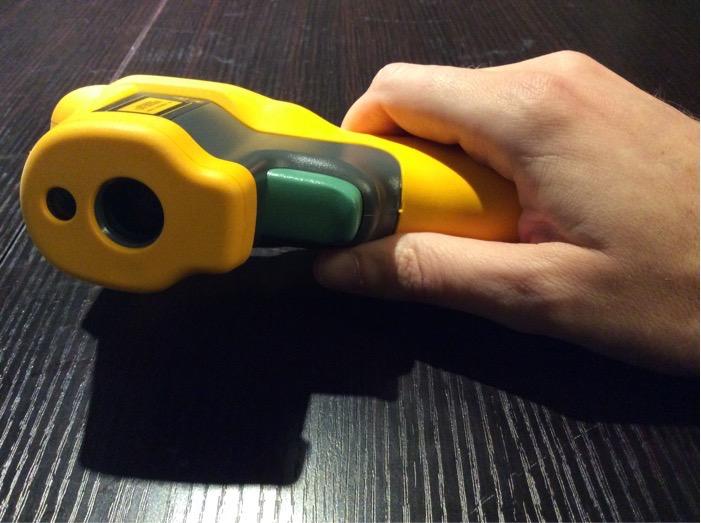
The Fluke 62 MAX is the pick when the number has to be right, and it holds the highest average rating in this roundup at 4.7. Owners running mechanical and HVAC work describe readings that are repeatable and that agree with other calibrated instruments, which is the one claim none of the cheaper guns can make.
It covers -22F to 932F with a stated accuracy of plus or minus 1.5 degrees Celsius or 1.5 percent of reading, and a 500 millisecond response time. The display gives you minimum, maximum, temperature difference and average, so a scan of a bearing or a motor housing produces a real diagnostic picture rather than a single number.
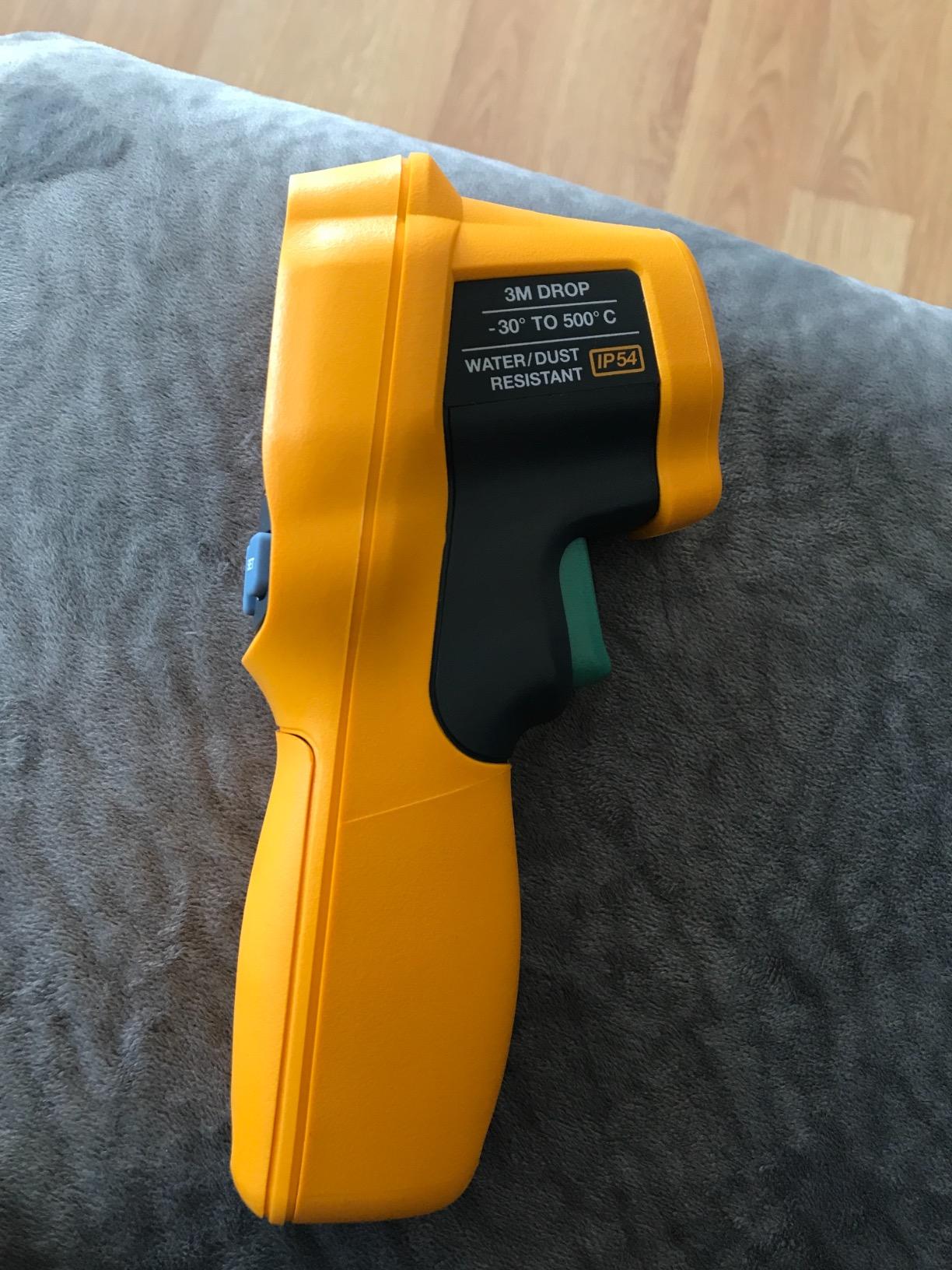
Build is where this class separates. The 62 MAX carries IP54 dust and splash protection and a 3 meter drop rating, and it includes a 3 year warranty. It runs on a single AA for a listed 10 hours, and at 0.26 kg it is light enough to hang off a belt loop for a whole day of inspections.
Users mention it for 3D printer beds and nozzles, electrical panel checks, motor and bearing monitoring and automotive work. The laser sighting and large backlit display make it usable in a dark panel room.
The criticism owners raise is documentation, not hardware. The printed manual is largely unannotated diagrams and the settings menu is not explained in writing, so the emissivity and menu adjustments take a few minutes of trial to learn. One owner also received a unit that would not respond to the trigger at all, which is a reminder that even name-brand tools can arrive faulty.
Why professionals choose the Fluke 62 MAX
Repeatability is the whole argument. If you are comparing a bearing at 120F to its neighbours, or confirming that a hot spot on a panel is not a sensor artifact, a gun that gives a different number each time is useless no matter how good the spec sheet looks.
The statistics display, the accuracy figure and the three year warranty all point the same way: this is the gun you buy once and keep for a decade of work.
Where the Fluke 62 MAX is not the best buy
It costs more than every cooking gun here, and for a weekend griddle cook that is a poor trade. The fixed 10:1 ratio also means you stand closer than a higher-ratio gun would allow, and the 932F ceiling is not enough for forging or kiln work.
You will still need to set emissivity before reading bare metal, and you should budget an evening with the manual because the settings menu is not self-explanatory.
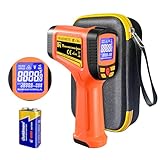
7. DEASOMIYE JD-04 – 50:1 Optics and a 2732F Ceiling for Forging and Kilns
-58°F to 2732°F Digital Infrared Thermometer Gun, 50:1 Distance Ratio Laser Temperature Gun with MAX/MIN/AVG Measure and Alarm, Heat IR Temp Gun for Cooking, Griddle, HVAC, Industrial Forging
-58F to 2732F range
50:1 distance-to-spot
Dual laser
0.5 second response
Pros
- Widest range here
- reaching furnaces kilns and forging temps
- 50:1 optics read a small spot from far away
- Dual laser pointers make aiming far easier
- High and low alarms plus MAX MIN AVG
- Backlit display with 15 second auto off
Cons
- No adjustable emissivity listed so metal can read wrong
- Uses a 9V battery
- Not a body temperature device
When your work gets genuinely hot, optics and range matter more than anything else. The DEASOMIYE JD-04 measures from -58F all the way to 2732F with a 50:1 distance-to-spot ratio, which means it can cover roughly a 1 inch spot from 50 inches away. That is a genuinely different capability from the 12:1 guns that make up most of this roundup.
The dual laser pointers outline the area being measured, so you can see what the sensor is averaging. At 50:1 you are measuring a small area on a furnace interior or a workpiece rather than a broad average of the whole opening.
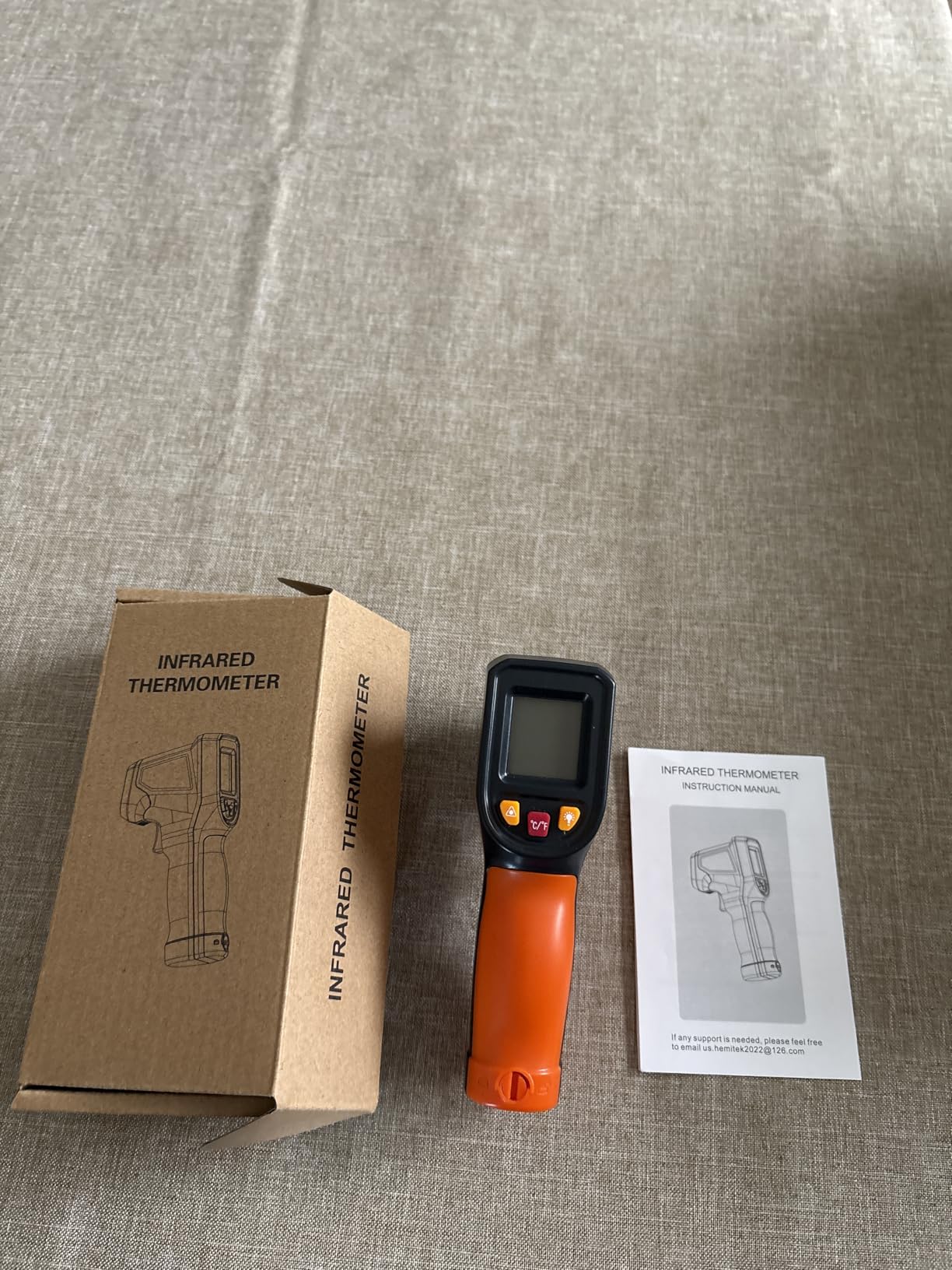
For diagnostic work, the combination of MAX, MIN and average readouts with high and low alarms is useful. Set an alarm and walk away while an oven or a kiln runs, then come back to a flagged condition rather than a number you happened to be looking at.
Response is a listed 0.5 seconds, the display is backlit, and there is a low battery indicator and a 15 second auto off. It ships with a 9V battery and a toolbox.
Two limits to know. No adjustable emissivity is listed, so shiny metal needs a taped target. And the 9V battery is less convenient than AAA cells for a full shift of intermittent use. Feedback on this listing is also thinner than for the picks above, which is normal for a newer product with a smaller owner base.
Where the DEASOMIYE JD-04 earns its place
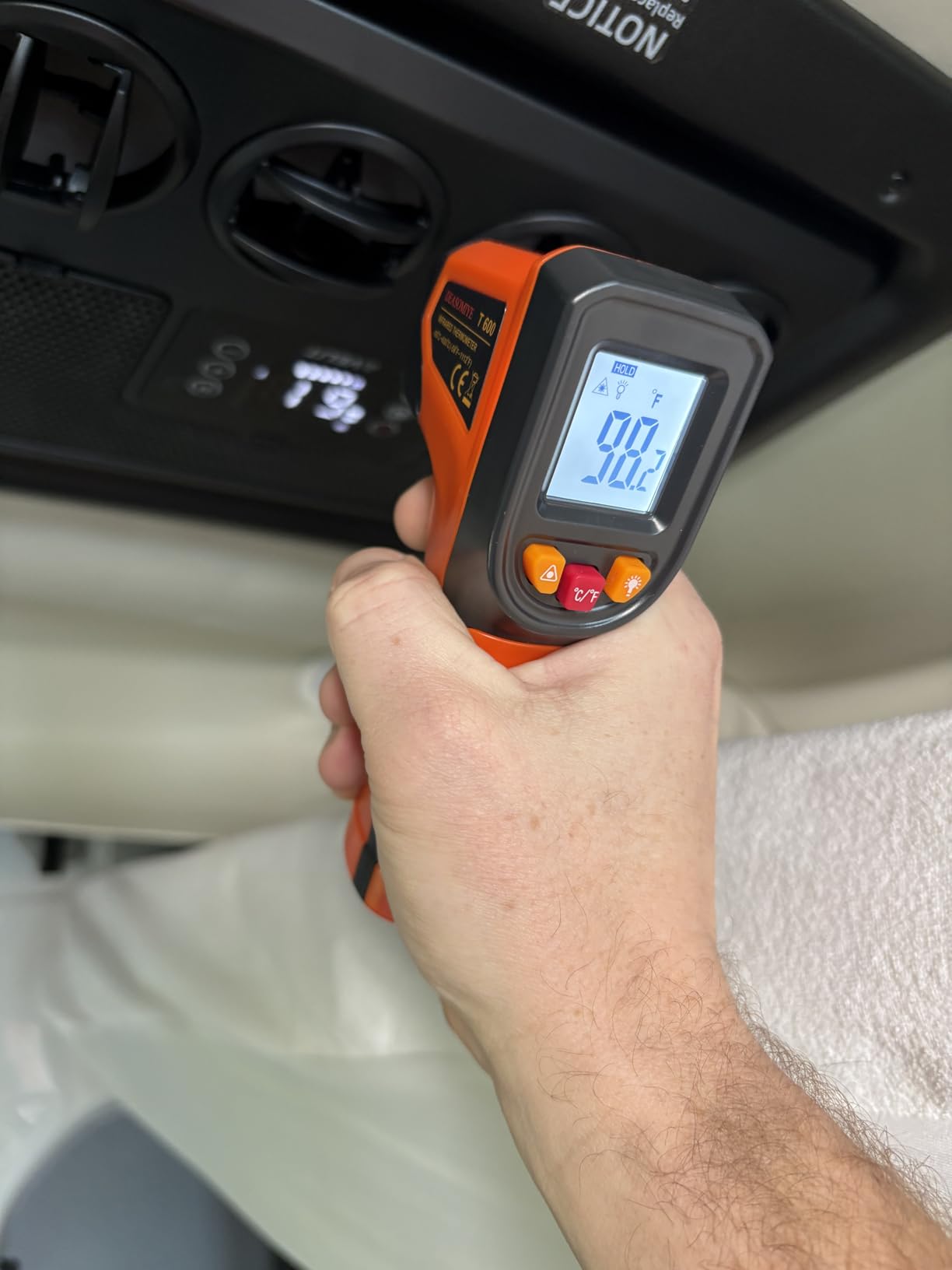
Forge, kiln, furnace, pizza oven peak and heat treat work. A 2732F ceiling handles temperatures that would simply peg most cooking guns at their maximum reading, and the 50:1 optics let you stand back far enough to be safe.
It also works as a general shop scanner. The alarms and statistics make it a reasonable choice for monitoring equipment that runs unattended.
Who should skip the DEASOMIYE JD-04
Skip it for ordinary kitchen work. Paying for a 2732F ceiling and 50:1 optics to check a griddle is money you get nothing back from, and the missing emissivity adjustment is a real drawback for measuring bare or polished metal.
It is also the wrong shape for anyone who needs readings that agree with a calibrated instrument. It is a range and optics specialist, not an accuracy specialist.
8. Klein Tools IR5 – Dual Lasers and Alarms for Equipment Monitoring
Klein Tools IR5 Dual Laser 12:1 Infrared Thermometer, Digital Thermometer Gun with Backlit Display, Dual Laser Targeting and Auto Scan, Wide Temperature Range
-22F to 752F range
12:1 distance-to-spot
Emissivity 0.1 to 1.0
6.6 ft drop protection
Pros
- Dual lasers outline the measured area on the surface
- Adjustable emissivity across the full range
- MAX MIN AVG DIFF plus high and low alarm
- Rugged build with a protective pouch included
- US made and feels solid in the hand
Cons
- Laser spacing is wider than the 12:1 spot so the area is ambiguous
- Some owners report readings a few degrees high
- One second response is slow against most rivals
The Klein IR5 is the one in this roundup that combines dual laser area targeting with adjustable emissivity, and that pairing makes it unusually well suited to scanning a full cooking surface rather than a single spot.
Two lasers mark the edges of what the sensor is averaging, which is exactly what you want when you are checking whether one zone of a griddle is running hotter than the rest. Add MAX, MIN, average, difference and high and low alarms, and you have a tool for monitoring equipment over time rather than taking a single reading.
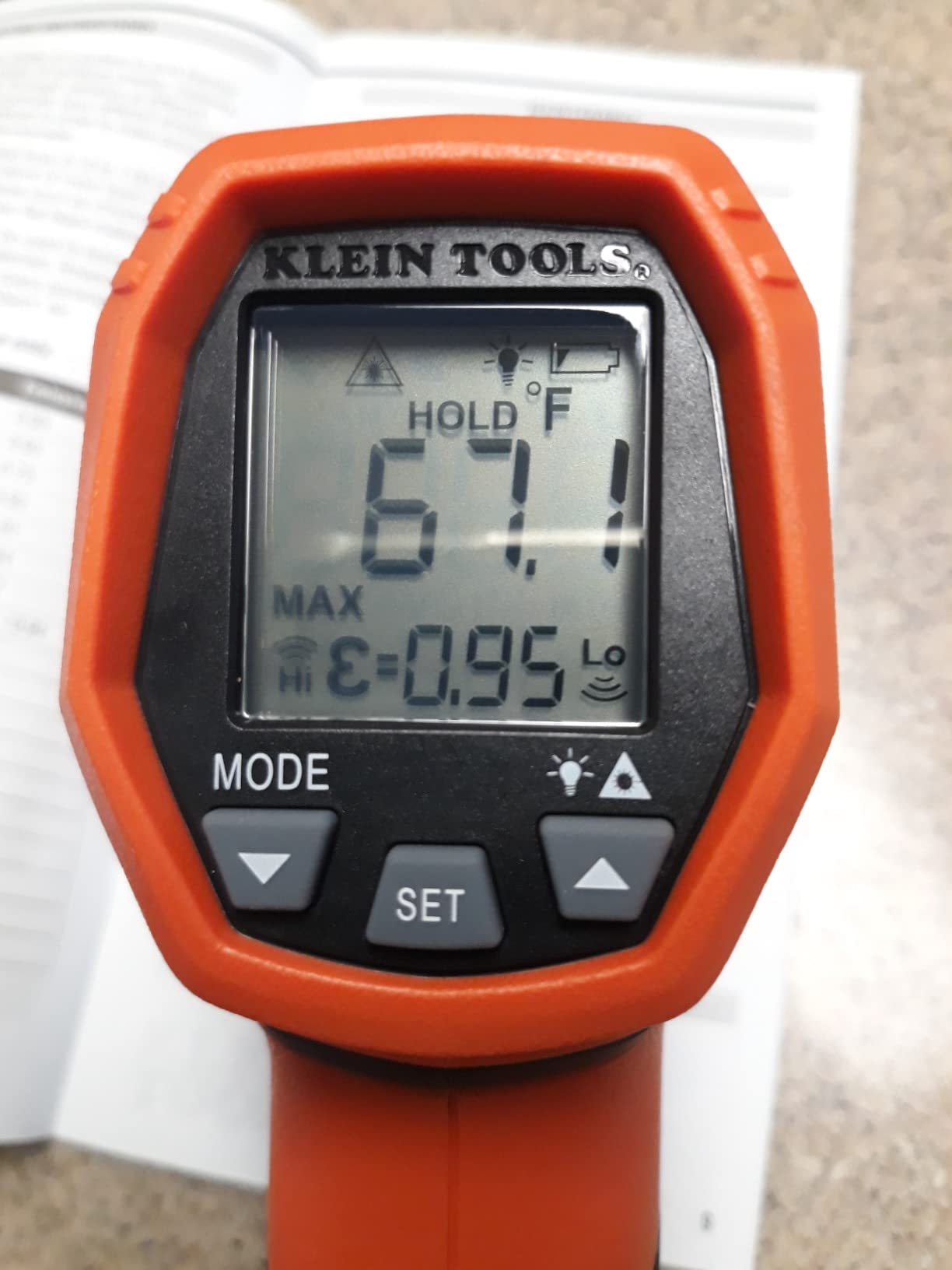
Emissivity adjusts from 0.1 to 1.0, so stainless, cast iron and painted surfaces are all measurable without taping a target. The range is -22F to 752F at 12:1, with 6.6 foot drop protection and a one year manufacturer warranty. The pistol-shaped protective pouch is included and genuinely useful in a tool bag.
The honest criticism is about geometry. At 12:1 the two lasers sit further apart than the actual spot size, so the marked area is wider than the area being measured. That is not a deal breaker, but it means the lasers are a rough guide, not a precise outline.
Response time is listed at 1 second, slower than most rivals in this class. One owner also reports readings that run a few degrees high compared with a Fluke 62, and another found the included battery dead after brief use, so carry a spare.
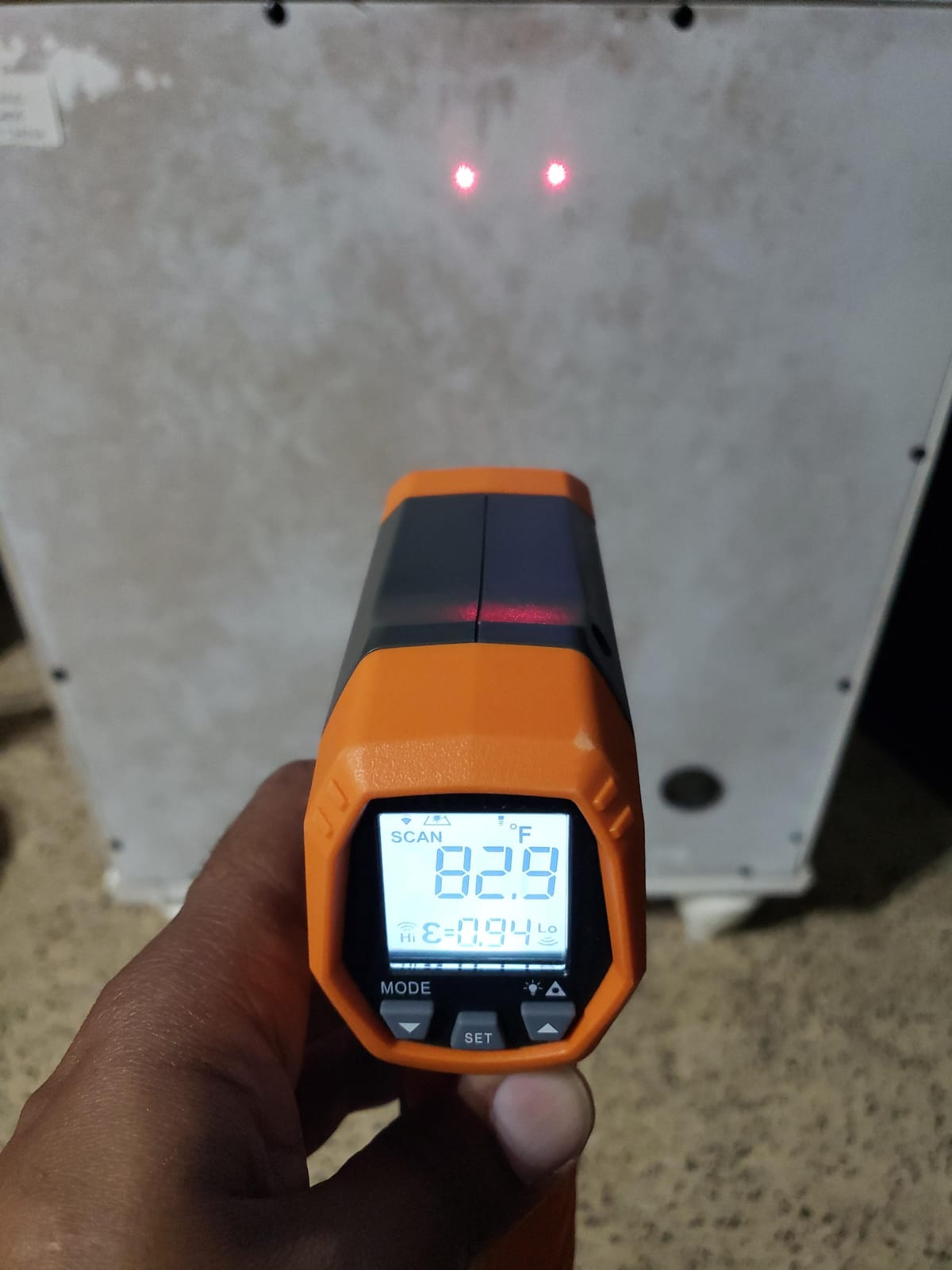
Why the Klein IR5 suits griddle and equipment work
The dual laser plus full emissivity control is the pairing you want for a large flat-top. You can mask nothing, set the emissivity to match the surface finish, sweep the plate and read the max and average to see how even the heat is.
For shop use the difference readout and the high and low alarms are what turn it from a thermometer into a monitoring instrument, and owners in HVAC and fabrication work rate it well for exactly that.
Where the Klein IR5 disappoints
Skip it if you need the highest accuracy available, or if a one second response is too slow for tracking a fast-moving target such as a thin piece of metal under a torch.
The 752F ceiling keeps it out of forging and kiln work, and the mismatch between laser spacing and the real spot means you should verify the reading against a taped target the first time you use it on a new material.
9. Temirup IR02C-OR – The Only Pick With a K-Type Probe and Humidity
Infrared Thermometer Gun, Non Contact Digital Laser Thermometer Temperature Gun with Color LCD for Cooking, Home Repairs, Humidity Measurement, Adjustable Emissivity -58°F to 1472°F(-50~800°C)
-58F to 1472F range
Includes K-type probe
Emissivity 0.1 to 1.0
Color LCD
Pros
- K-type contact probe included for internal checks
- HTU20 sensor adds humidity and dew point
- Full color backlit display is very readable
- Two alarm modes and adjustable emissivity
- Carry bag and 24 month service included
Cons
- Laser is not where users expect so aiming takes practice
- 13 point laser guidance can be confused with the real spot
- Some variant listings stop at a lower ceiling
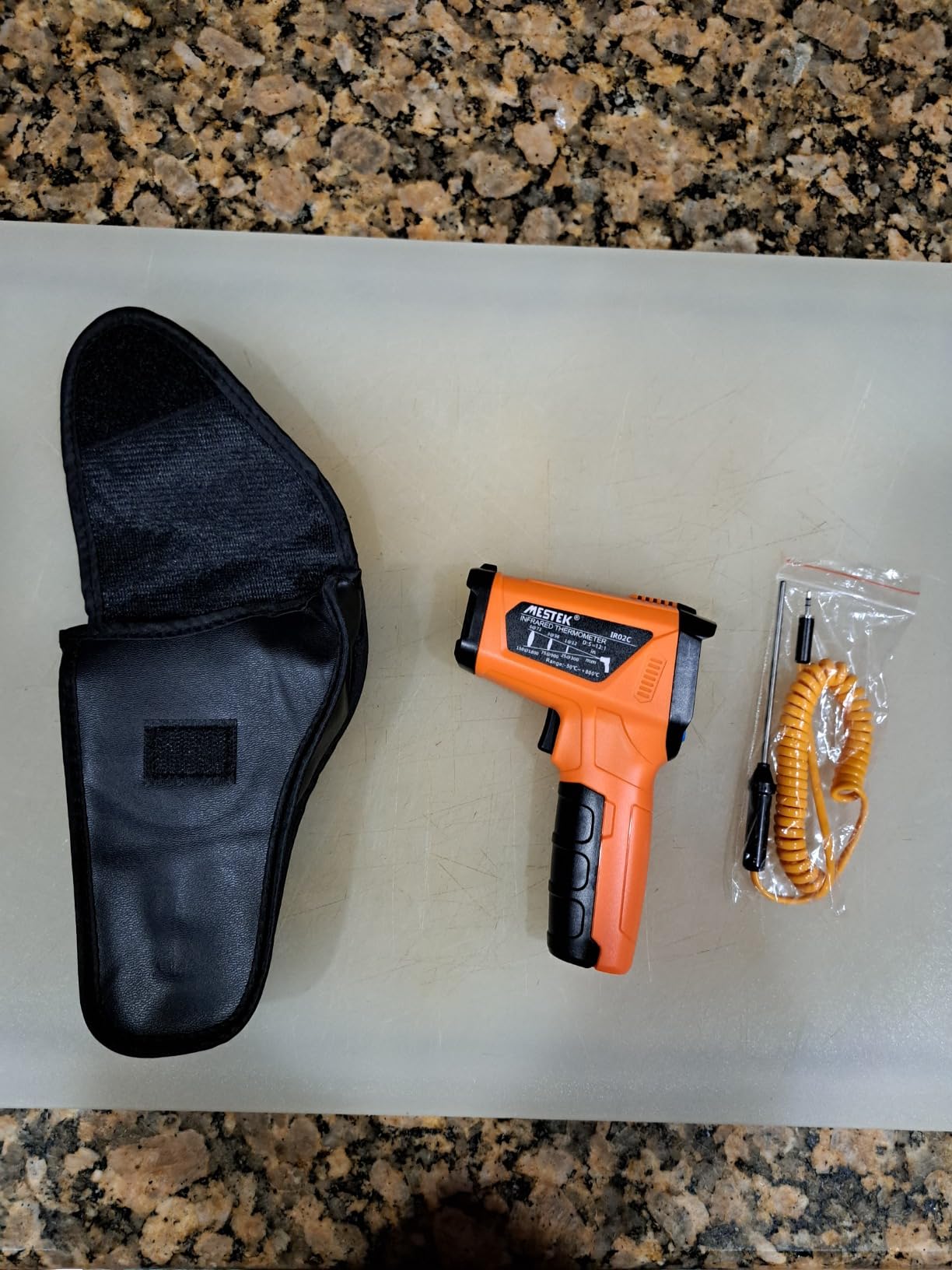
This is the most unusual gun in the roundup. The Temirup pairs the infrared sensor with an included K-type thermocouple probe, so you can scan a surface and then confirm with a contact reading in the same device. That combination answers a question none of the others can.
For a cook, that means you can check a griddle or pan surface with the laser and verify a slow-cooking piece with the probe without owning two tools. For a shop, it is a quick way to sanity check a surface reading against a contact measurement.
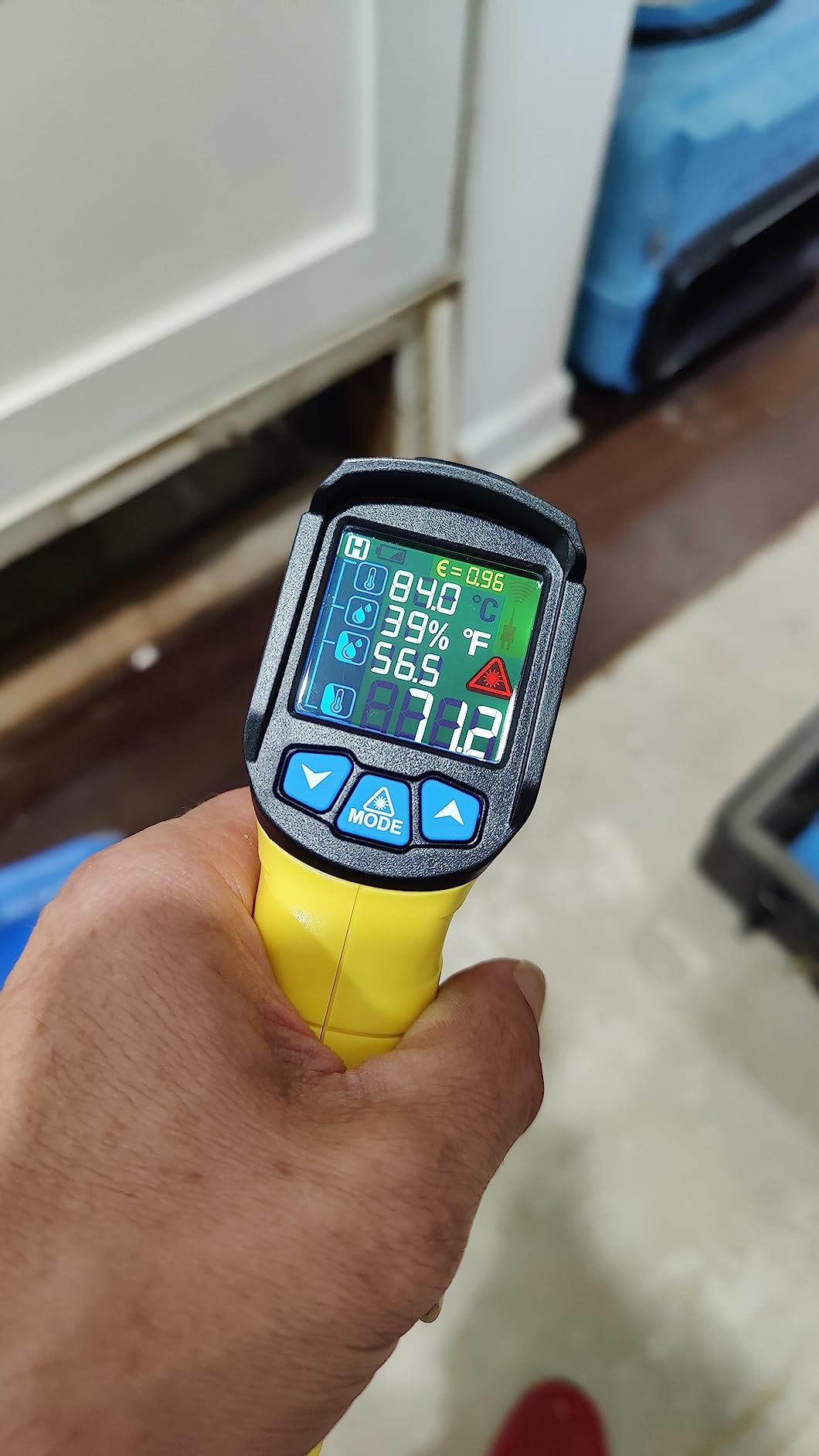
The HTU20 sensor adds ambient temperature, humidity and dew point alongside the surface reading. Dew point is the number that matters for condensation and mold complaints, and having it in the same display as the surface temperature makes spoilage checks much faster. Reviewers use the alarm modes for exactly that.
Range is -58F to 1472F with plus or minus 1.5 percent accuracy, response under half a second, and adjustable emissivity from 0.1 to 1.0. The full color backlit display is the most readable screen in this roundup in low light, and a carry bag and 24 month service are included.
The consistent complaint is aiming. The laser does not sit where people instinctively point, and the 13 point laser guidance can be mistaken for the actual measurement spot. It takes practice, and it is the one thing to test in the first ten minutes rather than in the middle of a cook.
Who the Temirup IR02C-OR is for
Anyone who wants one device to cover both surface and internal work: griddle owners who also cook thick roasts, home bakers checking a proofing box, and anyone troubleshooting a furnace who wants a cross-check against a contact reading.
It is also the pick here for humidity and dew point, which matters in home inspection work, mold complaints and cold storage checks where surface temperature alone does not tell the story.
Where the Temirup falls short
Skip it if you want dead-simple aiming off the bat, because the laser placement is genuinely unintuitive until you get used to it. And if you only want a cooking surface reading, the probe and the sensor are extras you will not use.
Be aware that some variant listings under this model name stop at a lower ceiling than the 1472F headline, so check the listed range on the exact listing before you rely on it for high heat work.
10. TempPro TempScan PLUS TP420 – Best 2-in-1 for Griddle Cooking
TempPro TempScan 2-in-1 Infrared Thermometer Gun with Meat Probe
IR plus meat probe
12:1 distance-to-spot
Adjustable emissivity
Built-in magnet
Pros
- IR and probe in one body for surface and internal
- Probe reads within 1.8F in 2-3 seconds
- Strong magnet sticks to a griddle edge hands free
- Running average and backlit display
- Adjustable emissivity on the IR side
Cons
- Printed manual is printed in tiny type
- Motion sensing needs the probe opened
- One owner reported a unit failing after about seven months
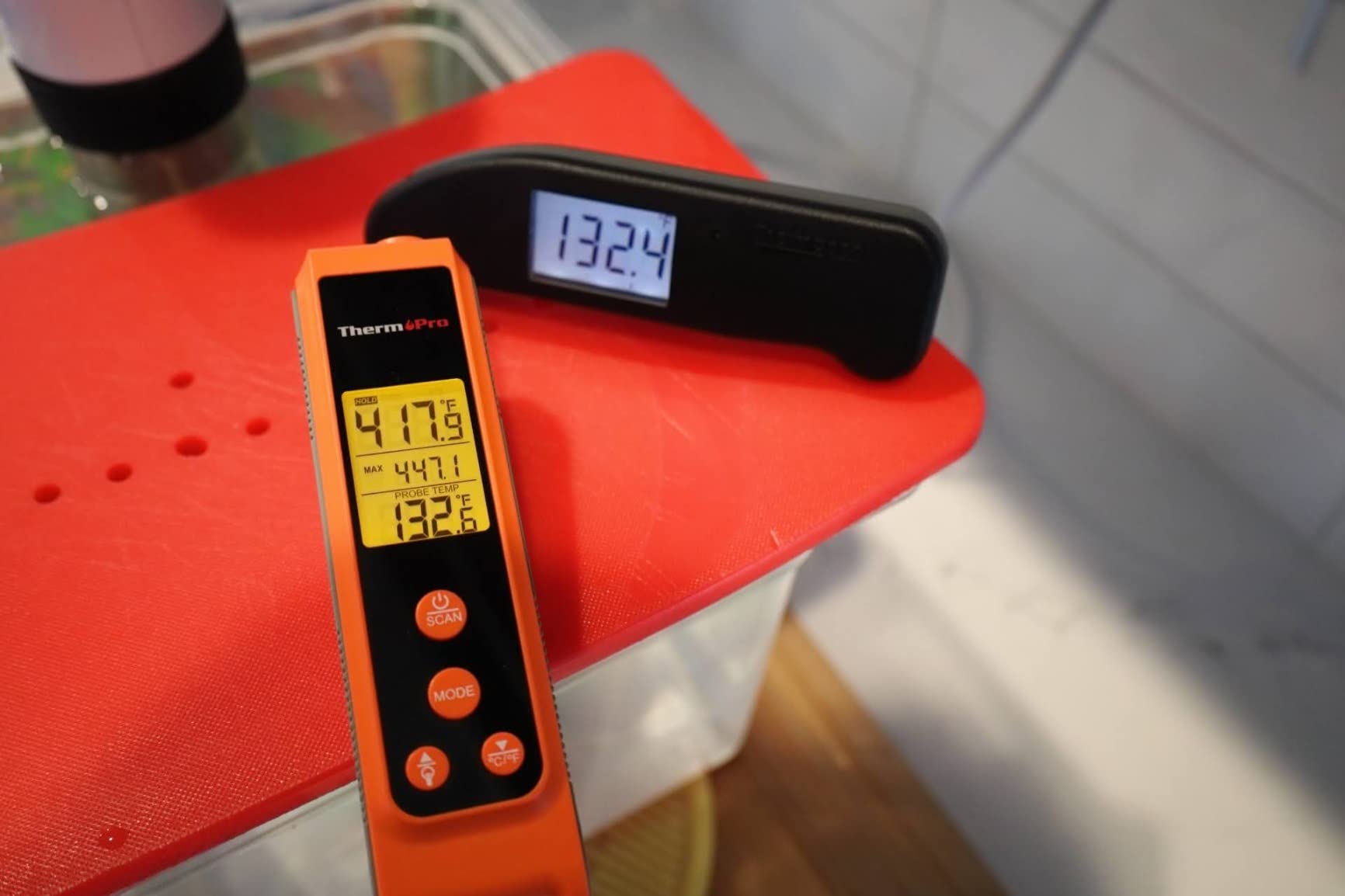
The TempPro TempScan PLUS TP420 is the model griddle owners keep coming back to, and the reason is simple: it puts a surface scanner and a meat probe in one body, and it has a magnet.
For a flat-top, the workflow is obvious. Check the surface with the infrared side, set your emissivity for the plate finish, and use the running average readout to see how even the heat is across the zones. Then, when you are cooking a thick piece, deploy the probe from the same unit and check internal temperature without owning a second device.
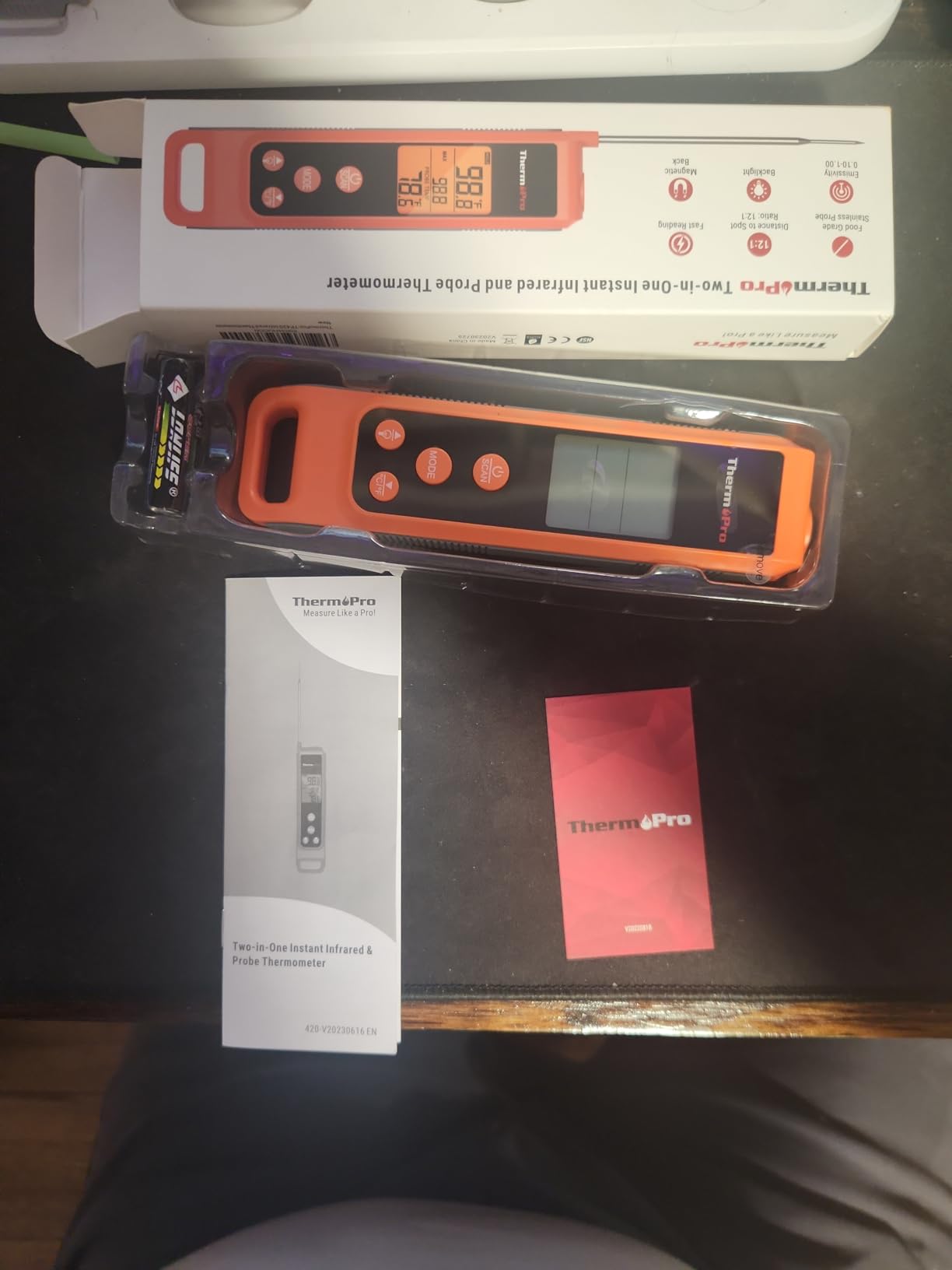
The built-in magnet is the detail that shows up in owner reviews over and over. It sticks to the edge of a griddle or a grill and stays there, which frees up both hands and keeps the gun within reach for the whole cook. There is also a hanging hole and a low battery indicator.
Probe accuracy is listed at plus or minus 1.8F in 2 to 3 seconds, and reviewers cross-checking against reference probes report agreement within about a degree. Infrared side features a 12:1 ratio with adjustable emissivity and a 0.5 second response.
The documentation is poor. The printed manual is set in very small type and the online version sits behind a signup, which is a genuinely frustrating first impression for a product that does so much. One owner also reported a unit failing after about seven months, resolved under warranty, which is worth remembering if you rely on one gun for everything.
Why the TP420 fits griddle cooking
A griddle cook needs both kinds of temperature. The surface tells you when a zone is ready and whether the heat is even; the probe tells you when a thick burger or a chicken breast is done. Splitting that across two devices is wasteful, and this gun handles both.
It is also fine for shop use on grills, ovens, HVAC surfaces and automotive work, and the motion sensing wake on probe open means it is ready when you reach for it. A button press is required to power it fully on, which is the small trade-off for that feature.
Where the TP420 is not ideal
Skip it if the unreadable documentation would frustrate you, or if you need the highest possible accuracy. Its range tops out at 1022F, which rules out forging, kiln and high temperature industrial work.
Probe response of 2 to 3 seconds is slower than premium probe thermometers, so it is not the tool for a delicate sous vide or a very fast sear where every second counts.
Griddle and Blackstone Cooking Guide
A griddle is the single best application for an infrared thermometer, because you cannot put a probe into a cooking surface and you cannot reach under a hot grate. The gun reads the plate directly, in under a second, with your hands nowhere near it.
Map your zones first. Hold the gun about 12 to 14 inches from a 12:1 model, which gives a spot of roughly an inch, and take a reading in the centre of each burner plus the corners and edges. Repeat once the grill is up to temperature, because the reading during preheat is not the reading at service.
Watch the seasoning, not just the metal. A properly seasoned black surface has a matte finish with emissivity close to 0.95, which is exactly what a fixed-emissivity gun assumes. A bare, freshly stripped or mirror-polished plate is a different problem, and it is when a taped target or an adjustable-emissivity gun becomes necessary.
Use the max temperature mode to find the hot corner rather than hunting for it. Sweep the whole surface once, read the maximum, and that number tells you which burner to avoid for delicate work. Then use the average or difference readout to see how even the plate is running, and on the Klein IR5 or TempPro TP30 those statistics do the work for you.
Two techniques matter on a flat-top. Aim at the food surface or the plate, not at the air just above it, and take several readings in the same spot rather than trusting the first. And never read through a splatter guard, a window or a sheet of glass: glass is opaque to infrared and you will be reading the guard.
Shop and Workshop Use
Half of this roundup’s value sits outside the kitchen, and it is the half almost nobody writes about. An infrared thermometer is a first diagnostic tool in HVAC, electrical, automotive, wood and printing work.
HVAC: walk a duct run and look for a reading that differs from its neighbours. A cold spot on a register or a hot spot on a supply trunk points at insulation, a blockage or an undersized unit before you open anything. The Fluke 62 MAX and the Klein IR1 are the two picks here built for that kind of work, with readable backlit displays and repeatable readings.
Electrical: a hot breaker, a loose lug or a failing connection shows up as a local temperature rise well before it becomes a problem. Set the high alarm on the Klein IR5 or the DEASOMIYE JD-04, point at each breaker in sequence, and the outlier identifies itself. Load the panel only as your training and local rules allow, and never point the laser at a person.
Automotive: exhaust manifolds, radiator cores, brake rotors, engine covers and catalytic converters all read well with matte or oxidized finishes, and the wide range models handle the underhood numbers. The Fluke 62 MAX is a common choice here because owners report its readings agree with other calibrated instruments.
Wood shop, 3D printing and heat work: kiln, forge and furnace temperatures need both high ceilings and narrow optics, which is where the DEASOMIYE JD-04 earns its place. 3D printer beds and nozzles are a common use for the Fluke, and the Temirup’s included K-type probe is useful when you want to confirm a surface reading with a contact check.
Setting up the rest of the space matters too. A proper dust extraction setup keeps a workshop safe to work in, and our guide to the quiet shop vacuums for workshops covers extraction specifically, while our picks for shop vacuums for garages handle lighter-duty cleanups. If you are measuring equipment in a new build or a converted room, a low EMF environment is worth thinking about alongside the thermometer choice.
How to Get an Accurate Reading in 5 Steps
1. Clean the lens. A dusty or greasy lens reads as a slightly warmer or cooler target. A wipe of a dry cloth takes ten seconds and removes the single most common source of drift.
2. Set emissivity to match the surface. Leave it at the default 0.95 for matte, rough and seasoned surfaces. Dial it down for polished metal, and if you cannot trust the setting, put a strip of matte tape on the target and read the tape.
3. Respect the distance-to-spot ratio. Aim from close enough that the spot is smaller than the target. A 12:1 gun wants about 12 inches for a 1 inch spot; a 50:1 gun wants 50 inches for the same result. Standing too far back averages your target with its surroundings.
4. Avoid steam, smoke and glass. Rising steam and drifting smoke are infrared sources and they will corrupt the reading badly on an open grill. Glass blocks infrared entirely, so a reading taken through an oven window is meaningless.
5. Repeat and record. Take three readings in the same spot and trust the one they agree on. A gun that returns a different number every time at the same distance is telling you about its own stability, not about your cook.
Buying Guide: 8 Criteria for Infrared Thermometers
Temperature range. Match the gun to your highest expected surface. Cooking-only users rarely need more than about 1022F, which covers a hot griddle and a pizza oven floor. Forge, kiln and furnace work needs a 1500C class gun, and a unit that pegs at its maximum simply gives you a useless reading at the moment you most need one.
Distance-to-spot ratio. This is the number most people ignore and the one that decides whether the reading is about your target or about everything around it. For griddle zones and small cast iron pans, higher is better. For reading a furnace mouth from a safe distance, higher is essential.
Emissivity adjustment. This is the single biggest quality difference between budget and serious guns. A fixed 0.95 gun is fine on matte surfaces and wrong on polished ones; an adjustable model from 0.1 to 1.0 handles both, or at least lets you try.
Accuracy as a percentage of reading. A stated plus or minus 1.5 percent or plus or minus 1.5 degrees is a good figure. Treat it as a best case that assumes a clean lens, correct distance and a matte target, and expect more drift on shiny surfaces.
Response time. Under half a second matters when you are tracking a moving target or sweeping a hot surface. One second is fine for static surfaces. Anything slower feels wrong immediately.
Display. A backlit screen is not a luxury in a smoky kitchen, a dark garage or a mechanical room. Max, min and average memory turns a series of readings into a useful map of a surface, and dual lasers help you see what is being averaged.
Power and battery type. AA and AAA cells are easy to replace mid-session. A 9V is fine but less convenient if you are using the gun all day. Auto power off and a low battery indicator are worth having on any model you take to a job site.
Build and support. Drop protection, a dust and splash rating, an included pouch and a warranty of two or three years are the marks of a tool you will keep. Warranty length is also a reasonable proxy for manufacturer confidence in calibration.
Add a probe if you need internal temperature. The Temirup and the TempPro TP420 bundle a K-type probe with the infrared sensor, which covers both surface and internal work in one body. For cooks who do a lot of roasting, that two-in-one format is often worth more than any other feature on this list.
Frequently Asked Questions
What is the best infrared thermometer for cooking?
For most home cooks the Etekcity Lasergrip 774 is the best all-round infrared thermometer, with a half second response, a 12:1 distance-to-spot ratio and a backlit screen that works in a smoky kitchen. If you cook on cast iron or stainless steel, choose the TempPro TempScan TP30 because its adjustable emissivity corrects the readings that fixed-emissivity guns get wrong on metal.
What is the best infrared thermometer for kitchen use?
The best infrared thermometer for a kitchen is one you will actually reach for, which in practice means a backlit display, trigger-activated data hold and a temperature range that covers your hottest surface. The TempPro TempScan PLUS TP420 is the strongest kitchen choice because it pairs the infrared sensor with a meat probe and a magnet, so surface temperature and internal doneness come from one tool.
What thermometer do professional chefs use?
Professional kitchens tend to use two instruments rather than one. An infrared or surface thermometer gun is used to verify pan, griddle and oven surface temperatures without touching the heat, while a fast probe thermometer handles internal doneness. A tool like the TempPro TempScan PLUS TP420, which combines an infrared sensor, a K-type probe and a built-in magnet, covers both roles in a single body.
Are infrared thermometers accurate for cooking?
Yes, on matte surfaces at the correct distance they are accurate enough to run a cook by. Advertised accuracy is commonly plus or minus 1.5 percent or plus or minus 1.5 degrees, and that holds when the lens is clean, the distance-to-spot ratio is respected and the emissivity setting matches the surface. Readings on polished metal, through glass, or through steam are not reliable with any infrared thermometer.
Which infrared thermometer is the most reliable?
The Fluke 62 MAX is the most reliable of the picks, holding the highest average rating here at 4.7 across more than 2,000 reviews, with owners reporting repeatable readings that agree with other calibrated instruments. It also carries IP54 dust and splash protection, a 3 meter drop rating and a 3 year warranty. Its weakness is documentation rather than performance.
What is the best type of thermometer for a Blackstone griddle?
For a Blackstone griddle an infrared surface thermometer is the right instrument, ideally with adjustable emissivity and at least a 12:1 distance-to-spot ratio so you can isolate a single burner zone. The TempPro TempScan TP30 and the Klein IR5 both offer adjustable emissivity, and a fixed-emissivity gun like the Etekcity works well on a properly seasoned matte surface. Add a probe thermometer for internal doneness, since no infrared gun can measure inside a burger.
What is one of the negatives of the infrared thermometer?
The main negatives are that it measures surface temperature only, and that it is unreliable on shiny or reflective surfaces. Other drawbacks: steam, smoke and hot air in the cone of measurement corrupt readings, glass blocks infrared entirely, and a wide spot averages your target with its surroundings when you stand too far back.
Which brand infrared thermometer is best?
Brand matters less than specifications, but the names that appear most often in owner feedback here are Fluke for reliable professional readings, Klein Tools for rugged build, Etekcity and TempPro for cooking work, and the KNINE OUTDOORS model for adjustable emissivity at a low cost. Judge any brand by range, distance-to-spot ratio and emissivity control rather than by the badge.
Which Infrared Thermometer Should You Buy in 2026
For the best infrared thermometers in 2026, there is no single winner, only the right winner for your surfaces. If you want one gun that handles griddles, ovens, vents and general shop checks without thinking about it, the Etekcity Lasergrip 774 is the safest purchase, backed by the largest owner base we found.
If your surfaces are metal, the TempPro TempScan TP30 is the better buy, because adjustable emissivity removes the most common source of bad readings. If you cook on a griddle and also want internal temperature, the TempPro TempScan PLUS TP420 gives you both in one body with a magnet that sticks to the cooktop edge.
For the shop, the Fluke 62 MAX is the one to buy when the reading has to be defensible, and the Klein IR1 is the rugged budget option for HVAC and electrical walks. For high heat, the DEASOMIYE JD-04 reaches where everything else pegs out, and the Temirup covers you when you want a contact probe and humidity readings in the same case.
Whichever you choose, respect the distance-to-spot ratio, set emissivity to match the surface, and keep a probe thermometer in the drawer for anything that needs an internal reading.