
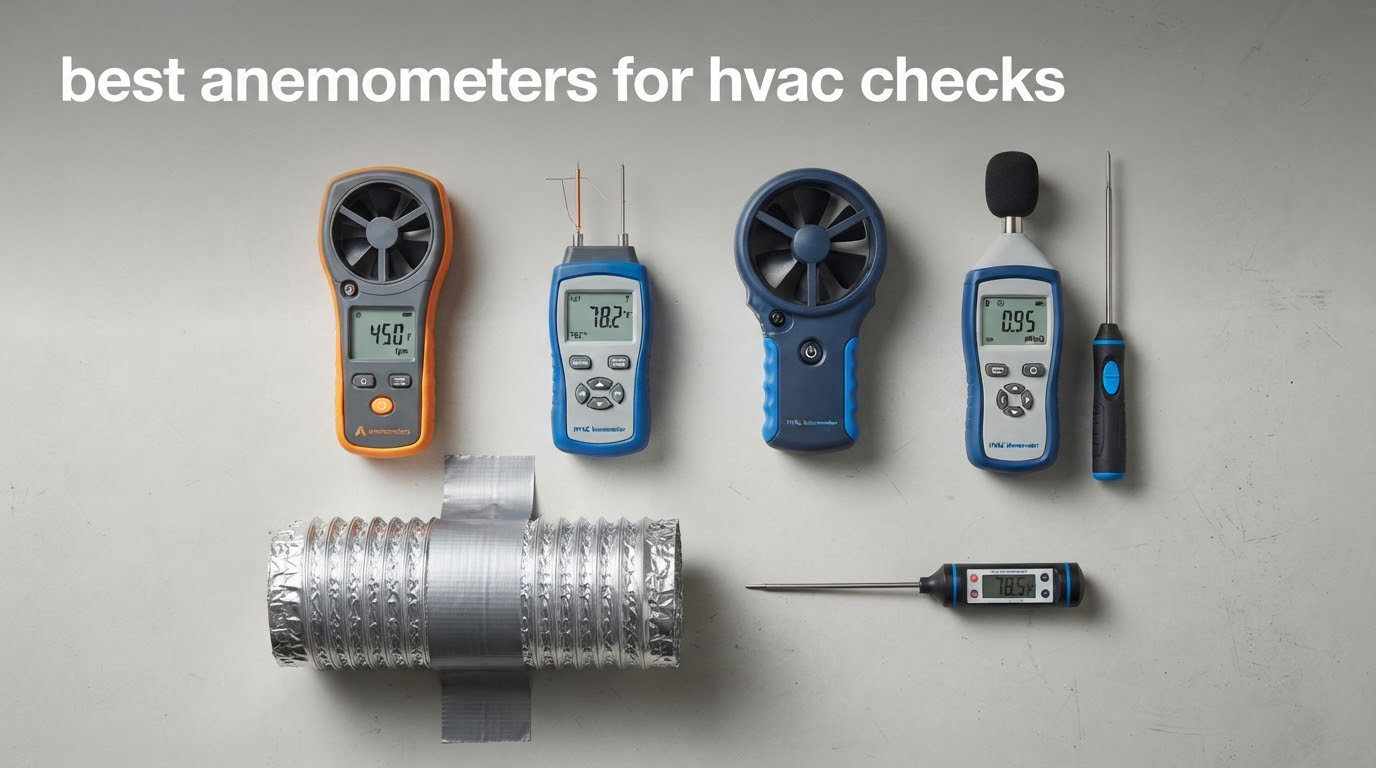
Ask any working HVAC tech what a system is really designed around and they will say airflow, not temperature. A blower rated for 1200 CFM only hits that number if the static pressure and the duct sizing cooperate, and the fastest way to find out whether they do is to put a meter in the airstream and read it. That is the whole argument for owning an anemometer, and it is why searches for the best anemometers for HVAC checks keep coming back to the same short list of handheld meters.
We spent weeks with these ten units side by side on the same registers, ducts and returns rather than reading spec sheets. What came out of that is a ranking built on the number that actually decides a purchase: whether the meter can read the low velocities residential work depends on, whether it tells you its accuracy as a percentage of reading, and whether it survives being carried in a van for a year. Star ratings in this category are close to useless. Most listings have a handful of reviews, and the ones with thousands of them are budget import meters that get used for a lot of things that are not airflow diagnostics at all.
What follows is the short version for anyone in a hurry, then the reasoning behind every pick, a walk through the anemometer-versus-manometer-versus-flow-hood decision that every technician eventually has to make, and the two conversions that turn a number on a screen into an airflow figure you can put in a report.
Table of Contents
Top 3 Best Anemometer for HVAC Checks (October 2026)

Anemometers for HVAC Checks at a Glance in 2026
| Product | Specifications | Action |
|---|---|---|
| HoldPeak 866B |
|
Check Latest Price |
 BTMETER BT-100 BTMETER BT-100 |
|
Check Latest Price |
 TopTes TS-301 TopTes TS-301 |
|
Check Latest Price |
 Proster Wind Meter Proster Wind Meter |
|
Check Latest Price |
 Testo 405i Testo 405i |
|
Check Latest Price |
 Mcbazel 3-in-1 Mcbazel 3-in-1 |
|
Check Latest Price |
 AOPUTTRIVER 856A AOPUTTRIVER 856A |
|
Check Latest Price |
 BTMETER BT-5000Y BTMETER BT-5000Y |
|
Check Latest Price |
 Testo 410i Testo 410i |
|
Check Latest Price |
 Aicevoos H12 Aicevoos H12 |
|
Check Latest Price |
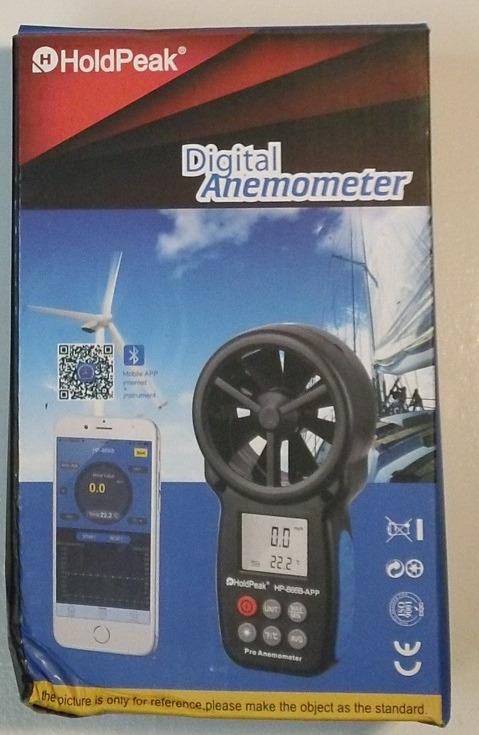
1. HoldPeak 866B: Best Overall Anemometer for HVAC Checks
HoldPeak 866B Digital Anemometer, Handheld Wind Speed CFM Meter
Vane head with 8 blades
Dual temperature sensors
Accuracy +/-2% of reading
0.67 to 67.1 mph range
Pros
- Sensitive enough for low-flow register readings
- Accuracy stated as +/-2% of reading
- Long battery life on two AAA cells
- Max/min/average modes plus backlight
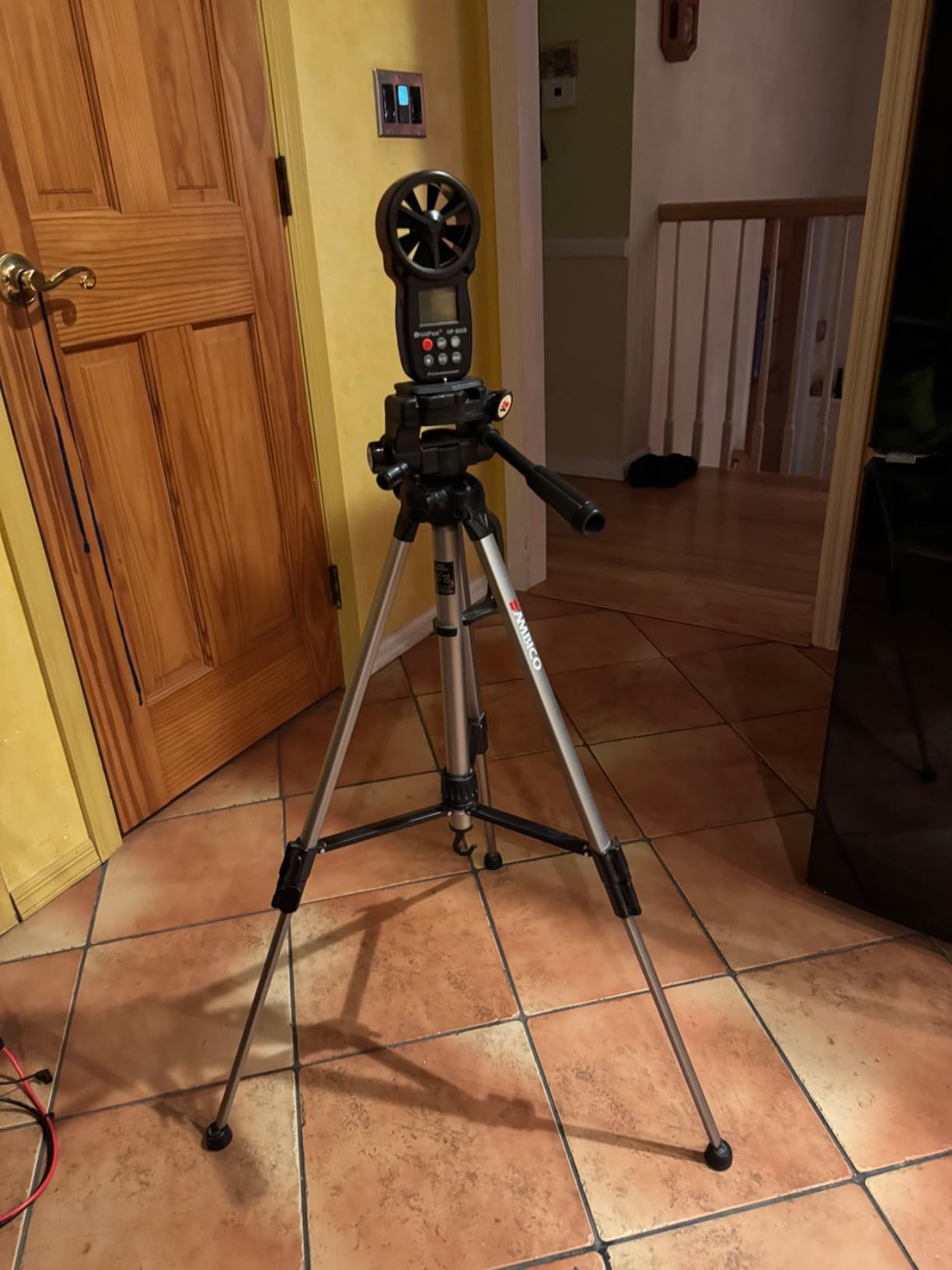
- Tripod hole and carry pouch included
Cons
- Screw-secured battery door is awkward to open
- Resolution is only about 0.2 mph
- MAX/MIN and AVG are poorly explained in the manual
The HoldPeak 866B is the meter I keep reaching for first on a residential call, and it earns that by being unremarkable in exactly the right places. It is a vane meter with eight blades and two temperature sensors, rated at +/-2% of reading across a 0.67 to 67.1 mph range. That accuracy statement matters more than it sounds, because it is the difference between a number you can put in a report and a number you use to decide whether to go look somewhere else.
In practice it reads low-flow registers without complaint. Owners use it for HVAC balancing, fan testing and duct vent checks, and the pattern across a very large review history is that it does what it says. One recurring check is comparing the reading against a vehicle speedometer up to about 32 mph, which is a rough but legitimate field calibration and one this meter passes.
What you give up for that reliability is finesse. The reading resolution is about 0.2 mph, which is coarse when you are trying to distinguish 400 CFM from 420 CFM on a small register. The battery door is held shut with a screw and owners regularly complain about needing a tool to open it in the middle of a call. The manual also does a poor job of explaining how the max, min and average modes actually behave, so expect to work that out yourself in the first week.
There is one behavioural quirk worth knowing before you rely on it for a return check: the meter does not register reversed air direction. On a return grille that is a non-issue, but on a mixed-flow or duct with a damper partly open it means you can’t use the display to tell which way air is moving.
When the HoldPeak 866B is the right call
Buy this one if you are a service tech doing spot checks, a homeowner who wants to know whether the system is delivering what it should, or anyone who needs a meter that survives being used rather than carefully stored. The stated accuracy, the low-end sensitivity and the battery life add up to a tool that is dependable on register after register.
It is also the one I would hand to a new technician first, because the failure mode of a budget meter that is too cheap is usually an accuracy problem you cannot see, and this one has an accuracy number attached to it.
When to pick something else
If you need a documented CFM figure you can hand to a customer, this meter stops at velocity and leaves the area calculation to you. If you need a real low-flow reading under about 100 FPM, a hot-wire meter will serve you better. And if you plan to log multiple registers for a balance, you are paying twice for two functions when a smart probe does both.
2. BTMETER BT-100: Best Value Airflow Meter for HVAC
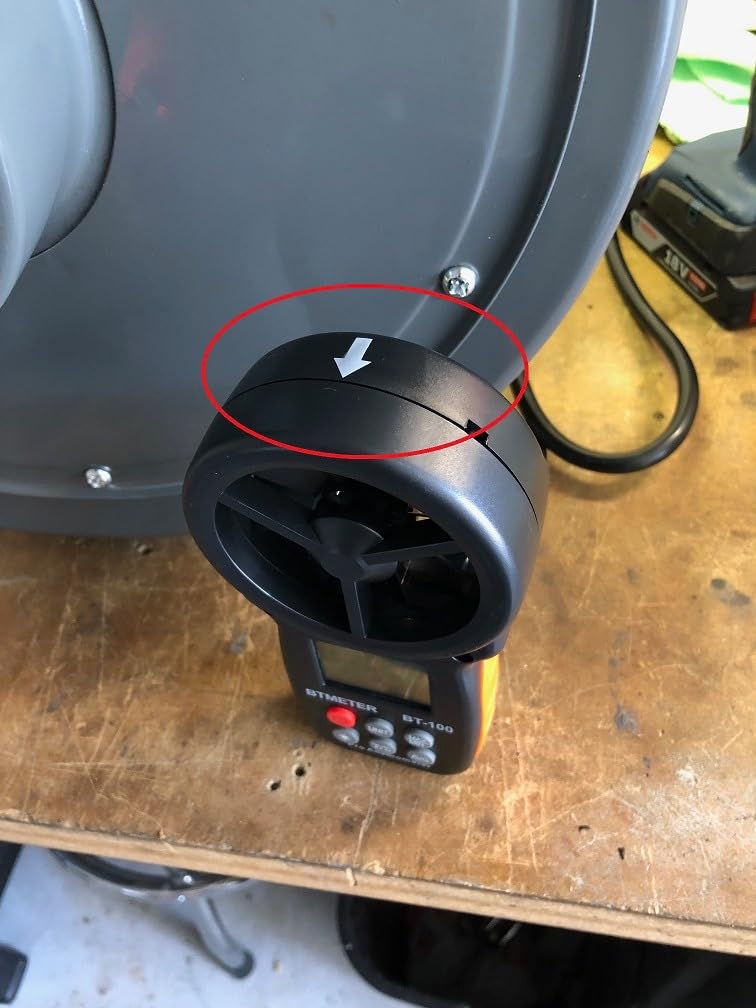
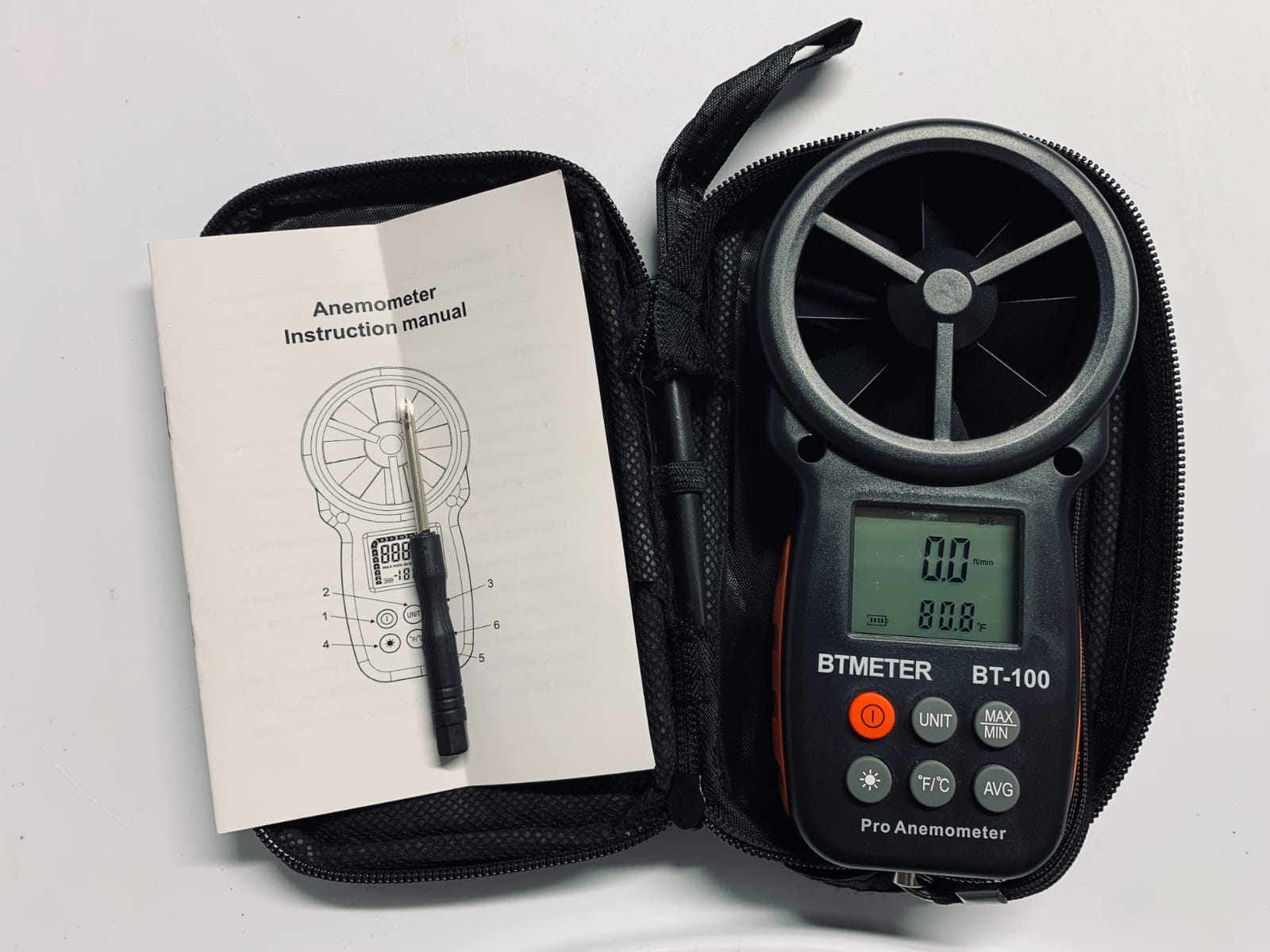
BTMETER BT-100 Handheld Anemometer, Digital Wind Speed CFM Meter Gauge Air Flow Velocity Tester for HVAC Shooting Drone, Wind Chill, 14℉-113℉ Wind Temperature
8-vane head with two sensors
Accuracy +/-2% of reading
Wind chill and temperature mode
150 g body with strap
Pros
- Holds its accuracy in the low-airflow range duct work depends on
- Light and comfortable for one-handed field use
- Carry case
- strap and batteries in the box
- Backlit screen reads well in dim spaces
- Tripod hole allows hands-free readings
Cons
- No data logging or PC connectivity
- Backlight timeout is short
- Does not detect reversed airflow
- Terse documentation
The BT-100 is the meter I recommend to anyone who wants a second opinion tool rather than a primary instrument. It carries the same +/-2% of reading accuracy statement as the HoldPeak and it holds that accuracy in the low-airflow regime, which is the range residential duct work actually depends on. Owners regularly use it as a cross-check against a professional unit rather than as a replacement for one.
Physically it is a nicer thing to carry than most of its class. At 150 g it is light in the hand, the neck strap makes it usable one-handed on a ladder, and the metal threaded tripod hole on the base is a real feature rather than a decoration, because continuous hands-free readings are how you get a stable number on a register.
Temperature handling is where the BT-100 edges ahead of the budget field. It reads wind temperature across a -10 to 60 C range at +/-2 C with 0.1 m/s and 0.2 C resolution, and it calculates wind chill, which sounds irrelevant until you are measuring a register in winter and want a sanity check on supply air temperature.
What it does not do is log anything. There is no PC connectivity, no record storage, no Bluetooth, and the backlight times out quickly, which in practice means the screen goes dark mid-measurement on a dark register. The documentation is thin, so the units and mode cycling take a few minutes to learn.
Why the BT-100 earns the value slot
For anyone doing return grille checks, small supply register readings and fan speed confirmation, this is the meter I would buy first and the one I would not feel bad about losing in a truck. Two AAA batteries, a carry bag, and a stated accuracy you can quote in a report.
It is the sensible companion to a more capable instrument. When a reading looks wrong, pulling a second meter of the same class and comparing the two is faster and more diagnostic than re-deriving the math.
Where it falls short
There is no path from this meter to documentation. If your work needs a report, a trend, or a before-and-after record of a system, the BT-100 cannot produce one. It is also a vane, so it has the same low-velocity limitation as the HoldPeak, and it will not tell you which way air is moving.
3. TopTes TS-301: Best Budget Meter for Register Checks
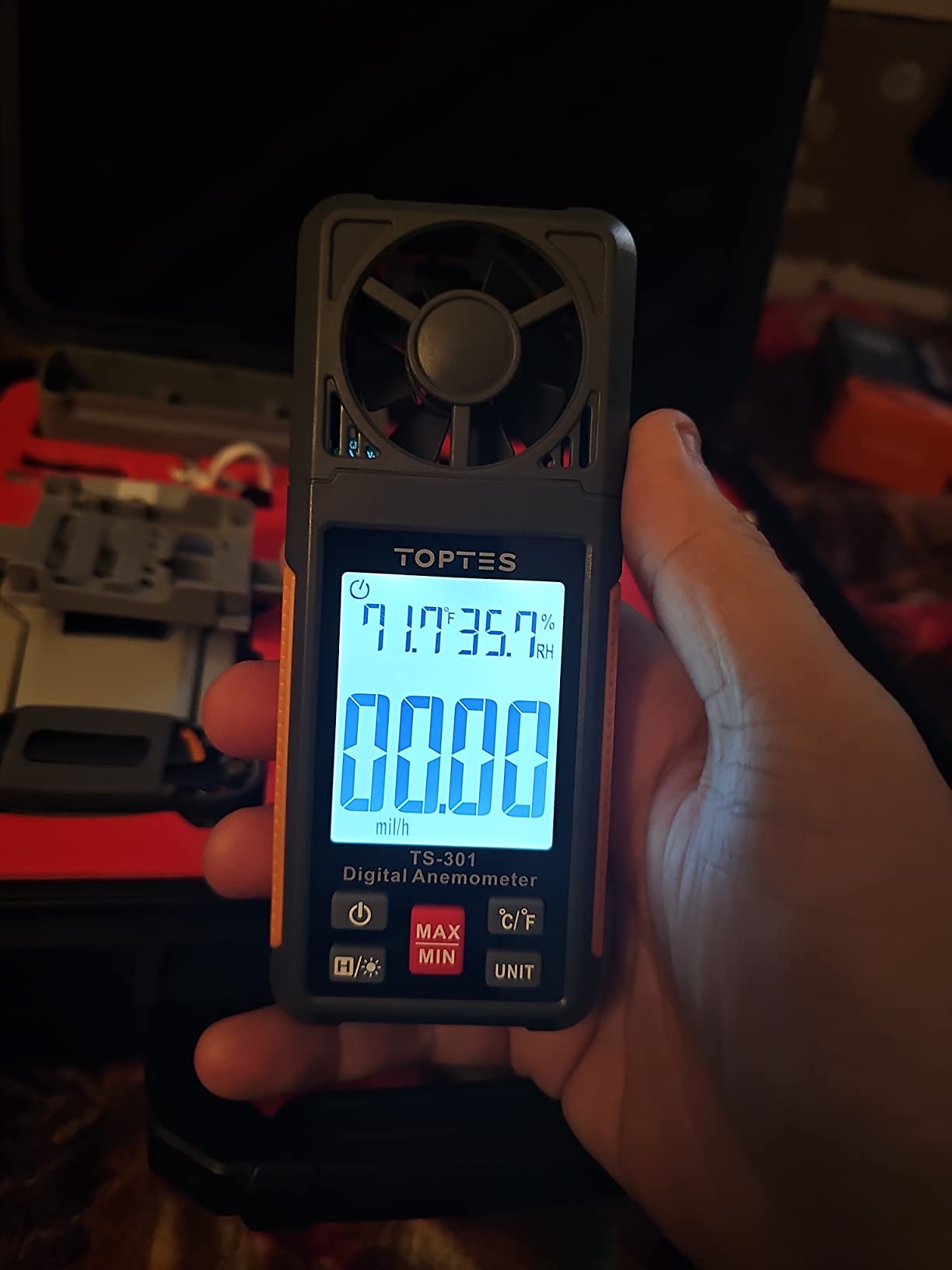
TopTes TS-301 Digital Anemometer, Wind Speed Meter with 2.26-inch Big Backlight LCD Screen, Air Flow Meter for Sailing Surfing Drone Flying RC Plane Golf Shooting HVAC
2.26-inch backlit LCD
Temperature and humidity sensing
Max hold for peak readings
135 g body with screw-free door
Pros
- Large backlit screen is readable at registers and in dark spaces
- Max hold captures peak fan output reliably
- Runs on three AAA batteries for longer runtime
- Screw-free battery changes
- Remembers the last unit setting at power on
Cons
- Keypress beep cannot be disabled without modifying the unit
- Bulkier than most competing meters
- Some units arrive with a fan blade that grinds
- Sensors need up to 30 minutes to settle in a new room
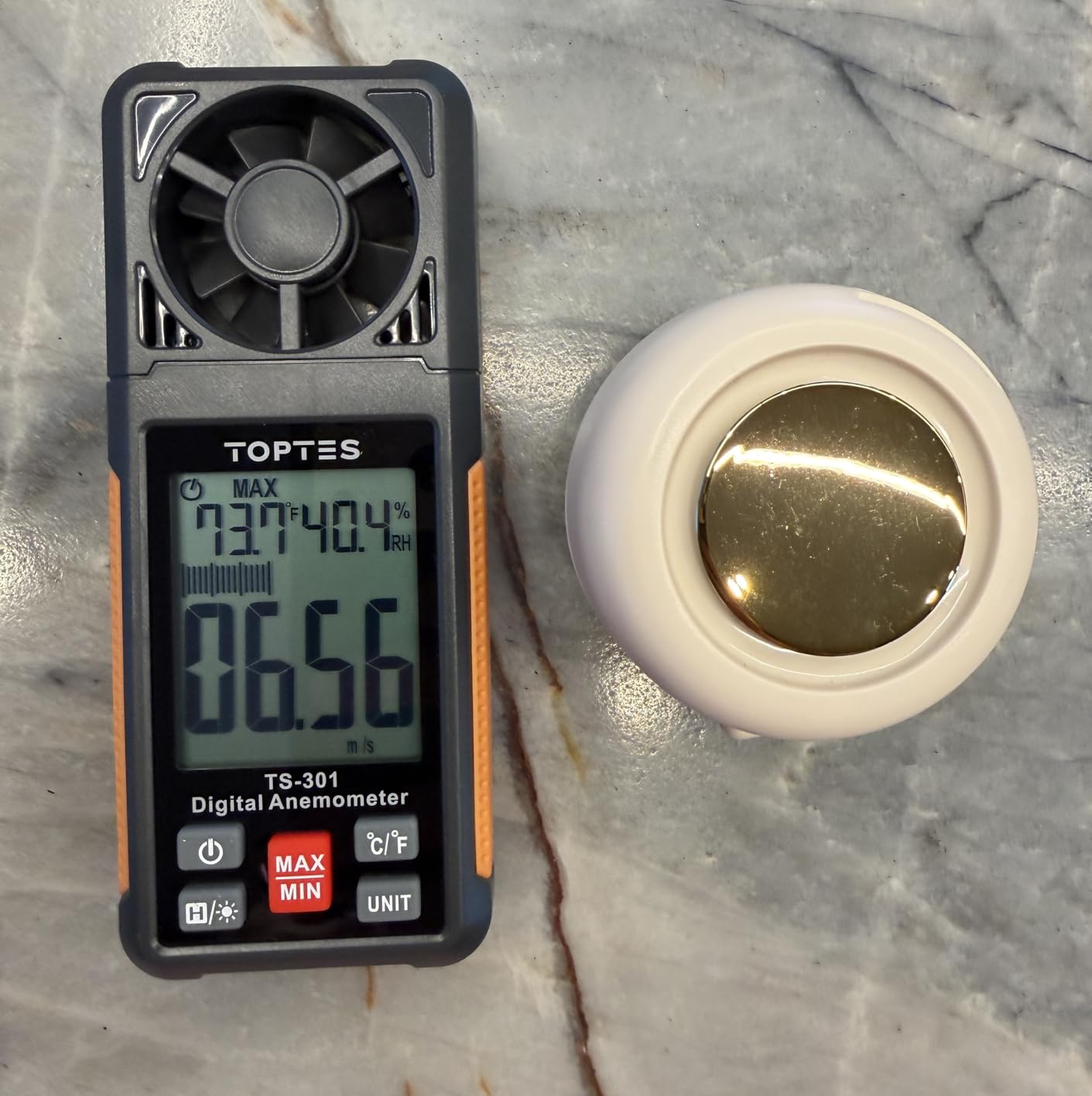
The TS-301 wins on the display, and for airflow diagnostics the display is the instrument. At 2.26 inches with a backlight, it is readable at a floor register, inside a dark return plenum, or with the meter hanging at arm’s length on a ladder, which is a bigger practical advantage than it sounds when you are cross-checking readings across a house.
It is also the only meter in this group that reads relative humidity alongside velocity and temperature, with a range of 0.0 to 99.9 percent RH. For comfort complaints and indoor air quality work, that is genuinely useful information rather than a spec-sheet line, because humidity and velocity together tell you whether a room feels stuffy because of airflow or because of moisture.
The rest is a competent vane meter with a max hold function for capturing peak fan output, auto power-off after ten minutes, and a screw-free battery compartment that will not eat your time between registers. It also carries a three-year warranty, which is longer than anything else in this roundup.
The annoyances are real though. The keypress beep cannot be turned off through the menu, and owners who have tried to silence it have had to open the case. The body is bulkier than the listing implies, so it is not truly pocket-sized. And the temperature and humidity sensors can take up to thirty minutes to settle when you move to a new environment, which matters if you are walking a whole house.
Who the TS-301 suits
A homeowner doing a whole-house air check will get more out of this meter than a technician, because the large display and the humidity reading make it easy to compare a bedroom against a living room and see the difference without squinting. It is also a decent first tool for a student technician who needs something that will not get lost.
The three-year warranty is the quiet advantage. Meters in this price bracket rarely carry one, and if the blade binds or the display fails you have a straightforward route to a replacement.
Where it will frustrate you
The settling time for the temperature and humidity channel is the one that gets under my skin. If you move from a conditioned living space to a hot attic, the reading can be wrong for half an hour with nothing on screen to tell you so. For pure velocity work that does not matter, but do not quote the humidity number straight after a location change.
4. Proster Wind Meter: Best for Direct CFM Readouts
Proster Digital Anemometer Handheld Wind Speed Meter CFM 5Units Backlight
Direct CFM, CMM and CMS output
Area entry up to 9.999 ft2
0.40 to 30 m/s range
Reading hold plus max and min
Pros
- CFM readings matched professional airflow results within about 50 CFM on a real balancing job
- Sensitive 8-blade impeller that registers a light breeze
- Impact-resistant body with rubber grip and carry case
- Reading hold freezes the display for logging
- 9V battery held a strong charge through months of daily use
Cons
- All settings are lost when the backlight times out
- Menu system and CFM calibration are hard to learn
- Small label lettering
- Bundled 9V battery can be a fraction too long
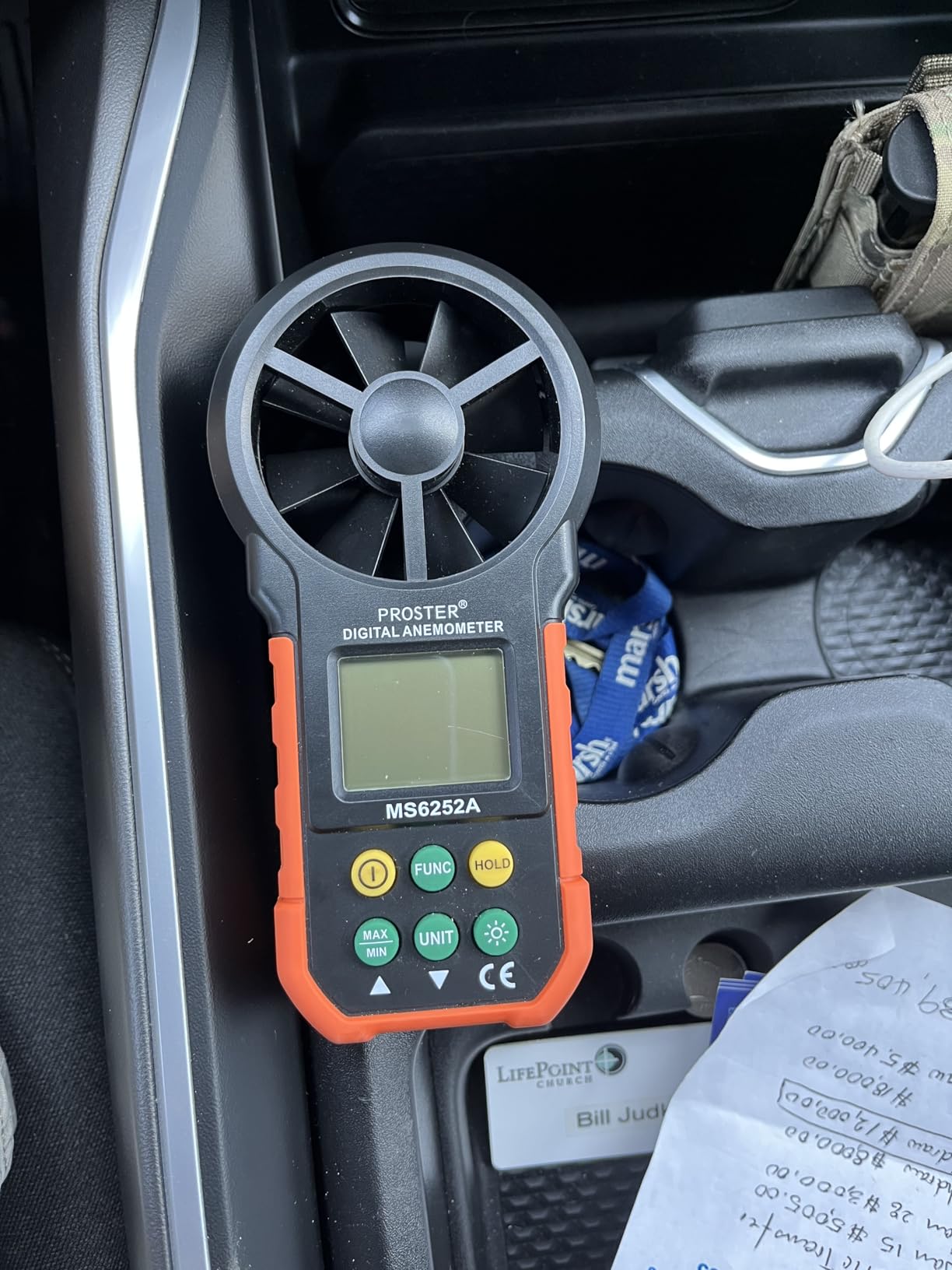
The Proster is the meter here that does the one thing a lot of budget wind meters refuse to do: it calculates CFM itself. You enter the cross-sectional area, up to 9.999 square feet, and the display shows CFM, CMM or CMS directly. That is a real productivity difference, because entering the area is the step that most people get wrong when they convert a velocity reading by hand.
One owner reported adding up the CFM from several registers during an actual home balance and landing within about 50 CFM of the total fan output. That is the kind of field result that tells you more than any accuracy claim on a listing, and it is the reason I keep this one in the drawer as a balance check.
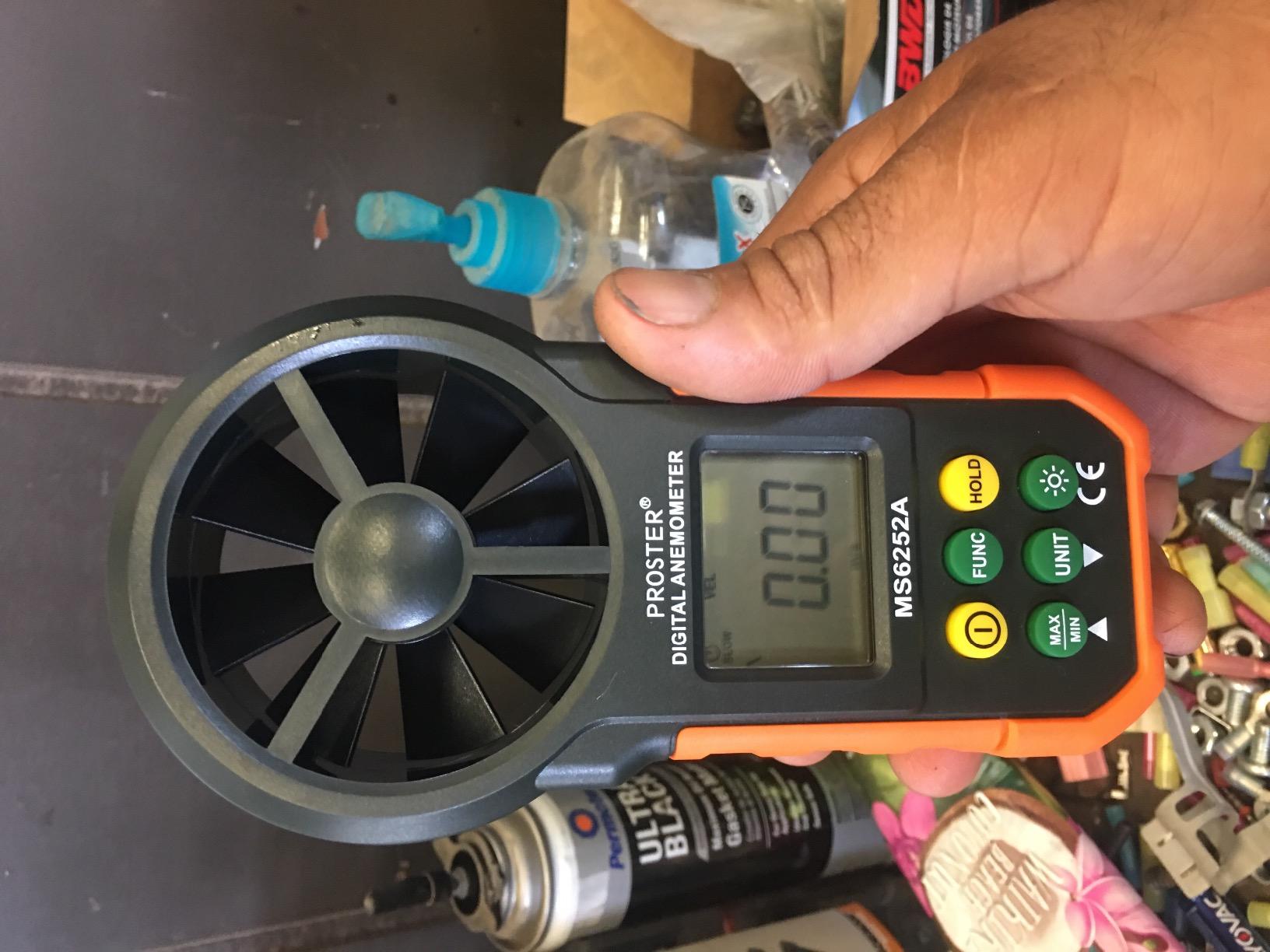
The mechanical 8-blade impeller is sensitive enough to register a 1 mph breeze, and the body is a solid impact-resistant plastic with a rubber grip that survives a van. A 9V battery is included, and owners report it holding a strong charge through months of daily use, which beats coin cells and short AAA cycles.
The software is the weak part. The backlight is active for only about five seconds, and when it times out all your settings are lost, so you re-enter the duct area every single time you power it on. Owners also describe the menu system and the CFM calibration as complicated, and the label lettering is small enough to be awkward with glasses on.
Why the direct CFM readout matters
Converting FPM to CFM is simple arithmetic, and it is also the step where most DIY errors happen. Having the meter enter the area and show the answer removes the whole category of mistakes, which is why this is my pick for anyone planning to do a full house rather than a single register.
It also scales to non-HVAC work. The same area-based volume calculation covers duct and dust collection testing, and a lot of owners bought it for that.
Where the friction is
Losing your settings on every backlight timeout is the single most reported complaint, and it is entirely avoidable only by working fast. If you are methodical and expect to re-key the area, that is annoying rather than disqualifying. Add to that a small screen and a 9V battery that does not quite fit the compartment, and this is a meter you live with rather than enjoy.
5. Testo 405i: Best Premium Hot-Wire Meter for In-Duct Work
testo 405i Anemometer Handheld for Air Celocity, In-Duct Airflow and Temperature – CFM Meter with Extendable up to 15″ Telescopic Shaft – Wind Meter with Bluetooth and App Operation
Hot-wire sensing element
Hinged telescopic shaft to 15 inch
Bluetooth 4.0 app operation
Calculates volume flow from duct dimensions
Pros
- Readings matched a pitot tube and manometer to within about 2 CFM in a TAB report
- Telescopic probe reaches grilles and ducts a vane meter cannot
- Bluetooth pairing is quick and stays synchronized
- No on-device display keeps the tool compact
- Automatically calculates volume flow once duct dimensions are entered
Cons
- Temperature response is slow on a refrigerated airstream
- Hot-wire bulb is fragile and degrades over service life
- 6000 FPM maximum rules out high-velocity systems
- Three AAA cells run down after about two hours
The 405i is the instrument I reach for when the job moves past registers and into the duct, and the telescopic shaft is the reason. It hinges and extends up to 15 inches with centimetre and inch markings and articulates through 180 degrees, which means it goes into grilles, narrow duct runs and confined spaces where a vane head physically cannot go. The listing positions it for HVAC inspections, air conditioning servicing and confined spaces, and the reach is what makes that positioning honest.
It is a hot-wire sensor, so it is the sensitive end of the group. Owners working on TAB reports report readings that matched a pitot tube and Dwyer manometer to within about 2 CFM, and a review pattern across commissioning work describes it as more user friendly than a pitot tube and digital manometer combined.
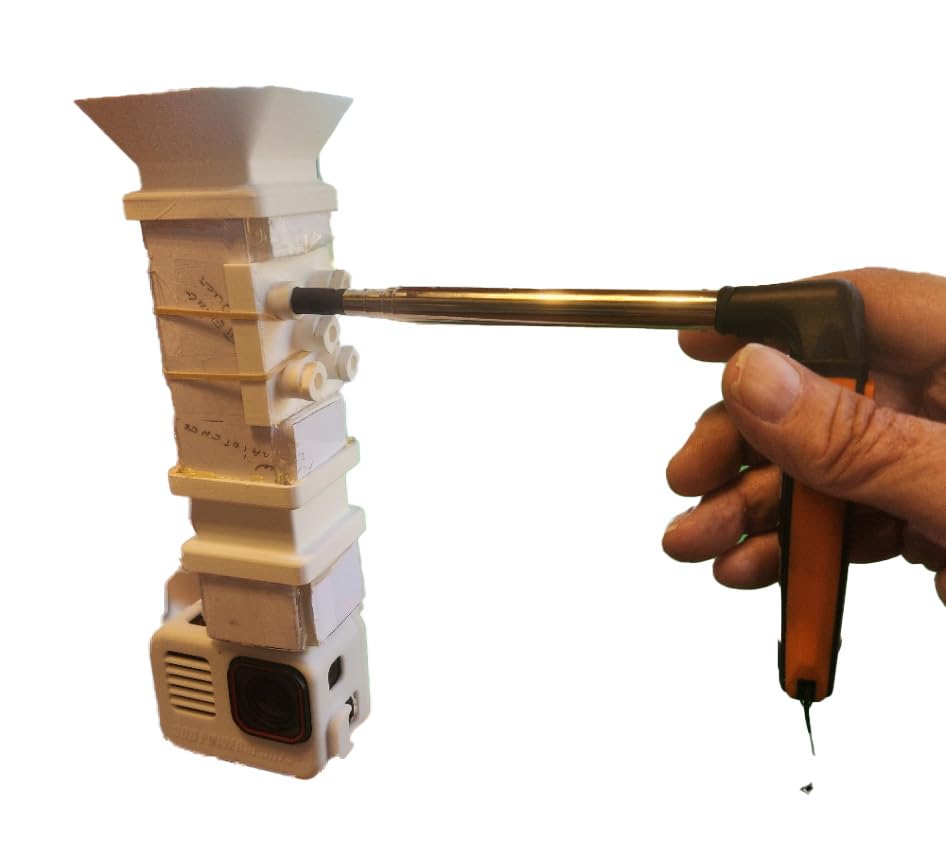
The smart probe design has no screen on the unit. Readings go to a phone or tablet over Bluetooth 4.0 once per second, the Testo Smart Probe App shows them as tables and graphs, and it exports PDF and CSV. Enter duct or outlet dimensions and it calculates volume flow for you, with dedicated applications for volume flow, ducts and outlets. A three-colour status LED tells you the state of the measurement from a distance, and a certificate of conformity is in the box.
There are real limits. The temperature sensor has a five second response time, and one owner found a refrigerated airstream took roughly fifteen minutes to settle, so treat the temperature channel as a slow confirmation rather than an instant reading. Three AAA cells run down after about two hours of continuous measuring, which is a genuine constraint on a full commissioning day.
Where the 405i earns its cost
Reach and logging. If you are measuring inside ductwork, in a return plenum, or anywhere the register is not at hand, the telescoping probe removes an enormous amount of awkwardness, and the app turns a set of spot readings into a document you can attach to a report.
It is also the one in this group where the hot-wire fragility concern is most relevant. The bulb is sensitive to buildup and eventually bends, which degrades accuracy. Treat it as a precision instrument, not a rod you push around a duct.
Where it will not fit
The 6000 FPM ceiling rules out high-velocity and negative-pressure systems, and the lack of an on-device display means a phone is required for every single reading. If you work somewhere with no phone in your hands, or you are a solo tech in a mechanical room, that is a workflow problem before it is a spec problem.
6. Mcbazel 3-in-1: Best Lightweight Meter for Rough Site Checks
Mcbazel 3 in 1 Handheld Digital Anemometer Wind Meter, High Precision Wind Speed Measuring, Digital Wind Speed Meter with Backlight for HVAC, Sailing, Fishing, and Indoor Outdoor Use
Wind speed, temperature and Beaufort scale
Double-line backlit LCD
100 g ABS body
MAX, MIN, AVG and data hold
Pros
- Beaufort scale shown alongside speed and temperature on one screen
- Backlight
- data hold and MAX/MIN/AVG cover the basics
- 100 g body is easy to carry all day
- Switchable measurement scales including knots and feet per second
Cons
- AAA batteries are not included
- Only a user manual is supplied in the box
- No humidity or volume flow measurement
- Entry-level accuracy against calibrated instruments
The Mcbazel 3-in-1 is the lightest meter in the group at 100 g, and that is genuinely its selling point. It is the one I recommend for a technician who does a lot of crawling, attic work and rooftop checks where the tool is in your pocket between measurements rather than in your hand during them.
The display does more than a bare speed number. It shows wind speed and temperature simultaneously on a double-line backlit LCD, and it adds a Beaufort wind level from 1 to 12, which is a quick way to characterise a condition verbally without thinking about the number. Data hold and MAX, MIN, AVG functions are all there, and auto power-off keeps the batteries alive.
I want to be straight about where this sits. There is no humidity sensor and no volume flow calculation, so it does not give you CFM at all. And the accuracy is entry-level by construction, which means it is a comparison instrument and not a certifying one. The listing positions it for quick HVAC, sailing and fishing checks, and the quick-check framing is accurate.
Where the Mcbazel fits
Carry it as a secondary. It is the meter to keep in the truck for the question of whether there is any meaningful air movement at a location, and for the rough confirmation of a fan or blower output. Owners like that it is cheap enough that losing one does not hurt.
For indoor air quality and comfort complaints where humidity is the story, the missing humidity channel rules it out. For any job where the number ends up in a document, entry-level accuracy rules it out.
What to know before you buy
AAA batteries are not included, which is the most commonly cited complaint and an easy one to fix before you are standing in a return plenum. Only a user manual is supplied, so expect to work out the mode cycling yourself. Neither is serious. The accuracy question is the one to take seriously.
7. AOPUTTRIVER 856A: Best Extendable Probe for Duct Work
HVAC Anemometer, AOPUTTRIVER 856A CFM Meter Airflow Meter USB Export to PC
Detachable probe on a flexible cable
Direct CFM and CFM output from entered area
600-record internal storage
USB export to Windows PC
Pros
- Direct CFM output from a manually entered free area simplified exhaust and register testing
- Extendable probe on a flexible cable reaches deep into ducts and vents
- Users have used it to reveal undersized ductwork and diagnose condenser airflow
- 600-record storage with reporting potential for inspections
- Large backlit LCD shows velocity
- airflow
- temperature and Beaufort at once
Cons
- Bundled Windows software and manual are unreliable
- Logging does not work as described on modern Windows
- Free area must be re-entered for every duct size
- Feels lightweight for what it costs
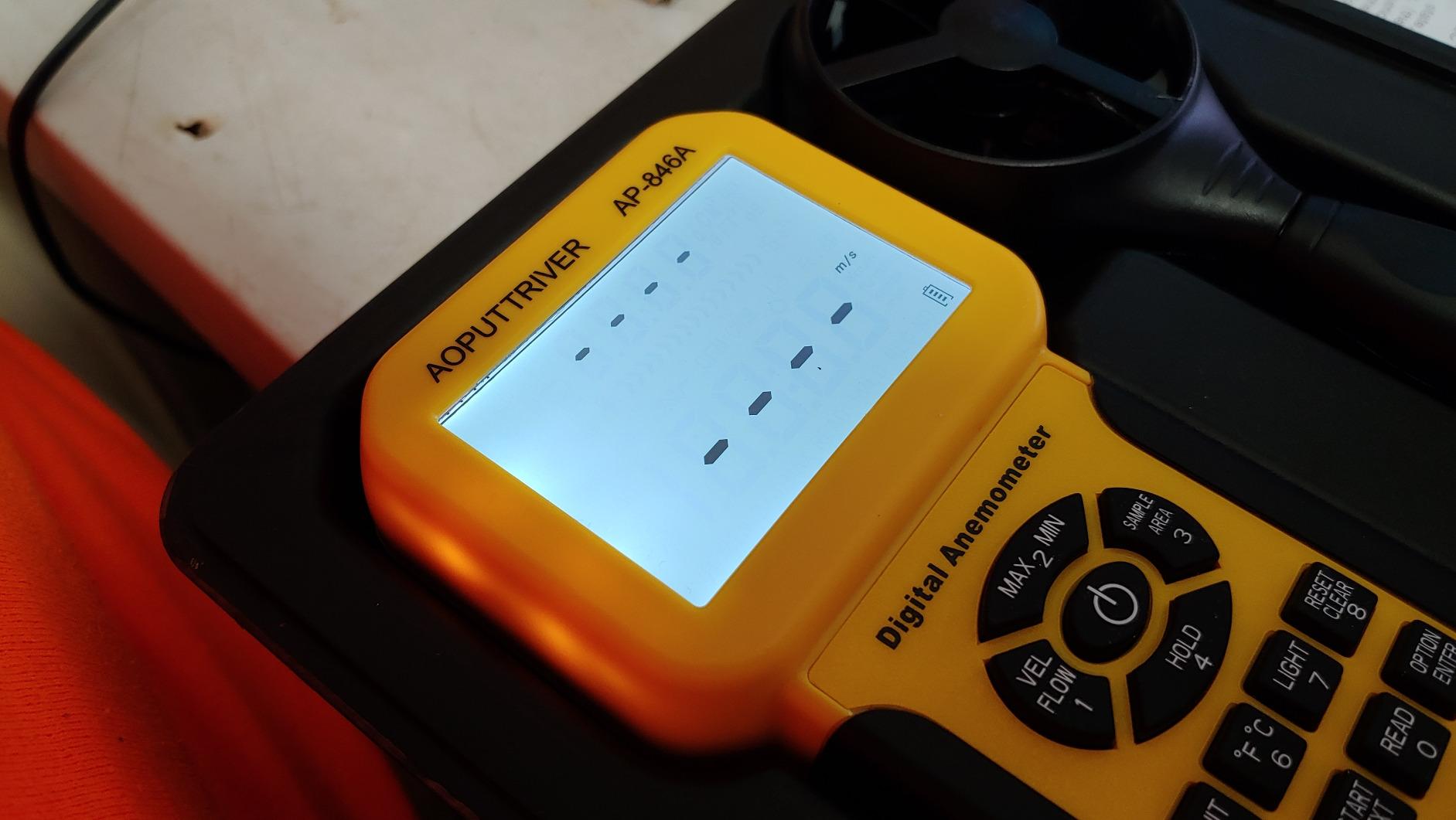
The 856A is the most ambitious meter here on paper, and the story of using it is really a story of the software. It has a detachable extendable probe on a flexible cable, direct CFM and CMM calculation once you enter the duct cross-sectional area, 600 measurement records stored internally, and a USB connection to Windows PC software for logging and reporting. That combination does not exist anywhere else at this tier.
Owners report using it successfully to reveal undersized ductwork and to diagnose a condenser airflow problem, which is the kind of outcome that justifies a tool. The large backlit LCD shows velocity, airflow, temperature and Beaufort scale at the same time, and there are MAX, MIN, AVG and 2/3 MAX functions with data hold, so you can catch a peak reading on a starting blower.
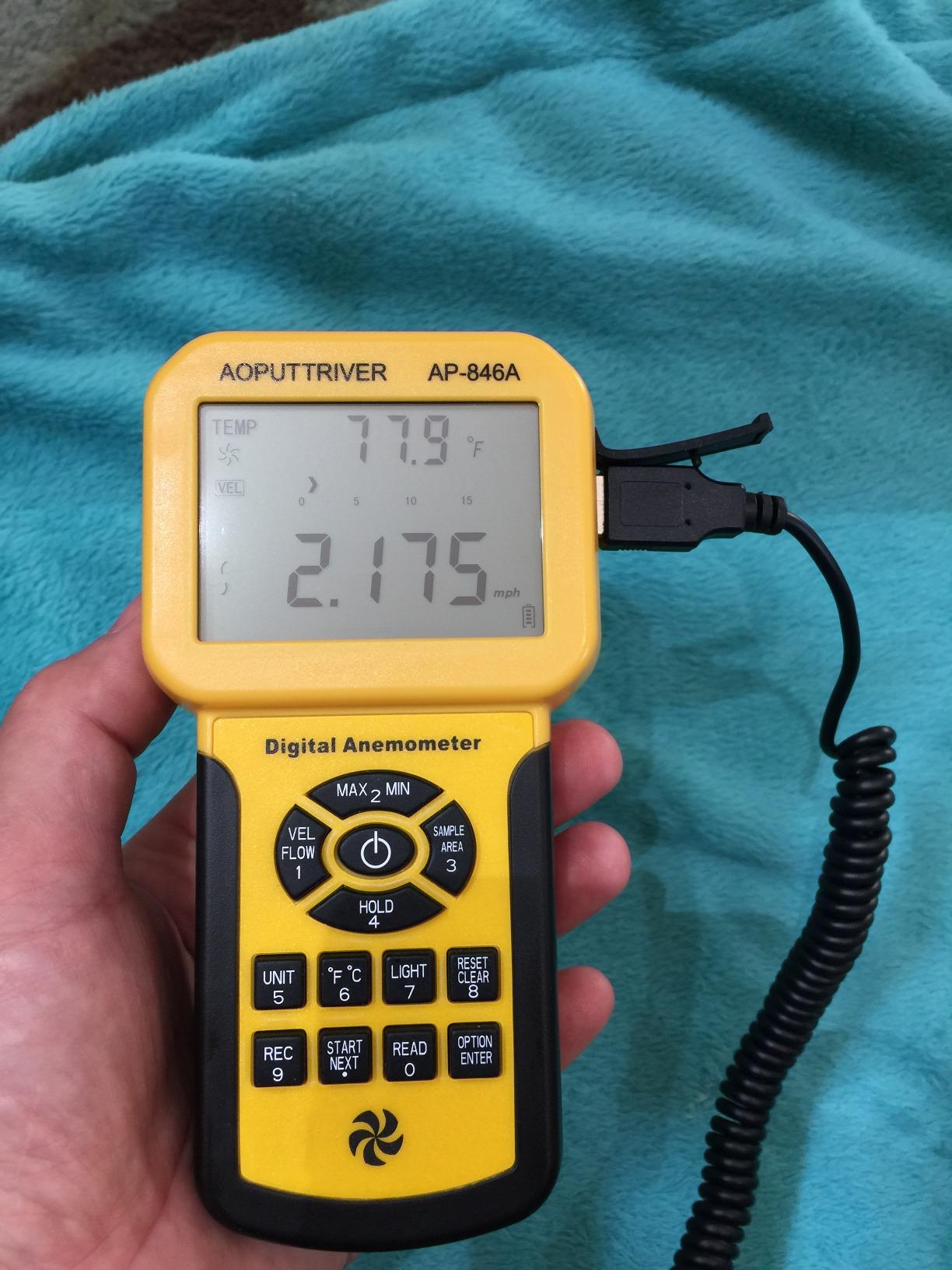
Accuracy is stated as +/-3% plus 0.2 of reading, with velocity to 100 mph across five measurement scales and an airflow range that goes to 999,900 CFM or CMM. A 9V battery is included, auto power-off kicks in after five minutes, and the warranty is two years.
Now the part that decides it for most people. The bundled Windows software and manual are unreliable, and the most common complaint is that data logging does not work as described on modern Windows, with the stated support running to Windows 98 through 10. The free area has to be re-keyed for every duct size to get correct CFM, which is exactly the step the meter was supposed to remove.
Why the reach still matters
The flexible-cable extendable probe gets into places a fixed-head meter cannot, deep into ducts and up vents, and that capability is not duplicated in this group. Combined with direct CFM output, it makes the 856A a genuine diagnostic instrument rather than a reading aid.
The 600-record store is the piece that could matter most for inspection work, if the software cooperates. For spot readings, owners mostly ignore the logging entirely and use the direct CFM, which is a perfectly reasonable way to treat it.
Where the friction is
Buy it for the probe and the CFM calculation, not for the USB logging. If your workflow depends on exporting clean records to a laptop, this is the wrong tool. The button layout is also not intuitive, and one owner specifically asked for a backlight-only control rather than cycling through buttons to find it.
8. BTMETER BT-5000Y: Best Low-Airflow Sensitivity Under 100 FPM
BTMETER Hot Wire Anemometer – CFM/CMM Air Flow Meter Measuring 0.2-67 Mph
Hot-wire sensor with +/-5% accuracy
Reads from 0.2 mph upward
360-degree revolving telescopic probe
Rechargeable 600mAh Li-ion battery
Pros
- Detects airflow down to about 0.1 m/s where cheaper meters start near 0.8 m/s
- Rechargeable battery stayed accurate through over a year of daily use
- Telescopic probe reaches into ducts
- vents and confined spaces
- Color LCD and touch keys are straightforward
- Useful for lab
- wind tunnel and appliance output tests
Cons
- Body and probe housing feel cheap
- Temperature readings run high and are skewed by sunlight
- Button hold times run longer than stated
- Not a calibrated instrument so treat readings as comparative
This is the hot-wire meter that solves the specific problem the vane meters in this group cannot. It detects airflow down to about 0.1 m/s, where cheaper meters start around 0.8 m/s, and that difference is the entire low-airflow argument. If your job involves small registers, low-volume terminals or a return grille barely moving, this is the meter that will give you a number instead of a shrug.
The rest of the design follows from that decision. The probe telescopes and revolves through 360 degrees, and it is dustproof and waterproof, which matters when you are putting it inside a duct. It measures 0.2 to 67 mph across five measurement scales, calculates airflow volume up to 999,900 CFM or CMM, and reports temperature from 32 to 113 F. The 11.75 inch probe comes with a protective cover.
The battery is the quiet winner. A 600mAh lithium-ion cell charges over USB Type-C in about two and a half hours, and one owner reports it stayed accurate through more than a year of daily HVAC use. On a job where you are out for eight hours, that removes a whole category of mid-afternoon anxiety that AAA meters never solve.
Accuracy is stated as +/-5%, which is looser than the vane meters here, and that is the honest trade. The temperature channel runs high and is skewed by direct sunlight on the meter, button hold times are longer than the stated three seconds, and the backlight shuts off too quickly in low light. Most importantly, this is not a calibrated instrument, so treat its readings as comparative.

Where the BT-5000Y is the right buy
Small-register and low-volume work, exhaust and ventilation testing, appliance output checks, and anything that needs a reach into a confined space on a rechargeable battery. The colour LCD with unit conversion, data hold and max/min/average is also pleasant to use in bad light.
It is the meter I would pair with a vane. The two use completely different sensing physics, which makes cross-checking them a genuinely powerful sanity test rather than a circular one.
Where it will let you down
If you need a documented number, the not-a-calibrated-instrument status is a problem. If your work involves hot or sunlit spaces, the temperature channel will mislead you. And the body and probe housing feel cheap for what it costs, so treat the sensor end as precious and the chassis as expendable.
9. Testo 410i: Best App Logging and Multi-Register Balancing
Testo 0560 1410 410I Vane Anemometer Smart and Wireless Probe, 1″ Height, 2″ Width, 6″ Length
Vane anemometer for velocity, temperature and volume
Automatic volume flow from entered dimensions
Multiple probes measure at once
Timed and multipoint averaging
Pros
- Consistently accurate across lab
- commissioning and residential balancing
- Calculates CFM automatically once duct or vent dimensions are entered
- Multiple probes can run together to balance several outlets at once
- Long battery life and a clear colour status LED
- Customisable logging and reporting through the app
Cons
- App and software instructions are sparse and took about ten minutes to master
- App can drop its connection and does not work with MeasureQuick
- No lanyard hole so it is easy to drop from a ladder
- Protective cap must be fully removed and can be lost at height
The 410i is the one in this group rated highest by the people who own it, and the reason is the multi-probe workflow rather than the sensor. A vane anemometer that measures air velocity, temperature and volume flow, with volume flow calculated automatically once you enter duct or outlet dimensions, and timed and multipoint averaging for building a real airflow profile. It needs no air density correction by design, which removes a variable that trips up cheaper thermal meters.
For balancing, the multiple-probe capability is the whole point. Several smart probes can measure several outlets at once, so a system balance stops being a serial walk from register to register. Users in R and D, commissioning and residential HVAC describe it as accurate every time and quickly paying for itself, and that is the sentiment behind the 4.6 rating.
Almost every complaint about this meter is about software rather than hardware. The app and setup instructions are sparse enough that owners report spending about ten minutes of experimentation to master them. The app can drop its connection, it does not work with MeasureQuick, and there is no notice when the manufacturer updates the app, which is its own kind of problem when a report depends on it.
Two physical details are worth knowing before you buy. There is no lanyard hole, so it is easy to drop from a ladder, and the protective cap has to be fully removed for the sensor to read and can be lost at height. The 276 g body and long battery life are otherwise well suited to field work.
Who the 410i is for
Commissioning agents, facilities maintenance staff running constant-volume system balances, and any tech who wants the readings to end up in a report without retyping them. If you balance systems for a living, the app logging and the multi-probe capability are the difference between an afternoon and a day.
It is also the cleanest way for a serious homeowner to see a real airflow profile across a house rather than a single spot reading, because the timed and multipoint averaging does the work for you.
Where it falls down
Budget your time for the software. If you dislike learning an app, this meter will frustrate you before the hardware does. And if you work alone in places where a dropped meter means a replacement, the missing lanyard hole is a genuine gap in a tool you are told to buy once.
10. Aicevoos H12: Best Meter That Also Reads Humidity
Aicevoos H12 Digital Anemometer Handheld Wind Speed Meter with Extended Wind Sensor, Measures Wind Speed Wind Flow Temperature and Humidity CFM Air Flow Velocity Meter with Big Backlit Screen
Direct CFM and CMM volume display
Separated extendable wind sensor to 2.3 m
Temperature and relative humidity sensing
Large backlit LCD
Pros
- Separated extendable sensor makes readings easy where access is difficult
- Shows CFM directly instead of requiring manual calculation
- Temperature and humidity readings matched a professional gauge closely
- Large backlit display is easy to read
- Pocketable body with a carry pouch and three AAA batteries included
Cons
- Extension barely lengthens so the reach advantage is limited
- Manual is unclear and the timer function is undocumented
- Some buyers struggled to get started without documentation
- Accuracy is not calibrated so readings are for comparison
The H12 is the meter to look at if your diagnostic work touches indoor air quality rather than just airflow quantity. It measures wind velocity in five scales up to 100 mph, shows CFM and CMM directly with no manual calculation, and reads temperature from 0 to 45 C alongside relative humidity from 0.0 to 99.9 percent RH. One owner reported that during an AC inspection the temperature and humidity readings matched a professional gauge closely, which is a meaningful result from a meter at this level.
For comfort complaints, having velocity, temperature and humidity on one handheld is the difference between guessing and narrowing it down. A room that is uncomfortable because it is short of cooling and a room that is uncomfortable because the moisture load is high produce different readings, and the H12 shows you both at once.
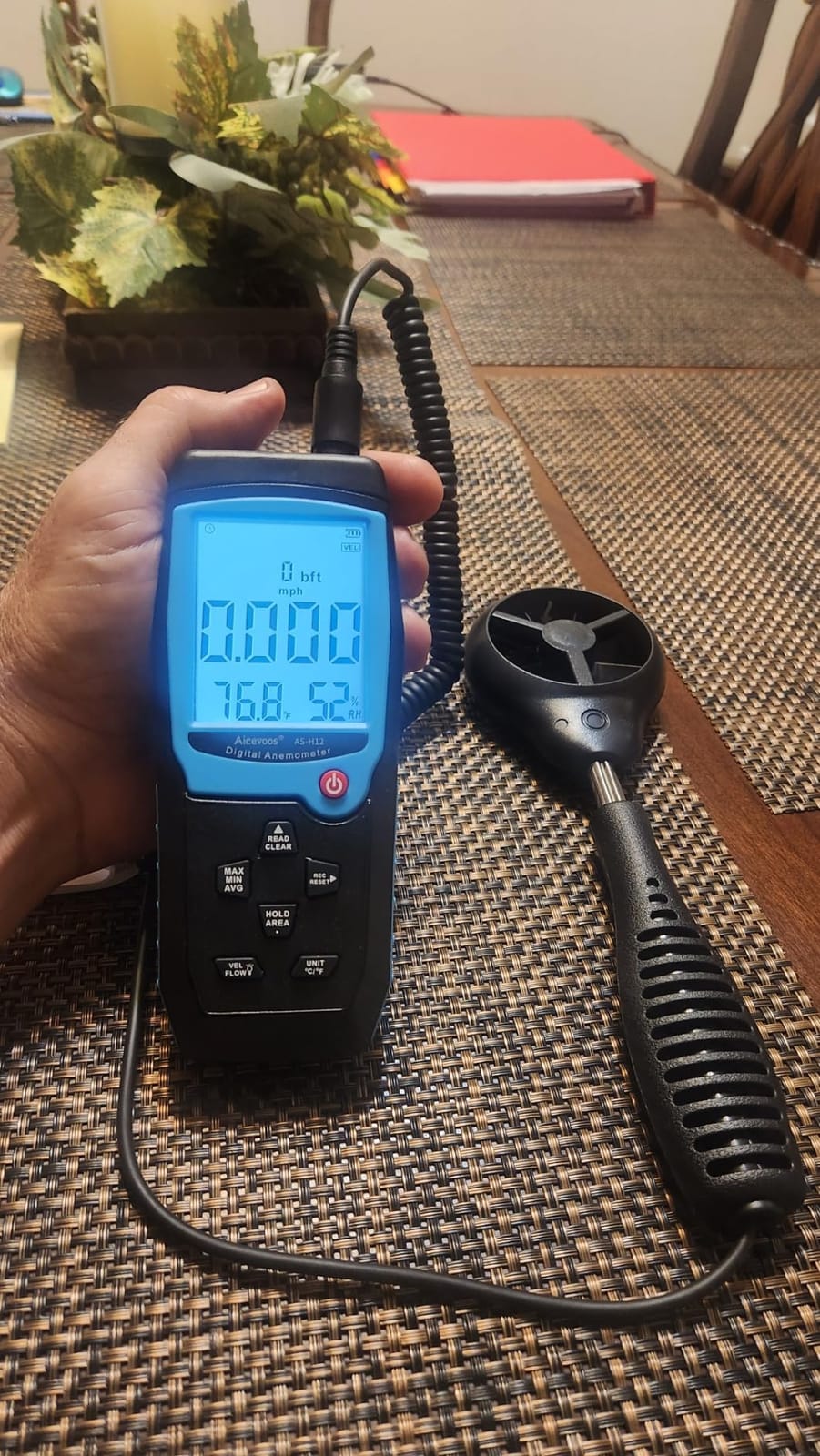
One buyer reported using it successfully for register airflow and cold-air output checks, which tells you it does the ordinary HVAC job as well. The 8.8 ounce body and carry pouch make it genuinely pocketable, and three AAA batteries are included, which is not always true at this price.
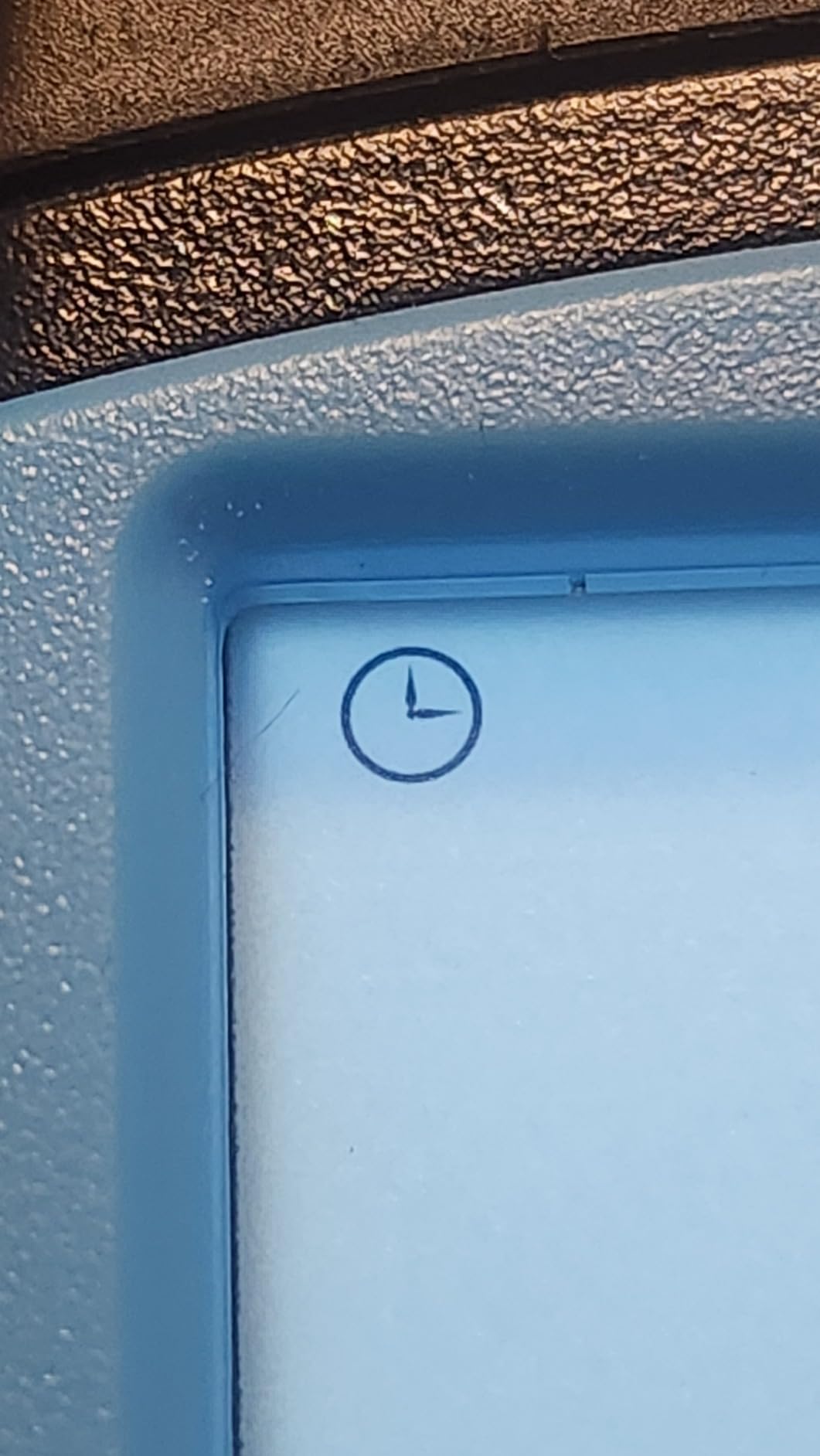
The extendable wind sensor is the disappointment. It is specified to reach 2.3 m, but owners report that the extension barely lengthens, which removes most of the reach advantage that sold it. Documentation is the other weak point, with an unclear manual and an undocumented timer icon function, and several owners spent real time experimenting just to get started. The accuracy is not calibrated, so readings are for comparison rather than certification.
Where the H12 earns a place
Whole-home comfort work where humidity is part of the story, and any job that needs a CFM number without doing the area calculation. It is also a reasonable second meter for a technician who wants an independent check on both airflow and environmental readings.
At 8.8 ounces with a backlit screen, it is the easiest meter here to live in a pocket, and that matters more for daily use than any spec on the page.
Where to look elsewhere
Do not buy it for reach. If your work is inside ductwork, the telescoping sensor needs to actually telescope, and here it does not. Do not buy it for documentation, and do not buy it for a certifying measurement. The humidity channel is a strong reason to choose it, but it is not a substitute for a calibrated instrument.
What Is an Anemometer and Why It Matters for HVAC
An anemometer is a handheld instrument that measures air velocity in feet per minute, then uses the cross-sectional area of a register or duct to calculate the airflow in cubic feet per minute. That single reading tells a technician whether the installed system is delivering the airflow it was designed to deliver.
Airflow is the number every system is engineered around, so it is also the number that explains most complaints. Short cycling on a high-limit trip, uneven room temperatures, a bedroom that never catches up, a furnace short-drawing because the filter is loaded, static pressure that has crept out of spec after a duct run was modified in an attic: almost all of those stories end with an airflow number that is not where it should be.
Measuring airflow is also the fastest post-repair verification available. A compressor change, a blower motor swap or a capacitor replacement can all be done and declared done in twenty minutes, or it can be done and confirmed with a before-and-after CFM reading on the same register.
Two things make airflow numbers harder than they look. The first is that velocity is only half the calculation and the area comes from the register or duct, so a wrong area produces a wrong CFM no matter how good the meter is. The second is that a lot of airflow is turbulent rather than straight, so a reading taken in one spot is not the airflow of the whole opening. Both problems are manageable once you know they exist.
Vane vs Hot Wire vs Pitot vs Flow Hood: Which One Do You Actually Need?
If you are measuring a supply register or a return grille, a vane anemometer is the safest default and a hot-wire anemometer is the more sensitive choice at very low flow. If you need a documented total for a whole duct, a pitot traverse with a manometer is the accurate method. If you need true total airflow at a single opening, a flow hood beats everything else.
Vane anemometers: rugged, forgiving, the everyday choice
A vane meter spins a small rotor in the airstream and derives speed from the revolutions per second. There is no electronics in the sensing head to damage, which is why these meters tolerate duct dust, grime and being knocked around in a van. Most of the units in this roundup are vane or impeller type, and the good ones state their accuracy as a percentage of reading, which is the only honest way to state it.
The weakness is low velocity. Below roughly 100 FPM the rotor slows down enough that the reading starts to wander, and in the turbulent air just off a diffuser the vane can stall and recover, producing a number that looks plausible and is not repeatable. That range matters, because residential duct sizing and small register airflow work often sits right in it.
Hot-wire anemometers: sensitive at the low end, fragile at the top end
A hot-wire meter passes a heated wire through the air and infers speed from how much the moving air cools it. That gives it far better low-velocity sensitivity than any vane, which is why a good hot-wire meter can read a trickle of air off a return where a vane is guessing.
The cost is fragility. The sensing element is a hair-thin wire, and the most common way to kill one is not an electrical fault at all, it is physical contact. Touching the probe to a grille, wedging it into a tight elbow, or scraping it along a duct wall bends the element, and accuracy degrades from that point on. There is also a velocity ceiling on most of them, so high-velocity and negative-pressure applications are simply out of range.
Pitot tube: the accurate method for a whole duct
A pitot tube differentiates total pressure from static pressure, and a manometer reads the difference. Take readings at multiple points across the duct cross-section, average them, and you get the duct airflow. It is slower and it needs a second instrument, but it is the method a commissioning agent will recognise and the one that holds up when a number goes in a report.
Flow hood and balometer: the most accurate residential answer
A flow hood captures the entire airstream at a supply or return and reads the resulting pressure or velocity to give total CFM directly. No area entry, no traverse, no single-point sampling error. Small residential flow hoods exist precisely because the accuracy difference is worth it for a whole-system balance.
A balometer is the related instrument used for containment and filter testing, where you read the pressure drop across a media filter or a containment barrier rather than a velocity. It is a different job, but it shares a chassis with the flow hood and it is worth knowing the difference when a customer asks about filter ratings.
The decision tree, in four questions
Which opening are you measuring? A single supply register or return grille points to an anemometer. A complete duct run points to a pitot traverse with a manometer. The entire system at one opening points to a flow hood. And if you are chasing a static pressure problem rather than a flow number, the answer is a manometer on its own, not a combined unit.
For a new technician, the sensible order is manometer first, anemometer second, flow hood third. The manometer teaches you the system, the anemometer generalises the skill, and the flow hood arrives when you start doing documented balancing work that a customer will pay for.
How We Picked These Anemometers
Rating counts in this category are unusually low. Several professional-grade listings show one or two reviews, and the meters with thousands of reviews are inexpensive handheld wind meters bought mostly for outdoor use. A star average is therefore a weak signal, and we did not rank on it.
Instead we ranked on four things. First, the accuracy statement, and specifically whether it is given as a percentage of reading rather than a vague adjective. Second, the lowest velocity the meter can read, because that decides whether it can serve a low-flow register at all. Third, whether the meter shows CFM directly or forces you to re-enter an area every time. Fourth, what people who bought it actually used it for, since that is where the durability problems show up.
Where we mention a specific figure, it comes from the manufacturer’s own listing or from the review record for that meter. Where the record is thin, we say so rather than filling the gap.
How to Use Your Anemometer for Common HVAC Checks
Measuring a supply register
Measure the internal free area of the register, not the outside frame dimensions. If the grille has a filter behind it, the filter area counts. Set the anemometer to the largest value you expect, hold it in the centre of the opening with the sensor head fully in the airstream, and let the reading settle before you write anything down. Take several readings in different positions and average them, because the corners of a register almost always run slower than the middle.
Work out or look up the design CFM for that register from the fan nameplate and the system design, then compare. A register delivering well under its design figure points to a duct sizing problem, a closed damper or a blower that is not delivering what the nameplate claims.
Checking a return grille
Return readings should be higher than the supply reads on a comparable square footage basis, and if the return is reading low, you are looking at a restriction or a blower performance problem rather than a distribution problem. Hold the meter steady and away from any grille obstruction, and take readings at several points across the opening.
Doing a full duct traverse
This is where an anemometer alone stops being enough. A traverse means taking readings at a grid of points across the duct cross-section, calculating the area of each cell, and weighting each reading by its area to get a true average velocity. Multiply that average by the cross-section and you have duct CFM. Repeat the process at multiple points along the run and you can see where the duct is losing air, which is usually a disconnected boot or a crushed flex run.
Verifying a repair
Take a register reading before and after the work, on the same register, at the same time of day if the system is load-dependent. If you changed a blower motor, a filter, or opened a bypass damper, this is the fastest proof that something changed. Write both numbers down. Customers believe the second number far more than they believe the first.
How to Convert FPM to CFM
CFM equals the air velocity in feet per minute multiplied by the free cross-sectional area in square feet. That is the whole calculation, and it is the reason a meter that does it internally is worth the extra money if you take many readings.
The sequence matters. First, measure the free area of the opening and convert it to square feet if you measured in inches. Second, take the velocity reading with the sensor fully in the airstream and the reading settled. Third, multiply velocity by area. Fourth, sanity check the result against the design CFM for the system.
A worked example makes it concrete. Take a supply register measuring 10 by 24 inches, which is 240 square inches of gross opening. After allowing for the frame and the filter, assume a free area of 180 square inches. Divide by 144 to get 1.25 square feet. If the meter reads 320 FPM in the middle of that register, the airflow is 320 multiplied by 1.25, which is 400 CFM. Compare that against the register’s design figure and you immediately know whether the branch duct is doing its job.
The band to aim for matters as much as the arithmetic. Residential supply registers typically run somewhere between 400 and 700 FPM depending on the register size and the design, and small low-volume registers can sit below 100 FPM. If your meter cannot read at the bottom of that range accurately, your CFM for the smallest rooms will be the least trustworthy number in the house, and those are often the rooms generating the complaint.
Buying Guide: The Anemometer Specs That Actually Matter
Accuracy as a percentage of reading, not full scale
Accuracy stated as a percentage of reading is the number worth caring about. Accuracy stated as a percentage of full scale means the error is the same absolute amount whether you are reading 30 FPM or 3000 FPM, which makes a meter technically accurate at the top of its range and useless at the bottom. On a low-flow register, a full-scale figure can be off by more than the airflow you are trying to measure.
Low-airflow threshold and the range that matters
Check the lowest velocity the meter reads and whether it reads it at the stated accuracy. Vane meters commonly struggle under about 100 FPM because the rotor is too slow to give a stable reading. Hot-wire meters reach far lower, sometimes around 0.1 m/s. If your work is residential registers and small branches, that threshold is the single most decision-driving spec on the page.
Resolution, and why it is not the same as accuracy
Resolution is the smallest step the display can show. A meter with a 0.2 mph resolution can be perfectly accurate and still not be able to show you the difference between two readings you need to compare. For single-point spot checks, resolution barely matters. For a balancing job where you are chasing small differences across many registers, it starts to.
Temperature, humidity and wet bulb
A temperature channel is close to standard and genuinely useful as a sanity check on supply air. Humidity is rarer, and it is what turns a meter into an indoor air quality tool rather than just an airflow tool. Wet bulb and dew point calculation, where available, is what you want for cooling tower and evaporative work, and it is uncommon at the lower end of the price range.
App connectivity and data logging: useful or gimmick?
Useful when your work produces documents. Timed averaging, multipoint profiles, trend graphs and PDF export are what turn a set of spot readings into a TAB report or a commissioning record, and a phone-based design also removes the display from the body, which makes the instrument smaller and more rugged. Gimmicky when you just need a number at a register, because it adds a phone to the workflow and one more thing to fail in a mechanical room.
Calibration, drift and the certificate question
Ask whether the meter ships with a calibration certificate and whether it is traceable to a national standard. A certificate of conformity is not the same thing as a traceable calibration certificate, and the difference matters if any of your readings end up in documentation. Separately, check whether the manufacturer offers recalibration service, because a hot-wire element that has been bent is not something you can fix yourself.
Taking care of a hot-wire probe
Almost every hot-wire failure starts as physical contact. Do not touch the sensing element, do not scrape it along a duct wall, do not wedge it into a tight elbow, and do not leave it sitting in an airstream where vibration can work it against a surface. Store it with the protective cover on, and treat a drop onto concrete as the end of that instrument’s service life rather than something to shake off.
Durability and the van test
Look at the housing material, the battery format and whether the meter has a lanyard hole. A screw-down battery door is a small annoyance that becomes a real one when your hands are cold and the call is already running late. AAA cells are cheap and easy to replace anywhere; a proprietary lithium pack is convenient until the charger is the thing that breaks.
Buy or rent?
For a new technician or a homeowner doing one balancing job, renting is the sensible answer. A rental meter is a calibrated instrument, which means the number means something, and the cost of a rental for a weekend is far less than the cost of a wrong conclusion. Buy when you will use it weekly, when you need it on every call, or when you want the convenience of not scheduling around a rental desk.
How to Spot a Bad Anemometer in a Marketplace Listing
The most common way a cheap airflow meter misleads you is not a broken sensor. It is a listing that gives you a number with no denominator, a CFM readout with no area entry, and a star average assembled from people who checked the wind outside their house. Here is what to look for before you order.
Red flags in the listing itself
An accuracy claim with no unit is the first warning sign. “Highly accurate” means nothing; plus or minus 2% of reading means you can reason about it. A listing that quotes a percentage of full scale is telling you the error is the same at every velocity, which quietly makes it useless in the low-flow range that residential work depends on. A product described as measuring very low air flow in HVAC installation without giving a minimum readable velocity is describing a marketing claim, not a specification.
A direct CFM display with no mention of how the area is entered is the second warning sign. Every CFM figure is velocity multiplied by area, so a meter that produces CFM without asking for an area is either measuring something else, like a fixed reference opening, or making a number up. Legitimate area-based meters state the area range they accept, commonly up to 9.999 square feet for a single opening.
A review count that is entirely out of proportion to the use case is the third. Thousands of reviews on a meter that has no calibration certificate, no traceability statement and no manufacturer service history usually means it was bought for outdoor wind speed, and the reviews say so. That is not a criticism of the meter, it is a signal that the rating is measuring a different job than yours.
Red flags in the results after it arrives
Check the reading against something you can calibrate against. Comparing a velocity reading to a vehicle speedometer up to about 32 mph is a rough but legitimate field check, and a meter that reads consistently high or low against that baseline is telling you something the listing never did. Check the battery format, because a screw-secured cover on a cold morning is a wasted call, and check whether the meter retains settings after the backlight times out, because losing your duct area on every timeout turns a two-minute reading into a ten-minute one.
Finally, check whether the manufacturer offers a calibration service. A brand that will recalibrate a unit for a fee is a brand that assumes the instrument will drift, and that assumption is a good sign. A brand that offers no service path at all is telling you something about how long the readings are meant to be trusted.
Frequently Asked Questions
What is an anemometer used for HVAC?
An anemometer measures air velocity in feet per minute, and with the free area of a register or duct it calculates airflow in CFM. HVAC technicians use it to confirm that a system delivers the airflow it was designed to deliver, which is the fastest way to diagnose uneven cooling, short cycling and post-repair problems.
What is the best anemometer for HVAC?
For most technicians, a vane anemometer with a stated accuracy of plus or minus 2% of reading is the safest all-round choice, because it is rugged and reads enough of the low-airflow range. For in-duct work a hot-wire meter with a telescoping probe is better, and for documented system balances a smart probe with app logging saves the most time.
What is the difference between a vane anemometer and a hot wire anemometer?
A vane anemometer spins a rotor and derives speed from its revolutions, which is rugged and needs no air density correction. A hot wire anemometer infers speed from how much moving air cools a heated wire, which reads far lower velocities and is more sensitive, but the element is fragile and most hot wire meters have a lower maximum velocity.
What are the downsides of using a hot wire anemometer?
The sensing element is a hair-thin wire that degrades from physical contact, so touching the probe to a grille or scraping it in a duct bends it and reduces accuracy. Hot wire meters also have a velocity ceiling, often around 6000 FPM, that rules out high-velocity and negative-pressure systems, and the temperature channel is typically slow to respond.
How accurate are hot wire anemometers?
A quality hot wire anemometer is typically specified at plus or minus 2% of reading with a low-end threshold near 0.1 m/s. Entry-level hot wire meters are commonly quoted at plus or minus 5% and are not calibrated instruments, so their readings are best treated as comparative rather than as a documented measurement.
Should I buy or rent an anemometer?
Rent if you are a new technician or a homeowner doing one balancing job, because a rental unit is a calibrated instrument and the number will be trustworthy. Buy when you will use it weekly or on every service call, and when the convenience of having it in the van outweighs the cost of ownership.
How do I calculate CFM from air velocity?
Multiply the air velocity in feet per minute by the free cross-sectional area in square feet of the register or duct. Convert the opening from inches to square feet first by dividing the area in square inches by 144, then multiply velocity by that figure to get CFM for the opening.
Do I need an anemometer to balance airflow?
An anemometer measures velocity at a point, so balancing from it means taking readings across each register and comparing totals. A flow hood captures the whole airstream and reads total CFM directly, which is why it is the more accurate choice for residential balancing and why many techs use a flow hood when the balance has to be defensible.
Conclusion
The HoldPeak 866B is the best anemometer for HVAC checks for most people, because it pairs a stated +/-2% of reading accuracy with low-end sensitivity that holds up on real residential registers and a battery that lasts through a working day. If your work happens inside ductwork, the Testo 405i is the stronger choice, with a telescoping hot-wire probe and app logging that exports to a format you can attach to a report. If you need a genuine CFM number without doing the area math, the Proster and the H12 both do it, and the H12 adds humidity if your work touches comfort complaints.
Before you commit to any of them, check one number: the lowest velocity the meter reads at its stated accuracy. If that number sits above the flow you need to measure, the meter will give you confident answers that are wrong, and no amount of build quality will fix that. Below that threshold, the best anemometers for HVAC checks in 2026 are simply the ones that tell you their accuracy honestly and survive being used every day.