
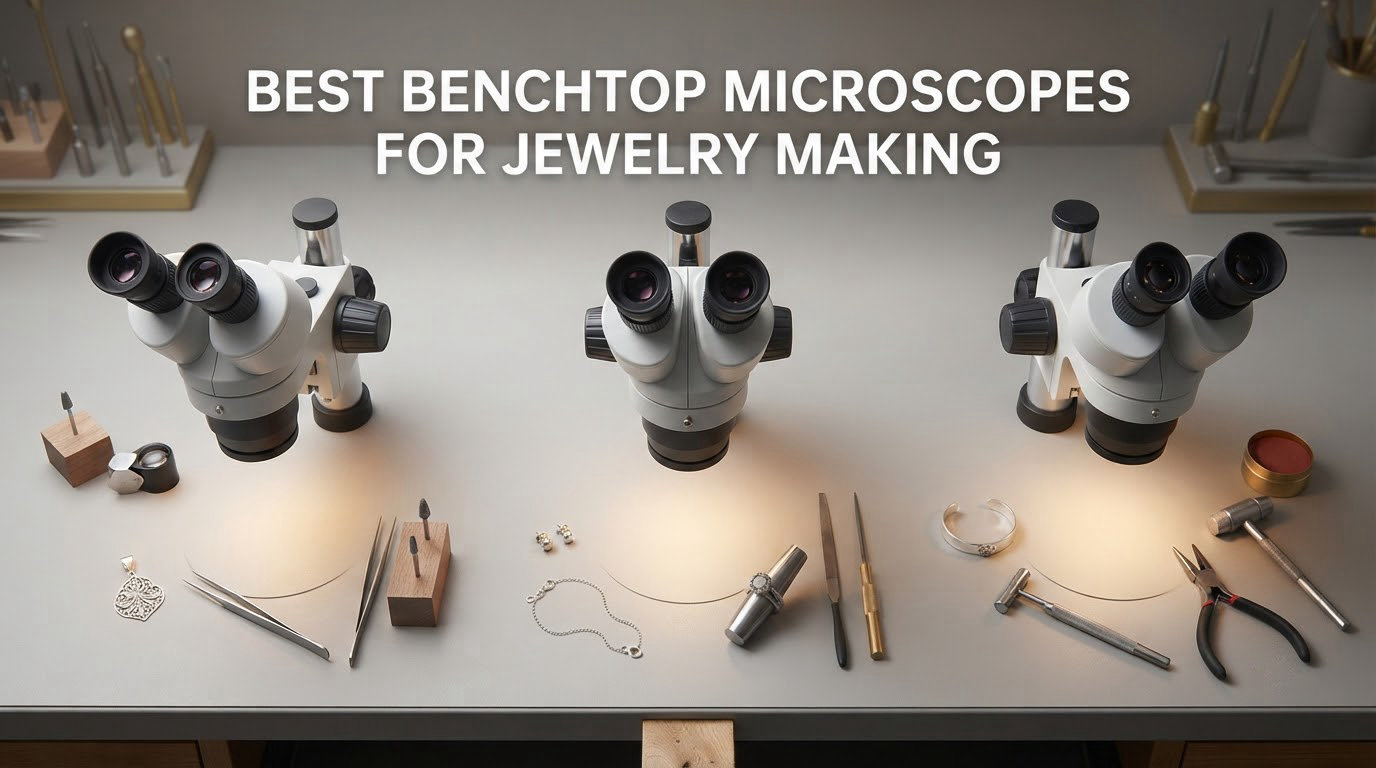
Jewelry work happens at millimetre scale with both hands already busy, so the best benchtop microscopes for jewelry making are the ones that get a true three-dimensional view out of the way without asking you to give up hand control. We spent weeks comparing ten of them, reading owner reviews, and matching each one to the craft it actually serves.
Here is the short answer. The best benchtop microscope for jewelry making is a stereo zoom microscope with continuous 7x-45x magnification, a working distance of 100mm or more, an LED ring light with a dimmer, and a stand that reaches over your work. That combination is what lets you see the seat under a prong or the tip of a graver while your hands stay on the piece. If you only need magnification for bead stringing or coin collecting, a digital bench scope is a genuine shortcut, and we name the one we would buy first.
A loupe, a head loupe and a benchtop scope solve three different problems. A loupe is a hand tool, a head loupe is tied to your face and your posture, and a benchtop stereo microscope is a fixed instrument with the working distance set by its stand. Only the third option keeps your hands free and your eyes over the work for hours at a stretch, which is why every bench jeweler eventually ends up with one.
What follows is a tiered roundup covering budget digital scopes, entry optical scopes, mid-range boom systems and professional articulating-arm setups, plus a buying guide that explains the four decisions that actually matter: magnification, working distance, lighting and stand.
Table of Contents
Top 3 Benchtop Microscopes for Jewelry Work

AmScope SM-4TZ-144A
- 3.5X-90X zoom
- Four-zone 144-LED ring
- Double-arm boom stand
- Trinocular photo port
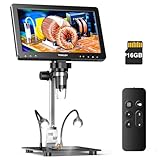
TOMLOV DM9 Max
- 10.1 inch IPS screen
- 20MP photos and 1080p video
- 10 dimmable LEDs
- Wireless remote

AmScope SE306R-PZ
- True optical glass lenses
- All-metal pillar stand
- 20X/40X/80X settings
- Top and bottom halogen
Our top pick is the AmScope SM-4TZ-144A because it is the only scope in this group that combines a genuine 3.5x-90x range, a four-zone LED ring light you can sculpt with, a boom stand that clears large work and a trinocular port for photos, backed by a five-year warranty.
The budget pick is the TOMLOV DM9 Max, which has the largest owner-feedback base of any scope we reviewed and doubles as a documentation camera for solder joints and repairs. The best value optical pick is the AmScope SE306R-PZ, an all-metal entry scope that holds up for years of use if you are patient about its hot halogen bulb.
All 10 Best Benchtop Microscopes for Jewelry Making Compared (October 2026)
| Product | Specifications | Action |
|---|---|---|
| AmScope SM-4TZ-144A Trinocular Zoom |
|
Check Latest Price |
 VEVOR Multi-Directional Microscope VEVOR Multi-Directional Microscope |
|
Check Latest Price |
 DZQ ZQ-1 Multi-Directional DZQ ZQ-1 Multi-Directional |
|
Check Latest Price |
| TOMLOV DM9 Max Digital Microscope |
|
Check Latest Price |
| AmScope SE306R-PZ Forward Binocular |
|
Check Latest Price |
 CTISMICE Jewelry Microscope Kit CTISMICE Jewelry Microscope Kit |
|
Check Latest Price |
 SWIFT Trinocular Pillar Stand Scope SWIFT Trinocular Pillar Stand Scope |
|
Check Latest Price |
 ZTEEERS Double-Arm Boom Trinocular ZTEEERS Double-Arm Boom Trinocular |
|
Check Latest Price |
 SWIFT S7 Single-Arm Boom Trinocular SWIFT S7 Single-Arm Boom Trinocular |
|
Check Latest Price |
 AmScope SM-6TX Articulating FlexArm AmScope SM-6TX Articulating FlexArm |
|
Check Latest Price |
Two patterns stand out in that table. Every serious optical bench scope here runs a 0.7x-4.5x zoom objective, which is the real standard for bench work, while the gemological stands pair a 0.5x auxiliary lens with a 7x-45x head to buy back working distance. And every scope that documents your work needs a third tube, not just two eyepieces.
1. AmScope SM-4TZ-144A Trinocular Stereo Zoom – the reference bench system
AmScope SM-4TZ-144A Professional Trinocular Stereo Zoom Microscope, WH10x Eyepieces, 3.5X-90X Magnification, 0.7X-4.5X Zoom Objective, Four-Zone LED Ring Light, Double-Arm Boom Stand, 110V-240V
3.5X-90X zoom
Four-zone 144-LED ring
Double-arm boom stand
Trinocular head
Pros
- Widest magnification range in the roundup at 3.5X-90X with 0.5X and 2.0X Barlow lenses
- Four independently zone-controlled LED ring light for reflective metal
- Double-arm boom stand clears large workpieces
- Trinocular head with photo port
- 5-year manufacturer warranty
Cons
- Highest price point in the roundup
- Large double-arm boom footprint needs a substantial bench
- Only 145 reviews so less owner history than the digital scope
This is the scope we kept coming back to. The 0.7x-4.5x zoom objective gives you continuous magnification from 3.5x all the way to 90x once the included 0.5x and 2.0x Barlow lenses are fitted, which means you can stay at 10x for setting a stone and push to 45x or beyond to check a sharpening point without changing instruments.
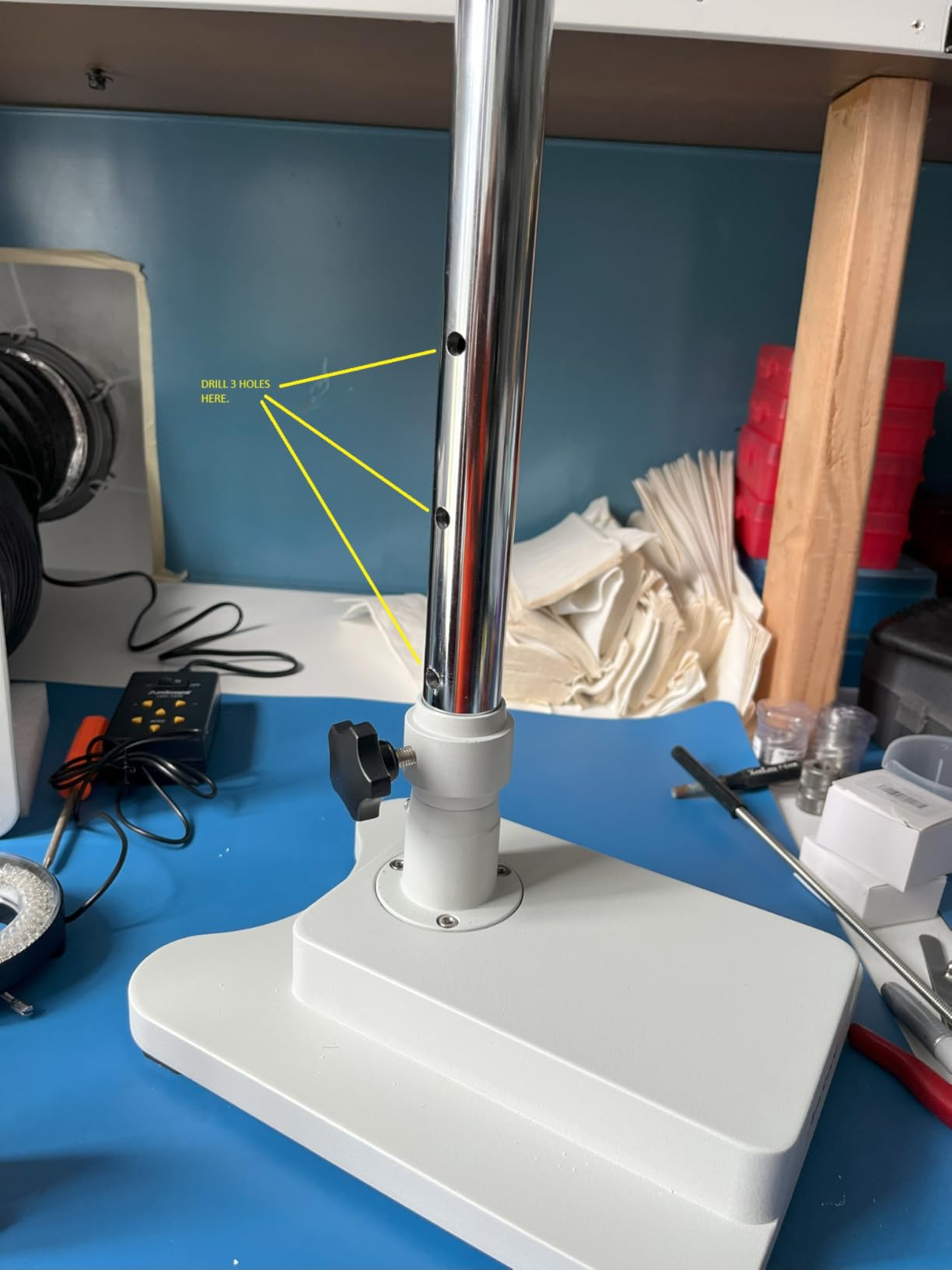
The double-arm boom stand is the part that changes daily work. With 20-inch arms and a 17-inch pillar, the head moves on three axes and swings clear of the bench whenever you want to solder, file or reach for your flex shaft.
The four-zone 144-bulb LED ring is unusual at this level. Instead of one flat wash of light, you can control four zones independently, which is how you deal with polished gold throwing a hard reflection straight back into your eyes. Owners treat this scope as the reference professional benchtop unit, and the 77% five-star share backs that up.
Its 45-degree inclined trinocular head with 360-degree rotation means you can swing it to a neighbour, spin the image toward yourself, or drop a camera into the third port for before-and-after documentation of a repair. It runs on universal 110V-240V input, so it travels well between benches.
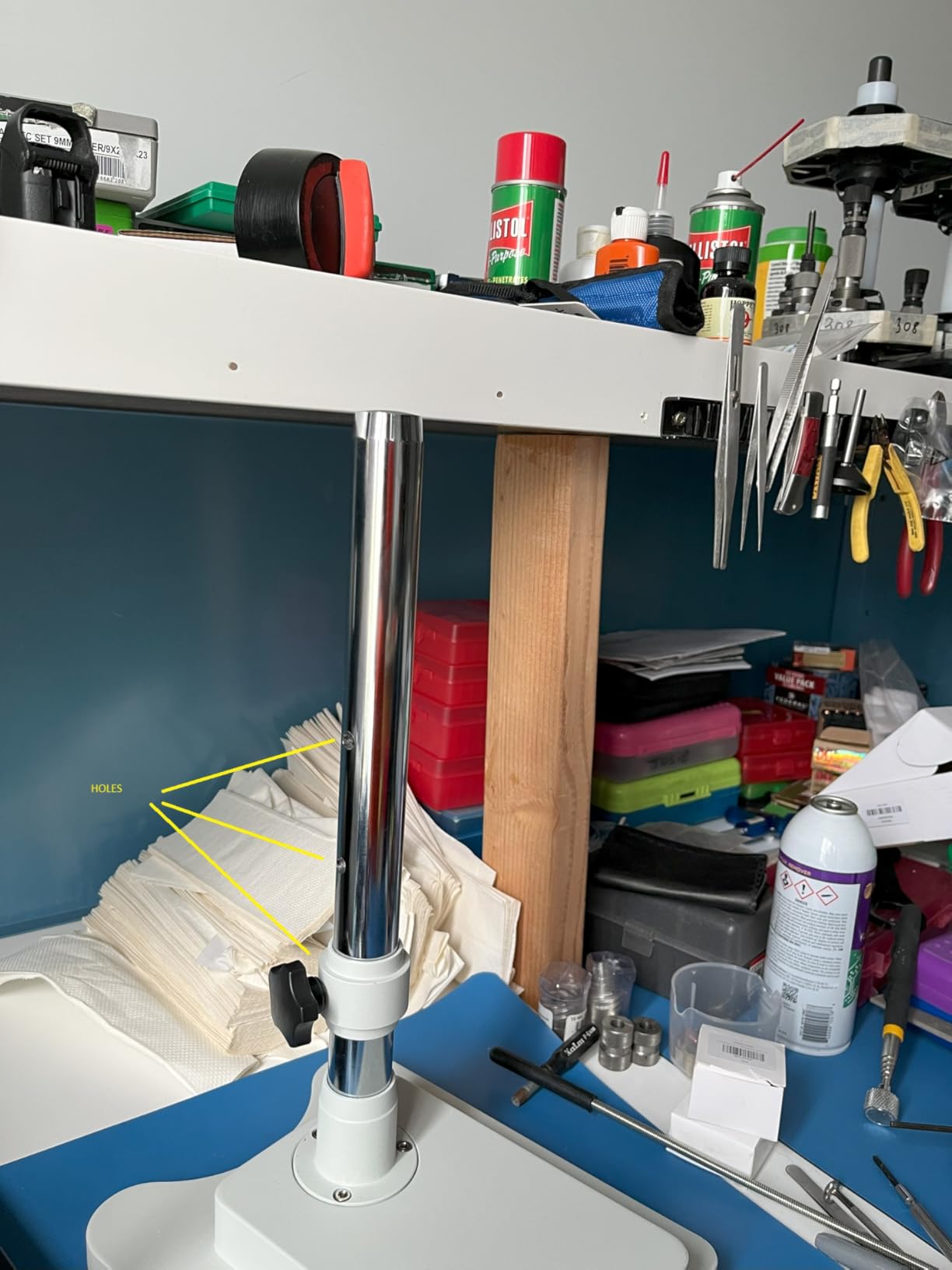
Why jewelers keep coming back to this one
Because it is the rare scope that does not force a choice. You can work at 10x with both hands free, swing the arm aside for torch work, and still get a documented image at the end of the job. The multi-zone ring solves the reflective-metal problem that ruins cheaper setups, and the boom reach means you never have to balance a piece against a fixed pillar.
Where it falls short for jewelry work
It is the most expensive scope here, and the double-arm footprint is genuinely large, so it needs a real bench rather than a corner of a desk. It also has no diopter adjustment mentioned in the spec sheet, which matters if your eyes are not matched, and the 0.5x and 2.0x Barlow lenses have to be swapped by hand each time you change working power.
2. VEVOR Multi-Directional Microscope – the headrest stand for stone setting
VEVOR Micro Inlaid Mirror Multi-Directional Microscope with Spring Bracket 7X-4.5X Multi-Directional Micro-Setting Microscope Jewelry Tools
7X-45X continuous zoom
95-300mm working distance
Spring bracket and head rest
LED light
Pros
- 7X-45X continuous zoom with 95-300mm working distance for micro-setting
- Spring bracket and head rest frame cut fatigue in long sessions
- Wide-angle vision head gives a large field of view
- Gimbaled universal bracket suits varied bench heights
Cons
- Only a 160-review base with a 6% one-star share
- Rubber and plastic build details feel less refined than lab stands
- No trinocular port for documentation
The idea that makes this scope interesting is the head rest frame. A spring-loaded column lets you rest your forehead against the frame and let the optics come to you, instead of craning down and holding tension in your neck. For stone setting, where your hands are on the piece and your face is close to the work for hours, that single feature does more for comfort than any amount of magnification.
Optically you get a 0.5x/165mm objective with WF10x/20mm eyepieces, continuous 7x-45x zoom and a working distance that stretches from 95mm to 300mm. That range is the useful part: at the short end you can get in close on a bead hole, and at the long end you have room for a graver handle or a setting tool to work underneath the lens.
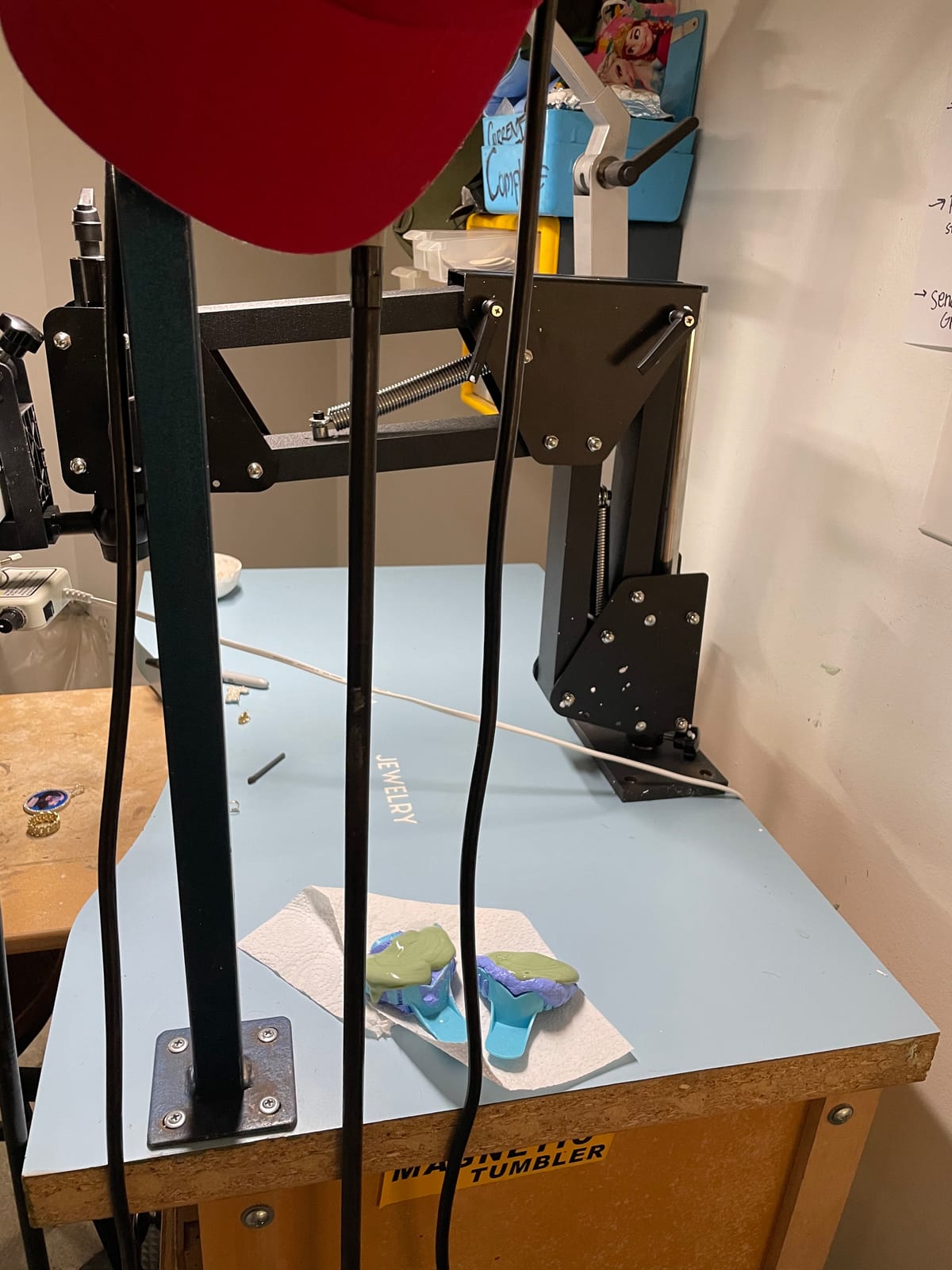
Buyers consistently praise the continuous zoom and the fatigue-reducing bracket, and the field of view runs 5.1mm to 33mm, which is wide enough to keep a whole bead or a small component in frame. Pupil distance adjusts from 54mm to 76mm, so it suits different face shapes.
Be aware of the trade-offs. The build is functional rather than premium, and the parts are a mix of aluminium alloy with rubber and plastic details that will not feel like a professional lab stand. There is also no trinocular head, so if you need photographs of your finished pieces you will need a separate camera solution.
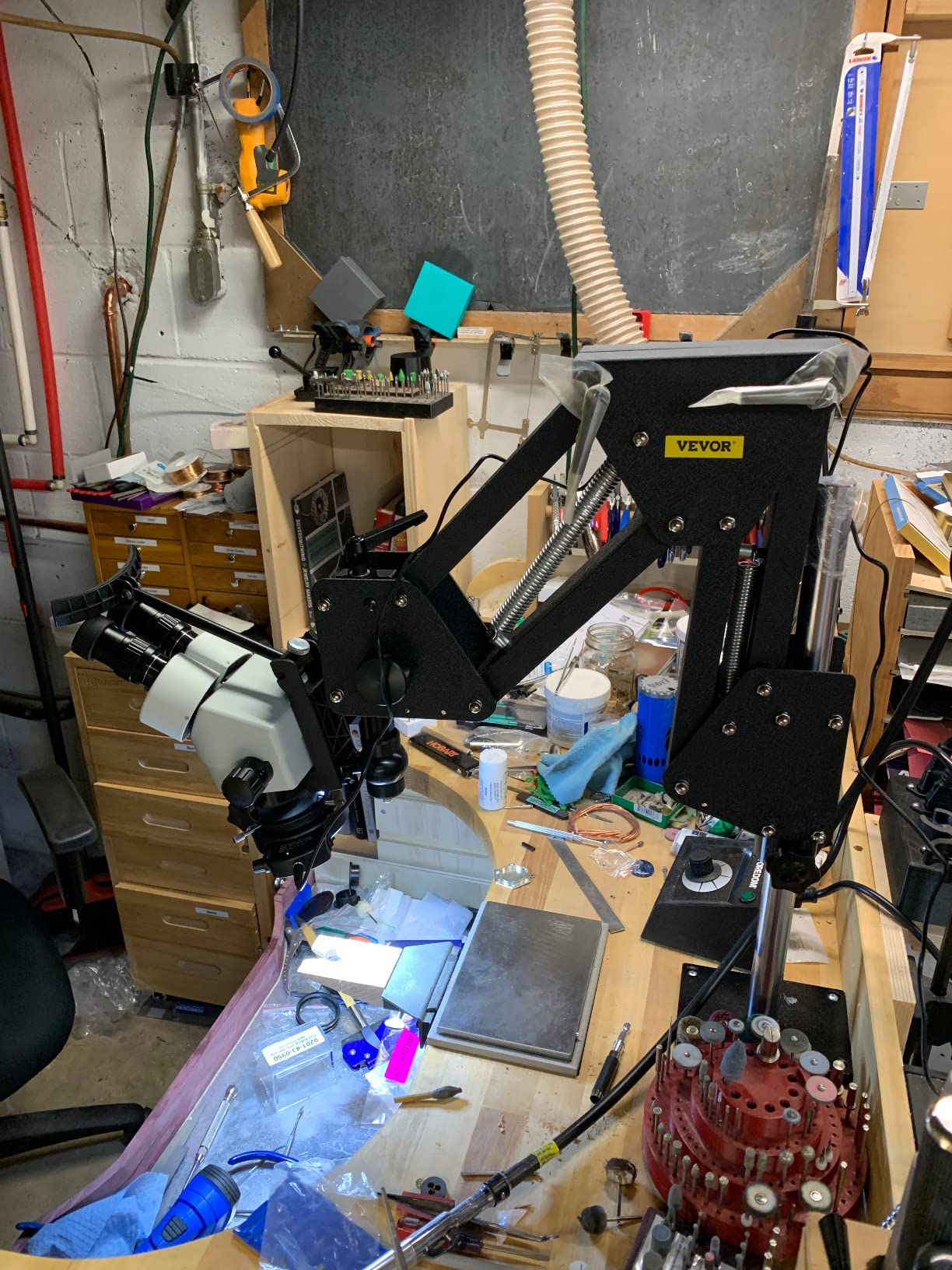
Who this headrest stand suits
Stone setters and engravers who spend whole afternoons with their face inches from the work. The head rest removes the eyecup pressure that leaves dark rings after a long session, and it means you are not fighting gravity with your neck while both hands are occupied. Practitioners on gemological forums consistently point to a headrest as the accessory that makes a bench scope bearable over a full working day.
Where it falls short
Documentation is out, since the head is binocular only. The zoom ceiling is 45x with no 2x auxiliary lens, so genuine high-power inspection work means a different instrument. And at 10.77kg with a 24 by 17 inch footprint, it is not a portable scope, which is fine if it has a permanent home on your bench.
3. DZQ ZQ-1 Multi-Directional – spring column and a dimmable ring
DZQ ZQ-1 Multi-Directional Microscope 7X-45X Magnification 0.5X Barlow Lens
7X-45X continuous zoom
60-LED ring with dimmer
Spring column and headrest
95-300mm working distance
Pros
- Purpose-built jeweler stand with spring mount and adjustable headrest
- 95-300mm working distance leaves room for hand tools
- 60-LED ring with 0-100% dimmer gives shadow-free light
- 80% of reviews are 5-star
Cons
- 45X ceiling with no 2X auxiliary objective
- Binocular only with no camera port
- Bulky 24 by 17 by 9 inch footprint at 11.1 kg
This is the multi-directional jeweler’s stand done slightly better than most of its competitors, and the differences that matter are all in the ergonomics. The spring-mounted support column carries the head weight, and the adjustable headrest lets you set the whole assembly at your working level rather than bending down to it.
The 60-LED ring light comes with a dimmer running 0-100%, which solves a problem you will hit the moment you work on polished metal. A fixed-brightness ring on a mirror-finish pendant is a wall of glare; a dimmable one lets you drop the intensity until the surface detail comes back.
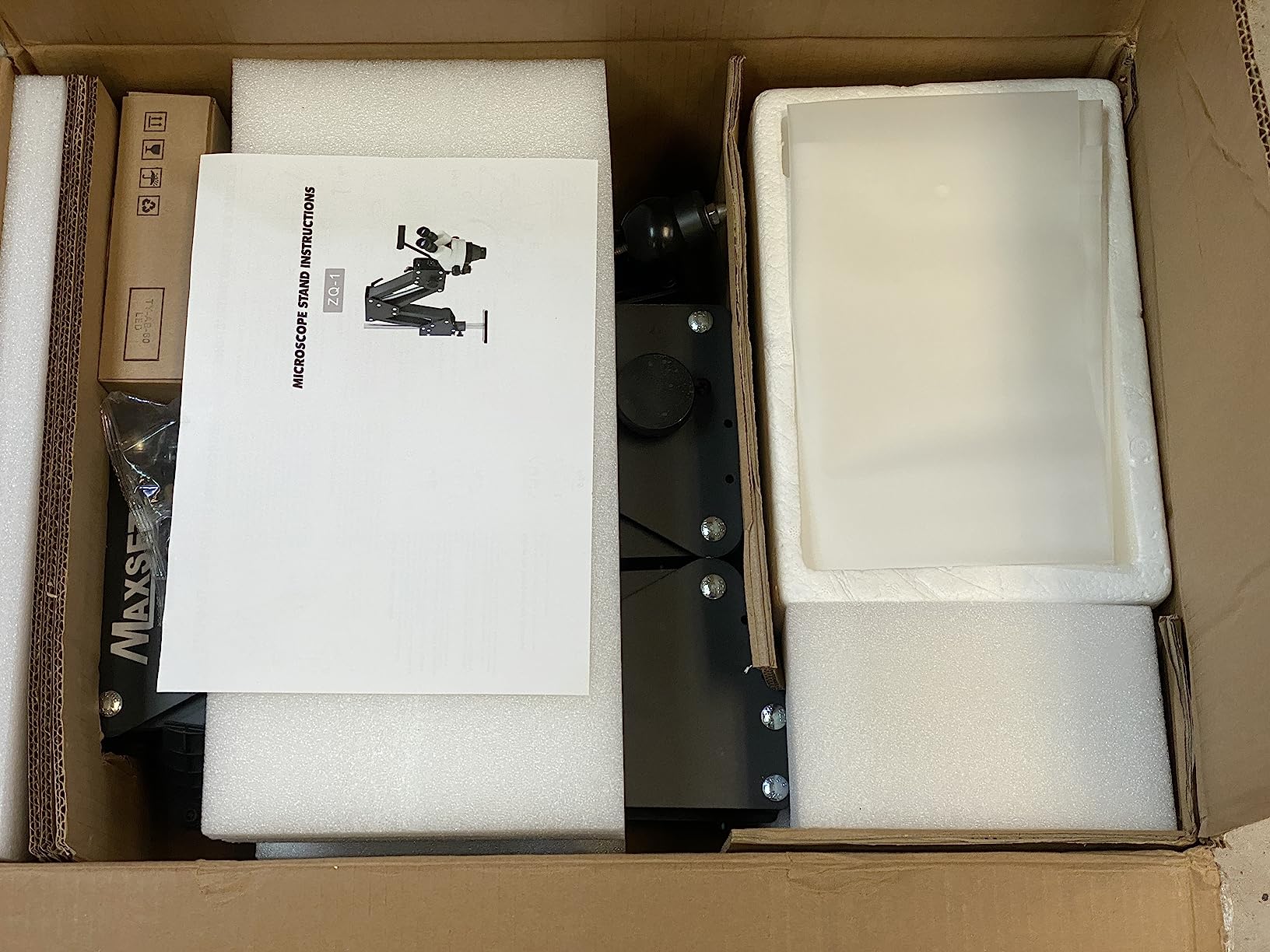
Continuous 7x-45x zoom with a 0.5x Barlow lens and the same generous 95-300mm working distance put this in the sweet spot for beadwork, wire wrapping and light setting. With 80% of reviews at five stars and only 4% at one star, owner satisfaction is unusually consistent for a gemological stand.
What you give up is the top end and the third tube. There is no 2x auxiliary, so 45x is your ceiling, and the head is binocular only, so photos need a separate camera. The 11.1kg weight and bulky footprint are shared with the other multi-directional stands in this category.
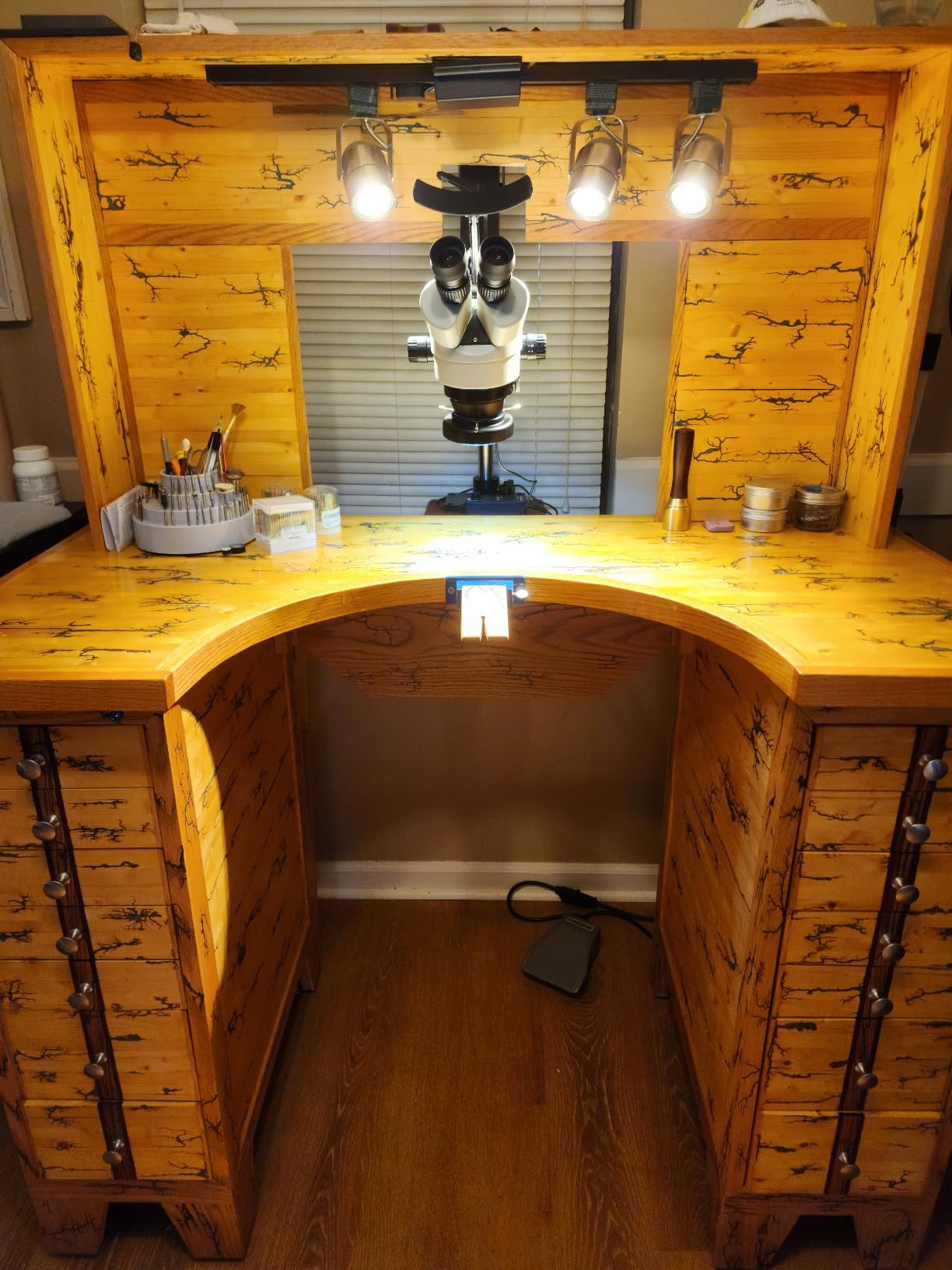
Best for the maker who is tired of leaning in
If your bench sessions run long and you already know that a fixed pillar scope makes your neck ache, the spring column and headrest are the reason to choose this over a cheaper pillar stand. The dimmable ring is the second reason, because it is the difference between workable and frustrating on polished gold and silver.
Where it falls short
Nothing here reaches above 45x, so inclusion work and fine point inspection are out of reach without a second scope. No trinocular port means no documentation, which matters if you photograph finished work for clients or listings. The weight also means you set it up once and leave it there.
4. TOMLOV DM9 Max – the best budget digital bench microscope
TOMLOV DM9 Max Digital Microscope: 20MP 10.1″ 1500X HD IPS Coin Microscope Magnifier for Error Coins with Screen, LCD Soldering Microscopes for Adults, 10 LED Lights, PC/TV Compatible, 16GB
10.1 inch IPS screen
20MP photos and 1080p video
10 dimmable LEDs
12.6 inch stand
Pros
- Largest review base of any scope in the roundup
- 20MP stills and 1080p video with audio for documenting repairs
- Large 178-degree IPS screen shows whole coins and components
- 8 ring LEDs plus 2 gooseneck side lights
- Wireless remote cuts screen shake
Cons
- Claimed 1500X is disputed with a realistic ceiling near 45X
- Focus must be reset at every height
- Magnification comes from moving the camera on the post
Let us be blunt about this one, because the marketing needs correcting. The headline claim is 1500x magnification, and owners with training have measured the realistic ceiling on the included screen at roughly 45x. Judge it on that number, not the sticker.
With that expectation set, it is genuinely good value. A 10.1-inch 178-degree IPS screen is large enough to view a whole coin or an assembled component without a second monitor, and the 12.6-inch stand with a 7 by 8 inch base clears larger workpieces. Hobbyists, coin collectors, electronics techs and watch restorers use it for exactly those jobs.
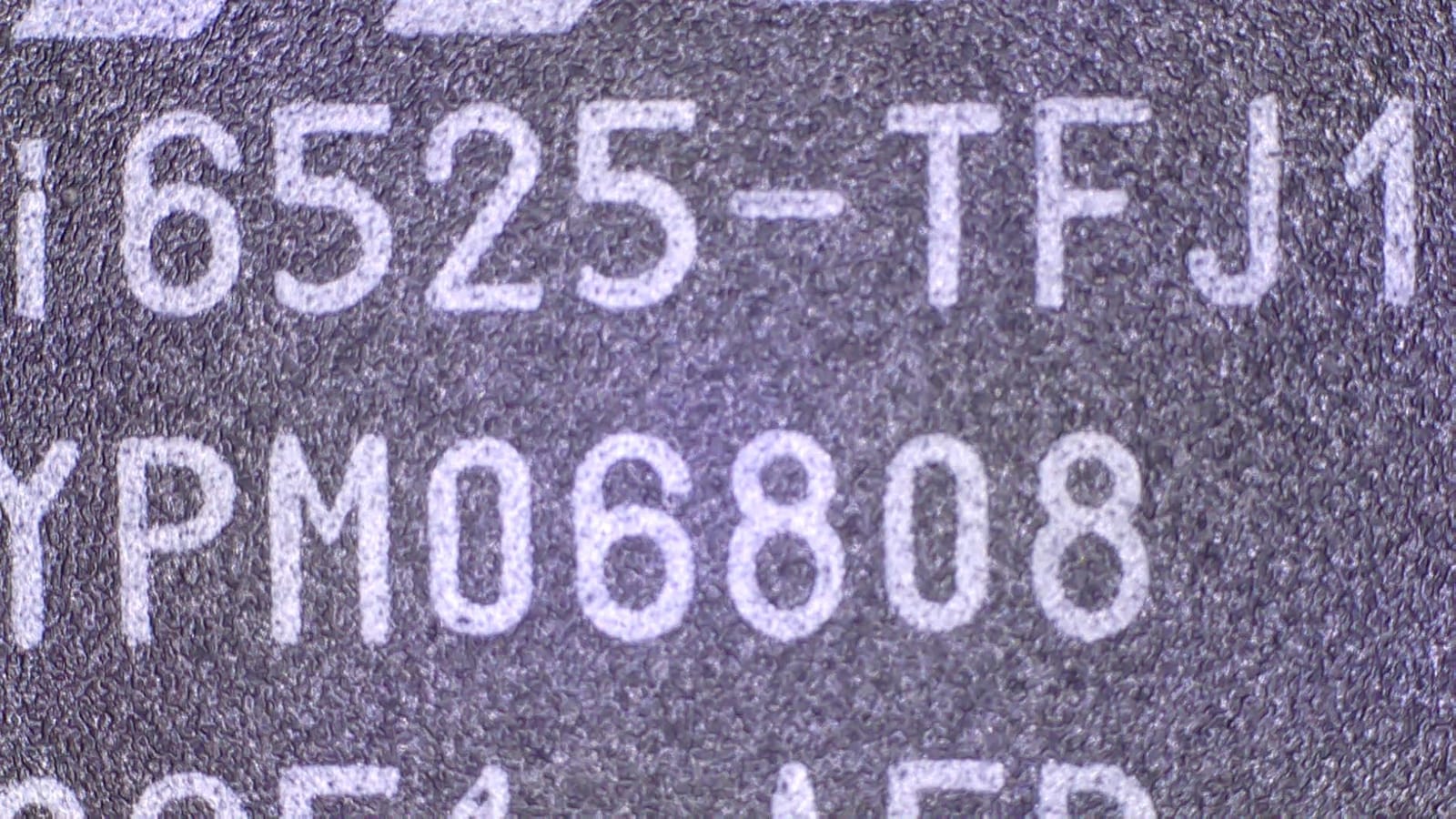
Documentation is where it beats optical entry scopes. It captures 20MP stills at 6096 by 3424 and 1080p video with audio, records to the pre-installed 16GB card, and connects to a PC, TV or monitor for a larger view. The eight ring LEDs plus two gooseneck side lights are all dimmable, and the wireless remote lets you change magnification without disturbing the piece.
The recurring complaints are practical rather than fatal. Focus must be re-set at every new height because magnification is achieved by moving the camera up and down the post, some owners report the base lighting battery failing to charge after a few weeks, and the supplied USB cables are short with no charging block included.
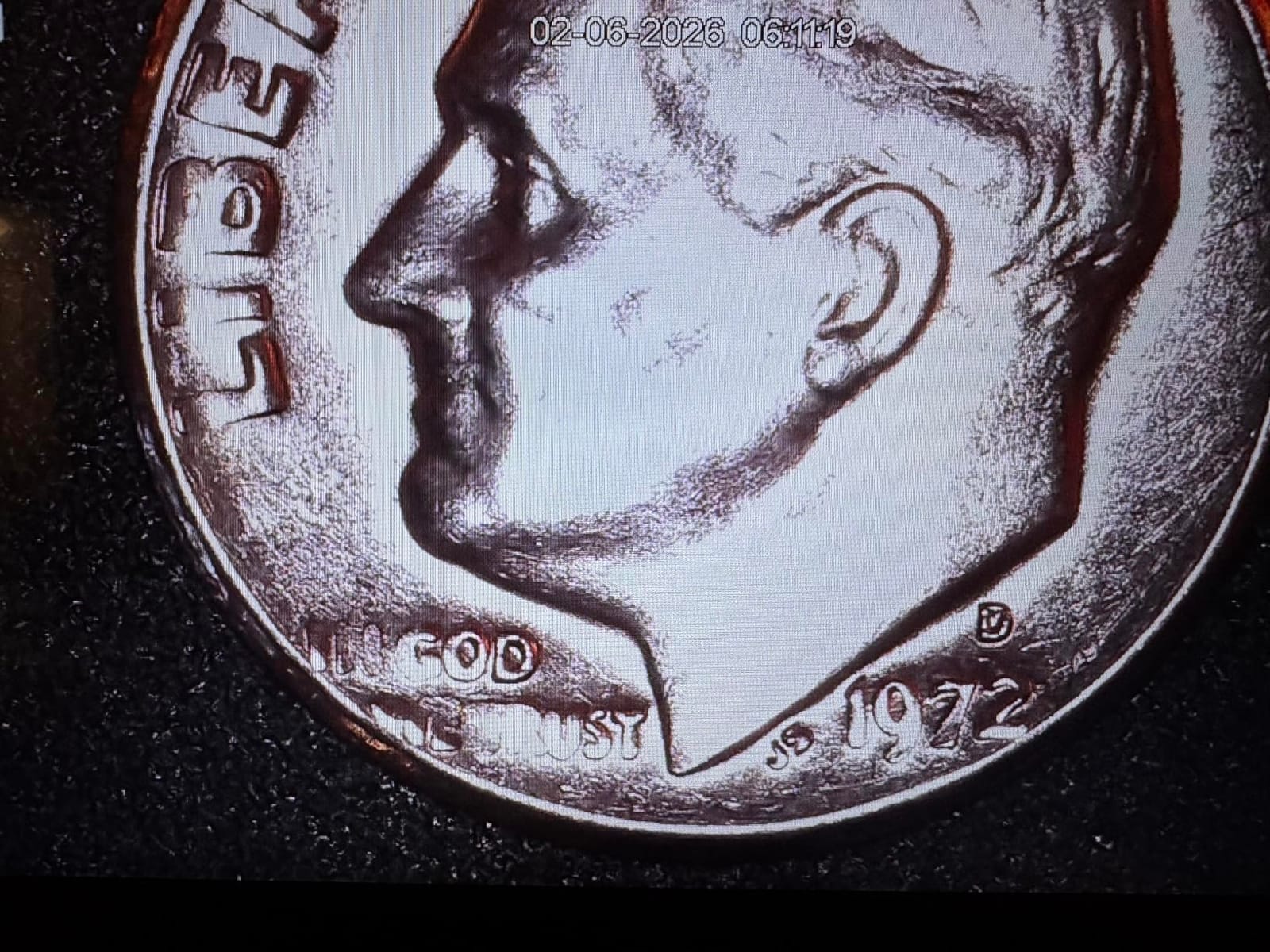
When a digital scope is genuinely the right answer
Bead stringing, wire wrapping, coin and stamp collecting, electronics repair and any job where you want a photograph at the end. It also suits anyone who cannot comfortably use a stereo eyepiece, since a screen is far easier on the eyes than pressing your face into rubber eyecups for an afternoon. If you want to compare digital options more broadly, our digital microscope roundup covers the category in more depth.
Where it falls short
It is not a benchtop optical scope and it does not pretend to be one. You lose hand-eye depth perception, which is exactly the ability bench work depends on when you are judging how a prong sits or how a graver tip is meeting the metal. It also cannot be corrected with your eyes, and image depth is fixed by the sensor.
5. AmScope SE306R-PZ – the best value optical starter scope
AmScope SE306R-PZ Forward Binocular Stereo Microscope, WF10x and WF20x
20X/40X/80X settings
WF10x and WF20x eyepieces
All-metal pillar stand
Top and bottom halogen
Pros
- True optical glass lenses with strong 3D depth perception
- All-metal pillar stand is genuinely solid
- Compact footprint fits a small bench
- Switchable top and transmitted bottom lighting
- Five-year warranty
Cons
- Halogen bulbs run hot and have no dimmer
- No zoom objective
- only discrete 20X/40X/80X steps
- Narrow field of view and shallow depth of field
This is the scope we would hand someone who wants real optics without a big commitment, and the reason is simple: it is built out of metal and it has true widefield glass lenses. Long-term owners report two-plus years of use with nothing broken, which is not something you can say about most entry scopes in this bracket.
Stereo vision is the headline. Two separate optical paths give you genuine depth perception on solder joints, prong tips and engraving lines, and the forward widefield binocular head sits at a 45-degree inclination so your neck stays neutral. You also get both WF10x and WF20x eyepieces, which effectively doubles your usable magnification options.
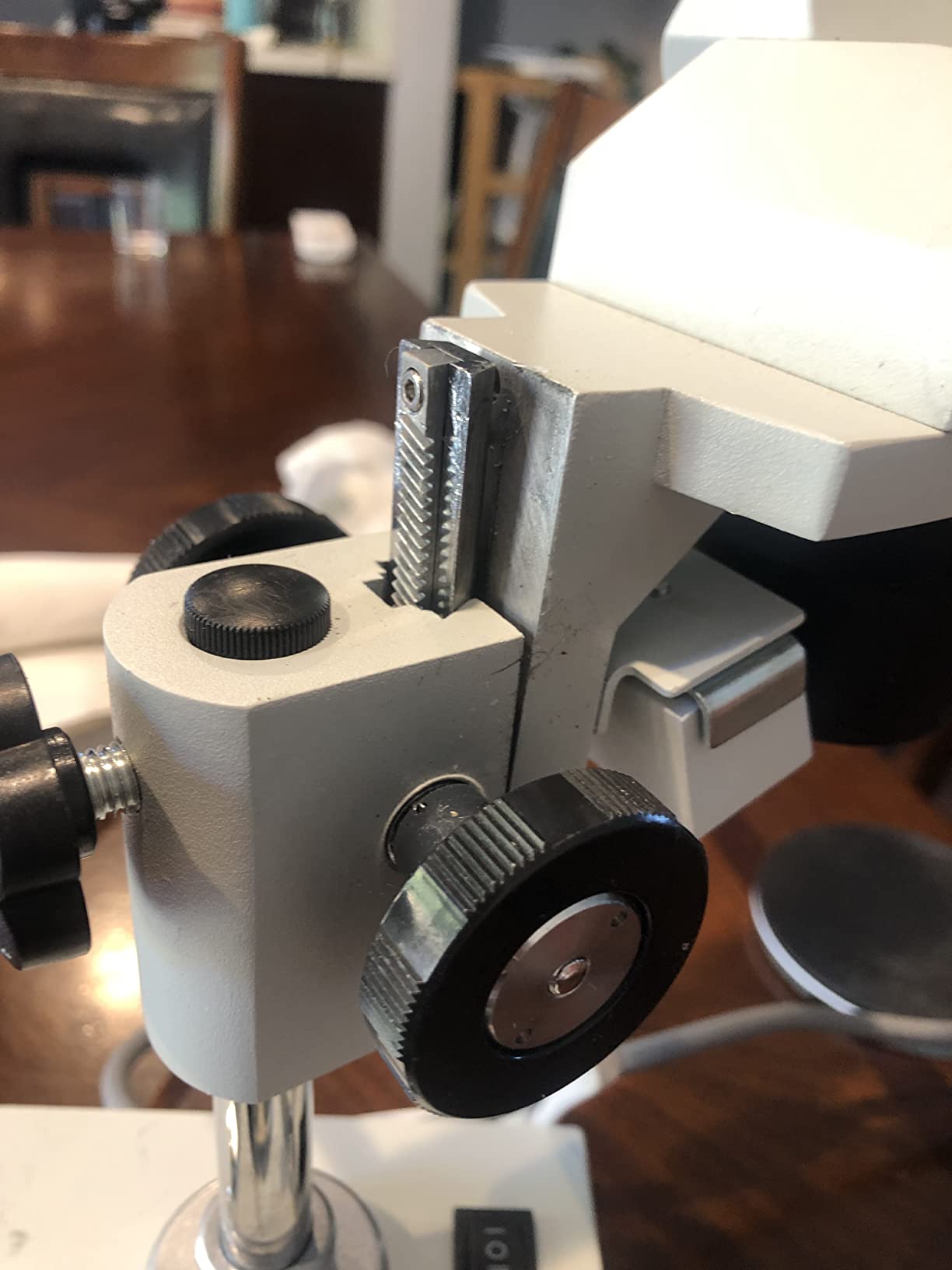
Lighting is the weak point. The built-in illumination is halogen, and the top incident light runs hot enough that owners report burning their fingers on the bulb housing. There is no dimmer control, and one owner reported flicker when the top light was turned down. Many people solve this by fitting LED replacements, which is a straightforward swap on this platform.
Because there is no zoom objective, magnification steps between discrete 20x, 40x and 80x settings. The field of view is also narrow and depth of field gets shallow at the top setting, which frustrates anyone used to laboratory-grade scopes. If you need continuous zoom to hunt for a stone in a claw setting, look higher up this list.

Why it still earns the value badge
Because a small bench should not mean a bad bench. At 13.6 by 11 by 6.6 inches it fits where larger gemological stands will not, the metal build outlasts plastic competitors, and the stereo depth you get is real rather than simulated. For beadwork, simple setting, general repair and learning, it does the job properly. Our general microscope roundup covers more entry options if you want to compare platforms.
Where it falls short
The hot halogen bulb, the missing dimmer and the lack of continuous zoom are the honest complaints. At 80x the field of view is tight and the image dims, and there is no trinocular port, so documenting your work means a separate camera. Treat it as a first optical scope, not a final one.
6. CTISMICE Jewelry Microscope – a complete kit for a first setter
CTISMICE Jewelry Microscope for Diamond Setting Jewelry Making Engraving
7X-45X continuous zoom
95-300mm working distance
60 ring light with dimmer
Headrest arm
Pros
- Purpose-built for jewelry with a headrest arm
- 95-300mm adjustable working distance on a spring stand
- Dimmable 60-LED ring light for shadowless illumination
- Complete hardware kit included
- Flat 4.9 rating with no 1-3 star reviews
Cons
- No warranty offered
- Only 22 ratings so long-term durability is unproven
- Binocular only with no camera port
- 45X ceiling with no 2X auxiliary
This is the scope most obviously aimed at jewelry makers rather than lab technicians, and the box contents reflect it. You get the 60 ring light illuminator, a dimmer switch, the microscope stand with a headrest arm, an objective lens, eyepieces, and the bolts, nuts, washers, wrench and screwdriver needed to assemble it.
The working distance adjusts from 95mm to 300mm on a flex arm, and the headrest drops over your subject to your comfortable level. That combination is aimed squarely at extended work, and the 0-100% dimmer switch means the ring can be softened on polished surfaces rather than fought.
Why new makers like it
It goes from box to bench in minutes with no missing hardware, the wide-angle vision head gives a large field of view at 7x-45x, and the ergonomics are designed for the jewelry posture rather than adapted to it. If you are setting your first stones and want the headrest and long working distance that experienced setters insist on, this puts those features in the box on day one.
Where it falls short
The rating is excellent at 4.9 with 89% of reviews at five stars and none in the 1-3 star range, but it rests on 22 ratings. That is too small a base to make claims about long-term durability, and there is no warranty at all, which is a real gap when you are buying a permanent bench fixture. The 45x ceiling and binocular-only head are the same limits as the other gemological stands here.
7. SWIFT Trinocular Pillar Stand – light body and a photo port
SWIFT Trinocular Stereo Zoom Microscope with 56-Bulb LED Ring Light,3.5X-90X Magnification,WF10X Eyepieces,0.7X-4.5X Zoom Objective, 0.5X 2.0X Additional Objectives,Table Pillar Stand
3.5X-90X with auxiliaries
56-bulb LED ring light
Trinocular vertical port
100mm working distance
Pros
- 3.5X-90X range from a compact metal stand
- 56-bulb LED ring runs cool enough for heat-sensitive work
- Vertical trinocular port doubles as a camera port
- 6.4 to 1 zoom ratio with 100mm working distance
- Only 4.2 kg so it is easy to reposition
Cons
- Fixed pillar stand has no boom reach for bulky pieces
- Only 46 reviews
- No dimmer or zone control on the ring light
This scope solves a specific problem: you want real optical performance and a third tube for documentation, but your bench cannot take a boom arm. At 4.2 kg in metal, it is the easiest unit here to move, and it still covers 3.5x-90x with the included 0.5x and 2.0x auxiliary objectives.
The 0.7x-4.5x zoom objective gives a 6.4:1 zoom ratio at 100mm of working distance, which is enough clearance for a graver handle on most work. The trinocular head tilts to 45 degrees for neck comfort, rotates a full 360 degrees, and the vertical port works as an eyepiece or as a photo port, which is what makes it useful for recording a repair before and after.
Best for compact benches and record-keeping
The 56-bulb LED ring produces low heat, so it is safe around resin, gemstones and heat-sensitive work where a halogen lamp would be a problem. The head is designed for eyeglass wearers, which is a detail that matters more than it sounds if you work in glasses every day. If you also photograph your finished pieces, our jewelry making kit roundup covers the rest of the bench setup.
Where it falls short
A fixed pillar stand cannot swing out of the way, so a tall ring, a large pendant or a bulky casting will be awkward to position. With only 46 reviews, the long-term record is thin, and there is no dimmer or zone control on the ring light, which brings back the glare problem on polished metal.
8. ZTEEERS Double-Arm Boom – the heaviest feature set on a steel base
ZTEEERS Professional Trinocular Stereo Zoom Microscope, 3.5X-90X Magnification,WF10X Eyepieces, 0.7X-4.5X Zoom,0.5X & 2.0X Auxiliary Lens, Double-Arm Boom Stand, 56S LED Ring Light,Two adapters
3.5X-90X with 0.5X and 2X lenses
18lb steel base ball-bearing arm
56S LED ring with dimmer
Two trinocular adapters
Pros
- Owners report optics and function matching a comparable AmScope at a fraction of the price
- 18 lb solid-steel base stays steady with the arm extended
- Ball-bearing boom arm glides and holds position
- Per-eye plus or minus 6 diopter adjustment
- Two trinocular adapters included
Cons
- Heavier and longer than listed
- one owner measured about 30 inches end to end
- Poor or missing instructions
- 1-year warranty is the shortest here
This one keeps surprising people. Multiple owners who compared it against an AmScope system of the same class report essentially equivalent optical performance and included accessories for roughly half the outlay, and the 18 lb solid-steel rectangular base is the kind of build you normally only see on a bench instrument.
Per-eye diopter adjustment of plus or minus 6 is a feature most scopes in this list lack, and it matters if your eyes are not perfectly matched. The ball-bearing double-arm boom glides with little resistance and holds position without sagging, which is what keeps the view steady while you are working with both hands.
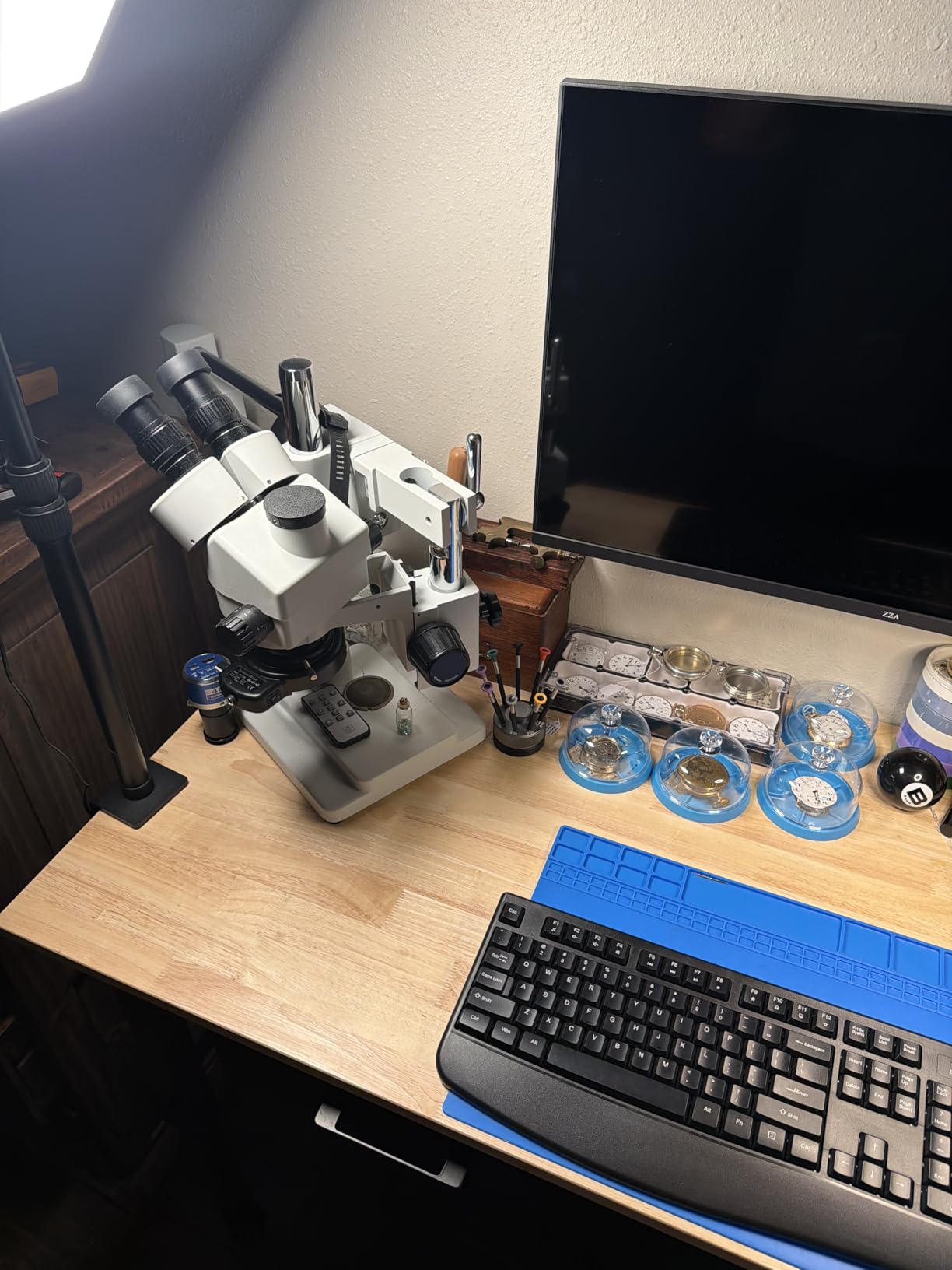
You also get a 56S LED ring with a dimmer switch, and two trinocular adapters so you can connect either a digital camera or an electronic eyepiece, with simultaneous observation through both eyes while recording. All necessary parts ship in the box with setup tools included.
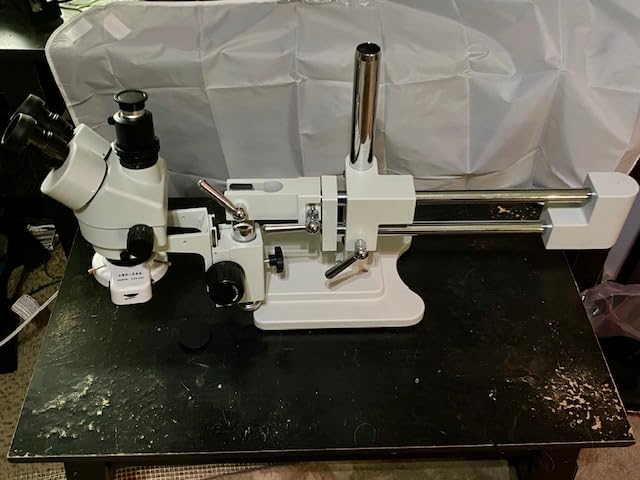
The complaints are physical and practical. One owner measured the unit at roughly 30 inches end to end, well beyond the listed 19.5 inches, which makes it too big for a normal desk, and several buyers had to piece the setup together from videos because the instructions are poor. The one-year warranty is the shortest in this roundup, and some owners feel the build is less refined than the name-brand equivalent.
Who gets the most from this scope
Solderers and anyone working on bulky assemblies. A weighted base is what stops a fully extended arm from tipping, and owners specifically praise the stability during long soldering sessions. The diopter adjustment and dual adapters also make it the most flexible documentation option in the group for the money.
Where it falls short
Size is the main problem. If your bench is a desk, this is not the scope for you, and you may need to clamp it to a cart as some owners have done. The thin review base of 37 ratings, weak instructions and a one-year warranty are all reasons to buy it from a seller who makes returns easy.
9. SWIFT S7 Single-Arm Boom – gemology and engraving reach
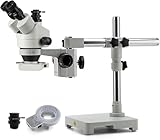
SWIFT S7 7X-45X Trinocular Stereo Microscope with Wide-Field 10X Eyepieces,0.7X-4.5X Zoom Objective Lens, Single-Arm Boom Stand, and 56-Bulb LED Ring Light
7X-45X continuous zoom
56-bulb LED ring light
Single-arm swinging boom stand
0.5X C-Mount adapter
Pros
- Swinging arm boom gives real reach over large or bulky pieces
- 56-bulb LED ring is bright
- shadow-free and low heat
- Trinocular third port plus included 0.5X C-Mount adapter
- Continuous 7X-45X with no discrete steps
Cons
- Heaviest footprint in the roundup at 17.45 kg
- Only 22 ratings
- No dimmer or zone control on the ring light
- 7X-45X ceiling with no 2X auxiliary listed
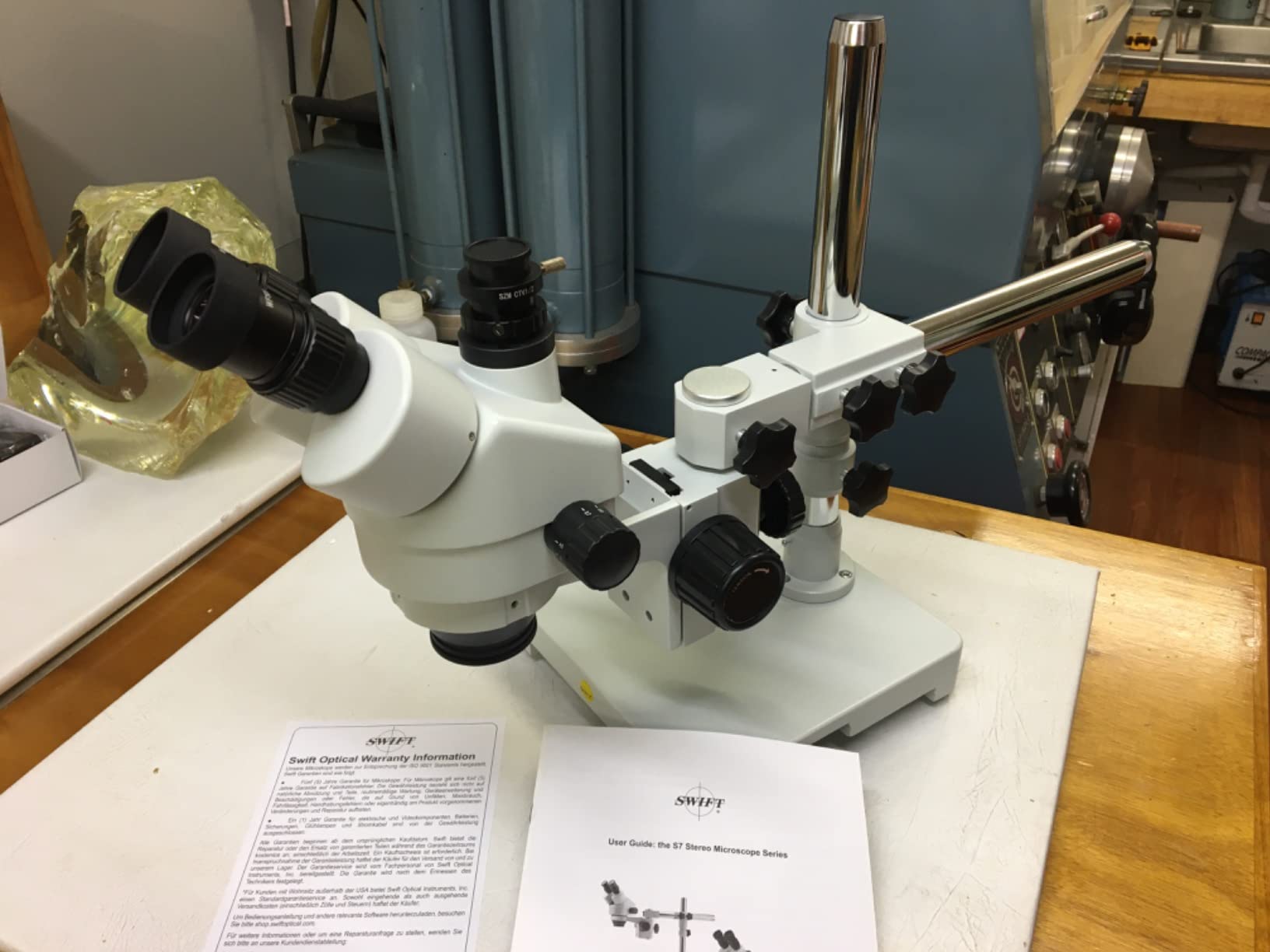
Where the pillar stands fail, the swinging arm works. This scope lets you reach over a large ring or a bulky casting and bring the head back down without moving the base, which is the difference between repositioning a workpiece and re-aiming the instrument.
The optics are a 0.7x-4.5x zoom objective with super widefield 10x eyepieces that carry diopter adjustment, giving continuous 7x-45x magnification with no discrete steps. That smooth zoom matters for engraving, where you are constantly sweeping between finding the line and working on it.
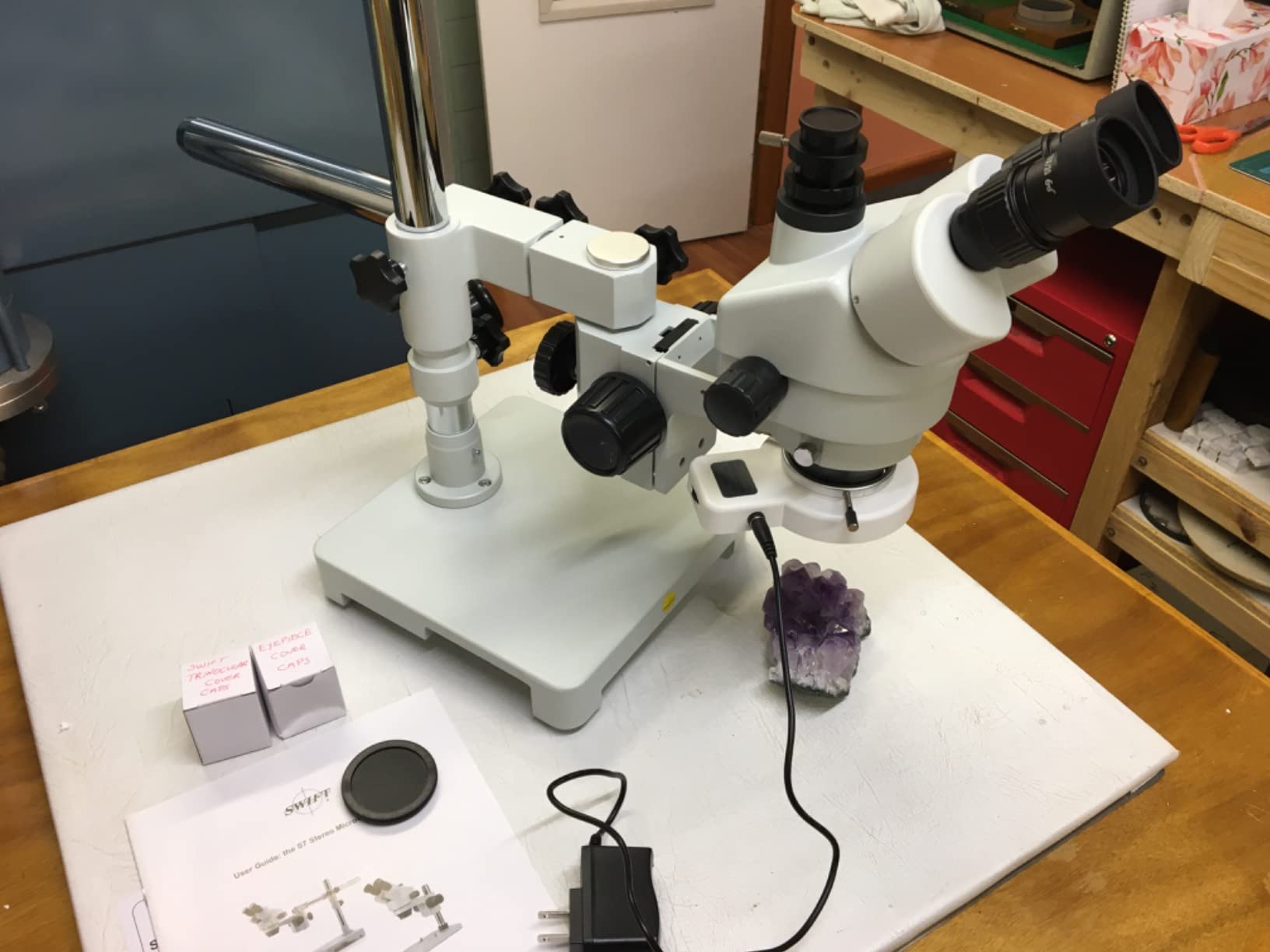
The 56-bulb LED ring floods the field with shadow-free light that runs cool enough for temperature-sensitive work, and the trinocular head tilts to 45 degrees for neck comfort with a third port for an extra eyepiece or a camera. A 0.5x C-mount adapter is included, which widens the view and reduces magnification for shooting whole pieces.
Review feedback is thin at 22 ratings, and 13% of them sit at three stars, largely about value and bulk rather than function. It is also the heaviest footprint in the roundup at 17.45 kg, and the 7x-45x ceiling is lower than the 90x trinocular scopes without a 2x auxiliary listed.
Best for gemological and engraving work
This is the scope to choose if you move between loose stones, engraving and inspection on pieces too large for a fixed pillar. The boom reach handles a full ring or a mounted workpiece, the widefield eyepieces keep context around the detail, and the included adapter makes client photographs straightforward.
Where it falls short
The weight is a commitment, and the low review base makes the durability case harder to make than on models with hundreds of ratings. There is no dimmer or zone control, so polished metal can still fight you, and if you need to push past 45x for inclusion work you will need auxiliary lenses or a different scope.
10. AmScope SM-6TX Articulating FlexArm – 40 inches of reach for bulky work
AmScope SM-6TX Trinocular Stereo Zoom Microscope, 3.5X-45X Magnification
3.5X-45X with 0.5X Barlow
40 inch articulating arm
Trinocular head with 45-degree tilt
Five-year warranty
Pros
- Widest reach available with a 40 inch articulating FlexArm that clamps to the bench
- Jewelry professionals specifically praise it for stone setting and prong work
- Optics are clear and bright across the field
- Compact 3.3 lb body
- Five-year warranty
Cons
- No light source included
- ambient illumination only
- Arm joint rubs and grinds
- Mediocre fit and finish for the price
No other scope here reaches as far. The articulating FlexArm extends 40 inches and clamps to your bench, which means the lens can come in close when you need it and swing completely out of the way when you are soldering, tumbling or reaching across the bench for tools.
Jewelry repair shops and hobbyists specifically endorse this model for stone setting, prong repair and micro-pave, and they report clear, clean images for a fraction of comparable scope cost. Optics are described as bright with no notable distortion across the field of view, and the trinocular head keeps the door open for a camera later.
Why bench jewellers reach for this one
A 40-inch articulating arm solves the problem that fixed pillars cannot. Large castings, assembled necklaces and tall ring cones are simply not workable under a short post, and a clamp-mounted arm means you set the base once and aim the head wherever the work is. The five-year warranty is also the longest in this roundup alongside our top pick.
Where it falls short
No light source is included, which is the biggest catch. Ambient room lighting is all you get out of the box, so almost every owner buys a separate LED light, and that changes both the cost and the geometry of the setup. The mounting arm also rubs and grinds at the joint, fit and finish are reported as mediocre relative to the price, and some units shipped with the wrong mount ring and missing screws for the oculars.
How to Choose a Benchtop Microscope for Jewelry Making
What magnification do jewelers actually use?
Jewelers work at 10x most of the time, and everything above that is a specialist tool rather than a default. The reason is field of view and depth of field: at 10x you can see the whole seat, judge your stone in context and still have enough depth of field to work with a tool in the frame. Practitioners on gemological forums describe 10x as the widest, lowest power setting they return to constantly.
Beyond that, the habit is consistent. 20x is the fussy engraving power, where you need to see a graver tip meeting a line clearly. Up to around 50x is reserved for inspection, such as checking an engraving point after a sharpening pass or confirming a solder joint. That is also why 10x is the standard for examining a stone for inclusions in the US, which makes it a useful reference point when judging a listing’s magnification claims.
This is exactly why the 40x-100x claim on many scopes is a red flag for jewelry work. A range that starts at 40x is an inspection scope, not a bench scope, and a stated maximum is meaningless without a low starting point. Look for continuous zoom from 7x to 45x as the core range, and treat everything above that as a bonus.
Working distance and hand clearance
Working distance is the gap between the front of the objective and your workpiece, and it is the single most important spec for a bench jeweler. It determines whether you can get a graver, a setting tool or both hands underneath the lens while you work. Anything under 100mm will feel cramped for engraving and stone setting.
Look for a scope that states working distance as a range, not a single number. The multi-directional gemological stands here run from 95mm to 300mm, which lets you pull back for hand clearance and push in for detail. The 40-inch articulating arm approach works differently: it holds a moderate working distance and instead solves clearance by letting you move the whole head out of the way.
Lighting: ring light, coaxial light and dual gooseneck
A ring light sits at the objective and gives even, shadow-free illumination straight down the optical axis, which is the standard for bench work. Its weakness is reflection: on a mirror-polished pendant or a polished gold bezel it becomes a wall of glare. That is why a dimmer matters so much, and why the four-zone ring on our top pick is a real advantage over single-zone lighting.
Coaxial and fluorescent illumination come from the same axis but are traditional lamp-based systems, and darkfield illumination throws light from the side so that inclusions and surface relief stand out against a dark background. Dual gooseneck arms let you position light from two directions independently, which is the most flexible option for shaping form on a three-dimensional piece.
For claw and bezel settings specifically, a dimmable ring or a coaxial light with intensity control is what finds a stone that is seated but not seated right. Our general guides to microscopes and student microscopes cover the lighting options in more technical detail if you want the theory.
Stand type: pillar, single-arm boom and articulating arm
Stand choice is where most buyer guides go quiet, and it is the decision experienced jewelers argue about most. A pillar stand is a vertical post with the head on a rack-and-pinion. It is stable, cheap and completely fixed, which means you move the work instead of the scope. For beadwork, simple repair and light setting that is entirely workable.
A single-arm boom stand swings the head out of the way and brings it back over your work. It is the practical choice for engraving and setting because you can clear the bench for a torch and then return without re-aiming anything. A double-arm boom adds reach and stability at the cost of a much larger footprint.
An articulating arm, the type used in the headrest-style gemological stands, is the third family. It carries the head weight on a spring and lets you rest your forehead against a frame, which removes the eyecup pressure that leaves dark rings after long sessions and frees both hands. If you work with your face close to the piece all day, ergonomics beat specifications.
Binocular vs trinocular and documentation
Binocular means two eyepieces and your eyes. Trinocular adds a third tube you can fit a camera or electronic eyepiece to, so you can photograph a repair without moving the work. The optics stay in the same plane, which is why a trinocular head is worth the extra cost if you document finished pieces, send condition photos to clients or keep before-and-after records of a setting job.
One caveat worth knowing: some trinocular ports are vertical and some are angled, and they are not interchangeable. If you already own a camera, confirm the port type and the adapter you need before you buy, because the adapters are model-specific. The two scopes in this roundup that include adapters are the ones we would buy for that reason.
Digital or optical: when a screen scope is enough
A digital bench microscope shows you a screen instead of putting your face against eyepieces. You gain image capture, recording, a large display, connectivity to a PC or TV and often a lower entry cost. You lose hand-eye depth perception, the ability to correct focus and diopter with your eyes, and the sense of scale that a stereo eyepiece gives you.
For bead stringing, wire wrapping, coin collecting, electronics and repair documentation, that trade is good and we would make it. For setting stones, carving or anything where you need to judge how a tool meets metal in three dimensions, an optical stereo scope is the right instrument. Our digital microscope roundup covers the screen-based category if that is the direction you are leaning.
Budget, mid-range and professional tiers
The entry tier covers pillar and small boom scopes with true glass optics. This is where you get genuine stereo vision and long-term durability at a sensible outlay, and where the compromises are discrete magnification steps rather than continuous zoom, plus hotter halogen lighting.
The mid tier is where the choice of stand becomes the decision. Gemological multi-directional stands with headrests, double-arm boom systems and compact pillar scopes with trinocular heads all live here, and this is the band most serious bench jewelers land in. You get continuous 7x-45x zoom, LED lighting with a dimmer and a stand that can move.
The professional tier is articulating arms with long reach, multi-zone lighting and longer warranties. Be candid about entry-tier limitations: low-cost scopes are genuinely fine for short sessions and for learning, and they are a clear step up from an Optivisor, but jewelers who put in full bench hours tend to find they want better optics and a stand that clears the work. Buy the tier that matches how long you will actually be looking through it.
How to test a microscope before you buy
Put a real piece of your own work under it, not the demo slide. Bring a prong set stone, a soldered joint and a piece with fine engraving, and check whether you can see the detail that actually matters to you at the magnification you would normally work at.
Set your own diopter on each eyepiece, then close one eye and focus, close the other and focus again. If the two eyes disagree badly, the scope will be tiring no matter how good the optics are. Then sweep the focus rack slowly and listen for any wobble or backlash in the movement.
Finally, work with your hands under the lens for a full minute at your normal working position. If your knuckles hit the post, if the light reflects off polished metal into your face, or if you cannot rest your forehead anywhere, the scope will get worse over a full session. Try the ring light at low and high brightness before you commit.
Buying a used microscope without stepping on a trap
Decommissioned industrial and medical scopes show up regularly in the used market and can be excellent value, particularly older Nikon, Wild, Zeiss, Leica and American Optical bodies. Two channels come up repeatedly in practitioner discussion: general marketplaces for the decommissioned units, and specialist equipment auctions for the better-maintained examples.
Watch for one specific problem. Scopes sold as generic inspection scopes are sometimes relabelled as jeweler’s scopes with a few hundred dollars added to the asking price, so check whether the unit actually has the features that make it useful at a bench: continuous zoom, adequate working distance, and a stand that moves. Red flags include a missing base, missing lighting hardware, scratched objectives and a focus rack that feels gritty.
One maintenance rule is worth repeating because it is easy to break: never clean microscope lenses with a shop rag. Dust and metal polish get dragged across the coating, and you cannot undo that. Use a proper blower and lens tissue, and keep the dust cover on when the scope is not in use. With that care, a used optical head is often the smartest value on the market.
Setting up a new scope for all-day comfort
Start with the diopter. Set it for your dominant eye, close the other eye and focus, then repeat with the roles reversed. Do this before you do any real work, and check it again if your prescription changes, because an uncorrected scope is the fastest route to eye strain.
Next, set the working height so that your forearms rest on the bench and your head is neutral, rather than bending down toward the eyepieces. On a headrest stand, bring the frame forward until your forehead makes light contact. Adjust the focus tension so the rack moves smoothly under a light touch but will not drift when you take your hand off.
Finally, position the light before you start work rather than during it. Dial the ring light until polished surfaces show detail instead of glare, and keep the dust cover on between jobs. If you are building out a full bench and still need tools around it, our jewelry making kit roundup covers the surrounding setup.
Frequently Asked Questions
What is the best microscope for jewelry making?
The best microscope for jewelry making is a stereo zoom benchtop microscope with continuous 7x-45x magnification, 100mm or more of working distance, a dimmable LED ring light and a stand that reaches over your work. That combination keeps both hands free while giving a true three-dimensional view for stone setting, engraving, soldering and gem inspection.
What do jewelers use for magnification?
Jewelers work at 10x for most bench tasks because it gives the widest field of view and the best depth of field for judging a stone in context. 20x is the standard for fussy engraving, and up to about 50x is reserved for inspection such as checking a graver point after a sharpening pass. 10x is also the standard for examining a stone for inclusions in the US.
What type of microscope is best for looking at diamonds?
A stereo zoom microscope with a bright ring light is the right instrument for looking at diamonds, because inclusion examination depends on seeing depth in the stone rather than flat magnification. Continuous 7x-45x zoom lets you scan a stone quickly, and 10x is the standard inclusion-examination power. Darkfield illumination is worth having if you grade stones regularly.
What are the downsides of using a stereomicroscope?
The main drawbacks are physical rather than optical. Working distance limits how much of your hand and tools fit under the lens, cheap objectives give a narrow field of view and shallow depth of field at high power, and halogen lamps run hot with little dimming control. A fixed stand also cannot be moved out of the way for torch work, and eyecup pressure over long sessions leaves marks around your eyes.
Is a digital microscope good enough for jewelry making?
A digital microscope is genuinely enough for bead stringing, wire wrapping, coin and stamp collecting, electronics repair and any job where you want photographs or video at the end. It falls short for stone setting, carving and soldering, where you need hand-eye depth perception to judge how a tool meets metal. Judge any listing by its realistic optical power, not its headline number.
Conclusion: Which Jewelry Microscope Should You Buy?
Pick the AmScope SM-4TZ-144A if you want one instrument that handles everything: continuous 3.5x-90x zoom, a four-zone LED ring that survives polished metal, a double-arm boom that clears your bench, a trinocular port for documentation and a five-year warranty. It is our best benchtop microscope for jewelry making because no other scope in this roundup combines all of those without a compromise.
Choose a multi-directional stand such as the VEVOR or DZQ if your sessions are long and your neck and eyes suffer for it, since the headrest and spring column solve a problem no spec sheet mentions. Choose the AmScope SE306R-PZ if you want real glass optics and a metal build on a small bench and can live with discrete magnification steps. Choose the TOMLOV DM9 Max if you work with beads, coins or electronics, or if you mainly want photographs of your work.
The order of decisions matters more than the brand. Start with the craft you do most, work out the working distance your hands need, then pick lighting you can dim, then choose the stand that clears your bench. Get those four right and almost any of the scopes above will serve you well. Get them wrong and no amount of magnification will fix the frustration.