
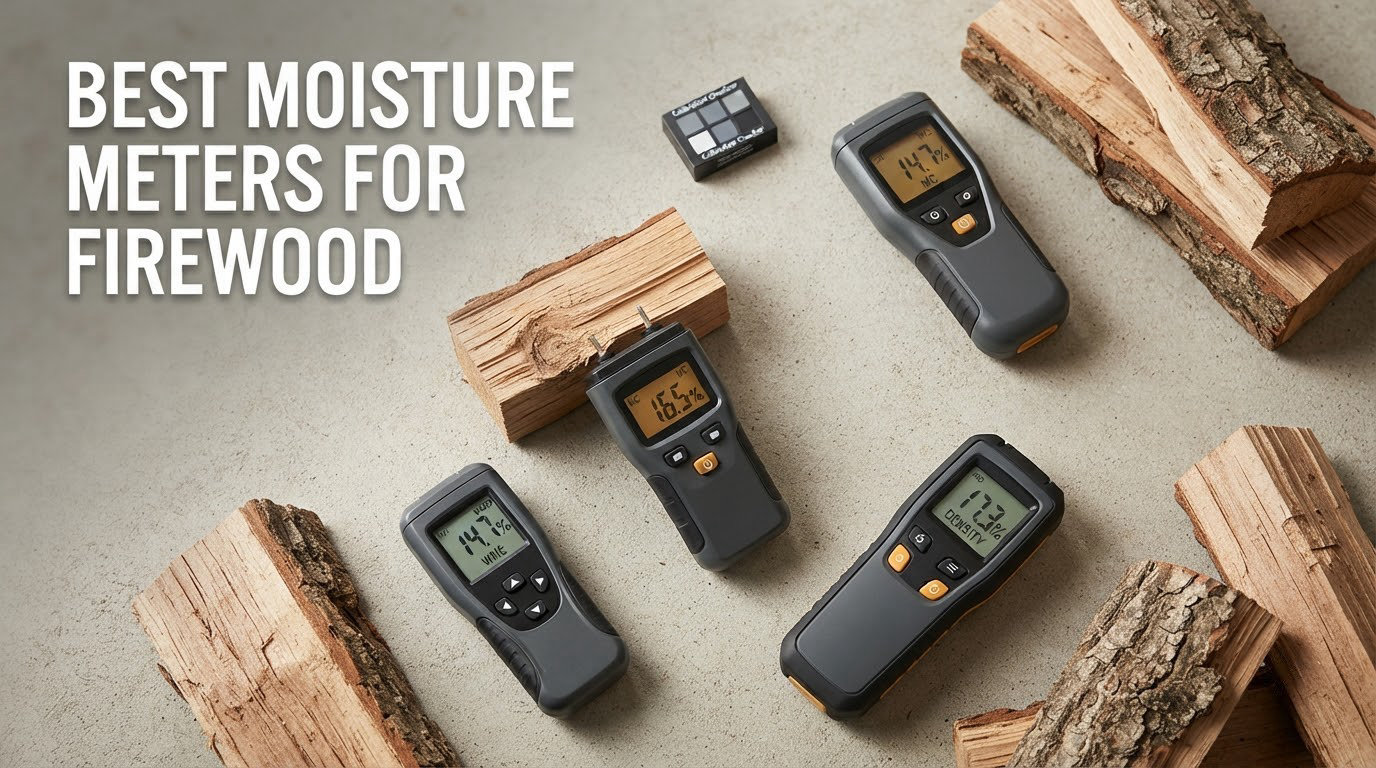
Firewood is ready to burn at 20% moisture content or less, and 15% or less gives you the hottest, cleanest fire. Above that, a stove burns cool and smoky, soots the glass, and lays down creosote in the flue faster than anyone wants to clean.
Choosing between the best moisture meters for firewood is harder than it should be. Pin-type meters measure resistance between two electrodes in the wood and give a real percentage. Pinless meters scan the surface with an electromagnetic field, which is faster but far less precise on small, uneven splits.
We put 12 of them through their paces, checking range, calibration, screen readability in a dark shed, and behaviour on split oak versus split pine. We also cover where to test, how many splits to sample, and where even a good meter misleads you. While the stack seasons, our firewood rack picks keep air moving through it.
Table of Contents
Top 3 Picks for Best Moisture Meters for Firewood (October 2026)
Klein Tools ET140
- Pinless EMF to 3/4 inch deep
- Nine LED range bars
- Reverse-contrast display

RDINSCOS Wood Moisture Meter
- Stated 0.5% accuracy
- Hardwood and softwood modes
- Backlit LCD with audio alert
Between them these cover the realistic range of needs: the default everyday meter, the fastest non-contact scanner, and the cheapest honest starting point.
All 12 Meters Side by Side in 2026
| Product | Specifications | Action |
|---|---|---|
| General Tools MMD4E |
|
Check Latest Price |
| Klein Tools ET140 |
|
Check Latest Price |
| RDINSCOS Wood Moisture Meter |
|
Check Latest Price |
 VINHMOR 8-Scale Moisture Meter VINHMOR 8-Scale Moisture Meter |
|
Check Latest Price |
 RDINSCOS Pinless MT28 RDINSCOS Pinless MT28 |
|
Check Latest Price |
 Dr.meter 2 in 1 MT1905 Dr.meter 2 in 1 MT1905 |
|
Check Latest Price |
 TOPTES TS-630 TOPTES TS-630 |
|
Check Latest Price |
 Proster PST050 Proster PST050 |
|
Check Latest Price |
 Valiant FIR421 Valiant FIR421 |
|
Check Latest Price |
 Proster PST199-P Pinless Proster PST199-P Pinless |
|
Check Latest Price |
 Mecurate WMM Mecurate WMM |
|
Check Latest Price |
 Calculated Industries 7440 Calculated Industries 7440 |
|
Check Latest Price |
The two RDINSCOS units, two Prosters, and the Dr.meter are separate models with different sensing methods, not variants of one another. Read the section for the way you actually burn wood.
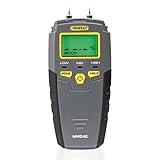
1. General Tools MMD4E – The Default Firewood Meter
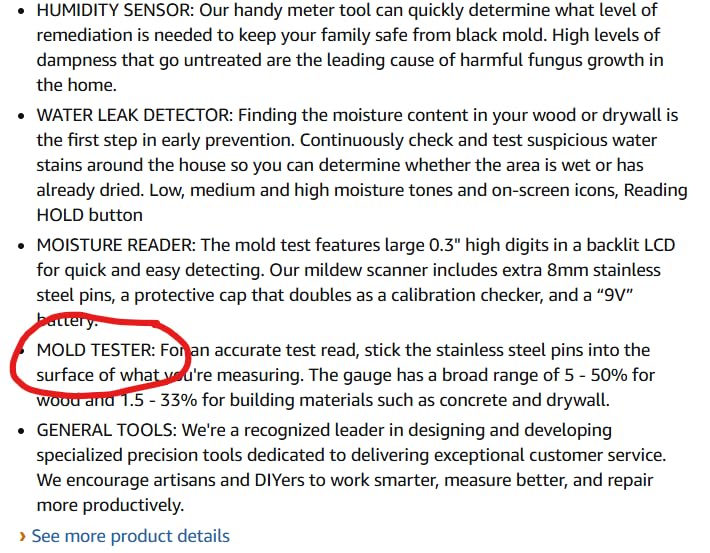
General Tools MMD4E Moisture Meter for Wood, Walls & Water Leak Detection
Wood 5-50%
Building 1.5-33%
Backlit LCD with HOLD
9V alkaline
Pros
- Largest review base here at over 15000
- 5-50% range covers green and seasoned wood
- Large 0.3 inch backlit digits
- Hold button freezes the reading
- Extra 8mm steel pins included
Cons
- Two-pin method leaves small holes
- Readings wander if the pins wobble
- Printed instructions not included
Long-time burners keep naming this meter, and fifteen thousand reviews averaging 4.5 stars is the deepest evidence base in the roundup. Three buttons, a backlit screen, and a hold function make it easy with cold hands.
The 5-50% wood range covers everything from a fresh split to wood that has dried through two seasons. Buyers confirm it is accurate within its stated spec for firewood and lumber alike.
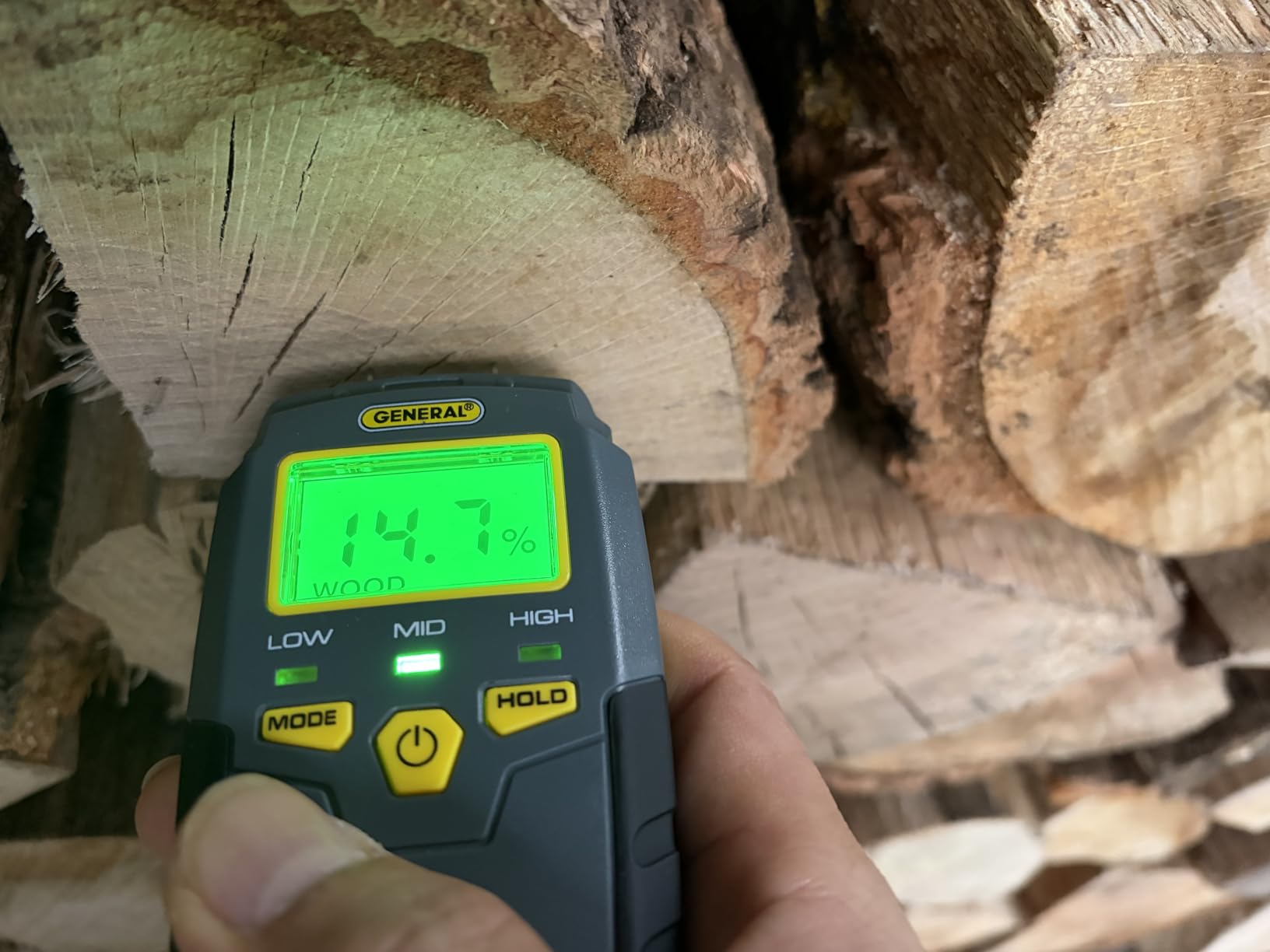
The recurring gripes are small and manageable. Two pins leave holes, which does not matter on fuel wood, and readings drift if the pins are not held steady.
Why it takes the top spot
Consistency across pine and oak, plus replaceable pins through customer service. Skip it if you need to test finished lumber without marking it.
Species handling
There is no per-species scale, so compare one species against itself rather than oak against pine.
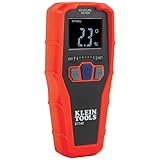
2. Klein Tools ET140 – Best Pinless Scan of a Whole Stack
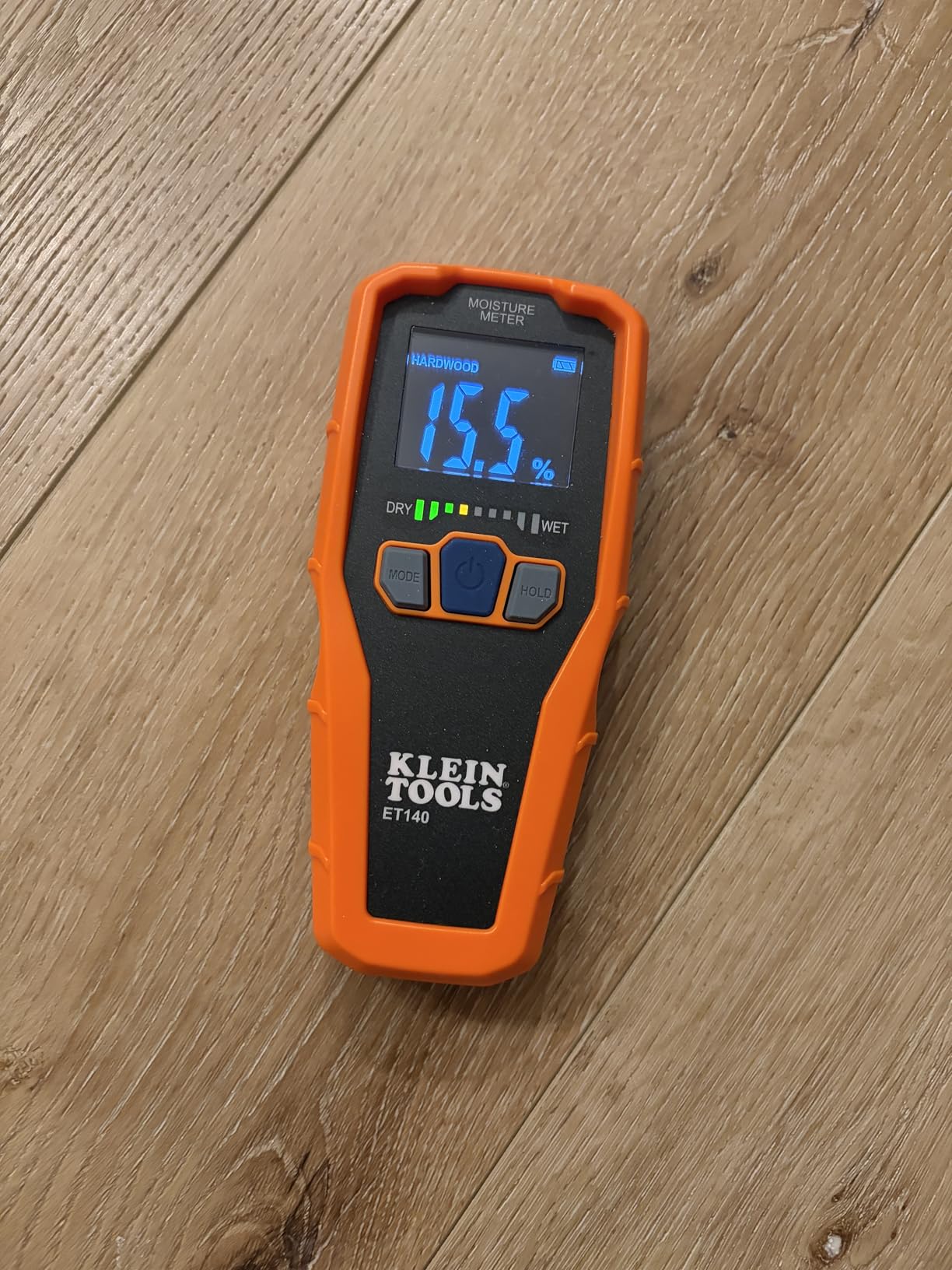
Klein Tools ET140 Pinless Moisture Meter for Non-Destructive Moisture Detection in Drywall, Wood, and Masonry; Detects up to 3/4-Inch Below Surface
Pinless EMF to 3/4 inch
9 LED range bars
Reverse-contrast LCD
7 ounces
Pros
- Leaves no holes in the wood
- Scans 3/4 inch deep to map wet zones
- Repeatable readings across scans
- Very legible display
- Two metre drop protection
Cons
- Hardwood setting can read low
- Flat sensor face awkward in corners
- Often jumps to maximum reading
This is the meter for answering which end of the row is wettest without driving a pin into every split. The flat sensor scans to three-quarters of an inch deep, so one pass maps where the damp is concentrated.
The reverse-contrast display with nine LED bars stays readable in a genuinely dark shed, which matters more in practice than the specification suggests.
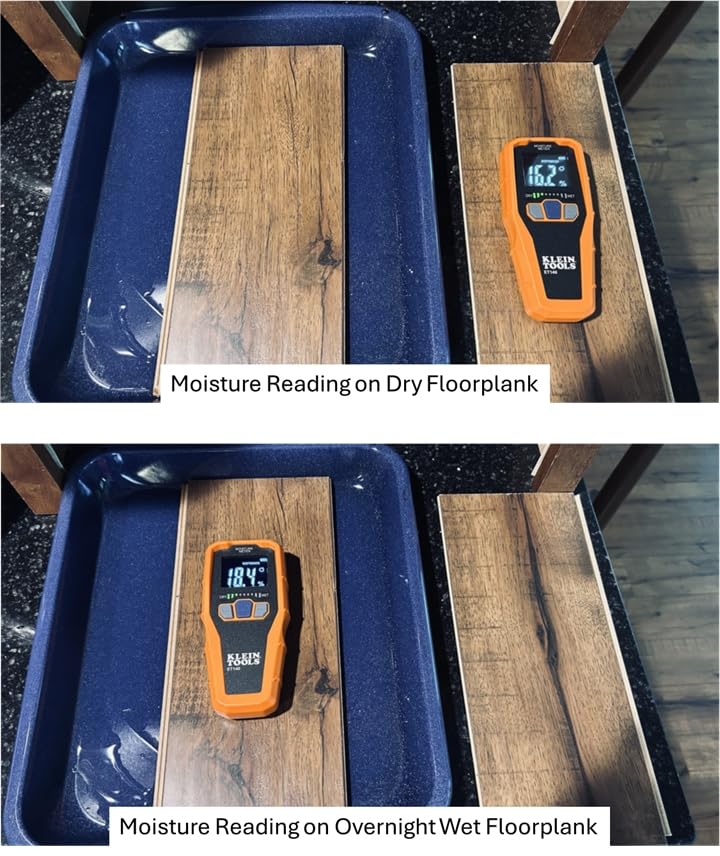
Pinless sensing averages over a wide area, so a wedge-shaped split with one wet corner can report a figure belonging to no part of the wood. The hardwood setting is also known to run a few points low against a pin meter.
Scan first, then measure
Use it to narrow a stack down, then confirm with pins. Skip it if you need a defensible percentage for selling wood by the cord.
Where it beats a pin meter
A delivery that arrived yesterday can be assessed in a couple of minutes without marking a single face.
3. RDINSCOS Wood Moisture Meter – Best Value for First-Time Buyers
RDINSCOS Wood Moisture Meter for Firewood, Softwood, Hardwood
Pin-type resistance
Stated accuracy 0.5%
Hardwood and softwood modes
3 AAA included
Pros
- Budget entry point and accurate enough for firewood
- Stated 0.5% measurement accuracy
- Backlit LCD readable in low light
- Audio alert above a set threshold
- Storage bag and spare batteries included
Cons
- Very dry wood can bottom out at 0%
- Only two material modes
- Pin holes in every split tested
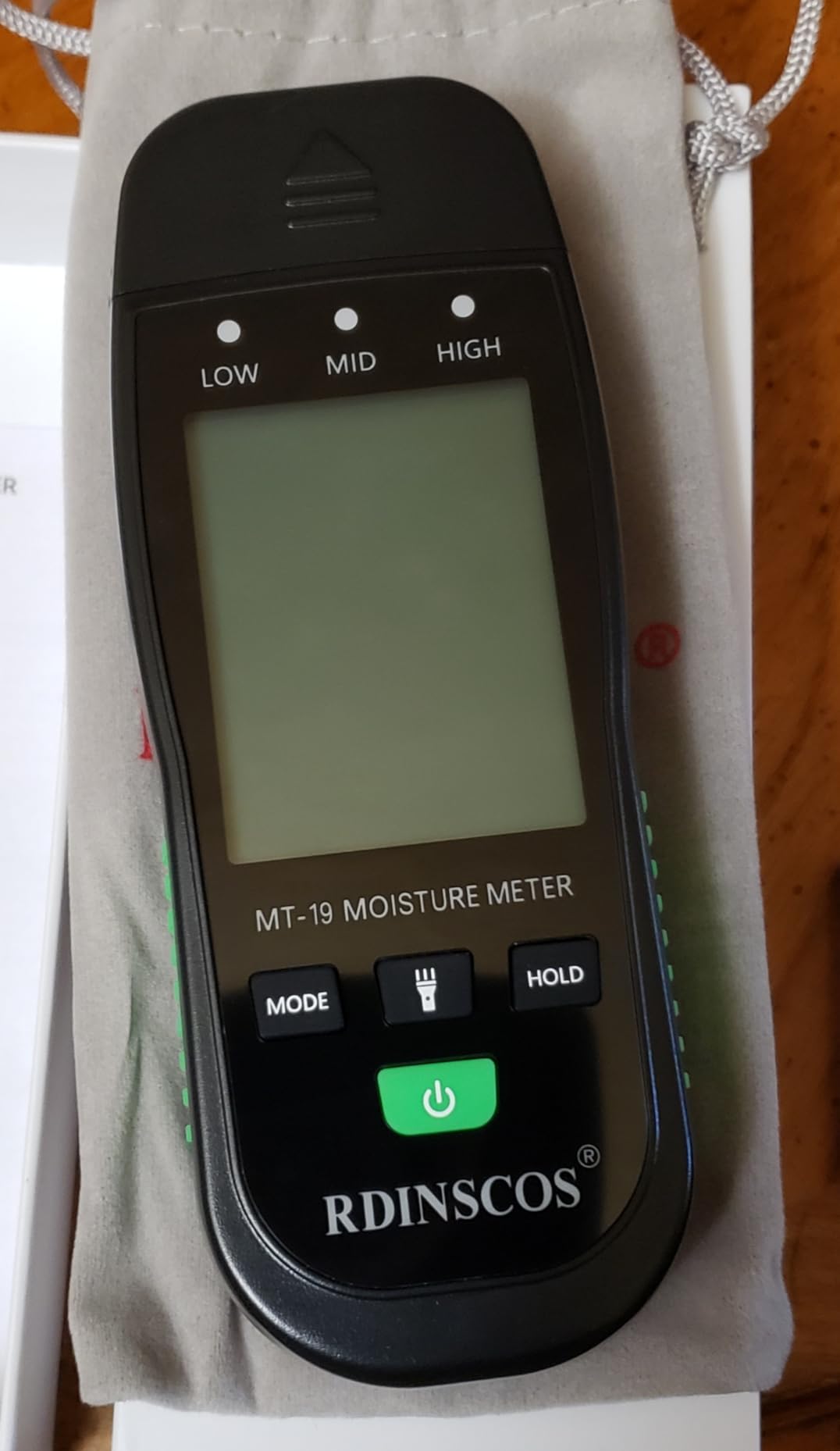
For a first meter on your own stack, this is the place to start. Nearly 5,600 reviews at 4.5 stars is remarkable at this level, and the features cover what actually matters on firewood.
Two material modes correct for wood density better than a single setting, and the audible alert fires when a split exceeds your threshold, which speeds up sorting one-handed in the cold.
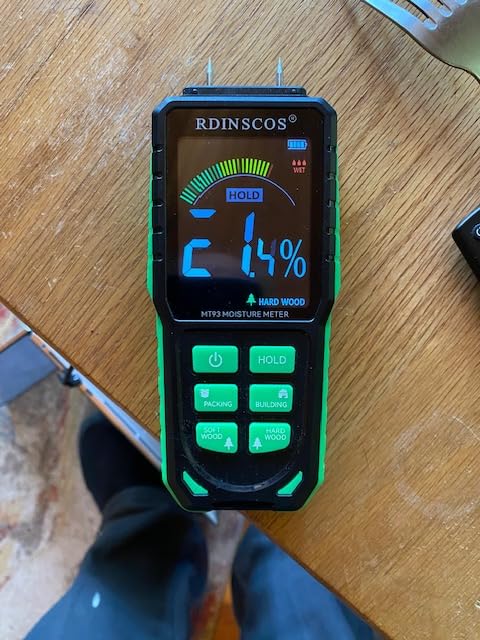
Know the floor: extremely dry wood can read 0% rather than a useful number. A zero means bone dry, not broken.
The supplied storage bag, three AAA batteries, and a spanner for pin changes are better than most rivals manage.
Who it suits
Anyone tracking a stack from season to season, where consistency matters more than absolute precision. Skip it if you sell wood and need documented figures.
Maintenance
Pop the batteries out before winter storage and wipe the pins clean. Good contact gives a far better reading than a film of last season’s resin.
4. VINHMOR 8-Scale Meter – Best Multi-Species Calibration
Wood Moisture Meter – Digital Moisture Detector Moisture Tester, Pin-Type Water Leak Detector Damp Tester Dampness Meter for Wood Building Material Firewood Walls Paper Floor (Sliver)
8 wood scales A-H
Wood 6-60%
Building 0-40%
Max/min and memory
Pros
- Eight calibration scales for finer correction
- Large backlit display readable without glasses
- Hold memory and max/min simplify logging
- Temperature display in C and F
- Ten-minute auto power-off
Cons
- Species chart must be kept with the meter
- Some common species missing from the list
- No wood reading below 6%
This is the pick if you burn mixed species and are tired of a generic wood setting. Eight calibration scales labelled A to H let you correct for the timber actually in front of you.
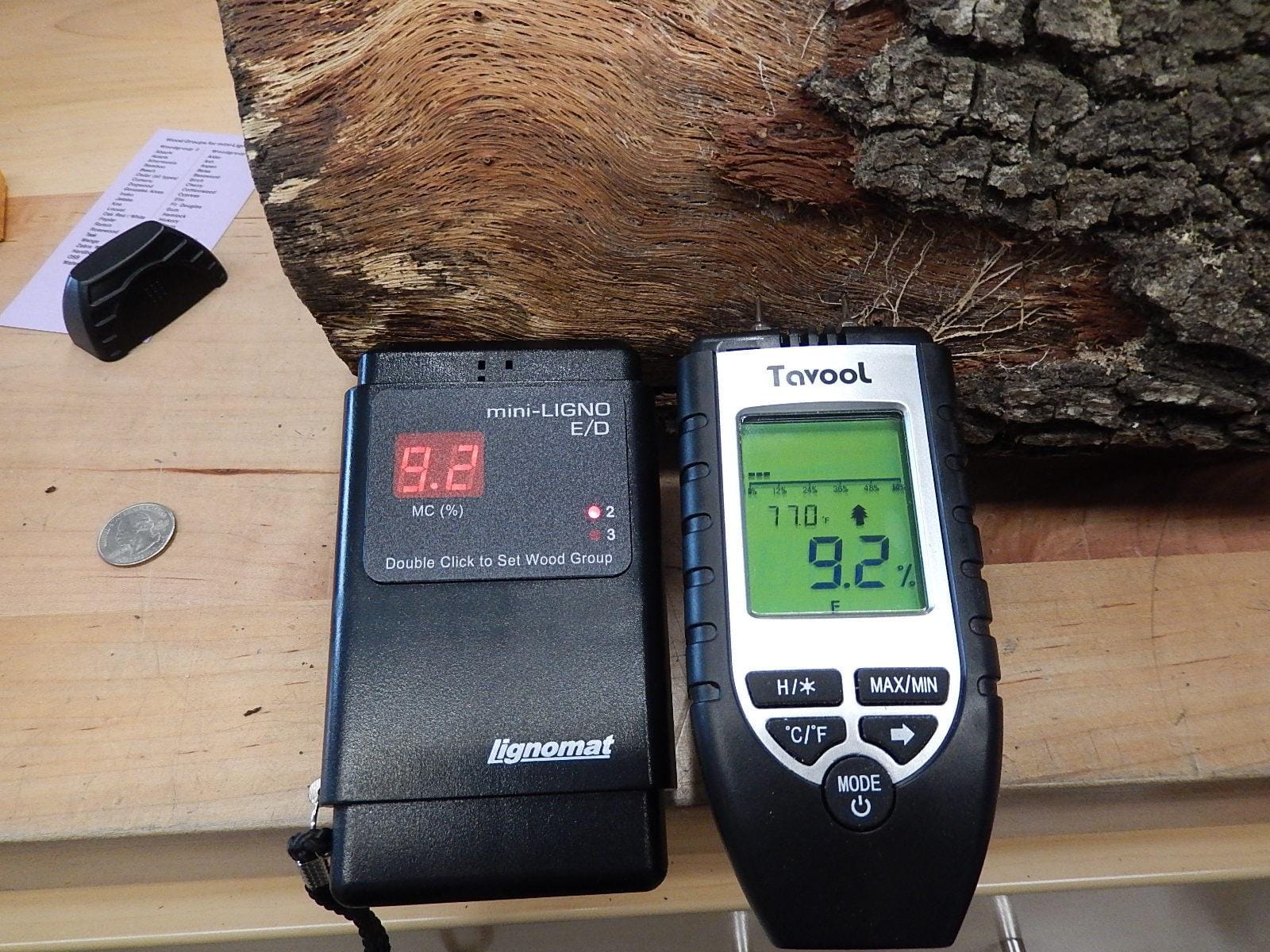
The wood range of 6% to 60% handles everything from a bone-dry split to a freshly felled log, and hold, memory, and max/min functions make logging a series of readings painless.
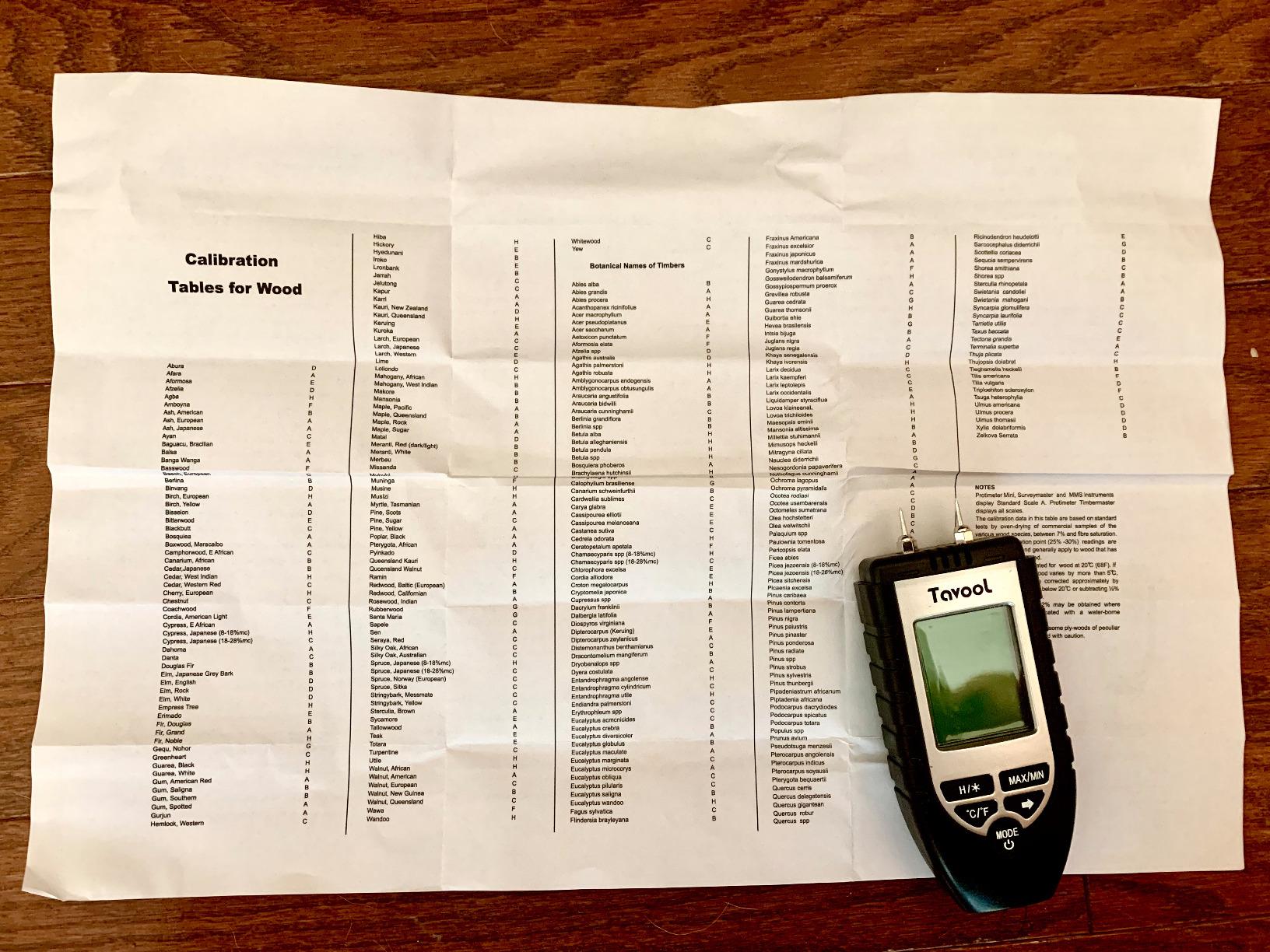
The downside is workflow. You need the species chart, and the list mixes common and Latin names inconsistently, with some popular woods absent.
Below 6% the meter shows nothing, so indoor kiln-dried lumber is out of reach, and the instructions contain plenty of errors.
When the extra scales pay off
Comparing an oak stack against a pine stack beside it. Without species correction that comparison means nothing. Skip it if you burn a single species.
Display and extras
The backlit LED is bright and large, and the temperature reading helps diagnose a slow-drying corner of the stack.
5. RDINSCOS Pinless MT28 – Best for Dark Sheds and Crawl Spaces
Pinless Moisture Meter for Wood Digital Wall Moisture Detector
Pinless EMF sensor
Built-in LED flashlight
Stated accuracy 5%
9V included
Pros
- Built-in flashlight lights dark sheds
- No pinholes in the wood
- Quick button material selection
- Useful for relative wetness comparison
Cons
- Accuracy only specified at 5%
- Concrete reads high long after drying
- Unreliable near metal objects
The integrated LED flashlight is the reason to buy this one. Testing the back of an unlit shed in January is exactly the situation where a backlit screen alone is not enough.
As a scanner it is useful for comparison. Run it over two areas, see which reads wetter, then take a pin reading in the wetter zone.
It also covers basements, bathrooms, and leak repairs, which makes it a reasonable second-purpose tool.
Mind the specification: accuracy is stated only at plus or minus 5%, and on concrete the reading reportedly stays high long after drying. Keep it off metal surfaces.
Best used as a scout
Thirty seconds of scanning tells you which pile deserves attention. Skip it if you need a trustworthy figure on one piece of wood.
Pairing with a pin meter
Treat it as the eyes and a resistive meter as the measurement. The workflow is fast and it avoids needless pin holes.
6. Dr.meter MT1905 – Pin and Pinless in One Unit
Dr.meter 2 in 1 Pin & Pinless Wood Moisture Meter for Wood Drywall
Pin wood 5-50%
Pinless wood 0-53%
Audible alarm at 17%
Ambient temperature
Pros
- Both sensing methods in one handheld
- Pinless mode starts at 0% so dry wood registers
- Audible alarm above 17% moisture
- Green backlight and reading hold
- Storage bag included
Cons
- Pinless figures looser at plus or minus 4%
- Green backlight is dimmer than white
- Two-in-one layout has a learning curve
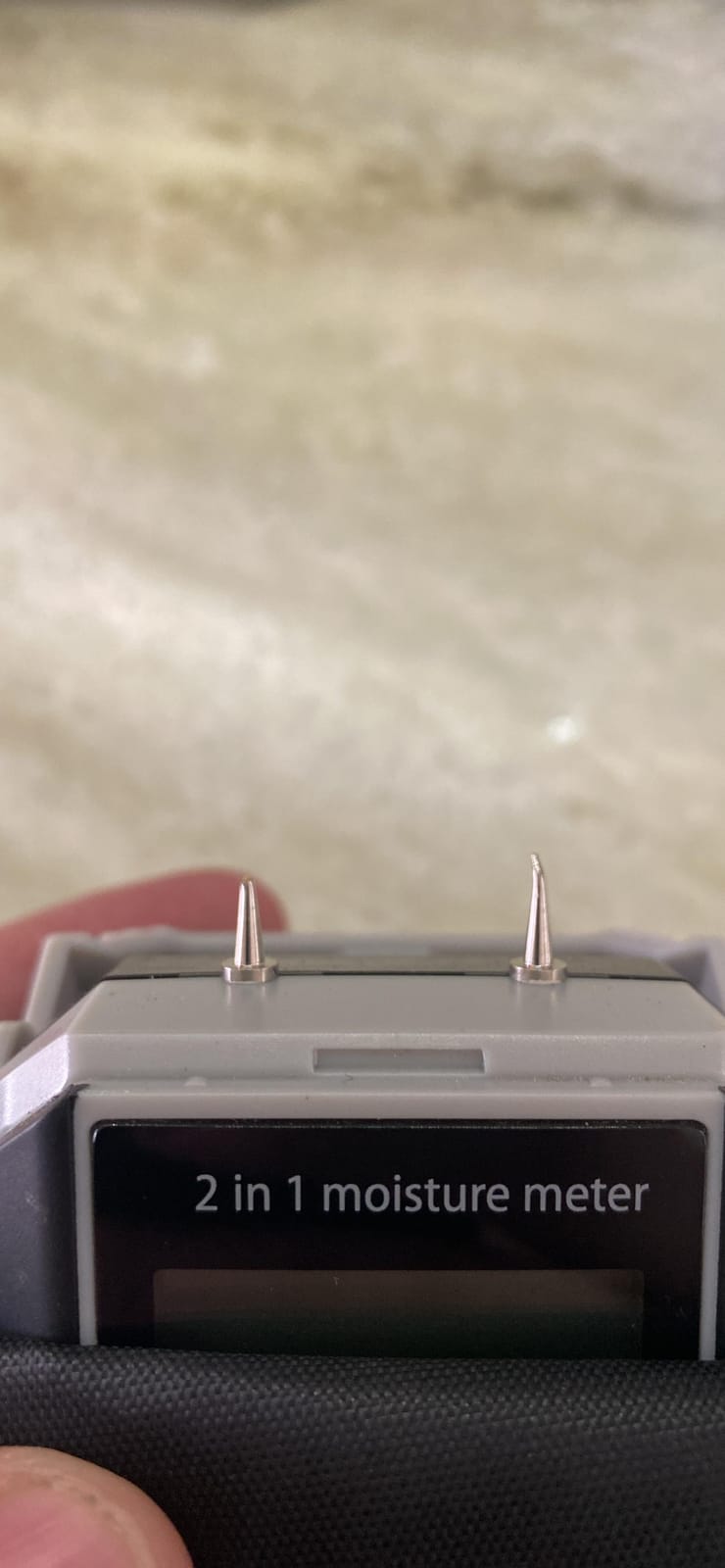
Carrying two meters to the woodshed is annoying, so a combined unit makes sense. Pin mode covers 5% to 50% for wood, and pinless mode reaches down to 0%.
That 0% floor matters. Several meters here stop registering below 6% or 10%, so you cannot tell very dry wood from an out-of-range reading. This one always returns a number.
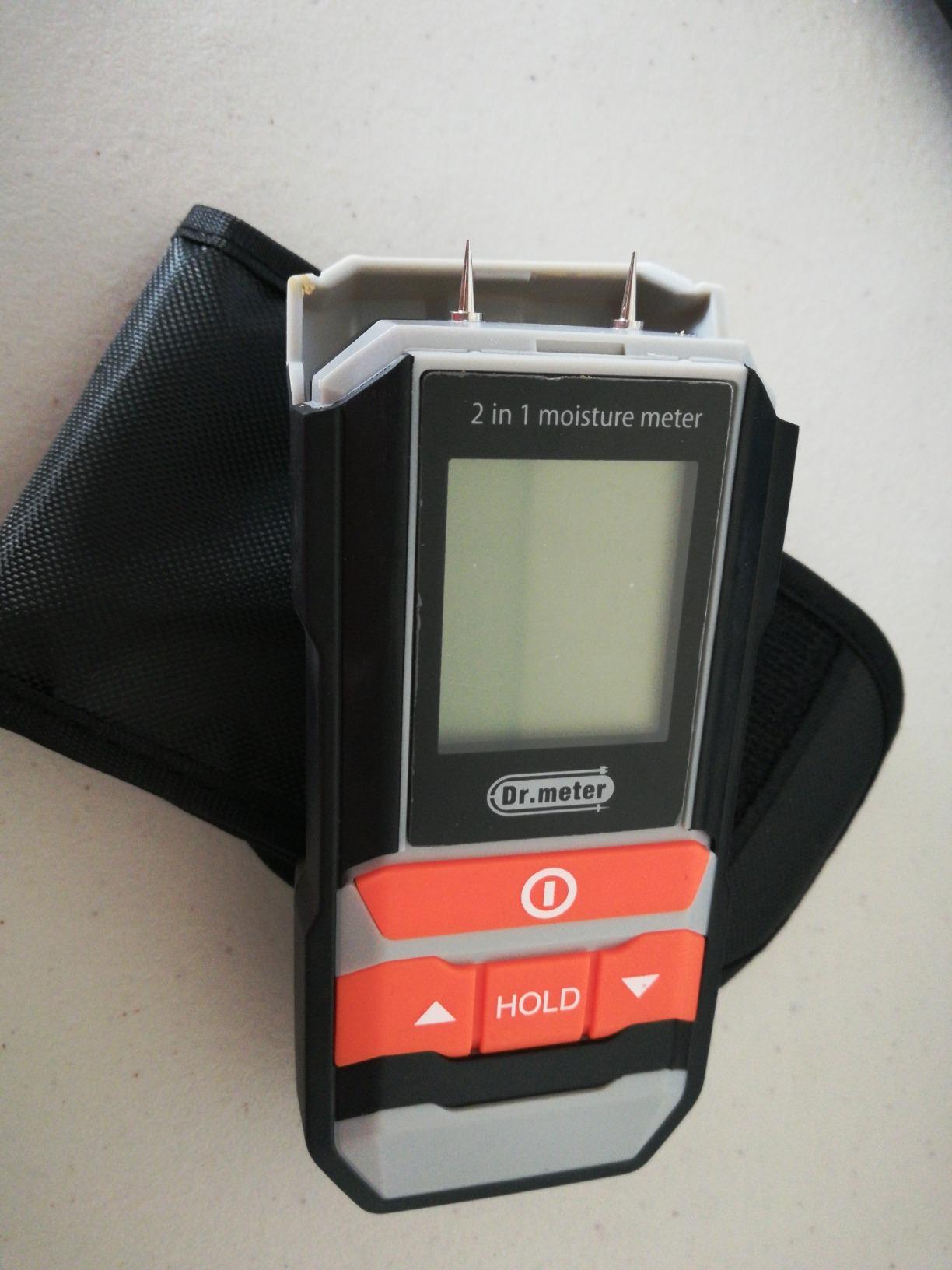
The audible alarm fires at 17% wood moisture, conveniently near the burn threshold, so you need not interpret numbers at arm’s length.
Ambient temperature is a bonus when you are watching a stack season, though the green backlight is dimmer than a white one and pinless mode is only accurate to plus or minus 4%.
When one device is right
If you test firewood and also check floors and walls, this covers both in one pocket. Skip it if you would rather choose the best tool for each job.
Learning the modes
Give it ten minutes with a scrap piece of wood before you rely on it. Once you know which mode you are in, the readings are consistent.
7. TOPTES TS-630 – Best for Reading at a Glance
Wood Moisture Meter, TopTes Digital Moisture Meter TS-630, Handheld Humidity Tester with 2.25-inch LCD Display, Tricolor Backlight, Check The Dampness Level on Firewood/Drywall – Orange
2.25 inch LCD
Tricolor backlight
0.0-57% range
Seven wood scales
Pros
- Tricolor backlight shows dry or wet without reading numbers
- Fast repeatable readings for sorting stacks
- Replacement pins and wrench in the box
- Three year warranty
- Carry pouch and batteries included
Cons
- Range bottoms out around 10-11%
- Cannot read kiln-dried lumber
- Pins must be pressed firmly
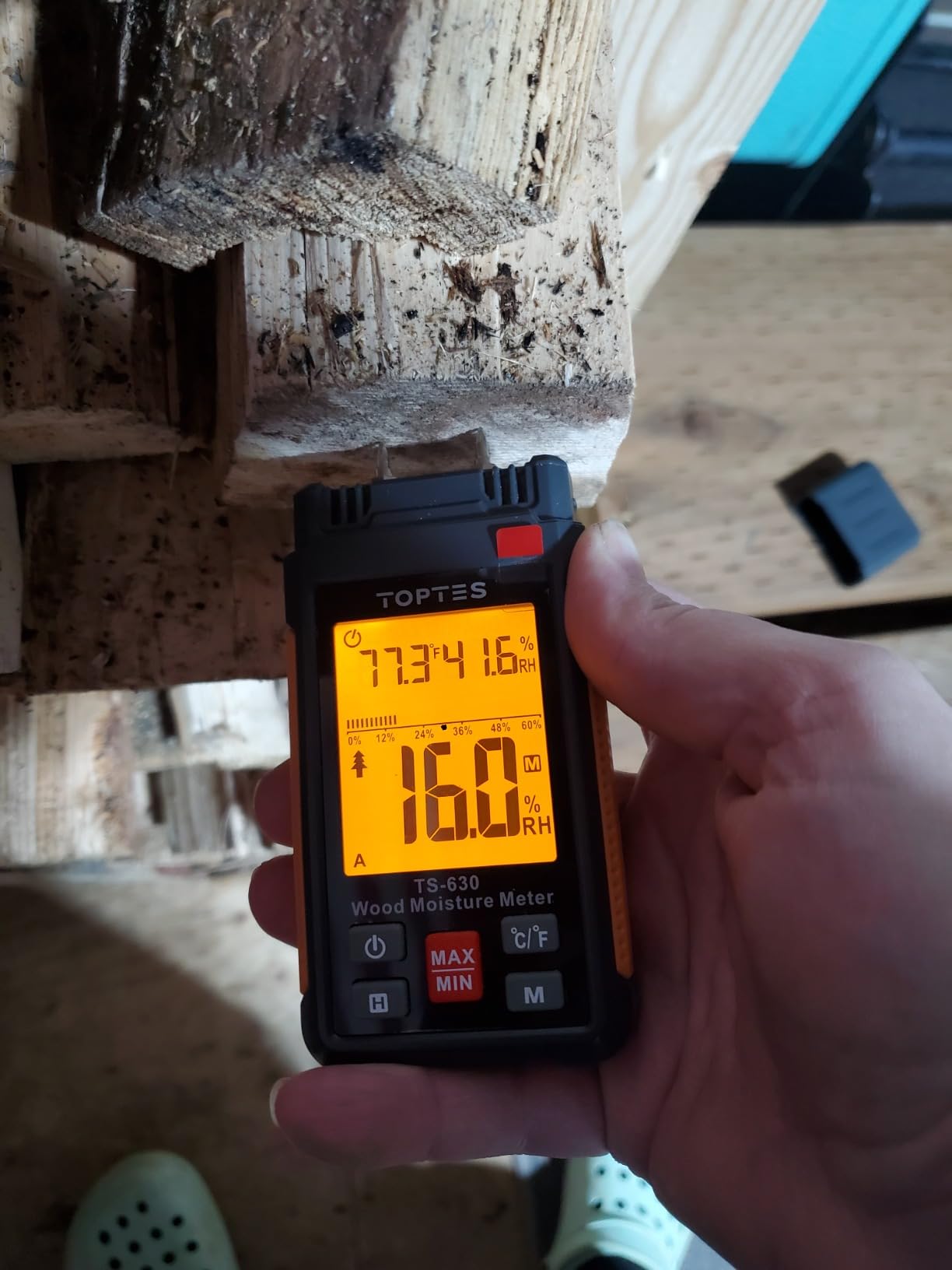
The tricolor backlight is the idea worth stealing. The screen glows green for low, orange for medium, red for high, so while you carry an armful of splits you can see which need another season.
Seven wood scales and a building material mode give more correction options than most meters here, and the 2.25 inch screen with a bar graph reads well in a shed.
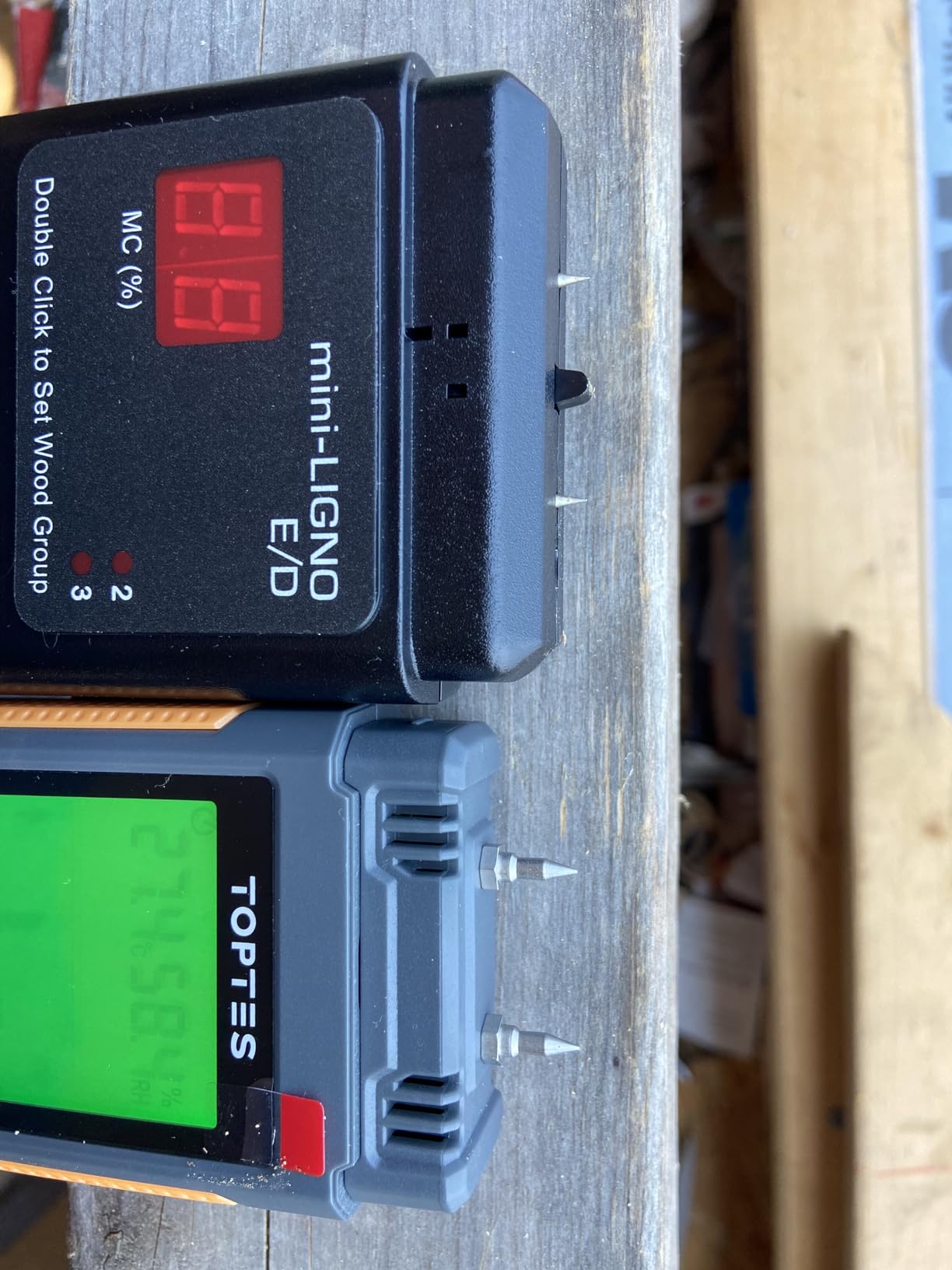
Replacement pins and a mini wrench in the box solve the bent-pin frustration that owners of other meters complain about, and the three-year warranty is the longest in this group.
The limitation is the low cutoff. Below roughly 10 to 11% the display shows Lo, so it is useless for indoor lumber and for detecting subtle damp in finished wood.
Sorting a delivery quickly
Hold each split for a second and build two piles, one for this season and one for next. It is the fastest sorting workflow here. Skip it if you test very dry indoor lumber.
Specs worth knowing
Range is 0.0 to 57% across seven wood scales plus building material mode, with data hold, max/min, and a ten-minute auto shut-off.
8. Proster PST050 – Budget Pick with Serious Range
Proster Wood Moisture Meter 4 Modes 0-99.9% for Wood/Paper/Firewood
0-99.9% range
0.1% resolution
Stated accuracy 0.5%
4 species groups
Pros
- Low entry cost and accurate enough for firewood
- Real-time readings with no delay
- Works on paper and cardboard too
- Hard protective case and pin cover included
Cons
- No backlight at all
- Wood groups favour tropical species
- Species group resets at every power-on
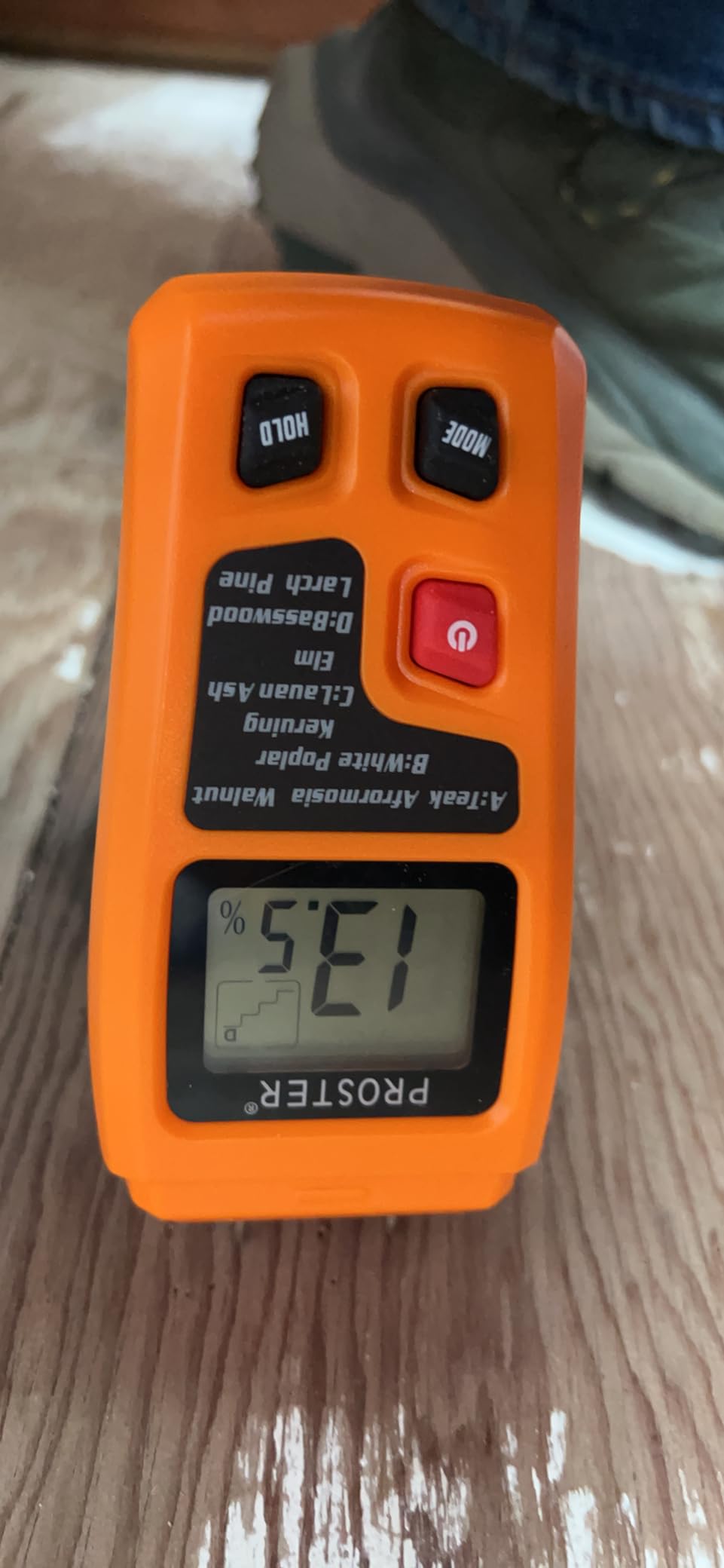
This is the least expensive meter in the group, and owners report it changing their mind about their own wood, which is the point of buying one. The 0-99.9% range, 0.1% resolution, and stated 0.5% accuracy are ample for a burnability check.
Readings appear immediately after the pins go in, with no settling delay, so you can work quickly through a delivery. The orange body is also easy to find in a tool bag.
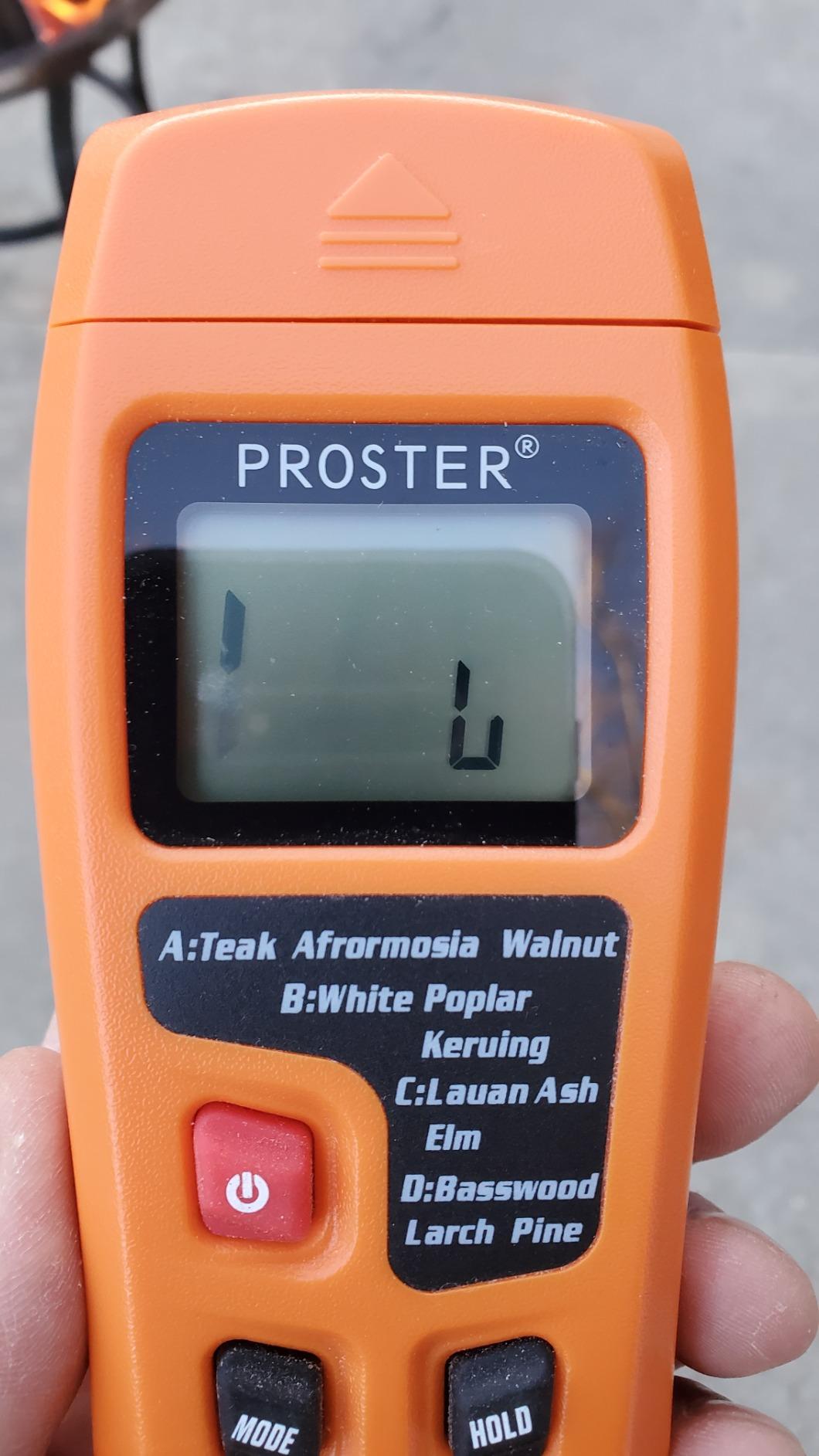
There is no backlight, which is the deal-breaker for winter shed work at dusk. The four species groups cover roughly 28 woods but skew toward tropical timber, with no group for dense North American hardwoods such as hickory.
The selected group also resets every time you switch it on, so you re-scroll it each session.
Best use on a tight budget
Stacking a first season of wood and wondering when to start burning. Skip it if you test after dark or work in dense hardwoods.
What it does not include
No backlight, minimal support, and a non-alkaline battery in the box. Budget for alkaline cells and a spare pin.
9. Valiant FIR421 – The Simplest Firewood-Only Design
Valiant FIR421 Digital Moisture Meter for Firewood Timber and Brickwork, Black
Colour-coded burn indicator
Wood timber and brickwork
Temperature in C or F
0.06 kg
Pros
- Colour indicator shows burn suitability at a glance
- Reads wood fuels timber and brickwork
- Built-in temperature in C or F
- Very light to carry
- Display legible in poor light
Cons
- Fewer calibration options than multi-scale meters
- Low sales rank in the category
- No customer photos on the listing
This meter answers one question plainly: is this log ready to burn? The colour-coded indicator tells you without interpretation, which is exactly what a first-year wood burner needs.
It also reads structural timber and brickwork, so it is not limited to fuel, and the temperature reading helps you diagnose why a corner of the stack is slow. At 0.06 kg it is the lightest unit here.
What you give up is calibration depth. There are far fewer documented options than the multi-scale meters offer, so it is a guideline device rather than a measuring instrument.
Who should buy this
Anyone who wants a yes or no answer without thinking about density correction, and it makes a good gift alongside a new wood stove. Skip it if you sell wood or compare species.
Why simplicity wins
In a dark shed with cold hands, fewer modes is a genuine advantage over the more capable meters.
10. Proster PST199-P – Pinless Locating with Colour Alarm
Proster Pinless Moisture Meter 3/4″ Depth Color Alarm Non-Destructive
Pinless to 3/4 inch deep
5-75% wood range
Three-colour LED and alarm
Backlit colour LCD
Pros
- Non-destructive sensing leaves wood unmarked
- Three-colour bar graph and alarm find wet zones fast
- Large backlit colour LCD with reverse contrast
- Wood range up to 75%
- Storage bag and battery included
Cons
- Readings are relative not true percentage
- 5% floor means very dry wood will not register
- Can drift on dense hardwoods
This is a locating tool, and a good one. The three-colour bar graph plus an audible alarm means a damp patch announces itself, so you can sweep a delivery in seconds to find the split that is still soaking.
The backlit colour LCD is easy to read in poor light, and the sensing leaves the wood unmarked if you want to keep the nicer faces for display.
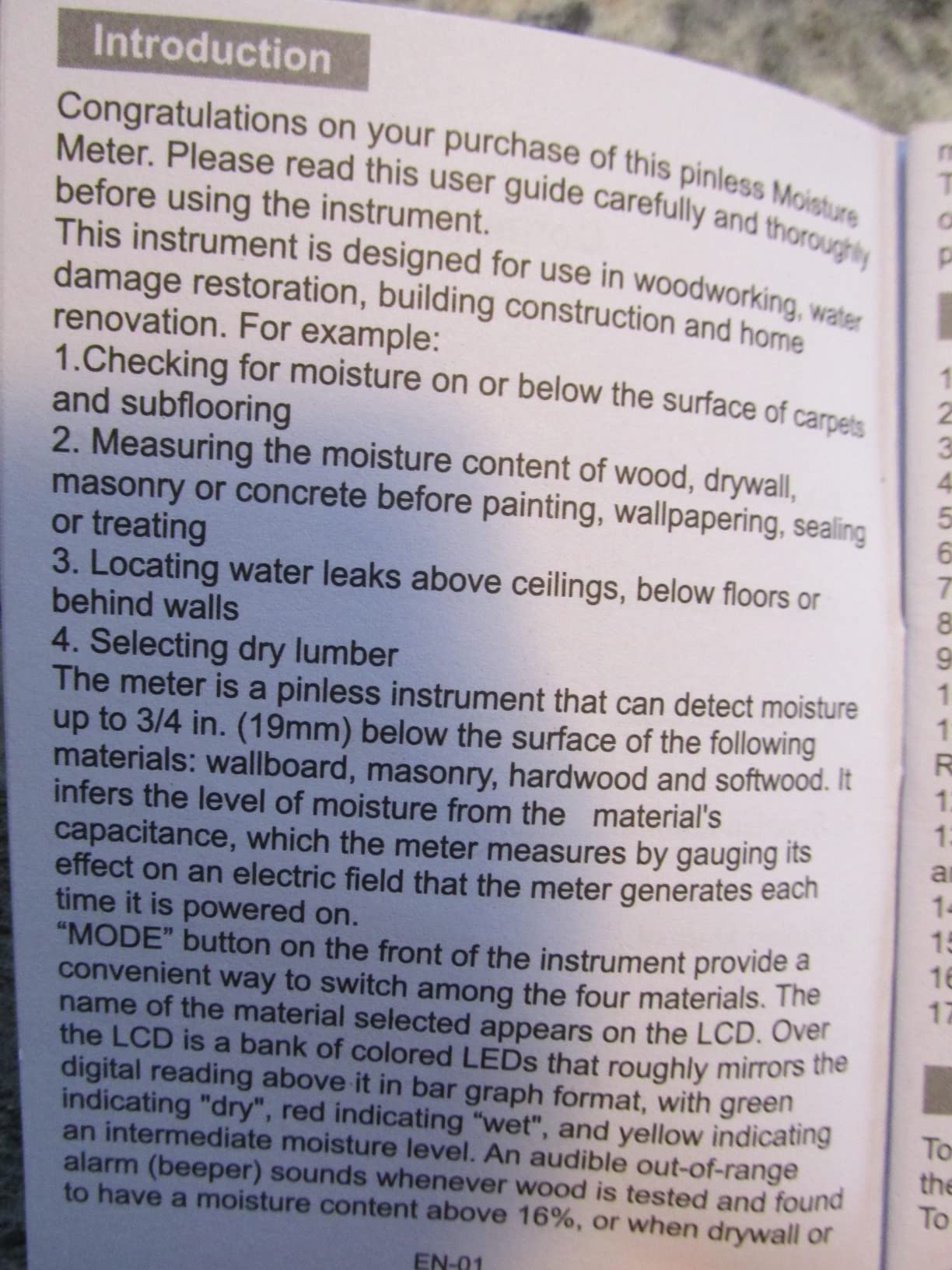
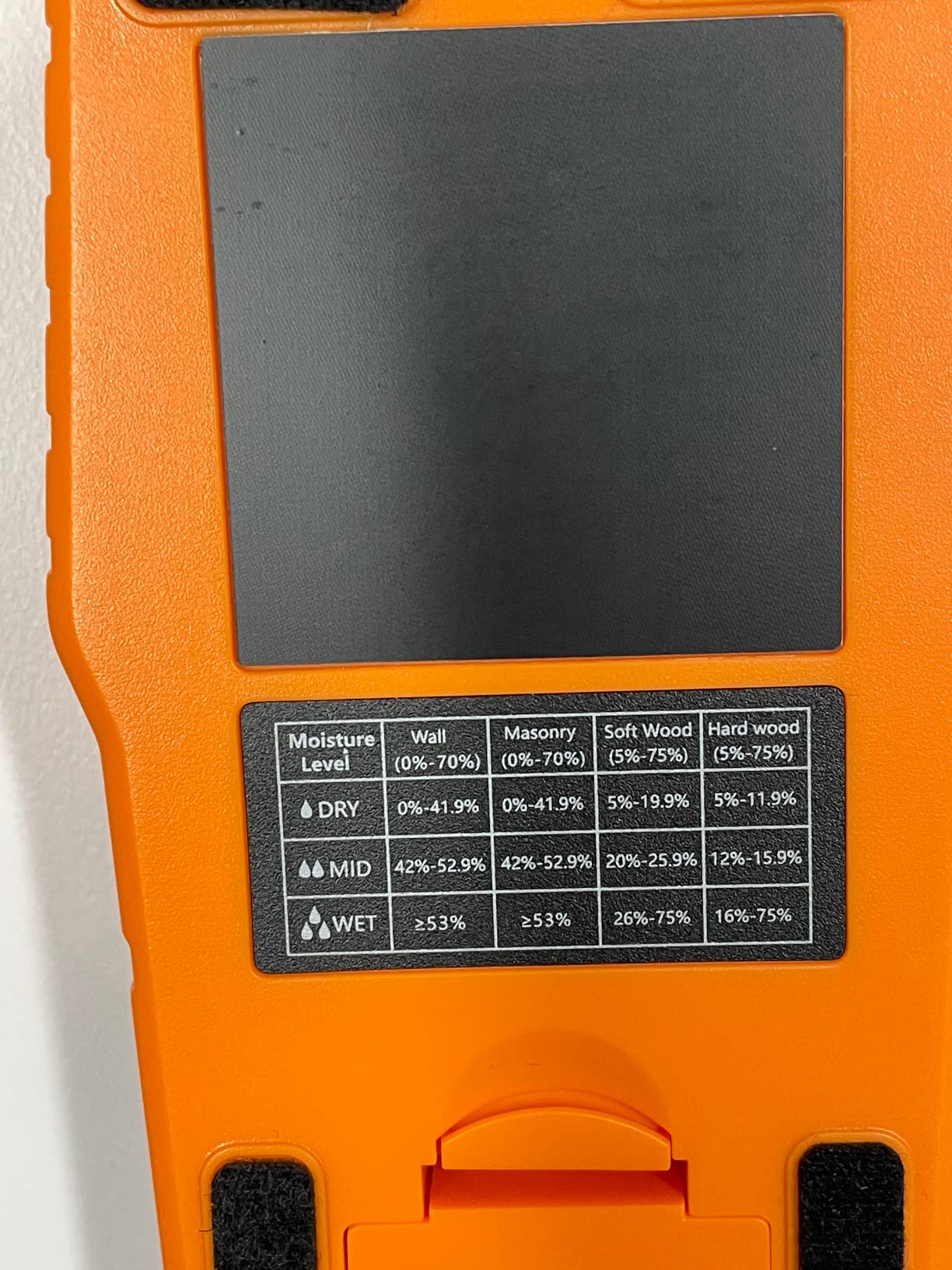
Understand what the number means. Pinless sensing gives a relative figure rather than a true moisture content, so it is not what you would put on a sales invoice. Reviewers also note drift on dense hardwoods with no pin reading to compare against.
The 5% floor means very dry wood will not register, so silence does not necessarily mean dry.
Scan first, then measure
Sweep with it, identify the wettest third of the stack, then confirm with pins. Neither tool is that good alone. Skip it if you need a defensible percentage.
Range and handling
It scans to three-quarters of an inch deep, 5 to 75% for wood, with hold, auto power-off, out-of-range alarm, and a low battery warning.
11. Mecurate WMM – Fastest Readings and Cap-Based Calibration
Mecurate Digital Pin Type Wood Moisture Meter with 3 Colored Indicators, Moisture Detector 2 Mode 8 Calibration Large Backlit for Wood, Wall, Firewall (Orange)
0.1% resolution
8 wood scales
Self-test in the cap
Temperature in C or F
Pros
- Highest average rating in this group at 4.6 stars
- Cap-based self-test needs no reference block
- Sensitive sensor updates without deep pin pressure
- Wood type index printed on the back
- Large backlit display with temperature
Cons
- No wood reading below 6%
- Sharp pins need care at the cap
- Uncommon species still need the manual
- Some buyers received dead batteries
At 4.6 stars across 1,170 reviews, this has the strongest rating in the roundup, and the reason is speed. The sensor updates almost instantly without needing the pins driven deep for a stable contact.
That matters on firewood, because deep pin pressure on oak is what bends pins. The cap doubles as a self-testing calibration aid, so you can check the meter is behaving with no extra tool.
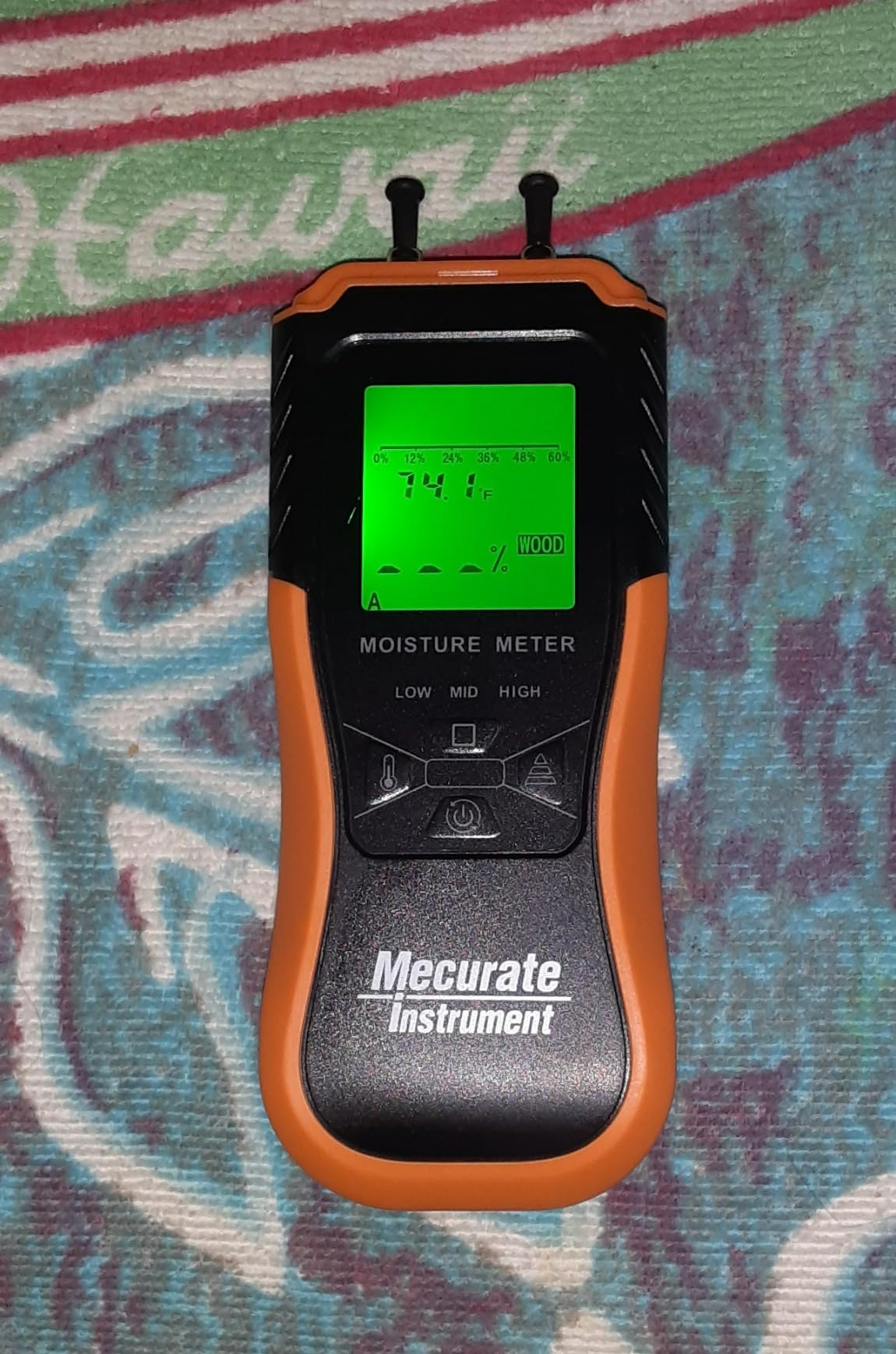
Eight wood scales give decent species correction, and a wood type index printed on the back saves carrying the manual into the shed. Two replacement pins and a water resistant pouch are included.
The consistent complaint is the 6% floor, so bone-dry lumber shows nothing. A few buyers also reported batteries arriving dead.
Why the rating leads the group
Reviewers call the sensor sensitive and immediate, and the colour indicators with on-screen icons make sorting simple. Skip it if your wood regularly sits below 6%.
Using the self-test
Slot the pins into the cap and press the test function. Confirming the meter before a long sorting session is a habit worth keeping with any resistive meter.
12. Calculated Industries 7440 – Widest Material Range with Firewood Bands
Calculated Industries 7440 AccuMASTER XT Digital Moisture Meter | Handheld |Pin Type | Backlit LCD Display | Detects Leaks, Damp and Moisture in Wood, Walls, Ceilings, Carpet and Firewood
Firewood bands 5-50%
Built-in calibration test pins
Replaceable steel pins
9V included
Pros
- Firewood burn-readiness bands printed on the device
- Built-in calibration test pins for on-demand checks
- Widest material compatibility here
- Large backlit screen with a hold key
- Replaceable stainless steel pins
Cons
- Highest priced option in this roundup
- Smallest review base at 830 reviews
- Pin-type only so surfaces are marked
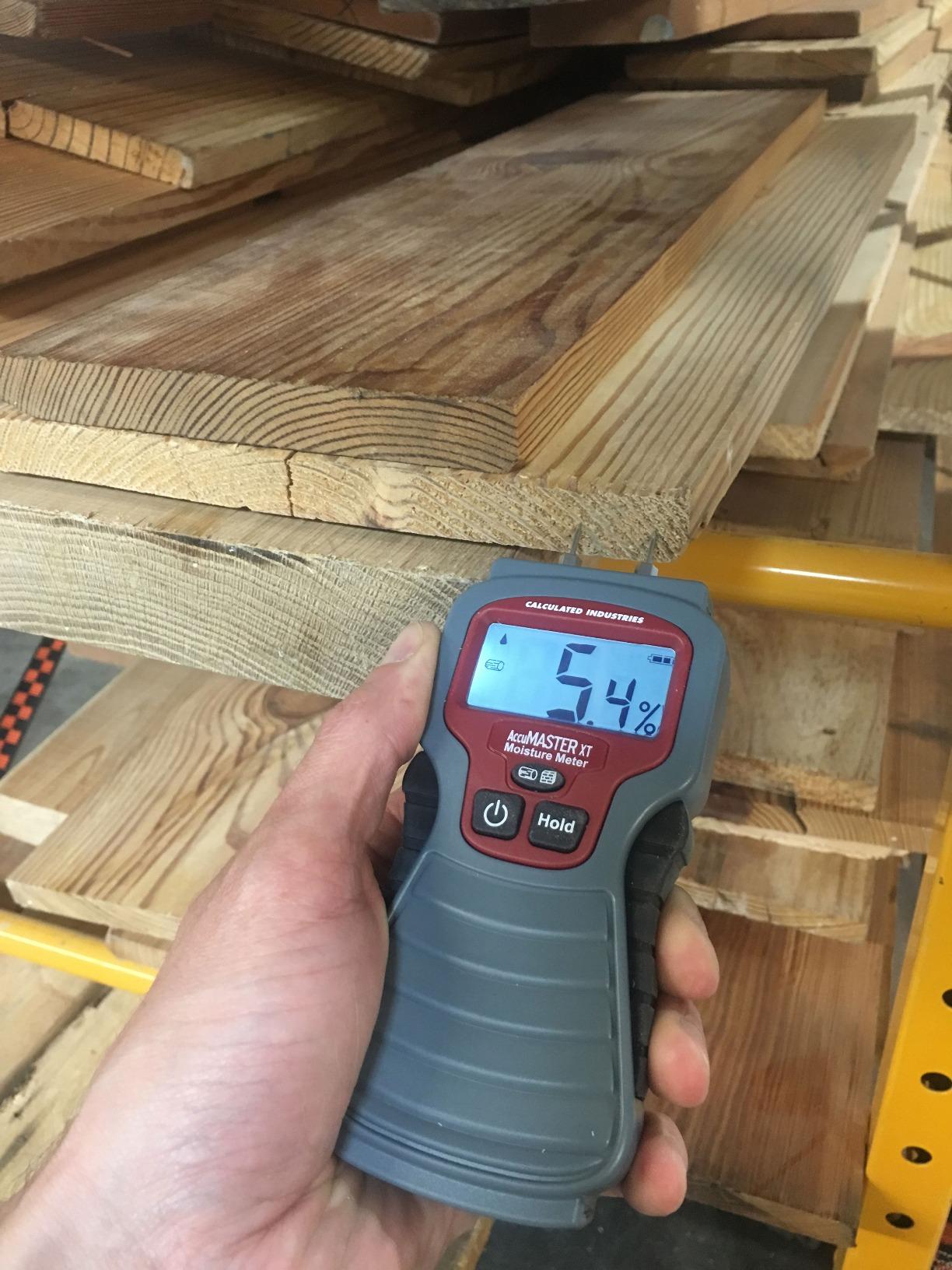
What sets this apart is the firewood banding. The device marks moisture as Low at 5 to 11%, Medium at 12 to 15%, and High at 16 to 50%, putting the burnability decision on the meter rather than in your head.
It is also the most versatile instrument here, covering firewood, lumber, brick, concrete, drywall, plaster, floors, walls, and carpet. One tool covers a house and a woodpile.
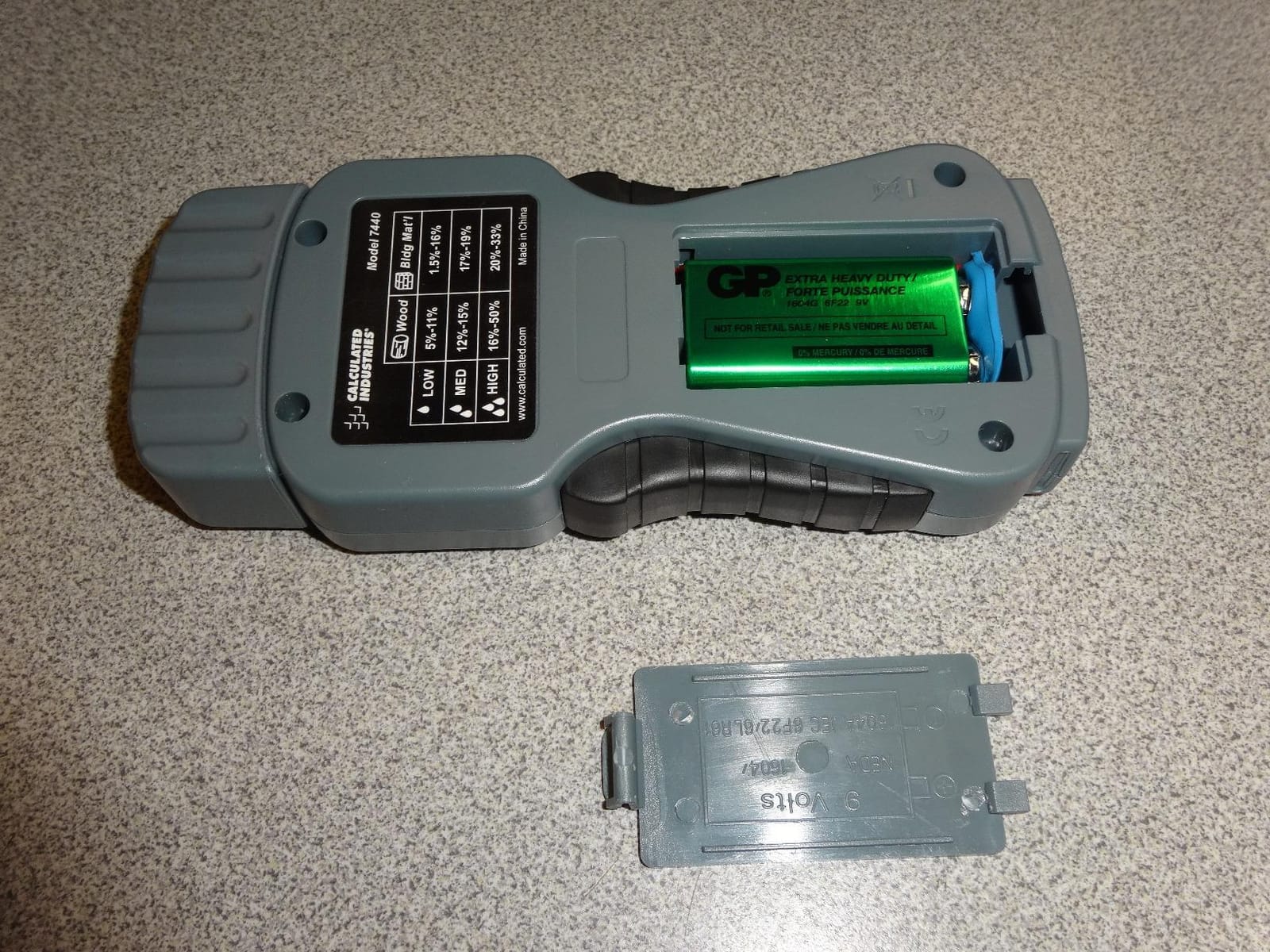
Built-in calibration test pins let you verify the meter on demand, and replaceable super-sharp steel pins mean you are not hunting for a spare when one bends.
The trade-offs are clear. It sits at the upper end of what we tested, it has the smallest review base at 830, and there are no printed wood species scales.
Who should pay more
Anyone who needs one credible number across firewood, building materials, and a finished floor, and who values printed burn bands over species correction.
Handling
At 6.4 ounces with a hand-friendly body, it feels solid when you press the pins in, and the hold key freezes the reading while you note it down.
Pin-Type vs Pinless Meters for Firewood
For firewood, use a pin-type meter as your primary tool. It measures electrical resistance between two electrodes in the wood, which correlates closely with real moisture content, and it reads a single split rather than averaging a wide area.
Pinless meters sense the electrical field through flat pads on the surface. They are faster and leave no holes, so they are right for finding the wettest part of a stack. On small uneven splits they report an average belonging to no part of the wood, and several here read a few points low on hardwood.
What Moisture Content Should Firewood Be?
Firewood is ready to burn at 20% moisture content or less, and 15% or less gives the best efficiency. Above roughly 20% you are burning energy to boil off water, which is why the firebox smokes and the flue soots.
The bands most burners work to are simple: below 15% is excellent, 15 to 20% is burnable, 20 to 25% is worth waiting on, and above 25% it is still seasoning rather than fuel.
A caveat from the forums is worth repeating. Agreement across firewood communities is that anything under 20% is good to go and 10 to 15% is optimal. Treat those as guides, since resin and extractives can shift a reading by a point or two.
How to Test Firewood Moisture the Right Way
Where you test matters more than which meter you own. Follow this sequence and almost any meter here gives a usable number.
First, split a piece and test the freshly exposed face, never bark and never a weathered outer surface. Readings from the outside of a log are misleadingly low, and it is the most common mistake.
Second, select the correct wood mode or species scale before pressing in. A generic setting will not compare oak with pine fairly.
Third, drive the pins parallel to the grain, insert them to full depth, and hold steady. On dense hardwood that is where pins bend, so press firmly but never force them. The splitting tools used to expose that fresh face matter as much as the meter does.
Fourth, take five to ten readings across the load rather than one, working from the driest-looking splits to the wettest and testing splits from the core of the pile last. Those core splits dry slowest.
Fifth, average them and compare the average to 20%. If a couple of readings come in well above the rest, believe them, because the wettest log is what makes your chimney dirty.
Where Meters Lie: Accuracy Limits Worth Knowing
Salt content and resin extractives push pin readings above the true moisture content, a well-known explanation in firewood forums. It matters most on resinous softwoods, treated timber, and salt-rich species.
Cheap meters also drift over a season. Track one pile with the same unit and settings, since comparing a reading from one cheap meter today against another next month tells you nothing. Cold weather makes readings less reliable and drains cells faster, so carry spare alkaline batteries if you test through winter.
Poor pin contact produces wandering numbers. If the reading bounces, you are measuring the contact, not the wood. Clean the pins, press again, and move to a fresh spot.
You can also tell without a meter, to a degree. Weight per cord, a hollow knock when two logs meet, a bread test on the cut face, and thick white smoke on the first burn all signal damp wood. None of them replace a number, but they stop you loading a bad pile in the first place.
The practical answer is to use both methods. Scan a stack with a pinless unit to find the suspicious zone, then drive a pin meter into the freshest split face there for the number you act on.
Frequently Asked Questions
Do moisture meters work on firewood?
Yes. A wood moisture meter measures resistance between two pins driven into the wood, and that resistance maps to moisture content. It works on any split firewood, softwood or hardwood, as long as you test a freshly exposed face and select the matching wood mode.
What is the best moisture reading for firewood?
Firewood is ready to burn at 20% moisture content or less, and 15% or less is optimal for efficiency. Below 15% is excellent, 20 to 25% is worth waiting on, and above 25% the wood is still seasoning rather than fuel.
Do I need a pin or pinless moisture meter for firewood?
A pin-type meter for numbers and a pinless meter for scanning. Pin meters give an accurate reading on a single split, which is what you need to decide whether to burn. Pinless meters are faster and leave no holes, so use them to find the wettest zone, then confirm with pins.
Where on a log should I test moisture?
Split a piece and test the freshly exposed face. Never test bark or a weathered outer surface, which reads misleadingly low. Drive the pins parallel to the grain to full depth and take five to ten readings across the load, testing splits from the core of the pile last.
How many splits should I test to know if my firewood is dry?
Take five to ten readings per load and average them, working from the driest splits to the wettest. Splits buried in the middle of the pile dry slowest, so test those last. If a couple of readings come in well above the rest, trust them rather than discarding them.
Can I test firewood without a moisture meter?
You can only estimate. Weight per cord, a hollow knock between two logs, a bread test on the cut face, and thick white smoke on the first burn all signal damp wood. None of these give you a percentage, so a meter is the only way to know where a load really sits.
Are firewood moisture meters accurate?
Good meters are accurate to within a couple of percent for burnability purposes, but readings can be skewed. Salt and resin extractives push pin readings high, cheap units drift between seasons, and cold weather reduces both accuracy and battery life.
Why does my meter have different wood modes?
Wood density affects how electrical resistance relates to moisture content, so each mode applies a different correction. Without the right mode, a piece of oak and a piece of pine can show the same number while holding very different amounts of water.
Our Verdict: The Best Moisture Meters for Firewood in 2026
The General Tools MMD4E is the best moisture meter for firewood overall. It has the deepest review history in the group, a 5-50% wood range, a backlit screen with a hold function, and a three-button interface that works with cold hands.
If you would rather not mark your wood, the Klein Tools ET140 scans a stack in seconds with no pinholes and an exceptionally legible display. If you are starting out, the RDINSCOS pin meter gives you hardwood and softwood modes, a backlit screen, and an audible alarm for very little money.
Whichever you choose, the number that matters is the same: 20% or less to burn, 15% or less for the best fire, measured on a freshly split face and averaged across five to ten pieces. A good work light for the shed helps when you check the pile after dark, and our firewood rack guide keeps air moving through the stack while it seasons.