
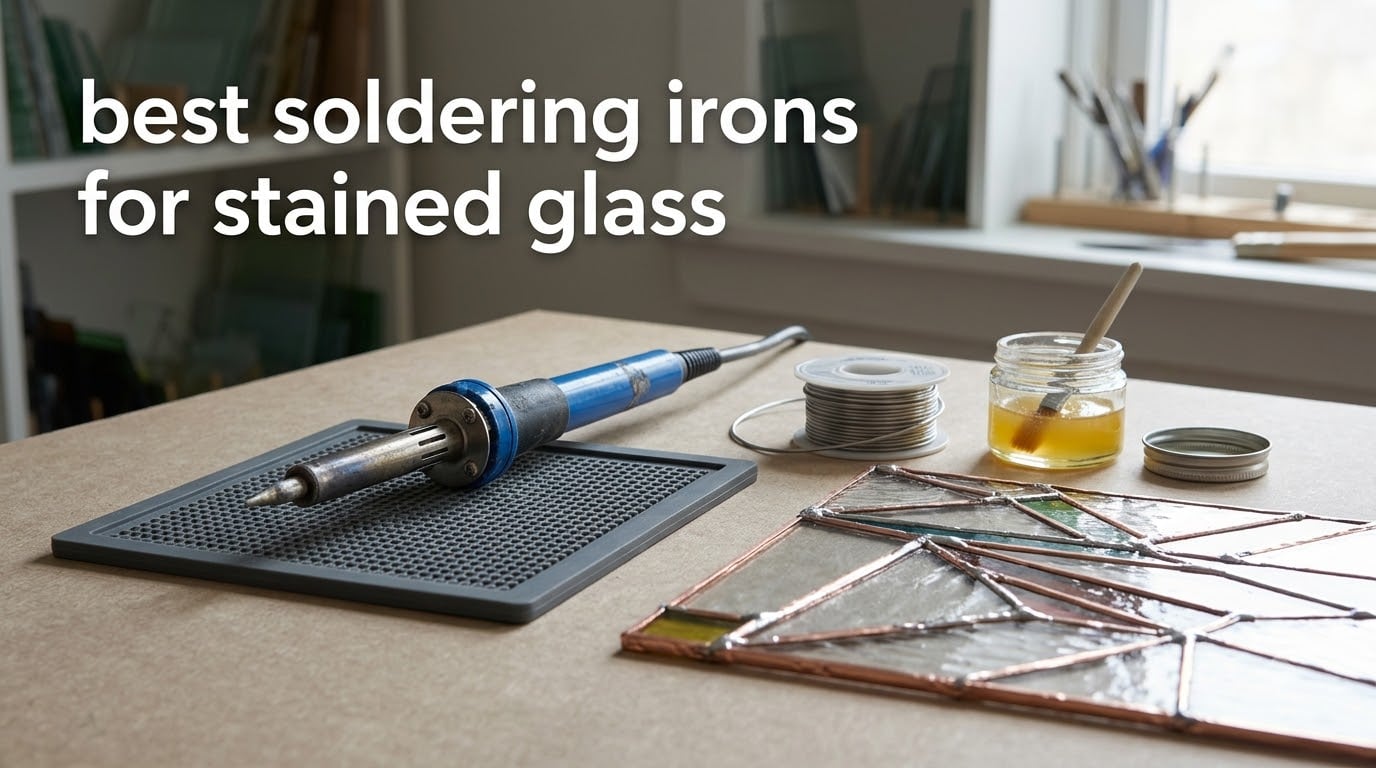
If you have soldered a single seam of copper foil, you already know that the iron decides how the rest of the panel goes. The best soldering irons for stained glass share three things: enough wattage to recover heat from the copper foil pulling it away, a way to hold a steady temperature, and a tip broad enough to lay a bead in one pass. Everything else is preference.
Our short answer: the Hakko FX601-02 is the pick. It runs 67 watts on a ceramic element with adjustable electronic closed-loop control, reaches up to 540 degrees Celsius, and ships with the standard T19 tip family that any stained glass supplier stocks. It is the iron that experienced makers in r/StainedGlass keep naming when they are asked the same question we were asked.
Can you use a regular soldering iron for stained glass? Technically yes, physically no. A 25 watt electronics iron cannot push heat into a foil seam fast enough to keep 60/40 solder molten for more than a few centimetres, so the seam cools behind you and you get cold, grainy joints. Copper foil is a heat sink, and only a higher-wattage iron with real thermal mass keeps up.
If you are still building the rest of your kit, our picks for the best stained glass kits and our guide to the best soldering stations for electronics cover the other tools that decide whether a seam looks good from the front.
Table of Contents
Top 3 Picks for the Best Soldering Irons for Stained Glass in 2026

Hakko FX601-02 Adjustable Iron
- 67W ceramic element
- Adjustable closed-loop control
- Up to 540C
- T19 tip family
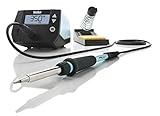
Weller WE1010NA Digital Station
- 70W iron
- Digital LCD
- Temperature lock at plus or minus 4F
- ESD safe

YIHUA 939D+ Digital Station
- 392F to 896F range
- Digital C/F display
- 20 millisecond compensation
- Compact base
Best Soldering Irons for Stained Glass at a Glance (October 2026)
All eight irons below were compared on the criteria that actually decide a seam: wattage and recovery, how temperature is controlled and how well it holds, the tip and tip family that comes with it, and what the iron feels like after two hours of continuous work.
| Product | Specifications | Action |
|---|---|---|
| Hakko FX601-02 Adjustable Temperature Iron |
|
Check Latest Price |
| Weller WE1010NA Digital Soldering Station |
|
Check Latest Price |
 Weller W100PG Heavy Duty 100W Iron Weller W100PG Heavy Duty 100W Iron |
|
Check Latest Price |
 Hakko FX888DX-010 Digital Station Hakko FX888DX-010 Digital Station |
|
Check Latest Price |
 Weller WLC200 Stained Glass Station Weller WLC200 Stained Glass Station |
|
Check Latest Price |
| YIHUA 939D+ Digital Station |
|
Check Latest Price |
 Hakko FX600 Dial Temperature Iron Hakko FX600 Dial Temperature Iron |
|
Check Latest Price |
 WEP 927-IV High Power Station Kit WEP 927-IV High Power Station Kit |
|
Check Latest Price |
1. Hakko FX601-02 Adjustable Temperature Iron – Best Overall for Glass
Hakko FX601-02 Adjustable Temperature Controlled Soldering Iron, 67 Watts
67W
Ceramic element
200C to 540C dial
10.1 inch body
T19-D5 tip
Pros
- Closed-loop dial control gives repeatable heat
- Ceramic element heats fast and holds temperature
- Slender ergonomic handle for long sessions
- T19 tip family is easy to source
Cons
- Ceramic element can crack if the iron is dropped
- Lighter feel than a heavy iron takes some practice
- Dial scale takes a few sessions to read
The Hakko FX601-02 is the iron we kept reaching for. It is a pencil-style iron with no base station, a dial on the handle, and a ceramic element that comes up to temperature quickly and then refuses to drift while you work. Owners rate it at 4.6 stars across 1775 reviews, and the summary of those reviews keeps repeating the same three words: fast heat-up, fine control, and durability on heavy copper foil work.
For stained glass that combination is exactly right. The 67 watts is lower than the classic 80 to 100 watt rule of thumb, but the closed-loop sensor in the heater reacts fast enough that the tip comes back up between passes on a mid-size panel. If you have read that a 67 watt iron is underpowered, that advice came from older wire-wound designs. This is the argument the community makes in r/StainedGlass, where the FX-601 is repeatedly described as the current standard for glass work.
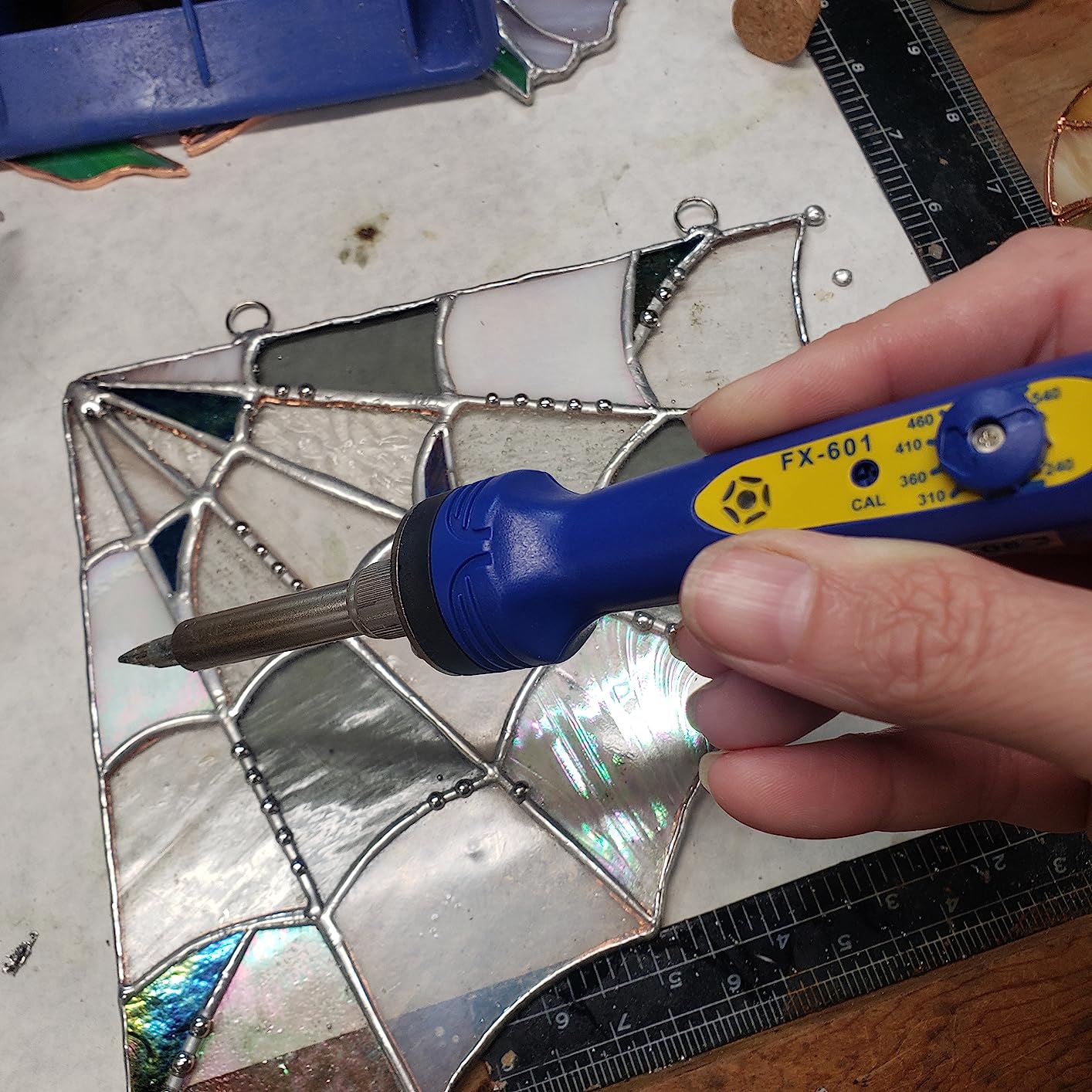
Two details matter more than the wattage number. First, the slender handpiece: at 10.1 inches it balances close to the tip, so a beading pass across the bottom edge of a panel does not roll the iron out of your grip. Second, the tip standard. The included T19-D5 is a screwdriver point, and the wider T19 chisel and the T19 C65 that experienced makers name are all in the same family, so one purchase covers detail seams and broader beads.
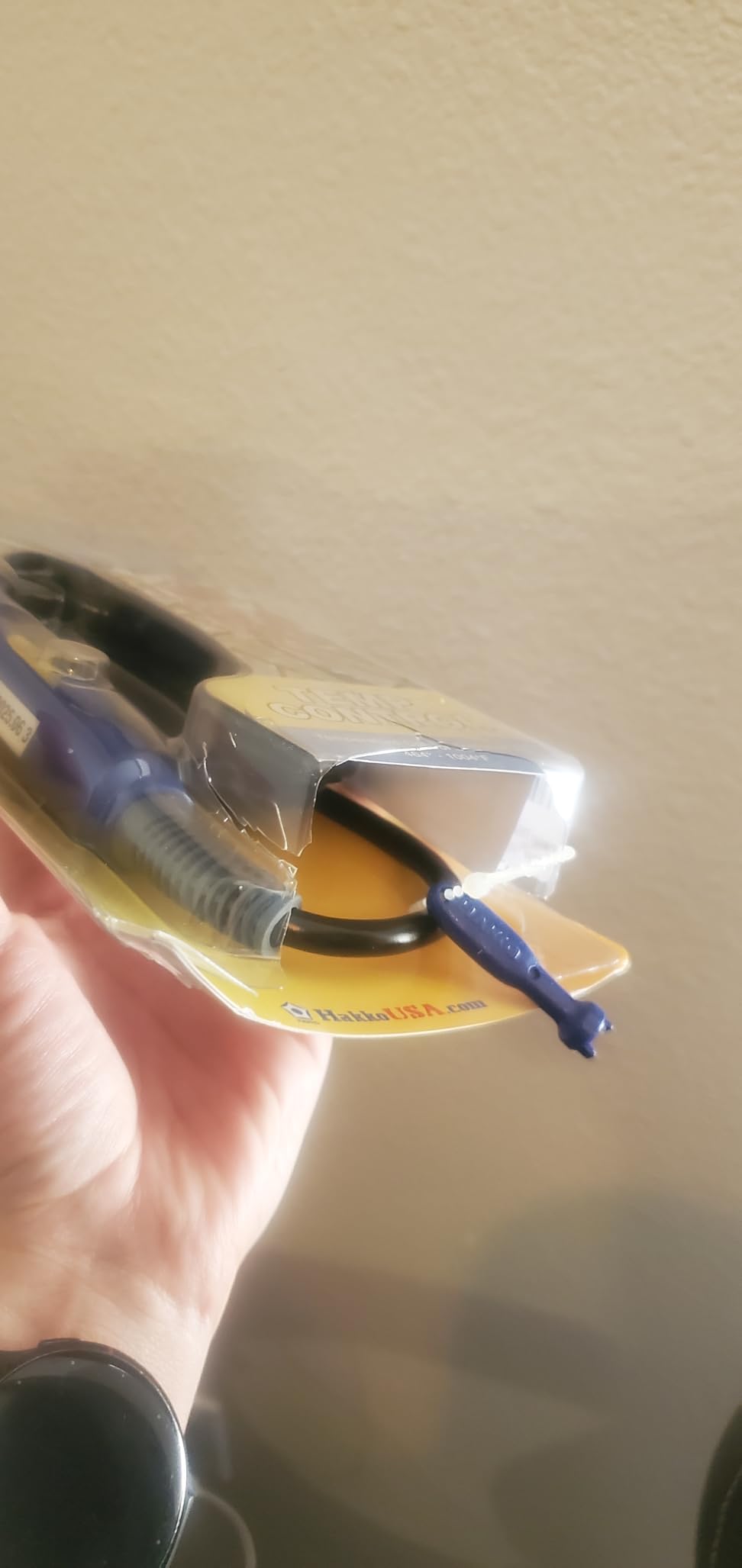
We also checked the complaints that show up repeatedly. The ceramic element is the fragile part of this design, and dropping the iron onto a hard bench can crack it. The handle is light enough that the iron feels slightly eager in the first few minutes, which is a small thing that passes once you get used to the weight. And the dial has no numbers you can read at a glance in bright window light, so you learn the marks by touch.
Who the Hakko FX601-02 suits
It suits anyone moving from their first sun catcher to panels around 12 inches, and it suits people who work in more than one place because there is no base to leave behind. The 20.5 centimetre style of corded pencil design means you can coil it and put it in a bag between classes.
It also suits people who want to grow into better work without buying twice. Adjustable control up to 540 degrees Celsius means the same iron handles lead-free solder, thicker came, and the higher temperatures needed for zinc leading, which a fixed-temperature iron will not do.
Who the Hakko FX601-02 does not suit
It is the wrong choice for someone who will drop tools. If your bench is cramped and the iron spends half its life rolling against a tin of solder, a station iron with a weighted holder protects the element better.
It is also the wrong choice for pure repair work where you want a specific temperature locked in and a readout telling you what the tip is doing. That job belongs to a digital station like the Weller WE1010NA below.
2. Weller WE1010NA Digital Station – Best for Repeatable Temperature
Weller 70 Watt Digital Soldering Station | WE1010NA
70W iron
Digital LCD
Temperature lock at plus or minus 4F
120V
1 year warranty
Pros
- Temperature stability of plus or minus 4F
- Heat resistant silicone cable
- Standby mode and auto setback
- Comfortable handle rated 4.7 stars
Cons
- Listed upper temperature rating of 400F suits repair more than big panels
- Password protected settings add menu steps
- 5.5 lb base takes desk space
Weller describes the WE1010NA as 40 percent more powerful than the two models it replaces, and at 4670 reviews it is the most proven station in this roundup. The number that matters for glass is the temperature stability: plus or minus 4 degrees Fahrenheit, held by a temperature lock that stops anyone nudging the setting mid-project.
That lock is the reason this station earns its place in a glass shop. On copper foil the failure mode is drift, not raw heat. A setting that wanders ten degrees during a long seam changes how the solder flows, and you end up compensating with your iron angle instead of your technique. A locked setting removes that variable entirely.
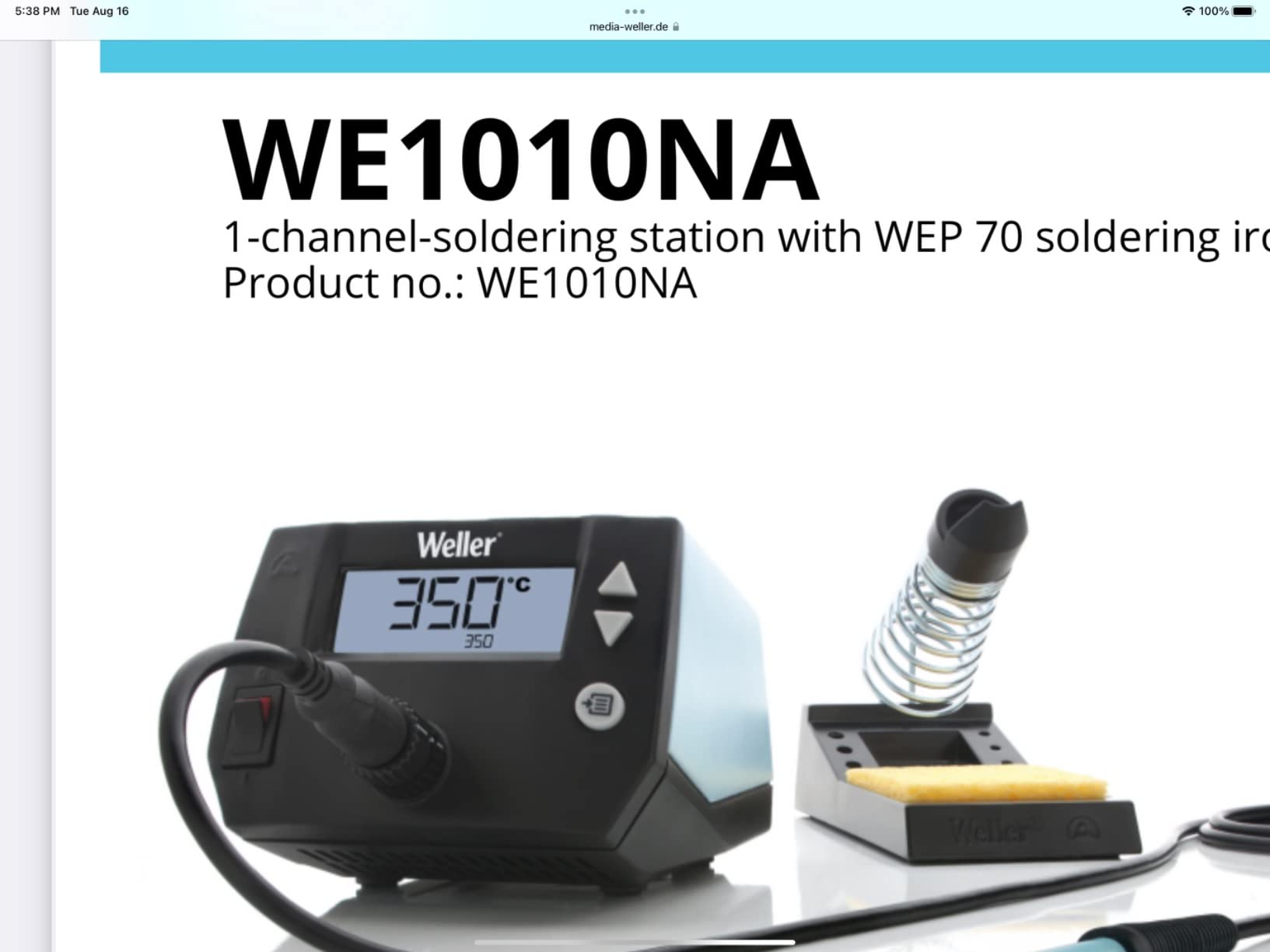
The physical package is a 12.5 by 6 by 9 inch base weighing 5.5 pounds with an LCD, a PH70 safety rest with sponge, a tip retainer, and a 0.062 inch screwdriver tip. Weller rates the station ESD safe, which matters if you share a bench with an electronics person, and the iron runs on a heat-resistant silicone cable that outlasts the plastic jacket on cheaper irons.
Two caveats from the reviews. The listed maximum temperature rating of 400 degrees Fahrenheit is lower than some glass-focused irons, so this is more of a repair and detail station than a leading tool. And the password-protected settings that guard your presets add menu steps that annoy people who want to change temperature twice a day.
Who the Weller WE1010NA suits
It suits people who solder every week and want the same seam result in March as in August. The stability figure and the lock make it a good fit for reflowing joints, attaching came, and any commission work where a cold joint means going back to the customer.
It also suits a teacher. Standby mode and auto setback mean the station is not sitting at full heat through a class break, and the sponge and holder are built into the base rather than sold separately.
Who the Weller WE1010NA does not suit
The 5.5 pound base does not suit a small desk or a portable setup. If your workshop is a folding table in a spare room, the footprint is the first thing you will fight.
It also does not suit someone working large panels that need sustained high heat across a long seam. For that, the higher-wattage handpieces later in this guide recover faster.
3. Weller W100PG Heavy Duty 100W Iron – Best for Large Panels and Thick Foil
Weller W100PG Weller Farenheit Heavy Duty Soldering Iron with CT6F7 Tip, 100 Watt, 700 Degree, Original Version
100W
Nichrome element
600F 700F and 800F tips
9.6 oz
Ships with CT6F7
Pros
- 100W heat handles thick copper foil and long seams
- 110 second heat up on the 700F tip
- No base station so it is fully portable
- Closed-loop tip temperature limiting
Cons
- No electronic readout so you manage heat by feel
- Heavier barrel causes hand fatigue
- Included CT6F7 tip is larger than most prefer
The W100PG is the oldest design in this roundup and the least fussy. At 100 watts with a nichrome wound element, it is a straight line voltage iron with no electronics beyond a closed-loop method of limiting maximum tip temperature, and it is UL and CUL listed. Temperature is set by changing tips: 600, 700, or 800 degrees Fahrenheit.
Reviewers with 1277 ratings describe it as a workhorse. It heats the included 700 degree tip in about 110 seconds, and the barrel has a reputation for surviving studio use without developing the electronics problems that plague cheaper temperature-controlled irons. For a maker who soldered their first panels twenty years ago, this is probably the iron they still use.
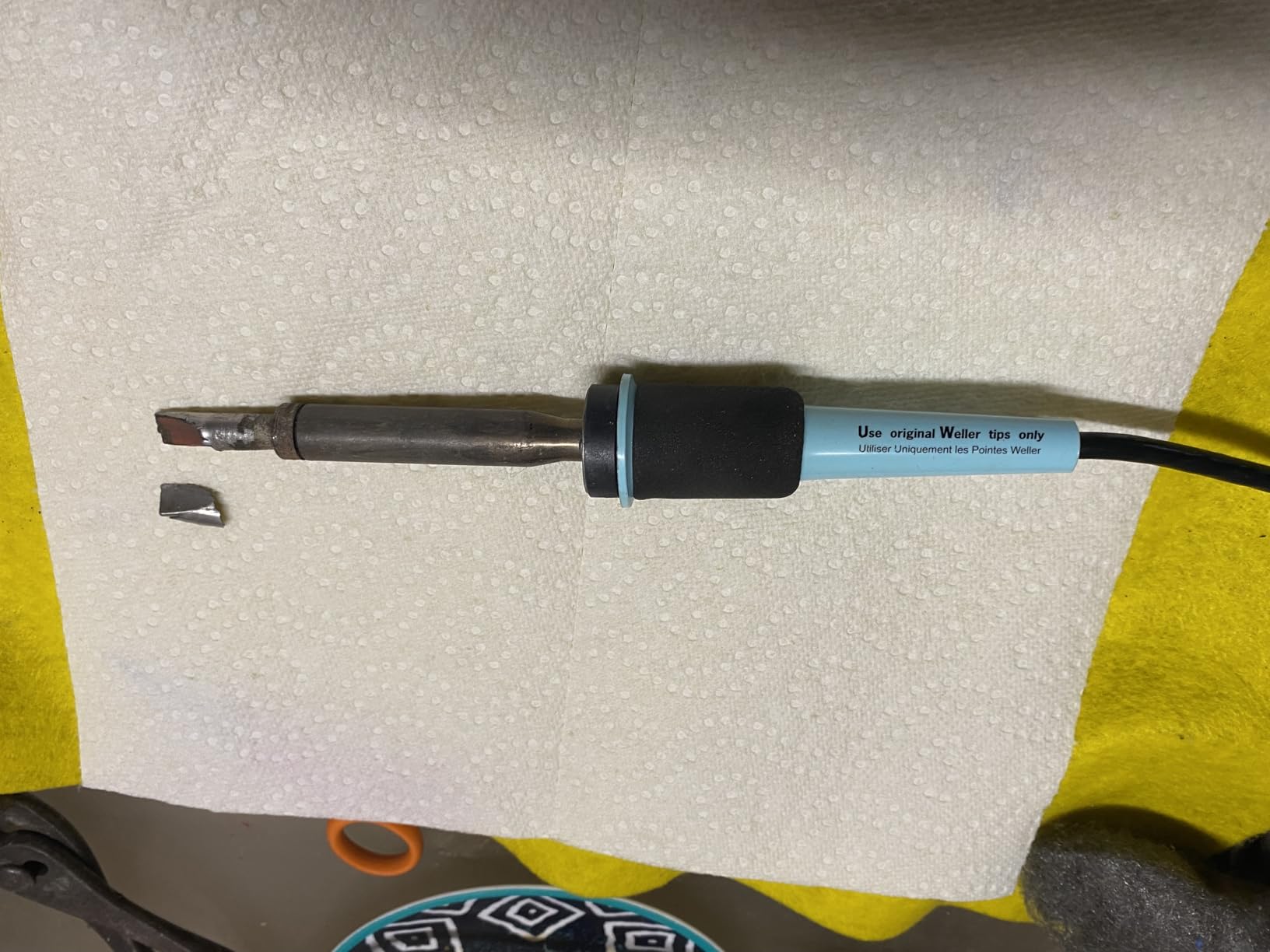
Two things to plan around. First, tip size: the CT6F7 that ships with it is a broad screwdriver point, and many stained glass makers prefer to move down to a quarter inch chisel for everyday seams. Weller sells those separately, and the shank is the Weller standard, which is well stocked. Second, the 9.6 ounce weight. That is real mass in the hand after a two hour session, and reviewers mention both the durability and the fatigue in the same breath.
The barrel also discolours with use, which trips up first-time buyers who assume something is wrong. Nothing is wrong. It is a working tool that shows its history.
Who the Weller W100PG suits
It suits makers working large architectural panels, cathedral glass, and any seam where the copper foil is thick enough to pull heat out of the tip faster than a 70 watt station can replace it. The 100 watt element simply has more to give on a cold morning.
It also suits anyone who prefers no base station at all. There is nothing to set, nothing to calibrate, and nothing to break in a stationary unit. You plug it in and you solder.
Who the Weller W100PG does not suit
It does not suit someone who wants to work lead-free solder at a controlled low temperature, because the tip swap means the temperature only changes when you change the part. If you alternate between came leading and fine detail work all afternoon, the trip to the drawer is the annoyance.
It also does not suit people with hand or wrist trouble. The 9.6 ounces are fine for an hour and tiring for four.
4. Hakko FX888DX-010 Digital Station – Best for Precise Digital Control
Hakko FX888DX-010 – Digital Soldering Station with Rotary Encoder
65W
Rotary encoder
120F to 480F range
3.8 lb
T18-D16 chisel tip
Pros
- Highest rated iron here at 4.8 stars
- Rotary encoder makes fine temperature steps easy
- Compact base with strong rubber feet
- Iron holder opens for easy cleaning
Cons
- 110V AC only so 220V regions need a transformer
- No hot swappable tips or rest mode
- A few buyers got mismatched iron and stand
The FX888DX-010 is the interface upgrade over the older FX-888D. Instead of pressing buttons, you turn a rotary encoder to walk through temperature settings and parameters, and the change in feel is significant when you are adjusting heat every twenty minutes. The 4.8 star rating across 367 reviews is the highest in this roundup, with 89 percent five-star.
Range is 120 to 480 degrees Fahrenheit on a 65 watt iron with an LCD. Sixty-five watts sounds modest until you understand what the element is doing: with a closed-loop sensor in the heater and a ceramic element, the recovery on a foil seam is quick, and the compact 3.8 pound base means you can keep it close to your work rather than across the bench.
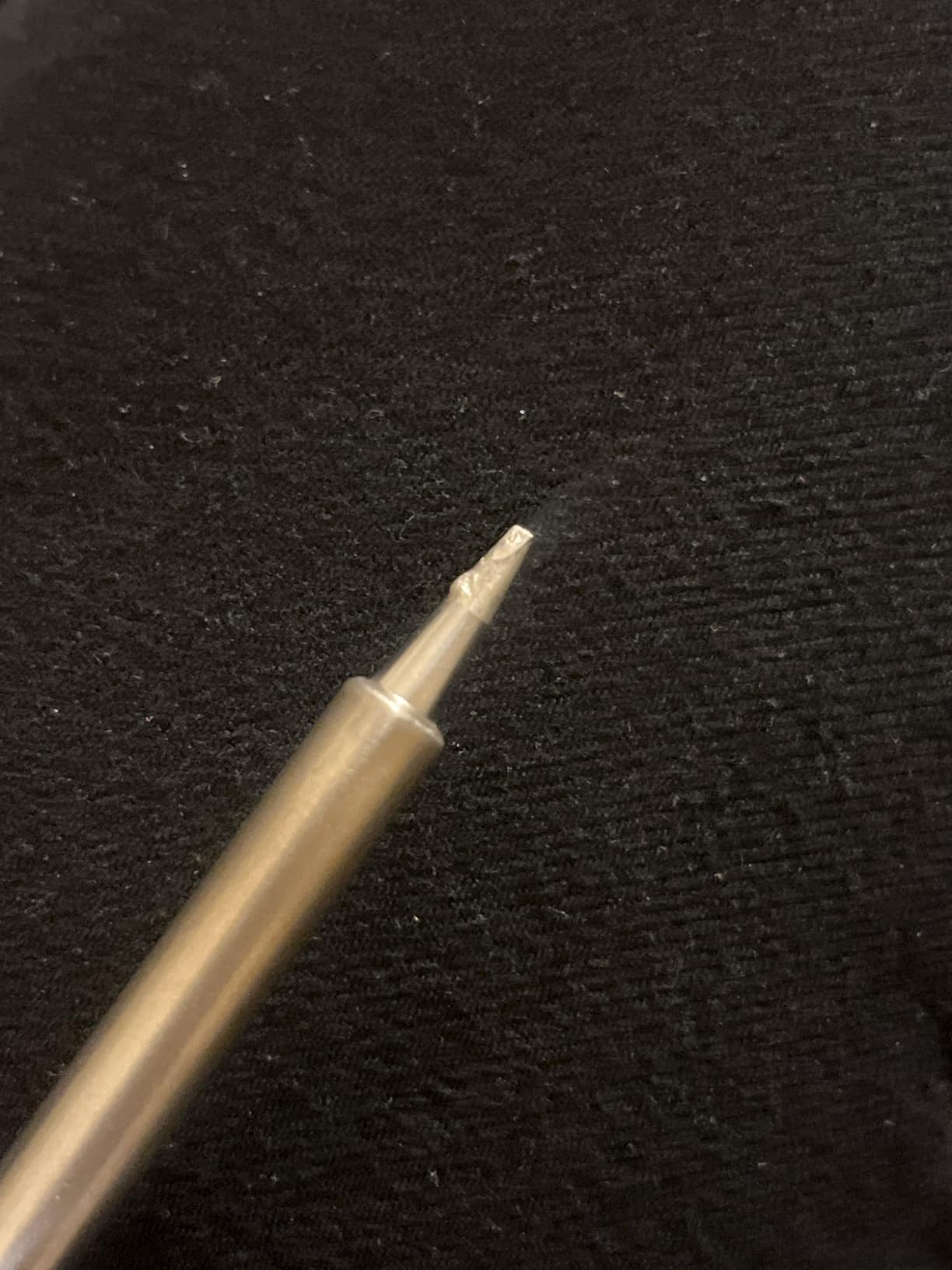
The box includes the station body, iron, iron holder, sponge, tip cleaner, manual, and a T18-D16 chisel tip at 1.6 millimetres. That tip family is the argument for this station: it is the same T18 line that the Hakko FX600 below uses, so one tip drawer serves both irons and the family is widely available from glass suppliers and electronics distributors alike.
The iron holder opens up so you can get at the sponge and the tip without lifting the iron, and the rubber feet grip hard surfaces rather than sliding. Reviews do report occasional mismatched iron and stand sets arriving in the box, which is a packing problem rather than a design one.
Who the Hakko FX888DX-010 suits
It suits makers who have decided temperature control is worth the desk space and want the most precise interface available. The rotary encoder lets you land on the same setting twice, which matters when you are repeating a panel in a different colour.
It suits anyone already committed to T18 tips, because the supplied chisel is the standard glass point and the station will not strand you later.
Who the Hakko FX888DX-010 does not suit
It does not suit anyone outside 110 volt regions without a converter. This is a recurring source of confusion in the community because Hakko sells regional variants of its irons, and the 110 volt AC build is the one most listings point to.
It also does not suit people who want to swap tips without cooling down. There is no hot-swap socket and no rest mode on this model, so a tip change means a wait.
5. Weller WLC200 Stained Glass Station – Best for a First Panel
Weller WLC200 80 Watt Hobby and Stained Glass Soldering Station
80W
5W to 80W power dial
Up to 900F
3/8 inch chisel tip
7 year warranty
Pros
- Built specifically for hobby stained glass work
- 7 year warranty
- Removable iron and replaceable heating element
- Accepts MTG21 quarter inch chisel tip
Cons
- Power dial control instead of a digital readout
- No display of actual tip temperature
- Rating sits at the lower end of this roundup
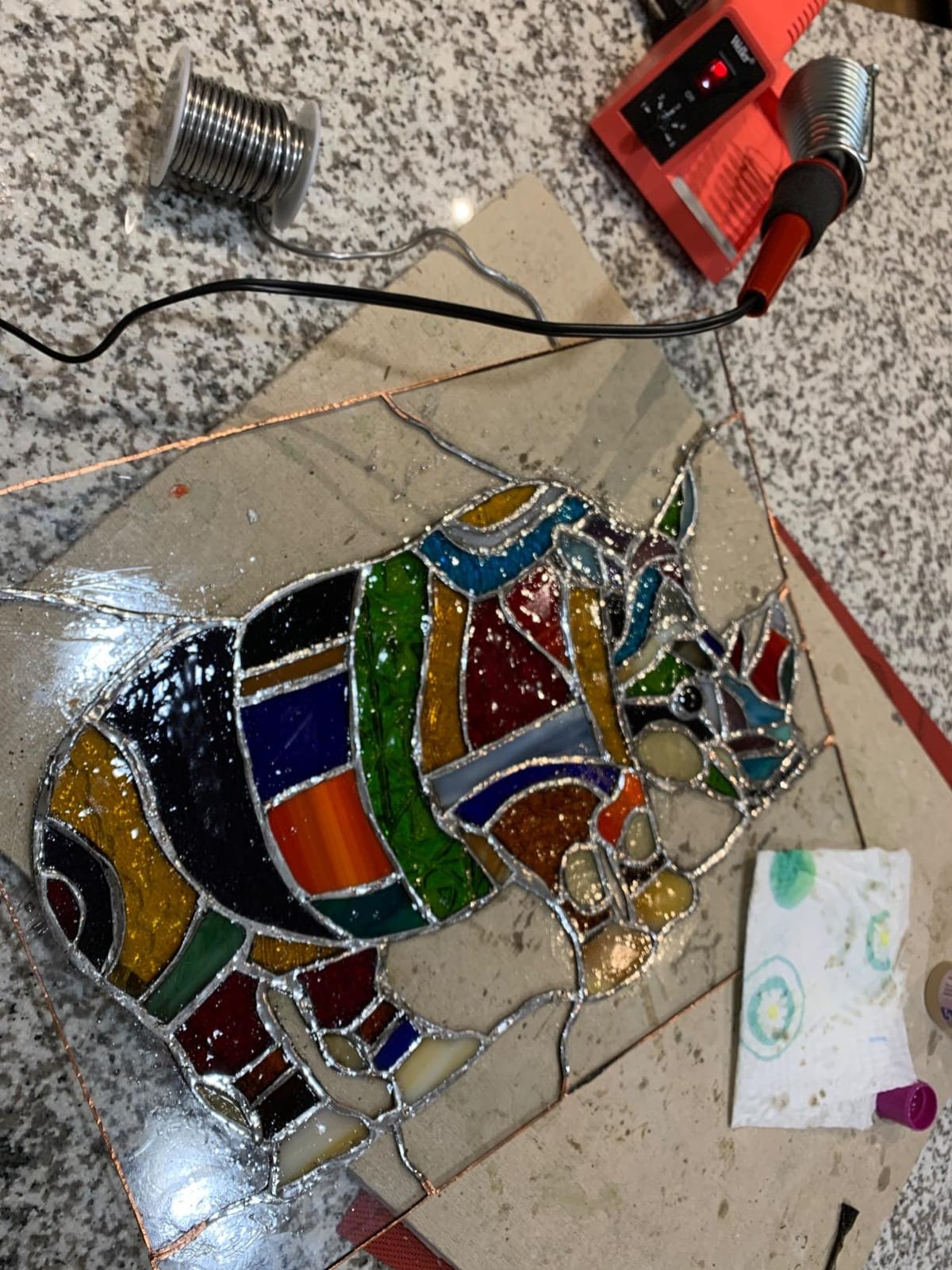
Weller built the WLC200 for this specific hobby and the packaging shows it. The station base ships with an SPG80 pencil iron, a three-eighth inch chisel tip, a pencil iron holder, and a cleaning sponge, which means a beginner can solder on day one without a second order for parts.
Control is a rotary power dial from 5 to 80 watts rather than a temperature setting. That sounds like a compromise, and in precision terms it is, but it also means you cannot accidentally set a temperature the element cannot deliver. Owners report quick heat recovery and up to 900 degrees Fahrenheit of controllable, reliable heat, which is the most headroom in this roundup.
The longevity angle is what separates it. The iron is fully removable and the heating element is replaceable, so an element that eventually fails is not the end of the station. The seven year warranty says Weller expects this base to outlive several first panels.
Tip compatibility is good for glass work: the SPG80 iron takes the MTG21 quarter inch chisel and the MTG22 three-eighths inch cone, both common in glass supply shops. At 2 pounds the whole station is light enough to move between a workbench and a class table.
Who the Weller WLC200 suits
It suits someone on their first few panels who wants a station that clearly was intended for stained glass rather than a repurposed electronics box. The included chisel tip is the right width for a beginner and the extra headroom covers thicker glass as you progress.
It also suits anyone who wants the iron to last. A replaceable element and a seven year warranty is a real answer to the recurring complaint that cheap irons die within a year.
Who the Weller WLC200 does not suit
It does not suit someone who wants a number. There is no readout of set or actual temperature, and users who compare it against a digital station find the control less precise.
Its rating of 4.3 stars across 717 reviews sits at the lower end of this roundup, with 8 percent one-star reviews, so it is not the choice if you are sensitive to a small share of early failures.
6. YIHUA 939D+ Digital Station – Best Value Digital Option
YIHUA 939D+ Digital Soldering Station, 75W Equivalent with Precision Heat Control (392°F to 896°F) and Built-in Transformer. ESD Safe, Lead Free with °C/°F display (Black)
392F to 896F range
Digital Celsius and Fahrenheit LCD
120W listed
5.4 by 4.4 inch base
Pros
- 4167 reviews at a 4.5 star average
- 392F to 896F covers solder and tinning work
- Control compensates in 20 milliseconds
- Compact base fits a hobby desk
Cons
- Not rated for continuous all day professional duty
- 110-127V only
- Base lacks grippy rubber feet
- Iron cord is short
The YIHUA 939D+ is one of the most reviewed stations in this roundup at 4167 ratings, and the 4.5 star average comes with 77 percent five-star reviews. It has a brushed aluminium control panel, a digital display that toggles between Celsius and Fahrenheit, automatic handle detection, and calibration support, which is more control surface than some of the branded stations above it.
For glass, the range is the headline. 392 to 896 degrees Fahrenheit covers standard 60/40 solder work and reaches high enough for tinning a large came joint, and the built-in transformer outputs a contact-safe voltage so a slip does not matter as much as it would on a bare line voltage iron.
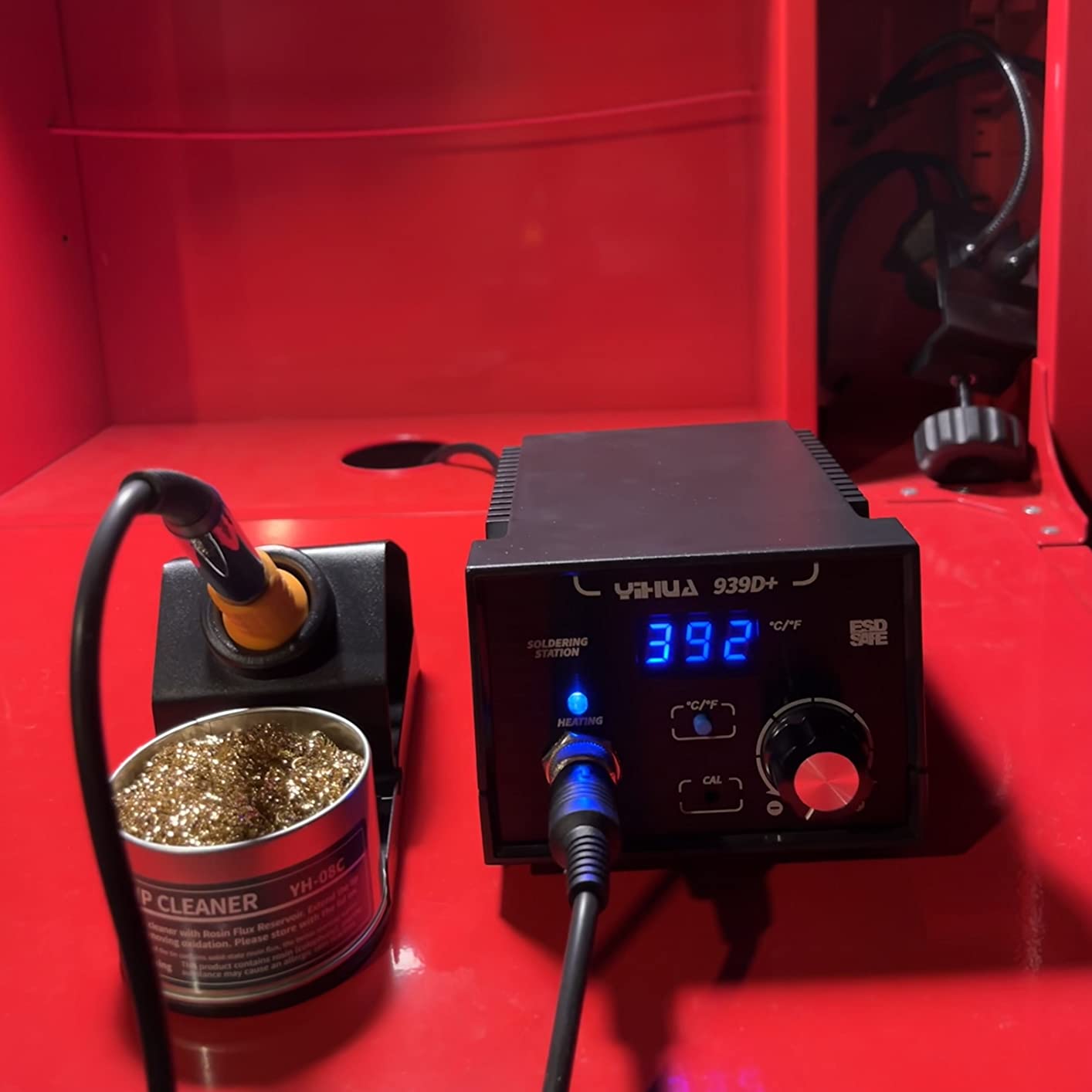
The detachable 907F iron is the part to judge. Buyers consistently report fast heat-up, good temperature recovery in real use, and factory tip plating that outlives most aftermarket replacements, which matters because a pitted tip is the fastest route to a failed seam. The box includes the station, iron, sponge, metallic holder, and a brass tip cleaner.
The honest limitation is duty cycle. Reviewers note it is not rated for continuous all day professional work the way a Weller unit is, and the 110 to 127 volt build means a transformer for 220 volt regions. The base also has no rubber feet and can slide on a hard surface, and the iron cord is short.
Who the YIHUA 939D+ suits
It suits hobbyists who want digital control without giving up desk space. At 5.4 by 4.4 by 3.6 inches it takes up less room than the Weller stations and leaves room for a panel, a flux pot, and a brush in a small workspace.
It also suits anyone soldering lead-free as well as leaded solder, because the top of the range gives you headroom without swapping irons mid-project.
Who the YIHUA 939D+ does not suit
It does not suit a studio running two irons at once for eight hours straight. The reliability record is strong, but the duty cycle is not a production rating.
It also does not suit someone outside North American voltage without planning for a converter, and the sliding base is worth fixing with a mat if you work on a hard glass cutting surface.
7. Hakko FX600 Dial Temperature Iron – Best for Travel and Small Repairs
1 X Hakko Dial Type Temperature Limiting Soldering Iron Fx600
50W
Nichrome element
200C to 500C dial
61 g
20.5 cm
Pros
- Heats up in roughly 20 to 30 seconds
- Only 61 g so it fits a small toolbox
- T18 compatible tips are easy to source
- Two prong plug keeps the cord light
Cons
- 50W struggles on long copper foil seams
- Documentation is Celsius only with no English instructions
- 110V AC model needs a transformer on 220V
- A share of one star reviews reports early failure
The FX600 is the lightest tool here at 61 grams and 20.5 centimetres, and it is the one we would put in a teaching kit or a repair bag. The dial limits temperature across a 200 to 500 degree Celsius range, the nichrome element is a proven design, and the rubber or silicone handle stays comfortable in a cold classroom.
Owners with 2303 ratings split cleanly. People who get a working unit praise the rapid heat-up, the dial control, the compact build, and how easy T18 tips are to find. People who get a bad one describe a pop and a loss of power after very little use, and that 12 percent one-star share is why this sits at 4.3 stars.
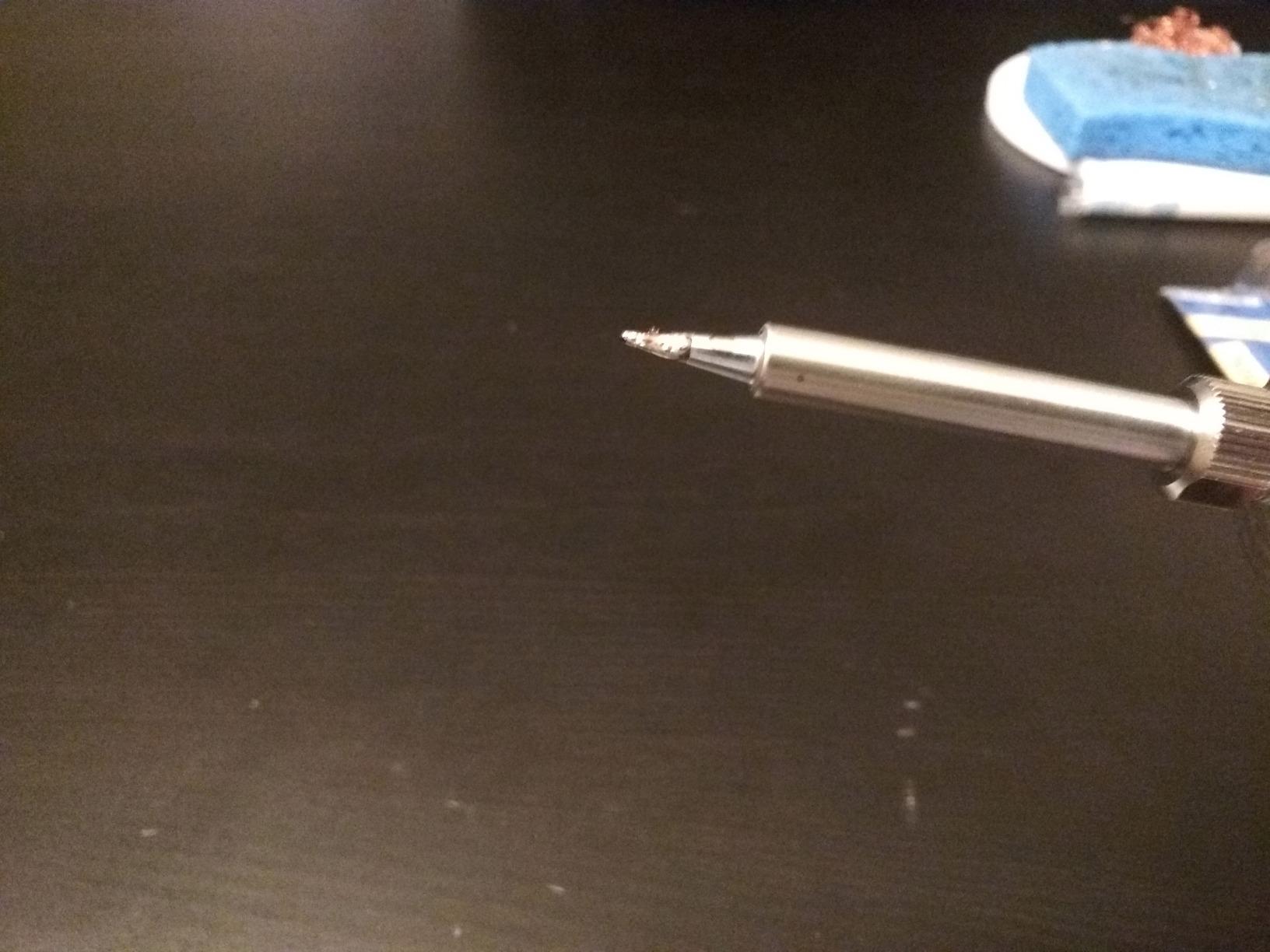
Be realistic about the 50 watt figure. This is not a seam iron for a full panel. It is right for tack soldering one joint at a time, attaching a hanger, reinforcing a came line, and any job where you need a hot tip for thirty seconds rather than a hot iron for an hour. The tip family is T18, the same family the FX888DX uses, so tips carry across between the two Hakko tools.
The documentation complaint is real and worth knowing: the indicator light behaviour is documented in Celsius only, with no English manual, so out of the box you are inferring what the dial and the light are telling you. That inference takes ten minutes and then becomes automatic.
Who the Hakko FX600 suits
It suits anyone whose work travels: teaching, repairing glass at a customer’s site, working from a shared studio, or soldering at a kitchen table between other tasks. At 61 grams it disappears in a pocket, and the two prong plug keeps the cord light and flexible.
It also suits a second iron in the shop. Experienced makers often run two irons at once, and a light repair iron alongside a main seam iron is a common and sensible pairing.
Who the Hakko FX600 does not suit
It does not suit full panel work. A 50 watt element cannot keep a long copper foil seam molten, and the failure shows up as cold joints partway along the run.
It also does not suit buyers who want a turnkey experience from the box. The missing English instructions and the early failure reports mean you should test it early and keep the receipt.
8. WEP 927-IV High Power Station Kit – Best All-In-One Kit
WEP 927-IV Soldering Station Kit High-Power 110W with 3 Preset Channels, Sleep Mode, LED Magnifier, 5 Extra Iron Tips, Tip Cleaner, 2 Helping Hands, Tip Storage Slots, Lead-free Solder Wire, Tweezers
110W element
194F to 896F range
Dual temperature display
3 preset channels
Sleep mode
Pros
- Station plus five extra tips plus solder and tools in one box
- Dual display shows set and actual temperature together
- Three preset channels and sleep mode
- One year USA technical support
Cons
- Uses proprietary WEP 1400 tips rather than the standard T18 family
- 110-127V only
- Bundled magnifier and helping hands are basic
The WEP 927-IV is sold as a kit and it is one. The box contains the station body, iron, lead-free solder wire, five extra tips, a desoldering pump, tweezers, brass wool tip cleaner with rosin flux, a cleaning sponge, helping hands, LED magnifier lights, and a storage block. For a first kit that is a lot of checklist ticked in one order.
The 110 watt element adjusts from 194 to 896 degrees Fahrenheit, and the dual numerical display shows the set temperature and the actual temperature at the same time, which is the single most useful feature for judging recovery. Three preset channels let you save a temperature per job stage, and sleep mode has a 0 to 99 minute timer so the station idles down when you step away.
What you give up is tip universality. This iron uses WEP 1400 tips rather than the standard T18 family, so the tip drawer does not merge with a Hakko or a Weller setup. If you already own an iron in this roundup, that is a real argument against buying a second station.
The bundled magnifier and helping hands are basic accessories rather than tools you will rely on for glass layout work, and the 110 to 127 volt build means a converter outside that range. Buyers otherwise rate it 4.5 stars across 1786 reviews, with 74 percent five-star, and praise the accessory completeness above all else.
Who the WEP 927-IV suits
It suits beginners who want everything in one order and would otherwise spend a week sourcing solder, flux, tips, and a cleaner. It also suits anyone who wants two iron temperatures ready to go without touching a dial.
It suits teaching setups where every station needs to be identical and spares have to be cheap. The five spare tips mean a student who burns a tip does not end the session.
Who the WEP 927-IV does not suit
It does not suit people who already own a T18-compatible iron and want to share tips and tips budgets across the bench.
It also does not suit a workshop on 220 volts without a converter, and the included solder wire is lead-free, so if you prefer 60/40 for ease of flow you will want to buy your own.
Hakko vs Weller: Which Brand Should You Actually Buy?
Two brands take up five of the eight slots here, and the honest answer depends on whether you want a portable iron or a fixed station. Hakko’s glass reputation comes from the FX-601, which makers in r/StainedGlass call the standard for glass work. Weller’s reputation comes from stations and long-lived handpieces, and the W100PG has been in service studios for decades.
Hakko’s advantage is tip family continuity. The FX601-02 takes T19 tips and the FX888DX and FX600 take T18 tips, both of which are easy to source from glass supply houses. Weller’s tip families are more fragmented: the W100PG uses a different shank from the SPG80 in the WLC200, and the WE1010NA ships with its own retainer, so a Weller bench usually ends up with more than one drawer.
Weller’s advantage is enclosure design. The WE1010NA gives you a locked temperature with plus or minus 4 degrees Fahrenheit stability and auto setback, and the WLC200 has a replaceable heating element and a seven year warranty, which are the two features that matter when a tool has to survive years of studio use.
Where they split is weight and heat. The Hakko FX601-02 is a slender 10.1 inch pencil that is easy on the hand and quick to put away. The Weller W100PG is 100 watts and 9.6 ounces, which is more heat and more mass. For small panels and a light hand, Hakko. For big panels and a heavy hand, Weller.
Our own rule: if you have never soldered glass before and you can only buy one tool, buy the Hakko FX601-02. If you already know you will be soldering every week for years, buy the Weller WE1010NA and stop worrying about the dial.
How to Choose a Soldering Iron for Stained Glass in 2026
The search results for this keyword are full of wattage advice pulled from guides written twenty years ago. Here is what still holds and what changed.
Wattage and thermal recovery
Wattage is a proxy for recovery, not a target. Copper foil acts as a heat sink and pulls heat out of the tip as you draw the iron along a seam, and what matters is whether the element can replace that heat before the solder cools. Older guides say 80 to 100 watts because wire-wound elements needed the headroom. Modern ceramic elements with a sensor in the heater reach and hold temperature with less power, which is why a 67 watt iron can outwork a bigger one in the right hands.
Read the numbers as bands rather than absolutes. Around 60 to 70 watts covers panels up to roughly 12 inches with 60/40 solder. 80 to 100 watts is the sweet spot for thick copper foil and long seam runs. Above 100 watts, you are into leading work and heavy came, and you should be thinking about a station rather than a handheld iron.
Fixed, adjustable or digital temperature control
Fixed temperature means the tip decides the heat, either through its rating or through a thermistor-free element. It is cheap, simple, and the W100PG takes this approach with 600, 700, and 800 degree tips. Adjustable adds a dial, which is how the FX601-02 and FX600 work, and it gives you usable resolution without a screen. Digital adds a readout, compensation, and often presets or lock, which is how the WE1010NA, FX888DX, 939D+, and WEP 927-IV work.
For most people moving past a first panel, adjustable is the sweet spot because it costs far less than a station and removes the biggest source of inconsistent joints. Digital pays for itself when you alternate between leaded and lead-free solder, or when you repeat panels and need identical results.
Tip shape and size
A chisel tip spreads solder across a seam; a screwdriver point concentrates it for detail; a diamond or cone point works in tight corners and on came edges. For copper foil seams, the working default is a chisel around a quarter inch. Experienced makers running front and back soldering often name a T19 C65 tip as their go-to, and the broader T18-D16 chisel at 1.6 millimetres is the common starter point.
Check the shank before you fall in love with a tip. T18 and T19 are Hakko standards, Weller has its own families, and the WEP 927-IV uses proprietary WEP 1400 tips. Buying a station whose tip family is widely stocked saves money over the life of the tool.
Ergonomics, cord type and safety
Weight matters more than people expect. Anything over about 9 ounces gets tiring across a four hour session, and a slim handle close to the tip is easier to control on a vertical seam than a heavy barrel. Cord type is a quiet durability factor: a heat-resistant silicone cable outlasts a plastic jacket that stiffens and cracks near the strain relief.
Look for a holder that closes over the iron, a sponge, and a stand that does not slide. Auto standby and auto setback are worth real money in a classroom. And if you share a bench with electronics work, an ESD safe station is a sensible default. For very fine seams, a microscope changes more than an iron upgrade does, which is why we keep pointing people at our best digital microscopes for soldering once the temperature is under control.
Temperature settings by task
Experienced makers quoted in community discussions run 360 to 410 degrees Celsius for front and back soldering, and around 310 to 360 degrees Celsius for edge beading, typically with a T19 C65 tip. Those numbers sit high compared with solder datasheets because the iron is heating a copper sink, not a small component.
For most work, set the iron, load the tip lightly, and test on scrap glass of the same thickness before you touch the panel. If the solder balls and rolls instead of flowing, you are too cool or the tip is dirty. If the flux smokes black and leaves sticky residue, you are too hot. Verifying on scrap is the habit that separates clean panels from rework.
Voltage and regional variants
This trips up more buyers than any other specification. The FX888DX and FX600 listings point to 110 volt AC builds, and the 939D+ and WEP 927-IV are 110 to 127 volt. If your supply is 220 volts, a converter is required, and a step-down transformer large enough for a 110 watt element is not a small box. Hakko also releases regional variants of the FX601, so check the plug and the label before ordering.
Solder, flux and tip care
Use 60/40 tin-lead solder for ease of flow at low heat, and gel flux on the tip rather than on the foil, since flux on the foil etches it over time. Never use acid-core solder or plumbing flux; the zinc chloride in it will corrode copper foil and etch the glass surface. Work somewhere ventilated, wash your hands after handling leaded solder, and keep a damp sponge and brass wool close for wiping the tip between seams.
Tin the tip before you put it down and before you store it. A bead of solder left on the tip overnight prevents the oxidation that turns a good tip into a pitted one in a month. If a tip is already pitted, replace it rather than filing it; filing destroys the plating. Our guide to the best glass kilns covers the firing side of the same project once the soldering is done.
Frequently Asked Questions
How many watts should a stained glass soldering iron be?
Around 60 to 70 watts covers panels up to about 12 inches with 60/40 solder, 80 to 100 watts handles thick copper foil and long seam runs, and more than 100 watts suits came and leading work. Wattage is only a proxy for thermal recovery. A modern ceramic element with a temperature sensor can recover faster than an older wire-wound iron with more power, so read recovery alongside the number.
Which soldering iron is better for stained glass, Hakko or Weller?
Hakko wins for portability and tip availability. The FX601-02 is a 67W pencil iron with adjustable control and the widely stocked T19 tip family, and it is the iron experienced makers most often name for glass work. Weller wins for stations and durability. The WE1010NA gives a locked temperature with plus or minus 4F stability, and the WLC200 has a replaceable element and a seven year warranty. Choose Hakko for panels and travel, Weller for repeat studio work.
Can I use a regular soldering iron for stained glass?
Not practically. A low wattage electronics iron cannot replace the heat that copper foil pulls out of the tip, so the solder cools behind the iron and you get cold, grainy joints that weaken the panel. Small point jobs and single-joint repairs can work on a modest iron, but full seams need an iron with real thermal mass and temperature control.
What temperature should I set my soldering iron to for stained glass?
Experienced makers commonly run 360 to 410 degrees Celsius for front and back soldering and about 310 to 360 degrees Celsius for edge beading, often with a T19 C65 tip. These readings sit above solder datasheet temperatures because the tip is heating a copper sink rather than a small component. Always test on scrap glass of the same thickness before committing to a panel.
What is the best temperature-controlled soldering iron for stained glass?
The Hakko FX601-02 is the best overall pick at 67 watts with adjustable closed-loop control up to 540 degrees Celsius. For locked repeatability the Weller WE1010NA holds temperature within plus or minus 4 degrees Fahrenheit. For the most precise interface the Hakko FX888DX-010 uses a rotary encoder across a 120 to 480 degree Fahrenheit range. For the most headroom the Weller WLC200 reaches up to 900 degrees Fahrenheit on an adjustable power dial.
How often should I replace a soldering tip?
Replace a tip when it stops holding solder or when the plating is pitted and discoloured, which usually means oxidising the tip rather than cleaning it. A well tinned tip used for glass can last many months. Tinning before storage, wiping on a damp sponge between seams, and never filing a tip all extend that life. Filing removes the plating and shortens the life of the next tip.
Is lead-free solder harder to work with for stained glass?
Yes. Lead-free solder needs a higher working temperature and a cleaner glass surface, because it will not wet a contaminated or oily piece of glass. It also flows less readily, so seams take more heat and more patience. Many makers keep 60/40 for general work because it flows at lower temperatures and forgives fingerprints on the glass. If you switch, test on scrap glass first and expect to raise the dial.
Final Verdict on the Best Soldering Irons for Stained Glass
The Hakko FX601-02 wins this roundup. It is the only iron here that combines a 67 watt ceramic element, adjustable closed-loop control up to 540 degrees Celsius, a slender handle that stays comfortable over a long session, and a tip family that any stained glass supplier can supply, and 1775 reviews at 4.6 stars back that up.
Pick the Weller WE1010NA instead if you want locked temperature and repeatability. Pick the Weller W100PG if you solder large panels and want more raw heat. Pick the Weller WLC200 if you want a station built for your hobby with a seven year warranty. Whichever you choose, buy one tip wider than the one included and tin it before the first seam.
Whichever iron you settle on, check the current listing for the latest details before you buy.