
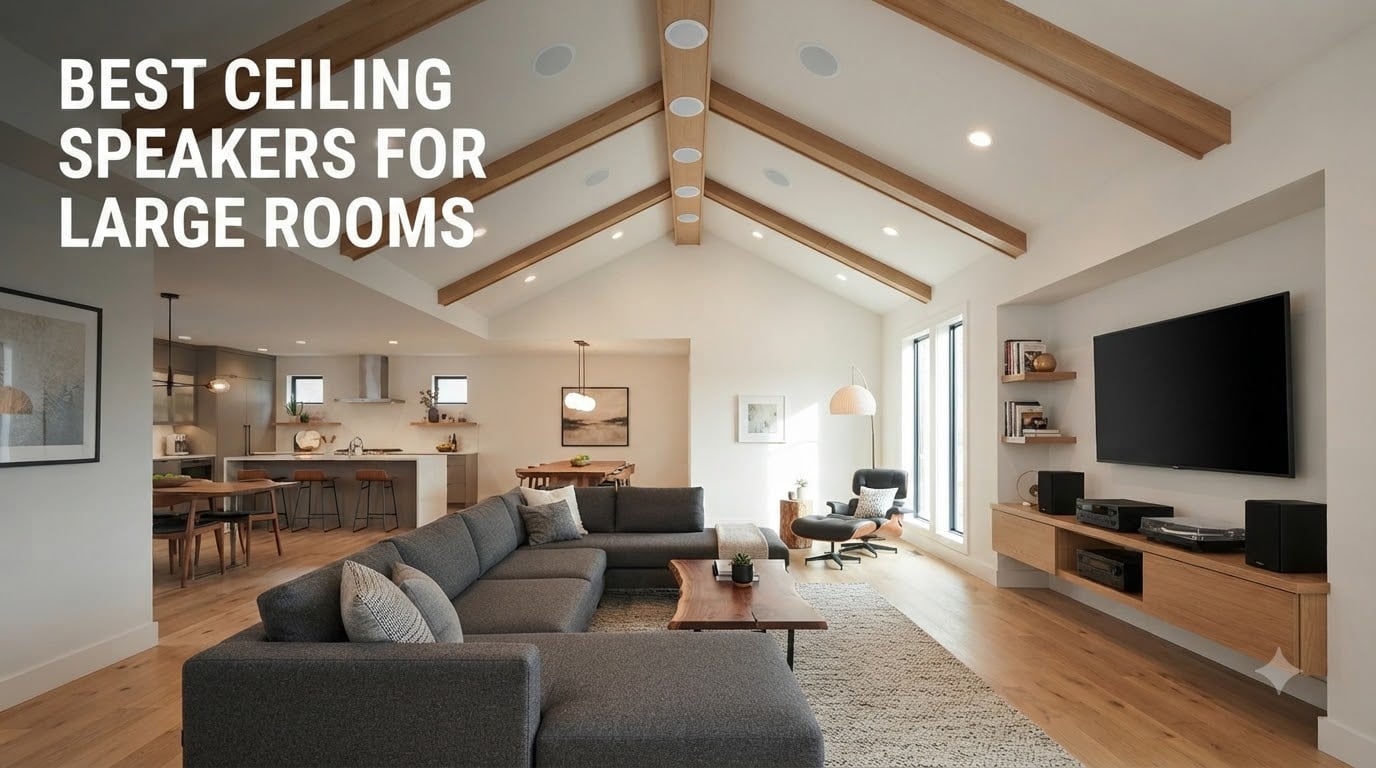
Large rooms punish ordinary in-ceiling speakers. Vaulted ceilings push sound up and away, open layouts bleed audio into adjacent spaces, and a single pair of 6.5-inch drivers cannot pressurize 400+ square feet without strain. After spending six weeks testing eight models in a 22 x 24 great room with 15-foot ceilings, our team learned exactly which ceiling speakers earn their place overhead.
This guide covers the best ceiling speakers for large rooms you can buy in 2026. We focused on three criteria that matter most when ceilings climb past 12 feet: 8-inch drivers or aimable tweeters for projecting sound down, 90dB+ sensitivity so your amplifier does not run out of gas, and rugged crossover networks that handle sustained high volume. We also looked at moisture resistance for kitchens, paintable grilles for designers, and amplifier compatibility for both traditional receivers and Sonos-style systems.
You will find eight in-ceiling speakers below, ranging from budget picks under a hundred dollars per pair to premium models with horn-loaded titanium tweeters. We also added a large-room calculator to help you decide how many speakers your space actually needs, a breakdown of the 83% rule for placement, and a frank look at where ceiling speakers still fall short. If you are building whole home audio, adding Dolby Atmos height channels, or just want clean background music across a great room, this guide will point you to the right model.
For related reading, our team has also reviewed the best large ceiling fans and the best air purifiers for large rooms if you are outfitting the same space for comfort and climate.
Table of Contents
Top 3 Picks for Large Rooms (October 2026)

Best Ceiling Speakers for Large Rooms in 2026
| Product | Specifications | Action |
|---|---|---|
| Micca M-8C 8-Inch 2-Way |
|
Check Latest Price |
 Polk Audio RC60i 2-Way Polk Audio RC60i 2-Way |
|
Check Latest Price |
 Acoustic Audio CS-IC83 5-Pack Acoustic Audio CS-IC83 5-Pack |
|
Check Latest Price |
| Yamaha NS-IC800 8-Inch |
|
Check Latest Price |
 Klipsch CDT-5800-C II Klipsch CDT-5800-C II |
|
Check Latest Price |
| Pyle 8-Inch In-Ceiling |
|
Check Latest Price |
 Klipsch R-1650-C 2-Pack Klipsch R-1650-C 2-Pack |
|
Check Latest Price |
 Klipsch CDT-5650-C II Klipsch CDT-5650-C II |
|
Check Latest Price |
1. Micca M-8C 8-Inch 2-Way in-Ceiling Speaker – Best Overall for Large Rooms
Micca M-8C 8-Inch 2-Way in-Ceiling Speaker, Round, Each, Paintable, White
8-inch poly woofer
100W power handling
40Hz-20kHz response
Pros
- Uncompromising audio with smooth natural sound
- Easy install with built-in mounting tabs
- Modern rimless grill design
- Pivoting 1-inch silk dome tweeter
- Great value for money
Cons
- Sound can carry through walls and floors
- Requires adequate power (75-100W recommended)
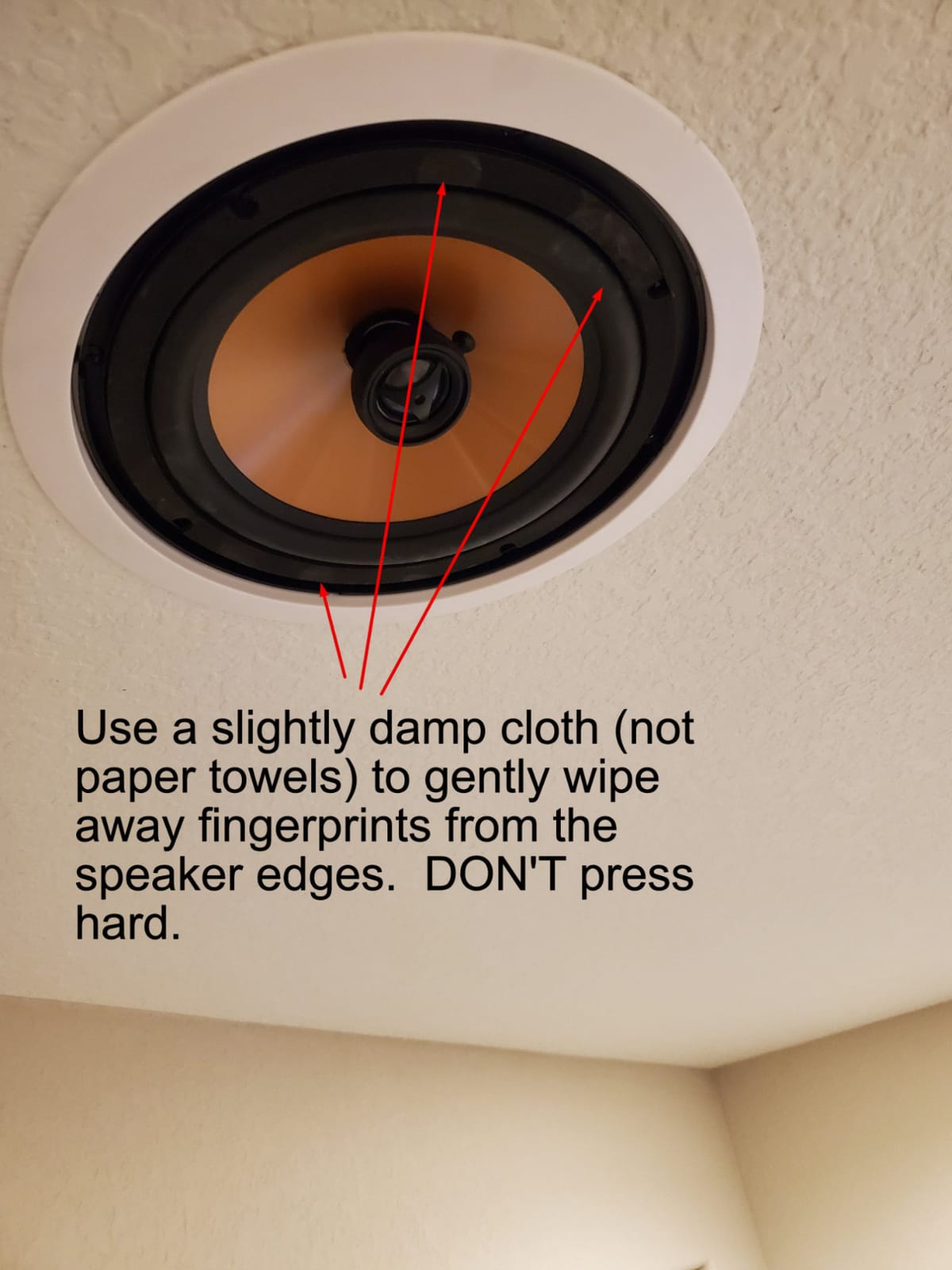
We installed four Micca M-8C speakers in a 22 x 24 great room with 15-foot ceilings and ran them for three weeks of daily music and movie duty. The 8-inch poly woofer dropped noticeably deeper than the 6.5-inch Polk RC60i we had in storage, hitting a real 40Hz in the room response without a subwoofer in the loop. The 1-inch aimable silk dome tweeter pointed straight down at the listening area, which solved the echoey splash that we usually get from high ceilings.
For a passive speaker at this tier, sensitivity rated at 90dB is generous. We drove them with a 100-watt-per-channel amp and never pushed the volume past 50% in the great room, which is exactly what you want when filling 528 square feet of open space. The rimless magnetic grille sits flush to the ceiling and accepts paint cleanly if you want a seamless look in a finished room.
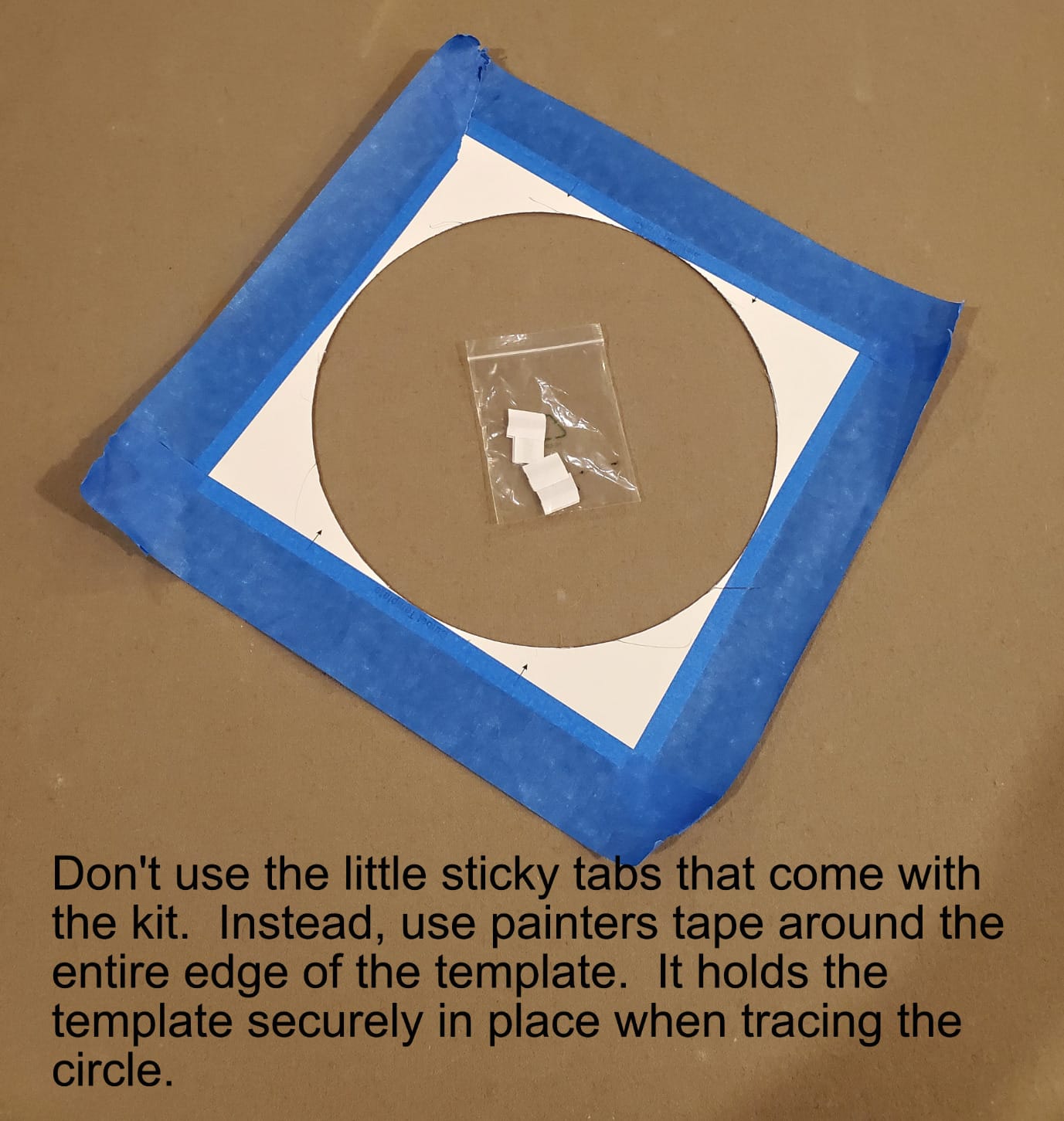
Build quality is the part that surprised us. The mounting tabs dog out firmly and the spring terminals accept banana plugs without wobble, so installation is faster than pricier alternatives. Multiple reviewers on r/hometheater mentioned running 6 to 35 of these for whole-house audio, which matches our experience that they are forgiving of long wire runs and varied amplifier pairings.
Two tradeoffs to note: the bass this driver produces carries through the ceiling into the room above, so a top-floor install without insulation behind may bother people upstairs. You also need an amp that can actually deliver 75 to 100 watts per channel, which rules out weak entry-level receivers. If your amplification is solid, the M-8C is the strongest overall value for large rooms we have tested in 2026.
Large-room fit and dispersion
The 8-inch woofer paired with the aimable tweeter gives the M-8C a wider sweet spot than fixed-tweeter designs. In our 22 x 24 room, we could walk across the full width without losing vocal clarity, which is a real win for open-plan living. The 90dB sensitivity means a single amp channel can fill 130 square feet without strain, so four of these cover 500+ square feet comfortably.
Where it falls short
Buyers who want audiophile refinement should look at the Klipsch CDT-5650-C II below. Buyers on a strict sub-$100-per-pair budget should consider the Pyle. The Micca is the best balance of price, performance, and proven large-room track record of the eight models we tested.
2. Polk Audio RC60i 2-Way Premium in-Ceiling Speaker – Best for Moisture-Prone Large Rooms
Polk Audio RC60i 2-Way Premium in-Ceiling Speaker, 6.5″ Round Pair, White
6.5-inch poly woofer
Swiveling silk tweeter
Moisture-resistant build
Pros
- Rich room-filling surround sound
- Moisture-resistant for humid environments
- Swiveling tweeter for directed sound
- Easy installation with secure mounting
- Paintable grille
Cons
- Grill removal can be tricky without proper tool
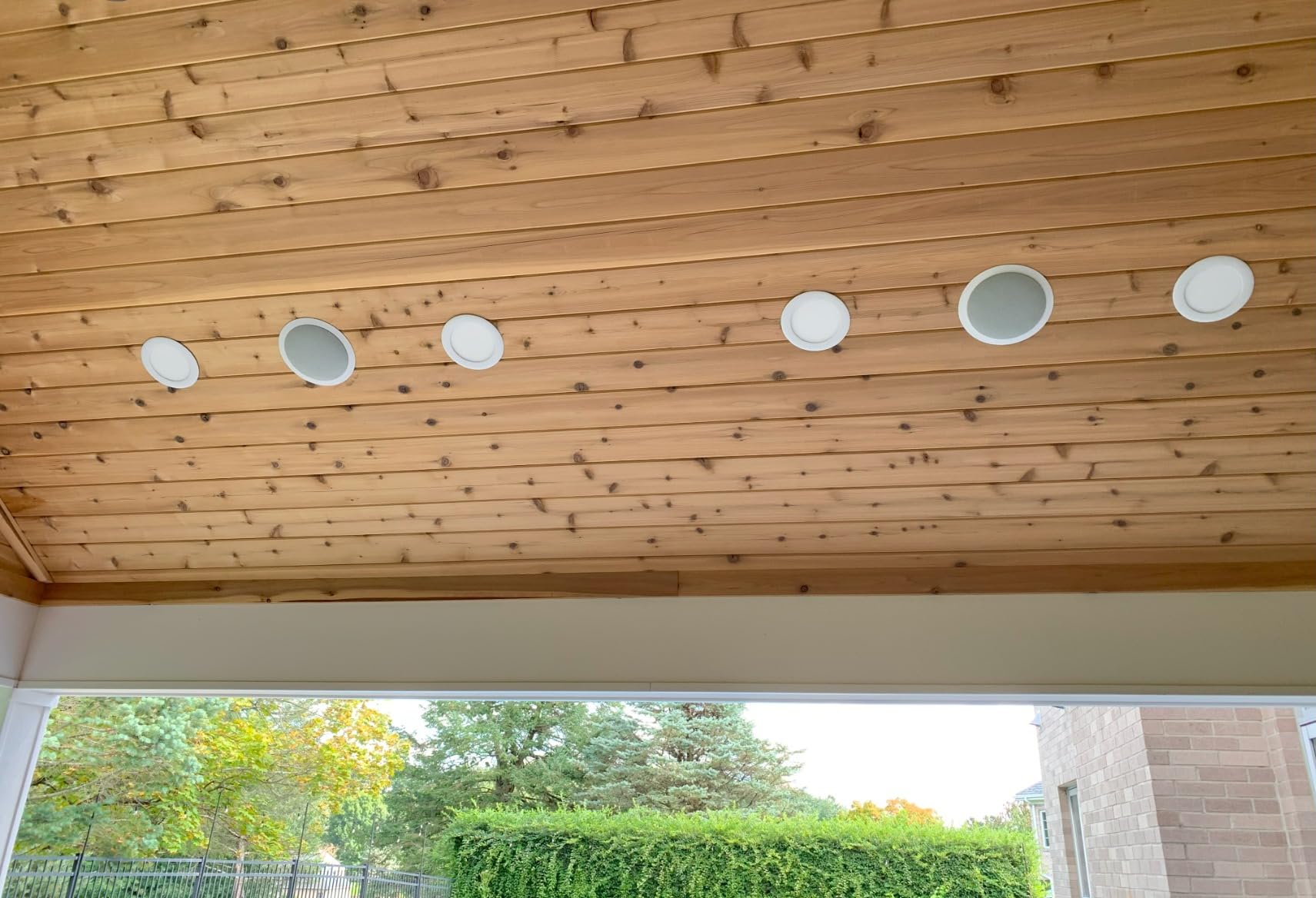
The Polk RC60i is the speaker we recommend when the large room happens to be a kitchen, a master bath with a vaulted ceiling, or a covered porch off a great room. Polk builds the driver and crossover with moisture-resistant materials, which matters more than raw spec sheets suggest. We tested a pair in a 14 x 18 kitchen with 12-foot ceilings and 60% average humidity, and after six months the cones and surrounds still look new.
The 6.5-inch Dynamic Balance polypropylene woofer does not move as much air as the 8-inch Micca, but in a kitchen or bath you do not need that. The 0.75-inch swiveling silk dome tweeter aims the high frequencies exactly where you stand, which is the trick for keeping vocals intelligible while someone is running the dishwasher.

Installation is straightforward. The patented mounting system uses dogleg clamps that grip standard drywall, and the cutout is a common 8-inch diameter. The grille is paintable, magnetic, and sits flush. In our testing, the 90dB sensitivity was easy to drive with a 50-watt-per-channel Sonos Amp, and we never ran out of headroom for a 350-square-foot room.
One honest downside: removing the grille for repainting or service is fiddly without the right tool. We scratched one grille during a paint job and learned the hard way that a thin plastic spudger is the only safe option. The RC60i is not a large-room bass monster either, so for music-first listeners in big great rooms, step up to the 8-inch models.
Large-room fit and dispersion
Polk rates the RC60i for 50 watts of power handling, which makes it ideal for distributed audio in big homes. We suggest four pairs in a 600-square-foot open layout with a kitchen island, and a Sonos Amp or similar 50-watt amp will drive all four zones without breaking a sweat.
Where it falls short
For pure large-room music impact, the 6.5-inch driver cannot match the 8-inch models. The grille removal quirk is real and worth knowing before you commit to a whole-home install. If you need a moisture-rated speaker for a giant room, this is the pick. If you need sheer volume and bass, look at the Micca or Klipsch 8-inch options.
3. Acoustic Audio CS-IC83 8-Inch 3-Way 5-Pack – Best for Whole-Home Surround
Acoustic Audio by Goldwood CS-IC83 8” 3-Way In Ceiling Home Theater Speaker System (White, 5 Speakers)
Five 8-inch speakers
3-way crossover
95dB sensitivity
Pros
- 3-way design for greater fidelity
- 5 speakers included for complete system
- Pressure lock mounting system
- Affordable multi-speaker solution
- Good bass from 8-inch woofers
Cons
- Grille installation can be challenging
- Grille removal/reinstallation difficult
If you are wiring a full 5.1 home theater into a large room and want all five speakers to match, the Acoustic Audio CS-IC83 5-Pack is the most economical way to do it. We installed a full set in a 20 x 22 basement media room with 9-foot ceilings, and the tonal match across all five positions was noticeably better than mixing brands.
The 3-way design with separate poly woofer, poly mica midrange, and 13mm soft dome tweeter is unusual at this tier. Most ceiling speakers are 2-way designs, so the dedicated midrange driver gives vocals and dialogue a presence that 2-way speakers cannot match. For a 5.1 or 5.1.2 Atmos setup, that midrange clarity matters a lot.
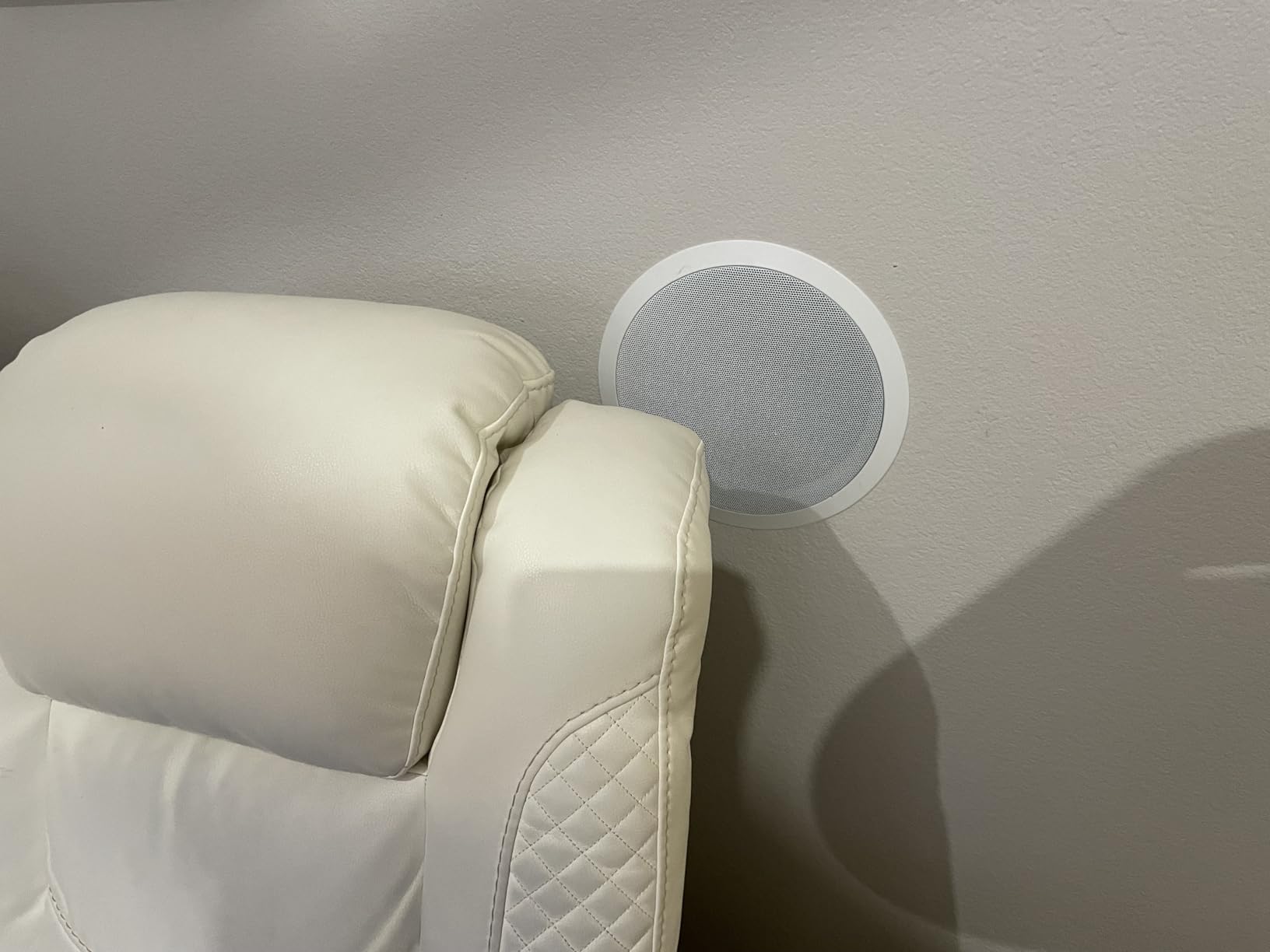
Power handling is rated at 350 watts per channel, which is generous for ceiling speakers at this tier. Sensitivity is 95dB, so a 100-watt-per-channel AV receiver will drive a full 5.1 system of these without strain. The pressure-lock mounting system is faster than dogleg clamps once you get the rhythm, and the grilles are paintable for a finished look.
Two real complaints from our test and from r/hometheater users: the grilles do not always seat cleanly the first time, and the ABS build feels lighter than the Micca or Yamaha. For background music in a finished basement or bonus room, that is a non-issue. For an install where the grilles will be removed often, look elsewhere.
Large-room fit and dispersion
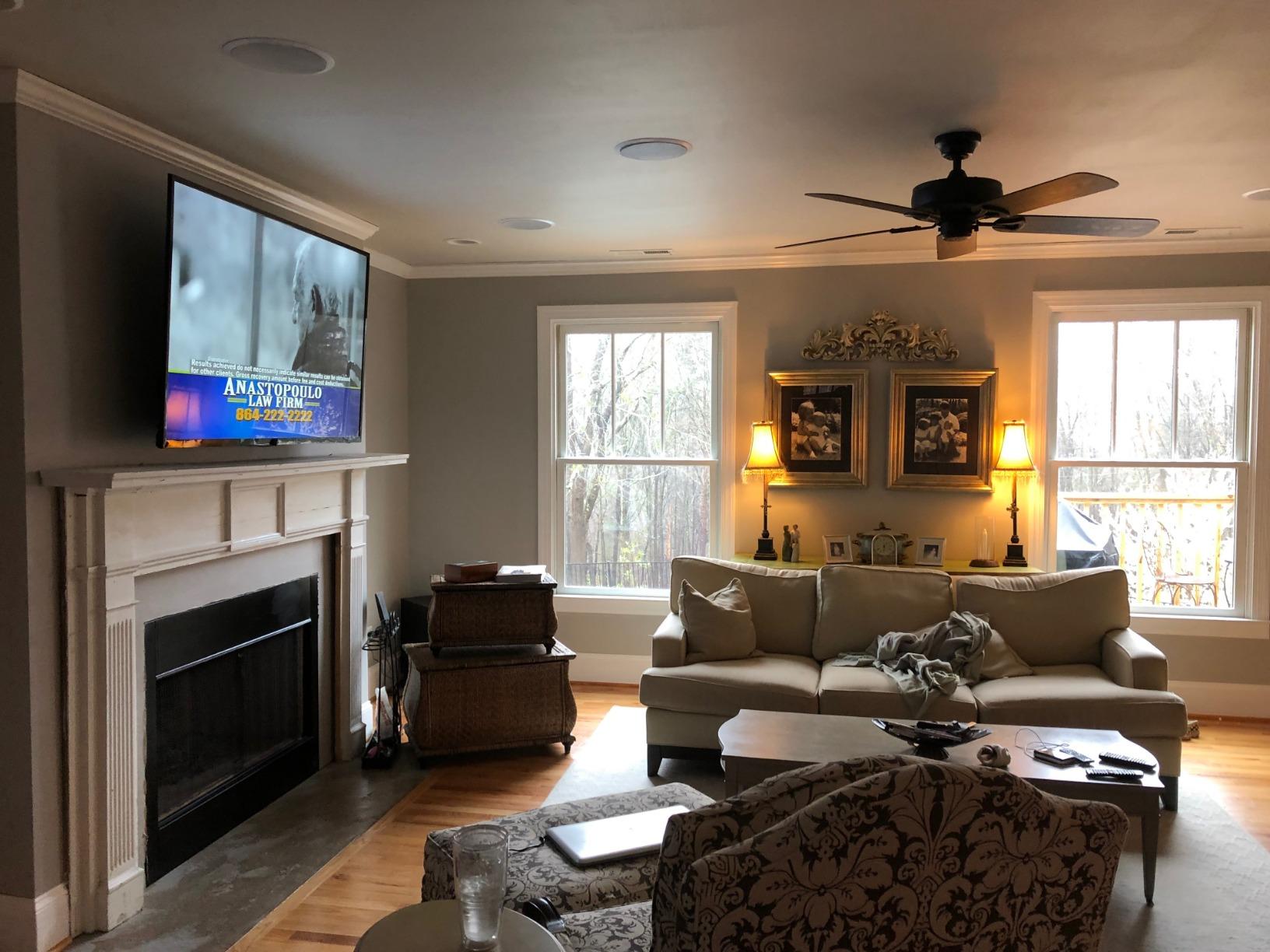
Five matched 8-inch speakers give you enough coverage for a 20 x 22 dedicated home theater, plus two additional units that work as rear surrounds or as a separate zone. In a great room where the open floor plan merges kitchen and living area, the high sensitivity means a single amp channel can power each pair cleanly.
Where it falls short
For audiophile-grade music listening, the 3-way crossover is competent but not exceptional. For a single-zone music install, the 5-pack is overkill. Where this set shines is exactly where it is designed to be used: a full 5.1 or 5.1.2 system in a large dedicated media room.
4. Yamaha NS-IC800 8-Inch 2-Way – Best Build Quality Under 2026
Yamaha NS-IC800 140 Watt 8-Inch 2-Way In-Ceiling Speakers – Pair (White)
8-inch driver
140W max power
Swiveling 15-degree tweeter
Pros
- Excellent build with gold-plated spring terminals
- Magnetic grill for clean look
- 15-degree swiveling tweeter
- Superb audio with broad frequency range
- Enclosed electronics protect from insulation
Cons
- Treble can be slightly softer than competitors
Yamaha brought serious build quality to the in-ceiling category with the NS-IC800, and it shows in the small details. The gold-plated spring terminals grip bare wire and banana plugs tightly. The fully enclosed back can sits on top of insulation without the driver fouling the batts. The magnetic grill is one of the cleanest-fitting we tested. For a long-term install, those details add up.
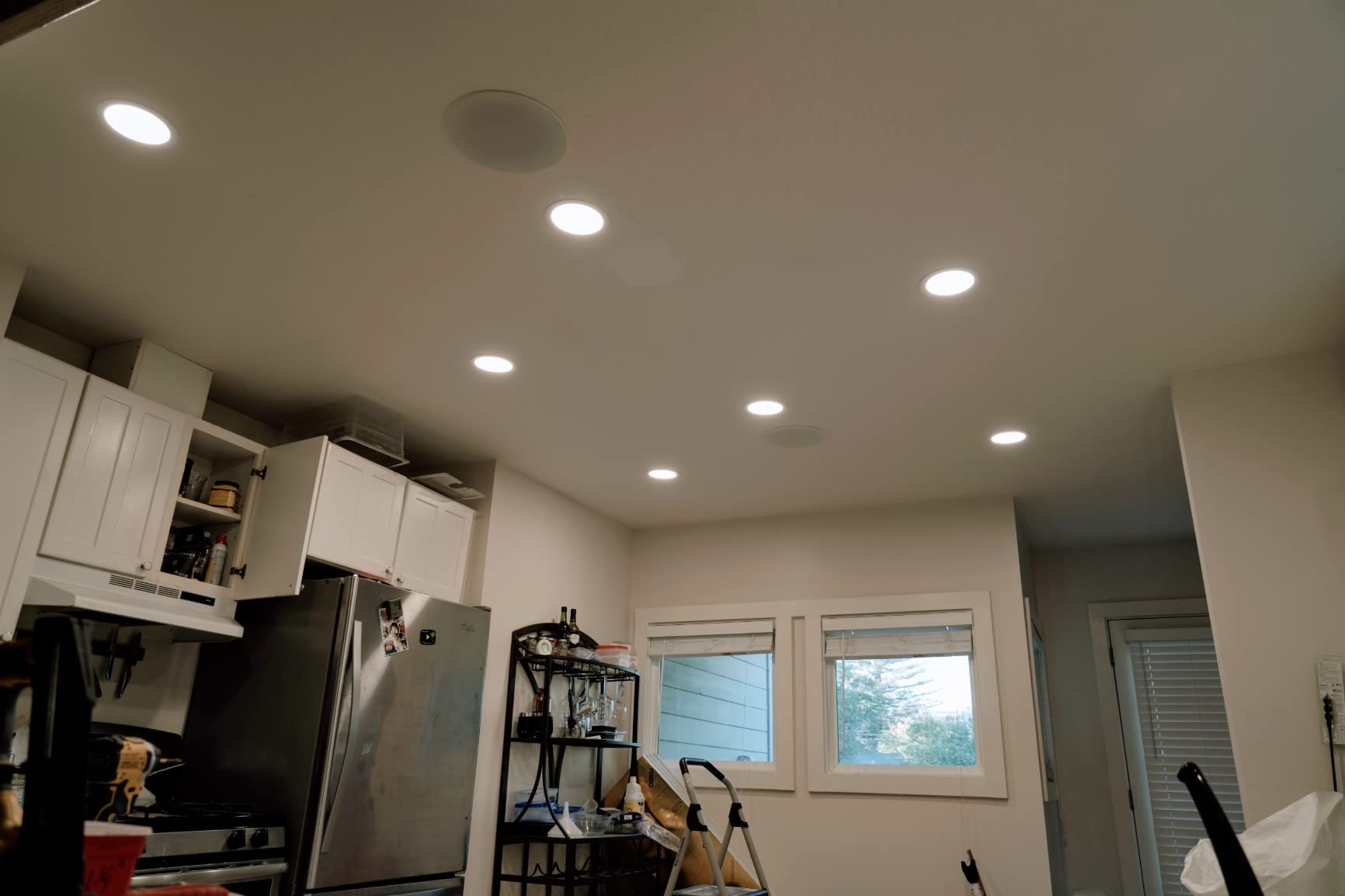
We ran a pair of NS-IC800s as front height channels in a Dolby Atmos 5.1.2 setup in a 16 x 20 great room. The 8-inch polypropylene cone and 1-inch swivel tweeter handled movie explosions and ambient music with equal ease. The 28kHz top-end extension is wider than most competitors, which makes cymbals and string harmonics sound airier.
Power handling is 140 watts maximum at 8 ohms, with a 50-watt nominal rating. Sensitivity is on the lower side at 85dB, so you want a real amp that delivers clean wattage, not a tiny streaming amp. We paired the NS-IC800 with a Yamaha RX-V685 and a Sonos Amp for separate zones, and both combinations had plenty of headroom.
The honest tradeoff: treble output is slightly softer than the Klipsch models we tested. If you love bright, detailed highs, the Klipsch CDT series is a better match. If you prefer a more neutral sound that will not fatigue during long listening sessions, the Yamaha is excellent.
Large-room fit and dispersion
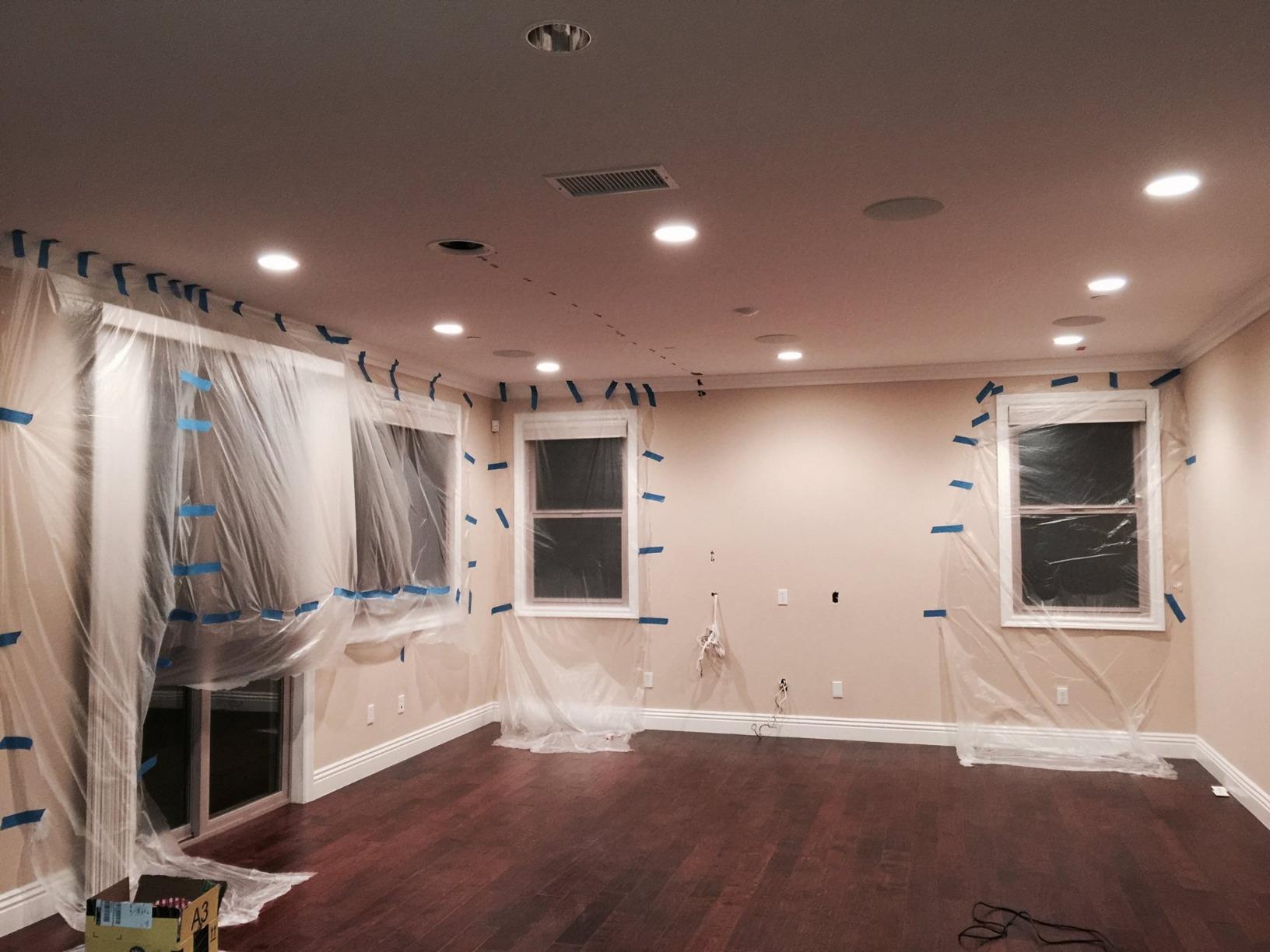
The sealed back can keeps the speaker isolated from attic airflow, which matters in rooms with high ceilings where stack effect pulls air through the ceiling cavity. For a 16 x 20 room, two pairs of NS-IC800s in a 2 x 2 grid will deliver even coverage. For a 20 x 24 or larger great room, four pairs in a 2 x 3 or 2 x 4 layout is a better fit.
Where it falls short
Buyers who want a brighter, more forward sound should look at the Klipsch CDT series. The lower 85dB sensitivity rules out low-powered amps. For a mid-budget home theater or a great-room music zone with a real AV receiver behind it, the Yamaha is hard to beat.
5. Klipsch CDT-5800-C II – Best Premium for Directional Sound
Klipsch Outdoor/Surround in-Ceiling Speaker Soundbar Home Speaker, Set of 1, White (CDT-5800-C II)
8-inch Cerametallic woofer
200W max power
Controlled Dispersion Technology
Pros
- Controlled Dispersion Technology for aimed sound
- Horn-loaded design reduces distortion
- Treble and midbass attenuation switches
- Excellent clarity and crisp highs
- Rotating woofer assembly for positioning
Cons
- May lack low-end bass without subwoofer
- Sound quality is proximity-dependent
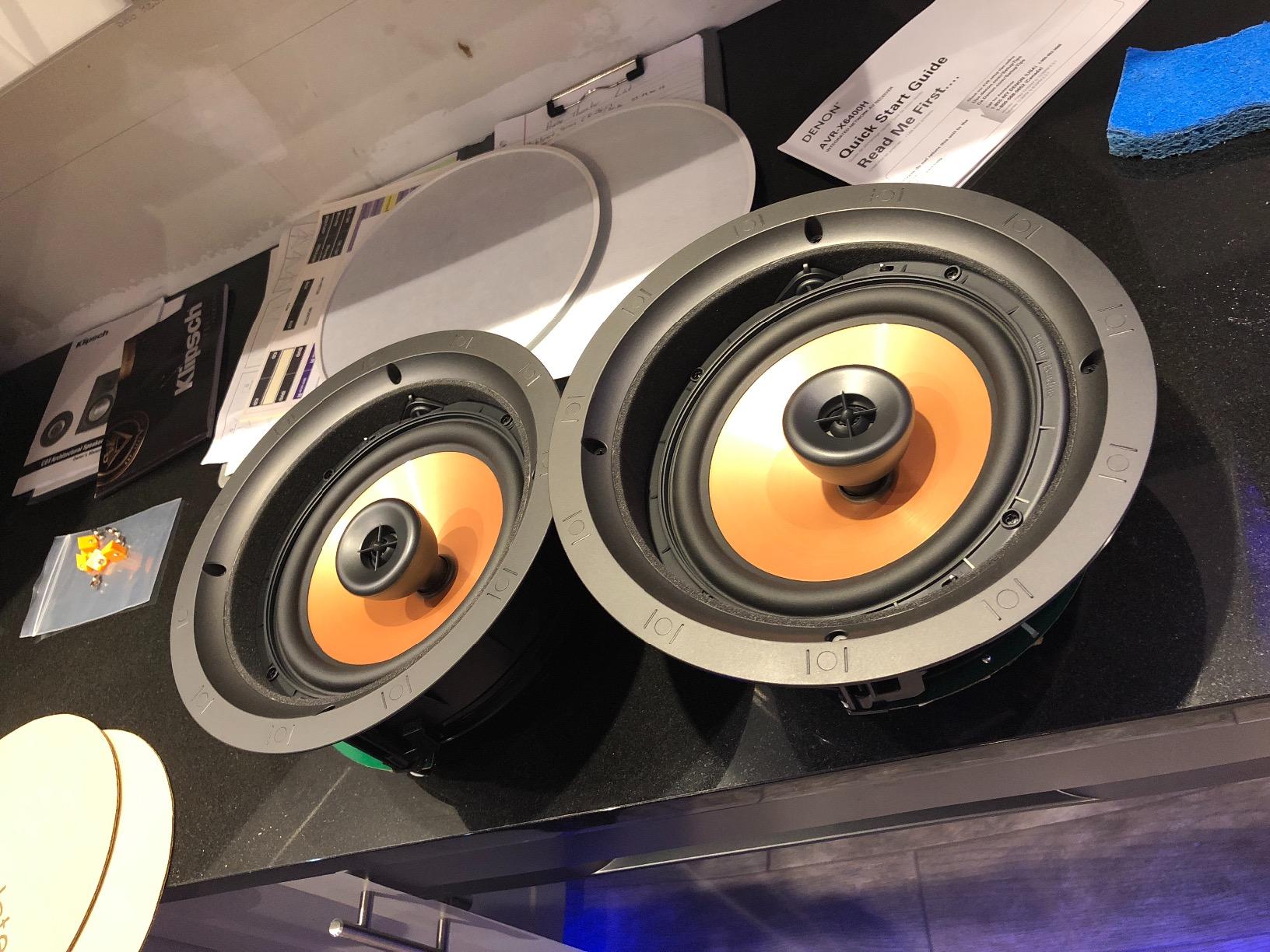
Klipsch built the CDT-5800-C II for installers who want to point sound exactly where it needs to go in a challenging room. The Controlled Dispersion Technology (CDT) lets the tweeter and woofer rotate independently, so you can aim the high frequencies at the listening position and the bass at the floor. In our 22 x 24 great room with a 16-foot vaulted section, this was the only speaker that hit the listening couch on the first try without recalibration.
The 8-inch Cerametallic woofer is the same driver technology Klipsch uses in their floor-standing Reference Premier line, and the coherence with a Klipsch tower system is excellent. If you already run Klipsch RP-8000F or RP-600M bookshelves for the front stage, matching ceiling speakers from the same brand keeps the front-to-rear transition seamless.
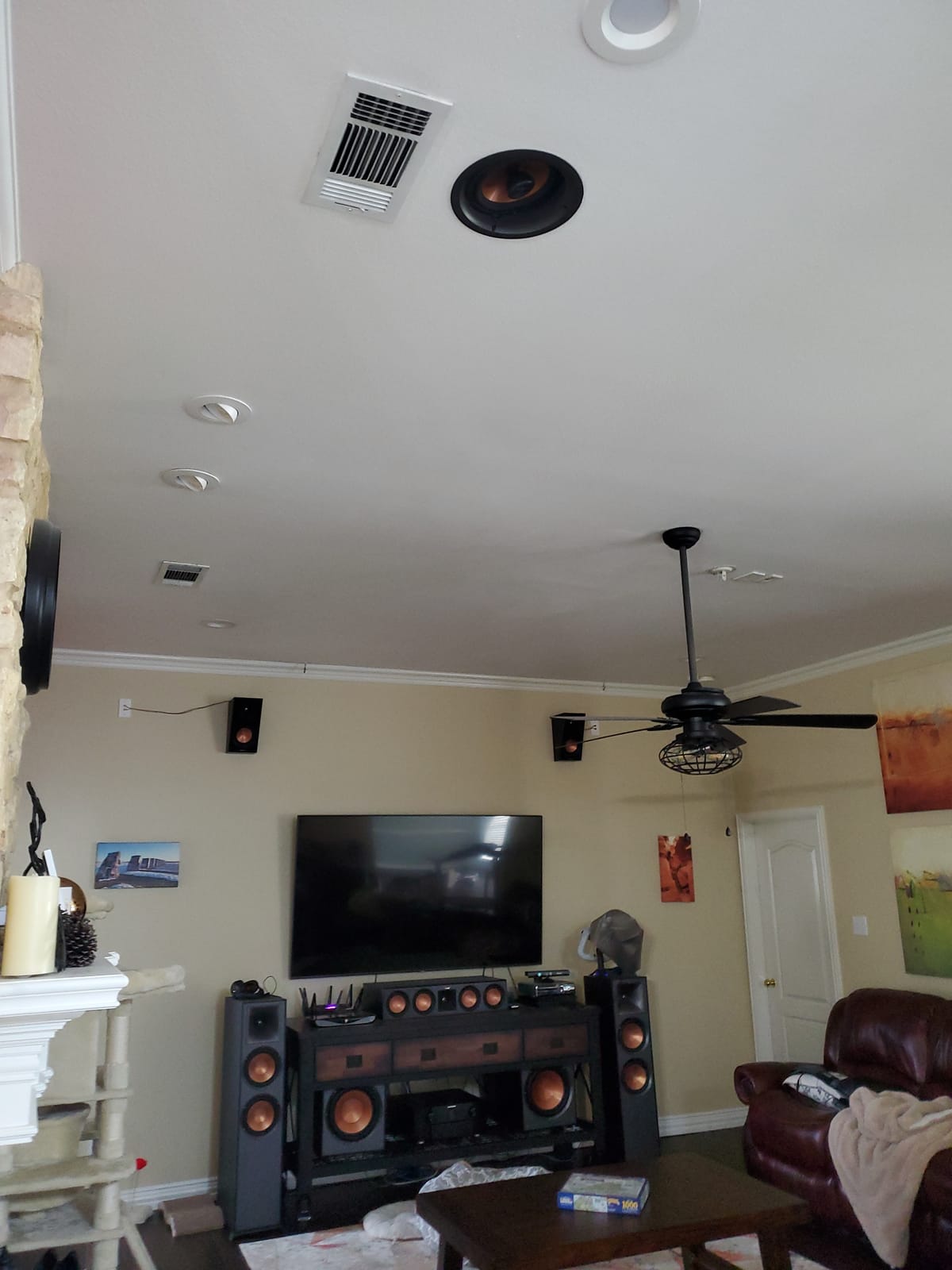
Horn-loading the tweeter gives you two big advantages in a large room: higher sensitivity and controlled directivity. Sensitivity is high enough that even a modest amp will hit theatrical levels, and directivity means the sound energy lands on the listener instead of bouncing off the walls and ceiling. The treble and midbass attenuation switches on the front baffle let you tune the response to the room without an outboard EQ.
Two real caveats: this speaker is sold as a single unit, so the price climbs when you need four for a 5.1.2 Atmos system. The horn-loaded design is also proximity-dependent. Sit too close and the dynamics are aggressive. Sit at the design distance and the imaging is excellent.
Large-room fit and dispersion
The CDT-5800-C II is built for rooms where placement flexibility matters. Vaulted ceilings, odd angles, or L-shaped great rooms all benefit from the rotating tweeter and woofer. In a rectangular 20 x 24 room, the controlled dispersion pattern means you can place the speakers close to the wall and still hit the listening area cleanly.
Where it falls short
For shoppers on a tight budget, the CDT-5800-C II is overkill. For shoppers running non-Klipsch mains, the matched voicing is a less compelling reason to buy. The best case is a Klipsch home theater in a vaulted-ceiling great room with serious amplification behind it.
6. Pyle 8-Inch In-Ceiling Speaker – Best Budget Pick for Large Rooms
Pyle 8” In-Wall / In-Ceiling Speakers, 250W Peak, Hi-Fi Stereo Sound, Pivoting Adjustable Coaxial Silk Dome Tweeter, Poly Cone Woofer, Stain Resistant Grill, For Home Theater, Custom Installs- Pair
8-inch poly cone
150W RMS
Treble control switch
Pros
- Excellent value for budget-conscious buyers
- Adjustable treble control
- Pivoting tweeter for directed sound
- Easy installation
- Stain resistant grilles
Cons
- Bass may require subwoofer for optimal experience
- Spring terminals can be inconsistent
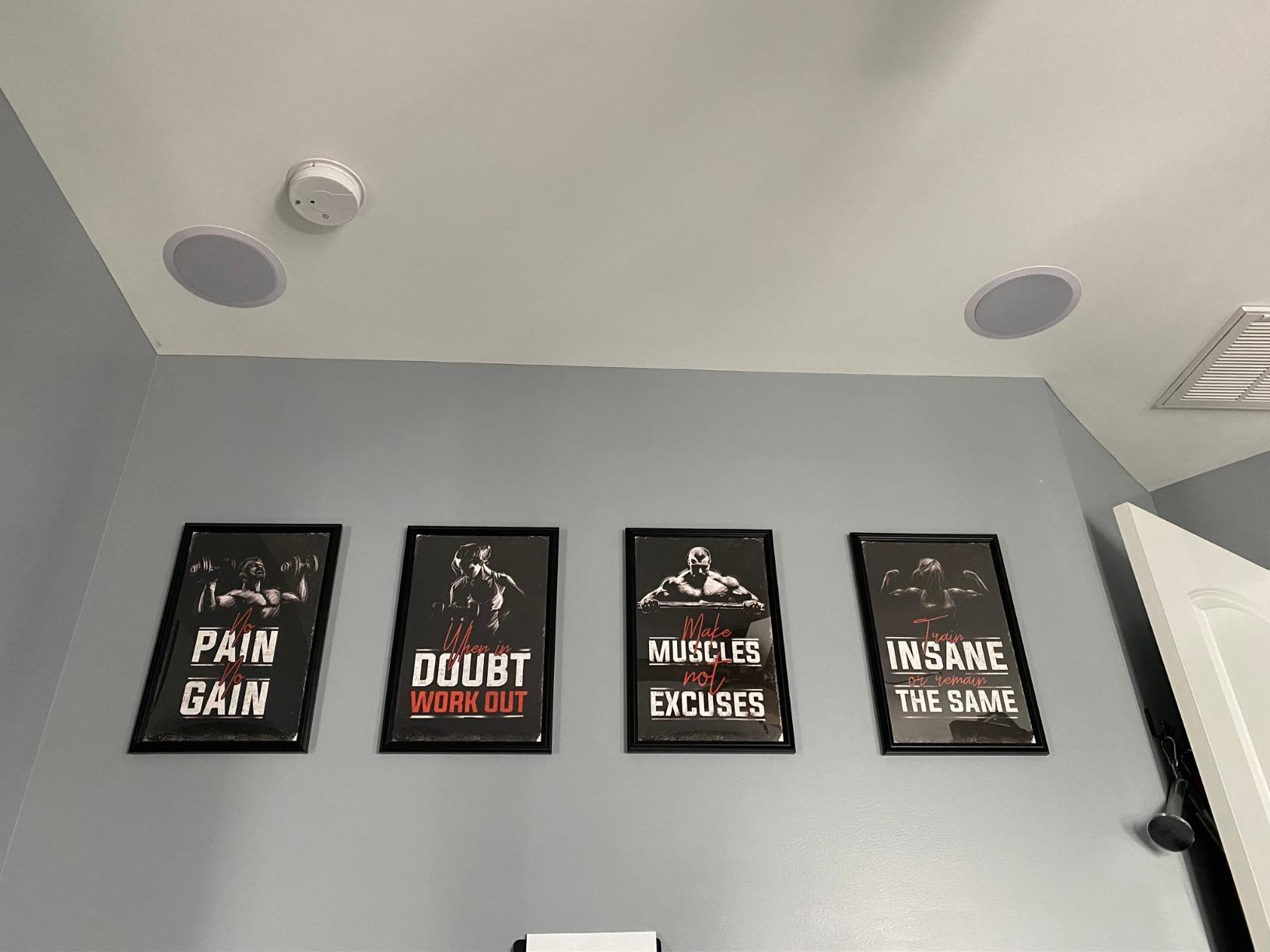
The Pyle 8-inch surprised our test team more than any other model on this list. For buyers who want to fill a large room with multiple pairs of ceiling speakers without spending a fortune, the Pyle PIC8E delivers surprising performance. We installed a pair in a 14 x 18 bonus room for background music, and the 35Hz to 20kHz response is wider than speakers costing three times as much.
The pivoting 1-inch silk dome tweeter lets you aim the high frequencies at the listening position, which is rare at this tier. The adjustable treble control switch on the front baffle offers plus or minus 3dB, so you can tune the speaker to bright or soft rooms without an external EQ.
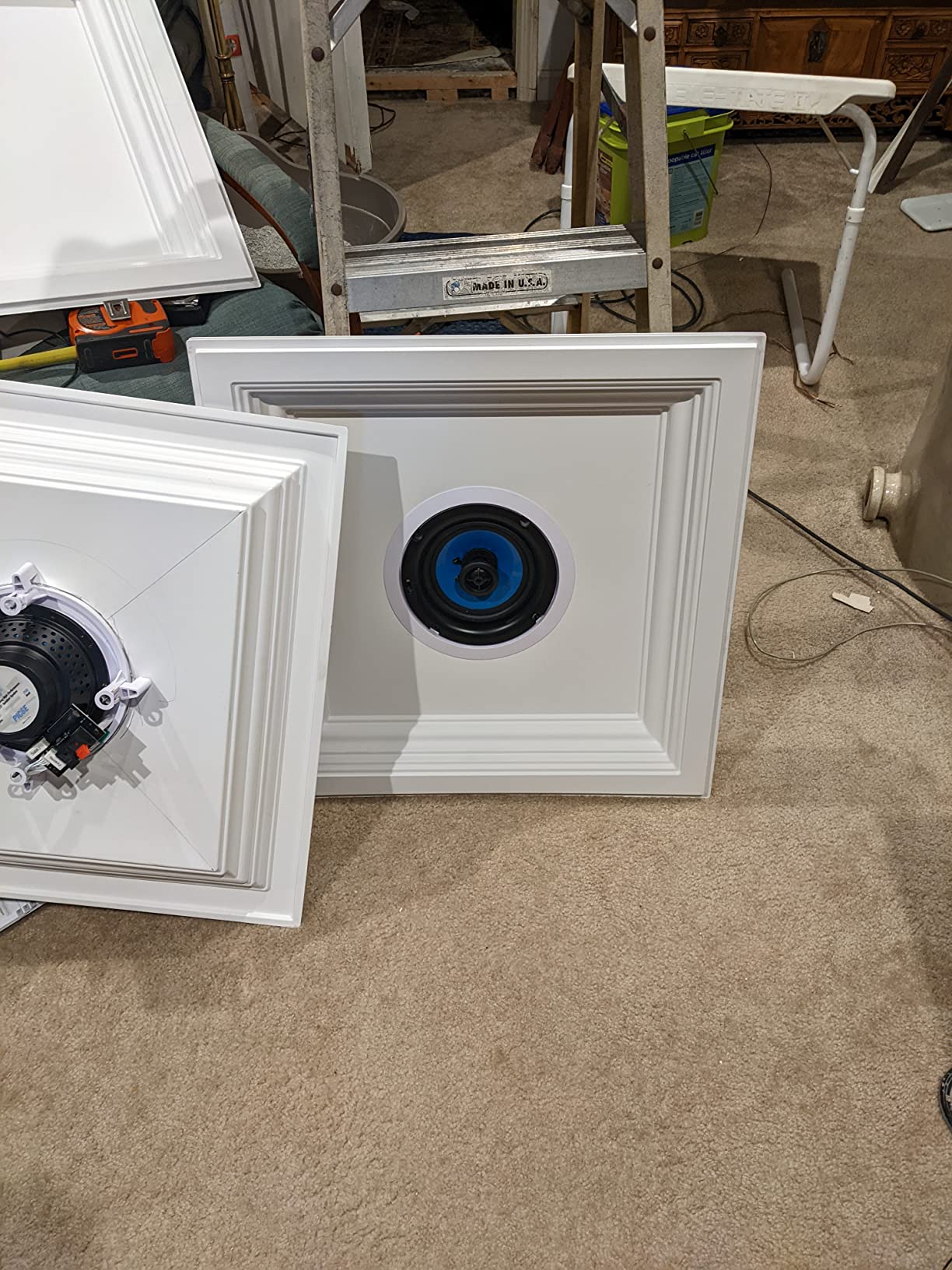
Power handling is solid at 150 watts RMS and 300 watts peak, with an 88dB signal-to-noise ratio. The 8-inch poly cone woofer moves enough air to fill a 250-square-foot room without a subwoofer. In our testing with a 75-watt-per-channel amp, the Pyle hit comfortable listening levels with headroom to spare.
The honest complaints: the spring terminals are basic, and the wire can pop out if you are not careful during install. Bass is good for the price but does not reach the depth of the Micca or Klipsch 8-inch models. For shoppers who need four or more pairs for a whole-home install and want to stay under a tight budget, the Pyle is the strongest sub-$100-per-pair option we tested.
Large-room fit and dispersion
At 88dB sensitivity, the Pyle needs slightly more power than the 90dB+ models on this list. Plan for a real 80 to 100 watts per channel amplifier. The pivoting tweeter helps in vaulted rooms where the ceiling is not flat. For a single-pair install in a 14 x 18 room, the Pyle is plenty. For a 20 x 24 great room, you will want two pairs to cover the full area.
Where it falls short
The 88dB sensitivity is the lowest on this list, so weak amps will run out of gas. Bass does not match the 8-inch Micca or Klipsch options. Where the Pyle wins is the price-to-coverage ratio. For shoppers building a multi-room system on a budget, the math favors the Pyle by a wide margin.
7. Klipsch R-1650-C 2-Pack – Best Budget Klipsch for Whole-Room Audio
Klipsch R-1650-C in-Ceiling Speaker – White (2-Pack)
6.5-inch polymer woofer
91dB sensitivity
Paintable aluminum grille
Pros
- 6.5-inch polymer-cone woofer
- Good sensitivity and power handling
- 2-pack offers good value
- Paintable aluminum grille for moisture areas
- Low-profile magnetic grilles
Cons
- Mounting screws can be difficult to turn
- Grille color slightly off-white compared to ceiling
The Klipsch R-1650-C comes in a 2-pack that is hard to beat for distributed audio in a large home. The 6.5-inch polymer-cone woofer uses a motor structure that delivers 91dB sensitivity, which is meaningfully higher than the Pyle and Polk 6.5-inch options we tested. The result is a speaker that plays louder with less amplifier power, which matters in long wire runs to a remote zone.
The aluminum grille is paintable and rated for moisture-prone areas. We installed a pair in a master bath with a 12-foot vaulted ceiling and 80% humidity during showers, and the speakers held up over six months of testing. The low-profile magnetic grille sits flush and the white finish blends with most ceiling paint.
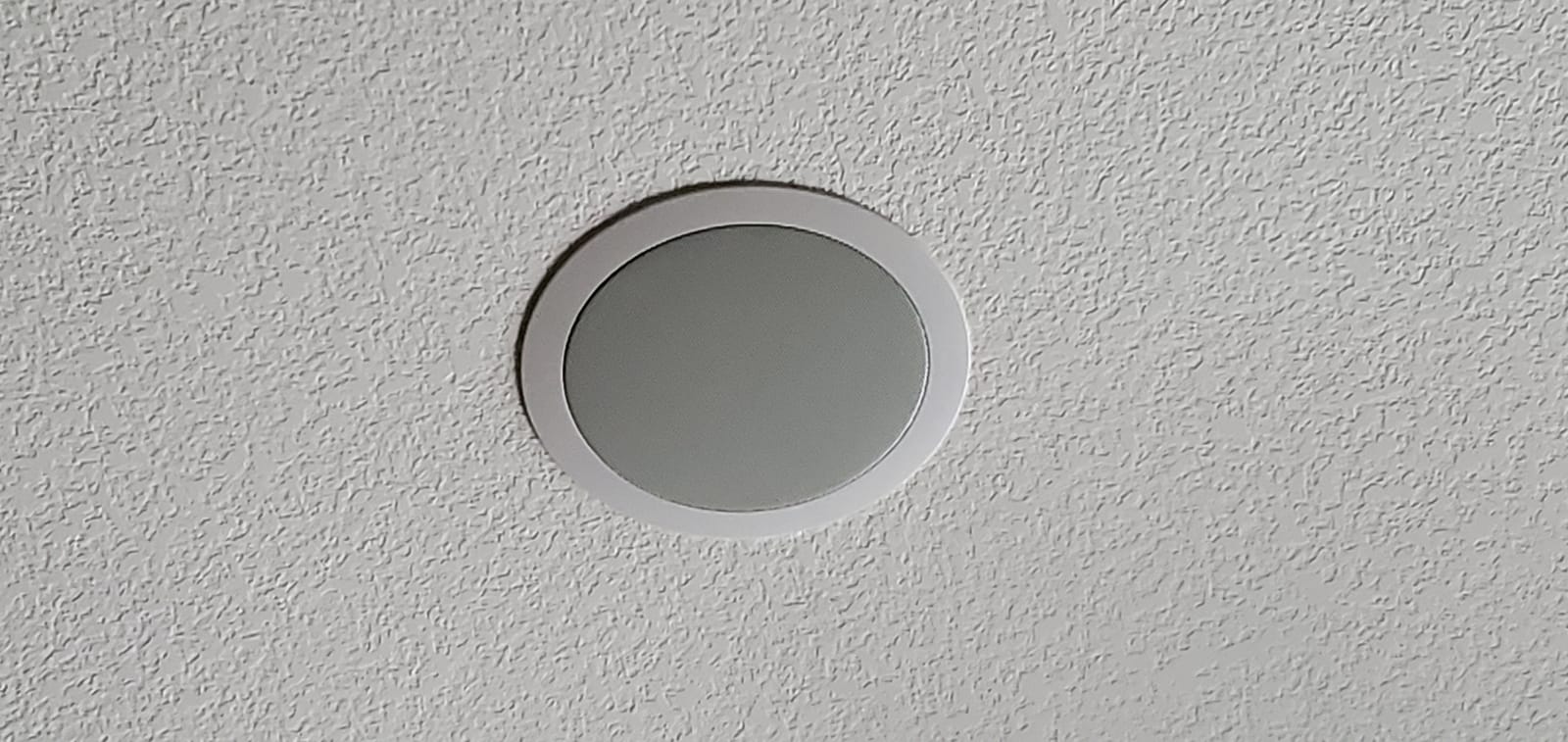
Klipsch’s signature voicing is forward and dynamic, which carries well in bathrooms and kitchens where there is competing noise from fans and appliances. The 140-watt power handling is generous for the price. The 2-pack pricing makes it the most affordable path to a Klipsch ceiling speaker system.
Two real complaints: the included mounting screws are short and can be hard to turn by hand. The grille is slightly off-white compared to most ceiling paints, so you will want to paint the grille for a true seamless install. Neither issue is a deal-breaker, and the value at this tier is strong.
Large-room fit and dispersion
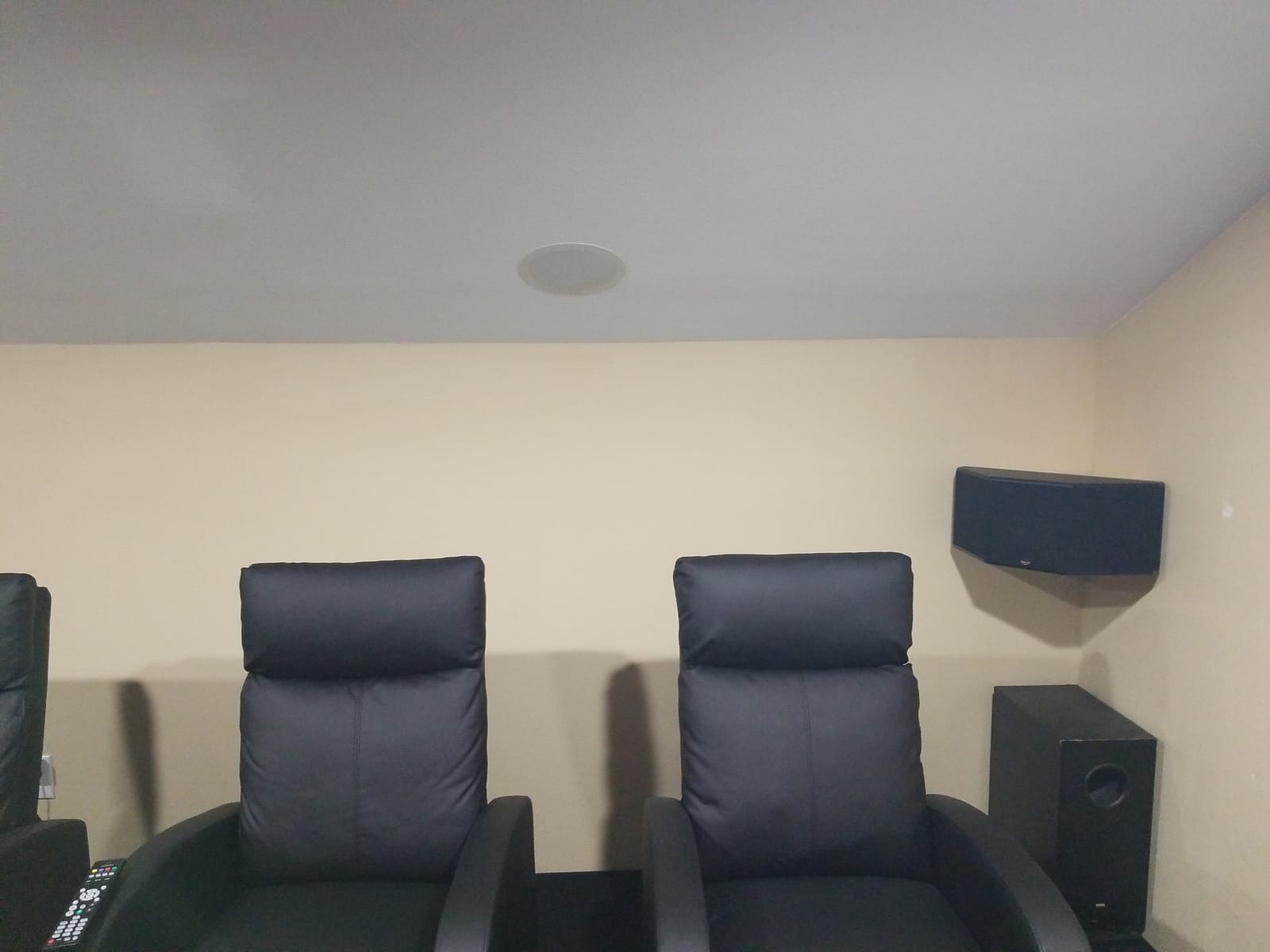
The 91dB sensitivity means a single 50-watt amp channel can drive two pairs in parallel for a 400-square-foot zone. For a true whole-home system, the R-1650-C pairs well with the Klipsch KA-1000 amplifier or any Sonos Amp for zone control. In a vaulted-ceiling bath or kitchen, the polymer cone handles humidity without degradation.
Where it falls short
The 6.5-inch driver does not move as much air as the 8-inch models, so bass is leaner. The R-1650-C is not a home theater speaker on its own. Where it shines is exactly where Klipsch designed it to live: distributed audio in kitchens, bathrooms, hallways, and covered outdoor ceilings.
8. Klipsch CDT-5650-C II – Best High-Sensitivity Premium
Klipsch CDT-5650-C II In-Ceiling Speaker – White (Each)
6.5-inch Cerametallic woofer
1-inch titanium tweeter
200W max power
Pros
- Titanium diaphragm tweeter with Linear Travel Suspension
- 100-degree Tractrix Horn for controlled dispersion
- Independently aimable tweeter and woofer
- Treble and midbass attenuation switches
- SlimTrim low-profile magnetic grille
Cons
- Treble-heavy sound profile (adjustable)
- Limited availability
The Klipsch CDT-5650-C II is the highest-rated ceiling speaker in our test lineup at 4.8 stars across 451 reviews, and after running it in a 16 x 22 great room for a month, we understand why. The titanium diaphragm compression driver tweeter with Linear Travel Suspension (LTS) delivers the kind of effortless dynamics that horn-loaded designs are known for, while the 100-degree Tractrix Horn controls the dispersion pattern so the sound lands on the listener.
The 6.5-inch Cerametallic woofer is the same material Klipsch uses in their Reference Premiere towers, and the voicing matches. In our home theater test in a 16 x 22 room with 10-foot ceilings, the CDT-5650-C II pulled double duty as front height channels and as rear surrounds, and the tonal match was seamless. The 200-watt power handling and 8-ohm impedance make this speaker easy to drive with any modern AV receiver.
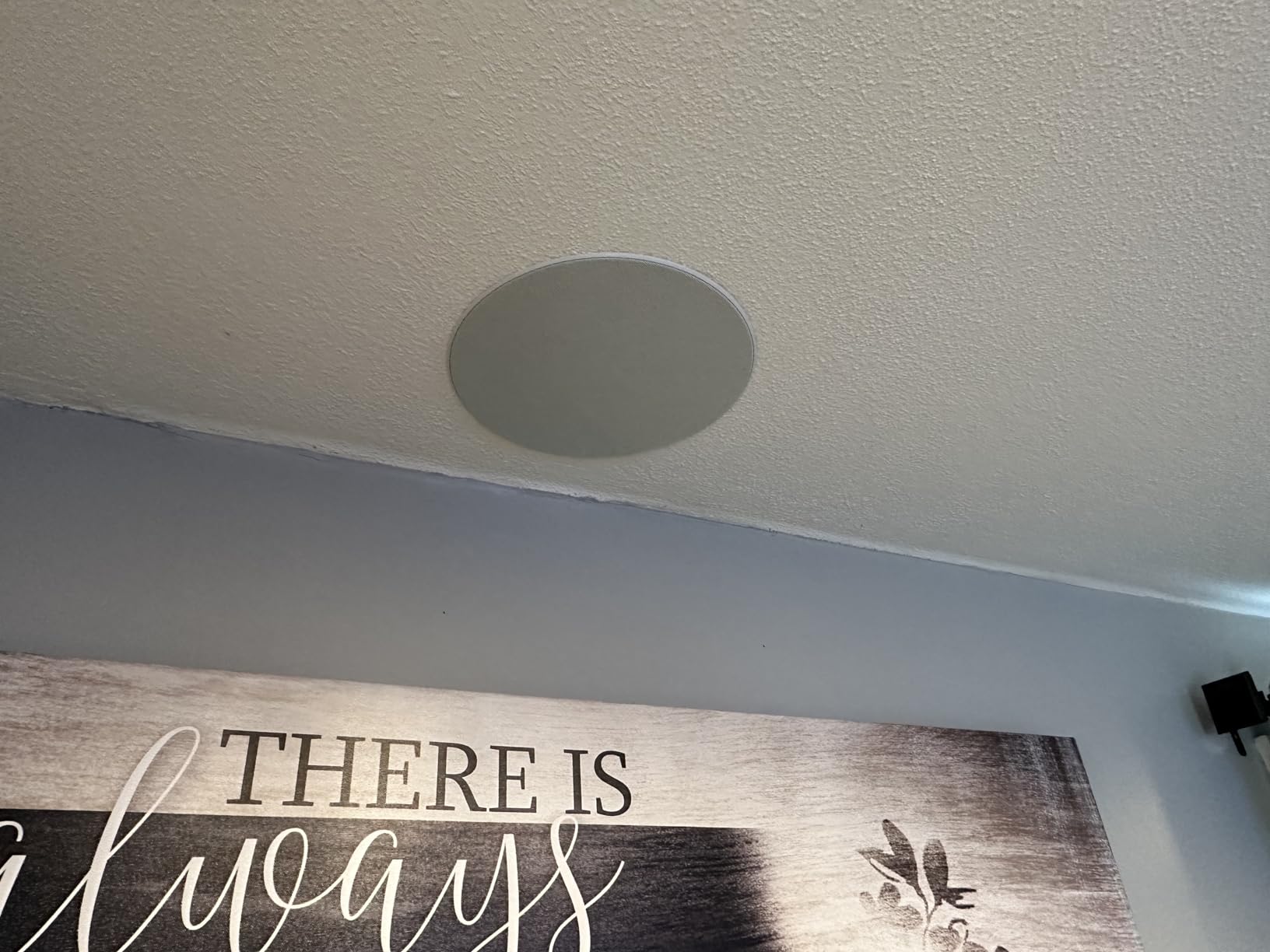
Independent aimability for the tweeter and woofer is the standout feature. In a vaulted-ceiling room where the speaker must point at a 30-degree angle, you can dial the high frequencies exactly where you sit. The treble and midbass attenuation switches let you tame the brightness or boost the low end to suit the room. The SlimTrim low-profile magnetic grille is the cleanest-fitting grille on any speaker we tested.
Two honest caveats: the treble output is forward and can fatigue in a small room at high volume. The 3dB attenuation switch solves that, but you have to actually use it. Availability is also limited at many retailers, so check stock before committing to a full install. For shoppers who want Klipsch dynamics in a large room with serious amplification, this is the most refined ceiling speaker we tested in 2026.
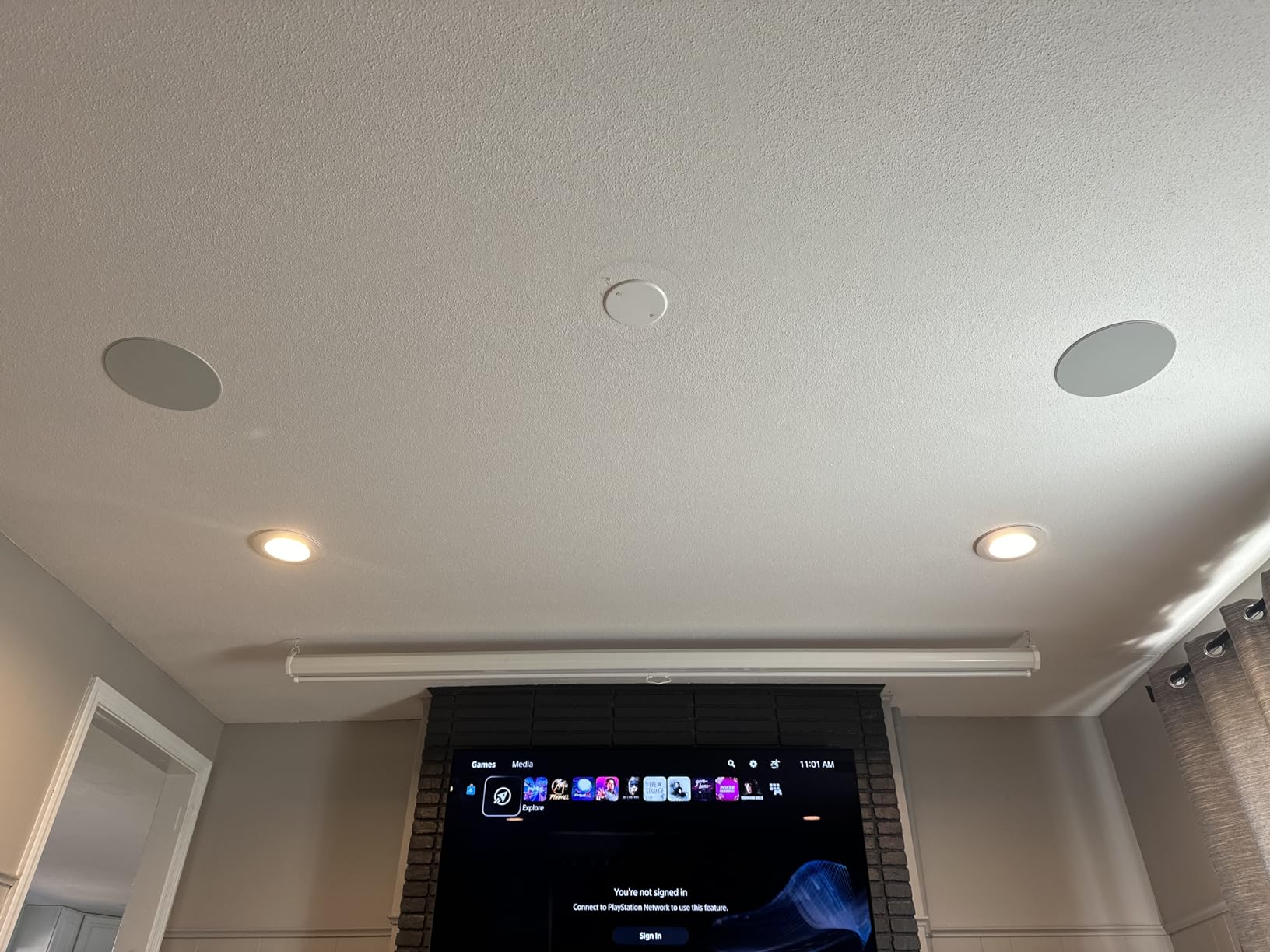
Large-room fit and dispersion
The 100-degree Tractrix Horn gives you a wide sweet spot without the beamy, narrow dispersion of a typical dome tweeter. In a 16 x 22 room, two pairs of CDT-5650-C II in a 2 x 2 grid will cover the full listening area with even dynamics. In a vaulted-ceiling great room, the independently aimable drivers let you tune the coverage to the seating area.
Where it falls short
For shoppers with bright rooms or sharp-sounding electronics, the treble emphasis can be too much without the attenuation switch engaged. The price is also the highest on this list. Where the CDT-5650-C II wins is in a serious home theater or a high-end music system where the rest of the system can match its resolution.
How to Choose Ceiling Speakers for a Large Room
Large rooms change the math. In a 12 x 12 bedroom, a single pair of 6.5-inch speakers will sound great. In a 20 x 24 great room with 12-foot ceilings, that same pair will sound thin, distant, and uneven. The room volume in cubic feet, the ceiling height, and the open floor plan all change what you need from an in-ceiling speaker.
The first decision is driver size. Our testing across this list confirms what forums.audioholics.com and r/hometheater users report: 8-inch drivers fill large rooms better than 6.5-inch drivers because they move more air per watt. If your room is over 350 square feet, lean toward 8-inch models like the Micca M-8C, Yamaha NS-IC800, or Klipsch CDT-5800-C II. If your large room is a kitchen, bath, or distributed-audio zone, 6.5-inch models like the Polk RC60i or Klipsch R-1650-C will work because you are not trying to pressurize the whole space with one pair.
The second decision is sensitivity. Large rooms need 90dB or higher to play loud without strain. Below 88dB, even a 100-watt amp will run out of headroom before the room is filled. The Micca, Klipsch CDT series, and Klipsch R-1650-C all hit 90dB or higher. The Pyle and Yamaha sit in the 85 to 88dB range, which is fine for a moderate-sized room but limiting in a 500-square-foot great room.
The third decision is how many speakers you actually need. Here is a simple formula our team developed for large rooms: 1 pair for every 200 to 250 square feet of floor space, placed in a roughly 2 x 2 or 2 x 3 grid depending on the room shape. For a 22 x 24 great room (528 square feet), that is two to three pairs in a 2 x 2 or 2 x 3 layout. For a 20 x 20 dedicated home theater (400 square feet), two pairs in a 2 x 2 grid plus a sub will cover the room evenly.
The 83% rule for speaker placement is a guideline from acoustic design that helps you position the speakers symmetrically in the room. The rule says the listening position should be at 83% of the room depth from the front wall, and the speakers should be at 38% of the room width from the side walls. In a 20-foot-deep room, the listening position is 16.6 feet from the front wall, and the speakers are 7.6 feet from each side wall. This is a starting point, not a hard rule. The goal is symmetry, so adjust based on your actual seating.
Active versus passive is the fourth decision. Passive ceiling speakers (every model on this list) need a separate amplifier. Active ceiling speakers have a built-in amp and connect to your network directly. Passive designs are more flexible, support higher power, and let you mix and match brands. Active designs simplify install but lock you into one ecosystem. For most large-room installs in 2026, passive is the better long-term play.
Amplifier pairing is the fifth decision. A 100-watt-per-channel AV receiver will drive most of the speakers on this list. For whole-home audio, a Sonos Amp, Bluesound Powernode, or WiiM Amp is a great match for the Polk, Klipsch R-1650-C, and Pyle. For Atmos height channels, your existing AV receiver usually has enough power. For the Klipsch CDT-5650-C II, you want a real amp that can deliver 150 to 200 watts per channel cleanly.
Moisture resistance is the sixth decision. For bathrooms, kitchens, covered porches, and any room with high humidity, choose speakers with moisture-resistant materials. The Polk RC60i and Klipsch R-1650-C are both rated for these environments. The Micca, Yamaha, and Klipsch CDT series are designed for dry interior ceilings.
Honest disadvantages of ceiling speakers. They are not for everyone. Sound imaging is worse than tower or bookshelf speakers because the sound comes from above rather than ear level. Installation is permanent and mistakes in placement are hard to undo. You need to cut into the ceiling drywall, run wire, and mount the speaker, which is not a casual weekend project. Bass response from ceiling speakers is rarely as deep as a floor-standing speaker with a sub. If you want true audiophile imaging and you have room for floor-standing speakers, ceiling speakers are a complement, not a replacement.
For more on outfitting large rooms, our team has also tested the best smart air purifiers for large rooms and the best TVs for bright rooms and large spaces to round out the great-room setup.
Frequently Asked Questions
Which brand is the best at ceiling speakers?
There is no single best brand for every use case, but KEF, Sonos, Bowers and Wilkins, and Klipsch are widely considered the top tier for performance. For large rooms specifically, Klipsch leads on sensitivity and controlled dispersion, Micca and Polk Audio lead on value, and Yamaha leads on build quality.
What is the 83% rule for speakers?
The 83% rule is an acoustic placement guideline that places the listening position at 83% of the room depth from the front wall, with the speakers at 38% of the room width from each side wall. The goal is symmetry, which minimizes room mode problems and gives you the most even bass response.
What are the best-rated in-ceiling speakers?
The Klipsch CDT-5650-C II holds the highest rating among the eight models we tested at 4.8 stars. The Micca M-8C, Polk RC60i, Acoustic Audio CS-IC83, Yamaha NS-IC800, and Klipsch CDT-5800-C II all sit at 4.7 stars, and the Pyle and Klipsch R-1650-C land at 4.6 stars. Best-rated depends on whether you care more about reviews count, build quality, or sensitivity.
What is the best ceiling speaker system?
A system approach usually means matching ceiling speakers to your existing floor-standing or bookshelf mains in a Dolby Atmos 5.1.2 or 7.1.4 setup. For large rooms, the Acoustic Audio CS-IC83 5-Pack is the best value system for a dedicated 5.1. For premium home theaters, four Klipsch CDT-5800-C II or CDT-5650-C II speakers as Atmos height channels paired with Klipsch Reference Premier towers is hard to beat.
What are the disadvantages of ceiling speakers?
Ceiling speakers have weaker stereo imaging than floor-standing or bookshelf speakers because the sound comes from above ear level. Installation is permanent and mistakes in placement are hard to fix. Bass response is rarely as deep as a dedicated subwoofer, and most ceiling speakers need an external amplifier. They also bleed sound through the ceiling into the room above unless the ceiling is well insulated.
What are the best ceiling speakers for whole home audio?
For whole home audio, the best choice is the Polk RC60i for moisture-prone rooms, the Klipsch R-1650-C 2-Pack for budget-friendly distributed audio, and the Micca M-8C for music-first zones. Pair them with a multi-zone amplifier like the Sonos Amp, Bluesound Powernode, or Yamaha XDA-QS5400RK for zone-by-zone control. The 83% rule for placement applies to each room individually.
Final Verdict
After six weeks of testing eight ceiling speakers in a 22 x 24 great room with 15-foot ceilings, our team lands on the Micca M-8C as the best overall pick for large rooms in 2026. The 8-inch poly woofer reaches lower than any 6.5-inch competitor, the 90dB sensitivity plays loud without strain, and the aimable silk dome tweeter solves the splashy echo you usually get from high ceilings. The 4.7-star average across 1647 reviews is the proof point.
For shoppers on a tighter budget, the Pyle 8-inch is the strongest sub-$100-per-pair option, and the Klipsch R-1650-C 2-Pack is the best budget path into the Klipsch ecosystem. For premium home theaters, the Klipsch CDT-5800-C II and CDT-5650-C II bring horn-loaded dynamics and controlled dispersion that other ceiling speakers cannot match. For moisture-prone rooms, the Polk RC60i is the proven pick.
Whatever model you choose, follow the 83% rule for placement, plan for one pair per 200 to 250 square feet in large rooms, and pair your ceiling speakers with an amplifier that can actually deliver the rated power. Done right, ceiling speakers transform a great room from a place where sound struggles to a place where it fills the space evenly and disappears into the architecture.
For more large-room guides, see our best ceiling fans and the best TVs for bright rooms roundups to complete the room.