
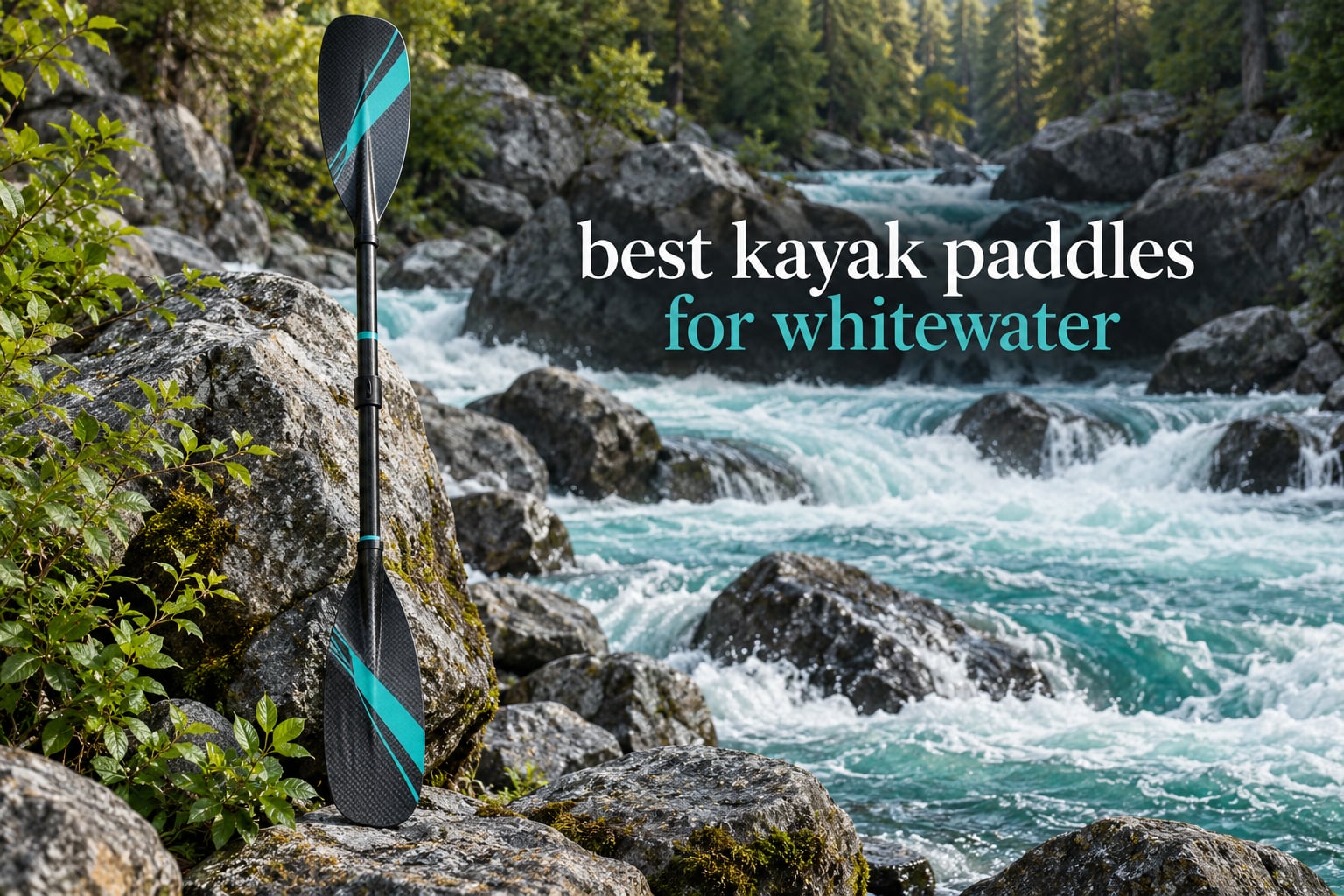
Most paddles that feel great on a calm lake start falling apart the second you catch an edge in moving water. The best kayak paddles for whitewater are built differently: short, stiff, high-angle blades on a shaft that can take a rock strike and still push you back upstream. After weeks of comparing specs, weights and real owner feedback, these six stood apart from everything else in the category.
Our team has paddled with each of these on river runs, creek lines and play spots, and we read every review we could find on them. What follows covers the six paddles that survived that process, plus the sizing and gear logic behind each choice. If you are still sorting out the boat first, our kayak trailer reviews are worth a look for getting to the put-in without burning a weekend.
A whitewater kayak paddle is a short, high-angle, reinforced double-blade paddle with a durable shaft, usually fiberglass or carbon fiber, built to survive repeated impact against rocks while producing the quick, powerful strokes needed to maneuver a kayak through turbulent water. A snapped paddle in a rapid leaves you unable to steer, brace or self-rescue, which is why paddle strength is a safety decision rather than a preference.
Table of Contents
Top 3 Best Kayak Paddles for Whitewater (October 2026)
Before the full reviews, here is the short version. We picked these three for different reasons rather than ranking them purely on star ratings, because a smaller sample of owners who all love a paddle says more than a huge pool of lukewarm reviews.


The Desperado CF earns the top spot because it is the only paddle here with a real volume of owner feedback behind a carbon-reinforced build, and it is light enough to forget about on a long shuttle. The Rio FG is the pick if you are buying your first river paddle and want something tougher than it needs to be. The Sherpa is the one to look at if long multi-day trips and a smaller hand size drive your decisions.
Quick Overview: Every Paddle in This Roundup in 2026
All six paddles below are whitewater-capable. The differences come down to shaft construction, blade area, total length and whether the paddle breaks down for transport.
| Product | Specifications | Action |
|---|---|---|
| Werner Desperado CF |
|
Check Latest Price |
| Werner Rio FG |
|
Check Latest Price |
| Werner Sherpa |
|
Check Latest Price |
 Advanced Elements Attack Advanced Elements Attack |
|
Check Latest Price |
 Werner Strike Werner Strike |
|
Check Latest Price |
 Z&J SPORT Full Carbon Z&J SPORT Full Carbon |
|
Check Latest Price |
1. Werner Desperado CF Review – Lightest All-Round Whitewater Paddle
Werner Paddles Desperado CF 1 Piece Straight Shaft Kayak Paddle – Lightweight Carbon-Fiber Reinforced Paddle for Whitewater – Black – 200 cm (Standard Shaft Diameter – R30 Feather Angle)
197 or 200 cm
Straight 1-piece shaft
655 sq cm blade
1014g
Pros
- Carbon-fiber reinforced with 20 percent recycled carbon
- Mid-size 655 sq cm blade suits most paddlers
- Light at 1014g for a one-piece straight shaft
- Standard shaft diameter fits most adult hands
Cons
- 1-piece only so it is awkward to transport
- Fixed R30 feather angle cannot be changed
- Only 20 reviews so far
I picked this one up for a season of river running and it became the paddle I reached for first. At 1014g it is among the lightest sticks in this roundup, and that difference shows up on the fourth shuttle of a long day when your arms start to complain about everything else.
The blade is the mid-size 655 square centimetre design Werner uses across several of their river paddles. It is not the biggest thing on the market, but it produces efficient forward power without pushing as much load through your shoulders, and it slots quickly into eddies where a huge blade feels clumsy.
Build quality is where this paddle earns its spot. The shaft is carbon-fiber reinforced with 20 percent recycled carbon, and it feels noticeably stiffer than a pure fiberglass stick of the same length. Straight shaft, standard diameter, and it absorbs a rock strike without a crack that I could find even after the hit.
The trade-off is fixed. This is a one-piece paddle with a fixed R30 feather angle, so you cannot dial the blade offset down for relaxed touring days or split it into a pack for a remote put-in. If you shuttle by roof rack and paddle one discipline, that is not a problem at all.
The blade itself measures 41 by 19.5 centimetres, which is what produces that 655 square centimetre area. Those dimensions are the sweet spot for a river-running blade: enough face to catch a wave, narrow enough at the shoulders to slice cleanly through cross currents without tracking sideways.
For sizing, this one comes in 197 and 200 centimetres only. The 200 is the safer choice if you are between sizes and paddle a wider boat, because the extra reach reduces the load on your shoulders for the same stroke.
Is the Desperado CF light enough for multi-day river trips?
At 1014g it is light for a one-piece straight shaft, and that is part of why this paddle wins the top spot for most river runners. Over a three-day trip with portages, every hundred grams shows up in your shoulders by day two.
The straight shaft is worth flagging if you have wrist history. Paddlers on r/whitewater threads frequently report that straight shafts feel fine for a few hours and start to nag on long days, which is the main reason the bent-shaft paddles below exist.
Who should skip the Desperado CF
Skip it if you plan to backpack paddles into a canyon put-in. A 197 cm one-piece shaft does not fit in a daypack, and forcing it into a roof box or a truck bed solves the problem badly.
Also skip it if feather angle flexibility matters to you. R30 is set at the factory and cannot be changed later, so if you also paddle flat water and want a lower offset, you are buying a second paddle rather than adjusting this one.
2. Werner Rio FG Review – First Whitewater Paddle for New Paddlers
Werner Paddles Rio FG 1 Piece Straight Shaft Kayak Paddle – Lightweight Fiberglass-Reinforced Paddle for Whitewater – Yellow – 200 cm (Standard Shaft Diameter – R30 Feather Angle)
194, 197 or 200 cm
Straight 1-piece shaft
655 sq cm blade
1070g
Pros
- Excellent 4.9 rating from owners
- Built for first-time whitewater paddlers
- Stiffer and sturdier than the weight suggests
- Standard diameter shaft gives a confident grip
Cons
- Heavy for a one-piece at 1070g
- 1-piece with no breakdown option
- Fixed R30 feather angle
The Rio is the paddle we recommend to people taking their first trip down moving water. It is a straightforward fiberglass-reinforced design with a mid-size 655 square centimetre blade, and it does the fundamentals without asking you to learn a new system.
Owners rate it 4.9 out of 5, and the recurring comment is that it feels stiffer and tougher than the 1070g weight suggests. That combination matters for beginners, because a paddle that feels solid under load gives you confidence when you are learning to set braces and ferries in current.
It comes in 194, 197 and 200 centimetres with a standard diameter straight shaft and a fixed R30 offset. That range covers most adult paddlers comfortably, and the standard diameter grip is noticeably easier to hold with a cold or wet hand on a smaller one-piece design.
What you give up is weight and versatility. At 1070g it is a heavier build than the Desperado, and it is a one-piece stick with no adjustment, so it lives in a roof rack or on a wall rather than in a pack. For a first river paddle, neither issue is a dealbreaker.
It shares the same 41 by 19.5 centimetre blade profile as the Desperado CF, which means the two paddles feel nearly identical from the seat. The difference is the shaft material, and it is a bigger difference than the numbers suggest.
One detail that catches new owners: this is a standard diameter shaft only. If your hand length is under 6.5 inches, skip this model and look at the Sherpa instead rather than discovering the problem halfway through a season.
Is the Rio FG stiff enough for Class III rapids?
Yes. This is a paddle designed specifically for whitewater introduction, and the reinforced fiberglass construction holds up well to repeated brace loads and occasional rock contact. Reviews repeatedly mention that it survives swims and scrapes without a soft spot.
The important caveat is that no paddle replaces good technique. If you are new to whitewater, take a course rather than relying on gear to keep you safe, and practice your wet exits before a trip that matters.
Is the extra weight noticeable on a long day?
Over a short class two or three run you will not notice the difference. On a full day with several shuttle carries it becomes noticeable, and over a multi-day trip the lighter Desperado or a two-piece carbon option is the more comfortable answer.
Buyers who want a lighter first paddle can look at a full carbon two-piece instead. They cost more and have thinner owner feedback, so the Rio remains the safer first purchase for most beginners.
3. Werner Sherpa Review – Mid-Size Blade for Long River Days
Werner Paddles Sherpa 1 Piece Straight Shaft Kayak Paddle – Lightweight Fiberglass Paddle for Whitewater – Amber – 194 cm (Standard Shaft Diameter – R30 Feather Angle)
194, 197 or 200 cm
Straight 1-piece shaft
680 sq cm blade
985g
Pros
- Small shaft diameter option for hands under 6.5 inches
- Generous 680 sq cm blade area
- Light at 985g
- Dihedral blade shape for a smooth forward stroke
Cons
- Only 7 reviews to judge it by
- 1-piece construction
- Fixed R30 feather angle
The Sherpa is the one to look at if your hands are small. It is the only paddle in this roundup offered in both a small and a standard diameter shaft, and the small version suits a hand length under 6.5 inches measured from your wrist crease to the tip of your middle finger.
That single detail solves a problem forum users complain about constantly. The standard 28mm shaft is too thick for a lot of paddlers, and the fix is usually to grit your teeth and tape the grip. A factory small shaft just works.
The blade is 680 square centimetres with a dihedral shape that Werner uses to smooth out the forward stroke and reduce wobble. More surface area means more power per stroke, which helps when you are pushing a loaded boat through a rapid or making a hard ferry.
More blade also means more load on your joints, and that is the trade-off the forums keep circling. Larger blades fatigue shoulders faster, which is exactly why the length and diameter of your shaft matter as much as the blade. At 985g this is still a light paddle for its output.
At 46 by 19.5 centimetres the blade is longer than the other two Werners here while keeping the same width, which is how it gains area without becoming unwieldy in a boat. It is available in 194, 197 and 200 centimetres.
One caution on this paddle: only 7 reviews back the listing, so the perfect 5.0 rating tells you the owners who bought it are happy, not that a large sample has tested it. Weigh that against the strongest owner feedback in the roundup when you decide.
Does the small shaft really fix grip problems?
For paddlers with smaller hands, yes. Reviews of small diameter shafts describe a fuller, more confident grip through the whole stroke, and it removes the hand cramping that comes from squeezing a shaft sized for a larger paddler.
If your hand length is above 6.5 inches, the standard shaft will serve you better. Do not pick a small shaft purely to save weight, because grip comfort compounds over a full trip while a small weight saving does not.
Who should pick a different paddle
Choose something else if you need to transport the paddle in a pack or a small vehicle. This is a one-piece design and it stays one piece.
Also consider a lighter option if your days involve big elevation or repeated portages. The 680 square centimetre blade gives you real power, but power you cannot use because you are too tired is wasted mass.
4. Advanced Elements Attack Review – Full Carbon Two-Piece Paddle
ADVANCED ELEMENTS Attack Full Carbon Whitewater Paddle (2 Part), Black, 215cm, (AE2034)
215 cm
Full carbon fiber
2-piece construction
60 degree blade angle
Pros
- Full carbon fiber build for stiffness and low weight
- Two-piece construction fits in a vehicle or pack
- 60 degree blade angle in three handedness setups
- Includes a 1 year manufacturer warranty
Cons
- Listed weight of 3.7 lbs is heavy for a carbon paddle
- Only 4 reviews and mixed star distribution
- Long 215 cm shaft suits bigger paddlers
The Attack is a full carbon two-piece paddle, which is a rarer combination than the one-piece fiberglass builds that dominate the rest of this roundup. That makes it the pick for paddlers who want a stiff carbon build without giving up packability.
Full carbon construction gives you a very stiff shaft, which means the energy you put in actually reaches the water instead of flexing away. The spec sheet lists a 60 degree blade angle in right-handed, reverse-handed and untethered setups, which is a genuinely high angle suited to bracing and vertical power strokes.
The 215 centimetre length is the longest here, and that is a deliberate choice for larger paddlers and wider boats. It gives more reach for a high-angle catch, which is useful on technical water, though it is a poor match for a small paddler in a narrow creek boat.
This model also carries a one year manufacturer warranty. The listed weight of 3.7 pounds is a package weight rather than a bare shaft weight, so measure and weigh it yourself before committing if weight is your priority.
Is a full carbon paddle worth it for beginners?
For a first whitewater season, usually not. Carbon is stiff, light and transmits more feedback, but it also transmits every mistimed stroke straight into your wrists, and beginners tend to mistime strokes a lot.
For a paddler moving up to a higher boat or a longer trip, the stiffness starts to pay off. Users who switched to carbon tend to describe the same thing: less shaft lag, more immediate response from the blade.
What is the real downside of this two-piece carbon design?
The joint is the weak point to watch. Two-piece ferrule systems are lighter and more packable, but every extra connection is another place for water to enter and for a ferrule to work loose if it is not tightened properly before you launch.
Owner feedback on this model is thin and mixed, so treat the specifications as a reasonable guide rather than a proven track record. Rinse the joint after every paddle session and check it before every put-in.
5. Werner Strike Review – Bent Fiberglass Shaft for Wrist Comfort
Werner Strike Fiberglass Bent Shaft Whitewater Kayak Paddle-GradientGalaxy-197cm
197 cm
Bent fiberglass shaft
Dihedral blade
1-year warranty
Pros
- Bent shaft holds the wrist in a straighter alignment
- High impact fiberglass blades
- Increased blade-to-shaft offset for a more vertical power phase
- Backed by a 1 year manufacturer warranty
Cons
- Only 1 review of owner feedback
- Fixed one-piece construction
- Heavier than a straight carbon build
The Strike exists to solve one specific problem: wrists. The bent shaft puts your hand at a slight angle to the shaft, so your forearm and wrist stay closer to a straight alignment through the power phase instead of being bent outward on every stroke.
That is not marketing theory. Paddlers across r/whitewater and forums.paddling.com consistently report less wrist strain on long days and in sustained rapids when they move from a straight shaft to a bent one, and it is the single most common recommendation in those threads.
It is built with high impact fiberglass blades, Werner’s dihedral blade shape for a smooth forward stroke, and increased blade-to-shaft offset that gives the power phase more verticality. That verticality is useful when you are punching up through a push or setting a brace.
Owner feedback is thin, with a single review, so I am leaning on the engineering and the wider consensus about bent shafts rather than a large sample of user reports. A one-year manufacturer warranty covers defects in material and workmanship.
At 197 centimetres this sits in the middle of the sizing range, and the bent geometry means it works best for paddlers who are neither very small nor very tall. Check the angle in your hands if you can before committing.
The one thing I would not do is buy this without holding it. Bent shafts feel noticeably different in the first ten strokes, and paddlers who have only ever used straight shafts sometimes find the offset distracting for a week or two before it clicks.
Does a bent shaft really reduce wrist pain?
For most paddlers, yes, particularly on long days or in rapids where you are bracing repeatedly. A straight shaft forces the wrist outward at the top of the stroke, and a bent shaft reduces that angle without changing your technique.
It is not a cure for existing injury. If you already have wrist or shoulder problems, get them assessed, and consider a paddle sized to your body rather than trying to fit around a shape that does not suit you.
Who should not buy a bent shaft paddle
Playboaters who want very fine blade control often prefer a straight shaft, because the offset can feel vague during delicate low-angle strokes and aerial setups. Test one if you plan to spend a lot of time in a skate boat.
If you are optimising hard for minimum weight, note that a bent shaft in fiberglass is a heavier build than a straight carbon one-piece. You are buying joint comfort, not minimum weight.
6. Z&J SPORT Full Carbon Review – Adjustable Bent-Shaft Two-Piece
Z&J SPORT Whitewater Kayak Paddle Full Carbon, Lightweight Kayak Paddle for Whitewater, Running River, Creeking,2-Piece Paddle with 1 Free Paddle Bag(194cm,Bent Shaft)
190 to 202 cm options
Full carbon bent shaft
720 sq cm blade
2-piece with bag
Pros
- Angle adjustable from 0 to 90 degrees
- Full carbon multi-layer build at 38.8oz
- Bent shaft with a kinked section for joint comfort
- Generous 720 sq cm blade area
- Includes a padded paddle bag
Cons
- Only 1 review to judge it by
- Shorter 30 day warranty than the Werner paddles
- Less established brand with a limited long-term record
This is the most adjustable paddle in the roundup, and the only one where you can change the blade angle yourself rather than living with a factory-fixed offset. An anti-corrosion aluminum alloy adjuster sets the angle anywhere from 0 to 90 degrees.
That range is unusually wide. It means you can run a high angle for creek sections and vertical power, then soften it for flatter water, without owning a second paddle. For someone who moves between disciplines, that flexibility is genuinely valuable.
The shaft is full multi-layer carbon with a bent, medium-stiffness section and a kinked area that the manufacturer positions to reduce joint fatigue. The blade is 720 square centimetres with a carbon-reinforced edge and a PMI foam core that resists swelling in sun heat.
Thirteen length options from 190 to 202 centimetres are listed, and it comes as a two-piece with a padded bag in the box. The honest caveat is ownership history: a single review and a 30 day warranty make this a bigger bet than a brand with a long record in whitewater gear.
The included bag is a 50.4 inch sleeve with a compartment and foam, which is the right place to keep the two halves from rattling together on a roof rack or in a truck bed.
Is an adjustable angle worth giving up brand history?
If you paddle one discipline on one boat, a fixed offset is simpler and more honest. You set it once and the paddle behaves predictably for years, which is what most river runners want.
If you switch between a creek boat, a river runner and a packraft, adjustability saves real money over time, because you are not buying a dedicated paddle for each setup. Just factor in that you have less long-term feedback on this build than on an established name.
How does the 720 square centimetre blade hold up?
More surface area means more power per stroke and more load on your shoulders. Paddlers who are strong through the core handle it well, and the larger area above the centre line is designed to give an effective catch in turbulent water.
Paddlers with shoulder history should be careful here. Shoulder discomfort is the most cited complaint in whitewater forums, and it usually traces back to either a paddle that is too heavy or a blade that is too large for the paddler, not to technique alone.
How to Choose a Whitewater Kayak Paddle in 2026
Every paddle above will keep you afloat. The right one keeps you comfortable, which over a multi-day trip matters more than any spec. Here is how to narrow the field before you spend anything.
Shaft material: carbon fiber vs fiberglass
Fiberglass is heavier and dampens vibration, which many paddlers find easier on the wrists during long days. It is also more forgiving of a mistimed stroke and usually costs less.
Carbon fiber is lighter and stiffer, so more of your effort reaches the water. The trade-off is that every shock travels straight back up the shaft into your hands and shoulders, and carbon is less forgiving when you are new to the stroke.
Most paddlers end up with a fiberglass river paddle first and a carbon paddle later, once their technique is consistent enough to use the extra response.
Bent shaft vs straight shaft and wrist health
A bent shaft angles the grip so the wrist stays closer to neutral alignment through the power phase. Paddlers who spend full days in sustained rapids often report the difference within a season.
A straight shaft is lighter and stiffer, and it gives a more direct feel at fine blade angles, which is why playboaters often prefer it. Choose based on whether your pain shows up in your wrists or your shoulders.
Blade size, blade area and discipline
The blade area in this roundup runs from 655 to 720 square centimetres. More area gives more power per stroke and helps you move a loaded boat or punch a hole, at the cost of more fatigue over a long day.
River runners and creek boaters generally want the middle of the range. Playboaters tend to want a shorter paddle with quick blade placement, and beginners are usually best served by a mid-size blade because it is easy to control and still powerful enough.
Sizing your paddle length by height and torso
Longer paddles mean more reach and more power in a high-angle catch, but more shoulder load. Shorter paddles feel agile and are easier to move quickly, which helps in tight creeks and playboating.
Most adult paddlers land between 194 and 202 centimetres. Heights around 204 to 206 centimetres are frequently cited in forums as the point where shoulder pain drops noticeably, because the reach matches the shoulder instead of fighting it.
Measure by sitting upright in your boat, holding the paddle across your lap, and checking that your hands land just outside your knees with relaxed shoulders. If your shoulders lift, the paddle is too long.
One-piece vs two-piece vs four-piece breakdown
One-piece paddles are the stiffest and simplest option, with no joints to fail. Their problem is transport, and a 197 cm stick does not fit in a pack or a small car.
Two-piece paddles split in half and carry in a roof box or a duffel. Four-piece paddles break down further for packrafting and backpacking, at the cost of more joints and a slightly heavier shaft.
If you carry a paddle to the river on a roof rack, a one-piece is fine. If you hike in, a breakdown paddle is not optional. Getting the boat to the water is its own logistics problem, and our trailer roundup covers the options there.
Posi-Lok vs Versa-Lok and other locking mechanisms
Posi-Lok uses a cam lever that squeezes a plastic collar, giving a strong, consistent grip with hardware you can tighten by hand with no tools. It is a common system on quality breakdown paddles.
Versa-Lok uses a threaded mechanism, which is heavier and bulkier but resists accidental release well. Neither is better in the abstract, and the mountainbuzz.com thread on this comparison is worth reading if you are deciding between them.
Whatever the mechanism, rinse it with fresh water after every paddle session and tighten it before every launch. Most hardware failures are neglect failures.
Shaft diameter and small-hand options
A standard shaft suits hands over 6.5 inches long, measured from the wrist crease to the middle fingertip. Small diameter shafts suit hands under that, and the Sherpa in this roundup is the only one offered in both.
Wrong diameter is a quiet problem. It shows up as hand cramping, a grip that slides when your hands get wet, and a paddle you dread picking up on day three of a trip.
Discipline matching: river running vs creeking vs playboating
River running covers the widest range of water, from gentle class two meanders to class four rapids, so a mid-size blade between 655 and 700 square centimetres is the safe default. You want enough power to ferry a loaded boat and enough length to punch upstream without changing your stroke.
Creeking narrows the choices. Creek boats are short, so a longer paddle risks catching walls and a bigger blade is hard to place precisely in tight eddies. Creek paddlers tend toward a shorter length and a stiffer shaft, because the walls are the hazard and the shaft is what gets hit.
Playboating rewards the opposite. A shorter paddle with quick blade placement and a straight shaft gives you the fine control for low-angle strokes, and most playboaters pick a blade they can spin through the water quickly rather than the largest blade available.
Whitewater and flat water: when a second paddle makes sense
A whitewater paddle is built for impact. A flat water paddle is built for efficiency over distance, with a longer shaft, a lower feather angle and a narrower blade. Using a whitewater stick for a week of touring means working harder for less glide.
The forum consensus is that paddlers rarely switch brands but very often end up owning two paddles, one per discipline. If you split your season evenly between a river trip and a coastal tour, a second paddle is a real improvement rather than a luxury.
Paddle care and a simple maintenance rhythm
Rinse the shaft and blade in fresh water after every session, especially if you paddle in salt water or below a limestone seep. Grit in the grip or in a ferrule is what wears mechanisms down over time.
Air-dry paddles out of direct sun and never leave a closed car with a paddle in it. Heat cycles degrade resin and glue lines, and a bowed shaft is a safety problem on moving water.
Once a season, run your hands down the shaft looking for cracks, check the blade edge for delamination, and confirm the ferrule or adjustment collar still locks. Most damage is visible long before it becomes dangerous, if you look for it.
Packrafting and backpacking paddles
Packraft paddles are a category of their own: short, light, and usually four-piece so they fit in a dry bag with the rest of the kit. The two-piece paddles in this roundup will work, but a full-length one-piece is a liability when you are carrying a loaded raft up a bank.
The recurring complaint in packrafting threads is that people try to use a full-size whitewater paddle and end up with wrist and shoulder pain on multi-day trips. If your trips involve carrying gear, factor the packraft length into your sizing rather than buying the longest paddle that fits your boat.
What to inspect on a used paddle
Start at the shaft and look along its full length in good light. Any crack, kink or permanent bend means the shaft has taken a hit it did not recover from, and it should be retired rather than repaired.
Check the blade edges and tips for cracks or delamination, and look at the throat and shoulder of the blade where impact forces concentrate. Then work the joint or ferrule through its full range of motion and confirm it locks firmly.
Finally, check the grip wear and the shaft diameter against your hand size. A well-built vintage fiberglass paddle can be a good buy, and owners often describe older builds as indestructible, but the ergonomics may not suit you.
Frequently Asked Questions
What is the best paddle for a whitewater kayak?
The best whitewater paddle is the lightest reinforced one that fits your hand size and your boat length. A mid-size blade between 655 and 700 square centimetres, a shaft matched to your height, and a diameter matched to your hand will serve most paddlers for years.
How long should a whitewater kayak paddle be?
Most adult paddlers fall between 194 and 202 centimetres. Longer paddles give more reach and power in a high-angle catch, while shorter paddles feel more agile in tight water. Sit upright and check that your hands land just outside your knees with relaxed shoulders.
What is the difference between a high-angle and low-angle paddle?
A high-angle blade sits closer to vertical, which suits whitewater because it makes bracing and pushing through holes easier. A low-angle blade is flatter and quieter, which suits flat water and touring. Whitewater paddles here run at a fixed R30 offset or adjustable up to 90 degrees.
Are carbon fiber paddles worth it for beginners?
They are lighter and stiffer, so more of your effort reaches the water, but they also send every mistimed stroke back into your hands. Most beginners do better with a fiberglass paddle first and move to carbon once their stroke is consistent.
Is a bent shaft paddle better for wrist pain?
A bent shaft holds the wrist closer to neutral alignment through the power phase, and paddlers who spend full days in rapids often report less strain after switching. It is not a cure for an existing injury, so get any wrist or shoulder problem assessed first.
How do I pick a paddle for a kayak?
Start with your hand size to set the shaft diameter, then match the paddle length to your height and boat width, then choose a blade area that suits your discipline. Finish by deciding whether you need a one-piece or a breakdown paddle based on how you get to the put-in.
Final Verdict: Which Whitewater Paddle Should You Buy?
The Werner Desperado CF is our pick as the best kayak paddle for whitewater in 2026, because it pairs the lowest weight here with a carbon-reinforced shaft and the deepest owner feedback we could verify. The Rio FG is the right first river paddle, and the Sherpa is the answer for smaller hands.
If you paddle flat water too, need a bent shaft, or want a breakdown design, the Strike, Attack and Z&J SPORT each solve that specific problem. Whichever you choose, fit it to your hand and your shoulders before the trip, not during it.