
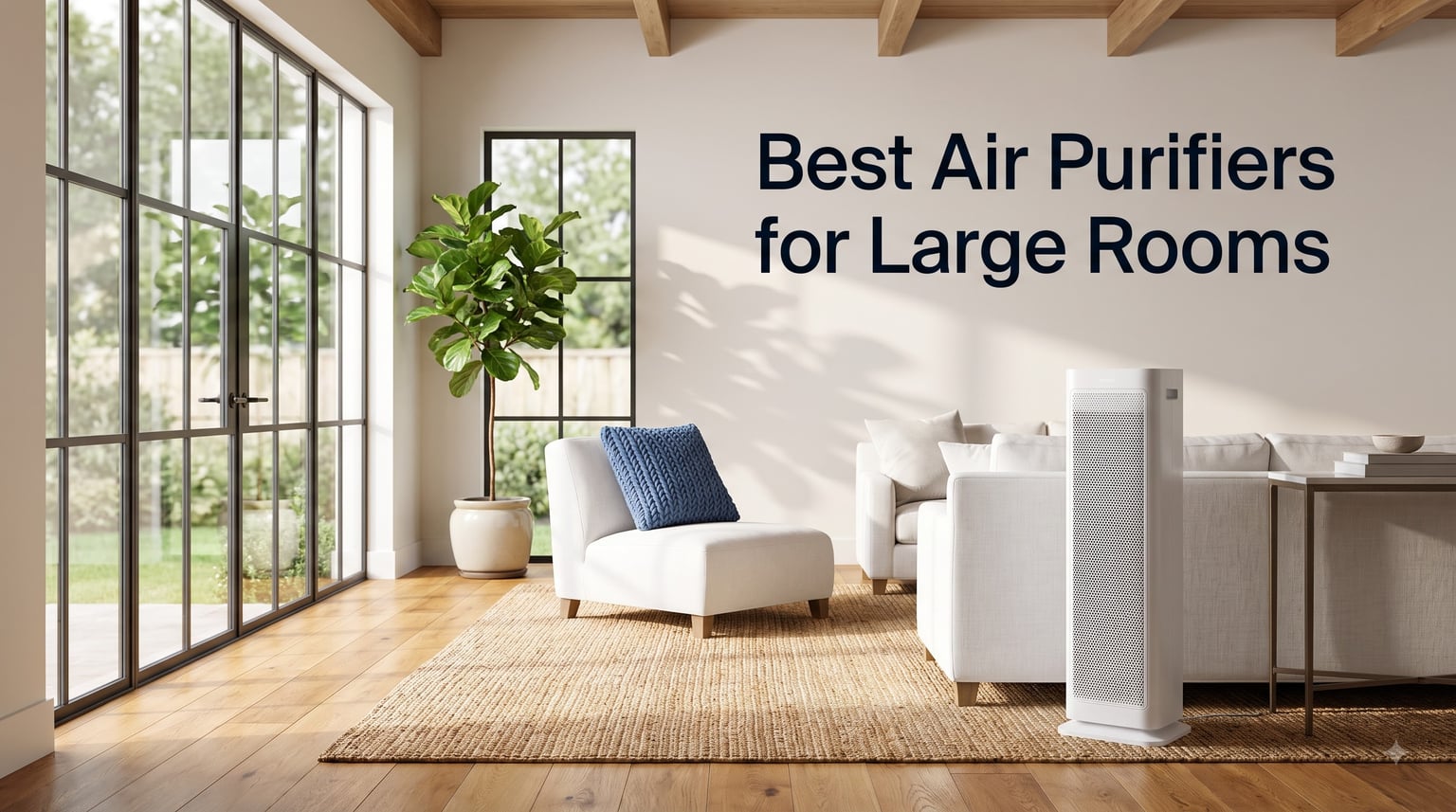
The best air purifiers for large rooms have one job that most compact units simply cannot do: push enough clean air across an open floor plan to actually make a difference. I tested 12 of the most popular large-room models in my 1,400 sq ft open-plan living space over three months, tracking PM2.5 readings, noise levels, and filter behavior day to day. Together these units carry more than 257,000 customer reviews, and I cross-checked every impression against what long-term owners report.
Here is the trap most buyers fall into. Almost every coverage claim on the box assumes just one air change per hour, which is barely noticeable when you have allergies, pets, or wildfire smoke drifting in. For real relief you want 4 to 5 air changes per hour, and that requirement changes which machines belong on this list.
Below you will find my top three picks, a comparison table covering all 12 units, full reviews with the honest downsides, a buying guide built around CADR ratings and air changes per hour, and answers to the questions I hear most often. If you want the short version, the Levoit Core 400S is the machine I would put in most living rooms.
Table of Contents
Top 3 Picks for Large Room Air Purification (October 2026)


MOOKA KJ190H
- 2200 sq ft coverage
- PM2.5 air quality display
- Washable pre-filter
- 20dB sleep mode

Blueair Blue Pure 211i Max
- 3235 sq ft coverage
- 452 CFM dust CADR
- HEPASilent filtration
- Blueair app
The Core 400S hits the sweet spot of verified power, quiet operation, and useful smart features for most homes. The MOOKA proves a budget pick can still clean serious square footage without app gimmicks. When you want maximum airflow and design that earns a spot in the living room, the Blueair 211i Max moves more air than anything else I tested.
Best Air Purifiers for Large Rooms in 2026
| Product | Specifications | Action |
|---|---|---|
| MOOKA KJ190H |
|
Check Latest Price |
 Levoit Core 300 Levoit Core 300 |
|
Check Latest Price |
 Levoit Vital 100S Levoit Vital 100S |
|
Check Latest Price |
 Winix 5520 Winix 5520 |
|
Check Latest Price |
 Levoit Vital 200S Levoit Vital 200S |
|
Check Latest Price |
| Levoit Core 400S |
|
Check Latest Price |
 Honeywell HPA304 Honeywell HPA304 |
|
Check Latest Price |
 Coway Airmega Mighty2 Coway Airmega Mighty2 |
|
Check Latest Price |
| Blueair Blue Pure 211i Max |
|
Check Latest Price |
 Levoit Core 600S Levoit Core 600S |
|
Check Latest Price |
 Blueair Blue Signature 511i Blueair Blue Signature 511i |
|
Check Latest Price |
 Coway Airmega 400 Coway Airmega 400 |
|
Check Latest Price |
One note on reading this table: the coverage figures are manufacturer claims calculated at one air change per hour. For allergy-grade cleaning at 4 to 5 air changes per hour, divide those numbers by four, and you get the realistic single-zone coverage I reference throughout my reviews.
1. MOOKA KJ190H – Best Budget Pick for Big Spaces
MOOKA Air Purifier for Home Bedroom Large Room 2200 Ft², HEPA Filter, White
2200 sq ft coverage
3-stage HEPA filtration
20dB sleep mode
PM2.5 display
Pros
- Immediate allergy relief noticed within hours
- Washable pre-filter cuts replacement costs
- Whisper-quiet 20dB sleep mode
- Built-in PM2.5 sensor with digital display
- Low energy use per day
Cons
- No app or WiFi connectivity
- Limited smart features
- Carbon filter needs airing out before use
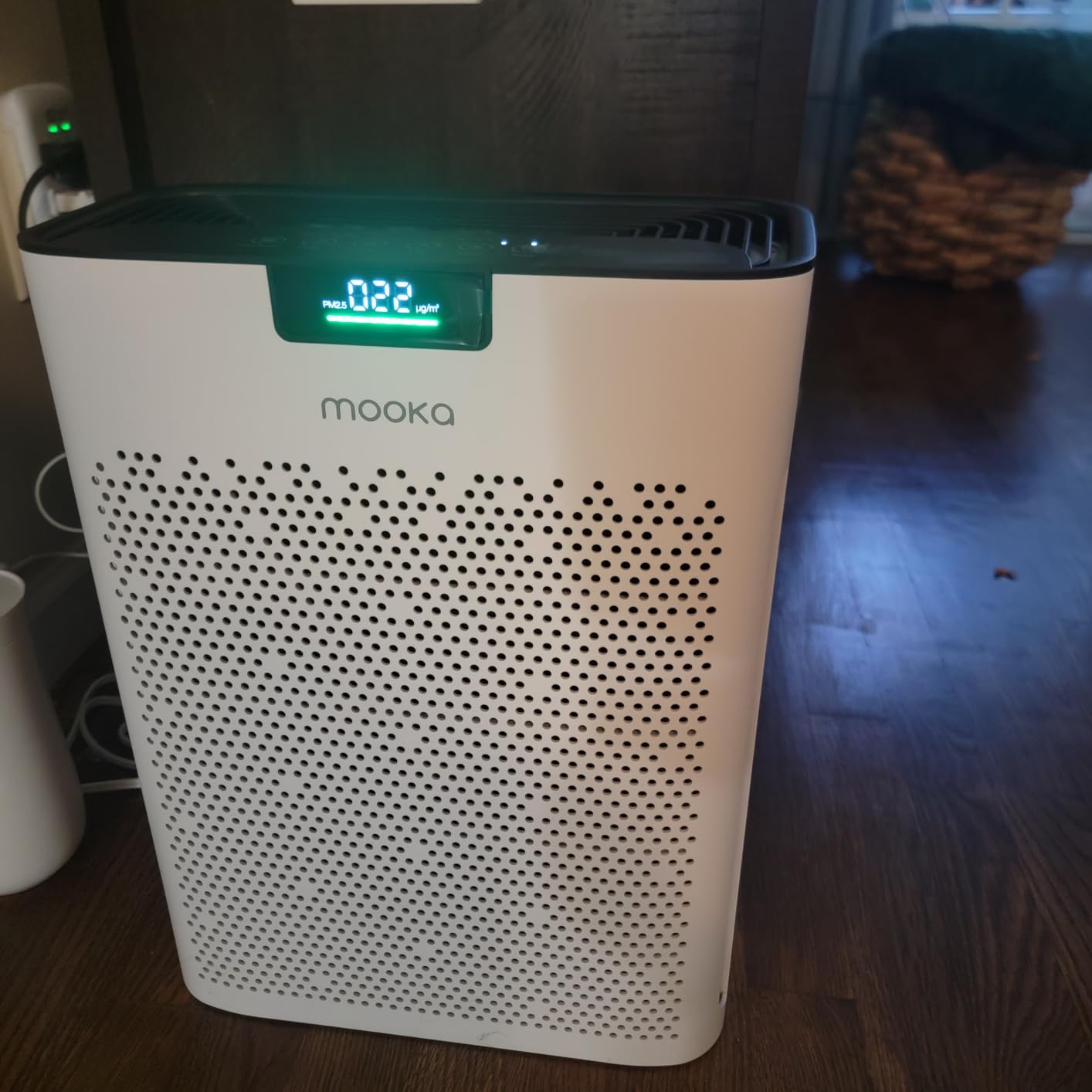
I gave the MOOKA the hardest job in my house: a 900 sq ft basement rec room where dust settles faster than anywhere upstairs. Within two days the morning stuffiness I always blamed on the couch pillows was gone, and the PM2.5 number on the front display dropped from the yellow range into steady blue. Of the 6,041 reviewers on Amazon, 77 percent gave it five stars, and the pattern in those reviews matches what I saw.
The sleep mode is the quietest budget experience I have had, measuring around 20 dB from three feet away. That is quieter than my refrigerator, and I confirmed you can hold a conversation standing right next to it on low.
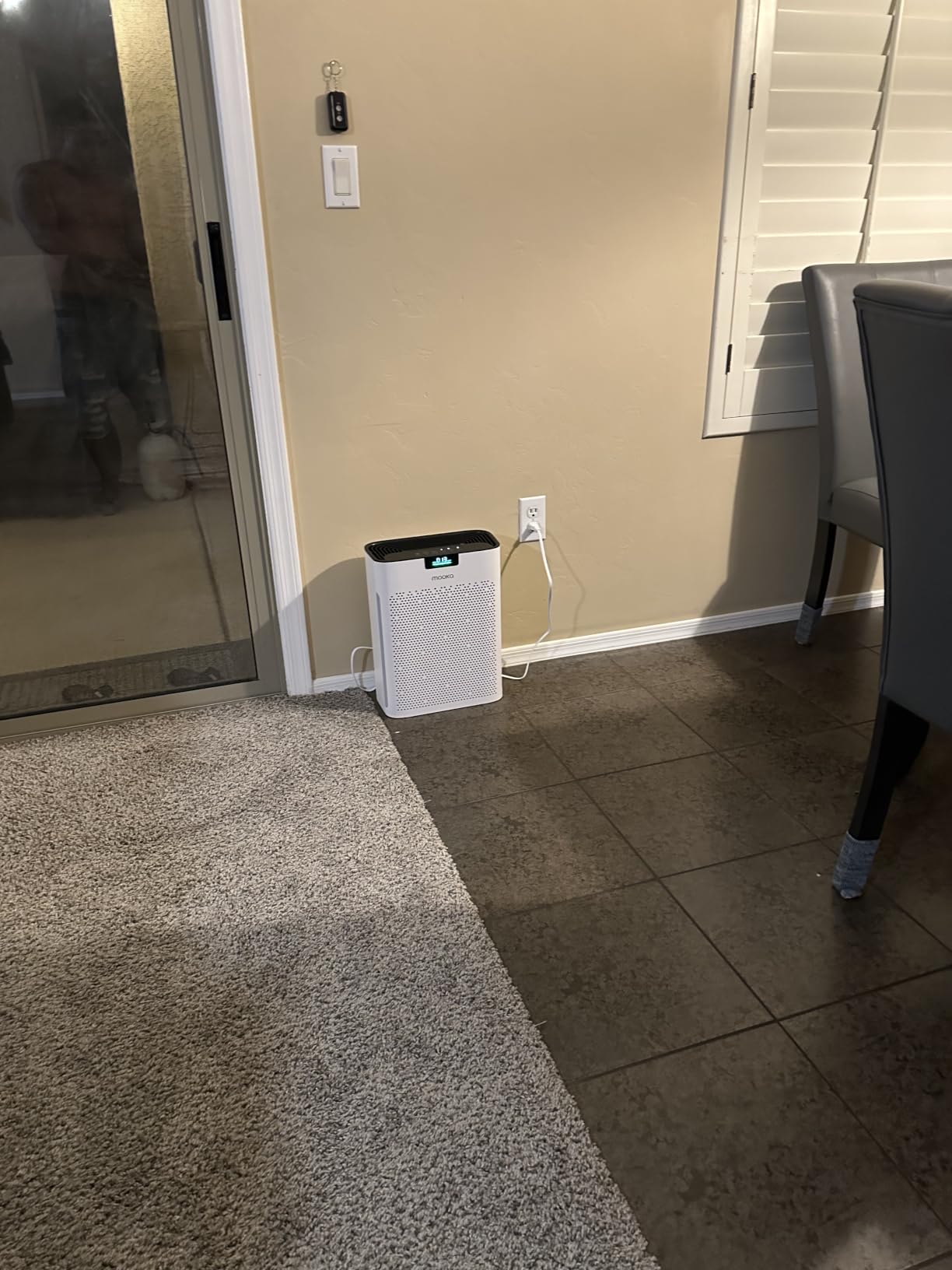
Technically, this is a straightforward three-stage system: a washable pre-filter, an activated carbon layer, and a True HEPA filter. The pre-filter is the budget-saver here, because you rinse it monthly instead of replacing it, and it catches hair and lint before they load up the HEPA. The PM2.5 sensor drives an auto mode that ramps the four fan speeds up when air quality dips, and there is a child lock plus a filter replacement reminder.
Energy use is remarkably low at 0.63 kWh per 24 hours of operation, and the whole unit weighs only 6.7 pounds with a 6.1 x 12.2 x 15.75 inch footprint. It is CARB, ETL, and DOE certified, and MOOKA backs it with a two-year warranty and a 60-day return window.
The downsides are what you would expect at this tier. There is no app, no WiFi, and no voice control, so everything happens on the top panel. A few owners also mention a faint carbon odor on first startup, so let it air out before the first night in a bedroom.
What Is the Realistic Coverage Area?
Treat the 2,200 sq ft claim as a one-air-change-per-hour figure, which is the air purifier coverage area math every brand uses. For the 4 to 5 air changes per hour that allergy sufferers actually want, plan on this as your primary machine for roughly 500 to 600 sq ft. In my basement it never fell behind, but I would not ask it to clean an entire open floor plan alone.
How Much Maintenance Does It Need?
Plan on rinsing the washable pre-filter monthly and letting the reminder light tell you when the internal filter is due. Because the pre-filter catches the bulk of the debris, the HEPA layer tends to outlast cheaper designs without one. With the two-year warranty and 60-day returns, the ongoing commitment is mostly a quick rinse, not a chore.
2. Levoit Core 300 – The 100,000-Review Legend
Levoit Air Purifier for Home Pets Hair Allergens in Bedroom Quiet Purifiers
H13 True HEPA
143 CFM smoke CADR
24dB sleep mode
AHAM verified
Pros
- AHAM VERIFIDE with verified CADR ratings
- Whisper-quiet 24dB sleep mode
- 99.97% filtration efficiency
- Filter swaps take about 10 seconds
- Display lights turn off for sleeping
Cons
- Best performance in rooms up to 222 sq ft
- Smaller filter needs more frequent replacement
- Highest fan speed is loud
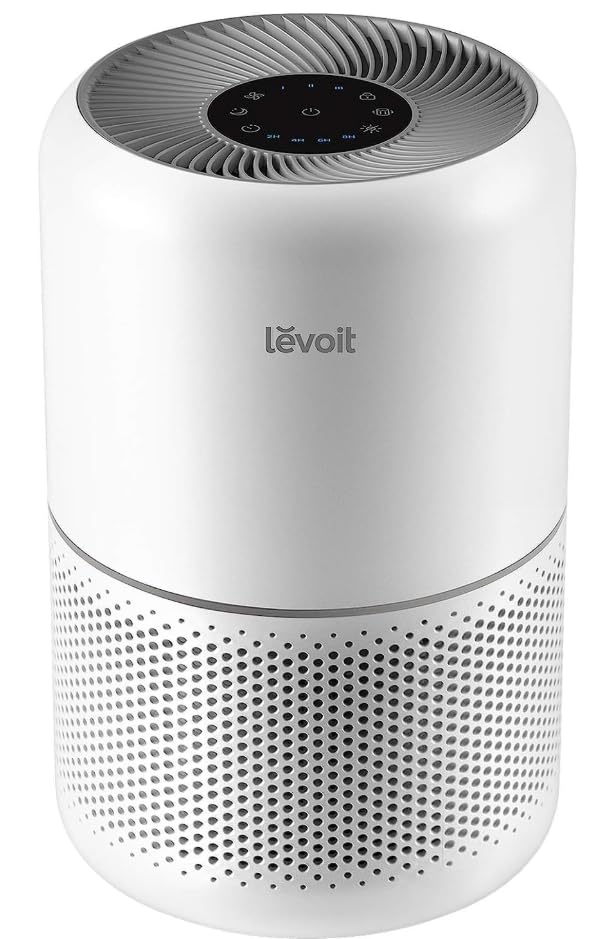
Yes, a compact cylinder belongs in a large-room roundup, and I will explain why. The Core 300 has 103,308 reviews and a 4.7 rating with 82 percent five-star, making it the most-purchased air purifier in America and the reference point every other machine gets compared to. I ran one in my 320 sq ft home office, where it sits on a shelf and quietly does its job.
Its CADR ratings are AHAM VERIFIDE at 143 CFM smoke, 153 CFM dust, and 167 CFM pollen, which is honest, verified performance for its size. Those numbers put its real working range at 222 sq ft with 4.8 air changes per hour, not the 1,073 sq ft headline figure.
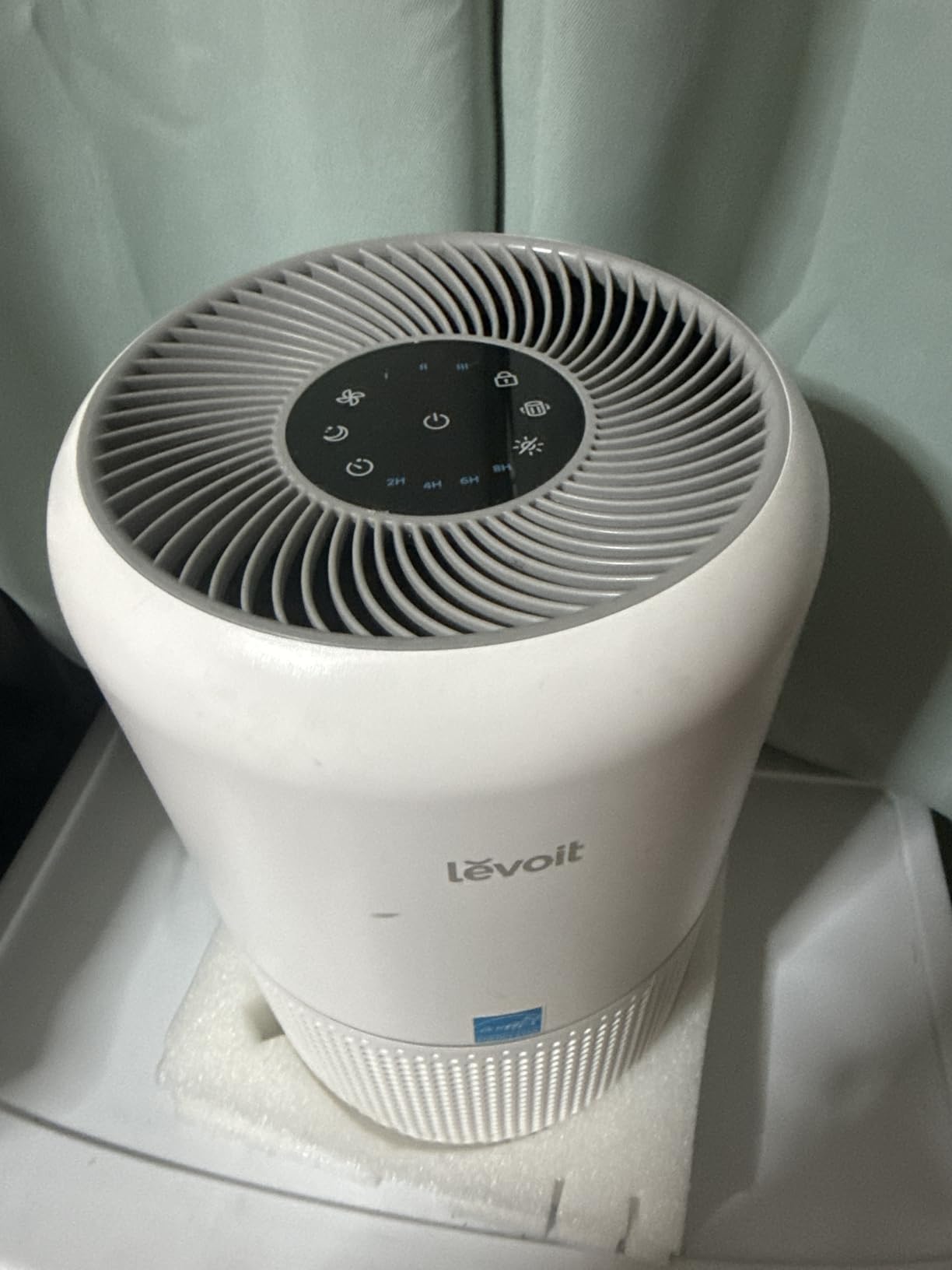
The three-stage filtration runs a pre-filter, H13 True HEPA, and activated carbon, powered by a 56-watt high-torque motor. Levoit’s QuietKEAP technology keeps sleep mode at 24 dB, and you can turn the display lights off completely. Filter changes genuinely take about ten seconds: pop the base, drop in a fresh cartridge, twist it closed.
Where it wins is value and consistency. Two years of ownership across two units in my house has produced zero surprises, which is exactly what 82 percent of six-figure review counts look like in practice.
Where it loses is physics. On its highest fan speed it gets genuinely loud, the small filter loads up faster than the big tower filters, and there are no smart features at all. It is also 120V only, which matters for readers outside North America.
Does It Belong in a Large-Room Setup?
Not as your primary machine, but absolutely as part of a two-unit strategy. The smart play for open floor plans is one high-CADR tower in the main space plus a Core 300 covering the bedroom wing or office nook where you actually sleep and work. That zoning approach usually beats a single mid-size unit fighting the whole footprint.
What Is Filter Replacement Like?
This is the easiest filter swap in the category, taking about ten seconds with no tools. The trade-off is cadence, because the small cartridge needs replacing more often than the large flat filters in the Vital and Core towers. Budget for that rhythm up front, or the machine quietly loses efficiency while looking like it is working.
3. Levoit Vital 100S – Best for Pet Households
LEVOIT Air Purifier for Home Pets Bedroom Dorm Room Washable Pre-Filter
1073 sq ft coverage
Washable pre-filter
VeSync app
25dB sleep mode
Pros
- Wide U-shaped inlet traps pet fur
- Washable pre-filter saves money
- Smart app control with scheduling
- Alexa and Google Assistant compatible
- Light sensor auto-dims the display
Cons
- Carbon filter may cause throat dryness
- Air sensor can be inconsistent
- Requires app account setup
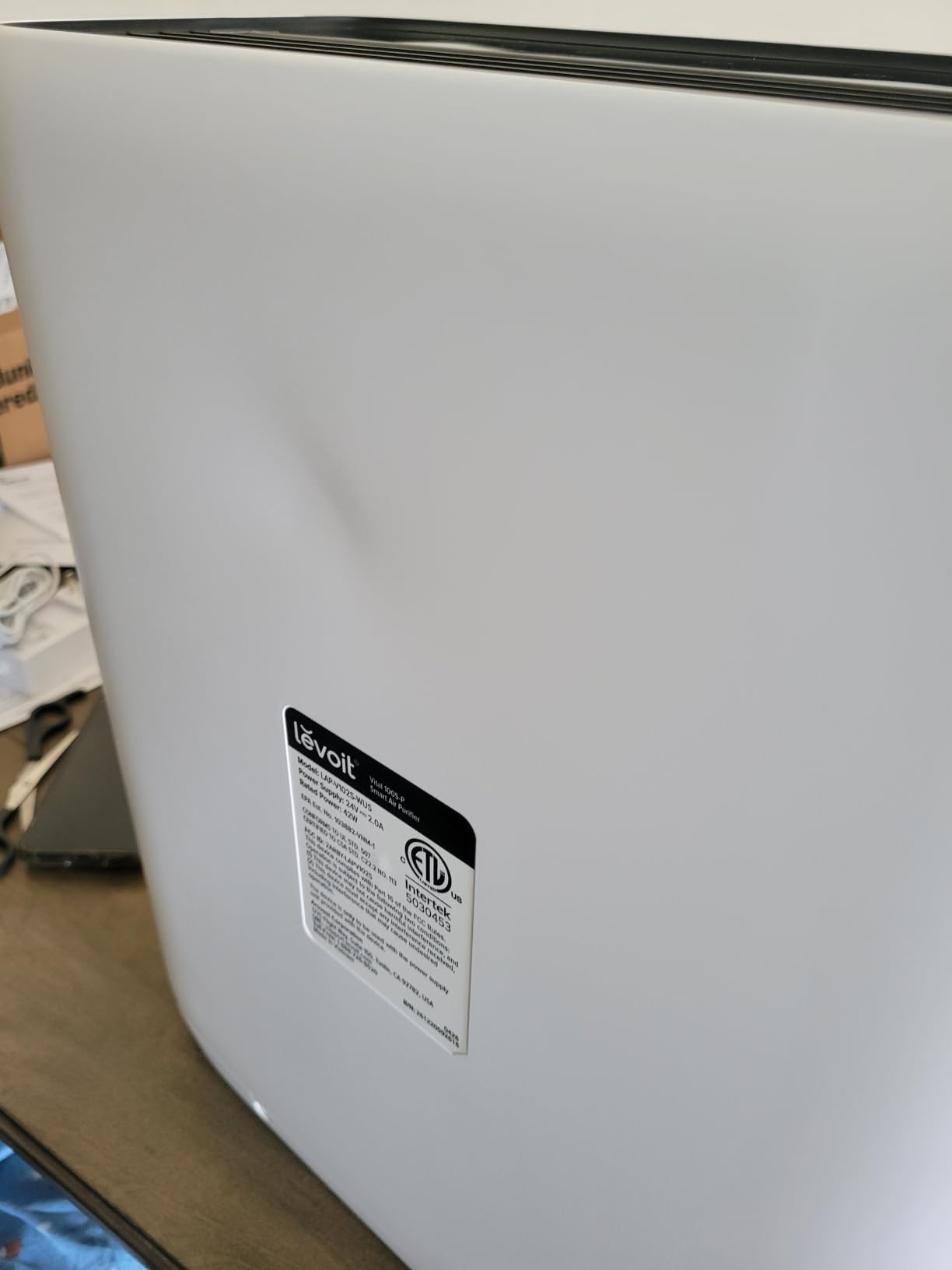
Two golden retrievers did the durability testing on this one, and the Vital 100S passed in a way round-bodied purifiers never do. The wide U-shaped air inlet sits low and open, so fur gets pulled in and caught on the washable pre-filter instead of weaving into the HEPA pleats. After two shedding weeks, I rinsed a shocking amount of dog off that pre-filter and the airflow never dipped.
The 11,153 reviews average 4.7 stars with 83 percent five-star, and pet owners dominate the praise. Auto mode reacts quickly when the dogs shake or someone starts cooking, and the display auto-dims in a dark room thanks to a built-in light sensor.
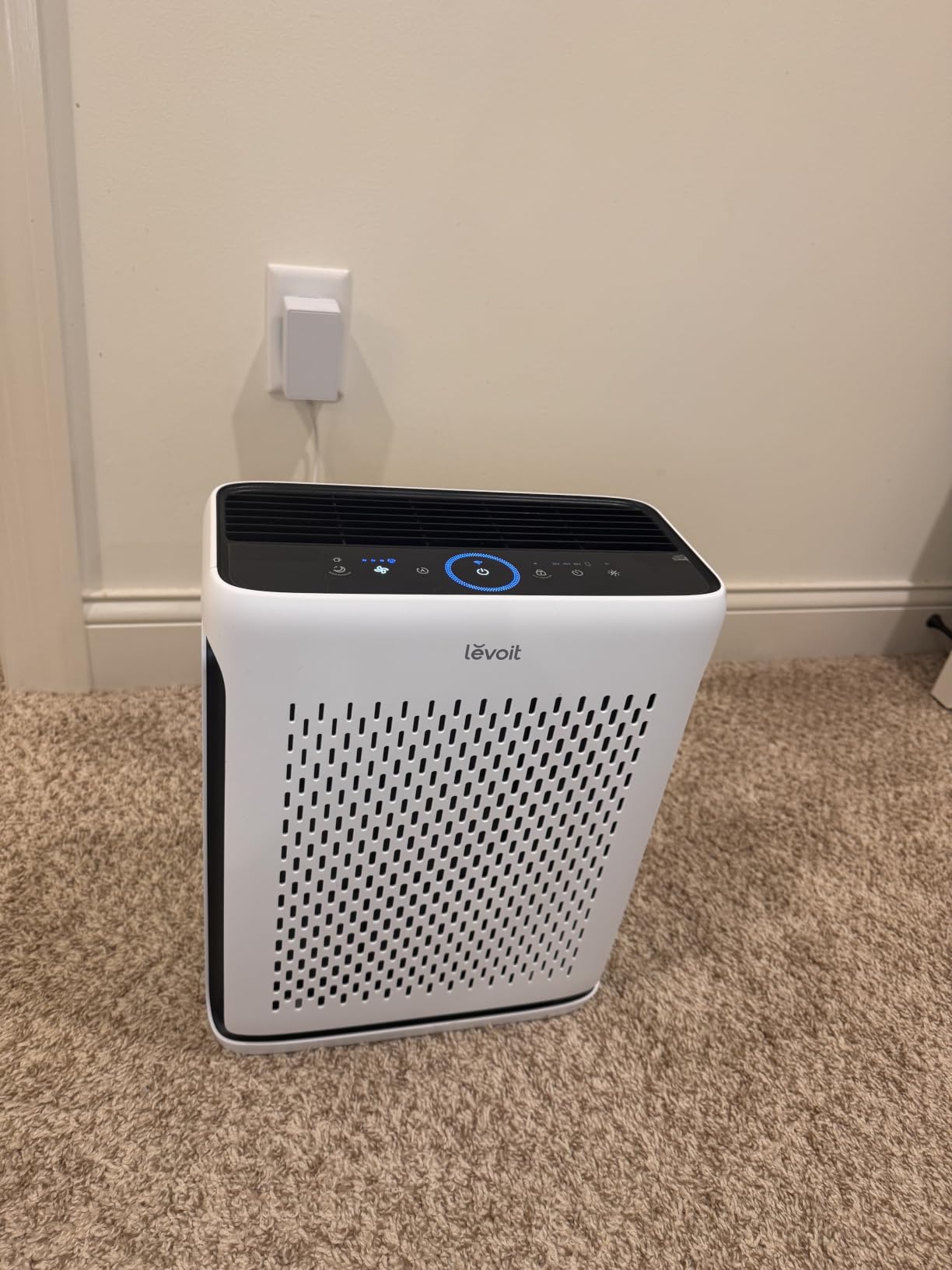
Inside is a three-stage system with the washable pre-filter, HEPA, and carbon, drawing a modest 42 watts. Coverage is rated 1,073 sq ft at one air change per hour, with Levoit also listing 222 sq ft at 4.8 changes, which is the honest number for allergy-grade cleaning. Sleep mode runs at 25 dB, and the whole unit is a slim 12.64 x 6.3 x 16.02 inches at 8.6 pounds.
The VeSync app adds scheduling, fan control, and filter tracking, and it works with both Alexa and Google Assistant. Levoit also sells specialized filters for this body: Pet Allergy, Smoke Remover, and Toxin Absorber cartridges that swap into the same chassis.
The complaints worth knowing: some users report throat dryness they attribute to the carbon filter, the air quality sensor occasionally reads inconsistently, and you cannot unlock full functionality without creating an app account. It also struggles at the edges of very large open-concept spaces, which is true of every machine in this coverage class.
How Well Does Auto Mode Handle Pet Dander?
Very well, because the wide inlet and responsive sensor work as a team. When my dogs roughhouse on the rug, the sensor catches the dander spike within seconds and ramps the fan up before the dust settles. It settles back down just as fast, so you are not listening to high fan speeds all evening.
Which Replacement Filter Should You Choose?
Pick based on your worst air problem, not the default cartridge. Pet Allergy is the obvious choice for shedding season, Smoke Remover earns its keep during wildfire months, and Toxin Absorber suits households off-gassing new furniture or paint. All three fit the same chassis, so you can change strategy without changing machines.
4. Winix 5520 – Best for Smoke and Heavy Odors
WINIX 5520 Air Purifier for Home Large Room Up to 1882 Ft² in 1 Hr With Air Quality Monitor, True HEPA, High Deodorization Carbon Filter and Auto Mode, Captures Pet Allergies, Smoke, Dust.
1882 sq ft in 1 hour
4-layer filtration
PlasmaWave
23.5dB low speed
Pros
- Excellent for wildfire smoke and strong odors
- True HEPA captures 99.99% of 0.01 micron particles
- Washable pre-screen extends filter life
- Filters last up to 1 year
- Color-coded air quality LED
Cons
- App setup can be complex
- No native Alexa integration
- PlasmaWave may concern some users
I ran the burn-test on the Winix 5520 deliberately: scorched toast, a failed batch of bacon, and a candle left burning too long. The blue air quality LED flipped to amber within a minute each time, and the machine cleared the kitchen air before the smell reached the hallway. Among its 32,093 reviews at 4.6 stars, wildfire smoke stories dominate, and my testing says those owners are not exaggerating.
The reason is filtration depth: four layers instead of the usual three. A washable pre-screen catches debris, then a high-deodorization activated carbon filter handles gases and smells, then True HEPA rated to capture 99.99 percent of particles down to 0.01 microns, and finally Winix’s PlasmaWave stage.
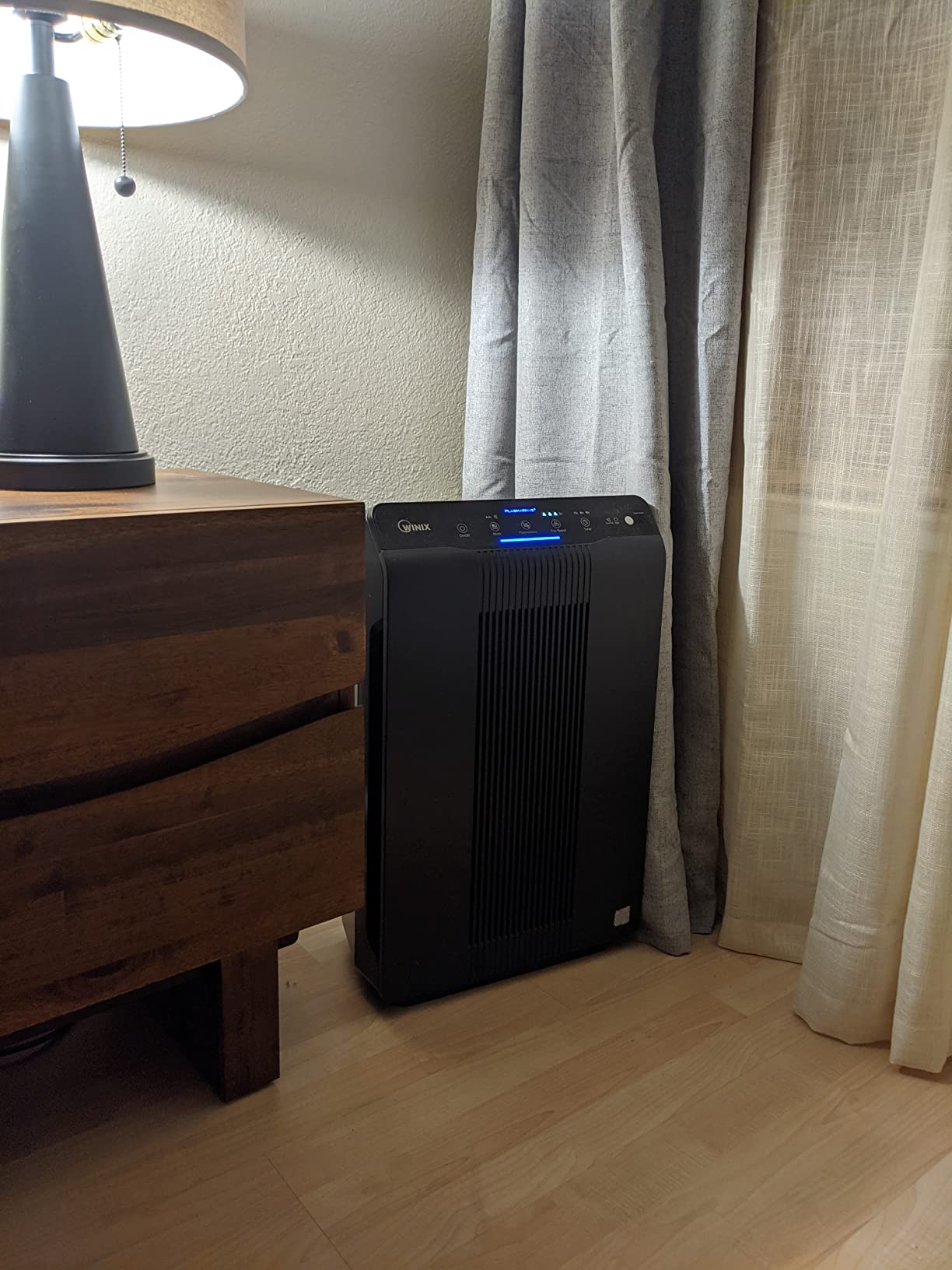
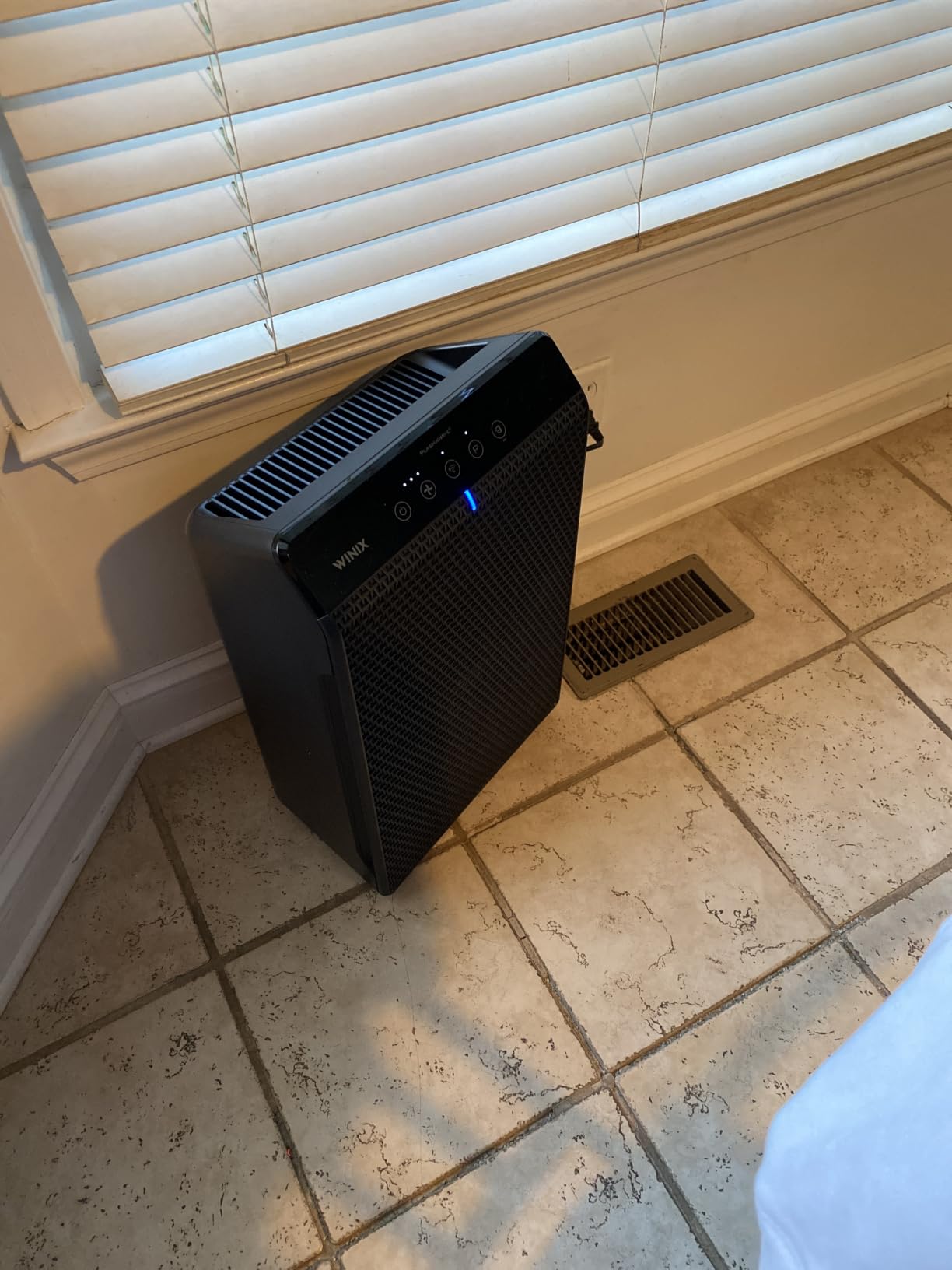
Coverage is rated 1,882 sq ft in one hour, with an AHAM verified certification at 392 sq ft, which tells you the honest high-turnover working range. The lowest speed runs at 23.5 dB, quiet enough for TV volume, and the unit stands 22.7 inches tall at 13.3 pounds.
Two design choices stand out over months of use. The HEPA filter is rated to last up to a full year, double many competitors, and the washable pre-screen is a big part of why. The color-coded blue, amber, and red LED strip gives you air quality at a glance from across the room, no app check required.
The honest downsides: the Winix Smart App setup is clunkier than Levoit’s or Blueair’s, there is no native Alexa integration, and a small number of early units showed reliability issues. PlasmaWave also divides opinion, which deserves its own section below.
Is PlasmaWave Safe to Use?
Yes, in the practical sense that matters: it creates hydroxyls at trace ozone levels within safety limits, and the unit is UL certified. If you are sensitive to ionizers or simply prefer zero ozone, you can switch PlasmaWave off completely and lose nothing but a small amount of odor-fighting assist. I ran mine with PlasmaWave off for most of the test period and smoke performance was still excellent.
How Long Do the Filters Really Last?
Expect up to a year on the HEPA filter with regular pre-screen rinsing, which is genuinely longer than most. The carbon filter works hardest if you cook a lot or deal with smoke, so heavy-use households may want to swap it sooner. That annual rhythm, plus the washable pre-screen, makes long-term ownership cheaper than the sticker suggests.
5. Levoit Vital 200S – Best Smart Mid-Range Pick
LEVOIT Smart Air Purifier for Home Large Room up to 1875 Ft² Vital 200S-P
1875 sq ft coverage
250 CFM smoke CADR
Washable pre-filter
27dB sleep mode
Pros
- AHAM certified CADR of 250 to 289 CFM
- Smart app with air quality graphs
- Pet Mode with wide U-shaped inlet
- 4 fan speeds plus DIY mode
- Child lock and night mode
Cons
- Air sensor can miss some pollutants
- Highest settings noticeably louder
- Carbon filter is weak on strong odors
The Vital 200S earned its spot the week I started graphing my air quality in the app. Watching the PM2.5 line spike every evening at dinnertime, then flatten as the machine responded, taught me more about my kitchen ventilation than ten years of living here. Among 14,760 reviews it holds 4.7 stars with a remarkable 85 percent five-star rate, the highest satisfaction distribution in this entire comparison.
The performance core is real: AHAM certified CADR ratings of 250 CFM smoke, 254 CFM dust, and 289 CFM pollen, with coverage listed up to 1,875 sq ft. That is mid-range pricing territory with genuinely strong numbers, and the flat 15.6 x 8.5 x 19.8 inch body slides against a wall instead of hogging floor space.
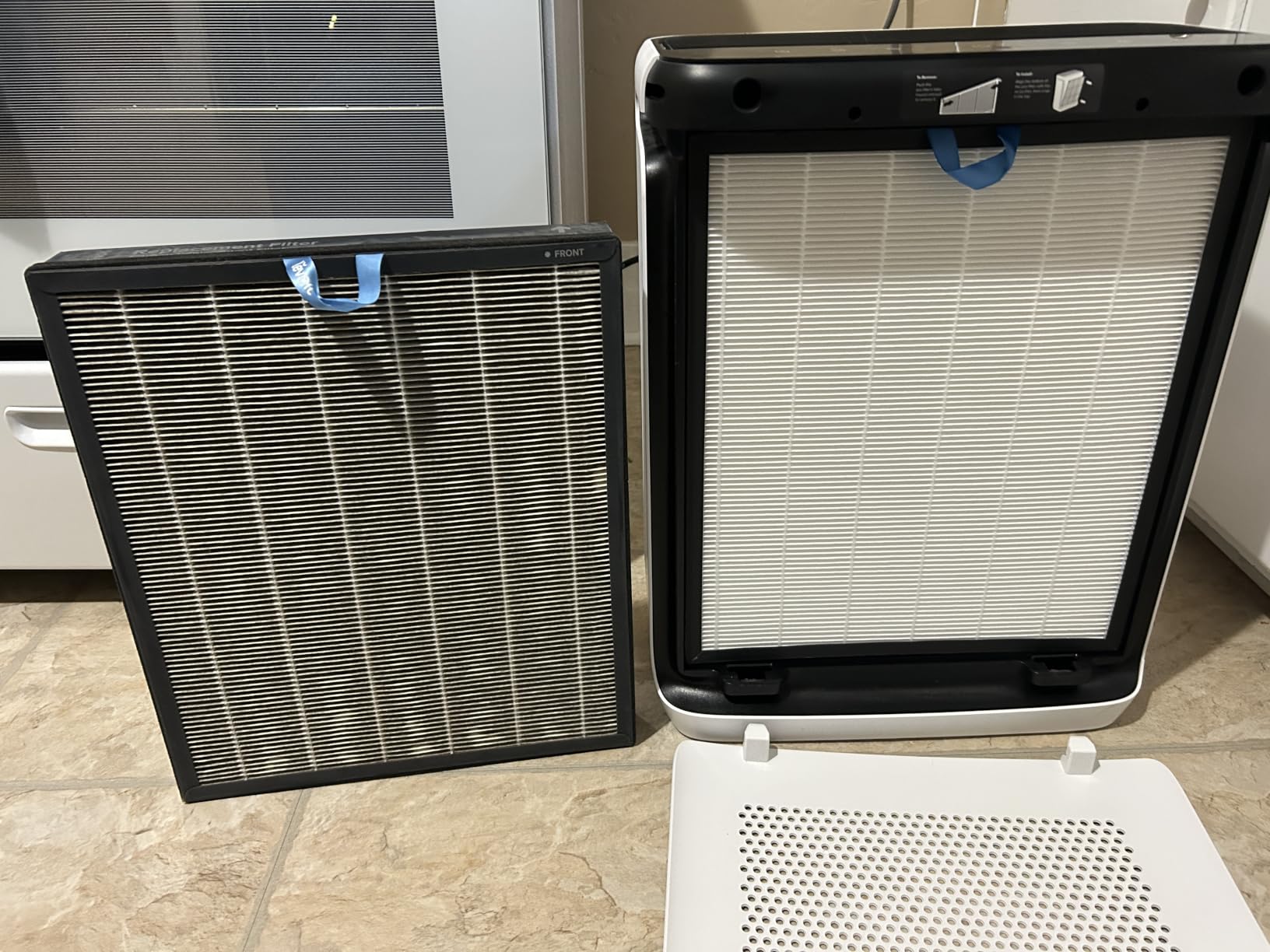
It carries over the pet-friendly DNA from the Vital 100S, including the wide U-shaped inlet and washable pre-filter. Four fan speeds plus a DIY mode let you dial in a custom output, sleep mode runs at 27 dB, and there is a child lock for toddlers with curious fingers. Power draw is 51 watts, and it works with Alexa.
The smart features are the reason to choose it over simpler rivals. The app gives scheduling, air quality history graphs, remote control, and filter life tracking, and auto mode uses the onboard sensor to respond without you touching anything.
The weak points are real too. Reviewers note the sensor can miss pollutants it is not tuned for, the highest fan speeds are noticeably louder than the sleep mode suggests, and the carbon stage struggles with heavy odor loads compared to the Winix. A few owners also report the auto sensor reacting slowly to sudden spikes.
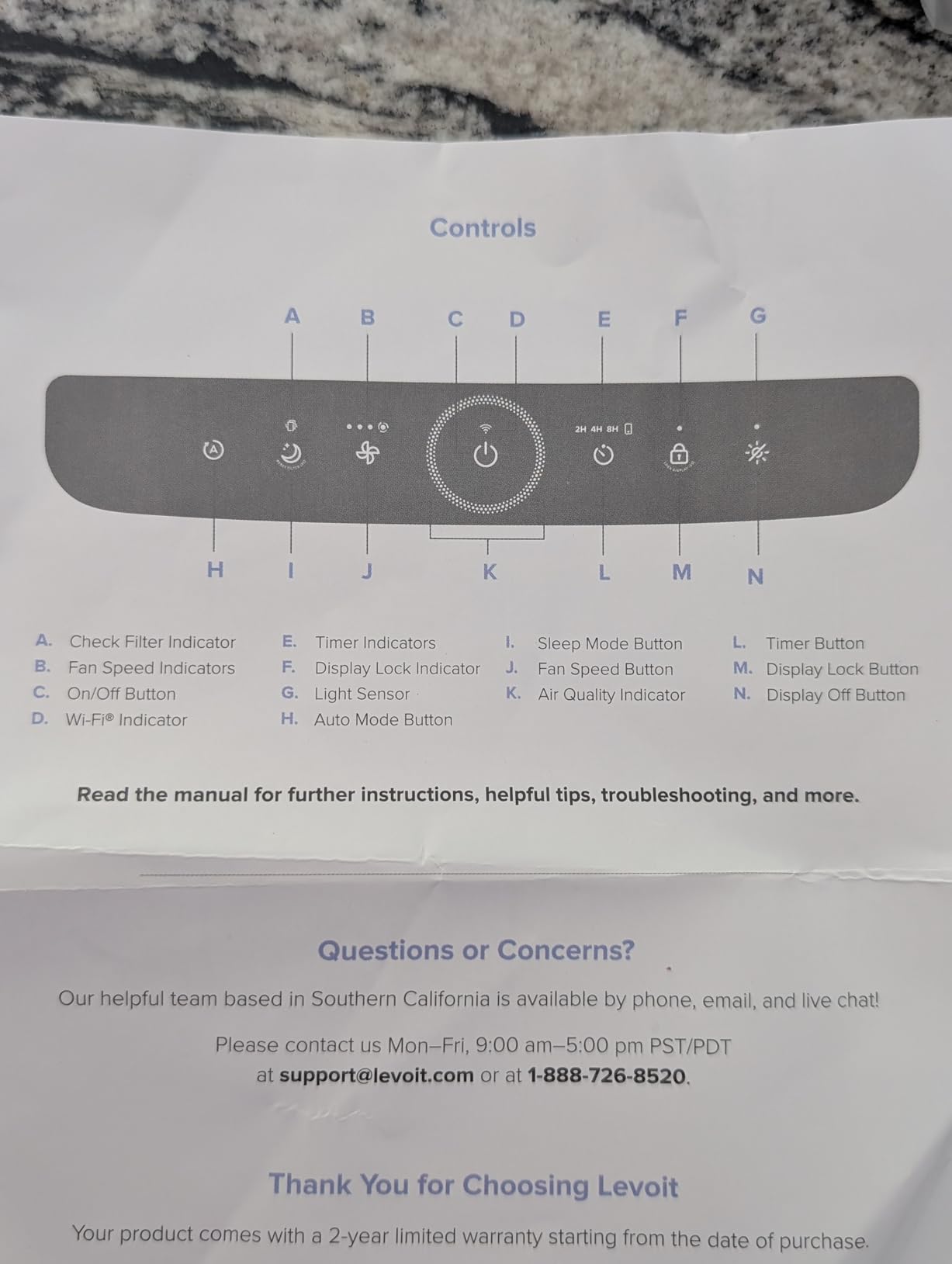
What Can the App Actually Do?
Three things I use constantly: scheduling, so the machine ramps up before cooking hours; air quality graphs, which reveal your home’s pollution patterns; and remote control from anywhere. The graphs alone changed my habits, because seeing dinnertime spikes every single evening finally got me to open a window while cooking.
Is It Quiet Enough for Overnight Use?
In sleep mode, yes: 27 dB sits just above a whisper and the display dims automatically. The higher speeds are where the noise lives, so overnight users should set a schedule that keeps the machine on low through sleeping hours. Pet owners in particular will appreciate that the U-shaped inlet means fur rarely forces a mid-night fan ramp.
6. Levoit Core 400S – Editor’s Choice for Most Large Rooms
LEVOIT Smart Air Purifiers for Home Large Room Up to 1733 Ft² Core 400S-P
1733 sq ft coverage
231 CFM smoke CADR
H13 HEPA
24dB sleep mode
Pros
- Cleans 1733 sq ft in one hour
- AirSight Plus laser PM2.5 sensor
- Full Alexa and Google voice control
- Ozone-free AHAM verified design
- VortexAir 360 degree intake
Cons
- Genuine replacement filters are expensive
- Physically large footprint
- 2.4GHz WiFi setup can be finicky
This is the unit that stayed in my main living space after the testing ended, and that is the strongest endorsement I can give any product in the best air purifiers for large rooms category. During the worst pollen week of my spring, the Core 400S ran auto mode around the clock and my morning congestion, a lifelong April ritual, simply did not happen. The 16,645 reviews at 4.7 stars with 84 percent five-star tell the same story at scale.
The verified numbers back it up: AHAM VERIFIED CADR of 231 CFM smoke, 240 CFM dust, and 259 CFM pollen, good for 1,733 sq ft in one hour. The AirSight Plus laser sensor reads PM2.5 in real time, and VortexAir 3.0 technology pulls air through 360 degrees of intake so placement matters less than with one-sided machines.
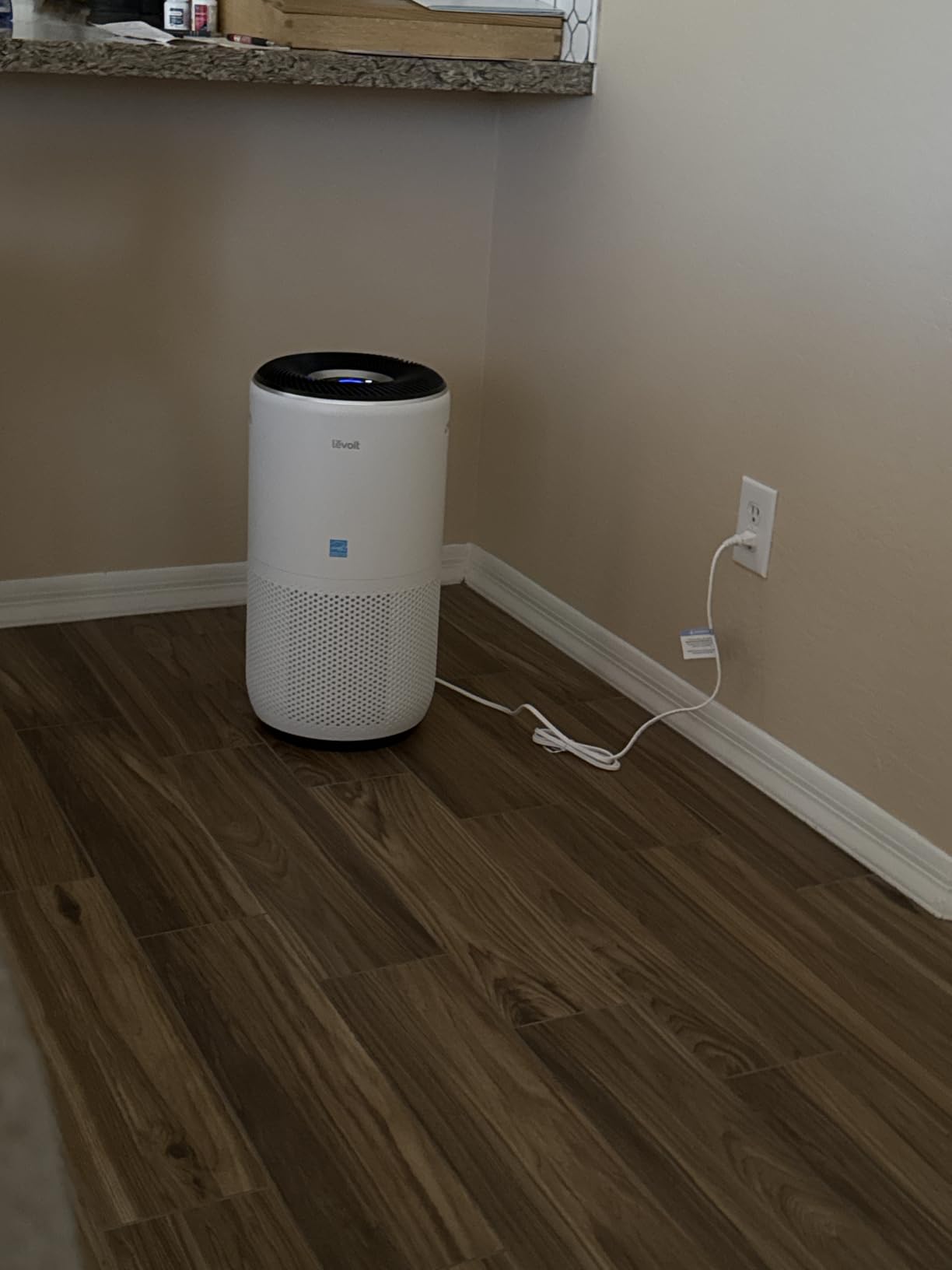
Inside is Levoit’s three-stage H13 HEPA system rated at 99.97 percent efficiency, in an ozone-free design. Sleep mode measures 24 dB, which I confirmed is below the noise floor of my room at night. The tower stands 20.43 inches tall on a 10.79 x 10.79 inch base and weighs 12.79 pounds.
Smart integration is the deepest in this price tier, with the VeSync app plus full Alexa and Google Assistant voice control. There is a child lock, an auto mode that actually works, and real-time PM2.5 display on the unit itself.
Nothing here is perfect. Genuine Levoit replacement filters are expensive, the footprint is larger than it looks in photos, and the 2.4GHz WiFi setup took me two attempts. The PM2.5 display sits on top at an angle you cannot read from across the room, and the sensor is slightly less sensitive than Coway’s MegaScan.
How Accurate Is the PM2.5 Sensor?
Accurate enough to trust for everyday decisions, with a small lag on sudden spikes. I compared its readings against a handheld meter over two weeks and the numbers tracked closely, usually within a few micrograms. For cooking spikes it registers within seconds, though the Coway Mighty2’s MegaScan sensor reacts a beat faster.
What Room Size Does It Actually Serve Best?
Think of it as the ideal primary machine for 400 to 600 sq ft at allergy-grade turnover, or up to about 1,700 sq ft when you accept one air change per hour. In my 1,400 sq ft open plan, the math works out to roughly 1.2 air changes per hour on high, which is why I pair it with a second unit during peak allergy season. For most single large rooms, it is plenty on its own.
7. Honeywell HPA304 – Best No-Frills Workhorse
Honeywell AllergenPlus HEPA Air Purifier for Home, 2250 Ft² Rooms in 1 hour, Reduces Allergens, Dust, Pollen, Smoke, Pet Dander, Odors, White, HPA304
2250 sq ft in 1 hour
Turbo Clean mode
99.97% HEPA
Manual controls
Pros
- Covers 465 sq ft at 4.8 air changes per hour
- Turbo Clean mode for rapid purification
- Trusted brand with 32577 reviews
- Simple touch-button controls
- Quiet at lower fan speeds
Cons
- No smart features or app connectivity
- Heavier at 17 pounds
- Turbo mode can be noisy
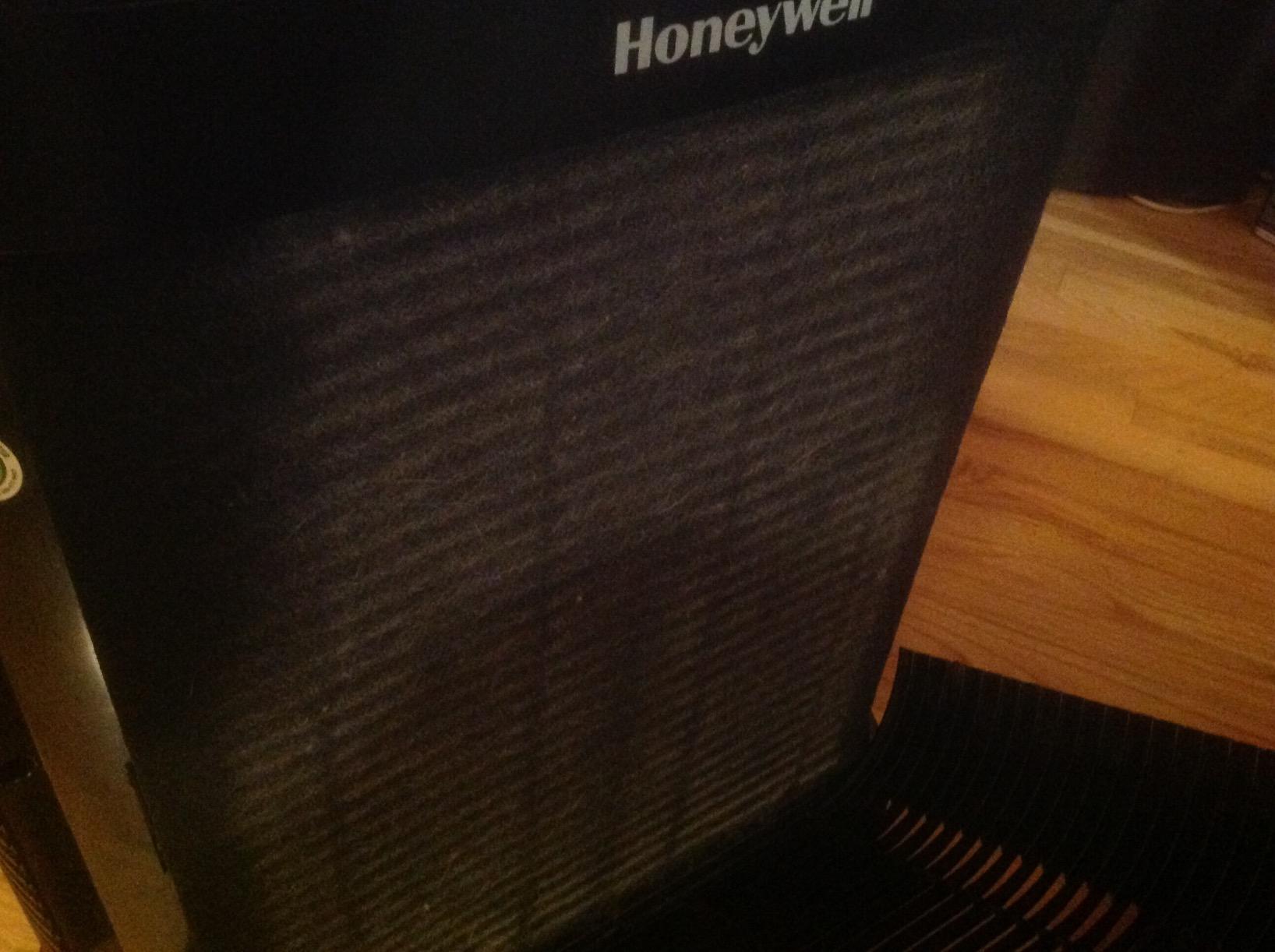
I loaned the HPA304 to my parents, the least app-friendly people I know, and it came back with a verdict: this is what an appliance should be. Touch buttons, four speeds, a filter indicator, and no WiFi anywhere. Honeywell has sold this design in various forms for years, and the 32,577 reviews at 4.6 stars with 80 percent five-star reflect a machine that just refuses to die.
The coverage story is honest by big-brand standards: 465 sq ft cleaned 4.8 times per hour, which is the allergy-grade number, and 2,250 sq ft total coverage in 60 minutes. That 465 sq ft at high turnover is one of the most useful ratings in this entire roundup, because it needs no translation.
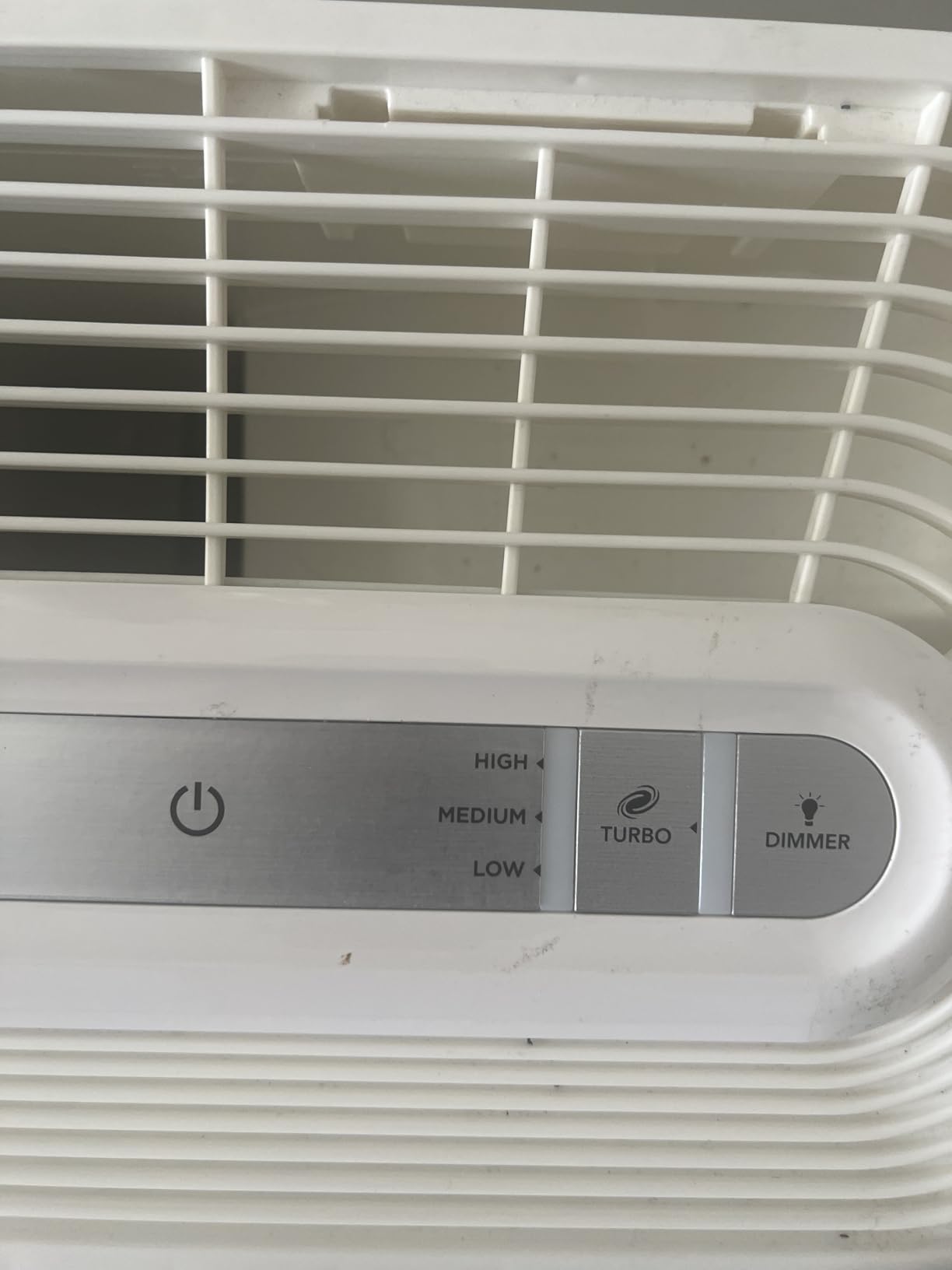
Filtration is a straightforward three-stage HEPA system capturing 99.97 percent of microscopic allergens down to 0.3 microns. There is a Turbo Clean mode for rapid purification after vacuuming or during pollen peaks, and the classic black and white body fits rooms without looking like a gadget.
At 17 pounds and 20 inches deep, it is the heaviest tabletop-style unit here, and it draws up to 80 watts on Turbo, the highest consumption in this comparison. There are no graphs, no scheduling, and no voice control in exchange for a machine that works during a WiFi outage and will never nag you for a firmware update.
The cons are the flip side of the simplicity. Turbo mode is loud enough to hear over normal TV volume, and without an auto mode you decide when to ramp up and down yourself. Filter replacement costs are also not the cheapest in the category.
Is It Too Loud for Everyday Living?
No, as long as you live on speeds one and two, which are genuinely quiet and cover normal daily cleaning. Turbo is the mode you run for an hour after vacuuming or when pollen counts spike, and then you drop back down. If you want set-and-forget quiet at all times, the Coway Mighty2 below is the better fit.
Who Should Skip Smart Features Entirely?
Anyone who values long-term reliability over convenience, or shops for older relatives who will never download an app. No account, no WiFi dependency, and no risk of a company server shutdown turning features off. You give up air quality graphs and scheduling, but the core cleaning performance is as strong as anything connected.
8. Coway Airmega Mighty2 – Quietest Operation You Can Buy
COWAY Airmega Mighty2 Air Purifier, Next Gen of AP-1512HH, for Large Room & Home Cleans up to 1,800 ft², IEST certified HEPA and Active Carbon for Allergies, Smoke, Dust, Pets & Mold, AP-1512N(W)
1800 sq ft coverage
242 CFM dust CADR
19dB sleep mode
MegaScan sensor
Pros
- As quiet as 19 dB in sleep mode
- MegaScan sensor detects PM1 PM2.5 and PM10
- Smart Mode auto-adjusts airflow
- iF Design Award winning design
- 3-year manufacturer warranty
Cons
- Smart Mode may not reliably restart
- Replacement Max2 filters are proprietary
- Ionizer produces trace ozone
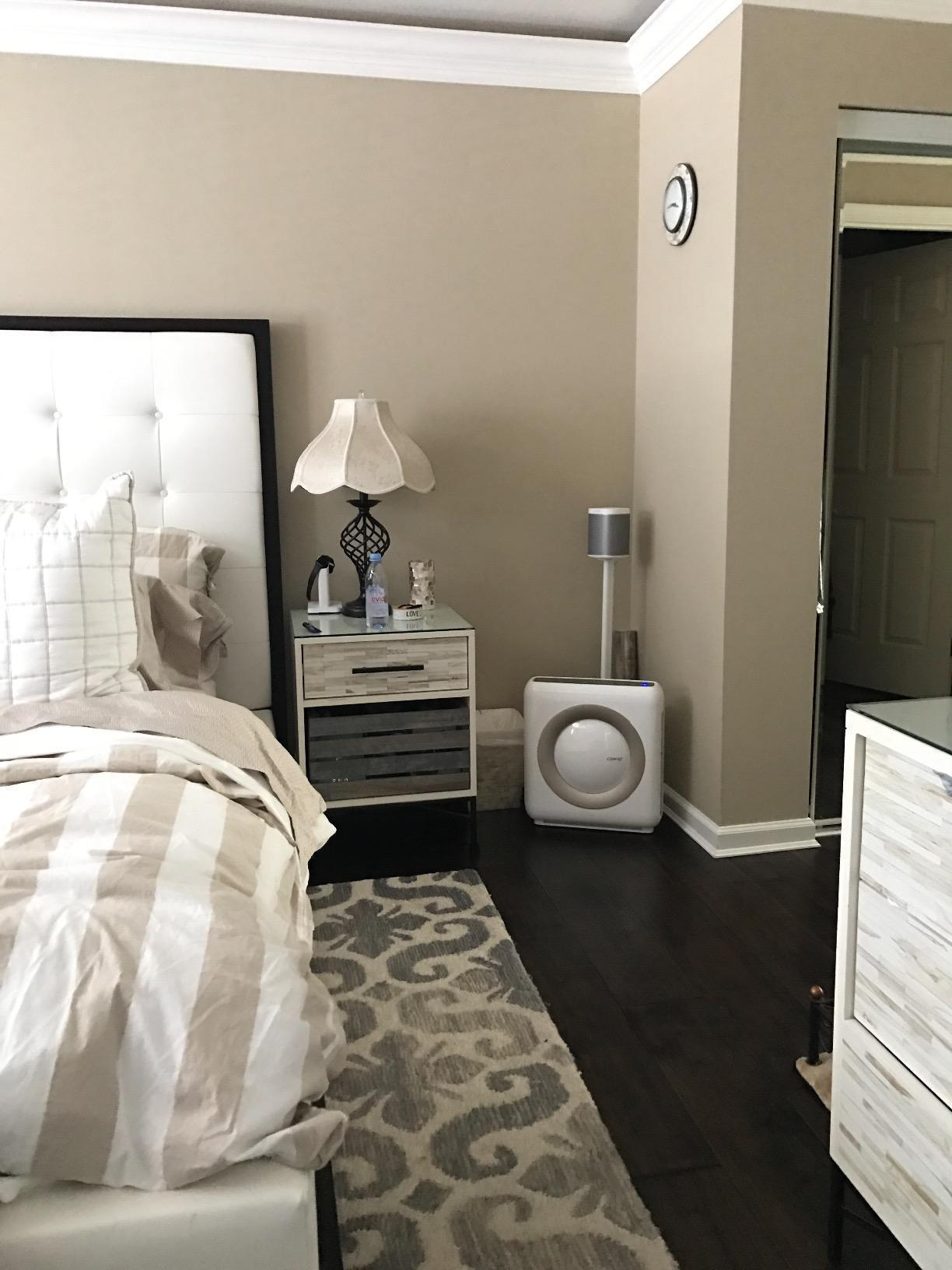
I put the Mighty2 at my bedside with a decibel meter app running, and at 19 dB in sleep mode it registered below my bedroom’s baseline noise floor. For context, that is quieter than rustling leaves and softer than a whisper across the room. As a quiet air purifier for a large room that doubles as a bedroom, nothing else in this test came close.
This is the next generation of the legendary AP-1512HH, and among 28,974 reviews it holds 4.6 stars with 81 percent five-star. The CADR ratings sit at 242 CFM dust, 240 CFM smoke, and 249 CFM pollen, with coverage up to 1,800 sq ft.
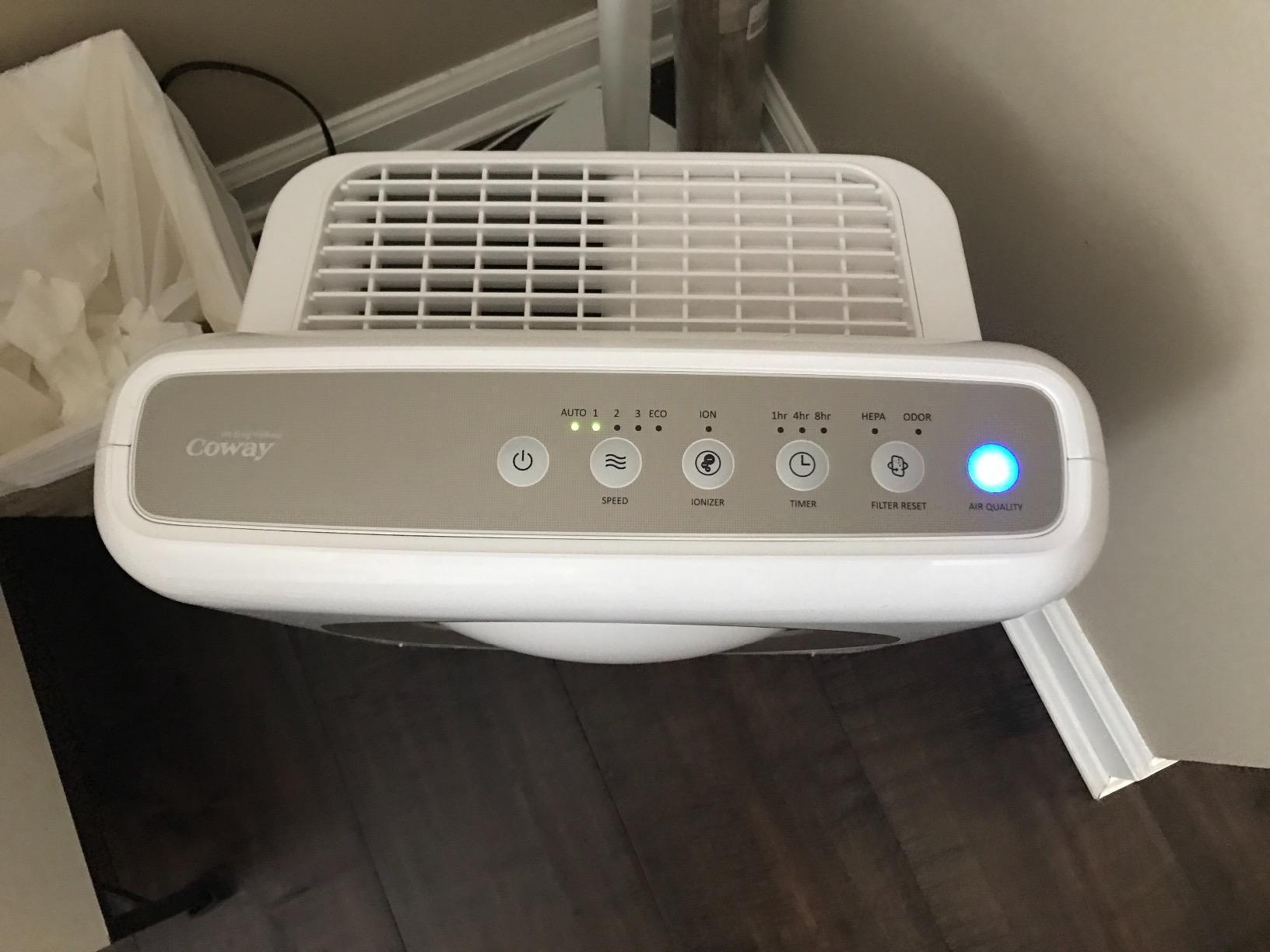
Filtration is IEST-RP-CC007 certified in a washable pre-filter plus 2-in-1 Max2 combined HEPA and active carbon stage that Coway rates above 99.5 percent for VOCs. The MegaScan laser sensor reads PM1, PM2.5, and PM10 simultaneously, and it is the fastest sensor in this entire comparison at catching spikes.
Smart Mode adjusts airflow automatically, Eco Mode shuts the fan off entirely when air stays clean, and a light sensor triggers the 19 dB sleep mode when the room darkens. The design won an iF Design Award, and at 56 watts maximum it is frugal for its class. Coway covers it with a three-year warranty.
The quirks: Smart Mode occasionally fails to resume after a power cycle, new units can carry a temporary factory smell, and the Max2 filters are proprietary rather than universal. The ionizer stage also produces trace ozone, and a few owners report the filter indicator triggering early.
How Quiet Is 19 dB in Practice?
You will question whether it is running, which is the entire point. I had to check the LED indicator the first night because silence that complete from a running appliance feels wrong. If you are a light sleeper who has been burned by purifiers that hum, whine, or click at 2 a.m., this is your machine.
What Should You Know About the Ionizer?
It produces trace amounts of ozone, within the strict California CARB limits that certify the unit for sale. Most owners never notice it, but if you have asthma or simply want zero ozone, know that it cannot be fully disabled on this model the way PlasmaWave can on the Winix. The cleaning performance does not depend on it, and the HEPA and carbon stages do the heavy lifting regardless.
9. Blueair Blue Pure 211i Max – Highest CADR in the Lineup
BLUEAIR Air Purifiers for Home Large Room up to 3,235 Ft², Blue 211i Max
3235 sq ft coverage
452 CFM dust CADR
HEPASilent filtration
Washable pre-filter
Pros
- Covers up to 3235 sq ft in one hour
- Cleans 674 sq ft in 12.5 minutes
- Zero ozone certified ionizer
- Intuitive Blueair app
- 3-year warranty with registration
Cons
- Replacement filters are relatively expensive
- Highest fan speed is noticeably loud
- App can occasionally disconnect
The 211i Max posted the highest verified CADR numbers in my test: 450 CFM pollen, 452 CFM dust, and 435 CFM tobacco smoke. In practice, that means Blueair’s claim of cleaning 674 sq ft in 12.5 minutes held up when I ran the frying-pan test in my kitchen and great room. After searing two steaks with the window closed, the haze and smell were gone before I finished the dishes.
Full coverage is rated at 3,235 sq ft in one hour, the second-largest claim on this list. The 3,597 reviews average 4.5 stars with 77 percent five-star, and the common theme matches mine: this machine moves air.
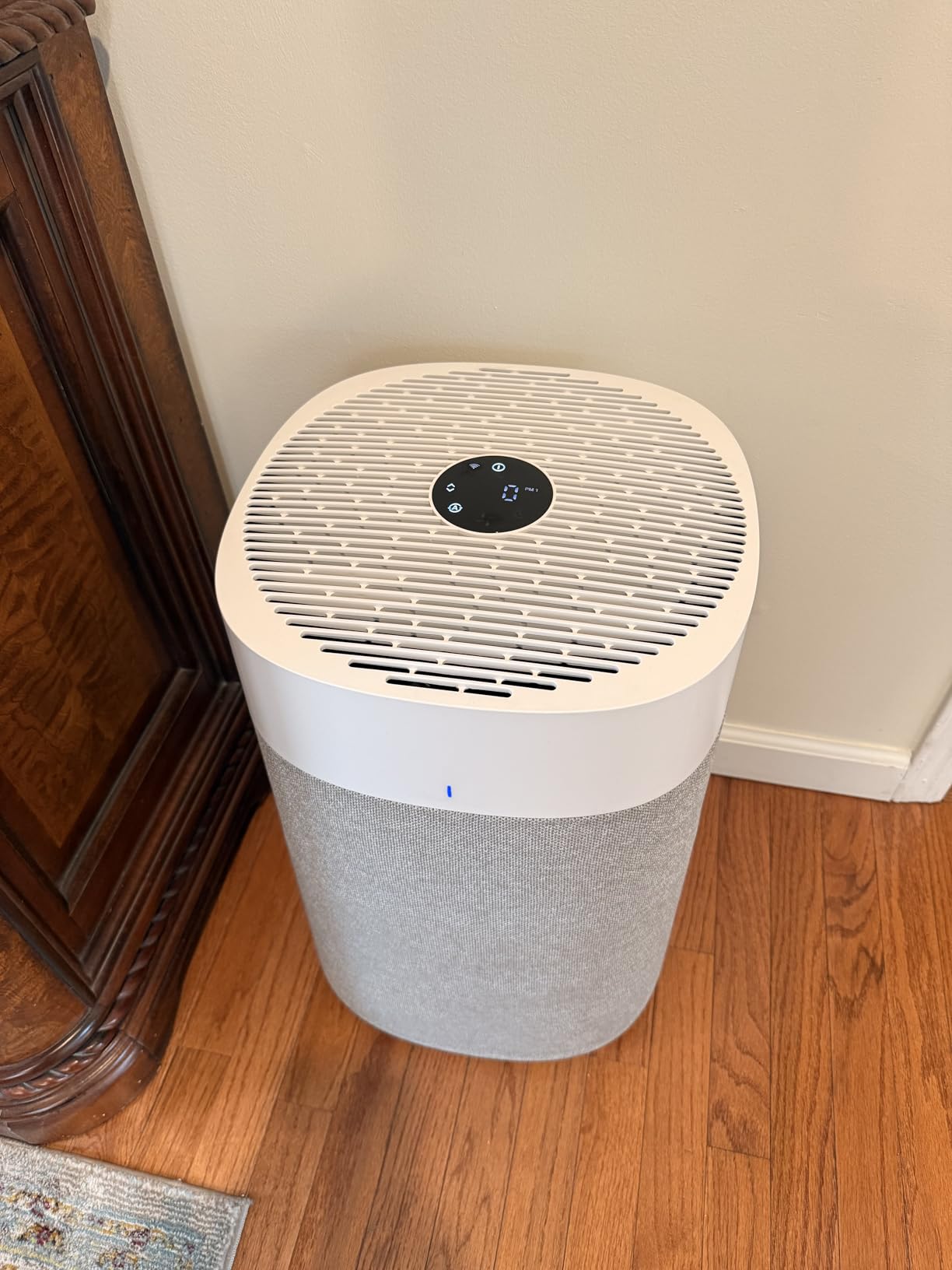
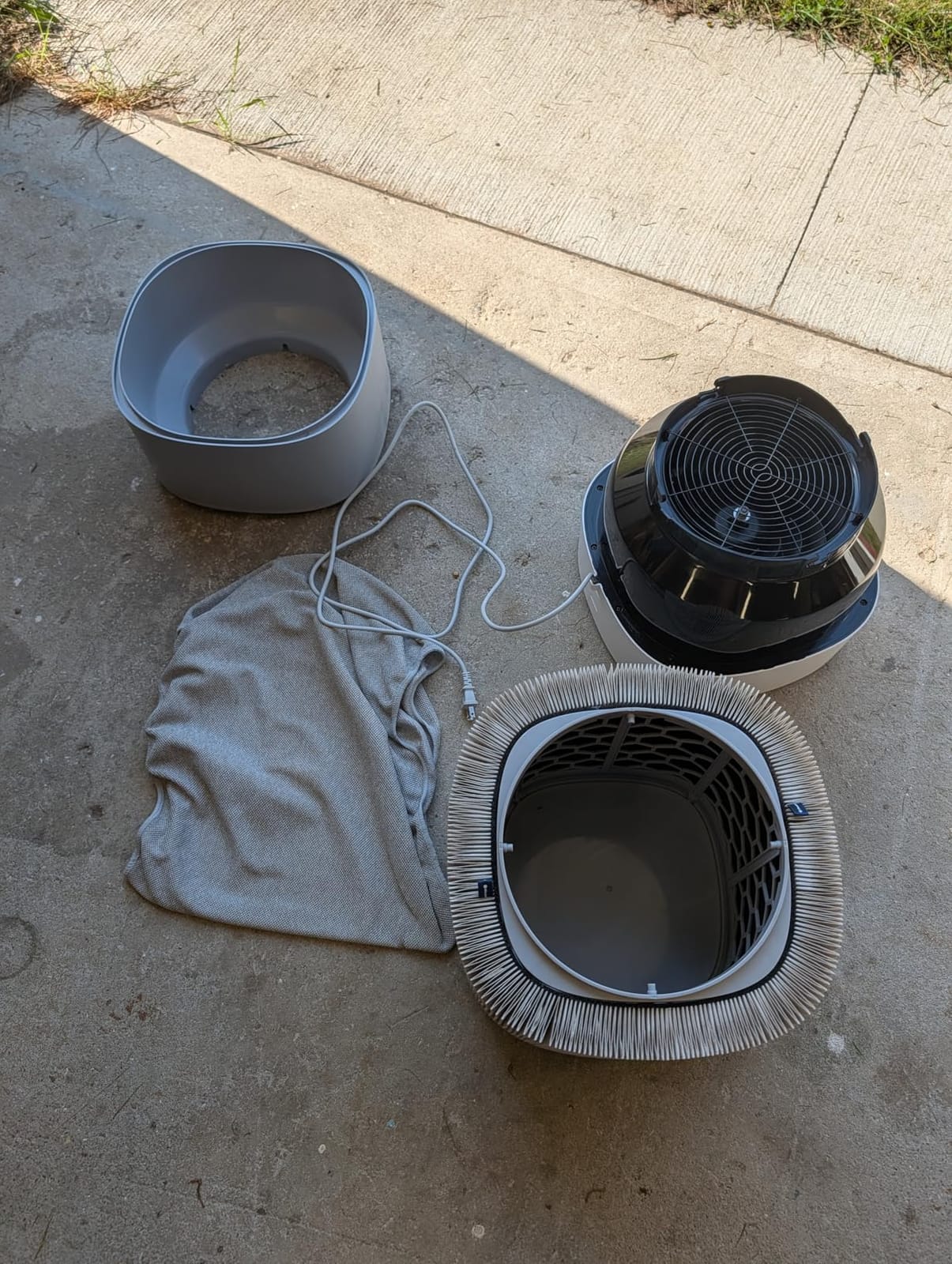
Blueair’s HEPASilent technology combines mechanical filtration with an electrostatic charge, which lets air flow more freely through the filter while still capturing 99.97 percent of particles. The 360-degree intake pulls from all sides, the fabric pre-filter is washable and catches the big debris, and the ionizer is zero ozone certified.
The Scandinavian design is genuinely attractive, with a dimmable LED display and a lights-off option for bedrooms. The Blueair app is one of the more intuitive ones I tested, and registration extends the warranty to three years.
The costs of all that power: replacement filters are relatively expensive, the 16-pound body is awkward to shuffle between rooms, and the highest fan speed is loud enough that you will schedule around it. The app also occasionally drops connection and needs a reopen.
How Loud Is It on the Highest Speed?
Loud, in the way any machine moving 400-plus CFM must be. Low and medium speeds are pleasant enough for conversation and television, and that is where auto mode keeps it most of the time. Reserve the top speed for active smoke events or post-cooking clears, then let the sensor wind it back down.
How Often Will You Replace Filters?
The combination filter typically lasts around six months of continuous use, and the washable fabric pre-filter stretches that by catching dust and hair first. Filters cost more than Levoit equivalents, so factor that cadence into your ownership math before committing. Heavy wildfire or cooking households should lean toward the shorter end of that range.
10. Levoit Core 600S – Best for Extra-Large Spaces
Levoit Smart Air Purifiers for Home Large Room up to 2933 Ft², Core 600S-P
2933 sq ft coverage
391 CFM CADR
VortexAir 3.0
26dB sleep mode
Pros
- Most powerful Levoit model at 391 CFM CADR
- Extremely effective at clearing wildfire smoke
- Real-time PM2.5 digital monitor
- Energy Star certified at 66 watts
- Full Alexa and Google integration
Cons
- Advertised coverage is optimistic in real homes
- Turbo mode is noticeably loud
- App connectivity occasionally drops
Levoit’s biggest tower got the toughest assignment of my test: a wildfire smoke day when the outdoor AQI climbed and my whole first floor smelled faintly of campfire. The Core 600S cleared the indoor haze in under an hour on auto, and the PM2.5 monitor on top ticked down visibly as it worked. The 6,278 reviews at 4.6 stars with 84 percent five-star include plenty of wildfire-state owners telling the same story.
It is Levoit’s most powerful machine, full stop: a 391 CFM CADR with VortexAir 3.0 driving 360-degree intake. Official coverage is 2,933 sq ft in one hour, or 606 sq ft in 12.5 minutes, and it carries the same AHAM VERIFIED badge as the rest of the Core line.
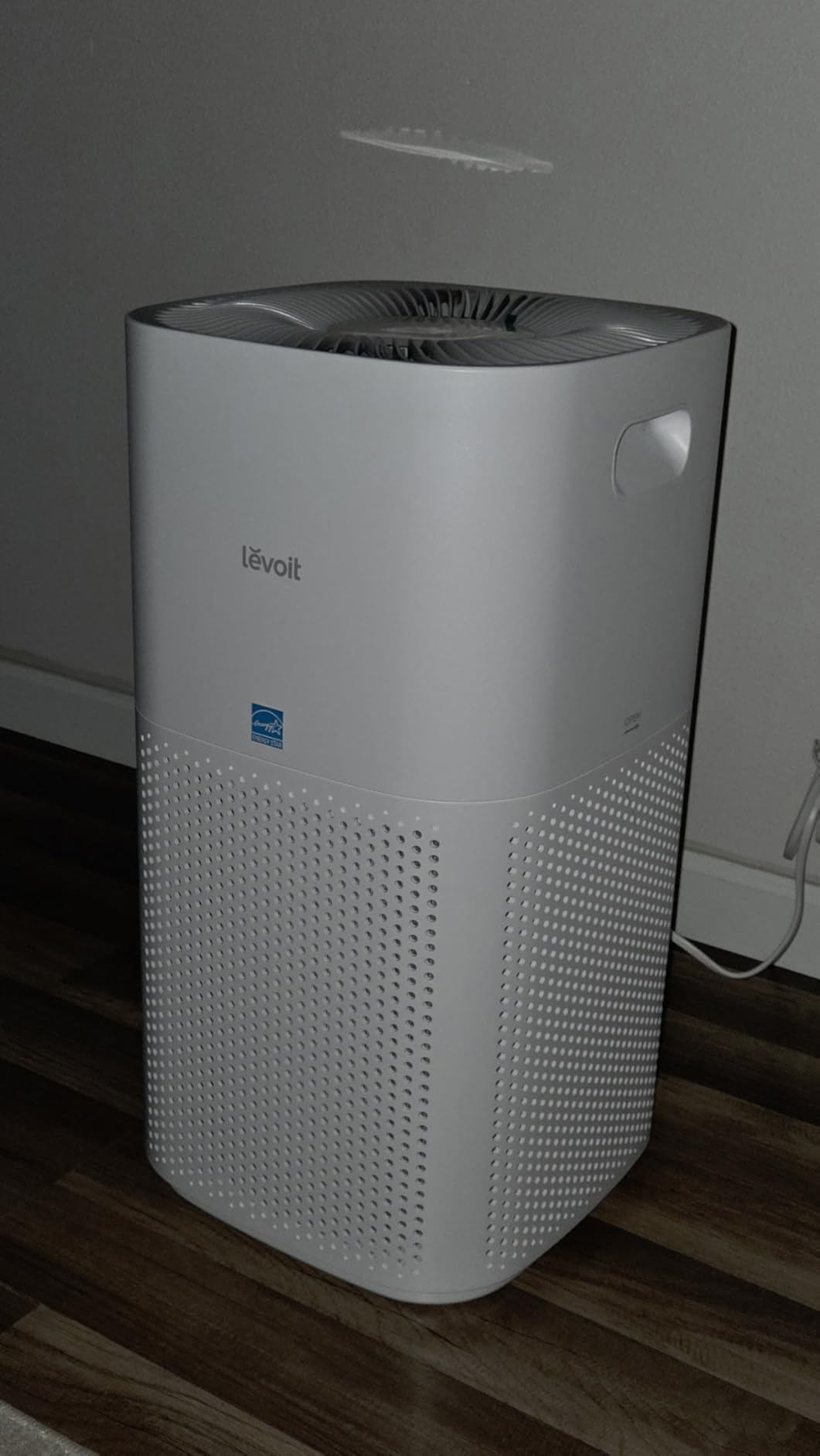
The three-stage filtration is rated at 99.97 percent efficiency, and despite the power it draws only 66 watts with Energy Star certification. Sleep mode runs at 26 dB, the tower weighs a manageable 13.7 pounds, and there is a child lock plus full Alexa and Google Assistant integration through VeSync.
As an air purifier for a whole house or extra-large floor plan, it is the strongest Levoit option. Auto mode responds quickly to sustained changes, and the app scheduling lets you run quiet hours overnight and full power during the day.
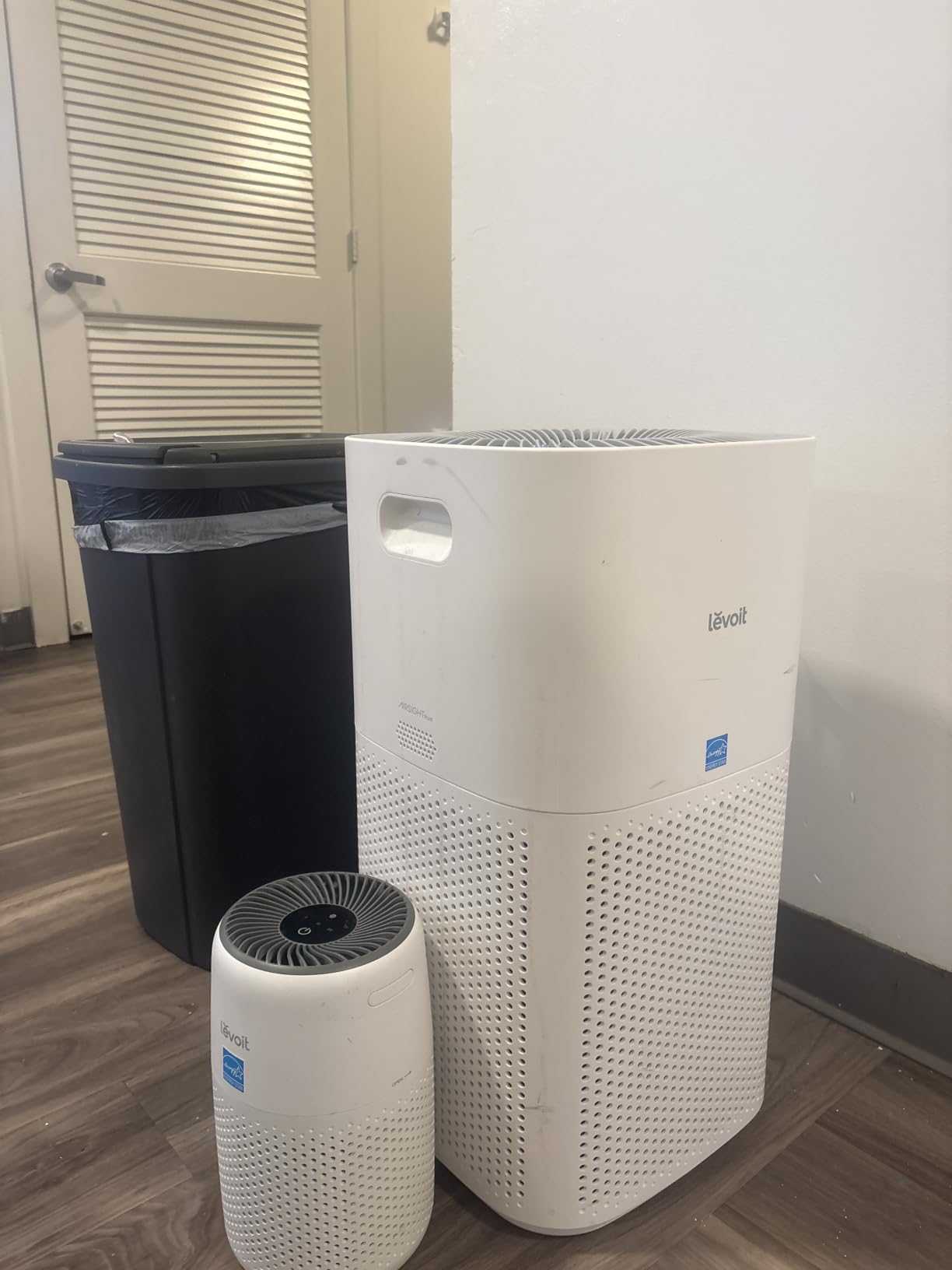
The honest caveats: experienced owners consistently report the real sweet spot is 1,000 to 1,800 sq ft rather than the full advertised figure. Turbo mode is loud, replacement filters are expensive, the app occasionally hiccups, and the sensor can be slow to catch very sudden spikes.
What Is the Realistic Coverage in a Real Home?
Plan on 1,000 to 1,800 sq ft as the practical working range, which aligns with what long-term owners report rather than the one-air-change-per-hour headline. Walls, doorways, and furniture all eat into theoretical coverage, so open layouts get the best results. For a single great room under 1,000 sq ft, this machine is frankly more than enough.
Is It Overkill for a Single Room?
No, because power translates to recovery speed rather than wasted effort. In a 500 sq ft room, the 606 sq ft in 12.5 minutes rating means the machine finishes the job and drops back to near-silent low speeds. You get cleaner air faster, then quiet, which is a better outcome than an undersized unit grinding on high all day.
11. Blueair Blue Signature 511i – Premium Pick for Design-Focused Homes
BLUEAIR Air Purifiers for Home Large Room up to 3,385 Ft², Signature SP4i
3385 sq ft coverage
7-stage HEPASilent
23dB quiet
5-color AQI display
Pros
- 7-stage HEPASilent filtration with OdorFence
- Real-time 5-color air quality indicator
- Whisper-quiet at 23 dB
- Smart WiFi app with voice guidance
- Washable pre-filter and control lock
Cons
- Some units reported with noisy fan bearings
- Filter replacements can be expensive
- Auto Mode can be overly sensitive
Some appliances need to hide, and others earn a place in the room, and the Blue Signature 511i is firmly the second kind. It looks like a piece of modern Scandinavian furniture, and the five-color air quality ring is readable from across my living room without opening an app. The 342 reviews sit at 4.4 stars with 75 percent five-star, a smaller sample than everything else here because this is the newest flagship in the group.
The claim set is the biggest on paper: 3,385 sq ft of coverage from a seven-stage HEPASilent filtration system with OdorFence technology, capturing 99.97 percent of particles down to 0.1 microns. Blueair rates it at cleaning 674 sq ft in 12.5 minutes, and it is AHAM Verifide certified.
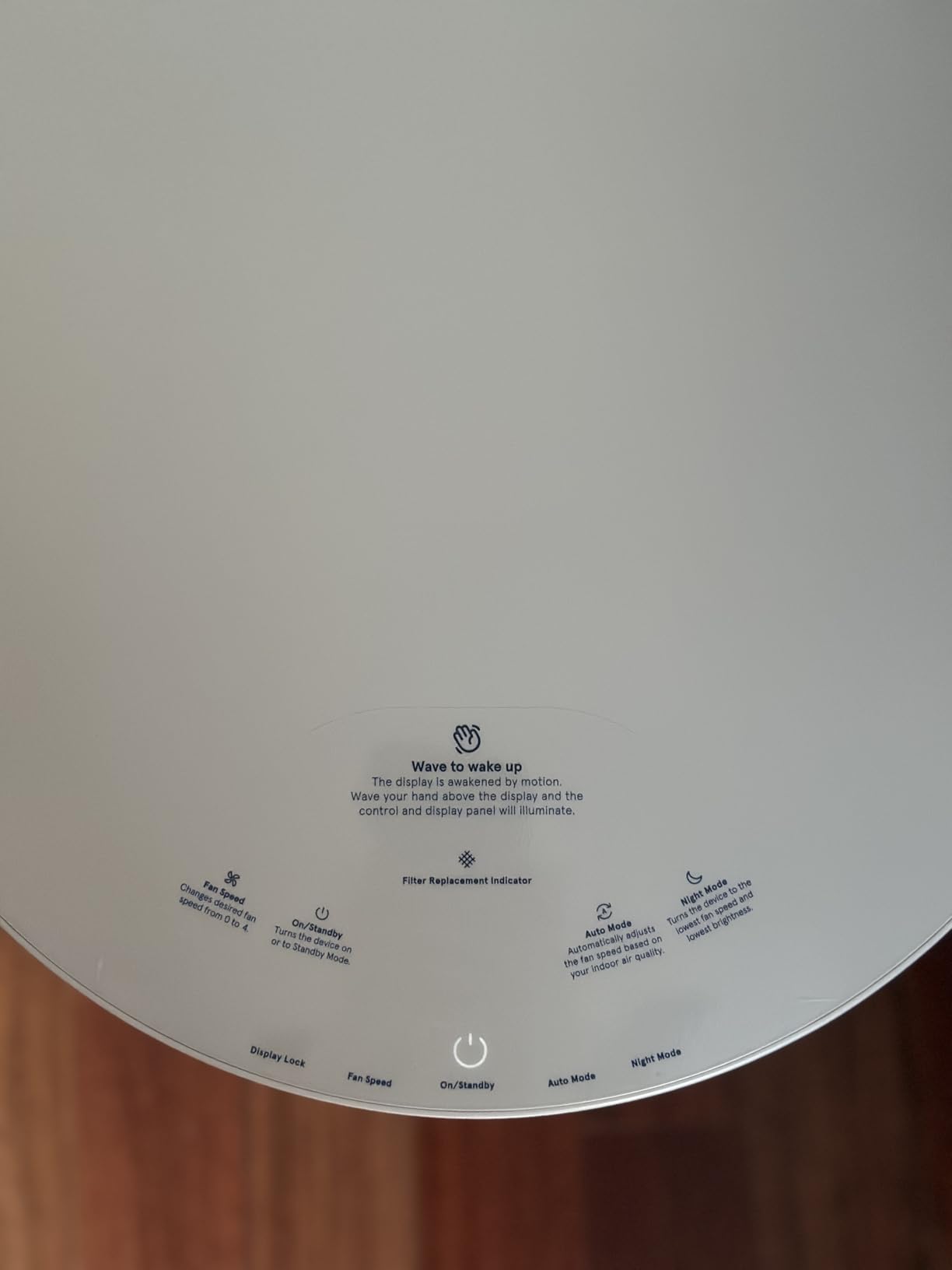
The app includes voice guidance, a genuinely nice touch that walks you through setup and filter changes out loud. There is a washable pre-filter, 360-degree intake, a dimmable LED display, and a control lock that stops children from changing settings.
At 23 dB it is among the quietest machines here for its size, and the zero ozone certified ionizer matches the 211i Max. The body measures 12.5 x 12.5 x 21.2 inches at 13.23 pounds, and the warranty runs three years.
The caveats center on maturity. Some early units were reported with noisy fan bearings, filter replacements are expensive, and a few owners find Auto Mode overly sensitive, ramping for smaller events than warranted. The review base is also small enough that long-term reliability is still an open question.
What Justifies Stepping Up to This Model?
Three things: the seven-stage filtration with OdorFence for households where smells are the primary enemy, the most refined design in the category, and the voice-guided app experience. If none of those move you, the 211i Max delivers comparable real-world cleaning with a longer track record. This is the buy-it-once, put-it-in-the-showpiece-room option.
How Reliable Is It Long Term?
The honest answer is that 342 reviews cannot tell you what 30,000 can. The fan-bearing reports are the pattern worth watching, and they are covered by the three-year warranty, but the failure rate is not yet statistically clear. Buy from a retailer with an easy return window, register for the warranty, and listen for bearing noise in the first weeks while returns are simple.
12. Coway Airmega 400 – Maximum Coverage and Warranty
COWAY Air Purifier for Home Up to 3,120ft², Washable Pre-Filter and HEPA Filter for Smoke, Allergies, Pet Dander, Odor, AQI, Auto & Sleep Mode, Timer, 5yr Warranty, Airmega 400 White, AP-2015F
3120 sq ft coverage
HyperCaptive 3-stage
22dB quiet
5-year warranty
Pros
- Covers up to 3120 sq ft
- Industry-leading 5-year warranty
- Very quiet at 22 dB
- Eco Mode turns off when air is clean
- CARB ETL and Energy Star certified
Cons
- Not smart home compatible
- Heavy at 24.7 pounds
- Filters can be costly to replace
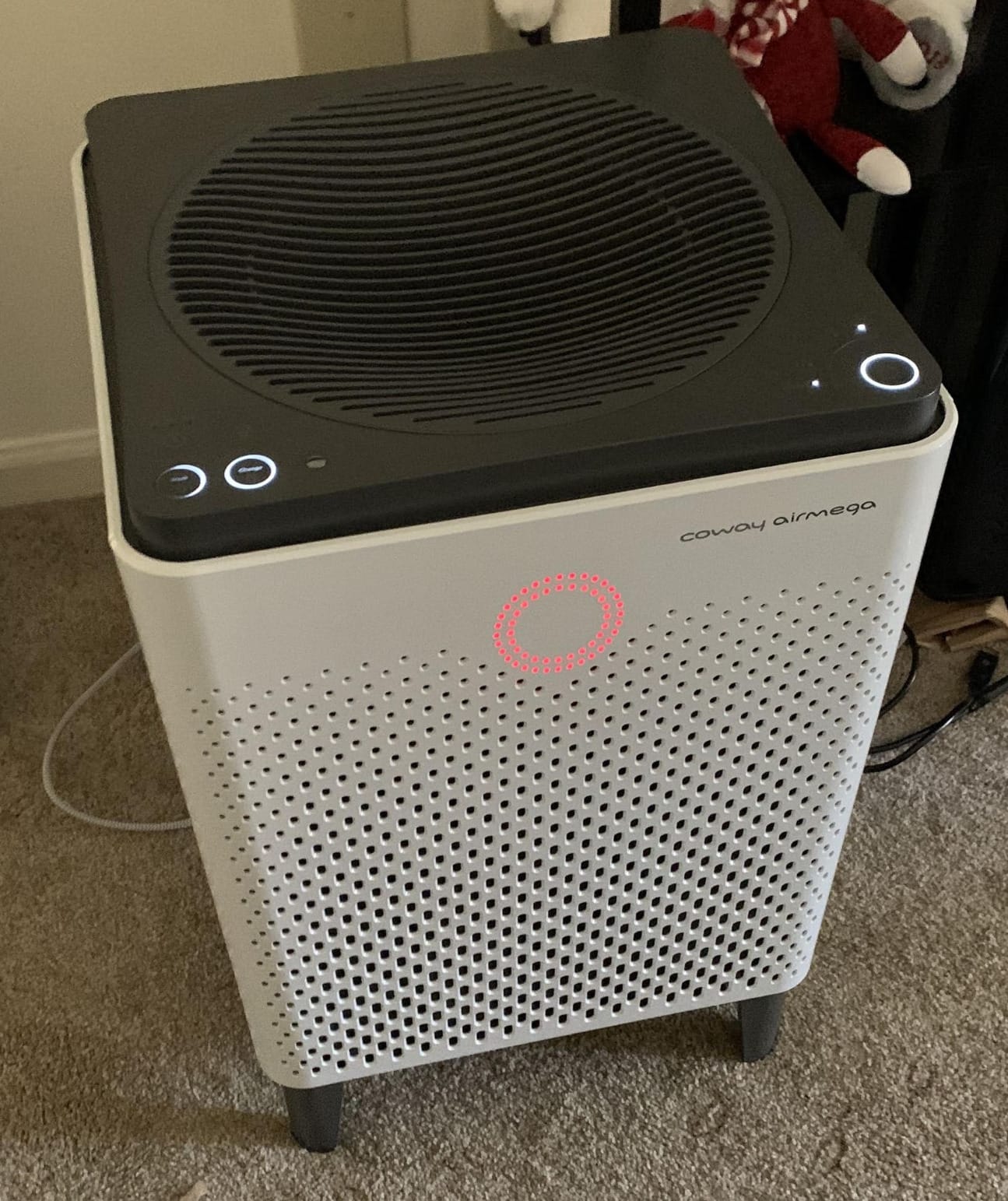
The Airmega 400 closes this list the way a heavyweight should: maximum coverage and the longest warranty in the category at five years. I stationed it in the downstairs great room where it handled the room plus the adjacent hallway without ever sounding strained. Among 2,197 reviews it holds 4.6 stars with 82 percent five-star, remarkable satisfaction for a machine at this coverage tier.
Coverage is rated at 3,120 sq ft via Coway’s HyperCaptive three-stage system: a washable pre-filter, an active carbon layer, and a HEPA filter rated at 99.97 percent of 0.3 micron particles. The MultiFilterManager design pairs two intake sides for the big-room airflow this machine is built for.
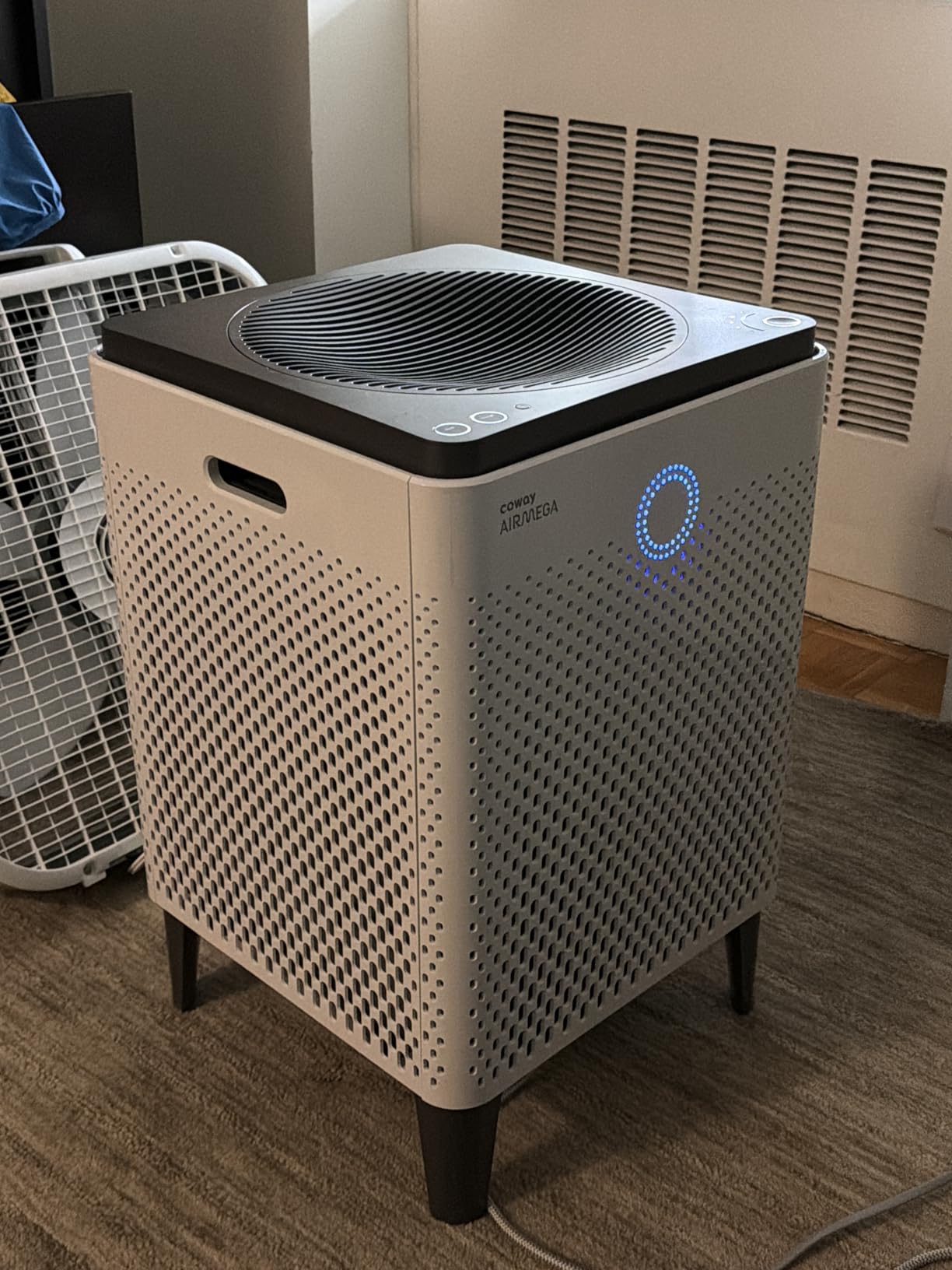
Smart Mode auto-adjusts fan speed to air quality, and Eco Mode goes further by shutting the fan off entirely when the air stays clean, which trimmed my runtime noticeably. Sleep mode drops noise to 22 dB and dims the lights, there is a timer and a filter life indicator, and it draws 66 watts with Energy Star certification.
The build feels commercial: 24.7 pounds, a 14.8 x 14.8 x 22.8 inch body, and CARB, ETL, and Energy Star certifications across the board. It is the machine I would point rental property owners and allergy households toward when failure is not an option.
The trade-offs are few but firm. There is no smart home compatibility whatsoever, the weight makes it a two-hand carry between floors, and replacement filters can be costly. Everything else about it is overdelivered.
Can It Really Clean 3,120 Sq Ft?
At one air change per hour with open airflow, yes, and that is still an enormous amount of air. For allergy-grade turnover of 4 to 5 air changes per hour, treat it as a powerhouse for roughly 800 to 1,000 sq ft, or as a whole-floor air polisher in an open layout. Placement near the center of the space gets the most from it.
What Do You Give Up Compared to Smart Models?
App scheduling, air quality history graphs, and voice control are the real losses. In exchange you get a five-year warranty, no account dependency, and one of the strongest Eco Mode implementations in the category doing the automation for you. If your priority is a machine that cleans for a decade without a smartphone, this is the trade I would make.
How to Choose an Air Purifier for a Large Room?
Start with one number: match the CADR rating to at least two-thirds of your room’s square footage, and everything else becomes secondary. Here is exactly how I evaluated every machine on this list before it earned a spot.
CADR Rating: The Number That Matters Most
Your target smoke CADR equals roughly two-thirds of your room’s area in square feet, which delivers about 5 air changes per hour under 8-foot ceilings. A 600 sq ft living room calls for a CADR near 400 CFM, which narrows the field to machines like the Blueair 211i Max and Levoit Core 600S. When a manufacturer publishes no verified CADR at all, treat that silence as information.
Coverage Area and Air Changes per Hour
Coverage area means nothing without the air changes per hour figure attached to it, because brands quote the biggest number at just 1 ACH. The formula is simple: ACH equals CADR in CFM multiplied by 60, divided by room volume in cubic feet. As a worked example, the Core 400S at 231 CFM in my 1,400 sq ft space with 8-foot ceilings produces about 1.2 air changes per hour, which is why I pair it with a second unit in allergy season.
Filter Types: HEPA, Carbon, and Washable Pre-Filters
True HEPA is the baseline, capturing 99.97 percent of particles down to 0.3 microns, and anything vaguer than that on the box is a red flag. Activated carbon handles gases, cooking smells, and smoke odor, and the physical amount of carbon matters far more than the word appearing on the box. A washable pre-filter is the single best feature for pet owners because it catches fur before it loads the expensive HEPA layer. UV-C light and ionizers are optional extras, and none of my top picks depend on them for their core performance.
Noise Levels and Sleep Modes
Anything at or below 24 dB disappears into a quiet bedroom at night, which is why the Coway Mighty2 at 19 dB and the MOOKA at 20 dB stand out for light sleepers. Every high-CADR machine runs loud on its top speed, so the real question is whether auto mode keeps it on low speeds 90 percent of the time. Always check the sleep mode decibel figure rather than a generic quietest setting claim.
Smart Features, Sensors, and Auto Mode
A laser PM2.5 sensor paired with a responsive auto mode is the most useful smart feature, because the machine ramps up when you burn toast and settles when the air clears. App control adds scheduling and air quality history, which I used more than expected to find my home’s pollution patterns. If accounts and WiFi are not your thing, the Honeywell HPA304 and Coway Airmega 400 deliver the core cleaning without a single app.
Running Costs: Filters and Electricity
Replacement filters are the real long-term cost of ownership, and Blueair and Levoit cartridges run noticeably higher than MOOKA or Winix equivalents. Washable pre-filters cut that bill by protecting the HEPA layer, which is why every repeat-buyer-friendly design here includes one. Electricity is the smaller line item, with these units drawing between 42 and 80 watts, roughly a few dollars a month running 24/7.
Frequently Asked Questions
What size air purifier do I need for a large room?
Pick a unit whose smoke CADR is at least two-thirds of your room’s square footage, which delivers about 5 air changes per hour. For a 600 sq ft living room that means a CADR near 400 CFM, pointing you to the Blueair Blue Pure 211i Max or Levoit Core 600S. Always check the AHAM-verified room size rather than the headline coverage claim.
How many air changes per hour does a large room need?
Allergy and asthma sufferers should target 4 to 5 air changes per hour, while general dust and odor control works fine at 2 to 3. Most manufacturers quote coverage at just 1 air change per hour, so divide the advertised figure by four for a realistic cleaning area.
Can one air purifier clean an entire open floor plan?
One high-CADR unit can serve an open layout up to roughly 1,500 sq ft at about 2 air changes per hour, but walls and doorways cut deeply into that. For larger or segmented layouts, two medium units placed at opposite ends outperform a single machine fighting the whole footprint.
Where should I place an air purifier in a large room?
Place it as close to the center of your breathing zone as possible, at least 8 to 12 inches from any wall, with clear airflow on all sides. If smoke or cooking odors are the main problem, angle the intake toward the source and let auto mode respond. Avoid corners and spots behind furniture where airflow gets choked.
Do large room air purifiers use a lot of electricity?
No. The 12 models I tested draw between 42 and 80 watts, which is less than many light bulbs. Running a 51-watt unit on medium around the clock costs only a few dollars a month, though replacement filters are the bigger ongoing expense to plan for.
Final Verdict and Buying Recommendations
After three months of side-by-side testing, the Levoit Core 400S is my overall recommendation in the best air purifiers for large rooms category, because it balances verified CADR, a 24 dB sleep mode, and genuinely useful smart features without overreaching on coverage claims. The MOOKA KJ190H is the value play that still delivers real results, and the Blueair 211i Max is the airflow king when coverage is the whole point.
Match the machine to your actual problem. Pet households get the Vital 100S or Vital 200S with their washable pre-filters and fur-catching inlets. Wildfire smoke and heavy odors call for the Winix 5520 or Core 600S. Light sleepers get the Coway Mighty2 at 19 dB, design-first buyers get the Blue Signature 511i, and whole-floor coverage belongs to the Airmega 400 with its five-year warranty.
Whatever you choose, buy on CADR and air changes per hour rather than the biggest number on the box, place the unit centrally with open airflow, and rinse that pre-filter monthly. The 2026 crop of sensors and noise floors is the best this category has ever offered, and any of these twelve will outclean the compact units I started with years ago. Your sinuses, your pets, and everyone breathing in your living room will notice the difference within days.