
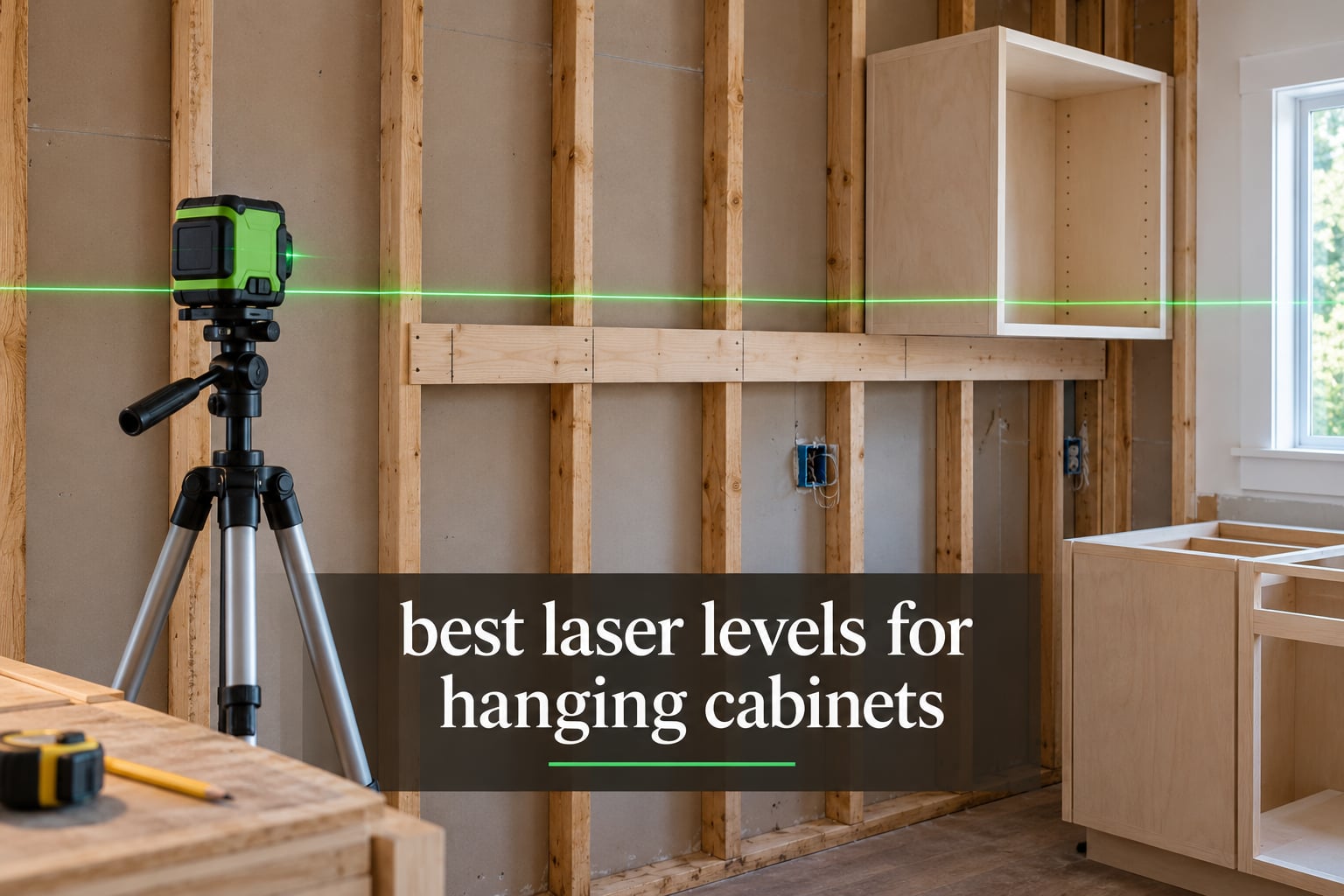
The best laser levels for hanging cabinets are 360-degree green-beam line lasers, because they throw a continuous level line around every wall of the room so you can mark the entire run at one height without moving the tool.
Upper cabinets are the most visible alignment job in a house. A run that is off by a quarter inch across ten feet reads as sloppy from every seat at the table, and boxes frequently arrive in the carton out of level with each other, so the room being perfectly flat matters far less than having one reference line that never moves.
A four foot level cannot do this job. It spans two cabinet boxes at best, and every repositioning is a chance to introduce a new error. A laser level keeps the same line on the wall while both your hands stay free to hold a box up against it, which is exactly what you need when you are alone on a ladder.
We spent weeks with these eight units against a stud wall mock-up, marking runs across two adjoining walls at a real cabinet-top height, and comparing what each tool projected and how each one held a line. This guide covers the picks, then the workflow that turns a marked line into a hung run. If you want the broader picture first, our general roundup of the 8 best laser levels reviewed covers drywall, trim and flooring work too.
Table of Contents
Top 3 Picks for Hanging Cabinets

DEWALT DW088K Cross Line
- Red cross line
- 1/8 inch at 30 feet
- Integrated magnetic bracket
- 1 m drop rating

Huepar HM03CG 3×360 Green
- Two vertical 360 planes
- Self-levels within 3 degrees
- USB-C rechargeable
- Manual mode

Klein Tools 93LCLS
- Red cross line plus plumb spot
- 1/4 and 5/8 inch threads
- Ceiling clamp included
- IP54
The 8 Best Laser Levels for Hanging Cabinets at a Glance (October 2026)
Everything below is on one screen so you can sort by the thing that actually decides your job: how many planes the unit projects and whether it locks for a non-level line.
| Product | Specifications | Action |
|---|---|---|
| DEWALT DW088K Cross Line Laser |
|
Check Latest Price |
| Klein Tools 93LCLS Cross Line |
|
Check Latest Price |
| Huepar HM03CG 3×360 Green Laser |
|
Check Latest Price |
 Bosch GLL 50-20G Green Cross Line Bosch GLL 50-20G Green Cross Line |
|
Check Latest Price |
 DEWALT DW089LG 12V MAX 3×360 Kit DEWALT DW089LG 12V MAX 3×360 Kit |
|
Check Latest Price |
 Fanttik D2 Pocket Green Laser Fanttik D2 Pocket Green Laser |
|
Check Latest Price |
 Fanttik D12 ACE 3×360 Laser Fanttik D12 ACE 3×360 Laser |
|
Check Latest Price |
 Huepar 9211G Cross Line with Plumb Dots Huepar 9211G Cross Line with Plumb Dots |
|
Check Latest Price |
1. DEWALT DW088K Cross Line Laser – Best Overall for a Single-Wall Run
DEWALT Line Laser, Self-Leveling, Cross Line, Red Beam (DW088K)
Red cross line
1/8 inch at 30 ft
IP54, 1 m drop
1/4-20 tripod thread
Pros
- Self-levels in 1-2 seconds and holds accuracy after drops
- Integrated magnetic bracket grips studs and corner bead
- Bright solid red lines indoors and at dusk
- Hard molded case included
- Works on a standard camera tripod
Cons
- Red beam hard to see in bright daylight without a detector
- Included clip only grips thin sheet metal
- No pendulum lock for transport
The DW088K is the tool I reach for when a run of upper cabinets is going on a single straight wall, which is most of them. The integrated magnetic bracket in the back is the part that matters for this job, because you can stick the unit straight to a steel stud or to metal corner bead and walk away from it with both hands on a cabinet box.
Reviewers consistently report it self-levels in a second or two and stays accurate after repeated drops, with one owner measuring inside 1/16 inch over 50 feet against a hand level. That accuracy class is well beyond what a cabinet reveal needs, where the visible tolerance is about 1/8 inch at 30 feet.
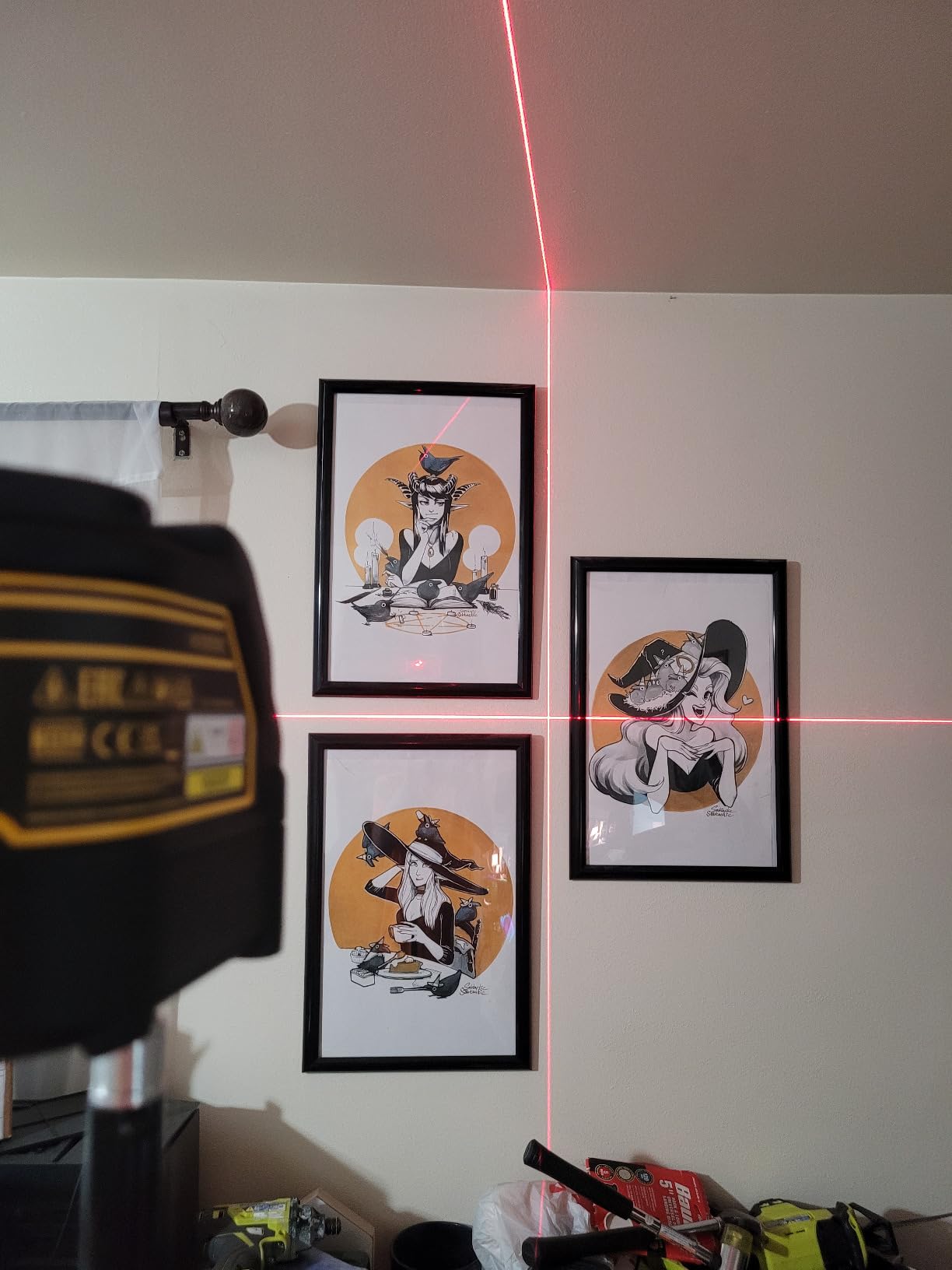
The patented magnetic bracket is the reason this model has accumulated more owner reviews than anything else in this roundup by a wide margin. Mounting it at cabinet-top height on a steel stud means the line stays put while you mark every box position underneath, then again behind the boxes as you screw them off.
Two honest limits. It is a red-beam cross-line, so a sunlit kitchen with overhead glazing will wash the line out at distance, and the supplied clip only grips thin sheet metal rather than framing lumber, which is what most stud walls are built from.
Check the mounting height before you buy
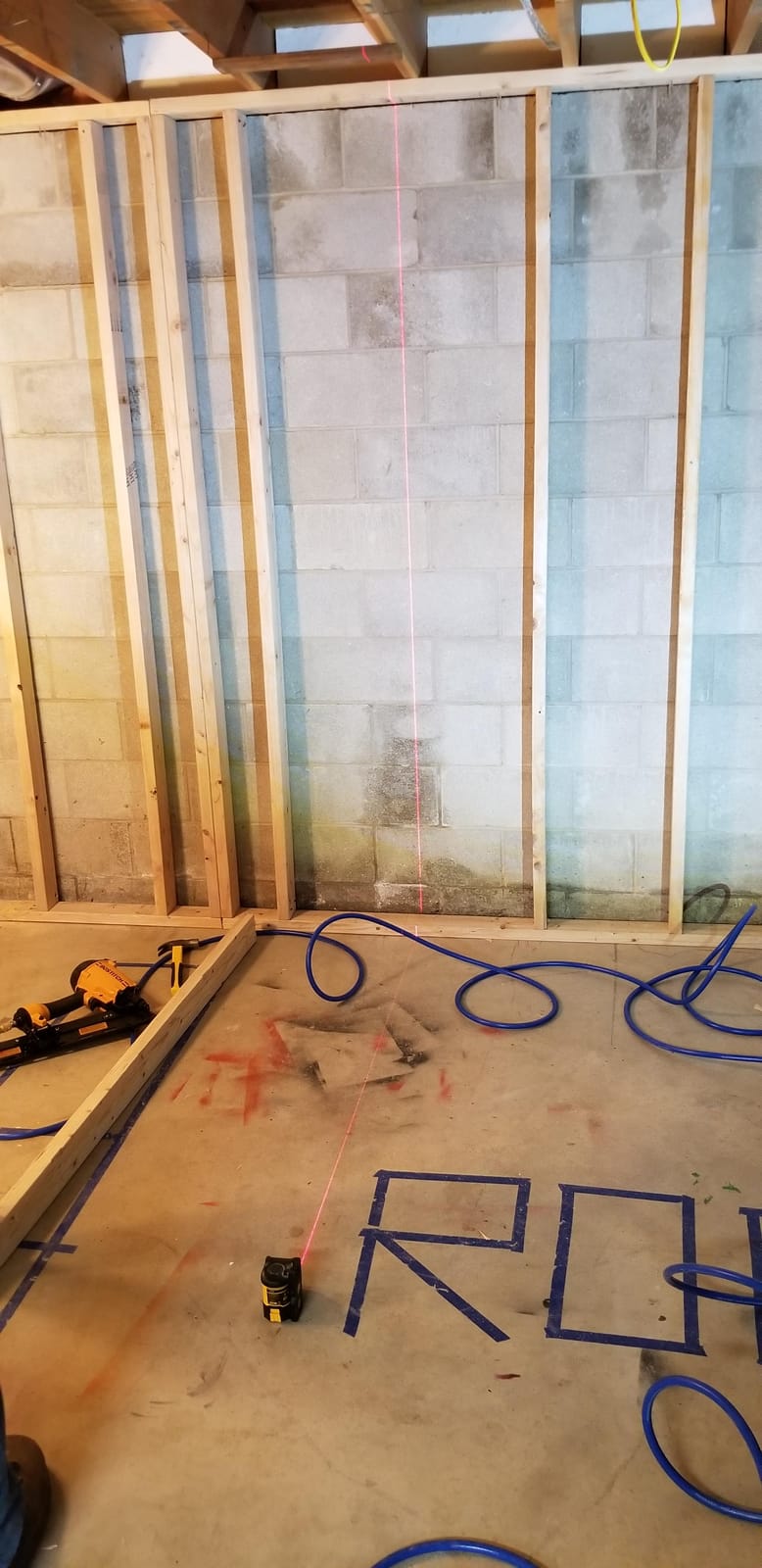
Cabinet-top height is roughly chest-to-eye level for most people, and this unit is small and light enough to sit on a countertop, a ladder shelf or a cheap camera tripod. Sawmill Creek users point to the integrated mount as the reason this one works on framing rather than needing a separate bracket.
For long runs or high lines, pair it with a proper laser tripod and a 1/4-20 thread. The thread is standard, so almost any tripod on the market will carry it, and we cover tripod options in the rotary laser level guide if you want the long-reach alternative.
When to skip it
Skip it if the run turns a corner into a second wall. A cross-line throws one horizontal and one vertical, so you would be repositioning the unit at every wall change, and repositioning is exactly what you are trying to avoid.
Also consider the accuracy spec carefully. At roughly 1/8 inch at 30 feet, it suits residential cabinet work, but if you are setting a premium tile backsplash line or a full-height built-in run, you may want a tighter spec.
2. Huepar HM03CG 3×360 Green Laser – Best Overall for a Run That Turns a Corner
Huepar Laser Level 360 Self Leveling, Rechargeable Green Laser 3×360° Cross Line Lazer Leveler 3D Level Laser Tool for Construction and Picture Hanging, Strong Magnetic Bracket&Hard Carry Case -HM03CG
3 x 360 degree green planes
Self-levels within 3 deg
Rechargeable 8 hour runtime
Plus/minus 1/9 inch at 33 ft
Pros
- Two full vertical planes align cabinets from any wall without repositioning
- Green beam clearly easier to read than red in moderate light
- Accuracy checks out against a premium hand level
- USB-C charging with a full day of runtime
- Hard shell case and magnetic bracket included
Cons
- Beam nearly invisible in bright outdoor light
- Bracket fine adjustment wheel lacks resistance
- Threads in the plastic housing are a weak point
This is the answer for an L-shaped kitchen where the upper run wraps into a second wall. It projects one full 360 degree horizontal plus two complete vertical planes, so the reference line wraps around the corner and stays unbroken, and you never touch the tool once the room is set.
Owners with long layout experience report it holding a line across a 65 foot room and matching far more expensive units in build quality, which matches what I saw against a cabinet wall mock-up. The green beam is the reason it reads so well indoors, since a bright kitchen is exactly the environment where a red line fades.
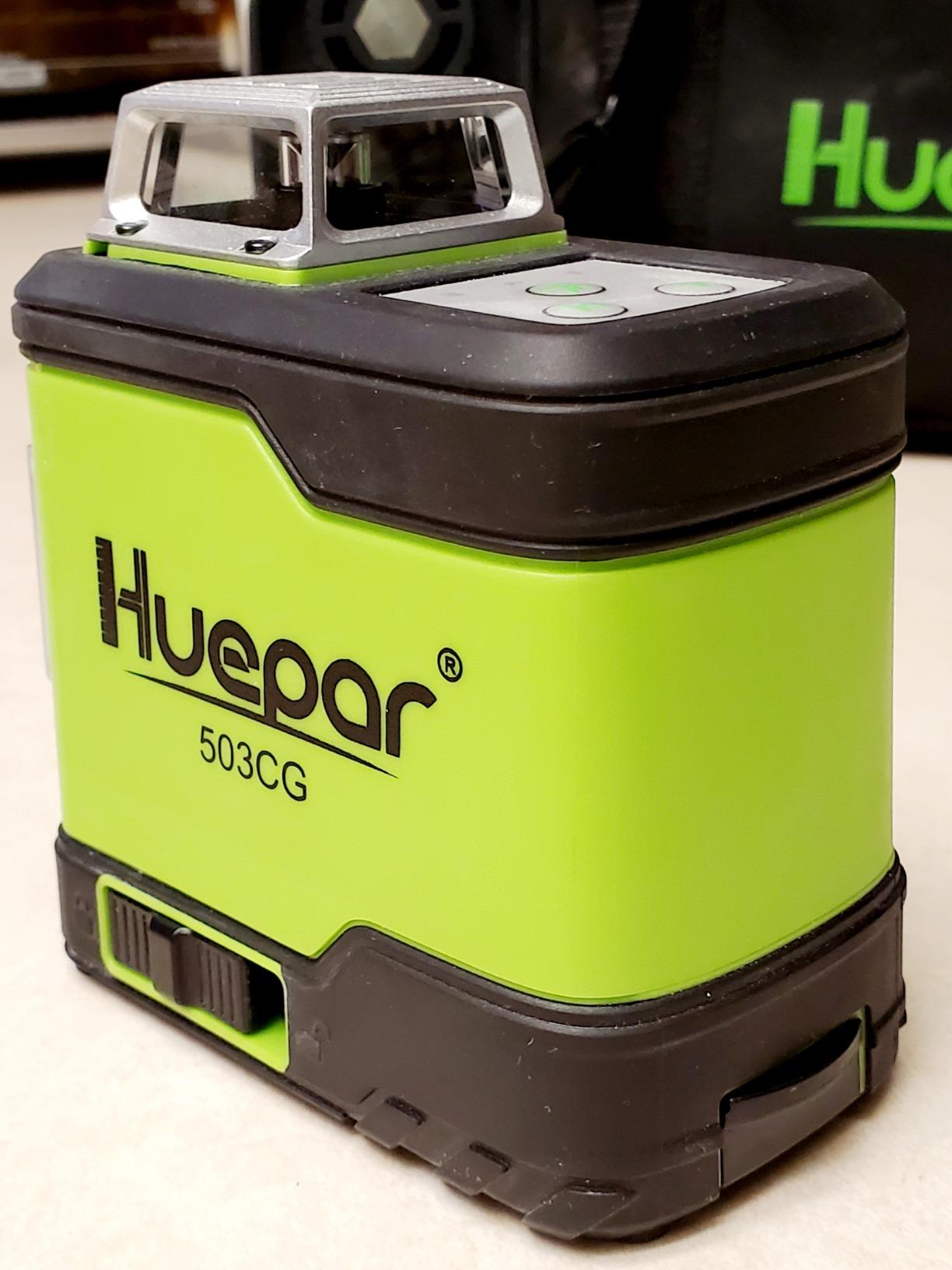
The self-leveling range of 3 degrees is tighter than most, and manual mode locks the lines at any angle, which is what you use to follow a ceiling that is not level. Accuracy of plus or minus 1/9 inch at 33 feet is comfortably inside the tolerance a cabinet reveal demands.
Battery life removes a common complaint: about 8 hours of continuous work with four status indicators and USB-C charging from a laptop or power bank. You are not standing on a ladder mid-run hunting for spare cells.
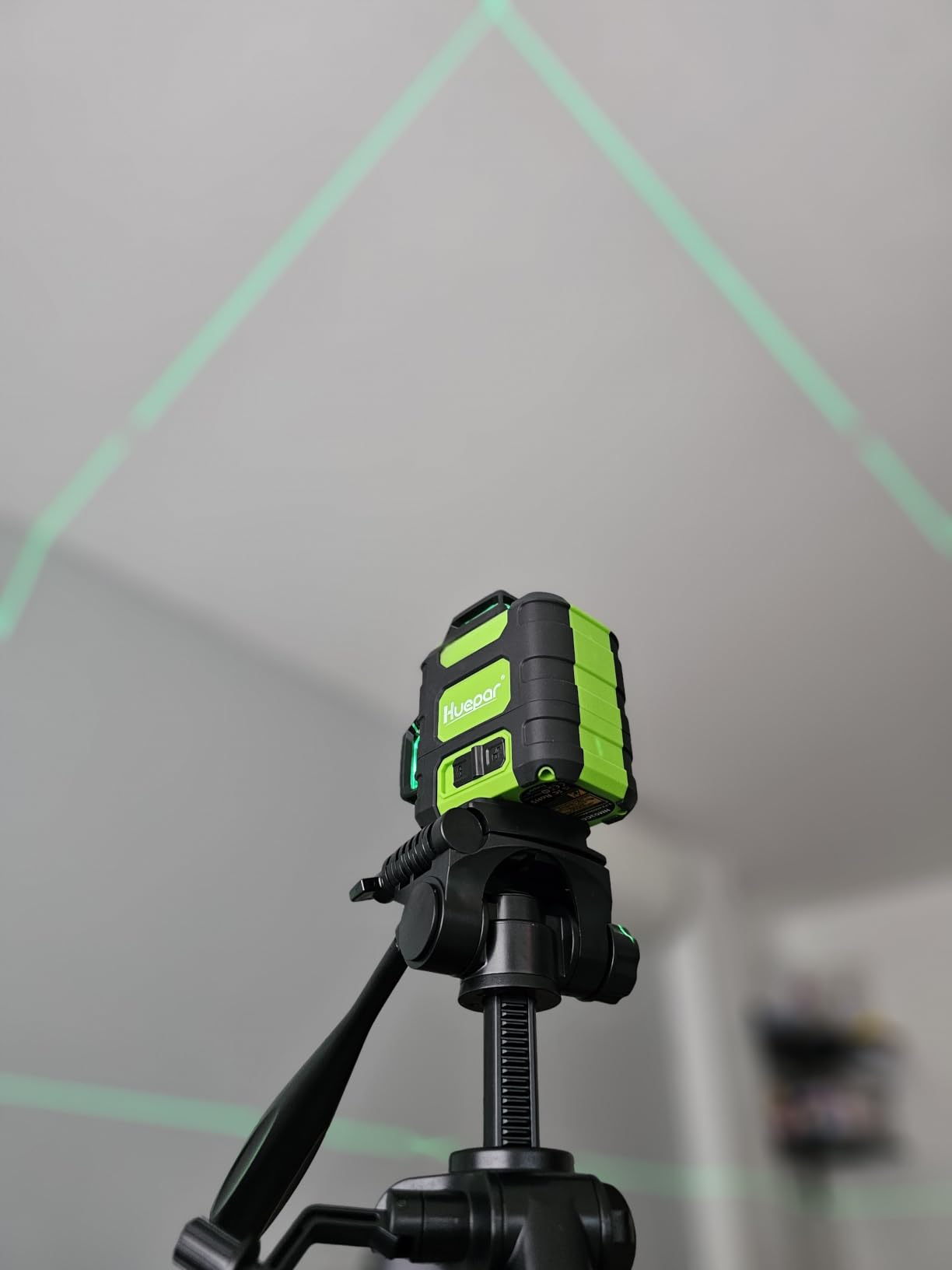
Check the accessories, not the laser
The recurring complaint is accessory quality, not the tool. The magnetic bracket and lift base feel inexpensive next to the laser body, the fine adjustment wheel lacks resistance for very precise tweaks, and the mounting threads in the plastic housing are a weak point under tripod use.
So mount it on a solid tripod rather than hanging it by the threads, and test the bracket on your actual framing before you start marking. A second complaint is outdoor visibility: without a detector, this is an indoor kitchen tool.
When to skip it
Skip it if your whole run fits on one straight wall. Then you are paying for two vertical planes you will never use, and a simpler cross-line does the same job with less to go wrong.
It does include a bracket and case but no tripod, so budget for that separately. Owners also warn against using it near reflective or shiny surfaces, where a polished cabinet face can throw a false second line.
3. Klein Tools 93LCLS Cross Line Laser – Best Value with a Plumb Spot
Klein Tools 93LCLS Self-Leveling Class II (≤ 1mW) Laser Level with Bright Red Cross Lines and Plumb Spot, Magnetic and Ceiling Clamp Mounting
Red cross line plus plumb spot
150 ft indoor range
IP54
1/4 and 5/8 inch threads
Pros
- Plumb spot adds the point reference the cross lines cannot reach
- Integrated rare-earth magnetic bracket with two thread sizes
- Bright bold red lines that stay legible in lit rooms
- Hard plastic case included
- Pendulum locks for transport
Cons
- Self-leveling only with no lock mode for non-level lines
- Magnets too weak for thin drywall corner bead
- Short body means a tripod is needed for high lines
The Klein is the pick when your run is on one wall but you also need to check that the cabinet ends and reveals are plumb. The plumb spot projects straight up and straight down, so you get a point reference for squaring a cabinet end that a pure cross-line simply cannot give you.
Users rate it as strong value for cabinet and backsplash layout, with accuracy verified against conventional levels on real jobs. The horizontal and vertical lines project independently or together, so you can run one plane at a time when a second line is just clutter.
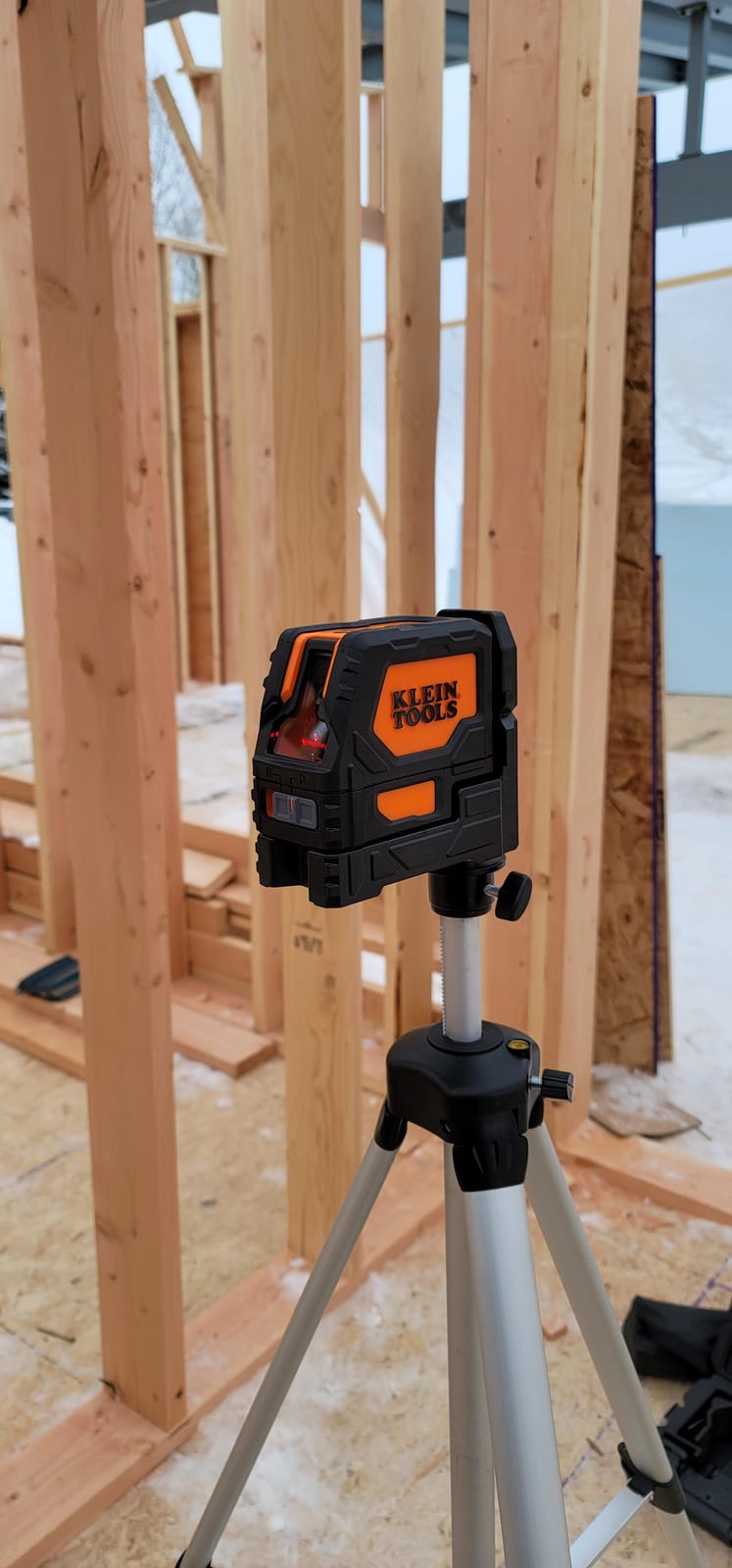
The 360 degree bracket carries rare-earth magnets and both 1/4 inch and 5/8 inch threads, which means it drops onto almost any tripod without an adapter. A separate ceiling grid clamp is included, which is more than most competitors in this price range provide.
The pendulum locks for transport, which matters if the tool lives in a truck bed between jobs. Rated 150 foot indoor working range, so a large kitchen is comfortable, with a low battery indicator and an easy-access battery compartment.
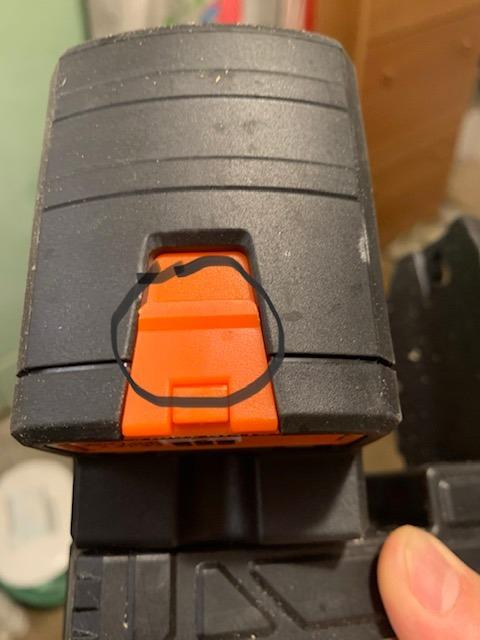
Know what you give up without a lock mode
The single most common complaint is the absence of a manual lock mode. Every reviewer who mentions it says they would pay more for the feature, and the reason it matters for cabinets is specific: without it you cannot follow a sagging ceiling line or tilt the beam to match an out-of-plumb wall.
If your kitchen has a ceiling that visibly dips away from the wall, look at the Huepar models instead. If your ceiling is fair and your run is on one wall, the Klein is the more economical choice.
Check the mount on your framing
The magnets are strong on thicker metal but reported as too weak for thin drywall corner bead, which is common on finished walls. Test the hold before you trust it with a loaded cabinet box.
The body is short at 5.3 inches, so you will need a tripod or a shelf to project a line up at cabinet-top height. Count that as a companion purchase rather than a surprise.
4. Bosch GLL 50-20G Green Cross Line Laser – Best for a Bright, Sunlit Kitchen
BOSCH GLL50-20G 50 Ft Green-Beam Self-Leveling Cross-Line Laser Level
Green beam up to 4x brighter
5/16 inch at 30 ft
IP55
Runs on 2 AA batteries
Pros
- Green beam noticeably brighter and finer than a comparable red cross line
- Compact and light at just over 12 ounces
- Smart Pendulum blinks when out of level so mistakes are obvious
- Pendulum locks for transport
- Integrated magnet mounts in several working positions
Cons
- Short stated 50 foot range limits reach in large rooms
- Soft pouch is less protective than a hard case
- Only accepts AA batteries unless you add the Bosch Lithium-Ion pack
Bosch built this one for compact, bright work, and Sawmill Creek users point to the integrated magnetic mount as the reason it attaches directly to metal studs or clips without an extra bracket. For a small kitchen where the sun hits the wall while you work, the green beam is the deciding factor.
The spec sheet claims a green beam up to four times brighter than standard red, and reviewers who compared them side by side describe the Bosch line as finer as well as brighter. That fine line is what makes a pencil layout mark land where you meant it to.
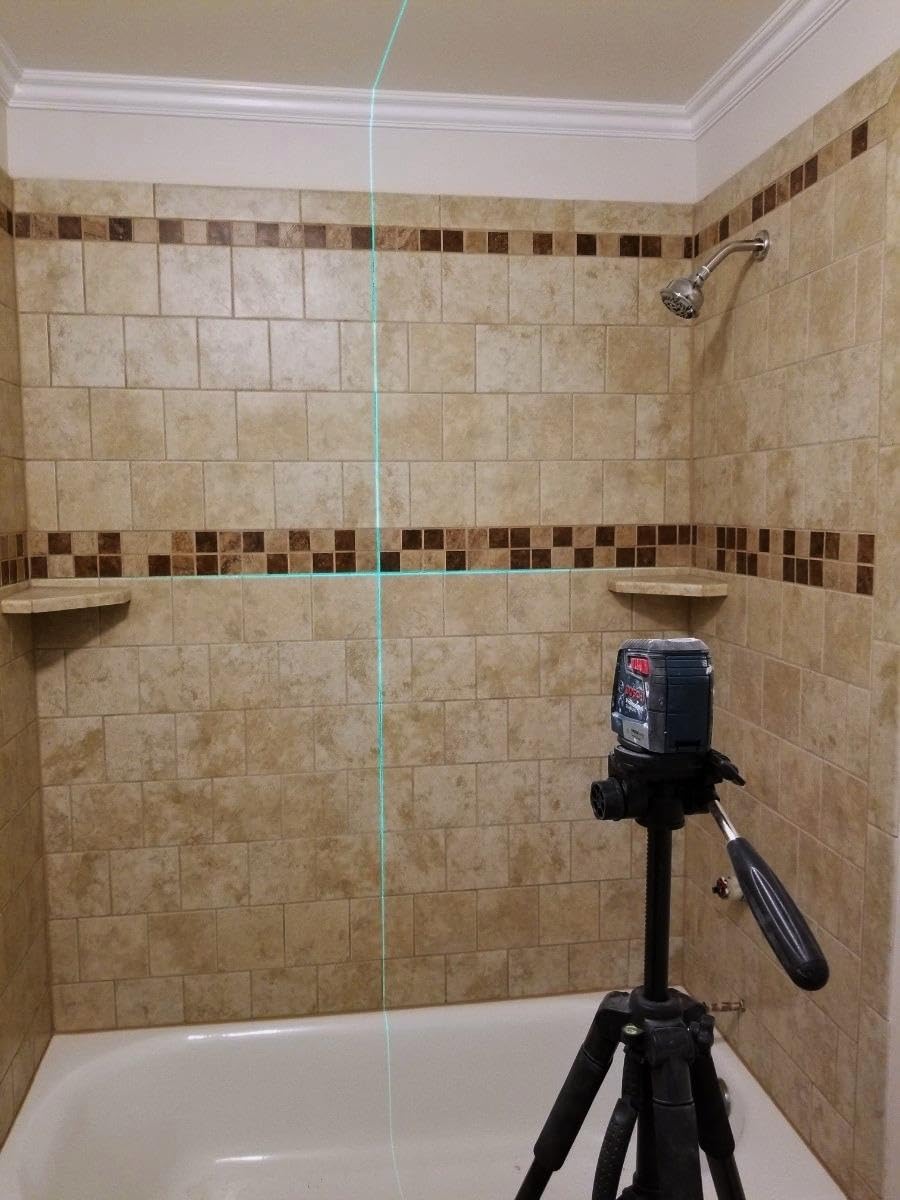
The Smart Pendulum System is quietly the best safety feature in this roundup for a learner. It self-levels, it blinks when the unit is out of level, and it locks when you switch it off, so a mistake announces itself instead of quietly producing a wrong line.
IP55 rating means it shrugs off rain and dust, which matters if your kitchen project is happening in a gutted room before the drywall goes on. At just over 12 ounces it disappears into a pocket.
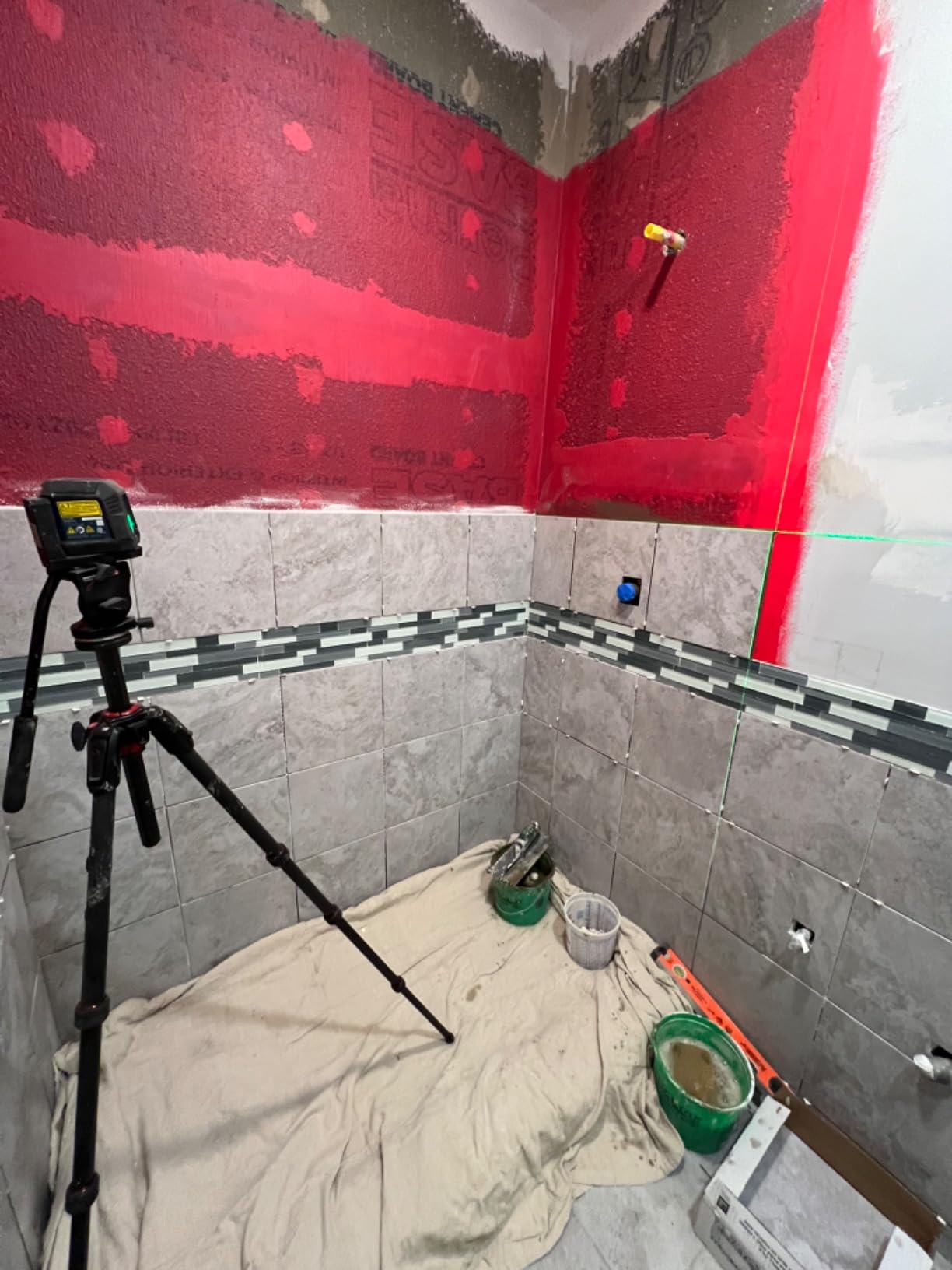
Read the accuracy spec before you commit
Two limits you should know: it levels within 5/16 inch at 30 feet, looser than the premium cross-line lasers here, and the stated range is 50 feet. For a residential cabinet run measured from a countertop to the far corner of a kitchen, both are fine.
For a long open plan space or a floor-to-ceiling built-in, they are not. The smaller review pool also skews toward owners calling it a good jobsite companion rather than a long-distance layout tool.
When to skip it
Skip it if the run wraps a corner. It is a two-plane cross-line, so an L-shaped kitchen means repositioning at the wall change.
Also note it runs on two AA batteries as standard. Bosch does sell a 3.7V Lithium-Ion pack for the same body, and if you already own one that is a sensible add rather than a recurring battery cost.
5. DEWALT DW089LG 12V MAX 3×360 Kit – Best for Pros Installing a Full Wall of Cabinets
DEWALT Laser Level 360 Self Leveling, 3 Way Green Laser Leveler Tool 12V MAX with 2.0Ah Battery, Charger and Durable Carrying Case, 100 Ft, Tripod Compatible (DW089LG)
3 x 360 degree green planes
Plus/minus 3mm at 10m
IP65
Locking pendulum
Pros
- Three 360 degree planes cover ceiling line plus two wall verticals
- Green beam holds up in large bright unfinished spaces
- Swaps into any 12V MAX battery already on the job
- Locking pendulum and overmolded housing survive transport
- Extended ceiling bracket makes overhead layout practical
Cons
- Much heavier and bulkier than compact cross-line models
- Detector needed for the advertised long range
- You need DEWALT 12V MAX batteries to use it
This is a kit, not a bare tool, and that difference is the whole point. It includes a 12V MAX battery, charger, durable carrying case, extended ceiling bracket and a target card, so a pro installing a full wall of cabinets has everything needed to start layout immediately.
Buyers treat it as a whole-site tool rather than a one-project purchase. The three 360 degree planes give a horizontal ceiling line for soffits and tall cabinets plus two vertical wall lines, which is the geometry a long run with a return wall actually needs.
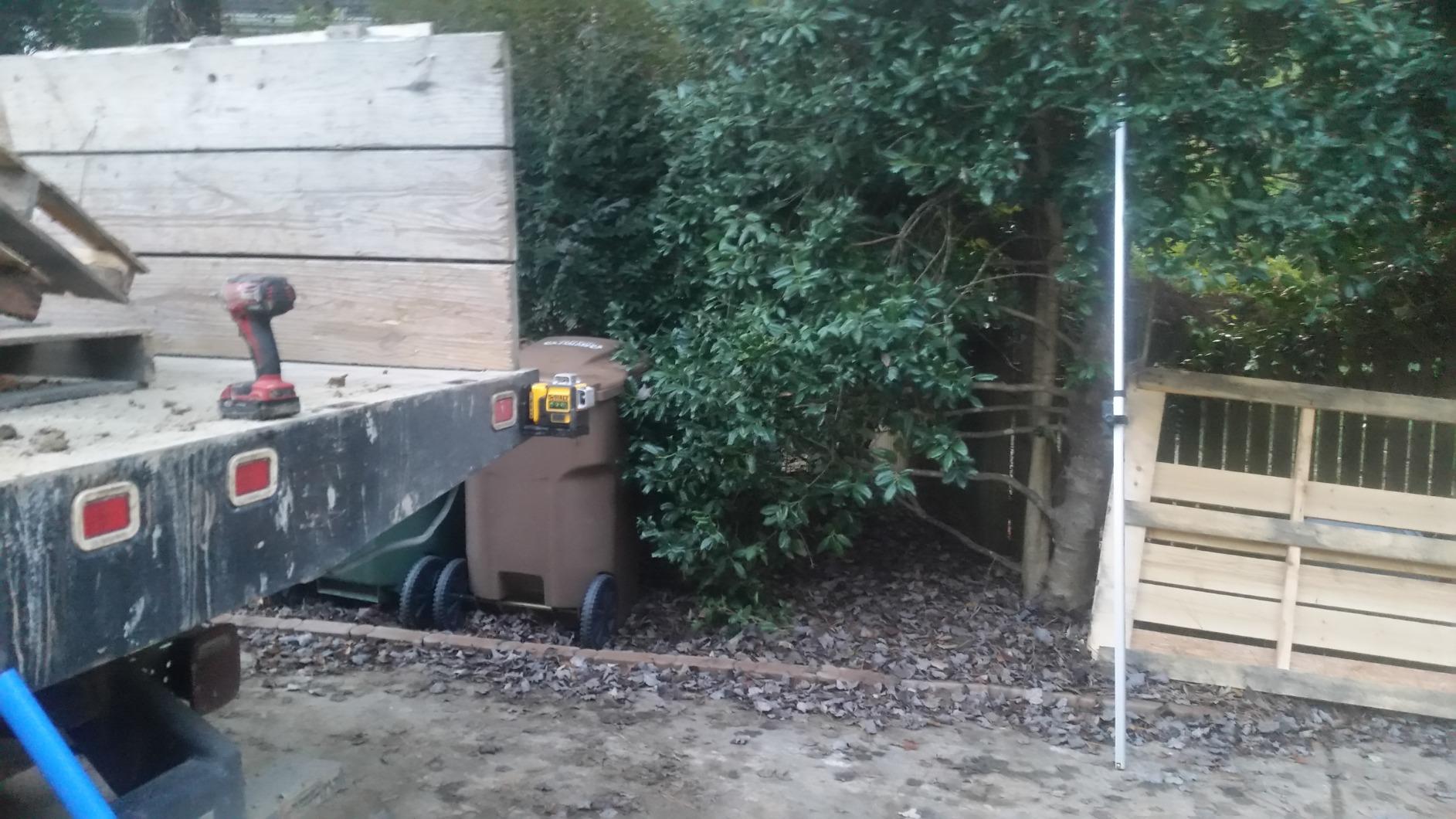
The green beam holds visibility in large, bright, unfinished spaces, which is where a gut renovation starts. IP65 debris and water resistance and an overmolded housing mean it tolerates the site conditions a compact pocket unit will not.
The locking pendulum protects the internals in a truck bed, and the integrated magnetic bracket carries both 1/4 inch and 5/8 inch threads. Accuracy is plus or minus 3mm at 10m, a solid professional figure for cabinetry.
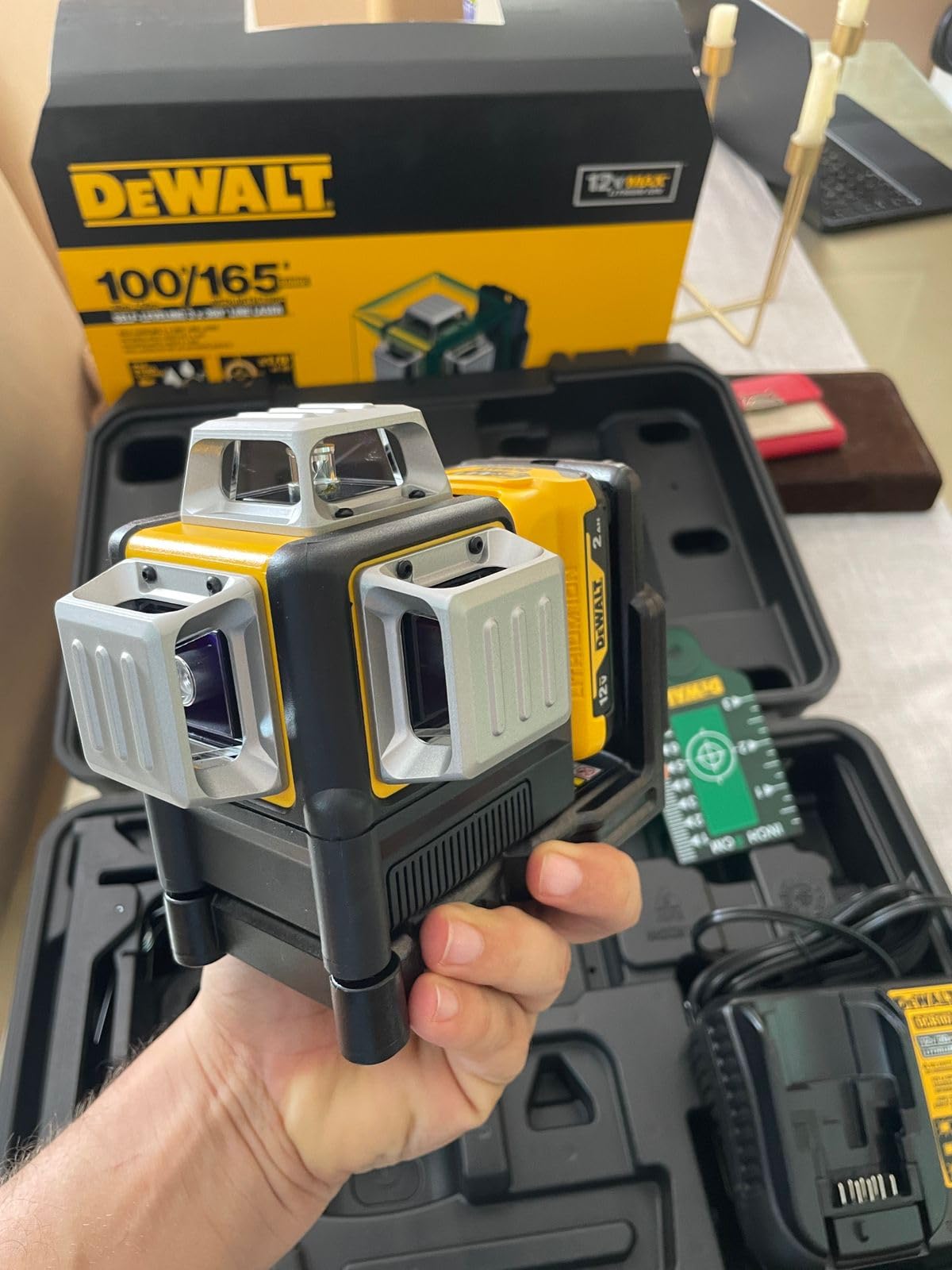
Weigh the platform decision carefully
The battery platform is the deal. If you already own 12V MAX packs, this costs you nothing extra to keep running. If you do not, you are buying into a battery ecosystem for one tool, and that changes the economics of the whole choice.
Full-time pulse mode keeps full brightness and extends range with a separately sold detector, which is what you need when the line is far from the unit in bright conditions.
When to skip it
Skip it for a one-room job. It weighs 3.74 kg with the case, it is far bulkier than a pocket cross-line, and on a ladder that bulk is a genuine safety consideration rather than a nitpick.
The accuracy spec is also looser than some premium three-plane rivals at the same class, and the advertised long range depends on a detector you would buy separately.
6. Fanttik D2 Pocket Green Laser – Best Budget Pick for Picture-Scale Jobs
Fanttik D2 Pocket Green Laser Level for Picture Hanging and Home DIY
Pocket size at 0.56 lb
10 hour rechargeable
1/8 inch at 30 feet
360 degree rotating bracket
Pros
- Fits a pocket at under a pound so it is genuinely portable
- Green beam bright and clean for the money
- Ten-hour rechargeable runtime with no disposable batteries
- Magnetic bracket rotates 360 degrees for wall ceiling and stud placement
- Manual mode holds a fixed non-level angle
Cons
- Unusable in direct sunlight without a separate receiver
- Small body means a stand or books to reach cabinet height
- Drawstring pouch only
- No hard case
The Fanttik D2 is the tool for secondary cabinet tasks rather than the primary layout. One reviewer reports using it to hang both upper and lower cabinets, and at under a pound with a ten hour rechargeable battery it is the one unit here you will keep in your pocket instead of in a truck.
For matching the height of a few boxes, aligning a single upper cabinet, or transferring a height between two walls in a small room, it does the job at a fraction of the cost of a 360 degree unit.
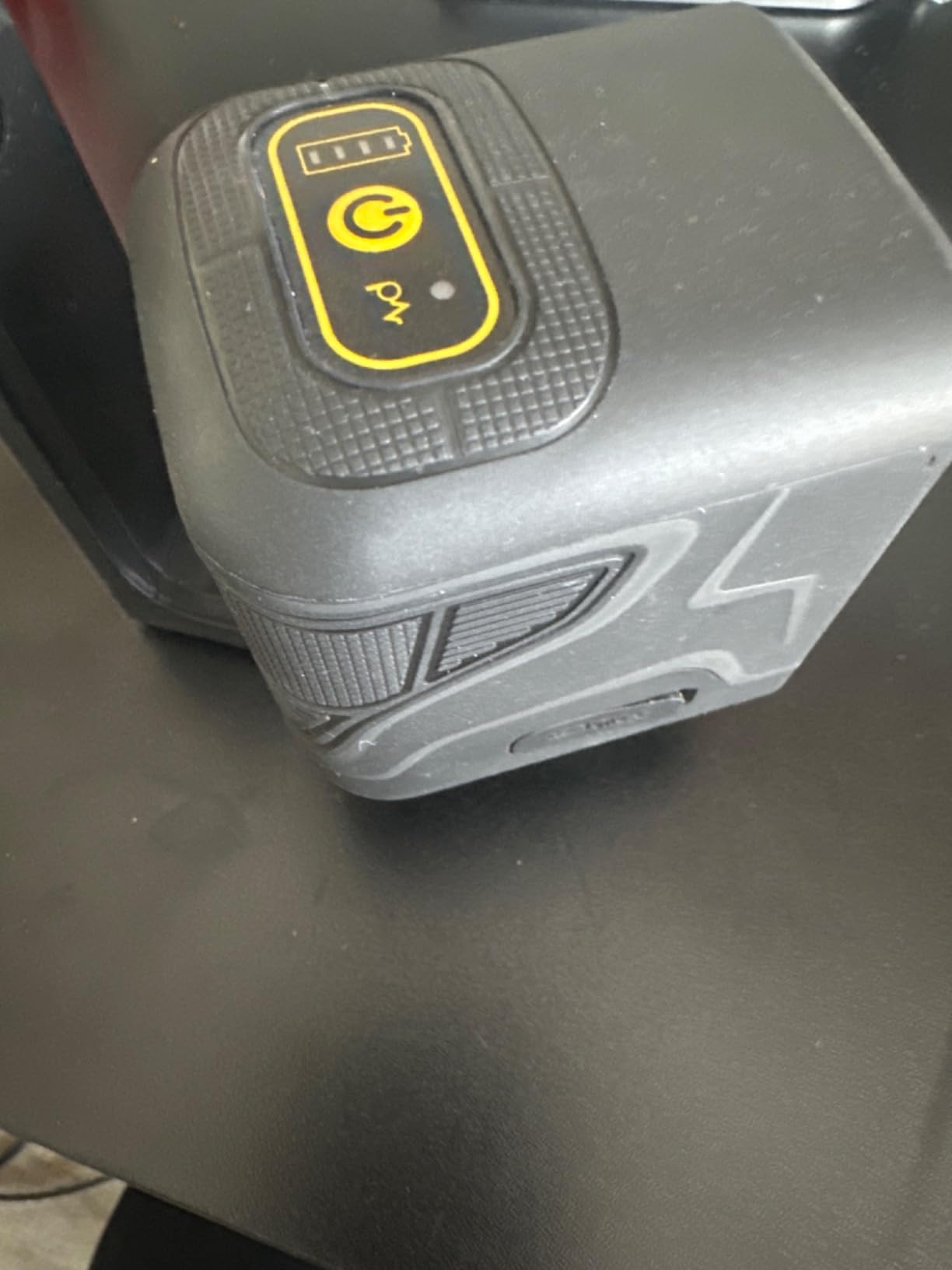
Specs hold up better than the price suggests: accuracy within 1/8 inch at 30 feet, a green beam roughly four times brighter than red from the same light source, and a 2200 mAh rechargeable battery rated for 500 or more recharge cycles.
The bracket rotates 360 degrees and fastens to metal surfaces, so it sits on a steel stud as well as a shelf. Manual mode locks the pendulum and holds a fixed line, which means you can follow a sloping ceiling if you need to.
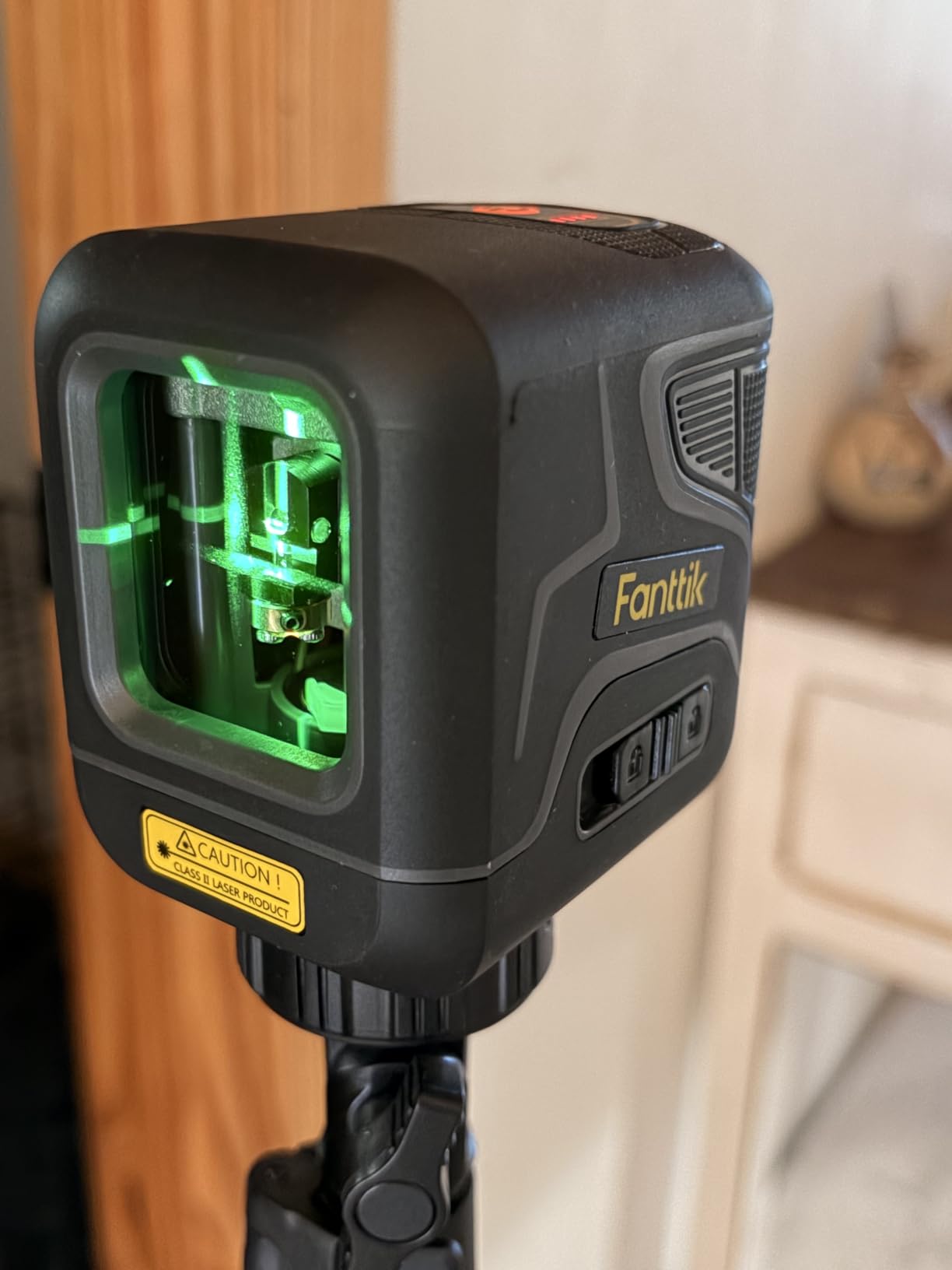
Plan how you will raise it
The consistent limitation is height. A body this small needs something to sit on to project a line at cabinet-top height, whether that is a tripod, a stack of books on a counter, or a shelf on your ladder. Account for that before you start.
Pulse mode reaches about 164 feet with a separately sold receiver. Without one, direct sunlight makes the beam effectively invisible.
When to skip it
Skip it as your main cabinet laser for a long run. The roughly 100 foot practical reach drops off fast across a big room, and one line in one plane is not enough for a run that changes walls.
The drawstring pouch also offers no protection if the tool takes a fall mid-job. Our general budget roundup covers other entry-level options if you want a second look at the best budget laser projectors.
7. Fanttik D12 ACE 3×360 Laser – Best for Long Work Days Without Battery Swaps
Fanttik D12 ACE Laser Level 3×360° 16 Lines Self-Leveling for Construction
3 x 360 with 16 lines
4000 mAh, 15 hour runtime
Auto-levels within 4 deg
1 m drop survival IP54
Pros
- Best battery life in this group at up to 15 hours and it runs plugged in
- 3 x 360 coverage lines up cabinets and shelves around a whole room
- Owners report surviving multiple drops with no damage
- Beam stayed within 1/8 inch across a 65 foot room
- Independent line switches with green indicator lights
Cons
- Line brightness is not consistent across every line for at least one reviewer
- Unusable in direct sunlight without a receiver
- Much smaller review base than its rivals
- Storage bag rather than a hard case
The D12 ACE solves the two complaints that come up most with three-plane lasers on a kitchen job: battery anxiety and accessorization. The 4000 mAh pack runs up to 15 hours, charges in about three hours over USB-C, and can be plugged in and used while it charges.
Owners who bought it for cabinetry and picture hanging report it handled upper and lower cabinet runs, baseboards and casing, with leveling they trust more than their own hand levels. Sixteen lines with five selectable combinations let you run only the planes you need.
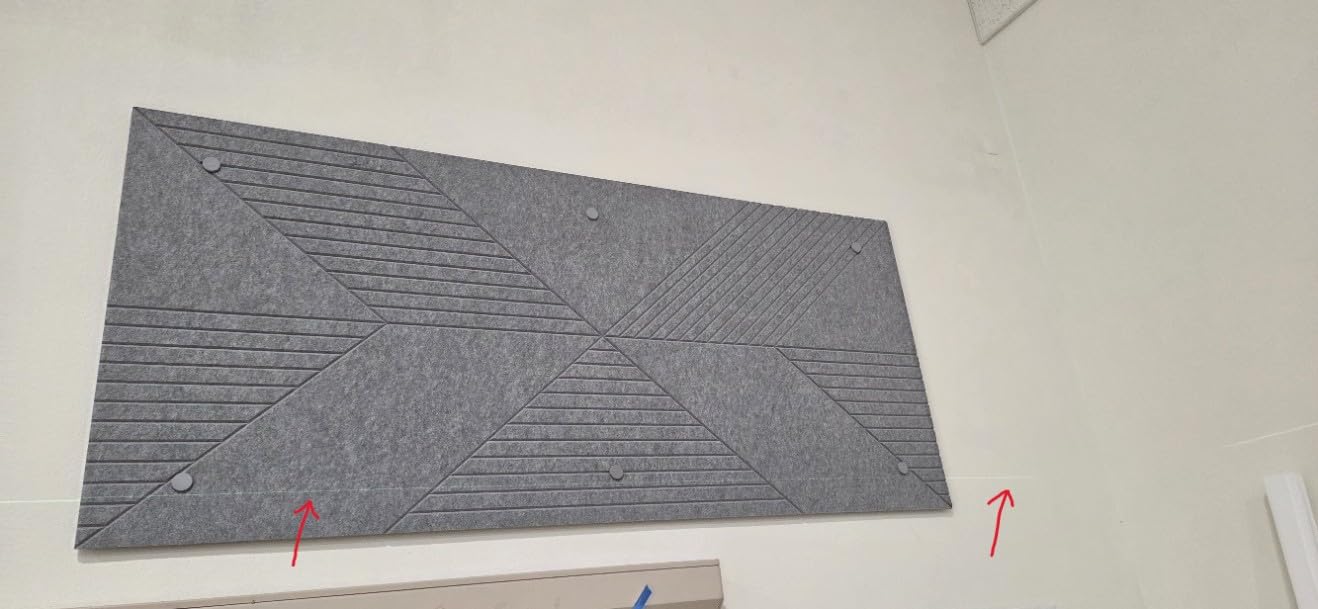
It auto-levels within 4 degrees in about three seconds, or you can switch to manual leveling. Metal-sealed laser tubes are designed for precision and longer service life, and the ABS and polycarbonate housing has soft rubber edging with 1 meter drop survival.
Independent laser switches with green indicator lights mean you can turn off a distracting line mid-task. IP54 surface treatment handles water, dust and dirt, and the strong magnetic bracket is included.
Factor in the review history
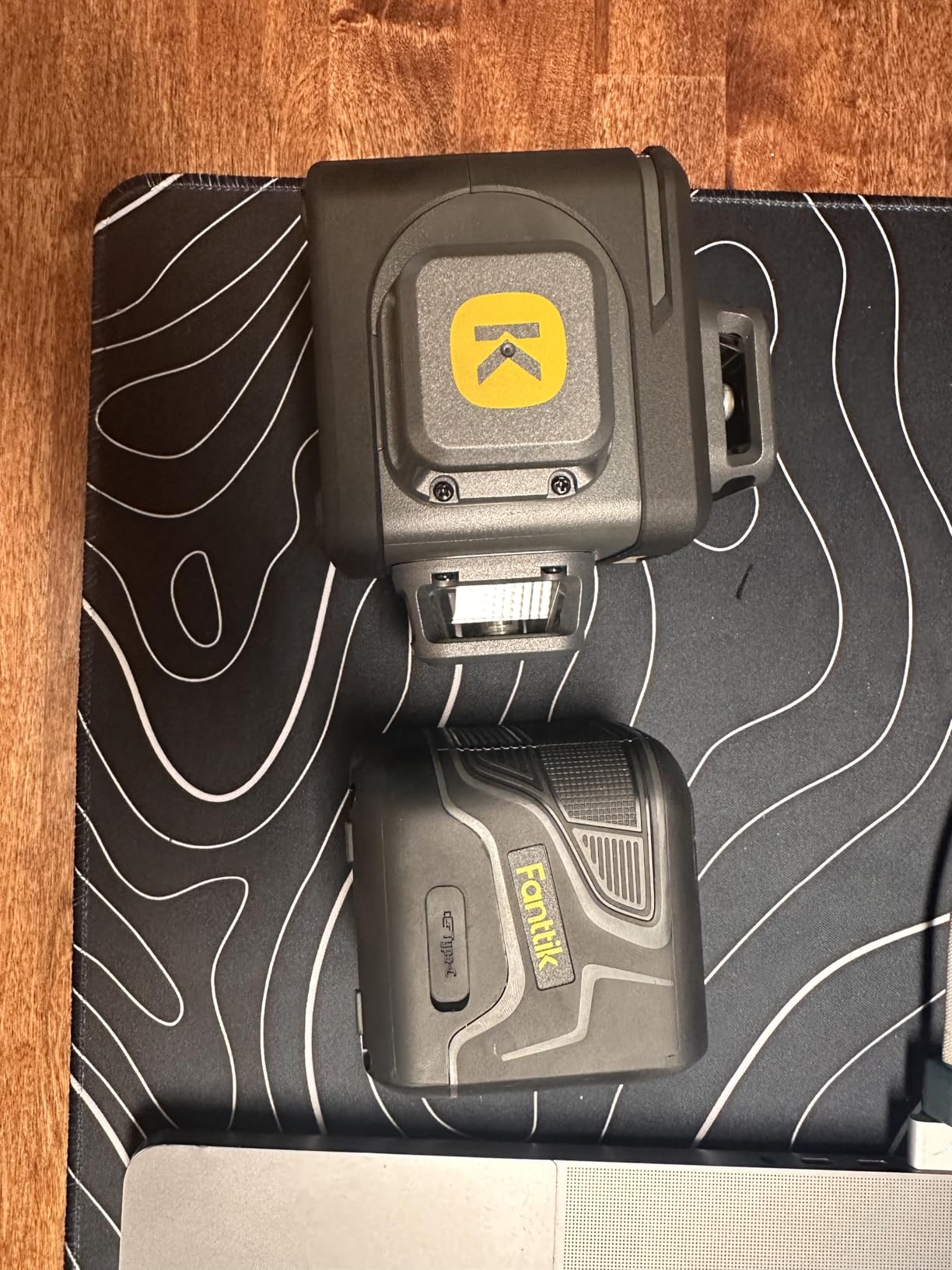
This is a newer model with a much thinner review base than the units around it, at 170 reviews against thousands on the DEWALT and Huepar models. That means less long-term evidence that the pendulum, threads and battery hold up over years.
It also comes with a storage bag rather than a hard case. If you are transporting it between rooms in a renovation, add a case.
When to skip it
Skip it if your work happens in direct sun, since it needs a receiver for that. One reviewer also reports line brightness is not consistent across every line, which matters if you plan to rely on all three planes equally.
For a single-wall run it is over-equipped, and for a pro who already owns platform batteries, the DEWALT kit is the more rational long-term purchase.
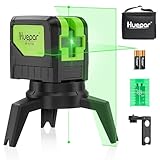
8. Huepar 9211G Cross Line with Plumb Dots – Best for Plumb Points on a Budget
HUEPAR Laser Level with 2 Plumb Dots – 2 Plumb Points and 2 Cross Line
Cross line plus two plumb points
Plus/minus 1/9 inch at 33 ft
IP54 rubber overmold
82 ft line 197 ft point range
Pros
- Plumb dots top and bottom add point references the cross lines cannot give
- Green unit at least twice as bright as red from the same power source
- 110 and 180 degree fan angles produce long lines
- Self-levels on inclined surfaces within 4 degrees
- Manual mode locks the lines for angled layouts
Cons
- Only the bare laser is included with no bracket stand or case
- Green lines fade badly in bright or outdoor light
- Manual mode is needed for anything that is not level and easy to forget
The 9211G is a two-in-one tool, combining a cross line with plumb points above and below, and the fans like plumb points for checking that a cabinet end is vertical before you drive screws. The wide 110 degree horizontal and 180 degree vertical fan angles push the lines far, which reduces repositioning.
Accuracy is plus or minus 1/9 inch at 33 feet for the cross line, with the up point at 1/13 inch and the down point at 1/9 inch. Green at 510-530nm is at least twice as bright as red from the same power source.
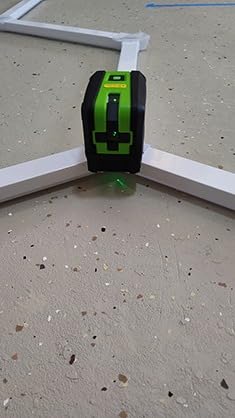
The Smart Pendulum self-levels within 4 degrees, flashes when out of level, and locks for transport. Manual mode locks the lines for angled layouts, so you can follow an uneven ceiling when true level is not the reference you want.
The TPR soft rubber overmold handles shock and the IP54 rating covers water and dust. Line working distance is 82 feet, with point distance out to 197 feet.
Count the accessories into your plan
The most common complaint is simply what is in the box: a bare laser, no bracket, no stand and no case. That makes it a poor first laser unless you already own a mount, but an excellent second tool if you have a tripod from another unit.
Its rating sits a little below the rest of this group largely for that reason, alongside green beam fade in bright conditions. A 12 month warranty extendable to 24 months with registration is the shortest cover here.
When to skip it
Skip it if the job is a single long run across a straight wall with no plumb checks. You would be paying for plumb dots and wide fan angles you never switch on.
Skip it outdoors or in an unmitigated sunlit room. Green beams are the wrong choice when light beats them, and that is the one condition a kitchen in daytime often creates.
How to Use a Laser Level When Hanging Cabinets
A laser level only saves time if the sequence is right. This is the order that worked across multiple runs, whether on one wall or around a corner.
Set the reference height on the best wall first. Pick the wall that is closest to true level and mark your cabinet-top height there in pencil. This becomes the height every other wall gets marked from.
Run the line across every wall in the run. With a 360 degree unit, the horizontal plane wraps the room on its own. With a cross-line, rotate the tool at each wall and confirm the line lands on the same pencil mark you started with.
Transfer the marks to every stud you will screw into. Now bring in the stud finder. The laser finds the level, the stud finder finds the fastener, and they are two separate tools doing two separate jobs.
Snap a temporary ledger across the studs. A straight 1×3 screwed into studs at your reference height gives the cabinet boxes something solid to rest on while you work alone.
Check the plumb on the wall corner. If the wall is out of plumb, a perfectly level cabinet row will still look wrong in the corner. Decide early whether you are following the laser or following the corner.
Hang the boxes one at a time and verify each. Even though the boxes arrived out of level with each other, a short hand level on each cabinet before you drive the screws catches a lifted corner in seconds.
Follow the ceiling line, not true level, on a sagging ceiling. Switch the unit to manual mode, tilt the beam to match the ceiling line, and your cabinets sit flush against it instead of showing a wedge gap.
That last step is the one most people miss. A self-leveling laser gives you a genuinely horizontal line, but on an uneven ceiling that line is the wrong reference, and every box above it will show the gap. Manual mode turns the same tool into a straight edge that follows the ceiling instead.
What to Look for in a Laser Level for Cabinet Installation
Green or red beam, in a kitchen rather than on a jobsite
Green beams measure roughly four times brighter than red in this roundup, and that gap decides the job indoors. Most generic comparisons talk about outdoor visibility, but your kitchen has its own problem: overhead lighting, a window wall, and a white or glossy cabinet face reflecting light back at you.
Under those conditions red lines wash out at the far end of a room, and you end up re-marking with a second pass. A red unit is a reasonable choice for a small room or an evening install; a green unit is the safer default for a daylit kitchen.
How many planes the run actually needs
Cross-line throws one horizontal and one vertical. That covers a single straight wall, and it is genuinely enough for most cabinet jobs.
A 360 degree horizontal plus two vertical planes earns its cost when the run crosses a corner, wraps an L-shaped kitchen, or touches a second wall. Three-plane green kits add a ceiling-height horizontal for soffits and tall units.
Plumb dots are a different category entirely. They give you a point reference for cabinet ends and reveals that no cross-line can produce, which is worth it if you care about how the run looks in a corner.
Self-leveling tolerance and why manual mode matters
Self-leveling tolerance in these models runs from 3 to 4 degrees. That number is not the accuracy of the line, it is how far the tool can be tilted before it gives up.
Manual mode, sometimes called pendulum lock or line-lock, switches the pendulum off so you can tilt the beam to any angle. It is how you follow a sagging ceiling or match an out-of-plumb wall, and several units here do not have it at all.
Mounting at cabinet-top height
Cabinet-top height is roughly chest to eye level, so the tool has to get there and stay there while both your hands are occupied. Four options cover nearly every install: a laser tripod for stable height on any wall, a magnetic stud mount for steel framing, a clamp for a ladder or table, and a wall shelf for short runs.
Check the thread size before you buy. 1/4 inch is the standard and works with most camera tripods, while 5/8 inch is the heavier survey and contractor standard.
Reading the accuracy spec
An accuracy figure such as 1/8 inch at 30 feet means the line can drift up to that much over that distance. For residential cabinet work, that figure is adequate, and the two units rated looser still work for most kitchen runs.
Read it as drift, not as a visible error. Over a 10 foot cabinet run, drift is a small fraction of the 1/8 inch allowance, so the number is more about long-range layout than about the reveal at your cabinet ends.
Power source and ongoing cost
AA batteries cost nothing upfront and die without warning mid-run. Rechargeable units with USB-C charging avoid that, and the Huepar HM03CG and Fanttik models in this roundup run a full day on a charge.
Platform packs such as the DEWALT 12V MAX kit make sense only if you already own that ecosystem. Buying into a battery platform for one laser is usually the most expensive way to power a tool.
Durability where the job happens
IP54 covers dust and splashes, IP55 adds better water protection, and IP65 is effectively full dust and water sealing. For a kitchen install in a finished room, IP54 is enough. For a gutted room before drywall, higher is better.
Drop rating matters more than most people expect, because cabinet work happens on ladders and the tool gets knocked. If your project is also storage-heavy, our guide to the best tool storage cabinets covers keeping tools and batteries organised between jobs.
Frequently Asked Questions
What is better, a green or red laser level?
For kitchen cabinet work, green is the better choice. Green beams in this group measure roughly four times brighter than red, which decides the job in a room with overhead lighting, a window wall or glossy cabinet faces. Red remains a reasonable budget choice for a small room or an evening install where the line only has to travel a few feet.
Do I need a 360 degree laser level for cabinets?
Only if your run crosses a corner or touches more than one wall. A cross-line throws one horizontal and one vertical, which is enough for a run on a single straight wall. Add 360 degree coverage when the kitchen wraps into an L shape or you are matching a return wall, because that is exactly where repositioning a cross-line costs you time.
Do upper cabinets need to align with lower cabinets?
Not strictly. What matters is that the upper run is internally consistent from end to end, and that it relates cleanly to a line in the room. In practice installers match the upper run to the countertop edge or to a continuous line on the wall, because that is the line the eye already tracks. A laser keeps the whole upper run on one height.
What accuracy do I need for hanging cabinets?
An accuracy spec of 1/8 inch at 30 feet is adequate for residential cabinet work, and that is the most common figure in this roundup. Read it as drift over distance rather than as visible error, so over a 10 foot run the real deviation is a fraction of that allowance. Tighter specs matter more for tile and long layout lines than for cabinet reveals.
Is a laser level or a bubble level better for cabinets?
Use both. The laser sets and holds the reference line across the whole run, which no handheld level can do over ten feet. A short hand level verifies each cabinet box after you position it and before you drive screws, which catches a lifted corner that a laser alone will not warn you about.
Do I need a tripod for a laser level?
You need something to raise it to cabinet-top height. A tripod is the most stable option and works with any unit carrying a standard 1/4 inch thread. Magnetic stud mounts work well on steel framing, and clamps suit ladders and tables. Several units here ship with a bracket but no tripod, so count it as a companion purchase.
Bottom Line: Which Laser Level Do You Need?
One cabinet on one straight wall? A red cross-line with a magnetic mount, such as the DEWALT DW088K, handles it and doubles as a general tool for trim, shelving and pictures.
A full run that crosses a corner? A 360 degree green-beam line laser such as the Huepar HM03CG, so the line wraps the room without you moving the tool. Working in a daylit kitchen? Start with a green beam, since red fades under overhead light.
Matching a sagging ceiling or an out-of-plumb wall? You need manual mode, which rules out the Klein Tools 93LCLS. Whole-room renovation or professional site work? A platform kit like the DEWALT DW089LG pays off if you already own the batteries.
Whichever you choose, pair it with a stud finder, snap a temporary ledger at your reference height, and still check each box with a hand level before you drive screws. Our pick of the best laser levels for hanging cabinets in 2026 is the DW088K for single-wall work and the HM03CG for anything that wraps around a corner.