
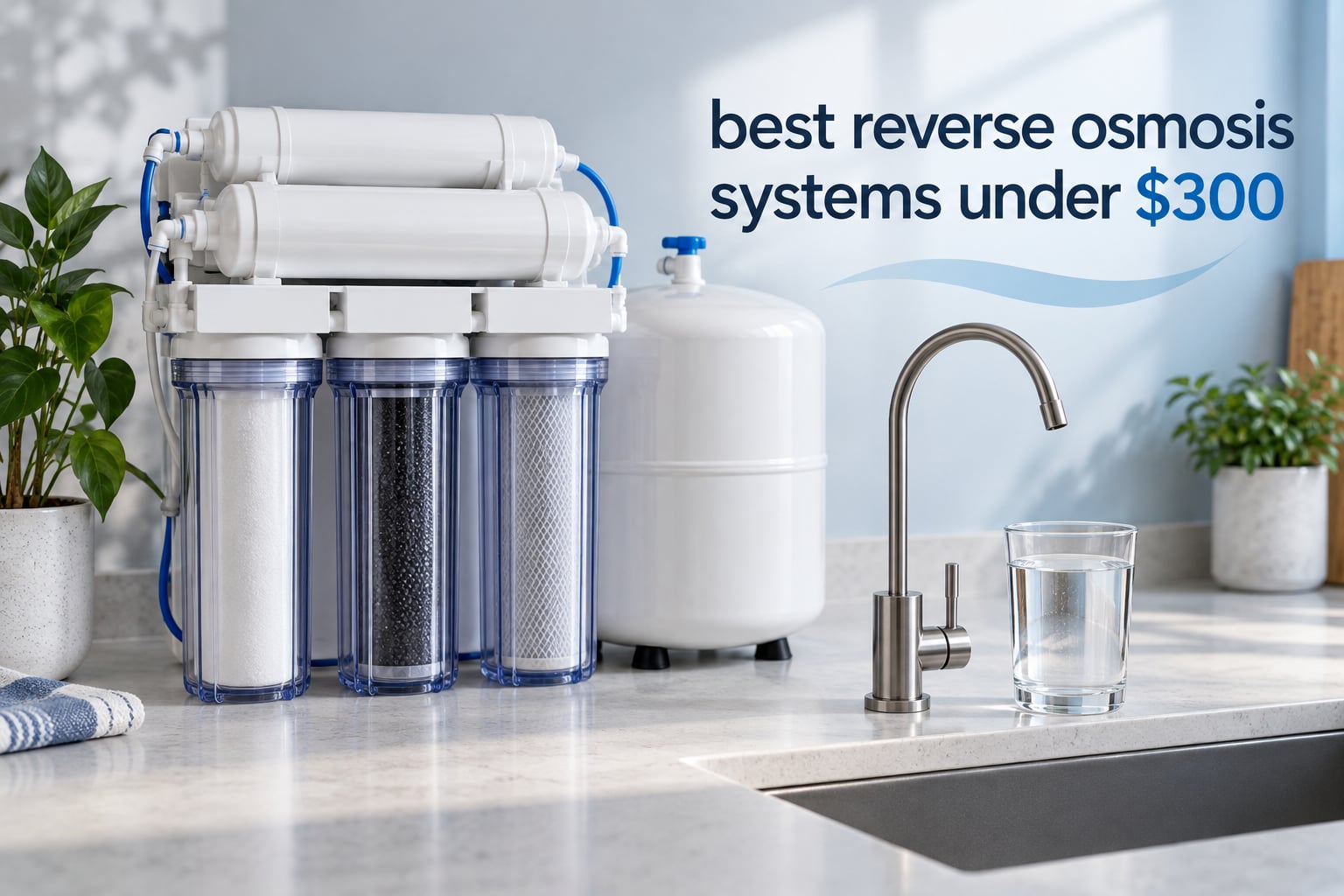
Reverse osmosis used to mean one thing: a big white box, a plastic tank, and a faucet that took an afternoon to plumb. That is still true, but the sub-300 range has shifted. You can now get tankless units that fill a cup in seconds rather than minutes, systems that add minerals back, and bodies small enough to hide behind a trash can. The catch is that most of what separates the good buys from the cheap ones is invisible on a product page.
The best reverse osmosis systems under 300 are the iSpring RCC7-BN for overall balance, the APEC ROES-50 for people who want a set-and-forget build, and the Waterdrop G2 for anyone who is tired of waiting on a tank to refill. All three clear the budget ceiling while covering the three genuinely different ways to own an RO system: the supported conventional unit, the durable conventional unit, and the powered tankless unit. We also pulled in a near-zero-TDS option for aquariums and two small-footprint units for renters and tight cabinets, so the list covers real household situations rather than ten variations of the same white box.
We read every specification, filter claim and owner complaint we could get our hands on, then sorted the field by the things that decide whether a budget system still works in year three: incoming water pressure, gallons per day against household size, drain ratio, whether replacement cartridges are standard parts, and how hard the install is in a cabinet you do not own. If you want the wider picture on filtration methods and whole-house options, our reverse osmosis system roundup covers categories this budget range does not reach.
Table of Contents
Top 3 Picks for the Best Reverse Osmosis Systems Under 300 (October 2026)
Those three cover most shopping situations. The iSpring wins on the combination of rating depth, filter availability and a support team that will actually troubleshoot your pressure reading. The APEC is the one to buy when you want the smallest number of decisions. The Waterdrop G2 is the only one in this group that produces water fast enough to skip the tank entirely.
Best Reverse Osmosis Systems Under 300 at a Glance
| Product | Specifications | Action |
|---|---|---|
 iSpring RCC7-BN iSpring RCC7-BN |
|
Check Latest Price |
 APEC ROES-50 APEC ROES-50 |
|
Check Latest Price |
 Waterdrop G2 Waterdrop G2 |
|
Check Latest Price |
 Waterdrop G5P500A Waterdrop G5P500A |
|
Check Latest Price |
 NU Aqua 5-Stage NU Aqua 5-Stage |
|
Check Latest Price |
 Geekpure RO5 Geekpure RO5 |
|
Check Latest Price |
 PureDrop RTW5 PureDrop RTW5 |
|
Check Latest Price |
 FS-TFC 100 GPD FS-TFC 100 GPD |
|
Check Latest Price |
 COMFEE CMP10 COMFEE CMP10 |
|
Check Latest Price |
 Aquatic Life RO/DI Aquatic Life RO/DI |
|
Check Latest Price |
Two things stand out in that table. Only two of these ten are powered tankless designs, and both are the Waterdrop units. Everything else runs on household line pressure alone, which is cheaper to own and simpler to install but ties your output to whatever PSI your municipality delivers.
1. iSpring RCC7-BN – the all-round pick with the deepest support bench
iSpring RCC7-BN NSF Certified, High Capacity Under Sink 5-Stage Reverse Osmosis Water Filter, RO Drinking System, 75 GPD Brushed Nickel Faucet, Patented Top-Mounted Faucet Design for Easy Installation
75 GPD
5-stage
NSF/ANSI 58
No power needed
27.5 lb
Pros
- Color-coded tubing and QR install videos make the DIY setup straightforward
- Transparent first housing lets you check filter condition at a glance
- US-based support troubleshoots by pressure and TDS readings
- Reduces TDS by 80-90 percent
Cons
- Needs 40-45 psi incoming
- above 80 psi a regulator helps
- Drain ratio runs about 2:1 to 3:1
- A few quick-connect clips arrive uninstalled
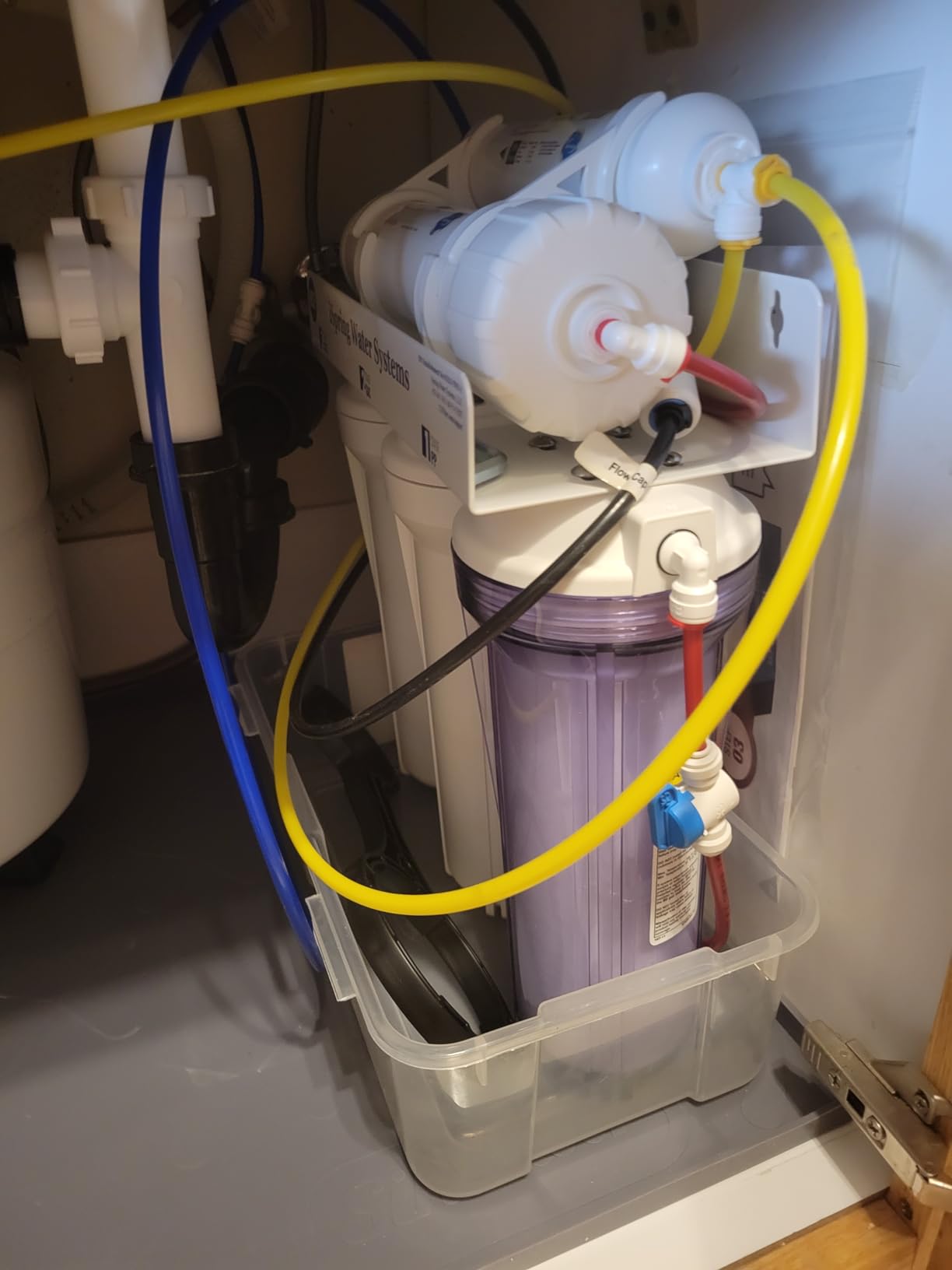
This is the system we keep coming back to because nothing about it is a compromise you will have to apologize for later. The RCC7-BN puts out 75 gallons a day, which is enough for a family of four drinking and cooking with water, and it does it without a single watt of electricity. Water moves through a sediment stage, three carbon stages and a 0.0001 micron membrane, and the manufacturer claims removal of up to 99 percent of more than 1,000 contaminants including PFAS, chlorine, fluoride, lead, arsenic and asbestos.
What separates it from cheaper 5-stage boxes is the boring stuff. The first housing is transparent, so you can see the sediment filter brown instead of guessing when to change it. The fittings are color-coded and individually wrapped, and the manual points to QR-coded install videos, which matters when you are on your back under a cabinet with a phone in your mouth. There is a check valve to stop backflow and food-grade tubing throughout.
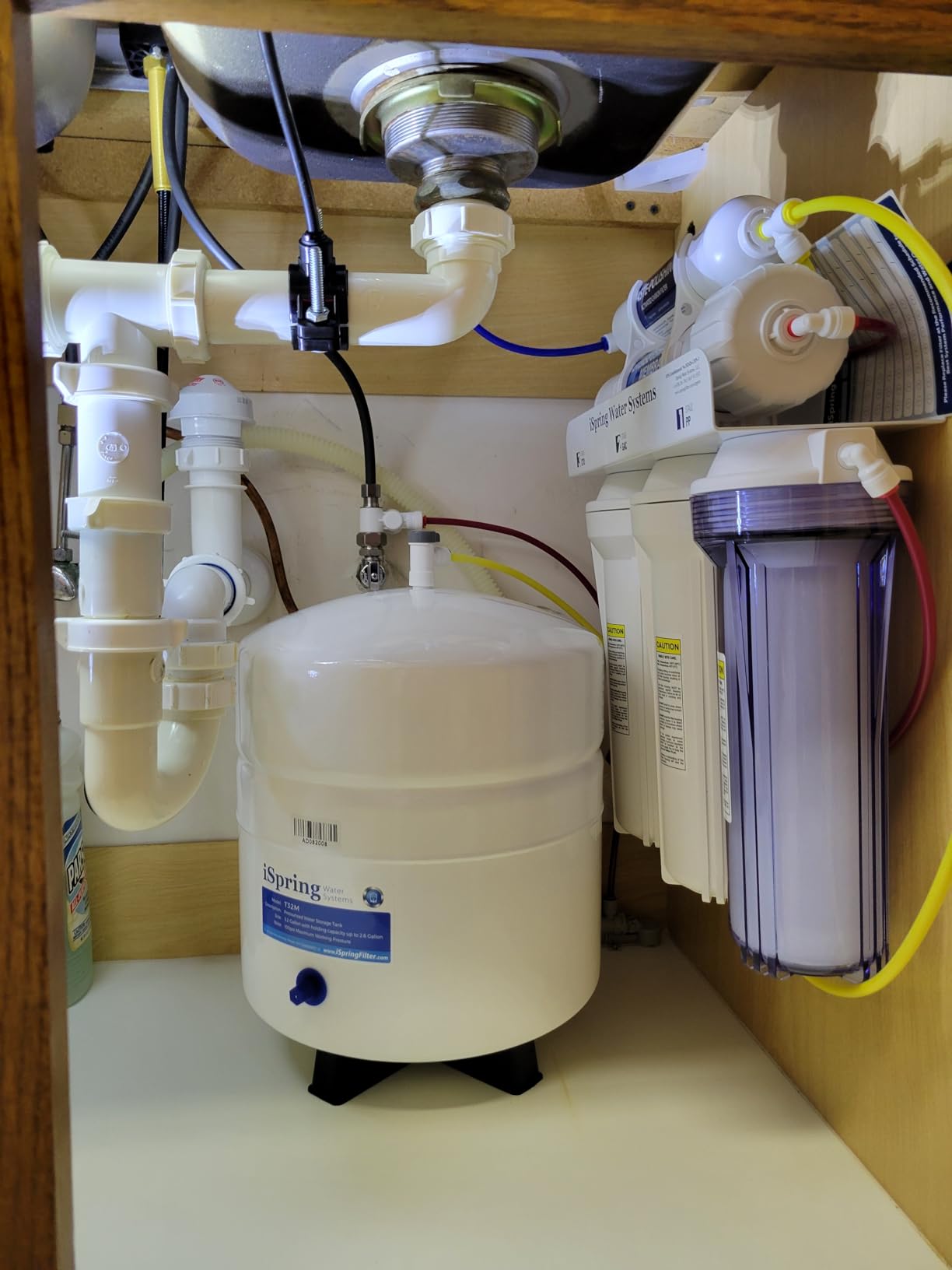
Owner feedback on this unit is unusually consistent for a product in this bracket. The most common theme is that iSpring’s US-based support will walk you through a diagnosis using your pressure and TDS readings rather than sending a form to fill out. That is worth real money when a system stalls at 30 psi, and it is the single biggest reason this unit takes the top slot here despite being one of the larger footprints at 23.62 by 15.75 by 11.81 inches.
Multiple owners report running the same unit for years without a leak, and the taste complaints that usually show up in cheap RO systems are largely absent. Chlorine aftertaste gets called out as gone, and measured TDS readings after install commonly land in single digits, which is where you want an RO system to end up.
Where the RCC7-BN earns its price
The reasons to pick this one are practical rather than glamorous. Filter cartridges are standard parts, not sealed proprietary cartridges, so you can compare prices across retailers and keep the annual cost predictable. At 75 GPD it outproduces most of the conventional units on this list without needing a pump bolted to the frame, and the 750 ppm input ceiling gives it more headroom on well water and hard municipal lines than several competitors here.
The 1-year manufacturer warranty is short, and the warranty activates on registration, so register it the day it arrives. Note the body is heavy at 27.5 pounds, which is not a problem on the floor of a cabinet but is awkward if you plan to mount it high on a wall.
Where it will frustrate you
It needs 40 to 45 psi of incoming pressure to hit its rated output, and in a home above 80 psi you really should add a regulator or you will be chasing constant cycling and premature wear on the housings. The drain line runs roughly 2:1 to 3:1 purified to waste, which is normal for a non-pumped unit but worse than the two Waterdrop systems in this list.
Flow is slower than any of the powered tankless models, and a few buyers report that some quick-connect fittings arrived without their retaining clips pre-installed. That is a five-minute fix with a pair of pliers, but it is a real annoyance on install night.
2. APEC ROES-50 – the classic build with a decade of owner reports
APEC Water ROES-50, 5-Stage Under Sink Reverse Osmosis System, 50 GPD
50 GPD
5-stage
40-85 psi
Includes tank and faucet
Pros
- Quick-connect fittings rarely leak once seated
- Decade-plus ownership reported on the same unit
- Complete install kit in the box
- TDS commonly drops from 100+ ppm to single digits
Cons
- Supplied faucet has no air gap
- Housing caps can crack if overtightened
- 50 GPD is modest for a large household
The ROES-50 is the system people describe as the old reliable, and the ownership history reflects that. This is a 5-stage, 50 GPD under-sink unit rated for 40 to 85 psi, and APEC claims removal of up to 99.99 percent of impurities across more than 1,000 targets including arsenic, chlorine, lead, fluoride, heavy metals, PFAs and microplastics. APEC has been designing residential filtration systems for over 20 years, and that history shows up most clearly in the parts availability.
The box contains the RO system, tank, a full Filter-Max-ES50 set, a brushed nickel faucet, the install kit and instructions. Colored tubing and quick-connect fittings mean most people finish this in an afternoon without a wrench fight, and owners frequently note that the connections stay dry long after installation.
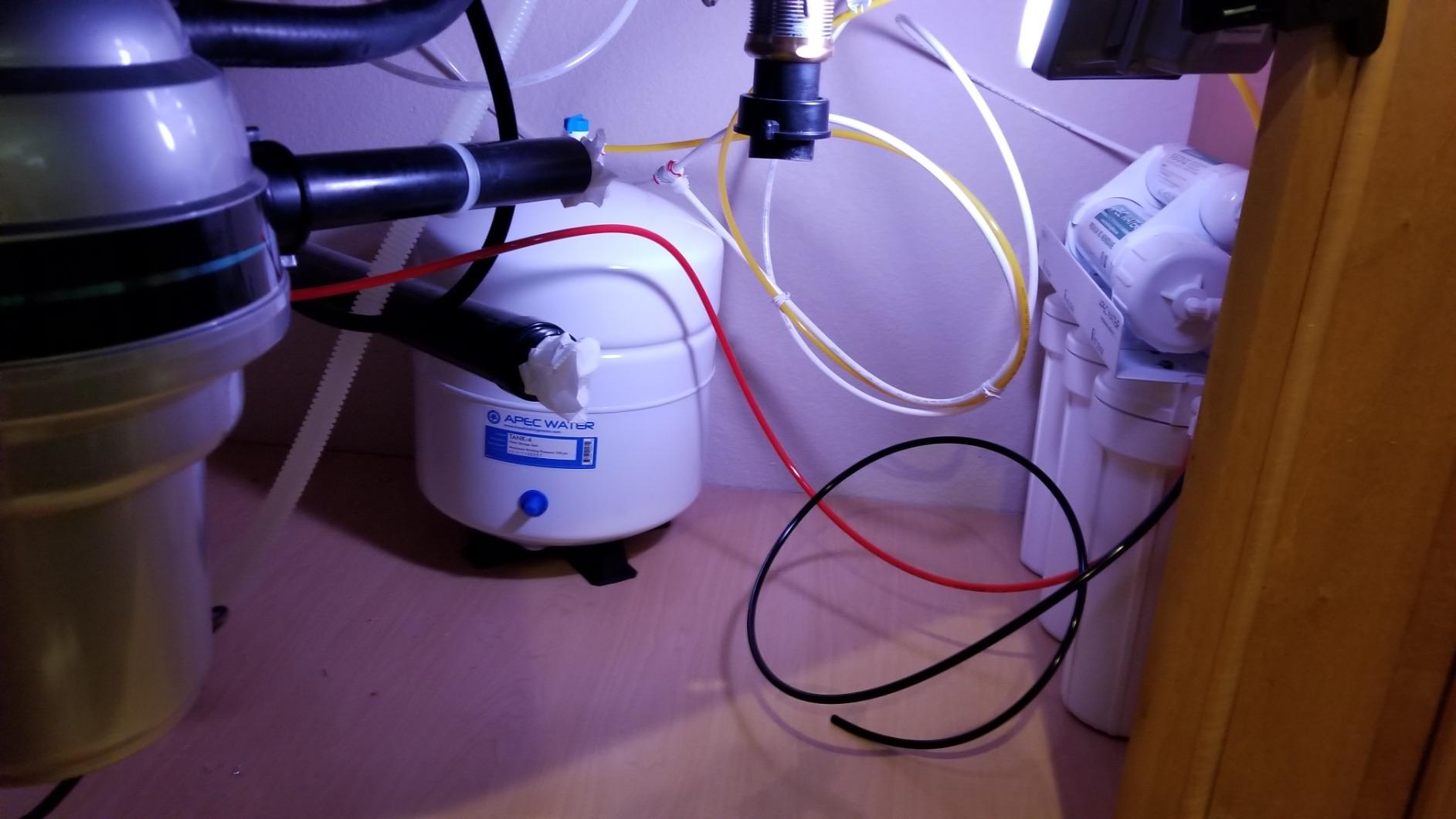
What we like most is the durability signal. A large share of reviews on this unit come from people who bought their second or third ROES-50 after decades with the first. That is a different kind of endorsement than a high star average, because it means the housings, threads and membrane housing are still accepting parts built twenty years ago.
The specification sheet lists an operating range of 40 to 100 degrees Fahrenheit and a maximum input of 2000 ppm TDS, which is the highest ceiling of any conventional unit here. Filter replacement is recommended on a 6-to-24-month schedule depending on incoming water quality, so the cost per year depends heavily on what your municipal supply is doing.
Best fit for a plain, durable install
This is the pick for a household that wants one decision made for them and then a decade of quiet operation. It handles 2000 ppm input, runs from 40 to 85 psi, and stores water in the included tank so you are not waiting on the membrane when you want a glass of water. Support gets singled out for resolving leak and parts problems quickly, which matters when a housing does eventually crack.
It is also the one to buy if your plumber has installed APEC systems before, because the parts and the drilling pattern are familiar territory.
Where it falls short
50 GPD is the smallest rated output among the conventional units in this group, and a 5-gallon tank only yields 2 to 3 gallons at a time before you wait for a refill. In a household of five or more, or anyone filling large pots, that is noticeable. Below 40 psi you will need a booster pump, and above 85 psi a regulator, neither of which is in the box.
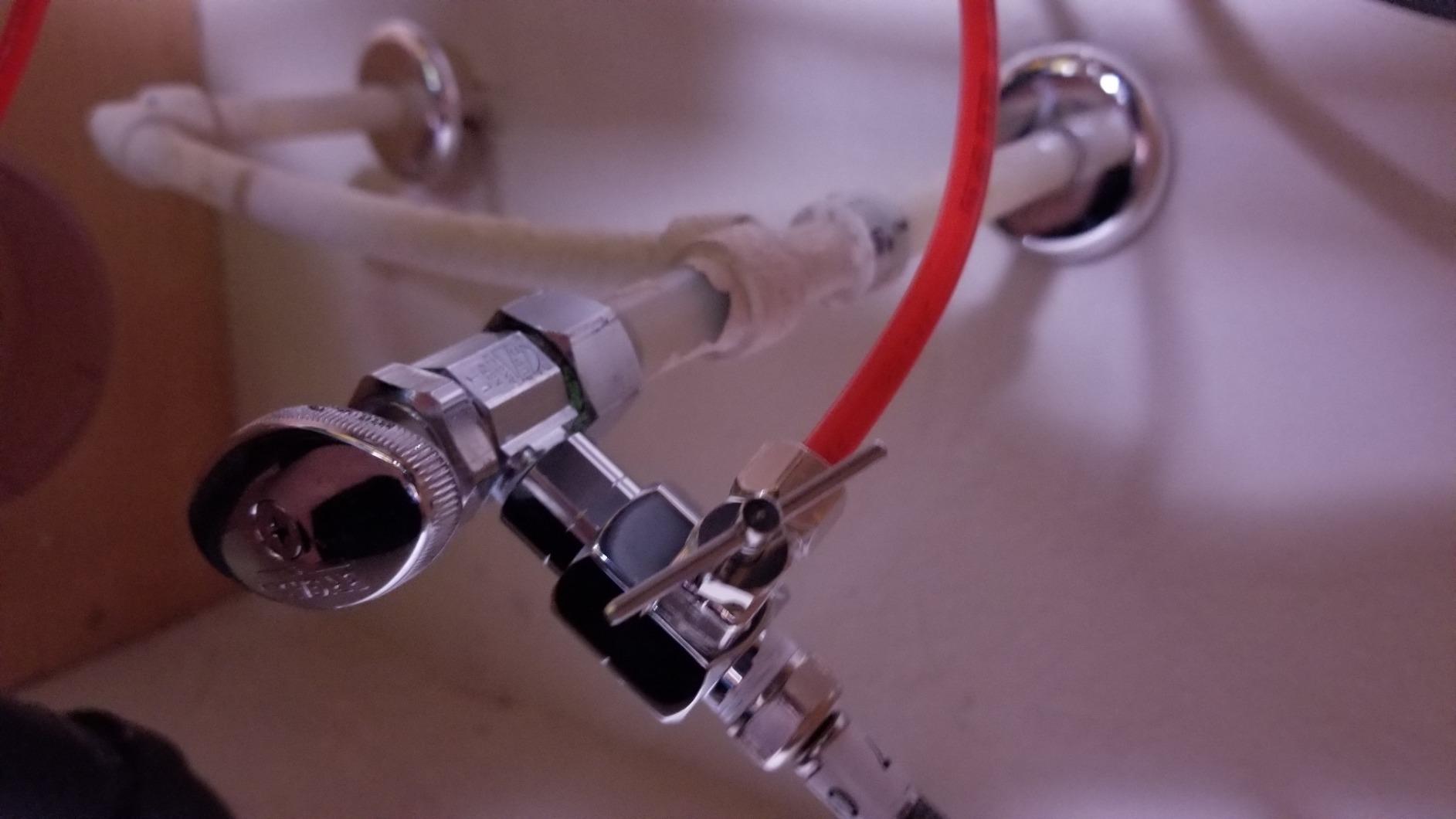
Two real drawbacks: the supplied faucet is a non-air-gap design, so if your local code requires an air gap you will want to add a dual dishwasher air gap unit, and the housing caps can crack if you overtighten them during a filter change. The self-piercing feed adapter is also sized for North American plumbing only.
3. Waterdrop G2 – 400 GPD tankless flow and a 1:1 drain ratio
Waterdrop G2 Reverse Osmosis System, 400 GPD Tankless RO Water Filtration
400 GPD
Tankless
1:1 drain ratio
NSF/ANSI 372
Pros
- 400 GPD output with no tank refill delay
- 1:1 pure-to-drain ratio wastes far less water
- Tankless body frees over 70 percent of cabinet space
- Twist-and-pull cartridges swap fast
Cons
- Requires an under-sink electrical outlet
- Faucet install needs countertop drilling
- Only two filters included in the box
Most budget RO systems force a tradeoff between flow and cabinet space. The Waterdrop G2 does not, and that is why it earns a slot this high. It is a 7-stage tankless system rated at 400 GPD, with a 1:1 pure-to-drain ratio that means every gallon to the drain buys you a gallon of finished water. A cup of filtered water arrives in about 12 seconds.
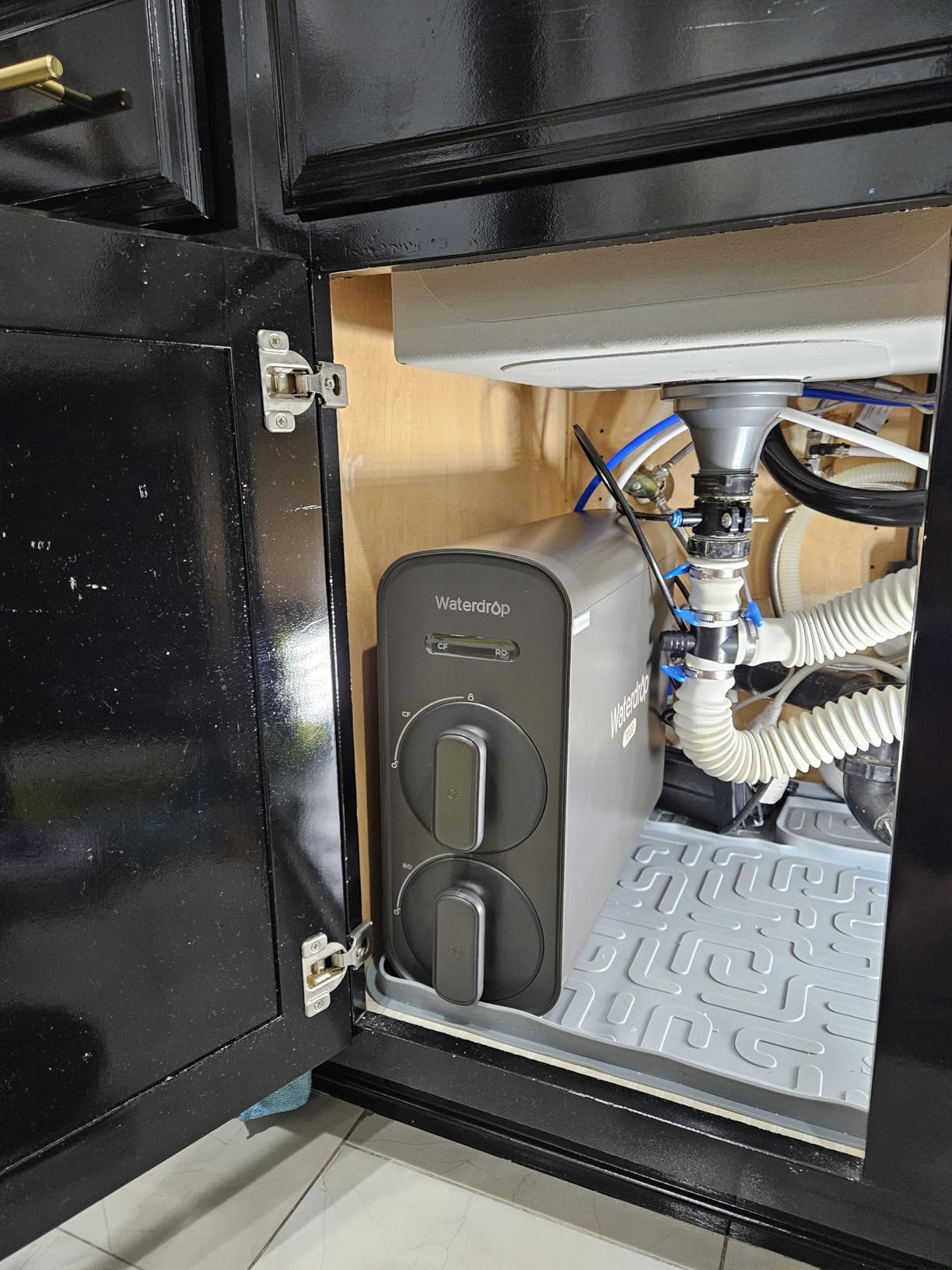
It is NSF/ANSI 372 certified for lead-free materials, handles feed water up to 300 ppm, and runs on an in-built stored cord rather than a hardwired outlet. The integrated electrical and water circuit design reduces the number of leak points compared with a conventional system, and the airtight housing keeps the noise down, which is a genuine consideration in a kitchen at 6 a.m.
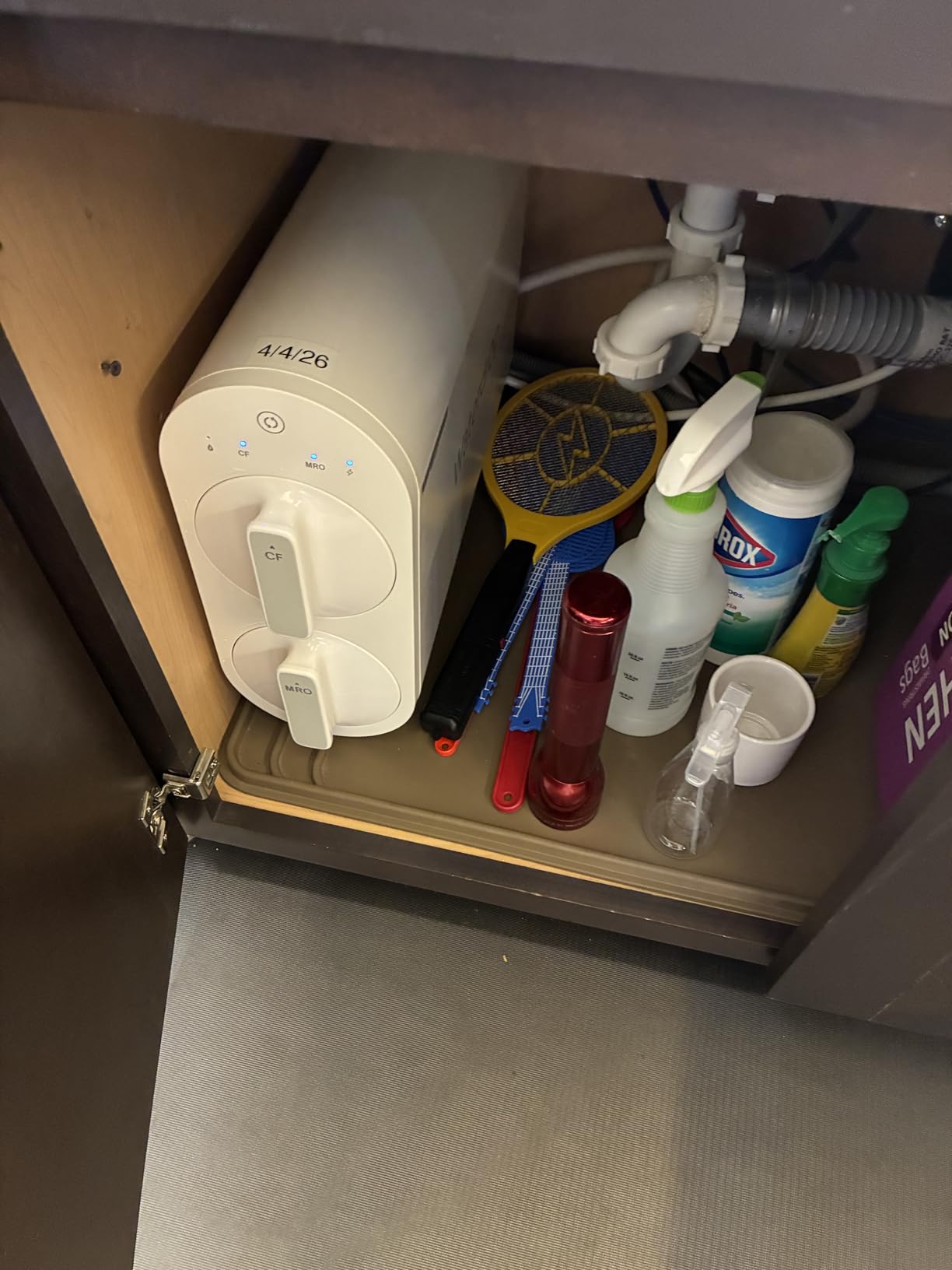
Where the tankless approach pays off is in a household that drinks a lot of water on demand. There is no storage tank to fill, so the first glass is as fast as the hundredth. Reviewers consistently point to the 400 GPD flow and the 1:1 ratio as the reasons they bought it, and the cabinet space recovery matters more than expected in a kitchen where the sink already has a disposal and a plumbing trap taking up room.
Filter changes are the other quiet win. These are twist-and-pull cartridges rather than housings you unscrew cap-by-cap, and the manufacturer states a swap takes about 3 seconds with the system off. Replacement cartridges are the Waterdrop G2CF and G2MRO. Installation is quoted at under 30 minutes for anyone comfortable with a drill and a wrench.
Why this one for busy kitchens
Choose the G2 if you cook often, run an ice maker, or have people over who all want filtered water at once. The 1:1 drain ratio is the environmental argument and it is a real one, since a conventional 3:1 system sends two gallons down the drain for every gallon you drink. The tankless footprint also means the freed cabinet space can go to a recycling bin instead of a 3-gallon pressure vessel.
Tankless means no stored reserve, though. During a power or supply interruption you have nothing to draw on, so this is the wrong pick for anyone who wants emergency stored drinking water.
Where it will frustrate you
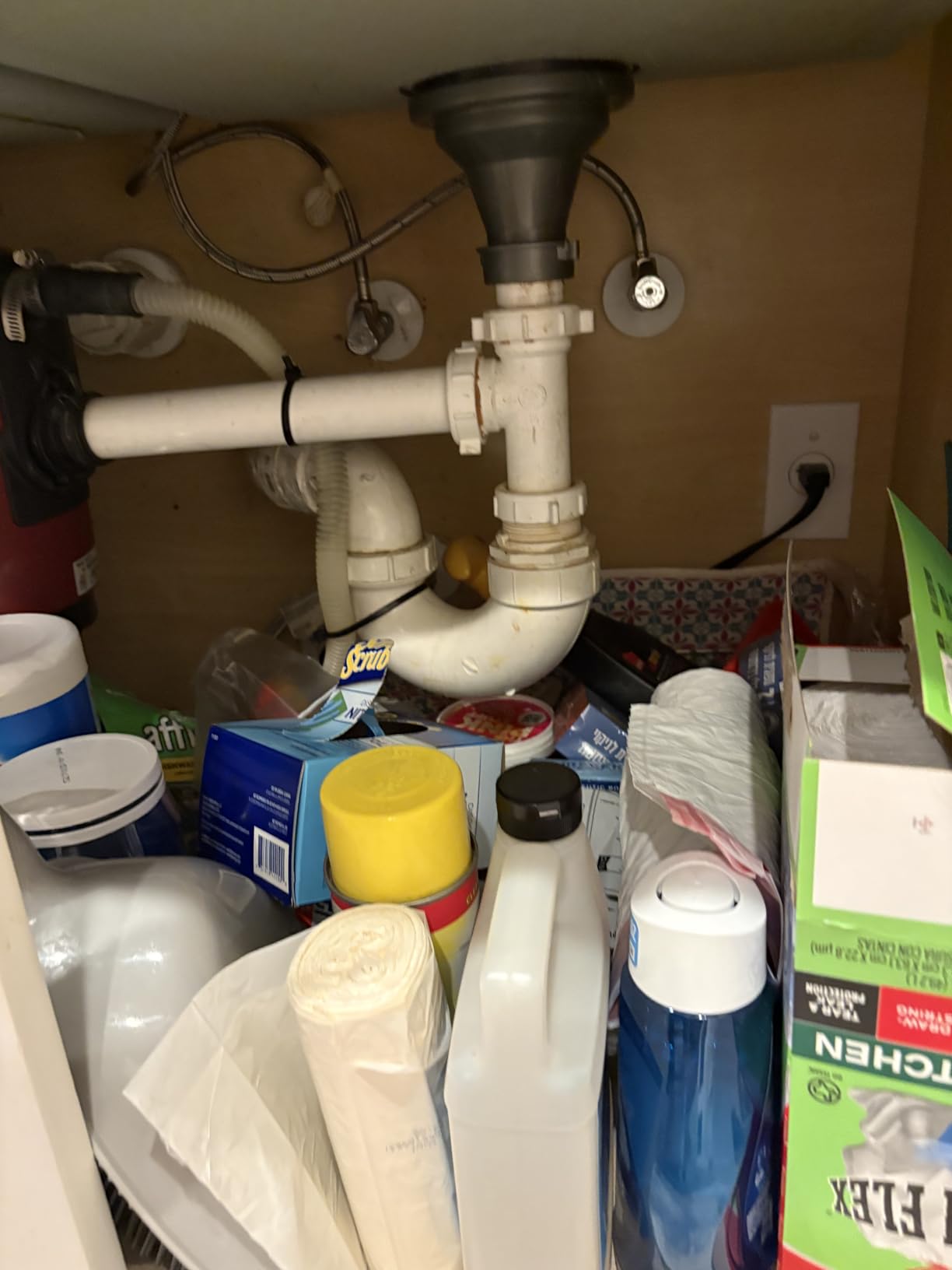
It needs an under-sink electrical outlet, which rules it out in older apartments where the nearest socket is in the next room. The faucet installation requires drilling the countertop, so this is not a renter-friendly unit unless you have a surface-mount option and a landlord who does not mind a hole. Only two filters are included, so plan on a cartridge order for the first year of ownership.
With a 300 ppm input ceiling, this is a municipal-water system. If you are on a well or have unusually hard water, you need a unit with a pre-treatment stage, and the more capable conventional picks handle higher ceilings.
4. Waterdrop G5P500A – alkaline minerals and the highest flow in the set
Waterdrop G5P500A Reverse Osmosis System, 8-Stage RO Filtration, Alkaline
500 GPD
8-stage
Alkaline minerals
2:1 drain ratio
Pros
- Highest rated flow in the set at 500 GPD with a 6 oz cup in about 8 seconds
- Mineral stage offsets the flat acidity of plain RO
- 2:1 drain ratio beats conventional 3:1 systems
- Frees up to 70 percent of under-sink space
Cons
- Needs an electrical outlet
- Countertop drilling for the faucet
- 500 ppm input ceiling caps well-water use
Plain RO water strips minerals out and leaves you with something that tastes flat to a lot of people. The G5P500A answers that directly with an alkaline mineralization stage that adds Ca2+, Mg2+, Na+ and K+ back into the finished water after a 0.0001 micron membrane. It does that as a built-in stage behind the membrane rather than as an add-on cartridge you buy later, and it is the only system here that names Ca2+, Mg2+, Na+ and K+ as the intended additions. It also carries the highest rated output in the roundup.
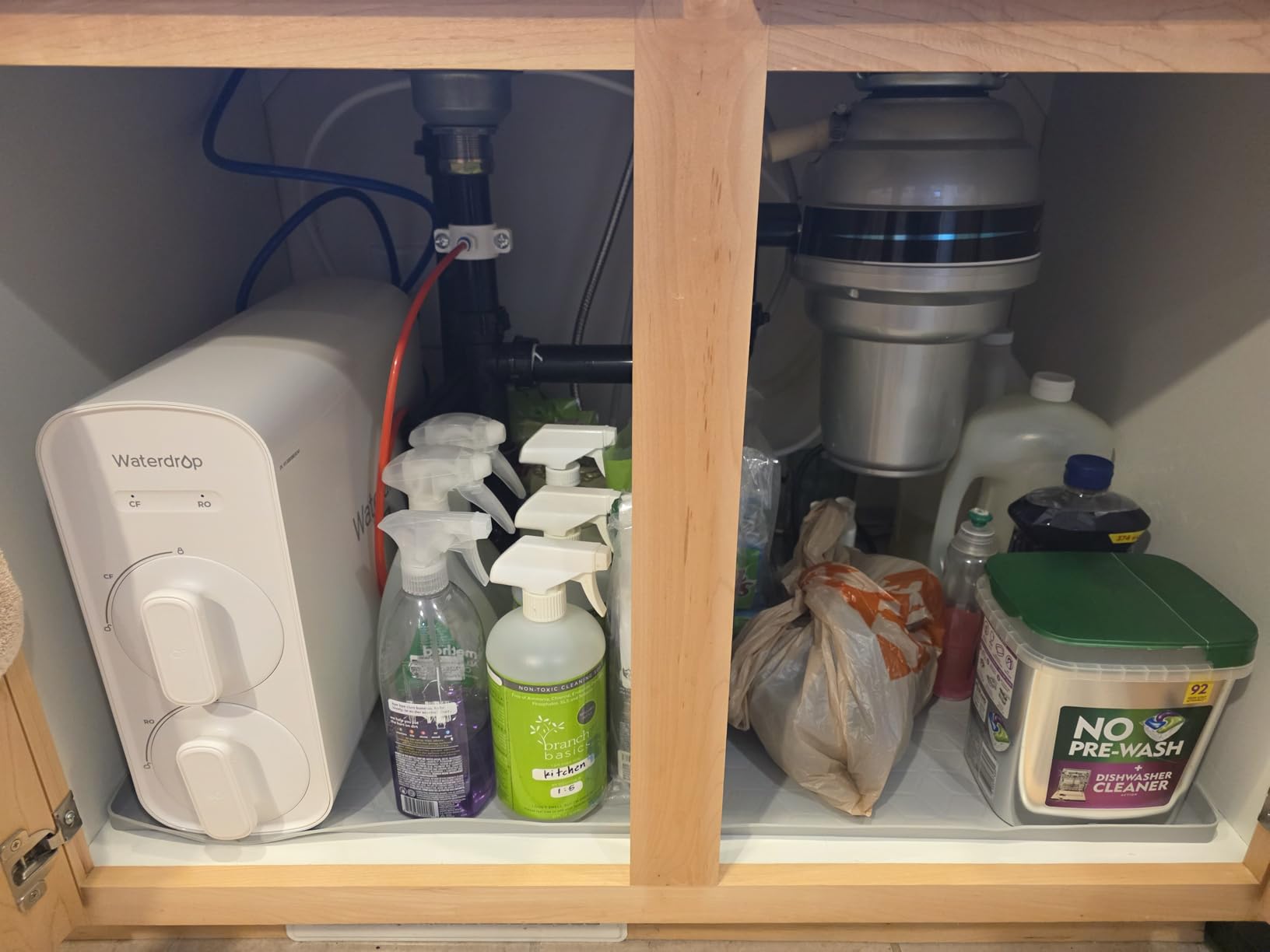
It is also the biggest number on the spec sheet: 500 GPD steady flow, filling a 6-ounce cup in about 8 seconds, through 8 stages that cover PFOA, PFOS, chlorine, lead, fluoride and heavy metals. The drain ratio is 2:1, half the waste of a typical 3:1 conventional system, and the tankless body frees up to 70 percent of under-sink space.
It is NSF/ANSI 58 and NSF/ANSI 372 certified, which is the combination you want to see. NSF/ANSI 58 certifies the filtration performance claims, and 372 certifies the lead-free materials. Quite a few budget units claim one or the other, and the COMFEE further down this list is a good example of a system that certifies materials but not the system itself.
The operating range is wide for a tankless unit, running 14.5 to 87 psi, and the maximum flow rate is listed at 1.31 liters per minute. It weighs 21.4 pounds and measures 16.69 by 5.69 by 13.9 inches. If you want to feed an ice maker or a refrigerator line, the Waterdrop XT connection handles that.
Best for taste and for feeding appliances
The mineral cartridge is the reason to pick this. If you have tried RO before and found the taste unpleasant, this is the unit most likely to change your mind, because the taste complaint in owner reviews is consistently described as improved rather than flat. It is also the one to buy if you want filtered water routed to an ice maker or a fridge, which no other system in this group does out of the box.
At 500 GPD with a 2:1 ratio, the ongoing water cost of this system is the lowest here for heavy daily use, and the alkaline output has a noticeably higher pH than conventional RO.
Where it will frustrate you
Same two installation demands as the G2: a powered under-sink outlet and a drilled countertop hole for the faucet. The mineral cartridge is also a consumable that needs replacing on a schedule, and users of remineralization cartridges generally replace them every 6 to 12 months, so budget for that on top of the standard stages.
The 500 ppm input ceiling is the hard limit. On well water or a high-TDS municipal supply, feed water above that number will degrade membrane performance, and no tankless unit in this price range solves that without pre-treatment. Only two pre-installed filters are included, so the accessory budget is not zero either.
5. NU Aqua 5-Stage 100 GPD – pumped-free flow with a three-year warranty
NU Aqua 5-Stage Under Sink Reverse Osmosis Water Filter System – 100 GPD RO
100 GPD
3-year warranty
PPM meter included
20 lb
Pros
- 100 GPD is high for a unit with no pump
- Longest warranty in this group at 3 years with a 120-day home trial
- Free PPM meter and leak detector included
- Double o-ring sealed housings
Cons
- No pump so low household pressure limits output
- Alkaline sixth stage can leave a sulfur-like taste
- Support knowledge described as uneven
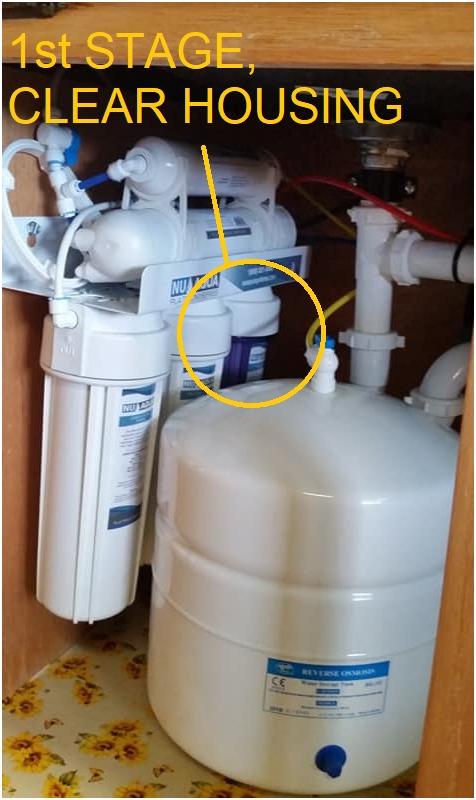
100 GPD without a pump is the number that makes this system interesting. Most conventional units in this bracket sit between 50 and 75 GPD, so the NU Aqua is delivering meaningfully more finished water from the same household line pressure, which means fewer trips to the faucet for a cooking pot full of water. The HydraCoil membrane is specified for up to 99 percent rejection across more than 1,000 total dissolved solids.
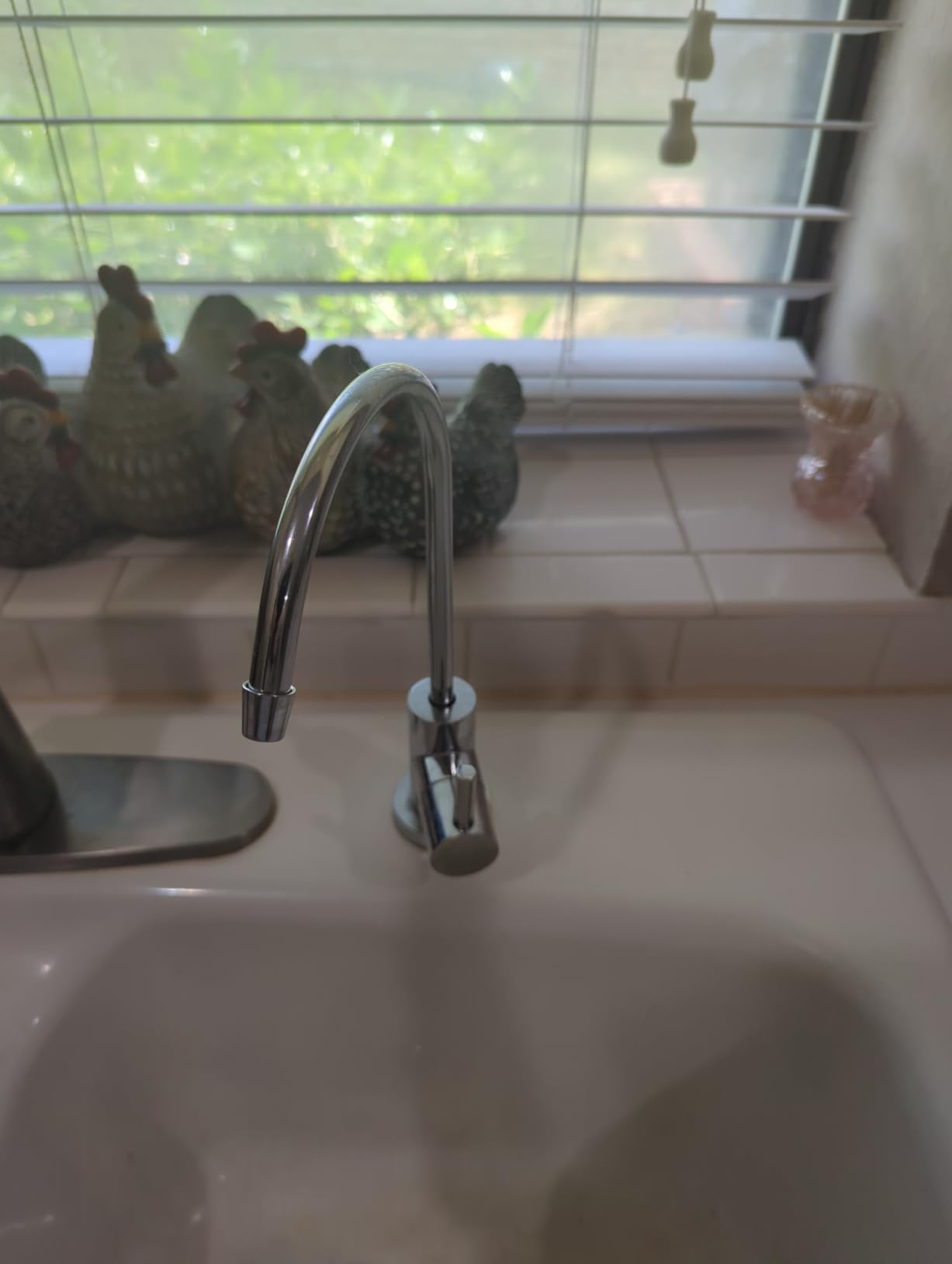
It also arrives with the accessories that budget systems usually omit. You get a complimentary PPM meter, which is the cheapest way to track when your filters are actually exhausted, and a leak detector. The faucet is a lead-free stainless steel designer model, and the filter housings use double o-ring seals, which is the single most common leak point on a five-stage system.
Two items put it ahead on ownership terms. The warranty runs three years, which is longer than any other system in this roundup, and there is a 120-day home trial, so you can install it, taste the water for a season, and send it back if it does not suit you. That combination of risk reversal and warranty length is unusual at this budget level.
Owners report repeat purchases across multiple systems over roughly eight years with few leaks, and installation is reported as comfortably under an hour with color-coded tubing and professional grade quick-connect fittings. The stated maximum input is 500 ppm.
What makes it worth the money
Buy this one if you want high throughput but do not want to run a cord to the sink or drill a faucet hole. The stainless faucet and double o-ring housings are genuinely better sealing than most of what you will find in this bracket, and the included PPM meter means you are not replacing filters on a calendar when you could be replacing them on evidence.
For a household of four or five that cooks a lot, 100 GPD from a tankless-adjacent conventional design is the practical sweet spot between the APEC and the Waterdrop units.
Where it will frustrate you
There is no pump, so if your line pressure is low the whole design weakens. That is the one weakness the marketing does not resolve, and it is the reason a boosted or tankless model exists in this price range at all. Some buyers also report the alkaline sixth stage developing a sulfur-like odor or taste, which is a resin issue rather than a membrane issue and usually means replacing that cartridge.
Support experiences are described as less knowledgeable about troubleshooting than the leaders in this group, so read the manual and the TDS readings carefully before calling anyone. New units may also need multiple flush cycles to clear an initial off taste.
6. Geekpure RO5 – twelve filter pieces in the box
Geekpure 5 Stage Reverse Osmosis RO Drinking Water Filter System-75 GPD
75 GPD
12 filter pieces
2.8 gal tank
28 lb
Pros
- Seven spare filters in the box defer the first year of costs
- Universal standard-size replacement parts
- Quick push fittings and color-coded tubing
- Handles feed water up to 1000 ppm
Cons
- Install and flush take 1-2 hours of care
- First two tanks of water must be discarded
- 28 lb body is awkward to lift
The Geekpure RO5 is 75 GPD at 60 psi with a 2.8 gallon tank, and the reason it is on this list is arithmetic rather than filtration. The box contains 12 filter pieces: the five installed stages plus seven extra replacement cartridges. For a buyer who wants the smallest possible first-year running cost, that is the single most valuable thing in this entire roundup.
It also states that all filters and parts are universally compatible and standard size, which is the opposite of proprietary cartridge lock-in and a real advantage if you ever switch brands or find a cheaper supplier. Prefilters last about a year and the RO membrane 2 to 3 years, so the seven spares cover the first replacement cycle without another order. That is worth remembering before you assume every budget system includes this much spare media.
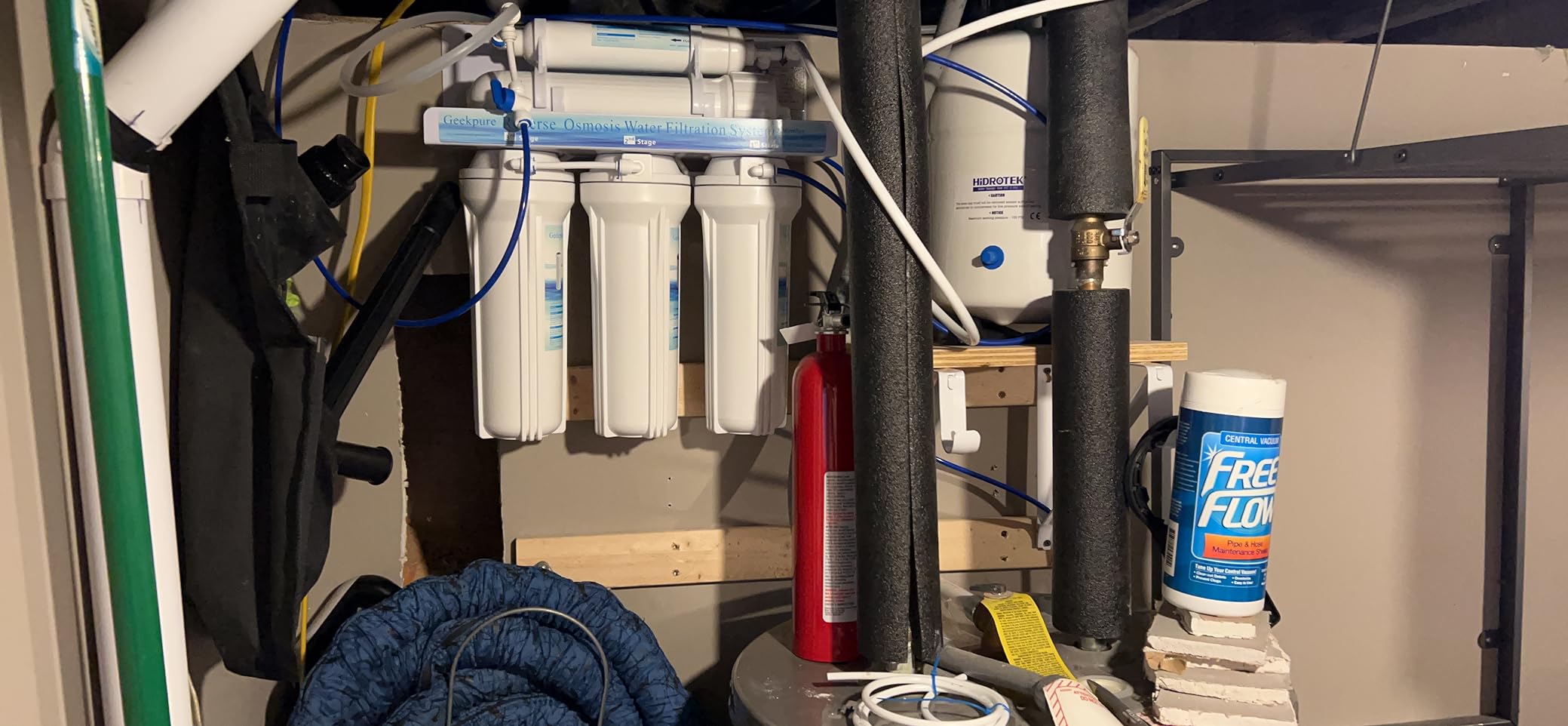
Filtration is 0.0001 micron with claimed reduction of arsenic, lead, fluoride, cadmium and heavy metals, and the tubing, quick push fittings, storage tank and RO membrane are all NSF certified. The operating envelope is wide at 40 to 100 psi with a maximum TDS input of 1000 ppm, which makes it one of the more tolerant systems here if you are on a harder municipal supply.
There is 24/7 technical support and a manufacturer with over 20 years in the category, plus EU spare part availability for two years, which is a minor but real supply chain note for anyone outside North America.
Best for budgeting the first year
If your household has never owned an RO system and you are starting from zero, buying a year of filters up front removes the most common early failure point, which is people running a system past the point where taste and pressure degrade because they never got around to ordering cartridges. It is also the best option here for anyone with more than one system or a rental property, since the spares can be split across two installs.
The wide 40 to 100 psi range and 1000 ppm input ceiling also make it one of the more forgiving picks if your pressure swings seasonally.
Where it will frustrate you
The install demands attention. The instructions ask for care and roughly 1 to 2 hours of install and flush time, and you must discard the first two tanks of produced water before drinking, which is standard practice but catches people out. At 28 pounds the unit is the heaviest body on this list, so mounting it high or lifting it into a high cabinet is unpleasant.
The 2.8 gallon tank is modest, so a large household will refill it more often. Discount the “extra filters” claim slightly: those spares are prefilters, not membranes, and the membrane is still a 2-to-3-year expense.
7. PureDrop RTW5 – a small tank and a faucet you fit from above
PureDrop RTW5 5-Stage Reverse Osmosis Water Filter System
50 GPD
2.2 gal tank
Top-mount faucet
No electricity
Pros
- Faucet installs entirely from above the countertop
- Small tank suits shallow and crowded cabinets
- Acoustic dampening keeps refills quiet
- Three spare prefilters included
Cons
- Recurring storage tank bladder failures reported
- Small tank for larger households
- No pump so low pressure hurts output
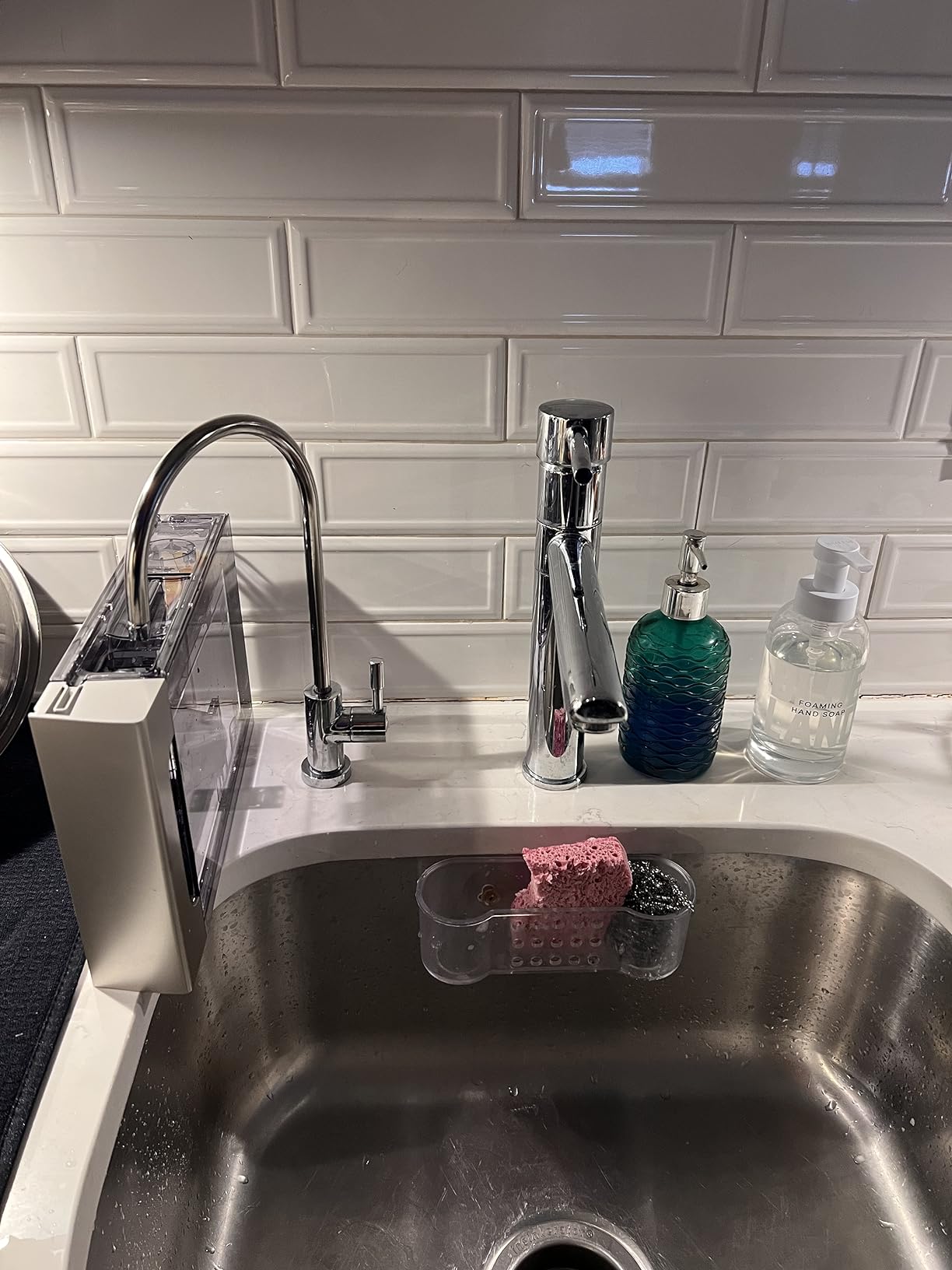
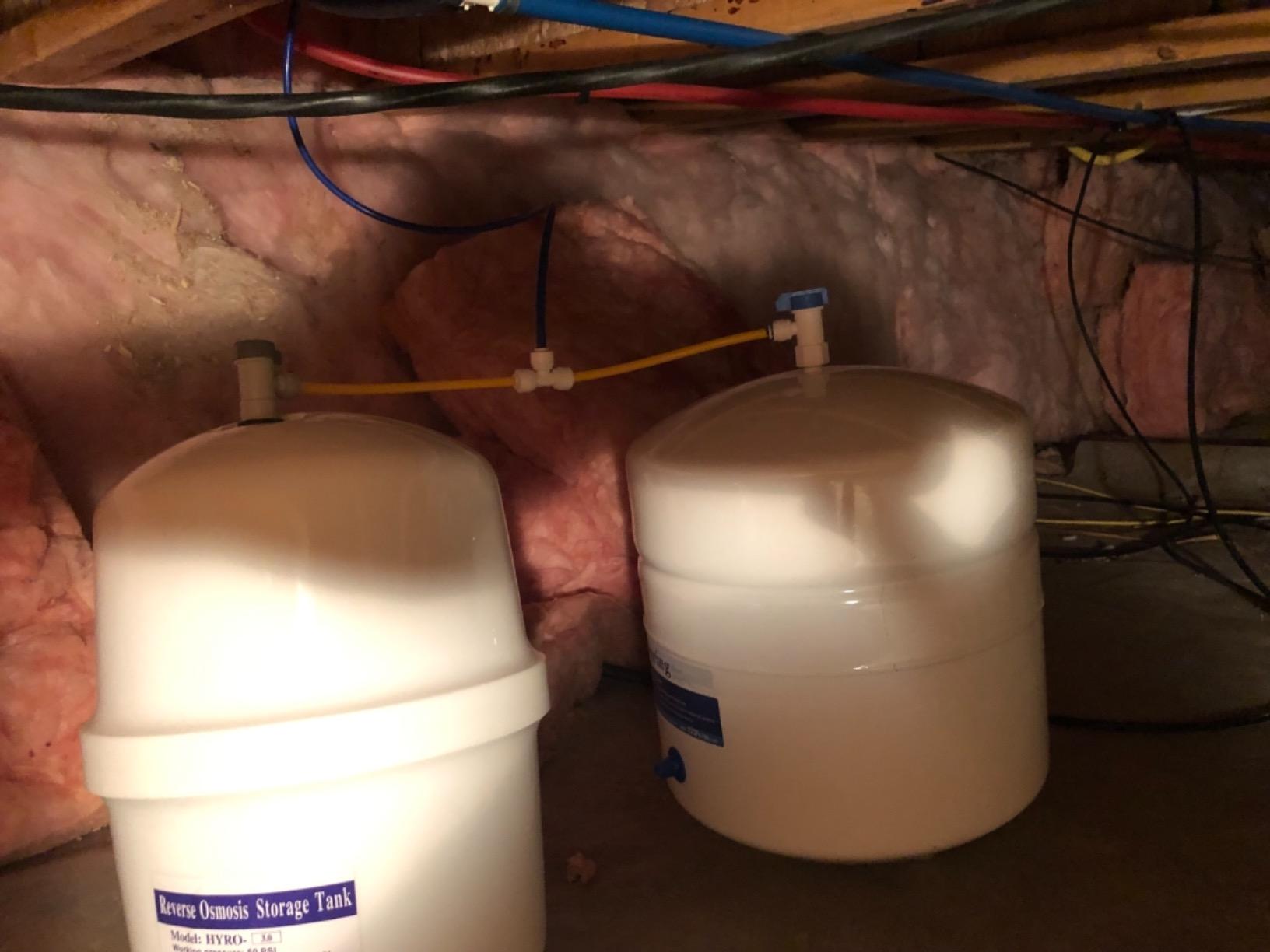
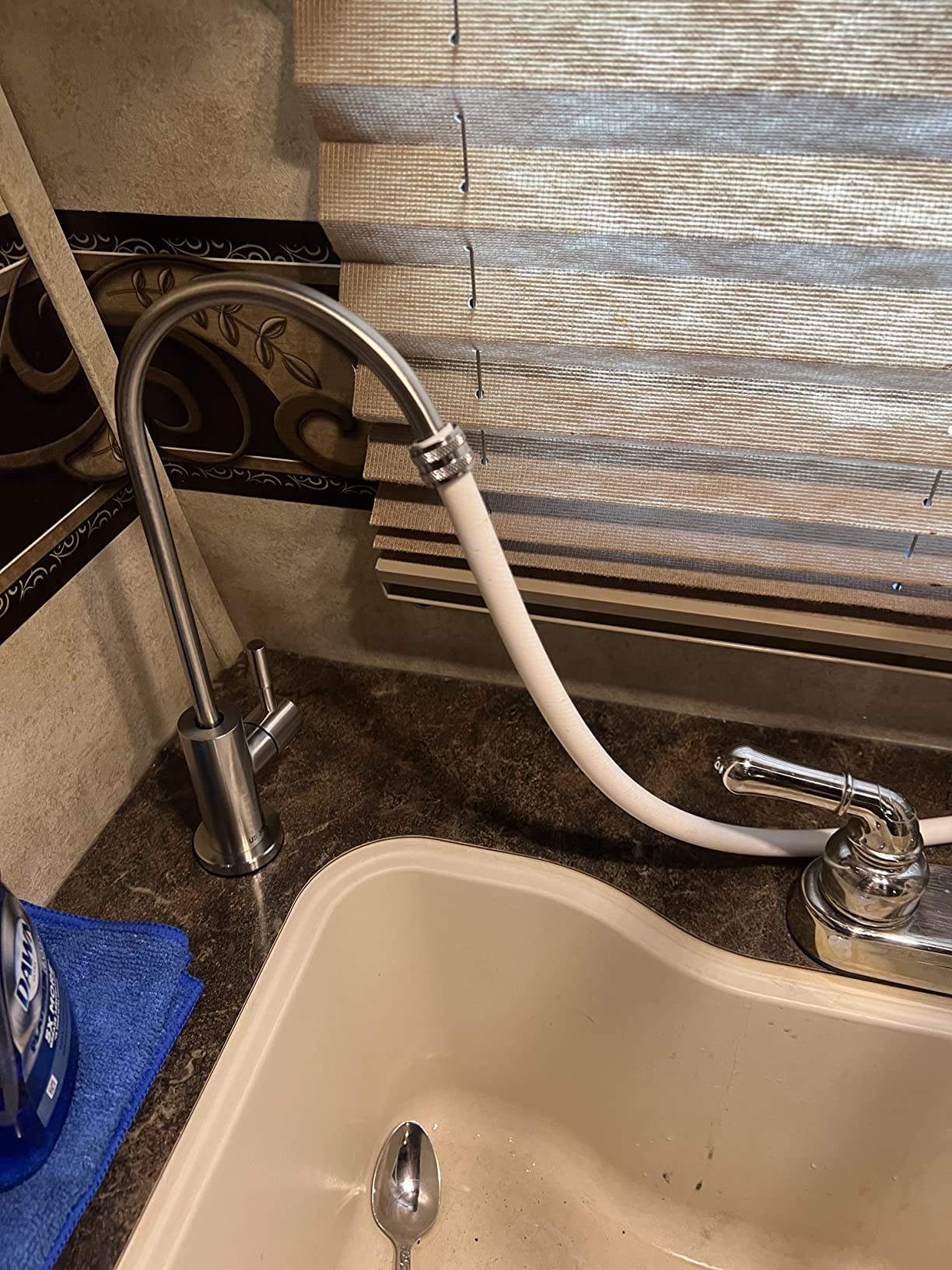
The PureDrop RTW5 solves a specific problem better than anything else in this group: faucets that must be installed from above the countertop. The patented oval-nut top-mount design means you drill one hole, drop the faucet in from the top, and connect it from above, rather than contorting yourself under the sink with a wrench and a flashlight. The manufacturer calls out apartments, rentals, RVs and tight cabinets as the intended situations, and that is accurate.
It is a 5-stage system rated at 50 GPD that reduces up to 99 percent of PFAS, lead, arsenic, chlorine, heavy metals and TDS, and it is SGS-tested against NSF/ANSI 58 standards. The storage tank is only 2.2 gallons, and the housing uses acoustic dampening so refills stay quiet. Refrigerator and ice maker adapters are included with standard 1/4 inch quick-connect fittings.
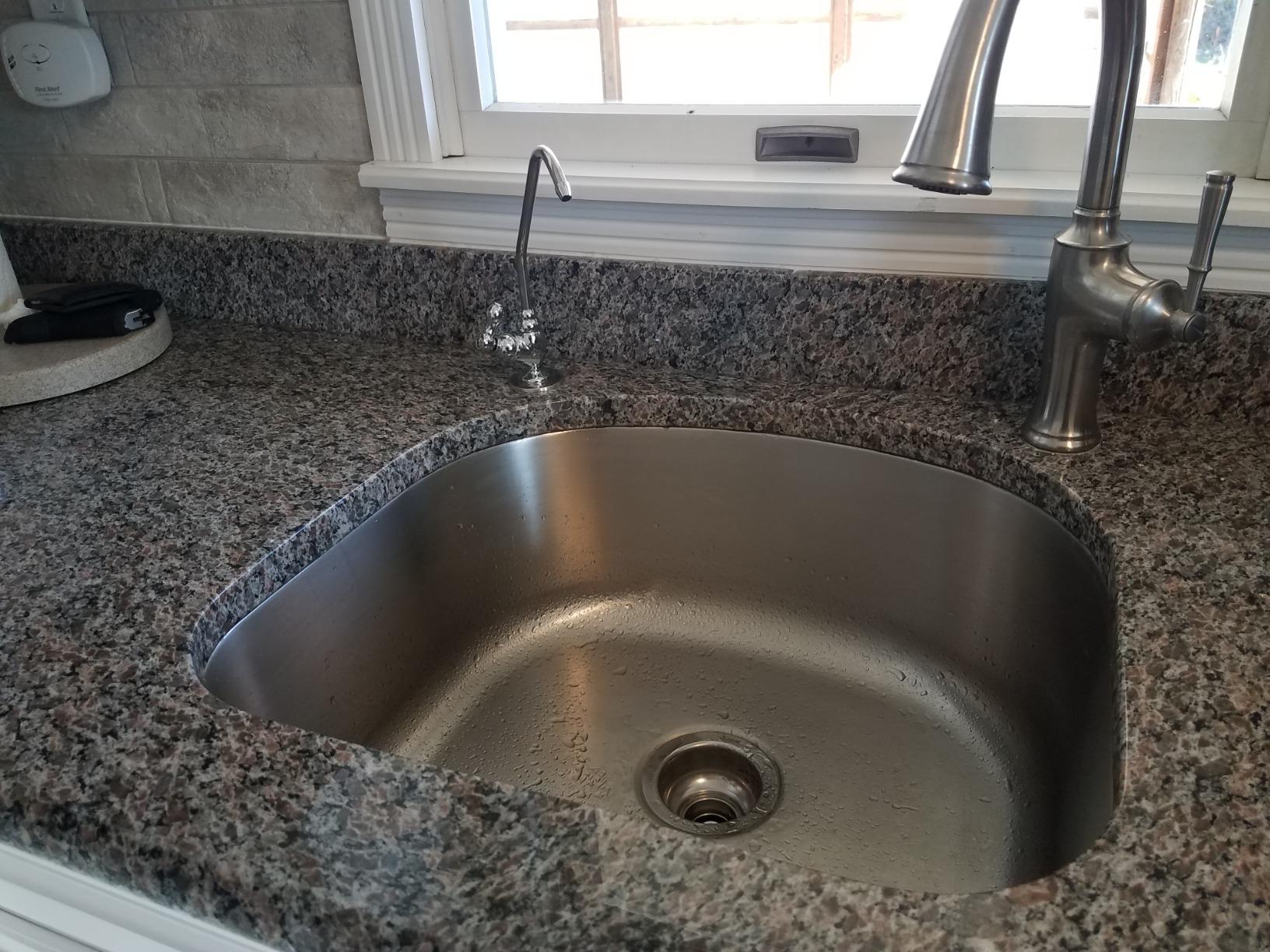
Three extra pre-filters come in the box, which extends membrane life and pushes the first filter change out to roughly a year. The modular design means individual filters swap one at a time instead of all at once, which spreads the cost.
What we like is the physical logic. A 2.2 gallon tank leaves storage space in a cabinet that a 3-gallon vessel would fill, and the top-mount faucet means a single-hole countertop install that is far easier to remove when you move out. There is no electricity to connect.
Where it makes sense
This is the renter pick of the roundup, and not just because of the faucet. A small footprint, no electrical work, no drilling under the sink, and a unit you can unplug and carry to a new apartment in one box are all real advantages when you do not control the plumbing.
It is also a good second system for a fridge or a wet bar, and the included refrigerator adapters mean you can plumb it to an ice maker without buying extra parts.
Where it will frustrate you
The most serious recurring complaint is long-term storage tank reliability. Several owners describe repeated bladder ruptures and slow leaks over multi-year use, so you should budget for a tank replacement rather than assuming the vessel lasts as long as the filters. Instructions are also described as slightly confusing without supplemental install videos.
At 50 GPD with a 2.2 gallon tank, this is a small household system. There is no pump, so low supply pressure reduces output below the rated figure, and the 1-year manufacturer warranty is on the short side compared with the NU Aqua.
8. FS-TFC 100 GPD – the lightest body for the tightest cabinet
FS-TFC 5-Stage Reverse Osmosis Water Filter System, NSF Certified 100GPD RO Water Purifier Under Sink Reduces 99.999% Impurities, with 4 Extra Replacement Filters Free for Home Drinking
18 L/h full flow
13 lb body
2-year warranty
30-85 psi
Pros
- Lightest and most compact body here at 13 lb
- Arrives largely pre-assembled with a 10-minute install
- Four spare filters cover roughly the first year
- TDS commonly lands between 2 and 10 ppm
Cons
- Included push-fit connectors crack or leak and get replaced
- Filter mounting brackets described as flimsy
- Real drain ratio is nearer 3:1 than claimed without a pump
At 13 pounds and 11.5 by 5 by 11.5 inches, this is the smallest complete RO system in the roundup, and the dimensions are the entire reason to consider it. Several owners fit it under sinks where larger systems simply will not go, and the manufacturer also markets it for bathrooms, RVs and small workspaces. If cabinet space is your binding constraint, nothing else here solves it as well.
The claimed performance is 99.999 percent removal across more than 1,000 contaminants at 0.0001 micron, tested at 60 psi for 18 liters per hour of full flow, which is a 200 ml cup in about 5 seconds. It runs from 30 to 85 psi, which is the lowest minimum pressure requirement of any system here, and it needs no electricity. Four extra replacement filters are included, covering nearly a full year of cycles.
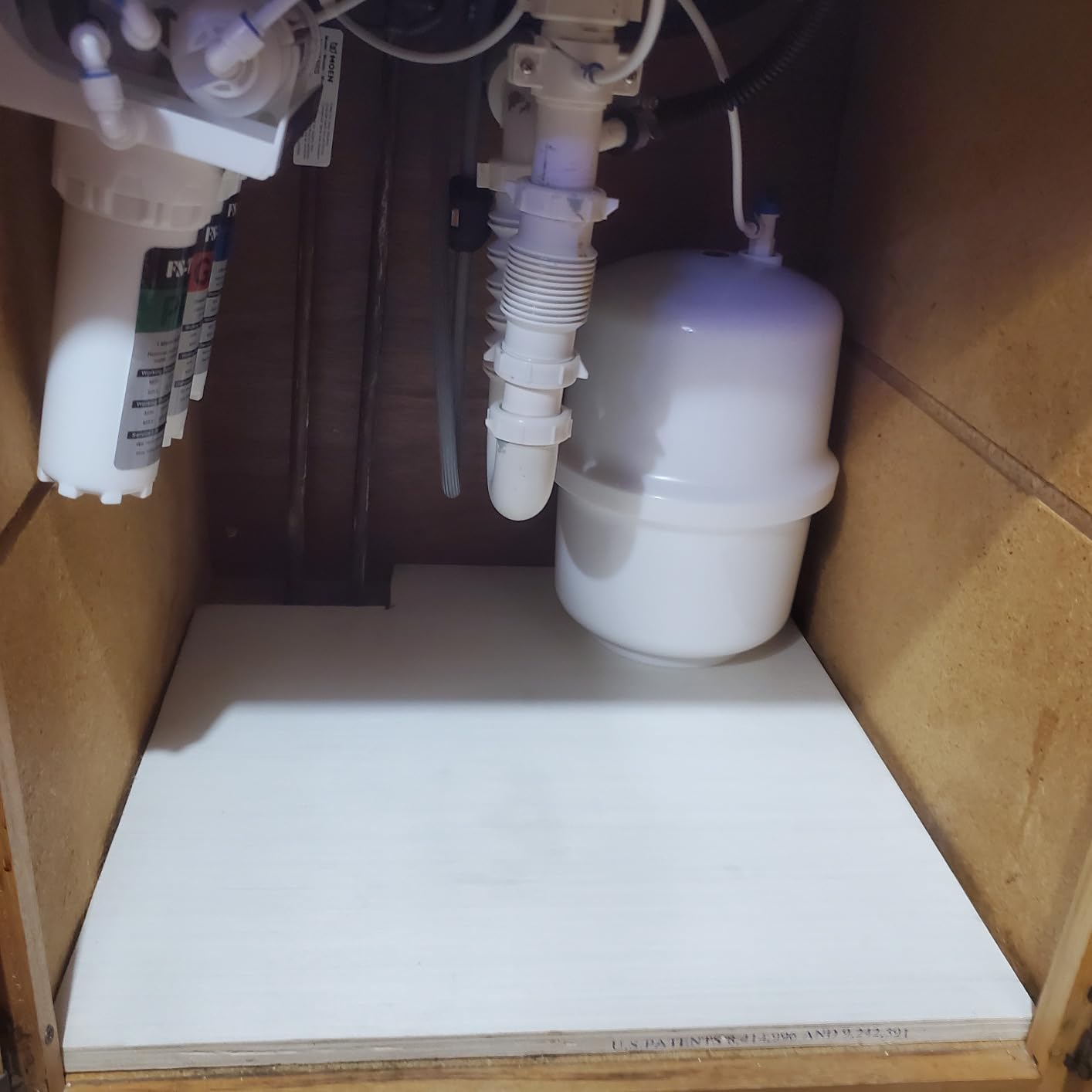
It arrives largely pre-assembled, so installation is a matter of connecting a few tubes, and the warranty runs two years after registration with lifetime 24/7 technical support. Owners report TDS readings landing between 2 and 10 ppm, and customer service is described as prompt and accommodating, including reimbursing an incompatible fitting.
For high-TDS municipal or well water this is described as strong value, and the low minimum pressure makes it more forgiving in older homes than most of the conventional units here.
Where its size earns the pick
Choose this if your cabinet is genuinely tight, if you are filtering in an RV or a small apartment, or if you want a second system for a wet bar. The 30 psi floor is the quiet advantage: it is the only system in this group that will still function in a home where the others would starve.
The 2-year warranty and pre-assembled delivery also make it a low-risk first RO purchase for a beginner.
Where it will frustrate you
The recurring quality complaint is the included low-grade push-fit connectors. Several owners report the feed and tank connectors breaking or leaking and replacing them with better components from another brand, which is straightforward but adds cost and time. The filter mounting brackets are also described as flimsy and worth reinforcing.
Two more things to know. Condensation collects heavily on the lower three filter housings, and some owners needed a drip trough. And the stated 1:1 drain ratio does not hold without a permeate pump, which this unit does not include; owners measuring it report a ratio closer to 3:1. The 3.2 gallon tank also needs several full flush cycles before any off taste clears.
9. COMFEE CMP10 – lead-free materials and double o-ring sealing
COMFEE’ CMP10 5-Stage Reverse Osmosis Under Sink Water Filter System
75 GPD
3 gal tank
NSF/ANSI 372
18 lb
Pros
- Double o-ring housing connections at the most common leak point
- NSF/ANSI 372 lead-free across faucet tank and water path
- US-based phone support
- Quick-fit connectors with written steps and a video
Cons
- Lowest rating in this group at 4.1
- Output falls to 50 GPD below 0.25 MPa or 25 degrees C
- No pump so household pressure sets the ceiling
- Housing color varies between production runs
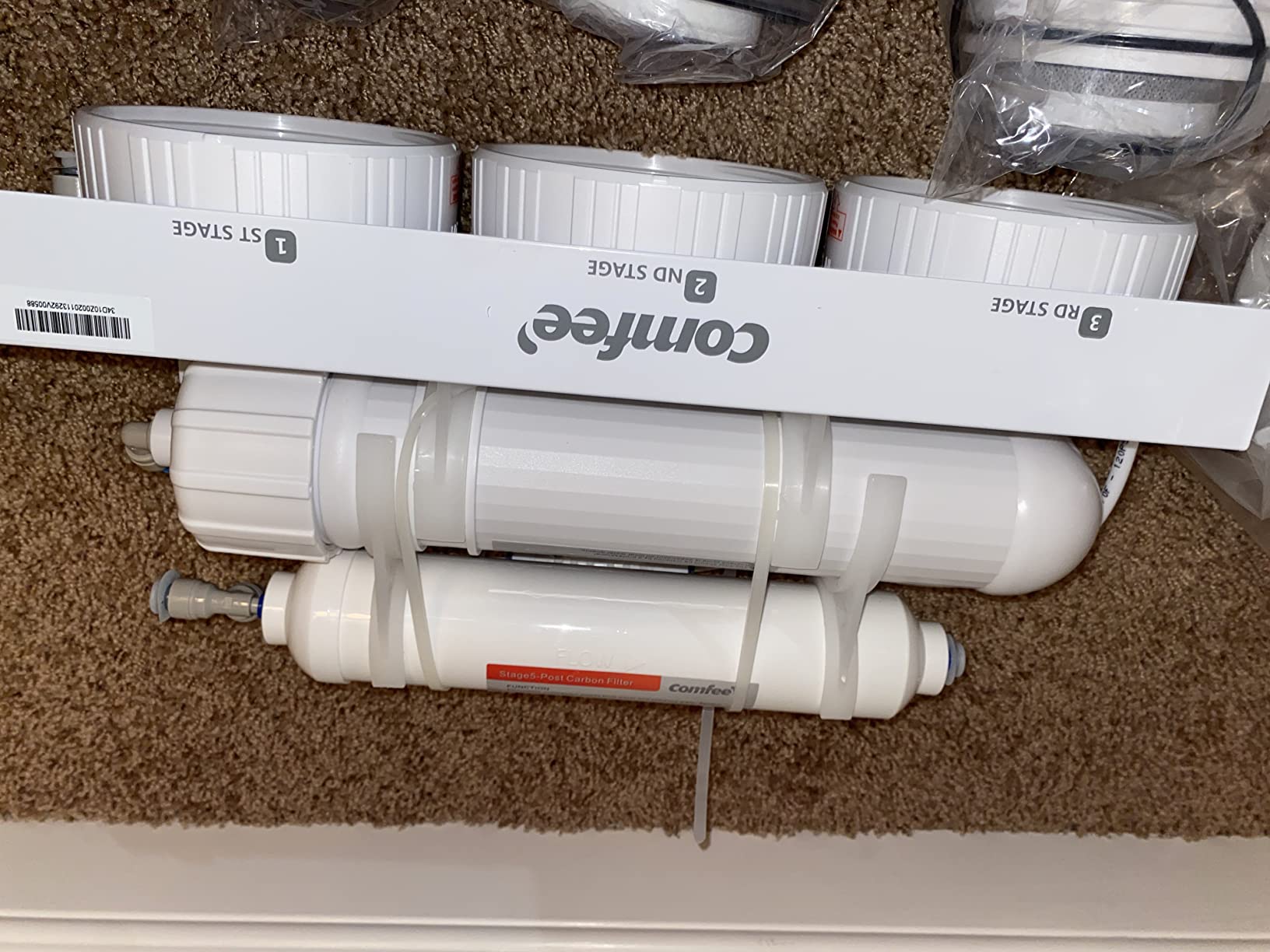
The COMFEE CMP10 is made by Midea and sold under the COMFEE’ name, and its case for inclusion is materials and sealing rather than headline numbers. It is 75 GPD with a 3 gallon tank, filtering to 0.0001 micron with more than 90 percent TDS reduction across heavy metals including lead, cadmium and chrome, plus organic matter and more than 1,000 impurities. All water-contacting parts, including the faucet, the water path and the tank, are NSF/ANSI 372 certified lead-free.
The double o-ring housing connections matter more than they sound. On a five-stage system, the filter housing caps are where leaks almost always start, and a second sealing ring is cheap insurance at a point you cannot easily see once the tubing is dressed back into the cabinet.
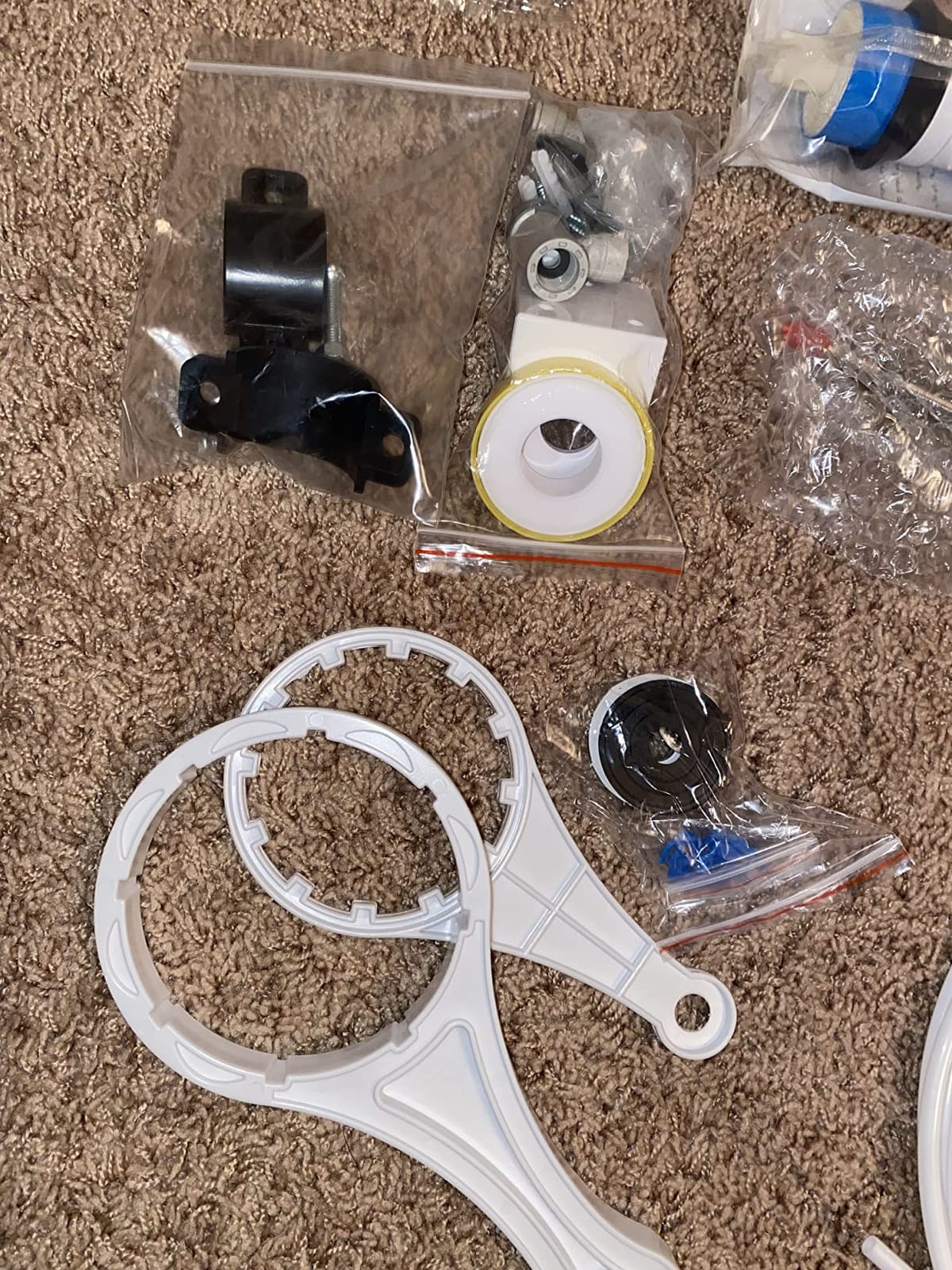
There is a US-based customer service team available by phone, quick-fit connectors, and both written step-by-step instructions and a tutorial video, which is more support material than most budget competitors provide.
The specification sheet includes an important caveat that reviewers do not always mention: if water pressure is below 0.25 MPa or the temperature is below 25 degrees Celsius, output drops to 50 GPD. In a cold climate or a house with modest pressure, you may not get the rated figure at the tap. The maximum supported TDS input is 600 ppm.
What it does better than the rest
If lead-free material certification across every water-contacting component is your priority, this is the one to buy, and the 3 gallon tank is larger than most of the compact units in this roundup. The US-based phone support is also a genuine advantage when a housing is weeping and you want to describe it to a person.
For a normal-pressure home on municipal water, 75 GPD with a 3 gallon tank is a workable combination for a typical family.
Where it will frustrate you
Be clear-eyed about the numbers. This is the lowest-rated system in the group at 4.1, with roughly 12 percent of reviews at one star, which is a higher share of serious complaints than anything else here. There is no pump, so household pressure is the ceiling on performance, and the 50 GPD drop under low pressure or cold water is documented in the manufacturer’s own specifications.
Its certification is NSF/ANSI 372 for lead-free materials, not full NSF/ANSI 58 certification of the system’s filtration performance. If independent performance certification is non-negotiable for you, the iSpring, APEC and Waterdrop G5P500A all carry it and the COMFEE does not. One more oddity: transparent and opaque housings are distributed randomly between production runs, so the color of your system is luck.
10. Aquatic Life RO/DI – near-zero TDS for aquariums, not for drinking
AquaticLife 4-Stage RO/DI Filter with Carbon Plus, 100 GPD
100 GPD
DI resin stage
Pressure gauge
Not for drinking
Pros
- DI resin produces genuinely near-zero-TDS water
- Liquid-filled pressure gauge shows membrane condition
- Carbon Plus cartridge handles chloramine as well as chlorine
- Auto shutoff solenoid and flush valve included
Cons
- Manufacturer states it is not intended for drinking water
- DI resin is a recurring refill consumable
- No tank or faucet in the base kit
- Narrower temperature range than drinking-water units
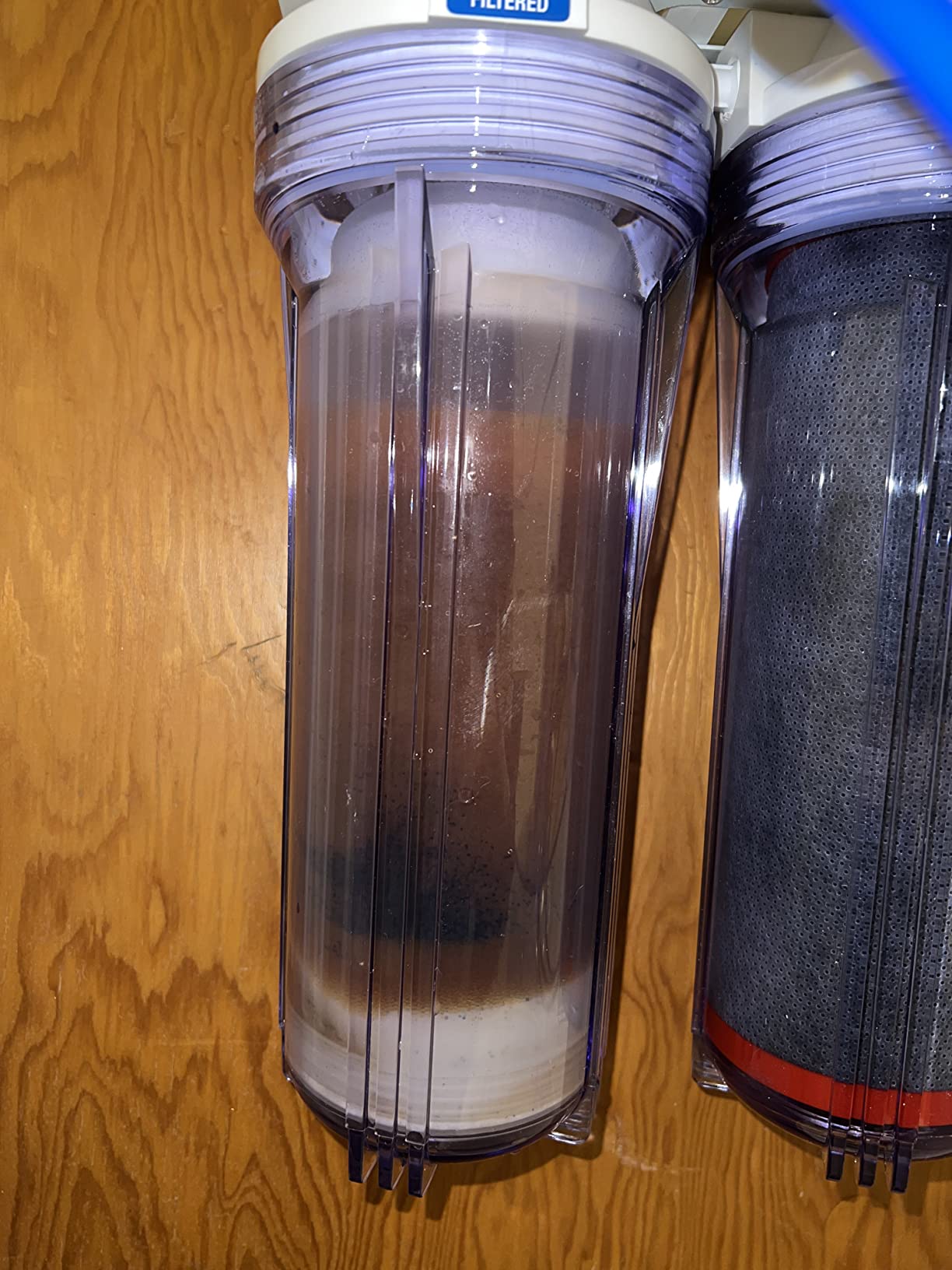
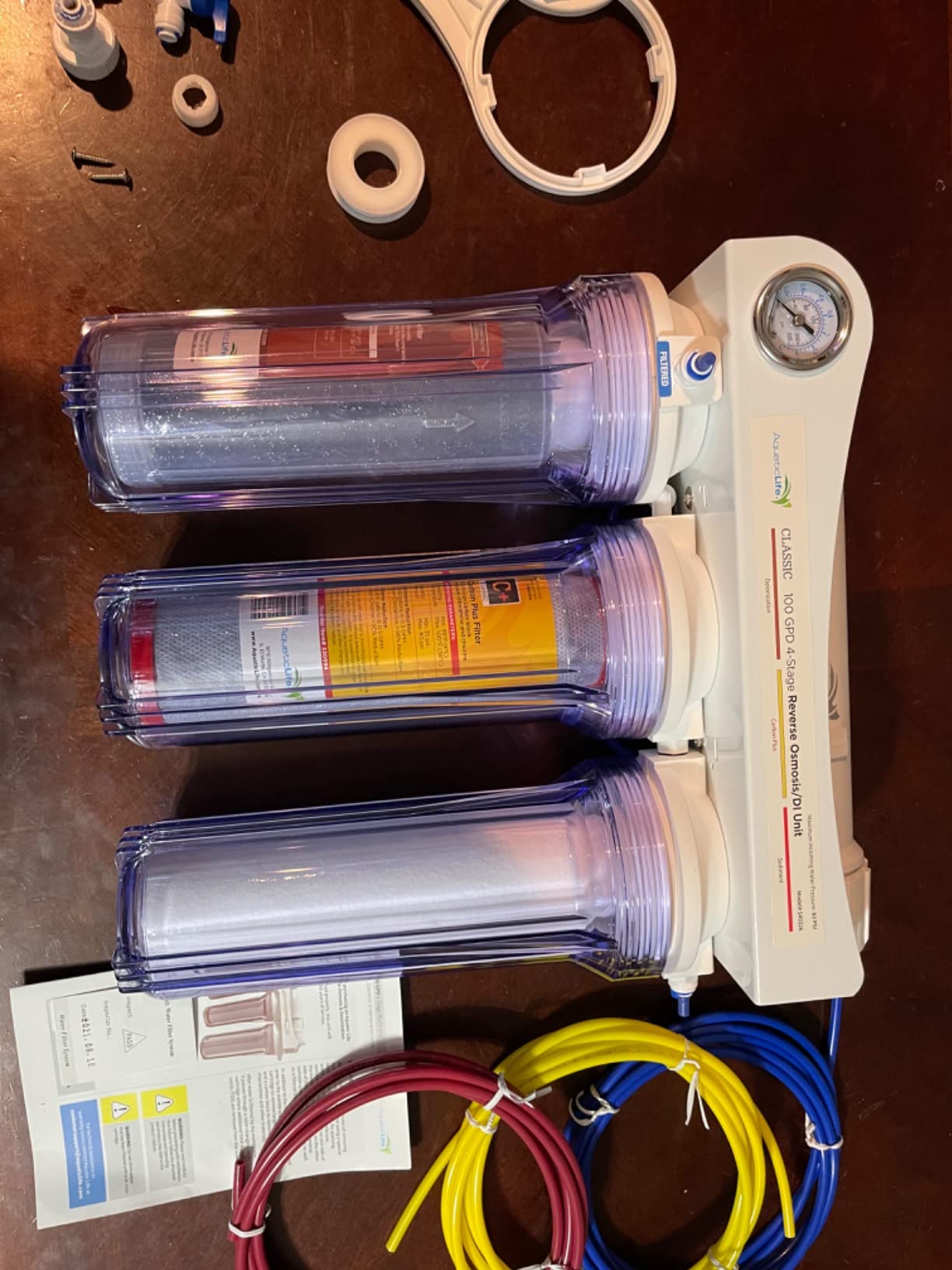
We are including this one with a clear label because leaving it out would misrepresent the category. The Aquatic Life 4-Stage RO/DI combines a sediment cartridge, a Carbon Plus cartridge, a 100 GPD RO membrane and a refillable 10-inch color-changing deionization resin cartridge, and the DI stage is what pushes the output to near zero total dissolved solids. That is a different goal from drinking-water filtration, and it is the goal aquarists and serious water-treatment hobbyists are actually buying.
The Carbon Plus cartridge is specified to remove up to 98 percent of chloramines and 99 percent of chlorine, which makes it a better fit than most drinking units if your municipal supply has switched to chloramine. The liquid-filled pressure gauge is the standout practical feature: it tells you when the membrane is losing performance without any guesswork, and the Auto Shutoff Solenoid and flush valve let it run unattended.
The base kit includes Buddy-Fit press-fit connectors and 10 feet each of blue, yellow and red polyethylene tubing. At 18.5 by 7 by 19 inches and about 16 pounds, it fits under a sink but leaves no faucet or tank, so you will need to plumb it to whatever you are feeding.
Owners point to the near-zero TDS output as the entire reason for the purchase, and the color-changing resin cartridge gives you a visual signal for when it needs refilling rather than a guess.
When this is the right tool
Buy this for reef aquariums, for hydroponics, or for any application where residual TDS matters more than drinking-water taste. The 100 GPD membrane gives real output, the pressure gauge removes the guesswork from maintenance, and the dual chlorine and chloramine capability is a genuine advantage on chloraminated municipal systems.
If you are filtering for an aquarium or a laboratory-style application, this is the only unit in the group built for that job.
Where it will frustrate you
The manufacturer explicitly states that this system is not intended for filtering water for drinking. That is not a formality; it changes what certifications and testing apply to the finished water, and it is why we have not ranked it against the drinking units above it.
It also has the highest running cost structure. DI resin is a consumable that must be replaced or refilled on a regular cycle, there is no storage tank or faucet in the kit, and the stated operating range of 77 to 86 degrees Fahrenheit is narrower than the drinking-water units in this roundup.
How to Choose a Reverse Osmosis System Under 300: What Actually Matters
Almost every RO listing on the internet leads with contaminant counts and a percentage reduction figure. Those numbers tell you very little about what you will experience on day one. Here is what we would check, in order, before buying anything in this price range.
1. Measure your line pressure before you pick a model
Pressure decides whether a non-pumped system works at all. Every conventional unit here needs somewhere between 30 and 45 psi minimum, and the APEC specifically caps out at 85 psi. Below that range, output drops and the membrane wears faster. If you are on a pumped municipal line or live above the third floor, a tankless system that runs on its own pump may serve you better than a higher-GPD conventional unit. A five-minute gauge check with an inexpensive PSI gauge is worth more than any spec comparison.
2. Match gallons per day to household size
A rough rule: 50 GPD suits one to two people drinking and cooking, 75 GPD covers a family of three or four, and 100 GPD and above is for larger households or heavy cooking use. But GPD is a rated figure measured at a specific pressure, so treat it as a ceiling rather than a promise. The two most common complaints in owner reviews for conventional units are slow flow and a tank that is empty exactly when you need it, and both trace back to an undersized system for the household.
3. Decide between tanked, tankless and countertop formats
Tanked systems are the cheapest to buy and to run, store water for outages, and need no power. Their penalties are slower first draw, cabinet space and a 2:1 to 3:1 drain ratio. Tankless systems deliver instantly, waste less water at 1:1 to 2:1, free up cabinet space, and require an under-sink outlet plus a drilled faucet hole. Countertop units need no install at all, which makes them the renter option, though none of the highest-rated systems in this group are countertop units. Our broader RO system roundup covers the portable formats in more depth if your situation rules out plumbing work entirely.
4. Read the drain ratio, not just the contaminant list
The wastewater ratio is how many gallons go down the drain for every gallon you drink. A conventional non-pumped system runs 2:1 to 3:1. The Waterdrop G2 claims 1:1 and the G5P500A runs 2:1. But be cautious with manufacturer claims on non-pumped systems: the FS-TFC states 1:1, and owners measuring it report closer to 3:1 without a permeate pump. In a high-water-cost area, that difference is real money over a decade.
5. Check certification, warranty and filter availability together
Look for NSF/ANSI 58 for filtration performance and NSF/ANSI 372 for lead-free materials. The iSpring, APEC and Waterdrop G5P500A carry the performance certification; the COMFEE carries the lead-free materials certification only. On ownership, weigh warranty length against filter cost: a 3-year warranty with standard-size cartridges beats a 1-year warranty with proprietary ones. Before you buy, confirm the replacement cartridges are sold by more than one retailer. Proprietary cartridges are how a cheap system becomes expensive by year three.
6. Plan for the real cost of ownership
Budget for prefilters roughly annually and the RO membrane every 2 to 3 years across the board in this range. Add the consumables that only some systems need: an alkaline or remineralization cartridge every 6 to 12 months if you choose the G5P500A, and DI resin refills if you choose the Aquatic Life. Then check the first-year math. Systems that include spare cartridges, like the Geekpure with 7 extras or the PureDrop with 3, get you through year one without another order, which is genuinely the easiest way to keep a new owner from running filters past their useful life.
Frequently Asked Questions
What is the best and cheapest reverse osmosis system?
The iSpring RCC7-BN is the best overall reverse osmosis system under 300, pairing a 4.6 rating with more than 21,000 reviews, 75 GPD output, NSF/ANSI 58 certification and standard-size replacement filters. On pure value for a conventional tanked build, the APEC ROES-50 runs at 50 GPD with a two-year track record of decade-plus ownership reports.
Which RO systems are the cheapest but still worth buying?
The most budget-friendly systems here that still perform well are the FS-TFC 100 GPD, the PureDrop RTW5 and the Geekpure RO5. Each includes spare replacement cartridges in the box, which pushes the first filter change out to about a year. The FS-TFC has the lowest minimum pressure requirement at 30 psi, and the Geekpure includes 12 filter pieces in total.
Is reverse osmosis water hard on the kidneys?
There is no established medical evidence that drinking properly maintained reverse osmosis water is harmful to healthy kidneys. RO water contains no significant amounts of sodium, calcium or magnesium, so the practical concern is drinking an entirely mineral-free diet from one source rather than a single glass. People with diagnosed kidney disease are usually advised by their clinician to limit mineral and electrolyte intake, so talk to your doctor if that applies to you.
What is a major downside of reverse osmosis water?
The most common downside is taste. RO strips out dissolved minerals, which many people describe as flat, and it also removes chloride, which is a large part of what makes water feel refreshing. The second downside is water waste: a conventional non-pumped system runs a 2:1 to 3:1 drain ratio, sending two or three gallons down the drain for every gallon you drink.
What is the highest rated reverse osmosis system under 300?
The iSpring RCC7-BN holds the highest rating in this group at 4.6 out of 5 across more than 21,000 reviews. The APEC ROES-50, the Waterdrop G2 and the Waterdrop G5P500A follow at 4.5, and the Geekpure, NU Aqua, PureDrop and Aquatic Life systems sit at 4.4.
How much does an under 300 reverse osmosis system cost to maintain per year?
Plan on roughly one prefilter change per year and an RO membrane replacement every 2 to 3 years, which works out to a modest annual figure for a conventional five-stage system. Systems with extra cartridges in the box, such as the Geekpure RO5 with 7 spares or the PureDrop RTW5 with 3, push the first-year cost to nearly nothing. Add roughly one alkaline or DI consumable cartridge per year only if you choose the Waterdrop G5P500A or the Aquatic Life RO/DI.
Can I install a reverse osmosis system under a sink myself?
Yes, and most of the systems here are designed for it. Color-coded tubing, quick-connect fittings and QR install videos mean a first-timer can finish most conventional units in an afternoon. You will need a drill for the faucet hole, a wrench, and about 40 to 85 psi of line pressure. If your home is outside that pressure range, add a booster pump or a regulator. Tankless models add an under-sink electrical outlet to the list of requirements.
Bottom Line on the Best Reverse Osmosis Systems Under 300
The iSpring RCC7-BN is the best reverse osmosis system under 300 for most people. It has the highest rating in the group, the deepest review history, standard-size filters you can price-shop, NSF/ANSI 58 certification and a support team that will troubleshoot from your pressure and TDS readings. Buy the APEC ROES-50 if you want the fewest decisions and a system owners report running for a decade, and buy the Waterdrop G2 if you want 400 GPD with no tank and a 1:1 drain ratio, provided you have an outlet under the sink.
Everything else in this roundup is a specialist answer to a specific constraint: the Geekpure for first-year filter savings, the PureDrop for a renter or a tight cabinet, the FS-TFC for the smallest possible footprint, the COMFEE for certified lead-free materials, and the Aquatic Life for near-zero TDS water that is not meant for drinking. Check your line pressure first, match GPD to your household, and confirm the replacement cartridges are available from more than one source. That is the whole buying guide, and it is what keeps a budget RO system cheap for ten years instead of three.