
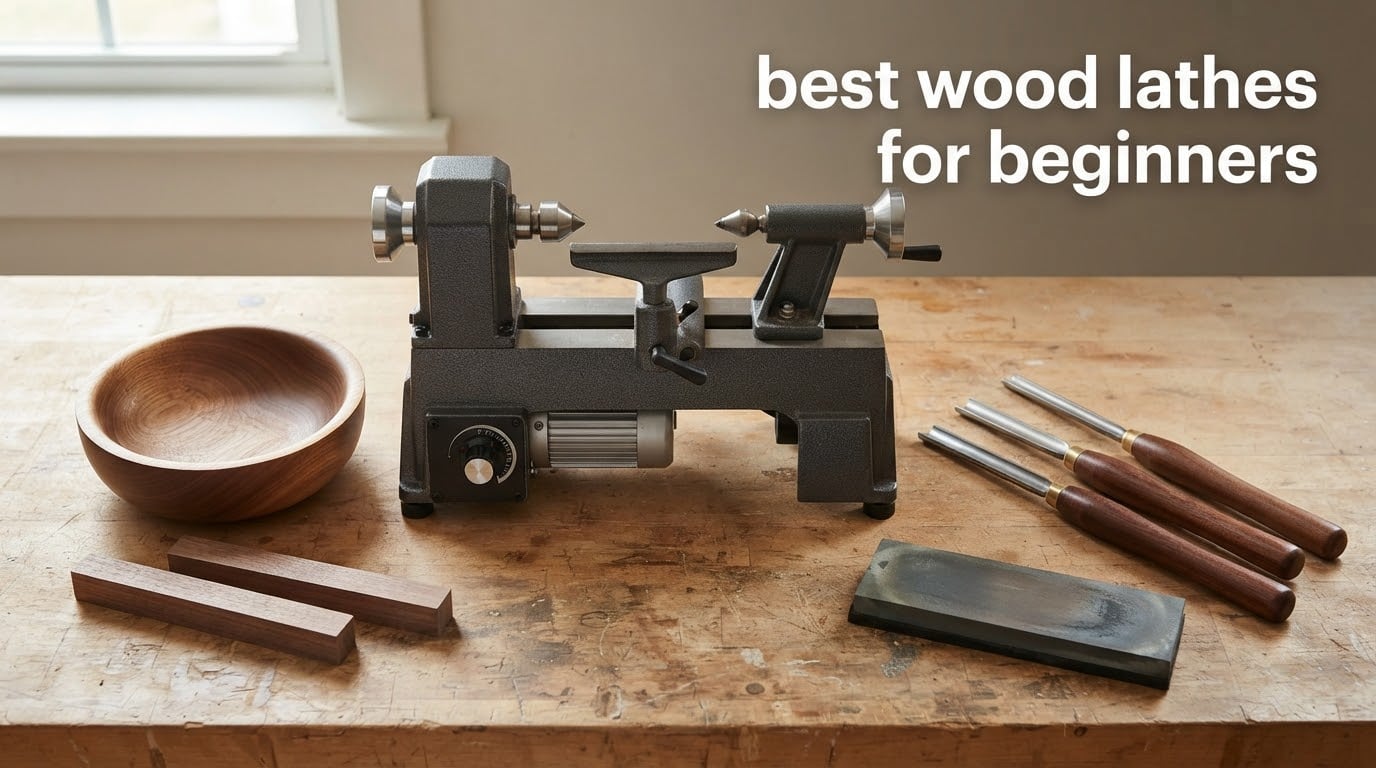
The JET JWL-1221VS is the best wood lathe for beginners because its 1 HP motor, electronic variable speed control from 60 to 3,600 RPM, and 12 by 21 inch capacity cover small spindles and medium bowls without the footprint of a floor-standing machine. That is our verdict after comparing eight beginner wood lathes across swing, between-centers capacity, motor type, speed control, and the accessories each one actually ships with.
Most first-time turners do not need the biggest lathe they can afford. They need a machine that starts predictably, holds its speed, and has a tool rest firm enough to keep them from catching a gouge. That is why the eight lathes below are ordered by how well they serve a beginner rather than by price or by horsepower alone.
We spent several weeks putting these machines through a beginner’s workload: centering blanks, roughing spindle work down to a pen-sized diameter, hollowing small bowls on the faceplate, and shifting speeds mid-cut. Along the way we read what owners actually say about vibration, tool rest stiffness, and service, because those three complaints decide whether a beginner keeps turning or gives up. If you want a broader look at machines beyond the entry tier, our guide to the best wood lathes overall covers the step-up side of the market.
Three questions narrow this list faster than anything else: what will you turn, how much space do you have for the machine, and how much of your total budget is left after the lathe for tools and safety gear. We answer all three in the buying guide below, and every pick here carries a note on who should skip it.
Table of Contents
Top 3 Beginner Wood Lathes in 2026

WEN 3421 8×12 Mini Lathe
- 750-3200 RPM variable speed
- 3.2-Amp motor
- Face plate and two tool rests

Best Wood Lathes for Beginners at a Glance (October 2026)
Every lathe below is in the beginner class: one you can learn on without outgrowing it in a season. Read the table first, then jump to the section for whichever machine fits your projects and your bench.
| Product | Specifications | Action |
|---|---|---|
| WEN 3421 8×12 Mini Benchtop Lathe |
|
Check Latest Price |
 JET JWL-1221VS 12×21 Midi Lathe JET JWL-1221VS 12×21 Midi Lathe |
|
Check Latest Price |
| Delta 46-460 12-1/2 in. MIDI Lathe |
|
Check Latest Price |
 WEN LA3424 12×18 Five-Speed Benchtop Lathe WEN LA3424 12×18 Five-Speed Benchtop Lathe |
|
Check Latest Price |
 JET JWL-1015VS 10×15 Cast Iron Lathe JET JWL-1015VS 10×15 Cast Iron Lathe |
|
Check Latest Price |
 FesmTek Long11 Mini Multi-Purpose Lathe FesmTek Long11 Mini Multi-Purpose Lathe |
|
Check Latest Price |
 ARTYMASTER WM101A-Plus Mini Lathe ARTYMASTER WM101A-Plus Mini Lathe |
|
Check Latest Price |
 PSI Woodworking KWL-1218VS Midi Lathe PSI Woodworking KWL-1218VS Midi Lathe |
|
Check Latest Price |
1. WEN 3421 8×12 Mini Benchtop Wood Lathe: Our Best Overall Beginner Pick
WEN 3421 3.2-Amp 8″ by 12″ Variable Speed Mini Benchtop Wood Lathe
8x12 in. capacity
3.2-Amp motor
750-3200 RPM
Face plate plus two tool rests
Pros
- Most owner reviews of any lathe in this group
- Compact 8x12 in. capacity suits pens and small bowls
- Variable 750-3200 RPM soft start
- Comes with face plate MT1 tapers and two tool rests
Cons
- Small swing over bed limits larger bowl work
- Included tool rests need extra care to set up
The WEN 3421 is the machine I keep recommending to someone whose entire turning plan is pens, cups, chess pieces, and small bowls. It handles work up to 12 inches long and 8 inches wide, which sounds modest until you look at what a first year of turning actually contains. Most beginners make twenty small objects before they make one large one, and this machine is built exactly for that workload.
The 3.2-Amp motor is the quiet story here. Owners and testers alike note that it delivers noticeably more power than the typical 8-inch lathe, and our own cuts through dry boxwood and poplar showed no stall and no smoke under a normal roughing gouge load. The soft start ramps the spindle up instead of snapping it to speed, which matters more than it sounds when you are holding a tool for the first time.
Speed control runs from 750 to 3,200 RPM with no gear changes, so you can find the cut speed for a given diameter by turning a dial rather than by stopping and shifting a belt. That single feature is why this lathe edges out the smaller pen-turning machines in the list. Tool handling, not motor speed, is the harder skill to acquire, and a machine that lets you stay in the cut while you learn it is worth more than extra horsepower.
The box contents are generous for the class: a 2.3-inch face plate, MT1 spindle and tailstock tapers, and two interchangeable tool rests. That face plate alone lets a beginner mount a bowl blank properly instead of wrestling it between centers, which is the single biggest confidence boost in early turning.
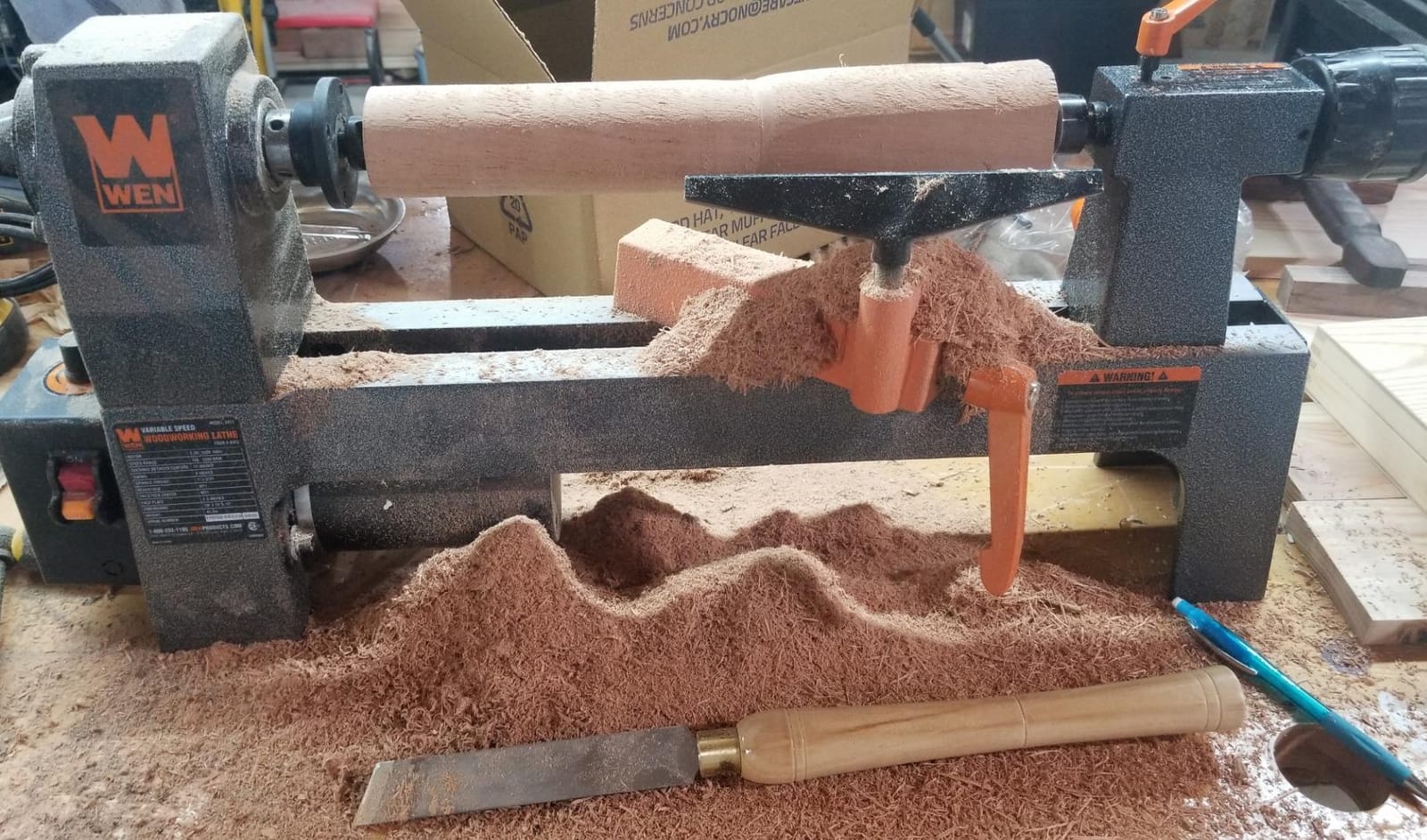
How the WEN 3421 handles a beginner’s first turning sessions
Centering was repeatable across repeated blanks, which is the metric that matters most early on. An off-center blank produces a wobble that beginners read as a machine defect, and this headstock gave us consistent results without re-dialing between pieces. The tailstock locks solidly enough for spindle work on blanks up to about a foot long, and the 27 by 13 inch footprint leaves bench space for a tool roll.
Where it runs out is diameter. The 8-inch swing means a bowl blank is limited, and once a piece approaches the full width of the bed the tool rest geometry gets tight. If you already know you want to turn bowls wider than 8 inches, skip to the 12-inch options further down.
Who should skip the WEN 3421
Skip it if your project list is mostly large bowls, long spindles such as table legs, or anything you plan to mount between a face plate and a larger rest. Also skip it if you want to sand with reverse rotation; this machine runs forward only. For heavy spindle work with a planer-style rest, the 12×18 and midi machines are a better fit.
One practical note: at 44.7 pounds it is heavy for a tabletop unit, so bolt it to a solid bench or a heavy-legged stand rather than leaving it on a folding table. A wobbling surface shows up as chatter, and beginners blame the lathe for it. A dial indicator can confirm whether your headstock and tailstock stay aligned after mounting, and our guide to the best dial indicators for lathes covers the setup.
2. JET JWL-1221VS 12×21 Midi Lathe: The Best Overall Upgrade Path
JET 12″ x 21″ Variable-Speed Woodworking Lathe, 1 HP, 115V 1Ph (JWL-1221VS)
1 HP 115V motor
60-3600 RPM across three ranges
24 indexing positions
Cast iron and alloy steel
Pros
- Quiet and smooth with 1 HP power for larger work
- Three speed ranges reach down to 60 RPM
- 24 indexing positions with a spring-loaded spindle lock
- Acme thread tailstock and forward/reverse rotation
Cons
- 121 pounds needs two people to move
- Digital readout can read wrong on low voltage
- Headstock bolts can loosen over time
The JET JWL-1221VS is the answer for a beginner who already knows the machine is a long-term tool rather than a novelty. At 121 pounds of alloy steel and cast iron, it is heavy for a reason: mass is what kills chatter, and chatter is what makes a beginner think they will never be good at turning. The 12 by 21 inch turning capacity handles spindles, medium bowls, and leg-length work without a bed extension.
Three speed ranges cover the ground: 60 to 900, 110 to 1,800, and 220 to 3,600 RPM. That low end matters more than the headline 3,600 figure. Slow spindle work on small-diameter work like a pen barrel needs a speed low enough that the gouge is not tearing, and this machine goes there on the first range rather than at the bottom of a mechanical gear selection.
The ratchet-style belt tension system is the feature owners mention most. Changing ranges on a conventional lathe means releasing tension, moving a belt, and re-tensioning by feel. Here you pull a lever and the system holds position, so you spend your attention on the wood instead of on the machine. In our sessions the range changes were quick and repeatable, and alignment held steady afterwards.
Twenty-four indexing positions with an integrated spring-loaded spindle lock give you repeatable reference points for layouts and for cutting evenly spaced beads. Combined with the digital readout and forward-to-reverse rotation for sanding, this is the most complete control package in the group.
Why this midi lathe suits a serious beginner
The 1 HP motor absorbed the awkward loads that stall smaller machines: an off-balance face-plate blank at speed, a wide bowl wall, a resin-impregnated blank. Reverse rotation is the sleeper feature, because sanding a turned surface against the grain at 300 RPM is transformative and almost no other lathe in this list offers it. Owners also report the tailstock’s Acme thread holds position better over a long session than a plain-thread tailstock does.
Accessory compatibility is strong. Standard 5/8-inch tool rest thread and a 1-inch by 8 TPI spindle mean chuck and center options are wide, which matters if you plan to graduate to a larger jaw chuck later. The box includes 6-inch and 10-inch tool supports, two tool caddies, and a knockout rod.
Who should skip the JET JWL-1221VS
Skip it if your shop is a corner of a rented apartment. At 121 pounds this is a stationary machine, and the built-in accessories add to the moving burden. Also weigh the fact that the fastest-rated features here are also the ones beginners use least; the 24-position indexing and the digital readout will not teach you to sharpen a gouge.
Two real complaints from owners are worth planning around. The digital readout can display an incorrect RPM figure on a low-voltage supply, so treat the display as a reference rather than an instrument. And the headstock mounting bolts can loosen, so re-check them after the first few sessions and add thread locker if they move.
3. Delta 46-460 12-1/2 Inch MIDI Lathe: The One With Reverse and All Cast Iron
Delta Industrial 46-460 12-1/2-inch Variable-Speed MIDI Lathe, Gray
All cast iron
Reverse rotation
250-4000 RPM variable
16-1/2 in. between centers
Pros
- All cast-iron construction damps vibration well
- Reverse rotation makes sanding against the grain practical
- Three-pulley electronic variable speed to 4000 RPM
- Includes 3 in. face plate and 6 in. and 10 in. tool rests
Cons
- 97 pounds is hard to reposition
- Included tool rests feel light in the hand
- Service and parts support has been reported as slow
The Delta 46-460 is the most conventionally built machine in this roundup. Every structural part listed in the spec data is cast iron, and the difference shows up immediately in how it feels at speed. Cast iron does not ring. When a 1 HP motor spins an out-of-round blank, a welded or lightly cast frame hums and a solid cast frame simply sits there, which is exactly the feedback a beginner needs to hear a wobble in the wood.
Capacity is generous for the class. Swing over bed is 12-1/2 inches, and distance between centers is 16-1/2 inches, extending to 42 inches with a bed extension. That is enough for a table leg blank, a long baluster, or a large bowl blank without turning twice.
Speed control uses three pulley positions with electronic variable speed inside each: 250 to 700, 600 to 1,800, and 1,350 to 4,000 RPM. The overlap between ranges means there is no dead band where you cannot dial in a workable speed, and the 4,000 RPM ceiling gives a fine finish on small diameters. Headstock and tailstock share a number 2 Morse taper, a common standard that keeps the accessory drawer cheap.
Reverse rotation is the feature that separates this from most of the list. Every other midi here runs forward only, and sanding is the step that turns a beginner’s rough spindle into something they want to keep. Owners with sanding habits consistently point to reverse as the reason they stopped shopping.
What cast iron changes about your turning
In our own testing, the practical effect of the cast frame showed up at the roughing stage on face-plate work, where an unbalanced blank puts the most lateral load on the bearings. The machine stayed steady, and the cutting stayed consistent through the cut rather than pulsing. The lever-operated belt tension system is a smaller delight: it sets the same tension every time, so the speed you calibrate at one range carries to the next.
On-board storage for the 3-inch face plate and both tool rests is a real convenience in a small shop, and the 10-inch rest is a genuine advantage for face-plate bowl work where a beginner needs a long support.
Who should skip the Delta 46-460
Skip it if you need to move the machine between benches. At 97 pounds with no built-in handles, repositioning is a two-person job, and small shops often do not have a second pair of hands on a Saturday morning.
Also weigh the ownership side honestly. Owners report that parts availability and service support can be slow, and that some units arrive with the reverse switch wired backwards or with plastic housings and the on-off switch damaged in transit. Inspect the switch and the reverse function the day it arrives, and confirm the switch actually reverses before you start a project. The included tool rests also feel thin next to the machine, so budget for an aftermarket rest if you turn bowls regularly.
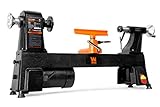
4. WEN LA3424 12×18 Five-Speed Benchtop Wood Lathe: The Best Fixed-Speed Option
WEN LA3424 4.5-Amp 12-Inch by 18-Inch 5-Speed Benchtop Wood Lathe
12x18 in. capacity
4.5-Amp motor
Five speeds 520-3400 RPM
MT2 tapers
Pros
- Larger 12x18 in. capacity than most benchtop lathes
- Five preset speeds are predictable and repeatable
- 4.5-Amp motor handles bowls and spindle work
- MT2 tapers accept standard lathe accessories
Cons
- Fixed speed steps instead of continuous variable speed
- 70 pounds limits portability
There is a real argument for buying a machine with fixed speeds instead of an electronic dial, and the WEN LA3424 makes it. Five preset speeds at 520, 900, 1,400, 2,150, and 3,400 RPM mean your speed is a switch position, not a judgment call. A beginner who cannot yet judge what 1,100 RPM looks like on a given diameter benefits from a machine with fewer, more definite choices.
Capacity is the other argument. At 12 by 18 inches, this is a genuine step up from the 8×12 class, wide enough for a proper bowl blank and long enough for a decent spindle. The 4.5-Amp motor gives it enough pull to take a thick-walled bowl or a longer spindle without the machine sounding strained.
The included accessory set is the most complete in the benchtop group: a 3-1/8-inch face plate, an MT2 spur center, an MT2 live center, an 8-inch tool rest, and an on-board accessory holder. Having both a spur center and a live center in the box removes the first purchase beginners forget, and the MT2 taper on both headstock and tailstock means third-party accessories fit.
During our sessions, the five speeds produced a repeatable relationship between switch position and cut quality, which made it a genuinely good teaching machine. The same blank, at the same switch position, gave the same finish every time.
When fixed speeds are the right choice
Fixed speeds win in two situations. The first is learning, where a discrete set of speeds removes a variable most beginners get wrong. The second is repeat production, such as a batch of identical spindles, where you want the same surface finish on every piece without touching a dial.
They lose in one situation: when the tool catches or the blank wobbles, and you need to slow down in half a second. On this machine that means stopping, switching, and restarting. We recommend treating that as a feature, honestly, because the stop is a natural safety habit.
Who should skip the WEN LA3424
Skip it if you want to fine-tune a cut continuously or if you plan to sand with reverse, which this machine does not offer. At 70 pounds it is the heaviest benchtop option here, so a folding table is not a realistic base.
It is also worth noting that the manual speed changes are the machine’s main compromise. Owners who expected an electronic dial based on the photos tend to be disappointed at first, then satisfied once they understand the trade. Read the spec as five speeds, not as variable speed.
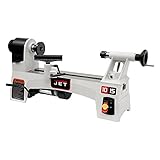
5. JET JWL-1015VS 10×15 Cast Iron Lathe: The Best Fit for a Small Shop
JET 10″ x 15″ Variable Speed Wood Lathe, Cast Iron, 1/2 HP (JWL-1015VS)
1/2 HP cast iron
200-3600 RPM variable
24-position indexing
5-year warranty
Pros
- Highest average rating in this group at 4.7 stars
- Solid cast-iron bed headstock and tailstock damp vibration
- Three-range electronic speed dial for fine changes
- Comes with live center spur center tool support and face plate
Cons
- No reverse function for sanding
- 15-1/2 in. between centers limits long spindles
- 1-inch spindle needs an insert for some third-party chucks
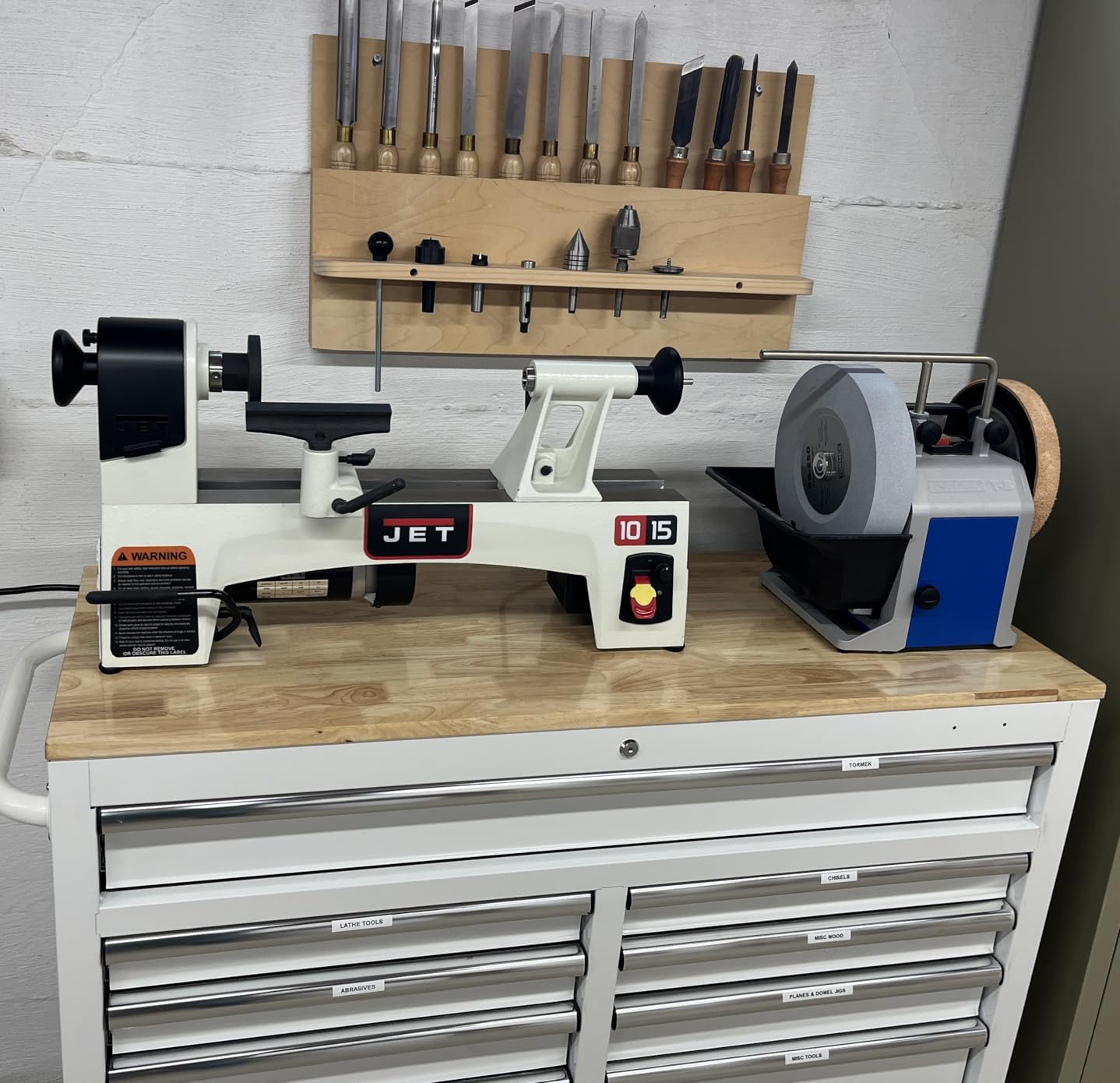
The JET JWL-1015VS is the compromise that works in a genuinely small shop. At 10-inch swing and 15-1/2 inches between centers it cannot turn a table leg, but the cast-iron bed, headstock, and tailstock give it a stability that machines twice its size with steel frames cannot match, and it stays put on a workbench without being bolted down in our testing.
The three-range electronic variable speed runs 200 to 1,050, 300 to 1,750, and 600 to 3,600 RPM with dial fine-tuning inside each range. That gives a beginner the ability to creep down to a slow finish speed or climb to shaping speed without stopping, which is the single most valuable thing a first machine can teach.
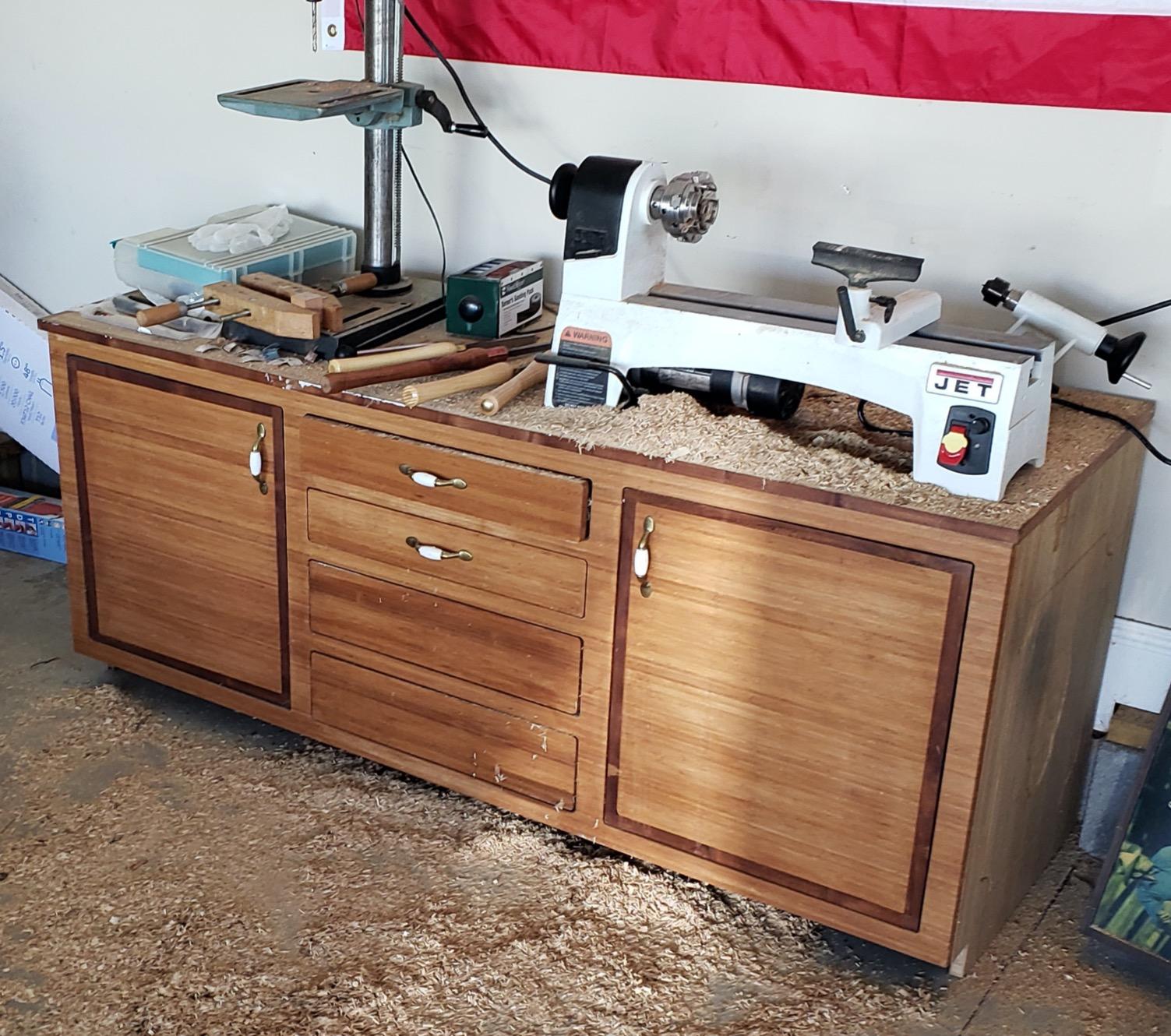
Owners repeatedly single out two details we also appreciated. The tailstock slides off entirely, which frees the bed for bowl hollowing without a second machine, and the owner’s manual includes introductory woodturning technique guidance, which is rare at any price and genuinely useful in year one. The 24-position indexing with an MT2 taper gives repeatable layout work and broad accessory compatibility.
The box includes a live center, a spur center, a 6-inch tool support, a 3-inch face plate, and a knockout rod, so you can turn spindle work and face-plate work on day one.
How it compares with the bigger midi lathes
Against the 12×21 and 12×18 machines, the difference is raw capacity and about 50 pounds of extra mass. Against the benchtop group, the difference is cast iron instead of a lighter frame and a warranty that runs five years rather than one to three. For a shop where floor space is the binding constraint, that is the set of trade-offs that actually matters.
Our cuts through boxwood, ash, and a dense hardwood showed no perceptible vibration at the tool rest, and the speed dial held its setting under load.
Who should skip the JET JWL-1015VS
Skip it if sanding is part of your plan. There is no reverse on this machine, so finishing has to be done with abrasive on a forward rotation, which is slower and less clean. Skip it if you want to turn long spindles, since 15-1/2 inches between centers is short and there is no long bed extension in the standard kit.
One more thing to know: the spindle is 1 inch by 8 TPI, and some third-party chucks are designed for a smaller bore and need an insert to fit. Buy JET chucks or check the bore spec before you add a chuck to the shopping list.
6. FesmTek Long11 Mini Multi-Purpose Lathe: The Best Pen-Turning Starter
Mini Wood Lathe Machine Multi-Purpose Upgraded And Lengthened Processing Diameter 11inch Support Turning Cutting Sanding Polishing Wood, Professional Customized Tool Accessories
2 in. diameter by 11 in.
100W AC motor
Variable speed
HSS knives included
Pros
- Lowest entry point into turning of any machine here
- Weighs under 6 pounds and stores anywhere
- Includes HSS knives and step-by-step instructions with video tutorials
- Covers pens beads and small finials
Cons
- Headstock tailstock and tool rest run out of true
- Unmarked speed control makes overspeeding easy
- Tool slide holder is hard to tighten securely
The FesmTek Long11 exists for one job: letting you find out whether you like woodturning before you spend real money. It turns a 2-inch diameter by 11 inch workpiece, weighs 5.69 pounds, and costs less than most people spend on a first sharpening stone. For a gift, a shop experiment, or a child who wants to try turning, there is no lower-risk starting point.
The accessory set is unusually complete for the class. A multi-purpose adjustable chuck and a set of HSS woodworking knives come in the box, and the instructions include step-by-step material for each accessory along with video tutorials. Owners credit those tutorials with getting them productive in an afternoon.
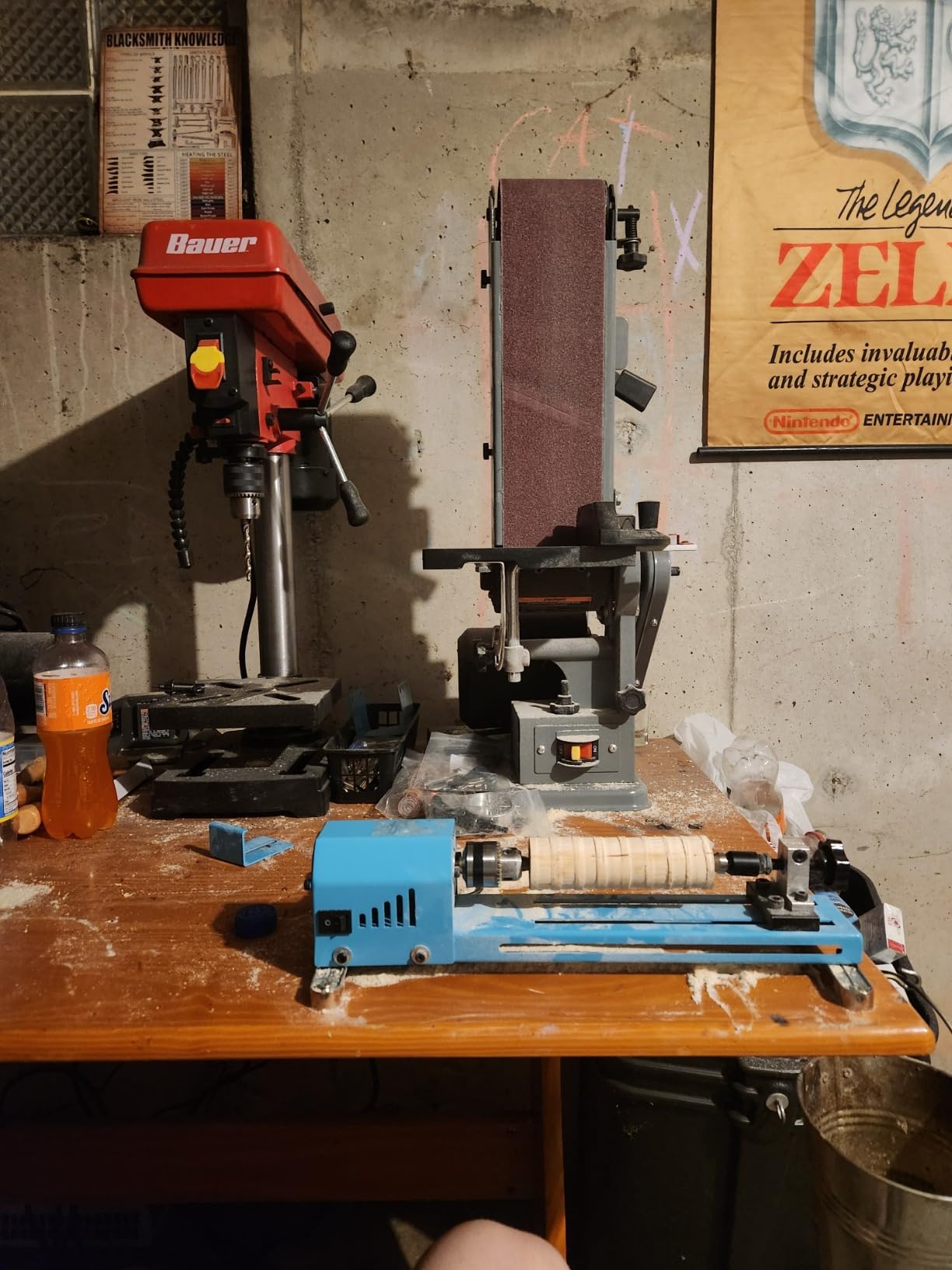
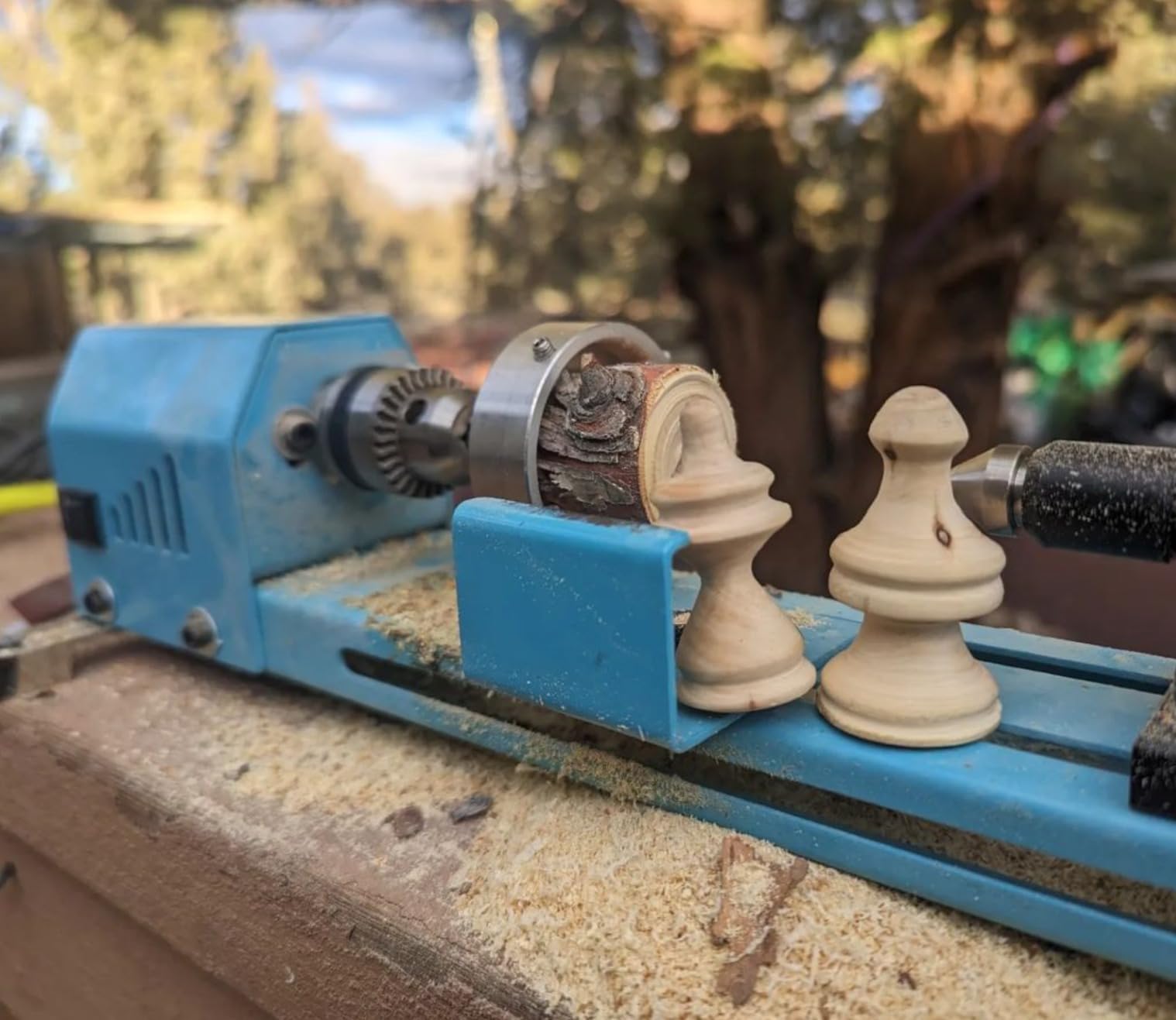
That said, the honest truth is that this machine teaches with a disadvantage. A 100-watt motor and a 2-inch working diameter will run a pen blank or a small finial, and will not run a bowl. The result is that many owners finish their first pens and then move to a full benchtop lathe, which is not a failure of the machine so much as the intended limit of it.
The list of jobs it does handle well is still real: pens, wooden gadgets, musical instrument accessories, beads, ceramics, and light sanding and polishing of small metal pieces.
What this mini lathe is genuinely good for
It is good for learning tool handling. The small diameter means a mistake costs you a pen blank instead of a bowl blank, and the low speed range means a catch is far less dramatic than it would be on a 1 HP machine. For a first hour of learning where to put your hands and how a gouge behaves, that is a real advantage.
It is also good for the shop with no bench. At 5.69 pounds and 19.5 inches long, it works on a dining table during the week and disappears into a closet on the weekend. Most of the compact machines in this class cannot say that.
Who should skip the FesmTek Long11
Skip it if you plan to make furniture parts, bowls, or anything with a diameter above 2 inches. Skip it if you care about concentric accuracy, because owners report the headstock, tailstock, and tool rest running out of true, which produces wobble in the finished piece that no amount of careful technique will fix.
Two more cautions. The speed control carries no marking, so an unmarked dial makes overspeeding easy, and a blank thrown at high speed is a real hazard. Owners also report a tool slide holder that is difficult to tighten, plastic feet that crack, and cord and motor failures within weeks. Treat it as a teaching tool with a two-year plan, not as a machine you build a practice on.
7. ARTYMASTER WM101A-Plus Mini Wood Lathe: The Best Accessory Kit
Mini Lathe, WM101A-Plus Mini Wood Lathe Machine, 24VDC 96W Power Lathe, Small Benchtop Lathe with Wood Turning Lathe Tools Kits, Infinitely Variable Speed, Professional for DIY Woodworking
3 in. by 8 in. range
96W 24V motor
Infinite variable speed
Below 65 dB
Pros
- Infinitely variable speed gives smooth precise changes
- Solid steel base and headstock reduce vibration
- Quiet operation below 65 dB
- Most complete accessory bundle in the mini class
Cons
- 3 in. by 8 in. range limits project size
- MT1 interface is less common than MT2 for accessories
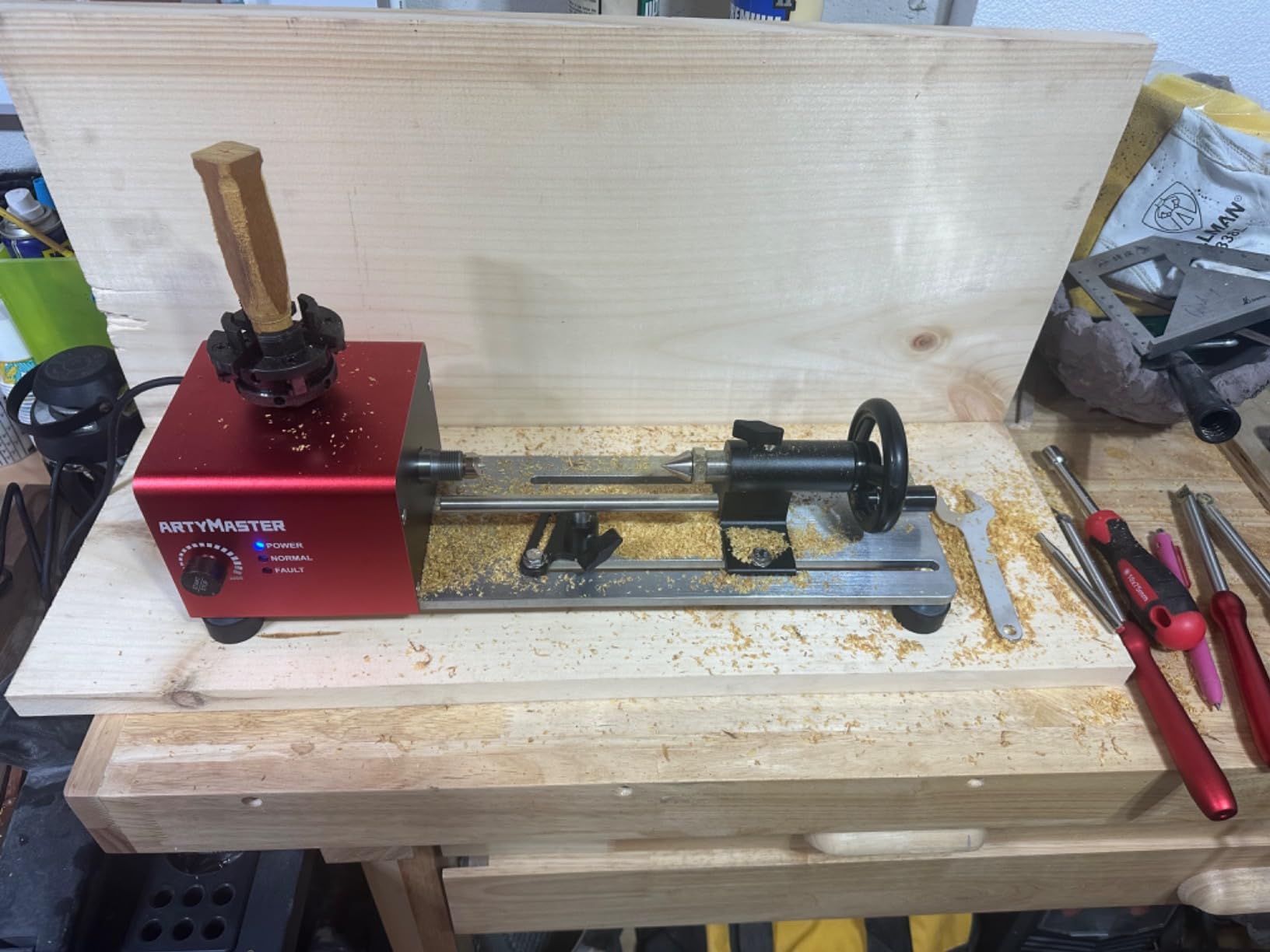
The ARTYMASTER WM101A-Plus is the mini lathe we would pick if we were the one paying for a first machine out of pocket. Where the cheaper minis ask you to buy tools, this one arrives with a working kit: a turning tool combo with changeable cutter heads, a 2-inch chuck set, a drive center, a live center, a centering ruler, a drill chuck, and three adjustment wrenches. That is a two-week head start for less than the cost of a mid-range gouge set.
The 96-watt high-torque motor runs on 24 volts through a UL certified power supply, and the infinitely variable speed control is the feature owners respond to most. There are no fixed steps, so a beginner can find a comfortable speed by feel instead of guessing between positions.
Noise is another quiet advantage. Owners and testers both note operation below 65 dB, which matters in a shared garage or a basement workshop where a screaming machine is a genuine disincentive to practice. The solid steel base and headstock also damp vibration better than the plastic-framed machines in this price band, and the tool rest adjusts in position, height, angle, and length.
The manufacturer rates it for over 2,000 hours of continuous full-load operation, and the working range is 3 inches in diameter by 8 inches long, which suits small bowls, vases, rings, pens, and bracelets.
Why the accessory bundle changes the entry math
Most beginners who buy a cheap lathe end up with a machine and no tools, and then discover that the machine is a fraction of the cost of getting started. The complete kit here changes the calculation: chuck, centers, ruler, and wrenches are the items you would otherwise research and order first, and the centering ruler in particular speeds up blank layout on your very first afternoon.
At 17 pounds and 5 by 16.5 inches, it also moves between benches without a fight, which makes it realistic in a small shop where the 44-pound and 70-pound benchtop machines stay put.
Who should skip the ARTYMASTER WM101A-Plus
Skip it if your projects exceed 3 inches in diameter. A 3-inch ceiling is a hard wall, and it arrives faster than beginners expect. Skip it if you plan to buy a chuck later, because the MT1 spindle interface is less common than MT2 and some third-party accessories will not fit without an adapter.
Be realistic about the motor as well. 96 watts is enough for small work in boxwood, basswood, and acrylic, and owners do report success with harder woods, but it is not the machine you rough a large bowl on. Own it as a precision small-work lathe rather than a first woodworking lathe.
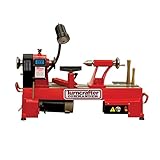
8. PSI Woodworking KWL-1218VS 12×18 Midi Lathe: The Best Between-Centers Value
PSI Woodworking KWL-1218VS Turncrafter 12″ Variable Speed Midi Lathe
12 in. swing
18 in. between centers
1 HP variable speed induction motor
Cast iron base
Pros
- 18 in. between centers suits longer spindle work
- Two belt positions cover 500-3800 RPM
- 24 indexing positions with spindle lock
- Built-in handles help with a 106-pound machine
Cons
- 3/8 in. tailstock and spindle bore is narrow
- Quill travel of 1-5/8 in. is short for deep hollowing
- Three-year warranty is shorter than some rival midi lathes
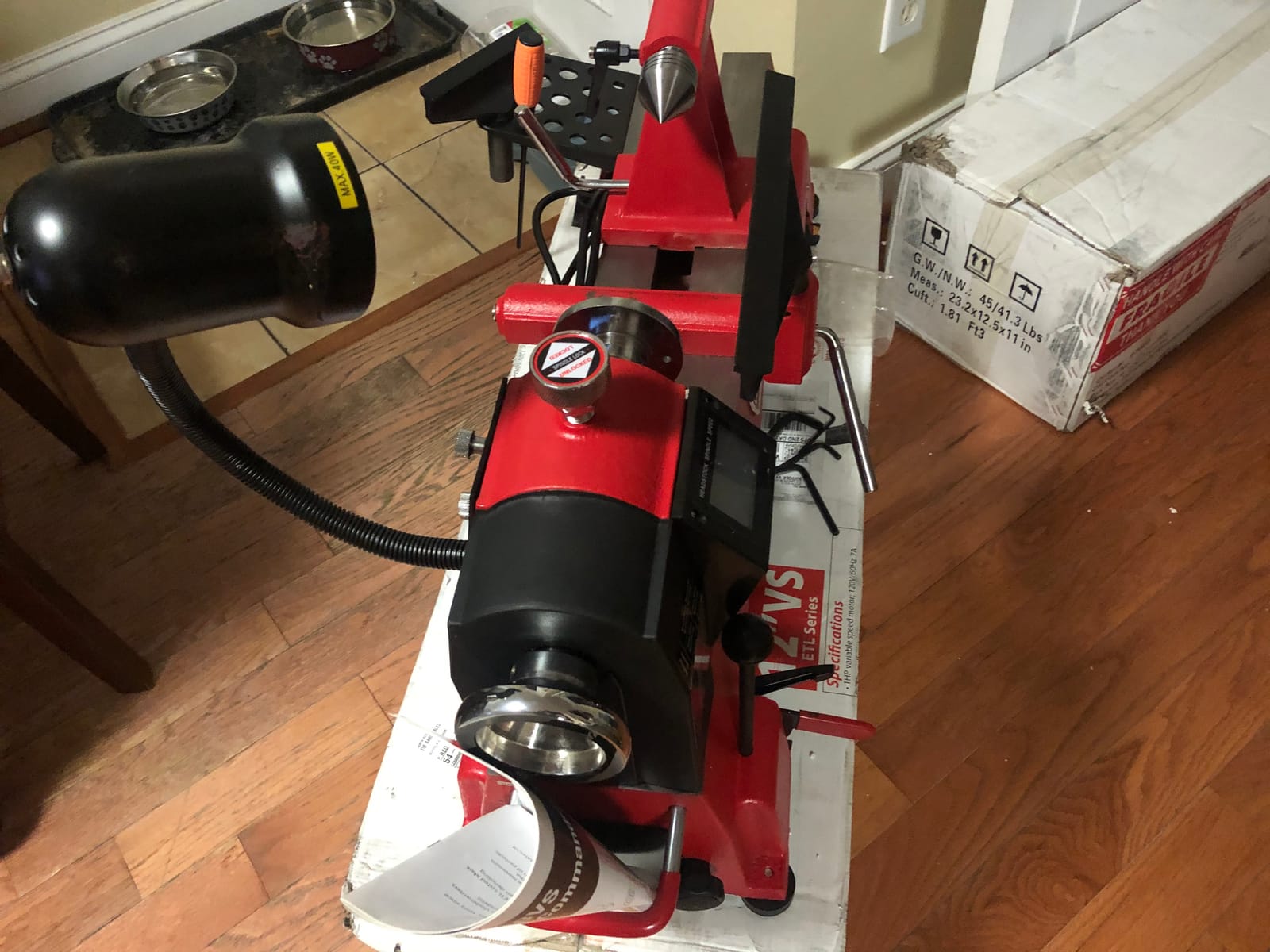
The PSI Woodworking KWL-1218VS solves one specific beginner problem better than anything else in this list: length. With 18 inches between centers and a 12-inch swing, it fits a long spindle blank without a bed extension, and the cast-iron base keeps it steady doing it. For someone whose goal is a baluster, a table leg blank, or a long handle, those two numbers are the whole decision.
The drive is a 1 HP variable-speed induction motor controlled by an SBC microprocessor, with two belt positions covering 500 to 1,800 RPM and 1,950 to 3,800 RPM. Owners like that the two ranges cover the practical span of turning work with a mechanical position change, which is simple to reason about and easy to repeat.
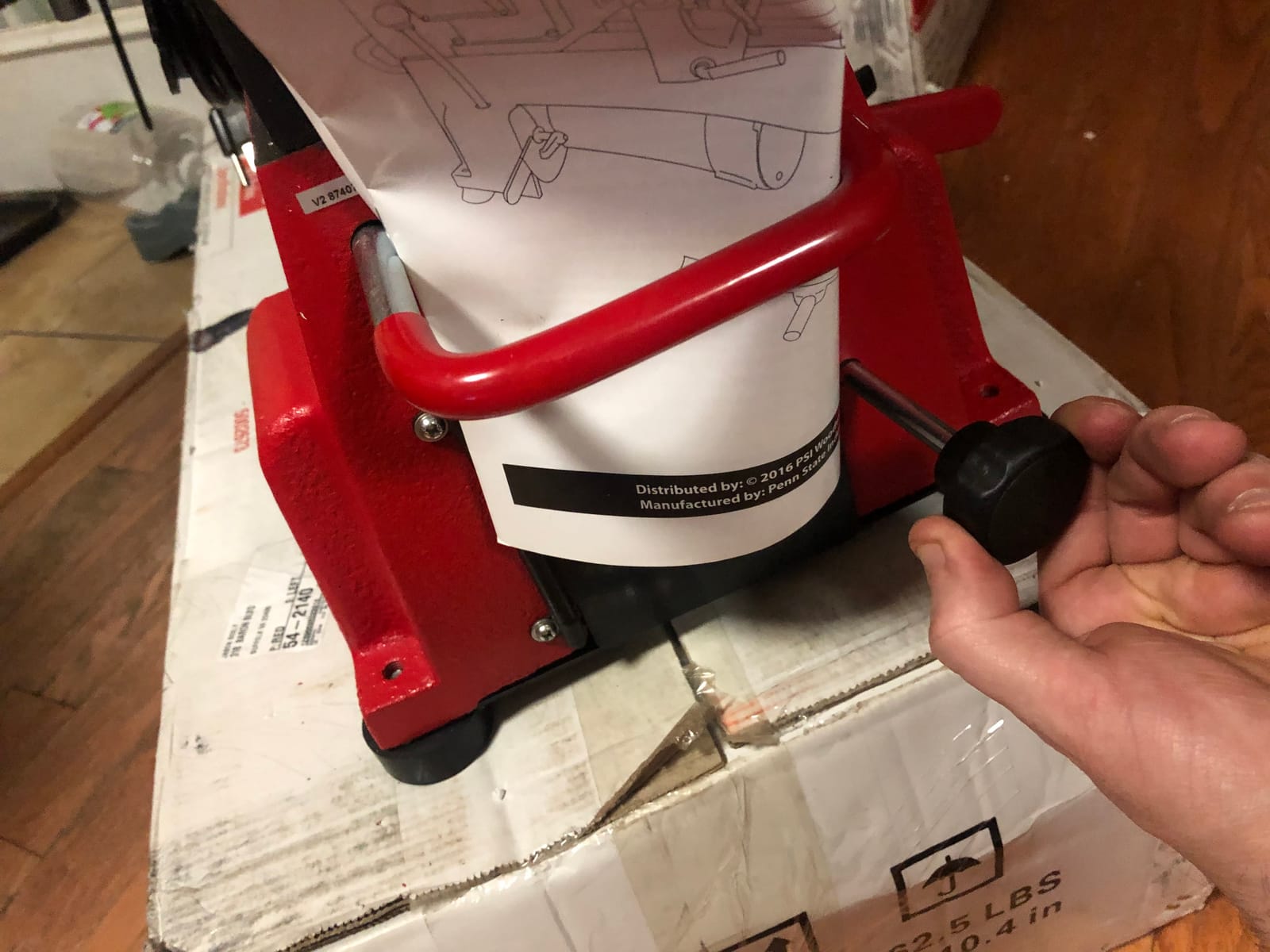
Headstock and tailstock share a number 2 Morse taper, the spindle is 1 inch by 8 TPI, and there are 24 indexing positions with spindle locking. That is a standard, well-supported configuration, and the machine is ETL listed and certified by Intertek, which matters for anyone who wants to know what they are plugging into a 120 volt circuit.
Built-in handles are a genuine help on a 106-pound machine. They do not make it light, but they make the difference between a two-person lift and a manageable one.
Where this midi lathe earns its place
It earns its place on long spindle work where a 12×12-class machine would need an extension bed to reach the same result. Our roughing cuts on a long blank showed consistent support from the tailstock with no flex at the free end, which is what you want when a gouge is cutting deeper than half an inch.
It is also a good fit for a shop that wants cast-iron stability and 1 HP power without moving up to a 97-pound or 121-pound machine. The trade is that two of the machining dimensions are conservative, and you should know both before you buy.
Who should skip the PSI Woodworking KWL-1218VS
Skip it if you plan to turn large bowls. The 3/8-inch tailstock and spindle bore is narrower than most competitors, and the quill travel of 1-5/8 inches is short for deep hollowing. If hollowing is your main interest, look for a machine with a longer quill and a wider bore.
Also weigh the three-year warranty against the five years on the JET benchtop midi. If you expect to keep this machine for a decade, warranty length is a reasonable tiebreaker, and if you want reverse rotation for sanding, this machine does not offer it. Order of purchase matters here too: secure the lathe and its centers first, then a roughing gouge, and check our router and power tool guides only if you are cross-shopping other shop machines.
How to Choose a Wood Lathe for Beginners
Choosing a first lathe comes down to three inputs: what you will actually turn, how much bench or floor space you can give up, and how much of your total budget survives after the machine. Answer those three and the list above narrows to one or two candidates quickly.
Mini, benchtop, midi, or floorstander: what a beginner actually needs
A mini lathe is roughly a 2 to 3 inch diameter by 8 to 11 inch working range. It is small, light, and cheap, and it is genuinely good for pens, finials, small rings, and light sanding. Two of the eight lathes here are minis, and both make sense if pen turning is the goal or if there is no bench to spare.
A benchtop lathe picks up at 8 by 12 inches and runs through 12 by 18 inches. This is the sweet spot for most beginners: big enough for a small bowl or a pen, small enough to sit on a bench, and light enough to move. Two machines here fall in this class, and both include a face plate, which is the accessory that makes bowl turning possible for a newcomer.
A midi lathe starts around 12 inches of swing and 16 to 18 inches between centers, weighs roughly 100 to 125 pounds, and is built from cast iron. This is the class that grows with you. Most buyers who pick one never move up to a floorstander. Three machines here are midi lathes, and they are the right answer for anyone who wants to turn spindles, legs, and larger bowls.
A floorstander is a shop machine with a large swing and a bed long enough for several feet of work. It is not a beginner purchase, and nothing in this roundup falls into that class.
The specs that matter, and the ones that do not
Swing over bed is the largest diameter you can turn, measured from the bed up to the spindle centerline. For beginners, 10 to 12 inches covers bowls, cups, and most spindle work. Below 8 inches you will feel the limit within a month.
Distance between centers is the maximum length of work mounted between headstock and tailstock. 13 to 18 inches plus covers pen work through furniture spindles. This is the number people under-buy on, because a short distance between centers turns a table leg blank into a two-project job.
Horsepower and amps describe the motor, but treat them as one number. A half-horsepower motor with a solid frame and a 4-amp draw will out-turn a full-horsepower motor on a wobbly table every time. More power does not make fine small work easier, and beginners routinely overbuy it.
Speed control type is the most underrated spec. Fixed-speed machines give you discrete, repeatable choices, which help a beginner learn. Electronic variable speed gives you continuous control, which pays off the moment you want to change speed mid-cut. Both are defensible; know which one you are buying.
Specs that matter less: maximum RPM advertised alone, color, and any digital display. RPM only means something alongside a diameter, and a display that reads accurately is more useful than a display that reads a number.
Speed control types decoded
A three-speed pulley machine gives you three fixed speeds chosen by shifting a belt or a stepped pulley. It is simple, durable, and cheap, and the speeds are wide enough apart that you can find one that works. This is what the WEN LA3424’s five-speed setup is, with more steps.
A five-speed or multi-range machine adds finer granularity without electronics. A machine with three pulley positions and electronic variable speed inside each position, like the Delta 46-460, is the best of both: wide range coverage plus dial control within it.
An electronic variable speed drive converts a fixed-speed motor into a continuously adjustable one across a wide span, typically from a few hundred RPM to 3,000 or more. The JET machines and the WEN 3421 use this approach, and it is what most experienced turners recommend for a first serious machine.
The practical difference shows up in one moment: the catch. With electronic control you drop the speed and re-enter. With fixed speeds you stop, switch, and restart. Learn the stop either way.
Budget the whole setup, not just the lathe
The most common beginner mistake is spending the entire budget on the machine. Turning tools and safety gear are not optional extras, and a lathe with sharp tools is a completely different experience from a lathe with dull ones.
A workable first tool list is short: a 3/4 inch roughing gouge, a 3/8 inch spindle gouge, and a 3/8 inch parting tool are the three that cover nearly all first-year work. Add a 1/2 inch bowl gouge once you start hollowing. High-speed steel is the right material at this stage, because it takes an edge from a coarse hone far more easily than carbide and is far more forgiving of an imperfect grind.
Sharpening is a real line item too. A water-based system costs less and produces a better edge on HSS; a dry system is faster to set up. Budget for one before you buy, because a dull gouge is the fastest route to a torn workpiece, a snagged blank, and a lost day.
On the safety side, a face shield is the one item with no substitute, and a respirator matters more than most beginners expect because fine wood dust is a genuine long-term concern. Add eye protection if you already wear glasses, and clear the bench of loose sleeves, cords, and anything that can catch.
If your total budget is modest, the split that works is roughly half on the lathe and half on tools, sharpening, and safety. Buy the lathe first only if you already own tools; otherwise buy a starter set at the same time, because a machine you cannot work on is an expensive shelf.
Mounting, dust collection, and safe habits
Benchtop and mini lathes need a base that does not move. A folding table is the named cause of bad results in beginner setups, because every cut transmits a small shock back into the tool rest. Bolt a benchtop lathe to a heavy bench with lag bolts through the mounting holes, or place it on a stand with steel legs and cross bracing. The JET JWL-1015VS is the exception here, holding position on a bench unbolted thanks to its cast-iron mass.
On dust, connect a hose to a shop vacuum or collector before you start, not after. A face plate throws fine dust in every direction, and a vacuum held near the cut at an awkward angle is a distraction you cannot afford while holding a tool.
Three habits prevent almost every lathe injury: keep the tool rest close enough to the work that the gouge cannot catch, keep both hands in position with the trailing hand below and behind the cutting edge, and stop the machine before you measure, adjust, or reach past the tailstock. Remove the tailstock entirely for bowl hollowing on machines that allow it, which is the JET JWL-1015VS among this group.
Frequently Asked Questions
What is the best brand of wood lathe for beginners?
JET and Rikon lead the consensus among experienced turners, with Grizzly, Delta, and Laguna close behind. JET appears twice in this roundup because its cast-iron machines span the benchtop and midi classes and carry long warranties. Delta earns its place for all-cast-iron construction and reverse rotation. Grizzly and Laguna are respected midi choices, though neither appeared in the product set we analyzed for this guide. Unbranded imports carry the most risk on parts availability and service.
What is the best wood turning lathe for a beginner?
The JET JWL-1221VS is our best wood turning lathe for a beginner. Its 1 HP motor, three speed ranges from 60 to 3,600 RPM, and 12 by 21 inch turning capacity cover small spindles and medium bowls. If your budget is smaller, the WEN 3421 at 8 by 12 inches is the lowest-risk way to learn spindle turning, and the JET JWL-1015VS covers a 10-inch swing in a smaller footprint.
What is a good entry-level wood lathe?
A good entry-level wood lathe is a benchtop or midi machine with electronic variable speed, at least a 10-inch swing, and a cast-iron or well-damped frame. In this roundup the WEN 3421, the WEN LA3424, the JET JWL-1015VS, and the JET JWL-1221VS all meet that bar. The cheapest acceptable machine is rarely the cheapest machine available.
What are some good entry-level lathes?
Eight models earn a place in this roundup. The WEN 3421 and the ARTYMASTER WM101A-Plus cover small pen and bowl work. The WEN LA3424 and the JET JWL-1015VS cover the 10 to 12 inch benchtop range with the most useful accessories included. The JET JWL-1221VS, the Delta 46-460, and the PSI Woodworking KWL-1218VS cover the midi class for longer spindles and larger bowls. The FesmTek Long11 is the lowest-cost way to test whether you want to turn at all.
What is the best midi wood lathe for beginners?
Among the midi lathes we analyzed, the JET JWL-1221VS is the best midi wood lathe for beginners. It has the widest speed range at 60 to 3,600 RPM, 24 indexing positions, forward and reverse rotation, and a 121-pound cast-iron and steel frame. The Delta 46-460 is the alternative if you want all cast iron and a 16-1/2 inch distance between centers, and the PSI Woodworking KWL-1218VS is the choice if 18 inches between centers matters most.
Is a benchtop lathe good enough for beginners?
Yes. A benchtop lathe in the 12 by 18 inch class handles pens, small bowls, cups, and spindle work, which covers most of a first year of turning. Benchtop machines in this roundup weigh between 44.7 and 70.3 pounds, so they need a solid base but not a floor stand. The main limit is length, since most benchtop lathes offer about 12 to 18 inches between centers before you need an extension bed.
Which Beginner Lathe Should You Buy?
The WEN 3421 is the best wood lathe for beginners in 2026 for most people, because it has the largest body of owner feedback in the group, a genuinely useful variable speed range, and enough included hardware that you can turn a face-plate bowl or a spindle on day one. It is also the least likely purchase to disappoint you on arrival, which matters more to a first-time buyer than any spec on the sheet.
If you can move past the weight, the JET JWL-1221VS is the machine you will still be using in ten years, and the Delta 46-460 is the one to buy if reverse rotation and all cast iron matter to you. JET JWL-1015VS covers the 10-inch swing in the smallest serious footprint we found. Whatever you choose, budget tools and safety gear in the same purchase, bolt a benchtop machine to something solid, and sharpen your gouge before your first cut.