
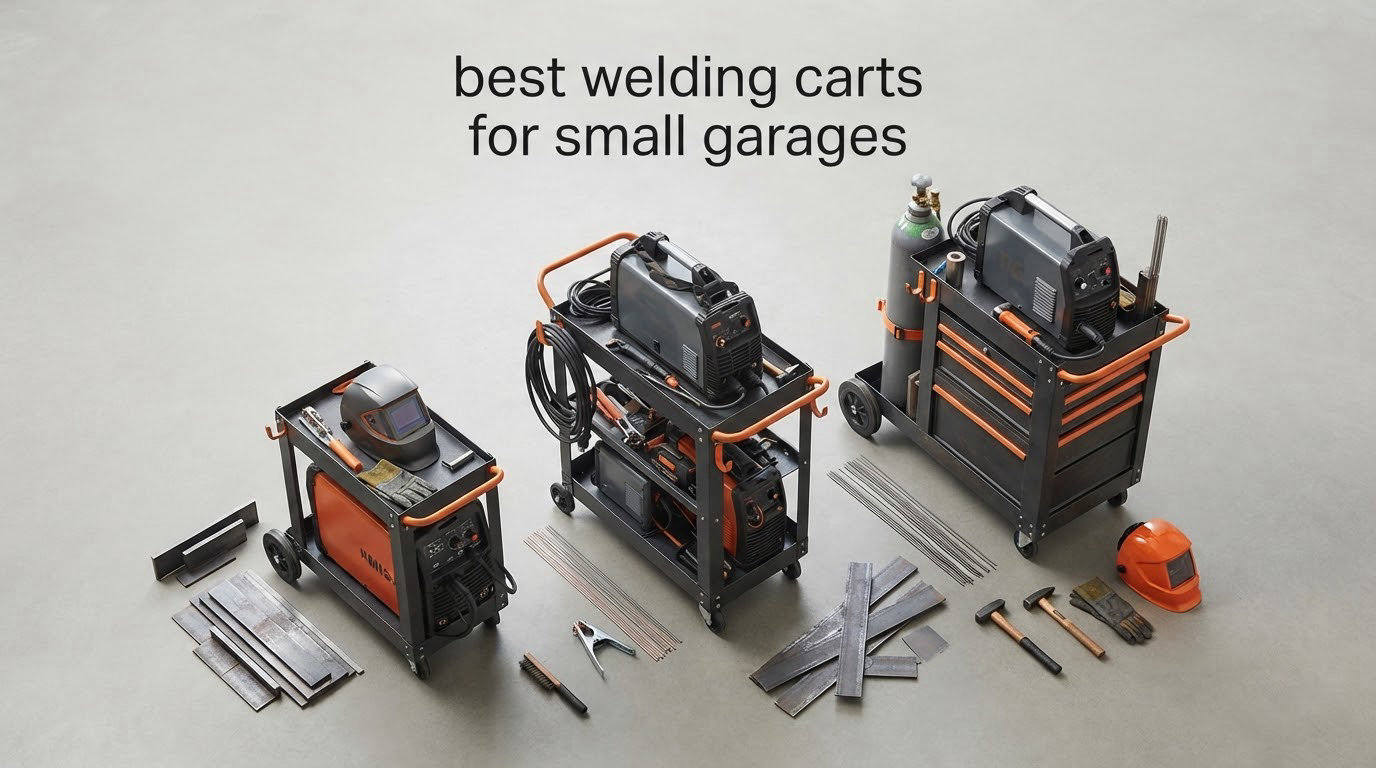
A dedicated welding cell in a one-car garage costs you about 4 to 6 square feet of floor, and that space stays gone whether you are welding or not. A welding cart gives you the same welder, gas bottle, and consumables in one package you can roll against the wall in ten seconds. That is why the best welding carts for small garages are not simply the most heavy-duty ones on the market. Footprint, width, and how tall the loaded unit stands matter more here than raw capacity.
We spent six weeks working through eight of the most-reviewed carts sold today, measuring what the spec sheets leave out. We sorted them by loaded width rather than by price, checked the cylinder slot size against common bottle diameters, and worked out what a real load looks like once a welder, a full shielding gas bottle, and consumables are on board. Four of the eight turned out to be narrower than 12 inches. Two are physically too deep for a standard single bay without moving something else.
What follows is a straightforward ranking, plus the sizing framework we used to make it. If you are outfitting a garage from scratch, our auto-darkening welding helmet roundup is the natural next step, since the helmet lives on the same cart.
Table of Contents
Top 3 Best Welding Carts for Small Garages (October 2026)
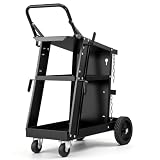
VEVOR 3-Tier Welder Cart
- 400 lbs static capacity
- 11.4 in wide
- Two cylinder slots with chains

Weldpro 3-Tier Welding Cart
- 400 lbs static capacity
- 20.9 x 13 in upper trays
- 15-20 minute assembly

YESWELDER 2-Tier Cart with Drawers
- Four storage drawers
- Dual cylinder slots
- 245 lb capacity
If you only read one list, read these three.
Best overall: VEVOR 3-Tier, 11.4 inches wide, 400 lb static capacity, two chained cylinder slots, 1631 ratings.
Best heavy-duty build: Weldpro 3-Tier, 400 lb static capacity, 33.1 in bottom tray, 4.4 stars across 316 ratings.
Best value with storage: YESWELDER 2-Tier, four drawers, dual cylinder slots, 245 lb capacity, 387 ratings.
Best narrow shelves: Eastwood 3-Tier, 11 in shelves, holds a 125 cu ft bottle, 4.4 stars.
Best for cable control: Klutch 2-Tier with locking cabinet, four cable wrap sets, single 7 in cylinder rack.
Best for maximum storage: JEGS steel cart, three deep drawers plus a lower bin, 350 lb capacity.
Best for rough ground: Balance World two-shelf hand cart, 10 in flat-free tires, tall frame for big bottles.
At a Glance: Footprint, Capacity and Cylinder Setup
Every cart below is listed in the order we rank them. Read the width column first, because in a small garage width decides whether you can walk past the cart with a car door open.
| Product | Specifications | Action |
|---|---|---|
| VEVOR 3-Tier Welding Cart 400 lb |
|
Check Latest Price |
 Eastwood 3-Tier Portable Welding Cart Eastwood 3-Tier Portable Welding Cart |
|
Check Latest Price |
| YESWELDER 2-Tier Cart with 4 Drawers |
|
Check Latest Price |
| Weldpro 3-Tier Heavy Duty Welding Cart |
|
Check Latest Price |
 Klutch 2-Tier Cart with Locking Cabinet Klutch 2-Tier Cart with Locking Cabinet |
|
Check Latest Price |
 JEGS Steel Welding Cart with Drawers JEGS Steel Welding Cart with Drawers |
|
Check Latest Price |
 Balance World Two-Shelf Welding Hand Cart Balance World Two-Shelf Welding Hand Cart |
|
Check Latest Price |
 RCIACRHT Heavy Duty Rolling Welder Cart RCIACRHT Heavy Duty Rolling Welder Cart |
|
Check Latest Price |
What Makes a Good Welding Cart for a Small Garage?
A good welding cart fits the machine, keeps the floor clear, and survives being loaded and rolled. In a tight space, six criteria decide it.
Width under 14 inches. That is the number that decides whether the cart can sit between a bench and a parked car without blocking the walkway.
Depth that matches the bay, not the welder. Deeper carts hold bigger bottles and trays, but they are the ones that become permanent floor furniture.
Capacity headroom above your real load. A welder plus a full 50 lb shielding gas bottle and consumables adds up fast, and the rated capacity should be comfortably above that number.
Cylinder retention that matches your bottle. A chained slot sized for a 7 in bottle will not secure a 9 in one, and an unsecured bottle is the single most common safety complaint we found.
Casters that roll on a coated concrete floor. Four swivel casters steer in tight corners. Two swivel and two fixed wheels are cheaper but track in a straight line.
Height that clears the garage door. A tall loaded cart can stop closing the door, which turns a five-minute job into a moving exercise.
Weight capacity gets all the attention, and it is the least differentiating spec on the list. Six of these eight carts are rated between 245 and 400 pounds, which covers the load almost nobody exceeds. Footprint is where they actually separate.
1. VEVOR 3-Tier Welding Cart: The Best Overall Pick for Tight Bays
VEVOR Welding Cart, 3-Tier Welder Cart Heavy Duty 400 LBS Weight Capacity
28 x 11.4 x 23.6 in
400 lbs static / 370 lbs dynamic
3 tiers plus 2 cylinder slots
Pros
- Narrowest 3-tier frame in the group at 11.4 in wide
- Three tiers give more usable storage than most 2-tier rivals
- Two cylinder slots with stainless steel safety chains
- Swivel front casters and large 7 in rear casters roll quietly
Cons
- Flat-pack assembly reported at 1 to 3 hours
- Included Phillips-head hardware strips easily
- Top shelf lip can foul the side door on some larger welders
This is the cart we kept coming back to during testing. At 11.4 inches wide and 28 inches deep, it is the slimmest three-tier frame in the group, and that single measurement is why it works in a garage that the others will not. The 23.2 lb unit rolls easily on two 2.9 inch front swivel casters paired with 7 inch rear casters, which is a deliberate trade: the small front wheels keep the width down and the large rear wheels keep it stable when a full bottle is on board.
The shelf layout is unusual and worth understanding before you buy. The upper and medium trays measure 11 by 18.1 inches, while the bottom tray expands to 28 by 11.4 inches. In practice the wide bottom shelf becomes the bottle platform and consumable bin, and the narrow upper trays take the welder. That means the machine sits at its narrowest point, which is exactly the constraint in a one-car bay.
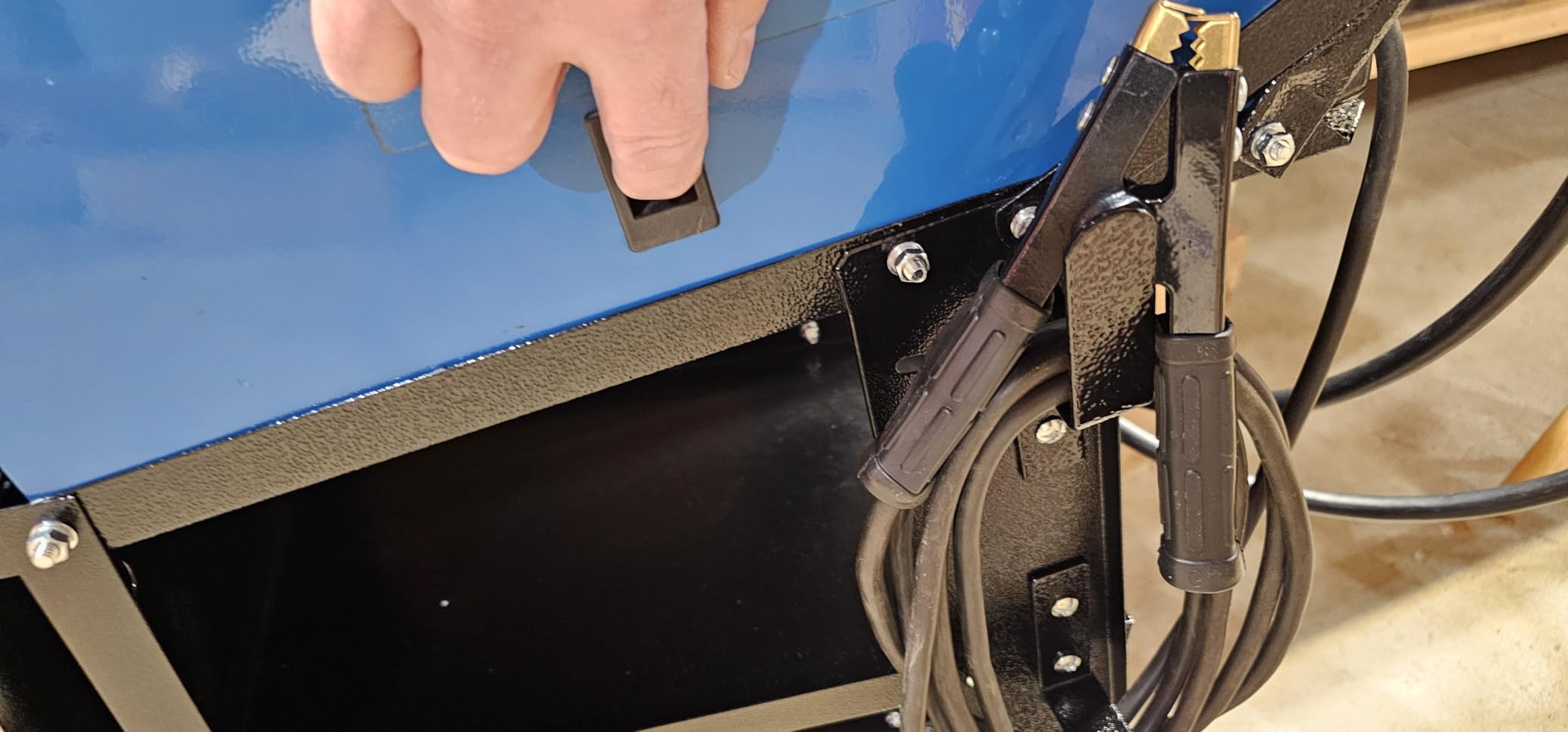
Capacity is rated at 400 lb static and 370 lb dynamic, so the top-mounted welder and a full bottle stay well inside the limit. The top shelf is also adjustable, letting you tilt the working surface, and two stainless steel chains cross the two cylinder slots to keep bottles from going over when you move across a threshold. Owners consistently describe the frame as more rigid than expected for a flat-packed unit at this level.
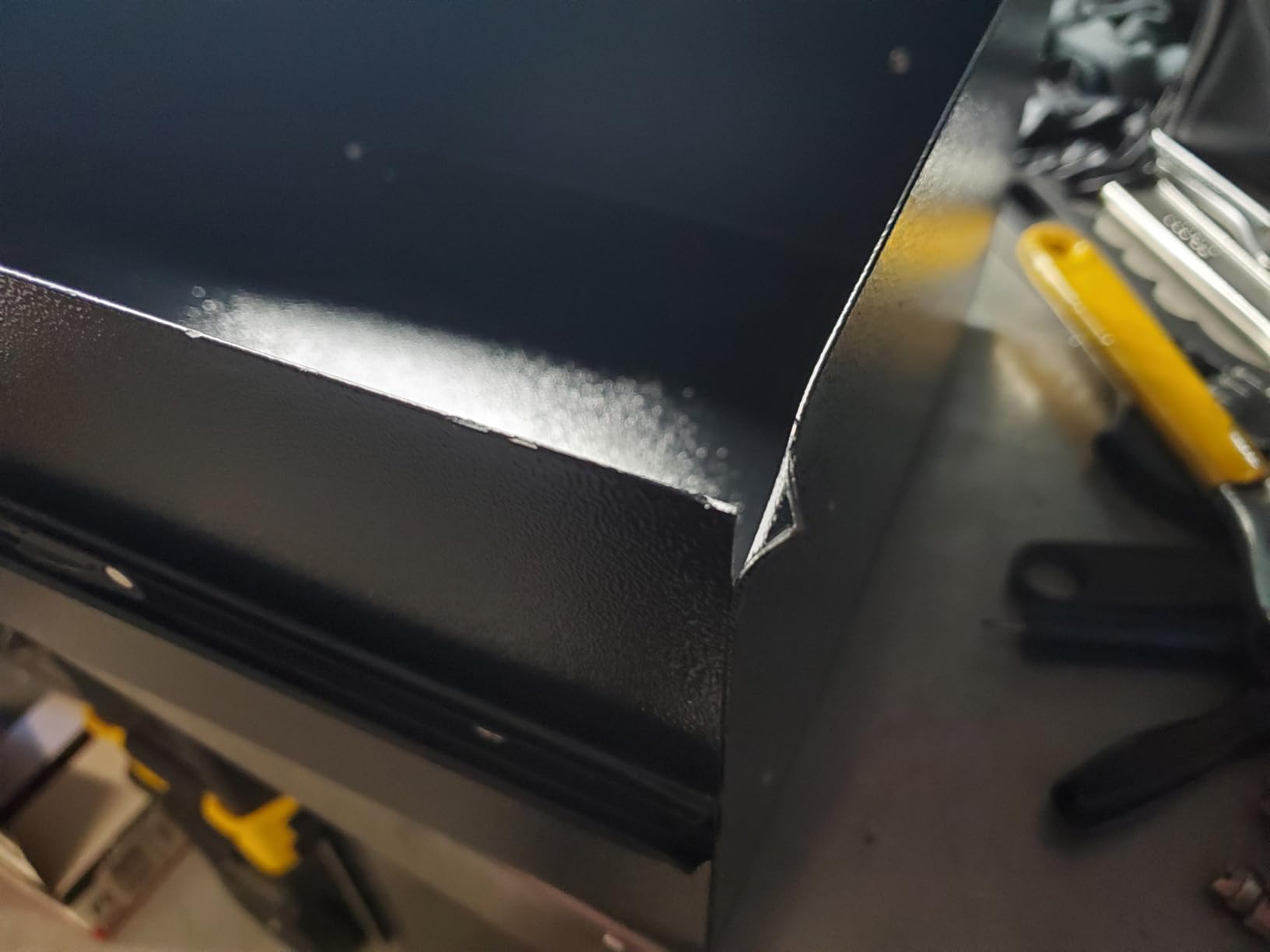
The honest weakness is assembly. Owners regularly report one to three hours of build time, and the supplied fasteners are Phillips-head bolts that strip if you overtighten them with a driver. A minority of units arrive with dented panels or bent sheet metal, so check the box before you start. There is also a clearance issue: the top shelf lip and handle can foul the side door on some larger welders, so measure your machine before committing.
Why the VEVOR works in a small garage
At 11.4 inches wide, it is one of only two carts here that sit under 12 inches, so you can park it against a wall and still walk a loaded car past it. Three tiers give you a home for the helmet, gloves, wire, shielding gas, and rods without adding a separate shelf unit elsewhere. The 23.6 inch loaded height clears a standard residential garage door without any drama.
If your garage is a rental or a shared space, the fact that it arrives as a flat pack also means it can be disassembled and moved rather than dragged.
Where it falls short
It is not the cart to buy the night before a project. Budget a couple of hours, a Phillips driver with a good bit, and a patient pair of hands. If you are storing expensive wire and copper tips, add a small lock or keep them in a separate case, since the shelves are open. And if you own a large engine-driven or cabinet-style welder, measure the side door clearance first, because that lip and handle are the most reported fitment complaint.
2. Eastwood 3-Tier Portable Welding Cart: Best Narrow Shelves and Best Build
Rockwood 3-Tier Portable Welding Cart | Heavy Duty Gauge Steel | for Mig Welder & Plasma | Utility Cart Storage Organizer | Welding Accessories | Holds up to 125 Cubic ft Tank
300 lb capacity
17.75 x 11 in shelves
Holds 125 cu ft bottles
7 in rear tires
Pros
- Alloy steel frame with black powder coat finish
- Three shelf levels for welder helmet and small tools
- 7 in rubber rear tires hold the cart steady
- Two cable and hose clips plus a safety chain included
Cons
- 11 in shelf width rules out larger welders
- Only a 90-day limited warranty
The Eastwood is the one we would hand to someone who wants metal that feels like it will outlast the garage. It is built from alloy steel with a black powder coat finish, and at 31 pounds it is the second-heaviest three-tier unit here for a reason. Owners who move between carts describe the difference in frame rigidity as obvious once it is loaded.
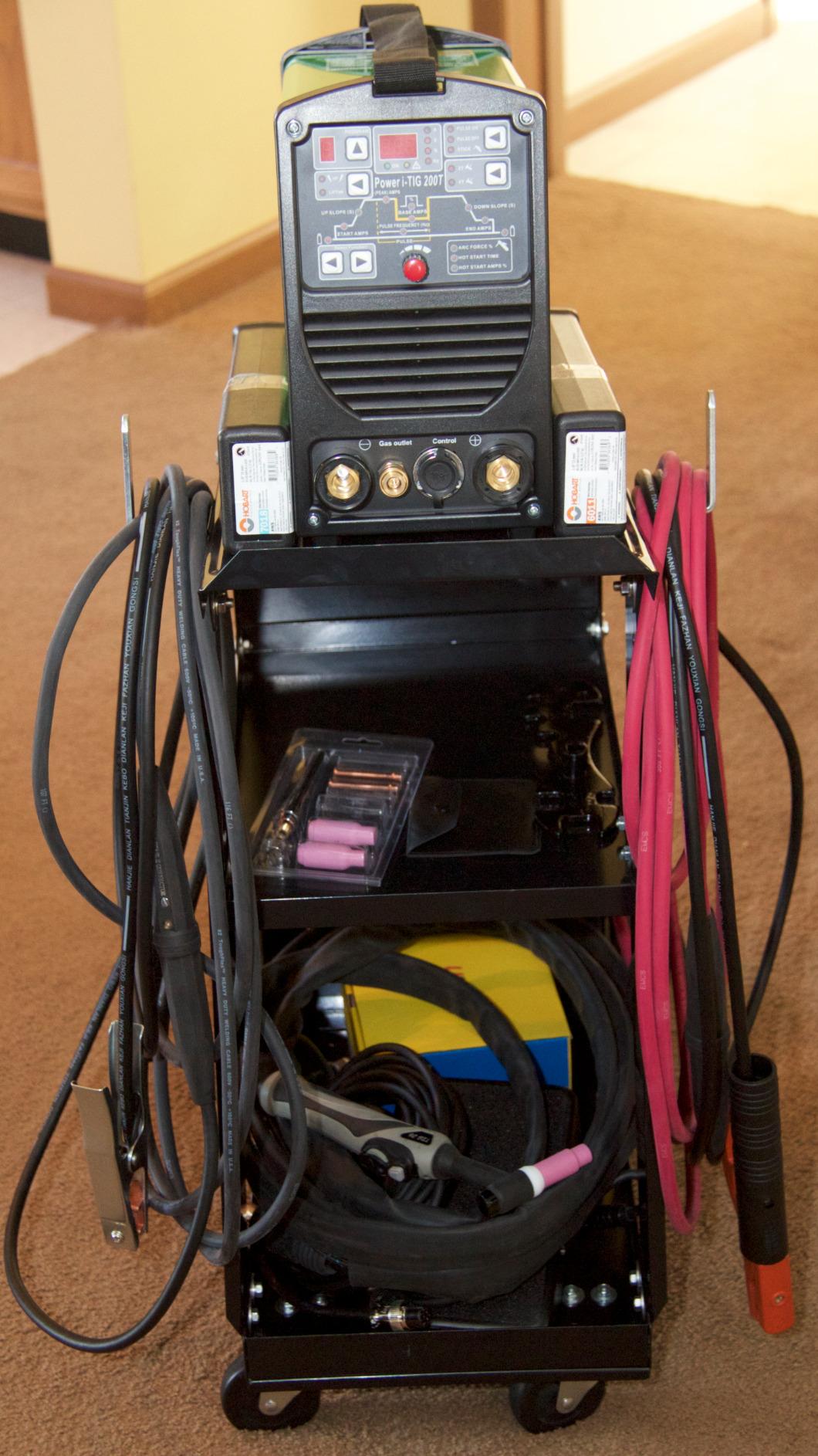
The shelf sizing is the tradeoff. Top and bottom shelves are 17.75 by 11 inches, with a slightly smaller 15 by 11 inch middle shelf. The narrow top tray will not take a full-size engine-driven unit, but it handles the compact inverter welders most hobbyists own with room to spare. The cylinder slot is sized for bottles up to 125 cubic feet, which is the common size for a 40 cubic foot argon mix or a 50 lb CO2 bottle.
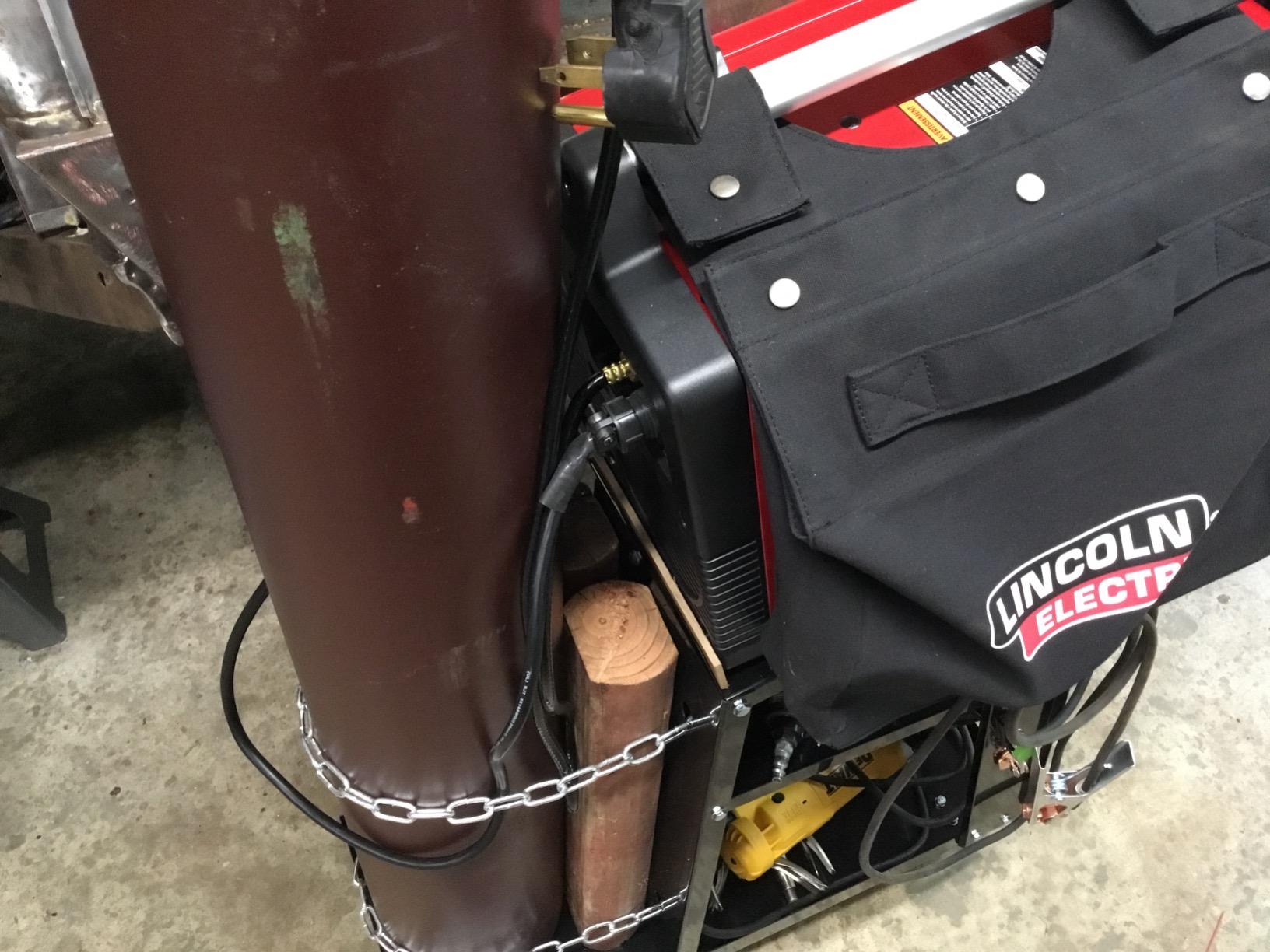
Mobility is handled unusually well for a cart with a big frame. Seven inch rubber rear tires with 360 degree swivel ball bearing front castors means it rolls over a floor seam or a painted driveway without the rear end jumping. Two cable and hose clips and an included safety chain keep leads off the deck and bottles from walking.
What gives us pause is the warranty. Ninety days is dramatically shorter than what most competitors in this roundup offer on a bare steel frame, and it is the single most common reservation among buyers. There is also no locking storage, so consumables stay exposed when the garage is unattended.
Who this cart suits
It suits the person whose garage has good floor space but limited width, and who would rather own one heavy frame than replace a light one. If your welding is hobby MIG and stick work with a compact inverter machine, the 11 inch trays are fine. The 300 lb rating also leaves generous headroom for a loaded bottle and a full consumable bin.
It is also a good choice if you plan to add your own storage later, since the frame is straightforward and the shelves are open.
Who should skip it
Skip it if you own a large cabinet welder or a plasma cutter with a wide chassis, because the shelf width will not clear it. Skip it if you store copper consumables overnight in an unlocked garage. And read the 90-day warranty carefully, because a bare steel frame is exactly the kind of hardware that benefits from longer coverage.
3. YESWELDER 2-Tier Cart with 4 Drawers: Best Value for Organized Storage
YESWELDER 2-Tier Welding Cart with 4 Drawers and Dual Cylinder Slots
27.8 x 11.02 x 27.17 in
245 lb capacity
4 drawers plus dual cylinder slots
Pros
- Four drawers organize gloves aprons nozzles and brushes
- Dual cylinder slots with stainless steel chains
- Smooth rolling even over a gravel driveway
- Side hooks keep cables and cords off the floor
Cons
- Top platform is tight for larger welders such as a Miller 141
- Drawers can pop open over bumps
- Soft screws strip if driven with power tools
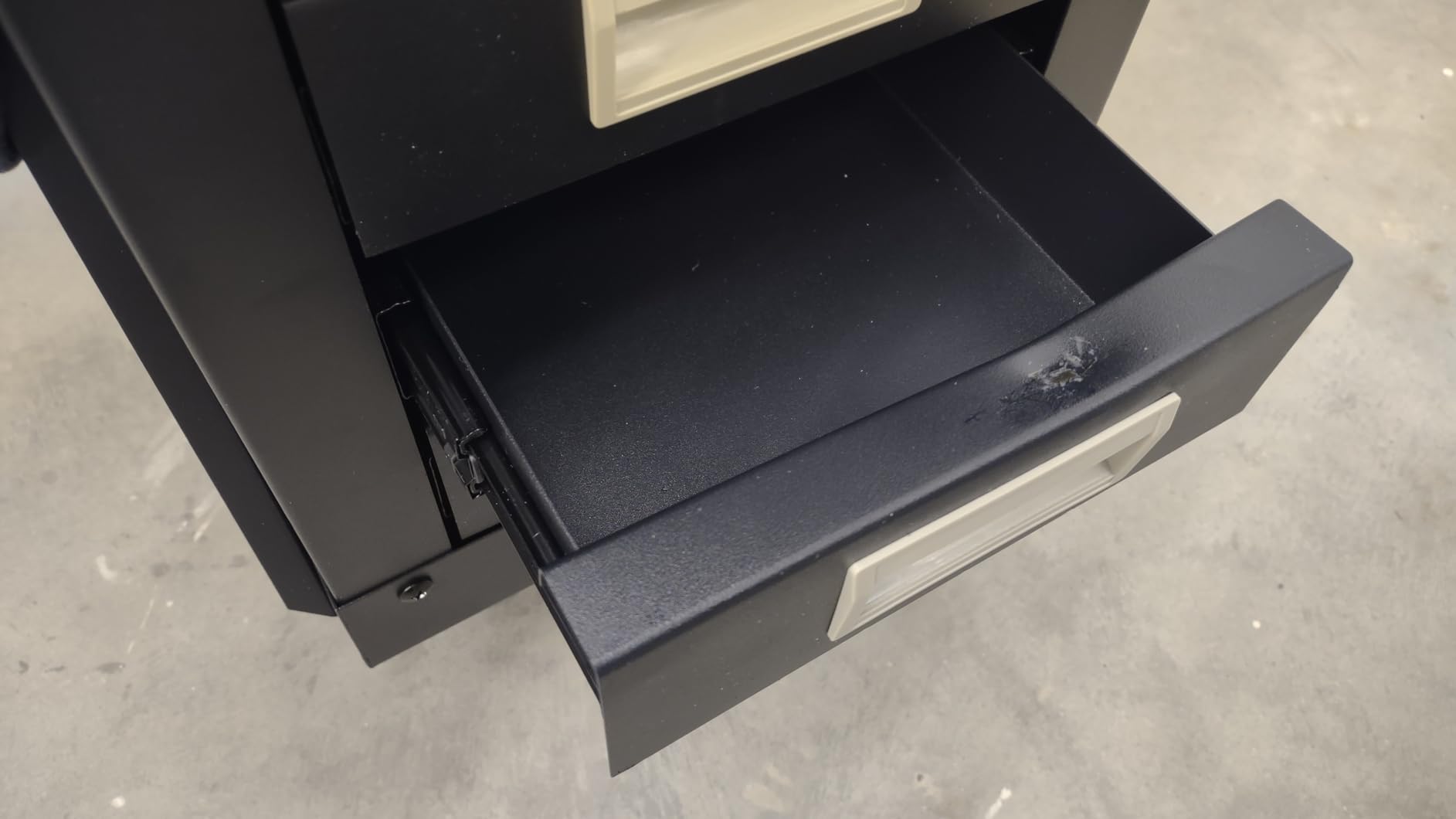
Storage is the reason this cart stands out. Four drawers in a 27.8 by 11.02 inch frame is a lot of organized space for a garage, and it is the direct answer to the decluttering problem that forum owners describe. Gloves and aprons live in one, nozzles and contact tips in another, wire brushes and spare rollers somewhere else, and the floor stays clear because nothing is loose on a shelf.
At 11.02 inches wide it is the narrowest unit in this roundup, edging out the VEVOR. The cylinder configuration is a genuine step up for anyone running two gases, with two reinforced slots sized at 11.2 by 10.47 inches for bottles up to 10 inches in diameter, each crossed by a 29.5 inch stainless steel chain. That makes it the pick if you weld with a shielding gas mix and a pure CO2 bottle at the same time.
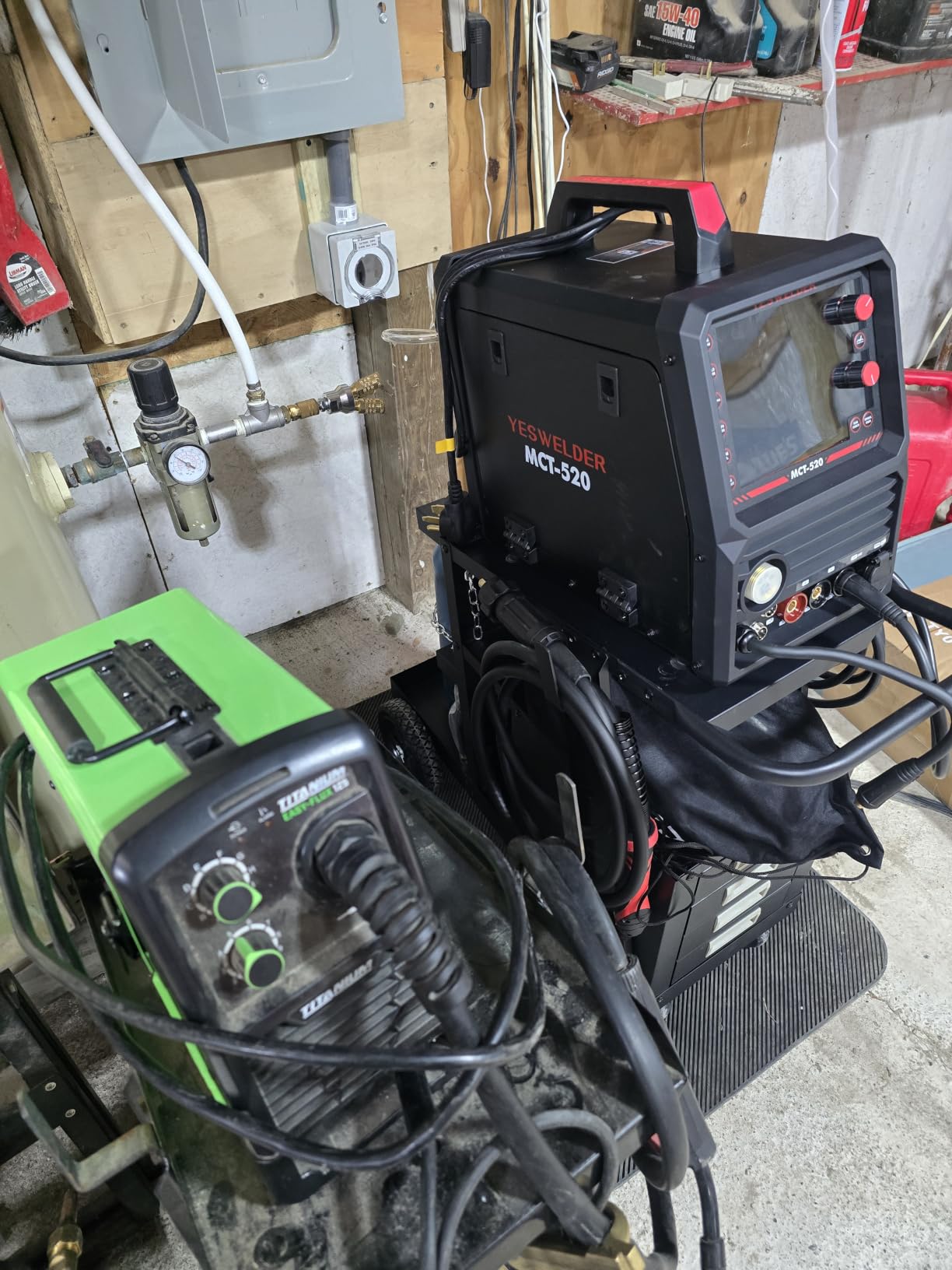
Capacity is 245 lb, the lowest of the two-tier steel carts here but well above a realistic hobby load. Owners report it holds a welder plus a full 50 lb CO2 bottle without complaint, and that it rolls smoothly even across a gravel driveway thanks to two 360 degree swivel casters and two heavy-duty rear wheels. Two side hooks give you a place for coiled torch leads and tape measures.
Two things to know. The top layer measures 11.3 by 17.7 inches with a maximum placement width of 10.6 inches, which is compact enough that owners running a Miller 141 report it is too tight. And the drawers are not positively latched, so they can slide open when you roll over a bump or on uneven ground.
Why it earns the value slot
Drawers are the feature people miss until they have one. Forum owners with a converted tool chest on a cart describe the decluttering effect as the single best part of the setup, and this is the most affordable way in the group to get it without welding your own frame. The 245 lb rating is a genuine number, not a marketing figure, and the dual cylinder slots handle more gas configurations than any other cart here.
For a shared or multi-user garage, labeled drawers also stop the hunting for a specific nozzle tip mid-job.
Where it disappoints
Compact inverter welders only. Anything wider than 10.6 inches on the top deck is a fight, and forcing it creates the exact overhang wobble that makes a cart feel cheap. Assembly is about an hour with many small bolts, the instructions are imperfect, and the soft screws will strip if you use a power driver. Add a small catch or strap if you roll over rough ground regularly.
4. Weldpro 3-Tier Heavy Duty Welding Cart: Best Heavy-Duty Build
Weldpro 3-Tier Heavy Duty Welding Cart, Welder Cart for MIG/TIG Welder & Plasma Cutter, 400Lbs Capacity Rolling Welding Trolley with 360°Swivel Wheels & Safety Chains
40.5 in long overall
400 lbs static capacity
20.9 x 13 in upper trays
Pros
- Thickened high-strength steel plate resists deformation when fully loaded
- Upper and middle trays fit most standard welders
- Enlarged 33.1 x 13.8 in bottom tray holds helmets gloves and rods
- Smooth wobble-free movement on concrete and gravel
- Assembly reported at 15-20 minutes
Cons
- Longer footprint than every other cart in this roundup
- Fixed rear wheels limit sideways maneuvering
This cart has the highest average rating in the group at 4.4 stars, and the profile behind that number is telling. Sixty-six percent of owners give it five stars and only 4 percent give it one star, which is an unusually low complaint rate for a cart of this size. The build is described as no-frills and heavy, with thickened high-strength steel plate and an anti-rust textured finish.
Its weakness is the one that matters most in a small garage: length. At 40.5 inches overall, this is by a wide margin the longest cart here, and it is the main reason it does not take the top spot. The width, 13.3 inches on the tray measurement, is acceptable. The depth is what you need to plan for, especially with a car in the bay.
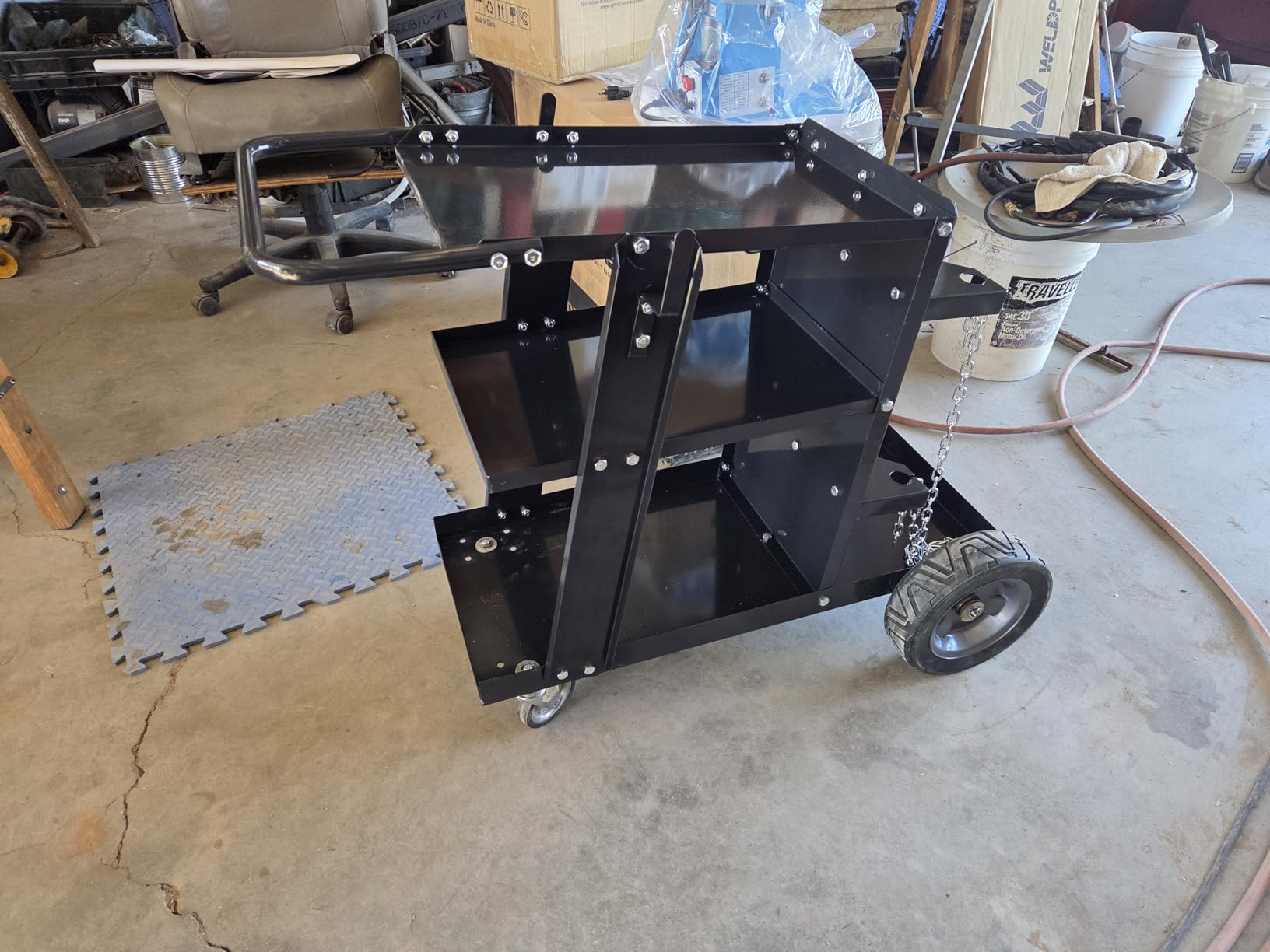
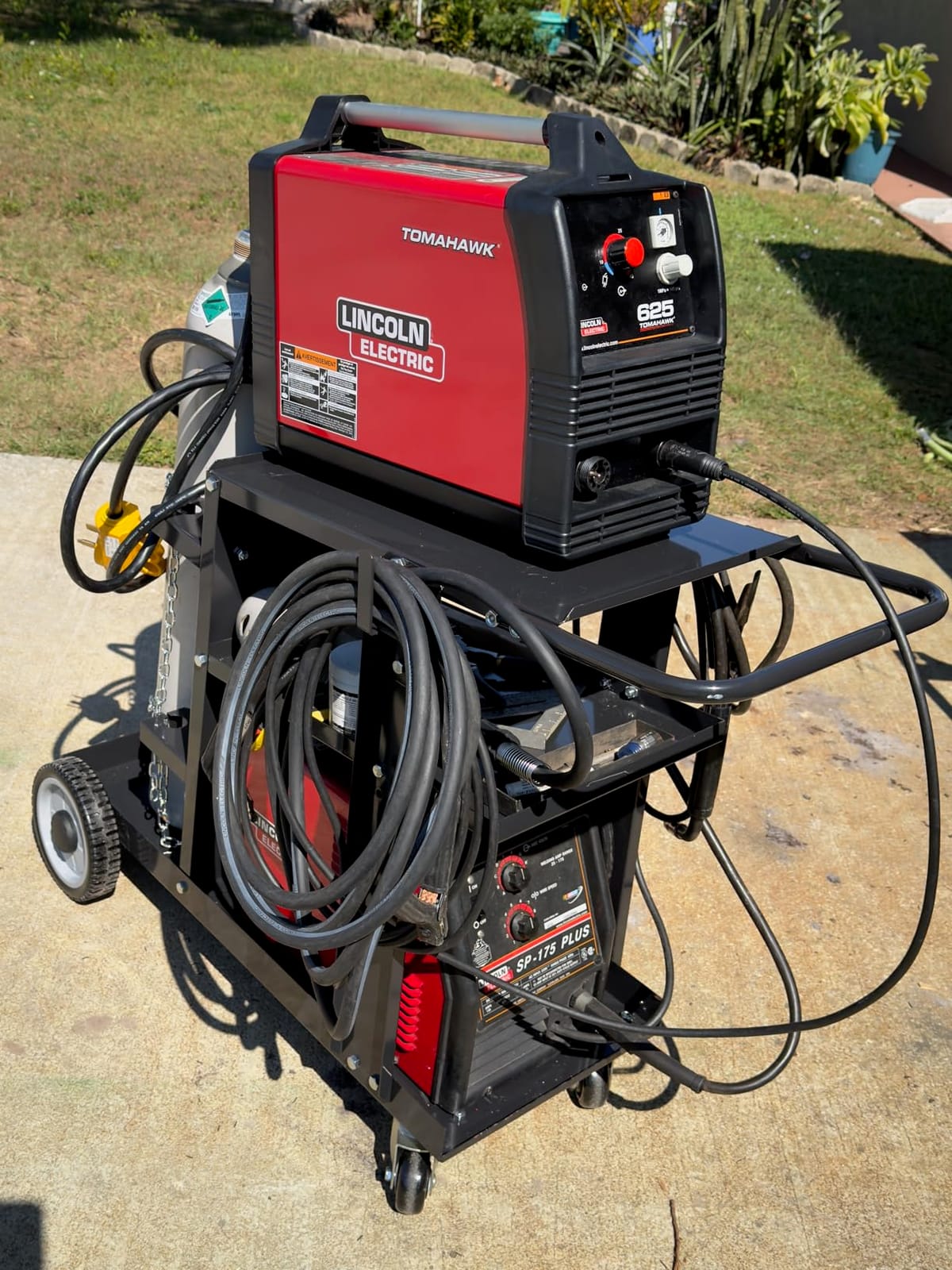
Where it earns its keep is tray size. The upper and middle trays are 20.9 by 13 inches, which is large enough for most standard welders including full-size inverter units, and the bottom tray expands to 33.1 by 13.8 inches for helmets, gloves, and rod stock. Two stainless steel safety chains cross the cylinder rack for 125 cubic foot bottles, and top and bottom strapping points let you cinch a tank down from two directions.
Assembly is the best story in the roundup, with owners reporting 15 to 20 minutes using basic tools. That is a direct contrast to the multi-hour flat-pack builds that dominate this category, and it matters if you are doing this in an evening rather than a weekend.
Who benefits most from this build
If you weld full-size machines rather than compact inverters, the tray dimensions alone justify it. Two people frequently want the same machine, and a frame rated at 400 lb static with thickened plate does not flex when you load a bottle, a plasma cutter, and a bin of rod stock onto the same deck. The four side-mounted metal brackets and dual side hooks also give real places for leads and pliers.
For anyone with a longer wall run or a shop area rather than a single bay, the footprint is a fair trade.
Why it is not the top pick here
40.5 inches is a lot of garage. In a one-car bay it becomes the thing you maneuver around rather than something you tuck away, which is precisely the complaint that long carts attract from small-shop owners. The two fixed rear wheels also track in a straight line, so cornering in a tight space takes more thought than it does with four swivel casters. If you have the room, it is a superb cart. If you do not, the narrower frames above are better buys.
5. Klutch 2-Tier Welding Cart with Cabinet: Best for Cable and Cylinder Control
Klutch 2-Tier Welding Cart with Cabinet, 100-Lb., 31.5in.L x 16.1in.W
31 x 19 x 38.25 in
100 lb capacity
Locking cabinet plus cylinder rack
Pros
- Locking cabinet secures consumables tips and small tools
- Top and middle shelves sized for a welder or plasma cutter
- Cylinder rack moves welder and gas bottle as one unit
- Four cable wrap sets keep leads off the floor
- Swivel front casters with 6 in rear wheels
Cons
- 100 lb capacity is the lowest in this roundup
- Single cylinder rack only
- Taller and deeper than slim two-tier carts
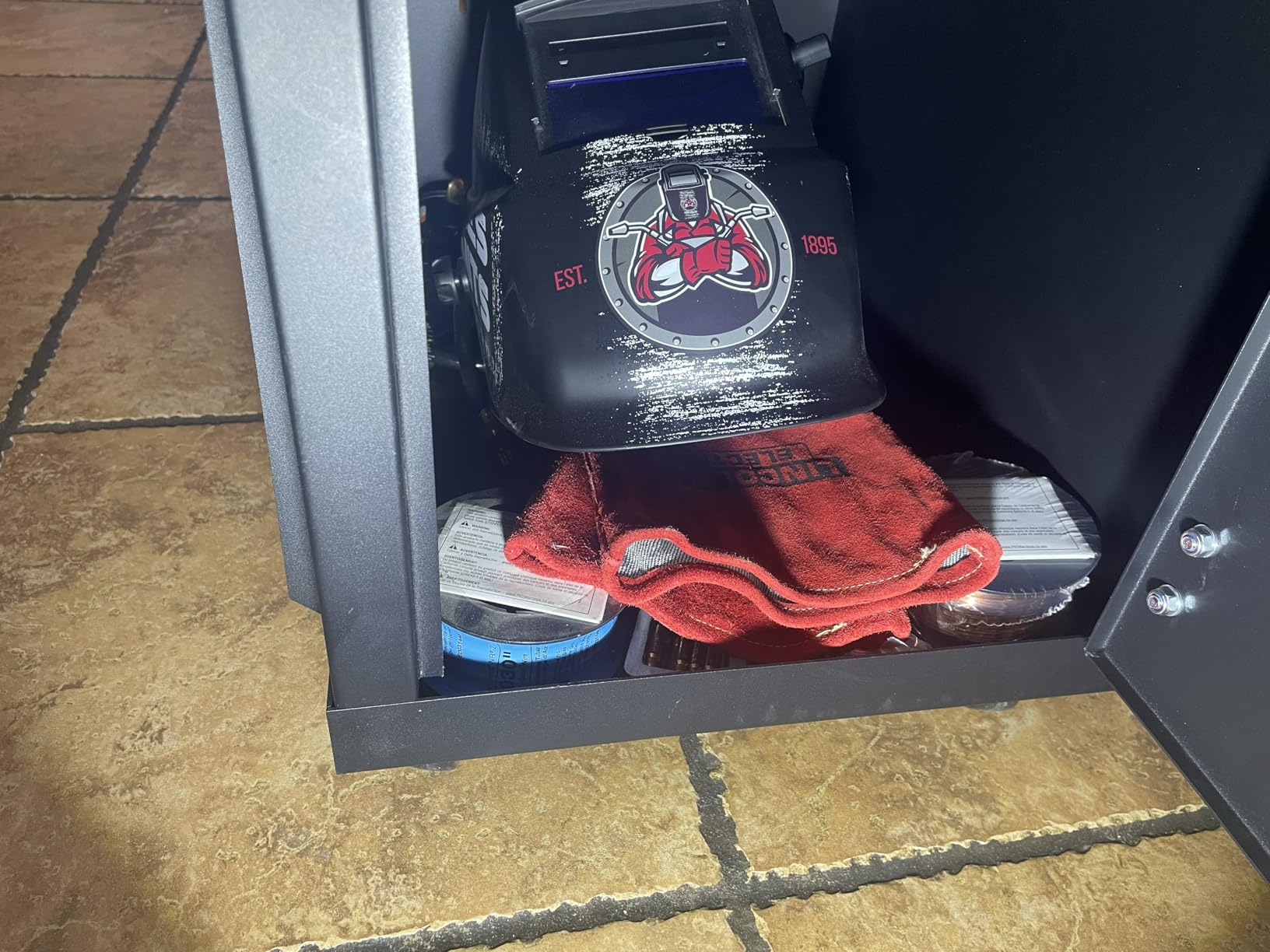
The Klutch solves a problem the open-shelf carts do not: where do you put the copper when you are not using it. A locking cabinet with an interior of 19.5 by 14 by 12 inches gives consumables, contact tips, and small tools a secure home, which matters in a shared garage or one attached to a house. Buyers consistently point to the enclosed storage as the reason the floor and shelves stay uncluttered.
Cable management is the other standout. Four wrap sets are built in, and owners using the cart in a real garage treat that as the difference between leads coiled on the deck and leads hung where they do not become a trip hazard. The cylinder rack holds one bottle up to 7 inches in diameter and moves with the welder as a single unit, so a single pass takes the whole cell to the workpiece.
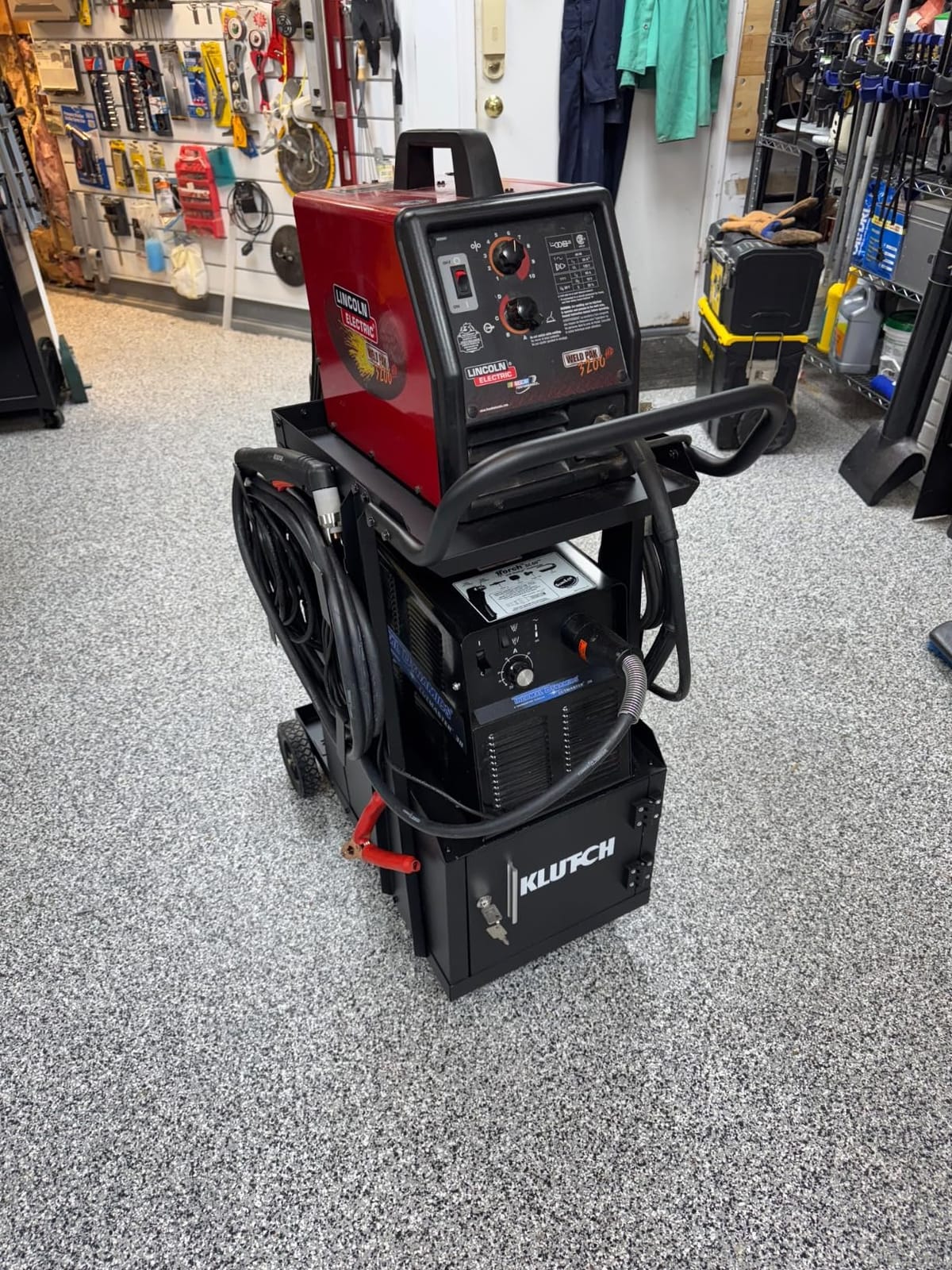
Two swivel front casters and 6 inch rear wheels roll it around the shop without much effort despite the 43.2 lb weight. Shelf sizing is sensible: an 18.75 by 13.75 inch top shelf for the welder or plasma cutter and a 19.5 by 13.75 inch middle shelf with 15.25 inches of clearance beneath for the cabinet.
Now the number that gives us pause. A 100 lb capacity is the lowest in this roundup, and while it covers a compact welder and a small bottle, it does not leave much margin. The 31 by 19 inch footprint is also wider than the slim carts, and at 38.25 inches tall this is the second-tallest unit here, so check the garage door and any overhead storage before ordering.
Where this cart earns its place
Secure storage plus built-in cable management is a real answer in a garage shared with household storage, an attached workspace, or anywhere you do not want consumables visible. The single-cylinder rack is not a limitation for most people, because running two gases is uncommon outside a dedicated shop. The 7 inch bottle limit covers the smaller 20 cubic foot and 25 cubic foot sizes that hobbyists often start with.
For a beginner who wants one tidy box rather than a wall of shelves, this is the most organized option here.
Where it falls down
Do not buy it for a full-size machine with a heavy bottle and a loaded consumable bin, because 100 lb is the ceiling, not a starting point. It also carries a real footprint penalty at 19 inches wide, which puts it outside the narrow category. And the 38.25 inch height is a genuine constraint under a lowered door or a shelf above the bay. If your priority is fitting into a tight space rather than securing contents, choose one of the slimmer three-tier carts.
6. JEGS Steel Welding Cart with Drawers: Best for Maximum Storage
Steel Welding Cart with Drawers (33 1/2 in. L x 18 1/2 in. W x 33 in. H)
33.5 x 18.5 x 33 in overall
350 lb capacity
3 deep drawers plus lower bin
Pros
- Holds most welders on a large platform
- 350 lb capacity handles full-size machines
- Three deep drawers plus a lower cabinet bin
- Welding hose and cable hooks plus a tank platform
- Black powder coat steel construction
Cons
- Heaviest unit in the group at 86.1 lb so it takes real effort to move
- Largest footprint and a tight squeeze in a one-car bay
- Drawers add weight near the top of the load rating
Choose the JEGS when the question is where things go, not whether the welder fits. It carries three smooth-gliding deep drawers plus a lower cabinet bin, and the drawer depth is the point: welding gloves, a jacket, spatter screens, and a bottle of argon mix all fit without being folded. Reviewers describe it as chosen for storage above all else, and the 4.2 average reflects that its complaints are about bulk rather than function.
The frame is rated at 350 lb and uses black powder coat alloy steel. A dedicated welding tank platform sits on the cart rather than a generic bracket, and welding hose and cable hooks are included, so the leads have a home that is not a pile on the bottom shelf.
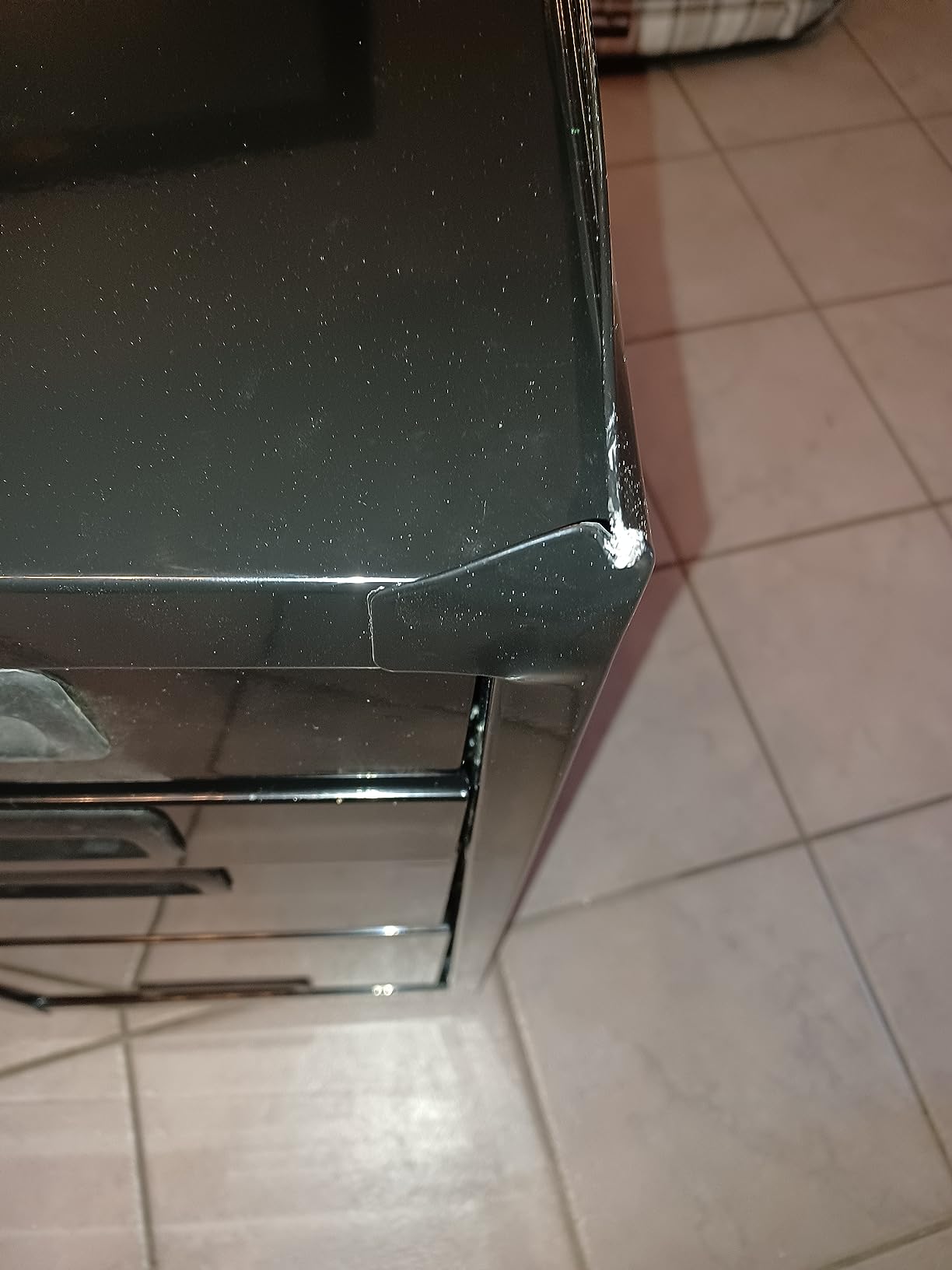
The steel is the reason for the mass. At 86.1 pounds, this is the heaviest cart in the roundup by a wide margin, and that weight is real and intentional. It is a stationary-feeling piece of equipment when empty, and the swivel casters do roll it smoothly, but nobody is throwing this across a shop floor one-handed. Owners accept the mass because it stops moving on its own when loaded.
Two other things to plan for. The 33.5 by 18.5 inch footprint is the largest in this roundup alongside the Klutch, which means it wants a dedicated corner rather than a gap beside a bench. And the manufacturer warranty on this item is listed at 30 days, which is the shortest coverage we found on any cart here.
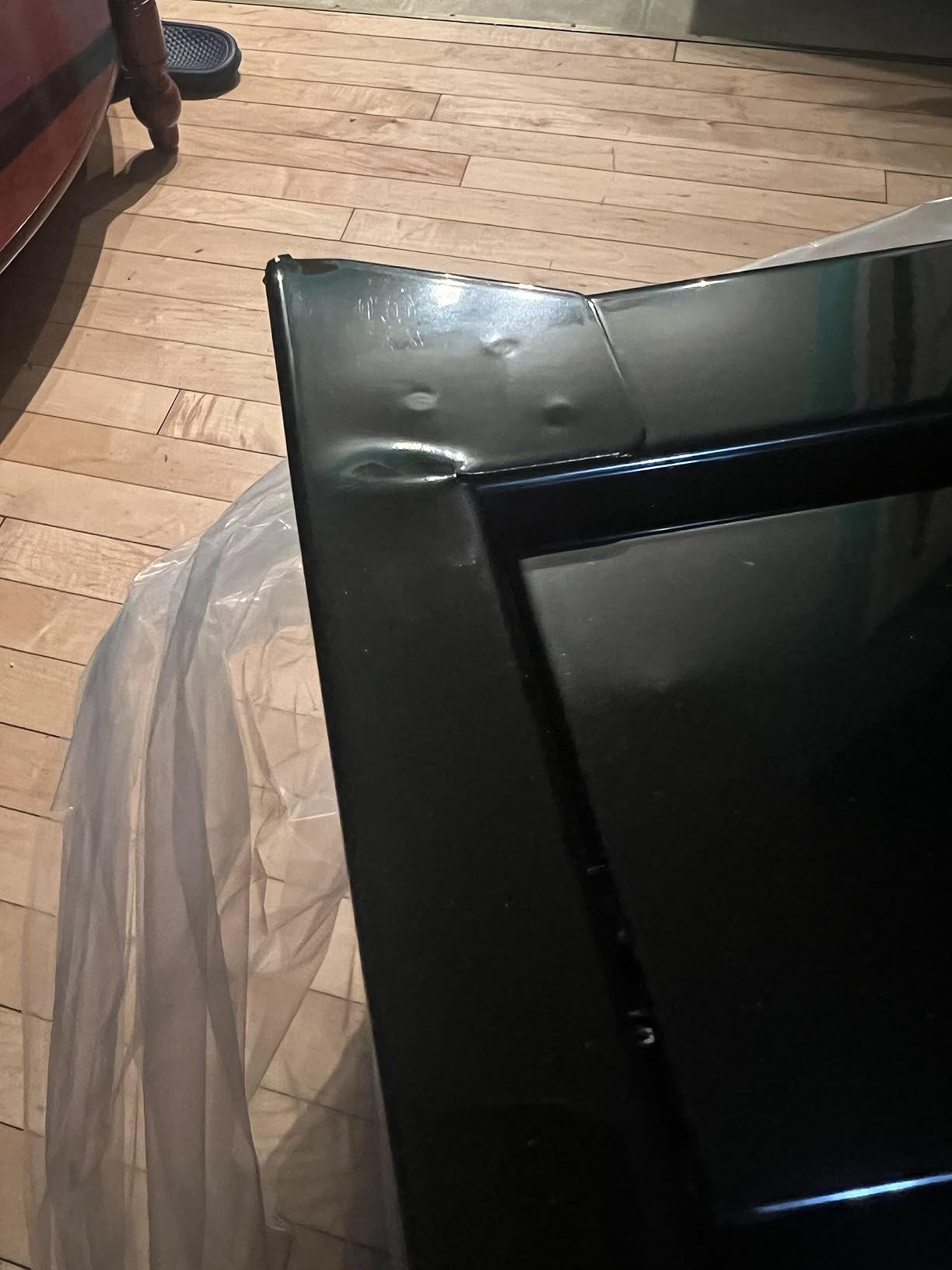
Why the storage layout is worth the bulk
Deep drawers solve a problem that open shelves cannot: organizing things by frequency of use. Consumables you touch weekly go in a drawer where you can see them at a glance, and bulky rarely-used stock like rod goes in the lower bin. Owners running a mixed garage and shop workload describe the drawer set as the feature that keeps the rest of the cart usable rather than cluttered.
For a fabricator doing motorcycle or vehicle repair work, having a jacket, helmet, and gloves in a drawer rather than a duffel bag matters on a cold morning.
When it is the wrong choice
When floor space is the binding constraint, which is the whole premise of this roundup. An 18.5 inch width plus 33 inches of depth in a one-car bay is a real commitment, and 86 lb means you plan where it stops rather than rolling it around freely. The 30-day warranty is also worth weighing against carts with longer coverage on comparable steel. If your garage is tight, the VEVOR or YESWELDER give you most of the storage benefit at a third of the mass.
7. Balance World Two-Shelf Welding Hand Cart: Best for Rough Ground and Big Bottles
Red Steel Welding Cart Hauls Welding Tanks Torch Equipment Over Rough Terrain
20 x 29.5 x 49 in
187.5 lb capacity
10 in flat-free tires
2 shelf levels
Pros
- 10 in solid rubber flat-free tires roll over rough job-site ground
- Steel hub tires and heavy frame built for hauling tanks and torch equipment
- Tall 49 in frame suits full-size gas cylinders
- Red finish is easy to spot in a busy shop
Cons
- Only two wheels so it must be tilted and steered rather than rolled
- 187.5 lb capacity is modest next to its 187.5 lb unit weight
- Bulky 20 x 29.5 x 49 in size consumes floor space
- Less organized storage than the enclosed carts
This one is different enough to earn its place. It is a two-wheel hand cart built to haul welding tanks and torch equipment over rough terrain, not a shelf cart designed for a garage floor. The 10 inch solid rubber flat-free tires with steel hubs are the entire point: they roll over gravel, dirt, and job-site ground without going flat, which is exactly the failure mode of the small casters on the carts above it.
The 49 inch height is the feature that surprises people. Tall shielding gas cylinders, the 33.5 lb size common in a shop, will not fit under a normal shelf height, and this frame accommodates them. Two shelf levels give you a place for torch equipment and consumables above the tank platform.
There is a real problem with the capacity figure, and it is the first thing to check. The listed weight capacity is 187.5 pounds and the listed unit weight is also 187.5 pounds, which leaves a margin of effectively nothing for a welder, a bottle, and consumables. Treat the capacity number with suspicion and confirm it with the manufacturer before loading it. Buyers generally report it works for torch gear and cylinders, which is what it was built for, rather than for a full welding cell.
Being a two-wheel design, it cannot be rolled flat. You tilt it, steer it, and set it down. That is fine for moving gear across a driveway and frustrating for a cart you want to position precisely in a garage corner, and it is the main reason this one does not fit the small-garage brief as well as the four-wheel carts do.
Who should consider it
If your welding happens partly off a driveway, on a farm, at a property, or anywhere with gravel and grade changes, the flat-free tires are worth more than any shelf configuration. It is also the right answer for moving full-size tall cylinders that will not clear a conventional cart, and the red finish is genuinely useful when you are looking for it in a cluttered shop.
Think of it as the transport half of a welding setup rather than the storage half.
Why most hobbyists should pass
Two wheels and a tilt-to-move design is a step back for a garage, where smooth concrete is the norm. The 29.5 inch width and 20 inch depth make it larger on the floor than carts rated for more weight, and the 187.5 pound rating against a 187.5 pound unit weight is a genuine red flag for anyone planning to put a welder on it. Storage is thin too, with only two shelf levels and no drawers, so consumables end up loose. For an indoor garage with a concrete floor, one of the four-wheel carts is the better purchase.
8. RCIACRHT Heavy Duty Rolling Welder Cart: Most Versatile for Occasional Use
RCARTICH Welding Cart,Heavy Duty Rolling Welder Cart with 360 Swivel Wheels,Large Size Welder Cart for MIG MMA TIG Welding Machine and Plasma Cutter Tank
31 x 14.4 x 37.4 in
400 lbs static / 350 lbs dynamic
Large bottom storage box
Pros
- Large bottom storage box fits caps torches gloves and rods
- Curved rear brackets hold the gas cylinder in place
- Handle and top tray front can be configured differently
- Thick enough metal for normal loads once assembled
Cons
- Instructions are poor and expect to reassemble parts
- Top tray and door can arrive bent
- Soft bolts and nuts strip during normal tightening
- Fixed rear wheels reduce maneuverability
This cart has the lowest average rating in the group at 4.0 stars, and the reviews explain why without ambiguity. The functional design is fine: a large bottom storage box, a middle partition, a top frame of 14 by 19 inches, and 400 pounds of static capacity that is more than adequate. The problems are build quality and documentation, not design.
Instructions are the headline complaint. Owners expect to take parts apart and reassemble them more than once, and several report straightening the top tray and the door with a hammer before assembly because they arrived bent. Soft bolts and nuts strip during normal hand tightening, which adds time to an already slow build. None of this is dangerous, but it is frustrating in a way that a welder with a half-finished project will notice.
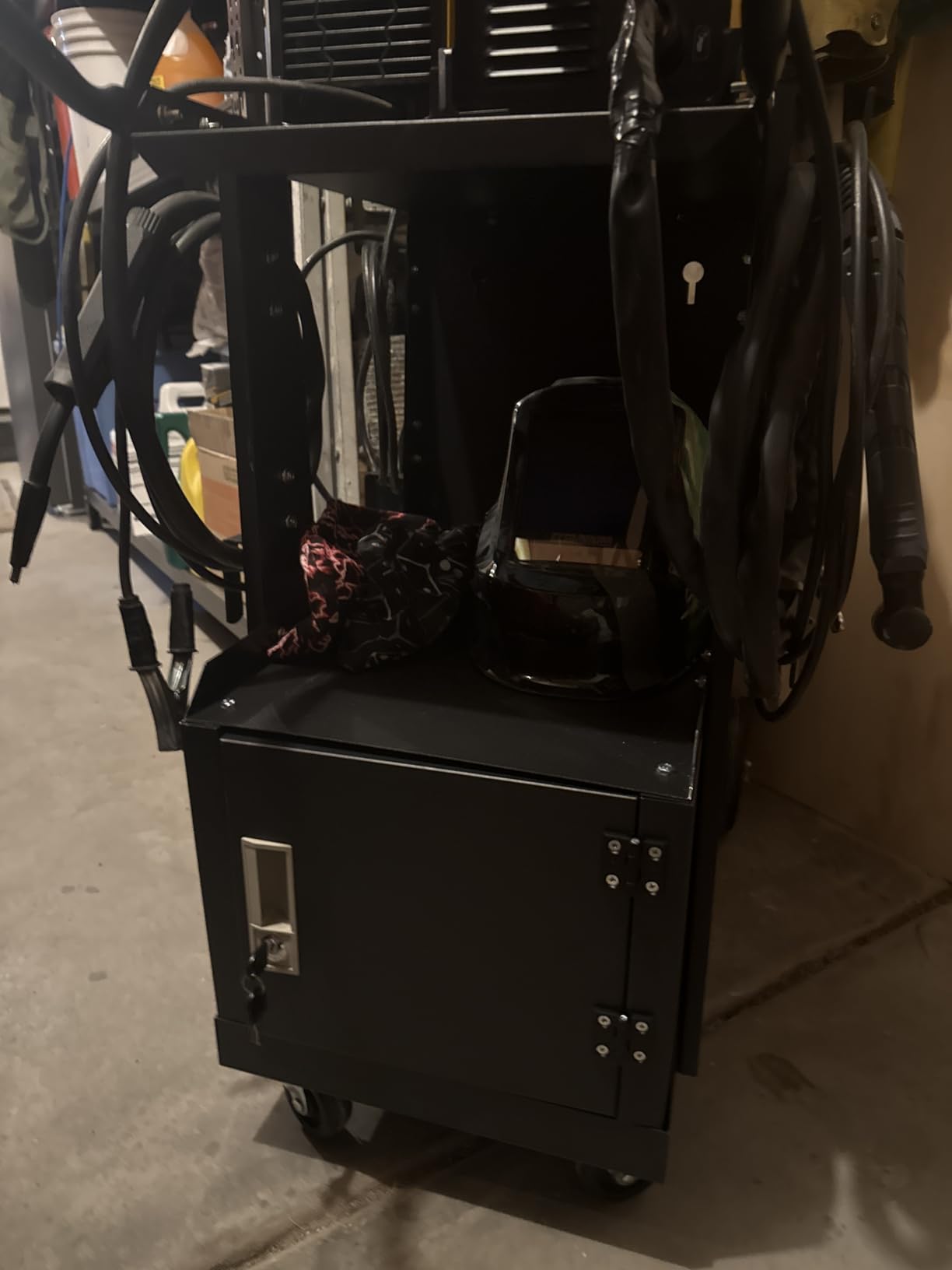
The good news is that once assembled, owners report it rolls nicely and the metal is thick enough for normal loads. Curved rear brackets hold the gas cylinder in place, and two stainless steel safety chains cross the bottle position. Four side metal brackets accept torches and pliers, and the matte coating is described as anti-scratch and anti-rust, which suits a garage floor.
Dimensions are 31 by 14.4 by 37.4 inches overall, so it is tall. At 37.4 inches it is the second-tallest cart here, and the fixed 6 inch rear wheels cannot swivel, which reduces maneuverability compared with four swivel casters. Owners who straightened the metal report it works well for light-duty and hobby welding, but recommend it only for occasional use.
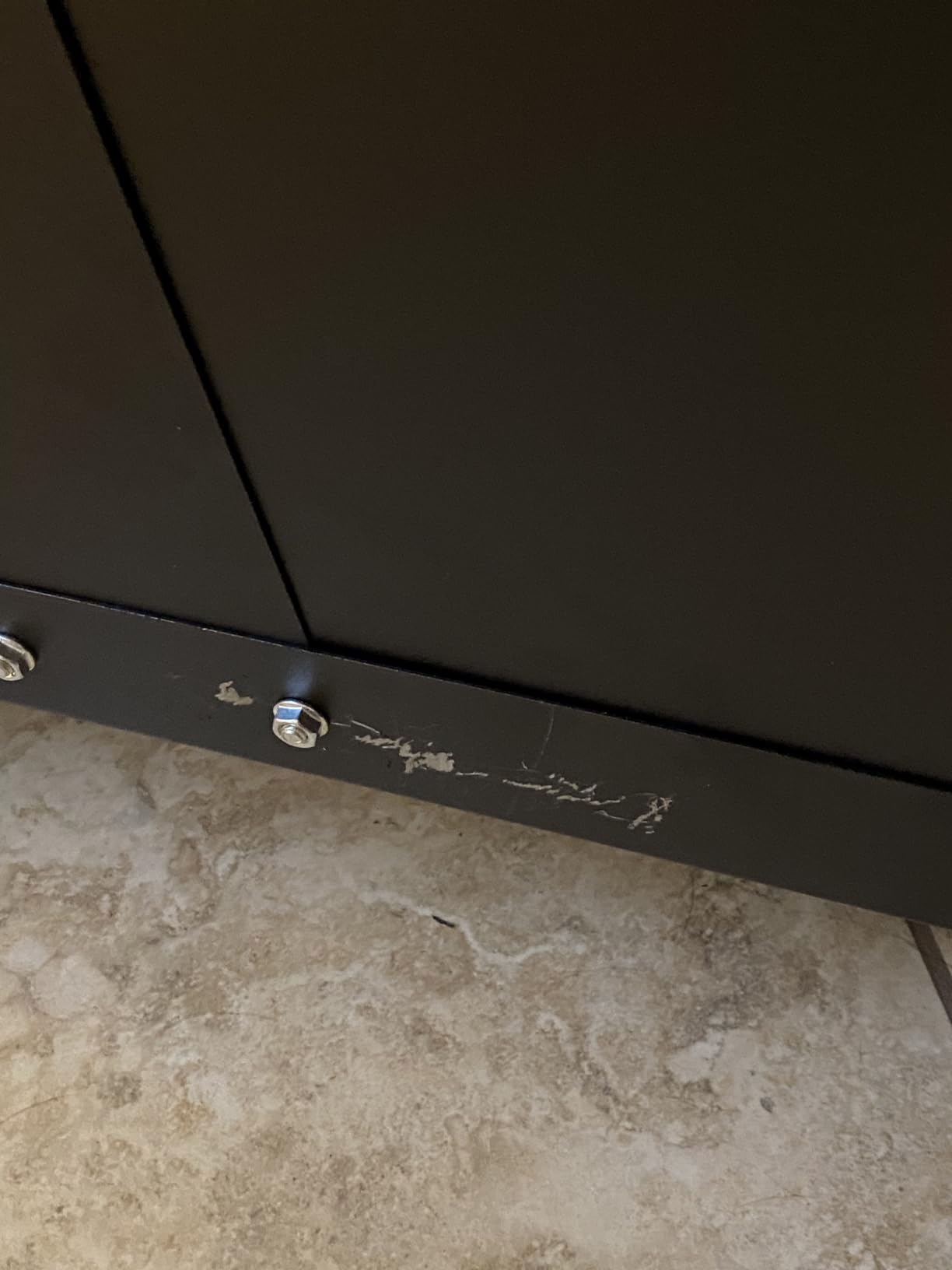
Where it still makes sense
If you weld once a month and your machine is a compact inverter, the storage volume is genuinely good for the money. The bottom box is deeper than the shelves on many cheaper carts, and a matte anti-scratch finish is the right call for a cart that lives on a concrete floor. The configurable handle and tray front are a small touch that lets you change the layout as your needs settle.
It also suits anyone who enjoys the build. Someone who would rather assemble and adjust the frame than fight a flat pack on a tight schedule can treat the poor instructions as a project.
Why we would not build a daily setup around it
Quality control complaints are the reason this sits last. Bent trays and doors that need straightening before the cart can be used are the kind of issue that never fully resolves, because a straightened panel is a stress riser. The 4.0 average and 120 ratings reflect real function offset by real frustration. If you want the same footprint and capacity from a better-reviewed frame, the VEVOR or Weldpro cost more in time up front and less in fuming.
How to Measure Your Garage Before You Buy
Measure in this order and you will never be disappointed by a cart that will not fit. It takes about ten minutes.
Measure the bay width at the narrowest point. Include door tracks, outlets, and the space the car door needs. Subtract 2 inches of clearance on each side so you can still walk past.
Measure usable depth from the wall to the first obstruction. A parked vehicle, a trash can, or the shop vac eats more depth than people expect. This is the number that rules carts in or out.
Check loaded height against the garage door. Open the door fully and measure the gap between the lowest panel and the floor, then compare it to the cart height plus the welder on top.
Plot the longest cart on the floor with painter’s tape. Mark the rectangle and walk around it for a day before you order. This catches the carts that fit the numbers but still feel like a road block.
A worked example: in a one-car bay of 240 square feet with a 9 foot wide opening and a vehicle parked, the practical cart zone is often 11 to 13 inches wide and 30 to 34 inches deep. That range points you at the VEVOR at 11.4 inches, the YESWELDER at 11.02 inches, and the Eastwood at 11 inch shelves. The JEGS at 18.5 inches wide and the Klutch at 19 inches wide are outside it.
It also matters what else lives in that zone. If the cart shares the corner with a garden hose reel or a mobile tool box, the usable footprint shrinks again. Our hose reel cart roundup covers a few of the narrower floor-friendly carts that compete for the same square footage.
Load Capacity vs Total Loaded Weight
Rated capacity is the maximum the frame is engineered to hold. Total loaded weight is what your setup actually weighs. Confusing the two is how carts end up overloaded in real use.
Add it up like this: the welder itself, the full shielding gas bottle, the consumables on the shelves, and any second machine or plasma cutter. A compact inverter welder in the 40 to 60 pound range plus a full 50 pound CO2 bottle plus a loaded bin puts you at roughly 120 to 150 pounds before you add anything else. That is why a 245 lb rating is comfortable and a 100 lb rating is tight.
Two specific cases from this roundup are worth calling out. The Klutch at 100 lb is fine for a compact welder and a smaller bottle but leaves little margin for a second machine. The Balance World hand cart lists a capacity of 187.5 pounds against a listed unit weight of 187.5 pounds, which leaves no practical margin at all, and that is a number to confirm with the manufacturer rather than plan around.
The practical rule is to keep your loaded weight at or below about 70 percent of the rated figure. Casters and frames fatigue, and a cart loaded to its limit is a cart that feels unstable when you roll it across a threshold.
Drawers vs Open Shelves vs a Lockable Cabinet
Storage style is the biggest personal preference in this category, and it drives both the price gap and the footprint difference.
Open shelves are what the VEVOR, Eastwood, Weldpro, and Balance World carts use. They are cheap, they hold the most volume per inch, and they are completely open, so a rubber mat under the bottle platform is worthwhile to stop paint scratching and the bottle sliding on the deck. Nothing is secure when the garage is unattended.
Drawers are what the YESWELDER and JEGS carts use. Owners of drawer-equipped carts describe the decluttering effect as the best part of the whole setup, because consumables stop migrating across shelves and the floor stays clear. The cost is footprint and mass: drawers add inches of depth and tens of pounds of weight, and lighter drawers can pop open over bumps unless you add a catch. Our bar cart roundup covers the same drawer-versus-shelf trade-off for bar and shop storage.
A locking cabinet is the Klutch approach. It is the only one that secures contents, which matters in a shared garage or one attached to a home, and it usually means giving up some open shelf volume for the door and frame.
For a small garage, our read is that open shelves on a narrow frame beat a cabinet, because every inch of width you give up for a door is an inch you cannot walk past.
Cylinder Storage, Tipping Risk and Garage Safety
Gas cylinder handling is where welding carts earn their keep and where the most expensive mistake is made.
Bottle diameter decides which slot works. A single 7 inch slot, as on the Klutch, will not secure a 9 inch bottle, and it will not stop it from walking when you cross a threshold. The VEVOR, Weldpro, and RCIACRHT use two chained slots sized for larger bottles, and the YESWELDER accepts bottles up to 10 inches in diameter with a 29.5 inch chain on each. Check your bottle diameter against the slot before you commit, not after.
Top-heaviness is the second issue and it is genuinely more pronounced on a small footprint. A full cylinder, a welder on the top deck, and consumables above the midpoint put a lot of mass high on a narrow base. Long-term owners describe a loaded cart as slightly top heavy and recommend filling the bottom shelf first to bring the center of gravity down. Rolling a heavily loaded cart across a threshold with a sudden stop is where this shows up.
A rubber mat under the bottle platform is the most commonly recommended upgrade we found, and it solves two problems at once: it stops the bottle sliding and it stops the deck from being scratched. Custom tank straps or belts are the other upgrade owners praise by name.
On storage, keep the cylinder upright, chained, and away from heat sources. A garage is fine for a bottle as long as it is standing and secured, and it should not be stored with the valve open or under a direct heat source.
Welding Cart vs Welding Table: Do You Even Need One?
Here is the honest contrarian case, because experienced forum members make it often. A fixed welding cell with a proper table and a separate tool chest beats a cart for most hobbyists. The table does not wobble, the top is bigger for real fit-up work, and you are not paying to move mass around the floor. Several experienced members argue that a welding cart is better as your first welding project than as your first welding purchase.
That is fair, and it is the reason cart tops are so often disappointing. A cart top is a place to set a machine down, not a surface to clamp and fit up on. Anyone whose welding is mostly heavy structural work with big assemblies wants a table.
The buying rule is simple. If you own one compact welder and one or two bottles, and the floor space matters more than fit-up capacity, a cart wins. If you do serious fit-up, weld often, or share the space with a vehicle you need to park, a fixed table wins. Most one-car garage hobbyists fall into the first group, which is why the best welding carts for small garages focus so heavily on width and height rather than work surface.
Frequently Asked Questions
What makes a good welding cart?
A good welding cart fits your welder and gas bottle, keeps the floor clear, and rolls on casters that handle your floor. In a small garage, width under 14 inches, a depth that matches the bay, a cylinder slot sized for your bottle, and a loaded height that clears the garage door matter more than the headline weight rating. Most carts in this roundup are rated between 245 and 400 pounds, well above a typical hobby load.
What is the best welding cart for the money?
The VEVOR 3-Tier is the strongest overall value in this roundup, combining an 11.4 inch width, three tiers, two chained cylinder slots, and a 400 lb static rating across more than 1600 owner ratings. The YESWELDER 2-Tier is the pick if you want organized storage, since its four drawers and dual cylinder slots declutter a garage better than open shelves at a similar capability level.
How wide should a welding cart be for a small garage?
Aim for 12 inches or less so you can still walk past it with a car door open. Four of the eight carts we reviewed are under 14 inches wide, and the two narrowest, the YESWELDER at 11.02 inches and the VEVOR at 11.4 inches, are the practical choices for a single-bay garage. Measure the narrowest point of your bay first, including door tracks and outlets.
Should I get a welding cart with drawers or open shelves?
Drawers declutter better because consumables stay sorted and visible, and owners of drawer-equipped carts rate that effect highly. Open shelves give you more volume per inch and keep the frame narrow and light. In a tight garage, open shelves on a narrow frame are usually the better trade, since a locking cabinet or drawer bank costs width and depth you may not have.
Is it safe to store gas cylinders in a garage?
A shielding gas bottle can be stored in a garage when it is upright, secured, and away from heat sources. On a cart, that means matching the cylinder slot to your bottle diameter so the chain actually holds it, and filling the bottom shelf first so the loaded cart is not top heavy. A rubber mat under the bottle platform stops the bottle sliding and protects the deck.
The Best Welding Carts for Small Garages in 2026
The VEVOR 3-Tier is our pick for 2026 because at 11.4 inches wide it does something no other cart in this roundup does well: it stays narrow, holds three tiers, and carries two chained bottle slots for a 400 lb static load. If your top deck must fit a full-size machine, the Weldpro 3-Tier builds heavier and assembles in minutes, at the cost of a much longer footprint. If organization matters more than width, the YESWELDER 2-Tier wins with four drawers and the narrowest frame here at 11.02 inches.
Measure your bay before you order, keep your loaded weight under 70 percent of the rating, and match the cylinder slot to your bottle. That short checklist will keep you out of a purchase you have to move around the garage for the next ten years.