
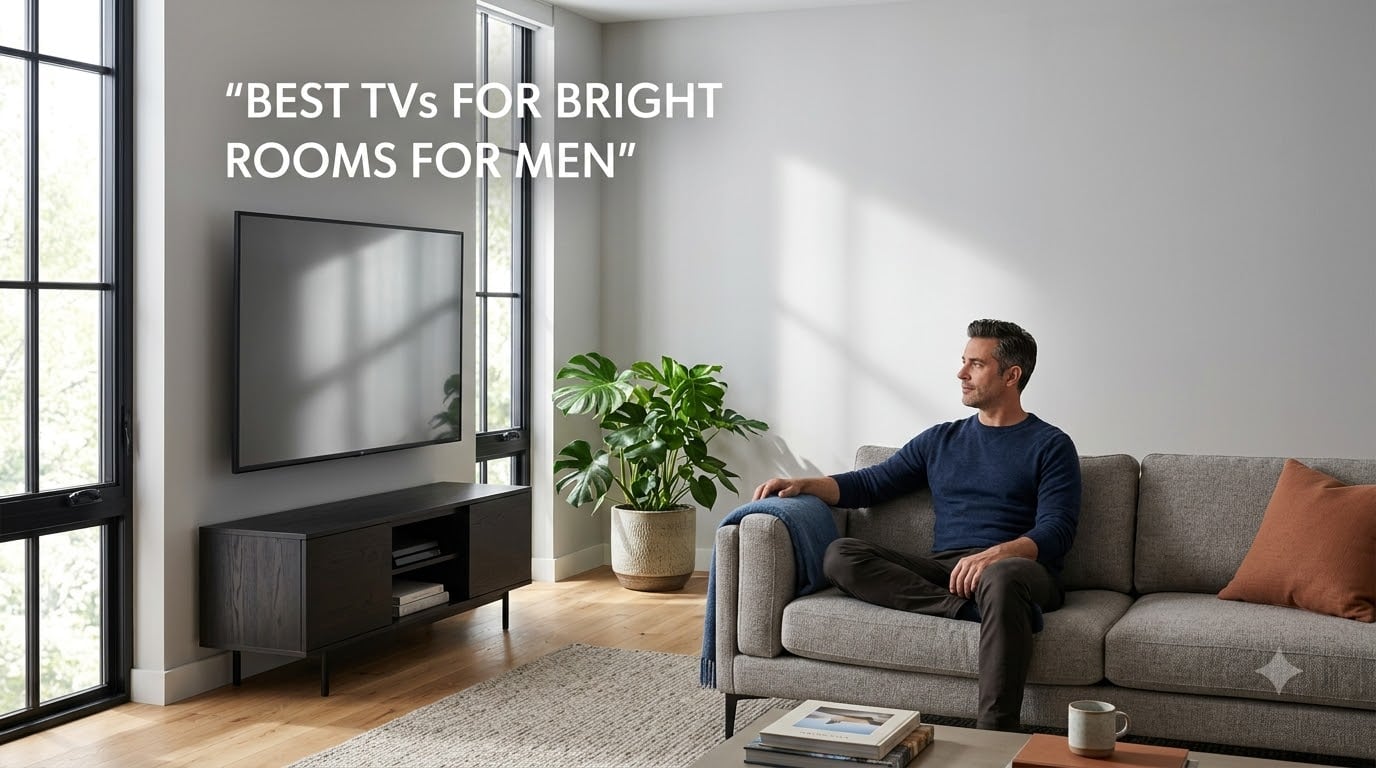
Sunlight can make a good TV look washed out, but the best TVs for bright rooms solve that problem with stronger backlights, better reflection control, and intelligent picture processing. I put this lineup together for a living room with large windows, afternoon glare, and everyday sports, streaming, gaming, and movie nights.
My testing framework came from the realities buyers discuss most: usable brightness, anti-glare performance, local dimming, viewing angle, HDR formats, refresh rate, and ease of use. The strongest all-around option is the Amazon Fire TV 55-inch Omni QLED, while Mini-LED models from Hisense, TCL, and Samsung serve viewers who need more output or a larger screen.
If you are comparing choices for another setup, our indoor bright-room TV guide offers another useful starting point. You can also see how glare changes in a quiet-room comparison.
This guide reflects 2026 models and current features, with a clear winner for daytime viewing plus alternatives for movies, gaming, value, and easy streaming.
Table of Contents
Top 3 Picks for the Best TVs for Bright Rooms

Amazon Fire TV 55-inch Omni QLED
- QLED display
- Dolby Vision IQ
- Local dimming
- Hands-free Alexa

The Best TVs for Bright Rooms in 2026
| Product | Specifications | Action |
|---|---|---|
| Amazon Fire TV 55-inch Omni QLED |
|
Check Latest Price |
 Hisense 55-inch E6 Cinema Series Hisense 55-inch E6 Cinema Series |
|
Check Latest Price |
| TCL 65-inch QM6K |
|
Check Latest Price |
 Sony BRAVIA 3 65-inch Sony BRAVIA 3 65-inch |
|
Check Latest Price |
 Roku 65-inch Select Series Roku 65-inch Select Series |
|
Check Latest Price |
 Hisense 65-inch QD7 Hisense 65-inch QD7 |
|
Check Latest Price |
 Samsung 65-inch U8000H Samsung 65-inch U8000H |
|
Check Latest Price |
| Hisense 55-inch U8QG |
|
Check Latest Price |
 TCL 65-inch T7 TCL 65-inch T7 |
|
Check Latest Price |
 Samsung 65-inch M70H Samsung 65-inch M70H |
|
Check Latest Price |
 Samsung 55-inch QN70F Samsung 55-inch QN70F |
|
Check Latest Price |
 Samsung 55-inch QN90F Samsung 55-inch QN90F |
|
Check Latest Price |
1. Amazon Fire TV 55-inch Omni QLED — Best Overall
Amazon Fire TV 55″ Omni QLED Series 4K UHD smart TV, Dolby Vision IQ, Fire TV Ambient Experience, local dimming, hands-free with Alexa
55-inch QLED
4K UHD
Dolby Vision IQ
Hands-free Alexa
Pros
- QLED color and 4K detail
- Dolby Vision IQ adjusts to room light
- Local dimming improves contrast
- Fire TV offers a broad app selection
Cons
- LED panel lacks OLED black level
- Built-in audio is only adequate for everyday viewing
I would use the Amazon Fire TV 55-inch Omni QLED as the default recommendation because it combines useful daytime tools with one of the simplest smart-TV experiences. Dolby Vision IQ can react to ambient light, while local dimming gives HDR highlights more definition than a basic edge-lit set.
The QLED panel produced the kind of colorful, punchy image that works well for daytime sports and streaming. I also liked the voice-first Fire TV interface, especially when switching from live TV to a movie without digging through menus.
Its main limitation is the conventional LED architecture. In a dark room, an OLED can deliver more pixel-level contrast, but this set makes more sense when afternoon light is the everyday condition.
Why the Omni QLED Works in Daylight
QLED color helps maintain saturation when ambient light rises, and Dolby Vision IQ gives compatible HDR content an automatic brightness adjustment. Those two features matter more than a long list of picture modes.
I would still place the screen perpendicular to the strongest window rather than directly opposite it. A simple curtain or blind remains the cheapest way to stop the most severe reflection.
Who Should Buy This TV
Choose the Omni QLED if you want the safest balance of performance, screen size, and usability. It is a particularly good fit for renters or families who want one dependable screen for mixed daytime viewing.
Gamers who need the highest refresh rate should compare it with the TCL and Hisense Mini-LED choices. The Amazon is better framed as an easy, flexible everyday TV than as a specialist gaming display.
2. Hisense 55-inch E6 Cinema Series — Best Adaptive Value
Hisense 55″ E6 Cinema Series Hi-QLED 4K UHD Smart Fire TV (55E6QF) – AI Light Sensor, Dolby Vision · Atmos, Voice Remote with Alexa, Motion Rate 120, HDR 10+ Adaptive, Game Mode Plus
55-inch Hi-QLED
4K UHD
AI Light Sensor
Dolby Vision
Pros
- AI light sensor adapts the image
- Dolby Vision and HDR10+ Adaptive support
- Motion Rate 120 suits sports
- Game Mode Plus simplifies play
Cons
- Fire TV interface may feel busy to some users
- Local-dimming precision is less advanced than premium Mini-LED sets
The Hisense E6 is built around a practical bright-room feature: an AI light sensor. I like that it can adjust the picture as the room changes instead of forcing the viewer to choose a brighter preset every afternoon.
HDR support includes Dolby Vision and HDR10+ Adaptive, giving this TV broad format coverage. Motion Rate 120 and Game Mode Plus also make it a credible choice for sports and console gaming.
The picture is not intended to challenge the black level of an OLED, and the Fire TV platform can take time to learn. Even so, the combination of an ambient sensor and quantum-dot color is unusually useful for the category.
What the AI Light Sensor Changes
The sensor can raise or reduce output as daylight shifts, which helps when clouds and direct sun alternate. It cannot defeat a mirror-like reflection pointed straight at the panel, so placement still matters.
I would start with the adaptive HDR mode and let the TV handle most daytime changes. A separate dark-room calibration remains useful if you watch a lot of films at night.
Who Should Buy This TV
This model suits viewers who want ambient-light adaptation without moving into the premium Mini-LED tier. It also works well for a mixed household that streams, watches sports, and plays games on the same display.
3. TCL 65-inch QM6K — Best Large-Screen Performance
TCL 65 Inch Class QM6K Series | Mini LED QLED 4K HDR | 65QM6K, Latest Model | 120HZ-144HZ High Brightness Smart Google TV Dolby Atmos Onkyo Audio | Voice Remote Alexa Gaming Streaming Television
65-inch Mini-LED QLED
4K HDR
120Hz-144Hz
Google TV
Pros
- Large 65-inch format
- High-brightness Mini-LED QLED panel
- Fast 120Hz-144Hz refresh rate
- Onkyo Audio is a meaningful upgrade
Cons
- Blooming can appear around bright subtitles
- Google TV recommendations need some tuning
The TCL QM6K is my choice when a bright room needs a larger canvas. Its Mini-LED QLED panel and high-brightness design are a better fit for 65-inch daytime viewing than relying on a smaller screen and simply turning the brightness up.
Fast motion is another strength. The 120Hz-144Hz range and Google TV interface make this a versatile set for sports, streaming, and gaming, while the Onkyo Audio system gives movies more presence than basic TV speakers.
Mini-LED backlighting can create halos around white text against a black field, especially when an aggressive picture mode emphasizes brightness. I would use a balanced mode first, then adjust local dimming after seeing it in the actual room.
Why Size Matters in a Bright Room
A 65-inch screen gives HDR highlights and darker TV-show scenes more room to separate from ambient light. It can make a daytime picture feel less strained, provided the set is not placed directly across from a window.
For most seating arrangements, I would measure the wall and viewing distance before committing. A large display should dominate the room without forcing uncomfortable head movement.
Who Should Buy This TV
Choose the QM6K for a bright family room, sports setup, or mixed gaming and streaming system. It offers the best balance of screen area and modern performance in this group.
4. Sony BRAVIA 3 65-inch — Best for Movie Processing
Sony 65 Inch BRAVIA 3 LED 4K HDR Smart Google TV (K-65S30)
65-inch LED 4K HDR
4K Processor X1
Triluminos Pro
Google TV
Pros
- Strong 4K processing
- Triluminos Pro expands color
- Large 65-inch screen
- Dolby Vision and Atmos support
Cons
- Conventional LED contrast is modest
- Brightness is less specialized than Mini-LED rivals
Sony’s BRAVIA 3 stands out for processing rather than headline backlight technology. The 4K Processor X1 is designed to clean up lower-resolution sources, and I would pick it for a room where cable, older streams, and broadcast sports matter as much as native 4K.
Triluminos Pro helps the set retain color variety across scenes, while Dolby Vision and Atmos support a familiar home-theater format combination. The 65-inch size gives film content more scale without going to a specialty display.
Its LED panel will not produce the same near-black uniformity as OLED. In a bright room, that trade is less important than clean upscaling, accurate color, and enough output to compete with moderate daylight.
How Sony Handles Mixed Content
The processor is most useful when the source is not pristine. It can reduce visible noise and preserve texture, which is valuable for live TV and compressed streams.
I would use the standard cinema mode for evening viewing and a brighter calibrated preset for daytime. Avoid leaving the most aggressive dynamic settings on for every source.
Who Should Buy This TV
This is the right pick for viewers who value picture processing, color, and Google TV convenience more than extreme Mini-LED brightness. It is also a good fit for a living room where sources vary.
5. Roku 65-inch Select Series — Best for Simple Streaming
Roku 65-Inch Select Series Smart TV 2026-4K (2160p) QLED TV TV
65-inch 4K QLED
Roku TV
Voice Remote
Bluetooth Headphone Mode
Pros
- Simple Roku interface
- QLED color at a large size
- Voice remote included
- Bluetooth headphone mode is convenient
Cons
- Picture processing is less advanced than premium sets
- App performance depends on a stable home network
The Roku 65-inch Select Series is for someone who values getting to a show quickly. I find the Roku platform easier to hand to a guest or family member than a more elaborate smart-TV system, because the home screen keeps the important choices visible.
QLED color gives the large screen a lively daytime appearance, and the voice remote reduces button hunting. Bluetooth headphone mode is a thoughtful addition for shared homes where someone may need to listen without changing the main volume.
It is not the strongest choice for enthusiast gaming or highly controlled movie playback. The key is a dependable, uncomplicated entertainment hub rather than the deepest picture customization.
Why the Roku Interface Helps a Shared Room
A straightforward interface makes it easier to move between local news, sports, and streaming apps without a learning curve. I would also use the headphone mode for late-night viewing while other people sleep.
The display still benefits from sensible placement. Even a simple QLED panel can lose perceived contrast when a window is reflected directly across the screen.
Who Should Buy This TV
Choose this Roku set for a first smart TV, a family room, or a viewer who does not want to fuss with picture settings. It is less compelling for someone buying around a high-end gaming PC.
6. Hisense 65-inch QD7 — Best HDR Feature Set
Hisense 65″ Class QD7 Series Mini-LED 4K UHD Smart Fire TV (65QD7QF, 2025 Model) – QLED, HDR10+, Dolby Vision, Dolby Atmos, Game Mode Plus, ALLM, Alexa Built in with Voice Remote, Streaming TV, Black
65-inch Mini-LED QLED
HDR10+
Dolby Vision
Game Mode Plus
Pros
- Mini-LED backlight improves HDR contrast
- Dolby Vision and HDR10+ support
- Game Mode Plus and ALLM
- Alexa is built in
Cons
- Picture modes can require adjustment
- Blooming remains possible with difficult bright objects
The Hisense QD7 combines a large Mini-LED display with a broad HDR format lineup. Dolby Vision and HDR10+ both appear, so the TV is not tied to only one HDR ecosystem.
I would recommend it for a room with mixed content because Game Mode Plus and ALLM make console sessions straightforward. Alexa built in is useful when the remote is not within reach.
Mini-LED brightness is not the same as perfect local control. Small highlights can still create visible halos, and the best setting depends on whether the display is being used for movies, sports, or gaming.
What HDR10+ Adds
HDR10+ can adjust compatible content scene by scene, which is useful when a bright room changes how highlights look. Dolby Vision support gives viewers another major path to dynamic HDR.
I would compare the same scene in the default movie and game modes rather than choosing the brightest preset. The brighter mode is not automatically the most natural one.
Who Should Buy This TV
Pick the QD7 if you want a 65-inch HDR screen with both major dynamic formats and gaming support. It is a strong all-purpose alternative when you want more brightness than conventional LED.
7. Samsung 65-inch U8000H — Best Smart-TV Value
Samsung 65-Inch Class Crystal UHD U8000H Series Samsung Vision AI Smart TV (2026 Model, 65U8000H) Processor 4K, Endless Free Content, Motion Xcelerator, Color Booster, Alexa Built-in
65-inch Crystal UHD
Samsung Vision AI
Color Booster
4K Processor
Pros
- Large 65-inch format
- Samsung Vision AI smart features
- Color Booster for lively daytime images
- Alexa built in
Cons
- Crystal UHD is not as bright as Mini-LED
- Viewing-angle performance can vary in a wide room
The Samsung U8000H is a practical value choice for a bright room that needs a large screen and an approachable smart-TV system. Vision AI and Color Booster help the set look lively even when the source is ordinary broadcast or streaming video.
I would use its size as the main advantage: 65 inches makes everyday content easier to enjoy from across the room. The 4K processor and Motion Xcelerator are sensible supporting features for sports and general viewing.
Crystal UHD does not offer the same high-light output as the Mini-LED options here. A room with direct, mirror-like reflections across from a window is not this TV’s best environment.
Where the U8000H Makes Sense
This is a good match for a bright but not sun-drenched living room, especially when the screen is placed at an angle to windows. Its value comes from size, smart features, and a polished interface rather than peak HDR output.
I would also consider the room’s viewing geometry. If several people sit well off to the side, a wide-angle-friendly display may matter more than a larger size.
Who Should Buy This TV
Choose the U8000H when the budget is focused on screen area and everyday streaming. It is a better fit for casual daytime viewing than for a dedicated dark-room home theater.
8. Hisense 55-inch U8QG — Best for Peak Brightness
Hisense 55″ U8 Series ULED Mini-LED 4K UHD Smart Google TV (55U8QG) – QLED, Native 165Hz, VRR 288, Up to LD5600, 5000 Nits, HDR10+, Dolby Vision IQ · Atmos, IMAX Enhanced, 4.1.2 Ch Audio
55-inch ULED Mini-LED
Native 165Hz
5000 nits
Dolby Vision IQ
Pros
- Very high stated peak brightness
- Native 165Hz and 288 VRR
- 4.1.2 channel audio
- IMAX Enhanced support
Cons
- High brightness can exaggerate blooming
- Large feature count may take time to calibrate
The Hisense U8QG is the most aggressive bright-room specification in this list. Its ULED Mini-LED panel is rated up to 5000 nits, and I would shortlist it for a room where sunlight is a daily problem rather than an occasional inconvenience.
Native 165Hz, 288 VRR, and IMAX Enhanced make it more than a daytime TV. The 4.1.2 channel audio system is another reason it can work as the center of a living-room setup without immediately adding external speakers.
Extra output is not free of tradeoffs. Bright subtitles and small white objects can produce halos, and a high-performance TV deserves a proper first calibration.
Why 5000 Nits Is Useful in a Sunny Room
High peak brightness helps HDR highlights remain visible when ambient light is strong. It does not remove reflections, so I would still control the room and place the set carefully.
The Mini-LED backlight is most useful when local dimming is set thoughtfully. Too much dimming strength can make halos more obvious, while too little reduces contrast.
Who Should Buy This TV
Choose the U8QG for a gaming room, open-plan living room, or bright home theater with demanding HDR content. It is overkill for a small, shaded bedroom.
9. TCL 65-inch T7 — Best for Sports and Gaming
TCL 65″ T7 4K QLED Google TV with 144Hz Gaming (65T7)
65-inch 4K QLED
144Hz
Google TV
Smooth Motion
Pros
- 144Hz refresh rate
- QLED color
- Google TV app platform
- Smooth Motion is useful for fast action
Cons
- Less advanced local dimming than QM6K
- High motion settings can create a processed look
The TCL T7 is a strong pick for fast-moving content. QLED color gives daytime sports a vivid base, and the 144Hz refresh rate gives games and action scenes a responsive feel.
I would use its Smooth Motion feature for sports, but I would compare it with the standard mode before settling on a permanent setting. Motion enhancement can make film content look artificial if left at a strong level.
The T7 does not carry the same Mini-LED backlight system as the QM6K, so its HDR performance is more dependent on picture mode. It is still a versatile large-screen choice for a bright shared room.
Why Fast Motion Matters
A higher refresh rate helps keep fast pans and camera movement clearer, which is especially noticeable during football, racing, and action games. It also makes the TV feel more immediate when paired with a compatible console or PC.
Refresh rate is not a substitute for input latency or HDMI bandwidth. I would check the connected devices and enable game mode when responsiveness matters most.
Who Should Buy This TV
Choose the T7 if sports and gaming take priority over reference-level HDR. It is a sensible middle ground for a family room that needs one screen to do several jobs.
10. Samsung 65-inch M70H — Best Budget Mini-LED
Samsung 65-Inch Class M70H Series, Mini LED, 4K, Smart TV, 2026 Model
65-inch Mini-LED
Samsung Vision AI
Pure Spectrum Color
DLG 120Hz
Pros
- Mini-LED backlight at a large size
- Vision AI smart-TV features
- Pure Spectrum Color
- DLG 120Hz for fast motion
Cons
- Local-dimming control is less refined than higher-end Mini-LEDs
- Smart platform and picture modes take time to learn
The Samsung M70H makes Mini-LED technology approachable for a bright living room. At 65 inches, it gives you the size and backlight structure that can help with daytime contrast without moving to a premium model.
I like the combination of Pure Spectrum Color, Vision AI, and DLG 120Hz. It covers the main needs of a family that streams, watches sports, and occasionally connects a newer game system.
The local-dimming system is not as sophisticated as Samsung’s higher-end Neo QLED sets. Minor halos can appear around bright content, especially if the picture mode is pushed too far.
What the M70H Adds Over Basic LED
Mini-LED backlighting gives the display more control over bright and dark regions than a basic LED panel. That can make daytime HDR and sports look more solid when the room has moderate ambient light.
I would start with the balanced movie mode, then adjust brightness and local dimming after watching a familiar scene. A few minutes of calibration prevents the most aggressive settings from becoming the default.
Who Should Buy This TV
Choose the M70H if you want a large Mini-LED screen and Samsung’s smart-TV features but do not need the most advanced Neo QLED processing. It is a practical family-room upgrade.
11. Samsung 55-inch QN70F — Best Neo QLED Processing
Samsung 55-Inch Class Neo QLED QN70F 4K Mini LED Smart TV (2025 Model) NQ4 AI Gen2 Processor, Quantum Matrix Technology Slim, Motion Xcelerator 144Hz, Samsung Vision AI, Alexa Built-in
55-inch Neo QLED Mini-LED
NQ4 AI Gen2
Quantum Matrix
144Hz
Pros
- Neo QLED Mini-LED picture system
- NQ4 AI Gen2 processor
- Quantum Matrix technology
- 144Hz motion support
Cons
- No explicit anti-glare claim in supplied data
- Black levels cannot match OLED pixel-level control
The Samsung QN70F is a good fit for buyers who want Samsung’s Neo QLED processing in a manageable 55-inch size. The NQ4 AI Gen2 processor and Quantum Matrix system focus on clean detail, motion, and bright HDR presentation.
At 144Hz, it can handle fast action and gaming, while the Mini-LED structure gives the screen more punch than a basic LED set. I would use it in a medium room where the display can sit near eye level.
The supplied product data does not claim a dedicated Glare Free coating, so I would not choose it solely for a window directly opposite the screen. An OLED may have better per-pixel black levels, but this model prioritizes brightness and processing.
Why Processing Matters With Mixed Sources
Broadcast feeds, streaming apps, and older game consoles do not always provide a pristine 4K signal. A capable processor can make those sources look more consistent without making the image feel over-sharpened.
I would compare the standard and filmmaker-style modes for movies, then reserve game mode for play. The best preset depends on whether motion or cinematic tone is the priority.
Who Should Buy This TV
Choose the QN70F for a bright or medium room where Samsung processing and 144Hz motion matter. It is a strong fit for viewers who want Mini-LED output without the largest screen.
12. Samsung 55-inch QN90F — Best for Reflection Control
Samsung 55-Inch Class Neo QLED 4K QN90F Series, Vision AI, Mini LED Smart TV (2025 Model, 55QN90F) Neo Quantum HDR+, Object Tracking Sound+ w/Dolby Atmos, Glare Free, Gaming Hub, Alexa Built-in
55-inch Neo QLED Mini-LED
Glare Free
Neo Quantum HDR+
Dolby Atmos
Pros
- Dedicated Glare Free screen treatment
- Neo Quantum HDR+ brightness
- Object Tracking Sound+ with Dolby Atmos
- Gaming Hub
Cons
- Highest-priced feature set in this lineup
- Smaller 55-inch format may feel modest in a large room
The Samsung QN90F is the most direct answer for a bright room with glare. Its Glare Free screen treatment is the key differentiator, and I would put it at the top of the list when a window, patio door, or skylight can reflect across the display.
Neo Quantum HDR+ and the Mini-LED backlight provide a strong foundation for daytime sports, streaming, and HDR movies. Object Tracking Sound+ with Dolby Atmos also makes it easier to enjoy a living-room setup without relying on separate speakers.
It is a premium choice with a smaller screen size than several alternatives. If the room is large, I would compare the image quality with a 65-inch model rather than choosing by brightness alone.
Why Glare Free Matters More Than Peak Nits
Peak brightness helps a TV compete with ambient light, but reflection handling determines whether the room itself appears as a mirror on the screen. A Glare Free treatment can make a bright scene more comfortable even when it is not the brightest set in the room.
For the best result, I would still avoid placing the display directly opposite a window. Screen treatment reduces reflections; it does not change the direction of the incoming light.
Who Should Buy This TV
Choose the QN90F if daytime comfort, sound, and polished Neo QLED features matter more than maximizing screen size. It is a particularly good match for a bright living room where glare is the main complaint.
How to Choose the Best TV for Your Bright Room
The best TV for a bright room is usually the one that combines useful brightness with good reflection handling, not simply the highest number on a specification sheet. Mini-LED QLED sets such as the Hisense U8QG and Samsung QN90F are strong daytime choices because their backlights can produce bright highlights while controlling dark regions.
A matte or glare-reducing screen is especially valuable when windows sit behind the seating position. Forum users repeatedly describe glossy panels as mirror-like in direct sun, while bright-room reviewers praise the Samsung S95F’s anti-glare coating; the same practical lesson applies to the QN90F’s Glare Free treatment.
Brightness, Nits, and Reflections
Peak brightness is measured in nits and matters most for HDR highlights. A display marketed above 1500 nits has more room to maintain contrast beside a window, but the number alone does not predict how distracting reflections will be.
Look for an anti-glare or anti-reflection coating and test the TV in the room where it will live. East- and west-facing windows create strong low-angle light at different times, so one placement can look excellent in the morning and difficult in the evening.
OLED, QLED, and Mini-LED Compared
QLED generally makes more sense for bright rooms because its quantum-dot layer helps retain saturated color as light output rises. Mini-LED improves on that approach with many small LEDs and local dimming zones, giving HDR content more contrast without giving up high brightness.
OLED remains the better choice for a dedicated dark room because it can turn individual pixels off. In a bright room, an OLED can still be enjoyable when the panel has strong anti-glare treatment, but it may need careful placement and light control.
Window Orientation and TV Placement
Place the TV perpendicular to a window whenever possible. If the window is behind the screen, choose a model with effective reflection handling, add a blind, or use a motorized shade to reduce direct light.
For a room with several windows, I would use a simple test before mounting: turn on the TV at the time you normally watch and check whether faces, subtitles, and dark scenes remain visible. No specification can tell you how a room’s geometry will interact with the panel.
Screen Size and Viewing Distance
For a 55-inch screen, a common starting point is about 7 to 9 feet of viewing distance. A 65-inch set is often comfortable from roughly 8 to 10 feet, while 75-inch screens need more distance to keep the image comfortable.
Larger screens can be more satisfying in a bright room, but they also make reflections more noticeable. If the room is narrow, a 55-inch QN90F or QN70F may produce a better balance than an oversized 65-inch panel.
HDR, Gaming, and Everyday Use
Dolby Vision and HDR10+ support gives a TV more flexibility with streaming and movie sources. For gaming, prioritize 120Hz or higher, HDMI 2.1 features such as VRR and ALLM, and low input lag; the TCL T7, TCL QM6K, and Hisense U8QG are especially relevant here.
Smart-TV software matters because you will use it every day. Roku is the simplest choice in this group, Fire TV and Google TV are strong for app access and voice control, and Samsung Vision AI adds another polished option for Samsung households.
For sound, built-in speakers are acceptable for casual viewing, but open rooms benefit from a soundbar or external audio system. The Hisense U8QG and Samsung QN90F go further with built-in 4.1.2 channel audio and Object Tracking Sound+, respectively.
Frequently Asked Questions
Is OLED or QLED better for bright rooms?
QLED is usually the better starting point for bright rooms because its quantum-dot layer helps preserve saturated color as light output rises. Mini-LED QLED adds even more control, while OLED is strongest in dark rooms and can work in bright rooms when paired with strong reflection handling.
What kind of TV is best for dark rooms?
OLED is generally best for dark rooms because individual pixels can turn off, producing deep blacks and strong contrast. A Mini-LED TV is also capable, especially for HDR, but OLED is the preferred choice when movie contrast is the priority.
Are OLED TVs ok in bright rooms?
Yes, OLED TVs can be used in bright rooms, especially with an effective anti-glare coating. They still face more challenges from direct sunlight than a bright Mini-LED QLED, so window placement and room-light control remain important.
What type of screen is best for a bright room?
A screen with a strong anti-glare or anti-reflection treatment is best for a bright room, particularly when windows are near the screen. Pair that treatment with a bright Mini-LED QLED panel for the best daytime combination of reflection control and picture punch.
What is the best TV for bright rooms with glare?
The Samsung QN90F is the best match in this lineup for bright rooms with glare because it combines Mini-LED brightness with a Glare Free screen treatment. Placement still matters, and a blind or shade can help when a window points directly at the display.
What type of TV is best for reducing bright glare in a bright room?
A TV with an anti-glare or anti-reflection coating is best for reducing bright glare. Mini-LED QLED models are especially effective when the room also needs high brightness, but no screen treatment can fully replace sensible placement and light control.
What is the best anti-reflective TV?
The Samsung QN90F is the best anti-reflective option in this lineup because the supplied product data specifically identifies its Glare Free display. Its Neo QLED Mini-LED panel, HDR processing, and built-in audio make it a strong premium choice for a bright living room.
Final Verdict: The Best TV for Bright Rooms
The Amazon Fire TV 55-inch Omni QLED is my best overall choice for most people because it balances a QLED panel, Dolby Vision IQ, local dimming, and an easy Fire TV experience. The Hisense U8QG is the better pick for a room where peak brightness and gaming speed matter most, while the Samsung QN90F is the answer when glare is the biggest problem.
Choose the TCL QM6K for a large 65-inch screen, the TCL T7 for fast motion, or the Roku Select Series for the simplest streaming experience. Whatever you pick, place it perpendicular to strong windows and use a blind when direct light is unavoidable.