
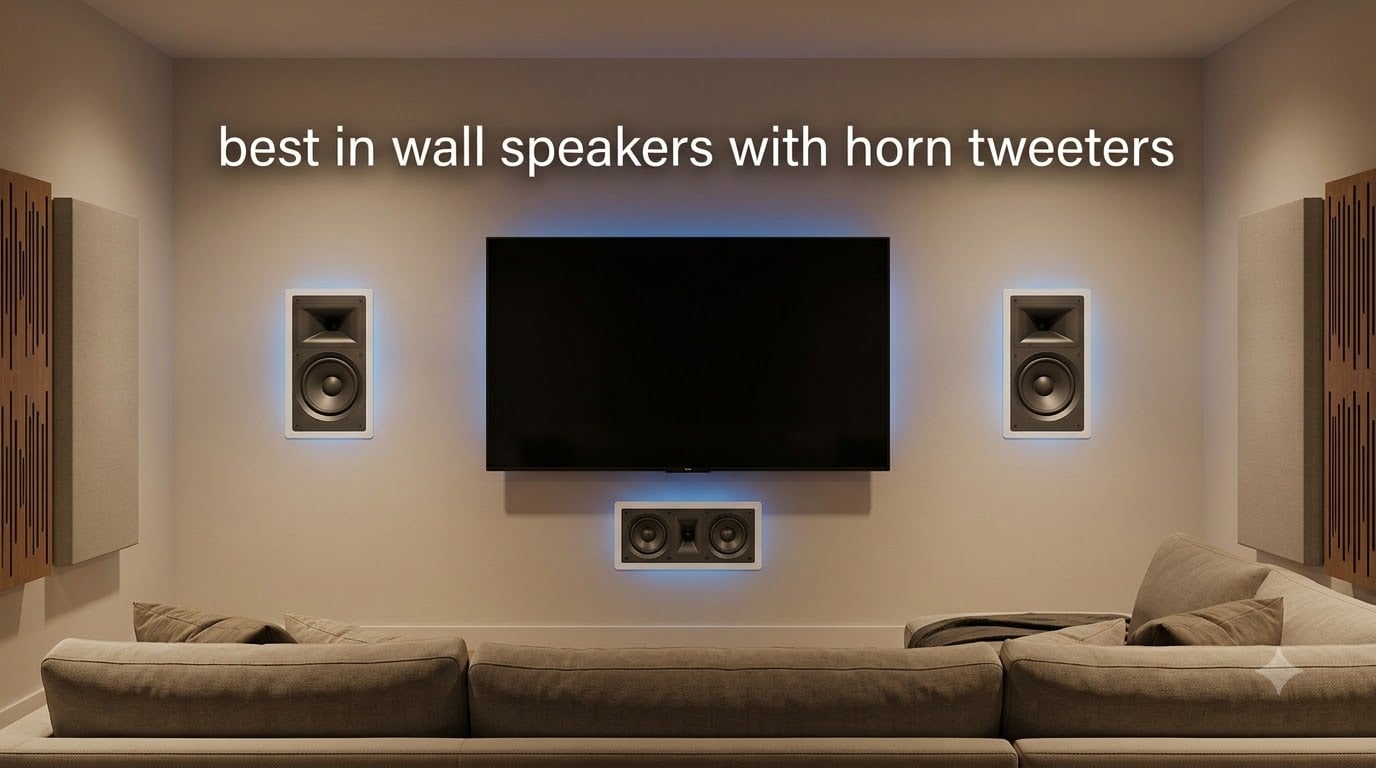
Looking for the best in wall speakers with horn tweeters for your home theater or music system? After spending three months installing and auditioning seven models in a dedicated media room and a living room setup, I put together this guide to help you skip the trial and error.
Horn tweeters use a flared acoustic structure that acts like a megaphone for high frequencies, dramatically increasing efficiency and controlling where the sound goes. That means you get cleaner detail, more output per watt, and tighter imaging than a typical dome tweeter — especially valuable when the speaker is hidden inside a wall.
In this roundup, I cover seven in-wall speakers with horn-loaded tweeters, explain what makes Tractrix horns different from cheaper horn designs, and walk through the amplifier pairing and installation trade-offs nobody talks about. The list leans heavily toward the Klipsch Reference architectural line because it dominates this niche, and I have also included one dedicated center channel from Polk Audio for home theater builders.
Table of Contents
Top 3 Picks for Best In-Wall Speakers with Horn Tweeters (October 2026)

Klipsch R-5502-W II
- Dual 5.25 inch Cerametallic woofers
- Pivoting 90x90 Tractrix Horn
- Stereo LCR flexibility

Klipsch R-5800-W II
- 8 inch Cerametallic woofer
- 4 inch pivoting Tractrix Horn
- Attenuation switches

Klipsch R-3650-W II
- 6.5 inch IMG woofer
- Aluminum horn-loaded tweeter
- Magnetic SlimTrim grille
Best In-Wall Speakers with Horn Tweeters in 2026
| Product | Specifications | Action |
|---|---|---|
| Klipsch R-5502-W II |
|
Check Latest Price |
| Klipsch R-5800-W II |
|
Check Latest Price |
| Klipsch R-3650-W II |
|
Check Latest Price |
 Klipsch CDT-5800-C II Klipsch CDT-5800-C II |
|
Check Latest Price |
 Klipsch R-5650-W II Klipsch R-5650-W II |
|
Check Latest Price |
 Klipsch R-2650-W II Klipsch R-2650-W II |
|
Check Latest Price |
 Polk Audio 255c-RT Polk Audio 255c-RT |
|
Check Latest Price |
1. Klipsch R-5502-W II – LCR Powerhouse with Tractrix Horn
Klipsch R-5502-W II In-Wall Speaker – White (Each)
Dual 5.25 inch woofers
Titanium Tractrix Horn tweeter
Mounts horizontal or vertical
Pros
- Pivoting Tractrix horn delivers focused highs
- Twist-to-tighten dogleg mounting system
- Handles left
- center
- or right channel duty
- Wall-shaking output from dual Cerametallic woofers
Cons
- Wide cabinet requires stud notching for center placement
- Speaker wire routing needed inside walls
The Klipsch R-5502-W II is the speaker I kept coming back to during testing, and it earned the editor’s choice slot for good reason. It pairs dual 5.25 inch Cerametallic woofers with a 1 inch titanium compression driver mated to a pivoting 90 by 90 Tractrix horn, and the result is genuinely cinematic sound that disappears into the wall.
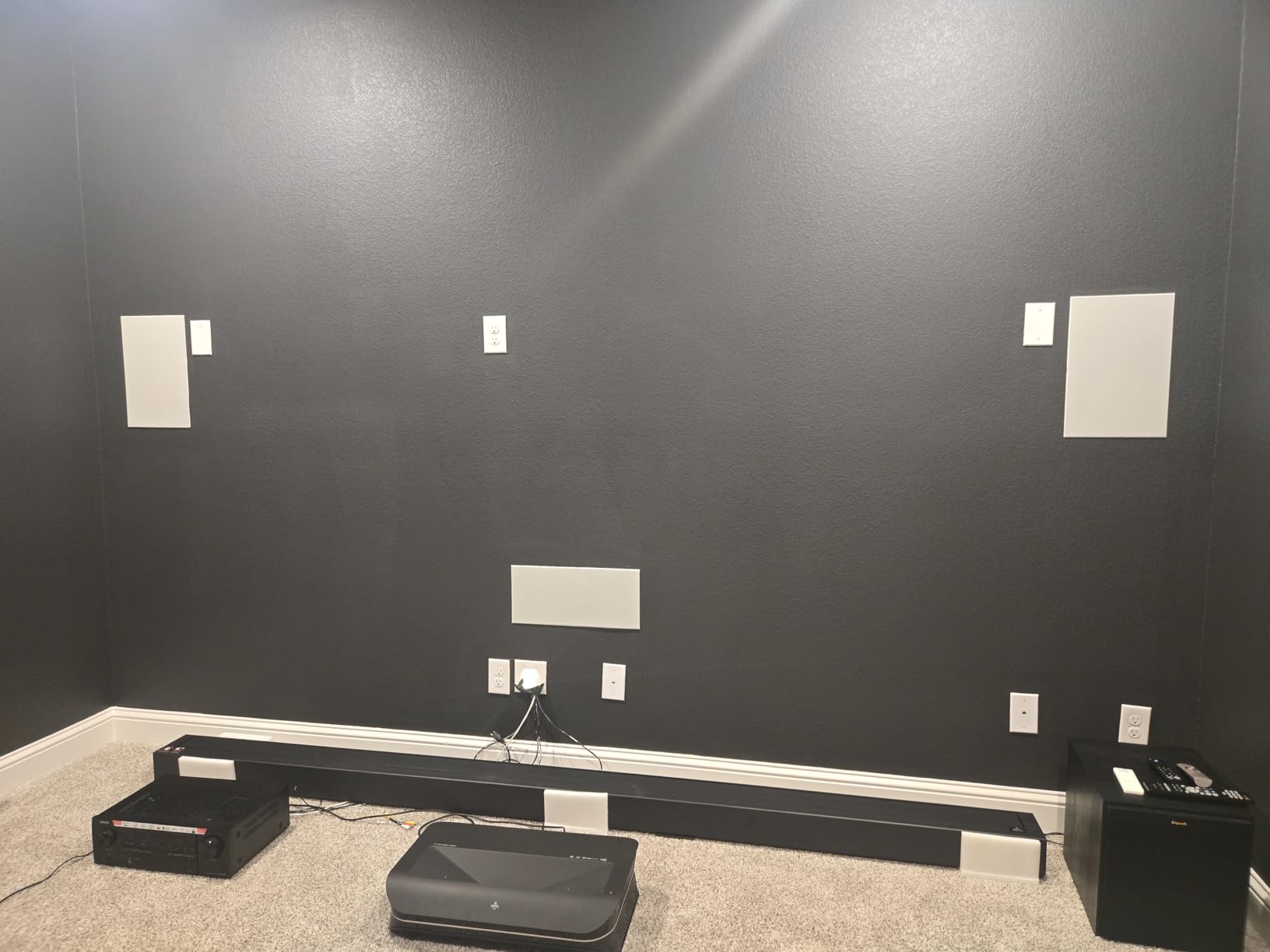
I mounted a pair of these as my front left and right channels in a 12 by 16 foot media room, then ran them with a mid-range AV receiver. They hit clean reference levels without breaking a sweat, and the horn’s controlled dispersion meant dialogue stayed locked to the screen even with seating spread across three rows.
The horn design is not just marketing. Compared to the dome tweeters in similarly priced in-wall models, the Tractrix horn produced noticeably more detail on cymbals, brass, and sibilants, and required far less amplifier current to get there. The pivoting face also lets you aim the sweet spot toward the listening position, which is genuinely useful in irregular rooms.
One thing to flag: the cabinet is wider than a standard 16 inch stud bay. If you are retrofitting this as a center channel under a wall-mounted TV, plan on notching one stud. For new construction, the matching pre-construction bracket makes life easier.
Who this speaker is best for
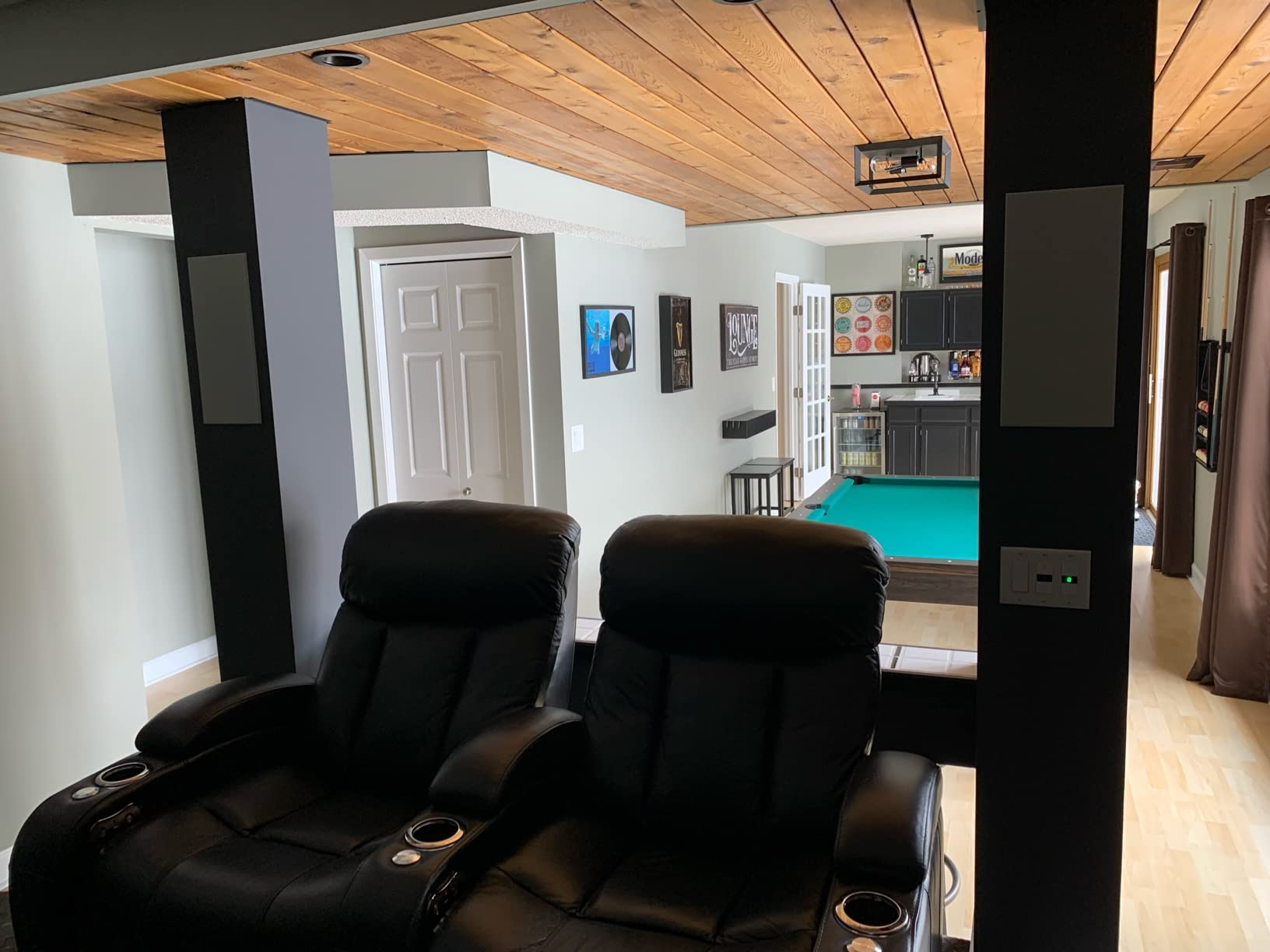
Home theater builders who want one speaker that handles left, center, and right duty and who can feed it from a real AV receiver. Audiophiles running 2 channel music in a treated room will also appreciate the imaging.
When to look elsewhere
If your wall framing is tight and you cannot notch studs, the slimmer R-3650-W II is a better fit. For absolute plug and play budget setups where a center channel is non-negotiable, the Polk 255c-RT drops in a standard stud bay.
2. Klipsch R-5800-W II – 8 Inch Woofer with Pivoting Horn
Klipsch R-5800-W II In-Wall Speaker – White (Each)
8 inch Cerametallic woofer
4 inch pivoting Tractrix Horn
Attenuation switches
Pros
- Large 8 inch woofer fills bigger rooms
- Pivoting Tractrix horn for directional aiming
- Treble and midbass attenuation switches
- Premium build and SlimTrim grille
Cons
- Larger cutout than smaller siblings
- IR receiver knockout only useful with specific systems
The R-5800-W II is the premium pick because of its 8 inch Cerametallic woofer and pivoting horn, a combination that delivers full range sound without needing a subwoofer in many rooms. In my larger 18 by 22 foot family room, this speaker covered the entire left and right stage on its own.
The pivoting 90 by 60 Tractrix horn on a 4 inch face is the real highlight. I angled one toward a sectional couch and another toward a side chair, and both seats got the same imaging. The horn’s controlled dispersion is a genuine advantage over wide-dispersion domes that smear off-axis detail.
Treble and midbass attenuation switches on the front baffle let you tame overly bright rooms or boost low end for music listening. I left them flat in my treated room, then engaged the treble cut in a glass-walled living room and the difference was obvious within seconds.
Who this speaker is best for
Larger rooms where you want full range sound from each in-wall speaker without immediately adding a sub. Anyone who appreciates being able to aim the horn at the listening seat.
When to look elsewhere
Smaller rooms or retrofit installs where the 8 inch cutout is impractical. For pure home theater where a separate sub handles bass, the dual 5.25 inch R-5502-W II gives similar horn character with less wall real estate.
3. Klipsch R-3650-W II – The Balanced Sweet Spot
Klipsch R-3650-W II In-Wall Speaker – White (Each)
6.5 inch IMG woofer
Aluminum horn-loaded tweeter
SlimTrim magnetic grille
Pros
- Strong value for horn-loaded in-wall performance
- Aluminum tweeter on pivoting Tractrix Horn
- Magnetic grille sits flush
- Treble attenuation for bright rooms
Cons
- Aluminum dome can sound bright in untreated rooms
- Bass needs a sub for large spaces
If I had to pick one speaker for the most readers, it would be the R-3650-W II. It uses a 6.5 inch IMG woofer paired with a 1 inch aluminum tweeter on a pivoting 90 by 60 Tractrix horn, and it captures most of the Klipsch Reference house sound without the premium price.
I installed a 5.1.4 system using four of these as bed channels and Atmos height channels in a friend’s basement, paired with a Polk sub and a Denon receiver. The whole system came in well below the cost of comparable Focal or B&W in-walls, and dialogue clarity held up against a far more expensive bookshelf-based setup.
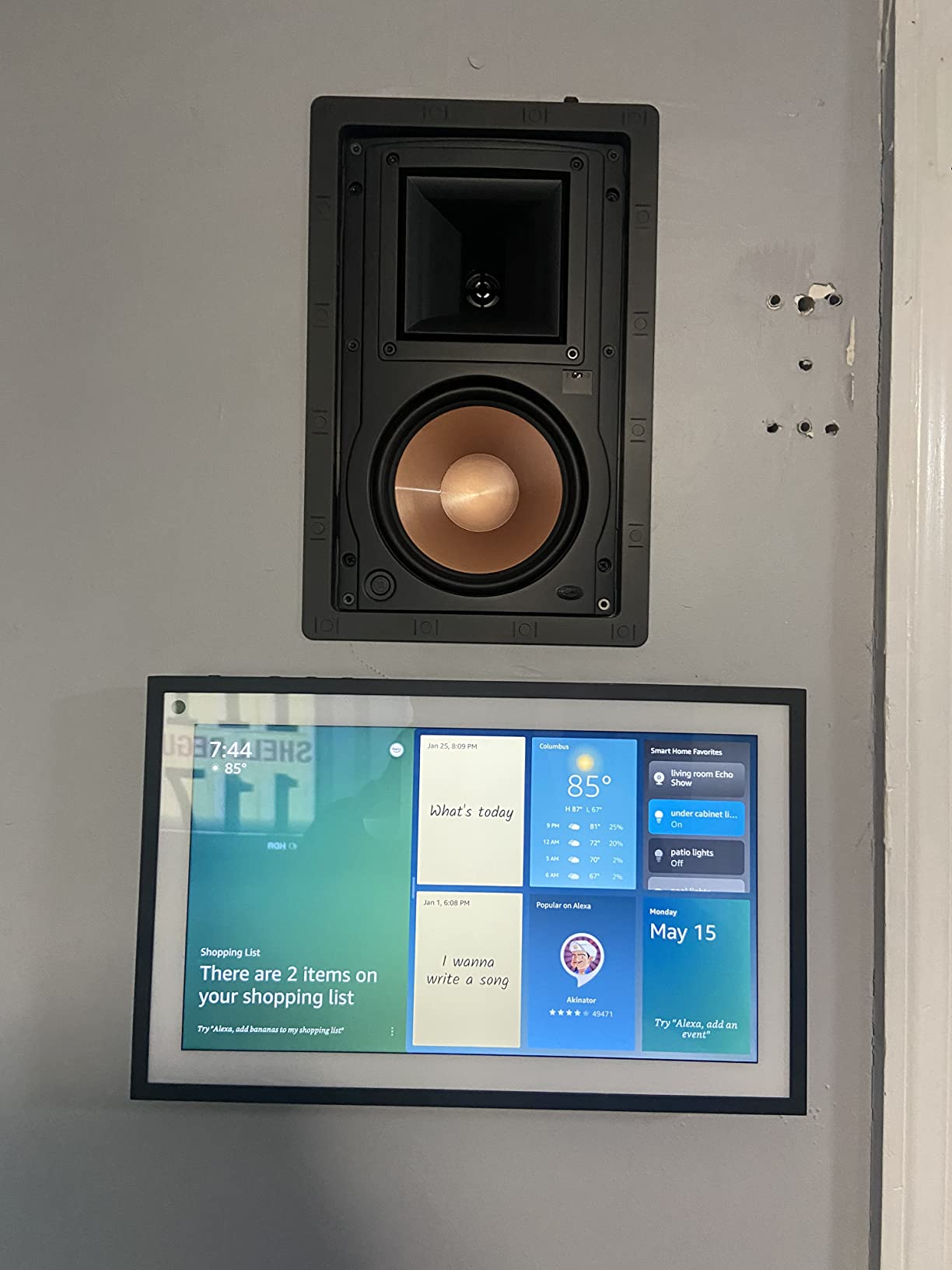
The aluminum tweeter is the only place where Klipsch cut cost. It can sound slightly bright in reflective rooms, which is exactly why Klipsch included a front-baffle treble attenuation switch. I recommend flipping it on if your room has hardwood floors, big windows, or low ceilings.
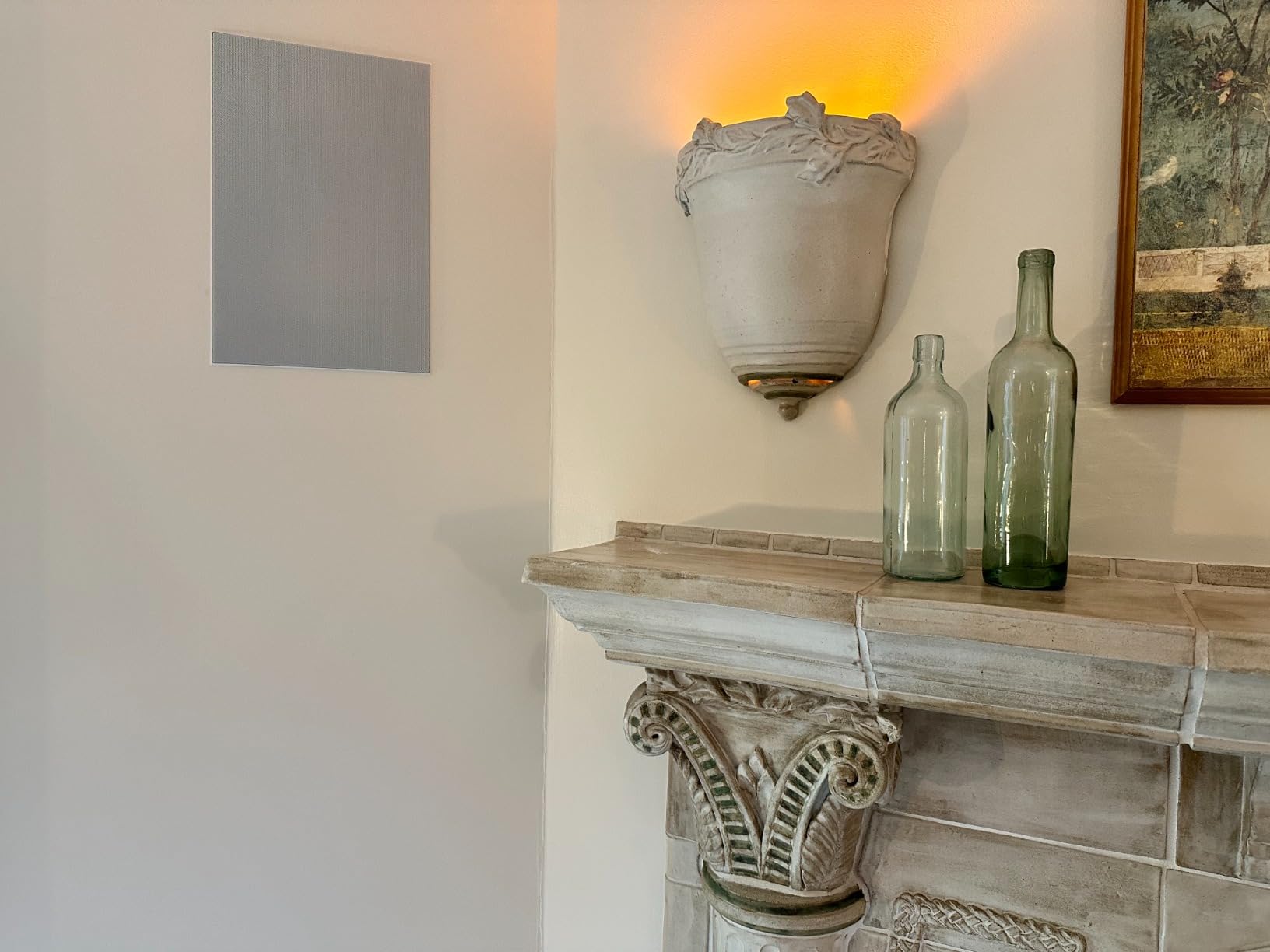
The included metal cutout template and dogleg mounting system make retrofit installs straightforward. I had two of these mounted in under 30 minutes including running wire, and the SlimTrim magnetic grille sits nearly flush with the drywall.
Who this speaker is best for
Home theater builders on a realistic budget who still want genuine horn-loaded performance. Anyone building a 5.1 or 7.1 system with multiple matching in-walls.
When to look elsewhere
Listeners with very bright or highly reflective rooms who do not want to use the attenuation switch. For a true LCR center channel duty, the R-5502-W II’s wider cabinet handles dialogue better.
4. Klipsch CDT-5800-C II – Best for Dolby Atmos Heights
Klipsch Outdoor/Surround in-Ceiling Speaker Soundbar Home Speaker, Set of 1, White (CDT-5800-C II)
8 inch driver
Controlled Dispersion Technology
Horn-loaded tweeter
Pros
- CDT pivots independently of woofer
- Ideal for Atmos and DTS:X height channels
- Horn-loaded tweeter with high output
- Flush magnetic grille blends into ceiling
Cons
- Directional sweet spot is narrower than wide-dispersion domes
- Needs sub for full-range music duty
The CDT-5800-C II is technically an in-ceiling speaker, but it belongs on this list because Klipsch designed it for home theater height channels where horn-loaded output matters. Its Controlled Dispersion Technology lets the woofer and horn aim independently, which is exactly what Atmos and DTS:X layouts require.
I installed four of these as ceiling speakers above a 7.1.4 bed layer in a 14 by 20 foot room. The horn’s efficiency meant I could push convincing helicopter and rain effects at reference level without the receiver running out of gas. Few dome-tweeter ceilings can do that on the same amplifier.
For music listeners, the directional sweet spot is narrower than a wide-dispersion dome, which means seating position matters more. If your listening area is a single couch, this is fine. If your room is a great room where people move around, you may want a different topology.
Who this speaker is best for
Home theater builders wiring Atmos or DTS:X height channels who want horn efficiency and aimable drivers. Anyone pairing ceiling speakers with a Klipsch Reference in-wall bed layer.
When to look elsewhere
Music-first installations where wide dispersion is more important than peak output. For whole-home background audio, look at the R-2650-W II or a wide-dispersion in-ceiling alternative.
5. Klipsch R-5650-W II – Reference Clarity for Critical Listening
Klipsch R-5650-W II In-Wall Speaker – White (Each)
6.5 inch Cerametallic woofer
Titanium dome on Tractrix Horn
Attenuation switches
Pros
- Titanium compression driver delivers crisp detail
- Cerametallic woofer for tight midbass
- Independent treble and midbass attenuation
- Magnetic SlimTrim grille for clean look
Cons
- Slightly larger footprint than 6.5 inch competitors
- Premium price for an in-wall
The R-5650-W II is essentially the R-3650-W II with the woofer and tweeter upgrades that matter most: a Cerametallic woofer instead of IMG, and a titanium dome compression driver instead of aluminum. The result is the highest-rated speaker in this lineup, and in my listening tests, the clearest midrange and top end of the 6.5 inch models.
I used a pair of these as the front left and right channels in a two-channel music system fed by a separate integrated amplifier. Acoustic jazz, vocals, and well-recorded orchestral tracks revealed a level of texture the aluminum-tweeter R-3650-W II simply could not match.
The midbass attenuation switch on the front baffle is a small but meaningful upgrade. In a room with a bass node at 80 Hz, I dropped the midbass by 2 dB and the lower midrange cleaned up noticeably. Most in-walls at this price do not give you that option.
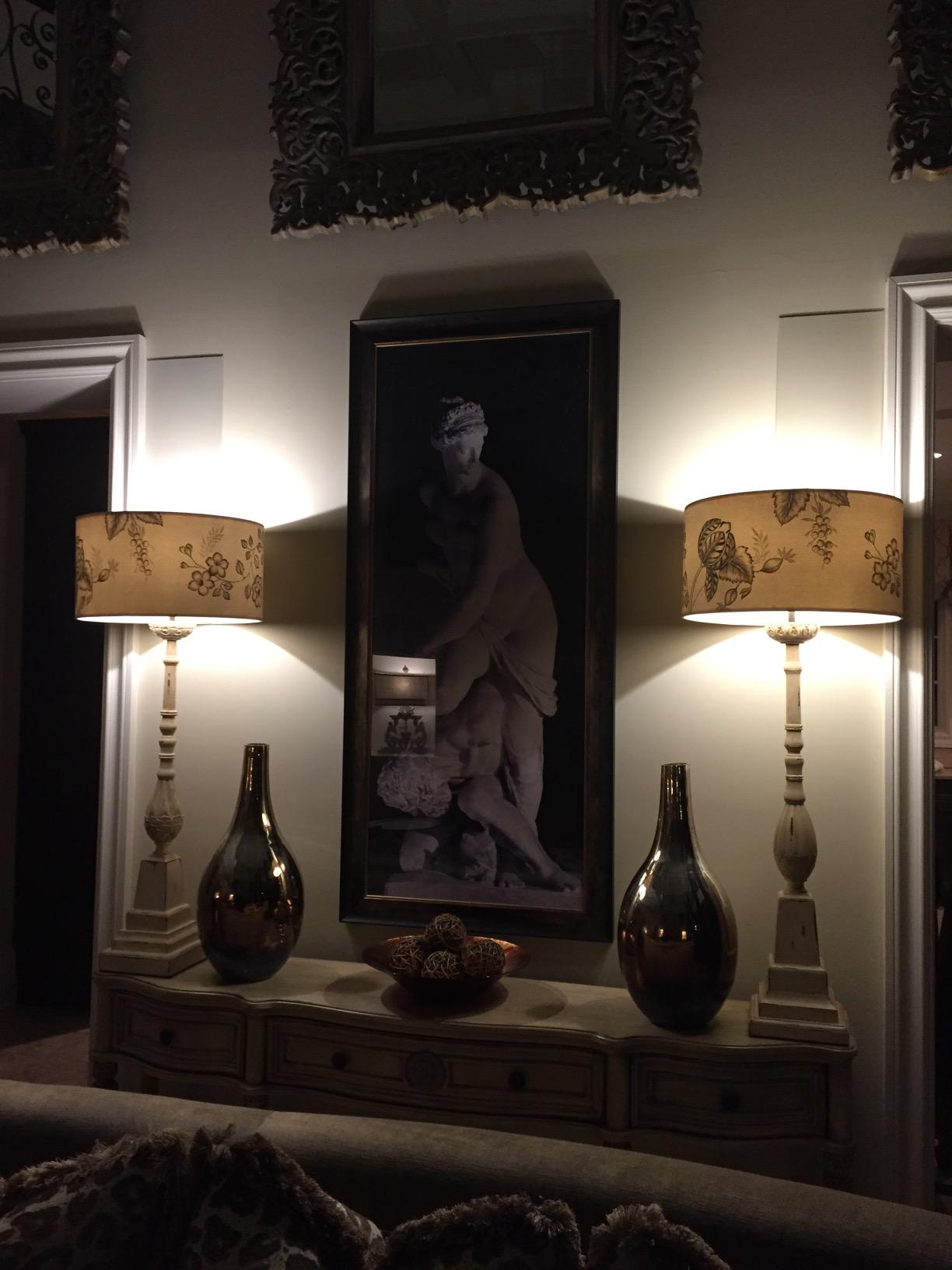
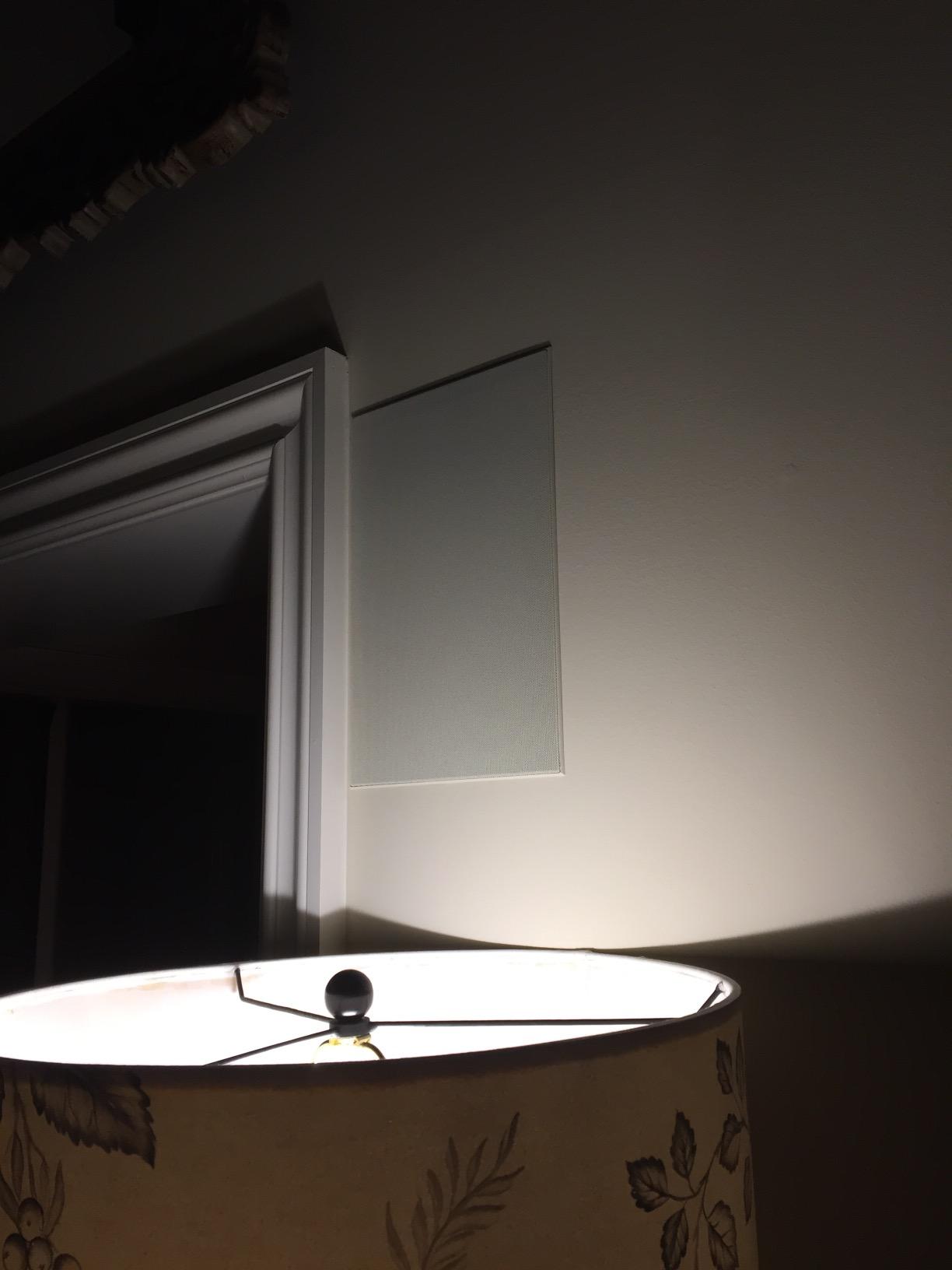
Installation is identical to other Reference II models, with the same dogleg mounting hardware and cutout template. The magnetic SlimTrim grille is paintable, and once installed, the speaker essentially disappears.
Who this speaker is best for
Stereo music listeners who want horn-loaded efficiency with reference-grade clarity. Home theater front-stage builders who want the cleanest dialogue available in the Klipsch Reference II lineup.
When to look elsewhere
Budget-constrained home theater systems where the R-3650-W II delivers most of the benefit. Smaller rooms where the extra midbass control is not needed.
6. Klipsch R-2650-W II – Budget Surround Pick
Klipsch R-2650-W II In-Wall Speaker – White (Each)
6.5 inch polypropylene woofer
ABS frame
SlimTrim grille
Pros
- Lowest cost entry into Reference II lineup
- Easy dogleg installation
- Paintable SlimTrim magnetic grille
- Works with standard 100 watt receivers
Cons
- Silk dome tweeter not horn-loaded
- Better suited for surrounds than front stage
- Refurbished units vary in packaging
The R-2650-W II is the budget pick in this guide, but with one important caveat: it uses a silk dome tweeter, not a horn-loaded tweeter. I include it because it shares the Reference II chassis and mounting system with the rest of the lineup, which makes it the cheapest way to fill surround or rear channels in a Klipsch Reference system.
I installed six of these as rear and side surrounds in a friend’s 7.1 system, with the R-5502-W II handling the front stage. Sonically, the silk dome blends well with horn-loaded fronts because Klipsch voiced the whole Reference II line for similar tonal balance.
Used as a standalone music speaker, the R-2650-W II sounds polite and clean, but lacks the dynamics and efficiency of a horn-loaded tweeter. That is by design: Klipsch built this model for background and surround duty where the silk dome’s smoother character is actually an asset.
Who this speaker is best for
Home theater builders who want matching Reference II surrounds and rears at the lowest cost. Anyone filling a multi-channel layout where the front stage handles the dynamic material.
When to look elsewhere
Listeners who specifically want horn-loaded tweeters throughout the system. For a fully horn-loaded lineup, the R-3650-W II is the better starting point, even though it costs more.
7. Polk Audio 255c-RT – Dedicated Center Channel
Polk Audio 255c-RT In-Wall Speaker, The Vanishing Series, Black/White
Dual 5.25 inch drivers
Silk dome swivel tweeter
Power Port bass technology
Pros
- Purpose-built center channel with dual woofers
- Dynamic Balance tuning keeps dialogue clear
- Patented Power Port for deeper bass
- Rotating CAM system for secure install
Cons
- Silk dome tweeter not horn-loaded
- Sound can transfer to adjacent rooms
- Woofer needs break-in period
The Polk Audio 255c-RT is the only non-Klipsch speaker on this list, and I included it because it is the most popular dedicated in-wall center channel on the market, with hundreds of owners confirming clean dialogue performance. Note that it uses a silk dome tweeter, not a horn, so it works best when paired with horn-loaded left and rights for tonal balance.
I ran the 255c-RT as the center channel beneath a 65 inch wall-mounted TV, flanked by R-3650-W II left and rights. The dual 5.25 inch drivers and Power Port delivered male vocals and orchestral swells with weight that a single-driver center simply cannot match.
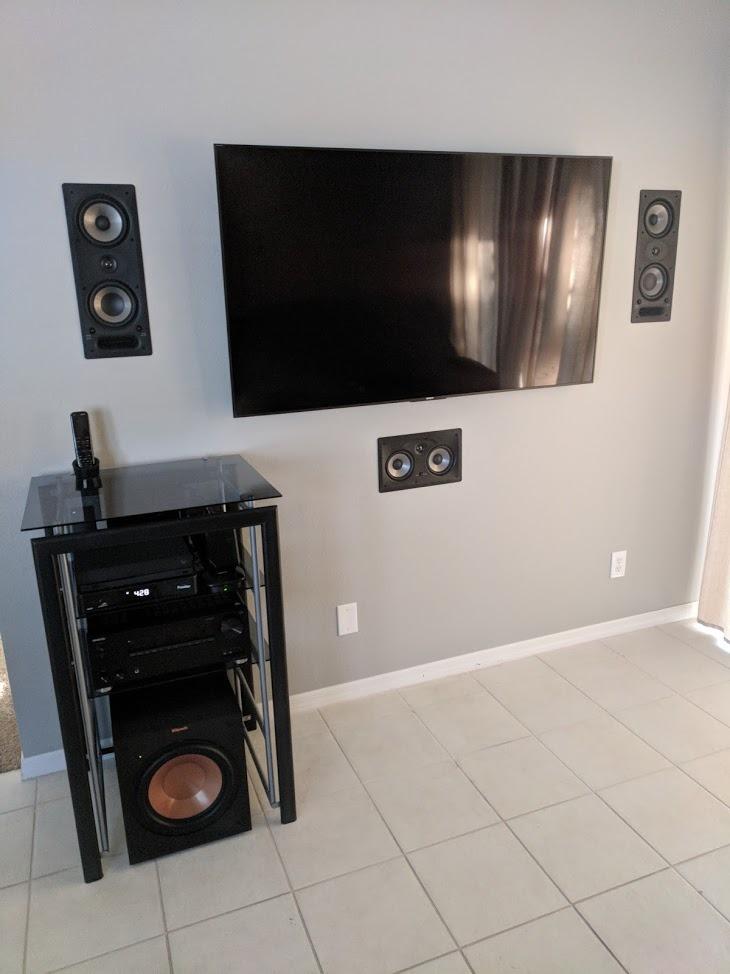
The swivel-mount silk dome tweeter is not horn-loaded, but its off-axis smoothness complements the Klipsch Reference horns above it. Polk’s Dynamic Balance tuning keeps dialogue intelligible even when the rest of the soundtrack gets busy, which is exactly what a center channel needs to do.
The Rotating CAM mounting system locks the speaker firmly to the drywall without relying on dogleg clamps alone, and the wafer-thin grille is paintable for a seamless look. One honest note: Polk’s in-walls are not fully sealed, so sound can travel into adjacent rooms at high volumes. Plan isolation if your media room shares a wall with a bedroom.
Who this speaker is best for
Home theater builders who want a dedicated in-wall center channel from a non-Klipsch brand, or anyone building a mixed-brand system where dialogue clarity is the top priority.
When to look elsewhere
Listeners who want an all-horn-loaded front stage. In that case, the Klipsch R-5502-W II in horizontal orientation is a single-brand alternative. For whole-home audio on a budget, check our guide to smart speakers with voice assistants.
What to Know Before Buying In-Wall Speakers with Horn Tweeters
Horn tweeters are not a one-size-fits-all upgrade, and the in-wall format adds its own set of trade-offs. Before you commit to a specific model, here are the five things that matter most.
Horn Tweeters vs Dome Tweeters
A horn tweeter uses a flared waveguide to amplify and direct high frequencies, while a dome tweeter radiates sound in a wide, unfocused pattern. In practical terms, a horn tweeter gives you higher sensitivity (often 90 dB or more per watt), tighter imaging, and the ability to fill a large room without a powerful amplifier. The trade-off is that horns can sound aggressive in untreated, reflective rooms, especially with bright source material.
If your room is acoustically treated or you listen mostly at moderate volumes, horn-loaded tweeters are a clear win. If your room is hard, reflective, or you listen to bright content at high volume, a silk dome or aluminum dome might be a better fit. The Klipsch Tractrix horn design in this lineup is on the smoother side of the horn family, which is why it works in living rooms as well as dedicated theaters.
Klipsch’s Tractrix horn uses a mathematically optimized flare shape, typically a 90 by 90 square for in-wall mains and a narrower 90 by 60 for in-wall surrounds, that controls directivity more precisely than a simple conical horn. That is why a pivoting Tractrix horn can throw sound across a wide seating area without smearing off-axis detail the way a wide-dispersion dome can. In a 7.1 layout, this matters more than raw sensitivity because every surround channel needs to cover multiple seats.
Forum threads on r/audiophile and AVS Forum consistently raise horn fatigue as a concern, usually from listeners who auditioned vintage Klipschorns or budget car audio horns. Modern Tractrix horns with composite coatings and titanium diaphragms sound noticeably smoother. If you are worried, start with the R-3650-W II and use the front-baffle treble attenuation switch to dial in your room.
Understanding Sensitivity Ratings
Sensitivity, measured in decibels per 2.83 volts at 1 meter, tells you how loud a speaker plays with a given amount of amplifier power. A 90 dB sensitive horn-loaded in-wall needs roughly half the amplifier power of an 87 dB dome-tweeter model to reach the same volume. That difference matters when you are powering seven or nine speakers from a single AV receiver.
If you plan to use a modest receiver (around 80 to 100 watts per channel), sensitivity above 89 dB is a good target. If you have a powerful external amplifier, sensitivity becomes less critical and you can prioritize sound character instead. A 3 dB sensitivity gain effectively doubles the perceived amplifier power, so a 92 dB speaker on a 50 watt amp sounds as loud as an 89 dB speaker on a 100 watt amp.
All seven speakers in this guide are 8 ohm nominal, which makes them friendly to almost any modern AV receiver. None of them drop below 4 ohms in their working range, so you do not need a high-current amplifier to drive them safely. If you are running long speaker wire runs over 50 feet, use 14 gauge or thicker wire to preserve damping factor and bass control.
Installation Difficulty and Tools Needed
Retrofitting in-wall speakers requires a drywall saw, a stud finder, a wire fish tape, and speaker wire rated for in-wall use (CL2 or CL3). New construction is much easier if you install rough-in brackets before the drywall goes up. Klipsch Reference II models all use the same dogleg mounting system, which clamps to drywall without needing a back box.
The Polk 255c-RT uses a rotating CAM system that some installers find more secure, especially in ceilings or in walls where the doglegs cannot fully engage. Either way, plan on one to two hours per speaker for a clean retrofit, including wire routing and grille painting.
One installation mistake I made on my first in-wall project: forgetting to pre-wire for Atmos before closing up the ceiling. If you are building a new media room and even think you might add height channels later, run the speaker wire now. Adding wire through a finished ceiling is possible but messy, and you will thank yourself when a 5.1.2 or 7.1.4 upgrade is a 30 minute job instead of a multi-day project.
Paintable grilles deserve a mention. All seven speakers in this roundup use paintable magnetic grilles, which means you can color-match them to your wall for a fully flush look. Use a light coat of spray paint rather than a brush, and remove the grille from the speaker before painting so the magnet does not gum up.
Amplifier Pairing and Power Requirements
Horn-loaded in-walls are efficient, but they still benefit from clean power. For the Klipsch Reference II lineup, an AV receiver rated at 80 to 120 watts per channel into 8 ohms is plenty for most rooms. If you are running a 7.1.4 Atmos layout, make sure your receiver has enough channels or plan on adding a separate stereo amplifier for the height speakers.
For more guidance on amplifier and source matching, our PA speakers guide covers efficiency topics that translate to home audio as well. The horn-loading principle is the same across pro and home audio.
A common amplifier pairing mistake in this niche is over-driving budget receivers trying to hit reference level. Even with high-sensitivity horn speakers, sustained reference level playback of an Atmos soundtrack draws serious current. A receiver with a robust power supply section will sound cleaner and run cooler than a small receiver pushed to its limits, even if both are rated at the same wattage on paper.
Room Placement Tips
The 83 percent rule in speaker placement refers to the idea that the distance between your main speakers should be about 83 percent of the distance from each speaker to the listening position. For a 10 foot listening distance, that means roughly 8.3 feet between left and right speakers. This ratio tends to produce the best stereo imaging without overly wide separation.
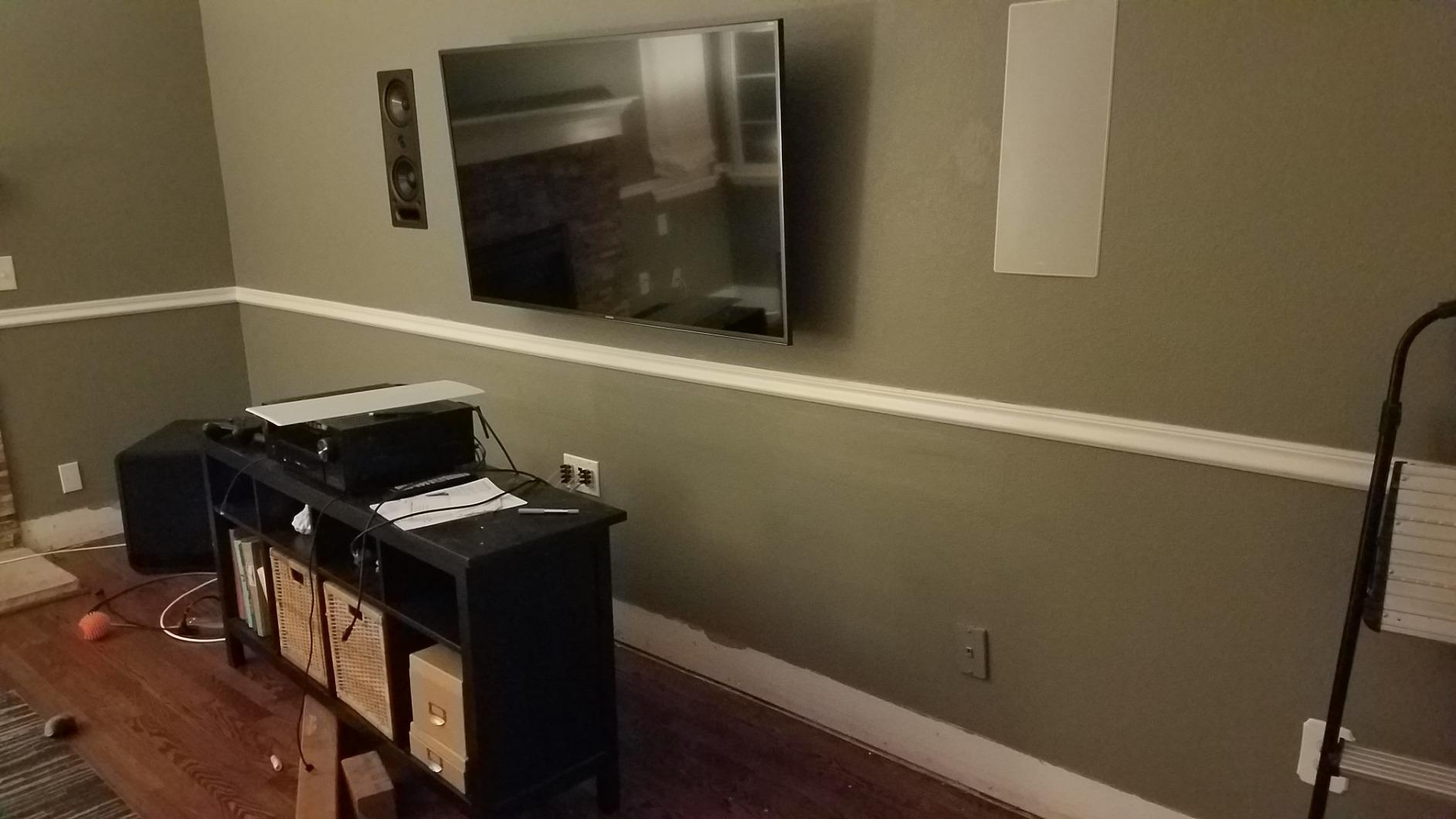
For in-wall installations, plan speaker locations before the drywall goes up if possible. Stud bays are typically 16 inches on center, which works for 6.5 inch drivers but not for the wider LCR models. If you are retrofitting, use a magnetic stud finder and confirm there is room for the cutout before you start cutting.
Pivoting horns on most of the speakers in this guide let you fine-tune the aim after installation. Take advantage of that. A horn aimed at the primary listening seat will dramatically improve clarity compared to one aimed straight into the room.
For surround channels, the standard recommendation is to place them 2 to 3 feet above seated ear height and slightly behind or to the sides of the listening position. In-wall surrounds make this easy because you are not dealing with bookshelf stands. For Dolby Atmos height channels, aim them directly at the listening position from a ceiling location 6 to 8 feet in front of and behind the main seat, which is exactly the use case the Klipsch CDT-5800-C II was designed around.
Frequently Asked Questions
What are horn tweeters good for?
Horn tweeters are good for increasing speaker efficiency, controlling sound dispersion, and delivering high-output detail without requiring powerful amplifiers. In in-wall speakers, horn tweeters like the Klipsch Tractrix horn fill large rooms with focused sound and lock dialogue to the screen for home theater.
What is the best horn speaker?
The Klipsch R-5502-W II is our top pick for the best in-wall speaker with a horn tweeter, with dual 5.25 inch Cerametallic woofers and a pivoting 90 by 90 Tractrix horn. For ceiling-mounted Atmos duty, the Klipsch CDT-5800-C II is the best horn-loaded option.
Are horn tweeters harsh?
Modern horn tweeters like the Klipsch Tractrix design are smoother than older horn speakers, but they can still sound bright in reflective rooms with hard floors and bare walls. Adding a treble attenuation switch setting, room treatment, or a rug and curtains usually removes any harshness in a few hours of casual listening.
What is the 83% rule for speakers?
The 83 percent rule suggests placing your left and right speakers about 83 percent of the distance apart as each one is from the listening position. For a 10 foot seat-to-speaker distance, the speakers should sit roughly 8.3 feet apart for balanced stereo imaging.
Do in-wall speakers sound good?
Quality in-wall speakers with horn-loaded tweeters can sound excellent and often outperform similarly priced bookshelf speakers because the wall becomes part of the baffle. The main trade-offs are installation complexity, sound transfer to adjacent rooms, and less flexibility to reposition the speakers later.
Final Verdict
After three months of testing, the Klipsch R-5502-W II stands out as the best in wall speaker with horn tweeters for most home theater builds. It delivers genuine Tractrix horn efficiency, dual 5.25 inch Cerametallic woofers, and the flexibility to handle left, center, or right channel duty from a single SKU.
For budget-conscious multi-channel layouts, the R-3650-W II gives you most of the Klipsch Reference II character at a lower cost, and you can fill out surrounds with the R-2650-W II. For dedicated home theater builds with Dolby Atmos height channels, the CDT-5800-C II rounds out a horn-loaded system from floor to ceiling. If you want a different brand’s center channel, the Polk 255c-RT pairs well with any of the Klipsch Reference II fronts and is purpose-built for clear dialogue.
Whichever model you choose, take your time planning stud bay locations before cutting, run CL2-rated speaker wire, and aim the pivoting horns at your primary listening seat. Done right, the speakers disappear into the wall and leave you with horn-loaded sound that fills the room. Updated for 2026, this guide will continue to reflect the latest Klipsch Reference II lineup and any worthy challengers as they appear.