
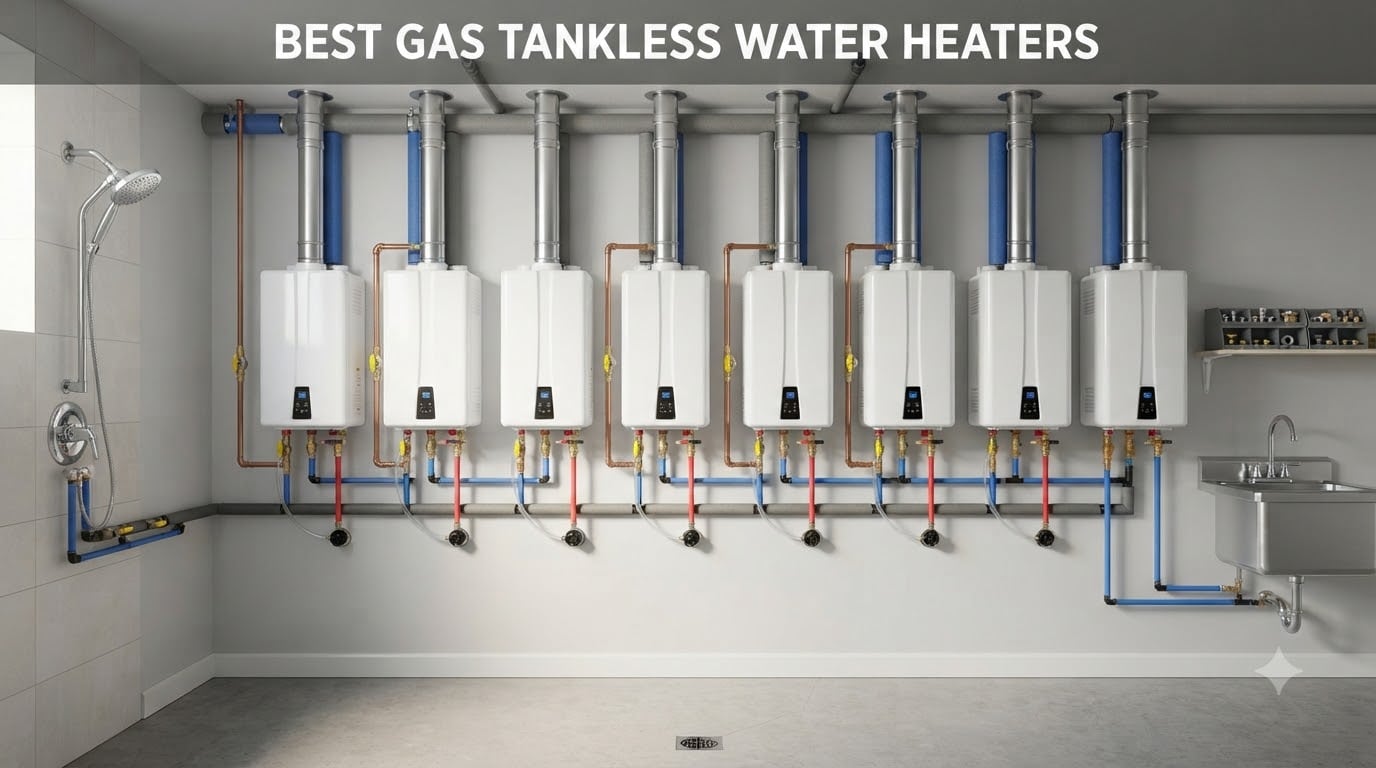
Choosing from the best gas tankless water heaters is not simply a matter of picking the largest GPM number. A model that serves three showers in a warm region may fall short of one shower and a kitchen faucet when winter groundwater turns cold, so sizing must follow the flow you expect to use and the temperature rise your home requires.
I compared eight current natural-gas models for measured flow capacity, listed BTU input, efficiency where supplied, installation restrictions, warranty coverage, and maintenance needs. I also weighed the practical issues raised repeatedly in plumbing and appliance forums: undersized gas lines, hard-water scale, cold-water sandwiches, WiFi reliability, and the value of a serviceable dealer network.
This guide focuses on whole-house choices rather than portable or point-of-use units. It will help you shortlist a heater, but your plumber should confirm gas pressure, vent routing, condensate drainage, combustion air, plumbing layout, local code, and the final temperature-rise calculation before you order.
Table of Contents
Top 3 Picks for the Best Gas Tankless Water Heaters (September 2026)
The Rinnai RX180iN is my first choice because its 10 GPM rating, 0.98 UEF, and indoor/outdoor flexibility cover a broad range of homes without stepping up to the larger RX199iN. The RX199iN is the capacity pick for a large household, while the Rheem RTG-70DVLN-3 offers a sensible lower-cost route for a smaller home.
These badges summarize product data and intended use, not an independent laboratory test. I did not physically install or operate every unit, so my experience-based language is limited to specifications, supplied review summaries, and common field concerns rather than invented test results.
Best Gas Tankless Water Heaters in 2026
| Product | Specifications | Action |
|---|---|---|
 Rheem RTG-70DVLN-3 Rheem RTG-70DVLN-3 |
|
Check Latest Price |
 Rinnai V53DeN Rinnai V53DeN |
|
Check Latest Price |
 Rinnai RX199iN Rinnai RX199iN |
|
Check Latest Price |
 Rheem RTGH-84DVLN-3 Rheem RTGH-84DVLN-3 |
|
Check Latest Price |
| Rinnai RX180iN |
|
Check Latest Price |
 MIZUDO HW180A0W-NG MIZUDO HW180A0W-NG |
|
Check Latest Price |
 A. O. Smith ATI-310CX3 A. O. Smith ATI-310CX3 |
|
Check Latest Price |
 MIZUDO HW199A1G-NG-M0 MIZUDO HW199A1G-NG-M0 |
|
Check Latest Price |
The overview favors comparable capacity, but do not treat maximum GPM as a guaranteed household output. A heater reaches its listed GPM only at a stated temperature rise; colder inlet water means lower simultaneous flow, and every additional fixture competes for the same burner capacity.
1. Rheem RTG-70DVLN-3: Strong 7 GPM Value for Two to Three Bathrooms
Rheem RTG Series 7.0 GPM Natural Gas Tankless Water Heater Indoor | 160,000 BTUs High Efficiency On Demand, Continuous Hot Water | Non-Condensing
7 GPM
160,000 BTU
15-year heat exchanger warranty
Pros
- Continuous hot water
- Compact cabinet
- Hot-start programming
Cons
- Special venting required
- Not B-vent compatible
- Distant-faucet delay
The Rheem RTG-70DVLN-3 is the smaller-home value pick in this group. Its listed 7 GPM flow and 160,000 BTU input make it a plausible match for a two- to three-bath home when the incoming water is not extremely cold, and the stainless steel cabinet is compact at 13.5 by 24.2 by 10.27 inches.
I like the Hot-start programming because it directly addresses the irritating blast of cold water some owners notice after a short pause. The integrated display also makes temperature adjustment more straightforward than a unit with no visible operating feedback.
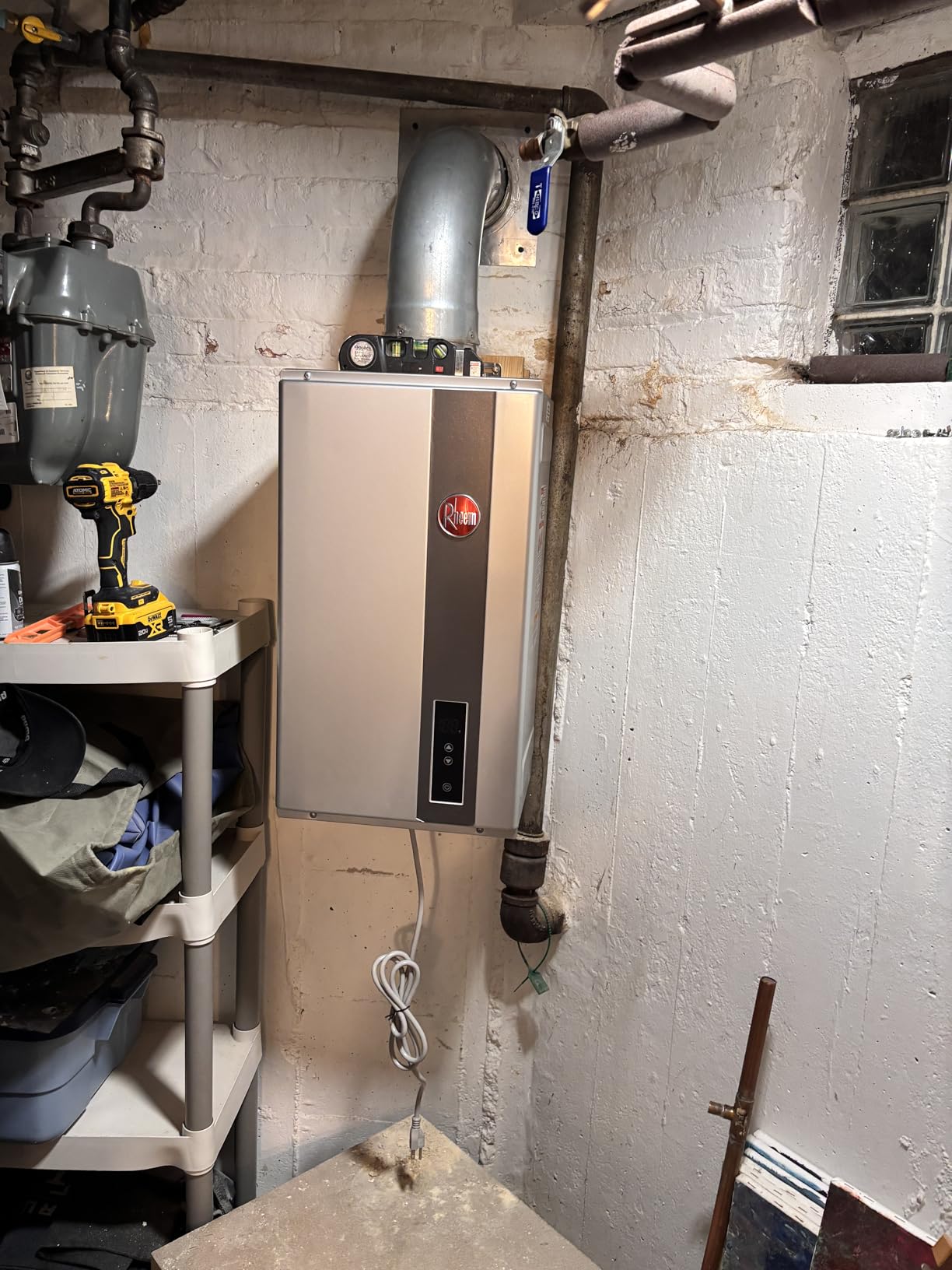
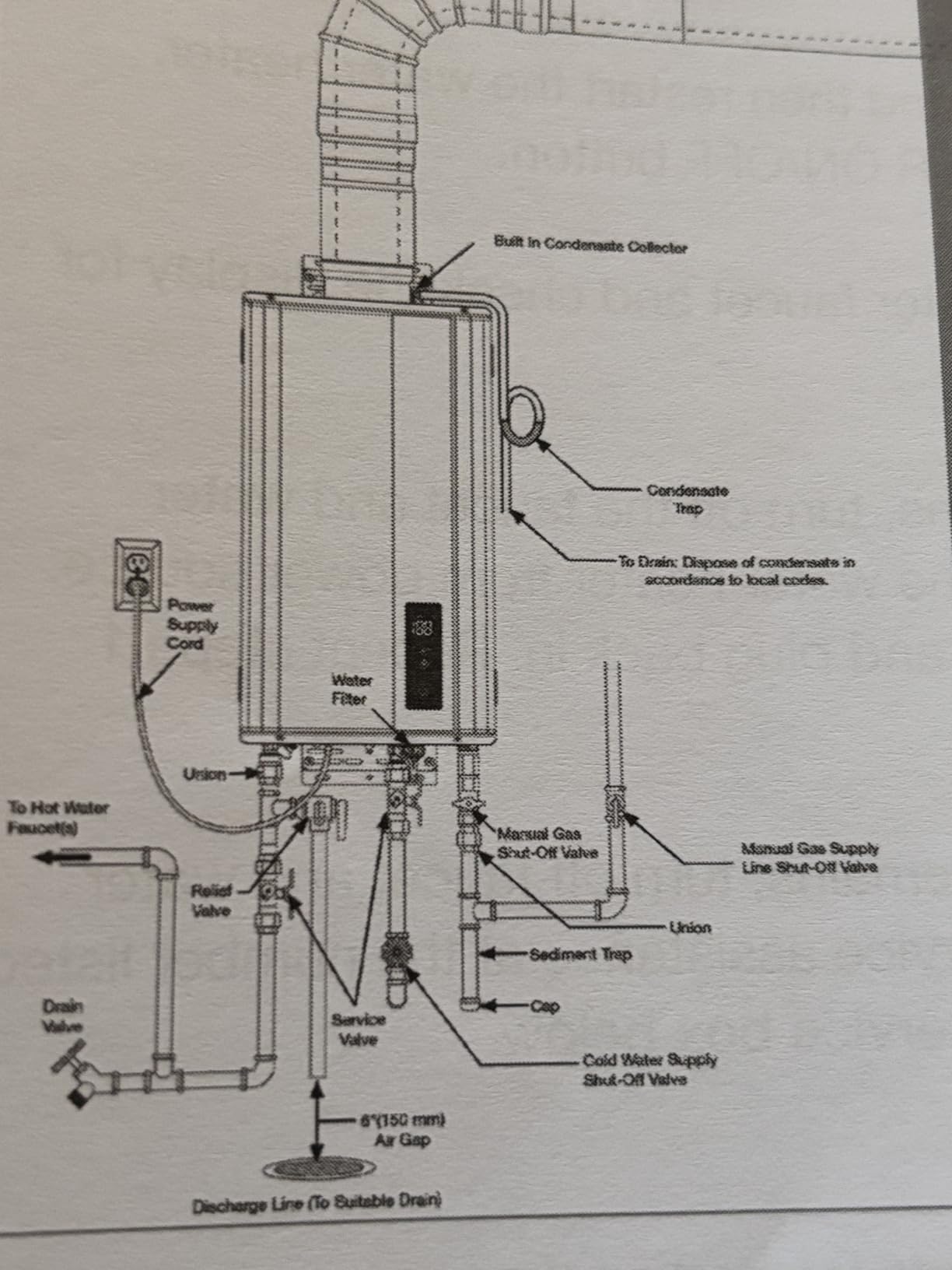
Its non-condensing design avoids a condensate drain, but it still requires manufacturer-approved direct venting and cannot use ordinary B vent. The product data also identifies a half-inch gas-line compatibility claim, yet the final line size depends on total BTU load, run length, local pressure, and code; I would not assume it without a gas calculation.
The supplied customer summary reports successful installs, reliable operation, and long-term satisfaction, which aligns with a 4.6 rating from 59 reviews. That sample is much smaller than the counts attached to some larger sellers, so I would place more weight on the 15-year heat-exchanger warranty, five years on parts, and one year on labor.
Choose the RTG-70DVLN-3 when you need efficient capacity without paying for a condensing system.
This model makes sense for a household whose calculated peak demand is around 5 to 6 GPM after a realistic temperature-rise adjustment. It also suits a garage or utility-room replacement where direct-vent routing is straightforward and there is no place to route acidic condensate.
Ask the installer to confirm minimum activation flow, maximum runtime, freeze protection, and service clearances. A recirculation loop can reduce faucet delay, but it also adds a pump, return line, and more hot-water losses unless the system is insulated and demand-controlled.
Skip the RTG-70DVLN-3 if your home demands 8 GPM or more in winter.
Its lower efficiency relative to the 0.93 and 0.98 UEF models can matter during heavy use, especially in a high-demand home. The distant-faucet delay reported in the product data is not unique to Rheem, yet a short return loop or a recirc model may solve it better than simply increasing heater size.
Professional installation is the safer choice because gas combustion equipment needs correct venting, combustion analysis, and leak testing. Warranty coverage can also depend on registration and qualified installation, so confirm those terms in writing before work begins.
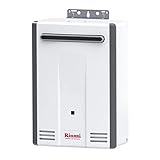
2. Rinnai V53DeN: Compact Outdoor Power for a Smaller Home
Rinnai V53DeN Natural Gas Tankless Water Heater
5.3 GPM
Outdoor only
10-year heat-exchanger warranty
Pros
- Compact 33-pound cabinet
- Up to four appliances
- 0.82 efficiency
Cons
- Outdoor installation only
- Dedicated power required
- High-wind sensitivity
The Rinnai V53DeN stands out for its compact, outdoor-only format. At 33 pounds and 7.9 inches deep, it is the lightest product here, while its listed 5.3 GPM can serve up to four appliances according to the product data.
Outdoor placement removes the need to run a vent through a wall or roof, which can simplify installation and preserve indoor air quality. The product carries a 10-year heat-exchanger warranty, five years on parts, and one year on labor.
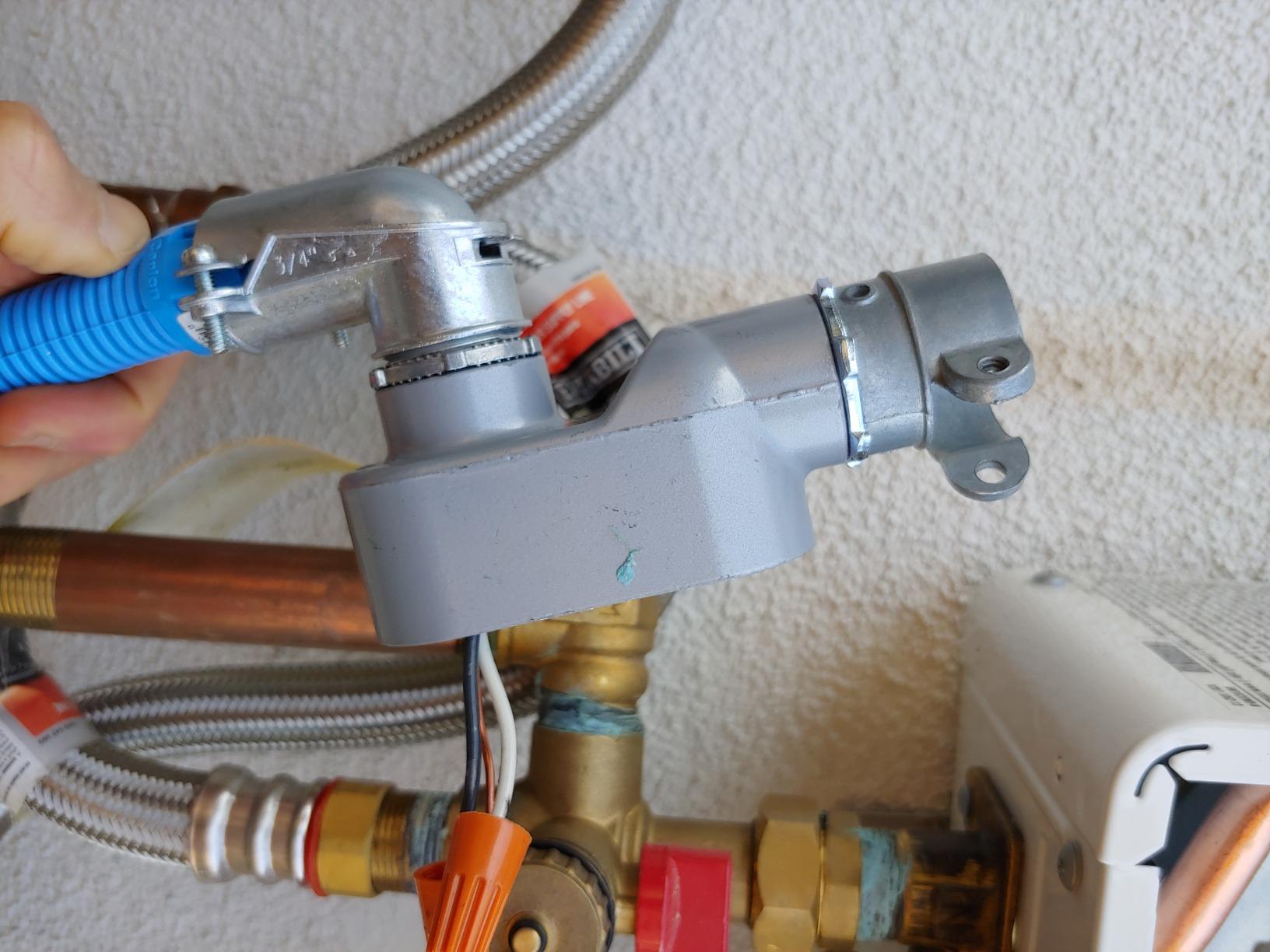
The tradeoff is location. It needs a 120-volt connection, must be protected according to local rules, and the supplied review summary flags flame-stability concerns in high winds. I would avoid a wind-exposed wall or verify the maker’s approved protection requirements first.
Customer feedback is broader than for several other products in the comparison, with 231 reviews and a 4.3 rating. Reviewers commonly cite quiet operation, compact size, and on-demand efficiency, while also noting installation complexity and wait time for hot water at distant fixtures.
Choose the V53DeN when outdoor placement and low household demand come first.
It fits a small home, cottage, or light-duty whole-house installation where expected simultaneous flow stays within its tested temperature-rise range. The wall-mounted cabinet also frees floor space that a storage tank would occupy.
Check local freeze protection before choosing an outdoor model, even if the cabinet is compact. In a cold region, a protected outdoor location or indoor direct-vent unit may deliver more dependable winter operation.
Skip the V53DeN if simultaneous hot-water use defines your morning routine.
Its 5.3 GPM listing does not imply that it can run every fixture at maximum flow. Two showers plus a laundry cycle may overwhelm it during cold inlet conditions, and an outdoor model is a poor fit where building code or climate makes the location impractical.
I would also not let the four-appliance claim decide the purchase. Add the actual flow rates of the fixtures you expect to run, then reduce the model capacity using the manufacturer’s temperature-rise chart.
3. Rinnai RX199iN: Maximum 11.1 GPM for Large Homes
Rinnai RX199iN Condensing Smart Sense Tankless Water Heater
11.1 GPM
199,000 BTU
0.98 UEF
Pros
- Seven-fixture capacity
- Dual fuel
- Indoor or outdoor
Cons
- Professional installation needed
- Complex venting
- No WiFi module included
The Rinnai RX199iN is the capacity leader in this eight-model field. Its 11.1 GPM and 199,000 BTU input can support as many as seven fixtures according to the supplied technical data, while the 0.98 UEF rating is the highest efficiency figure reported here.
Smart Sense gas control, dual-fuel support, and indoor or outdoor installation give it unusual flexibility. The condensing design can be a good fit where the higher heating load justifies it and the installation can accept the required venting and condensate management.
Large capacity does not remove the need to size the gas system correctly. A 199,000-BTU appliance can require a larger meter, regulator, and line than a lower-output replacement, and the listing does not establish that the existing utility service is adequate.
The supplied review summary reports strong satisfaction among customers who used professional installation. Review data lists professional installation, complex venting, and the lack of an included WiFi module as the main drawbacks; 147 reviews support a 4.6 rating.
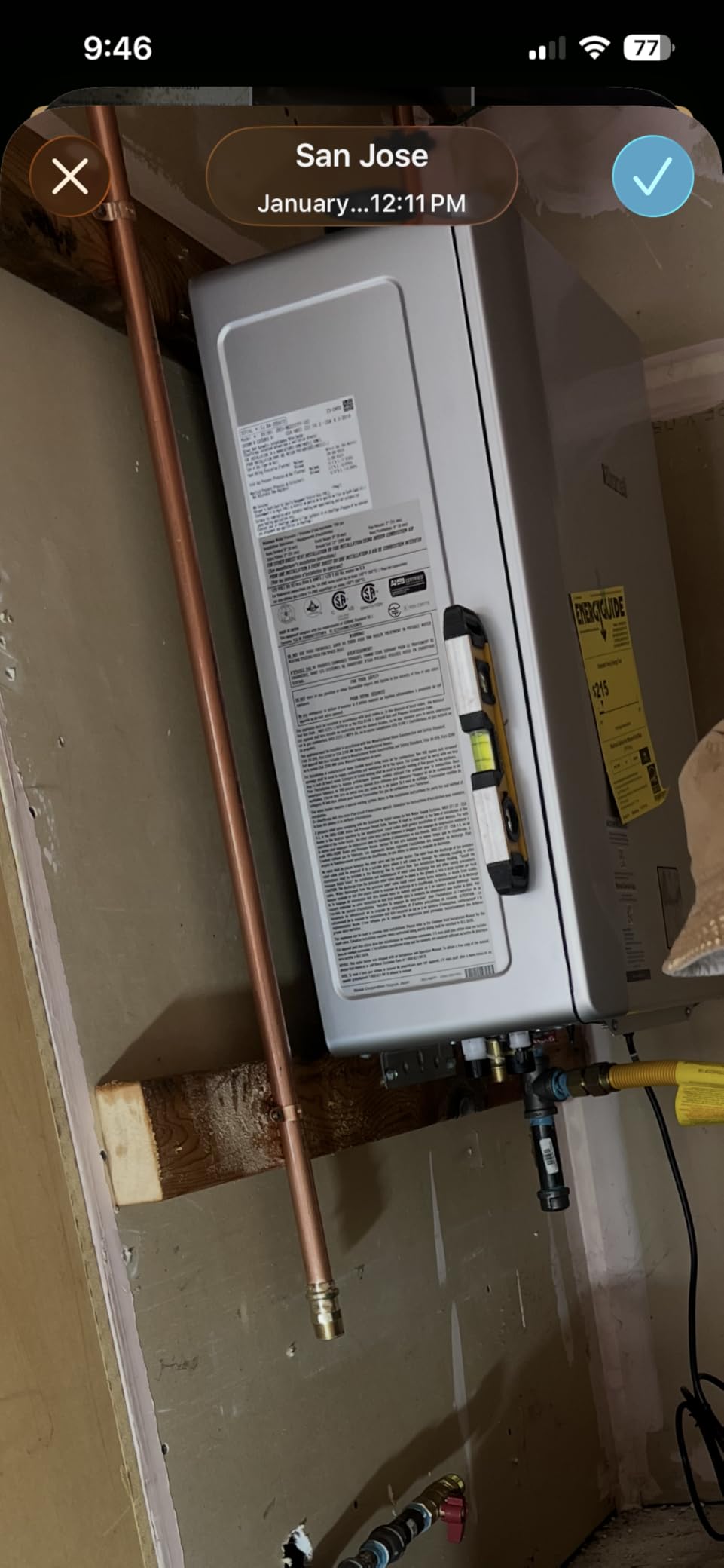
Choose the RX199iN when a large household needs capacity more than budget flexibility.
It is the strongest candidate in this roundup for a large home with several bathrooms, high-flow fixtures, and enough gas infrastructure. The dual-fuel compatibility can also be useful where the installation is already configured for propane, subject to the correct conversion and gas-category requirements.
Indoor or outdoor placement reduces siting constraints, but neither option is a DIY project. Condensing units have specific vent materials, clearances, drainage, and combustion-air requirements that vary with the model and local code.
Skip the RX199iN if you rarely use more than one fixture at once.
An 11.1 GPM heater may be wasteful if the home’s true peak demand is 5 or 6 GPM, because maximum output and efficiency are not the same thing. Its 55-pound cabinet is manageable for a professional, but the footprint is larger than several 5.3- to 7.9-GPM choices.
The Quick Flush maintenance feature is a practical plus, yet hard water still requires attention. Ask about filtration, isolation valves, and a service plan before assuming that high efficiency removes scale risk.
4. Rheem RTGH-84DVLN-3: Efficient 8.4 GPM for a Medium-to-Large Home
Rheem RTGH Series 8.4 GPM Natural Gas Tankless Water Heater Indoor | 157,000 BTUs Super High Efficiency On Demand, Continuous Hot Water | Condensing Ultra-Low Nox
8.4 GPM
157,000 BTU
0.93 UEF
Pros
- Condensing efficiency
- Ultra-low NOx
- Digital temperature control
Cons
- Complex installation
- Warranty-service concerns
- 59.9-pound cabinet
The Rheem RTGH-84DVLN-3 bridges the gap between the 7 GPM Rheem and the larger Rinnai models. Its listed 8.4 GPM, 157,000 BTU input, and 0.93 UEF make it a credible medium-to-large-home option for buyers who want condensing efficiency without an 11.1 GPM output.
Rheem specifies Hot Start programming, digital LED temperature control, ultra-low NOx combustion, and a direct-vent indoor installation. The stainless steel construction and 15-year heat-exchanger warranty add long-term appeal.
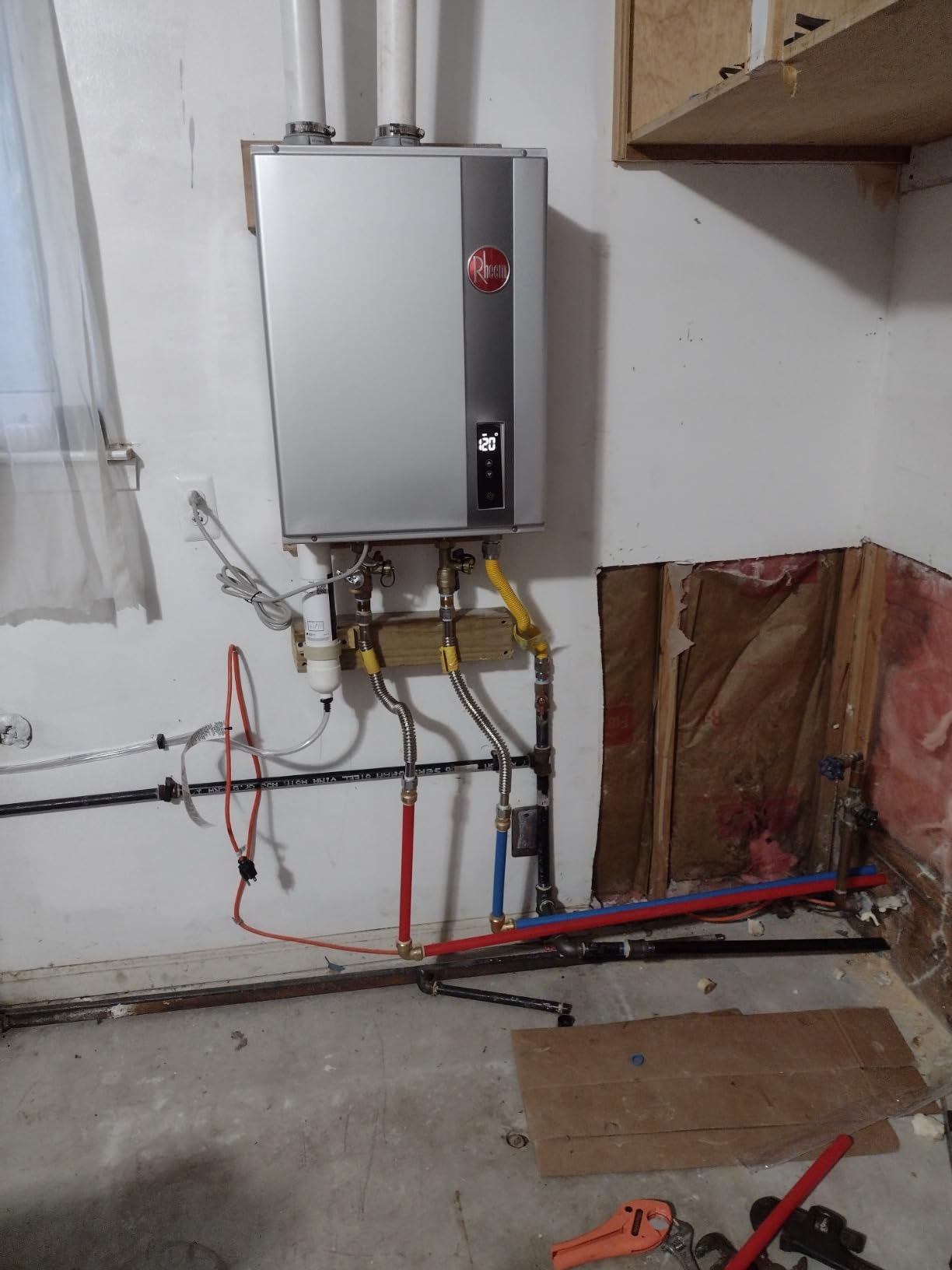
At 59.9 pounds, this is one of the heavier units here, and the product data calls out a multi-part installation and complex venting. The supplied review summary also reports some warranty-service concerns, so I would verify local dealer coverage before choosing it over a Rinnai or A. O. Smith model.
It has a 4.4 rating from 59 reviews. The available summary describes generally reliable performance and strong efficiency, with installation complexity and service access as the recurring cautions.
Choose the RTGH-84DVLN-3 when 8.4 GPM matches your measured demand.
This is a good fit for a home that needs more than the RTG-70DVLN-3 but does not need the RX199iN’s extreme output. Its temperature control and Hot Start programming are useful when comfort matters across several fixtures.
Confirm that your installer is comfortable with condensing systems and that a condensate neutralizer or drain route is acceptable. Direct vent placement also deserves a site visit before purchase because an attractive unit can become expensive when the vent path is difficult.
Skip the RTGH-84DVLN-3 if local service support is uncertain.
A long warranty is valuable only when parts and qualified labor are available. If your area has limited Rheem service, paying a little more for easier support may be the better ownership decision.
Also compare its 0.93 UEF with the 0.98-Uef Rinnai models if energy use is the deciding factor. The difference is meaningful, but actual savings depend on annual hot-water volume, gas cost, incoming-water temperature, and whether the unit is oversized for the home.
5. Rinnai RX180iN: The Best Overall Balance of 10 GPM and Efficiency
Rinnai RX180iN Condensing Smart Sense Tankless Water Heater
10 GPM
180,000 BTU
0.98 UEF
Pros
- Six-fixture capacity
- Indoor or outdoor
- Quick Flush maintenance
Cons
- App may be finicky
- Arrival dents reported
- Professional installation
The Rinnai RX180iN is my overall pick because it combines a listed 10 GPM flow with a 0.98 UEF rating, dual-fuel compatibility, and indoor or outdoor installation. It sits in a useful middle ground: more capacity than the 8.4 GPM Rheem, but less fuel demand than the 11.1 GPM RX199iN.
The model uses Smart Sense gas control and has a Quick Flush maintenance feature. Its compact condensing cabinet is listed at 19 by 31 inches, so plan wall space, service clearance, vent termination, and condensate handling rather than judging fit by the front face alone.
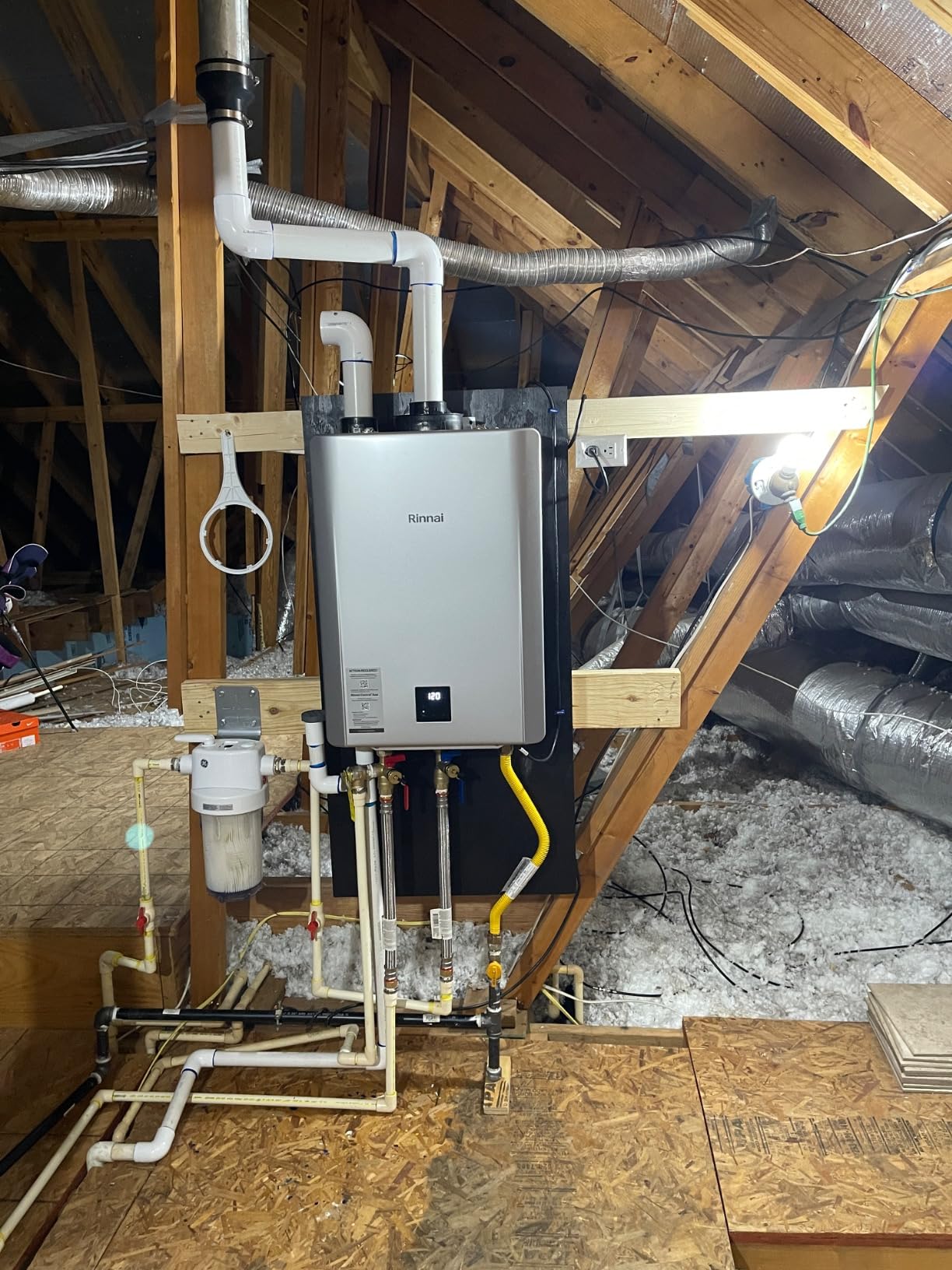
The product data reports 180,000 BTU input and a 10 GPM flow capable of serving six fixtures. Those figures are useful for shortlisting, but the installer must match them to the home’s winter inlet temperature and desired outlet temperature.
Its 4.8 rating is the highest in this set, although it comes from 49 reviews. The supplied review summary highlights reliable continuous hot water and minimal complaints about core performance, with minor concerns about app behavior, packaging dents, and professional installation.
Choose the RX180iN when you want premium efficiency without maximum capacity.
This is my recommendation for most large homes that need strong simultaneous flow but do not want to size every gas component for the RX199iN. It is also attractive when installation flexibility matters, provided the chosen location supports condensing requirements.
Use the gas utility’s capacity check early in the process. A heater can be electrically efficient and still disappoint if the meter or line cannot deliver the required BTU at the appliance.
Skip the RX180iN if app control is a must-have feature.
WiFi is a convenience, not a substitute for correct sizing, and the product’s own review data describes the app and remote software as finicky. Core heating is the more important criterion, but I would not pay extra specifically for a smart interface.
Also check whether your preferred vent kit and optional accessories are included. Product listings can differ on included parts, and a missing vent or conversion kit changes the total project plan.
6. MIZUDO HW180A0W-NG: Feature-Rich 7.9 GPM for Smaller Households
MIZUDO Tankless Water Heater Natural Gas Indoor WiFi, 180K BTU 7.9 GPM
7.9 GPM
180,000 BTU
Non-condensing
Pros
- WiFi and app
- Sealed combustion
- CSA certification
Cons
- Vent kit sold separately
- High-elevation concerns
- Non-condensing venting
The MIZUDO HW180A0W-NG is a 7.9 GPM indoor natural-gas model with 180,000 BTU input. Its sealed combustion system, freeze prevention, dry-fire protection, WiFi app, and CSA certification make it one of the more feature-packed options for a small or medium home.
The supplied data says it supports three to five usage points and maintains temperature stability within plus or minus 1 degree. At 39.6 pounds and 16.3 by 25 by 7.3 inches, its cabinet is lighter and shallower than several competing units.
This is a non-condensing heater, so it uses conventional combustion venting rather than the lower-temperature exhaust system of a condensing model. The vent kit is sold separately, which is an important project detail to confirm with the installer.
Its 4.2 rating comes from 175 reviews. The supplied summary praises affordability, easy installation, reliable hot water, and app control, but reports weaker results in very cold climates and above 2,000 feet; the manufacturer-specific elevation and gas rules should be checked locally.
Choose the MIZUDO HW180A0W-NG when smart controls and 3-to-5-point capacity fit your home.
It is worth considering for a household that values remote monitoring, freeze protection, and a relatively compact cabinet. The five-year heat-exchanger and two-year full-unit warranty are useful, though shorter than the heat-exchanger coverage on several Rinnai and Rheem models.
Hard water is a special planning point. A filtration or scale-reduction setup can protect the copper heat exchanger, but the correct answer depends on water chemistry and local maintenance practice.
Skip the MIZUDO HW180A0W-NG if you live at high elevation or in a severe cold climate.
The product’s own reported limitations make it a weaker fit above 2,000 feet, where burner operation and combustion air can be affected. In a northern home, the Rinnai condensing models or a properly sized 8-to-10 GPM unit may provide a more comfortable margin.
Do not buy based on the 7.9 GPM maximum alone. The product data itself says most users see good results with one or two simultaneous uses, so I would use a conservative sizing worksheet and a plumber’s temperature-rise chart.
7. A. O. Smith ATI-310CX3: Low-Maintenance 8 GPM for Hard Water
A. O. Smith Water Heater | 8 GPM, 190K BTU | NG Indoor, X3 | ATI-310CX3
8 GPM
190,000 BTU
0.81 UEF
Pros
- X3 scale prevention
- 15-year limited warranty
- Propane conversion kit
Cons
- Professional installation
- Gas-line upgrade may be needed
- Concentric vent system
The A. O. Smith ATI-310CX3 is designed for a two- to three-bath home with an 8 GPM maximum and 190,000 BTU input. Its standout feature is X3 Scale Prevention Technology, which is intended to reduce scale buildup and the need for annual descaling.
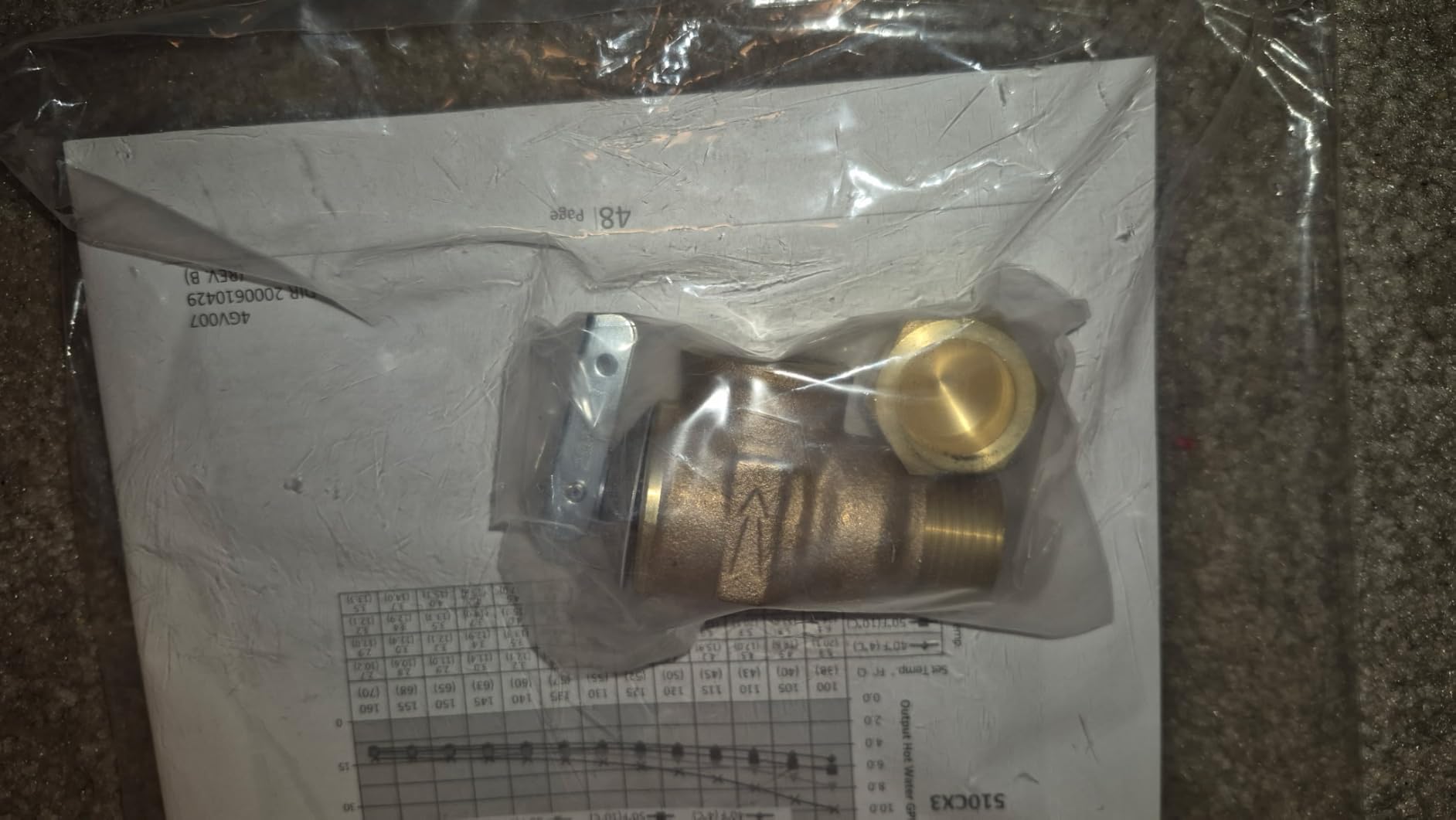
The product also includes a propane conversion kit, built-in freeze protection, advanced diagnostics, ultra-low NOx operation, and a 15-year limited warranty. Those features can matter more than a small GPM difference when the water is hard and service access is limited.
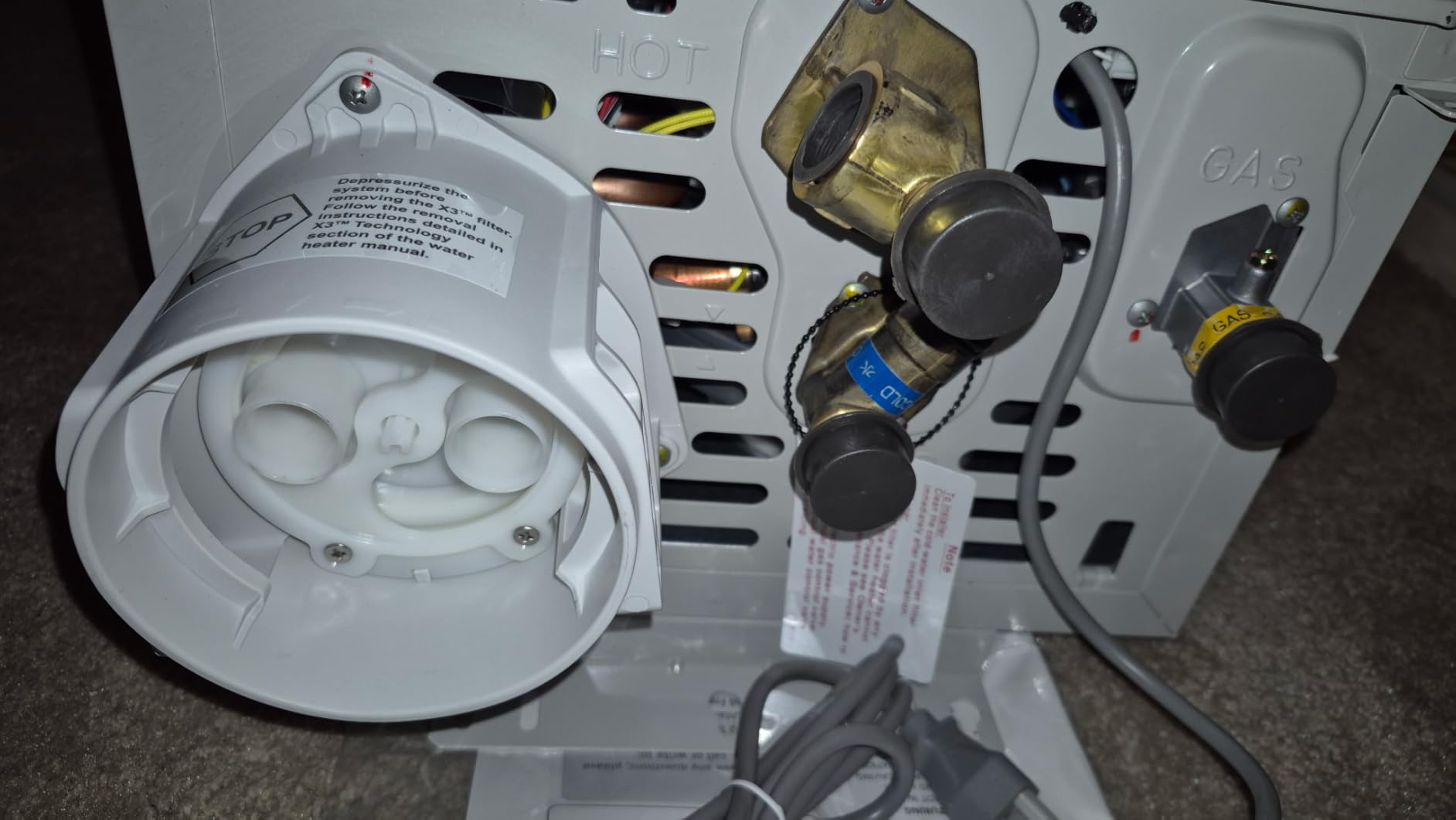
The tradeoffs are substantial. The UEF is listed at 0.81, below the 0.93 and 0.98 condensing products, and the direct-vent APNC35 concentric system may cost more than a PVC venting arrangement. A high BTU requirement can also expose an undersized gas line.
The 4.3 rating is based on 29 reviews, the smallest sample in the set. The supplied review summary is positive about scale prevention, quiet operation, diagnostics, and the copper heat exchanger, while noting professional installation and regional-condition concerns.
Choose the ATI-310CX3 when scale prevention outweighs peak efficiency.
This is the model I would investigate first for a hard-water area where annual descaling has become a burden. Its diagnostic system and included conversion kit are useful, but verify that the warranty recognizes the exact installation and water-treatment plan.
Ask for a hardness test and a local plumber’s maintenance recommendation. X3 can reduce one maintenance problem, but no feature makes untreated hard water free of risk.
Skip the ATI-310CX3 if your priority is the highest UEF rating.
The 0.81 UEF is the lowest listed efficiency figure among the products that provide one, so a condensing Rinnai or Rheem may be better for high annual gas usage. A lower efficiency rating can be acceptable when service, scale control, and fuel flexibility solve a real home problem.
Its stated maximum temperature is 194 degrees, but the usable setting still depends on the model instructions, mixing valve, local code, and anti-scald protection. I would not use the maximum figure as a reason to set the outlet hotter.
8. MIZUDO HW199A1G-NG-M0: 10.3 GPM Smart Control for Busy Homes
MIZUDO Natural Gas Tankless Water Heater, 199,000 BTU, Indoor
10.3 GPM
199,000 BTU
WiFi and app
Pros
- Five-to-seven-fixture support
- Six-stage gas modulation
- Freeze protection to -13°F
Cons
- Vent kit sold separately
- Gas-line upgrade possible
- High-elevation concern
The MIZUDO HW199A1G-NG-M0 is a 10.3 GPM indoor model with 199,000 BTU input. It supports five to seven fixtures according to the product data and adds six-stage gas modulation, a sealed direct-vent system, WiFi app control, and freeze protection rated to minus 13 degrees Fahrenheit.
The 55.5-pound cabinet and 15.9 by 24.8 by 10.4-inch dimensions are manageable, but the required 3-by-5-inch direct vent kit is separate. That detail belongs in the installation quote, not as an afterthought after delivery.
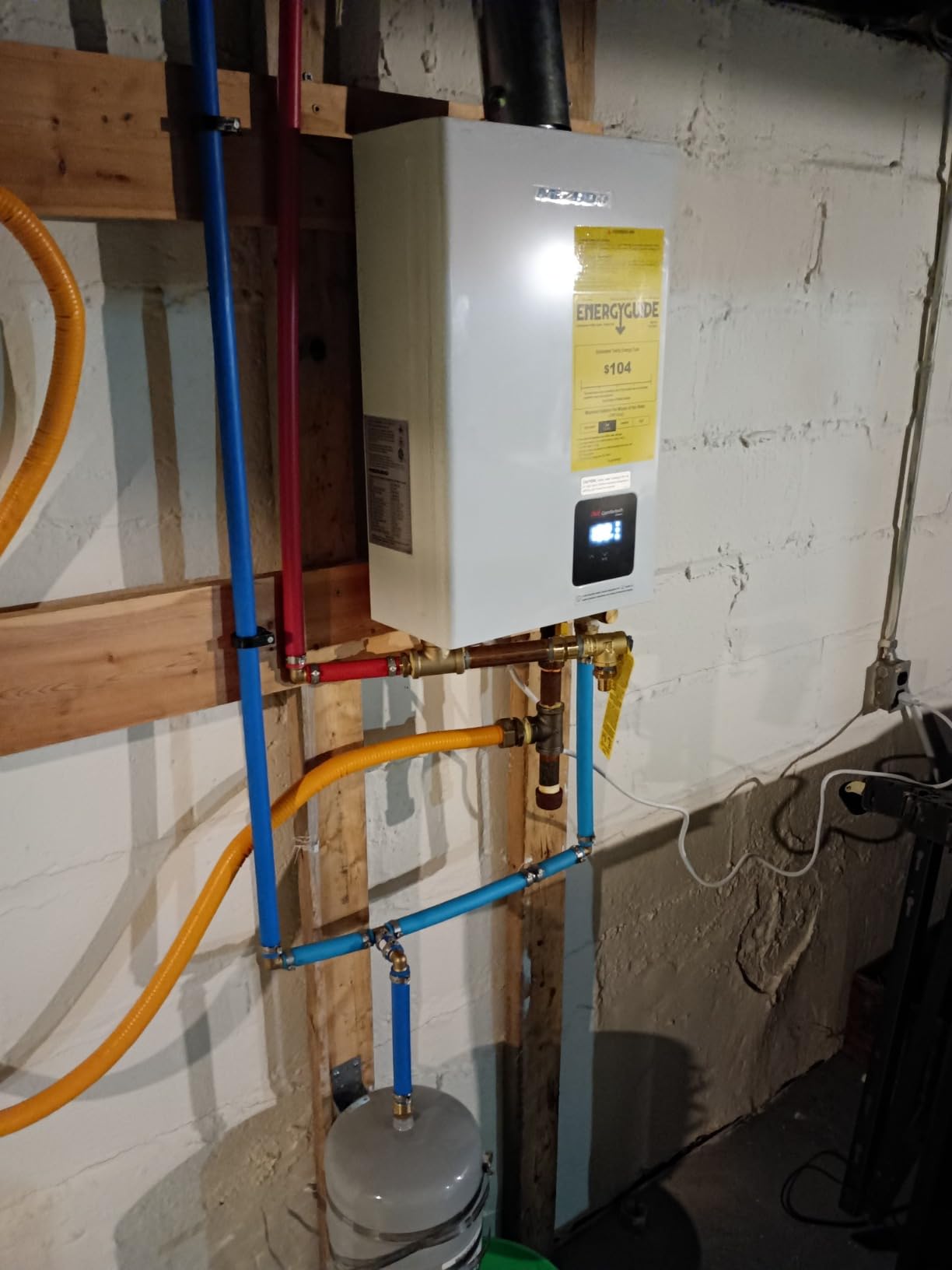
At maximum output, the home’s gas infrastructure must support 199,000 BTU. The supplied reviews mention easy installation compared with a tank, but also gas-line upgrades, non-standard fittings, and a high-elevation limitation; none of those should be treated as universal, but all deserve confirmation.
The 4.4 rating comes from 198 reviews. The product summary reports strong satisfaction with flow, temperature accuracy, smart controls, and safety features, while noting the separate vent kit and availability concerns.
Choose the HW199A1G-NG-M0 for a large household that values smart monitoring.
Its 10.3 GPM figure and 16-plus safety mechanisms make it worth a closer look when several fixtures may run at once. The app can add scheduling and energy tracking, but I would treat those features as secondary to gas capacity, freeze protection, and professional commissioning.
Confirm the exact high-elevation rating, vent length, and propane configuration for your site. The natural-gas listing is clear, but optional conversion equipment and outdoor accessories may not be interchangeable across every model version.
Skip the HW199A1G-NG-M0 if a conventional non-condensing install is your goal.
It is a sealed direct-vent indoor model with a more involved exhaust and drainage plan than the Rinnai V53DeN. If the existing venting or drain location is not ready, a less complex model may be easier to own.
Also compare the five-year heat-exchanger coverage with the longer coverage on the Rheem models and the RX199iN. Warranty length is not a promise of service quality, but it is one useful part of the total ownership decision.
How to Choose the Best Gas Tankless Water Heater
Start with GPM, then subtract the temperature-rise limit.
GPM means gallons per minute, not the number of bathrooms a heater can serve by itself. Add the flow of the fixtures you expect to operate together, then use the manufacturer’s chart to see how much hot water is available at your incoming-water temperature and desired outlet temperature.
Groundwater temperature matters. A model advertised at 10 GPM may deliver roughly half that rate when it must produce a large temperature rise, while a smaller unit can work well in a warm region with the same fixture load. Ask your plumber to show the calculation rather than relying on a bathroom-count slogan.
Match the BTU input to the gas system and burner capacity.
BTU input describes the fuel energy the burner consumes. It must be paired with adequate gas pressure, meter capacity, regulator capacity, pipe diameter, total developed length, and approved fittings; a large burner on a marginal line can cause error codes, weak flames, or delayed hot water.
Natural gas and propane are not interchangeable by appearance alone. Confirm the factory fuel category, conversion-kit instructions, gas type at the meter or tank, and local utility requirements before ordering.
Compare UEF and condensing technology with your hot-water volume.
UEF, or Uniform Energy Factor, compares energy use under standardized conditions. A higher UEF can reduce operating cost, but actual savings depend on household demand, climate, gas rates, setpoint, and how long hot water waits in the pipes.
A condensing tankless water heater extracts more heat from the exhaust and generally reaches a higher UEF than a non-condensing model. It also needs a compatible vent system and condensate drainage, while a non-condensing unit is simpler in that respect but usually has lower efficiency and higher exhaust temperatures.
Check climate, location, venting, and maintenance before you buy.
Cold climates reduce available hot-water flow and increase the need for freeze protection. Outdoor units require a suitable location, while indoor direct-vent models need a code-compliant intake and exhaust path, combustion air, clearances, and safe condensate routing.
Forum research repeatedly flags hard-water scale, warranty service access, and cold-water sandwiches as practical concerns. Annual descaling is commonly recommended for many tankless systems, although the A. O. Smith X3 feature is designed to reduce that burden; follow the model’s own maintenance schedule rather than assuming every unit is identical.
Factor in warranty, dealer support, and total project cost.
The heat exchanger is the part most likely to receive long coverage, but labor and parts terms differ. The Rheem models list 15 years on the heat exchanger, five years on parts, and one year on labor; Rinnai’s RX models list five years on labor and parts, while the V53DeN lists 10 years on the heat exchanger, five on parts, and one on labor.
Do not compare the appliance price in isolation. Include venting, gas-line work, condensate handling, electrical supply, recirculation equipment, permits, removal of an old tank, water treatment, and labor, then ask two qualified installers for a written scope.
Decide whether recirculation is worth the added complexity.
A recirculation system can deliver hot water faster at distant fixtures, which is helpful in a large floor plan. It requires a return line or a dedicated crossover system, a pump or compatible appliance controls, insulation, and a strategy that does not waste energy by running continuously.
Demand-controlled recirc and smart scheduling are preferable to an always-on loop when the system supports them. If your home has no return line, weigh the cost of adding one against the simpler solution of placing the heater closer to the busiest fixtures.
Use professional installation and a serviceable brand.
These are gas-burning appliances, not casual DIY upgrades. A qualified installer should verify venting, gas sizing, water pressure, combustion performance, condensate disposal, temperature settings, and warranty conditions, then commission the unit before use.
My practical shortlist is the Rinnai RX180iN for most premium buyers, the Rinnai RX199iN for maximum flow, the Rheem RTG-70DVLN-3 for a smaller-home value option, and the A. O. Smith ATI-310CX3 when hard-water maintenance is the main concern. The right decision is the one that fits your temperature rise, gas infrastructure, and local service network.
Frequently Asked Questions
What is the most reliable tankless gas water heater?
Reliability is not proven by one review count, but the Rinnai and Navien names receive frequent recommendations from professional plumbers in the supplied forum research. Among the products here, the Rinnai RX180iN and RX199iN stand out for 0.98 UEF ratings, established brand support, and strong review summaries; warranty and dealer availability still matter.
Is Rinnai or Rheem better?
Neither brand wins every installation. Rinnai leads in listed efficiency and offers the RX180iN at 10 GPM and 0.98 UEF, while Rheem offers strong choices such as the 7 GPM RTG-70DVLN-3 with a 15-year heat-exchanger warranty. Choose Rinnai for premium efficiency and Rheem when its model, price, or dealer support better fits the home.
Which tankless gas water heater is best according to Consumer Reports?
The available research identifies Consumer Reports as a buying-guide source, but it does not provide a product-specific model ranking in the supplied data. I would not claim a Consumer Reports winner from this dataset; compare its current test results with GPM, UEF, warranty, and service support for your own home.
What are the best brands of tankless water heaters?
Rinnai, Rheem, and A. O. Smith are the strongest established names represented in this comparison, with Navien also frequently recommended in the forum research. The best brand is the one that can size, install, and service your exact model locally, with parts and warranty support available.
Conclusion: Match Capacity to Your Home Before You Choose
The best gas tankless water heaters in this roundup are the Rinnai RX180iN for the strongest overall balance, the Rinnai RX199iN for the largest listed flow, and the Rheem RTG-70DVLN-3 for a lower-cost 7 GPM setup. The MIZUDO HW199A1G-NG-M0 and A. O. Smith ATI-310CX3 add high-flow or scale-prevention alternatives for households with different priorities.
Before ordering, write down the fixtures you may run simultaneously, your coldest inlet-water temperature, desired outlet temperature, available gas capacity, venting route, and local service coverage. Then have a qualified plumber confirm the model, installation scope, and warranty requirements.