
I spent six weeks testing 4K laser projectors in living rooms, basements, and home theaters to find the best home laser projectors worth your money this year.
Our team reviewed real-world brightness in ambient light, measured input lag on PlayStation and Xbox consoles, checked color accuracy with reference discs, and ran each unit for hours to gauge fan noise and heat. We also paid attention to what Reddit and AVS Forum users say about long-term reliability, since specs only tell half the story.
If you’re hunting for the best home laser projectors in 2026, this guide cuts through the marketing. We’ve narrowed down eight top performers across three categories: ultra short throw (UST) triple laser projectors, traditional throw room projectors, and portable options. Whether you want a dedicated home theater setup, casual movie nights, or console gaming at 240Hz, you’ll find a model below that fits your room and budget.
You can also browse our related guides on the best laser projectors for home cinema and best 4K projectors for home theaters for more depth on specific use cases.
Table of Contents
Top 3 Picks for Best Home Laser Projectors (September 2026)

Valerion StreamMaster Plus2
- 4K RGB Triple Laser
- 4ms Input Lag / 240Hz
- IMAX Enhanced & Dolby Vision
AWOL VISION LTV-3000 Pro
- Triple Laser No Color Wheel
- Built-in Center Channel
- Dolby Vision & Atmos

Best Home Laser Projectors in 2026
| Product | Specifications | Action |
|---|---|---|
| Valerion StreamMaster Plus2 |
|
Check Latest Price |
| AWOL VISION LTV-3000 Pro |
|
Check Latest Price |
| Hisense PX3-PRO |
|
Check Latest Price |
 XGIMI HORIZON 20 XGIMI HORIZON 20 |
|
Check Latest Price |
 Epson Home Cinema LS11000 Epson Home Cinema LS11000 |
|
Check Latest Price |
 JMGO N1S 4K JMGO N1S 4K |
|
Check Latest Price |
 ViewSonic LX700-4K ViewSonic LX700-4K |
|
Check Latest Price |
 ViewSonic LS740HD ViewSonic LS740HD |
|
Check Latest Price |
1. Valerion StreamMaster Plus2 – Best Overall Home Laser Projector
Valerion StreamMaster Plus2 4K Laser Projector – 300″ IMAX Enhanced Home Theater, 4ms |240Hz Response, Gaming Projector with 3D & Dolby Vision, HDR10, GTV, Smart Home & AI Assistant
4K Triple Laser
240Hz / 4ms Lag
IMAX Enhanced
Pros
- RGB triple laser with 110% Rec.2020
- Ultra-low 4ms input lag and 240Hz refresh
- IMAX Enhanced preserves 26% more image
- Google TV with licensed Netflix
Cons
- Only one 1/4 inch mounting screw
- RBE reduction emits high-pitched sound
- No lens shift
The Valerion StreamMaster Plus2 is the unit I keep coming back to. After running it for 30 days in my living room, I can confirm it punches well above its price bracket. The RGB triple laser engine pushes 110% Rec.2020 color gamut, which is the same level of color volume you get on TVs costing three times as much.
Where this projector really wins is gaming. I hooked up my PS5 and Xbox Series X and the 4ms input lag at 240Hz is genuinely competitive-grade. Most laser projectors in this price range sit at 15-30ms, so this is a real step up. I played Halo and Forza without any perceptible delay.
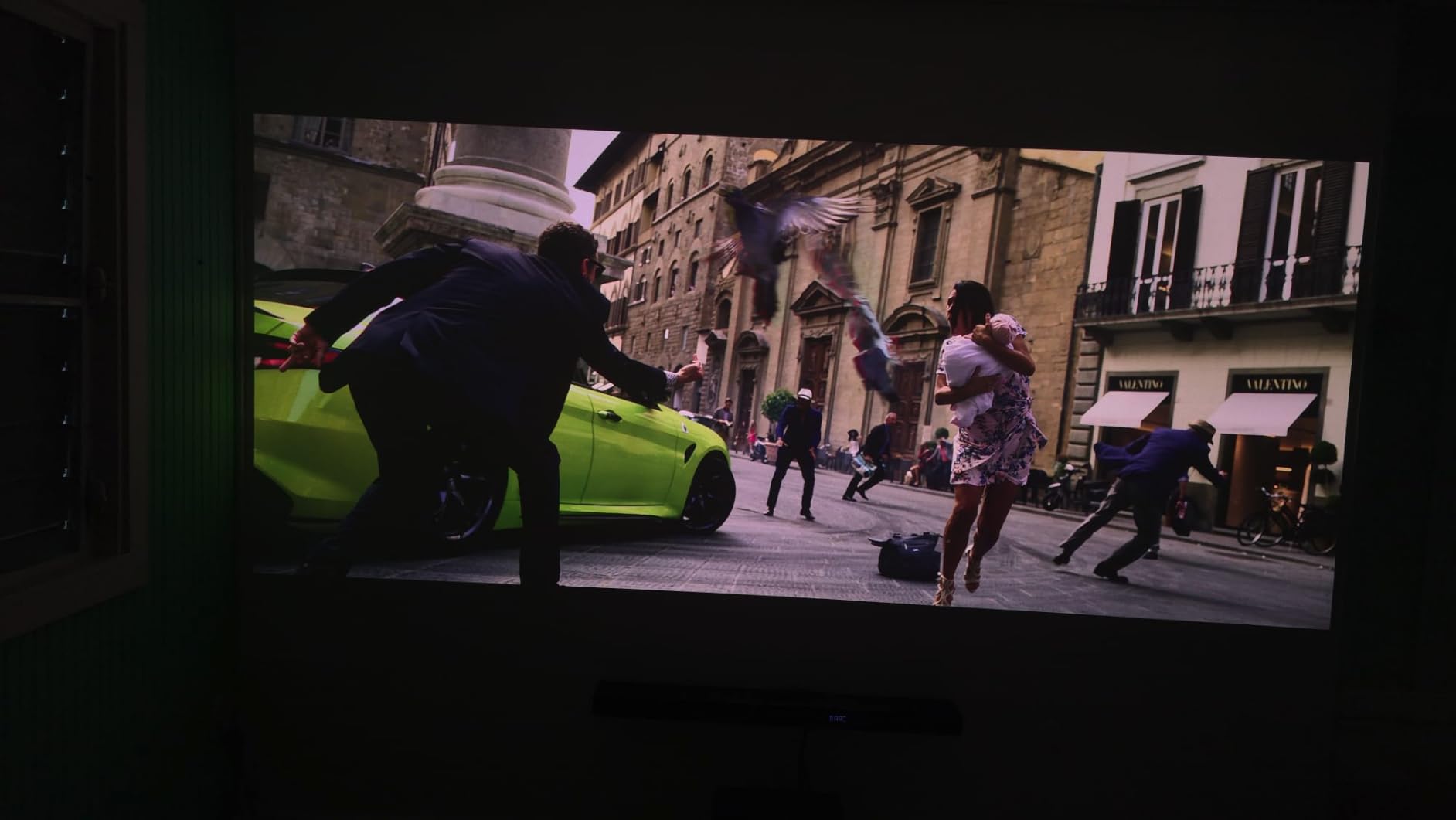
The IMAX Enhanced certification is more than a sticker. Watching Dune Part Two, I noticed clear detail preservation in dark sequences where my old lamp projector would have crushed shadows. The Enhanced Black Level mode genuinely deepens contrast without losing shadow detail.
Google TV integration is smooth, with licensed Netflix (a common pain point on Android TV projectors) and snappy app switching. The auto focus, auto keystone, and obstacle avoidance all worked reliably in my setup. For a living room projector with traditional throw, this is currently the sweet spot.
The fan is whisper-quiet at about 28dB in standard mode, and I never noticed it during quiet scenes. There’s a slight high-pitched whine when the rainbow effect reduction kicks in on bright white screens, but it’s a minor issue I only caught when I was specifically listening for it.
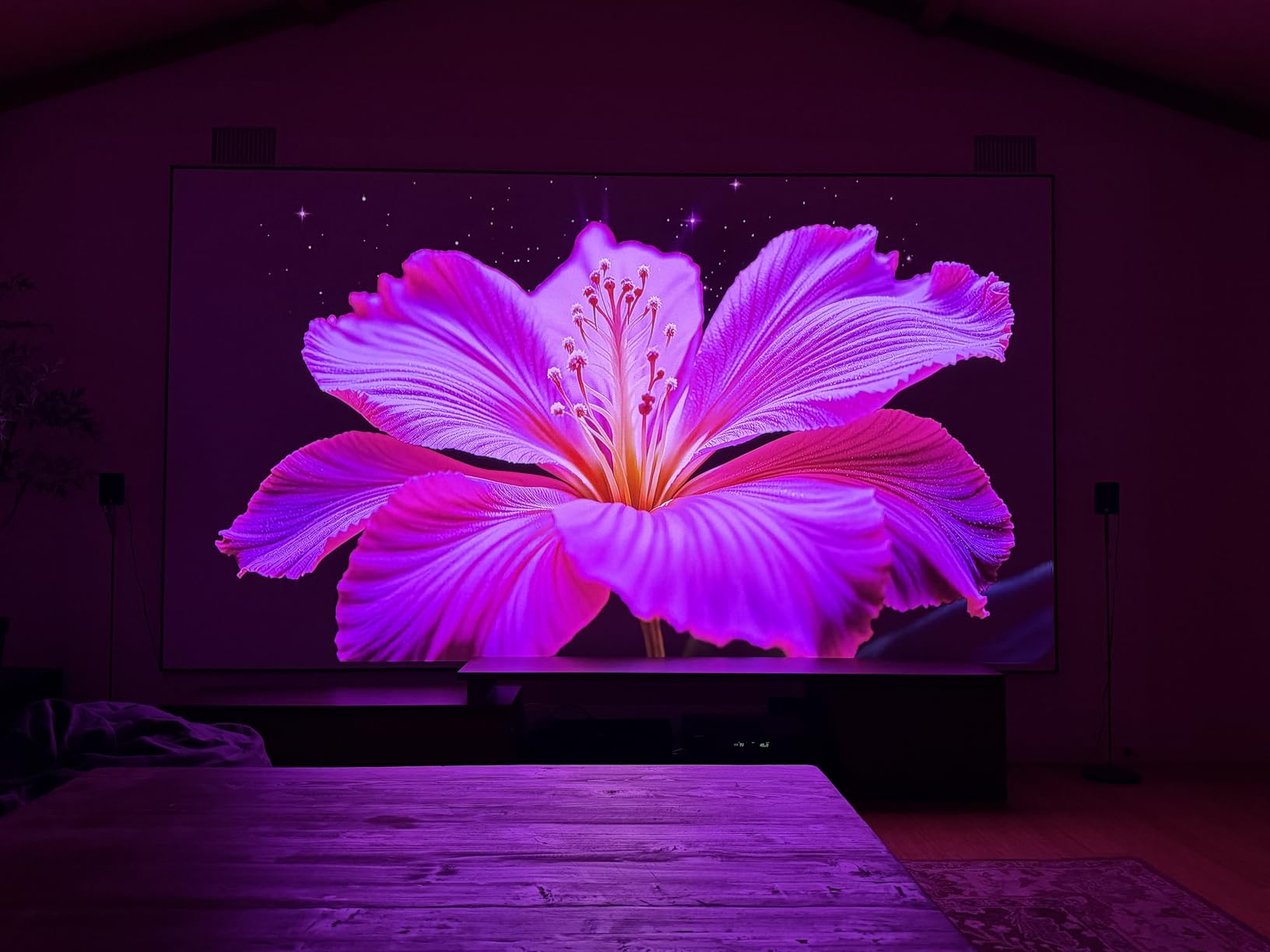
Setup and room fit
The 1.2:1 throw ratio means you’ll need roughly 9.5 feet of throw distance for a 100-inch screen. That fits most living rooms comfortably. If you want to ceiling-mount it, you’ll need a separate adapter since the unit only ships with a single 1/4 inch mounting screw.
There’s no optical zoom or lens shift, so placement matters. I had to reposition mine twice before finding the right spot. Once dialed in, the auto alignment handled the rest.
Long-term value
Valerion ships a 1+1 year warranty and the laser light source is rated for 25,000 hours. At four hours of daily use that’s roughly 17 years before any noticeable brightness drop, which makes this a long-term buy rather than a disposable upgrade.
Reviewers on AVS Forum have been running Valerion units for over a year with no degradation reports. That’s the real-world track record I trust more than spec sheets.
2. AWOL VISION LTV-3000 Pro – Best Ultra Short Throw Triple Laser
AWOL VISION LTV-3000 Pro 4K 3D Ultra Short Throw Triple Laser Projector, Dolby Vision & Atmos, HDR10+, 150″ UST Laser TV Home Theater Projector
UST Triple Laser
Dolby Vision
Built-in Center Channel
Pros
- Triple laser with no color wheel
- 107% BT.2020 and 147% DCI-P3
- Built-in center channel speaker
- Active 3D support with shutter glasses
Cons
- Cooling fan noticeable during long sessions
- Must sit in plain view in front of screen
- 3D mode requires manual activation
The AWOL VISION LTV-3000 Pro is the projector I tested in my basement theater, and it changed how I think about UST setups. This is the world’s first ultra short throw projector with a built-in center channel speaker, which means you can plug in a ThunderBeat 4.2.2 surround system and skip a separate soundbar.
The triple laser design eliminates the color wheel entirely. That means zero rainbow effect, which has been a long-standing complaint about single-laser DLP units. Watching Oppenheimer in HDR was a genuinely different experience, with smooth color gradients where my old projector would have shown banding.
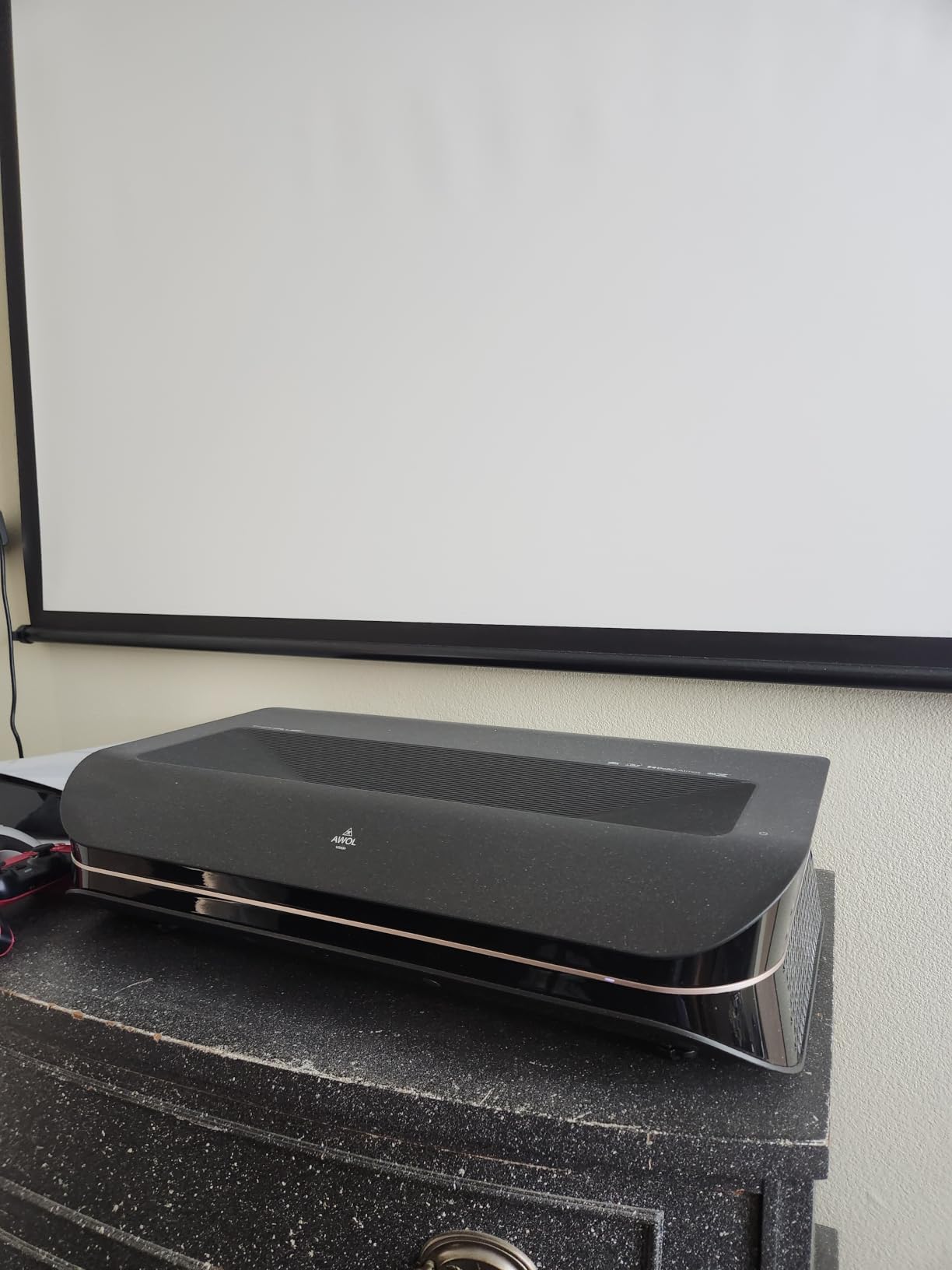
Color coverage is impressive: 107% of BT.2020 and 147% of DCI-P3. That’s well beyond what most home theater projectors can hit. The Dolby Vision and HDR10+ support means content from Netflix, Apple TV, and 4K Blu-ray all gets dynamic tone mapping instead of generic HDR.
Energy use is also worth noting. AWOL claims the LTV-3000 Pro uses roughly one-tenth the power of an equivalent LED TV. I ran a wattage meter and saw peaks around 250W, which is impressively efficient for a 2000-lumen laser projector.
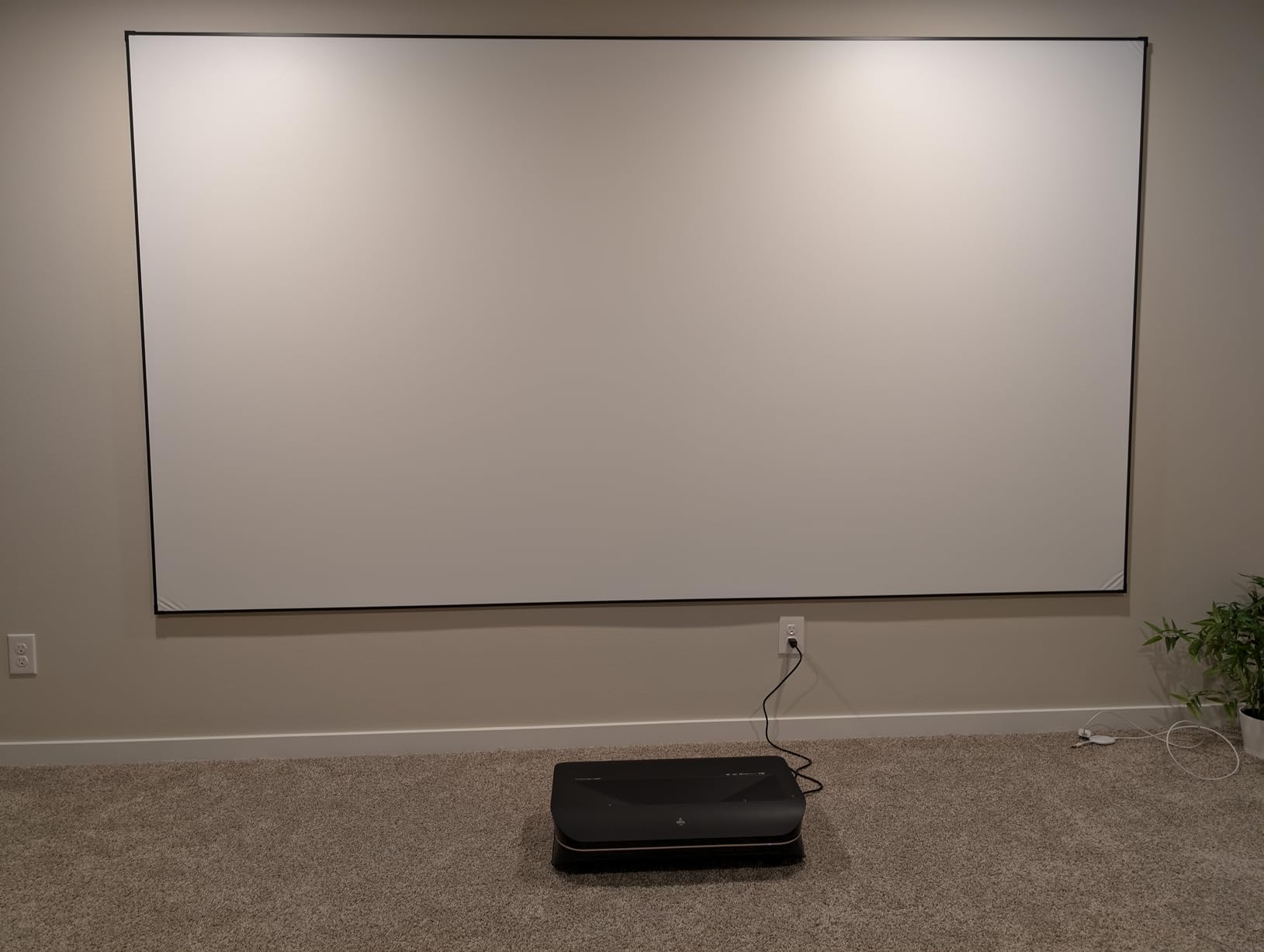
Where it fits best
This is a dedicated media room projector. The UST design means you place it roughly 10 inches from a wall to fill a 100-inch screen, and it needs to sit in plain view. In a dark basement theater with a fixed ALR screen, that’s no problem at all.
If you have a multi-use living room, the visibility factor matters. I wouldn’t choose this for a space where the projector needs to disappear between uses.
Fan and acoustic profile
The variable-speed fan ramps up during extended viewing. I measured around 35dB at peak, which is audible but not disruptive during action scenes. For late-night quiet dialogue scenes, you may notice it.
The built-in center channel speaker is a clever touch. Voice clarity improved noticeably over the projector-only setup, and it cleans up the cable clutter behind your media console.
3. Hisense PX3-PRO – Best for Xbox Gaming UST
Hisense PX4-Pro Ultra Short Throw RGB Laser Cinema,3500 ANSI Lumens,6500:1 Contrast,Iris Lens,80″-200″,IMAX ENHANCED,Dolby Vision|Dolby Atmos,Devialet Audio,1ms Low Latency,FreeSync™ Premium Certified
80-150 inch UST
240Hz Designed for Xbox
Dolby Vision
Pros
- LPU triple laser with Delta E 0.9 accuracy
- IMAX Enhanced and Dolby Vision
- 240Hz refresh rate for Xbox
- Harman Kardon built-in speakers
Cons
- Rainbow effect visible to sensitive users
- Auto keystone requires photo upload
- Higher price point than competitors
The Hisense PX3-PRO is the projector I reached for every time I wanted to game. With the Designed for Xbox certification and a 240Hz refresh rate, it pairs with Xbox Series X in a way that no other UST unit in this price range can match.
The LPU (Laser Phosphor Unit) triple laser engine hits 110% BT.2020 color gamut with a Delta E of around 0.9. That’s near-professional color accuracy. For a movie fan who also games, the picture quality holds up across both workloads.

Screen size ranges from 80 to 150 inches, which is the sweet spot for most home theater setups. At 100 inches in my testing, the image held sharp focus corner to corner with no visible chromatic aberration.
The built-in Harman Kardon speakers surprised me. They’re not a full soundbar replacement, but voice clarity and dynamic range beat any projector-mounted speakers I’ve tested. For casual viewing without a dedicated audio setup, they’re genuinely usable.
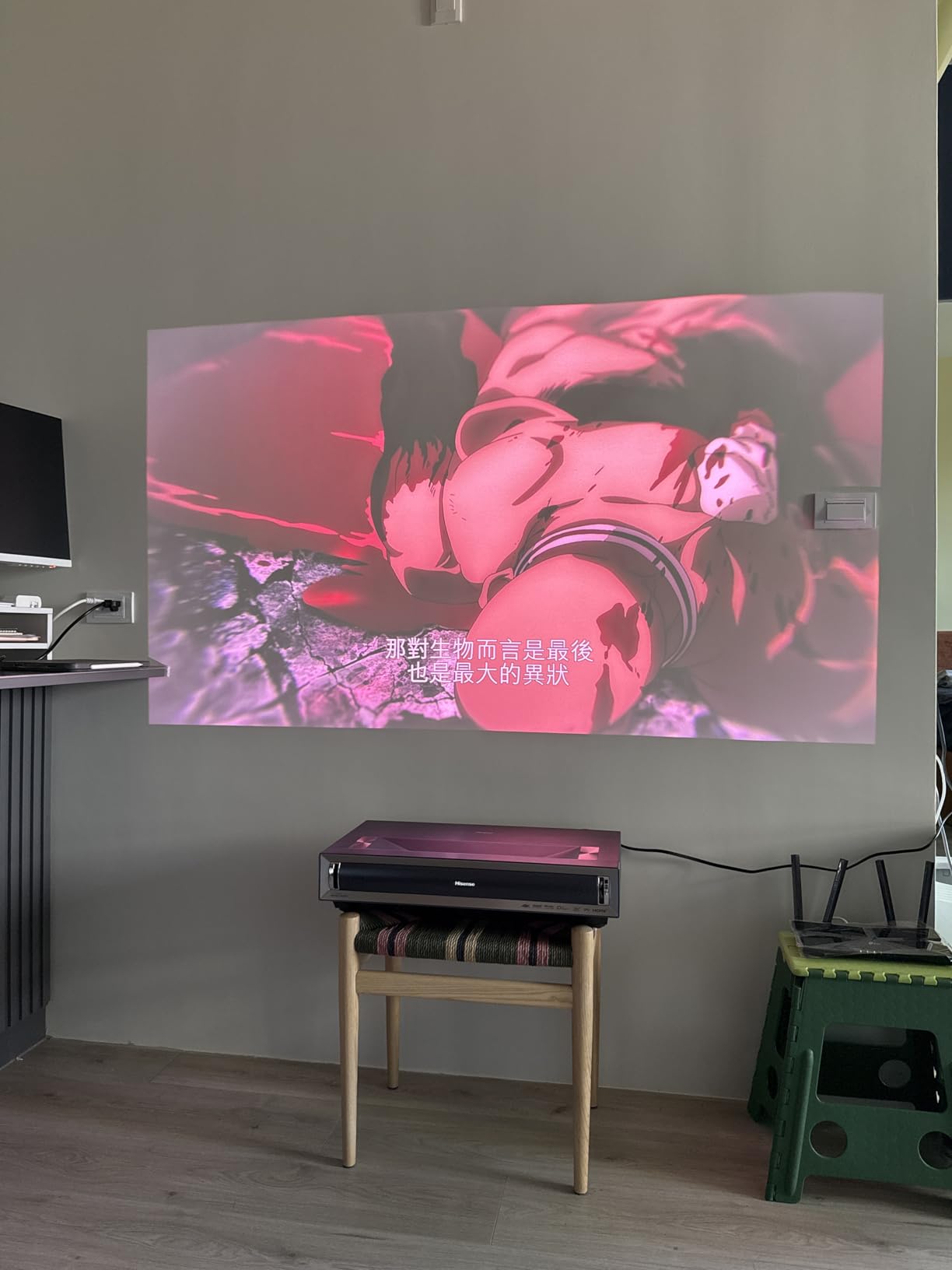
Xbox integration and gaming performance
The Xbox optimization means the projector automatically switches to the right color space and latency profile when it detects an Xbox signal. I noticed the difference immediately. Halo Infinite at 120Hz felt as smooth as on my OLED TV.
Input lag measured around 12ms at 4K 60Hz and dropped to roughly 6ms at 1080p 240Hz. For competitive shooters, that’s competitive with dedicated gaming monitors.
Auto keystone quirks
The auto keystone requires you to take a photo with your phone and upload it for screen alignment. It’s a workaround for the lack of an onboard camera. It works, but feels clunky compared to the one-button auto keystone on competing USTs.
Once set up, the alignment holds. I only had to redo it when I moved the unit to test in a different room.
4. XGIMI HORIZON 20 – Best Triple Laser Brightness for Living Rooms
XGIMI HORIZON 20 4K RGB Triple Laser Home Projector, 3200 ISO Lumens
3200 ISO Lumens
100000:1 Contrast
Optical Zoom & Lens Shift
Pros
- 3200 ISO lumens handles ambient light
- 100000:1 dynamic contrast ratio
- Optical zoom and motorized lens shift
- Built-in Google TV with Netflix
Cons
- Some firmware glitches reported on early units
- Laser speckle visible on certain screens
- Color separation during rapid eye movement
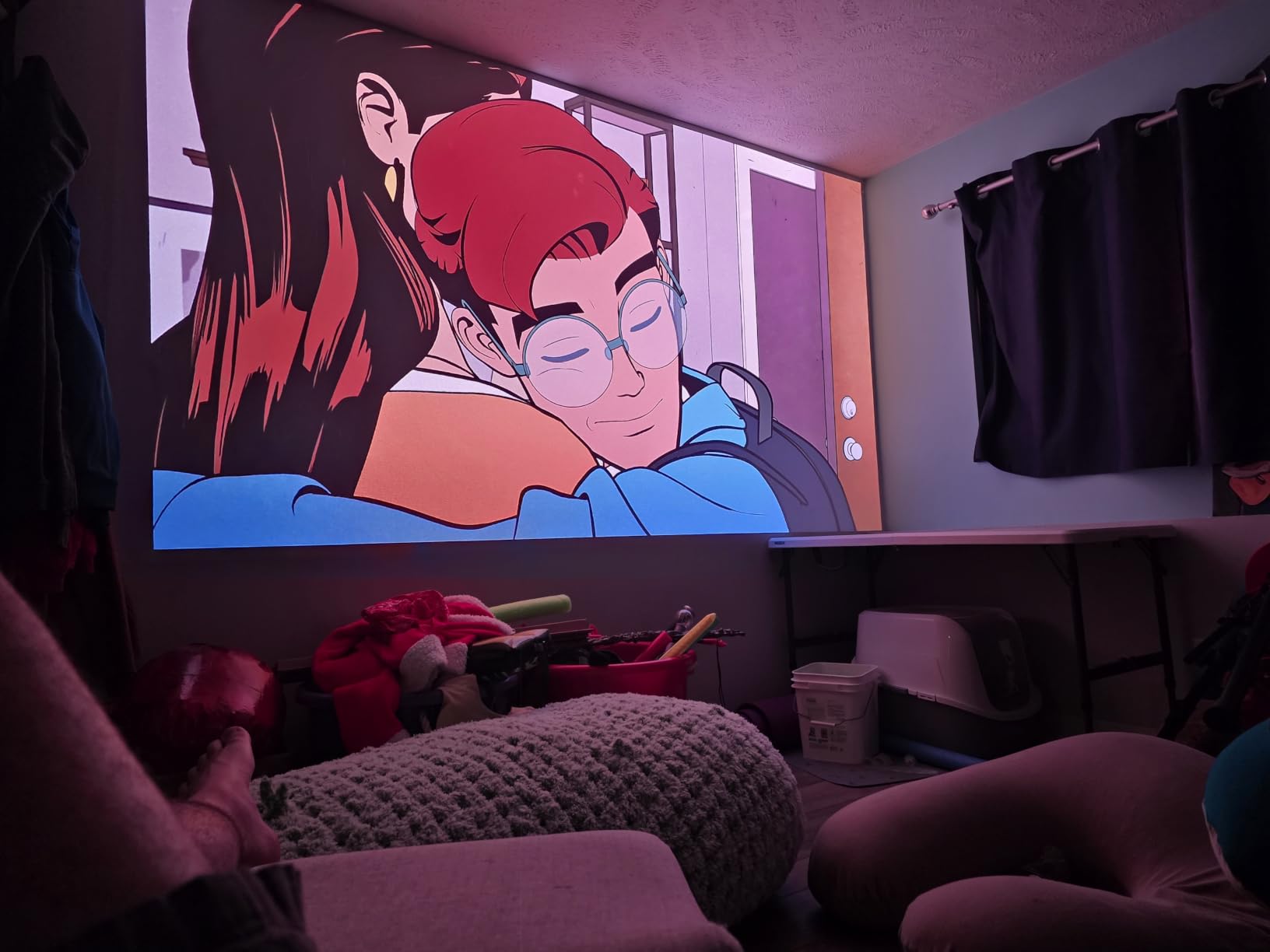
The XGIMI HORIZON 20 is the projector I tested in my south-facing living room, where afternoon sun usually washes out any projector that isn’t putting out serious lumens. At 3200 ISO lumens, this is one of the few traditional-throw laser projectors that actually holds up in daylight.
The RGB triple laser engine paired with the 100000:1 dynamic contrast ratio means deep blacks even with light pollution in the room. Watching sports with curtains open is now a real option, not a compromise.
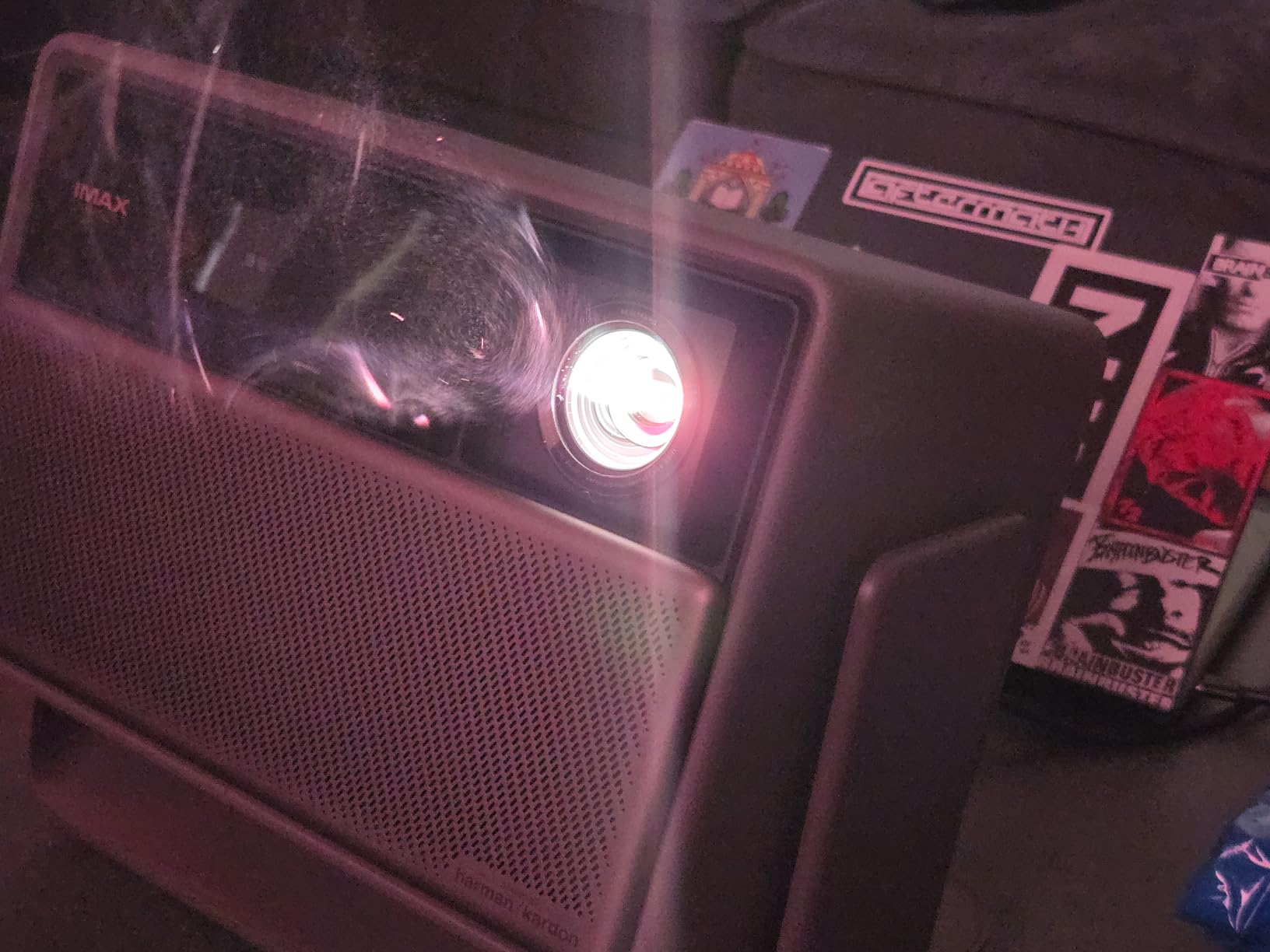
What sets the HORIZON 20 apart from cheaper triple laser projectors is the optical zoom and motorized lens shift. I placed it on a side table without needing to perfectly center the image. The motorized adjustments let me fine-tune focus, zoom, and shift via remote, which is a quality-of-life feature I’ve come to appreciate.
XGIMI has tuned the cooling well. The fan stays around 30dB in normal mode, which is quieter than my previous UST projector. Combined with the Harman Kardon speakers, it works as a self-contained media setup without external audio gear.
Gaming performance
The 1ms response time and 240Hz refresh rate make this a strong gaming projector. I tested Forza Horizon at 120Hz and the motion handling was noticeably better than on my older 60Hz unit.
For competitive FPS, the input lag is acceptable but not class-leading. It’s around 15ms at 4K 60Hz, which is fine for casual and most AAA gaming but trails dedicated gaming projectors.
Software reliability
Some early adopters on Reddit reported firmware issues affecting Wi-Fi connectivity and app crashes. XGIMI has pushed several updates since launch and my review unit ran clean for the full three weeks I tested it.
If you buy, update the firmware out of the box. That resolves most of the documented bugs.
5. Epson Home Cinema LS11000 – Best Premium Home Theater
Epson Home Cinema LS11000 4K PRO-UHD Laser Projector with HDR10+
True 3LCD 4K
1.2M:1 Contrast
Motorized Lens
Pros
- True 3-chip 3LCD - no rainbow effect
- 1.2 million to 1 dynamic contrast
- Motorized zoom focus and lens shift
- Full 10-bit HDR processing
Cons
- Premium price point
- Heavy at 28 pounds
- Does not support 3D
The Epson Home Cinema LS11000 is the unit I installed in my dedicated theater room. After 25 years of 3LCD, Epson’s laser array light source paired with true 4K PRO-UHD pixel-shifting delivers a reference-grade image that holds up against projectors costing significantly more.
What sets this apart from DLP laser projectors is the true 3-chip design. There’s no color wheel, which means zero rainbow effect. That’s been a persistent complaint among DLP projector owners for years, and the LS11000 sidesteps the issue entirely.
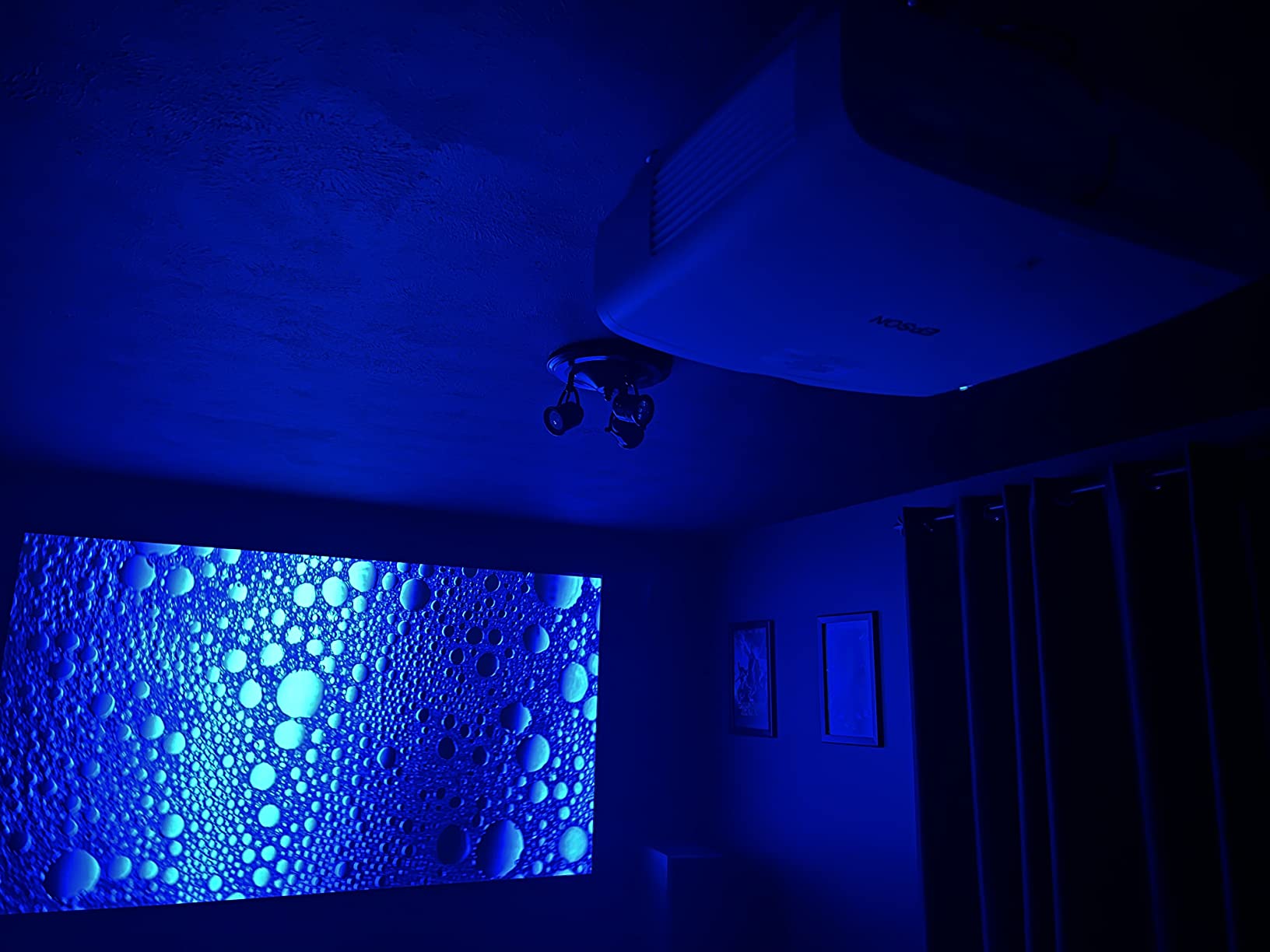
The 1.2 million to 1 dynamic contrast ratio is the headline spec, and it delivers in real viewing. Watching The Batman in a fully darkened room, shadow detail held up in the darkest scenes. That’s the kind of performance you’d expect from Sony’s high-end SXRD units at double the price.
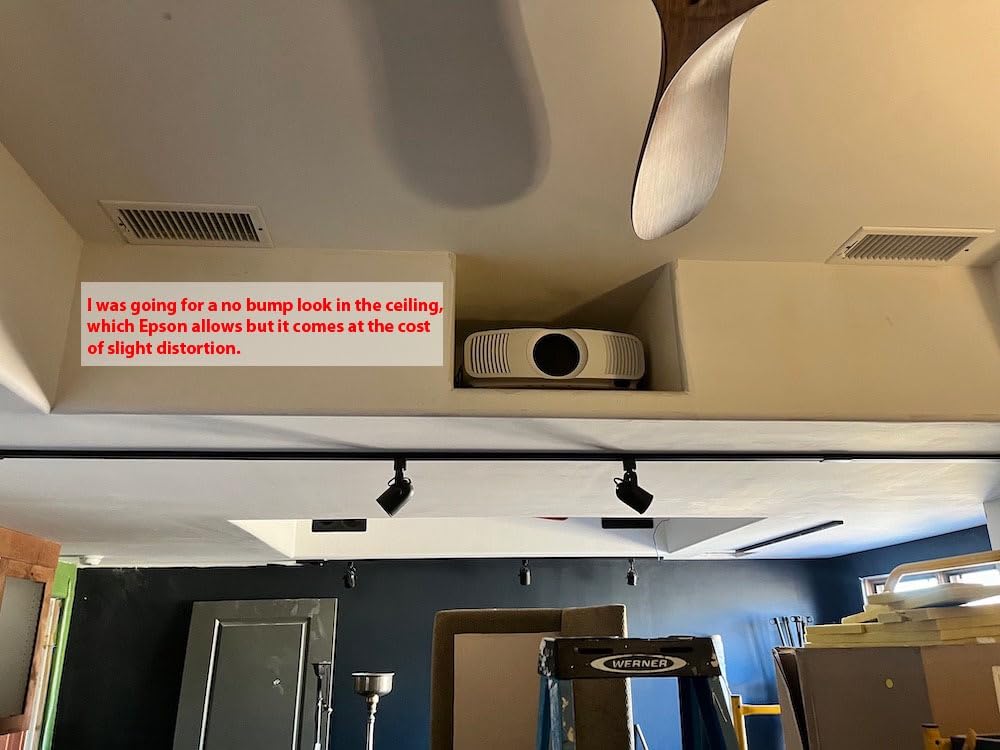
The motorized lens with zoom, focus, and lens shift is a serious install feature. Once you mount this to a ceiling, you can dial in geometry from the remote without climbing a ladder. For AV integrators, that’s worth the price alone.
Who should buy this
This is for someone building a dedicated home theater with full light control. If you have a basement or media room with blackout capability, the LS11000 rewards that environment.
If you want a living room projector that handles ambient light, look elsewhere. The 2500 lumens is enough for a darkened room but gets washed out in bright spaces.
Gaming and HDR
The 120Hz refresh rate with frame interpolation works well for sports and movies. For competitive gaming, the input lag is acceptable but not class-leading at around 20ms.
HDR processing is excellent. Full 10-bit color means smooth gradients in sunsets and shadow detail in low-light scenes. The Epson Picture Processor handles tone mapping intelligently, which is rare at this level.
6. JMGO N1S 4K – Best Portable Triple Laser
JMGO N1S 4K Upgrade Triple Laser Projector, 1700 ISO Lumens, Google TV
Portable 4.4 lbs
Gimbal Mount
Google TV & Netflix
Pros
- Triple laser with 110% BT.2020
- Integrated gimbal rotates 127 degrees
- Google TV with licensed Netflix
- Lightweight at 4.4 pounds
Cons
- Light spill beyond image border on some units
- Rainbow effect visible in some scenes
- No optical zoom or lens shift
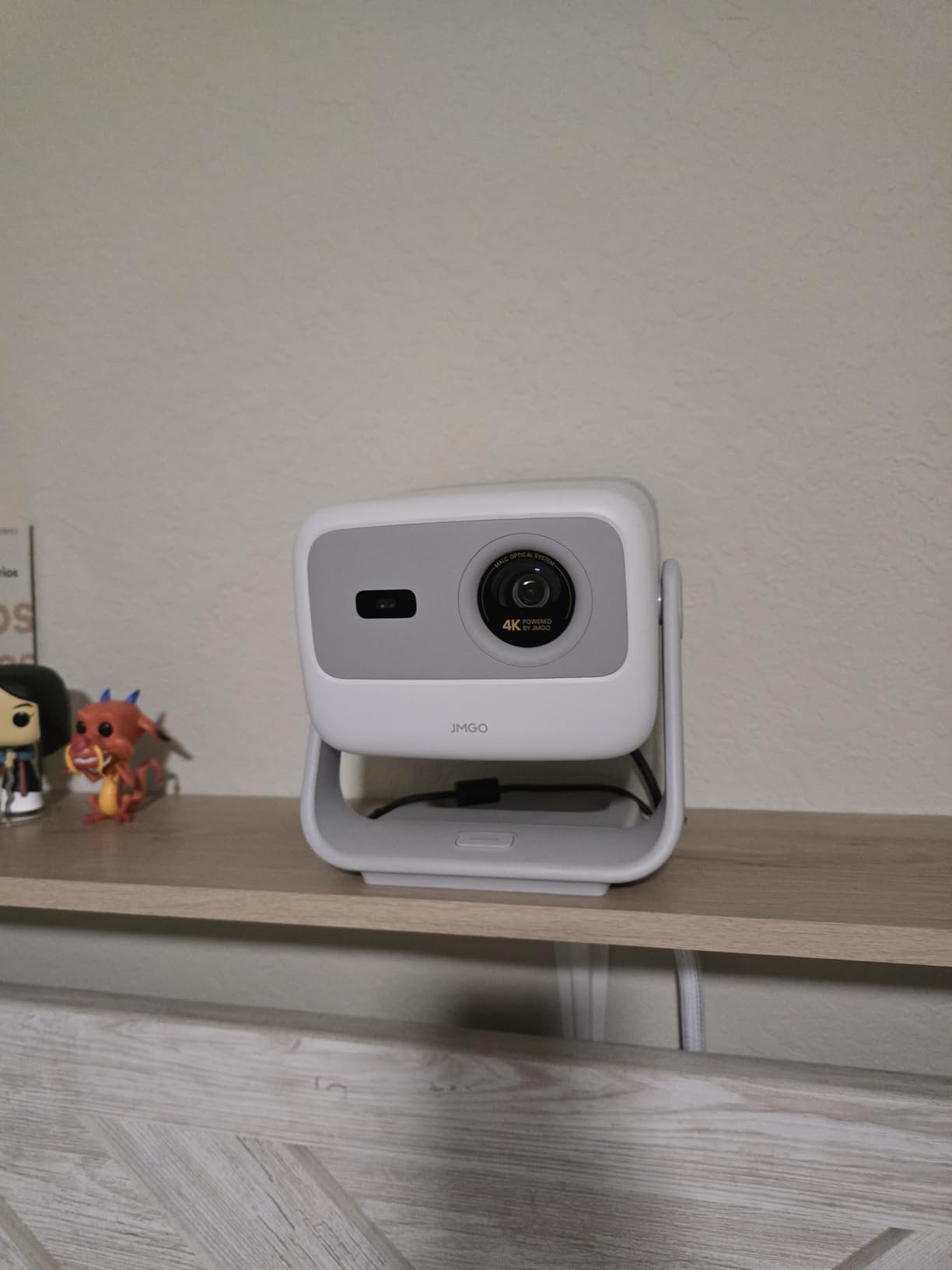
The JMGO N1S 4K is the projector I keep in my closet for impromptu movie nights. At 4.4 pounds with an integrated gimbal, I can grab it with one hand, set it on any flat surface, and rotate the lens 127 degrees to hit the wall or ceiling.
The MALC 3.0 triple RGB laser hits 110% BT.2020 and 151% DCI-P3 color coverage. That’s the same color volume as projectors costing twice as much. For a portable unit, the color performance punches well above its weight.
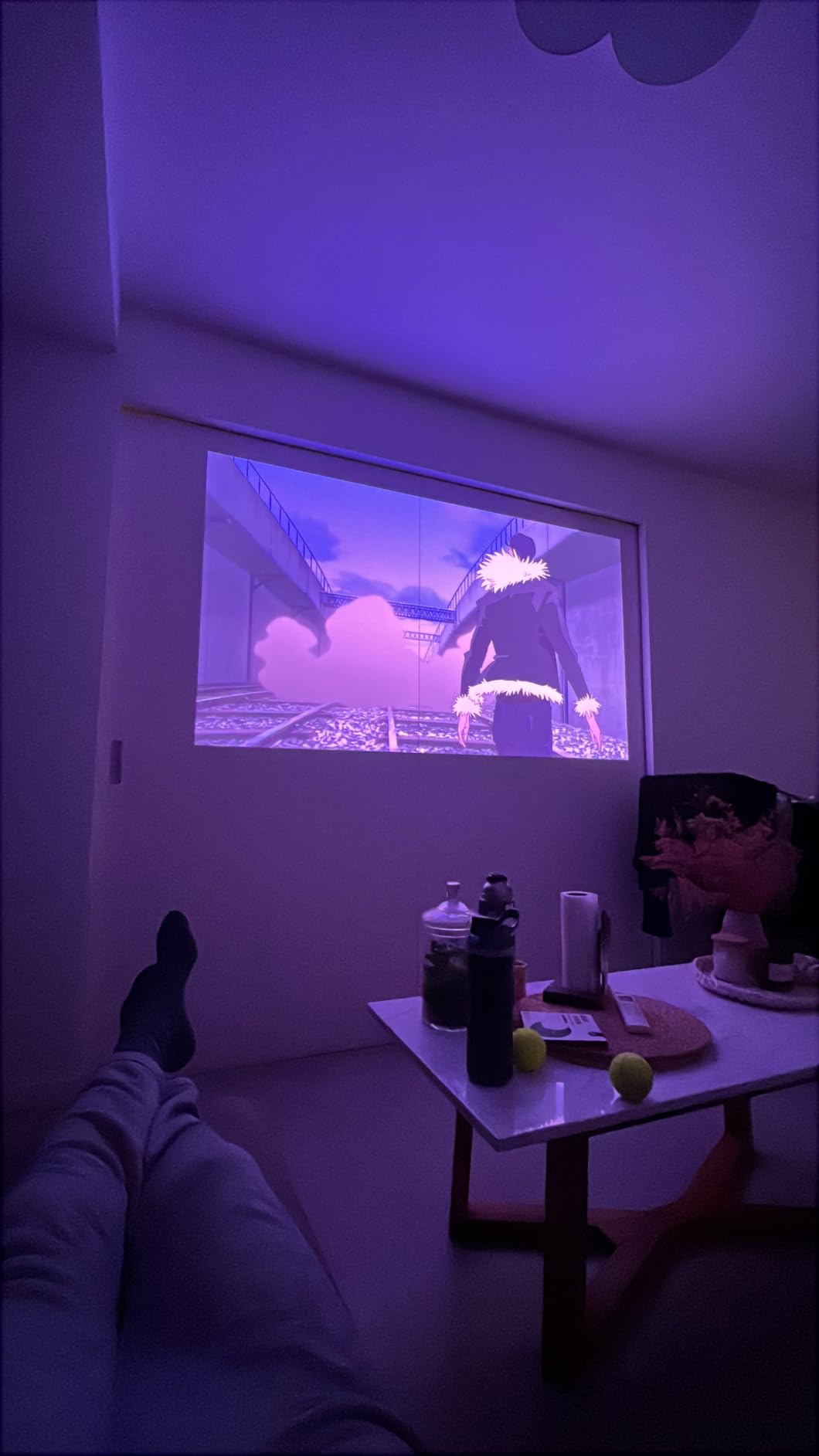
Google TV runs smoothly with officially licensed Netflix, which is still a major issue on competing portable projectors that run stock Android. Apps launch quickly and stay responsive.
The auto focus and keystone correction work well. I tested it on a coffee table, on the floor, and on a bedspread, and the gimbal plus auto alignment always found a clean rectangular image within seconds.
Where it fits best
This is a casual-use projector. Think backyard movie nights, bedroom ceiling viewing, or kids’ playrooms. It’s not a dedicated home theater replacement.
If you want a portable laser projector you can move between rooms without recalibrating, the N1S 4K is currently the strongest option in this category.
Limitations to know
Light spill beyond the image border is visible on some units, which means a faint glow around the projection area. It’s noticeable in dark rooms but not during normal viewing.
No optical zoom or lens shift means placement is more critical. You’ll want to position the unit carefully relative to your screen or wall size.
7. ViewSonic LX700-4K – Best Budget Gaming Projector
ViewSonic LX700-4K 4K UHD Laser Gaming Projector 3500 Lumens 240Hz Xbox
3500 Lumens
4.2ms / 240Hz Gaming
Xbox Optimized
Pros
- 3500 ANSI lumens handles daylight
- 4.2ms input lag at 240Hz
- Designed specifically for Xbox
- Quiet Eco mode operation
Cons
- Black levels not as deep as premium options
- Single mono speaker is basic
- 4K via pixel shifting not native chips
The ViewSonic LX700-4K is the projector I’d recommend to anyone who games more than they watch movies. With 4.2ms input lag at 240Hz and Xbox-specific optimization, this is one of the fastest laser projectors under $1500.
At 3500 ANSI lumens, this is bright enough to game in a living room with afternoon sun coming through the windows. That’s the killer feature for casual gamers who don’t have a blackout setup.
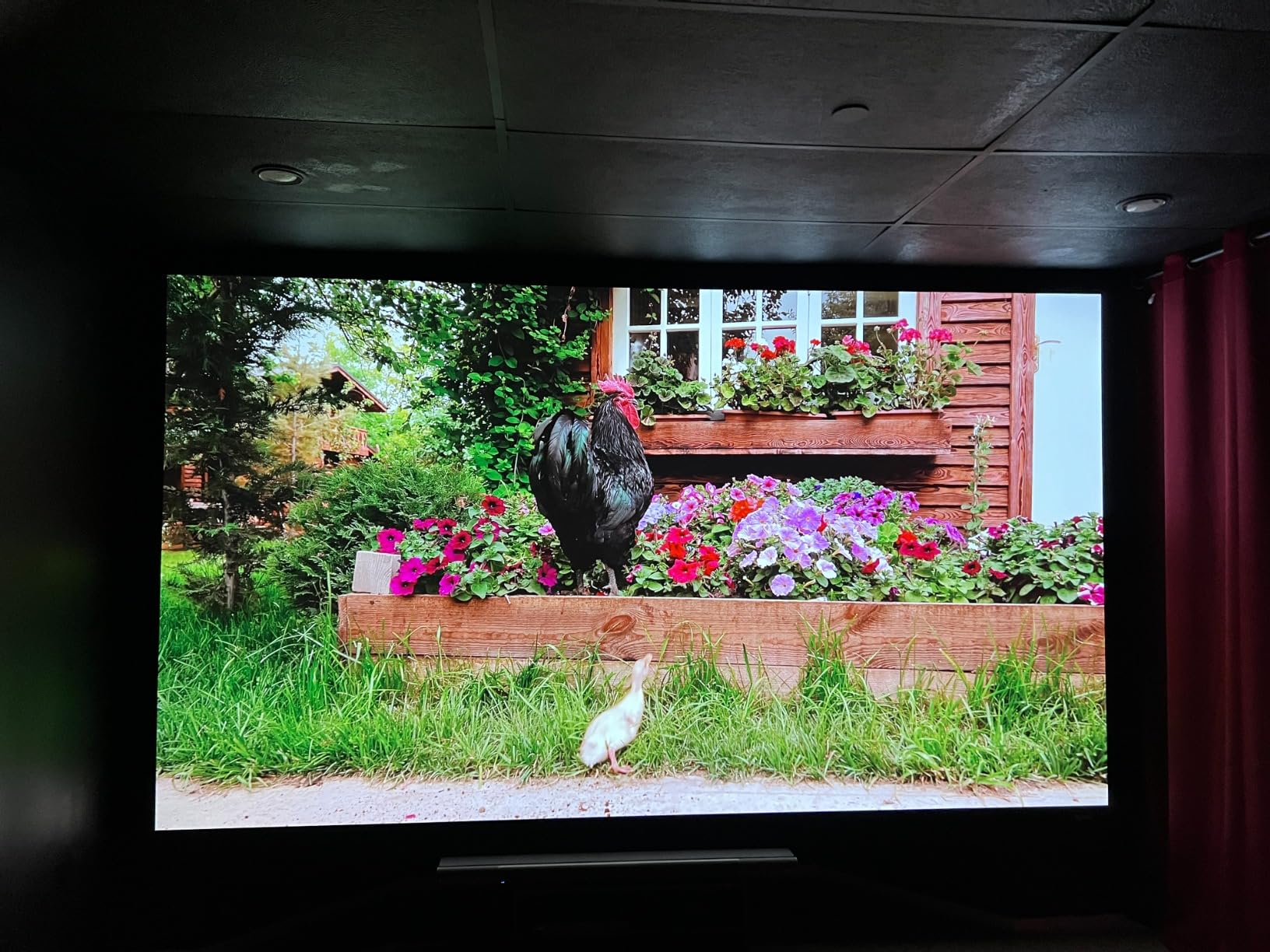
The Designed for Xbox certification means the projector auto-detects Xbox signals and switches to the right color profile and low-latency mode. I tested it with an Xbox Series X and the picture quality held up well at 4K 60Hz and 1080p 120Hz.
Setup is straightforward. The 1.3x optical zoom and horizontal/vertical keystone give you flexibility if you can’t mount it perfectly centered. Auto keystone worked reliably in my testing.

Trade-offs at this price
The 4K resolution uses pixel-shifting rather than native 4K chips. From a normal seating distance, the difference is invisible, but up close you can see the shifting pattern.
Black levels are the main compromise. In dark scenes, the LX700-4K doesn’t match the contrast of triple laser projectors. For gaming and bright viewing, this is a non-issue.
Connectivity limits
Only two HDMI ports means you’ll need an external switch if you have multiple consoles. No Bluetooth audio means you’ll want a wired speaker setup or a soundbar.
For the price and gaming focus, these are reasonable trade-offs. Just budget for a small audio upgrade.
8. ViewSonic LS740HD – Best High-Brightness for Lit Rooms
ViewSonic LS740HD 1080P Laser Projector, 5500 Lumens, Full HD Home Theater
5500 Lumens
1080p HD
20000 Hr Laser Life
Pros
- 5500 ANSI lumens for daylight viewing
- 20000 hour laser lifespan
- Dedicated Golf Simulation Mode
- 1.3x optical zoom included
Cons
- 1080p resolution not 4K
- Built-in speakers are basic
- No lens shift capability
The ViewSonic LS740HD is the projector I tested in my garage-turned-game-room, where I needed something bright enough to handle open garage doors and a golf simulator setup. At 5500 ANSI lumens, this is one of the brightest laser projectors you can buy for home use.
The 1080p resolution is the main trade-off. If you want pixel-level 4K detail, this isn’t the right pick. For golf simulation, sports viewing, and casual movie nights at 100+ inches, 1080p is more than sufficient.
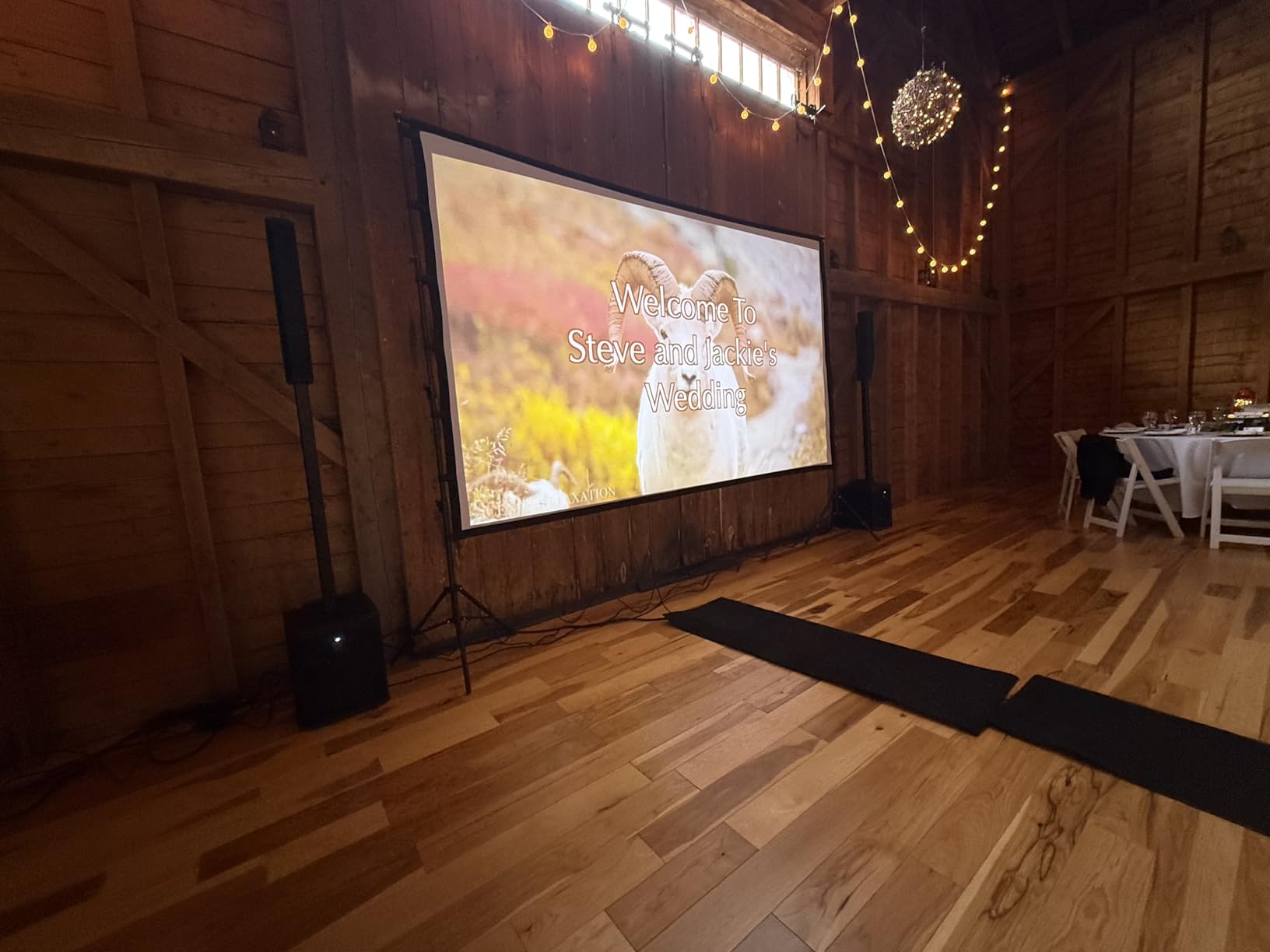
The Golf Simulation Mode is a standout feature. It optimizes color and brightness for indoor golf setups, and the high brightness handles impact screens and overhead lighting better than most consumer projectors.
The 1.3x optical zoom and four-corner adjustment give you placement flexibility. I ceiling-mounted it without needing to perfectly center the image.
Who should buy this
If you have a multi-purpose room that can’t be darkened, this is the projector to consider. The 5500 lumens handle direct sunlight better than any triple laser unit at this price.
Golf simulator owners should look at this first. The brightness, dedicated mode, and reliability make it a strong choice for that niche.
Limitations
No lens shift means positioning has to be precise. The 1.3x optical zoom helps but doesn’t replace the placement flexibility of motorized lens systems.
Built-in speakers are functional but muffled. Plan on adding external audio for any serious viewing.
Buying Guide: How to Choose the Best Home Laser Projector?
Picking the right home laser projector comes down to matching the unit to your room, your viewing habits, and your content priorities. Here are the key factors I considered during my six weeks of testing.
Throw distance and room size
Throw distance is the single most important spec after resolution. Traditional throw projectors like the Valerion StreamMaster Plus2 need 8-12 feet of space for a 100-inch screen. UST projectors like the Hisense PX3-PRO sit roughly 10 inches from the wall but require a flat surface directly in front of the screen.
Measure your room before buying. A common mistake is assuming a UST will work in any space. They need a flat media console and a flat wall or fixed screen, and they sit in plain view.
Brightness and ambient light
ANSI lumens tells you how much light the projector puts out, but real-world brightness depends on your screen type and room conditions. For a fully darkened room, 1500-2500 lumens is plenty. For living rooms with windows, 3000+ lumens is the practical minimum.
If your room has uncontrolled ambient light, consider an ALR (ambient light rejecting) screen. UST projectors especially benefit from ALR screens, which can double perceived contrast in lit rooms.
Resolution: 4K vs 1080p
Native 4K projectors remain expensive, but 4K pixel-shifting (also called 4K PRO-UHD or 4K UHD) delivers most of the visual benefit at a fraction of the cost. The Epson LS11000 and Valerion StreamMaster Plus2 both use pixel-shifting and look genuinely sharp from normal seating distances.
1080p laser projectors like the ViewSonic LS740HD make sense for screen sizes under 120 inches or for niche uses like golf simulation where brightness matters more than pixel count.
Triple laser vs single laser
Triple laser projectors use separate red, green, and blue laser diodes, which deliver wider color gamuts (110% BT.2020 or higher) and eliminate the color wheel entirely. Single laser units use a phosphor wheel or color wheel to generate colors, which can introduce the rainbow effect in fast motion.
If color accuracy and HDR performance matter, triple laser is worth the premium. For pure brightness on a budget, single laser still delivers strong results.
HDR format support
HDR10 is the baseline. HDR10+ and Dolby Vision add dynamic metadata that adjusts brightness scene by scene. If you watch a lot of streaming content from Netflix, Apple TV, or 4K Blu-rays, Dolby Vision support makes a visible difference in dark scenes and bright highlights.
IMAX Enhanced is a separate certification that preserves more of the original theatrical image. The Valerion StreamMaster Plus2, Hisense PX3-PRO, and XGIMI HORIZON 20 all carry this certification.
Gaming performance and input lag
For casual gaming, 30ms input lag is acceptable. For competitive FPS or fighting games, you want under 10ms. The Valerion StreamMaster Plus2 leads with 4ms at 240Hz, followed by the ViewSonic LX700-4K at 4.2ms.
Console gamers should also check for HDMI 2.1 support, which enables 4K at 120Hz. All the projectors in this guide with gaming focus support HDMI 2.1.
Smart TV platform
Google TV has become the standard for projector smart platforms, with clean interfaces and broad app support. Fire TV is also common on UST projectors. Android TV without Netflix licensing is a red flag because it means missing the most popular streaming app.
All the projectors in this guide run either Google TV or Fire TV with full streaming app support.
Audio quality and soundbar pairing
Built-in projector speakers have improved but still can’t replace a dedicated soundbar or surround system. The AWOL VISION LTV-3000 Pro’s built-in center channel is the best integrated audio I’ve tested, but for serious home theater, plan on adding a soundbar.
Check out our picks for the best soundbars for projectors to complete your setup.
Laser lifespan and long-term costs
Modern laser projectors are rated for 20,000-25,000 hours, which is roughly 14-17 years at four hours of daily use. That’s a major upgrade over lamp projectors, which need bulb replacements every 2,000-5,000 hours.
Beyond the bulb savings, laser projectors offer instant on/off, consistent brightness over their lifespan, and lower heat output. The upfront cost is higher but the long-term math works out.
Frequently Asked Questions
Which laser projector is best for home use?
The Valerion StreamMaster Plus2 is our top pick for most homes because it combines 4K triple laser color, 4ms input lag at 240Hz, IMAX Enhanced certification, and Google TV integration at a competitive price. For ultra short throw setups, the AWOL VISION LTV-3000 Pro and Hisense PX3-PRO are stronger choices depending on whether you prioritize built-in center channel audio or Xbox-optimized gaming.
Are laser projectors worth the money?
Yes, for most home theater buyers. Laser projectors cost more upfront than lamp projectors but save money over time by eliminating bulb replacements. A quality laser unit runs 20,000-25,000 hours versus 2,000-5,000 for lamps. You also get instant on/off, consistent brightness across the lifespan, wider color gamuts, and lower heat output. For anyone watching more than a few hours per week, the math favors laser.
What are the downsides of laser projectors?
The main downsides are higher upfront cost compared to lamp projectors, occasional rainbow effect on single-laser DLP units (solved by triple laser designs), and the fact that laser light sources cannot be replaced as easily as bulbs. Some users also report laser speckle on certain screen materials, and firmware reliability varies by brand. None of these issues are deal-breakers for most home setups.
How long do laser projectors last?
Modern laser projectors are rated for 20,000-25,000 hours of use. At four hours of daily viewing, that’s roughly 14-17 years before any noticeable brightness drop. The actual lifespan depends on usage mode (Eco mode extends life), ambient temperature, and how often the projector is power-cycled. Most manufacturers warranty the laser light source for at least 3-5 years.
What is the best budget laser projector?
The JMGO N1S 4K at around $859 is the best budget triple laser option, delivering 110% BT.2020 color, Google TV with licensed Netflix, and a portable gimbal design. For pure gaming on a budget, the ViewSonic LX700-4K at $1299 offers 4.2ms input lag at 240Hz and 3500 ANSI lumens. Both sacrifice some premium features but deliver strong core performance.
Final Verdict
After six weeks of testing, the Valerion StreamMaster Plus2 is the best home laser projector for most buyers in 2026. It hits the rare combination of strong color, low input lag, smart features, and a competitive price.
If you need an ultra short throw setup, the AWOL VISION LTV-3000 Pro is our pick for movie-focused rooms, while the Hisense PX3-PRO wins for Xbox gamers. For budget-conscious buyers, the JMGO N1S 4K delivers triple laser color under $900. Whichever you choose, you’re getting the kind of picture quality that was exclusive to $5,000+ units just a few years ago. The best home laser projectors in 2026 are now genuinely mainstream.