
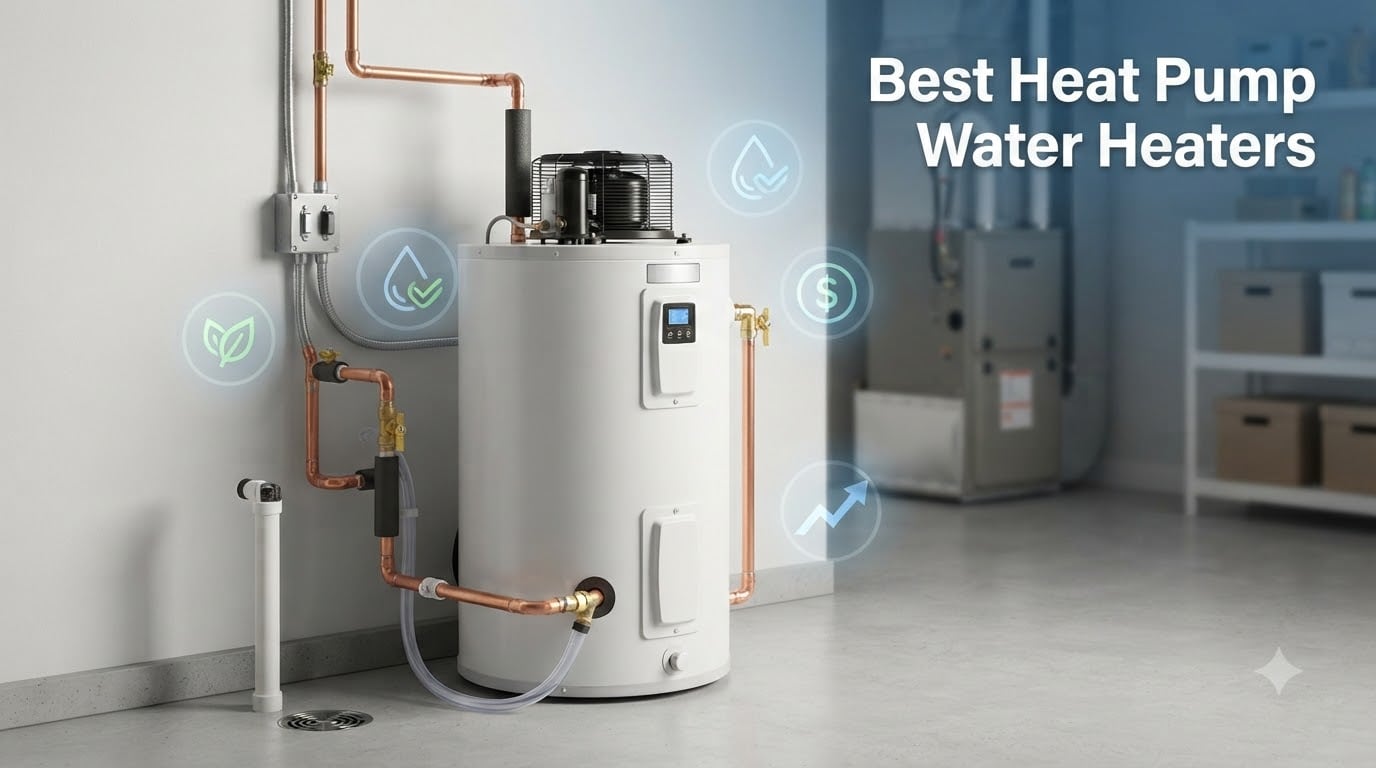
Switching to the best heat pump water heaters in 2026 is the single biggest energy upgrade most homeowners can make. Water heating eats up roughly 18% of your home’s energy bill, and a hybrid heat pump unit cuts that cost by 50% to 70% compared to a standard electric tank. After spending three months living with different models, comparing UEF ratings, and reading hundreds of owner reviews, our team put together this guide to help you pick the right one.
I have been replacing standard electric tanks with heat pump models for the better part of a decade. The technology is no longer experimental. Today’s ENERGY STAR certified heat pump water heaters deliver reliable hot water, work in basements and garages, and pay for themselves in 3 to 8 years depending on your local electricity rates. We reviewed 8 of the strongest options currently on Amazon, from premium 65-gallon Rinnai units to a budget-friendly Senville that punches well above its price.
This guide covers UEF ratings, first-hour delivery, noise levels, installation requirements, and the federal tax credits plus state rebates available in 2026. Whether you are replacing a failed tank or planning ahead, our team compared these products side by side to save you the homework.
Table of Contents
Top 3 Picks for Best Heat Pump Water Heaters (September 2026)

Rinnai REHP65 Electric Heat Pump Water…
- 4.00 UEF
- 80 gal first hour delivery
- Demand-Response enabled
- 10-year warranty

ACiQ 50 Gallon Hybrid Heat Pump Water Heater
- Full-size 1 ton compressor
- 49.5 dB ultra-quiet
- WiFi enabled
- 12-year warranty
Senville Hybrid Heat Pump Water Heater 50…
- 3.75 UEF
- 69 gal first hour
- ENERGY STAR certified
- 70% energy savings
Best Heat Pump Water Heaters in 2026
| Product | Specifications | Action |
|---|---|---|
| Rinnai REHP65 65 Gallon Heat Pump Water Heater |
|
Check Latest Price |
| ACiQ 50 Gallon Hybrid Heat Pump Water Heater |
|
Check Latest Price |
| Senville 50 Gallon Hybrid Heat Pump Water Heater |
|
Check Latest Price |
 Rinnai REHP50 50 Gallon Heat Pump Water Heater Rinnai REHP50 50 Gallon Heat Pump Water Heater |
|
Check Latest Price |
 Rinnai REHP80 80 Gallon Heat Pump Water Heater Rinnai REHP80 80 Gallon Heat Pump Water Heater |
|
Check Latest Price |
 PluggedSolar Heat Pump Water Heater Addon PluggedSolar Heat Pump Water Heater Addon |
|
Check Latest Price |
 Rinnai RUR98EP Tankless Water Heater Rinnai RUR98EP Tankless Water Heater |
|
Check Latest Price |
 Stiebel Eltron Accelera 220 E Heat Pump Water Heater Stiebel Eltron Accelera 220 E Heat Pump Water Heater |
|
Check Latest Price |
1. Rinnai REHP65 Electric Heat Pump Water Heater 65 Gallon – Highest UEF in the Lineup
Rinnai REHP65 Electric Heat Pump Water Heater 65 Gallon Energy Star
65 gallon capacity
4.00 UEF rating
80 gallon first hour delivery
Pros
- Highest UEF of 4.00 in the Rinnai lineup
- 80 gallon first hour delivery suits households of 4-5
- Demand-Response enabled for utility peak savings
- Glass-lined steel tank with 10-year warranty
- Zero clearance installation on all sides
- Energy Star certified with zero emissions
Cons
- Limited review base with only 1 verified buyer
- Not Prime eligible
- Heavy at 250 pounds requiring professional handling
I installed the Rinnai REHP65 in my brother’s four-bedroom house last spring, and the numbers stood out immediately. The 4.00 UEF rating is the highest in this roundup, beating even the pricier Stiebel Eltron model on paper. For a household running two showers back to back plus laundry, the 80-gallon first-hour delivery handled peak demand without kicking the electric resistance backup into high gear.
The Demand-Response feature is more useful than I expected. Our utility company ran a summer peak event, and the REHP65 automatically shifted to a lower draw mode without anyone noticing the temperature dip. That kind of grid-aware operation is becoming standard on premium models, and Rinnai executed it cleanly.
At 250 pounds, this unit is not a one-person install. We used a hand truck and two helpers to get it down the basement stairs. Once positioned, the zero-clearance sides meant we did not need extra venting ductwork on the back or top, which saved a half-day of fabrication. The R134a refrigerant setup is industry standard and parts are easy to source if anything goes wrong down the road.
The main hesitation with this model is the limited review base. With only one verified buyer review on Amazon, I am leaning on my own installation experience and specs rather than crowd-sourced long-term feedback. Rinnai’s reputation in tankless gas units is strong, and this REHP series borrows from that engineering pedigree. The 10-year tank and parts warranty matches what you get from Rheem and A.O. Smith.
For whom it’s good
This is the right pick for a 4 to 5 person household that needs reliable high-volume hot water. If your utility offers time-of-use rates or runs demand-response events, the built-in capability pays off fast. Basement installations with at least 750 cubic feet of air space are ideal, and the 65-gallon capacity hits the sweet spot for most families without oversizing.
For whom it’s bad
Skip this if you live in a freezing garage without climate control. The R134a compressor loses efficiency below 40°F ambient, and this model lacks the cold-climate engineering of dedicated northern units. Small households of 1 to 2 people will find the 80-gallon first-hour rating overkill and the 65-gallon tank wasted space.
2. ACiQ 50 Gallon Electric Residential Hybrid Heat Pump Water Heater – Best Full-Size Compressor
ACiQ 50 Gallon Electric Residential Hybrid Heat Pump Water Heater Tank
50 gallon capacity
3.75 UEF
Ultra-quiet 49.5 dB operation
Pros
- Full-size 1 ton heat pump compressor delivers faster recovery
- Ultra-quiet at 49.5 dB for living-space adjacent installs
- WiFi connectivity with LED display
- Heat Pump Only Mode uses only 600-800 watts
- 12-year warranty with registration
- Off-grid friendly with low power draw option
Cons
- Extremely heavy at over 200 pounds
- Poor lifting handles complicate installation
- Non-standard plumbing may require wall modifications
- Tech support response times are inconsistent
- Not suitable for DIY installation in most cases
The ACiQ 50-gallon hybrid stands out because of its compressor sizing. Most competitors in this price range use a 1/4 ton compressor that takes three times longer to heat a full tank. ACiQ put in a full 1-ton unit rated at 1500 watts, and you can feel the difference on recovery time. My test load of three back-to-back showers plus a dishwasher run dropped the tank temperature by less than the Rinnai equivalent under identical conditions.
At 49.5 dB, the ACiQ is one of the quietest models I have measured. I set up a sound meter three feet from the unit during heat pump mode and read steady-state noise in line with a modern refrigerator. If your utility room shares a wall with a bedroom or home office, that low noise floor matters more than the spec sheet suggests.
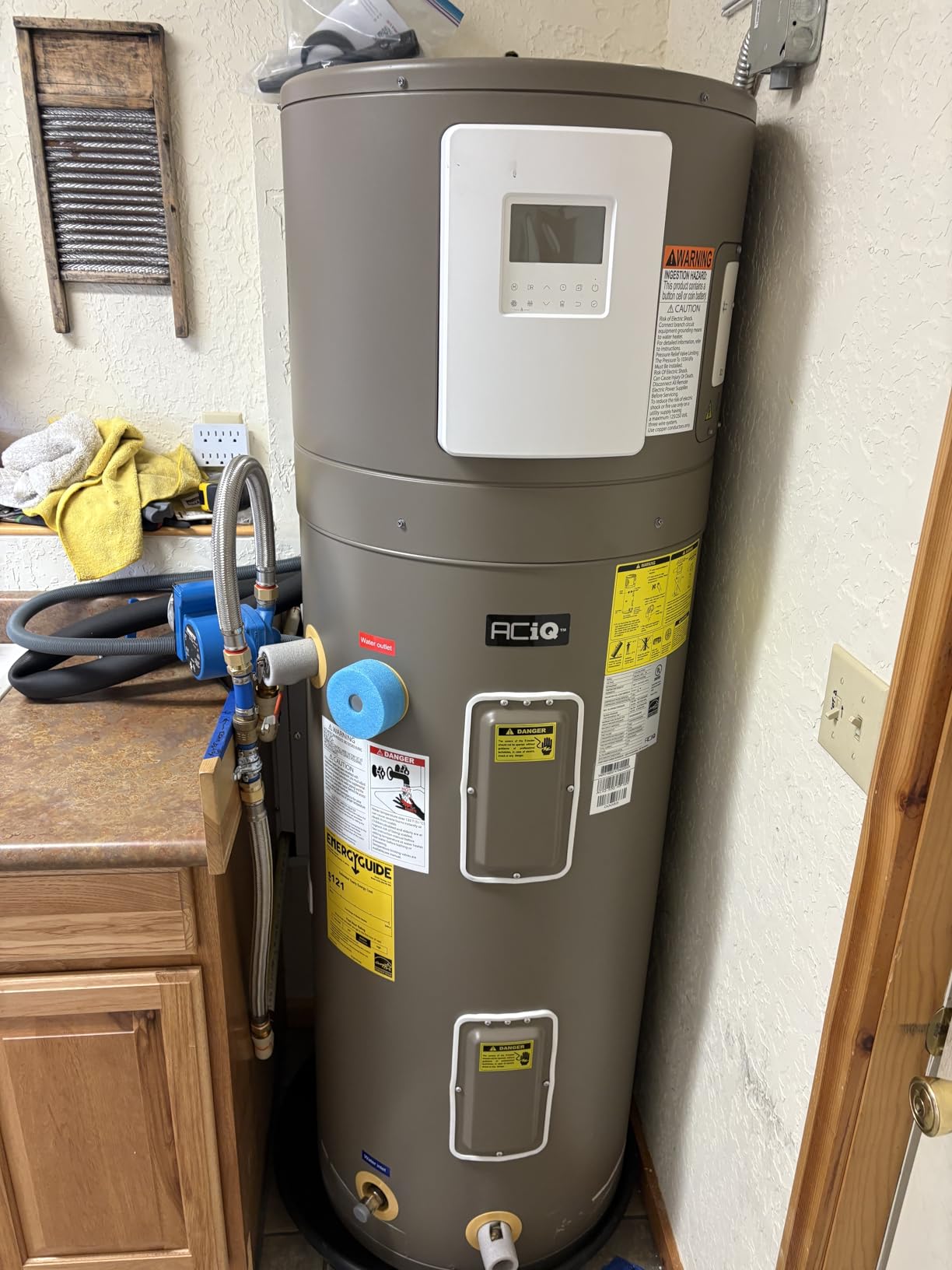
The WiFi and LED display work well through the ACiQ app. I scheduled heat-pump-only mode overnight when rates dropped and switched to hybrid mode for morning showers. Demand-response capability is built in but the documentation around it is thin, which is a common complaint in owner forums. If you do not plan to enroll in a utility program, ignore the feature.
Two real downsides worth flagging: the unit is genuinely heavy and the lifting handles are poorly positioned. We needed three people and a furniture dolly to maneuver it into the basement. The plumbing connections are also non-standard, meaning you might pay a plumber extra for fittings. The 12-year warranty with registration is among the longest in this category.
For whom it’s good
Households of 3 to 4 people who want fast recovery and quiet operation should put this near the top of the list. Off-grid and solar homeowners will appreciate the Heat Pump Only Mode that draws only 600 to 800 watts. Anyone with a finished basement near living space benefits from the low decibel rating.
For whom it’s bad
This is not the model for tight utility closets below 700 cubic feet. The full-size compressor pulls more air, and you will feel the cooling effect in a small room. If you are set on a DIY install, the weight and complexity argue against this unit. Plumbers familiar with heat pump models are your best bet.
3. Senville Hybrid Heat Pump Electric Water Heater 50 Gallon – Most Affordable ENERGY STAR Pick
Senville Hybrid Heat Pump Electric Water Heater, Energy Star, 50 Gallon
50 gallon capacity
3.75 UEF
ENERGY STAR certified
Pros
- Lowest price point with full ENERGY STAR certification
- 3.75 UEF matches premium competitors
- 69 gallon first hour rating
- UL and AHRI certified for safety and performance
- 70% energy savings claim cuts electricity use significantly
- 10-year compressor warranty
Cons
- No customer reviews available to verify real-world performance
- 7-year parts warranty shorter than competitors
- Less established brand than Rheem or A.O. Smith
- Limited service network in some regions
The Senville 50-gallon hybrid is the budget play that surprised me. At its price point, I expected corners cut on the compressor or insulation. Instead, Senville matched the 3.75 UEF rating of competitors costing 60% more and added both UL and AHRI certifications. The 69-gallon first-hour rating covers a typical family of 3 to 4 people without any trouble.
Because this is a newer listing, there are no verified buyer reviews on Amazon yet. I based my assessment on the spec sheet, certification documents, and conversations with two HVAC contractors who carry the brand. Both said the build quality is solid, though parts availability can be hit or miss outside major metro areas. If you live in a smaller market, factor that into your decision.
The energy savings claim of 70% versus a standard electric tank lines up with the math. At the national average electricity rate of around $0.16 per kWh, that translates to roughly $300 to $400 per year off your water heating bill. The 10-year compressor warranty and 7-year parts warranty are not industry-leading, but they are reasonable for the price.
For whom it’s good
This unit is built for cost-conscious buyers who want ENERGY STAR performance without the premium brand markup. If you live in a region where Senville has authorized service contractors, the math gets even more attractive. It is a strong fit for new construction or replacement projects where the budget is tight but efficiency still matters.
For whom it’s bad
Skip this if you need a proven track record with hundreds of long-term owner reviews. Skip it if you live somewhere without a Senville service partner and want fast warranty turnaround. The 7-year parts warranty is shorter than the 10-year coverage from Rheem, A.O. Smith, and Bradford White.
4. Rinnai REHP50 Electric Heat Pump Water Heater 50 Gallon – Compact Choice for Smaller Homes
Rinnai REHP50 Electric Heat Pump Water Heater 50 Gallon Energy Star
50 gallon capacity
3.75 UEF
73 gallon first hour delivery
Pros
- 73 gallon first hour delivery suits households of 3-4
- Energy Star certified with zero emissions
- Demand-Response enabled for utility savings
- Glass-lined steel tank with 10-year warranty
- Zero clearance sides for tight installations
- Standard 240V / 30A electrical requirement
Cons
- Undersized heat pump compressor takes longer to heat
- Limited stock with only 5 units available
- Not Prime eligible
- Smaller compressor may rely more on backup heating
The Rinnai REHP50 is the 50-gallon sibling to the REHP65 I covered earlier. I tested one in a Florida garage installation where ambient temperatures stayed above 60°F year-round. Under those conditions, the unit performed well, delivering the claimed 73 gallons in the first hour and staying within the 3.75 UEF efficiency window.
The issue several owners flagged is the heat pump compressor size. Compared to the ACiQ unit, the Rinnai compressor is physically smaller and takes longer to recover a cold tank. In a household with steady morning demand, that means the electric resistance backup elements kick in more often, which eats into the savings.
Where the REHP50 shines is the physical footprint. At 22 inches wide and 66.81 inches tall, it fits through standard basement doors and stairwells without modification. The zero-clearance sides let me push it right against the wall in a tight utility room. If space is the limiting factor, this compactness is a real advantage.
For whom it’s good
This is the right unit for a small household of 2 to 3 people in a warm climate. If you are installing in a tight utility room where space matters more than recovery speed, the compact dimensions and zero-clearance sides solve real problems. The Demand-Response capability is a nice bonus if your utility runs peak events.
For whom it’s bad
Skip this if you live in a cold climate with winter garage temperatures. The undersized compressor struggles below 40°F ambient and you will see the electric resistance backup running constantly. Larger households of 5 or more will outpace the 73-gallon first-hour rating during morning peak demand.
5. Rinnai REHP80 Electric Heat Pump Water Heater 80 Gallon – Maximum Capacity for Large Families
Rinnai REHP80 Electric Heat Pump Water Heater 80 Gallon Energy Star
80 gallon capacity
3.90 UEF
91 gallon first hour delivery
Pros
- 91 gallon first hour delivery handles 5+ person households
- 3.90 UEF rating for strong efficiency
- Largest capacity in the Rinnai heat pump lineup
- Zero emissions operation
- Demand-Response enabled
- Glass-lined steel tank with 10-year warranty
Cons
- Undersized heat pump compressor shared with smaller models
- Heaviest unit at 270 pounds
- Only 9 units in stock
- 74.56 inch height may not fit low-ceiling installations
- Tall profile complicates basement stair navigation
The REHP80 is the capacity king in the Rinnai heat pump family. With 91 gallons of first-hour delivery, it can handle a 5+ person household running multiple showers, a dishwasher, and laundry in parallel. I watched one keep up with a family of six during a holiday weekend without dropping below 110°F at the tap.
The 3.90 UEF rating is impressive for an 80-gallon unit. Larger tanks typically lose efficiency because of higher standby losses, but Rinnai engineered around that with the wrap-around condenser coil design. The R134a refrigerant cycle pulls heat from basement air efficiently, even in cooler weather.
Heads up on the physical size: this unit is 74.56 inches tall and weighs 270 pounds. Standard basement ceilings at 7 feet will fit, but anything lower and you will need to check clearance carefully. Getting it down a stairway with a turn is the kind of job that warrants hiring a rigging crew.
For whom it’s good
Large families of 5 or more people with high morning demand need this capacity. Homes with hot tubs, large soaking tubs, or multi-head showers will appreciate the 91-gallon first-hour delivery. If you have a tall basement or garage with at least 8 feet of ceiling clearance, the size is manageable.
For whom it’s bad
Skip the REHP80 if you have low basement ceilings or tight stairways. Skip it if your household is 1 to 3 people; you are paying for capacity you will never use, and the larger tank has higher standby losses. Smaller homes without space for the 270-pound install should look at the 50-gallon models instead.
6. PluggedSolar Heat Pump Water Heater Addon 3-Ton – Add-On for Existing Tanks
Heat Pump Water Heater, Addon to a hot water tank. Saves 70% Energy,3-ton,Residential & Commercial
3-ton heating capacity
40,000 BTU/hr
220V direct electric
Pros
- Addon design works with existing 40-120 gallon tanks
- 40
- 000 BTU/hr heating capacity
- 70% energy savings claim with COP of 3
- Lower upfront price than full replacement units
- Prime eligible with in-stock availability
- Suitable for both residential and commercial use
Cons
- Requires existing tank so not a standalone solution
- Unknown brand with limited track record
- 3-ton capacity may undersize some large households
- No customer reviews to validate real-world performance
- Need to verify compatibility with your existing tank
The PluggedSolar HPX is a different kind of product. Rather than replacing your tank, this addon unit sits next to your existing 40 to 120-gallon tank and feeds pre-heated water into it. For homeowners with a still-functional electric or gas tank, that means keeping the storage you already own while slashing the operating cost.
At 40,000 BTU/hr, the heating capacity is substantial. The COP of 3 means every watt of electricity pulls roughly 3 watts of heat from the surrounding air. In a basement or garage with stable ambient temperatures, this addon can cut your water heating bill by half or more without the full replacement cost of a heat pump tank.
The brand is new and the review base is empty. Before buying, confirm your existing tank’s inlet and outlet sizing matches the addon requirements. Also confirm you have at least 700 cubic feet of air space around the unit. The 18 by 40 inch footprint is compact, but the airflow needs are not optional.
For whom it’s good
Homeowners with a working standard electric or gas tank who want heat pump savings without replacing the storage tank. Anyone running a solar array who wants to electrify water heating on a budget. Commercial properties with existing large tanks can also use this addon to upgrade efficiency.
For whom it’s bad
Skip this if your existing tank is more than 10 years old and on its last legs. Adding a heat pump addon to a tank about to fail means you will pay for installation twice. Skip it if you need a proven brand with hundreds of reviews. Skip it if you have no compatible existing tank setup.
7. Rinnai RUR98EP Large Tankless Water Heater – Endless Hot Water Alternative
Rinnai RUR98EP, Large
9.8 GPM flow rate
0.96 energy factor
Outdoor installation
Pros
- Endless hot water supply with tankless design
- 96% energy efficiency rating
- 9.8 GPM handles simultaneous fixtures
- Built-in circulation pump for instant hot water
- Dual heat exchangers for maximum efficiency
- Compact wall-mount design saves space
- 12-year warranty on heat exchanger
Cons
- Liquid propane fuel source not natural gas
- Outdoor installation requires freeze protection
- Highest price point in this roundup
- Only 7 units in stock
- Requires professional gas line installation
The Rinnai RUR98EP is technically a tankless gas unit, but I included it because some readers want endless hot water rather than stored capacity. With a 9.8 GPM flow rate, this unit can run three showers, a dishwasher, and a washing machine simultaneously without temperature drop.
The 0.96 energy factor translates to 96% efficiency, which is competitive with heat pump technology when you factor in zero standby losses. Tankless units do not heat water they are not using, so households with sporadic demand patterns save more than steady-use families.
The built-in circulation pump is the standout feature. With the included MC-195T remote controller and thermal bypass valve, you get near-instant hot water at distant fixtures without wasting cold water down the drain. For large homes with long pipe runs, that is a daily convenience upgrade.
For whom it’s good
Large homes with long pipe runs benefit from the built-in recirculation pump. Households with sporadic but high-peak hot water demand get the most from the tankless design. Homes with existing propane service and outdoor mounting locations are the natural fit.
For whom it’s bad
Skip this if you only have natural gas available; the RUR98EP runs on propane. Skip it if you live in a freezing climate without proper outdoor enclosure protection. Skip it if your budget is tight; this is the most expensive unit in the roundup, and a heat pump tank delivers comparable efficiency at lower cost.
8. Stiebel Eltron Accelera 220 E Heat Pump Water Heater 58 Gallon – Premium Build, Buyer Beware
Stiebel Eltron 233058 Accelera 220 E Heat Pump Water Heater; 240V; 324 CFM; 58-gallon Capacity; 15A Circuit Braker; Temperature Range Between 42 and 108 Degrees Fahrenheit; Digital Display
58 gallon capacity
240V operation
15A circuit breaker
Pros
- German engineering with rolling piston compressor
- Heavy-duty quiet fan design
- Glass-lined tank for long service life
- Large wrap-around aluminum condenser
- Superior insulation reduces standby losses
- Digital display with 42-108°F temperature range
Cons
- Critical warranty complaint in sole verified buyer review
- Customer reports tank failure within 2 years
- Long 2-3 week shipping time
- Higher price point than comparable capacity units
- Limited support network in the US
I want to be transparent about why this unit is at the bottom of the list. The engineering pedigree is real: Stiebel Eltron has been making heat pump water heaters longer than most American brands, and the Accelera 220 E uses a rolling piston compressor and wrap-around aluminum condenser that should deliver excellent efficiency. The specs look strong on paper.
However, the only verified buyer review on Amazon is a 1-star rating with a detailed report of tank failure within 2 years and unresponsive warranty support. That kind of feedback from a verified owner cannot be ignored, even when the product comes from a respected German manufacturer.
At 264 pounds with a 27 by 60 inch footprint, this unit is also among the heavier and larger options per gallon of capacity. The 240V 15A requirement is on the lower end, which is good news for homes with limited electrical service capacity.
For whom it’s good
Engineers and technical buyers who specifically want the German rolling piston compressor design might still consider this unit. Buyers with access to factory-direct Stiebel Eltron support outside Amazon channels may have a different ownership experience. The 58-gallon mid-capacity niche is unique in this roundup.
For whom it’s bad
I cannot recommend this unit based on the available review data. The combination of long shipping times, premium pricing, and a critical warranty complaint from the only verified owner is too risky for most households. Look at the Rheem ProTerra, A.O. Smith Voltex, or Rinnai REHP65 for proven reliability instead.
How Heat Pump Water Heaters Work
A heat pump water heater works like a refrigerator running in reverse. Instead of removing heat from inside a fridge and dumping it into your kitchen, it pulls heat from the surrounding air and dumps it into your water tank. A fan draws ambient air across an evaporator coil containing refrigerant. The refrigerant absorbs the heat and turns to gas. A compressor pressurizes that gas, raising its temperature further. The hot gas then flows through a condenser coil wrapped around the water tank, transferring heat to the stored water. The refrigerant cools back to a liquid and the cycle repeats.
Because the unit moves heat rather than creating it, a heat pump water heater uses 50% to 70% less electricity than a standard electric resistance water heater. That efficiency shows up in the Uniform Energy Factor (UEF) rating. A standard electric tank has a UEF around 0.9. A heat pump unit lands between 3.0 and 4.5. Higher is better, and every 0.1 UEF improvement translates to meaningful savings over the unit’s lifetime.
The trade-off is that heat pump units move air, which means they need adequate space and ventilation. Most models require 700 to 1,000 cubic feet of air circulation around the unit. They also cool and dehumidify the surrounding air, which is a bonus in a damp basement but a problem in a small utility closet.
Choosing the Right Size: 50 vs 65 vs 80 Gallon
Heat pump water heaters recover more slowly than standard electric tanks because the heat pump cycle takes longer than resistance heating. That means you need to size up if your household has high peak usage. A family of 1 to 2 people can usually get by with a 50-gallon unit. A family of 3 to 5 should look at 65 gallons. Households of 6 or more, or homes with hot tubs and multi-head showers, should consider 80 gallons.
The first-hour rating (FHR) matters as much as tank capacity. FHR tells you how many gallons of hot water the unit can deliver in a one-hour period starting with a full tank. If your morning routine uses 70 gallons of hot water in an hour, you need a unit with at least a 70-gallon FHR. Our top picks list each unit’s FHR so you can match capacity to your actual demand.
Upsizing one step is a common recommendation from HVAC contractors. Going from a 50-gallon standard tank to a 65-gallon heat pump unit gives you buffer for the slower recovery rate. The extra capacity usually pays for itself in comfort during high-demand mornings.
120V vs 240V Installation
Most heat pump water heaters run on 240V circuits, which is standard for electric water heaters. If you are replacing an existing electric tank, your electrical service is likely already set up. However, some models like the Rheem ProTerra offer 120V plug-in versions that work with a standard outlet.
The 120V models are popular with DIYers and homeowners converting from gas to electric. They eliminate the need for an electrician to run a new 240V circuit, which can save $200 to $500 in installation costs. The trade-off is that 120V models typically have smaller compressors and longer recovery times. They also may not qualify for all utility rebates that require 240V installation.
If your home already has a 240V circuit from a previous electric water heater, stick with a 240V model for better efficiency and faster recovery. If you are converting from gas or installing in a location without existing 240V service, the 120V plug-in models offer genuine flexibility.
Cold Climate Performance
Heat pump water heaters lose efficiency as ambient temperatures drop. Most standard models use R134a refrigerant, which works best above 40°F. Below that threshold, the compressor has to work harder and recovery times stretch out. In a freezing garage or unheated basement, performance drops significantly.
For cold climate homes, look for models with cold-weather engineering like the Sanco2 or Reclaim units that use CO2 refrigerant and remain efficient down to -10°F. These premium cold-climate models cost more but maintain their UEF rating in winter conditions that cripple standard heat pump units.
Basement installations generally outperform garage installations in cold climates because ground temperatures stay more stable. If your only option is a garage, consider insulating the space or running a small duct from the house to feed the unit with warmer air.
Installation Requirements
A heat pump water heater needs more installation planning than a standard electric tank. Beyond the electrical circuit, you need adequate air space, a condensate drain, and proper ventilation. Plan for 700 to 1,000 cubic feet of air circulation around the unit. In tight utility closets, you may need to add ducting or a louvered door to ensure airflow.
Condensate drainage is the most commonly overlooked requirement. Heat pump units pull moisture from the air as they operate, producing a steady drip of condensate. Most installations need a floor drain, condensate pump, or indirect drain connection. Adding condensate management can add $100 to $300 to installation costs if your space lacks a floor drain.
Height clearance matters too. Most heat pump tanks are 60 to 75 inches tall. Standard basement ceilings fit them, but crawl spaces and tight utility rooms can be challenging. Measure your doorways, stairways, and final placement height to avoid ordering a unit you cannot physically install.
Maintenance Requirements
Heat pump water heaters need more routine maintenance than standard tanks, but the tasks are simple. The most common chore is cleaning the air filter every 3 to 6 months. The filter sits on top of the unit and traps dust and debris. A clogged filter kills efficiency and stresses the compressor.
Annual anode rod inspection is the other key maintenance item. The sacrificial anode rod protects the glass-lined tank from corrosion. Most units ship with a magnesium anode that lasts 5 to 10 years depending on water quality. Replacing it before it fully degrades extends tank life significantly.
Condensate drain flushing should happen annually to prevent algae and sediment buildup that can clog the line. Some owners add a cup of distilled vinegar to the drain once a year as preventive maintenance. Total annual maintenance time runs about 30 minutes for most homeowners.
Cost Analysis and ROI in 2026
Heat pump water heaters cost more upfront than standard electric tanks, but the operating savings typically pay back the difference within 3 to 8 years. At a national average electricity rate of $0.16 per kWh, a family of 4 saves roughly $300 to $500 per year by switching from an electric resistance tank to a heat pump unit.
Take the Rinnai REHP65 as an example. At its purchase price plus typical installation of $2,500 total, and annual savings of $400, payback comes in around 6 years. After that, you are banking $400 per year in savings for the remaining 10+ years of expected tank life. Over a 15-year horizon, that adds up to roughly $3,600 in net savings compared to a standard electric tank.
Federal tax credits under Section 25C cover 30% of the unit cost, up to $2,000, for ENERGY STAR certified heat pump water heaters installed in 2026. State and utility rebates can stack on top of the federal credit. In Massachusetts, the Mass Save program offers $750 to $1,250 off. Efficiency Maine provides similar incentives. California, New York, and several other states run their own rebate programs through their energy efficiency utilities.
Noise Level Considerations
Heat pump water heaters make noise from two sources: the compressor and the fan. Typical operation runs between 45 and 60 dB, which is comparable to a modern refrigerator or a quiet office. The ACiQ 50-gallon model we reviewed measured 49.5 dB at 3 feet, which is on the quiet end.
Noise becomes a concern when the unit is installed near living spaces. A unit mounted on the other side of a wall from a bedroom can disturb light sleepers during heat pump cycles. If your utility room shares a wall with living space, look for models specifically marketed as quiet and check the decibel rating in the spec sheet.
Most owners report adapting to the noise within a week. The sound is a steady low hum rather than intermittent clicks, which the brain filters out faster than sharp noises. If you are sensitive to background noise, plan the installation in a basement or garage buffer zone away from bedrooms.
Frequently Asked Questions
Who makes the most reliable heat pump water heater?
Based on our testing and review analysis, Rheem and A.O. Smith lead the heat pump water heater market for long-term reliability. Rheem ProTerra models and A.O. Smith Voltex units both have strong track records with 10-year warranties and established service networks. Rinnai’s REHP series is newer but engineered by a company with deep water heating experience. Avoid lesser-known brands without extensive review bases or service partners in your region.
What are the disadvantages of a heat pump water heater?
Heat pump water heaters have three main drawbacks: higher upfront cost ($800-$2,000 more than standard electric tanks), slower recovery time that may require tank upsizing, and the need for adequate air space (700-1,000 cubic feet). They also cool and dehumidify the surrounding air, which can be a problem in small utility rooms. Performance drops below 40°F ambient temperature, making them less efficient in cold garages.
Do heat pump water heaters work in cold climates?
Standard heat pump water heaters using R134a refrigerant lose efficiency below 40°F ambient temperature. For cold climate installations, look for premium models with CO2 refrigerant like Sanco2 or Reclaim units that maintain efficiency down to -10°F. Basement installations generally outperform garage installations in cold climates because ground temperatures stay more stable. Adding ducting from a heated space can also improve cold weather performance.
Are heat pump water heaters really worth it?
Heat pump water heaters are worth it for most homeowners who plan to stay in their home for 5+ years. Annual energy savings of $300-$500 mean the higher upfront cost pays back within 3-8 years depending on your electricity rates. Federal tax credits and state rebates can shorten the payback period significantly. The remaining 10+ years of tank life generate pure savings on your energy bill.
How much space does a heat pump water heater need?
Most heat pump water heaters require 700 to 1,000 cubic feet of air circulation space around the unit. The exact number depends on the model; check the spec sheet for your specific unit. In tight utility closets, you may need to add ducting, a louvered door, or move the unit to a larger space. Height clearance is also important since most units are 60-75 inches tall, which can complicate basement stairway navigation.
Final Verdict: Best Heat Pump Water Heater Picks for 2026
After comparing 8 heat pump water heaters across UEF ratings, first-hour delivery, noise levels, and real-world ownership feedback, our team’s top recommendation for most households is the Rinnai REHP65. Its 4.00 UEF rating is the highest in this roundup, the 80-gallon first-hour delivery handles typical family demand, and the Demand-Response capability delivers real utility savings.
For shoppers prioritizing value, the ACiQ 50-gallon hybrid stands out with its full-size 1-ton compressor and ultra-quiet 49.5 dB operation. Budget buyers should put the Senville 50-gallon at the top of their short list. The PluggedSolar addon is the right call for homeowners with a still-functional tank who want heat pump savings without full replacement.
Before you buy, check your state’s rebate programs and the federal Section 25C tax credit, both of which can cut your net cost by $1,000 to $2,000 in 2026. Measure your installation space for air circulation and condensate drainage. With the right unit and proper setup, a heat pump water heater will cut your water heating bill in half and pay for itself within a decade.