
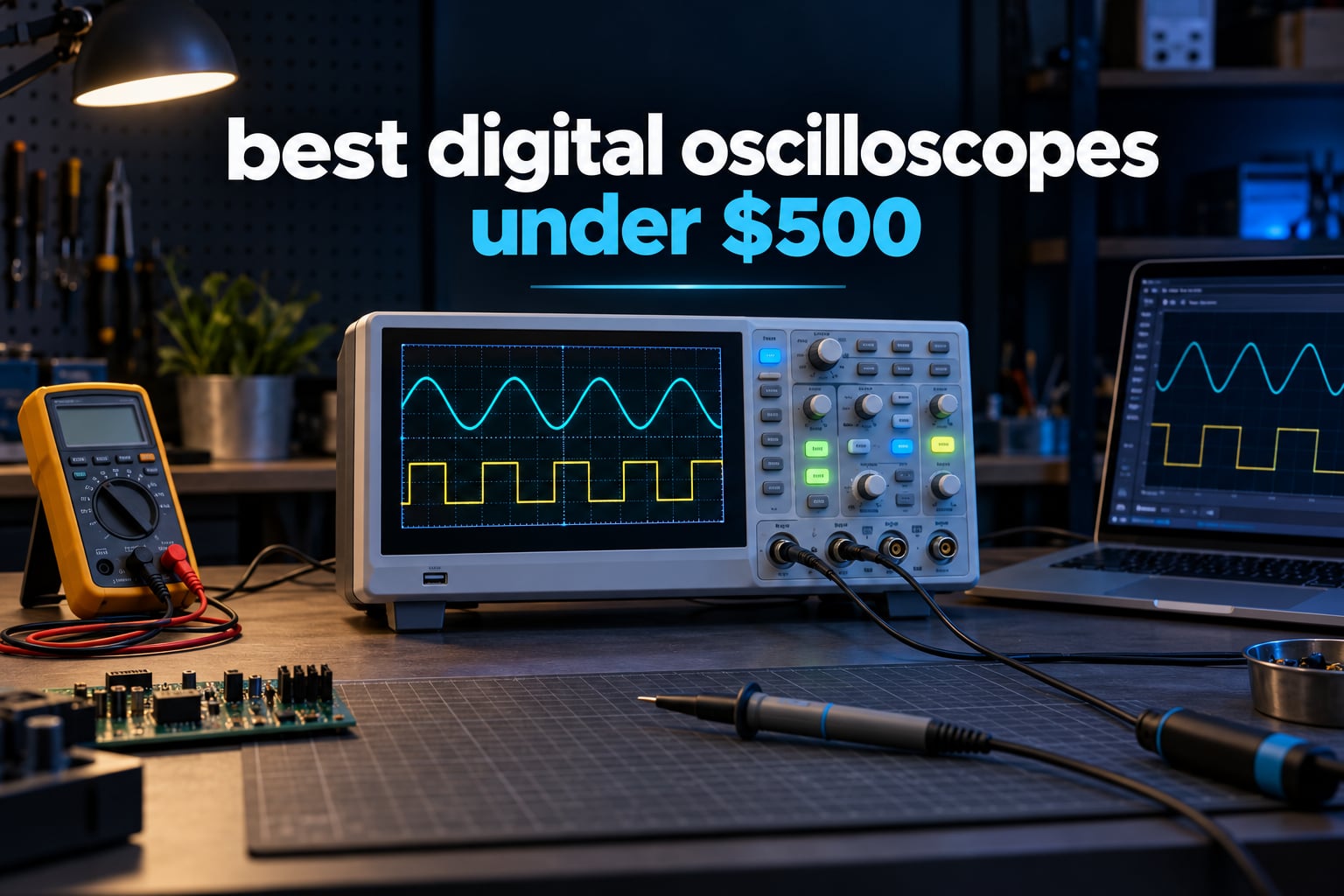
A multimeter tells you a voltage is 3.3 volts. It cannot tell you whether that voltage is a clean rail, a ringing spike, a PWM signal running at the wrong frequency, or an I2C bus that is clocking data back as all zeroes. That is the gap a digital oscilloscope fills, and it is the reason the best digital oscilloscopes under 500 have become the single most recommended bench purchase for students, hobbyists and working engineers alike.
We spent weeks putting ten of them side by side, reading the same fault signatures on each, and comparing what you actually get when you strip away the marketing. Two names dominated: Siglent and Rigol. Four budget handheld and combo tools proved genuinely useful in specific jobs. Every model below sits comfortably inside the sub-500 bracket, so nothing here requires a second mortgage or a grey-market import.
If you want the shorter version first, our separate roundup of the best budget digital oscilloscopes tested covers the entry tier in more detail. This guide goes deeper on bandwidth, memory depth and the trade-offs that actually show up once you start debugging real circuits in 2026.
Table of Contents
Top 3 Best Digital Oscilloscopes Under 500 (October 2026)
Three models earned a place above the rest. The Siglent SDS1202X-E is the strongest all-rounder you can buy at this budget. The Siglent SDS1104X-E wins on channel count and included decoders. The Rigol DS1054Z remains the value benchmark that every other manufacturer is measured against.
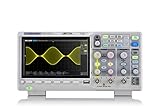
Siglent SDS1202X-E
- 200 MHz bandwidth
- 2 channels
- 1 GSa/s sampling
- 14 Mpts memory
- serial bus decode
- web server

Rigol DS1054Z
- 4 channels
- 24 Mpts memory
- 30000 wfms/s capture
- RS232 I2C SPI decode
- 3-year warranty
Quick Overview: All 10 Scopes Compared Side by Side
Every scope in this list fits the sub-500 ceiling. The table below gives the headline specifications so you can narrow the field before reading the full reviews.
| Product | Specifications | Action |
|---|---|---|
| Siglent SDS1202X-E |
|
Check Latest Price |
| Siglent SDS1104X-E |
|
Check Latest Price |
| Rigol DS1054Z |
|
Check Latest Price |
 Rigol DS1202Z-E Rigol DS1202Z-E |
|
Check Latest Price |
 FNIRSI 2C53T FNIRSI 2C53T |
|
Check Latest Price |
 FNIRSI DSO152 FNIRSI DSO152 |
|
Check Latest Price |
 FNIRSI 1013D Plus FNIRSI 1013D Plus |
|
Check Latest Price |
 ZOYI ZT-703 ZOYI ZT-703 |
|
Check Latest Price |
 HANMATEK DOS1102 HANMATEK DOS1102 |
|
Check Latest Price |
 Hantek DSO2D15 Hantek DSO2D15 |
|
Check Latest Price |
1. Siglent SDS1202X-E: The Best All-Rounder You Can Buy Here
Siglent Technologies SDS1202X-E 200 mhz Digital Oscilloscope 2 Channels, Grey
200 MHz
2 channels
1 GSa/s
14 Mpts
IIC SPI UART CAN LIN decode
Pros
- 200 MHz bandwidth at this budget
- 14 Mpts memory depth
- Serial decoding included out of the box
- Responsive display and clean interface
- Web server for remote viewing
Cons
- Audible cooling fan
- Only two channels
- Multifunction knob overshoots on selection
The SDS1202X-E is the model we kept reaching for. Two hundred megahertz of bandwidth is more than double what most entry-level scopes offer, and it means switching edges and fast digital lines show real shape instead of rounded blobs. With 1 GSa/s sampling and 14 Mpts of record length, a capture at full rate still holds a usable window rather than a handful of samples.
The serial bus decoding is the part that separates it from cheaper rivals. I2C, SPI, UART, RS232, CAN and LIN are all decoded on the box itself, with no option key and no time-limited trial. When a bus goes quiet on a project, that decode turns a guessing game into a readable transaction list.
The built-in web server means you can open a browser on your laptop and look at the same screen the scope is showing. In our bench workflow that removed the need to crowd around a small display whenever someone else wanted a look.
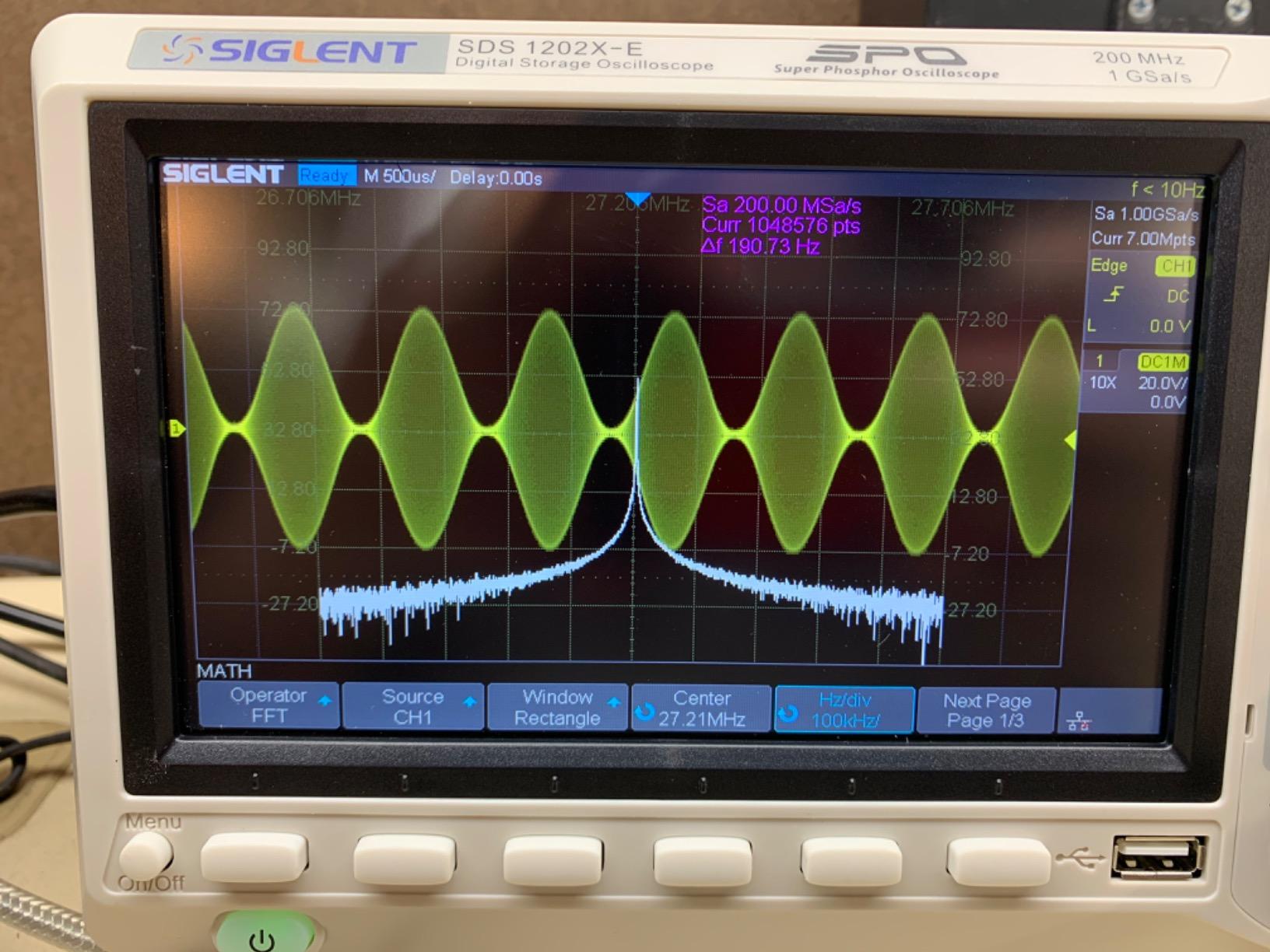
Where it softens is physical. The cooling fan is audible in a quiet room, which matters if you work at a desk at night. The multi-function knob overshoots when you press it to select an item, so fine adjustment takes a little practice. And two channels is genuinely limiting once you move past single-node debugging.
Triggering is thorough for a scope at this level, and the display stays responsive even with deep memory loaded. Probe quality is serviceable rather than inspiring, which is common across this whole price bracket.
Overall, if you can only own one instrument from this list, this is the one. It covers the widest range of real measurement tasks we encountered, and none of its shortcomings are deal-breakers.
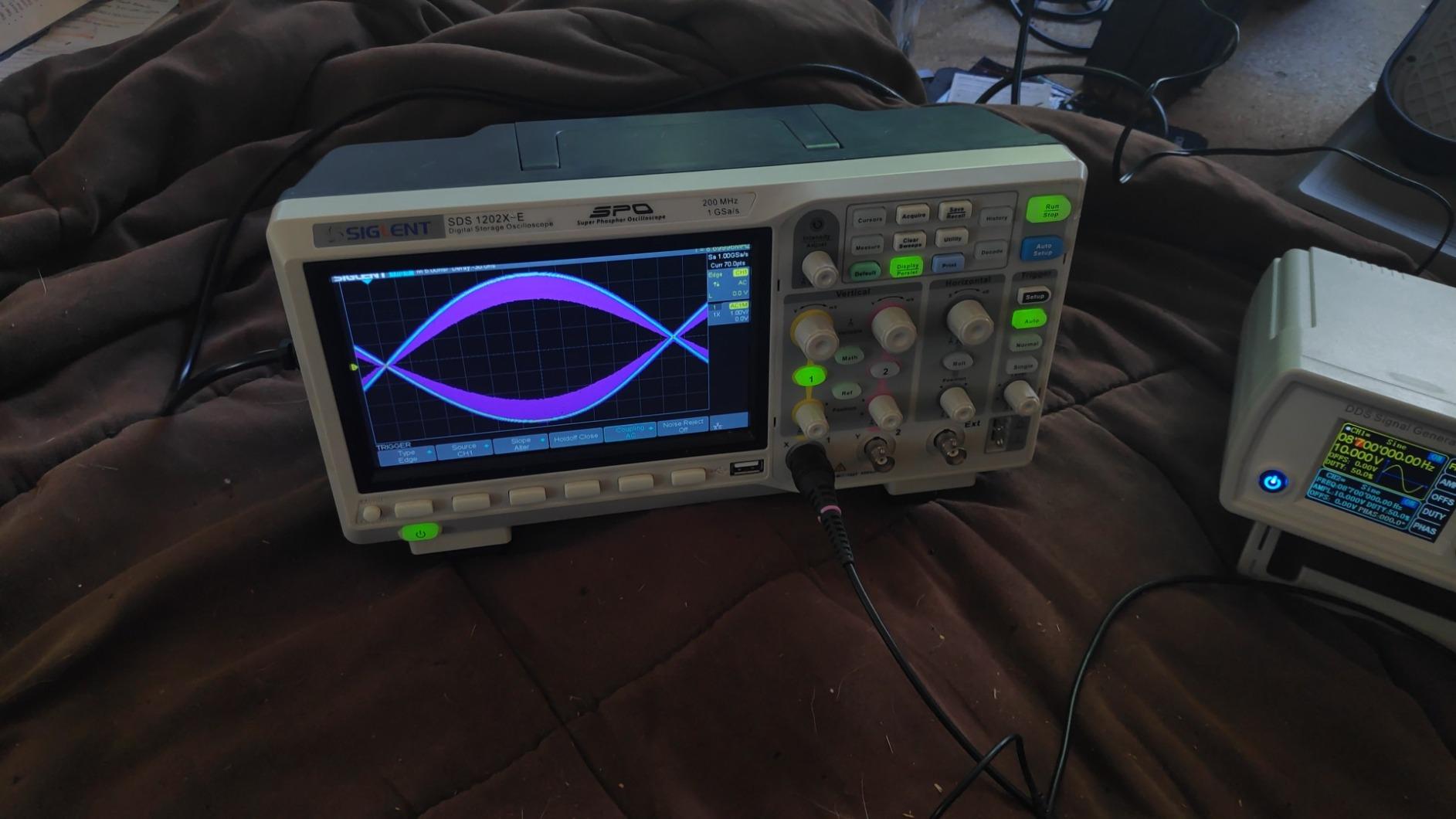
Who the Siglent SDS1202X-E suits
It suits anyone working above the low-frequency band, from microcontrollers running at tens of megahertz to power rails where you need to see ripple and ringing in detail. The deep memory means long time windows without dropping sample rate, which matters when hunting for an intermittent burst.
It is also a strong match for embedded developers who want protocol decode without opening a laptop. Two channels are enough for nearly all single-line debugging: clock, data, or signal versus trigger.
Where it falls short
Anyone measuring three or four rails simultaneously needs to step up to a four-channel model. It also cannot capture on more than two probes, so three-phase or multi-rail power work is out of reach.
The fan noise is the most common complaint in reviews, and users working in shared or late-night spaces should weigh it. Screen tilt and viewing angle are fine at a desk but awkward if you stand over the bench constantly.
2. Siglent SDS1104X-E: Best Four-Channel Scope in the Budget
Siglent Technologies SDS1104X-E 100Mhz Digital Oscilloscope 4 Channels Standard Decoder, Grey
100 MHz
4 channels
Dual ADC
14 Mpts
IIC SPI UART CAN LIN
Pros
- Four channels with dual ADC architecture
- All serial decoders included standard
- 14 vertical divisions for more screen detail
- Ethernet and built-in web server
- Optional 16-channel digital upgrade
Cons
- Knob is twitchy when pressed
- Channel 3 and 4 colours are hard to tell apart
- Time settings do not persist
This is the scope we recommend to anyone whose work involves more than two signals at once. Four channels at 100 MHz, with the same 14 Mpts memory depth as the two-channel model, means you can capture a whole bus transaction, a clock and a couple of rails without rotating probes.
The dual ADC architecture is the quiet advantage here. It delivers 1 GSa/s on two channels and 500 MSa/s on all four, which beats several competitors that drop the rate sharply when you light up the third and fourth probe. Reviewers consistently single out that headroom as the reason to pick this model over a cheaper four-channel scope.
Everything on the connectivity side is unusually mature for a sub-500 instrument: a built-in web server, Ethernet, and both USB host and device ports. Optional upgrades add a 16-channel mixed-signal analyser or a four-channel arbitrary waveform generator, which means the box can grow into logic analyser territory later.
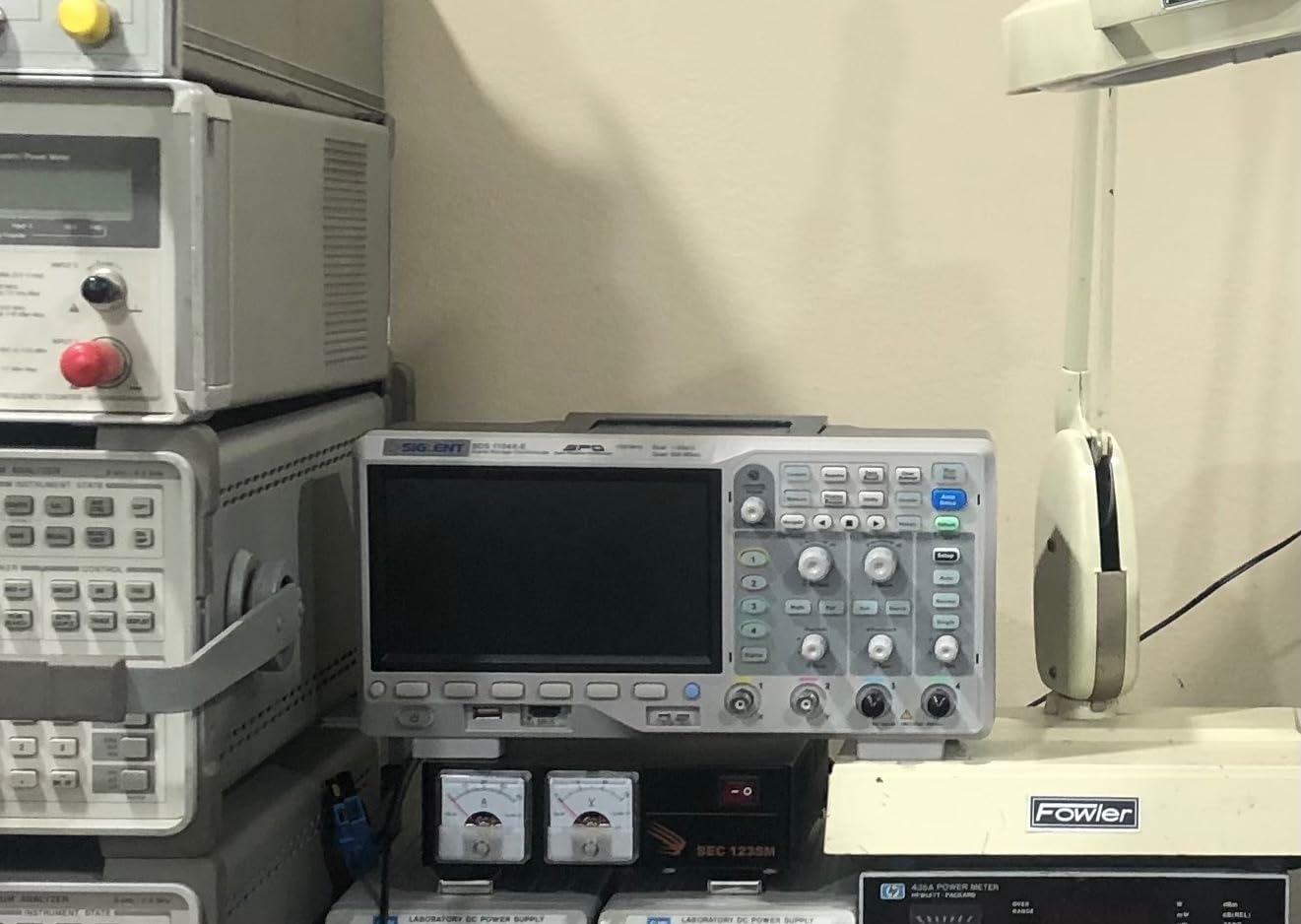
The build feels like laboratory equipment rather than a hobby accessory. The 7-inch screen shows 14 vertical divisions instead of the 12 you get elsewhere, so a trace uses more of the panel and small signals are easier to read.
Not everything is perfect. The multi-function knob can be twitchy when you press it rather than turn it. Channel 3 and channel 4 are drawn in colours that are genuinely hard to distinguish under bright light, which is a real annoyance on a four-channel trace. Network time settings also refuse to stick across power cycles.
Owners also point out that the optional MSO and AWG modules cost close to the price of an entire cheaper scope, so plan for that before you assume an upgrade path is a bargain.
When to choose this four-channel model
Choose it when you routinely need to compare a clock against data, watch three rails during a power-on sequence, or verify a quad encoder. The extra channels turn guesswork into a single screenshot.
It is also the pick for anyone who wants to see a UART or CAN exchange alongside the analogue behaviour of the circuit driving it. That combined view is where the decoders start paying for themselves.
Where the compromises bite
If your signals never exceed two, the fourth channel is dead weight and the two-channel model gives you twice the bandwidth for the money. The MSO and AWG options are also priced high enough that buying them separately may not make sense.
Reviewers note it does not accept a USB keyboard or mouse, so on-screen menus stay keyboard-free by design. If you plan to automate measurements, check that your SCPI workflow matches the commands it expects.
3. Rigol DS1054Z: The Value Benchmark Everyone Compares Against
Rigol DS1054Z Digital Oscilloscope, 50MHz, 4 Channel, 1GSa/s, Best Value
50 MHz base
4 channels
24 Mpts
30000 wfms/s
3-year warranty
Pros
- Four channels with 24 Mpts memory depth
- 30000 wfms/s capture rate with intensity grading
- Serial decode for RS232 I2C SPI
- Three-year warranty
- USB host device and LAN
Cons
- Noisy cooling fan
- Only 50 MHz base bandwidth
- Single ADC slows sampling on four channels
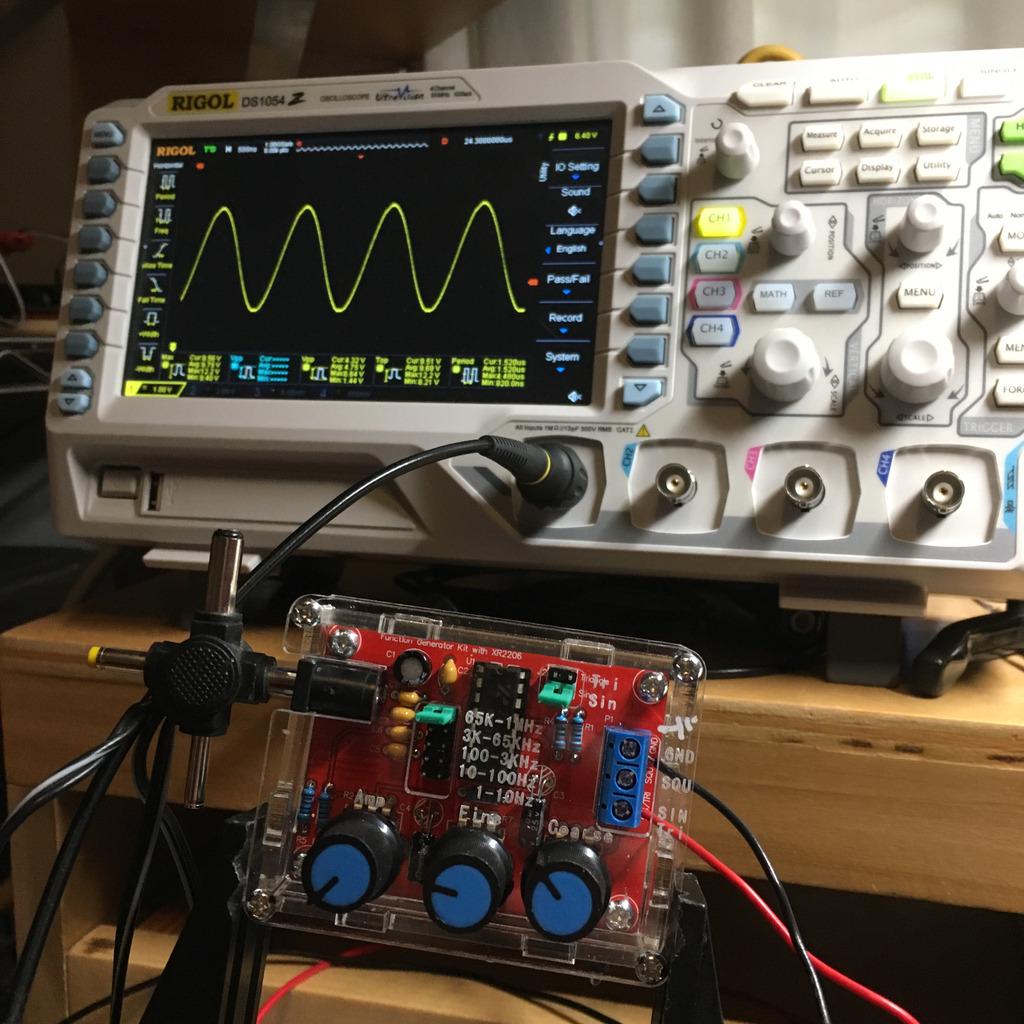
The DS1054Z has been the recommendation on hobby forums for years, and our testing did not change that. Twenty-four megasamples of memory is the deepest in this group, and a 30,000 waveforms per second capture rate with intensity grading reveals short glitches that slower scopes simply miss.
Out of the box the decoders for RS232, I2C and SPI are active with no time-limited trial. The built-in help system is genuinely useful for a beginner, offering guided operation instead of leaving you to guess what a trigger mode does.
Two things frame the experience. The first is bandwidth: the base rating is 50 MHz, which is honest but modest next to the Siglent models above. The second is the sample rate architecture, where a single ADC means all four channels share the sampler.
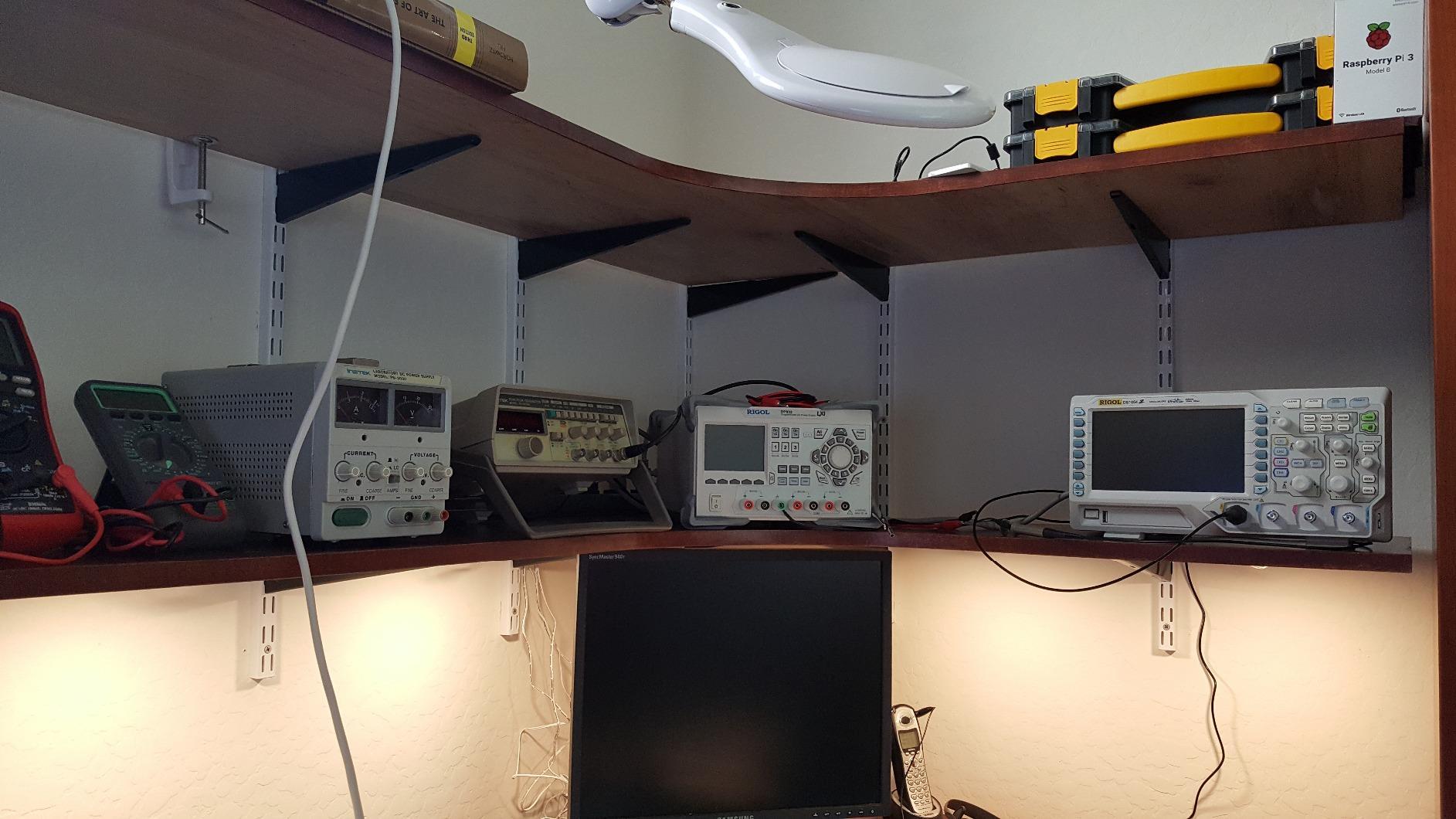
We should be straightforward about the community bandwidth unlock. Owners widely report running this scope past its stock 50 MHz rating through a firmware or hardware modification. It works, and many users treat the upgraded state as their daily configuration. Treat it as an undocumented extra rather than a supported specification, and check your local warranty terms before you open the case.
The fan is genuinely noisy in a quiet room, and channel 2 and channel 4 use colours close enough to cause mistakes on complex traces. The intensity knob shifts when pressed, which frustrates people who use the intensity grading feature often.
The included probes are the weakest part of the package. Many owners replace them early, and that single upgrade improves measurement quality more than anything else at this level.
Why the DS1054Z still earns its place
Deep memory plus a high capture rate is the pairing that matters for intermittent faults. If your bug appears for two microseconds every few seconds, the 24 Mpts record and 30,000 wfms/s capture give you a real chance of catching it.
The three-year warranty also stands apart. Every other model in this list carries a shorter or murkier support commitment, and for anyone building a bench that will last years, that is worth real money.
Where it disappoints
It disappoints if your signals sit above 50 MHz, since the scope is at its limit before harmonics become interesting. The single ADC also means the sample rate falls sharply when you enable all four channels, which is exactly when you most want the resolution.
The noisy fan and the fiddly intensity control are the two complaints that appear most often. Neither is fatal, but both are audible every day you own it.
4. Rigol DS1202Z-E: Two Hundred Megahertz With Serious Build Quality
RIGOL DS1202Z-E Digital Oscilloscope, 200MHz, 2 Channel, 1GSa/s Sampling
200 MHz
2 channels + ext trigger
24 Mpts
30000 wfms/s
3-year warranty
Pros
- 200 MHz bandwidth with 24 Mpts memory
- Every software option enabled from the box
- Quiet cooling fan
- Built-in help system and web server
- Three-year warranty
Cons
- Multifunction knob overshoots when pressed
- USB 2.0 only so deep memory transfers are slow
- Large USB drives are not recognised
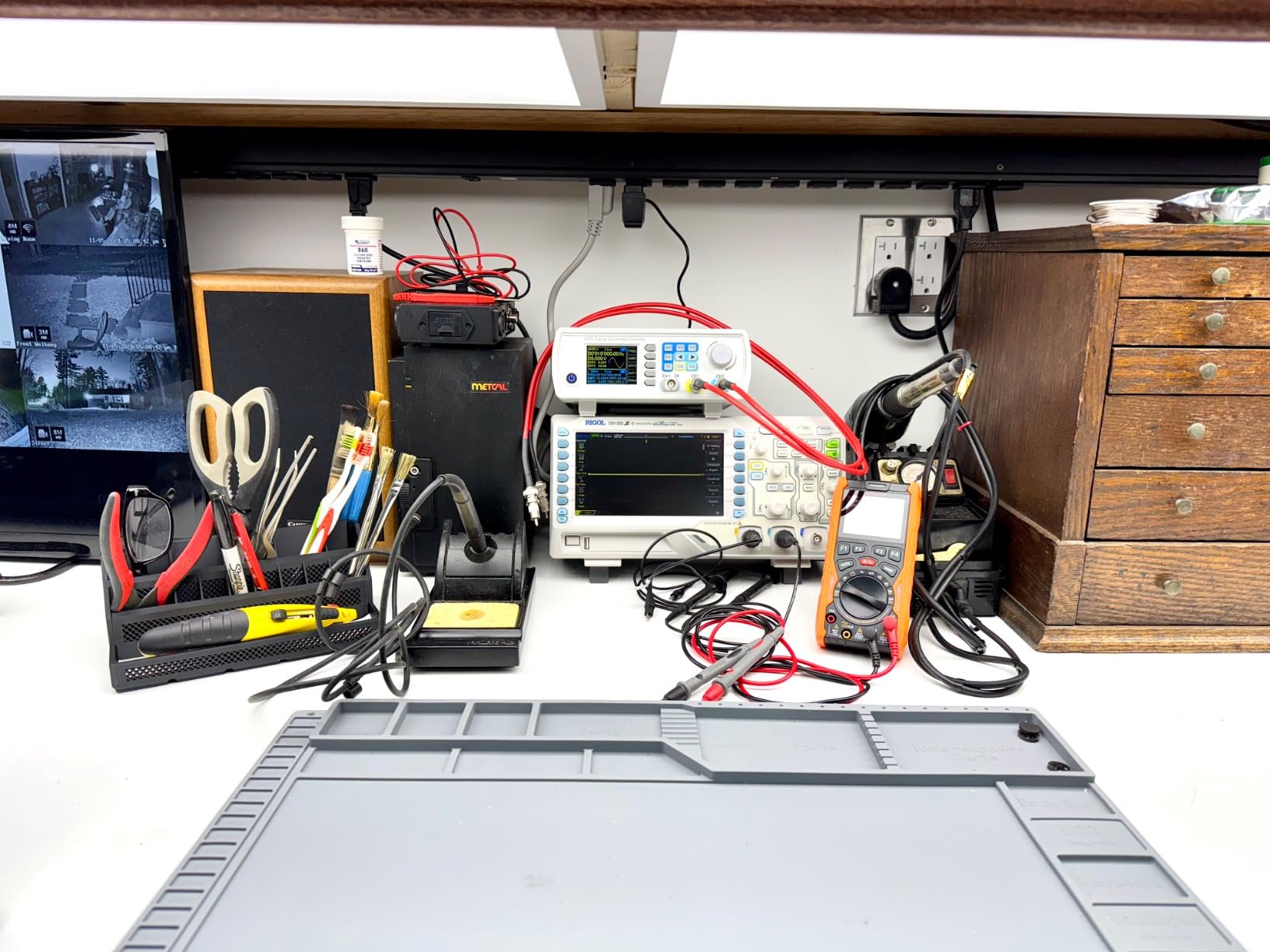
Where the DS1054Z wins on channel count, the DS1202Z-E wins on refinement. Two hundred megahertz of bandwidth, an external trigger input, and the same 24 Mpts memory depth and 30,000 wfms/s capture rate as the four-channel model. Every software option ships enabled with no trial timers.
The chassis feels noticeably more solid than anything else at this level. The quiet cooling fan is the detail we noticed most, since fan noise is the single most repeated complaint across this whole category. A built-in help system and a web server with VNC remote viewing round out a mature package.
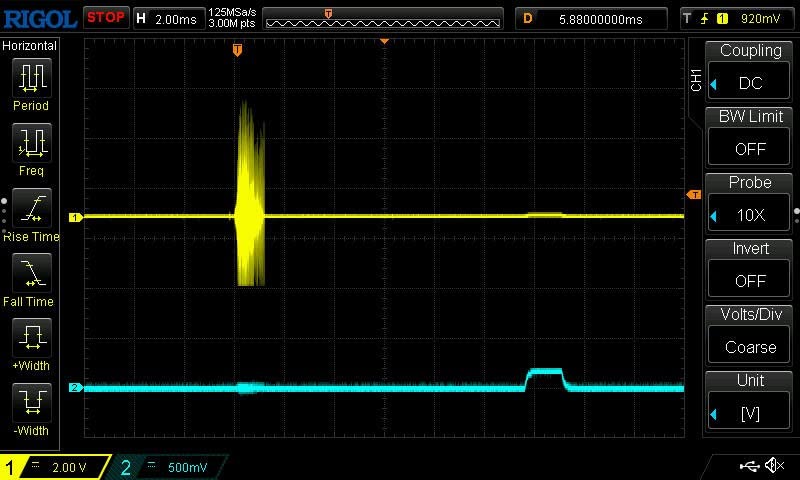
Triggering supports RS232 and UART, I2C and SPI decoding, plus waveform recording and playback up to 60,000 frames, which is useful for capturing a rare glitch and replaying it later rather than guessing.
The main weakness is data transfer. The scope is USB 2.0 only, and pulling a full 24 Mpts capture to a computer takes the best part of an hour. That is painful if your workflow depends on saving waveforms for analysis.
Large-capacity USB drives are also unreliable here; users report flash drives failing while smaller ones work. The multi-function knob overshoots on selection, and the soft key legends stay permanently on the sides of the display, eating a little screen.
The power cord is thick and stiff, which sounds trivial until it takes up half your bench space.
Best cases for the DS1202Z-E
It suits anyone who wants serious analogue bandwidth for signal integrity work on clock lines, switch-node behaviour or audio circuits. The external trigger input also makes it a better fit for repetitive production testing.
The 60,000-frame playback feature is the sleeper advantage. Capture a long run, then step through it frame by frame to find the exact moment something went wrong, without re-running the test.
Where it falls short
Two channels means it cannot watch a three-rail power-up or compare two buses at once. If your work regularly needs a fourth probe, the four-channel Siglent or the DS1054Z is a better fit.
Slow USB transfer and no USB 3.0 are the practical limiters for anyone who analyses waveforms on a computer rather than eyeballing them on the bench.
5. FNIRSI 2C53T: The Best Value for Automotive and Field Work
FNIRSI 2C53T 3-in-1 50MHz 2CH Oscilloscope Multimeter DDS Signal Generator
50 MHz
2 channels
19999 count DMM
DDS generator
3000 mAh battery
Pros
- Scope
- multimeter and signal generator in one body
- 19999 count multimeter is unusually accurate
- Battery runtime around six hours
- 400V protection and Type-C charging
- Screenshots and waveform upload to a computer
Cons
- Record depth limited to 1 Kpts
- 2.8 inch screen is small
- Generator capped at 50 kHz
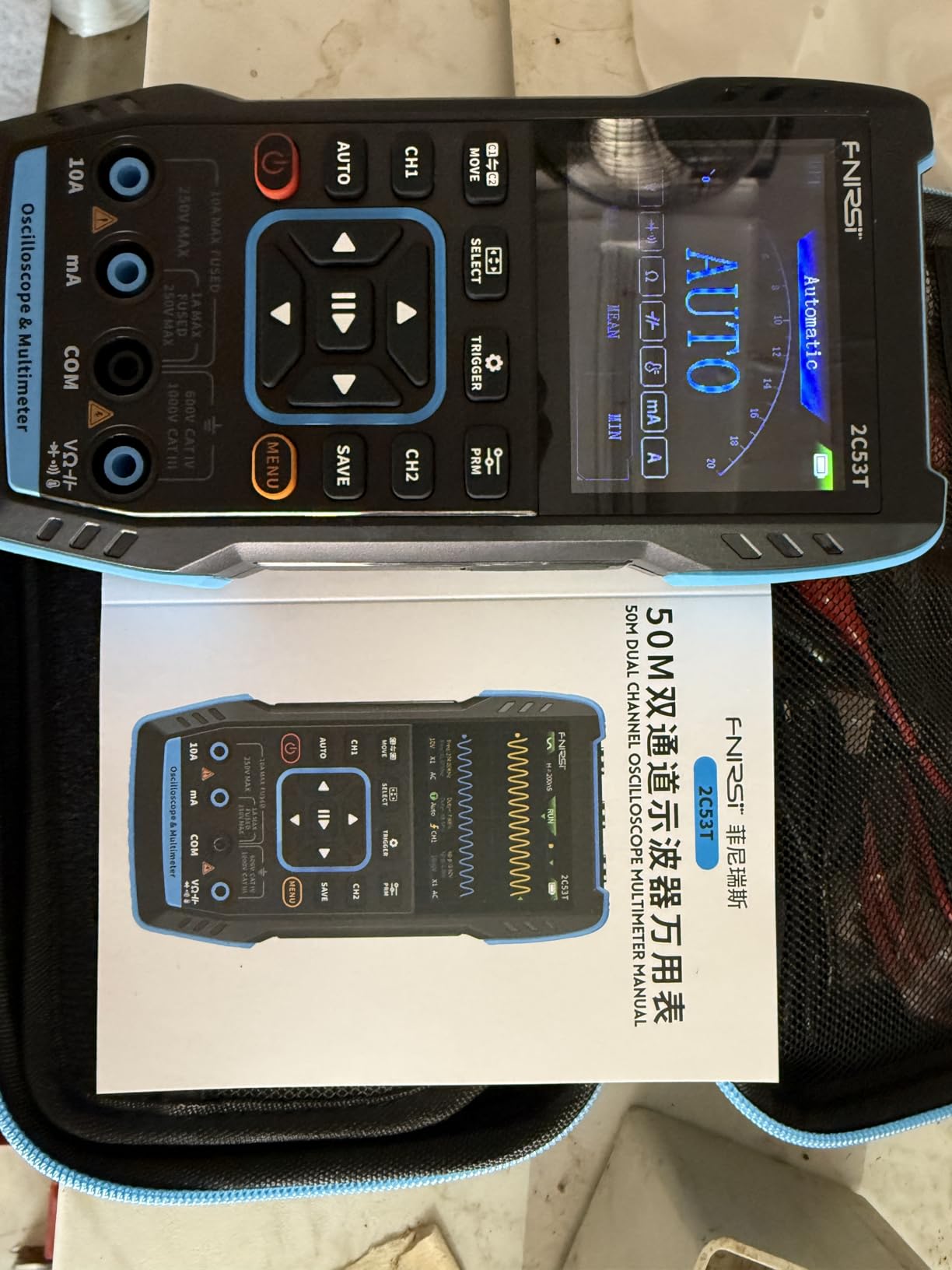
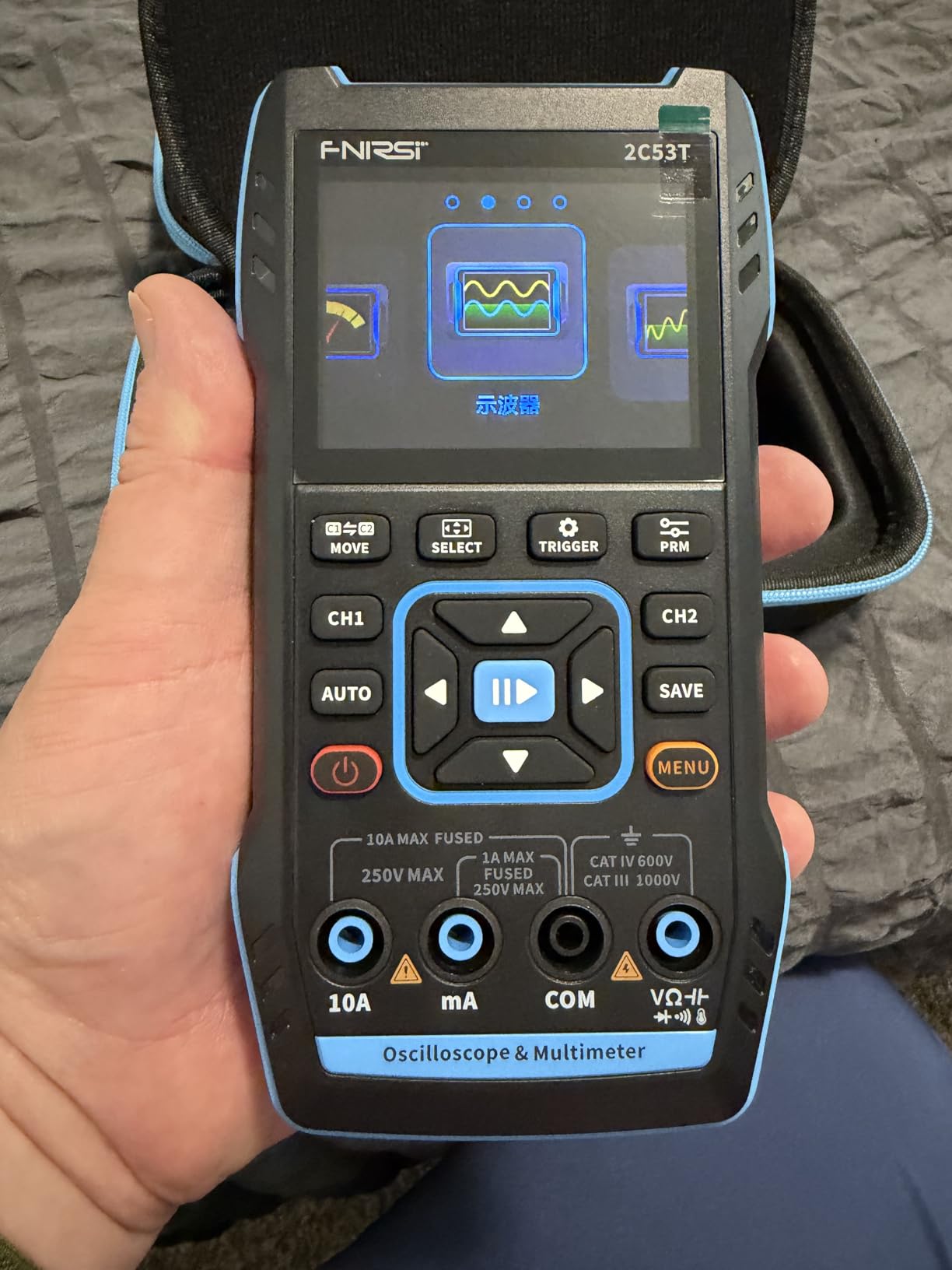
Combos like this solve a specific problem: a technician who needs a meter and a scope on the same fault, at the same time, without carrying two leads and two probes. The 2C53T puts a 50 MHz two-channel scope, a 19999-count multimeter and a DDS signal generator into a 400 g handheld body.
The multimeter is the surprise strength. A 19999-count meter measuring AC and DC voltage, current, resistance to 19.99 megaohms, capacitance and continuity is closer to a mid-range bench meter than a toy, and owners doing sensor diagnosis cite it as the reason to buy.
Battery life of roughly six hours means a full day of diagnostics away from a wall socket, and Type-C handles both charging and transferring screenshots to a computer. High voltage protection is rated for 400 V continuous.
Where it cannot follow the bench scopes is memory. A 1 Kpts record depth captures a window but no history, so any intermittent behaviour is gone before you notice it. The 2.8 inch screen is small enough that fine cursor work is awkward.
The generator tops out at 50 kHz, so it cannot drive the higher-frequency test signals a bench scope would. Menu navigation is button-heavy and takes getting used to.
This is not a bench replacement and owners do not treat it as one. It is a diagnostic companion, and in that role the compromises barely register.
Where the 2C53T earns its place
Automotive work is the obvious fit. Probing a throttle position sensor while checking the reference voltage, or watching injector duty cycles on a 12 V system, all sit comfortably inside 50 MHz. The meter mode lets you confirm a supply rail before you attach the probe.
It also suits field electronics repair and teaching, where a single inexpensive instrument covering three jobs beats three separate purchases.
Where it falls short
Deep-memory investigation and anything above a few tens of megahertz are outside its reach. The 1 Kpts depth in particular means it will not help you catch a rare glitch.
Reviewers report menu navigation as clunky, and the small screen limits multi-trace reading. If your work is stationary, one of the bench scopes is simply better.
6. FNIRSI DSO152: A Starter Scope for Learning, Nothing More
FNIRSI DSO152 Handheld Oscilloscope 200kHz Bandwidth, 2.5MS/s Sampling Rate
200 kHz bandwidth
2.5 MS/s
2.8 inch LCD
1000 mAh battery
Type-C
Pros
- Costs about as much as a meal
- True pocket size with a clip-on style probe
- One-key AUTO setup removes guesswork
- Type-C charging and firmware updates
- Ready to use with no assembly
Cons
- 200 kHz bandwidth covers only audio-range signals
- Very low 2.5 MS/s sample rate
- 320x240 screen is tiny
- No meter or generator functions
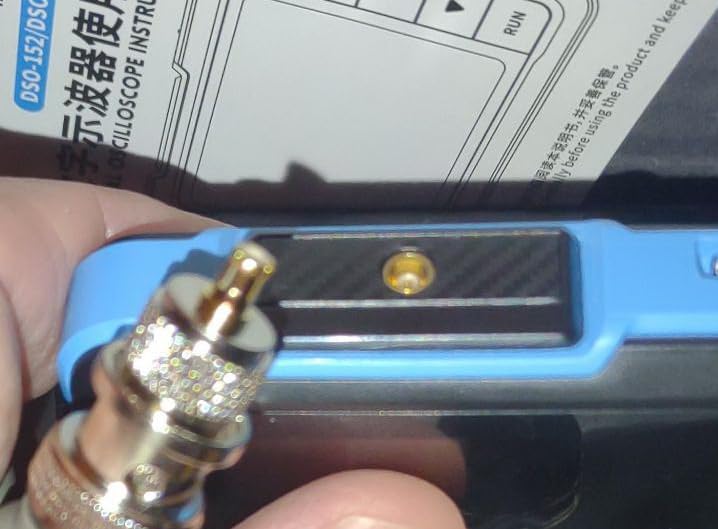
The DSO152 exists to answer a narrow question: can I show a student what a waveform looks like without a shared lab bench? For that purpose it works, and it costs a rounding error compared with anything else on this list.
Setup is genuinely zero. The probe attaches, you press AUTO, and the trace appears. Long-pressing AUTO runs a baseline calibration. Auto, Normal and Single trigger modes are all present, which covers most teaching demonstrations.
The included 10x probe handles signals up to 800 V peak-to-peak, so you are not limited to tiny logic levels. A 1000 mAh battery gives roughly four hours of continuous use, and Type-C handles charging, data and firmware updates in one port.
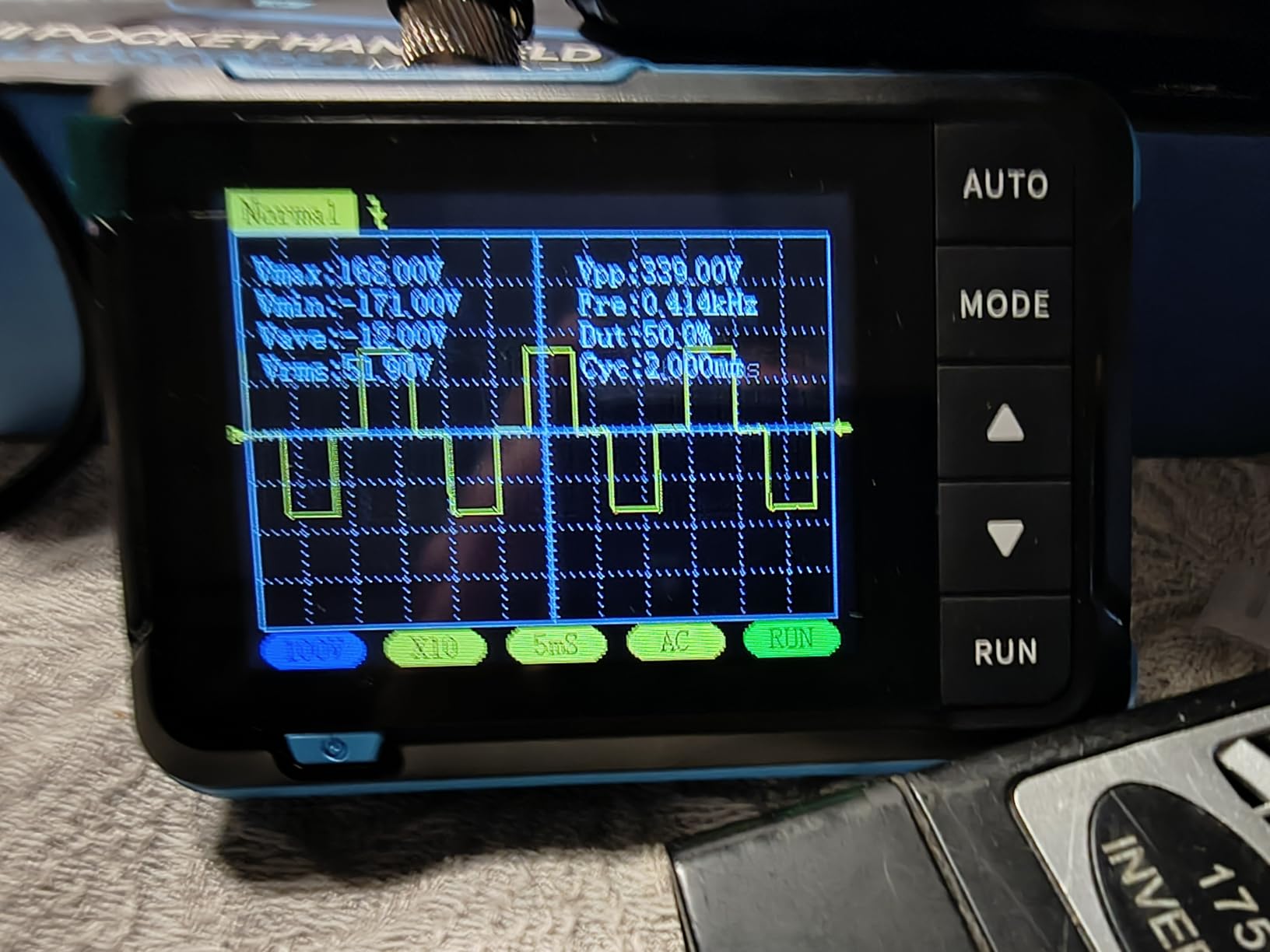
Be clear about what 200 kHz means. That is audio bandwidth. It will show you a 1 kHz sine, a slow PWM signal, or an audio tone. It will not resolve anything in a microsecond, and the 2.5 MS/s sample rate means even those simple signals get a coarse trace.
The 320×240 screen is small even for a pocket device, and there is no multimeter or generator built in, so it does nothing else for you.
For serious troubleshooting it is the wrong tool entirely, and owners are candid about that. Used as an introduction to reading waveforms, it earns its cost.
Who should buy the DSO152
It suits a classroom teaching a single concept, a parent showing a child what a PWM signal looks like, or anyone who wants to keep a spare meter-sized device in a toolbox for quick signal checks on slow circuits.
Because there is no soldering and no calibration procedure, it also works as a demonstration unit at a makerspace or STEM session where several people need to see a trace at once.
Where it is not enough
Any debugging involving microcontroller clocks, switched-mode power, radio or sensor conditioning will exhaust it immediately. Sample rate and bandwidth are not adjustable, so there is no setting that fixes that.
Treat it as a teaching aid. If you intend to develop electronics rather than demonstrate them, step up one tier at minimum.
7. FNIRSI 1013D Plus: A Hundred Megahertz With a Large Touchscreen
FNIRSI 1013D Plus 100MHz Oscilloscope, 2 Channel Oscilloscope 7″ TFT Touch
100 MHz
2 channels
1 GSa/s
7 inch touchscreen
6000 mAh battery
Pros
- 100 MHz bandwidth with 1 GSa/s sampling
- Seven inch 800x480 capacitive touchscreen
- 1 GB of storage for waveforms and screenshots
- Lissajous display and FFT analysis
- Four hour battery with 400V protection
Cons
- Build quality below Siglent and Rigol
- Touchscreen is less precise than physical knobs
- FFT and analysis features are basic
- Long term durability uncertain
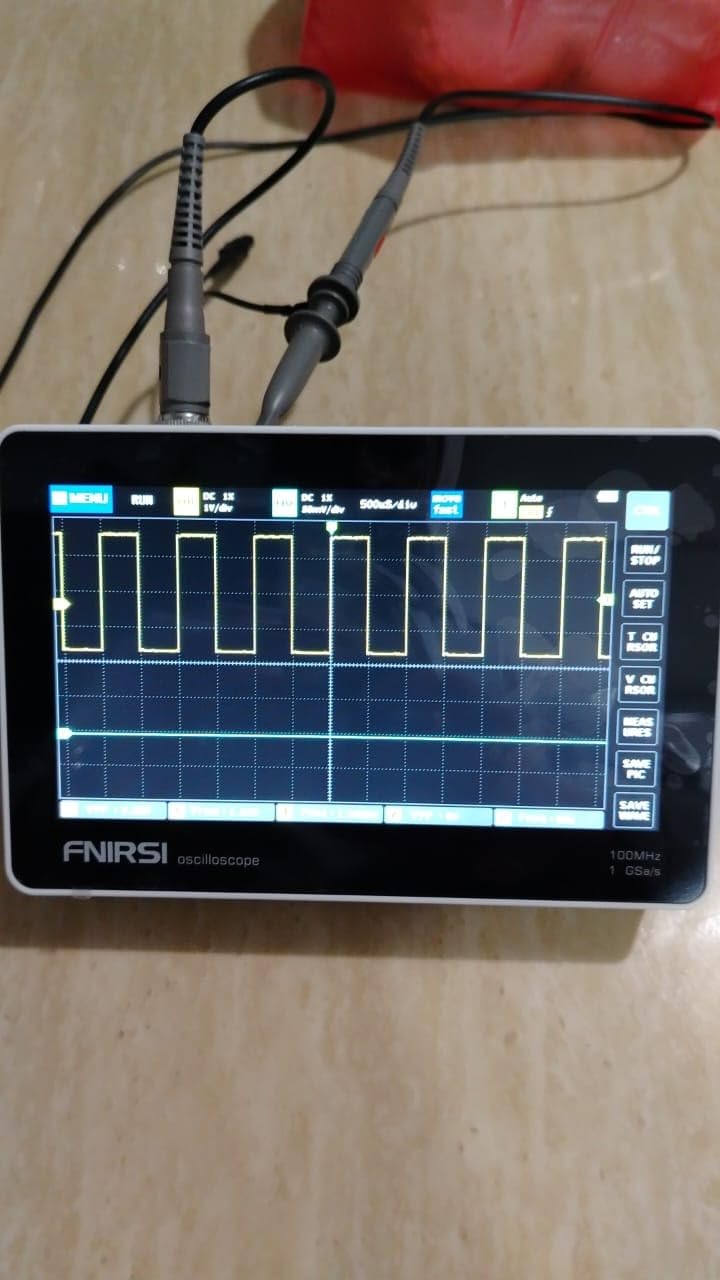
The 1013D Plus puts real oscilloscope bandwidth behind a modern touchscreen. One hundred megahertz across two channels at 1 GSa/s sampling is more than adequate for microcontroller work, and the 7-inch 800×480 panel makes a trace far easier to read than the small screens on most handheld alternatives.
Gesture control works well for zooming and panning, and cursor measurement plus direct peak-to-peak and frequency readouts cover most quick checks without diving into menus. Lissajous display and a basic FFT view are present for quick harmonic checks.
Storage is a real strength for this class of device. One gigabyte holds up to 1000 screenshots and 1000 waveform data sets, browsable as thumbnails, so you can save a trace, send it to a colleague, or compare before and after a change.
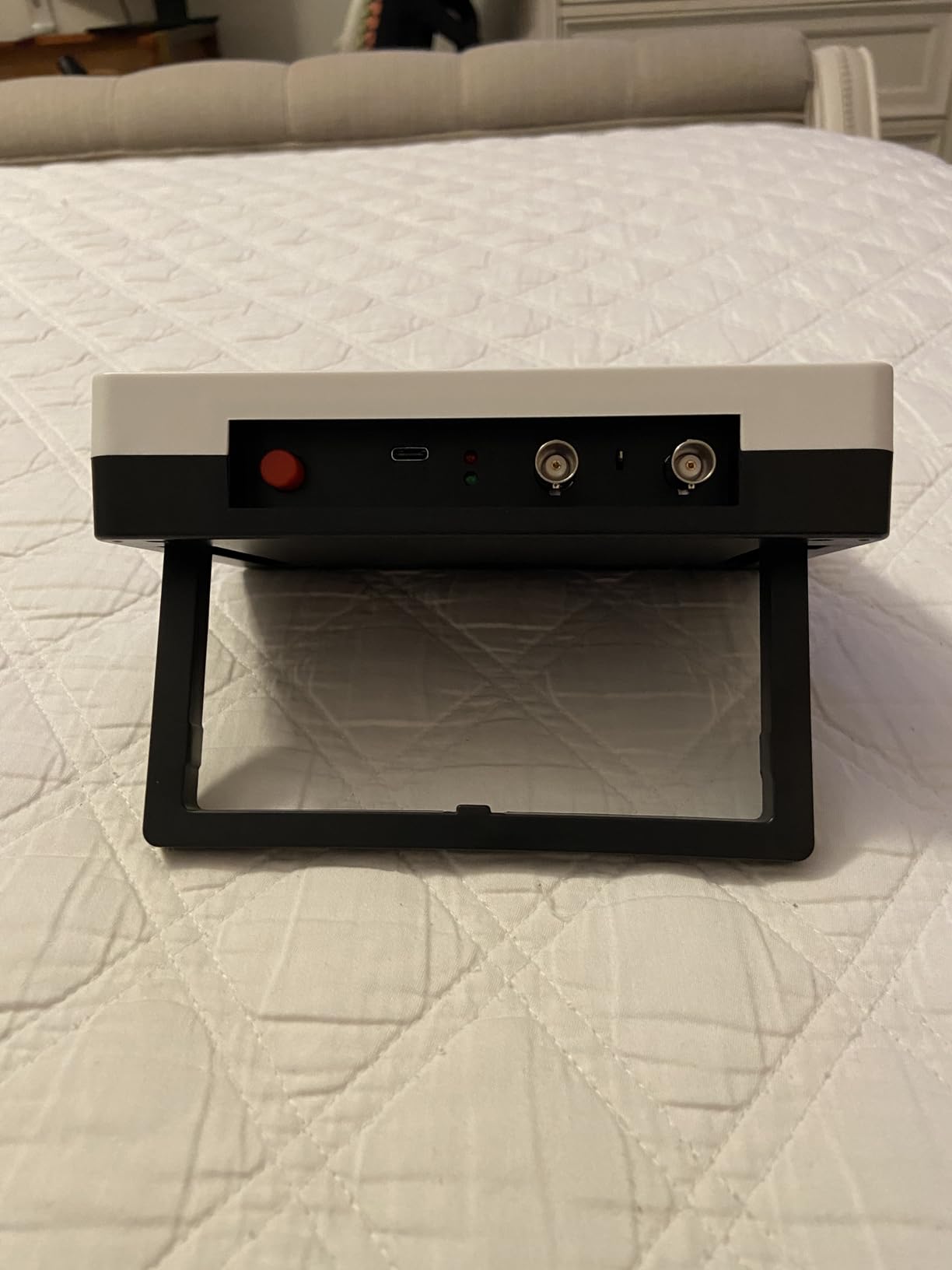
The honest limitation is build quality. This does not feel or sound like a Siglent or Rigol chassis, and long term durability is unproven compared with instruments carrying three-year warranties. Touchscreen precision is also a genuine downgrade for fine vertical positioning.
The FFT and analysis functions are basic, so if spectral work matters to you, this is not the instrument.
Some units also show fan noise, which is odd for a battery-powered device but worth checking on the specific unit you receive.
Who this scope suits
It suits students moving up from a pocket scope who now need 100 MHz and a readable screen, and field engineers who need a hundred megahertz of capability in a bag rather than on a bench.
It also works well for presentations, where you need to point at a feature on a trace while explaining it. A touchscreen plus one gigabyte of storage fits that workflow better than a menu-driven bench unit.
Where it falls short
If you plan to keep this instrument for a decade, the build and warranty situation argues for spending more on a Siglent or Rigol instead. Precision work with the vertical scale is slower on a touchscreen than with a physical knob.
Four hours of battery means it needs a charge mid-session for heavy use, and the analysis features will disappoint anyone wanting real spectrum work.
8. ZOYI ZT-703: The Best Three-in-One Combo Under 100
3 in 1 Handheld Oscilloscope Automotive Dual Channel 50MHz with Digital Multimeter and Signal Generator
50 MHz high speed mode
2 channels
25000 count DMM
Signal generator
Type-C
Pros
- 25000 count auto-ranging multimeter is excellent
- Cheapest full three-in-one here
- Battery powered with Type-C fast charging
- Auto waveform recognition works well on unknown signals
- Carrying bag and test leads included
Cons
- Button-only navigation with no knobs
- Practical bandwidth closer to 20 MHz for square waves
- Function generator is very basic
- No temperature measurement
The ZT-703 is the pick if you want the most capability per unit of money and you are willing to work within its limits. A dual-channel oscilloscope, a 25000 count auto-ranging multimeter and a sine, square and triangle generator all live in one battery-powered body that costs less than a single decent probe from the scopes above.
The multimeter is the standout. Twenty-five thousand counts with resistance, capacitance, continuity, diode and current measurement is a genuine bench instrument capability, and owners rate it well above the meter inside competing combos.
Auto waveform recognition works reliably on signals you cannot identify, which makes it useful for exploratory work. Storage depth of 128K gives more history than the FNIRSI combo, and Type-C handles charging and data transfer on one port.
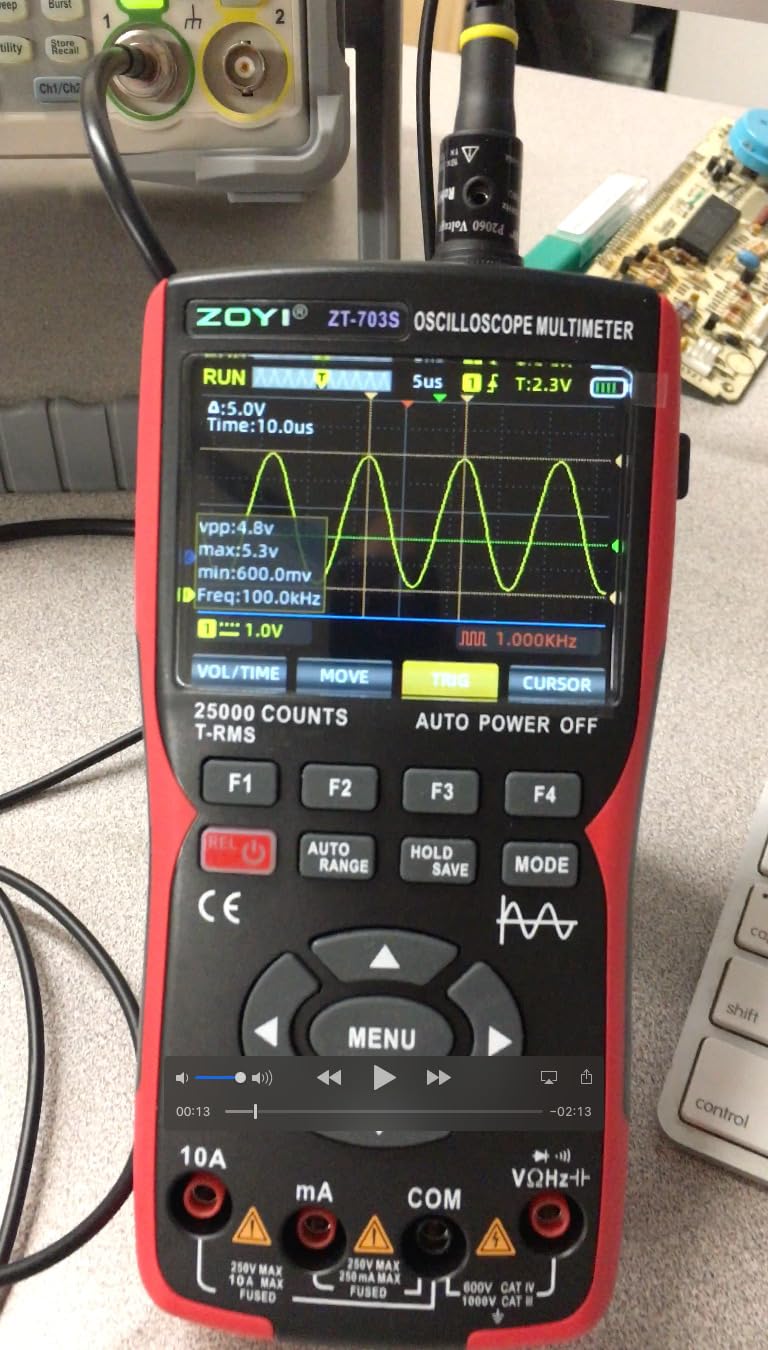
Now the limits. The oscilloscope section runs at 200 MSa/s and 30 MHz in normal mode, or 280 MSa/s and 50 MHz in high-speed mode. Owners who use it for square waves report useful behaviour closer to 20 MHz in practice, so treat the headline number carefully.
Navigation is button-only with no rotary knobs, which makes fine adjustment slower than on a real scope. The generator is very basic, there is no temperature measurement, and the screen sleep timeout cannot be adjusted separately, so it dims during long pauses while you read notes.
Power-on takes a few seconds rather than the instant start of a dedicated meter.
Where the ZT-703 makes sense
It suits automotive and appliance repair, where low-frequency signals dominate and you constantly switch between measuring a rail and viewing a waveform. Battery operation means no wall outlet in a vehicle or under a sink.
It is also a strong first instrument for a student who does not yet know whether they will focus on measurement or on waveform analysis, since it covers both without a large commitment.
Where it is the wrong choice
It is wrong for anything above roughly 20 MHz, and wrong for work needing precision triggering or deep memory. If you already know you are chasing intermittent digital faults, buy a bench scope instead.
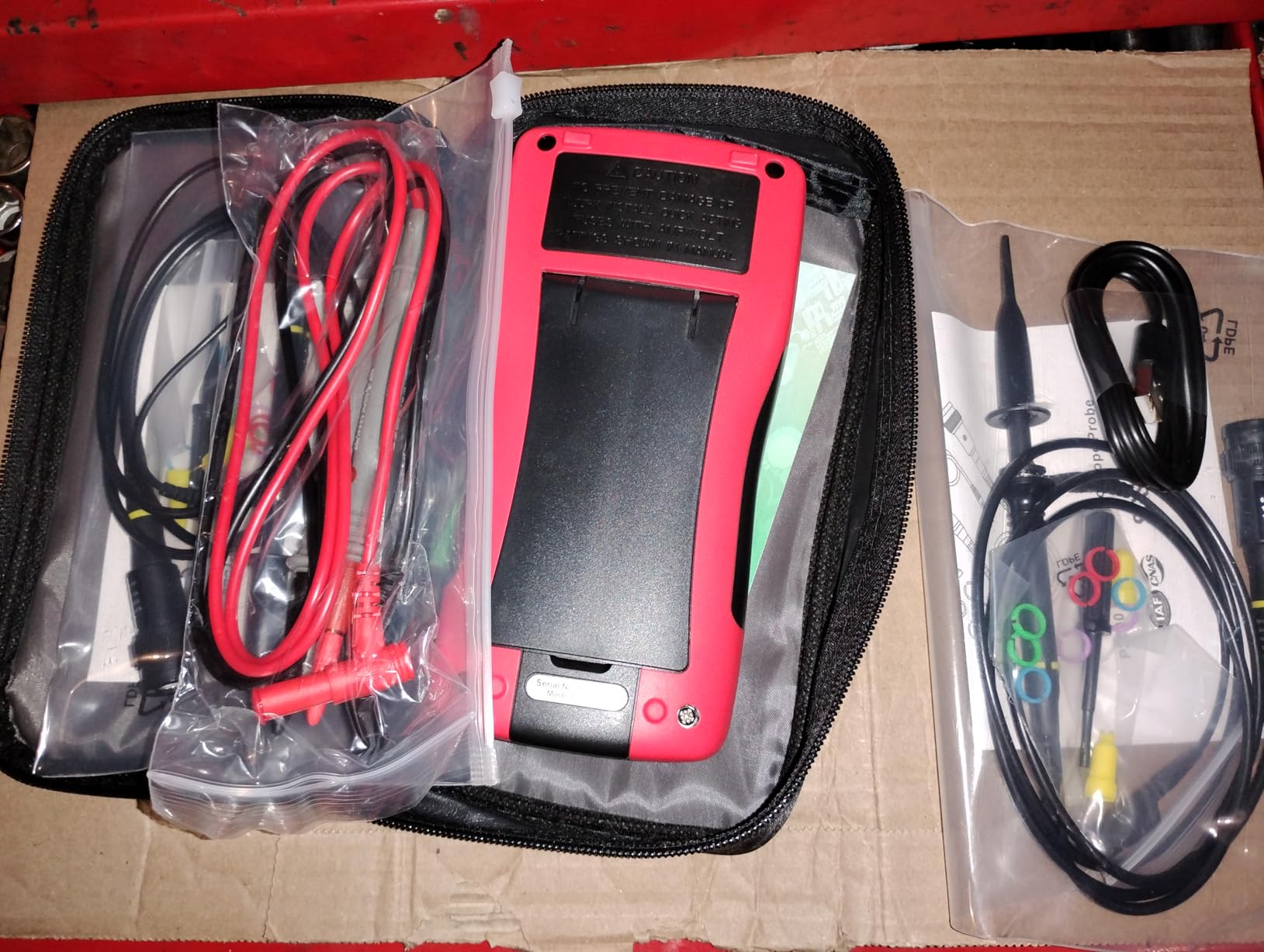
The button-only interface is the complaint owners return to most, followed by the limited generator. The included cloth bag is also a tight fit once the probes and test leads are packed in.
9. HANMATEK DOS1102: Best Choice for LabVIEW and SCPI Automation
HANMATEK 110mhz Bandwidth DOS1102 Digital Oscilloscope with 2 Channels and Screen 7 inch / 18 cm, TFT-LCD Display, Portable Professional Oscilloscope Kit with 500 MS/s *2 Sampling Rate
110 MHz
2 channels
500 MS/s
30 auto measurements
LabVIEW and SCPI
Pros
- 110 MHz bandwidth for a compact budget
- Six digit hardware frequency counter from 2 Hz to 20 MHz
- Thirty automatic measurement functions
- LabVIEW communication and SCPI compliance
- USB host and device plus U-disk storage
Cons
- Storage depth limited to 10K points
- Menu system can be confusing
- Documentation and software support limited
- Less active community than Siglent or Rigol
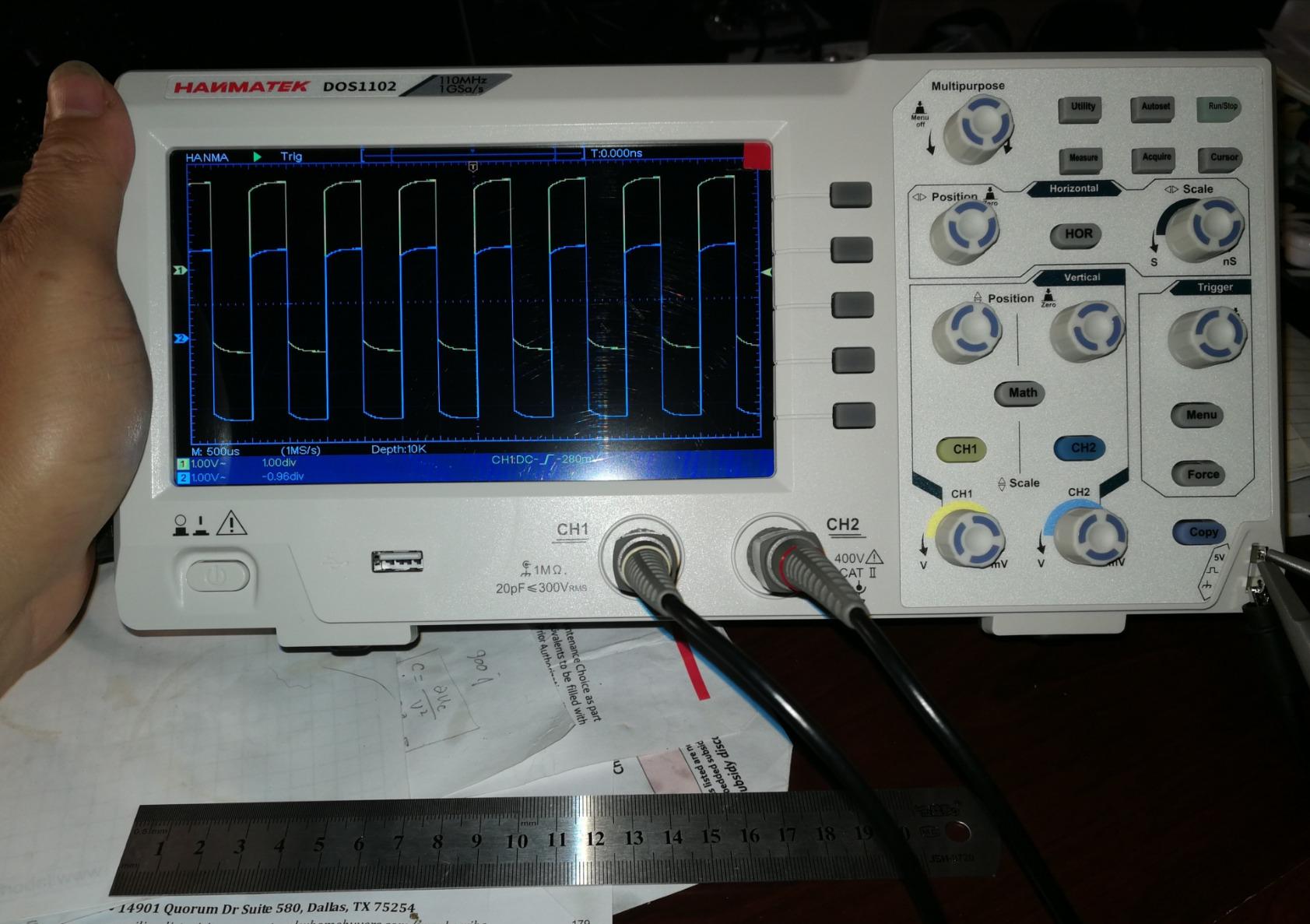
Where this model separates itself is automation. SCPI compliance and LabVIEW communication are documented in the specification, and with both USB host and USB device ports plus U-disk storage, it fits into a scripted measurement sequence without a proprietary front end.
One hundred and ten megahertz of bandwidth with 500 MS/s sampling on both channels is respectable for the money. The hardware frequency counter is a six-digit unit covering 2 Hz to 20 MHz, which means frequency readings come from hardware rather than a software estimate on the trace.
Thirty automatic measurement functions with a customisable measurement menu keep routine readings on screen, and probe attenuation is selectable at 1x, 10x, 100x and 1000x. The 7-inch true colour TFT at 800×480 and 65535 colours is larger than most scopes in this price band.
The storage depth is the weak point. Ten thousand points per acquisition and at least 16 waveform groups is thin next to the 24 Mpts available on the Rigols, and it limits how long a window you can hold at a usable sample rate.
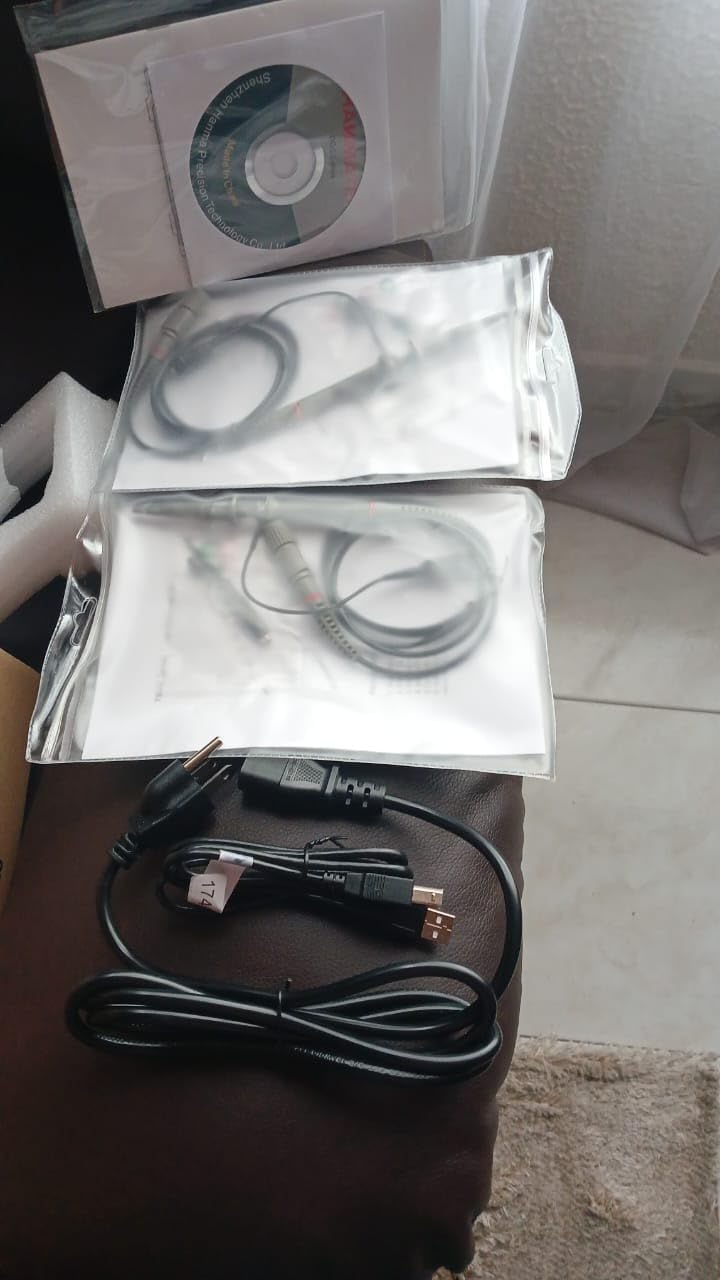
The menu system is described as confusing by multiple owners, and documentation is thin, with the manual downloaded from the vendor site rather than shipped in the box. The community around it is far smaller than for Siglent or Rigol, so troubleshooting advice is harder to find.
Fan noise is reported on some units, and build quality sits a step below the established brands.
Who should buy the DOS1102
It suits lab and test engineers writing automated sequences, production test benches running scripted measurements, and educators who want students learning SCPI on a real instrument rather than a simulator.
It also makes sense as a second scope so one unit stays on the bench for probing while another runs an automated sequence.
Where it falls short
Manual waveform work is the weak point. Ten thousand points of memory means you cannot scroll back through a long capture the way you can on a Rigol, which matters for intermittent fault hunting.
If you are not automating anything, the same money buys far deeper memory and better documentation elsewhere in this list.
10. Hantek DSO2D15: Feature-Packed 150 MHz With a Built-In Generator
Hantek DSO2D15 Digital Storage Lab Oscilloscopes150MHz Bandwidth 2CH
150 MHz
2 channels
Arbitrary waveform output
14 trigger modes
5 serial decodes
Pros
- 150 MHz bandwidth for the money
- Built-in arbitrary waveform generator on generator variants
- Fourteen trigger modes and five serial protocol decodes
- FFT and IQ analysis
- Color coded channel LEDs and square wave calibration output
Cons
- Slow CPU makes the display lag
- Shared USB port for front and rear access
- Firmware updates require Windows
- Can lock up with misconfigured settings
The DSO2D15 packs more functions into the box than almost anything else here. One hundred and fifty megahertz of bandwidth on two channels, fourteen trigger modes, five serial protocol triggers and decodes, plus FFT and IQ analysis for frequency-domain work.
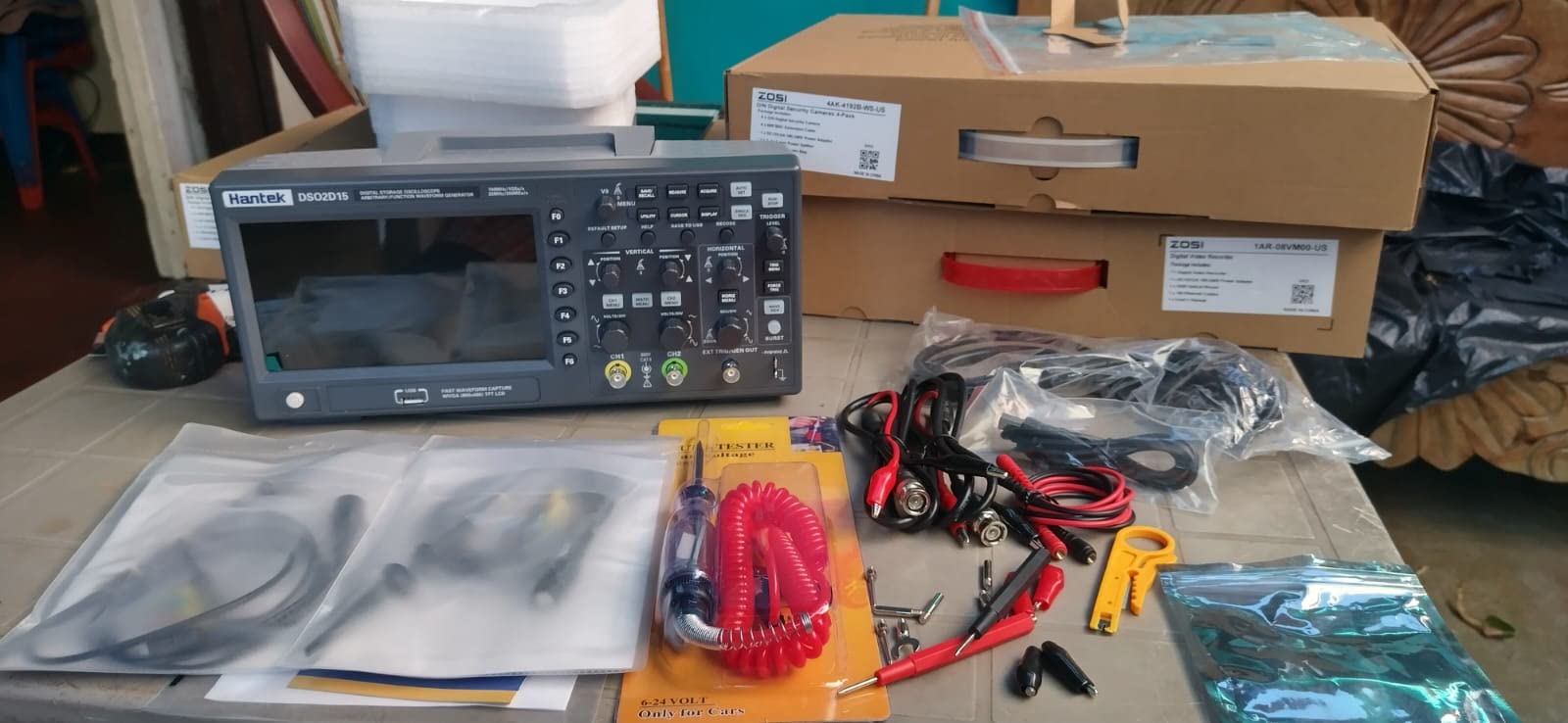
The headline feature is the arbitrary waveform generator available on the generator variants. Having a signal source in the same chassis removes the usual bench clutter when you need to drive a circuit with a known waveform, and a square wave output handles probe compensation checks.
Colour coded LEDs per channel take some of the guesswork out of identifying a trace, which we appreciated more than expected given how often channel colours confuse people on other scopes.
The processor is the weakness. Screen updates lag noticeably, so navigating menus and redrawing a trace feels dated next to the Siglents. Owners also report the scope can become unresponsive when settings are misconfigured.
Front and rear USB share a single port, so you cannot have a drive and a computer connection active together. Firmware updates require Windows, and some units benefit from an update straight out of the box. Documentation is a download rather than a printed manual.
There is no internal battery, so this is a bench instrument only, and AutoSet is not reliable enough to rely on for a signal you have not characterised.
Where the Hantek makes sense
It suits anyone who needs a signal generator as much as a scope: amplifier work, filter response, sensor conditioning and teaching. One box instead of two is a real saving on a small bench. If your project ends at a mixing desk, our roundup of the best digital audio mixers covers the other half of that signal chain.
The 150 MHz bandwidth also covers more digital work than the 50 MHz and 70 MHz class tools, and IQ analysis is a genuine extra for anyone working on modulated signals.
Where it falls short
The slow processor is felt every single session, in menus and in redraws. If you are doing intensive interactive debugging, a faster platform feels much better.
Anyone working on a laptop without easy access to Windows should also look elsewhere, and the absence of a battery rules out field use entirely.
Bandwidth: How Much You Actually Need
Bandwidth is the highest frequency the scope can measure accurately, and the rule of thumb is to buy roughly three to five times the bandwidth of the fastest signal you expect to see. That margin matters because a signal at the scope’s limit is displayed attenuated and rounded, which is exactly when you need to trust the reading.
For Arduino, ESP32 and STM32 work, 50 MHz is genuinely adequate. Most microcontroller peripherals sit well below 20 MHz. Our testers regularly found 50 MHz scopes giving useful answers on debug serial output, PWM duty cycle and simple I2C traffic.
Move to 100 MHz when you handle fast switching nodes, USB lines, or any board with a clock above about 30 MHz. Beyond that, 200 MHz scopes give you headroom on harmonics and edge shape rather than just the fundamental.
Sample rate is a separate number and easy to misread. One gigasample per second on two channels does not mean one gigasample per second with every channel active, because the ADC architecture decides how the rate is shared. The dual ADC in the Siglent SDS1104X-E holds 1 GSa/s on two channels and 500 MSa/s on four, which is why it outruns some rivals that collapse to a quarter rate.
Memory depth is what nobody considers until they need it. Deeper memory means a longer capture window at a high sample rate, so a glitch two microseconds wide does not scroll off the screen before you see it. The Rigols carry 24 Mpts, the Siglents 14 Mpts, and the cheapest handhelds here manage 1 Kpts to 128K.
Form Factor: Benchtop, Handheld or Three-in-One Combo
Benchtop scopes win on measurement depth. They have faster processors, bigger memory, real trigger systems, and screens you can read from across a bench. If your work is stationary, this is what you want, and everything from the Siglents to the Hantek fits here.
Handheld and combo devices win on portability and on bundling functions. Battery operation means no wall outlet, and the three-in-one models add a meter and a signal generator, so a technician diagnosing a fault can measure a rail and watch a waveform without swapping instruments. The tradeoff is memory depth, screen size and trigger quality.
One safety note for anyone testing mains or high-voltage circuits. Battery-powered handheld scopes do not tie your ground clip to earth, which removes a whole class of ground loop hazard on bench work around mains-referenced equipment. Mains-referenced testing still needs isolation transformers and proper instruments.
A practical decision: if you debug more than twice a month, buy a benchtop scope and keep a cheap handheld combo in the toolbox for field checks. If your work is mostly on-site, reverse that split.
What Owners Complain About Most
Across forums, reviews and hands-on time, the same complaints repeat at every price point in this bracket. Knowing them in advance saves you a return.
Fan noise is the most mentioned annoyance. The Siglent and Rigol bench units run audible cooling fans, while the Rigol DS1202Z-E is the quietest of the group. If you work late or in a shared room, that difference registers every day.
Shallow memory at high sample rates is the second big theme. Budget scopes advertise high sample rates but have little storage, so the display holds a fraction of the data. This is the single biggest gap between a budget scope and a professional one.
Included probes are consistently the weakest link. Cheap probes drift and need frequent compensation adjustment, which adds measurement error you will blame on the scope. Replacing probes is the highest-value upgrade available in this price range. For inspecting the board itself once a fault is narrowed down, our best digital microscopes guide covers the soldering-station side of the bench.
PC software divides opinion sharply. UltraVision is Windows-only but polished, SDS is cross-platform but described by users as clunky, and PicoScope is praised for its software while limited by bandwidth on entry models. Our best digital oscilloscopes for hobbyists roundup covers how each workflow handles screen captures and long memory dumps.
Warranty reach is the last issue. Rigol and Siglent carry three-year terms with real distributor networks, while smaller brands offer shorter support with slower responses. If a unit fails, shipping costs across borders can eat the value of any claim.
Frequently Asked Questions
Which digital oscilloscope is the best to buy?
Under 500, the Siglent SDS1202X-E is the strongest all-rounder, offering 200 MHz bandwidth, 14 Mpts of memory and serial decoding on a two-channel body. For four channels, the Siglent SDS1104X-E gives you 100 MHz, dual ADC sampling and every decoder included. For value, the Rigol DS1054Z combines four channels with 24 Mpts of memory and a three-year warranty.
What is the best and most affordable oscilloscope?
The Rigol DS1054Z is the most affordable four-channel option here, with 24 Mpts of memory and RS232, I2C and SPI decoding enabled out of the box. If you need something even cheaper, the FNIRSI 2C53T and ZOYI ZT-703 combine a scope, multimeter and signal generator in battery-powered bodies that cost less than a good probe.
Why are Tektronix oscilloscopes so expensive?
Tektronix builds professional instruments with far wider bandwidth, deeper memory, more accurate calibration and support networks that professional labs depend on. Budget brands compete on the specifications you see printed on the box, while a Tektronix figure is a measured, guaranteed performance level. The gap shows up in noise floor, trigger accuracy and long term calibration stability.
Is a 100MHz oscilloscope enough?
Yes for most hobby and embedded work. A 100 MHz scope measures microcontroller peripherals, debug serial, PWM and I2C with plenty of headroom. You only need more when working above roughly 30 MHz, or when you need accurate edge shape and harmonic detail on fast switching circuits. For safety, pick a bandwidth about three to five times your fastest signal.
Are USB oscilloscopes any good?
They are useful for logic-level digital work, but they tether to a computer and depend on PC software, which introduces ground loop risk and crashes on some setups. A standalone bench scope gives you triggering, deep memory and a display that works without a laptop. USB scopes make sense for automated bench testing or travel, not as your only instrument.
Is a 50 MHz oscilloscope good?
For Arduino, ESP32 and STM32 debugging, yes. Most microcontroller signals sit below 20 MHz, so a 50 MHz scope measures them with useful headroom. The Rigol DS1054Z and the FNIRSI 2C53T are examples. You will hit the ceiling on fast clock lines, USB and switching power circuits, so check your highest expected frequency first.
What is the best portable oscilloscope?
Under 500 the strongest portable options are the FNIRSI 1013D Plus, with 100 MHz bandwidth and a seven inch touchscreen on a four hour battery, and the ZOYI ZT-703 or FNIRSI 2C53T if you want a meter and generator in the same battery-powered body. For deeper memory on the move, verify the storage depth before buying.
Final Verdict: Best Digital Oscilloscopes Under 500 for 2026
The Siglent SDS1202X-E is our pick for most people, combining 200 MHz bandwidth, 14 Mpts of memory and working serial decoding in a two-channel body. Choose the Siglent SDS1104X-E if you need four channels, and the Rigol DS1054Z if you want the deepest memory and the longest warranty at the lowest entry point.
Add a three-in-one combo such as the FNIRSI 2C53T or ZOYI ZT-703 for field and automotive work, and replace the included probes early whichever model you choose. That single upgrade improves your measurements more than any other purchase at this budget.
Use the buttons below to check current pricing on the models covered here.