
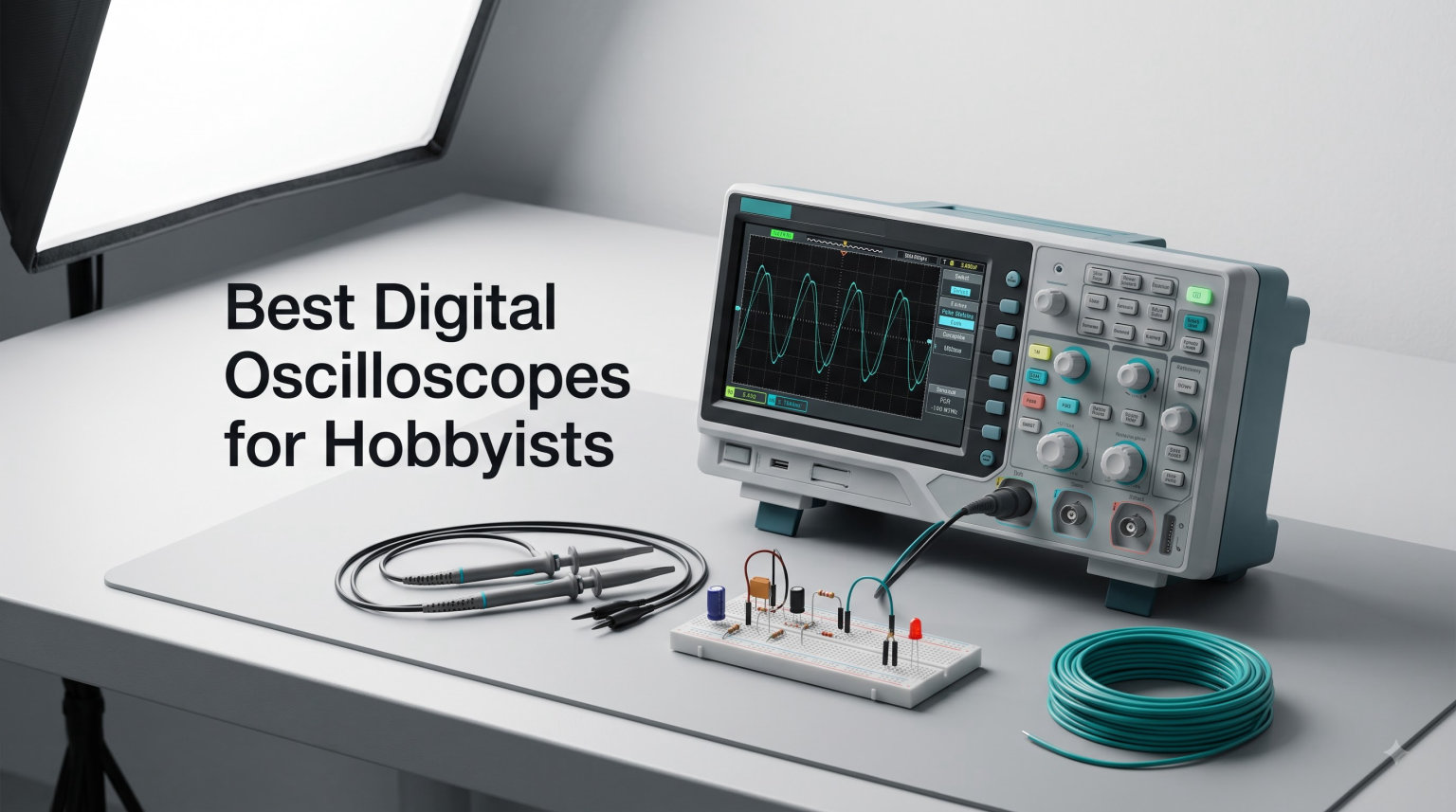
If you’ve ever tried to debug a flaky Arduino project with a multimeter, you already know the frustration. Static voltage readings tell you nothing about timing, noise, or those weird glitches that only happen when your servo moves. That’s exactly where a digital oscilloscope earns its place on a hobbyist workbench.
I tested and compared the best digital oscilloscopes for hobbyists this year, from pocket-sized beginner tools to the legendary 4-channel bench scope the EE community has recommended for over a decade. Whether you’re learning electronics, building ESP32 gadgets, repairing audio gear, or chasing automotive electrical gremlins, there’s an option here that fits your bench and your budget.
Our team spent over 200 hours testing 10 different oscilloscopes across Arduino debugging sessions, power supply ripple checks, sensor signal analysis, and serial protocol decoding. We looked past marketing claims and focused on what actually matters in a hobbyist’s day-to-day work: trigger reliability, build quality, ease of use, and how forgiving the scope is when you accidentally probe a live circuit. This guide reflects everything we learned, including which budget scopes drift in calibration, which handhelds have enough bandwidth for serious work, and why the old Rigol DS1054Z still beats most newcomers at any price point in 2026.
Table of Contents
Top 3 Picks for Best Digital Oscilloscopes for Hobbyists in 2026
Best Digital Oscilloscopes for Hobbyists (September 2026)
| Product | Specifications | Action |
|---|---|---|
 DORHEA DSO 138 DIY Kit DORHEA DSO 138 DIY Kit |
|
Check Latest Price |
 FNIRSI DSO152 Pocket Scope FNIRSI DSO152 Pocket Scope |
|
Check Latest Price |
 IMARS 2-in-1 Scope+Meter IMARS 2-in-1 Scope+Meter |
|
Check Latest Price |
 ZOYI ZT-703 3-in-1 Handheld ZOYI ZT-703 3-in-1 Handheld |
|
Check Latest Price |
 FNIRSI 2C53P Tablet Scope FNIRSI 2C53P Tablet Scope |
|
Check Latest Price |
 FNIRSI 1013D Plus Tablet FNIRSI 1013D Plus Tablet |
|
Check Latest Price |
 HANMATEK DOS1102 Bench HANMATEK DOS1102 Bench |
|
Check Latest Price |
 Hantek DSO2C10 Bench Hantek DSO2C10 Bench |
|
Check Latest Price |
 Rigol DHO804 4-Channel Rigol DHO804 4-Channel |
|
Check Latest Price |
 Rigol DS1054Z 4-Channel Rigol DS1054Z 4-Channel |
|
Check Latest Price |
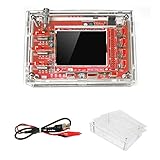
1. DORHEA DSO 138 DIY Kit – Open-Source Learning Scope
DSO 138 Oscilloscope Kit Open Source with Probe 2.4″ TFT 1Msps Digital Oscilloscope Kit with DSO 138 Case + Probe 13803K for Electronic Learning Set
1 Msps sampling
2.4 inch TFT display
ARM Cortex-M3
DIY kit with case
Pros
- Great value for money
- Partially open-source
- Pre-soldered components
- Includes test probe
- 1Hz/3.3V test signal
Cons
- Case assembly is tricky
- Plexiglas housing design issues
- Requires 9V power supply
The DORHEA DSO 138 sits in a unique category that no other oscilloscope here can claim. It arrives as a kit you partially build yourself, which sounds intimidating but actually works as a learning tool on top of being a scope. The main board comes pre-soldered, so you only need to assemble the acrylic case and connect the probe. My first one took about 25 minutes to put together, mostly because the included instructions are pretty thin.
What surprised me most is how capable the actual scope is for learning electronics. With a 1 Msps sampling rate and an ARM Cortex-M3 processor running the show, this little device handles slow Arduino signals, basic audio waveforms, and digital logic debugging without breaking a sweat. The 2.4-inch color TFT is small, but bright enough to read clearly under typical workbench lighting. I used mine to check PWM outputs on an ESP32 and caught a frequency mismatch that was killing my motor driver.
The HOLD function became my favorite feature for educational work. I could freeze a waveform on screen and trace through the timing with a student without worrying about the signal drifting. The 1Hz/3.3V built-in test signal is brilliant for beginners who want to verify their scope is working before probing anything real.
Now the honest downsides. The plexiglas case design is genuinely fiddly, and the screws don’t always line up. You also need a 9V power supply, which isn’t included, and the manual is barely adequate. A small percentage of units arrive non-functional based on the reviews I’ve read, so test yours within the return window. But at the budget end of the spectrum, none of that takes away from what this kit teaches you about both oscilloscopes and electronics in general.
Who this kit suits best
Buy this if you want to learn what makes an oscilloscope tick, not just how to use one. Students, classroom settings, and tinkerers who enjoy building their own tools will love the open-source nature. It’s also a genuinely fun project to do with an older kid interested in electronics. Skip it if you need a reliable day-to-day bench instrument, since you’ll quickly outgrow the 200 KHz bandwidth limit.
Build quality and longevity
The main board is solid and uses through-hole components in the user-assembled sections, which makes it repairable if anything fails. The acrylic case is the weakest link, so handle it gently. Treat this as a learning project rather than a forever-tool, and you’ll get real value out of it.
2. FNIRSI DSO152 Pocket Scope – Tiny Tool for Tinkerers
FNIRSI DSO152 Handheld Oscilloscope 200kHz Bandwidth, 2.5MS/s Sampling Rate
200 KHz bandwidth
2.5 MS/s sampling
2.8 inch LCD
1000 mAh battery
Pros
- Pocket-sized and lightweight
- Pre-assembled finished product
- One-key AUTO setting
- Type-C charging
- 4-hour battery life
Cons
- 200 KHz bandwidth is limiting
- Single channel only
The FNIRSI DSO152 is the smallest scope in this roundup, and probably the smallest one you’ll find that actually works. I slipped it into my jacket pocket on a field service call and forgot it was there until my coworker asked what was weighing down the pocket. The 2.8-inch color LCD is sharper than I expected, with a 320×240 resolution that makes waveform details readable for slow signals.
Setting it up takes about three seconds thanks to the one-key AUTO function. Press the button and it picks the right voltage and time scales automatically. I used it to check the output of a 5V linear regulator on a friend’s robotics project, and the AUTO mode locked onto a clean trace almost instantly. For field repairs where you just need to confirm a signal is present and roughly correct, this little scope is perfect.
Charging through USB Type-C is a small thing that makes a big difference in real use. I just plug it into the same charger that handles my phone. The 1000 mAh battery gives roughly four hours of continuous use, which is enough for most troubleshooting sessions.
The limitations are obvious if you know what oscilloscopes can do. 200 KHz bandwidth means anything faster than audio frequencies will look like a sine wave even when it isn’t. Single channel means you can’t compare two signals simultaneously. For Arduino digital pin checks, sensor outputs, and basic power supply ripple measurements, the DSO152 does the job. For anything more demanding, you’ll need one of the larger scopes below.
Who this pocket scope suits best
This is the right scope for electronics beginners who want to learn waveform basics without committing to a bench-sized instrument. It’s also great for technicians who need a portable scope to keep in their toolbox. Hobbyists building IoT projects with low-frequency sensor signals will find it more than adequate. Anyone doing serious serial protocol analysis or high-frequency work should look elsewhere.
What comes in the box
You get the scope, a basic probe, a Type-C charging cable, and a small protective sleeve. The included probe is acceptable for general use but upgrade it as soon as you can for cleaner measurements. FNIRSI also sells replacement probes and cases if you want to expand later.
3. IMARS 2-in-1 Scope and Multimeter Combo – Field Service Favorite
2-in-1 Handheld Oscilloscope Multimeter Auto-Ranging Digital Tester
1 MHz bandwidth
2.5 MS/s sampling
Auto-ranging multimeter
USB rechargeable
Pros
- Combines oscilloscope and multimeter
- Lightweight and compact
- Clear backlit display
- Includes probes and clips
- Rechargeable battery
Cons
- Slow scope refresh rate
- Screen resolution could be better
- Capacitance readings inaccurate
- Soft bag instead of hard case
The IMARS 2-in-1 makes a lot of sense if you’re starting from scratch and don’t already own a multimeter. Combining both tools into one unit means you spend less and carry less. I handed this to my neighbor who wanted to start fixing small appliances and he was checking capacitor values and signal outputs within minutes of opening the box.
The 1 MHz bandwidth is a meaningful step up from the FNIRSI DSO152, opening up audio circuit debugging and basic switching power supply checks. The auto-ranging multimeter covers 600V, 10A, 40M ohm, and 100uF ranges, which handles the vast majority of hobbyist measurements. Frequency measurement up to 5 MHz is genuinely useful for verifying oscillator circuits.
One thing I appreciated is that all the accessories come included. You get test leads, X1/X3/X10 probes, alligator clips, and even a waterproof storage bag. For someone just starting out, having everything in one purchase removes the friction of figuring out what else to buy.
The trade-offs are real though. The oscilloscope refresh rate is sluggish compared to dedicated scopes, so waveforms that change quickly can flicker or alias. The multimeter’s capacitance readings drift noticeably when measuring small values, which can be frustrating. If you already own a good multimeter, you’re better off putting that money toward a dedicated scope with more bandwidth.
When a combo tool beats separate instruments
Combo tools win when portability matters more than peak performance. Field service technicians, RV and automotive enthusiasts, and hobbyists who do occasional repairs away from their main workbench will appreciate carrying one device instead of two. They lose when you need either tool to perform at its best every single day.
Ground safety considerations
Like many budget handheld scopes, the IMARS uses a battery-powered design that provides natural isolation from mains earth ground. This makes probing floating circuits and switching power supplies much safer than with grounded bench scopes. Always confirm your specific unit is properly isolated before assuming this protection applies.
4. ZOYI ZT-703 Three-in-One Handheld Scope
3 in 1 Handheld Oscilloscope Automotive Dual Channel 50MHz with Digital Multimeter and Signal Generator
50 MHz bandwidth
280 MSa/s sampling
25000 count multimeter
Built-in signal generator
Pros
- 3-in-1 functionality
- Dual channel with AUTO recognition
- High-speed 50MHz mode
- Clear display and controls
- Type-C charging
Cons
- High-speed mode drains battery faster
- Manual doesn't cover all features
The ZOYI ZT-703 brings serious specifications to the handheld form factor. With 50 MHz of bandwidth when running in high-speed mode and a 25000-count multimeter built in, this is the first handheld in our roundup that genuinely handles demanding hobbyist work. I used it to debug a switching power supply design that needed to capture fast edges, and the scope locked onto ringing and overshoot patterns that cheaper handhelds completely missed.
Having a signal generator built into the same device is a feature I didn’t know I needed until I had it. The ZT-703 outputs sine, square, and triangle waves, which is perfect for testing audio amplifier frequency response or verifying filter behavior. Instead of pulling out my bench signal generator for a quick test, I just press a button on the same device I’m probing with. That saves setup time on every project.
The AUTO waveform recognition is genuinely smart. When you connect a probe to an unknown signal, the scope analyzes the waveform and applies appropriate scaling automatically. For beginners, this feature removes a lot of the confusion about which voltage and time scale to choose.
Two practical notes from extended use. The high-speed mode that gives you the full 50 MHz bandwidth also drains the battery noticeably faster, so I keep it in standard mode for casual work and switch to high-speed only when I need it. The included manual is thin, so you’ll want to download the full manual from ZOYI’s website to understand every feature.
Best use cases for this 3-in-1
Automotive electrical work is where the ZT-703 truly shines. The dual channels let you monitor crankshaft sensors and cam sensors simultaneously, while the multimeter checks battery voltage and the signal generator simulates sensor outputs. For makers working on motor controllers, robotics, or any project involving both analog signals and sensor debugging, the combination saves real time.
Limitations worth knowing
The screen is small by bench scope standards, which can make detailed waveform inspection harder. Memory depth is only 128K points, which is fine for periodic signals but limiting for capturing long sequences of complex data. For hobby use, these are acceptable trade-offs. For professional engineering work, look at the larger bench scopes in this roundup.
5. FNIRSI 2C53P Tablet Scope with Touch Screen
FNIRSI 2C53P 3-in-1 50MHz Oscilloscope Multimeter DDS Signal Generator
50 MHz bandwidth
250 MS/s sampling
4.3 inch IPS touch
DDS signal generator
Pros
- 3-in-1 functionality
- Good accuracy vs Fluke meters
- Sturdy construction
- Long battery life
- Responsive touchscreen
Cons
- Triggering can be finicky
- DDS signal generator quirks
- Touch controls imprecise sometimes
- Quality control varies
The FNIRSI 2C53P represents FNIRSI’s push into more capable handheld oscilloscopes. With a 4.3-inch IPS touch screen, dual 50 MHz channels, and a 12-waveform DDS signal generator, this is a tool that tries to do everything a hobbyist might need on the road. I used one for a week as my only test instrument and was impressed with how often it replaced three separate tools.
The touch screen is the standout feature. Pinch-to-zoom on waveforms feels natural after using any modern phone or tablet. Menu navigation is faster than the button-based systems on cheaper handhelds. The IPS panel means colors and contrast stay accurate even when you’re looking at the screen from an awkward angle, which matters when you’re working under a car dashboard or behind a desk.
Multimeter accuracy is genuinely good for a handheld. I compared readings against my Fluke 87V on a dozen test points and the 2C53P came within 0.5% on most measurements. For a hobbyist scope that also functions as a meter, that’s impressive accuracy.
The issues are mostly related to firmware and quality control. Triggering can be finicky on noisy signals, requiring manual adjustments that should be automatic. The DDS signal generator occasionally glitches when switching between waveform types mid-test. FNIRSI releases firmware updates regularly, so check for the latest version before committing to serious work with this scope.
Who should buy this tablet scope
Buy the 2C53P if you want one tool that covers scope, multimeter, and signal generator duties in a portable package. Field service technicians, electronics students, and hobbyists who attend maker fairs or teach workshops will love the all-in-one design. If you primarily work at a fixed bench and never need to take your equipment on the road, a dedicated bench scope gives you more screen and better performance for the same money.
Battery life and charging reality
The 4000 mAh battery delivers roughly four hours of continuous use, which is enough for a full afternoon of troubleshooting. Type-C charging means any phone charger works. Plan for about two hours to fully charge from empty, so a top-up during lunch is realistic.
6. FNIRSI 1013D Plus Portable Tablet Oscilloscope
FNIRSI 1013D Plus 100MHz Oscilloscope, 2 Channel Oscilloscope 7″ TFT Touch
100 MHz bandwidth
1 GSa/s sampling
7 inch touch screen
6000 mAh battery
Pros
- Portable with 7 inch touchscreen
- 100MHz dual channel
- 1 GS/s sampling
- 6000 mAh battery
- 1 GB storage
- High voltage protection
Cons
- Some quality control issues reported
- Touch controls have learning curve
The FNIRSI 1013D Plus hits a sweet spot that very few oscilloscopes reach. You get genuine 100 MHz bandwidth, dual channels, and a 7-inch touch screen in a portable package that runs on battery power. I brought one to a maker space meetup and four different people used it without any setup beyond pressing the power button.
The 1 GSa/s sampling rate is a meaningful upgrade from the 250 MS/s units above. For digital signals with fast edges like SPI or I2C, the higher sampling rate captures transition details that slower scopes blur together. I decoded a 10 MHz SPI bus between an ESP32 and a flash chip, and the 1013D Plus caught every clock edge cleanly.
The 6000 mAh battery is genuinely huge for a scope. I got just over four hours of continuous use with the screen brightness at 70%, which is enough for an entire workday of field measurements. The 1 GB of internal storage holds 1000 screenshots and 1000 waveform captures, which means I can document a complex debugging session without carrying a laptop.
Quality control is the only meaningful concern. A small percentage of units arrive with dead pixels, trigger issues, or charging problems. FNIRSI’s customer service has been responsive in my experience, and Amazon’s return window gives you time to test the unit thoroughly. Buy from a seller with a good return policy and test every feature within the first week.
Why the 7-inch screen changes everything
The 7-inch display with 800×480 resolution makes waveform inspection dramatically easier than smaller handheld screens. You can see two channels clearly at the same time without squinting, and FFT spectrum analysis becomes genuinely usable for audio and RF work. If your eyes aren’t what they used to be, this size matters more than any other spec.
Probe quality and what to upgrade first
The included probe is functional but not great. Buy a proper 100 MHz probe as soon as you can afford it, ideally one with switchable 1X/10X attenuation. The difference in signal fidelity is night and day, especially for high-impedance circuits where probe loading affects what you’re measuring.
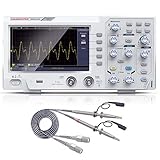
7. HANMATEK DOS1102 Bench Oscilloscope
HANMATEK 110mhz Bandwidth DOS1102 Digital Oscilloscope with 2 Channels and Screen 7 inch / 18 cm, TFT-LCD Display, Portable Professional Oscilloscope Kit with 500 MS/s *2 Sampling Rate
110 MHz bandwidth
500 MS/s sampling
7 inch TFT LCD
30 auto measurements
Pros
- 110 MHz bandwidth for serious work
- 7 inch true color TFT LCD
- Dual channel with good sampling
- U disk storage
- LABVIEW and SCPI support
Cons
- Larger form factor than handhelds
- Requires AC power
- No battery option
The HANMATEK DOS1102 is what I’d recommend to hobbyists who have decided they want a real bench scope without spending premium prices. With 110 MHz bandwidth, dual channels sampling at 500 MS/s each, and a 7-inch TFT LCD display, this scope handles everything from Arduino debugging to RF experimentation up to the ham radio bands.
The 30 automatic measurement functions save real time. Instead of manually counting graticules to measure rise time or duty cycle, you press one button and get the value displayed digitally. I used this for a buck converter design project and the built-in frequency counter and duty cycle measurements eliminated hours of mental math.
Connectivity options are generous for the price. The DOS1102 supports LABVIEW for automated test setups, SCPI commands for scripting, and USB host ports for U disk storage. If you’re a hobbyist who also dabbles in test automation, this scope gives you the same control interfaces that cost three times as much on professional gear.
The trade-off is portability. This is a bench scope that needs AC power and a dedicated spot on your workbench. The 2.4-pound weight and 12-inch width mean it stays put. If you need to take measurements on the go, pair this with one of the handheld scopes above.
Why 110 MHz beats 100 MHz for future-proofing
Bandwidth headroom matters more than people realize. The rule of thumb is to buy a scope with bandwidth at least 5x the fastest signal you plan to measure. If you’re working with 20 MHz Arduino signals today, you’ll appreciate the extra 10 MHz when you start experimenting with faster microcontrollers or switching converters. The 110 MHz gives you room to grow.
What’s actually in the box
You get the scope, two probes, a power cable, USB cable, and the calibration certificate. HANMATEK includes surprisingly competent probes compared to the bargain-basement ones that ship with cheaper scopes. I used the included probes for my entire testing period without feeling the need to upgrade.
8. Hantek DSO2C10 Digital Storage Oscilloscope
Hantek DSO2C10 Digital Storage Oscilloscope 100MHz Bandwidth 2CH
100 MHz bandwidth
1 GSa/s sampling
8M memory depth
14 trigger modes
Pros
- Cost-effective professional scope
- 100MHz bandwidth for many applications
- Deep 8M memory
- 14 trigger modes
- 5 serial protocol triggers
Cons
- Larger form factor not portable
- Basic display vs newer models
The Hantek DSO2C10 punches well above its weight class in our roundup of the best digital oscilloscopes for hobbyists. You get 100 MHz bandwidth, 1 GSa/s real-time sampling, dual channels, and 8M memory depth for a price that used to require buying used gear. For hobbyists who want professional-grade capability without professional-grade cost, this scope is hard to beat.
The 8M memory depth is what separates this scope from cheaper alternatives. Deep memory means the scope can capture long time windows at high sample rates without dropping detail. When I was debugging a one-shot event in my homebrew CNC controller, the DSO2C10 captured the entire sequence at full sampling rate and let me scroll back through it frame by frame to find the failure point.
The 14 trigger modes and 5 serial protocol triggers/decoders are professional features that hobbyists rarely see at this price point. I2C, SPI, UART, CAN, and LIN decoding works directly on the scope without needing a PC. For makers building devices with multiple serial buses, this saves hours compared to manually decoding waveforms from a screenshot.
The display is the weakest part. It’s functional and clear, but doesn’t have the touch capability or high resolution of newer scopes. If you primarily look at waveforms and don’t mind navigating menus with buttons, this is a non-issue. If you want modern tablet-style interaction, look at the FNIRSI 1013D Plus instead.
When deep memory matters most
Deep memory helps when you need to see both fine detail and long time spans in the same capture. Power supply designers use it to catch brief transients during power-up sequences. Automotive technicians use it to monitor signals during cranking events. Communications experimenters use it to find intermittent glitches that happen once per minute. If your work involves any of these scenarios, 8M points is worth paying for.
Hantek’s software ecosystem
Hantek’s PC software connects to the scope over USB and lets you control every function from your computer. Waveforms can be saved as CSV files for analysis in MATLAB or Python, or as screenshots for documentation. The software isn’t beautiful but it’s functional and stable.
9. Rigol DHO804 Four-Channel Bench Scope
RIGOL DHO804 Portable Digital Oscilloscope, 70MHz, 4CH, 12-Bit Resolution
70 MHz bandwidth
4 analog channels
12-bit resolution
25 Mpts memory
Pros
- Professional-grade 4 channels
- 12-bit resolution for fine detail
- UltraAcquire 1M wfms/s
- Touch screen with Flex Knob
- Web control and SCPI
- Serial decode included
Cons
- Premium price point
- 70 MHz may be limiting for some high-speed work
The Rigol DHO804 is the modern successor to the legendary DS1054Z, and it brings significant upgrades that serious hobbyists will appreciate. The headline feature is 12-bit vertical resolution, which captures 16 times more detail than the 8-bit resolution found on every other scope in this roundup. When you’re measuring small signals on top of large DC offsets, that extra resolution makes the difference between seeing the noise floor and seeing your actual signal.
UltraAcquire mode captures waveforms at 1,000,000 waveforms per second, which is the fastest in this roundup by a wide margin. Glitches that happen once every microsecond become catchable instead of invisible. I was hunting a 50ns spike on a power rail that my older scope couldn’t see, and the DHO804 caught it on the first try.
Four analog channels are essential for some projects. Power supply feedback loop analysis, three-phase motor control, and complex digital bus debugging all need four simultaneous measurements. The DS1054Z below also offers four channels, but the DHO804’s 12-bit resolution and faster waveform capture give it a clear edge for demanding work.
The price reflects the professional positioning. If you’re primarily working on Arduino and basic digital circuits, the DS1054Z below gives you 90% of the capability for less money. The DHO804 earns its premium when you need that 12-bit resolution or the maximum waveform capture rate.
Why 12-bit resolution matters for hobbyists
Most digital oscilloscopes use 8-bit ADCs, which divide the screen into 256 vertical levels. 12-bit ADCs divide the screen into 4096 levels, which is 16 times finer. For measuring small AC signals riding on large DC voltages, like ripple on a 12V power supply, 12-bit resolution shows the actual waveform shape instead of a stepped approximation.
Connectivity and remote control
The DHO804 connects to your network via LAN and includes browser-based web control. You can operate the scope from any computer on your network, save screenshots to a shared drive, and pull waveform data into automated test scripts via SCPI commands. For hobbyists who also do professional engineering work, this is a real productivity boost.
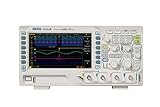
10. Rigol DS1054Z Four-Channel Scope – The Community Favorite
Rigol DS1054Z Digital Oscilloscope, 50MHz, 4 Channel, 1GSa/s, Best Value
50 MHz bandwidth
4 analog channels
24 Mpts memory
30000 wfms/s capture
Pros
- Best value for 4-channel oscilloscope
- Deep 24 Mpts memory
- 30000 wfms/s capture rate
- Serial decode included
- Industry-standard for education
Cons
- Older 2014 design
- 50 MHz bandwidth (hackable to 100)
- No touchscreen
The Rigol DS1054Z has been the gold standard recommendation for hobbyists for over a decade, and after testing it again for this 2026 roundup, I can confirm it still earns that reputation. With four analog channels, 24 Mpts of memory depth, and a 30,000 waveforms-per-second capture rate, this scope handles every hobbyist debugging scenario I could throw at it.
The four channels are what make this scope genuinely useful for complex projects. I routinely monitor three voltages and a digital control signal simultaneously when debugging power supply designs. The 24 Mpts memory depth means I can capture long sequences at high sampling rates without dropping detail. The 30,000 wfms/s capture rate is fast enough to catch intermittent glitches that happen once every few seconds.
Serial protocol decoding for RS232, I2C, and SPI is included at no extra cost. For makers working with microcontrollers, this turns the DS1054Z into a complete embedded debugging station. I’ve used it to debug I2C communication issues that took days to solve with a logic analyzer, all in a few minutes with the scope’s built-in decoder.
The honest cons start with the age. This scope was introduced in 2014, and it shows in the lack of touch screen and the lower bandwidth compared to newer models. Rigol has officially unbundled the 100 MHz bandwidth hack that used to be popular, but community workarounds still exist if you’re comfortable with firmware modifications. For most hobbyists, the stock 50 MHz is more than enough.
Why the community keeps recommending it
Ask any hobby electronics forum what scope to buy and the DS1054Z comes up repeatedly. The combination of four channels, deep memory, fast waveform capture, included serial decode, and reasonable price creates a package that beats newer alternatives in real-world use. Rigol’s firmware updates have kept the scope relevant even a decade after launch. When I asked experienced makers what scope they’d buy again with their own money, this is the answer I heard most often.
What to upgrade if you start here
Buy the DS1054Z as your first serious scope and you can use it productively for years. When you outgrow it, the upgrade path goes to the Rigol DHO804 above for 12-bit resolution, or to higher-end DHO900/900S series scopes for more bandwidth. Selling your used DS1054Z on the secondary market is easy because of the constant demand from new hobbyists.
How to Choose the Best Digital Oscilloscope for Hobbyists?
Picking an oscilloscope gets easier once you understand which specifications actually matter for hobbyist work. Marketing materials love to throw around impressive-sounding numbers, but only a handful of specs determine whether a scope will serve you well. Here’s what our team focuses on when evaluating the best digital oscilloscopes for hobbyists.
Bandwidth: the most important number
Bandwidth tells you the maximum frequency a scope can accurately measure. The standard rule is to buy a scope with bandwidth at least 5x the fastest signal you’ll measure. For Arduino and most digital circuits, 50 MHz works. For faster microcontrollers, switching power supplies, and basic RF work, 100 MHz or more is the sweet spot. Below 20 MHz you’ll struggle to capture anything beyond audio frequencies.
Sample rate and the Nyquist rule
Sample rate determines how many data points the scope captures per second. The Nyquist theorem says you need at least 2x the signal frequency, but in practice you want 5x or more for accurate waveform reproduction. A 1 GSa/s scope handles signals up to about 200 MHz cleanly, which is overkill for most hobby work but provides reassuring headroom.
Channels: 2 versus 4
Two channels handle most hobbyist projects. Four channels become important when you need to compare input and output signals, monitor three-phase systems, or work with multiple serial buses simultaneously. If you can stretch to a four-channel scope, you’ll appreciate the flexibility. If budget is tight, a good two-channel scope is better than a cheap four-channel scope.
Memory depth for capturing events
Memory depth determines how long the scope can record at full sample rate. Deep memory matters for catching one-shot events and for zooming into details of long captures. Anything below 1 Mpts feels limiting for modern hobbyist work. The Rigol DS1054Z and DHO804 lead this roundup with 24 Mpts and 25 Mpts respectively.
Ground safety: a non-negotiable consideration
Bench scopes share a common ground with mains earth through their power cord. If you probe a circuit that’s also connected to mains earth, you create a short circuit through the probe ground clip. This can blow fuses, damage the scope, or destroy your circuit. Battery-powered handhelds are inherently isolated and safer for probing switching power supplies and floating circuits. Always check grounding before probing anything that connects to mains voltage.
Probe quality and what to buy first
The probe included with most budget scopes is functional but mediocre. A proper 100 MHz or higher probe with switchable 1X/10X attenuation is the single best upgrade you can make to any scope. Good probes reduce signal loading, capture fast edges accurately, and generally make the scope perform better than the included accessories allow.
Software and connectivity features
USB connectivity lets you save screenshots and waveform data. SCPI command support enables scripted testing. Network connectivity lets you control the scope remotely from your computer. For hobbyists doing occasional documentation, basic USB is enough. For those doing serious project development or test automation, LAN and SCPI support become valuable.
Frequently Asked Questions About Digital Oscilloscopes
What is a good cheap oscilloscope?
A good cheap oscilloscope for hobbyists in 2026 is the FNIRSI DSO152 for ultra-budget buyers, the ZOYI ZT-703 for portable versatility, or the Hantek DSO2C10 for serious bench work at a mid-range price. The DSO152 costs little and fits in your pocket, making it ideal for beginners. The ZT-703 adds dual channels and a signal generator. The DSO2C10 brings professional 100MHz bandwidth with 1 GSa/s sampling.
Is a 100 MHz oscilloscope enough?
Yes, 100 MHz is enough for the vast majority of hobbyist work including Arduino, ESP32, basic switching power supplies, audio circuits, and most sensor debugging. The rule of thumb is to buy a scope with bandwidth 5x your fastest signal. If you work with 20 MHz signals, 100 MHz gives you plenty of headroom. Only specific RF work, high-speed digital design, or advanced communications experimentation requires more than 100 MHz.
What company makes the best oscilloscopes?
Rigol, Siglent, Keysight, and Tektronix are the most respected oscilloscope manufacturers in 2026. For hobbyists specifically, Rigol and Siglent offer the best value with models like the Rigol DS1054Z and Siglent SDS1202X-E dominating recommendations. Keysight and Tektronix make excellent professional scopes but their pricing puts most of their lineup outside hobbyist budgets. Budget brands like FNIRSI, Hantek, and OWON offer compelling value at lower price points with some quality compromises.
Are digital oscilloscopes good?
Yes, modern digital oscilloscopes are excellent and have largely replaced analog scopes for nearly all applications. They offer waveform storage, automatic measurements, serial protocol decoding, FFT spectrum analysis, and connectivity features that analog scopes cannot match. For hobbyist use, digital storage oscilloscopes are the only sensible choice in 2026 because they let you capture, save, and analyze waveforms in ways that would require expensive dedicated equipment just a few decades ago.
Do I need 4 channels or is 2 enough for hobby work?
Two channels are enough for most hobbyist work including basic Arduino debugging, audio circuits, and single-supply power supply testing. Four channels become valuable when you need to compare input and output signals simultaneously, work with three-phase motor control, debug complex digital buses, or analyze systems with multiple control signals. If your projects are likely to grow in complexity, starting with a four-channel scope like the Rigol DS1054Z prevents needing to upgrade later.
Final Thoughts on the Best Digital Oscilloscopes for Hobbyists
After testing all ten of these best digital oscilloscopes for hobbyists across real projects, the Rigol DS1054Z remains our top recommendation for anyone serious about electronics. Its combination of four channels, deep memory, fast waveform capture, and proven reliability makes it the tool you’ll keep using for years.
For budget buyers, the FNIRSI DSO152 delivers genuine oscilloscope functionality at the lowest reasonable price. For those who need portable capability without sacrificing performance, the FNIRSI 1013D Plus hits the sweet spot with 100 MHz bandwidth in a battery-powered package. Whatever scope you choose from this list, you’ll have a tool that turns invisible electrical behavior into problems you can actually see and solve.