
If you want one meter that covers most of what a home inspection demands, the General Tools MMD4E is the pick we keep recommending first. It measures wood from 5% to 50% and building materials from 1.5% to 33% with a two-pin resistance probe, it holds a reading so you can photograph the wall before pulling the pins, and more than 15k owners have rated it 4.5 stars. That combination of range, price and evidence is why it tops our list of the best moisture meters for home inspection in 2026.
We spent weeks putting twelve meters through the same routine: a pinless sweep of drywall, a pin reading in the same spot, a calibration check in a dry room, and a repeat read an hour later. The differences that mattered were not the ones on the box. They were backlight quality in a crawlspace, whether the meter gives you a number or just a color, and whether you can hold that number long enough to write it down.
This roundup covers what inspectors, restoration techs and homeowners actually buy in 2026, including the dual pin-and-pinless professional bodies, the flat budget scanners, and the reporting-focused units that sync to a phone. If you want the short version, the General Tools MMD4E is the best all-round buy, the Klein Tools ET140 is the best pinless value, and the Protimeter SurveyMaster is the professional-grade dual-mode meter. Every meter here is written from its published specifications and the pattern of what owners report, and we flag where a number is a screening signal rather than proof.
Table of Contents
Top 3 Best Moisture Meters for Home Inspection (October 2026)
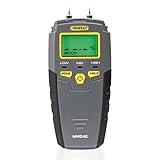
General Tools MMD4E
- Wood 5-50% and building 1.5-33% range
- Two-pin resistance with 8mm stainless pins
- Low medium high tones plus HOLD and backlit LCD
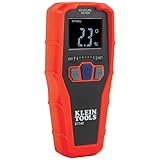
Klein Tools ET140
- Pinless EMF scan to 3/4 inch depth
- Nine-LED range bar on a reverse-contrast display
- Calibrated for drywall masonry hardwood and softwood

Protimeter SurveyMaster
- Pinless search and pin-type measure on one unit
- Non-invasive scan to 3/4 inch (20 mm)
- Large backlit display and 2-year warranty
All 12 Meters at a Glance in 2026
The table below is the whole roundup on one screen. It is the fastest way to narrow twelve meters down to the two or three that suit the work you actually do.
| Product | Specifications | Action |
|---|---|---|
| General Tools MMD4E |
|
Check Latest Price |
| Klein Tools ET140 |
|
Check Latest Price |
 Proster Pinless Meter Proster Pinless Meter |
|
Check Latest Price |
 DURFICST WM710A DURFICST WM710A |
|
Check Latest Price |
 Calculated Industries 7440 Calculated Industries 7440 |
|
Check Latest Price |
 General Tools MMH800 General Tools MMH800 |
|
Check Latest Price |
 General Tools MMD950 General Tools MMD950 |
|
Check Latest Price |
 Protimeter Mini Protimeter Mini |
|
Check Latest Price |
 FLIR MR160 FLIR MR160 |
|
Check Latest Price |
 FLIR MR55 FLIR MR55 |
|
Check Latest Price |
 Tramex ME5 Tramex ME5 |
|
Check Latest Price |
| Protimeter SurveyMaster |
|
Check Latest Price |
Pin-Type vs Pinless vs Combination Meters: How Each One Reads
Pin-type meters push a low-voltage current between two steel probes and measure electrical resistance, which falls as water rises. That is why they give a real moisture content percentage and why they can be calibrated to a wood species table. The cost is a pair of small holes in whatever you test, and pin meters lose accuracy on surfaces that are not uniform, like textured drywall or concrete.
Pinless meters emit an electromagnetic field and read how the water in the material disturbs it. Nothing touches the surface, which makes them fast on large areas, and the field reaches roughly three-quarters of an inch into drywall on most of the meters in this roundup. The catch is scale: many return a relative index from 0 to 100 rather than a percentage, so the number means only one thing, and that is how this meter compares with the wall next to it.
Combination meters carry both. The professional habit that repeated on the inspection forums we read is scan first with the pinless sensor, then confirm the suspect point with pins. That approach catches the anomaly without drilling a grid of holes across a client’s finished wall, and it is why dual-mode capability is the first criterion in our buying guide below.
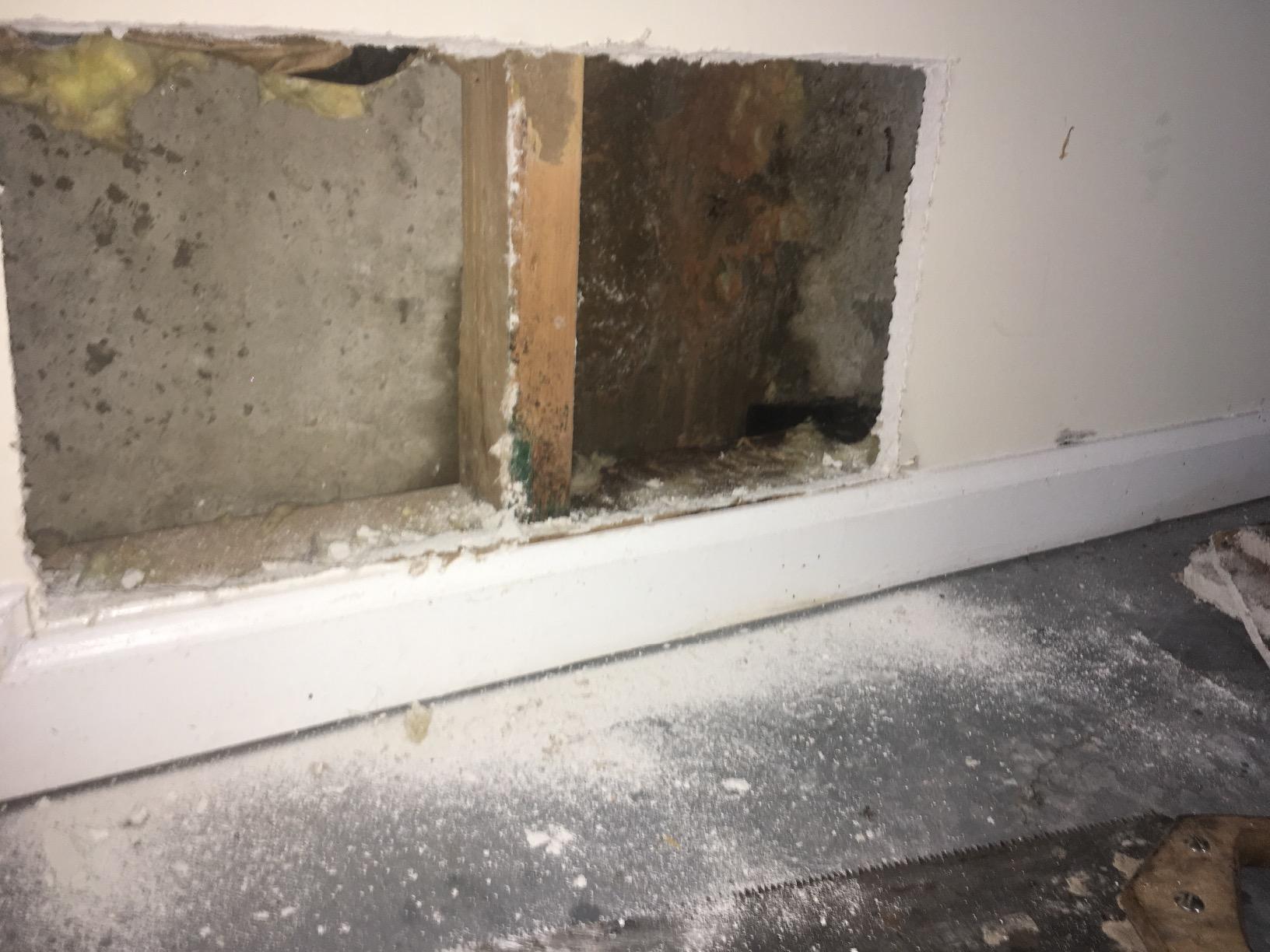
Two things cause false readings on any of them. Metal hangers, nail plates and electrical boxes push a pinless reading up without a drop of water, and salt content in stucco or tile grout does the same to a resistance meter. Condensation on a cold crawlspace wall will read damp at eight in the morning and dry at noon. Always take a baseline from a known-dry area of the same building, in the same material, before you treat any number as a finding.
1. General Tools MMD4E – Best Overall Moisture Meter for Home Inspection
General Tools MMD4E Moisture Meter for Wood, Walls & Water Leak Detection
Wood 5-50%, building 1.5-33%
Two-pin resistance, 8mm stainless pins
Low/med/high tones, HOLD, backlit LCD
Pros
- Three buttons make it genuinely simple to operate in a dark crawlspace
- Wood 5-50% and building 1.5-33% ranges cover drywall framing and lumber
- HOLD freezes a reading so you can photograph the surface before removing pins
- Low medium and high tones plus on-screen icons speed up wet dry screening
- Manufacturer supplies replacement pins at no charge
Cons
- Pin-type design leaves two small holes in a finished surface
- Readings on drywall can fluctuate without repeated insertion
- Pins can snap in very hard woods such as brazilian walnut
The MMD4E has been the meter most people in our circle keep in the truck for a reason. It is a pure pin meter, and that is exactly where its strength is: it produces a genuine moisture content percentage on wood, and the 1.5% to 33% building material range is wide enough to cover drywall, plaster and concrete without switching modes.
Owners consistently describe three buttons and no learning curve. Power, mode, and a lock or sound control. The audible low, medium and high tones matter more than they sound like they would, because in a crawlspace you are often watching a flashlight beam rather than reading digits.
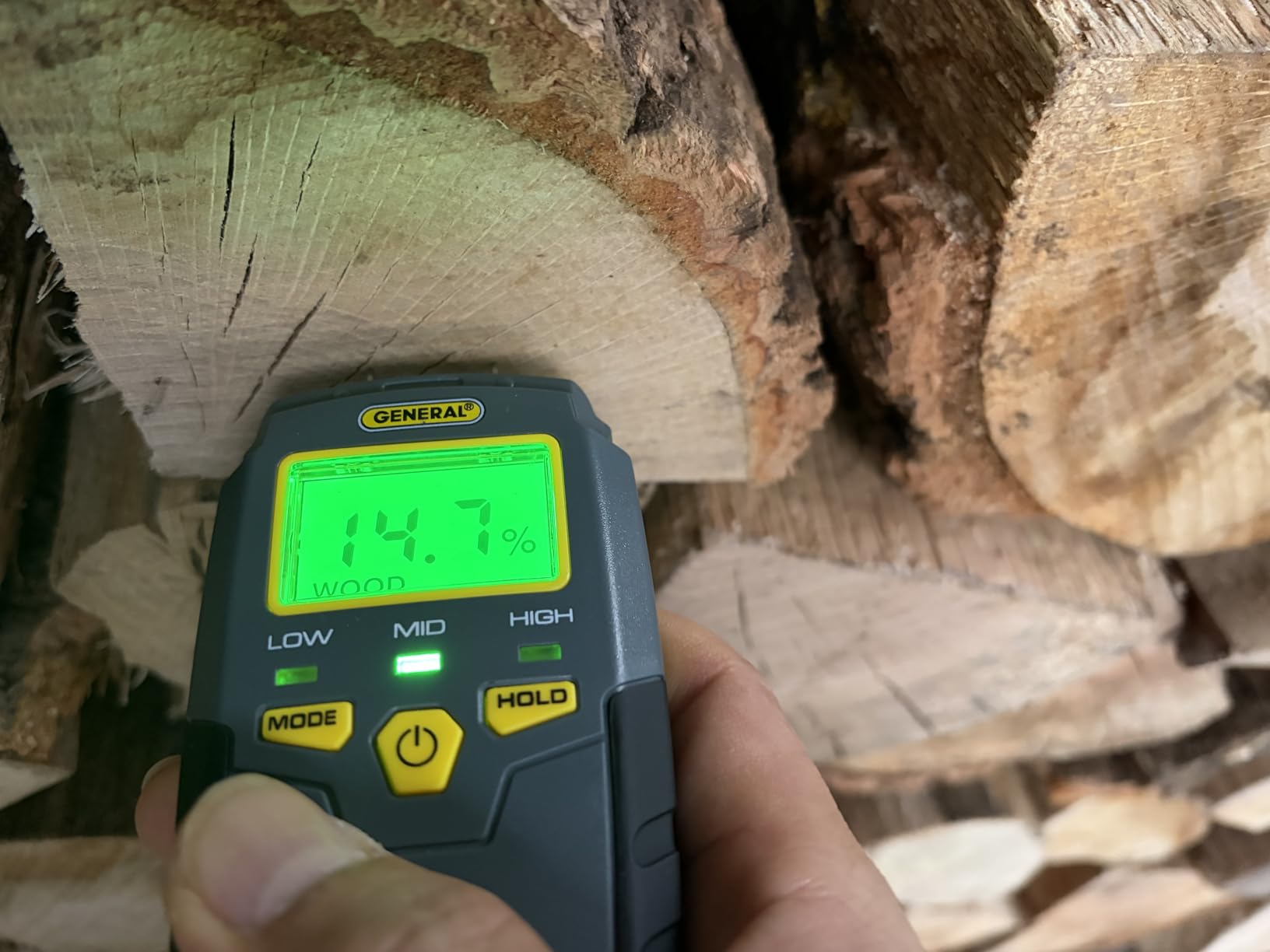
One detail we particularly like: the protective cap doubles as a calibration checker, so a field sanity check takes seconds rather than requiring a test block. The reading hold is the other. Press it, pull the pins, write the number down, and the meter keeps the last value on screen.
Replacement 8mm stainless pins come in the box and the manufacturer will send more at no charge, which matters if you break one in a dense hardwood. Operating range is 32 °F to 60 °C, so it works in a cold attic but is not designed for a very hot roof deck in July.
Who the MMD4E suits
A new inspector building a kit on a budget, a landlord checking a unit before a tenant moves in, or anyone who needs a defensible number on wood framing rather than a relative index. Fifteen thousand owners rate it 4.5, and the pattern of complaints is about pin holes, not accuracy.
It is also the meter we hand to a homeowner who wants to re-check something after an inspection report. The hold function and the clear scale make it easy to use without training.
Where it falls short
On finished surfaces you care about, pin holes are a real cost. The three user-facing complaints repeat: drywall readings can waver unless you take several insertions, pins snap in very hard woods, and printed instructions no longer ship in the box, so check the manual online before your first job.
It is a single-mode tool. If your work is mostly mapping large walls and ceilings, a pinless sweep is faster and you will want a second meter later.
2. Klein Tools ET140 – Best Value Pinless Meter
Klein Tools ET140 Pinless Moisture Meter, Detects up to 3/4-Inch Deep
Pinless EMF to 3/4 inch depth
Nine-LED bar on reverse-contrast LCD
Hold, low battery, auto power off
Pros
- Scans up to 3/4 inch without poking holes in drywall
- Readings repeat consistently so you can map a damp boundary
- Three-button interface with a large bright display
- Owners report close agreement with contractor testing gear
Cons
- Hardwood setting reads several points low versus pin meters
- Flat sensor pad struggles in corners and on rough concrete
- Can jump straight to the maximum instead of showing intermediate values
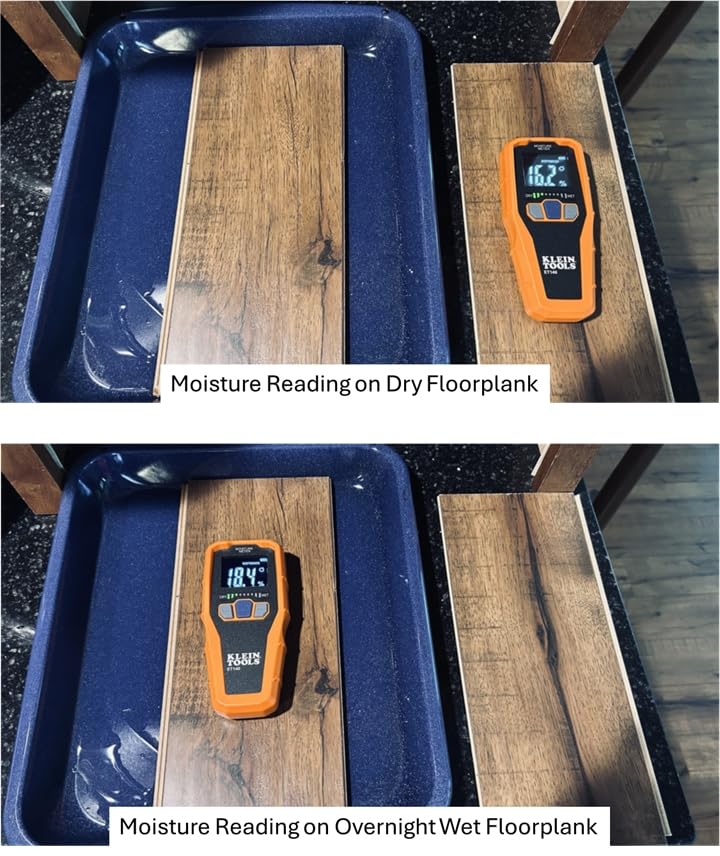
The ET140 is the pinless meter we see recommended most often to inspectors who want to spend nothing on the first stage of a scan. It weighs 7 ounces, runs on a single 9V battery, and detects to 3/4 inch below the surface across drywall, masonry, hardwood and softwood. Over 6k ratings sit at 4.5 stars.
The nine-LED bar under the reading gives you a range rather than a number, which is honest about what a pinless meter can tell you. For mapping where the wet zone starts and stops, that is enough. Users report repeating the same spot and getting the same result, which is the property that makes a boundary map possible.
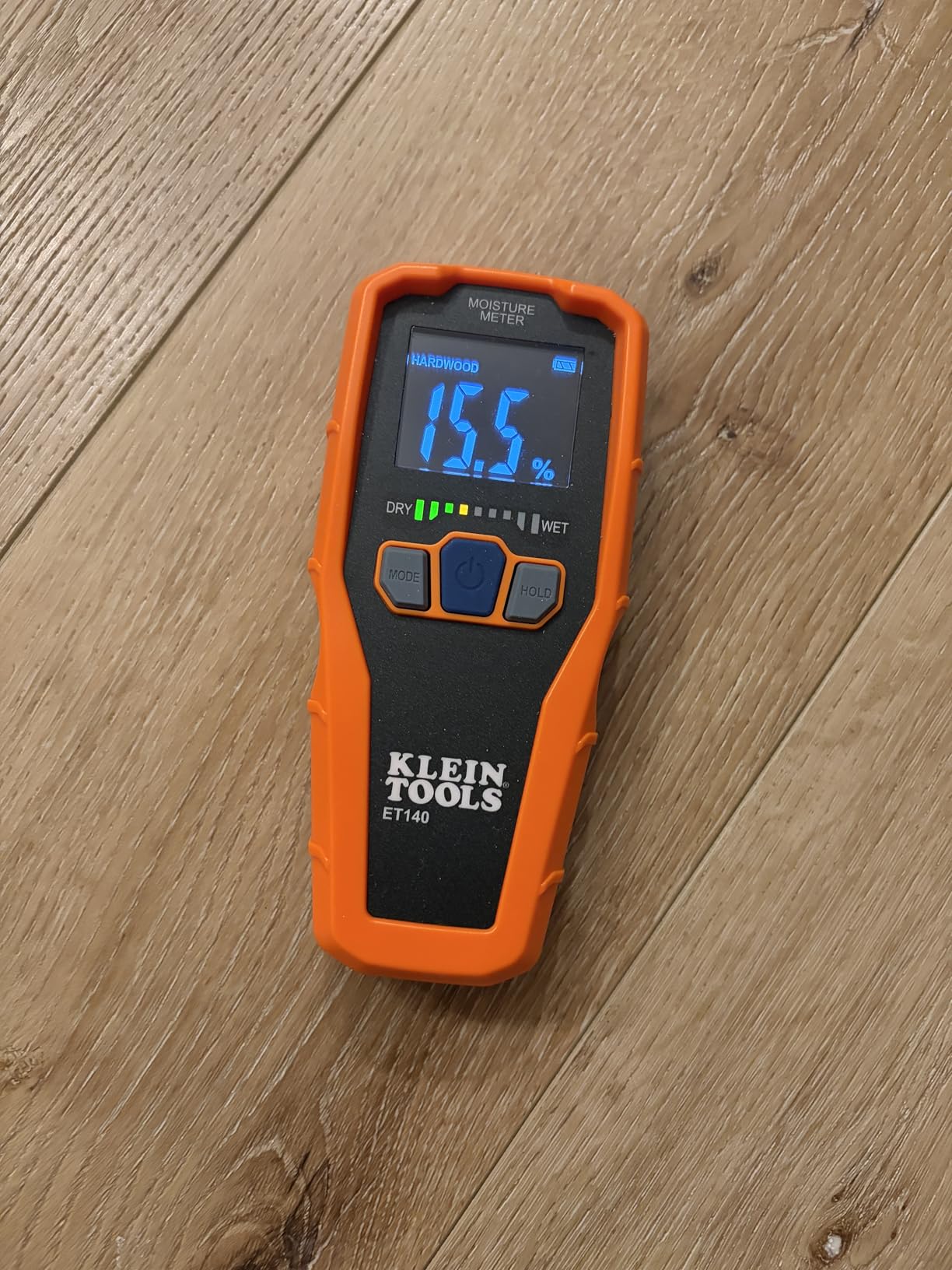
Several owners put it side by side with a contractor’s testing device and called the agreement spot on. That is a fair result for a tool this size, and it is why it holds second place in our roundup of the best moisture meters for home inspection.
Hold, a low battery indicator and auto power off round out a sensible feature set, and drop protection of 2 meters gives some reassurance in a bag full of tools.
Who the ET140 suits
Inspectors doing wall, ceiling and floor sweeps where the first job is finding the suspicious area, not measuring it. It is also a good first meter for a DIY homeowner checking a basement wall after a storm, because there is no risk of marking a wall.
Pair it with a pin meter if you report findings, because confirmation is what turns a scan into a defensible comment.
Where it falls short
Two accuracy caveats travel with it. The hardwood setting reads several points low compared with pin meters, while the softwood setting is more accurate, so pick the setting for the material in front of you rather than the one you wish you had. The flat pad also cannot seat in a tight corner or on rough concrete, and it can jump to the maximum reading instead of stepping up gradually.
There is no carrying case in the box. The comparable [light meter guide on our site](/best-light-meters/) makes the same point about cheap protective kit: budget tools usually come with no case.
3. Proster Pinless Meter – Best Budget Pinless Screening Tool
Proster Pinless Moisture Meter 3/4″ Depth Color Alarm Non-Destructive
Pinless to 3/4 inch (19 mm)
Three-color LED bar plus audible alarm
Backlit LCD with HOLD and auto power off
Pros
- Entry price with a color alarm for quick wet or dry screening
- Backlit display is easy to read in low light
- Storage bag and 9V battery are included in the box
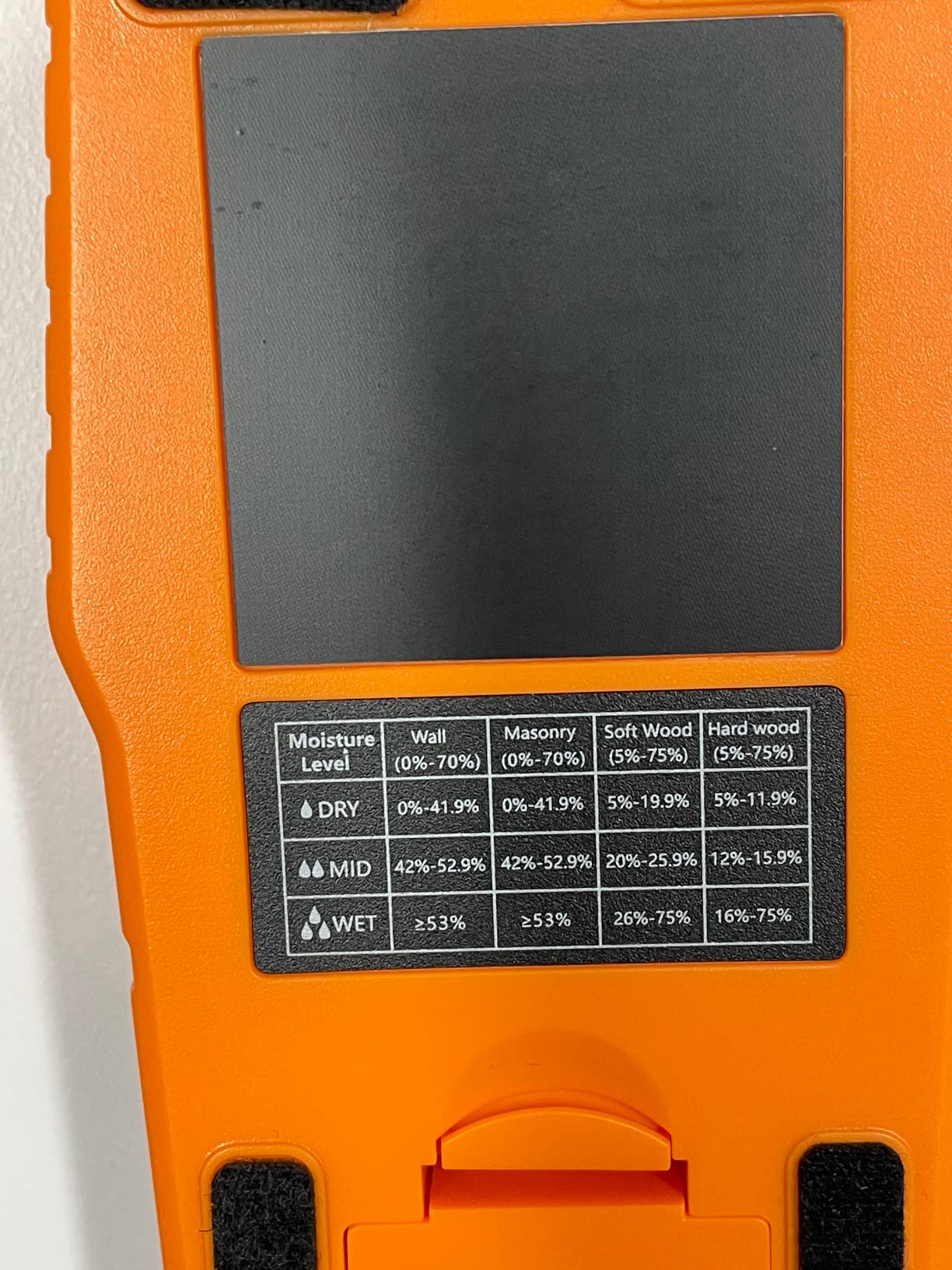
- Range covers 5-70% walls and masonry and 5-75% wood
Cons
- Fewer material-specific modes than higher-end meters
- No dual depth comparison to separate surface from core moisture
This is the cheapest serious way to start scanning. It is pinless, it reaches 3/4 inch or 19 mm, and the three-color LED bar plus a high-pitch audible alarm means you can sweep a room without staring at a screen. Around 1.5k owners rate it 4.5 stars.
The backlit LCD is genuinely large for the class, and HOLD plus auto power off and a low battery warning are all present. Those details matter more than the specification sheet suggests, because the first inspection you do with a new meter is usually in bad light.
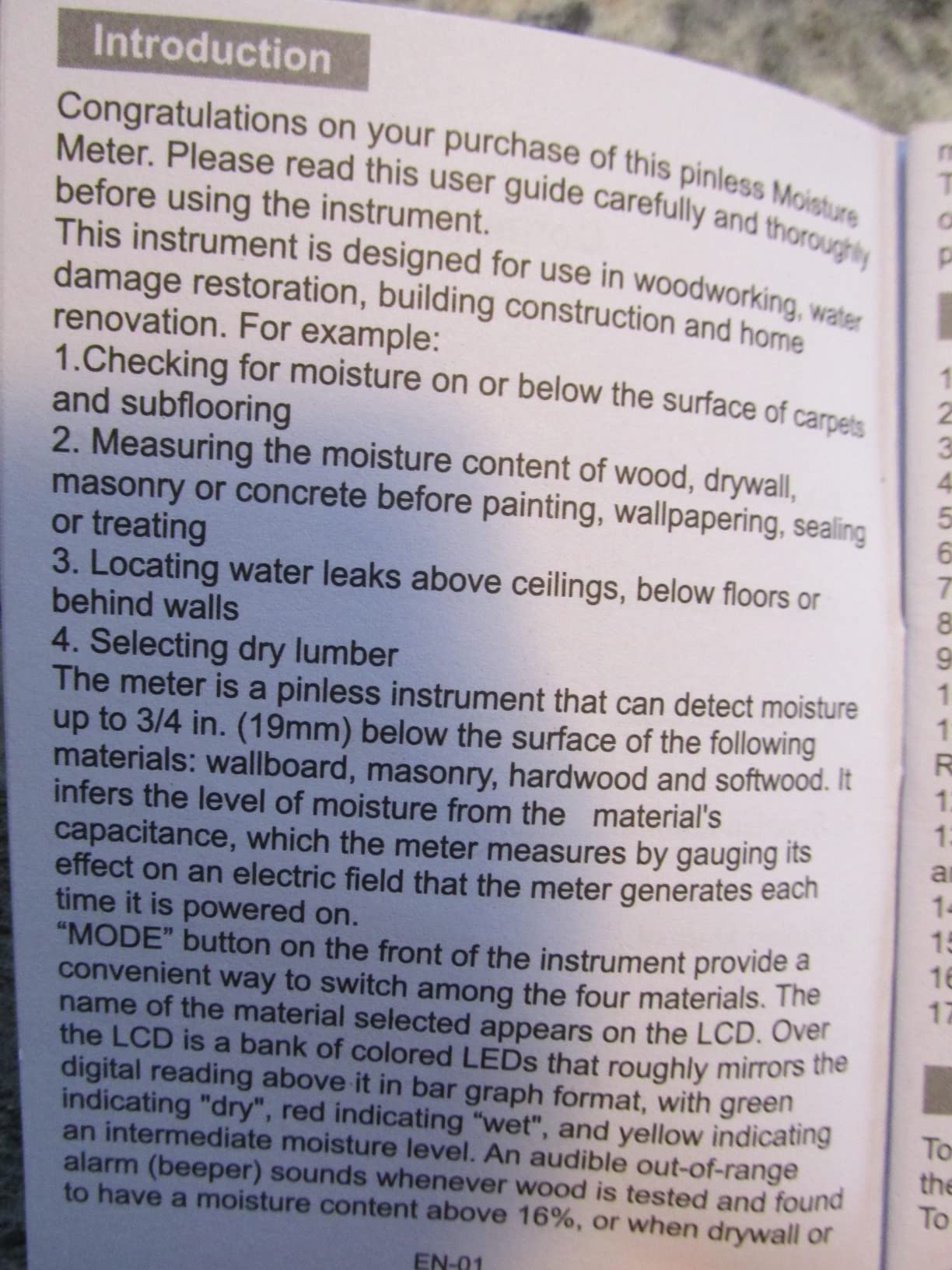
Owners describe readings as consistent and easy, and the alarm as the feature they notice first. For a first diagnostic tool or a spot check after a leak, it does the job without a learning curve.
It is also worth knowing where it sits in the pack. The feature set is basic next to a [home AED comparison](/best-home-aeds/)-style buyer’s guide: fewer material modes, fewer outputs, less to interpret later.
Who the Proster suits
Anyone who wants a wet or dry answer fast, in a homeowner’s basement, a rental turnover, or a first job. The audible alert means you do not have to keep looking at the screen while you move along a wall.
It also works as a second opinion tool. Cheap meters disagree with expensive ones sometimes, and knowing how your budget unit behaves is useful before you rely on a pricier reading.
Where it falls short
Fewer material-specific modes means you are reading one general scale rather than a setting matched to softwood, drywall or masonry. It also cannot do dual depth, so you cannot tell surface damp from moisture deeper in the assembly. Confirm anything you intend to write in a report with a pin meter.
4. DURFICST WM710A – Best for Masonry and Rough Surfaces
DURFICST Pinless Moisture Meter, Moisture Reader for Plaster Walls, Masonry, Concrete, Drywall, Wood
Ball probe reads about 40 mm deep
0.0-100.0 range at 0.1% resolution
3-inch HD color screen with DRY RISK WET
Pros
- Ball-tipped probe reaches corners baseboards and uneven surfaces without marks
- Large color screen is easy to show a client during an inspection
- Automatic calibration in about 3 seconds
- Inspectors report it standing up next to pricier thermal and pin meters
Cons
- Single scale with no separate hard wood and soft wood settings
- Reads higher than a reference pin meter on kiln-dried wood
- Manual warns readings may be inaccurate on workpieces under 20 mm thick
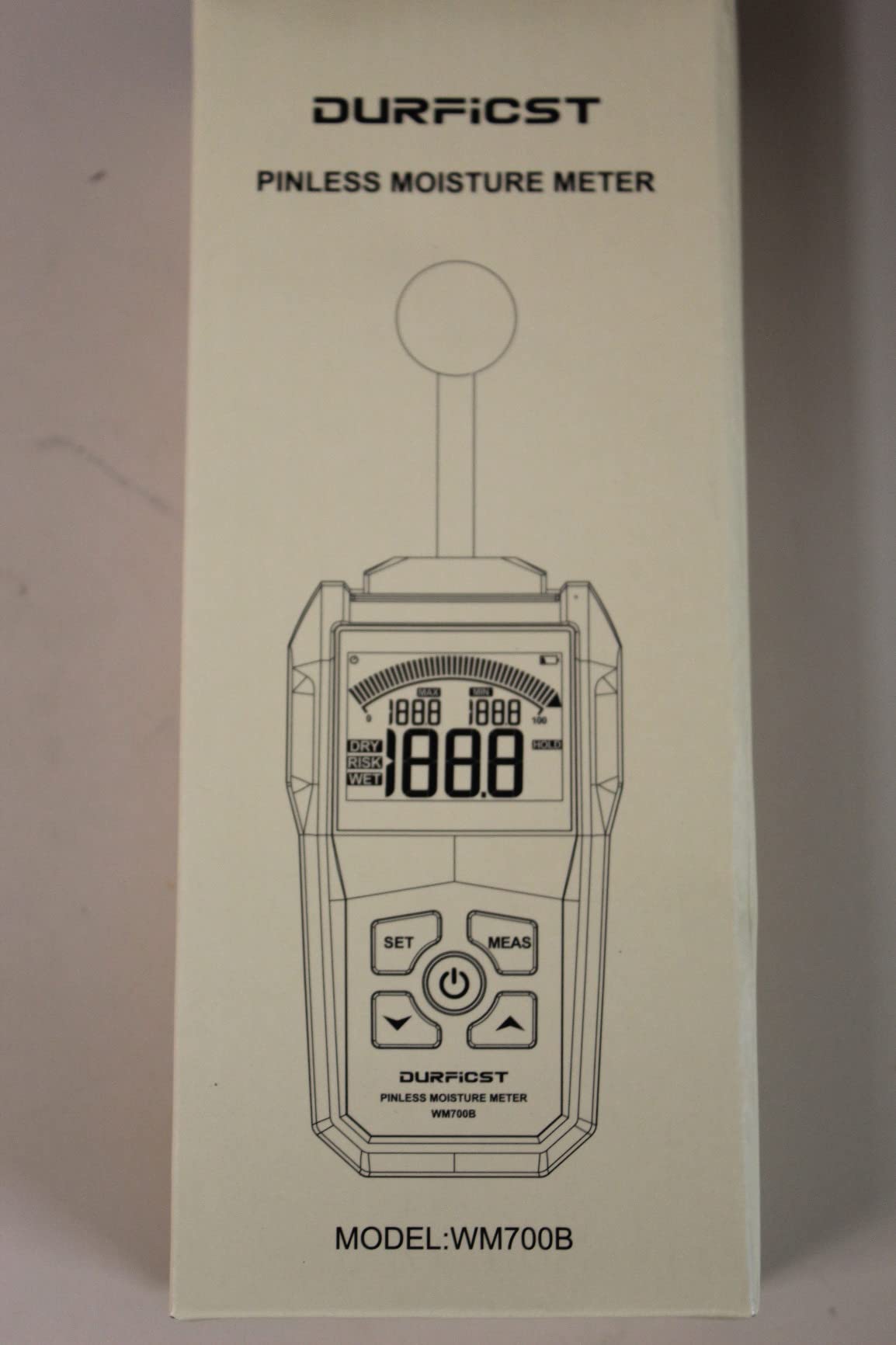
The ball-tipped probe is the idea here. Instead of a flat pad, a small spherical sensor touches the surface, so it can seat in an inside corner, run along an uneven plaster wall, or follow a baseboard where no flat meter will sit. It reads about 40 mm into masonry without leaving a mark.
The 3-inch HD color screen shows three-color bars and a DRY, RISK or WET verdict, which turns a technical reading into something you can show a seller across a kitchen island. Calibration is automatic and takes roughly three seconds, so there is no daily test block routine to remember.
Around 1.8k owners rate it 4.4, and several inspectors describe it substituting for a far more expensive thermal camera on early triage. Range is 0.0 to 100.0 with 0.1 resolution, and it covers wallboard, plaster, concrete, mortar, slate, tile and cardboard.
It comes in a cloth carry bag with a battery and a screwdriver. One hard limit is worth knowing: it cannot measure a metal surface.
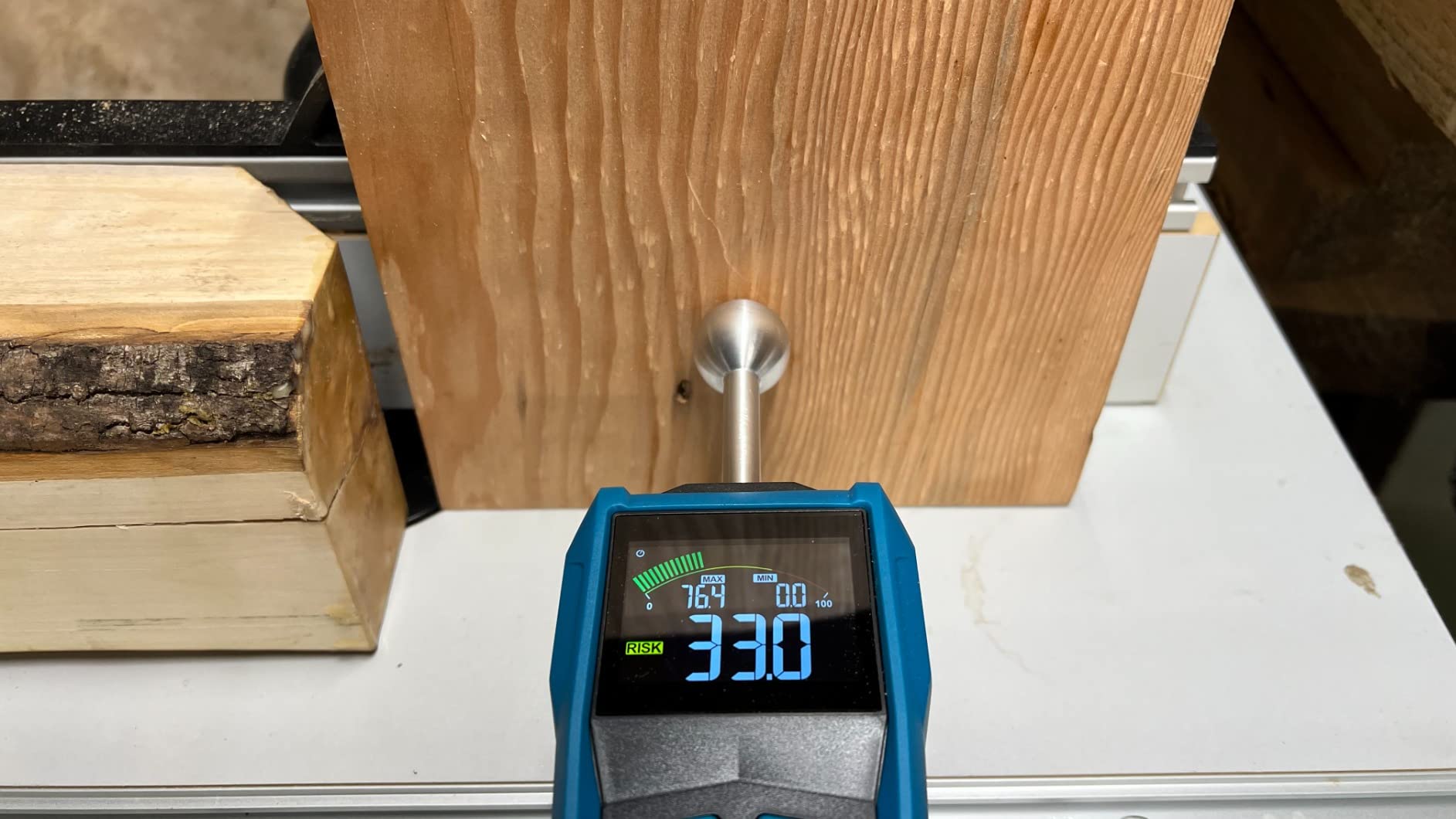
Who the DURFICST WM710A suits
Anyone working old housing stock where plaster, concrete block and uneven finishes are the rule rather than the exception. If flat pad meters frustrate you in corners, this is the geometry that solves it.
The color display also makes it a good choice when you explain findings to a client on site, which is a good use of a mid-tier budget.
Where it falls short
There is one scale and no hard wood or soft wood settings, so a reading on lumber is a relative figure rather than a calibrated moisture content. Owners report it reading higher than a reference pin meter on kiln-dried wood, which suggests some calibration drift. The manual also warns that readings may be inaccurate on workpieces under 20 mm thick, and it offers no manual calibration adjustment.
5. Calculated Industries 7440 – Best for Firewood and Lumber Checks
Calculated Industries 7440 AccuMASTER XT Digital Moisture Meter | Handheld |Pin Type | Backlit LCD Display | Detects Leaks, Damp and Moisture in Wood, Walls, Ceilings, Carpet and Firewood
Pin type with replaceable stainless steel pins
Firewood scale low 5-11% and medium 12-15%
Built-in calibration test pins
Pros
- Large backlit screen and solid body make one-handed readings easy
- Hold key freezes the reading for note taking
- Built-in calibration test pins for a quick field check
- Works across firewood lumber brick concrete drywall plaster carpet and floors
Cons
- Pin-type sensing leaves small holes in the material tested
- Icon based readout limits detailed numeric interpretation
The 7440 is a straightforward pin meter with a fire-specific advantage: a firewood scale that labels low as 5-11%, medium as 12-15% and high as 16-50%. If you split and season wood, or check a woodpile before it goes in a stove, that is a shortcut to an answer rather than a number to interpret.
It weighs 6.4 ounces, works across 0-95% operating humidity, and the backlit LCD with a Hold key is easy to use in one hand. Owners rate the body as solid-feeling for the price, and around 830 reviews sit at 4.4 stars.
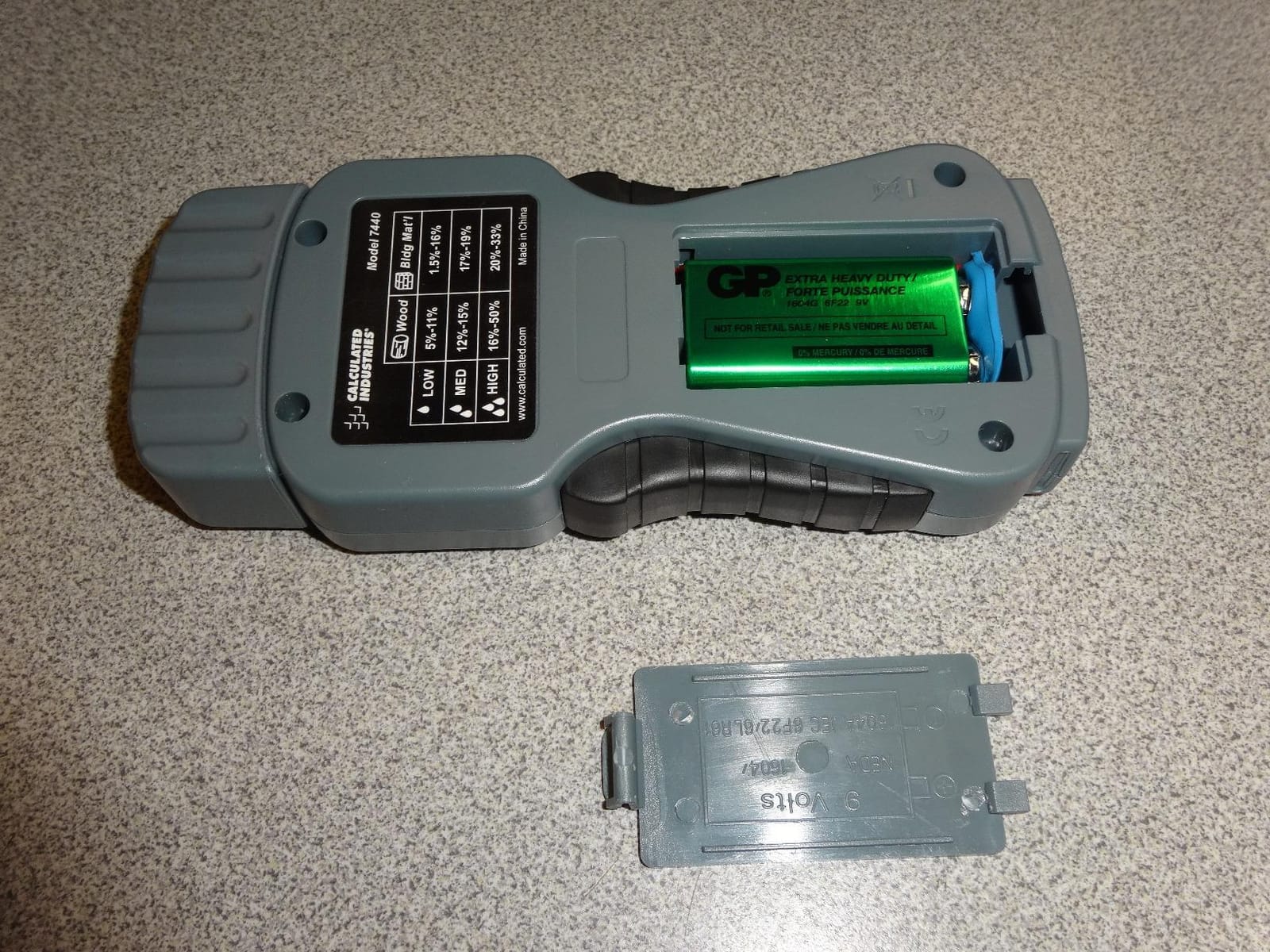
The built-in calibration test pins are the detail we like most. You can verify the instrument is behaving before you trust a reading, without a separate accessory, which is a step many inspectors skip.
Audio alerts and automatic shut-off are there, and the pins are replaceable, so the consumable cost of this tool is small.
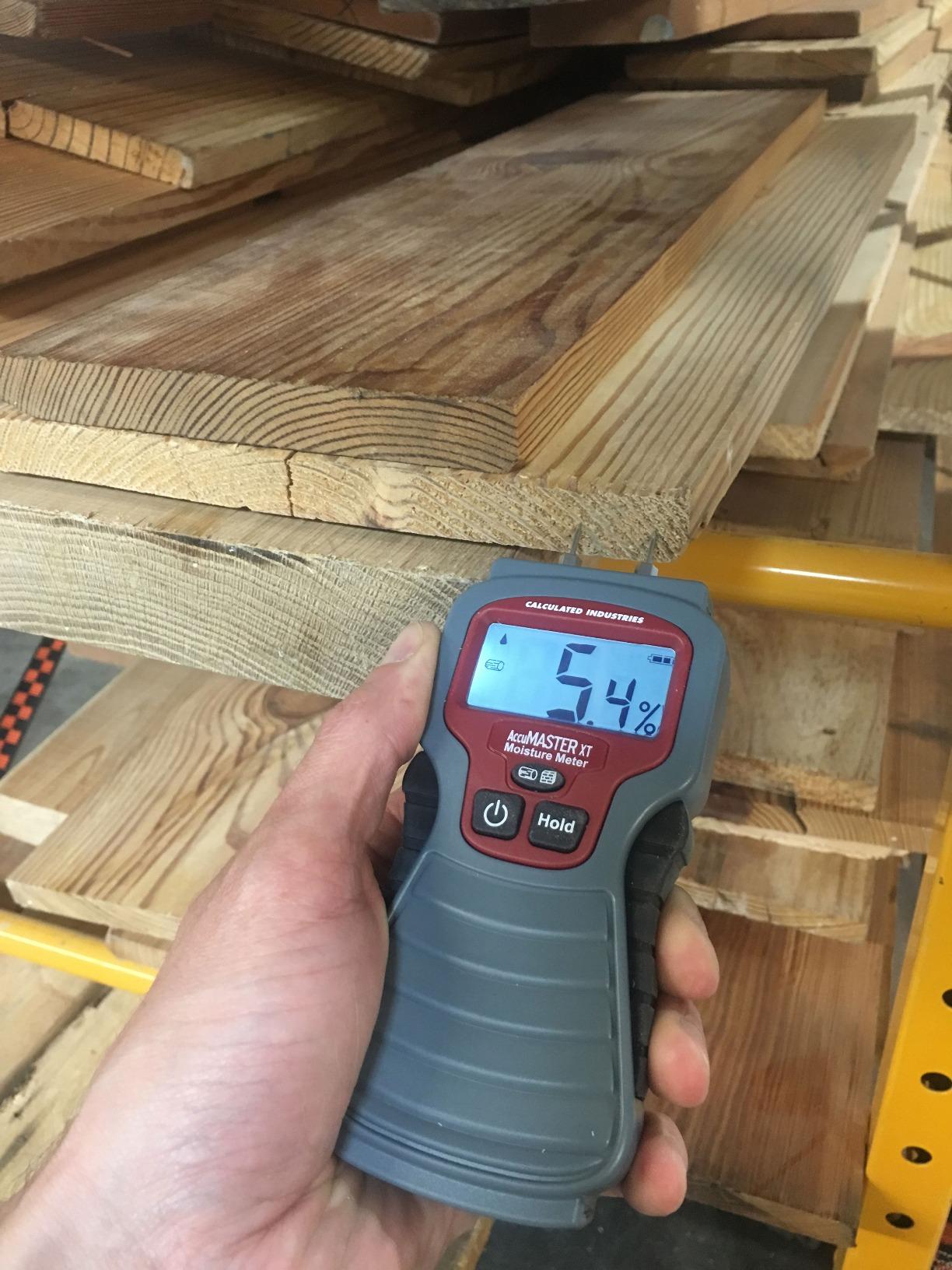
Who the 7440 suits
Homeowners managing firewood, and inspectors who want one dependable pin meter with a clear scale for lumber checks and finished floors. The wide material compatibility means it doubles as a furniture and flooring checker.
It is also a sensible first professional purchase for someone who does not need a relative index and just wants a reliable number.
Where it falls short
Pin-type sensing leaves holes, so it is the wrong tool on a wall you promised not to mark. The icon-based readout also limits how much you can say in a report, since there is less numeric detail to record than on a meter with a full percentage display.
6. General Tools MMH800 – Best Combo Meter with Humidity Readout
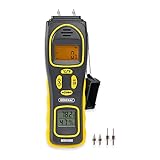
General Tools MMH800 Pin/Pinless Moisture Meter w/Temp and Humidity
Pin and pinless flat pad in one unit
Moisture percentage plus temperature and humidity
Stated accuracy plus or minus 0.1%
Pros
- Moisture temperature and relative humidity in one handheld unit
- Pinless pad for a fast scan then pin probes to confirm
- Audible and visual high medium low indicators speed up decisions
Cons
- One of the highest one-star shares among the meters in this roundup
- Pin and pinless readings can differ and need cross-checking
- Bulky 1.95 lb body compared with slim pinless meters
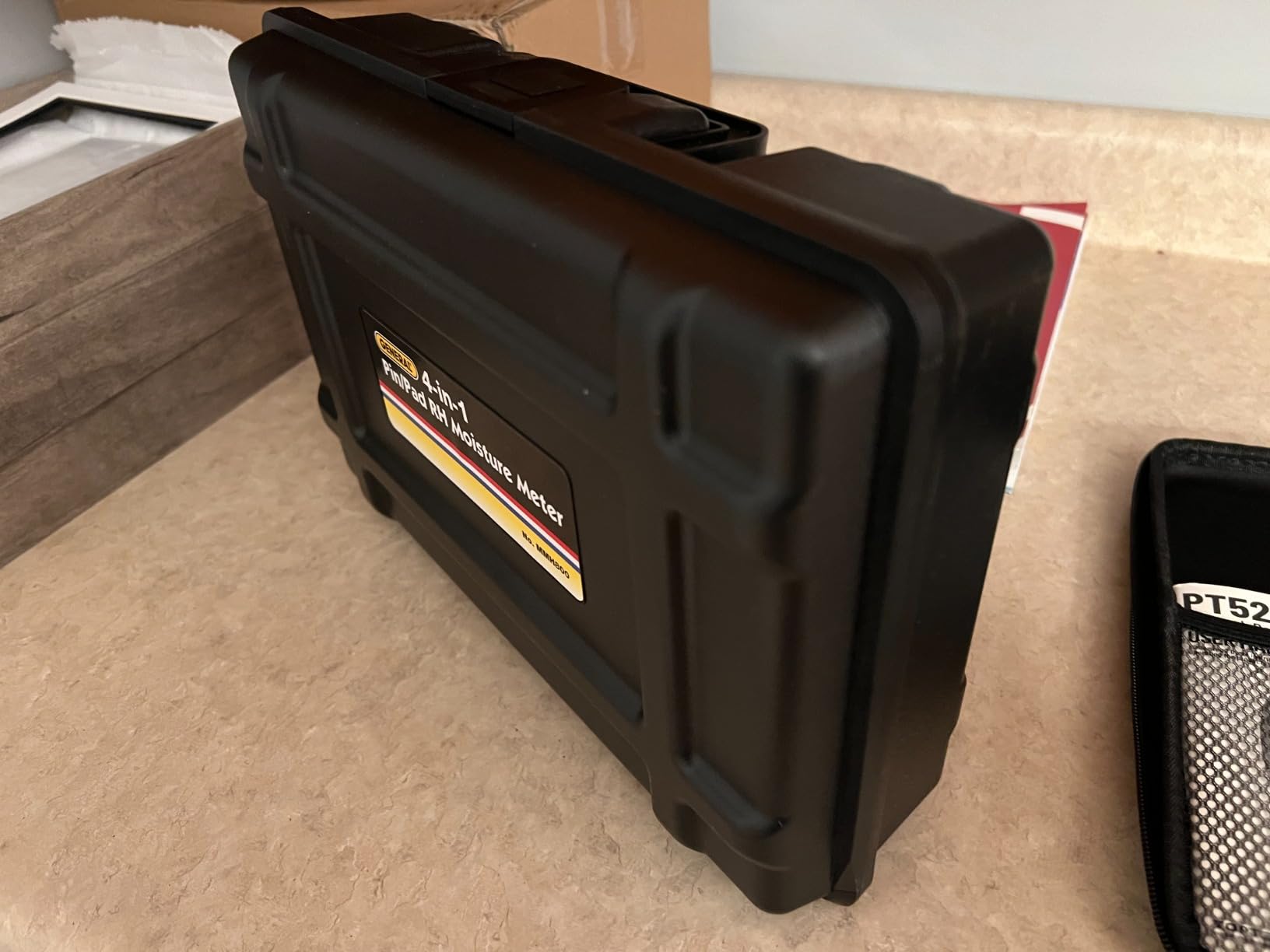
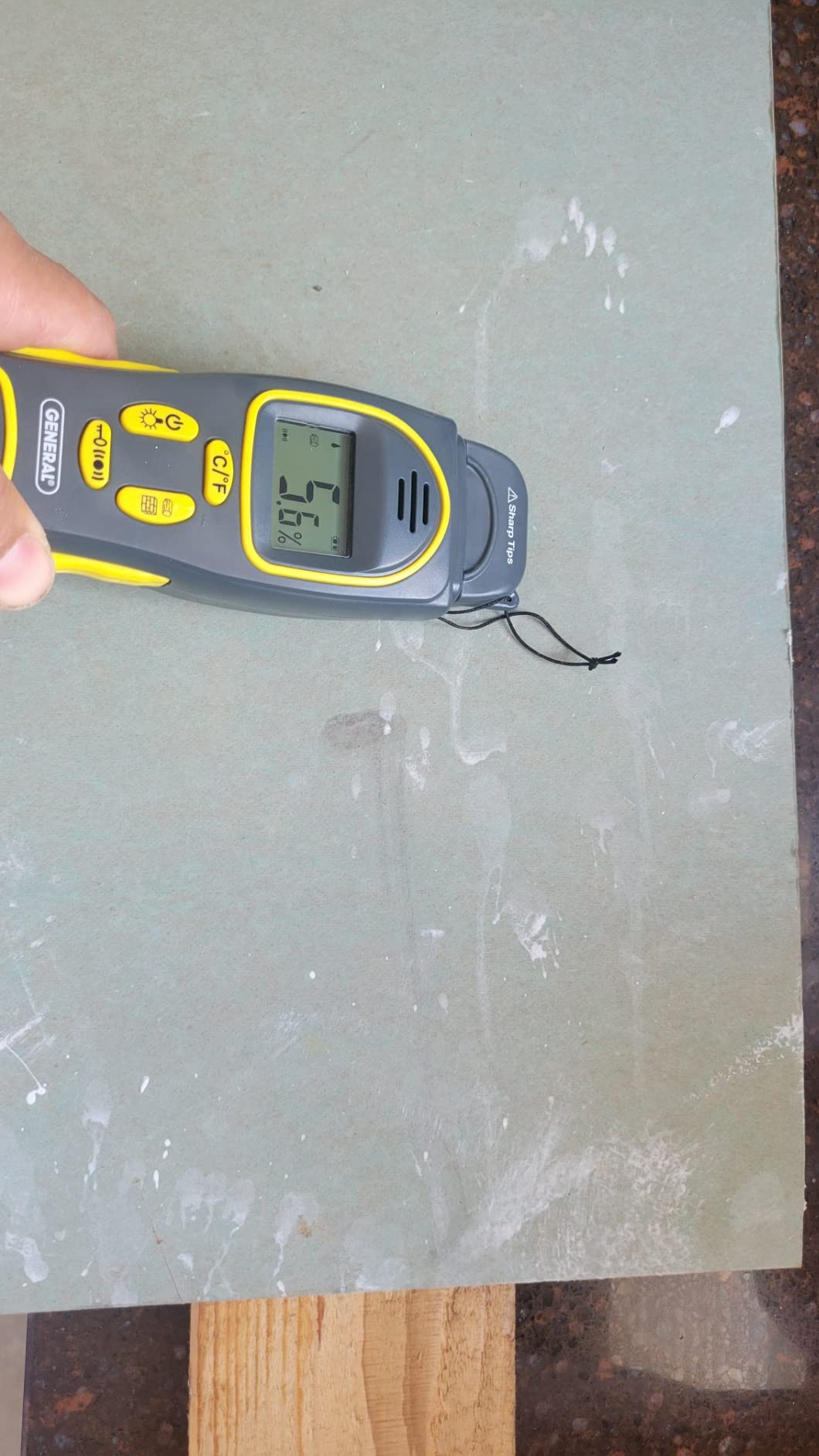
The MMH800 is a 4-in-1 unit: moisture percentage, ambient temperature and relative humidity, with both a pinless flat pad and flip-open pin sensors. If you are documenting a drying job or logging conditions across a day of inspections, having temperature and humidity on the same screen saves a second instrument.
The physical design is the weak point. At 1.95 lb and 3.63 by 8.13 by 12 inches, it is a brick in a tool bag, and the flip cap that protects the pins is the part most likely to fail first.
Ratings tell the story here. Its 4.0 star average is the second-lowest in this roundup, and about 650 reviews is thin for a device sold as a professional combo. Owners report that the pin and pinless modes do not always agree and question the stated plus or minus 0.1% accuracy figure.
That is not disqualifying for a screening tool, but it is a reason to cross-check against a known-dry reference rather than reporting the raw number.
Who the MMH800 suits
Restoration and mitigation technicians who need humidity and temperature alongside moisture in a single log entry. If your report format asks for ambient conditions, having them on the same display is genuinely convenient.
It is also fine for an inspector who wants one tool that covers both sensor styles without carrying two bodies.
Where it falls short
Two modes in one body is not the same as two good modes. Owners report disagreement between the pin and pinless readings, which means you still have to cross-check. The size is a real burden in a crawlspace, and the stated accuracy is not a claim we would put in a client report without verification.
7. General Tools MMD950 – Best for Deep and Awkward Access
General Tools Moisture Meter MMD950 – Humidity Sensor – Pin Type / Pinless Device – Spherical Sensor
Dual pin %WME and pinless REL modes
Spherical sensor reaches up to 4 inches
46-inch remote pin probe cable
Pros
- Spherical sensor reads behind walls and ceramic tile without surface damage
- 46-inch remote probe reaches subfloors ceilings and tight spots
- Jumbo LCD plus 40-dot tri-color bar graph reads at a glance
- Selectable auto power-off timeouts with manual and auto calibration
Cons
- Pinless readings are a relative index rather than a percentage
- Heavier and bulkier than compact pinless meters
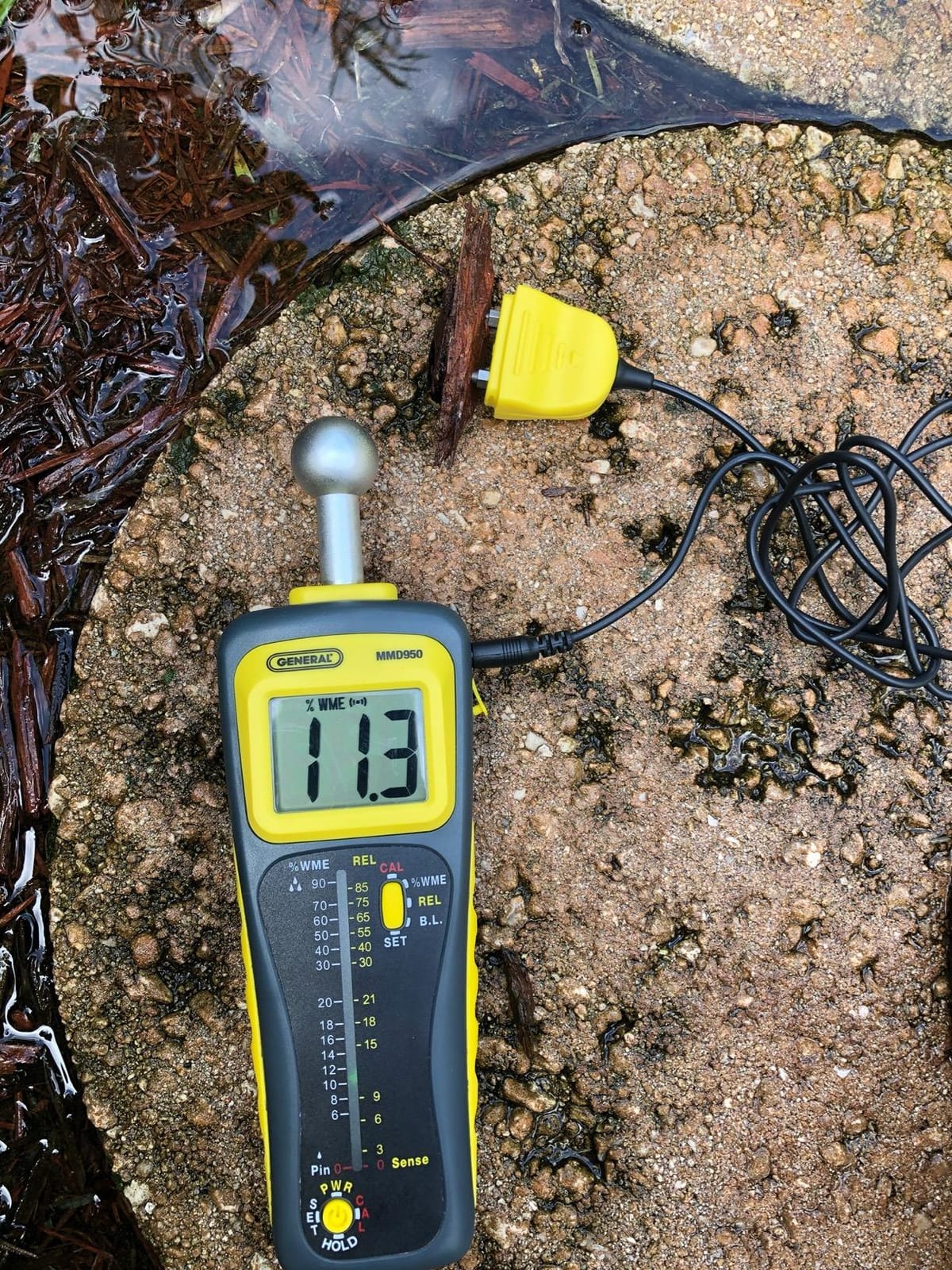
The MMD950 solves a specific access problem. Its spherical pinless sensor is rated to detect up to 4 inches behind walls and ceramic tile, and the 46-inch remote pin probe lets you take a reading in a subfloor, a ceiling cavity or behind an access panel without kneeling in the middle of the floor.
Two modes, labeled pin for percent WME and pinless for REL, run on a jumbo LCD with a 40-dot tri-color bar. Manual and auto calibration are both available, and you can set auto power-off at 3, 5 or 10 minutes.
It weighs 2 pounds and the box holds the meter, an external probe, replacement pins, a battery and a carrying case. The box is genuinely complete, which is more than we can say for several cheaper meters here.
Around 240 owners rate it 4.3, so the evidence base is smaller than for the entry-level units, but the design intent is clear and the reviews are consistent about what it does well.
Who the MMD950 suits
Inspectors working tile, subfloors and finished surfaces where damage is not acceptable and the water source is deeper than three-quarters of an inch. The remote probe is the feature people mention first in reviews.
It suits anyone who wants one device to cover a bathroom surround, a wet-area floor and a behind-tile leak without a second meter.
Where it falls short
Pinless mode returns a relative index, not a moisture content percentage, so it ranks areas rather than measuring them. At 2 pounds and 4 by 12 inches, it is heavy to carry all day. If your work is mostly standard drywall inspection, the extra reach is capacity you will not use.
8. Protimeter Mini – Best for a Fast Color-Coded Verdict
Protimeter Mini General Purpose Moisture Meter
Built-in pin probes with color LED verdict
Supplied calibration device
Extension pin probe included
Pros
- Color-coded green dry yellow borderline red damp cuts interpretation time
- Calibration device in the box confirms the instrument is functioning
- Extension probe reaches confined or awkward positions
- High owner satisfaction for a general purpose meter
Cons
- Pin-based measurement leaves small holes in the test material
- Single-function design with no pinless scanning or humidity sensing
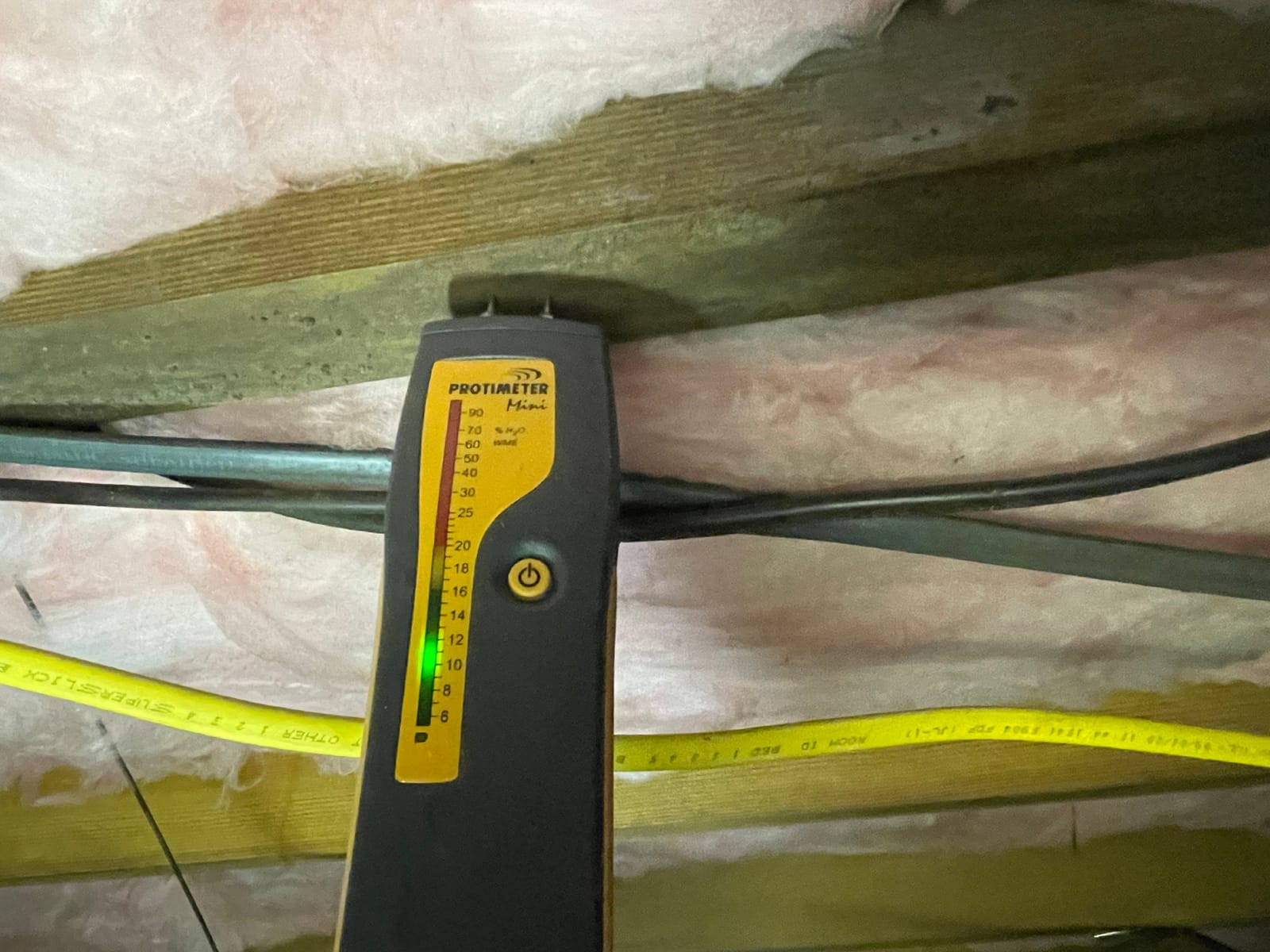
Protimeter built a reputation on meters that give you a verdict instead of a puzzle. The Mini is the compact expression of that: built-in pin probes, and a LED display that reads green for dry, yellow for borderline and red for damp. You glance at it and move on.
Its 4.6 star average is the second-highest in this roundup, and it operates up to 90% relative humidity. A supplied calibration device lets you confirm the instrument is functioning before a job, and an extension pin probe is included for tight positions.
At 0.41 kg it is a genuinely pocketable instrument, and the color classification is the fastest interpretation in this whole list. If you are walking a house with a client and want a defensible yes or no at each point, that matters.
Owners describe it as dependable for routine general purpose readings, with limits that come from the pin approach rather than from the unit itself.
Who the Protimeter Mini suits
Inspectors who work in occupied homes and want fast, repeatable verdicts, and anyone who dislikes interpreting numbers. The color coding also makes it usable by a helper who is not a trained technician.
It suits a technician who wants one dependable pin meter and does not need pinless scanning on every call.
Where it falls short
It is pin-only, so it leaves holes and it cannot sweep a large wall quickly. There is no humidity sensing or temperature measurement, so it does not serve a drying documentation workflow. With around 230 reviews, its rating is based on a smaller sample than the entry meters.
9. FLIR MR160 – Best for Thermal-Guided Leak Hunting
FLIR MR160 Imaging Moisture Meter with IGM Technology: Thermal Imaging, Pin & Pinless Detection, 80×60 Resolution, METERLiNK App, Rechargeable Battery – for Home Inspection & Mold Remediation
80x60 Lepton thermal imager
Switchable pinless sensor and external pin probe
METERLiNK app with wireless sync
Pros
- Thermal imaging guides you to the likely source before you probe
- Non-destructive scanning and an external pin probe in one unit
- Wireless METERLiNK export speeds up client documentation
- Compact housing with an internal rechargeable battery
Cons
- 80x60 thermal resolution gives grainy images that need a reference photo
- Some owners report inaccurate pin readings and an awkward sensor location
- Software setup is not intuitive and firmware updates may need a Windows PC
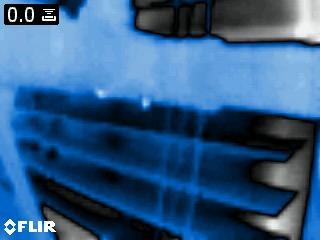
The MR160 is a different category of tool. It carries an 80 by 60 Lepton thermal imager alongside a switchable pinless sensor and an external pin probe, so you can scan a wall thermally, see the cool anomaly, and put a measurement exactly there instead of probing in a grid.
It stores up to 9,999 images with the moisture reading attached, reviewable on the device or over USB with FLIR Tools, and the METERLiNK app syncs wirelessly for reports. The temperature range goes to 233 °C at 0.15 °C or better sensitivity.
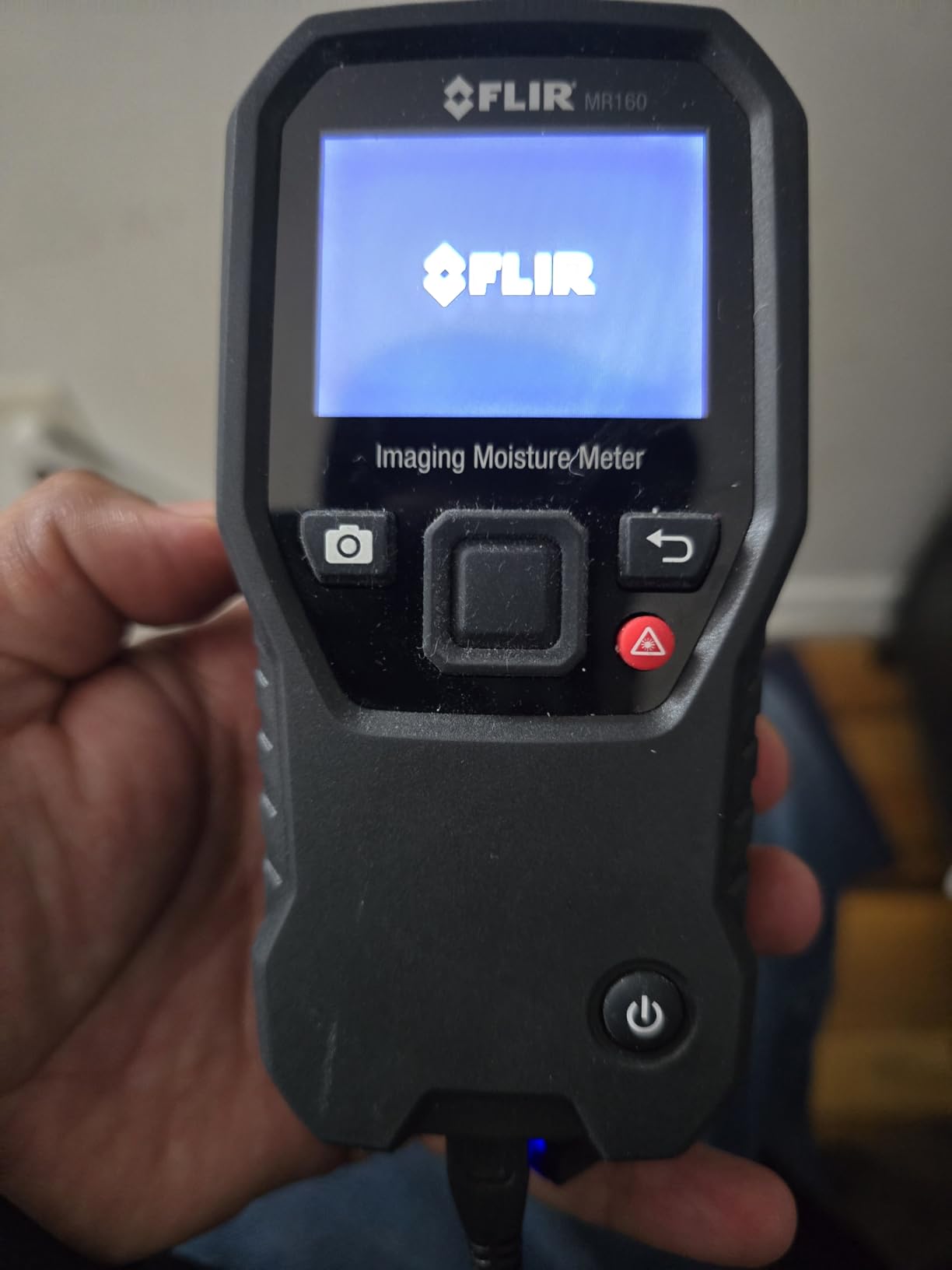
It runs on an internal lithium-ion battery at 0.3 kg, which makes it the easiest carry of any thermal-capable unit here. Inspectors and remediation firms report the overlay paying for itself after a couple of leak jobs, and spare part availability is listed at 10 years.
The 4.0 star average from about 170 reviews reflects a real learning curve rather than a bad instrument.
Who the MR160 suits
Inspectors who already own a decent camera and want moisture data attached to their thermal evidence, and remediation firms that need a documented trail for an insurer. Wireless report export is the feature that changes a workflow.
If you are building a report where each finding has a photo, a reading and a timestamp, this is the unit that produces that in one pass.
Where it falls short
An 80 by 60 sensor produces grainy images, and many owners say they need a reference photo beside the thermal frame to interpret one. Software setup is not intuitive and firmware updates may require a Windows PC. A share of owners report unreliable pin readings and find the moisture sensor position awkward, and no hard carrying case is included.
10. FLIR MR55 – Best for Stored Readings and Reports
Flir MR55 Pin Moisture Meter with Bluetooth
Pin measurement with Bluetooth
LCD with temperature and trend bargraph
Three-year limited warranty
Pros
- Bluetooth pairing to the FLIR Tools app simplifies report sharing
- Stores and recalls up to 15 labelled readings
- Three-year warranty is the longest among the pin meters here
- Temperature and trend bargraph on the same display
Cons
- Pin-based measurement only with no pinless scan option
- Runs on AA batteries with no rechargeable cell
The MR55 is the reporting-focused pin meter. It measures with pins, shows a temperature reading and a trend bargraph, and stores up to 15 labelled readings that you can recall on the device or push to the FLIR Tools mobile app over Bluetooth.
That storage feature is what separates it from a basic pin meter. When you come back to a wall on a return visit, you can retrieve the earlier figure instead of relying on a note in your phone, and a named label turns a number into a location.
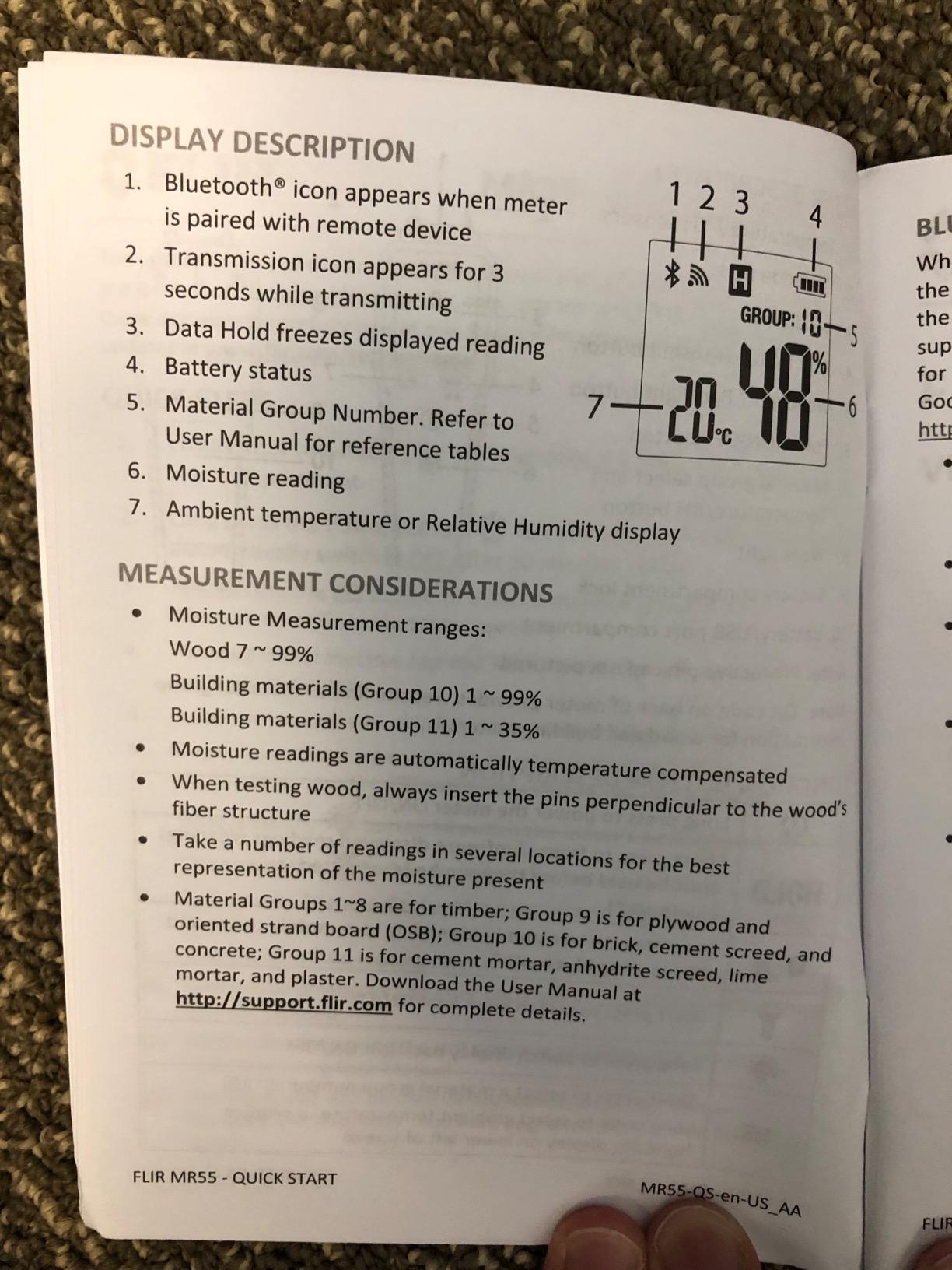
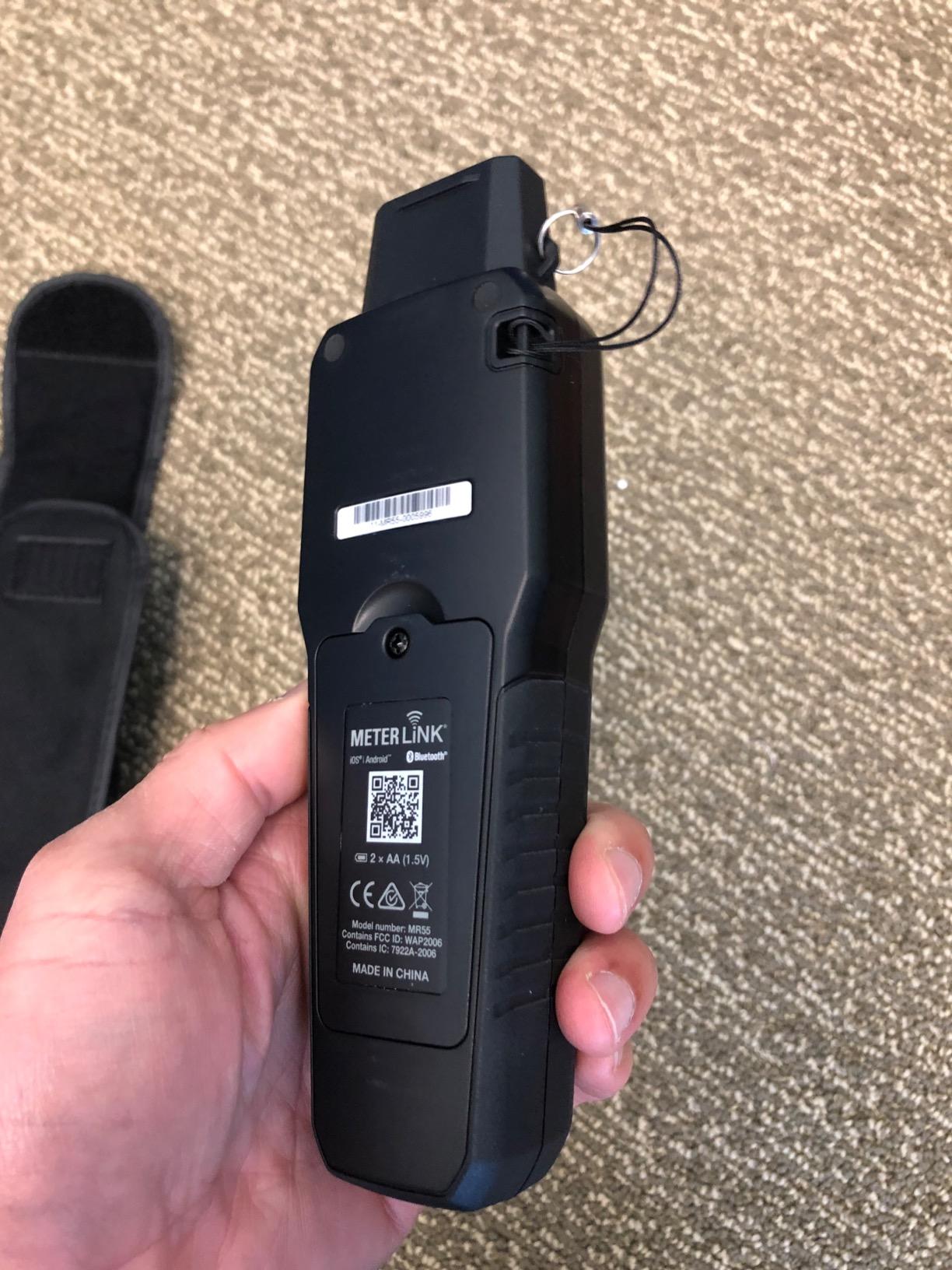
It weighs 0.45 kg, runs on two AA batteries and carries a limited 3-year warranty, the longest in the pin meter group here. A CAL feature alerts you when recalibration is due, which is a small courtesy that costs nothing.
Ratings sit at 4.2 from about 165 reviews, and the reviews concentrate on one thing: if you are already in the FLIR Tools ecosystem, the quick export is the reason to buy it.
Who the MR55 suits
Inspectors who want labelled, retrievable readings tied to a client file, and anyone returning to a property to show a seller how a reading changed over time. The three-year warranty also suits a tool that will live in a truck for years.
It suits a technician who measures with pins anyway and wants better records rather than a different measurement method.
Where it falls short
It is pin-only, so it cannot sweep a large area without marking the surface. It runs on AA batteries with no rechargeable cell, which means carrying spares. If you need non-destructive screening first, this is not the tool and you should look at a pinless unit instead.
11. Tramex ME5 – Best for Dual-Depth Pinless Scanning
Tramex Moisture Encounter ME5
Shallow 0.4 inch and deep 1.25 inch sensing
Wood scale 5-30% with 0-100 comparative scale
Pre-calibrated for common building materials
Pros
- Dual depth lets you separate surface moisture from core moisture
- Pre-calibrated for wood drywall plaster roofing tile masonry and more
- Large analogue display reads easily in poor lighting
- Bluetooth app supports geotagged time-stamped moisture mapping
Cons
- Pinless only
- so absolute wood moisture percentage needs a second tool
- Professional pricing is hard to justify for occasional use
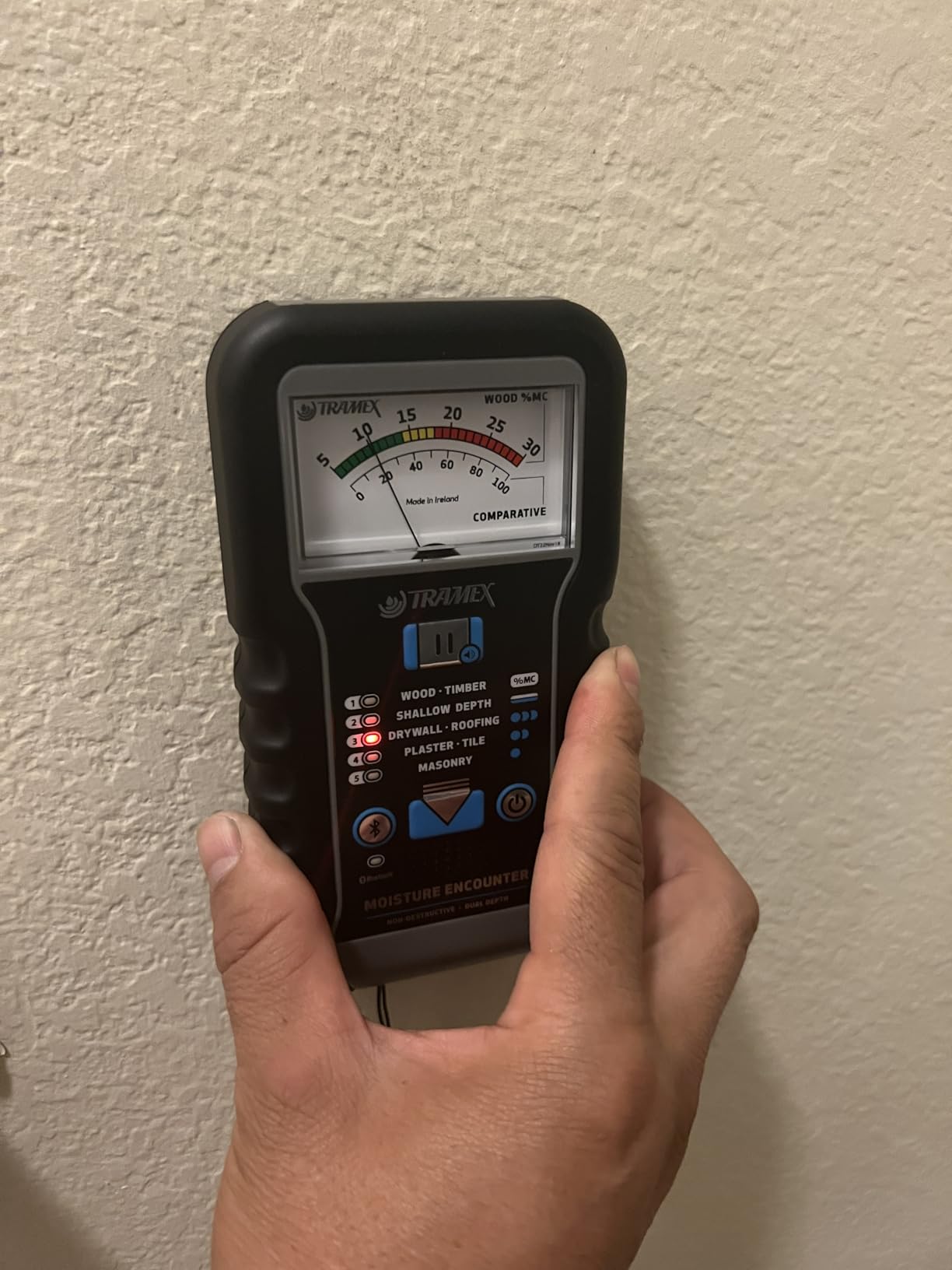
The ME5’s defining feature is dual-depth sensing. A shallow pass reads to 0.4 inch and a deep pass to 1.25 inch, so you can tell whether the surface is damp because of condensation or whether water is sitting in the assembly. That single comparison resolves a lot of crawlspace and bathroom arguments.
It is pre-calibrated for wood, drywall, plaster, roofing, tile, masonry, walls, floors and ceilings, with adjustment tables for wood species density. The wood scale runs 5-30% and other materials use a 0-100 comparative scale.
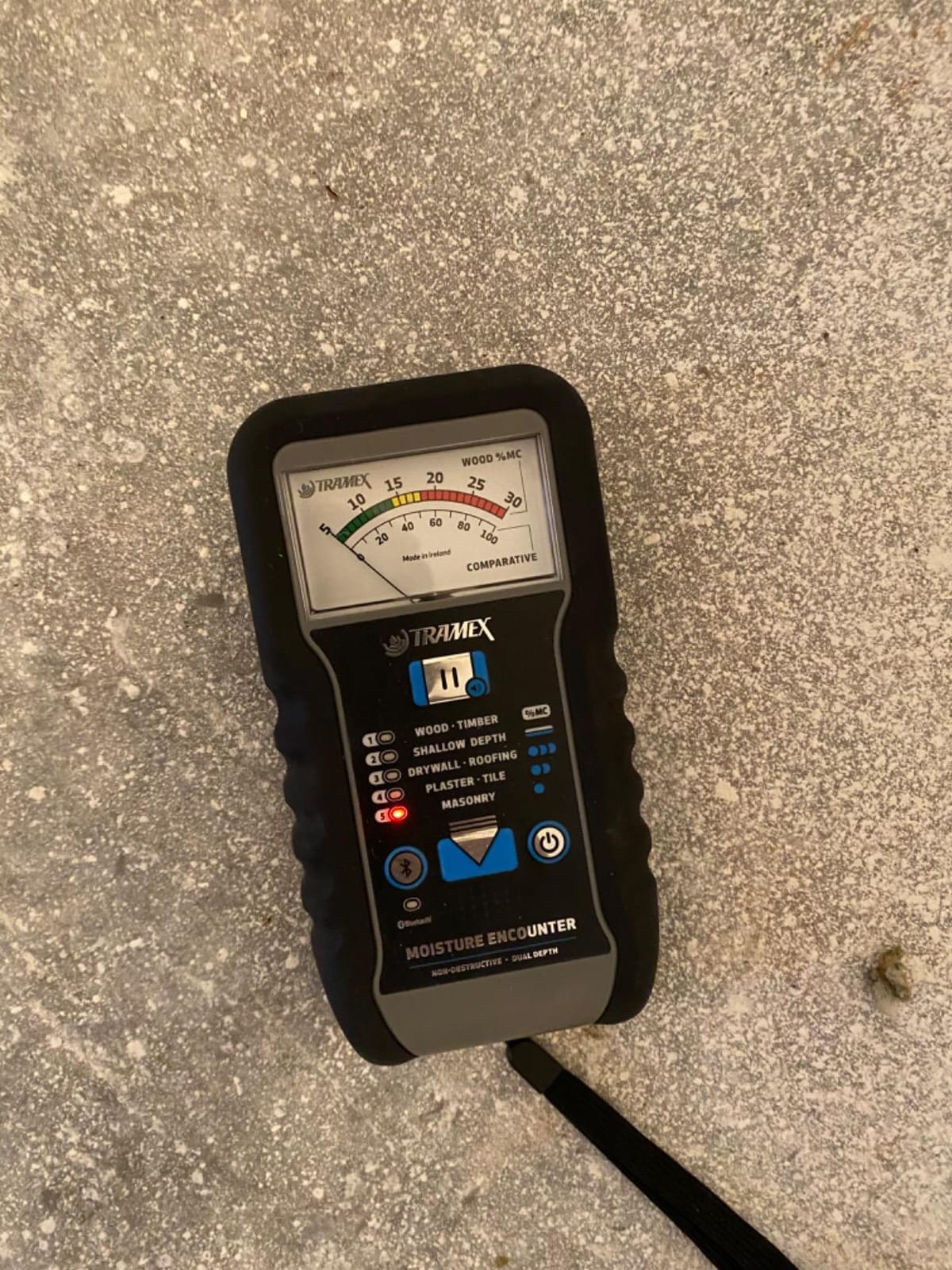
At 10.6 ounces and 6.3 by 3.5 by 1.5 inches, it is compact, and the large analogue display with an optional high-moisture audio tone is readable in poor light. Around 130 owners rate it 4.5, with professionals citing the material tables and mapping app as the value drivers.
The Bluetooth app supports geotagged, time-stamped moisture maps with photos, which turns a handheld instrument into a documentation tool.
Who the ME5 suits
Restoration and mitigation technicians who need to show a client how far a drying front has moved, and inspectors working crawlspaces, roofs and wet areas where surface versus core moisture is the whole question.
It suits anyone who wants non-destructive readings only, and who will not be discouraged by a relative scale on non-wood materials.
Where it falls short
It is pinless only, so confirming an absolute wood moisture percentage means carrying a second tool. And at a professional price point, a homeowner with an occasional damp wall is buying more instrument than the job needs, which is a point owners raise directly in reviews.
12. Protimeter SurveyMaster BLD5365 – Premium Dual-Mode Professional Meter
Protimeter BLD5365 Surveymaster Moisture Meter
Pinless search and pin-type measure
Non-invasive to 3/4 inch (20 mm)
Large backlit display, 2-year warranty
Pros
- Switch between pinless search and pin-type measurement on one unit
- Non-invasive scan reaches 3/4 inch or 20 mm below the surface
- Large backlit display stays readable in dark crawlspaces and attics
- Two-year warranty and a wide accessory plug-in range
Cons
- Pin-type mode still leaves small holes in the test surface
- Professional pricing puts it beyond occasional household screening
The SurveyMaster is the reference dual-mode instrument in this roundup, and it carries the highest rating in the group at 4.8 stars from about 260 reviews. Two modes of operation sit in one body: a pinless search and a pin-type measure, with non-invasive measurement to 3/4 inch or 20 mm.
At 225 g and 2.75 by 1.9 inches it is compact for a professional tool, and the large backlit display is built for the conditions inspectors complain about most, which is poor light in a crawlspace or attic. The 2-year warranty is the longest coverage in this roundup.
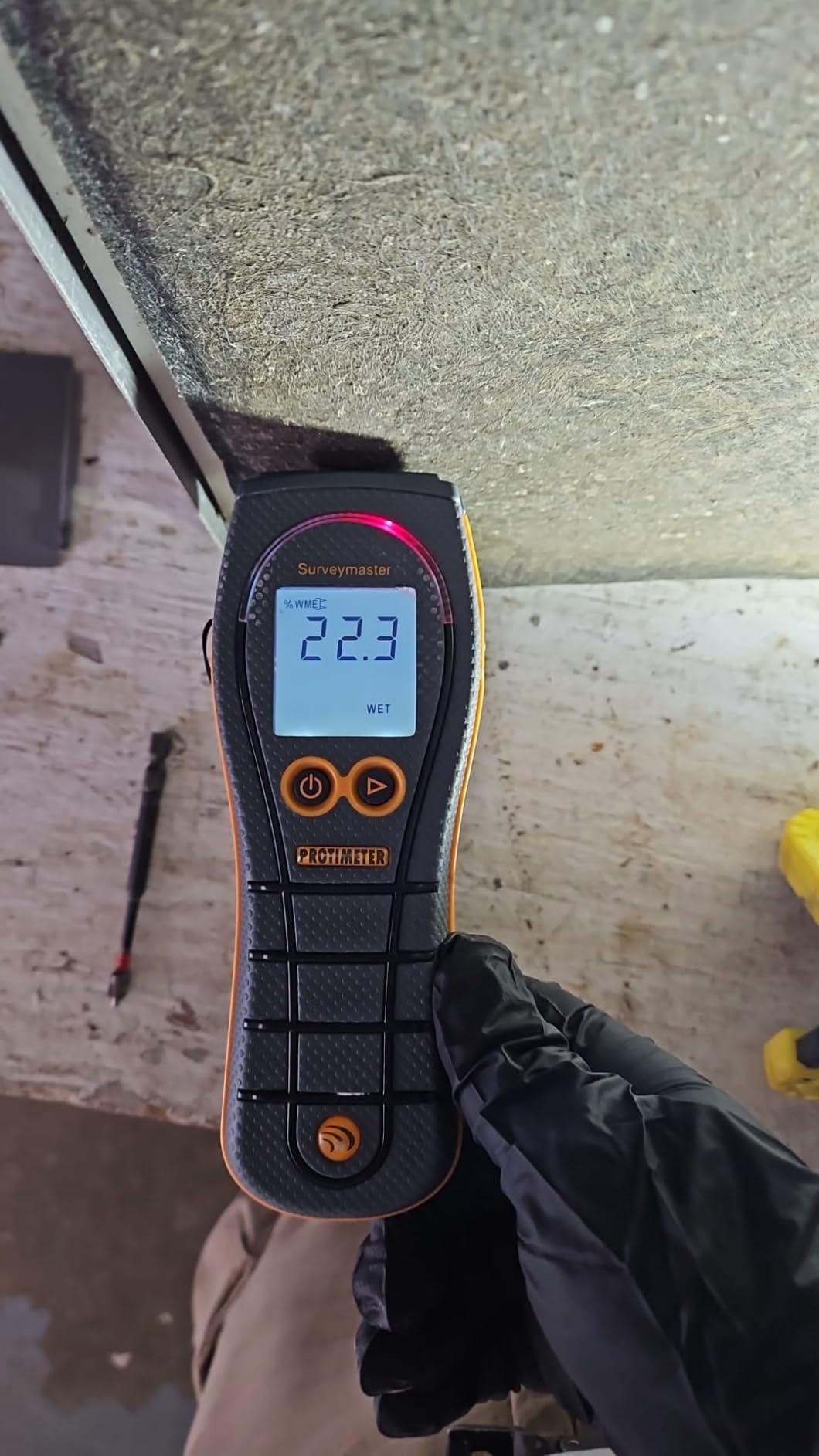
A wide range of accessory plug-ins extends the instrument beyond base moisture readings, which is the argument practitioners make for it over a cheaper combo: you are buying a platform, not a single function. Building professionals consistently single out build quality, backlight and the flexibility of switching modes mid-inspection.
Owners report a satisfaction score with 88% five-star ratings. The complaints that exist are the inherent pin-hole trade-off and the professional-level pricing.
Who the SurveyMaster suits
Working inspectors and restoration technicians who inspect every day and want one meter that covers screening and confirmation. The backlit display, dual mode and accessory ecosystem are the reason it is the consensus professional pick in the practitioner sources we reviewed.
It suits an established professional who will recover the cost quickly, and a buyer who wants one instrument rather than a kit.
Where it falls short
Pin-type mode still marks the surface, so dual mode does not make it a non-invasive tool in every mode. And the professional pricing puts it out of reach for occasional household screening, which is a fair criticism rather than a defect.
Note the naming confusion when you compare listings. BLD5365 is the SurveyMaster, and similar model numbers in the Protimeter range are different instruments with different specifications.
Key Features to Look For in an Inspection-Grade Meter
Dual functionality: a meter that switches between pinless scanning and pin measurement lets you sweep first and confirm second, so you are not marking finished surfaces just to find the wet zone.
Display quality in bad light: a large backlit LCD is not a luxury. Crawlspaces and attics are where leaks concentrate and where the light is worst, and a dim readout slows the whole inspection.
Hold and max or min memory: a hold function means you can pull the pins before you lose the reading. Meters that store labelled readings go further and let you compare a first visit with a return visit.
Calibration support: look for a built-in test block, a cap that doubles as a checker, or a recalibration alert. Cheap meters drift, and a weekly field check is the cheapest accuracy insurance there is.
Measurement depth and range: for standard drywall work, 3/4 inch of pinless reach is sufficient. Deeper sensing or a remote probe matters when you are behind tile, in a subfloor or inside a wall cavity.
Material settings and scale: separate softwood, hardwood and masonry settings change the reading. A meter with one scale will still show you a difference, but not a calibrated percentage.
Ruggedness and warranty: a drop-resistant housing, replaceable pins and a warranty of two years or more are reasonable expectations for a tool that lives in a vehicle.
How to Use a Moisture Meter During a Home Inspection
1. Calibrate in a dry room first. Use the built-in checker or test block before you walk the property. A meter that reads high at the start of the day will read high on every wall you touch.
2. Establish a baseline. Find a known-dry area of the same material in the same building and record it. Most of these meters have no true zero, so the baseline is what makes a later number meaningful.
3. Scan large areas pinless. Work the grid pattern, about 6 inches apart, across walls and ceilings. This is fast, marks nothing, and tells you where to stop and look closer.
4. Confirm with pins at the boundary. Take pin readings just inside and just outside the edge of the anomaly, not only in the middle. A sharp transition is evidence; a flat high number is usually a material effect.
5. Set the material correctly. Choose softwood, hardwood, masonry or drywall before you read. On multi-layer assemblies, push the pins in far enough to reach the layer you suspect.
6. Check the obvious suspects. Bathroom and kitchen surrounds, the wall behind the washing machine, the base of exterior siding near grade, window and door perimeters, roof sheathing penetrations, and the low corner of a crawlspace or basement.
7. Compare against visible evidence. A high reading with no staining, no softness and no mold means little on its own. Look for the water, and let the meter tell you how far it extends.
8. Record it properly. Write the material, the depth, the reading, the location and the ambient conditions for anything you intend to report. A bare number on a note is not evidence.
9. Keep the meter. Clean the pins after each use, replace the battery rather than riding it flat, and run the calibration check weekly. A dirty or flat battery is the most common reason a good meter starts disagreeing with itself.
Reading the Numbers: When a Reading Becomes a Reportable Concern
For wood, the familiar guidance holds. Below about 12% is generally considered safe for interior use, 12-17% is a range where you watch and recheck, and above roughly 17-20% you have a genuine concern for flooring, trim or structural lumber in a heated space. Species and temperature shift these numbers, which is why wood species correction exists.
For drywall, plaster and other gypsum-based finishes there is no universal percentage that means defective. Instead, compare the reading with an adjacent dry area in the same room and with the same meter. A difference of several points across a visible boundary, with staining or softness present, is a finding. A high number alone is a reason to investigate.
Concrete, masonry and stucco complicate everything. Concrete holds residual moisture for months, and salt content in stucco or grout can inflate a resistance reading regardless of water. The 0-100 relative index on pinless meters is not a percentage, so it ranks areas rather than measuring them, and that is exactly what you want for mapping.
The habit that holds up in front of clients, agents and insurers is simple: baseline, boundary, context, photograph. Forum practitioners we reviewed make the same point from the other direction, that a meter is a screening tool rather than a diagnostic instrument, and readings only carry weight when they sit alongside visual evidence and material context.
Moisture Meter Buying Guide: What to Weigh Before You Buy
Start with your material, not your budget. If you inspect wood framing and lumber, a calibrated pin meter is the tool. If you sweep finished walls and ceilings, pinless is faster and safer. If you do both daily, you want dual mode and you will eventually want a second device.
Buy the tier that matches your stage. A new inspector or a DIY homeowner usually needs a reliable entry pin meter plus a cheap pinless scanner, and the two cheapest meters in this roundup cover that. An established professional who inspects daily needs dual mode, a backlit display and a multi-year warranty. Restoration work adds dual depth and reporting features.
Treat relative scales correctly. A 0-100 index is not a percentage and should never appear in a report as one. If your documentation needs real numbers, you need a resistance meter with material settings.
Check depth against the job. Most pinless meters here reach 3/4 inch. That covers surface and near-surface moisture in drywall. Behind tile, in a cavity or in a thick floor, you want a deeper sensor or a remote probe.
Look at consumables and support. Replaceable pins, a manufacturer who supplies them, spare part availability and a calibration procedure all affect the real cost over years. Warranty length is a reasonable proxy for how the maker expects the tool to be used.
Budget for a second tool. The consensus on the inspection forums is that a combo does not fully replace a dedicated pin meter. Many professionals carry two bodies: a small pinless scanner for the sweep and a pin meter for confirmation.
Know what a meter cannot do. It samples points. A wall cavity can be wet in a spot you never touched, which is why thermal imaging complements a meter rather than competing with it. As we noted in our [inspection microscope roundup](/best-inspection-microscopes-for-coin-collecting/), choosing the right instrument for the question matters more than the instrument itself.
Frequently Asked Questions
Which moisture meter is most accurate?
Resistance-based pin meters with material settings give the most accurate moisture content percentage, because they measure the change in electrical conductivity between two probes as water rises. Among the meters here, the General Tools MMD4E is our accuracy pick for wood because it covers 5-50% with a calibrated scale, and the Tramex ME5 leads for non-destructive work because it reads at two depths. Accuracy always depends on matching the material setting and taking a baseline in a known-dry area.
Which professional moisture meter is the best?
The Protimeter SurveyMaster BLD5365 is the strongest all-round professional choice, switching between a pinless search reaching 3/4 inch and a pin-type measurement, with a large backlit display and a two-year warranty. If your work is restoration and drying verification, the Tramex ME5 dual-depth sensing is harder to replace. If documentation drives your business, the FLIR MR160 pairs thermal imaging with moisture readings and wireless report export.
Which brand of moisture meter is the best?
Protimeter, Delmhorst, Tramex and FLIR carry the strongest reputation among inspectors, and that reputation is mostly about build quality, calibration support and replacement parts rather than headline accuracy. General Tools and Klein dominate the affordable end and are well suited to screening work. The honest answer is that brand matters less than matching the meter to your material, your light conditions and how often you will use it.
What type of moisture meter is most accurate?
Pin-type resistance meters are the most accurate for a calibrated moisture content percentage because they measure conductivity between two probes. Pinless capacitive meters are less precise in absolute terms but reach about 3/4 inch and mark no surface. Combination meters are the practical answer for inspection because you sweep with the pinless sensor and confirm the suspect point with pins, which is the technique most inspectors use.
Do home inspectors use a moisture meter?
Yes, a moisture meter is standard equipment for home inspectors because elevated moisture is invisible until it becomes staining, softness or mold. Inspectors use pinless meters to sweep walls and ceilings quickly, then pin meters to confirm specific points, and they record the material, depth, reading and location for anything they intend to report. A meter is a screening tool, so readings are combined with visual evidence.
What moisture meter do surveyors use?
Surveyors and building surveyors typically choose a dual-function meter so the same instrument can scan and then measure. Pinless models such as the Tramex ME5 are popular where finished surfaces must stay untouched, while pin meters with wood species tables are standard where structural timber moisture content has to be reported. Surveyors working to a formal report format also value meters that store labelled readings or export data to a phone.
What is the biggest red flag in a home inspection?
Undetected moisture is the biggest red flag, because it causes mold, rot and structural decay long before anything is visible. Watch for staining below windows and roof penetrations, soft or hollow-sounding drywall, tide marks on finished walls, musty smell in crawlspaces, and elevated readings that continue across a whole wall rather than a single spot. A reading only becomes a finding when it sits alongside visible evidence.
Best Moisture Meters for Home Inspection: The Final Word
The General Tools MMD4E is the best moisture meter for home inspection overall, because it produces a real moisture content percentage across a wide material range, holds a reading so you can write it down, and has the largest body of owner feedback in this roundup. It is the meter we would hand to someone starting out and the one we would still keep as a backup.
The Klein Tools ET140 is the best pinless value for quick wall and ceiling sweeps, the Protimeter SurveyMaster is the professional dual-mode instrument, and the Tramex ME5 is the pick when surface versus core moisture is the question. Pick on the basis of your material, your light conditions and how often you will use it, then run the calibration check before every job.
Whichever meter you choose, treat the reading as evidence that supports a conclusion, never as the conclusion itself.