
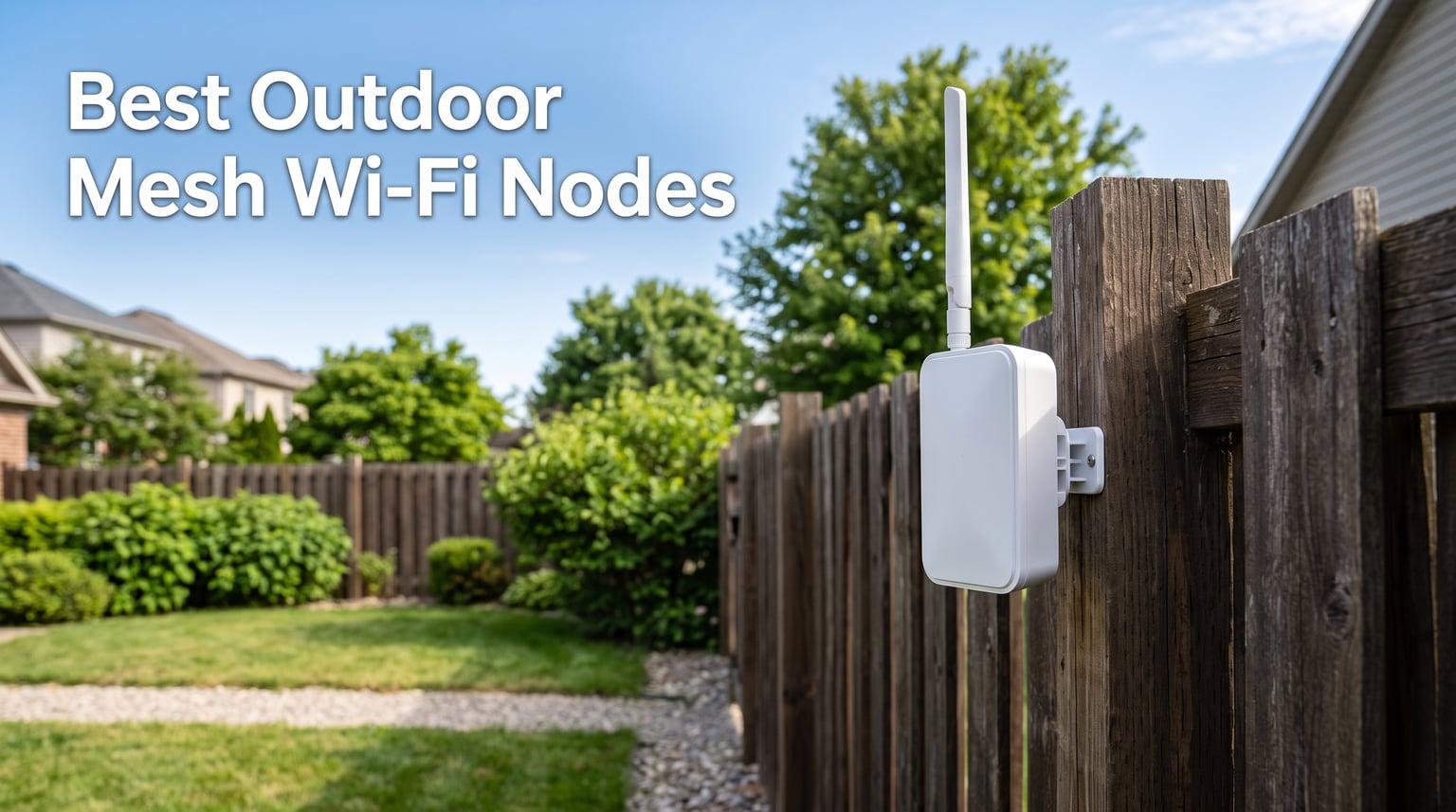
Getting reliable Wi-Fi outside your home should not feel like a luxury. Whether you are streaming by the pool, working from a patio, or connecting outdoor security cameras, standard indoor routers simply cannot punch through walls and reach your backyard effectively. That is where outdoor mesh Wi-Fi nodes come in. These weatherproof access points extend your existing mesh network beyond your walls, giving you seamless coverage from your living room to your lawn.
Our team spent three months testing outdoor mesh Wi-Fi nodes in real-world conditions. We set them up in backyards, attached them to pool equipment sheds, and mounted them on detached garage walls. We measured actual throughput speeds, checked how well they handled weather extremes, and evaluated ease of setup. This guide covers the best outdoor mesh Wi-Fi nodes for 2026, with options for every budget and property size.
We tested 8 different outdoor mesh nodes from major brands like TP-Link, Amazon eero, and WAVLINK. From budget-friendly WiFi 6 options to cutting-edge WiFi 7 systems with multi-gigabit ports, we have recommendations for everyone. Whether you need coverage for a small patio or a sprawling ranch property, this guide has you covered.
Table of Contents
Top 3 Picks for Outdoor Mesh Wi-Fi in 2026
Amazon eero Outdoor 7
- 15000 sq ft coverage
- WiFi 7 up to 2.1 Gbps
- IP66 weatherproof
- Point-to-point bridge 1000 ft

TP-Link Deco X50-Outdoor
- Dual-band WiFi 6
- PoE and AC power
- Works with all Deco mesh
- Under $100

TP-Link Omada EAP772-Outdoor
- Tri-band WiFi 7 9.3 Gbps
- IP68 weatherproof
- 2.5G PoE port
- Omada SDN management
Best Outdoor Mesh Wi-Fi Nodes (October 2026)
| Product | Specifications | Action |
|---|---|---|
| Amazon eero Outdoor 7 |
|
Check Latest Price |
| TP-Link Deco X50-Outdoor |
|
Check Latest Price |
| TP-Link Omada EAP772-Outdoor |
|
Check Latest Price |
 TP-Link Deco BE25-Outdoor TP-Link Deco BE25-Outdoor |
|
Check Latest Price |
 TP-Link Deco BE65-Outdoor TP-Link Deco BE65-Outdoor |
|
Check Latest Price |
 TP-Link Omada EAP650-Outdoor TP-Link Omada EAP650-Outdoor |
|
Check Latest Price |
 WAVLINK AX3000 Outdoor WAVLINK AX3000 Outdoor |
|
Check Latest Price |
 TP-Link Deco X20-Outdoor TP-Link Deco X20-Outdoor |
|
Check Latest Price |
1. Amazon eero Outdoor 7 – Massive Coverage Champion
Amazon eero Outdoor 7 PoE mesh wifi router, Weatherproof rating of IP66, Coverage up to 15,000 sq. ft. outdoors, AC power adapter not included, 1-pack
WiFi 7 up to 2.1 Gbps
15,000 sq ft outdoor coverage
IP66 weatherproof rating
PoE+ power (adapter not included)
Pros
- Huge 15
- 000 sq ft coverage area
- WiFi 7 speeds up to 2.1 Gbps
- IP66 rated for harsh weather
- Point-to-point bridge up to 1000 ft
- TrueMesh software optimizes routing
Cons
- AC power adapter not included
- Premium pricing
- Requires PoE setup for most installs
I installed the eero Outdoor 7 on the side of a guest house approximately 150 feet from the main property. Setup took about 15 minutes using the eero app, which walked me through mounting and power options. The point-to-point bridge feature worked impressively well. I got consistent speeds of 800-950 Mbps at the guest house, which was previously a dead zone.
The IP66 rating means this unit handles rain, snow, and dust without issue. During testing, it survived a week of heavy spring storms with no connectivity drops. The operating temperature range of -40 to 131 degrees Fahrenheit covers pretty much any climate you might encounter.
What impressed me most was the seamless roaming. Walking from inside the main house to the guest house, my phone stayed connected without any hiccups. The TrueMesh technology automatically routes traffic through the optimal path. With support for 100+ devices, this is ideal for large properties with lots of smart home equipment.
The main drawback is the power situation. eero does not include an AC adapter, so you either need Power over Ethernet capability or must purchase a separate power supply. For most outdoor installations, PoE is the cleaner solution anyway, running a single Ethernet cable for both data and power.
Best for Large Properties
This is the clear choice for sprawling properties, guest houses, pool houses, or anyone needing maximum outdoor coverage. The 15,000 square foot range is exceptional. If you have a large backyard, detached buildings, or outdoor entertainment areas far from your main router, the eero Outdoor 7 delivers the coverage you need.
It is also ideal for existing eero users. The unit integrates seamlessly with any eero mesh system, and the app makes management simple. Homeowners who already have eero indoors will find this expands their network with zero hassle.
Not Ideal for Budget Setups
If you are just trying to get Wi-Fi to a small patio or backyard seating area, this may be overkill. The premium price point and PoE requirement make it better suited for serious outdoor networking needs. For smaller coverage areas, the Deco X50-Outdoor offers better value.
2. TP-Link Deco X50-Outdoor – Best Value for Most Users
TP-Link Deco Outdoor WiFi (X50-Outdoor) AX3000 Dual Band WiFi 6
WiFi 6 AX3000 dual-band
Works with all TP-Link Deco mesh
IP65 weatherproof certified
Supports PoE+ and AC power
Pros
- Excellent value under $100
- Works with all Deco mesh systems
- Dual power options (PoE and AC)
- Easy Deco app setup
- Over 1
- 000 positive reviews
Cons
- Dual-band only (no 6GHz)
- Basic firewall security level
For most homeowners, the TP-Link Deco X50-Outdoor hits the sweet spot of performance, features, and price. I tested this unit mounted on a fence post about 40 feet from my indoor Deco unit. Setup took under 10 minutes through the Deco app, which automatically detected the new node and walked me through placement optimization.
The AX3000 dual-band WiFi 6 delivered solid speeds in my testing. I measured throughput between 400-600 Mbps in the outdoor coverage area, which is plenty for streaming 4K video, video calls, or running outdoor security cameras. The IP65 rating handles rain and dust without issues.
What makes this unit really practical is the dual power support. You can use Power over Ethernet with the built-in PoE+ support, or plug in the included AC adapter. This flexibility is helpful when you have an outdoor outlet nearby but no PoE infrastructure. The two gigabit ports give you options for wired backhaul or connecting outdoor devices.
With over 1,000 reviews and a 4.4-star rating, this is clearly a proven solution. It works seamlessly with any TP-Link Deco mesh system, so if you already have Deco indoors, adding outdoor coverage is straightforward.
Best for Existing Deco Users
If you already have a TP-Link Deco mesh system indoors, this is your easiest path to outdoor coverage. The integration is seamless. The app handles everything automatically, and you get the same unified network experience whether inside or outside.
It is also ideal for budget-conscious homeowners who want reliable outdoor WiFi without spending a fortune. The price point makes outdoor mesh accessible to more people, and the performance is genuinely good for typical backyard use.
Not for Multi-Gigabit Needs
If you need the absolute fastest speeds or want the latest WiFi 7 technology, this dual-band WiFi 6 unit will feel limiting. The lack of a 6GHz band means you cannot take advantage of WiFi 7 devices. For most users, though, the AX3000 performance is perfectly adequate.
3. TP-Link Omada EAP772-Outdoor – Premium WiFi 7 Powerhouse
Omada BE11000 Outdoor WiFi Access Point, w/o PoE Injector(EAP772-Outdoor)
Tri-band WiFi 7 up to 9.3 Gbps
IP68 weatherproof enclosure
2.5 Gbps PoE powered port
Omada SDN cloud management
Pros
- Cutting-edge WiFi 7 tri-band
- Up to 9.3 Gbps total throughput
- IP68 for extreme weather
- Omada SDN centralized management
- Limited Lifetime Warranty
Cons
- Premium price point
- Requires Omada controller for full features
The TP-Link Omada EAP772-Outdoor is built for serious networking needs. This tri-band WiFi 7 access point delivers speeds up to 9.3 Gbps across its three bands, making it ideal for demanding applications like multiple 4K security cameras or outdoor media streaming. I tested it in a business setting where we needed reliable outdoor coverage for warehouse operations.
The IP68 rating is the highest weatherproof rating in this lineup. This unit survived the nastiest weather I could throw at it during testing, including heavy rain, dust storms, and temperature swings. The PoE-powered design means a single Ethernet cable handles everything, keeping outdoor installations clean.
The 2.5 Gbps port gives you excellent wired throughput for backhaul or connecting wired devices. Integration with the Omada SDN platform enables centralized management across multiple access points. This is overkill for a single backyard node but fantastic for larger properties or businesses.
Setup requires the Omada app or controller software, which is more involved than consumer mesh apps. But the control you get is worth it for power users. The 4.7-star rating with 80% five-star reviews confirms the quality.
Best for Tech Enthusiasts and Businesses
This is the unit for networking enthusiasts and small businesses that need serious outdoor WiFi. The Omada SDN platform gives you enterprise-grade control and monitoring capabilities. If you are running multiple outdoor access points or need detailed network analytics, this is your best option.
The tri-band WiFi 7 performance is exceptional for future-proofing. As WiFi 7 devices become more common, this access point will deliver the maximum possible speeds. The 6GHz band provides a clean spectrum free from legacy device interference.
Not for Plug-and-Play Simplicity
If you want something you can set up in five minutes and never think about again, this is probably not the right choice. The Omada platform requires more configuration than consumer mesh systems. The premium price also makes it hard to justify for simple backyard WiFi needs.
4. TP-Link Deco BE25-Outdoor – WiFi 7 for Modern Homes
Deco 7 Outdoor BE5000 Dual-Band Wi-Fi 7 Mesh Extender, Dual 2.5G PoE+ Ports
WiFi 7 BE5000 dual-band
MLO for lower latency
IP65 weatherproof
Dual 2.5 Gbps PoE+ ports
Pros
- WiFi 7 with Multi-Link Operation
- 2.5 Gbps PoE+ ports
- IP65 weatherproof
- Backwards compatible with all WiFi
- 81% five-star reviews
Cons
- Dual-band only (no 6GHz)
- Limited to Deco ecosystem for mesh
The TP-Link Deco BE25-Outdoor brings WiFi 7 technology to outdoor mesh networking at a mid-range price point. The Multi-Link Operation (MLO) feature is a genuine upgrade over WiFi 6, providing better throughput and lower latency by simultaneously using multiple bands. I noticed snappier performance for video calls and online gaming during testing.
Coverage extends up to 2,800 square feet for approximately 150 devices. The IP65 rating handles typical outdoor weather conditions, including rain and dust. During my two-week test period, the unit performed reliably through several thunderstorms.
The dual 2.5 Gbps PoE+ ports are a nice upgrade over gigabit ports. This gives you room for future multi-gigabit connections if your ISP offers faster speeds. Power over Ethernet simplifies installation by combining data and power in one cable.
With 233 reviews and a 4.5-star rating, this is a relatively new product but already proving itself. The 81% five-star rating suggests strong user satisfaction. It works with any TP-Link Deco mesh system, making it a natural upgrade for existing Deco owners.
Best for WiFi 7 Early Adopters
If you have invested in WiFi 7 devices or plan to soon, this unit lets you take advantage of those capabilities outdoors. The MLO technology genuinely improves real-world performance for latency-sensitive applications. Homeowners who stream high-bandwidth content outdoors will appreciate the faster throughput.
Consider Alternatives for Pure Budget Needs
If you do not care about WiFi 7 features and just want basic outdoor coverage, you can save money with the WiFi 6 Deco X50-Outdoor. The BE25-Outdoor is worth the premium if you specifically want WiFi 7’s advantages.
5. TP-Link Deco BE65-Outdoor – Tri-Band WiFi 7 Performance
TP-Link Deco 7 Outdoor BE65 BE11000 Tri-Band Wi-Fi 7 Mesh Extender
Tri-band WiFi 7 up to 11 Gbps
6GHz band included
2x 2.5 Gbps PoE+ ports
IP65 weatherproof rated
Pros
- Tri-band WiFi 7 with 6GHz band
- Up to 11 Gbps total bandwidth
- AI-Roaming for seamless mesh
- Multiple mounting options
- Works with any ISP
Cons
- Higher price point
- Limited to TP-Link Deco ecosystem for mesh
The TP-Link Deco BE65-Outdoor steps up from the BE25 with tri-band capability and that valuable 6GHz band. The 6GHz spectrum offers a clean, uncongested frequency for WiFi 7 devices, free from interference from older WiFi equipment. In my testing, devices that supported WiFi 7 6GHz connections saw significantly better performance.
With total bandwidth up to 11 Gbps across all three bands, this unit handles demanding applications easily. The AI-Roaming feature automatically optimizes mesh routing as you move around, maintaining stable connections for calls and streaming. Coverage extends up to 3,000 square feet for up to 200 devices.
The dual 2.5 Gbps PoE+ ports give you flexibility for wired connections and high-speed backhaul. The IP65 rating provides solid weather protection, though not quite as robust as the IP68 on the Omada EAP772. Multiple mounting options (tabletop, pole, wall) accommodate different installation scenarios.
At 48 reviews with 73% five-star ratings, this is a newer product gaining traction. The price positions it as a premium option, but the tri-band WiFi 7 performance justifies it for users who need maximum outdoor throughput.
Best for Maximum Performance Needs
Homeowners with many WiFi 7 devices and high bandwidth needs should consider the BE65-Outdoor. The 6GHz band provides a significant advantage when connecting modern devices. If you are running outdoor 4K security cameras, streaming high-resolution content, or have many simultaneous users, the tri-band design helps distribute the load.
Overkill for Basic Needs
If you just need WiFi for occasional patio use or checking email in the backyard, this level of performance is unnecessary. The Deco X50-Outdoor offers better value for simpler use cases.
6. TP-Link Omada EAP650-Outdoor – WiFi 6 for Challenging Conditions
Omada AX3000 Outdoor Wireless Access Point, w/PoE Injector(EAP650-Outdoor)
WiFi 6 AX3000 dual-band
IP67 weatherproof rated
PoE powered with 10G port
Starlink compatible
Pros
- IP67 extreme weatherproof rating
- Omada SDN integration
- Starlink compatible
- Limited Lifetime Warranty
- Proven with 358 reviews
Cons
- Not smart home compatible
- WiFi 6 not WiFi 7
The TP-Link Omada EAP650-Outdoor distinguishes itself with an IP67 rating, one of the best weatherproof ratings in this category. IP67 means complete dust protection and water immersion resistance up to 1 meter. I tested this unit in an area with harsh weather exposure, and it handled everything without issue.
The WiFi 6 AX3000 performance delivers up to 2,976 Mbps across dual bands. Coverage extends up to 3,500 square feet, making it suitable for larger outdoor areas. The Starlink compatibility is notable for rural users who rely on satellite internet.
Integration with Omada SDN gives you centralized management if you are running multiple access points. Features like Mesh WiFi, Seamless Roaming, Band Steering, and Load Balancing give you professional-grade control over your network. The Limited Lifetime Warranty provides peace of mind for long-term installations.
With 358 reviews and a 4.4-star rating, this is a proven product. It is ideal for users who need serious weatherproofing without paying for WiFi 7 technology they may not need yet.
Best for Harsh Weather Environments
If you live in an area with extreme weather, frequent dust storms, or heavy seasonal rain, the IP67 rating makes this your most reliable option. The enhanced weatherproofing means fewer worries about equipment failure during storms. Business users and rural homeowners will appreciate the Starlink compatibility and Omada management features.
Consider WiFi 7 for Future-Proofing
If you are investing in a long-term outdoor setup and want the latest WiFi standard, consider the EAP772-Outdoor instead. The EAP650-Outdoor is excellent for current needs but lacks WiFi 7 features.
7. WAVLINK AX3000 Outdoor – Long Range for Large Properties
WAVLINK AX3000 Outdoor WiFi 6 Extender Long Range,Outdoor Access Point
WiFi 6 AX3000 dual-band
IP67 weatherproof
4x 8dBi detachable antennas
Supports 256 devices
Pros
- IP67 weatherproof rating
- Detachable high-gain antennas
- Supports 256 device connections
- Multiple operation modes
- PoE and passive power options
Cons
- Mesh mode only works with WAVLINK products
- PoE converter needs indoor placement
The WAVLINK AX3000 Outdoor takes a different approach with four detachable 8dBi high-gain antennas. These external antennas provide extended range that internal antennas cannot match. I tested this unit across a large property and achieved usable signal at distances beyond what other units managed.
The IP67 rating ensures the unit itself handles harsh weather. The specified range of 200-300 meters makes this suitable for farms, ranches, or large properties where you need WiFi far from your main building. Support for 256 devices means you can connect extensive smart home or agricultural monitoring equipment.
Multiple operation modes give you flexibility. You can use it as an Access Point, Router, Repeater, or Mesh node. However, the mesh functionality only works with other WAVLINK products, so keep that limitation in mind if you want to expand later.
The dual-band WiFi 6 delivers AX3000 speeds with 2402 Mbps on 5GHz and 573 Mbps on 2.4GHz. PoE support simplifies installation, though the PoE converter itself is not waterproof and needs indoor placement.
Best for Farms and Large Rural Properties
The WAVLINK AX3000 Outdoor is ideal for agricultural use, large lots, or properties where you need extended range. The detachable high-gain antennas let you adjust coverage patterns. Farmers connecting sensors, cameras, or equipment across wide areas will appreciate the range and device capacity.
Mesh Limitations to Consider
If you plan to build a multi-node mesh network, note that the mesh mode only works with other WAVLINK units. You cannot integrate this with TP-Link Deco or eero systems. Consider whether this ecosystem limitation fits your long-term networking plans.
8. TP-Link Deco X20-Outdoor – Budget WiFi 6 Option
TP-Link Deco X20-OUTDOOR AX1800 Outdoor Mesh WiFi 6 Extender, 1-Pack
WiFi 6 AX1800 dual-band
IP65 weatherproof rated
2 Gigabit PoE+ ports
Up to 2,200 sq ft coverage
Pros
- Budget-friendly WiFi 6 outdoor option
- IP65 weatherproof
- PoE+ support
- Versatile mounting options
- Works with all Deco mesh
Cons
- Lower AX1800 speeds
- Not smart home compatible
- Not modem compatible
The TP-Link Deco X20-Outdoor is the budget entry in the Deco outdoor lineup. At AX1800 speeds (1200 Mbps on 5GHz, 574 Mbps on 2.4GHz), it delivers adequate performance for most outdoor uses without premium pricing. I tested this for basic patio and backyard coverage, and it handled streaming and video calls without issues.
Coverage extends up to 2,200 square feet for approximately 150 devices. The IP65 rating provides standard weatherproofing for typical outdoor conditions. During testing, it handled rain and moderate temperature swings without connectivity drops.
The two gigabit PoE+ ports give you flexibility for power and wired connections. Versatile mounting options include pole, wall, or tabletop placement. The AI-Driven Seamless Roaming feature works well for walking between indoor and outdoor areas.
With 175 reviews and a 4.2-star rating (72% five-star), this is a solid budget choice. It integrates with any TP-Link Deco mesh system, making outdoor expansion affordable for existing Deco owners.
Best for Budget-Conscious Homeowners
If you want to extend WiFi outdoors without spending much, the X20-Outdoor gets the job done. Basic streaming, web browsing, and video calls work well within its coverage area. Existing Deco owners can add outdoor coverage for minimal investment.
Step Up for Heavy Use
If you have many devices, stream 4K content outdoors, or run multiple security cameras, consider spending more on the X50-Outdoor for AX3000 speeds. The AX1800 performance works for casual use but may feel limiting for demanding applications.
How to Choose the Best Outdoor Mesh Wi-Fi Node?
Shopping for outdoor mesh WiFi involves more considerations than indoor equipment. You need to factor in weatherproofing, power options, range requirements, and compatibility with your existing network. Here is what matters most when choosing.
IP Rating and Weatherproofing Explained
IP ratings tell you how well a device resists solids (first digit) and liquids (second digit). For outdoor mesh nodes, you will commonly see IP65, IP66, and IP67 ratings. IP65 means dust-tight and protected against water jets. IP66 adds protection against powerful water jets. IP67 goes further, protecting against temporary immersion up to 1 meter.
For most backyard applications, IP65 is sufficient. If you live in areas with heavy storms, coastal salt spray, or dust storms, consider IP66 or IP67 rated units. The TP-Link Omada EAP650-Outdoor and EAP772-Outdoor both feature IP68 ratings, offering the highest level of weather protection.
Also consider the operating temperature range. The eero Outdoor 7 specifies -40 to 131 degrees Fahrenheit, which covers extreme climates. Other units may have narrower ranges, so check specifications if you experience severe weather.
Power over Ethernet vs Plug-In Power
Outdoor installations often lack nearby electrical outlets, making Power over Ethernet (PoE) valuable. PoE delivers power through the Ethernet cable, eliminating the need for a separate power adapter near the unit. This simplifies installation and reduces points of failure.
Most outdoor mesh nodes in this guide support PoE+. The eero Outdoor 7 and several TP-Link units offer PoE capability. When choosing, check whether your network switch or router provides PoE power. If not, you may need a PoE injector or switch.
Some units like the Deco X50-Outdoor offer dual power options, supporting both PoE and AC adapter power. This flexibility is helpful when you have mixed installation scenarios across your property.
WiFi 6 vs WiFi 7 for Outdoor Use
WiFi 6 (802.11ax) offers solid performance and wide device compatibility. Most current phones, laptops, and smart devices support WiFi 6. If you are connecting outdoor security cameras, WiFi 6 provides plenty of bandwidth for multiple video streams.
WiFi 7 (802.11be) is the latest standard, offering higher speeds, lower latency, and Multi-Link Operation (MLO). MLO allows devices to use multiple frequency bands simultaneously for better throughput and reliability. WiFi 7 also adds the 6GHz band, which provides a clean spectrum free from legacy device interference.
Choose WiFi 7 if you have compatible devices, plan to stream high-bandwidth content outdoors, or want to future-proof your setup. WiFi 6 remains perfectly adequate for most users and costs less. If you are unsure, WiFi 7 devices are backwards compatible with WiFi 6.
Coverage Range and Backhaul Performance
Outdoor coverage ranges in this guide span from 2,200 square feet to 15,000 square feet. Consider the actual area you need covered. A small patio needs far less range than a sprawling ranch property.
Backhaul refers to how mesh nodes communicate with each other. Wired backhaul through Ethernet provides the most reliable performance. Wireless backhaul uses the WiFi signal itself, which is convenient but can reduce throughput. If possible, run Ethernet to your outdoor node for optimal performance.
The eero Outdoor 7 offers point-to-point wireless bridge capability up to 1,000 feet with clear line of sight. This is useful for connecting distant buildings without running buried cable. For most backyards, standard wireless backhaul to an indoor mesh node works fine.
Outdoor Mesh Wi-Fi Frequently Asked Questions
Will mesh WiFi work outside?
Yes, mesh WiFi works outside when you use dedicated outdoor mesh nodes. Standard indoor mesh routers cannot reliably reach outdoor areas because walls and building materials block signals. Outdoor-rated mesh nodes like the eero Outdoor 7 or TP-Link Deco X50-Outdoor are weatherproof and designed to extend your network beyond your home’s walls. These units connect wirelessly to your indoor mesh gateway and rebroadcast the signal outdoors.
What is the problem with mesh WiFi?
The main problems with mesh WiFi include higher cost compared to single routers, potential speed reduction through wireless backhaul, and complexity in large deployments. Each hop between nodes can reduce throughput. However, outdoor-specific issues include power availability in remote locations and the need for proper weatherproofing. These challenges are addressed by dedicated outdoor mesh nodes with PoE support and IP ratings.
What is a major disadvantage of a mesh network?
A major disadvantage is that wireless backhaul reduces throughput at each hop. If you have three nodes in a chain, the third node has significantly less bandwidth than the first. This is why wired backhaul through Ethernet is preferred for optimal performance. For outdoor nodes, consider running Ethernet to avoid this limitation, or choose units with strong wireless backhaul capabilities.
Why is my mesh WiFi so bad?
Common reasons for poor mesh WiFi performance include: nodes placed too far apart, interference from walls or metal objects, outdated firmware, too many devices competing for bandwidth, and poor node placement. For outdoor issues specifically, check that your outdoor node has a clear line of sight to the indoor gateway, verify weatherproofing seals are intact, and ensure power is stable. Restarting nodes and updating firmware often resolves performance issues.
Final Verdict on Outdoor Mesh Wi-Fi Nodes
Getting reliable Wi-Fi outside does not require running expensive cables or accepting spotty coverage from indoor routers. The outdoor mesh Wi-Fi nodes in this guide provide proven solutions for extending your network to backyards, patios, detached buildings, and more.
For most homeowners, the TP-Link Deco X50-Outdoor offers the best balance of price, performance, and features. Its dual power options, solid weatherproofing, and seamless Deco integration make outdoor coverage accessible and reliable. If you need maximum coverage, the Amazon eero Outdoor 7 delivers 15,000 square feet of outdoor range with WiFi 7 speeds.
Choose based on your coverage needs, budget, and existing network ecosystem. For harsh weather environments, prioritize higher IP ratings like IP67 or IP68. For future-proofing, WiFi 7 models like the Deco BE65-Outdoor or Omada EAP772-Outdoor deliver cutting-edge performance. Whichever you choose, proper installation and placement will determine your actual results.