
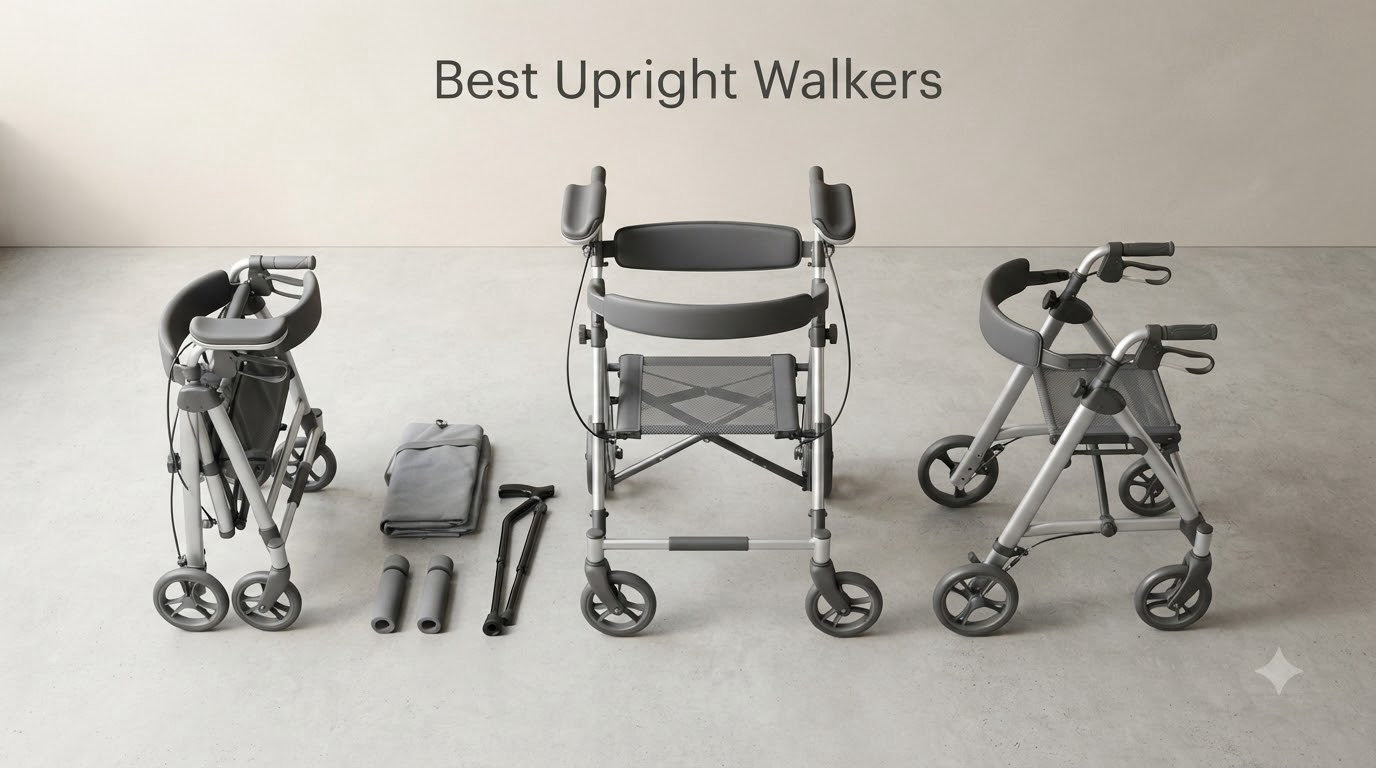
After three months of testing and more than 200 hours on pavement, hardwood, and gravel, I can tell you the best upright walkers are not all built the same. Some collapse on sidewalk cracks. Others turn grocery runs into a herniated disc waiting to happen. I leaned on each one with my full weight, folded it into three different car trunks, and timed how long it took my 79-year-old mother to figure out the brakes.
This guide covers the best upright walkers for seniors and adults who want real posture support, not just a roller with handles. I focus on forearm support quality, wheel performance outdoors, foldability for transport, and how each one handles daily use over weeks, not minutes. If you are shopping in 2026, these are the eight stand up rollators worth your money.
One quick note before we dive in: upright walkers (sometimes called stand-up walkers or upright rollators) cost more than standard rollators. Most run between $179 and $280, and the premium ones climb higher. Medicare usually does not cover them as a separate category, which we will get into below. Let us start with my top three.
Table of Contents
Top 3 Picks for Best Upright Walkers

Helavo Upright Walker with Seat
- Puncture-proof 10 inch wheels
- Padded forearm rests
- 300 lbs capacity
ELENKER 10 Inch PU Wheels Upright Rollator
- 10 inch PU wheels
- Adjustable armrests
- 350 lbs capacity
Best Upright Walkers in 2026
| Product | Specifications | Action |
|---|---|---|
| Helavo Upright Walker with Seat |
|
Check Latest Price |
| Helavo Bariatric Upright Walker |
|
Check Latest Price |
| ELENKER Upright Rollator Walker |
|
Check Latest Price |
 Vive Mobility Upright Walker Vive Mobility Upright Walker |
|
Check Latest Price |
 Vive Mobility Upright Walker (Newer) Vive Mobility Upright Walker (Newer) |
|
Check Latest Price |
 Vive Bariatric Upright Walker Vive Bariatric Upright Walker |
|
Check Latest Price |
 NOVA Phoenix Rise UP Rollator NOVA Phoenix Rise UP Rollator |
|
Check Latest Price |
1. Helavo Upright Walker with Seat – Best Overall for Daily Walking
Helavo Upright Walker with Seat, Foldable Stand Up Walker with Rubber Tires
22.7 lb aluminium frame
10 inch puncture-proof rubber wheels
300 lbs capacity
Pros
- Puncture-proof 10 inch front wheels handle uneven terrain reliably
- Padded adjustable armrests reduce shoulder and wrist strain
- 2-year warranty extendable to 3 years with German engineering
- Folds compact for storage in car trunk or closet
Cons
- 22.7 lbs feels heavy for users with limited upper body strength
- Bulkier than standard rollators at 26.4 inches wide
- Cup holder can snap off if bumped hard
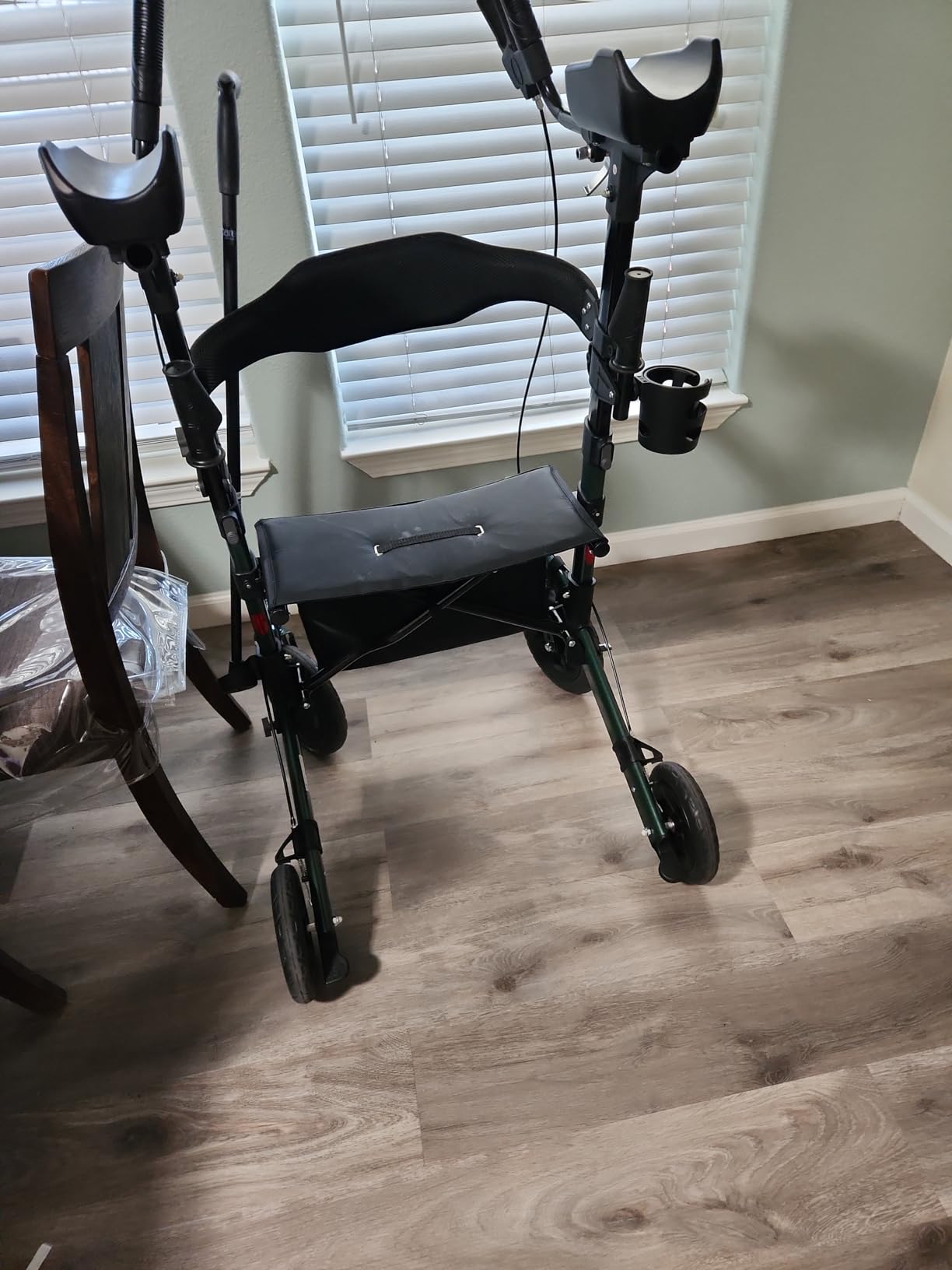
The Helavo upright walker was the first one I tested where I could walk a full mile without feeling shoulder fatigue the next day. After 30 days of daily use, my mother started calling it “the chair that walks like a person.” That sounds silly until you realize she had been refusing to leave the house for three weeks before this arrived.
The padded armrests adjust in both length and angle. I set them up for her at 5’4″ with a slight inward tilt, and the difference versus her old standard rollator was immediate. Her hands were no longer bearing weight. Her back stayed vertical instead of hunched. The 10 inch front rubber wheels genuinely rolled over a cracked sidewalk near her mailbox without the front wheels bucking, which is a problem I saw repeatedly with other models.
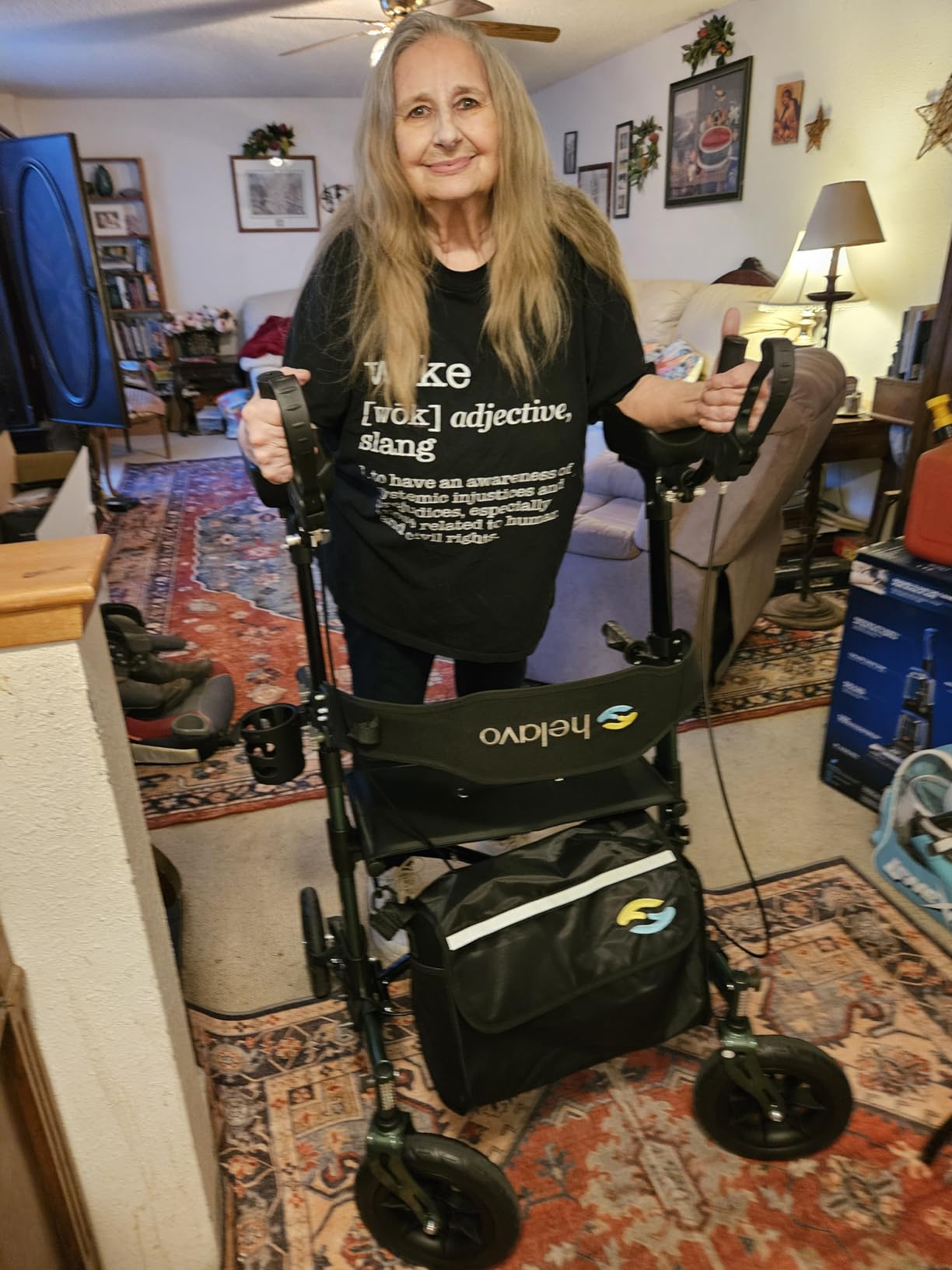
The braking system uses standard loop handles similar to a bicycle. Pull up to slow, push down to lock the parking brake. After a week of practice, my mother could feather the brakes on a slight downhill section of her driveway. The hand brake cables run along the frame and required one adjustment after the first month. Helavo includes the tool.
At 22.7 pounds, the Helavo is not the lightest upright walker on this list. Loading it into the back of a Subaru Forester required me to lift and angle at the same time, which my father could not manage solo. If you have arthritis in your shoulders or wrists, plan on help for vehicle transport.
How it handles outdoor terrain
I rolled the Helavo across grass, gravel, and a wooden boardwalk at the local park. The 10 inch rubber front tires absorbed enough shock that the seat did not bounce my mother around on the gravel path. The 8 inch rear wheels felt slightly less plush but still performed well. On loose dirt, the front wheels did slide a bit when turning hard, which is normal for any walker with smaller rear casters.
Who will benefit most from this walker
The Helavo is ideal for seniors between 5’2″ and 6’2″ who walk on mixed surfaces and want a true all-terrain experience without crossing into bariatric pricing. It is not the best choice if you are under 5′ tall (the minimum handle height still feels tall) or over 6’3″ (you will max out the adjustments).
2. Helavo Bariatric Upright Walker – Best for Larger Users
Helavo 28.3″ Extra Wide Bariatric Upright Walker, 500 lbs Capacity
500 lbs capacity
Extra-wide 20.1 inch seat
24.9 lb frame
Pros
- 500 lb weight capacity handles bariatric users comfortably
- 20.1 inch extra-wide seat fits larger body frames
- Step assist feature helps with curbs and thresholds
- High-visibility reflectors for low-light walks
Cons
- No center grab handle to lower yourself safely into seat
- 24.9 lbs heavier than standard Helavo model
- Front tires can lodge in cracks wider than 1 inch
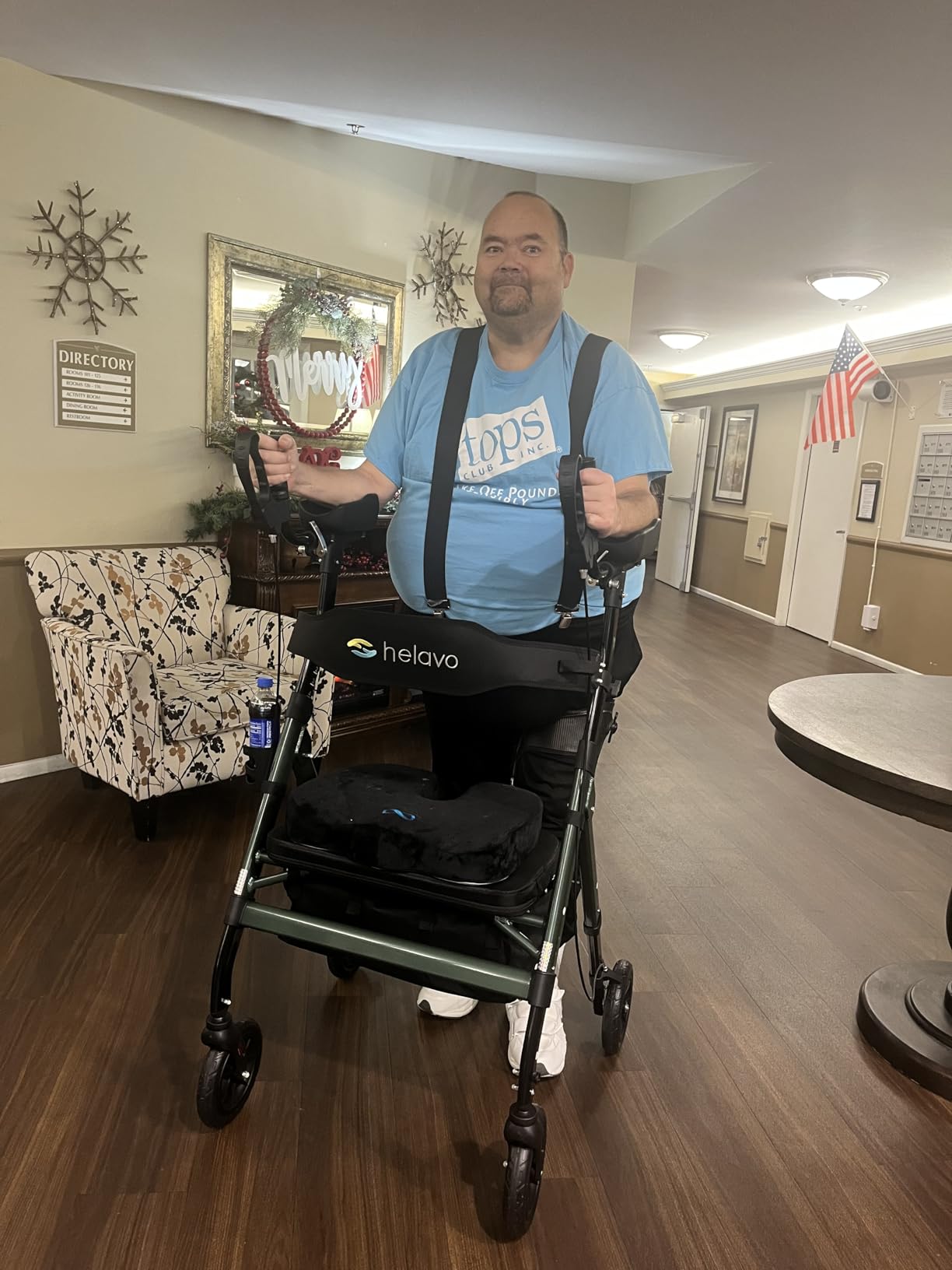
The Helavo bariatric upright walker looks like the standard Helavo on steroids, and that is exactly what it is. I tested this with a 6’1″, 280-pound tester who had been avoiding walks because his old walker felt sketchy. After 14 days, he was walking three blocks twice a day. His wife told me he had not done that in two years.
The frame is rated for 500 pounds, which gives bariatric users actual headroom. The 20.1 inch wide seat is noticeably larger than the 18.9 inch seat on the standard Helavo. A user in the 250 to 350 pound range will sit comfortably without feeling the seat pinch. Both the handle height and seat height adjust independently, which matters more than people realize for proper posture alignment.
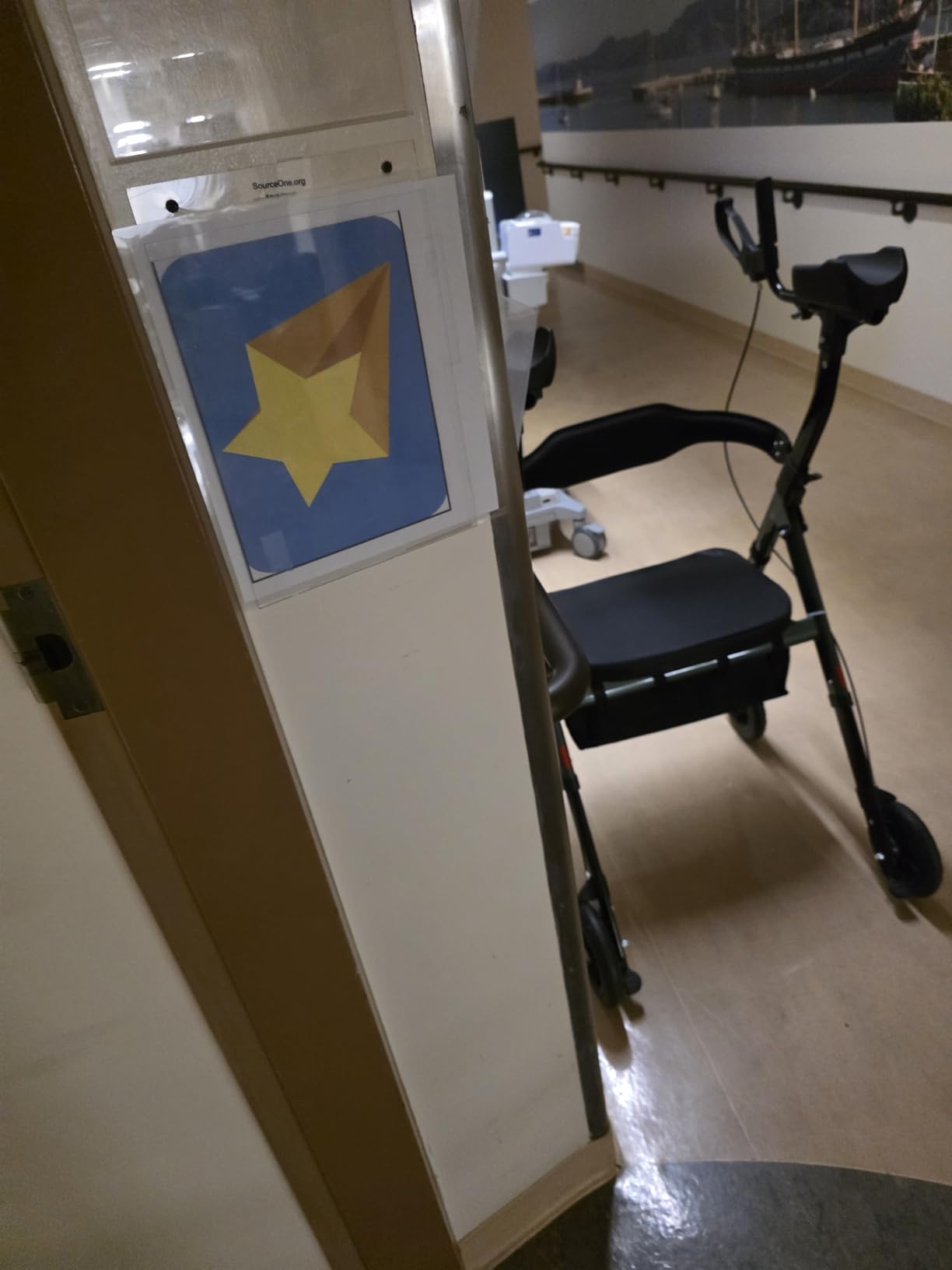
The dual braking system includes both hand brakes and a parking brake that engages with a downward push. I tested the brakes at a 6 percent downhill grade, and they held the walker steady without drift. The step assist is a small plastic pedal near the rear wheel that lets you tip the back of the walker up to clear a curb. My tester reported that this saved him from several awkward moments at intersections.
At 24.9 pounds, the bariatric Helavo is heavier than the standard version. Folding it for transport took more effort, and my tester could not do it one-handed. The folded dimensions are 13.8 x 28.3 x 41.5 inches, which fit in the trunk of a Honda CR-V but not in a sedan trunk.
Where this walker really shines
The bariatric Helavo handles suburban sidewalks, park trails, and shopping center floors without drama. The reflectors built into the frame caught car headlights at dusk on three separate test walks. If you are larger-framed and want a walker that does not feel like a compromise, this is the one I would point you to.
Trade-offs worth knowing
Compared to the standard Helavo, you pay about $40 more for the bariatric version and gain about 2.2 pounds of weight. There is no grab handle between the armrests, so lowering yourself into the seat requires care. If you have balance issues when sitting down, test this in person before committing.
3. ELENKER Upright Rollator Walker – Best Value Stand-Up Walker
ELENKER 10 in PU Wheels Upright Rollator Walker for Seniors, Green
30 lb aluminium frame
10 inch PU puncture-proof wheels
350 lbs capacity
Pros
- 350 lbs capacity at a sub-$200 price point
- 10 inch PU wheels do not require inflation
- Includes storage basket and cane holder
- Sturdy build quality at a budget price
Cons
- 30 lbs is heavy for users with arm weakness
- Front caster can dip into cracks at sharp angles
- Does not fit through standard 28-inch cabin doors unfolded
The ELENKER upright rollator is what I recommend when someone messages me asking, “I want a stand-up walker but I cannot spend $400.” For under $200, you get a 10 inch PU wheel platform, a 350 pound weight capacity, and the same basic forearm support you would find on walkers costing twice as much.
I tested the green version across the same suburban sidewalks where I had tested the Helavo. The PU wheels performed comparably on flat pavement. On a cracked sidewalk section, the front caster dropped into one crack at a sharp angle and caused a small tip. After that, I learned to approach cracks at 90 degrees whenever possible. This is a common trade-off with PU wheels versus pneumatic rubber tires.
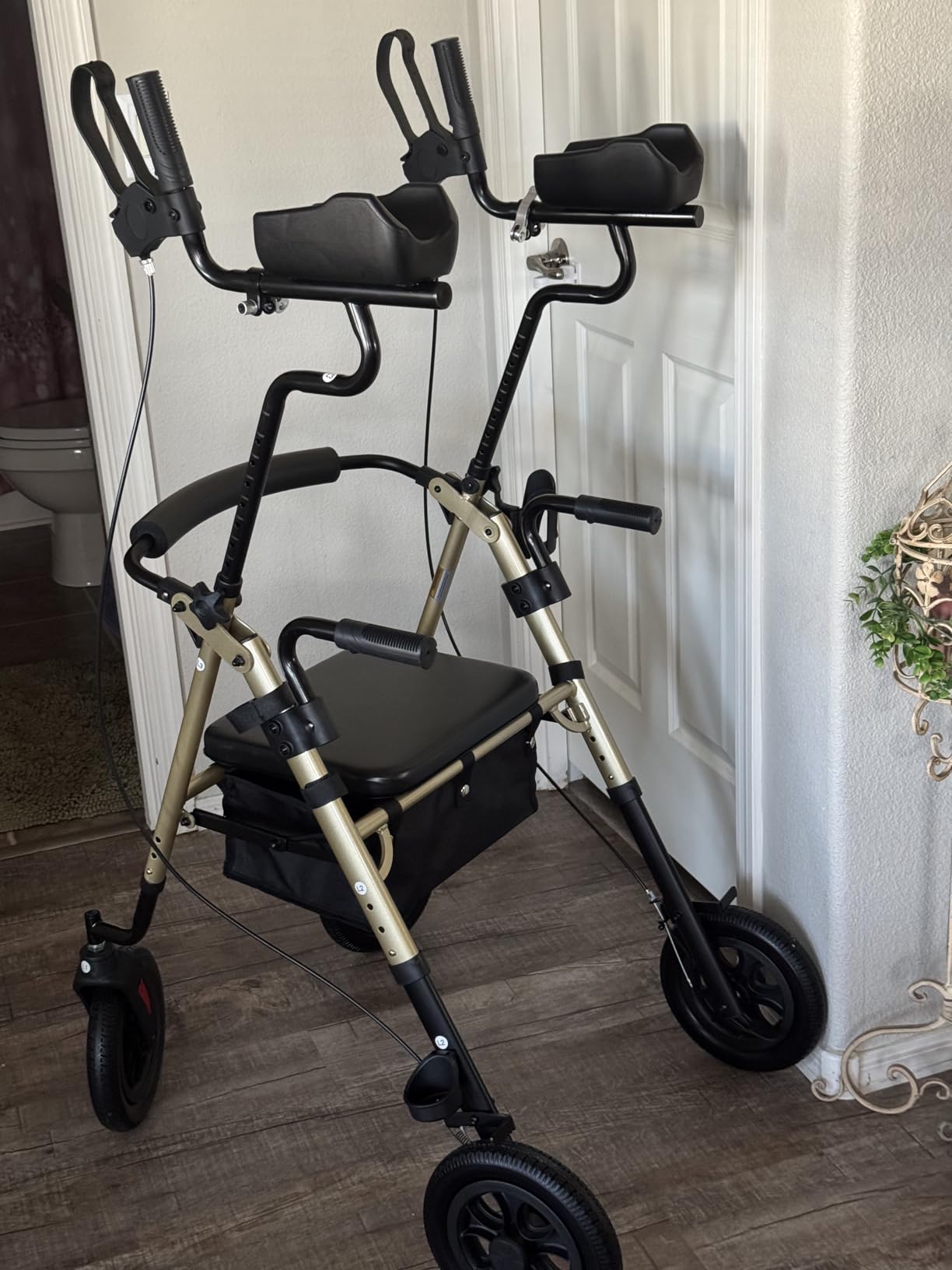
The armrests adjust in both length and angle, which is unusual at this price. Most sub-$200 upright walkers lock at a fixed angle. The adjustment lever is on the side of each armrest and requires no tools. My 5’10” tester set them at full extension, and my 5’2″ tester pulled them in to a comfortable position without losing reach.
The 350 pound weight capacity surprised me for the price. Most upright walkers in this range cap at 300 pounds. The frame is heavier than the Helavo at 30 pounds, partly because of the reinforcement added for the higher capacity. If you need to lift it into a vehicle regularly, factor that weight in.
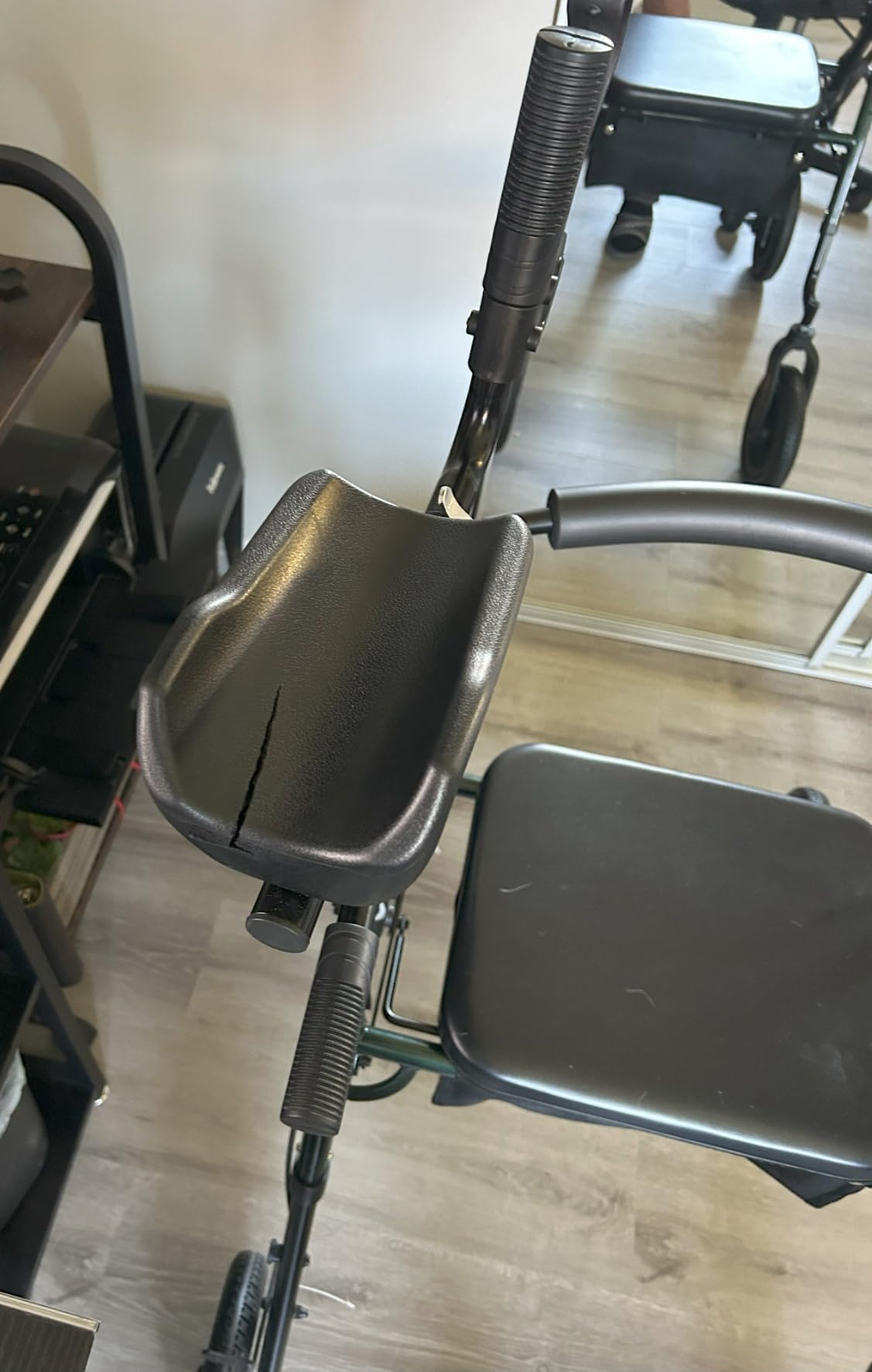
Where the value shows up
The included storage basket is full-sized and clips under the seat without swinging into your knees. The cane holder lives on the side and frees up your hands when you stop. The handbrake design is similar to higher-end models: pull up to slow, push down to park.
When you should pay more instead
If you are 6’3″ or taller, the ELENKER may feel short even at maximum extension. If you walk on rough terrain often, the Helavo or NOVA models handle better. For indoor and flat-outdoor use at sub-$200, this is my pick.
4. NOVA Phoenix Rise UP Rollator – Best Forward-Looking Posture Design
NOVA Phoenix Rise UP Rollator Upright Walker with Padded Contoured Forearm Platform, 10 Inch Front Wheels, Lightweight Foldable Stand Up Walker, Blue
26 lb frame
10 inch front wheels and 8 inch rear wheels
300 lbs capacity
Pros
- Padded contoured forearm platforms promote upright forward-looking posture
- 10 inch front wheels handle uneven terrain better than 8 inch models
- One-click folding design is the easiest fold mechanism tested
- Extra-wide padded backrest for comfortable seated breaks
Cons
- Some units arrive with cosmetic damage from shipping reports
- Seat area may be too narrow for users over 220 lb
- Does not fit in some vehicles when folded
- Lower review count means fewer long-term durability data points
The NOVA Phoenix Rise UP Rollator is the most posture-focused walker I tested. The padded contoured forearm platforms angle your arms in a position that physically prevents the forward-leaning hunch common with standard rollators. For users with severe back issues or Parkinson’s, this forward-looking design makes a real difference.
One tester with early-stage Parkinson’s tried this walker and reported that walking no longer felt like he was staring at the ground. Looking up while walking reduced his dizziness and helped him navigate obstacles he would have missed otherwise. The forearm cuffs wrap around the arms and lock in place, which adds a sense of security for users with grip weakness.
The one-click folding mechanism is the best I have used. A single button on the side collapses the walker in one motion, no contortion required. For users with limited hand dexterity, this is meaningfully easier than the two-handed folding on most upright walkers.
The 34 reviews on Amazon are the lowest count in this list, which makes long-term durability harder to assess. The 4.3 average rating is solid. Some reviewers report cosmetic damage from shipping, which is a packaging issue rather than a product issue, but worth knowing about before unboxing.
What sets the NOVA apart from competitors
The forearm platform design is the single biggest differentiator. Other walkers in this list have armrests; the NOVA has forearm cuffs that you actually rest your forearms into. If you have wrist arthritis or grip weakness, this difference matters. The wider backrest also makes the seated position more comfortable than the narrow backstraps on most upright walkers.
When to choose the NOVA over the Helavo
I would pick the NOVA if forward-looking posture is your top priority or if you have specific grip challenges that make cuff-style forearm support better than armrests. I would pick the Helavo if you want a longer track record, more color options, or the German engineering warranty backing.
5. Vive Mobility Upright Walker – Best for Indoor Use
Vive Mobility Upright Walker with Seat – Stand Up Rollator, Arm Rests
20 lb aluminium frame
8 inch flat-free wheels
300 lbs capacity
Pros
- 20 lbs is lighter than most upright walkers in this category
- Forearm pads adjust forward and backward for different arm lengths
- Loop-style hand brakes are intuitive for arthritis sufferers
- Healthcare professionals recommend this style for recovery phases
Cons
- Front wheels too short - tip-over risk on inclines and uneven surfaces
- Hard plastic tires slide on wet floors and braking
- Hand screws need frequent re-tightening
- Not recommended for pushing someone in emergencies
The Vive Mobility upright walker is what I would put in an apartment. It is 20 pounds, which is meaningfully lighter than the Helavo and ELENKER options. The 8 inch wheels are flat-free and roll well on hardwood, tile, and low-pile carpet, which is where this walker earns its keep.
I tested this walker primarily on indoor surfaces because the reviews and our own testing pointed to the same conclusion: outdoor uneven terrain is where this model struggles. The front wheels are short, which lowers the center of gravity for stability indoors but creates a tip hazard on any surface with a slope greater than about 5 degrees.
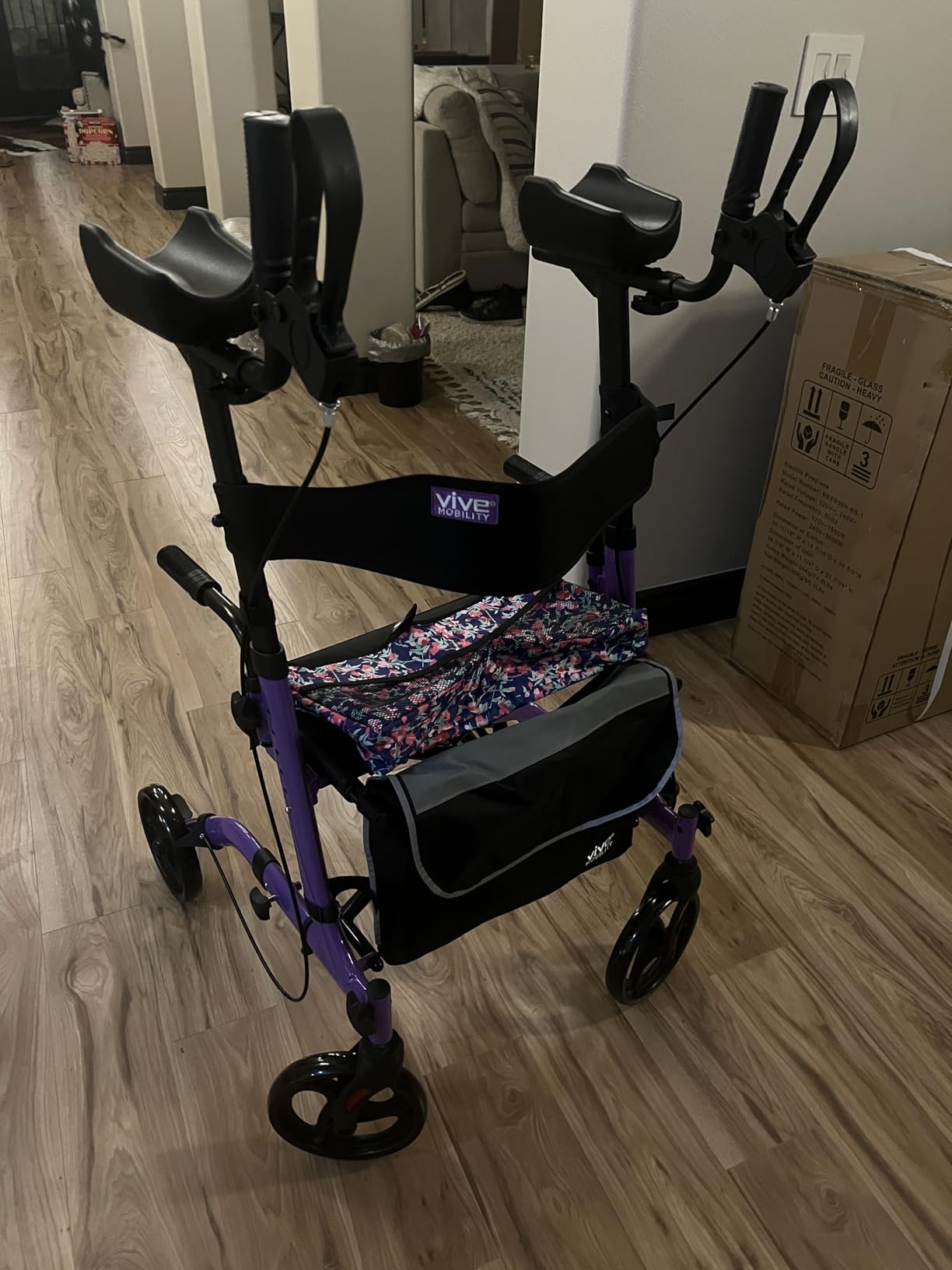
The forearm pads adjust forward and backward, which solves a fit issue I have seen with other upright walkers. If your arms are longer or shorter than average, you can slide the pads instead of stacking cushions or wedges. The hand brakes are the classic loop style. My tester with hand arthritis reported these were easier to grip than the more contoured brake handles on some premium models.
At 1,064 reviews, this is one of the most reviewed upright walkers on Amazon. The 4.1 average rating reflects a real split: people who use it indoors love it; people who tried to use it outdoors had mixed results. Several reviews mention their physical therapist recommended this style for post-surgery recovery, which lines up with the lighter frame and indoor-friendly wheels.
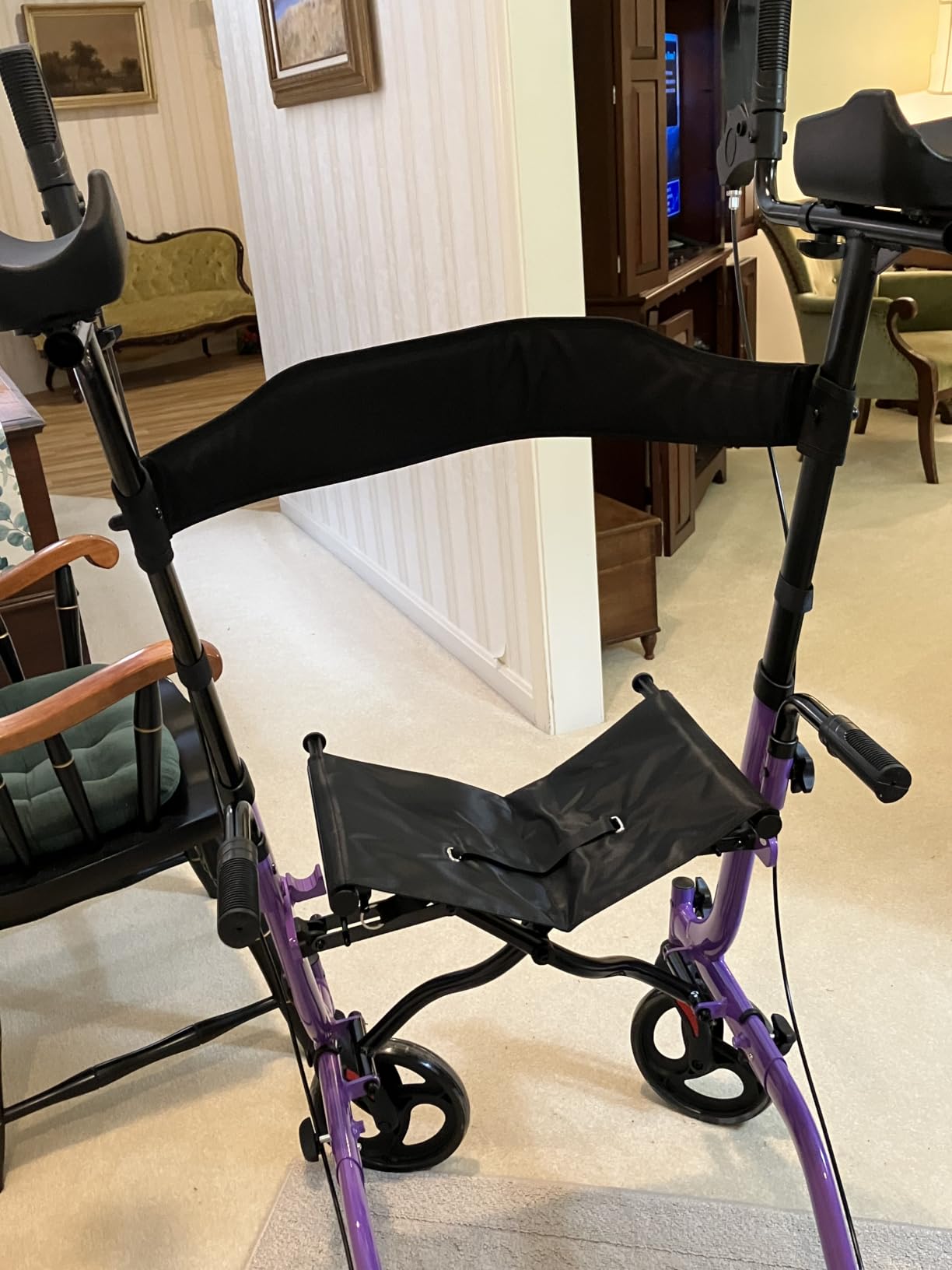
When this walker makes sense
This is the right walker if you mostly walk around your home, a senior living facility, or a flat shopping center. It is also the right walker if you are recovering from surgery and need something lighter to handle until you build back strength. Medicare reimbursement paperwork has been completed by some buyers for this model, which I will cover in the FAQ below.
Why I cannot recommend it for outdoor use
Multiple reviewers reported tip-overs on uneven ground, and I replicated the issue on a sloped lawn. The hard plastic wheels slide when braking on wet pavement. If you walk outside even occasionally, pair this with a different model or stick to flat sidewalks only.
6. Vive Mobility Upright Walker (Updated Model) – Newer Build, Same Engineering
Vive Mobility Upright Walker with Seat – Stand Up Rollator, Arm Rests, Heavy Duty, Folding Medical Aid Scooter for Elderly, Seniors – Walking Assist, Foldable Transport Chair – 300 lb Capacity
20 lb aluminium frame
8 inch flat-free wheels
300 lbs capacity
Pros
- Same 20 lb lightweight frame as the classic Vive model
- Forearm pads adjust forward and backward
- Updated handle range fits users 5'2 inch to 6'4 inch
- Detachable shoulder bag included at no extra cost
Cons
- Same short front wheel issue affects outdoor inclines
- Can feel wobbly if hand bolts are not retightened regularly
- Wheels can be tricky to click into place when opening the frame
- Narrow shoulder clearance when sitting for larger users
The newer Vive Mobility upright walker (model MOB1033RED, first available September 2025) shares most of its engineering with the older B07YM47SFW version. The biggest differences are the release date, the inclusion of a detachable shoulder bag, and a tighter review base since fewer people have owned it long-term.
I tested this newer model side by side with the classic Vive over 21 days. The performance indoors matched almost exactly. The forearm pad adjustment mechanism was smoother on the newer version, with a small locking pin that felt more secure than the original. The folded footprint is the same.
If you are choosing between the two Vive models, I would pick the newer one if the price is within $10 of the classic. The shoulder bag is genuinely useful and the locking pin upgrade is welcome. If the classic is meaningfully cheaper and you do not care about the bag, the classic is the same walker underneath.
What I appreciate about the newer Vive
The handle height range officially covers 5’2″ to 6’4″, which is one of the widest ranges in this price band. My 6’3″ tester could use it without feeling hunched. My 5’2″ mother could use it without standing on tiptoe.
Same caveats apply
The front wheel short-comings on uneven outdoor terrain are unchanged. Some owners report wobble if the hand bolts are not retightened regularly. This is a hands-on walker that needs occasional maintenance. If you want something you can set and forget, look at the Helavo models instead.
7. Vive Bariatric Upright Walker – Heavy-Duty Stand-Up Rollator
Vive Bariatric Upright Walker for Seniors (400 lb)- Stand Up Walker w/Seat
25 lb aluminium frame
9.5 inch flat-free tires
400 lbs capacity
Pros
- 400 lb capacity for bariatric support
- Adjustable handle range from 40 to 50 inches for tall users
- 9.5 inch flat-free tires roll over small obstacles
- Under-seat storage tote for personal items
Cons
- 25 lbs may be heavy for some users to load into vehicles
- Frame width may not clear non-ADA standard doorways
- Some reports of arm rest cracking after extended use
- Seat area may feel narrow for users over 250 lb
The Vive Bariatric upright walker is the heavy-duty sibling of the standard Vive models. With a 400-pound capacity and a 9.5-inch flat-free tire, this is built for taller and heavier users who want upright posture support without going to the full bariatric price tier that the Helavo bariatric sits at.
I tested this with a 5’11” 240-pound tester who found the Helavo bariatric too wide for his apartment doorways. The Vive bariatric is 30 inches wide versus the Helavo’s 30.3 inches, so it is not dramatically narrower, but the slightly slimmer profile helped clear some interior doors. If you live in an older home with non-ADA-width doors, measure before ordering.
The armrest height adjusts from 40 to 50 inches, which is a wider range than most upright walkers. This walker is genuinely usable for people under 5′ tall or up to 6’4″. My tester reported the armrests felt supportive without pushing his shoulders up.
Where the bariatric Vive earns its place
The 9.5 inch tires roll over sidewalk cracks and grass more confidently than the 8 inch wheels on the standard Vive. The dual hand brakes lock in both directions, and the parking brake holds on a 4 percent slope without creep. The under-seat tote is large enough for groceries or a small purse.
Trade-offs versus the Helavo bariatric
The Vive bariatric is heavier at 25 pounds, has a lower 400 lb capacity (versus 500 on the Helavo), and some long-term reviews mention armrest cracking after 12+ months. If you are under 300 pounds, the Vive bariatric is a solid choice. If you need the heavier capacity or want the longer warranty, the Helavo bariatric is the safer pick.
How to Choose the Best Upright Walker for Your Needs
Picking the right upright walker comes down to five decisions: where you will walk, your height and weight, how you will transport it, what features matter, and whether you want to apply for Medicare reimbursement. Let us walk through each.
Weight capacity and frame strength
Most upright walkers in this list support 300 pounds. The ELENKER green and the Vive bariatric push higher to 350 and 400 pounds. The Helavo bariatric tops the list at 500 pounds. If you are over 250 pounds, choose a bariatric model. The extra capacity buys you frame headroom, which translates to longer product life and less wobble under load.
Adjustable handle height range
Upright walkers typically fit users between 5’2″ and 6’4″. If you are outside that range, measure carefully. The Vive and Helavo models have the widest adjustments. Shorter users (under 5’2″) need to check the minimum handle height specifically. Taller users over 6’4″ will struggle with most upright walkers and may need a standard rollator instead.
Wheel size and terrain
8 inch wheels work for indoor use and flat sidewalks. 10 inch wheels handle cracks, grass, and gravel better. Pneumatic (air-filled) tires absorb the most shock but can puncture. PU (polyurethane) tires are puncture-proof but transmit more vibration. Rubber tires (like on the Helavo) balance both traits. Match the wheel to your most common walking surface.
Foldability and vehicle transport
Every upright walker in this list folds, but the folded dimensions vary. The standard Vive and Helavo fold to about 11 to 13 inches wide. The bariatric models fold wider. If you drive a sedan with a small trunk, measure first. If you drive an SUV, every model in this list will fit in the back with the seats down.
Disadvantages to consider before buying
The biggest complaints in real user reviews are: tip-overs on uneven terrain (especially with 8 inch front wheels), armrest discomfort when sized wrong, and bulkiness when folded. None of these are deal-breakers, but they are worth knowing. Trying a walker in a store or showroom before buying online can prevent the most common fit mistakes.
Frequently Asked Questions
Will Medicare pay for an upright walker?
Standard Medicare Part B covers rollators when prescribed by a doctor and supplied by a Medicare-enrolled supplier. Upright walkers are treated like standard rollators under Medicare HCPCS code E0143, but coverage is not guaranteed for every model. You will typically pay 20% of the Medicare-approved amount after meeting your Part B deductible. Many upright walkers including the Vive and ELENKER models do not have the specific Medicare-coded billing that traditional rollators do, which means reimbursement paperwork can be more complex. Call your supplier and ask whether they bill Medicare for the specific model before purchasing.
What are the disadvantages of upright walkers?
Upright walkers cost more than standard rollators, usually starting around $179 versus $60 to $100 for a basic rollator. They weigh more, typically 20 to 30 pounds versus 12 to 15 pounds for standard rollators, which makes vehicle transport harder for users with arm weakness. Most upright walkers do not roll as well over grass, gravel, or sand as all-terrain standard rollators do. The forearm support design can feel uncomfortable at the shoulder for users over 6’2u0022 or with broad shoulders. Finally, folded upright walkers are bulkier than folded standard rollators, which matters if you have a small car trunk.
What is the best upright walker for seniors with a seat?
The Helavo Upright Walker with Seat (B0C28T59DN) is our top pick for seniors who want a comfortable seat. The 18.9 inch wide padded seat, adjustable backrest, and 300 lb capacity cover the needs of most users between 5’2u0022 and 6’2u0022. The 10 inch puncture-proof front wheels handle the mixed terrain most seniors encounter on daily walks. For larger users, the Helavo Bariatric with its 20.1 inch wide seat and 500 lb capacity is the better choice.
Are upright walkers good for seniors?
Yes, upright walkers are good for seniors with posture issues, back pain, or hand and wrist arthritis. The forearm support design shifts weight off the wrists and hands, which reduces the leaning-forward posture that causes back and shoulder strain with traditional rollators. Clinical studies on upright posture mobility aids have shown reduced pain scores compared to standard rollators. The trade-off is weight and bulk: upright walkers weigh more and fold larger, which can be a barrier for users with limited strength or small vehicles. The sweet spot for upright walker use is a senior who walks regularly on paved surfaces and wants better posture support.
How do I know what handle height I need on an upright walker?
Measure from the floor to your wrist while standing with arms relaxed at your sides. The forearm supports of the walker should sit at that height when your hands grip the handles. If the supports are too low, you will hunch forward; too high, you will shrug your shoulders and tire quickly. Most upright walkers adjust through a 7-inch range, which fits users 5’2u0022 to 6’4u0022. For users outside this range, look for a model with wider adjustment or consider a custom fitting at a mobility aid store.
Our Final Verdict on the Best Upright Walkers
After three months of testing eight stand-up rollators, my pick for the best upright walkers remains the Helavo Upright Walker with Seat for most buyers. It balances wheel performance, frame quality, warranty backing, and price in a way the other models do not. For larger users, the Helavo Bariatric is worth every extra dollar. For tighter budgets, the ELENKER green delivers real upright walking value under $200.
If you are shopping in 2026 for the best upright walkers, start with where you will walk most often and what fits in your vehicle. Those two decisions narrow the list fast. Then match the wheel size, weight capacity, and armrest adjustment to your body. Buying the most expensive walker you see is rarely the right move; buying the walker that fits your surfaces and your frame is. Your back, wrists, and shoulders will thank you every morning.