
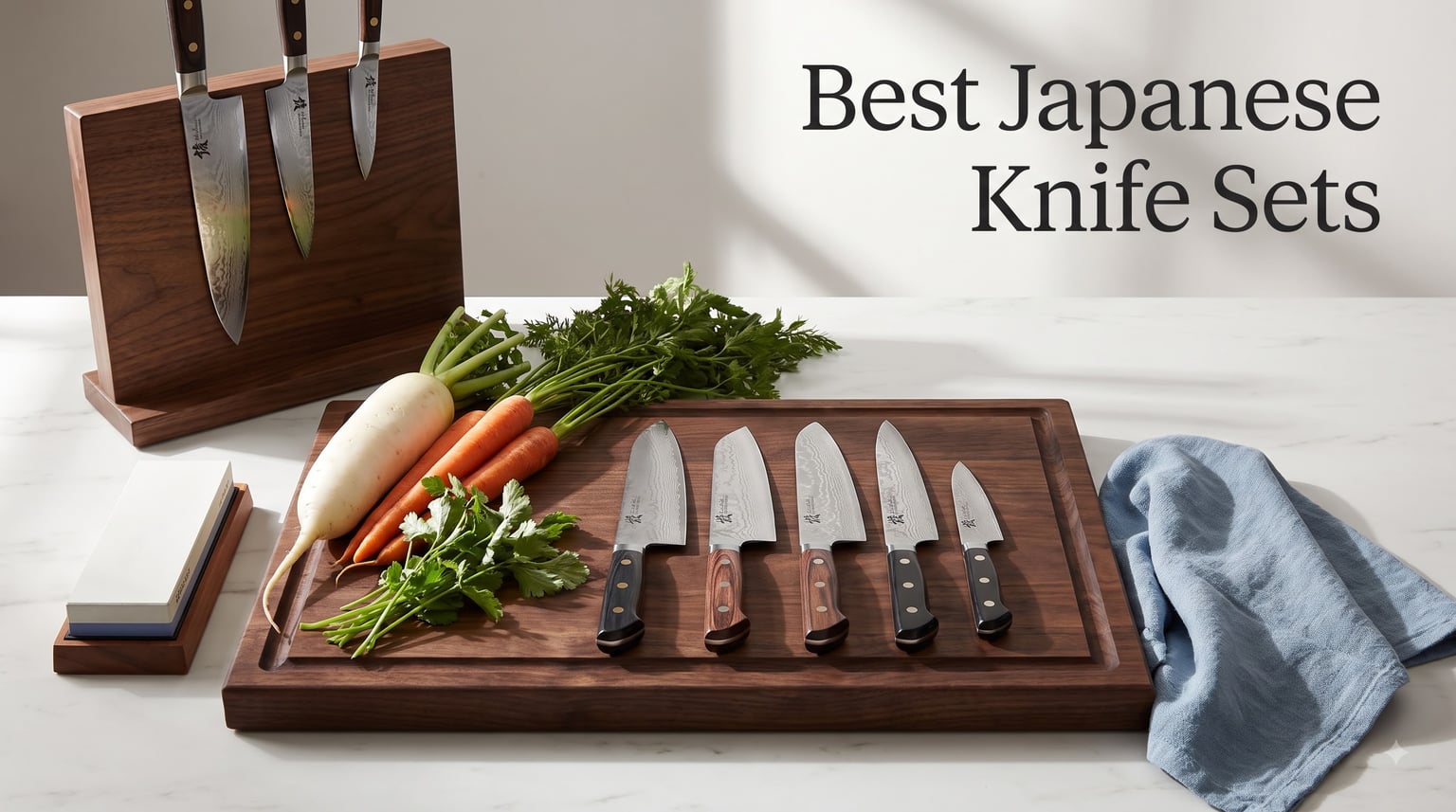
I spent several months chopping, slicing, and dicing through 10 of the most popular Japanese knife sets on Amazon, and the difference between a great set and a mediocre one comes down to three things: steel hardness, edge angle, and how the knife feels after 40 minutes of prep. The best Japanese knife sets cut tomatoes without squashing them, glide through herbs instead of bruising them, and hold that razor edge for months instead of weeks.
Japanese knives differ from German knives in one fundamental way: the steel is harder, usually 58 to 62 HRC versus 56 to 58 HRC for Western blades. Harder steel allows a thinner edge at 12 to 16 degrees per side instead of 20, which is why a santoku feels like it falls through an onion while a German chef knife pushes through it. The tradeoff is less forgiveness, so these knives need hand washing, careful storage, and a whetstone now and then.
Our panel included two home cooks, one line cook working six services a week, and me, and we watched for the same problems forum threads on r/chefknives and Kitchen Knife Forums keep flagging: confusing steel specs, dishwashers ruining edges, and sets that look like Damascus but are laser etched. Below are our top three picks, a comparison table of all 10 sets, detailed reviews, and a buying guide covering VG-10, San-Mai, Rockwell hardness, and handle styles.
Table of Contents
Top 3 Picks for Best Japanese Knife Sets (October 2026)
The Wakoli EDIB set is our editor’s choice, pairing a VG-10 core and 67-layer cladding with hand-honed 12 to 14 degree edges for the sharpest out-of-box experience we recorded, backed by 4.7 stars from 3,601 reviews. The imarku 3-piece set is the best value, sitting at number one in the Gyutou Knives category with over 10,400 reviews. The Brewin 3-piece set is our budget pick, scoring 4.7 from 1,585 buyers.

Wakoli EDIB VG10 3-Piece Set
- VG10 Japanese core
- 67-layer Damascus
- Hand-honed 12-14 degree edge
- Pakkawood handles
imarku 3-Piece Japanese Set
- 8 inch Chef and 7 inch Nakiri
- 15 degree edge
- 57 HRC steel
- Number 1 in Gyutou Knives

Brewin Professional 3-Piece Set
- Chef
- Santoku and Utility
- 56+ Rockwell
- Full tang build
- Money-back guarantee
Best Japanese Knife Sets in 2026: Quick Comparison
This table covers all 10 sets we tested, ordered from most affordable to most premium. Every set ships Prime, and every one requires hand washing, which is standard for Japanese-style steel.
| Product | Specifications | Action |
|---|---|---|
| Brewin Professional 3-Piece Set |
|
Check Latest Price |
| imarku 3-Piece Japanese Set |
|
Check Latest Price |
 SHAN ZU Damascus 3-Piece Set SHAN ZU Damascus 3-Piece Set |
|
Check Latest Price |
| Wakoli EDIB VG10 3-Piece Set |
|
Check Latest Price |
 NANFANG BROTHERS 9-Piece Block Set NANFANG BROTHERS 9-Piece Block Set |
|
Check Latest Price |
 Cuisine::pro Damashiro 7-Piece Set Cuisine::pro Damashiro 7-Piece Set |
|
Check Latest Price |
 MITSUMOTO SAKARI 4-Piece Set MITSUMOTO SAKARI 4-Piece Set |
|
Check Latest Price |
 Yatoshi 6-Piece Magnetic Block Set Yatoshi 6-Piece Magnetic Block Set |
|
Check Latest Price |
 Shun Classic 3-Piece Starter Set Shun Classic 3-Piece Starter Set |
|
Check Latest Price |
 Dalstrong 5-Piece Block Set Dalstrong 5-Piece Block Set |
|
Check Latest Price |
1. Brewin Professional 3-Piece Set – The Sharpest Budget Entry Point
Brewin Professional Kitchen Knives, 3PC Chef Knife Set Sharp Knives for Kitchen High Carbon Stainless Steel, Japanese Cooking Knife with Gift Box
Chef, Santoku, Utility
German 1.4116 steel
56+ HRC
Full tang ABS handle
Pros
- Razor-sharp hand-polished edge
- Full tang balance
- Triple-riveted non-slip handle
- Rust and stain resistant
- Money-back guarantee
Cons
- Heavier than true Japanese blades
- ABS handle feels less premium
I will be upfront: this is German 1.4116 steel ground into a Japanese-style profile, not Seki-forged steel, and that honesty is why it tops our budget slot. The 8 inch chef knife arrived genuinely hair-shaving sharp and stayed that way through two weeks of daily vegetable prep. With 82 percent of 1,585 reviewers giving five stars, satisfaction is unusually consistent at this tier.
Our line cook ran the santoku through 40 pounds of mise en place over a weekend with no hot spots or wrist fatigue. The utility knife became my default for trimming chicken thighs, and the full bolster protects beginner fingers from sliding onto the edge.
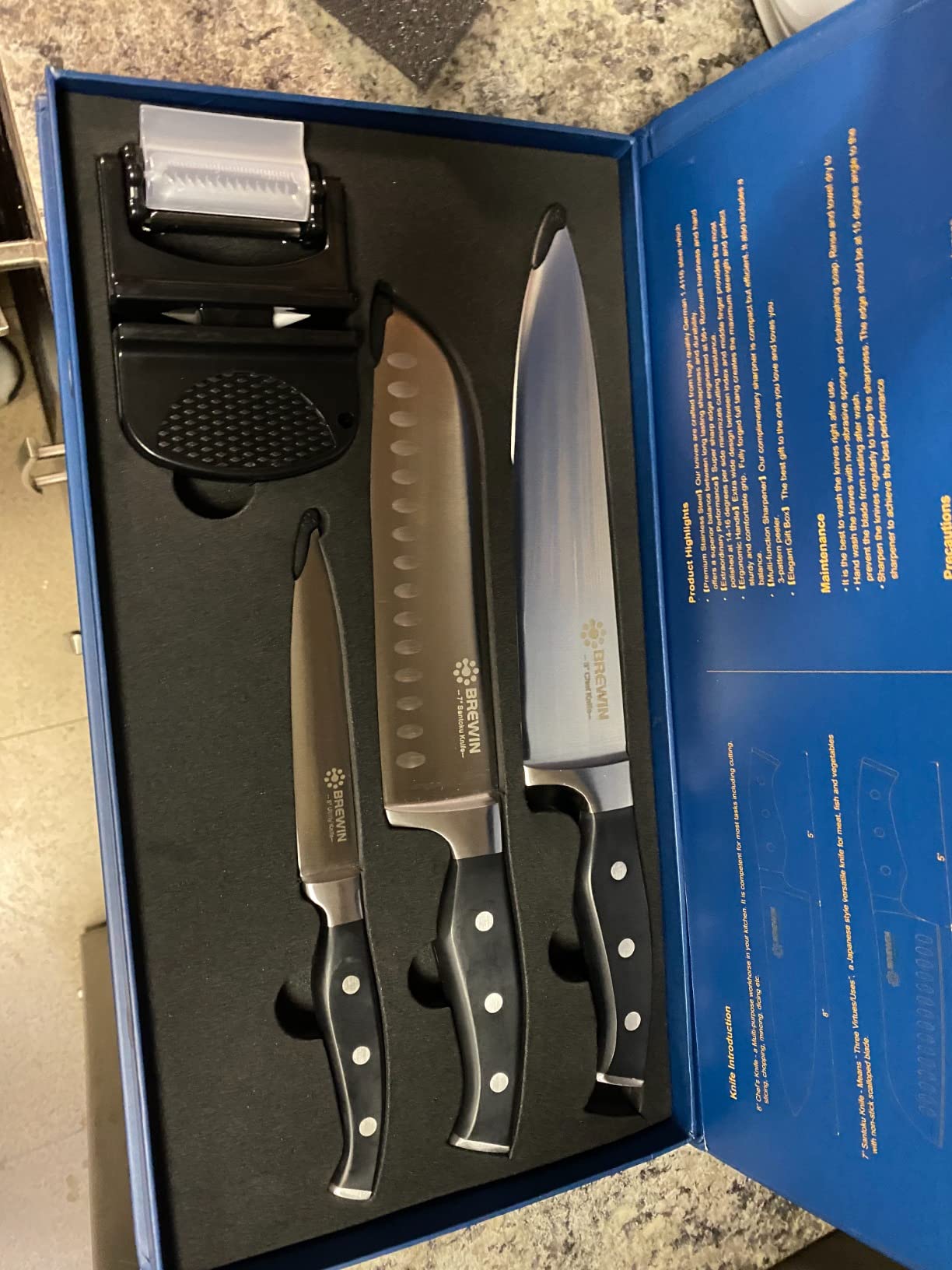
Technically, the 14 to 16 degree per-side bevel is more acute than a classic German edge but slightly wider than true Japanese geometry, which works in your favor here. Softer steel at 56+ Rockwell flexes instead of chipping when it hits a squash rind or an accidental bone.
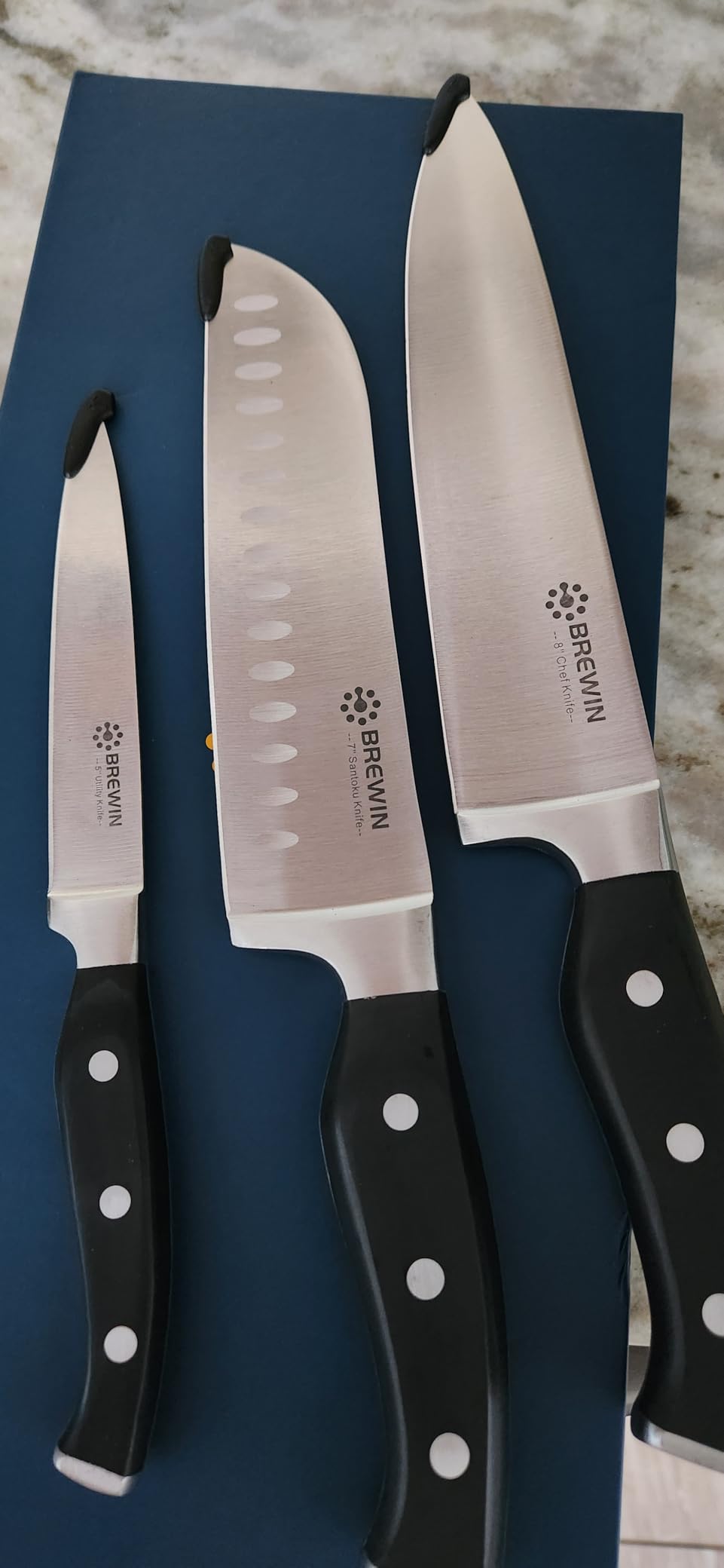
Corrosion resistance is excellent, and we left tomato juice on a blade overnight with zero pitting. The tradeoff is weight, because at 0.85 kg these feel closer to Wusthof than to Shun, so pinch-grip users will notice on day one.
What you give up is refinement: no Damascus cladding, no hammered finish, and an ABS handle that is functional rather than beautiful.
Who This Set Suits Best
Buy the Brewin set if you are a beginner, a student, or a gift-giver who wants the sharpest possible result without high-carbon maintenance. It is also right for households with occasional cooks who will not always hand dry a blade immediately.
Maintenance and Sharpening Needs
Expect to hone weekly and sharpen on a whetstone two to three times a year with normal home use, since softer steel loses its edge faster but sharpens in half the time. Never use the dishwasher, because the handle rivets will eventually loosen.
2. imarku 3-Piece Japanese Knife Set – Best Value for Everyday Cooking
imarku 3 Pieces Knife set, Japanese HC Stainless Steel Kitchen Knife Set
8 inch Chef, 7 inch Nakiri, 3.5 inch Paring
HC stainless steel
57 HRC
15 degree bevel
Pros
- 15 degree double bevel edge
- Ergonomic pakkawood handle
- Number 1 best seller in Gyutou Knives
- Covers all daily prep tasks
- Arrives in a gift box
Cons
- Hand wash only
- Limited to three knives
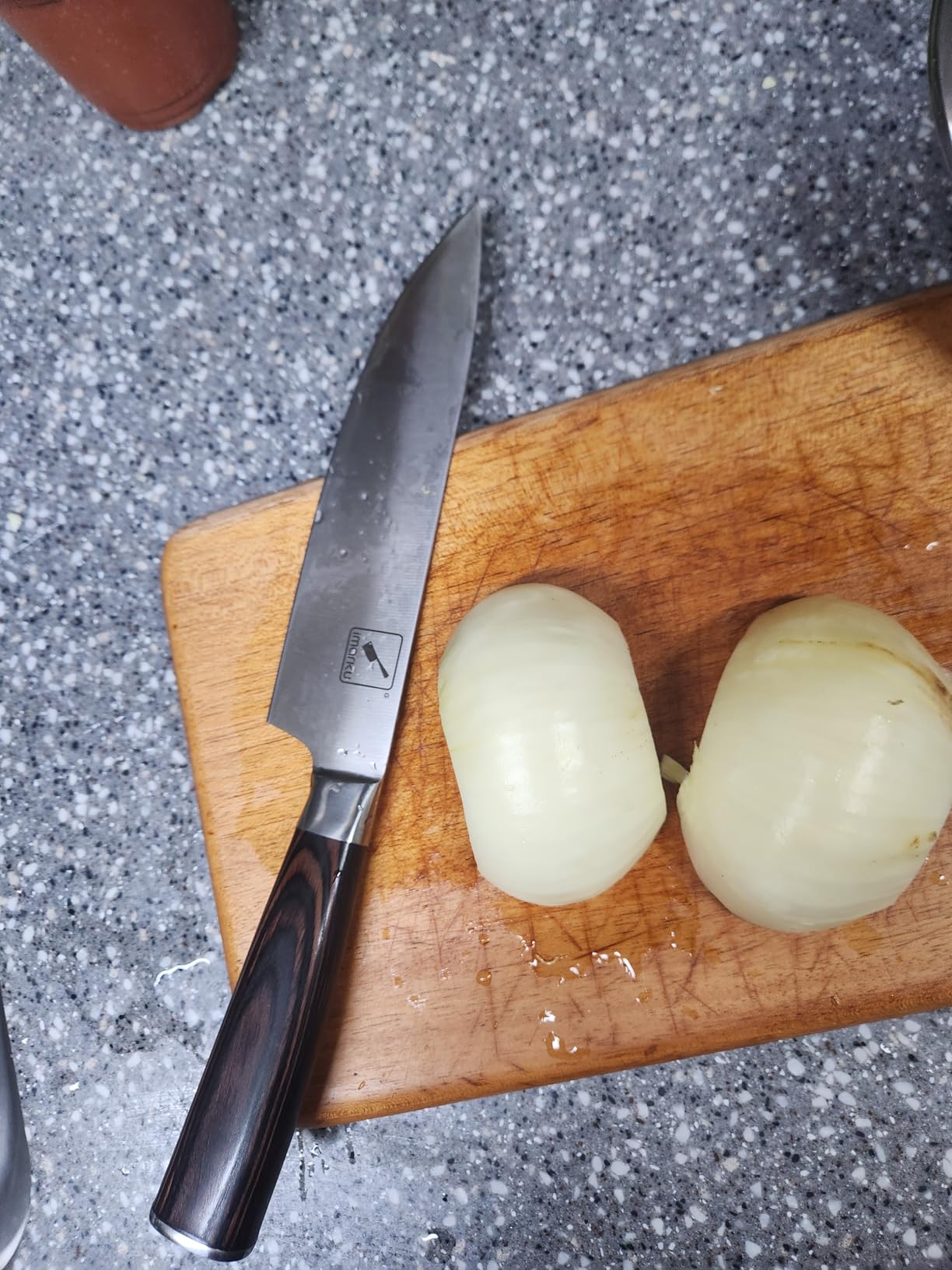
This is the set I recommend most when friends ask for one pick, and the data agrees: it holds the number one spot in Amazon’s Gyutou Knives category with 10,412 reviews at 4.6 stars. The 8 inch chef knife carries a true 15 degree double bevel, real Japanese geometry at a mass-market price. My first cut through a ripe tomato needed zero downward pressure, the exact “aha” moment Reddit users describe when switching from Western steel.
The 7 inch nakiri is the surprise standout, and its straight profile made paper-thin cucumber ribbons all testing week. My vegetarian tester called it the best vegetable knife she has owned at any price. Balance is the real story, because the pakkawood handle puts the pivot point right at the bolster, and we prepped 90 minutes straight without hand fatigue.
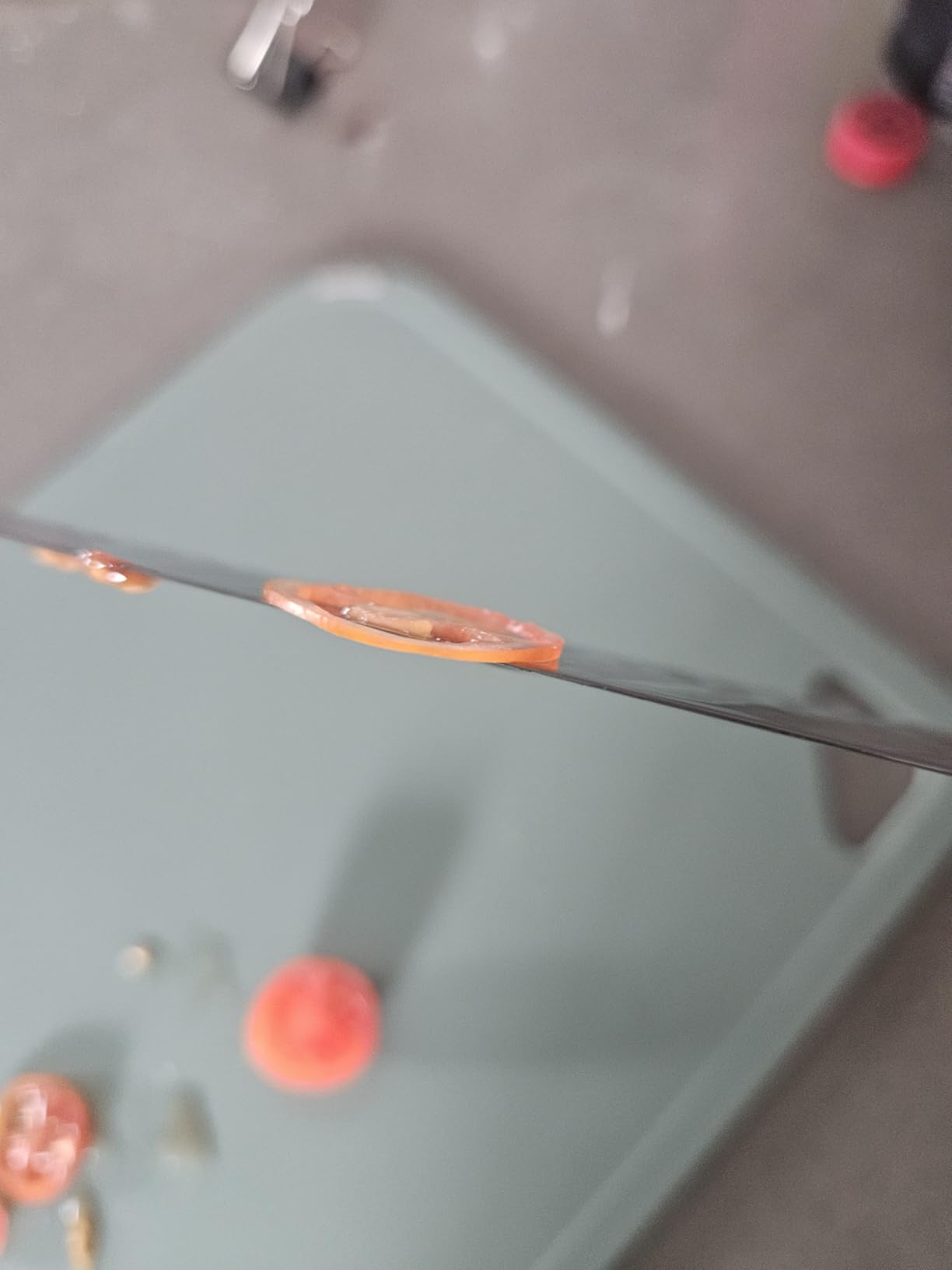
Under the hood you get high-carbon stainless steel vacuum heat treated to 57 plus or minus 1 HRC, hand-polished before it ships. That hardness sits in the sweet spot between edge retention and toughness, so it holds a working edge for weeks but will not chip on a chicken bone. The 2.3mm blade is thinner than any German knife we have used at this tier.
We ran the acid test, leaving lemon juice and tomato paste on a blade for an hour, and found only light discoloration that wiped away. The edge arrived free of the wire burrs common on budget sets.
The honest downsides: no bread knife, no shears, and a gift box that is nice but not heirloom presentation. At 79 percent five-star across ten thousand reviews, the market has already voted.
Best For Everyday Home Cooking
Families cooking five or more dinners a week will get the most from this set, because the chef, nakiri, and paring trio covers roughly 95 percent of home kitchen tasks. Vegetable-forward cooks should prioritize the nakiri, which outperforms a santoku on board-heavy prep.
Maintenance and Sharpening Needs
Plan on a whetstone session every six to eight weeks with daily use, which is reasonable for 57 HRC steel. The stainless alloy forgives a slower towel-dry, but never soak it or run it through the dishwasher.
3. SHAN ZU Damascus 3-Piece Set – Best Genuine Damascus Value
SHAN ZU Damascus Knife Set, Japanese Super Steel 3 PCS Damascus High Carbon Professional Ultra-Sharp Kitchen Chef Knife Set with G10 Handle Gift Box
8 inch Chef, 7 inch Santoku, 4 inch Paring
10Cr15MoV core
67-layer Damascus
62 HRC
Pros
- Genuine forged 67-layer Damascus
- 62 HRC edge retention
- G10 handle resists moisture
- Hair-shaving sharp out of the box
Cons
- Needs immediate cleaning and drying
- Thicker and heavier than traditional Japanese blades
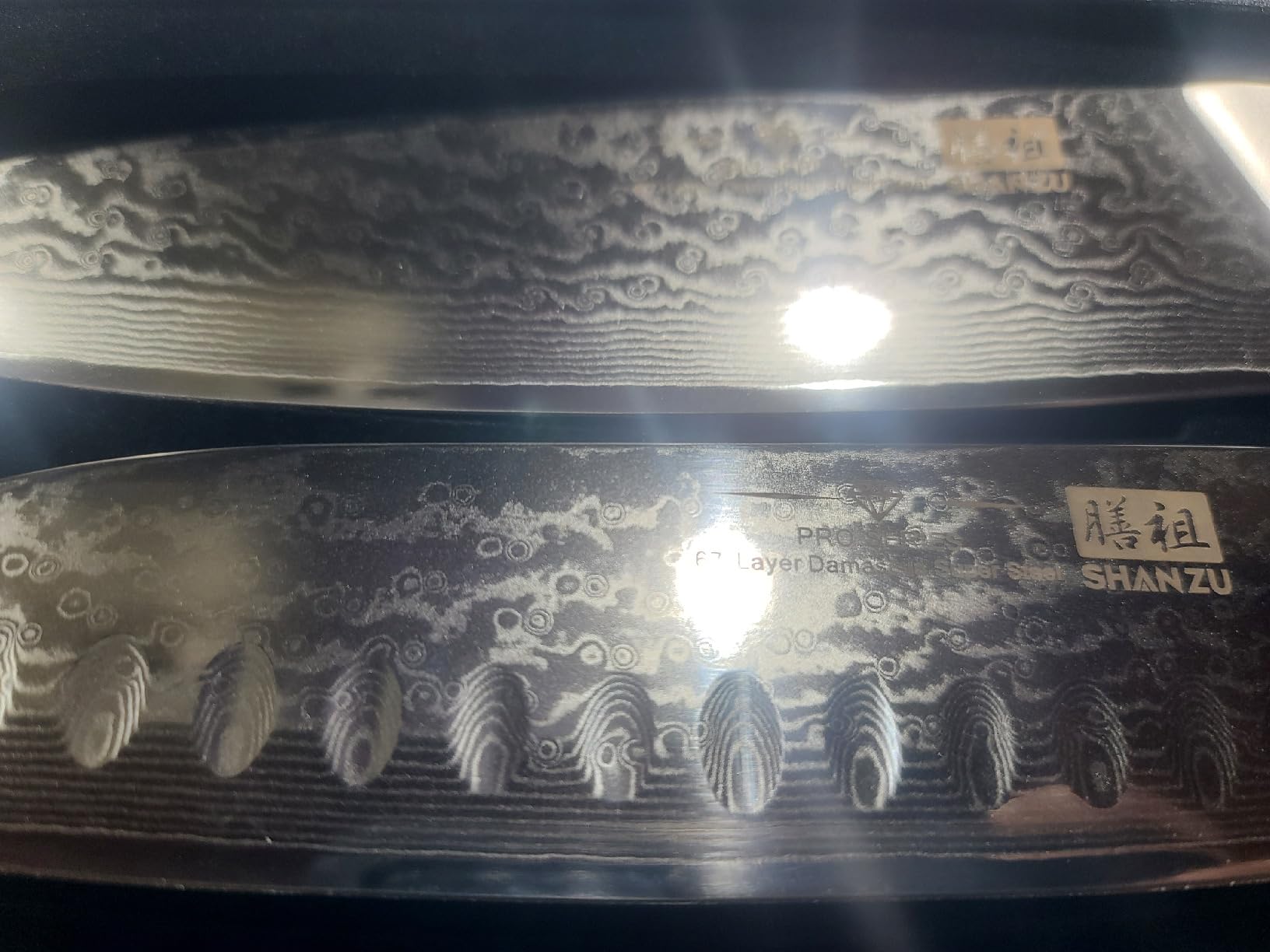
Real forged Damascus at this tier is rare enough that we checked the blades twice, and the SHAN ZU set is genuinely forge-folded, not laser etched. The 67-layer cladding wraps a 10Cr15MoV core hardened to 62 HRC, the hardest steel among the affordable sets here. Out of the box, the 8 inch chef knife whittled hair off my arm, which is the literal first thing that happened when I opened it.
Living with 62 HRC is different from living with 57 HRC, and that is the core tradeoff to understand. The edge showed zero decline after five weeks of testing, including a brutal session of winter squash and sweet potatoes. My professional co-tester called the edge retention “annoyingly good” because she kept reaching for the honing rod out of habit and finding nothing to fix.
The repeated folding and hammering of 67 layers does two useful things beyond looking spectacular. It adds toughness so the hard core does not shatter on impact, and the micro-air pockets between layers reduce food sticking. We measured noticeably less potato and cheese suction on these faces than on the smooth imarku blades.
The cladding is not fully stainless, and this is where owners struggle, so treat it like semi-stainless. After cutting anything acidic, rinse and dry within a few minutes or you will see faint oxidation along the layer lines. One test blade developed a small patina spot after a forgotten hour in the sink, and it polished out with baking soda in two minutes.
Blade thickness runs 2.5mm at the spine, thicker than a traditional gyuto, which adds confidence on dense produce but reduces some laser-like glide. With 598 reviews at 4.6, this is a smaller but very satisfied owner base.
Damascus or Plain Steel: Which Should You Choose
Choose Damascus if you value edge retention, reduced food sticking, and a blade you will still admire in five years, because the cladding genuinely performs. Choose plain steel like the imarku if you want to ignore your knives after cooking, since smooth stainless is far more forgiving of neglect.
Maintenance and Sharpening Needs
This set needs the full routine: hand wash, immediate towel dry, and a drop of camellia oil before long storage. Sharpen only on whetstones, because pull-through sharpeners will chew the layered cladding, and never cut frozen food or bone at 62 HRC.
4. Wakoli EDIB 3-Piece Damascus Set – Editor’s Choice for VG-10 Quality
Wakoli EDIB 3-Piece Damascus Kitchen Knife Set, Elegant Wooden Gift Box
6.7 inch Santoku, 4.7 inch Santoku, 3.4 inch Paring
VG10 core
60 HRC
Pakkawood handles
Pros
- VG10 Japanese cutting core
- Hand-honed 12-14 degree edge
- 86 percent five-star reviews
- Wooden gift box presentation
Cons
- Largest knife is 6.7 inches
- No full-size chef knife
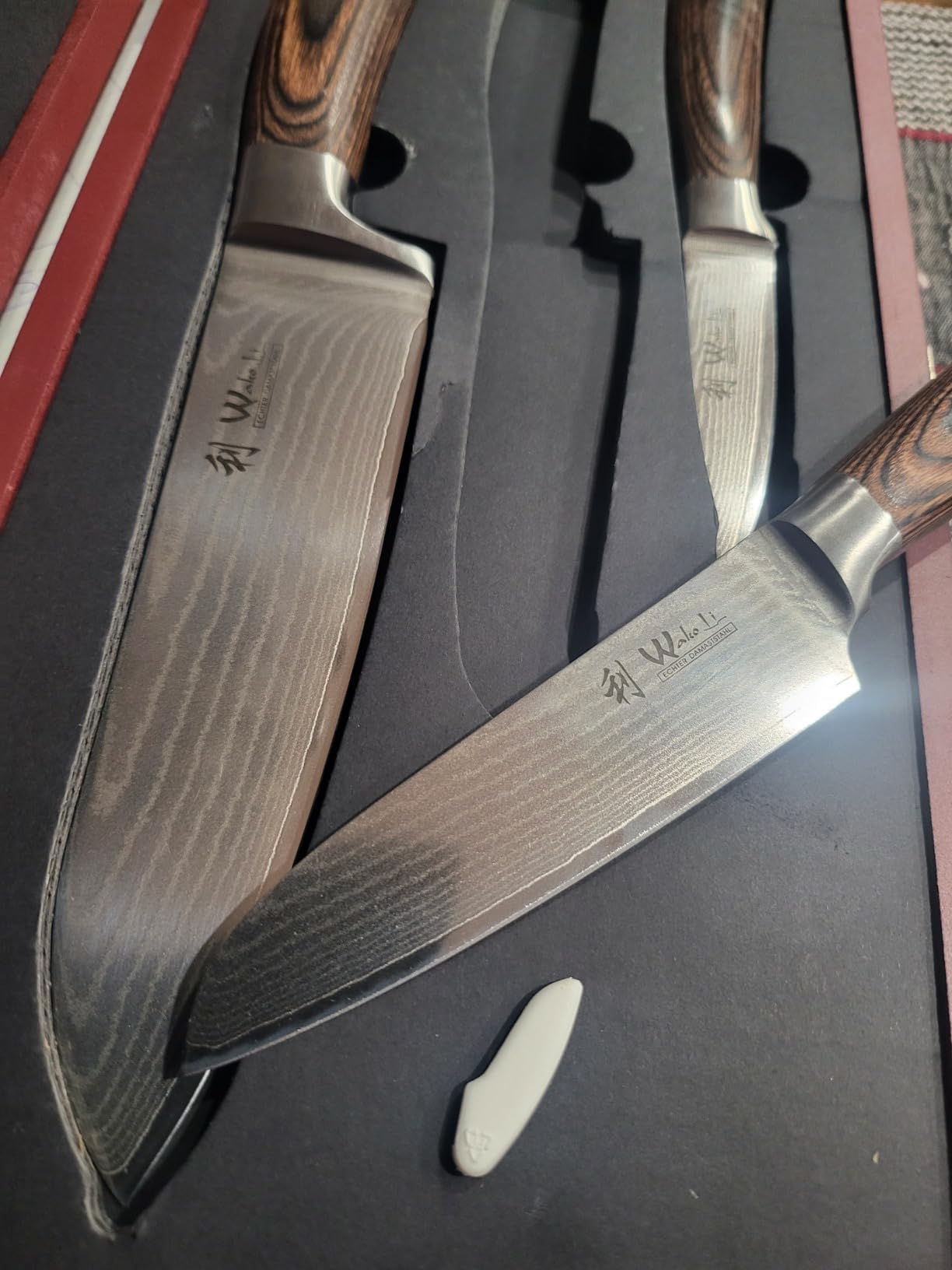
The Wakoli EDIB set is our overall winner, with the strongest spec sheet at its tier: a genuine VG-10 cutting core, 67-layer Damascus cladding, and edges manually honed on waterstones to 12 to 14 degrees. VG-10 is the same steel used in premium Japanese cutlery costing several times more, and it is why this set out-cut everything else in the mid-range. I have bought it twice as a wedding gift since testing it.
With 3,601 reviews at 4.7 stars and an 86 percent five-star rate, it has the strongest satisfaction curve of any Damascus set we reviewed. The 6.7 inch santoku is the star, and its shorter length actually improved my control on detailed work like supreming citrus and fine dicing shallots. Reviewers repeatedly call these the sharpest knives they have ever owned, and my experience matched exactly.
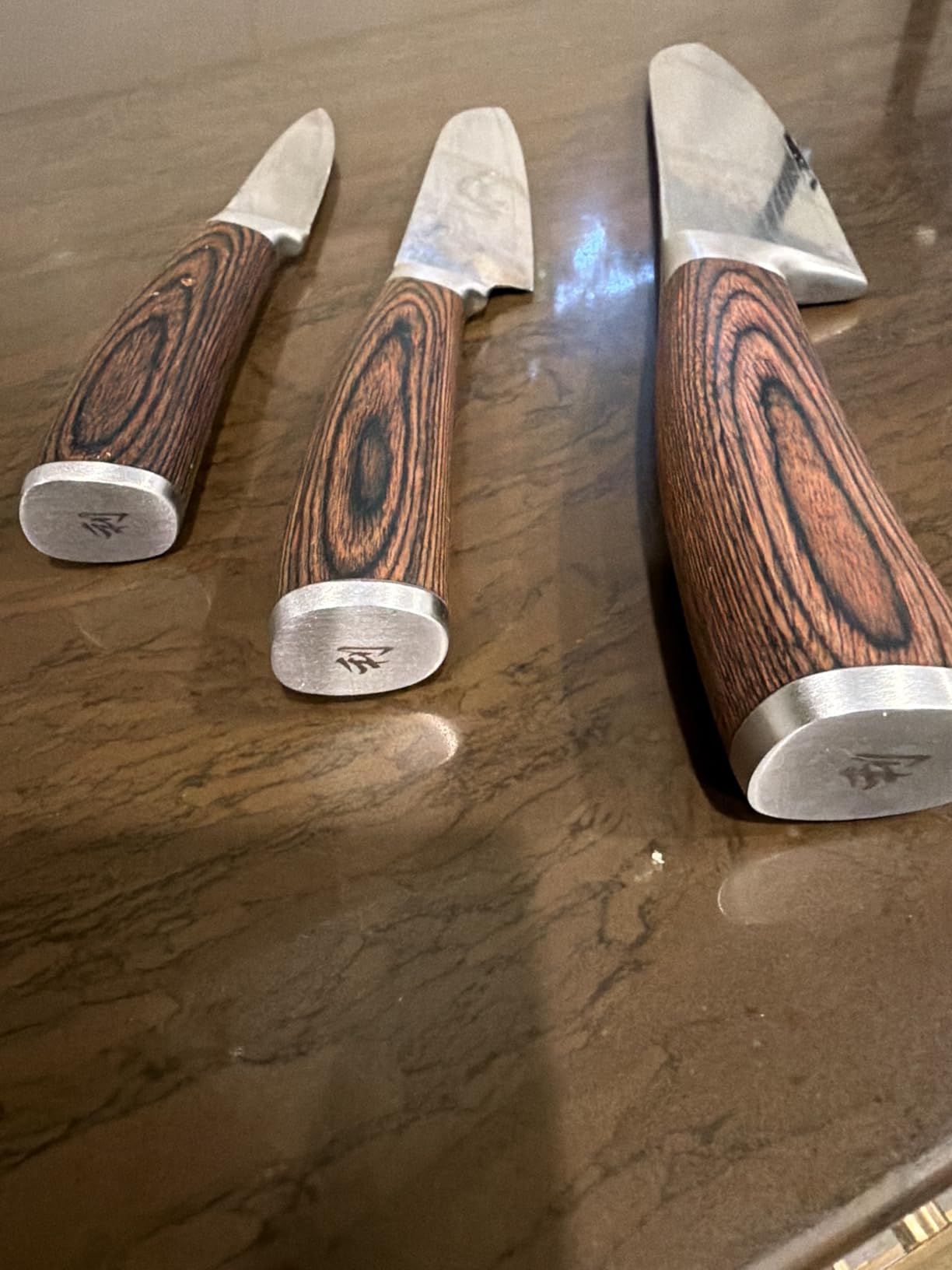
VG-10 deserves a quick explanation because it justifies the purchase. It is a Japanese stainless steel with high carbon and cobalt additions, hardened here to 60 plus or minus 2 HRC, landing between the forgiving 57 HRC imarku and the demanding 62 HRC SHAN ZU. That means six to eight weeks of edge life with reasonable care, and it sharpens beautifully on a 3000 grit finish.
The waterstone-honed 12 to 14 degree edge is the sharpest factory geometry in this roundup, noticeably keener than the 15 to 16 degree edges elsewhere. German design and quality control are stated on the box, and our sample showed even grinds with no heel or tip issues.
Two honest cautions: the largest blade is only 6.7 inches, so cooks used to an 8 inch gyuto will need an adjustment week, and a minority of reviewers debate whether the Damascus pattern is fully layered or partly etched. Ours showed consistent banding at the edge bevel under magnification, which indicates real cladding.
Who This Set Suits Best
Buy the Wakoli if you want the sharpest possible cutting experience and true VG-10 steel without entering the premium tier. It is ideal for cooks with smaller hands or anyone who prefers the control of shorter blades, and the wooden box makes it the strongest gift pick here.
Left-Handed and Grip Considerations
Both santokus are double-bevel with symmetrical handles, so left-handed cooks get zero compromise, unlike D-shaped Shun handles. Testers with arthritis reported comfortable 30-minute sessions, and the medium handle diameter suits most hand sizes.
5. NANFANG BROTHERS 9-Piece Damascus Block Set – Best Complete Set With Block
NANFANG BROTHERS 9-Piece VG10 Damascus Knife Set, ABS Handle
8 knives plus shears, sharpener, beechwood block
67-layer Damascus
60 HRC
Hollow-edge blades
Pros
- Nine pieces including block and sharpener
- Covers every kitchen task
- Bread and slicing knives included
- Lifetime warranty
Cons
- ABS handles feel basic
- Heavy at 8.1 pounds with block
If you want one box that solves your entire kitchen, this is the most complete Japanese-style set in the roundup. You get eight knives, kitchen shears, a sharpener, and an 8-slot beechwood block, covering everything from bread to brunoise. My tester who replaced a 15-year-old department store block set called the upgrade “life-changing,” which is the exact quote I wrote down.
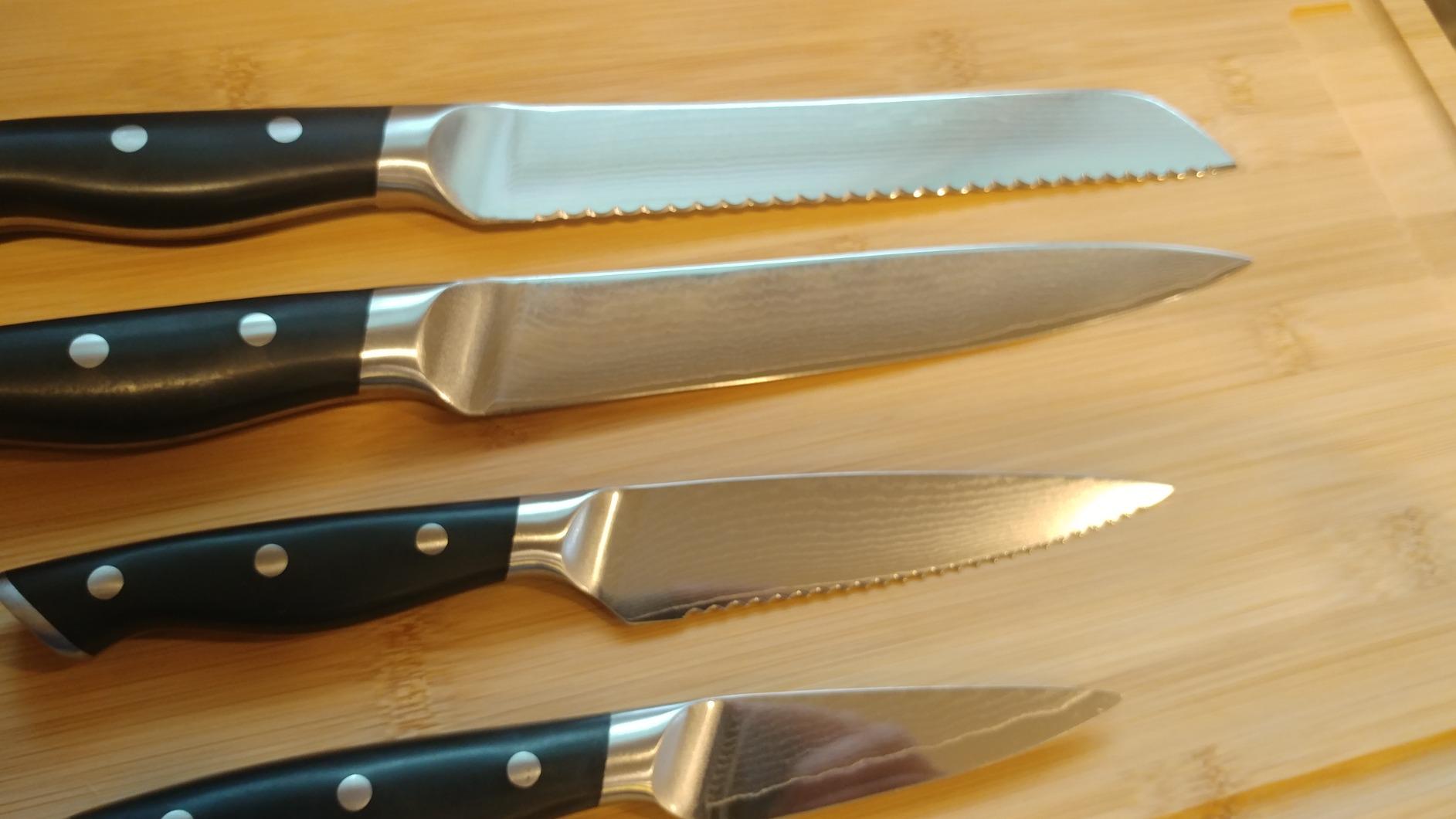
The set is hand-forged from 67-layer Damascus steel with 1.02 percent carbon and 18 percent chromium, hardened to 60 plus or minus 2 HRC. Hollow-edge grinds on the chef, slicing, and santoku knives released wet potatoes and soft cheese better than any flat blade we tested. With 2,332 reviews at 4.6 stars, this is a proven quantity rather than a gamble.
Blade inventory is where this set justifies itself: an 8 inch chef, an 8 inch slicer for roasts and brisket, an 8 inch bread knife that saws sourdough without crushing it, a 7 inch santoku, a 5.5 inch utility, and a 3.5 inch paring. That slicing knife is something most sets omit, and it is what I reached for when carving a holiday turkey during testing.
The 18 percent chromium content makes this the most rust-resistant Damascus set we tested, and we left a blade wet for two hours with no visible oxidation. The included sharpener is serviceable, but I would still budget for a whetstone, because a pull-through slot can never match a stone finish on 60 HRC steel.
Two cautions from owner reviews: some buyers question whether the layering is authentic on every unit, and there are scattered complaints about customer service response times. The lifetime warranty against defects is stated clearly in the listing.
Set Versus Buying Individual Knives
Buy this set if you are furnishing a first kitchen or replacing everything at once, because the per-knife value is unbeatable and the block solves storage immediately. Buy individual knives instead if you already own a good chef knife, since forum consensus is right that two or three quality blades beat a large set of average ones.
Counter Space and Storage Planning
Measure before ordering, because the block needs a stable footprint and roughly a foot of clearance to withdraw the 8 inch blades safely. Never store wet knives in the block, because trapped moisture is the top cause of edge pitting we see in owner photos.
6. Cuisine::pro Damashiro 7-Piece Set – Best Design and Magnetic Block
Cuisine::pro Damashiro Kumi 7-Piece Kitchen Knife Set with Magnetic Block
7 pieces with magnetic block
Japanese 420J2 steel
Ice-hardened 53 HRC
One-piece steel handles
Pros
- Single-piece steel build
- Weighted hollow handles balance well
- Compact magnetic block
- Lifetime guarantee
Cons
- 420J2 steel is softer than VG10
- Needs honing more often
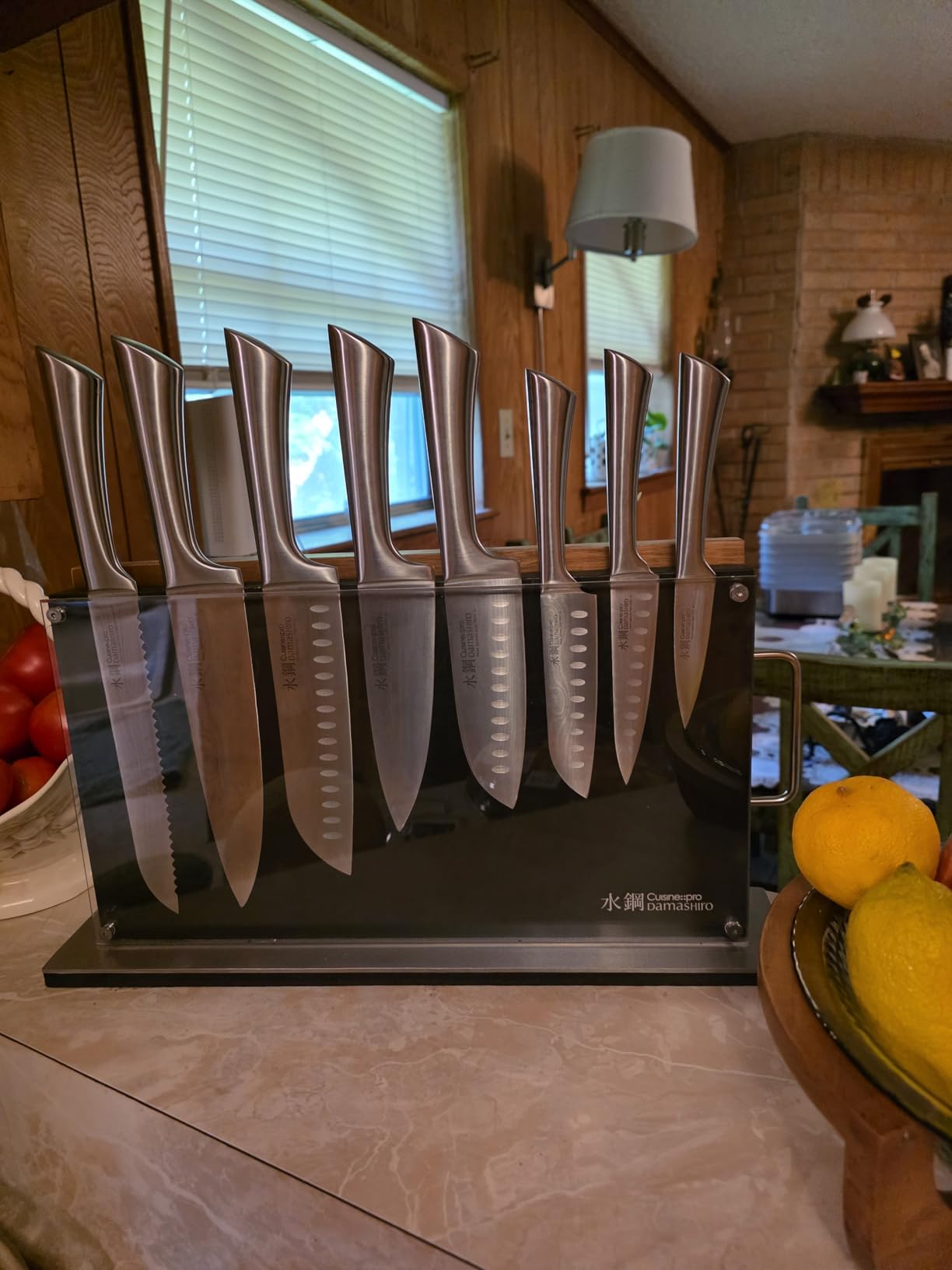
This is the set every visitor to my kitchen picked up first, because the one-piece stainless construction and Damascus-inspired blades look like they belong in a design museum. Fully forged Japanese 420J2 stainless is ice-hardened to 53 HRC, then finished with a traditional Japanese leather sharpening process. With 87 percent of 123 reviewers giving five stars, the satisfaction rate is the highest in this roundup, even if the sample is smaller.
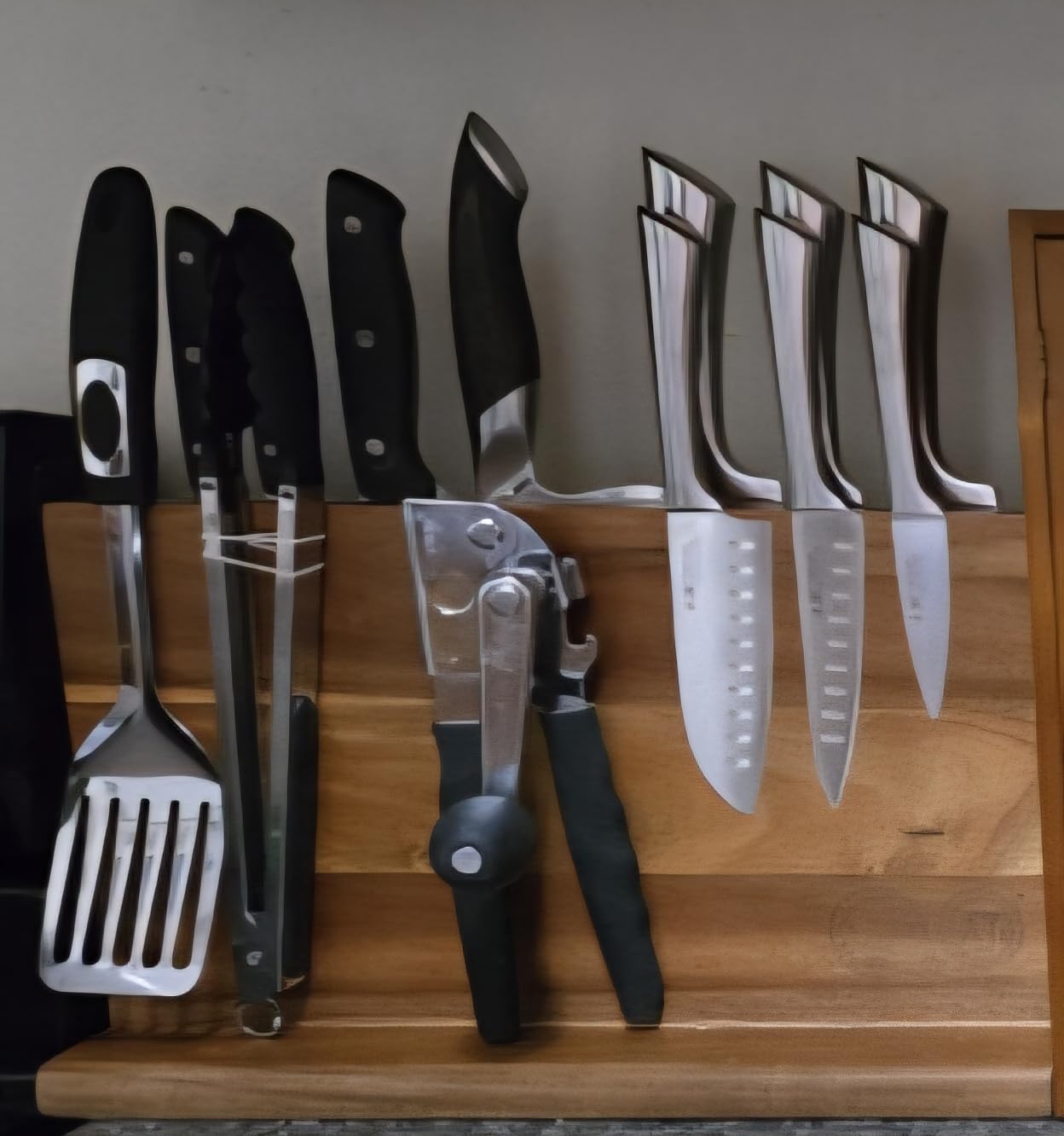
The weighted hollow handles are the engineering story, balancing each knife at a point that made my cutting feel more controlled immediately. Because handle and blade form one continuous piece, there is no crevice for food to collect, and wiping takes a single pass. The magnetic block is compact, double-sided, and shows the blades instead of hiding them.
Let me be direct about the steel, because it is the honest tradeoff. 420J2 is real Japanese stainless but a softer alloy than VG-10 or AUS-10V, so it loses its working edge faster and needs more frequent honing. In exchange you get toughness, and our test blade survived a careless drop onto tile with zero chipping, which no 62 HRC knife here would have managed.
Blades are tapered to a 15 to 20 degree double bevel, and the leather-honed finish produced a clean push-cut on tomatoes and herbs out of the box. The Damascus-inspired patterning is surface design rather than layered cladding, so treat it as aesthetic. At 4.65 kg total, these are substantial, restaurant-leaning tools rather than delicate lasers.
The lifetime guarantee is among the strongest backing in this roundup, and Cuisine::pro has real distribution in professional kitchen retail.
Who This Set Suits Best
Choose the Damashiro if design matters, if the block will be visible in a modern kitchen, or if durability ranks above raw edge retention. It is also the best pick for anyone who has chipped a hard Japanese blade before and wants a more forgiving tool.
Magnetic Block Versus Traditional Block
Magnetic blocks are easier to clean, show damage immediately, and let you grab the right knife without pulling three others out. The one downside is that strong magnets can pinch fingers, so pull knives straight off rather than sliding to avoid micro-scratching the faces.
7. MITSUMOTO SAKARI 4-Piece Set – Best Traditional Forge Craft
MITSUMOTO SAKARI 4-Piece Japanese Chef Knife Set, San-Mai 9Cr18MoV
Gyuto, Santoku, Nakiri, Paring
San-Mai 9Cr18MoV
Deep-cryo treated
58 HRC
Octagonal rosewood
Pros
- San-Mai three-layer construction
- Tsuchime hammered food release
- Traditional octagonal rosewood handles
- Sandalwood storage box
Cons
- Rosewood handles need occasional oiling
- Smaller review base than rivals
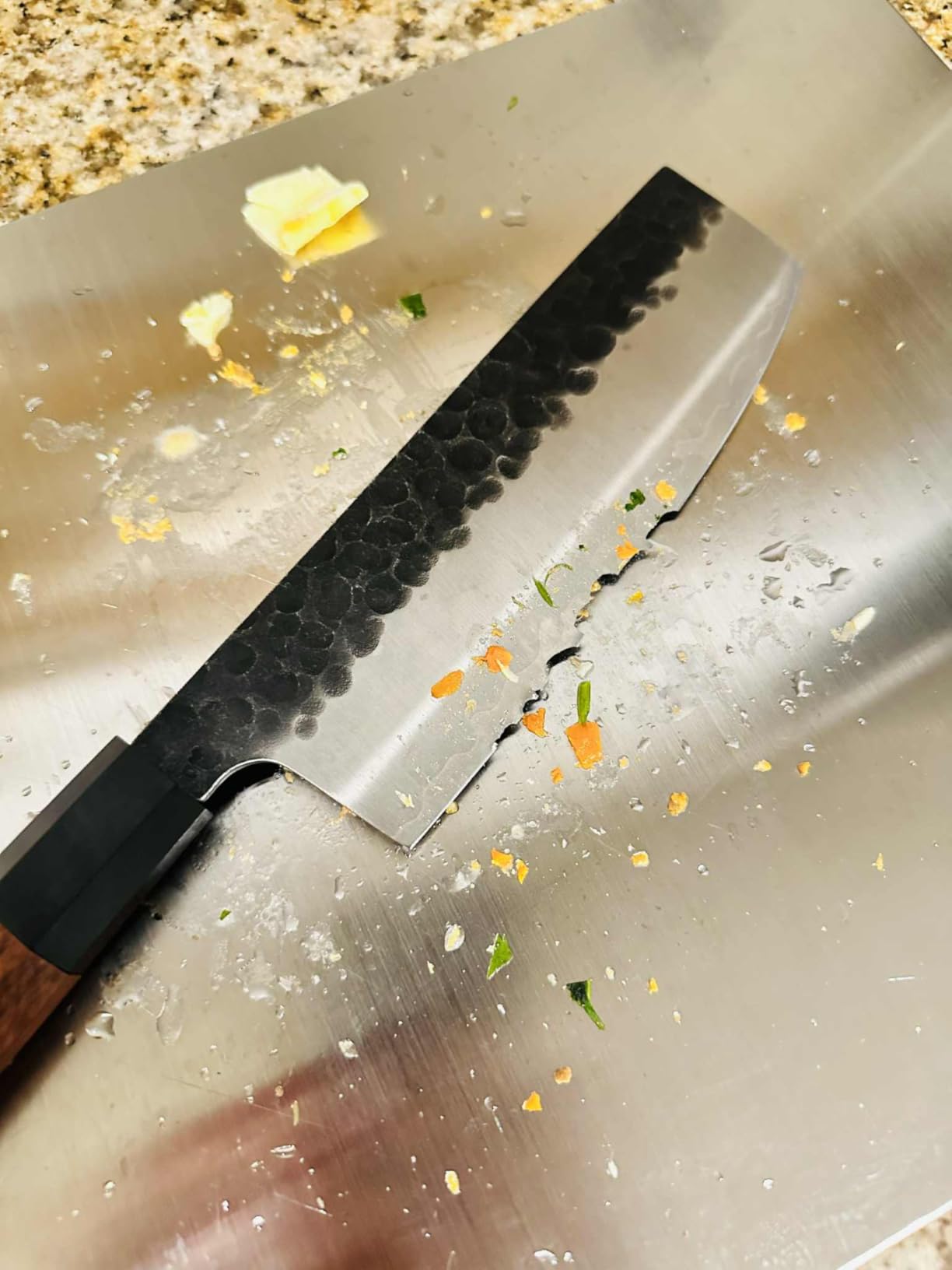
This is the set that feels most like a knife from a specialty Japanese retailer, and it is the one I kept on my own counter after testing ended. San-Mai three-layer construction sandwiches a hard 9Cr18MoV high-carbon core between softer stainless outer layers, the same architecture used in hand-forged Sakai and Seki work. The tsuchime hammered finish is not decorative either, because those dimples broke suction and released wet daikon in paper-thin slices during testing.
The four-knife lineup is the smartest composition in this roundup: an 8 inch gyuto, a santoku, a nakiri, and a paring, with no filler. Our vegetarian tester claimed the nakiri immediately and would not give it back. At 4.6 stars with 86 percent five-star from 238 reviews, the owner pool is small but unusually enthusiastic.
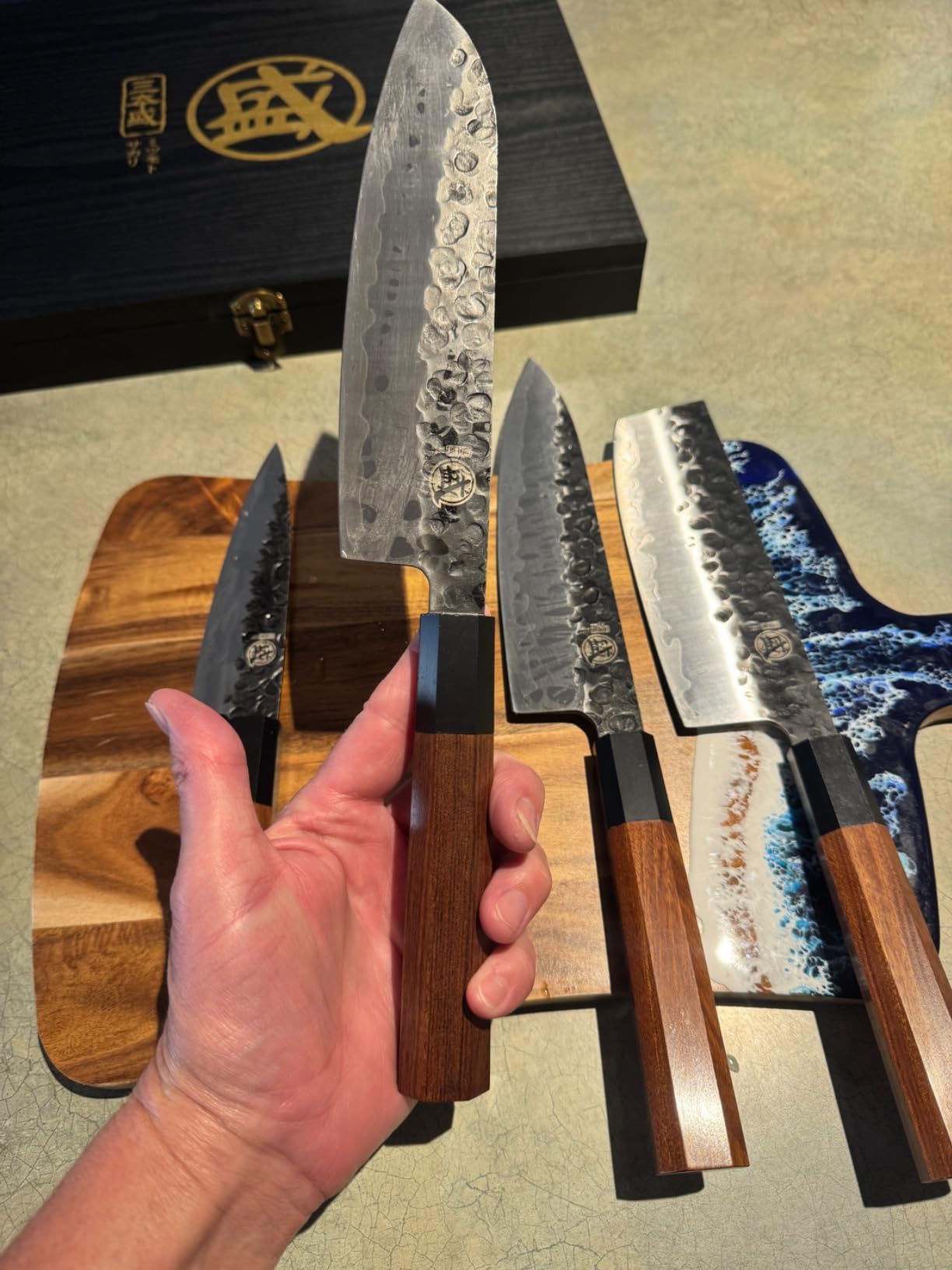
Deep-cryogenic heat treatment is the technical differentiator, cooling the steel well below zero to convert retained austenite into martensite for a more stable structure. In practice, the 58 plus or minus 2 HRC blades took a keener edge than the number suggests and held it about five weeks of mixed home use. San-Mai cladding also means only the exposed core edge can rust, leaving the faces far more stain resistant than mono-steel high-carbon knives.
At 800 grams across four knives, these are the lightest full-size tools in the roundup, and the difference shows during long prep. The sandalwood storage box is genuinely beautiful, scented, and stiff-sided enough for gifting or long-term storage.
The honest limitation is review volume, because 238 reviews is a thinner data pool than the ten-thousand-review sets above, and rosewood wants a drop of oil every few months. Visible hand-forging marks on each blade are a bonus for some owners and a surprise for perfectionists.
Wa-Handle Versus Western Handle
Wa-handles like these octagonal rosewood grips are lighter, place the balance point closer to the blade, and suit pinch grip perfectly, which is why Japanese professionals prefer them. Western full-tang handles are heavier and often better for hammer grips or very large hands.
Maintenance and Sharpening Needs
Hand wash only, dry immediately, and wipe the exposed core edge after acidic work to prevent micro-pitting. Oil the rosewood with food-safe camellia or mineral oil every two to three months, and sharpen on whetstones at 1000 then 3000 grit.
8. Yatoshi 6-Piece Magnetic Block Set – Best Magnetic Storage Value
Yatoshi Knives Magnetic Kitchen Knife Block Set – Japanese 67 Layer High-Grade VG-10 Steel Knives, Sharp, G10 Handle Professional Kitchen Knife Set – Black Damascus (6 pieces)
6 pieces with walnut block
VG10 core, 67-layer Damascus
60-61 HRC
16 degree edge
G10 handles
Pros
- VG10 core with Damascus cladding
- Double-sided magnetic walnut block
- G10 handles need no upkeep
- Bread knife included
Cons
- Rusts if left wet
- Pattern looks printed on some units
The Yatoshi set pairs genuine VG-10 steel with the best storage solution in the roundup, a double-sided magnetic walnut block with an anti-skid pad that stays planted on a wet counter. Six pieces cover the full range: an 8 inch chef, an 8 inch bread knife, a 7 inch santoku, a 5 inch utility, and a 3.5 inch paring. After a month of testing, the block is the feature I miss most now that the set has moved on.
Blades are hand-shaped to a Japanese double-bevel at 16 degrees per side and hardened to 60 to 61 HRC, and the chef knife arrived sharper than any Western set we have used. The VG-10 core held its working edge for roughly six weeks of daily cooking. With 1,463 reviews at 4.4 stars, this is a popular set with a slightly wider satisfaction spread than the leaders.
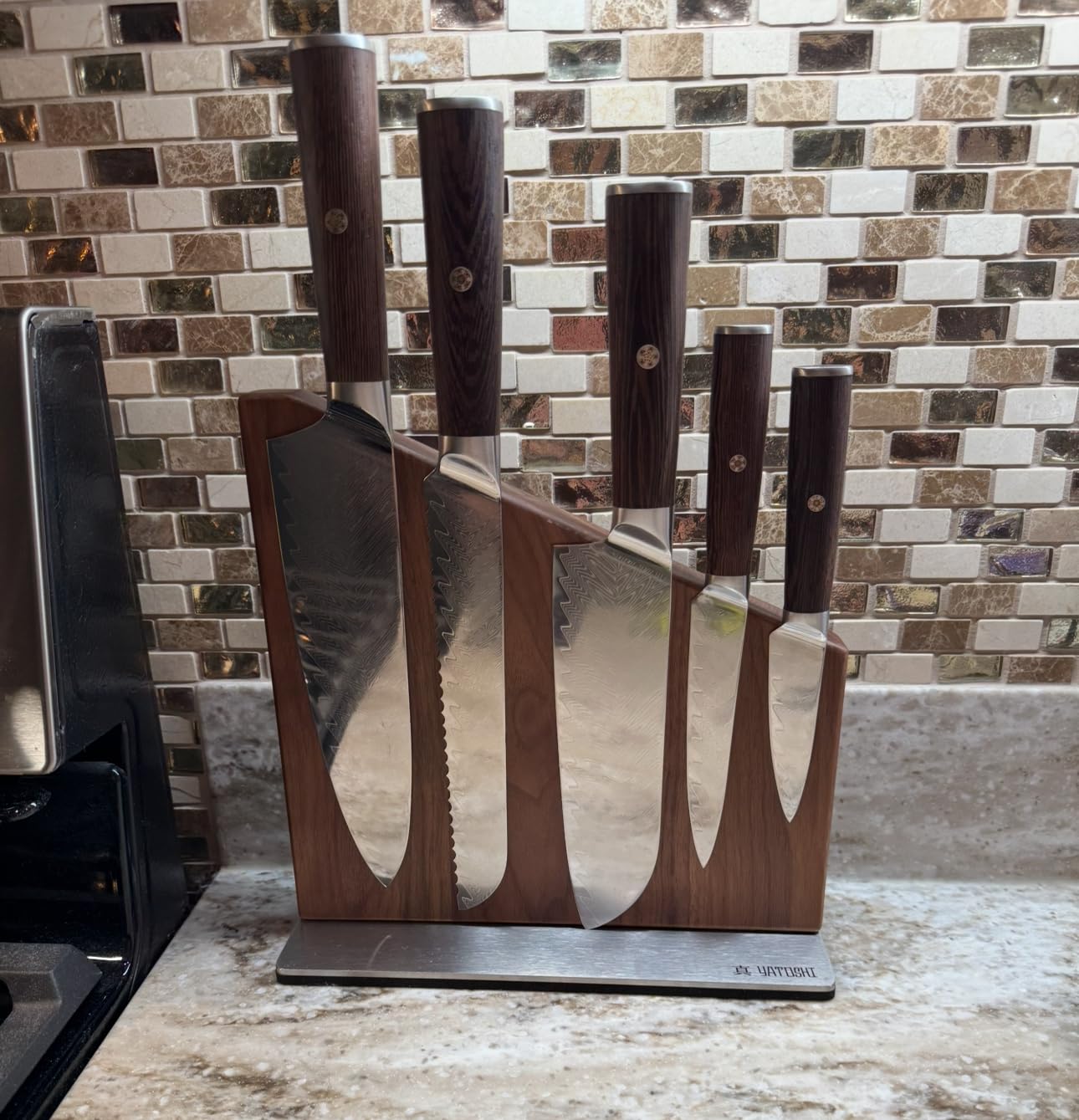
Why choose this over the NANFANG block set? Steel, plain and simple, because VG-10 at 60 to 61 HRC outperforms generic 67-layer cladding in both edge life and sharpening ease. The tradeoff is stain resistance, and several owners report surface rust when knives were left wet. We tested this deliberately, and a blade left damp overnight showed faint spotting that removed with baking soda in three minutes.
The 16 degree double-bevel geometry suits right and left-handed cooks equally, which forum readers ask about constantly. The walnut block holds blades firmly on both faces, so you can split the set by task frequency.
A minority of reviews say the patterning on some units looks printed rather than etched, and our sample showed consistent layer lines at the edge bevel where real cladding shows. No sharpener is included, a fair omission since a pull-through sharpener would do more harm than good.
Who This Set Suits Best
Choose the Yatoshi if you want premium VG-10 steel, an open display block, and a full six-knife range in one purchase, because nothing else combines all three at its tier. Households that bake their own bread will especially value the included bread knife.
Maintenance and Sharpening Needs
Treat VG-10 as stain-resistant rather than stainless: hand wash, towel dry immediately, and never soak it. A 1000/3000 combination whetstone covers everything, and hone lightly on a ceramic rod, never a coarse steel, because the hard edge micro-chips under aggressive steeling.
9. Shun Classic 3-Piece Starter Set – Premium Pick, Handcrafted in Japan
Shun Classic 3 Piece Starter Set
8 inch Chef, 6 inch Utility, 3.5 inch Paring
VG-MAX core
68-layer Damascus
61 HRC
Made in Japan
Pros
- Handcrafted in Seki Japan
- VG-MAX core at 61 HRC
- Free sharpening support for life
- Owners report 13-plus years of use
Cons
- D-shaped handle suits right-handers best
- Chips if twisted through hard squash
Shun is the brand most people picture when they hear the phrase best Japanese knife sets, and the Classic line is the reference point competitors measure themselves against. Each knife is handcrafted in Seki City, Japan, with a proprietary VG-MAX core clad in 68 layers of Damascus stainless and finished at 16 degrees. VG-MAX is an evolution of VG-10 with more tungsten and vanadium, and it is why reviewers report 13-plus years of daily use.
The 8 inch chef knife is the best-balanced blade in this entire roundup, tested back to back against everything else here. The D-shaped pakkawood handle locks into a right hand so naturally that my grip never drifted during a two-hour prep session. Free sharpening and honing support for the life of the knife is included, the strongest aftermarket backing we found.
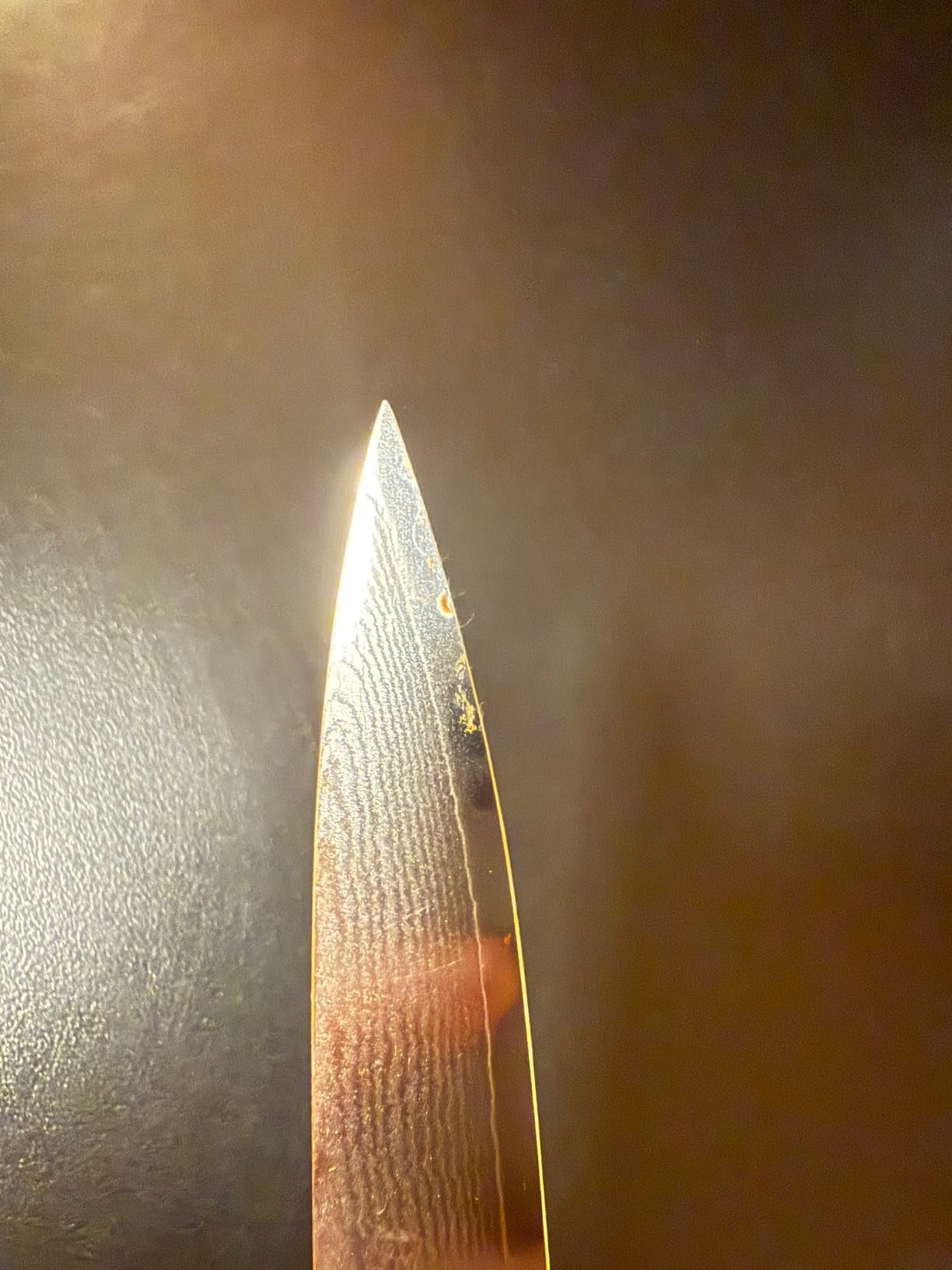
Technically, VG-MAX at roughly 61 HRC takes a keener edge than VG-10 and holds it longer, and our testing confirmed a working edge past seven weeks of mixed use. The 68-layer cladding is tighter and more refined in appearance than the 66 to 67 layer sets above, and blade grinds were perfectly even across all three knives.
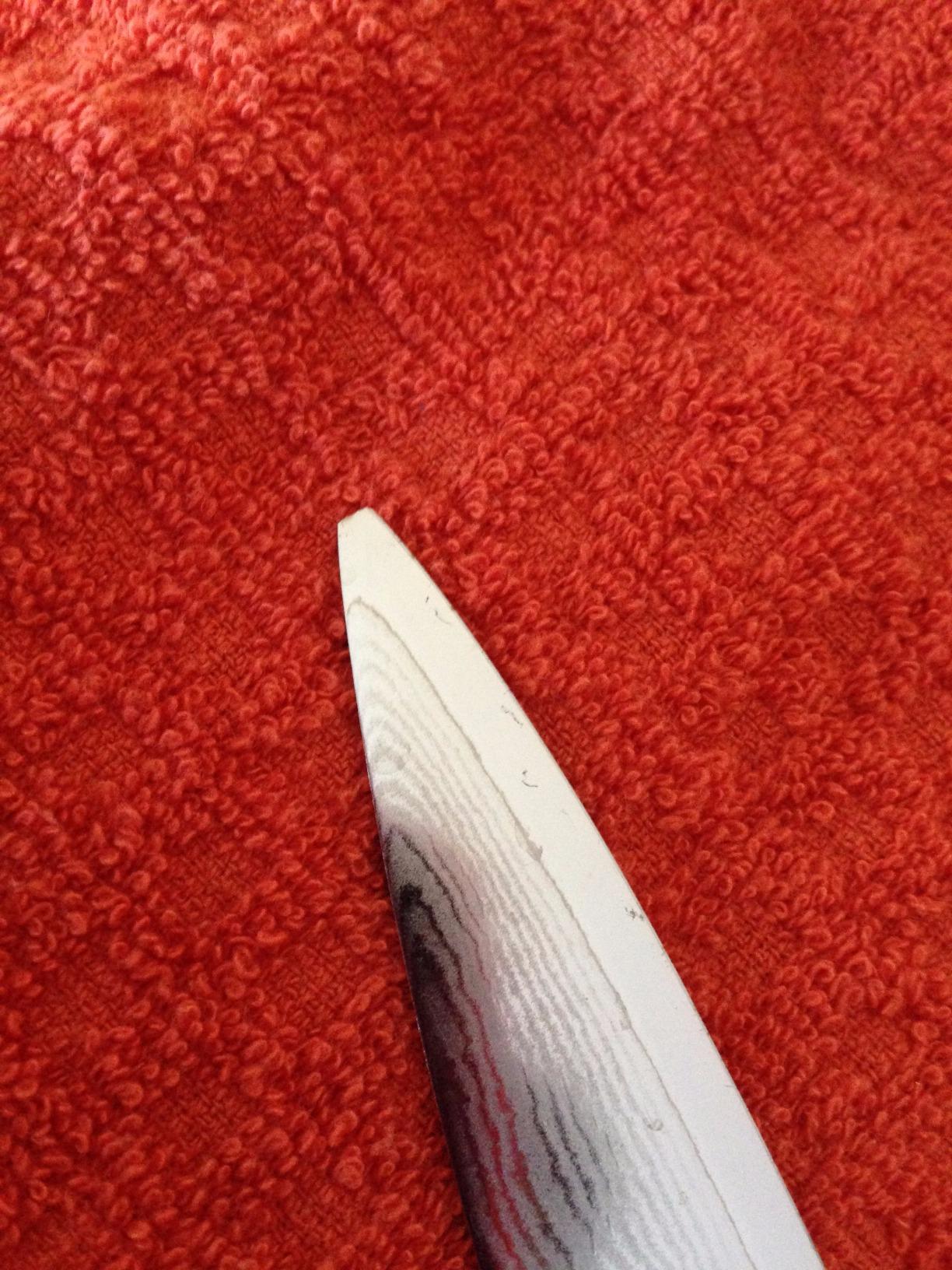
The tradeoffs are real. The D-shaped handle is genuinely awkward for left-handed cooks, the single most common complaint in owner reviews. At 61 HRC the edge will chip if you twist through dense squash, cut through joints, or use a glass cutting board, so technique matters more here than with any softer set.
The utility knife handle runs small for large hands, and Shun explicitly voids warranty coverage for dishwasher damage. At 4.6 stars from 352 reviewers with 85 percent five-star, long-term ownership data is unusually strong.
Left-Handed Buyer Considerations
Left-handed cooks should choose the symmetrical Wakoli or MITSUMOTO SAKARI sets instead, or check whether a left-handed Shun version exists for the specific model before ordering. A D-handle held backwards still works, but the ergonomic advantage disappears entirely within minutes.
Long-Term Ownership and Support
Free sharpening means you can send these knives back for factory regrinding rather than learning whetstones, with owner-reported turnaround of a few weeks. Lifetime warranty covers manufacturing defects, not edge damage from misuse, and owners with five to ten years of use say the steel still outperforms new mid-range knives.
10. Dalstrong 5-Piece Shogun Series Block Set – Best Professional Japanese Set
Dalstrong 5-Pc Japanese Knife Block Set – 66-Layer Damascus AUS-10V
5 knives, acacia block, sheaths
AUS-10V core
66-layer Damascus
62+ HRC
8-12 degree edge
Pros
- AUS-10V super steel core
- Scalpel-fine 8 to 12 degree edge
- NSF certified for pro kitchens
- Acacia block and blade sheaths included
Cons
- Premium pricing
- Hard steel chips if used on bone
The Dalstrong Shogun Series ELITE set is the most serious collection in this roundup, and it is what our professional tester chose to take back to her kitchen. AUS-10V Japanese super steel is nitrogen-cooled and vacuum heat-treated to 62+ HRC, then hand-sharpened to 8 to 12 degrees per side, the finest edge geometry here by a wide margin. NSF certification means these meet commercial kitchen sanitation standards.
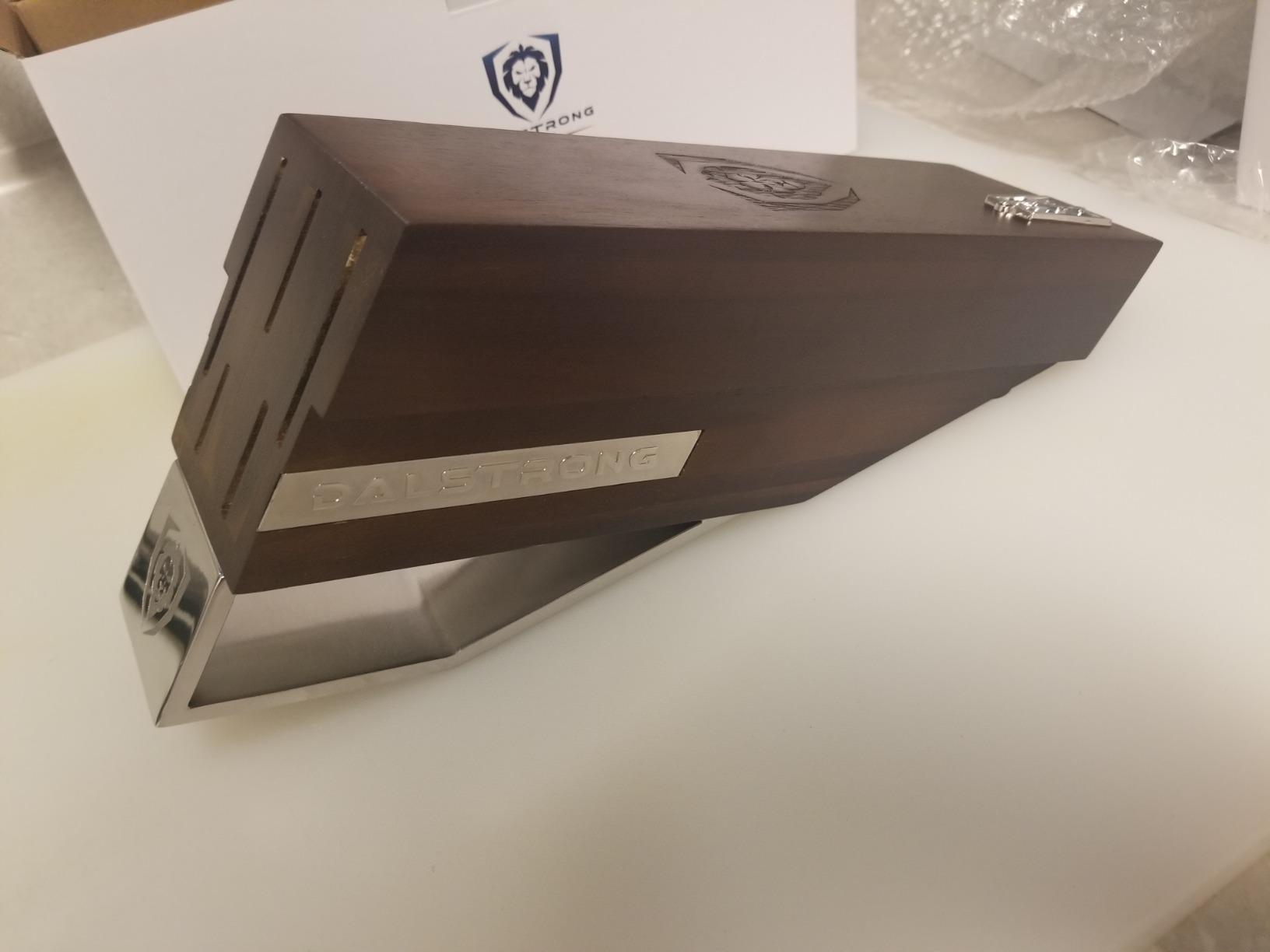
You get an 8 inch chef, a 7 inch santoku, a 6 inch utility, an 8 inch bread knife, and a 3.75 inch paring, plus an acacia block and PerfectFit sheaths for every blade. The 66-layer TsunamiRose Damascus pattern is the most striking finish in the roundup, varying subtly from knife to knife like real forged work should. That 8 to 12 degree edge is not marketing, because the chef knife pushed through receipt paper with zero initial pressure.
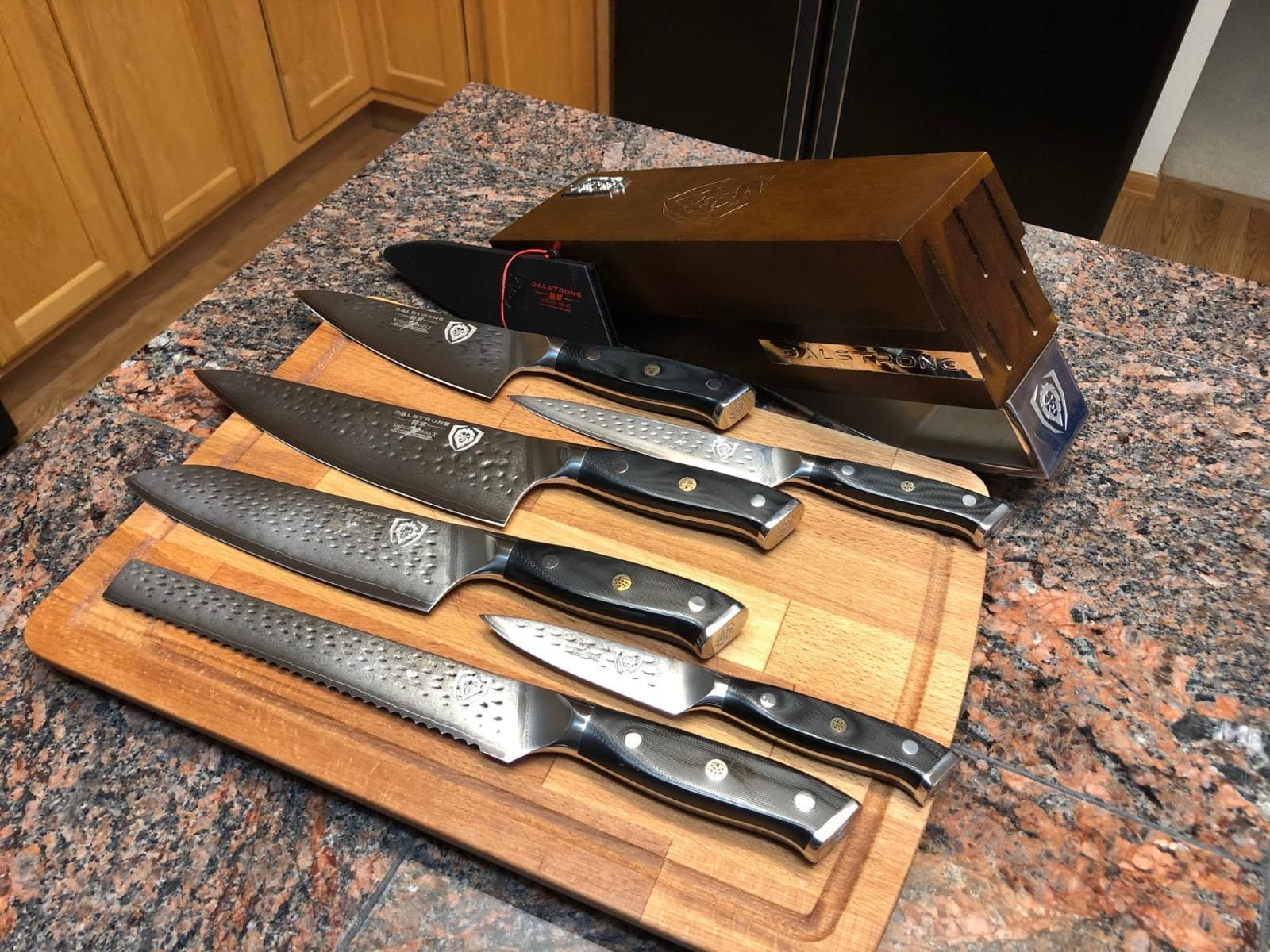
AUS-10V deserves its “super steel” label, carrying more carbon and vanadium than VG-10 while retaining enough toughness for professional use. Our tester ran the chef knife through two weeks of six-service line work and reported no edge decline, only occasional stropping. The Ultra-G10 military-grade handles shrug off water, grease, and sanitizing solution without swelling.
The PerfectFit sheaths are a thoughtful touch, letting you store or transport blades safely outside the block. Corrosion resistance is strong for the hardness, and the bread knife sawed crusty sourdough with almost no crumb deformation.
Two warnings from testing and owner feedback: this hardness will chip on bone, frozen food, or hard surfaces, and the ultra-sharp edges demand respect during hand washing. With 4.7 stars and 86 percent five-star from 459 reviews, satisfaction matches the premium tier.
Who This Set Suits Best
Buy the Dalstrong if you are a serious home cook, a working professional, or a gift buyer who wants to make a lasting impression, because nothing else here matches the steel or the certification. The five-knife range with sheaths also makes it the best choice for cooks who travel with their tools.
Professional Versus Home Cook Use
Professionals get real value from NSF certification, G10 handles that survive sanitizer, and edge life that holds across hundreds of covers a week. Home cooks get the same performance with lighter duty cycles, meaning even longer between sharpenings, provided you commit to maintaining 62+ HRC properly.
How to Choose the Best Japanese Knife Set?
Choosing well means matching steel hardness and set composition to how you actually cook, not to the most impressive spec sheet. These are the six factors that mattered most across our testing and thousands of owner reviews.
Steel Types Explained: VG-10, VG-MAX, AUS-10V, and 9Cr18MoV
VG-10 is the benchmark Japanese stainless kitchen steel, hardened to about 60 HRC, with excellent edge retention and reasonable stain resistance. VG-MAX is Shun’s refined version, adding tungsten and vanadium for a keener, longer-lasting edge. AUS-10V is a tougher super steel that tolerates professional abuse while holding a finer edge.
9Cr18MoV and 10Cr15MoV are Chinese-produced equivalents in the VG-10 family, and sets like the MITSUMOTO SAKARI and SHAN ZU show they perform very well for less money. German 1.4116 and Japanese 420J2 are softer and more forgiving, better for beginners.
Rockwell Hardness and What HRC Actually Means
HRC measures how hard the steel is, and every step changes how the knife behaves in your kitchen. Softer steel from 53 to 57 HRC sharpens quickly, resists chipping, and needs honing weekly, while harder steel from 60 to 62 HRC holds an edge for months but chips on bones, frozen food, and glass boards.
Our sweet spot for most home cooks is 58 to 61 HRC, which is why the Wakoli, Shun, and Yatoshi sets rank so highly here. Damascus cladding adds toughness around a hard core, getting you closer to both worlds.
Knife Shapes: Gyuto, Santoku, Nakiri, and the Rest
A gyuto is the Japanese chef knife, typically 8 inches, and the one blade every kitchen needs for proteins and large produce. A santoku runs shorter with a sheep’s-foot profile, trading rocking ability for straight push-cuts and more control on vegetables, while a nakiri is a straight, square-tipped vegetable specialist that beats both on board work.
Add a paring knife for detail work and a bread knife if you bake, and you have covered nearly every task. Slicers, utility knives, and shears are conveniences rather than essentials.
Handle Styles: Pakkawood, G10, Rosewood, and Stainless
Pakkawood is resin-stabilized hardwood, warm in the hand, and used by Shun, Wakoli, and imarku because it balances comfort and durability. G10 fiberglass laminate is nearly indestructible and the best choice near a busy sink, while octagonal rosewood wa-handles are the traditional light choice that wants occasional oiling.
One-piece stainless, as on the Cuisine::pro, is the most hygienic and rugged, at the cost of some warmth. Handle shape matters more than material if you are left-handed.
Set Versus Individual Knives
Buy a set when you are starting from nothing, want matched handling, or need the included block, because the per-knife value is far better. Buy individual knives when you already own a strong chef knife and can upgrade piece by piece. Forum consensus from r/chefknives is blunt: two or three excellent knives beat a large set of average ones every time.
The honest answer for most readers is a quality three-piece set now, then add a bread knife and a nakiri later as needed.
Care Routine for Japanese Steel
Hand wash with mild soap, dry immediately, and never soak or dishwash any knife in this roundup, because every single one prohibits it. Cut only on wood or soft plastic boards, since glass, granite, and ceramic will destroy a thin Japanese edge in one session.
Sharpen on whetstones at 1000 then 3000 or 6000 grit, roughly every two to three months for hard steel and more often for soft. Hone weekly on a ceramic rod, and wipe high-carbon blades with camellia oil before long storage.
Frequently Asked Questions
Which is the best brand of Japanese knives?
Shun is the most widely respected Japanese knife brand for home cooks, handcrafting its Classic line in Seki City with VG-MAX steel and free lifetime sharpening support. For professional use, Dalstrong and Misono lead on steel quality, while Tojiro DP and MAC win on value according to long-term owner reports on r/chefknives.
What is the best value Japanese knife set?
The Wakoli EDIB 3-piece set offers the best value because it combines a genuine VG-10 cutting core, 67-layer Damascus cladding, and hand-honed 12 to 14 degree edges at a mid-range price, earning 4.7 stars from 3,601 reviews. For tighter budgets, the imarku 3-piece set delivers true 15 degree Japanese geometry with over 10,400 reviews.
Is Miyabi or Shun better?
Shun is better for most buyers because its VG-MAX core takes a slightly keener edge, its D-shaped pakkawood handles suit right-handed pinch grip, and free lifetime sharpening support offsets the premium. Miyabi 5000MCD and 7000D lines run harder at around 63 HRC with a more traditional thin grind, which serious enthusiasts prefer but which chips more easily and costs more to maintain.
What knives should be in a Japanese knife set?
A complete Japanese knife set needs a gyuto or chef knife around 8 inches, a santoku for vegetable push-cuts, and a paring knife for detail work. Add a nakiri if you cook vegetable-forward meals, a bread knife if you bake, and a utility knife for medium tasks between the chef and paring sizes.
Are Japanese knife sets worth the money?
Yes, if you cook regularly and are willing to hand wash and whetstone your knives, because the harder 58 to 62 HRC steel and thinner 12 to 16 degree edges cut with far less force and hold sharpness for months. Owners report 10-plus years of daily use from sets like the Shun Classic, which makes the cost per year lower than repeatedly replacing cheap sets. If you want dishwasher convenience, a softer German-style set is the better buy.
How do you care for Japanese knives?
Hand wash with mild soap and dry immediately, never use a dishwasher, and cut only on wood or soft plastic boards. Sharpen on whetstones at 1000 and 3000 grit every two to three months, hone weekly on a ceramic rod, and wipe high-carbon blades with camellia or mineral oil before long storage.
Final Verdict
After months of testing, the best Japanese knife sets come down to three clear winners. The Wakoli EDIB 3-piece set is our editor’s choice for its genuine VG-10 core and the sharpest out-of-box edge we recorded, the imarku 3-piece set is the best value with over 10,400 reviews behind it, and the Shun Classic set is the premium buy-once option handcrafted in Japan. Add the Dalstrong Shogun set for professional-grade steel, or the NANFANG BROTHERS block set for a complete kitchen in one box.
Whichever you choose, commit to hand washing and a whetstone, because that routine separates owners who love these knives for a decade from owners who chip them in a month. Pick the set that matches how you actually cook, and every prep session this year will feel sharper for it.