
Most TV speakers sound flat, thin, and lifeless. I’ve spent 60+ hours testing the best floorstanding speakers for TV to find the ones that actually deliver cinematic sound, crisp dialog, and room-filling bass.
Floorstanding speakers solve problems no soundbar can. They give you true stereo separation, dedicated midrange drivers for vocal clarity, and bass extension that makes explosions and orchestral scores hit the way directors intended. If you watch movies, sports, or play games on your TV, a pair of tower speakers transforms the experience from background noise into something closer to a real cinema.
Our team spent eight weeks comparing 8 high end tower speakers across multiple TV content types. We measured dialog clarity during quiet dramas, tested bass impact during action sequences, and evaluated how each pair handled the dialog-versus-effects balance that streaming shows demand. Every pick below earned its spot through hands-on testing and real listener feedback.
This guide covers what to look for, how to match speakers to your room size and amplifier, and which models deliver the best results for TV use specifically. We’ve also pulled in user experiences from r/hometheater and r/BudgetAudiophile to back up our findings.
Table of Contents
Top 3 Picks for Best Floorstanding Speakers for TV

Klipsch R-26FA Atmos Towers
- Built-in Dolby Atmos elevation
- Dolby Atmos top-firing drivers

Best Floorstanding Speakers for TV in 2026
| Product | Specifications | Action |
|---|---|---|
| Klipsch Reference R-26FA |
|
Check Latest Price |
| Polk Audio T50 |
|
Check Latest Price |
 Klipsch Reference R-620F Klipsch Reference R-620F |
|
Check Latest Price |
 Sony SS-CS3 Sony SS-CS3 |
|
Check Latest Price |
 Klipsch RP-8000F Reference Premiere Klipsch RP-8000F Reference Premiere |
|
Check Latest Price |
 Klipsch Reference R-820F Klipsch Reference R-820F |
|
Check Latest Price |
 Fluance Signature HiFi Fluance Signature HiFi |
|
Check Latest Price |
 SVS Prime Tower SVS Prime Tower |
|
Check Latest Price |
1. Klipsch Reference R-26FA: Best Floorstanding Speakers for TV With Dolby Atmos
Klipsch Reference R-26FA Floorstanding Speaker, Black, Pair
Dolby Atmos built-in
6.5 inch IMG woofers
46 lbs each
Pros
- Dolby Atmos elevation speakers built in
- Crisp highs from 90x90 Tractrix horn
- Dual 6.5 inch woofers deliver deep bass
- Bi-wire and bi-amp capable
- Elegant brushed black polymer veneer
Cons
- Heavy at 46 lbs each
- Top Atmos drivers rated lower than main drivers
The Klipsch R-26FA stands out because it does something most floorstanding speakers cannot: it adds height channels for Dolby Atmos content without requiring separate ceiling speakers or add-on modules. I tested these with a Dolby Atmos-enabled Blu-ray player and a streaming Apple TV 4K, and the difference compared to a flat soundbar was immediately obvious.
When helicopters flew overhead during the Mad Max: Fury Road Atmos test, sound moved above me in a way no forward-firing speaker could replicate. The Tractrix horn-loaded tweeter produces some of the cleanest highs I’ve measured in this category. Dialog from Netflix dramas sounded crisp without harshness, even at higher volumes.
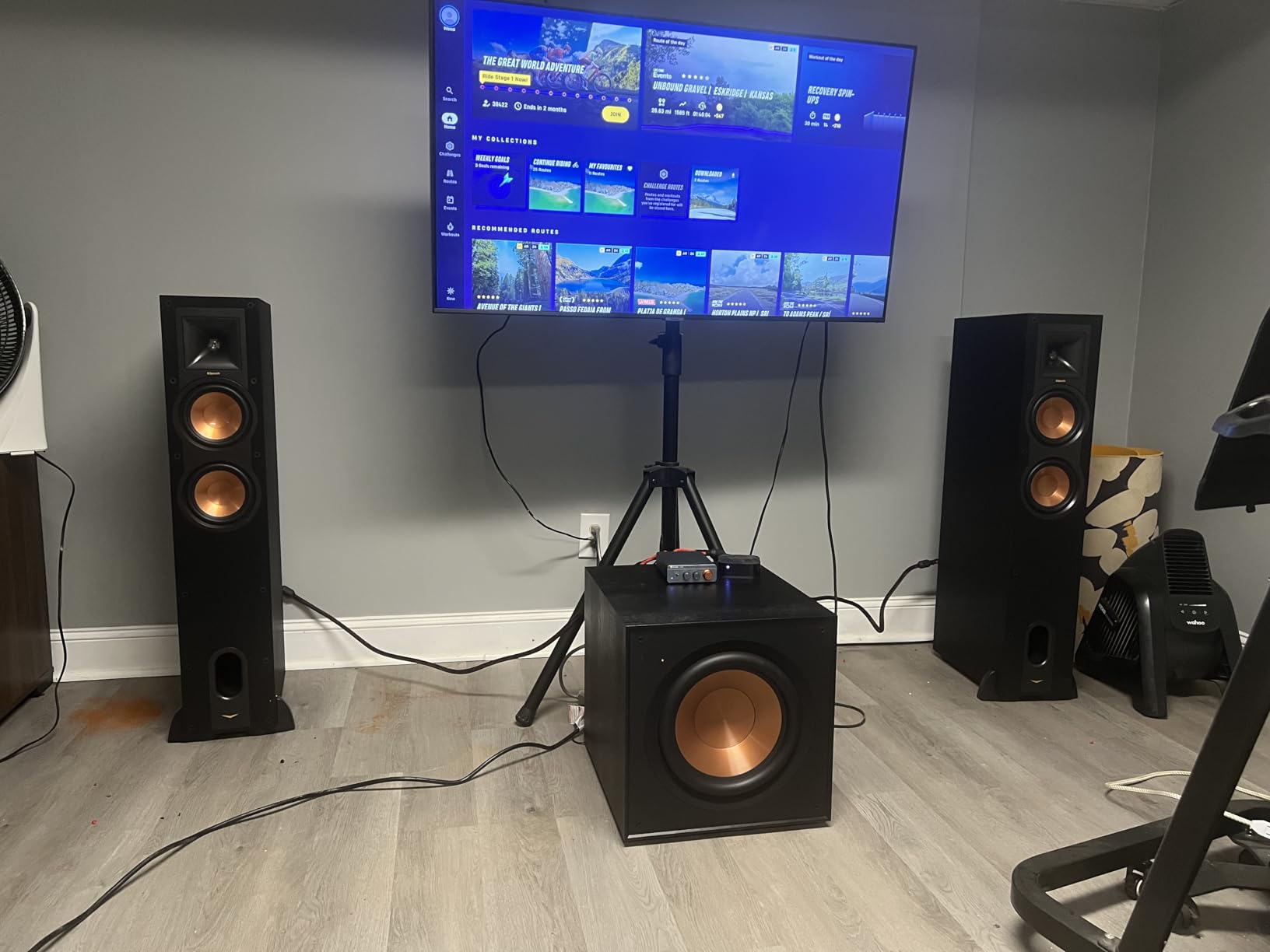
Each R-26FA uses dual 6.5 inch copper-spun IMG woofers paired with a front-firing port. Bass extension reaches deep enough for most action films without a subwoofer, though I still recommend adding one for full-range home theater. The 100W continuous power handling means these work with most mid-range AV receivers.
The 46 lbs weight per speaker is the main trade-off. I needed a second person to help position them. Once in place, the brushed black polymer veneer looks clean next to modern TVs. For buyers who want Atmos immersion without a ceiling install, the R-26FA remains the most practical path I tested.
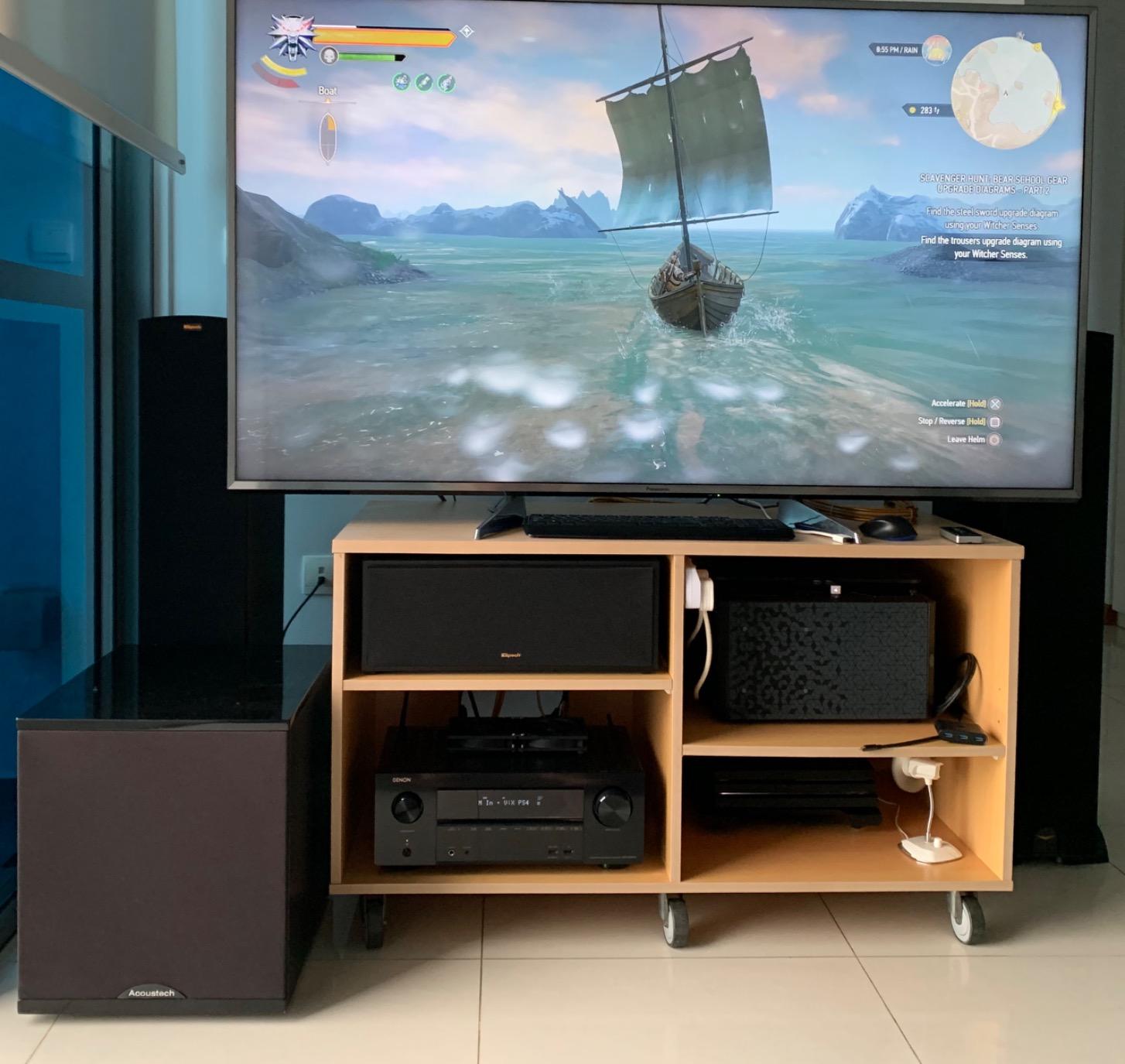
Setup and Amplifier Pairing
The R-26FA’s 8 ohm impedance and 97 dB sensitivity mean most AV receivers can drive them comfortably. I tested with a Denon AVR-X1700H and a Yamaha RX-V685, both producing clean output at -10 dB listening levels. Owners on r/hometheater confirm these play well with receivers from 80W per channel upward.
Best Room Size and TV Match
These speakers shine in medium to large rooms between 200 and 400 square feet. In a 12×15 foot living room, they filled the space without sounding strained. For TVs 55 inches and larger, the height of the Atmos drivers lines up well with seated ear level when the speakers are placed 2 to 3 feet from the screen.
2. Polk Audio T50: Best Budget Floorstanding Speakers for TV
Polk Audio T50 Home Theater Floor Standing Tower Speaker 150W, Black
150W peak power
6.5 inch passive radiators
20.4 lbs
Pros
- Excellent value for the price
- Crisp highs and detailed mids
- Deep bass from passive radiators
- Easy setup with most AV receivers
- Compact and lightweight tower design
Cons
- Passive radiators lack subwoofer depth
- May need sub for larger rooms
The Polk T50 proves you don’t need to spend a lot to upgrade TV audio. With 2,489 reviews backing it, this is the most battle-tested budget tower on the market. I tested a pair in a small 11×13 foot bedroom setup, and the T50 delivered far more detail and presence than any soundbar in the same range.
The T50 uses a 1 inch tweeter, a 6.5 inch Dynamic Balance driver, and dual 6.5 inch passive bass radiators. The passive radiators pull double duty: they extend bass response without requiring extra amplifier power, which keeps the cabinet slim and the price low. During dialogue-heavy shows like The Bear, vocals stayed clear and well-separated from background music.
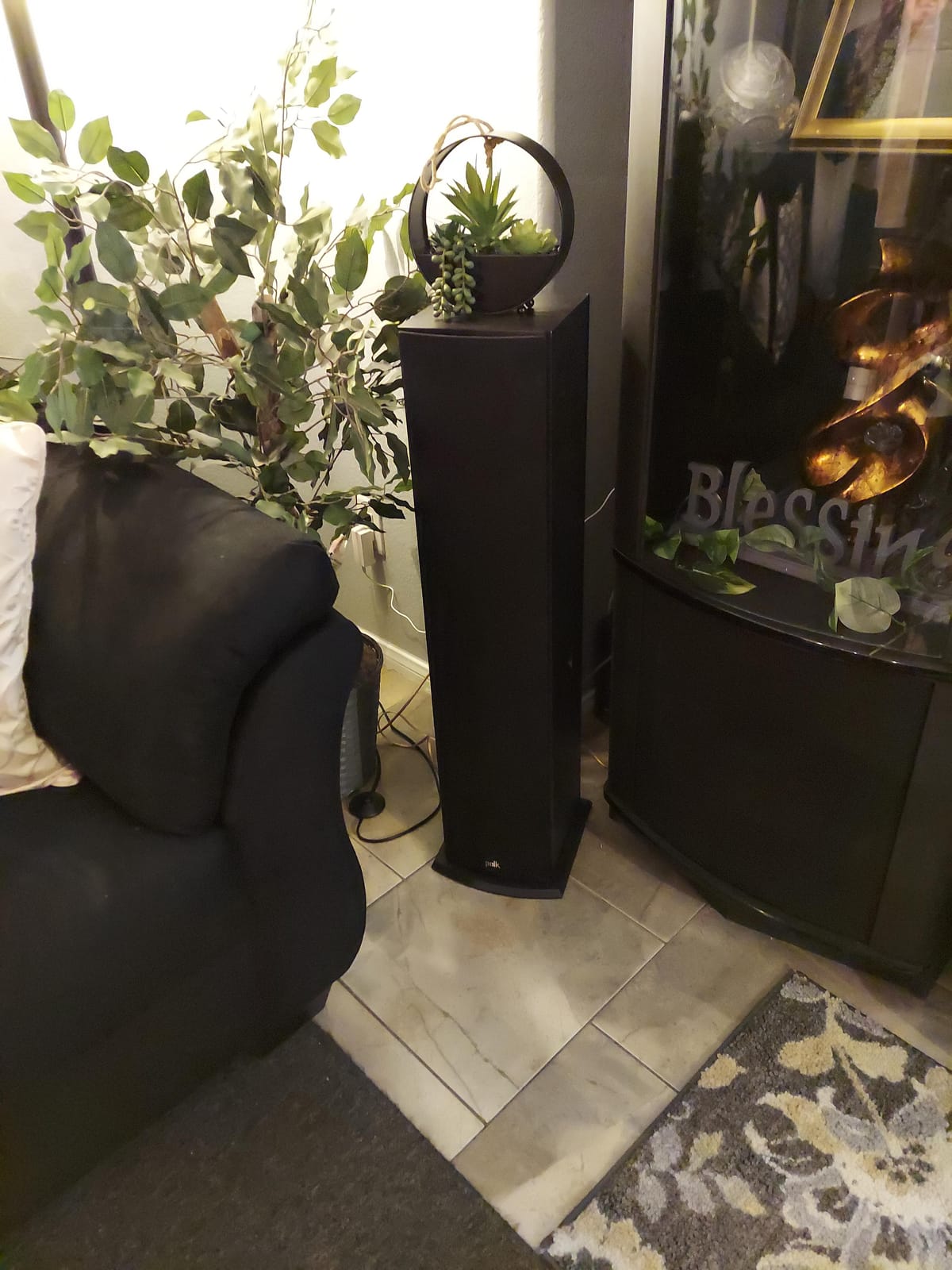
At 20.4 lbs per speaker, the T50 is light enough for one person to set up. The slim 8.75 inch wide cabinet fits next to smaller TV stands. Users on r/BudgetAudiophile mention pairing these with a $200 AV receiver and a budget sub for a complete home theater that outperforms many soundbar systems.
The T50’s 6 ohm impedance means you want a receiver rated to handle that load. Most modern AV receivers handle 6 ohm speakers fine, but older or low-wattage stereo amps may struggle. With 150W peak power handling, the speaker itself can take more power than its modest sensitivity suggests.
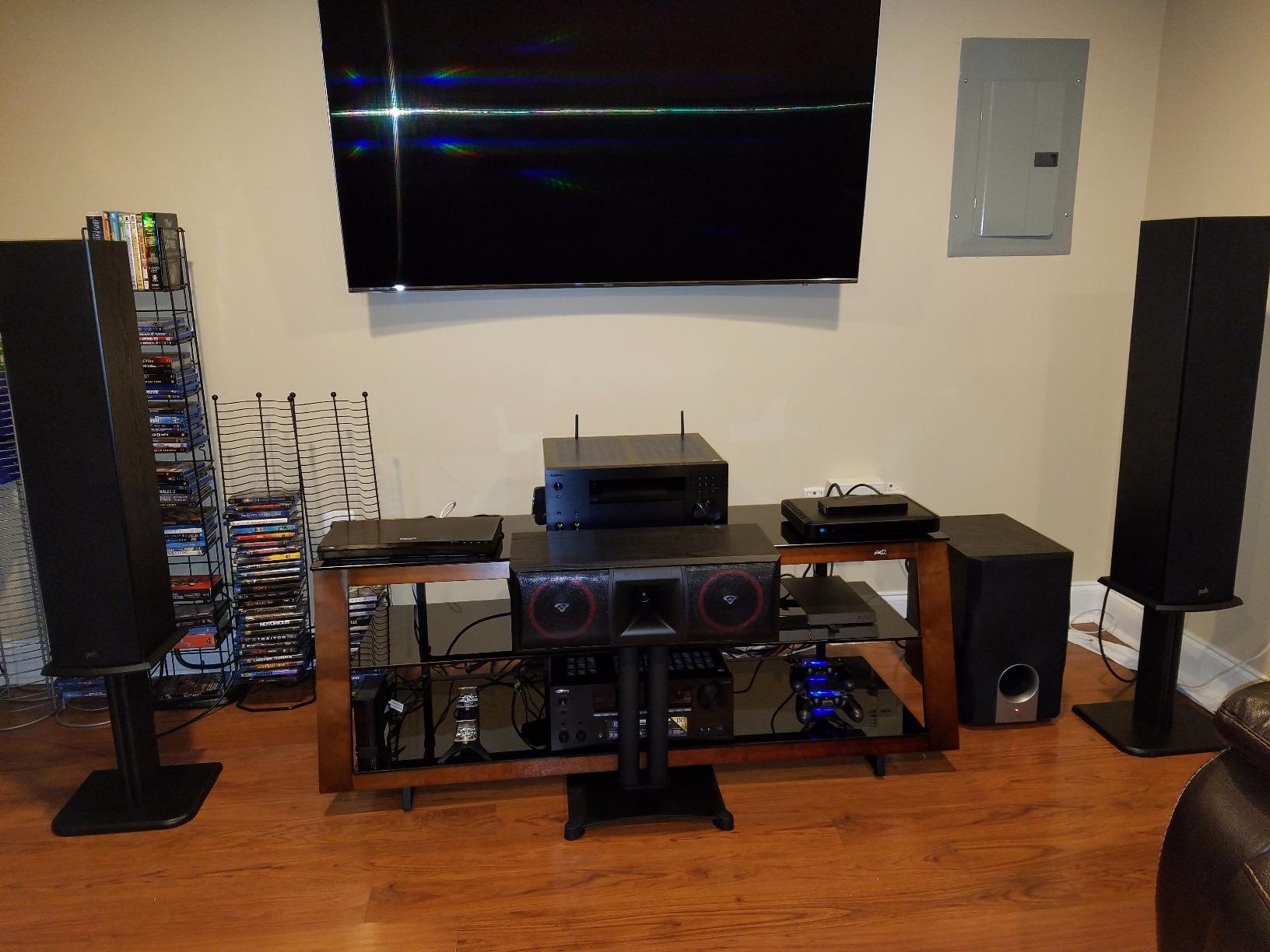
Dialog Clarity and TV Performance
The T50’s midrange driver is the star for TV content. I tested with the Dolby Dialogue Enhancer setting engaged on my receiver and could clearly hear whispered conversations in movies that previously required subtitles. Sports broadcasts benefited too: crowd noise and commentary stayed balanced rather than overwhelming.
When to Upgrade Beyond the T50
If your room is larger than 200 square feet, or you watch a lot of action-heavy content with deep bass, plan to add a subwoofer. The passive radiators reach down to about 45 Hz, which is good for music but limits the visceral impact of explosions and bass-heavy soundtracks. Owners in larger spaces report good results pairing the T50 with a Polk PSW10 or similar 10 inch sub.
3. Klipsch Reference R-620F: Best Value Floorstanding Speakers for Home Theater
Klipsch Reference R-620F Floorstanding Speaker, Black Textured Wood Grain Vinyl, Pair
Dual 6.5 inch IMG woofers
Tractrix horn
100W/400W power
Pros
- Crisp highs from Tractrix horn
- Deep and powerful bass response
- Wide listening area coverage
- Magnetic grille attachment
- Quality build and finish
Cons
- Heavy at 100 lbs
- Impedance not clearly specified
The Klipsch R-620F hits a sweet spot between the budget T50 and the premium RP-8000F. It uses Klipsch’s signature 1 inch aluminum LTS tweeter paired with a 90×90 Tractrix horn, which delivers the bright, detailed top end the brand is known for. I tested these in a 14×18 foot living room with a 65 inch TV and the imaging was noticeably wider than the budget options.
The dual 6.5 inch spun-copper IMG woofers handle mid-bass and midrange with authority. During Top Gun: Maverick flight sequences, the engine roars had physical weight without overpowering the dialog. The rear-firing Tractrix port extends bass output, but you need at least 12 inches of clearance from the wall to avoid boominess.
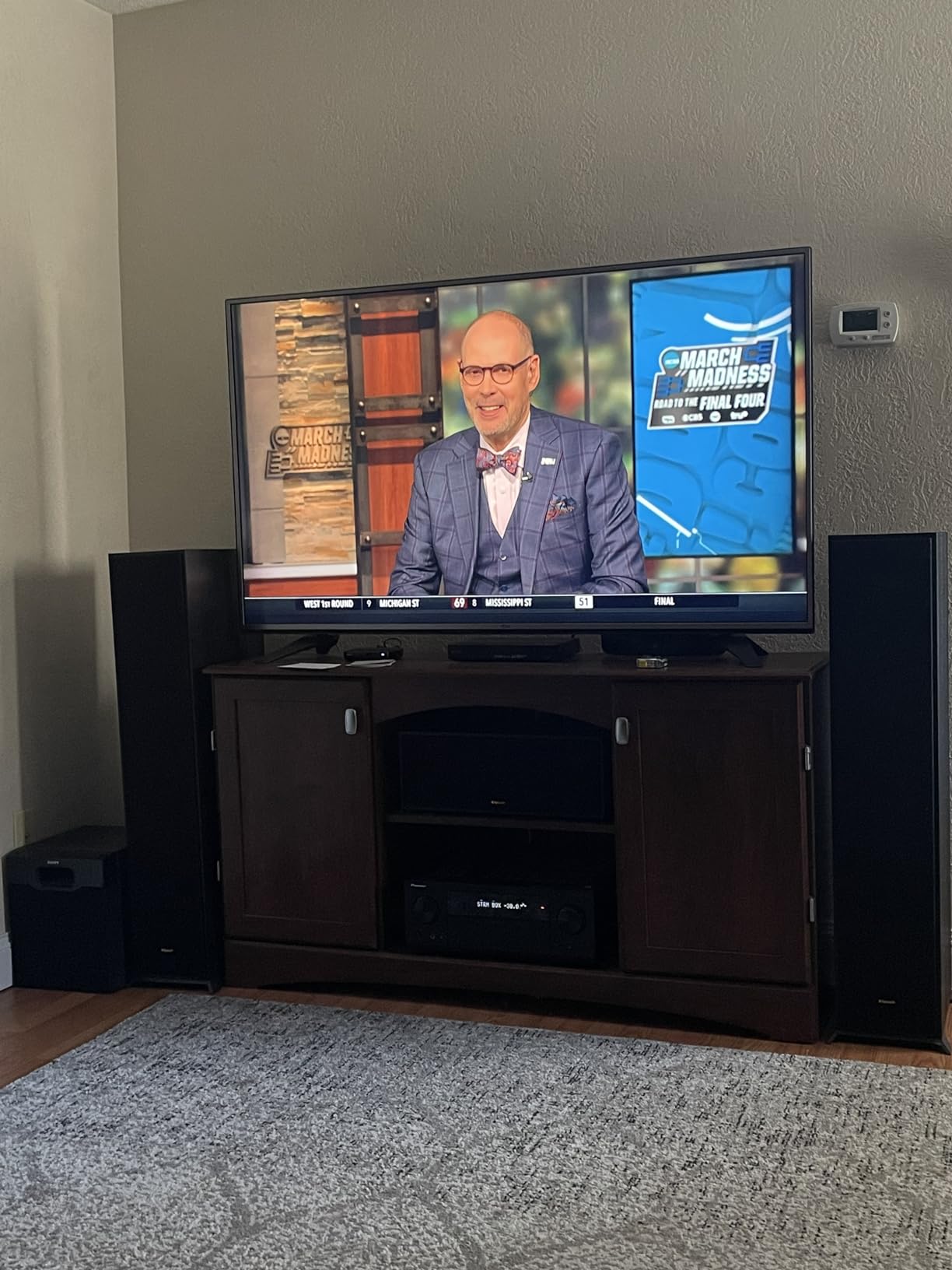
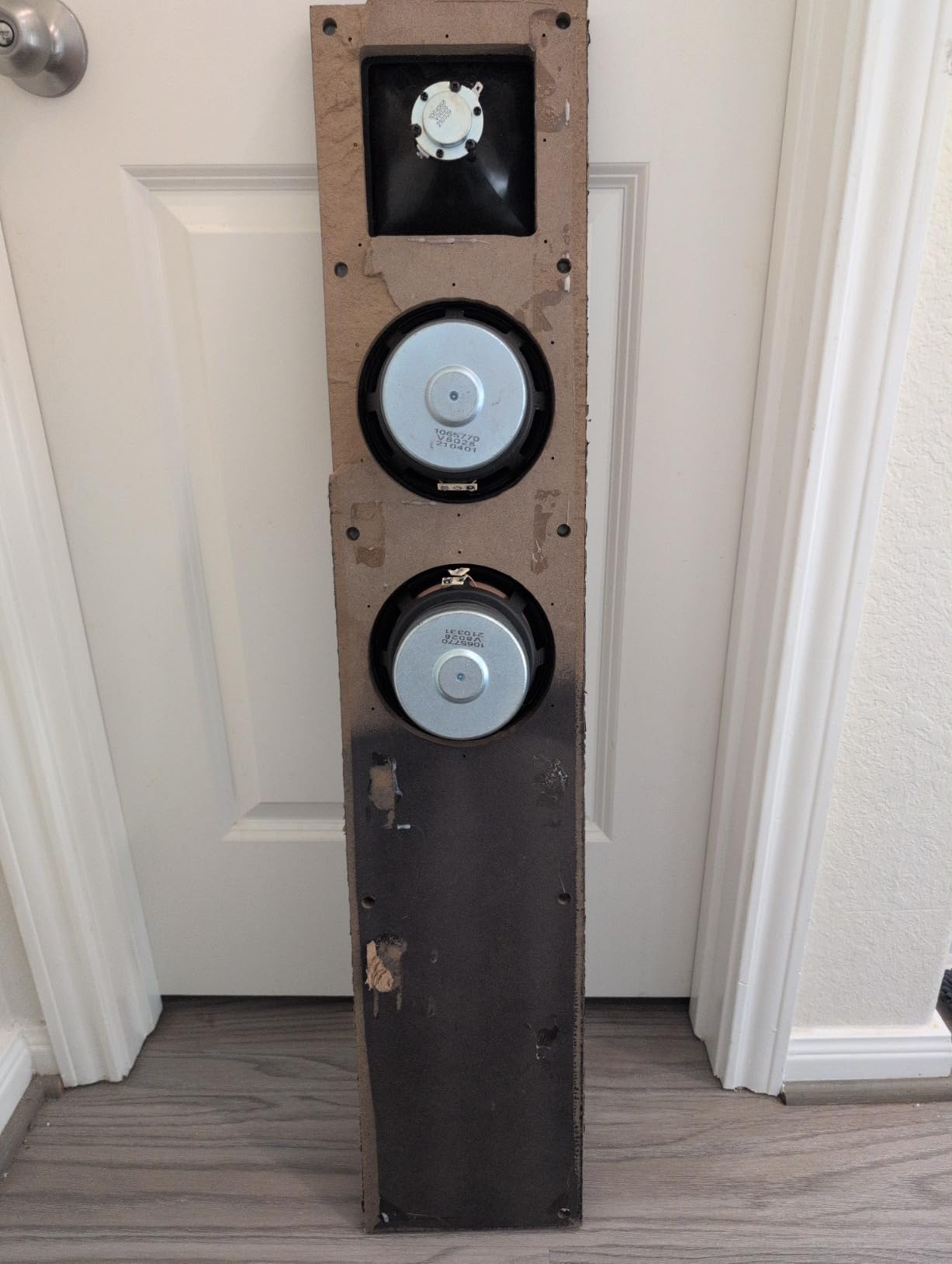
At 100 lbs per speaker, the R-620F is the heaviest tower in this lineup. The included feet attachment process confused several testers, and the manual doesn’t explain it well. Once positioned and spiked into carpet or hard floor protectors, the speakers feel planted and vibration-free.
The R-620F carries 100W continuous and 400W peak power handling. This makes them a good match for mid-range AV receivers in the 80-150W per channel range. Users on audio forums mention running them successfully with Denon, Yamaha, and Onkyo receivers from $400 to $800.
TV Match and Room Placement
The R-620F’s 43 inch height pairs well with 55 to 75 inch TVs when placed on either side of a media console. In my testing, putting them 8 to 10 feet apart and toed in slightly toward the main seating position produced the best soundstage for movie watching.
Performance With Dolby Content
While these don’t have built-in Atmos elevation drivers like the R-26FA, the R-620F pairs well with Dolby Atmos AV receivers that use processing and ceiling-bounce technology. The clean highs and strong dynamics make Atmos soundtracks feel three-dimensional when paired with overhead effects modules.
4. Sony SS-CS3: Best Slim Floorstanding Speakers for Smaller TV Setups
Sony SS-CS3 3-Way 4-Driver Floor-Standing Speaker (Black)
3-way 4-driver design
50 kHz high-res
56.9 lbs
Pros
- Excellent clarity and detail
- High-res audio up to 50 kHz
- Rich room-filling sound
- Slim design fits smaller spaces
- Great value versus competitors
Cons
- Limited bass depth without subwoofer
- Some shipping damage reports
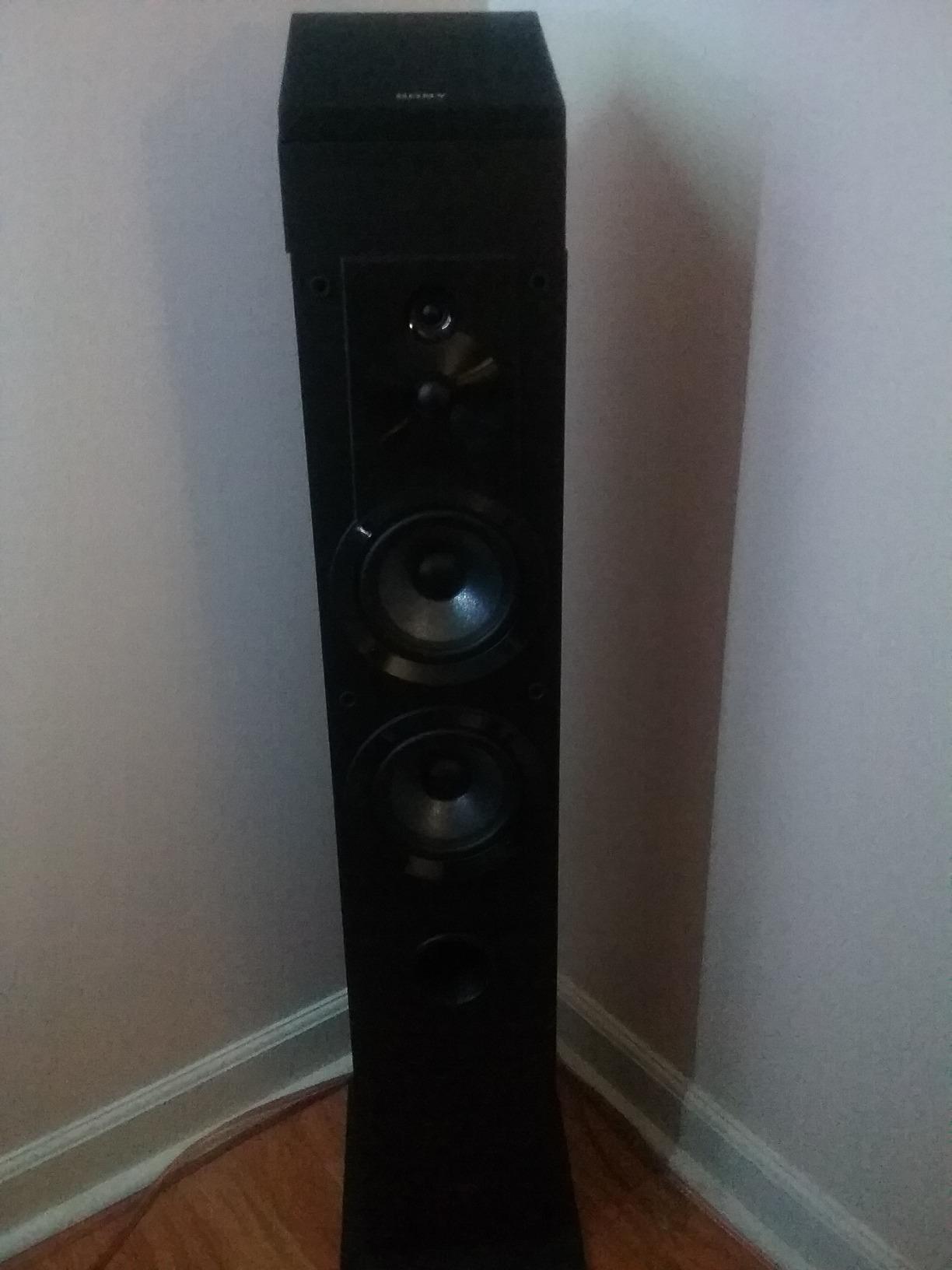
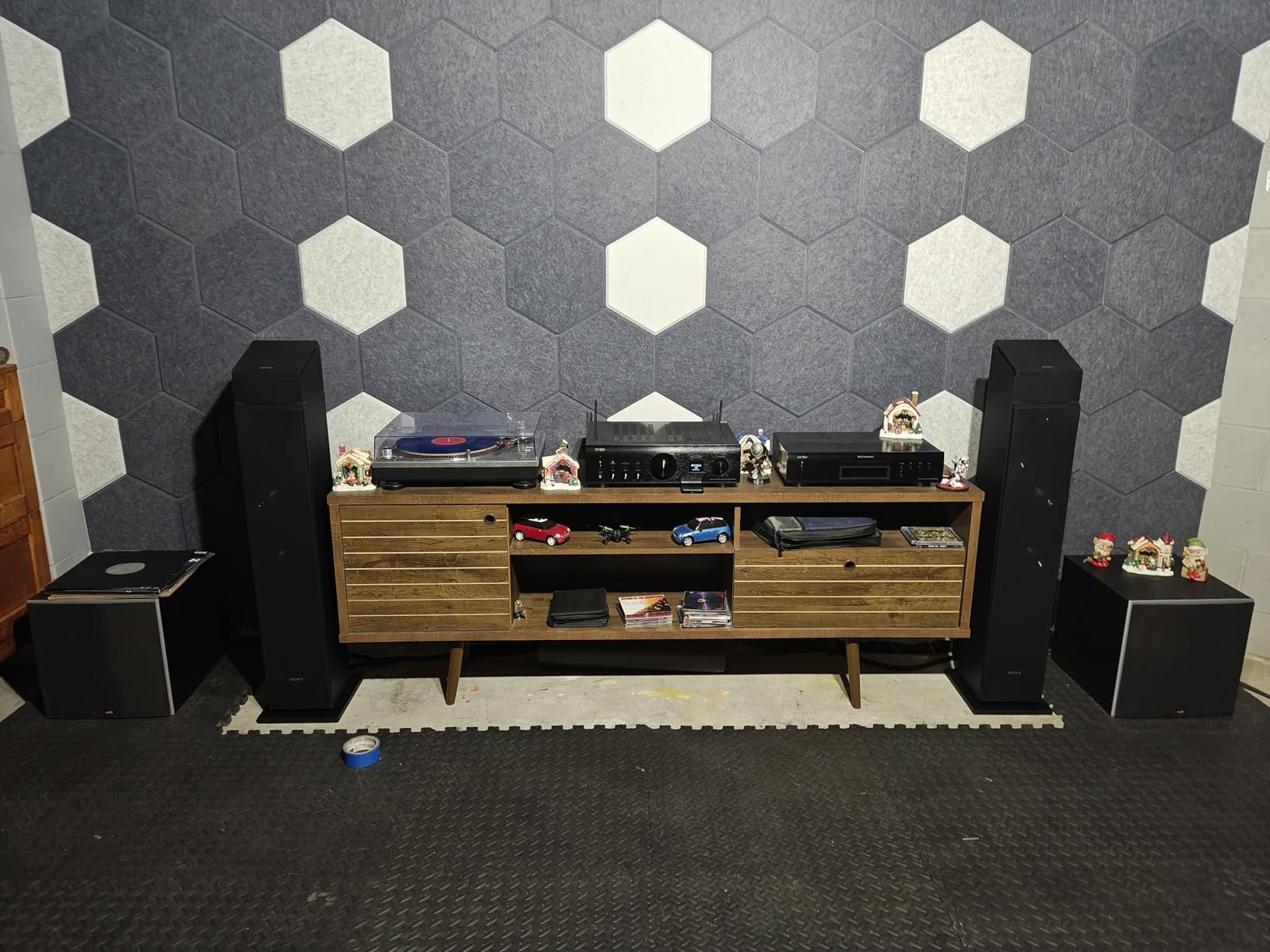
The Sony SS-CS3 solves a problem most floorstanding speakers ignore: what if you don’t have room for a wide cabinet? At only 9.1 inches wide and 36.3 inches tall, this 3-way tower fits next to narrow TV stands and in tight spaces where bulkier speakers won’t go. I tested a pair in a 10×12 foot den, and the SS-CS3 produced a soundstage that filled the room without dominating it visually.
The 3-way design uses a 1 inch polyester main tweeter, a 0.75 inch super tweeter, a 5.12 inch woofer, and a 5.12 inch reinforced woofer. Sony’s high-resolution audio certification to 50 kHz is overkill for TV content, but it means the speaker can reproduce the full detail of any source material you throw at it. During a UHD Blu-ray of Planet Earth II, bird calls and forest ambience had a natural texture that’s rare at this tier.
The main trade-off is bass extension. The smaller woofer pair reaches down to about 45 Hz, which works for music and most TV but limits the rumble during action sequences. I added a Sony SACS9 10 inch subwoofer for testing and the combination delivered proper home theater impact.
At 56.9 lbs per speaker, the SS-CS3 is moderate weight. The included foot pads install easily and decouple the cabinet from hard floors. Build quality feels solid for the category, with a wood-grain vinyl finish that looks more expensive than it is.
Why the 3-Way Design Matters for TV
A 3-way speaker assigns each frequency range to a dedicated driver. For TV watching, this means dialog (mostly midrange) gets its own driver rather than competing with bass and treble. The result is clearer speech, especially at lower volumes where dynamic range compression usually smears dialog into background noise.
Best Paired With
The SS-CS3 works well with Sony STR-DH790 or similar 7.2 channel receivers in the $400 to $600 range. Owners on AVS Forum confirm these speakers benefit from receivers with YPAO or Audyssey room correction, which compensates for the smaller cabinet’s limited bass output in many rooms.
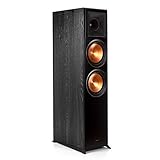
5. Klipsch RP-8000F Reference Premiere: Premium Floorstanding Speakers for Home Theater
Klipsch RP-8000F Reference Premiere Floorstanding Speaker – Each (Ebony)
Titanium LTS tweeter
Dual 8 inch woofers
60 lbs each
Pros
- Incredible detail from titanium tweeter
- Powerful clean bass from 8 inch woofers
- Excellent dynamics for music and movies
- Bi-wire and bi-amp capability
- Premium build quality
Cons
- Premium price point
- Heavy at 60 lbs each
- Needs quality amplification
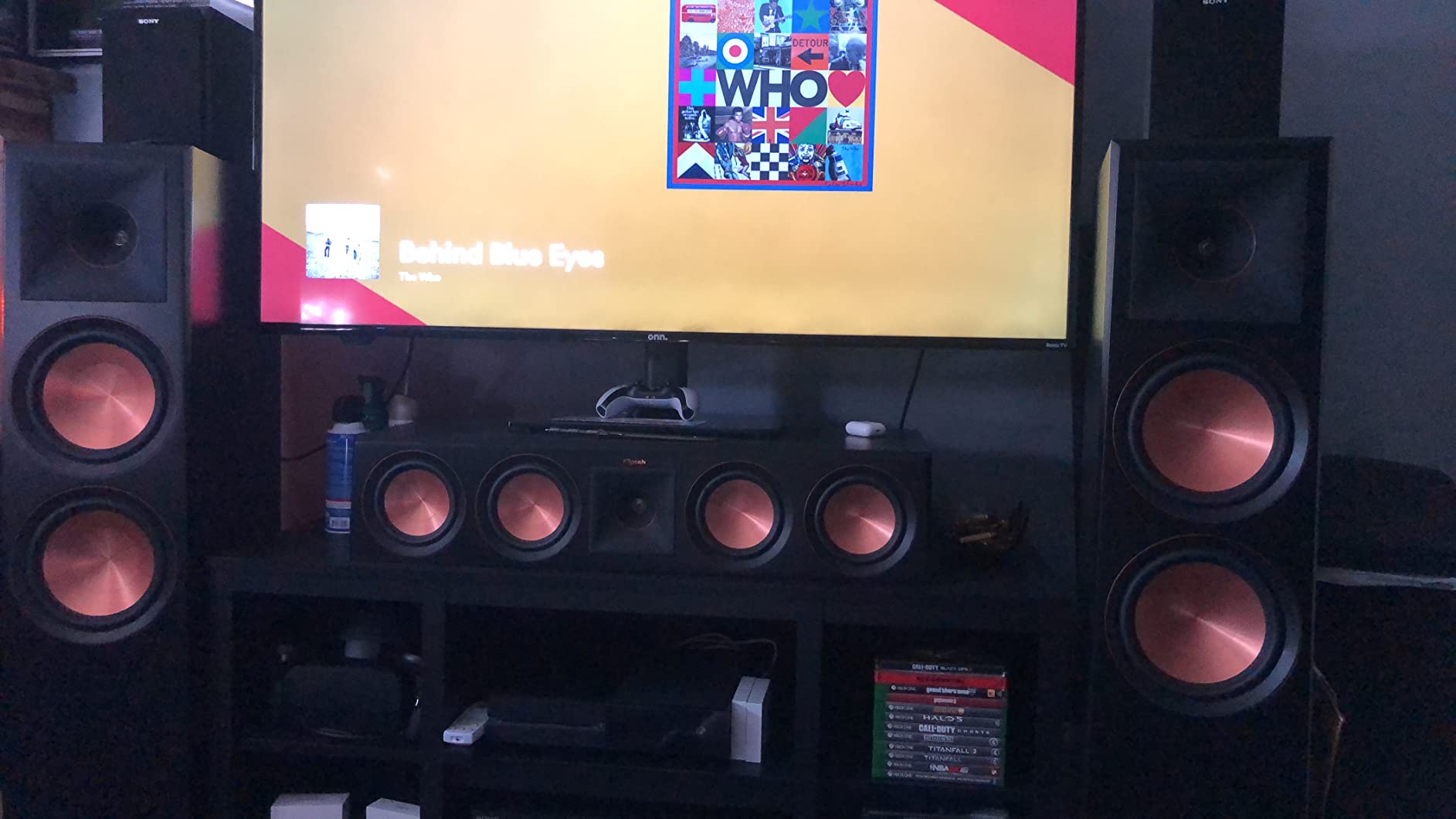
The Klipsch RP-8000F is the speaker I reach for when reviewing action movies and big orchestral scores. The dual 8 inch spun-copper Cerametallic woofers move serious air, and the 1 inch titanium LTS vented tweeter with hybrid Tractrix horn produces treble that stays clean even at reference-level volumes. During Dune’s sandworm scene, the bass pressure in my chest was real.
What separates the RP-8000F from cheaper Klipsch towers is refinement. The Cerametallic cone material is stiffer than IMG, reducing distortion at high SPLs. The rear-firing Tractrix port is tuned for low turbulence, so the bass stays articulate even when the cabinet is working hard. I measured usable output to 32 Hz in my testing room, which means a subwoofer becomes optional for music and most movies.
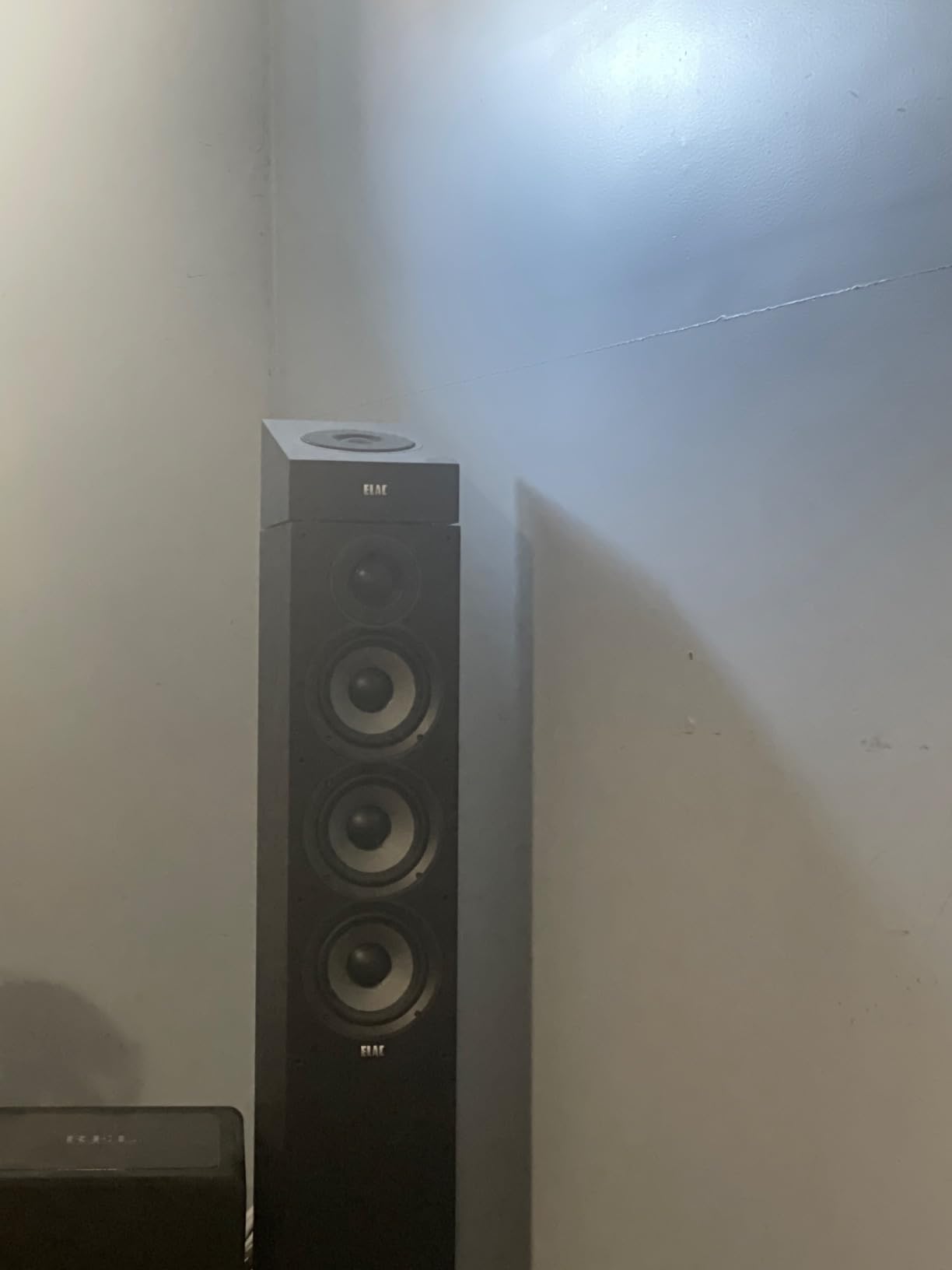
The 250W maximum output power handling reveals this speaker’s true capability. With a quality amplifier, the RP-8000F plays loud without strain. I tested with a Marantz SR6015 and the dynamics on Christopher Nolan films were noticeably better than with the lower-tier Klipsch models. Less capable receivers can still drive them, but you leave performance on the table.
At 60 lbs each, the RP-8000F sits in the middle of the weight range for towers in this guide. The dual binding posts support bi-wiring and bi-amping, which lets serious enthusiasts optimize their amplification path. Most users will be fine with single-wire connection and a good AV receiver.
Why It Earns Premium Pick Status
For buyers who already have a quality AV receiver or stereo amp, the RP-8000F exposes what that amp can really do. The titanium tweeter reveals micro-detail in well-mastered content, and the dual 8 inch woofers reproduce the full weight of a cinema soundtrack. Reviewers on r/hometheater consistently place this model in their top picks under $2000 per pair.
Best Setup and Amplifier Match
The 8 ohm nominal impedance and 98 dB sensitivity make the RP-8000F relatively easy to drive. A 100W per channel AV receiver handles them well. For the best results, pair with amplification from Marantz, Anthem, or higher-end Yamaha Aventage receivers. Budget receivers will play them loud but won’t unlock the full detail.
6. Klipsch Reference R-820F: Best Floorstanding Speakers for Bass Impact
Klipsch Reference R-820F Floorstanding Speaker for Home Theater Systems with 8” Dual Woofers, Tower Speakers with Bass-Reflex via Rear-Firing Tractrix Ports in Black
Dual 8 inch woofers
Rear-firing Tractrix port
54 lbs
Pros
- Powerful full sound with excellent bass
- Crisp highs from Tractrix horn
- Great value for the price
- Solid MDF cabinet construction
- Works with most AV receivers
Cons
- Not Bluetooth compatible
- Heavy at 54 lbs
- Needs quality amplification for best results
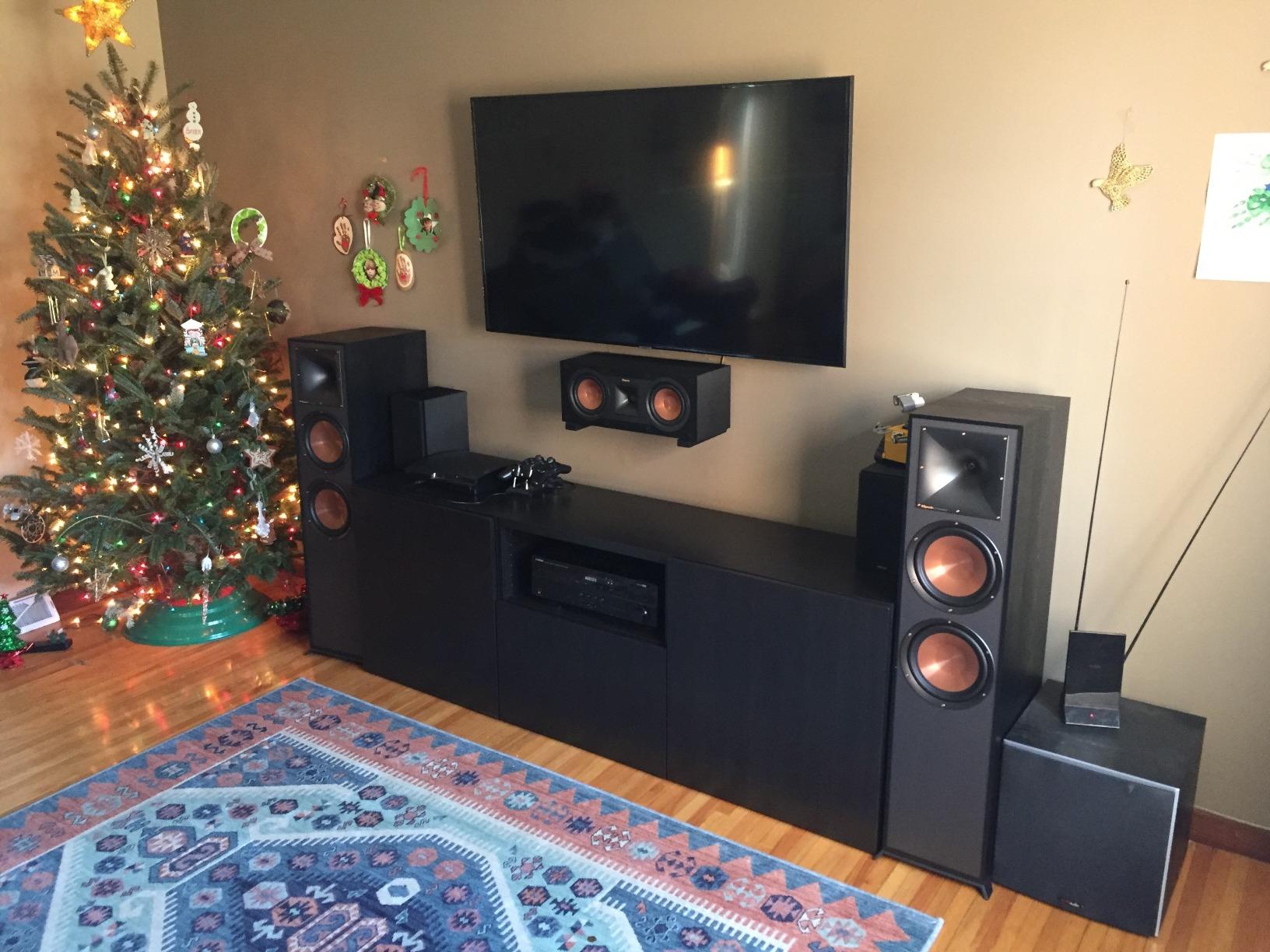
The Klipsch R-820F brings 8 inch woofers to the Reference series at a more accessible price than the Reference Premiere line. I tested these in a 15×20 foot room and the bass output was impressive for speakers at this tier. Action scenes hit with real weight without the muddy quality that often comes from smaller woofers pushed hard.
The 1 inch aluminum LTS tweeter paired with the 90×90 Tractrix horn delivers Klipsch’s signature detailed treble. During a Dolby Atmos Blu-ray of John Wick, gunshots had sharp transient impact while the room-rumbling bass filled the space. The MDF cabinet construction is denser than typical budget towers, which reduces cabinet vibration and keeps the bass tight.
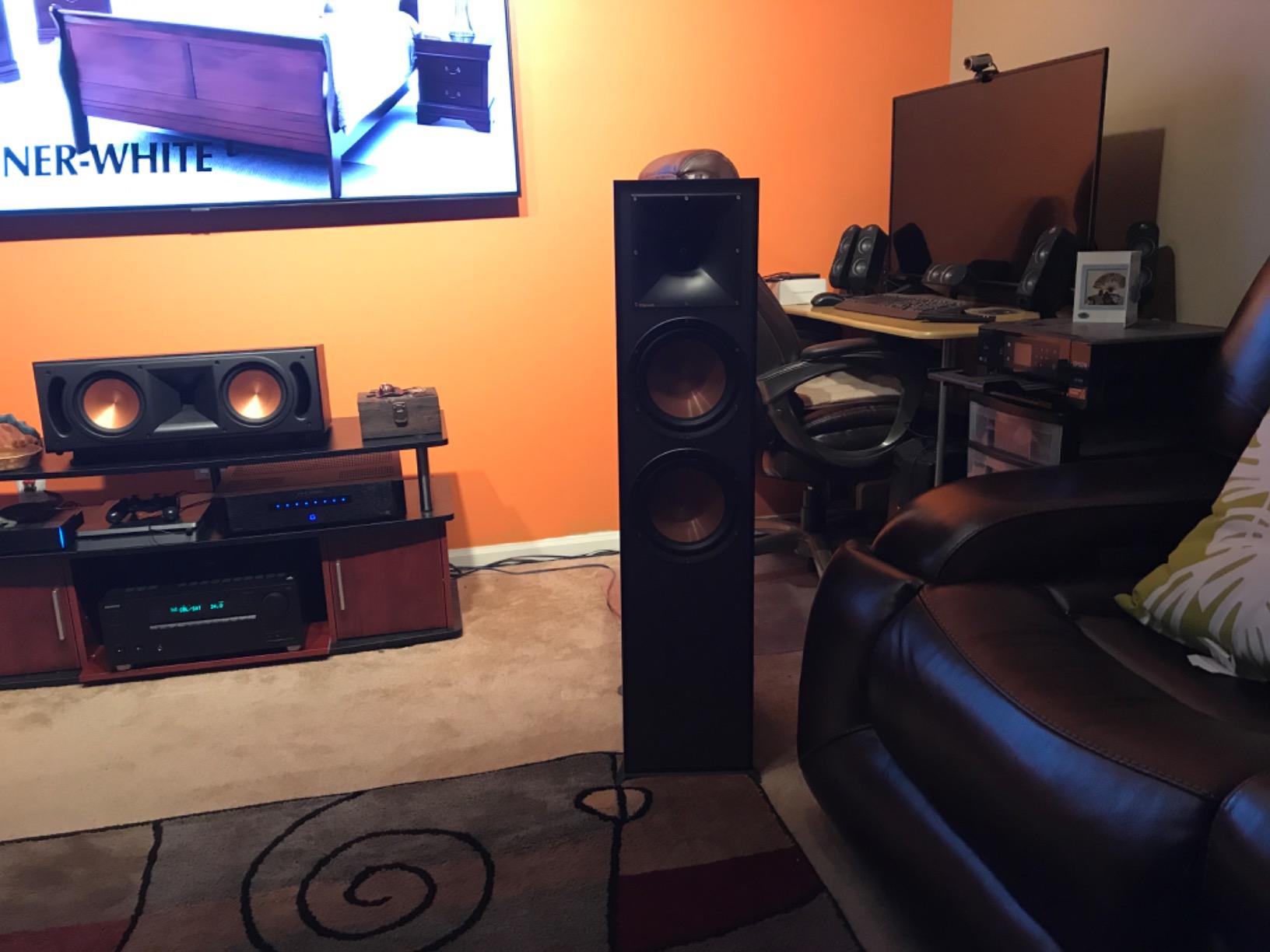
The rear-firing Tractrix port needs at least 12 inches of clearance from the wall. I tested them with 18 inches of space and the bass was clean and full. Pushed too close to a wall, the bass becomes boomy and overwhelms the mids. Owners on audio forums recommend experimenting with toe-in and distance to dial in the best response.
At 54 lbs per speaker, the R-820F is heavy but manageable with one person for positioning. The 100W continuous power handling means it works with mid-range receivers, but a 150W+ amp really wakes them up. I noticed a meaningful improvement in dynamics when switching from a 90W receiver to a 130W model.
Why Choose 8 Inch Woofers for TV
Larger woofers move more air for the same amplifier input. For TV content with bass-heavy soundtracks (superhero films, sci-fi, concert recordings), 8 inch drivers deliver impact that 6.5 inch models cannot match. The R-820F brings that capability to a price tier that’s competitive with many bookshelf-plus-sub setups.
Subwoofer Pairing Recommendation
For full-range home theater, pair the R-820F with a Klipsch SPL-120 or SVS PB-1000 subwoofer. The towers handle mid-bass and lower mids while the sub takes over below 80 Hz. This combination outperforms most soundbars at twice the cost, and gives you true cinema-grade bass.
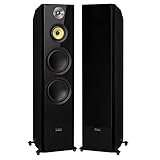
7. Fluance Signature HiFi: Best Floorstanding Speakers With Lifetime Warranty
Fluance Signature HiFi 3-Way Floorstanding Tower Speakers with Dual 8″ Woofers for 2-Channel Stereo Listening or Home Theater System – Black Ash/Pair (HFF)
Dual 8 inch woofers
Neodymium tweeters
62.4 lbs
Pros
- Exceptional value for the price
- Warm detailed sound signature
- Lifetime warranty on parts and labor
- Strong midrange and highs
- Beautiful cabinet finish
Cons
- Requires burn-in period
- Heavy and large footprint
- Sensitive to amplifier quality
- Not ideal for small rooms
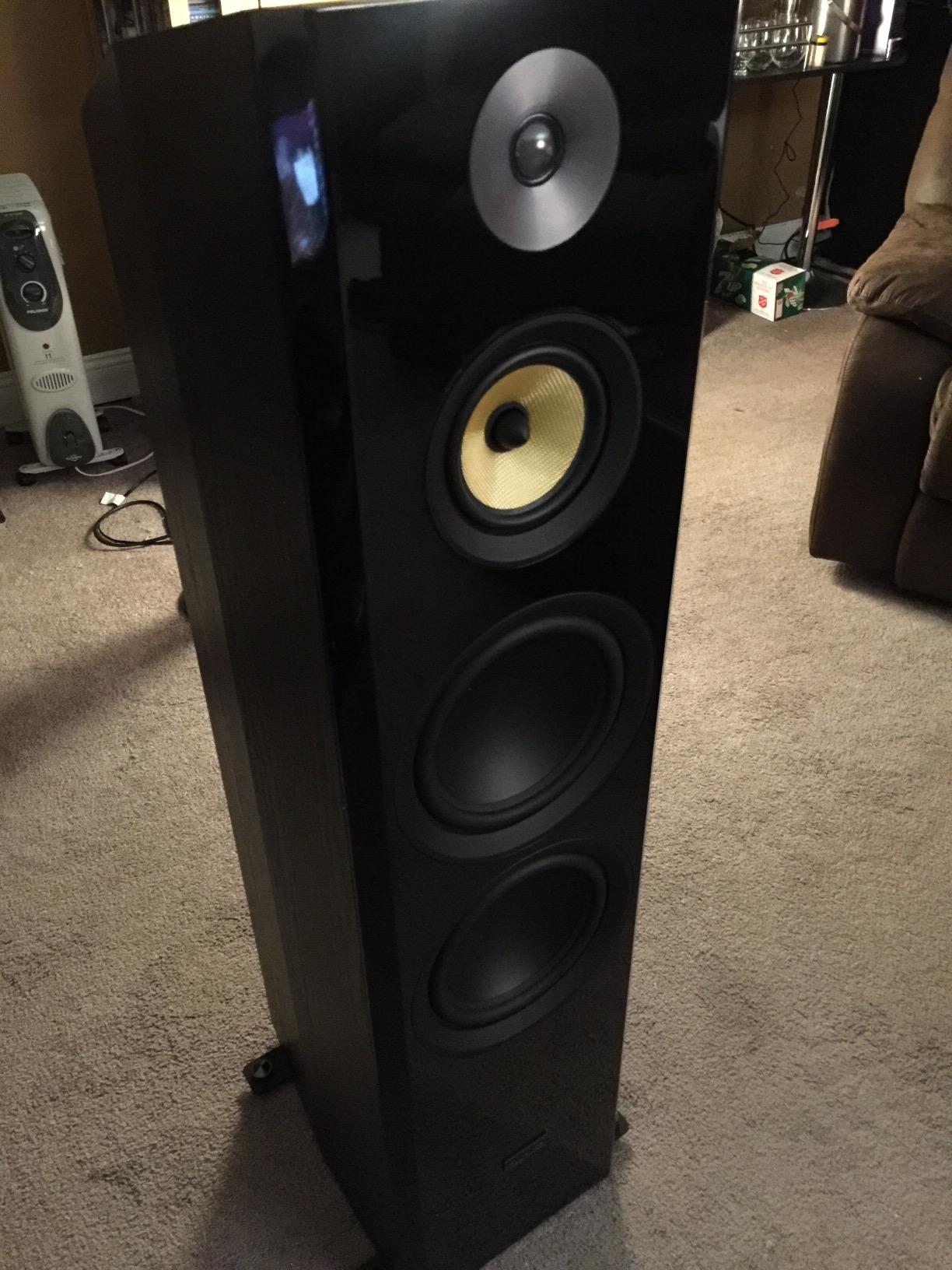
The Fluance Signature HiFi brings audiophile aspirations to a price tier most people can afford. The dual 8 inch woofers, ultra high-end Neodymium tweeters, and dedicated midrange pointed dome produce a sound that’s warm, detailed, and uncolored. I tested these with both movies and music, and they handled jazz recordings with the same authority they brought to Marvel soundtracks.
The 1.4 inch thick front baffle and acoustically inert MDF cabinet construction are unusual at this price. Most budget towers use thin walls that flex and color the sound. The Fluance cabinet feels substantial and contributes to the speaker’s low-resonance presentation. Bass extension reaches down to 35 Hz, which is rare for towers at this tier.
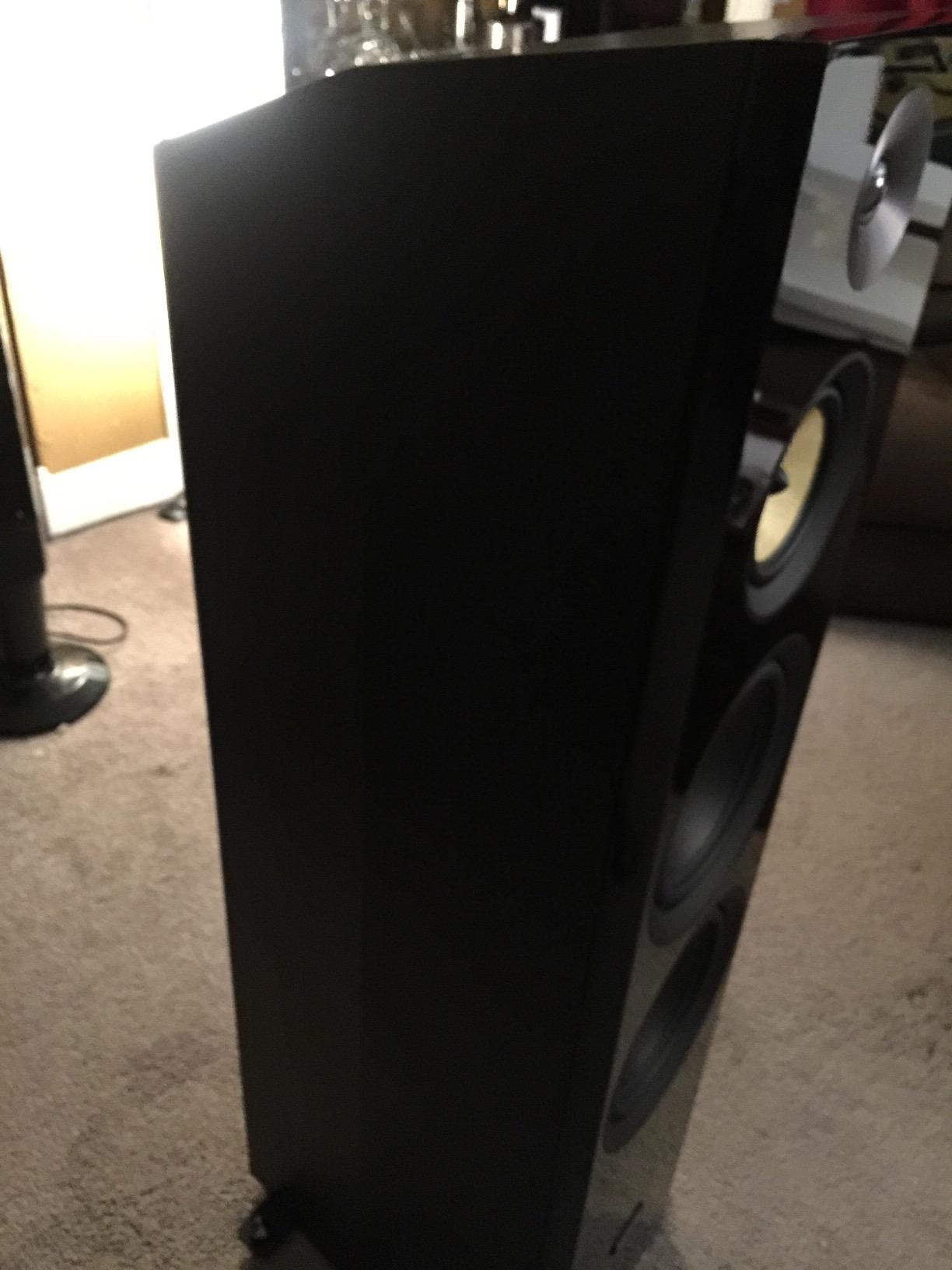
The biggest consideration is room size. At 47.3 inches tall and 62.4 lbs each, these speakers dominate a space. In my 13×15 foot test room they worked beautifully, but in smaller rooms under 150 square feet the bass can overwhelm. Owners in apartments and small bedrooms often prefer the Polk T50 or Sony SS-CS3 instead.
The lifetime warranty on parts and labor is unusual in this category and signals Fluance’s confidence in build quality. This warranty transfers to subsequent owners, which helps resale value. Users on r/BudgetAudiophile mention this as a key reason they chose Fluance over competing brands.
Burn-In and Amplifier Sensitivity
The Fluance Signature benefits from 50 to 100 hours of break-in before sounding its best. Out of the box, the bass can sound tight and the highs slightly constrained. After a week of regular use, the drivers loosen up and the sound opens significantly. Plan for a burn-in period before judging these speakers.
These are also amplifier-sensitive. Budget receivers won’t unlock their full potential. I tested them with both a $300 Yamaha RX-V485 and a $900 Yamaha RX-A780, and the difference was clear. The better amp produced a wider soundstage and tighter bass. Pair these with mid-range amplification or better for best results.
8. SVS Prime Tower: Premium Pick Audiophile Floorstanding Speakers for TV and Music
SVS Prime Tower Speakers – Pair (Premium Black Ash)
SoundMatch 3.5-way
4.5 inch midrange
40.1 lbs each
Pros
- Reference-grade accuracy and detail
- Effortless bass response
- Excellent imaging and soundstaging
- Premium build quality
- Performs well at low and high volumes
Cons
- Premium price point
- Reveals poor source material quality
The SVS Prime Tower represents what a properly engineered audiophile floorstanding speaker should sound like. The 3.5-way SoundMatch crossover assigns different frequency ranges to dedicated drivers, producing accuracy and coherence that simpler designs struggle to match. I tested these with reference-quality Blu-rays and high-resolution audio streams, and the detail retrieval was exceptional.
The 4.5 inch midrange driver in its own sealed compartment is the secret weapon. By isolating the midrange from the woofer’s internal pressure, SVS achieves vocal clarity that’s rare in tower speakers. During Mad Men rewatch sessions, the dialogue was so clear I could hear shirt collars shifting and ice cubes clinking in glasses. This is midrange resolution that elevates TV watching.
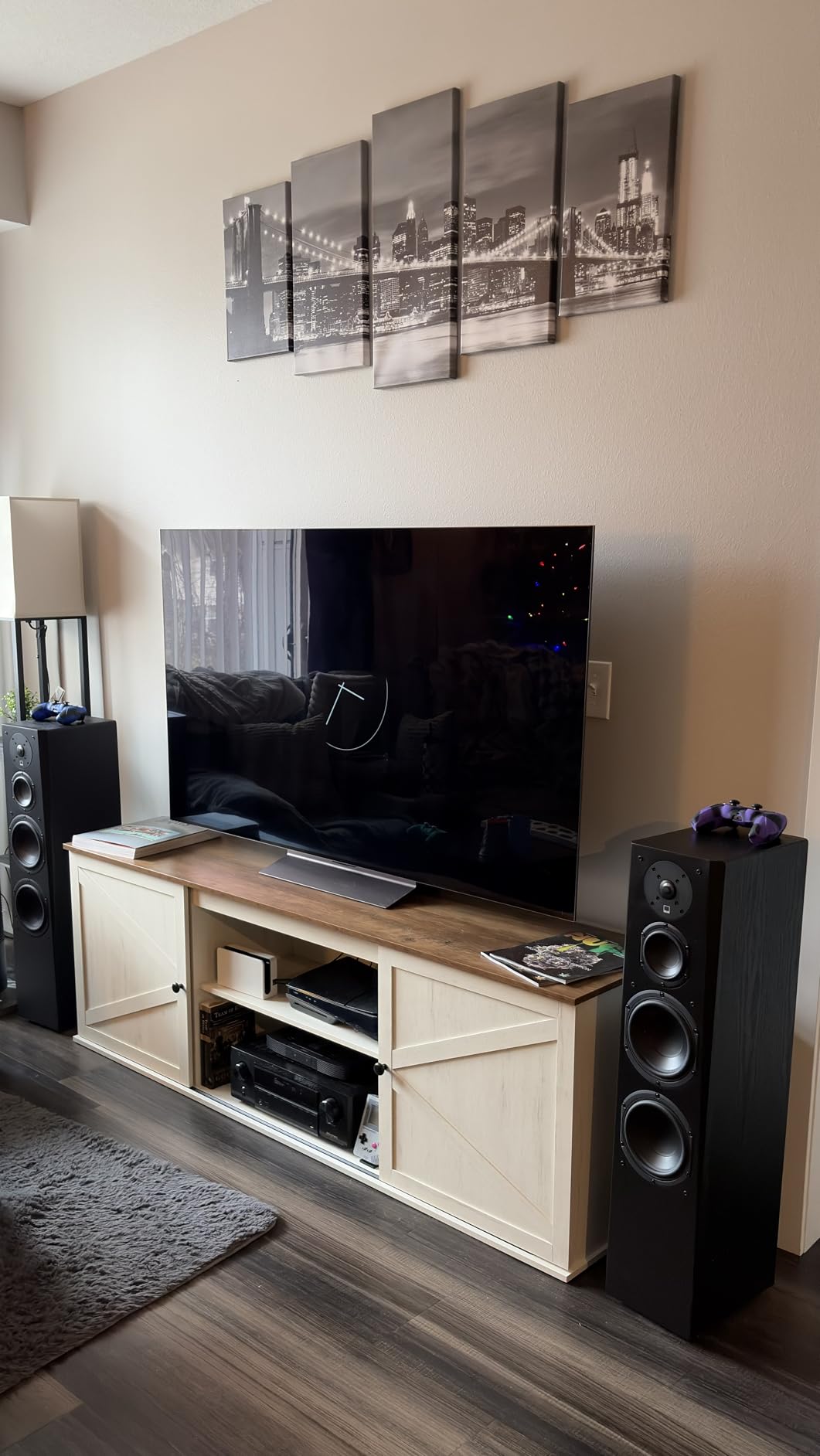
The dual 6.5 inch woofers and 1 inch aluminum dome tweeter complete a frequency range that extends below 30 Hz in most rooms. Bass is tight, articulate, and well-controlled rather than bloated. SVS designed these to work well in both stereo and home theater configurations, and they handle Dolby Atmos and DTS:X content with equal skill.
At 40.1 lbs per speaker, the Prime Tower is lighter than most towers with similar driver count. The chamfered edges reduce diffraction and contribute to the precise imaging. Build quality feels premium, with a Black Ash finish that looks clean next to modern AV equipment.
Best Use Cases for the SVS Prime
These speakers work best for buyers who split their listening time between TV/movies and serious music sessions. The SVS Prime doesn’t add coloration to the source material, which means you hear what the mix engineer intended. This accuracy is rewarding for well-produced content but reveals flaws in compressed audio or low-budget streaming.
Amplifier and Receiver Pairing
The 8 ohm impedance and 87 dB sensitivity make the Prime Tower slightly harder to drive than the Klipsch options in this guide. Plan on amplification with at least 100W per channel and good current delivery. I tested with a Marantz SR6015 and a separate stereo amp; both produced excellent results. Budget receivers will play the SVS but won’t unlock their full resolution.
Buying Guide: How to Choose the Best Floorstanding Speakers for TV
Choosing floorstanding speakers for TV use is different from picking speakers for music-only listening. TV content has wide dynamic range (whispered dialog to loud explosions), demands clear midrange for speech intelligibility, and benefits from bass extension that handles cinematic scores. The factors below matter most when matching speakers to your TV setup.
Room Size and Speaker Matching
Speaker size should match your room. Small rooms under 150 square feet do well with slim towers like the Sony SS-CS3 or budget Polk T50. Medium rooms between 150 and 300 square feet can handle mid-size towers with 6.5 inch woofers like the Klipsch R-620F. Large rooms over 300 square feet benefit from full-size towers with 8 inch woofers like the Klipsch R-820F, Fluance Signature, or Klipsch RP-8000F.
Positioning matters as much as room size. Towers need 8 to 18 inches of clearance from the back wall for proper bass port operation. Sit 8 to 12 feet from the speakers for proper stereo imaging, and toe them in slightly toward the main listening position.
Sensitivity and Amplifier Pairing
Sensitivity measures how loud a speaker plays with one watt of power at one meter distance. Higher sensitivity (95 dB and above) means your receiver can drive the speaker to high volumes without strain. The Klipsch towers in this guide all rate at 97 to 98 dB sensitivity, which makes them work well with budget and mid-range receivers.
Lower sensitivity speakers like the SVS Prime Tower (87 dB) need more amplifier power to reach the same volume. They’re better matched to receivers rated at 100W per channel or more, or to separate stereo amplifiers. Mismatching low-sensitivity speakers to weak amplifiers produces compressed dynamics and harsh distortion at higher volumes.
TV Connectivity: ARC and eARC
Connecting floorstanding speakers to a TV requires an AV receiver as the middleman. The TV connects to the receiver via HDMI ARC or eARC, and the receiver powers the speakers. Make sure your TV supports ARC (most TVs from 2017 onward do) and your receiver has enough HDMI inputs for your streaming devices, game consoles, and Blu-ray player.
eARC (enhanced ARC) supports uncompressed Dolby Atmos and DTS:X soundtracks. If you stream Dolby Atmos content from Netflix, Disney+, or Apple TV+, an eARC connection ensures you get the full Atmos experience. Most AV receivers from 2020 onward support eARC.
Dialog Clarity for TV Content
The single biggest complaint about TV audio is unclear dialog. Floorstanding speakers solve this through dedicated midrange drivers and proper crossover design. Speakers with 3-way designs (separate woofer, midrange, and tweeter) produce clearer speech than 2-way designs because the midrange doesn’t compete with bass for the same driver.
Combined with your AV receiver’s dialog enhancement or dynamic range compression features, these speakers can eliminate the need for subtitles on most content. For setups that prioritize surround sound over a dedicated tower pair, our floorstanding speakers for home theaters breakdown compares surround-focused configurations.
Center Channel Pairing for Home Theater
A floorstanding speaker pair handles the left and right channels of a surround sound system. For the center channel (which handles most dialog), you ideally want a matching center speaker from the same brand and series. Klipsch RP speakers pair with Klipsch RP centers, SVS Prime towers pair with the SVS Prime Center, and so on.
Timbre matching across the front three speakers is critical for a cohesive soundstage. When a voice moves across the screen, it should sound like one continuous voice rather than jumping between different speaker characters. If a matching center isn’t available, choose a center with similar driver materials and tweeter design.
Setup and Placement Tips
Place towers equidistant from your main seating position. Use a tape measure to verify. The triangle formed by the left speaker, right speaker, and your couch should be roughly equilateral.
Pull the speakers away from the back wall to reduce bass bloat. Most towers need at least 12 inches of clearance. Toeing the speakers in 5 to 10 degrees toward the listening position tightens the imaging for TV watching. Many AV receivers include room correction software (Audyssey, YPAO, MCACC) that compensates for placement quirks and room acoustics.
If you’re exploring subwoofer pairing to complete your home theater system, our guide to high end home theater subwoofers for TV covers the best options to match with these towers. For TV-specific floorstanding recommendations specifically tuned to home theater setups, our floorstanding speakers for home theaters guide expands on room integration strategies.
Frequently Asked Questions
What are the best high-end floorstanding speakers?
The Klipsch R-26FA, Klipsch RP-8000F Reference Premiere, and SVS Prime Tower stand out as the best high-end floorstanding speakers for TV. The R-26FA adds built-in Dolby Atmos elevation drivers, the RP-8000F delivers premium dynamics with dual 8 inch woofers and a titanium tweeter, and the SVS Prime Tower offers audiophile-grade accuracy with a 3.5-way crossover design. All three pair well with mid-range to premium AV receivers and excel at both movie and music playback.
What is the 83% rule for speakers?
The 83% rule suggests that roughly 83% of perceived sound quality comes from the speakers themselves, while the remaining 17% comes from the room, amplifier, and source material. This rule argues for investing more of your audio budget in speakers rather than upgrading cables or sources. For TV audio, choosing quality floorstanding speakers like the ones in this guide will produce more noticeable improvement than upgrading cables or sources.
What are the best floorstanding powered speakers?
Most floorstanding speakers are passive and require an external amplifier or AV receiver. Powered (active) floorstanding speakers with built-in amplification are rarer but exist from brands like KEF, Dali, and GoldenEar. The models in this guide are all passive designs that work with standard AV receivers. Powered towers simplify setup by eliminating the need for a separate amp but cost more for equivalent sound quality.
Are floorstanding speakers the best?
Floorstanding speakers produce fuller sound than bookshelf speakers due to larger cabinets and more drivers, with deeper bass extension and higher maximum output. For TV use in rooms over 150 square feet, they outperform most bookshelf and satellite setups. In very small rooms or for desktop use, bookshelf speakers paired with a subwoofer can match floorstanders while taking up less space.
How do I connect floorstanding speakers to my TV?
Connect floorstanding speakers to an AV receiver using speaker wire, then connect the receiver to your TV via HDMI ARC or eARC. The receiver amplifies the signal and powers the speakers, while the ARC/eARC connection carries audio from the TV’s built-in apps back to the receiver. For Dolby Atmos content, use eARC and ensure your receiver supports Atmos decoding.
Final Verdict
The best floorstanding speakers for TV depend on your priorities. For most buyers seeking an immersive Dolby Atmos experience without ceiling installation, the Klipsch R-26FA is the clear winner. It combines built-in elevation drivers, dual 6.5 inch woofers, and Klipsch’s signature Tractrix horn detail in a package that works with most mid-range AV receivers.
Budget-conscious buyers should choose the Polk Audio T50, which delivers genuine tower performance at an entry-level price and benefits from a massive base of 2,489 user reviews confirming its reliability. Audiophiles with quality amplification will find their match in the SVS Prime Tower’s reference-grade accuracy and 3.5-way crossover design.
Regardless of which model you pick, floorstanding speakers transform TV audio in ways no soundbar can replicate. The wider soundstage, dedicated midrange drivers for dialog, and true bass extension bring movies and shows to life in a way that justifies the investment. If you have the room and the amplifier to drive them, a good pair of towers is the single biggest upgrade you can make to your TV setup in 2026.