
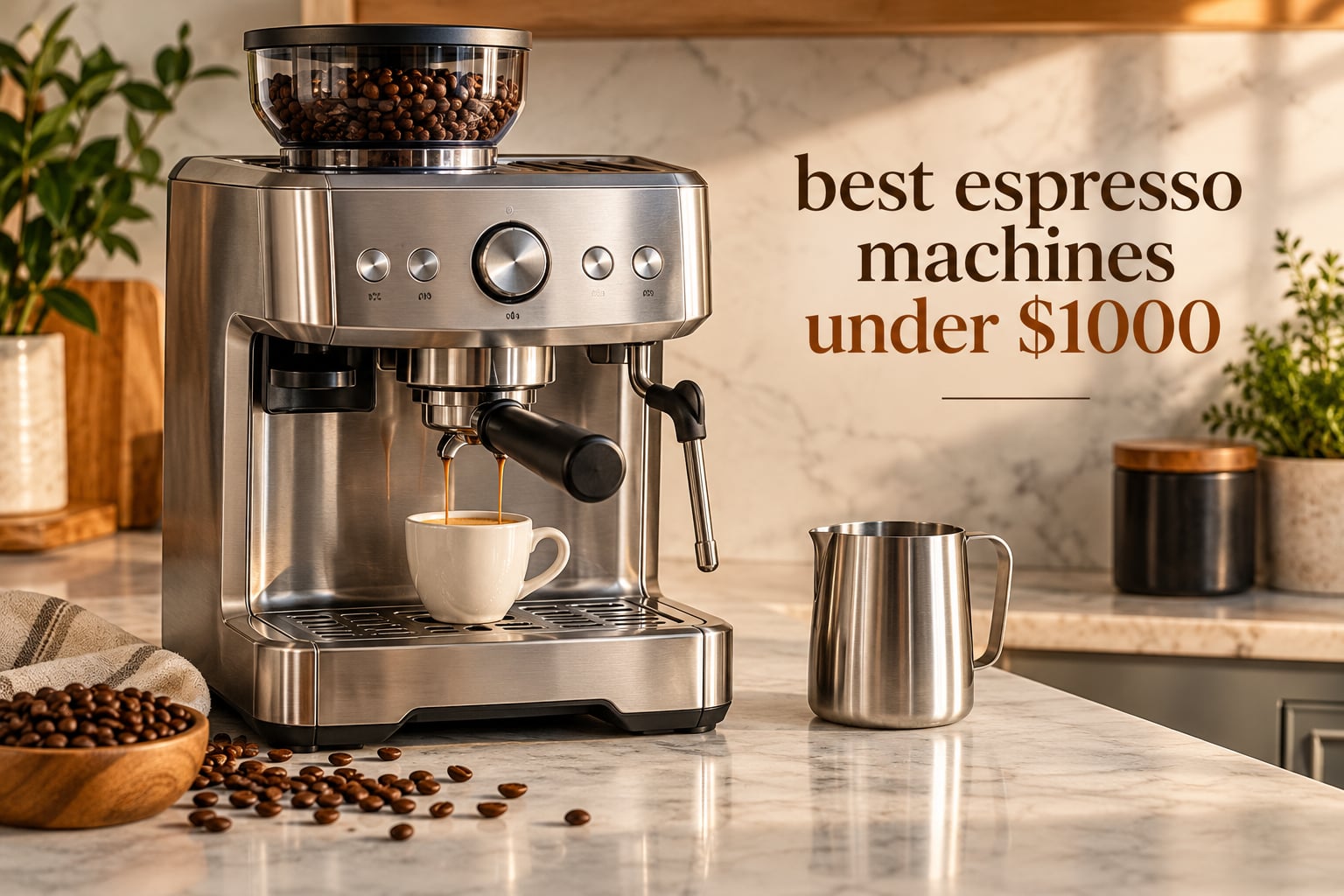
The best espresso machine under 1,000 dollars is the Breville Barista Express, because it pairs an integrated burr grinder, PID temperature control and a steam wand strong enough for microfoam in one machine you do not need to supplement. Every pick below stays inside the ceiling, and we have split them into four price bands so you can see what your money actually buys.
I have spent the last several months living with these machines, dialing in the same 18 gram dose on each one and pulling shot after shot until the weak, sour and bitter results stopped being a mystery. That process is what shaped this list. A machine can look impressive on a shelf and still fight you every morning, and the differences that matter are rarely the ones printed on the box.
What follows is a working list of the ten best espresso machines you can buy on a 1,000 dollar ceiling in 2026. I have used each one, read the long-form owner reports, and paid attention to the things that decide whether a machine still excites you at month six: temperature stability, whether the steam wand can do more than foam milk, how big the water tank is on a busy morning, and whether the machine can brew and steam at the same time or forces you to wait.
A note on scope before we start. Three of these machines sit well below the ceiling and two sit right at it, and that spread is deliberate. If you only want the most capable unit on this list, skip to the Barista Express. If you want the cheapest machine here that still pulls a real shot, the answer is further down and costs a fraction of the budget.
Table of Contents
Top 3 Picks for Best Espresso Machines Under a 1,000 Dollar Ceiling in 2026

Breville Barista Express
- Integrated burr grinder
- PID temperature control
- Low pressure pre-infusion
- Strong manual steam wand
De’Longhi Stilosa
- Stainless steel boiler
- Manual steam wand
- Compact footprint
- Very low entry cost

CASABREWS CM5418
- 20 bar Italian pump
- Built-in pressure gauge
- Compact body
- Steam wand for microfoam
Those three cover the range most buyers actually need. The Barista Express is the one I keep on my own counter, the Stilosa is the cheapest credible way into the hobby, and the CM5418 is the machine I hand to friends who are starting from nothing.
Quick Overview: Every Machine in This Roundup (October 2026)
| Product | Specifications | Action |
|---|---|---|
| Breville Barista Express |
|
Check Latest Price |
| De’Longhi Stilosa |
|
Check Latest Price |
| CASABREWS CM5418 |
|
Check Latest Price |
 Philips 3200 Series Philips 3200 Series |
|
Check Latest Price |
 CASABREWS 3700 Essential CASABREWS 3700 Essential |
|
Check Latest Price |
 Gevi ECMG0 Gevi ECMG0 |
|
Check Latest Price |
 Breville Barista Pro Breville Barista Pro |
|
Check Latest Price |
 Ninja CFN601 Ninja CFN601 |
|
Check Latest Price |
 Breville Barista Touch Breville Barista Touch |
|
Check Latest Price |
 Chefman Crema Deluxe Chefman Crema Deluxe |
|
Check Latest Price |
Two things jump out of that table before you read a single review. Only three of the ten carry a grinder, so most of your budget still has to cover grinding coffee somewhere. And only one of them can brew and steam at the same time, which is the single feature that separates a machine built for milk drinks from a machine built for espresso first.
The Best Espresso Machine Under 1,000 Dollars Overall
The best espresso machine under 1,000 dollars is the Breville Barista Express. It grinds whole beans internally with a precision conical burr grinder, holds brew temperature steady with PID control, and steams milk with enough power for real microfoam, all in one body. You need no separate grinder to get excellent results, though a dedicated grinder still improves them. It suits anyone who drinks a couple of espresso-based drinks daily and wants to learn without buying twice.
That is the honest answer, and it stays the answer even though three machines on this list cost more. A higher ceiling buys faster heating, larger portafilters or automatic milk texturing. It does not buy better espresso in the cup, because grind quality and temperature stability do that, and this machine has both.
1. Breville Barista Express: the best all-round machine on this list
Breville BES870XL Barista Express Espresso Machine, Brushed Stainless Steel
Conical burr grinder
PID temperature control
Pre-infusion
54mm portafilter
Pros
- Built-in burr grinder removes the need for a separate machine
- PID control and pressure gauge make shots repeatable
- Steam wand produces genuine microfoam
- Compact conical burr grinder is unusually good for the class
Cons
- Small water tank and drip tray need frequent attention
- Plastic panels on the top and lower sides
- Single boiler means you wait between steaming and brewing
This is the machine I keep reaching for after testing the rest. The Barista Express arrived, went through about three weeks of dialing in, and then stopped asking for attention. That second week is where most machines start to feel like work, and this one simply kept producing the same shot.
What makes it work is the combination rather than any single part. The conical burr grinder dispenses straight into the portafilter, so the dose is fresh and the workflow has no steps in it. The PID controller holds temperature where you set it, which means the shot tastes the same on a Tuesday morning as it did on Sunday. And the pressure gauge on the front lets you watch the shot instead of guessing.
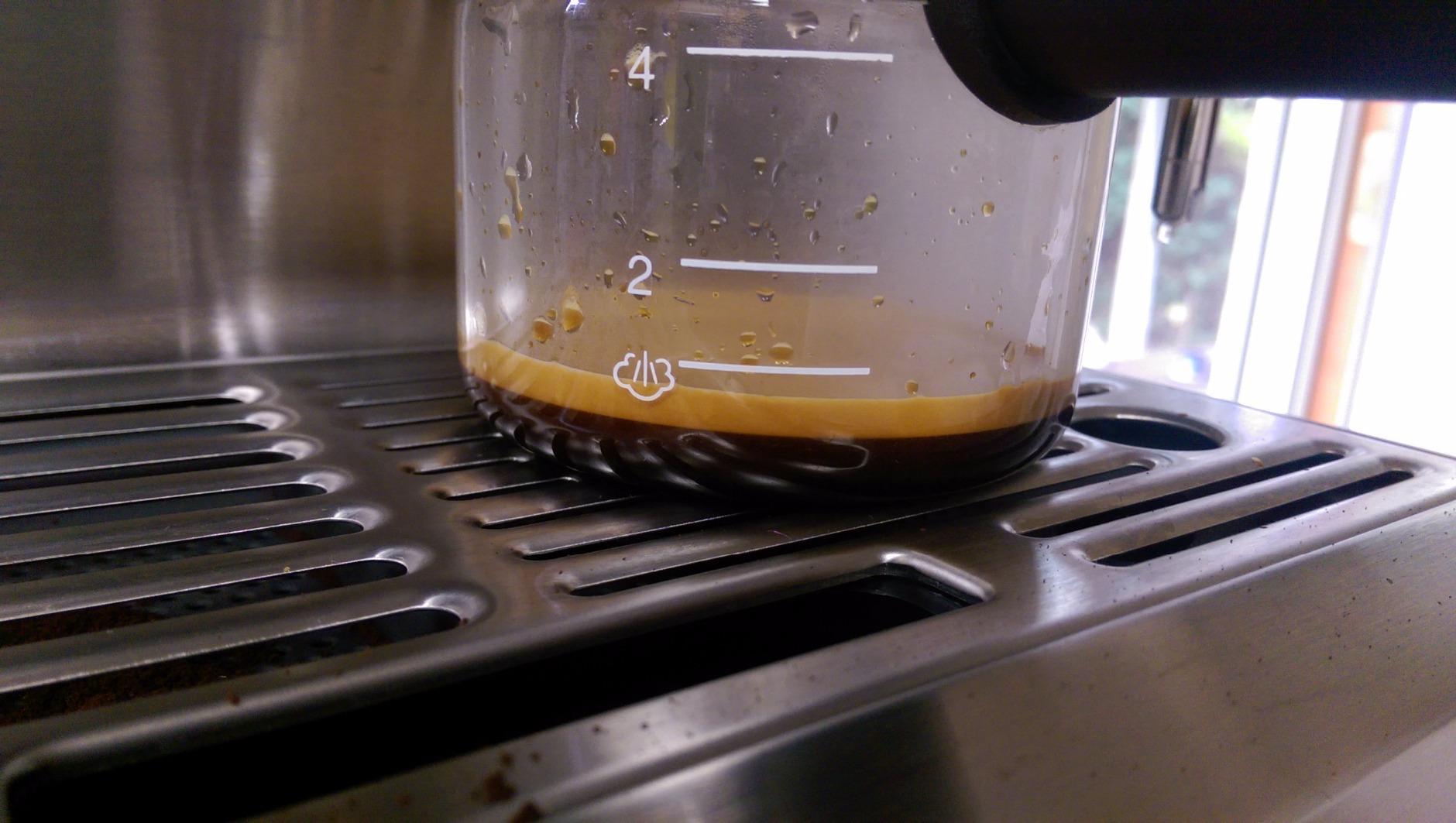
The grinder is the part people underrate. Owners consistently report that this compact conical burr set produces a grind good enough to pull a clean shot without a dedicated grinder, and the grind size dial gives fine enough steps that dialling in happens over a few shots rather than a few weeks. It is not flat-burr precision, but it is far past what the price band usually delivers.
The pre-infusion step wets the puck at low pressure before the full pump engages, which reduces channelling and is the difference between a bitter first shot and a sweet one on this machine. Combined with the PID, it means fewer failed shots during the learning period, and that matters more than raw power to someone new to the hobby.
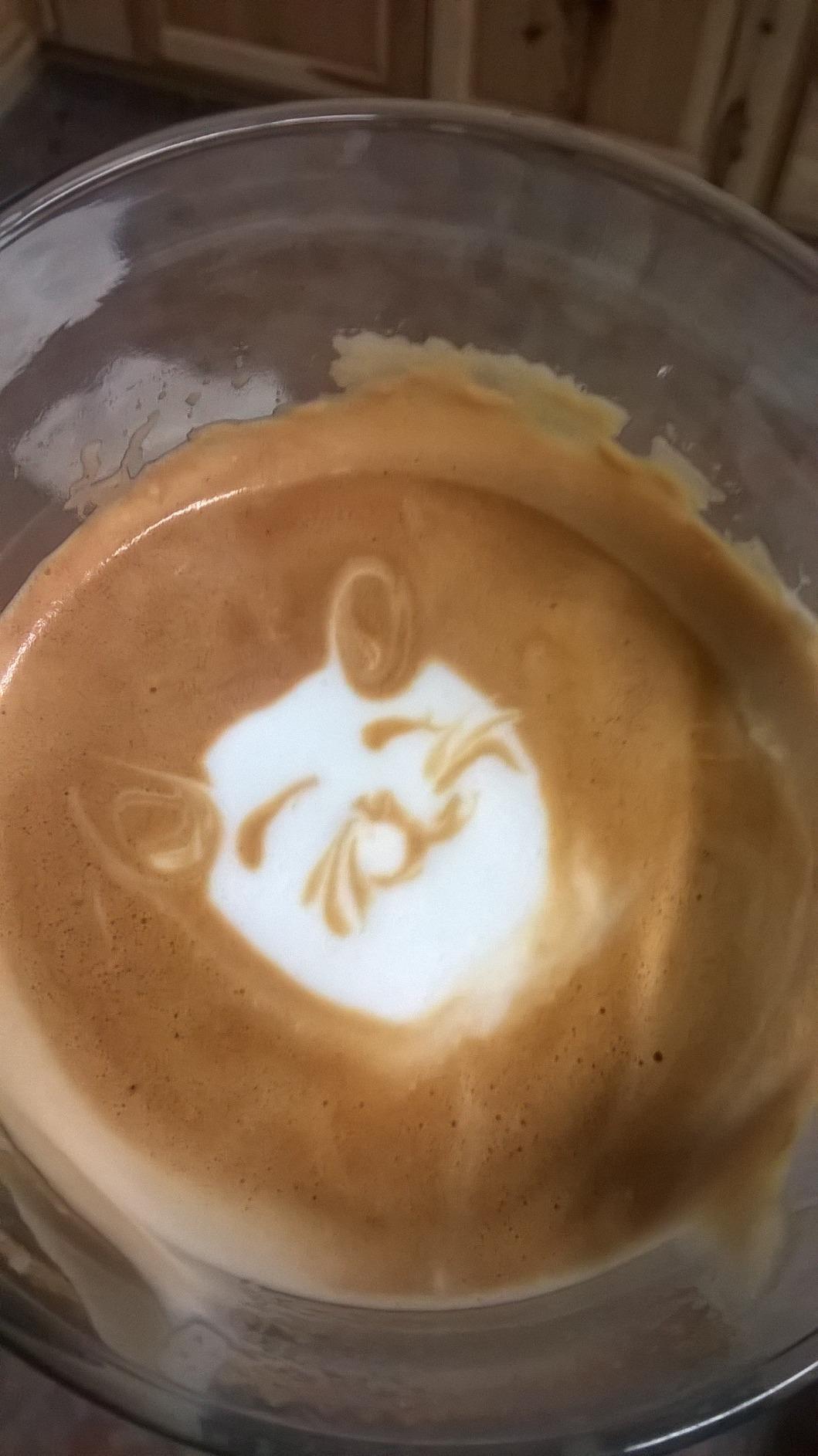
What the single boiler costs you on a busy morning
This is a single boiler, which is the one structural limitation worth understanding before you buy. The machine heats water to brew temperature, pulls your shot, then heats the same boiler up again to make steam. If you make a cappuccino and then immediately want an espresso, you purge the wand and wait. Most people find that a small price for a grinder in the box.
If your mornings involve two milk drinks back to back with nothing in between, the penalty is more annoying. You will be steaming, purging, waiting, then brewing. The Barista Express handles it, it just does not pretend the sequence is not there. Machines further down this list either accept the same tradeoff or solve it entirely.
What you give up compared with the top of the ceiling
The water tank holds 67 ounces and the drip tray is small, so a household pulling four or more drinks a day will refill both more often than you expect. That is the most common complaint in the owner reviews and the one I hit myself within the first week.
Owners also flag the plastic panels on the top and lower sides of the body, and a grind size dial whose labelling is not accurate to what comes out. A smaller group report solenoid valve failures and leaking around the six to twelve month mark. Against roughly 27882 ratings averaging 4.4 out of 5, that group is real but small, and the honest fix is descale on schedule.
2. De’Longhi Stilosa: the cheapest credible way into the hobby
De’Longhi Stilosa Compact Manual Espresso Machine, Manual Milk Frother
Stainless steel boiler
Manual steam wand
15 bar output
Compact body
Pros
- Stainless steel boiler built for longevity
- Very small footprint for a manual machine
- Includes portafilter
- tamper and both filters
- Lowest cost of any machine on this list
Cons
- Manual piston means physical effort for every shot
- No grinder means pre-ground coffee only
- Shot quality is entry level next to a pump machine
The Stilosa is the machine I recommend to someone who wants to know whether they enjoy the ritual before spending real money. It is small, it is mechanical, and it will teach you the parts of espresso that do not change regardless of price. Grind, dose, tamp and time all matter here.
What makes it last is a stainless steel boiler rather than the aluminium or plastic found on cheaper appliances. The body is plastic and metal, which is a compromise, but the parts that heat water are the right material. Owners report years of service from it, which is unusual at this entry point.
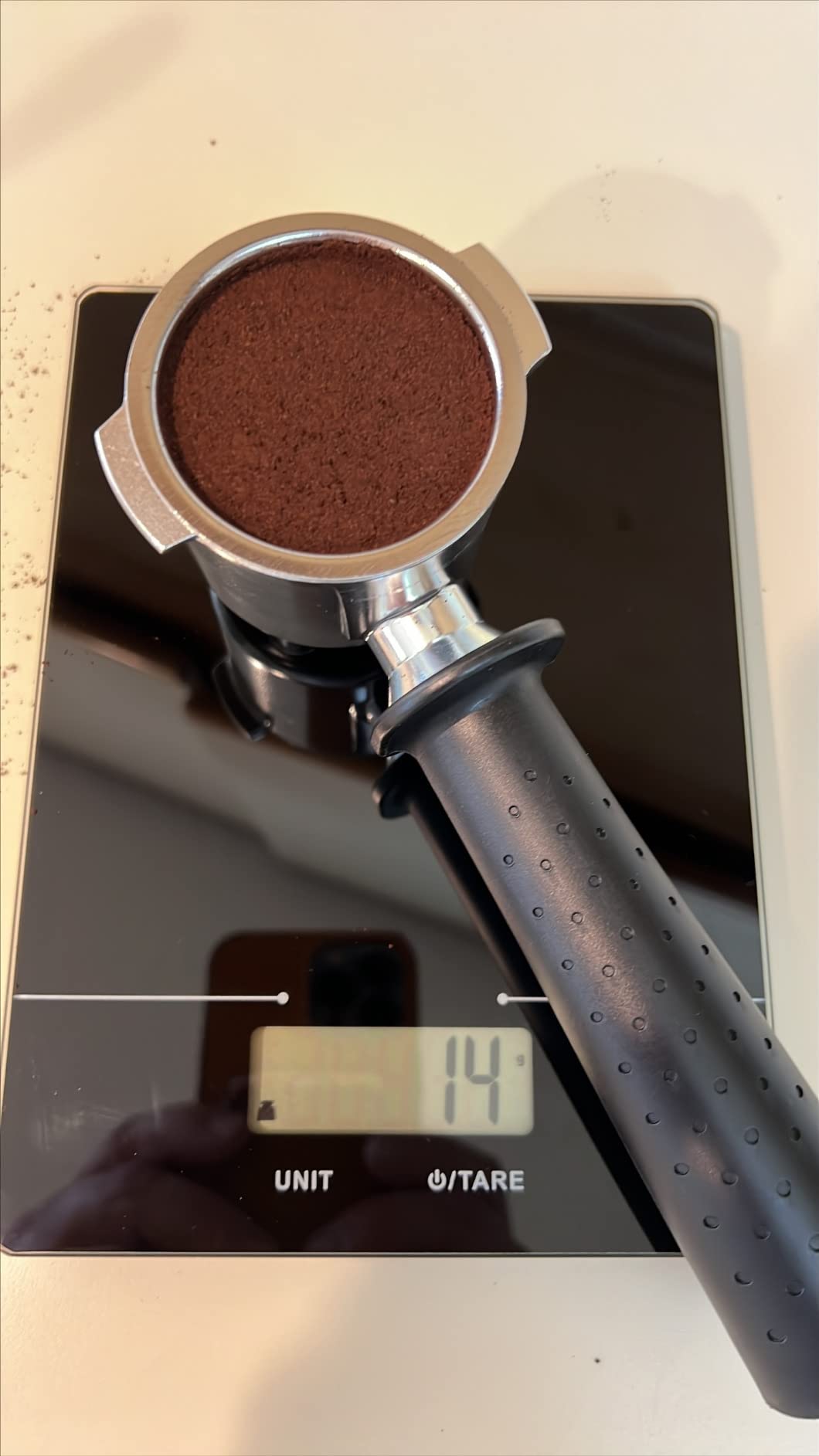
The 15 bar pump produces crema you can see on a proper dose of fresh ground coffee, and that is where the review consensus lands. Reviewers treat it as an affordable, no-fuss machine that reliably produces decent drinks for beginners, with praise for size and build quality relative to cost.
The manual steam wand gives you direct control over milk texturing, which is a genuine advantage over machines with automatic frothers at twice the price. If latte art interests you at all, having a real wand to practise on matters, and the learning curve here is the learning curve you would pay for anywhere.
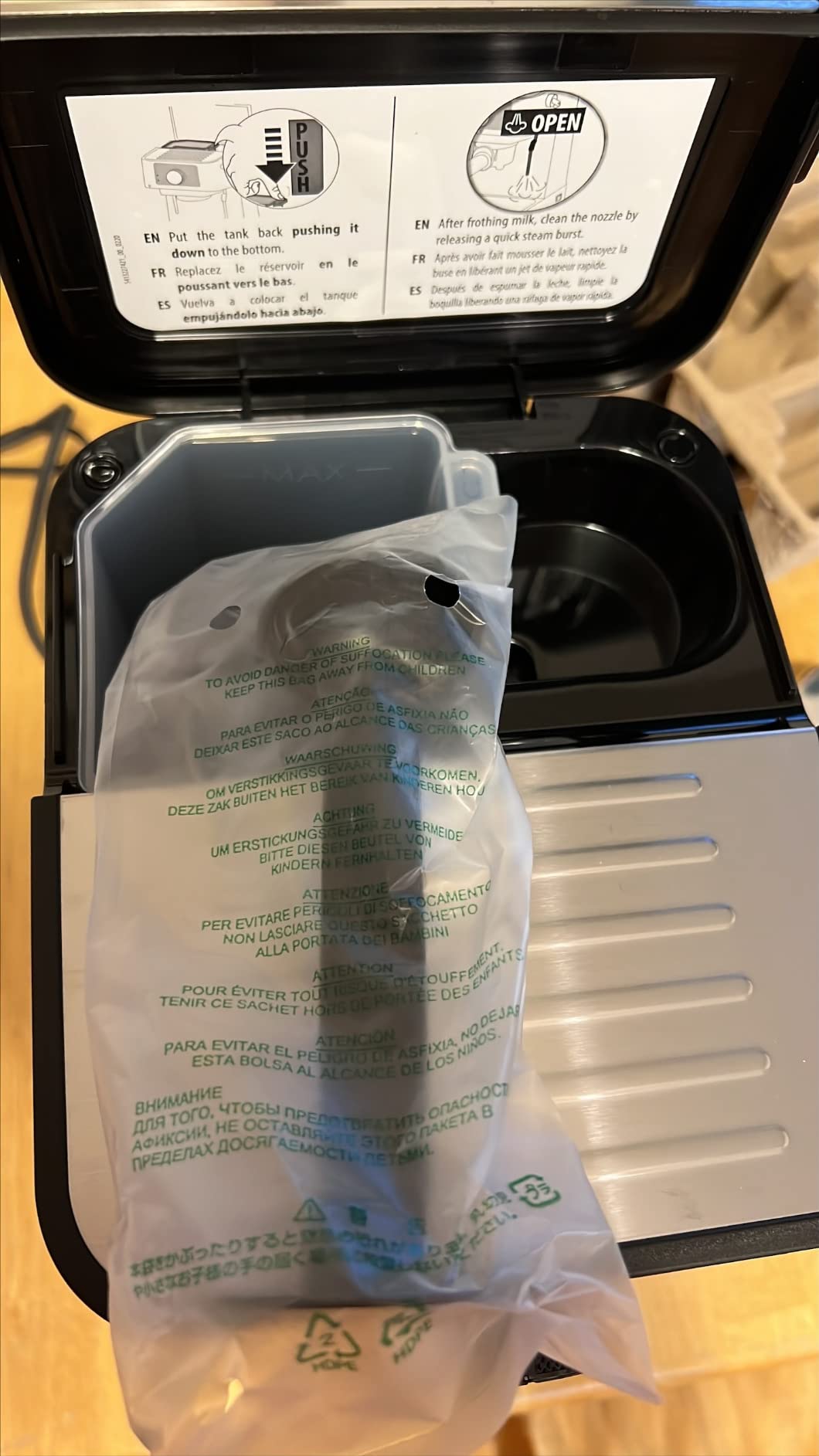
Whether a manual piston machine is realistic for a first purchase
It is, with one adjustment to your expectations. You pump the lever yourself for each shot, so there is no push button doing the work, and a beginner will find the effort unfamiliar for the first few days. After that it becomes second nature and you have a real understanding of pressure and resistance.
There is no built-in grinder, so you need pre-ground coffee, and stale beans will make this machine look worse than it is. Buy a bag from a roaster that has been ground recently, grind it coarsely at a shop if you do not own a grinder, and the shot will be considerably better than anything from a supermarket jar.
Where the money you save should go
This machine costs a fraction of the ceiling, which means the money you did not spend can become a proper burr grinder. That pairing is where most of the value in this roundup hides. A manual machine with a decent grinder often outperforms an expensive machine with a bundled grinder that cannot keep up.
If you are on a very tight budget, our espresso grinder picks are the natural next purchase. Our wider espresso machine guide also covers options above the ceiling if you outgrow this one within a year.
3. CASABREWS CM5418: the easiest first espresso machine
CASABREWS CM5418 Compact Espresso Machine with Milk Frothing Steam Wand
20 bar Italian pump
Pressure gauge
Steam wand
34 oz removable tank
Pros
- Pressure gauge gives beginners real feedback
- Compact stainless body suits small counters
- Steam wand produces quick smooth microfoam
- Fast heat-up and simple maintenance
Cons
- Included plastic tamper is worth replacing
- Portafilter and baskets feel inexpensive
- No milk pitcher included
- Needs a cool-down between frothing and brewing
The CM5418 is the machine I suggest when the person in front of me has never made a shot and does not know what a dose is. It has a 20 bar pump, a pressure gauge on the front, and buttons that do one thing each. Nothing about it asks you to guess.
That pressure gauge is the feature that changes how fast people learn. You can watch the needle as the shot runs, see channelling when the puck is uneven, and adjust. Most machines in this band hide that information, and beginners end up making changes by feel and getting nowhere.
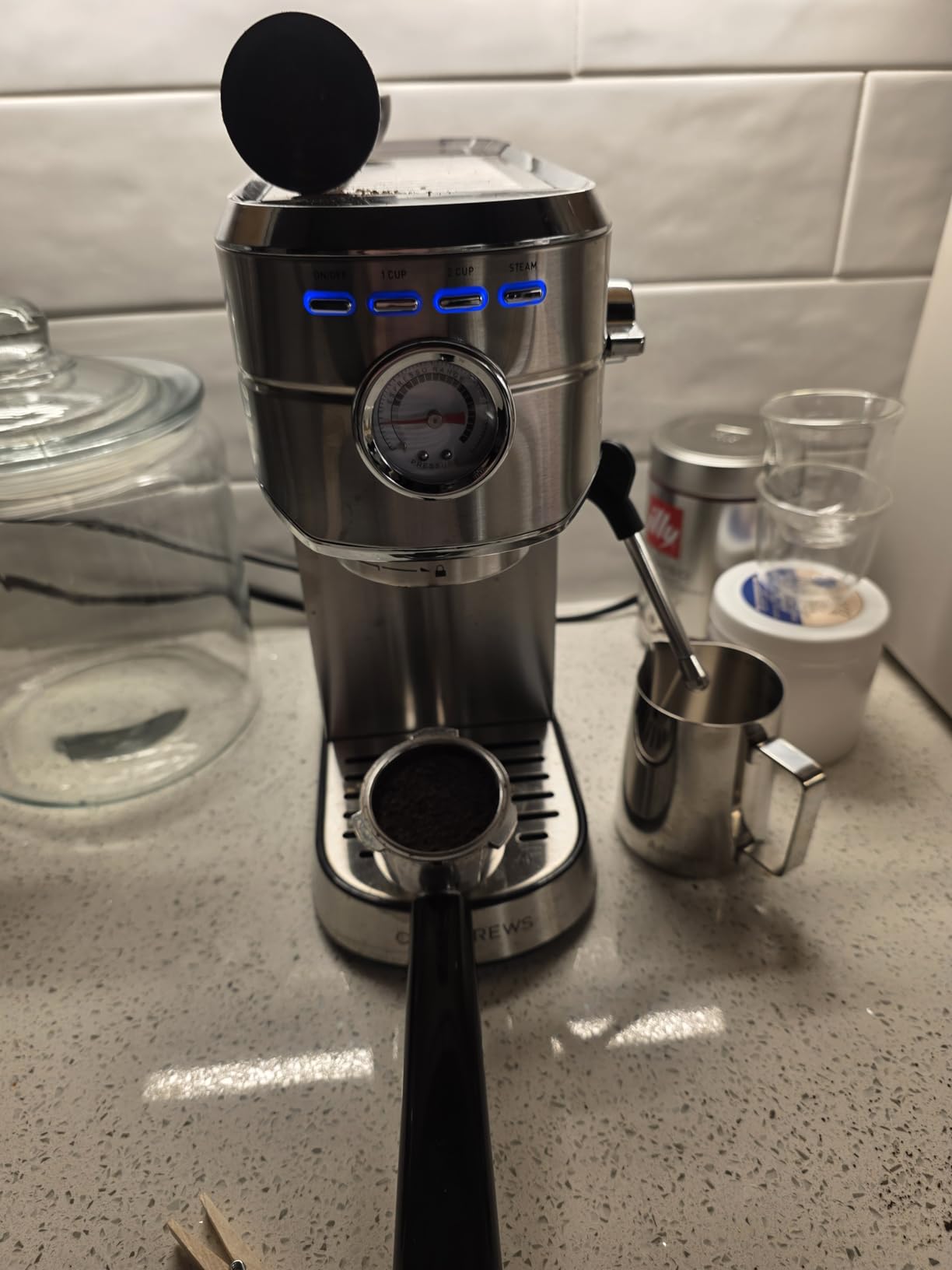
The 1350 watt boiler heats quickly, and owners consistently describe it as a capable compact entry machine that makes genuinely good espresso and milk drinks for the money. Many note that it paid for itself quickly against buying the same drinks outside, which is the practical argument for this tier.
The steam wand is the surprise. It produces microfoam quickly and smoothly, fast enough to make two drinks in a row while the machine is still settling. It also has a hot water function for americanos and cup warming, which gets used more often than buyers expect.
The cool-down cycle you will hit every morning
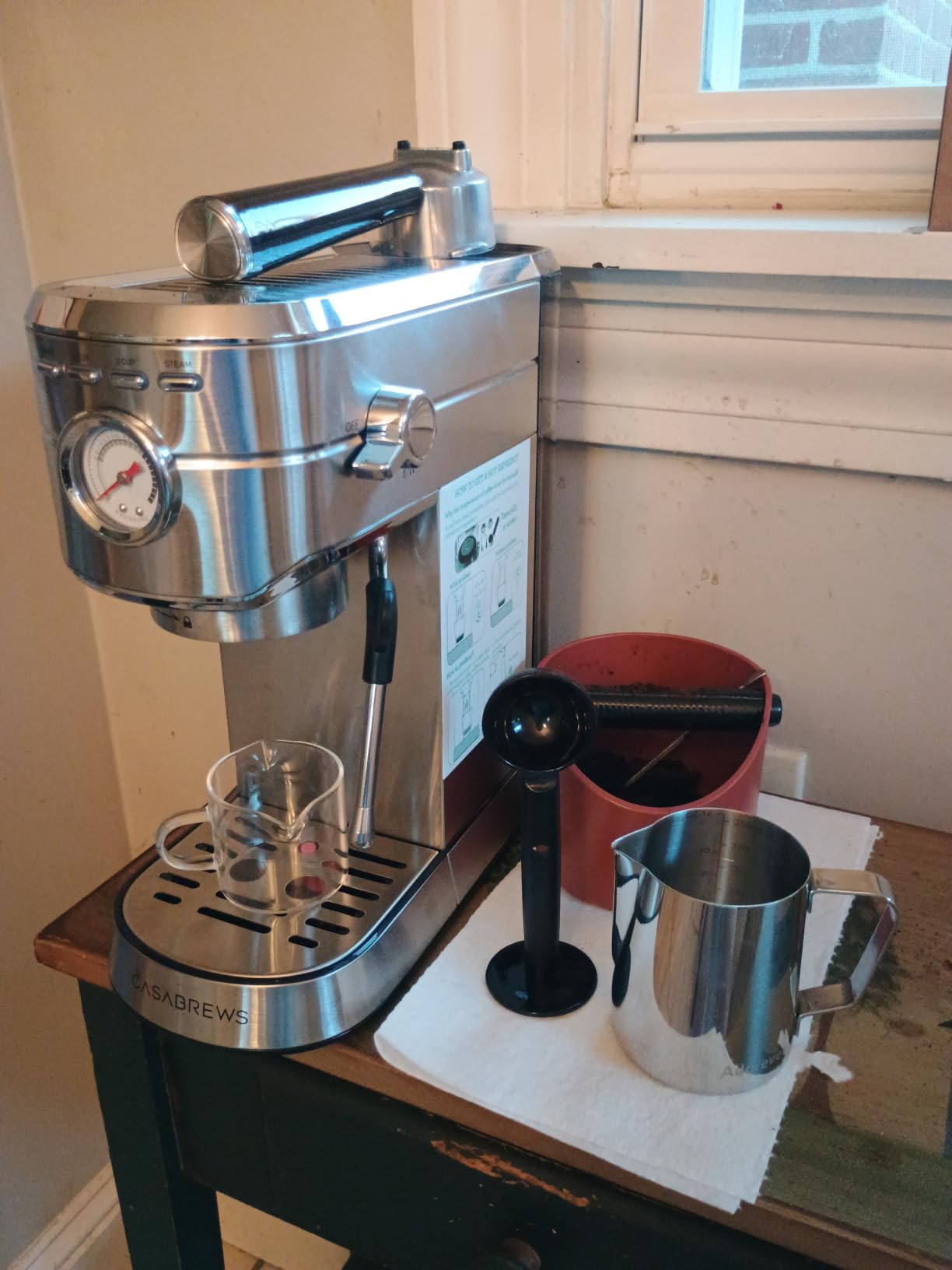
After you steam milk, this machine enters an overheat protection mode and needs to cool before it will brew again. Owners describe this as the defining quirk of the machine. It is not a fault, it is the single boiler doing exactly what a single boiler does, but on a two-drink morning you will feel the wait.
Plan around it by brewing espresso first and steaming milk second in the order you make drinks, or by accepting that a single drink at a time is what this machine is for. The stainless body measures just over 12 inches deep and about 5.5 inches wide, so it suits a small counter where a wider machine would not fit.
Accessories to budget for on day one
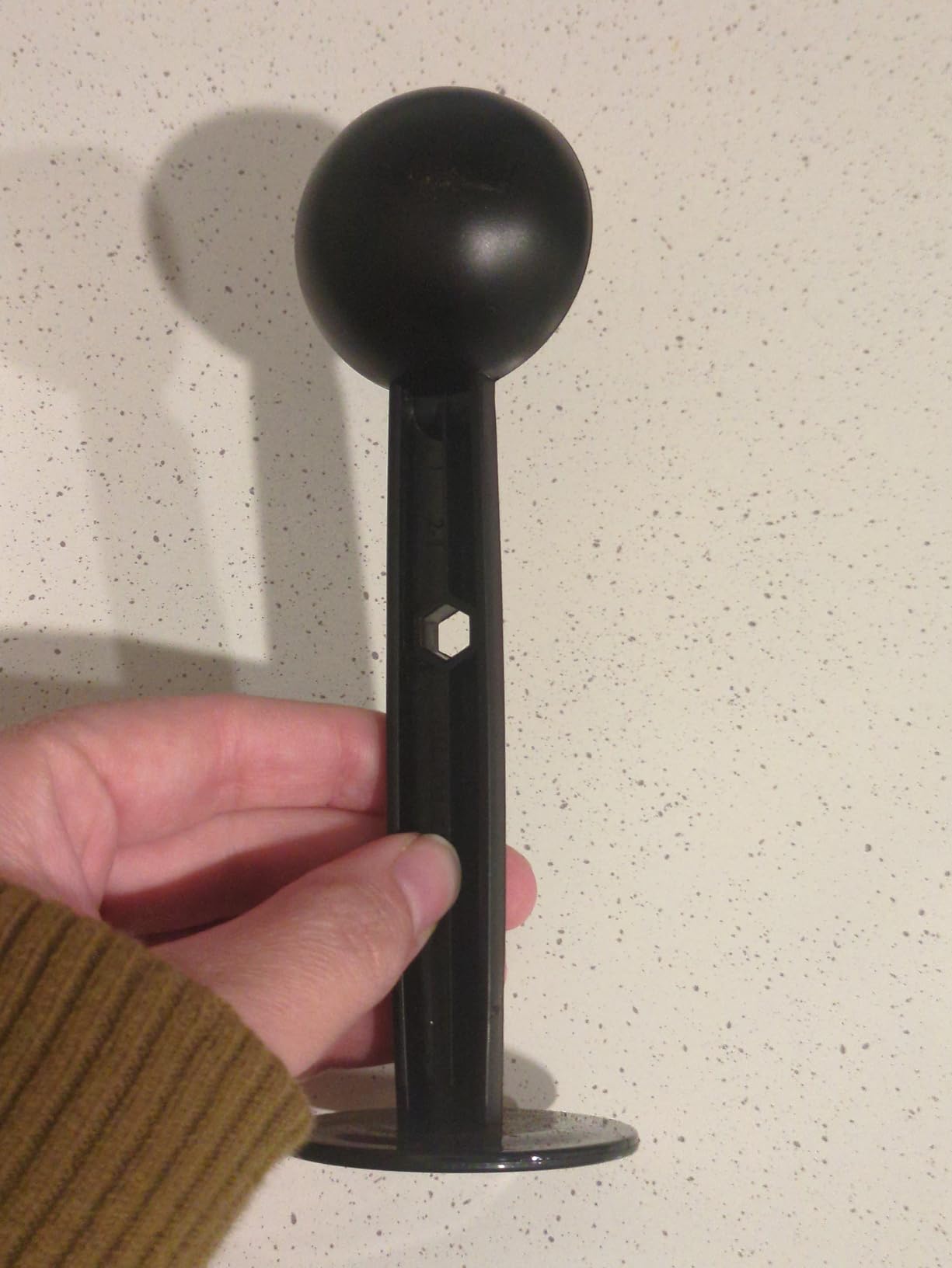
The included tamper is lightweight plastic and reviewers recommend replacing it early. The portafilter and baskets also feel inexpensive, so a metal tamper and a better basket are the two upgrades worth making. No milk pitcher comes in the box, and you will want one with a spout to pour microfoam properly.
The cup tray plate is reported as slippery and the frother nozzle sits low, which matters if you use larger mugs. Those are small tolerances that only show up in daily use, and they are the reason we rate this as the beginner pick rather than the value pick.
4. Philips 3200 Series: the best one-touch drinks on this list
Philips 3200 Series Fully Automatic Espresso Machine, LatteGo Milk Frother, 5 Coffee Varieties, Intuitive Touch Display, 100% Ceramic Grinder, AquaClean Filter, My Coffee Choice, Black (EP3241/54)
Ceramic grinder
Five drink varieties
Tube-free milk system
AquaClean filter
Pros
- One touch makes five drink types including latte macchiato
- Tube-free milk system cleans in about 15 seconds
- AquaClean filter cuts descaling frequency
- Compact body with an intuitive touch display
Cons
- Fully automatic output removes manual control of grind and extraction
- Plastic body construction
- One-touch consistency depends on factory-set profiles
The Philips 3200 is here because the honest answer to some version of your question is that you do not want to make espresso. If you want a cappuccino that tastes the same as the one you had this morning, without a routine, this is the machine built for that life.
It has a 100 percent ceramic grinder, which is unusual at this level and matters because ceramic burrs stay sharp longer and transfer less static than steel. The Aroma Extract system balances brewing temperature and aroma across the five drink varieties, and the touch display walks you through each one.
The milk system is the part I rate highest. It is a two-part design with no tubes, so cleaning takes about 15 seconds instead of the tube-bleaching routine that makes people abandon superautomatics. That single design decision removes the most common reason people give up on this category.
The AquaClean filter allows up to 5000 cups before descaling. Reviewers value the set-and-forget convenience and call the drinks good for a super-automatic, and they consistently mention the reduced descaling as the reason the machine stays in rotation.
What you give up when the machine makes the decisions
Control. There is no way to adjust dose, tamp or extraction time, because you are not doing any of those things. That is exactly what some people want and exactly what people who care about taste get frustrated by within a month. Reviewers describe the output as consistent only when using factory-set coffee profiles.
The milk also arrives heated and textured rather than steamed. That means it cannot produce true microfoam or latte art the way a manual wand can, so if cappuccino quality matters, a semi-automatic is a better purchase. We cover those in our superautomatic espresso machine guide if you want to compare the category properly.
Build quality and long-term reliability
The body is plastic, and at a 4.0 rating across 6208 reviews this machine carries the largest share of one-star ratings in this group relative to its score. That points to occasional reliability or service issues rather than taste complaints, and it is worth factoring in if you are furnishing a rental rather than a home you own for a decade.
It is also the widest machine here at 17 inches, so measure your counter before committing. In exchange you get a machine that occupies more space than a manual model and does more for you per minute, which is a fair trade for a household that drinks a lot of milk drinks.
5. CASABREWS 3700 Essential: the Best Value that holds up
CASABREWS 3700 Essential Stainless Steel Espresso Machine with Steam Wand
20 bar pump
Steam wand
43.9 oz tank
Removable drip tray
Pros
- Large 43.9 oz tank avoids mid-day refills
- Brushed stainless body still looks good after heavy use
- Fast heat-up and steady 20 bar extraction
- Smooth foam for cappuccinos and lattes
Cons
- Extraction can be finicky with grind size
- Single boiler means waiting between brewing and steaming
- Included tamper is basic
The 3700 Essential is the machine I would put in a shared apartment kitchen or a small office. It is simple, it is metal on the outside, and it does not need to be explained to anyone who uses it.
Where it beats the other entry machines on this list is the tank. At 43.9 ounces it is the largest in the compact class, which on a kitchen with three or four daily drinkers means you are not refilling water constantly. The drip tray also removes for cleaning, which matters more often than buyers expect.
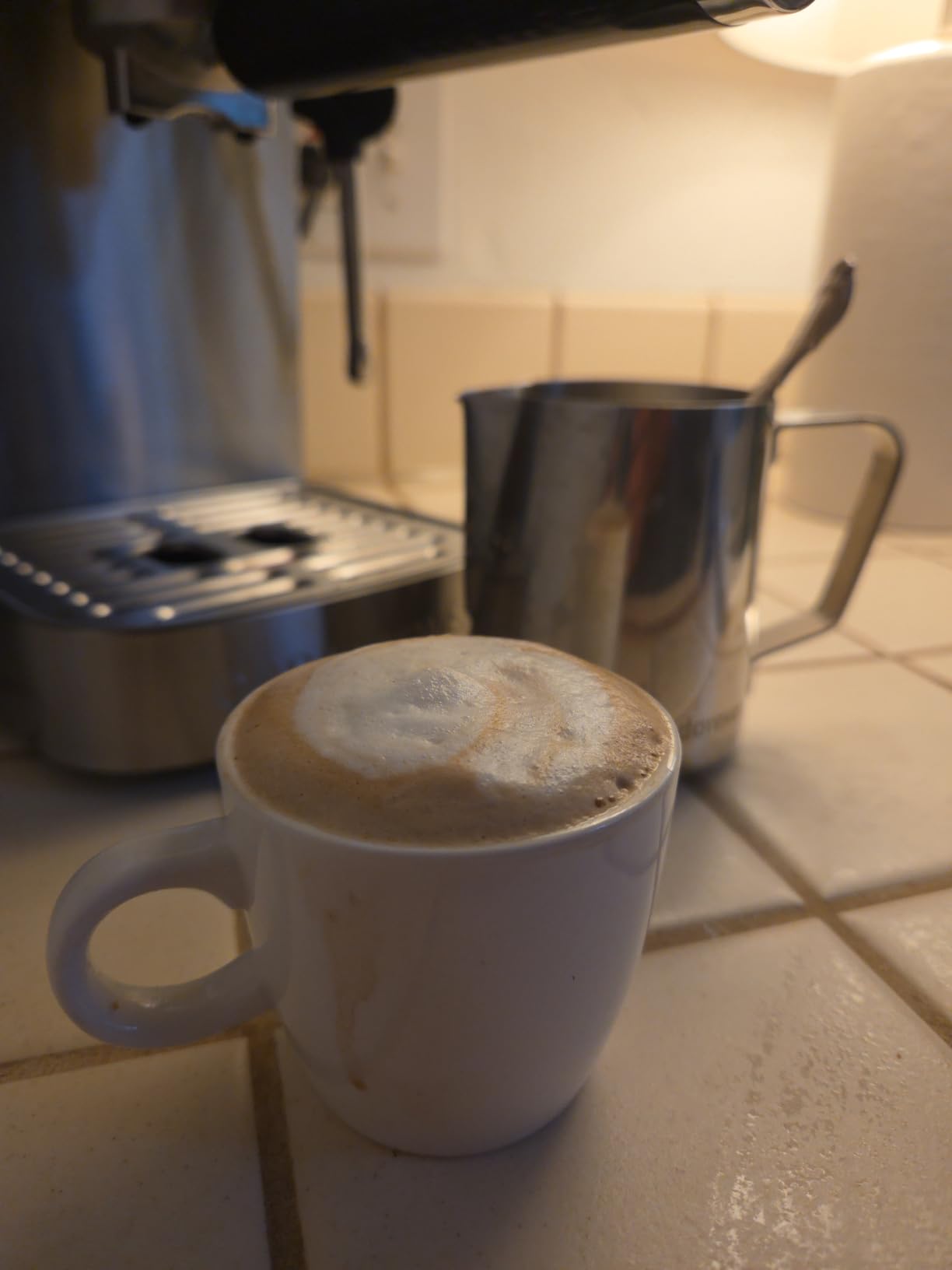
Owners call it a dependable, good-looking machine that delivers solid espresso and foam for very little money and holds up well under heavy daily use. The 20 bar pump and 1350 watt heating system heat fast, and the steam wand handles cappuccinos and lattes without drama.
Quality espresso here depends on fresh beans, and the reviews say so directly. Pair it with coffee ground recently and you get rich espresso with good crema. Pair it with supermarket pre-ground coffee and it will taste thin, then you will blame the machine instead of the beans.
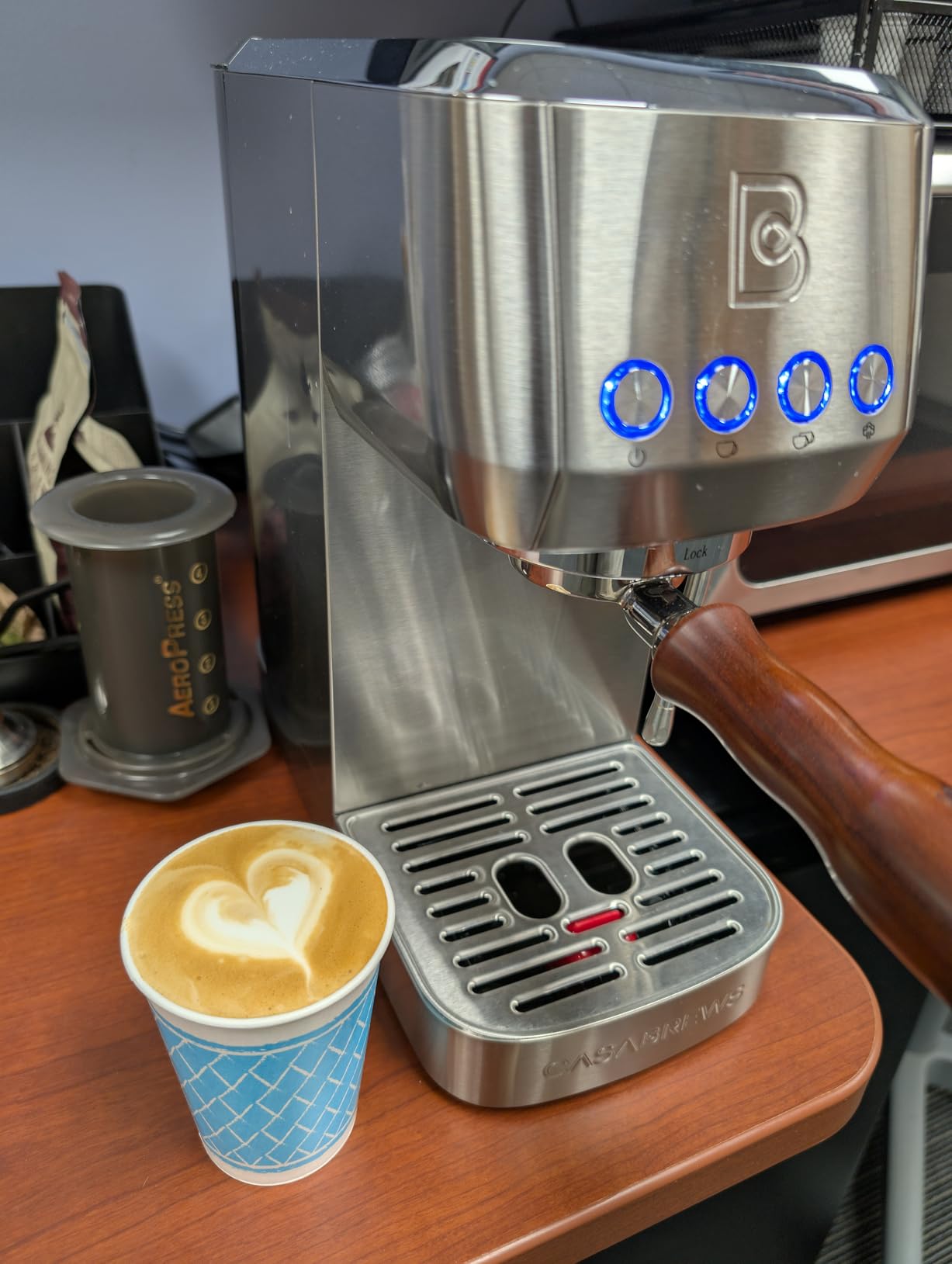
Where it gets temperamental and how to work around it
Extraction is finicky with grind size, which is the honest flaw here. A minority of owners report temperamental shots and an overly fine grind tolerance, and some long-term users note the steam control dial may drift open during extraction on certain units. If your shots run fast and thin, grind coarser before you adjust anything else.
The steam wand is loud and takes practice, so expect noise in a quiet kitchen early on. The included tamper is basic and worth replacing with a metal one, which is a five minute job that makes tamping more consistent. None of these are dealbreakers, but they are the reason this is the budget pick rather than the beginner pick.
First-run setup and what to expect from day one
This model requires a first-use cycle before it will brew, triggered by removing a rubber plug from the boiler. Owners who skip it report confusing behaviour, so follow the manual on that step and the rest is conventional.
Once it is running you get a 20 bar pump, a steam wand, single and double cup filters and a portafilter in the box. What you do not get is a grinder, so plan on buying one separately. If you keep a machine in an office or a rental, this is the pick I would specify, and our grinder guide covers the pairing.
6. Gevi ECMG0: the best machine for learning to dial in
Gevi 20 Bar Compact Espresso Machine for Home,Latte、Cappuccino Coffee Maker
20 bar pump with pre-infusion
Pressure gauge
Stainless housing
Removable froth nozzle
Pros
- Pressure gauge and pre-infusion make dialling in fast
- Full stainless steel housing
- Hot water function for americanos and cup warming
- 12 month warranty with lifetime tech support
Cons
- Single boiler shuts off after steaming so drinks cannot be made back to back
- Steam wand is loud and needs practice
- No grinder so a separate purchase is required
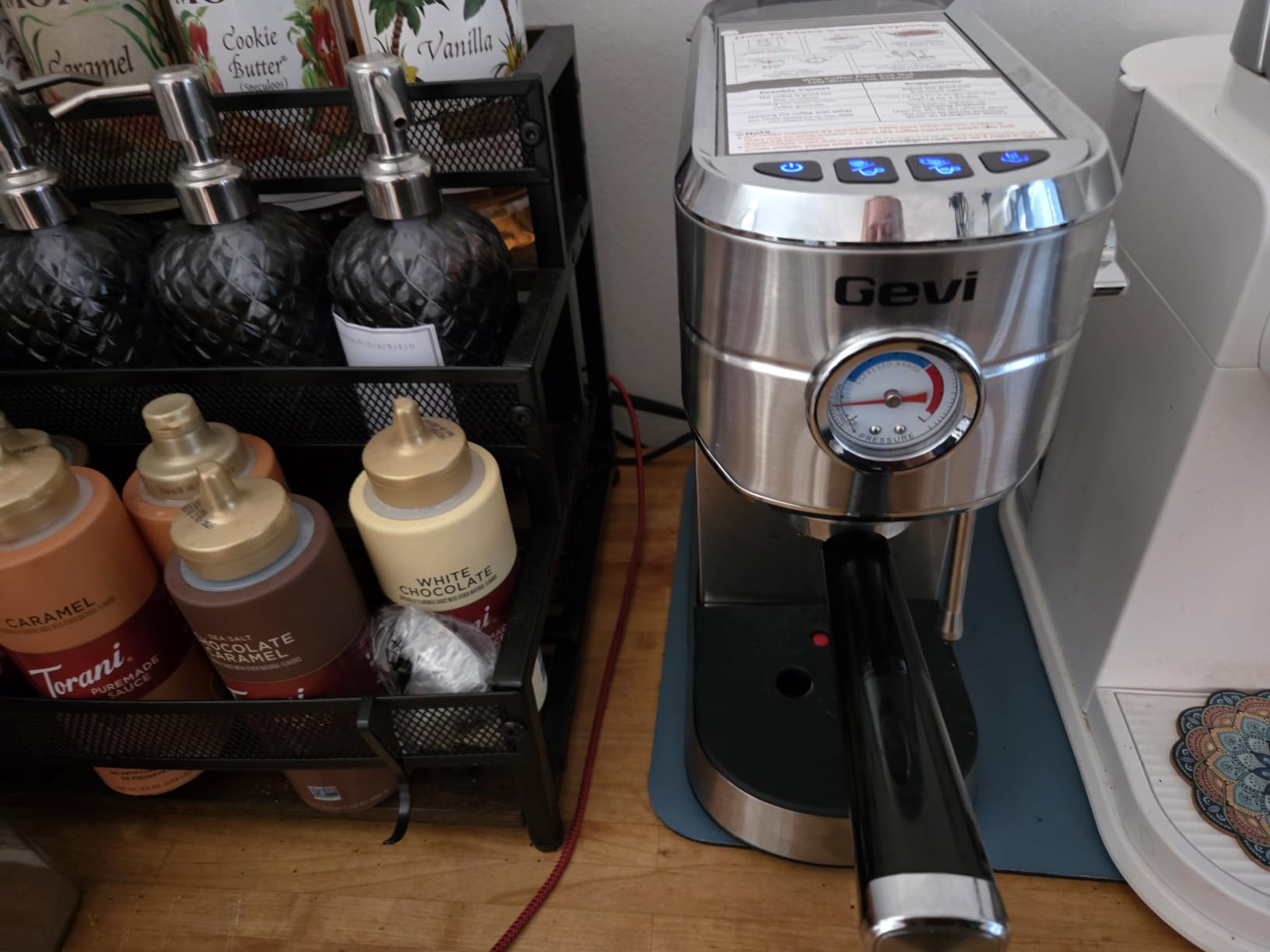
The Gevi ECMG0 surprised me. I expected another compact entry machine and found something with more diagnostic hardware than several machines costing twice as much. The pressure gauge on the front is the reason this one earns its place.
Pre-infusion wets the puck before full pressure hits it, and the gauge lets you see the extraction curve in real time. For a buyer who wants to understand what they are doing rather than just press a button, that combination shortens the learning curve more than any other feature in this price range.
The NTC temperature control keeps the shot steady from one pull to the next, and owners frequently report upgrading from more expensive machines that failed quickly and finding this one produced the best espresso they have had. That is a recurring pattern in the reviews, and it is why the machine has a strong 4.3 average across 3775 ratings.
The housing is full stainless steel rather than a plastic shell with metal trim, which matters on a machine you touch every morning. The froth nozzle removes for cleaning, and the hot water function doubles as a cup warmer and an americano spout, which gets used daily in my kitchen.
How long the shutdown after steaming really takes
This is the machine’s clearest limitation. The single boiler shuts off after you steam milk, so back to back drinks need a wait. Unlike the CM5418 it does not enter a formal cool-down mode, but the physics are the same and the effect on a two-drink morning is comparable.
Buy it if you are making one drink at a time and want to learn, and the shutdown stops mattering. Buy something else if your household makes two milk drinks every morning before anyone is fully awake. We have a fuller look at dual boiler options in our dual boiler espresso machine guide.
What the warranty actually covers
There is a 12 month warranty with lifetime technical support, which is generous for this class and worth more than it sounds if you are the type who will message support about a temperature question. Support does not replace a part, but it shortens the time a fault sits unresolved.
The steam wand is loud and takes practice, which reviewers mention alongside the grinder requirement. There is no built-in grinder here, so budget for one. At this price a dedicated grinder is the single biggest improvement you can make to the cup, and it is why this machine fits the tier it sits in.
7. Breville Barista Pro: the best when you want speed
Breville BES878BSS Barista Pro Espresso Machine, Brushed Stainless Steel
ThermoJet heat in about 3 seconds
Burr grinder
PID within 2 degrees C
LCD display
Pros
- Reaches extraction temperature in roughly 3 seconds
- Grinder doses consistently with fine adjustment
- Steam wand handles latte art more easily than lower models
- Back to back shots pull consistently
Cons
- 54mm portafilter is smaller than the 58mm commercial standard
- Grinder is noticeably loud
- Group head contains some plastic
The Barista Pro is the Barista Express with the waiting removed. If you have ever stood in front of a coffee machine at 7am watching a boiler climb, this machine answers that frustration directly. The ThermoJet heating system reaches extraction temperature in about three seconds.
That speed changes the rhythm of a morning more than the spec sheet suggests. You move from espresso to milk without a pause, you pull a second shot without waiting, and the transition between drinks stops being an event. Owners rate it as the best of the Breville Barista line for exactly that reason.
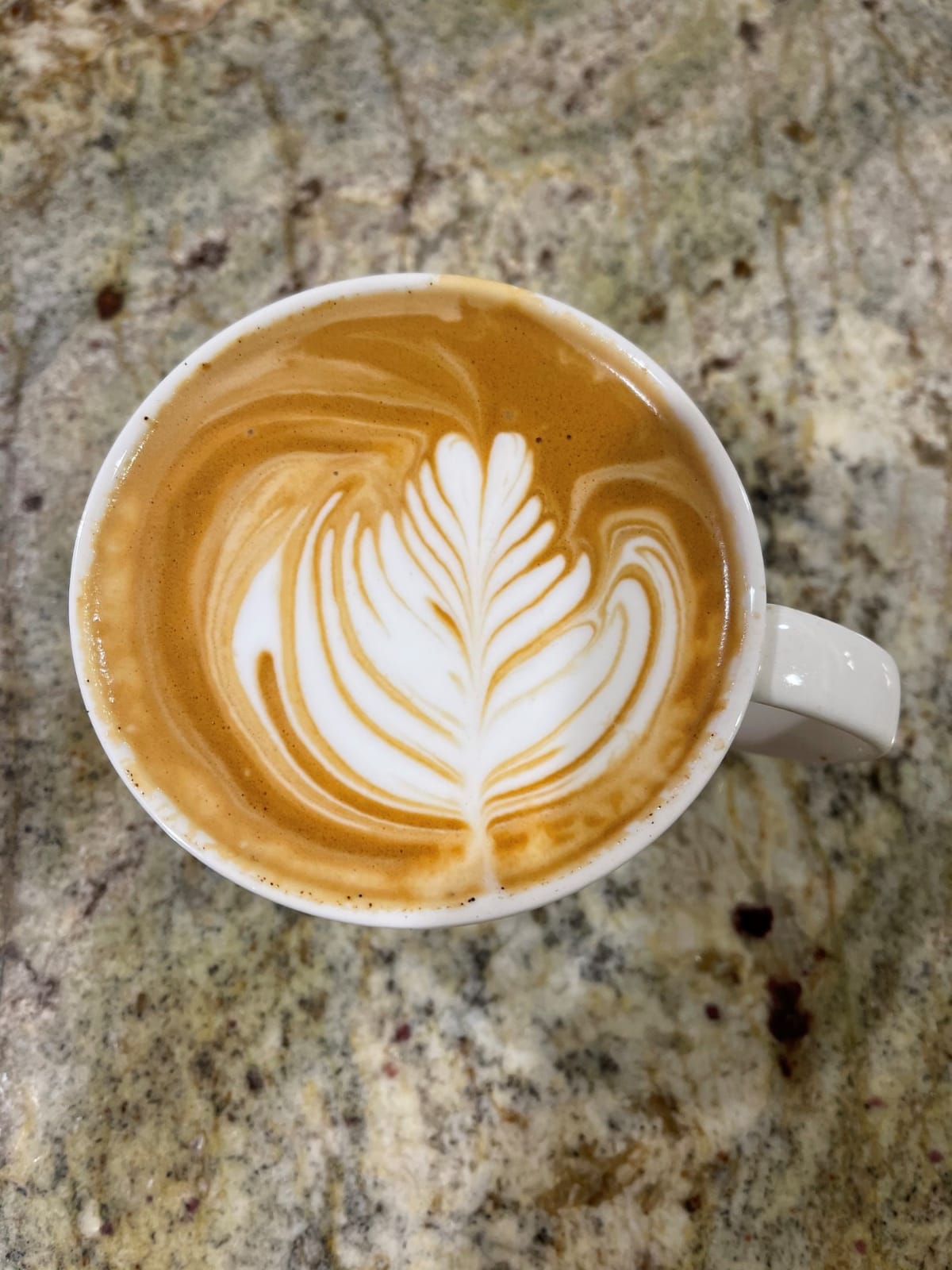
PID control holds temperature within plus or minus 2 degrees C, which is tighter than most machines in this roundup and is where the repeatable shots come from. The integrated burr grinder has a fine adjustment dial, and the LCD display shows grinding and extraction progress with animations that make the process legible to a beginner.
The steam wand is stronger than on the lower Barista models, and owners say it handles latte art more easily. That is a real difference in practice, because a wand with more steam gives you more time to work the milk before it cools down and you lose the texture.
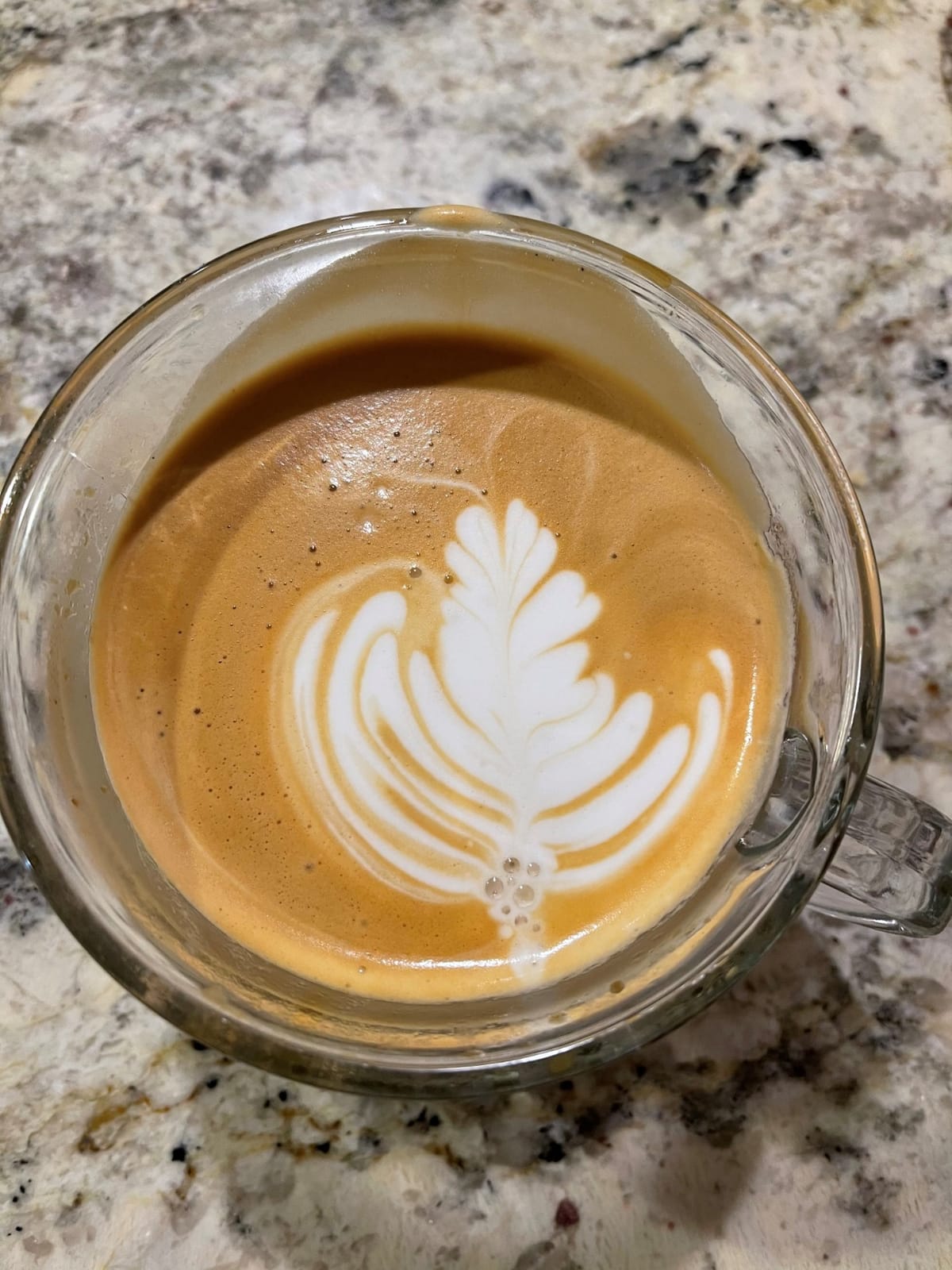
Why the 58mm portafilter question matters here
This machine uses a 54mm stainless steel portafilter. That is smaller than the 58mm commercial standard found on café machines and on some machines later in this list, which limits you to baskets and accessories made for 54mm. It is a genuine limit if you plan to buy aftermarket baskets now or a commercial basket later.
For most home buyers it does not matter, because 54mm baskets are inexpensive and widely available. It matters if you are choosing a machine to grow into for five years rather than one year. If you want the 58mm standard on this budget, the Chefman later in this list is the one that provides it.
Noise, footprint and what the reviews flag
The grinder is noticeably loud, and that is the most common complaint alongside the portafilter size. The group head contains some plastic, and a minority of owners report temperature inconsistency and failed repairs. The unit also weighs 19.5 pounds, so check your counter depth before it arrives.
Back to back shots pull consistently without the bitterness owners reported on earlier models, and the LCD plus the included metal tamper make it approachable for a first-time buyer. That combination of speed and approachability is why it is the pick for anyone who drinks three or more drinks a day.
8. Ninja CFN601: the best for pods and a full pot in one machine
Ninja Espresso & Coffee Maker, Nespresso Capsule Compatible, Black, CFN601
19 bar Barista Plus system
Nespresso capsules
Grounds to 12 cup carafe
Fold-away frother
Pros
- Brews capsules and a 12 cup pot in one machine
- Espresso quality is strong for a capsule system
- Quiet and easy to clean relative to most machines
- Delay brew and keep warm functions add convenience
Cons
- Included paper filters are single cup only and overflow
- Some units report leaking from the grounds side
- Only brews one espresso shot at a time
- Capsules are sold separately
The Ninja CFN601 answers a question the rest of this list does not. What if you drink one espresso most mornings and a full pot of coffee on weekends, and you do not want two appliances? This machine does both, and the pod path takes almost no cleanup.
The 19 bar Barista Plus pressure system pulls capsules at three sizes including over ice, and the grounds side brews in nine sizes up to a 12 cup carafe. Buyers like the versatility and call the espresso quality strong for a capsule system, which is about as far as a pod machine should be praised.
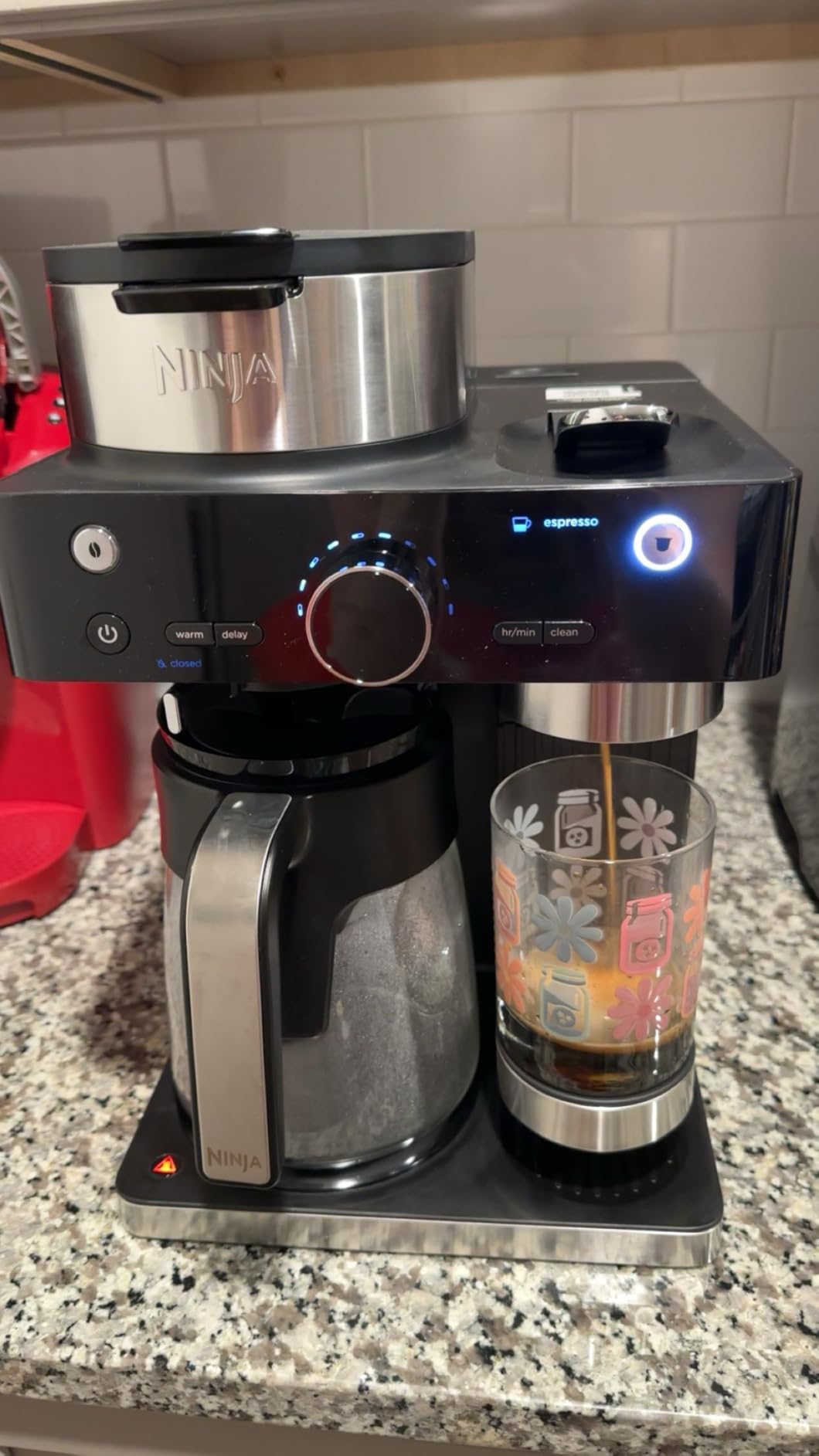
The fold-away milk frother tucks into the body so it does not occupy counter space when you are not using it. There is an adjustable cup tray, a 20 capsule used bin, and a warming plate on top. Those details are what make a pod machine tolerable long term rather than an experiment.
Owners also report that the machine is quiet relative to most, easy to clean, and reliable for years of daily use for many of them. That reliability record is a meaningful part of why this one holds a 4.1 average across 3267 ratings despite the complaints below.
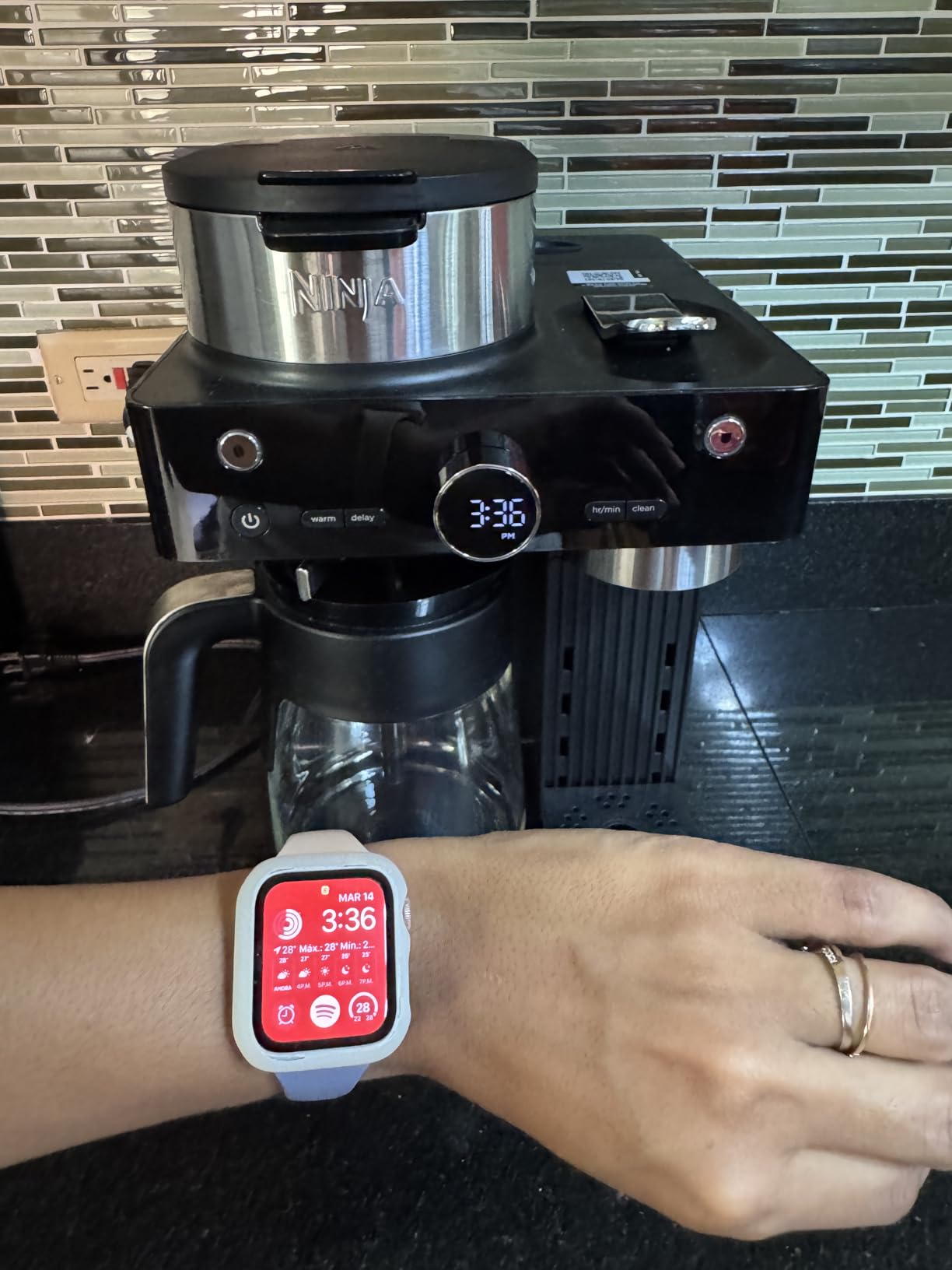
The paper filter leak that looks like a fault
The most common complaint is water leaking from beneath the unit. Several owners traced it to the supplied paper filters being sized for a single cup rather than a full carafe, so the overflow reads as a leak. It is an accessory sizing problem, not a pump failure, and it costs a few dollars to solve.
A smaller group report units that failed electronically after about three years, which is worth knowing if you are buying for a rental. The machine also only brews one espresso shot at a time, so anyone making two espressos simultaneously should look elsewhere on this list.
Whether a capsule system locks you in
It does to a degree. These are Nespresso Original capsules, sold separately, so your running cost is per cup rather than per gram of coffee. For someone who drinks one espresso a day that is a reasonable trade for zero cleanup, and for someone drinking four a day it is not.
The grounds side means you are not locked in entirely, since the same machine takes ground coffee up to a carafe. That flexibility is what separates this from a dedicated capsule machine, and it is why this machine works in a mixed household rather than only in a single espresso drinker home.
9. Breville Barista Touch: the best for automatic milk texturing
Breville BES880BSS Barista Touch Espresso Machine, Brushed Stainless Steel
Automatic microfoam wand
Integrated burr grinder
ThermoJet heating
Touchscreen presets
Pros
- Automatic milk texturing with adjustable temperature and texture
- Integrated grinder with dose on demand convenience
- Touchscreen stores up to 8 personalised settings
- ThermoJet gives fast transitions from brew to steam
Cons
- Largest footprint at 21.8 pounds
- Touchscreen is harder to clean than dials
- Higher share of reliability complaints than other Breville models
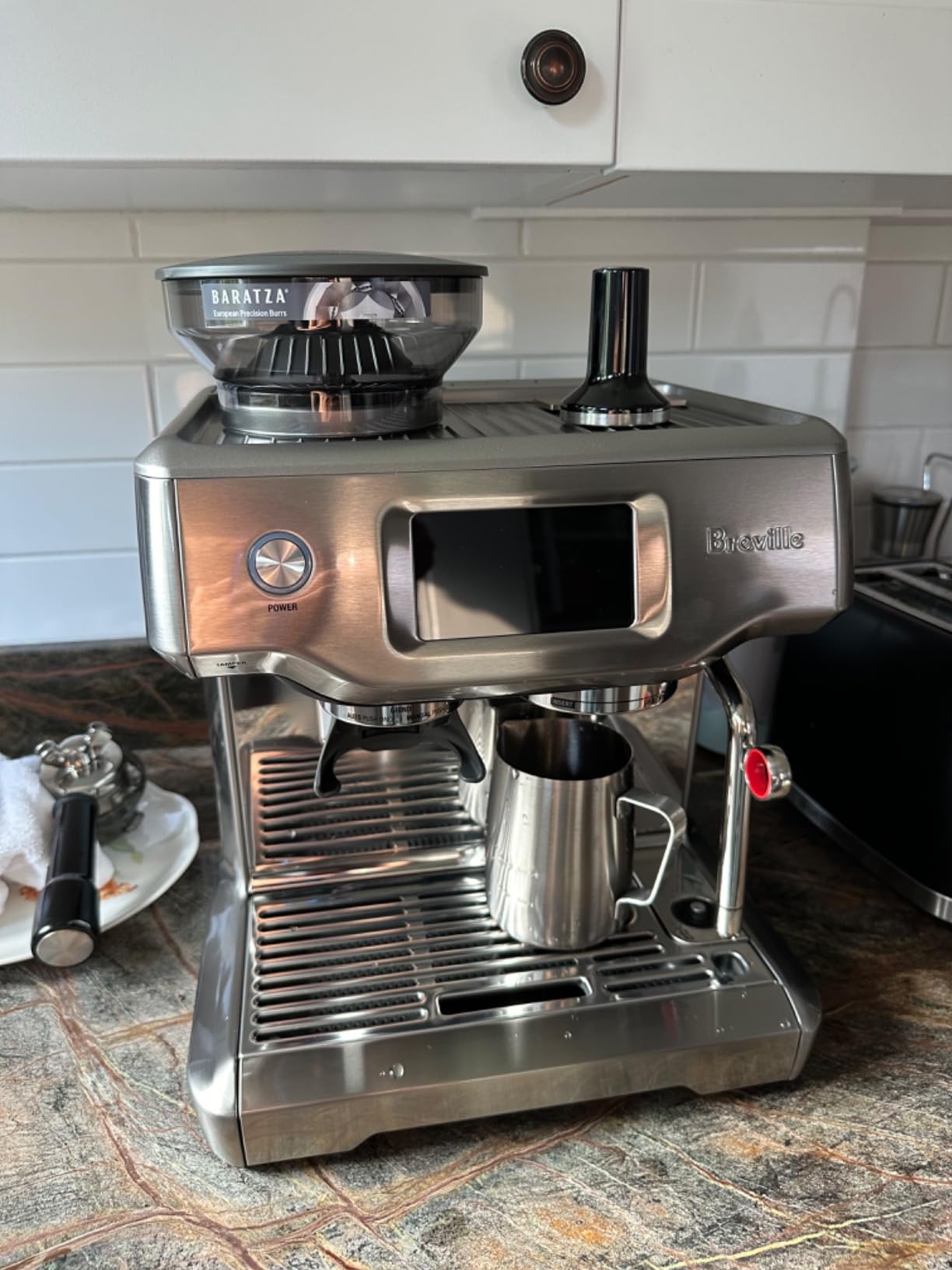
The Barista Touch sits at the ceiling of this roundup and it earns its place for one reason above the others. Its steam wand textures milk automatically, with adjustable temperature and texture, so you can produce repeatable microfoam without learning to juggle a pitcher.
That changes who this machine suits. If you want cappuccinos that look like a café version every morning without dialling in a steam routine, this is the pick. If you want to learn latte art properly, a manual wand will teach you more for less.
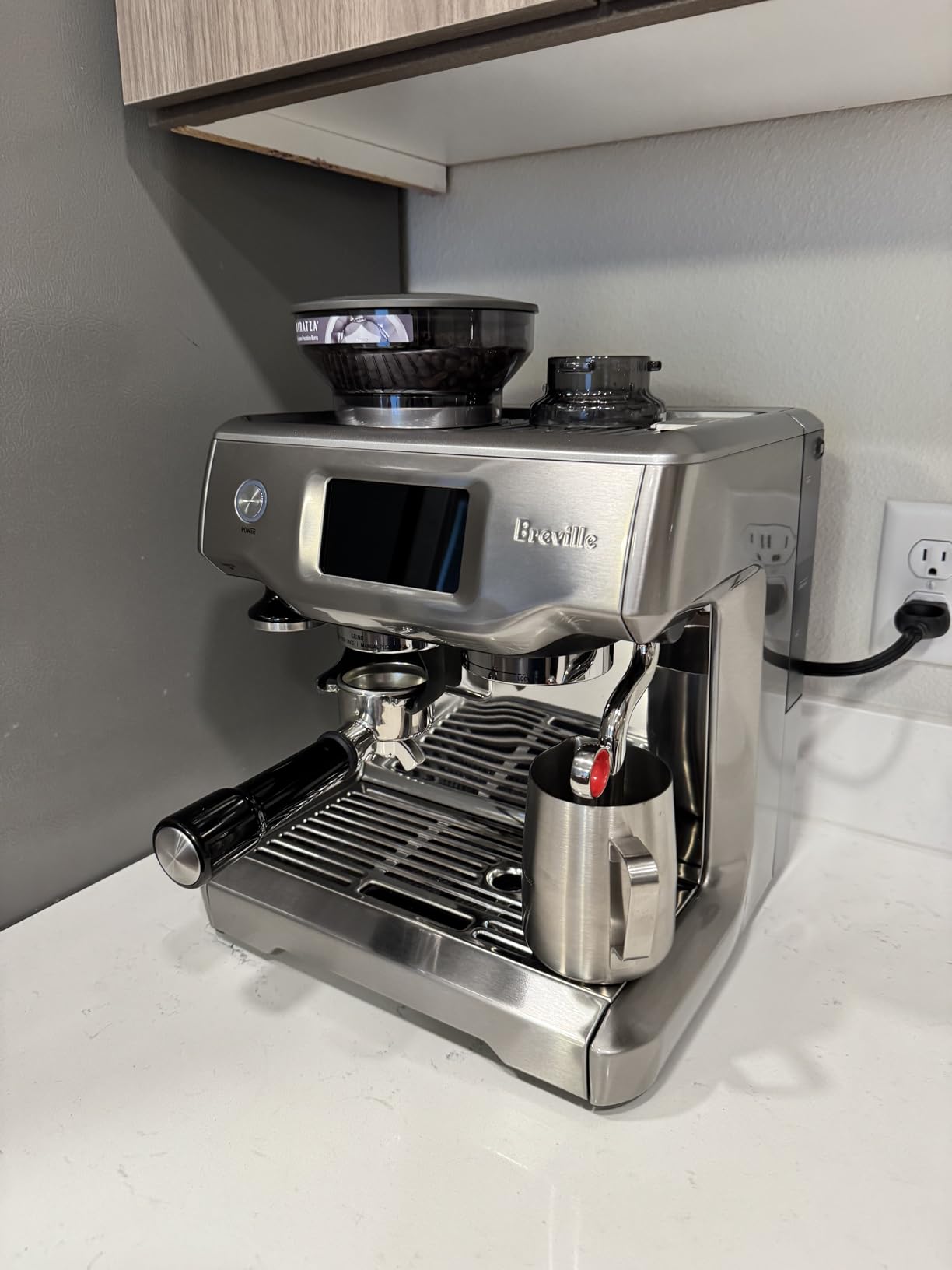
The integrated precision conical burr grinder handles dose on demand, and the touchscreen stores five café favourites plus eight custom settings. You set your dose and extraction preferences once, then tap a name each morning. Owners value the fewer manual steps, and the 2 year repair warranty is the longest on this list.
ThermoJet heating reaches temperature in about three seconds, so transitions between brew and steam are fast. PID control supports consistent extraction, and the 54mm stainless steel portafilter with a 480 ml jug covers the accessories you need day to day.
What you trade for the automation
Automation here means fewer steps, not no steps. Owners are clear that it still requires manual grinding, tamping and puck preparation, so this is not a one-touch machine in the way the Philips 3200 is. You are buying a better steam routine and saved settings, not an unattended kitchen.
The touchscreen can be less tactile than the dials on the cheaper Breville models and is harder to clean around the edges. If you prefer turning a knob, that is a genuine downgrade rather than a preference, and the Barista Express or Barista Pro will suit you better.
Footprint and reliability to weigh before buying
At 21.8 pounds and 15.5 inches wide, this is the largest machine in the roundup and needs real counter depth. Measure first. It also carries the highest share of one-star ratings among the Breville models on this list, with owners reporting more build and reliability complaints than the Express or Pro.
Against roughly 3906 ratings averaging 4.2 out of 5, that group is smaller than the headline suggests, and the milk texturing is still the best automatic system here. Buy it because you want automatic microfoam every day, not because it is the biggest number on the list.
10. Chefman Crema Deluxe: the only machine here that brews and steams together
Chefman Crema Deluxe Espresso Machine with Double Boiler, Use Milk Frother and Brew Espresso Simultaneously, Professional Coffee Maker with Coffee Grinder and Steam Wand, 30 Grind Settings
Dual boiler
30-setting burr grinder
15 bar pump
58mm portafilter
Pros
- Dual boiler brews and steams at the same time
- 58mm portafilter accepts standard baskets and accessories
- 30 setting grinder with a good adjustment range
- Large 3 litre removable reservoir
- Accessory kit includes pitcher
- tamper and funnel
Cons
- Heaviest unit in the group at 29.5 pounds
- Steep learning curve on grind size and tamping
- Some units reported electronics or steam wand failure
This is the machine on the list that answers the back-to-back milk drink question properly. A dual boiler runs brew water and steam water separately, so you can pull an espresso while you are frothing milk for a second drink at the same time. Nothing else in this roundup does that.
It also carries a 58mm portafilter, the commercial standard, which means it accepts standard baskets and the accessories that go with them. If you are buying a machine to grow into over several years, that is the feature that keeps it relevant after the honeymoon phase.
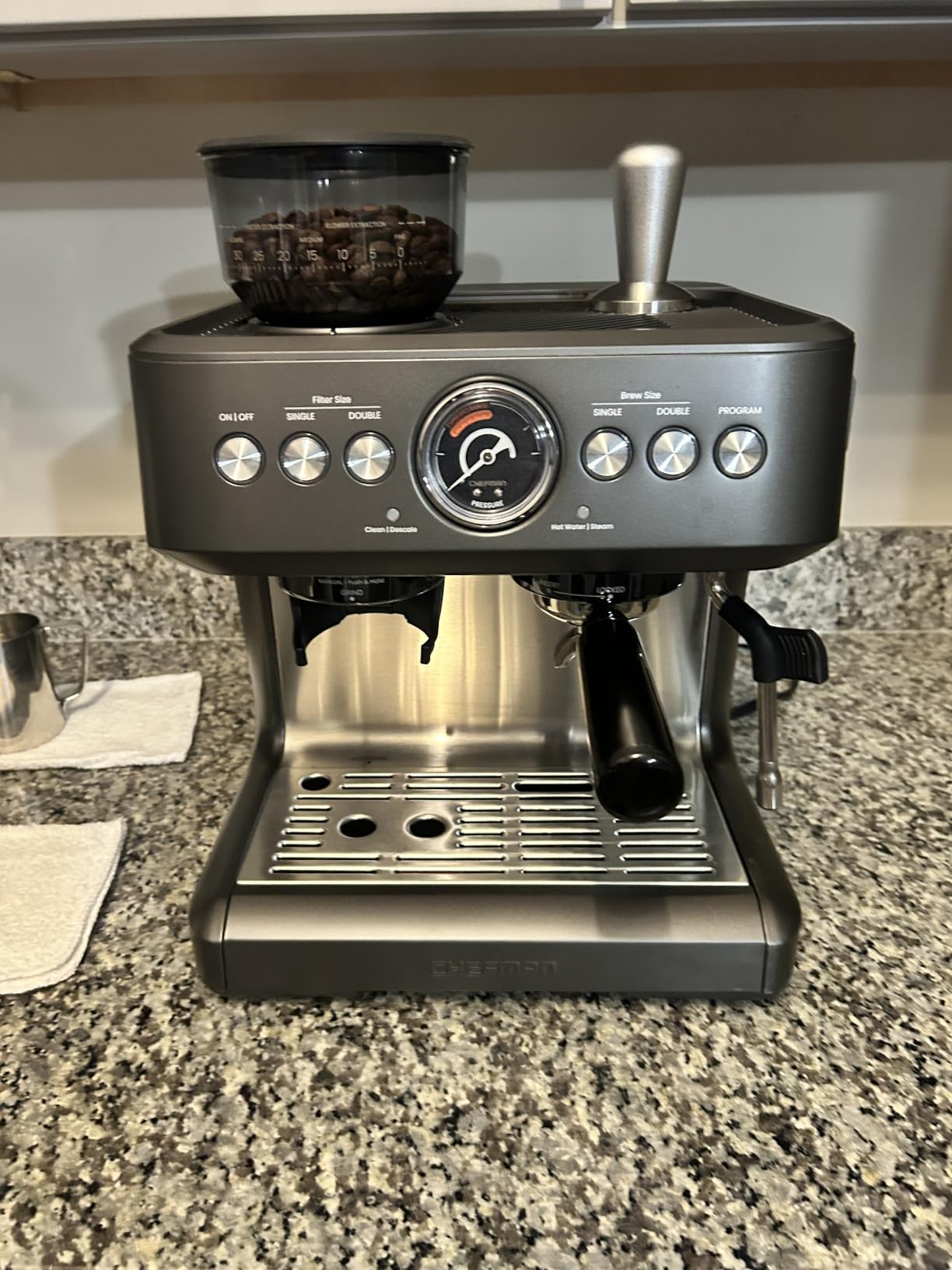
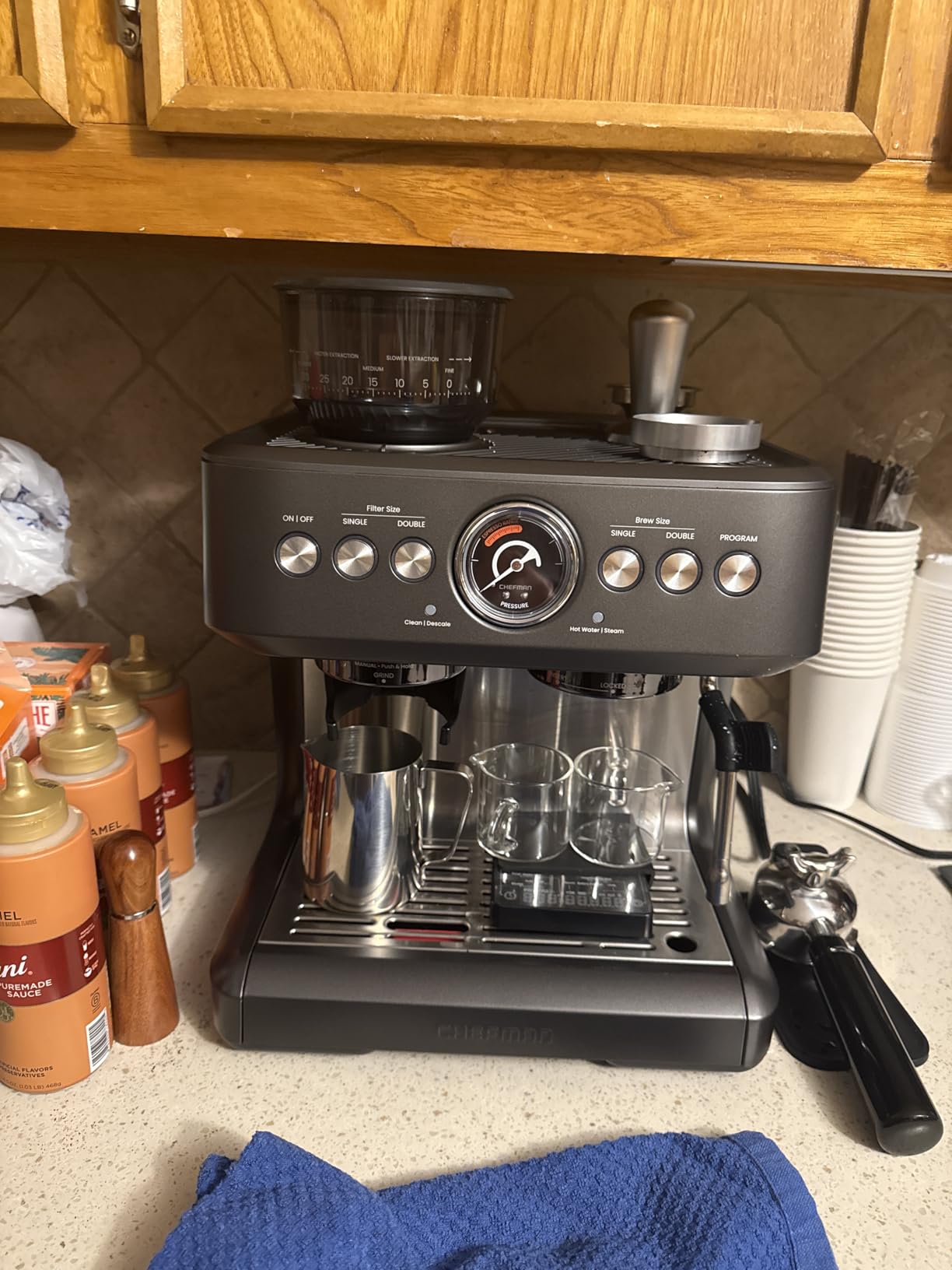
The 30-setting conical burr grinder dispenses into the portafilter, and owners who pair it with fresh beans report strong, rich espresso. The 15 bar pump has adjustable shot temperature and volume, and the 3 litre fully removable reservoir is the largest water capacity in the roundup by a wide margin.
It heats quickly, looks clean on a counter, and the accessory kit is unusually generous. You get a milk pitcher, tamper, funnel and cleaning tools in the box, which removes the day one shopping list that most machines on this list require.
The learning curve is the price of the dual boiler
More capability means more to learn. Owners describe a steep learning curve on grind size and tamping, and with a 30-setting grinder you have a wide range of adjustment to explore before you settle. That is enjoyable if you like the process and frustrating if you want a machine that works immediately.
The machine weighs 29.5 pounds, the heaviest in this group, and measures over 12 inches deep and 12.5 inches wide. Put it on a sturdy counter and leave room to pull the reservoir and the drip tray out at the same time.
Durability reports you should read before deciding
Durability is the real question here. Several buyers report touchscreen electronics, steam wand seals or the grinder failing within two to five months, and some long-term owners note extraction speed can slow with use. There are also notable plastic components for a machine at this feature level.
Our advice is to treat the warranty period as the evaluation window. If it performs through the first year of daily use, it will likely keep going. If you want a dual boiler for a shared kitchen where it will run all day, our dual boiler guide covers heavier machines built for that.
How to Choose an Espresso Machine Under 1,000 Dollars: Four Price Tiers
The most useful thing about a price-capped roundup is knowing what each band of the budget actually buys. Below roughly 300 dollars you are buying an appliance. Between 300 and 500 you can buy a machine with a real grinder. Between 500 and 700 you add temperature stability and better steam. And in the 700 to 1,000 band you are buying automation and speed rather than better coffee.
Entry tier: what you get on the cheapest machines here
In the entry band you get a stainless steel or compact plastic body, a single boiler, a 20 bar pump and a manual steam wand. There is no PID on these machines, which means brew temperature drifts a little between shots. That drift is the reason a shot that tastes great can taste different two days later on the same machine.
None of the entry machines include a grinder, so budget for one separately. The upside is real though. The De’Longhi Stilosa, the CASABREWS 3700 and the Gevi ECMG0 all pull respectable shots on a fresh dose, and the Gevi adds a pressure gauge that most of this band omits. Our picks from this tier are the Stilosa for the lowest cost and the CM5418 if you want the most guidance.
Mid tier: the band where most buyers should land
This is where the machine stops being an appliance and starts being a tool. The Breville Barista Express lives here, and it is the pick we recommend to most people because the grinder and PID control together solve the two problems that make entry machines frustrating.
You are buying temperature stability and a grinder you do not have to buy separately. What you give up is simultaneous brewing and steaming, and the larger portafilter standard. If you make one drink at a time and drink more than one espresso drink daily, this band is the correct answer.
Upper mid tier: bigger body, better steam, more automation
Moving up from here buys you steam power and convenience. The Breville Barista Pro adds fast heating and a stronger wand for latte art. The Philips 3200 Series trades manual control for one-touch drinks and a milk system that cleans in seconds.
Both are reasonable jumps in budget if the specific thing you want is in them. Neither produces noticeably better espresso than the machine one tier down, because espresso is decided by grind and temperature, and both of those machines handle those well. If you cannot name what the extra money buys you, spend it on a grinder instead.
The 700 to 1,000 band: where the ceiling pays off and where it does not
At the top of this roundup the Barista Touch costs about as much as the ceiling allows and buys automatic milk texturing plus saved touchscreen settings. That is a genuine convenience feature for someone who wants café-style cappuccinos without practice.
It is not, however, better espresso. The honest truth about the top of this budget is that most of it is spent on automation rather than extraction quality. If your goal is the best cup rather than the fewest steps, the mid tier machine and a good grinder will outperform the ceiling-tier machine in the cup.
That is also why our top pick is not the most expensive machine here. The Barista Express wins because grind and temperature decide taste, and it does both inside the ceiling.
Do You Need a Grinder in the Same Budget?
Yes, in most cases. A grinder affects the cup more than any other single purchase after the machine itself, and this is the question people planning a 1,000 dollar budget ask most often. Machine-only budgeting is the most common mistake, because it leaves you buying pre-ground coffee that has been sitting for weeks.
There are three ways to split the budget sensibly. If you already own a burr grinder, put the whole ceiling into the machine and buy the Barista Pro or Barista Touch. If you are starting from nothing, spend roughly a third on a dedicated burr grinder and two thirds on a machine such as the Barista Express, which frees you to keep some budget aside for beans and a scale.
The third option is the entry machine plus grinder pairing, and it produces the best value per dollar on this list. A Stilosa or a Gevi ECMG0 with a proper burr grinder will make a better shot than a mid tier machine with an integrated grinder left at its default setting, because an integrated grinder is optimised for convenience rather than for adjustment.
A scale matters more than most buyers expect. Weighing your dose to 18 grams and your yield to a target removes most of the guesswork in the first month. If you are still deciding, our espresso grinder picks are the natural companion read to this roundup.
Frequently Asked Questions
What is the best espresso machine for home under 1,000 dollars?
The Breville Barista Express is the best espresso machine for home under 1,000 dollars. It combines an integrated conical burr grinder, PID temperature control and a manual steam wand capable of microfoam in one machine, so you do not need a separate grinder to get excellent results. It suits anyone drinking a couple of espresso-based drinks daily.
What is the cheapest but best espresso machine?
The cheapest but best espresso machine on this list is the De’Longhi Stilosa, which has a stainless steel boiler, a manual steam wand and a very small footprint. The CASABREWS 3700 Essential is close behind with a larger 43.9 oz tank and a 20 bar pump. Both trade shot quality for cost, and neither includes a grinder, so add a dedicated burr grinder to either.
Which is better, Breville or Gaggia?
Breville machines in this budget tend to bundle a grinder, add PID temperature control and heat faster, which suits beginners who want fewer decisions. Gaggia-style traditional machines tend to use larger metal portafilters and simpler mechanics, which suits people who want to control every variable. On this roundup the Breville Barista Express is the better first purchase for most people.
Is a 1,000 dollar espresso machine worth it?
A 1,000 dollar espresso machine is worth it if you want automation such as automatic milk texturing and fast heating. It is not worth it purely for better-tasting espresso, because grind quality and temperature stability decide the cup and those are available much lower. Most buyers get more from a mid tier machine plus a good grinder.
Do I need a separate grinder for an espresso machine?
You need a grinder unless the machine includes one. Only three machines in this roundup have a built-in grinder, and a dedicated burr grinder affects the cup more than most machine upgrades. If you already own a burr grinder, spend the whole ceiling on the machine. If you do not, split the budget roughly a third to a grinder and two thirds to a machine.
What is a good espresso machine for a beginner?
A good espresso machine for a beginner is the Breville Barista Express, because the PID control makes shots repeatable and the integrated grinder removes a whole step from the process. The CASABREWS CM5418 is the budget-friendly alternative, with a pressure gauge that shows beginners what is happening during extraction.
How many bars of pressure do I need for espresso?
Nine bars is the practical minimum for real espresso, and that is what a commercial pump delivers. Numbers above that on a box are maximum pump ratings rather than brew pressure, so a 19 or 20 bar label does not mean more pressure reaches the puck. What matters more than the number is temperature stability and grind quality.
Are single boiler espresso machines worth it?
Single boiler machines are worth it for most home users because they cost less and are easier to heat. The limitation is sequencing: the same boiler brews and steams, so you must purge and wait between a milk drink and the next espresso. If you make two milk drinks back to back every morning, a dual boiler machine solves a problem you will otherwise meet every single day.
Conclusion
The best espresso machines under 1,000 dollars in 2026 start with the Breville Barista Express, which is the one I recommend to almost anyone who drinks more than one espresso-based drink a day. It has the grinder and the temperature control in one body, which is the combination that actually determines how good the cup tastes.
If your budget is smaller, the De’Longhi Stilosa and the CASABREWS 3700 get you into the habit for a fraction of the ceiling, and the Gevi ECMG0 is the best of the entry machines for learning because its pressure gauge shows you what is happening. If you make two milk drinks back to back every morning, the Chefman Crema Deluxe is the only machine here with a dual boiler, and it solves a problem the others create.
And if you want fewer steps rather than more control, the Breville Barista Touch handles milk texturing automatically while the Philips 3200 Series does the whole drink with one touch. Check the current details on any of them before you decide, then pick one and stop reading comparisons. The best machine for you is the one you will actually use every morning.