
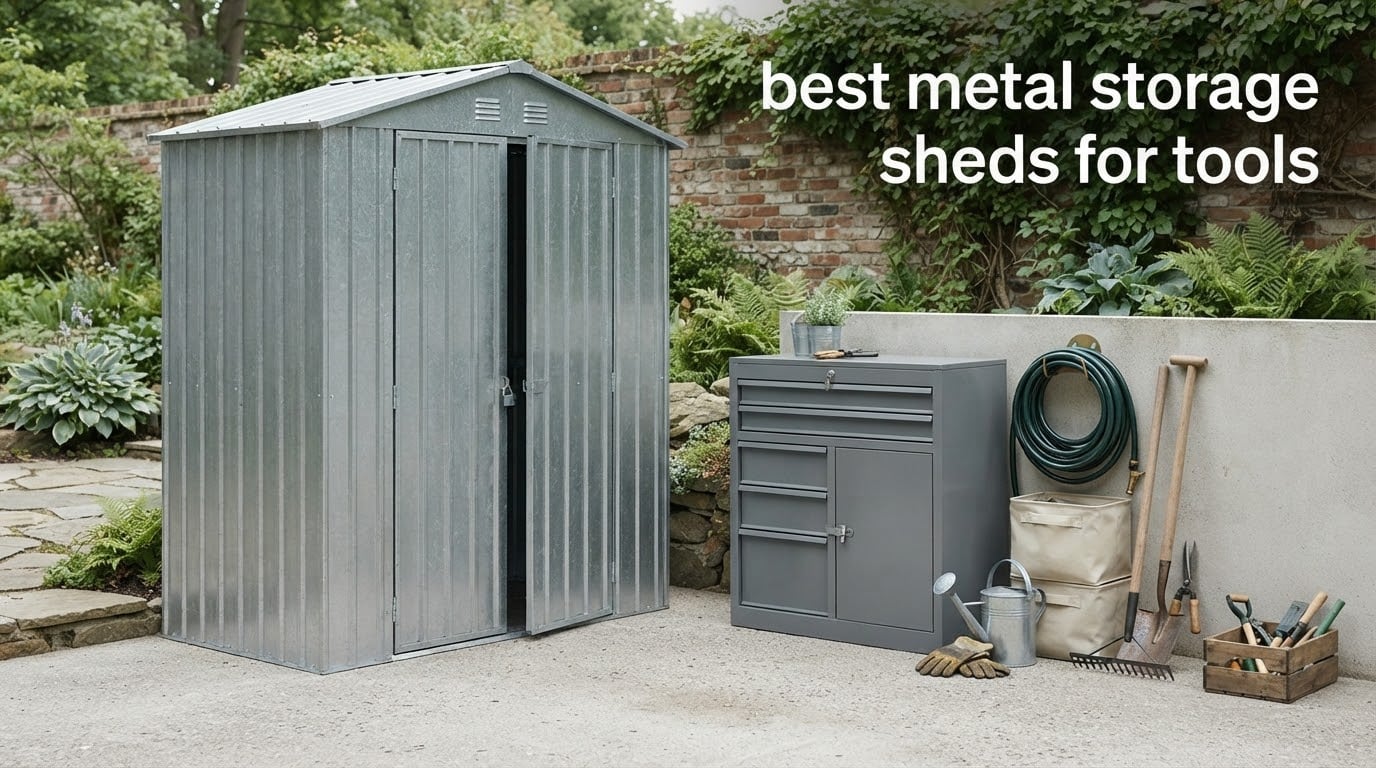
If you have a mower, a snow blower and a tool chest competing for garage space, a metal storage shed is the fastest fix. A metal storage shed for tools is a prefabricated steel kit, usually alloy or galvanized panels screwed into a frame with a sloped roof, vents and a lockable door, that you bolt onto a foundation you build yourself. Almost none of them include a floor, and the right pick depends far more on your available footprint and your door opening than on the badge on the box.
Over the last few months our team compared the ten most-reviewed metal sheds sold for tools and garden equipment, reading the full review sets on each one and weighing the spec sheets line by line. We looked hard at floor area, door width, steel type, ventilation, roof shape, assembly requirements and what each shed realistically holds. Our aim with this guide to the best metal storage sheds for tools is to save you the two things that cost buyers the most time: buying a shed that will not fit through its own door, and discovering on assembly day that the panels are thinner than the listing photos implied.
A word of warning before we start. Metal tool sheds carry a reputation for underwhelming reviews, and looking at retailer listings for this exact category, the ratings genuinely do cluster low. That is not a sign that every shed is badly made; it is a sign the category has a few predictable failure points, mostly thin gauge steel, dented panels arriving in the box, a missing floor, and interior condensation that rusts the very tools you bought the shed to protect. We explain those failure modes, and how to avoid them, further down.
If your problem is the garage rather than the shed, our [guide to the best outdoor storage sheds](https://zamd.net/best-outdoor-storage-sheds/) covers non-metal options. And if you want the tools organised inside, start with our picks for [metal storage cabinets](https://zamd.net/best-metal-storage-cabinets/), then come back here for the shell around them.
Table of Contents
Top 3 Picks for the Best Metal Storage Sheds for Tools (October 2026)

Azomabox 9×10.5 Metal Shed
- 100 square foot floor area
- Alloy steel with sliding doors
- Lockable and water resistant

Gizoon 6×4 Metal Shed
- 44.5 inch double door opening
- Galvanized steel with UV paint
- Vented sloped roof

Aoxun 6×4 Metal Shed
- Waterproof galvanized steel
- Vented sloped roof
- Padlock-ready hinged doors
All 10 Metal Storage Sheds Compared Side by Side
The table below lists every shed in the roundup with its footprint, steel type, door arrangement and the practical use it suits best. Use it to shortlist two or three before reading the individual reviews.
| Product | Specifications | Action |
|---|---|---|
| Azomabox 9×10.5 Metal Shed |
|
Check Latest Price |
| Gizoon 6×4 Metal Shed |
|
Check Latest Price |
 Aoxun 7.3×5.3 Metal Shed Aoxun 7.3×5.3 Metal Shed |
|
Check Latest Price |
 Gizoon 8×6 Metal Shed Gizoon 8×6 Metal Shed |
|
Check Latest Price |
 Flamaker 6×8 Metal Shed Flamaker 6×8 Metal Shed |
|
Check Latest Price |
| Aoxun 6×4 Metal Shed |
|
Check Latest Price |
 Patiowell 8×12 Metal Shed Patiowell 8×12 Metal Shed |
|
Check Latest Price |
 Devoko 8×6 Metal Shed Devoko 8×6 Metal Shed |
|
Check Latest Price |
 Polar Aurora 8×12 Metal Shed Polar Aurora 8×12 Metal Shed |
|
Check Latest Price |
 JUMMICO 8×8 Metal Shed JUMMICO 8×8 Metal Shed |
|
Check Latest Price |
1. Azomabox 9×10.5 Metal Shed: Our Top Pick for Big Yards
Azomabox 9×10.5 FT Outdoor Storage Shed, Metal Tool Shed with Windows & Secure Lockable Doors, Ideal Storage Garden Shed for Outdoor, Patio, and Backyard
100 sq ft floor area
Alloy steel with metal frame
Sliding lockable doors
Powder-coated finish
Pros
- 100 square feet of usable floor area
- Double sliding doors open wide for bulky gear
- Powder-coated galvanized steel blocks UV and moisture
- Lockable doors secure power tools
Cons
- Very large footprint needs open yard space
- Tall 128 inch overall height
- No floor or base included
This is the shed we kept coming back to while building the roundup. At 100 square feet of floor area it is the largest footprint in the roundup, and it carries the highest average rating of any shed in this list, sitting at 4.6 stars across more than 660 ratings. Owners describe the interior as genuinely spacious and the sliding doors as the reason they can wheel equipment in and out without swinging a panel wide into the yard.
The steel is powder-coated galvanized steel described by the manufacturer as repelling water and blocking UV, and the frame is listed as a heavy-duty metal frame built for wind, rain and snow loads. Water resistance is listed at the water resistant level rather than waterproof, which is an honest description of any single-wall steel shell and worth remembering before you store anything corrosion-prone.
The dimension figures matter more than the marketing copy here. The unit measures 108.62 inches deep by 83.8 inches wide by 128.19 inches tall, which means you are clearing a footprint close to nine by ten and a half feet plus a little working room at the door. In a small side yard that is a non-starter. In an open suburban backyard it is a walk-in workshop rather than a cupboard.
Because the doors slide rather than swing, you gain usable floor area right up to the frame on both sides, which is why owners fit wall rails and pegboard in there. That is the single biggest upgrade you can make, and Small-Cabin Forum members make the same point about hanging tool hooks on shed walls to double the storage you get from the same box.
A mower fits inside the Azomabox 9×10.5 with room to walk
Yes, comfortably. The 100 square feet of listed floor area gives you room for a push mower, a snow blower and a full tool chest with walking space between them. The sliding doors mean you can also stage bulky items like a ladder or patio furniture flat against the wall without losing door clearance.
The catch is planning, not size. Measure your mower including the handle width, then confirm you can approach the door straight on rather than at an angle, because a shed this deep needs a wide path in front of it.
Where the Azomabox falls short: space and yard room
The footprint is the obvious limit, and the 128 inch overall height is worth noting if you have overhanging branches or a low fence line. Buyers in the reviews focus on space and access rather than on finish problems, and there is no complaint pattern around leaks to plan around at this rating level.
The other limitation is documentation. The listing data for this shed carries no meaningful assembly detail, so you would be relying on the printed manual alone. If picture-only instructions are a dealbreaker for you, check that a written guide exists before you commit.
2. Gizoon 6×4 Metal Shed: Best Value for Side Yards
Gizoon 6×4 FT Outdoor Shed, Metal Garden Shed Lockable Doors, Dark Gray
24 sq ft floor area
Galvanized alloy steel
44.5 inch double door
Vented sloped roof
Pros
- 44.5 inch wide double door opening
- Galvanized steel with UV protection spray paint
- Sloped roof with integrated vents
- Metal lock and gloves included
- Labelled parts with written instructions and video
Cons
- Only 24 square feet of floor area
- Hinged fixed-tube doors limit opening options
- Height of 71.3 inches suits hand tools more than tall cabinets
The Gizoon 6×4 is the shed we would put in a narrow side yard or beside a patio door. Owners consistently single out one thing above everything else: the 44.5 inch double door opening. That width is what lets a snow blower or a mower through in one piece, which matters a lot at this footprint size.
It also carries some of the clearest documentation in the roundup. The box includes labelled parts, written step-by-step instructions, a metal lock, a pair of gloves and an installation video. Given how often buyers complain about picture-only manuals, having instructions that use actual words is a real practical advantage.
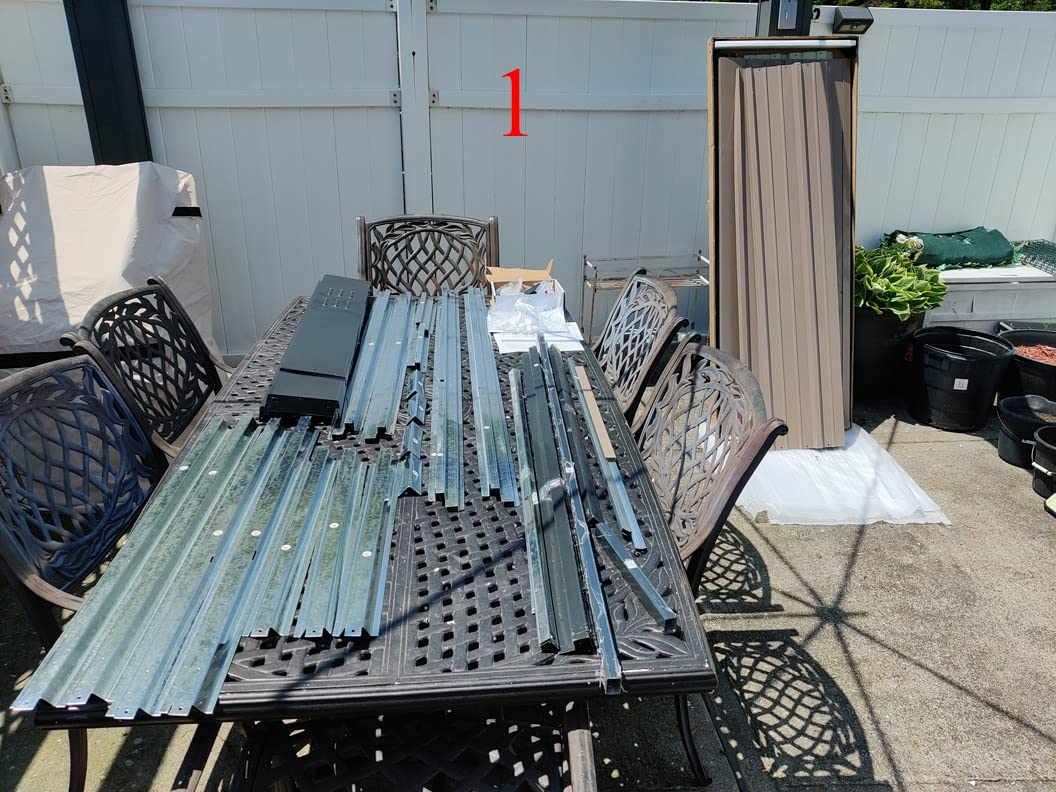
Construction is galvanized steel with UV-proof spray painting, listed as waterproof, with a sloped roof and integrated vents that keep the interior dry and move air through it. The chamber measures 48.5 inches deep by 75.6 inches wide by 71.3 inches tall, giving 24 square feet of floor.
At 71.3 inches tall, this is a crouching shed rather than a standing one. A tool chest and a bag of compost fit comfortably. A wheelbarrow goes in flat but you will not be standing upright beside it, so plan wall-mounted storage at chest height.
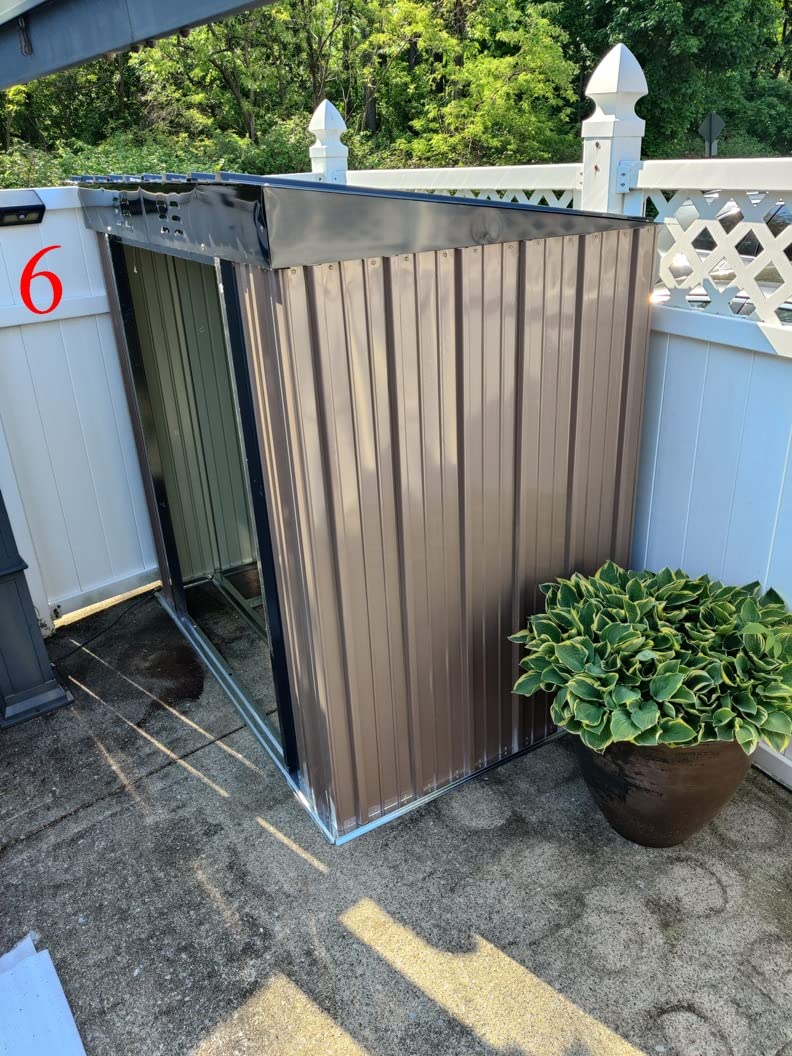
A push mower clears the Gizoon 6×4 door easily
With a 44.5 inch opening and 48.5 inches of interior depth, a standard push mower goes in easily with room to spare. A small snow blower fits too. The constraint is everything else: 24 square feet fills up fast once a mower and a tool chest are inside, so this shed works best when you store hand tools and one powered machine, not a whole lawn fleet.
If you have a riding mower, skip this size. Look at the 8×6 and 8×12 options further down, where door width and floor area open up properly.
Where the Gizoon 6×4 falls short: floor area and headroom
The floor area is the honest weak point. Owners love the door and then run out of room, which is the most common regret pattern with compact sheds. Two doors on a fixed-tube hinge also swing to a fixed angle rather than opening wide enough to roll something straight in.
At 71.3 inches of height you will also be bending for every shelf you install. If you intend to hang things up high, look for a taller shell such as the JUMMICO instead.
3. Aoxun 7.3×5.3 Metal Shed: Best Choice When a Floor Is Included
Aoxun 8’x6′ Shed with Floor Galvanized Steel Outdoor Storage Shed Brown
12mm interlocking floor
82 lb load capacity
Rated 6 inch snow and 25 mph wind
Top vents
Pros
- Interlocking 12mm plastic floor included
- One of the few with a stated load rating
- Top vents reduce condensation
- Double doors with stainless steel latch
- Numbered pre-drilled panels with manual and video
Cons
- Two to four adults and around three hours to assemble
- Thin sheet metal that flexes and dents
- Occasionally dented panels and misaligned holes
Almost every shed in this category is sold as a shell and leaves the floor to you. This Aoxun is the exception. It comes with a 12mm interlocking plastic floor rated at 82 pounds per cubic foot, which means you can put a loaded mower or a compressor inside without building a platform first. For most buyers that is worth more than any other single feature on this list.
It also carries one of the few published environmental ratings in this category: 6 inches of snow load and 25 mph of wind. You should still anchor it properly, but at least you are working from a number rather than a guess.
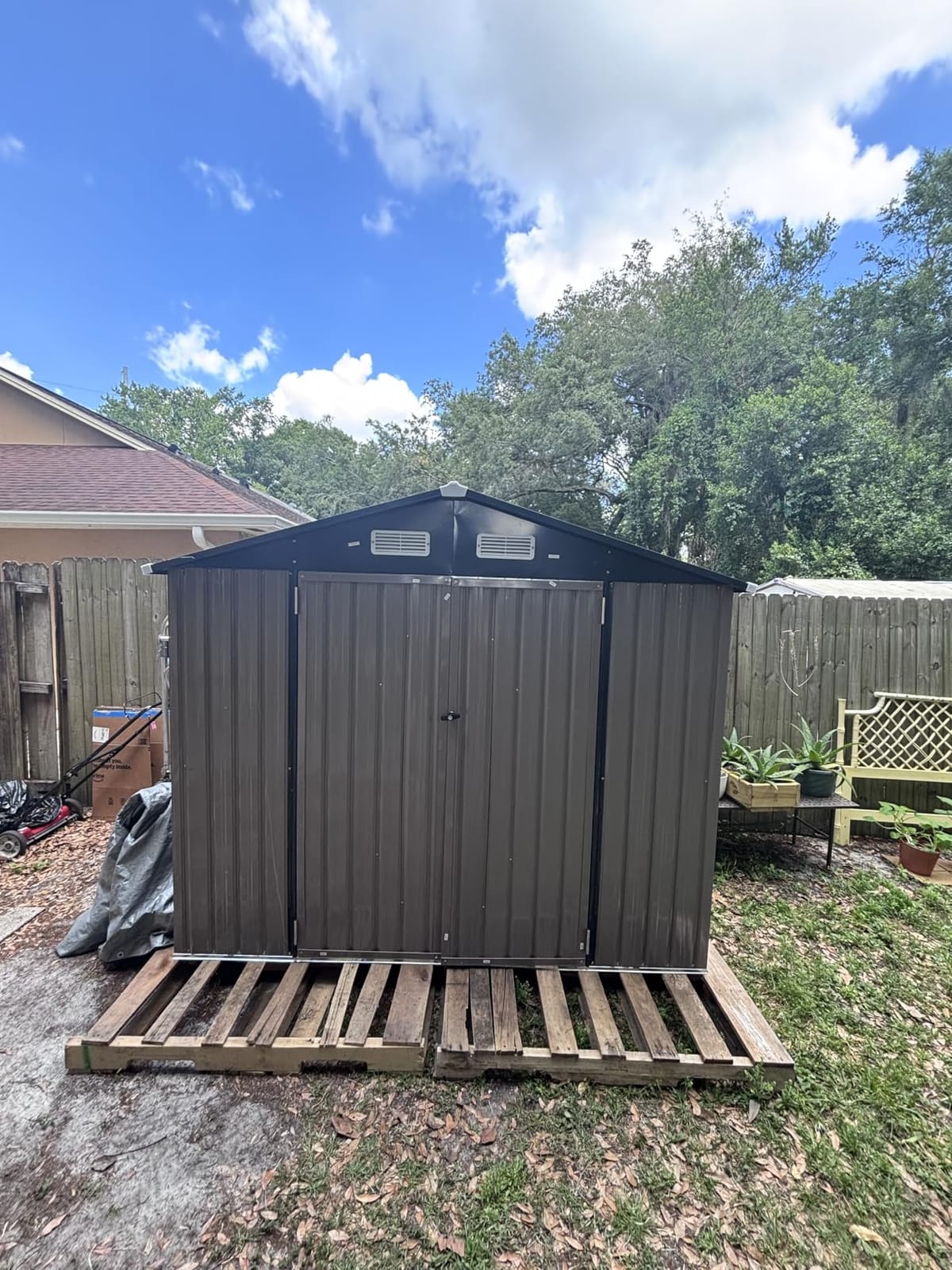
The footprint measures 63.4 inches deep by 88 inches wide by 77.2 inches tall across 48 square feet, and the listed weight is 159 pounds. Owners like the dual front doors with a stainless steel latch and reinforced hinges, plus integrated top vents that reduce condensation and help keep stored tools from rusting.
The sloped roof angle adds interior headroom and sheds snow rather than letting it sit. Panels are numbered and pre-drilled, with an illustrated manual and installation video, and corner guards plus foam and air cushioning protect the panels in transit. Owners do report good weather resistance after they seal the roof screws, which is a five-minute job with a tube of sealant.
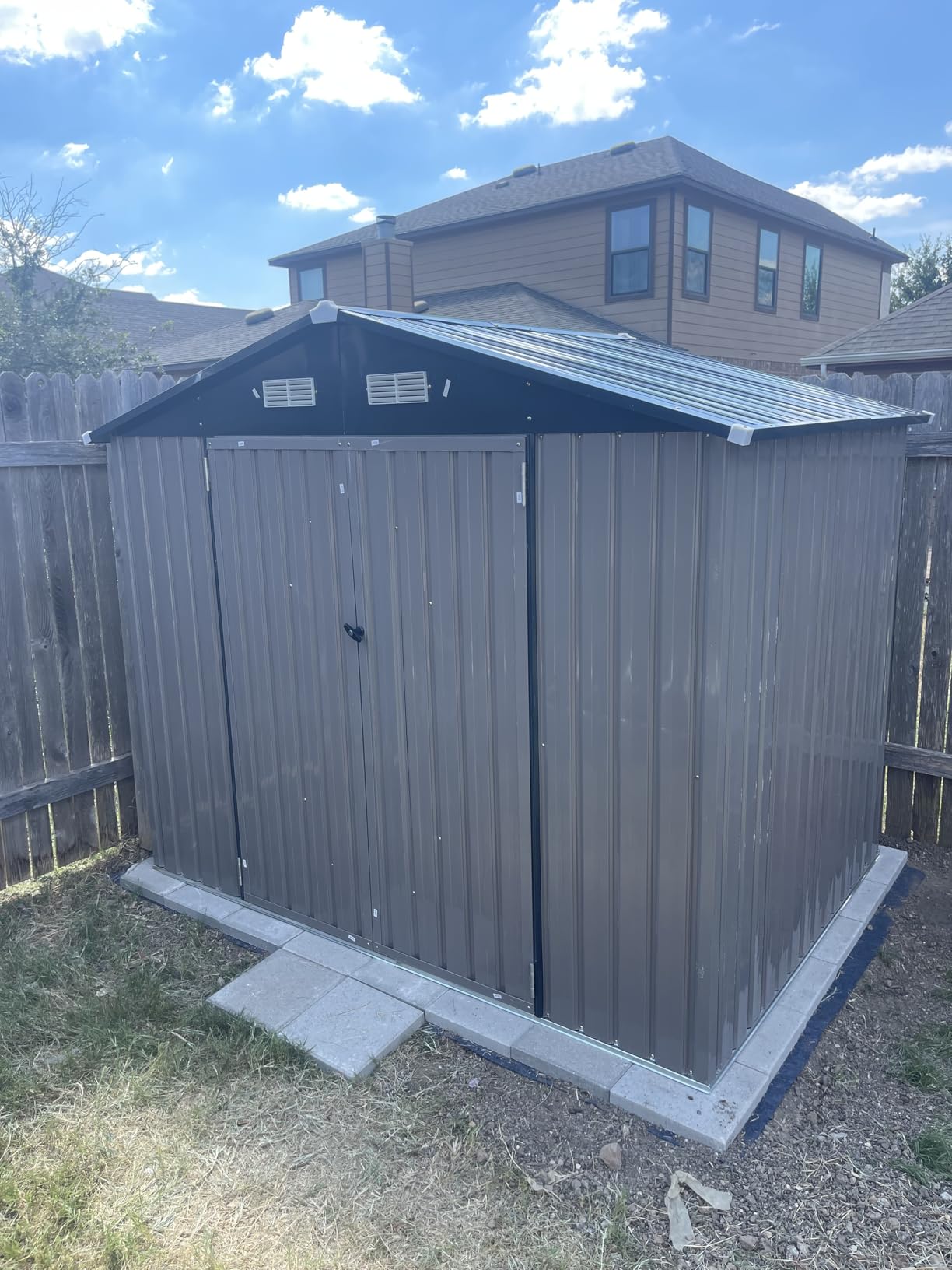
The interlocking floor takes mower and snow blower loads
At 82 pounds per cubic foot, yes for the kinds of loads a tool shed sees. A push mower, a snow blower, tool chests and shelving all sit comfortably inside that figure. It is a floor, not a vehicle ramp, so do not try to drive a riding mower across the threshold panels without a ramp.
Keep in mind the floor does not solve your foundation problem. The shed still needs a level base underneath, and the plastic panels are designed to sit on one.
Where the Aoxun 7.3×5.3 falls short: build time and sheet thickness
Assembly is the biggest hurdle. Owners and the manufacturer both point to two to four adults and roughly three hours, which is more than most people expect for a shed this size. Budget an afternoon and a second pair of hands rather than a single evening.
Reviewers also report thin sheet metal that flexes and dents, panels arriving dented, and a colour that renders more grey and black than the brown in the photos. None of that is a dealbreaker, but it is the reason this shed sits mid-pack on ratings despite its feature list.
4. Gizoon 8×6 Metal Shed: Best for Sliding-Door Access
Gizoon 8×6 FT Outdoor Storage Shed, Corrosion Metal Garden Shed, Dark Grey
47.67 sq ft floor area
Galvanized steel roof
45.1 inch sliding door
Peaked roof
Pros
- Nearly 48 square feet of floor area
- 45.1 inch sliding door opening
- Galvanized steel top resists corrosion
- Peaked roof adds interior headroom
- Customer service resolves missing parts quickly
Cons
- Only about 66 inches of interior height under the rafters
- Picture-only instructions with errors and misaligned holes
- Some reviewers report leaking in heavy rain
The 8×6 footprint is one of the most common sizes in this category for a reason: it is big enough for a mower, a snow blower and bikes, and small enough to sit against a fence in a normal suburban yard. This Gizoon version covers 47.67 square feet in a 73 inch by 94 inch footprint with a 76.1 inch overall height.
Its sliding door is 45.1 inches wide, so you gain floor area along the entire front wall without any door swing stealing space. That makes wall-rail organisation far more practical than in hinged-door sheds of the same size.
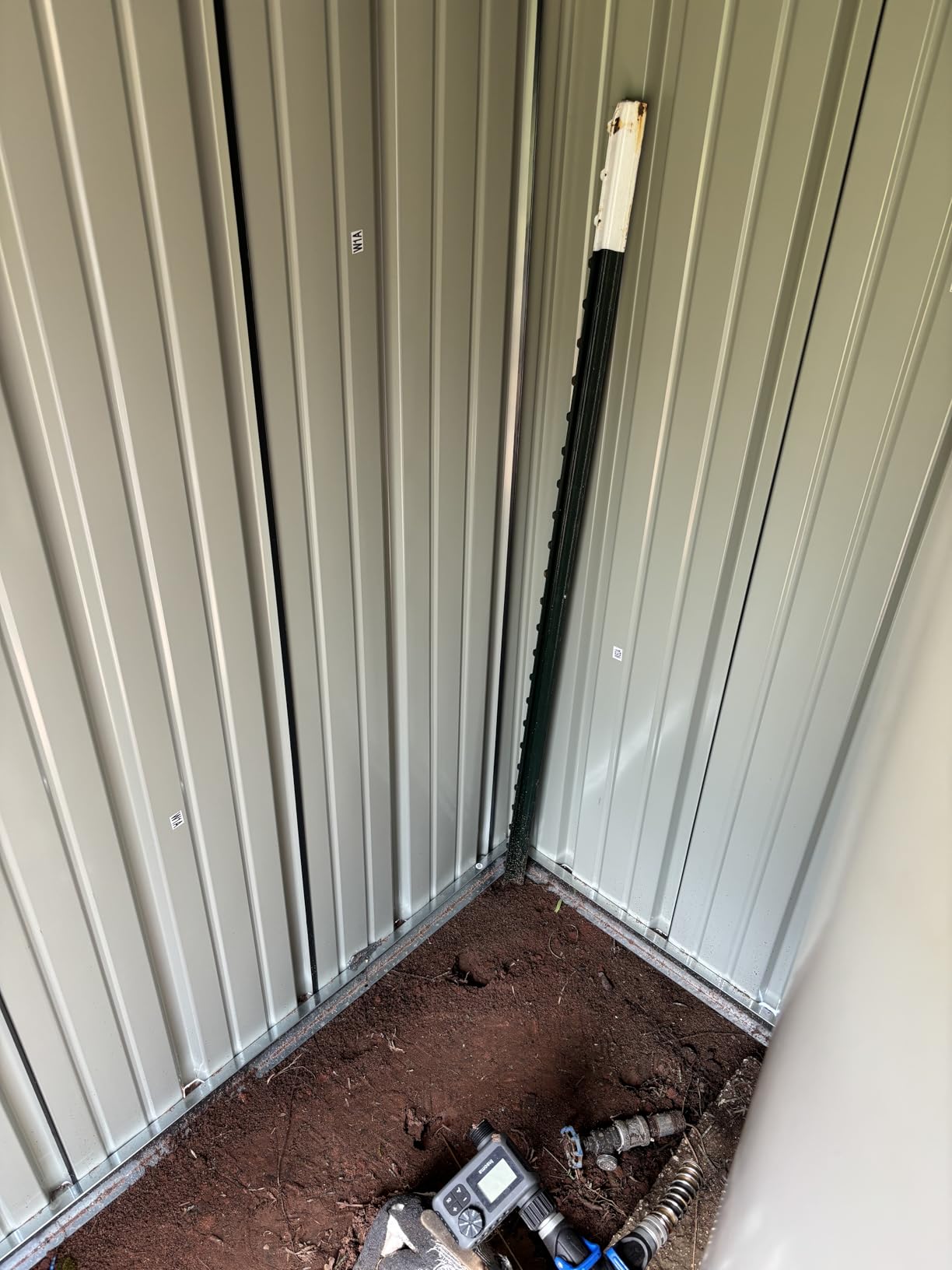
Construction is galvanized steel with a corrosion-resistant finish and UV protection, listed as water resistant, with a peaked roof that adds usable height in the centre. Owners rate the size-to-capability ratio highly and report that support responds quickly when parts are missing, which is worth having on a shed that has to be assembled before you can use it.
The catch is height. With a 76.1 inch exterior height, interior clearance under the rafters is about 66 inches. That is fine for mowers and bikes, but you will be ducking to reach the top of a wall rail, and a tall tool chest will not fit upright.
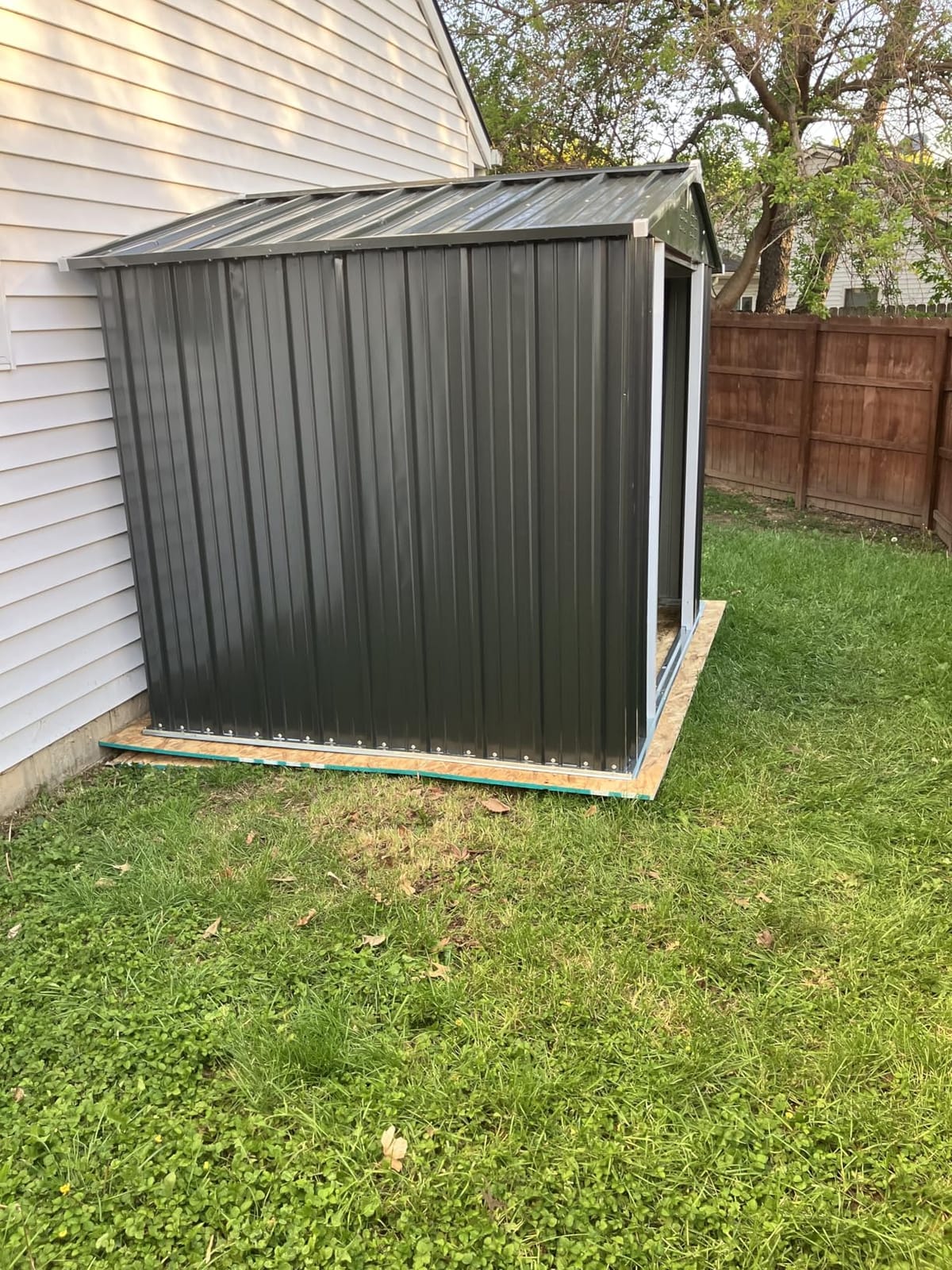
Two bikes and a mower share the Gizoon 8×6 floor in practice
Yes, in practice. Bikes go along the back wall on a hook or rail, the mower sits on one side, and that leaves a workable centre aisle. Just measure your mower handle width before you commit, because a wide-deck mower plus a bike can push you toward the far wall.
Plan wall storage rather than floor storage. In a sliding-door shed the full front wall is free, so pegboard and rail systems pay for themselves immediately.
Where the Gizoon 8×6 falls short: interior headroom and instructions
The low interior height is the headline limitation and it is not subtle. Anyone over about five foot ten will spend a lot of time bent over inside this shed, which is tiring if you are digging out garden tools on a Saturday.
Reviewers also flag picture-only instructions with errors, hardware that does not seat cleanly in the clearance holes, roof screws that are awkward to reach for sealing, and a handful of reports of roof leaking in heavy rain. Seal every roof screw on day one and most of that risk disappears.
5. Flamaker 6×8 Metal Shed: Best for Firewood and Patio Utility
Flamaker 6×8 FT Storage Shed Waterproof Metal Garden Shed with Lockable Door Utility Tool Shed Outdoor Storage for Backyard, Patio and Lawn, Brown
48 sq ft floor area
Anti-rust coated galvanized steel
Sloped roof
Lockable sliding door
Pros
- Anti-rust and corrosion coating on galvanized steel
- Roof corner and screw head protective caps
- Sloped roof that sheds rainwater
- Lockable door deters theft and animals
- Useful as firewood store or pet shelter
Cons
- Base and floor not included
- 165 pound weight makes it a two-person job
- Single door opening limits bulky loads
The Flamaker 6×8 is one in this roundup that owners regularly repurpose. Reviewers describe using it for landscaping supplies, as a patio utility room, for firewood, and even as a pet shelter. That is a fair measure of how well the 48 square foot floor handles mixed storage.
It measures 73 inches deep by 89.7 inches wide by 76.1 inches tall and weighs 165 pounds, so this is a two-person build and a two-person move. That weight is a genuine downside if you ever want to relocate it.
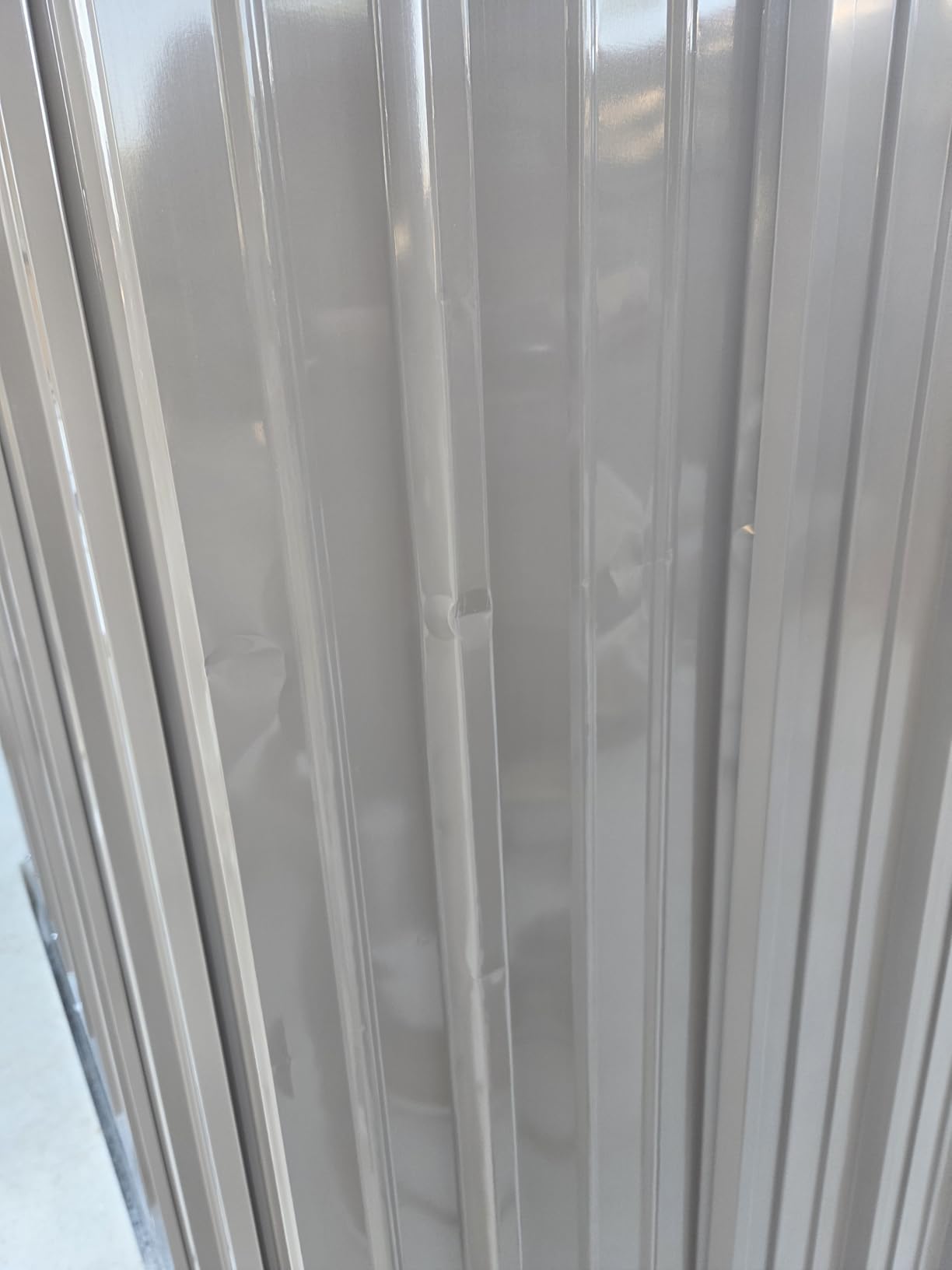
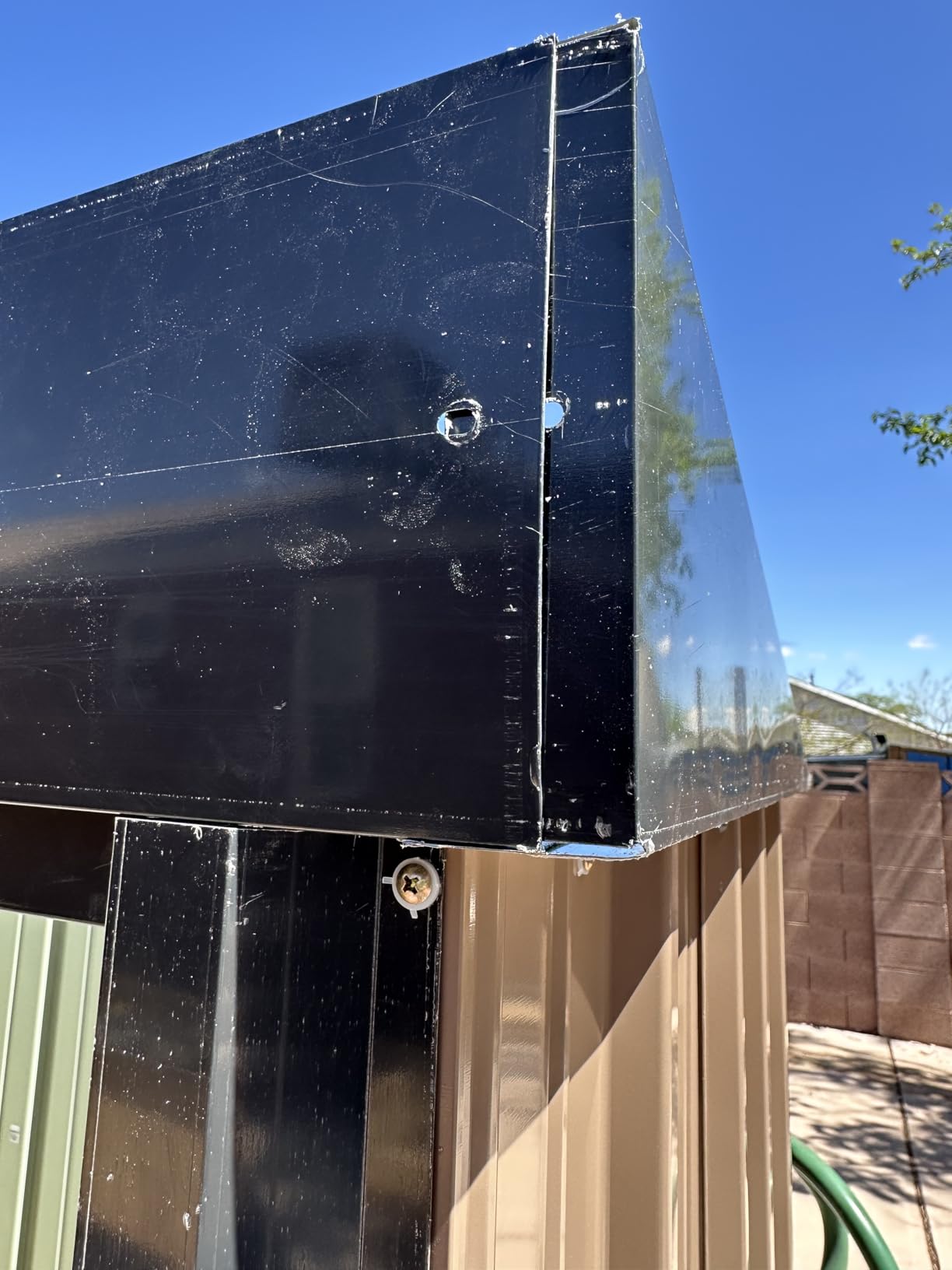
The steel is galvanized with a special anti-rust and corrosion coating, and the build detail that stands out is the protective capping: roof corner caps and screw head caps reduce scratches during assembly and remove the sharp edges you would otherwise handle bare-handed. It is a small feature that owners mention more than you would expect.
The sloped roof is designed to shed rainwater rather than pool it, and the door is lockable, which handles both opportunistic theft and curious animals. Water resistance is listed as waterproof, and there is some UV protection in the finish.
The Flamaker 6×8 works well as a seasonal wood store
For a seasonal woodpile, yes. Forty-eight square feet holds a decent stack of split logs, and the sloped roof keeps rain off the top of the pile while air moves around it. Add a floor of pavers or a raised timber platform and you protect against ground moisture rising into the bottom row.
Firewood does not need a lockable door as much as tools do, but having one means the space is secure from animals and opportunistic theft, which matters if the shed sits close to a street.
Where the Flamaker 6×8 falls short: no floor and a heavy build
No base or floor is included, so your real starting cost includes gravel, pavers or a timber platform on top of the shed. That is true of most of this list, but on a 165 pound shed the foundation needs to be genuinely level or the frame will rack.
The door arrangement is also more limited than it looks. A single sliding door of about six feet is fine for firewood and bins, but it is not the wide twin opening you would want for a machine you plan to wheel in and out weekly.
6. Aoxun 6×4 Metal Shed: Budget Pick with Vents and a Padlock
Aoxun 6×4 FT Metal Outdoor Steel Shed Brown
Waterproof galvanized steel
Vented sloped roof
Padlock-ready hinged doors
93 pounds build weight
Pros
- Thick galvanized steel rated waterproof
- Reinforced roof and stacked wall panels
- Sloped roof with dedicated air vents
- Padlock-ready hinged doors for security
- Numbered parts with step-by-step manual and gloves
Cons
- Needs two people to assemble
- Small 6x4 footprint limits what fits
- No floor or base included
The Aoxun 6×4 carries more than 1,100 ratings at 4 stars and ranks near the very top of the Storage Sheds category, which tells you something useful: it is the shed in this roundup that the most people have actually bought and lived with. That long review history makes its reported weaknesses easy to plan around.
The build is thick galvanized steel described as waterproof, with a reinforced roof and stacked wall panels that improve both strength and sealing. The shipping weight is 93 pounds, which keeps it manageable for a first-time build.
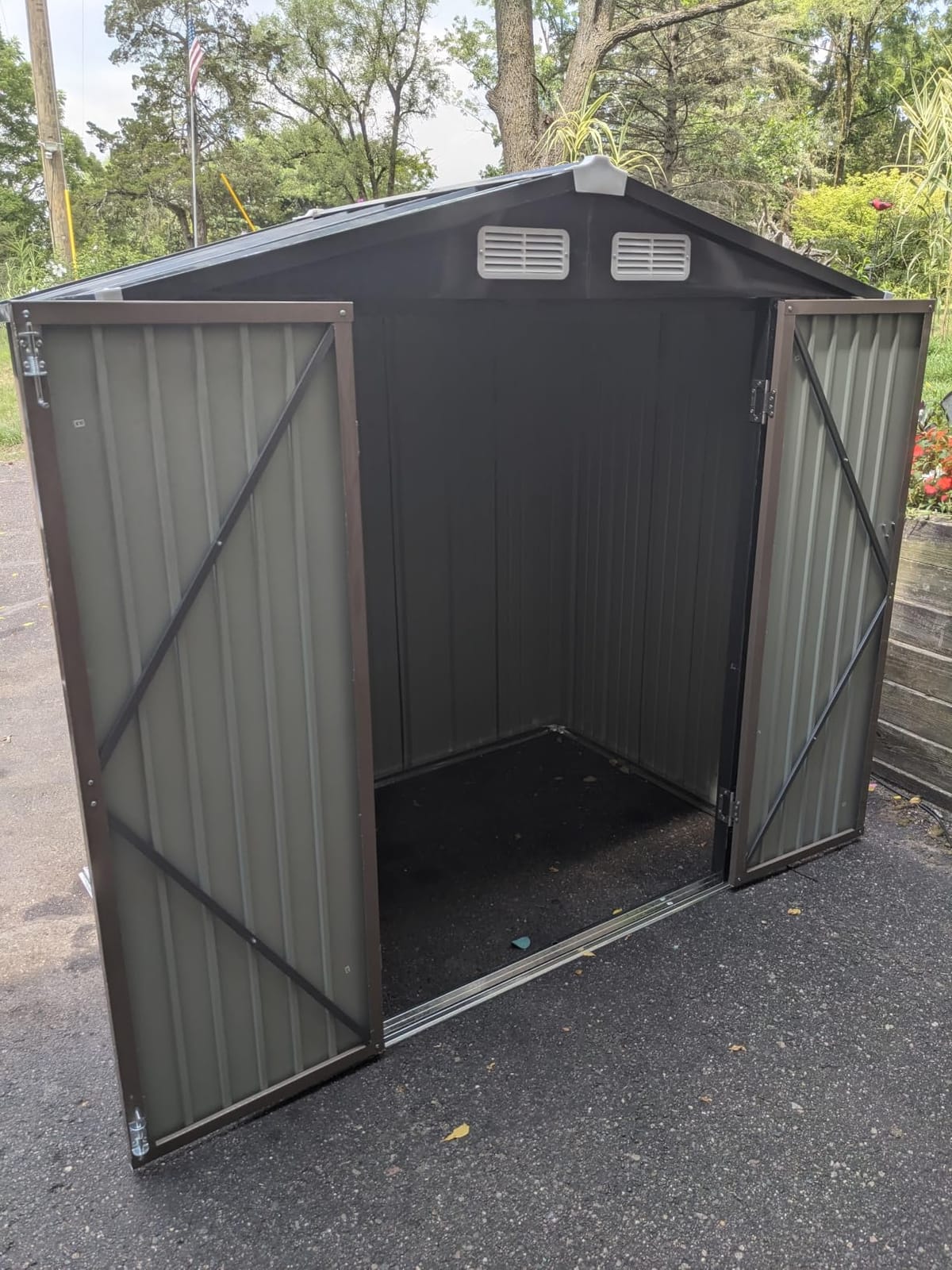
The sloped roof includes dedicated air vents, which matters more than it sounds. Ventilation is the single best defence against the condensation that rusts stored tools, and reviewers specifically praise the vented roof design for keeping the interior dry.
Doors are hinged and padlock-ready, so you can secure power tools without buying a separate lock. The footprint measures 75 inches deep by 49 inches wide by 74 inches tall, and parts arrive labelled with a step-by-step manual and gloves in the box.
A 6×4 holds hand tools, bins and one powered machine
Hand tools, a tool chest, bags of compost or fertiliser, a pressure washer stood on end, and a couple of bikes hung from the rear wall. That is a solid list. A push mower will fit, but it will consume most of the floor once it is in there.
Because the doors are hinged rather than sliding, plan the swing direction before you assemble so the open doors do not foul a wall, a fence or your lawn mower path.
Where the Aoxun 6×4 falls short: two-person assembly and floor area
Two people are needed for assembly, even at this modest size. That is the single most common complaint in the reviews and it is fair: the panels still number in the hundreds and the frame needs to stay square while you bolt them together.
The footprint is the other limit. Once the mower is inside, you have very little flat floor left, so this works best as overflow storage alongside your garage rather than as a replacement for it.
7. Patiowell 8×12 Metal Shed: Premium Pick with 96 Square Feet
Patiowell 8 x 12 FT Outdoor Storage Shed, Metal Storage Shed, Gray
96 sq ft floor area
440 lb load capacity
89.7 inch swinging doors
Alloy steel frame
Pros
- 96 square feet of floor area
- 440 pound load capacity on a stated spec
- 89.7 inch swinging double doors for big equipment
- Customer support sends replacement parts quickly
- Most reviews of any shed here
Cons
- Thin sheet metal that strips screw holes with a power driver
- Assembly is slow and needs two people despite the marketing
- No base or floor included
This is the largest review sample we looked at, more than 2,400 ratings, and it makes the Patiowell a very well documented shed. Buyers agree on the headline value: 96 square feet of alloy steel floor area with a stated 440 pound load capacity and an 89.7 inch swinging double door.
Those doors are the feature that matters at this size. Nearly seven and a half feet of opening means a riding mower, a snow blower, a bike rack and a shelving run all fit without the door swing stealing floor space.
The footprint is 141.5 inches deep by 89.7 inches wide by 76.2 inches tall, and the listed weight is 232.4 pounds. Construction is described as top-grade alloy steel with rust and corrosion resistance, and the frame is alloy steel throughout. Assembly-line manufacturing is what makes the extra length practical at all.
Reviewers also report good experiences with customer support when items arrive missing, which is worth having in a category where missing hardware is one of the top complaint themes.
96 square feet suits a typical garden rather than exceeding it
For most households it is exactly right rather than excessive. The 8×12 shape is the standard footprint for storing a riding mower with room to walk around it, plus a tool chest, plus seasonal equipment you would rather not drag into the garage twice a year.
It only becomes overkill if your lawn is small. Check clear space at the door end, because the door swing alone needs roughly three feet of room beyond the frame.
Where the Patiowell 8×12 falls short: thin panels and a long build
The 3.8 average is among the lowest in this roundup, and the reason is consistent: thin sheet metal. Owners report panels that bend, dent and strip their screw holes if you drive them with a power driver. Use a hand drill at low torque or the supplied wrench and you will avoid most of that.
There is also no base or floor included, the protective plastic film tears into shreds and takes hours to remove, and it arrives as two packages that may not turn up on the same day, so plan for a full weekend and a second person.
8. Devoko 8×6 Metal Shed: Best Value for Storage Volume
Devoko 8×6 FT Outdoor Storage Shed, Brown
245 cubic feet of volume
Electro-galvanized steel
Three roof beams
Ventilation openings
Pros
- 245 cubic feet of storage in an 8x6 footprint
- Three roof beams add wind and snow strength
- Electro-galvanized steel with paint treatment resists rust
- One door leaf closes independently for large loads
- Ventilation openings move air through the interior
Cons
- No floor or base included
- Lock must be added by the buyer
- Exposed screw tips need capping after assembly
Volume is the number that makes the Devoko interesting. The manufacturer states 245 cubic feet of storage inside an 8×6 footprint, which is a lot of usable air for this footprint and explains why owners fit ladders, bikes, mowers and tents inside without it feeling crowded.
Structurally it is a deliberately engineered design. Three roof beams rather than one or two is a meaningful choice for wind and snow strength, and the steel is electro-galvanized with a paint treatment described as resisting rust and sun deformation.
Assembly dimensions are 89.8 by 71.5 by 76.2 inches. The two-door layout has one leaf that closes independently, which is genuinely useful when you want the full opening for a mower but a small one for a spade.
Ventilation openings promote airflow and reduce moisture, which matters because damp interiors are one of the most common themes in this category’s reviews. The finish is listed as waterproof.
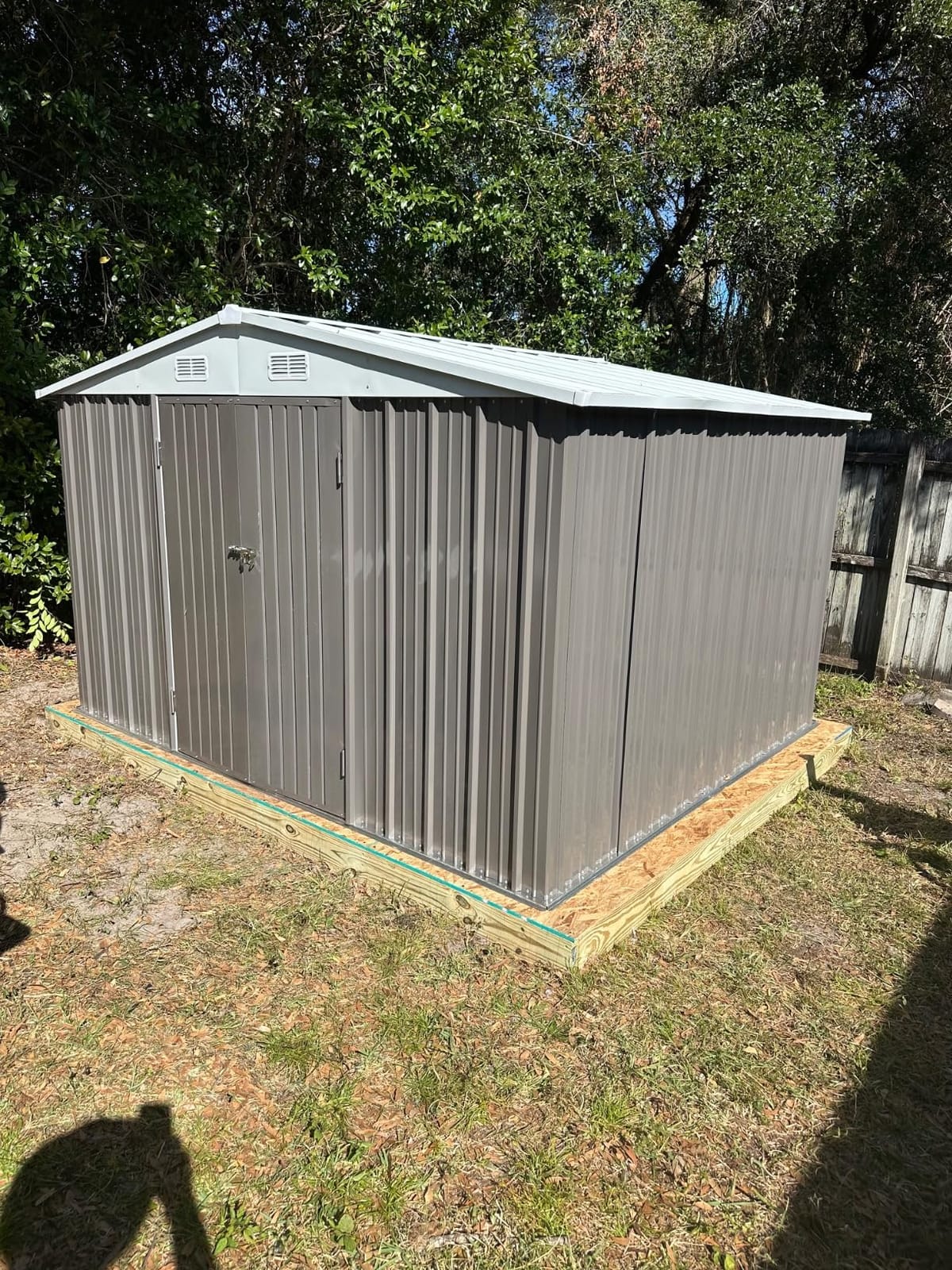
245 cubic feet beats extra floor area for tool storage
For most tool storage, yes. Vertical space is what you actually run out of first, because you can always slide things side by side on the floor but you cannot stack a mower on a shovel. An 8×6 with high internal volume beats a lower, wider box for the same footprint.
The trade-off is headroom under the roof beams. At 76.2 inches tall, the beams will interrupt your wall rails at certain points, so measure the spacing before you commit to a full pegboard run.
Where the Devoko 8×6 falls short: no floor and no lock
There is no floor or base, and the lock is not included. For a shed meant to hold power tools and bikes, buying a padlock the same day is not optional.
Reviewers also flag the need to watch the assembly video, check every part before starting, and cap the exposed screw tips afterwards so you do not put a hole in a jacket or a knee. Budget that extra hour.
9. Polar Aurora 8×12 Metal Shed: Best for a Big Open Yard
Polar Aurora 8 x 12 FT Outdoor Storage Shed
96 sq ft floor area
Waterproof UV resistant metal
Lockable doors
Sloped roof with vents
Pros
- 96 square feet of floor area
- Waterproof and UV resistant metal construction
- Reinforced structure aimed at stable assembly
- Lockable door with a water-shedding sloped roof
- Ventilation openings and tough corner protectors
Cons
- No base or floor included
- Black finish shows dents and scratches
- Door opening is narrower than the full shed width
The Polar Aurora is the other 96 square foot shed here, and it takes a different approach to the same problem. Rather than a wide twin-door opening, it uses lockable doors with a 55.51 inch width and 65.35 inch height, paired with a sloped roof designed to shed water.
Construction is listed as waterproof and UV resistant, with an alloy steel frame, ventilation openings and tough corner protectors. Reviewers credit the reinforced structure for making assembly more stable than a basic flat-pack panel build.
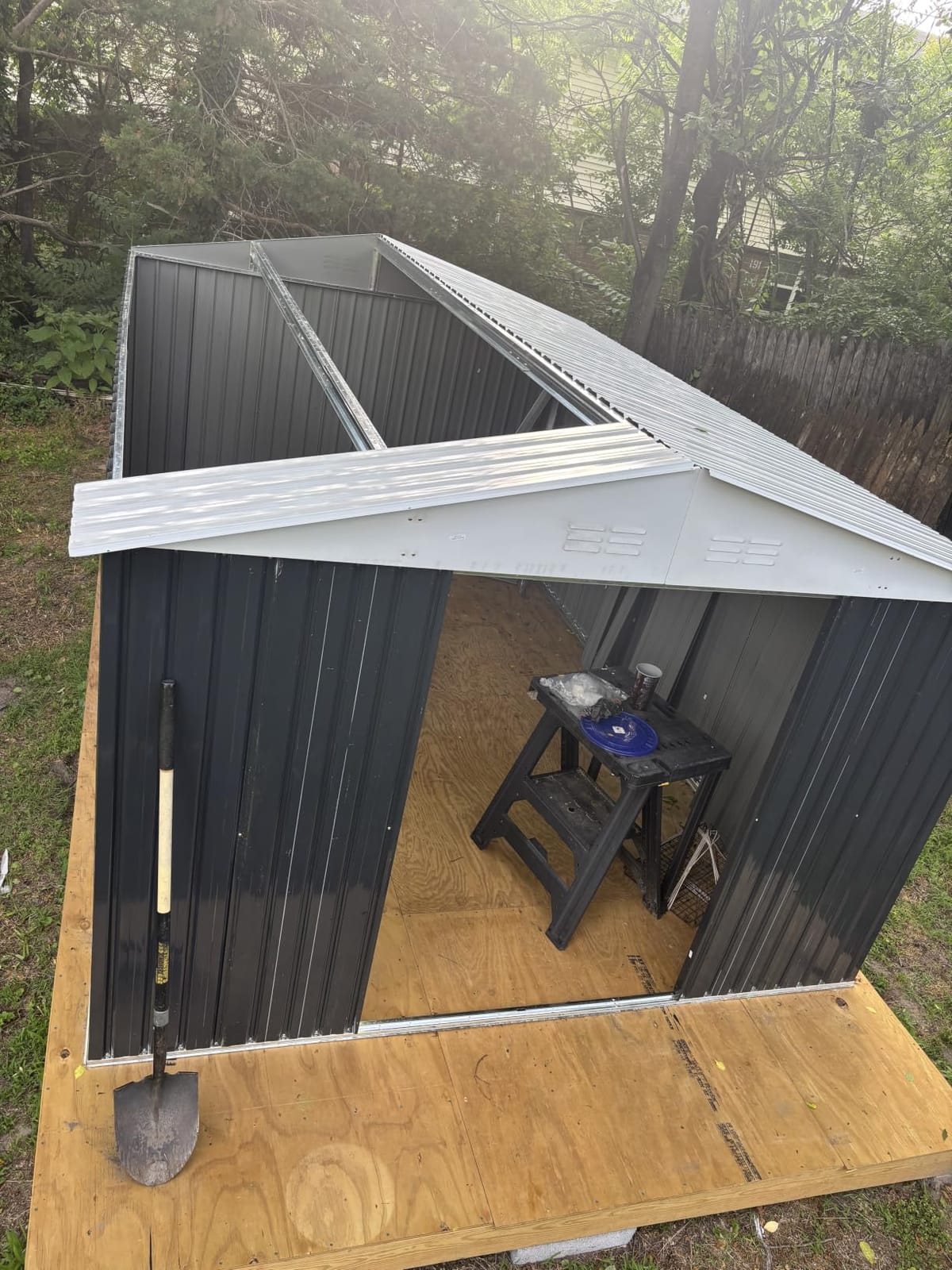
The dimensions are 138.98 inches deep by 92.52 inches wide by 76.38 inches tall, at a listed weight of 223 pounds. Nearly eight feet of width helps with long items like ladders and patio furniture laid flat, and is demanding in a narrow yard.
It ranks twelfth in the Storage Sheds category by review volume, so like the Patiowell, its reported problems are well documented rather than anecdotal.
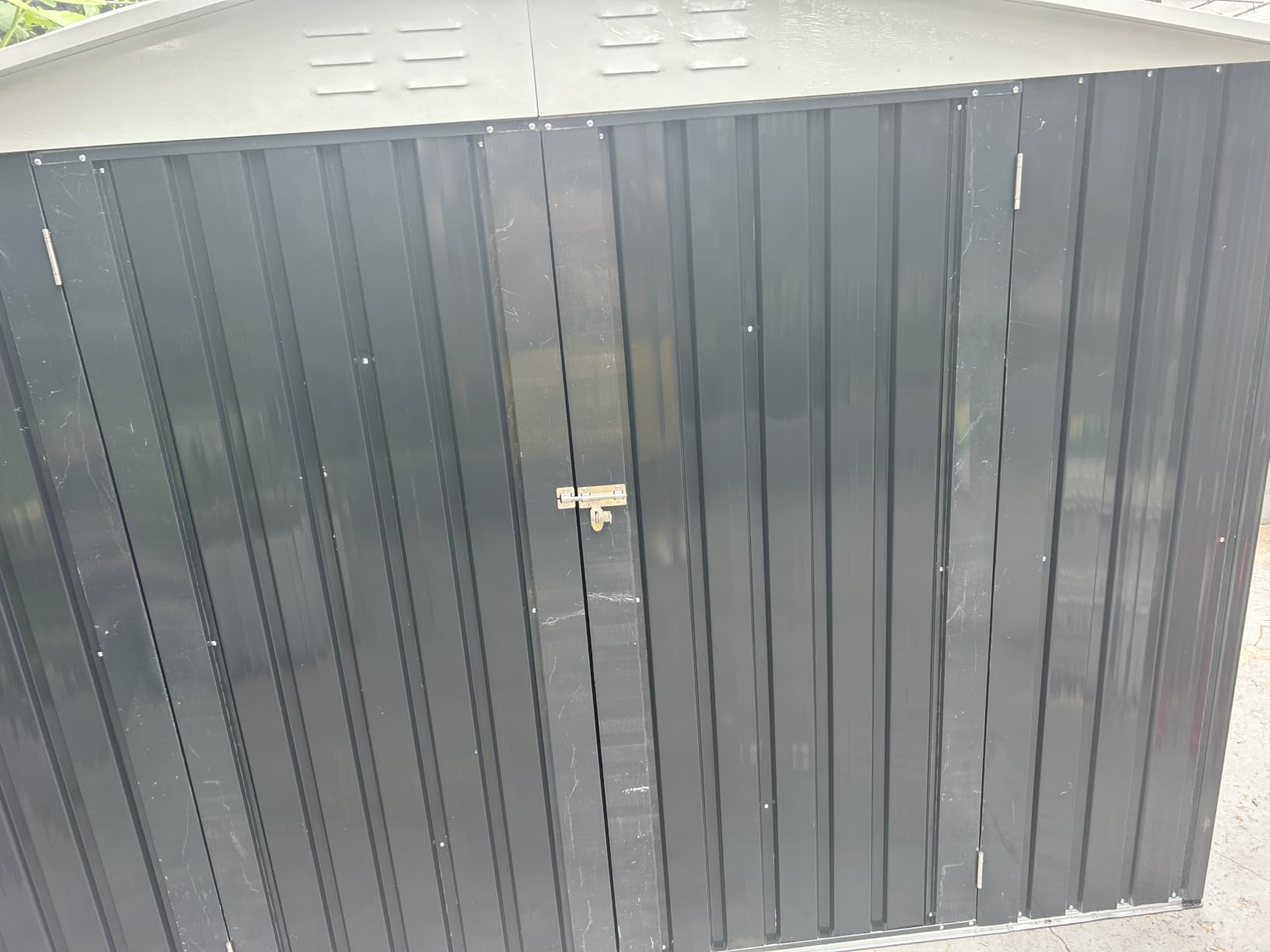
A riding mower fits, with one caveat on the opening
Yes on space, with a caveat on the opening. Ninety-six square feet gives a riding mower room to park with the shed contents around it. The 55.51 inch door is wide enough for a mower deck to pass, but check your mower at its widest point including mirrors before you commit.
If your mower is a wide zero-turn with a rollover bar, measure twice. The Patiowell, with its 89.7 inch swinging doors, is the safer choice for oversized equipment.
Where the Polar Aurora 8×12 falls short: finish marks and footprint
The black finish is the most repeated complaint. Dents and scratches show immediately on black panels, so a shed that ages poorly looks worse than a grey one that does not. If appearance matters to you, choose a lighter finish.
There is also no base or floor included, and the footprint is large enough that you need to clear the whole area before you start. Confirm the site will take it before you buy, not after.
10. JUMMICO 8×8 Metal Shed: Best for Headroom and Tall Tool Cabinets
JUMMICO 8×8 FT Outdoor Storage Shed, Tool Metal Sheds, Black
Full frame structure
90.9 inch height
Three roof vents
Lockable hinged door
Pros
- Clears head height so you can stand and work inside
- Overlapping wall panels improve load capacity and sealing
- Sloped roof with three ventilation openings
- Lockable door with reinforced internal metal beams
- Finishes well and suits courtyards and patios
Cons
- Metal is light so it must be anchored
- Some holes do not align and panels can arrive bent
- Instructions and drawings are not always clear
The JUMMICO solves a problem none of the other sheds here address: standing height inside a mid-size box. At 90.9 inches overall it clears head height, which means you can stand and work inside rather than crouch, and it makes upper shelving and shelf units worth planning around.
The build uses an improved full-frame structure with overlapping wall panels, which reviewers credit for both load capacity and better sealing between sheets. Internal metal beams reinforce the frame, and the lockable hinged door keeps the contents secure.
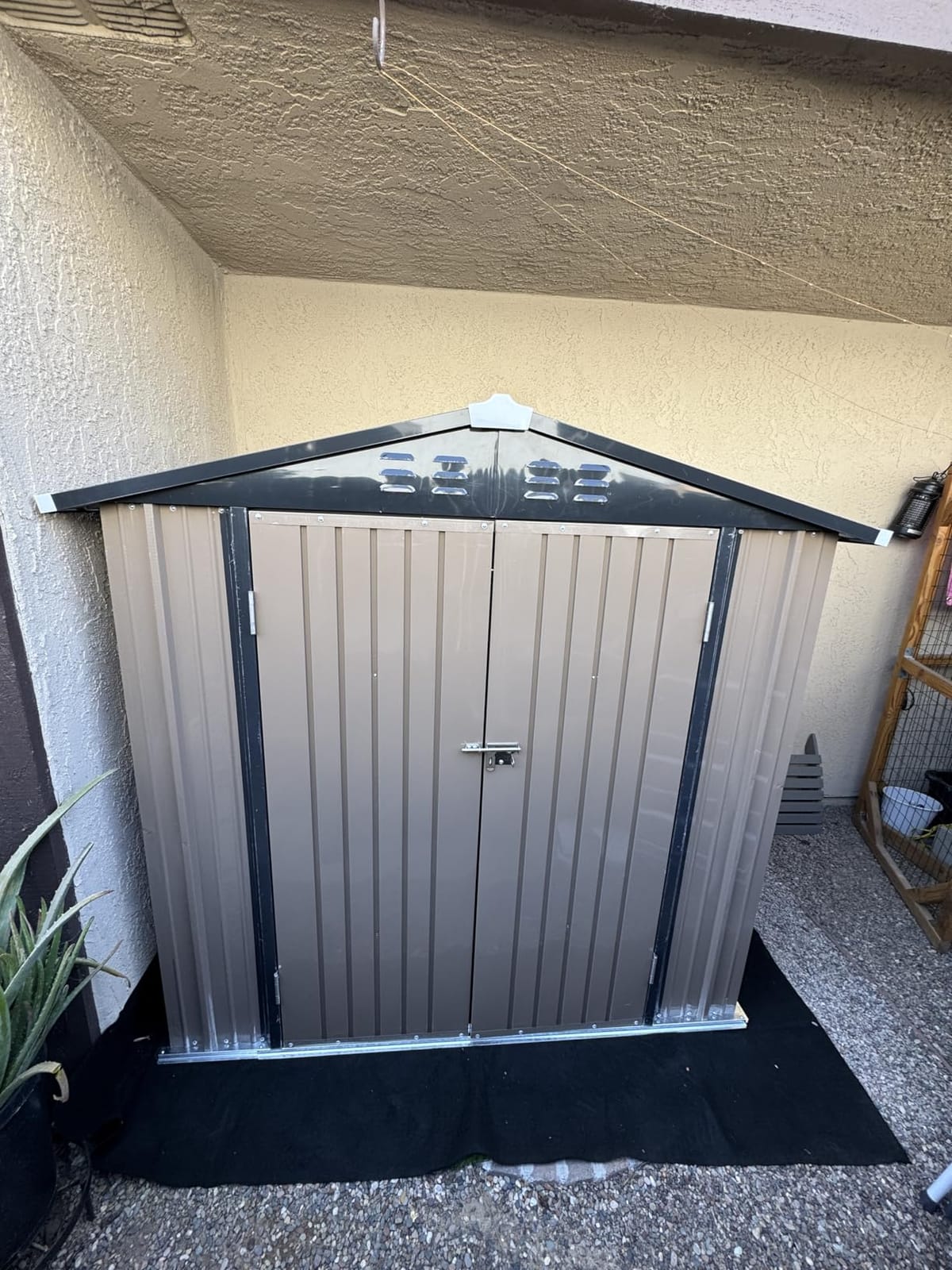
The sloped roof carries three ventilation openings, which is plenty of airflow for this size. Airflow does more to prevent rust than any sealant, and a taller shed sweats more than a low one, so this detail matters more here than on the compact models.
Owners report that the interior fits more than ten large storage bins, and the black finish is described as looking good against a courtyard, patio or garage door. Parts arrive numbered with a detailed step-by-step manual.
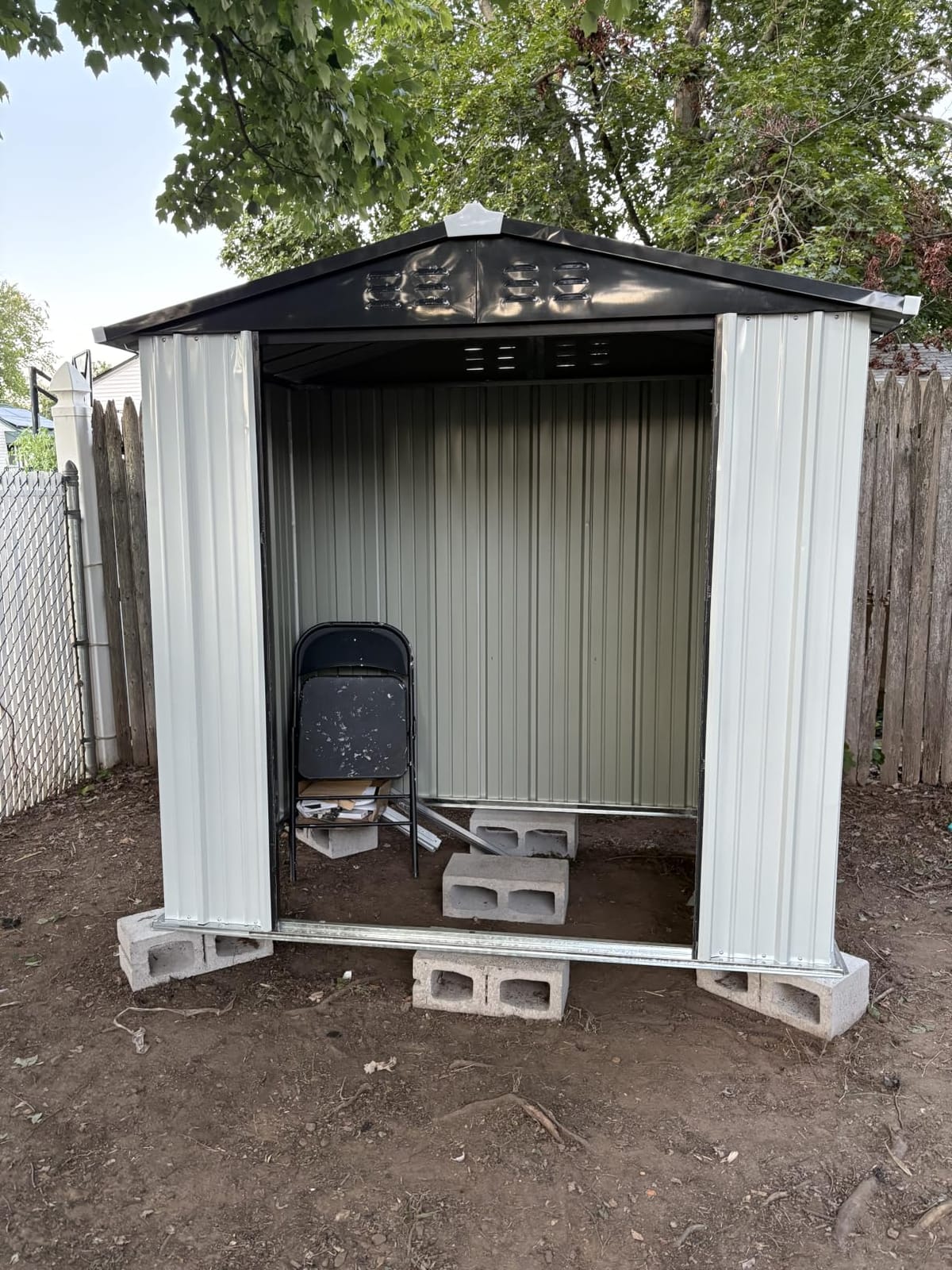
Standing room is worth giving up some width for
In a tool shed, frequently yes. Being able to stand upright changes how you use the space, because you can add upper shelving and wall rails at a comfortable height rather than crouching to reach the top of a stack. If you plan to work in the shed rather than only store in it, this is the pick.
The 8×8 footprint gives up some length compared with the 8×12 models, so a long ladder or a riding mower needs careful angling. Measure your longest stored item against the 89.3 inch depth before you decide.
Where the JUMMICO 8×8 falls short: light metal and parts checks
The metal is very light, and reviewers are clear that it must be anchored to a solid base or it will rack and move in wind. Lightweight steel in this shed means anchoring is compulsory rather than advisable.
You will also need to inspect everything before you start. Some pieces have holes that do not align and panels that arrive bent, and the illustrations are not always clear enough to work from alone. Count and lay out the parts first.
Why Metal Tool Sheds Get Low Ratings
Most metal tool sheds on retailer listings sit somewhere between 2.6 and 4.0 stars, which looks damning until you read why. Once you group the complaints they fall into a small number of repeatable failure modes, and every one of them is checkable before you buy.
Thin gauge steel. Most residential sheds use steel in the 26 to 30 gauge range, and the numbering runs backwards: lower numbers mean thicker steel. A 26 gauge panel feels noticeably stiffer than a 30 gauge panel, and reviewers who regret their purchase almost always regret the thin end of that range.
Shipping damage. Long flat panels arrive bent or dented in transit. This is usually cosmetic on a roof panel and structural on a corner, so inspect the box before you open the carton and photograph anything that is already warped.
No floor. Nearly every shed here is a shell. Buyers who budgeted only for the shed itself discover the foundation cost late, which is one of the main reasons one-star reviews exist in this category.
Condensation. Single-wall steel is not a vapour barrier. Warm humid air meets a cool steel panel and moisture forms on the inside surface, which is why tools stored in an unventilated shed can rust even though the outside is bone dry.
Assembly friction. Picture-only manuals, hundreds of fasteners and holes that do not quite line up produce the same low ratings on otherwise decent sheds. This one is entirely about expectations. If you plan for two people, a full day and a hand drill on low torque, most of these problems do not apply to you.
Rust is the fear that comes up most often in owner discussions, and one Garage Journal thread opens by advising against steel entirely because of a relative’s rusted-out shed. That experience is real, but it usually describes an unventilated, uncoated, badly anchored shed in a damp climate. Ventilation, a coating and anchoring change the outcome, which is why we rate ventilation and coating quality so heavily across this roundup.
How to Choose a Metal Storage Shed for Tools
Steel gauge, and why a lower number means thicker metal
Metal gauge is the single most useful spec a listing can give you, and almost nobody reads it. Gauge numbering runs backwards, so 26 gauge steel is thicker than 30 gauge steel. For residential tool sheds, 26 to 30 gauge covers the whole range, and within that range the difference in feel and dent resistance is obvious the moment you carry a panel.
Also check what the coating actually is. Galvanized steel carries a zinc layer for corrosion resistance. Alloy steel gets its protection from a powder coat or paint layer, which protects well until it chips, at which point rust starts at the exposed steel. Whichever you choose, touch up chips early with a zinc-compatible primer rather than waiting.
Size and what actually fits
Square feet tells you floor area, but interior volume is what determines whether you can actually use the shed. A common disappointment is a shed with enough floor and too little height, which is why we flagged the interior heights on every pick above.
As a rough guide: a 5×3 or 6×4 handles hand tools, a tool chest and bags of compost. A 6×8 fits a push mower plus stacked bins. An 8×6 fits a mower, a snow blower and bikes with room to walk. A 10×8 or 10×12 fits a riding mower and seasonal equipment. Anything from 10×12 upward is a workshop rather than a store.
Owners on Small-Cabin Forum make the practical point that wall-hung tool storage is what converts a small shed from a box into a real tool store, so plan rails and pegboard before you buy rather than after.
Door width and mower clearance
Measure your mower at its widest point including the handle or steering wheel, then measure the shed door opening. The openings in this roundup run from a 44.5 inch double door on the Gizoon 6×4 through to an 89.7 inch swinging pair on the Patiowell.
Two details people miss: sliding doors reclaim the interior floor but need flat wall space beside them, while hinged doors need clear swing room outside that can conflict with a fence or a neighbouring boundary. And the door height matters as much as the width for anything on a tall frame.
Ventilation and condensation control
Do metal sheds cause condensation? Yes. A single-wall steel panel has no vapour barrier, so on a warm humid day the warm interior air touches a panel cooled by overnight air and moisture condenses on the inside surface. You will see it first on the underside of the roof, which is exactly where the name sweating comes from.
To prevent it, in order of impact:
Keep the built-in vents clear and pair top vents with a lower air gap rather than sealing the base airtight.
Add a passive or powered dehumidifier if you store anything corrosion-prone. A small unit is more effective than any amount of sealant.
Use desiccant packs or a passive dehumidifier in the smaller sheds, refreshed on a schedule.
Line the roof underside with reflective or foam board insulation, which keeps the panel above the dew point.
Store steel tools off the floor on shelving, never against the back wall.
Wipe down steel tools before storing them, and keep them separated so damp surfaces do not touch.
If you want a spray or coating, anti-condensation roof treatments exist and are worth trying on the ceiling panels, but they are a supplement to airflow rather than a substitute for it.
Foundation and anchoring
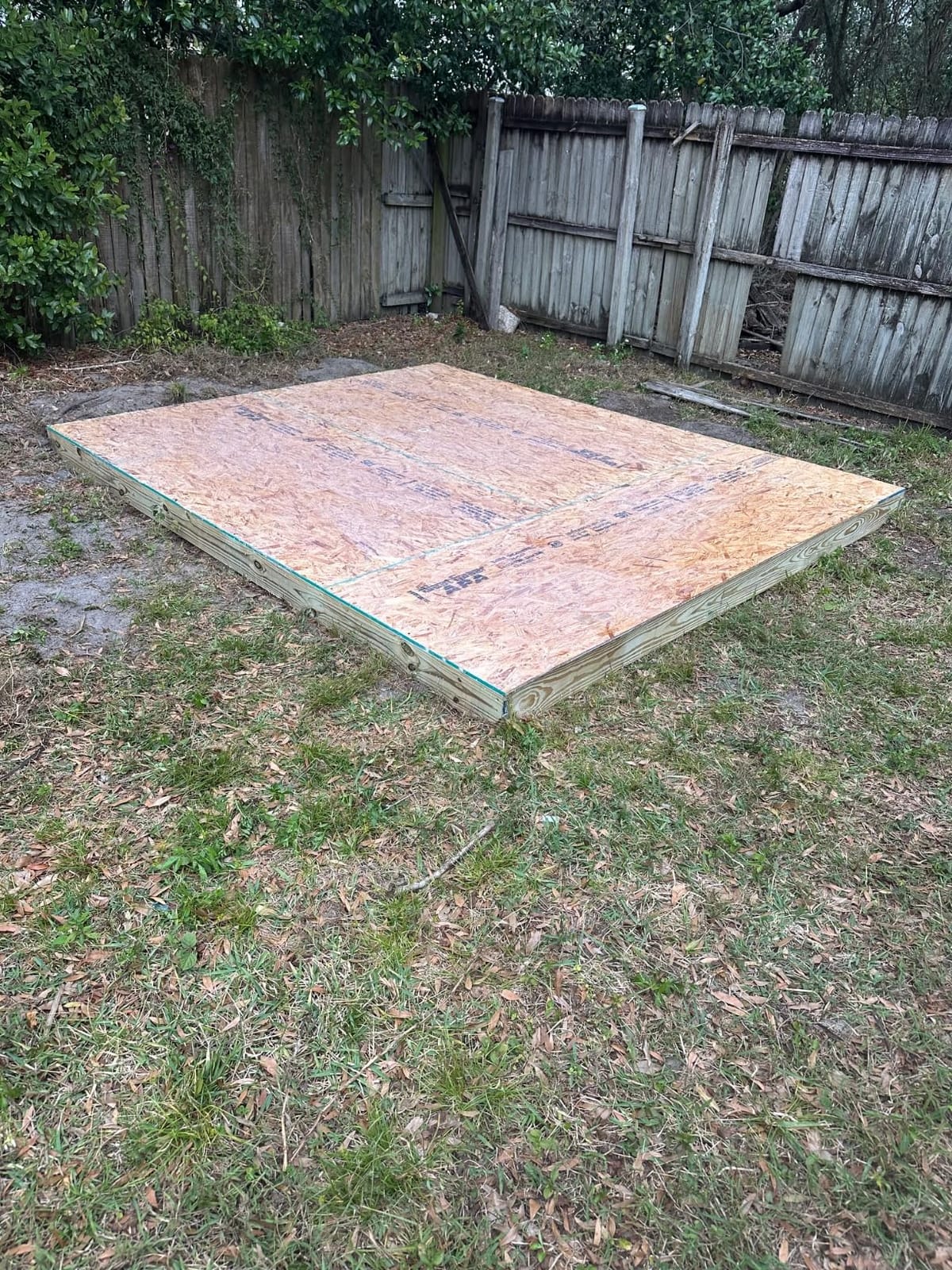
Do metal sheds need a floor? Not from the manufacturer’s point of view, but you will regret skipping one. A shed that sits directly on soil or grass will rack over time as the ground moves, and lightweight steel panels amplify every twist.
Pressure-treated timber platform. Best balance of cost and stability. Build a frame, deck it, and use exterior-rated screws. Usually the right answer for most buyers.
Gravel pad. Cheapest and best draining. Compact in layers and frame the edges so the gravel does not migrate.
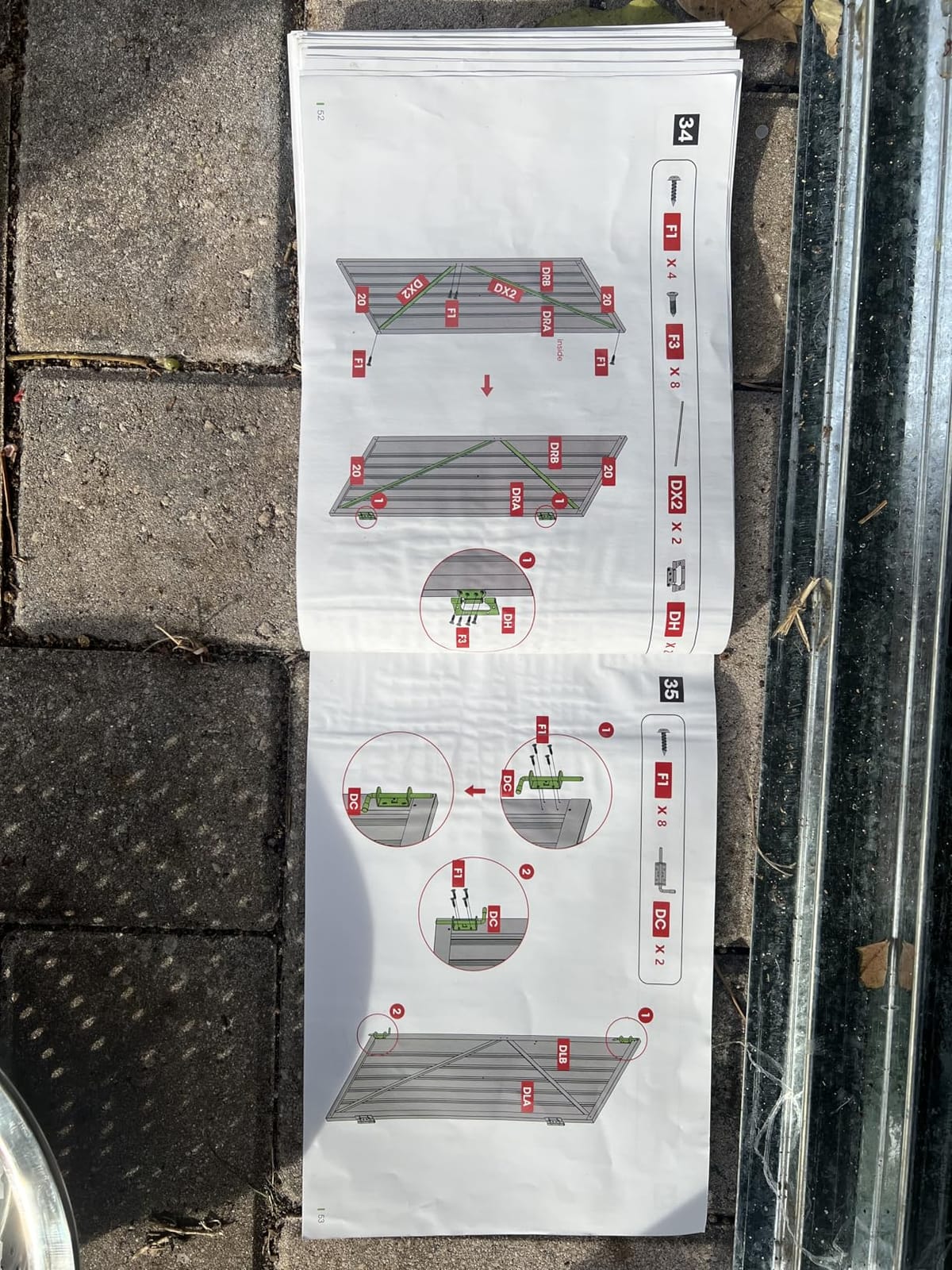
Concrete slab. The most durable and the best for a shed you plan to load with a riding mower, but it is the most expensive and hardest to level.
Pavers on sand. A good middle ground for smaller sheds, and it lifts the base off wet ground.
Whatever you build, anchor the shed to it with the supplied or appropriate ground anchors. Anchoring is what a wind rating assumes, and it is what stops a shed becoming a projectile. The JUMMICO in particular is light enough that we treat anchoring as compulsory.
Wind ratings, snow load, and roof reinforcement
Can metal sheds handle snow and heavy weather? Only up to a point, and the number is usually not published. Where a manufacturer does state it, the figure is worth reading closely, as we did with the Aoxun 7.3×5.3 at 6 inches of snow and 25 mph of wind.
Two design details do more for you than the rating. A triple-beam roof, as on the Devoko, spreads load across the span. Interior cross-bracing stops the walls racking sideways under wind pressure. If you are in a heavy snow area, add roof cross-braces yourself after assembly, because most kits do not include them.
Lockable security and padlock hasps
No lockable door is a dealbreaker for anyone storing power tools or bikes. Most sheds in this roundup have a lockable hinged door or a sliding door with a lock, and the Gizoon 6×4 comes with a metal lock in the box. The Devoko does not include one, so factor that into your plan.
Security beyond the padlock is about visibility and access. A shed tucked behind a fence is harder to break into than one in the open. If you store a generator or fuel, use a lockable steel cabinet inside, not a plastic one, and store fuel away from any ignition source.
Brands and tiers: who makes the best quality metal sheds
A good brand of metal shed is one where a single manufacturer stands behind a published warranty, because that is the only thing that distinguishes the tiers. The market splits cleanly in two: legacy steel brands such as Arrow, Fleximounts, Absco, ShelterLogic and Biohort that sell through big-box retailers and carry real multi-year warranties, and Amazon-native brands that sell direct to you, with thinner support behind the panels.
The names in this roundup sit in the second tier. They are legitimate manufacturers with real review volume, and at these sizes they deliver better value than the big-box tier, but expect thin gauge steel and self-service parts rather than a warranty-backed claim.
Choose the legacy tier when you want one accountable brand, a heavier gauge or a shed that will still be there in fifteen years. Small-Cabin Forum members specifically recommend the Arrow Arlington for that reason.
Coastal and humid buyers should ask about salt-air corrosion rates, which is what an r/Charleston thread did. In that environment, coated big-box steel with a real warranty is worth the step up, because touch-up painting every few years is not realistic on a schedule nobody keeps.
Metal vs wood vs resin
Metal wins on maintenance and lifespan, and loses on insulation and appearance. A steel shed needs no painting or staining, will not attract termites, and typically lasts 15 to 20 years with minimal attention. It conducts heat and cold, so a shed full of paint or electronics needs insulation.
Wood is warmer inside and better looking, and it needs regular sealing, will warp, and is the favourite target of rodents. Resin is light and cheap and better insulated than steel, but it degrades faster under UV and does not take a heavy load or a wall rail. For a tool shed, metal remains the sensible default.
Permits, zoning, and HOA setbacks
Before you buy anything, check whether your municipality requires a permit for an accessory structure and what the setback rules are. Rules commonly exempt structures under a certain square footage, but they frequently still impose a setback from property lines and often restrict placement in side yards.
HOA rules are separate from zoning and are frequently stricter. Check for approval requirements on shed colour and material, because a grey or black metal shed in a neighbourhood with a materials covenant can be a problem after the fact. A quick call to the building department and a read of your HOA documents costs nothing and prevents the most annoying returns in this category.
Assembly Reality Check: Hours, Helpers, and Tools
Assembly is where metal sheds generate most of their complaints, so here is an honest benchmark based on what owners report. The pattern is consistent across brands: shed size drives the time far more than panel quality does.
A 6×4 shed typically takes one working day for two people. An 8×6 is closer to a full day and a half. An 8×12 with double doors and a base frame is a genuine weekend project for two, and the Aoxun 7.3×5.3 with a floor is quoted by its own manufacturer at around three hours for two to four adults, which is a useful calibration for what these builds actually involve.
You need a cordless drill with a low-torque setting, a socket set, a rubber mallet, a tape measure, a spirit level, safety glasses and a step ladder. Have the parts sorted by label before you start, count every panel against the manual, and photograph anything damaged in the box before assembly begins.
Two habits save most people a return. Use the hand wrench rather than a power driver on the frame screws, because thin panels strip their holes easily. And seal every roof screw with exterior sealant as you go rather than after the first leak.
Frequently Asked Questions
What are the downsides of a metal shed?
The main downsides of a metal shed are thin steel gauge that dents easily, poor insulation so the interior tracks outdoor temperature, interior condensation that can rust stored tools, and the fact that most models ship without a floor or base. Assembly is also fiddlier than the marketing suggests, with hundreds of fasteners and frequently picture-only instructions. Panels also arrive dented in transit more often than buyers expect.
Do metal sheds rust?
Yes, metal sheds can rust, but not usually from the outside. Galvanized or powder-coated steel resists corrosion well until the coating is scratched or chipped, and then rust starts at the exposed steel. The bigger risk is inside, where condensation forms on the panel surface. Touch up chips early with a zinc-compatible primer, keep the vents clear, and run a dehumidifier in humid climates.
Will tools go rusty in a shed?
Tools will not rust in a dry, ventilated shed, but they can in a damp one. Single-wall steel has no vapour barrier, so warm humid air condenses on the cooler inside surface of the panels, particularly under the roof. Keep the vents open, store steel tools on shelving away from the walls, wipe tools before putting them away, and use a dehumidifier or desiccant in smaller sheds.
How long do metal storage sheds last?
A well-built galvanized steel tool shed typically lasts 15 to 20 years. Thin gauge, poorly coated steel in a coastal or humid climate can fail sooner, often around 10 years, while a heavier gauge shed on a solid foundation with occasional touch-up painting can outlast that. Anchoring and ventilation matter more than the brand when it comes to lifespan.
Do metal sheds need a floor?
Most metal sheds do not include a floor, because the frame is designed to sit on a foundation you build. A pressure-treated timber platform is the best-value option, a compacted gravel pad is cheapest and drains best, and a concrete slab is the most durable for a shed holding a riding mower. Whatever you choose, the shed must be anchored to it so the frame does not rack over time.
Who makes the best quality metal sheds?
The legacy steel brands such as Arrow, Fleximounts, Absco, ShelterLogic and Biohort generally make the highest quality metal sheds, because they use heavier gauge steel and back it with a published warranty from a single accountable manufacturer. Amazon-native brands deliver better value at smaller sizes but typically use thinner steel and self-service parts support. Choose the legacy tier when longevity and warranty matter more than upfront cost.
Can metal sheds handle snow and heavy weather?
Only within their published limits, and most manufacturers do not publish them. Where a rating exists, look for something in the region of 6 inches of snow load and 25 mph of wind as a minimum. Design features help more than the rating: triple-beam roofs spread the load, interior cross-bracing resists wind racking, and adding your own roof cross-braces after assembly prevents sagging in heavy snow.
What are the common problems with metal sheds?
The recurring problems are thin steel that dents during shipping and in use, assembly friction from hundreds of fasteners and picture-only instructions, missing hardware, a base or floor that is not included despite listings implying otherwise, door and roof gaps that let rain in, and interior condensation. Nearly all of these are avoidable by inspecting parts on arrival, using a hand wrench on frame screws, sealing roof screws on day one and keeping the vents clear.
Once you have the shell, the next upgrade that pays for itself is the storage system inside it. Our picks for [metal storage cabinets](https://zamd.net/best-metal-storage-cabinets/) slot into the wall spaces in these sheds, and if you are replacing tools rather than just storing them, our [rotary tool reviews](https://zamd.net/best-rotary-tools/) cover what is worth putting in the chest.
Final Verdict on the Best Metal Storage Sheds for Tools
The Azomabox 9×10.5 is our pick for the best metal storage shed for tools, because 100 square feet of floor area, sliding doors and the highest rating in the roundup make it the one that draws the fewest complaints once it is up. For the narrow side yard, the Gizoon 6×4 gives you a 44.5 inch opening in a small footprint with written instructions and an installation video in the box. If you want the floor built in, the Aoxun 7.3×5.3 is the only pick here with a rated interlocking floor. And if standing upright matters to you, the JUMMICO 8×8 is the only shed here you can work in standing up.
Match the size tier to your buyer profile and you will not go wrong: compact footprints for hand tools and one machine, mid-size 8×6 for a mower plus bikes, and the 8×12 models only if you have an open yard and a riding mower. Whatever you choose, build a foundation, anchor the shed, seal the roof screws and keep the vents clear. That is the difference between a shed that lasts fifteen years and one that ends up back on a marketplace in three.