
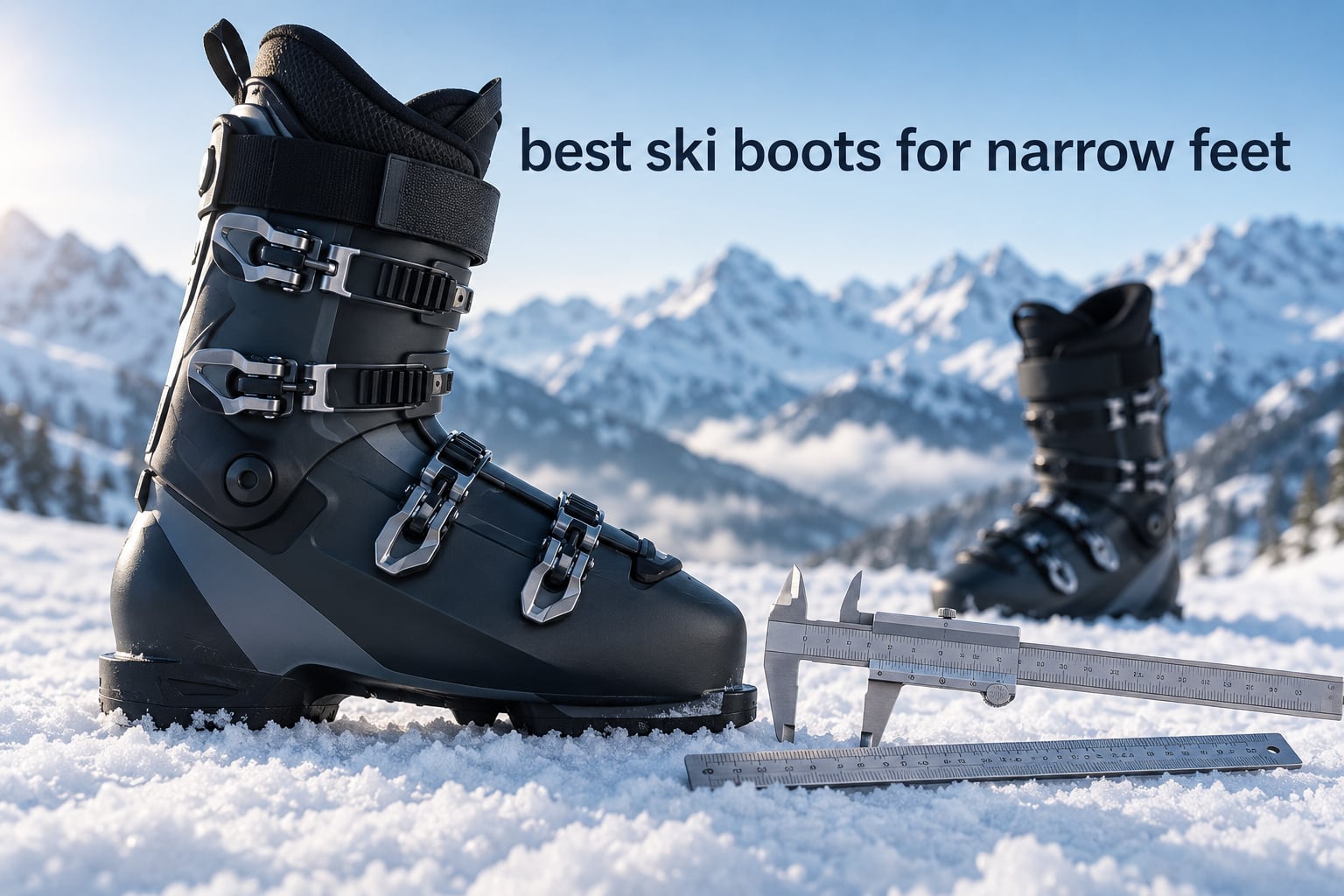
A last width under 98mm is what makes a ski boot narrow. Anything built on a 96, 97 or 98mm last is classed as low volume (LV) and gives a narrow foot almost no room to slide around, which is exactly what you want. Our three strongest picks are the Nordica Promachine 100 at 98mm, the Tecnica Mach1 LV 110 on an LV last, and the Fischer RC4 95 LV BOA for women with a reworked narrow fit.
Narrow feet get a bad deal in most boot categories. A standard alpine last sits around 100mm, which leaves roughly 2mm of slop across your forefoot that you feel every time the boot flexes. That slop becomes heel lift, cold toes and a lazy response at speed. A low-volume last removes it.
We went through twelve low-volume models for this guide, reading the published last width, flex index and shell construction on each one, and cross-checked what skiers actually report about fit. Every boot below is a genuine LV or narrow-fit last. Where a manufacturer does not publish a millimeter figure we say so rather than guessing, because LV lettering is not a standardised industry spec.
Table of Contents
Key fitting tips for narrow feet
Measure across the forefoot of a size 26.5 shell. Under 98mm is narrow, 100mm is standard, 102mm and up is wide.
Narrow toes and a floating heel are two different problems. Width fixes the first, a custom liner and orthotic fix the second.
Choose flex to match your ability, not your ambition. A 130 flex recreational boot is a frustrating boot.
Size to your shell in mondo points, then let the fitter decide the boot size.
Get scanned and molded by a bootfitter. It is the single highest-return step in the whole process.
What the terms actually mean
Last width
The internal measurement across the forefoot of a size 26.5 shell, quoted in millimetres. It is the only comparable number between brands.
Low volume (LV)
A shell built on a last under about 98mm, meaning less room across the forefoot, over the instep and in the heel pocket. The letters are brand-specific, so read the millimetres.
Flex index
A number describing how stiff the shell is, running from roughly 60 to 130. Higher is stiffer, more powerful and more demanding.
Mondo point
The true foot length in centimetres, and the only size system that transfers reliably between brands.
Instep height
The vertical height of the arch area on top of the foot. A low instep needs a shell with more volume on top than the forefoot width alone suggests.
Ski boot syndrome
Pain, numbness and circulation problems caused by a boot that presses on the foot for hours at a time, usually because the last is the wrong shape rather than the wrong size.
Top 3 Low-Volume Ski Boots for Narrow Feet in 2026

Nordica Promachine 100
- 98mm low-volume shell
- Primaloft liner
- 3 Force shell build
- GripWalk soles

The Nordica Promachine 100 takes the top slot because it pairs a published 98mm low-volume last with a fully customisable shell and an anatomical liner, which is a rare combination of a modern all-mountain shape and a genuine narrow wrap. The Tecnica Mach1 LV 110 is the stiffer, more aggressive option, and the Fischer RC4 95 LV BOA is the one to look at if your feet are narrow and you want a closure you can adjust on a lift line.
All 12 Best Ski Boots for Narrow Feet (October 2026)
| Product | Specifications | Action |
|---|---|---|
| Nordica Promachine 100 Men’s Narrow Fit |
|
Check Latest Price |
 Tecnica Mach1 LV 110 Tecnica Mach1 LV 110 |
|
Check Latest Price |
 Tecnica Mach Sport LV 100 GW Tecnica Mach Sport LV 100 GW |
|
Check Latest Price |
 Tecnica Mach1 95 LV Women’s Tecnica Mach1 95 LV Women’s |
|
Check Latest Price |
 Lange XT3 Free 130 LV Lange XT3 Free 130 LV |
|
Check Latest Price |
 Lange Women’s XT3 Free 110 LV GW Lange Women’s XT3 Free 110 LV GW |
|
Check Latest Price |
 Lange RS 130 LV Lange RS 130 LV |
|
Check Latest Price |
 Dalbello Cabrio LV 120 Dalbello Cabrio LV 120 |
|
Check Latest Price |
 Head Kaliber PRO 100 LV GW BOA Head Kaliber PRO 100 LV GW BOA |
|
Check Latest Price |
 Dalbello Cabrio LV 115 W 3DWrap Dalbello Cabrio LV 115 W 3DWrap |
|
Check Latest Price |
 Rossignol Vizion 4B Elite 130 LV Rossignol Vizion 4B Elite 130 LV |
|
Check Latest Price |
| Fischer RC4 95 LV BOA Women’s |
|
Check Latest Price |
A note on the table above: only five of these twelve listings publish an actual millimetre figure. The rest are labelled LV by the manufacturer without a stated width. Treat the millimetre as the fact and the LV letters as the marketing.
The Last Width Ladder: What 97mm, 98mm and 99mm Actually Mean
Walking the last width from narrow to wide is the fastest way to understand this category. Below 96mm is rare and usually a purpose-built race or junior shell. 97mm is a firm narrow fit that most slim adult feet can live with. 98mm is the sweet spot for the majority of narrow-footed all-mountain skiers. 99mm is narrow-adjacent, useful when you have a bun or a prominent big toe but still want a close fit.
97mm appears on the Tecnica Mach1 95 LV Women’s and the Lange XT3 Free 130 LV. This is the tightest published last in the roundup.
98mm appears on the Nordica Promachine 100 and the Rossignol Vizion 4B Elite 130 LV. Most narrow-foot skiers land here.
99mm appears on the Dalbello Cabrio LV 120, the most forgiving of the published widths.
Unpublished covers the Tecnica Mach1 LV 110, the Mach Sport LV 100, the women’s Lange XT3 Free 110 LV, the Lange RS 130 LV, the Head Kaliber PRO 100 LV, the Dalbello Cabrio LV 115, and the Fischer RC4 95 LV BOA.
Two foot shapes trip people up here. The first is the wide toe box with a narrow heel, common with bunion-prone feet, where a 98mm last still presses on the big toe joint but the heel floats inside the same shell. The second is the low instep with a normal-width forefoot, where the boot fits fine across the toes but the instep buckles into a ridge after an hour. Neither is fixed by sizing down. A custom liner with a raised instep and a heel wedge addresses both, and that is a fitter job rather than a shopping job.
One myth to clear up: a lighter boot is not automatically a narrower boot. Shell weight and last width are separate design choices, and some of the heavier race shells in this roundup run on narrow lasts for exactly that reason. If you are filtering on grams, you will lose the fit you came for.
1. Nordica Promachine 100: The Best All-Mountain Low-Volume Boot in the Range
Nordica Promachine 100 Men’s Narrow Fit High Performance Alpine Ski Boots (Anthracite/Grey/Red, 26.5)
98mm low-volume shell
Anatomical Primaloft liner
3 Force construction
Isotherm insulation
Pros
- Published 98mm last width
- Anatomical Primaloft liner that molds to a slim foot
- 3 Force shell transfers power efficiently
- Soft flap throat makes entry easy
- GripWalk soles for walking on snow
Cons
- GripWalk soles will not work with traditional alpine bindings
- Performance-oriented shell can feel unforgiving early in the season
The Promachine 100 is the boot we would put a narrow-footed all-mountain skier in first, and the reason is simple: one of the few boots on sale where the manufacturer states a 98mm low-volume last on the spec sheet. That is a documented fact you can check against your own foot measurement, not a marketing letter.
Around the shell, the 3 Force construction is designed to move energy from your leg and foot through the liner into the shell with as little loss as possible. For a narrow foot that matters more than it sounds. When the foot has room to move, energy gets absorbed in the wobble instead of reaching the edges. Take the room away and the whole system starts working.
Inside, the anatomical Primaloft liner is the part most narrow-footed skiers care about. Primaloft is thin and forgiving at first, then it takes a permanent set of your foot’s shape during the first heat mould. The liner is where the fit is won or lost in a low-volume boot, and one that is already anatomical saves a fitter a lot of corrective work. The Isotherm material in the liner handles warmth and moisture, which matters if you are tightening down hard to kill heel lift and need your foot to stay warm while you do it.
Two practical notes. The soft flap insert in the throat opens the shell wider than most plastic tongues, so a low instep does not fight you on entry. And the GripWalk rocker sole uses 9523 geometry, which is compatible with Marker GripWalk bindings but not with traditional alpine bindings, so check what your bindings accept before you commit.
Why it fits narrow feet well
The 98mm last is the number that matters, and it is published. A narrow foot gets a wrap across the forefoot with no dead space, so the flex of the boot goes into the ski rather than into moving your foot around inside the shell. For most narrow-footed recreational skiers, that is the whole point of buying a low-volume boot.
The 3 Force shell and the Isotherm insulated liner work together in a way that suits long days. Warmth matters here because the classic narrow-foot failure mode is a skier cranking the buckles to compensate for movement, which cuts circulation and produces cold feet. A boot that already fits means you can close it to a sensible tension and stay warm.
Where it falls short
This is a performance-oriented shell, and it will feel firm to anyone arriving from a rental-shop boot. Give it a season of days before judging it. The response typically settles noticeably after the liner and shell have been molded and after a dozen or so days on snow.
The GripWalk sole is the other limitation. It is excellent for walking around the village and the car park, but it will not drop into a standard alpine binding, which rules it out if your current setup is older or a non-GripWalk touring binding.
2. Tecnica Mach1 LV 110: The Stiffest Low-Volume All-Mountain Pick
Tecnica Mach1 LV 110 All Mountain/High Performance Men’s Downhill Ski Boot (Race Grey, 29.5)
LV low-volume last
C.A.S. customisable shell with floating tongue
Quick Instep entry
4 aluminium buckles plus 45mm strap
Pros
- LV last purpose-built for narrow feet
- C.A.S. shell can be customisabled after purchase
- Quick Instep opens the shell over the instep
- Four micro-adjustable aluminium buckles
- GripWalk soles and a 2 year warranty
Cons
- Only a single size offered in this listing
- Very little published review history for this listing
The Mach1 LV 110 is the aggressive end of the Tecnica low-volume range, and it is the one to look at if you already ski firmly and want the narrow last without giving up power. The floating tongue design is doing a lot of work here, filling the gap between shell and liner so a narrow foot gets pushed forward into the boot rather than sitting back in it.
C.A.S. is the feature that matters most for narrow feet. The Customizable Adaptive System lets a bootfitter punch out the shell and add or remove material in specific zones after you have bought the boot, which means an LV last that is close on day one can be made exact by the end of the week. Combined with Quick Instep, which softens the plastic over the top of the foot so the shell opens wider, it addresses the two complaints we hear most from narrow-footed skiers: pressure on the instep and difficulty getting in and out.
Closure is four micro-adjustable aluminium buckles with Lift Lock, plus a 45mm power strap. Aluminium ratchets hold their setting through a day and let you make fine corrections rather than binary tight-or-loose changes, which is useful when a narrow boot needs precision rather than force.
We would be honest about the evidence here. This listing carries a single review at a 4-star rating, so treat the fit claims as a combination of the published specification and the wider Tecnica LV reputation rather than a body of owner feedback. The spec sheet is detailed; the customer history is not.
Why it fits narrow feet well
The floating tongue is a genuinely good match for a low-volume foot. Because the tongue fills the space your foot would otherwise occupy at the front of the boot, the last can stay narrow without the front of your foot feeling like it is jammed against a wall. That is a different engineering answer to the same problem that some brands solve with a thinner tongue.
A 110 flex is firm enough to give real feedback through the boot and still forgiving enough to ski all day if your technique is tidy. It is a manageable step up from a softer boot for most skiers, while racers tend to move further up the flex range anyway.
Where it falls short
At 110 flex this is not a beginner’s boot. If you are still working on parallel turns and controlling speed, the feedback will feel like criticism rather than information. Choose a softer LV model instead.
Availability of sizes on a single listing is a real practical issue, and it also means there is very little owner history to draw on. Before you buy, confirm the size range the seller actually carries rather than assuming the model runs in your mondo point.
3. Tecnica Mach Sport LV 100 GW: A Forgiving First Low-Volume Boot
Tecnica Men’s GripWalk System Quick Instep & Lift Mach Sport LV Low Volume 100 GW Ski Boots, Black, 29.5
Low Volume last for narrow feet
C.A.S. anatomical shell
Quick Instep entry
Heat-formable Sport N.F.S. liner
Pros
- Purpose-built LV fit for narrow feet and smaller frames
- Comfortable out of the box for intermediate skiers
- Quick Instep opening simplifies entry
- Thermoformable N.F.S. liner takes hot-air customising
- GripWalk soles grip well on snow and ice
Cons
- Entry-level flex aimed at intermediate rather than advanced skiing
- Only a single size offered in this listing
If narrow feet have kept you in soft rental boots for years, the Mach Sport LV 100 is the gentlest way into a proper low-volume fit. It is built for intermediate skiers with low-volume feet or smaller frames, and the spec sheet says outright that it is designed to feel comfortable out of the box.
The anatomical C.A.S. shell is dimpled, and those dimples are functional rather than cosmetic. They reduce surface tension in the plastic and give heat or a punch a better grip, which is what makes post-purchase customising realistic on this shell. The Sport N.F.S. liner is thermoformable with hot air, so it can be reshaped on a workbench as well as in a warming oven.
Quick Instep does the same job here as it does on the Mach1: softer plastic over the instep, so the shell opens more widely at the top of the foot. For a low instep that is a meaningful difference on every entry, and for a narrow foot it removes one of the most common reasons people say their ski boots hurt.
Why it fits narrow feet well
The listing labels the last as low volume but does not publish a millimetre figure, so ask the seller for the number before you commit. Assuming it matches the rest of the LV range, this is a shape that will not fight a slim foot across the forefoot, and the dimpled shell means a fitter can take it from close to exact.
The N.F.S. liner is the part worth a second look. Thermoformable liners let a bootfitter add or remove material in the heel pocket and along the arch, which is how you get a narrow boot to hold the heel without crushing the toe box. That is the two-problems-one-boot approach that most narrow-footed skiers actually need.
Where it falls short
This is an intermediate boot, not a performance one, and it will feel soft if you are used to driving a stiffer shell. That softness is the point for many people, but if you want to pressure the edges at speed, look higher in the Tecnica LV range.
Like the other Tecnica listings here, the size range offered on this listing is narrow. Verify your mondo point is covered before ordering, and get it checked in person if you can.
4. Tecnica Mach1 95 LV Women’s: A True 97mm Last Built for Expert Skiers
Tecnica Mach1 95 LV Ski Boot Womens Ink Blue 26.5
97mm low-volume last
95 stiff flex
Expert skill level
Women's specific fit
Pros
- Published 97mm last width
- One of the tightest published lasts here
- Stiff 95 flex for expert skiing
- Women's specific fit and colourway
Cons
- 95 flex is wrong for beginner or intermediate skiers
- Minimal feature detail in the listing
- Only a single size offered
The Mach1 95 LV shares the narrowest confirmed millimetre figure in this roundup. At 97mm it sits a full millimetre below the 98mm Promachine, and that single millimetre is the difference between a snug low-volume fit and a genuinely tight one.
Women’s boots are not simply scaled-down men’s boots, and the differences show up in the cuff volume and the last shape around the heel. If you are a woman with narrow feet who has spent years sizing up into a men’s shell to get the width you need, this is the opposite approach: a shell built narrow in the first place, with a women’s last and a stiff 95 flex for expert skiing.
At 95 flex this is an expert-level boot. The rating is honest about that, which is more than most listings manage. It will give you precise feedback and it will not tolerate lazy technique, but if you ski well it is a very effective tool.
The weakness in the data is detail. This listing publishes the last width, the flex and the skill level, and very little else, so there is no shell material, liner or buckle specification to work from. If those details matter to you, ask a fitter or check the brand’s own product page for the current season model.
Why it fits narrow feet well
A 97mm last is the answer for a slim foot that still finds 98mm slightly generous. It is tight enough that almost no motion is possible across the forefoot, which is what produces the immediate, edge-to-edge response that narrow-footed skiers chase.
Because the flex is stiff, the boot will hold its shape under load rather than collapsing and letting the foot roll. For an expert skier on firm snow, that combination of a narrow last and a stiff shell is the performance end of the fit puzzle.
Where it falls short
Expert level is not a marketing flourish here. Beginners and intermediates should not start at 95 flex in a 97mm last, because the pressure points show up within a day or two and skiers commonly blame the width rather than the flex.
The single-size listing is a practical limit, and the sparse specification means you are buying on three data points. Have it fitted if you can, and if you cannot, be conservative and expect to need a break-in period before the liner fully takes shape.
5. Lange XT3 Free 130 LV: A 97mm Touring Boot for Backcountry Days
Lange XT3 Free 130 LV Ski Boots 2026
97mm low-volume last
130 flex
V-LOCK walk mode
Friction-Free Hinge
Pros
- Published 97mm last for a precise narrow fit
- 130 flex for real control on steep terrain
- V-LOCK walk mode opens the boot for climbing strides
- Friction-Free Hinge gives a long range of motion
- Current model year
Cons
- 130 flex is demanding for recreational skiers
- Touring-oriented design carries more weight than a pure alpine shell
The XT3 Free 130 LV is the boot for narrow-footed skiers who split their season between lift-served and touring. It is built around a 97mm low-volume last, so the narrow fit is documented, and the whole design leans toward long days on ungroomed terrain where a stiff, precise boot earns its weight.
V-LOCK walk mode is the feature that changes the character of a stiff boot. Instead of wrestling with four buckles at every transition, you flip the boot into a walk configuration and the shell opens for a natural stride. The Friction-Free Hinge adds to that by allowing a wide range of motion, so the boot bends where a hiking boot bends rather than at the ankle only.
At 130 flex this is the stiffest class of boot here. That flex is correct for steep terrain and hard snow, and it is genuinely unpleasant on soft days at a slower pace. The trade is worth making only if you ski hard enough to need it.
Why it fits narrow feet well
The 97mm last is a documented narrow fit, and on a touring boot the wrap is doubly valuable. When you are climbing, your foot swelling is the enemy of comfort, and a roomy forefoot that feels fine in the lodge feels terrible after two hours of skinning. A 97mm last is a good tool for that.
The hinge and the walk mode also reduce the pressure points that a stiff boot normally creates at the ankle and instep, which matters when a narrow last already concentrates sensation across a small area of the foot.
Where it falls short
A 130 flex is a specialist rating. If most of your days are on groomers at moderate speed, this boot will tire you out and slow you down rather than speed you up.
Touring boots are heavier than pure alpine boots by design, because the hinge, the walk mechanism and the reinforced cuff all weigh something. If you mostly ride lifts, that is weight you are carrying for a feature you will not use.
6. Lange Women’s XT3 Free 110 LV GW: A Narrow Fit That Climbs and Descends
Lange Women’s XT3 Free 110 LV GW Snow Ski Boots
Low Volume fit
Frictionless rotating hinge
Dual Core sandwich shell
Female-specific cuff
Pros
- LV fit targets narrow feet
- Rotating hinge gives real mobility on ascents
- Dual Core construction blends power with precision
- Female-specific cuff design
- 110 flex suits all-mountain skiing
Cons
- Only a single size offered in this listing
- Limited specification detail in the listing
The women’s XT3 Free 110 LV is the same touring platform as the 130, dialled back to a flex that most strong recreational skiers can actually use. If you want the climbing mobility of the Lange hinge system without the stiffness, this is the version, and it is built on an LV fit for narrow feet.
The frictionless rotating hinge is the centrepiece. Rather than a fixed hinge that flexes in one plane, it rotates as you stride, which is the difference between a touring boot that feels like a ski boot on the climb and one that feels like footwear. For a narrow foot, that matters because the standard complaint about touring boots is pressure across the instep, and a free-moving hinge removes a large part of that pressure.
Dual Core sandwich construction gives a subtle mix of power and precision rather than a single harsh feel, and the female-specific cuff is a genuine difference in shell volume around the lower leg. That matters for narrow ankles, one of the fit problems skiers raise most often, and one that sizing up does not solve.
Why it fits narrow feet well
The LV fit and the female-specific cuff attack two different narrow-foot complaints at once. A slim forefoot needs a narrow last, and slim ankles need a cuff with less volume around them, and plenty of boots only solve the first one.
At 110 flex this is firm enough to hold an edge and soft enough to ski long days without the feedback turning into punishment, which makes it a realistic step up for an intermediate-to-advanced skier rather than a specialist tool.
Where it falls short
As with the other single-size listings here, confirm your size is covered before ordering. The listing also gives limited technical detail, so verify the current season specification with the seller or a fitter.
If you are a genuinely strong skier on hard terrain, 110 may feel soft. The 130 version exists for that reason, and it is worth a try-on of both before you commit.
7. Lange RS 130 LV: Race-Stiff Precision on a Narrow Last
Lange – Men’s RS 130 LV Vibrant Blue Ski Boots – Men – Size 43 – Blue
LV last for narrow feet
130 race flex
Racing construction
Expert level
Pros
- LV last in a race-oriented shape
- 130 flex for expert-level power
- Racing construction throughout
- Men's fit with a large size option
Cons
- 130 flex suits expert racers only
- Only a single size offered in this listing
- Sparse technical specification
The RS 130 LV is the race boot in this roundup, and it is built for a specific person: an expert skier with narrow feet who wants maximum power transfer and does not need forgiveness. The LV last is where the narrow fit comes from, and the racing shape means the cuff wraps the lower leg closely rather than loosely.
At 130 flex this is the top of the stiffness range. There is no meaningful compliance left in the shell, which is exactly what a racer on a groomed course wants and exactly what a recreational skier does not. If you have to steer around variable snow, the speed you gain on the race course disappears on the days you do not want it.
We would treat this as a specialist purchase. The right way to buy a 130 flex LV is to have it fitted and to be honest with the fitter about how many days a year you are actually on piste at speed. If the number is small, a 120 or 110 LV will make you a better skier.
Why it fits narrow feet well
The race shape is efficient precisely because there is no wasted volume. Everything in the shell, from the last width to the cuff wrap, is designed to put your foot and lower leg as close to direct contact with the ski as a boot can manage, and the narrow last is the foundation of that.
Expert skiers with narrow feet often struggle to find boots that are both stiff enough to drive and narrow enough to fit. This is one of the few boots here that does both, which is why it earns a place despite the flex being unsuitable for most readers.
Where it falls short
The flex is the limitation, and it is a hard one. A 130 flex boot on a beginner or intermediate skier produces pressure points, fatigue and a general sense that something is wrong, usually blamed on the fit rather than the stiffness.
The listing publishes almost no technical detail beyond the level, style and collection, so check the current specification yourself. And again, confirm the size range, because this particular listing covers a single size.
8. Dalbello Cabrio LV 120: The Widest Low-Volume Last in the Roundup
Dalbello Sports, Cabrio LV 120 Ski Boot – 2026, Grey/Black, 28.5
Low-volume 99mm last
120 flex
3-piece cabrio shell
PVC-free construction
Pros
- Widest published last here at 99mm
- Three-piece construction gives progressive flex
- 120 flex delivers power with some retained comfort
- PVC-free build using recycled materials
Cons
- 120 flex is not the most forgiving choice for beginners
The Cabrio LV 120 is the answer if 98mm is still too tight for your foot. At a 99mm last it is the widest of the boots here with a published millimetre figure, and it is the version to try if you have a bunion, a prominent big toe joint, or simply a forefoot that spreads wider than a standard LV last accommodates.
The three-piece construction is what distinguishes the Cabrio platform. A three-piece shell flexes progressively rather than bending in one hinge, so the boot gives at the top as the leg presses forward and stays planted at the bottom. That is a meaningful difference from a two-piece shell and one of the reasons the 120 flex feels workable rather than punishing.
At 120 flex, the manufacturer describes the balance as quick power transfer that still retains some comfort, and that is an accurate summary of where this boot sits. It is a step below the 130 race class and a step above a soft intermediate boot, which makes it a sensible default for a strong skier who wants narrowness and power together.
The construction has a sustainability angle too, with a PVC-free shell made in part from recycled material. It does not change the fit, but it is worth knowing if you are weighing this against similar three-piece boots.
Why it fits narrow feet well
For a foot that is narrow through the heel and ankle but wider across the toes, 99mm is the sweet spot. Tight enough to eliminate forefoot movement, forgiving enough not to press on a bunion, and the three-piece shell softens the transition so the wider last does not feel punishing.
This is also the most forgiving published last here, which makes it a useful first LV boot for someone who has previously found 97mm and 98mm models too aggressive.
Where it falls short
120 flex still needs decent technique. Beginners will find the feedback unforgiving, and there is no soft version of this particular boot in the roundup, so if you are early in your skiing the Tecnica Mach Sport LV 100 is a better starting point.
Even at 99mm, a wide toe box combined with a narrow heel is a shape mismatch that a last cannot fully solve. Expect a fitter to add a heel wedge rather than expecting the boot to do it on its own.
9. Head Kaliber PRO 100 LV GW BOA: Even Tension Without Buckle Hunting
Head Kaliber PRO 100 LV GW BOA Alpine Ski Boots (Black, 28.5)
Low-volume last
100 flex
BOA fit system
GripWalk sole
Pros
- Low-volume last for narrow foot shapes
- BOA dial gives precise and even tension
- GripWalk sole improves walking on snow
- 100 flex sits in the versatile middle range
Cons
- BOA hardware is less serviceable than traditional buckles
- Minimal published specification detail
The Head Kaliber PRO 100 LV is the one here where the closure system is the headline. A BOA dial replaces the four-buckle stack, and on a narrow boot that is a genuinely interesting combination, because a cable-and-dial closure applies tension evenly around the shell rather than concentrating force at a few points.
That evenness is the argument for it on a narrow foot. Buckles tighten in a sequence and can load the shell unevenly, which on a tight last sometimes produces a pressure ridge across the forefoot even when the fit is technically correct. A BOA cable wraps the whole shell and pulls it in uniformly, which some narrow-footed skiers find more comfortable over a full day.
At 100 flex this sits in the most versatile part of the range. It is firm enough to give real feedback and soft enough for an advanced recreational skier, and it is the flex we would pick for someone who wants narrowness without committing to a performance-only stance.
Why it fits narrow feet well
The even tension argument is the strongest case here, and it is worth testing in person. Cable closure removes the hunting-for-the-right-ratchet problem that happens when a narrow boot is tensioned tightly and the shell shifts.
The 100 flex is a genuinely useful middle. Many narrow-footed skiers buy far too stiff a boot because they equate a tight fit with a fast boot, and a mid-flex LV lets you feel the responsiveness of the narrow last without the punishment of a 120 or 130.
Where it falls short
BOA hardware is a real maintenance consideration. The dial and cable are serviceable parts, but they are not field-fixable in the way a broken buckle strap is, and the cable can stretch with use. This is a genuine downside if you ski hard and treat your gear roughly.
The listing publishes very little beyond the last type, flex rating and closure, so verify the shell material and liner specification independently. Ask for the millimetre last width, since the LV label alone is not a specification.
10. Dalbello Cabrio LV 115 W 3DWrap: A Three-Piece Shell That Can Be Reshaped
Dalbello Cabrio Lv 115 W 3DWrap Ski Boots 2025
115 flex
3DWrap construction with PuRE
Pebax ergonomic tongue
Dynalock buckle
Pros
- 3DWrap construction improves fit over long days
- Three-piece platform gives progressive flex with lateral support
- Pebax tongue makes entry and exit easier
- Dynalock buckle and Powerband for quick on-mountain changes
Cons
- 115 flex demands strong technique and is wrong for beginners
- No millimetre last width is published in the listing
The Cabrio LV 115 W 3DWrap is among the most customisable boots in this roundup, and for a narrow foot that is a feature rather than a nice-to-have. The 3DWrap construction is designed to improve fit and energy transfer across a long day, which is a way of describing a shell that can be adjusted to your specific shape after purchase.
Combined with the three-piece Cabrio platform, you get a shell that flexes progressively while holding lateral support. Progressive flex means the boot gives gradually as you load it rather than snapping to a new shape, and lateral support is what keeps a narrow foot from rolling inside the shell during a turn. For slim feet that lack the volume to be held by the boot itself, that lateral support is doing real work.
The Pebax ergonomic tongue makes entry and exit easier than a stiff plastic tongue would, and the Dynalock buckle with Powerband quick release is a practical on-mountain detail. Being able to open the boot at a lift line and close it again in a few seconds is a small thing that adds up across a day.
At 115 flex this is a performance rating. It suits confident skiers and it will not be patient with poor technique, which is worth stating plainly because the 3DWrap adjustability tempts people to believe a boot can be made to work for any ability level.
Why it fits narrow feet well
Adjustability is the answer when the right last is not quite enough. A 3DWrap shell can be opened up in specific zones so a boot that is close across the forefoot can be made exact, and for narrow feet with unusual bone structure that is often the difference between comfortable and painful.
The 115 flex is a sensible place for a narrow-footed strong skier. It is firm enough for controlled skiing without reaching the punishing territory of the 120 and 130 boots, and the wrap keeps the foot in place through the turn.
Where it falls short
No millimetre last width is published for this listing, only the LV designation. That is the single biggest reason to try this on in person rather than ordering blind, because you cannot confirm it is narrow enough from the listing alone.
115 flex is firmly in performance territory. Beginners and early intermediates should not treat the adjustability as a substitute for a boot matched to their ability.
11. Rossignol Vizion 4B Elite 130 LV: Step-In Entry With a Steel Spine
ROSSIGNOL Men’s Vizion 4B Elite 130 Low-Volume Grip Walk High-Performance On Piste Downhill Alpine Ski Boots for Skiers with Double Buckle and Steel Spine, Metal Bronze, 285
98mm low-volume last
130 flex
Step-in spoiler with steel spine
Dual Core polyurethane shell
Pros
- Published 98mm low-volume last
- Step-in design makes entry effortless
- Steel spine gives traditional alpine power and precision
- Seamless toe box reduces pressure points
- Double buckle releases the spoiler and locks the boot
Cons
- 130 flex is demanding for intermediate skiers
The Vizion 4B Elite 130 LV is a boot built around a different way of getting into it. Instead of a traditional hinged shell, it uses a step-in design with a spoiler and a spine mechanism that lock into place once your foot is in, so you slide in and click the boot closed rather than working a cuff over your heel.
For narrow feet this is more than a convenience. A stiff boot with a tight last is genuinely hard to get into, and every struggle over the cuff is a place where the liner gets dragged and damaged. A step-in design removes that process entirely, which is a real quality-of-life argument on a 130 flex with an LV last.
The steel spine and spine link mechanism deliver the direct power transfer that makes steel-spined boots the traditional choice for on-piste performance. The overlap shell opens wide at the rear for slip-on ease, and the bi-injected spoiler has soft rubber sides plus a seamless toe box, which reduces pressure points across the forefoot on a narrow last.
The double buckle on the lower cuff does two jobs: it releases the spoiler and it locks the boot for skiing. That is neat design, though it does mean one buckle failure stops both functions.
Why it fits narrow feet well
The 98mm last is published and documented, which puts this boot in the mainstream narrow band where most slim-footed skiers land. A 98mm last combined with a seamless toe box means no shell seam pressing across the widest part of the forefoot, and that is a common source of long-day discomfort on tight boots.
The overlap shell opening wide at the rear is a genuine advantage on a low instep. Instead of forcing the foot past a narrow throat, the back of the shell opens first, and the instep settles into place rather than being levered in.
Where it falls short
The 130 flex is a race-class rating. Unless you ski firmly on groomed terrain at speed, this boot will tire you out faster than it serves you, and pressure points show up quickly on a tight last.
The step-in mechanism is a proprietary system, which means parts and serviceability depend on the brand and the model. If you travel far from a dealer, that is worth factoring in before you commit.
12. Fischer RC4 95 LV BOA: An Adjustable Narrow Fit for Women
Fischer RC4 95 LV BOA Women’s Alpine Ski Boots (Black, 23.5)
Low-volume last with reworked narrow fit
95 flex
BOA Fit System
Adjustable VACUUM FitA shell
Pros
- Reworked narrow fit specifically for slim feet
- BOA system wraps the foot evenly
- VACUUM FitA shells broaden the fit range
- 95 flex is versatile for all-mountain skiing
- Two year limited warranty
Cons
- BOA closure needs dial-specific maintenance and has no ratchet
- Liner and shell specification is thin in the listing
The Fischer RC4 95 LV BOA is built around what the manufacturer calls a reworked narrow fit, and the word reworked matters. It suggests the last was revised rather than simply copied from an existing model, which is a good sign for a category where narrow feet are often an afterthought.
The VACUUM FitA shells are the standout feature. These are lightweight shells with an adjustable fit, and the benefit for a narrow foot is that the range of shapes they can cover is wider than a fixed last allows. A narrow foot with an unusual profile, a high arch or an instep that is hard to fit, can often be accommodated in a vacuum-adjustable shell when a fixed last cannot.
The BOA Fit System is described as providing strong foot wrapping, which is the same even-tension argument that makes the Head Kaliber attractive on a narrow last. At 95 flex, this is a medium rating that works for all-mountain skiing, and it is the least intimidating flex in the group of women’s boots here.
It is also a women’s boot, built on a women’s last rather than a scaled-down men’s shell. Skiers who have spent years sizing up into men’s boots to get a narrow wrap should read that as a genuine advantage rather than a cosmetic label.
Why it fits narrow feet well
The adjustable shell is the answer for feet that no single last fits well. If your narrow foot has a high arch, a thin heel or an instep that is lower than average, a fixed narrow last will close one of those problems and reopen another, and the vacuum system gives the fitter room to work.
Even wrapping from the BOA system distributes pressure rather than concentrating it at buckle points, and the 95 flex is forgiving enough to be skied comfortably for a full day once molded. That combination makes this a good fit for a strong intermediate or advanced skier who wants narrowness without stiffness.
Where it falls short
BOA closure has the same trade-off as any cable system. The cable and dial need their own maintenance rather than a generic buckle service, and there is no ratchet to give you fine incremental adjustment in the way an alpine buckle does.
The listing gives thin technical detail, so confirm the liner material, the millimetre last width and the exact flex specification with the seller before you order. And as always with a single-variant listing, check the size range first.
How to Choose Ski Boots for Narrow Feet: Last Width, Flex, Sizing and Heel Hold
Measure your foot before you look at a single boot
Stand with your weight evenly distributed and measure the widest point of your forefoot. Do it standing, because the foot spreads under load and a seated measurement will understate the width. Then measure your instep height with a tape from the floor up over the arch, and note the circumference of your ankle at its narrowest.
If you can get hold of a size 26.5 shell, slide your foot in and measure across the forefoot of the shell itself. Under 98mm is narrow. If you do not own a shell, measure your foot and add a millimetre or two for the sock you will actually wear.
Last width is not the same as volume
These get confused constantly. Last width is the horizontal measurement across the forefoot, and it is the number that decides whether your toes feel cramped. Volume is the total internal space of the shell, which also covers instep height, heel depth and ankle room. A boot can be narrow across the forefoot and still be too tall over the instep, which is exactly why a low instep can fail in a supposedly narrow boot.
Read the millimetres, not the LV letters. LV is a brand-specific label with no industry standard behind it, and one manufacturer can use it for 97mm while another uses it for 99mm. If a product page does not state a last width in millimetres, that is a reason to ask rather than a reason to assume.
Pick flex to match your skiing, not your ambition
A flex index in the 60 to 80 range is soft and forgiving, suitable for beginners and for anyone still building technique. The 90 to 110 range covers intermediate through advanced all-mountain skiing and is where most people should be. Anything at 120 or above is a performance or racing rating that rewards precise technique and punishes everything else.
There is a narrow-foot-specific trap here. Because a tight boot feels fast and responsive, skiers with narrow feet often escalate straight to the stiffest boot on the shelf. The dominant advice in the skier forums we read points the other way: many narrow-footed skiers would be better served by a softer boot that fits properly than by a race boot they cannot stand.
Size in mondo points, then let the fitter decide
Measure your bare foot length in centimetres on snow, standing, in the evening when your feet are at their largest. That number is your mondo point. Alpine boot sizing in Italy and Germany runs about half a size down from mondo, but do not apply that yourself, because shell fit varies by brand and the decision belongs to someone who can see your foot in the shell.
Size down only for a reason. Skiers frequently try to solve a width problem by going shorter, and the result is a boot that is narrow enough but too short, so the toes press against the front and the heel lifts more than ever. Width and length are separate problems with separate answers.
Four fixes for heel lift, in order of effectiveness
Custom or foam-injected liner. This rebuilds the inside of the boot to your heel pocket and is by far the most effective fix. It is reversible and it can be done after you have broken the boot in.
Custom orthotic. A footbed built to your arch and your stance fills the volume under your foot, which takes up the space that lets your heel rise. It is the standard answer for a narrow foot with a floating heel.
Heel wedge in the liner. A cheap and quick option for a small amount of lift, and a good stopgap if you cannot get a custom liner immediately.
Power strap tension. Snug but not aggressive. Pulling the upper strap very tight pulls your heel down at the cost of circulation, and cold feet follow quickly. This is the last resort, not the first move.
That last point matters more than it sounds. The most common reason narrow-footed skiers end up with cold feet is not a faulty boot, it is a skier over-tightening buckles to compensate for a volume problem that a liner would have solved properly.
Bootfitter or online? Go in person for this category
The consensus across every skier forum we read is the same: if you have narrow feet and you have never been fitted, get fitted. A 3D scan captures instep height, heel shape and forefoot width in a way that a size chart cannot, and heat molding then locks the shell and liner to that shape.
Buying online makes sense if you already know your last width in millimetres, your flex preference and your exact size in this specific model. If any of those three is a guess, the savings are not worth the exchange rate, which is why so many people end up buying twice.
Warmth, gloves and the rest of the kit
A boot that fits properly is the first step to warm feet, because you stop cranking the closure. After that, the rest of your layers matter. Our guides to ski gloves and to men’s ski jackets cover the insulation side, and thin socks remain the single most effective warmth decision you make. If your feet are cold, a third pair of thick socks will make them colder.
For anyone whose feet are narrow at the toes but wide elsewhere, our hiking boot guide for wide feet covers the same last-width logic in a different category, and the measurement method transfers directly.
Break-in and care
No ski boot breaks in on a shelf. Heat molding plus a dozen days of actual skiing does it, and until then a narrow boot will feel tight in ways that do not predict the final fit. Buckle the boots together in the car on the drive home and wear them around the house for half an hour before your first run.
After each day, open the buckles fully, remove the liners and let everything dry overnight. Dry boots are warm boots, and moisture held in a liner is the most common cause of cold feet on an otherwise correctly fitted boot. Replace heel and toe pads as they wear, because a worn pad lets the foot slide and creates lift that looks like a fit problem.
Frequently Asked Questions
What is the best boot for narrow feet?
A last width under 98mm is narrow, and anything on a 96, 97 or 98mm last is classed as low volume (LV). Our top picks are the Nordica Promachine 100 with a published 98mm last, the Tecnica Mach1 LV 110 on an LV last, and the Fischer RC4 95 LV BOA for women. A bootfitter can also modify a shell after purchase, which fixes a close fit without buying the wrong last.
Which ski boot brand is best for narrow feet?
Read the millimetre last width rather than the LV letters, because LV is a brand-specific label and not an industry standard. In this roundup, 97mm appears on the Tecnica Mach1 95 LV and the Lange XT3 Free 130 LV, 98mm on the Nordica Promachine 100 and the Rossignol Vizion 4B Elite 130 LV, and 99mm on the Dalbello Cabrio LV 120.
What are some good boots for slim feet?
For slim feet, start with a documented narrow last: the Tecnica Mach1 95 LV and Lange XT3 Free 130 LV at 97mm, or the Nordica Promachine 100 and Rossignol Vizion 4B Elite 130 LV at 98mm. If 98mm still feels generous, the Dalbello Cabrio LV 120 at 99mm or an adjustable shell such as the Fischer RC4 95 LV BOA will give you room without going fully wide.
What are some good boots for people with skinny ankles?
Skinny ankles are a cuff volume problem, not a forefoot width problem, and a narrow last alone will not fix them. Look for a female-specific cuff or a lower-volume cuff, keep the flex at a versatile 90 to 110 rating, and use a custom liner with a raised instep. The Lange Women’s XT3 Free 110 LV and the Tecnica Mach1 95 LV both address cuff volume in a women’s last.
What is ski boot syndrome?
Ski boot syndrome is pain, numbness and circulation problems caused by wearing a boot that presses on the foot for hours. It is usually a shape mismatch rather than a sizing error, and the pain typically appears after an hour or two rather than immediately. A heat mold cannot fix a last that is the wrong shape, so the solution is a different last width or a custom liner and orthotic.
What reduces heel lift in ski boots for narrow feet?
In order of effectiveness: a custom or foam-injected liner rebuilt to your heel pocket, then a custom orthotic that fills the volume under your foot, then a heel wedge for a small amount of lift, and only then power strap tension. Pulling the upper strap very tight drops your heel but cuts circulation, which is why so many narrow-footed skiers end up with cold feet.
Should I buy ski boots online or in store?
For narrow feet, in person is the better choice unless you already know your last width in millimetres, your flex preference and your exact size in that specific model. A bootfitter can take a 3D scan of instep height and heel shape and heat mold the shell and liner to your foot, which no size chart can replicate. Buying blind often means buying twice.
The Verdict: Which Low-Volume Ski Boot Fits Your Feet
The best ski boots for narrow feet are the ones with a published last width under 98mm, and the Nordica Promachine 100 is our pick because it combines a documented 98mm last with a fully customisable shell and an anatomical liner. Go to the Tecnica Mach1 95 LV or the Lange XT3 Free 130 LV if 97mm is the width you actually need, and step up to the Fischer RC4 95 LV BOA if you want a shell that can be reshaped around an awkward foot shape.
Two rules will save you more money than any single boot on this list. Read the millimetres, because LV means nothing on its own. And get the liner and orthotic sorted early, because a narrow last with a floating heel is a different problem from a narrow toe box and needs a different fix.