
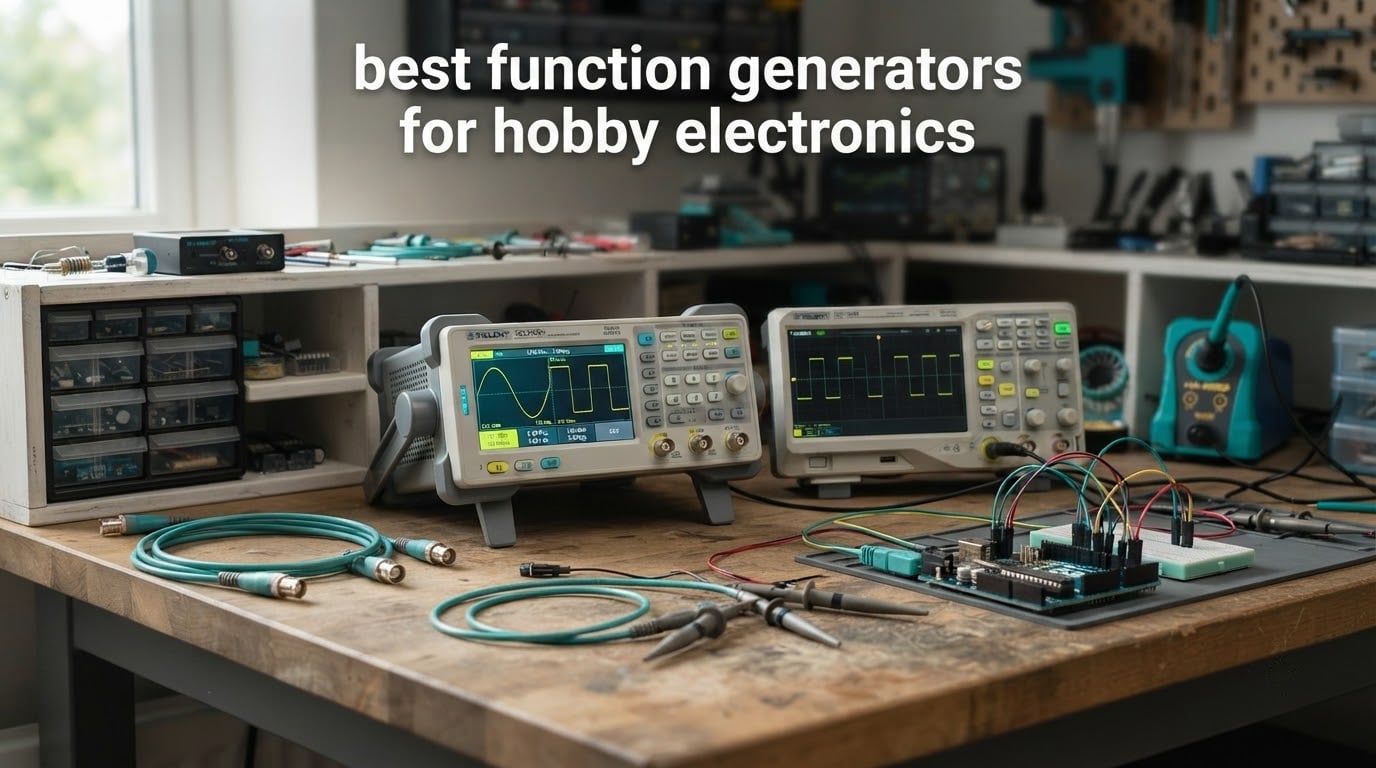
A function generator is a bench instrument that produces an electrical signal at a frequency, amplitude and waveform you choose — sine, square, triangle, sawtooth or a shape you draw yourself — so you can feed a known test signal into a circuit and watch what happens. Without one, you can only test a circuit with DC or noise, which means op-amp gain, filter cutoffs, comparator thresholds, amplifier response and sensor interfaces all stay guesswork. That is the entire reason this roundup exists.
The principle is simpler than the spec sheets make it sound. A core oscillator runs at a frequency you dial in, a shaping circuit turns that raw output into the waveform you selected (a comparator and hysteresis switch makes a square wave, a charge-and-discharge integrator makes a triangle), and an output amplifier scales and buffers the result to the level you set. In an arbitrary waveform generator, the same job happens by replaying a table of samples you loaded at a fixed rate — either way you get a signal with a known shape, a known frequency and a known amplitude.
We compared ten of the most capable function generators you can get for hobby electronics work, reading the spec sheets, weighing the owner feedback and sorting them by what actually lands on a home bench. The list runs from a low-cost dual-channel unit with a built-in counter up to a Siglent with 40 MHz of bandwidth, 16-bit resolution and network control, so you can start at the level your projects genuinely need instead of overshooting.
One framing note before the picks: consensus across electronics forums is remarkably consistent — an inexpensive generator in the 5 to 20 MHz range is enough unless you have specific measurements in mind. Almost nothing on a hobby bench above 20 MHz is real work rather than headroom. Our methodology is a desk comparison of manufacturer specifications plus the pattern of owner reports, updated for 2026, and we quote no prices here at all — the buttons below show the current figure when you click.
Table of Contents
Top 3 Picks for the Best Function Generators for Hobby Electronics In 2026
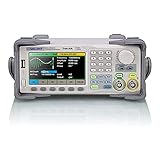
Siglent SDG2042X 40 MHz
- Dual channel 40 MHz
- 16-bit resolution
- Touch screen and TrueArb
- USB and LAN with built-in counter

Koolertron 15 MHz Dual-Channel
- Dual-channel DDS
- TTL level output
- 200 MSa/s and 14-bit
- Counter and sweep
- 99 stored setups
Seesii 60 MHz Dual-Channel
- 60 MHz sine output
- 200 MSa/s
- Per-channel duty cycle
- Frequency counter and sweep
All Ten Function Generator Picks at a Glance (October 2026)
The table below is the short version. Every pick is a dual-channel capable unit except where noted, and all ten generate the core sine, square, triangle and sawtooth shapes. Scroll down for the reasoning behind each one.
| Product | Specifications | Action |
|---|---|---|
| Siglent SDG2042X 40 MHz Dual-Channel AWG |
|
Check Latest Price |
| Koolertron 15 MHz Dual-Channel DDS |
|
Check Latest Price |
| Seesii 60 MHz Dual-Channel DDS |
|
Check Latest Price |
 DOMINTY FY6900 60 MHz Dual-Channel DOMINTY FY6900 60 MHz Dual-Channel |
|
Check Latest Price |
 UNI-T UTG932E 30 MHz Dual-Channel UNI-T UTG932E 30 MHz Dual-Channel |
|
Check Latest Price |
 OWON DGE2070 70 MHz Dual-Channel OWON DGE2070 70 MHz Dual-Channel |
|
Check Latest Price |
 Walfront FY8300S Three-Channel DDS Walfront FY8300S Three-Channel DDS |
|
Check Latest Price |
 Siglent SDG810 10 MHz Single-Channel Siglent SDG810 10 MHz Single-Channel |
|
Check Latest Price |
 Rigol DG1032Z 30 MHz Dual-Channel Rigol DG1032Z 30 MHz Dual-Channel |
|
Check Latest Price |
 GW Instek AFG-2125 25 MHz AWG GW Instek AFG-2125 25 MHz AWG |
|
Check Latest Price |
1. Siglent SDG2042X 40 MHz Dual-Channel Arbitrary Waveform Generator
Siglent Technologies SDG2042X Arbitrary Waveform Function-Generators, 40 MHz, Grey
40 MHz dual channel
16-bit resolution
Touch screen with TrueArb
Built-in counter
USB and LAN
Pros
- Exceptionally clean output across sine
- square
- triangle and pulse
- Two fully independent channels for harmonic and differential work
- Ethernet and USB for scope-linked automated measurement
- Quiet cooling and a compact 1.6 pound footprint
- Five year warranty support from Siglent North America
Cons
- EasyWave waveform software is Windows-only and awkward
- DDS and TrueArb behave differently and the manual explains it poorly
- Printed documentation is very basic
The SDG2042X is the unit we would put on a bench first, because it does not compromise on any of the three things that matter most here: bandwidth, resolution and connectivity. Two independent channels give you 40 MHz each, 16-bit vertical resolution keeps quantization noise off the output, and the Ethernet port means it can sit on a network and be driven by software instead of your thumbs.
In practice, the 40 MHz ceiling matters less than the 16-bit resolution does. Resolution determines whether your square wave has visible stair-step artefacts on it, and whether a small ripple riding on top of a 2 V signal is visible at all. Owners consistently describe the output as clean across sine, square, triangle and pulse, with 86% of reviews at five stars.
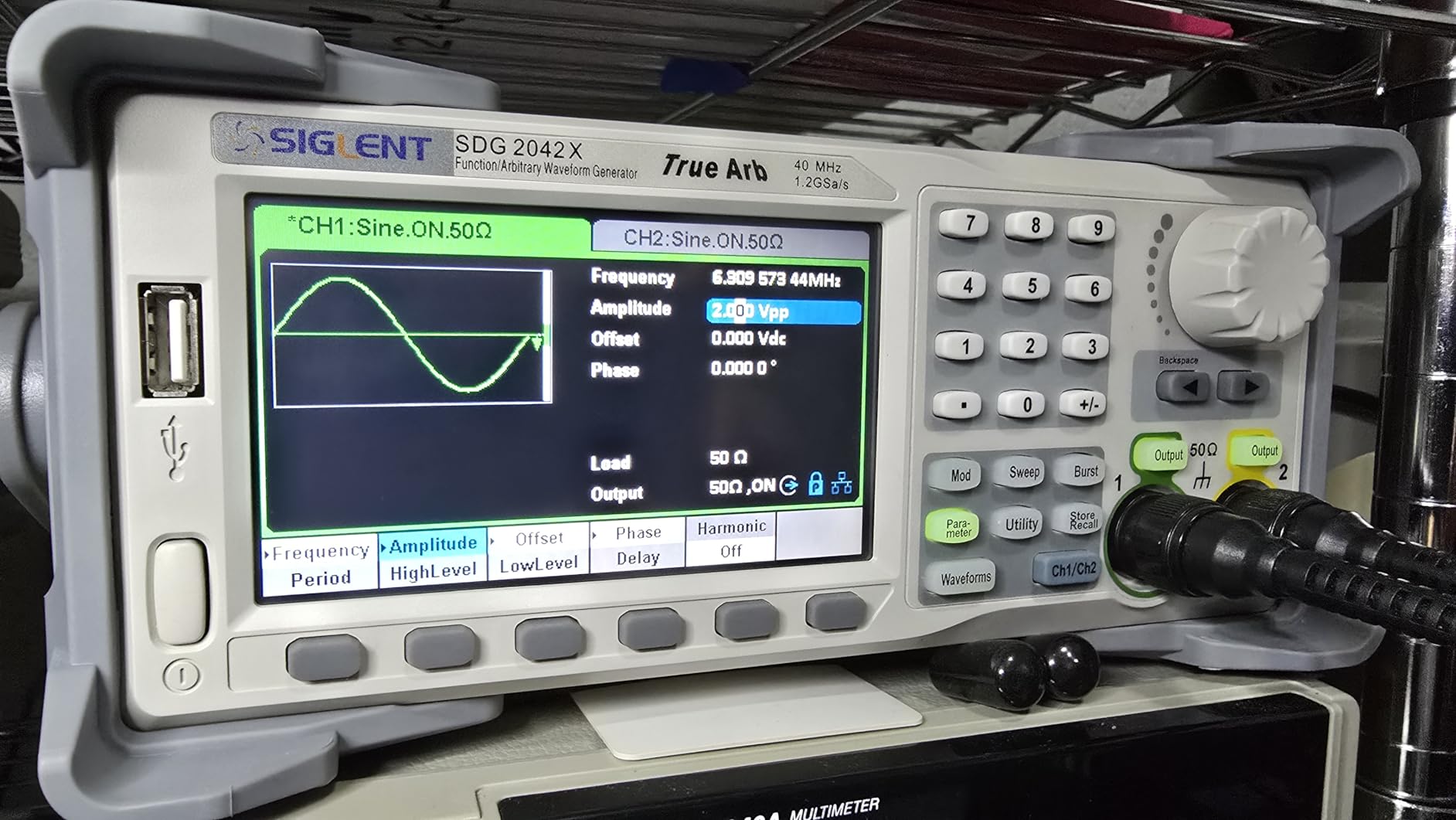
TrueArb and EasyPulse are the two technologies Siglent markets here. TrueArb is about arbitrary waveform fidelity — replaying your loaded shape rather than approximating it — while EasyPulse is about pulse quality, giving fast edges and low jitter when you need a clean clock or a fast digital stimulus. Both matter more than they sound like they do, particularly if you are driving a microcontroller clock line or a comparator.
The touch screen is responsive and the physical buttons still work well for the parameters you adjust constantly. It weighs 1.6 pounds and measures 10.2 by 4.2 by 11.6 inches, so it is a genuinely small benchtop instrument rather than a rack box, and the built-in high-precision frequency counter saves you carrying a separate counter around.
Who the SDG2042X suits
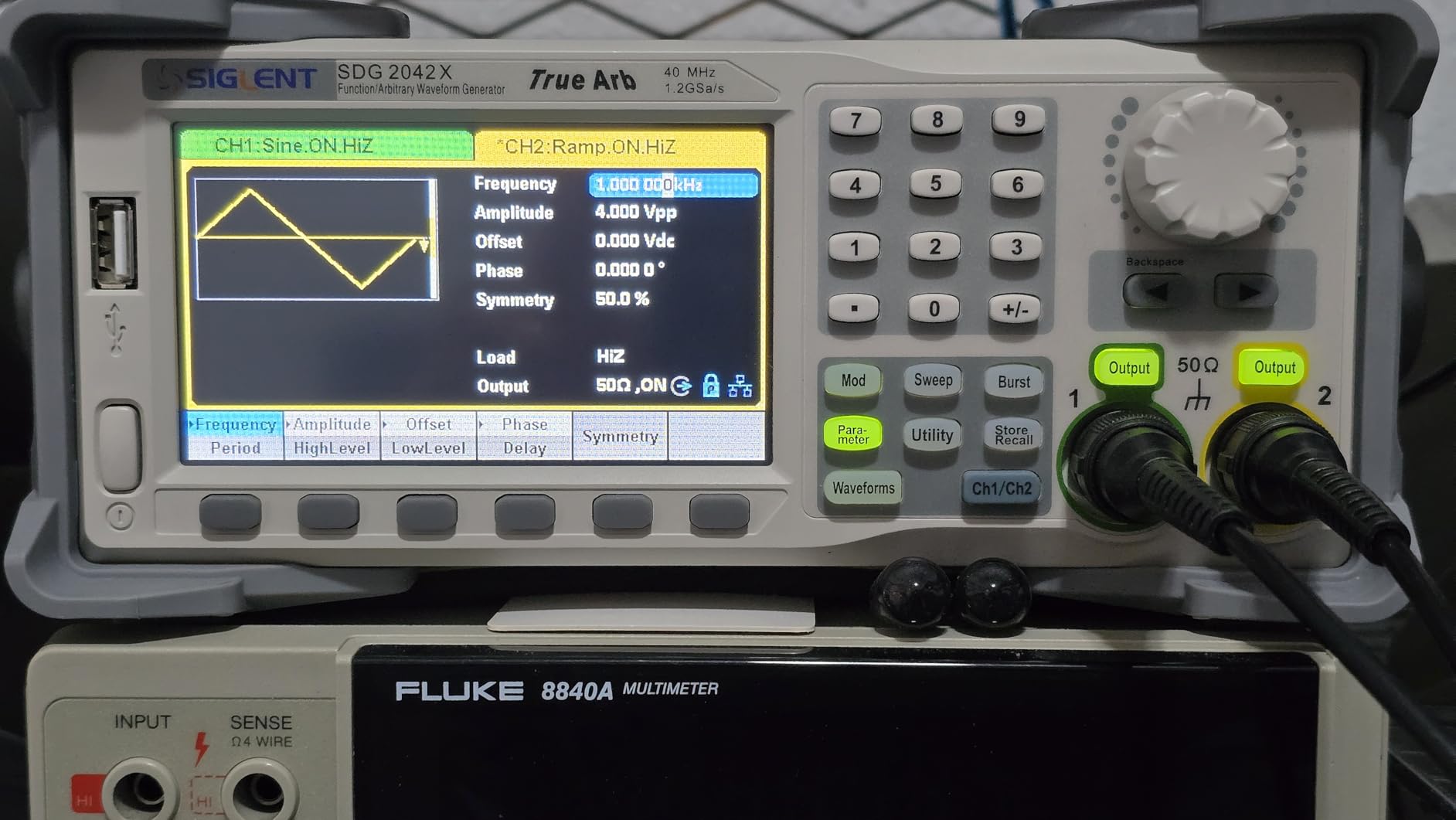
This is the right pick if your work goes past audio. Audio amplifier testing, op-amp characterization, filter response work, power supply ripple injection and microcontroller bring-up all benefit from the resolution and the dual-channel independence, and two truly independent channels remove a whole category of workarounds when you want to generate a differential signal, look at a harmonic of a fundamental, or drive two devices at once.
It also suits anyone automating measurements. With USB and LAN on board and an optional GPIB adapter, you can drive it from a script and run a sweep while capturing the response on your scope, which turns the instrument from something you poke into a corner of the day into a measurement system.
Where it disappoints
The honest weakness is software and paperwork, not hardware. EasyWave, the waveform editing package, is Windows-only and reviewers describe it as awkward, which is a real problem for anyone on a Mac or Linux machine. The printed manual is very basic, and Siglent does a poor job of explaining the difference between DDS mode and TrueArb mode in writing.
Some menu areas on the touch screen remain awkward even when the screen itself is responsive. None of this touches output quality, but it does mean the instrument takes longer to learn than its rivals with simpler front panels.
2. Koolertron 15 MHz Dual-Channel DDS Signal Generator
Koolertron 15MHz DDS Signal Generator, Dual-Channel
15 MHz sine output
200 MSa/s, 14-bit
TTL level output
99 stored setups
Counter and sweep
Pros
- Rock-solid signal stability from a crystal-referenced DDS design
- Two channels set independently plus a TTL level output
- Stores 99 instrument states and 60 user waveforms
- Counter and pulse width measurement built in
- Compact enclosure with wide frequency coverage
Cons
- Build and finish are entry-level rather than lab-grade
- 15 MHz ceiling limits higher frequency work
- Menu-driven interface with a display that is small for dense entry
With 473 owner reviews behind it, the Koolertron is the most thoroughly exercised budget unit in this roundup, and the pattern in those reviews is consistent: signal stability first, everything else second. The DDS core runs off an active crystal oscillator reference, which means the frequency does not drift the way free-running RC oscillators do, and for a bench tool that stability is the feature you feel every day.
It is also the rare cheap generator that gives you two independent channels. For filter response testing, or injecting two signals into a circuit to check how they interact, dual channel matters far more than raw bandwidth. On top of that there is a separate TTL level output, which is genuinely useful for clock lines and digital logic bring-up where a 5 V square wave at a known frequency is exactly what you need.
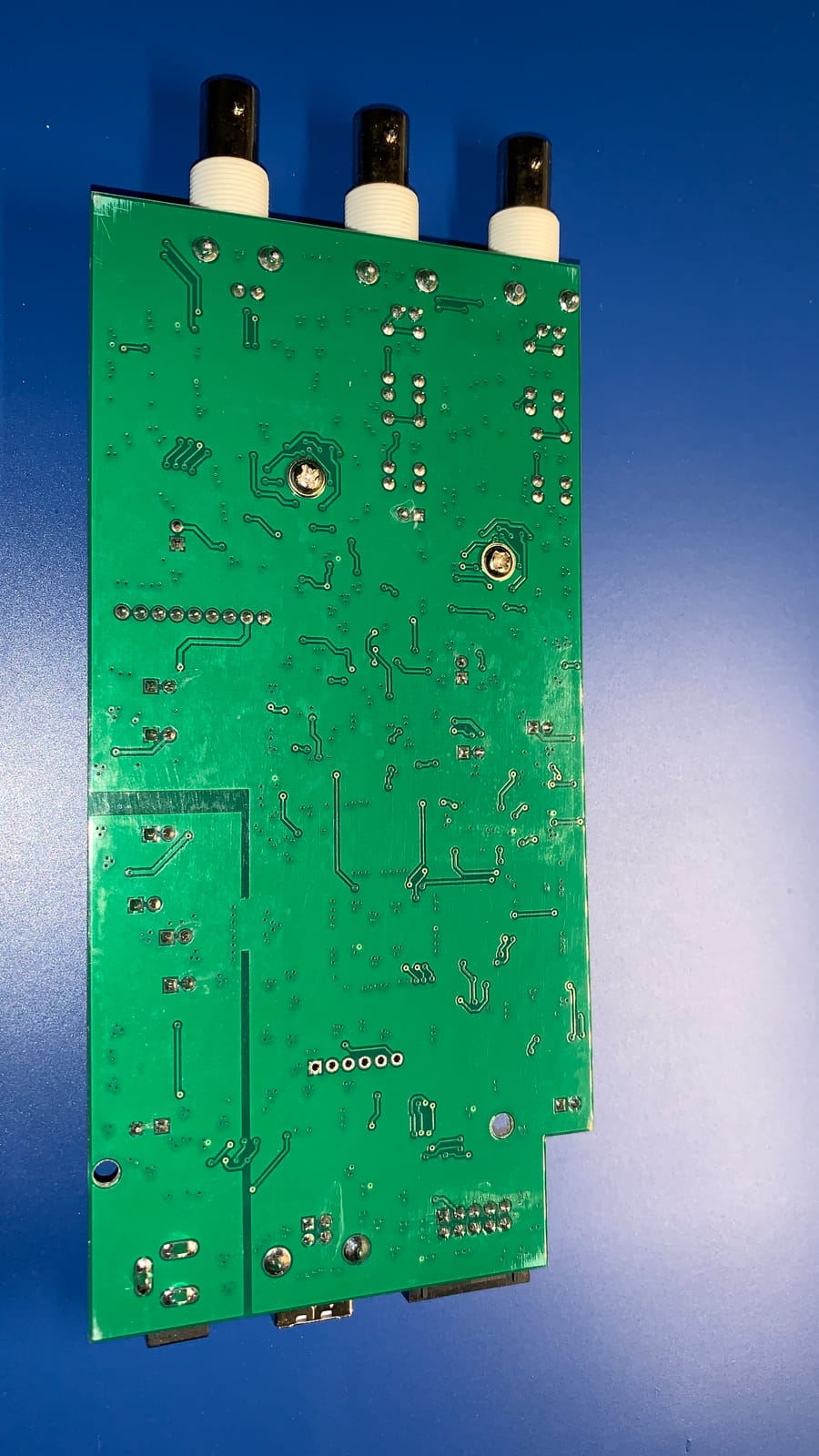
Storage is unusually generous. Ninety-nine groups of instrument state parameters can be saved and recalled, and 60 user-defined waveform slots hold 2048 points each — on a bench where you keep re-entering the same settings for different test points, store and recall turns a fiddly five-minute setup into a two-press operation. The linear sweep runs to 999.9 seconds with a logarithmic sweep alongside it, which covers slow frequency-response work well.
The measurement side is solid too — frequency, period, positive and negative pulse width, and a counting function, enough to check what you are driving the circuit with. Waveform coverage is sine, square, triangle, sawtooth, pulse, white noise and user-defined, covering everything short of staircase.
Who the Koolertron suits
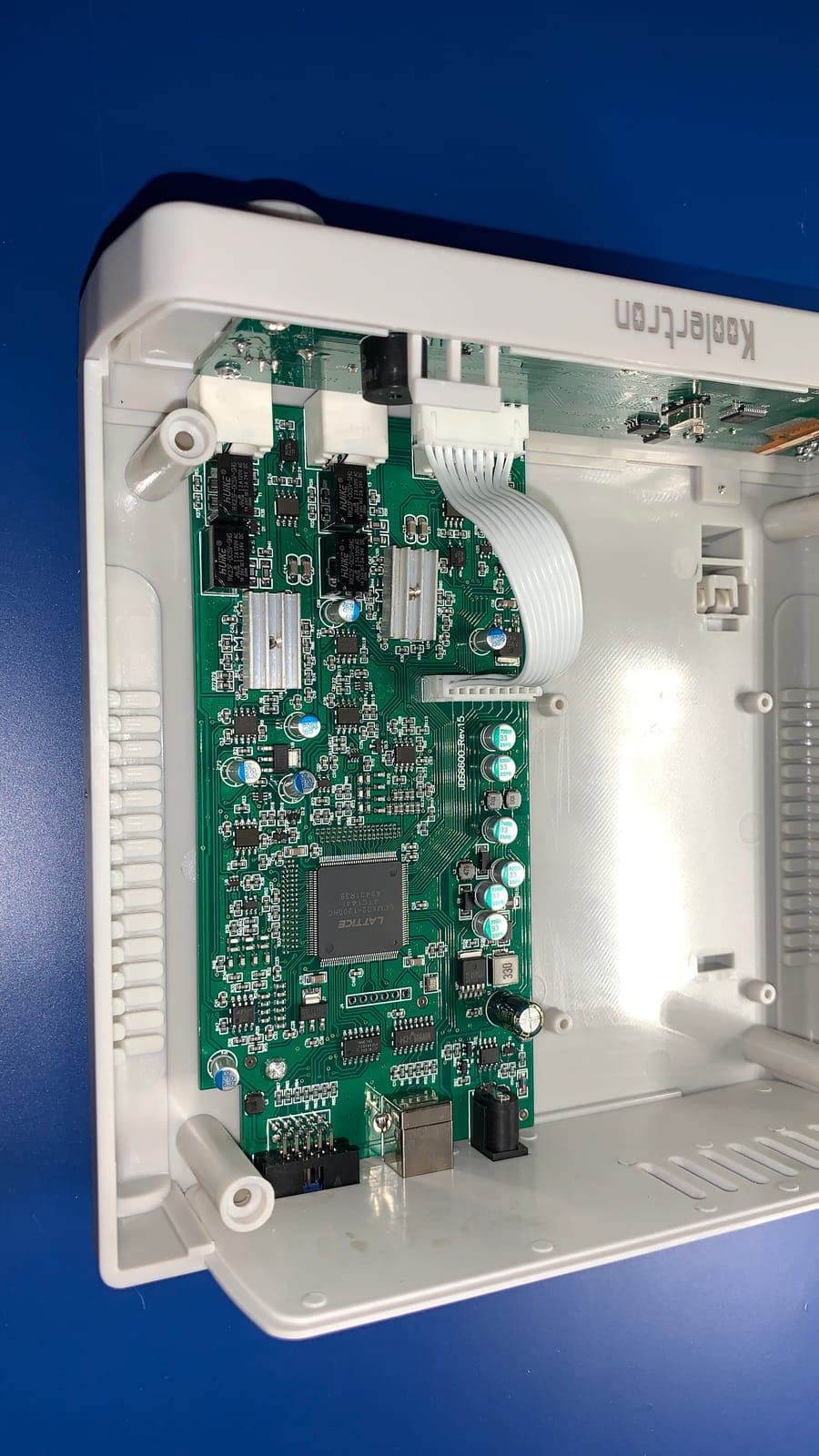
This is the pick for a learner or a hobbyist who will use the same handful of setups repeatedly. The 14-bit vertical resolution is a real step above the 10-bit units at the bottom of the market, and at 15 MHz it comfortably covers audio work, op-amp testing, comparator thresholds and most microcontroller clock work — and teaching labs like it for the stored-setup count.
It suits anyone who wants more than a single channel without stepping up to the professional tier. The combination of independent dual channels, a TTL output, a counter and 99 stored states at this tier is rare, and it is the reason this unit carries the best-value badge rather than one of the higher-spec ones.
Where it disappoints
Fifteen megahertz is a real ceiling: if your project involves fast digital edges, radio, or anything above audio and low-frequency logic, you will be measuring beyond what the sine output can do. The 200 MSa/s sampling rate sounds impressive next to that ceiling, but it is marketing headroom rather than usable bandwidth.
The build is entry-level and reviewers say so plainly — this is an instrument that tolerates a crowded bench, not one that belongs in a calibration lab. The menu-driven interface also has a display that is smaller than you would like when you are entering dense parameter sets, which is a daily friction rather than a deal breaker.
3. Seesii 60 MHz Dual-Channel DDS Signal Generator
Professional Upgraded DDS Signal Generator Counter, Seesii 60MHz LCD Display High Precision 200MSa/s Dual-Channel Arbitray Waveform Function Generator Frequency Meter
60 MHz sine output
200 MSa/s, 0.1 percent stated accuracy
Independent duty cycle per channel
TTL output and counter
Pros
- Dual channels plus TTL output give plenty of stimulus for audio and vintage repair
- 60 MHz sine output in a light compact enclosure
- Built-in counter with period and pulse width measurement
- Sweep function is usable and the display stays readable
- Stable over years of intermittent use according to owners
Cons
- Frequency counter reads about 12 cycles high against a precision standard
- Square waves show edge overshoot at higher frequencies
- No start-of-sweep sync output so scope triggering during sweeps is awkward
The Seesii sits at the interesting middle of this list: a 60 MHz ceiling, a 200 MSa/s sampling rate and per-channel duty cycle adjustment, in a light, compact enclosure. Sixty megahertz of sine output is headroom almost no hobby project uses, but having it changes what the instrument feels like when you are experimenting rather than repeating a fixed test.
Independently adjustable duty cycle per channel is the feature that quietly separates this from cheaper two-channel units. Duty cycle is what sets the brightness of a PWM-driven load, the position of a servo, or the proportion of a switching regulator’s cycle your circuit sees, so setting it separately on each channel means you can build a two-level or modulated stimulus without external circuitry.
Storage matches the Koolertron — 99 instrument state slots and 60 user waveform slots — and the waveform set is sine, square, triangle, sawtooth, pulse, white noise and user-defined. Linear sweep runs to 999.9 seconds with a logarithmic sweep beside it, and a bundled PC package handles building custom waveforms and combining frequencies.
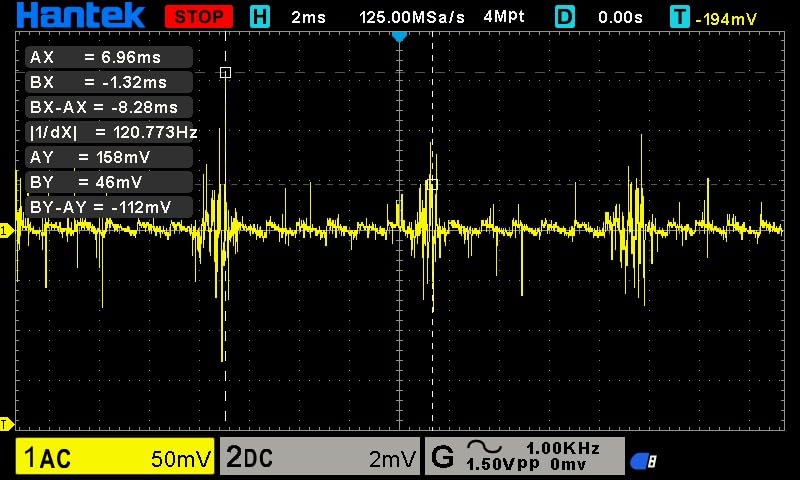
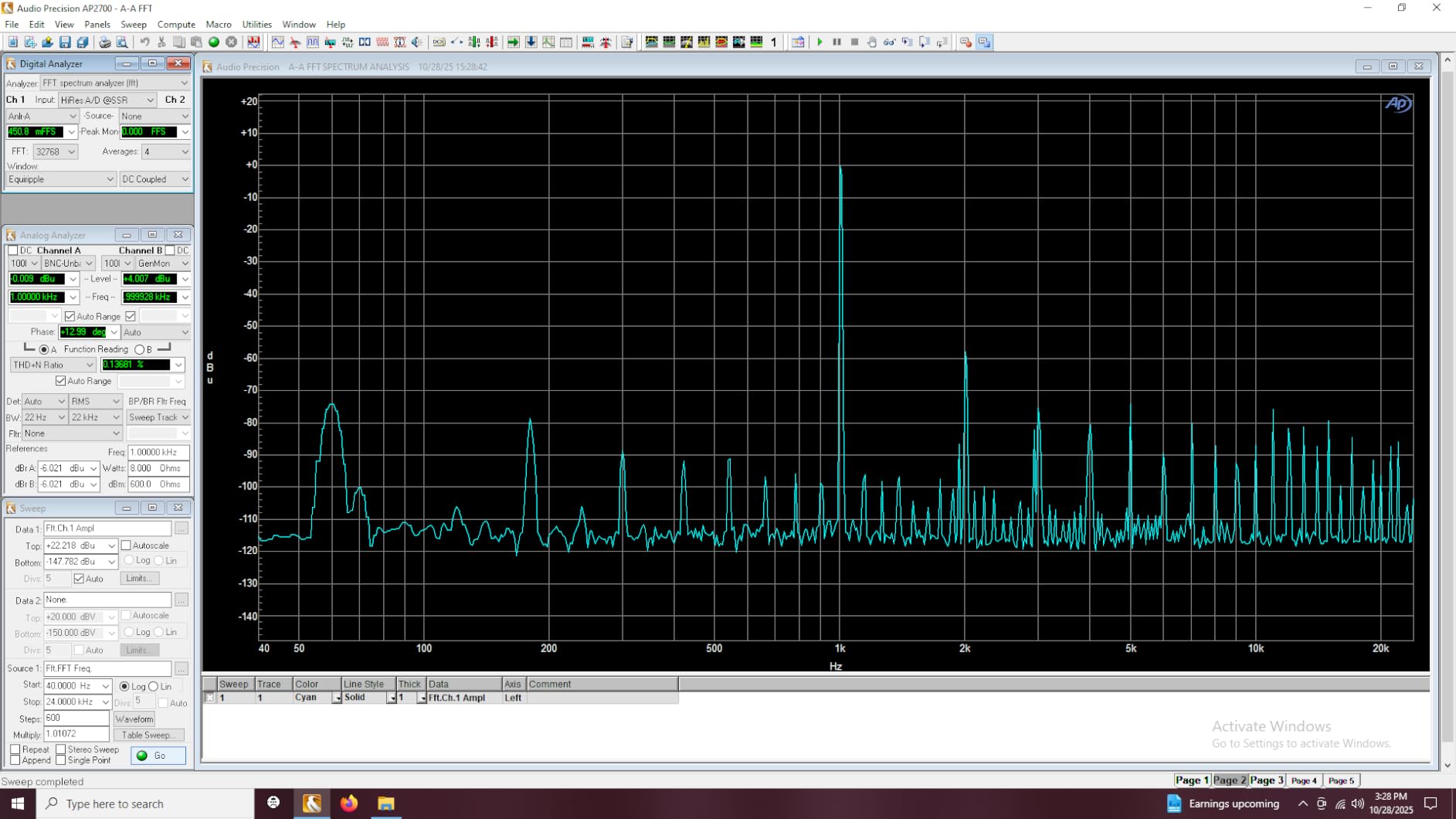
That 0.1% precision rating is the number to keep in mind, and it is where the honest criticism starts: it is a specification-level figure, not a calibrated measurement, and the counter itself reads roughly 12 cycles high when compared against a precision reference.
Who the Seesii suits
This is the budget pick for someone whose work drifts above audio — RF-adjacent experiments, faster digital work, clock signals well past a few megahertz — but who still wants a second channel. Guitar pedal and fuzzbox work, vintage audio restoration and general bench signal injection are all well served by the TTL output and the independent channels, and long-term owners report the output has stayed stable over years of intermittent use.
If your bench is small, the light enclosure and compact footprint matter. It weighs about a kilogram and stays out of the way in a way a full half-rack instrument does not.
Where it disappoints
The counter being 12 cycles high is the practical issue: it is fine for confirming that something is roughly the frequency you asked for, and useless as a reference when you are chasing accuracy. Square waves also show leading and trailing edge overshoot at higher frequencies, which can ring in the circuit under test and send you chasing a fault that is really your stimulus.
There is no start-of-sweep sync output, which means triggering your oscilloscope during a sweep is awkward and is the reason several owners recommend adding an external trigger source for frequency-response work. The chassis is also light with hard plastic feet, so it slides around on a hard bench unless you put something under it.
4. DOMINTY FY6900 60 MHz Dual-Channel DDS Generator
DOMINTY Function Generator AC100-240V FY6900 60MHz Double Channel DDS Function Arbitrary Waveform Signal Generator Frequency Meter 250MSa/s Sine Square/Triangle/Pulse/Sawtooth Wave/Staircase Wave
60 MHz maximum output
250 MSa/s sampling rate
Built-in frequency meter
Staircase waveform output
Pros
- Large feature set covering all the common waveform shapes
- Compact footprint smaller than it looks
- Frequency meter display matches an external reference accurately
- Output noise kept down by attenuating the driver output
- One-year warranty included
Cons
- Case feels flimsy and the display and encoder knob are very small
- Output glitches briefly whenever any control is turned
- No trigger output during sweep which limits scope work
The FY6900 is the unit we would hand someone building their first home electronics bench, because it covers a wide range of jobs in one box while staying genuinely dual-channel. The waveform set is sine, square, triangle, pulse, sawtooth and staircase, and staircase in particular is useful for step-response testing of filters and amplifiers — you can watch how a circuit recovers from a level change.
At 250 MSa/s this is one of the higher sampling rates among the entry tier, and the practical effect is that the square and pulse shapes stay cleaner than on slower sibling units. The output driver is attenuated rather than the input being limited, which owners credit for keeping output noise down.
The frequency meter is accurate enough to trust as a cross-check, with an on-screen reading that owners report matching an external reference. It runs on AC 100-240V directly, so it works on mains power in any region without a converter, and it carries a one-year warranty.
One detail worth knowing comes from owners who have opened recent production batches: the switching supply board is modern and clean, and the ground between the AC earth and the BNC shells has been properly separated, which reduces the chance of ground loop noise contaminating your measurements.
Who the FY6900 suits
It suits a beginner building a first bench, and it suits anyone who needs a lot of waveform shapes without wanting to read a manual first. Filter response sweeps, amplifier gain checks, staircase step response, tone sweeps for speaker and microphone testing — the FY6900 covers all of it in a box that is smaller than its feature list suggests.
It also suits anyone teaching, because two channels plus six waveform shapes plus a counter gives you most of the demonstration set for circuit fundamentals in one instrument.
Where it disappoints
The interface is the weak point. The display and encoder knob are both small, and reviewers report replacing the knob because it is uncomfortable for fine adjustment — when you are setting a frequency to three decimal places, that is a daily annoyance rather than a one-off.
The output briefly glitches whenever any control is turned, which matters if your circuit is sensitive to a transient on the output, and output voltage also pulls down noticeably under load. There is no trigger output during sweep either, which limits scope work. The case feels flimsy, though the electronics inside have held up better than the shell suggests.
5. UNI-T UTG932E 30 MHz Dual-Channel Arbitrary Waveform Generator
UNI-T UTG932E Function Generator Arbitrary Waveform 60 MHz Dual-Channel 200MSa/s 14 Bits Frequency Meter with USA Power Adapter USB Cable Power Cord(UTG932E 30 MHz 2ch)
30 MHz per channel
200 MSa/s, 14-bit
AM FM PM FSK PSK PWM
Phase-locked channels
3.5-inch color display
Pros
- Compact unit that fits a small shelf without dominating the bench
- Two channels are easy to set up and control
- Modulation and sweep features far exceed what audio work needs
- 5-year warranty with product registration
- Free waveform editing software and USB cable included
Cons
- Small screen relative to some competing units
- Very few owners have posted long-term experience with it
The UTG932E is among the smallest instruments in this roundup at 4 by 7 by 3 inches and 1.8 pounds, and it is also one of the most capable per cubic inch. It is the pick if your bench is a shelf rather than a table, which is a more common problem than most buying guides admit.
Despite the size it carries a 3.5-inch colour display, 200 MSa/s sampling with waveform memory, 14-bit vertical resolution and the full modulation set: AM, FM, PM, FSK, PSK and PWM, plus sweep. That modulation list is what separates it from the other compact units here — phase modulation and PSK are the two you are least likely to need as a hobbyist and most likely to be glad you have when you start experimenting with modulated carriers.
Who the UTG932E suits
The two channels can be phase-locked, which means you can generate a differential signal across two outputs — interesting for amplifier and comparator testing, because differential inputs are exactly what modern audio and measurement circuits use. It also suits anyone working near a mains-powered device, since phase-locked channels let you build a floating output arrangement that is far kinder to probing than a single-ended output into live circuitry.
On connectivity it is fully equipped for a scripted bench: the USB interface is SCPI-compatible for waveform upload and remote control, and BNC cables, a power cord and free waveform editing software are included in the box.
Where it UTG932E disappoints
The warranty is the standout. Five years, structured as three plus two on registration, is longer than the coverage most makers offer on a unit at this level, and it is the kind of thing that matters when you are buying a precision instrument second-hand a few years from now.
What holds it back is evidence rather than specification. Owners rate it very highly and describe the interface as intuitive and clear, but there are only thirteen reviews, so long-term reliability feedback is thin. Treat the 4.8 rating as encouraging rather than proven. The 3.5-inch screen is also on the small side next to units with larger panels.
Note that this variant is the 30 MHz per-channel model; UNI-T also sells a 60 MHz version as the UTG962E if you want the extra headroom.
6. OWON DGE2070 70 MHz Dual-Channel Arbitrary Waveform Generator
OWON DGE2070 70MHz Dual Channel Arbitrary Waveform Generator, 300MSa/s Sampling Rate, 14-Bit Resolution, 150 Built-in Waveforms, 3.6” LCD, Portable Signal Generator for Lab & Electronics Testing
70 MHz dual channel
300 MSa/s, 14-bit
150 built-in waveforms
AM FM PM and FSK
Sweep and burst
Pros
- Intuitive operation that needs little documentation reading
- Informative button markings and menu design
- Crisp and easily readable display
- Comes with a useful set of test leads
- Reliable across months of circuit testing
Cons
- Menu navigation takes some getting used to
- Level adjustment control could be more user-friendly
- One owner reports accuracy below comparable UNI-T units
The DGE2070 has the widest sine bandwidth in this roundup at 70 MHz, with a 300 MSa/s sampling rate and 14-bit vertical resolution. For most hobby work that headroom is unnecessary, but it means the instrument will not be the limiting factor in anything you build next.
Where it genuinely differentiates is the arbitrary waveform library: 150 built-in shapes alongside the five standard waveforms of sine, square, pulse, ramp and noise. Most competitors ship a handful of user slots and make you build anything else by hand. Having 150 ready-made shapes means the odds are good that the waveform you need — a cardiac-ish pulse, a vehicle profile, a comms frame — is already in the menu.
Who the DGE2070 suits
It suits someone working on fast digital or mixed-signal circuits, and someone who wants to hand-pick shapes rather than construct them. Remote control via PC software is included, so it drops into an automated measurement setup alongside a scope, and test leads come in the box.
At 1.85 pounds and 2.9 by 7.87 by 2.7 inches it is one of the more portable options, with a thin body and quick-access shortcut keys for the parameters you reach for most.
Where it disappoints
Owners consistently rate the build quality and the display highly, and the recurring criticism is the menu layout rather than the hardware. Basic adjustments mean working through menus rather than turning a dedicated knob, and the level adjustment in particular is called out as less than user-friendly. Budget a week before you are fast with it.
One owner reports accuracy below that of a comparable UNI-T unit, which is a single report but worth weighing given the brand’s reputation on the accuracy end. At 25 reviews the feedback base is small, so treat all of it as early rather than settled.
7. Siglent SDG810 10 MHz Single-Channel Signal Generator
Siglent Technologies SDG810 Siglent Single Channel 10 mhz Bandwidth Signal Generator, Function Generator, Arbitrary Waveform Generator, 125 MSa/s Sampling Rate, Light Gray
10 MHz bandwidth
125 MSa/s, 14-bit
46 built-in arbitrary waveforms
AM FM PM FSK ASK PWM
Linear and log sweep
Pros
- Intuitive interface that works without reading the manual
- Accurate low-distortion output from a DDS architecture
- Store and recall is genuinely useful for repeated setups
- Sawtooth
- ramp and sweep work well for vintage audio repair
- Several owners bought additional units for the lab
Cons
- Single channel only
- Thin manual with little detail
- Does not recall the last state automatically after a power cycle
The SDG810 is the pick if your electronics are audio. It is single channel, which rules it out for differential or two-signal work, but its sawtooth, ramp and sweep functions are exactly the tools vintage audio repair needs, and owners doing that work speak well of them specifically.
The modulation set is unusually broad for a single-channel unit: AM, DSB-AM, FM, PM, FSK, ASK and PWM. Linear and logarithmic sweep plus burst mode cover tone sweeps for testing a speaker’s frequency response, aligning a tuner, or checking whether an amplifier stage responds across the band, and at 125 MSa/s with 14-bit vertical resolution it is respectable for a single-channel instrument.
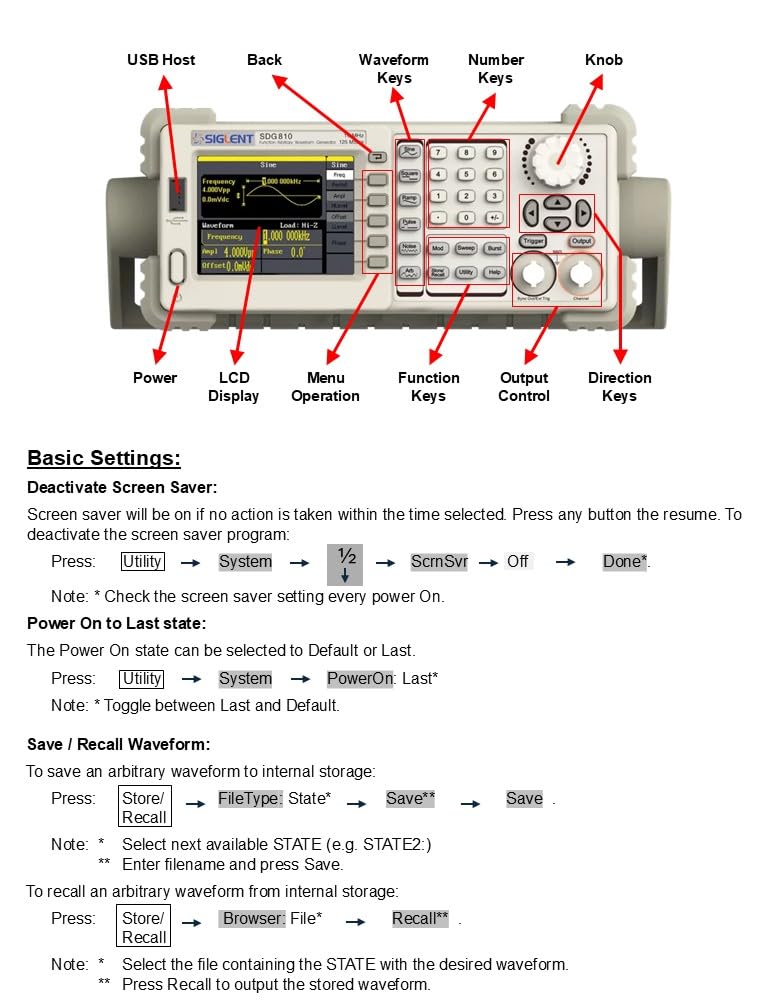
Easy Pulse technology handles the pulse side — fast rising and falling edges with low jitter — which makes it useful as a clock source for digital work as well, and five standard waveforms are joined by 46 built-in arbitrary waveforms including DC, more than most single-channel units offer and enough that you rarely have to build a shape yourself.
Both USB Device and USB Host interfaces are present, so you can attach a stick for waveform storage and firmware updates. Store and recall is the feature owners praise most: with a repeatable setup saved, testing ten capacitors in a row becomes ten button presses.
Who the SDG810 suits
It suits anyone restoring or repairing vintage audio equipment, anyone testing amplifiers and pedal circuits, and anyone who wants one reliable signal source rather than several versatile ones. Owners report five nines frequency accuracy measured on the bench, and the interface works out of the box without the manual — a combination that is rarer than it should be.
It also suits a lab that wants more of the same — several owners bought additional units so the bench has identical instruments, which is a genuine advantage when you are standardising a setup.
Where it disappoints
Single channel is the structural limitation and there is no way around it. If your work involves two signals, this is the wrong shape of tool.
The manual is thin and lacks detail. The unit does not recall its last state automatically after a power cycle or outage, which on a bench with mains interruptions means re-setting everything, and a small number of owners report units that stopped responding after a short period — worth keeping the receipt for. At 5.72 pounds it is also noticeably heavy for a single-channel instrument.
8. Rigol DG1032Z 30 MHz Dual-Channel Signal Generator
Rigol DG1032Z Signal Generator, 30MHz Function Arbitrary Waveform Generator
30 MHz dual channel
16-bit resolution
200 MSa/s sample rate
AM FM PM ASK FSK PSK PWM
Sweep and burst
Pros
- Two fully independent output channels for simultaneous dual-signal testing
- 16-bit resolution with 200 MSa/s sampling for clean low-distortion output
- Broad modulation set covering AM FM PM ASK FSK PSK and PWM
- Sweep and burst expand it beyond simple signal output
- Connectivity suits both lab benches and automated test setups
Cons
- Only five customer reviews so long-term reliability feedback is thin
- No customer review images available for this listing
The DG1032Z is the Rigol in this group, and it is worth understanding what you are buying with that name. Thirty megahertz across two independent channels, 16-bit vertical resolution and a 200 MSa/s sample rate is a genuinely competent specification set that matches the resolution class of the Siglent at a lower bandwidth.
The modulation set is as broad as anything here: AM, FM, PM, ASK, FSK, PSK and PWM, plus sweep and burst. ASK and PSK are the two you will almost certainly never use, but their presence tells you this instrument was designed for communications and automated test work rather than for a teaching bench, and that shows in the connectivity options for laboratory and automated test integration.
Who the DG1032Z suits
It suits someone building an automated measurement setup, and someone who values Rigol’s interface. Owners who have used both brands at a similar tier tend to find Rigol’s front panel easier to live with, and if you have used one and did not get on with it, that is a reasonable reason to look here instead.
The 16-bit resolution is the practical selling point. Higher resolution means lower quantization noise on the output, which shows up as a cleaner noise floor when you are measuring small signals or looking at ripple riding on a larger waveform.
Where it disappoints
The honest caveat is evidence, not hardware. There are only five customer reviews on this listing, all five stars, so the perfect rating reflects a very small sample rather than a settled reputation. There is no owner-reported long-term reliability data to draw on, and we would not treat a five-review average as meaningful evidence.
At 7.04 pounds and 10.3 by 12.54 by 4.41 inches it also has one of the larger footprints in this roundup. If shelf space is tight, a compact unit will serve better.
9. Walfront FY8300S Three-Channel DDS Function Generator
DDS Generator 3-Channel Arbitrary Waveform Function Generator Frequency Meter 4 TTL Level Output(FY8300S-20M US Plug 100-240V)
Three independent DDS channels
Synchronous operation with adjustable phase
Four TTL outputs
100 MHz counter
Pros
- Three fully independent channels that work synchronously with adjustable phase
- Bundles seven instrument functions into one unit
- Four TTL level outputs for digital and logic work
- 100 MHz frequency meter measuring down to 0.01 Hz
- Output short-circuit protection rated for 60 seconds
Cons
- Lowest average rating in this group with a visible one-star share
- Dense menu structure and shortcut keys take time to learn
- Manual documentation is limited
The FY8300S is the only three-channel unit in this roundup, and that is the reason to look at it. Three independent DDS channels running synchronously with a precisely adjustable phase difference between them is a capability nothing else here offers, and for three-phase work, a multi-axis arrangement or a quadrature pair with a defined phase offset it is the right tool by default.
It also consolidates a lot of functions into one box: function generator, arbitrary waveform generator, pulse signal generator, voltage-controlled oscillator, frequency sweeper, counter and frequency meter. The VCO in particular is unusual — feeding a control voltage in and getting a proportional frequency out is a genuinely different way of using a generator, and it is useful for envelope-following style experiments.
Who the FY8300S suits
It suits anyone driving more than two signals, and anyone doing logic work, because there are four TTL level outputs alongside the three analog channels. That is enough to clock a microcontroller, drive a display and toggle a control line from one instrument.
The frequency meter reaches 100 MHz with a minimum measurable frequency of 0.01 Hz across four measurement methods — frequency, period, positive and negative pulse width, and duty cycle. Output short-circuit protection is rated for 60 seconds under a load short, which is reassuring on a unit whose outputs will end up clipped to rails in beginner experiments, and host PC software drives every function alongside an open communication protocol for secondary development.
Where it disappoints
This unit carries the lowest average rating in the group at 4.0, with a 16% share of one-star reviews. The common thread in those reviews is the control layout rather than the electronics: a dense menu structure with shortcut keys that takes real time to learn.
Documentation is limited, so expect to work out the channel tracking function — which updates all three channels from a stored configuration — on your own. If you are buying for capability rather than the lowest learning curve, this is still the most capable multi-channel option in the roundup.
10. GW Instek AFG-2125 25 MHz Arbitrary DDS Function Generator
GW Instek AFG-2125 Arbitrary DDS Function Generator with Counter, Sweep, AM, FM and FSK Modulation, 0.1Hz to 25MHz Frequency Range
0.1 Hz to 25 MHz range
20 MSa/s, 10-bit
4k point waveform memory
Counter and sweep
AM FM and FSK
Pros
- Accurate and dependable in every function it offers
- Simple function-focused design a technician can pick up quickly
- Counter
- sweep and AM FM FSK cover standard bench needs
- 3.5-inch LCD shows amplitude and DC offset together
- USB interface for remote control and waveform editing
Cons
- Less sophisticated than newer touch-screen instruments
- 10-bit resolution and 4k point memory are dated for arbitrary waveform work
- Very few customer reviews on this listing
The AFG-2125 is a workshop instrument. It comes from a brand with a long bench pedigree, and the design philosophy is visible in the front panel: numeric keypad entry for parameters plus a rotary knob for selection, and a 3.5-inch LCD that shows amplitude, DC offset and other settings simultaneously rather than one field at a time.
The frequency range is 0.1 Hz to 25 MHz, a genuinely useful span for a bench — the low end covers audio and physiological signals while the top covers most fast digital work. Counter, sweep and AM, FM and FSK modulation are built in, covering the standard test functions, while waveform memory is 4k points at 10-bit vertical resolution, which is the one place this unit has clearly dated.
Who the AFG-2125 suits
It suits a workshop or lab where a technician needs to pick the instrument up and use it without learning it. The parallel display of amplitude and DC offset is what you want when working with bias points on an amplifier stage, and the numeric keypad makes entering precise values faster than scrolling through a menu.
It also suits anyone who wants USB remote control and waveform editing without a network stack. A single detailed owner review describes it as spot on in every function it offers and recommends it to serious technicians and hobbyists, noting that fancy features are not always better.
Where it disappoints
Ten-bit vertical resolution and 4k points of waveform memory are dated. If your interest is building complex arbitrary waveforms and playing them back with fidelity, this is not the instrument. Sixteen-bit parts like the Siglent SDG2042X and the Rigol DG1032Z exist precisely because that resolution gap shows up in noise-sensitive work.
There is no touch screen and the interface is less sophisticated than newer instruments from Siglent and Rigol. At 16 pounds and 15.2 by 13 by 6.9 inches in its package, it is also far heavier than any other unit here, and it needs a real shelf rather than a corner. With only two customer reviews on this listing, owner feedback is minimal, so weigh the brand’s service reputation more heavily than the rating.
How to Choose a Function Generator Without Overbuying
The specifications that genuinely decide the purchase
Frequency range. Match it to your circuits, not to the biggest number on the box. Audio work, op-amp testing and microcontroller clock bring-up all sit comfortably below a few megahertz. The recurring advice on electronics forums is that a unit in the 5 to 20 MHz range covers essentially all hobby work unless you have specific measurements in mind, and digital signals with fast edges need more headroom than their clock frequency suggests.
Vertical resolution. This is the number most hobby buyers ignore and most regret ignoring. Ten-bit resolution quantizes the output into about a thousand steps, and those steps are visible on a square wave and audible as noise on a sensitive amplifier. Fourteen-bit and sixteen-bit parts remove most of that, which is why resolution buys more than bandwidth on the audio and op-amp projects that dominate hobby benches.
Channel count and independence. Two channels only help if they are genuinely independent — separately settable frequency, amplitude, phase and waveform. That capability is what makes filter response measurement, differential signal testing and harmonic work possible. Watch for units where the second channel is a fixed complement or a copy of the first.
Output impedance and the 50 ohm gotcha. Nearly every generator specifies its output into 50 ohms. If your circuit has a high input impedance, you will see roughly double the amplitude you dialled in. The fix is a 50 ohm series terminator at the load, which halves the amplitude back to what you expected. This single mismatch is the most common source of the double-voltage surprises hobbyists report on forums, and knowing about it before you start debugging saves an afternoon.
DC offset. If you are biasing transistor stages, setting an op-amp operating point or testing a comparator threshold, the ability to add a DC level to an AC waveform is essential. Check the offset range, not just whether an offset control exists.
Built-in counter and measurement. A frequency counter turns a generator from a signal source into a measurement instrument. Period, pulse width and duty cycle measurement add more. Several picks here include all of it, and it saves carrying a separate counter around.
The specifications you can ignore
Sample rate is the big one. A 200 MSa/s or 300 MSa/s figure on a generator with a 15 MHz or 30 MHz ceiling is headroom you will not use — it exists because the underlying DDS architecture runs faster than the output stage can exploit. Judge by usable bandwidth and resolution, not by the sampling number.
Harmonic count claims are marketing more than specification unless you are working above 10 MHz. For audio and low-frequency analog work, the audible harmonics from a 14-bit unit are far below the noise floor of the circuit you are testing.
Similarly, ignore the “professional upgraded” and “lab grade” language in listing titles — it means nothing measurable. Judge the manufacturer, the resolution, the bandwidth and the owner feedback instead. On forums the recurring warning is about marketplace listings claiming high bandwidth with no supporting specification, and the general advice is to buy from authorized distributors rather than the cheapest marketplace listing.
Do you need a separate generator, or will your oscilloscope do?
Most modern hobby oscilloscopes ship with a built-in arbitrary waveform function generator. If yours has one, it will cover sine, square, triangle and sawtooth up to a modest bandwidth, and for audio work that is genuinely enough — a real objection to spending on a standalone unit, and the reason some hobbyists buy a scope with a good AFG instead.
The standalone instrument wins in three places: more output amplitude range and offset control, better modulation and sweep, and physical controls you can turn quickly while watching a scope. For audio amplifier and pedal work a scope’s built-in generator is a workable companion; for regular bench use across filters, amplifiers and digital circuits a dedicated unit earns its place. The pairing to aim for is generator plus scope in one workflow — signal in on one side, response out on the other.
DIY kits, op-amp builds and used analog units
Building your own is a legitimate first step, and owners report building generators from magazine circuits and still using them years later. An XR2206 or ICL8038 kit gives you sine, square and triangle at low frequencies, which covers audio and basic op-amp experiments, and the build itself teaches more about oscillators than any purchase. The limitation is honest: kits have poor frequency accuracy, no calibration and unstable output, fine for audio and useless for anything precise.
A square wave from an op-amp is even simpler and worth knowing. A single op-amp with positive feedback for hysteresis and an RC network that charges and discharges the capacitor produces a relaxation oscillator — the frequency is set by the resistor-capacitor pair, and the output swings rail to rail between the two thresholds, with a second op-amp or a comparator added to give you a triangle as well. It is the cheapest working function generator there is, and a genuinely useful weekend build.
Used analog units are the other route. HP and Agilent 3310, Tektronix FG504, Eico 324, Heathkit IG-102 and SG-8, B&K and RCA WR-50B all come up repeatedly in forum recommendations, with several owners saying they never regretted an HP unit. The trade-off is honest: a second-hand analog instrument needs recalibration, carries no warranty, and a very old unit may be harder to service than to replace — buy one for the character and for the reassurance of a known-good reference, not to save money on a primary bench tool.
Check the ground clip before you probe anything
Every bench generator has all its BNC shells tied to earth. That is a safety feature, and it is also the single most common way hobbyists destroy a circuit or themselves: clipping a ground clip from a grounded instrument onto a point in a mains-powered circuit shorts that point to earth.
Before connecting a generator to anything connected to mains, check whether the circuit is transformer-isolated. If it is not, do not probe it with a grounded generator — use a differential probe, a battery-powered handheld unit, or an isolation transformer, and check the ground reference on any non-isolated switching supply on the bench too.
Building out the rest of the bench
A signal source is only half the workflow. If you are starting rather than upgrading, our picks for the best multimeters for electronics repair cover the DC side of the same work, and our guide to the best soldering stations for electronics covers the part that comes before the probe goes anywhere. For the physical side of a repair bench, the best electronics repair toolkits round up what to keep on the bench alongside the instruments.
Frequently Asked Questions
What is the principle of a function generator?
A function generator runs a core oscillator at a frequency you set, then a shaping circuit converts that raw output into the waveform you selected. A comparator with hysteresis produces a square wave, while a charge-and-discharge integrator produces a triangle. An output amplifier then scales and buffers the result to the amplitude and DC offset you chose. In an arbitrary waveform generator the same result comes from replaying a table of samples at a fixed rate. The result is a signal with a known shape, frequency and amplitude that you can feed into a circuit.
What is a function generator used for?
A function generator feeds a known test signal into a circuit so you can measure how the circuit responds. Typical uses include measuring op-amp gain, checking filter cutoffs and roll-off, setting comparator thresholds, testing amplifier and audio circuit response, sweeping frequency to plot a filter response, driving a microcontroller clock line, and injecting ripple into a power supply. Paired with an oscilloscope it turns guesswork into a measurement you can read off a screen.
What are the limitations of using a function generator?
The main limitations are source impedance, amplitude range and resolution rather than frequency. Output is specified into 50 ohms, so a high-impedance circuit can see roughly double the amplitude you dialled in until you add a 50 ohm series terminator. Low-resolution units quantize the output visibly, more at low amplitudes. A generator also cannot measure anything itself except through its built-in counter, and a grounded generator cannot be safely clipped onto a non-isolated mains-referenced circuit.
Are oscilloscopes the same as function generators?
No. A function generator produces a signal; an oscilloscope measures one. Many modern scopes include a built-in arbitrary waveform generator, which overlaps with a simple function generator for sine, square, triangle and sawtooth at modest bandwidth. A standalone generator usually wins on amplitude range, DC offset control, modulation and sweep, plus faster physical controls for repeated work. If your scope already has a built-in generator that covers audio, you may not need a separate one at all.
Where can I find a cheap function generator?
Cheapest options are DIY kits built around an XR2206 or ICL8038 chip, which give sine, square and triangle at low frequencies and are excellent learning projects but lack calibration and frequency accuracy. Above that, entry dual-channel DDS units cover audio, op-amp and microcontroller work with a counter and sweep built in for a modest outlay. Buying from an authorized distributor rather than the cheapest marketplace listing avoids the recurring counterfeit problem reported on electronics forums.
How many MHz function generator do I need?
For most hobby electronics, a unit with 5 to 20 MHz of sine output is enough, which is the consensus across electronics forums. Audio work, op-amp testing and microcontroller clock bring-up sit far below that. Digital signals with fast edges need more headroom than their clock frequency implies, because a 10 MHz square wave carries harmonics well above 10 MHz. Buy more than you need only if you plan RF, SDR or fast switching-converter work.
Which Function Generator Should You Buy?
For most people building a hobby electronics bench, the Siglent SDG2042X is the right first buy. Dual independent channels, 40 MHz of bandwidth, 16-bit resolution and network control cover everything from op-amp characterization to switching-supply work, and the owner feedback on output quality is the strongest in this group. If your work is audio and vintage restoration rather than fast digital, the Siglent SDG810 earns its place with its sawtooth, ramp and sweep behaviour.
At the budget end, the Koolertron 15 MHz dual-channel unit is the strongest all-round value here, with independent channels, a TTL output, a counter and 99 stored setups. The Seesii 60 MHz unit is the pick if you want more bandwidth headroom, and the DOMINTY FY6900 is the one to buy if the instrument is for a first bench and for learning. Whichever you choose, the best function generators for hobby electronics are the ones whose resolution and channel independence match your circuits — not the ones with the biggest number on the box.