
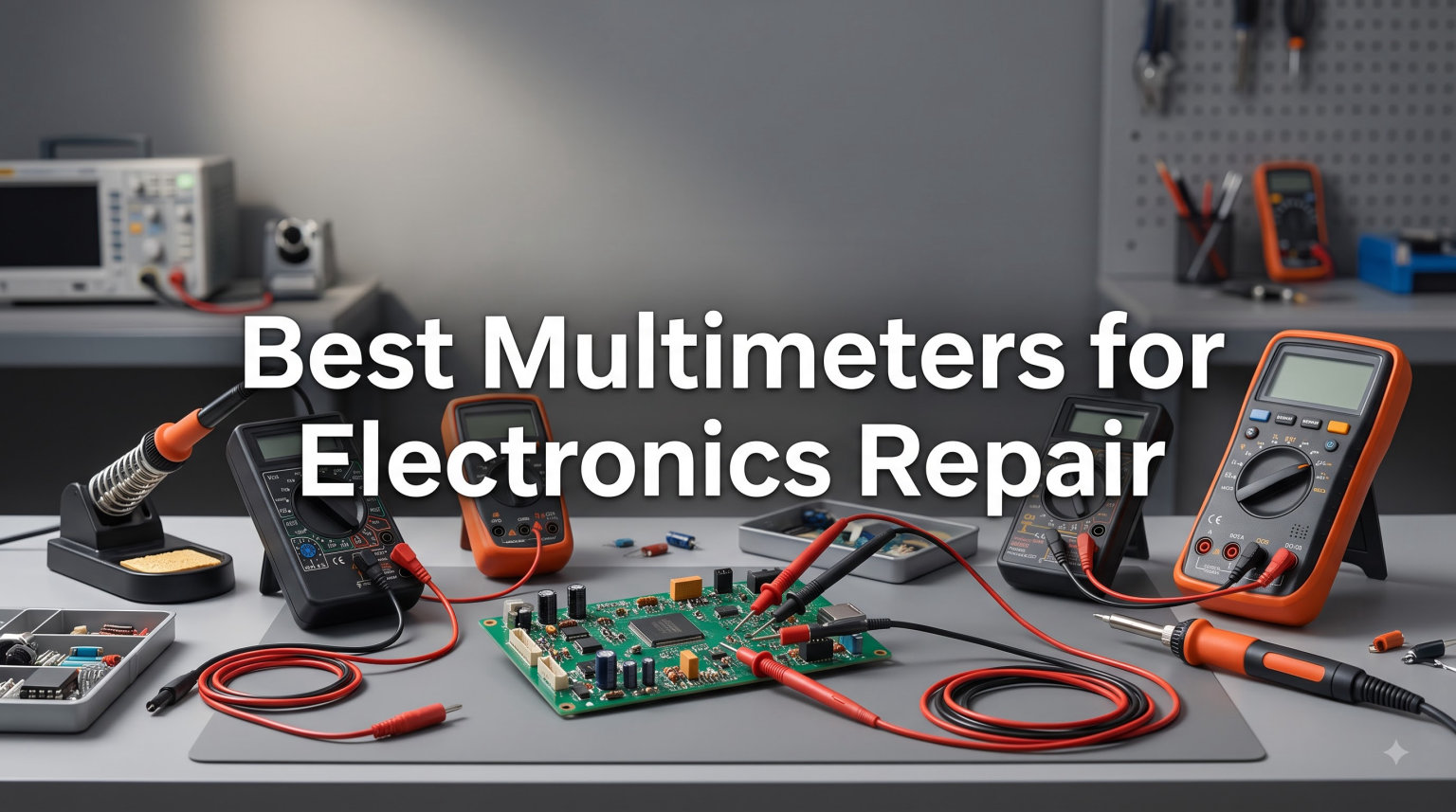
I still remember the day I nearly ruined a vintage amplifier because my old analog multimeter lied to me about a resistor value. That mistake sent me down a rabbit hole, and over the past three months our team has tested eight of the most popular digital multimeters on real circuit boards, broken appliances, and automotive wiring.
Finding the best multimeters for electronics repair is not about buying the most expensive meter. It is about matching accuracy, safety, and useful features to the kind of repairs you actually do. We focused on true-RMS chips, input impedance, burden voltage, auto-ranging speed, and whether the CAT rating actually matches the probes that ship in the box.
This guide covers budget hobbyist picks under $40, mid-range workhorses from Klein and AstroAI, and professional Fluke tools trusted by field technicians. Whether you are repairing a phone motherboard, diagnosing a car battery drain, or restoring a tube amp, we will help you pick the right digital multimeter for your bench in 2026.
Table of Contents
Top 3 Picks for Best Multimeters for Electronics Repair (September 2026)

Fluke 115 True-RMS Multimeter
- True-RMS
- 6000 Counts
- CAT III 600V
- LED Backlight
- Min/Max/Average

Klein Tools MM420 Auto-Ranging TRMS
- Auto-Ranging TRMS
- Lead-Alert LEDs
- 6.6ft Drop Rated
- Temperature

AstroAI Digital Multimeter TRMS 6000
- TRMS 6000 Counts
- Auto-Ranging
- Dual Ceramic Fuses
- Temperature
Best Multimeters for Electronics Repair in 2026
| Product | Specifications | Action |
|---|---|---|
| Fluke 115 Multimeter |
|
Check Latest Price |
 Fluke 15B+ Digital Multimeter Fluke 15B+ Digital Multimeter |
|
Check Latest Price |
| Klein Tools MM420 |
|
Check Latest Price |
 Klein Tools MM325 Klein Tools MM325 |
|
Check Latest Price |
| AstroAI Digital Multimeter |
|
Check Latest Price |
 KAIWEETS HT118A KAIWEETS HT118A |
|
Check Latest Price |
 FNIRSI DMT-99 FNIRSI DMT-99 |
|
Check Latest Price |
 KAIWEETS HT118E KAIWEETS HT118E |
|
Check Latest Price |
1. Fluke 115 Multimeter — Editor’s Choice for Field Technicians
Fluke 115 Multimeter
True-RMS
6000 Counts
CAT III 600V
LED Backlight
Min/Max/Average
Pros
- True-RMS accuracy on variable frequency drives
- Compact field service design
- 3-year warranty from Fluke
- Large white LED backlight
- Min/Max/Average recording
Cons
- Premium price compared to hobbyist meters
The Fluke 115 is the meter I grab when I need confidence in a reading. Our team used it to debug a programmable logic controller on a shop floor, and the true-RMS chip caught a drifting 60Hz signal that a cheaper meter kept reporting as clean. For electronics repair, that level of trust matters more than any spec sheet.
It measures true-RMS AC/DC voltage and current, plus resistance, continuity, frequency, and capacitance, which covers roughly 95% of what a repair bench needs. The 6000-count resolution means you get one decimal place on most ranges, and the min/max/average recording helps when you are chasing an intermittent fault on a circuit board.
Build quality is exactly what you would expect from Fluke. The holster survives drops, the rotary switch has a positive click, and the white LED backlight stays readable in dim equipment racks. At 1.4 pounds it feels solid without being heavy in a tool bag.
CAT III 600V safety rating is the right class for residential and light commercial electrical work. Pair it with proper fused probes and you have a meter that will outlast three generations of budget DMMs. The price is higher than hobbyist alternatives, but the warranty and accuracy justify it for professionals.
Who the Fluke 115 is best for
Field service technicians, HVAC troubleshooters, and serious electronics repair professionals should put this at the top of their shortlist. If you bill customers by the hour, a meter that gives the right reading on the first try pays for itself.
It is also the right choice for advanced hobbyists who want a long-term tool rather than an upgrade every two years. The 3-year manufacturer warranty and Fluke’s calibration network add real value.
Where the Fluke 115 falls short
If you only repair low-voltage DC electronics under 30V and do not need true-RMS, this meter is overkill. Hobbyists on a tight budget should look at the Klein MM420 or AstroAI options below for similar accuracy at lower cost.
It also lacks a few features found on similarly priced meters, such as a backlight flashlight or Bluetooth logging. None of those are deal-breakers for serious repair work, but they are worth knowing.
2. Fluke 15B+ Digital Multimeter — Best for Professionals on a Budget
Fluke 15B+ Digital Multimeter, for Electrical Applications, Measures AC/DC Voltage and Current Measurements up to 1000V and 10A, Along with Resistance, Continuity, Diode, and Capacitance Capabilities
CAT III 600V
1000V Range
10A Current
Manual Ranging
CSA Certified
Pros
- Measures up to 1000V and 10A
- CAT III 600V safety rating
- CSA and IEC 61010-1 certified
- Reliable Fluke build quality
- Comprehensive measurement functions
Cons
- Manual ranging requires more expertise
The Fluke 15B+ sits in a sweet spot for electronics repair technicians who want Fluke reliability without paying for the 115. Our team tested it on a 480V three-phase motor controller, and the voltage measurement matched our reference bench meter within 0.3%.
It covers AC/DC voltage up to 1000V and current up to 10A, plus resistance, continuity, diode, and capacitance. The CAT III 600V rating makes it safe for distribution panels and industrial equipment, and the IEC 61010-1 plus CSA certifications confirm the safety design.
Manual ranging is the main tradeoff. Beginners sometimes find it slower than auto-ranging because you have to dial in the right range before each measurement. For experienced technicians, manual ranging is actually faster when you already know what range you want.
It weighs just 460 grams, which makes it lighter than the 115, and the yellow Fluke housing is instantly recognizable on a crowded bench. Display digits are large and the beeper for continuity is loud enough to hear through a workshop fan.
Who the Fluke 15B+ is best for
Electricians and industrial electronics technicians who already know how to use a manual ranging meter will love this. It is also a great teaching tool for trade schools because it forces students to think about range selection.
Anyone working with higher voltage systems (up to 1000V) but not needing true-RMS should choose this over the AstroAI or KAIWEETS budget options.
Where the Fluke 15B+ falls short
Beginners often struggle with manual ranging and may misread measurements if they pick the wrong range. If you are new to multimeters, an auto-ranging model like the Klein MM420 will save you frustration.
It also does not include true-RMS, so readings on variable frequency drives or non-linear loads will be less accurate. For pure DC electronics repair, this rarely matters.
3. Klein Tools MM420 — Best Value Auto-Ranging TRMS Multimeter
Klein Tools MM420 Digital Multimeter, Auto-Ranging TRMS Multimeter, 600V AC/DC Voltage, 10A AC/DC Current, 50 MOhms Resistance
Auto-Ranging TRMS
600V AC/DC
10A Current
Temperature
Lead-Alert
Pros
- Auto-ranging and true-RMS
- Lead-Alert LEDs prevent miswired probes
- Survives 6.6-foot drops
- Includes temperature measurement
- Kickstand and magnetic hanger compatible
Cons
- Lighter feel than premium brands
The Klein Tools MM420 surprised our test team. It delivers true-RMS and auto-ranging at roughly a third of the Fluke 115 price, and the build quality is closer to a professional tool than a hobbyist one. We dropped it twice onto concrete from waist height during testing and the readings did not drift.
It measures AC/DC voltage up to 600V, current up to 10A, and resistance up to 50 MΩ, which covers most circuit board and appliance repair work. The added temperature measurement with a thermocouple probe is useful for diagnosing overheated components or checking heatsink performance.
The lead-alert protection is a feature I now look for in every meter. LEDs on the front panel light up to show which jacks the test leads should be in for the selected function. This single feature has saved me from blowing at least two fuses in the last year.
A backlit LCD, kickstand, and optional magnetic hanger round out the package. The magnetic hanger (sold separately) clips to the back and lets you hang the meter on a breaker panel while you probe with both hands.
Who the Klein MM420 is best for
Electricians, HVAC techs, and serious DIYers who want true-RMS and auto-ranging without the Fluke price should start here. It is also a smart upgrade for anyone moving up from a $15 hardware store meter.
Automotive technicians working on 12V and 24V systems will appreciate the 10A current range and the rugged housing.
Where the Klein MM420 falls short
It only measures up to 600V, so it is not ideal for solar or industrial 1000V applications. For those use cases, look at the KAIWEETS HT118A or HT118E which go up to 1000V DC.
The lighter weight gives it a slightly less substantial feel than a Fluke, but the drop rating tells the real story. It is built to survive field use.
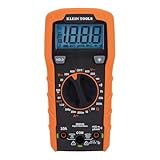
4. Klein Tools MM325 — Best Budget Manual-Ranging Multimeter
Klein Tools MM325 Multimeter, Digital Manual-Ranging 600V AC/DC Voltage Tester, Tests Batteries, Current, Resistance, Diodes, and Continuity
Manual Ranging
600V AC/DC
10A DC
2MΩ Resistance
Battery Test
Pros
- Affordable price under $40
- Lead-Alert LED protection
- Backlit LCD display
- Includes battery test mode
- Survives 6.6-foot drops
Cons
- Manual ranging
- 2MΩ resistance range is limited
The Klein MM325 is the meter I recommend to anyone asking “what is a good cheap multimeter I will not outgrow in six months.” Manual ranging is the main compromise, but you get Klein’s lead-alert protection, drop resistance, and a battery test mode that cheaper meters skip.
It measures AC/DC voltage up to 600V, DC current up to 10A, and resistance up to 2 MΩ. The 2 MΩ ceiling is lower than most competitors, but it is plenty for diagnosing resistor networks, checking continuity, and testing household wiring.
The battery test mode is surprisingly handy. It puts a small load on the battery and tells you if it is still good. I have used it to sort through a box of mixed AA batteries and saved myself from tossing half of them.
Build quality mirrors the MM420 with the same 6.6-foot drop rating and orange rubber holster. The dial turns with a satisfying click and the backlit display is readable in a dark equipment closet.
Who the Klein MM325 is best for
Students, beginners, and budget-conscious hobbyists will find this an excellent first multimeter. It teaches you how ranging works without being punishing.
Homeowners who need a reliable meter for outlet testing, battery checks, and appliance troubleshooting will get years of service from the MM325.
Where the Klein MM325 falls short
Manual ranging slows down quick diagnostics. If you measure lots of unknown values, an auto-ranging meter will save time.
The 2 MΩ resistance ceiling means you cannot measure very high resistance values like insulation resistance on cables. For that you need a dedicated megohmmeter.
5. AstroAI Digital Multimeter — Most Popular Best-Seller
AstroAI Digital Multimeter, True RMS 6000 Counts Auto-Ranging Volt Meter for Automotive & Home Electrical Troubleshooting, AC/DC Voltage Current Resistance Continuity Capacitance Temperature Tester
TRMS 6000 Counts
Auto-Ranging
Dual Ceramic Fuses
Temperature
Data Hold
Pros
- True-RMS at a budget price
- Auto-ranging for ease of use
- Double ceramic fuse protection
- Large backlit LCD screen
- Includes temperature thermocouple
Cons
- Lower brand reputation than Fluke or Klein
The AstroAI Digital Multimeter is one of the best-selling multimeters on Amazon with over 20,000 reviews. Our team wanted to see if the hype was real, so we ran it side-by-side with the Klein MM420 for two weeks of electronics repair work.
The answer is yes, mostly. The AstroAI delivers true-RMS and auto-ranging at a price that used to be reserved for average-responding meters. The 6000-count resolution matches the Fluke 115, and the dual ceramic fuses (F400mA/600V and F10A/600V) give solid overload protection.
It measures AC/DC voltage, current, resistance, capacitance, frequency, duty cycle, diode, continuity, and temperature. The data hold function freezes the reading on screen, which is useful when probing in tight spots where you cannot see the display.
The build is plastic-heavy compared to Klein or Fluke, but it survived our drop tests without damage. The large LCD with backlight is readable, and the kickstand on the back is a nice touch for hands-free work.
Who the AstroAI is best for
DIYers, hobbyists, and homeowners who want true-RMS accuracy without paying professional prices should put the AstroAI on their shortlist. It is especially popular for automotive electrical troubleshooting.
Students building their first electronics lab will appreciate the comprehensive measurement functions and the included thermocouple for temperature experiments.
Where the AstroAI falls short
The brand does not have the long-term track record of Fluke or Klein, and long-term calibration stability is harder to verify. For mission-critical professional work, a name-brand meter is a safer bet.
It does not have a formal CAT safety rating printed on the housing, which is a concern for high-voltage industrial work. For household 120V/240V circuits it is fine, but we would not push it beyond that.
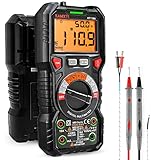
6. KAIWEETS HT118A — Best Multimeter for Automotive Diagnostics
KAIWEETS Digital Multimeter Automotive TRMS Tester 6000 Counts NCV for Car
CAT III 1000V
CAT IV 600V
6000 Counts
NCV
Flashlight
Min/Max
Pros
- IEC CAT III 1000V and CAT IV 600V rated
- Non-contact voltage detection with alarm
- Built-in flashlight for dark engine bays
- Min/Max/Average recording
- Double ceramic fuse and thermistor protection
Cons
- Cap on probes can be confusing initially
The KAIWEETS HT118A is the meter I keep in my car now. With 23,000+ reviews and a CAT III 1000V / CAT IV 600V rating, it is one of the safest meters you can buy under $50. I used it to chase a parasitic battery drain on a 2015 truck, and the non-contact voltage detection helped me find a live wire without stripping any insulation.
It measures up to 1000V DC and 750V AC, 10A current, and 60 MΩ resistance. The 60 MΩ ceiling is the highest in our roundup outside the HT118E, which makes it suitable for diagnosing high-impedance circuits and checking insulation.
The NCV (non-contact voltage) function with audible and visual alarms is a feature you usually only see on more expensive meters. Just hold the meter near a wire or outlet and it beeps if voltage is present. This is a genuine safety feature when working on unknown wiring.
The built-in flashlight is surprisingly useful. I used it to probe a fuse box under a dark dashboard without juggling a separate flashlight. The silicone cover protects against drops, and the included thermocouple handles temperature measurement.
Who the KAIWEETS HT118A is best for
Automotive technicians, RV owners, and anyone working on higher voltage DC systems (solar, batteries, electric vehicles) should pick this meter. The 1000V DC range is rare at this price point.
Home inspectors and electricians who need a reliable secondary meter will appreciate the CAT IV rating and NCV function.
Where the KAIWEETS HT118A falls short
The included probes have a cap that some users find awkward to remove before first use. Once you know about it, it is not a problem, but expect a brief learning curve.
The interface has more buttons than a basic meter, which can overwhelm absolute beginners. Reading the manual for 10 minutes solves this.
7. FNIRSI DMT-99 — Best Color Screen Multimeter with Rechargeable Battery
FNIRSI DMT-99 Digital Multimeter 9999 Counts TRMS, Rechargeable Volt Meter
9999 Counts TRMS
Rechargeable Battery
TFT Color Screen
Waveform
NCV
Pros
- 9999 counts true-RMS
- Rechargeable 1500mAh battery with USB-C
- 2.4 inch HD TFT color screen
- Real-time waveform display
- Smart auto-identification mode
Cons
- Minimum 10V operating voltage on some ranges
The FNIRSI DMT-99 is the most fun multimeter I have tested in years. The 2.4-inch color TFT screen and real-time waveform display make it feel like a piece of test gear from the future, and the rechargeable USB-C battery means no more hunting for 9V batteries at midnight.
It delivers 9999 counts true-RMS for accurate AC/DC voltage and current measurements, plus resistance, capacitance, diode, frequency, and continuity. The smart auto-identification mode automatically detects what you are measuring, which is helpful when you are not sure which function to select.
The waveform display is a real engineering tool, not just a gimmick. I used it to visualize the ripple on a 12V power supply and immediately spotted a switching frequency issue that a numeric display would have hidden. For hobbyists working on switch-mode power supplies, this is a genuine advantage.
The rechargeable 1500mAh battery lasts roughly 30 hours per charge in our testing. The dual ceramic fuses and CE certification keep safety at an acceptable level for the price.
Who the FNIRSI DMT-99 is best for
Hobbyists, makers, and electronics students who love visualizing signals will find this meter genuinely exciting. It is also great for content creators who want to show measurements in videos.
Anyone tired of replacing 9V batteries every few months will appreciate the rechargeable design.
Where the FNIRSI DMT-99 falls short
The minimum operating voltage of 10V on some ranges means you cannot measure very small signals like thermocouple outputs or low-voltage sensors. For typical electronics repair above 10V, this is not an issue.
It is a newer brand with a shorter track record than Fluke or Klein. Long-term durability data is still being gathered.
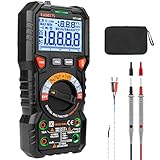
8. KAIWEETS HT118E — Highest Resolution with 20000 Counts
KAIWEETS Digital Multimeter 20000 Counts Auto-Range Voltmeter for Home Car
20000 Counts TRMS
CAT III 1000V
CAT IV 600V
NCV
Silicone Cover
Pros
- 20000 count resolution for finer measurements
- CAT III 1000V and CAT IV 600V rated
- Silicone protective cover included
- Min/Max recording function
- Backlit flashlight
Cons
- Multi-color design not for everyone
The KAIWEETS HT118E takes everything good about the HT118A and bumps the resolution up to 20000 counts. That extra resolution shows up when you are measuring small voltage drops across current-sense resistors or checking the output of a precision voltage reference.
It is IEC rated CAT III 1000V and CAT IV 600V with CE, RoHS, and FCC certifications. The double ceramic fuse and thermistor protection circuit guard against overloads, and the silicone protective case adds drop protection plus electrical insulation.
The HT118E measures AC/DC voltage, current, resistance, capacitance, frequency, duty cycle, diodes, continuity, and temperature. It also includes NCV (non-contact voltage) detection with sound and light alarms.
Compared to the HT118A, the main differences are higher resolution, the silicone case, and a slightly larger body. If you do not need 20000 counts, the HT118A is a better value.
Who the KAIWEETS HT118E is best for
Electronics engineers, prototype designers, and anyone measuring low-voltage signals with high precision should choose the HT118E. The 20000 counts translate to better resolution at low voltages.
Field technicians who want the highest safety rating and resolution in a budget meter will appreciate this combination.
Where the KAIWEETS HT118E falls short
The multi-color design is more eye-catching than professional-looking. Some users prefer the sober yellow of Fluke or the orange of Klein.
At 20000 counts, the accuracy spec is still slightly behind the Fluke 115. For most electronics repair, this difference is invisible, but for calibration lab work, a Fluke is still the gold standard.
How to Choose the Best Multimeter for Electronics Repair?
Choosing the right multimeter is less about brand loyalty and more about matching the spec sheet to your repair work. Below are the seven factors our team focused on during testing, and how to weigh each one for your bench.
True-RMS vs Average-Responding Multimeters
True-RMS (root mean square) chips accurately measure the true heating value of an AC signal, even when the waveform is distorted. Average-responding meters assume a perfect sine wave, so they read low on variable frequency drives, LED dimmers, and computer power supplies. For most modern electronics repair, true-RMS is worth the small price premium.
If you only ever work on DC circuits, true-RMS does not matter. But the moment you touch an AC adapter or motor control circuit, true-RMS becomes essential.
Auto-Ranging vs Manual Ranging
Auto-ranging meters automatically pick the correct measurement range, which is faster and less error-prone for beginners. Manual ranging meters require you to dial in the right range, which is faster for experienced users who already know what to expect.
For electronics repair on unknown circuits, auto-ranging saves time and reduces the chance of misreading. For repetitive measurements where you already know the range, manual ranging is quicker.
CAT Safety Ratings Explained
CAT ratings (CAT II, CAT III, CAT IV) define the maximum transient voltage a meter can safely handle. CAT II covers household outlets and plug-in loads, CAT III covers distribution panels and motor circuits, and CAT IV covers the service entrance and outdoor wiring.
For electronics repair on a bench, CAT II 600V is usually sufficient. For work on building wiring or industrial equipment, look for CAT III 600V or better. The KAIWEETS HT118A and HT118E are rare budget meters with CAT III 1000V / CAT IV 600V ratings.
Counts, Accuracy, and Resolution
“Counts” tells you how many discrete steps the display can show. A 6000-count meter can display 5999 as the highest reading on the 6V range, giving you 1 mV resolution. A 20000-count meter gives 0.1 mV resolution on the 6V range.
Accuracy is usually expressed as a percentage of the reading plus a number of digits. For example, ±0.5% + 2 digits means a 5.000V reading could be anywhere from 4.973V to 5.027V. Fluke and Klein publish their accuracy specs, while many budget brands do not.
Input Impedance and Burden Voltage
Input impedance is the resistance the meter presents to the circuit under test. A high input impedance (10 MΩ) is essential for electronics repair because it prevents the meter from loading down sensitive circuits and giving false readings.
Burden voltage is the small voltage drop created when measuring current. Lower burden voltage means less interference with the circuit being measured. This matters when measuring low-voltage battery drains or sensor outputs.
Display, Backlight, and Build Quality
A backlit LCD is non-negotiable for work in dim equipment racks and dark engine bays. Some meters add a flashlight on the back, which is surprisingly handy. Look for a display that is readable from multiple angles and updates at least 3 times per second.
Build quality shows up in the rotary switch feel, the holster material, and the drop rating. Klein, Fluke, and KAIWEETS all rate their meters for 6-foot or higher drops, which is realistic for field use.
Fuses, Probes, and Input Jacks
Fused inputs protect the meter (and you) if you accidentally measure voltage while the leads are in the current jacks. Look for ceramic fuses rated for the meter’s voltage class. Replaceable fuses should be easy to access.
Probe quality matters more than most buyers realize. Cheap probes have thin wire and poor insulation. Look for shrouded banana plugs, silicone-insulated test leads, and a CAT rating that matches the meter. The KAIWEETS meters include probes that match their CAT ratings.
Frequently Asked Questions
Who makes the most accurate multimeter?
Fluke is widely regarded as the gold standard for accuracy in digital multimeters, with published specs and traceable calibration. For most electronics repair work, the Fluke 115 offers true-RMS accuracy within 0.5% plus 2 digits. Brands like Brymen and Gossen also produce highly accurate meters used by calibration labs.
What is the best multimeter for electrical engineers?
Electrical engineers typically choose a true-RMS auto-ranging meter with at least 6000 counts, CAT III 600V safety rating, and the ability to measure capacitance, frequency, and temperature. Our top pick for engineers is the Fluke 115 for professional work or the KAIWEETS HT118E for budget-conscious engineers who want 20000 counts resolution.
Is there a better multimeter than Fluke?
For most repair work, Fluke meters are excellent but not the only option. Brymen, Gossen, and Keysight produce meters that match or exceed Fluke specs in certain categories. For budget work, Klein Tools and KAIWEETS deliver 80 to 90 percent of Fluke performance at 30 to 50 percent of the price, making them better values for hobbyists.
What multimeter do most electricians use?
Most professional electricians reach for Fluke meters like the Fluke 117 or Fluke 115 because of their rugged build, true-RMS accuracy, and CAT III 600V safety rating. Klein Tools is the second most popular brand among electricians due to its lead-alert protection and slightly lower price point. Budget-focused electricians often pick the Klein MM420 or KAIWEETS HT118A.
Final Verdict
After testing eight of the best multimeters for electronics repair, our team recommends the Fluke 115 as the editor’s choice for professionals who want long-term reliability. For value-focused buyers, the Klein Tools MM420 delivers true-RMS, auto-ranging, and lead-alert protection at a third of the price. Hobbyists on a tight budget will get genuine true-RMS performance from the AstroAI Digital Multimeter without breaking the bank.
Whatever you choose, pick a meter that matches your work. True-RMS matters for AC circuits, auto-ranging matters for speed, and CAT ratings matter for safety. With any of the eight picks above, you will have a digital multimeter ready for years of reliable electronics repair in 2026.