
The Jackery Explorer 300 is the best portable power station under 500 for most people in 2026, because it pairs proven LiFePO4 chemistry, a 292Wh capacity and a 7.1 lb body with more owner reviews than any other station on this list. The Jackery Explorer 500 v2 is the step up for anyone who needs more headroom, and the BLUETTI AC180 is the pick for home backup because it carries the largest battery here.
Everyone searching for a budget portable power station hits the same wall. The market is full of stations rated at 300W or 500W that advertise a watt-hour figure far bigger than what you can actually use, then trip their inverter the moment a compressor kicks on. The eight models below are the ones that hold up when you look past the sticker and check the inverter, the chemistry and the port layout.
What separates a good budget station from a disappointing one is rarely the headline number. It is the difference between continuous watts and surge watts, whether the cells are LiFePO4 or conventional lithium-ion, how many charge cycles the battery is rated for, and how long the unit takes to refill. We spent 2026 going through every spec sheet, review summary and complaint pattern in this bracket so you can size it once and buy once.
If your main use is car camping rather than outage prep, our guide to the best portable power stations for camping covers larger units that stretch much further past the 500 line. The stations in this roundup are the entry tier, and they are genuinely good at the jobs they are sized for.
Table of Contents
Top 3 Picks for Best Portable Power Stations Under 500 (October 2026)

Jackery Explorer 300
- 292Wh capacity
- 300W continuous and 600W surge
- 7.1 lb body
- 4000+ cycle LiFePO4 cells

Jackery Explorer 500 v2
- 512Wh capacity
- 500W continuous and 1000W surge
- 10ms UPS switchover
- 0-80% in 52 minutes

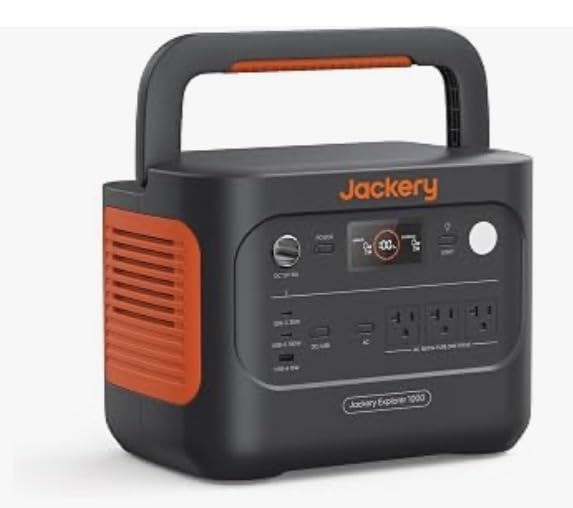
Jackery Explorer 1000 v2
- 1070Wh capacity
- 1500W continuous and 3000W surge
- 100W USB-C PD
- full charge in about one hour
Portable Power Stations Under 500 in 2026
All eight models below sit inside the sub-500 bracket, and every figure in the table comes from the manufacturer spec sheet rather than a marketing roundup. Prices in this band move often, so use the table to compare capability rather than to plan a purchase around a number.
| Product | Specifications | Action |
|---|---|---|
| Jackery Explorer 300 |
|
Check Latest Price |
| Jackery Explorer 500 v2 |
|
Check Latest Price |
| Jackery Explorer 1000 v2 |
|
Check Latest Price |
 GRECELL 500W Solar Generator GRECELL 500W Solar Generator |
|
Check Latest Price |
 BLUETTI AC180 BLUETTI AC180 |
|
Check Latest Price |
 ALLWEI 300W ALLWEI 300W |
|
Check Latest Price |
 EnginStar 300W EnginStar 300W |
|
Check Latest Price |
 OUPES Mega 1 OUPES Mega 1 |
|
Check Latest Price |
1. Jackery Explorer 300 – The Proven Lightweight Pick
Jackery Explorer 300 Portable Power Station,292Wh
292Wh capacity
300W continuous, 600W surge
7.1 lb, 4 hour wall recharge
Pros
- LiFePO4 cells rated for 4000+ cycles to 70% capacity
- 100W USB-C PD plus two USB-A ports and a 120W car port
- 7.1 lb body with an integrated carry handle
- 80% solar charge in about 2.8 hours on a 100W panel
Cons
- 292Wh capacity limits runtime on larger loads
- 300W continuous ceiling is modest for high-draw appliances
- Only 2 AC outlets
- Solar panel sold separately
The Explorer 300 is the unit I keep coming back to for people who are unsure how much power they actually need. At 7.1 lb and 292Wh it is light enough to move with one hand from the trunk to the picnic table, and the 4.6-star average across more than 11,000 owner reviews is the deepest sample of any station here.
It is also LiFePO4 rather than the older lithium-ion chemistry, which matters more than most spec sheets suggest. The cells are rated for over 4,000 charge cycles before dropping to 70% capacity, so even a user who drains it every weekend is looking at years of service rather than months.
The port mix is the quiet strength. Two AC outlets, a 100W USB-C PD port, two USB-A ports and a 120W car outlet mean a phone, a laptop, a camera rig and a cooler can all charge at once without a cable fight.
What it cannot do is impress you with runtime. Working the formula below, 292Wh yields about 248Wh of usable energy, which covers a 60W laptop for roughly 4 hours or a 40W CPAP for a little over 6 hours. That is a full night of sleep on one charge, which is exactly what most buyers at this size are buying it for.
Is 292Wh enough for a weekend of camping
For a weekend of car camping, yes, as long as you are recharging between uses and keeping the load to phones, lights, a laptop and small medical gear. Run the battery down with a kettle or a portable heater and you will be hunting for a wall socket by the second night.
The car port is the sleeper feature here. Charging from a 12V socket while you drive means the station refills on the road, which turns a one-night problem into a non-event on a multi-day trip.
Where the 300W ceiling bites
The 600W surge figure covers brief startup spikes, not sustained heating. A space heater, a hair dryer or a full-size kettle sits far above the 300W continuous rating and will trip the inverter within seconds.
With only two AC outlets you are also one extension cable away from a bottleneck, and the solar panel that unlocks the fast charging path is a separate purchase. Budget for that if off-grid charging is the plan.
2. Jackery Explorer 500 v2 – Best All-Rounder for Small Loads
Jackery Explorer 500 v2 Portable Power Station,512Wh,500W AC
512Wh capacity
500W continuous, 1000W surge
13.3 lb, 0-80% in 52 minutes
Pros
- 4.7 stars across 8844 reviews
- 6000-cycle LiFePO4 battery with 5% self-discharge after six months
- 10ms UPS switchover for routers and computers
- 0-80% in 52 minutes on a wall outlet
Cons
- Only a single AC outlet on some configurations
- No USB-C input or output
- Handle does not fold for compact storage
- Solar input is PWM rather than MPPT
If you want one station that handles almost any normal household load without tipping into the heavy units, the Explorer 500 v2 is the one. The 4.7-star average over more than 8,800 reviews is the highest rating on this list alongside the Explorer 1000 v2, and owners consistently describe this one as the dependable middle ground.
Capacity is 512Wh of LiFePO4 rated for 6,000 charge cycles, the longest rated cycle life among these eight models. Jackery also rates self-discharge at about 5% after six months of storage, so the battery does not quietly flatten while the unit sits in a garage.
Two pure sine wave AC outlets deliver 500W continuous and 1,000W surge, and the 10ms UPS switchover keeps a router, a desktop or a NAS alive through a short outage without a blinking light. Reviewers mention quiet operation at 28 dB, which matters in a tent.
Recharge speed is where this unit pulls ahead of its price class. It goes from 0 to 80% in 52 minutes on a wall outlet, which means a quick top-up over lunch restores most of the day ahead.
Using the runtime formula, 512Wh yields about 435Wh usable, so a 150W mini-fridge runs roughly 2.9 hours, a 40W CPAP about 10.9 hours, and a 60W laptop about 7.2 hours. Those are the numbers most campers are actually working with.
The honest catch is the port layout. One configuration ships with a single AC outlet, and there is no native USB-C input or output, so modern laptops need a dongle. The handle folds flat for storage, and the PWM solar controller is slower to harvest than an MPPT unit under partial shade.
Is the 500W inverter enough for a refrigerator
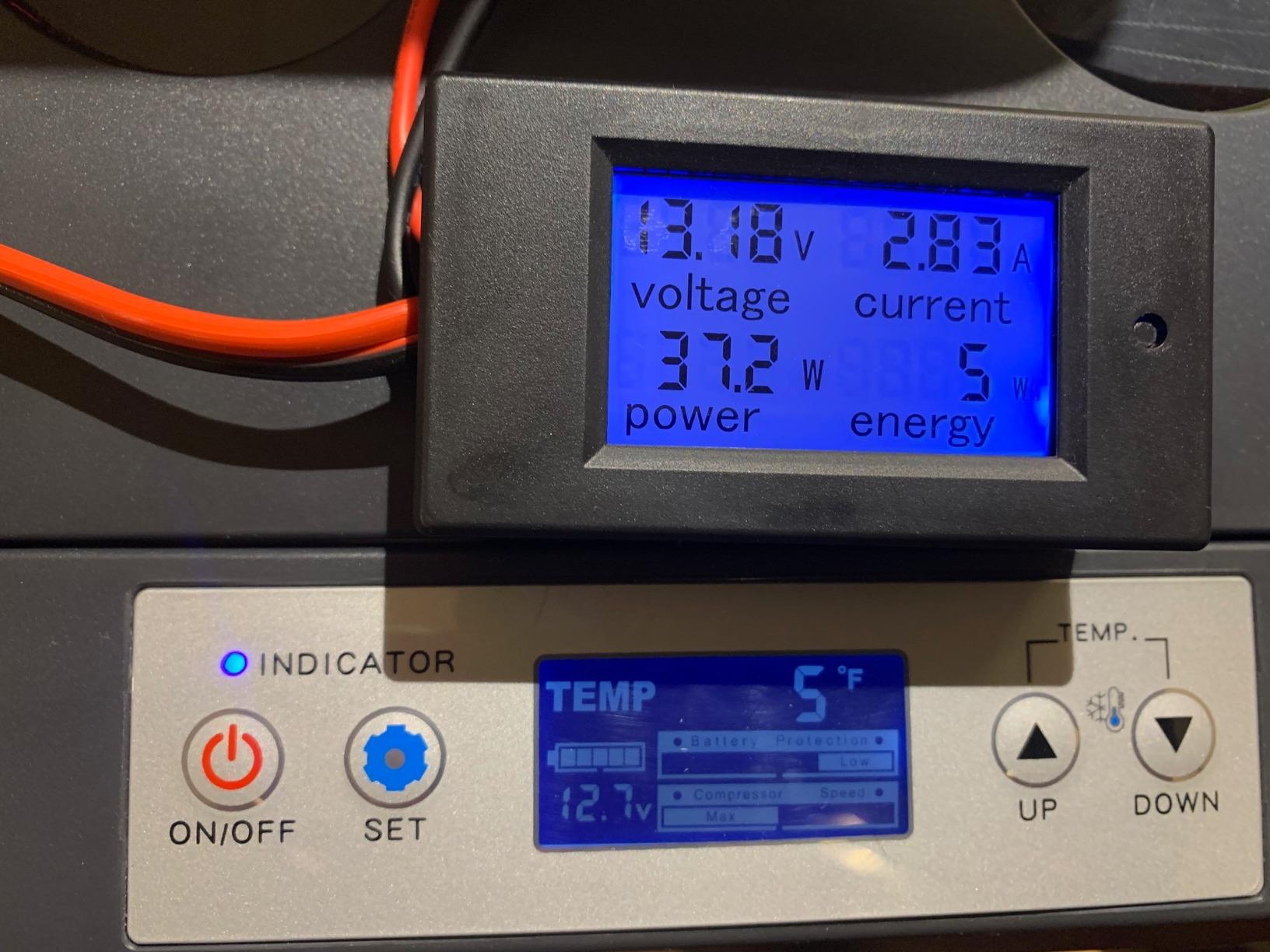
Yes, comfortably. A small 12V fridge or a portable freezer typically cycles between 60W and 250W depending on the compressor duty cycle, and 500W of continuous output leaves enough headroom that the inverter will not trip on startup.
Forum users consistently report a mid-size freezer pulling roughly 250W for five to ten minutes an hour, which is why compressor loads run much longer than a flat runtime figure suggests. A 12V cooler is easier still and can run a full day on a single charge.
Who should skip this model
If your plan involves a coffee maker, a microwave or any heating appliance, skip it. Those draw 1000W or more and will shut the inverter down, surge rating or not.
It is also not the station to grow into. There is no expansion battery path here, so when you outgrow 512Wh you are buying a new unit rather than adding a module.
3. Jackery Explorer 1000 v2 – Most Output in the Jackery Range
Jackery Explorer 1000 v2 Portable Power Station,1070Wh,1500W
1070Wh capacity
1500W continuous, 3000W surge
23.8 lb, one hour emergency charge
Pros
- 1500W continuous with 3000W surge handles fridges and small appliances
- 0-100% in about one hour with emergency charging enabled
- 100W USB-C PD charges laptops without an adapter
- Bluetooth app with quiet and emergency charging modes
Cons
- Solar charging works only with Jackery-branded panels
- 23.8 lb is heavy for hiking
- One-hour charging must be re-enabled in the app
- No expansion battery path for growing later
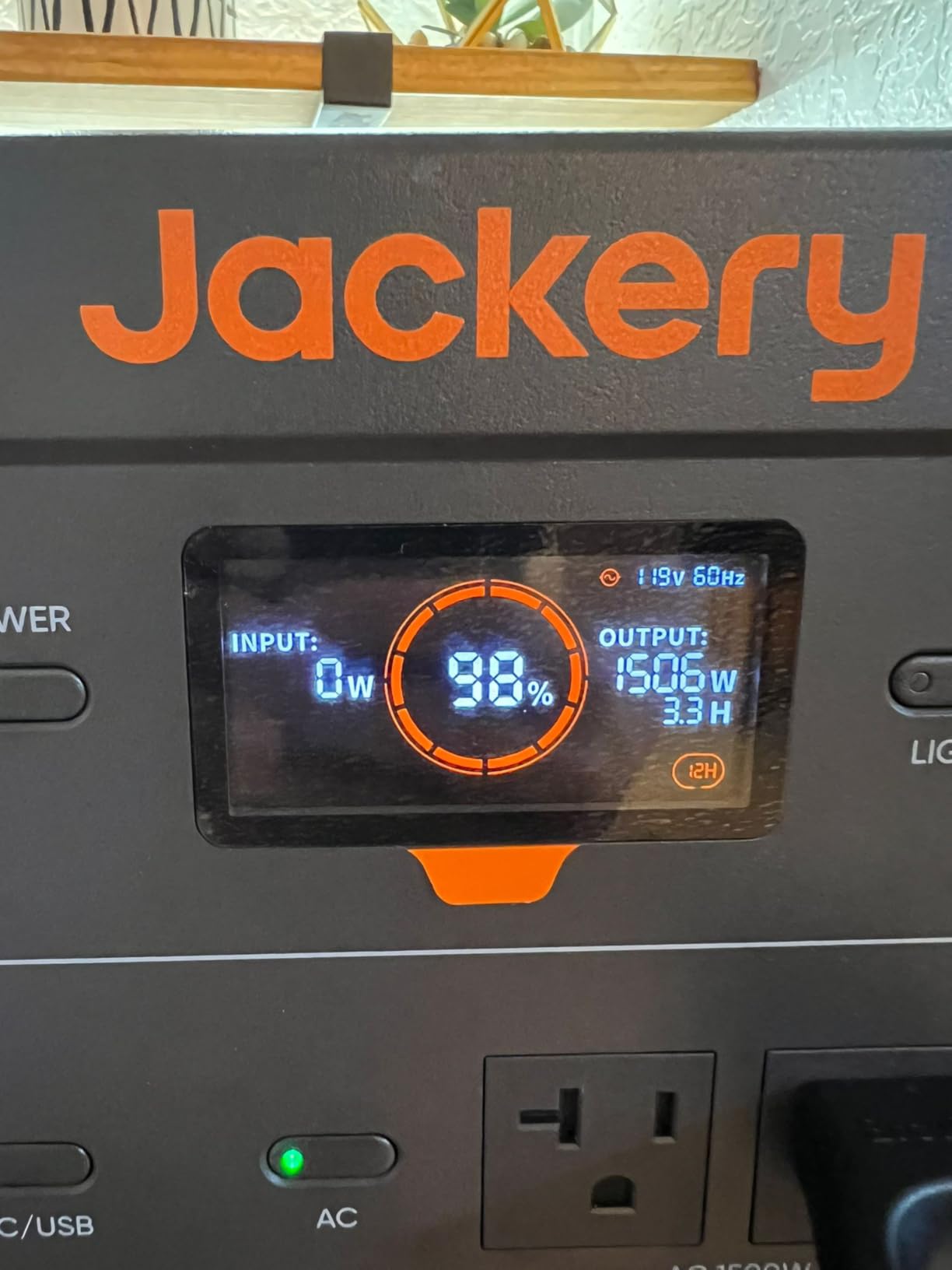
The Explorer 1000 v2 is the first station in this roundup that feels like a real backup power source rather than a camping accessory. It carries 1,070Wh and 1,500W of continuous output with 3,000W of surge, which is enough headroom to run a small air conditioner, an electric pot or a fridge through a real outage.
It holds a 4.7-star average from 3,623 reviews with 85% of those ratings at five stars. Owners consistently point to the inverter headroom and the charging speed, and the most common complaint is simply that 23.8 lb is a lot to carry up a trail.
Emergency charging is the feature that changes how you use it. Enable it in the Jackery app and the unit goes from empty to full in about an hour, versus 1.7 hours by default. Ten owners in a row will not notice the difference, but anyone waiting out an outage will.
The port layout is generous: two USB-C ports at 100W PD, one USB-A, a DC car port, three pure sine wave AC outlets and LED lighting. Quiet charging runs at 30 dB, and the LFP battery retains over 70% capacity after 4,000 cycles.
Run through the formula, 1,070Wh gives about 910Wh usable. That is roughly 15 hours on a 60W laptop, 22 hours on a 40W CPAP and 6 hours on a 150W mini-fridge, or 12 hours on a 75W router and modem setup.
The solar limitation is worth flagging before you buy. Solar charging works only with Jackery-branded panels, so a third-party panel setup will not deliver the quoted solar rate. If you already own panels from another brand, read that section first.
What a 1500W inverter can and cannot start
At 1,500W continuous, this unit starts a 1,200W microwave, a 1,000W coffee maker and most portable power tools without drama. That is the practical dividing line between the small stations and the ones people actually rely on during an outage.
It still will not run a full house. A 1,500W space heater can push it to its limit and a 2,000W hair dryer will trip it outright, so budget your loads carefully when the grid is down.
Is 23.8 lb still portable
It is portable the way a loaded cooler is portable. Around a campsite or a patio, absolutely. Carrying it more than a few hundred metres from the vehicle, you will want the foldable handle and a second pair of hands.
Anyone moving into an RV or a van should weigh it against our RV-focused power station picks, where mounting space and low self-discharge matter more than raw output.
4. GRECELL 500W Solar Generator – Most Ports for the Money
Grecell Portable Power Station 500W(Peak 1000W) 519Wh Outdoor Solar Generator Backup Battery Pack with 2 110V AC Outlets,10-Port Powerhouse for RV/Van Camping Fishing Climbing Road Trip Home Emergency
519Wh capacity
500W continuous, 1000W peak
14.1 lb, ten output ports
Pros
- Ten simultaneous outputs including 60W USB-C PD and a 10W wireless charger
- 519Wh capacity in a compact 14.1 lb body
- Three recharge paths including 100W or 200W solar panels
- Pure sine wave inverter with a six-function battery management system
Cons
- 4.3 star average sits below the LiFePO4 units here
- No USB-C input
- AC output must be switched off manually when unused
- Wireless charger needs two buttons to activate
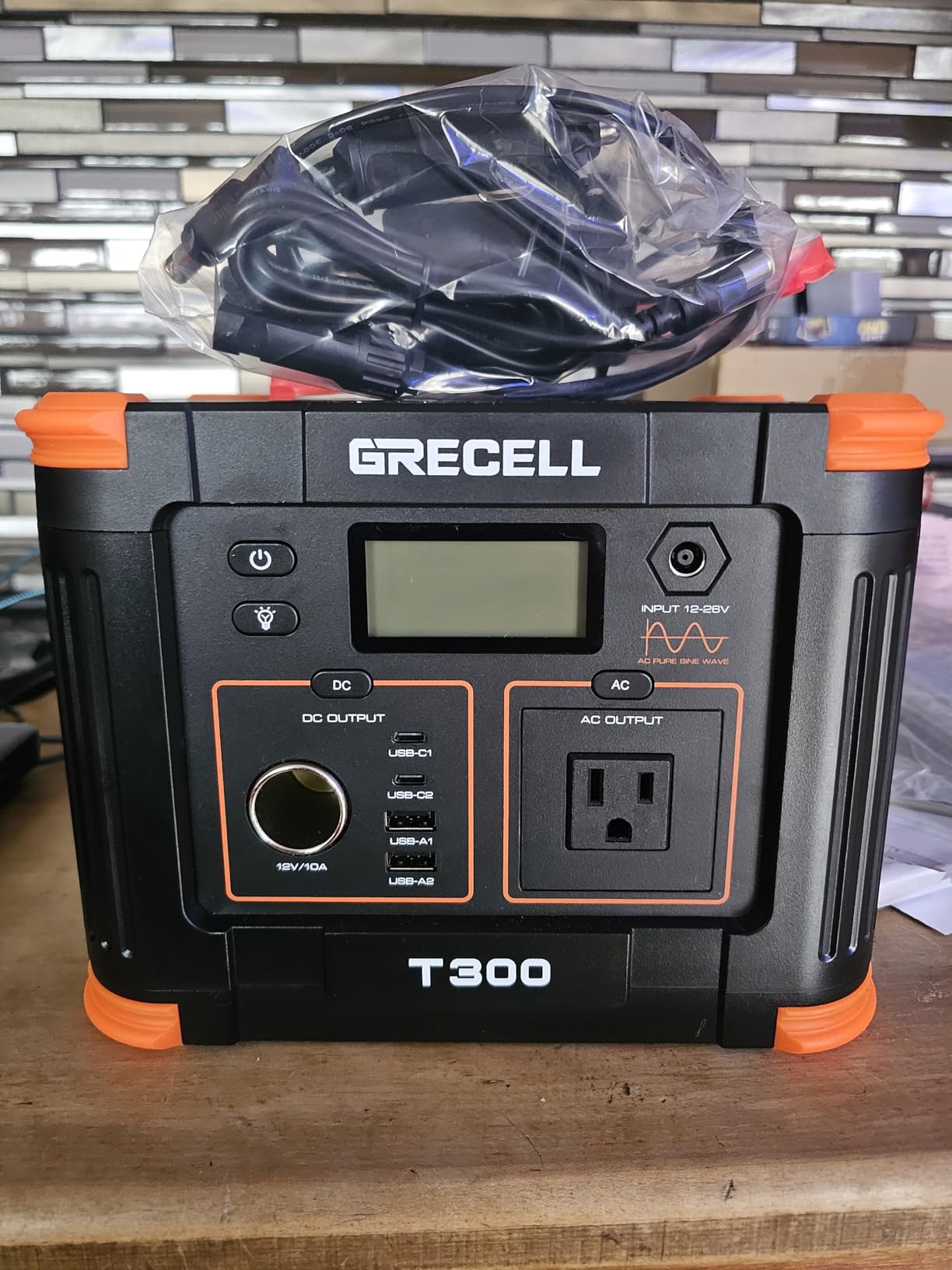
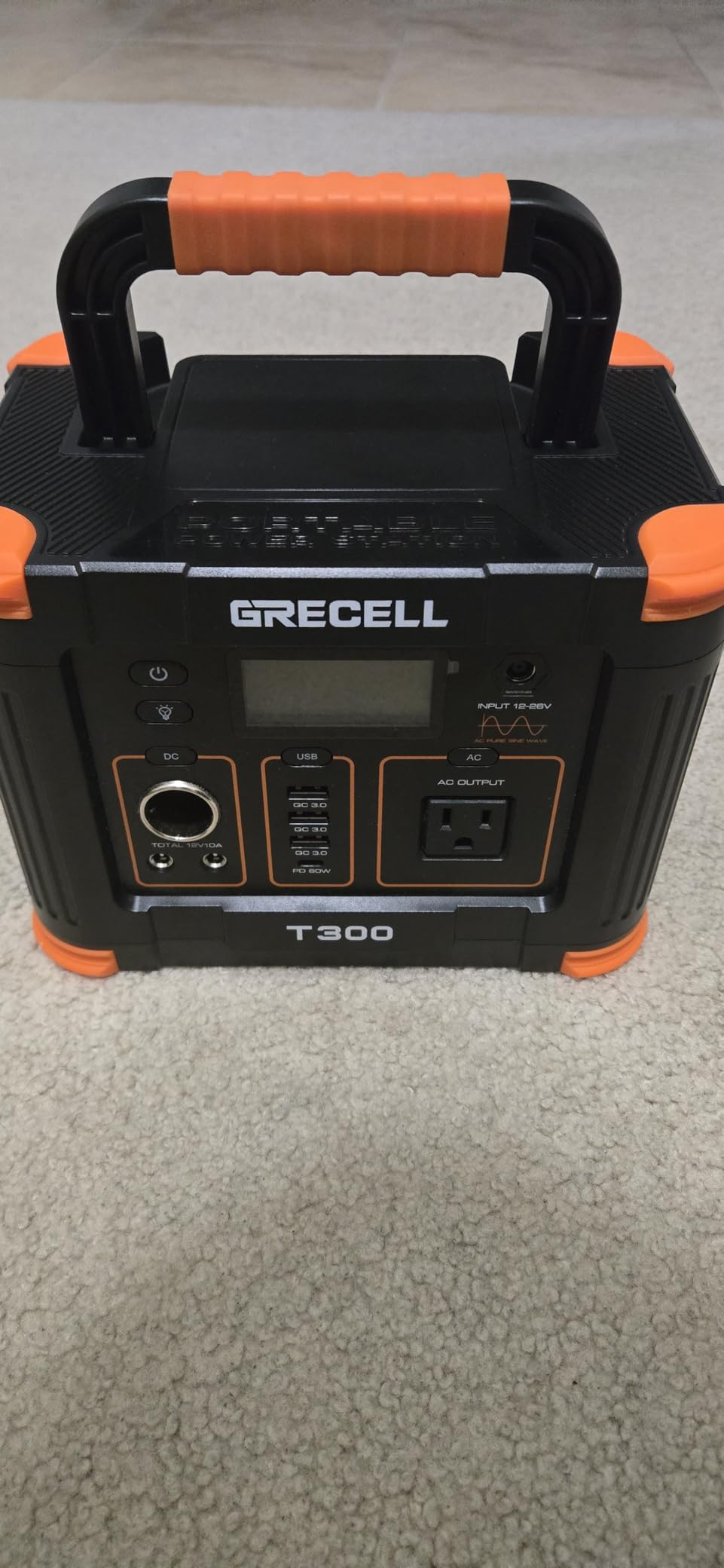
Port count is the entire argument for the GRECELL T-500, and it is a good one. Ten simultaneous outputs means two pure sine wave AC outlets, three USB-A QC3.0 ports, a 60W USB-C PD port, two DC outputs, a car port and a 10W wireless charging pad on one unit.
Capacity is 519.48Wh, or 140,400mAh, with 500W continuous and 1,000W peak output. At 14.1 lb it sits right in the middle of the weight class, and the built-in flashlight has light, strobe and SOS modes that are genuinely useful off-grid.
It is also one of the few budget stations with conventional lithium-ion cells rather than LiFePO4. That is the main reason the rating sits at 4.3 with an 11% one-star share, and it is a real trade for anyone planning to keep the unit for a decade.
Recharging works three ways: wall in six to seven hours, car in seven to eight hours, or a compatible 100W or 200W solar panel in six to nine hours. That flexibility is what makes it attractive for weekend trips.
On usable energy, 519Wh works out to about 441Wh after inverter losses. That covers a 40W CPAP for roughly 11 hours or a 60W laptop for around 7.3 hours, and the pure sine wave output is safe for sensitive electronics.
The battery management system includes temperature, overvoltage, overcurrent and short circuit protection, which is the sort of detail that separates a serious unit from a novelty one.
Is the extra port count worth the lower rating
If you are charging many small devices, yes. Phones, cameras, a drone battery, a handheld console and a lantern at the same time is exactly the scenario where ten outputs earn their keep and a three-port competitor leaves you swapping cables all evening.
If you are powering a single large appliance instead, the port count is irrelevant and you are better served by a higher-rated unit with more inverter headroom.
Watch for the idle drain
Reviewers repeatedly flag one behaviour: the AC output has to be switched off manually when it is not in use, or it keeps drawing from the battery on its own. Get into the habit of powering the inverter down when you pack up.
The wireless charger also needs two buttons pressed to activate rather than charging on contact, which sounds minor until you are trying to set a phone down in the dark.
5. BLUETTI AC180 – Biggest Battery and Best Home Backup Here
BLUETTI AC180 Portable Power Station 1152Wh 1800W LiFePO4 Solar Generator
1152Wh capacity
1800W continuous, 2700W peak
37.4 lb, one hour full charge
Pros
- 1800W continuous output with a 2700W app-enabled surge boost
- Full charge in one hour from a 1440W wall input
- 20ms UPS keeps routers and internet alive through outages
- Five-year warranty with responsive support
Cons
- Heaviest station in the roundup at 37.4 lb
- About 20W self-consumption plus 90% usable capacity shortens runtime
- Top wireless charging pad often fails to hold a phone connection
- Only one USB-C port
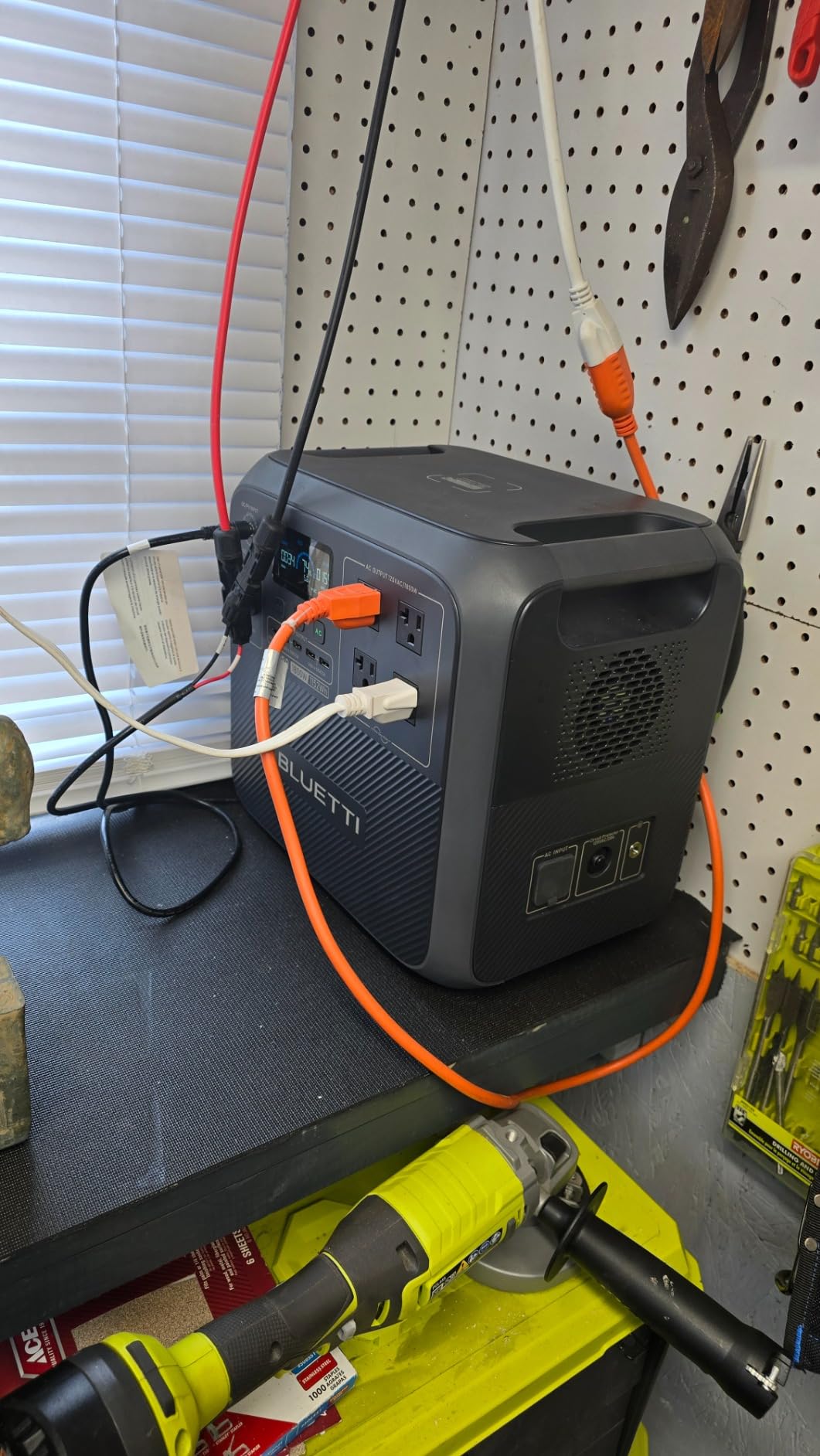
The AC180 is the station to buy if your power needs are about the house rather than about the campsite. It holds 1,152Wh, delivers 1,800W continuous with a 2,700W peak boost enabled through the app, and pushes full output across eight outlets plus a wireless charging pad.
At 4.6 stars from 2,622 reviews with 82% five-star ratings, it sits comfortably in the top tier. Reviewers single out the output headroom, the one-hour recharge and BLUETTI’s support, including a documented exchange and firmware fixes.
Home backup is where the 20ms UPS earns its place. A router, a monitor and a network switch transfer over without the reset cycle that a 20ms switchover causes on a typical computer, so an outage stops meaning a restart.
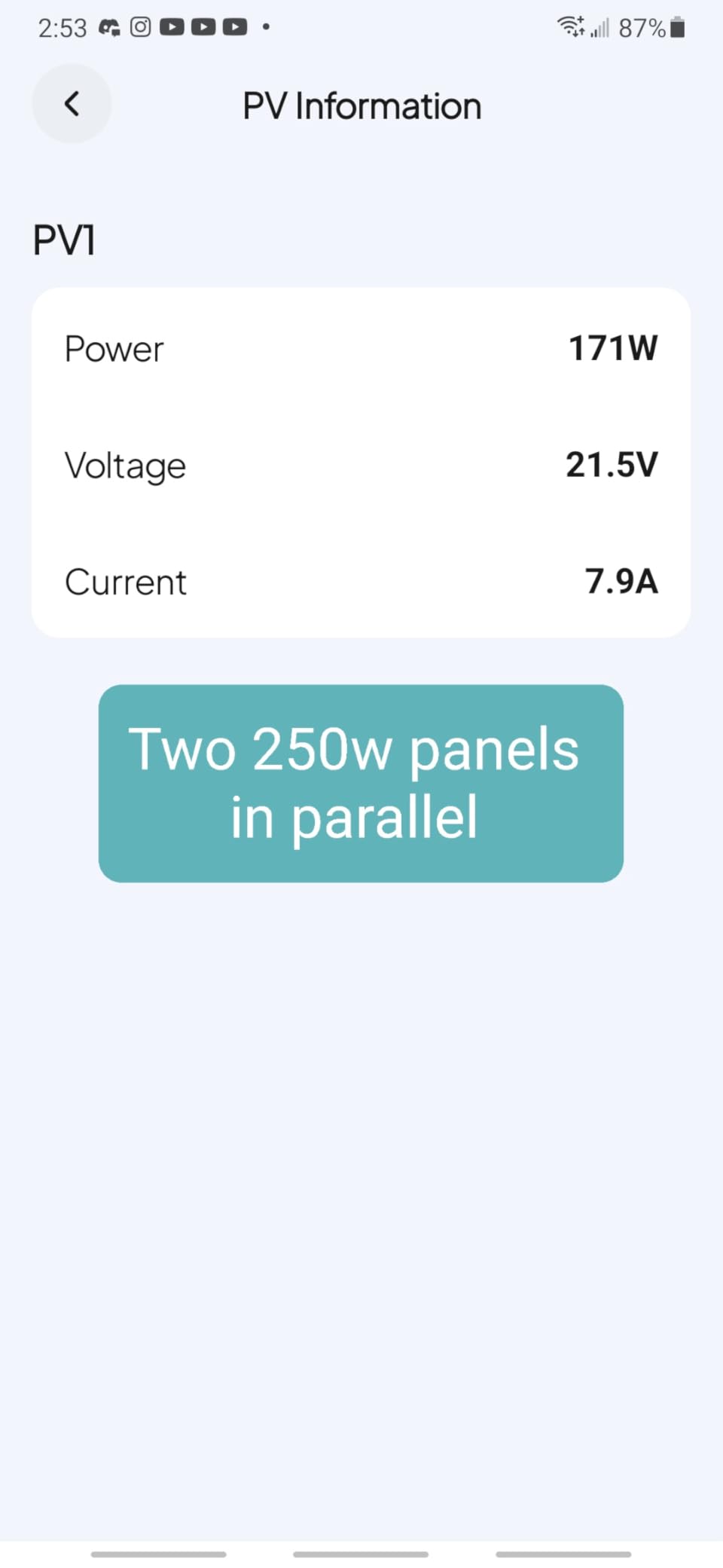
Charging is fast: a full charge in one hour at 1,440W AC input, and 500W solar input refills it in roughly 2.8 to 3.3 hours. That solar ceiling makes the unit a reasonable partner for a mid-size folding panel.
Runtime is strong. With 1,152Wh at 90% usable capacity, you are working with roughly 1,037Wh, which runs a 60W laptop for about 17 hours, a 40W CPAP for about 26 hours, or a 150W mini-fridge for nearly 7 hours before self-consumption trims it further.
That 20W of inverter self-consumption matters more than it sounds. On a small overnight load the station can lose a noticeable slice of a charge just sitting there powered up, so switch it off between uses rather than leaving it on standby all weekend.
Is the 37.4 lb weight a real problem
It is a genuine two-person lift at times. For anyone moving a station between a house, a garage and a vehicle, 37.4 lb is the heaviest thing on this list by a wide margin, and it is the single most common complaint in reviews.
If the station is going to live in one spot, the weight stops being an issue entirely. For permanent outage prep that is the right trade, and its five-year warranty matches the longest coverage offered in this roundup.
What it will not carry
Even at 1,800W continuous, this is a portable-class inverter, not a whole-home system. A space heater, a well pump and a clothes dryer all sit outside what a 1,800W inverter can start, no matter how much surge you have available.
One safety note matters here. Never plug a portable power station into a household wall outlet to backfeed the house. Route essential loads through extension leads or a transfer system instead, and our high-capacity station guide covers the options once you outgrow portable units entirely.
6. ALLWEI 300W – Lightest Unit With LiFePO4 Chemistry
ALLWEI Portable Power Station 300W, 256Wh Solar Generator LiFePO4 Battery
256Wh capacity
300W continuous, 600W surge
6.4 lb, 2-2.5 hour dual-input charge
Pros
- LiFePO4 cells and 3000 rated cycles in the lightest body in this roundup
- Only 6.4 lb and a slim profile that fits tight spaces
- Display shows estimated runtime and exact charge percentage
- 60W USB-C PD with pass-through charging
Cons
- 256Wh is the smallest capacity here and limits runtime on larger loads
- Single AC outlet
- No 24V output for RV users
- A minority of owners report units losing charge ability after months
The ALLWEI PPS300-4 does something the other budget stations do not: it puts LiFePO4 chemistry and 3,000 rated cycles into the smallest and lightest body in the roundup at 6.4 lb. For a first backup battery or a medical device you need to keep alive, that combination is hard to argue with.
Output is 300W continuous with 600W of pure sine wave surge across six ports: one AC outlet, two DC5521 outputs, a car port, an 18W USB-A and a 60W USB-C PD port. The display shows both exact charge percentage and estimated remaining runtime, which more units in this class skip.
Recharging is genuinely flexible. A wall outlet takes 3.5 to 4 hours, a 12V car socket the same, a 100W solar panel 4 to 5 hours, and running AC and solar together brings a full charge down to 2 to 2.5 hours through the built-in MPPT controller.
At 4.4 stars from 2,450 reviews with 73% five-star ratings, it sits mid-pack on satisfaction and near the top on value per pound.
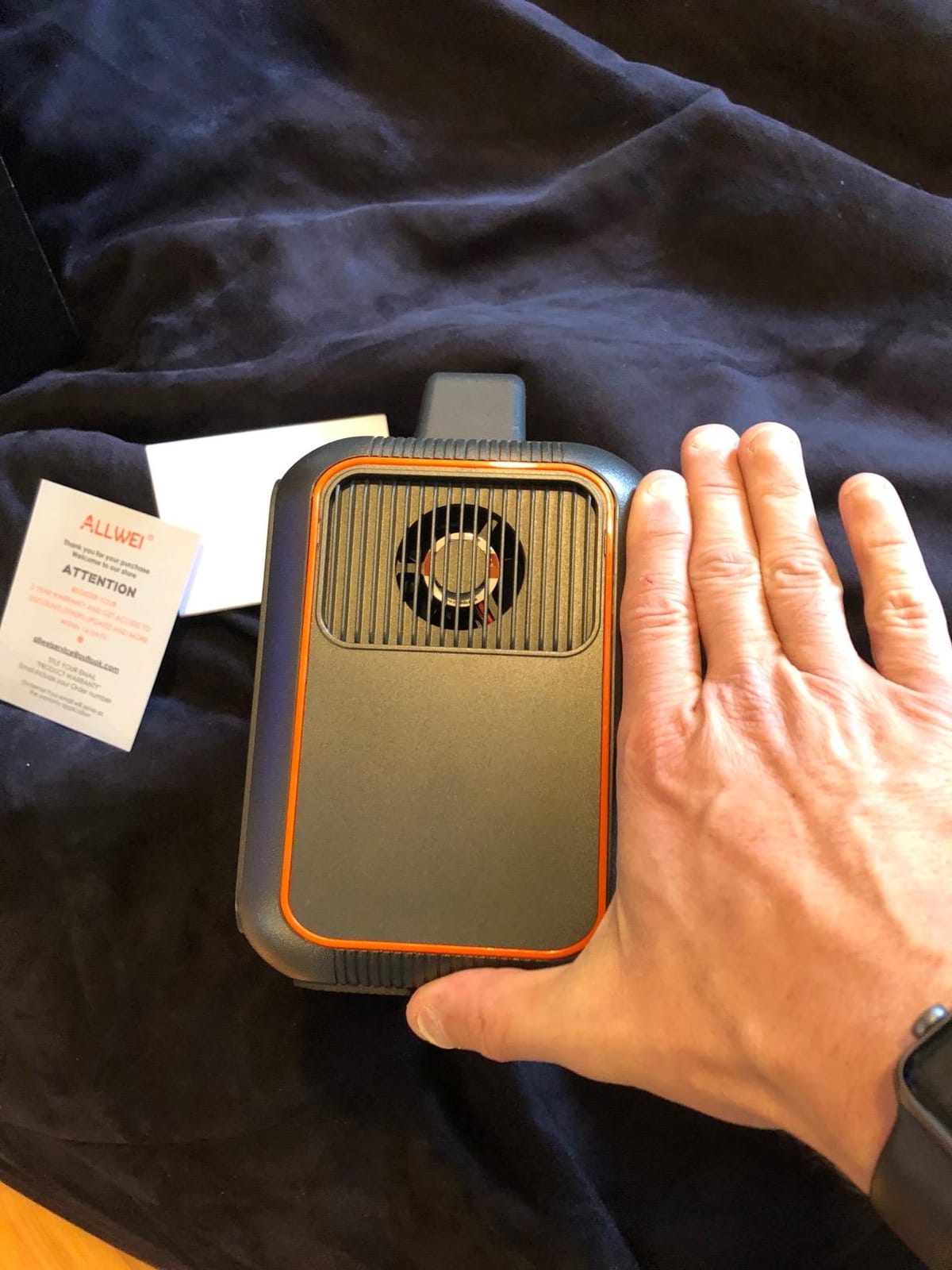
Capacity is the limit here, not power. 256Wh yields about 218Wh usable, so a 40W CPAP runs for roughly 5.4 hours, a 60W laptop about 3.6 hours, and a 10W LED string more than 20 hours.
For CPAP users specifically, that number is the whole decision. If you need more than a single night between charges, step up to the Jackery Explorer 500 v2 or the BLUETTI AC180.

Why 256Wh still makes sense
Because the two specs people underweight are both strong. Six-layer battery management protection, pass-through charging and a real MPPT controller are usually the first things removed to hit a price, and they are all present here.
The three-level LED light with SOS mode is also reachable without unpacking the unit, which matters when the station is buried under gear at midnight.
The durability question
A minority of owners report units that stopped holding charge after several months of use. This is not a widespread pattern in the reviews, but it is the reason the warranty is two years rather than five, and it is worth weighing against a slightly larger LiFePO4 unit with longer coverage.
It also has a single AC outlet, no 24V output for RV users and a solar input ceiling that keeps it below larger 200W panels.
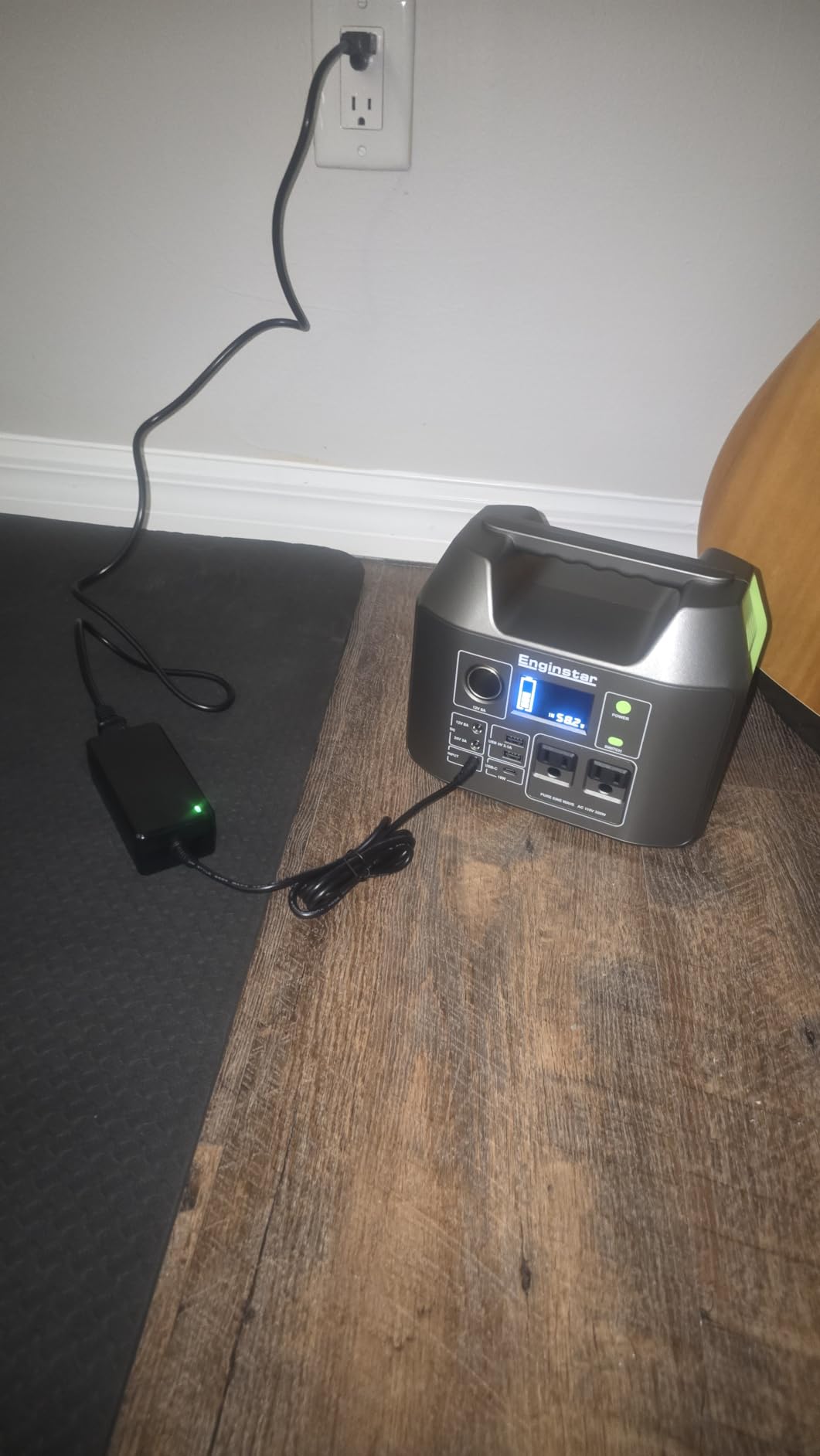
7. EnginStar 300W – Best for 12V and 24V DC Loads
EnginStar Portable Power Station 300W 296Wh Solar Generator
296Wh capacity
300W continuous AC
6.5 lb, 80% charge in 2 hours
Pros
- Two pure sine wave AC outlets
- which is rare at this capacity
- Regulated 12V and 24V DC outputs for 12V appliances and coolers
- ETL certified with a battery management system covering voltage and temperature
- 80% recharge in about 2 hours
Cons
- Lowest average rating in the roundup at 4.2 stars with 11% one-star reviews
- Only a 12-month limited warranty
- USB-C output limited to 18W
- Conventional lithium-ion cells rated for only 1000+ cycles
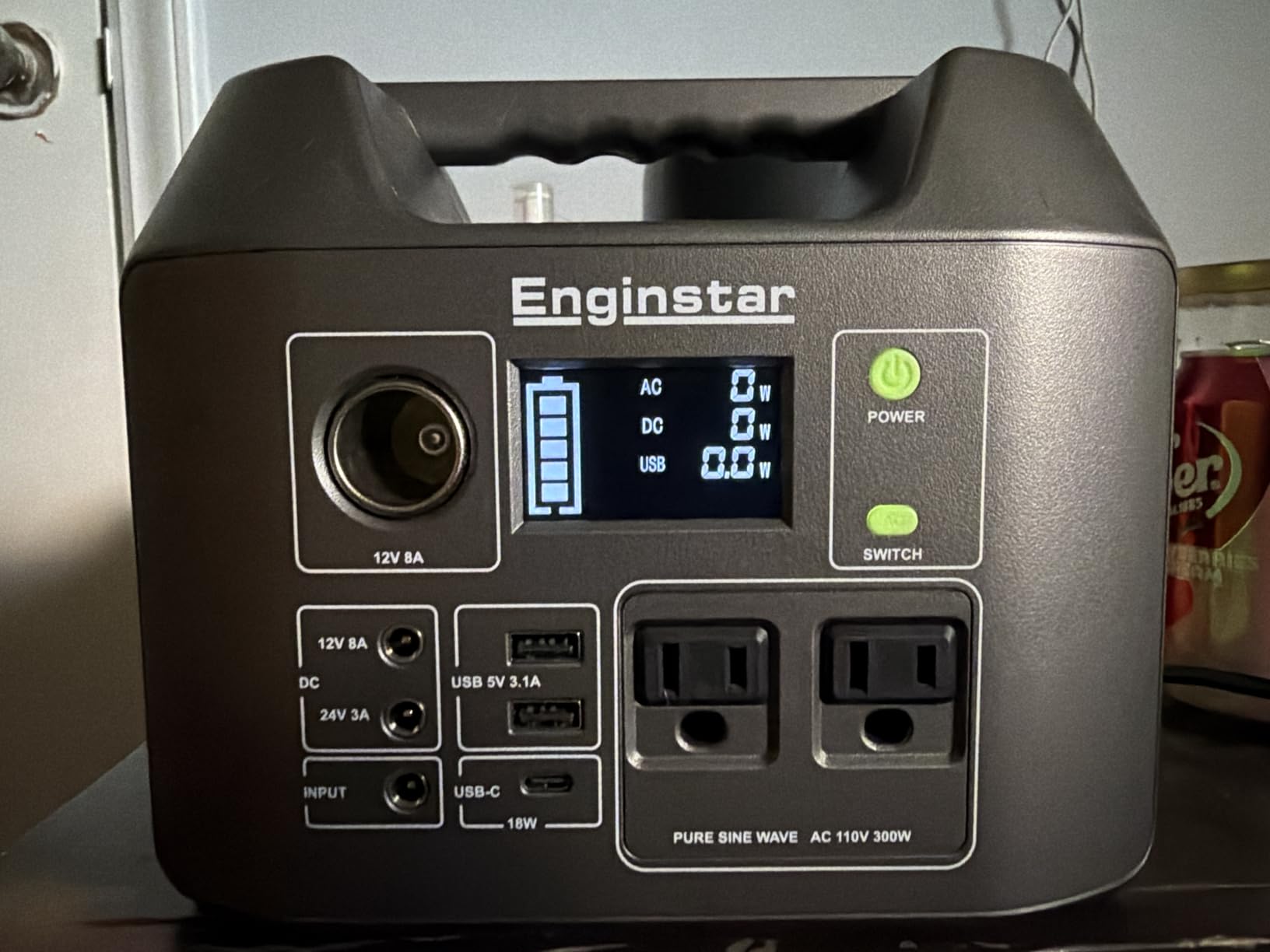
The EnginStar R300 is the odd one out in this roundup, and that is exactly why it is here. Instead of USB-C everywhere, it offers regulated 12V and 24V DC outputs alongside two pure sine wave AC outlets, and it still manages to hit 80% charge in about two hours.
Those regulated DC outputs are the reason to buy it. A 12V portable fridge, a 24V fan or a DC appliance runs from them directly without passing through the inverter, which means no conversion loss and no inverter noise at all.
At 296Wh and 6.5 lb it is almost the same footprint as the ALLWEI unit but with double the AC outlets. Eight total output ports, an ETL certification and a battery management system covering voltage, temperature, short circuit, overcharge and overload round out the build.
The 4.2-star average from 1,836 reviews is the lowest star rating among these eight models, with an 11% one-star share. Most of that frustration traces back to the warranty rather than the hardware.
With 296Wh you are working with roughly 252Wh usable, which is a little more than the ALLWEI. That is about 4.2 hours on a 60W laptop or 6.3 hours on a 40W CPAP through the AC outlets, and noticeably longer on DC loads because the inverter is bypassed.
Maximum input is 65W, which is modest for solar. Plan on topping up from a wall outlet or a 12V car socket rather than expecting a folding panel to fill it quickly.
Is a 12-month warranty a dealbreaker
It is the shortest warranty in this roundup by a wide margin, and it is the single strongest argument against this model. Every LiFePO4 competitor here carries two to five years, so if you want the unit repaired rather than replaced after a failure, you are on your own after a year.
That matters more for conventional lithium-ion cells, which are rated for only 1,000+ cycles against 3,000 to 6,000 for the LiFePO4 units. At 1,000 cycles, daily full discharge brings you to end of rated life in roughly 2.7 years.
When the DC outputs pay off
They pay off quietly and constantly for anyone running a 12V cooler. Bypassing the inverter means lower draw, no fan noise and noticeably longer runtime from the same capacity, which is exactly the scenario forum users reach for these units in.
The 18W USB-C output is the weak point by modern standards, so bring your own charger for a phone or tablet.
8. OUPES Mega 1 – Fastest Recharge and the Only Expansion Path
OUPES Mega 1 Portable Power Station 1024Wh 2000W (4500W Surge)
1024Wh capacity
2000W continuous, 4500W surge
27.8 lb, 0-80% in 36 minutes
Pros
- Highest continuous output in the roundup at 2000W from 1024Wh
- 0-80% in 36 minutes on AC and 26 minutes combining AC with solar
- Expandable from 1024Wh to 5120Wh with two B2 extra batteries
- Dual 100W USB-C PD ports plus four QC3.0 USB-A ports
Cons
- Currently lists above the price ceiling this roundup is built around
- 4500W surge rating is optimistic and some units trip between 2050W and 2200W
- Proprietary charge cable is hard to source as a replacement
- Cooling fans run during charging and under heavy load
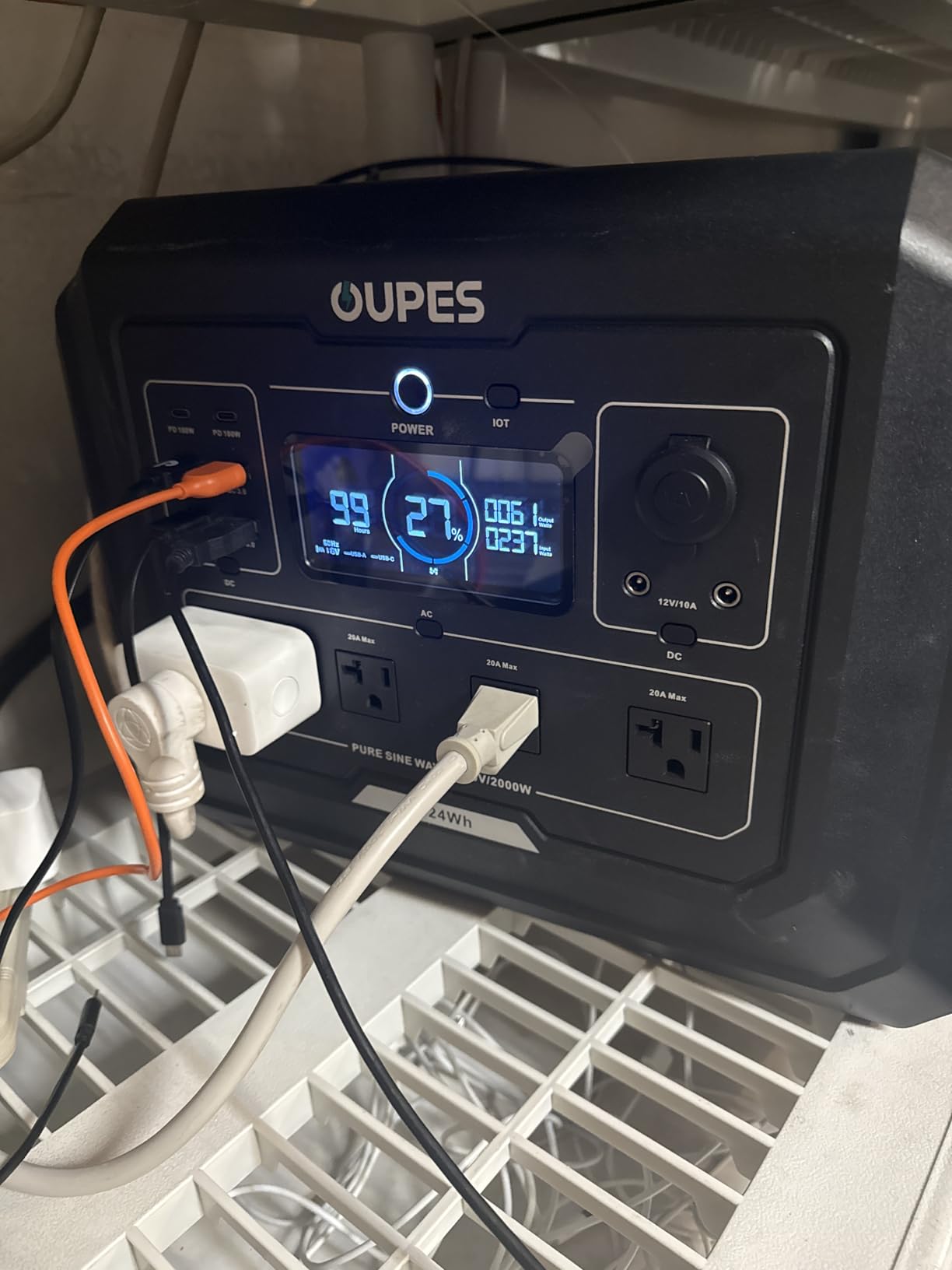
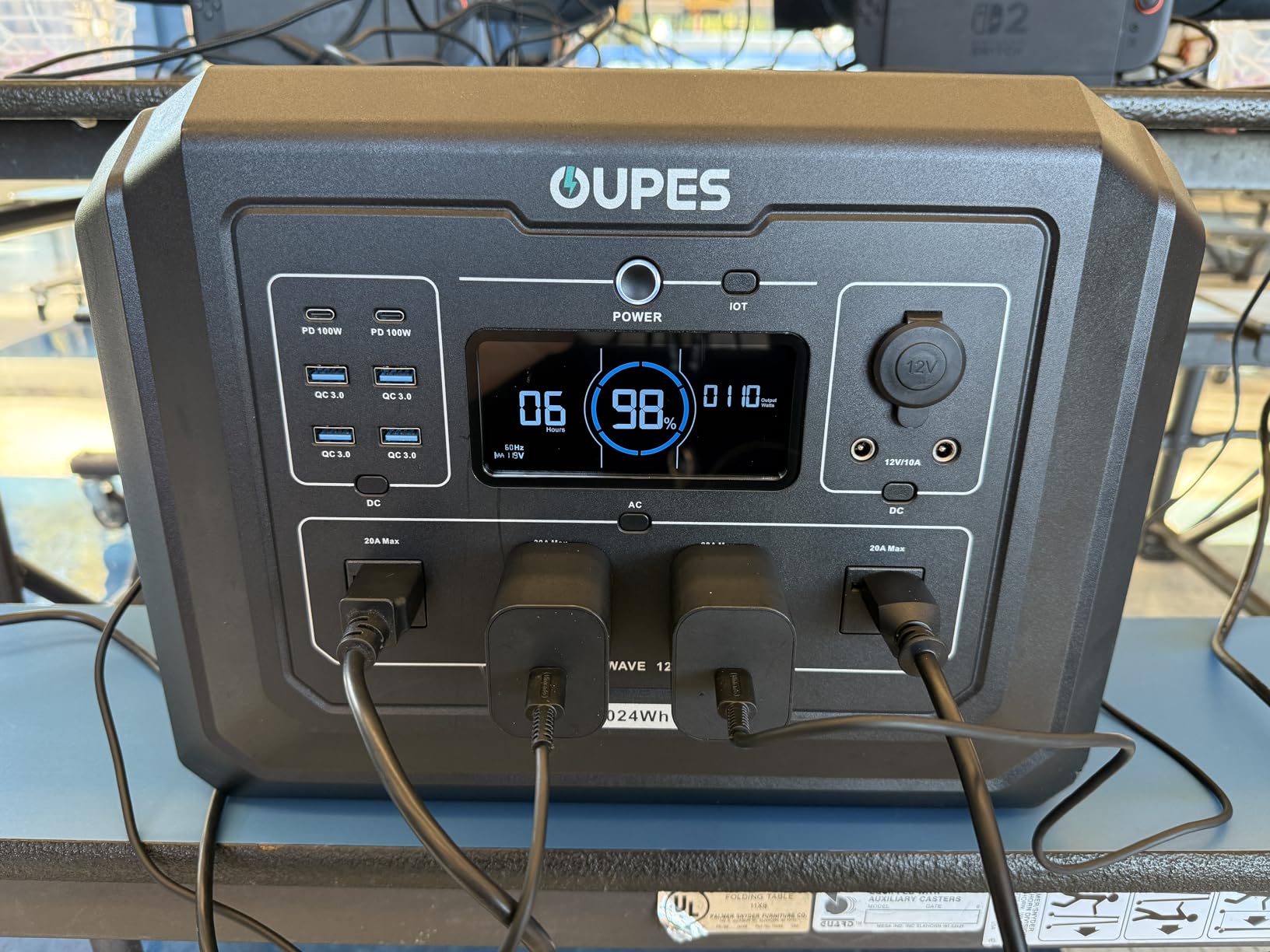
The Mega 1 is the odd one out in a good way: of the eight models here, it is the only one that is documented as growing with you. Add up to two B2 Extra Batteries and 1,024Wh becomes 5,120Wh, which turns a sub-500 entry into something closer to a home backup system without buying again.
Output is the highest here at 2,000W continuous from a pure sine wave inverter, and charging is the fastest by a wide margin. It reaches 80% in 36 minutes on AC alone, or 26 minutes when you combine wall power with solar through the 800W MPPT input.
Ports are the best laid out in the class: dual 100W USB-C PD ports, four QC3.0 USB-A ports, 12V DC outputs and AC outlets, with Bluetooth app control and a transfer time under 20ms for servers, workstations and medical devices.
At 4.5 stars from 1,324 reviews with 82% five-star ratings, satisfaction is high, and owners specifically call out power per dollar, recharge speed and the expansion route.
On runtime, 1,024Wh gives roughly 870Wh usable, so a 60W laptop runs about 14.5 hours, a 40W CPAP about 21.7 hours and a 150W mini-fridge about 5.8 hours, before any fan draw.
The listed 4,500W surge is the number to treat carefully. Reviewers report that on some examples the inverter trips between 2,050W and 2,200W under load, so treat the headline figure as marketing rather than a spec you plan around.
Is the expansion path worth planning around
Yes, if you can already foresee outgrowing 1,024Wh. The B2 modules stack cleanly to 5,120Wh, and every extra watt-hour you add later costs you less attention than resizing a station you already own.
If you are certain that a fridge, a router and some lights will always be the whole list, expansion capacity is money spent on a future you will not use.
The cost of the extra capability
This model currently lists above the price ceiling the rest of this roundup is built around, so treat it as a stretch pick rather than a budget default. It also carries two irritants worth knowing: cooling fans that run during charging and heavy loads, and a proprietary charge cable that is difficult to source as a replacement.
The Bluetooth app is functional but basic, and Wi-Fi connectivity is reported as unreliable. At 27.8 lb it is the second-heaviest unit here, and the warranty is five years.
How to Choose a Portable Power Station Under 500
Watt-hours and watts answer different questions
Watt-hours decide how long. Watts decide whether the device starts at all. A station with 1,000Wh and a 300W inverter can run a CPAP for a day but will refuse to start a microwave, while a 500Wh unit with 1,500W of output starts the microwave and then dies in 20 minutes.
Check both numbers, then check surge separately. Surge covers the brief spike when a compressor or motor starts, and it is not a rating you can run a heating element on.
The runtime formula, stated plainly
Runtime in hours equals capacity in watt-hours multiplied by 0.85, divided by the device’s wattage. The 0.85 factor accounts for inverter conversion loss and, on some units, the power they draw simply being switched on.
Worked example on the Jackery Explorer 1000 v2: 1,070Wh multiplied by 0.85 is 909.5Wh, divided by a 150W mini-fridge gives about 6 hours. On the smaller ALLWEI at 256Wh, the same fridge runs about 1.4 hours. Same appliance, very different evening.
One correction for refrigerators and freezers. Those appliances do not draw continuously. Forum users consistently measure a mid-size freezer pulling roughly 250W for five to ten minutes per hour, so realistic runtime is several times the flat calculation rather than exactly what the formula returns. Anyone planning around a full-size fridge should size up one class.
LiFePO4 versus NMC and cycle life in real years
LiFePO4 cells are rated for 3,000 to 6,000 cycles on the models here, against roughly 1,000+ for conventional lithium-ion. That difference decides whether your station is a five-year tool or a two-year one, and it is the single most useful spec in this bracket.
At a daily pace, a 6,000-cycle battery is good for roughly 16 years before it drops to 70% of rated capacity, and a 3,000-cycle unit lands near 8 years. The 1,000-cycle lithium-ion option in this roundup reaches that point in about 2.7 years of daily full discharge, which is the number that ends most budget complaints.
LiFePO4 also runs cooler and is more thermally stable, which matters if the unit lives in a vehicle through a hot summer. Its two real drawbacks are weight for the same capacity and higher cost per watt-hour, and cold-weather charging is limited on many models.
UPS mode, solar input and warranty length
UPS mode is what separates a brief flicker from a full outage. The BLUETTI AC180 switches over in 20ms, the OUPES Mega 1 in under 20ms, and the Jackery Explorer 500 v2 in 10ms. Anything under about 20ms keeps a router and a desktop running without a manual reboot.
Solar input is a decision most buyers defer and then regret. The BLUETTI AC180 accepts 500W and the OUPES Mega 1 accepts 800W, while smaller units sit at 100W or less. Whatever panel you pair, assume a realistic yield around 70% of nameplate, so a 200W folding panel in good sun is closer to 140W at the battery. Our portable solar panel guide covers matching panels to inputs properly.
Warranty length is decisive at this price. Jackery offers two years on the Explorer 300 and five on the 500 v2, BLUETTI and OUPES both carry five, GRECELL and ALLWEI offer two, and EnginStar offers a single year. Longer coverage matters more here because the absolute purchase amount is small.
What you give up by staying under 500
Five things, honestly. First, capacity: you top out near 1,150Wh instead of the 2,000Wh-plus found above the ceiling, so a full-size fridge and a CPAP together are a stretch. Second, output: a 1,500W space heater is out of reach for every unit on this list.
Third, expansion. Among the eight models reviewed, only the OUPES Mega 1 is documented as growing without a replacement unit. Fourth, weight: the heaviest unit here is 37.4 lb, and the 25-40 lb class is genuinely a two-person carry despite the portable label. Fifth, battery management detail and idle power draw, which the AC180’s 20W self-consumption demonstrates clearly.
If you are moving toward full off-grid living rather than weekend use, read our off-grid living power station picks before committing to a single small unit.
Frequently Asked Questions
What is the best budget portable power station under 500?
The Jackery Explorer 300 is the strongest budget pick, pairing 292Wh, 300W continuous output, 7.1 lb weight and LiFePO4 cells rated for 4000+ cycles. For more headroom, the Jackery Explorer 500 v2 adds 512Wh, 500W continuous, a 10ms UPS and a 0-80% recharge in 52 minutes. For home backup, the BLUETTI AC180 carries 1,152Wh and 1,800W continuous with a 20ms transfer.
Is Jackery or Anker better?
Within the sub-500 class the honest answer is that Jackery dominates on proven reliability and review depth. The Explorer 300 has 4.6 stars from 11,273 reviews and the Explorer 500 v2 has 4.7 from 8,844, both LiFePO4 with long cycle ratings. The units in this bracket that beat Jackery on raw capability are the BLUETTI AC180 and OUPES Mega 1, which offer more output and expansion but with a shorter ownership track record.
Which brand of portable power station is the most reliable?
Reliability at this price tracks warranty length and chemistry. BLUETTI and OUPES both carry five-year warranties on LiFePO4 cells rated for 3,500+ and 3,000+ cycles, and BLUETTI support is repeatedly praised in reviews for handling exchanges and firmware fixes. Jackery pairs a five-year warranty on the Explorer 500 v2 with 6,000 rated cycles. EnginStar, with a 12-month warranty and lithium-ion cells rated for 1,000+ cycles, is the least protective option here.
Which battery is safer, NMC or LiFePO4?
LiFePO4 is the safer chemistry. It is more thermally stable, tolerates deeper discharge and degrades more slowly than the NMC-style lithium-ion cells used in budget stations. The downside of LiFePO4 is weight for the same capacity and a higher cost per watt-hour, and many models limit charging below freezing, so it is not the right pick for a sub-zero winter base. Every LiFePO4 model in this roundup is rated for 3,000 to 6,000 cycles against roughly 1,000+ for the lithium-ion alternatives.
How long does a 1000Wh power station run a refrigerator?
Using the formula runtime equals watt-hours multiplied by 0.85 divided by device watts, a 1,000Wh station provides about 850Wh of usable energy. Against a 150W mini-fridge that is roughly 5.7 hours of continuous running, and a 250W portable freezer about 3.4 hours. In practice refrigerators cycle rather than run flat, so users typically see two to three times that figure. The Jackery Explorer 1000 v2 and OUPES Mega 1 both sit in this 1,024Wh to 1,070Wh class.
Is it worth buying a portable power station?
It is worth it if you have a concrete device to power: a CPAP machine, a mini-fridge, a router, a laptop or power tools. A 500W unit that runs a CPAP for 11 hours replaces a heavy battery bank and no longer needs a gas generator indoors. It is not worth it if you are hoping to run a house, because a sub-500 station tops out around 1,800W continuous and cannot start a space heater, a well pump or a clothes dryer. Never backfeed one into household wiring.
Final Verdict on Portable Power Stations Under 500
For most buyers the Jackery Explorer 300 is the right first portable power station under 500, because weight, capacity and cycle life are all sensible and nothing about it is speculative. If you need more runtime or a fast wall recharge, the Jackery Explorer 500 v2 is the step up, and if the AC180’s 1,152Wh and 1,800W inverter match your outage plan, it is the strongest all-round machine in this bracket despite the 37.4 lb carry.
Check watt-hours and continuous watts together, pick LiFePO4 over lithium-ion wherever the price gap is small, and run your own devices through the formula before you commit. Whichever unit you choose, use the latest price check before ordering, since this band moves constantly through the year.