
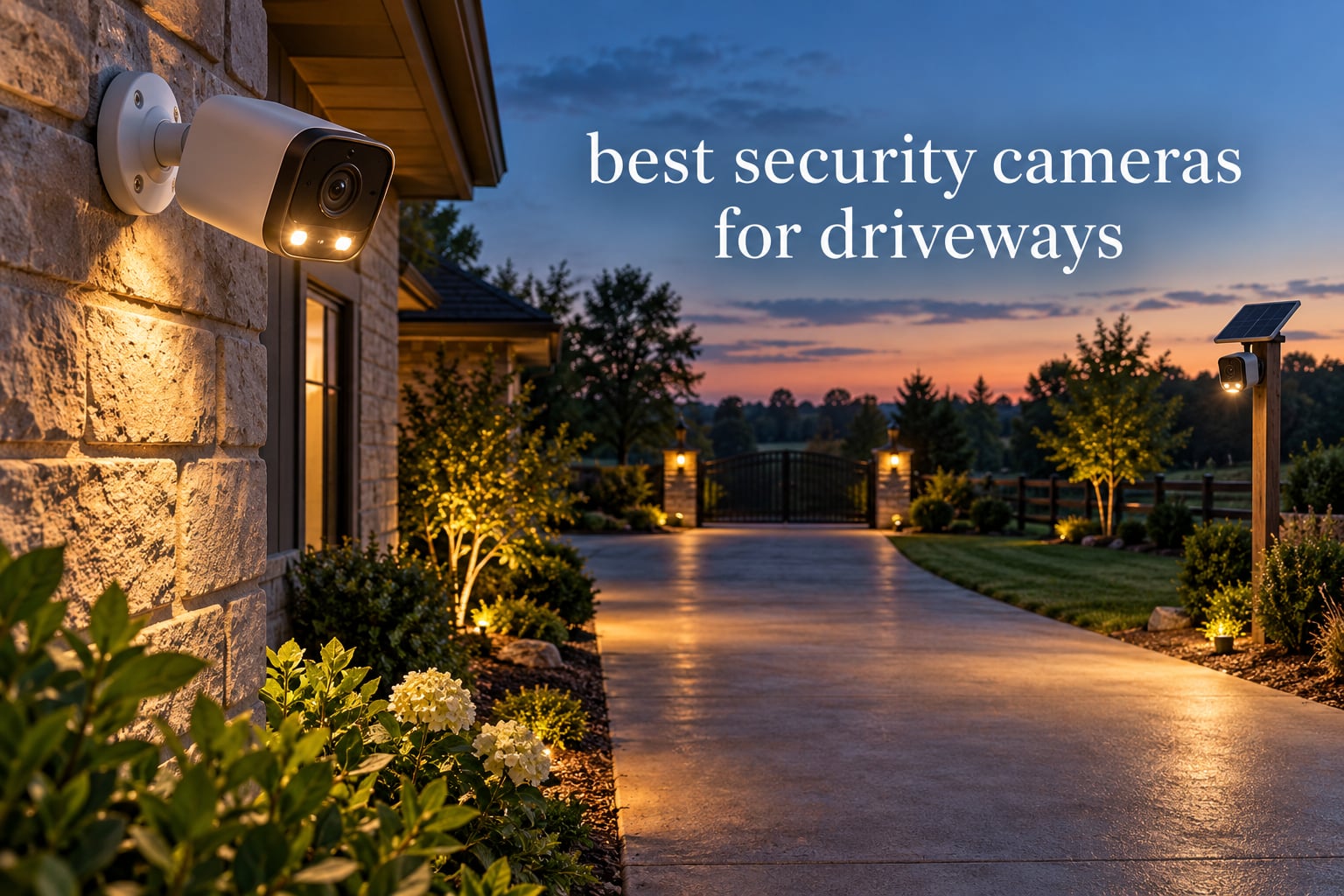
A driveway camera solves a problem a doorbell camera cannot. The doorbell sees whoever is standing on your step; a driveway security camera sees the person or vehicle approaching from the street, often from 60 or 100 feet away, which means you get an alert before anyone reaches the house at all. That single difference changes how useful the footage is when it matters.
We have been sorting through the current crop of outdoor cameras built for exactly that job: wide field of view, weather sealing, usable night footage at range, and detection that does not fire on every passing car. Our shortlist covers wired floodlight units, solar panels at the far end of a gravel track, battery sticks with 142-degree lenses, and multi-camera kits for owners who watch more than one driveway.
Quick picks, if you want to skip ahead:
Best Overall: the Ring Floodlight Cam Wired Plus, a hardwired 1080p unit with 2000-lumen motion-activated lighting, customizable motion zones and an 85dB siren.
Best for Long Driveways: the Tapo C425 MagCam, whose 2K QHD sensor and 142-degree field of view hold detail on far-off vehicles and run up to 300 days per charge.
Best with No Subscription: the Reolink Argus Eco with its 3W solar panel, recording to a 512 GB microSD card with no monthly fee at any point.
Best Full-Color Night Vision: the Tapo C425 MagCam again, with a Starlight sensor and built-in spotlights that keep colours readable after dark.
Best Budget Pick: the Tapo C500, a 1080p 360-degree pan/tilt camera with microSD storage and free AI person detection.
Best for Detail at Range: the eufy Floodlight Cam E340, whose dual 2K/3K lenses carry telephoto detail roughly 50 feet out.
Best for Multiple Areas: the Blink Outdoor 4 three-camera system, with up to two-year battery life and a Sync Module Core included.
Everything below covers what each camera does well, where it falls short, and how to match it to the shape of your property. For the wider picture, our guides to the best outdoor security cameras and the best battery-powered security cameras go deeper on the hardware side.
Table of Contents
Top 3 Picks for Best Security Cameras for Driveways (October 2026)

Ring Floodlight Cam Wired Plus
- 2000-lumen motion-activated floodlights
- 1080p HD with color night vision
- Hardwired power with 85dB siren

Tapo C425 MagCam 2K+
- 2K QHD with 142-degree field of view
- 10000 mAh battery up to 300 days
- Full-color Starlight night vision
- 512 GB microSD with no subscription

Reolink Argus Eco 2K 5MP Solar
- 3W solar panel with battery backup
- 2K 5MP resolution and 33 ft night vision
- Local microSD up to 512 GB
- IP65 weatherproof
All 12 Driveway Cameras Side by Side in 2026
| Product | Specifications | Action |
|---|---|---|
| Ring Floodlight Cam Wired Plus |
|
Check Latest Price |
 Ring Outdoor Cam Stick Up Cam Ring Outdoor Cam Stick Up Cam |
|
Check Latest Price |
 Blink Outdoor 4 three-camera system Blink Outdoor 4 three-camera system |
|
Check Latest Price |
 Blink Wired Floodlight Camera Blink Wired Floodlight Camera |
|
Check Latest Price |
 Reolink Argus PT with solar panel Reolink Argus PT with solar panel |
|
Check Latest Price |
| Reolink Argus Eco 2K 5MP Solar |
|
Check Latest Price |
 Tapo C500 1080p Pan Tilt Tapo C500 1080p Pan Tilt |
|
Check Latest Price |
 Arlo Essential Outdoor 2K two-pack Arlo Essential Outdoor 2K two-pack |
|
Check Latest Price |
| Tapo C425 MagCam 2K+ |
|
Check Latest Price |
 eufy Floodlight Cam E340 eufy Floodlight Cam E340 |
|
Check Latest Price |
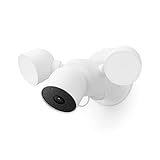 Google Nest Cam with Floodlight Google Nest Cam with Floodlight |
|
Check Latest Price |
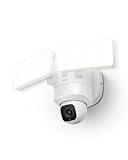 eufy Floodlight Cam E30 2K eufy Floodlight Cam E30 2K |
|
Check Latest Price |
1. Ring Floodlight Cam Wired Plus: Best Overall Driveway Camera
Ring Floodlight Cam Wired Plus, Outdoor Home or Business Security with Motion-Activated 1080p HD Video and Floodlights, White
1080p HD video
2000-lumen motion-activated floodlights
Hardwired power with 85dB siren
Pros
- Easy DIY install reported at 15-30 minutes
- 2000 lumens lights a whole driveway or yard
- Reliable low-false-alarm motion detection
- Built-in siren and two-way talk
- Works cleanly with the Ring app and Alexa
Cons
- Fixed body cannot pan or tilt remotely
- Light is motion-triggered only with no dim-to-bright behavior
- Video history needs a Ring Protect plan
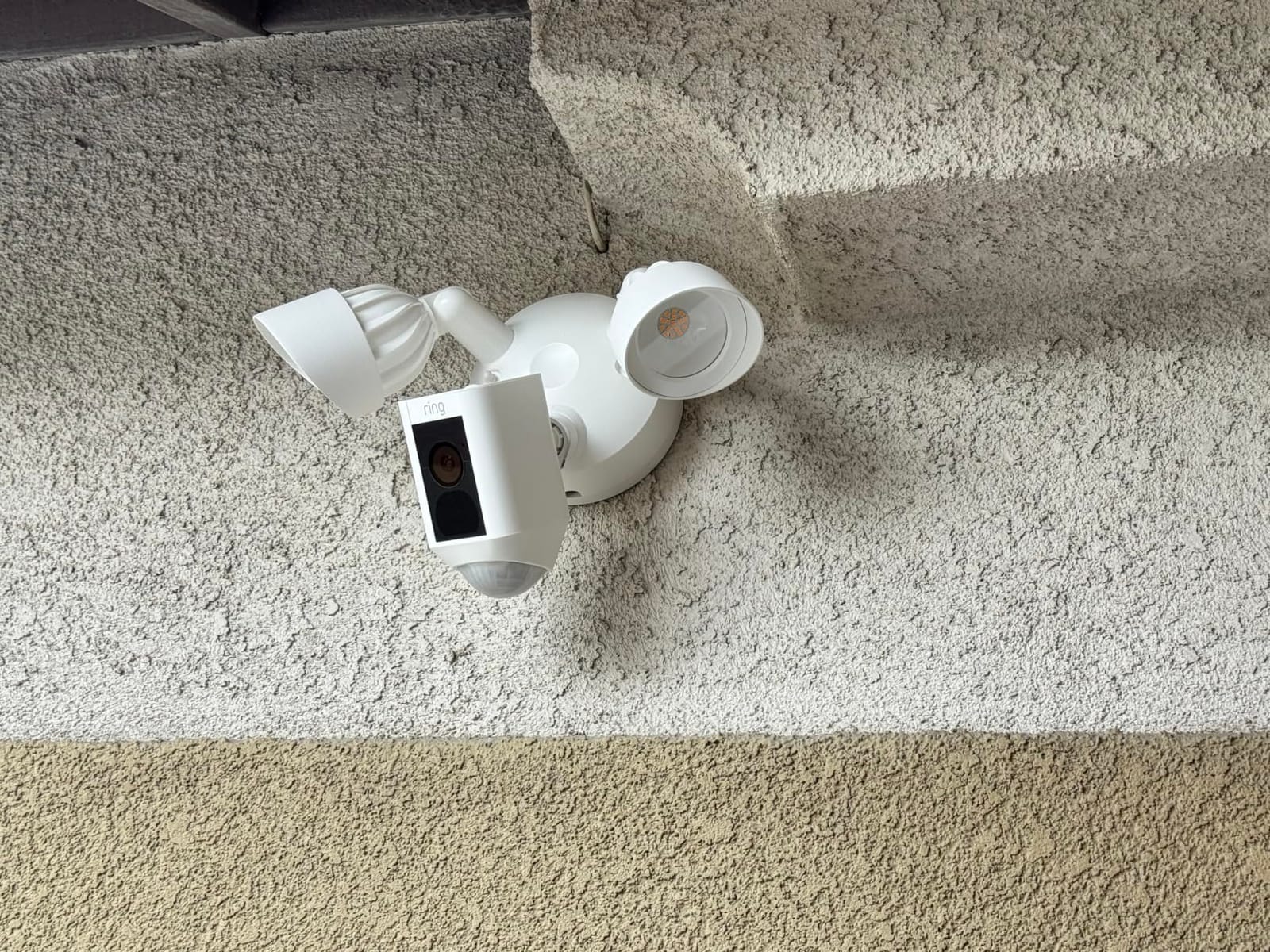
The Floodlight Cam Wired Plus is the camera we keep coming back to because it solves the driveway problem with the fewest compromises. Mounted where a floodlight already sits, it replaces the light and the camera in one junction box, throws 2000 lumens across the drive when something moves, and records 1080p colour video in daylight and colour night vision after dark.
Install is genuinely quick. Owners report 15 to 30 minute installs with the mounting hardware and a multi-tool in the box, and the hardwired power means no charging, no battery degradation in winter, and no missed footage because the battery ran flat on the coldest night of the year.
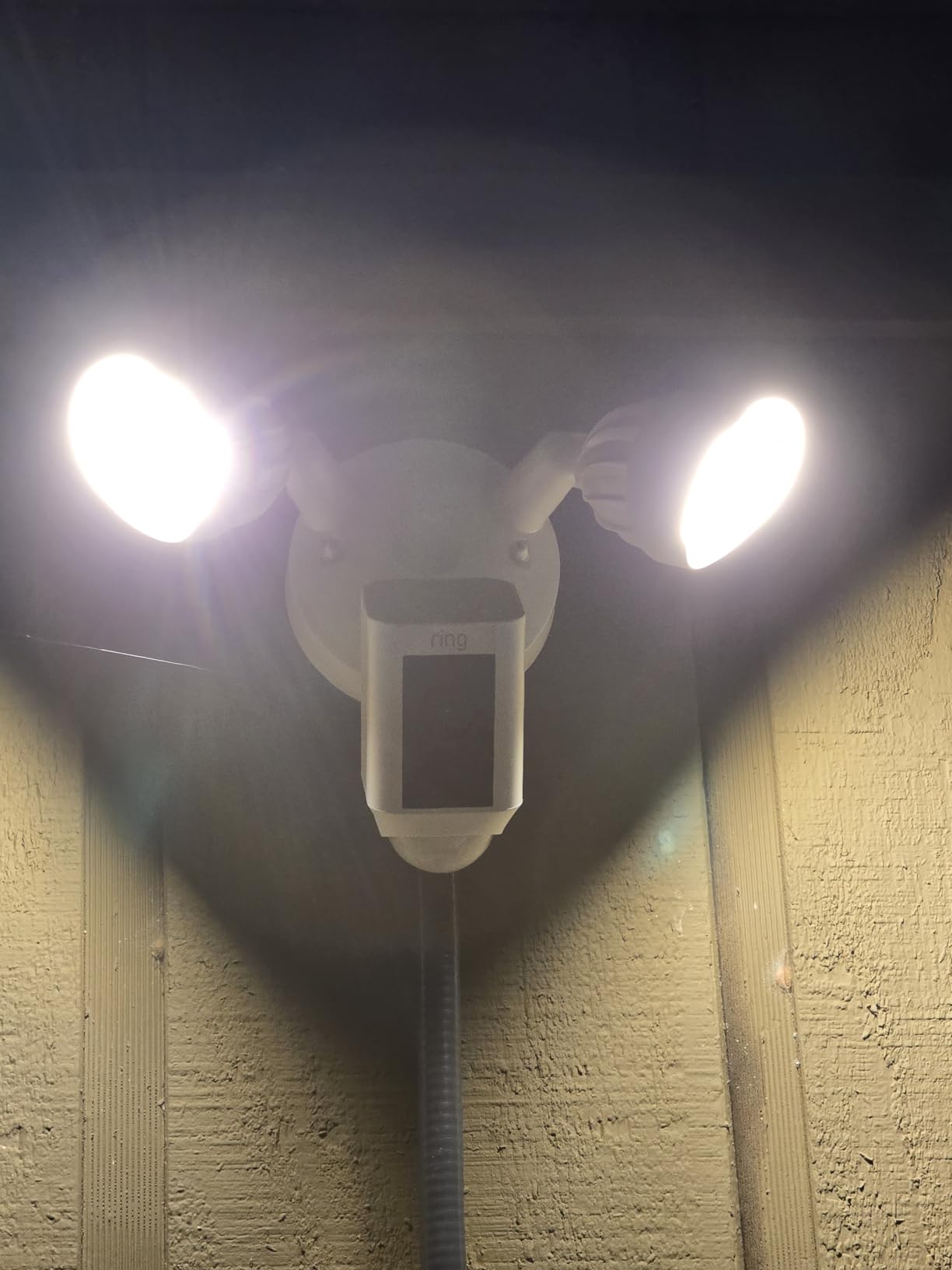
The compromise is the fixed lens. There is no remote pan or tilt, so the field of view you get is the field of view you aimed at install time. Aim it down the driveway rather than across the yard, because driveway coverage is the whole point.
The light is also strictly motion-activated, either on or off. If you want a dim always-on glow at the base of the drive, this is not the unit for you. Beyond that, stored video history sits behind a Ring Protect subscription, which is worth thinking about before you commit to more than one of these.
Check the field of view before you drill
This camera cannot be re-aimed remotely, so the angle you choose on the ladder is the angle you live with. Mount it high on the wall or eave that faces the driveway and tilt it down the length of the drive, and you will cover the approach without wasting pixels on the neighbour’s hedge.
If your driveway is L-shaped or split, this is the wrong shape of tool. A pan/tilt unit such as the Tapo C500 or the eufy E340 covers those awkward approaches far better because you can redirect it after mounting.
Check whether the subscription changes your plan
Motion detection and live view work without paying anything. Rewindable video history does not. If you only plan to check live view occasionally, the free tier is fine. If you want to review what happened at 6am while you were asleep, budget for the plan.
Our floodlight security camera guide compares more of these hardwired light-and-camera units side by side if you want to see how the alternatives handle a long drive.
2. Tapo C425 MagCam 2K+: Best for Long Driveways
Tapo MagCam 2K+ Security Camera Wireless Outdoor, Battery Powered, C425
2K QHD with 142-degree field of view
10000 mAh battery up to 300 days
Full-color Starlight night vision
IP66 magnetic base
Pros
- 2K QHD sharp enough to read plates at distance
- Very wide 142-degree view from a single mount
- Full-color night vision from Starlight sensor
- 10000 mAh battery rated up to 300 days
- Works with optional Tapo A200 solar panel
- Local 512 GB microSD with no subscription
Cons
- Battery life drops with heavy motion and spotlight use
- Fixed view with no pan or tilt
- 2.4 GHz dependent so distance from the router matters
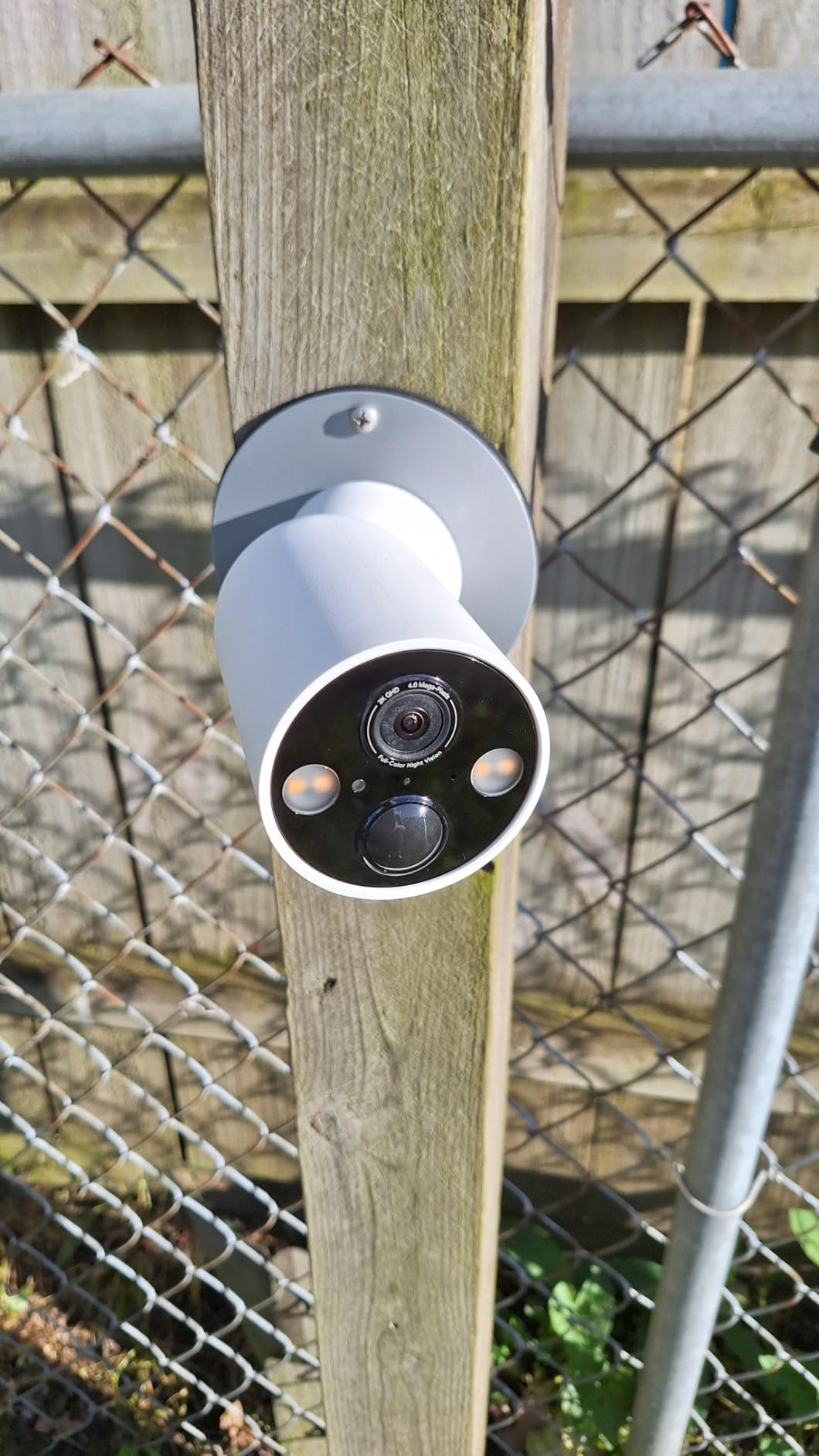
The C425 is the camera we recommend when the drive is long. Its 2K QHD sensor carries 1.7 times the pixels of 1080p, which is the difference between a recognisable vehicle shape and an identifiable vehicle at the far end of a long property.
The 142-degree field of view is unusually wide, so one mount near the house can see the full width of the drive plus both verges. Reviewers report that this resolution is sharp enough to read license plates, which is the benchmark that matters most for driveway coverage.
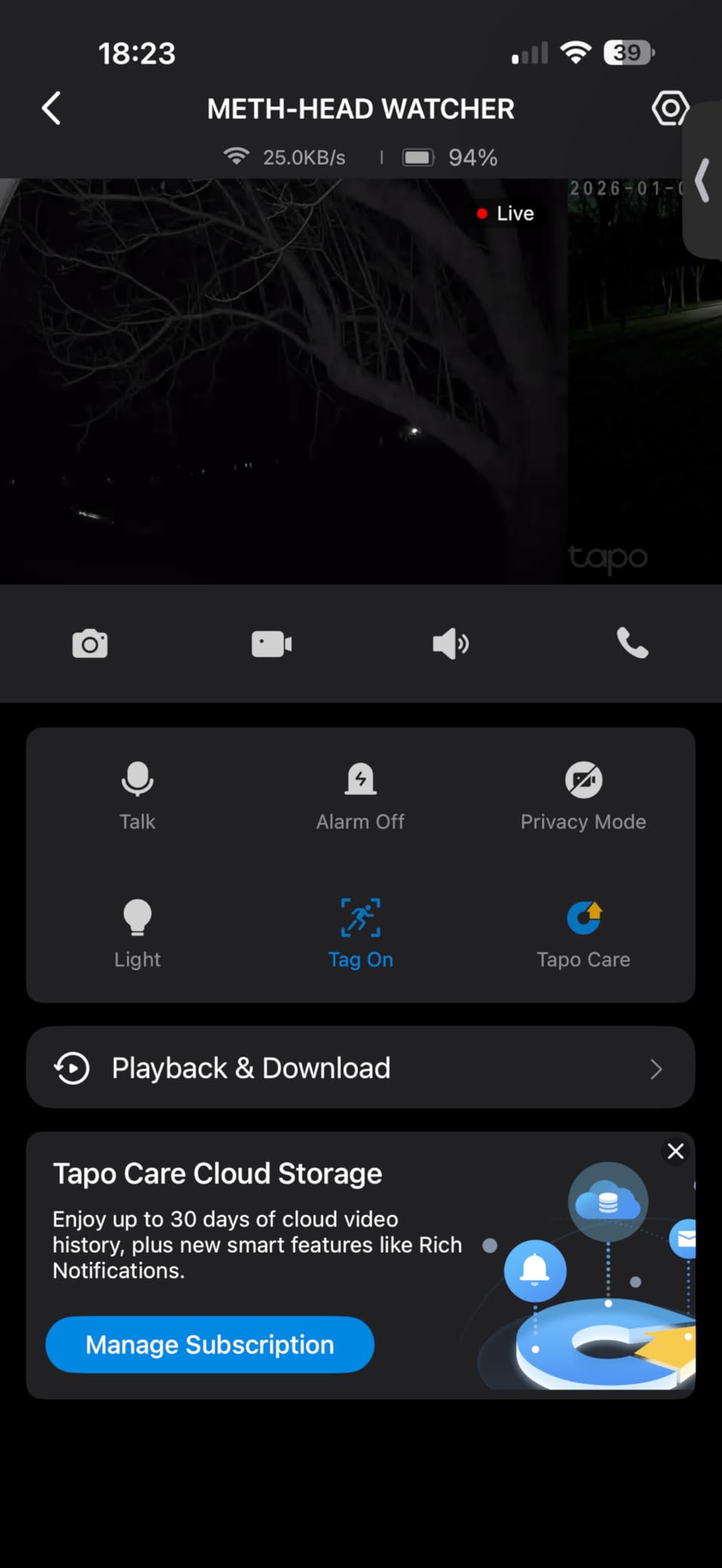
Battery capacity is 10000 mAh, rated by the manufacturer at up to 300 days per charge, and the optional Tapo A200 solar panel turns it into a genuinely set-and-forget unit. Cold weather still costs you charge, so in northern climates the solar panel is the safer long-term answer.
The night performance is where this camera beats most of the field. A Starlight sensor plus built-in spotlights give full-colour footage after dark, so a red car stays red rather than becoming a grey blob. That single feature decides a lot of driveway arguments.
Check your Wi-Fi distance before ordering
The C425 is 2.4 GHz dependent, and long driveways are exactly where 2.4 GHz signal dies first. If the mount point sits more than about 80 feet from your router with a wall or two in between, run a mesh node or an extender toward the drive before you commit.
Our solar-powered camera guide covers the pairing options for remote mounts, including what a small panel can and cannot keep up with in winter.
Check that fixed view works for your layout
There is no pan or tilt, so the 142 degrees is the most you will ever see. On a curved or circular drive this can leave gaps at the edges. A PTZ unit covers those shapes better, at the cost of the sort of resolution that identifies faces.
The magnetic base is a genuine convenience for repositioning, but it means the final angle still depends on your first aim. Walk the driveway and check the coverage in the app before you walk away.
3. Reolink Argus Eco 2K 5MP Solar: Best Solar Pick With No Subscription
REOLINK Solar Camera Outdoor Wireless 2K 5MP Smart AI Detction Argus Eco
3W solar panel with battery backup
2K 5MP resolution
33 ft infrared night vision
IP65 housing
Pros
- 3W solar panel removes battery swaps
- 2K 5MP sharper than 1080p at distance
- 2.4 GHz only improves crowded-network reliability
- Local microSD up to 512 GB
- IP65 housing holds up in rain and sun
Cons
- 2.4 GHz Wi-Fi only with no 5 GHz support
- Fixed view with no pan or tilt
- Battery models are not supported by the Home Assistant integration
- Some owners report connection drops needing a manual reset
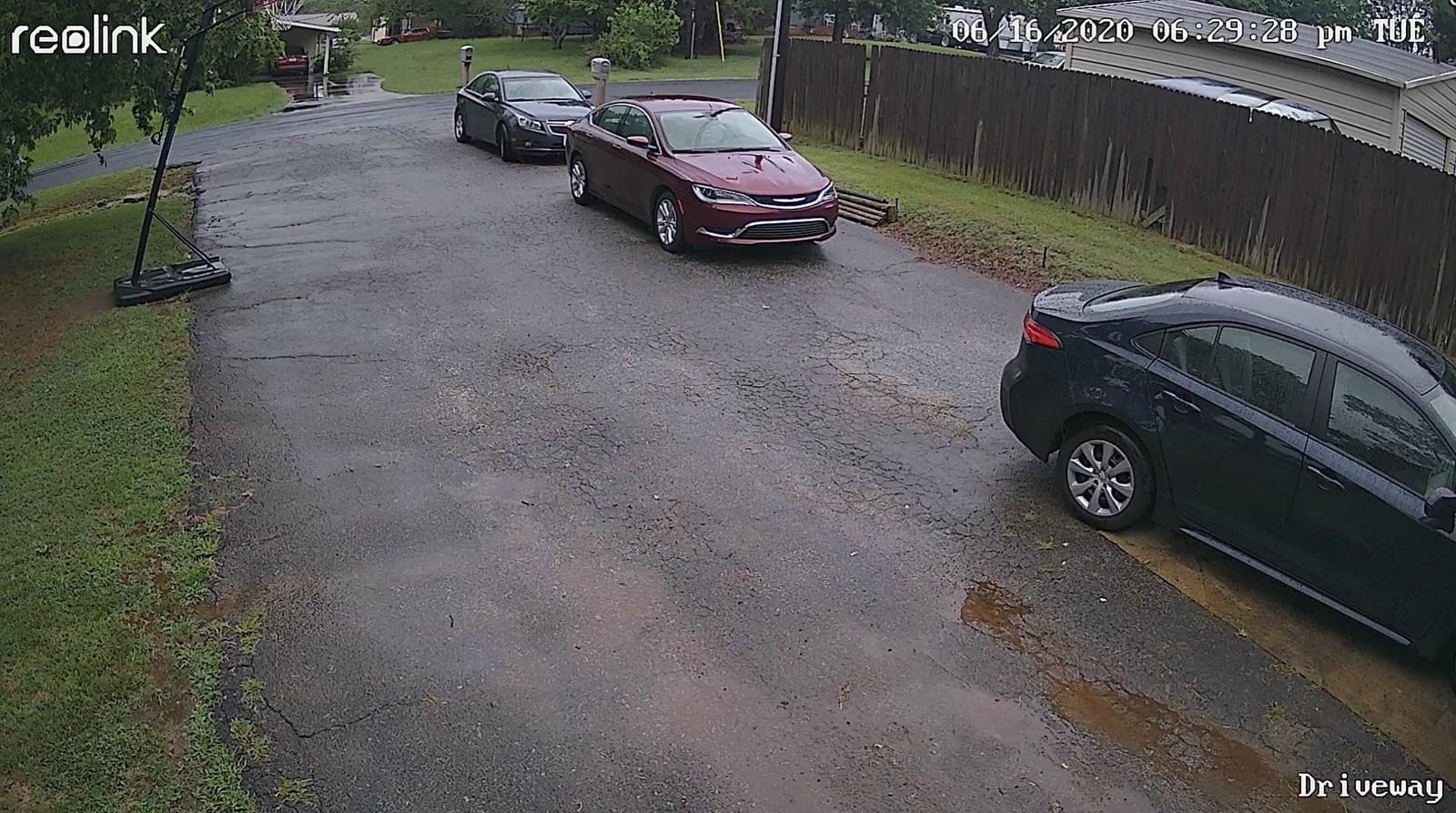
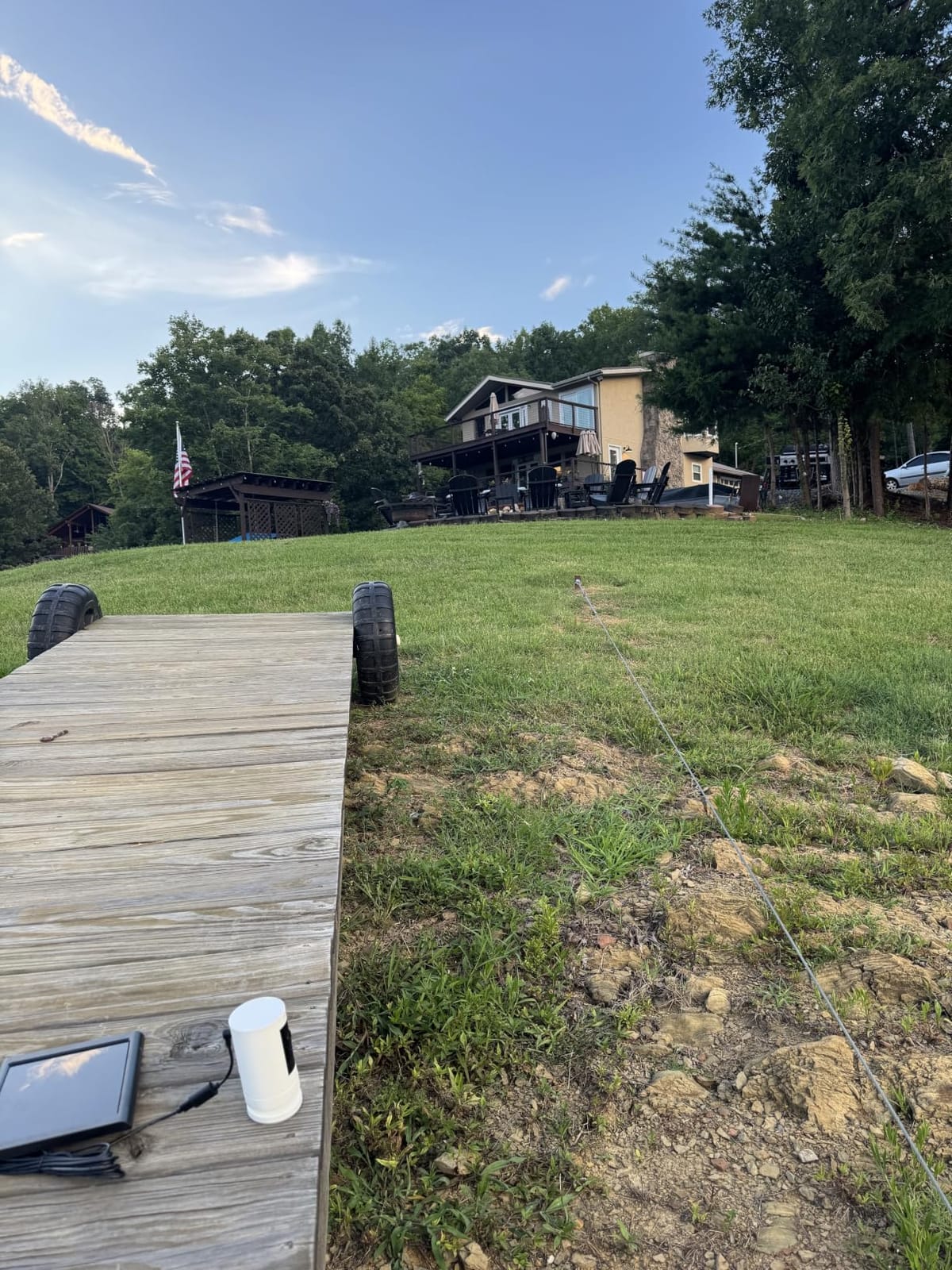
The Argus Eco is the answer for a driveway with no power at the far end. The included 3W solar panel tops the battery up during the day, and the whole point of the design is that you never touch it again after mounting.
Video capture is 2K 5MP at 15 fps across a 110-degree field of view, which is a real step up from 1080p when you are trying to work out who walked up the drive. Night vision comes from six infrared LEDs reaching 33 feet, so anything past that range is lit by ambient light or nothing at all.
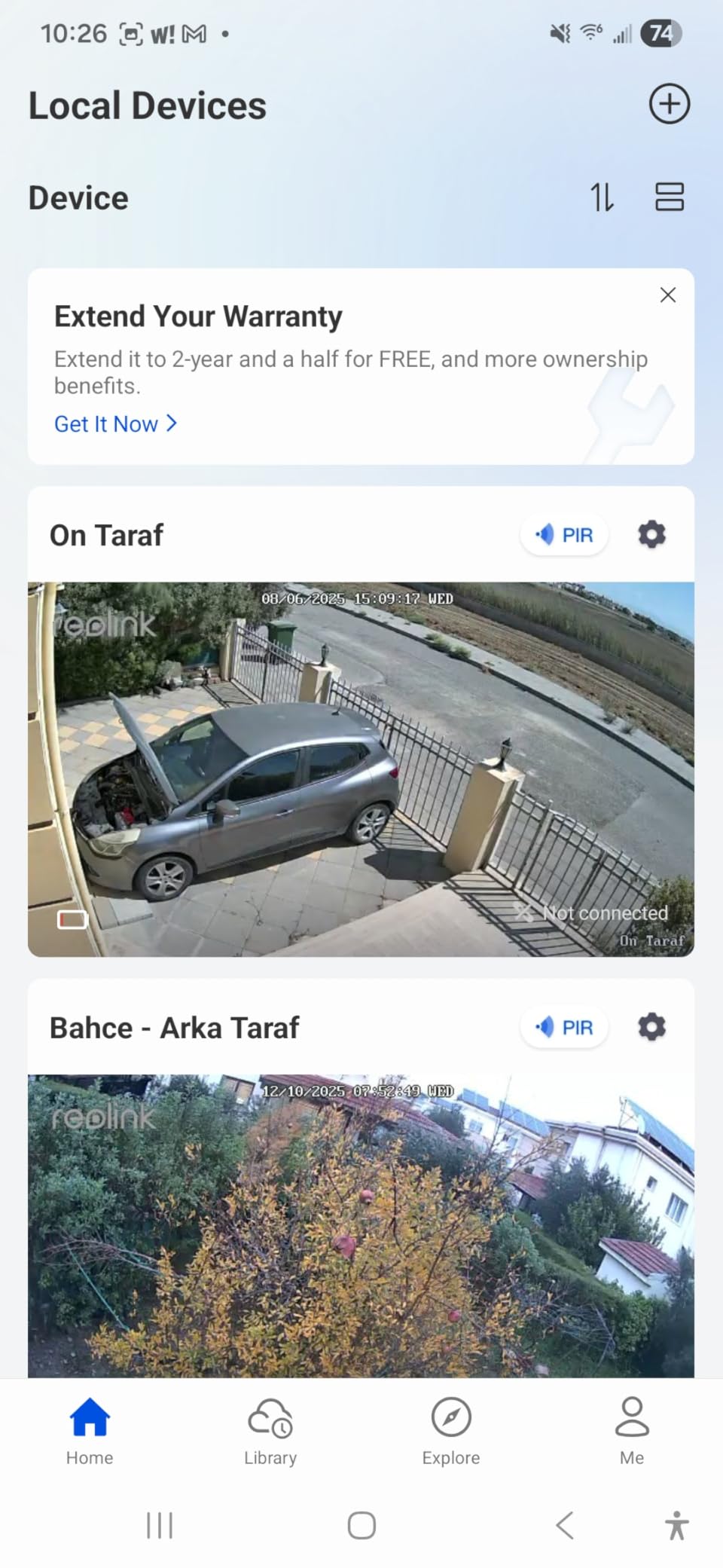
The storage is the headline here. Local microSD up to 512 GB, no subscription at any stage, and the app will replay your footage years later without a single monthly payment. For anyone covering several driveways or rental units, that difference compounds quickly.
AI detection covers people, vehicles and pets, with push, email and siren alerts. Our subscription-free camera guide goes into why on-device classification matters more than cloud alerts for quiet driveways.
Check whether 2.4 GHz is a feature or a problem
Being 2.4 GHz only is an advantage on crowded networks, where 5 GHz congestion is common, and a limitation if your router is set to 5 GHz alone. It also means less bandwidth, so live view at 2K will drop frames when the signal is marginal.
If you already have a mesh node or extender covering the far end of the drive, this camera’s limitation becomes irrelevant. If you do not, sorting the network out first will save you a lot of frustration later.
Check your winter sun exposure
A 3W panel produces a modest amount of power, and a driveway with a tree line or a north-facing mount can fall short in December. Owners who added a second panel or angled the existing one south report noticeably better cold-weather endurance.
The fixed lens and missing Home Assistant support are worth weighing too, but neither affects the core job of watching a drive with no wiring.
4. Ring Outdoor Cam Stick Up Cam: Best Low-Cost Battery Camera
Ring Outdoor Cam (Stick Up Cam), Weather-Resistant Home or Business HD Security Camera, Live View, Color Night Vision, Two-Way Talk, Motion Alerts, Works with Alexa, White
Rechargeable battery power
HD live view with color night vision
Two-way talk and motion alerts
Weather-resistant body
Pros
- Very easy setup with sub-minute app pairing
- Battery lasts many weeks per charge
- Optional Ring solar panel removes recharging
- Versatile wall table or ceiling mounting
- Excellent value against commercial systems
Cons
- Motion detection misses activity at distance beyond about 30 feet
- Motion zones cannot cover roughly 10-20 percent of the frame
- Records on motion only with no continuous mode
- Two-way talk audio is mediocre
- Stored clips require a Ring plan
With more than 65,000 reviews behind it, the Stick Up Cam is the most battle-tested cheap camera in this list, and for a short driveway it works well. Setup is about as painless as cameras get: power it on, scan the QR code, and it is on your account.
Battery life runs many weeks between charges, and adding an optional Ring solar panel turns it into a fixed installation. Colour night vision and two-way talk are both present at this tier, which was not true of comparable cameras a few years ago.
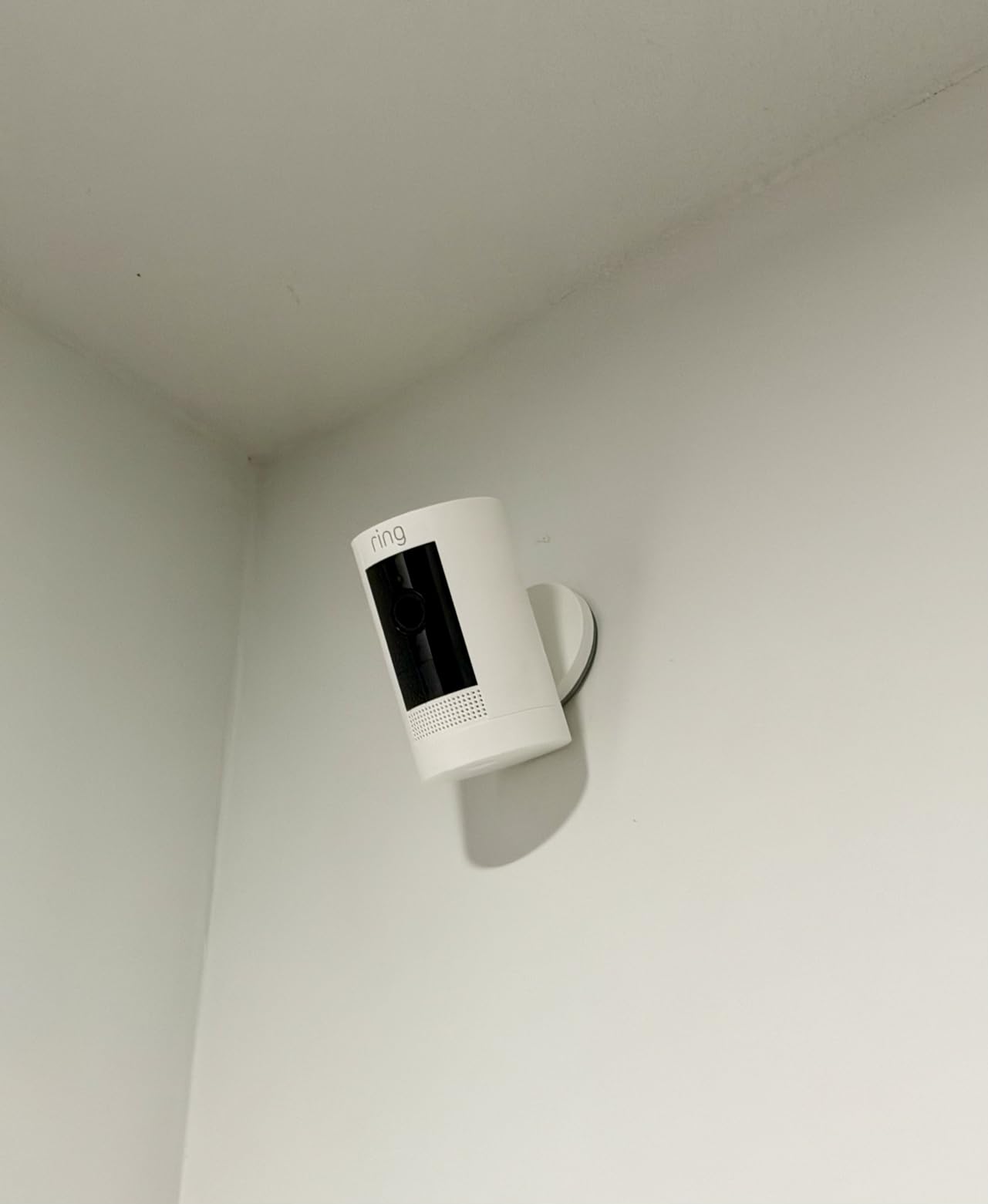
Here is the limit that matters most for our topic. Reviewers consistently report that motion detection can miss activity at distance, particularly with vehicles more than about 30 feet away. On a long driveway, that is disqualifying. On a short suburban drive where you want to know someone is at the kerb, it is a fair trade.
There is also a dead zone: motion zones cannot cover roughly 10 to 20 percent of the frame, so the extreme edges of the image will never trigger a recording. And recorded clips need a Ring subscription, since the camera records on motion only.
Check the drive length against the 30-foot detection limit
If your drive is longer than about 40 feet and you expect to identify vehicles, this camera is the wrong choice regardless of how good the day-time image looks. The limitation is detection, not resolution, so more pixels will not fix it.
For anything longer, step up to a 2K unit with a wider field of view. Our outdoor security camera roundup covers the range in detail.
Check the climate you are installing into
Some long-term owners report batteries becoming stiff in the housing after months of direct sun exposure. If your mount gets full southern exposure on a wall all day, factor that in or choose a wired unit instead.
The camera also cannot be powered down from the app; the battery has to be removed. If you want a camera that goes dark while you are on holiday, you will need physical access.
5. Tapo C500 1080p Pan Tilt: Best Budget Pan and Tilt Camera
Tapo 1080P Outdoor Wired Pan/Tilt Security Wi-Fi Camera, 360° View, Motion Tracking, Works with Alexa & Google Home, Night Vision, Free AI Detection, Cloud & SD Card Storage(up to 512GB), Tapo C500…
360-degree horizontal and 130-degree vertical pan/tilt
1080p at 15 fps
Night vision up to 98 ft
IP65 and 2-year warranty
Pros
- Covers 360 degrees with motion tracking that follows a person
- Very easy Wi-Fi setup and mounting
- Clear 1080p with night vision reaching 98 ft
- Works with no subscription thanks to 512 GB microSD
- Physical privacy shutter and two-way audio
Cons
- Plug-in DC adapter rather than hardwiring
- Monochrome night vision with no color mode
- No integrated floodlight so the alarm is modest
- Some owners report pan calibration drift
The C500 is the cheapest way to get genuine pan and tilt coverage over a driveway, and for L-shaped or curved drives it solves a problem no fixed camera can. It pans 360 degrees horizontally and 130 degrees vertically, with AI person detection and motion tracking that follows a person across the yard.
Night vision reaching 98 feet is unusually long for a unit at this level, which makes it more useful down a dark drive than the advertised range suggests. Storage is local microSD up to 512 GB, and the 2-year manufacturer warranty is longer than most rivals offer.
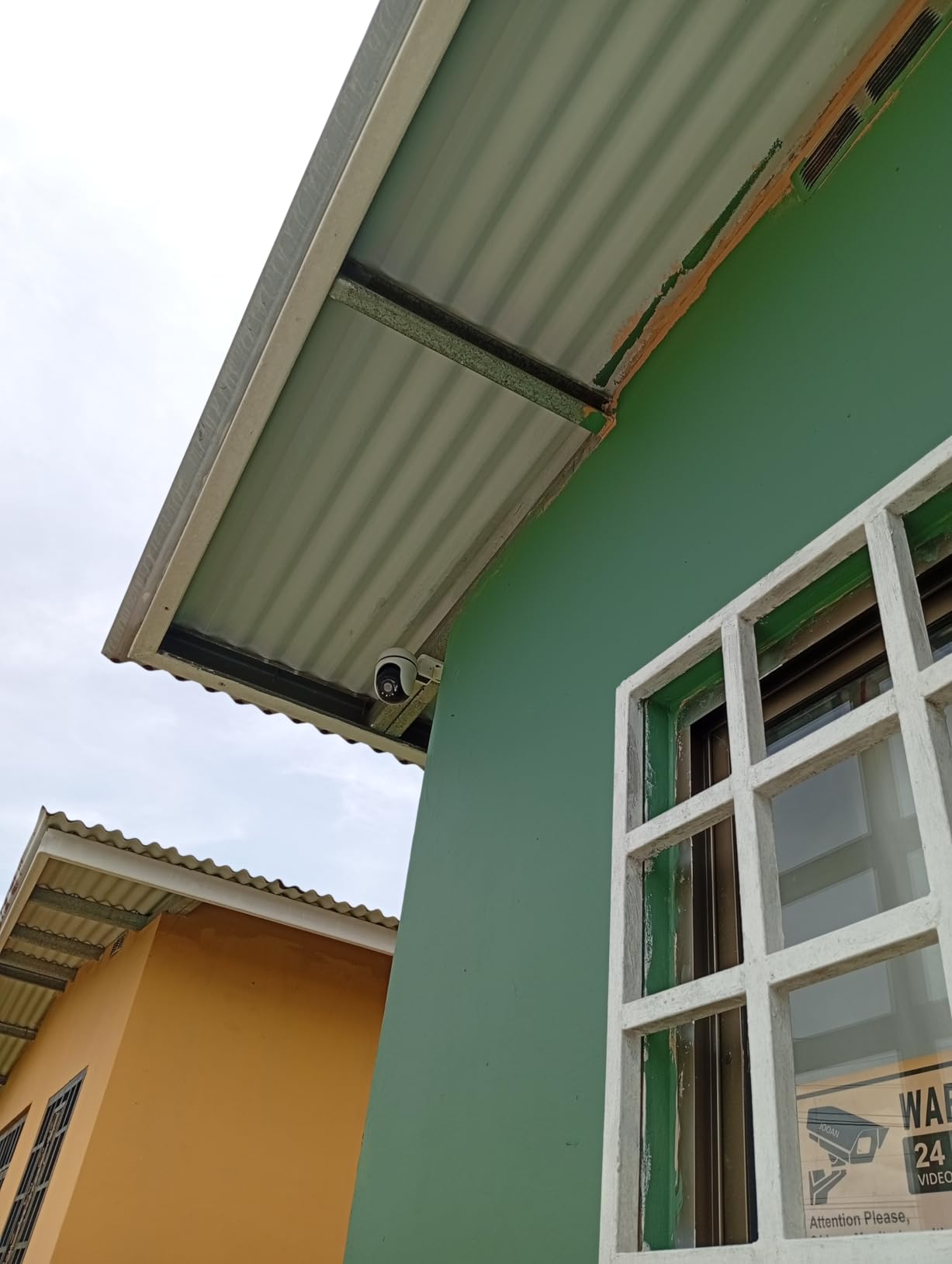
It runs from a low-voltage DC plug adapter rather than being hardwired into existing porch-light wiring. That makes installation easy and rules out a clean install at the end of a drive with no outlet nearby.
The night vision is monochrome only, there is no integrated floodlight, and some owners report pan calibration drift where detection zones warp after the camera has moved and regular reboots are needed. None of that is fatal, but it is friction you will feel over a year of use.
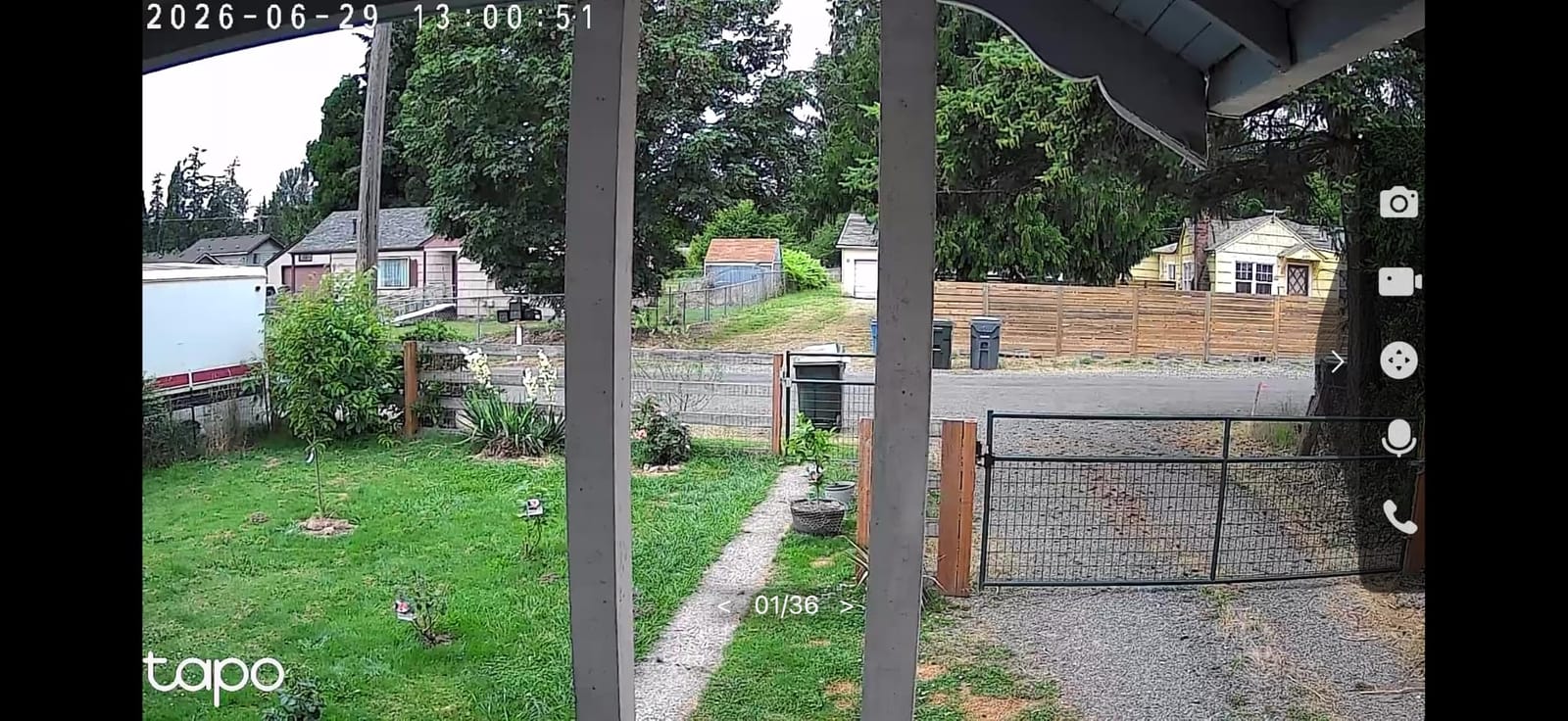
Check where your nearest outlet is
This is a plug-in camera. If the ideal mount point is at the gate or the far end of the drive with no power nearby, this unit is not a candidate and you should be looking at battery or solar hardware instead.
If an outdoor outlet exists within reach, the C500 becomes one of the easiest cameras on this list to install and one of the cheapest to run.
Check whether you need colour after dark
Monochrome night vision records perfectly well, but vehicle colour is lost. If identifying a car by colour matters to your use case, the Tapo C425 or one of the floodlight units will serve you better.
The physical privacy shutter is a nice touch for indoor-adjacent mounts and worth more than it sounds when a neighbour has a direct sightline.
6. Blink Outdoor 4 Three-Camera System: Best for Covering Multiple Driveways
Blink Outdoor 4 – Wireless smart security camera, two-year battery life, 1080p HD day and infrared night live view, two-way talk. Sync Module Core included – 3 camera system
1080p HD with infrared night vision
Two-year AA lithium battery life
Sync Module Core included
Three cameras in the box
Pros
- Battery life up to two years on included lithium AA cells
- Simple wire-free setup
- Clear 1080p with crisp two-way audio
- Dual-zone motion detection cuts irrelevant alerts
- Alexa support for multi-camera live view
Cons
- Sync Module Core has no local storage
- Person detection and clip history need a Blink plan
- Infrared night vision rather than color
Three cameras, a Sync Module Core, six lithium AA cells, three mounting kits and a USB-C cable come in one box. For anyone covering a driveway, a side gate and a back yard, that is the simplest path to full coverage without running a single cable.
The two-year battery claim is the headline. In practice that assumes motion-triggered recording rather than continuous capture, but even at busier settings the AA lithium cells last far longer than the rechargeable packs used by most rivals.
Enhanced dual-zone motion detection reduces irrelevant alerts by letting you ignore one region and watch another, which is useful when part of your view is a road you cannot control.
Check where your clips are actually stored
The included Sync Module Core is the sticking point. It has no local storage, so clip retention depends on cloud service, or on adding a Sync Module 2 with a USB drive or a Sync Module XR with a microSD card separately.
That extra hub is a modest cost, but it is a cost, and owners who did not plan for it are the ones who end up with lapsed subscriptions and no footage.
Check range and app behaviour over multiple sites
Several owners report occasional Wi-Fi dropouts or delayed alerts in the Blink app. Across three cameras on a long property, that means the Sync Module needs a clear line to your router, possibly via an extender placed near the house rather than in the middle of the building.
The infrared-only night vision is another limitation. It is clear footage, but a grey vehicle at 3am is far less useful than a coloured one.
7. Blink Wired Floodlight Camera: Brightest Light on a Driveway
Blink Wired Floodlight Camera, Smart security camera, 2600 lumens, HD live view, enhanced motion detection, built-in siren, Works with Alexa, 1 camera (White)
2600-lumen LED floodlight
1080p HD with color night view
Built-in security siren
Hardwired installation
Pros
- 2600 lumens is the brightest light in this roundup
- Color night view alongside 1080p live view
- Built-in siren for an active deterrent
- Hardwired so there is no battery charging
- Simple setup onto existing outdoor wiring
Cons
- Needs existing outdoor wiring and electrical work
- Cloud clip history needs a Blink plan and no hub is included
- Fixed camera position with no pan or tilt
Where the Ring Floodlight Cam produces 2000 lumens, this Blink unit produces 2600, and on a wide gravel drive that difference is obvious the moment motion triggers it. Colour night view means the light does the work the sensor cannot, so vehicles stay recognisable in colour.
The built-in siren can be triggered from the app, which turns the light into an active deterrent rather than just a passive recorder. Hardwiring removes battery maintenance entirely, which matters more on a driveway than anywhere else on the property.
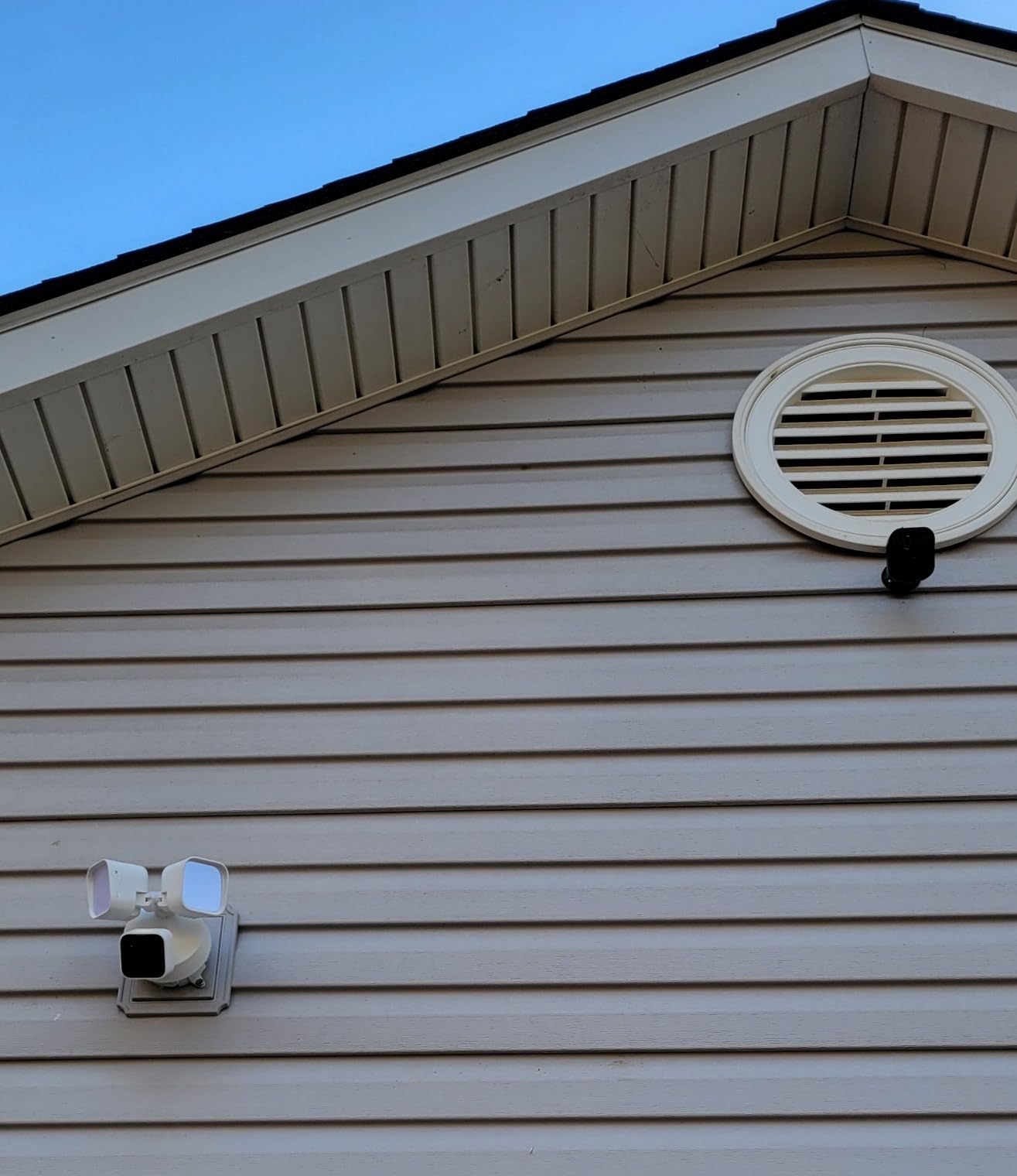
Two practical warnings. There is no hub in the box, so a single-camera setup needs a separately purchased Sync Module and a Blink plan for clip history. And it must be hardwired, so you need an existing outdoor supply at the mount point or an electrician.
The camera position is fixed with no pan or tilt, the same constraint as the Ring floodlight units. Both serve short-to-medium drives brilliantly; neither adapts to an unusual approach.
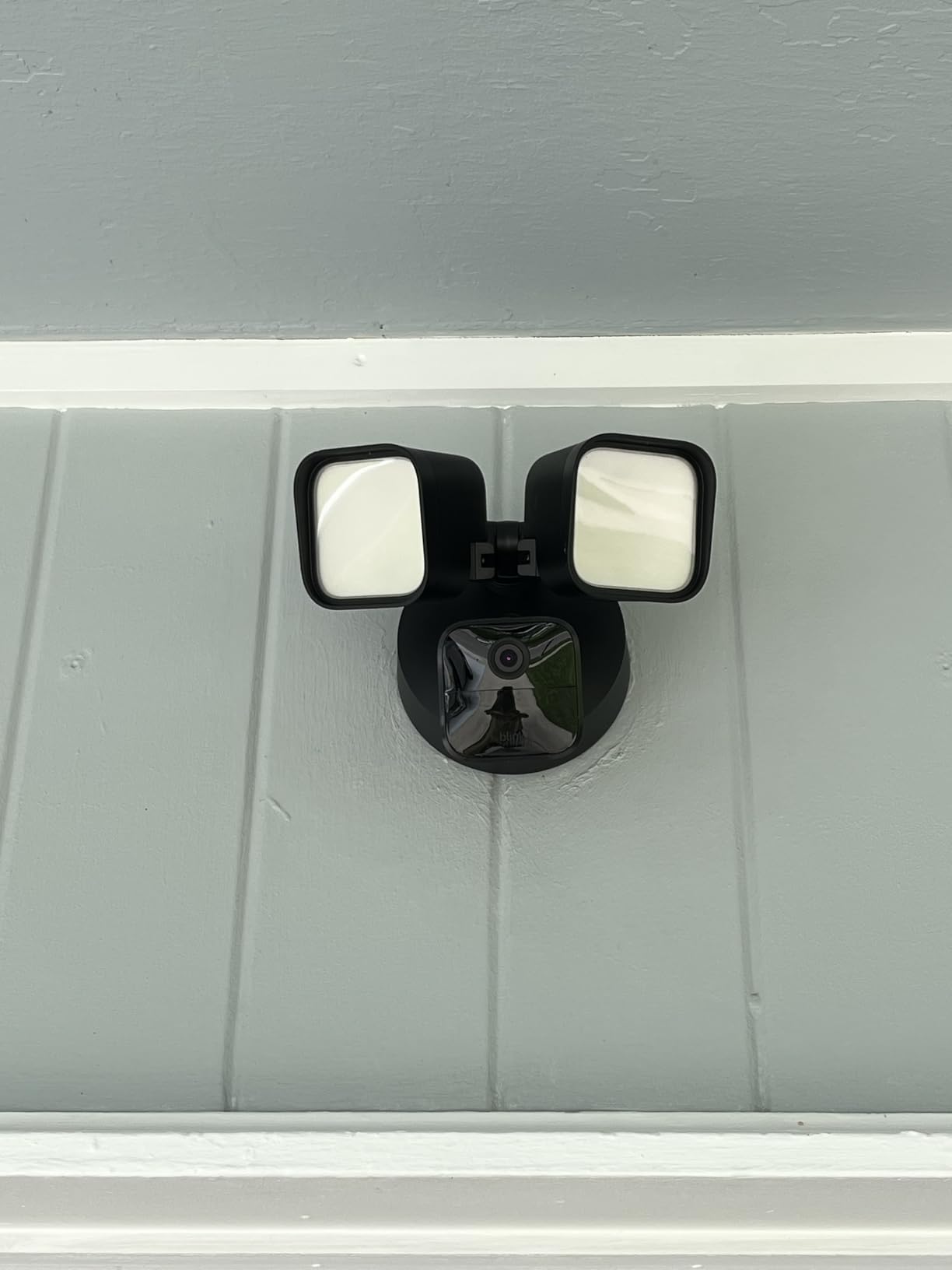
Check your existing wiring before buying
A 2600-lumen floodlight draws meaningful current. If your junction box was fitted for a lower-wattage lamp, swapping it for one of these needs a qualified electrician rather than a weekend project.
If you do have suitable wiring, this is the most capable light-and-camera unit here for a wide driveway. Our floodlight camera comparison lays out the wiring question in more detail.
Check the storage plan in advance
Buying a single Blink floodlight camera without a hub is a purchase with an unfinished end. Budget for the Sync Module up front rather than discovering later that your clips live on a trial you never converted.
Alexa support is present and the app setup is straightforward, but the extra hardware is what differentiates this from a cheaper wired unit.
8. Reolink Argus PT with Solar Panel: Best 360-Degree Wire-Free Coverage
REOLINK Solar Security Cameras Wireless Outdoor 360° Coverage Argus PT
1440p video from 5MP stills
355-degree pan and 140-degree tilt
Dual-band Wi-Fi and IP65
Local microSD up to 512 GB
Pros
- Solar power keeps the battery near full in most conditions
- 355-degree pan and 140-degree tilt for true 360 coverage
- 5MP stills with colour night vision up to 33 ft
- Local microSD Home Hub or FTP storage with no subscription
- Quick QR code setup and holds up in snow and rain
Cons
- Solar power adds 4-7 second response delays
- Detection zones need frequent recalibration
- Battery models unsupported by the Home Assistant integration
- Some owners report intermittent Wi-Fi disconnects
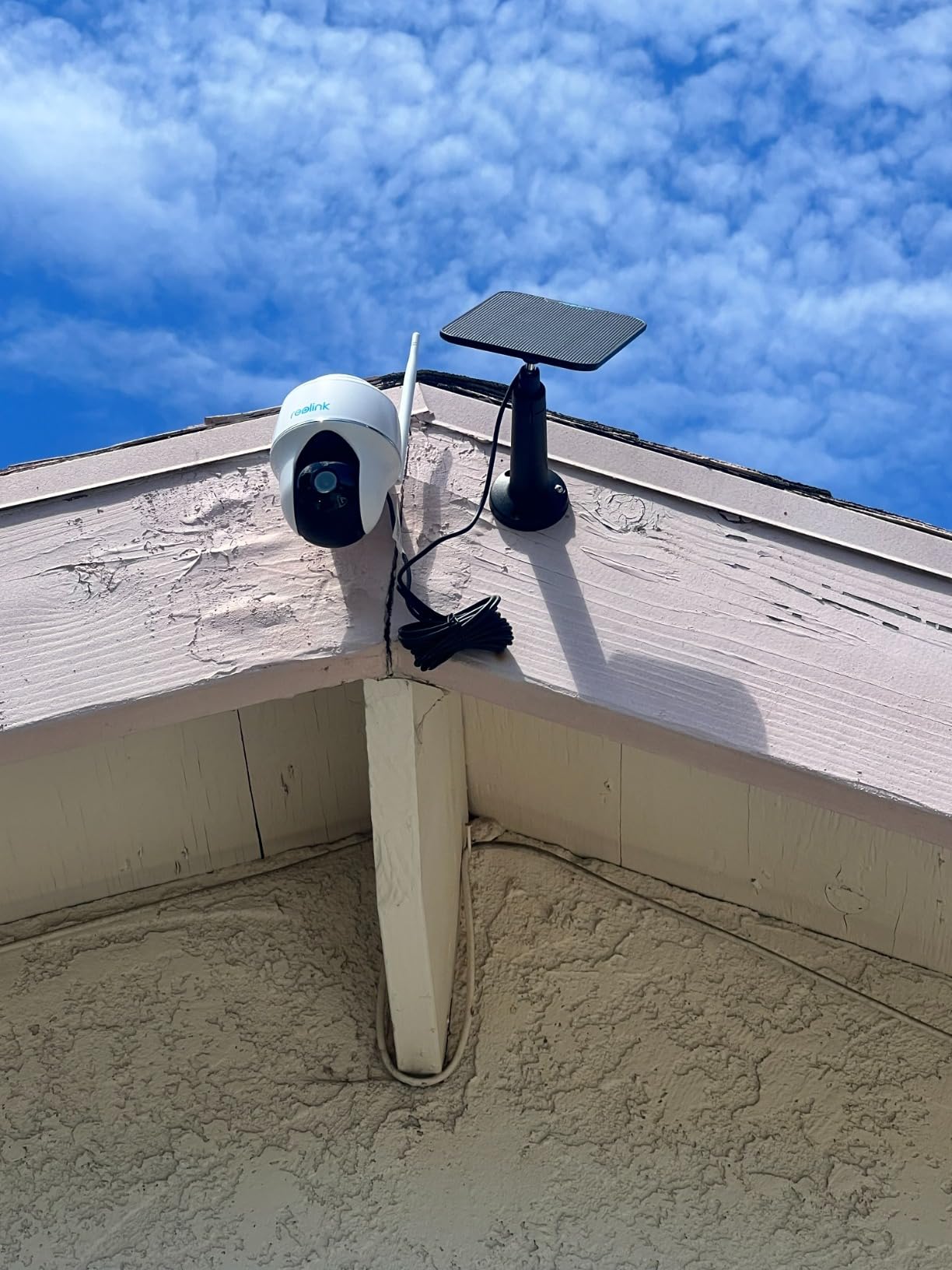
The Argus PT is the only genuinely 360-degree camera in this roundup, and on a circular drive or a wide yard it covers ground that would take three fixed cameras to match. It pans 355 degrees horizontally and tilts 140 degrees, with colour night vision reaching 33 feet.
It is also the only unit here with dual-band Wi-Fi, supporting both 2.4 GHz and 5 GHz. On a long driveway that is a meaningful advantage, because it lets you keep 5 GHz for live view and fall back to 2.4 GHz when the signal weakens.
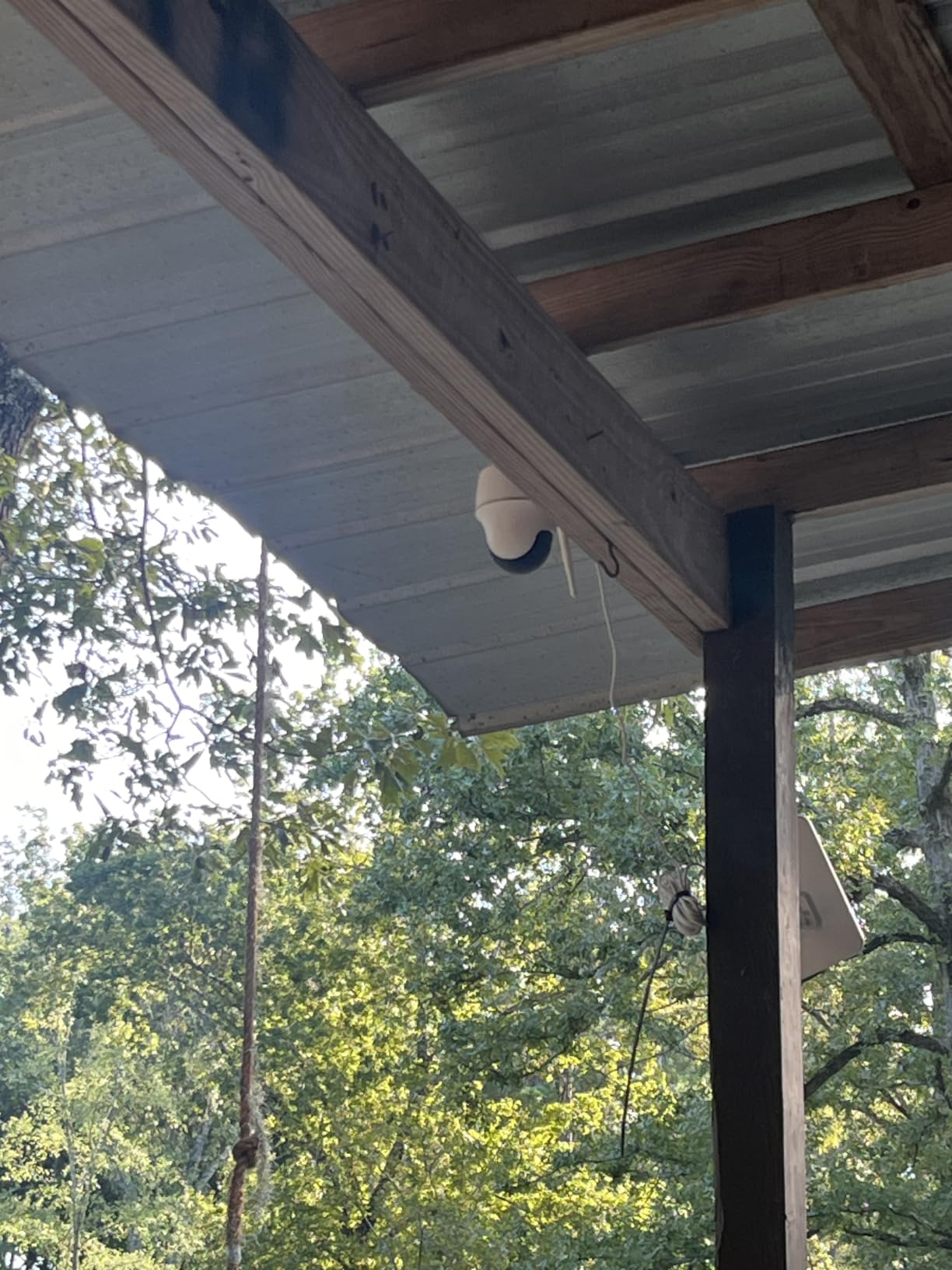
Storage is local microSD up to 512 GB, a Reolink Home Hub or an FTP server, with no subscription required. Video uses H.265 encoding, which roughly halves storage versus H.264, and digital zoom reaches 10x.
The delay is the real caveat. Solar power introduces four to seven seconds of response lag on commands and motion, which can miss fast-moving subjects at night. The PIR sensor detects people and vehicles but does not auto-track, so you get an alert and a wide view rather than a camera that follows the subject.
Check whether latency matters for your threat
A four to seven second delay is irrelevant for recording a car that has already stopped. It matters if you want to talk to someone at the gate or catch someone running from a vehicle. Know which situation you are buying for.
Detection zones and person/vehicle classification also need more recalibration than fixed cameras. Budget an afternoon of fine-tuning after installation.
Check the small-parts support reality
Several owners report intermittent Wi-Fi disconnects requiring a manual reset, and the rubber cover over the power switch is fragile with replacement parts that are hard to source. Neither is a dealbreaker outdoors under an eave, but both argue for mounting somewhere sheltered.
Battery cameras are also not supported by the Home Assistant integration, so if your smart home runs on Home Assistant this one needs planning around.
9. Arlo Essential Outdoor 2K Two-Pack: Best Starter Two-Pack
Arlo Essential Security Cameras Wireless Outdoor 2K (2nd Gen, 2023 Release) – Battery Power, Person Recognition, Package Detection, Animated Preview, 1-Month Trial of Secure Plan, 2 Cam, White
2K at 2560 x 1440
130-degree field of view with 12x optical zoom
Color night vision with integrated spotlight
Battery powered and IP65
Pros
- Crisp 2K video with a wide 130-degree field of view
- Color night vision plus an integrated spotlight for drive monitoring
- Person and package detection cut false alerts meaningfully
- Survives harsh winters and storms
- Battery-only mounting simplifies placement
Cons
- Without an Arlo Secure plan there is no cloud storage
- Battery drains faster with frequent spotlight use
- Firmware issues sometimes need a factory reset
- Some owners report sluggish response times
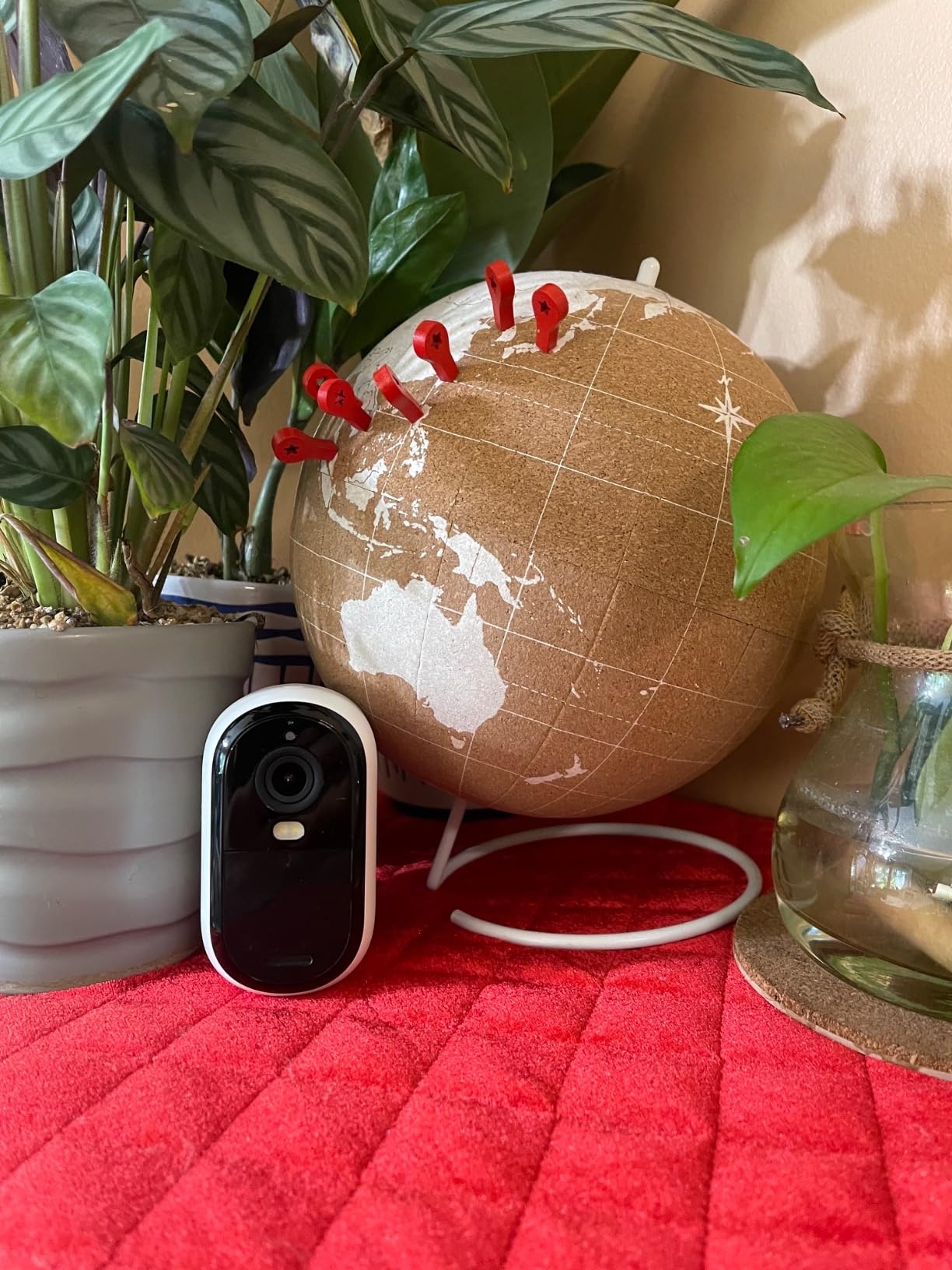
The Arlo Essential Outdoor 2K two-pack gives you two cameras, two wall mounts, a charging cable and a security decal in the box. For a driveway plus a side gate, that pairing is the natural shape of the problem.
Video is 2K at 2560 x 1440 across a 130-degree field of view with 12x optical zoom. That zoom is the part that matters for a long drive: it is the difference between a car being in frame and a car being readable.
Person, package, animal and fire detection runs through the Arlo Secure plan and meaningfully cuts false alerts when it is active. Alexa, Google Home and IFTTT all work, which makes it the most flexible ecosystem story in this roundup.
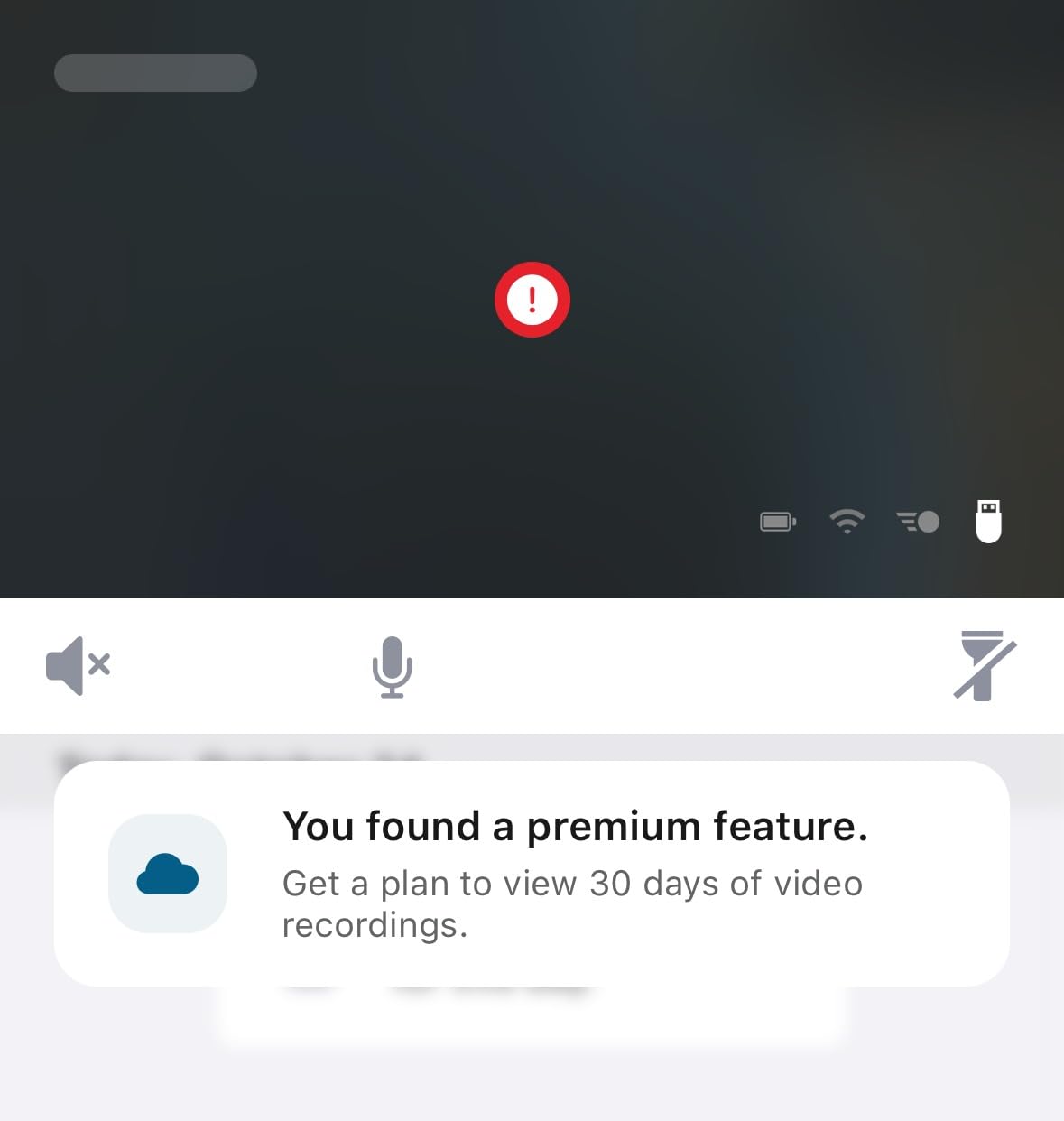
Without a Secure subscription there is no cloud storage at all, which is the sharpest edge on this camera. Battery life also shortens noticeably when the spotlight and motion detection are both working hard, and a handful of owners hit firmware problems that needed lengthy troubleshooting.
Check what you lose without the plan
Read this carefully before buying two of them. Recorded video may simply be inaccessible without an Arlo Secure subscription, so the camera becomes a live-view tool rather than a recording one. That is a very different product from what you think you are buying.
If you want a recording-first camera with no ongoing fee, the Reolink and Tapo units on this list are the ones to shortlist instead.
Check the cold-weather battery claim for yourself
Owners credit the hardware with surviving harsh winters and storms, which matters more on a driveway than on a sheltered porch. Even so, budget for more frequent charging on a north-facing mount than the marketing suggests.
At 7.2 ounces each, these cameras are light enough to reposition easily, which makes swapping a failing unit between positions a quick test rather than a project.
10. eufy Floodlight Cam E340: Best for Detail at Range
eufy Security Floodlight Camera E340, Dual-Lens, 360° Coverage, 8X Zoom
Dual 2K and 3K lenses with 8x hybrid zoom
360-degree pan tilt with AI auto-tracking
2000-lumen light with 95dB alarm
Dual-band Wi-Fi 6
Pros
- Dual-lens pairs a 3K wide view with a 2K telephoto for detail at range
- 360-degree pan and tilt with AI tracking of people vehicles and pets
- 2000-lumen motion floodlight
- 24/7 recording to microSD up to 128 GB or HomeBase with no monthly fee
- Dual-band Wi-Fi 6 improves range and stability
Cons
- Motion detection can trigger late with short clips
- Field of view narrower than some rivals
- HomeBase S380 does not expose accessories to Apple HomeKit
- microSD setup can be fiddly
The E340 is the camera in this list built specifically for the problem of identifying something at the far end of a drive. It pairs a 3K wide-angle lens with a separate 2K telephoto lens, giving up to 8x hybrid zoom with telephoto detail reaching roughly 50 feet.
That second lens is why it outperforms a single-sensor camera on distance. Most of the frame stays wide for context, while the telephoto feed delivers the pixels that let you actually read a plate or see clothing.
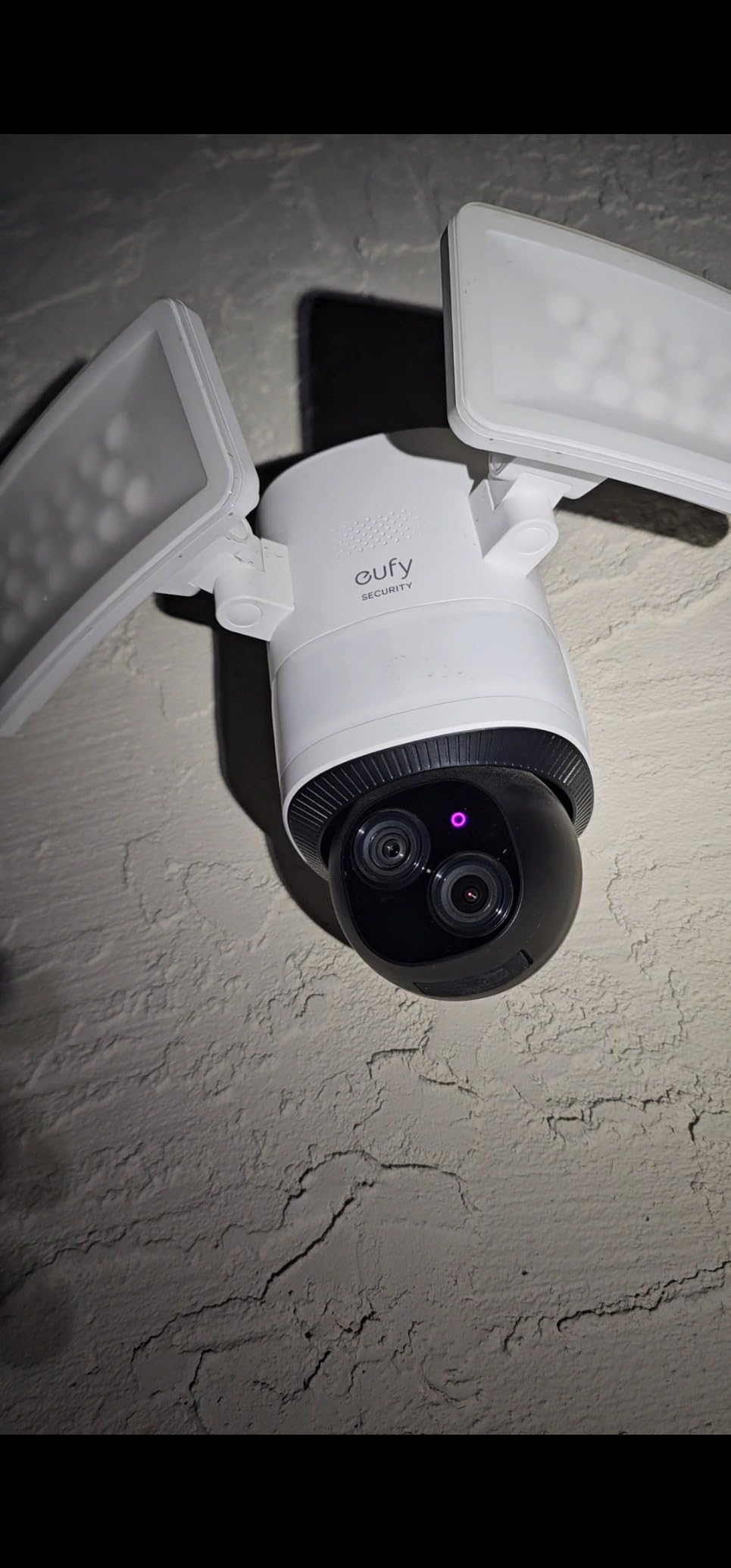
Around that sits 360-degree pan-and-tilt coverage with AI detection and automatic tracking of people, vehicles and pets. A 2000-lumen motion-activated light, a 95dB alarm and 24/7 continuous recording to microSD up to 128 GB or a HomeBase S380 give you options on storage with no monthly fee attached.
Dual-band Wi-Fi 6 support improved range and stability over earlier eufy generations, which is exactly what you want at the end of a property. Owners frequently recommend the optional HomeBase for local 24/7 storage rather than a subscription.
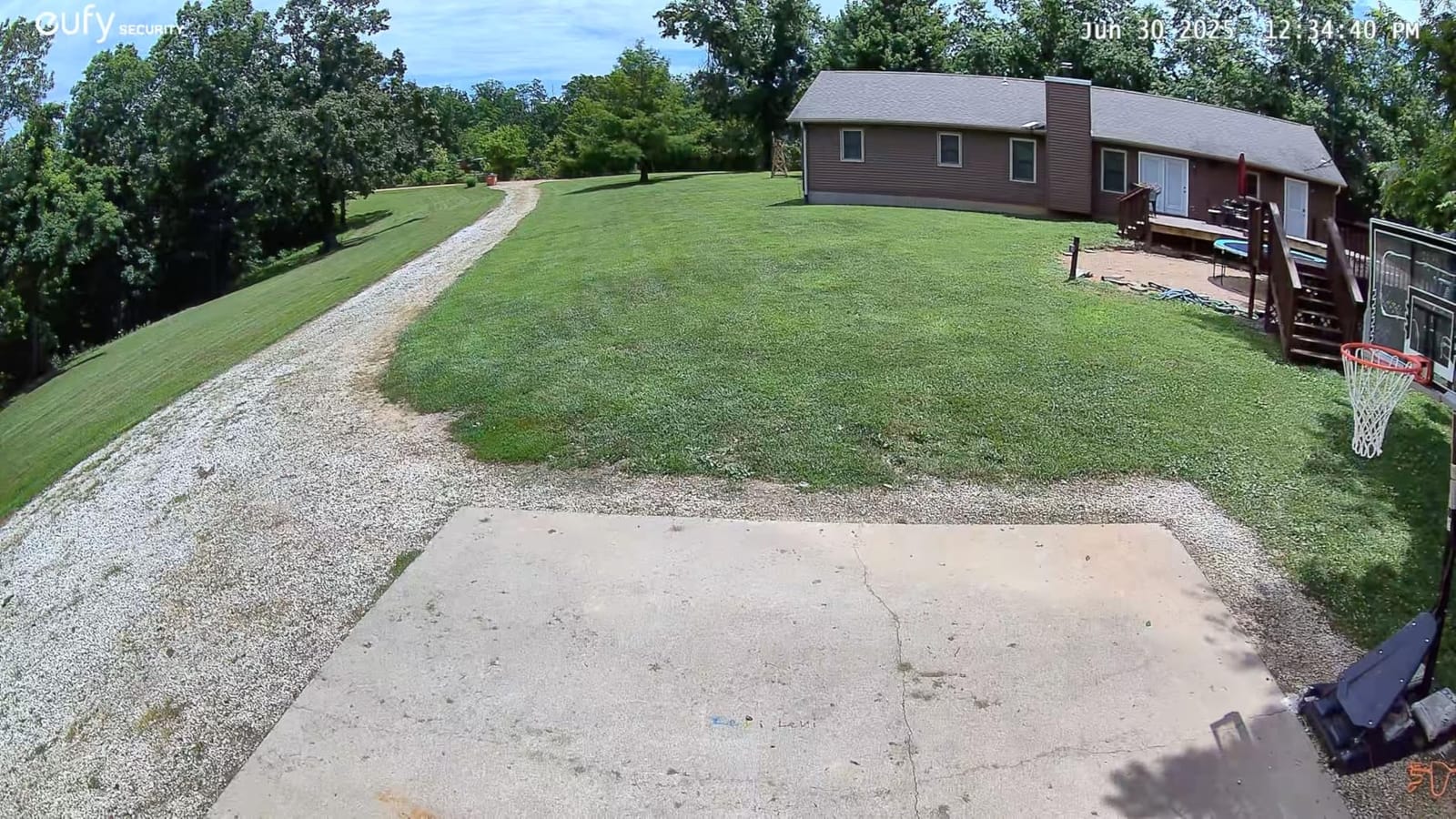
Check motion triggering reliability
The most common critical reviews centre on motion detection triggering late and recorded clips being short even when motion continues. For a driveway where a vehicle crosses the frame in four seconds, that is a real failure mode and it is worth testing before you commit.
Field of view is narrower than some competing systems, relying on zoom rather than wide coverage. If you want to see the full width of a broad drive and read a distant plate at the same time, check the app preview at your actual mount angle.
Check your ecosystem before buying
The HomeBase S380 does not expose attached accessories to Apple HomeKit, so if your household runs on HomeKit, verify what you lose. A small share of buyers also report privacy concerns around eufy cloud-connected features, which is a fair thing to weigh.
microSD setup can be fiddly and may need troubleshooting before the card is recognised. Budget for it rather than discovering it at 9pm.
11. eufy Floodlight Cam E30: Best Wired 360-Degree Value
eufy Security Floodlight Camera E30, 2K, AI Detection & Tracking, Outdoor
360-degree pan and tilt with AI tracking
2K video with 2000-lumen floodlight
Hardwired IP65 for 24/7 recording
Built-in siren
Pros
- Single 2K sensor with 360-degree pan-tilt covers a whole property
- AI detection and auto-tracking follows people and vehicles
- 2000-lumen light gives full-colour low-light footage
- Power amplifier boosts 2.4GHz signal and wall penetration by roughly 50 percent
- Hardwired IP65 design supports 24/7 recording in any weather
Cons
- Single lens lacks the E340 dual setup and telephoto zoom
- 2.4GHz only so it cannot join a 5GHz-only network
- 20 fps is lower than the 30 fps typical of rivals
- Hardwiring to an existing junction box is required
The E30 sits below the dual-lens E340 in the same range and does something different: it drops the telephoto lens and adds 360-degree pan and tilt with AI auto-tracking. If your priority is following movement across a wide area rather than zooming onto a distant plate, this is the better tool.
At 4.4 stars across its review base it is one of the better-rated cameras here, and owners consistently point to the same three strengths: dependable 24/7 hardwired recording, a bright 2000-lumen light for full-colour low-light footage, and coverage of a full property from a single mount.
The power amplifier is the sleeper feature. It improves 2.4GHz signal and wall penetration by roughly 50 percent, which on a driveway behind a brick wall is often the difference between a working camera and one that drops clips.
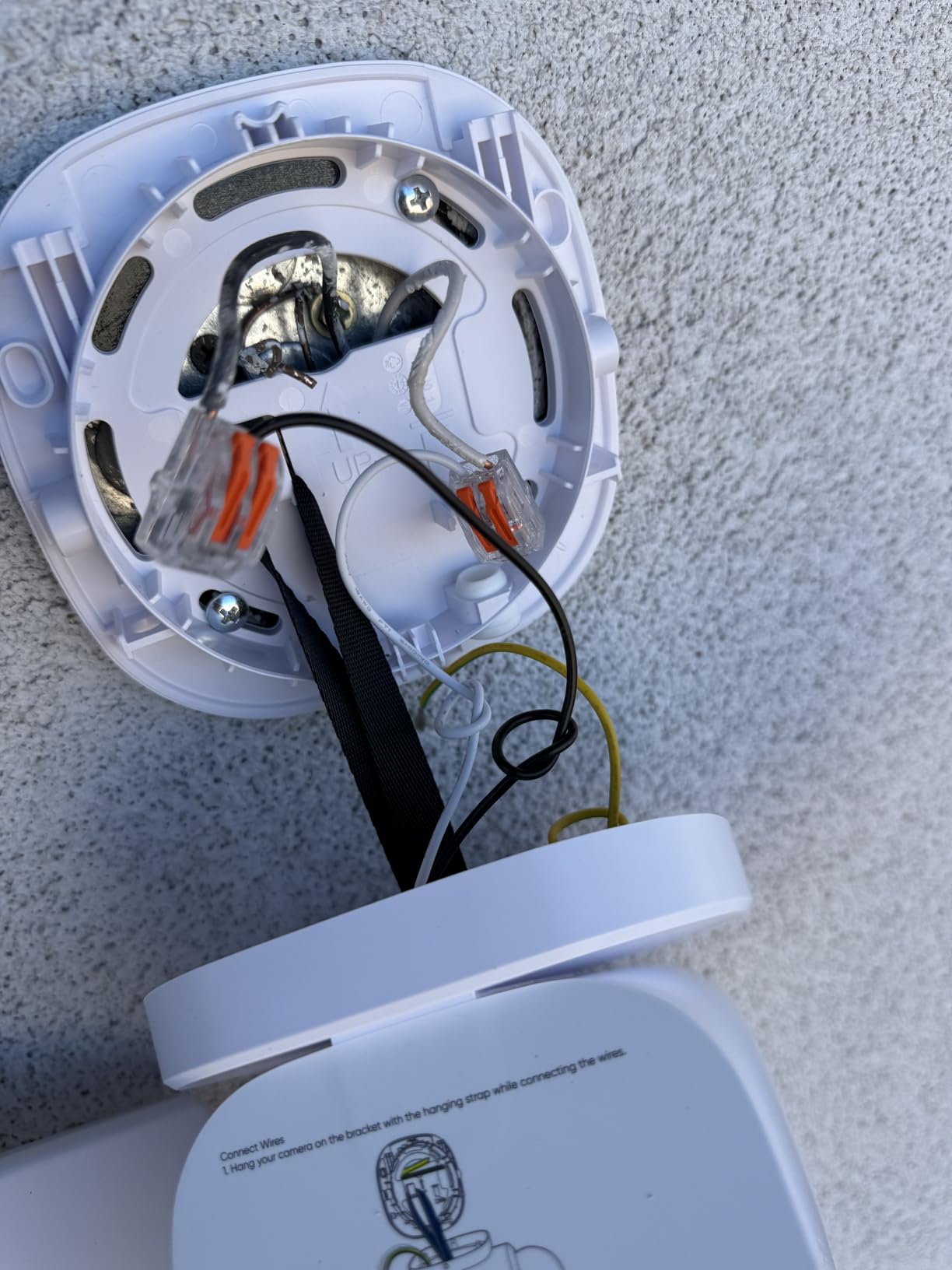
Recorded-event playback and AI alert tuning are less refined than some rival apps, and 20 fps is below the 30 fps typical of competitors, which makes fast motion slightly less smooth.
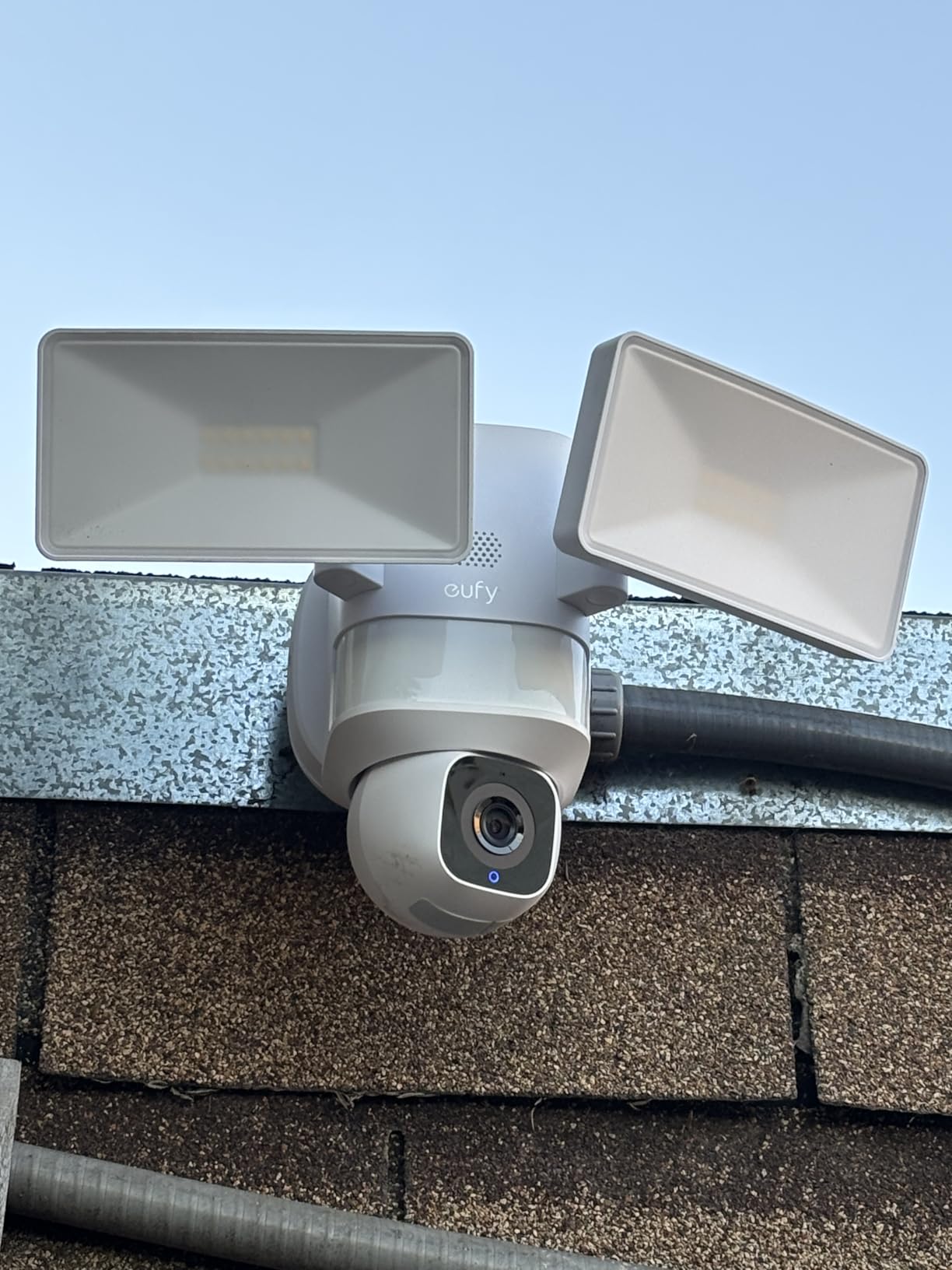
Check whether you need telephoto detail or wide tracking
This is the decision to make on this camera. The single 2K lens cannot deliver the E340’s distant detail, so if the point of your driveway camera is reading plates at range, choose the dual-lens model instead.
If instead you want to know that something crossed the drive at 2am, 360-degree tracking serves you better, and the brighter tracking behaviour is the feature you are paying for.
Check your network and wiring
2.4GHz only means this camera cannot connect to a 5GHz-only network. Check your router settings before installing, because that is a simple fix now and an afternoon of frustration later.
There is no battery or solar option here; hardwiring to an existing junction box is required, and the bracket may not fit an existing box without an adapter.
12. Google Nest Cam with Floodlight: Best On-Device AI Detection
Google Nest Cam with Floodlight – Outdoor Camera – Floodlight Security Camera, White, 1 Count (Pack of 1)
1080p HDR at 30 fps with 130-degree field of view
Automatic floodlight on important activity
One hour of local outage buffering
IP65 wall mount
Pros
- On-device intelligence distinguishes people animals and vehicles without a subscription
- Floodlight switches on automatically for important activity
- 1080p HDR video with night vision at 30 fps
- Stores up to an hour of events during an outage
- Two-way talk and emergency calls from the Google Home app
Cons
- Only three hours of free event history
- Face detection and 24/7 recording need Nest Aware Plus
- Fixed 1080p trails 2K and 3K rivals
- No pan or tilt so the 130-degree view is fixed
- No local storage option
The Nest Cam with Floodlight does the detection work on the camera itself rather than in the cloud. That means people, animals and vehicles are separated without a subscription, which matters on a driveway where passing traffic would otherwise generate a constant stream of meaningless alerts.
The floodlight switches on automatically when important activity is detected, and 1080p HDR video runs at 30 fps across a 130-degree field of view. Thirty frames per second is the smoothest in this roundup, which keeps fast-moving vehicles from looking stepped.
The most underrated feature is outage buffering. It stores up to an hour of recorded events locally during a Wi-Fi or power outage, which means a camera cut off by a storm still has something to show you afterwards.
Video quality stops at 1080p, which trails the 2K and 3K rivals, and there is no pan or tilt so the 130-degree view is fixed. Storage lives in the cloud with no local option, and extended history sits behind Nest Aware Plus.
Check what the free tier actually gives you
Three hours of event history is the free allowance. Longer retention, 24/7 recording and familiar face detection all require Nest Aware Plus. If you only need to catch a visitor in the moment, three hours is workable; if you need to review yesterday, it is not.
Because there is no local storage option at all, this camera is a poor fit for anyone specifically avoiding cloud subscriptions.
Check your ecosystem before installing
It works with Google Assistant, Alexa, tablets and televisions, so it is not locked to a single ecosystem. The trade-off is that the detection quality people praise is tied to the Google Home app’s notification handling.
At 2.6 pounds and powered from a wall adapter, this is a plug-in unit like the Tapo C500 rather than a hardwired floodlight, so plan the outlet location with that in mind.
How to Choose a Driveway Security Camera
Every camera above works on a driveway. What separates them is how far away you can identify something, whether the footage survives a bad Wi-Fi month, and what it costs you over three years. These are the decisions that actually move the outcome.
Resolution: how far you can really see
Long-driveway owners consistently report that 1080p becomes unusable beyond roughly 50 feet, with faces and license plates turning into shapes. The practical sweet spot for most driveways sits at 4MP to 5MP, which is where the Tapo C425 and the Reolink Argus Eco sit.
Higher resolution only helps if the camera can actually hold focus at that distance. A 2K sensor with a wide lens spreads those pixels too thinly to be useful. That is the argument for the eufy E340’s separate telephoto lens, and against simply buying more pixels in a wide-angle body.
Night vision: colour versus infrared
Infrared night vision records in black and white. It is reliable in total darkness, but a silver car and a white car look identical at 3am, and clothing colours vanish.
Colour night vision relies on a larger sensor, a spotlight or starlight illuminator, or some combination. The Tapo C425, the Nest Cam with Floodlight, the Blink floodlight and both eufy floodlights all produce usable colour. For vehicle identification, that difference decides cases.
Watch out for headlight blowout at the driveway entrance. IR glare off number plates is the most common ruined night recording, and only a physical hood or careful downward angle fixes it.
Power: battery, solar or wired
Battery is the easiest install and the most maintenance. Cold weather shortens battery life, and a camera at the end of a gravel drive is the hardest one to reach when it dies.
Solar removes charging entirely where the panel gets real sun, which is the only clean answer to a drive with no power. Keep the panel unobstructed and angle it well, and expect a small panel to fall short in a northern December.
Wired is the least troublesome long-term. No battery to cold-snap, no solar panel to position, no recharge schedule. It costs you either an outlet near the drive or an electrician.
Storage: local microSD versus a cloud subscription
This is the loudest objection in every home security forum, and it is entirely legitimate. Per-camera cloud subscriptions become genuinely expensive once you are covering several driveways, gates and rental units.
Local microSD changes the arithmetic. The Reolink Argus Eco and Argus PT, both Tapo cameras and the eufy floodlights all record to a card up to 128 or 512 GB with no monthly fee. The trade-off is that you manage the footage yourself, and a stolen camera takes its card with it unless you set up remote backup.
Our subscription-free camera guide compares the local-storage options in detail.
Connectivity: reaching the far end of a long driveway
Weak or absent Wi-Fi at the end of a long driveway is the single most common cause of failed recordings. The fix depends on distance.
Under about 80 feet, a dual-band camera such as the Ring Outdoor Cam or the Tapo C500 will usually cope. Beyond that, add a mesh node or an outdoor extender partway down the drive. Past roughly 300 feet, Wi-Fi stops being realistic and you need either a point-to-point wireless bridge or a 4G LTE cellular camera with its own data plan.
Several r/Ubiquiti builders in our research recommended dedicated PoE switches and external antennas for long runs. If you are running cable anyway, PoE gives you power and data on a single line and sidesteps the Wi-Fi problem entirely.
Placement: where and how high
Mount between 9 and 12 feet up and angle downward along the length of the drive. That height sees over parked cars without catching the sky, and the downward angle keeps plates facing the lens.
Avoid pointing into low sun, which blows out the whole frame for half the day. Check the drive at 8am, noon and dusk before you fix the bracket, because the angle that works at noon is rarely the angle that works at dusk.
Cover L-shaped or split drives with two mounts or a pan/tilt unit rather than trying to cover both from one position. Our outdoor camera roundup has more on multi-camera layouts.
How far can a camera read a license plate?
Realistically, a 1080p camera produces a usable plate image at roughly 25 to 30 feet in good daylight, and often not at all at night. A 2K camera pushes that to around 50 feet with a colour night sensor and a spotlight. At 100 feet you want a dedicated telephoto lens and a controlled light source, and even then the result depends on the angle of the plate and the vehicle’s speed.
Speed matters more than most buyers expect. A car travelling past at 30 mph covers a lot of ground between frames, and motion-triggered recording may start after it has already passed your best angle.
Frequently Asked Questions
Which security camera is best for recognizing license plates?
For plate capture at distance, the deciding factor is a telephoto lens rather than raw resolution. The eufy Floodlight Cam E340 pairs a 3K wide lens with a separate 2K telephoto reaching roughly 50 feet, which outperforms most single-sensor 2K cameras. Budget for a 2K or higher sensor with color night vision and a spotlight, and mount it high with a downward angle.
How far away can a security camera read a license plate?
Expect a 1080p camera to produce a readable plate at roughly 25 to 30 feet in good daylight and often not at all after dark. A 2K camera reaches around 50 feet when paired with color night vision and a spotlight. Beyond 100 feet you need a dedicated telephoto lens and controlled lighting, and vehicle speed starts to matter as much as sensor quality.
What’s the best outdoor security camera without a subscription?
The Reolink Argus Eco 2K 5MP with its included 3W solar panel is our pick for subscription-free operation. It records to a 512 GB microSD card, a Reolink Home Hub or an FTP server with no monthly fee at any stage. The Tapo C500, Tapo C425 and eufy E340 and E30 also offer local storage without ongoing charges.
What is the best security camera for long distances?
For long distances, combine a 2K or higher sensor with a wide field of view and reliable night performance. The Tapo C425 MagCam offers 2K QHD across a 142-degree view with full-color Starlight night vision, while the eufy E340 adds a telephoto lens for detail at roughly 50 feet. Confirm Wi-Fi reaches the mount point before installing anything.
Do I need a wired or wireless camera for my driveway?
Choose wired when an outlet or existing wiring sits near the driveway, since it removes battery cold-weather drain and solar placement entirely. Choose wireless or solar when no power reaches the mount point, which is the common case at the end of a long gravel drive. Ring and Blink floodlight models need hardwiring, while Reolink and Tapo battery units do not.
Can security cameras read license plates at night?
Yes, but only with the right hardware. Color night vision from a larger sensor or a starlight illuminator preserves the detail that infrared black-and-white footage throws away. The Tapo C425 and the floodlight units from Blink, eufy and Google produce usable color after dark. Expect nothing useful beyond roughly 50 feet without a telephoto lens.
Final Verdict: Which Driveway Camera Should You Buy
Start with the Ring Floodlight Cam Wired Plus. It has the highest rating and the deepest review base of anything we tested, and it handles the two things a driveway demands most: bright, colour night footage and zero battery maintenance.
If your drive is long, take the Tapo C425 MagCam instead for the 2K sensor, the 142-degree view and full-colour Starlight night vision. If there is no power at the far end, the Reolink Argus Eco with its solar panel is the answer, and it never asks you for a monthly payment. For zooming onto a distant plate, the eufy E340’s telephoto lens is the only proper tool on this list.
Whatever you pick, check the Wi-Fi at the mount point before you buy, mount between 9 and 12 feet aiming down the drive, and turn on person and vehicle detection so you are not scrolling through footage of headlights and stray dogs all winter.