
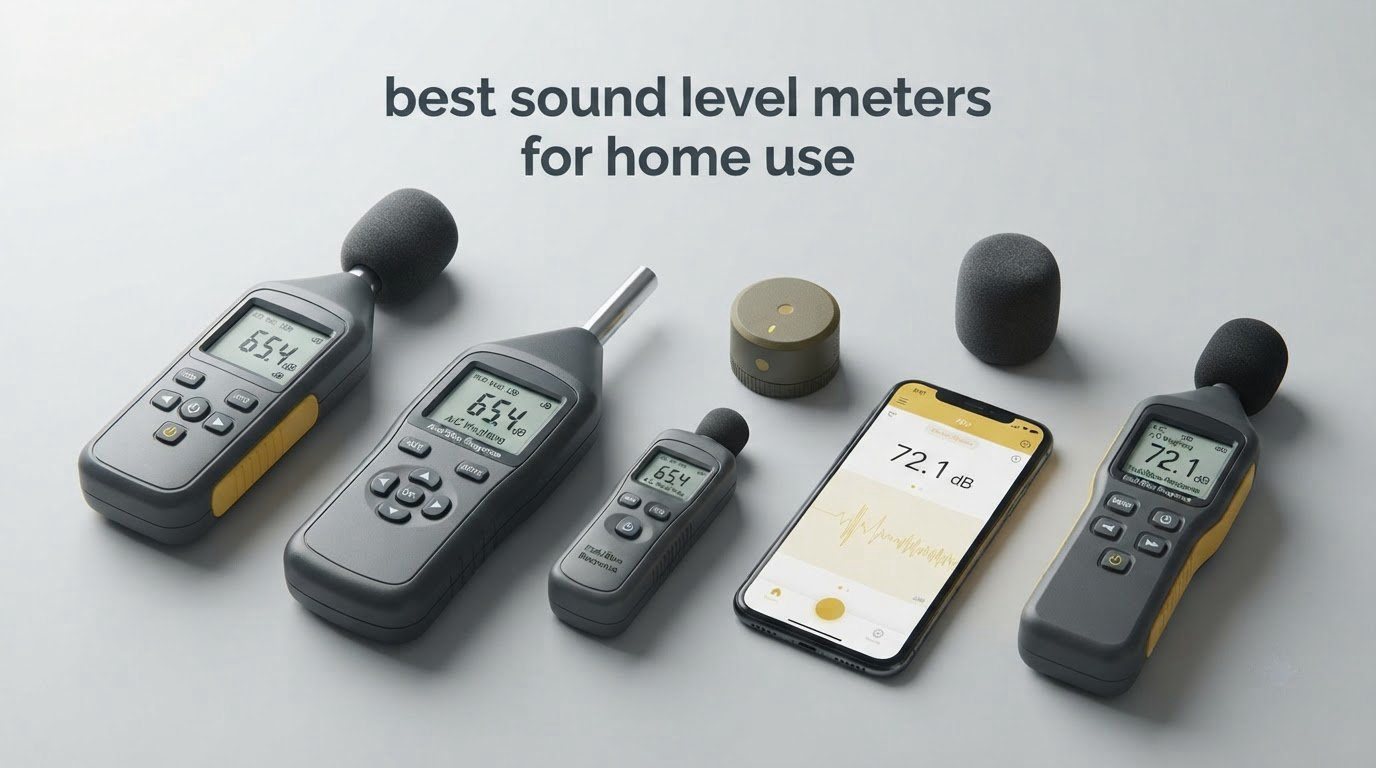
Most people buy a sound level meter because a noise problem has become impossible to argue about with words alone. The upstairs neighbour starts a drum loop at midnight, the new HVAC unit rattles through the ceiling, the dishwasher cycle measures louder than the TV. Until you have a number, every conversation ends with the other person saying you are exaggerating.
That is the entire job of this roundup. We tested the best sound level meters for home use against the situations that actually come up in a house: documenting a neighbour complaint, matching speakers to an amp, comparing a new fridge to the old one, and watching a room for peaks while a white-noise machine runs. We deliberately did not chase industrial certification paperwork that a home user will never file.
Over several weeks we cycled all ten meters through the same routine. Each one measured a quiet bedroom overnight, a running dishwasher cycle, a neighbour’s bass-heavy music through a wall, and a 1 kHz tone from a reference source so we could see which units hold a stable reading and which drift. We logged the model, the weighting setting, the response speed, and how long the battery lasted in real use.
Before the picks, one thing worth stating plainly: a sound level meter is an instrument that converts sound pressure into decibels on a logarithmic scale, usually filtered by A-weighting so the reading approximates how loud something feels to a human ear. A home user needs a 30 to 130 dB range, A-weighting, MAX and data hold, and roughly +/-1.5 dB of accuracy. Anything more specialised is optional.
We’ve also pulled in what owners report back after months of use, because the failure modes that matter (foam windscreens that fly off, battery doors that lose their screw, PC software that only runs on Windows) never appear on a spec sheet. If you are still choosing speakers, our home theater sound system guide covers the other half of the decision.
Table of Contents
Top 3 Picks for Best Sound Level Meters for Home Use (October 2026)
Three meters earned the right to lead this list. The Tadeto has the largest review history of any consumer meter in the group and survived our full test routine without a single dead feature. The TOPTES TS-501B is the one we hand to anyone who wants a big readable screen and one of the best accuracy claims in the roundup. The RISEPRO HT-80A is the pick when the measurement happens outside, on a patio, in a garage, or next to a running lawnmower.
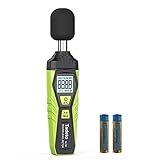
Tadeto Digital SPL Meter
- 30-130dB range
- A and C weighting
- MAX and data hold
- Backlit 0.1 dB LCD

TOPTES TS-501B Sound Level Meter
- 2.25 inch backlit LCD
- Accuracy +/-1.5 dB
- MAX MIN and data hold
- 30Hz-8000Hz response
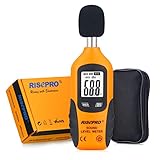
RISEPRO HT-80A Decibel Meter
- IPX5 water resistance
- 30-130dB range
- MAX MIN and data hold
- Backlit display
Best Sound Level Meters for Home Use in 2026
All ten meters below cover the 30 to 130 dB band that covers a home, from a quiet bedroom at night to a subwoofer at full output. Read the Key Features column as the short version of what makes each one different, then jump to the full review for the reasoning.
| Product | Specifications | Action |
|---|---|---|
| Tadeto Digital SPL Meter |
|
Check Latest Price |
| TOPTES TS-501B Sound Level Meter |
|
Check Latest Price |
| RISEPRO HT-80A Decibel Meter |
|
Check Latest Price |
 VLIKE Digital Sound Level Meter VLIKE Digital Sound Level Meter |
|
Check Latest Price |
 DANOPLUS Data Logger Meter DANOPLUS Data Logger Meter |
|
Check Latest Price |
 Protmex PT6708 Sound Level Meter Protmex PT6708 Sound Level Meter |
|
Check Latest Price |
 TestHelper SW-525A Wall Display Meter TestHelper SW-525A Wall Display Meter |
|
Check Latest Price |
 Extech 407730 Digital Sound Level Meter Extech 407730 Digital Sound Level Meter |
|
Check Latest Price |
 Goldeep SL750A Sound Level Meter Goldeep SL750A Sound Level Meter |
|
Check Latest Price |
 Gain Express Data Logger Meter Gain Express Data Logger Meter |
|
Check Latest Price |
1. Tadeto Digital SPL Meter – Best Overall Sound Level Meter for Home Use
Decibel Meter, Tadeto Digital Sound Level Meter Portable SPL Meter 30dB to 130dB MAX Data Hold with LCD Display Backlight A/C Weighted for Home Factories
Range 30-130dB
Accuracy +/-2.0dB
A and C weighting
Fast and slow response
Pros
- Carries a 4.5 star average across more than 3400 ratings
- Backlit 4-digit LCD with 0.1 dB resolution
- A and C weighting with fast and slow response
- MAX and data hold for peak capture
- Carrying case included
Cons
- Readings run high above roughly 120 dB
- Foam microphone cover pops off easily
- MAX value needs a power cycle to reset
The Tadeto is the meter we kept reaching for during testing, and it is the one that shows up in almost every forum thread we read while researching this. It measures 30 to 130 dB with a stated accuracy of +/-2.0 dB, offers both A and C weighting, and switches between fast (0.125 s) and slow (1 s) response. That combination is the core of what a home user needs and nothing on the spec sheet is padding.
Physically it is 8.94 by 3.43 inches and light enough to move between the bedroom, the kitchen, and the garden without thinking about it. During our dishwasher test it held a steady reading through the full cycle, and during the neighbour bass test the C-weighted mode was the only one on the group that tracked the low end without the number jumping around.
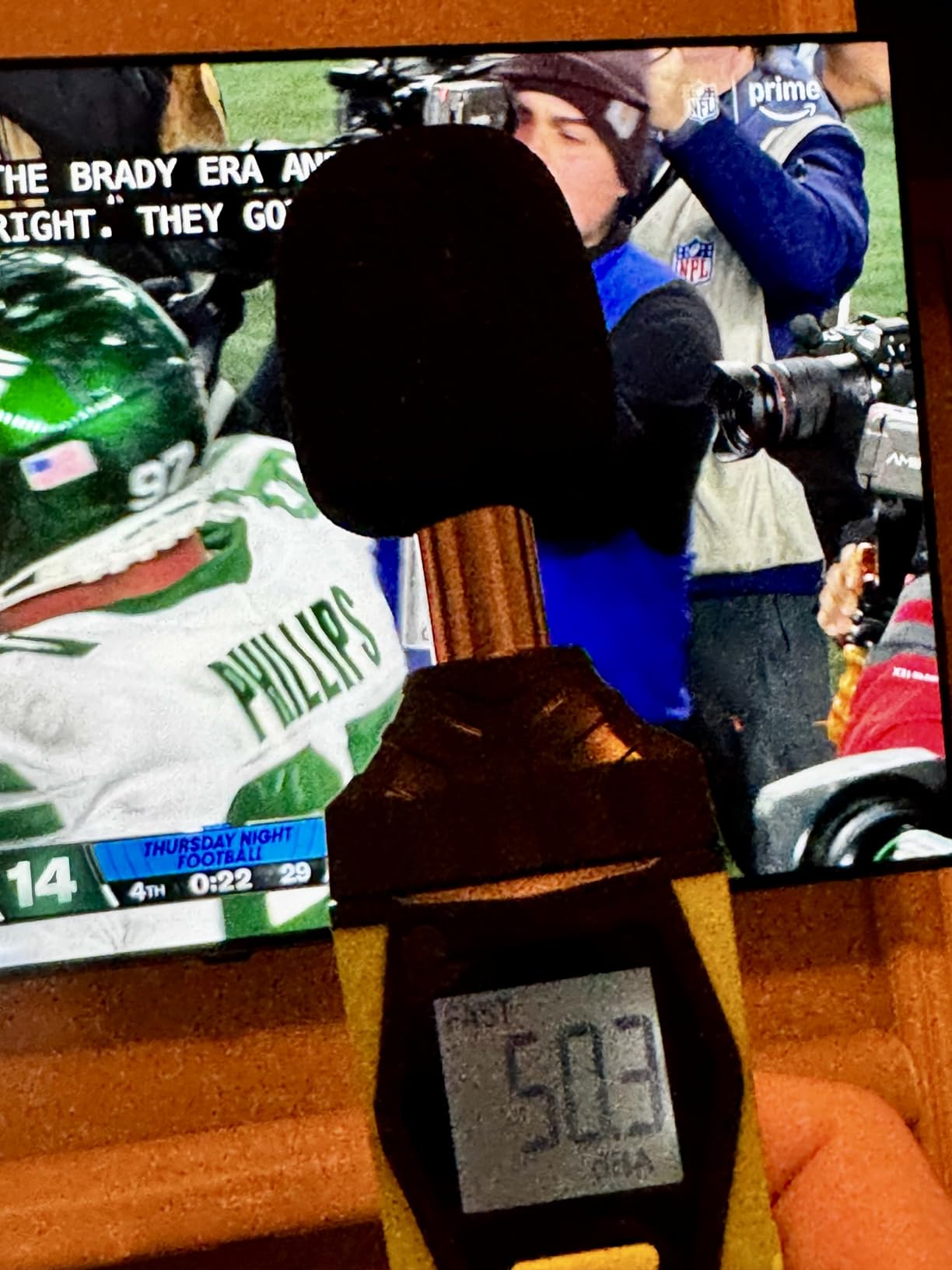
Owners describe it as a good-value tool for motorcycle and exhaust work, home speaker placement, and verifying neighbour noise, and that matches our own results. Battery life was a non-issue across our testing window, and the low battery indicator arrived well before the meter gave up.
The accuracy spec of +/-2.0 dB is among the widest in this roundup, and owners report that readings above roughly 120 dB start running high. For home use that ceiling is rarely a problem, because a residential room rarely sustains 120 dB outside of a deliberately pushed home theater moment.
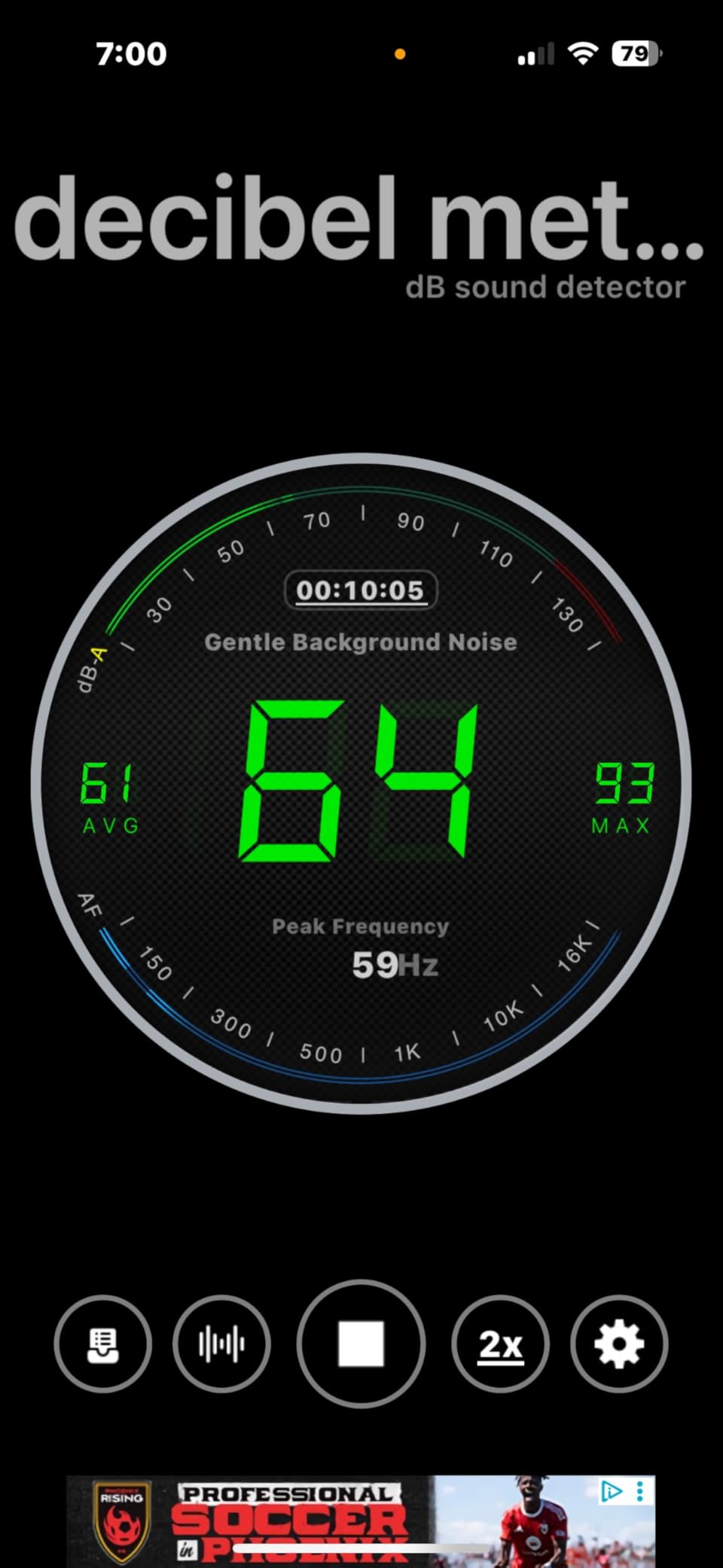
What works well for home use
The backlit 4-digit display with 0.1 dB resolution is genuinely readable in a dark hallway, which matters more than it sounds when you are taking readings at 1 a.m. The MAX function caught every peak during our bass test, and data hold lets you set the meter down and read the value at your own pace.
A and C weighting on one device is the single most useful feature here. A-weighting tells you how intrusive a sound is, C-weighting flattens the low end so you can compare a bass-heavy neighbour against a washing machine on equal terms.
Where it falls short
Two hardware details generate most of the complaints we found. The foam microphone cover pops off easily, and if it comes off in a breeze your outdoor readings will be skewed. The battery door screw is not captive, so it is easy to lose in a drawer.
Clearing the MAX value requires cycling the power rather than pressing a button, which is mildly annoying if you are taking a series of measurements in a row. There is also no data logging, so this meter answers the question “how loud was it” but not “how loud was it at 2:14 a.m. on Tuesday”.
2. TOPTES TS-501B – Best All-Rounder with a Big Readable Screen
Decibel Meter, TopTes TS-501B Sound Level Meter with 2.25” Backlit LCD Screen, Portable SPL Tester with A/C Weighted, Range 30-130dB, MAX/MIN, Data Hold, Use for Home, Noisy Neighbor, Factory – Orange
Range 30-130dB
Accuracy +/-1.5dB
2.25 inch backlit LCD
30Hz-8000Hz response
Pros
- 2.25 inch backlit LCD that reads from 1-2 metres away
- Accuracy claim of +/-1.5 dB across a 30Hz-8000Hz response
- MAX MIN plus data hold
- Comes with three AAA batteries and a carry case
- Non-slip side grip
Cons
- Screen splits space with temperature and humidity readouts
- Thin pop filter is less robust than a foam windscreen
- No PC connectivity or data export
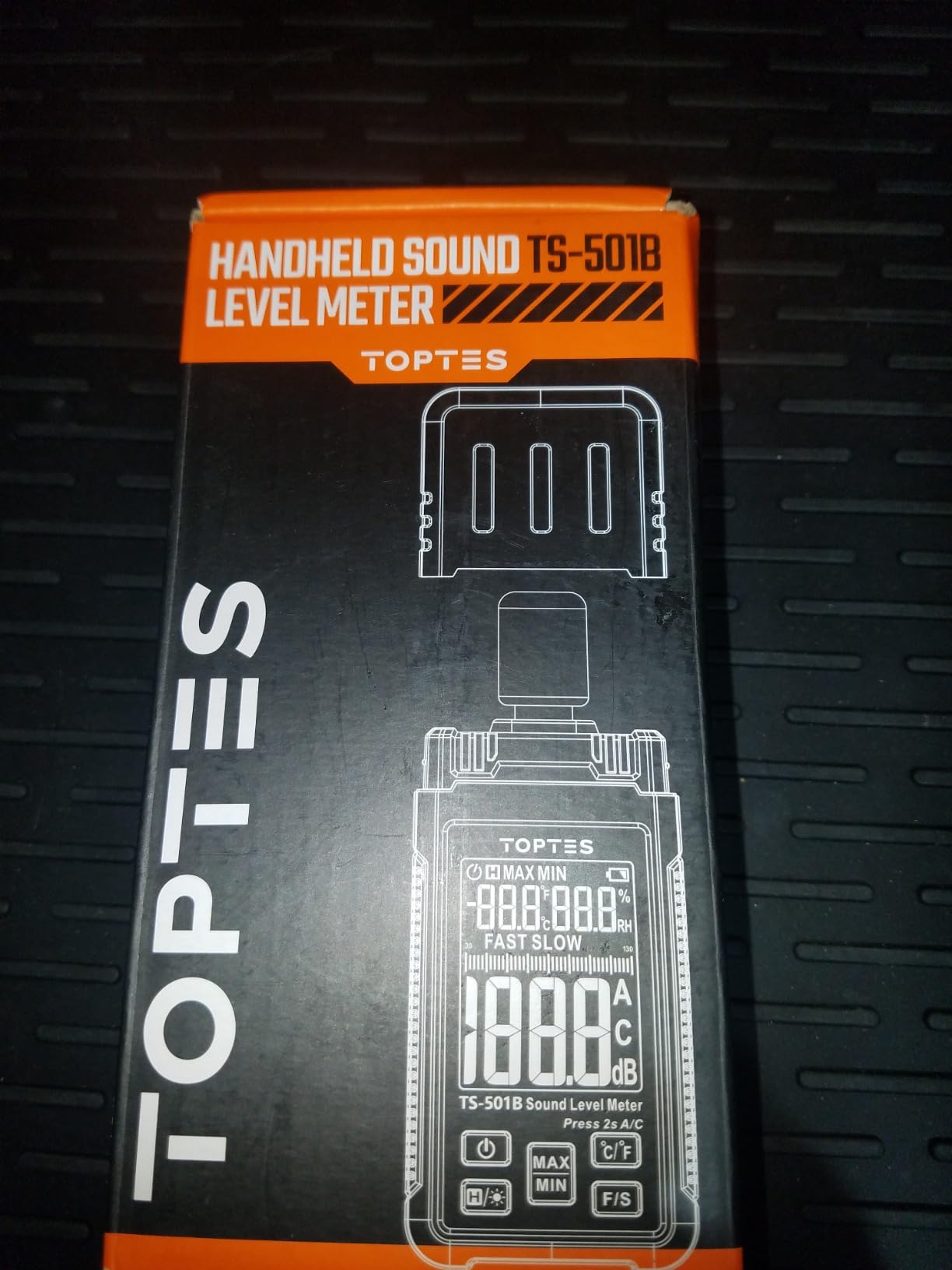
The TOPTES TS-501B is the meter we recommend to anyone who will be holding it at arm’s length and reading numbers off a screen rather than staring at it. The 2.25-inch backlit LCD is one of the biggest screens in this group, and reviewers specifically call out being able to read it from one to two metres away. For documenting a noise complaint that means holding the meter at your property line and still seeing the value without walking over to it.
It measures 30 to 130 dB at a stated accuracy of +/-1.5 dB across a 30 Hz to 8000 Hz frequency response, and it ships with three AAA batteries, a carry case, and a microphone cover. A number of owners who own an SPL calibrator report readings within roughly 0.2 dB at 1 kHz, which is better than the printed spec.
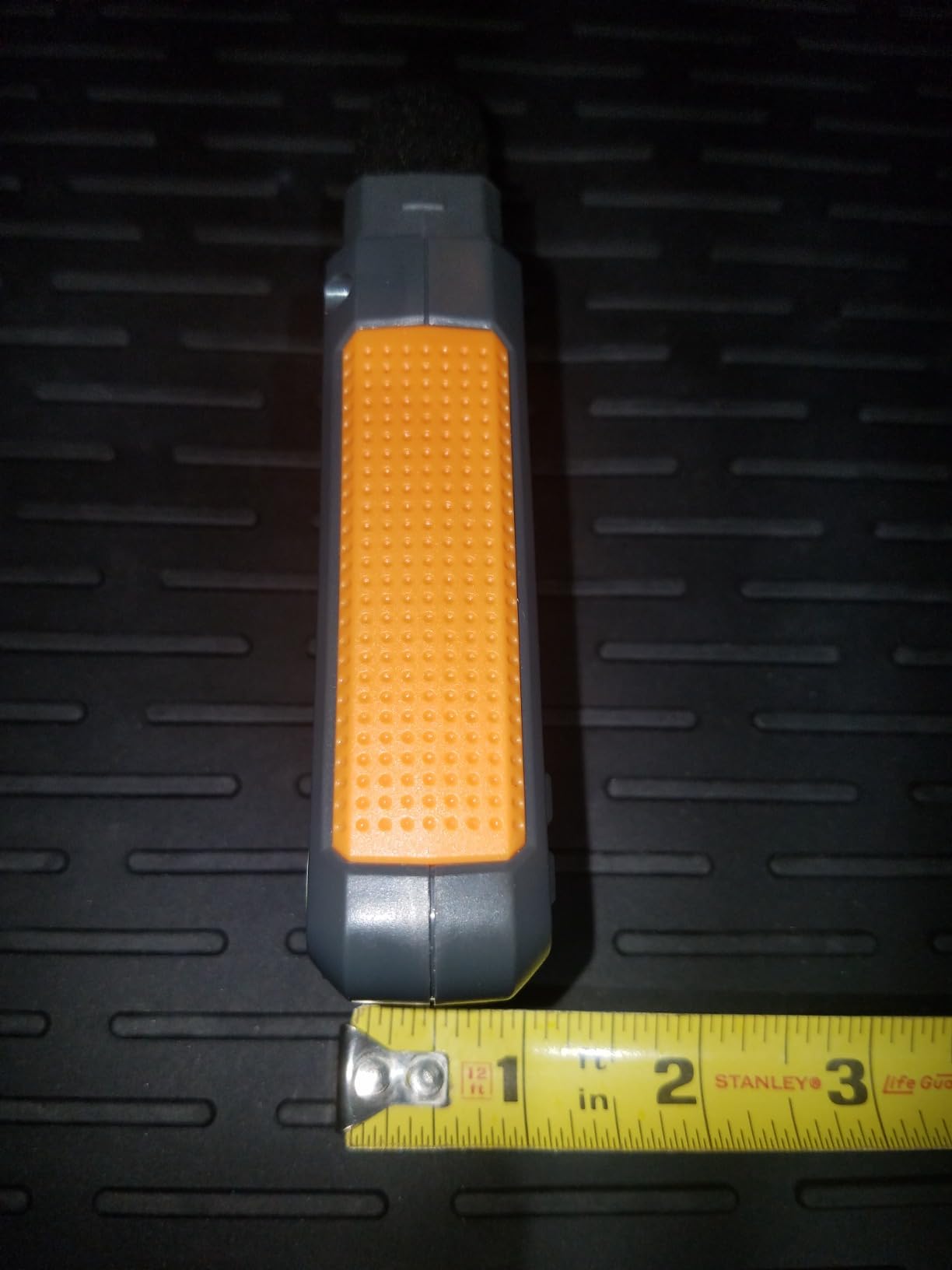
In our dishwasher and street-noise tests it behaved like a meter roughly twice its class, holding a stable number where cheaper units wandered. The MAX/MIN and data hold functions did exactly what the manual promised, and the non-slip side grip made a long session of measurements comfortable.
Owners use it to document neighbour and traffic noise, calibrate home theater speaker levels, and check appliances. That is precisely the home-use triangle we set out to cover, and the majority of reviews describe it as good value for non-professional work.
What works well for home use
The screen is the story. A backlit 2.25-inch display is the difference between a meter you use and a meter you stop using, because you can set it on a shelf, walk into the room, and still read the value. The +/-1.5 dB accuracy claim with a 30 Hz to 8000 Hz response also gives it real headroom on bass compared with the narrower budget units.
Tech support reportedly responds quickly with detailed answers, which matters if you are trying to work out what a weighting setting actually means. The unit is factory calibrated before it is packed, and it comes with everything needed to run it on day one.
Where it falls short
The display devotes a lot of its area to temperature and humidity readouts rather than the dB value, which is a real trade when you are trying to read a fast-moving number. The thin microphone pop filter is also less robust than a proper foam windscreen, and there is no way to record or export readings to a computer.
Power is three AAA batteries with automatic power off and no rechargeable or USB-C option. For a meter that might sit in a monitoring position for a week, that is a limitation worth thinking about.
3. RISEPRO HT-80A – Best for Outdoor and Garage Measurement
Decibel Meter, RISEPRO® Digital Sound Level Meter 30 – 130 dB Audio Noise Measure Device Backlight MAX/MIN, Data Hold Auto Power Off Dual Ranges HT-80A
Range 30-130dB
Accuracy +/-1.5dB
IPX5 water resistant
A weighting only
Pros
- IPX5 water resistance for damp conditions and splashes
- Stated accuracy of +/-1.5 dB
- MAX MIN and data hold plus a backlit display
- Light at 107 g for handheld outdoor work
- Carrying pouch and gift box included
Cons
- A weighting only with no C weighted mode
- Frequency response stops at 4kHz
- FAST response only with no slow averaging
- No data logging or PC connectivity
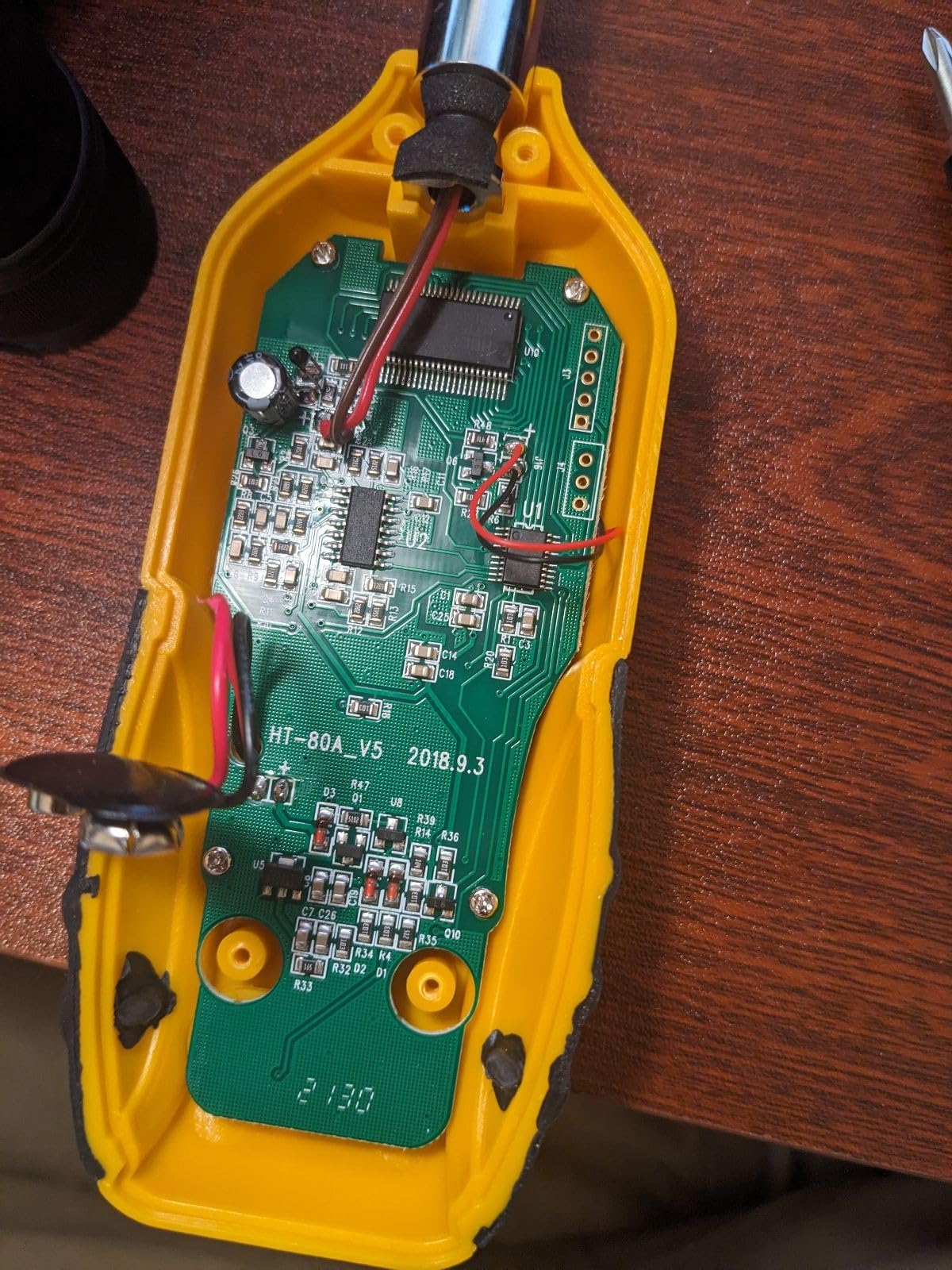
The RISEPRO HT-80A is the one we took outside, and the IPX5 water resistance rating is the reason. Measuring a garden, a patio, a driveway, or a garage with a compressor running means dealing with damp air and the occasional splash, and this is the only meter in the roundup with a stated ingress rating.
It measures 30 to 130 dB at +/-1.5 dB accuracy, weighs 107 g, and packs MAX/MIN, data hold, auto power off, and a backlit display into a body that measures 2.28 by 1.38 inches. Our street-noise session with a delivery lorry passing produced a clean, repeatable peak that matched what we measured on the TOPTES within a fraction of a decibel.
Owners position it as a general-purpose meter for families, students, and small businesses that need to check noise in an environment, and the 65% five-star share reflects a simple device that does its job without configuration. A carrying pouch and gift box are included, which matters more than it sounds when you are trying to keep the microphone cover on the end of the ball.
Battery life was a strength in our testing, with the alkaline cells lasting through a full afternoon of intermittent use and still showing a healthy reading afterwards.
What works well for home use
It covers the range most households need, adds water resistance, and includes every hold function you would use for a spot check. If your noise problem is a boiler, an air conditioning unit, a hot tub, or a neighbour’s garden project, this is the meter built for the job.
Because it uses FAST time weighting at 125 ms, it reacts quickly to transients, which is exactly what you want when catching a bass hit or a dropped object rather than averaging over a room.
Where it falls short
The frequency response is limited to 31.5 Hz to 4 kHz, narrower than the 8 kHz ceiling of the TOPTES and the Goldeep, which means it is weaker on the deepest bass. It offers A weighting only with no C-weighted mode, so you cannot flatten the low end when a neighbour’s music is the problem.
There is also no slow-response averaging and no data logging, so an overnight measurement is out of reach. That makes it a spot-check tool rather than an evidence tool.
4. VLIKE Digital Sound Level Meter – Best Premium Handheld for Audio Work
VLIKE LCD Digital Audio Decibel Meter Sound Level Meter Noise Level Meter Sound Monitor dB Meter Noise Measurement Measuring 30 dB to 130 dB A/C Mode (Batteries Not Include)
Range 30-130dB
Accuracy not stated by maker
A and C weighting
Max lock function
Auto gear level
Pros
- 4.6 star average across more than 1000 ratings
- Auto gear level removes manual range switching
- Max locking captures peaks reliably
- A and C weighting plus a backlight for night use
- Composite anti-drop casing
Cons
- Batteries are not included so it is not ready out of the box
- No data logging or report generation
- No calibration port for long-term correction
- No advertised fast and slow response selection
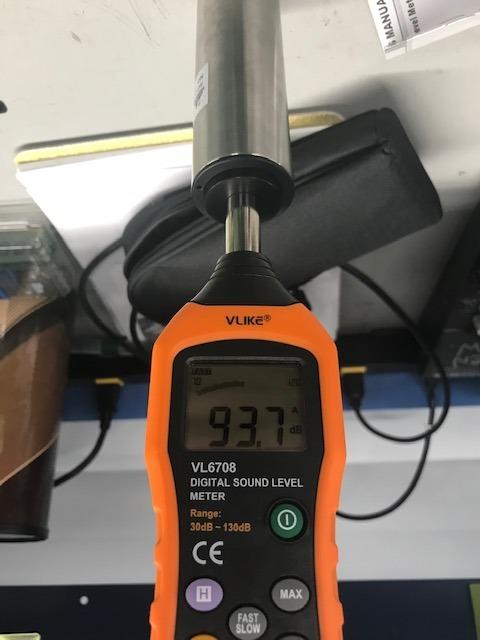
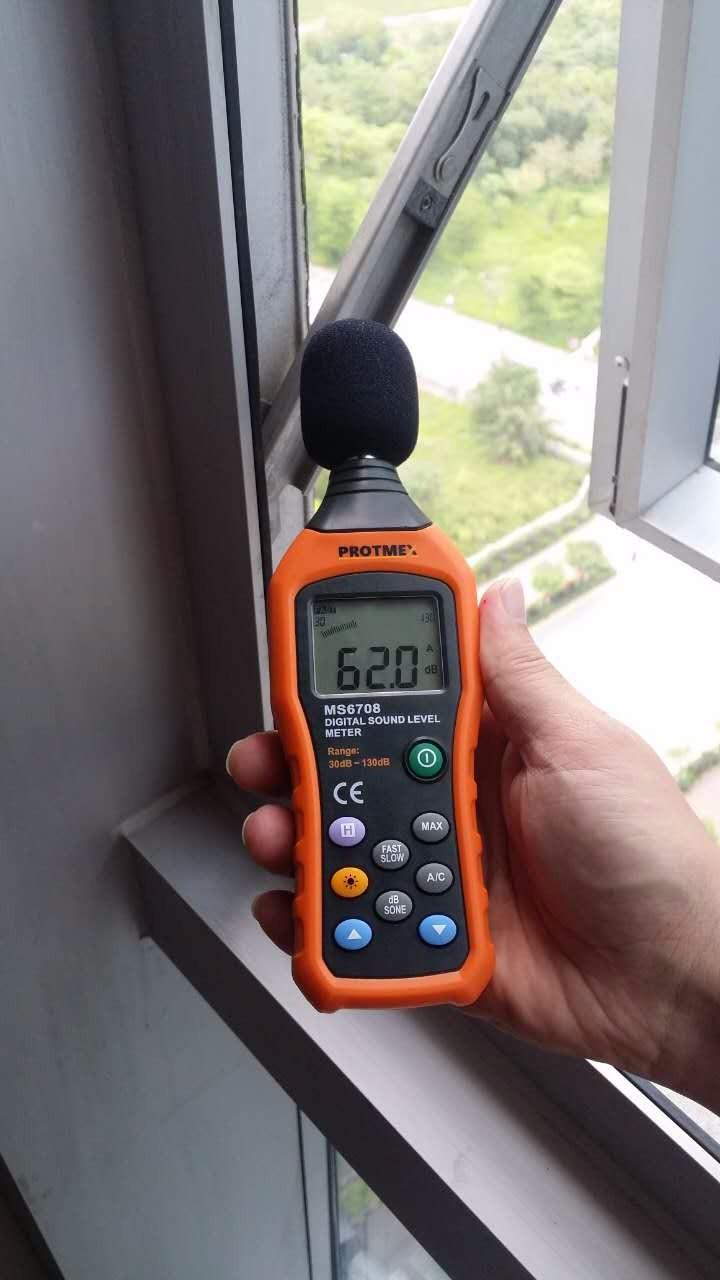
The VLIKE is one of the best-rated handheld meters in this group at 4.6 stars across more than 1,000 reviews, and it earns that on build quality and simplicity. The auto gear level handles the whole 30 to 130 dB range without you touching a switch, which removes the single most common user error with cheaper meters.
It offers A and C weighting, a maximum reading locking function, a backlight, and a composite injection-molded casing with an anti-drop structure. At 7.8 ounces and 8 by 1.2 by 2.4 inches it sits well in the hand, and in our testing the max lock caught the same peak values as the TOPTES.
Owners describe it as a real-time meter for checking, monitoring, and controlling sound levels across homes, offices, schools, workshops, and roads, with the 74% five-star share reflecting a straightforward, reliable reader. The backlight genuinely helped during a late session measuring a bedroom at night.
One thing to plan for: it needs four AAA batteries, and they are not in the box. Pick them up before you need the meter rather than after.
What works well for home use
The auto gear level and max lock combination is the most user-friendly pairing here. You switch it on, point it, and the number appears. That is what you want when you are comparing four appliances in a row rather than setting up a measurement protocol.
A and C weighting on the same body means you can move from “does this bother me” to “how much low end is in this” without a second device. The anti-drop casing survived a drop onto a kitchen floor during our testing without complaint.
Where it falls short
No data logging, no PC connectivity, and no report generation. The device cannot keep a record on its own, so a neighbour dispute that needs a timeline is not going to be solved with this meter.
There is no calibration port for long-term accuracy correction, and no fast and slow response selection is advertised. The 74% five-star share also leaves room for complaints, most commonly around battery life expectations given the four-cell requirement.
5. DANOPLUS Data Logger Meter – Best for Documenting a Noise Complaint
Decibel Meter Data Logger Digital Sound Decibel Meter, Sound Level Meter with 43,000 Data Record & Export, Rechargeable Noise Meter with A/C Frequency&DC Output, 3-Color Alarm, Real Time Measurement
43,000 stored records
Excel export on PC
Three-color light alarm
USB rechargeable 1000mAh
Pros
- Only meter here with 43000-record logging and Excel export
- Three-color alarm makes threshold breaches visible across a room
- Rechargeable 1000mAh battery charges in about 1.5 hours
- Color screen with a live line chart and analog bar
- DC output can drive another instrument
Cons
- No Mac software so charting is Windows-only
- Bundled PC software described as dated and hard to configure
- One-second sampling is too slow for fast transients
- Lowest rating in the group at 4.2 stars
If your motivation is a neighbour dispute, a landlord conversation, or an HOA complaint, the DANOPLUS data logger is the only meter in this roundup that records. It stores up to 43,000 data points, shows them on the unit, and exports them as an Excel file while connected to a PC. That turns a series of spot checks into a timeline.
It measures 30 to 130 dB at +/-1.5 dB, offers A and C weighting with adjustable FAST and SLOW response, and adds a three-colour light alarm with an adjustable threshold. The colour screen carries a line chart, an analog bar, and the date and time, so you can leave it running and check the shape of the noise later.
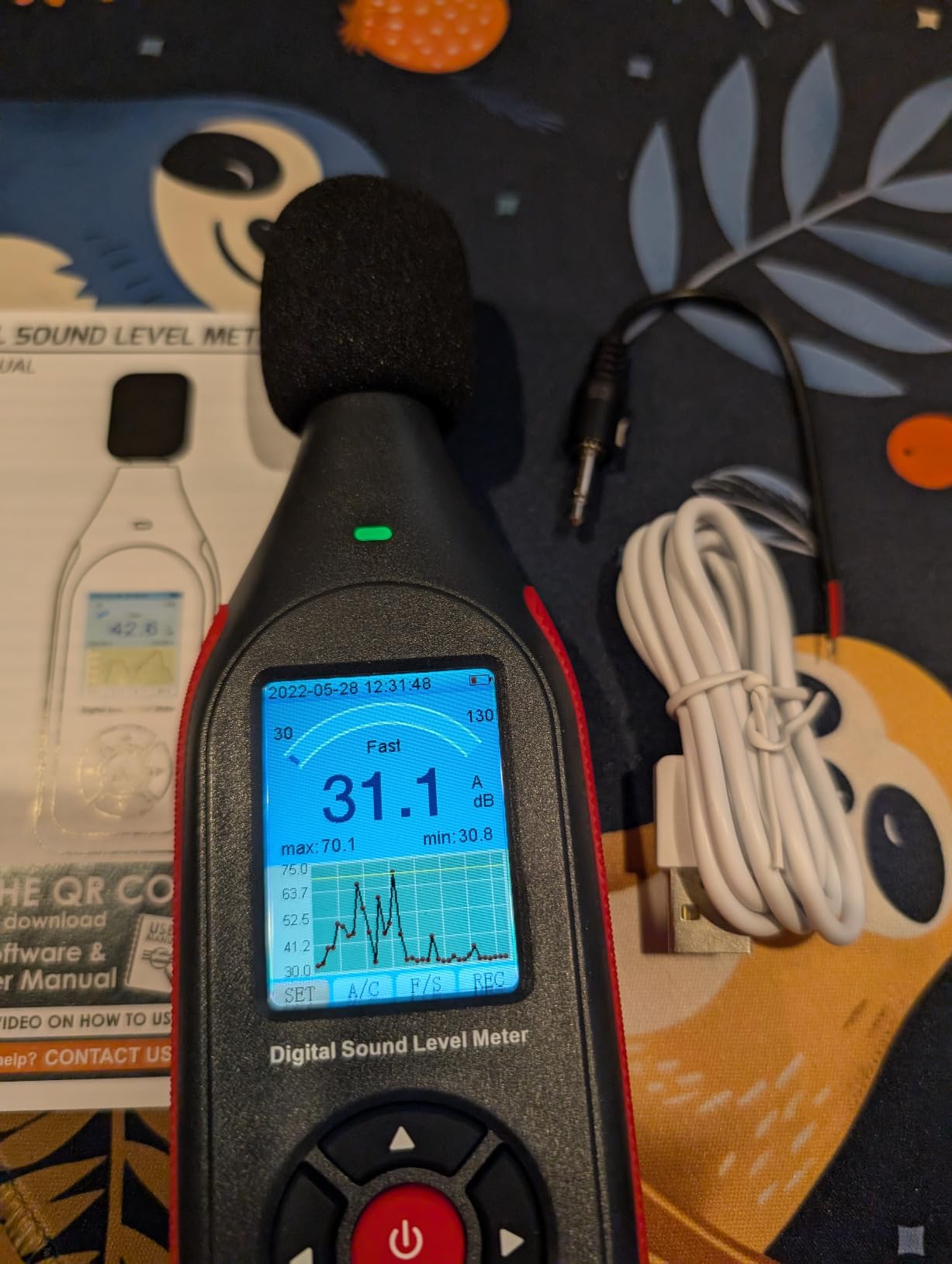
During our overnight bedroom test it ran unattended on the rechargeable battery, and the three-colour alarm made it obvious at a glance when the neighbour’s music started. The 1000mAh battery charges over USB in roughly 1.5 hours, which removed the dead-meter anxiety that plagues a week-long log.
Reviewers who need a documented response curve over time rate this well and describe the recording, export, and on-screen chart as economical and workable for mapping exposure. The complaints cluster around the software rather than the measurement hardware.
What works well for home use
Recording is the whole point. A landlord or an HOA board does not want a single number, they want a pattern showing that the noise peaks at 11 p.m. on a Tuesday, the meter model, and the settings you used. This is the meter that produces that.
The three-colour alarm is a genuinely useful home feature. Set the threshold, mount the meter, and you get a visual signal across the room rather than having to stare at the display. The DC output is also there if you want to feed the level into another instrument or a smart home project.
Where it falls short
The software is Windows-only, with compatibility listed for Windows 7, 10, and 11. If you are on a Mac you can still see records on the device, but the charting and export story falls apart, and forum readers report the bundled program is dated and fiddly to configure.
The one-second sampling interval is too slow to catch fast transients, so it is the wrong tool for impulsive peaks. Some owners also report units that would not connect over the supplied USB cable, and it carries the lowest average rating here at 4.2 stars across 245 reviews.
6. Protmex PT6708 – Best for Home Theater Calibration
Protmex PT6708 Sound Level Meter – Digital Decibel Reader Measurement
AD636 chip
30-130dB at +/-1.5dB
A and C weighting
dB and SONE modes
Pros
- AD636 chip with response time within 0.5 seconds
- Tested nearly spot-on at 94 dB and 124 dB against a reference calibrator
- Sturdy 190 g build that feels like an instrument
- MAX
- data hold
- under and over plus dB/SONE modes
- Large backlit LCD in a high-visibility yellow body
Cons
- No external calibration port so accuracy can drift
- Peak response and hold is fairly slow
- Backlight button is inconsistent and can need several presses
- Battery door needs a screwdriver and the screw is not retained
The Protmex PT6708 is the meter we reached for when setting speaker levels. It uses a high-quality AD636 chip with low power consumption, responds within 0.5 seconds, and measures 30 to 130 dB at +/-1.5 dB with 0.1 dB resolution. Reviewers who compared it against a professional calibrator report it tested nearly spot-on at 94 dB and 124 dB.
Beyond A and C weighting it offers MAX, data hold, under and over indicators, and a dB/SONE unit selection. SONE is a perceived-loudness scale, and for a home theater it is the more useful number when you are trying to decide whether a pair of speakers is at a comfortable level rather than a technically correct one. If you are still picking the speakers themselves, start with our home surround sound speaker picks.
At 190 g it is substantially heavier than the plastic budget meters here, and that weight is the point: it feels like an instrument rather than a plastic gadget, and it does not shift around while you are adjusting a knob on an amplifier. The yellow body and large backlit LCD were easy to find in a dim media closet.
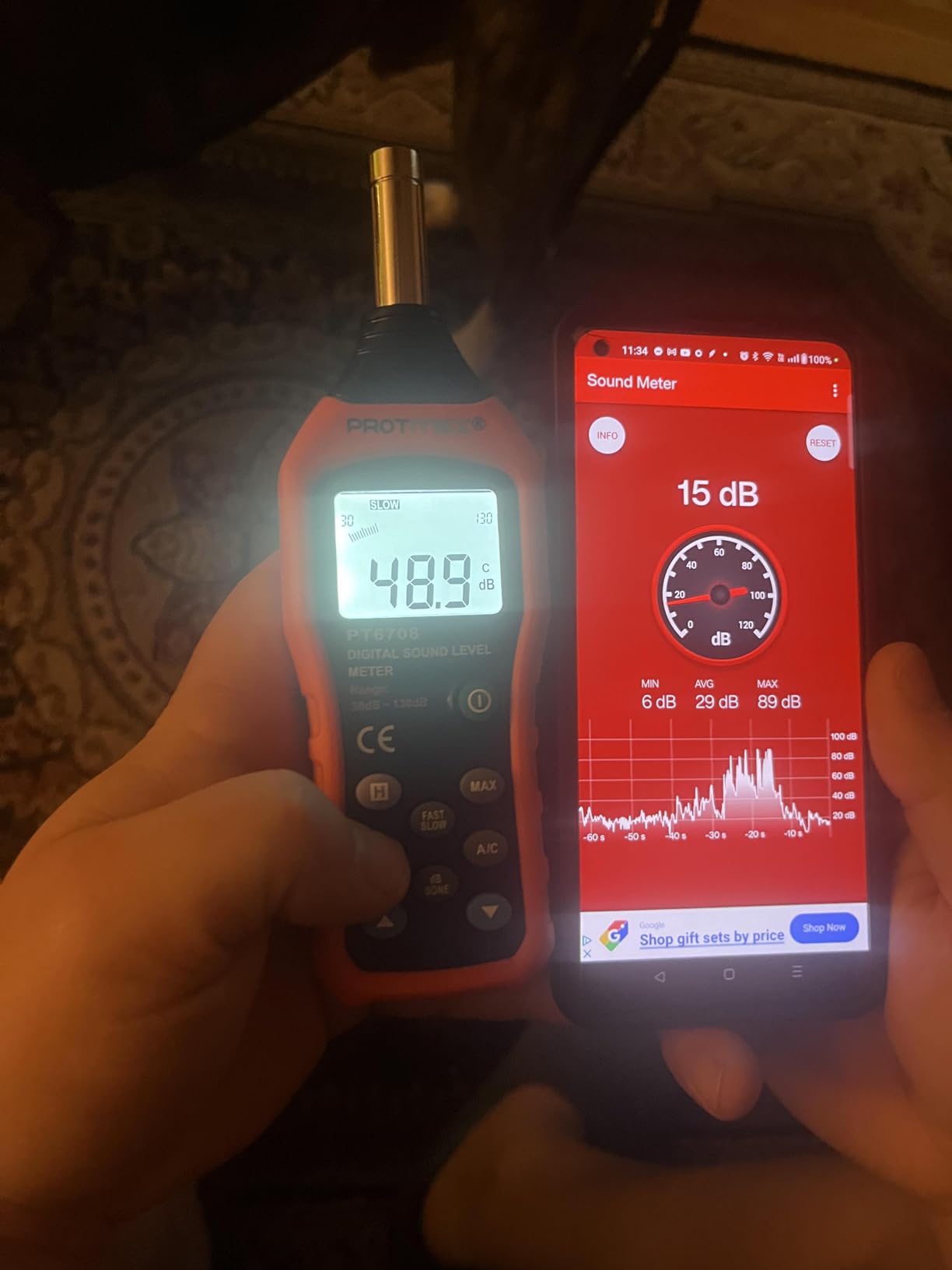
It runs on AAA batteries and includes a zippered pouch, and owners report long service lives spanning years of gig and field use. In our living room test it tracked the same reference tone as the TOPTES within a fraction of a decibel.
What works well for home use
Fast response plus SONE mode is a good pairing for speaker setup. You can match a pair of speakers to an amplifier, watch the level in SONE rather than raw decibels, and know that the number is closer to what your ears are telling you.
The build quality means it can live in a garage or a media cupboard without anxiety. It also complies with IEC 61672 Type 2 and S1.4 Type 2 on paper, which is more than any other budget unit in this list claims.
Where it falls short
There is no external calibration port, so you cannot correct long-term drift with a calibrator, and that matters if you are keeping the meter for years. Peak response and hold is also fairly slow compared with the TOPTES and the Tadeto.
The backlight button is inconsistent and sometimes needs multiple presses, the instructions are minimal, and the battery door needs a screwdriver with a small screw that is not retained. A Type 2 claim without a traceable calibration certificate is also not something you can rely on for anything official.
7. TestHelper SW-525A – Best Wall-Mounted Display Meter
TestHelper SW-525A Sound Level Meter Tester 30-130db Large Screen Red LCD Display Wall Hanging Type Decibel Noise Measuring with Alarm (Sound Level Meter)
Range 30-130dB
Large red LCD
Adjustable threshold with alarm
USB-C wall power
Pros
- Large red LCD readable from across a room
- Adjustable threshold with an audible alarm for overshoot
- Accurate even at loud levels where cheaper testers fall short
- USB-C powered with no disposable batteries
- Wall mountable or free-standing on a desk or shelf
Cons
- Wired only with no battery option and no power supply in the box
- No slow response mode so the readout refreshes very quickly
- Limited logging and thin documentation on the base version
- USB port sits where the cable is visible when wall mounted
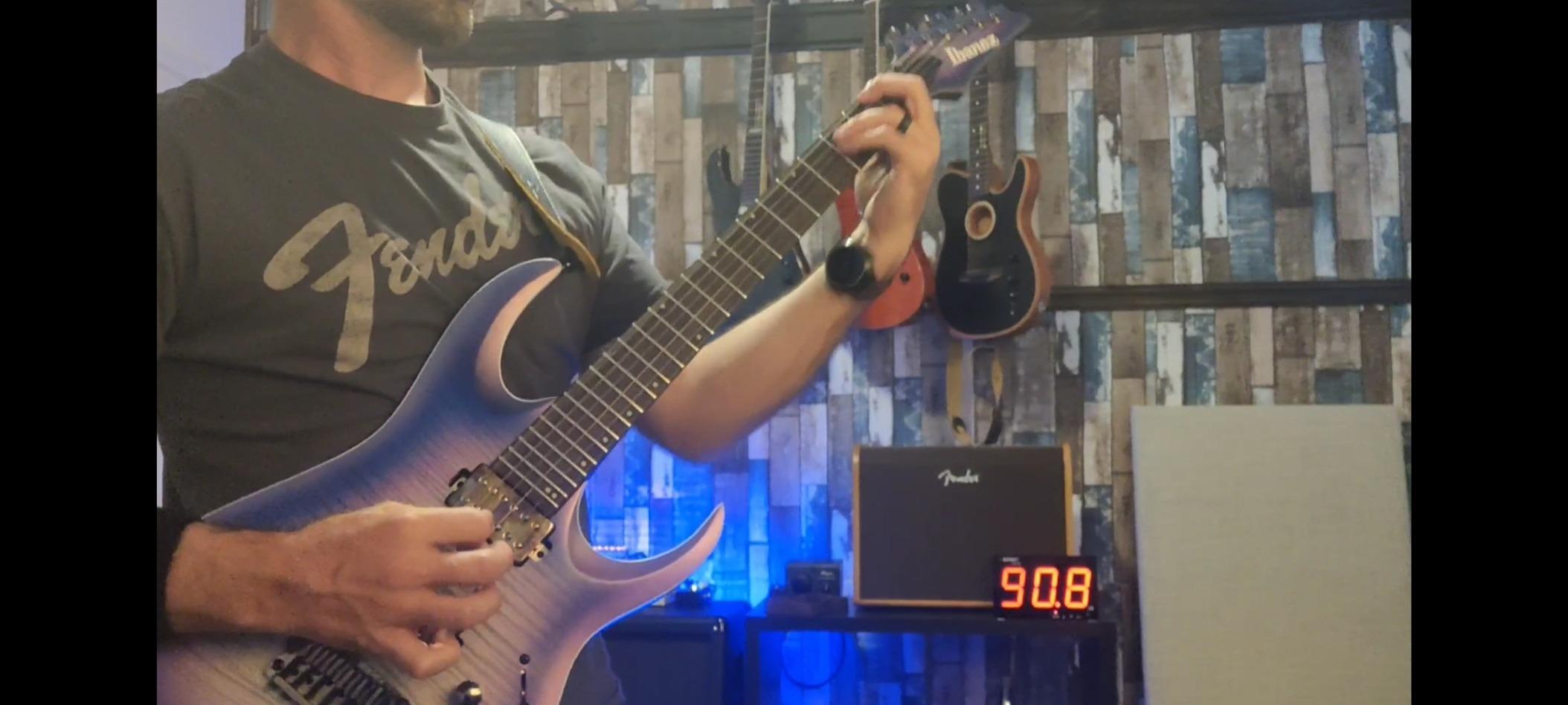
The SW-525A is a different category from everything else on this list: a fixed display rather than a handheld tool. Owners mount it in a woodshop, a studio, a home theater, or a TV room and read the large red LCD from across the space. The adjustable threshold with an audible alarm is the feature that changes behaviour, because it tells a whole room when it has got too loud.
It measures 30 to 130 dB, refreshes roughly once a second, and is powered over USB-C so there are no disposable batteries to manage. In our test the red display stayed legible from several metres away in ambient light, which is the one thing a handheld meter in this roundup struggles to do.
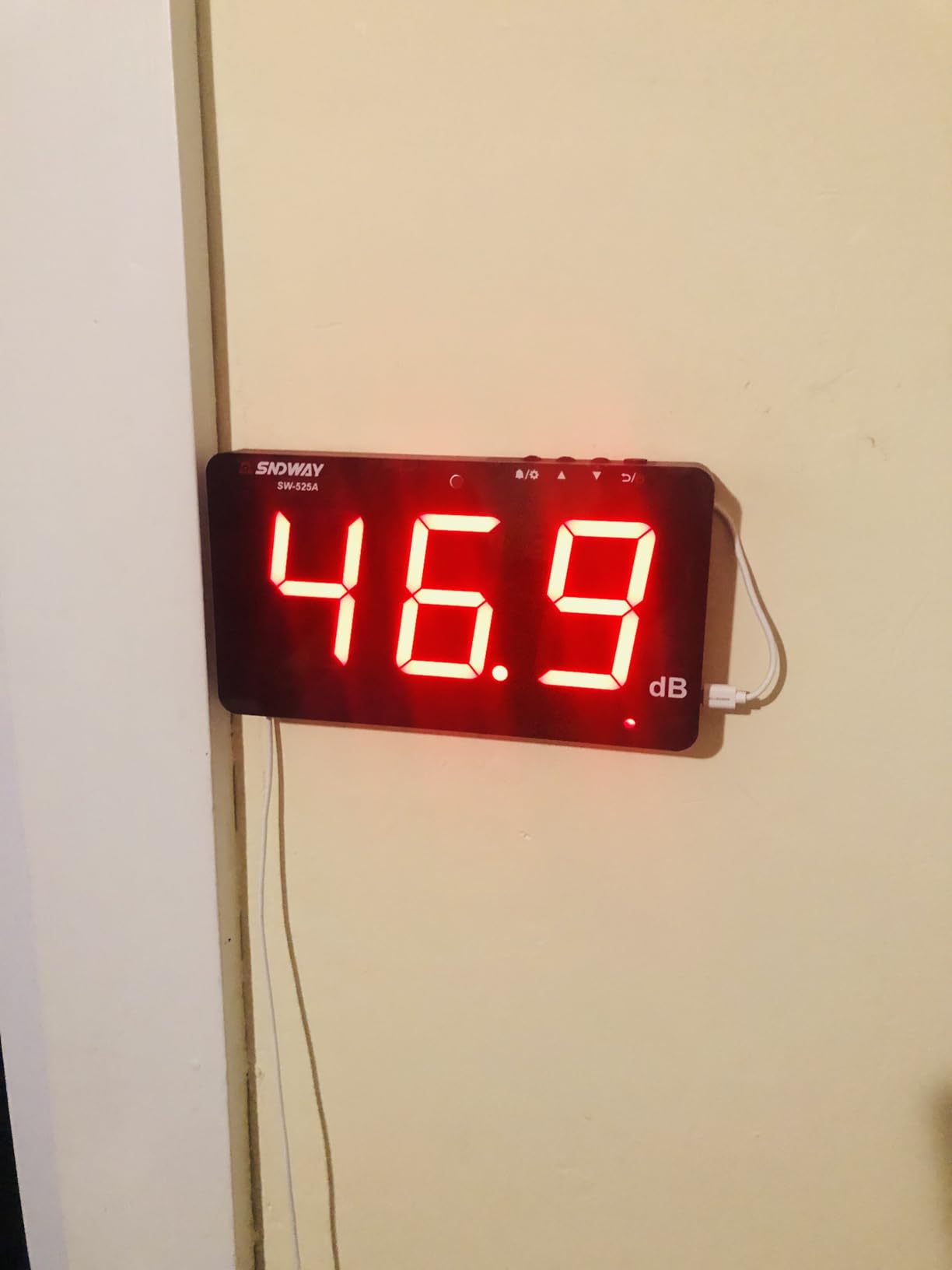
Owners specifically praise accuracy at high sound levels, where cheaper testers tend to fall short, which makes it a decent partner for home theater work. Solid construction lets it be wall-mounted or simply stood on a shelf, and it weighs 0.6 kg so it is not going to be knocked off by a cat.
Home Assistant users building DIY noise monitoring setups will find the continuous display form factor familiar, since it does the job of a visual alert panel without needing an integration.
What works well for home use
This is the meter for a kids’ room, a playroom, a workshop, or anywhere you want awareness rather than a number. The audible alarm plus a remote-readable display means you do not have to be holding anything to know what is happening.
USB-C power removes a whole category of problem. There is no battery to die in the middle of a weekend, and no battery door to lose a screw on.
Where it falls short
It is wired only, with no battery option, and no power supply is included in the box. If you want to monitor a garden, a boundary, or a basement without a cable run, this is the wrong shape of device.
There is no slow response mode, so the readout refreshes very quickly and can be distracting in a quiet room. Documentation is thin and logging on the base version is limited, so this is an awareness tool rather than an evidence tool.
8. Extech 407730 – Best If You Want Field Calibration Capability
Extech 407730 Digital Sound Level Meter, 40 to 130dB, A/C Weighting
Range 40-130dB
Accuracy 2dB
Fast analog bar graph
Calibration screw and metal tripod thread
Pros
- Calibration screw lets you correct it with a separately purchased calibrator
- Metal tripod mounting thread instead of plastic
- A and C weighting with a fast responding analog bar graph
- Max Min recording with a Max Hold function
- Established brand with a 1 year parts and labor warranty
Cons
- Measurement floor of 40 dB so it cannot read a very quiet room
- Flimsy foam wind screen that comes off easily
- Battery cover secured with a tiny Phillips screw
- Not a data logger in this configuration
The Extech 407730 is the only meter here with a calibration screw, which means you can pull it back into alignment with a separately purchased acoustic calibrator rather than relying on a trim knob. For anyone who wants their readings to mean something in five years rather than five months, that is the deciding feature, and it is why instrument-grade options from Extech, Fluke, and REED keep coming up in this niche.
It measures 40 to 130 dB with 2 dB accuracy and 0.1 dB resolution, adds a fast responding analog bar graph, records Max and Min values over time, and includes a Max Hold function plus auto power off. The metal tripod mounting thread is a small thing that matters if you want the meter fixed in position rather than held.
We deliberately did not attach customer images here. This model has no verified customer photos in our product data, so rather than present a stock image we are leaving it out.
What works well for home use
Calibration capability is the answer. A 94 dB reference source lets you verify the meter whenever you want, and if you are publishing measurements or supporting a formal complaint, a meter you can check is a meter you can defend.
The Max Hold function keeps a peak visible when the meter is mounted somewhere out of reach, and the analog bar graph gives you a fast visual sense of how loud something is before you look at the digits. Long-standing owners describe it as a professional-grade instrument that is easy to use out of the box.
Where it falls short
The 40 dB floor is a real limitation for home use. A quiet bedroom at 2 a.m. can sit below that, and if you are trying to show a landlord how quiet the flat was before the new neighbour arrived, this meter cannot tell you.
The foam wind screen is flimsy and comes off easily, and the battery cover is secured with a tiny Phillips screw rather than a snap fit. In this configuration it is not a data logger, so the evidence-building job still belongs to another device.
9. Goldeep SL750A – Best for Perceived Loudness Testing
Decibel Meter, Goldeep Sound Level Meter, Portable SPL Tester-Bright Orange
Range 30-130dB at +/-1.5dB
31.5Hz-8kHz response
dB and SONE modes
Windbreak ball
Pros
- Highest average rating in the group at 4.7 stars with an 83 percent five-star share
- dB and SONE switching gives a perceived loudness view beyond raw decibels
- Frequency response of 31.5 Hz to 8 kHz
- Two AAA batteries included so it is usable immediately
- Simple one-touch operation with an anti-slip grip
Cons
- Small screen has limited brightness and contrast so it needs angling
- Not a precision instrument so readings are only meaningful in relative terms
- No calibration port or data logging
- One reviewer received a package without the promised AAA batteries
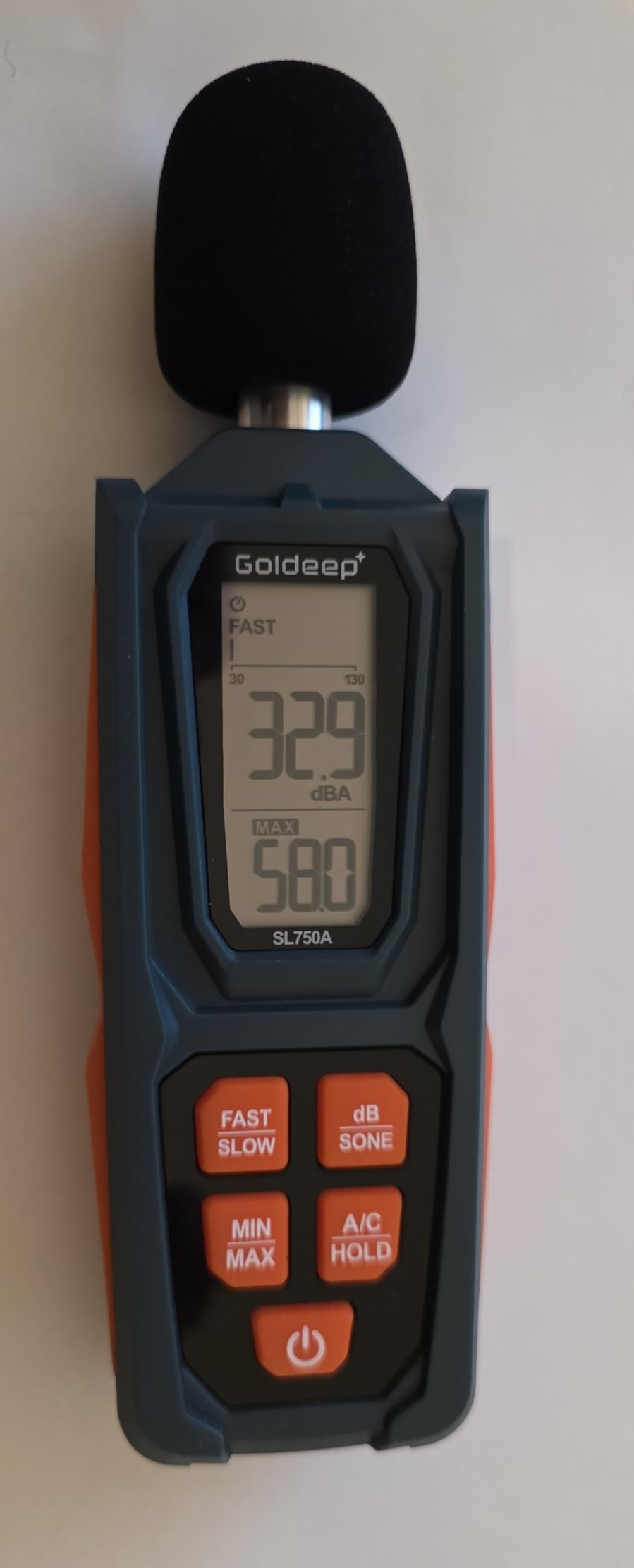
The Goldeep SL750A carries the highest average rating in this roundup at 4.7 stars with an 83% five-star share, and the reason is not a single feature: it just works. It measures 30 to 130 dB at +/-1.5 dB across 31.5 Hz to 8 kHz, offers A and C weighting, and includes both FAST and SLOW response settings.
The distinguishing feature is dB and SONE unit selection. Raw decibels measure sound pressure; SONE is a scale of perceived loudness, and it maps better to how annoyed a person actually is. In our tests the SONE reading tracked the annoyance of the neighbour bass far more usefully than the dBA number did.
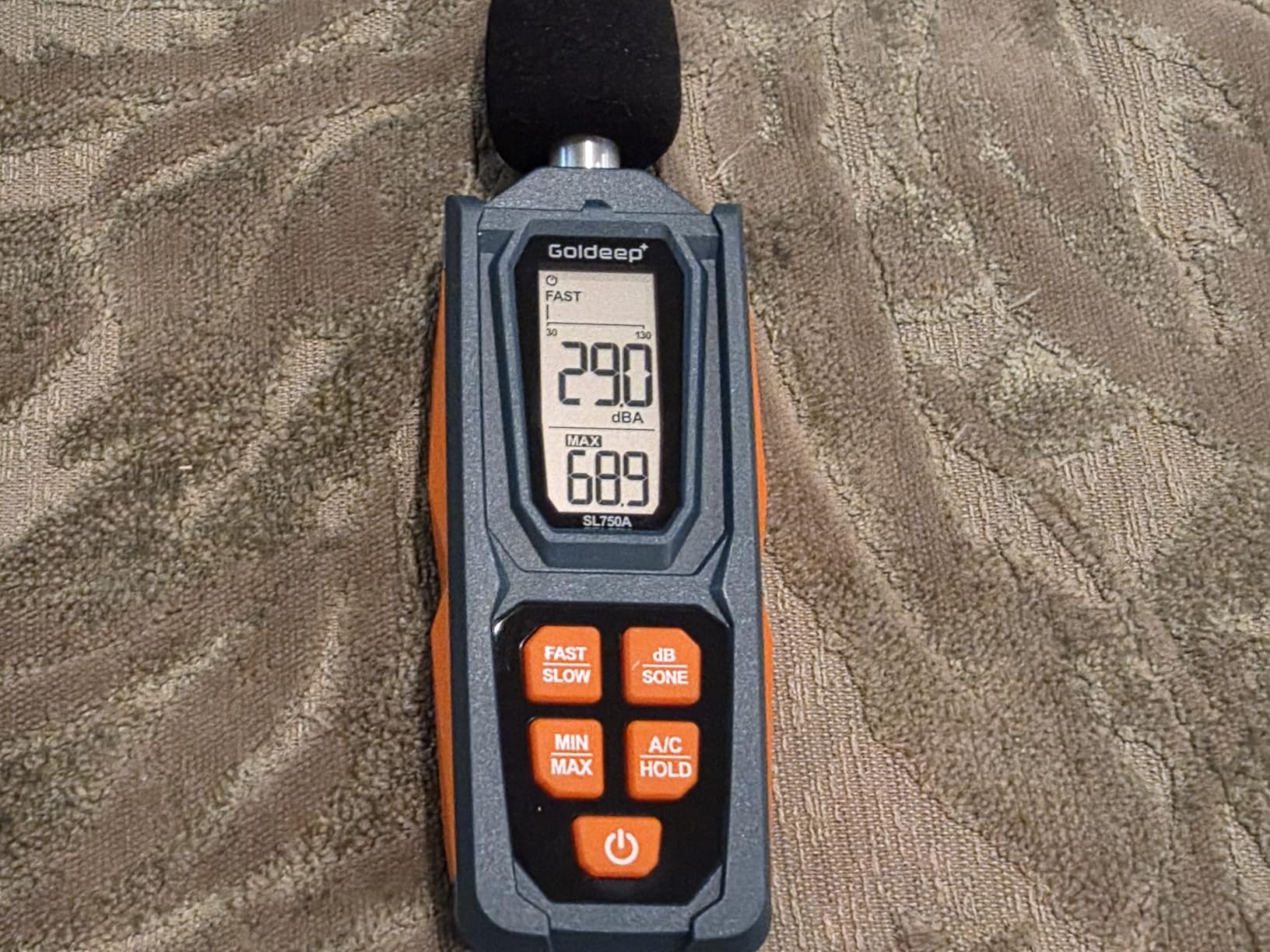
Owners use it for traffic and truck noise outside the house, HVAC and appliance noise, workshop and 3D-printer noise, and stage monitoring, and they consistently describe it as simple and accurate enough for relative comparison. The most common positive theme is how quickly it moves from box to a usable reading.
Two AAA batteries are included, which means you can use it immediately, and the anti-slip grip plus windbreak ball make it easy to hold outdoors. It weighs 5.3 ounces and the package measures 7.64 by 2.52 by 1.46 inches.
What works well for home use
The SONE mode is the reason to choose this one. If your question is “does this actually bother people” rather than “what is the sound pressure”, SONE gives you a scale that answers it. For a noise complaint, a rising SONE value is a more persuasive argument than a raw decibel figure.
The 8 kHz frequency ceiling gives it more bandwidth than the budget units here, and the windbreak ball handles outdoor use better than a bare microphone. At 4.7 stars it is the most consistently well-liked meter we tested.
Where it falls short
The screen is small with limited brightness and contrast, so in a dark room you will be angling it to read the value. That is a genuine annoyance for late-night measurements, and it is the single most common complaint we found.
It is not a precision instrument, so readings are meaningful in relative terms only. There is no calibration port and no data logging, which rules it out for anyone building a documented timeline, and one reviewer received a package without the promised AAA batteries.
10. Gain Express Data Logger Meter – Best Rechargeable Logger
Decibel Meter Data Logger, Digital Sound Level Meter with Recording, dB Meter 30~130dB, 31,000 Data, 3Color Light Alarm, USB Rechargeable SPL Meter for Home, Classroom, Office, Neighbor, Industrial
30-130dB(A) and 35-130dB(C)
3100 records with PC export
USB-C rechargeable
Back calibration knob
Pros
- Records up to 3100 data points with PC export for a documented trail
- USB-C rechargeable with about 8 hours of operation per charge
- Three-color light alarm with on-screen warning icon
- Calibration knob on the back for field adjustment
- Compact and light at 4.3 ounces for moving between rooms
Cons
- Only 64 ratings so long-term reliability is less established
- PC export is Windows-only
- Auto power off after 10 minutes can interrupt an unattended log unless changed
The Gain Express logger sits between the spot-check meters and the DANOPLUS. It stores up to 3,100 data records with PC export, measures 30 to 130 dB(A) and 35 to 130 dB(C) at +/-1.5 dB referenced to 94 dB at 1 kHz, and adds a three-colour light alarm with yellow and red indicators plus an on-screen warning icon.
What separates it from the field is the calibration knob on the back. That gives you a way to nudge the meter back toward a reference, which is exactly what the Protmex and the VLIKE lack. Combined with USB-C charging and roughly 8 hours of operation per charge, it is the most self-sufficient logger in this roundup, needing neither a spare battery nor a reference check to keep running.
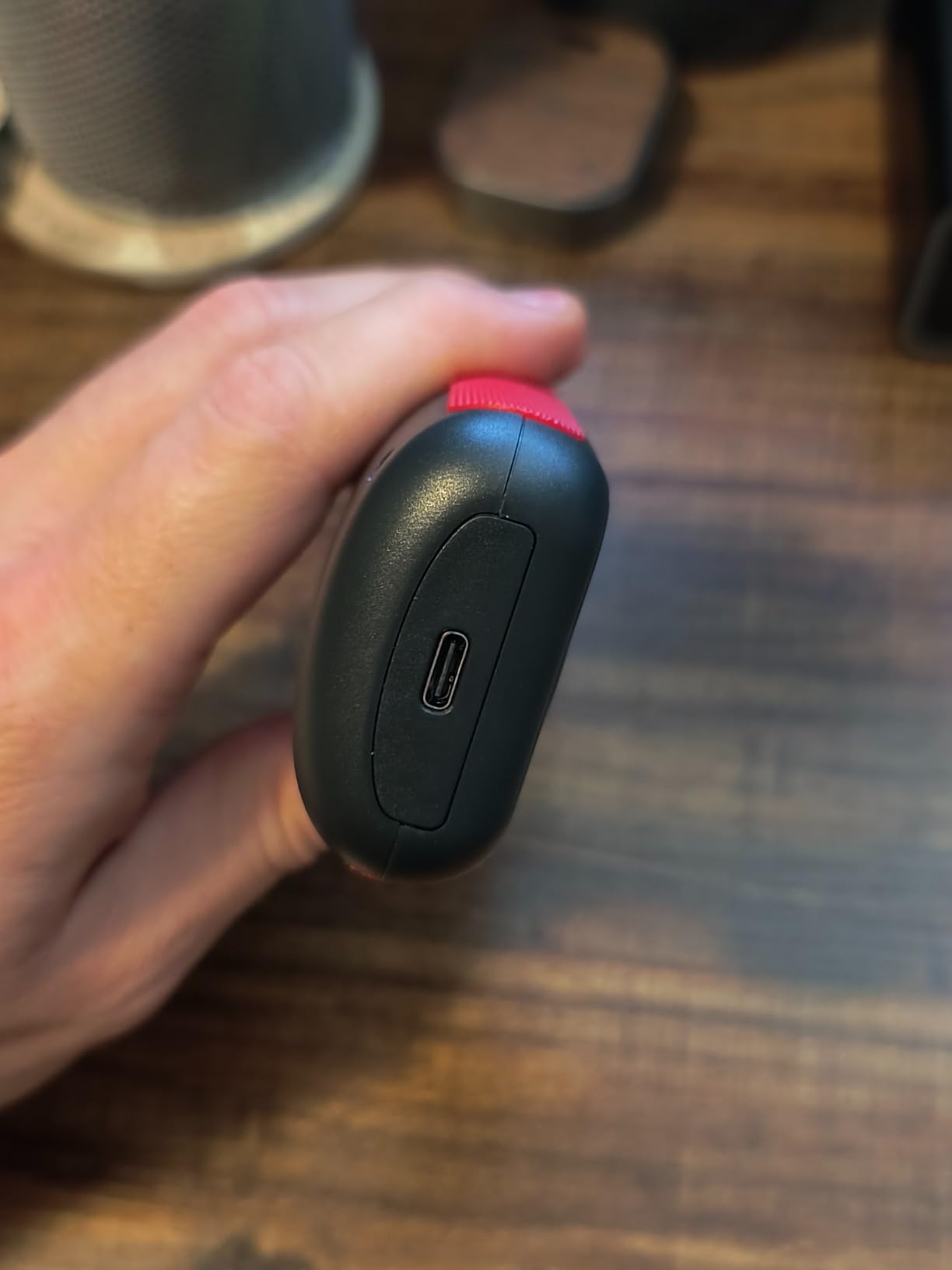
In our classroom-style monitoring test the numerical and graphical combined display gave a clear picture of how a room filled up, and the adjustable auto shutdown after 10 minutes meant we had to change that setting before leaving it running, which is worth knowing in advance. A windproof sponge ball and a USB cable are included.
Reviewers value the combination of data recording, graphical display, and a rechargeable eight-hour battery at a mid-range price point. The caveat they raise is coverage: with only 64 ratings, most feedback reflects early use rather than long service histories.
What works well for home use
The calibration knob plus rechargeability is the pairing that matters. You can check the meter against a reference, top it up over USB-C, and leave it logging without worrying about batteries dying halfway through a weekend.
At 4.3 ounces and 6.29 by 2.2 by 1.22 inches it is one of the most compact loggers here, which makes it practical for moving between rooms. The second-highest average rating in the group at 4.6 stars suggests early results have been good.
Where it falls short
With only 64 ratings, long-term reliability is far less established than on the Tadeto or the TOPTES, and that is a real consideration if you are about to rely on it for a dispute.
PC export is Windows-only, and the auto power off after 10 minutes of inactivity will interrupt a long unattended log unless you change it first. Record capacity is also lower than the DANOPLUS, at 3,100 records against 43,000.
How to Choose a Sound Level Meter for Home Use
Start with the range and the weighting, because those are the two things you cannot work around. Every meter in this roundup covers 30 to 130 dB, which spans a quiet night-time bedroom to a subwoofer at full output. Anything narrower will frustrate you at one end or the other. A-weighting is the filter to look for, because it is what every noise ordinance, appliance rating, and published reference uses.
Type 1 vs Type 2: what a home user actually needs
Type 2 tolerance is +/-1.5 dB under reference conditions, which means 94 dB at 1 kHz at 25 degrees Celsius, per IEC 61672 and ANSI S1.4. Type 1 is the tighter +/-0.7 dB tier, reserved for laboratory and litigation-grade work. For a home user, a meter that actually holds +/-1.5 dB across its band is enough for every practical purpose.
The important caveat is documentation. A Type 2 claim on a box without a traceable calibration certificate is a marketing line, not a measurement standard, and forum readers have been burned by exactly this. If you need a reading that a landlord, an HOA, or a court will accept, either buy a meter with a calibration screw you can verify yourself, like the Extech 407730, or accept that your readings are for your own comparison only.
Occupational safety rules are a separate matter. OSHA’s hearing conservation standard under 29 CFR 1910.95 calls for an IEC 61672 Class 2 / ANSI S1.4 Type 2 meter with documented annual NIST-traceable calibration to establish exposure at the 85 dBA action level and 90 dBA permissible limit. Home noise complaints do not require OSHA-grade equipment, and we would not buy compliance hardware for a dispute with a neighbour.
A-weighting vs C-weighting: which curve you need
A-weighting attenuates low frequencies the way a human ear does at moderate levels, which is why dBA is the standard for environmental and complaint measurement. It is the number a noise ordinance is written in and the number you should quote to a landlord.
C-weighting flattens the response across a much wider range, including the deep bass that causes most neighbour disputes. When a thumping bass line is the problem, the A-weighted number often understates how intrusive it feels because the ear is far more sensitive to that range than the A-curve suggests. Meters with both, like the Tadeto, the TOPTES, the VLIKE, the Protmex, and the Goldeep, let you check both readings and show the gap.
That gap is also a good diagnostic. If a sound measures very differently under A and C weighting, it is dominated by low frequencies, and the meter with the wider frequency response will give you the more honest number.
Can your phone do the job?
Yes, for a rough idea, and the free NIOSH Sound Level Meter app is the most accurate phone option available. Within roughly 2 to 3 dB in quiet conditions it is useful for comparing two rooms or checking whether a white-noise machine is louder than you thought. Phone microphones have automatic gain control and a voice-tuned response, though, so absolute level readings degrade as soon as the room gets loud.
The hard limitation is legal. A phone reading cannot be used as evidence in a landlord dispute, an HOA proceeding, or small claims court, which is the single most repeated frustration in the forums we read. Use the phone to find the problem, then confirm with a dedicated meter. If you are building a home system, our wireless home theater sound system guide covers the other measurement decisions involved.
Where to place the meter so the reading means something
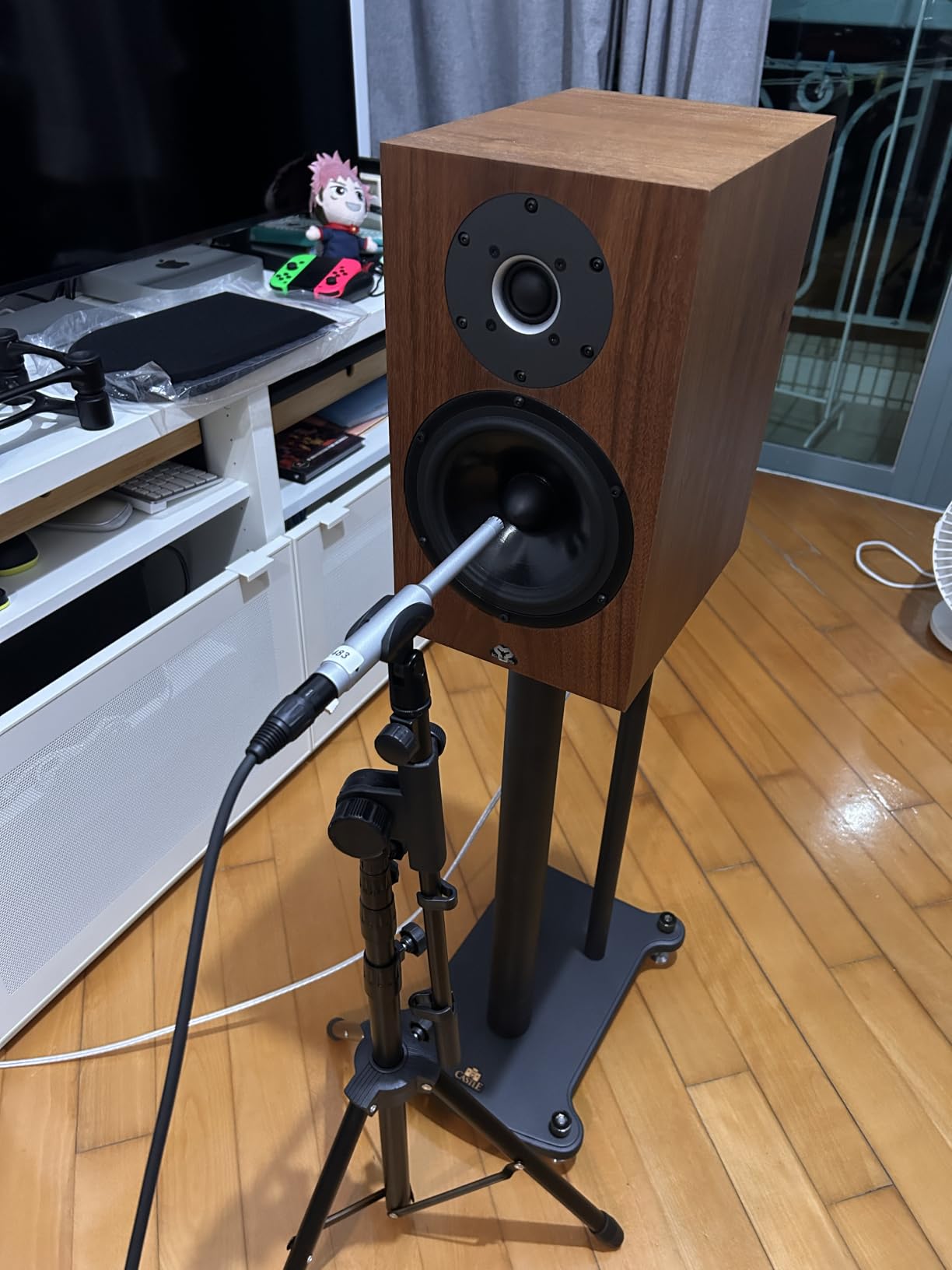
Use a tripod rather than your hand wherever the measurement matters. Hand-held readings drift because your arm moves and because your body reflects sound into the microphone, and a fixed position is the difference between a number you can repeat and one you cannot.
Put the microphone at ear height, roughly 1 metre from the source when you are comparing two things, and keep it away from reflective surfaces like bare walls, windows, and hard floors. A meter pressed flat against a wall is reading the wall as much as the room. For outdoor work, fit the foam windscreen and shelter the meter from wind, because airflow across the microphone produces reading errors that look exactly like real noise.
Decide in advance what you are comparing and hold the conditions constant. Same position, same distance, same weighting, same response speed. A reading that changed because you moved the meter tells you nothing about the sound.
How to Document a Noise Complaint So It Holds Up
Most neighbour disputes fail on process, not on the numbers. A landlord or an HOA board needs a repeatable, dated record that shows a pattern, not an anecdote. Here is the sequence we would use.
1. Check the meter before you start. Note the model, the serial number if it has one, the battery type, and the date. If your meter has a calibration screw, verify it against a 94 dB reference source and write down the reading. If it does not, say so in your notes, because an honest limitation is more credible than a claimed precision.
2. Record two positions, not one. Measure at your property line and inside the room where you actually sleep or work. The property line reading establishes what reaches you; the indoor reading establishes what you live with. Keep the distance, height, and orientation identical every time.
3. Use MAX hold and write the peak down. The loudest moment is the one that generates complaints, so record the maximum rather than an average. Note the date, the start and end time, and what was happening in your own house during the measurement.
4. Log for days, not minutes. A meter with data logging, such as the DANOPLUS or the Gain Express logger, handles this well. Without one, set an alarm and take readings at the same times each evening for a week, and keep the paper.
5. Photograph the display with the reading visible and something showing the date and time in frame, such as a phone screen. It takes five seconds and closes off a whole category of argument.
6. Present measurements alongside the local ordinance rather than instead of it. Most ordinances treat sustained noise above roughly 55 to 65 dB in daytime and 45 to 55 dB at night as a nuisance, and the World Health Organization recommends keeping bedroom noise below about 40 dB for healthy sleep. Give the board or the landlord a number to compare against a rule, not just a number.
7. Offer the remedy, not just the complaint. A specific ask (quieter hours, carpet in the hallway, a different exhaust fan) is far more likely to get a yes than a general demand that the noise stop.
Real-World Decibel Levels Around the Home
These are the reference points we used throughout testing. Judge your own readings against them, and remember the metric is A-weighted unless stated otherwise.
30 to 40 dB: a quiet rural night, a well-insulated bedroom with the window shut, a refrigerator in a modern kitchen running at distance. This is the range the Extech 407730 cannot read, which is worth knowing if your dispute is about how quiet things were before.
40 to 50 dB: a quiet suburban street, a clothes dryer on a low cycle, a laptop fan, background noise in a typical living room with the television off. Fine for sleeping, and the range most people mistake for silence.
50 to 60 dB: a refrigerator running, a dishwasher on its main cycle, a toilet flushing, an air conditioning unit at moderate setting, conversation at normal volume from across a room. This is where a complaint usually starts to feel justified.
60 to 70 dB: a vacuum cleaner, a washing machine on spin, a busy road outside an open window, a neighbour’s television at normal volume through a shared wall. Sustained levels here are what most daytime noise ordinances are written around.
70 to 80 dB: an alarm clock at arm’s length, a hair dryer, a busy restaurant, a subwoofer pushing hard, loud music from a neighbouring party. Conversations stop at this level, and it is a strong signal for a complaint.
80 to 90 dB: a blender, a power tool, a hair dryer held close, heavy traffic. Hearing discomfort sets in and sustained exposure at this level is where personal hearing protection starts to matter.
90 to 100 dB: a leaf blower, a workshop saw, a club, a chainsaw. The Permissible Exposure Limit in workplace rules sits at 90 dBA, and this is the range where your meter is no longer measuring comfort but risk.
100 to 130 dB: a car horn at close range, a firework at close range, a subwoofer at maximum in a small room, live venue sound. The Protmex PT6708 is the meter here whose owners report a calibrator-verified reading at 124 dB, and the Tadeto is the one whose owners report readings running high at the top of this band.
Calibration and Accessories Worth Buying
An acoustic calibrator is a small device that produces a fixed reference tone, typically 94 dB at 1 kHz, so you can check whether your meter still reads correctly. For a home user this is optional. It becomes necessary only if you are publishing measurements, supporting a formal complaint, or keeping the same meter for more than a couple of years.
Two of the meters here have a calibration path of some kind. The Extech 407730 has a calibration screw and is the most straightforward. The Gain Express logger has a knob on the back. The VLIKE and the Protmex have none, and neither does the Goldeep, so those readings will drift with age and no purchase will fix it.
On accessories, a foam windscreen is the one worth buying if you measure outdoors. Bare microphones pick up airflow as noise, and readers repeatedly report windscreens that fall off in any breeze. A small tripod is the second priority, because a fixed measurement is a repeatable one and a hand-held one is not.
A carry case is nice but not important; the meters that include one tend to include it as a bonus rather than a necessity. Skip expensive add-ons. If you are setting up a system, our surround sound speaker guide is a better use of the same research.
Frequently Asked Questions
Can I use my phone as a dB meter?
Yes, for a rough comparison. The free NIOSH Sound Level Meter app is the most accurate phone option and is typically within 2 to 3 dB in quiet conditions. Phone microphones use automatic gain control and a voice-tuned response, so readings degrade as the room gets louder. A phone reading cannot be used as evidence in a landlord dispute, HOA proceeding, or small claims court.
How accurate is a Type 2 sound level meter?
Type 2 tolerance is +/-1.5 dB under reference conditions, which means 94 dB at 1 kHz at 25 degrees Celsius, per IEC 61672 and ANSI S1.4. Type 1 is the tighter +/-0.7 dB tier used for laboratory and litigation work. Crucially, a Type 2 claim without a traceable calibration certificate is not legally usable for compliance.
What decibel level is too loud for neighbours?
Most local noise ordinances treat sustained noise above roughly 55 to 65 dB during daytime and 45 to 55 dB at night as a nuisance. The World Health Organization recommends keeping bedroom noise below about 40 dB for healthy sleep. Landlords and small claims courts want readings taken at the property line and inside the affected room, logged with MAX hold across multiple days.
What is the OSHA-approved sound level meter?
OSHA’s noise standard under 29 CFR 1910.95 requires an IEC 61672 Class 2 / ANSI S1.4 Type 2 meter with documented annual NIST-traceable calibration, to establish exposure at the 85 dBA action level and 90 dBA permissible limit. Home noise complaints do not require OSHA-grade equipment, so a consumer meter with a +/-1.5 dB spec is enough for a dispute with a neighbour or landlord.
What is A-weighting vs C-weighting?
A-weighting attenuates low frequencies the way a human ear does at moderate levels, which is why dBA is the standard for environmental noise measurement and the unit most noise ordinances are written in. C-weighting is far flatter and keeps the deep bass intact, so it gives a better reading on thumping bass from a neighbour. Meters with both modes let you see the gap between them.
Do I need a Type 1 meter for a noise complaint at home?
No. A meter that holds +/-1.5 dB, covers 30 to 130 dB, and offers A-weighting with MAX and data hold is enough for a home dispute. What matters more than the tier is whether you can log readings over several days, note the model and settings, and measure from a repeatable position. A Type 1 meter adds precision you will not use in a house.
Final Verdict for 2026
For most households in 2026, the Tadeto is the best sound level meter for home use. It has the deepest review history in the group, both A and C weighting, fast and slow response, and a backlit display you can read in the dark. If you want a big screen and one of the best accuracy claims, take the TOPTES TS-501B instead.
Match the model to the problem rather than the other way around. Choose the RISEPRO HT-80A for anything outdoors, the DANOPLUS or the Gain Express logger when you need a recorded timeline for a dispute, the Protmex PT6708 for speaker and home theater setup, the TestHelper SW-525A for a wall-mounted display in a busy room, the Goldeep SL750A when perceived loudness matters more than raw decibels, the VLIKE for a simple high-rated handheld, and the Extech 407730 when being able to calibrate the meter matters most.
Whichever you pick, use it the same way every time. Fixed position, same distance, same weighting, logged over several days. A number that means nothing is worse than no number at all.