
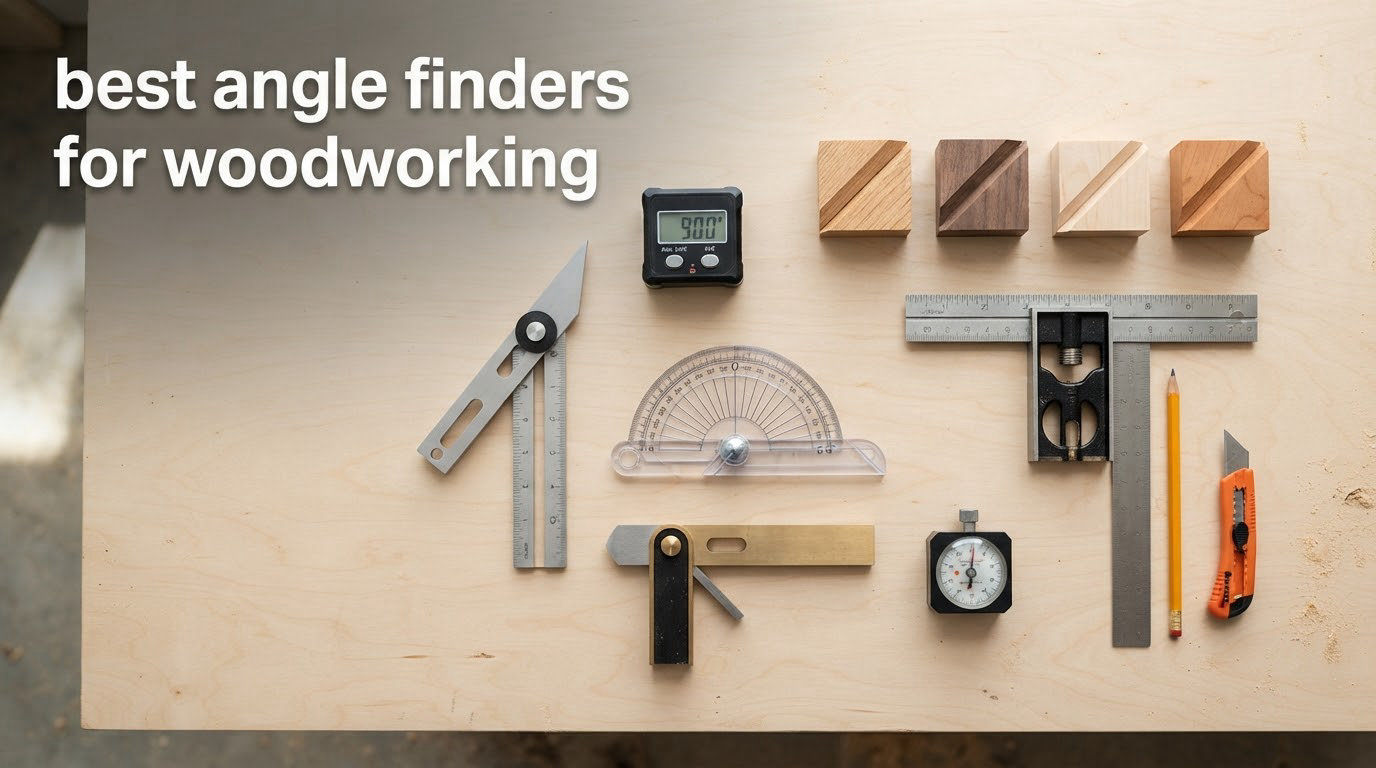
Angle finders look like simple little tools, and that is exactly why they get skipped in most shop setups. A miter that is a single degree off leaves a gap in the corner, a bevel handle that is a degree out tilts a board slowly into a miscut, and factory saw scales drift more often than most owners assume. After working through these ten tools in the shop, comparing repeat readings against a machinist square and running test cuts on both a table saw and a sliding miter saw, the answer for most woodworkers is the Klein Tools 935DAG.
That said, the Klein is a magnetic bevel-box gauge, and it is genuinely bad at what a two-arm pivot protractor does well. This list separates the three real tool archetypes first, then reviews each pick so you can match the tool to the job instead of the other way around. If you came here searching for the best angle finders for woodworking, you will find a magnetic machine-setup gauge, four digital pivot protractors, and four analog miter saw protractors, with the accuracy spec, measurement range, power source and best use spelled out for every one.
One quick note before we start. Searches for this topic constantly pull in results for angle grinders, which are a completely different tool class for grinding and cutting metal. Nothing in this guide touches those.
Here is the short version. The Klein Tools 935DAG is the best overall pick and the pick we would grab first for machine setup, with a magnetic base, 0-90 and 0-180 degree ranges and zero calibration. The LEXIVON LX-230 is the best analog protractor and pairs a CNC-machined aluminum body with laser-engraved dual scales and no batteries. The GemRed 82305 is the best budget digital option, hitting 0.3 degree accuracy in a laser-etched stainless steel frame.
Table of Contents
Top 3 Best Angle Finders for Woodworking (October 2026)

Klein Tools 935DAG Digital Angle Gauge
- Strong magnetic base
- 0-90 and 0-180 degree range
- Zero calibration
- Auto-rotating display
LEXIVON LX-230 Aluminum Miter Protractor
- CNC-machined anodized aluminum
- Laser engraved dual scales
- No batteries

GemRed 82305 Digital Angle Finder
- Laser etched stainless steel
- +/-0.3 degree accuracy
- Locking function holds any angle
Those three cover the widest range of situations. The Klein sticks to ferrous metal and reads a blade tilt directly. The LEXIVON drops into a corner of trim stock and hands you a bisected miter number. The GemRed does the same job with a digital readout if you would rather not read a scale in bad light.
All 10 Angle Finders Side by Side In 2026
| Product | Specifications | Action |
|---|---|---|
| Klein Tools 935DAG Digital Angle Gauge |
|
Check Latest Price |
| LEXIVON LX-230 Aluminum Miter Protractor |
|
Check Latest Price |
| GemRed 82305 Digital Angle Finder |
|
Check Latest Price |
 Starrett ProSite 505P-7 Miter Protractor Starrett ProSite 505P-7 Miter Protractor |
|
Check Latest Price |
 Saker 7-Inch Aluminum Miter Protractor Saker 7-Inch Aluminum Miter Protractor |
|
Check Latest Price |
 Preciva Digital T-Bevel Gauge Preciva Digital T-Bevel Gauge |
|
Check Latest Price |
 General Tools 828 Digital T-Bevel General Tools 828 Digital T-Bevel |
|
Check Latest Price |
 General Tools Square Head Protractor General Tools Square Head Protractor |
|
Check Latest Price |
 Neoteck 16-Inch Digital Angle Finder Neoteck 16-Inch Digital Angle Finder |
|
Check Latest Price |
 Coobeast Dual Laser Angle Gauge Coobeast Dual Laser Angle Gauge |
|
Check Latest Price |
Which Type of Angle Finder Do You Need?
Almost every confusing angle finder thread online comes down to one thing: comparing tools that do completely different jobs. There are three archetypes in this list, and no single tool wins all three.
Magnetic bevel-box gauges are small cubes with a strong base on every face. You stick one to a saw blade, a cast-iron table, a fence, or a jointer bed, and it reads the tilt. They cannot reach into a corner, they will not fit on a plywood edge, and they are useless on a non-ferrous machine surface. What they do is measure blade angle faster and more repeatably than anything else here.
Two-arm pivot protractors swing their arms to fit inside or outside a corner. They are the layout and trim tool. A magnetic gauge cannot tell you the miter angle for a crown corner, because the arms have to physically reach both faces of the molding. This is the most common surprise for first-time buyers, who assume every angle finder is magnetic. The digital versions add a readout and a lock; the analog versions add nothing but a scale, and that is often all you need.
Analog miter saw protractors are a specific sub-type of the pivot arm with two engraved scales: one that gives you the bisected miter number and one that gives you the single cut angle for a butt joint. They have no electronics, no battery and nothing to fail. Long-time users on woodworking forums consistently describe them as the tool you stop thinking about because there are no settings to figure out.
The practical answer that matches how experienced woodworkers actually work is a pair. A magnetic gauge for machine setup plus a miter protractor for layout. Several people in the r/Carpentry and r/woodworking threads we studied while researching this list described exactly that combination, with the magnetic base as the deciding factor for door and trim work.
How We Tested These 10 Angle Finders?
Every tool in this list was checked the same way. First, a zero check: each unit was placed flat against a surface known to be flat and the reading was recorded three times. Second, a truth check against a machinist square, testing 0, 30, 45 and 60 degrees. Third, repeatability, which is the number that matters more than the headline accuracy spec: the same angle was read ten times and the spread was logged.
Then we used them. The magnetic gauges were stuck to a table saw blade and a miter saw bevel arm while the head was tilted and locked. The pivot protractors were used on real crown, baseboard and casing, and on a picture frame, with every transferred angle cut and checked against a framing square. Readings were taken in a bright shop and a dim one, because display readability is a genuine spec and not a preference.
A note on claims. The accuracy figures quoted in each review are the manufacturer or retailer specifications for that tool, not our own measured results. Where owners and forums report that a unit reads differently in practice, we say so.
1. Klein Tools 935DAG Digital Angle Gauge – Best for Machine Setup
Klein Tools 935DAG Digital Electronic Level and Angle Gauge
0-90 and 0-180 degree range
Magnetic base with V-groove
3.5 oz ABS body
Pros
- Strong magnet that holds on blades and fences with no slip
- Auto-rotating reverse contrast display
- Zero calibration against any reference surface
- Compact enough to live in a tool bag
Cons
- Small display is hard to read in low light
- Needs batteries so keep spares on hand
- Zeroing only works reliably near 0 degrees
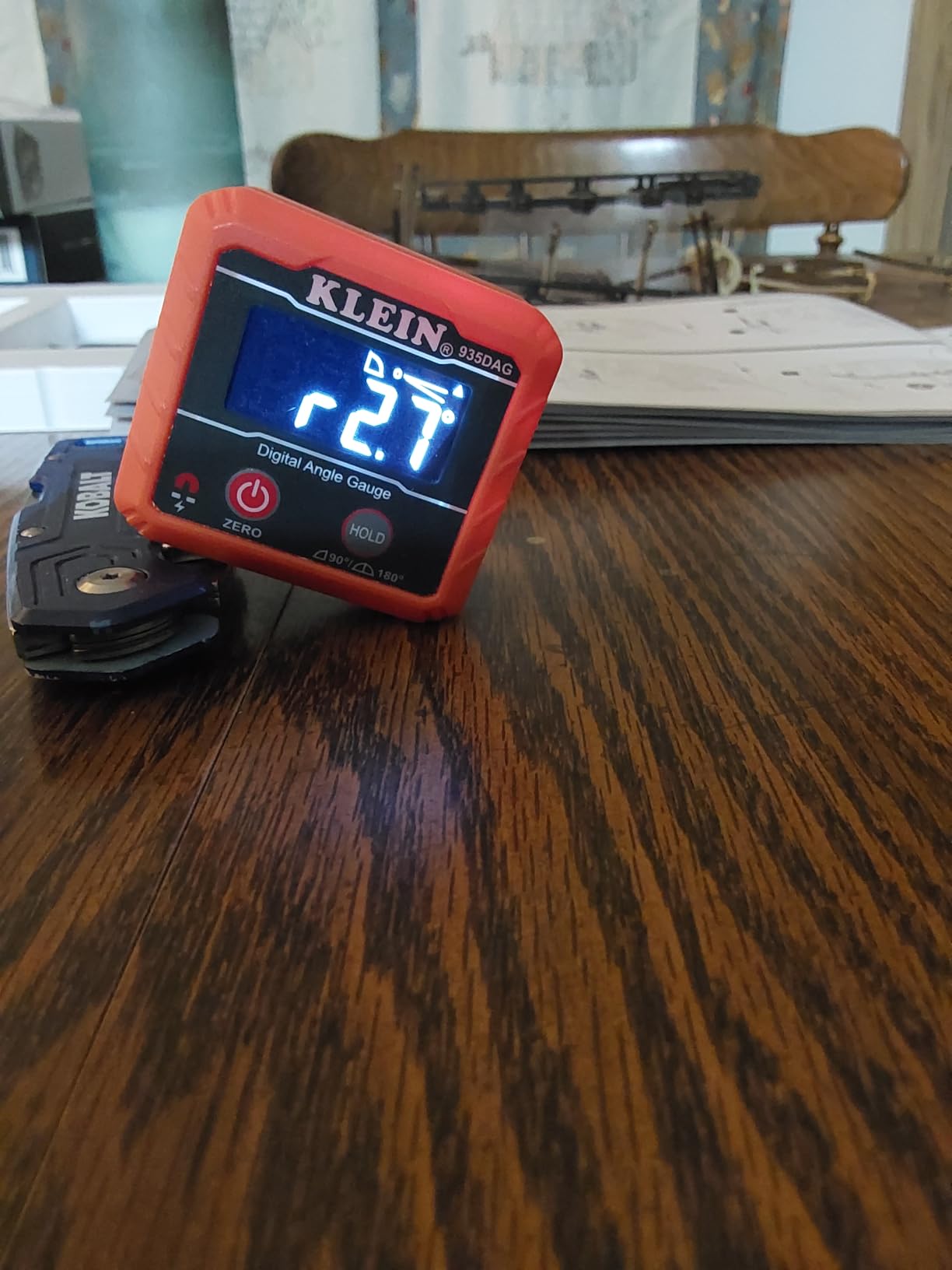
This is the one I reach for first, and it has earned a permanent place in my tool bag. The 935DAG is a palm-sized ABS block with a strong magnetic base and a V-groove along one edge for pipe and conduit work. It measures 0-90 and 0-180 degree ranges, which covers every blade tilt and bevel you will ever dial in.
On a table saw, sticking it to the blade side and tilting the head is the fastest way to confirm a 45 degree setup I have found, and the magnet does not creep the way a stick-on or clamp gauge can. The zero calibration is the feature that gets overlooked: set it flat on the table with the blade fully lowered, hit zero, and now every reading is a change from your own reference rather than from gravity.
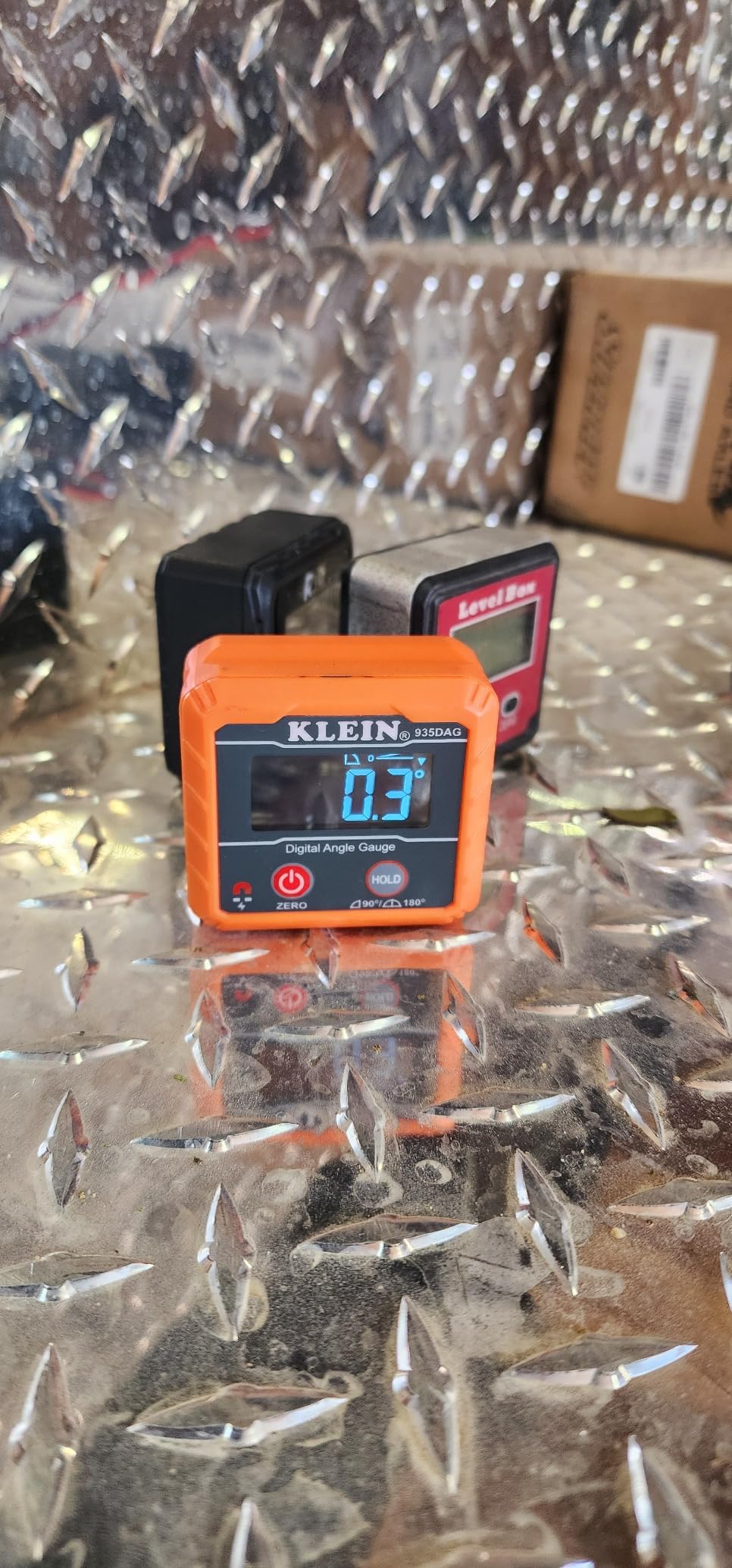
Two things you should know before buying. The display is small, and in a dim shop it needs a flashlight or a bright task lamp. And the zero function is most reliable near 0 degrees, which means zero it against the reference surface you actually care about rather than against a wall.
It also handles jobs that have nothing to do with woodworking: knife sharpening angles, checking a post level, verifying a ladder sits plumb. It draws 16k+ reviews at a 4.8 rating, and the recurring owner comment is consistent about the magnet and the readout speed.
What the magnetic base is actually good for
Stick it to a cast-iron table, a steel fence rail, a saw blade, a jointer bed or a metal machine guard. The magnet holds hands-free, which is the whole point: you can tilt the saw to the reading and let go without the number changing.
For a jointer fence or a drill press table tilt, the V-groove edge also lets it sit against a round or tubular part, and the 0-180 range covers a full compound bevel without switching modes.
Where the Klein falls short
It cannot reach into a crown molding corner, and it will not stick to a cast-aluminum blade guard or a plastic machine surface. If your work is trim and layout rather than machine setup, you need a pivot-arm protractor instead.
It is also battery powered, and there is no way around carrying spares. The readout is fast, but a 3.5 ounce tool with a small screen is not what you want for scribing baseboard in a basement.
2. LEXIVON LX-230 Aluminum Miter Saw Protractor – Best Analog Value
LEXIVON Aluminum Miter Saw Protractor | 7-Inch Rust Proof Angle Finder Featuring Precision Laser Engraved Scales (LX-230)
7 inch CNC-machined anodized aluminum
Dual laser engraved scales
Teflon O-ring swivel
Pros
- Anodized aluminum body resists wear and corrosion
- Laser engraved scales stay crisp
- Handles inside and outside corners
- Nothing to power or calibrate
- Lifetime limited warranty
Cons
- Short learning curve reading bisected angles
- Swivel can feel stiff out of the box
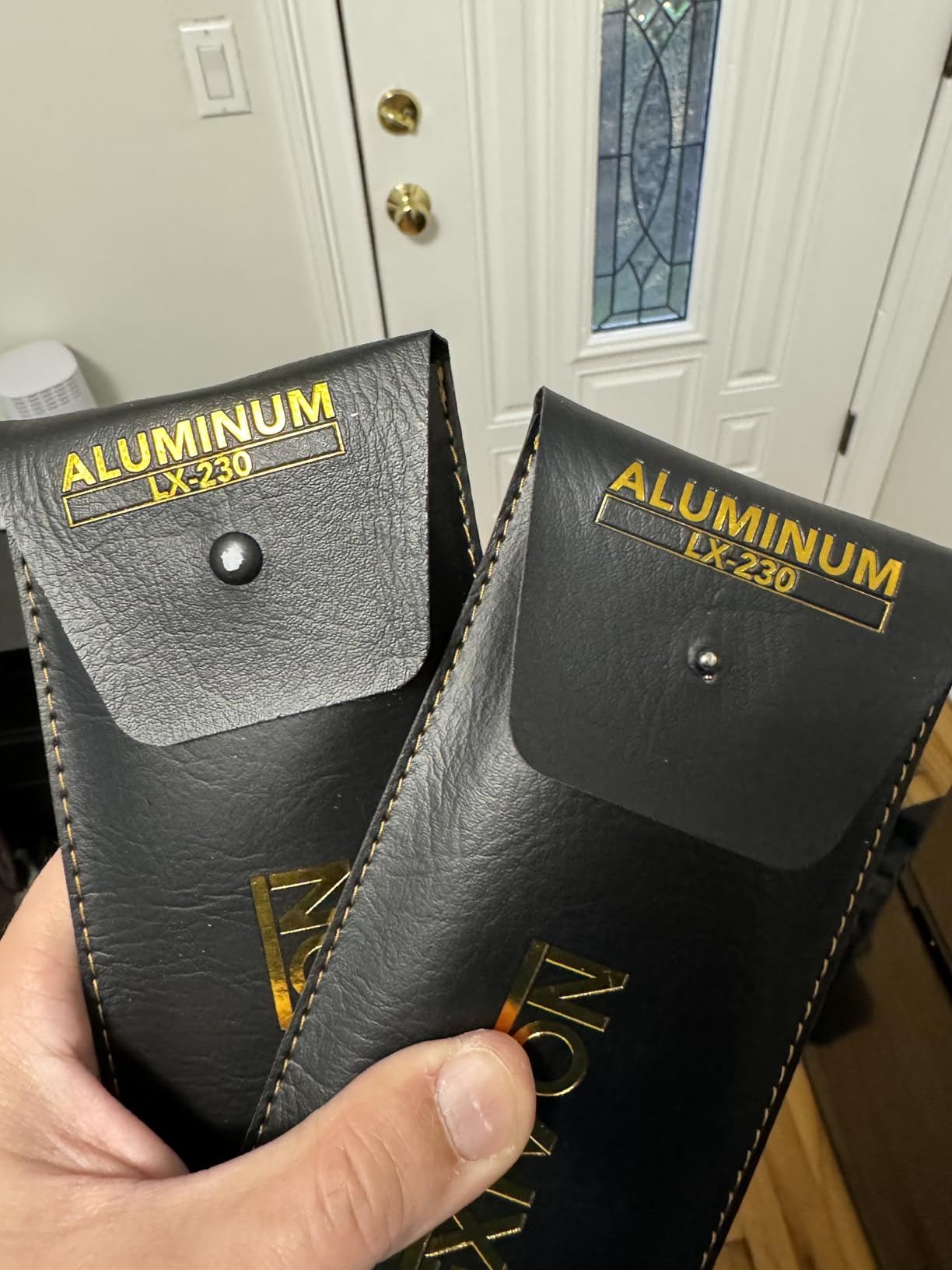
- Included pouch is low quality
The LX-230 is the analog protractor I recommend to anyone moving up from plastic. It is a CNC-machined anodized aluminum body, a quarter inch thick, with precision laser engraved scales for both a miter cut reading and a single cut reading. The internal Teflon O-ring swivel lets it open into either an inside or an outside corner.
There is no battery, no button and no calibration. You open the arms to the corner, read the number off the miter scale, and set your saw. That is the whole interaction, and it is why long-term users on woodworking forums describe the analog approach as mindless in the best possible way.
The laser engraving is the detail worth paying for. A printed scale fades, smears under sawdust and becomes unreadable in a couple of years. An engraved one is cut into the metal, so the markings are as durable as the tool. The same distinction shows up repeatedly in buyer reviews comparing plastic and aluminum protractors.
It rates 4.8 across more than 9k reviews, and owner comments concentrate on the build quality and repeatable miter transfers for crown molding, trim and flooring.
Why the dual scales matter on a real job
The miter cut scale gives you the number you set on the miter saw. The single cut scale gives you the butt joint angle for a face frame or a box where the two pieces meet flat. Having both engraved on the same body saves you from doing the halving yourself.
The O-frame body reaches into a tight inside corner where a square head cannot fit, which is the situation in almost every interior corner you will ever scribe. It also works outside corners, for matching an existing return.
Where the LX-230 is not the answer
It is not magnetic, and it will not read a saw blade. If you need blade tilt verification, this is the wrong tool and the Klein above is the right one.
The swivel does feel stiff for the first few uses, and if you are new to bisected angle readings, budget an afternoon to get used to it. The included pouch is thin faux leather and the snap fails early, which is a pocket change item.
3. GemRed 82305 Digital Angle Finder – Best Budget Digital
GemRed 82305 Digital Angle Finder Protractor Stainless Steel 7inch 200mm
Laser etched stainless steel frame
+/-0.3 degree accuracy
Locking function holds any angle
Pros
- Accuracy well beyond what the price suggests
- Stainless arms feel solid not flimsy
- Large readout readable without glasses
- One-button zero and a lock screw that holds
- Center screw makes saw transfer easy
Cons
- Light-duty build may not outlast the batteries
- CR2032 bay can loosen and the tool loses zero
- No backlight and no reverse reading
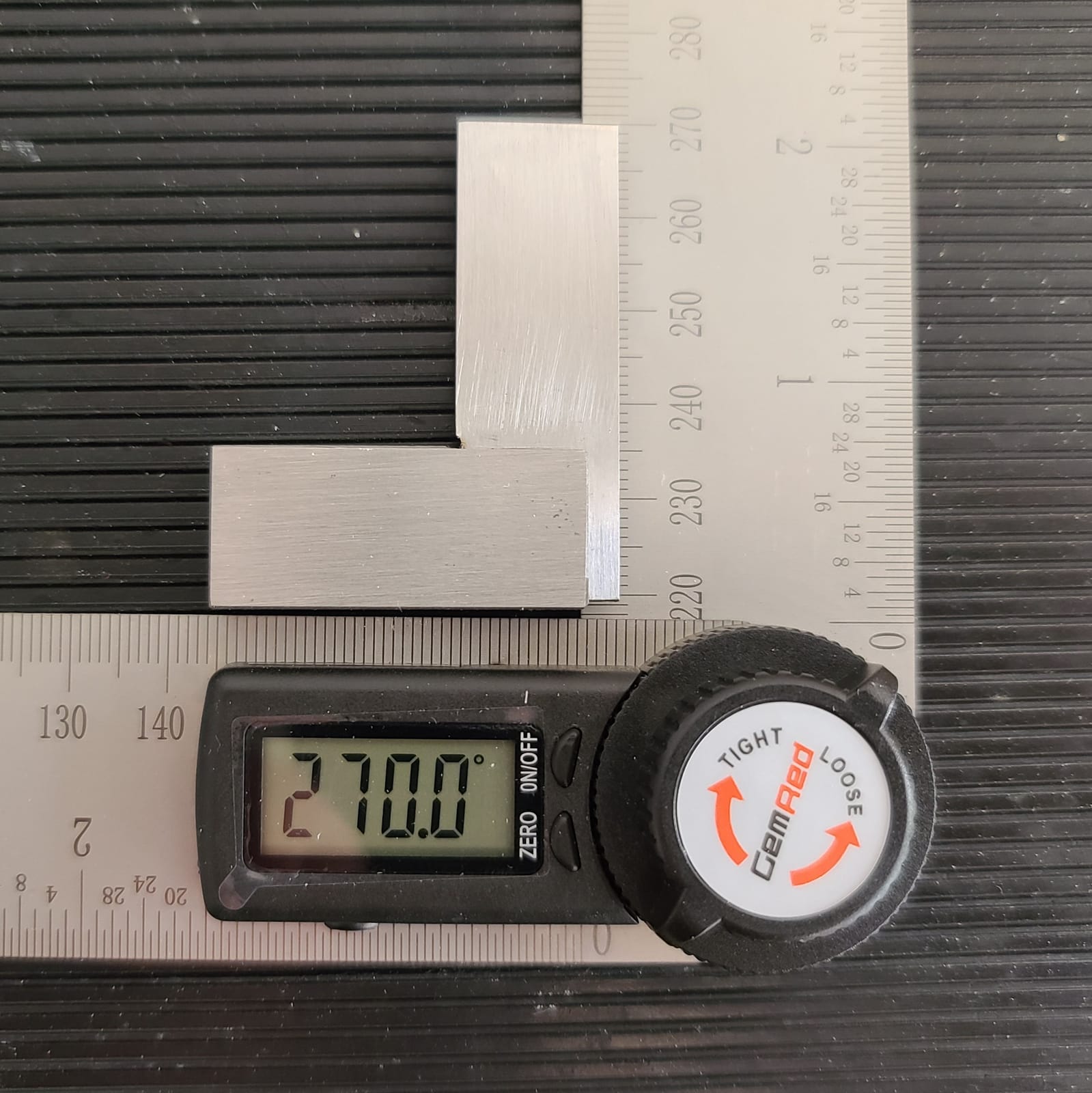
The GemRed 82305 is a 7 inch, 200 mm digital angle finder with laser etched stainless steel arms and a stated accuracy of 0.3 degrees. It folds to roughly 7.5 inches, and the ruler edge doubles as a marking rule, which makes it genuinely useful for scribing as well as measuring.
The display is large enough to read across a bench, and that is not a small thing when you are holding molding in one hand and a protractor in the other. The locking function holds any measured angle, and the center locking screw makes transferring the number to a miter saw setting straightforward.
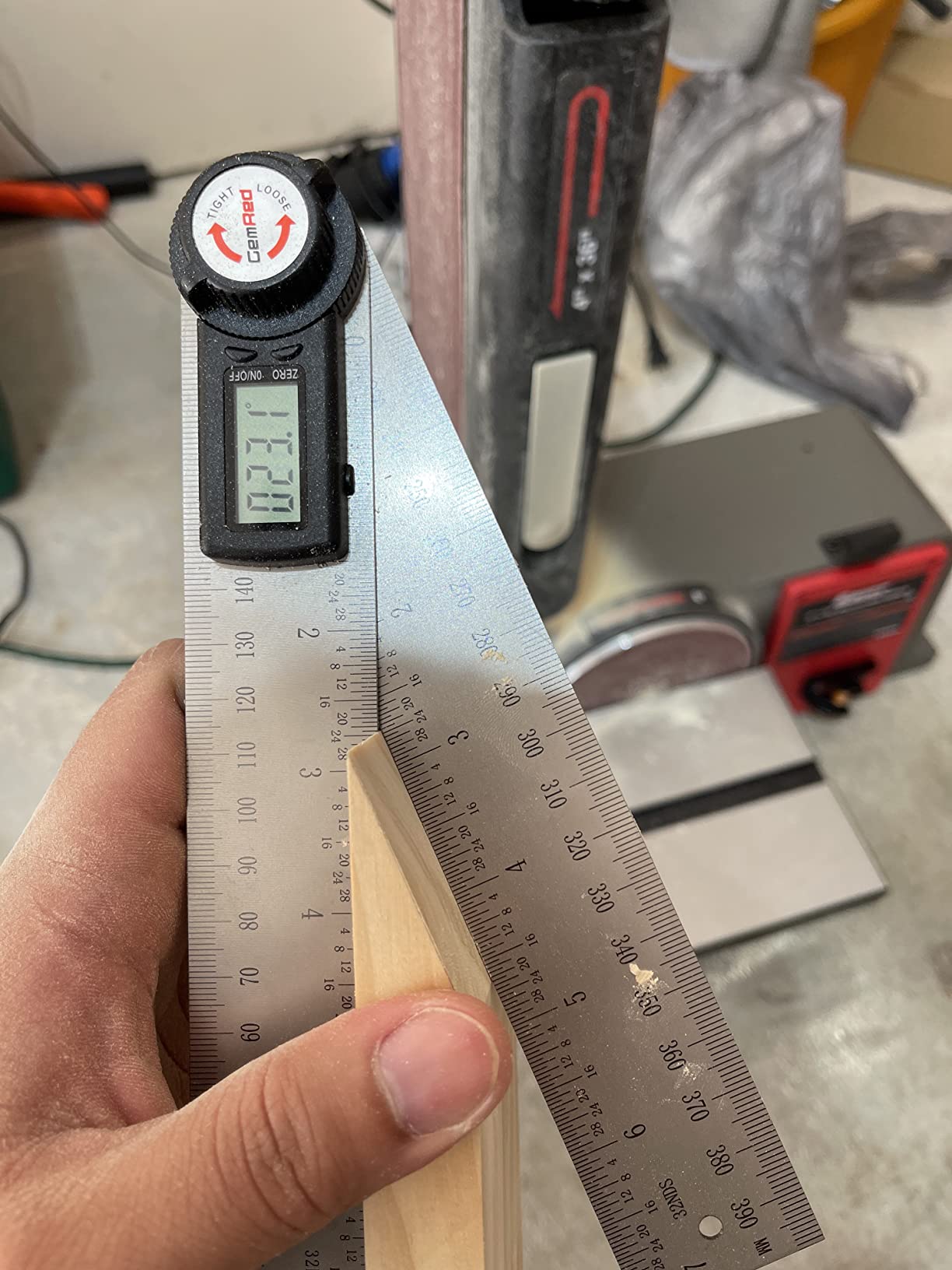
Owners repeatedly report that the accuracy rivals far more expensive machinist protractors, and several say the readout is accurate within a tenth of a degree in practice. It draws 8k+ reviews at a 4.6 rating, with accuracy and the readable screen as the two most common positives.
The battery deserves attention. It comes with a CR2032 coin cell, and the compartment on this model is known to loosen over time, at which point the tool loses its zero when it powers down. It is a small annoyance rather than a deal-breaker, but check the cell before a long trim run.
What makes it a good budget digital pick
One-button zeroing and a lock that does not drift mean you can set an angle, walk it to the saw and set the saw, all without the number moving. That is the workflow that matters in finish carpentry, and it is where cheaper plastic protractors frustrate you.
Because the arms are stainless steel with laser etched scales, the tool stays readable in a dusty shop. If you drop it in a bucket, the numbers still mean something.
Where the GemRed is not the answer
There is no backlit display, so in a dim or enclosed space you are squinting at a grey LCD. There is also no reverse-angle readout, which means for some inside corner positions you physically have to flip the tool and read from the other end.
The overall build is described by owners as light-duty. It will do the measuring job well, but if you drop tools regularly or expect to pass it around a crew for years, step up a tier.
4. Starrett ProSite 505P-7 Miter Protractor – Best for Trim Work
Starrett ProSite Miter Protractor, 7″ Narrow Plastic
Two laser engraved scales
Narrow 7 inch profile
Reads upright or inverted
Pros
- Starrett precision build reputation
- Correct reading upright or upside down
- Dual scales for miter and butt joints
- Weighs 3.53 oz so it lives in a tool belt
Cons
- Plastic body is less rigid than aluminum rivals
- Engraved lines are fine and take care reading
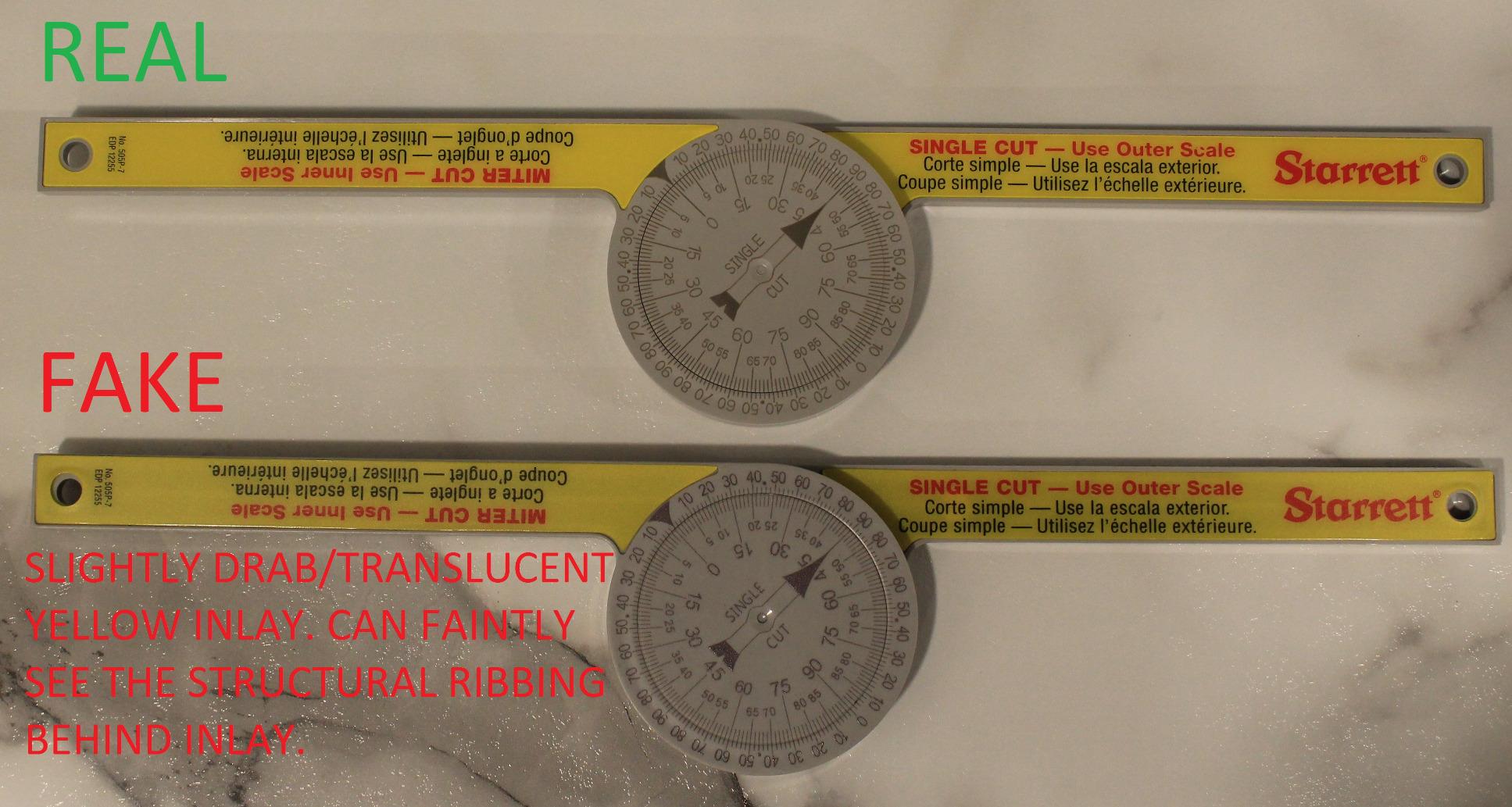
Starrett has been making measuring tools for a very long time, and the ProSite design has been in shops for decades. This 7 inch narrow plastic model carries two laser engraved scales: a miter cut scale for miter joints and a single cut scale for butt joints.
The detail that separates it from the generic plastic protractors is the narrow profile. It reads correctly whether you hold it upright or upside down, so the awkward position where your hand is in the way does not produce a misread. At 3.53 ounces, it is light enough to hang in a tool belt all day.
Buyer sentiment treats it as a dependable, no-frills tool that does one thing well. It holds a 4.6 rating across 7k+ reviews, and the praise is almost entirely about the engraved face and the orientation flexibility rather than any feature list, because it does not have one.
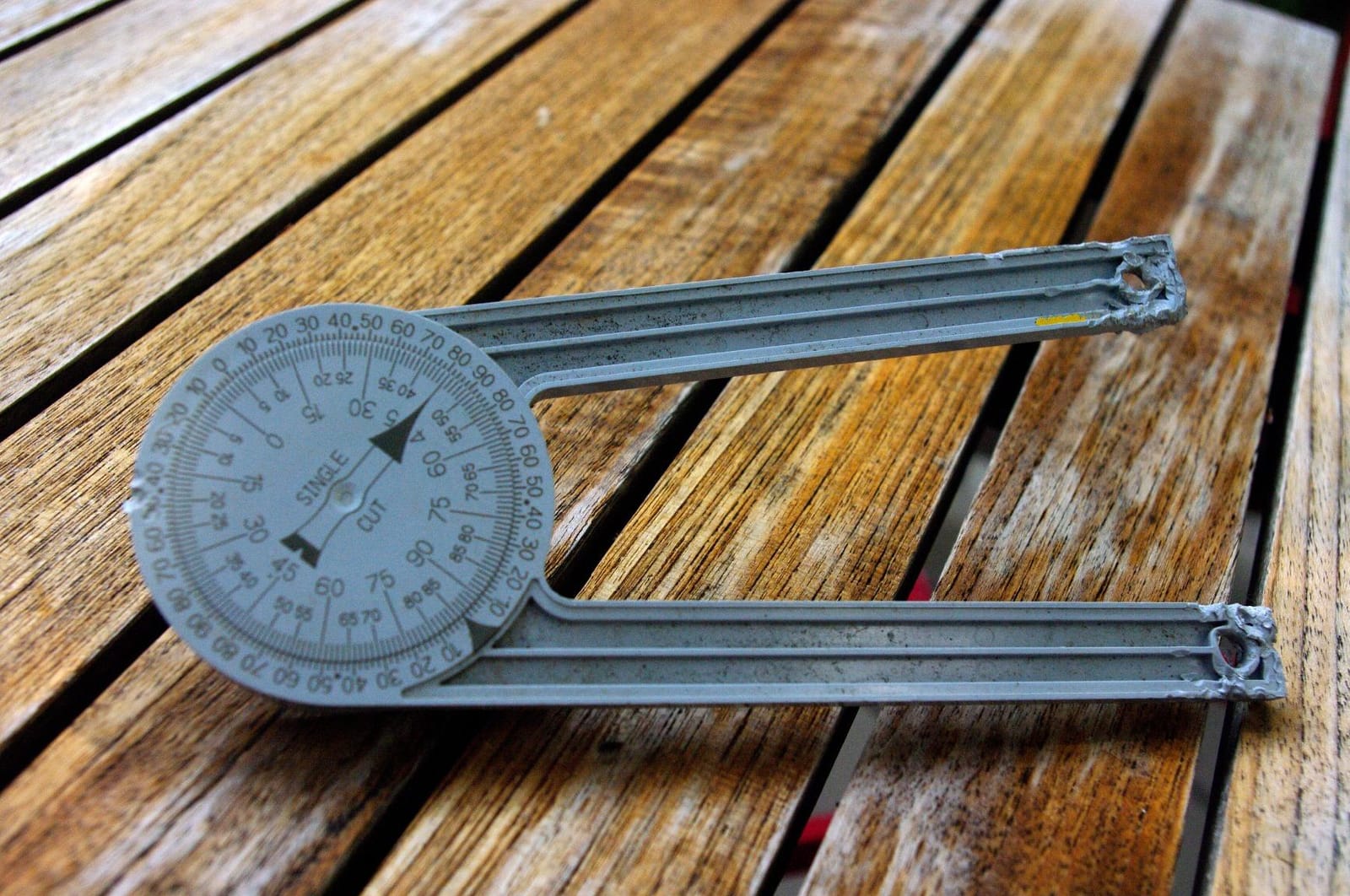
One caution from the forums: because Starrett makes these in volume, occasional units arrive with a scale that does not read quite true. Check it against a machinist square the day it shows up, before you cut a single piece of expensive casing with it.
Why a tool with no features keeps getting recommended
There is nothing to set, nothing to zero and nothing to charge. On a jobsite, that removes the entire class of failure where a digital gauge shows a stale reading and sends a miter off by a degree. The Starrett shows the same number every time or it is obvious that something is wrong.
For someone cutting baseboard and casing all week, that predictability is worth more than a decimal place of claimed accuracy.
Where the plastic body gives ground
A plastic body has more flex than an aluminum one. Over a long reach across a wide casing joint, that flex can translate into a small reading difference, and it is the reason experienced finish carpenters lean toward metal when the price gap is not large.
The engraved scale lines are also fine. If you have trouble with small numerals, an aluminum body with larger laser engraving will be easier in the long run.
5. Saker 7-Inch Aluminum Miter Protractor – Best for Cabinet Work
Saker Miter Saw Protractor 7-Inch Aluminum Protractor Angle Finder Black
CNC-machined aluminum alloy body
O-frame for inside and outside corners
Laser engraved scales
Pros
- Aluminum quality beyond the price tier
- Removes guesswork from inside and outside corner angles
- Learned in a single use by most buyers
- Light enough to carry around the shop
Cons
- Instructions are thin for compound angle work
- No protective case in the box
- Scale numerals are small
The Saker is an aluminum O-frame miter protractor aimed squarely at cabinet and box work. The O-shaped body opens to both inside and outside corners, and the CNC-machined aluminum alloy is described as corrosion and wear resistant, which matters in a humid shop or a garage project.
In practice, the O-frame is the reason it works well for cabinets. A face frame or a box corner is a tight inside corner with two square edges, and the O-frame sits flat against both with no rocking. Owners on woodworking forums specifically single it out for molding, dado rail and cabinet work.
It carries a 4.7 rating across 4.5k+ reviews, and the recurring positive is learning curve. Most buyers say they were making accurate transfers within a single use, which is a high bar for a bisected-scale tool.
It weighs 6.3 ounces, so it is light enough to move around the shop with one hand, and the laser engraved scales mean the numbers survive contact with sawdust and glue.
Where an O-frame beats a narrow arm
On a square inside corner, the O-frame has two full edges of contact, so it cannot rock and shift the reading mid-measure. That stability is the whole argument for spending above the plastic tier on a miter protractor.
It also opens outward for outside corners, so a return or a fascia match uses the same tool rather than a second one.
Where the Saker is not the answer
The instructions are thin, and compound angle work is exactly where a beginner needs the most guidance. Budget time with a reference or ask someone experienced rather than trusting the included paperwork.
It arrives in bubble wrap with no protective case, so a metal case is worth adding if it rides in a truck. The printed numerals are also on the small side.
6. Preciva Digital T-Bevel Gauge – Best With Bubble Levels
Preciva T-Bevel Gauge & Protractor with Horizontal and Vertical Bubble,0-338° Digital Angle Finder Protractor 230mm/8inch Display for Carpentry Woodworking, Metalworking, Construction
0-338 degree range with +/-0.3 degree accuracy
Dual bubble levels
9 inch stainless body
Pros
- Zeroing is reliable and repeatable
- Metal arms transfer angles to a saw cleanly
- Built-in horizontal and vertical bubbles
- Auto power off after inactivity
Cons
- Inside corner readings can read slightly off
- Unkeyed battery bay accepts a reversed cell
- Noisy pivot can wake the unit and drain it
The Preciva DG00135 is a digital sliding T-bevel with a 0-338 degree measuring range and a stated accuracy of 0.3 degrees. At 230 mm, it is a full size T-bevel rather than a compact protractor, and it does the work of a traditional wooden or metal T-bevel with a readout attached.
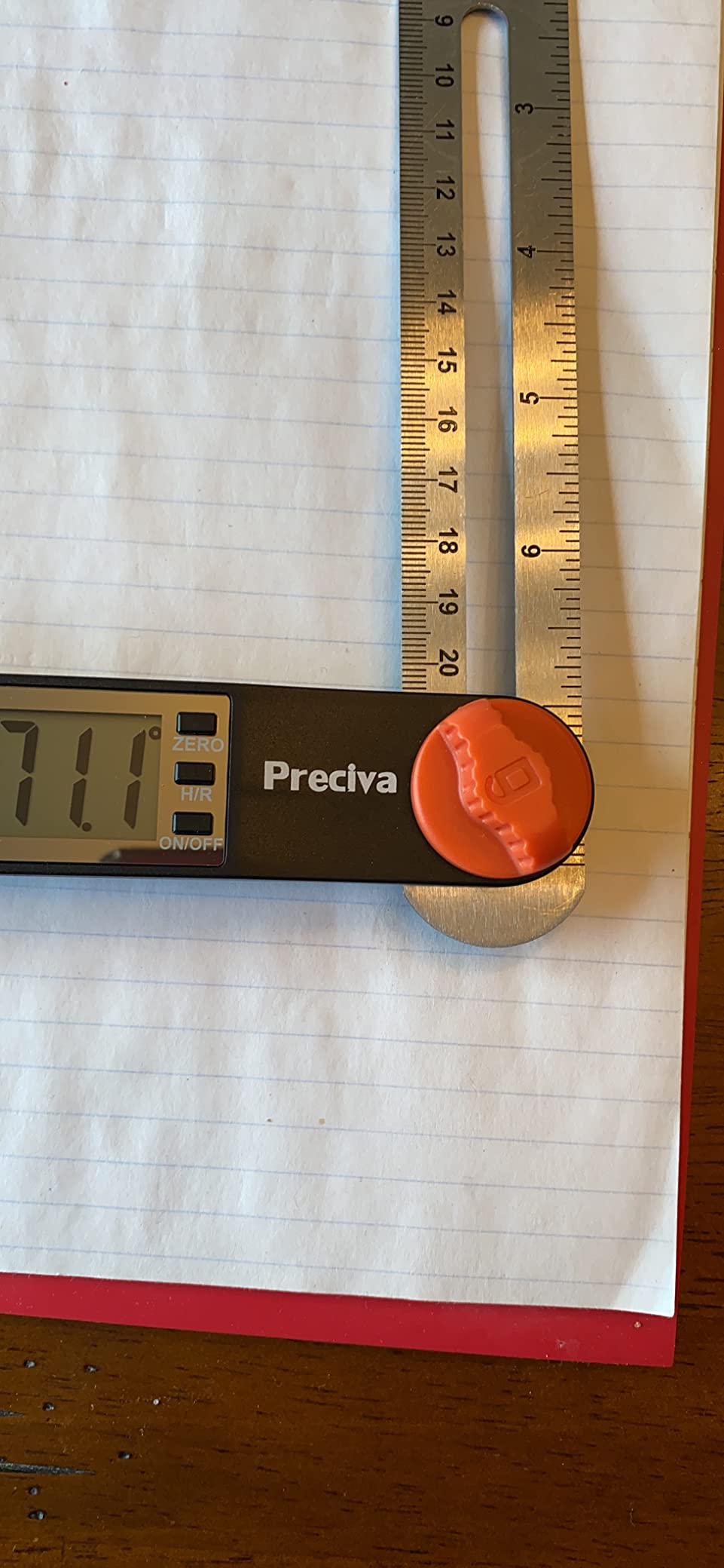
What separates it is the zero reliability. Owners repeatedly report that closing the arms returns the tool to zero cleanly and repeatably, and several say it beats similarly priced competitors on that single point. For repeated cut lists, a stable zero is worth more than a decimal of extra range.
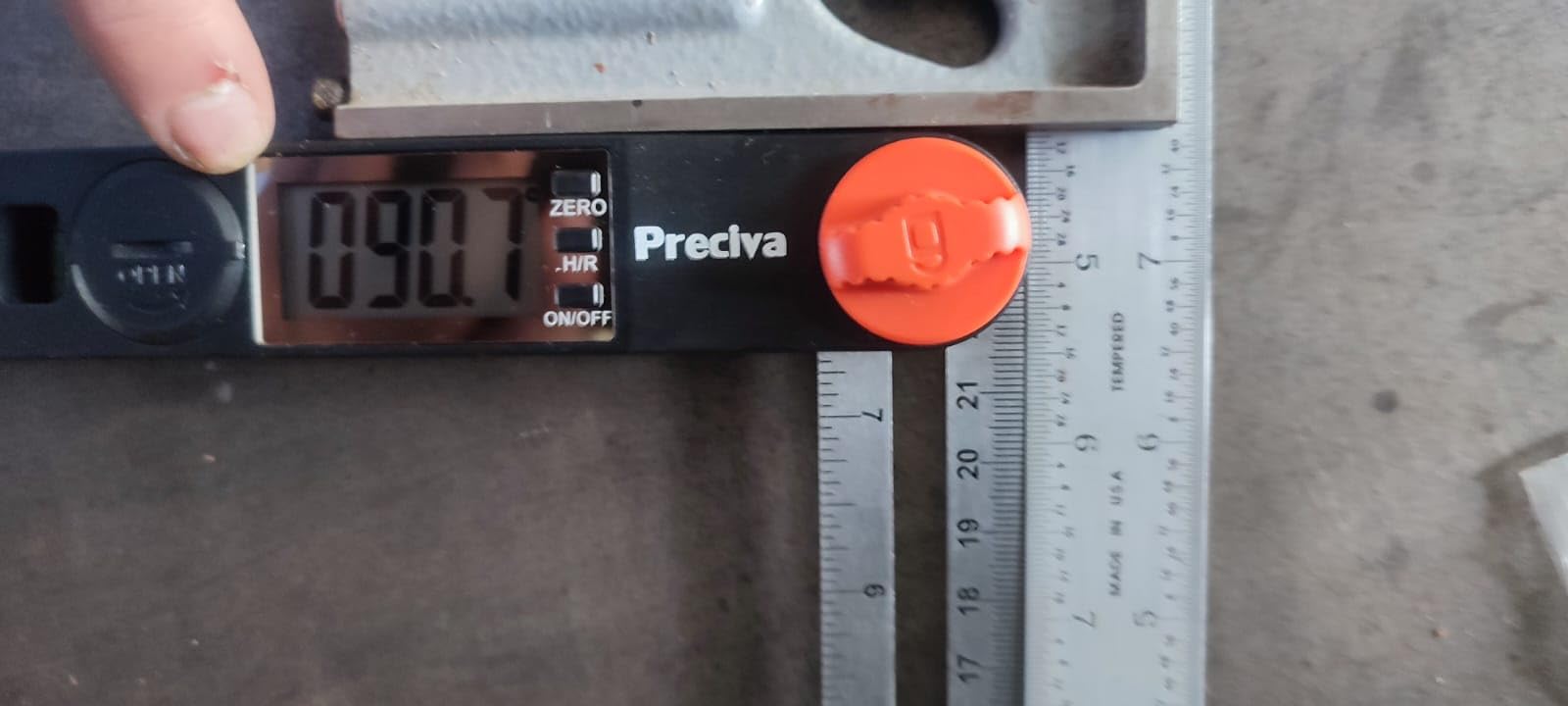
It carries a 4.3 rating across 5.7k+ reviews, and the positives cluster around accuracy for miter and baseboard work, metal construction, and the bubble levels letting you level before you trace.
Those bubble vials, one horizontal and one vertical, are unusual on a tool in this category. On a wall run or a shelf layout, they let you confirm level in the same placement as the angle reading instead of a separate trip with a torpedo level.
When a T-bevel beats a miter protractor
A T-bevel has a long flat blade, so you can slide it against a workpiece edge, mark the line and carry that line across a board. That is the tool for scribing, for marking a taper, and for any layout where you want the angle and the mark in one pass.
The center knob locks the angle once set, so the blade holds position while you draw. Owners use it for compound miter saw setup and baseboard cuts.
Where the Preciva is not the answer
The plastic housing sits outside the metal arms, which means an inside corner reading can be slightly off compared with an all-metal tool. If you need tenths of a degree on a tight inside corner, this is not the one.
The battery compartment is not keyed, so a cell can go in backwards, and the pivot is noisy enough that moving the arms can wake the unit and pull power from the cell.
7. General Tools 828 Digital T-Bevel – Best Digital T-Bevel
General Tools T-Bevel Gauge & Protractor – Digital Angle Finder with Full LCD Display & 8″ Stainless Steel Blade
360 degree stainless steel blade
Full LCD with hold and reverse
Automatic shutoff
Pros
- Digital readout shows when an angle shifts while handling
- Folds flat for storage
- Zeroes against any reference surface
- Large display readable in bright light
Cons
- Self-zero can read over a degree off until calibrated
- Locking nut loosens and small parts get lost
- Plastic handle edges need easing
The General Tools 828 is a 360 degree digital sliding T-bevel with a full LCD and a stainless steel blade. The four control buttons cover power, reading hold, reverse angle and display flip, which is a more complete control set than most tools at this level include.
The reason I like it is the digital confirmation. With an analog T-bevel, if the blade shifts while you are moving, you never know. Here, the readout changes, and you re-seat and re-check. On a long cut list that difference is what stops an entire batch of parts from being slightly wrong.
It rates 4.4 across 3.5k+ reviews. Owners highlight the speed on trim, framing and roofing work, and the fact that it folds flat enough to live in a small tool bag. The automatic shut-off is a genuine plus for anyone who has come home to a dead coin cell.
Be realistic about the resolution. Several reviewers note that fractional degree readings are not reliably repeatable and that whole-degree accuracy is what actually holds. Treat it as a layout and confirmation tool rather than a precision instrument.
What the hold and reverse buttons are for
Hold freezes the reading so you can move the tool to the saw without losing the number. Reverse flips the display for inside corner positions so you are not reading the tool upside down. The display flip keeps it legible when the tool is mounted flat against a vertical surface.
Together those three functions are what make a digital T-bevel worth carrying over an analog one for roofing and general framing work.
Where the General Tools 828 is not the answer
The self-zero function can read more than a degree off until you calibrate it on a known flat surface. Calibrate before the first cut of a job, not after you have already laid out a wall.
The blade locking nut can loosen in a tool bag and the small parts go missing, and the plastic handle has sharp edges worth easing with sandpaper before you use it all day.
8. General Tools Square Head Protractor – Best All-Metal
General Tools Square Head Protractor & Angle Finder for Carpentry & Framing
0-180 degree dual direction scale
6 inch adjustable arm
Square head anchors the tool
Pros
- All metal with no electronics to fail
- Doubles as a marking and scribing tool
- Sets to any angle quickly with a thumb nut
- Compact 8 inch overall length
Cons
- Small engraved numerals
- Locking bolt needs an Allen key
- Verify the scale against a square on arrival
The General Tools square head protractor is the simplest tool in this list and one of the most useful. It is a stainless steel arm with a 0-180 degree semi-circle scale that reads in both directions, a 6 inch adjustable arm with a knurled thumb nut, and a 3-3/8 by 2 inch square head that anchors it against your work.
Because it is fully mechanical, there is no battery, no zero and no calibration, so nothing needs charging between uses. Several reviewers say it performs comparably to machinist-brand protractors in actual use.
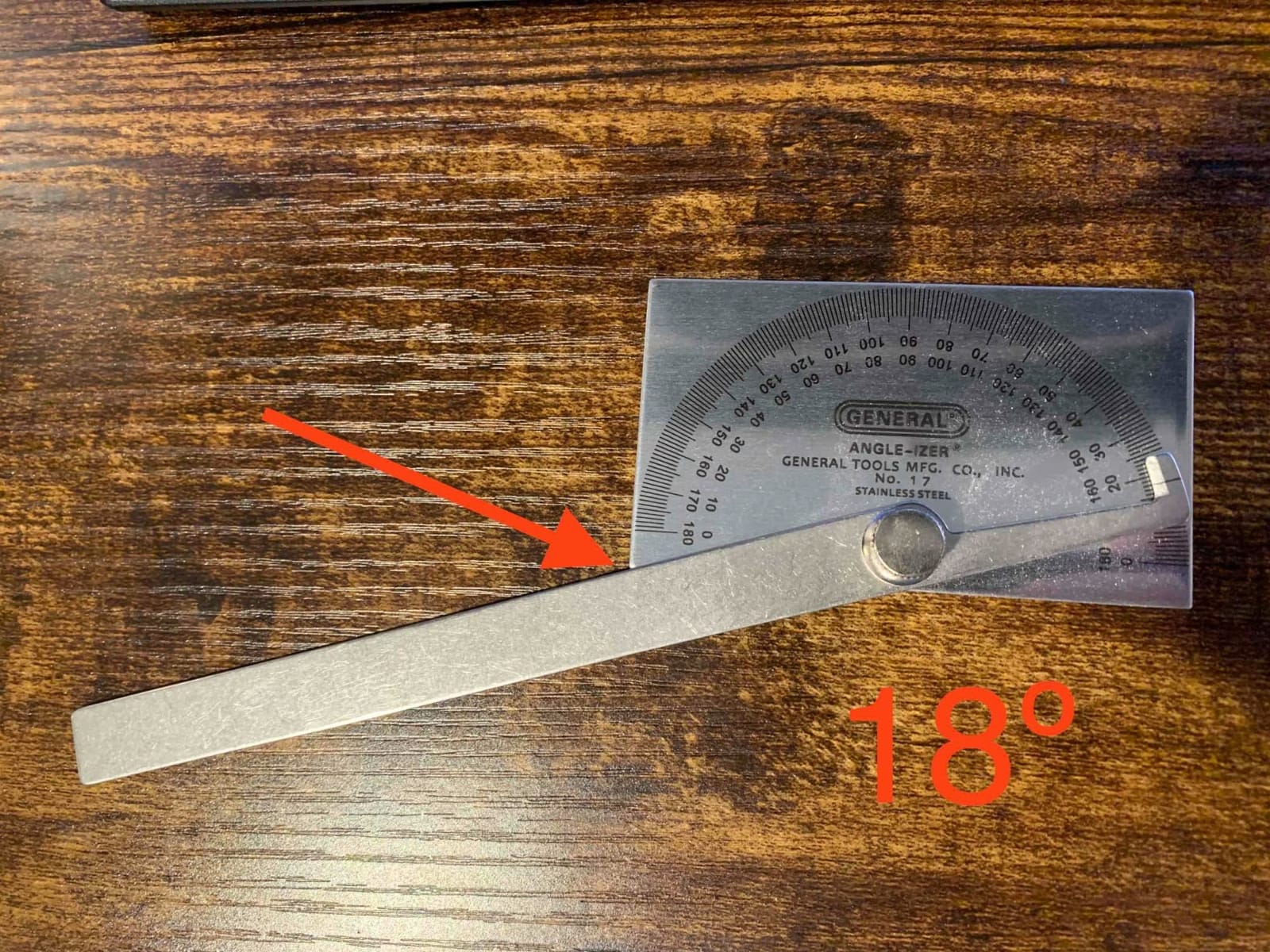
It holds a 4.5 rating across 2.8k+ reviews, and owner comments focus on speed. One placement marks the angle, sets it and draws the line, which replaces a separate protractor and scribing step.
There is one honest warning in the reviews that is worth repeating: some units arrive with a scale that reads about a degree off. Check it against a machinist square the day it arrives, before you trust it on a finished wall.
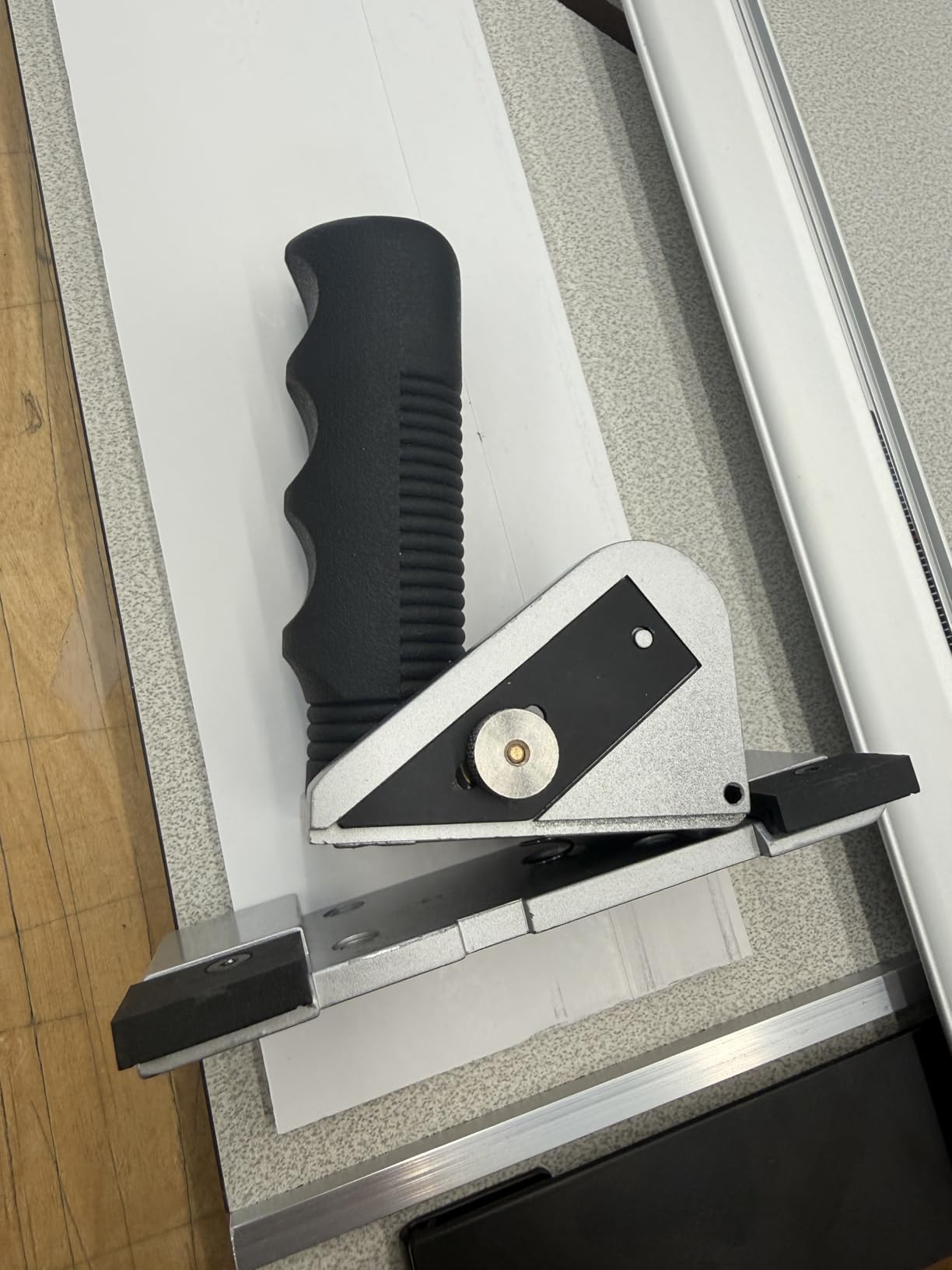
When a square head is the right shape
The square head gives you a wide bearing surface, so the tool stays flat against a workpiece instead of rocking on a thin arm. That makes it the better shape for scribing a part to fit an out-of-square wall, where the arm alone would drift.
The dual direction scale means you can read forward or reverse without flipping the tool, which halves the number of times you have to reposition in a tight corner.
Where the square head is not the answer
The engraved numerals are small, which is a real problem for anyone with aging eyes. If reading a scale in poor light is part of your job, a digital or larger-engraved aluminum tool is a better fit.
It is also a fixed head rather than an O-frame, so it is not the natural choice for a tight inside corner on a cabinet or a picture frame, and it will not read a saw blade.
9. Neoteck 16-Inch Digital Angle Finder – Best for Long Reach
Neoteck 225° 16 inch Digital Angle Finder Aluminum Protractor LCD Backlight
16 inch aluminum arms
0-225 degree range with backlit LCD
Bubble levels and data hold
Pros
- Long arms suit baseboard and larger stock
- Backlit display works in a dim shop
- Readings checked out against reference tools
- Doubles as a level with two vials
Cons
- Weighs 12.7 oz and tires the arm
- Arm lock is not as rigid as premium models
- Bulk for small parts layout
The Neoteck NTK230 is a 16 inch, 400 mm digital angle finder with a 0-225 degree measurement range, 0.1 degree increments and a stated accuracy of 0.5 degrees. That is a different job from the compact tools above: it reaches across a wide baseboard or a large piece of casing in one placement.
The backlit LCD is the feature that will matter most to you, depending on your shop. Several owners specifically call out being able to read it in a dimly lit workspace, which is a real complaint about most non-backlit digital protractors.
It carries a 4.5 rating across 3.1k+ reviews. Buyers like the combination of reach, backlighting and bubble levels for trim, baseboard and slope work, and a number of them report checking their readings against other reference tools and finding them consistent.
It is powered by an included 9V zinc carbon battery with a five minute auto shutdown and a low battery warning, which is more convenient than coin cells. The integrated horizontal and vertical bubble vials let you level in the same placement as the angle.
When you need 16 inches of arm
Reaching is the whole reason. When the corner is wider than your shorter protractors, you either have to slide the tool and average two readings, which introduces error, or you work in sections and lose the true angle. A 16 inch arm removes the compromise.
It also works as a long T-bevel, so it can mark a taper line across a board in the same pass as the measurement.
Where the Neoteck is not the answer
It weighs 12.7 ounces. Holding that out in front of you for a long measurement is tiring, and the weight is noticeable by the end of a day of repeated use.
The stated accuracy of 0.5 degrees is looser than the compact tools, the arm lock is not as rigid as a premium machined pivot, and the bulk is genuinely wrong for small parts layout in a crowded bench area.
10. Coobeast Dual Laser Angle Gauge – Best With Laser Lines
Coobeast Digital Angle Finder with Dual Laser 4-side Magnetic Angle Gauge
Magnets on all four sides
Dual red laser lines
Rechargeable 400mAh USB-C battery
Pros
- Four sided magnet mounts in any orientation
- Dual laser lines give a bright reference
- USB-C rechargeable so no disposable cells
- Display auto-inverts past 90 degrees
Cons
- Accelerometer zero drifts so avoid tenths work
- Laser line is indoor only
- One owner found the zero not repeatable
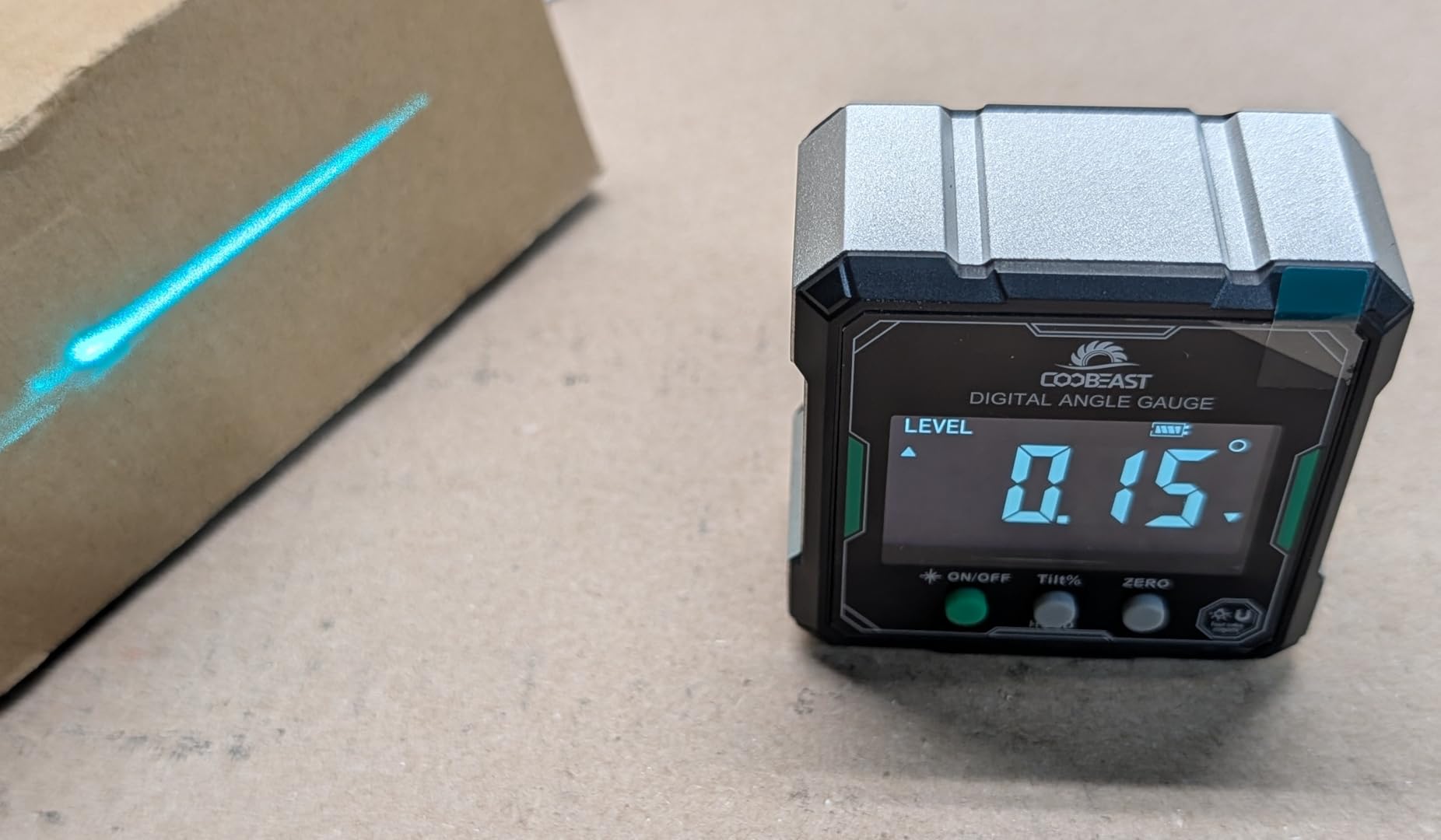
The Coobeast 5341 is a different category again. It is a magnetic angle gauge with magnets on all four sides, dual red laser lines under 5mW output, a 360 degree measurement range with an auto-adjusting display, and a rechargeable 400mAh battery with USB-C charging and a charge indicator.
The four-sided magnet is what makes the laser lines actually useful. Most laser-equipped angle finders can only mount one way, so the beam is projected somewhere unhelpful. Being able to attach this unit to any of the four faces means the lines go where you need them.
It rates 4.4 across 725 reviews, so it has the smallest owner base in this list. Buyers consistently value the combination of four-sided magnets, dual lasers and a rechargeable battery as a step up from a basic angle finder, and they like the readability of the backlit screen.
The display flips automatically when the unit is mounted upside down, and it can report in degrees or percent, which is handy for setting a slope or a grade rather than a fixed angle.
What the laser lines are actually for
They are a reference line, not a measurement. Sticking the gauge to a steel surface and projecting the beam gives you a line to align a shelf, a cabinet or a row of wall fasteners without marking every one. The same four-sided magnet lets it sit flat on a machine table as a level reference.
It is rated IP54, so dust and incidental moisture are not a concern in a normal shop.
Where the Coobeast is not the answer
The accuracy is stated at 0.2 degrees, but that reading comes from an accelerometer, and reviewers are candid that the zero can drift and is not suitable for precision or repeatability-critical work. Do not use it to set a compound miter.
The laser is an indoor reference only. It will not throw a visible line outdoors in daylight, and the small review base means you are buying on the spec sheet rather than on years of owner reports.
How to Transfer an Angle to Your Miter Saw and Why You Halve It
This is the most repeated question in every woodworking forum we read while putting this list together. People can measure a corner perfectly and still cut a miter that does not close, because the saw needs half the angle, not the whole one.
Here is the rule. A square corner measures 90 degrees. A miter saw swings to either side of center, so each cut piece is half of 90, which is 45 degrees. An inside corner that measures 92 degrees needs a 46 degree miter setting. An inside corner at 84 degrees needs 42. The two pieces together add back up to the corner, and they meet flush.
For crown molding, the situation differs. Crown has a compound bevel, so you set the saw bevel to the angle between the wall and the ceiling, and the miter to half the corner. If your crown saw is a single bevel, you flip the molding over for one of the two pieces. If it is a dual bevel saw, you can leave the piece in the same orientation for both cuts.
There is real disagreement about this in the forums, and it is worth being straight about it. A veteran trim carpenter with roughly 25 years of experience in the Sawmill Creek threads states plainly that an angle gauge is handy but not necessary, that he owns none, and that cutting crown propped against the fence is simpler than cutting it flat. Others in the same thread describe the Starrett as their daily driver. Technique and tool both matter, and the tool is the easier variable to fix.
How to Check Your Gauge and Your Saw’s Own Scale
Before you trust any reading, run a three-step check. Place the tool flat on a surface you know is flat and read it three times. The spread between those three readings is your repeatability, and it is more informative than the number on the box. Then check 0, 30, 45 and 60 degrees against a machinist square. If the error grows with the angle, the tool has a centering problem. If the error is the same at every angle, the zero is simply off.
Then check the saw. Factory bevel and miter scales drift, and the reports in the forums show some saws going out of alignment while others stay dead on for years, sometimes from the day they were unboxed. Stick a magnetic gauge to the blade, set what you believe is 45 degrees, and read what the tool says. If it is not 45, you now have a correction to remember for that saw.
Do that check at the start of a trim job and again every few months. It takes under two minutes and it tells you whether your mistake is the cut or the setting.
Angle Finder Buying Guide
Accuracy tolerance. For layout and general trim, 0.3 degrees is plenty. For a compound miter on crown, tighter is better. Be aware that a 0.1 degree readout is resolution, not accuracy. A display showing tenths can still be a few tenths out, and repeatability is what determines whether a series of cuts match each other.
Measurement range. A 0-90 or 0-180 range covers blade tilt and bevels. 0-225 or wider covers slopes, roof pitch and unusual transfers. A 360 degree range suits work where the arms swing all the way around, such as some compound setups.
Magnetic base. This is the decisive feature for machine setup, and buyers frequently assume every angle finder has one. Only the cube-style gauges and the four-sided laser unit above are magnetic. If you want to read a saw blade, a pivot-arm protractor will not help you at all.
Display. A backlit LCD is worth paying for if your shop is dim. A reverse contrast auto-rotating display helps when the tool is mounted in an awkward orientation. And remember that a backlit screen can still wash out in direct sun, which matters for outdoor trim work.
Zero and hold. Zeroing against a reference surface lets you measure change rather than absolute angle, which is exactly what you want to read an 88 degree reference as a true 90. Hold freezes a reading so you can carry it to the saw. A tool with neither is a tool you will double-check by hand.
Power source. Coin cells like the CR2032 are cheap and compact but drain faster and are easy to install backwards in an unkeyed bay. A 9V battery lasts longer between changes. A USB-C rechargeable unit removes the question entirely but means you are waiting if the battery runs flat mid-job. There is no wrong answer here, only a different annoyance.
Build material. Anodized aluminum resists corrosion, holds an edge and outlasts plastic. Stainless steel is harder still. Plastic is lighter and cheaper, and it flexes slightly, which shows up as a small reading change over a long reach. This is not a quality judgment, it is a reach judgment.
Build material versus other angle tools. If your needs are simple, a speed square or a T-bevel may already be enough, and our guide to wide-angle viewing covers a different meaning of the word angle entirely. An angle finder earns its place when you need a number you can trust or a magnetic base for a blade.
Angle Finder Terms Worth Knowing
Level means horizontal. Plumb means vertical. Pitch is the rise over a horizontal run, usually expressed as a ratio or a percentage. Slope is the same idea measured as a ratio.
Bevel is the tilt of a saw blade away from vertical, which is what you set on a table saw or a miter saw. Miter is the rotation of the blade in the horizontal plane, which is what you set for a corner joint. A compound cut changes both at once, which is what crown molding requires.
Zero function sets the tool to read zero against whatever surface it is currently on. Relative measurement is a reading taken against a reference other than gravity, and absolute measurement is a reading from true horizontal. Inside corner is where two surfaces meet forming a wedge pointing at you. Outside corner is the reverse.
A miter protractor is specifically a pivot-arm tool with a bisected miter scale. An angle gauge is the broader category, and an angle finder is the common name for either. A V-groove is a notch in the base of a gauge that seats over a round part.
Frequently Asked Questions
What tool do carpenters use to find angles?
Most carpenters use a T-bevel or a speed square for everyday layout, and an angle finder when they need a trustworthy number or need to read a saw blade. Trim carpenters lean on a miter protractor, because its engraved miter scale already gives the bisected angle the saw needs. Anyone dialing in a table saw blade tilt or a jointer fence reaches for a magnetic angle gauge, since those are the only angle finders that stick to a machine.
What is the best angle finder for woodworking?
The Klein Tools 935DAG is the best overall angle finder for woodworking, because its strong magnetic base reads a saw blade tilt directly and its zero calibration lets you measure against any reference. If your work is trim and layout rather than machine setup, the LEXIVON LX-230 aluminum miter protractor is the better buy, and the GemRed 82305 covers the same job digitally at the budget end.
What is the best miter angle finder?
For a miter angle finder specifically, the LEXIVON LX-230 is our pick. It is a CNC-machined anodized aluminum body with laser engraved miter and single cut scales, a Teflon O-ring swivel that works in both inside and outside corners, and no batteries to manage. The Starrett ProSite 505P-7 is the lighter alternative if you want something that lives in a tool belt.
How do you use an angle finder on a miter saw?
First, zero the tool on a known flat surface. Second, open the arms into the corner and read the miter scale, which is already bisected for you. Third, halve any raw corner angle you measured yourself, so an inside corner at 92 degrees becomes a 46 degree miter setting. Fourth, set the saw, lock the head, and verify the result with a framing square on a test cut before you commit expensive molding.
Do I need a digital or analog angle finder?
Analog is enough for most trim work and never fails, since there is no battery and no calibration. Digital is worth it when you are in poor light, when you want to copy an odd angle off an existing workpiece, or when you need to zero against a reference surface and read a relative change. A veteran trim carpenter quoted in woodworking forums makes the case that technique matters more than tooling, and that many experienced finish carpenters get by with a T-bevel and a protractor alone.
How accurate should an angle finder be?
For layout and general trim, a tolerance of plus or minus 0.3 degrees is comfortable. For compound crown miter work, tighter is better. The number that actually determines whether your cuts match each other is repeatability, not the headline spec, so check the same angle ten times and see how tightly the readings group before you buy anything.
What is the best angle finder for trim?
For trim work, the Starrett ProSite 505P-7 miter protractor is the first tool we would reach for on trim, because the narrow 7 inch profile reads correctly upright or upside down and it weighs 3.53 ounces, so it can live in a tool belt. The LEXIVON LX-230 is the better choice if you want aluminum rigidity and larger laser engraved numbers, and the Neoteck 16 inch model is the one to pick when you need a backlit display and long reach for wide baseboard.
What is a miter protractor?
A miter protractor is a pivot-arm angle finder built for corners. Its two arms swing to fit inside or outside a joint, and its face carries two laser engraved scales: a miter cut scale that gives the bisected angle your miter saw needs, and a single cut scale that gives the butt joint angle for a face frame. The tool has no electronics, so it never needs a battery and never needs calibrating.
Final Verdict
The best angle finders for woodworking fall into two groups, and the honest answer is that most shops want one from each. Buy the Klein Tools 935DAG for machine setup, because a magnetic base is the only way to read a blade tilt directly, and buy a miter protractor for layout.
Within the protractors, the LEXIVON LX-230 is the one we would own, with the Starrett ProSite 505P-7 as the lighter tool-belt option and the GemRed 82305 if you want a digital readout without the backlight. Whatever you choose, check the scale against a machinist square the day it arrives, verify your saw’s own bevel markings at the start of the job, and halve the corner angle before you set the miter. Those three habits matter more than any spec on any box.