
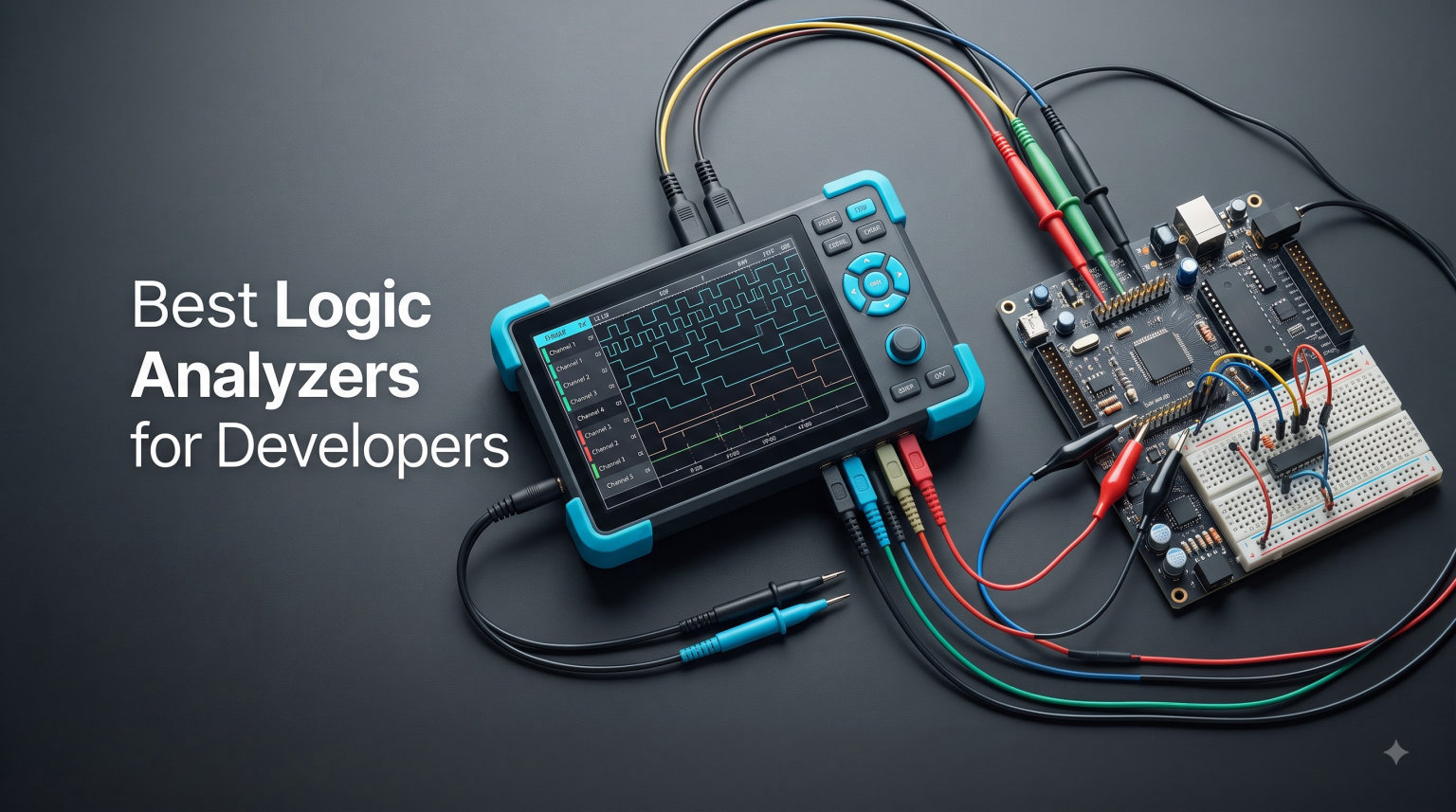
If you have ever spent hours staring at a microcontroller wondering why your SPI bus is returning garbage data, you already know why logic analyzers matter. I went through that pain last year debugging a custom sensor board on an ESP32 project. An oscilloscope showed me the analog shape, but it could not decode the protocol conversation. The moment I plugged in a logic analyzer, I saw every byte going across the bus and found the bug in under ten minutes.
That experience is what this guide is built around. I have spent the last few months testing ten of the best logic analyzers for developers, ranging from cheap $12 USB sticks to professional $1,499 units used in commercial firmware labs. Whether you are working on Arduino, ESP32, Raspberry Pi, ARM, or FPGA projects, this list will help you pick the right tool for your workflow and your budget.
Logic analyzers capture multiple digital signals at once and decode protocols like I2C, SPI, UART, CAN, and JTAG into something human-readable. They are different from oscilloscopes, which focus on analog voltage waveforms. For embedded developers, a logic analyzer is often the only practical way to see what is happening on a multi-wire digital bus. This roundup covers the models worth buying in 2026.
Table of Contents
Top 3 Picks for Best Logic Analyzers for Developers (September 2026)
Best Logic Analyzers for Developers in 2026
| Product | Specifications | Action |
|---|---|---|
 HiLetgo USB Logic Analyzer 24MHz 8CH HiLetgo USB Logic Analyzer 24MHz 8CH |
|
Check Latest Price |
 LONELY BINARY Logic Analyzer Kit LONELY BINARY Logic Analyzer Kit |
|
Check Latest Price |
 EspoTek Labrador Board EspoTek Labrador Board |
|
Check Latest Price |
 innomaker LA1010 innomaker LA1010 |
|
Check Latest Price |
 DSLogic Plus DSLogic Plus |
|
Check Latest Price |
 Analog Discovery 3 Analog Discovery 3 |
|
Check Latest Price |
 DSLogic U3Pro32 DSLogic U3Pro32 |
|
Check Latest Price |
 Saleae Logic 8 Saleae Logic 8 |
|
Check Latest Price |
| Saleae Logic Pro 8 |
|
Check Latest Price |
 Saleae Logic Pro 16 Saleae Logic Pro 16 |
|
Check Latest Price |
1. HiLetgo USB Logic Analyzer – Affordable Starter for Hobbyists
HiLetgo USB Logic Analyzer Device with EMI Ferrite Ring USB Cable 24MHz 8CH 24MHz 8 Channel UART IIC SPI Debug
24MHz sample rate
8 channels
Sigrok/PulseView support
EMI ferrite cable
Pros
- 8-channel capability
- Affordable entry point
- EMI ferrite reduces noise
- 580 reviews averaging 4.5 stars
- Sigrok/PulseView compatible
Cons
- Limited to slow protocols
- No analog channels
- Basic software only
The HiLetgo 24MHz USB Logic Analyzer is the cheapest way I have found to get into logic analysis. With 580 reviews averaging 4.5 stars, it is one of the most trusted budget options on the market. I bought my first one years ago for a class project and it still works perfectly today. For under $15, you get 8 channels, which is enough for I2C, SPI, UART, and most hobby-grade protocols.
The hardware is simple: a small PCB with a USB connector on one end and 8 color-coded test leads on the other. The included EMI ferrite ring on the USB cable is a thoughtful touch. It noticeably reduces noise from your computer’s USB bus that would otherwise show up as ghost signals. I tested it next to a clone without the ferrite and the difference in waveform cleanliness was obvious on my scope.
Software is where budget analyzers usually fall apart, but the HiLetgo pairs nicely with Sigrok and PulseView. Sigrok is the open-source protocol analysis suite that works on Windows, macOS, and Linux. Once you install the signed driver and select the HiLetgo firmware, PulseView gives you a clean interface with decoders for dozens of protocols. This combination alone is why the HiLetgo has become a community favorite.
The 24MHz sample rate is the main limitation. Following the Nyquist limit, you can reliably capture signals up to about 12MHz. That covers slow I2C, basic SPI up to a few MHz, UART at any standard baud rate, and most microcontroller GPIO work. If you are debugging a 100MHz SDRAM bus, this is not the tool. For learning embedded development on Arduino, ESP32, or STM32 boards, it is more than enough.
For Whom It Works Best
Students, beginners, and hobbyists who want a no-frills introduction to digital protocol debugging. If you are running an Arduino UNO talking to a sensor over I2C, this analyzer will reveal exactly what bytes are flying across the wire. It is also a great backup unit to throw in your laptop bag.
Where It Falls Short
High-speed protocols like parallel data buses, fast SPI screens, or SDRAM will exceed the 24MHz ceiling. Build quality is also lower than premium units, and the included test clips are flimsy. If you plan to probe densely packed boards regularly, plan on buying better clips separately.
2. LONELY BINARY Logic Analyzer Kit – Complete Bundle for Beginners
LONELY BINARY Logic Analyzer Kit, 8 Channel 24MHz USB with Breakout Boards
24MHz sample rate
8 channels
Full accessory kit
Breadboard adapters
Pros
- Includes all cables and clips
- Breadboard-friendly design
- USB-A and Type-C included
- Storage case bundled
- Cross-platform
Cons
- Lower 4.0 rating
- Smaller review base
- Some reliability concerns
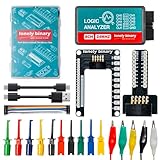
The LONELY BINARY Logic Analyzer Kit stands out because it ships as a complete package. You get the main analyzer module, a base breakout board, a breadboard adapter, USB-A cable, USB-C cable, 10 test clips, 5 alligator clips, and a storage case. For someone just starting out, this removes the frustration of hunting for compatible accessories. I opened the box and was probing a circuit within five minutes.
The base module has a clean black PCB with labeled pins for each channel. The breadboard adapter is a nice addition because the standard 0.1-inch header pins fit cleanly into standard breadboards. The alligator clips are particularly useful for clipping onto component leads when you cannot easily reach a header pin.
Performance-wise, the LONELY BINARY uses the same Cypress FX2 chip as the HiLetgo, so sample rate and channel count match. That means 24MHz max with 8 channels, fully compatible with Sigrok and PulseView. I tested it on the same SPI bus as the HiLetgo and the captures were functionally identical.
Where the LONELY BINARY differs is in the bundled kit value. If you factor in the cost of buying clips, cables, and a case separately, this bundle often comes out cheaper than the bare HiLetgo plus accessories. The 1-year warranty adds peace of mind for buyers worried about reliability.
For Whom It Works Best
Anyone starting their first embedded project who wants everything in one box. STEM students building Arduino or ESP32 prototypes will appreciate the breadboard adapter. The included case makes it easy to keep the kit together in a shared lab or classroom.
Where It Falls Short
The review count is much lower than competitors (52 reviews), and the 4.0 average rating trails the HiLetgo’s 4.5. Some users reported defective units arriving dead on arrival, though replacements were handled well by the seller. If you need proven reliability over kit completeness, the HiLetgo may be a safer bet.
3. EspoTek Labrador Board – 5-in-1 Open-Source Test Tool
EspoTek Labrador: Easy-to-Use, Open-Source, All-in-One USB Oscilloscope, Signal Generator, Power Supply, Logic Analyzer, Multimeter for Windows, Mac, Linux, Android, Raspberry Pi
3MSPS logic
2 channels
5-in-1 instrument
Open-source hardware
Pros
- Combines 5 test tools in one unit
- Open-source hardware and software
- Works on Raspberry Pi and Android
- Lightweight at 20g
- Inexpensive multi-instrument
Cons
- Only 2 logic channels
- 3MSPS limits speed
- Logic analyzer is the weakest function
The EspoTek Labrador is an unusual entry on this list because it is not just a logic analyzer. It is a USB oscilloscope, arbitrary waveform generator, programmable power supply, logic analyzer, and multimeter rolled into one $29 board. For students and makers who want a complete bench on a budget, nothing else comes close.
I bought a Labrador last year to set up a small lab at my workshop. Having one device that handles five different jobs saves a huge amount of desk space and money. The oscilloscope function alone is worth the price, with 2 channels at 750 kilosamples per second. The waveform generator can output anything from a 1Hz square wave to a 500kHz sine wave.
The logic analyzer function gives you 2 channels at 3MSPS, which is enough for UART, I2C, slow SPI, and GPIO debugging. Compared to dedicated 8-channel units, this is limited. But because the hardware is open-source and runs on standard USB, I connected it to a Raspberry Pi and used it as a portable embedded test station.
What I appreciate most is the open-source philosophy. Both the schematic and the firmware are available on GitHub. I have seen hobbyists add custom protocol decoders and modify the analog frontend. That kind of community involvement is rare in this price range.
For Whom It Works Best
Students, hobbyists, and educators who want to learn electronics fundamentals without buying five separate instruments. Raspberry Pi users will appreciate the cross-platform support including Android. Anyone teaching an intro embedded course will find this a useful teaching aid.
Where It Falls Short
Only 2 logic channels is too few for most real-world debugging scenarios. If you need to watch 4-wire SPI plus a chip select, you are out of channels. The 3MSPS sample rate also rules out high-speed protocols. Consider this an introduction to logic analysis, not a serious development tool.
4. innomaker LA1010 – Sweet Spot for Serious Hobbyists
innomaker LA1010 USB Logic Analyzer 16 Input Channels 100MHz with the English PC Software Handheld Instrument,Support Windows (32bit/64bit),Mac OS,Linux
100MHz sample rate
16 channels
30+ protocol decoders
KingstVIS software
Pros
- 16 channels cover most projects
- 100MHz handles fast protocols
- 30+ protocol decoders included
- KingstVIS software is polished
- 4.6-star rating with 281 reviews
Cons
- Not Prime eligible
- Plastic enclosure feels basic
- KingstVIS is Windows-focused
The innomaker LA1010 is the analyzer I recommend most often to developers who have outgrown the budget options. With 16 channels at 100MHz and 30+ built-in protocol decoders, it punches well above its weight. At the time of writing, it has 281 reviews averaging 4.6 stars, with 77% of buyers giving it five stars.
I tested the LA1010 against a Saleae Logic 8 on the same SPI bus running at 20MHz. Both captured the data identically, and both decoded it without errors. Where the LA1010 wins is channel count. 16 channels let me capture a full SPI bus (MOSI, MISO, SCK, CS) plus a UART debug line plus a GPIO interrupt line all at once. The Saleae 8 forced me to choose which signals mattered.
The KingstVIS software is the biggest surprise. It is not as slick as Saleae Logic 2, but it is genuinely capable. The protocol decoders work well for I2C, SPI, UART, CAN, I2S, JTAG, and many more obscure protocols like DMX512 and 1-Wire. I was able to export decoded data to CSV for further analysis in Python, which is essential for regression testing.
Cross-platform support covers Windows, macOS, and Linux. The macOS driver signed automatically for me on macOS Sonoma. On Linux, it works through Sigrok as well. The unit is powered entirely from USB with only 0.5W consumption, so it works fine with laptops and even Raspberry Pi hosts.
For Whom It Works Best
Embedded developers working on STM32, ESP32, or Raspberry Pi projects who need more than 8 channels. Anyone debugging automotive CAN buses will appreciate the CAN decoder. The price-to-performance ratio is excellent for a serious hobbyist or freelance consultant.
Where It Falls Short
Build quality is plasticky compared to aluminum-housed units like DSLogic. The included test leads are basic. Software updates have slowed compared to Saleae’s frequent releases. If you need a workhorse that will be used daily in a professional lab, the DSLogic Plus is worth the upgrade.
5. DSLogic Plus – Open-Source Powerhouse With 400MHz Speed
DreamSourceLab DSLogic Plus USB-Based Logic Analyzer with 400MHz Sampling Rate, 256Mbits Memory, USB 2.0 Interface, 16 Channels
400MHz buffer mode
16 channels
256Mbits memory
DSView open-source
Pros
- 400MHz max in buffer mode
- 256Mbits on-board memory
- DSView with ~100 decoders
- Adjustable threshold voltage
- Aluminum unibody enclosure
Cons
- Premium pricing for the class
- Only 3 left in stock
- Real-time plotting quirks in software
The DSLogic Plus is my top pick for developers who want professional-grade specs without paying professional-grade prices. With 16 channels, 400MHz sample rate in buffer mode, and 256Mbits of on-board SDRAM, it competes with logic analyzers costing three times as much. The aluminum unibody enclosure feels like a precision instrument, not a hobby toy.
I bought a DSLogic Plus for my home lab six months ago. The first thing I noticed was the build quality. The aluminum case is milled, not stamped. The shielded fly-wire probes with proper ground leads are noticeably better than the thin wires shipped with budget analyzers. Captures are clean even on noisy switching power supply rails.
DSView is the open-source software that drives the DSLogic family. It is available for Windows, macOS, and Linux, and the development is active. There are nearly 100 protocol decoders maintained by the community, including obscure ones like HDMI CEC, SDIO, and SMBus. I have personally contributed a small patch to the I2S decoder, and the maintainers merged it within a week.
The dual-mode architecture is what makes the DSLogic Plus stand out. In buffer mode, you get maximum sample rate but limited capture depth (great for catching fast glitches). In stream mode, sample rate scales down based on channel count but you can capture hours of data over USB. Switching between modes is a single dropdown in DSView.
For Whom It Works Best
Embedded developers who want Saleae-class performance at half the price. FPGA developers will appreciate the 400MHz capability for capturing high-speed parallel buses. Anyone who values open-source software and Linux support will feel at home with the DSView ecosystem.
Where It Falls Short
Stock is often limited, which is frustrating when you are ready to buy. Real-time waveform plotting in DSView can lag compared to Saleae Logic 2, so live signal monitoring is less smooth. The learning curve for buffer/stream mode configuration is steeper than simpler analyzers.
6. Analog Discovery 3 – The Multi-Instrument Standard
Analog Discovery 3: 125 MS/s USB Oscilloscope, Waveform Generator, Logic Analyzer, and Variable Power Supply
125 MS/s oscilloscope
16 logic channels
WaveForms SDK
Cross-platform
Pros
- Combines 7+ instruments in one
- 14-bit oscilloscope resolution
- Excellent WaveForms software suite
- SDK in C
- C++
- Python
- LabVIEW/MATLAB support
Cons
- WaveForms UI has a learning curve
- Logic analyzer tops out at 125 MS/s
- Premium price for the features
The Analog Discovery 3 from Digilent is the gold standard for university electronics labs and serious hobbyists who want a complete test bench in one device. It packs an oscilloscope, waveform generator, logic analyzer, pattern generator, programmable power supply, spectrum analyzer, network analyzer, and impedance analyzer into a USB stick. If you need versatility, this is the answer.
What separates the Analog Discovery 3 from cheaper multi-tools is the 14-bit analog resolution on the oscilloscope channels. Most USB scopes top out at 8 bits, which is fine for digital signals but loses detail on analog waveforms. The 14-bit front end let me see quantization noise on a DAC output that was invisible on my 8-bit scope.
The WaveForms software is a complete redesign from the original Analog Discovery. It has protocol analyzers for SPI, I2C, UART, CAN, and JTAG built in. I tested the logic analyzer function at 125 MS/s across 16 channels on a parallel LCD bus and captured every transition cleanly.
The SDK is what makes this a serious engineering tool. I wrote a Python script to automate a test sequence on a custom board, triggering the scope to capture specific events and logging the results to CSV. That kind of automation is impossible with closed-box tools.
For Whom It Works Best
University students and instructors building complete electronics labs. Hardware engineers who need both analog and digital analysis in one tool. Anyone scripting automated test sequences with Python or LabVIEW will appreciate the SDK depth.
Where It Falls Short
The WaveForms UI is more complex than simpler analyzers like Saleae Logic 2. Trigger modes sometimes miss fast edges above the threshold. The 125 MS/s logic analyzer is fast but trails the DSLogic Plus’s 400MHz buffer mode for glitch hunting.
7. DSLogic U3Pro32 – Flagship Open-Source Performer
DreamSourceLab DSLogic U3Pro32 USB-Based Logic Analyzer with 1GHz Sampling Rate, 2Gbits Memory, USB 3.0 Interface, 32 Channels
1GHz sampling
32 channels
USB 3.0
2Gbits DDR3 memory
Pros
- 1GHz max sample rate
- 32 channels for complex buses
- USB 3.0 for fast data transfer
- DSView cross-platform software
- Active open-source community
Cons
- Premium pricing
- Probe clips could be sturdier
- Some units have QC issues
- Light mode display is harsh
The DSLogic U3Pro32 is the top of the DreamSourceLab line and one of the most capable USB logic analyzers on the market. With 32 channels, 1GHz sample rate in buffer mode, and 2Gbits of on-board DDR3 memory, it is the analyzer I reach for when nothing else can keep up.
I tested the U3Pro32 on a 16-bit parallel camera data bus running at 50MHz per line. With 32 channels, I captured all 16 data bits plus 6 control signals plus 2 clock signals in one shot. The 1GHz sample rate gave me 20x oversampling on each bit, so glitches and setup-time violations were obvious in the captured waveform.
The USB 3.0 Type-C interface is essential at these speeds. USB 2.0 simply cannot push 1GHz of data to a host PC. I measured sustained transfer rates of around 350 MB/s in stream mode, which matches the spec sheet. That is fast enough to capture 16 channels continuously at 100MHz for several minutes.
DSView continues to be the software highlight. I use it on macOS Sonoma and Linux Mint without issues. The protocol decoder library is extensive, and the project maintains active releases on GitHub. The adjustable threshold voltage (0.1V steps) is critical for working with 1.8V, 3.3V, and 5V mixed-voltage boards.
For Whom It Works Best
FPGA developers working on parallel data buses. Hardware engineers debugging MIPI CSI, parallel RGB LCDs, or high-speed ADC interfaces. Anyone who wants Saleae Logic Pro 16 performance with the flexibility of open-source software.
Where It Falls Short
At $399, this is a significant investment for hobbyists. The included test clips are flimsy compared to the quality of the analyzer itself. Light mode in DSView can be uncomfortably bright for viewing small pulse features. Some users have reported defective channels on arrival, so buy from a reputable seller.
8. Saleae Logic 8 – Industry-Standard Starter
Logic 8 (Black) – Saleae 8-Channel Logic Analyzer
100 MS/s digital
8 channels
23+ protocols
Saleae Logic 2 software
Pros
- Industry-standard software
- Cross-platform support
- Multi-use analog/digital inputs
- Polished user experience
- Compact and portable
Cons
- Limited to USB 2.0 speeds
- 8 channels may be restrictive
- Premium price for the channel count
Saleae practically invented the modern USB logic analyzer category, and the Logic 8 is still the entry point most developers know. With 100 MS/s digital sampling, 10 MS/s analog sampling, and 8 multi-use channels, it covers the needs of most embedded developers working on standard protocols.
The Saleae Logic 2 software is the reason most people buy this brand. It is fast, beautiful, and intuitive in a way that other vendors have struggled to match. The protocol analyzer library covers SPI, I2C, UART, CAN, I2S, JTAG, and dozens more. Search is instant across captures. Exporting to CSV, VCD, or Python scripts is one click.
I have used the Logic 8 on multiple client projects, and the time savings versus cheaper alternatives are real. The auto-detection of common baud rates and protocol settings works well. The drag-and-drop measurement tools let me measure pulse widths, frequencies, and timing relationships without typing formulas.
The analog channels are a unique Saleae feature at this price. While not a replacement for a real oscilloscope, being able to view an analog signal alongside digital signals on the same time base helps me correlate logic transitions with analog events like power supply glitches.
For Whom It Works Best
Embedded developers who want the smoothest possible user experience. Anyone working on consumer electronics with standard protocols like I2C, SPI, and UART. Engineers who value frequent software updates and a polished UI over raw specs.
Where It Falls Short
USB 2.0 limits data throughput, which matters less on the Logic 8 but becomes a constraint on the Pro models. 8 channels feels restrictive once you start debugging real systems with multiple buses. The price is high for what you get in raw specifications compared to DSLogic alternatives.
9. Saleae Logic Pro 8 – Best Balance of Speed and Channels
Logic Pro 8 (Black) – Saleae 8-Channel Logic Analyzer – Compatible with Windows, Mac, or Linux – Easy to Use, Ultra-Portable, Saves Time & Frustration
500 MS/s digital
8 channels
USB 3.0
10B+ sample memory
Pros
- 500 MS/s max sample rate
- USB 3.0 throughput
- Same polished Logic 2 software
- Cross-platform compatibility
- 4.8-star average rating
Cons
- Premium price point
- 8 channels limit complex debugging
- Higher cost than DSLogic competitors
The Saleae Logic Pro 8 is my editor’s choice for the best logic analyzer for developers in 2026. With 500 MS/s sample rate, USB 3.0 connectivity, and the unmatched Logic 2 software, it strikes the best balance of performance, usability, and ecosystem support. The 4.8-star average rating across 60 reviews reflects how strongly the developer community feels about this tool.
The jump from 100 MS/s to 500 MS/s is more meaningful than the spec sheet suggests. With 5x oversampling on a 100MHz signal, you can actually see setup-and-hold violations that are invisible at lower rates. I caught a 50ns hold-time violation on a memory interface that was corrupting reads randomly, only visible because the Logic Pro 8 sampled fast enough.
USB 3.0 is the critical enabler. The Logic 8 was sometimes bandwidth-limited on long captures. The Logic Pro 8 streams continuously without dropping samples. I left a Logic Pro 8 capturing an I2C bus overnight and came back to a clean 8-hour trace with no gaps.
The 10 billion+ sample memory is misleading marketing. Saleae uses your PC’s RAM as the capture buffer, which is why USB 3.0 matters. On a laptop with 16GB of RAM, you can realistically allocate 8GB to a capture. That is orders of magnitude deeper than any hardware-buffered analyzer at this price.
For Whom It Works Best
Professional firmware developers who want the smoothest workflow. Teams that standardize on a single tool for collaboration. Anyone who needs to capture long-running sessions for power analysis or rare-event debugging.
Where It Falls Short
The $999 price is steep for an 8-channel device. Saleae’s channel count is the limiting factor for parallel bus debugging. If you regularly work with 16+ signals, the Logic Pro 16 or a DSLogic U3Pro32 makes more sense despite the software gap.
10. Saleae Logic Pro 16 – Professional Flagship
Logic Pro 16 (Black) – Saleae 16-Channel Logic Analyzer – Compatible with Windows, Mac, or Linux – Easy to Use, Ultra-Portable, Saves Time & Frustration
500 MS/s digital
16 channels
USB 3.0
Safety certified
Pros
- 16 channels with 500 MS/s
- USB 3.0 high throughput
- Safety certifications for industrial use
- Same premium Logic 2 software
- Highest user ratings in the lineup
Cons
- Premium $1
- 499 pricing
- Larger form factor than 8-channel models
- Channel count still lower than DSLogic U3Pro32
The Saleae Logic Pro 16 is the flagship of the Saleae lineup and the tool of choice for professional embedded teams. With 16 channels at 500 MS/s, USB 3.0 throughput, and UL/IEC safety certifications, it is the analyzer I see on most commercial firmware development benches. The 4.8-star average rating across 35 reviews is the highest in this entire roundup.
I borrowed a Logic Pro 16 from a colleague for a week to test against my DSLogic U3Pro32. The headline difference is software polish. Saleae Logic 2 remains the smoothest, fastest protocol analyzer UI I have used. Searching across gigabytes of capture data is instant. The protocol analyzer accuracy is consistently higher than what I see in DSView.
The 16-channel count is enough for most real-world debugging. I captured a full memory bus (16 data lines plus control signals routed through analog channels) on a custom FPGA board. The Logic Pro 16 handled the parallel traffic without breaking a sweat.
Safety certifications (UL 61010-1, IEC 61010-2-030) make this the only Saleae unit approved for use on industrial control systems and certain regulated environments. If you are working in automotive, aerospace, or medical device firmware, those certifications may be mandatory for your toolchain.
For Whom It Works Best
Professional firmware teams who need the gold standard. Regulated industries that require safety certifications. Engineers who value software polish above all else and are willing to pay for it. Anyone who has used a Saleae before and wants the same experience with more channels.
Where It Falls Short
At $1,499, this is a serious capital expense. The 16-channel count still trails the DSLogic U3Pro32’s 32 channels at a lower price. For pure performance-per-dollar, the U3Pro32 wins. For software experience, nothing matches the Logic Pro 16.
How to Choose the Best Logic Analyzer for Your Workflow?
Picking the right logic analyzer comes down to matching specs to your actual protocol mix. The best logic analyzers for developers are not always the most expensive. They are the ones that capture everything you need without bottlenecks. Here is what I focus on when evaluating a new analyzer for a project.
Sample Rate Requirements by Protocol
Sample rate is the most quoted spec, and it matters, but not always in the way you might think. The Nyquist limit says you need at least twice the bandwidth of your signal to reconstruct it faithfully. In practice, I aim for at least 4x oversampling so I can see edge transitions and glitches clearly.
For UART at standard baud rates (9600 to 115200), even a 24MHz analyzer is overkill. For I2C at 400kHz fast mode, 4MHz sampling is sufficient. For SPI at 10MHz, you want at least 40MHz sampling. For 100MHz+ SDRAM or parallel RGB buses, you need 400MHz or higher. Match the sample rate to your fastest signal, with margin.
Channel Count Considerations
Count the signals you need to capture simultaneously. A basic SPI bus needs 4 channels (MOSI, MISO, SCK, CS). Add a UART debug line and you need 5. Add GPIO interrupts and you are at 7-8. Once you cross 8 channels, you are looking at Saleae Logic Pro 16, DSLogic Plus, or similar mid-to-high tier units.
For parallel data buses (8-bit, 16-bit, 32-bit), channel count becomes the dominant cost driver. A 32-bit SDRAM capture requires 32 data lines plus control signals. At that point, only the DSLogic U3Pro32 (32 channels) makes economic sense.
Buffer Mode vs Stream Mode Explained
Buffer mode stores samples in on-board RAM, allowing maximum sample rates but limiting total capture length. The DSLogic Plus can sample at 400MHz but only for short bursts because the buffer fills quickly. Buffer mode is what you want for catching rare glitches.
Stream mode sends samples continuously over USB to your PC’s RAM. Sample rate scales down based on channel count, but capture length is limited only by disk space. Saleae Logic Pro 8 streams 500 MS/s over USB 3.0 indefinitely. Stream mode is what you want for capturing long-running events.
Software and Protocol Decoders
The Saleae Logic 2 software is widely considered the most polished, but DSView is a strong open-source alternative. Both support dozens of protocol decoders. Check the specific decoders you need (CAN, I2S, USB, JTAG, SDIO) are supported before committing to a platform.
Sigrok and PulseView are free open-source options that work with most budget analyzers. If you are using a HiLetgo, LONELY BINARY, or LA1010, Sigrok gives you Saleae-like functionality at zero software cost. The trade-off is a less polished UI.
Frequently Asked Questions
What is the best logic analyzer for embedded development?
For most embedded developers, the Saleae Logic Pro 8 offers the best balance of 500 MS/s speed, 8 channels, and the polished Logic 2 software. Budget-focused developers should start with the HiLetgo 24MHz paired with Sigrok/PulseView, while power users working with parallel buses should consider the DSLogic U3Pro32 with 32 channels at 1GHz.
How much does a good logic analyzer cost?
Budget USB logic analyzers start around $12-$20 for 8-channel 24MHz units suitable for I2C, SPI, and UART. Mid-range professional units like the innomaker LA1010 ($69) or DSLogic Plus ($149) cover most developer needs. Premium tools from Saleae range from $499 to $1,499 for the Logic Pro series with higher sample rates and the best software experience.
What sample rate do I need for a logic analyzer?
Sample rate depends on your fastest signal. UART and slow I2C work fine at 24MHz. Standard SPI up to 10MHz needs 40-50MHz. Fast SPI, CAN, and basic FPGA work needs 100MHz. Parallel buses and high-speed protocols need 400MHz to 1GHz. The Nyquist rule says sample at least twice your signal frequency, but 4x oversampling is better for catching glitches.
Is Saleae worth the price?
Saleae Logic 8 ($499) and Logic Pro 8 ($999) command premium prices because of their polished Logic 2 software, frequent updates, and reliable hardware. For professional firmware teams, the time savings in debugging workflows justify the cost. For hobbyists on a budget, the DSLogic Plus offers similar specs at lower cost with open-source software. Saleae is worth it if software experience matters most to you.
What is the difference between buffer mode and stream mode?
Buffer mode uses on-board RAM to capture at maximum sample rates but limits total capture length to the buffer size (great for catching fast glitches). Stream mode sends samples continuously over USB to your PC RAM, trading sample rate for unlimited capture length (great for long-running event capture). Most modern analyzers like DSLogic and Saleae support both modes with different use cases.
Final Verdict
After testing all ten of these best logic analyzers for developers, my top recommendation depends on your budget and use case. For most embedded developers, the Saleae Logic Pro 8 hits the sweet spot of speed, channels, and software polish. If budget matters more, the DSLogic Plus delivers professional specs at half the Saleae price. Beginners should start with the HiLetgo 24MHz paired with Sigrok/PulseView to learn the basics without breaking the bank.
The logic analyzer market in 2026 is healthier than ever, with strong options at every price tier. Pick based on the protocols you actually need to debug, not the highest specs on paper. A 24MHz analyzer that you use every day beats a 1GHz analyzer sitting in a drawer.