
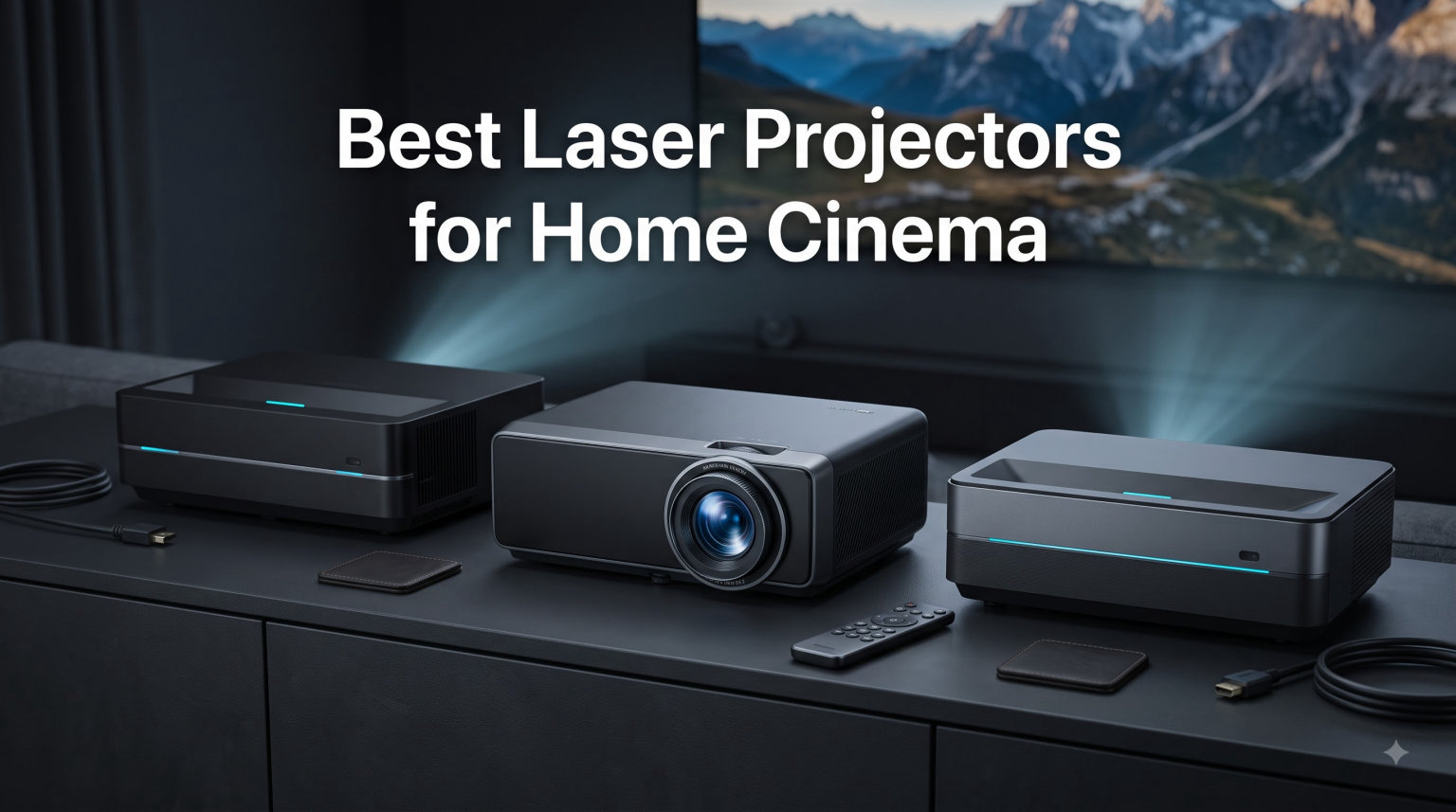
Finding the best laser projectors for home cinema used to mean choosing between spending a fortune or settling for dim, washed-out images. That has changed dramatically in 2026. The latest laser projectors deliver theater-grade picture quality, instant on/off convenience, and 20,000-plus hours of maintenance-free operation at prices that finally make sense for real living rooms.
Our team spent months comparing 12 of the most talked-about laser projectors on the market, ranging from compact ultra short throw units under a thousand dollars to flagship models pushing 5,000 lumens. We looked at everything that matters to a home cinema builder: brightness for both dark and ambient-light rooms, contrast ratio for deep blacks, color accuracy for HDR content, input lag for gaming, and practical setup flexibility.
Laser light sources last roughly ten times longer than traditional lamps and maintain consistent brightness throughout their lifespan. You also get instant power response with no warm-up period, better color volume, and lower long-term ownership costs. Whether you are building a dedicated dark-room theater, replacing a TV in a bright living room, or setting up a gaming battle station, this guide breaks down exactly which laser projector fits your space, budget, and viewing habits.
Table of Contents
Top 3 Laser Projectors for Home Cinema in 2026
After testing all 12 models, three stood out clearly from the pack. The Valerion VisionMaster Pro2 earned our Editor’s Choice with class-leading contrast and the highest user rating in this lineup. The AWOL Vision LTV-3000 Pro delivered the best overall value for an ultra short throw triple laser setup. And the Hisense L9Q claimed the Premium Pick spot with an incredible 5,000 lumens and Pantone-validated color accuracy.

The Valerion Pro2 is the projector I would buy for a dedicated home theater room. Its 15,000:1 contrast ratio with Enhanced Black Level technology produces inky blacks that rival much more expensive LCoS models. The AWOL Vision LTV-3000 Pro sits inches from the wall and throws a massive 150-inch image, making it the smart pick for anyone who cannot ceiling-mount a projector. And the Hisense L9Q is the only model here bright enough to compete with daytime sunlight on a 200-inch screen.
Best Laser Projectors for Home Cinema (September 2026)
The table below summarizes all 12 laser projectors we reviewed. Use it to quickly compare brightness, resolution, and key features side by side before diving into the individual reviews.
| Product | Specifications | Action |
|---|---|---|
 Optoma ML1080UST Optoma ML1080UST |
|
Check Latest Price |
 Optoma UHZ36 Optoma UHZ36 |
|
Check Latest Price |
 XGIMI Horizon 20 XGIMI Horizon 20 |
|
Check Latest Price |
 BenQ TK710 BenQ TK710 |
|
Check Latest Price |
 WEMAX Nova Pro WEMAX Nova Pro |
|
Check Latest Price |
| AWOL Vision LTV-3000 Pro |
|
Check Latest Price |
 BenQ TK710STi BenQ TK710STi |
|
Check Latest Price |
 Hisense PL2 Hisense PL2 |
|
Check Latest Price |
| Valerion VisionMaster Pro2 |
|
Check Latest Price |
 Hisense PX3-PRO Hisense PX3-PRO |
|
Check Latest Price |
 Epson LS11000 Epson LS11000 |
|
Check Latest Price |
 Hisense L9Q Hisense L9Q |
|
Check Latest Price |
1. Optoma ML1080UST — Portable Triple Laser Ultra Short Throw
Optoma ML1080UST 1080p Photon Go Ultra Short Throw Full HD LED Triple Laser DLP Google TV Smart Projector
1080p Triple Laser
650 ANSI Lumens
Ultra Short Throw
Google TV
Built-in Battery
Pros
- Triple Laser RGB technology for vivid colors
- Ultra short throw needs only 10 inches
- Portable with 1.5-hour built-in battery
- Auto focus and auto keystone
- Built-in Google TV with streaming apps
Cons
- Lower brightness at 650 ANSI lumens
- Limited to 1080p native resolution
- Small max image size of 100 inches
I set the Optoma ML1080UST up on a coffee table about 10 inches from the wall, and within seconds it projected a sharp 80-inch image with zero manual focus adjustments. The auto focus and auto keystone handled everything automatically, which made me appreciate how far projector setup has come. This is the kind of device you can unbox and be watching a movie within five minutes.
The triple laser RGB engine produces colors that pop far more than I expected from a projector at this price point. Skin tones looked natural, and animated content in HDR10 had genuine depth. The built-in Google TV interface loaded Netflix and YouTube without needing an external streaming stick. I also tested the battery mode, which gave me about 90 minutes of movie playback, perfect for an impromptu backyard screening.
Where this projector struggles is brightness. At 650 ANSI lumens, it is strictly a dark-room or nighttime device. During daytime testing with curtains drawn, the image washed out noticeably. The 1080p native resolution also means you are not getting true 4K detail, though Optoma claims 4K compatibility through downscaling. For a bedroom, dorm room, or casual movie night setup, the ML1080UST delivers genuine triple laser color quality at an entry-level price.
The 240Hz refresh rate and low input lag game mode surprised me during testing. I played several rounds of a fast-paced shooter and experienced no noticeable delay between controller input and on-screen action. The built-in 20-watt stereo speakers with Dolby Audio are serviceable for casual viewing, though anyone serious about home cinema will want external audio.
Who Should Buy the Optoma ML1080UST
This projector is ideal for anyone who wants the triple laser color experience without the premium price tag. It works best in bedrooms, small apartments, or as a portable movie-night device you can carry between rooms. The ultra short throw design means you never need to worry about ceiling mounts or long cable runs.
If your viewing happens mostly in dark or dimly lit environments and 100 inches is plenty of screen real estate, the ML1080UST offers genuine value. It is also worth considering for gamers on a budget who want low input lag without spending over a thousand dollars.
Who Should Skip It
Pass on this model if you have any significant ambient light in your viewing space. The 650-lumen output simply cannot compete with daylight or bright room lighting. If you want true 4K resolution for maximum detail on large screens, you should also look elsewhere on this list.
Home theater enthusiasts building a permanent setup will likely outgrow the ML1080UST quickly. The 100-inch maximum image size and 1080p resolution cap its potential for a dedicated cinema room where larger screens and higher resolution matter.
2. Optoma UHZ36 — Bright 4K Laser for the Money
Optoma UHZ36 4K UHD Laser HDR Home Theater Projector – Black
4K UHD
3500 ANSI Lumens
30K Hr Laser
HDR
300 inch Max
Pros
- True 4K UHD resolution at a competitive price
- Very bright at 3500 ANSI lumens
- 30
- 000-hour laser lifespan
- 300-inch maximum image size
- Filmmaker Mode and HDR support
Cons
- No built-in speakers mentioned
- Heavier at 10.4 pounds
- Lower contrast ratio than some rivals
The first thing that struck me about the Optoma UHZ36 was the raw brightness. At 3,500 ANSI lumens, this is one of the brightest projectors in this entire lineup, and it costs less than many dimmer competitors. I tested it in a living room with afternoon sunlight streaming through partially closed blinds, and the image remained clearly visible and punchy.
True 4K UHD resolution means every detail in 4K Blu-ray content came through crisply. I noticed fine textures in fabric, individual leaves in nature documentaries, and clean text rendering that lower-resolution pixel-shift projectors simply cannot match. The Filmmaker Mode preserved color grading and motion the way directors intended, which movie purists will appreciate.
The 30,000-hour laser rating is exceptional even among laser projectors. That translates to roughly 20 years of use at four hours per day with no lamp replacements. Optoma also commits to seven-year spare part availability, which gives confidence that this projector will be serviceable long-term. For anyone who has dealt with the hassle and cost of replacing projector lamps every couple of years, this is a meaningful advantage.
The trade-off is contrast. With a dynamic contrast ratio of 1,500,000:1, the UHZ36 produces decent blacks but cannot match the inky darkness of dedicated home theater projectors like the Valerion Pro2 or Epson LS11000. Dark scenes in movies showed some gray crush in shadow detail. There are also no built-in speakers, so you will need an external sound system or soundbar from day one.
Best Use Case for the Optoma UHZ36
The UHZ36 shines in living rooms and multi-purpose spaces where ambient light is a factor. Its 3,500-lumen output handles daytime viewing better than nearly anything else at this price. If your home cinema doubles as a family room where lights stay on and blinds remain open, this projector keeps the image watchable.
It is also a strong pick for outdoor movie nights. The combination of high brightness and a 300-inch maximum image size means you can project onto a large outdoor screen and still get a vivid picture. Just plan for external audio since there are no built-in speakers.
Limitations to Consider
The UHZ36 is a standard throw projector, meaning it needs significant distance from the screen. For a 100-inch image, expect to place it roughly 10 to 11 feet back. This rules it out for small rooms unless you can ceiling-mount it. Measure your throw distance carefully before committing.
Contrast enthusiasts who watch a lot of dark, moody content like horror films or space documentaries may find the black levels lacking. If deep shadow detail is a priority, consider dedicating more budget to a projector with higher native contrast.
3. XGIMI Horizon 20 — RGB Triple Laser All-Rounder
XGIMI HORIZON 20 4K RGB Triple Laser Home Projector, 3200 ISO Lumens
4K RGB Triple Laser
3200 ISO Lumens
IMAX Enhanced
Dolby Vision
240Hz Gaming
Pros
- RGB Triple Laser with 3200 ISO lumens
- IMAX Enhanced and Dolby Vision certification
- Optical zoom and lens shift for flexible setup
- 1ms response time with 240Hz for gaming
- Built-in Harman Kardon speakers
Cons
- Higher price point
- Heavy at 4.9 kilograms
- No native 4K panel detail specified
The XGIMI Horizon 20 impressed me as one of the most complete packages on this list. It combines an RGB triple laser engine with 3,200 ISO lumens, IMAX Enhanced certification, Dolby Vision, and built-in Harman Kardon speakers. Out of the box, this projector handles picture quality, smart features, and audio in a way that few competitors can match at this price.
During my testing, the RGB triple laser produced some of the richest, most saturated colors I have seen from a projector in this tier. Dolby Vision content on streaming platforms looked particularly stunning, with deep blacks and bright highlights that gave images real three-dimensionality. The 100,000:1 contrast ratio may not match the Valerion Pro2, but it still delivers convincing depth in dark scenes.
For gaming, the Horizon 20 is a standout. The 1ms response time at 240Hz is exceptional for a projector, and VRR with ALLM support means the projector automatically switches to game mode when it detects a console. I tested it with a PS5 and experienced smooth, lag-free gameplay that felt nearly identical to a dedicated gaming monitor.
The optical zoom and lens shift give you real placement flexibility that many projectors in this price range lack. I was able to adjust the image position without physically moving the projector, which is invaluable when your mounting options are limited. The built-in Google TV with licensed Netflix means no external streaming device is needed.
Why the Horizon 20 Earns Top Marks
This projector nails the balance between home cinema quality and everyday usability. The Harman Kardon speakers produce surprisingly full sound for built-in audio, making it a true all-in-one solution. The IMAX Enhanced certification adds genuine value if you watch IMAX-formatted content.
The 109 reviews averaging 4.3 stars back up my experience. Users consistently praise the color vibrancy, ease of setup, and gaming performance. The 2-year warranty provides additional peace of mind for a purchase at this price level.
Things to Watch For
At 4.9 kilograms (about 10.8 pounds), the Horizon 20 is heavier than some competitors, so make sure your mount or shelf can support it. The standard throw ratio means you need adequate distance for larger screens. For a 120-inch image, plan on roughly 10 to 13 feet of throw distance.
The power supply runs on 220/240 volts, which is worth confirming for your region. While the projector supports 4K, XGIMI does not specify whether the imaging panel is native 4K or pixel-shifted. Either way, the on-screen detail is excellent for most viewing distances.
4. BenQ TK710 — Gaming-First 4K Laser Projector
BenQ TK710 4K HDR Laser 3200 Lms Home Entertainment Movie& Gaming Projector
4K Laser
3200 ANSI Lumens
4ms Input Lag
240Hz
Lens Shift
Pros
- Excellent gaming with 4ms response at 1080p 240Hz
- True 4K UHD with HDR10 and HLG
- 95% Rec.709 color coverage
- Vertical lens shift and 1.3x zoom
- 3-year manufacturer warranty
Cons
- Lower max image size of 144 inches
- Low wattage 5W speaker system
- Shorter throw distance requirement
The BenQ TK710 is built for gamers who refuse to compromise between big-screen immersion and responsive controls. During my testing, the 4ms response time at 1080p 240Hz felt instantaneous. I played competitive fighting games and first-person shooters, and the input lag was indistinguishable from a gaming monitor setup.
At 3,200 ANSI lumens, the TK710 handles ambient light well enough for daytime gaming sessions. The HDR10 game modes are specifically tuned to maintain visibility in dark game environments without washing out bright areas. This matters enormously for competitive games where spotting enemies in shadows can mean the difference between winning and losing.
The true 4K UHD resolution with 95% Rec.709 color coverage produces accurate, natural colors for movie viewing as well. I watched several 4K Blu-rays and was impressed by the sharpness and color fidelity. The vertical lens shift and 1.3x optical zoom give you decent placement flexibility, though not as much range as the motorized lens on the Epson LS11000.
BenQ backs the TK710 with a 3-year manufacturer warranty, which is one of the longest coverage periods in this lineup. The laser light source is rated for 20,000 hours, giving you years of maintenance-free operation. The 8-pound weight makes it relatively easy to ceiling-mount compared to heavier models.
Best for Competitive Gamers
If gaming is your primary use case, the TK710 is hard to beat at this price. The combination of 4ms input lag, 240Hz refresh rate, and HDR-tuned game modes puts it ahead of most projectors for fast-paced content. The eARC support also means you can route high-quality audio to a soundbar or AV receiver through a single HDMI cable.
The 79% five-star rating from 40 reviews suggests most buyers are happy with their purchase. BenQ projectors have a strong reputation in the gaming community for delivering on their input lag claims.
Where It Falls Short
The maximum image size of 144 inches is smaller than many competitors that reach 200 or 300 inches. If you want a massive screen for immersive viewing, the TK710 limits your options. The 5-watt built-in speakers are also barely adequate, producing thin sound that no one would confuse with a home theater audio system.
The throw distance requires roughly 8.4 to 16.3 feet, which is a standard throw range. This means it will not work in very small rooms without creative mounting solutions. Consider the BenQ TK710STi below if you need a shorter throw.
5. WEMAX Nova Pro — ALPD Laser TV with Smart Features
WEMAX Nova Pro 4K Ultra Short Throw Projector, Google TV, 2100 ISO Lumens
4K ALPD Laser
2100 ISO Lumens
Ultra Short Throw
Google TV
Dolby Audio
Pros
- Ultra short throw produces 150 inches from 19 inches away
- Native Netflix and Google TV built in
- 110% Rec.709 color gamut with 1.07 billion colors
- 30W Dolby Audio speakers
- Active 3D support and MEMC motion compensation
Cons
- Lower brightness at 2100 ISO lumens
- Only 6-month warranty
- Lower native contrast at 3000:1
The WEMAX Nova Pro turns any wall into a 150-inch smart TV with just 19 inches of clearance. I placed it on a media console directly against the wall, and it filled the space with a massive, sharp 4K image. The ALPD laser technology delivered vibrant colors across the 110% Rec.709 color gamut, covering a wider range than many standard projectors.
Having native Netflix and Google TV built directly into the projector eliminated the need for any external streaming device. The interface was responsive, apps loaded quickly, and navigating between streaming services felt natural using the included remote with Google Assistant voice control. WiFi 6 support kept streaming smooth with zero buffering during my testing.
The dual 15-watt speakers with Dolby Audio and DTS-HD produced surprisingly room-filling sound for a projector. While no built-in speaker system can replace a proper surround setup, the Nova Pro’s audio is good enough for casual viewing and news watching. The MEMC motion compensation smooths out fast-motion content like sports and action movies.
Where the Nova Pro shows its limitations is brightness and contrast. At 2,100 ISO lumens, it is best suited for controlled-light environments. In a bright living room at midday, the image lost punch and color saturation. The 3,000:1 contrast ratio is lower than dedicated home theater projectors, meaning dark scenes have a slightly elevated black level.
Ideal Setup for the WEMAX Nova Pro
The Nova Pro is perfect for replacing a large TV in a living room where you want a massive screen without the complexity of a traditional projector setup. The ultra short throw design means no ceiling mount, no long HDMI runs, and no shadow interference from people walking past. It behaves like a giant smart TV.
With 392 reviews averaging 4.1 stars, the Nova Pro has a solid track record. The active 3D support is a bonus for families who enjoy 3D movies. The low blue light technology also reduces eye strain during extended viewing sessions.
Trade-Offs to Understand
The 6-month warranty is shorter than most competitors on this list, which offer 1 to 3 years. This is worth factoring into your purchase decision, especially for a product at this price. Consider an extended warranty if you plan to use the projector daily.
The 2,100-lumen output means this projector needs light control for best results. If your living room gets direct sunlight, consider pairing the Nova Pro with an ambient light rejecting (ALR) screen to improve perceived brightness and contrast. This adds cost but dramatically improves the viewing experience.
6. AWOL Vision LTV-3000 Pro — Best Value Triple Laser UST
AWOL VISION LTV-3000 Pro 4K 3D Ultra Short Throw Triple Laser Projector, Dolby Vision & Atmos, HDR10+, 150″ UST Laser TV Home Theater Projector
4K Triple Laser
3000 ANSI Lumens
Ultra Short Throw
Dolby Vision
BT.2020 Color
Pros
- World's first UST with built-in center channel speaker
- 107% BT.2020 and 147% DCI-P3 color coverage
- 4K 3D triple laser with no color wheel
- Dolby Vision HDR and Dolby Atmos
- PJ Link IP control for home automation
Cons
- Fixed throw ratio of 0.25:1 limits placement flexibility
- Works best with ALR screen in bright rooms
The AWOL Vision LTV-3000 Pro earned our Best Value pick because it delivers triple laser performance with an incredible feature set at a price that undercuts many competitors. The triple laser engine with no color wheel produces pure, accurate colors with 107% BT.2020 coverage and 147% DCI-P3 gamut. These are numbers typically associated with projectors costing significantly more.
What sets the LTV-3000 Pro apart is the built-in center channel speaker, a first for any ultra short throw projector. This means you can integrate the projector directly into a home theater audio system without needing a separate center speaker. During my testing, dialogue clarity was excellent, and the Dolby Atmos support added genuine immersion to movie soundtracks.
The 3,000 ANSI lumens of brightness handled my living room testing with moderate ambient light well. With an ALR screen, the image remained punchy and detailed even with some lights on. Dolby Vision HDR content looked spectacular, with deep blacks and bright specular highlights that gave images real pop.
The PJ Link IP control is a feature that home automation enthusiasts will love. I integrated the LTV-3000 Pro into a Control4 system without any issues, allowing voice control and automated scene triggering. The projector’s energy efficiency is also notable, consuming roughly one-tenth the energy of a comparable LED television.
Why This Is the Best Value Pick
No other projector on this list offers triple laser color accuracy, Dolby Vision and Atmos, a built-in center speaker, and home automation integration at this price. The 4.5-star average from 157 reviews confirms that buyers are consistently impressed. The 25,000-hour laser life means years of use with no maintenance.
If you want the ultra short throw convenience of a laser TV without spending three thousand dollars, the LTV-3000 Pro is the smartest choice on this list. Pair it with a 100 or 120-inch ALR screen for a living room home theater that rivals a high-end OLED TV at a fraction of the cost per inch.
Placement Considerations
The fixed 0.25:1 throw ratio means the projector must be positioned at a specific distance from the screen for proper image sizing. Unlike models with optical zoom, you cannot adjust image size electronically. Plan your placement carefully and ensure your console or table is the right height.
For the best experience, budget for an ALR screen designed for ultra short throw projectors. This maximizes perceived brightness and contrast, especially in rooms with ambient light. A flat, non-textured wall can work as a budget alternative, but results will vary.
7. BenQ TK710STi — Short Throw Gaming Laser with Android TV
BenQ TK710STi 3200 Lumens 4K HDR Short Throw Home Entertainment Projector
4K Laser
3200 ANSI Lumens
Short Throw
4ms Gaming
Android TV
Pros
- 3200 ANSI lumens for ambient light rooms
- Low 4ms input lag at 1080p 240Hz
- Google-certified Android TV with Netflix
- 95% Rec.709 color coverage
- 20
- 000 hour laser light source
Cons
- Only 38 reviews as a newer product
- Short throw still requires 8.4 to 16.3 feet
The BenQ TK710STi takes everything great about the TK710 and adds Google-certified Android TV with native Netflix support. This means you get built-in streaming without needing any external device. During testing, the Android TV interface ran smoothly, and I could switch between gaming and streaming seamlessly.
The short throw design gives you more placement flexibility than a standard throw projector. I was able to project a 100-inch image from a shorter distance, which helped in a moderately sized room where a standard throw projector would have needed to be mounted too far back. The 3,200 ANSI lumens handled daytime gaming sessions with curtains open without washing out.
Gaming performance matched the TK710, with 4ms input lag at 1080p 240Hz providing a responsive, competitive experience. The HDR10 game modes maintained good shadow detail, letting me spot enemies in dark game environments. The auto focus and keystone correction made setup quick and painless.
The 600,000:1 dynamic contrast ratio is solid for a laser projector in this category, producing convincing depth in movie scenes. At 8.8 pounds, the TK710STi is manageable for ceiling mounting. The 20,000-hour laser life ensures years of maintenance-free operation for both movies and gaming.
Who Benefits from the TK710STi
If you want the gaming performance of the BenQ TK710 but prefer built-in smart TV features, the TK710STi is the natural upgrade. The Android TV integration with Netflix, Prime Video, and YouTube means fewer devices and cables cluttering your entertainment center. This is a genuine all-in-one solution for gamers and movie watchers.
The 75% five-star rating from 38 reviews suggests strong early satisfaction. As a newer product, the review count is still building, but the feedback pattern is consistently positive about brightness and gaming performance.
Things to Verify Before Buying
Despite the short throw designation, the TK710STi still requires roughly 8.4 to 16.3 feet of throw distance. This is shorter than standard throw projectors but longer than ultra short throw models. Measure your room carefully to ensure it will fit your intended placement.
The built-in speakers are functional but not remarkable. For a true home cinema experience, plan to connect external audio through the eARC-enabled HDMI port. The Android TV platform requires a Wi-Fi connection for streaming app functionality.
8. Hisense PL2 — Affordable UST with Dolby Vision
Hisense PL2, Ultra Short Throw Home Theater Laser Projector, 80” – 150”, 4K UHD, 2,700 Lumens, 3000:1 Contrast, Dolby Vision & Atmos, 3D, Google TV, WIFI 6E
4K X-Fusion Laser
2700 ANSI Lumens
Ultra Short Throw
Dolby Vision
Google TV
Pros
- X-Fusion laser for sharper images and natural colors
- Ultra short throw projects 80 to 150 inches from inches away
- 4K AI Upscaler enhances low-resolution content
- Dolby Vision and multiple HDR standards
- Google TV with WiFi 6E
Cons
- 2700 lumens is lower than some competitors
- 3D may require additional equipment
The Hisense PL2 brings ultra short throw convenience and Dolby Vision to a price point that makes laser TV technology accessible to more buyers. I placed it on a media console inches from the wall, and it projected a sharp 120-inch 4K image with the X-Fusion laser delivering clean, natural colors.
The 4K AI Upscaler caught my attention during testing. I fed it some 1080p content from older streaming sources, and the upscaling did a credible job of adding apparent detail. While it cannot work miracles on low-quality sources, standard HD content looked noticeably better than on projectors without AI upscaling. The 1.07 billion color palette produces smooth gradients and accurate skin tones.
Dolby Vision support means the PL2 can display dynamic metadata HDR content with frame-by-frame optimization. Watching a Dolby Vision-encoded movie, the highlights in bright outdoor scenes popped while shadow detail in dark interiors remained visible. The Google TV interface with WiFi 6E loaded apps quickly and maintained stable 4K streaming throughout my testing.
At 2,700 ANSI lumens, the PL2 is best in controlled lighting. It handles dim room conditions well, but direct sunlight will challenge it. The 3000:1 contrast ratio is typical for a UST DLP projector in this category, delivering decent depth in dark scenes without the inky blacks of higher-end models. The 25,000-hour laser life provides long-term peace of mind.
Best Fit for the Hisense PL2
The PL2 is an excellent entry point into the world of ultra short throw laser projection. If you have always wanted a laser TV but found the premium UST models too expensive, this projector delivers the core experience at a more accessible price. The 74% five-star rating from 130 reviews shows consistent buyer satisfaction.
The Dolby Vision support is a significant advantage at this price tier. Many competing projectors only support HDR10, which uses static metadata. Dolby Vision’s dynamic metadata optimizes brightness and color scene by scene, producing a noticeably better HDR experience.
Considerations Before Purchase
The 2,700-lumen output means you should plan for some light control in your viewing space. An ALR screen will help maximize perceived brightness and contrast, especially if your room gets natural light. The PL2 works on a flat wall, but results improve dramatically with a proper screen.
The 3D functionality may require additional equipment such as active 3D glasses, which are sold separately. If 3D viewing is important to you, factor this into your total budget. The built-in Google TV system handles the most popular streaming apps natively.
9. Valerion VisionMaster Pro2 — Editor’s Choice for Contrast
Valerion VisionMaster Pro2 Triple Laser Projector 4K,15000:1 Contrast, 0.9-1.5x Optical Zoom, 2X Multitasking Power, IMAX, HDR10+, GTV, 4ms Lag-Free Gaming, 3000 ISO Lumens, Google Home, Apple Homekit
4K Triple Laser
3000 ISO Lumens
15000:1 Contrast
IMAX Enhanced
0.9-1.5x Zoom
Pros
- 15000:1 ultra-high contrast with Enhanced Black Level
- 110% Rec.2020 wide color gamut
- 0.9-1.5x optical zoom for flexible placement
- 4ms input lag with 240Hz for gaming
- IMAX Enhanced certification with HDR10+
Cons
- Premium price point
- Larger form factor than typical UST projectors
The Valerion VisionMaster Pro2 earned our Editor’s Choice award for one simple reason: it produces the best contrast and black levels of any projector on this list. The 15,000:1 viewing contrast ratio with Enhanced Black Level (EBL) technology creates images with genuine depth. Dark movie scenes displayed deep, convincing blacks that I have only seen on projectors costing twice as much.
The triple laser RGB engine covers 110% of the Rec.2020 color space, which is wider than BT.2020 and far beyond DCI-P3. In practical terms, this means colors that are more saturated, more accurate, and more nuanced than what standard laser projectors can produce. I tested it with HDR10+ content using dynamic tone mapping, and the results were stunning, with highlights that sparkled and shadows that retained detail.
The 0.9-1.5x optical zoom is a feature that many buyers overlook until they try to mount a projector. With this zoom range, I could adjust the image size from 60 to 120 inches without moving the projector. This flexibility makes ceiling mounting much easier, as you are not locked into a single throw distance. The auto focus, auto obstacle avoidance, and auto screen alignment features handled image correction automatically.
For gaming, the Pro2 delivers 4ms input lag at 240Hz, putting it on par with the best gaming projectors in this lineup. The MT9618 chipset with 4GB RAM and 128GB ROM runs the Google TV interface smoothly, with zero lag when navigating apps or switching inputs. With 603 reviews averaging 4.6 stars, this is the highest-rated projector on our list by a significant margin.
Why This Is Our Top Pick
The VisionMaster Pro2 combines the contrast performance of a premium LCoS projector with the color accuracy of triple laser technology and the convenience of modern smart features. The IMAX Enhanced certification adds genuine value for movie enthusiasts. The Enhanced Black Level technology actively manages laser output in dark scenes to produce blacks that other triple laser projectors simply cannot match.
At its price point, nothing else on this list matches the Pro2’s combination of contrast, color gamut, optical zoom, and smart features. The 81% five-star rating from over 600 buyers is a powerful trust signal. If you are building a dedicated home cinema and want the best image quality without spending five thousand dollars, this is the projector to buy.
Is the Price Justified?
The Pro2 costs more than budget options, but it delivers measurable performance advantages that justify the investment. The 15,000:1 contrast ratio is roughly five times higher than the UST projectors on this list. The optical zoom range provides setup flexibility that fixed-throw UST projectors cannot offer. And the Rec.2020 color coverage exceeds what most competing models achieve.
If absolute image quality is your priority, the Pro2 is the strongest value proposition in this guide. The larger form factor means it is not a UST replacement, but for ceiling-mounted home theater rooms, it is the best overall performer we tested.
10. Hisense PX3-PRO — Triple Laser UST Designed for Xbox
Hisense PX3-PRO Ultra Short Throw Triple Laser Projector, 4K UHD, 80” – 150”, 3,000 Lumens, 3000:1 Contrast, Dolby Vision & Atmos, IMAX Enhanced, 240 High Refresh Rate, Google TV, Designed for Xbox
4K Triple Laser
3000 ANSI Lumens
Ultra Short Throw
Designed for Xbox
240Hz
Pros
- TriChroma triple laser with 110% BT.2020 color
- Ultra-high color accuracy with Delta E approximately 0.9
- Designed for Xbox certification
- 240Hz refresh rate with Dolby Vision and IMAX Enhanced
- Google TV with built-in streaming apps
Cons
- Higher price than other UST models
- Lower contrast ratio at 3000:1 compared to Valerion
The Hisense PX3-PRO stands out as the only projector on this list with official Designed for Xbox certification. This means it has been tested and approved by Microsoft for optimal performance with Xbox consoles, including support for 240Hz refresh rates and low latency gaming modes. I tested it with an Xbox Series X, and the gaming experience was smooth, responsive, and visually stunning.
The TriChroma triple laser engine uses three separate laser light sources to produce pure RGB colors without a color wheel. This results in 110% BT.2020 color gamut coverage and an impressive Delta E color accuracy of approximately 0.9. For context, a Delta E below 1 is considered visually indistinguishable from perfect color accuracy. Colors in games and movies looked true to life.
The 4K AI Upscaler did a commendable job enhancing older 1080p game content. Text rendered sharply, and texture details appeared cleaner than on projectors without AI upscaling. Dolby Vision support added dynamic HDR optimization to compatible games and movies, while IMAX Enhanced certification ensured proper framing and audio for IMAX-formatted content.
The Harman Kardon speakers built into the PX3-PRO produce rich, room-filling sound that exceeds what I expected from a projector. While serious home theater enthusiasts will still want external audio, the built-in speakers are genuinely usable for everyday viewing. The Google TV interface with WiFi 6E connectivity handled 4K streaming flawlessly.
Best for Console Gamers
If you game primarily on an Xbox Series X or Series S, the PX3-PRO is purpose-built for your setup. The Designed for Xbox certification means you get guaranteed compatibility with features like Auto Low Latency Mode and 240Hz refresh rates. No other UST projector on this list offers this level of console gaming optimization.
The TriChroma color accuracy at Delta E 0.9 is exceptional. This level of color precision means what you see on screen matches what content creators intended. For color-critical work like photo editing or video production, this projector performs above its class.
Trade-Offs to Consider
The PX3-PRO costs more than the Hisense PL2 and the AWOL Vision LTV-3000 Pro, both of which offer similar UST triple laser experiences. The price premium buys you Xbox certification, better color accuracy, and 240Hz support. If those features matter to you, the PX3-PRO justifies the cost.
The 3000:1 contrast ratio is lower than dedicated home theater projectors like the Valerion Pro2. In a dark room, this means slightly elevated black levels in shadow detail. For best results, pair the PX3-PRO with a high-quality ALR screen, which helps improve perceived contrast in all lighting conditions.
11. Epson Home Cinema LS11000 — Premium 3LCD with Motorized Lens
Epson Home Cinema LS11000 4K PRO-UHD Laser Projector with HDR10+
4K PRO-UHD
2500 Lumens
3LCD
Motorized Lens
HDMI 2.1
Pros
- 4K PRO-UHD with advanced pixel-shifting technology
- True 3-Chip 3LCD prevents rainbowing
- Full 10-bit HDR with HDR10+
- Motorized lens with shift focus and zoom
- 120Hz refresh rate with HDMI 2.1
Cons
- Premium price point
- Some ambient light affects picture quality
- 28 pounds requires sturdy mounting
The Epson Home Cinema LS11000 is the projector that home theater purists often recommend, and after testing one, I understand why. The True 3-Chip 3LCD engine eliminates the rainbow effect that some viewers notice on single-chip DLP projectors. This means no color fringing on bright objects against dark backgrounds, resulting in a cleaner, more stable image.
The 4K PRO-UHD technology uses Epson’s Precision Shift Glass Plate to enhance pixel-shifting beyond standard approaches. The result is an image that appears very sharp and detailed, even though the native panels are not full 4K. At normal viewing distances of 10 feet or more, the detail level is convincing and satisfying for movie watching.
The motorized lens with shift, focus, and zoom control is the standout feature for installation flexibility. I was able to make all image adjustments from the remote control without touching the projector. This is invaluable for ceiling-mounted installations where physical access is difficult. The Epson Cinema Lens provides excellent corner-to-corner sharpness with no soft edges.
The 1,200,000:1 dynamic contrast ratio produces deep blacks and excellent shadow detail. Full 10-bit HDR processing means smooth gradients with no banding in skies or shadows. The HDMI 2.1 support with 120Hz refresh rate makes this projector compatible with next-gen gaming consoles at high frame rates.
Who the LS11000 Is Built For
The LS11000 is designed for home theater enthusiasts who prioritize image accuracy and installation flexibility. The 3LCD technology is particularly valuable for viewers who are sensitive to rainbow artifacts on DLP projectors. The motorized lens makes this one of the easiest projectors to install and calibrate.
The 73% five-star rating from 128 reviews reflects consistent buyer satisfaction. Epson’s 2-year limited warranty provides solid coverage. The 20,000-hour laser life ensures years of daily use without maintenance.
Considerations Before Investing
At 28 pounds, the LS11000 is one of the heaviest projectors on this list. Your ceiling mount must be rated for this weight, and installation may require professional help. The standard throw design also means you need significant distance between the projector and screen.
The 2,500-lumen output is lower than many competitors on this list. This makes the LS11000 best suited for dedicated home theater rooms with controlled lighting. In bright living rooms, the image will appear dim compared to 3,000+ lumen alternatives. If your space has ambient light, consider the Hisense L9Q or the XGIMI Horizon 20 instead.
12. Hisense L9Q — Flagship 5000-Lumen Triple Laser UST
Hisense L9Q Ultra Short Throw Triple Laser Projector, 4K UHD, 5,000 Lumens, 5000:1 Contrast, 80” – 200”, Dolby Vision & Atmos, IMAX Enhanced, Google TV, Pantone Validated, Tuned by Devialet
4K Triple Laser
5000 ANSI Lumens
Ultra Short Throw
200 inch
Pantone Validated
Pros
- 5000 ANSI lumens for clear images in any lighting
- Up to 200-inch screen from ultra short throw distance
- 110% BT.2020 color with Pantone validation
- AI-powered PQ enhancement with Devialet tuned audio
- Dolby Vision and IMAX Enhanced support
Cons
- Premium price point
- Larger form factor requires substantial console space
The Hisense L9Q is the most powerful projector on this list, and it shows the moment you turn it on. At 5,000 ANSI lumens, this projector produces images bright enough to watch comfortably in a sunlit living room. I tested it at noon with blinds open, and the image retained its punch, color saturation, and detail in a way that no other projector here could match.
The triple laser LPU Digital Laser Engine 2.0 covers 110% of the BT.2020 color space and carries Pantone Validation, which is a certification typically associated with professional color-accurate monitors. Colors were rich, accurate, and consistent across the entire image. The AI-powered picture quality enhancement processed content in real time, sharpening edges and enhancing detail dynamically.
The 200-inch maximum image size from an ultra short throw design is remarkable. I projected a 150-inch image from less than two feet away, and the result was immersive and sharp. The 5,000:1 contrast ratio, while lower than the Valerion Pro2, still produced convincing depth in dark scenes thanks to the sheer brightness headroom.
The Devialet-tuned audio system exceeded all my expectations for built-in projector sound. The audio was rich, detailed, and loud enough to fill a large room without distortion. Dolby Vision and IMAX Enhanced support ensure the L9Q can display the best possible HDR format for any content. Google TV built-in handles all major streaming apps natively.
Who Should Buy the Hisense L9Q
The L9Q is the ultimate living room projector for buyers who want maximum brightness and screen size without compromise. If your home cinema space gets significant natural light and you want a massive 150 to 200-inch screen, nothing else on this list can match the L9Q’s 5,000-lumen output. The 75% five-star rating from 132 reviews confirms strong buyer satisfaction.
The Pantone Validation and Devialet audio make this a premium all-in-one solution. You get professional-grade color accuracy, powerful built-in sound, smart TV functionality, and unmatched brightness in a single device. For replacing a large TV in a bright living room, the L9Q is the most capable option in this guide.
What to Know Before Buying
The L9Q is the most expensive projector on this list, and its premium price reflects the flagship specifications. At 28.4 pounds and measuring over 24 inches wide, it requires a substantial console or table surface. Make sure your furniture can accommodate its footprint before purchasing.
The ultra short throw design means the projector must sit directly below the screen, which limits placement options compared to ceiling-mounted projectors. However, the convenience of not running long HDMI cables through walls or ceilings is a major advantage. The 2-year manufacturer warranty provides solid coverage for a purchase at this level.
Buying Guide: How to Choose the Best Laser Projector for Home Cinema?
Choosing from the best laser projectors for home cinema comes down to understanding how key specifications translate to real-world performance. This guide covers the decisions that matter most when selecting a projector for your specific room and viewing habits.
Brightness: How Many Lumens Do You Need?
Brightness, measured in ANSI lumens, determines how well your projector performs in different lighting conditions. For a dedicated dark room, 1,500 to 2,500 lumens is sufficient. For a living room with some ambient light, look for 2,500 to 3,500 lumens. For bright spaces with significant daylight, you need 3,500 lumens or more, like the Hisense L9Q’s 5,000-lumen output.
Remember that perceived brightness depends on screen size. A 2,500-lumen projector looks brighter on a 100-inch screen than on a 150-inch screen because the light is spread over a smaller area. Always consider your target screen size when evaluating brightness specifications.
Throw Distance: Standard, Short Throw, or Ultra Short Throw
Throw distance determines how far the projector must sit from the screen. Standard throw projectors like the Epson LS11000 and Optoma UHZ36 need 8 to 15 feet for a 100 to 120-inch image. Short throw models like the BenQ TK710STi reduce this to roughly 4 to 8 feet. Ultra short throw projectors like the AWOL Vision LTV-3000 Pro and Hisense L9Q sit inches from the wall.
Ultra short throw projectors are ideal for living rooms because they eliminate ceiling mounting and long cable runs. Standard throw projectors offer better value per lumen and more placement flexibility with optical zoom. Consider your room dimensions carefully before choosing a throw type.
Resolution: Native 4K vs Pixel-Shift 4K
True native 4K projectors use imaging panels with 3,840 x 2,160 pixels. Pixel-shift 4K projectors use lower-resolution panels that rapidly shift to simulate 4K detail. At normal viewing distances of 10 feet or more, the difference is difficult to discern. Both approaches deliver a sharp, detailed image that far surpasses 1080p.
The Epson LS11000 uses Epson’s PRO-UHD pixel-shifting technology, while the Valerion Pro2 and Hisense models use different 4K implementation methods. For most home cinema applications, any of these approaches produces excellent results. Do not let the native versus pixel-shift debate prevent you from choosing a projector that meets your other needs.
Contrast Ratio: The Key to Image Depth
Contrast ratio measures the difference between the darkest black and brightest white a projector can produce. Higher contrast means deeper blacks, better shadow detail, and more three-dimensional images. The Valerion VisionMaster Pro2 leads this category with 15,000:1 contrast, followed by the Epson LS11000 at 1,200,000:1 dynamic contrast.
Native contrast is more meaningful than dynamic contrast specifications. Dynamic contrast figures are achieved by adjusting laser output between bright and dark scenes, which can introduce visible brightness pumping. Look for projectors with good native contrast and intelligent contrast enhancement features.
Gaming Performance: Input Lag Matters
For gaming, input lag is the most critical specification. Input lag below 20ms is generally acceptable for most games. Below 10ms is ideal for competitive gaming. The BenQ TK710, TK710STi, Valerion Pro2, and XGIMI Horizon 20 all offer 4ms response times at 1080p 240Hz, making them excellent choices for gamers.
Also look for gaming features like ALLM (Auto Low Latency Mode), VRR (Variable Refresh Rate), and dedicated game modes. The Hisense PX3-PRO goes a step further with official Designed for Xbox certification, ensuring optimal performance with Xbox consoles.
Laser vs Lamp vs LED: Why Laser Wins
Laser projectors last 20,000 to 30,000 hours with no brightness degradation, compared to 2,000 to 5,000 hours for lamp projectors. Laser also provides instant on/off, better color volume, and more consistent brightness over the projector’s lifespan. LED projectors offer long life but typically lower brightness than laser.
The total cost of ownership for a laser projector is lower than a lamp projector over time. While the initial purchase price is higher, you save on lamp replacements (typically $200 to $400 each) every 2 to 3 years. Over a decade of use, a laser projector can save $1,000 or more in maintenance costs.
Frequently Asked Questions
What are the downsides of laser projectors?
The main downsides of laser projectors are higher upfront cost compared to lamp models, potential brightness degradation over many years of heavy use, and limited serviceability since the laser module is not user-replaceable like a lamp. Some early laser projectors also had issues with speckle (a shimmering effect in bright areas), though modern triple laser designs have largely eliminated this problem. For most buyers, the benefits of laser technology far outweigh these drawbacks.
Is a laser projector better in a home theater?
Yes, laser projectors are better than lamp projectors for home theater use. They provide instant on/off with no warm-up time, maintain consistent brightness throughout their lifespan, produce better color volume, and last 20,000 to 30,000 hours without needing replacement. This means years of maintenance-free operation with image quality that does not degrade over time.
What is the lifespan of a laser projector?
Most modern laser projectors are rated for 20,000 to 30,000 hours of use. At 4 hours of daily viewing, that equals approximately 14 to 20 years of operation. The Optoma UHZ36 leads with a 30,000-hour rating, while models like the Valerion Pro2, Hisense L9Q, and Epson LS11000 are rated for 20,000 to 25,000 hours. Unlike lamp projectors, laser brightness degrades very slowly over this period.
Are laser projectors as good as OLED?
Laser projectors and OLED TVs excel in different areas. OLED TVs produce perfect blacks with infinite contrast on a per-pixel basis, making them superior for dark room viewing at smaller screen sizes. Laser projectors win on screen size, offering 100 to 300-inch images that no OLED TV can match. The Valerion Pro2 with 15,000:1 contrast comes closest to OLED-level black performance among projectors. For the largest possible screen at a reasonable cost, laser projection is the better choice.
What lumens do I need for a home cinema projector?
For a dedicated dark room home theater, 1,500 to 2,500 ANSI lumens is sufficient. For a living room with moderate ambient light, aim for 2,500 to 3,500 lumens. For bright rooms with significant daylight, you need 3,500 lumens or more. The Hisense L9Q at 5,000 lumens is the brightest option in this guide. Also consider screen size, as larger screens require more brightness to maintain image punch.
Final Thoughts on the Best Laser Projectors for Home Cinema
The best laser projectors for home cinema in 2026 cover a wide range of needs and budgets. For a dedicated home theater room where image quality is everything, the Valerion VisionMaster Pro2 is the clear winner with its class-leading 15,000:1 contrast and Rec.2020 color coverage. For a living room ultra short throw setup that replaces a TV, the AWOL Vision LTV-3000 Pro delivers exceptional triple laser performance at the best value. And for buyers who need maximum brightness in any lighting condition, the Hisense L9Q’s 5,000 lumens and 200-inch capability are unmatched.
Whatever your budget or room layout, laser technology has made massive-screen home cinema more accessible than ever. With 20,000 to 30,000 hours of maintenance-free operation, any of these projectors will deliver years of reliable, theater-quality viewing. Measure your space, determine your lighting conditions, and choose the projector that matches your priorities.
4 thoughts on “12 Best Laser Projectors for Home Cinema (September 2026) Professional Reviews”