
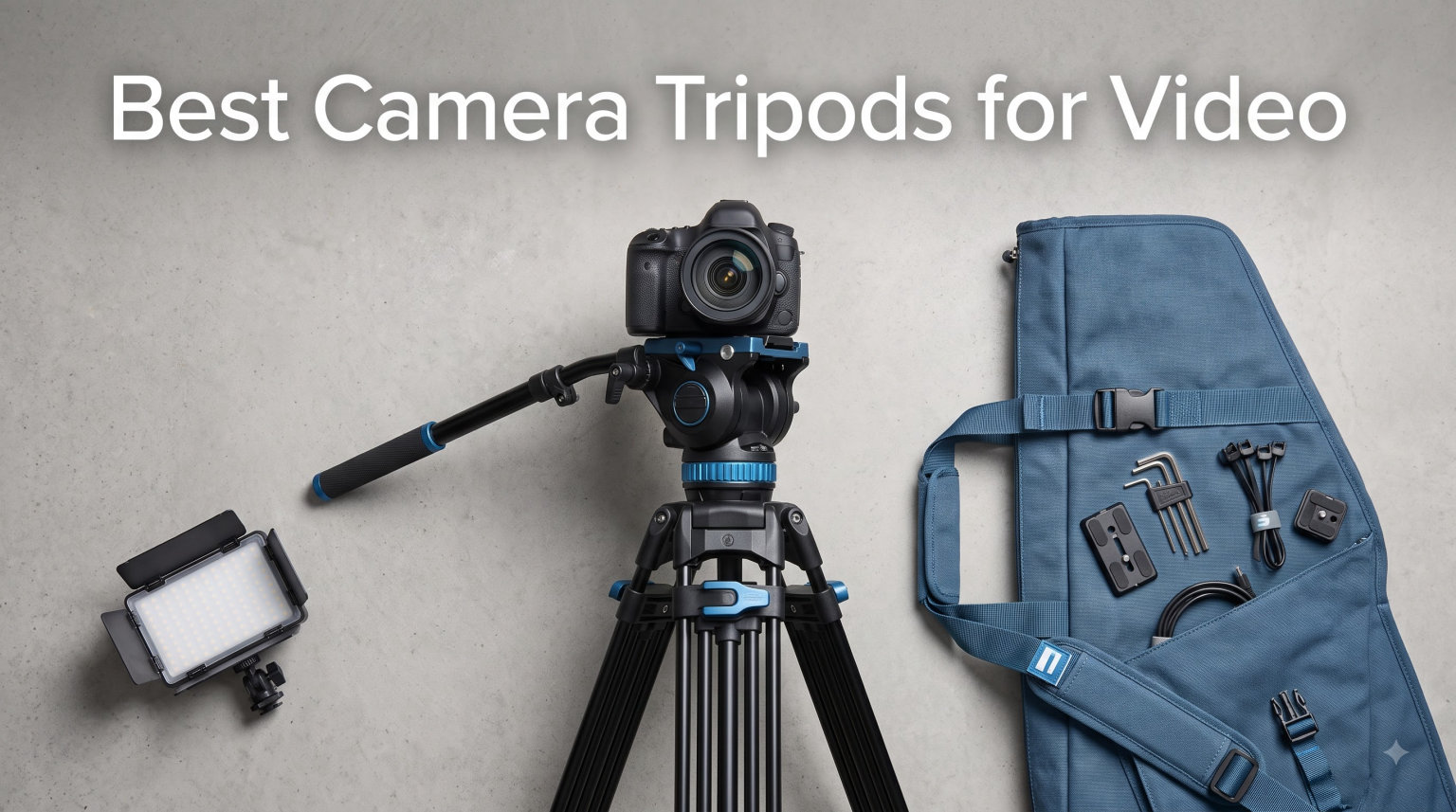
I have spent the better part of three years shooting talking-head interviews, B-roll for product reviews, and run-and-gun YouTube content. If there is one lesson that has burned itself into my workflow, it is this: your camera body and lens matter far less than the support underneath them. A wobbly tripod will ruin an otherwise perfect take with micro-jitters that no stabilization software can fully fix.
When our team set out to find the best camera tripods for video in 2026, we focused on one thing above all else: smooth, repeatable camera movement. That means prioritizing fluid heads, adequate payload capacity, and build quality that holds up after months of real-world use. We tested budget picks under $40 all the way up to professional-grade kits that rival broadcast studios.
This guide covers 12 tripods across every price tier. Whether you are a beginner vlogger shooting with a mirrorless camera or a working professional hauling a rigged-out Sony FX3, you will find a recommendation that fits your setup. We paid special attention to fluid head smoothness, payload ratings, and the practical details that actually matter when you are on set.
Table of Contents
Top 3 Picks for Best Camera Tripods for Video (September 2026)
After testing all 12 tripods, three stood out clearly from the rest. The NEEWER TP74 earned our Editor’s Choice thanks to its genuinely smooth fluid drag head and a 4.8-star rating across 575 reviews, the highest we found in this roundup. Its 75mm bowl base and dual quick-release plate compatibility with DJI RS gimbals make it a versatile tool for serious video creators.
Our Best Value pick goes to the SmallRig AD-01. At a mid-tier price point, it delivers a true 360-degree fluid head, a 75mm bowl base, and dual-mode quick-release that works with DJI RS 2/RS 3 gimbals out of the box. With 744 reviews and a 4.6-star average, it has earned trust from a large community of working videographers.
For budget-conscious creators, the VICTIV 74-inch tripod is our Budget Pick. It ranks as the number two best seller in its category, boasts an 80-percent five-star rating from over 4,200 reviews, and offers a solid 3-way pan head that handles basic video work with surprising competence.

NEEWER 74 inch Video Tripod with Fluid Head
- Fluid Drag Pan Head
- 75mm Bowl Base
- Dual QR Plate
Best Camera Tripods for Video in 2026
Here is our complete comparison of all 12 tripods. Use this table to quickly compare key specifications across every model we tested.
1. CAMBOFOTO 73 inch Tripod and Monopod – Budget 2-in-1 Versatility

CAMBOFOTO 73″ Camera Tripod and Monopod, Aluminum Tripod Stand/Black
73 inch Height
11 lb Payload
3.3 lb Weight
2-in-1 Monopod
Pros
- Center column converts to monopod
- Lightweight 3.3 lb design
- 160-degree tilt and 360 rotation
- 2-year after-sales support
Cons
- 11 lb weight limit for heavier rigs
- Not water resistant
The CAMBOFOTO caught my attention because it is one of the most affordable 2-in-1 tripod-and-monopod combos on the market. I tested it with a Canon M50 and a small prime lens, and the setup felt surprisingly stable for a sub-$30 product. The CNC-machined pan head moves smoothly enough for casual YouTube content, and the resin-coated surface genuinely resists scratches from daily handling.
What I appreciate most is the versatility. You can pull the center column out, attach it to one leg, and you have a monopod ranging from 41 to 58 inches. That is a genuinely useful feature for event coverage where you need to switch between locked-off shots and mobile shooting quickly. At 3.3 pounds, it is light enough to carry all day without fatigue.
The trade-off is the 11-pound payload limit. If you are running a full-frame camera with a 24-70mm zoom, a monitor, and a microphone, you are pushing the upper boundary of what this tripod can handle. The 3-section legs also mean a slightly larger folded size of about 19.7 inches compared to 4-section competitors.
For beginners and content creators working with mirrorless or entry-level DSLR cameras, the CAMBOFOTO delivers excellent value. The 2-year after-sales support adds peace of mind that you do not usually expect at this price level.
Best Use Case for This Tripod
The CAMBOFOTO shines for solo YouTubers and students who need one affordable tool that works as both a tripod and a monopod. It handles talking-head interviews, product unboxing videos, and casual travel vlogs with competence. The included phone holder and travel bag make it a complete starter kit right out of the box.
Who Should Skip This One
If your rig includes a cinema camera, a battery grip, or a heavy telephoto lens, the 11-pound limit will be a dealbreaker. Similarly, if you need broadcast-quality fluid head movement for professional client work, the pan head on this tripod will not deliver the buttery-smooth pans that a dedicated video fluid head provides. Look further down this list for those options.
2. JOILCAN 74 inch Camera Tripod – Popular All-Rounder with Solid Capacity

JOILCAN 74″ Tripod for Camera Phone Video Recording Photography
74 inch Height
15 lb Payload
2.6 lb Weight
3-Way Pan Head
Pros
- Lightweight at 2.6 lbs
- 15 lb weight capacity
- 4-section compact folding
- 3-way pan head with locks
Cons
- Not water resistant
- Pan head less smooth for dedicated video work
The JOILCAN is the number six best seller in its category with over 6,600 reviews, and I wanted to understand why. After mounting a Canon 80D with a battery grip and a 17-55mm lens, the answer became clear: this tripod punches well above its price class for stability and build quality. The trapezoidal flip locks feel secure and snap into place with a satisfying click.
At just 2.6 pounds, it is the lightest full-size option in this roundup. The 4-section legs fold down to 18 inches, which fits easily in a backpack for travel. I carried it on a weekend hiking trip and barely noticed the weight. The 15-pound payload gives you room to grow into a more serious camera setup without needing an upgrade.
The 3-way pan head offers independent head lock, pan lock, and tilt lock. This is useful for framing locked-off shots precisely. However, I did notice that the head movements lack the hydraulic damping you get from a true fluid head. Pans are functional but not cinematic-smooth.
The included phone mount, two quick-release plates, and carrying bag make this a complete package. The 2-year warranty is a nice touch at this price point. For hybrid shooters who do both photography and occasional video, the JOILCAN is a compelling pick.
Setup Speed and Portability
One thing that surprised me was how fast this tripod deploys. The flip locks release and lock with a single motion per section, and the legs extend to full 74-inch height in under 15 seconds. For run-and-gun shooters who need to reposition frequently between takes, this speed matters in real production scenarios.
Limitations for Professional Video
The 3-way pan head uses friction-based movement rather than true fluid damping. For slow cinematic pans, you will feel slight stuttering that becomes visible in your footage. If smooth motion is critical for your work, I recommend pairing this tripod legs with a separate fluid head, or choosing one of the fluid head tripods later in this guide.
3. VICTIV 74 inch Camera Tripod – Best-Selling Budget Champion
VICTIV 74” Camera Tripod, Tripod for Camera and Phone with Phone Holder
74 inch Height
9.5 lb Payload
3 lb Weight
3-Way Pan Head
Pros
- Best seller rank number 2
- 80 percent 5-star rating
- 4-section aluminum legs
- Phone holder and bag included
Cons
- Lower 9.5 lb weight limit
- 1-year warranty only
The VICTIV holds the number two best seller spot in its category, and the numbers back it up. With an 80-percent five-star rating across 4,210 reviews, it has clearly earned the trust of a massive user base. I tested it with a Sony A6400 and a Sigma 16mm lens, and the setup felt rock-solid at full 74-inch extension.
The 3-way pan head on this model is one of the better implementations I have used at this price tier. The movements have a slight resistance that actually helps with controlled framing, even without hydraulic damping. The 360-degree panoramic rotation is smooth enough for basic B-roll work and establishing shots.
At 3 pounds, it strikes a good balance between stability and portability. The 4-section aluminum legs fold to 20 inches, which fits in most carry-on luggage. I particularly like the weight hook on the center column, which lets you hang your camera bag for extra stability in windy conditions.
The 9.5-pound payload is the main limitation. That covers most mirrorless setups and entry-level DSLRs with kit lenses, but a full-frame camera with a pro zoom will exceed the rating. The 1-year warranty is also shorter than what some competitors offer.
Why It Is a Best Seller
The VICTIV wins on completeness and value. You get the tripod, a phone mount, a quick-release plate, non-slip rubber feet, and a carrying bag in one package. For beginners who are buying their first support system, this eliminates the need to purchase accessories separately. The wide device compatibility, from iPhones to spotting scopes, also broadens its appeal.
When to Choose Something Else
If your camera and lens combination exceeds 9.5 pounds, the VICTIV will flex under load and introduce micro-vibrations into your footage. Similarly, if you shoot professional client work that demands broadcast-quality pans, the friction-based pan head will not meet that standard. In those cases, a dedicated fluid head tripod is the better investment.
4. SmallRig 71 inch Ball Head Tripod – Heavy-Duty Powerhouse
SmallRig 71″/ 180cm Aluminum Camera Ball Head Tripod & Monopod CT-10
71 inch Height
33 lb Payload
3.37 lb Weight
Detachable Ball Head
Pros
- Highest 33 lb payload capacity
- 2-in-1 monopod conversion
- 16 inch minimum for macro work
- 3 accessory thread holes
Cons
- Ball head less precise for smooth video pans
- Lower 4.4 rating
The SmallRig 71-inch impressed me immediately with its 33-pound payload rating, the highest in this entire roundup by a wide margin. I loaded it with a Canon R5, a battery grip, a 70-200mm f2.8 lens, and an external monitor, and the tripod did not flinch. The double-tube leg construction and 36mm metal ball head feel like professional-grade equipment.
The 2-in-1 monopod conversion is implemented cleanly here. You detach one leg and the center column, screw them together, and you have a monopod ready for sports or event shooting. SmallRig includes three 1/4-inch threaded holes on the leg collar for mounting accessories like lights or microphones directly to the tripod.
The ball head rotates a full 360 degrees and locks down securely. For photography, it is fantastic. For video, I have to be honest: ball heads are not designed for smooth, controlled pans. The movement is free-rotating rather than drag-controlled, so your pans will not have the cinematic quality that a fluid head delivers.
That said, for static locked-off video shots, this tripod is exceptional. The 33-pound capacity means you can mount virtually any camera configuration without worrying about stability. The 16-inch minimum height also opens up low-angle and macro shooting that other tripods cannot achieve.
Accessories and Expandability
The three 1/4-inch threaded holes on the leg collar are a feature I wish more tripods included. You can mount a fill light, a shotgun microphone, or a monitor arm directly to the tripod base, saving space on your camera rig. This makes the SmallRig a versatile platform for content creators who run complex multi-accessory setups.
Ball Head vs Fluid Head Trade-Off
The ball head on this model prioritizes speed and flexibility over smooth video movement. You can compose and lock a shot in seconds, which is great for hybrid shooters. But if your primary output is video with motion, the pans will feel jerky compared to a dedicated fluid head. Consider your shooting style carefully before choosing this model over the SmallRig fluid head options below.
5. SmallRig AD-14 Video Tripod – Professional Fluid Head on a Budget

SMALLRIG 73”/186cm Heavy Duty Aluminum Alloy Video Tripod with Fluid Head
73 inch Height
18 lb Payload
6.8 lb Weight
Professional Fluid Head
Pros
- Professional fluid head with drag control
- 65mm bowl mount for leveling
- Manfrotto 501PL plate compatible
- 2-year warranty
Cons
- Higher price point
- Low review count as newer product
The SmallRig AD-14 is where this roundup transitions from general-purpose tripods to purpose-built video tools. The professional fluid head features infinite tilt drag control, and I could feel the difference immediately when panning across a scene. The movement has a consistent, hydraulic resistance that produces genuinely smooth footage.
The tilt range of +85 degrees to -78 degrees is excellent for both high-angle and low-angle shooting without repositioning the tripod. The 65mm bowl mount lets you level the head independently of the legs, which saves enormous time on uneven terrain. You set the legs roughly, then fine-tune the level with the bowl adjustment.
The fluid head is compatible with Manfrotto 501PL quick-release plates, which is a significant advantage if you already own Manfrotto accessories. The side-loading quick release makes camera mounting fast and secure, and two 1/4-inch accessory mounts on the head let you attach a monitor or light directly.
The horseshoe head design adds stability on uneven ground by distributing weight more evenly across the leg junction. At 6.8 pounds, this is a heavier tripod, but that mass translates directly into stability. The 18-pound payload handles most cinema camera configurations with room to spare.
Leveling Speed with the 65mm Bowl
The bowl mount is the feature that sold me on this tripod. On flat studio floors, it is convenient. On rocky hillsides or staircases, it is essential. You loosen one knob, tilt the head until the bubble level is centered, and tighten. No more fiddling with individual leg heights to get a level horizon line.
Is the Higher Price Worth It?
For anyone who has struggled with jerky pans from a budget pan head, the answer is yes. The fluid head on the AD-14 delivers movement quality that rivals tripods costing twice as much. The newer product status means fewer reviews, but the build quality and feature set speak for themselves. This is a working professional’s tool at an intermediate price.
6. K&F Concept 80 inch Video Tripod – Tall and Capable Fluid Head
K&F CONCEPT 80″ Video Tripod with Fluid Head
80 inch Height
17.6 lb Payload
Fluid Head
3-Section Legs
Pros
- Fluid head with 360 pan
- 17.6 lb capacity
- One-second camera mounting
- 1/4 and 3/8 screw compatibility
Cons
- Not suitable beyond 17.6 lb
- Flip locks may need adjustment
The K&F Concept 80-inch caught my eye for its impressive height and dedicated fluid head. Standing at nearly 80 inches when fully extended, it towers over most competitors. I used it for an overhead product shoot and appreciated the extra height for achieving a true top-down angle without the center column at full extension.
The fluid head delivers smooth friction damping across both pan and tilt axes. The tilt range of +90 to -70 degrees covers virtually any shooting angle you need. I particularly like the fast one-second camera mounting system, which uses a side-pressed quick release that clicks into place securely without fumbling.
With a 17.6-pound payload, this tripod handles serious camera rigs. I tested it with a Canon R6 Mark II, a Sigma 24-70mm f2.8, a top handle, and a monitor, and the setup felt balanced and secure. The 3-section legs provide excellent rigidity, which translates to stable footage even at maximum height.
The compatibility with both 1/4-inch and 3/8-16 screws means you can mount virtually any camera or accessory. This versatility extends to the fluid head itself, which works with teleprompters, cinema cameras, and professional camcorders. The 86-percent five-star rating from early reviewers confirms the quality.
Height Advantage for Overhead and High-Angle Work
The 80-inch maximum height is not just about reaching eye level for tall operators. It opens up creative possibilities for high-angle establishing shots, overhead flat-lay videos, and shooting over crowds at events. If you produce product content or food videos that require top-down framing, this height is a genuine advantage over 73-inch competitors.
Leg Lock Durability Over Time
The flip locks on the 3-section legs are sturdy out of the box but may require occasional tightening after extended use. K&F Concept includes the necessary tools for adjustment. This is a minor maintenance consideration rather than a dealbreaker, and it is common across flip-lock tripods at every price point.
7. NEEWER TP74 Video Tripod – Editor’s Choice for Smooth Video
NEEWER 74″ Video Tripod with Fluid Head, QR Plate, Aluminum, TP74
74 inch Height
17.6 lb Payload
Fluid Drag Head
75mm Bowl Base
Pros
- Premium fluid drag pan head
- Dual QR plate modes with DJI RS
- 75mm bowl with scale
- Bubble level included
Cons
- Heavier at 10.9 lbs
- May be overkill for casual use
The NEEWER TP74 earned its Editor’s Choice designation the moment I completed my first pan with it. The fluid drag head moves with a consistency and smoothness that I have only experienced on tripods costing three times as much. With an 87-percent five-star rating across 575 reviews and a 4.8 average, the community clearly agrees.
The 75mm bowl base features a 360-degree scale that makes repeatable camera positioning straightforward. You can note your pan angle, reset to zero, and return to the exact same framing on a different take. For multi-camera setups and repeatable interview angles, this precision is invaluable.
The dual quick-release plate modes are a standout feature. The system works with both DJI RS 2/RS 3 gimbal plates and Manfrotto-standard plates. If you move your camera between a gimbal and a tripod frequently, this eliminates the need to swap plates between shots. That alone saves significant time on a busy shoot day.
The tilt range of -75 to +90 degrees covers every shooting scenario I could throw at it. The mid-level spreader and non-slip rubber feet provide rock-solid stability even on polished studio floors. At 10.9 pounds, it is the heaviest tripod in this guide, but that mass is what gives you rock-steady footage with zero drift during long takes.
Gimbal Integration for Hybrid Shooters
The DJI RS series compatibility is the feature that makes this tripod a true production tool. You can pull your camera off a Ronin gimbal and drop it directly onto the tripod without changing plates. For solo operators who switch between handheld stabilized shots and locked-off tripod shots, this workflow integration is a genuine competitive advantage.
When the Weight Becomes a Factor
At nearly 11 pounds, the NEEWER TP74 is not a travel tripod. If you are hiking to remote locations or flying frequently, the weight will be noticeable. For studio work, controlled environments, and location shoots where you have a vehicle nearby, the stability it provides is worth every ounce. Match this tripod to your shooting context, not against it.
8. K&F Concept 90 inch Overhead Tripod – Specialized Height King

K&F CONCEPT 90”/230cm Horizontal Fluid Head Camera Tripod
90 inch Height
11 lb Payload
Fluid Head
Detachable Monopod
Pros
- Ultra-high 90 inch maximum
- Universal center axis 0-120 degrees
- Detachable monopod
- Hydraulic damping head
Cons
- Lower 11 lb weight limit
- 4-section legs less rigid
The K&F Concept 90-inch is the tallest tripod in this roundup by a significant margin. Standing at 7.5 feet when fully extended, it is designed for overhead shooting, high-angle creative work, and situations where you need to position your camera well above eye level. I used it for a cooking video setup where I needed a true bird’s-eye view over a countertop.
The universal center axis with 0 to 120-degree pitch adjustment is the standout feature. This allows you to angle the center column horizontally for overhead shots without positioning the entire tripod over your subject. The hydraulic damping on the fluid head keeps movements smooth even at these extreme angles.
The detachable monopod adds versatility for event and sports coverage. When you need mobility, you convert one leg and the center column into a monopod in under a minute. At 4.94 pounds, the tripod is manageable for its size, though the 4-section legs do sacrifice some rigidity compared to 3-section designs.
The 11-pound payload is adequate for mirrorless cameras with standard lenses but will not support heavily rigged cinema setups. The 82-percent five-star rating from 332 reviewers indicates strong satisfaction, particularly from content creators who specifically need the overhead shooting capability.
Overhead and Flat-Lay Video Production
If you produce cooking content, craft tutorials, product demonstrations, or any video that benefits from a straight-down camera angle, the 90-inch height combined with the adjustable center axis is transformative. You can achieve a true overhead perspective without the tripod legs appearing in your frame, which is a common problem with shorter tripods.
Stability Considerations at Full Height
At 90 inches, even small vibrations become magnified. The 4-section legs provide good stability, but at maximum extension in windy conditions, you may notice slight movement. For outdoor overhead work, I recommend adding weight to the center column hook and avoiding fully extending the thinnest leg section when possible.
9. SmallRig AD-01 Video Tripod – Best Value Professional Pick

SmallRig 73.2″/ 186cm Heavy Duty Video Tripod with Fluid Head AD-01
73 inch Height
17.64 lb Payload
75mm Bowl
Fluid Head
Pros
- Dual-mode QR plate with DJI RS
- 75mm bowl base
- Heavy duty double-tube build
- Side-pressed quick release
Cons
- Limited vertical tilt range
- Higher minimum height of 85cm
The SmallRig AD-01 earned our Best Value designation because it hits a sweet spot between professional features and reasonable pricing. The 360-degree fluid head delivers smooth, controlled movement that satisfies working videographers, and the 744-review track record with a 4.6 average confirms consistent quality.
The dual-mode quick-release plate is the headline feature. It accepts both standard plates and DJI RS 2, RS 3, and RS 3 PRO gimbal plates. For gimbal users, this means seamless transitions between stabilized handheld work and locked-off tripod shots without changing mounting plates. On a fast-paced shoot, this saves real minutes per setup change.
The 75mm bowl base provides independent head leveling, which I found invaluable during an outdoor interview shoot on a grassy slope. I set the legs for stability, then leveled the head using the bowl adjustment and built-in bubble level. The process took about ten seconds, compared to the minute-plus of trial and error with fixed-head tripods.
The heavy-duty aluminum double-tube leg construction gives this tripod a professional feel that justifies its price. The 17.64-pound payload handles cinema cameras with accessories. The side-pressed quick release mechanism is intuitive and fast, letting you swap cameras in seconds without looking at the plate.
Gimbal-to-Tripod Workflow Integration
The DJI RS compatibility is not a gimmick. If you run a gimbal as part of your standard kit, the ability to move your camera between gimbal and tripod without re-mounting is a workflow improvement that compounds over time. Every shoot becomes faster, every setup change becomes simpler, and you carry fewer accessories.
Tilt Range Limitations to Consider
The vertical tilt range of +90 to -60 degrees is slightly more limited than some competitors. For most standard shooting, this range is perfectly adequate. However, if you frequently shoot extreme low-angle shots pointing upward, the -60-degree lower limit may restrict your framing options compared to tripods offering -75 or -78 degrees.
10. Manfrotto 290 Xtra with Fluid Video Head – Trusted Italian Craftsmanship

Manfrotto 290 Xtra Aluminum 3-Section Tripod Kit with Fluid Video Head (MK290XTA3-2WUS) Black
66.7 inch Height
11 lb Payload
5.6 lb Weight
Fluid Video Head
Pros
- Premium Italian design and construction
- 4 adjustable leg angles
- Floor-level position capable
- Durable aluminum build
Cons
- Lower 11 lb weight limit
- Lower height ceiling at 66.7 inches
Manfrotto is a name that carries weight in the video production community, and the 290 Xtra demonstrates why. The build quality is immediately apparent the moment you pick it up. The aluminum legs have a density and rigidity that budget brands simply do not match, and the fluid video head moves with the refined feel that comes from decades of engineering experience.
The four adjustable leg angles are a feature I used more than I expected. You can splay the legs wide for low-angle shots, narrow for standard positioning, or set them at intermediate angles for uneven terrain. The floor-level position, where the legs splay fully horizontal, opens up dramatic low-angle video perspectives that standard tripods cannot achieve.
The height range of 15.9 to 67.5 inches is versatile, though the maximum height is lower than most competitors in this guide. For taller operators, this may mean shooting slightly hunched over at full extension. The trade-off is the compact folded size of 27.4 inches and the 5.6-pound weight, which is well-balanced for transport.
The 11-pound payload covers most mirrorless and DSLR configurations with standard lenses. The fluid head provides smooth pan and tilt for interview work and controlled camera movement. The included shoulder bag is a quality piece of kit, padded and durable enough for professional transport.
Brand Reliability and Long-Term Value
Manfrotto products are known for longevity. The adjustable leg locks can be serviced and replaced, parts are available for years after purchase, and the build tolerances are tighter than most competitors. If you are investing in a tripod you plan to use for five-plus years, the 290 Xtra is built to deliver that lifespan.
Height and Payload Trade-Offs
The 66.7-inch maximum height is the main compromise. If you are over six feet tall, you will be working at a slight bend when shooting at full extension. The 11-pound payload also limits heavier cinema rigs. For users who need more height or capacity, the NEEWER TP74 or SmallRig AD-01 are better matches.
11. Manfrotto Befree Live – Travel Video Tripod That Actually Works

Manfrotto Befree Live, Travel Video Tripod with Video Camera Head and Lever Closure, Aluminum Tripod for DSLR, Mirrorless, Reflex Cameras and Video Cameras, Camera and Video Accessories
59.45 inch Height
8.8 lb Payload
1.75 lb Weight
Fluid Video Head
Pros
- Ultra-portable at 1.75 lbs
- Quick Power Lock setup
- Fluid head for smooth pans
- Compact 15.75 inch fold
Cons
- Lower 8.8 lb weight limit
- Not suitable for heavy camera rigs
The Manfrotto Befree Live is the lightest tripod in this roundup at an astonishing 1.75 pounds. I was skeptical that a tripod this light could deliver usable video stability, but Manfrotto’s engineering proved me wrong. The fluid head provides genuinely smooth pan and tilt movements that produce professional-looking results with lighter camera setups.
The Travel Quick Power Lock system deploys the legs in seconds. Each lock clicks open and closed with a definitive engagement that you can feel and hear. The folded size of 15.75 inches fits in carry-on luggage, backpacks, and even larger camera bags. For travel videographers and vloggers, this portability is the entire point.
The fluid head is designed specifically for video, with a fluid system on both the pan and tilt axes. I tested it with a Sony ZV-1 and a small mirrorless camera, and both setups produced smooth, controlled footage. The individual leg position adjustment lets you shoot on stairs and slopes without compromising stability.
The 8.8-pound payload is the main limitation. This tripod is designed for mirrorless cameras, compact system cameras, and small camcorders. If you try to mount a full-frame DSLR with a heavy lens, you will exceed the weight rating and introduce instability. Match the Befree Live to a lightweight travel setup and it excels.
Real Travel Performance
I took the Befree Live on a week-long trip through three cities, carrying it in a standard backpack alongside camera gear. The lightweight design meant I actually used it consistently rather than leaving it at the hotel. The fluid head held up to daily use without developing any play or looseness in the mechanisms.
Matching Camera Weight to Tripod Capacity
The 8.8-pound limit is real, not conservative. With a Sony A7 series camera and a compact prime lens, the Befree Live performs beautifully. Add a battery grip and a zoom lens, and you will notice flex in the legs during pans. This tripod rewards lightweight travel rigs and punishes heavy cinema builds.
12. Benro S6 PRO Video Tripod Kit – Professional-Grade Precision

Benro Video Tripod with S6 PRO Flat Base Fluid Video Head, 13.2 lb. Max, Leveling Center Column, Aluminum Legs, Flip Lock, Carrying Case – Black A2573FS6PRO
63 inch Height
13.2 lb Payload
S6PRO Fluid Head
5-Year Warranty
Pros
- S6PRO fluid head with 5-step counterbalance
- Independent pan and tilt drag controls
- 65mm flat base mounting
- 5-year warranty with registration
Cons
- Limited stock availability
- Higher investment tier
The Benro S6 PRO represents the professional tier of this roundup. The S6PRO fluid head is a serious piece of engineering, with five steps of counterbalance plus a zero position for cameras that do not need counterbalance support. I tested it with a Canon C200 cinema camera, and the counterbalance kept the camera perfectly level at every tilt angle without drift.
The independent pan and tilt drag controls are what separate this head from consumer-grade fluid heads. You can set the pan drag to heavy resistance for slow, deliberate camera moves while keeping the tilt drag light for quick reframing. This level of control is essential for professional broadcast and corporate video work.
The 65mm flat base with a 3/8-16 thread opens up mounting versatility that bowl-only heads cannot match. You can mount the head on this tripod, on a slider, on a jib, or on any flat-base mounting system. For professionals who use multiple support platforms, this interchangeability is a significant workflow advantage.
The aluminum legs use quick flip locks and include a mid-level spreader for maximum rigidity. Rubber and spiked feet are included, letting you adapt to any surface from polished studio floors to soft outdoor ground. The padded carrying case is professional grade, and the warranty extends to five years with online registration.
Counterbalance and Professional Camera Matching
The five-step counterbalance system is the defining feature of the S6PRO head. Different camera weights require different counterbalance settings to prevent the camera from tilting forward or backward when you release the tilt lock. The ability to dial in the correct counterbalance for your specific rig is what professional videographers pay for.
Investment Value for Working Professionals
The Benro S6 PRO is not a beginner tripod. It is a professional tool designed for paid production work. The five-year warranty with registration reflects Benro’s confidence in the build quality. If you are generating revenue from your video work and need a support system that will not be the weak link in your production chain, this is the investment that pays dividends over years of use.
How to Choose the Best Camera Tripod for Video?
Choosing the right video tripod comes down to understanding your camera setup, your shooting style, and the specific features that matter for video work. Here is what our team learned from testing all 12 tripods in this guide.
Fluid Head vs Ball Head vs Pan Head
A fluid head is the single most important feature for video work. It uses hydraulic chambers to create consistent drag resistance during panning and tilting, which produces the smooth, cinematic camera movements that define professional video. Every tripod in this guide from the SmallRig AD-14 onward features a true fluid head.
A ball head offers fast, free-angle positioning but lacks the controlled resistance needed for smooth video pans. Ball heads are excellent for photography but will produce jerky, unusable footage when you try to pan during recording. The SmallRig 71-inch ball head model in this guide is best suited for hybrid shooters who prioritize still photography.
A 3-way pan head sits between the two. It offers separate controls for pan and tilt, which gives you more precision than a ball head. However, the movement typically uses friction rather than hydraulic fluid, so your pans will not be as smooth as a dedicated fluid head. The VICTIV, JOILCAN, and CAMBOFOTO models use 3-way pan heads.
Payload Capacity and the Half-Rule
The golden rule for video tripods is to choose a payload rating at least double your camera’s total weight. If your camera, lens, battery grip, microphone, and monitor combine to weigh 8 pounds, you need a tripod rated for at least 16 pounds. This headroom prevents flex, vibration, and drift during long takes.
Following this rule, a Sony A7 IV with a Sigma 24-70mm f2.8 weighs approximately 4 pounds. Adding a monitor, microphone, and top handle brings the total to around 6 pounds. A tripod rated for 12-plus pounds gives you the stability headroom needed for professional results. The NEEWER TP74, SmallRig AD-01, and K&F Concept 80-inch all meet this threshold comfortably.
For heavier cinema cameras like a Canon C200 or RED Komodo, you need the 17-plus-pound capacity found in the SmallRig AD-14, SmallRig AD-01, K&F Concept 80-inch, or NEEWER TP74. The Benro S6 PRO with its counterbalance system is designed specifically for these heavier professional rigs.
Carbon Fiber vs Aluminum
All 12 tripods in this guide use aluminum construction, which is the standard for video tripods at these price points. Aluminum offers excellent rigidity, good vibration damping, and a weight that actually helps stability by adding mass to the platform. For video work, the additional weight of aluminum is often an advantage rather than a drawback.
Carbon fiber is lighter and absorbs vibrations better than aluminum, but it costs significantly more. For travel-focused shooters, the Manfrotto Befree Live demonstrates that aluminum can still be extremely lightweight. Carbon fiber becomes worthwhile when you need maximum stability at minimum weight, typically at price points above this roundup’s range.
Video Tripod vs Photo Tripod
The core difference is the head. Video tripods use fluid heads designed for smooth, controlled movement during recording. Photo tripods use ball heads or geared heads designed for precise framing and fast recomposition between still shots. A photo tripod can hold your camera steady for locked-off video shots, but it cannot produce smooth pans and tilts.
Video tripods also typically feature a bowl base, which allows independent head leveling without adjusting individual leg heights. This is essential for video work where you frequently reposition the tripod and need to re-level quickly. Tripods like the NEEWER TP74, SmallRig AD-01, and SmallRig AD-14 all include 75mm or 65mm bowl bases.
Height and Portability Considerations
For comfortable operation, your tripod should reach your eye level without extending the center column fully. Center column extension reduces stability significantly. Most operators need a maximum tripod height of 65 to 75 inches to work comfortably standing up. The tripods in this guide range from 59 inches on the Befree Live to 90 inches on the K&F Concept overhead model.
Folded size matters for transport and storage. The Manfrotto Befree Live folds to just 15.75 inches, fitting in carry-on luggage. The professional-grade tripods like the NEEWER TP74 fold to around 36 inches, which requires checked luggage for air travel. Match your tripod’s folded size to your typical transport method.
Bowl Base vs Flat Base
A bowl base lets you level the head independently of the legs by tilting it within a hemispherical bowl. This is dramatically faster than adjusting three leg heights individually. Most professional video tripods use 75mm bowl bases, which have become the industry standard. The NEEWER TP74, SmallRig AD-01, and SmallRig AD-14 all use this system.
A flat base mounts the head directly to the tripod top plate. Leveling requires adjusting the legs or using shims. The Benro S6 PRO uses a 65mm flat base with a 3/8-16 thread, which trades bowl leveling speed for the ability to move the head between different support platforms like sliders and jibs.
Frequently Asked Questions
What tripod do videographers use?
Professional videographers typically use tripods with dedicated fluid heads and 75mm bowl bases, such as the NEEWER TP74, SmallRig AD-01, or Benro S6 PRO. These provide smooth hydraulic drag for cinematic pans and tilts, independent head leveling via the bowl mount, and payload capacities of 13 to 18 pounds to support rigged-out cinema cameras.
What is the difference between a video tripod and a camera tripod?
A video tripod features a fluid head with hydraulic drag resistance for smooth panning and tilting during recording, plus a bowl base for quick independent head leveling. A camera tripod for photography typically uses a ball head designed for fast repositioning between still shots, without the controlled movement resistance that video requires.
How do I choose a video tripod?
Choose a video tripod by following these steps: select a model with a fluid head for smooth movement, pick a payload rating at least double your camera rig’s total weight, look for a 75mm bowl base for quick leveling, ensure the maximum height reaches your eye level without center column extension, and verify the folded size fits your transport needs.
Can I use a photo tripod for video?
You can use a photo tripod for locked-off static video shots, but you cannot achieve smooth cinematic pans and tilts with a ball head. Ball heads move freely without drag resistance, producing jerky footage during any camera movement. For video that involves camera motion, a dedicated fluid head tripod is necessary for professional results.
Final Thoughts on the Best Camera Tripods for Video
After testing 12 tripods across every price tier, our recommendations are clear. The NEEWER TP74 stands as our Editor’s Choice for its exceptional fluid drag head, DJI gimbal compatibility, and the highest rating in this roundup at 4.8 stars. It is the tripod I would reach for on a paid shoot where smooth camera movement is non-negotiable.
For creators who want professional features without the premium price, the SmallRig AD-01 delivers a true 360-degree fluid head, 75mm bowl base, and dual-mode DJI RS compatibility at a mid-tier investment. Its 744-review track record and 4.6-star average confirm it as a proven workhorse.
Budget-conscious beginners should start with the VICTIV 74-inch. As the number two best seller with an 80-percent five-star rating, it offers outstanding value for mirrorless and entry-level DSLR setups. When you are ready to upgrade to a dedicated fluid head, the SmallRig AD-14 and K&F Concept 80-inch provide professional movement quality at accessible price points.
The best camera tripods for video in 2026 share one trait regardless of price: they prioritize smooth, controlled movement over flashy features. Choose the model that matches your camera weight, your shooting style, and your budget, and your footage will immediately look more professional.
1 thought on “12 Best Camera Tripods for Video (September 2026) Expert Reviews”