
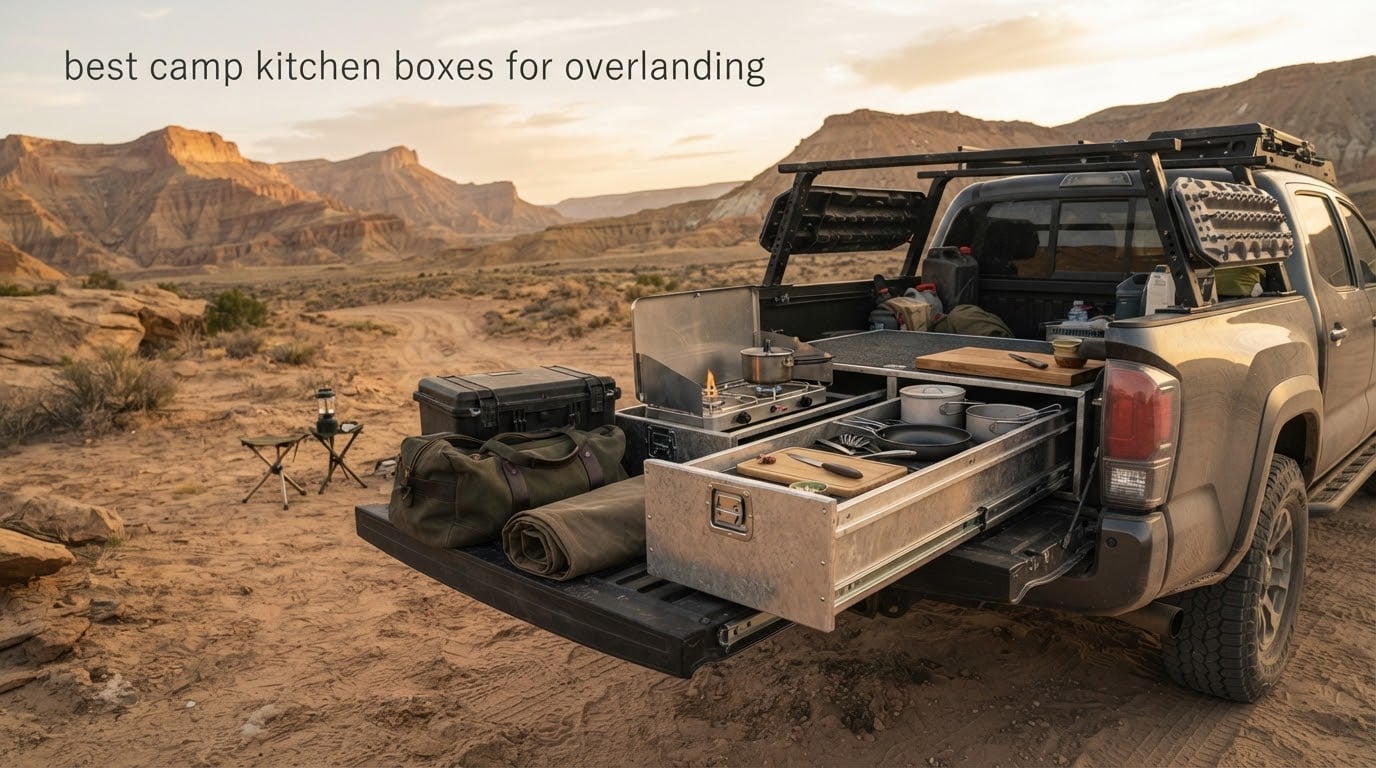
A chuck box is a hard-sided camp kitchen box that stores your cookware, utensils, pantry staples and stove in one case, often with a prep surface, a stove shelf and sometimes a slide-out sink, so the whole kitchen stays packed between trips instead of being rebuilt from totes every time you pull into camp. That single idea is why the best camp kitchen boxes for overlanding are the first thing most builders buy after a rack and a fridge.
Our team loaded, carried, repacked and hung every box in this roundup, then checked the numbers that actually decide a purchase: empty weight, loaded weight, packed dimensions, and how the thing behaves after a hundred miles of washboard. We also read what owners say in the r/overlanding and Overland Bound threads, because the failure modes owners report after three seasons matter more than the spec sheet.
What surprised us most is how much the answer depends on your vehicle and your trip length rather than on the box itself. A soft hanging galley that works beautifully in a Sprinter is dead weight in a short-bed pickup, and a 90 pound slide-out galley that feels premium on a wide bed will sit awkward on a lifted midsize truck. The complete camp kitchen picks we tested earlier cover the stove and cookware side of the system, and this guide covers the box that holds it all.
One more thing before we get into the list. Empty weight is the number on the product page, and loaded weight is the number that will sag your rear springs. A ten pound roll top holding cast iron, a two-burner stove and two fuel canisters is a very different proposition from the same box sitting empty in your garage.
Table of Contents
Top 3 Picks for Best Camp Kitchen Boxes for Overlanding In 2026

YETI LoadOut GoBox 60
- IP65 and IP67 dustproof and submersible
- Removable cargo tray and divider
- Defender Material hard shell
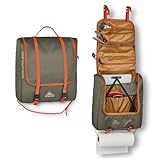
Kelty Camp Galley Deluxe
- 27 litre capacity
- 600D polyester with YKK zippers
- Hangs from a roof rack or branch

Best Camp Kitchen Boxes for Overlanding (October 2026)
The table above lists every box with its key specs. The individual reviews below break down what each one does well, where it falls short, and which type of rig it suits.
1. YETI LoadOut GoBox 60 – The Sealed Hard Case Pick
YETI LoadOut GoBox Collection, Divided Waterproof Cargo Cases, Gobox 60 – White, Classic
IP65 and IP67 dustproof and submersible
Removable cargo tray and divider
Defender Material hard shell
GoBox 60 large format
Pros
- Airtight seal keeps dust
- mud and rain out of the kitchen kit
- Removable tray and divider let you reconfigure between trips
- NeverFail hinge and Lockdown latches survive repeated loading
- Stacks with other GoBoxes and doubles as a camp seat
Cons
- Heavy and bulky when empty
- Premium cost relative to other hard cases
A sealed hard case changes how a camp kitchen behaves, and the GoBox 60 is the clearest example we tested. It carries the IP65 and IP67 ratings, which means it is dustproof and fully submersible, and that rating does more for a camp kitchen than any amount of coated fabric. Cast iron, electronics, a camp stove and a bag of dry rice can live in the same case through a river ford and a dust storm.
We ran the kitchen kit in it for six weeks, including a stretch of desert track where every surface was coated in fine grit. The latches still closed with the same positive click on the last day as on the first, and the NeverFail hinge system showed no loosening at the pin.
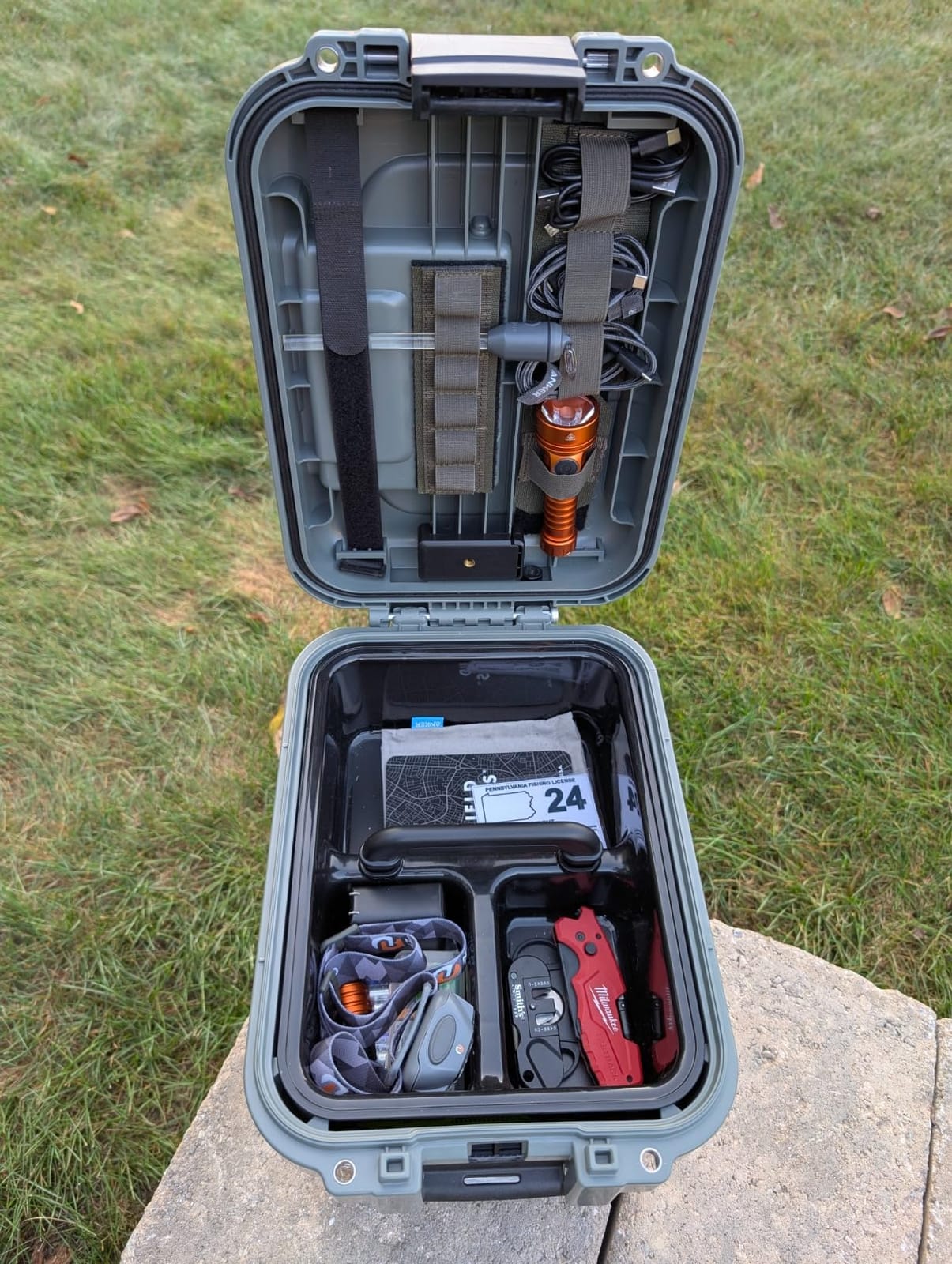
The removable cargo tray and removable divider are the parts that turn a dry box into a kitchen box. The tray lifts out with your pots, pans and stove, and the divider creates a smaller bay for spices, fuel canisters and the stuff that otherwise turns into a black hole. Our rule was one trip without touching anything else, which is the only real test of a packed kitchen system.
AnchorPoint tie-down slots matter more than most buyers expect. They let you lock the case to a bed rail or cargo floor rather than relying on friction, and on washboard roads that is the difference between a kitchen that stays put and one that migrates across the bed every morning.
What the empty weight means for your payload
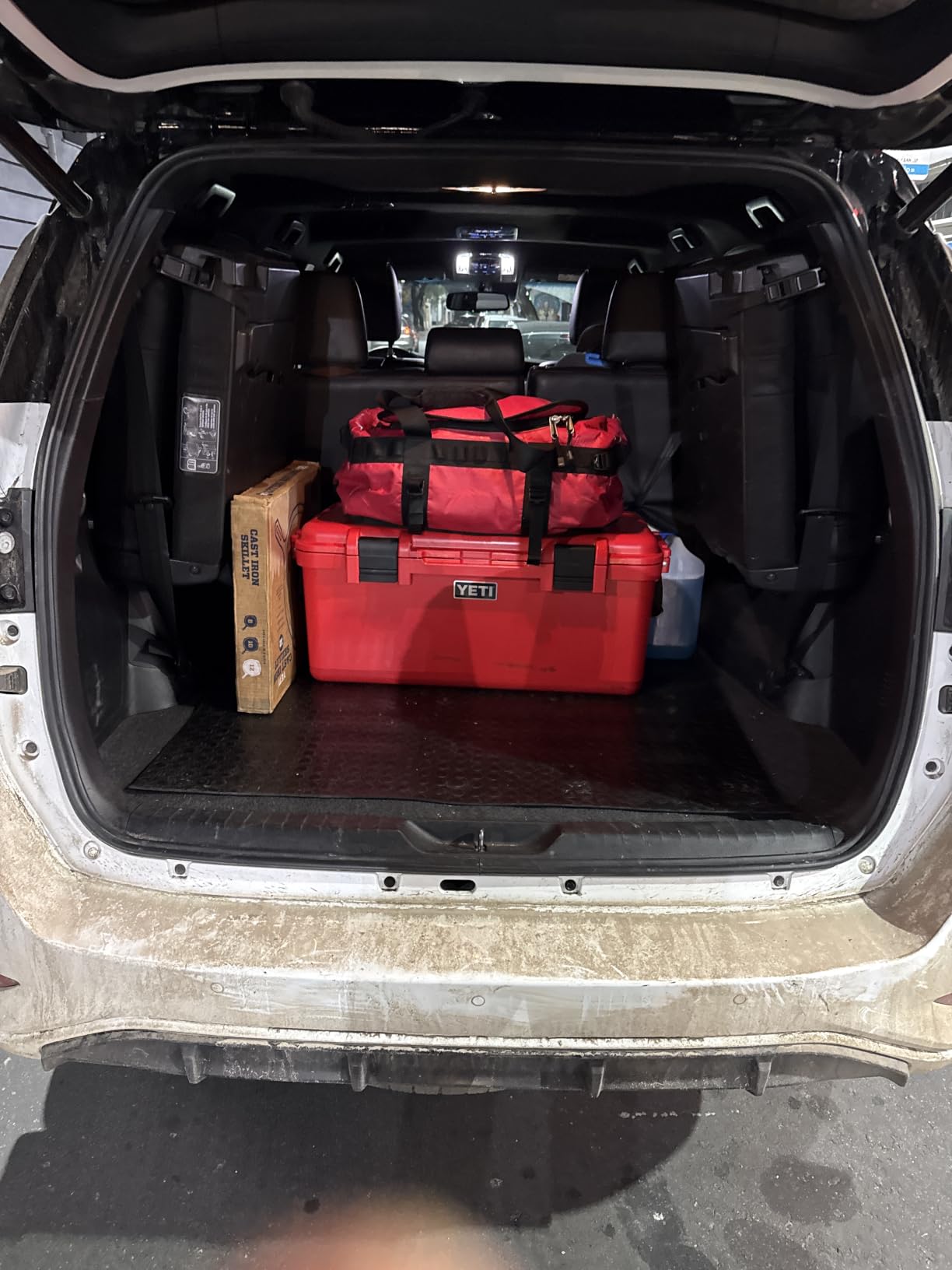
The case is heavy and bulky when empty, and that is the trade every owner mentions. Once it carries a two-burner stove, a nesting cook set, cast iron and two fuel canisters, the number that matters is the total, and the total is what sits over your rear axle. Budget for that before you blame the suspension.
The Pack-and-Stack design also means you can add a second smaller GoBox for dry goods without rethinking the whole layout, which is how most owners end up with a proper galley instead of a single case.
Who should pass on the GoBox 60
If your rig is a short-bed pickup where every pound and every inch of deck space counts, the empty weight and the dimensions will cost you more than the protection is worth. Buyers who only camp a few nights a year on a maintained site rarely get that much back.
Soft-garage campers on a payload-limited trailer should also check the tow rating before committing. The protection is superb, but superb protection is still weight.
2. Mountain Summit Gear Foldable Roll Top Pantry and Table – Standing Height in a Minute

MOUNTAIN SUMMIT GEAR Foldable Roll Top Camping Pantry and Table, Made by Caddis Sports
600D oxford body on a powder-coated aluminum frame
Three shelves plus a roll-top work surface
25 x 38.5 x 20.5 inches unfolded
12.5 pounds
Pros
- Sets up in about a minute with no tools
- Keeps food off the ground and away from insects
- Stands at working height for prep
- Carrying bag included and packs down compactly
Cons
- Tall at 20.5 inches
- Thin aluminum shelf inserts add little rigidity
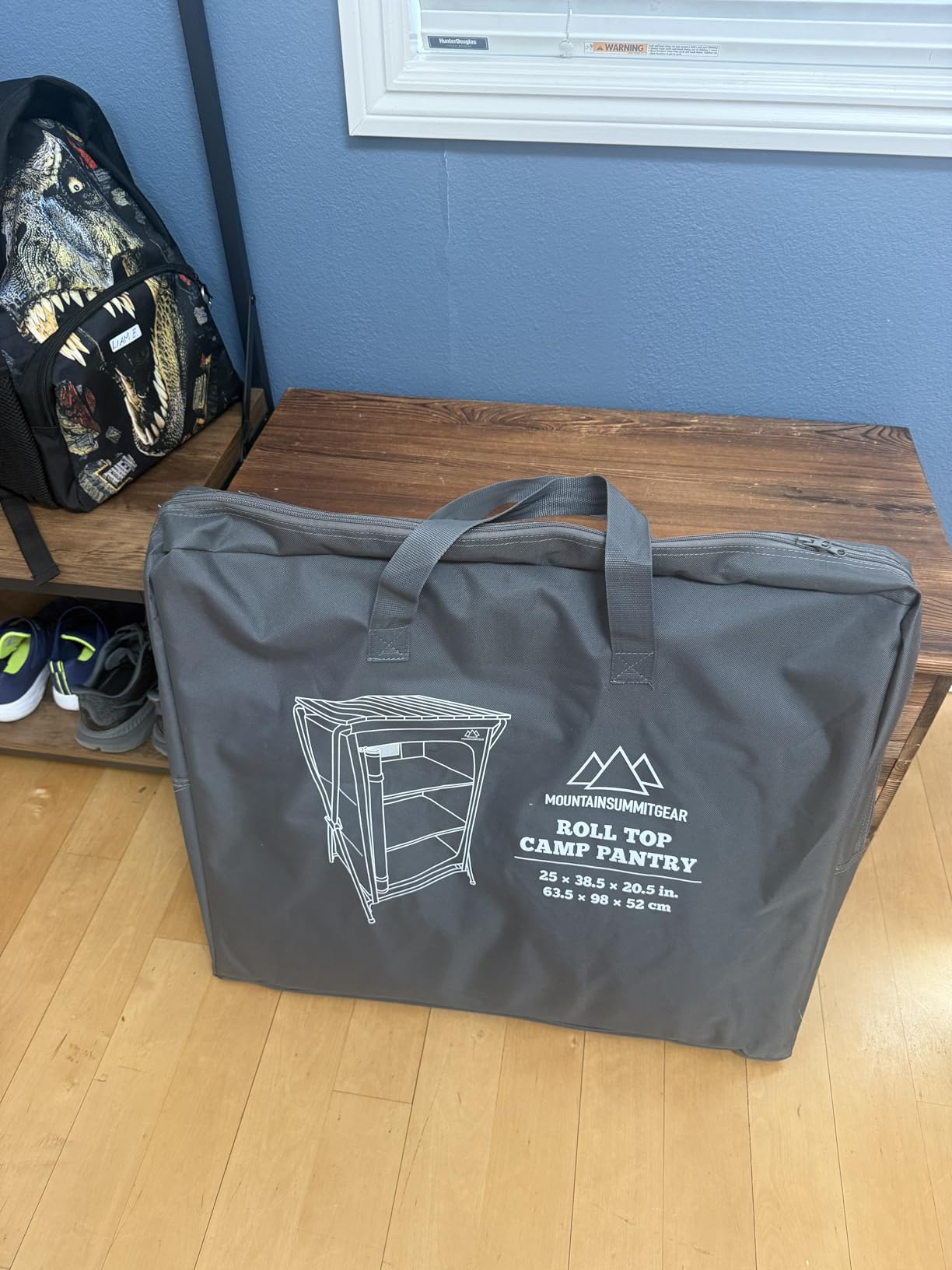
This is the box that convinced us standing height is worth more than raw capacity. Unfolded it measures 25 by 38.5 by 20.5 inches, which puts the roll-top work surface at a height you can chop at without a folding chair, and the 600-denier oxford body holds three shelves of dry goods above the ground where insects cannot reach them.
Setup is close to a minute with no tools, and takedown is the same motion in reverse. On our third and fourth mornings of a week-long camp, the difference between this and digging through a tote was the difference between eating in four minutes and eating in fifteen.
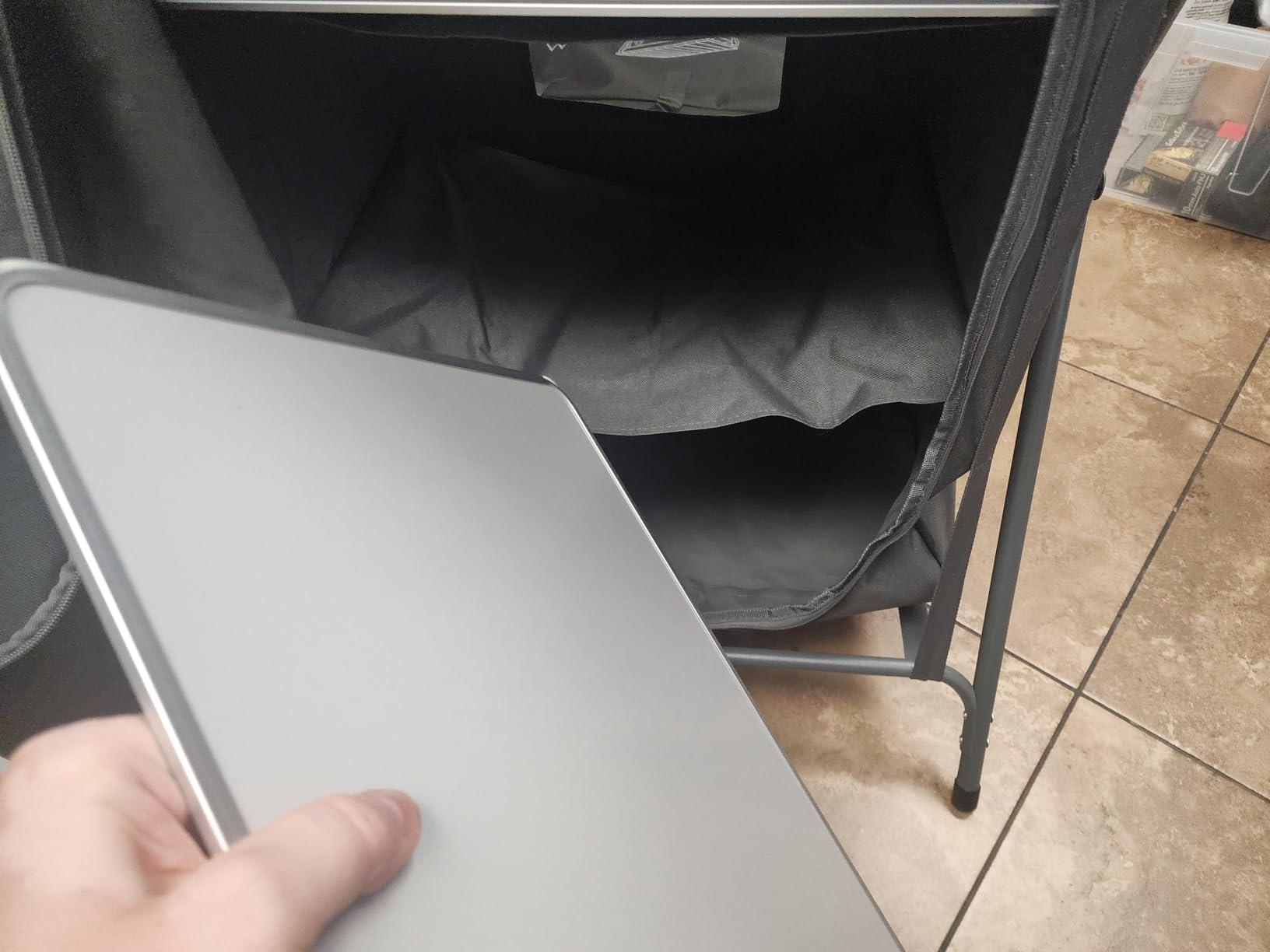
The powder-coated aluminum leg frame is the part that feels overbuilt for the price, and the mesh vent back on the pantry body keeps airflow moving so dry goods do not go musty in humid weather. Reviewers consistently single out the build quality, the capacity and the fast fold cycle, with 86 percent of ratings at five stars.
The removable aluminum inner shelf inserts let you change the layout. We ran one shelf for pots and left the others for pantry goods, which is the arrangement most families settle on after a trip or two.
How it fits a truck bed or a van
At 25 inches wide and 12.5 pounds empty, this is one of the few boxes here you can carry one-handed from the tailgate to the picnic table, and the zippered carrying bag makes that a one-motion job. In a van it works as a standing pantry that folds flat against a wall between trips.
Because it is a roll top rather than a lid, the whole surface unzips and rolls back to open. That means the only thing sealing your food is fabric, so pack dried goods in sealed containers if you camp in humid ground or coastal air.
Who should pass on this roll top pantry
The 20.5 inch height is a real consideration. Buyers who want a low table find it awkward, and shorter campers report the work surface sitting closer to shoulder than waist level. Measure your cook’s preferred prep height before committing.
The thin aluminum shelf inserts also add little rigidity, so avoid stacking heavy cast iron on the upper shelves. And if you need true waterproofing, this is a fabric pantry, not a sealed case.
3. JAGAHAHA Slide-Out Overland Kitchen Box – Cooking Outside the Van

JAGAHAHA Slide-Out Overland Kitchen Box, Foldable Outdoor Cooking Gear for SUV Car Camping Overlanding
70 x 20 x 11.8 inch foldable footprint
45 pounds empty
Heavy-duty locking slides
Collapsible sink, utensil hooks and lamp stand
Pros
- Deploys in under a minute once assembled
- Keeps cooking smells out of a van interior
- Adjustable support legs handle uneven ground
- Doubles as storage
- counter and seat support in a build-out
Cons
- Bottom shelf can bind when fully extended
- Assembly screws can loosen on rough roads
- Two people recommended to load it
The value of a slide-out kitchen is not the storage, it is the smell. Cooking inside a Sprinter or a wagon leaves grease in the headliner that never fully comes out, and this box exists to let you cook outside while still having a proper counter, a sink and a place for pans.
It folds down to a 70 by 20 by 11.8 inch footprint and weighs 45 pounds empty. Once assembled, deployment is under a minute, and the heavy-duty locking slides stop the drawer retracting while you are working over a hot burner, which is a genuine safety feature rather than a gimmick.
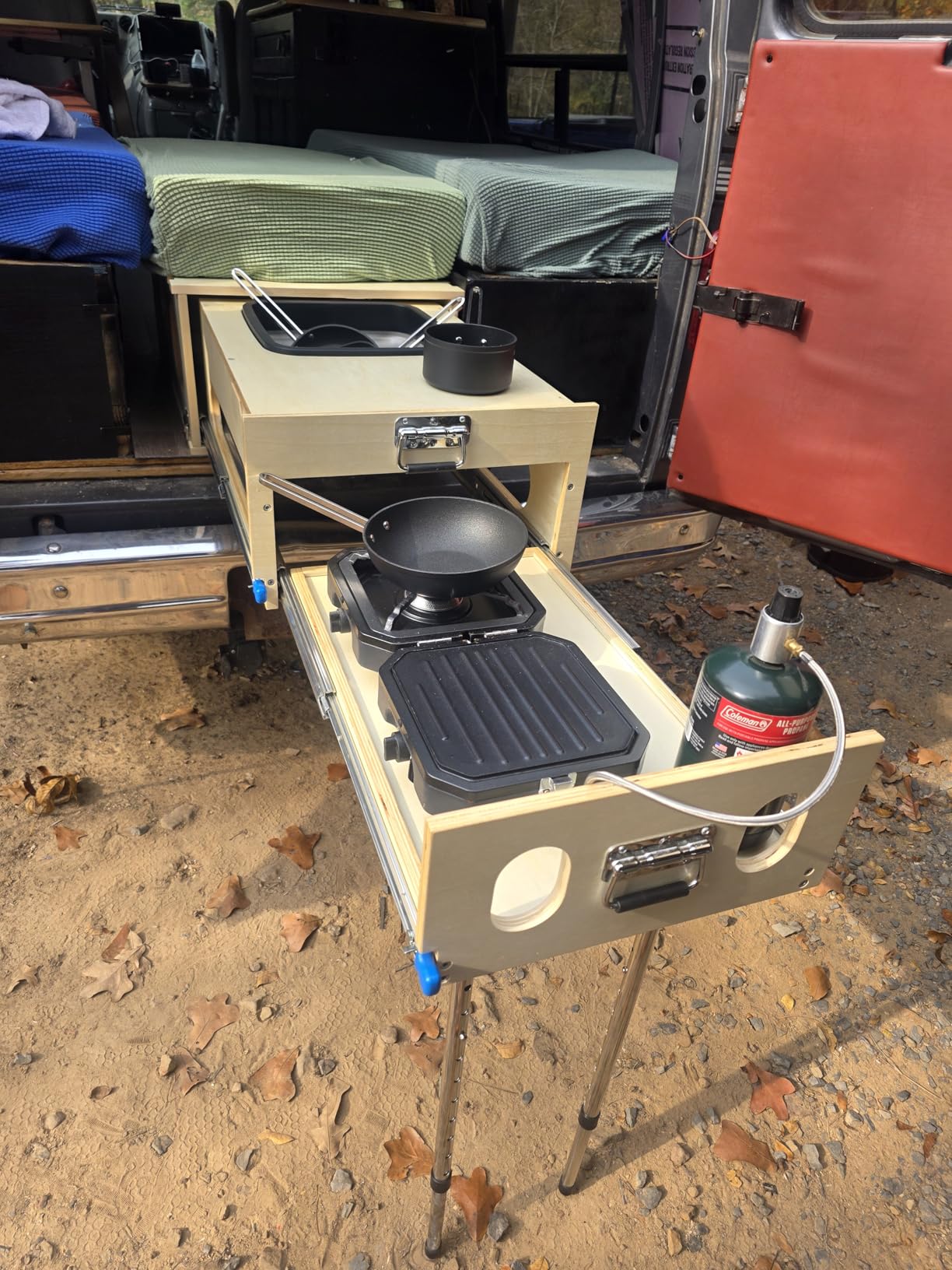
The layout covers a lot of ground: a collapsible sink, a trash bag holder, a napkin rack, utensil hooks, a lamp stand and a storage drawer, with an adjustable support rod for two-burner stoves. Assembly took us under an hour with the printed instructions and the video walkthrough, which is faster than most engineered-wood build-outs.
Owners building out vans report that it doubles as a counter, a storage drawer and even seat or cushion support, which is why it keeps appearing in van builds rather than traditional truck beds.
What the slide-out format costs you
Two things. First, the bottom shelf can bind when the drawer is fully extended, and pushing it back in takes patience. Second, the push-button leg stops give you legs that are either slightly too long or slightly too short, so on uneven ground you shim rather than adjust.
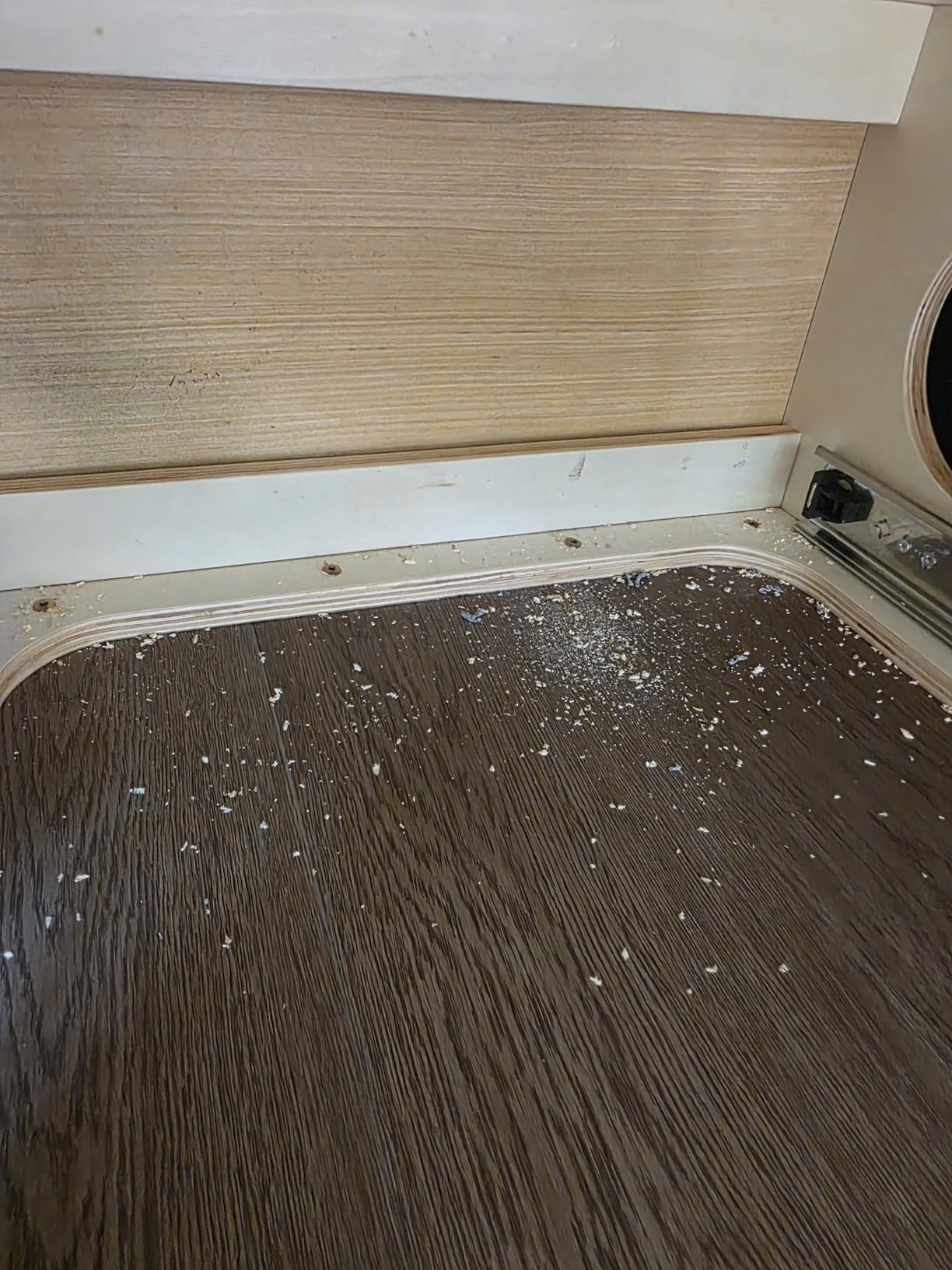
More important is the screws. Assembly screws in a vehicle driven over washboard roads can vibrate loose, and glue is not included. Owners who are serious about this fix the joints with thread locker before the first trip, and it is a fifteen-minute job that prevents a season of rattles.
Who should pass on this slide-out box
At 45 pounds empty and 70 inches long, it needs a real mounting surface. Short-bed pickups and small SUVs will not take the footprint without creative mounting, and solo owners will want a second pair of hands for the lift.
Also note the finish. Reviewers say the wood texture in photos is not fully representative of what arrives, and if you are matching a van interior you will want to check the real colour before committing.
4. Mountain Summit Gear Roll Top Kitchen – A Prep Surface You Can Lift One-Handed

MOUNTAIN SUMMIT GEAR Camping Roll Top Kitchen Made from Weather-Resistant Aluminum (By Caddis Sports)
Just over 10 pounds empty
18.9 x 31.5 x 47.2 inches
Weather-resistant aluminum roll tops
One year limited manufacturer warranty
Pros
- Light at just over 10 pounds
- so it lifts one-handed
- Adjustable legs handle uneven ground
- Folds flat for tight storage
- Holds a two-burner camp stove without wobbling
Cons
- Light duty construction
- Limited roll-top surface for larger cookware
At 10.2 pounds you can lift this without planning for it. It includes one foldout counter and two roll-top table surfaces, stands at 47.2 inches, and the adjustable legs take up the worst ground you will find at a dispersed site.
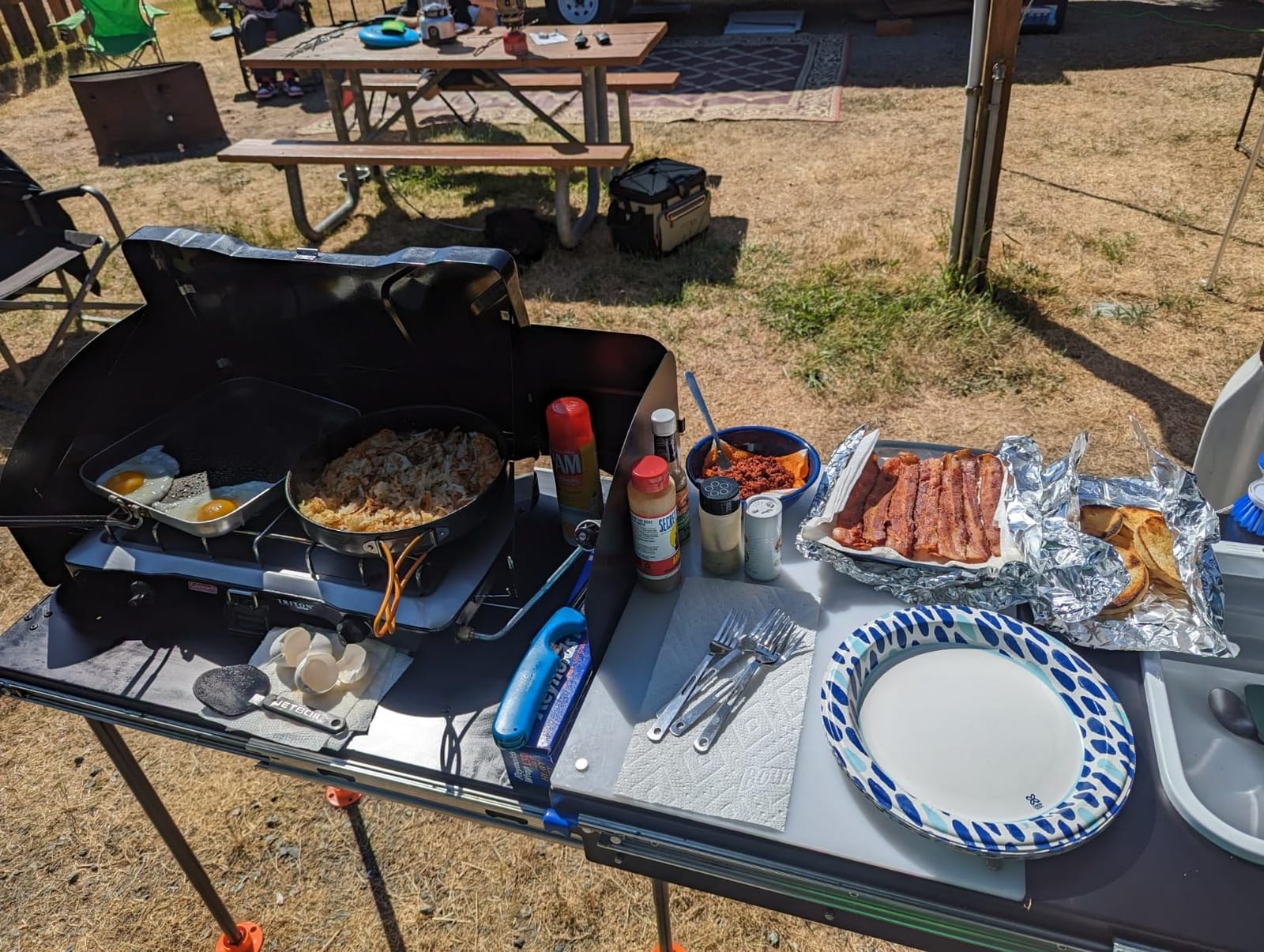
It sets up in seconds and folds flat, so the packed footprint disappears into a gap behind the seat. Reviewers confirm the roll top held a dual-burner Coleman stove without wobbling, which is the actual load test that matters.
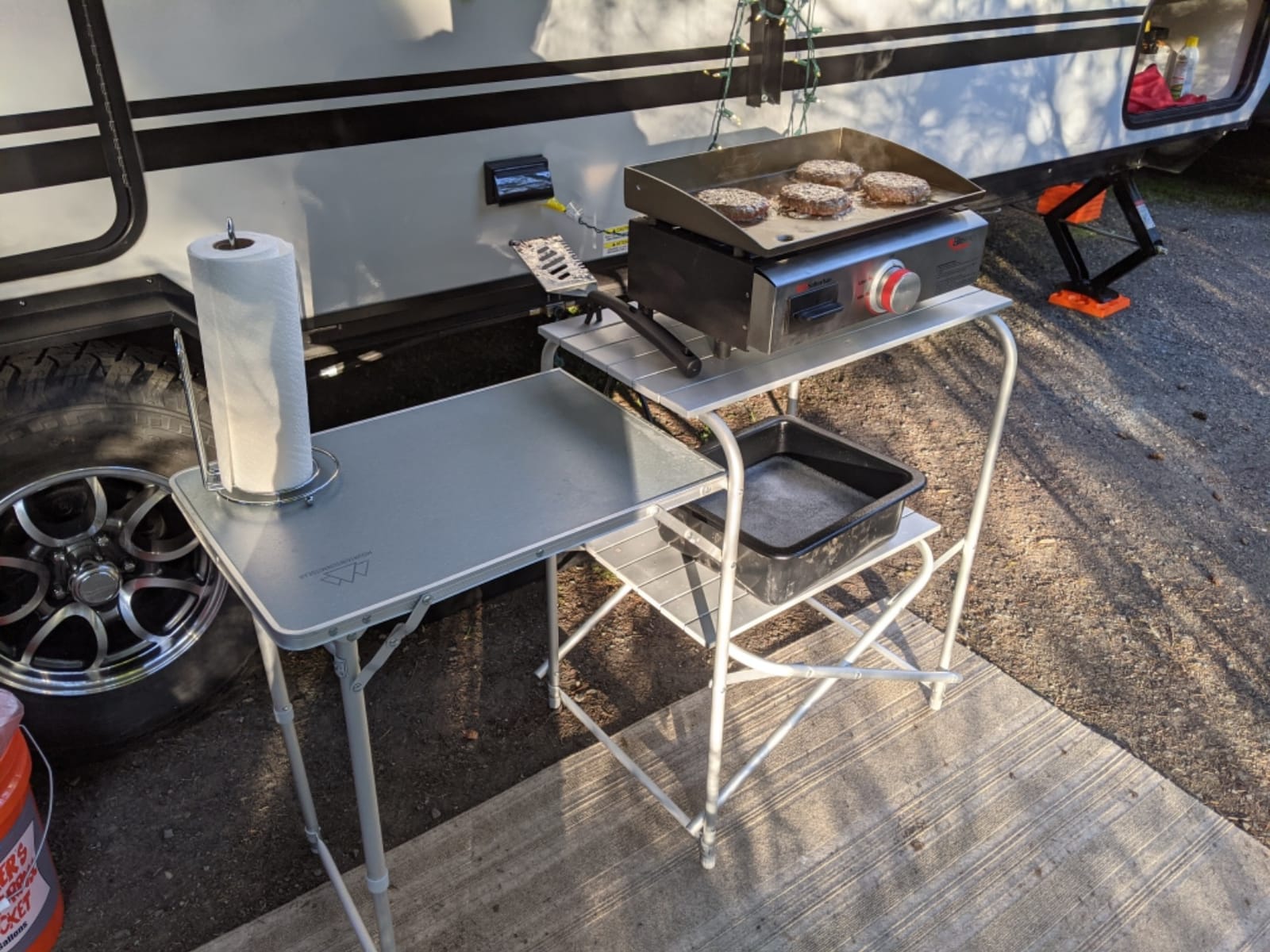
The weather-resistant aluminum surfaces wipe clean, which sounds minor until you have washed a camp pan in cold water at 6 degrees. We also used it as a grill support and as a prep surface for a full camp breakfast with two burners running.
The one year limited manufacturer warranty is shorter than the hard cases here, so treat it as a prep surface rather than a lifetime piece of gear.
Weight and fuel decisions on a light setup
Because it is this light, it changes what you can carry in the box. The pounds you save against a hard aluminium case become fuel, water and dry goods, and on a long desert route that is a better trade than more storage.
Be deliberate about the stove though. Aluminum surfaces transfer heat straight to the pan and there is no insulation, so use a windscreen and keep the windward burner off when the wind picks up.
Who should pass on this roll top kitchen
Anyone expecting hard-sided durability. Reviewers are consistent that this is light duty construction, and the interior roll-top surface area is limited for larger cookware, so a 12 inch skillet hanging off the edge is a real scenario.
It is also storage-light. If your list of kitchen kit runs past a two-burner stove, a small cook set and utensils, pair it with a soft bag like the Kelty later in this list rather than trying to cram it all underneath.
5. Keter Stack N’ Roll Camping Gear Organizer – 18 Bins and a Clear Lid

Keter Stack N’ Roll Camping Gear Organizer, Portable Storage Organizer
18 removable bins plus a transparent lid
20.28 x 13.58 x 4.53 inches
Heavy-duty latches and padlock eyelet
Stacks with the wider Keter line
Pros
- Clear lid shows contents without opening anything
- Removable bins let you rebuild the layout between trips
- Lockable so gear is secure when you step away
- Impact-resistant resin with heavy-duty latches for transport
Cons
- Resin body is heavy for its size
- Depth suits small parts more than full pans
This is the answer to the problem every big deep box creates, which is that without internal dividers a kitchen box becomes a black hole. Eighteen removable bins mean you can pull out the spice tray, the fuel fitting tray and the cutlery bin individually and leave the rest packed.
The transparent lid is the feature that changes daily use. You can see the whole layout from arm’s length, which means you stop unpacking the whole case to find the lighter, and on a dark morning that is worth more than it sounds.
Heavy-duty latches keep contents secure during transport, and the integrated padlock eyelet lets you lock the case when you walk away from camp. It is sold separately from the padlock, which is a small extra to plan for.
How the 18-bin layout holds up in a kitchen
Eighteen sounds like a lot until you load it. The bins are sized for small things: spice jars, camp cutlery, stove parts, fuel fittings, a lighter, a scrub brush, zip ties, a repair tape roll. A nesting cook set does not go in the bins, it goes beside them.
Owners who use it for camp kitchens usually pair it with a larger bag for pans. The ergonomic carry handle is comfortable for that split, and the box also stacks with the wider Keter Stack N Roll system if you want to add a second tier for dry goods.
Who should pass on this organizer
The resin body adds weight compared with soft fabric organizers, and the manufacturer does not list a weight figure for it. If your priority is minimum pounds, a nylon tote will always be lighter, so pair this with a lightweight roll top rather than treating it as the whole kitchen.
It is also a small-parts case. Families cooking multi-meal days with a full camp kitchen will need a second, larger container for the cookware.
6. Overland Vehicle Systems Camp Cargo Box Kitchen – Sink, Prep and Grill in Three Slides
Overland Vehicle Systems Camp Cargo Box Kitchen with Slide Out Sink, Cooking Shelf and Work Station – Aircraft Grade Aluminum with Stainless Steel Hardware – for SUV, Truck, or Trailer
Aircraft grade aluminum with stainless steel hardware
36 x 23 x 9 inches, 90 pounds
Three latched slides plus telescoping legs
Five year limited warranty
Pros
- Slides hold heavy appliances such as a Weber Q
- Removable sink and cutting board add flexible prep space
- 18 mounting positions across 3 rows of mounts
- Reversible wind protector for the grill
Cons
- Published dimensions overstate fridge slide capacity
- Dented or scratched slides arriving from the packaging
- Carpeted plywood raises durability questions in wet climates
This slide-out kit covers a lot of ground and carries the highest listed weight at 90 pounds empty. It is built from aircraft grade aluminum with marine grade stainless steel hardware, and it gives you three latched locked slides: a fridge and storage slide, a sink and cutting board slide, and a BBQ slide with three fold-down telescoping legs.
That third slide is the differentiator. Installers report the slides hold heavy appliances such as a Weber Q without deflection, and the legs extend from 26 to 43 inches to level the cooking surface on uneven ground. The reversible three-sided wind protector handles the other half of the outdoor cooking problem.
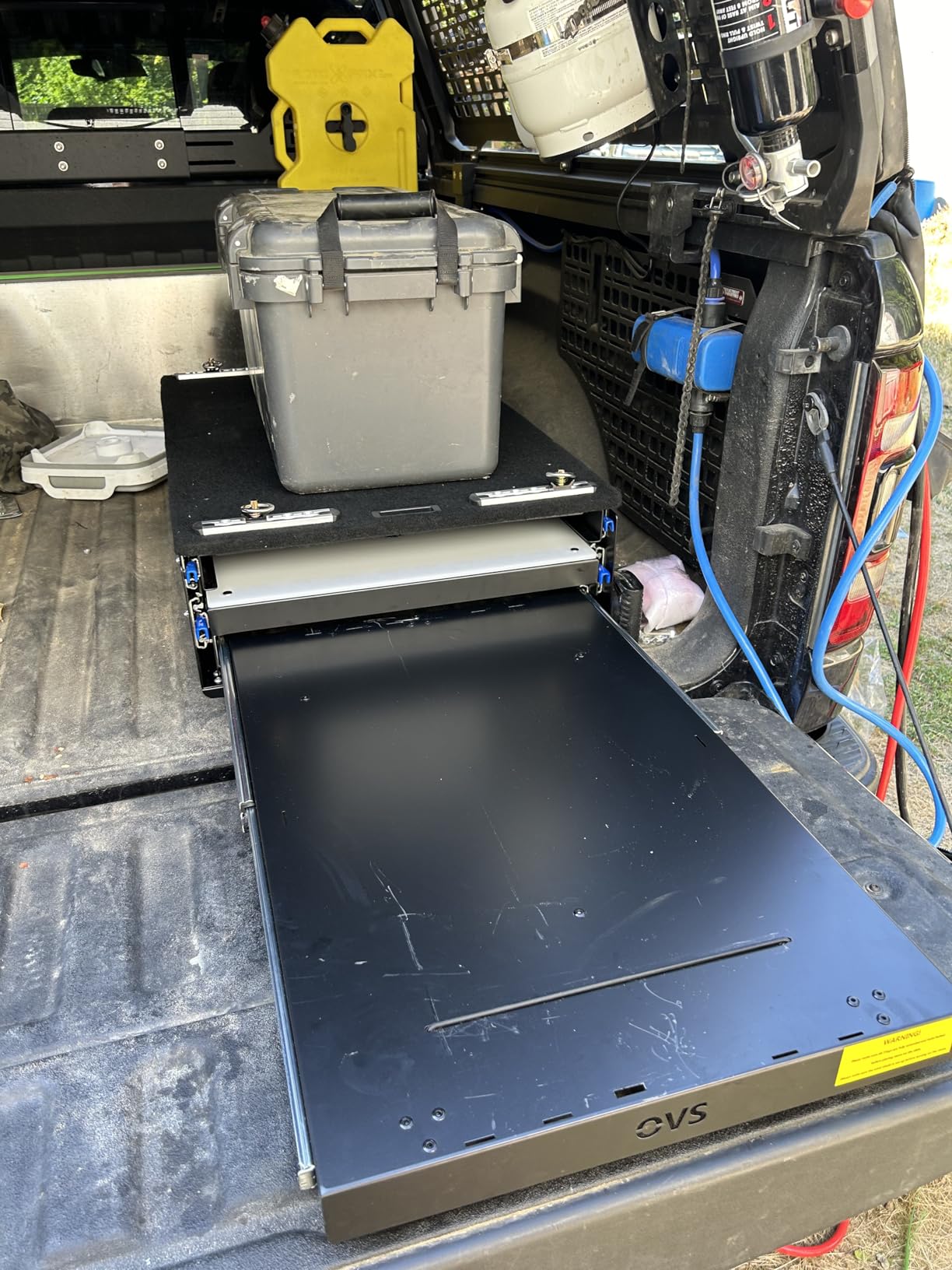
The carpeted top deck slides out to bring food prep closer to the cooking surface, and the removable collapsible sink and preparation cutting board add real workspace rather than decorative surface area. Installation is quick and the 3 rows of mounts with 18 slot positions let you set the height you want.
The five year limited warranty is the longest here, and owners mention Overland Vehicle Systems for honoring warranty work on the slide mechanisms, which is a meaningful signal on a moving part.
Payload and deck height on this one
Ninety pounds empty is not a truck-bed accessory, it is a payload decision. Add a fridge, a Weber Q and a sink full of water and you are carrying several hundred pounds behind the rear axle, so check your vehicle rating before you order and measure your deck height for the cooking position.
It measures 36 by 23 by 9 inches, which suits a wide bed with a flat mounting surface. Buyers report it works well as a pull-out kitchen in a truck deck or in an SUV with a proper cargo slide, and the adjustable legs are what make the cooking height usable on a lifted truck.
Who should pass on this cargo box kitchen
Anyone with a short bed, a low payload rating or a small SUV. The footprint and the weight are not compatible with a compact rig, and the system is close to pointless without a mount surface you can drill or bolt to.
Also set expectations on two points. Published dimensions overstate the fridge slide capacity, so larger 12V fridges may need modification, and several buyers received slides with dents, scratched paint or bent wind guard tabs because the packaging does not protect the unit in transit.
7. Yorkenbe 45L Camping Organizer – A Full Kitchen in a Collapsible Bag

Yorkenbe 45L Camping Organizer, 1680D Heavy Duty Waterproof Camping Storage for Camping Cooking Utensils and Camping Cookware, with Hard Bottom, Camping Bag with Zippered Lid for RV, Hiking
45 litre capacity, 20 x 12 x 12 inches
1680D oxford with water resistant lining
5mm embedded base board and non-slip strips
1.64 kg
Pros
- Fits pots
- cast iron
- stove and fuel bottles in one bag
- Base board stops it collapsing when empty
- Collapses flat when the trip is over
- Paper towel strap on the front
Cons
- Capacity falls short of the 45 litre label for some loads
- Only one divider is included so compartments are limited
- Zippers are not heavy duty
This is the bag people buy after realising a plastic storage bin is the wrong shape. The 1680-denier waterproof oxford outer with a water resistant inner layer holds a full camp kitchen, and users report fitting pots, cast iron pans, a stove and fuel bottles into the 20 by 12 by 12 inch body.
The 5mm board embedded in the base is the reason it holds its shape when empty. Most soft organizers fold into a shapeless sack the moment they are unloaded, and that is what makes the difference between a bag you can find things in and a bag you have to unpack.
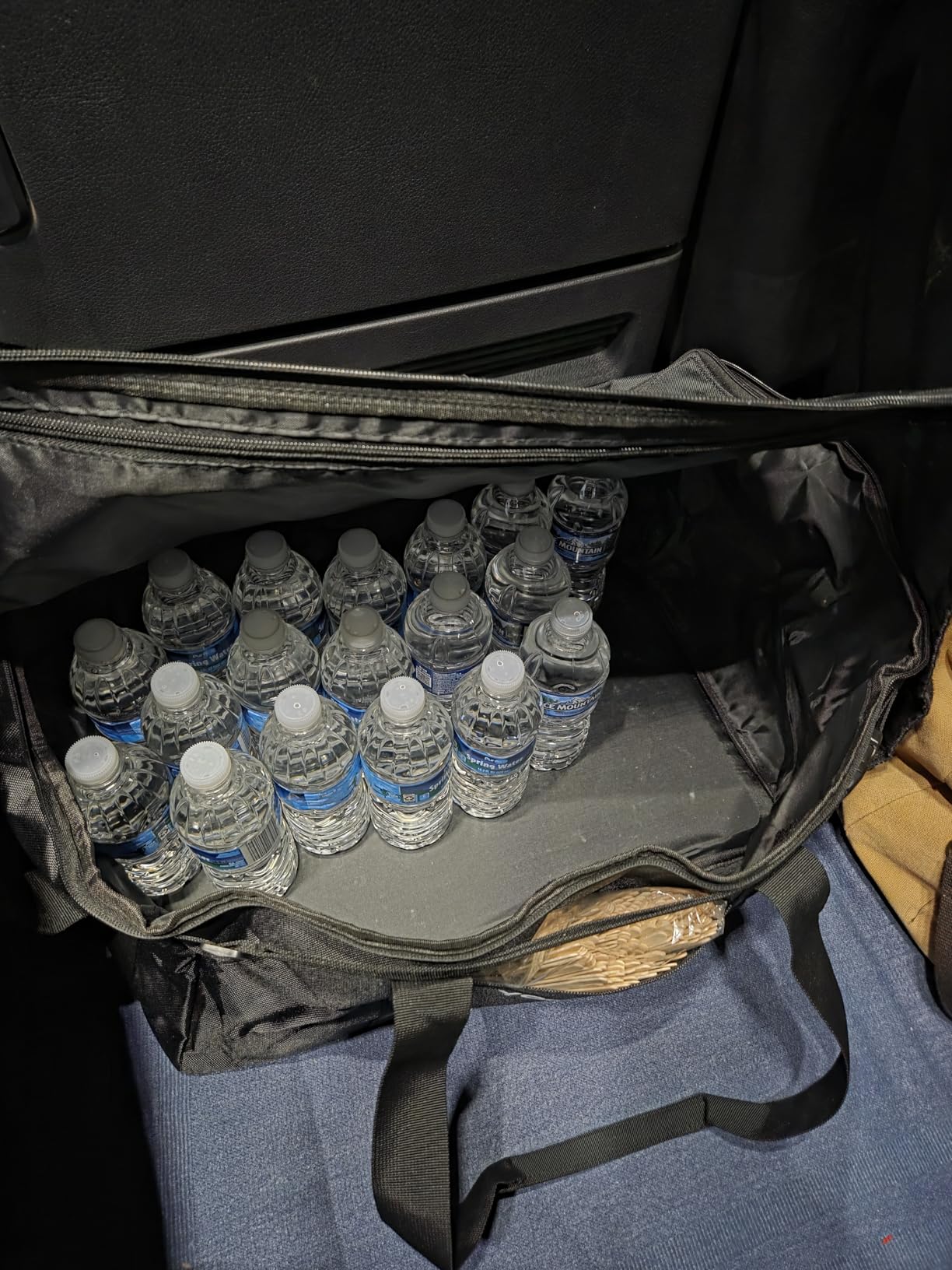
The non-slip strips on the base stop it sliding on a wet truck bed floor, and the PU divider creates compartments of different sizes so a cutting board and a fry pan do not fight for the same space. Non-slip base plus hard base board is a combination we do not see often at this weight.
Padded carry handles and two side handles mean you can lift it the way that suits the load, and it folds flat for storage when the trip is over. Users consistently praise the durability, shape retention and the space it saves over a plastic bin.
What actually fits in 45 litres
Roughly a two-person camp kitchen: a nesting cook set, one cast iron pan, a stove, two fuel canisters, utensils, a cutting board, a wash basin and a modest dry goods load. It is a tight fit at the top end of that list, which is where the capacity complaints come from.
Reviewers note that the capacity falls short of the 45 litre label for some cookware loads, and only one divider is provided, so compartment customisation is limited. If you cook for four with a full-size griddle, step up a size.
Who should pass on this organizer
Anyone who leaves their kitchen in the vehicle for weeks and needs true waterproofing, since the zippers are not heavy duty and will wear with constant use. It is splash-resistant, not submersible.
It is also not a structure. There is no lid to stand on, no shelf height and nothing to hang cookware on, so it works best paired with a prep surface from one of the roll top kitchens above.
8. Rhino Large Essential Trunk – A Large Hard-Sided Case on Wheels

Rhino Large Essential Trunk with Wheels, Tray & Lid Organizer for Camp
32 x 18 x 14 inches, 130 quart capacity
34 pounds empty, rated to 1000 pounds
3/8 inch birch plywood with steel hardware
Rolling wheels add no height
Pros
- Holds a large volume of camp kitchen gear in one case
- Hardwood and steel build outlasts plastic bins
- Removable tray and lid organizer
- Steel-encased wheels roll without adding height
Cons
- Lock assembly is the weak point
- Wheels are sized for hard surfaces
- not dirt or grass
- Tray grommet brackets can loosen
At 130 quarts and 4.13 cubic feet, the Rhino trunk holds a very large amount of hard-sided storage, and the material is the selling point: 3/8 inch birch plywood with leather embossed vinyl and steel hardware, made in the USA and fully assembled when it arrives. That is a very different material story from resin or fabric.
At 34 pounds empty it is not a light box, but the wheels are steel-encased and add no height to the stack, which is how it moves from a garage to a campsite without two people lifting it. Owners also use it as a bench or footlocker at camp.
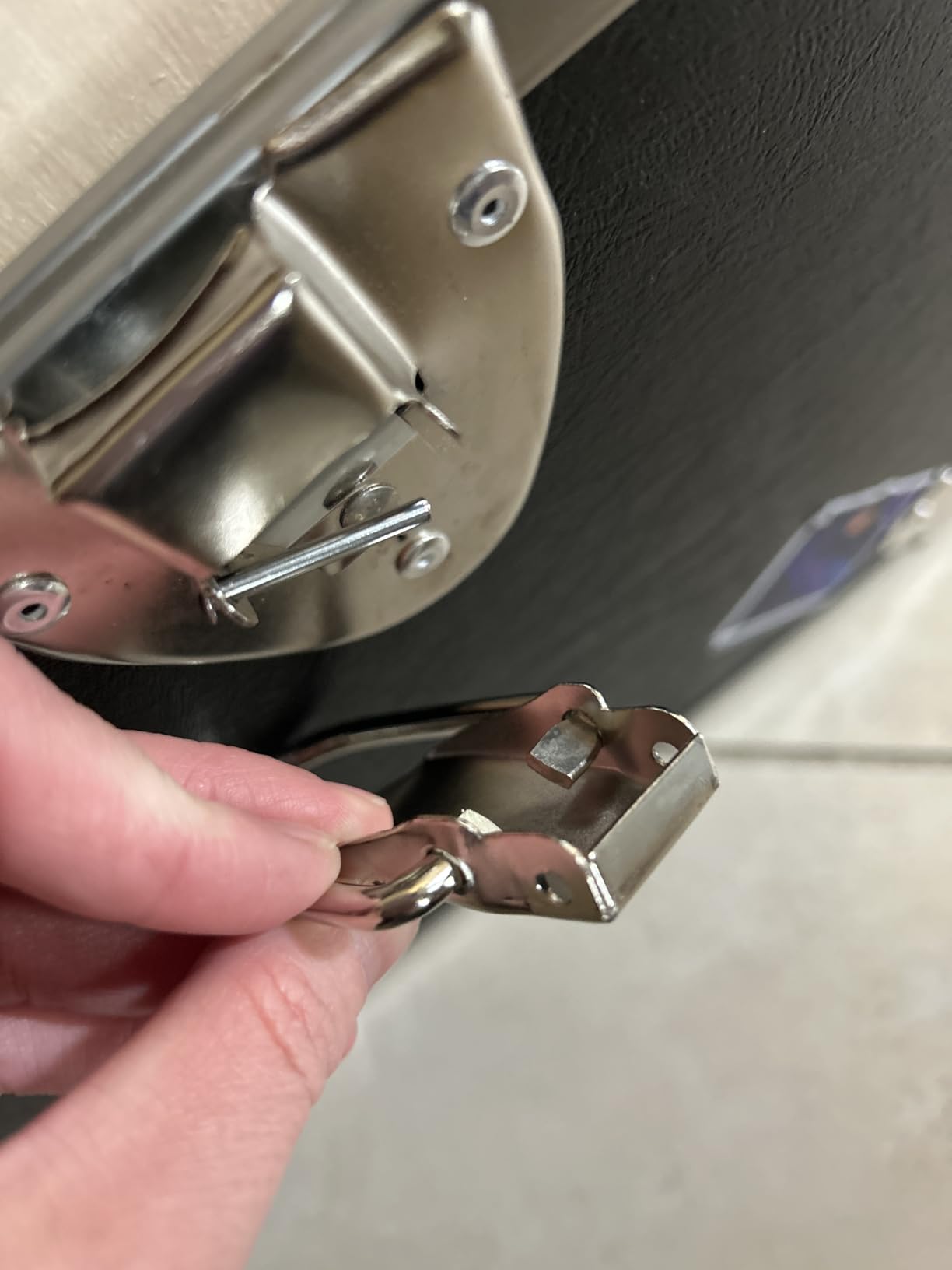
The hardwood tray and removable lid organizer are what turn a trunk into an organised kitchen case. The tray lifts out with the cookware and the lid organizer holds the small items that otherwise end up loose at the bottom, and the magnetic latch with a padlock loop keeps it shut without a key.
The tongue and groove steel closure is described as tight-fitting against moisture and dust, and the two year warranty includes free non-cosmetic repairs, which is rare in this category.
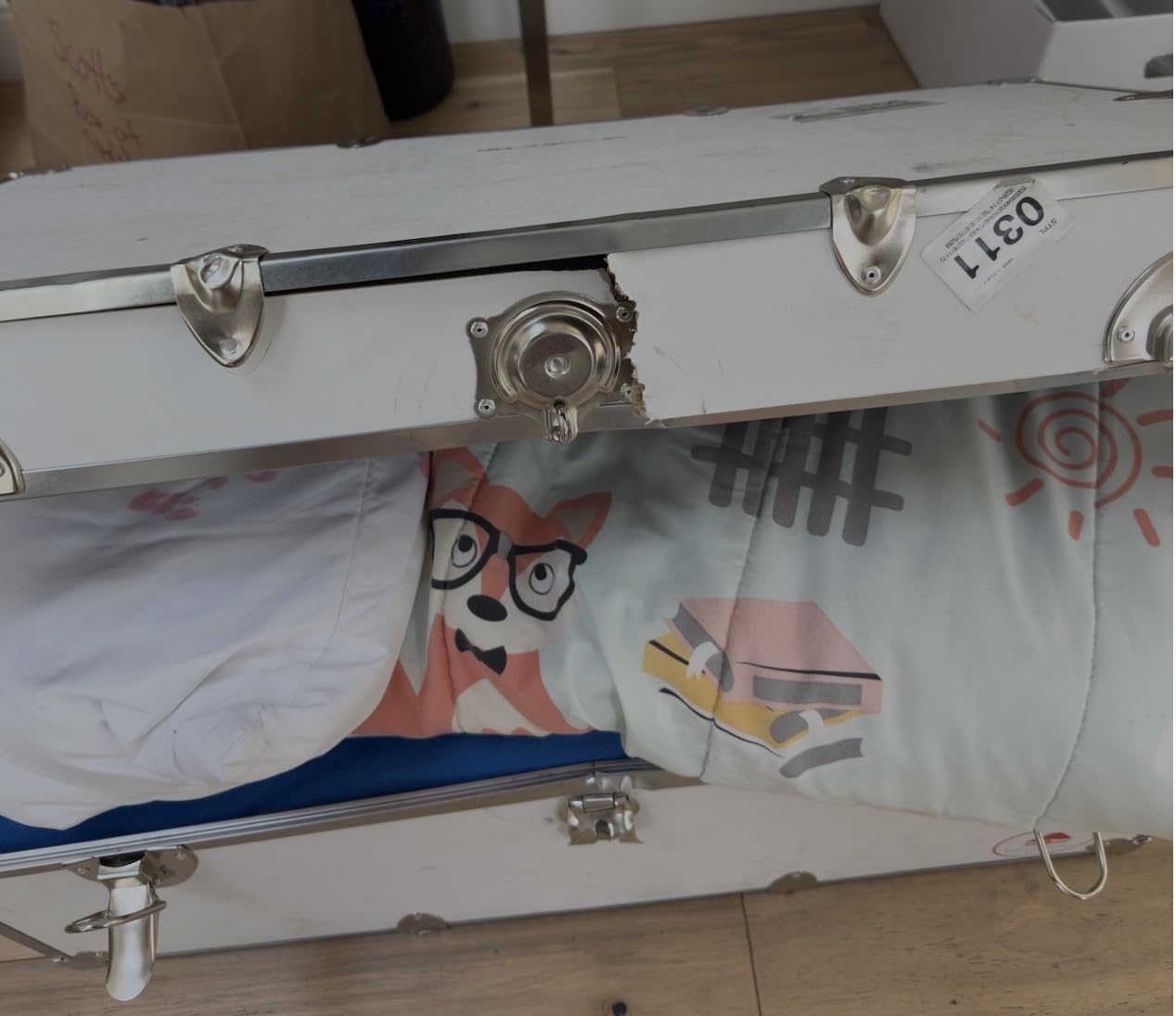
Loading it without a second pair of hands
The 1000 pound maximum weight recommendation means the case itself is not the constraint. The real handling question is the 34 pounds empty plus a full kitchen load, and the wheels only help on hard surfaces, so a grass site means a lift.
Plan the load order the way you would pack a real case: heaviest cookware low and centred against the wall, stove and fuel in the tray, small items in the lid organizer. Packing the trunk near a tailgate at driving height rather than in a garage is what makes the wheels worth having.
Who should pass on this trunk
The low ratings in this product are not about capacity or materials, they are about three small components. The lock assembly is described as cheap quality and can break, the metal grommet brackets holding the tray can loosen and let the tray fall, and one buyer reported a splinter from an unsanded interior tray.
It is also simply large. If your vehicle has a short bed or a shallow cargo area, the 32 inch length will decide it for you before anything else does.
9. HODRANT Tactical Camping Kitchen Organizer – Hangs Away From the Vehicle

HODRANT Large Tactical Camping Kitchen Organizer for BBQ Cooking Essentials
Seven compartments in nylon
15 x 5.5 x 15 inches, 16 ounces
Two-way zipper unfolds into a stand-up organizer
Hangs from awnings, roof racks or branches
Pros
- Consolidates a whole camp kitchen into one bag
- Unfolds into a stand-up organizer
- Clear PVC pouches make small items findable
- Hangs from an awning or roof rack to free up vehicle space
Cons
- Zippers feel stiff and lightweight
- No backpack straps for a loaded carry
- Hanging straps sit inside the zip pocket
At 16 ounces this is the lightest full kitchen carrier we tested, and that is the argument for it. The two-way zipper on the main compartment fully unfolds it into a stand-up organizer with a built-in buckle that stops it tipping, so you get a floor-standing kitchen from something that was a flat bag in the bed.
Seven compartments plus two side mesh pockets hold dishes, cutting boards, mugs and utensils, and the two transparent PVC zippered pockets on the upper compartment mean you can find a lighter or a seasoning bottle without unpacking anything.
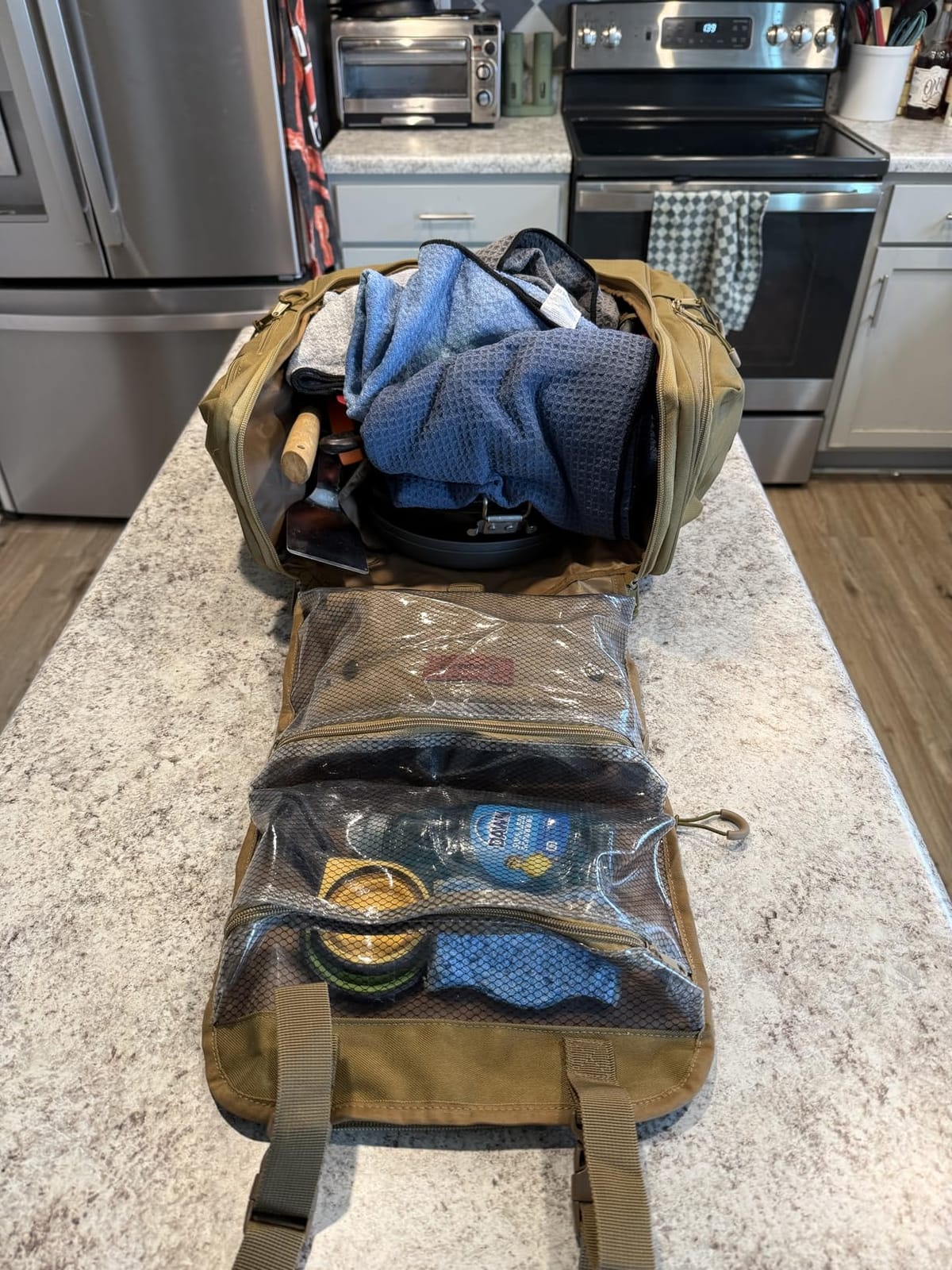
The khaki lining is a small detail that earns its place. Low light at a 5am start is the normal case, and a light interior shows you where the coffee is. The paper towel holder and front webbing with a badge loop round out a genuinely complete kitchen layout.
Two adjustable buckles let it hang from awnings, roof racks, ridge poles, tent brackets or branches, which is how owners keep cooking gear out of the vehicle and out of the mud.
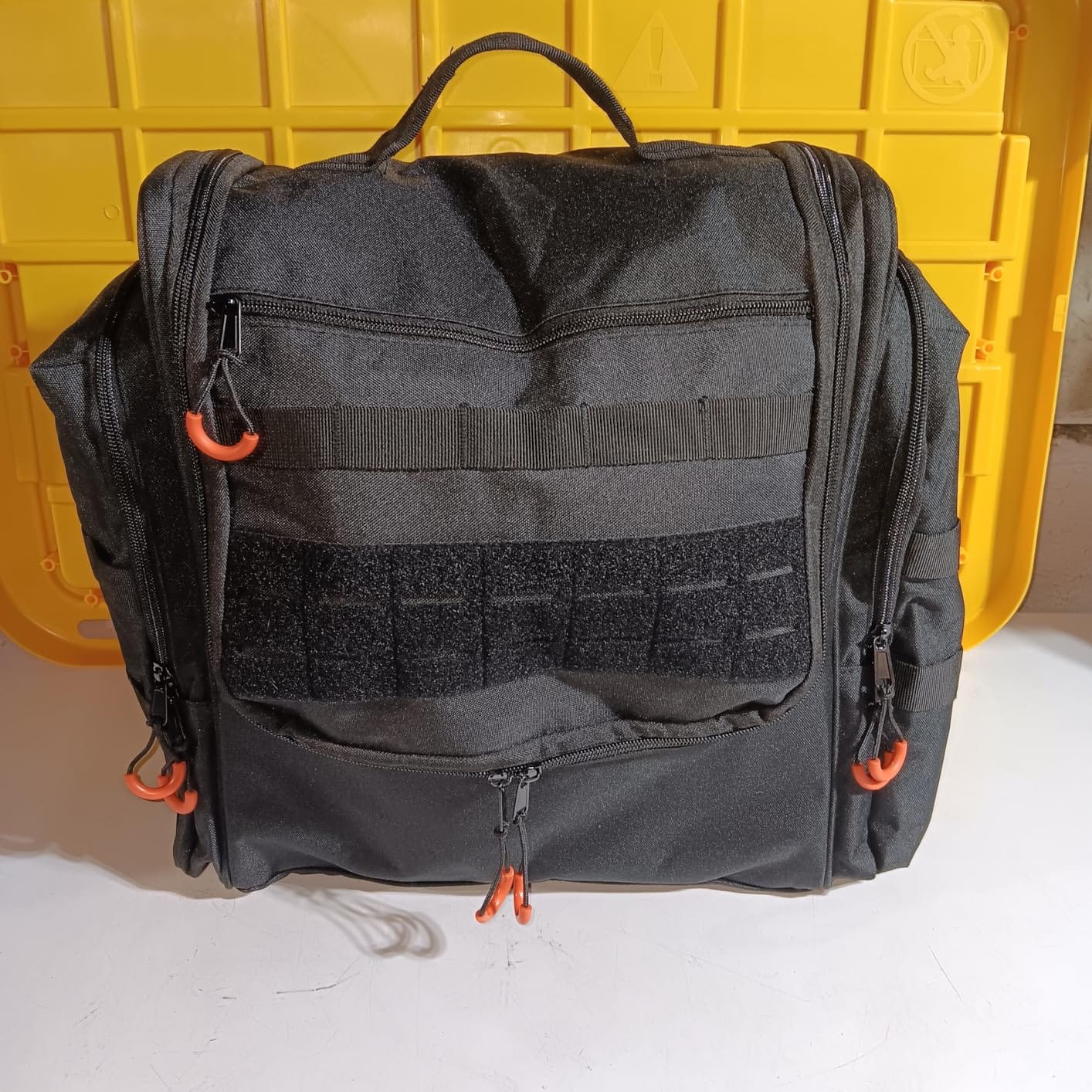
Hanging it away from the vehicle
Hanging storage changes where the weight sits, and that is the real benefit for overlanders. Kit that lives in a hanging bag on a roof rack or awning frees bed space and keeps the payload lower and further forward, which is where you want it in a washboard section.
There is a catch worth knowing: the hanging straps sit inside the main zipper pocket, so you cannot hang it while the case is closed. Plan for a ten-second setup at each end of the day rather than a snap-on.
Who should pass on this organizer
Buyers wanting a sealed container. This is an open nylon hanging bag, so it protects from dust and splashes but not from a downpour left unattended or an animal that has decided your camp is a food source.
The zippers are also the most common complaint. They feel light and stiff for the size of the bag, and contents have to be aligned carefully before closing. There are no backpack straps either, so a loaded carry over uneven ground is one hand on the handle.
10. Kelty Camp Galley Deluxe – A Soft Kitchen That Stays Organised
Kelty Camp Galley Deluxe – Camp Kitchen Organization Kit, Deep Pockets, Paper Towel Holder, Zippered Compartments for Outdoor Cooking Essentials
27 litre capacity
34 x 16 x 6 inches in use, 1 lb 7 oz
Packs to 16.5 x 15 x 6 inches
Rugged 600D polyester with YKK zippers
Pros
- Holds cookware
- dishes
- cutting boards and utensils for a whole trip
- Hangs from a roof rack
- branch or canopy frame
- Wipes clean and takes weather well
- Packs far smaller than a tote or bin
Cons
- Low opening threshold lets utensils slide out
- Bottom compartment has no stiffening board
- No shoulder strap included
The Camp Galley Deluxe is the soft answer to the hard case, and it does one thing extremely well: it holds an entire trip of cooking gear and lets you hang it open. Three zippered top pockets, two of them mesh for visibility, sit above side pouches with elastic straps and a deep waterproof pocket for trash, which is a genuinely useful piece of Leave No Trace design rather than a slogan.
In use it is 34 by 16 by 6 inches and weighs 1 pound 7 ounces. Packed, it shrinks to 16.5 by 15 by 6 inches, which is a fraction of the volume of a hard trunk and the reason so many van life builds start with one.
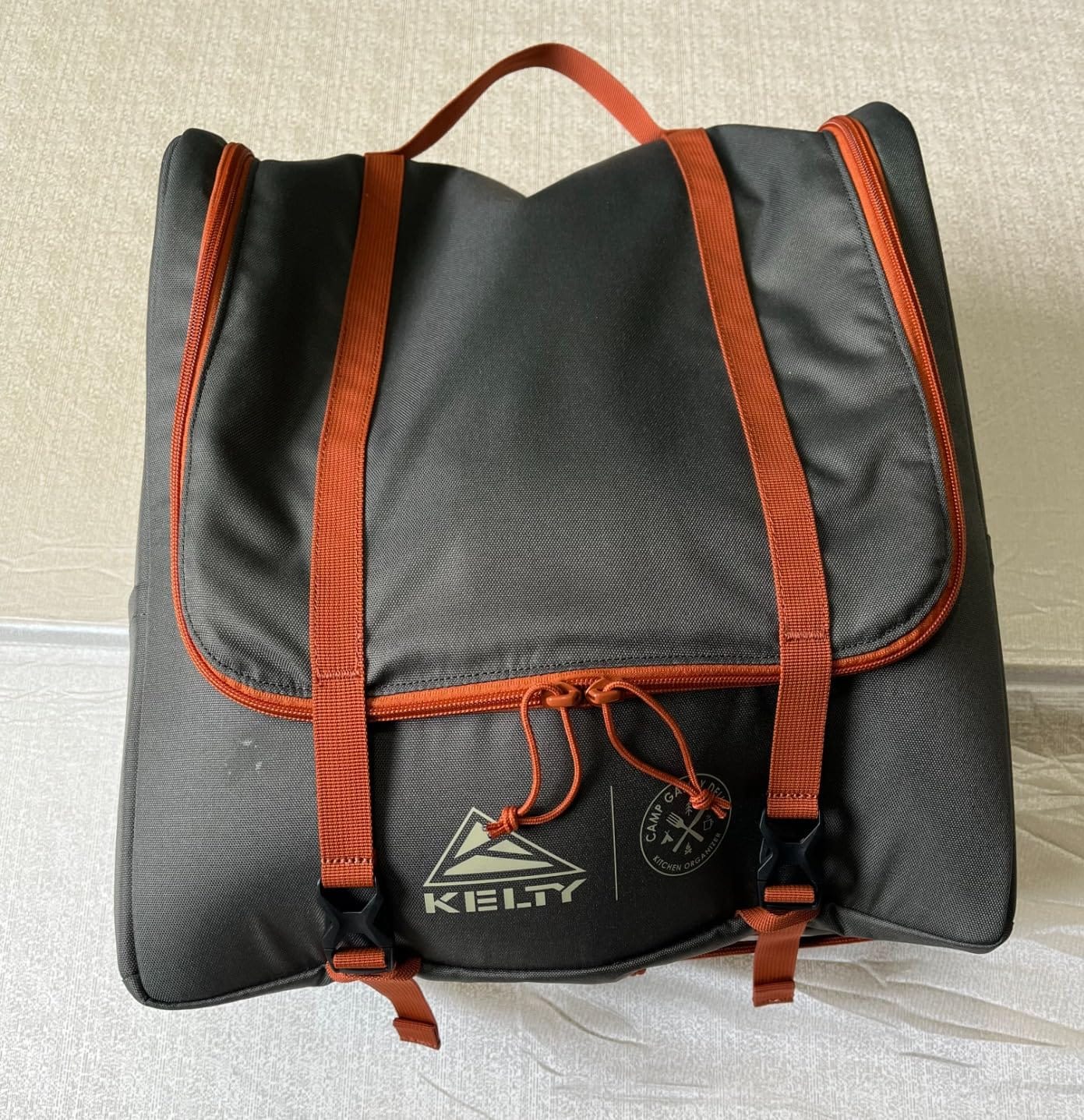
The rugged 600D polyester wipes clean and holds up to weather, and the YKK zippers are a step up from the hardware on most bags in this price band. Reviewers treat it as a premium answer to bulky camp kitchen totes, with 82 percent of ratings at five stars.
The integrated paper towel holder doubles as a small clothesline, and the whole thing hangs from a roof rack, a tree branch or a canopy frame so you are not cooking bent over a tailgate. Fabrics and coatings are DWR and PFC free.
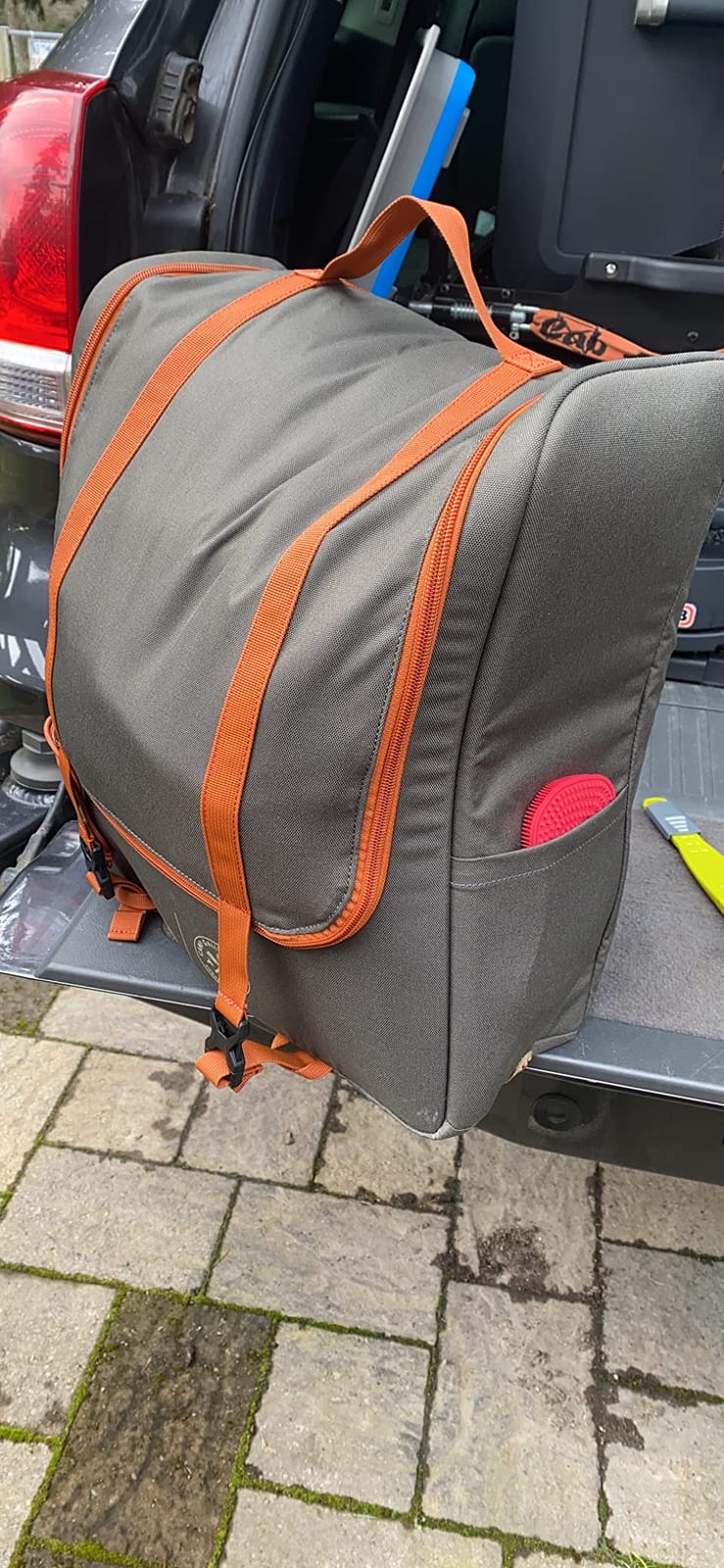
What stays dry and what does not
Be realistic about the rating. 600D polyester with a DWR finish shrugs off drizzle, splash and road spray, and the deep waterproof pocket is the right home for a bag of used bin liners or a damp wash basin. It is not a sealed case, and cast iron left inside overnight will still be damp in the morning.
The thing to watch is the opening. The main compartment has a low threshold, so long utensils can slide out unless you use the elastic strap. The bottom compartment also has no stiffening board and feels floppy, so keep the heavy cookware above it rather than at the base.
Who should pass on the Camp Galley Deluxe
Rigs with no safe hanging point. The bag needs a roof rack, canopy frame or a solid branch, and there is no closing cover for when it hangs in unsheltered locations, so in exposed campsites you will want a tarp over it.
Solo users with a heavy load should note there is no shoulder strap included, and the exterior side pockets do not expand, so the load has to go in the main compartment. Families cooking multi-meal days will find 27 litres tight for cast iron plus a full dish set.
11. Lemubeane 18L Utility Tote – Structured, Rigid and Surprisingly Light
Lemubeane Tactical Camping Storage Bag 18L Utility Tote Bag Camp Kitchen and Trunk Organizer (Army Green)
18 litres, 14.2 x 9.6 x 8.3 inches
600D nylon with waterproof PVC base
1.9 pounds
Hard boards in the short sides plus dividers
Pros
- Rigid padded panels protect pots and pans
- Waterproof base wipes clean after a dusty road
- Folds to 4.4 inches thick when empty
- Shoulder strap included
Cons
- 18 litres is small for a full cook set
- Dividers need the hook-and-loop pads fitted first
Most fabric totes go soft and fold into a puddle. This one keeps its boxy shape because of the hard boards embedded in the two short sides, the pearl cotton padding on the sides, and the dividers. At 1.9 pounds it holds its shape without the heft of a hard case, which is the combination we valued most of anything we tested.
The 600D nylon body with a waterproof PVC base is the detail that wins over a dusty road. You can wipe the base out after a gravel washboard run, and the base will not absorb the grit that turns a fabric tote into an abrasive for your cookware.
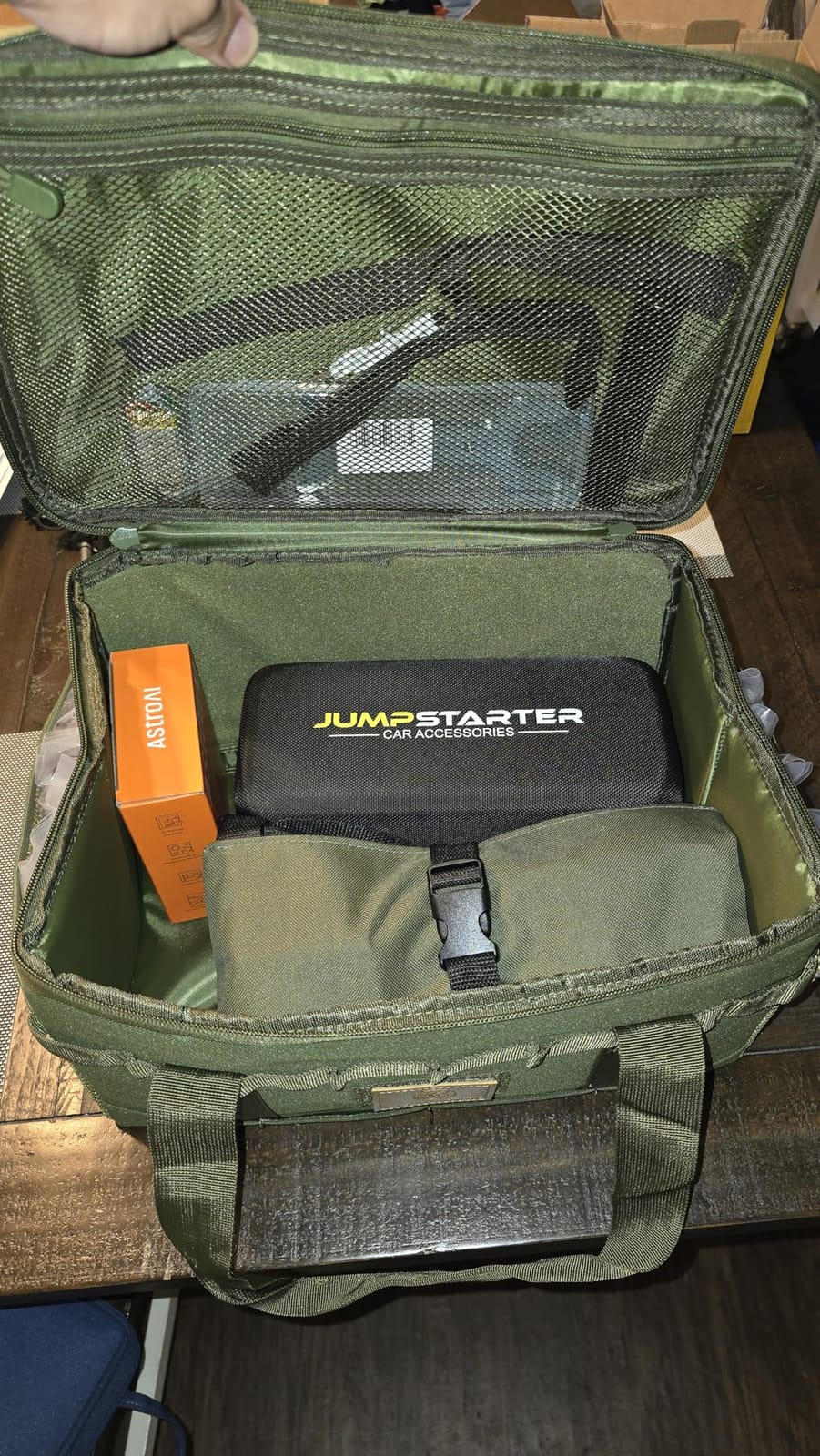
MOLLE trims and slots run around the outside, and there are two mesh pockets per side plus a large zipper mesh pocket on top, so a griddle, a set of tongs and a mug have a home instead of rattling loose. The included shoulder strap plus top handles give you two carry options.
It folds to 14.2 by 9.8 by 4.4 inches when empty, so it lives in a trunk or a frunk permanently and does not take up the space of a packed case. Buyers frequently pair it with a camp kitchen as the carry layer for smaller trips.
MOLLE layout for kitchen kit
MOLLE on a kitchen tote is not decoration. Strap a fuel canister cover, a hanging towel or a small tool pouch to the webbing and the bag absorbs accessories you would otherwise bury. The two mesh side pockets take things you want to grab without opening the main bay.
The interior hook-and-loop lining accepts the two included separating pads to form three compartments. That is the system to think about before you buy: with the pads fitted you get a cookware bay, a dry goods bay and a small parts bay, and without them it is one large space.
Who should pass on this tote
Anyone cooking for a family. Eighteen litres is smaller than most buyers expect for cookware, which is the single most common complaint in the reviews, and 18L holds a two-person kit rather than a full griddle-and-pans load.
It is water-resistant, not waterproof, and the dividers are optional extras you have to fit yourself. If you leave gear in the vehicle for weeks between trips, choose a sealed hard case instead.
12. TOPJUM Hanging Camp Kitchen Organizer – Eight Compartments, Anywhere

TOPJUM Camp Kitchen Organizer with Hanging Storage & Paper Towel Holder
20 litre capacity with eight compartments
Oxford 600D fabric, 600 g
Rated for loads up to 15 pounds
Hangs from a tailgate, door, hood or roof rail
Pros
- Pack a full camp kitchen into one bag
- Hook system covers tailgate
- car door
- roof rails and branches
- Two paper towel mounting options
- Detachable mesh front stops contents falling out
Cons
- Fabric is a little floppy
- All-black interior makes small items harder to see
- Occasional stitching defects on early units
This is the most flexible hanging option we found. The hook system attaches to a car door, a tailgate, a hood, a boat, roof rails, a camp pole or a branch, which means a family with a van full of passengers can turn a door into a kitchen wall without any drilling.
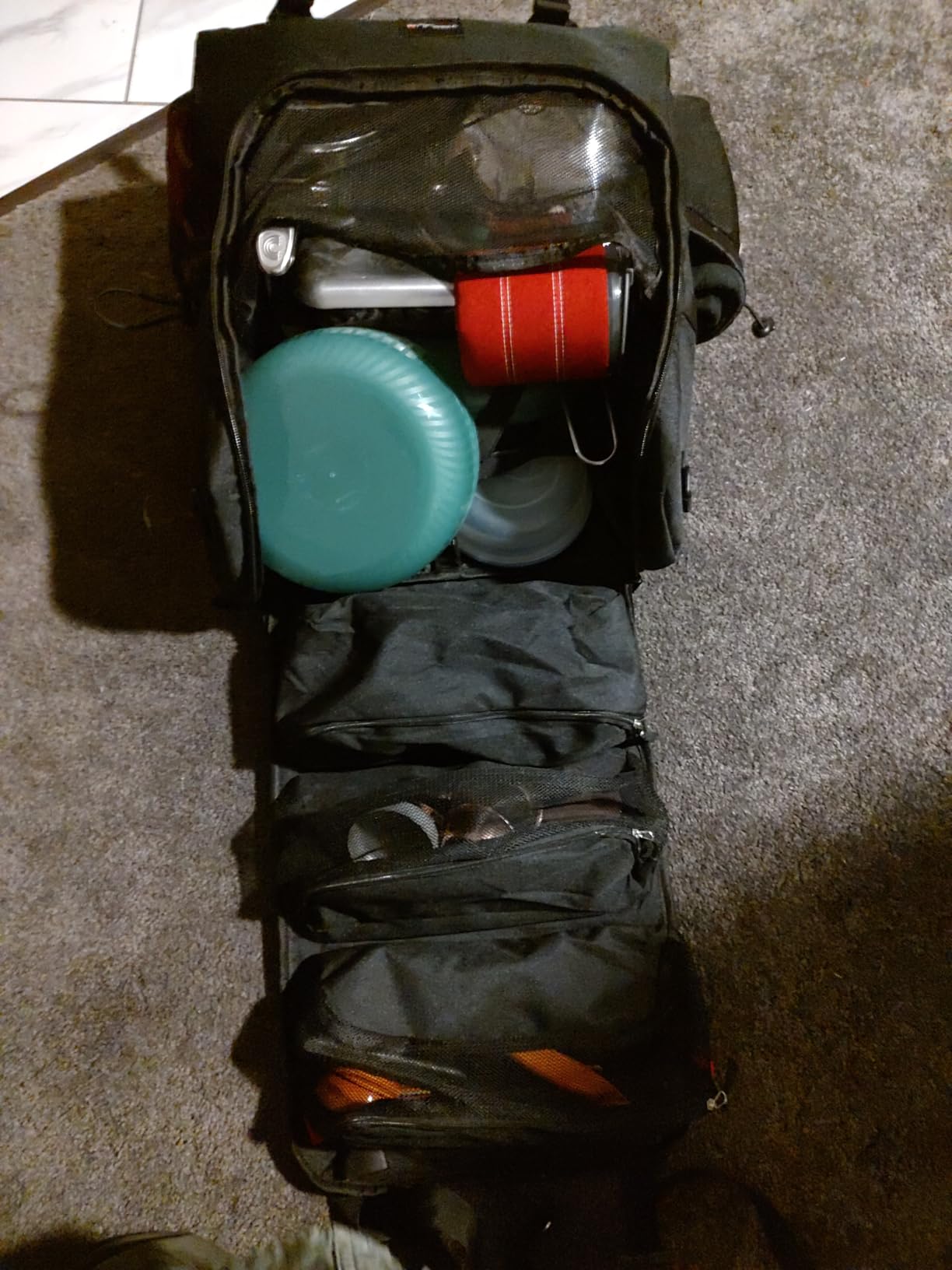
Eight compartments cover the job: three are zippered, one is a removable pouch, and a two-layer divider with elastic bands holds long items like a spatula or a skewer. Owners report packing pans, a griddle, bowls, mugs and utensils into the 20 litre body and retiring a bulky storage bin entirely.
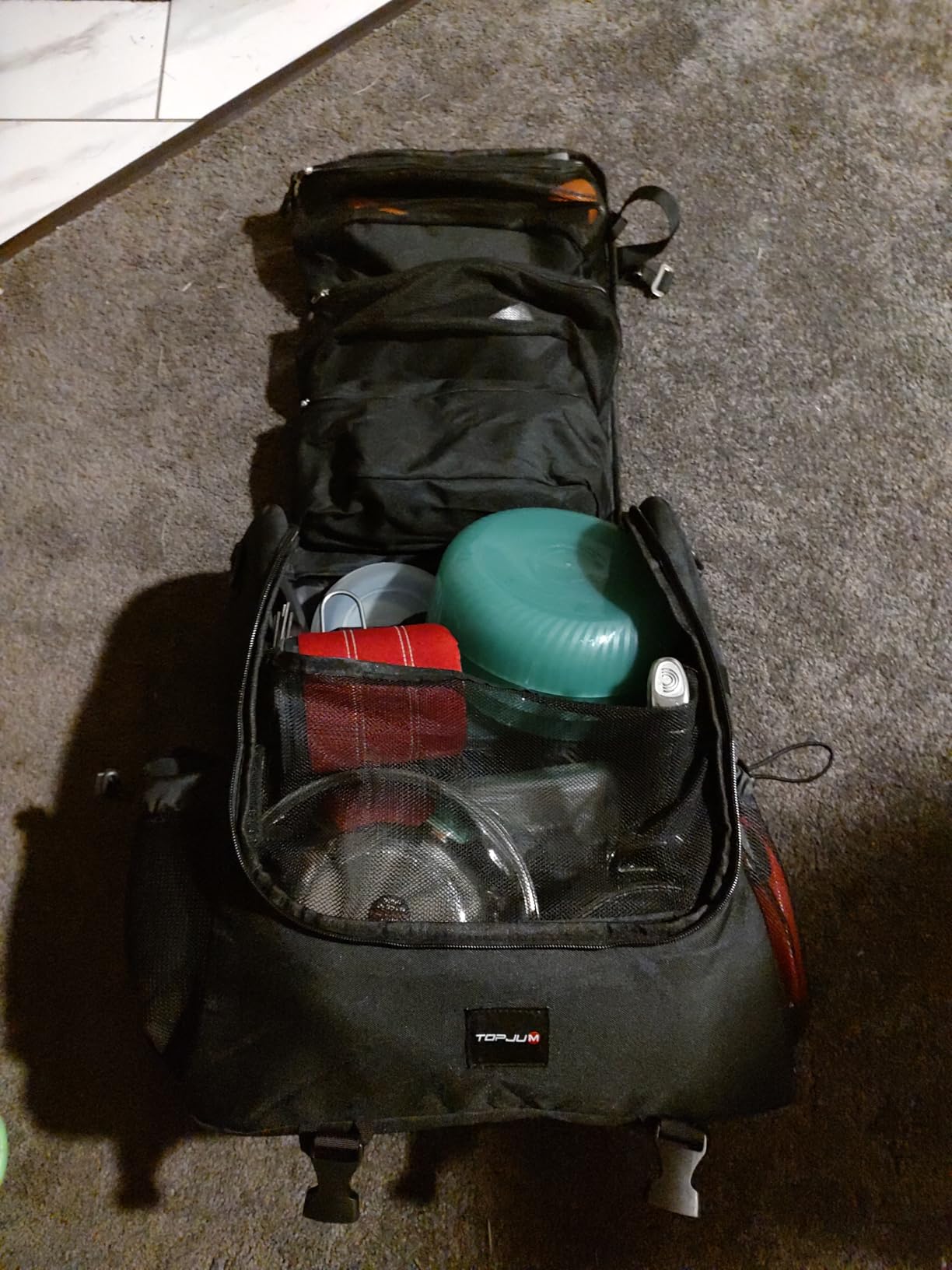
Two paper towel mounting options is the feature we did not expect to care about and now recommend. You can run a roll along the bottom or secure it inside the middle section so it stays put while you work, and the detachable front mesh panel keeps the contents from spilling when the bag is packed full.
A padded shoulder strap is included for transport, and the bag converts to a car seat organizer or a tool bag, which is a better use of the same object than owning a second organiser.
Hanging points and load limits
The 15 pound maximum recommended load is the number to plan against. That is a realistic two-person cook set with a stove and light cookware, and exceeding it pulls the hanging point onto whatever you hooked it to, so the hook choice matters as much as the bag.
Check the surface before you hang it. A roof rail or a canopy frame handles the weight comfortably, while a tailgate is fine for quick access and a branch depends entirely on the branch. If you plan to hang it from a car door, pack the lower compartments first so the weight sits close to the hinge side.
Who should pass on this organizer
Anyone who needs weatherproofing. Oxford 600D fabric with a hanging layout is a splasher, not a storm, and the all-black interior makes small items hard to locate, which is the opposite of what you want at dawn.
Some buyers also report the fabric being a little floppy where a stiffer panel would help, and a small number of units arriving with minor tears or stitching defects. Check the seams on arrival.
How to Choose a Camp Kitchen Box for Overlanding
What a chuck box is and why stay-packed changes everything
A chuck box, patrol box or field kitchen is one self-contained case that holds the whole cooking system, and the defining feature is that it stays packed. A roll top or slide-out kitchen also counts when it is permanently mounted, but the shared principle is the same: the kitchen is a fixture in the vehicle, not something you unpack at camp.
That changes the arithmetic. Overlanders on Overland Bound and in r/overlanding threads repeatedly describe the same benefit, and it is not really about tidiness. A packed kitchen cannot leak, cannot get left on a picnic table in a wind, and cannot turn into a two-hour excavation every morning.
Pick your system type: soft galley, hard cargo case, roll top or slide-out
There are four archetypes here, and they suit different rigs. A soft galley bag such as the Kelty or the TOPJUM is the lightest option and needs a hanging point. A hard cargo case such as the YETI GoBox 60 is the most protective and the heaviest. A roll top such as the two Mountain Summit Gear units gives you a prep surface and stands off the ground. A slide-out such as the JAGAHAHA or the Overland Vehicle Systems kit gives you a fixed counter at working height.
Decide by trip length and payload before you decide by features. Someone who cooks twice a month on maintained sites will be well served by a soft bag. Someone running three-week desert routes with a cast iron collection needs the hard case or the slide-out.
Empty weight versus loaded weight, and why payload matters
This is the section most roundups skip, and it is the one that decides purchases. In this list, empty weights run from 16 ounces for the HODRANT to 90 pounds for the Overland Vehicle Systems kit, and a filled kitchen adds a stove, a cook set, cast iron, water and fuel on top.
Our rule is that a box should stay under roughly a quarter of your remaining payload after passengers, a fridge, recovery gear and water are loaded. That is a conservative guideline, but it protects the rear suspension and your ability to add a rooftop tent later.
A second consideration is where the weight sits. A high box against the tailgate is worse than the same weight further forward, and a low box in the footwell is worse for your legs than the same box behind the seat. If you are weighing two options, weigh where they sit as well as what they weigh.
Vehicle fitment, deck height and securing the box
Measure two things before ordering: the interior width at the mounting surface, and the working height of the cooking surface once installed. The first decides whether it fits. The second decides whether you can actually cook on it, and on a lifted truck the difference between tailgate height and standing height is the difference between a system you love and one you avoid.
To secure a kitchen box, work through these four steps:
Anchor to structure, not to the bed floor, using bed rail bolts, a deck plate or existing D-rings where the manufacturer provides them.
Use ratchet straps over the box in at least two directions rather than a single bungee, because a bungee stretches under repeated washboard loading.
Confirm AnchorPoint slots or tie-down points exist before you buy, because retrofitting them to a soft bag means a strap around the whole body.
Re-tension the straps after the first 100 miles and again after a long gravel run, then check them at every fuel stop.
Several of the products here have integrated tie-down hardware, such as the AnchorPoint slots on the YETI GoBox 60. Those are the ones worth paying a small premium for, because the failure mode of an unsecured kitchen box in a bend is a pot of coffee across your seats.
Water management if you choose a sink box
Only the two slide-out systems in this list have integrated sinks, and that is where the planning starts. Buyers of 12V pump kitchens commonly report two things: the pump is genuinely useful and the grey water routing is an afterthought. Plan your grey water path before the first trip.
Our three-step process is simple. Carry a dedicated container for grey water rather than pouring it near camp. Use a shower-style hose to direct discharge away from your sleeping area and away from water sources. And wipe the basin and pack it down empty, because a basin with a litre of grey water in it will make your vehicle smell for a week.
Plenty of owners carry a separate wash basin and skip the built-in sink entirely, which is a perfectly good answer. You still need somewhere to rinse, but you do not need to plumb a vehicle to do it.
Materials, hardware and bear country rules
Three material families appear here. Fabric bags are the lightest and sit at the low end of the price band, and they need a hanging point and a tarp in bad weather. Plywood and resin cases sit in the middle and handle rough handling but are not sealed. Aluminium with stainless hardware is the most durable and the heaviest, and it is what you want if the box lives in the vehicle permanently.
One failure mode comes up repeatedly with aluminium builds: steel hardware at dissimilar metal joints corrodes faster in salty or coastal air. If you camp on the coast, rinse the box with fresh water and dry the latches rather than leaving salt on them for months.
For bear country, no product in this roundup is certified as a bear-resistant container, and owners on forums ask the question constantly. The honest answer is that a kitchen box is not a food storage canister. You need a certified canister or a proper hanging system for anything with scent, and the kitchen box is for gear, not food, in grizzly and black bear territory.
Seating, lighting and the rest of the camp kit
A kitchen box only pays off if you can use it comfortably, which brings up two adjacent decisions. The first is where you sit while you prep and eat; our best camp chairs for heavy people picks cover rigs that need a wider frame and a higher load rating than a folding stool offers.
The second is where the gear goes when it is not in the kitchen. Recovery boards, water containers and firewood compete for the same bed space, and hard-sided storage such as the deck boxes we tested solves that without giving up the deck.
Building your own box versus buying one
DIY has real appeal because you can size a box to your exact vehicle, and Overland Bound members regularly share plywood and drawer slide builds. The five-step version is straightforward: measure your mounting space, cut birch plywood panels, drill and bolt the box, add drawer slides from a hardware supplier, then fit a removable tray and dividers.
What DIY gets you is fitment and a work surface you can shape around your stove. What it costs you is a long first build, no warranty, and hardware that will need re-tightening on every rough road. Buy commercially if you want to be camping next weekend rather than building.
One more caution from the community: there are counterfeit and gray market versions of some popular overland kitchen box brands being sold through social marketplace groups. Buy from the brand or an authorised seller, and be suspicious of a listing that undercuts everything else by half.
Frequently Asked Questions
What is a chuck box for camping?
A chuck box is a hard-sided camp kitchen box that stores cookware, utensils, pantry staples and often a stove in one lockable case, sometimes with a prep surface, a stove shelf or a slide-out sink. The point is that it stays packed between trips, so you do not rebuild your kitchen from storage bins every time you reach camp.
How much does a camp kitchen box cost?
Prices in this category run from soft hanging bags in the tens of dollars, through canvas and plywood organizers in the middle range, to aluminium slide-out systems in the several hundred dollar range. The jump in cost tracks the jump in weight and capability, so a heavier box is not automatically a better one for a small vehicle.
Do I need a sink in my overland kitchen?
Usually not. Most overlanders carry a separate wash basin and grey water container instead, and skip the plumbing. A built-in sink makes sense if you wash hands and dishes daily, cook for a family, or camp in places where a short walk to a water source is not realistic.
What size camp kitchen box do I need for a family?
For two people cooking a weekend trip, 18 to 27 litres covers a nested cook set, a stove, a pan and utensils. A family of four cooking multi-meal days usually needs 45 litres or a hard case, and cast iron adds more volume than most buyers expect because it does not nest.
How do I secure a kitchen box in a truck bed?
Anchor the box to structure such as bed rail bolts, a deck plate or existing D-rings, then use ratchet straps in at least two directions rather than a single bungee. Choose a box with built-in tie-down points if you can, and re-tension the straps after the first 100 miles and after any long gravel run.
What is the best camp kitchen box for van life?
For van life, the Kelty Camp Galley Deluxe and the Lemubeane 18L tote are the strongest fits because both are light, both pack down small and both keep their shape. For van builds where cooking smells inside are the main complaint, a slide-out box such as the JAGAHAHA system moves the whole kitchen outside.
Final Verdict on the Best Camp Kitchen Boxes for Overlanding
After living with all twelve, the best camp kitchen boxes for overlanding come down to what you drive and how long you stay out. If you want one answer, the YETI LoadOut GoBox 60 is the pick: it is the only product here with published submersible ratings, it has the largest review base of any product in the list, and the removable tray and divider make it a real kitchen system rather than a box.
For van life and weekend trips, the Kelty Camp Galley Deluxe and the Lemubeane 18L tote win on weight and packability, and the Mountain Summit Gear roll top pantry wins if you want a standing prep surface for very little payload. For a built-out van where cooking inside is not an option, the JAGAHAHA slide-out system takes the kitchen outside entirely, and the Overland Vehicle Systems kit is the full gallery option if your payload allows 90 pounds empty.
Whatever you choose, buy for loaded weight, secure it to structure rather than to the bed floor, and keep it packed between trips. That habit, not the box, is what makes an overland kitchen fast. Check the latest options for each pick before you order, and see how these pair with our tested camp kitchen roundup for the stove and cookware side of the system.