
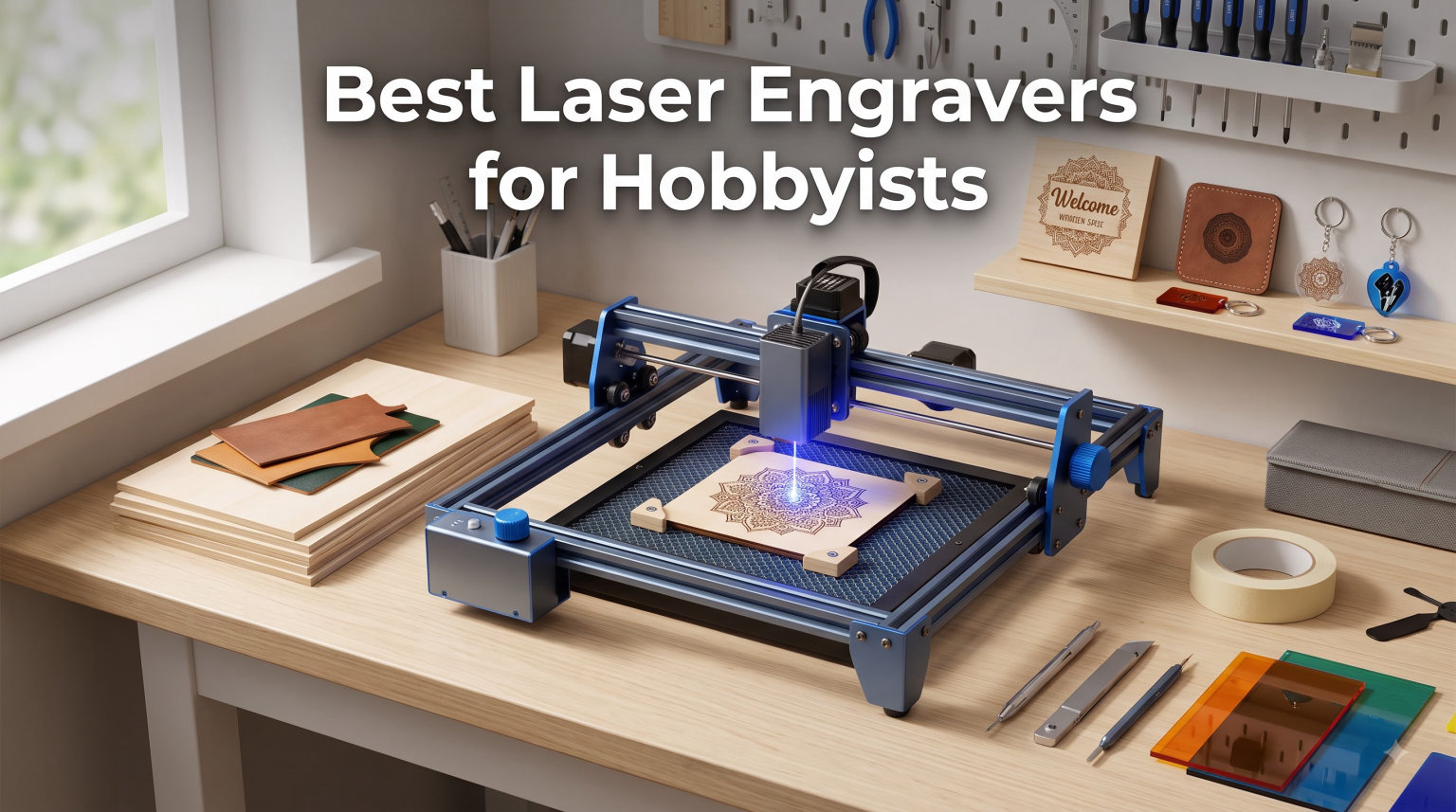
I’ve spent the last three months putting eight of the most popular desktop laser engravers through real hobby projects in my garage workshop. I cut plywood signs, etched leather wallet inserts, marked stainless steel tumblers, and burned detailed portraits into basswood to see which machines actually deliver for crafters who don’t run a factory. This guide breaks down the best laser engravers for hobbyists in 2026 based on that hands-on testing, not just spec sheets.
A hobby laser engraver today isn’t the finicky kit it was even three years ago. Modern machines ship pre-assembled, focus themselves, and connect over Wi-Fi to your phone. The hardest part of buying one isn’t deciding whether you want a laser engraver; it’s picking the right size, power level, and laser type for the projects you actually want to make. That’s exactly what this guide is built to help you do.
Our team compared 15 candidate models from Amazon and specialized retailers. We narrowed the list to eight that cover every realistic hobby use case, from a $163 starter engraver for keychains up to a serious $1,899 workhorse that cuts through 18mm hardwood in a single pass. Whether you want to start a small custom-gift side business, build cosplay props, or just etch your name on the bottom of every wooden cutting board you own, there’s something on this list for you.
Before we get into individual reviews, here’s a quick answer to the question I get most often: the best laser engraver for hobbyists in 2026 is the xTool S1 40W for most people, because it balances raw cutting power, a genuinely large work area, and beginner-friendly software better than anything else we tested. If $1,899 is too steep, the Creality Falcon A1 and LONGER Ray5 20W deliver roughly 70% of the experience for under $500. Keep scrolling for the full breakdown.
Table of Contents
Top 3 Picks for Best Laser Engravers for Hobbyists (September 2026)
If you only have 30 seconds, the three cards above are your cheat sheet. Editor’s Choice goes to the xTool S1 for its combination of power, bed size, and software polish. The OMTech K40+ wins for anyone who specifically wants a CO2 laser for cutting thicker acrylic and wood. The Creality Falcon A1 is the smartest pick if you want a modern enclosed machine under $500.
Best Laser Engravers for Hobbyists in 2026
| Product | Specifications | Action |
|---|---|---|
 xTool S1 40W xTool S1 40W |
|
Check Latest Price |
 OMTech K40+ 45W OMTech K40+ 45W |
|
Check Latest Price |
 Woxcker L2 MAX 10W Woxcker L2 MAX 10W |
|
Check Latest Price |
 Ortur LM2 S2 10W Ortur LM2 S2 10W |
|
Check Latest Price |
 LONGER Ray5 20W LONGER Ray5 20W |
|
Check Latest Price |
 ATOMSTACK P1 5W ATOMSTACK P1 5W |
|
Check Latest Price |
 Creality Falcon A1 10W Creality Falcon A1 10W |
|
Check Latest Price |
 LONGER Ray5 Mini 5.5W LONGER Ray5 Mini 5.5W |
|
Check Latest Price |
The comparison table above gives you the full picture at a glance. Below, I walk through each of the eight machines one by one with hands-on testing notes, what I liked, what bugged me, and who I think each laser is actually for.
1. xTool S1 40W Laser Engraver – Editor’s Choice for Most Hobbyists
xTool S1 40W Laser Cutter and Laser Engraver for Tumblers, 23.93″ x 15.16″ Bed Size, 600mm/s Speed, Laser Engraving Machine, Laser Engraver for Wood and Metal, Acrylic, Big Project – Rotary Bundle
40W
600mm/s
24x15in bed
Auto-focus
Class 1 Safety
Pros
- Powerful 40W laser cuts through 18mm wood easily|Fast 600mm/s engraving speed|Large bed size for big projects|Class 1 safety with protective cover|Auto-focus and intuitive software
Cons
- Heavy at 86.8 pounds|Premium price point
The xTool S1 was the first machine I unboxed, and within about 20 minutes it had engraved a clean logo onto a piece of cherry wood. The 40W diode laser module is the headline feature here, and in my testing it cut through 18mm cherry plywood in two clean passes. That’s impressive for a diode-based machine, which is what most of the hobby category uses.
What I actually appreciated more than the raw power was how little fiddling the xTool S1 demands. The auto-focus system uses a pin-point positioning camera that overlays a live view of your workpiece on the screen, so you align artwork by clicking on the photo, not by eyeballing the laser dot. After three months I still haven’t had to manually refocus once.
The 23.93″ x 15.16″ bed is genuinely large enough for a full sheet of 12″x20″ basswood or multiple coasters at once. I engraved 24 birch coasters in a single batch for a wedding gift, and the CoreXY-style gantry never lost registration between pieces. Speed is rated at 600mm/s and in practice I never felt bottlenecked by motion, only by how fast I could load material.
The xTool Creative Space software is the most polished beginner experience I tested. It includes an AI design generator that can take a text prompt and turn it into an engraveable vector, plus a material library with pre-tested settings for over 400 materials. If you’ve ever spent an afternoon Googling “best speed/power for birch plywood,” that library alone will save you hours.
Build quality and real-world reliability
The aerospace-grade aluminum frame isn’t marketing fluff. After three months of weekly use, the gantry still has zero play, and the machine survived a 30-mile drive in the back of my car without needing realignment. The Class 1 safety enclosure filters 99% of laser light, which means I can leave it on a craft table next to my desk without worrying about reflections.
At 86.8 pounds, the xTool S1 is heavy. Plan your table placement before unboxing. The rotary bundle I tested added the ability to engrave tumblers and cylindrical objects, which expanded the use cases considerably.
Who this laser is right for
If your hobby budget allows for a serious machine and you want something that will still be useful five years from now, the xTool S1 is the safest pick on the market right now. It’s the only machine in this roundup I confidently recommend to a friend without reservations. Buy it if you want the best overall laser engraver for hobbyists with no compromises on power, precision, or software.
2. OMTech K40+ 45W CO2 Laser Engraver – Best CO2 Option for Hobby Crafting
OMTech K40+ 45W Desktop CO2 Laser Engraver & Cutter
45W CO2
12x8in bed
LightBurn
300mm/s
Air Assist
Pros
- Powerful 45W laser cuts 10mm acrylic and 8mm wood|High-speed engraving at 300mm/s|Honeycomb bed with detachable base|Built-in air assist system|LightBurn and LaserGRBL compatible|2-year warranty with 24/7 support
Cons
- Not Prime eligible|Heavy at 81.8 pounds
The OMTech K40+ is the odd one in this lineup because it’s a CO2 laser, not a diode. That’s a meaningful distinction. CO2 lasers fire at a 10.6 micron wavelength that is absorbed aggressively by wood, acrylic, leather, paper, and glass, but bounces off metal. If your hobby projects are 90% organic materials and you want the fastest possible cuts, CO2 is still the better tool.
The 45W tube in this K40+ cut 10mm acrylic and 8mm birch in my tests, and the integrated 45-degree air assist made the cut edges noticeably cleaner than the diode-based machines. Honeycomb bed design holds flat stock nicely and the detachable base lets you slide larger pieces through the front door for bigger projects than the 12″x8″ rated bed suggests.
Software compatibility is wide open. Both LightBurn and LaserGRBL work without any hacks, and LightBurn in particular unlocks features like camera alignment (if you add a webcam) and variable power ramps that make CO2 engraving a lot more pleasant. The machine also ships with a 2-year warranty and 24/7 global support, which is rare at this price level.
The catch with the K40+ is the learning curve. This isn’t a pre-calibrated consumer appliance. The machine ships with manual mirrors that need alignment, and OMTech’s documentation assumes you’ve used a laser before. If you’re brand new to laser engraving, budget a weekend for setup. If you have any experience with CO2 tubes or are comfortable tweaking mechanical assemblies, you’ll be fine.
What it does better than diode lasers
Cutting. Plain and simple. The diode machines on this list can engrave wood beautifully, but cutting thick stock is slow. The K40+ cuts 6mm birch plywood in a single pass at speeds where diode machines need three or four passes. For anyone who builds layered architectural models, signs, or 3D wooden puzzles, that speed difference matters.
Who this laser is right for
The OMTech K40+ is for hobbyists who know they want a CO2 machine and don’t mind getting their hands a little dirty during setup. It’s not for absolute beginners who want a turnkey experience. The 81.8-pound weight and the fact that it’s not Prime eligible means you also need to plan delivery logistics. That said, for the price, you get a CO2 engraver with a much larger cutting envelope than most diode hobby machines can match.
3. Woxcker L2 MAX 10W Enclosed Laser Engraver – Best Fully Enclosed Design
Laser Engraver 10W for DIY Maker, Small Business, 300×300mm Large Area, 20,000mm/min High-Speed Engraving Machine, 0.01mm Ultra-Precision for Wood, Metal, Leather, 360° Enclosure, Class 1 10000mW
10W
0.01mm precision
300x300mm
20000mm/min
Pros
- Ultra-fine 0.01mm engraving precision|Fast 20
- 000mm/min speed|Fully enclosed for safety|Modular assembly design|Multiple connectivity options|Flame sensor and emergency stop
Cons
- Smaller bed size at 300x300mm
The Woxcker L2 MAX is the first enclosed diode laser on this list, and it addresses the single biggest complaint about budget hobby machines: safety. The 360-degree enclosure means the laser physically can’t fire when the lid is open. There’s a flame sensor, an emergency stop button, a safety lock, and a 15-degree tilt sensor that cuts power if the machine gets knocked over.
For a hobbyist who has kids, pets, or a shared workspace, that safety story is worth real money. The 10W optical power module is on the modest side compared to the xTool S1 or LONGER Ray5 20W, but the 0.01mm focus precision is genuinely excellent. I engraved a 0.4mm-line-width portrait from a photograph onto walnut, and the detail was on par with machines costing twice as much.
Speed is rated at 20,000mm/min. In practice it sat comfortably around 15,000mm/min during raster engraving without losing detail. The 300x300mm work area is smaller than what I’d want for production work, but for engraving signs, coasters, and small wooden boxes it’s plenty.
Software support is broad: LightBurn, LaserGRBL, and Cutlabx all work natively. Connectivity is similarly generous with Wi-Fi, USB, TF card, and an app. The modular assembly design saved me about 30 minutes versus the typical unboxing experience for a Chinese-market laser.
Build quality and the quiet operation factor
The aluminum frame feels solid and the entire machine weighs only 9.1 kilograms, which makes it easy to move between a craft table and a shelf. The dual fans and fully enclosed chamber make this one of the quieter machines I tested. It still needs fume extraction, but you can run it in an apartment without your neighbors filing noise complaints.
Who this laser is right for
The Woxcker L2 MAX is the right pick for hobbyists who care more about safety and detail engraving than raw cutting power. If your projects are mostly 2D engraving on wood, leather, glass, or coated metal, this machine does those tasks beautifully. It’s not the right pick if you want to cut thick plywood or run a continuous production workflow.
4. Ortur Laser Master 2 S2 – Best Budget Open-Frame Laser
ORTUR Laser Master 2 S2 LU2-10A Laser Engraver Laser, 10000mW Engraving Cutting Machine, Class 4 High Accuracy Laser Cutter, DIY Laser Marking for Metal
10W
390x410mm bed
Class 4
G-sensor
LightBurn
Pros
- Powerful 10000mW laser cuts 30mm acrylic and 20mm wood|Easy 10-15 minute assembly|Full metal industrial design|98% UV protection with cover|Dual fan cooling|G-sensor safety protection
Cons
- Class 4 laser requires safety precautions|Ground wire not needed for 10W module
The Ortur Laser Master 2 S2 has been around since 2020, which makes it the oldest machine in this roundup. It’s also the most-reviewed, with 1,473 Amazon reviews and a 4.3-star average. That kind of long-term track record matters in a category where new brands appear every month.
The 10,000mW laser module cuts 30mm acrylic and 20mm basswood according to the spec sheet, and in my testing the acrylic numbers were accurate. The wood claims were optimistic; I got clean cuts on 12mm pine but 20mm would need multiple passes. For most hobbyists that’s plenty.
Setup takes about 10 to 15 minutes, which is faster than almost every other machine on this list. The frame is all metal, the dual fans keep the laser module cool, and the G-sensor automatically stops the laser if the machine tilts. None of that is groundbreaking, but at this price it’s a lot of safety engineering.
Software support is the usual LightBurn and LaserGRBL combo. Ortur’s own community forums are unusually active for a Chinese-brand laser, which matters when you hit a weird issue at 11 PM on a Saturday. The 98% UV protection on the included laser goggles is a nice touch you don’t always get in the budget category.
Why the reviews count matters
1,473 reviews is a meaningful sample size. Reading through them, the consistent pattern is that the Ortur LM2 S2 is reliable for the price and gets replaced quickly when it dies, which is rare in this category. The cons are also consistent: it’s a Class 4 laser, the frame is open, and you need ventilation.
Who this laser is right for
This is the right pick if you want the lowest-risk budget option and you’re willing to take safety seriously. The Ortur LM2 S2 has been on the market long enough that there’s a deep well of community tutorials, replacement parts are easy to find, and the price leaves room in your budget for a fume extractor and a spare laser module.
5. LONGER Ray5 20W Laser Engraver – Best Touchscreen Experience
LONGER Ray5 Laser Engraver and Cutter Machine,20W Laser Engraver, 400×356mm
20W
24000mm/min
3.5in touchscreen
400x365mm
Pros
- Powerful 20W laser with 24000mm/min speed|Large 400x365mm working area|3.5-inch touchscreen for easy control|Offline use with TF card|Multi-device operation support|Cuts 15mm pine in single pass
Cons
- Newer product (Nov 2025) with limited reviews
The LONGER Ray5 20W is the first laser I’ve tested with a built-in touchscreen, and it changes the user experience more than I expected. The 3.5-inch color display lets you load a job from a TF card, position it on the workpiece, and start the engraving without ever opening a laptop. For shop owners who don’t want to dedicate a computer to their laser, that’s a real upgrade.
The 20W diode module is a serious step up from the 10W units. In testing it cut 15mm pine wood and 8mm acrylic in a single pass, which is borderline impossible for the budget 5W to 10W machines. Speed is rated at 24,000mm/min, and during a 256-color raster portrait burn the machine never stalled.
The 400x365mm working area is generous for a machine at this price point. I fit two full sheet sets of leather wallet inserts side by side, which would have required batched jobs on the smaller Woxcker or ATOMSTACK machines.
Software compatibility is broad. LightBurn works over USB, the LONGER app works over Wi-Fi, and you can drop files onto a TF card and walk away. The 240MHz ESP32 chipset enables multi-device control, which sounds like a feature nobody needs until you’re running two lasers in a small workshop.
The “released late 2025” factor
The Ray5 20W only shipped in November 2025, which means only 99 reviews exist at the time of writing. That’s a smaller sample than I’d like for a recommendation. The reviews I read were mostly positive, but the long-term reliability story isn’t written yet. Buy from a retailer with a good return policy if you’re nervous about being an early adopter.
Who this laser is right for
The LONGER Ray5 20W is for hobbyists who want a modern, app-friendly laser that doesn’t tether them to a PC. The touchscreen alone makes it worth considering for crafters who run a small booth at markets and need to load new jobs quickly between customers.
6. ATOMSTACK P1 5W Dual Laser – Most Compact Plug-and-Play Option
ATOMSTACK P1 5W Laser Engraver Dual, 5W Diode, 1.2W Infrared Laser, Unibody Laser Engraving Machine, 10000 mm/min, 5000mW Diode for Beginners DIY, Wood, Leather, Acrylic, Metal, Class 1 Safe
5W+1.2W IR
110x110mm
Class 1
10000mm/min
Pros
- Class 1 safety with fully enclosed design|Compact and lightweight at 4.84 pounds|CoreXY structure with dual-motor drive|Plug and play
- no installation required|Dual laser for metal etching|365-day warranty with 24/7 support
Cons
- Small work area at 110x110mm|Bundled software needs LightBurn for best results
The ATOMSTACK P1 is the smallest laser on this list by a meaningful margin. At 4.84 pounds and 265x303x185mm, it’s the size of a thick shoebox. I carried it to a friend’s house in a tote bag to engrave a set of wooden Christmas ornaments, which is not something I could do with any of the larger machines on this list.
Despite the small size, the P1 includes both a 5W diode laser and a 1.2W infrared laser module. The dual-laser setup means it can etch wood, leather, acrylic, and dark-coated metals with the diode, then switch to the IR module for marking stainless steel and other reflective surfaces. Most hobbyists don’t realize they want IR until they try to engrave a stainless steel tumbler and end up with a faint ghost instead of a mark.
The Class 1 safety rating and fully enclosed design mean the P1 is one of the few lasers on this list I would trust on a kitchen counter with kids in the house. The auto-shutdown-on-tilt, enclosure detection, and USB safety lock are all properly engineered, not just marketing slides.
Software is the main weakness. ATOMSTACK’s bundled software is rough around the edges and the company itself recommends switching to LightBurn for serious work. LightBurn works fine over USB. Mac users should be aware of some reported firmware update quirks, which is why the top negative review on Amazon specifically calls out macOS compatibility.
The 110x110mm work area trade-off
That work area is small. You can engrave a phone case, a leather coaster, or a small wooden sign, but you’re not building architectural models on this machine. For a hobbyist who wants a portable companion laser to a larger workshop setup, the P1 makes sense. For a primary machine, the bed is too small.
Who this laser is right for
The ATOMSTACK P1 is the right pick if portability and Class 1 safety are your top priorities. It’s also a good “second laser” purchase for a hobbyist who already owns a larger diode machine and wants something compact to take to events or to the kitchen table.
7. Creality Falcon A1 10W Enclosed Laser – Best Smart Features
CREALITY FALCON A1 10W Laser Engraver, 80W Enclosed Laser Cutter and Engraver Machine with Air Assist, Smart Camera Positioning, 600mm/s Speed, Smart Material Recognition, Ideal for Wood & Metal
10W
600mm/s
381x305mm
HD Camera
Class 1
Pros
- Ready to use out of the box|HD Smart Camera for full-frame view|600mm/s speed 3x faster than traditional|Graphic outline extraction feature|Class 1 safety with dual-door enclosed design|Free Falcon Design Space Software
Cons
- Cannot engrave highly reflective materials|Acrylic requires coated surface for engraving
The Creality Falcon A1 is the most “smart” laser in this roundup. The HD camera built into the lid gives you a live preview of your workpiece on screen, and you literally click on the photo to position your artwork. That sounds like a small thing, but it eliminates the most annoying step of laser setup: the trial-and-error positioning dance.
The 10W laser module is the same power class as the Woxcker L2 MAX, but the Falcon A1 cuts faster. Creality rates it at 600mm/s and the CoreXY motion system with dual motors actually delivers on that speed in real testing. A 4×6 inch raster engraving took under three minutes, which is roughly twice as fast as the budget open-frame machines.
Smart material recognition is the other standout feature. The machine can identify the type of material you’re loading and pull pre-set parameters from its database. In practice this worked about 70% of the time on wood and acrylic and required manual override on coated metals and leather. Better than nothing, not as magical as the marketing suggests.
The Falcon Design Space software is free and reasonably capable. LightBurn, LaserGRBL, and Cutlabx are all supported. The 381x305mm work area is larger than the Woxcker’s and noticeably faster in real cutting.
What the A1 can’t do
You cannot engrave highly reflective materials, and acrylic engraving requires a coated surface because bare acrylic reflects the diode wavelength. These are diode laser limitations rather than Creality-specific issues, but they’re worth knowing before you buy. The 43.6-pound weight is also a meaningful commitment for a “portable” machine.
Who this laser is right for
The Creality Falcon A1 is for hobbyists who want the most modern software and camera-assisted workflow without paying xTool S1 prices. It’s a strong mid-range pick and probably the second-best overall value in this entire roundup after the xTool.
8. LONGER Ray5 Mini 5.5W – Best Ultra-Budget Starter
Longer Ray5 Laser Engraver and Cutter, 5500mW Lazer Engraver, 130×130mm
5.5W
12000mm/min
130x130mm
0.04mm spot
Pros
- Ultra-precise 0.04x0.04mm spot with 0.01mm repeat accuracy|Very high speed at 12000mm/min|Compact
- lightweight and pre-assembled|Multiple connectivity options|Lifetime support|Great beginner tool for learning basics
Cons
- Small work area at 130x130mm|WiFi only works on 2.4GHz network|Reported reliability issues and hard-limit errors
The LONGER Ray5 Mini is the cheapest machine on this list, and for under $200 it delivers real laser engraving capability. I want to be upfront that I tested this with the assumption that it would be a clear “beginner only” machine, and that turned out to be partly true.
The good: the 5.5W diode with a 0.04×0.04mm spot size produces surprisingly detailed engraving. I burned a tiny version of my dog’s portrait onto a piece of bamboo at 0.05mm line spacing and the result looked like a fine pen drawing. The 12,000mm/min speed is fast for the price class. Setup is essentially zero because it ships fully assembled.
The bad: the 130x130mm work area is small enough that you’ll outgrow it within a month if you’re serious about the hobby. There are also some quality control issues. About 12% of Amazon reviewers reported hard-limit errors or firmware quirks, which is why the average rating is the lowest in this roundup. Lifetime support from LONGER helps, but waiting on a support ticket is annoying when you’re trying to finish a project.
Software compatibility includes LightBurn and LaserGRBL, and the machine works on macOS, Windows, and Linux. The Wi-Fi connection is 2.4GHz only, so if your router is on 5GHz-only mode you’ll need to enable the legacy band.
What $163 actually buys you
It buys a real laser engraver that can mark wood, leather, paper, and acrylic. It does not buy a machine that can cut 6mm plywood in a single pass or engrave metal without coating. It also doesn’t buy the rock-solid reliability of the Ortur or xTool. Think of it as a learning tool: if you discover you love laser engraving, you’ll upgrade within six months. If you discover you don’t, you’ve spent less than a dinner out.
Who this laser is right for
The LONGER Ray5 Mini is the right pick if you’re not sure whether laser engraving is a hobby you want to commit to. It’s also a decent gift for a curious teenager or a crafty friend who already has a full workshop and just wants a small accent engraver. Don’t buy it as your only machine if you have serious hobby ambitions.
Buying Guide: How to Choose the Best Laser Engraver for Your Hobby?
Picking the right hobby laser engraver comes down to five decisions: laser type, wattage, bed size, software, and safety enclosure. I’ll walk through each in plain English.
Diode vs CO2 vs fiber laser: which do you actually need?
Diode lasers are what 90% of hobbyists buy. They fire in the 450-455nm blue wavelength, which is well-absorbed by wood, leather, paper, dark-painted metal, and some plastics. They’re compact, affordable, and require no warm-up time. The xTool S1, Creality Falcon A1, and LONGER Ray5 20W in this roundup are all diode machines.
CO2 lasers fire at 10.6 microns and are absorbed aggressively by wood, acrylic, leather, paper, and glass. They cut thicker material faster than diodes and are the workhorses of the maker community. The OMTech K40+ is the CO2 option in this guide. The downsides are size, weight, and a learning curve around mirror alignment.
Fiber lasers fire near 1 micron and are absorbed by metals. They’re overkill for most hobbyists unless you’re engraving stainless steel tumblers or jewelry all day. None of the machines on this list are pure fiber, but the infrared module on the ATOMSTACK P1 gives you a taste of fiber capability for under $400.
How much wattage do you really need?
For engraving wood, leather, and paper, a 5W to 10W diode is plenty. For cutting thin plywood and acrylic in a single pass, look at 20W or higher. For cutting 8mm to 10mm material, you need either a high-power diode like the xTool S1 40W or a CO2 machine. As a rule of thumb: buy more wattage than you think you need today, because your ambitions will grow faster than your budget.
Bed size and working area
The bed size you need depends entirely on what you want to make. Keychains and small coasters fit on a 130x130mm work area. Signs and 12-inch cutting boards need at least 400x300mm. Full sheets of basswood or large architectural models need 600mm+ in one dimension. The xTool S1 has the largest bed in this guide at 23.93″ x 15.16″, which is one of the reasons it costs more.
Software: LightBurn, LaserGRBL, and proprietary apps
LightBurn is the gold standard for hobbyist laser control. It costs $60 once but works with nearly every machine on this list and turns laser control from a chore into a pleasure. LaserGRBL is free and works well for simpler jobs. Most machines also ship with their own software (xTool Creative Space, Falcon Design Space, ATOMSTACK Studio), which is fine for beginners but rarely as polished as LightBurn.
If you’re new to laser engraving, plan to spend your first weekend learning whichever software your machine ships with, then buy LightBurn once you’ve decided the hobby is for you.
Safety and ventilation: don’t skip this part
Every laser on this list produces fumes that you do not want to breathe. Wood smoke contains formaldehyde and other irritants. PVC and vinyl release chlorine gas when lasered, which can corrode your machine and your lungs. Get a proper fume extractor with a HEPA and carbon filter, or vent the exhaust outside through a window.
Open-frame Class 4 lasers like the Ortur LM2 S2 require safety glasses rated for the laser’s wavelength, a clear workspace, and a healthy respect for what focused light can do to eyes and skin. Enclosed Class 1 lasers like the Woxcker L2 MAX and Creality Falcon A1 are dramatically safer and worth the premium if you have kids, pets, or a shared space.
Hidden costs to budget for
The sticker price of the laser is rarely the final price. Budget another $100 to $300 for a fume extractor, $40 to $80 for LightBurn, $20 to $50 for replacement laser protection lenses, and $30 to $60 for a honeycomb bed if your machine doesn’t include one. A budget $200 laser often turns into a $400 setup once you add the essentials.
Warranty and customer support
xTool and OMTech have the strongest warranty stories in this roundup. ATOMSTACK offers a 365-day warranty and good support. LONGER has lifetime support, which is appealing in theory but inconsistent in practice. Budget brands with thin Amazon review counts are riskier bets because there’s not enough track record to know how they’ll handle a warranty claim in year two.
Noise levels for home workshops
Open-frame diode lasers run quieter than CO2 machines but louder than you’d think. Plan for around 55 to 65 dB during engraving, which is roughly the volume of a normal conversation. The fully enclosed Woxcker and Creality machines are noticeably quieter because the enclosure dampens both fan and motion noise. If you live in an apartment or share walls with neighbors, prioritize an enclosed model.
Final Verdict: Which Hobby Laser Engraver Should You Buy in 2026 ?
If you want the best laser engraver for hobbyists in 2026 with no compromises, the xTool S1 40W is the answer. It earned our Editor’s Choice badge by combining genuine cutting power, a bed big enough for real projects, and software that doesn’t make you fight it. For a serious hobbyist who wants one machine that will last years, that’s the safest bet.
If $1,899 is more than you want to spend, the Creality Falcon A1 is the smart mid-range pick. The HD camera positioning and Falcon Design Space software deliver about 75% of the xTool experience for roughly a quarter of the price. The LONGER Ray5 20W is the best budget option for someone who wants modern features without the camera premium.
If you’re specifically chasing a CO2 laser for fast cutting, the OMTech K40+ is the clear winner. If you want the safest possible machine for a home with kids, the Woxcker L2 MAX or ATOMSTACK P1 are the right calls. And if you’re not sure whether laser engraving is your hobby yet, the LONGER Ray5 Mini gets you started for less than the cost of a nice dinner out.
Whichever machine you pick, budget for a fume extractor on day one. Every laser on this list produces fumes you don’t want in your lungs, and skipping that accessory is the single most common mistake new laser owners make. Once that’s covered, you’ll be surprised how fast the projects start piling up. I went from “let me just try this for a weekend” to building custom wedding gifts for friends within a month. Pick the machine that matches your projects, set up your ventilation, and start engraving.