
The best chicken scalder for most backyard flock owners is the Rite Farm Products Pro Scalder: a 15 gallon stainless steel tank on four welded legs, heated by a 3000 watt 240V element with electronic temperature control. It handles the 25 to 100 birds a year range that almost every home processor works in, and it is the only scalder in this roundup with any real customer feedback behind it.
A chicken scalder is a heated water tank. You dunk a slaughtered bird head first for a few seconds in water held around 140 to 150 degrees Fahrenheit, the hot water reaches the base of the feather quills and loosens them, and the bird goes straight to a plucker. Too cool and the feathers stay locked in. Too hot and the skin tears and the meat toughens. Scalding is the step that turns a five hour chore into a two hour one.
This guide covers the six dedicated poultry scalders that are actually available to buy, plus the technique, temperature bands and capacity matching that no competitor page explains. I updated everything for 2026, and every capacity, wattage and dimension below comes from the manufacturer listing rather than from a spec sheet somebody paraphrased. If you have never processed birds before, read the scalding steps first. If you have done it a dozen times, jump to the individual reviews.
Table of Contents
Top 3 Picks for Best Chicken Scalders in 2026
Rite Farm Pro Scalder 15 Gal
- 3000W 240V element
- 15 gallon stainless tank
- electronic temperature control

Strombergs Stainless Steel Scalder
- Stainless steel construction
- 81 lb unit
- 28 x 27 x 24 inches

MEUBLLY Commercial Scalder
- 30 to 100 C adjustable range
- reinforced tank walls
- removable protective grille
All 6 Chicken Scalders Compared (September 2026)
| Product | Specifications | Action |
|---|---|---|
| Rite Farm Products Pro Scalder 15 Gallon |
|
Check Latest Price |
| Strombergs Stainless Steel Scalder Large |
|
Check Latest Price |
| MEUBLLY Commercial Poultry Scalder |
|
Check Latest Price |
 ZHEDUID 70L Scalding and Plucking Unit ZHEDUID 70L Scalding and Plucking Unit |
|
Check Latest Price |
 Vdniduir 120L Poultry Scalder Vdniduir 120L Poultry Scalder |
|
Check Latest Price |
 Generic 120L Commercial Chicken Scalder Generic 120L Commercial Chicken Scalder |
|
Check Latest Price |
Here is the honest state of this category in 2026. Only one of these six units has a single customer review, and that review count is two. Poultry scalders are a thin, import heavy niche that the big roundup sites have mostly ignored, which means you are reading spec sheets rather than owner reports for most of this list. Treat the comparison table above as a shortlist of what is actually for sale, not as a lab test.
Do you need a poultry scalder at all? If you process fewer than about 25 birds a year and you already own a large stock pot with a propane burner, the pot works. Buy a dedicated chicken scalder when you move past that number, when you want set and forget temperature control, or when you process turkeys and need a tank the bird fits in without the water going everywhere.
1. Rite Farm Products Pro Scalder 15 Gallon 3000W
RITE FARM PRODUCTS 15 GALLON 240 Volt, 3,000-Watt PRO SCALDER SCALDING CHICKEN POULTRY QUAIL
3000W 240V element
15 gallon stainless steel tank
24 x 19.5 x 32 inches
30 pounds
Pros
- Electronic set and forget temperature control
- Stainless tank on four welded legs sits at working height
- 3000W element recovers temperature quickly between birds
- Made in the USA with a 1 year warranty
Cons
- No drain valve so the welded tank must be tipped to empty
- Internal thermometer reads about 10 degrees high out of the box
- First heat up took close to an hour
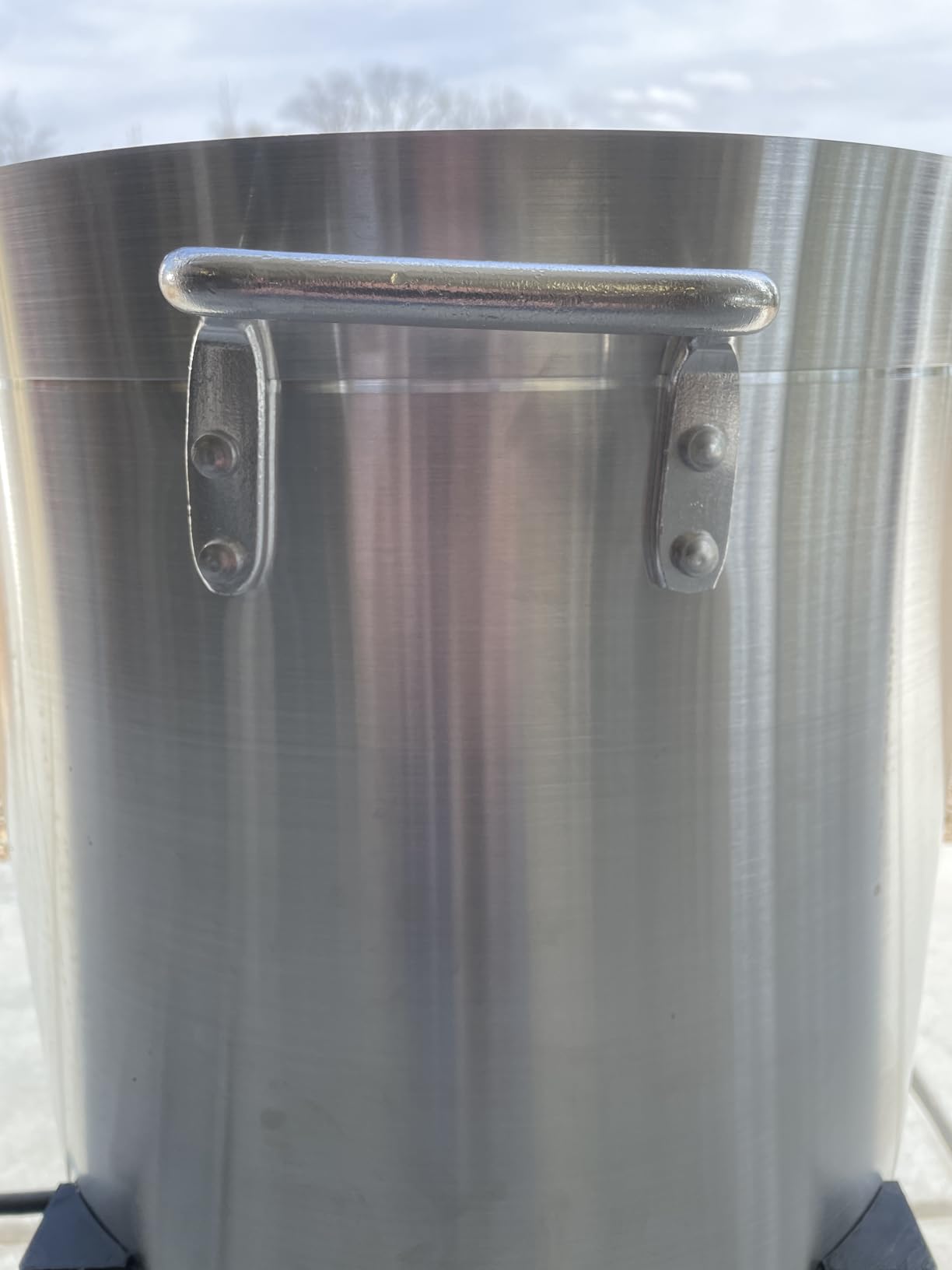
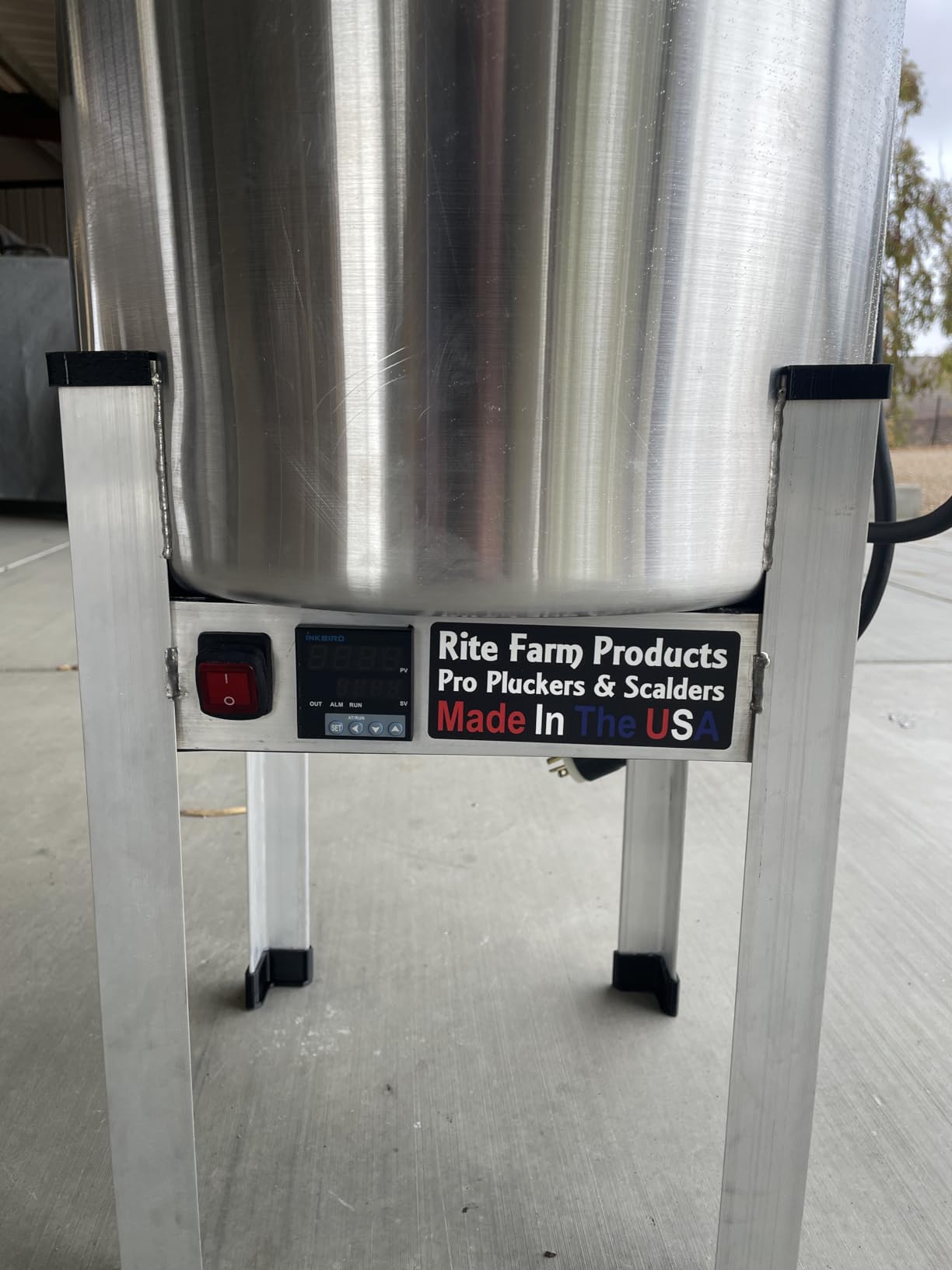
This is the chicken scalder I recommend to almost everyone reading this. The 15 gallon stainless tank sits on a welded four leg stand, so you are not lifting a wet 100 pound pot off a burner, and the 3000 watt 240V immersion element brings the water back to temperature between birds. Electronic temperature regulation with a built in thermometer is the part that changes your processing day: you set a number instead of watching a dial.
It needs a dedicated 30 amp 240V circuit, which is the single biggest reason people skip it. If your processing shed has only a 120V outlet, this is not your unit, and no adapter fixes that. The power cord is a NEMA 6-20P plug on a cord just under six feet, so plan the circuit run before you order rather than after.
The owner who reviewed it processed 41 Cornish Cross and 11 American Bresse birds across two sessions with no functional failures, and specifically reported that the set and forget control killed the temperature creep they had been fighting with a propane turkey fryer. That is the honest test of a scalder: not whether it heats, but whether it stays at temperature through a whole afternoon.
Two things need adjusting on day one. The internal thermometer read about 10 degrees hot against four separate reference thermometers, so I calibrate with an independent probe clipped to the rim and treat the built in dial as a rough guide. And the stand is welded to the pot with no drain valve, so draining means tipping roughly 125 pounds of water. Plan where that water goes before you fill it, because a full 15 gallon tank is heavy enough to strain a shoulder.
Who this chicken scalder suits
Anyone processing 25 to 150 birds a year in a spot with 240V power. The tank holds birds from broilers up through a turkey in one batch, and the leg height means you can work a full day without kneeling over the rim. The 30 pound empty weight is also low enough to reposition with two people when you want to drain it at the end of the run.
Who should skip it
Skip it if your processing site is off grid, in a barn with only a household outlet, or if you plan to ever move it alone. Skip it if draining a welded tank is going to annoy you, because you will do it every processing day. Nobody has published a review of it beyond the two it has, so if you are risk averse, the stainless steel body and 1 year warranty are the only things I can point to.
2. Strombergs Stainless Steel Scalder Large
Stromberg’s Stainless Steel Scalder Large
Stainless steel construction
81 pounds
28 x 27 x 24 inches
Model PP935
Pros
- Stainless steel tank and body
- 81 lb unit is a serious build
- Compact 28 x 27 x 24 inch footprint
Cons
- No customer reviews or rating on this listing
- Heat source and capacity are not published
- Catalogued under a dental scaler category by mistake
Stromberg’s is the name that comes up constantly in meat bird processing forums, mainly for killing cones and pluckers, and this is their large stainless steel scalder. The listing is thin: stainless steel construction, model PP935, an 81 pound unit, and dimensions of 28 by 27 by 24 inches. That is genuinely all the manufacturer publishes.
What those numbers do tell you is size and mass. An 81 pound stainless unit is a tank built to stay put, which matters when you are dunking a wet turkey by hand and the vessel is full. The 28 by 27 by 24 inch footprint is also smaller than most of the 70L and 120L machines in this roundup, so it fits in a shed doorway more easily than the import units do.
What to check before you buy
Ask the seller directly what the heat source is and what the working capacity in gallons is, because neither is on the page. A dedicated poultry scalder with no published wattage or BTU figure is a red flag for anyone who cares about heat up time, and the answer you want is either a wattage for an electric element or a BTU rating for a burner. If the seller cannot give you a number, the temperature control question never gets answered either.
Who should skip it
I would skip it as a first purchase purely because there is no owner feedback and no capacity figure to match against your bird count. Buying blind is fine when a unit costs pocket change, and much less comfortable when you are committing a serious chunk of a processing budget. Come back to this one only if a Stromberg’s representative confirms the electrical or fuel requirements in writing.
3. MEUBLLY Commercial Poultry Scalding Machine
MEUBLLY Commercial Poultry Scalding Machine, Stainless Steel Chicken Scalder, Adjustable Temperature Control 30-100℃, Large Capacity Feather Removal Equipment, for Poultry Processing Farms
30 to 100 C adjustable range
Stainless steel with reinforced walls
44.1 pounds
19.69 x 16.14 x 25.59 inches
Pros
- Adjustable 30 to 100 C temperature settings
- Removable protective grille over the heating elements
- Reinforced tank walls for repeated cycles
- Handles chickens ducks geese and quail
Cons
- No customer reviews or independent testing
- Heat source and electrical requirements are not published
- 44.1 lb listed weight is light for a commercial capacity claim
The MEUBLLY sits in the middle of the import group and is the one whose temperature control is described most clearly. The heating is adjustable across a 30 to 100 C range, which in Fahrenheit terms is roughly 86 to 212 F, so you can hold a 140 F scald or a 165 F hard scald without swapping equipment. There is a removable protective grille over the heating elements, which is exactly the part you will want to lift out and clean.
The build is oriented at repeated cycles rather than a single home processing day. Reinforced tank walls and stainless steel throughout, with a stated use range covering chickens, ducks, geese and quail. At 44.1 pounds and 19.69 by 16.14 by 25.59 inches it is the lightest and most compact of the commercial style units here, though that weight looks optimistic for a tank that claims farm scale capacity.
Why the adjustable range matters for you
A scalder that only hits boiling is less useful than it looks. Soft scalds around 130 to 135 F need a dial that can stop well below a hard scald, and if you process birds of different sizes in one day you will want to change the target without waiting for a large volume of water to cool and reheat. A 30 to 100 C band covers soft scald, hard scald and the higher work temperatures some operations use for waterfowl, all from one control.
Who should skip it
Skip it if you need a documented electrical requirement before you commit. Nothing on the listing states voltage, wattage or whether the element is immersion style, and that is the first question to ask. I would also treat every performance claim as unverified, because there are zero reviews and no independent testing behind any of it.
4. ZHEDUID 70L Scalding and Plucking Unit
ZHEDUID Stainless Steel Poultry Processing Machine with Adjustable Temperature Control for Scalding and Plucking,70L
70 liter stainless tank
30 to 110 C adjustable
100 kg batch capacity
Model BTR4a31137-70L
Pros
- Removable heating elements lift out for cleaning
- Roller system moves birds through the bath
- 100 kg batch capacity
- 30 to 110 C range holding a 65 to 67 C working band
Cons
- No customer reviews or ratings
- 70L and 120L versions differ only in size
- Weight and dimensions are not listed
What separates this listing from the others is the roller system and the removable elements. Instead of hand dunking, a roller moves birds through the bath, which is how commercial operations keep throughput steady without someone standing over the tank for hours. The heating tubes lift out entirely, which matters for food safety cleaning because scale and feather debris build up on an element that cannot be removed.
Temperature is adjustable from 30 to 110 C and the working range is stated as 65 to 67 C, which is about 149 to 153 F. That is a hard scald band, so if you prefer soft scalding you will need to set it lower and hold it there. The stated 100 kg batch capacity and quick heating are vendor claims with no review evidence behind them.
Where the 70 litre size actually fits
70 litres is roughly 18 US gallons of water, which suits a two to four bird batch of broilers or a single turkey. It is the size most small farm operators buy first, because it is the smallest of the commercial style tanks that still has a roller. If you process mostly full size broilers and never touch turkeys or waterfowl, the 70L is the sensible end of the range and you can ignore the 120L versions.
Who should skip it
Skip it if cleaning access is not your priority and you want the simplest possible tank, or if you need shipping weight and dimensions to plan a delivery. Both are missing. As with the rest of this import group, the deciding factor is whether the seller will state the power requirements and confirm the roller system in photos of a real unit before you pay.
5. Vdniduir 120L Poultry Scalder with 24kW Heating
Vdniduir Poultry Scalding Machine, Stainless Steel Hot Water Defeathering Tool, Temperature Adjustment 30-110℃,for Chicken, Duck, Goose (120L)
120 liter stainless tank
24kW heating tubes
2 mm tank walls
100 kg batch capacity
Pros
- 24kW industrial heating tubes
- 2 mm thick tank walls
- 100 kg batches with continuous 10 kg processing
- Multi gear heating knob from 30 to 110 C
Cons
- No customer reviews or ratings
- Specifications are near identical to other 120L listings
- Weight and dimensions are not listed
This is the heavy tank in the group. 120 litres of stainless steel with 2 mm walls and 24kW industrial heating tubes is a genuinely different scale of hardware from a 15 gallon home unit, and the batch claim is 100 kg with continuous 10 kg processing while the next bird is processed. That continuous processing claim is the whole argument for a machine this size: a 120L tank stays at temperature because it is never empty.
Temperature is adjusted on a multi gear heating knob across a 30 to 110 C band, holding a 65 to 67 C working range, with a 12 rpm roller moving birds through. A 70L version of the same machine exists, which tells you the design scales rather than changes.
Who a 120 litre tank suits
Processors running regular weekly batches rather than one annual event. If you are doing 150 birds or more, working in cold weather, or running waterfowl where feather sets are dense, a tank at this size keeps recovering temperature between loads in a way a 15 gallon unit cannot. It also has the headroom to dunk a turkey without the water dropping ten degrees every time.
Who should skip it
Skip it for a 40 bird backyard season, and skip it if floor space or floor loading is a question, because 120 litres of water weighs more than a quarter of a ton and the listing gives you no dimensions to plan against. Also skip if you expect independent feedback, because there are no reviews, and the spec sheet is nearly identical to the other 120L listings in this roundup.
6. Generic 120L Commercial Chicken Scalding Machine
Commercial Poultry Chicken Scalding Machine,70L/125L Stainless Steel Plucker Machine Accessories Chicken Scalder, 30-110℃ Temperature Adjustment, for Chicken Duck Goose Poultry Quails(120L)
120 liter stainless unit
24kW heating tubes
2 mm tank walls
44.1 pounds
Pros
- 24kW heating tubes and 2 mm tank walls
- 100 kg batch capacity with continuous 10 kg processing
- Grille covered removable heating elements
- Claims 40 percent better efficiency than gas burners
Cons
- No customer reviews or ratings
- Specifications match other 120L listings with no stated difference
- 44.1 lb weight looks light for a 120 litre steel tank
This listing is the same 120 litre machine as the previous entry, hardware for hardware, and the differences are on paper only. 24kW heating tubes, 2 mm walls, a 12 rpm roller, 100 kg batches, and the same 30 to 110 C adjustment holding 65 to 67 C. One claim sets it apart: heat retention technology stated as 40 percent more efficient than traditional gas burners. That number comes from the manufacturer and has not been independently measured.
Its stated unit weight of 44.1 pounds and dimensions of 19.69 by 16.14 by 25.59 inches repeat the figures from the smaller MEUBLLY unit in this roundup, which tells you the shipping data is generic rather than measured. I would not plan a delivery around those numbers.
How to tell the 120L listings apart
You cannot, from the spec sheets. When four listings share the same capacity, the same element wattage, the same wall thickness and the same roller speed, the real differences are warranty terms, spare part availability, element replacement cost and how the seller answers a support question. Send each seller the same three questions: what is the voltage, what is the heater warranty, and can you send a photo of a powered unit running at 150 F.
Who should skip it
Skip it if you are paying a premium for the efficiency claim alone, because nothing in the published specifications supports the difference. It is a reasonable last entry in the lineup, but the identical 120L listings mean you should choose on seller support and warranty rather than on features.
How to Scald a Chicken Step by Step
Technique matters more than the machine. A 3000 watt element and a 24kW element both fail if the water is at the wrong temperature when the bird goes in, and no scalder holds a set point more accurately than the thermometer you actually read.
Heat to temperature and verify it. Bring the water to 140 to 150 F for a hard scald, or 130 to 135 F for a soft scald. Read it with an independent clip on probe thermometer rather than the built in dial, which on the Rite Farm unit reads about 10 degrees high out of the box.
Soak the bird, not just dunk it. Submerge the body fully and hold it under. The feathers on the back and wings sit over thick muscle and hold on hardest, so the bird needs to be under the water the whole time, not floating.
Swirl for about 10 to 15 seconds. Movement pushes hot water into the follicle at the base of each quill. A bird that sits still in the tank loosens unevenly and you will be picking feathers by hand for twenty minutes afterwards.
Check one feather before you commit the batch. Feather a spot on the breast or thigh and see whether it releases with light finger pressure. If feathers are still locked in, add a few seconds per bird rather than raising the temperature, because higher heat tears skin.
Move straight to the plucker. Scalded feathers start re-tightening within minutes. Pluck immediately, ideally within a couple of minutes of the dunk.
Lower the temperature between batches if the tank is small. Every cold bird dropped into a 15 gallon tank drops the water temperature, and that is where feather set problems on the second and third bird come from.
A soft scald at 130 to 135 F with a longer soak loosens quills while leaving the skin surface intact, and research on defeathering and carcass quality has linked higher scalding temperatures to more damaged skin and a tougher outer layer on the breast. A hard scald at 145 to 150 F with a short dunk is faster and still widely used for poultry. Both work. Pick one band and stay consistent, because switching between them is what makes results inconsistent.
If you are planning where your birds live before processing day, our guides to the best chicken tractors and the best chicken coops cover the housing side of a meat bird flock.
How to Choose a Chicken Scalder by Batch Size, Power and Temperature
Match the tank to your bird count, not to the biggest bird
Under 25 birds a year: a large stock pot with a propane burner is enough, and a dedicated scalder is a luxury. 25 to 75 birds: look for a 10 to 15 gallon tank that holds one bird with room to submerge it. 75 to 150 birds: this is where a raised stainless tank with electronic temperature control earns its place, because you are dunking repeatedly and losing water temperature every time. 150 birds and above, or any turkeys or waterfowl in the mix: you want a commercial style 70 to 120 litre unit with a roller and removable elements.
The mistake is buying for the largest bird on the property and discovering you cannot get the water above 140 F with a cold carcass in the tank. Rule of thumb: the tank should hold the bird with enough water around it that one dunk does not drop the temperature more than a few degrees.
Decide your power source before anything else
Propane means no electricity requirement at all, which is the only viable option for off grid properties, barns and rural processing sites with no 120V. It also means you manage temperature yourself, and temperature management is the number one frustration reported by home processors in the poultry forums. Electric means set and forget, at the cost of needing a circuit: the 3000 watt 240V unit in this roundup needs a dedicated 30 amp circuit, which is a real electrical project if you do not already have one.
Buy a propane unit if power is unreliable or absent. Buy an electric unit if you have a proper circuit and you value consistency over flexibility. Buying an electric unit and running it off an extension cord or a 120V outlet is the worst of both.
Treat temperature control as the deciding feature
Look for three things: a real temperature control rather than an on off switch, an independent thermometer you can clip on, and a tank that recovers temperature quickly between birds. Recovery speed is a function of element wattage against tank volume, and it is the spec that determines whether your tenth bird of the day plucks as cleanly as your first. On the same note, a dial thermostat needs calibration, and a thermostat that is off by 10 degrees in either direction will cost you either feathers or skin.
Check what actually ships in the box
This is where the accessory costs hide. Burner, thermometer, poultry rack, stand and basket are frequently sold separately, and buyers in the processing forums consistently report discovering the missing piece after the tank arrived. Ask for an itemised contents list before you order. If a scalder does not include a thermometer, budget for a clip on probe, because you cannot run this process on the built in dial alone.
Plan for drainage, cleaning and cold weather
The welded tank with no drain valve in this roundup has to be tipped to empty, so know where the water goes before you fill it. A drain spigot is a genuine convenience feature, not a nicety. Draining and storing a scalder through winter needs the tank emptied and the element or burner protected from freezing, and an outdoor processing site in freezing weather has its own problems with water freezing in the lines.
For a first processing day budget, the rest of the station is a killing cone, a plucker, a processing table and chill tubs. Pluckers come as drum machines and hand pick units, and the choice there matters as much as the scalder choice, because a good scalder feeding a mediocre plucker still leaves you picking feathers.
Frequently Asked Questions
What is the best chicken scalder?
For most backyard flock owners the best chicken scalder is a 15 gallon stainless steel tank on a raised stand with a 3000 watt 240V element and electronic temperature control. The batch size suits roughly 25 to 150 birds a year, and a raised tank beats a pot because you do not have to lift 100 pounds of hot water. The catch is that it needs a dedicated 30 amp 240V circuit.
Do you need a poultry scalder?
You need one if you process more than about 25 birds a year, want consistent temperature control, or process birds too large for a stock pot. If you are under that number and already own a large pot and a propane burner, that setup will scald a bird perfectly well. Buying a dedicated scalder mainly buys you temperature control, working height and faster batch recovery.
How long should I scald a chicken?
Hold the bird fully submerged and swirl it for about 10 to 15 seconds at 140 to 150 F. A soft scald uses 130 to 135 F with a slightly longer soak. Test a feather on the breast before committing the batch, and add seconds rather than heat if feathers still resist, because raising the temperature tears the skin.
What temperature should scalding water be for chickens?
Use 140 to 150 F for a hard scald with a short dunk, or 130 to 135 F for a soft scald with a longer soak. Read the water with an independent clip on probe thermometer, because built in dial thermostats are often off by several degrees out of the box. Stay in one temperature band for a whole batch for consistent results.
Is a propane or electric chicken scalder better?
Propane needs no electricity at all, which makes it the only option for off grid or rural processing sites, but you manage the temperature yourself. Electric gives set and forget control and needs a dedicated circuit, such as a 30 amp 240V supply for a 3000 watt element. Choose electric if the circuit exists, propane if it does not.
Can you use a turkey fryer to scald chickens?
Yes, a turkey fryer pot works well for a first processing day, and it is the cheapest way to learn the technique before committing to a dedicated unit. The limits show up as the flock grows: no working height, manual temperature management, and a pot size that suits broilers but not turkeys. Many home processors start this way and upgrade after their second season.
Final Verdict on the Best Chicken Scalders in 2026
For most people reading this, the best chicken scalders pick is the Rite Farm Products Pro Scalder. A 15 gallon stainless tank, a 3000 watt 240V element, electronic temperature control and a raised working height is the combination that removes the two biggest frustrations in home poultry processing, which are temperature drift and back strain. Calibrate the built in thermometer on day one, plan how you will drain a welded tank, and give it a dedicated circuit.
If you have no reliable power at the processing site, a propane setup built around a pot or a turkey fryer kit is still the practical answer, and the technique matters more than the vessel. If you are processing 150 birds or more, or adding turkeys and waterfowl, move up to a 70 to 120 litre stainless unit with removable elements and a roller. Check the power requirements in writing, read an independent thermometer, and take the manufacturer claims on capacity with a grain of salt until an owner has posted a photo of it running.
This niche is thin on owner reports, so the advice in this guide leans on published specifications and on what processing communities report about temperature control, drainage and accessory costs. Whichever unit you land on, hold the water at 140 to 150 F, dunk for 10 to 15 seconds, and get the bird to the plucker within minutes.