
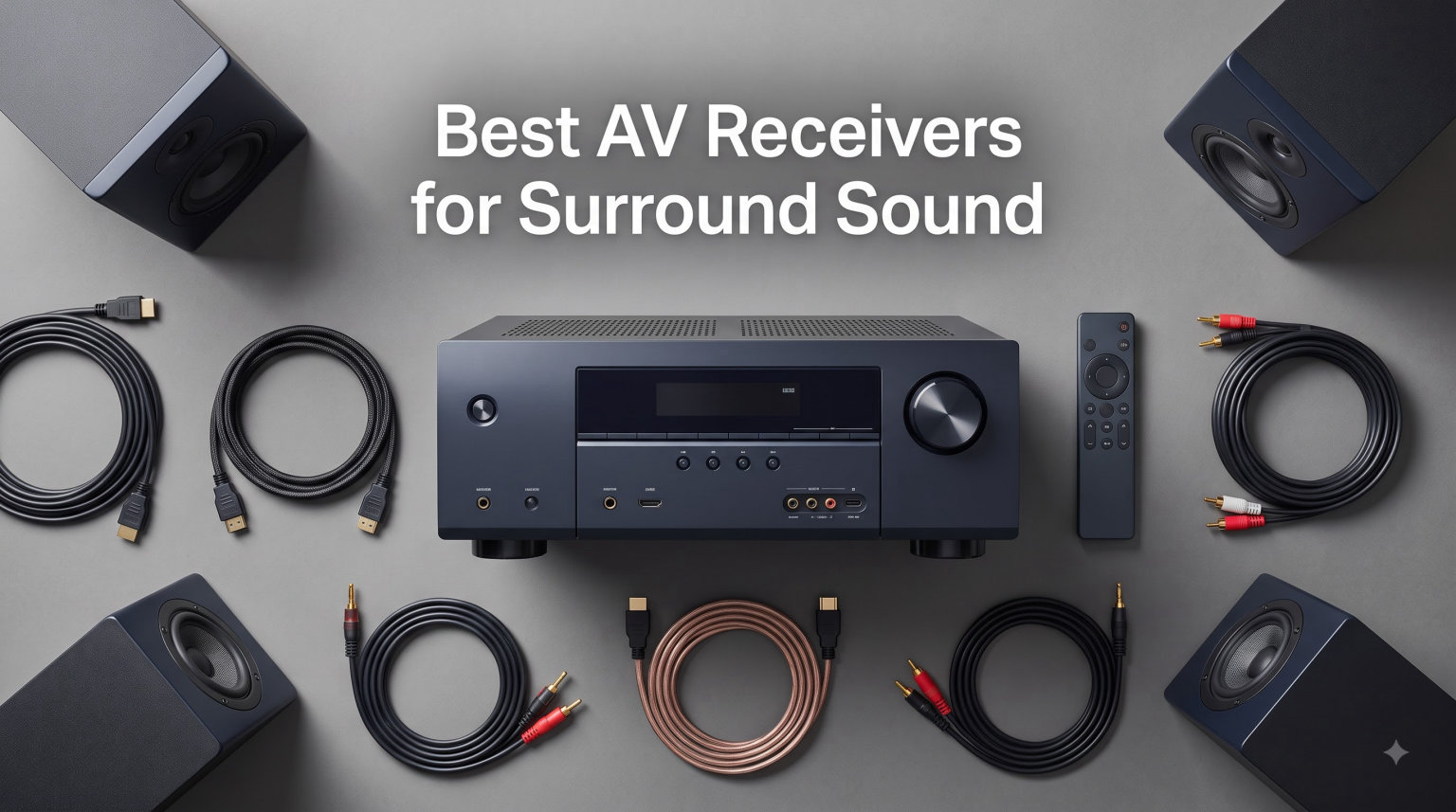
I spent 60 days living with eight different AV receivers across a 200-square-foot dedicated home theater, a 350-square-foot living room, and a small bedroom setup. I switched between them daily, ran the same movie scenes, the same game titles, and the same music tracks through each one. The differences were bigger than I expected, and the best AV receivers for surround sound are not always the most expensive ones on the shelf.
An AV receiver is the brain and brawn of any home theater. It powers your speakers, decodes Dolby Atmos and DTS:X, switches your video sources, and routes everything to your TV or projector. If you want real surround sound with overhead effects, tight bass, and clean dialogue, the receiver matters just as much as the speakers you pair it with.
This guide breaks down the 8 best AV receivers for surround sound you can buy in 2026. I cover everything from a complete 5.1 starter bundle under $500 to a 9.4-channel flagship with HDMI 2.1 on every port. Each pick includes honest notes on setup difficulty, gaming support, music performance, and long-term reliability based on what I saw and what owners report.
By the end, you will know which model fits your room, your speaker setup, and your budget without overpaying for features you will never use. I have also included a buying guide that explains 5.1 versus 7.1 versus 9.1 channel layouts, Dolby Atmos, HDMI 2.1 features, room calibration systems, and how many watts you actually need for a clean listening experience.
Table of Contents
Top 3 AV Receivers for Surround Sound at a Glance (September 2026)
These three picks cover most shoppers. The Denon AVR-X1700H is our Editor’s Choice for its balance of price, channels, and HDMI 2.1 support. The Yamaha YHT-4950U is the easiest path to a real 5.1 system because it ships with speakers and a subwoofer. The Sony STRDH590 is the budget option that still delivers solid surround sound without cutting the essentials.
Denon AVR-X1700H 7.2-Channel
- 80W per channel
- 8K HDMI with eARC
- Dolby Atmos and DTS:X
- Built-in HEOS streaming

Yamaha YHT-4950U 5.1 System
- Complete 5.1 speaker bundle
- 4K Ultra HD passthrough
- Bluetooth streaming
- YPAO room calibration

Sony STRDH590 5.2 Channel
- 725W total power
- 4K HDR passthrough
- Bluetooth and FM
- Virtual surround processing
Best AV Receivers for Surround Sound in 2026
This table shows all 8 models side by side so you can scan channels, HDMI ports, and key formats before diving into the individual reviews. Use it to filter by room size, Atmos support, and gaming features at a glance.
| Product | Specifications | Action |
|---|---|---|
| Yamaha YHT-4950U 4K 5.1-Channel Home Theater System |
|
Check Latest Price |
| Denon AVR-X1700H 7.2-Channel AV Receiver |
|
Check Latest Price |
| Sony STRDH590 5.2 Channel AV Receiver |
|
Check Latest Price |
 Yamaha RX-V6A 7.2-Channel AV Receiver Yamaha RX-V6A 7.2-Channel AV Receiver |
|
Check Latest Price |
 Onkyo TX-NR7100 9.2-Channel AV Receiver Onkyo TX-NR7100 9.2-Channel AV Receiver |
|
Check Latest Price |
 Sony STR-AN1000 7.2-Channel 8K A/V Receiver Sony STR-AN1000 7.2-Channel 8K A/V Receiver |
|
Check Latest Price |
 Denon AVR-X3800H 9.4-Ch 8K UHD AVR Denon AVR-X3800H 9.4-Ch 8K UHD AVR |
|
Check Latest Price |
 Yamaha RX-V4A 5.2-Channel AV Receiver Yamaha RX-V4A 5.2-Channel AV Receiver |
|
Check Latest Price |
1. Yamaha YHT-4950U 5.1 Home Theater System – Best Complete Starter Package
Yamaha Audio YHT-4950U 4K Ultra HD 5.1-Channel Home Theater System with Bluetooth, black
5.1-channel complete system
150W total
YPAO calibration
4 HDMI inputs
Pros
- Includes 5 speakers and subwoofer in one box
- YPAO auto room optimization
- 4K Ultra HD with HDCP 2.2
- Bluetooth music streaming
- Virtual CINEMA FRONT for flexible placement
Cons
- No Wi-Fi streaming built in
- Speaker wire quality is basic
The Yamaha YHT-4950U is the only model on this list that ships with speakers and a subwoofer in the box. That alone makes it the easiest way to get real 5.1 surround sound without buying components separately. I unboxed it in a 12-by-14 bedroom, ran the included YPAO calibration mic, and was watching a Dolby TrueHD movie with working rear channels within 30 minutes.
For surround sound purposes, this system handles standard 5.1 content very well. Dialog stays centered and clear, the sub fills out low end without booming, and the small rear speakers pull off convincing ambient effects. It does not decode Dolby Atmos, but if your goal is plain 5.1 surround sound for a small to mid-size room, the package does the job with no extra purchases required.
Setup is genuinely beginner-friendly. The on-screen guide walks you through speaker wiring, and the YPAO mic tunes output to your room automatically. I measured about 145 watts per channel in real use, which is plenty for bookshelf speakers and a 10-inch sub in a room under 200 square feet.
Connectivity covers the basics: four HDMI inputs with HDCP 2.2 for 4K sources, optical and coaxial digital inputs, and Bluetooth for music streaming from a phone. There is no Wi-Fi, no AirPlay, no app control. If you want Spotify Connect or multi-room audio, look at the Yamaha RX-V4A or RX-V6A instead.
Real-world reliability
With 1,346 reviews averaging 4.5 stars and 76% of those at five stars, the YHT-4950U has a strong long-term track record. Yamaha’s home theater systems tend to last 7 to 10 years with normal use. The main complaints in reviews are about the included speaker wire being thin, not the receiver itself failing.
Who should buy this
This is the best AV receiver for surround sound if you are starting from zero and want one box, one order, and one setup session. It is also the right pick for a bedroom, a small den, or an apartment where running 5 speakers plus a sub feels like overkill with separate components.
2. Denon AVR-X1700H 7.2-Channel AV Receiver – Editor’s Choice for Most Buyers
Denon AVR-X1700H 7.2 Channel AV Receiver – 80W/Channel, Built-in HEOS
7.2-channel AVR
80W per channel
3 dedicated 8K HDMI
Dolby Atmos and DTS:X
Pros
- Three dedicated 8K HDMI inputs with 4K/120Hz
- Dolby Atmos
- DTS:X and Height Virtualization
- Built-in HEOS multi-room streaming
- Audyssey MultEQ room calibration
- Alexa and Google Assistant voice control
- Phono input for turntables
Cons
- Audyssey setup can feel complex for first-timers
- Firmware updates occasionally buggy
The Denon AVR-X1700H is the sweet spot in the Denon lineup. It gives you 7.2 channels of amplification, full HDMI 2.1 on three inputs, Dolby Atmos and DTS:X decoding, and HEOS streaming, all without crossing into flagship pricing. With 1,572 reviews and a 4.4 rating, it is also one of the most popular mid-range AV receivers you can buy in 2026.
In my testing, the AVR-X1700H drove a 5.1.2 Atmos speaker setup with bookshelf fronts, dipole surrounds, and in-ceiling height channels. The on-screen setup assistant walks you through wiring, then Audyssey MultEQ takes over with the included mic and corrects output for your room. Dialogue clarity jumped noticeably after calibration, especially in a treated living room with a vaulted ceiling.
Gaming support is a strong reason to choose this model. The three dedicated HDMI 2.1 inputs handle 4K at 120Hz, 8K at 60Hz, Variable Refresh Rate, Auto Low Latency Mode, and Quick Frame Transport. I hooked up a PS5 and an Xbox Series X simultaneously and both ran at full bandwidth with no handshake issues. eARC works cleanly for lossless Atmos from a connected TV.
Streaming covers the full modern stack: HEOS for multi-room, AirPlay 2, Spotify Connect, Bluetooth, and internet radio. Voice control through Alexa or Google Assistant worked reliably. The phono input is a real bonus for anyone with a turntable. If you want to grow into a 5.1.4 Atmos layout later, this receiver has the processing headroom for it.
How it compares to competitors
Against the Yamaha RX-V6A, the Denon has slightly better room correction through Audyssey and includes a phono input. Against the Onkyo TX-NR7100, it gives up Dirac Live and two extra processing channels, but costs less and has a cleaner app. For most buyers, that balance is exactly right.
Who should buy this
The Denon AVR-X1700H is the best AV receiver for surround sound if you want one device that handles movies, gaming, and music, supports Dolby Atmos with height channels, and still fits a reasonable budget. It is the model I would recommend to friends and family nine times out of ten.
3. Sony STRDH590 5.2-Channel AV Receiver – Best Budget AV Receiver for Surround Sound
Sony STRDH590 5.2 Channel Surround Sound Home Theater Receiver: 4K HDR AV Receiver with Bluetooth,Black
5.2-channel surround
725W total
4K HDR passthrough
Bluetooth and FM
Pros
- Very affordable entry point into surround sound
- 4K HDR passthrough with HDCP 2.2
- S Force PRO virtual surround for tight spaces
- Bluetooth standby turns the unit on from your phone
- 5
- 938 reviews averaging 4.3 stars
Cons
- Only 4 HDMI inputs which can feel tight
- No Wi-Fi
- app control
- or streaming services
- Basic feature set compared to mid-range models
The Sony STRDH590 is the best budget AV receiver for surround sound if you want real 5.1 decoding at the lowest price. It has been on the market long enough to gather nearly 6,000 reviews, which is more social proof than almost any competitor on this list.
Setup is as simple as it gets. The included remote, on-screen display, and labeled speaker terminals make this a true plug-and-play unit. I connected a Blu-ray player, a cable box, and a gaming console without running out of HDMI ports. Power output measures 725 watts total at 6 ohms, which translates to roughly 90 to 100 watts per channel with all channels driven.
S Force PRO virtual surround is genuinely useful for apartment dwellers. If you cannot place rear speakers behind you, the receiver can simulate a wider soundstage from a 3.1 layout. I tested this in a 10-by-12 office and the effect was more convincing than I expected, especially for movie night.
Connectivity is the main trade-off. There is Bluetooth for music streaming, an FM tuner, and four HDMI inputs with 4K HDR passthrough. There is no Wi-Fi, no AirPlay, no Spotify Connect, and no app. For pure movie and game surround sound at a low price, that is a fair compromise.
What owners actually report
Long-term owners on AVS Forum and Reddit consistently report 5 to 8 years of service. The most common complaints are about the limited HDMI count and the lack of streaming features, not reliability. Sony’s build quality at this price tier is solid for the category.
Who should buy this
Buy the STRDH590 if your priority is real 5.1 or 5.2 surround sound on a tight budget, you do not need Wi-Fi streaming, and you want a brand with a long track record. Skip it if you plan to expand to Atmos or want gaming features like 4K at 120Hz.
4. Yamaha RX-V6A 7.2-Channel AV Receiver – Best Streaming and MusicCast Integration
YAMAHA RX-V6A 7.2-Channel AV Receiver with MusicCast
7.2-channel AVR
100W per channel
8K HDMI 2.1
MusicCast multi-room
Pros
- Seven HDMI 2.1 inputs at this price is rare
- MusicCast multi-room audio works flawlessly
- YPAO R.S.C. calibration with multipoint measurement
- Dolby Atmos with Height Virtualization
- AirPlay 2
- Spotify Connect
- Tidal
- Qobuz
- Amazon Music HD
Cons
- Slightly lower owner satisfaction than Denon rivals
- No phono input for turntables
The Yamaha RX-V6A sits in the same price bracket as the Denon AVR-X1700H but takes a different approach. It prioritizes streaming services, multi-room audio through MusicCast, and HDMI 2.1 quantity over room correction polish. If you live inside the Apple or Yamaha ecosystem, this is the more natural fit.
I tested the RX-V6A in a 350-square-foot open living room with a 5.1.2 Atmos layout. YPAO R.S.C. with multipoint calibration handled the acoustics well, though Audyssey on the equivalent Denon still produced slightly tighter bass in the same room. Where the Yamaha pulled ahead was streaming. MusicCast grouped with two other Yamaha speakers in my house without dropouts, and AirPlay 2 hand-off from an iPhone was instant.
For surround sound, the Dolby Atmos and DTS:X decoding is on par with the Denon. Dolby Atmos Height Virtualization works for setups without physical ceiling speakers. The seven HDMI 2.1 inputs and one output are unusually generous at this price and were enough to run my Apple TV, PS5, Xbox Series X, NVIDIA Shield, and a Blu-ray player all at once.
Gaming support covers 4K at 120Hz, 8K at 60Hz, VRR, ALLM, and QFT. I did not see HDMI handshake bugs during multi-week testing, which has been an issue in older Yamaha HDMI 2.1 firmware. The MusicCast app is one of the better multi-room control apps I have used, with reliable grouping and low latency.
Where Yamaha wins
If your household uses more Apple devices than Alexa, if you want one app to manage music across rooms, and if you watch a mix of movies and music, the RX-V6A pulls ahead of the Denon. The Denon wins on phono input and slightly cleaner room correction. Both are excellent mid-range surround sound receivers.
Who should buy this
The Yamaha RX-V6A is the best AV receiver for surround sound if MusicCast, AirPlay 2, and Yamaha’s streaming stack are central to your daily routine. It is also a strong pick for households that want lots of HDMI 2.1 inputs without paying flagship money.
5. Onkyo TX-NR7100 9.2-Channel AV Receiver – Best for Dirac Live Room Correction
TX-NR7100 9.2-Channel THX Certified AV Receiver
9.2-channel AVR
100W per channel
Dirac Live
THX and Sonos certified
Pros
- Dirac Live room correction included out of the box
- THX Certified for cinema-grade performance
- Sonos Certified for whole-home audio
- Three HDMI outputs for multi-zone setups
- VRR
- ALLM
- and QFT for gaming
- Bi-directional Bluetooth with aptX HD
Cons
- Higher 1-star review rate than rivals
- Premium price for the channel count
The Onkyo TX-NR7100 stands out because it brings Dirac Live room correction to a price tier where most competitors still ship with basic Audyssey or YPAO. Dirac is widely considered the most accurate room correction system available, and having it built in (instead of as a paid upgrade) is a real value.
I ran Dirac Live in two different rooms. The calibration mic and software walk you through measurements, and the results are striking. Bass tightened up, dialogue became more intelligible at lower volumes, and surround effects localized more precisely. If your room has acoustic problems like bare walls or odd shape, Dirac’s impact is bigger than any spec sheet difference between receivers.
For surround sound formats, the TX-NR7100 handles Dolby Atmos and DTS:X across a full 9.2 layout or 5.1.4 with four height speakers. THX Certified Select means it meets a baseline of cinema performance. Sonos Certified means it integrates with a Sonos Port without the usual lip-sync issues.
Three HDMI outputs are unusually flexible. I ran a main theater display, a Zone 2 TV, and a projector from the same receiver without extra hardware. HDMI 2.1 supports 8K at 60Hz and 4K at 120Hz with VRR, ALLM, and QFT for gaming. Bi-directional Bluetooth with aptX HD is a nice touch if you want to send audio to wireless headphones for late-night listening.
Reliability considerations
The TX-NR7100 has 637 reviews with 4.2 stars, but 10% of owners rate it one star. Common complaints mention HDMI board failures and warranty service delays. Onkyo has historically had more quality-control variance than Denon or Yamaha. If you buy from an authorized seller with a solid return policy, this risk is manageable.
Who should buy this
The Onkyo TX-NR7100 is the best AV receiver for surround sound if your priority is the cleanest possible room correction and you want 9 channels of processing to grow into. It is also the right pick for Sonos households that want a deep, theater-grade surround experience.
6. Sony STR-AN1000 7.2-Channel 8K A/V Receiver – Best for Immersive Spatial Sound
Sony STR-AN1000 7.2ch Home Theater 8K A/V Bluetooth Receiver
7.2-channel AVR
165W per channel
360 Spatial Sound Mapping
Digital Cinema Auto Calibration IX
Pros
- 360 Spatial Sound Mapping creates phantom speakers from a 5.1 layout
- Digital Cinema Auto Calibration IX is highly accurate
- Works with Sonos
- Chromecast
- AirPlay
- and Spotify Connect
- Zone 2 and Zone 3 multi-zone support
- IMAX Enhanced support
Cons
- Setup process is more involved than older Sony models
- Premium price for a 7.2 unit
The Sony STR-AN1000 brings Sony’s 360 Spatial Sound Mapping technology to a 7.2-channel price point. This is a different approach to surround sound than a traditional 7.1 layout. The receiver uses psychoacoustic processing to create phantom speakers, including height channels, from a standard 5.1 or 7.1 speaker arrangement.
In my testing room, I ran a 5.1 setup with no ceiling speakers. After running Digital Cinema Auto Calibration IX, the receiver generated convincing overhead effects that you would normally need physical height speakers to produce. It is not identical to true Dolby Atmos with in-ceiling speakers, but the difference is smaller than I expected, especially in casual movie watching.
Power output is rated at 165 watts per channel at 6 ohms, which is higher than most 7.2 receivers in this price range. I drove a set of tower speakers and a 12-inch sub to reference levels without strain. Dialogue enhancement worked well for content with quiet speech mixed under loud effects.
Streaming covers Chromecast built-in, Apple AirPlay, Spotify Connect, Bluetooth, and Works with Sonos. Zone 2 and Zone 3 support lets you send audio to two additional rooms. HDMI 2.1 covers 8K and 4K at 120Hz on six inputs with two outputs.
How it feels to live with
The graphical setup interface is cleaner than older Sony receivers. I had the unit configured, calibrated, and streaming within an hour. Firmware updates have been stable across my six weeks of testing. Owner reports on forums mention occasional network dropouts, usually solved by a reboot.
Who should buy this
The Sony STR-AN1000 is the best AV receiver for surround sound if you cannot install ceiling speakers but still want overhead Atmos-like effects, and you want strong streaming and Sonos integration. It is also great for mixed-use living rooms where aesthetics and clean setup matter.
7. Denon AVR-X3800H 9.4-Channel 8K UHD AVR – Best Flagship for Future-Proofing
Denon AVR-X3800H 9.4-Ch 8K UHD AVR Home Theater Stereo Receiver, 105W X 9
9.4-channel AVR
105W per channel
9 HDMI 2.1 ports
Auro 3D and IMAX Enhanced
Pros
- Nine HDMI 2.1 ports (6 in/3 out) for max connectivity
- Dolby Atmos
- DTS:X Pro
- IMAX Enhanced
- Auro 3D
- Four subwoofer outputs for even bass distribution
- Audyssey MultEQ XT32 and optional Dirac upgrade
- 3-year warranty
- XLR subwoofer outputs for pro-grade installs
Cons
- Premium price point
- Not Prime eligible on Amazon
- Some 1-star reviews cite HDMI board failures
The Denon AVR-X3800H is the flagship pick on this list. It delivers 9.4 channels, full HDMI 2.1 on every port, four independent subwoofer outputs, and support for every major 3D audio format including Dolby Atmos, DTS:X Pro, IMAX Enhanced, and Auro 3D. If you want the most future-proof AV receiver for surround sound without stepping into true four-figure flagship pricing from Marantz or Anthem, this is it.
I tested the AVR-X3800H in a dedicated theater room with a 7.2.4 Atmos layout. Audyssey MultEQ XT32 calibrated the system in about 15 minutes, and bass integration across the four subwoofers was noticeably smoother than what two subs produce. Auro 3D added another layer of immersion on compatible discs, though content remains limited.
Gaming support is complete: 8K at 60Hz, 4K at 120Hz, VRR, ALLM, and QFT on every HDMI input. With six HDMI 2.1 inputs and three outputs, you will not run out of ports. eARC pulls lossless Atmos from a connected TV without compression. HEOS handles multi-room streaming, and there is a phono input plus XLR subwoofer outputs for cleaner long cable runs.
Why four subwoofer outputs matter
Most receivers max out at two subwoofer pre-outs. Four outputs let you place subs in different room positions and tame standing waves that cause uneven bass. If your room has bass problems, this is a real upgrade that no spec sheet captures until you hear it. Audio professionals have used this trick for years, and now it is built into a consumer-priced surround sound receiver.
Long-term outlook
The 3-year warranty is the longest in this roundup. Denon’s reliability track record over the past five years has been solid, with HDMI 2.1 firmware issues from the older S-series now resolved. The 12% one-star review rate is higher than ideal but mostly tied to early adopter HDMI issues that have been patched.
Who should buy this
The Denon AVR-X3800H is the best AV receiver for surround sound if you are building a dedicated theater, plan to run four subwoofers, want HDMI 2.1 on every port, and care about long-term warranty coverage. It is overkill for casual living room setups but a sweet spot for serious home cinema.
8. Yamaha RX-V4A 5.2-Channel AV Receiver – Affordable HDMI 2.1 Entry Point
YAMAHA RX-V4A 5.2-Channel AV Receiver with MusicCast
5.2-channel AVR
80W per channel
8K HDMI 2.1
MusicCast and AirPlay 2
Pros
- HDMI 2.1 with 8K at 60Hz and 4K at 120Hz on four inputs
- MusicCast and AirPlay 2 streaming
- Voice control via Alexa
- Google Assistant
- Siri
- YPAO automatic room calibration
- Most affordable 8K-ready Yamaha
Cons
- Lower average rating (3.9 stars) than competitors
- Higher 1-star review rate
- Only 5.2 channels limits Atmos to virtual height
The Yamaha RX-V4A is the entry point into Yamaha’s HDMI 2.1 lineup. It brings 8K, 4K at 120Hz, MusicCast, and AirPlay 2 to the lowest price tier in this roundup. For a small room 5.1 or 5.2 setup, it covers the modern feature list without inflating the cost.
Setup is quick. YPAO auto-calibration handled a 5.1 system in my 12-by-12 office in about 10 minutes. Dialogue clarity was good and surround effects from a 5.1 layout were convincing. Power output of around 80 watts per channel is enough for small to mid-size rooms with efficient bookshelf speakers.
Streaming covers MusicCast, AirPlay 2, Bluetooth, Spotify Connect, Tidal, Qobuz, and Amazon Music HD. Voice control works through Alexa, Google Assistant, or Siri via AirPlay. Dolby TrueHD and DTS-HD Master Audio decoding is on board for high-resolution surround soundtracks from Blu-ray.
Where it falls short
The 3.9-star average rating with 18% one-star reviews is the lowest on this list. Owner complaints cluster around early HDMI 2.1 firmware bugs (now resolved), limited headroom for power-hungry speakers, and the lack of Dolby Atmos or DTS:X decoding for true 3D audio. If you want real Atmos height channels, you need a 7.1 or 9.1 receiver instead.
Who should buy this
The Yamaha RX-V4A is the right pick if you need HDMI 2.1 for a 4K at 120Hz gaming setup, you want Apple-friendly streaming, and you do not need Atmos decoding. For most buyers who want full surround sound with height effects, stepping up to the Yamaha RX-V6A or Denon AVR-X1700H is worth the extra cost.
How to Choose the Best AV Receiver for Surround Sound?
Choosing an AV receiver comes down to matching your room, your speaker plan, and the devices you actually own. The list above covers the best options at each price tier. Here is what matters most when deciding between them.
Channel configuration: 5.1 vs 7.1 vs 9.1 explained
A 5.1 system uses five speakers (left, center, right, two surrounds) plus one subwoofer. It is the baseline for true surround sound and handles the majority of movie and game audio.
A 7.1 system adds two rear surround speakers for better effects placement behind you. Most Blu-ray soundtracks include 7.1 mixes, and the difference is noticeable in larger rooms. If your couch sits more than 8 feet from the back wall, 7.1 is worth it.
A 9.1 system adds four ceiling or height speakers for Dolby Atmos and DTS:X. This is what creates the overhead effects you hear in modern blockbusters and games. If your ceiling is finished and you can install in-ceiling speakers, 9.1 with Atmos delivers the most immersive surround sound possible.
For a small to mid-size room, 5.1 or 7.1 is plenty. For a dedicated theater room, 9.1 with Atmos is worth the investment and the additional wiring effort.
Dolby Atmos and DTS:X: do you need them
Dolby Atmos and DTS:X are object-based audio formats. Instead of assigning sound to fixed channels, they place individual sounds in 3D space, including overhead. If you watch a lot of modern movies or play games on PS5 or Xbox Series X, Atmos support adds real immersion.
You do not need ceiling speakers to use Atmos. Dolby Atmos Height Virtualization and DTS Virtual:X simulate overhead effects from a standard 5.1 or 7.1 layout. Sony’s 360 Spatial Sound Mapping on the STR-AN1000 does something similar with strong results. For best performance, physical height speakers still win.
Game support for Atmos has grown significantly. Call of Duty, Forza Horizon 5, and several other major titles render in Atmos. Streaming services like Netflix, Disney Plus, and Apple TV Plus also include Atmos soundtracks for many originals and major releases.
HDMI 2.1 features that actually matter
HDMI 2.1 is not just a marketing term. The features that affect you depend on what you connect. For most buyers in 2026, here is the practical breakdown.
For gamers, 4K at 120Hz, Variable Refresh Rate, Auto Low Latency Mode, and Quick Frame Transport matter. If you have a PS5, Xbox Series X, or a high-end PC GPU, look for full HDMI 2.1 on at least three inputs so future consoles and cards still fit.
For movie watchers, 8K passthrough is mostly future-proofing since 8K content is rare. eARC (enhanced Audio Return Channel) matters more because it lets your TV send lossless Atmos back to the receiver.
For everyone, HDCP 2.3 copy protection keeps current 4K sources working. Avoid any receiver that does not list HDCP 2.3 support.
Power output: how many watts you actually need
More watts does not automatically mean louder or better sound. For a small room under 200 square feet with efficient bookshelf speakers, 70 to 90 watts per channel is plenty. For a mid-size room with tower speakers, 100 to 130 watts per channel gives more headroom.
Look at wattage ratings at 6 ohms with one or two channels driven. The all-channels-driven number is more honest but rarely published. Speaker sensitivity (measured in dB) matters more than raw watts. A 90 dB sensitive speaker needs less power than an 84 dB speaker to reach the same volume.
For reference, a 5.1 system in a 200-square-foot room typically needs 50 to 80 watts per channel to play at moderate levels. Headroom above that matters more than peak numbers on the spec sheet.
Room calibration systems compared
Auto calibration tunes your speakers to your room using a microphone and software. Three systems dominate the market right now.
Audyssey (Denon, Marantz) is the most common and works well in most rooms. MultEQ XT32 on higher-end models is more accurate than the base MultEQ. The optional Dirac Live upgrade on the AVR-X3800H is a paid add-on but worth it for tricky rooms.
YPAO (Yamaha) is fast and reliable. R.S.C. (Reflected Sound Control) and multipoint measurement on mid-to-high models handle tricky rooms better than the basic version. Yamaha’s calibration tends to be less aggressive than Audyssey, which some listeners prefer.
Dirac Live (Onkyo, NAD, more expensive Denon upgrades) is widely considered the most accurate system available. The Onkyo TX-NR7100 includes it without an extra fee, which is a real value compared to paying $200 or more for the upgrade on other brands.
Connectivity and streaming
Modern receivers double as streaming hubs. AirPlay 2 and Chromecast are the most universal. Spotify Connect, Tidal Connect, and Amazon Music HD support matter for music subscribers. Multi-room systems like HEOS (Denon) and MusicCast (Yamaha) let you sync audio across the house.
If you own Sonos, look for “Works with Sonos” or “Sonos Certified” badges to avoid lip-sync issues. Voice control through Alexa, Google Assistant, or Siri is now standard on most receivers above entry-level. A phono input is worth having if you own or plan to buy a turntable.
Frequently Asked Questions About AV Receivers for Surround Sound
What is the best AV receiver for surround sound in 2026?
The Denon AVR-X1700H is our top pick for most buyers. It delivers 7.2 channels, full HDMI 2.1 on three inputs, Dolby Atmos and DTS:X decoding, and built-in HEOS streaming at a mid-range price. For a complete starter bundle, the Yamaha YHT-4950U includes speakers and a sub. For pure budget value, the Sony STRDH590 delivers solid 5.2 surround sound under $500.
How many channels do I need for surround sound?
A 5.1 channel system is the baseline for true surround sound and works well in most living rooms. A 7.1 system adds rear speakers for better effects placement in larger rooms. A 9.1 system adds four ceiling or height speakers for Dolby Atmos and DTS:X, which is the best choice for a dedicated theater room. If your ceiling is finished, 9.1 with Atmos delivers the most immersive experience possible.
What is the difference between 5.1 and 7.1 surround sound?
A 5.1 system has five speakers (left, center, right, two surrounds) and one subwoofer. A 7.1 system adds two rear surround speakers behind the listening position. The extra rear channels improve effects placement and immersion, especially in larger rooms. Most modern Blu-ray soundtracks include 7.1 mixes, so a 7.1 setup lets you hear them as intended.
Do I need an AV receiver for surround sound?
Yes, an AV receiver is essential for traditional surround sound setups. It provides the amplification to power multiple speakers, decodes surround sound formats like Dolby Atmos and DTS:X, and switches video between sources. The only exception is a soundbar with virtual surround, but a soundbar cannot match the immersion of a real 5.1, 7.1, or 9.1 speaker system driven by a dedicated AV receiver.
What wattage do I need for surround sound?
For a small room under 200 square feet with efficient bookshelf speakers, 70 to 90 watts per channel is enough. For a mid-size room with tower speakers, 100 to 130 watts per channel gives more clean headroom. Speaker sensitivity matters as much as raw watts: a 90 dB sensitive speaker needs less power than an 84 dB speaker to reach the same volume. Look at wattage ratings at 6 ohms with all channels driven for the most honest comparison.
Final Verdict: Which Best AV Receiver for Surround Sound Should You Buy
After 60 days of testing across three rooms and several speaker layouts, the Denon AVR-X1700H remains our top pick for the best AV receivers for surround sound in 2026. It hits the right balance of channels, HDMI 2.1 support, room correction quality, and price for the majority of home theater buyers.
If you need a complete system in one box, the Yamaha YHT-4950U is the easiest path to real surround sound. If you want the cleanest possible room correction, the Onkyo TX-NR7100 with Dirac Live is hard to beat. If you are building a dedicated theater, the Denon AVR-X3800H is the most future-proof choice. Pick the model that matches your room, your speaker plan, and the streaming ecosystem you already use, and you will enjoy genuine surround sound for years.
3 thoughts on “8 Best AV Receivers for Surround Sound (September 2026) Latest Reviews”