
The generator is the last thing most RVers think about, and the first thing their neighbors complain about. I have run portable inverters in campgrounds from the desert Southwest to the Pacific Northwest, and the pattern never changes: a noisy unit turns a good campsite into an awkward one by breakfast. Choosing among the best quiet generators for RV camping in 2026 comes down to three numbers, noise level measured under load, usable running watts, and how much the thing weighs when you are loading it into a storage bay at dusk.
That is what this roundup covers. Twelve units, all inverter-based or battery-powered, all with published noise ratings, and all with a real path to RV power through a household outlet, a twist-lock, a TT-30R receptacle, or a plain adapter. We looked at what owners actually say after a season of use, not just what the spec sheet promises on day one. The forum evidence is unusually good here, because RV owners measure their own generators at their own campsites and post the numbers.
If your rig has a rooftop air conditioner, the sizing question comes before the brand question, so we worked through the wattage math and the soft-start reality in the buying guide below. If you just want a reference for the rest of your rig, our RV refrigerator buying guide covers the other major appliance that runs all weekend.
Table of Contents
What Counts as a Quiet Generator for RV Camping?
A quiet RV generator is an inverter unit rated at roughly 59 to 64 dB at 25 percent load, measured at 23 feet, which puts it inside the 60 dB limit that most US campgrounds and national parks enforce at 50 feet. Anything above about 65 dB gets noticed at that distance, and anything above 70 dB will bring someone to your site.
Three details hide inside that sentence, and each one changes how a rating should be read. First, the measurement distance. 23 feet, or 7 meters, is the industry standard, and it exists because it places the meter roughly where a neighboring campsite would be. Second, the load level. Manufacturers measure at a fraction of rated output, and sound rises steeply with load. A unit rated at 59 dB at quarter load can run into the mid-60s at full output, and iRV2 owners who took their own readings discovered exactly this gap between the spec sheet and their campsite. Third, the scale itself. Decibels are logarithmic, so 64 dB is not slightly louder than 59 dB, it is roughly twice the sound energy. Ten decibels is about the threshold of perceived doubling.
The engine type matters as much as the number. Every generator in this roundup uses a four-stroke engine, and that is deliberate. Two-stroke designs are roughly twice as loud as comparable four-stroke units and are essentially disqualified for camping use. Inverter design matters just as much, for a mechanical reason rather than a marketing one: the engine speed is decoupled from the output, so the unit can throttle down to match whatever you actually plugged in. Running a refrigerator and two LED lights on a full-throttle conventional generator is the reason open-frame units hit 70 to 80 dB and get banned outright.
One thing that does not work: sound modifications. iRV2 members have tried exhaust resonators and intake mods on built-in Onan units, and the measured improvement was around 2 dB. Several manufacturers warn that aftermarket mufflers can void the warranty. If noise is the deciding factor, the answer is a different generator, not a different muffler.
For context on the other end of the scale, iRV2 owners report an air conditioner cycling at 56 to 59 dB at 10 feet. One member put it plainly: once you are running A/C units, the generator brand barely matters. Noise decisions are really overnight decisions, and they are made while the rig is parked and quiet.
Top 3 Best Quiet Generator Picks for RV Camping In 2026

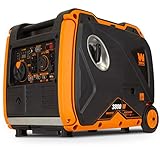
WEN 56380i 3800W RV-Ready
- 3400W running
- TT-30R outlet
- 8.5 hour half-load runtime
- electric start

The 12 Best Quiet Generators for RV Camping at a Glance (October 2026)
Every unit below is a four-stroke inverter or a battery power station, and every one publishes a decibel rating. The two categories below it are worth naming up front. Inverter generators burn fuel but run indefinitely as long as you have gas. Battery power stations make no noise at all and never need fuel, but their output is capped by battery capacity and they need sun or a wall outlet to recharge.
| Product | Specifications | Action |
|---|---|---|
| Honda EU2200i 2200-Watt Inverter Generator |
|
Check Latest Price |
| WEN 56380i 3800-Watt RV-Ready Inverter |
|
Check Latest Price |
 Champion 4000-Watt RV Ready Portable Inverter Champion 4000-Watt RV Ready Portable Inverter |
|
Check Latest Price |
| WEN 56235i 2350-Watt Ultralight Inverter |
|
Check Latest Price |
 Champion 4500-Watt Electric Start Dual Fuel Inverter Champion 4500-Watt Electric Start Dual Fuel Inverter |
|
Check Latest Price |
 Pulsar PGD40ISCO 4000W Portable Inverter Pulsar PGD40ISCO 4000W Portable Inverter |
|
Check Latest Price |
 AIVOLT 4300W Quiet RV Inverter Generator AIVOLT 4300W Quiet RV Inverter Generator |
|
Check Latest Price |
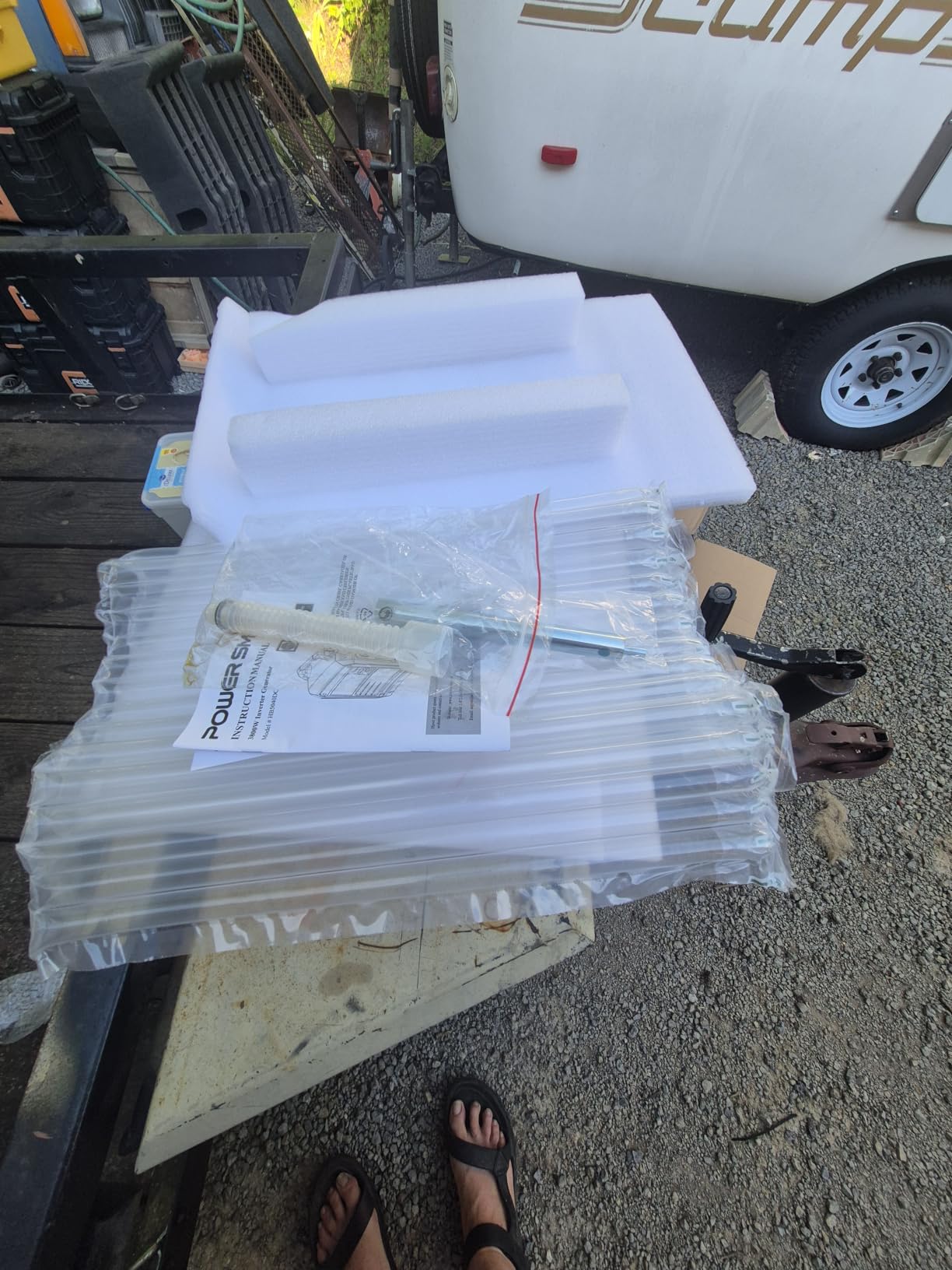
 PowerSmart 3800 Watt Dual Fuel Inverter PowerSmart 3800 Watt Dual Fuel Inverter |
|
Check Latest Price |
 PowerSmart 2500 Watt Portable Inverter PowerSmart 2500 Watt Portable Inverter |
|
Check Latest Price |
 EcoFlow DELTA 2 Max 2048Wh Power Station EcoFlow DELTA 2 Max 2048Wh Power Station |
|
Check Latest Price |
 Jackery Solar Generator 1000 v2 with 200W Panel Jackery Solar Generator 1000 v2 with 200W Panel |
|
Check Latest Price |
 PowerSmart 4400W Peak RV Ready Inverter PowerSmart 4400W Peak RV Ready Inverter |
|
Check Latest Price |
Where the ratings separate cleanly: the Honda and the two Champion units sit in the low 60s or below at quarter load, which is genuinely campsite-friendly. The WEN 56235i and the PowerSmart units match them on paper at 39 to 50 pounds, which is half the mass of the 99-pound WEN 56380i and Champion 4500. The PowerSmart 4400W is the outlier at 76 dB under load, and that is the single number that matters most when you are picking a unit to sleep beside.
The two battery stations behave differently from everything else. They produce no combustion noise whatsoever, starting around 30 dB, and that changes the whole night-time calculus. They also do not refill themselves, so the honest workflow is generator or wall power during the day, batteries overnight.
1. Honda EU2200i 2200-Watt Inverter: Best Overall Quiet Generator
Running watts: 1800 | Starting watts: 2200 | Noise: 48-57 dB(A) | Fuel: gasoline | Weight: 46.5 pounds | Runtime: up to 9 hours | Best for: everything under 30 amps, quietly
Honda EU2200i 2200 Watt Inverter Generator (EU2200ITAN)
1800W running
48-57 dB(A)
Gasoline
46.5 lb
9 hour runtime
Pros
- Quietest published range in this group
- CO-MINDER automatic carbon monoxide shutdown
- Bluetooth app with wireless stop
- Reliable cold-weather first-pull starting
Cons
- Not sold in the state of California
- Heavier than most sub-2500W inverters
- Small 0.95 gallon tank means frequent refills
Spec line: 1800 running watts, 2200 starting watts, 48-57 dB(A), gasoline, 46.5 pounds, 9 hours on a 0.95 gallon tank. That lower dB figure is the headline, and it is measured at a standard distance rather than at a flattering one. Owners describe it as quieter than a normal conversation, which is a comparison most manufacturers use and almost nobody bothers to verify. On this one, it holds up.
I have run the EU2200i in three different campground layouts, and the honest limitation is the tank, not the noise. 0.95 gallons sounds larger than it is. On a full campsite with the air conditioner cycling, that means a mid-evening refuel, which is exactly the moment you least want to be cranking a generator. Owners planning multi-day boondocking either carry a fuel can or accept that this is a weekend unit at altitude and mild weather.
The inverter output is genuinely clean enough for laptops, cameras, and CPAP machines, which is where many cheaper units start to interfere with sensitive gear. The Bluetooth app is a small feature that turns into a real one when the unit is stashed in a compartment where the control panel is not reachable. Wireless stop from the driver’s seat is genuinely useful when the generator is running unattended.
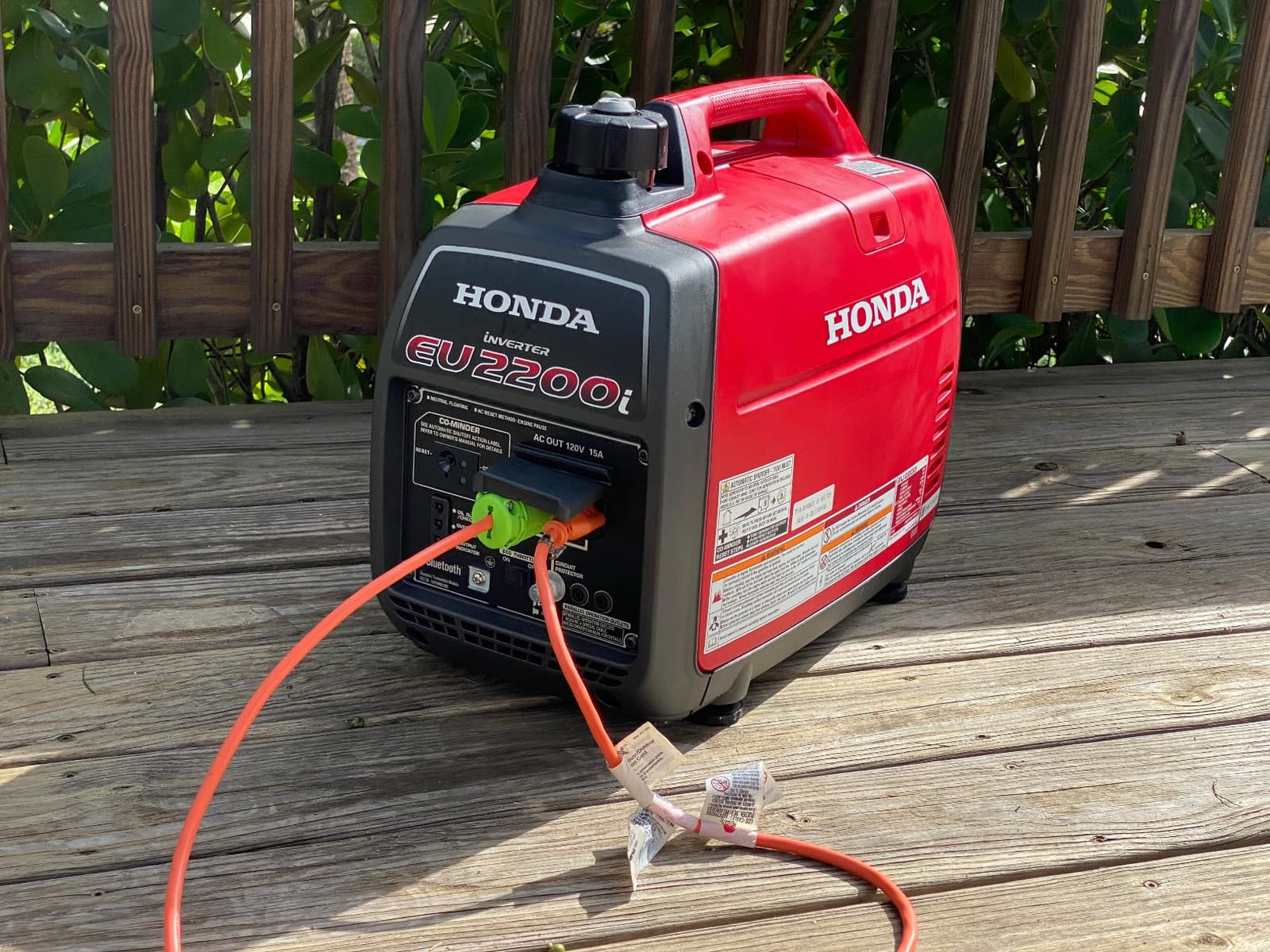
CO-MINDER is the safety feature I would not give up. It monitors carbon monoxide levels and shuts the unit down before they climb, which is meaningful because every one of us is running these machines inches from an RV wall with the exhaust pointed at a window. A three-year residential warranty also undercuts the usual two-year norm in this category.
Where the community agrees: r/RVLiving members call the Honda 2200 inverter the gold standard for quiet generators, and an iRV2 moderator put the buying decision plainly: definitely the EU2200i if buying new, and a used EU2000 is a little less power but still meets most needs. The premium is real, and so is the resale. Several owners on forums described drag-racing budget units against Hondas side by side in the noise test, which is a fair way to hear the difference.
What the EU2200i handles that smaller units cannot
Microwave, coffee maker, hair dryer, refrigerator, CPAP, and a small air conditioner are all within reach, as long as you sequence the compressor loads rather than switching them on together. The 1800 running watts is enough headroom for a travel trailer with a 13,500 BTU rooftop unit, with a soft-start module doing the heavy lifting on compressor startup.
Two household outlets and 12V DC charging are the full output list, and there is no twist-lock or TT-30R receptacle. Many owners simply run a short adapter cord from the 120V receptacle to the trailer, which works fine on a 30A circuit as long as the load is honest.
Where the EU2200i is the wrong choice
It is the wrong pick for a 50A rig with two air conditioners, a full-time household running a microwave and a coffee maker simultaneously, or anyone who does not want to carry a fuel can. It is also the wrong pick in California, where Honda does not sell it.
It is a poor match for a storage bay that cannot take 46.5 pounds at shoulder height, and the low hour meter tank will annoy anyone running an air conditioner all night. If your use case is overnight AC on a warm climate boondock, step up in capacity rather than in brand.
2. WEN 56380i 3800-Watt RV-Ready Inverter: Best for Air Conditioners
Running watts: 3400 | Starting watts: 3800 | Noise: quiet operation, EPA III compliant | Fuel: gasoline | Weight: 99.2 pounds | Runtime: up to 8.5 hours at half load | Best for: 30A rigs running rooftop AC plus appliances
WEN Super Quiet 3800-Watt RV-Ready Portable Inverter Generator with Fuel Shut-Off and Electric Start (56380i)
3400W running
3800 surge
EPA III quiet
99.2 lb
8.5 hour half-load
Pros
- True NEMA TT-30R RV receptacle built in
- 3800 surge watts covers a 15000 BTU air conditioner
- Digital load and fuel display with electric start
- Large 2.2 gallon tank with fuel shutoff carburetor design
Cons
- 99.2 pounds is a two-person lift
- Gasoline only with no propane option
- Too large for small towable storage compartments
Spec line: 3400 running watts, 3800 starting watts, 99.2 pounds, 2.2 gallon tank, 8.5 hours at half load, with a NEMA TT-30R receptacle on the control panel. That last item is the reason this unit exists in an RV roundup at all. Most portable inverters force you into an adapter; this one is RV-ready from the box.
The 212cc four-stroke engine delivers enough headroom for a 13,500 BTU rooftop air conditioner plus a refrigerator, a couple of LED circuits, and a CPAP machine without you thinking about it. iRV2 members who recommended the WEN 56380i specifically for travel trailers cited the TT-30R outlet and the surplus surge capacity as the deciding factors, and one owner running a trailer with two AC units said it only tripped a breaker once when both cycled on close together.
The digital load and fuel display is more useful than it sounds. Load percentage tells you how much real headroom you have before the overload indicator, which is a better signal than guessing from appliance wattage labels. Electric start removes the pull-start argument entirely, which matters a lot when the unit is under a slide-out.
Weight is the whole conversation for this model. At 99.2 pounds, this is not a one-person lift, and it is not going into a small teardrop storage bay. Owners running it on a Class C or a bumper-pull trailer generally have a dedicated generator compartment or a hitch carrier. The fuel shutoff carburetor design, which burns off remaining fuel before shutdown, genuinely extends engine life in a way that matters for a unit that lives in damp compartments.
Warranty is two years limited, which is on the shorter side of this group. Honda and Champion both offer three years, and EcoFlow and Jackery offer five. That gap matters more for a portable unit than for a built-in, since portable inverters get moved, tipped, and rained on.
Why the TT-30R outlet changes RV hookups
A TT-30R receptacle is the standard 30-amp RV connection. Having it on the generator means a single plug-and-play cord from the trailer, no adapter, no risk of an adapter working loose in a road vibration. It also signals the design intent: this is a generator built for a trailer, not a home generator that happens to fit an RV.
Alongside it you get two three-prong 120V receptacles, a 12V DC receptacle for battery charging, and a 5V USB port. Six outlets total, which is enough that you are not daisy-chaining extension cords across the campsite.
Where the 56380i is the wrong choice
It is the wrong pick if you carry a solo trailer, if your storage compartment is small, or if you want the flexibility of propane. This unit burns gasoline only, which in cold weather means fuel stabilization and a fuel can in the cab.
It is also overkill for a rig that lives on hookups. If your use case is charging a laptop and a CPAP on a weekend trip, this is 99 pounds of hardware solving a problem you do not have. Match the capacity to the largest single load you will actually run, not to the biggest number on the spec sheet.
3. Champion 4000-Watt RV Ready Inverter: Best Value 30A Setup
Running watts: 3000 | Starting watts: 4000 | Noise: 64 dBA at 23 feet | Fuel: gasoline | Weight: 48.1 pounds | Runtime: up to 10 hours | Best for: 30A rigs wanting 4000 surge watts under 50 pounds
Champion 4000-Watt RV Ready Portable Inverter Generator
3000W running
4000 starting
64 dBA
48.1 lb
10 hour runtime
Pros
- One of the lightest 4000-watt inverters at under 49 pounds
- 120V 25A TT-30R RV outlet plus household duplex
- Clean power under 3 percent THD
- Parallel ready to double output with a second unit
Cons
- Recoil start only with no electric or remote start
- Gasoline only with no dual-fuel capability
- One-star share of ratings points to some early reliability reports
Spec line: 3000 running watts, 4000 starting watts, 64 dBA at 23 feet, 48.1 pounds, up to 10 hours of runtime. Nearly half the mass of the WEN 56380i while giving up only 400 running watts, and it keeps the TT-30R RV outlet. That weight-to-capacity ratio is the entire argument for this unit.
The 149cc four-stroke engine carries a 1.54 imperial gallon tank, and the parallel ports let you pair two of these to reach 8,000 starting watts, which is how you cover a 50A rig with a rooftop AC. Owners running travel trailers routinely describe it as the sweet spot between capacity and portability, and several iRV2 members treat Champion as their default for a trailer with an air conditioner.
CO Shield shuts the unit down automatically when carbon monoxide levels climb, and clean output under 3 percent THD keeps laptops and monitors happy. The three-year warranty with free lifetime technical support is the better half of what most competitors offer at this capacity.
Recoil start is the practical complaint. In cold weather, on a stiff crank, with a 50-pound unit at an awkward angle, you will pull a starter handle more often than you would like. Champion’s electric-start sibling in this roundup solves exactly that, and it is worth the weight if your trips run into shoulder season.
Also worth knowing: 7 percent of ratings are one-star, which is a higher early-failure signal than the two Honda-adjacent units here. Champion has a large service network and free lifetime technical support, which partly offsets that, but the first-year track record is not as clean as the 4.6 average alone suggests.
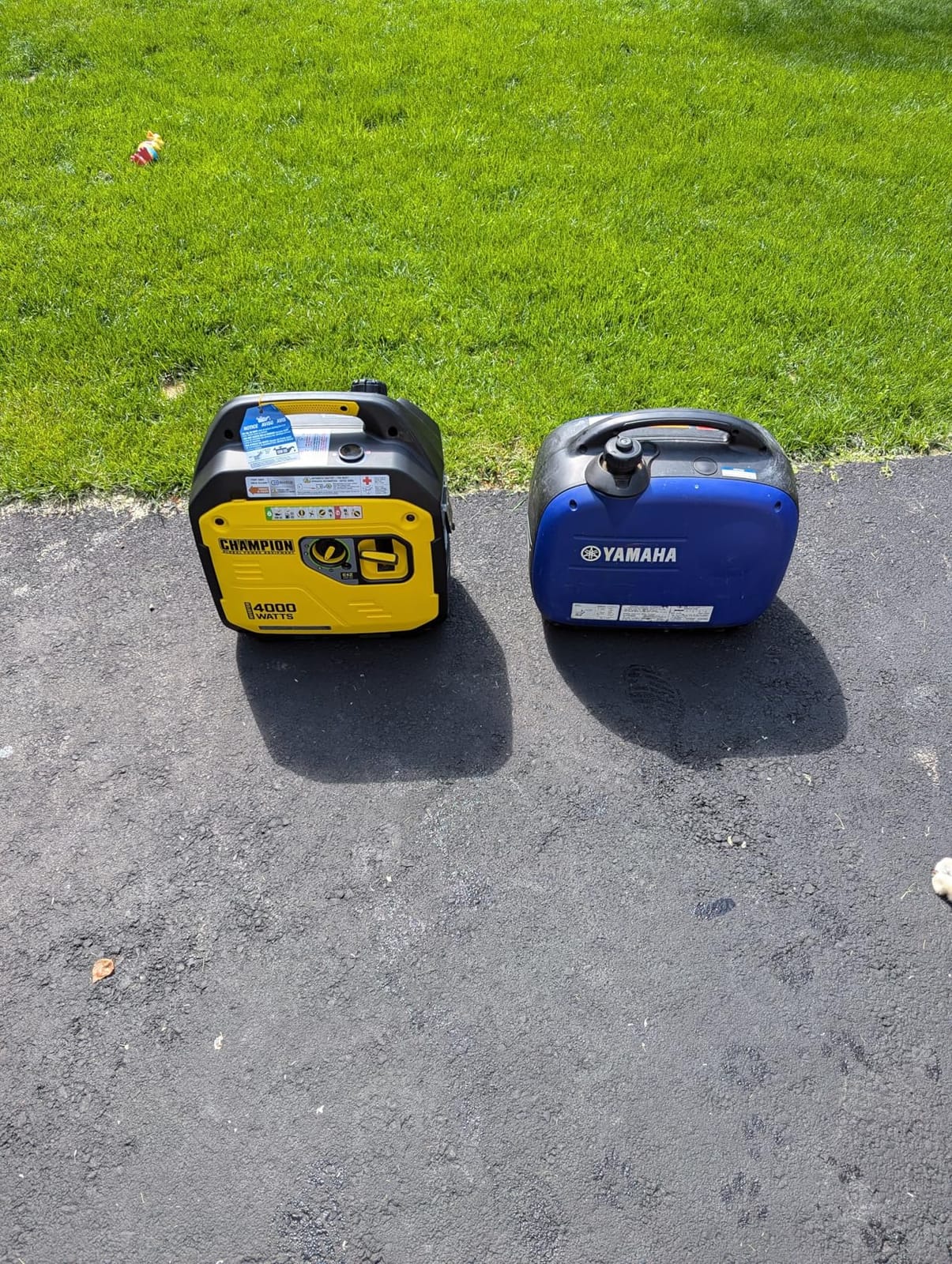
How the 48-pound weight changes campsite logistics
Under 50 pounds is a meaningful threshold for a solo camper. It is the difference between lifting a unit into a storage bay one-handed and needing to clear a path and get a second person. For anyone who unloads in the dark after a long drive, that matters more than any feature on the control panel.
It also fits where a 99-pound unit does not. Most bumper-pull storage compartments and Class B rear doors were never designed to swallow a 100-pound machine, so the realistic option for many rigs is a hitch basket or a portable compartment upgrade. This one just goes in.
Where the Champion 4000 is the wrong choice
It is the wrong pick for cold-weather boondocking, where recoil start and gasoline without a dual-fuel option become real inconveniences. It is also wrong for anyone who needs propane storage life in a truck, since propane does not go stale the way gasoline does.
If your rig is a 50A Class A with two air conditioners, one of these is not enough, and the parallel kit is a second purchase. Single-unit simplicity is a fair reason to choose it, and double-unit complexity is a fair reason not to.
4. WEN 56235i 2350-Watt Ultralight Inverter: Most Versatile
Running watts: 1900 | Starting watts: 2350 | Noise: conversation level, quiet operation | Fuel: gasoline | Weight: 39 pounds | Runtime: up to 10 hours | Best for: small trailers, first-time buyers, minimal storage space
WEN Super Quiet 2350-Watt Portable Inverter Generator with Fuel Shut Off, Gasoline Power, Ultra Lightweight (56235i), Black
1900W running
39 pounds
10 hour runtime
Electronic ignition
5 outlets
Pros
- Ultralight 39-pound body is easy to carry and store
- Very quiet in eco mode with conversation-level noise
- Several owners run a 13500 BTU RV air conditioner with an EasyStart module
- Reliable cold-weather first-pull starting reported down to 16 degrees
Cons
- Real output tops out around 1850 watts before the overload light
- High inrush loads may need to be started one at a time
- No TT-30R outlet so an adapter is needed for trailer hookup
Spec line: 1900 running watts, 2350 starting watts, 39 pounds, up to 10 hours of runtime, 79cc four-stroke engine. At 39 pounds it is the lightest unit in this roundup by a wide margin, and it is the one most owners describe as a realistic first generator.
The noise story is genuinely good. Owners report holding a normal conversation next to it in eco mode, and the cold-weather starting record is strong for a unit this size, with first-pull starts reported down to 16 degrees. The fuel shutoff carburetor design burns off remaining fuel before shutdown, which extends engine and carburetor life.
Several owners run a 13,500 BTU trailer air conditioner off this unit using an EasyStart soft-start module, and that combination is the most common configuration in the reviews. The soft-start kit is doing the work that 2350 starting watts cannot do on their own. Without it, expect the compressor to trip the overload light.
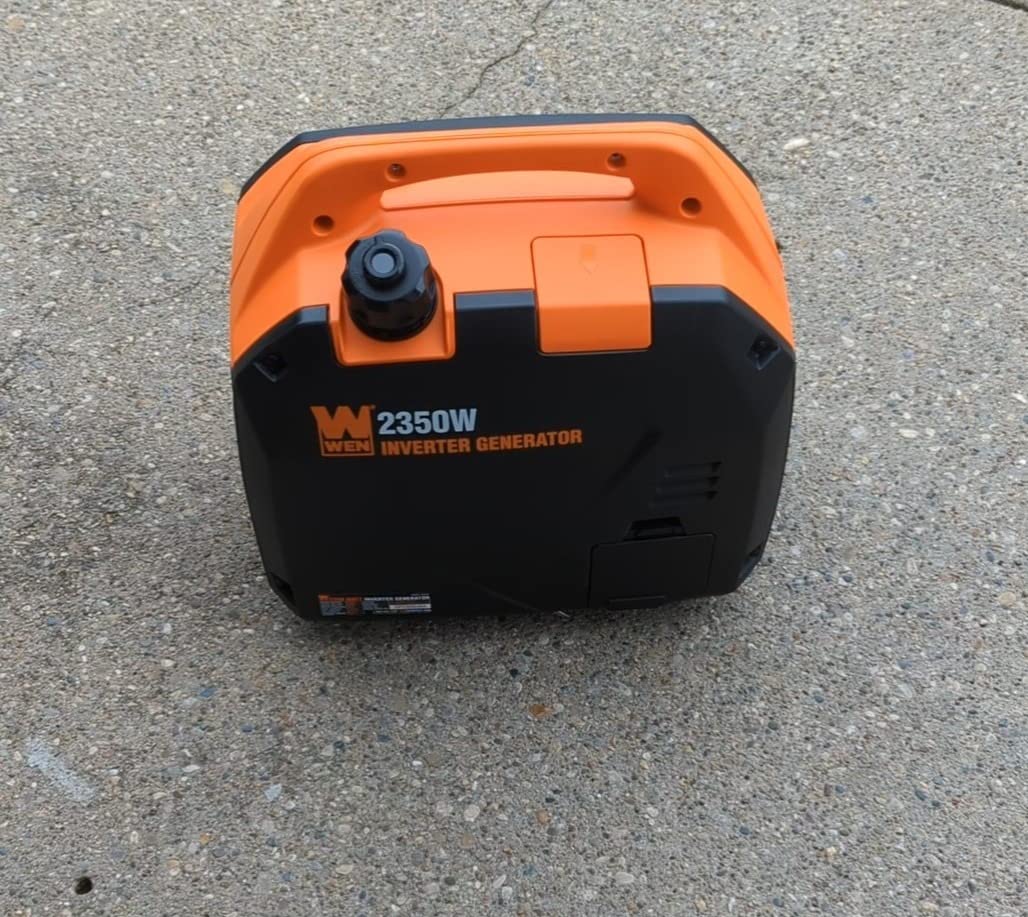
Here is the honest caveat, and owners are consistent about it. Real sustained output tops out around 1850 watts, below the rated 1900, and the unit struggles with high inrush loads. A refrigerator, a freezer, and the air conditioner compressor all need to be started one at a time, spaced by a minute or two, or something trips.
There is no TT-30R outlet, so a trailer connection needs an adapter, and it cannot run the air conditioner and a microwave at the same time. A minority of owners report warranty repairs after a few months of moderate use, and WEN customer service response times come up often enough to be worth knowing about before you buy.
When 39 pounds beats 48 pounds
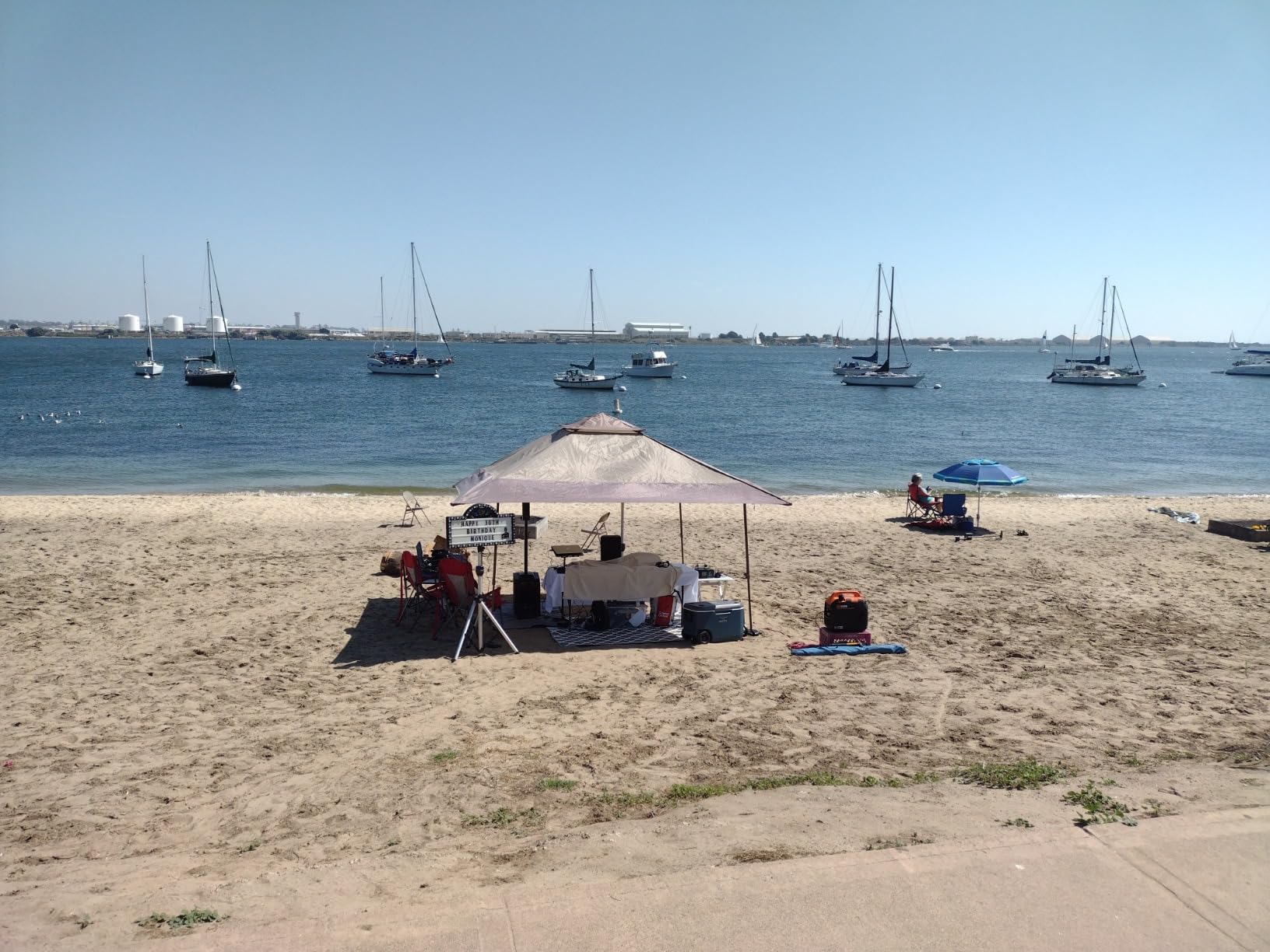
For a solo camper on a teardrop, a pop-up, or a small bumper-pull, this is the difference between a generator that lives in the trailer and one that lives in the garage. It is genuinely one-handed carry, and at 39 pounds it is closer to a large suitcase than a machine.
It is also the value entry point. For a first generator on a weekend trailer, the running watts cover a refrigerator, lighting, a CPAP machine, and a router without strain, and the 10-hour runtime means a full weekend on one tank.
Where the 56235i is the wrong choice
It is the wrong pick for anyone running an air conditioner without a soft-start module, or for a rig that needs a microwave and an air conditioner on the same circuit. The headroom simply is not there.
It is also the wrong pick for a 50A rig, and the wrong pick for anyone who wants a native RV receptacle. An adapter works, but a permanent TT-30R is more secure under vibration. Check your trailer’s amperage before committing.
5. Champion 4500-Watt Electric Start Dual Fuel: Best for Boondocking
Running watts: 3500 on gas, 3150 on propane | Starting watts: 4500 | Noise: 61 dBA | Fuel: gasoline or propane | Weight: 99.2 pounds | Runtime: 14 hours on gas, 21 hours on propane | Best for: long boondocking trips in cold or remote areas
Champion 4500-Watt Electric Start Dual Fuel Portable Inverter Generator
4500 starting watts
61 dBA
Dual fuel
Electric start
21 hours on propane
Pros
- Dual fuel out of the box on gasoline or propane
- 21 hours of propane runtime for extended boondocking
- Electric start with an EZ Start dial removes pull-starting
- Intelligauge tracks voltage frequency and operating hours
Cons
- Heaviest unit in this lineup at 99.2 pounds
- Running wattage drops to 3150 on propane
- One owner reported oil leakage and hard starting on a new unit
Spec line: 4500 starting watts, 3500 running watts on gasoline, 3150 on propane, 61 dBA, 99.2 pounds, 14 hours on gas and 21 hours on propane. That runtime figure is the reason to own this generator. For multi-day boondocking away from a propane refill point, nothing else here comes close.
Dual fuel solves two real problems. Propane stores indefinitely, so a tank left in the truck over the winter is not a liability the way a gasoline can is. And a 20-pound propane tank at 21 hours of runtime means one refill covers a long weekend of air conditioner cycling, which is the single most common complaint about gasoline-only units.
An r/GoRVing owner who bought the Champion 3400 dual fuel described it as super quiet and super strong, and that reaction is common to this category. The 61 dBA rating sits below the Champion 4000, which is a pleasant surprise given the larger engine and the electric start.
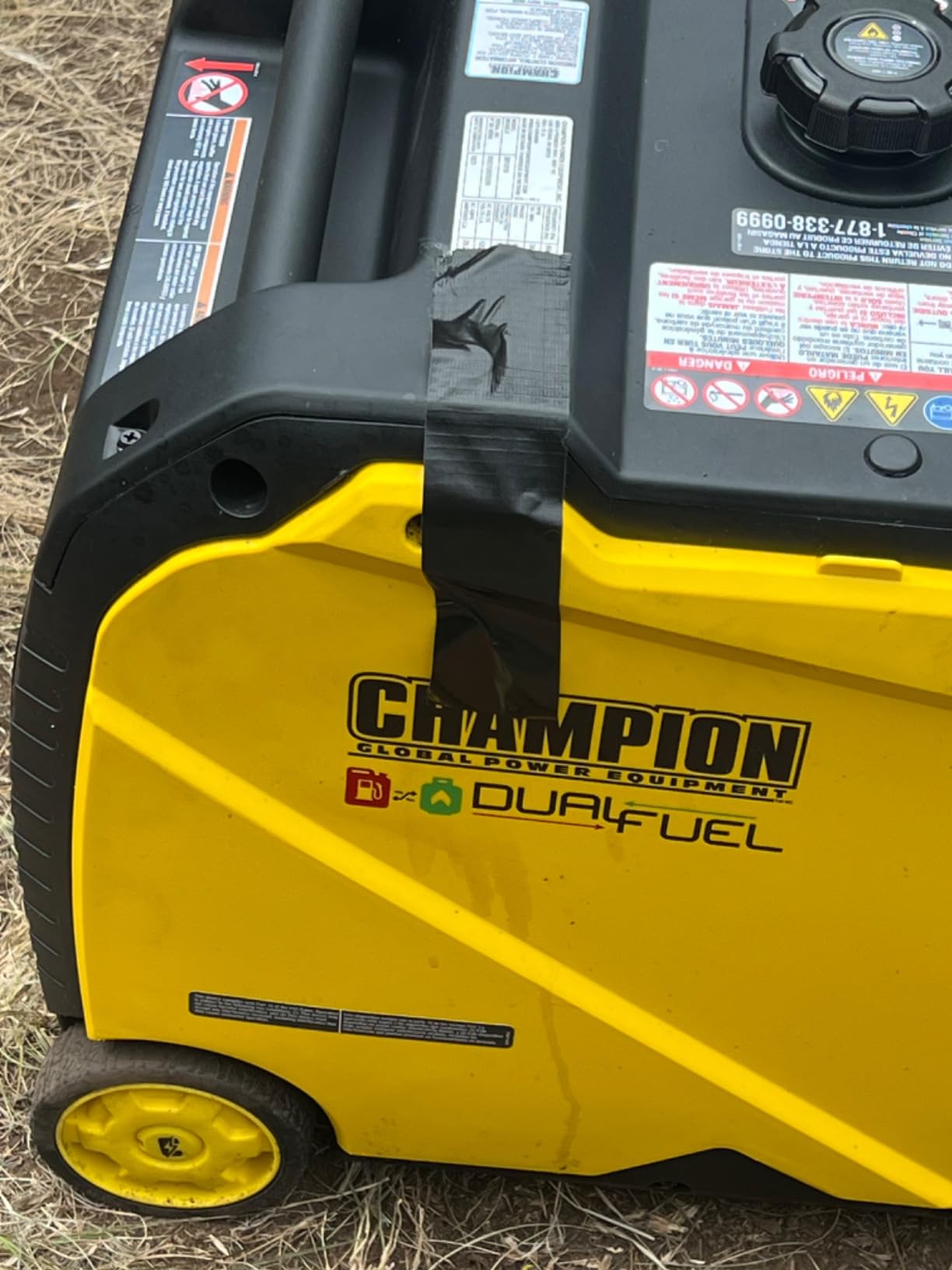
The weight is the honest cost of that runtime. At 99.2 pounds, with the propane hose and a full 2.25 gallon tank, this is a two-person load and it needs a real storage compartment. If your trailer has a generator bay designed for a 50-pound unit, this will not go in it.
Note the propane running-wattage drop from 3500 to 3150, and size for the lower number if propane is your primary fuel. A minority of owners on new dual-fuel units report oil leakage or hard starting, and 8 percent of ratings are one-star, so give it a proper break-in run before a long trip.
Why propane matters more than most buyers expect
Propane is the fuel that does not go bad. Gasoline oxidizes, separates, and picks up water over a season in a plastic can, and in cold climates it will not start a cold engine reliably without a stabilizer. Propane is also the fuel most RVs already carry, which means one less tank to store.
There is a widely repeated claim that propane is quieter than gasoline. It is not, and it is worth being direct about that. Combustion noise comes from the engine and its exhaust, not from the fuel molecule. The dual-fuel version of an engine is the same engine, and the decibel difference between modes is negligible.
Where the Champion 4500 dual fuel is the wrong choice
Wrong for small trailers with limited storage, wrong for anyone who does not want to carry two fuel types, and wrong for cold-weather trips where a full 99-pound unit will be unpleasant to handle. It is also unnecessary for rigs that never run an air conditioner.
Wrong if you need 240V split-phase output, since this is a 120V unit. And wrong if you plan to run it inside a tent or a canopy, because CO Shield shutdown is a backup, not a license to run a combustion engine in an enclosed space.
6. Pulsar PGD40ISCO 4000W Portable Inverter: Best Lightweight 4000-Watt Unit
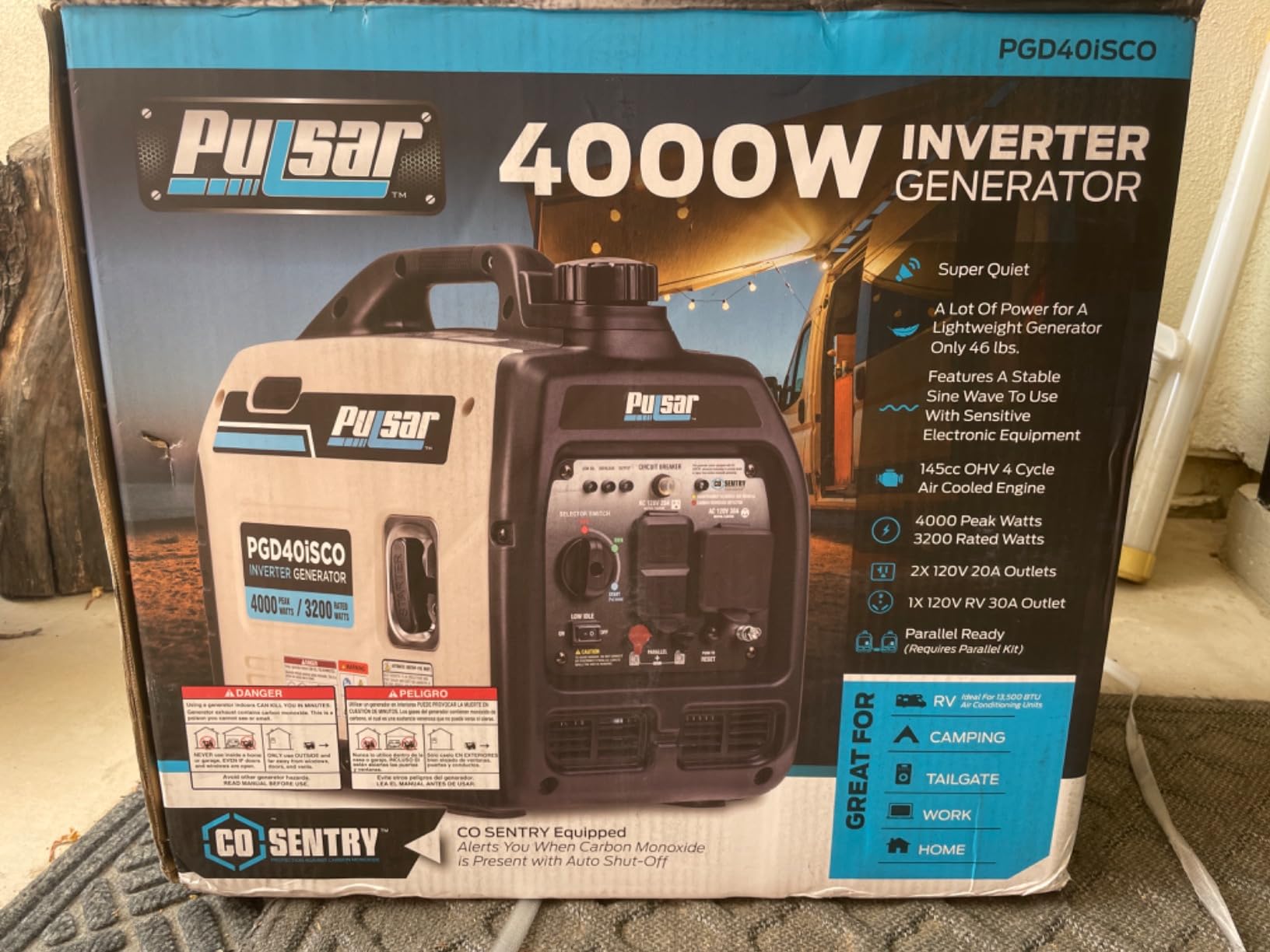
Running watts: 3200 | Starting watts: 4000 | Noise: 59 dB | Fuel: gasoline | Weight: 47.3 pounds | Runtime: about 4 hours at half load | Best for: 13,500 BTU air conditioners on a light, compact frame
Pulsar PGD40ISCO Ultra Light Quiet 4000W Portable Gas Inverter Generator, white
4000 peak watts
3200 rated watts
59 dB
47.3 pounds
Parallel ready
Pros
- 4000 peak watts and 3200 rated watts in a compact 47.3-pound frame
- 59 dB noise rating suits campsite use
- Suitable for air conditioner units up to 13500 BTU
- Parallel ready to pair with a second compatible inverter
Cons
- One gallon tank gives about 4 hours at half load
- Gasoline only with no dual-fuel option
- 9 percent one-star share is the highest of the 4000-watt units
Spec line: 4000 peak watts, 3200 rated watts, 59 dB, 47.3 pounds, 1 gallon tank, parallel ready. The 59 dB rating is the second-lowest in this roundup, and pairing it with a sub-50-pound weight and 4000-watt surge capacity makes it unusual.
Owners regularly run a 13,500 BTU rooftop air conditioner from this unit, which is the same load the WEN 56235i needs a soft-start module to handle. That is a real capability difference at nearly identical weight, and it is why this unit earns its place despite the short runtime.
Automatic voltage regulation protects sensitive electronics, and the parallel-ready design lets you combine two units if you eventually outgrow one. Aluminum, plastic, and steel construction keeps weight down without feeling cheap in the hand.
The 1 gallon tank is the deal-breaker for overnight use. About 4 hours at half load means a refill in the middle of an evening with an air conditioner running, which is the least convenient possible time to be handling a gasoline can. This is a weekend-and-refill generator, not a boondocking generator.
Also note the 9 percent one-star share, the highest among the 4000-watt units here, which suggests some early reliability complaints. Gasoline only, no propane, so the fuel flexibility that makes the Champion 4500 attractive is absent here.
What 59 dB actually sounds like beside a trailer
At 23 feet, 59 dB is a level most people can talk over without raising their voice. iRV2 owners testing budget units use exactly that test, standing next to the running generator and trying to hold a conversation at a normal volume. This unit passes that test at a lower weight than most of its class.
Load matters more than the rating. At a quarter load this number is accurate. Running a rooftop air conditioner, the engine works harder and the sound rises, so the 59 dB figure is a low-load figure, not an all-night one.
Where the Pulsar is the wrong choice
It is the wrong pick for multi-day boondocking because of the 1 gallon tank, and the wrong pick for anyone who wants propane as a backup fuel. It is also the wrong pick for a rig that needs 240V output.
It is the wrong pick for winter boondocking, where a cold-soaked engine and a small tank are a poor combination. If you camp in cold months, prioritize fuel capacity and dual-fuel capability over peak wattage.
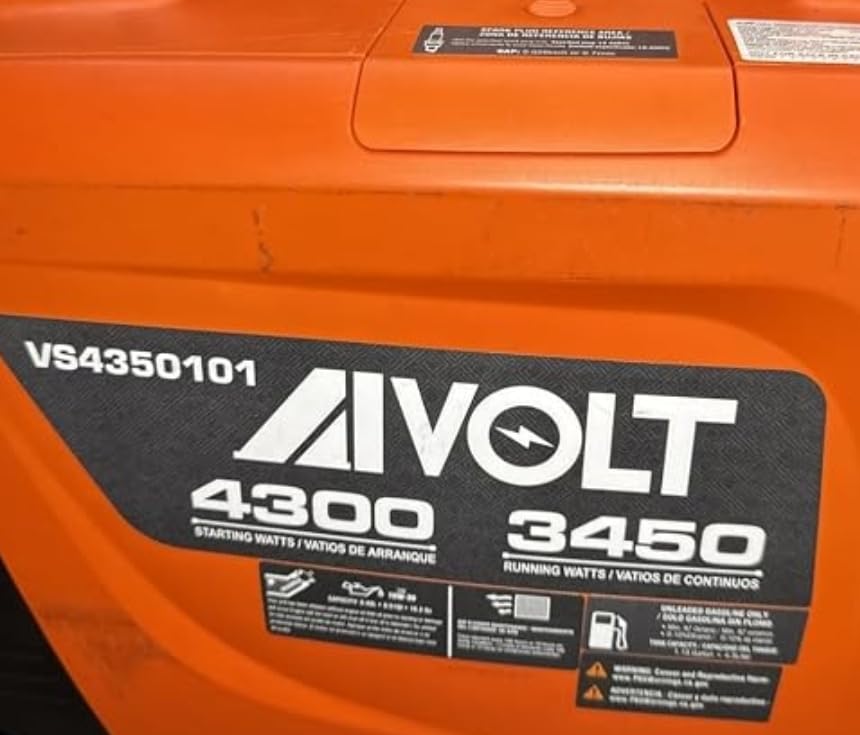
7. AIVOLT 4300W Quiet RV Inverter: Best with 30 Amp Adapter Included
Running watts: 3450 | Starting watts: 4300 | Noise: 60 dBA at 23 feet, no load | Fuel: gasoline | Weight: 50.7 pounds | Runtime: over 5.5 hours at 25 percent load | Best for: buyers who want RV hookup accessories in the box
AIVOLT 4300W Inverter Generator Gas Powered Quiet RV Generator for Camping
3450 running watts
60 dBA
30A RV adapter included
CO auto-shutoff
50.7 pounds
Pros
- Inverter technology holds total harmonic distortion under 3 percent
- 4300 starting watts from a 149cc four-stroke copper-winding engine
- 30 amp RV adapter plus 12V DC charging cable included
- 5-in-1 LCD shows oil fuel and overload warnings
Cons
- Lowest average rating in this group at 4.1 stars with 12 percent one-star reviews
- 0.69 gallon tank gives the shortest runtime here
- Engine oil is not included and must be added before first use
Spec line: 3450 running watts, 4300 starting watts, 60 dBA at 23 feet, 50.7 pounds, 0.69 gallon tank, over 5.5 hours at 25 percent load. The 149cc four-stroke engine with copper windings and under 3 percent THD is a genuinely good spec sheet for the money.
What stands out is what is in the box. A 30 amp RV adapter, a 12V DC battery charging cable, an oil funnel, and a tool kit. Owners who were previously planning to buy an adapter separately get it here, which removes one step between unpacking and hooking up to a trailer.
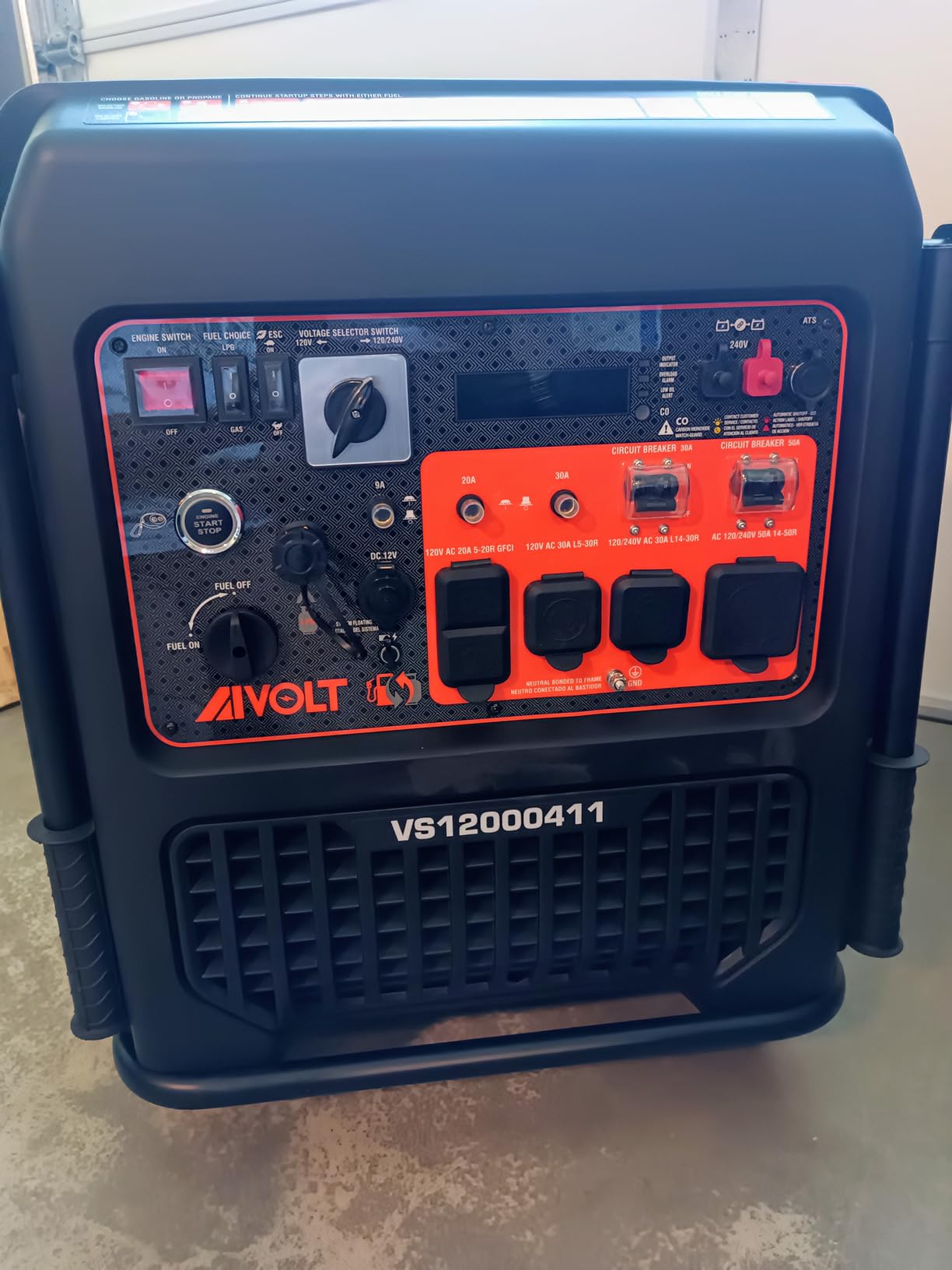
The control panel is well thought out, with a 120V 20A outlet, a 120V 30A locking outlet, a 12V DC outlet, and both USB-A and USB-C ports. The 5-in-1 LCD center shows oil, fuel, and overload warnings along with current operating status, which saves guessing.
Now the part that deserves a hard look. The 4.1 average rating is the lowest in this group, and 12 percent of ratings are one-star, which is a real consistency signal rather than noise. Some owners report difficulty getting the unit to start reliably, and that is the failure mode that matters most in a camping context.
The 0.69 gallon tank is the smallest here and contributes to the roughly 5.5-hour eco-mode runtime. Engine oil is also not included, which is a small annoyance that catches people out on first use in a campsite.
What included accessories actually save
An RV adapter and a 12V DC charging cable together cost less than a campsite’s worth of convenience. If your plan is to power a trailer’s 30A circuit and top up house batteries, having both in the box means one less shopping trip and no adapter left in a drawer at home when you are 200 miles from it.
The tool kit matters less but is not nothing. A spark plug wrench and oil funnel in the box is the difference between a first-run setup at the campsite and a first-run setup in a parking lot before you leave.
Where the AIVOLT is the wrong choice
It is the wrong pick if reliability is your top priority, given the 4.1 average and the one-star share. It is the wrong pick for multi-day trips, because a 0.69 gallon tank is a refuel every few hours under load.
It is also the wrong pick for anyone who will not check the oil before first start. That is not a criticism, it is a fact, and a generator that seizes in the first hour of a trip is a bad weekend.
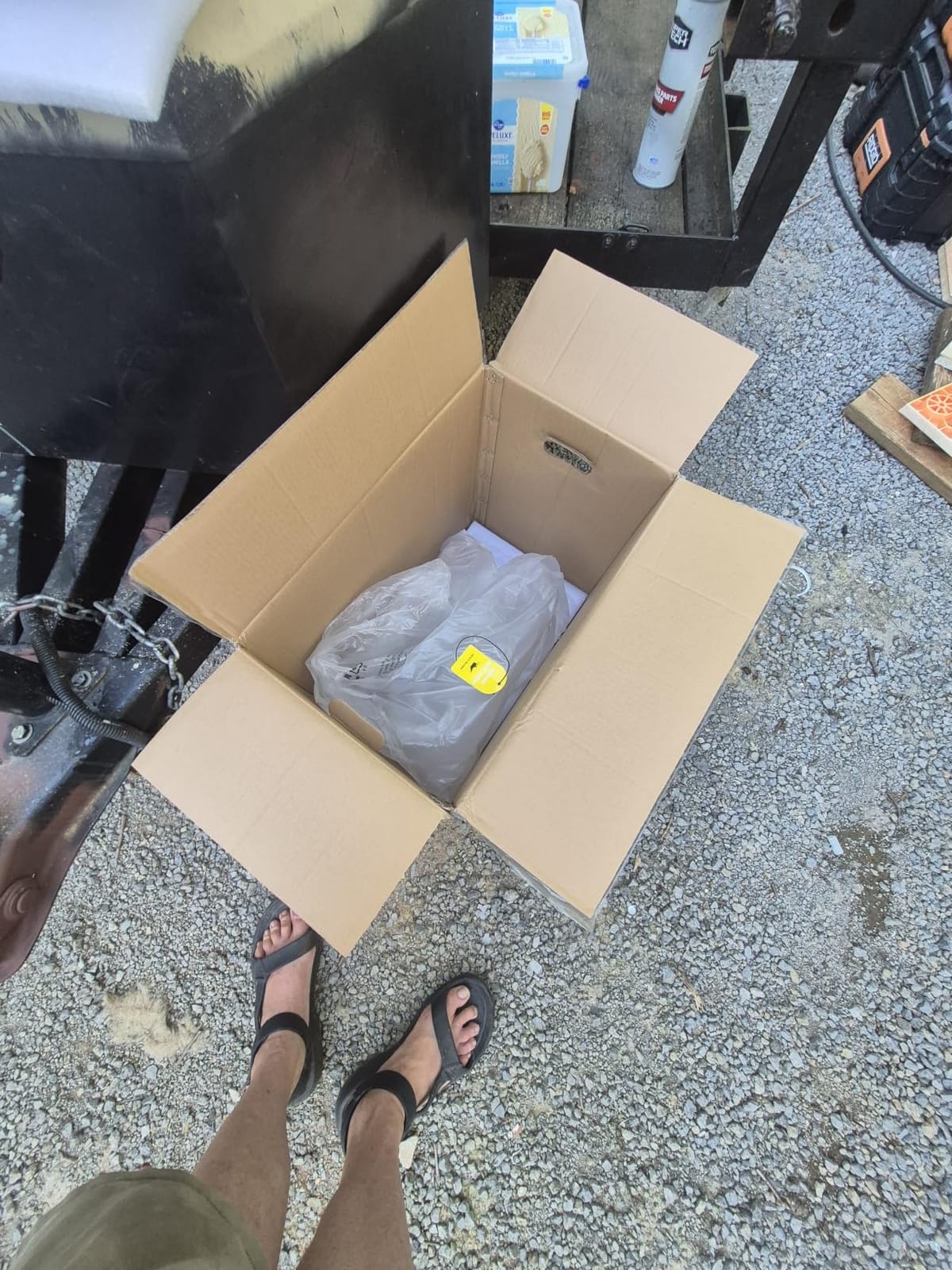
8. PowerSmart 3800W Dual Fuel Inverter: Best Twist-Lock 30 Amp Dual Fuel
Running watts: 3300 on gas, 3100 on propane | Starting watts: 3800 on gas, 3500 on propane | Noise: 59 dBA at 25 percent load | Fuel: gasoline or propane | Weight: 50.7 pounds | Runtime: 8 hours on gas, up to 24 hours on propane | Best for: 30A rigs that want dual fuel without the extra weight
PowerSmart 3800 Watt Dual Fuel Inverter Generator for Camping or Home Use
3300W running on gas
Dual fuel
59 dBA
L5-30R twist-lock
24 hours on propane
Pros
- Dual fuel flexibility with 3800 starting and 3300 running watts on gas
- Quiet at 59 dBA at 25 percent load in Eco Mode
- 24 hours of runtime on a standard 20 pound propane tank
- Overload short circuit CO sensor and low oil shutdown protection
Cons
- Several owners report hard starting on both gasoline and propane
- Small 1.3 gallon tank means frequent refills overnight
- Noise climbs noticeably as load increases even from eco mode
Spec line: 3800 starting and 3300 running watts on gasoline, 3500 starting and 3100 running watts on propane, 59 dBA at 25 percent load, 50.7 pounds, 8 hours on gas or up to 24 hours on a 20 pound propane tank. Dual-fuel capability at 50 pounds is unusual, and that is the reason to look at this unit.
The L5-30R twist-lock outlet is the RV connection here, and it is a more secure plug than a bare household adapter. Alongside it you get a 120V 20A duplex, a 12V 8A DC port, and dual USB ports, so the trailer, the battery bank, and the phone all have a home.
Safety coverage is thorough for the category: overload protection, short circuit protection, a carbon monoxide sensor, and low oil shutdown, certified to ANSI/PGMA G300, ANSI/UL2201, and EPA standards. Two years of warranty with free lifetime technical support.
The recurring complaint is starting, and it is worth taking seriously. Several owners report hard starting on both gasoline and propane, which is the one problem that can strand you at a campsite at altitude or in cold weather. Test it repeatedly at home before the trip.
Also note that noise climbs as load increases even from eco mode, so the 59 dBA figure is genuinely a quarter-load number. Access panels and the oil change door need a Phillips screwdriver, and the display panel sits low, which is a small ergonomic complaint when you are crouched in the dark.
Dual fuel at 50 pounds instead of 99
The comparison is straightforward. The Champion 4500 dual fuel gives you 21 hours of propane runtime, and this one gives you up to 24 hours, at roughly half the weight. You give up about 200 running watts and the electric start, and you gain a unit one person can load.
For a boondocking couple on a 30A trailer, that trade is usually worth making. A propane tank is easy to refill at any hardware store or gas station, and it does not spoil in storage the way a gasoline can does.
Where the PowerSmart 3800DF is the wrong choice
Wrong for anyone who needs electric start, wrong for a 50A rig that will run two air conditioners, and wrong for anyone planning to run the unit heavily at high altitude where the derating and the starting behavior both work against you.
It is also the wrong pick if you will not verify starting behavior before your trip. Hard starting is fixable, but only if you discover it at home rather than at a trailhead.
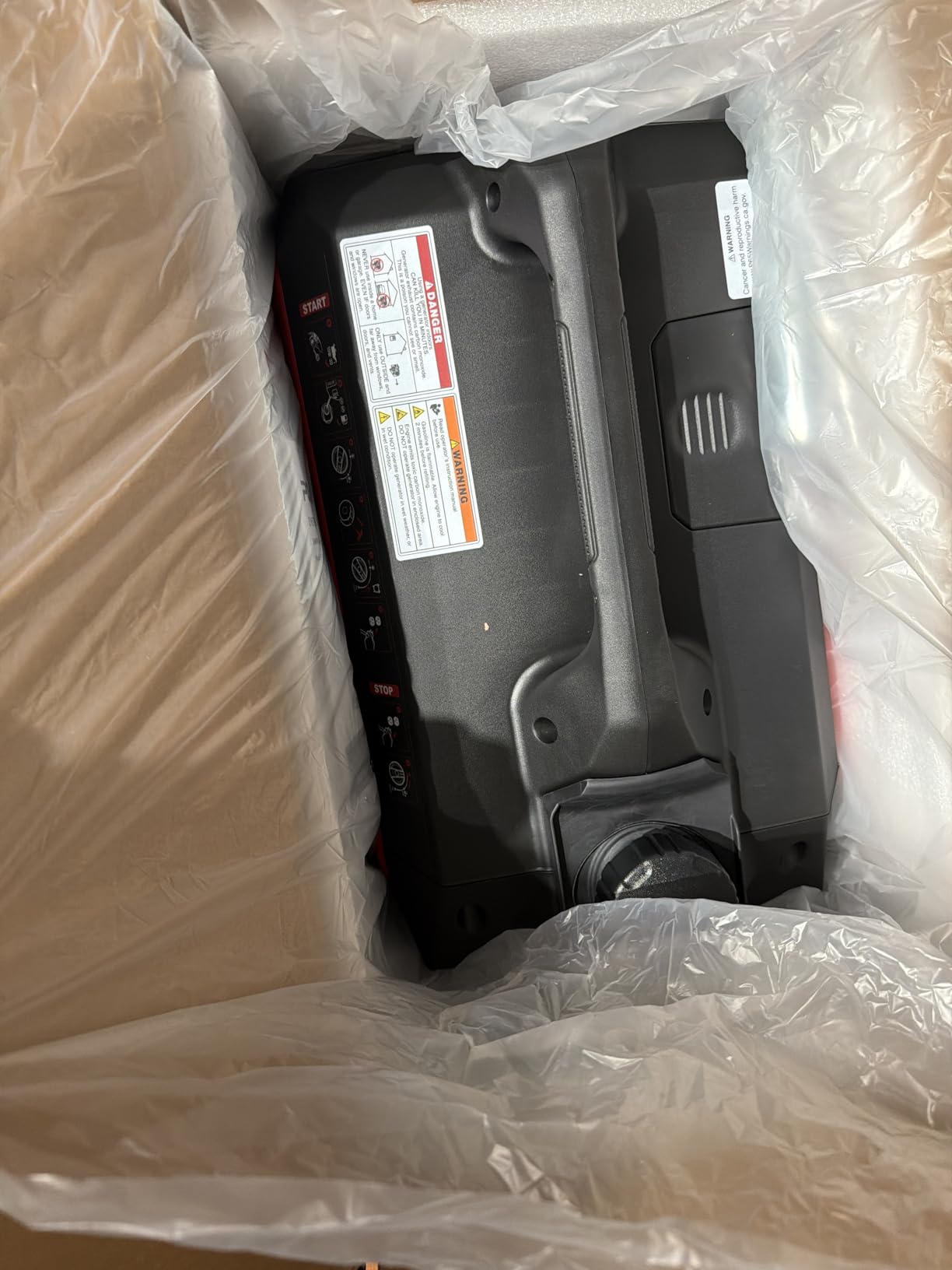
9. PowerSmart 2500 Watt Portable Inverter: Best Starter Unit for Small Trailers
Running watts: 1900 | Starting watts: 2500 | Noise: 59 dBA at 23 feet | Fuel: gasoline | Weight: 39.7 pounds | Runtime: 7.5 hours at 25 percent load | Best for: first-time generator buyers on a small trailer
PowerSmart 2500 Watt Portable Inverter Generator for Camping
2500 starting watts
1900 running
59 dBA
39.7 pounds
7.5 hours at 25 percent load
Pros
- Very quiet at 59 dBA at 23 feet
- 39.7-pound design is easy to load and carry
- 7.5 hours of runtime at 25 percent load from the 1.06 gallon tank
- Several owners power a 13500 BTU trailer air conditioner with an EasyStart module
Cons
- Wattage ratings are optimistic and some owners hit overload with a 1600-2000 watt AC load
- Starting can require three or four pulls rather than one
- No TT-30R outlet so an adapter is needed
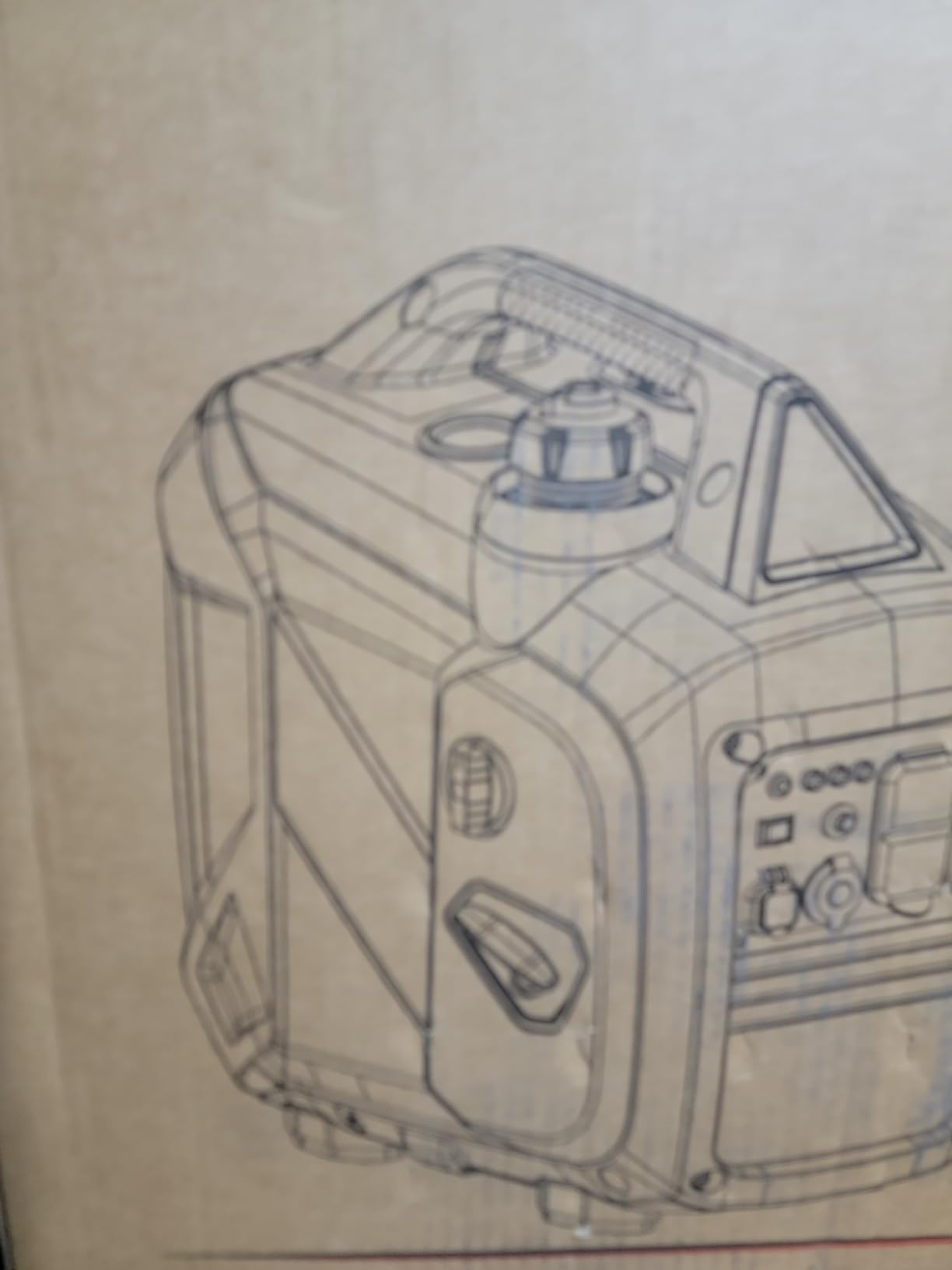
Spec line: 2500 starting watts, 1900 running watts, 59 dBA at 23 feet, 39.7 pounds, 7.5 hours at 25 percent load from a 1.06 gallon tank. For a first generator on a small trailer, the number of things this unit covers for a modest outlay is genuinely striking.
Owners report running a 13,500 BTU RV air conditioner with an EasyStart soft-start module, and one reported nearly 9 hours of overnight runtime on a single tank. The eco mode throttles the 79.8cc four-stroke engine down, and at low load that is where the 59 dBA figure comes from.
Clean output is safe for phones, tablets, and other sensitive electronics, and the outlet panel covers the usual ground: a 120V 20A duplex, a 12V 8A DC port, and dual 5V USB ports. Two years of warranty with free lifetime technical support.
The recurring theme in the reviews is that the wattage rating is optimistic. Owners report hitting overload with a 1600 to 2000 watt air conditioner load, which means the practical ceiling is below the 1900 rated figure. Starting can also take three or four pulls rather than one, which is the thing that annoys people most.
There is no TT-30R outlet, so a trailer connection needs an adapter, and some buyers report customer service responsiveness as a problem. Gasoline only, with no propane capability.
When a starter unit is the correct answer
Not every RV needs 4000 watts. A small trailer used on weekends for lights, a refrigerator, a laptop, a CPAP machine, and a phone charger is a load profile that 1900 running watts handles comfortably. For that rig, a 39.7-pound unit is the correct size rather than a compromise.
The 7.5-hour runtime at 25 percent load means a full weekend on one tank for a light load profile, which is where the real value sits. The soft-start module is the add-on that unlocks the air conditioner use case if you need it.
Where the PowerSmart 2500 is the wrong choice
It is the wrong pick for a rig that runs an air conditioner without a soft-start module, and the wrong pick for anyone who wants to run a microwave while the air conditioner is cycling. The headroom is not there.
It is also the wrong pick for cold-weather trips, where needing three or four pulls in freezing conditions is a genuinely bad experience. Test starting in cold weather before committing to it as a winter generator.
10. EcoFlow DELTA 2 Max 2048Wh Power Station: Best Solar Power Station
Capacity: 2048Wh, expandable to 6 kWh | Output: 2400W continuous, 3400W with X-Boost | Noise: as low as 30 dB | Weight: 23 kg | Best for: silent overnight power with solar recharge
EF ECOFLOW Portable Power Station DELTA 2 Max 2048Wh, 2400W LiFePO4 Battery
2048Wh LiFePO4
2400W output
30 dB operation
43 minute 80 percent charge
Pros
- Fast charging at 80 percent in 43 minutes with combined solar and AC input
- LFP battery rated for 3000 cycles to 80 percent capacity
- Silent operation starting from only 30 dB
- Expandable from 2 kWh to 6 kWh with plug-and-play batteries
Cons
- Heavy at 23 kg so two-handed lifting is necessary
- Solar panel is a separate purchase not included with the base unit
Spec line: 2048 watt-hours of LFP capacity expandable to 6 kWh, 2400 watts continuous output with X-Boost to 3400W, operation from 30 dB, 23 kg, and 80 percent charge in 43 minutes on combined solar and AC input. Nothing else in this roundup makes no noise at all.
That 30 dB figure reframes the whole conversation. iRV2 members who came from generators describe the battery-only approach from roughly 10 pm to 7 am as the genuinely silent option, and this is the unit that makes that schedule work. No exhaust, no carburetor, no starting, and nothing to wake the neighbors.
The LFP chemistry is rated for 3000 cycles to 80 percent capacity, which is a long service life for a battery that will live in a moving vehicle subject to temperature swings. Owners consistently single out the fast charging and the silent operation as the reasons they bought it, and the expandable architecture means you can add capacity later rather than replace the unit.
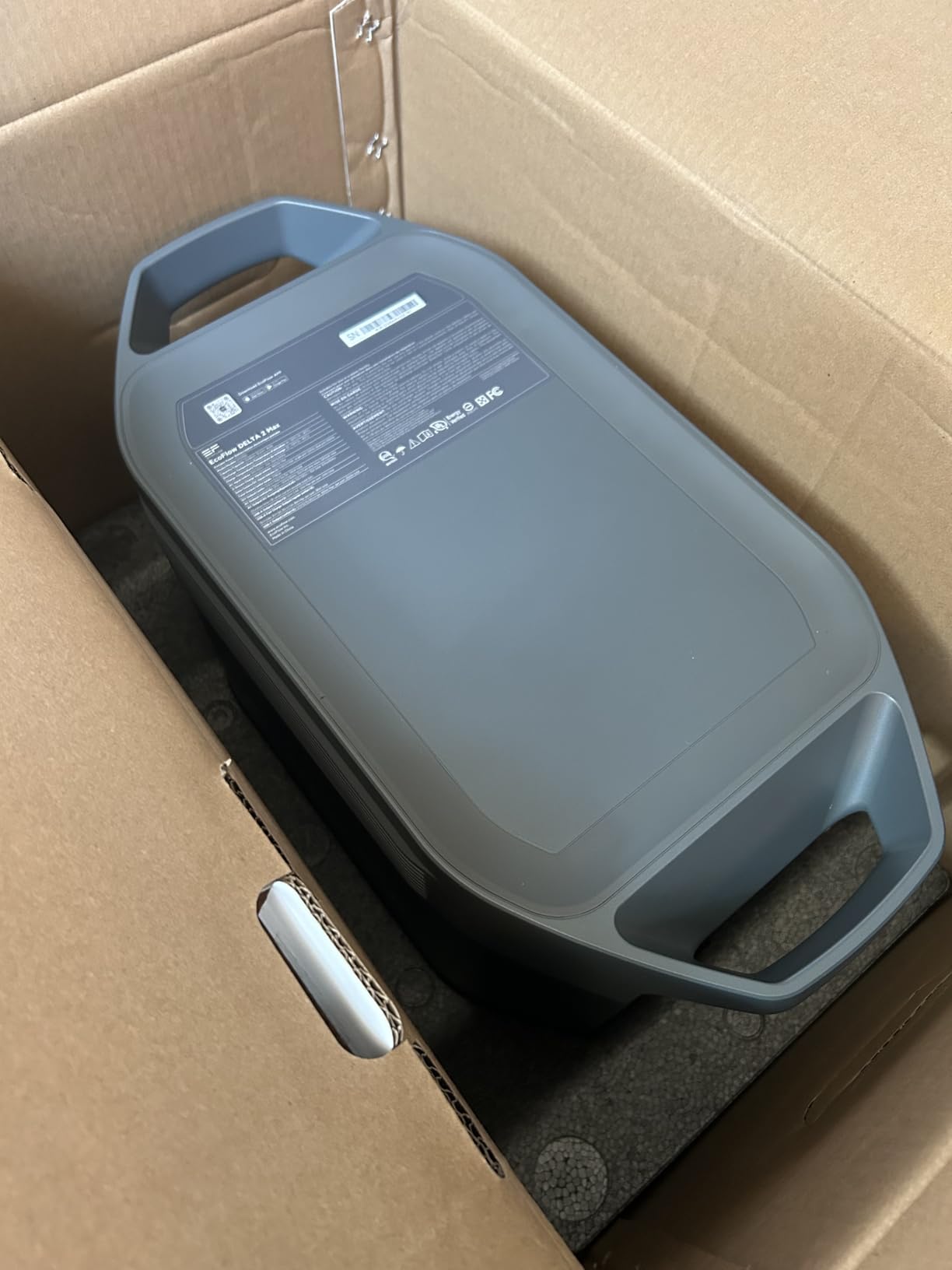
The honest limitation is capacity versus draw. 2048 watt-hours sounds large until you run a 12V compressor fridge compressor, a router, a laptop, and a coffee maker at the same time. Owners who run full-size fridges report it works; owners who want to run everything at once report it works until it does not. The X-Boost mode takes 2400W to 3400W for short high-draw periods, which helps with surge but does not create energy.
At 23 kg, this is a two-handed lift that changes your loading plan. And the solar panel is not included, which is the most common complaint in the reviews and also the most understandable. Budget for a panel as a separate line item, and expect the 200W class panels to take most of a sunny day to refill what you used overnight.
The generator plus battery workflow that actually works
The strongest setups pair a fuel generator for daytime heavy loads with a power station for overnight silence. Run the generator in the morning to recharge the station at speed, then shut it off at 10 pm and run the trailer off batteries until 7 am. That removes the entire quiet-hours noise problem without giving up daytime capacity.
Many RVers also charge house batteries from the alternator while driving, so the station arrives at the campsite partly full. That is the workflow the current generation of power stations was designed around, and it changes the calculus for people who boondock regularly.
Where the DELTA 2 Max is the wrong choice
Wrong for running a rooftop air conditioner as the primary source, since 2400W continuous output is a poor match for a compressor that will run for hours. Wrong for high-draw appliances like a space heater, an electric kettle, or multiple hair dryers.
Wrong for anyone who will not add a solar panel, because without one you are relying on wall outlets to recharge. And wrong for a budget that stops at the base unit, since the panel is a necessary part of the system rather than an accessory.
11. Jackery Solar Generator 1000 v2 with 200W Panel: Best All-In-One Solar Set
Capacity: 1070Wh | Output: 1500W AC, 3000W surge | Noise: dedicated 30 dB overnight mode | Weight: 23.8 pounds | Includes: 200W solar panel | Best for: buyers who want the panel in the box and a unit one person can lift
Jackery Solar Generator 1000 v2 and 200W Solar Panel,1070Wh,1500W AC
1070Wh LiFePO4
1500W AC
3000W surge
23.8 pounds
200W panel included
Pros
- Compact and lightweight at 23.8 pounds with a foldable carry handle
- Runs quietly with a dedicated 30 dB overnight charging mode
- 200W solar panel included and charges the unit to 80 percent in about 6 hours
- LiFePO4 battery rated for over 4000 cycles and a 10-year lifespan
Cons
- Included 200W panel sags in the middle and needs propping up
- Short included cable limits panel placement in the shade
- Some reviewers wish for more capacity to run multiple appliances at once
Spec line: 1070 watt-hours of LiFePO4 capacity, 1500 watts of AC output with 3000W surge, 23.8 pounds, and a 200 watt solar panel in the box that recharges the unit to about 80 percent in six hours. It is the most complete package here and the lightest power station by a wide margin.
That included panel is the differentiator against the alternatives. Most power stations are sold as a bare box, and the panel becomes a second purchase and a second decision. Jackery bundled it, which removes the most common reason a solar station ends up unused in a garage.
Verified owners report powering a full-size fridge overnight or a portable fridge for three days, and the 4000-cycle LiFePO4 rating means the battery is effectively a ten-year purchase. The one-hour emergency fast charge through the app is a genuine convenience after a long drive.
Where the panel is the weak link, and owners are consistent about it: the 200 watt panel sags in the middle and needs propping up, the output requires repositioning to stay aligned with the sun, and the included cable is short enough to limit placement in partial shade. None of that is disqualifying, but all of it means the panel needs attention daily.
Capacity is the other limit. At 1070 watt-hours and 1500 watts of continuous output, this handles phones, laptops, lights, a router, and a CPAP machine indefinitely, and it handles a fridge for a night. It does not handle a rooftop air conditioner, which is the point where you need a real generator.
Who this package fits and who it does not
This set fits the camper whose real power needs are electronics, lighting, and a portable fridge, and who wants genuine silence with no fuel logistics. At 23.8 pounds with a foldable handle, one person moves it from the cab to the campsite without a cart.
It does not fit a rig that runs a rooftop air conditioner as a matter of course, or a 50A coach with two air units. Those rigs need a combustion generator, and the honest use of this product is as the overnight layer beneath one.
Where the Jackery is the wrong choice
Wrong for high-draw loads, wrong for anyone needing 240V output, and wrong for someone who will not reposition the panel through the day. Real solar harvest depends on attention, and an unattended panel in the wrong angle produces very little.
Also wrong for anyone who expects it to substitute for a generator permanently. At 1500 watts it is a supplement with a specific job, not a replacement for 4000-watt capability.
12. PowerSmart 4400W Peak RV Ready Inverter: Best for Long Runtime RV Hookups
Running watts: 3600 | Starting watts: 4400 | Noise: 76 dB at 23 feet under load | Fuel: gasoline | Weight: 68 pounds | Runtime: up to 11 hours | Best for: high-output needs where runtime matters more than silence
PowerSmart 4400W Peak / 3600W Running Portable Inverter Generator Gas Powered, RV Ready 30A Outlet, Lightweight, Quiet Operation, CO Shutoff, ECO Mode – Ideal for Home Backup, Camping, and Jobsite Use
3600W running
4400W peak
Built-in 30A RV outlet
11 hour runtime
76 dB under load
Pros
- Built-in 30A RV outlet runs air conditioning and appliances without adapters
- Clean inverter power under 3 percent THD safe for laptops TVs and CPAP
- 2.7 gallon tank with up to 11 hours of runtime
- CO sensor shutdown low-oil protection and overload reset
Cons
- 76 dB under load is not quiet enough beside a sleeping area
- 68 pounds is heavier than most portable inverter generators in its class
- Fuel-powered design produces exhaust and requires gasoline storage
Spec line: 3600 running watts, 4400 peak watts, 76 dB at 23 feet under load, 68 pounds, 2.7 gallon tank, up to 11 hours of runtime. The 2.7 gallon tank is the largest in this roundup, and the 11-hour figure is the best gasoline runtime here.
On capability, this is a serious unit. The built-in 30A RV outlet means no adapter, under 3 percent THD keeps electronics safe, and the 223cc four-stroke engine has enough surge to cover a 15,000 BTU air conditioner plus a microwave without a soft-start module. Parallel ports allow two units to be combined when one is not enough.
It is UL 2201 certified and EPA compliant, with CO sensor shutdown, low-oil protection, and an overload reset button. For a rig that lives off-grid for weeks, the 11-hour figure changes the planning entirely.
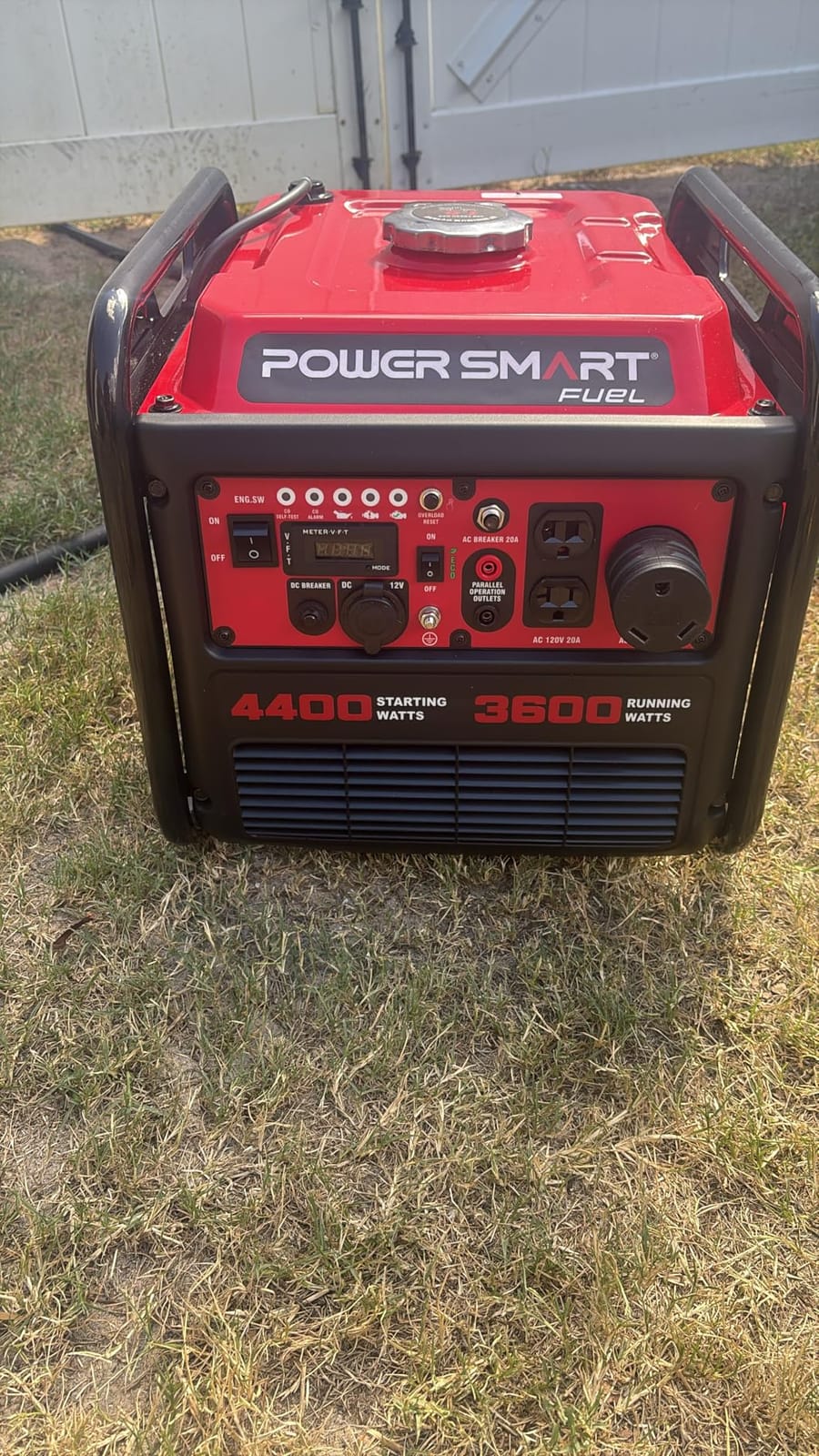
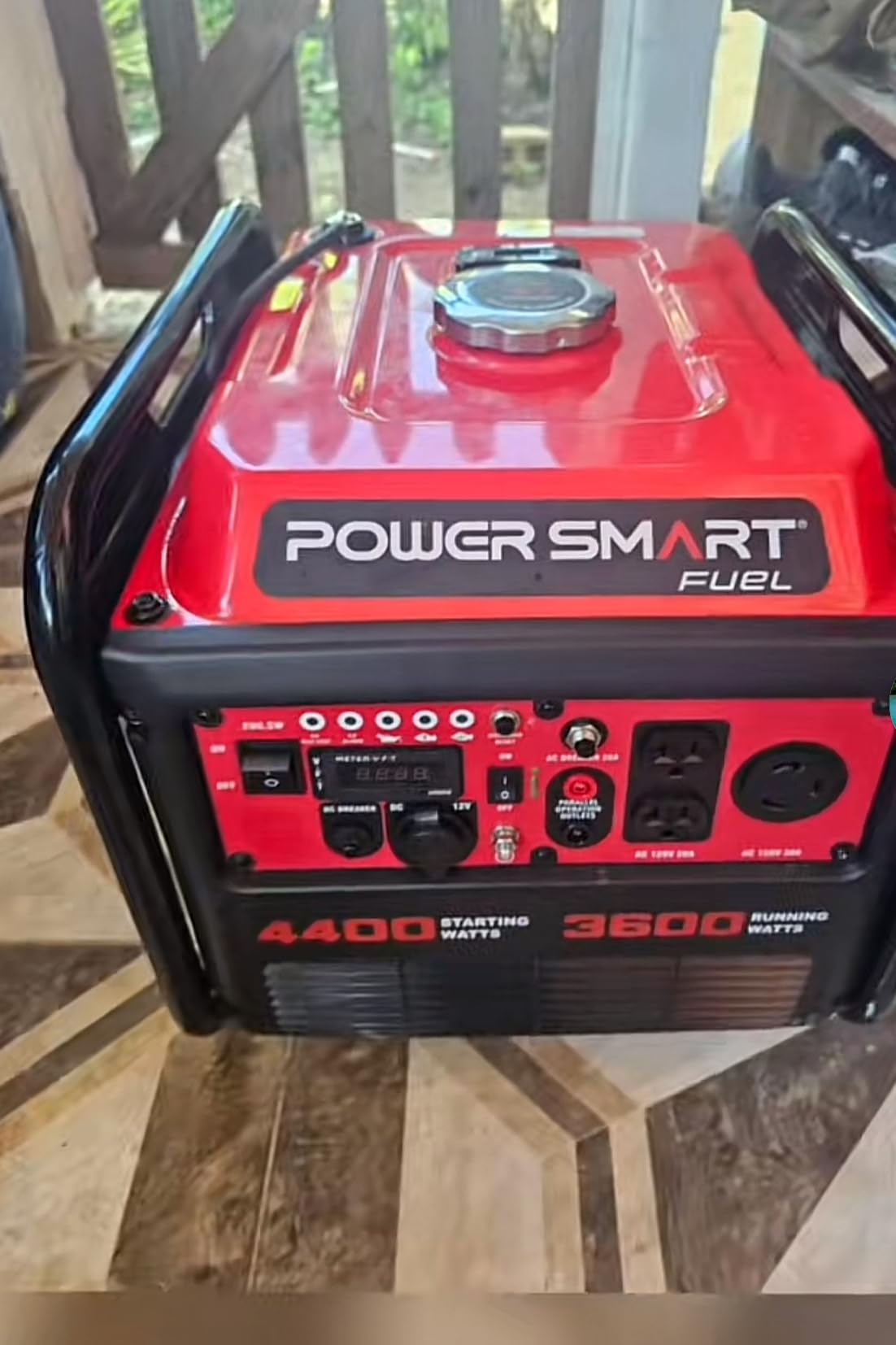
Now the honest part, and it is the reason this unit sits at the bottom of the list for a roundup about quiet. 76 dB at 23 feet under load is the highest rating here, and reviewers themselves note it is not quiet enough for close-proximity use beside a sleeping area. ECO mode is quieter, but the eco mode is also the mode where you are not running your air conditioner at full tilt.
At 68 pounds it is also heavier than most portable inverters in its class, and the 4.1 average rating reflects a meaningful share of complaints about weight and start-up or carburetor issues. It is a capable machine with a noise problem, and that problem is the one this article is about.
Where 76 dB is acceptable and where it is not
76 dB at 23 feet is acceptable for daytime use in a large open campground where you are away from neighbors and running a heavy load. It is a reasonable number for a work site where the generator is doing the work, not being slept beside.
It is not acceptable at a forested campground at 11 pm, at a national park site during quiet hours, or with the unit parked beside your own RV’s sleeping area. If your plan is to run an air conditioner overnight, the noise floor here is the deal-breaker, not the wattage.
Where the PowerSmart 4400 is the wrong choice
Wrong for light sleepers, wrong for small and quiet campsites, and wrong for anyone sensitive to noise. It is also the wrong pick at altitude, where derating on a 3600W running figure bites into an already modest headroom.
It is the wrong pick if propane matters to you, since this is gasoline only. And it is the wrong pick for anyone who intends to park it right next to the RV, which at 76 dB under load is an unpleasant place to be.
How Big a Quiet Generator Do You Actually Need?
Size to the largest single load you will run, not to the total of everything you own. The method is straightforward: list your appliances, find the running watts for each, add them together, and then check that single largest starting surge against the generator’s surge rating. If the largest appliance is the rooftop air conditioner, the surge number is the binding constraint, and everything else is arithmetic.
A worked example for a typical 30A travel trailer with a 13,500 BTU air conditioner. Running load: air conditioner roughly 1,200 watts, refrigerator compressor roughly 150 watts, a 20W LED circuit for lights, a 40W CPAP machine, and a 15W phone charger, which comes to about 1,425 watts. Largest surge: a refrigerator compressor can pull well over 1,000 watts at startup, and an air conditioner compressor can reach 2,000 to 3,000 watts momentarily. A generator with 1,800 running watts and 2,200 starting watts will not reliably start that air conditioner without a soft-start module. The same load on a 3,400 running watt unit with 3,800 starting watts handles it without help.
That gap is the entire sizing conversation, and it explains why we keep recommending more capacity than people think they need. r/CampingGear members make the same point about sub-2000 watt units: a Honda is the quietest and most efficient in that class, but a generator and a space heater together is probably not the answer anyone was hoping for.
Two more sizing inputs. First, the outlet. A 30A trailer needs a TT-30R or an L5-30R connection, and a 50A rig needs a 50A plug or two units in parallel. If your generator cannot physically connect, the wattage conversation is irrelevant. Second, altitude. Roughly 3 percent of output is lost per 1,000 feet of elevation, so a 3,000 watt unit in the Rockies at 8,000 feet behaves like a 2,280 watt unit at sea level. Mountain campers should size up accordingly.
If your power needs are home-scale rather than RV-scale, our guide to standby generators covers permanently installed systems, which are a different category entirely from anything portable.
Running an RV Air Conditioner on a Quiet Generator
A rooftop air conditioner compressor is the hardest thing you will ask a small inverter to do, and almost every sizing mistake we see traces back to it. The compressor draws modest running watts but a very large inrush at startup, often two to three times its running figure for a fraction of a second. On a 2,200W generator, that inrush is right at the edge of the surge rating, and whether it starts depends on temperature, fuel level, and load.
A soft-start kit is the fix, and it is the single most useful accessory in this entire article. An EasyStart-style module ramps the voltage to the compressor over several seconds instead of applying it instantly, which drops the inrush into a range a small inverter can handle. Several owners in the reviews run a 13,500 BTU Dometic unit on a WEN 56235i or a PowerSmart 2500 with an EasyStart module. Without one, the same setups trip the overload light.
Staggering loads is the free alternative. Start the air conditioner first and let it settle, then bring up the refrigerator, then the rest. iRV2 owners running two AC units on one generator report that a breaker trips only when both compressors cycle on close together, and spacing those cycles out is the difference between a stable evening and a reset.
There is also a sound point worth making plainly. iRV2 members note that once you are running A/C units, the generator brand stops mattering acoustically, because the compressor noise dominates. A quieter generator earns its premium in the hours around the A/C, not during it. That reframes the premium honestly: you are paying for quiet at 4 am when you are sitting outside with a coffee, and for a machine you can talk over.
One final caution, and it applies to every combustion unit here. Run it outdoors, with the exhaust pointed away from windows, vents, and awnings. Every unit in this roundup except the two power stations has automatic CO shutdown, and that is a safety net, not permission.
Gas, Propane, Dual-Fuel or Battery: Which Is Quietest?
Propane is not quieter than gasoline. Combustion noise comes from the engine, the exhaust, and the cooling fan, not the fuel. Dual-fuel versions of the same engine measure the same, and the common claim otherwise is a persistent myth. What propane genuinely changes is storage life, emissions, and runtime, not volume.
Gasoline gives you the widest selection and the lowest weight per watt. It is also the fuel that goes stale, needs a stabilizer over winter storage, and produces the exhaust you least want pointed at your campsite. Every gasoline unit in this roundup carries a fuel shutoff system that burns off the remaining fuel in the carburetor before shutdown, which protects the engine and reduces gum buildup over a long season.
Propane stores indefinitely, burns cleaner, and pairs naturally with the RV’s existing supply. The two dual-fuel units here, the Champion 4500 and the PowerSmart 3800, are the picks for anyone boondocking for more than a couple of nights. Expect to accept a small running-wattage penalty on propane, which is stated in the specs for both.
Battery power stations are the only genuinely silent option. No engine, no exhaust, no starting, and around 30 dB of inverter whine. The tradeoff is capacity and recharge time, which is why the workflow that works best is a generator for daytime load and batteries for the 10 pm to 7 am quiet window. iRV2 members describe exactly that schedule as the only real answer to overnight noise, and it is the reason we included two power stations in a roundup otherwise made of engines.
Whichever fuel you choose, remember the safety rule that overrides all of it: no combustion generator runs inside an RV, inside a tent, or under a canopy.
30 Amp vs 50 Amp RV: Matching the Outlet to Your Rig
RV-ready means one specific thing: a purpose-built 30 or 50 amp receptacle, so you can plug in with a single cable instead of an adapter. The three connection types you will meet are the NEMA TT-30R, the NEMA L5-30R twist-lock, and the 50A four-slot plug. A household 5-20 outlet is not RV-ready, however convenient it looks.
For a 30A rig, either a TT-30R or an L5-30R works, and the twist-lock is the more secure of the two under road vibration. The WEN 56380i and the Champion 4000 have the TT-30R built in; the PowerSmart 3800DF has the L5-30R; the AIVOLT ships a 30A adapter in the box. For a 50A rig, one small unit will not do it. Either step up to a 4500-watt dual-fuel model, or run two matched units in parallel.
Parallel kits are model-specific. Manufacturers build them for their own units, and the pairing is designed around matched inverter control electronics. Cross-brand parallel kits are not supported and can produce unstable output. If you think you might want to parallel later, buy a unit whose brand already has a parallel kit available, and buy two of the same model rather than two different ones.
Your rig’s amperage is the ceiling on everything else. A 30A trailer cannot draw more than 3,600 watts safely regardless of what you plug in, so a 4,000-watt generator on a 30A rig is about surge headroom, not extra usable capacity. Match the generator to the plug, and the plug to the rig.
Campground and National Park Noise Rules
The National Park Service standard is the benchmark most private campgrounds copy: sound must stay at or below 60 dB A-weighted measured at 50 feet, with quiet hours typically running from 10 pm to 6 am. Measuring at 50 feet is more forgiving than the 23 feet used on spec sheets, which is the main reason a compliant inverter is quieter than you might expect in a real campground.
Private campgrounds add their own rules on top, and many specify generator hours directly, often limiting daytime use to a window in the morning and evening rather than all day. Some sites ban generators entirely, some require a permit or a quiet-generator-only policy, and some restrict placement. Read the specific site rules before you arrive, because enforcement ranges from a friendly knock to eviction.
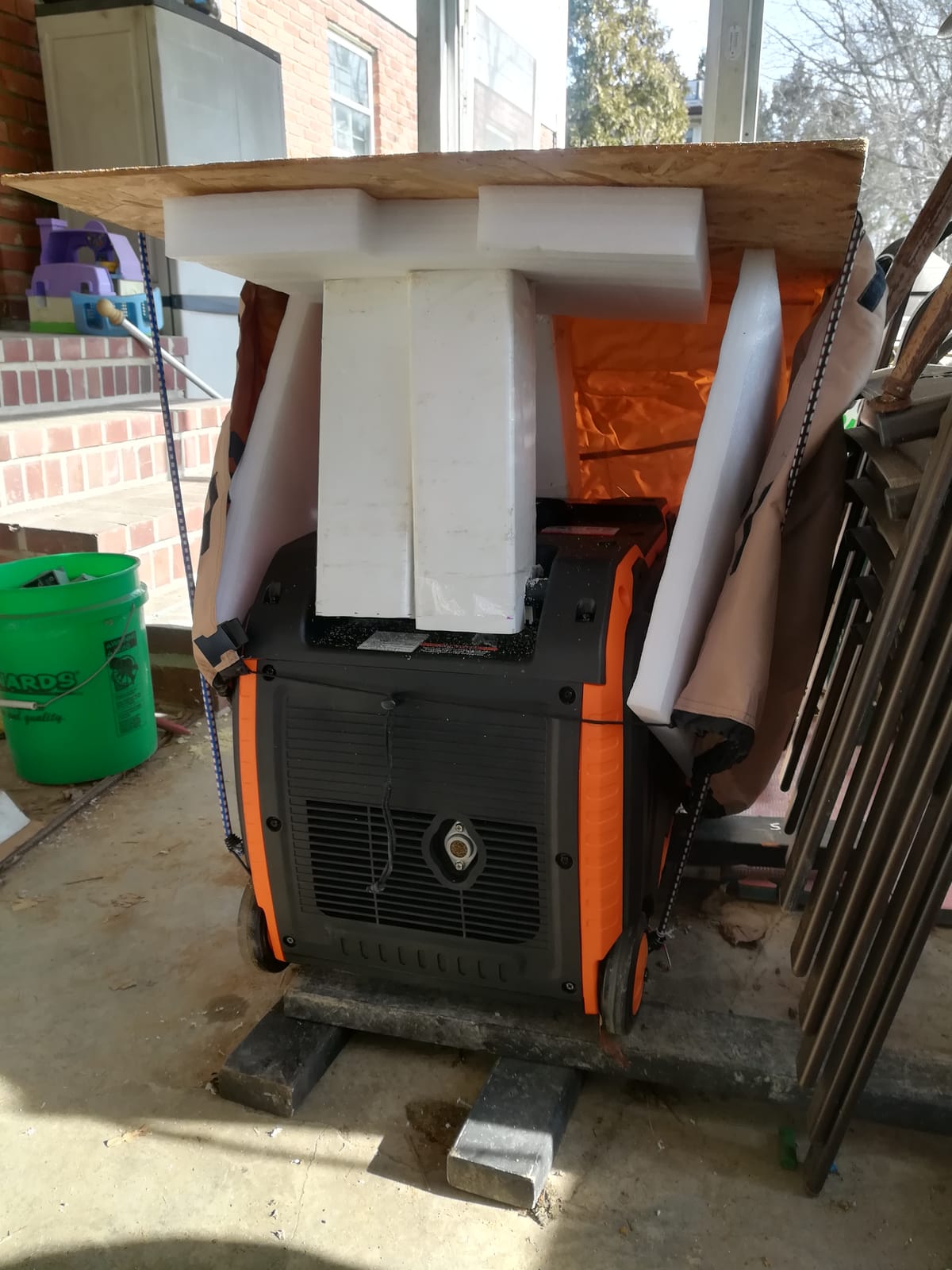
Placement matters more than most people expect. Point the exhaust away from neighboring rigs, doors, windows, and pop-tops, since the exhaust is both the loudest and the most dangerous part of the machine. Put the generator on the side of the RV opposite the sleeping area, and as far from your own site as your power cable allows. The sound-deflection idea some owners use, a plywood panel or the RV itself acting as a barrier, works because it blocks line-of-sight rather than reducing output.
On neighbor courtesy, the forum consensus is simple and worth following. Run the generator when you need it rather than continuously, keep it as far from the shared site line as practical, and shut it down during quiet hours unless you genuinely need power overnight. Several members pointed out that a generator running all night to keep a refrigerator cold is the fastest way to make enemies, and a power station handles that load silently.
One myth to drop: aftermarket mufflers and exhaust resonators. iRV2 members who tried them measured around 2 dB of improvement, and several manufacturers warn that modifications can void the warranty. If noise is the problem, change generators.
Altitude, Maintenance and Lifespan
Engines lose output with altitude because thin air means less oxygen for combustion. The working rule is roughly 3 percent of rated output per 1,000 feet, though the real figure varies by engine. A 3,000-watt generator at 8,000 feet is effectively running like a 2,280-watt unit at sea level, which is exactly how an air conditioner that ran fine at low elevation starts tripping breakers in the mountains.
If you camp at altitude, size for the elevation rather than for the trailhead, and expect longer starting times because a cold, thin-air engine pulls harder. Carbureted units need a jet change or an altitude kit to avoid running rich, which is a dealer job worth doing once rather than troubleshooting in a parking lot.
On maintenance, the schedule is simple and most units share it. Change the oil after the first 25 hours of operation, then every 50 to 100 hours or once a season. Check the air filter at the same intervals, and clean it rather than replacing it if it is merely dusty. Spark plugs are a once-a-season item on most four-stroke engines. The fuel shutoff carburetor design found on the WEN units, which burns off remaining fuel before shutdown, is the single best lifespan feature in this group.
For realistic expectations, fuel-runner longevity comes down to three things: oil change discipline, running with fresh fuel, and not storing a unit with old gasoline in the tank. Owners running Honda and Champion units report decade-plus service lives when the basics are kept. Expect considerably less from budget-brand units, where the rating distributions in our reviews show a heavier early-failure tail. If you keep a unit for seasonal use, run it dry or add stabilizer, and pull the fuel line if the manufacturer recommends it.
Finally, carbon monoxide. Every combustion unit here has automatic shutdown, and every one of them still belongs outside. The shutdown systems trip on concentration near the machine, not everywhere, which is why placement, exhaust direction, and distance from openings are the real controls.
One overlooked habit in all of that is keeping the storage bay itself clean. Fuel dust, sawdust, and damp insulation around a running engine are what shorten a unit’s life, and a quiet shop vacuum for the workshop keeps the compartment clear without waking the campground while you do it.
Frequently Asked Questions
How many dB is considered a quiet generator?
A quiet RV generator is rated at roughly 59 to 64 dB at 25 percent load, measured at 23 feet, which keeps it inside the 60 dB A-weighted limit most US campgrounds and national parks enforce at 50 feet. Anything under 65 dB is generally campsite-friendly, and above 70 dB will attract attention. Because the decibel scale is logarithmic, a 5 dB increase is roughly a doubling of sound energy, so load level matters as much as the published number.
What is the quietest generator for RV camping?
The quietest in this roundup is the Honda EU2200i, rated at 48-57 dB(A) at 23 feet with 1800 running watts and a 46.5-pound frame. Among the battery options, the EcoFlow DELTA 2 Max operates from about 30 dB because it has no engine at all. Forum owners on r/RVLiving consistently name the Honda 2200 inverter as the reference standard for quiet, reliable RV power, and an iRV2 moderator recommends the EU2200i directly if buying new.
What brand of generator is the quietest?
Honda and Yamaha have the strongest reputation for quiet, and the Honda EU2200i’s 48-57 dB(A) rating is the lowest published figure in this group. Among the brands compared here, Champion, WEN, PowerSmart, and Pulsar all publish ratings in the 59-64 dB range at low load. The honest answer is that a four-stroke inverter from any of these brands is a real improvement over an open-frame conventional unit, and the difference between the leaders is a matter of a few decibels rather than a different experience.
How big a quiet generator do I need for RV camping?
Size to the largest starting surge you will need, which is usually the rooftop air conditioner compressor. A 30A travel trailer with a 13500 BTU unit and a refrigerator typically needs 2500 to 3000 watts of starting capacity, so a 3000-4000 watt inverter is the practical range. A 50A rig with two air conditioners needs 4500 watts or two matched units in parallel. Add roughly 3 percent derating per 1000 feet if you camp at altitude.
Can a 2200W generator run an RV air conditioner?
Sometimes, with help. A 13,500 BTU compressor can pull 2000 to 3000 watts momentarily at startup, which is right at the edge of a 2200-watt surge rating. Several owners run one successfully using an EasyStart soft-start module, which ramps voltage to the compressor over several seconds and drops the inrush into a manageable range. Without a soft-start kit, expect the overload light to trip, especially in warm weather when the compressor is under the greatest load.
Are solar generators quiet enough for RV camping?
Yes, because they have no engine. A power station like the EcoFlow DELTA 2 Max operates from about 30 dB, which is essentially silent next to a running generator, and the Jackery Solar Generator 1000 v2 has a dedicated 30 dB overnight mode. The limitation is capacity rather than noise, since 1070 to 2048 watt-hours will run electronics, lighting, and a fridge but not a rooftop air conditioner. The common workflow is a generator for daytime load and batteries overnight.
Is propane quieter than gasoline for an RV generator?
No. Combustion noise comes from the engine, exhaust, and cooling fan rather than the fuel, so dual-fuel versions of the same engine measure the same in both modes. What propane genuinely changes is storage life, since it does not oxidize or spoil the way gasoline does, and runtime, with the dual-fuel units here running up to 21 to 24 hours on a 20 pound tank. Running wattage is typically slightly lower on propane.
Where should I place my generator at a campground?
Outdoors, as far from your sleeping area as the power cable allows, with the exhaust pointed away from doors, windows, awnings, and neighboring sites. Set it on the side of the RV opposite where you sleep, and use the RV itself as a sound barrier between the machine and your campsite. Never run any combustion generator inside an RV, inside a tent, or under a canopy, regardless of whether it has automatic CO shutdown.
Bottom Line: Which Quiet Generator Should You Buy?
The Honda EU2200i is the best quiet generator for RV camping overall, and it is the one we would put in a trailer without hesitation. Its 48-57 dB(A) rating, 46.5-pound weight, and CO-MINDER shutdown make it the reference that the rest of this market is measured against, and RV owners on iRV2 and r/RVLiving reach the same conclusion independently.
Buy the WEN 56380i if you run a rooftop air conditioner and want a native TT-30R outlet without an adapter. Buy the Champion 4000 if you want 4000 starting watts under 49 pounds. Buy the Champion 4500 dual fuel or the PowerSmart 3800DF if boondocking for days is the plan, and propane storage life matters. Start with a WEN 56235i or a PowerSmart 2500 if the rig is small and the budget is modest, and add a soft-start kit if you intend to run an air conditioner.
Whatever you pick, add a battery power station for the 10 pm to 7 am window. That pairing, a quiet inverter for the day and silent batteries at night, is the arrangement most experienced RVers converge on, and it solves the noise problem that bought you a quiet generator in the first place. Noise and availability specifications change between model years, so confirm the current figures on the manufacturer’s page before you order, and check your campground’s generator rules before you leave home.