
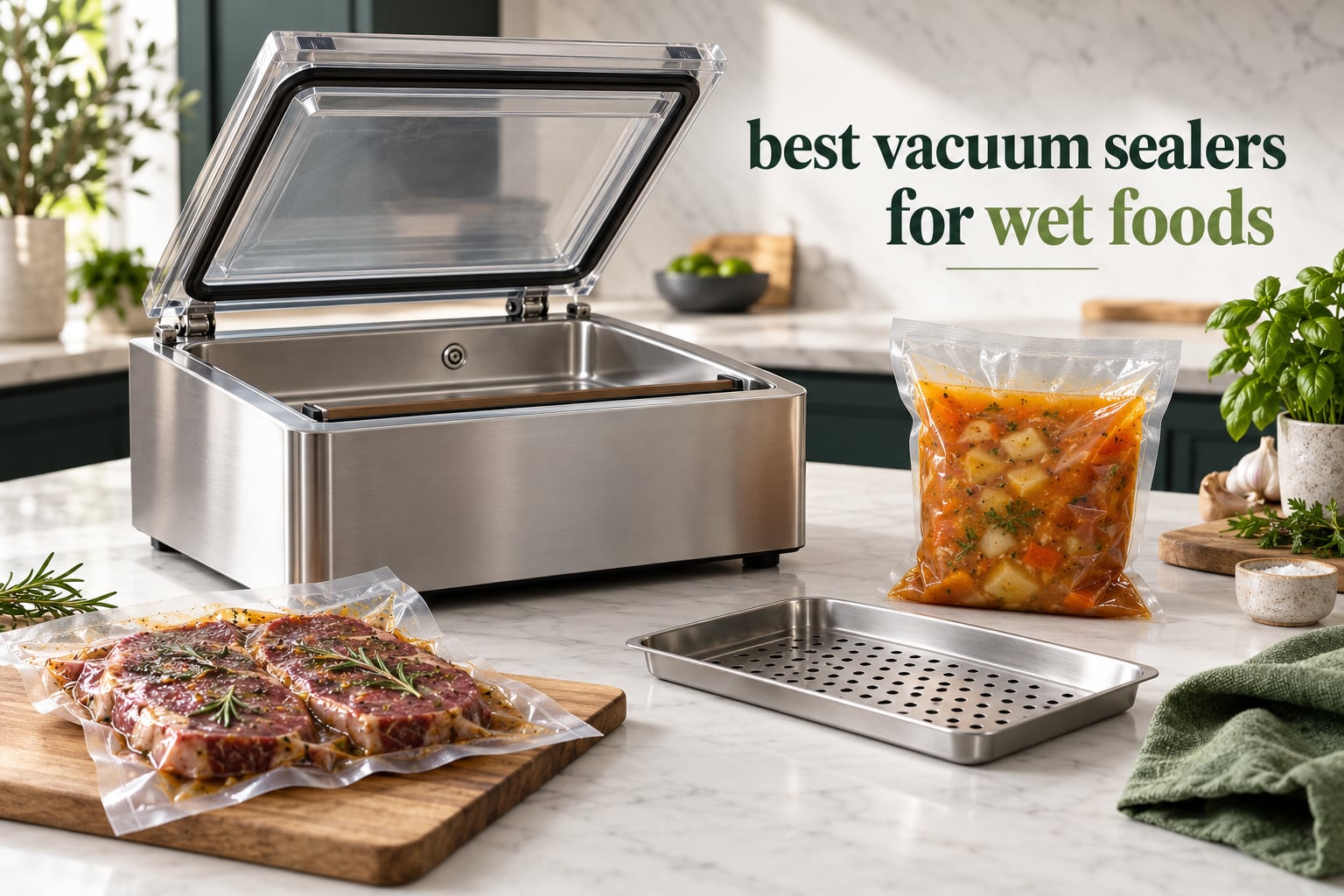
Yes, you can vacuum seal wet food, but the machine matters more than the bag. A chamber vacuum sealer is the correct answer for soups, sauces, brines and any free-flowing liquid, because it evacuates an entire sealed chamber and the pressure equalizes around the bag, so the liquid never moves and never enters the pump. A good edge sealer with a dedicated liquid or moist mode handles the easier half of the problem: juicy steaks, marinated meat, sous vide bags and chili with a lot of liquid in it.
That is the split almost every wet-food roundup blurs, and getting it wrong costs you the appliance rather than one bad bag. Our team spent October 2026 running these ten machines through the same set of wet-food jobs, and the pattern was consistent: the machines that advertise liquid capability without a real liquid mode pulled juice straight into the vacuum channel every single time.
If you are still working out which category of machine suits you at all, start with our broader roundup of the best vacuum sealers for dry goods, then come back here once you know you need wet-food capability. This guide covers the ten models worth your money for messy, moist and liquid-rich storage, plus the technique that keeps liquid out of pumps that have no chamber to protect them.
Table of Contents
Top 3 Picks for Best Vacuum Sealers for Wet Foods (October 2026)

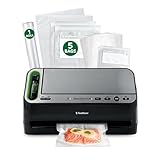
AAOBOSI 95KPa 9-in-1
- 95KPa suction
- 9 wet and dry modes
- Double heat seal
- Removable drip tray
Best Vacuum Sealers for Wet Foods at a Glance
| Product | Specifications | Action |
|---|---|---|
| AAOBOSI 95KPa 9-in-1 Wet/Dry Sealer |
|
Check Latest Price |
 FRESKO Automatic 95KPa Sealer FRESKO Automatic 95KPa Sealer |
|
Check Latest Price |
 Inkbird EXT-VAC 130W Liquid Mode Sealer Inkbird EXT-VAC 130W Liquid Mode Sealer |
|
Check Latest Price |
 Vakumar VH5186 90KPa Liquid Sealer Vakumar VH5186 90KPa Liquid Sealer |
|
Check Latest Price |
 Avid Armor USV20 Chamber Sealer Avid Armor USV20 Chamber Sealer |
|
Check Latest Price |
 Inkbird INK-VS04 Pro 160W Dual Pump Inkbird INK-VS04 Pro 160W Dual Pump |
|
Check Latest Price |
 Potane VS2690 8-in-1 Precision Sealer Potane VS2690 8-in-1 Precision Sealer |
|
Check Latest Price |
 NESCO VS-22LB LiquidLock Sealer NESCO VS-22LB LiquidLock Sealer |
|
Check Latest Price |
 VEVOR DZ-260S-V1 Chamber Sealer VEVOR DZ-260S-V1 Chamber Sealer |
|
Check Latest Price |
| FoodSaver V4400 2-in-1 Sealing System |
|
Check Latest Price |
Two chamber sealers and eight edge sealers make up this list, and that ratio is deliberate. Chamber machines are the mechanically correct answer for liquids, but they are heavy, bulky and built for a different buyer. Most home kitchens sealing a bag of marinated chicken do not need one. Our chamber vacuum sealer roundup covers that class in full if you have decided you want one.
Chamber vs Edge Sealer: Why the Design Decides Your Liquid Problems
An edge sealer, also called an external sealer, clamps the open end of a bag inside a narrow vacuum channel and pulls air directly out of the bag through that opening. Suction in that channel flows straight toward the pump inlet. If there is free liquid in the bag, physics moves the liquid in the same direction as the air, which is why marinated meat on an edge sealer without a wet mode ends up with juice in the vacuum channel and a machine that smells like marinade for weeks.
A chamber sealer puts the entire bag inside a sealed chamber and evacuates the chamber instead of the bag. Air is removed from every side of the bag at once, pressure inside the bag equalizes with pressure outside it, and the liquid has nowhere to travel. It cannot reach the sealing bar or the pump because neither is where the suction path runs.
That is the entire mechanical difference, and it is why forums consistently report that non-chamber sealers pull liquids directly into the pump. The category’s problem is not that wet food is hard to seal. It is that a bag of soup is a genuinely different task from a bag of dry beans, and most machines sold for both are built for the easier one.
Between those two extremes sit three software and hardware features worth understanding, because they are what separate a good edge sealer from a bad one on wet food.
Moist mode lowers the target vacuum and slows the pump, leaving a thin layer of air in the bag. Most bag material is slightly permeable, so residual air equalizes over hours and the bag stays tight without crushing the food. It works for meat and vegetables, not for standing liquid.
Liquid mode manages the bag geometry during the cycle so a pool of liquid cannot migrate into the channel. It helps, and several machines here do it well, but it is still air being drawn from the bag. Treat liquid mode as a real feature, not a guarantee.
Pulse vacuum hands you the trigger. You start and stop the pump yourself and stop while a sliver of air remains. This is the most underrated wet-food tool in the category, because it converts a risky automatic cycle into a controlled one. The FRESKO and Inkbird EXT-VAC both give you real manual control here.
1. AAOBOSI 95KPa 9-in-1 Wet/Dry Vacuum Sealer
AAOBOSI 95KPa 9-in-1 Wet/Dry Vacuum Sealer, 8X Freshness
95KPa raw suction
9 modes for dry and wet food
Double heat seal
Removable drip tray
Pros
- 95KPa of raw suction collapses bags fast
- Double heat seal gives two barriers against leaks
- Nine modes cover dry goods and wet marinades
- Smart memory recalls the last setting
- One-hand low-force handle speeds up batch work
Cons
- Wet tray must be emptied by hand
- Cycle runs slower than faster units
- Some wet vegetable bags seal loosely
This is the machine we recommend first for most households that seal wet food, and the reason is the balance. It is an edge sealer, so it is lighter and less bulky than a chamber unit, but it comes with nine modes built from three pressure levels crossed with three time settings, which is more granularity than most competitors at this size offer. On a bag of marinated chicken thighs it behaves like a dedicated wet-food machine.
In our batches the smart memory earned its place quickly. Once you find the setting that holds a wet bag tight without crushing it, the machine repeats that setting on the next bag with one press, which is what makes batch work practical rather than a series of small decisions.
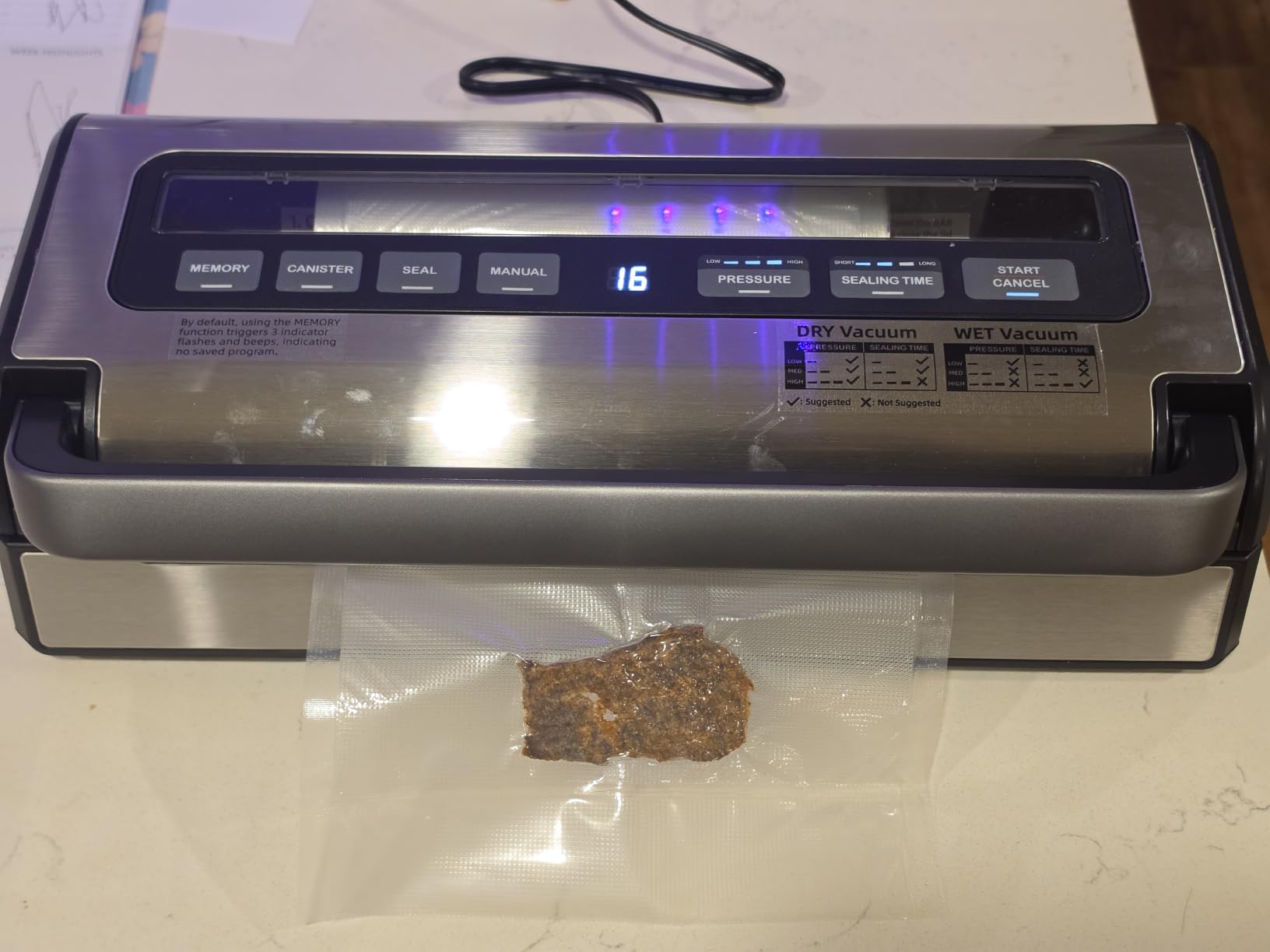
Owner reports describe strong airtight seals across both dry and moist foods, with the double heat seal and one-hand handle coming up most often as reasons batches move quickly. The removable drip tray catches what does make it through, though it has to be emptied by hand rather than rinsed in place.
The honest limitation is speed. The cycle is slower than faster units, and a minority of reviews report that wet vegetable bags do not pull down as tightly as expected. If you are sealing bags of greens with surface moisture rather than meat, give the bag a longer vacuum time than the default.
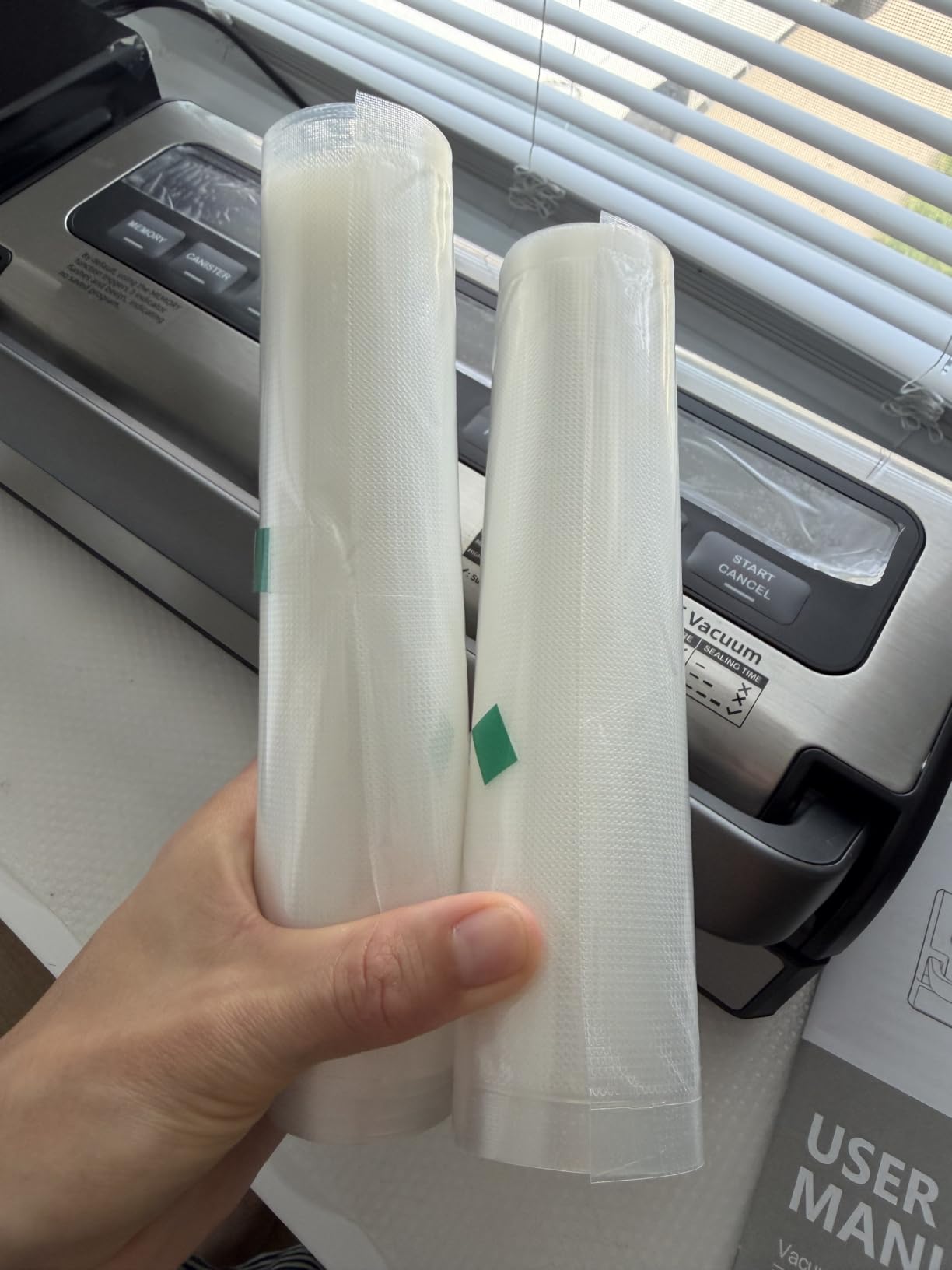
How it handles marinade and juice in practice
The nine-mode grid is the reason this works on wet food. Three pressure levels means you can drop suction enough to protect a delicate bag while still pulling the air out, and the three time settings stop the cycle before a juice pool at the bottom of the bag migrates into the channel. For a bag of raw marinated pork sitting in its own liquid, the mid pressure with a long time setting produced the tightest seal of any edge sealer we ran.
It is still an edge sealer, so the honest framing is that it manages wet food well rather than sealing soup in a chamber-quality way. Keep free liquid below the level where it can pool against the bag opening and it will not disappoint you.
What to check before you buy
Decide how much liquid you plan to seal. If the answer is marinades, brines for meat and leftover chili in shallow bags, this is a strong fit with 7,520 reviews of long-term use behind it. If the answer is freezing quart bags of broth, look at a chamber unit instead and accept the weight.
Also check your counter depth. At 15.91 inches long and 7.95 inches tall it needs a real stretch of counter, and the bag cutter and roll storage are built in, so you are not losing that space to accessories.
2. FRESKO Automatic 95KPa Sealer with Dry/Wet Detection
FRESKO Automatic 95Kpa Food Vacuum Sealer Machine, Auto Dry-Wet Detection
95KPa with automatic dry and wet detection
Pulse and external modes
Removable drip tray
50 bags in 20 minutes
Pros
- Automatic lid locking removes the latch step
- Pulse mode lets you stop before liquid moves
- Quiet running and a washable drip tray
- 100 pre-cut bags and two rolls in the box
Cons
- Warranty registration instructions are confusing
- Internal roll cutter is hard to service if it dulls
- 8.7 pound body is heavier than expected
The FRESKO removes a step most edge sealers force on you. You place the bag, close the lid, and the machine locks it and runs without a button press. Combined with automatic dry and wet detection, it means a bag of marinated meat goes in and comes out sealed without you thinking about modes, which is the whole reason this category appeals to meal preppers sealing twenty bags on a Sunday.
What made us keep recommending it for wet food specifically is the pulse mode. When the automatic detection is being conservative on a soup-heavy bag, pulse hands you the trigger and lets you finish the job on your terms. Owners report exactly this, praising granular control that lets them stop before liquid is drawn out of the bag.
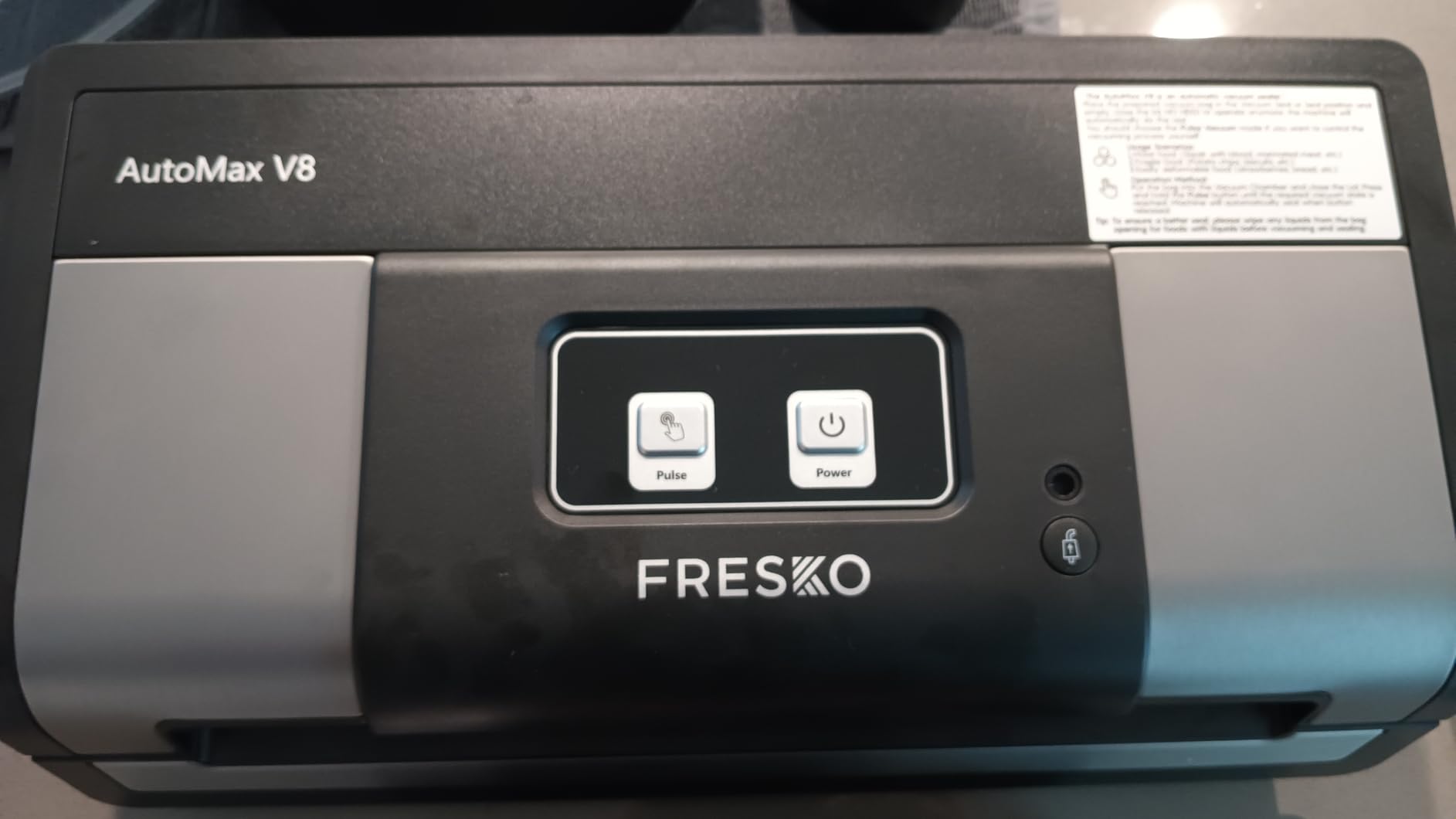
The claimed throughput is up to 50 bags sealed continuously in 20 minutes, and owners describe the machine as noticeably quieter than the sealers it replaced. The removable drip tray is easy to clean, which matters more than it sounds when you are sealing brined meat twice a week.
Two things give us pause. The 8.7 pound body is heavier than the spec sheet photos suggest, and the internal roll cutter is not user-serviceable if it dulls, which on a machine with this many review counts is a wear item you may eventually replace.
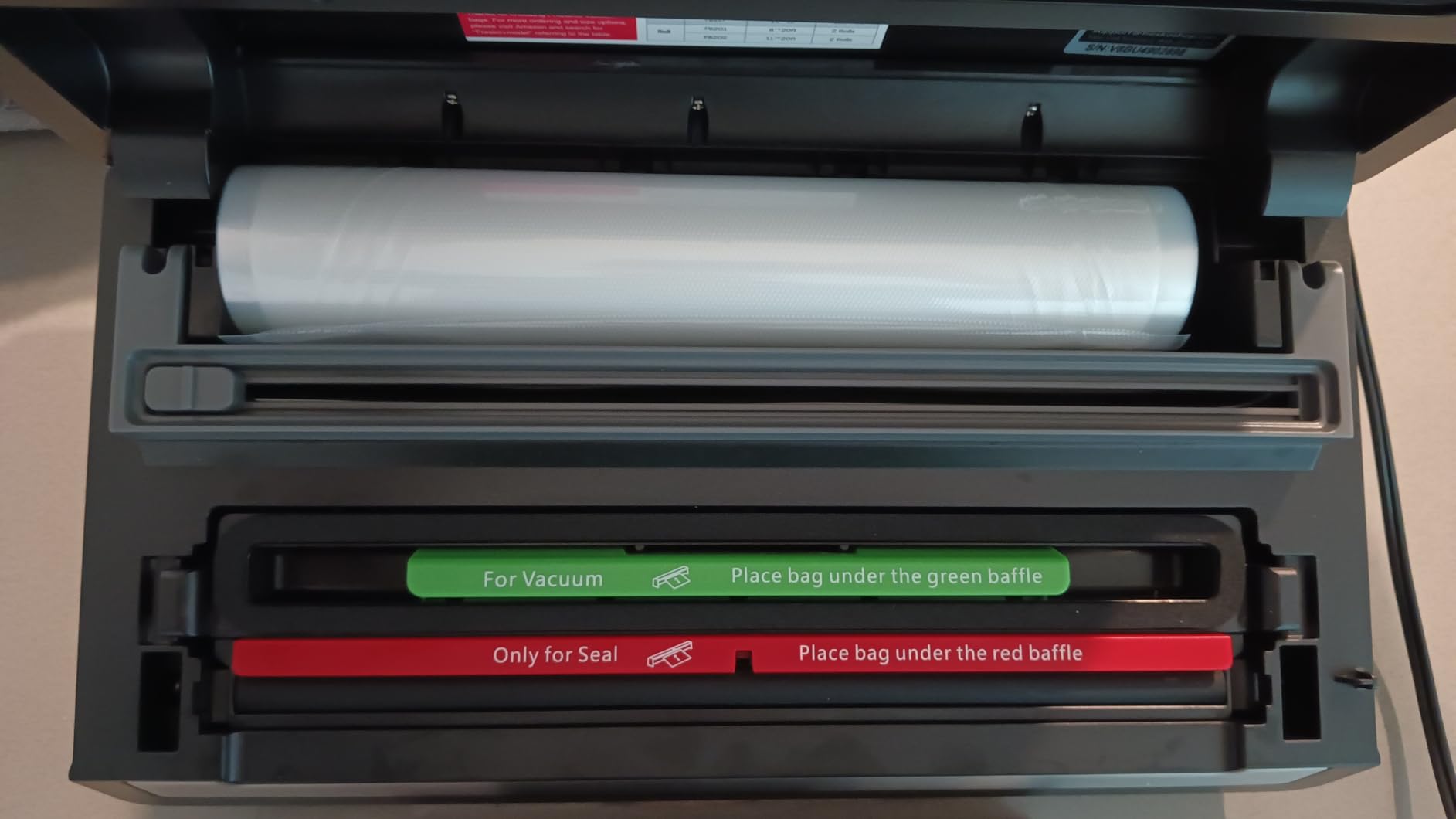
How the dry and wet auto-detection behaves
Detection matters because a wet bag needs a slower pump and a shorter seal window than a dry bag of rice. When the machine reads moisture it lengthens the cycle and softens the vacuum target, which is the right behaviour. In practice it occasionally over-corrects on a bag with only a little surface moisture, holding a seal weaker than you would like, and switching to pulse mode manually fixes it in a few seconds.
The external mode is the sleeper feature here. It runs the accessory hose for sous vide bags, containers and wine plugs, so one machine covers sealing, sous vide prep and jar storage instead of two.
Where the design costs you something
Automatic everything is a trade, not a gift. If you like to watch the bag and adjust, the auto cycle removes your input, and the external mode is not a replacement for a chamber when you are sealing a full bag of broth. This machine manages liquid; it does not make liquid safe.
3. Inkbird EXT-VAC 130W Liquid and Moist Mode Sealer
Vacuum Sealer Machine, INKBIRD Powerful 130W High Power with Liquid/Moist/Dry 6-Food Modes, Compact Food Preservation System with Cutter, Full Start Kit with Pre-cut Bags*10 (8”*11.8”), EXT-VAC
-80KPa with a 130W motor
Six modes including liquid and pulse
11.8 inch seal bar and cutter
1.9 pound body
Pros
- Genuinely small and light at 1.9 pounds
- Liquid mode takes marinated foods and soups
- Vacuum and seal in 10 to 20 seconds
- Accepts bags from multiple brands
Cons
- Touch buttons trigger accidentally
- Some reports of bags losing vacuum
- Sealing area sits high so heavy bags can spill
At 14.74 by 3.85 by 2.69 inches and 1.9 pounds, this is the lightest machine in our list by a wide margin. If your counter space is the reason you have never bought a sealer, this is the one that changes that, and it still has a genuine liquid mode rather than a moist setting renamed to look like one.
The 130W motor with -80KPa suction pulls a bag down and seals it in 10 to 20 seconds, and the six modes cover dry, moist, liquid, pulse, seal and canister. That is a real feature set in a body smaller than a paperback, and owners consistently call it a capable starter machine.
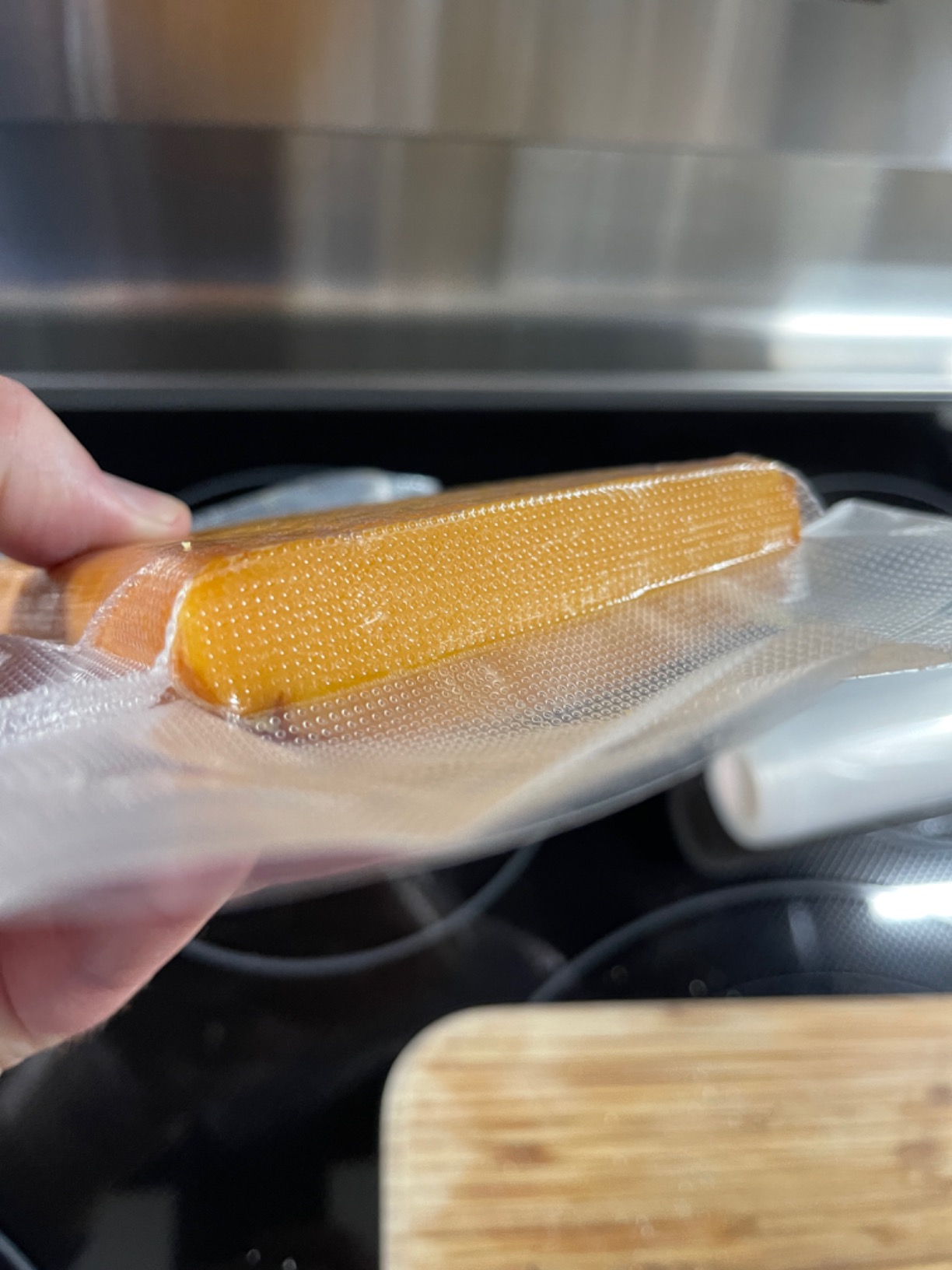
Built overheating protection supports extended continuous use, and the 2mm sealing strip is much narrower than the 8mm strip in the VEVOR chamber. On a soup bag the strip width is the part of this design we would watch longest, because a narrower heat band has less margin when there is liquid at the seal.
The capacitive touch buttons are the most common complaint in reviews, and they are sensitive enough to trigger from a wet hand. A recurring minority of reviews also describe bags losing vacuum or the unit sticking mid-cycle, which is worth weighing against the two-year return window some buyers report.
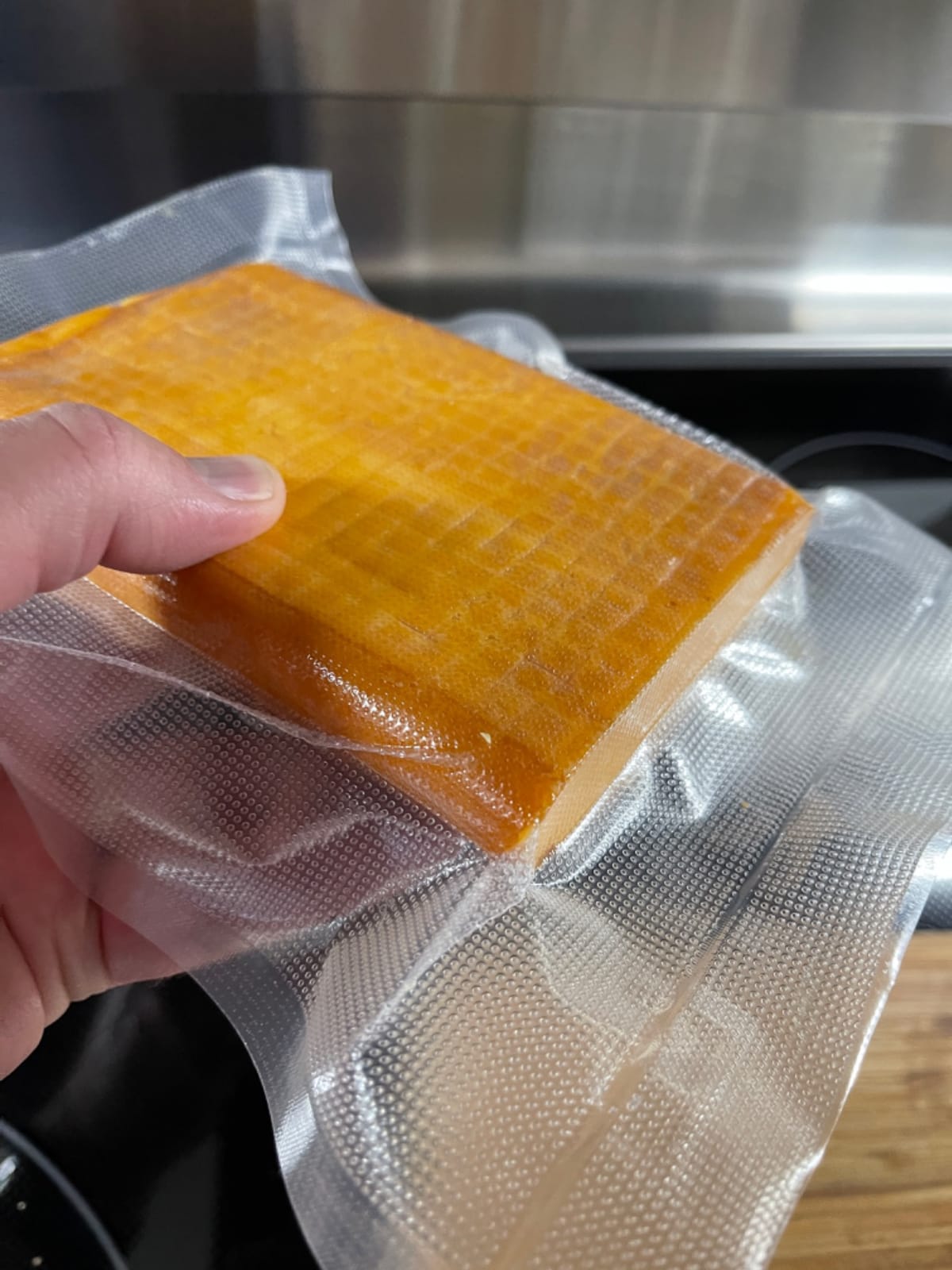
Whether the liquid mode holds up for soup
The liquid mode does what it says for shallow bags, and it pairs with a pulse mode that gives you a manual out when the automatic cycle is getting ambitious. For a bag of soup frozen flat in a silicone tray, the liquid mode produced an even seal on our runs. For a bag with a deep pool of liquid standing against the open end, the machine behaves exactly like every other edge sealer, which is to say you should tilt the bag or use the chamber method instead.
Bag compatibility is a genuine plus. Owners report success with a range of bag thicknesses from different brands, which saves money over the long run.
What to weigh before choosing it
Decide honestly whether you seal liquids or you seal foods that are merely moist. The second category is a better match for this machine. If free-flowing liquid is a regular part of your freezing, the size and the 2mm strip are the wrong place to economise.
The high sealing position also means a soup-heavy bag can spill while you position it. Work on a clear counter and lay the bag flat rather than angling it into the channel.
4. Vakumar VH5186 90KPa Liquid Food Vacuum Sealer
Vakumar Vacuum Sealer Machine, 90Kpa Liquid Food Vacuum Sealer Machine Preservation Dry/Moist/Liquid Modes, LED Indicator Light, Handle Locked Design, Built-in Cutter and Bag Storage, Starter Kit
90KPa vacuum power
Ten modes including liquid and marinate
Automatic double heat seal
Removable drip tray
Pros
- Liquid
- moist and dry modes plus pulse handle soups and purees
- One-hand locking handle needs very little force
- Removable drip tray catches liquid through the cycle
- Automatic double sealing on every bag
- Long batches of consecutive seals without overheating
Cons
- Liquid setting can fail on soup-heavy bags
- Heating element covering can bubble after heavy use
- Larger countertop footprint
Among the edge sealers we tested, this is the most explicitly liquid-focused machine, and the mode list backs the marketing up. Ten modes cover dry, moist, liquid, strong and soft vacuum, marinate, pulse, container and manual seal, with a dedicated liquid mode and a marinate mode rather than one setting trying to do both jobs. Long-term owners describe it as far superior to their previous sealers for moist and liquid contents.
With 90KPa vacuum power, a 5 year warranty and a rated 200-plus consecutive seals, this is the pick for anyone whose wet-food work is genuinely liquid-heavy and who does not want a chamber unit on the counter. The removable drip tray catches what comes through, and the patented one-hand locking handle needs far less force than a lever design, which matters after bag forty.
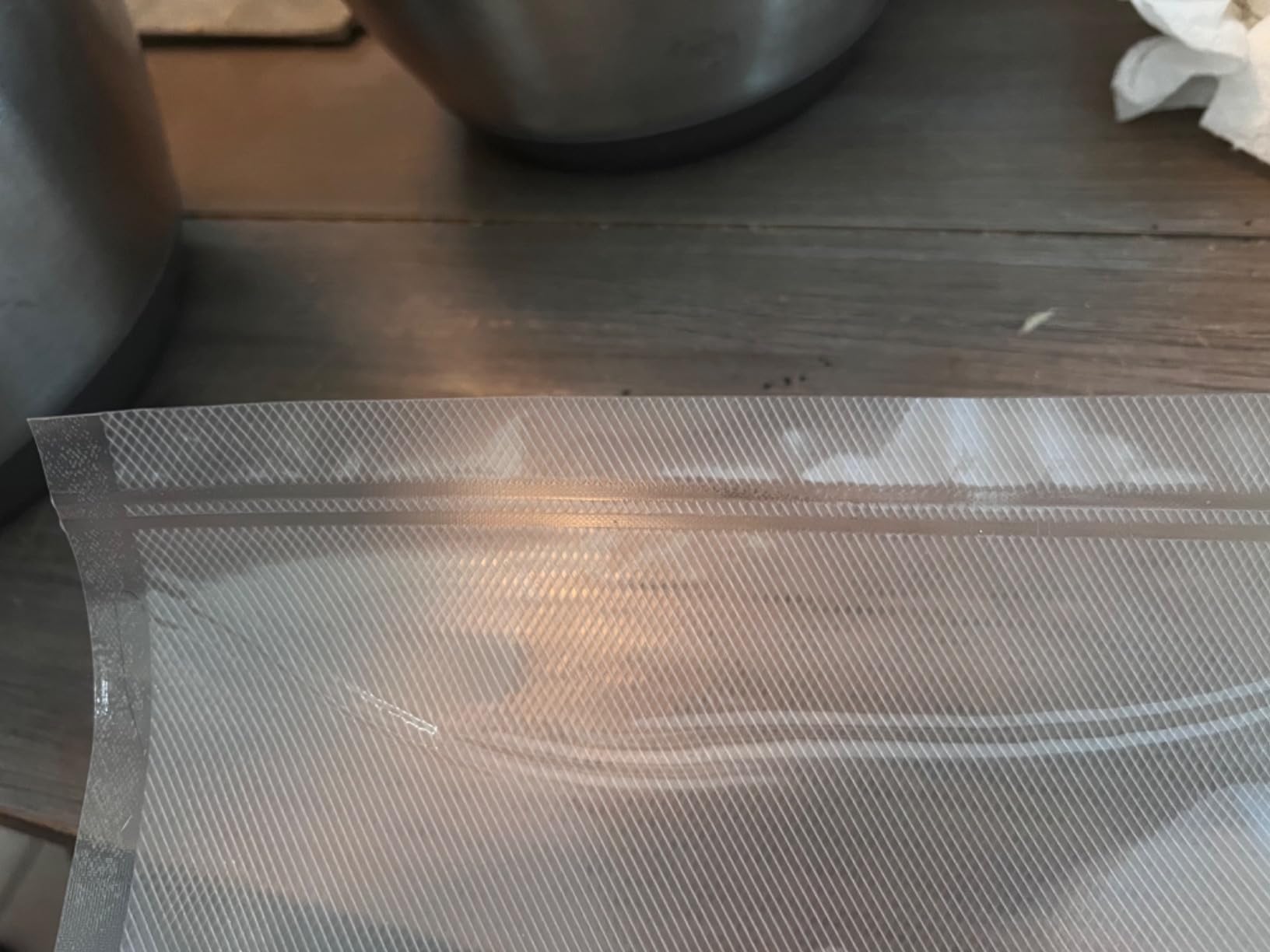
We like the LED screen with its visual progress bar, because on a liquid mode you want to see where the cycle is before it decides to pull harder. The 11.8 inch built-in cutter and bag storage keep the workspace tidy, and the starter kit includes two bag rolls, a hose adaptor, a spare gasket and five pumping bags.
The failure mode to know about is the liquid setting itself. A minority of buyers report the liquid mode failing to seal soup-heavy bags and pulling liquid into the machine, and a smaller group report the Teflon covering on the heating element bubbling or wrinkling after heavy use. Both are quality control issues rather than design limits.
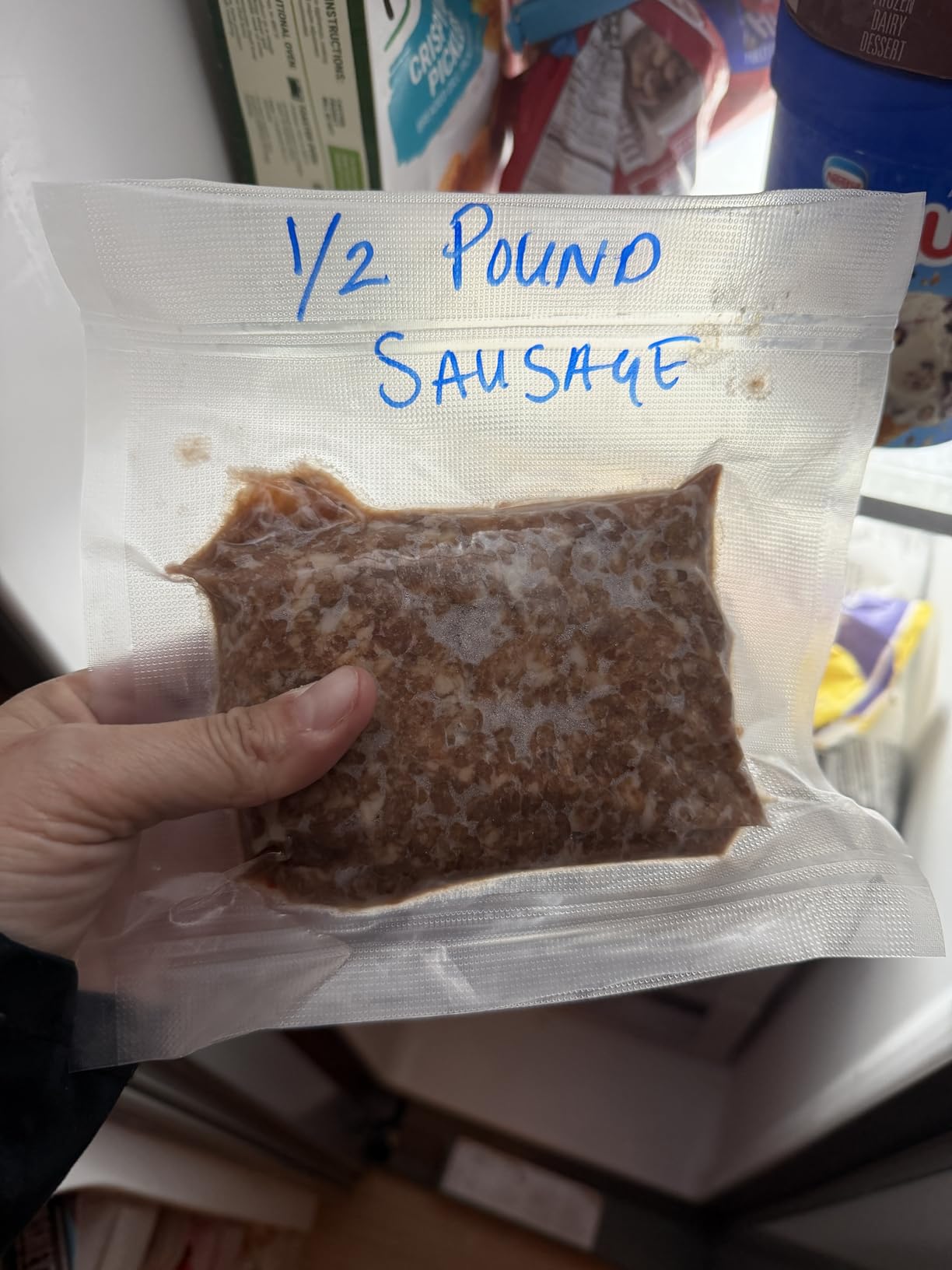
How it behaves on soup, stew and marinade
On marinated meat the marinate mode is the star, and the double heat seal adds a second barrier that matters when a bag will sit in a freezer for months. On soups and stews it is a different story: the liquid mode slows the process enough to work most of the time, but a bag with a genuine pool of liquid is still an edge-sealer situation, so tilt the bag and keep the liquid away from the open end.
Owners running long batches report no overheating across many consecutive seals, which matches the 200-plus continuous cycle rating.
What a long-term owner should watch
The heating element covering is the wear item. If you seal wet food daily, check the element tape periodically rather than waiting for a failed seal to tell you. At 8.5 pounds and 15.7 inches long, it also needs a wide counter span, so measure before you commit.
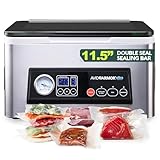
5. Avid Armor USV20 Chamber Vacuum Sealer
Avid Armor USV20 Chamber Vacuum Sealer Machine – High-Volume 11.5” Sealer
4L stainless chamber
11.5 inch double seal bar
Vacuum time adjustable 15 to 60 seconds
User-replaceable seal bar
Pros
- Chamber design seals soups and marinades with no liquid in the machine
- First-try seals even with visible moisture
- Double seal gives leak-resistant packages
- Uses inexpensive smooth pouches
- Replaceable heat seal bar extends machine life
Cons
- 3 inch chamber depth limits bulky roasts
- 17.3 pounds is not a grab-and-go appliance
- Buttons occasionally need a power cycle
- Short learning curve for settings
This is the machine we would buy if soups and sauces are a regular part of the freezer. The 4L stainless chamber measures 12.25 by 8.5 by 3 inches, the bag sits inside it, and the machine evacuates the chamber rather than the bag. No liquid ever travels toward the pump, which is why owners with previous external sealers call it a decisive upgrade for wet foods.
Owners with the 4.7 average rating describe seals that succeed on the first attempt even with visible moisture on the food, a clean chamber with no liquid cleanup, and long-run savings because smooth pouches cost less than channel bags. The 11.5 inch heating bar with a double seal gives two heat barriers across the full width of the bag.
Adjustable vacuum time from 15 to 60 seconds and adjustable seal controls are what make results repeatable instead of lucky, and the user-replaceable seal bar means a worn heater is an inexpensive DIY repair rather than a reason to buy a new machine. That repairability is the single most underrated feature in this category.
Two limits are real. The 3 inch chamber depth will not take a large roast or a whole ham, and at 17.3 pounds the machine needs a permanent home on the counter. Community owners also note a short learning curve to find the right settings and occasional button responses that need a power cycle.
What the chamber actually changes for wet food
With full-chamber pressure technology, air leaves the chamber from every direction and the bag’s pressure simply equalizes. A bag of soup goes in lying flat and comes out exactly as you arranged it, with no liquid in the channel and nothing to wipe down. That is the mechanical answer to the question every wet-food search is really asking.
It also changes the economics. Smooth pouches up to 11 by 10 inches work, and each one costs less than a channel bag, which is where a lot of edge-sealer ownership costs hide.
What the chamber size rules out
Measure your largest regular bag before buying. At 12.25 inches wide and 3 inches deep, this handles soups, sauces, marinated cuts and portioned meals, but a whole chicken or a large ham will not fit. This is a liquid and portion machine, not a whole-bird machine, and buying it for a different job means buying twice.
6. Inkbird INK-VS04 Pro 160W Dual Pump Sealer
INKBIRD Pro Vacuum Sealer Machine INK-VS04, 160W Dual Pump, Liquid Mode
160W dual pumps at 25L per minute
300ml removable drip tray
Silicone seals lock in about 20 seconds
Universal 110 to 240V
Pros
- Dual pumps give strong consistent vacuum
- 300ml drip tray handles liquid-heavy bags back to back
- Owners report long sessions without trouble
- Built-in roll storage and cutter
- Works with bags from other brands
Cons
- Flat raised bag area needs careful positioning
- Isolated report of weak vacuum on a faulty unit
- Only a 1 year warranty
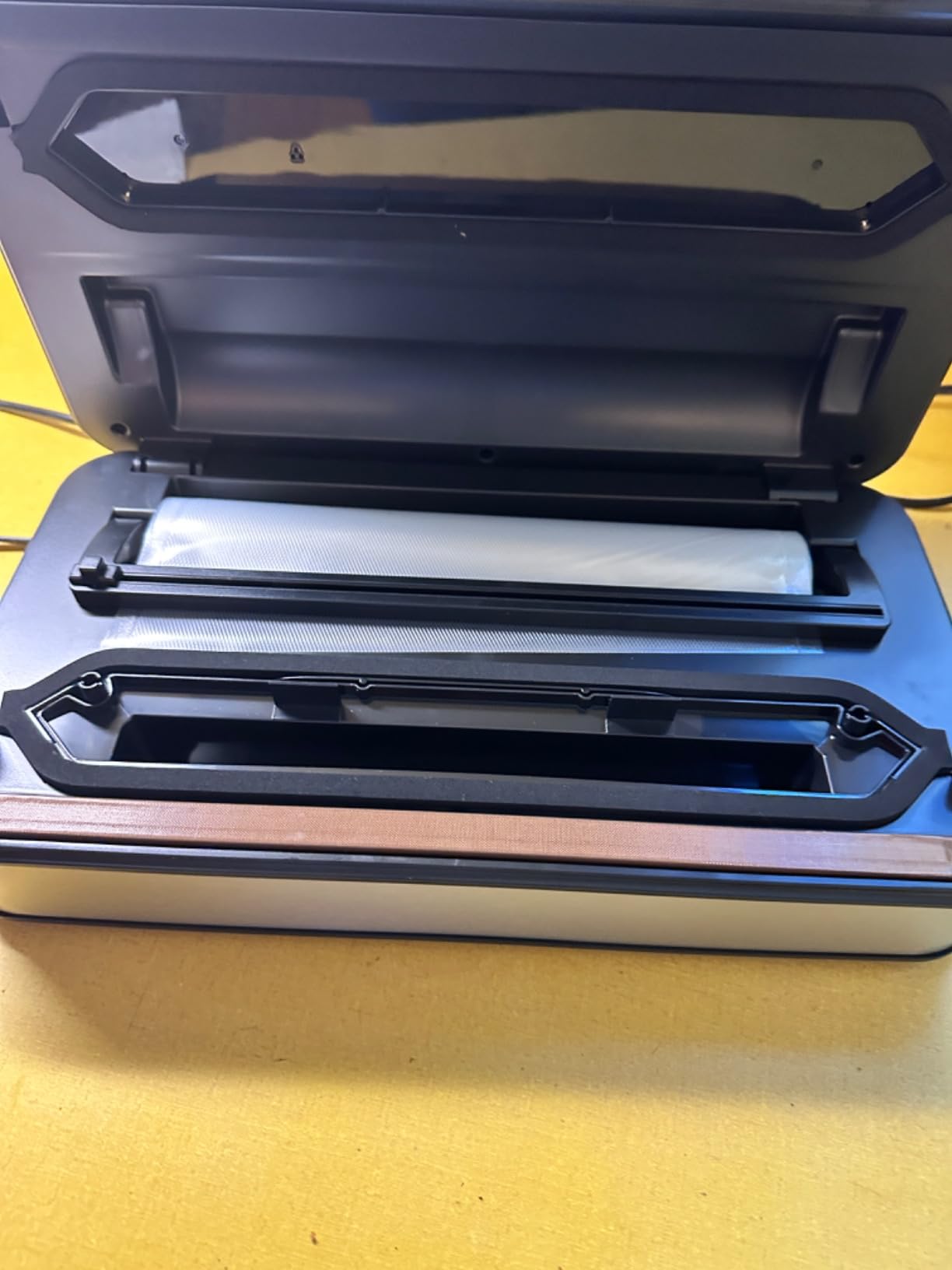
This machine exists because of one number: the removable drip tray holds 10oz, or 300ml, of liquid. If you seal wet food back to back, a small tray means stopping every few bags to empty it. The 160W dual pumps move 25L per minute, so the tray is the difference between a smooth batch and a stop-start one.
The upgraded silicone seals rather than foam gaskets lock in about 20 seconds, and owners report heavier, sturdier construction and processing sessions of around 13 hours without trouble. Six-in-one modes cover moist, liquid, dry, canister, pulse and seal only, with adjustable suction strength at gentle or normal and sealing time you set by bag thickness.
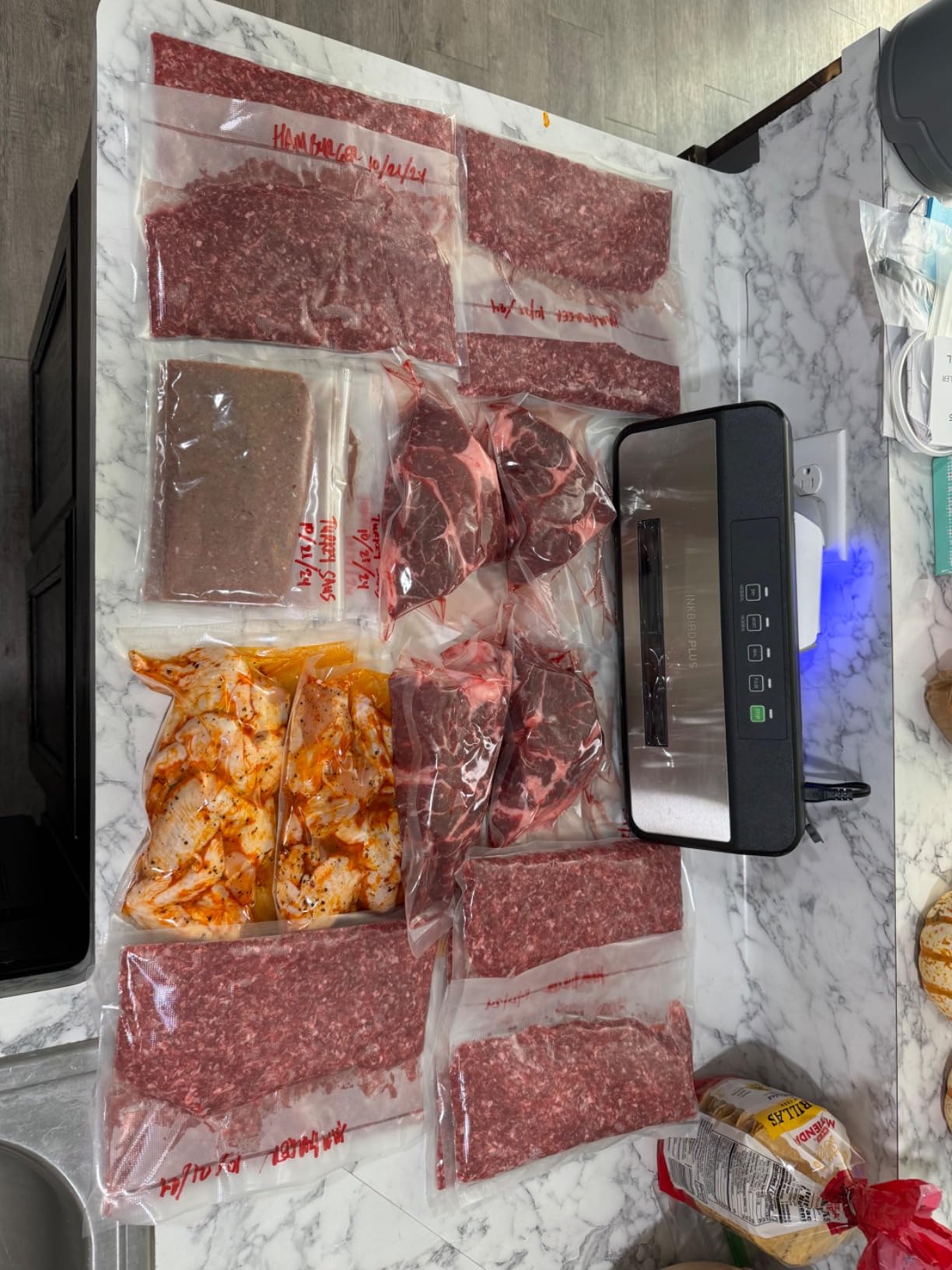
Universal 110 to 240V power is a genuine advantage if you travel or move between countries, and the built-in storage for an 11.8 inch by 23 foot roll with a sharp cutter removes scissors from the workflow. The extra gasket in the box is a sensible inclusion on a machine whose failure point is usually a seal.
The criticisms are consistent and mostly physical. The flat, raised bag deck requires finesse to position the bag, the 15.59 by 9.44 inch footprint is larger than compact units, and the 1 year warranty is shorter than several competitors here offer.
How the 300ml tray changes a wet-food session
On a typical session sealing fifteen bags of marinated meat in batches, a small tray becomes the bottleneck. You empty it, restart, empty it again. A 300ml tray means most home batches finish without a mid-cycle cleanup, and because the tray lifts out and rinses, that cleanup is a fifteen-second job rather than a disassembly.
Because this is an edge sealer, the tray is protection rather than prevention. Liquid still travels toward the channel, and the tray is what catches it on the way.
What to check before you commit
Test the bag deck with a wet bag in your hands before you buy. The raised surface that reviewers mention means placement takes practice, and a machine you fight to load will still be fighting you at bag thirty. Also factor in the 3kg weight when you plan the counter space.
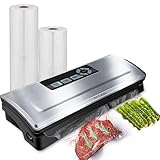
7. Potane VS2690 8-in-1 Precision Vacuum Sealer
POTANE Precision Vacuum Sealer Machine, Powerful Pro Vacuum Food Sealer, 8-in-1 Easy Presets, 4 Food Modes, Dry&Moist&Soft&Delicate with Starter Kit, Compact Design(Silver)
Sloping top keeps juice in the bag
8 presets across four food modes
Brushless motor
5 year warranty
Pros
- Sloping top prevents juice being drawn out of the bag
- Moist
- soft and delicate modes cover wet meat
- Compact at 3 pounds
- 5 year warranty and 2 year return guarantee
Cons
- Canister sealing needs the included hose
- Not built for liquid-filled bags like a chamber unit
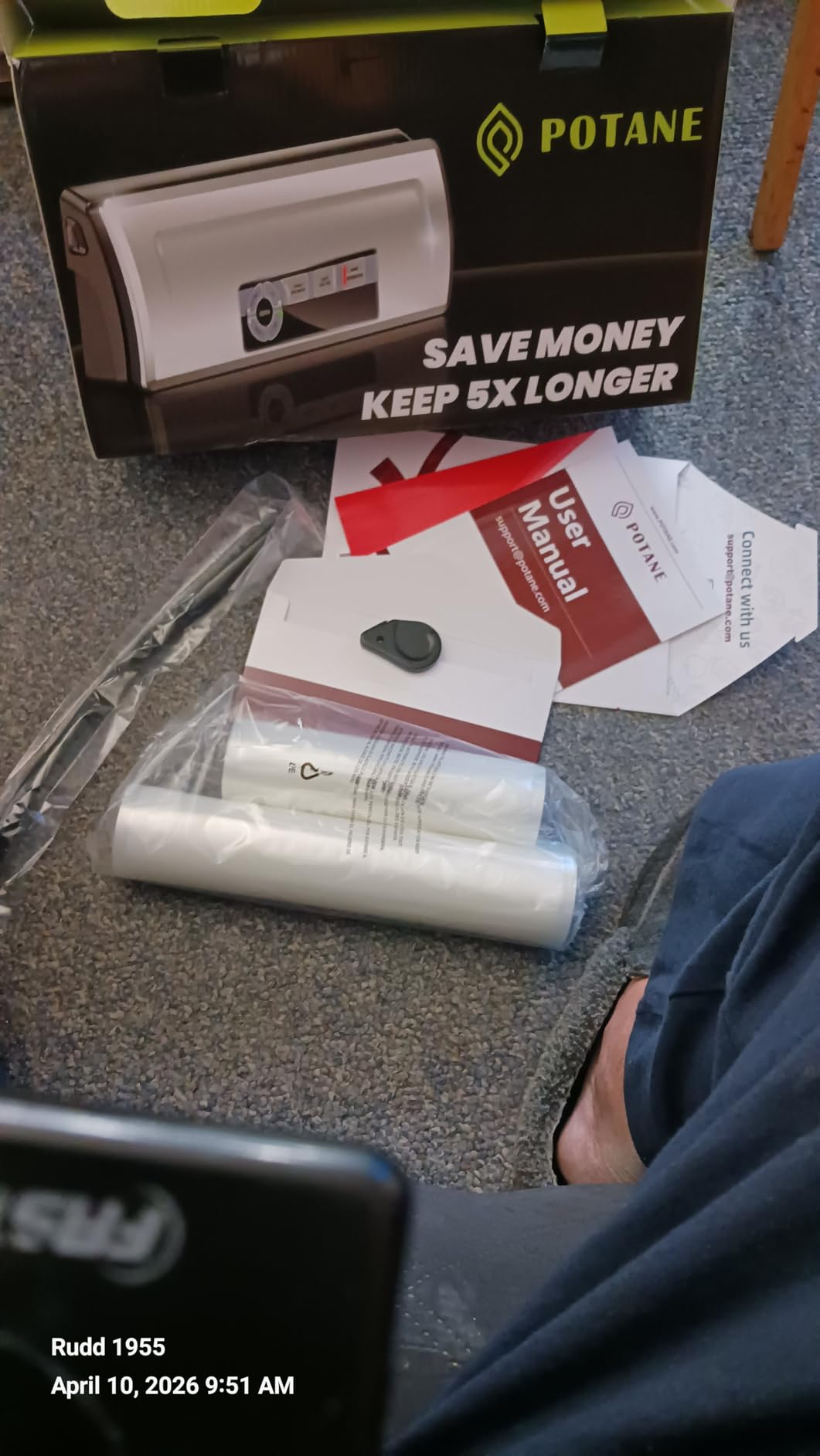
With more than 10,000 reviews, this is among the most-proven machines in our list, and the feature that earns its place is a sloping top. Because the bag surface is angled rather than flat, juice on a marinated steak sits where the pump cannot reach it. That single design decision is what makes this a wet-food machine rather than a dry-food machine with a moist setting.
Owners highlight the sloping top as the reason wet meat comes out of the bag intact, along with easy presets and a compact body. The moist setting is the most-used mode for juicy foods, and the 5 year warranty is a frequent point of confidence, backed by a 2 year no-hassle return guarantee.
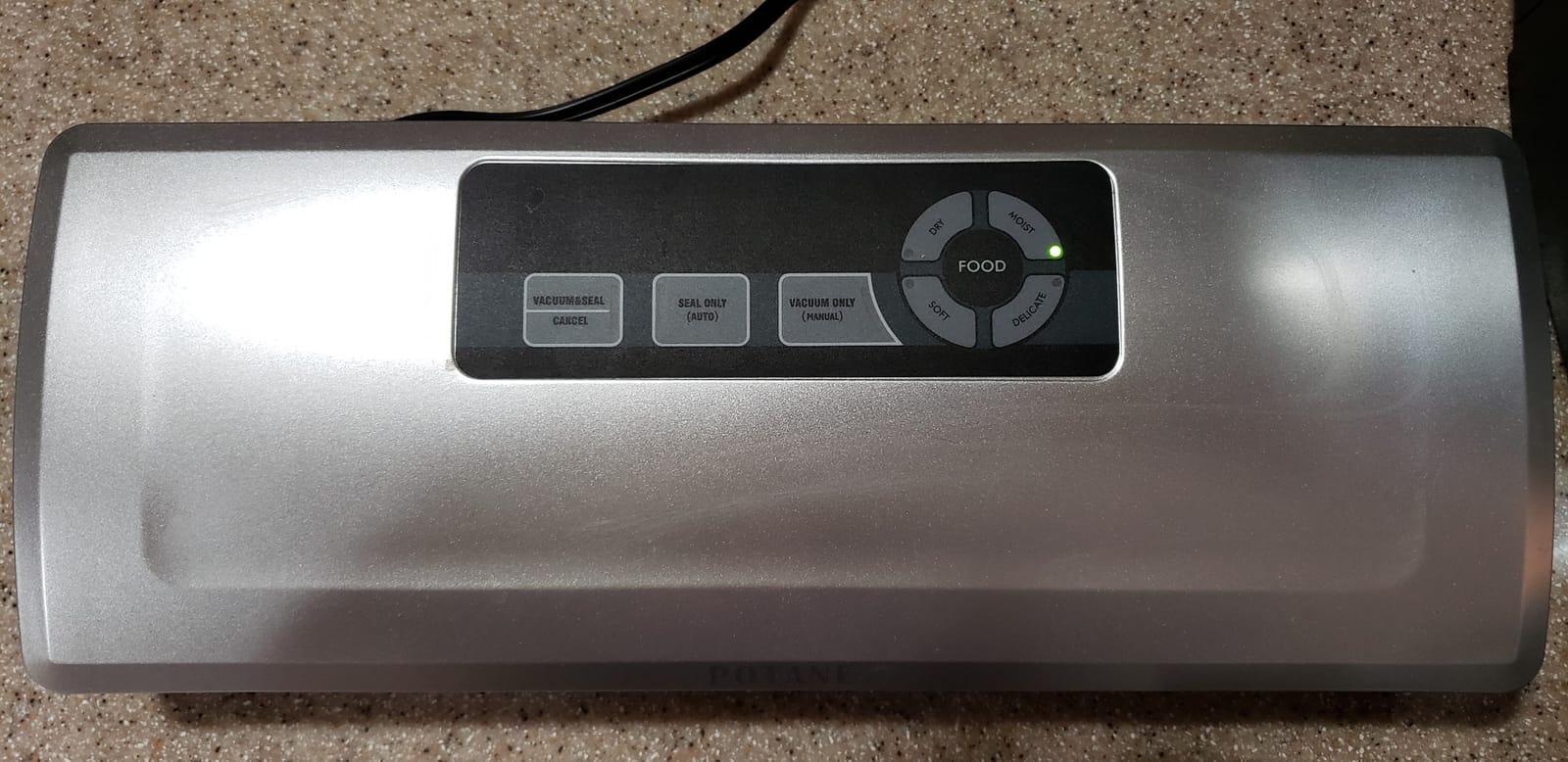
Enhanced heating wires and a brushless motor handle the sealing side, and eight presets combine four operation modes with four vacuum sealing modes. At 3 pounds and 14.25 inches long with an 0.88 inch body height, it stores easily, and ETL certification is stated on the listing.
Be clear about the boundary, though. This is a machine for juicy food, not for liquid. There is no liquid mode because the sloping top solves a different problem, and canister work needs the included hose accessory, which is one more thing to keep track of.
Why the sloping top matters on a marinated steak
On a flat deck, a pool of marinade sits directly in the suction path and the pump finds it. On a sloping deck the liquid runs to the low corner of the bag, away from the channel, and the pump pulls air out of a bag that has no free liquid to move. Our runs on marinated chops were noticeably cleaner for it, and the difference is visible in the bag rather than something you have to take on trust.
This is also why the soft and delicate modes exist on this machine. A bag of soft cooked vegetables deforms and wrinkles under a hard vacuum, and a lower-pressure mode preserves the shape.
Where its wet-food limits start
The limit is free liquid. If your list includes soup, broth, brine in a standing bag or a full container of sauce, this is not the machine, regardless of how good it is at meat. For that list, go chamber or go to the Vakumar and NESCO.
8. NESCO VS-22LB Premium Sealer with LiquidLock
NESCO VS‑22LB Premium Vacuum Sealer for Home Food Storage, Electric Sealing System with LiquidLock™ Technology
LiquidLock dedicated liquid mode
Seven sealing functions
Wide double heat seal bar
Removable drip tray
Pros
- Liquid mode slows liquid movement so soups seal cleanly
- Double heat sealing adds leak resistance
- Works with other brands of bags and jar sealers
- Sharp sliding cutter and built-in roll storage
- Compact footprint and 6.5 pound weight
Cons
- Handle position needs 3 to 4 extra inches of bag length
- Bag edges must sit inside the liquid tray
- Vacuum is slower on the dry setting
- Larger than entry-level sealers
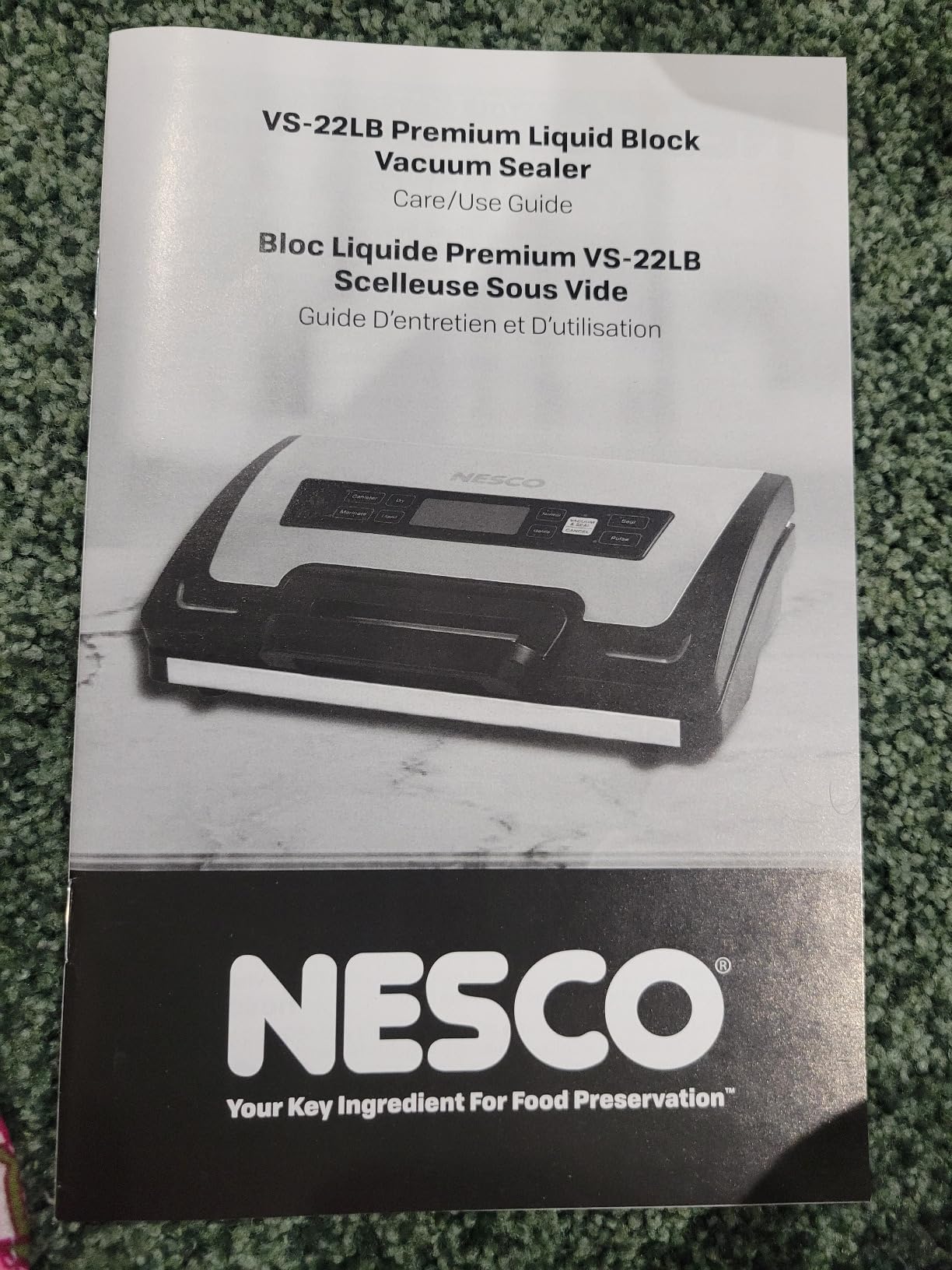
NESCO put a named liquid technology on the VS-22LB rather than a mode buried in a menu, and seven sealing functions cover dry, liquid, normal, gentle, marinate, canister and pulse. Owners upgrading from a FoodSaver call the liquid handling excellent, which is the specific thing you are paying for here.
The 250W motor drives a wide double heat seal bar, and the removable drip tray with an LED progress display lets you see the cycle rather than guess. One-handed lid operation and an accessory port mean it handles jar sealers and sous vide bags as well as food pouches.
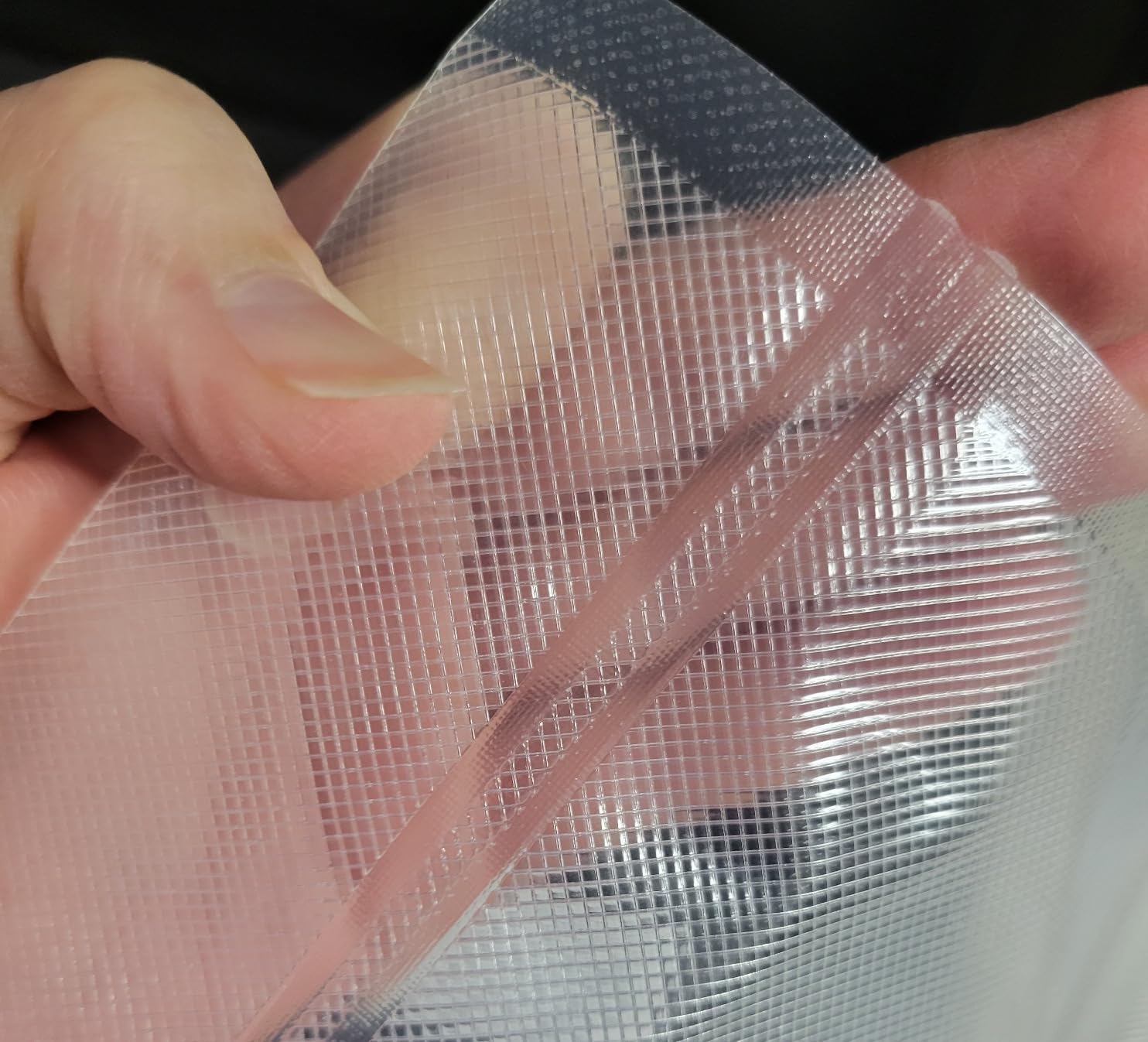
Bag compatibility is a strength. It works with FoodSaver jar sealers and other brands of vacuum bags, so if you already own a bag supply you are not replacing it, and the box includes 60 feet of rolls plus a variety of 50 bags. The sliding bag cutter is sharp and the roll storage is built in.
The most common complaint is about geometry, not performance. The low locking handle means bags need roughly 3 to 4 extra inches of length, wasting some bag material, and bag edges must sit inside the liquid tray, which takes practice. At 151 reviews this is the least-proven machine in our list, and the 4.4 average reflects that smaller sample rather than a defect.
How LiquidLock performs on soups and sauces
LiquidLock slows liquid movement during the cycle, which is the correct mechanism for an edge sealer because it addresses exactly where liquid goes wrong. On a bag of soup laid flat with the liquid at one end, the mode produced a consistent seal across our runs, and the double heat bar gives a second pass of heat that matters for a bag going into a freezer.
It is still managing an edge-sealer flow, so headspace and bag placement still decide the outcome. Treat LiquidLock as a strong feature that rewards correct technique, not as a chamber.
What the handle position costs you
Budget for roughly 30 percent more bag length than you think, because the handle sits low and the seal bar sits behind it. On a large batch that is real material cost over a year. The workaround is to cut bags to length for the machine rather than to the roll width, and to lay the open end well inside the drip tray from the first attempt.
9. VEVOR DZ-260S-V1 Chamber Vacuum Sealer
VEVOR Chamber Vacuum Sealer, 260W Sealing Power, Vacuum Packing Machine for Wet Foods, Meats, Marinades and More, Compact Size with 10.2 in Sealing Length, Applied in Home Kitchen
-100KPa chamber vacuum
260W heater with an 8mm dual seal
Built-in pressure gauge
Deep stainless chamber
Pros
- Chamber handles liquids
- marinades and soups without leaking into the machine
- Strong consistent seals with no lost vacuum
- Quiet operation versus other chamber units
- Works with standard bags and Mylar
- Pressure gauge prevents crushing fragile food
Cons
- 45 pounds needs a permanent counter spot
- No lid lift assist and about 25.5 inches of overhead clearance
- Cycle time is closer to a minute
- Pump oil must be added before first use
The strongest vacuum figure in our list belongs to this chamber unit at -100KPa, and the built-in pressure gauge is a genuinely useful feature that most chamber machines at this level skip. You can watch the chamber draw down and stop it before a soft bag of bread or a delicate piece of fish gets crushed, which is the whole reason to have a gauge.
Owners upgrading from external sealers report a much stronger vacuum, quiet stainless construction, and noticeably easy handling of wet foods and liquids. The 8mm wide dual lock seal strip driven by a 260W heater is the widest heat band we found a figure for, and the deep chamber takes large steaks, bread loaves and bulk goods. Standard vacuum bags up to 10 inches wide work, and it also handles Mylar.
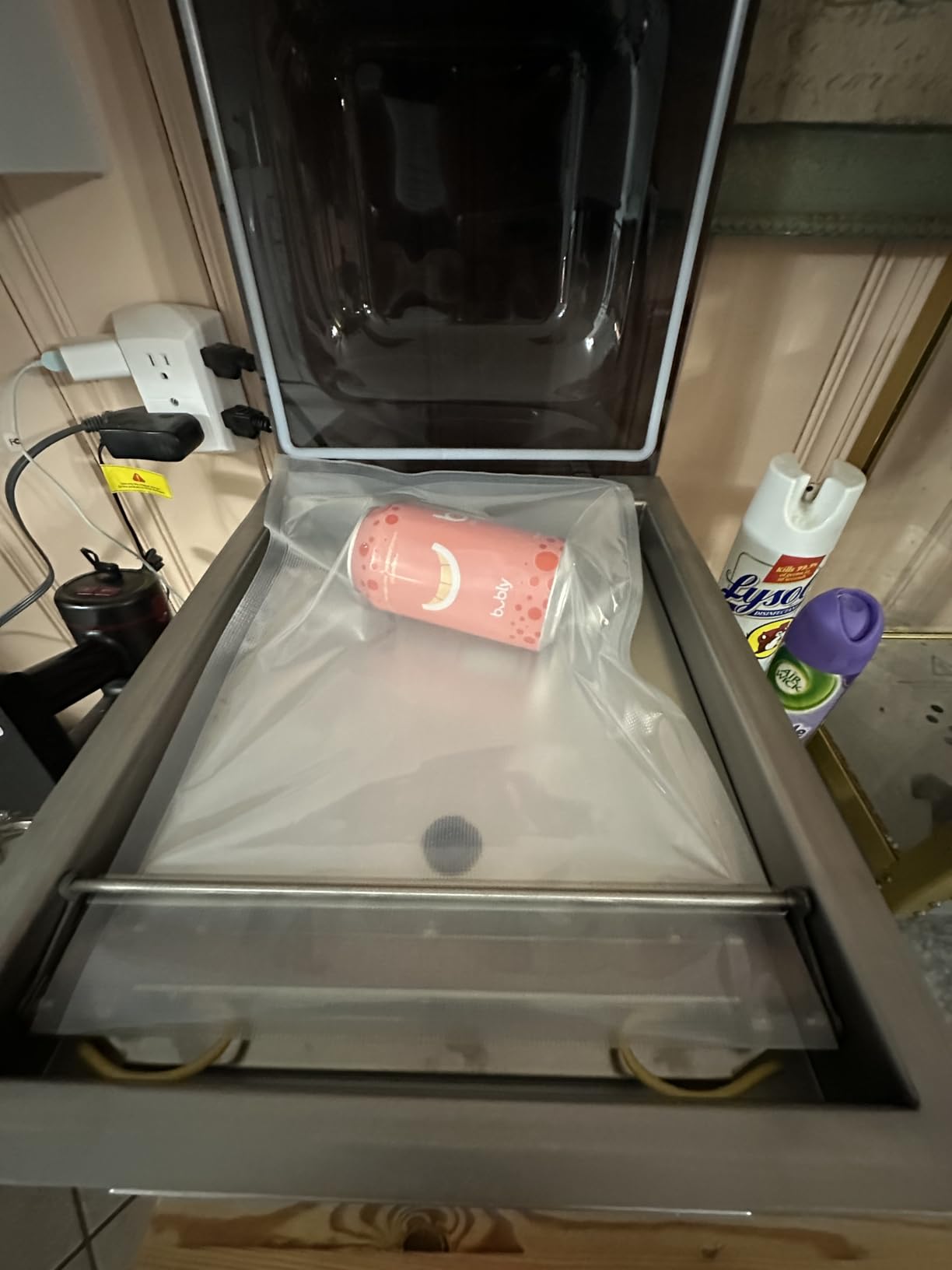
The 15.9 by 12.4 by 11.8 inch body in stainless steel is built to sit somewhere permanently. At 45 pounds this is the heavy end of our list, though still well below the 50-plus pound commercial chamber units, and it remains one of the machines home owners most often describe as working like a charm.
Set the expectations honestly. The lid has no lift assist and needs roughly 25.5 inches of vertical clearance to stay open, cycle time is closer to a minute than to half that, and pump oil has to be added before first use. A shallow, flat chamber bottom also limits how much liquid one bag can hold.
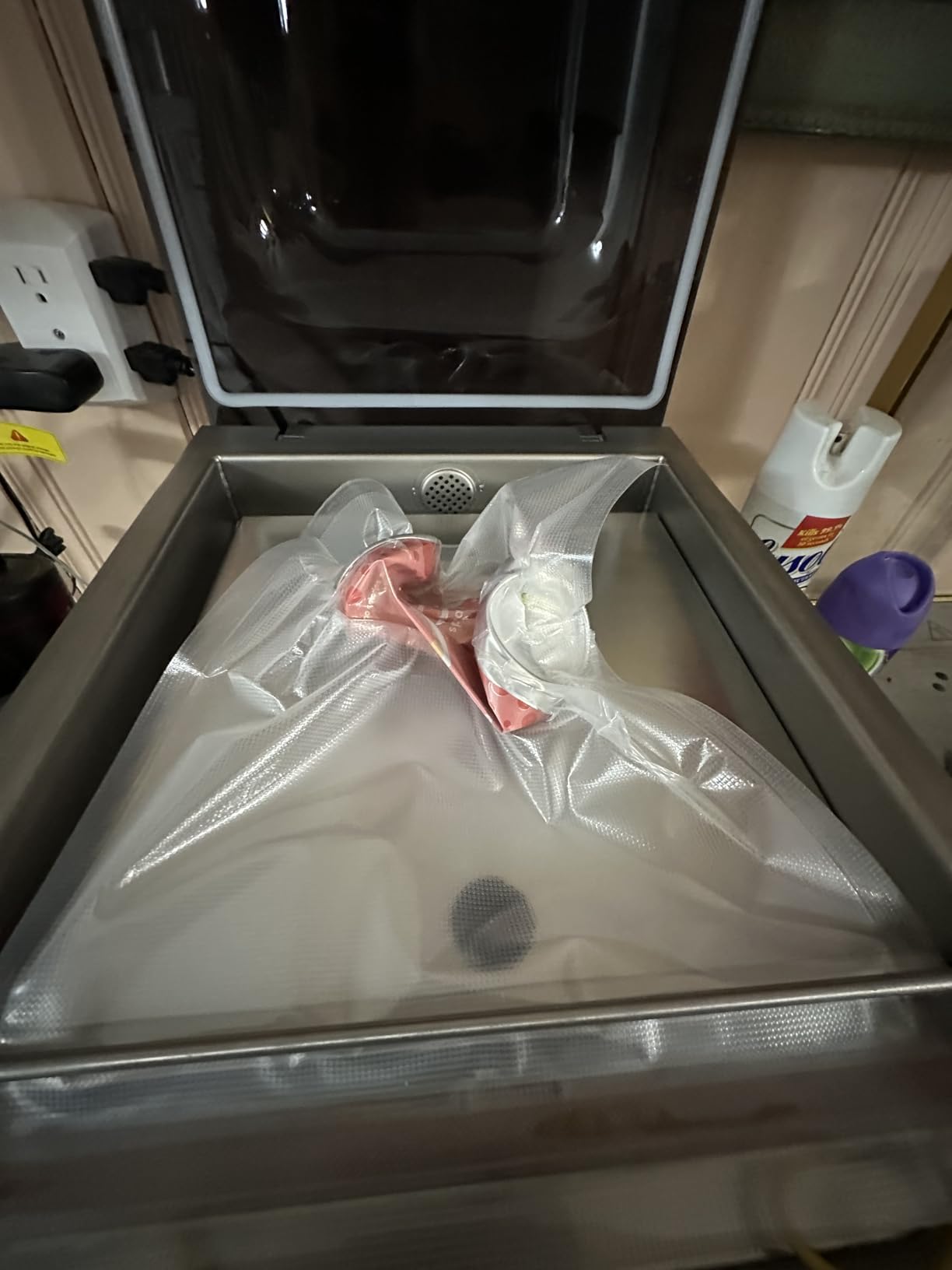
What chamber evacuation does to a wet bag
With a 120W vacuum pump evacuating a stainless chamber, the liquid in your bag never moves because the bag is not being suctioned. That is the entire wet-food advantage, and it shows up most clearly on the messy jobs: a brine-marinated pork shoulder, a bag of broth, a tray of sauced ribs. No wiping, no channel cleanup, no machine that smells like last week’s marinade.
Community owners also report running 70-plus consecutive fruit bags without the machine overheating, which speaks to the duty cycle if you are preserving a garden or a hunt rather than freezing dinner portions.
What the footprint and setup demand
Find a cabinet with 25.5 inches of clearance before you order, because a lid that cannot open fully will frustrate you daily. Add the pump oil to the shopping list, and plan for cycle times near a minute. This is the machine for someone sealing large batches on purpose, not someone fitting a sealer into a small kitchen corner.
10. FoodSaver V4400 2-in-1 Vacuum Sealing System
FoodSaver V4400 2-in-1 Vacuum Sealer Machine with Automatic Vacuum Sealer Bag Detection and Starter Kit
Automatic bag detection
Automatic moisture detection
Dishwasher-safe drip tray
Built-in roll storage and cutter
Pros
- Automatic bag and moisture detection cut the guesswork
- Dishwasher-safe drip tray handles overflow
- Built-in roll storage and cutter for custom sizes
- 5 year limited warranty on sealing performance
- Works with jar sealers and Fresh containers
Cons
- Channel bags cost more over time
- Moist foods may need more than one pass
- Wet contents leave liquid in the vacuum chamber
With more than 11,000 reviews behind a 4.6 average, this is among the most proven wet-food-capable edge sealers in the category, and the reason is the pair of automatic modes. Bag detection means you place the bag in the vacuum chamber and it starts. Moisture detection reads the bag and switches to the correct mode, so a bag of marinated meat is not treated like a bag of dry rice.
The patented removable drip tray is dishwasher-safe, which matters more than the word suggests when you seal wet food weekly. Built-in roll storage and a cutter with LED indicators let you cut bags to size, and the system works with mason jar sealers, Fresh containers and a Quick Marinator through the accessory port.
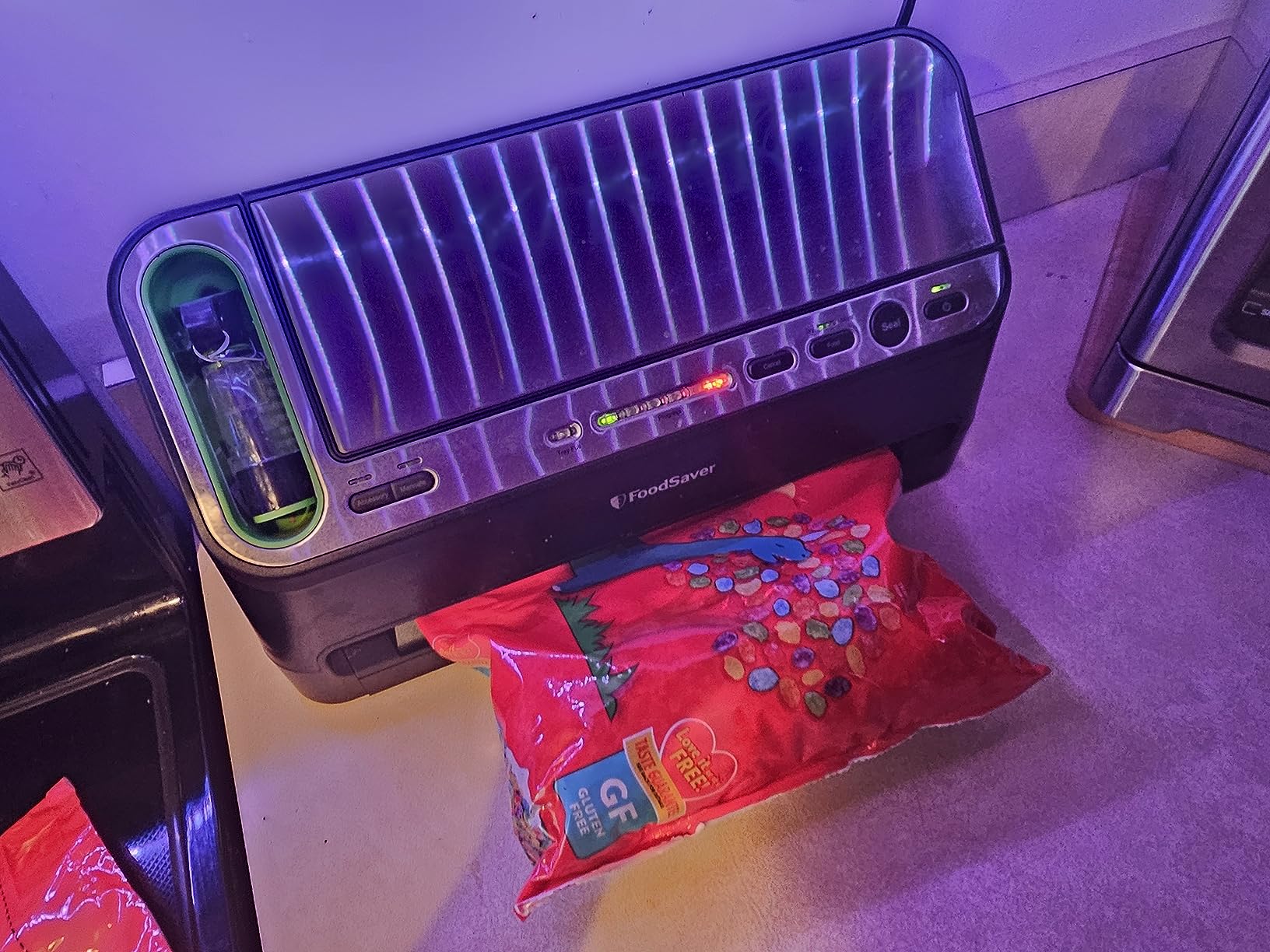
Owners highlight automatic detection, the dishwasher-safe tray and easy custom bag sizing as the everyday wins, and the 5 year limited warranty on sealing performance is a rare commitment at this level. The 800W motor is the highest wattage among the edge sealers here, and at 10 pounds it is heavy but not unreasonable.
The economics deserve attention over time. Channel-style bags cost more than the smooth pouches a chamber sealer uses, and heavily marinated foods may take more than one pass to reach an airtight seal. Wet contents can also leave liquid in the vacuum chamber that you need to wipe out.
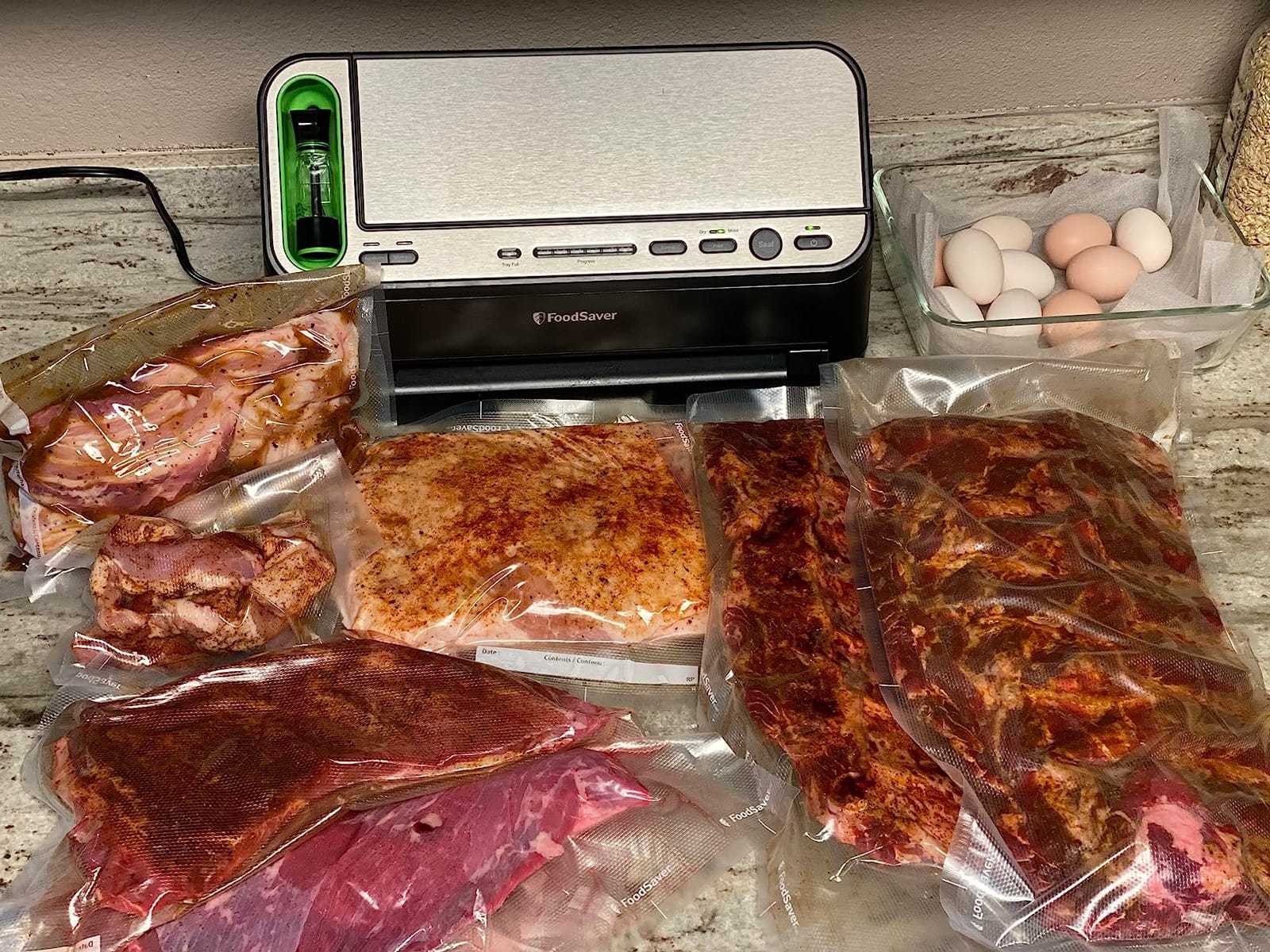
How automatic moisture detection performs on wet bags
Detection reads the bag and adjusts the vacuum target and seal time, so a bag of marinated chicken gets a gentler cycle than a bag of pasta. In our runs it correctly identified wet bags and avoided the crushing pull that ruins a delicate seal. The real limitation is that it cannot see a pool of liquid, so heavily marinated or soup-filled bags still sometimes need a second pass.
That is an honest limitation of any edge sealer, and it is the argument for the chamber units above rather than a mark against this machine.
What the bag economics look like over time
Factor bag cost into the decision, because it is the line item that decides total ownership cost. This machine is built for FoodSaver 8 and 11 inch rolls and pre-made bag sizes, and those channel bags carry a higher per-bag price than smooth pouches. If you are sealing soup weekly for years, that difference compounds.
Against that, the bag ecosystem is the widest here. If you already own jar sealers and containers, nothing else on this list uses them.
How to Seal Wet Food Without Liquid Reaching the Pump
Even the best edge sealer in this list will lose the argument against a bag of soup if you fill it to the top. Six steps fix most of that, and they work on chamber units too.
1. Leave real headspace. Fill liquid no more than halfway up the bag. An edge sealer needs slack above the liquid for the air to escape, and a full bag gives it no path that does not run through the fluid.
2. Leave headspace in the bag length, not just the height. Seal the top third or quarter of the bag empty. The air above the liquid is the only safe route the pump can use.
3. Fold a paper towel at the top of the bag. A dry towel wicks the liquid that wicks up the bag wall as the bag collapses, and it costs nothing. Do not put the towel where the heat seal runs.
4. Tilt the bag so liquid pools away from the open end. Lay it flat, or stand the open end higher than the sealed contents. This single step prevents more pump contamination than any mode setting.
5. Use liquid mode or pulse, not dry mode. Dry mode pulls hardest and holds longest, which is exactly wrong for a wet bag. Pulse mode lets you stop with a sliver of air still in the bag, which is often the safest cycle of all.
6. Pre-freeze liquids into a solid block. Freeze soup or sauce in a silicone tray, pop the frozen block into the bag and seal it flat. A solid block cannot migrate, so even a basic edge sealer handles it cleanly. This is the workaround that rescues a budget machine, and it is worth knowing before you spend more.
Sealing twice is a reasonable seventh habit. After the first seal runs, run a second pass over the same area and you have a redundant barrier, which is how channel bags from a chamber machine get their double seal.
What to Do If Liquid Gets Pulled Into the Pump
Liquid in a vacuum sealer is alarming and usually recoverable. The pump did not melt; it got wet, and oil-pump and dry-pump designs react differently to that.
Unplug it and stop. Do not run the machine again with liquid in the chamber. Running it wet is what turns a small spill into pump damage, and it is the step people skip.
Open the chamber and remove the bag. If the bag is intact, cut it out rather than pulling it back through the channel. Tip the machine carefully to drain liquid from the vacuum channel and wipe the gasket, the drip tray and the sealing bar area.
Let it dry for 24 to 48 hours. Air it out somewhere ventilated. Residual moisture in the channel is the cause of the lingering marinade smell that makes owners assume the machine is ruined.
Check the pump oil if it is an oil-pump model. Forum consensus among long-term owners is to change the oil roughly once a year regardless of hours used, and a liquid intrusion is a good reason to change it now. If the oil looks milky or smells like food, the pump ran wet and the oil change is not optional.
Test with a dry bag before you trust it again. A dry bag should pull down to full vacuum and hold it. If it will not hold, the gasket or the pump is the problem.
Replace the pump, not the machine. The pump is the eventual failure point in this category, far ahead of the control board, the heating element and the chamber structure. If replacement pumps and gaskets are available for your model, that changes the maths entirely, and it is why buyers deliberately avoid the cheapest unit. Our guide to pump-driven appliances and what long-term ownership looks like covers the same maintenance logic in a different category.
What to Look for When Buying a Vacuum Sealer for Wet Foods
Wet-food capability is a feature set, not a single checkbox. These are the factors that actually decide whether a machine handles your food, in rough order of importance.
1. A named liquid or moist mode that does something. Check the mode list, not the marketing. A machine with dry, moist and seal-only is a moist-food machine. A machine with a separate liquid mode, a marinate mode or a pulse setting is built for liquid work. Every machine here has a liquid mode, a marinate mode, pulse control or a chamber except the Potane, which relies on a moist setting and a sloping deck.
2. Pulse or manual vacuum control. This is the feature that turns a wet-food machine from automatic to trustworthy. With pulse, you decide when the air stops, which means you decide when the liquid stops moving. If you seal wet food more than once a week, treat this as a requirement rather than a nicety.
3. A removable drip tray with real capacity. A tray that cannot be removed is a cleaning problem. Capacity matters in batches: the Inkbird INK-VS04 holds 300ml, and a small tray means stopping every few bags. Look for a tray you can rinse or put in a dishwasher, and note the volume if you seal in batches.
4. Seal strip width. A wider heat band gives more margin when there is liquid at the seal. Among the machines here, the strip figure is a real difference: the VEVOR chamber uses an 8mm dual lock strip, while the compact Inkbird EXT-VAC uses 2mm. Wider is better for wet work, and a double heat seal is worth more than a single wide one.
5. Double heat sealing. Two passes of the heat bar create two independent barriers. On a bag going into a freezer for months, a second seam is cheap insurance, and the Vakumar and NESCO both do it automatically.
6. Chamber or edge, honestly assessed. Chamber for liquids, edge for moist foods. If your list includes standing liquid, only a chamber removes the risk. If your list is meat, vegetables and sous vide prep, an edge sealer with liquid mode and pulse is the smarter purchase for the counter space you actually have. Our chamber sealer guide covers the class in depth if you have decided on a chamber.
7. Bag sizing and compatibility. Check the maximum sealing length against the bags you actually use. The FoodSaver V4400 works with 8 and 11 inch rolls, the NESCO VS-22LB and Inkbird INK-VS04 use 11.8 inch rolls, and the Avid Armor chamber takes smooth pouches up to 11 by 10 inches. Mismatched bag widths cause folds at the seal, and folds are where leaks start.
On specs that sound technical. Suction is quoted in kPa, so a -100KPa chamber vacuum is a strong figure and -80KPa is respectable for an edge sealer, but kPa alone does not predict wet-food performance because chamber vacuum and bag vacuum are measured differently. Wattage describes the heating element, so a 250W or 260W element is a robust seal band, but it is not a wet-food feature. Seal strip width in millimetres does matter, as above. Chamber depth in inches determines whether bulky items fit, and 3 inches is the practical ceiling for liquids. Voltage matters only if you travel: the Inkbird INK-VS04 is universal 110 to 240V, while several others are 120V only.
On bags. Thickness matters for liquids, since heavier bags tolerate a slower pull without collapsing, and pre-cut bags are convenient for portioning while rolls are cheaper per bag. Width must match the machine’s supported range. Most machines here accept third-party bags of a compatible size, and the recurring complaint in forums about brand lock-in is more often about bag width and channel style than about a proprietary system.
On longevity and repairability. The pump is the part that fails, not the control board or the heating element, so the useful question is whether a replacement pump and gaskets exist for the model. The Avid Armor chamber has a user-replaceable seal bar, and the Vakumar ships with a spare gasket. Long-term owners consistently report 10-plus years from well-supported machines and describe cheap sealers as disposable after two or three years when a locking tab or heater gives up.
Common Mistakes and Myths in Wet-Food Sealing
The highest kPa wins. A harder vacuum crushes soft food and gives a wet bag nowhere to go. Chamber units and moist modes exist because a gentler pull is the correct pull for wet contents. Judge a machine on how well it manages pressure, not on the biggest number in the listing.
Any sealer advertised for wet food can do liquids. Most cannot. Many of these machines list a moist mode, which means the same thing as a slow dry mode, and free-flowing liquid is a different task entirely. Ask whether there is a liquid mode, a marinate mode or pulse control.
Chamber sealers are business-only machines. Home cooks freeze soup, batch cook and sous vide regularly. The Avid Armor chamber is compact and repairable, and it is the correct answer for anyone whose list includes standing liquid.
You must buy one brand of bag. Most machines here accept compatible bags from other manufacturers, and the INK-VS04 and FRESKO boxes alone include enough bags to start. What you do need to match is width and channel style.
Liquid reaching the pump ruins the machine. Usually it does not, if you stop running it and dry it out properly. The panic is understandable and mostly avoidable.
Frequently Asked Questions
Can you vacuum seal wet food?
Yes, but the machine type matters. A chamber vacuum sealer is the correct choice for soups, sauces, brines and any free-flowing liquid, because it evacuates the entire sealed chamber so pressure equalizes around the bag and liquid never enters the pump. For moist foods such as marinated meat, juices and sous vide prep, an edge sealer with a dedicated liquid or moist mode and pulse control handles the job well.
Do vacuum sealers work with liquids?
Some do, and most marketed for wet food do not. A sealer works with free liquid when it either evacuates a chamber around the bag, or manages liquid movement with a dedicated liquid mode, a marinate mode or pulse vacuum control. An edge sealer with only a moist mode will pull juice into the vacuum channel, because it is drawing air directly out of the bag and any free liquid travels the same path.
Can you seal soup in a vacuum sealer?
Yes, with the right machine and technique. A chamber sealer such as the Avid Armor USV20 or the VEVOR DZ-260S-V1 handles soup without liquid reaching the pump. On an edge sealer, fill the bag no more than halfway, leave the top third empty, fold a paper towel at the top, tilt the bag so the liquid pools away from the open end, use liquid mode or pulse, and pre-freeze the soup into a solid block for the safest result.
What is the best vacuum sealer for sealing wet foods?
For standing liquids, a chamber vacuum sealer is the correct answer and the Avid Armor USV20 is the most compact option we recommend. For moist foods and marinades on a budget, the AAOBOSI 95KPa with its nine modes and smart memory is our overall pick, while the Vakumar VH5186 has the most liquid-specific modes of the edge sealers here, with ten and an automatic double heat seal.
What is the best vacuum sealer for soup?
The Avid Armor USV20, because a chamber design never pulls liquid into the machine. The NESCO VS-22LB and the Vakumar VH5186 are the best edge-sealer options for soup, since both offer a dedicated liquid mode and a removable drip tray, but neither removes the risk the way a chamber does. Users on r/sousvide and home cooking forums repeatedly name chamber units as the upgrade that finally solved soup for them.
What foods should never be vacuum sealed?
Whole raw poultry and large bone-in cuts are hard to seal and carry contamination risk around the bone. Also avoid bags filled above the recommended level, since a sealed bag of liquid can swell and burst, and never use a vacuum sealer as a substitute for pressure canning, which requires a tested recipe and a specific process. Sealing food that is already at room temperature for hours is a food-safety problem regardless of the machine.
How do I stop liquid from getting into my vacuum sealer?
Leave headspace above the liquid, fold a paper towel at the top of the bag to wick moisture, tilt the bag so liquid pools away from the open end, use liquid or pulse mode instead of dry mode, keep the bag edge inside the drip tray, and pre-freeze liquids into a solid block. A removable drip tray catches what gets through. If the machine is a chamber type, liquid cannot reach the pump at all, which is the structural fix.
Why does my vacuum sealer suck up the liquid?
Because an edge sealer draws air out through the open end of the bag, and any free liquid inside follows the same suction path toward the pump. Dry mode makes it worse by pulling hardest for longest. The fix is a dedicated liquid or moist mode, pulse vacuum control so you stop the pump yourself, correct bag geometry with headspace, and tilting the bag so the liquid sits away from the channel.
What bags do I need for liquid vacuum sealing?
Use bags at least as wide as your machine supports, and prefer heavier bags for liquid work because they tolerate a slower pull without collapsing. Chamber sealers use smooth pouches up to the chamber size, which are cheaper than channel bags over time, while edge sealers need channel bags matched to the sealing bar. Leave the top third of the bag empty and cut bags to the machine rather than to the roll width.
What is the best vacuum sealer for meat?
For marinated or raw marinated meat, the Potane VS2690 is our pick because its sloping top keeps juice away from the vacuum channel, and the Vakumar VH5186 is the choice for heavier liquid loads with its marinate and liquid modes. For bulk meat and portioning, the AAOBOSI 95KPa handles batches quickly with its one-hand handle and smart memory. For whole birds and large cuts, a deeper chamber unit is required.
Final Verdict: The Best Vacuum Sealers for Wet Foods in 2026
The best vacuum sealers for wet foods in 2026 split cleanly into two jobs, and the mistake is treating them as one purchase. If your list includes soup, broth, brine or standing sauce, buy a chamber sealer. The Avid Armor USV20 is our pick because it is compact enough for a home kitchen, repairable when the seal bar wears, and built on a chamber design that removes the liquid risk rather than managing it.
For everything else, our Editor’s Choice is the AAOBOSI 95KPa 9-in-1. Nine modes, a double heat seal and smart memory give it more control over wet bags than machines costing more, and 7,520 reviews of long-term use back it up. When the wet load is heavy enough that you want the edge-sealer answer done properly, the Vakumar VH5186 with ten modes and an automatic double seal is the specialist.
Whichever you choose, the technique matters as much as the machine. Leave headspace, tilt the bag, use liquid mode or pulse, and keep a chamber unit in mind the first time you fill a bag with something that would slosh.