
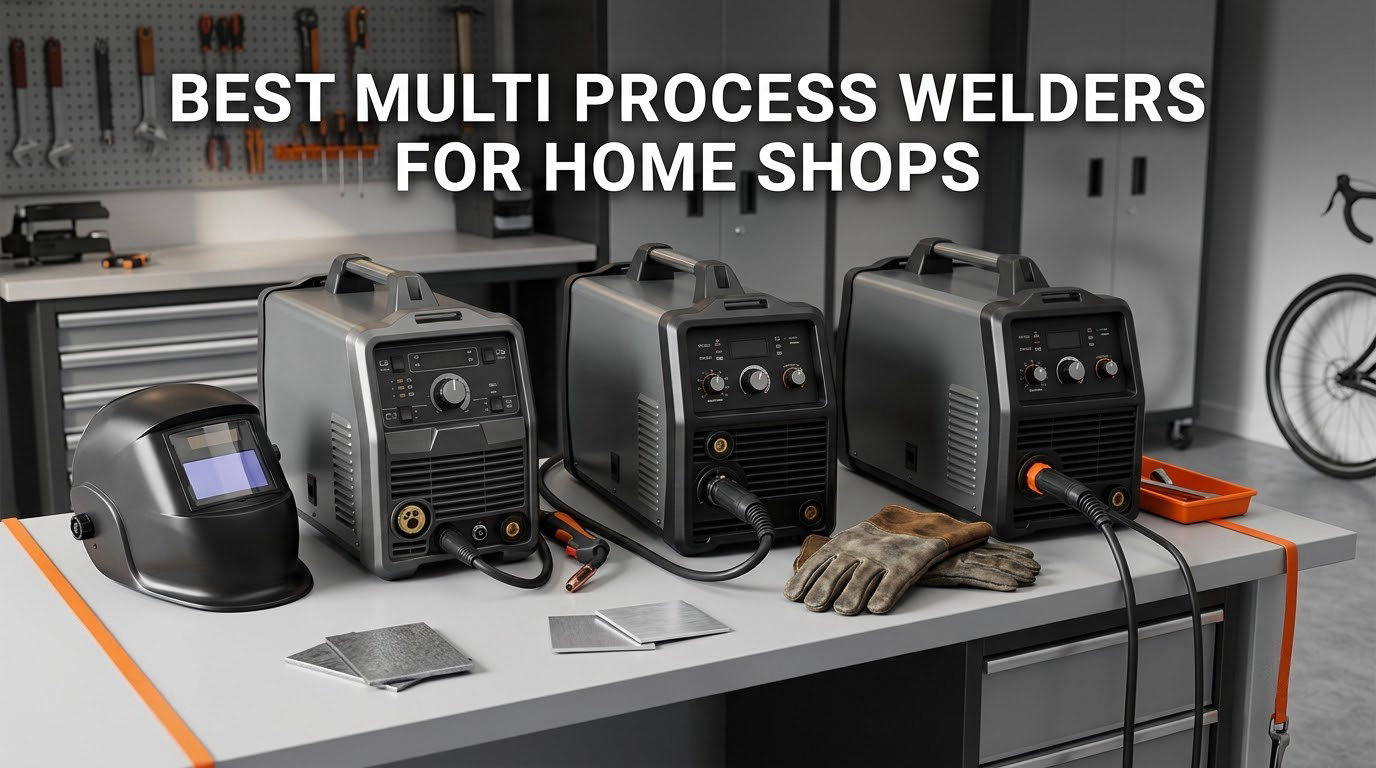
Welding in a home shop usually means owning three machines: a MIG for the bulk of the work, a stick machine for the awkward jobs, and a TIG set for thin material and aluminum. Buying them one at a time costs more, takes up more bench space, and leaves you with three power leads and three sets of consumables. A multi-process welder collapses all of that into one box, and the best multi process welders for home shops now do the job without a serious compromise in arc quality.
We spent weeks reading owner reviews, manuals and spec sheets on eight of the strongest multi-process machines a garage can actually own, then cross-checked what welders complain about on r/Welding and the AR15 forums. The short version: our top pick is the YESWELDER 205A 5-in-1, the best value is the TOOLIOM 200A 5-in-1, and the only machine here that welds aluminum properly with AC/DC TIG is the Weldpro Omni210.
What follows is a model-level roundup, not a brand list. Every machine below is written up with who it suits, what the real output looks like, and where owners report it falling short. Updated for 2026, and every rating and review count is the verified figure from the product page rather than a round number we picked ourselves.
Table of Contents
What Is a Multi-Process Welder?
A multi-process welder is a single power source that combines MIG/GMAW, TIG/GTAW and stick/SMAW welding, usually adding gasless flux core and sometimes spot welding or plasma cutting. One inverter reconfigured by a mode switch feeds continuous wire in MIG, switches to a high-frequency arc under a foot pedal in TIG, and delivers constant-current output matched to the electrode in stick. For a home shop, that means one machine covers nearly every common job.
That is the entire sales pitch, and it is a good one. The less obvious benefit is consumables and power. A single multi-process unit means one set of leads, one grounding practice, and one machine to learn, instead of three separate control schemes to keep straight in your head.
The compromise, and there is one, is that each process gets a share of the machine’s capability rather than a dedicated design. A multi-process TIG is never quite the same as a TIG-only inverter with dedicated HF start and slope controls, and the cheaper the unit, the wider that gap becomes. Understanding where each machine below draws that line is the whole point of this roundup.
Top 3 Picks for Home Shop Welding (October 2026)

YESWELDER 205A 5-in-1
- 5-in-1 processes including spool gun MIG and lift TIG
- 110V/220V dual voltage with 200A output
- Synergic MIG with 58-858 in/min wire feed and manual override
- Digital display with real-time current readout

ARCCAPTAIN MIG200
- 6-in-1 with spot welding and spool gun readiness
- 10 stored presets per mode plus crater fill and burn-back
- Digital synergic control with demand-driven fan
- 2-year manufacturer warranty

TOOLIOM 200A 5-in-1
- 200A dual-voltage 5-in-1 package
- Wire feed 60-320 in/min with auto voltage match
- Accepts solid flux core and aluminum wire
- 2lb and 10lb spool capacity
Best Multi-Process Welders for Home Shops in 2026
Here is the whole lineup at a glance. Every machine runs on 110V and 220V, which matters more for a garage than any feature on the front panel. The column that decides most purchases is the last one.
| Product | Specifications | Action |
|---|---|---|
| YESWELDER 205A 5-in-1 |
|
Check Latest Price |
| ARCCAPTAIN MIG200 |
|
Check Latest Price |
| TOOLIOM 200A 5-in-1 |
|
Check Latest Price |
 Bestarc MIG145 Bestarc MIG145 |
|
Check Latest Price |
 ANDELI 135A Pulse ANDELI 135A Pulse |
|
Check Latest Price |
 FEMEROL 250A FEMEROL 250A |
|
Check Latest Price |
 Weldpro Omni210 Weldpro Omni210 |
|
Check Latest Price |
 PUWU Plasma Cutter Combo PUWU Plasma Cutter Combo |
|
Check Latest Price |
One note on weight before you start reading. The Weldpro Omni210 weighs 81.8 lb and the YESWELDER weighs 37.5 lb, a difference that decides whether a machine lives on a cart or lives on a shelf. Weight is not a spec to dismiss in a garage.
1. YESWELDER 205A 5-in-1 – The All-Rounder With The Most Owner History
YESWELDER 205A MIG Welder, 110V/220V 5-In-1 MIG/Flux Core MIG/Spool Gun MIG/Lift TIG/Stick
200A output
110V and 220V dual voltage
37.5 lb
5-in-1 including spool gun MIG
Pros
- Genuinely handles all five advertised processes
- Strong penetration on 110V household power
- Synergic auto voltage match with plus or minus 3V fine tuning
- Ships with adapter gas hose liner ground clamp and electrode holder
- Solid metal construction and a digital current readout
Cons
- Instruction manual is confusing and the wire diagram is wrong
- Supplied MIG torch is rated to about 150A
- Synergic flux-core program only accepts .035 wire
This is the machine we kept coming back to, and the reason is the review history rather than the spec sheet. With 1455 ratings averaging 4.5, it is the most thoroughly worn multi-process welder in this roundup, and the pattern across those reviews is consistent: owners start skeptical of the price, weld for a few months, and then report that it handles everything the listing claimed.
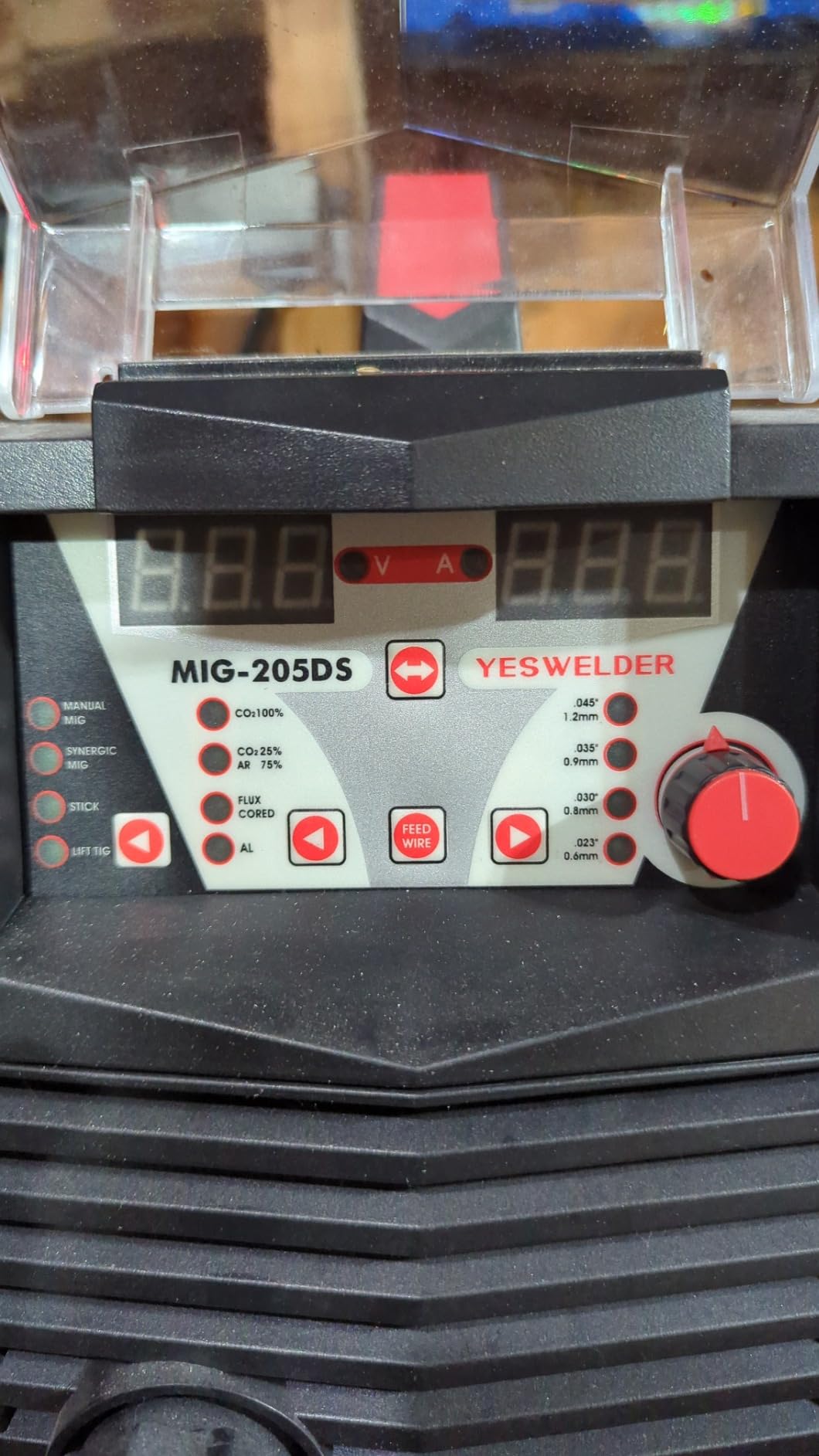
It really does perform all five advertised processes. Gas MIG, gasless flux core, spool gun aluminum MIG, lift TIG and stick all work, and the wire feed runs from 58 to 858 in/min with a synergic mode that matches voltage to feed speed and a plus or minus 3V fine tune for when you want to dial it yourself. A digital display shows live current, which is genuinely useful when you are learning what a voltage change does to a bead.
Owners consistently praise penetration on 110V household power, which is the statistic that actually matters for a garage. Most 200A machines are meaningfully weaker on 120V, and owners report this one holding a steady arc on 1/8 inch steel without a dedicated circuit. The box also includes a 220V to 110V adapter, gas hose, graphene liner, drive rollers, ground clamp, electrode holder and MIG torch, so you are not ordering a starter kit before the first bead.
There is a real short list of complaints, and all of them are documentation or accessory issues rather than machine failures. The manual is confusing and the internal wire-roll diagram does not match the machine. The supplied torch is rated to roughly 150A, below what the power source can push, so heavy-gauge work will need a higher-rated gun. The synergic flux-core program only accepts .035 wire even though the MIG side takes three sizes. There is no hook on the torch to hang it while you adjust clamps, and the amp readout behaves inconsistently in flux-core mode.
Why we picked it as the best multi process welder for home shops
Nothing else in this list combines 200A class output, five real processes, dual voltage, spool gun readiness and a review history deep enough to trust. Most of the competition either offers fewer processes or has a fraction of the ownership history. For a buyer who wants one machine that does everything without learning its quirks later, the YESWELDER 205A 5-in-1 is the safe and correct answer.
Where it falls short
It will not weld aluminum on its own. The spool gun and lift TIG torch are sold separately, and lift TIG DC-only struggles with aluminum anyway. If aluminum is on your project list and staying there, step up to the Weldpro Omni210. Budget the extra torch and a proper gas setup, and plan on replacing the supplied MIG gun for heavy work.
2. TOOLIOM 200A 5-in-1 – The Best Value Multi-Process Welder
TOOLIOM 200A 5-in-1 Aluminum MIG Welder Kit, Wire & Gloves
200A output
110V and 220V dual voltage
35.5 lb
Synergic wire feed 60-320 in/min
Pros
- Five processes in a 200A dual-voltage package
- Handles solid flux core and aluminum wire in three diameters
- 2lb and 10lb spool capacity
- Digital display with live current readings
Cons
- Spool gun and lift TIG torch sold separately
- About a quarter of reviews are 3 stars or below
- Best sellers rank trails the leading MIG welders
The TOOLIOM 200A 5-in-1 is the pick if you want the process list of a much more expensive machine without the sticker shock. It does the same five things as our top pick at 200A on both 110V and 220V, and it is the only machine in the lower half of this list that will hold a 10 lb spool, which matters when you are running a long trailer or a full day of production.
Wire handling is the real strength. It takes .030, .035 and .045 solid wire, flux core and aluminum wire, and the synergic mode sets wire speed from 60 to 320 in/min and auto-matches voltage with plus or minus 3V of fine tuning available. Manual mode gives you full control when the synergic guess is not right. Owners frequently single out the low learning curve for beginners as the standout benefit.
The gap between this and the YESWELDER is narrow on paper and slightly wider in practice. The TOOLIOM kit is thinner: the listed included components amount to the welder itself, with spool gun and lift TIG torch as extras. That is the same catch as the top pick, just less clearly signposted. About 25 percent of its reviews sit at 3 stars or below, with a few reports of units failing or needing replacement, which is a real reliability signal even at a 4.5 average.
On a value basis, though, this is hard to argue with. You get five processes, dual voltage, a large display and a wide wire range for less than most single-process machines from the big names. If you are starting a garage shop on a budget and intend to grow into bigger material later, the TOOLIOM 200A 5-in-1 buys you the most capability per pound of machine.
Best for a first home shop machine
This is the one to buy if you are starting from nothing and plan to weld mild steel, some stainless and occasional aluminum. The wire range and spool capacity cover almost everything a hobby fabricator touches, and the digital readout makes the first hundred hours less frustrating. It also ranks 43rd in MIG welding equipment, so it is not flying entirely under the radar.
When to skip it
Skip it if reliability history matters more to you than process count, or if you intend to do heavy multi-pass plate work as a primary activity. The lower rating tail is the reason. If your work leans heavy, the FEMEROL 250A is the more honest machine for it. If your work leans aluminum, neither is the right tool and you should be looking at AC/DC TIG.
3. ARCCAPTAIN MIG200 – Most Features Per Dollar Plus Spot Welding
ARCCAPTAIN 200A MIG Welder 110V 220V 6 in 1 Aluminum Welding Machine MIG200
200A class multi-process
6-in-1 with spot welding
10 stored presets per mode
2-year manufacturer warranty
Pros
- Six-in-one including spot welding and spool gun readiness
- Ten preset memories per mode with crater fill and burn-back
- Large LED display readable while wearing a helmet
- Cooling fan runs only when needed
- Backed by a 2-year manufacturer warranty
Cons
- Drive roll set has no groove for .035 wire so it will not feed out of the box
- No setup chart sticker inside the door
- Shipped wired for 110V with a thin power cable
The ARCCAPTAIN MIG200 rates 4.6 across 974 ratings, tied for the highest average in this roundup and backed by a much larger review base than most of the machines that share that score. The reason it earns the TOP RATED badge is that it packs more process features into the package than anything else in this tier. Gas and solid wire MIG, gasless flux core, stick, spot welding, lift TIG and spool gun readiness. It is the only machine in the lower group that includes spot welding as a named mode, and that turns out to matter more than it sounds.
Spot weld is a timed, non-traversing arc that stops where you tell it to. For tacking 24 gauge sheet or any thin panel before a finish weld, it gives you a repeatable, consistent tack instead of a guess. Owners upgrading from older transformer MIGs commonly call out better bead shape, more adjustment range and the setting memory as the features that changed their work most.
The control suite is unusually complete. Ten preset memories per welding mode means you save the settings for 1/8 inch steel and thin stainless and they stay there. Crater fill, burn-back adjustment and pre and post gas flow are all present, and 2T or 4T trigger selection lets you use the spool gun properly later. The large LED display is readable through a welding helmet, which is a small thing you notice every single session.
The demand-driven cooling fan is the detail owners single out most. It runs only when the machine needs it, so it stays quiet during setup and light work instead of droning constantly in the corner of the garage.
Now the honest list, because there are real ones. The included drive roll set has no groove sized for .035 inch wire of any type, so that size will not feed properly until you replace or modify the roller. There is no MIG setup chart sticker on the inside of the door, which most MIG machines include as standard. It ships wired for 110V with an adapter for the other direction, which several buyers read as poor electrical design. The power cable is thin and runs warm, the torch cable feels lightweight, and the plastic strain relief where the torch plugs in is reported as flimsy. Wire feed speed is displayed in meters per second rather than inches per minute.
Why the 2-year warranty matters here
Budget machines often carry 90-day warranties, and that single fact does more to predict early failures than any spec on the spec sheet. A 2-year manufacturer warranty on a machine of this class is a real signal that the manufacturer expects it to last, and owners report the support team as responsive. If you are buying near the bottom of the market and want some protection, this is the machine to buy.
What you have to fix yourself
Budget an afternoon for the drive rollers before your first real job, and consider replacing the power cable if you plan to run it at full output regularly. The thin cable is the part owners flag most often. Wire that does not feed is a five-minute fix with an inexpensive roller set, but it will stop a beginner dead on day one if they do not know what is happening.
4. Bestarc MIG145 – The Dual-Voltage Four-Process Workhorse
Bestarc 145A MIG Welder, Flux Core/Gas MIG Stick Lift TIG Welding, 110/220V
145A output
110V and 220V dual voltage
22.6 lb
IGBT inverter with synergic control
Pros
- Four processes in a compact dual-voltage package
- Handles .030 .035 and .040 flux core plus .030 solid
- Portable chassis with shoulder strap
- Owners report good penetration on 1/8 inch steel
Cons
- Short MIG gun lead on early units
- Spool holder spring tension is not adjustable
- Stick output appears limited to roughly 130A
The Bestarc MIG145 is the smallest four-process machine here that still runs on both 110V and 220V, and at 22.6 lb it is light enough to move with one hand. That combination makes it the pick for someone who welds in a garage during the week and takes the machine to a farm, a job site or a buddy’s place on the weekend.
It is an IGBT inverter with synergic auto voltage match and minus 3V to plus 3V fine tuning, and it handles E71T-GS flux core and ER70S-6 solid wire in .030, .035 and .040 flux and .030 solid, switching cleanly between gas and gasless. Several owners note that a 60 percent duty cycle claim is unusually generous at this price, and that the arc runs cleaner with less spatter than the transformer machines they came from.
The complaint pattern is almost entirely about early-production accessories, which is useful information because most of it was corrected on later runs. The MIG gun lead is short on early units, the cables and ground clamp are lighter than expected, and the included flux-core nozzle shield is flimsy. Early units shipped with V-groove drive rollers only, which hurt flux core arc stability until knurled rolls were added. The spool holder spring tension is not adjustable and often too tight out of the box. The manual never explains that pushing the rotary knob switches from wire speed to voltage adjustment.
One substantive limit: the stick output appears to top out around 130A, below the MIG figure. If you plan to run heavy stick on thick structural steel, this is not your machine.
Best for portable four-process work
The shoulder strap and the low weight make this the machine we would put in a truck bed. It has enough output for 1/8 inch steel and 16 gauge work, covers gas MIG, gasless flux core, lift TIG and stick, and the dual voltage means it works in a workshop or a driveway outlet. It is also the cheapest serious entry in the roundup, which is why it earns the budget tag despite being a four-process rather than a five- or six-process unit.
When to buy something else
Buy up if you plan to weld aluminum regularly, run 1/4 inch and thicker plate, or work in a shop where weight does not matter. At 145A you are giving up both current and process count. For a fixed garage bench, the extra capability of the ARCCAPTAIN or TOOLIOM costs little and lasts longer. This machine is a tool for moving, not for maximum output.
5. ANDELI 135A Pulse – The Lightest Machine With A Pulsed Flux Core Mode
ANDELI 110V/220V MIG Welder 135A ,PULSE Flux Core/Lift TIG/Stick 4-in-1
135A output
110V and 220V dual voltage
18.46 lb
4.1 inch LED display with cover
Pros
- Pulsed flux core gives a smoother arc and lower spatter
- Very light at about 9 lb with a carry handle
- Adjustable inductance plus adjustable hot start and arc force
- Kit includes flux wire gloves helmet and contact tips
Cons
- Only accepts 2 lb spools so jobs need frequent changes
- Lift TIG torch sold separately
- Included welding helmet is reported as poor quality
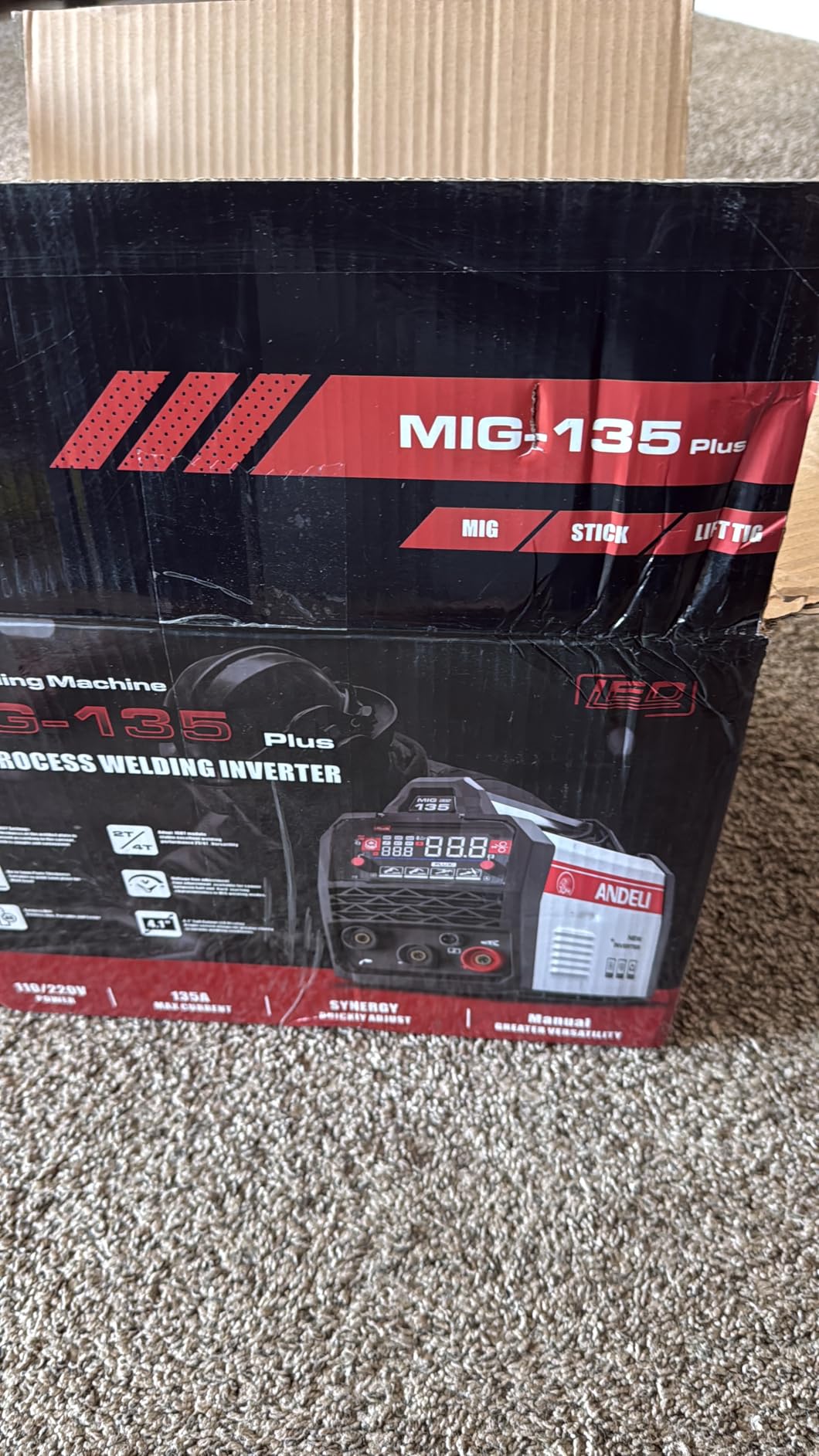
The ANDELI 135A is the one we keep reaching for when the question is how little machine can do this job. At 18.46 lb with a carry handle, and roughly 9 lb for the unit itself according to owners, it is the easiest machine here to move one-handed between a workbench and a car. That portability is its whole identity.
What separates it from the other budget options is the pulsed flux core mode. Pulsing cycles the current rapidly, which breaks up the arc, lowers spatter and produces finer, more uniform beads than plain gasless flux core. Reviewers repeatedly call out the bead quality and the low spatter as the standout, and adjustable inductance gives you a second knob to tune arc stability on the same joint. Hot start and arc force are adjustable, and 2T or 4T selection is available.
The 4.1 inch LED display has an impact and splash protective cover and is readable without lifting your helmet, which matters more than it sounds during setup. The kit is genuinely complete for a beginner: power adapter, flux core wire, contact tips, electrode holder, welding torch, leather gloves and an auto-darkening shield are all listed as included.
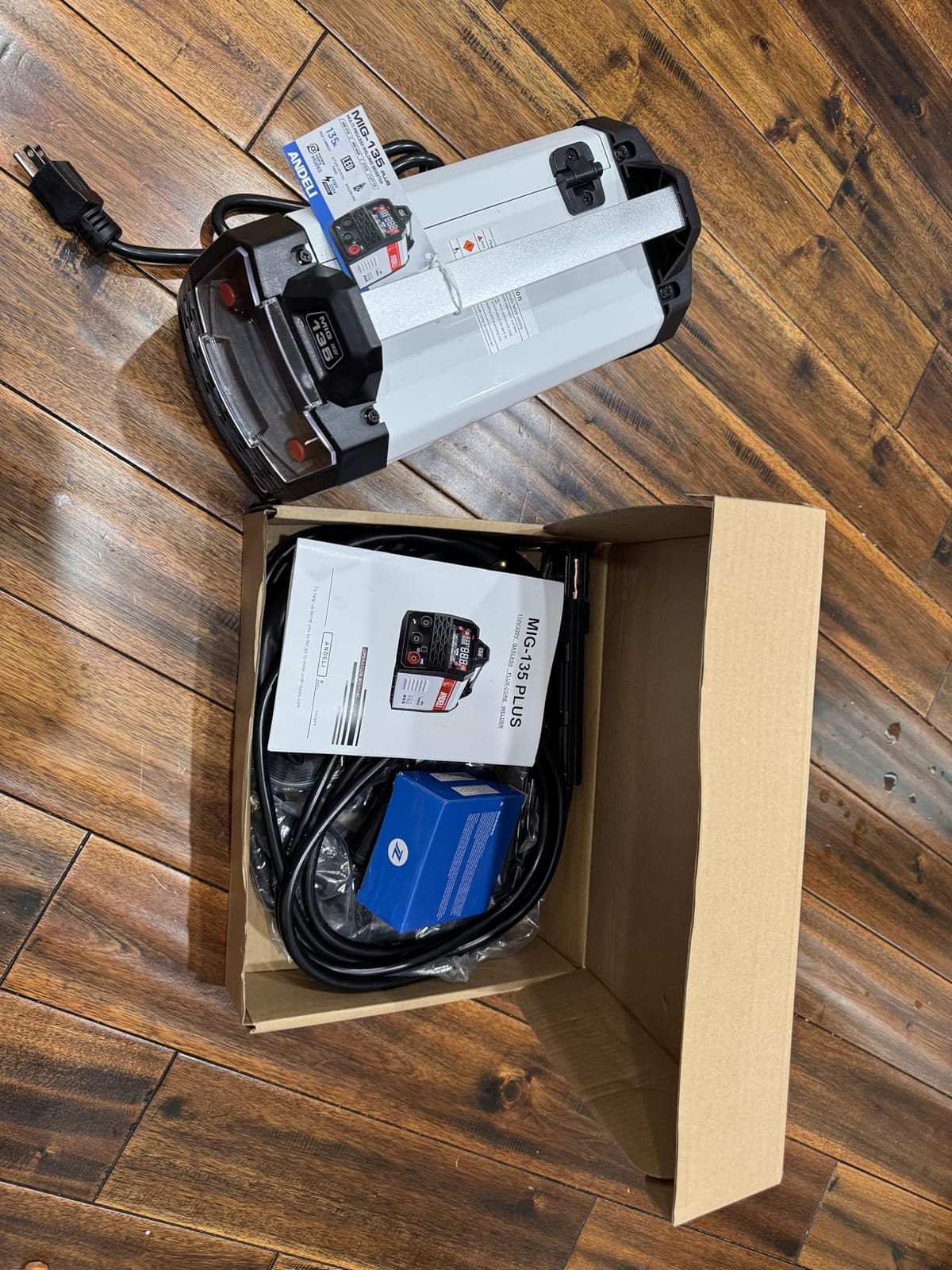
The limitations are specific and worth stating. Only 2 lb spools fit, so longer jobs mean frequent changes, which is the biggest practical annoyance owners report. The lift TIG torch is not included. Some units ship without the pulse function shown in product videos. The included welding helmet is reported as poor quality, and since the kit includes one, budget to replace it. The display shows wire feed in amps rather than inches per minute on some units, and manual mode scales vary between them. A minority of buyers report units overheating after use or arriving with non-functional controls.
It welds material up to 5.0 mm, or 3/16 inch. That is honest sheet and light structural capability and it is where the 135A rating stops.
Best for repair work and limited space
Handrails, brackets, thin steel patches, a mailbox, a trailer fender. This is the machine for small, frequent, single-part jobs in a space where a 37 lb welder is annoying to move. The pulse mode gives it bead quality well above its size, and the complete kit means a first-time welder can start without a second purchase.
What you give up
Spool capacity, sustained heavy work and included accessories quality. Two-pound spools mean more changeovers than you want on a production afternoon, and 3/16 inch is the practical ceiling. If your projects run to 1/4 inch plate, skip this and the Bestarc and step up to a 200A or 250A machine. If you want to carry a machine everywhere and never run out of current, the two answers to that are a bigger welder or a separate plasma cutter for cutting heavy stock.
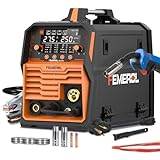
6. FEMEROL 250A – The Most Current You Can Get On 220V In This Roundup
FEMEROL 250A MIG Welder,6 in 1 Gas MIG/Gasless Flux Core/Stick/Lift TIG/Spot Welding/Spool Gun Compatible Aluminum Welding Machine Large LED Display 110V/220V Multi Process Welder
250A at 60 percent duty
110V and 220V dual voltage
32.6 lb
6-in-1 including spot welding
Pros
- 250A at 60 percent duty across MIG MMA and TIG
- Experienced welders report measuring roughly 245A on 220V
- Handles 1/4 to 1/2 inch steel in multiple passes
- Spot weld mode is genuinely useful for tacking 24 gauge
- Generous 9.5 ft torch and leads
- Two-year guarantee
Cons
- Cooling fan runs constantly and is noticeably loud
- Ships with a thin power cord and undersized 120V plug
- Barbed gas fitting instead of a threaded connection
Every other machine in this roundup is a 135A to 200A unit. The FEMEROL 250A is the outlier, and for anyone welding 1/4 inch plate or heavier it is the reason this list is worth reading. Rated at 250A with a 60 percent duty cycle across MIG, stick and TIG, owners report measuring roughly 245A on 220V, which is the kind of number that is almost never true on a listing.
It is also six-in-one: gas and solid wire MIG, gasless flux core, stick, spot welding, lift TIG and spool gun compatibility. Owners with real shop experience back it with 1/4 to 1/2 inch steel and aluminum projects and report that it has not stumbled under heavy multi-pass work. The wire range is broad, covering .023, .030 and .035 solid, .023, .030 and .035 flux core, and .035, .040 and .045 aluminum, with aluminum handled through the included teflon feed tube or a spool gun.
Spot weld again earns its place here. Consistently tacking 24 gauge sheet without burning through is a real production advantage, not a gimmick. The included leads are generous at 9.5 ft, which is unusual at this tier, and the synergic auto-setting with manual override is straightforward to navigate.
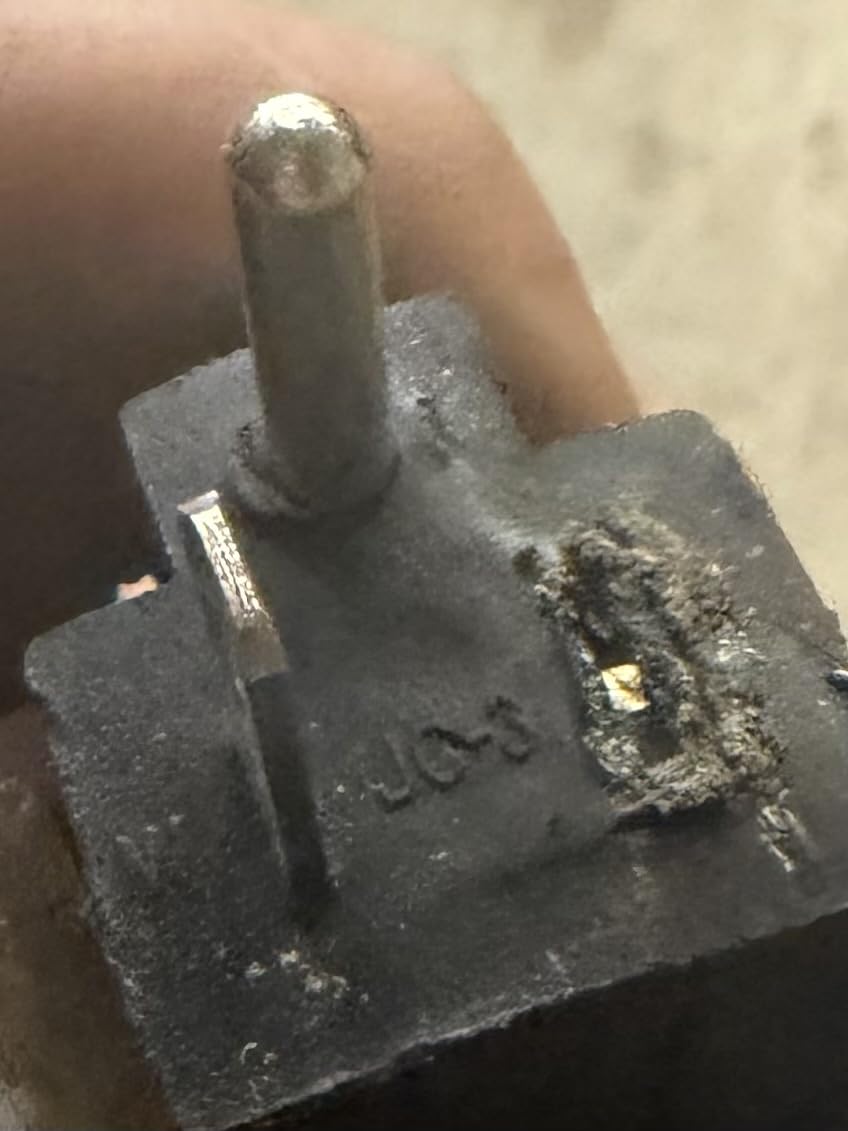
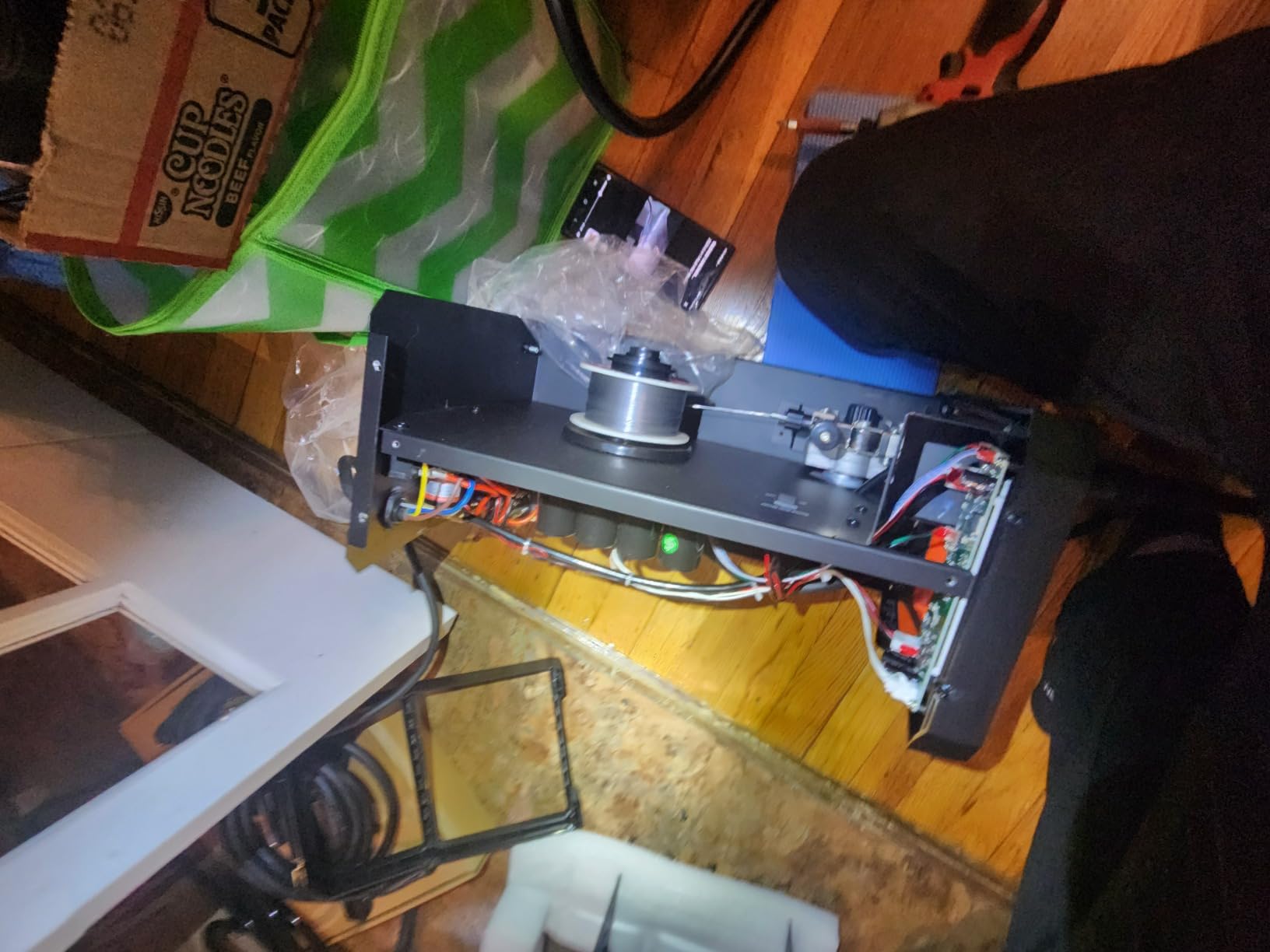
The 4.3 rating is the lowest average in this roundup, and the reasons are hardware rather than capability. The cooling fan runs constantly and is noticeably loud, which owners notice daily. It ships with a lighter-than-adequate 120V plug and a slightly undersized cord, and heavy users replace both. The gas connection is barbed rather than threaded, so a hose change takes longer than it should. Owners describe the arc as soft rather than crisp next to a name-brand machine, and report occasional wire feed studder, where a dirty contact tip can buckle the wire inside the gun. The supplied gas line and torch angle are poor for bench work, and there is no amperage control on the TIG function, which makes it unsuitable for anyone buying this machine for TIG.
Two of those are ten-minute fixes: replacing the plug and cord, and keeping a spare contact tip and a wire brush. The barbed fitting and the missing TIG amperage control are not fixable.
Best for structural steel and plate work
Trailer frames, steel legs, thicker fabrication, 1/4 inch and up in multiple passes. At 250A with a stated 60 percent duty cycle and a 14.0 mm plate rating, this is the machine for a home shop that regularly touches material too thick for the 200A units. The generous leads and the two-year guarantee help on a job this size.
Who should pass on it
Anyone who works in a quiet shop at odd hours, because the always-on fan is genuinely distracting. Anyone whose priority is TIG control, because TIG amperage is not adjustable on it. And anyone who wants a crisp, name-brand arc character on thin decorative work. If your steel stays under 1/8 inch, the 200A machines in the top half of this list are lighter, quieter and better behaved.
7. Weldpro Omni210 – The Only Machine Here That Welds Aluminum With AC/DC TIG
Weldpro Omni210 MIG Welder 200A Multi-Process Welder 110V/220V,Synergic MIG/Flux Core/Stick/Spool Gun/AC/DC HF TIG with Pulse,6-in-1 Frequency Control Welding Machine with Standard TIG Torch,VRD
200A on MIG TIG and stick
110V and 220V dual voltage
81.8 lb
AC/DC HF TIG with pulse MIG
Pros
- True AC/DC TIG which is the only practical home route to aluminum
- Also runs MIG stick spool gun flux core and pulse
- Synergic MIG with Auto-Set and frequency control
- Includes KT26 foot pedal and TIG torch plus 180A MIG torch
- Fan shuts off when not needed
Cons
- Very heavy at about 82 lb so it is not really portable
- TIG side lacks gas post-flow and up-slope or pulse adjustment
- Leads are short and the case hardware feels inexpensive
Here is the single most important filter in this entire roundup, and almost every competitor page buries it. Welding aluminum at home essentially requires AC TIG. DC TIG runs a torch that pushes electrons one way, and aluminum oxide melts at a completely different temperature from the metal underneath, so the oxide floats on top and never clears. Alternating current reverses the arc on each half cycle, scrubbing the oxide back each time it forms. The Weldpro Omni210 is the only machine in this roundup that outputs true AC/DC TIG.
It is also the strongest machine here overall on paper. Six-in-one with MIG, stick, AC/DC TIG, spool gun, flux core and pulse MIG, giving 200A available on MIG, TIG and stick. The synergic MIG has an Auto-Set mode plus frequency control, which owners say makes the machine approachable for a beginner and still tunable for someone who knows what they are doing. Pulse MIG is a genuine bonus for thinner material and stainless.
Everything needed to start TIG is in the box: a KT26 rocker-style foot pedal, a KT26 TIG torch, a 180A NT MIG torch, a flow meter and a ground clamp. The 12 lb spool capacity is the largest here, and HF and lift arc starting are both available with adjustable post-flow. Owners single out the fan shutting off when not needed as a favorite detail, and the customer support is reported as responsive, including handling a warranty replacement.
The compromises are real. At 81.8 lb this is not a portable machine despite what a handle might suggest, and it is three times the weight of the top pick. The TIG side is simplified: no gas post-flow control on some units, and no up-slope or pulse adjustment within the TIG function, which are the controls a dedicated TIG operator would want. The leads are a bit short, the plastic case, rubber feet and side door latch are reported as weak or cheap, the TIG torch vinyl hose is described as cheap, the wire drive roller could grip the wire better, and a 20A 120V breaker can trip if you push it hard on 110V. The integrated gas and MIG connector protrudes and is awkward to disconnect.
Review count is 244, which is the second thinnest in the roundup. That is worth knowing if warranty support is a deciding factor for you.
Best for aluminum, stainless and fine fabrication
If aluminum is a regular material in your shop, this is the answer and nothing else in this list competes. AC/DC TIG also gives you much better control over thin stainless and over heat-sensitive material than DC MIG. The pulse MIG, the 12 lb spool and the foot pedal in the box make it the most complete package for a fabricator doing varied work.
When it is the wrong machine
When you need to move the welder regularly, when your shop is a one-car garage with tight clearance, or when aluminum is a once-a-year curiosity rather than a regular material. At 82 lb it will sit on a cart and stay there, and a machine you cannot move is a machine you will not use for the field work. In that case, the YESWELDER plus a separate aluminum-capable TIG set is the more flexible path, and you can read our TIG roundup for the dedicated side of that.
8. PUWU Plasma Cutter Combo – A Welder With A Built-In Plasma Cutter
PUWU Plasma Cutter Welder Combo 6 in 1 Welding Machine 110V/220V
200A MIG at 220V and 146A at 110V
110V and 220V dual voltage
25.6 lb
plasma cut up to 5/8 in
Pros
- Genuinely capable plasma cutter built into the same chassis
- Clean cuts to 5/16 in at 110V and 1/2 in at 220V
- High-frequency non-contact TIG start reduces tungsten contamination
- Synergic one-knob MIG with full manual mode
- Compact 25.6 lb body with a sturdy handle
- 2-year warranty
Cons
- Plasma torch fitting and air regulator can leak air on some units
- 110V operation needs close to a 50A circuit
- Spool gun sold separately
- Spool holder bracket was overtightened and cracked on one unit
The PUWU Plasma Cutter Combo exists because of an argument we hear constantly in home shops: you need a plasma cutter anyway, so why not buy one machine that does both. The welding side is a competent six-in-one, gas MIG, flux core MIG, HF TIG, stick and spool gun capability. The reason to buy it is the cutter, and the cutter is the reason to hesitate.
It performs. Clean cuts to 5/16 inch at 110V and 1/2 inch at 220V, with a stated maximum of 5/8 inch at 220V and 1/2 inch at 110V, using 20 to 50A plasma with high-frequency ignition and 2T or 4T selection. Several owners report the cutter keeping up with larger name-brand machines across a long day of work. The HF non-contact TIG start is also a genuine step up from lift TIG, since it cuts the chance of tungsten contamination in the puddle.
It runs on 110V, 220V and reportedly a portable generator, and the 25.6 lb chassis with a sturdy handle makes it easy to move between the bench and the driveway. It carries a 2-year warranty and thermal protection.
Now the balance sheet. The plasma torch connection and the air regulator do not seal properly on some units and leak air immediately, which is the single most common complaint and the most annoying one because a plasma cutter cannot do its job without airflow. The instructions are poor, with far less guidance for the MIG and TIG modes than for the plasma function. 110V operation needs close to a 50A circuit, more than most household outlets provide, so check your panel before assuming it will run off a garage outlet. One unit arrived with an overtightened spool holder bracket that cracked the plastic. A contact tip jam can break the wire at the feed roller and force you to pull the wire out of the whip. And the spool gun is not included, so aluminum on this machine is a second purchase.
At 144 ratings, this is the least-reviewed machine here. We would want more history before recommending it over a dedicated cutter plus a better welder.
Best for shops that cut as much as they weld
If your projects are cut, formed and welded in equal measure, having one power source and one set of leads for both is a real convenience, and the cut quality owners report is better than the machine’s class suggests. The HF TIG start and synergic one-knob MIG with full manual override mean the welding half is not a compromise either.
When to buy a separate plasma cutter instead
When plasma is a small part of your work, or when reliability matters more than having one box. A dedicated cutter in this class will usually cut cleaner, and you will not have a leaky regulator taking the welder down with it. Our advice is to buy the welder that fits your welding and add a cutter later. If you do want the combo, this is the one to buy, but verify the air fittings on arrival before you rely on it.
How to Choose a Multi-Process Welder for a Home Shop
Six decisions decide whether you buy the right machine. Work through them in order, because each one narrows the field for the next.
1. Count the processes you will actually use. Most home shops use MIG for 80 percent of the work, stick for structural and outdoor jobs, and TIG rarely. Buy the process list, not the ambition. A five-in-one that runs gas MIG, flux core, lift TIG and stick covers almost every garage. Spool gun and AC/DC TIG are the two upgrades that add real capability rather than count on a marketing list.
2. Check the input voltage against your panel. Every machine here is 110V and 220V dual voltage, and that is the correct answer for a home shop. What actually matters is the branch circuit. A 200A machine at 220V wants a dedicated 30A to 50A breaker. A 145A or 135A machine can often run on a 20A household branch, which is the difference between a welder you can use from a normal outlet and one that needs an electrician. Owners of the larger machines here specifically note that a 20A 120V breaker can trip if you push hard, and that 110V operation on a larger combo can need close to 50A.
3. Match amperage to material thickness, not to the number on the box. Peak amperage on a listing is the machine running for a few minutes, not the amperage you can weld all day. A 200A machine that delivers 200A at 20 percent duty is honest. A machine claiming 100 percent duty at full output is not. As a rough guide, 1/8 inch mild steel sits comfortably in the 90A to 120A range, 1/4 inch wants roughly 150A to 180A for a single pass, and 1/2 inch or thicker multi-pass work is a 250A job. Duty cycle is a 10-minute-on, 1-minute-off figure, and a 60 percent rating means six minutes on, four off.
4. Decide about aluminum early. If aluminum is on your list, AC/DC TIG is the filter. Everything else is detail. DC-only lift TIG on aluminum is a frustrating experience, and DC MIG on aluminum is worse. The Weldpro Omni210 is the only machine in this roundup with true AC/DC output, which is why it wins the aluminum slot despite being the heaviest and least-reviewed option.
5. Treat warranty length as a build quality signal. A 90-day warranty means the manufacturer does not expect the machine to survive much. A 2-year warranty means something different entirely, and it is one of the clearest differentiators between tiers in this roundup. The ARCCAPTAIN MIG200, the FEMEROL 250A and the PUWU Plasma Cutter Combo all carry 2-year terms. The budget units at the bottom of the market typically do not.
6. Count the accessories you will have to buy. Spool gun, lift TIG torch and contact tips are frequently sold separately even on machines advertised as multi-process. Both the top pick and the best value pick require them for two of their five processes. Read the included components list, not the feature headline.
Setting Up Your Shop: Power, Gas and Ventilation
No ranking page we found covers the electrical reality of putting one of these machines in a garage, and it is the factor that most often turns a good purchase into a frustrating one.
Power. A 200A multi-process welder at 220V needs a dedicated circuit, typically a 30A to 50A double-pole breaker, and running it on a shared household branch will trip. The 135A and 145A machines here are the ones that can live on an ordinary 20A outlet if you are sensible about output. Check your panel before you buy, not after. If your garage sub-panel is full, that is a real cost that belongs in your decision, not a surprise.
Voltage switching. Every dual-voltage machine needs a physical switch between 110V and 220V, and a mismatch here is a fast way to destroy a power source. The YESWELDER’s switch procedure is reported as poorly explained with no voltage indicator, which is a reason to read the manual twice before your first 220V session rather than after.
Gas. If you plan to run gas MIG, you need shielding gas, a regulator, a flow meter and a hose that fits your machine’s fitting. Watch the fitting type. The FEMEROL uses a barbed gas connection where a threaded fitting is more convenient, and the Weldpro’s integrated gas and MIG connector is reported as protruding and awkward to disconnect. A 20 to 25 cubic foot cylinder covers a garage shop for a long time. Gasless flux core removes that requirement entirely, which is one of its underrated advantages in a home shop.
Ventilation. Welding fumes are a serious long-term health issue and no amount of a door being open fixes it. Move the welding position outdoors, or near a garage door opening that can actually stay open, and use a fume extractor. Position the machine so the extraction fan pulls air away from your breathing zone. A small fan pointed at the workpiece is not extraction and will not protect you.
Helmet. Modern inverter multi-process machines run low enough open-circuit voltage that many passive auto-darkening shells work, but a proper auto-darkening helmet is a separate purchase and a worthwhile one. The ANDELI kit includes a shield that reviewers call poor quality, so budget for a replacement. If you want to see how the dedicated side compares, we covered those in our TIG welder roundup.
Which Welding Process Should You Learn First?
Start with MIG. It is the fastest to learn, the most forgiving, and it covers the widest range of home shop work from 16 gauge sheet to 1/8 inch plate. It also teaches wire feed speed and voltage relationships, which transfer directly to flux core. If MIG is new to you, our MIG welder roundup covers the process in more depth.
Learn stick second. It is the most versatile process per dollar and the only one here that works outdoors without gas. For structural work and field repair, 6013 is the general-purpose electrode to start with, and 6011 is the fast-filler for cleanup, rusted or dirty steel where you need penetration over cosmetics. On thin material, E6013 is easier to control than E7018 because it runs with a shorter arc and less heat, which is why many hobbyists pick 6013 first and move to 7018 later for structural strength.
Learn TIG last, and only once you are already producing good MIG. TIG is a skill, not a mode. When you do get there, a dedicated TIG machine is often a better use of money than the TIG function on a budget multi-process unit, because features like up-slope, down-slope and gas post-flow control are what make TIG controllable. Our TIG welder roundup covers those choices.
That sequence has a practical payoff. Once you can run MIG well, the other modes on a multi-process machine are an afternoon of practice rather than a second machine purchase.
Who Should Not Buy a Multi-Process Welder
A multi-process welder is the wrong tool in a few specific situations, and buying one anyway is a common and expensive mistake.
If you weld thick steel all day. These are hobby and light-fabrication machines. Continuous 300A-plus work needs a machine designed for it, and the Weldpro at 81.8 lb shows how heavy a general-purpose unit gets before it reaches that class.
If your shop has only three-phase power. Every machine here is single-phase 110V and 220V. That is correct for a garage and wrong for a commercial fab shop.
If you already own a good MIG and a good stick machine. At that point you are looking at a third machine for occasional TIG, and a dedicated TIG welder is a better investment. Check what you have before shopping.
If you cannot dedicate a circuit. A 200A machine on a shared 20A branch will trip every time. Solve the electrical first or buy a machine sized for the circuit you have.
If aluminum is a someday project. Six of the eight machines here cannot weld aluminum properly. Waiting until you know you will do it saves you money and a return.
Frequently Asked Questions
What is the best multi-process welder for home use?
For most home shops the YESWELDER 205A 5-in-1 is the best multi-process welder because it runs 200A on both 110V and 220V and genuinely performs all five advertised processes, including spool gun MIG and lift TIG. The TOOLIOM 200A 5-in-1 is the better value pick, and the Weldpro Omni210 is the only machine in this roundup with true AC/DC TIG for aluminum.
Are multiprocess welders worth it?
Yes, for a home shop they usually are. One multi-process machine replaces a separate MIG, stick machine and TIG set, which cuts total cost, bench space and the number of leads you manage. The tradeoff is that each process shares the power source, so TIG controls and arc character are usually simpler than on a dedicated machine. If you already own a good MIG and stick machine, a dedicated TIG welder is the better buy.
What is the difference between MIG and multiprocess welding?
MIG, also called GMAW, is a single process that feeds a continuous solid wire through a gun. A multi-process welder is a single power source that offers MIG plus TIG, stick and usually gasless flux core modes. One is a process, the other is a machine that does several processes, and a multi-process welder can still do MIG as one of its modes.
Can a multi-process welder weld aluminum?
Only properly. Aluminum oxide melts at a different temperature from the metal, so DC-only TIG and DC MIG will not clear it. Practical home aluminum welding needs AC/DC TIG, which reverses the arc to scrub the oxide away. Of the eight machines reviewed here, only the Weldpro Omni210 has true AC/DC TIG output. The others need a spool gun for aluminum MIG, and DC lift TIG is a frustrating experience on aluminum.
Do I need 120V or 240V to run a multi-process welder?
Buy dual voltage and run whichever matches your circuit. A 200A machine at 220V wants a dedicated 30A to 50A double-pole breaker, and running it on a shared household branch will trip. Smaller 130A to 145A machines can often run on an ordinary 20A outlet at reduced output. Check your panel before you buy, and make sure you physically switch the machine to match the voltage you are feeding it.
The Best Multi-Process Welder for Your Garage
Here is where each machine lands, in plain terms.
Best overall: the YESWELDER 205A 5-in-1. Five working processes, 200A on both voltages, and the deepest owner history in the roundup at 1455 ratings. Best value: the TOOLIOM 200A 5-in-1, which matches the process list for less and handles a 10 lb spool. Most features and highest rating: the ARCCAPTAIN MIG200, with spot welding, preset memory and a 2-year warranty, once you replace its drive rollers. Best for thick steel: the FEMEROL 250A, the only 250A unit here. Best for aluminum: the Weldpro Omni210, the only true AC/DC TIG machine, heavy as it is. Most portable: the ANDELI 135A at 18.46 lb. Best all-in-one with cutting: the PUWU Plasma Cutter Combo. Lightest four-process option: the Bestarc MIG145.
If you take one thing from this roundup, make it the panel check and the aluminum decision. Everything else on the spec sheet is negotiable. Those two are where people regret the machine they bought.
Every machine here sits in the best multi process welders for home shops conversation for a reason, and the right pick depends on your material, your circuit and how often you plan to move the machine. Read the reviews on the page, check the included components list, and get the leads you need before the first bead.