
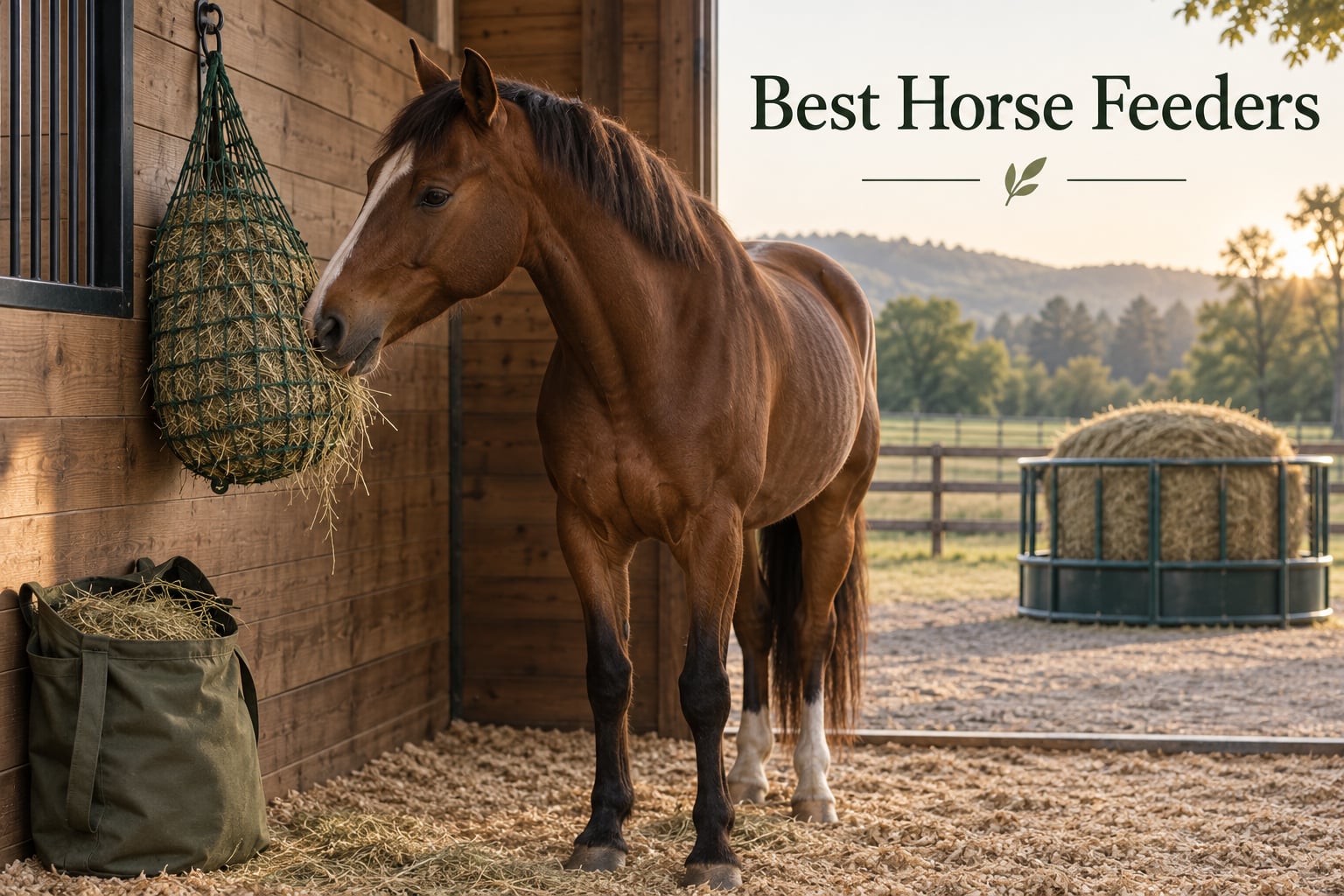
The best hay feeder for horses is a slow-feed net or bag sized to one feeding and hung at chest height, so the head stays low, the forage stays clean, and the horse has to work for every mouthful. Nets cut waste hardest, hard bags survive aggressive eaters, and corner units win when hay and grain share one spot.
Most barns do not have a feeder problem until the first greedy horse, the first ulcer diagnosis, or the first month of watching a good half-bale end up in the shavings. Then it becomes the biggest invisible line item in the hay budget. Owners on equestrian forums describe the same curve repeatedly: loose hay on the floor loses a large share of its weight to waste, bedding, manure and sand, and a feeder is the cheapest fix available.
That is why we spent weeks with these ten feeders in stalls, dry lots and trailers before ranking them. The list covers every format a barn actually runs on: small-hole slow-feed nets for ulcer-prone and greedy horses, hard webbed hay bags for horses that shred netting, a two-sided corner feeder for trailering, plus the two-pack options that make daily filling painless in a multi-stall barn.
If you also run feeders for other animals on the same property, the logic is identical: control access, control height, control waste. Our game feeder roundup covers the same three levers for wildlife, and our squirrel-proof bird feeder reviews handle the version that has to defeat a determined thief rather than a determined horse.
Table of Contents
Top 3 Best Horse Feeders for 2026

Weaver Equine Slow Feed Hay Net
- 1 to 1.5 inch holes
- Holds 30 to 40 lbs
- Nylon rope
- Show friendly


Hay Chix Half Bale Hay Net
- 1 3/4 inch openings
- Handmade fixed knots
- 30 to 35 lbs
- UV-treated nylon
The Weaver net takes the top slot because it does the most things right at once: small holes that genuinely slow intake, rope that survives being leaned on all day, and a size that works for shows and stalls without swapping hardware. The T TEKE two-pack is the value pick, and the Hay Chix net is the one to buy when the horse is rough on gear and you want fixed knots and a closure you can work one-handed.
All 10 Horse Feeders Compared (September 2026)
| Product | Specifications | Action |
|---|---|---|
| Weaver Equine Slow Feed Hay Net |
|
Check Latest Price |
| T TEKE Classic Slow Hay Net Two-Pack |
|
Check Latest Price |
| Hay Chix Half Bale Hay Net |
|
Check Latest Price |
 Majestic Ally Ultra Slow Feed Two-Pack Majestic Ally Ultra Slow Feed Two-Pack |
|
Check Latest Price |
 Aoneky 47 Inch Large Hay Net Aoneky 47 Inch Large Hay Net |
|
Check Latest Price |
 Harrison Howard Slow Feed Hay Net Harrison Howard Slow Feed Hay Net |
|
Check Latest Price |
 Derby Originals Superior Slow Feeder Hay Bag Derby Originals Superior Slow Feeder Hay Bag |
|
Check Latest Price |
 Professional’s Choice Trailer Corner Feeder Professional’s Choice Trailer Corner Feeder |
|
Check Latest Price |
 Fabbay Two-Pack Slow Feed Hay Net Fabbay Two-Pack Slow Feed Hay Net |
|
Check Latest Price |
 Derby Originals Front Web Slow Feeder Hay Bag Derby Originals Front Web Slow Feeder Hay Bag |
|
Check Latest Price |
Every one of these feeders restricts access in some way. That is the point: a horse eats roughly 16 to 18 pounds of forage a day at 1,000 pounds bodyweight, and that forage is meant to be eaten over 16 hours or more, not in three meals.
1. Weaver Equine Slow Feed Hay Net – Best Overall Slow Feeder
Weaver Leather Slow Feed Hay Net Pink, 36-Inch
36 inch nylon rope net
1 to 1.5 inch holes
Holds 30 to 40 lbs
Five color options
Pros
- Survives daily leaning and multi-use per day
- Genuinely slows intake and cuts waste
- Bright colors are easy to spot in a field or barn
- Nylon can be soaked for soaking hay
Cons
- Capacity is about half a small square bale
- Some buyers report holes after a couple of months
- May need a carabiner to hang
This is the net we kept reaching for. The 1 to 1.5 inch openings are small enough that a horse cannot gulp hay and air together, and the synthetic rope holds its shape when a 1,200 pound gelding leans on it looking for the easy mouthful at the bottom.
Capacity is the honest trade-off. Owners report it holding roughly 2 to 4 flakes, around 30 to 40 pounds, which is about half a small square bale and enough to keep a single horse eating through a workday.
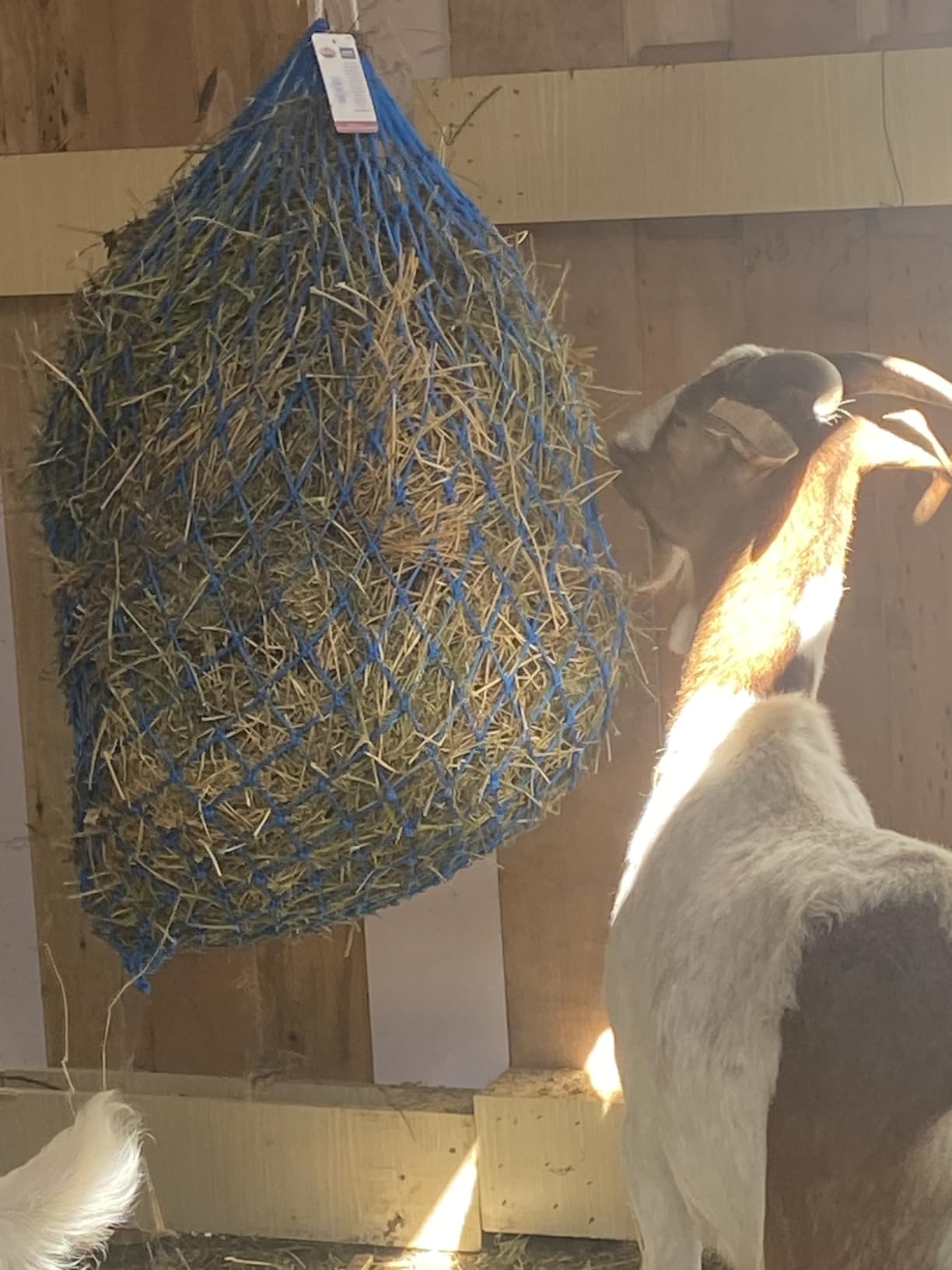
Two details make it work in a real barn rather than only in a product photo. The nylon construction can be soaked, which matters for laminitis cases where hay gets dunked before feeding. And the 36 inch body is short enough to hang on stall bars and load fast at a show, where a full-size bale net is a nuisance.
Durability is the other story. With 2,241 reviews averaging 4.5 stars, this is the most widely reviewed feeder in our group, and owners frequently report switching over from more expensive nets that failed sooner. The recurring caveat is wear: some buyers see holes appear after a couple of months, particularly on the purple variant, which several owners describe as running smaller and wearing faster than the other colors.
How it holds up against a determined horse
This is the net for horses that lean, paw and drape themselves over the hay rather than just eating from it. Reviewers consistently report it standing up to repeated daily abuse and multiple uses per day without the frame or knot failure you get with lighter netties.
It is not indestructible. Owners with shod horses note that any net on the floor is a leg-tangling risk, so this one belongs hung, not dropped.
Where it fits less well
If you are feeding a full small square bale for one horse, you will be topping up twice a day. The capacity is designed around a half-bale portion, which suits a stall ration rather than a group turnout.
Reviewers also mention needing an extra clip or carabiner for some hanging setups, so budget a few cents and a minute for hardware before the first fill.
2. T TEKE Classic Slow Hay Net Two-Pack – Best Value Slow Feeder
T TEKE 2 pcs Classic Slow hay Feeder hay nets, 40″ Length with 2″ Holes, Horse Supplies hay Bags for Horses, Goat Feed
Two nets per pack
40 inch length with 2 inch holes
14.3 lb capacity
6mm drawstring
Pros
- Two nets so one stays pre-filled
- Thick 6mm drawstring is easy to grip
- Soft braided polyethylene is comfortable
- Holds up as a high-ranked seller
Cons
- 14.3 lb capacity is small
- 2 inch holes feed faster than ultra-slow options
The selling point is arithmetic. You get two nets, so while one is on the horse the other is packed and waiting, which turns a two-a-day chore into a one-a-day chore without any extra hardware.
Mechanically it is a standard 40 inch poly net with 2 inch mesh and a 6mm drawstring. That string is thicker than most, and owners single it out for making the net easy to carry and easy to tie off in a dark stall.
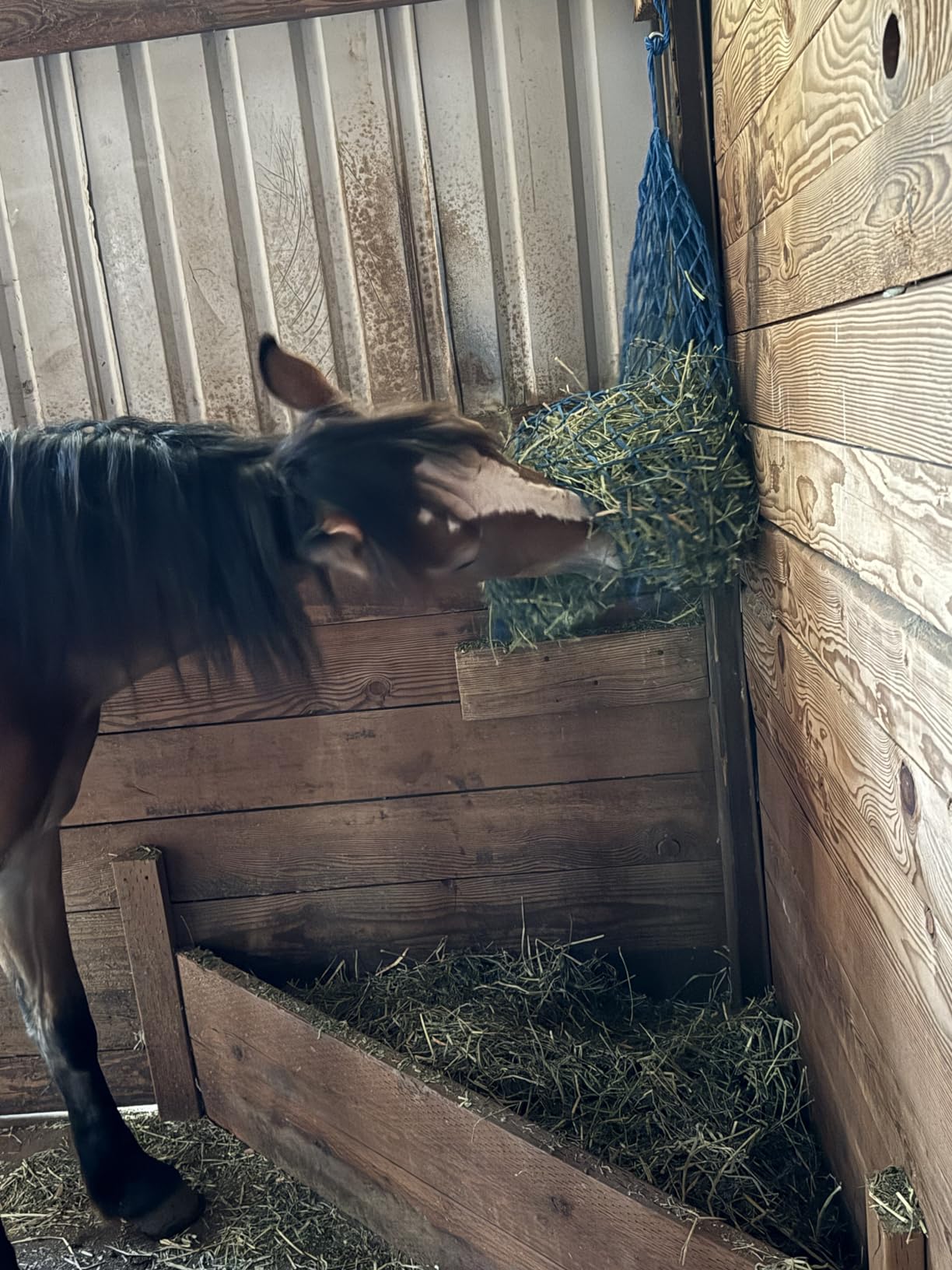
The 2 inch opening is the decision point. It lets a horse take a real mouthful rather than nibbling stem by stem, which reduces frustration, but it is a faster feed rate than 1 to 1.5 inch mesh. For a horse on a restricted diet or recovering from an ulcer, choose a smaller-hole net instead.
Capacity is about 14.3 pounds, which sounds small until you realize it is roughly one meal for a mid-size horse, not a full day. Reviewers treat it as a meal-sized net, and the twin pack is what makes that workable.
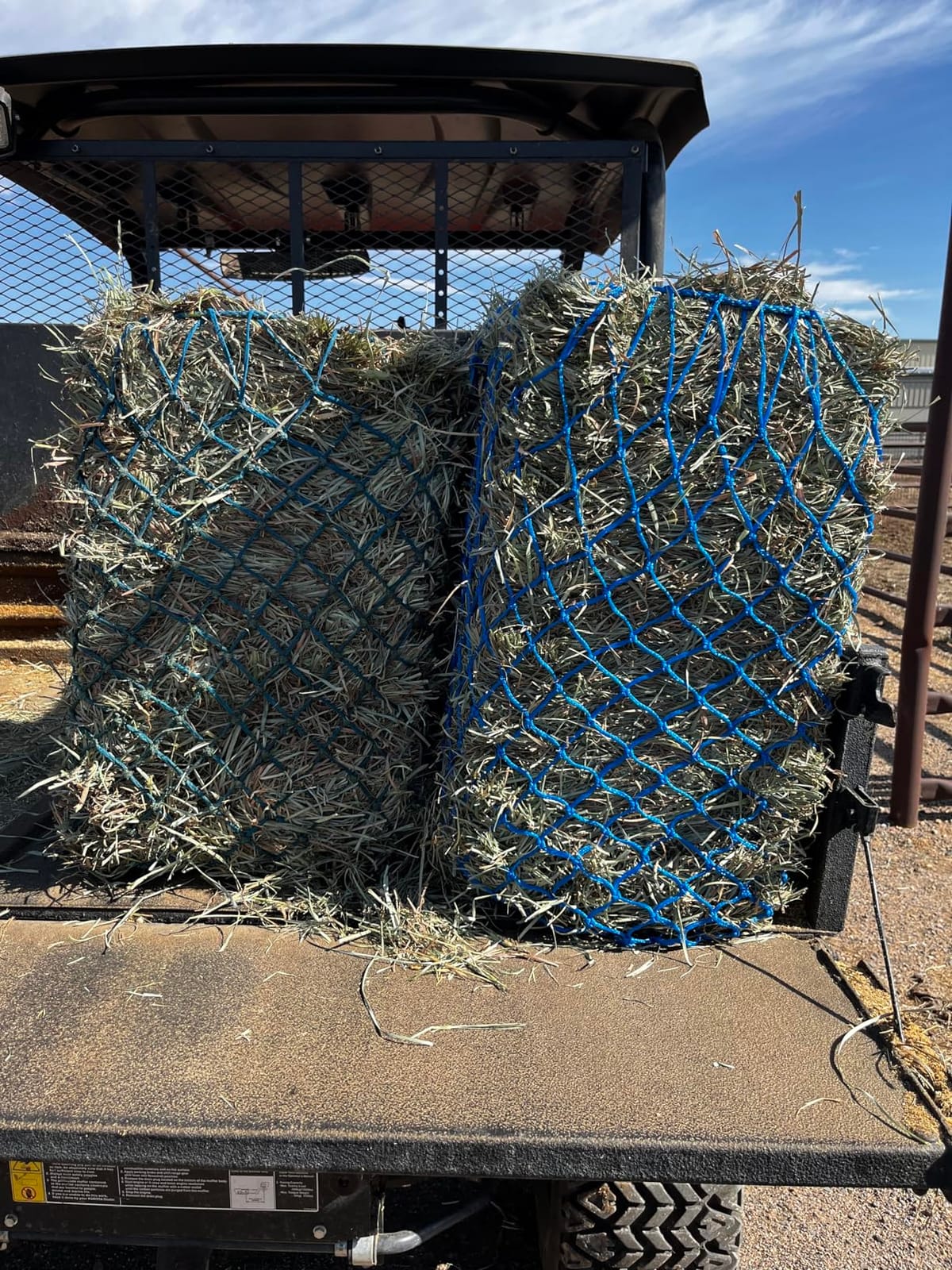
Why the twin pack matters in a stall barn
Daily refilling is where netted feeders lose owners, not on day one. With two nets you swap instead of restuff, and if one is soaking for a laminitis case the other still goes out.
Owners also like the soft braided polyethylene cord, which is comfortable for animals against the muzzle and does not have the wire-core feel of cheaper netties.
What you give up for the value
At 2 inch holes this is a moderate slow feeder, not an ultra-slow one. It will not stretch a bale to a full day the way a 1 to 1.5 inch net does.
The 14.3 pound capacity also means it works best for one horse rather than a pair sharing a wall, unless you buy the pack and use both nets.
3. Hay Chix Half Bale Hay Net – Premium Handmade Net
hay chix Half Bale Hay Net for Horses | 1 3/4″ Holes, Gold-Colored Rope
1 3/4 inch openings
Handmade fixed knots
30 to 35 lb capacity
Rope and Hoggle closure
Pros
- Multi-year durability reported by performance owners
- Rope and Hoggle closure fills in seconds
- Good for soaking hay cases
- Holds hay up and off the ground
Cons
- Holds less than a full small square bale
- Some arrive below factory quality
- Costs more than a generic net
This is the one we recommend when the horse is rough on gear. It is handmade in Texas with fixed knots rather than machine-tied loops, and the fixed-knot construction is why hole size stays consistent season after season instead of stretching into a funnel.
The Rope and Hoggle closure is the feature owners mention first. A full net loads and hangs in about half a minute, one-handed, which matters more in a real barn than any spec on the label.
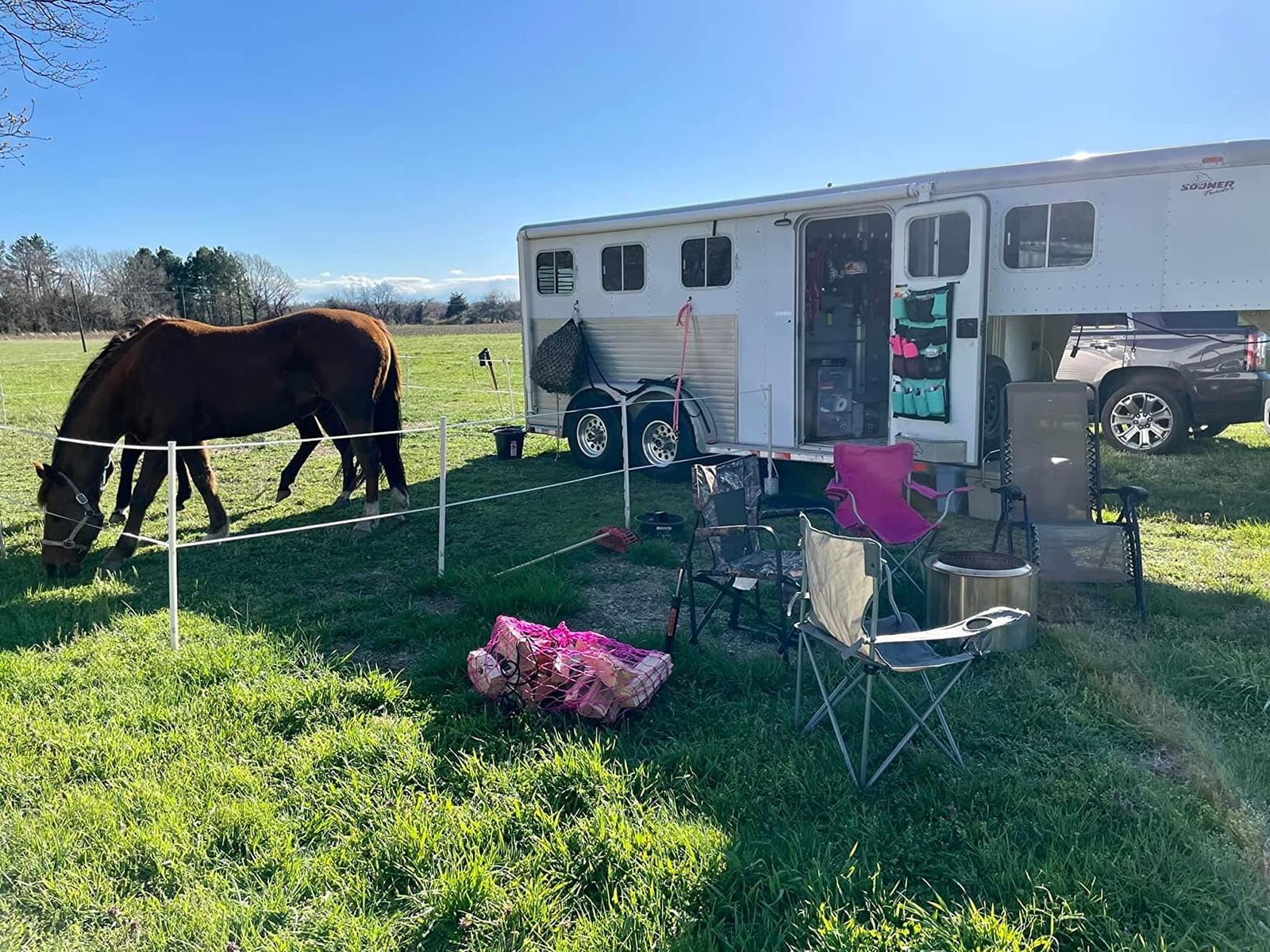
Openings are 1 3/4 inches, in the middle ground between true ultra-slow and a standard pace. Capacity runs about 30 to 35 pounds, roughly half a small square bale, and the marine-grade UV-treated nylon is built for outdoor use rather than a covered stall only.
Waste reduction is the headline claim: the manufacturer cites university testing showing hay waste reduced by up to 94 percent versus loose hay on the ground. Treat that as a controlled comparison rather than a guarantee, but the direction matches what owners describe in practice.
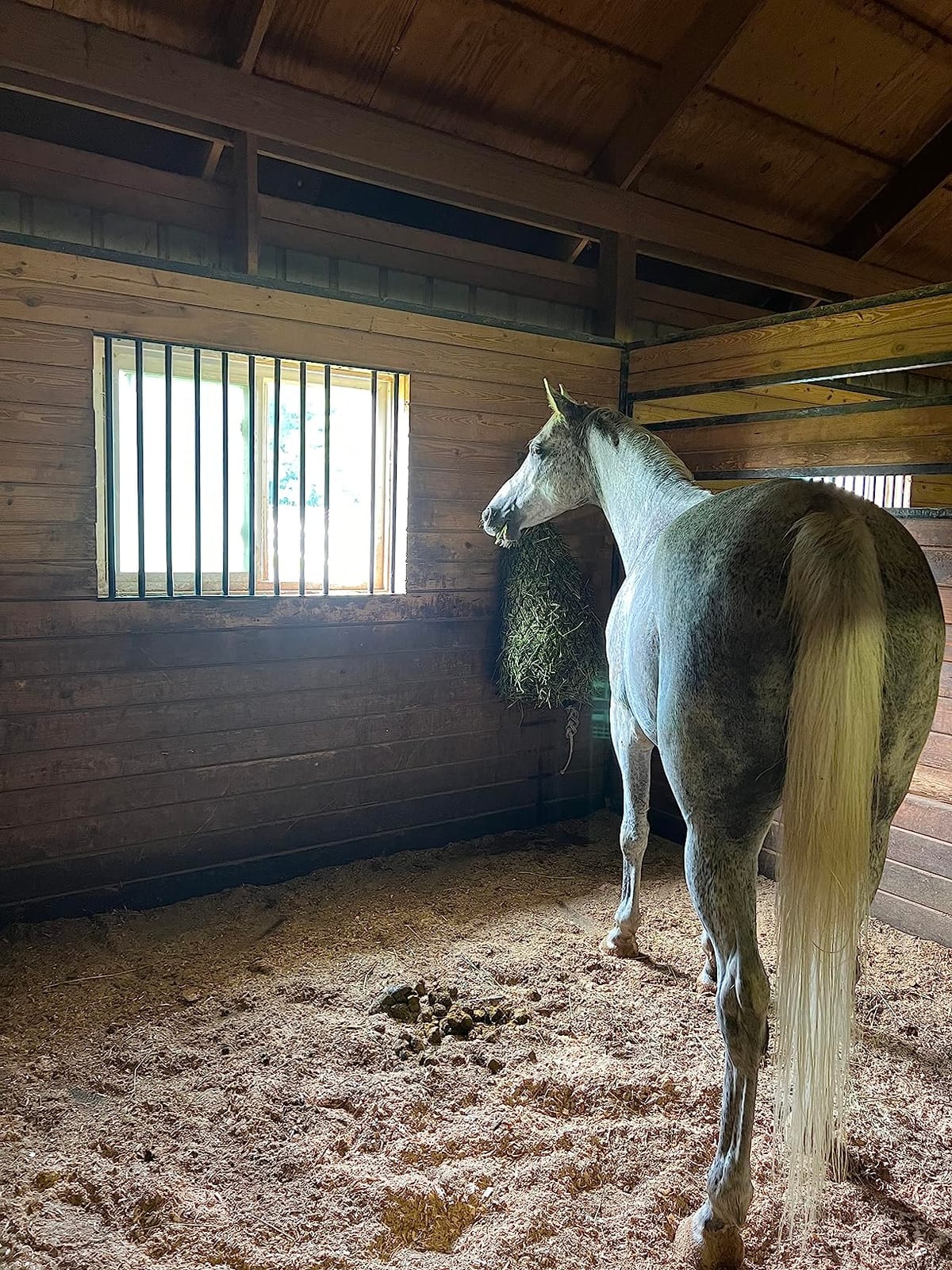
When durability decides the purchase
Performance-horse owners report multi-year daily use without failure, and the material is comfortable on hands and hooves when the net empties onto the floor. It is also a natural fit for soaking hay for horses recovering from laminitis or founder.
If your horse pulls nets through and shreds them, this is the construction that outlasts the behavior rather than hoping the horse calms down.
Where the trade-off sits
It is a premium-tier purchase, and it holds less than a full small square bale, so a second net is needed for continuous feeding. A minority of buyers also report that the unit they received did not match factory quality.
That last point is worth stating plainly: production was recently updated to address earlier dye-transfer concerns, so check the delivered unit rather than assuming every batch is identical.
4. Majestic Ally Ultra Slow Feed Two-Pack – Smallest Holes for Greedy Horses
Majestic Ally 2 pcs Ultra Slow Feed 1.5″x1.5″ Holes 40” Hay Net for Horses and livestocks (Turquoise)
1.5 x 1.5 inch mesh
40 inch stretched length
Holds 3 to 5 flakes
Twin pack
Pros
- Outlasts pricier nets in some barns
- Large enough for long feeding intervals
- Strong tie rope
- Eight color options
Cons
- Only about 15 lb capacity
- Quality varies between units
- Aggressive ponies and goats defeat the mesh
This is the net to reach for when the horse is a gobbler or is on an ulcer-management ration. At 1.5 by 1.5 inches it is the smallest mesh in our group that is still comfortable, and the intent is simple: smaller bites, more minutes over the same hay.
Owners running whole barns report these outlasting more expensive brands, which is the single most useful thing in the 387 reviews averaging 4.3 stars. Capacity runs 3 to 5 flakes, roughly 12 to 15 pounds.
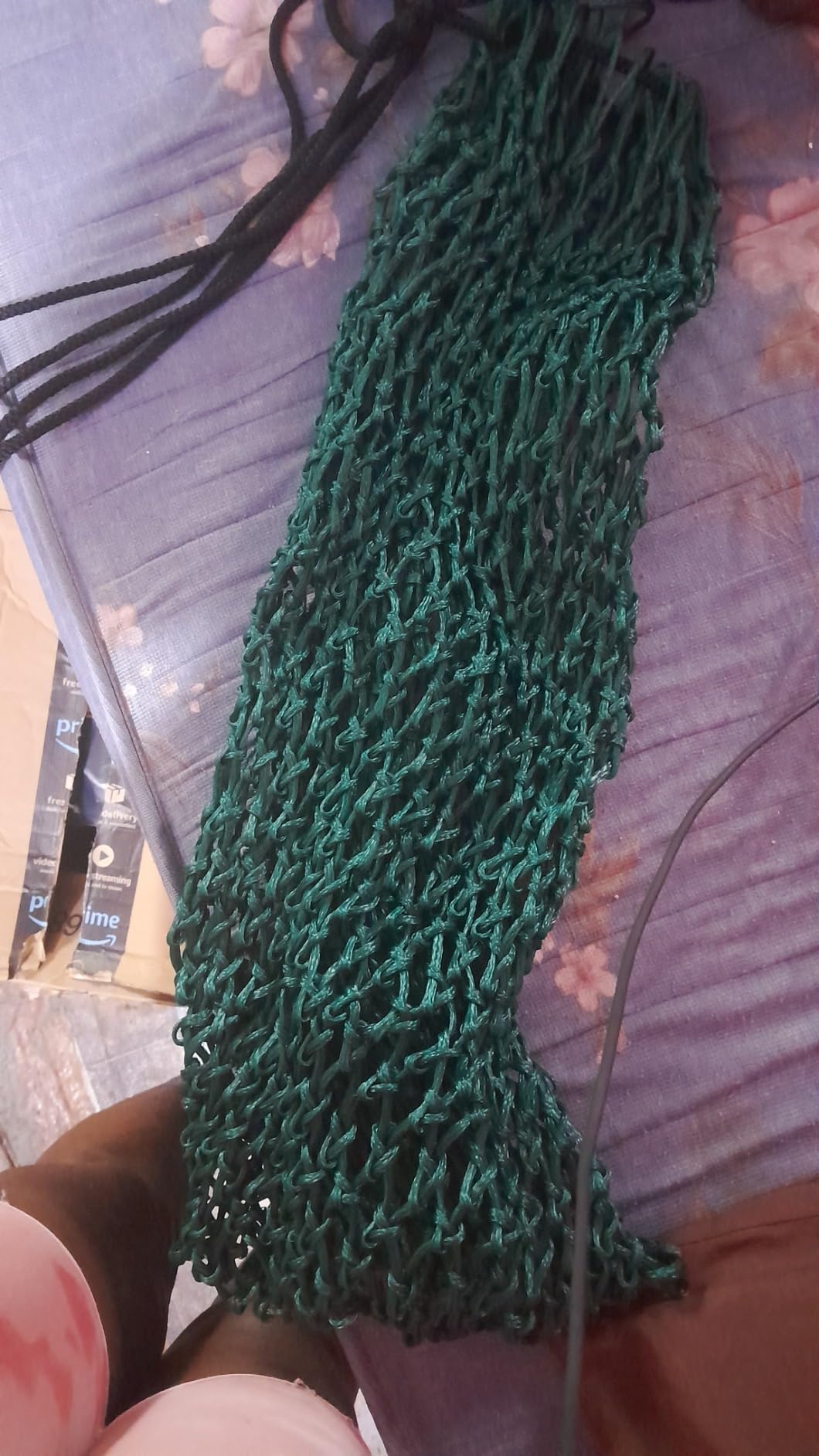
The 40 inch stretched length gives real foraging height, and multiple colors make nets easy to identify at a glance in a field or a row of stalls. The twin pack gives you a swap while one is in use.
Be realistic about the horses this suits. It is not recommended for horned livestock or very aggressive chewers, and owners with ponies report that determined animals can work the mesh. A goat will end this net faster than a horse will.
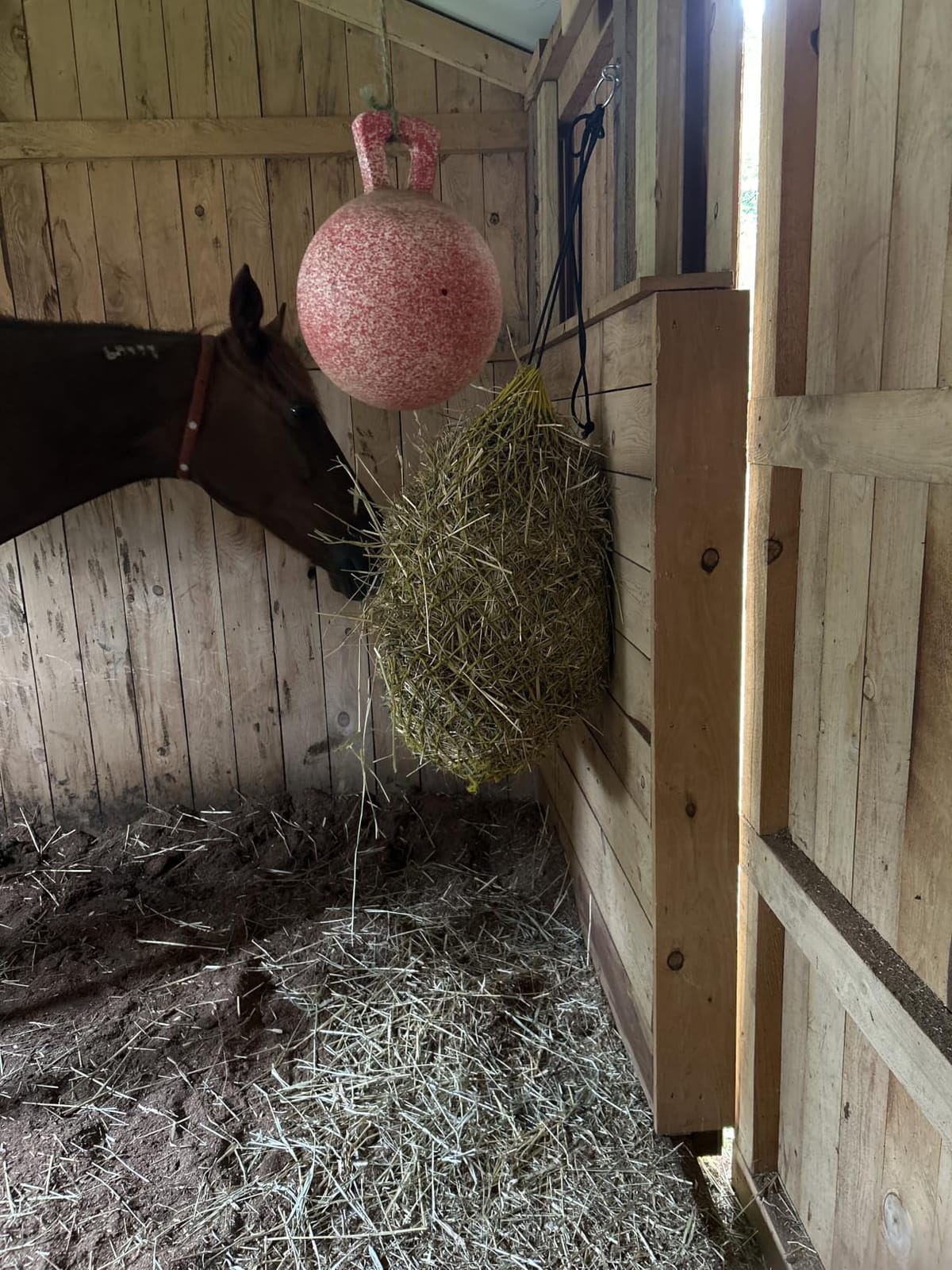
Best fit for ulcer-prone and greedy eaters
Small-hole mesh is the standard recommendation for horses that gulp air, crib or windmill on their hay, because it lengthens the meal without restricting total intake. Owners consistently confirm intake rate drops noticeably.
If the horse also soaks hay, the nylon body handles that better than most and can be rinsed and hung after.
Check these before you order
Capacity is the limit: 15 pounds means a single-horse meal, not a day. Plan on two nets hung side by side or a top-up at lunch.
Some arrive needing re-stringing or with much larger holes than advertised, and the bottom closure can separate slightly after extended use. Inspect it the day it arrives.
5. Aoneky 47 Inch Large Hay Net – Fits a Full Small Square Bale
Aoneky Large Hay Net for Horses Slow Feed Horse Feeder Hay Bag 47 Inch Bale Size with Soft Knotless Nylon Mesh Fits Small Square Bales Up to 36x18x18 Inch
47 inch design for full bales
Soft knotless nylon mesh
1 inch or 1.5 inch holes
Fits bales to 36x18x18
Pros
- Only net in this group sized for a full small square bale
- Soft knotless weave has not sprung holes
- Loads by standing the bale on end
- Works for ponies and minis
Cons
- Included rope is often too short
- 1 inch version frustrates horses as it empties
- Never leave it on the ground
Every other net in this list holds a portion. This one holds the whole bale. At 47 inches it fits small square bales up to 36 by 18 by 18 inches, and owners report it taking 37 to 50 pound bales, with at least one report of a 110 pound bale going in.
That changes the daily routine. One net per horse, filled once, holds roughly 24 hours, which is the difference between a feeder that works and one that quietly fails because the barn got busy.
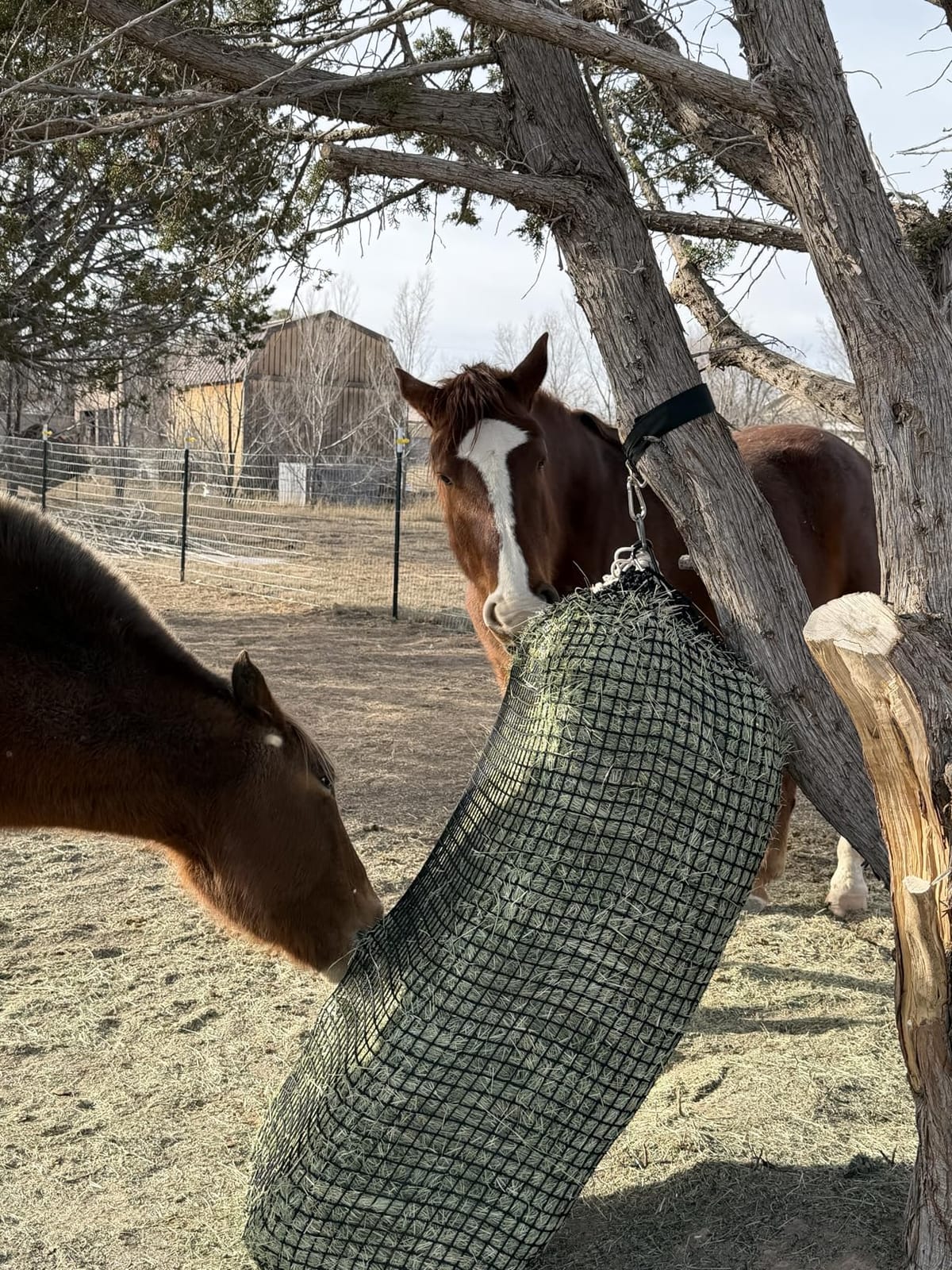
The soft knotless nylon mesh is the quiet hero. Owners report it is gentle on the muzzle and lips, easy to load even with gloves on, and several describe a year of grazing by more than one horse without a single sprung hole.
You choose the pace. The 1 inch version feeds slowly and is the one to pick for a greedy or ulcer-prone horse; the 1.5 inch version is a more normal pace for a horse that eats calmly. At 4.6 stars from 343 reviews, it sits among the highest-rated nets in our group on satisfaction.
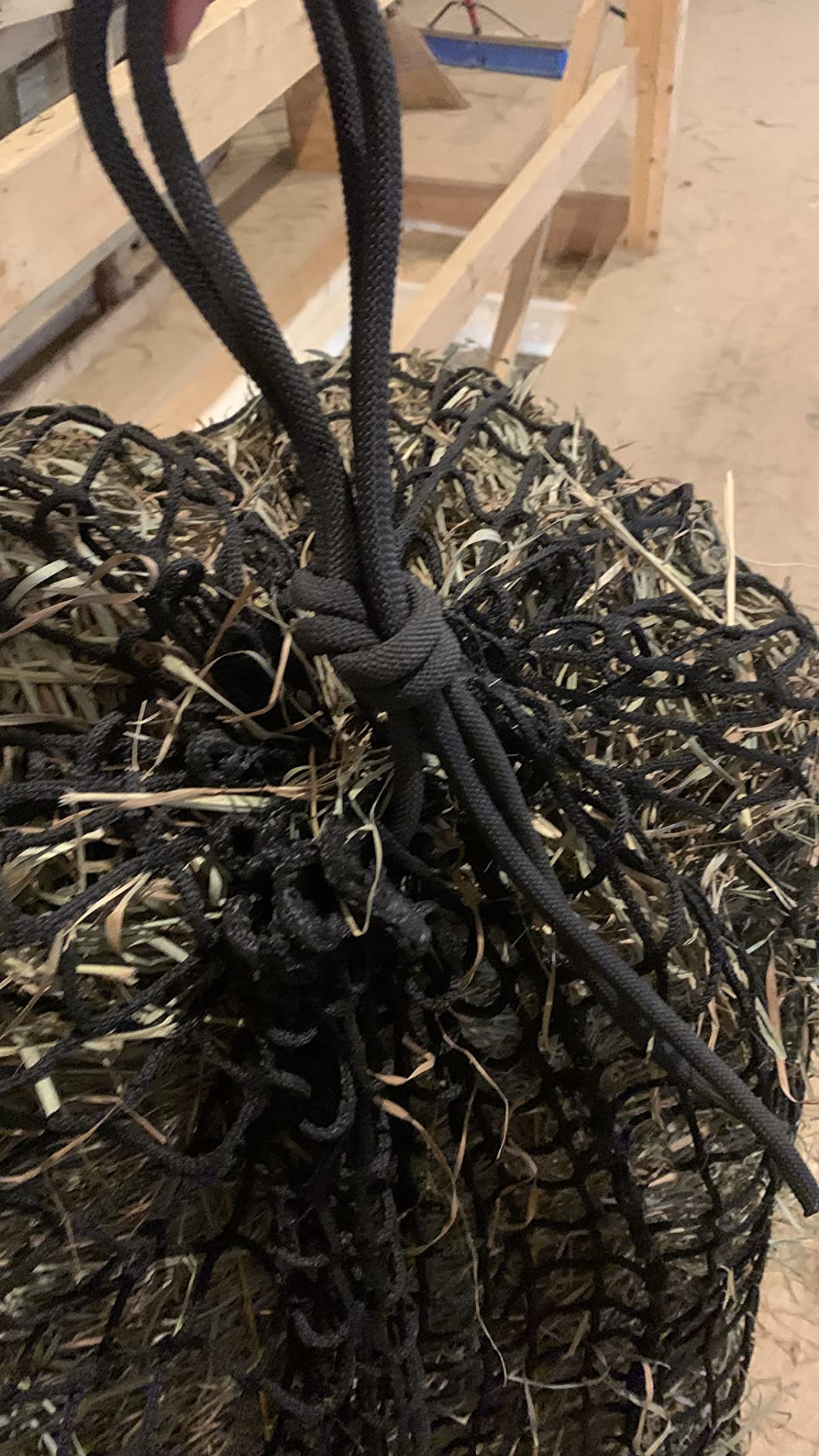
Why full-bale capacity changes the maths
Wasting a quarter of a bale costs you four times more than replacing a net. With a net sized to the bale and hung off the ground, the hay that gets soiled is a handful of flakes instead of a third of the bale.
It also works for ponies and minis at a restricted ration, and for horses on a hay-soaking protocol, since the whole flake goes in and comes out as one unit.
Two fixes to make on day one
The supplied rope is too short to open the net wide over a bale for many owners, and a longer rope is the first thing to replace. It is a two-minute job with basic hardware.
The 1 inch hole version can frustrate horses as the net empties, so start with 1.5 inches if you are unsure, and never leave a loaded net on the ground where shod horses could tangle a leg.
6. Harrison Howard Slow Feed Hay Net – Best Budget Net
Harrison Howard Slow Feed Hay Net Horse-Black
Roomy nylon rope net
Contrasting white top rope
Holds 4 flakes or more
Show friendly hanging
Pros
- Entry-level cost while still rated 4.5 stars
- Bright top rope easy to spot and tie
- Roomy enough for a heavy load
- Holds up with daily use
Cons
- Some nets rip after a couple of months
- Tie rope kinks easily
- Holes run larger than expected when wet
This is the feeder to buy first for a barn that is just getting organized, or for a second and third net to top up a stall where the main feeder is too small. The roomy cut holds about 4 flakes, and some owners report loading 10 or more flakes into it.
The contrasting white top rope is a small thing that matters at 6 a.m. You can see the closure from across a barn aisle, and the rope is thick enough to tie without fighting it, which is the opposite of a lot of budget netties.
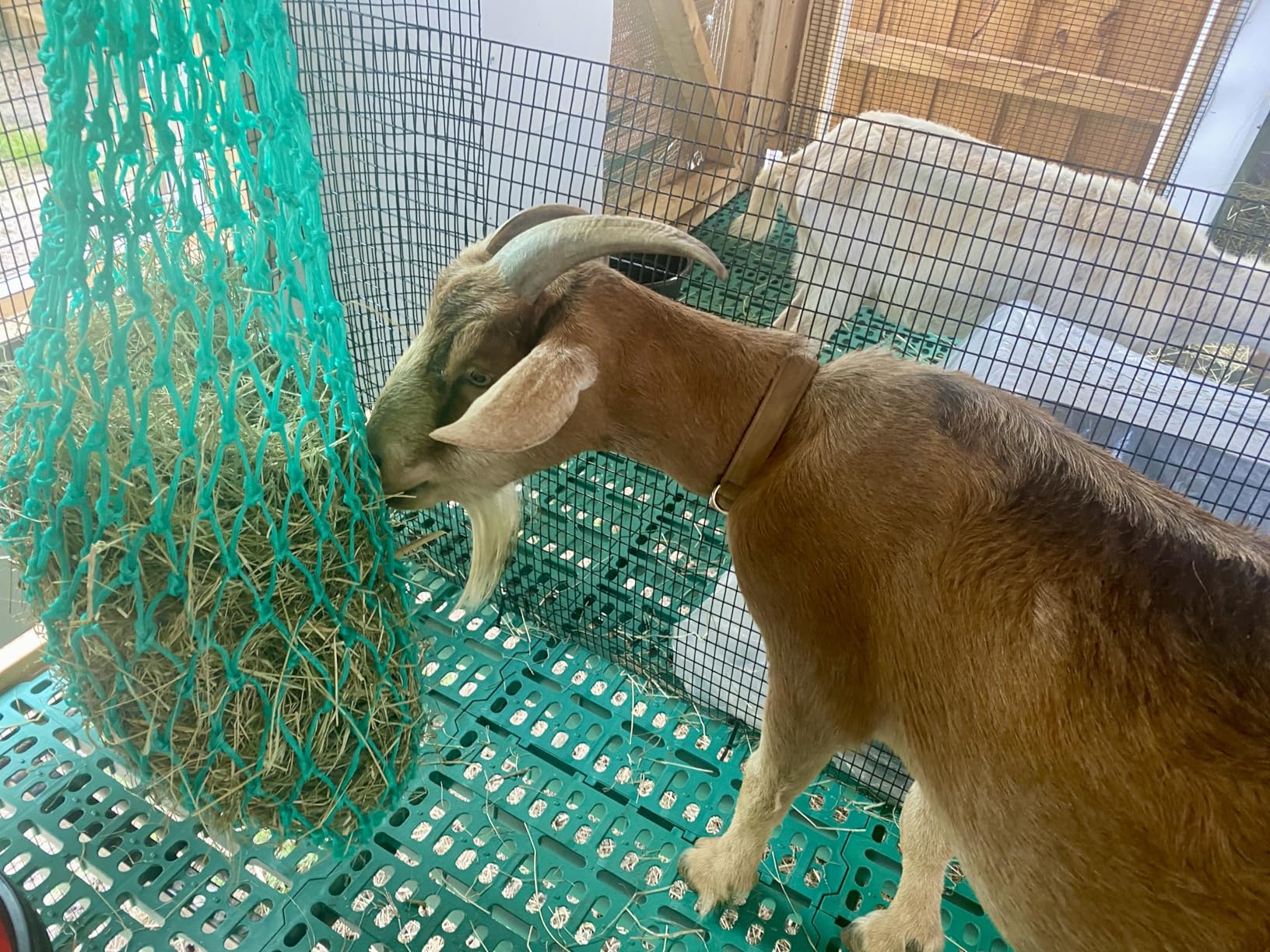
It weighs just over 14 ounces and packs flat, so it is easy to carry to shows and hang on fence lines or trees. Multiple colors are available for matching a specific horse in a group turnout.
The realistic lifespan is the honest caveat. Owners report daily use holding up well, but also a fair number of nets that rip after a couple of months, and a tie rope that kinks badly rather than sitting flat.
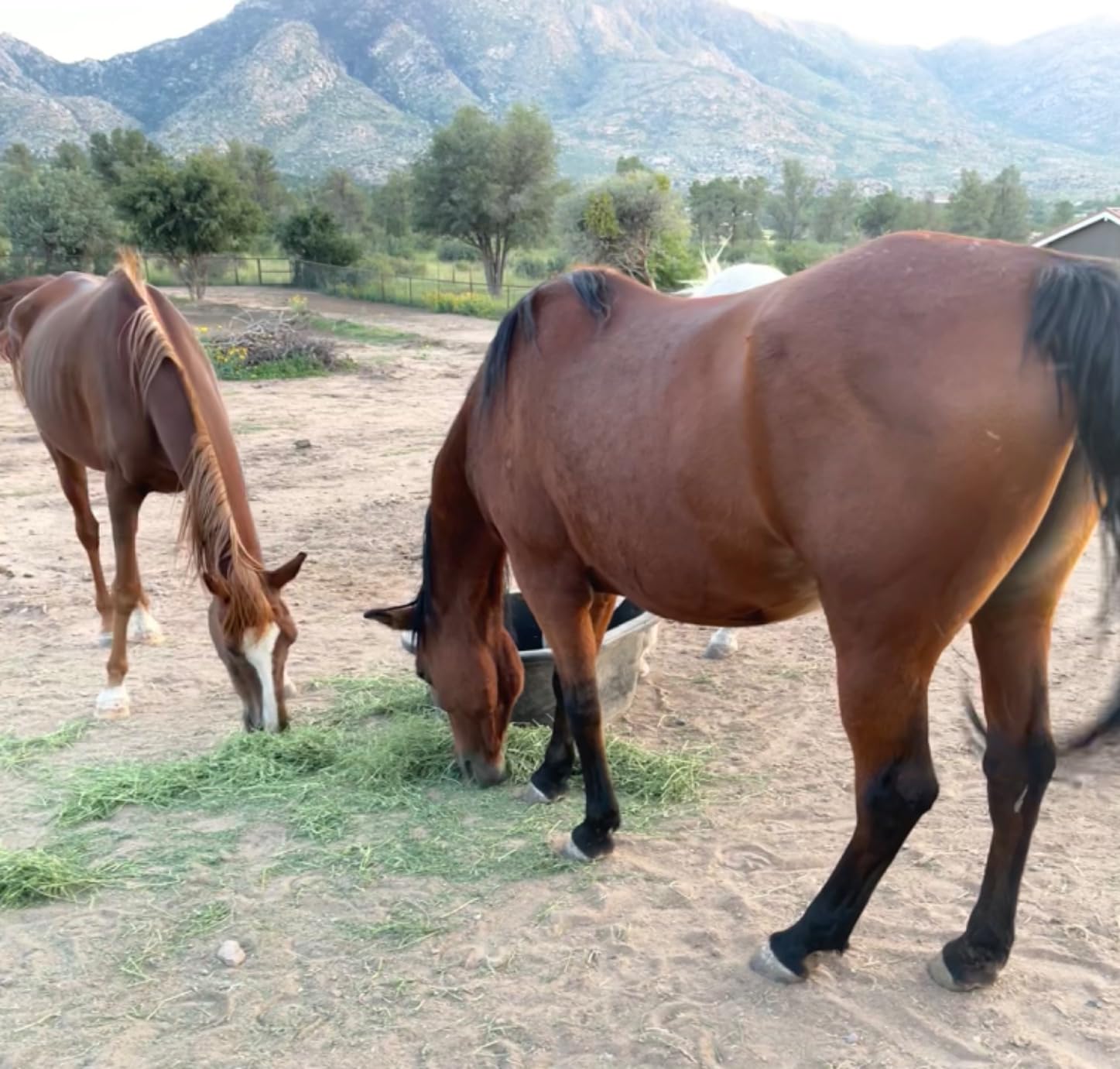
Best value for filling extra nets fast
If you need volume rather than longevity, this is the one. Buying several at entry-level cost is how you get a full set of spare nets staged in every stall without turning it into a significant purchase.
It is also easy to spot in a field, which matters when a net is empty and lying flat in long grass.
When to buy something sturdier instead
If your horse is a confirmed net destroyer, a fixed-knot net or a hard hay bag will outlast this by years, and buying two cheap nets a year costs more over time.
Also skip it for goats with destructive chewing habits, and note that wetting the net enlarges the holes further, which is worth remembering in wet winter conditions.
7. Derby Originals Superior Slow Feeder Hay Bag – Best Built Hay Bag
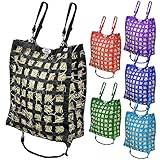
Derby Originals Superior 4-Sided Slow Feeder Horse Hay Bag – 1.75″ Square Openings – Restricted Slow Feed – 1-Year Warranty | Patented Design
22 x 8 x 25 inch bag
1.75 inch square openings
Holds 2 to 3 flakes
One year warranty
Pros
- Highest rated in our group at 4.7
- Patented 4-sided webbing resists tearing
- Reinforced overlapping bottom
- Stuffs in seconds
Cons
- Premium tier cost
- Holds only 2 to 3 flakes
- Moderate rather than ultra-slow pace
Most hay bags fail in the same two places: the bottom, where hay weight and hoof land, and the seam between the webbing panels. This bag is engineered around both. The bottom uses reinforced overlapping nylon webbing, and the patented four-sided web design lets the horse eat from any part of the bag instead of peeling at a fixed panel.
That four-sided design also removes the rip points that open up in conventional bags. With 273 reviews averaging 4.7 stars and 83 percent five-star feedback, it has the strongest satisfaction profile of anything we tested.
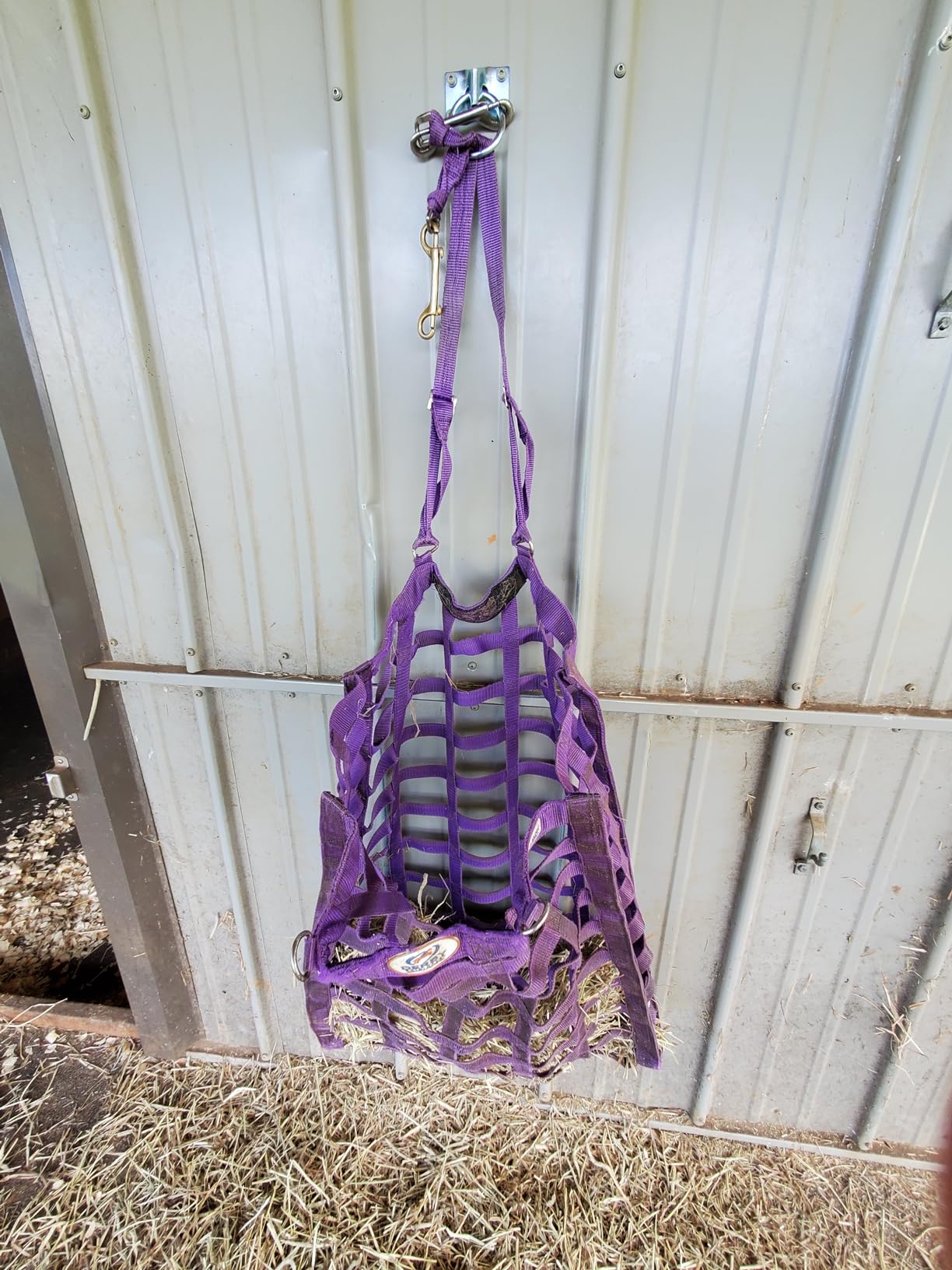
It holds about 2 to 3 flakes of Timothy, Orchard or Alfalfa in a 22 by 8 by 25 inch bag with 1.75 inch square openings. That pace is moderately slow, and it comes with a one-year limited manufacturer warranty covering defects, which is longer coverage than most bags in this price tier offer.
The reinforced bottom is not just a durability feature. Debris and dust exit through it, so the bag sheds the fines that collect in the bottom of a conventional slow feeder and end up in your horse’s nostrils.
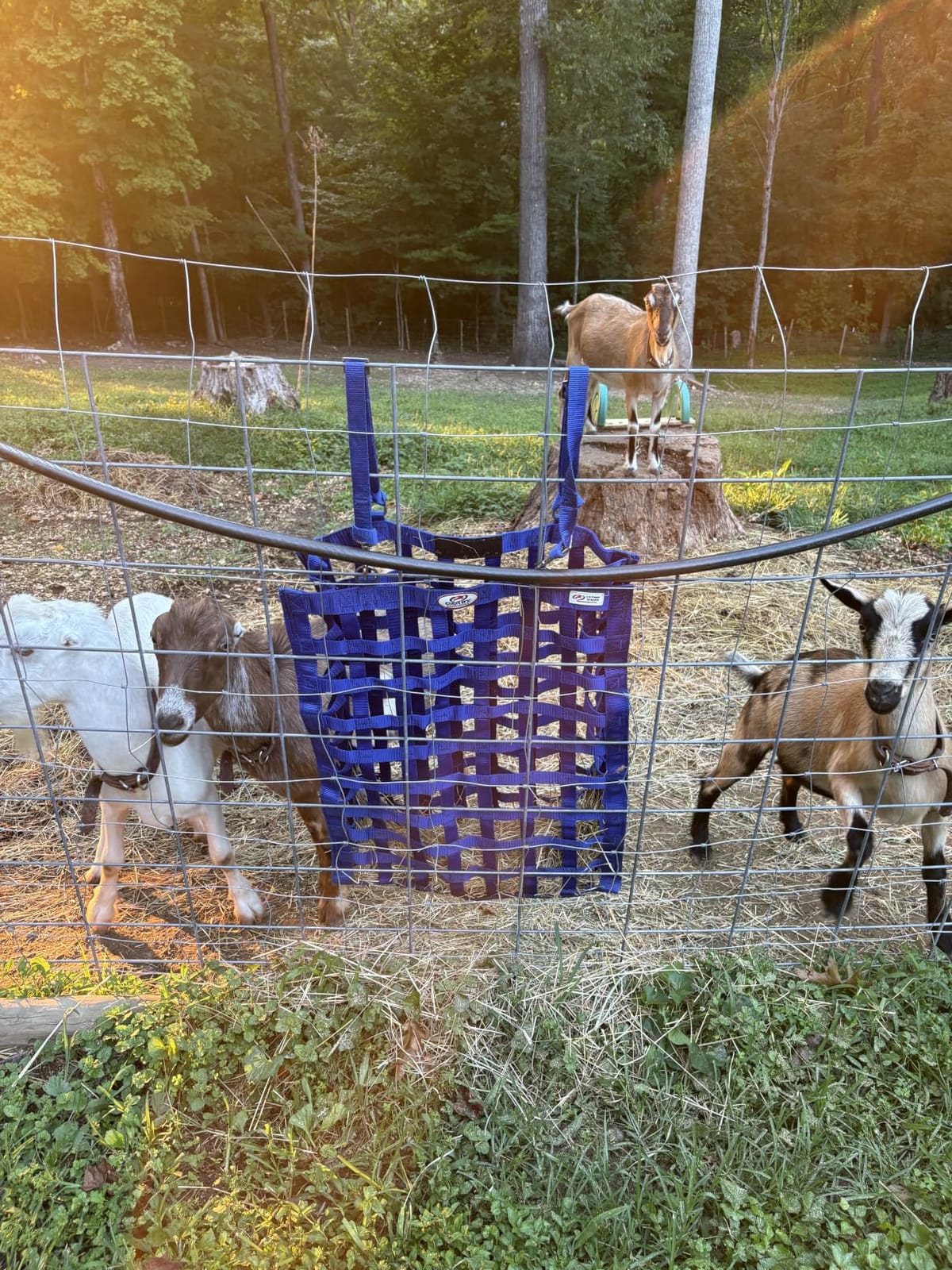
When a hay bag beats a net
Bags win on horses that pull netting through and shred it. There is no mesh to chew, and a determined horse can lean on a bag without destroying it, which is why barns with mixed temperaments gravitate to hard bags.
They are also cleaner to fill. You open a mouth, stuff flakes in, close it, and hang it, with no knot-tying mid-fill.
Where the cost shows
This is a premium-tier purchase and capacity is two to three flakes, so an all-day turnout needs multiple bags. The 1.75 inch openings slow intake without being the ultra-slow end of the range.
If your budget stretches further than it needs to for one stall, weigh it against two cheaper bags before committing.
8. Professional’s Choice Trailer Corner Feeder – Best for Trailers and Shows
Professionals Choice 33X26X23X11 Equine Trailer Corner Feeder (Black)
1000 denier mesh bottom
Three heavy-duty snaps
Reinforced grommets
33 by 26 by 23 inch
Pros
- Mesh base traps hay bits before they hit the floor
- Works in slant-load trailers and stall corners
- Tough enough for horses that kill nets
- Easy to toss treats into
Cons
- Grommets are the main failure point
- Newer units seem less well made
- Older trailer corners may need extra clips
This is the only hard-sided unit in the group, and it solves a problem nets cannot: a horse hauling in a slant-load trailer eats standing up, moving, with the trailer vibrating. Nets do not work in that environment, and a loose flake on a trailer floor is a slip hazard.
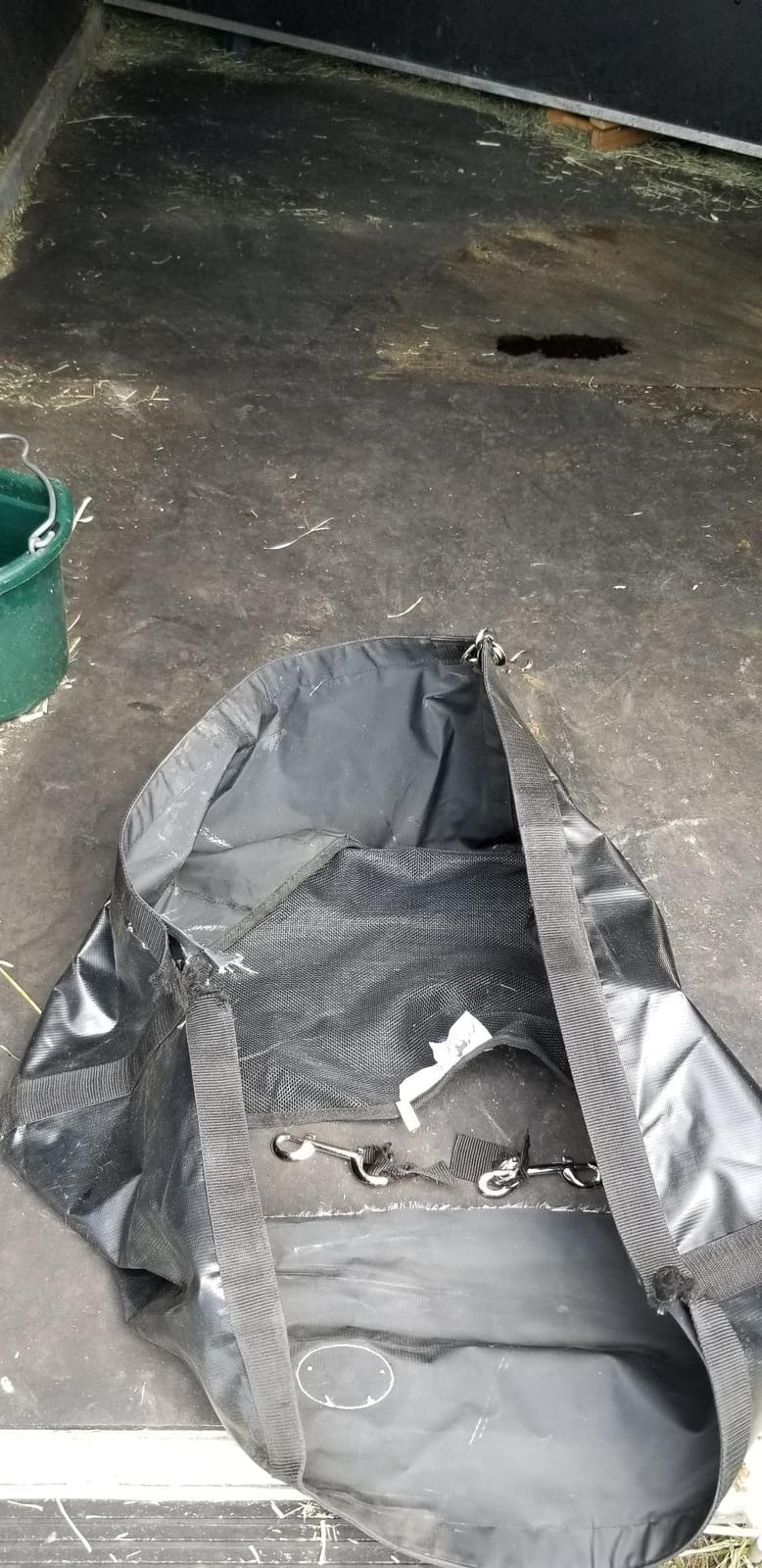
The 1000 denier air-permeable mesh bottom is the detail that earns its place. Dust, sand and debris fall through it, it resists mildew, and hay fragments that would scatter across the trailer floor stay in the feeder.
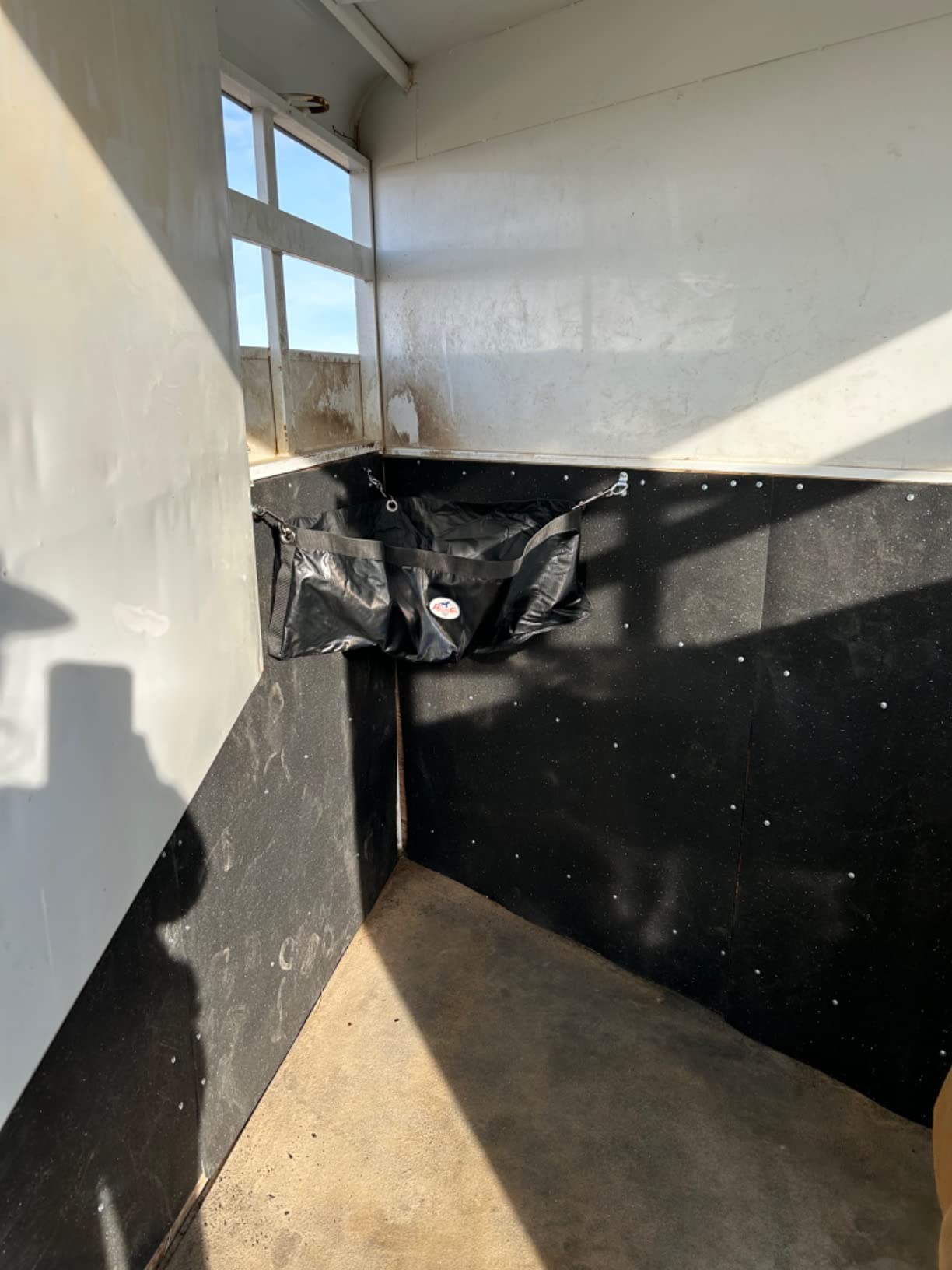
Three double-ended heavy-duty snaps hold it to the corner, reinforced nylon webbing edges resist fraying at the stress seams, and the whole thing is 33 by 26 by 23 inches. It also works in a stall corner at home or at a show grounds, so it is not a trailer-only tool.
Owners like that it survives horses that normally destroy hay nets quickly, and that you can toss treats or sweet feed in to reward loading. At 2 pounds it is light enough to move with one hand.
Why trailer owners switch to a corner feeder
Travel is the use case. A net is a snag risk in a moving trailer, and a corner unit puts the feed in a fixed position the horse cannot drag around. It also keeps hay out of the walkway where a horse can step on it.
It doubles as a stall corner feeder, which makes it a reasonable second use if you show or trail regularly but only have one horse.
The failure point to plan around
At 4.1 stars from 204 reviews, this is the lowest-rated feeder we include, and the reason is consistent: the corner grommets pull out and tear the fabric long before the bag itself wears out. Some owners also feel newer production is less well made than earlier versions.
Measure your trailer corner before ordering, and keep clip rings or a chain on hand for older or unusual layouts.
9. Fabbay Two-Pack Slow Feed Hay Net – Best Soft PE Two-Pack
Fabbay 2 Pcs Slow Feed Hay Net for Horses, 35 x 31 Inch Hay Bag, Black
Two nets per pack
1.1 inch holes when empty
PE woven rope
Three sizes available
Pros
- Twin pack includes a ready spare
- PE woven rope is soft on gums
- Opens wide and fills easily
- Side loops hang on walls and fences
Cons
- Holes stretch from 1.1 to 1.5 inches when filled
- Less durable than knotted or webbed bags
- Smallest size holds limited hay
The material is the reason to look at this one. PE woven rope is softer on a horse’s gums and lips than stiffer netties, which matters for young horses, seniors, or any horse with dental work that leaves sore spots.
It includes two nets, so one can stay loaded and ready. Loops on both sides make hanging on a stall, trailer wall, fence line or tree straightforward.
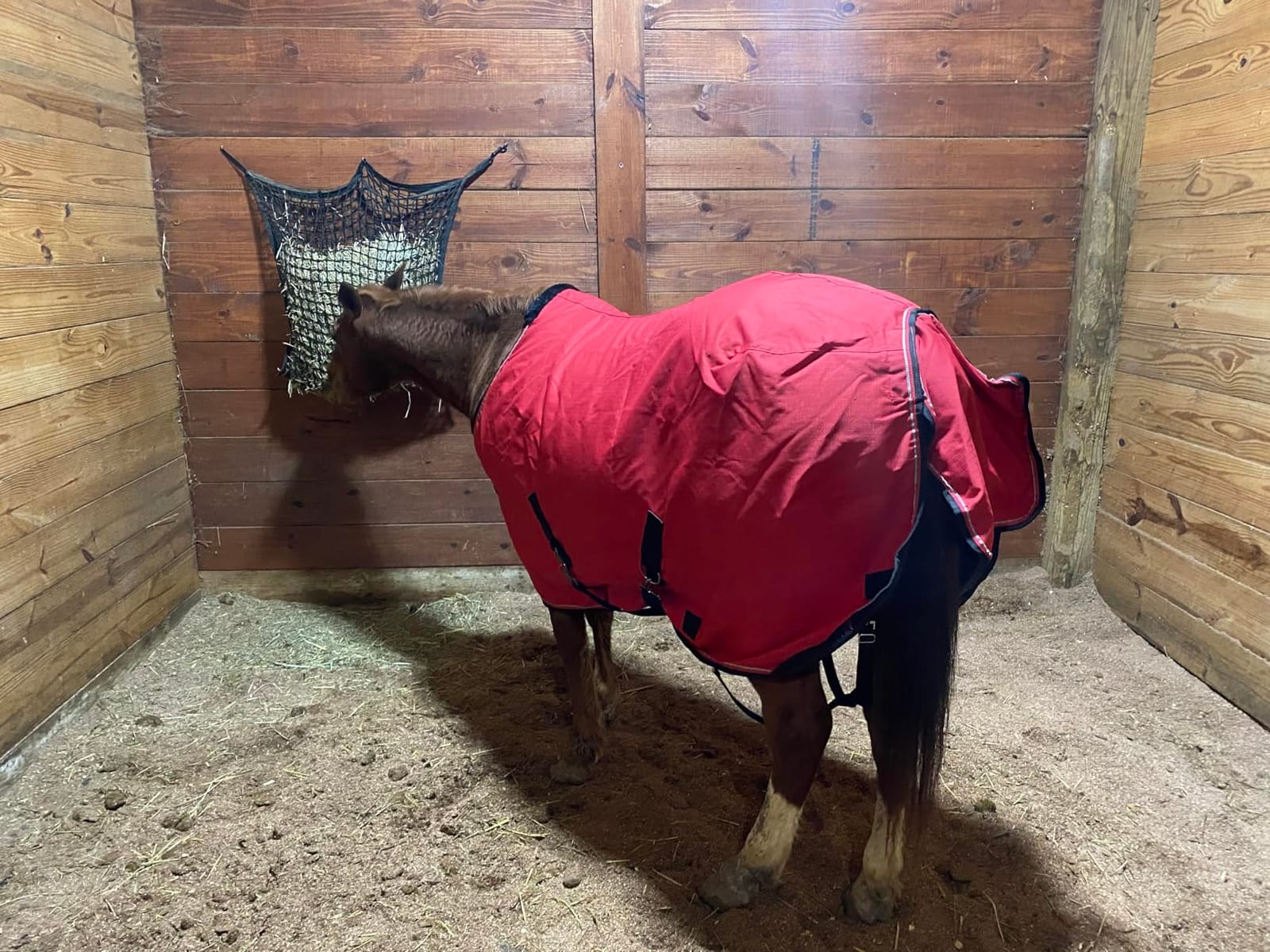
Three sizes are offered, at 24 by 35, 35 by 31 and 35 by 47 inches, so you can cover a small paddock pony and a full-size horse from the same brand. The 35 by 31 inch pair is the middle ground and the one most buyers land on.
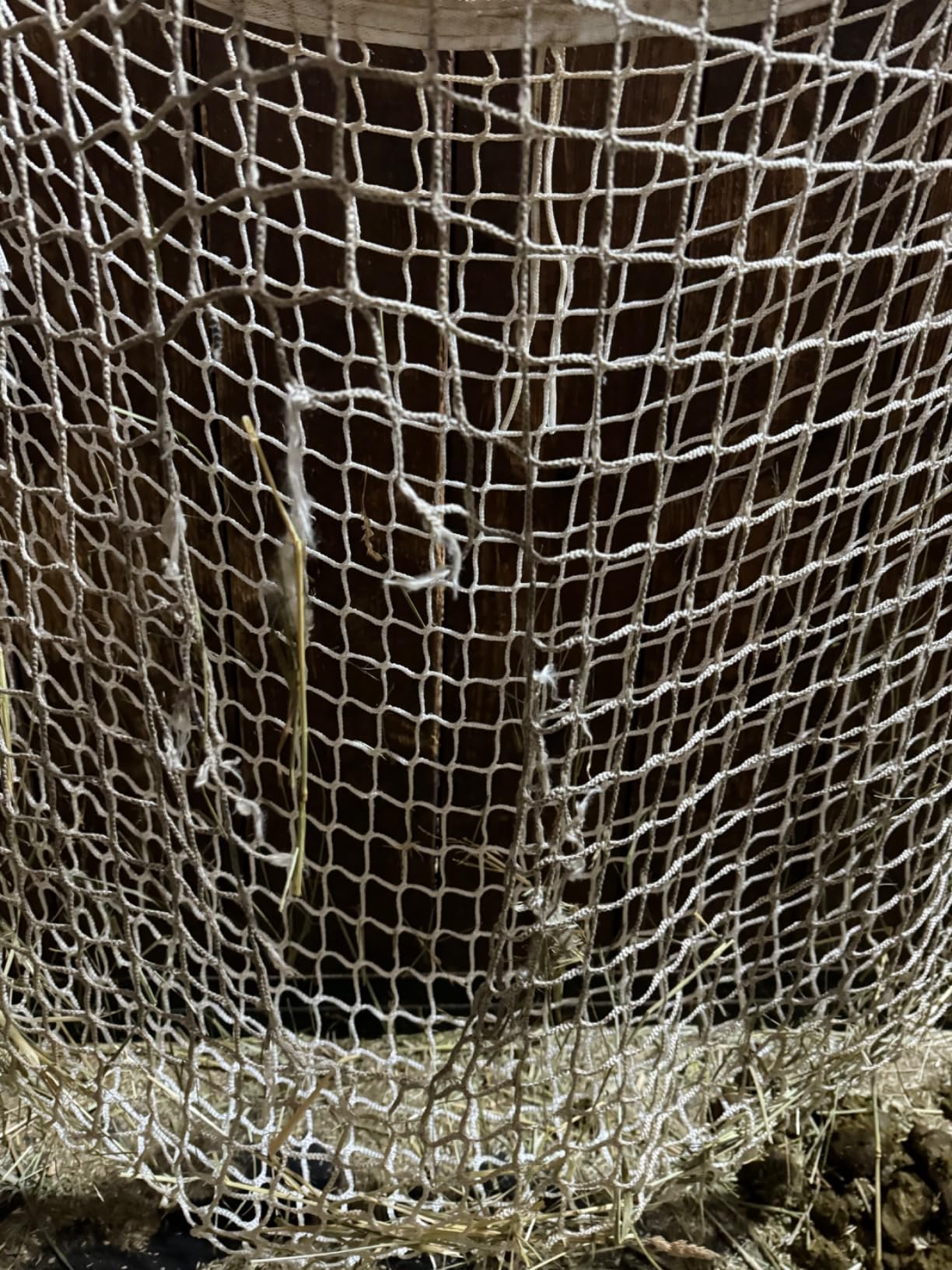
Here is the real behavior to understand. The holes measure about 1.1 inches when the net is empty and stretch to roughly 1.5 inches once filled with hay, so the slow-feed effect weakens as the net empties. Owners notice this and describe it as the main criticism of an otherwise convenient feeder.
Best for soft mouths and younger horses
Soften up goes the mesh, and a horse with sharp dental edges or a young horse learning to eat from a net is a good match. Buyers consistently report it opens wide enough to fill without wrestling the drawstring.
It is also the easy option for a temporary setup, since it fits on fences and walls in an outdoor run as readily as a stall.
Where the stretching holes bite
If you are feeding a horse that needs a true ultra-slow pace for ulcer management, stretching holes are a real problem, not a detail. Pick fixed-knot or webbed construction instead.
Woven PE is also less durable than knotted nylon or a hard hay bag, and 4.2 stars from 270 reviews reflects more mixed experiences than the nets above it. The smallest size also holds a limited amount of hay.
10. Derby Originals Front Web Slow Feeder Hay Bag – Best for Multi-Horse Barns
Derby Originals Front Web Slow Feeder Horse Hay Bag Super Tough Bottom with 6 Month Warranty
1.75 inch square openings
Holds 2 to 3 flakes
Replaceable straps and snaps
Super tough bottom
Pros
- Most reviewed hay bag in our group at 580
- Survived two years with goats and donkeys
- Replaceable hardware extends life
- Buckle strap stops the bag flipping
Cons
- Some aggressive horses cause rips within a year
- Small 2 to 3 flake capacity
- Velcro weakens with use
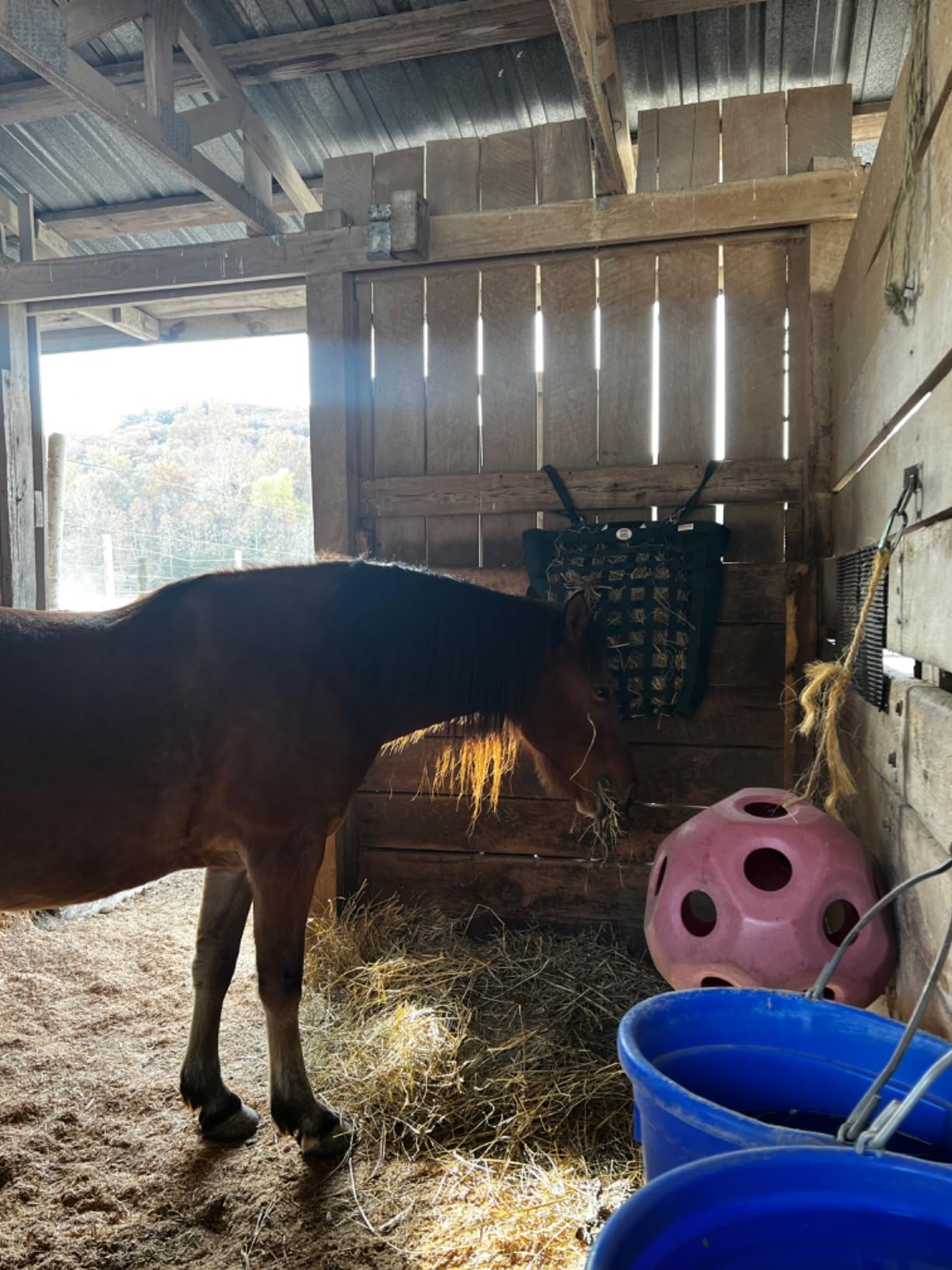
This is the hay bag that barns actually standardize on, and the reason is the review volume: 580 ratings at 4.4 stars, the most reviewed product in our entire group. When something works across thousands of horse-measures, the failure data is trustworthy too.
Construction is heavy webbing in a front-web layout, with 1.75 inch square openings holding about 2 to 3 flakes of Timothy, Orchard or Alfalfa. The super tough bottom uses reinforced overlapping nylon webbing, the same idea that makes the Derby bag above it last.
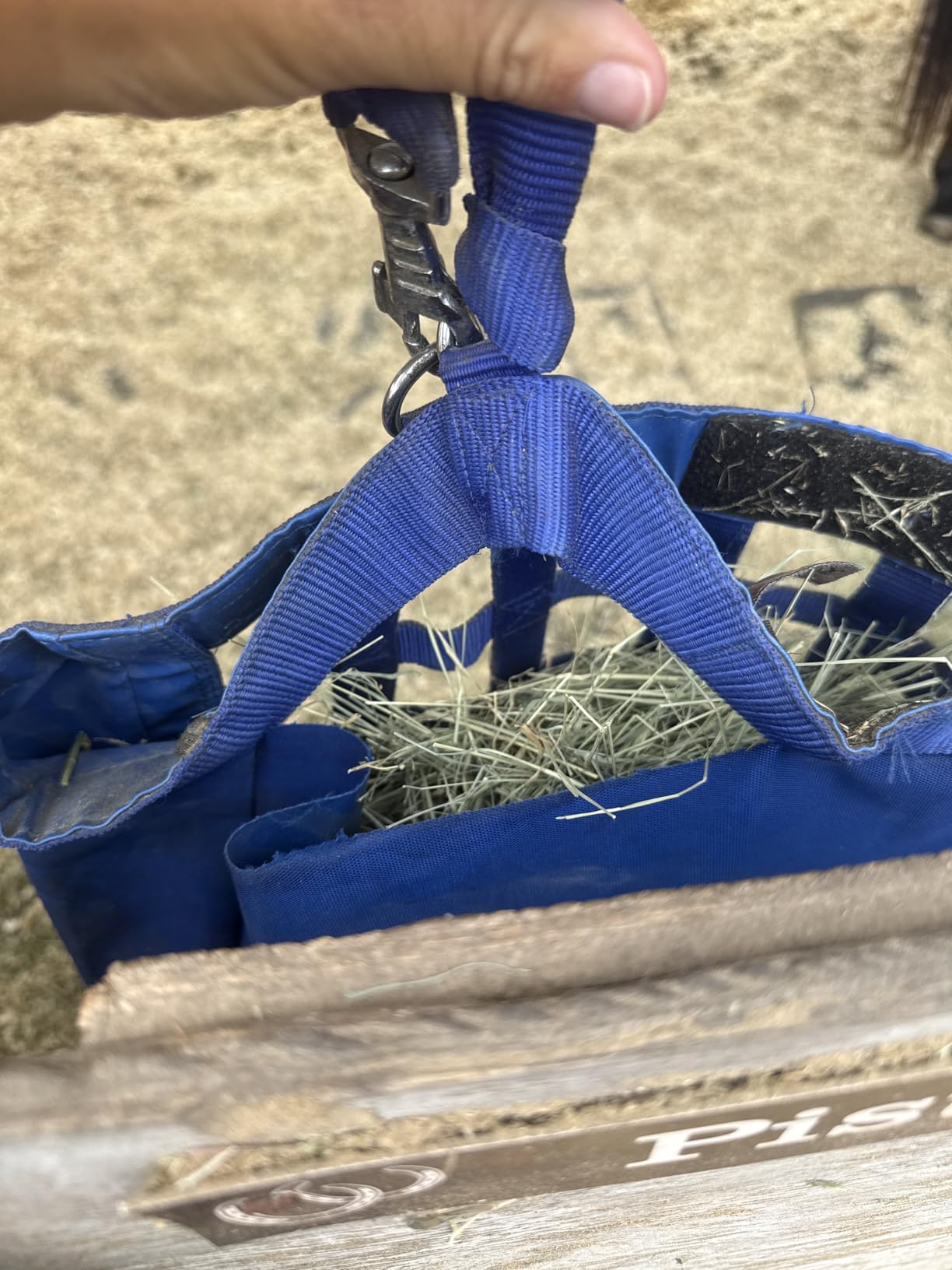
Two hardware details matter more than they sound. The hanging straps and snaps are replaceable, so a snapped clip is a five-minute fix instead of a discarded bag. And the removable bottom strap buckles around a stall post, which stops a determined horse from flipping the bag over and standing in it.
One owner reports two years of constant use with 16 dairy goats and two donkeys, which is about as aggressive a test as this category gets. Thickness is the reason: heavy webbing is hard for animals to chew through.
Why barn managers standardize on it
Replaceable parts are the deciding factor at barn scale. A 12-stall barn does not need a perfect bag, it needs a bag that can be repaired on a Tuesday morning without calling anyone.
The anti-flip bottom strap also protects the slow-feed function, because an overturned bag is just a pile of hay on the floor, and the same velcro closure weakening over time is a known wear point even while the double hooks keep it shut.
What the reviews split on
Durability is the dividing line. Many owners report multi-year service, and a minority with hard-hitting horses see rips inside a year, so match the bag to the temperament rather than to the herd average.
Capacity is only 2 to 3 flakes, so full-day turnout means several bags per horse. It comes with a limited six-month warranty.
How Much Hay Does Your Horse Actually Need?
A 1,000 pound horse should eat about 16 to 18 pounds of hay a day, or roughly 1.5 to 2 percent of bodyweight, and that forage should be spread across 16 hours or more. Any feeder decision starts with that number, because a feeder that empties in two hours is not a slow feeder no matter what the label says.
Scaled to horse weight, the daily ration works out roughly like this:
400 lb pony or mini: about 6 to 8 lb of hay per day
600 lb horse: about 10 to 12 lb per day
800 lb horse: about 13 to 15 lb per day
1,000 lb horse: about 16 to 18 lb per day
1,200 lb horse: about 19 to 22 lb per day
1,400 lb horse: about 22 to 25 lb per day
Match that to capacity, and a pattern emerges. A 15 pound net suits a 900 to 1,000 pound horse on a roughly 16 pound ration filling about once a day. A 30 to 40 pound net suits a larger horse or a pair sharing a wall. A full-bale net covers a 1,200 pound horse’s day in a single fill.
For ponies and minis, the ration is small enough that a standard net is usually too big, so pick a small size or fill a larger net with a partial load. A mini does not need a slow feeder for weight reasons, but it does need one to stop it bolting the whole pile in ten minutes.
How to Choose a Horse Feeder: 7 Things That Matter
Mesh opening size. This is the single most consequential choice. Around 1 to 1.5 inch openings give the slowest pace and suit ulcer-prone, greedy or post-surgery horses. Around 1.75 to 2 inches is a moderate pace that most calm adult horses eat comfortably without frustration. Anything much smaller than an inch raises dental wear concerns.
Capacity against the daily ration. Buy for a day, not for a meal, if you can. A net that holds the full daily ration means one fill, and a 12-stall barn full of half-size nets becomes a twice-daily job that eventually gets skipped.
Mounting height. Hang nets and bags at roughly chest height so the horse’s head stays near or below the level of its withers. That is the natural grazing position, and the reason feeding height is discussed as much as feeder type. Anything hung at head height or above makes the horse stretch up, which pulls more dust and finer hay particles into the airways.
Ground clearance. Hay on the floor picks up hair, manure, sand and bedding, and horses will not eat it. Nets and bags solve this. A corner feeder with a mesh bottom solves it too, and lets debris fall out.
Material and hardware. Fixed-knot rope and webbed bags outlast woven PE, and replaceable straps or snaps are worth more than a slightly better fabric because they turn a teardown into a repair. Owners consistently rank durability and ease of refilling above everything else.
Cleaning. Choose a feeder you can open fully and wipe out, and one that lets dust exit rather than trap it. Mold and dust in the bottom of a slow feeder are the reason some horses cough on otherwise good hay.
Where it lives. A stall feeder and a pasture feeder are different purchases. In a stall you want controlled, one-horse portions. Outdoors you need weather resistance, hay cover or a roofed design, and enough capacity for a group. If you are outfitting the rest of the barn, our horse tack set roundup covers the other gear that gets worn out on the same schedule.
Are Hay Nets Safe? Neck, Teeth and Entanglement Risks
Hay nets are widely used and widely recommended, but they are not risk-free, and the honest answer to are hay nets bad for horse necks is that most problems come from how they are hung and sized rather than from the net itself.
The four risks riders ask about most:
Entanglement. A loose net or a trailing strap on the floor can catch a leg or a halter, and a panicked horse makes it worse. Hang nets clear of the ground and tie off strap ends short.
Dental Wear from very small holes. Horses need to open their mouths wide on long-stemmed forage. Holes around 1 inch or smaller, and especially fixed-knot nets with no give, can push a horse into grinding incisors and molars instead of chewing sideways, which shows up as enamel spurs over time.
Overhead reaching. A net hung at head height or above forces the horse to stretch, pulling dust and fines into the lungs and worsening respiratory irritation in a horse that already has ulcers or a heave.
Struggling at the end. A net with a small hole size and a small remaining amount of hay frustrates some horses, and a frustrated horse kicks, bites the net through or flips a bag. This is the practical argument for a 1.75 to 2 inch hole if your horse is not a gobbler.
The mitigations are straightforward. Hang at chest height. Keep 1 to 2 inch openings rather than sub-inch. Check the mesh weekly in the first months, because a net that is about to fail often frays at a knot first. Never leave a loaded net on the ground in a stall with a shod horse.
For horses with a history of ulcers, a restricted ration or an equine dental history, ask your vet about hole size before you buy, and tell them which feeder you plan to use. That conversation is quick, and it is far cheaper than a dental float or a colic case.
Frequently Asked Questions
What is the best hay feeder for horses?
The best hay feeder for horses is a slow-feed net or bag sized to one full daily ration and hung at chest height. Small-hole nylon nets give the slowest pace for ulcer-prone and greedy horses, hard webbed hay bags survive horses that shred mesh, and corner feeders with a mesh base are the right answer for trailers and for sharing hay and grain in one spot.
Are slow feed hay nets worth it?
Most owners say yes, and the reason is waste rather than speed. A net or bag holds the hay up off the ground and forces smaller bites, which means more of what you buy is actually eaten and more time is spent in natural grazing position. The trade-off is daily refilling, so choose a capacity that covers a full ration or buy a two-pack so one net stays pre-filled.
What are the disadvantages of using a hay net?
The main drawbacks are entanglement risk on a net left on the ground, dental wear if holes are much smaller than an inch, frustration for horses that struggle to get the last of the hay, and the daily refilling chore. Horses that shred mesh will also damage nets faster, which is when a hard hay bag or corner feeder is the better buy.
How high should a hay rack be for horses?
Hang nets, bags and racks at roughly chest height so the horse’s head stays near or below the level of its withers, which is the natural grazing position. Hanging feeders at head height or above makes the horse stretch upward and pulls more dust and fine hay particles into its airways, which matters most for horses with ulcers or respiratory sensitivity.
How much hay should a 1000 pound horse eat a day?
A 1,000 pound horse should eat about 16 to 18 pounds of forage per day, roughly 1.5 to 2 percent of bodyweight, spread over 16 hours or more. Size your feeder to that number: a 15 pound net covers a full ration, a 30 to 40 pound net suits a larger horse or a pair, and a full small square bale net covers a 1,200 pound horse in a single fill.
Which Horse Feeder Should You Buy?
Buy the Weaver Equine Slow Feed Hay Net if you want one feeder that handles most stall situations: small holes that genuinely slow intake, rope that survives leaning, a half-bale capacity sized to a working day, and a size that hangs on stall bars at shows. It is our pick for 2026 because it combines the highest review volume in the group with a 4.5 rating and none of the structural weaknesses the cheaper nets have.
Buy the Aoneky 47 inch net instead if one fill per day matters more than compact size, since it is the only feeder here that takes a whole small square bale and holds it off the ground for roughly 24 hours. Buy the Hay Chix half bale net if your horse destroys equipment, because fixed knots and a fast closure are what end the shredding cycle. For a horse that needs a true ultra-slow pace, the Majestic Ally 1.5 inch two-pack is the fastest route to a longer meal.
For net destroyers, hayers that get shoved around, or barns standardizing on hardware that can be repaired rather than replaced, go hard: the Derby Originals Front Web bag for barn scale, the Derby Originals Superior bag for a single stall with the best-built construction available, and the Professional’s Choice corner feeder the moment you start trailering.
Whatever you choose, size it to your horse’s daily ration, hang it at chest height, and check the mesh weekly for the first couple of months. Feeder choice is one of the few barn decisions that pays for itself within a season in hay you stop throwing away, and it keeps a horse comfortable while it does it.
While you are sorting out the barn, our horse saddle reviews and riding helmet roundup cover the two pieces of kit that matter most on every ride.