
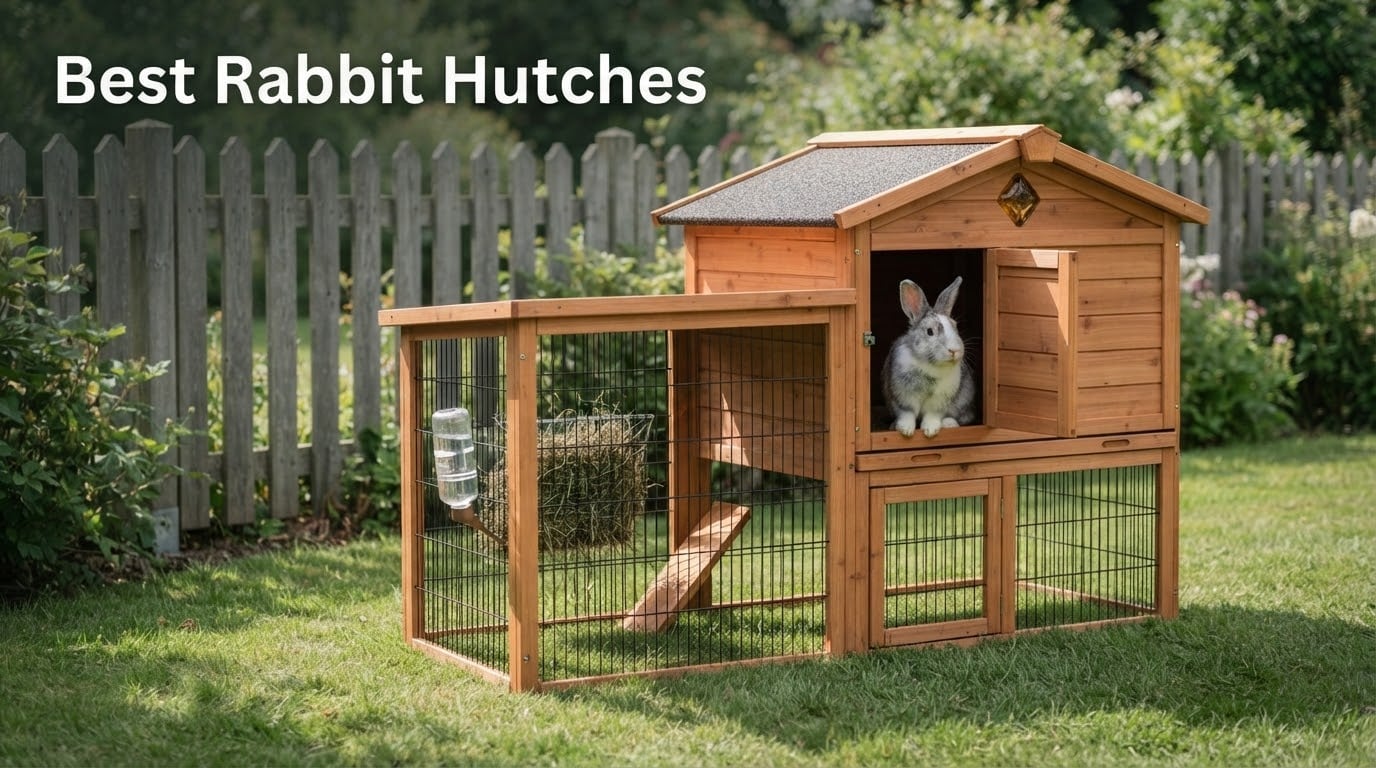
Most rabbit hutches on the market fall into one of two camps: cheap flat-packs that leak urine, smell of fresh varnish and give a rabbit nowhere to stretch out, or bulky timber builds that finally give a bonded pair real room. The best rabbit hutches sit in the middle, with a solid lined floor, a leak-proof tray that slides out in one motion, mesh fine enough that a rabbit cannot chew a hole in it, and fasteners no raccoon can work loose.
I have been picking through this category for weeks, comparing spec sheets against the complaints owners actually post on r/Rabbits, r/Bunnies and binkybunny.com. Twelve hutches made the cut, and the pattern was clear: the things that decide whether a hutch works in real life are the floor area, the tray, the roof, and whether the whole thing stands high enough off the ground that digging predators lose interest.
This roundup covers wooden hutch-and-run combos, two-storey indoor cages, mobile hutches on wheels and a couple of small-pet units, tested against what welfare bodies and experienced owners actually recommend. Prices move constantly, so use the check buttons rather than the numbers you may see elsewhere. We last updated this guide in 2026.
Table of Contents
Top 3 Rabbit Hutches We Rate Highest in 2026

Aivituvin Double House
- 10.4 sq ft living area
- Two houses and runs
- Leak-proof trays
- Six braked wheels

GUTINNEEN 61 Inch Hutch
- Chew-proof ramp
- Three pull-out trays
- Six access doors
- Braking wheels
All 12 Best Rabbit Hutches Compared Side by Side (September 2026)
| Product | Specifications | Action |
|---|---|---|
| Aivituvin Double House and Run |
|
Check Latest Price |
 GUTINNEEN Two-Story 39 Inch GUTINNEEN Two-Story 39 Inch |
|
Check Latest Price |
| GUTINNEEN 61 Inch Hutch |
|
Check Latest Price |
 TRIXIE Natura Two-Story 40 Inch TRIXIE Natura Two-Story 40 Inch |
|
Check Latest Price |
| GDLF 62 Inch Fir Hutch |
|
Check Latest Price |
 Aivituvin Two-Story 39 Inch Aivituvin Two-Story 39 Inch |
|
Check Latest Price |
 GEGURI Cedar Hutch GEGURI Cedar Hutch |
|
Check Latest Price |
 PawHut 62 Inch Hutch and Run PawHut 62 Inch Hutch and Run |
|
Check Latest Price |
 PetsCosset 93 Inch Double Run PetsCosset 93 Inch Double Run |
|
Check Latest Price |
 PawHut 48 Inch Two-Story PawHut 48 Inch Two-Story |
|
Check Latest Price |
 Suumerpety Compact Two-Story Suumerpety Compact Two-Story |
|
Check Latest Price |
 GUTINNEEN Mobile 44 Inch GUTINNEEN Mobile 44 Inch |
|
Check Latest Price |
1. Aivituvin Double House and Run: Best Overall Rabbit Hutch for Two Rabbits
Aivituvin Rabbit Hutch Bunny Cage with Double House and Run Indoor Outdoor Guinea Pig House with Deeper No Leak Trays and Wheels
10.4 sq ft living area
Two houses and runs
80.12 x 22.82 x 28.64 inch
62 pounds on six wheels
Pros
- Enormous 10.4 sq ft of living space across two houses and runs
- Leak-proof pull-out trays on both levels
- Six braked wheels make indoor-outdoor moves simple
- Eleven access doors make handling and separating pets easy
Cons
- 80 inch footprint dominates a small room
- 62 pounds is heavy for one person to reposition
- Sliding middle doors and multi-level layout take practice to clean
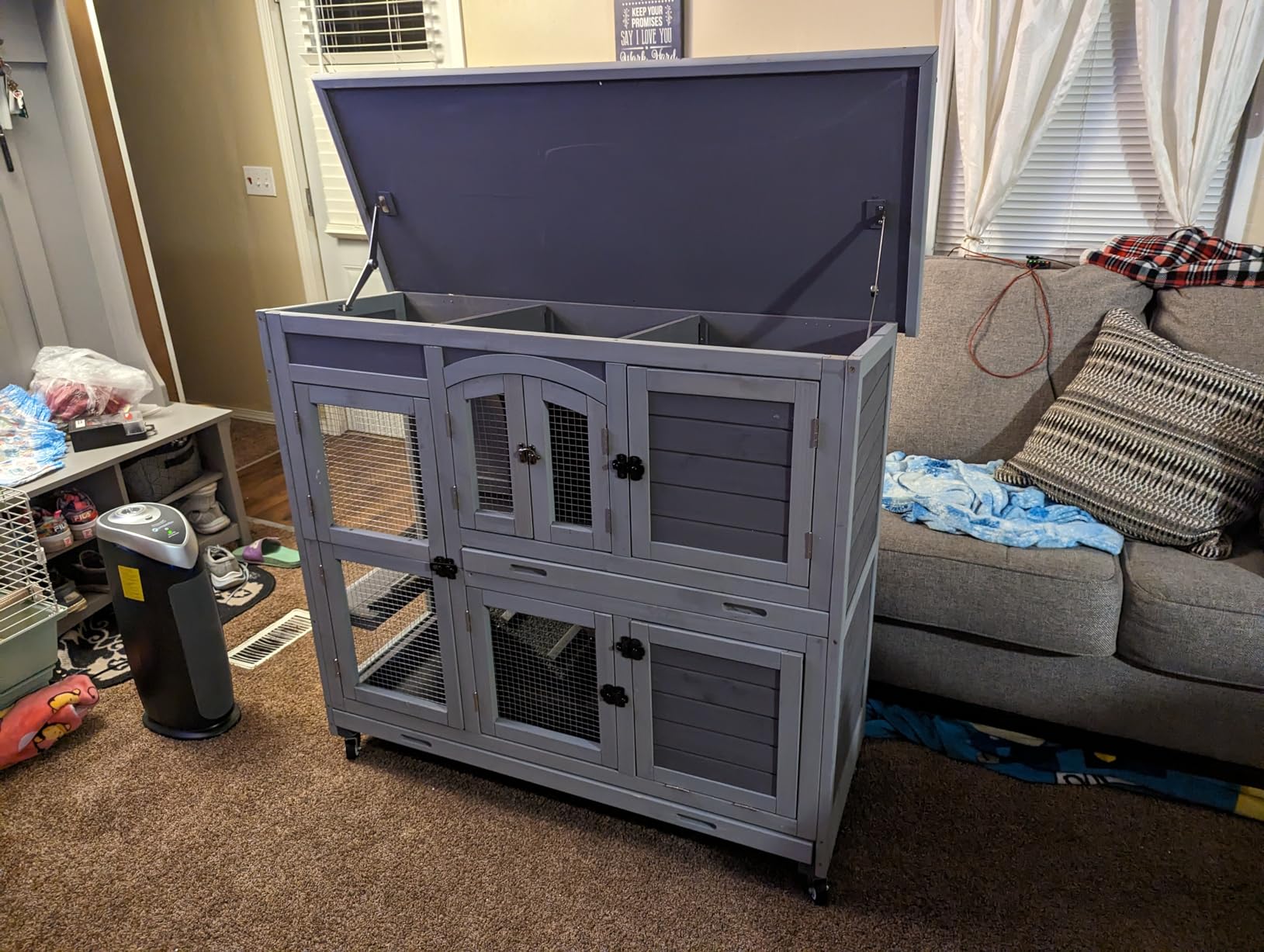
My first thought when this one arrived was that it was a rabbit hotel rather than a hutch. There are two sleeping houses, two integrated runs, and a middle sliding door so you can keep two rabbits apart when you need to and let them share the space when you do not. Living area is listed at 10.4 sq ft, which is enough for two rabbits to sit side by side in the upper house and still have a run to move in.
The detail that sold me is the flooring system. Removable metal wire floor sections sit above the plastic trays, so a rabbit is standing on wire over a tray rather than on wire over bare ground, and the trays are described as no-leak with no gaps. Six wheels with a brake design mean you can wheel the whole thing out of an unused room in the morning and back under cover at night.
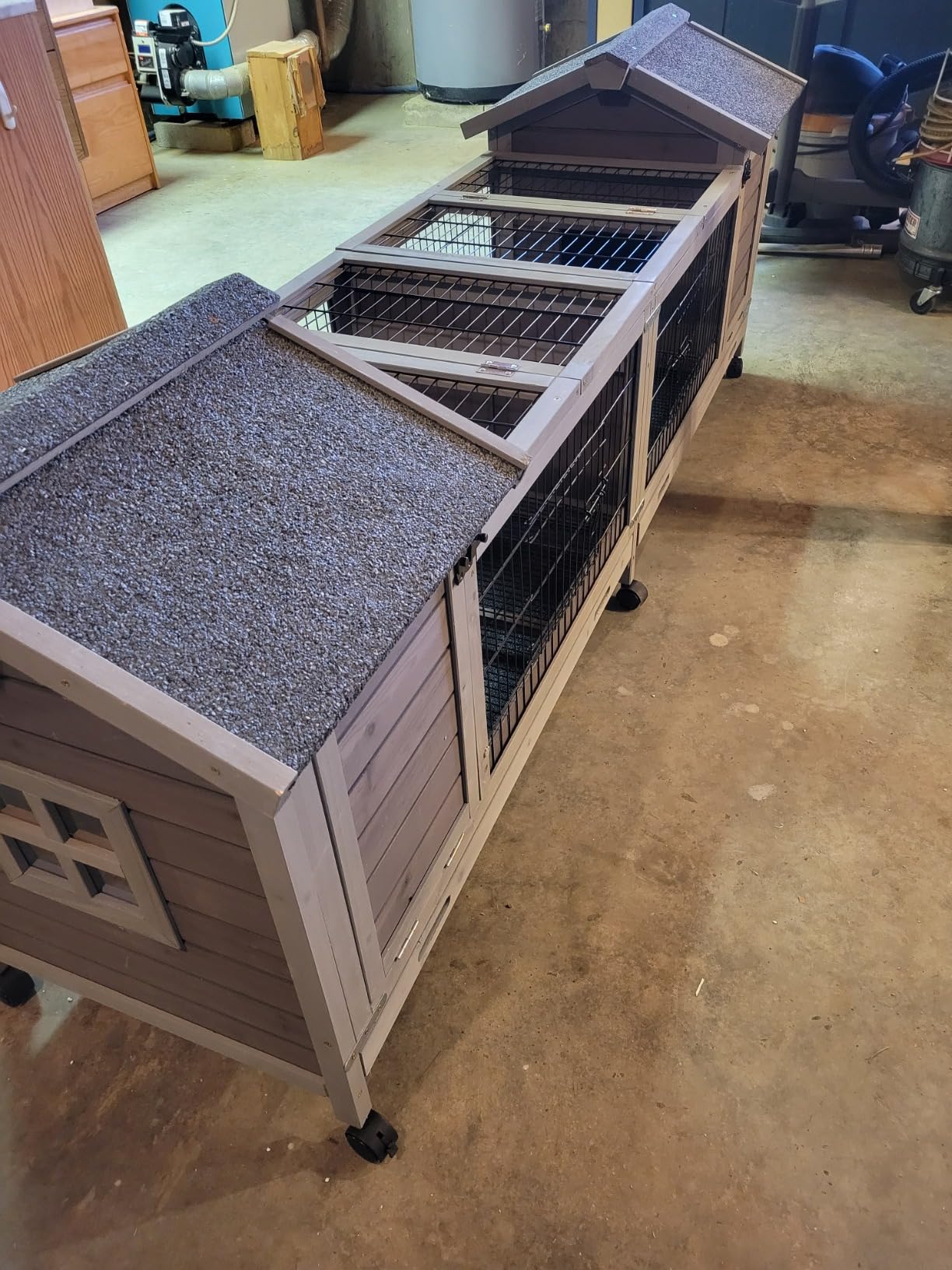
Owners also highlight the tray depth and the number of doors. Deep trays on all sides mean a full clean rather than a scrape, and eleven access doors mean you never have to reach into a corner to get a rabbit out. Reviewers repeatedly single out the mobility from the six wheels as the feature that makes the size manageable in practice.
The honest drawbacks are size and weight. At 80.12 inches end to end and 62 pounds, this is not an indoor hutch for a flat, and one person will feel the weight even with wheels. The multi-level cleaning routine takes a few goes to get efficient, and the sliding middle doors need practice before you can open them quickly.
Who this hutch suits
This is the one to buy if you keep two rabbits, or one rabbit you intend to get a partner for soon. Owners on r/Rabbits repeatedly point out that buying for one and upsizing later means paying twice, and this layout already separates and shares space on demand.
It also suits anyone with a garage, shed or spare room who wants the rabbit outside during the day and the whole unit stored away from predators overnight.
Who this hutch does not suit
Apartment dwellers with limited floor space should look elsewhere. A 80 inch footprint needs a long wall, and turning it daily to keep the ground underneath fresh is a two-person job once the wheels are locked.
It is also a poor fit for a single dwarf rabbit. That animal would be rattling around in space designed for two, and you would be paying for capacity you never use.
2. GUTINNEEN Two-Story 39 Inch: Best Chew-Proof Hutch on a Smaller Footprint
Gutinneen 2-Story Rabbit Hutch Bunny cage with Chew-Proof Ramp, Locking Leak-Proof Trays – Indoor/Outdoor 39.3″ Wooden Rabbit Cage with Wheels for Rabbits, Guinea Pigs, Small Animal (Black and White)
39.3 x 22 x 36.8 inch
Solid wood with alloy framing
Two locking leak-proof trays
Indoor and outdoor
Pros
- Aluminum alloy framing and chew-resistant ramp that survives rabbit teeth
- Locking leak-proof trays clean in minutes without disassembly
- Wheels let one person move the hutch
- Multiple sliding doors and a roof opening for feeding
Cons
- Assembly realistically needs a drill and often two people
- Soft cheap wood splits if screws go near the edges
- Strong chemical or fresh-paint odour on arrival
- Ramp is steep for smaller or lop breeds
Everything about this hutch is built around one enemy: a rabbit chewing through the parts it can reach. The frame is reinforced with aluminum alloy, and the ramp carries a chew-resistant reinforced edge, which is the exact detail that separates this model from cheaper two-storey builds that lose their ramp in a month.
The second theme is containment. Two deep locking leak-proof trays sit under each level, and the elevated design raises the whole unit off the ground for ventilation and to reduce ground-predator interest. At 39.3 by 22 by 36.8 inches it is compact enough for a shed, a porch or a conservatory.
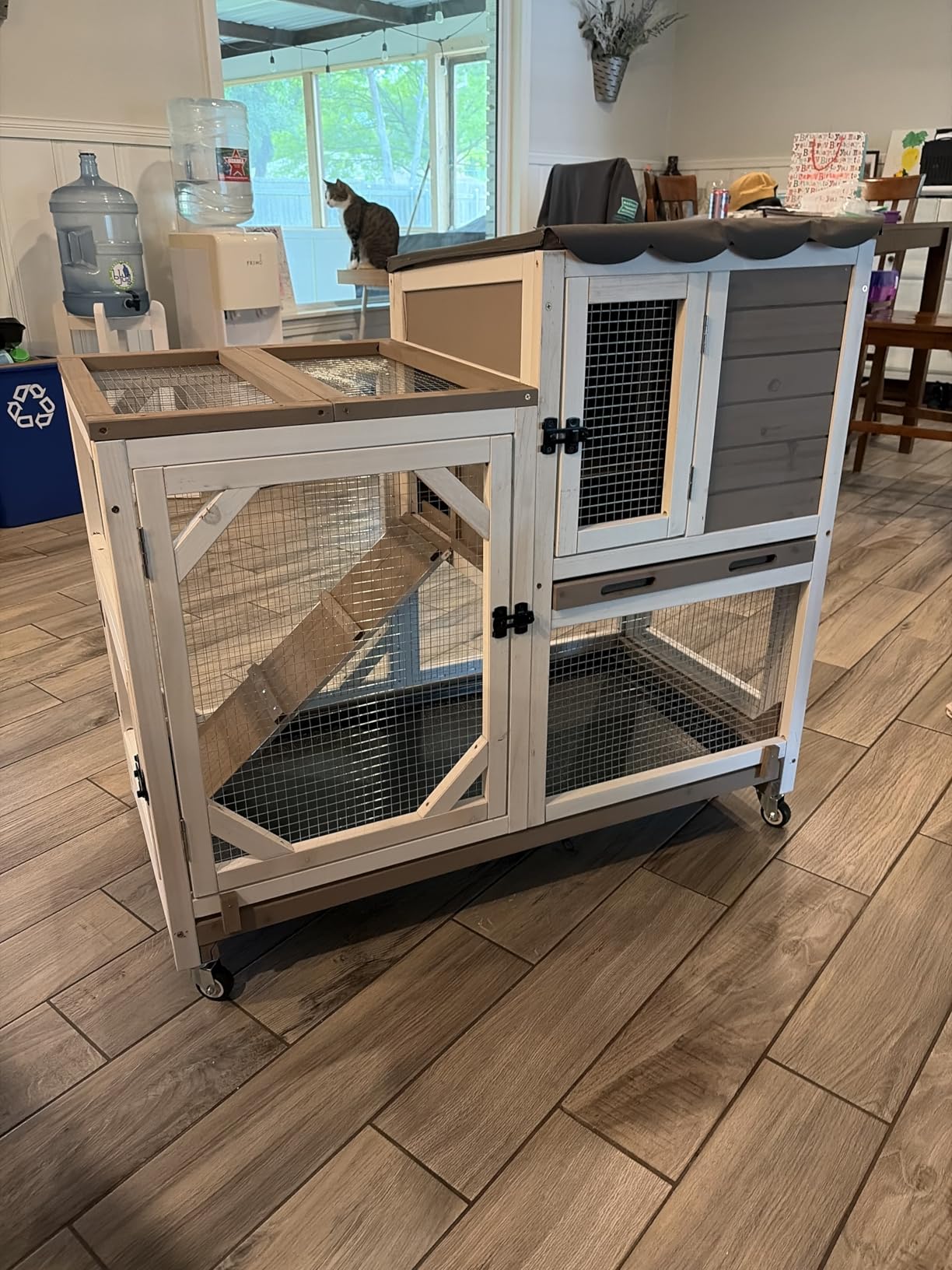
Owners point to the locking trays as the feature that changes daily life. Because the tray locks into position and lifts out whole, a full clean takes minutes and you are not dragging wood panels across wet litter to get underneath. Wheels, sliding doors and a roof opening cover the rest of the servicing angles.
What buyers complain about is honest and specific: the quick-assembly claim is optimistic, the wood is on the soft side and can split when screws are driven near edges, and some buyers find the arrival odour overwhelming enough to leave the hutch in a garage for a week with the lid off. The interior is also tight for a full-size rabbit, and the ramp is steep for lop breeds.
Who this hutch suits
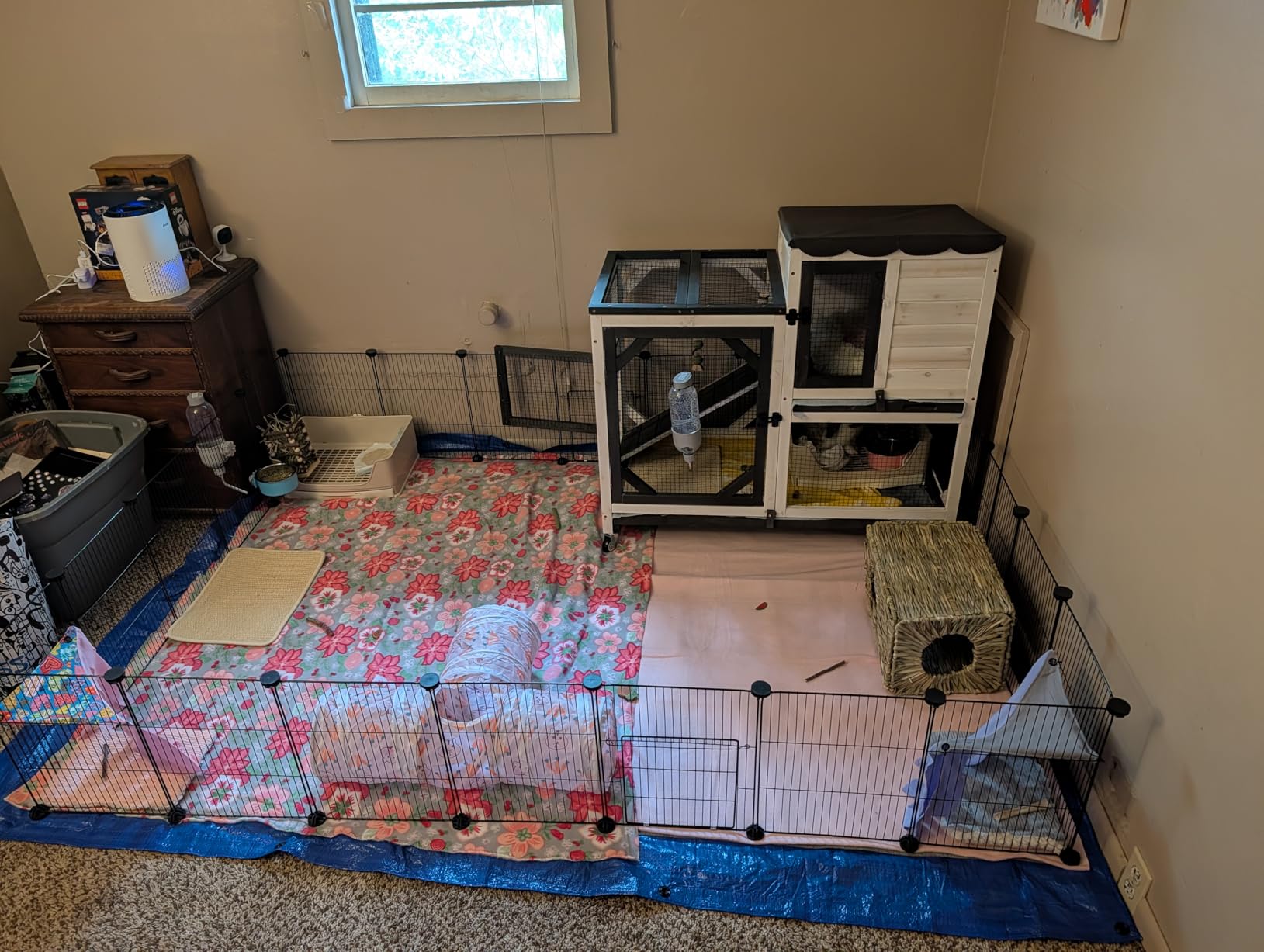
This is the pick for a single small rabbit, a young rabbit being house-trained indoors, or two guinea pigs and one dwarf. Several owners describe it as exactly that in their reviews rather than overselling it.
If your main worry is that your rabbit will destroy the hutch, the alloy framing and reinforced ramp edge are the reason to buy this one over a similar-looking timber model.
Who this hutch does not suit
A full-size or lop-eared rabbit is a poor fit. The ramp pitch and the interior dimensions both get reported as tight, and lop breeds in particular struggle with steep climbs.
It also does not suit anyone without a drill, a second pair of hands, or a ventilated space to air out the paint smell before the rabbit goes in.
3. GUTINNEEN 61 Inch: Best Rabbit Hutch for a Bonded Pair
GUTINNEEN Rabbit Hutch with Chew-Resistant Ramp Indoor Bunny Cage Outdoor Guinea Pig Cage with Wheels and Leakproof Tray
61.2 x 22.6 x 33.5 inch
Three leakproof removable trays
Six access doors
Indoor and outdoor
Pros
- Chew-resistant ramp reinforced with aluminum alloy edging
- Three trays pull out from either the front or the back
- Wheels with two brakes roll smoothly on any surface
- Six doors give full coverage for cleaning and feeding
Cons
- Long 61 inch footprint takes up significant space
- Bulky for indoor use in smaller rooms
- Assembly time and required tools are not detailed
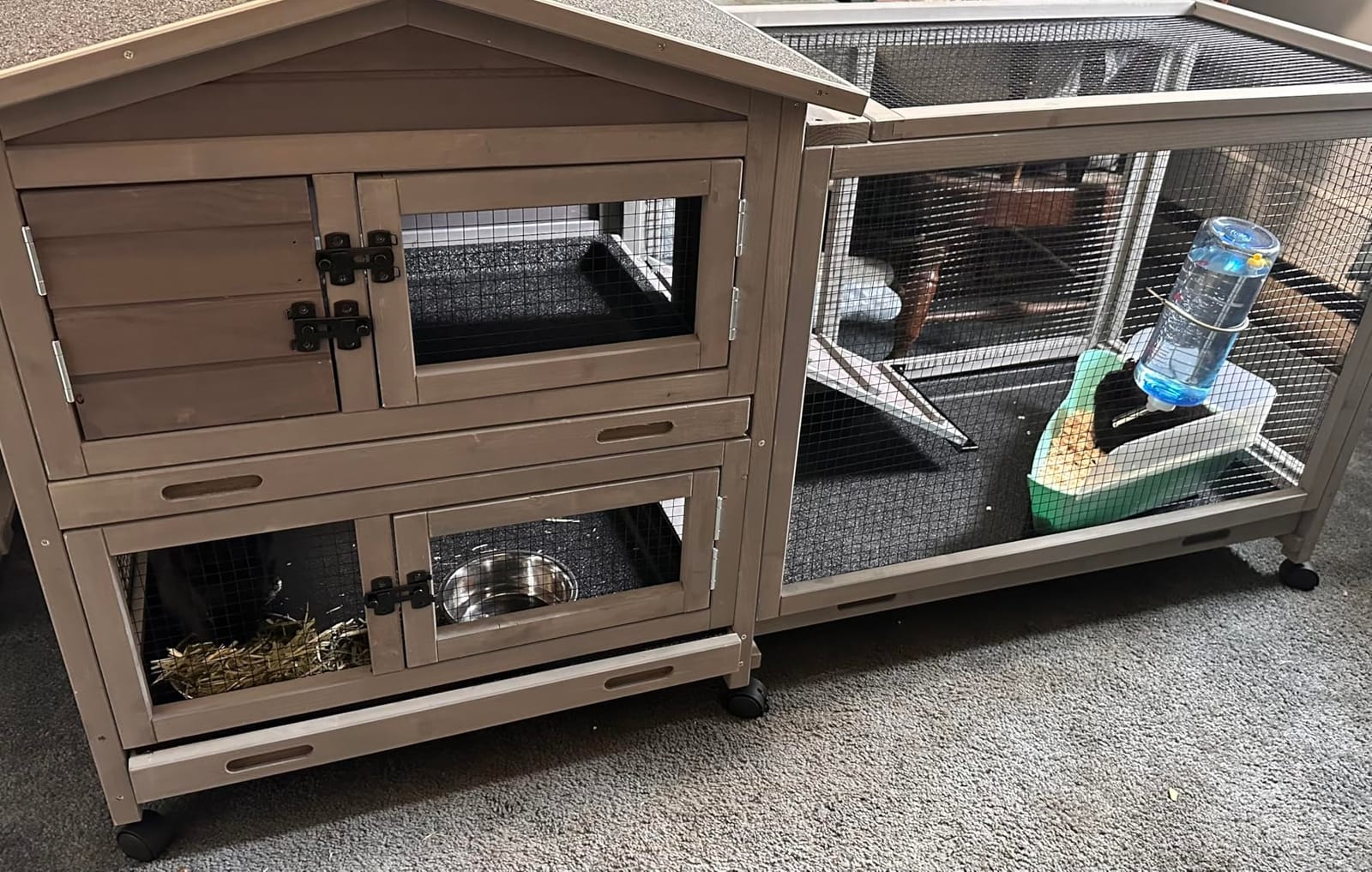
The tray system is the reason to look at this model first. Three leakproof removable trays can be pulled out from either the front or the back, which is unusual at this size and means you can always reach the cleanable face no matter how the hutch is positioned against a wall or fence.
The second reason is the ramp. Aluminum alloy edge reinforcement on the ramp is the single most-complained-about part of budget hutch builds, because a rabbit will chew a soft wooden ramp into a staircase of splinters within weeks. Buyers consistently say this one has survived their rabbit.
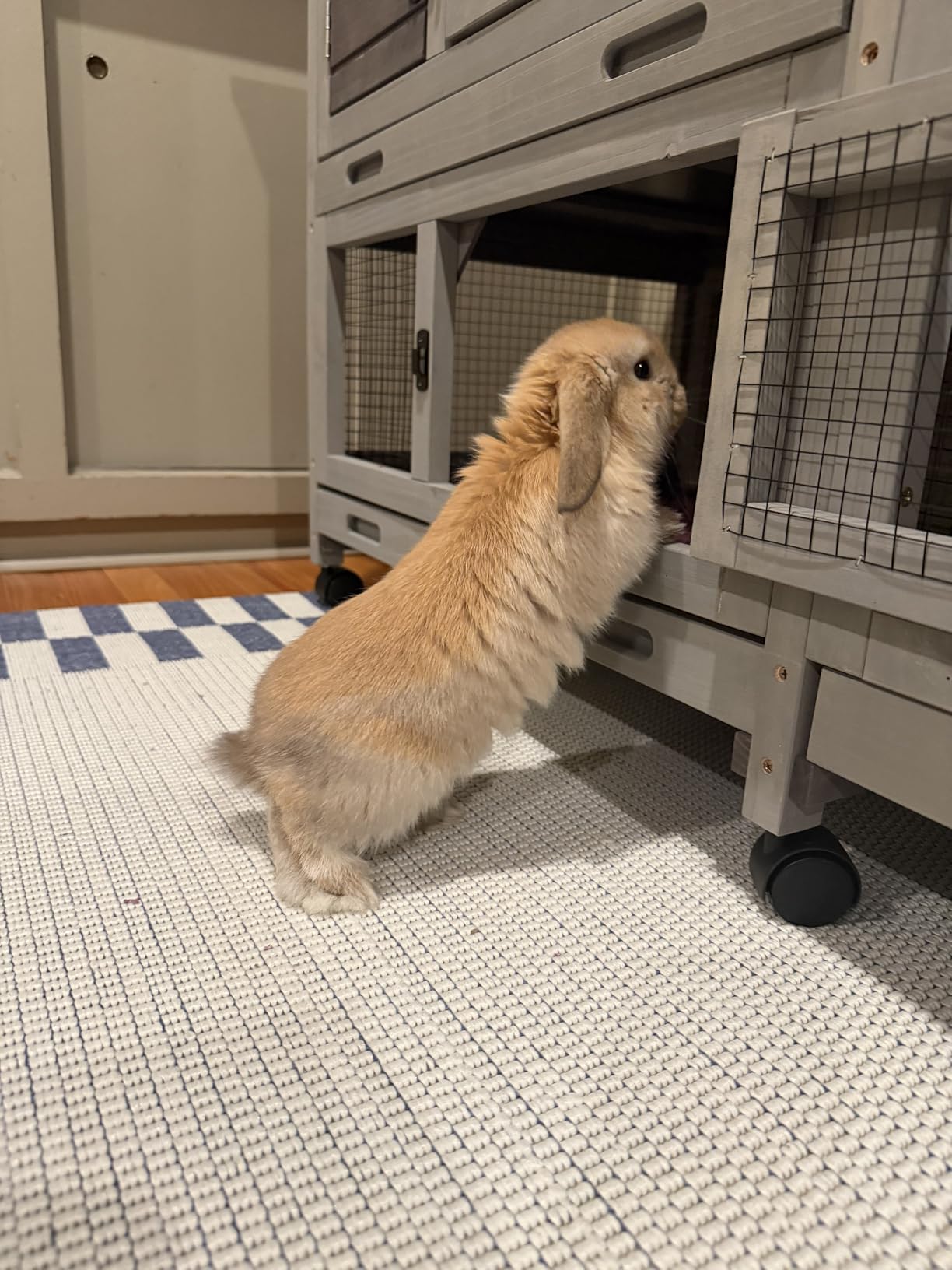
With 62% five-star ratings and 8% one-star in the review data, this model scores above its smaller sibling in the same range. The specific things reviewers praise are the front-and-back tray access and the braking wheels, which roll smoothly across grass or decking and stay put when the rabbit is active.
Weather-resistant construction is listed for both indoor and outdoor placement, and six access doors mean you can reach every level without lifting panels. The reservations are physical rather than functional: a 61 inch footprint is a lot of yard or patio, and the listing does not detail assembly time or tools, so budget an afternoon and a screwdriver set.
Who this hutch suits
Two rabbits that need to be housed together outdoors, with enough length that neither has to share the same stretch of floor. Owners of bonded pairs on rabbitrehome.org.uk consistently warn against splitting bonded rabbits, and this length helps you avoid it.
It also suits anyone who wants tray access from whichever side has space, which is often the deciding factor in a narrow garden or a conservatory against a wall.
Who this hutch does not suit
Small rooms are a problem. At 61 inches long this is bulky indoors, and owners flag it as such even when the hutch itself performs well.
It is also not the right choice for a rabbit that needs large breeds only and no run time. It is a hutch, not an exercise space, and the long run sections are still short compared with an x-pen.
4. TRIXIE Natura Two-Story 40 Inch: Best Classic Hutch With a One-Year Warranty
TRIXIE natura Outdoor Rabbit Hutch with Run – 2-Story Rabbit Cage with Non-Slip Ramp – Medium Elevated Small Animal House with Secure Playpen, Hinged Roof & Pull-Out Tray – in Brown
40.75 L x 38 W x 20.5 H inch
Pine construction
Two levels, four doors, one divider
1 year manufacturer warranty
Pros
- Established European-style brand with a 1 year manufacturer warranty
- Weather-resistant finish suited to outdoor placement
- Pull-out tray and hinged roof make cleaning fast
- Non-slip ramp and four doors give good access
- Divider allows the two areas to be used separately
Cons
- Pine is softer and less chew-resistant than solid fir
- A 10 percent one-star share
- Divider and two levels reduce usable floor space
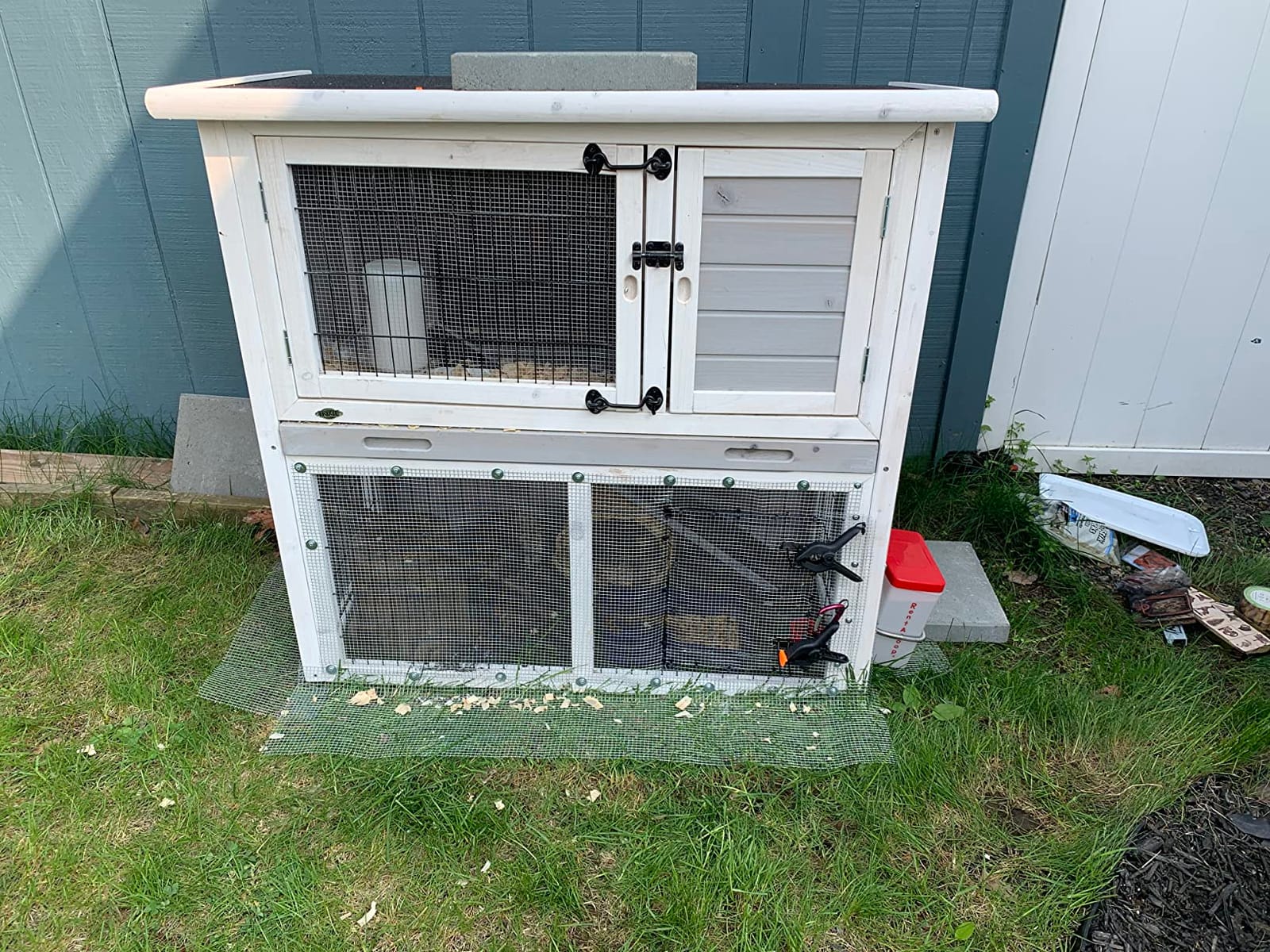
Some buyers want a name on the warranty card rather than a list of features, and this is the hutch in the group that offers one: a one-year manufacturer warranty from a long-established small-animal brand. The construction is pine with a weather-resistant finish, rated for outdoor use and shelter.
Layout is classic two-storey, with a lower enclosed area, an upper retreat, a non-slip ramp linking the two, a hinged roof for top-down access, four doors and a pull-out tray. A divider panel is included so you can use the levels separately, which is handy during introductions or cleaning.
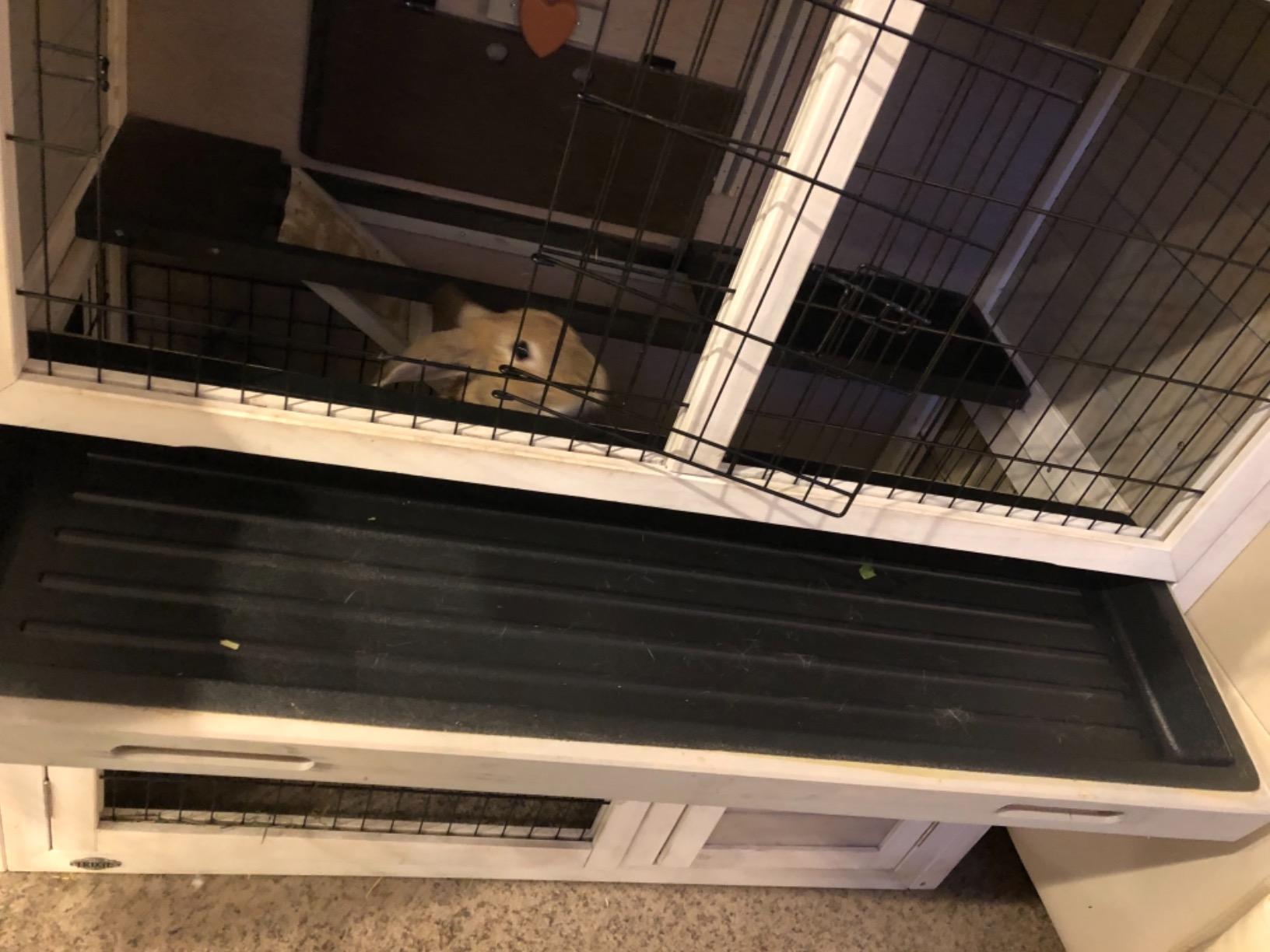
What owners like is the tray and roof combination. Pulling the tray out and lifting the roof covers almost every cleaning angle without dismantling anything, and the four doors mean you can catch a rabbit without chasing it around a corner.
What owners do not like is pine. It is a softer, resinous wood that chews and marks more readily than the fir and cedar used elsewhere in this roundup, and a substantial group of reviewers mention chew damage as the reason for lower scores. The 10% one-star share is the highest here. The two-level-plus-divider format also eats into usable floor space compared with an open run design.
Who this hutch suits
A buyer who wants a documented warranty, a straightforward European-style design, and a hutch that will sit outside in ordinary weather without a cover. The hinged roof is a genuine advantage for nesting-box checks in spring.
It also suits owners with a rabbit who is confident and mobile enough to use a ramp, rather than a nervous or very young animal.
Who this hutch does not suit
A determined chewer. Pine will not hold up to a rabbit with an appetite for timber, and no warranty covers chewed structural parts.
It also does not suit a bonded pair who need maximum shared floor area, because the divider and split levels divide the space you paid for.
5. GDLF 62 Inch Fir Hutch: Best Premium Hutch for Solid Floors and Multiple Rabbits
GDLF 62″ Rabbit Hutch, Bunny Hutch Indoor Outdoor with Ramp, Cleaning Tray
62 L x 21 W x 37 H inch
Natural fir with non-toxic varnish
Upper house 27.5 L x 18 W
Suits 2-3 rabbits
Pros
- Solid metal sheet floors that are far gentler on feet than mesh
- Natural fir wood with eco-friendly waterproof varnish
- Sliding tray
- grid doors and window make servicing easy
- Ramp ridges give noticeably better traction
Cons
- Picture-only instructions and parts that do not always line up
- Asphalt roof sheds grit and off-gasses on arrival
- Light wire mesh that can bend under heavy water bottles
- Ramp is hard to clean and needs a runner for grip
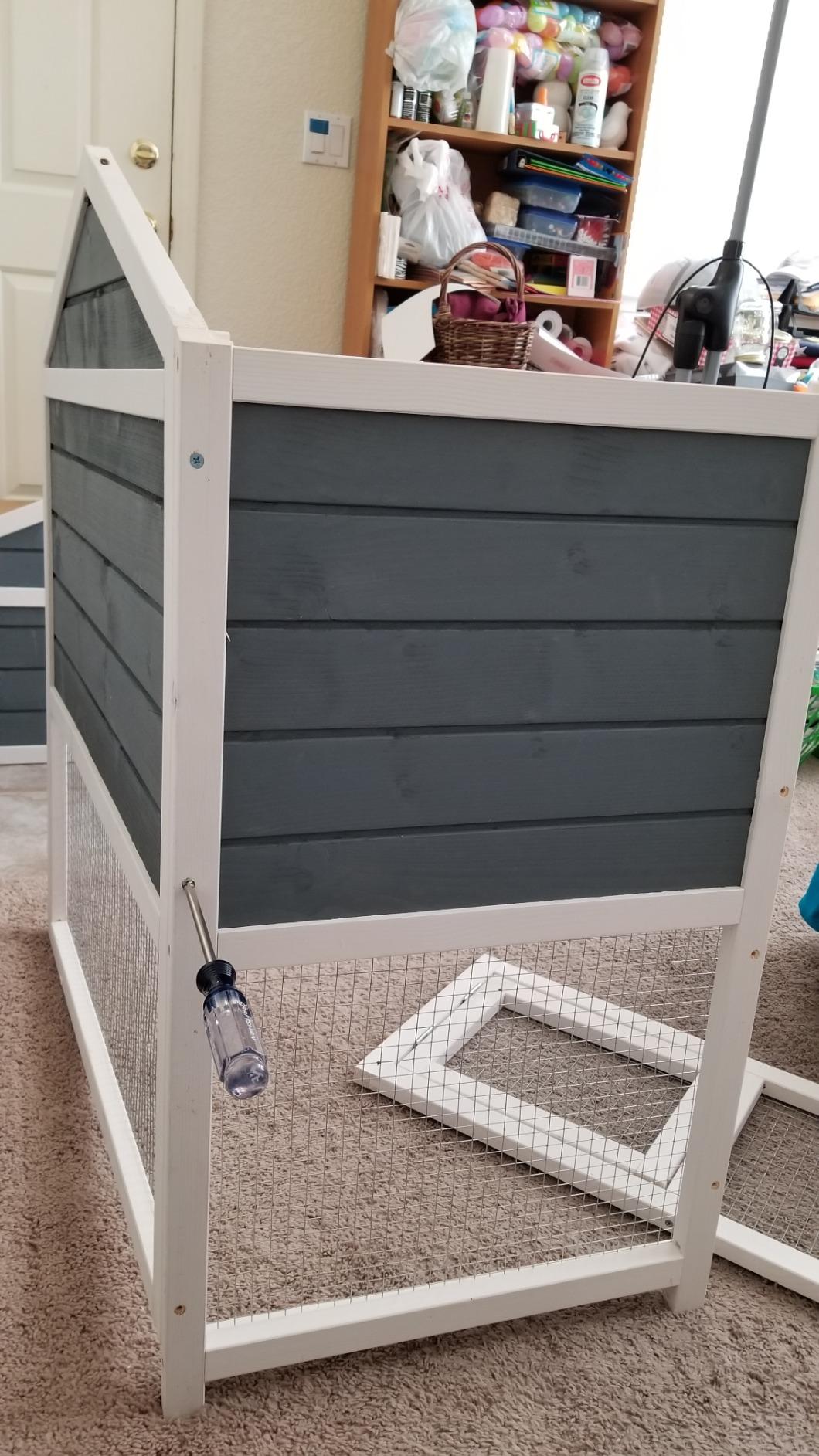
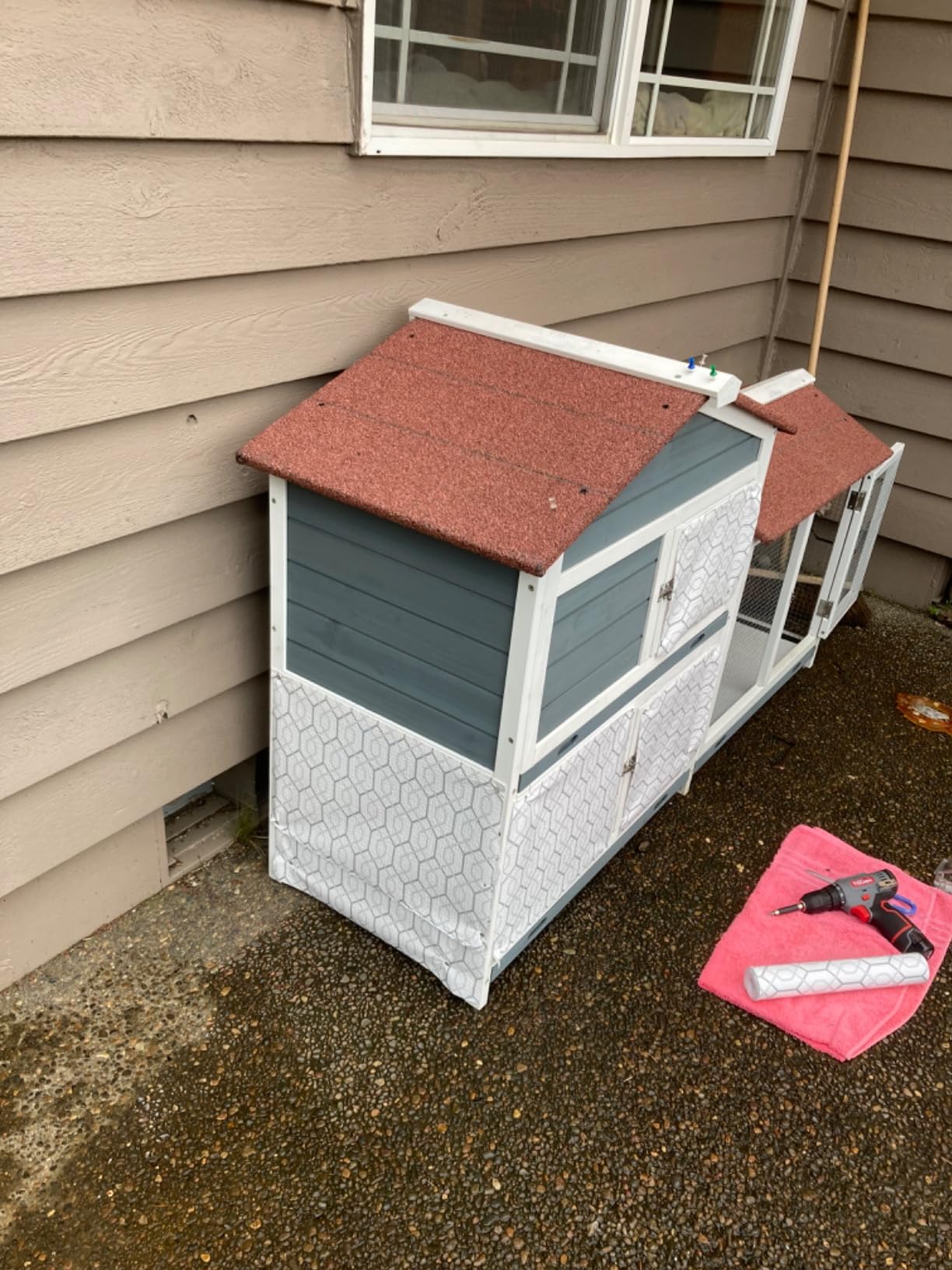
This is the hutch I keep coming back to, because it gets the one thing most wooden hutches get wrong. The floor is solid metal sheet rather than wire mesh, and owners single that out as the reason their rabbits have not developed the sore hocks that wire-floored models cause.
Everything else is proportionate to that. Premium natural fir wood carries an eco-friendly waterproof non-toxic varnish, the sliding door has a ramp with timber ridges cut into it for traction, grid doors allow observation without opening anything, and the pitched roof shelters the run in rain. It is listed for 2-3 rabbits or 3-4 guinea pigs of a similar size.
With a 4.4 average and 66% five-star ratings, this is one of the highest-scoring hutches in the group, and the reviews explain why in consistent language. The most-cited strengths are the solid sheet-metal floors, the upgraded plastic sliding tray and the overall sturdiness, which owners describe as noticeably more rigid than flat-packs in the same bracket.
The complaints are specific and fixable. The instructions are picture-only and parts do not always line up with the diagrams, so allow extra time. The asphalt roof sheds grit that has to be swept off after setup and can off-gas for a day or two. The wire mesh is light and can bow if you hang a full water bottle on it, and the ramp is awkward to clean and offers limited traction until you add a runner.
Who this hutch suits
Owners of two or three rabbits, or anyone whose rabbit has already had sore paws from a wire floor and needs solid footing to recover. The metal sheet floor is the deciding feature and it is worth choosing this hutch specifically for it.
It also suits buyers who care about the finish. A water-based non-toxic varnish on natural fir is a much better answer to concerns about smell and safe materials than an unsealed softwood.
Who this hutch does not suit
Anyone who wants a painless build. Reviewers repeatedly describe the picture-only instructions as the most frustrating part of assembly, and this is not a build-you-in-an-afternoon hutch if you are not comfortable with flat-pack furniture.
It also does not suit two full-size rabbits. Once the accessories are in, the interior is reported as tight, and size should be judged for small breeds.
6. Aivituvin Two-Story 39 Inch: Best Value Indoor Hutch With Deep Trays
Aivituvin Rabbit Hutch Indoor Outdoor Bunny Hutch on Wheels, 2 Story Wood Guinea Pig Cages with 2 Deeper Pull Out Trays (Brown)
39.37 L x 22.04 W x 36.8 H inch
Two deep no-leak trays
Waterproof roof with summer shade
38.85 pounds
Pros
- Two deep no-leak trays that keep the living area dry and cut cleaning time
- Openable roof and multiple entrances simplify feeding
- A non-slip
- non-chew ramp between levels
- Waterproof roof works indoors and out
Cons
- 39 inch footprint is snug for anything larger than a small rabbit
- Two trays need frequent cleaning if you use disposable bedding
- Open mesh sides offer limited protection from determined predators
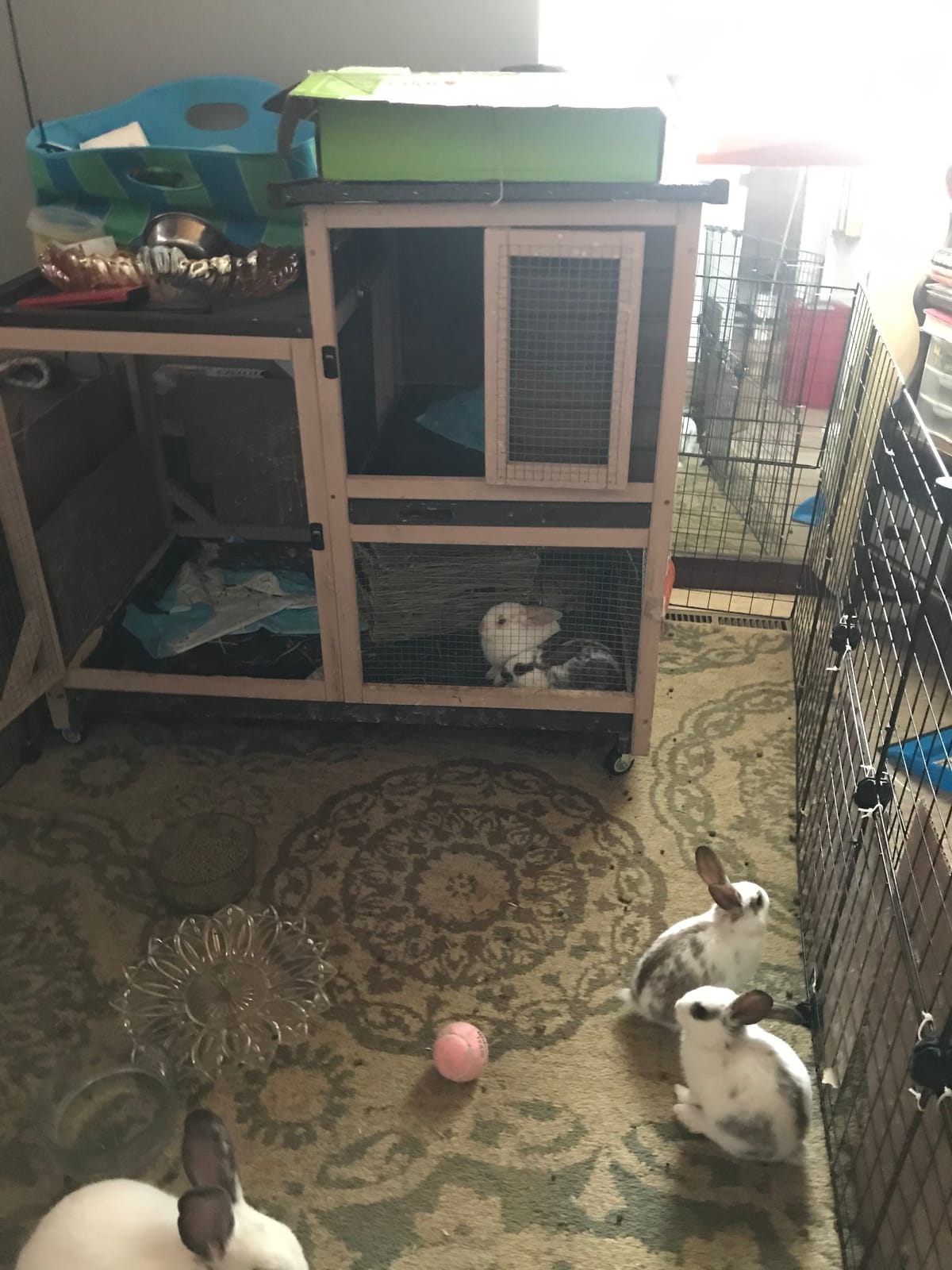
If your rabbit lives inside, this is the hutch I would put in a corner of a spare room. It is a two-storey wood build at 39.37 by 22.04 by 36.8 inches and 38.85 pounds, with sliding doors separating the floors so you can drop food or hay into either level without opening the whole front.
The deep trays are the reason it works indoors. Two deeper no-leak pull-out trays sit under the levels, which is what keeps urine out of the wood and the smell out of the room. A waterproof roof covers the top and doubles as summer shade when the hutch is near a window, and the ramp is described as both non-slip and non-chew.
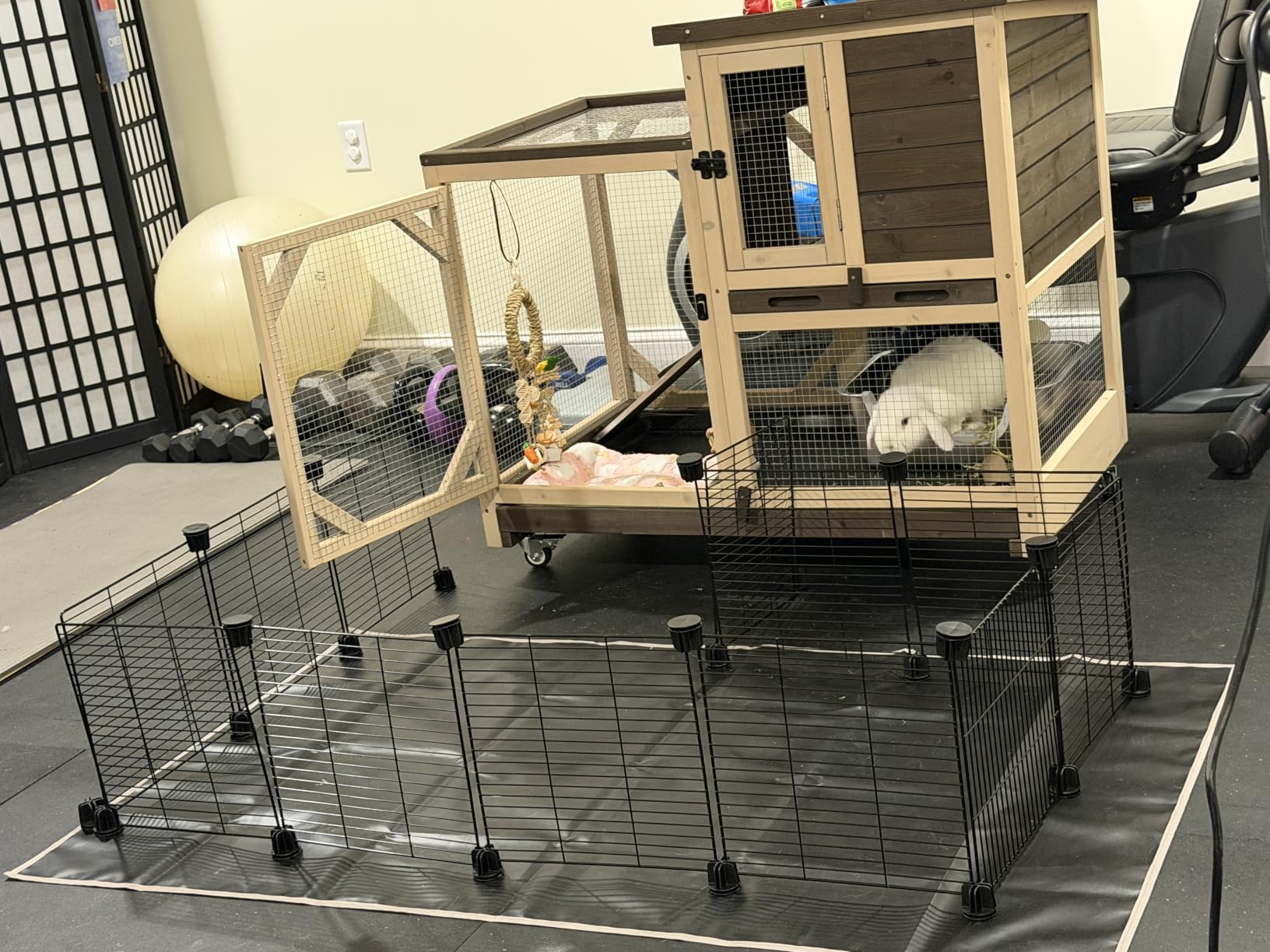
The 4.5 average with 73% five-star and only 3% one-star is the strongest satisfaction profile in this batch, and reviews focus on the trays, the openable roof and value for a two-storey layout. Owners also note it sits at a sensible indoor scale compared with the 60-plus inch outdoor models.
The caveat is size. Reviewers are consistent that a 39 inch footprint is snug for anything larger than a small rabbit or a guinea pig, so this is not the answer for a full-size or young adult rabbit. If you use disposable bedding, two trays at this size need cleaning often. And open mesh sides mean limited protection from determined predators, so keep it indoors.
Who this hutch suits
Indoor rabbit owners with a dwarf, mini lop or young rabbit, and anyone keeping guinea pigs alongside. The two-level split is useful when you need to separate for a feeding or bonding session without moving the animal.
The openable roof also makes this a practical choice as a recovery space for a rabbit coming home from a rescue, since you can check on them without opening a door.
Who this hutch does not suit
Large breeds and bonded adult pairs. The interior is not built for two rabbits side by side, and a full-size rabbit will feel the length.
It is also wrong for anyone planning to put it in the garden, because the open mesh sides and the general shell are not built for overnight predator pressure.
7. GEGURI Cedar Hutch: Best for Guinea Pigs, Chicks and Small Pets
GEGURI Wooden Rabbit Hutch, Indoor Outdoor Chicken Coop Bunny Cage with Waterproof Roof
37.51 L x 23.22 W x 36.59 H inch
Cedar with waterproof varnish
Asphalt roof
Raised nest box with ramp
Pros
- Cedar wood with a waterproof varnish better than plain pine
- Asphalt roof gives genuine weather protection
- Raised nest box and built-in ramp use the vertical space well
- Removable tray simplifies cleaning
Cons
- Smallest interior here at just over 37 inches long
- Wood can split during assembly if screws go near edges
- Asphalt roof sheds grit that has to be swept away
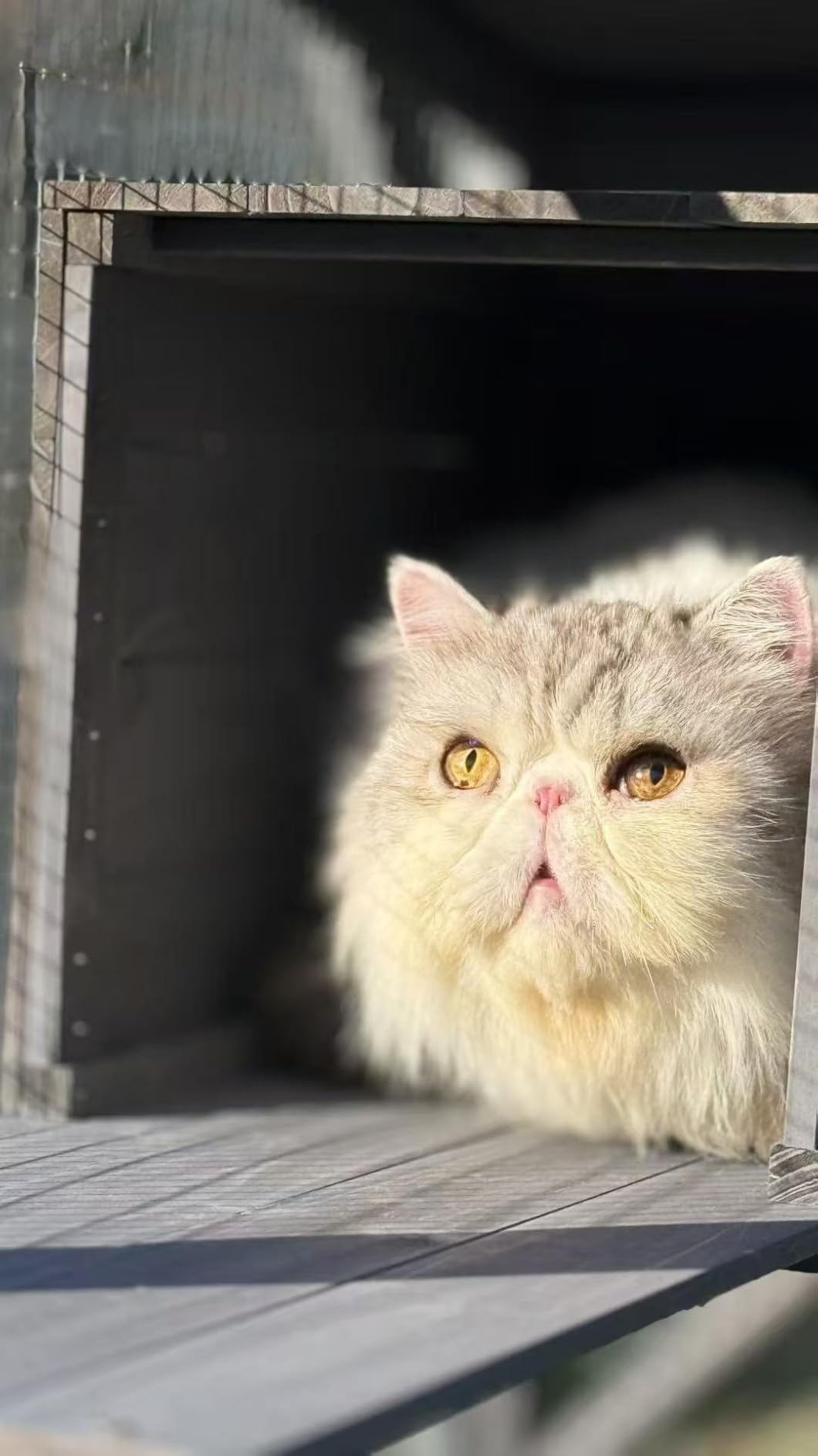
GEGURI takes a different approach to small-animal housing: it is built for a mixed household rather than a single rabbit. The listing covers rabbits, guinea pigs, chicks, hedgehogs and ferrets, and at 37.51 by 23.22 by 36.59 inches and 38.05 pounds it is a compact, easily carried unit.
The materials are the interesting part. It uses cedar with an environmentally friendly waterproof varnish, and a raised nest box with a built-in ramp sits above a separate play area, so the vertical space actually gets used rather than being a second open level. The asphalt roof is specified against wind, rain and snow.
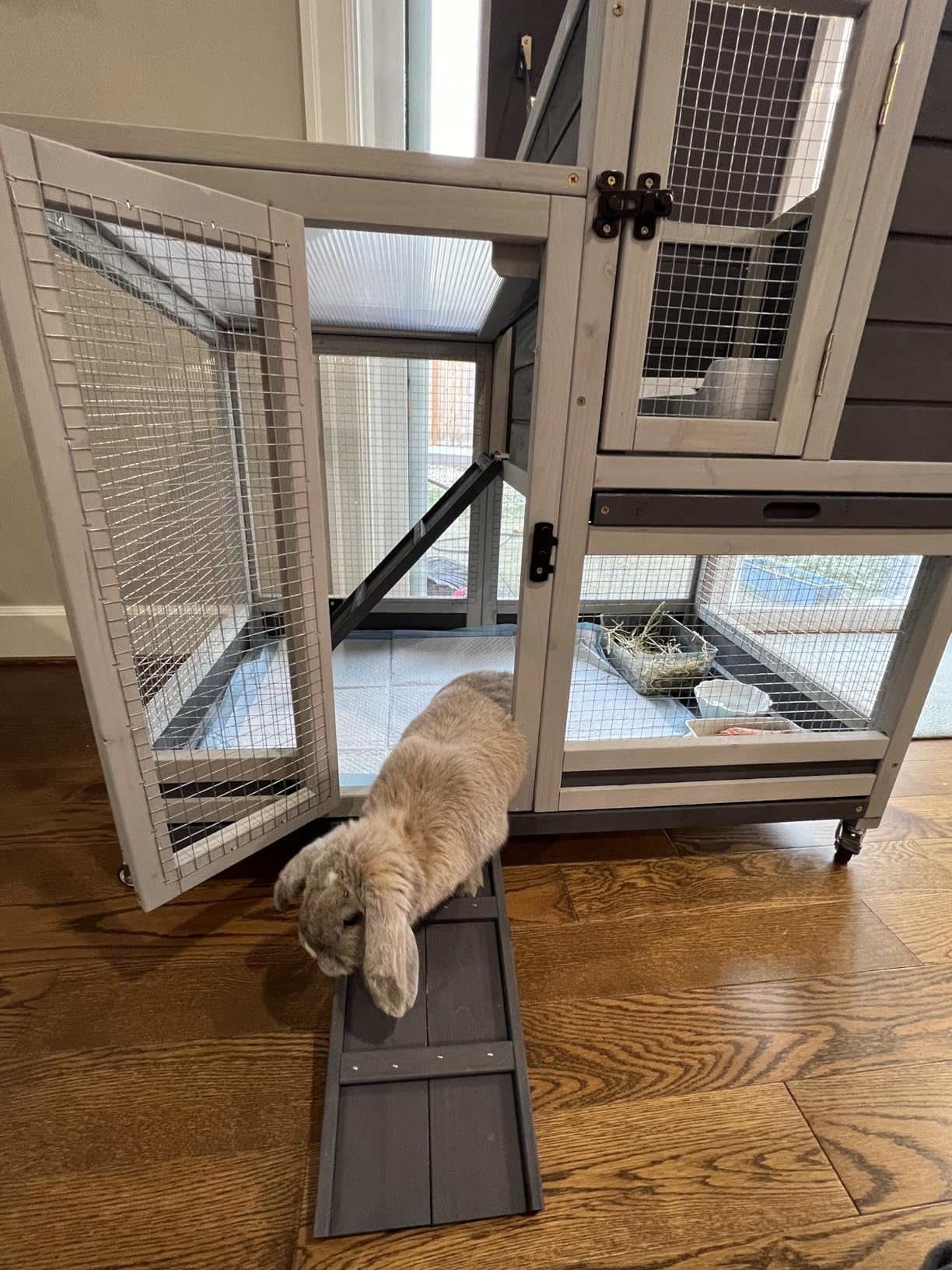
With a 4.1 average across 219 reviews and 59% five-star, reactions are positive on construction. Owners like the cedar choice, the weatherproof roof and the raised nest design, and the removable tray is mentioned as the feature that keeps the daily routine quick.
Two reservations come up repeatedly. The interior is the smallest in this roundup at just over 37 inches long, so a rabbit fills it quickly, and the wood can split during assembly if screws are driven near the edges. The asphalt roof also tends to shed grit that has to be swept away after weather.
Who this hutch suits
Guinea pig and small pet owners, particularly anyone housing more than one. A raised nest box with an integrated ramp also works well for a rabbit that likes elevation without needing a full second storey.
If you have a mixed small-animal household, this is the only unit in the group explicitly rated for chicks, hedgehogs and ferrets as well as rabbits.
Who this hutch does not suit
A full-size rabbit that needs room to hop a full length. At just over 37 inches, the interior is the shortest here and is reported as the most common reason buyers are disappointed.
It is also a poor match for a confident chewer, since the wood is described as splitting when fasteners are driven close to the edges during assembly.
8. PawHut 62 Inch Hutch and Run: Best Multi-Rabbit Run Layout
PawHut 62″ Rabbit Hutch with Run Area for Rabbits, Chickens, White
62 L x 20.75 W x 36.75 H inch
4 sq ft house plus 7 sq ft run
End-to-end asphalt roof
Four access doors
Pros
- Generous 11 sq ft split between a 4 sq ft house and a 7 sq ft run
- Solid fir wood from an established pet-furniture maker
- End-to-end asphalt roof keeps the run usable in rain
- Four doors and a pull-out tray make servicing straightforward
Cons
- 62 inch length and 44.1 pounds make it awkward to reposition
- Assembly instructions are minimal
- Mesh wire sides are light for keeping determined predators out
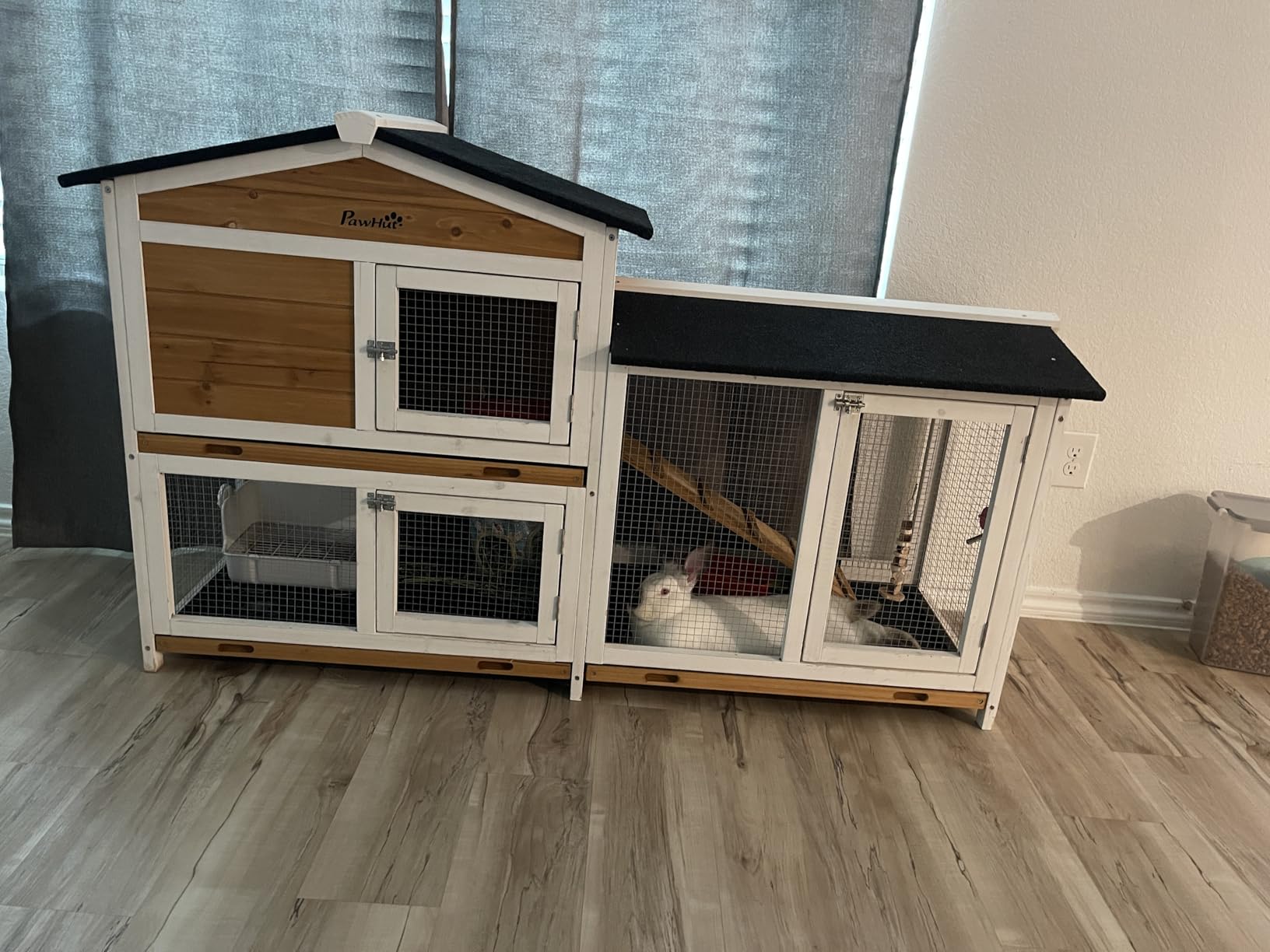
The distinguishing feature here is the split. Rather than stacking two small floors, this hutch divides 11 sq ft into a 4 sq ft enclosed house and a 7 sq ft open run, with the run under the same roof. That is a much more usable shape for a rabbit that needs length to hop, and it is listed for 1-3 small to medium rabbits.
Construction is solid fir wood with mesh wire sides, an end-to-end asphalt roof that covers the run as well as the house, a pull-out cleaning tray, four access doors and a ramp connecting the two areas. It comes from Aosom, an established pet-furniture maker, which matters for replacement parts.
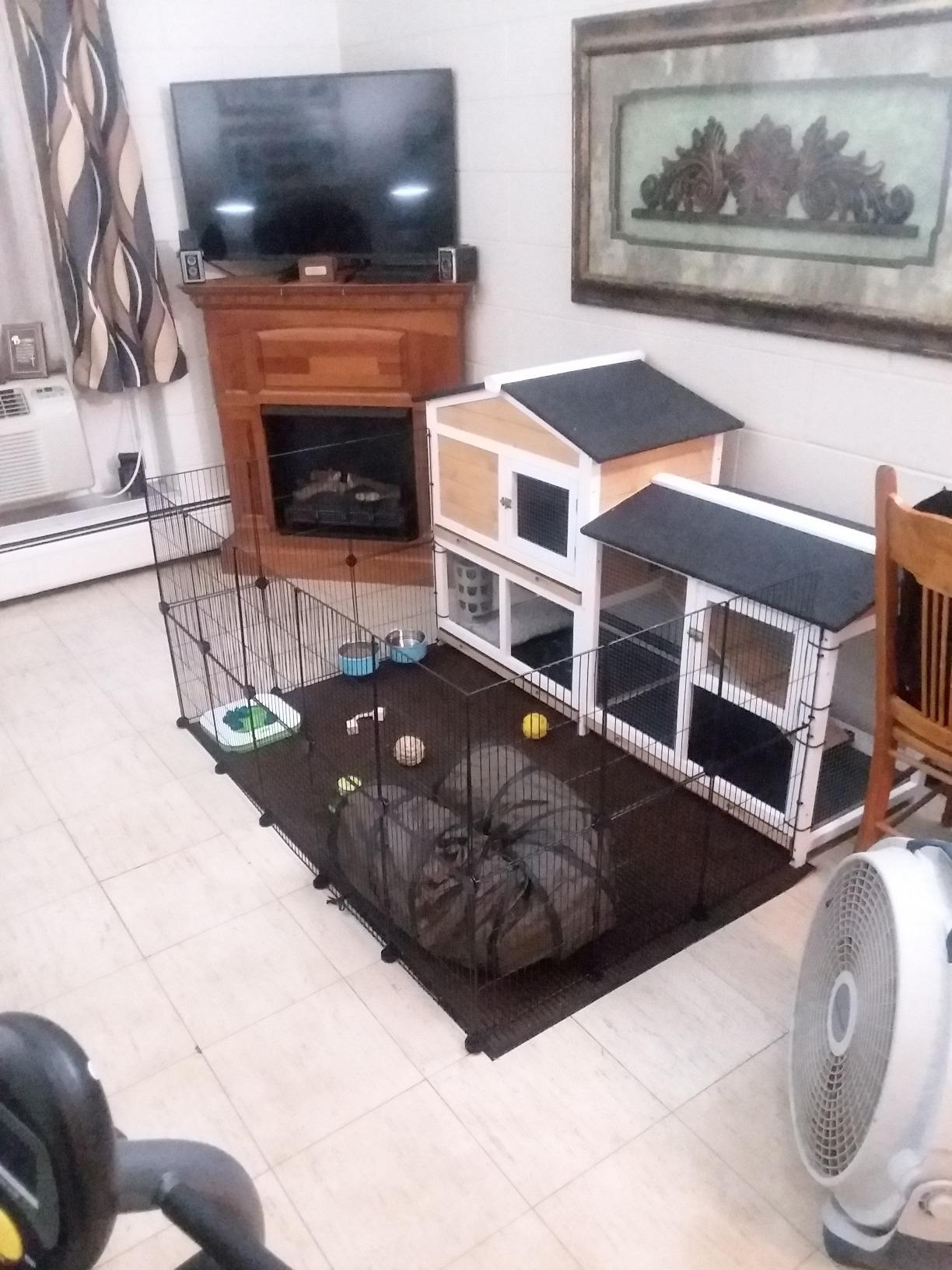
At 4.1 across 201 reviews with 59% five-star, buyers focus on the unusual run area for the money. Owners highlight the 7 sq ft run, the fir build and the full-length roof, and the ability to leave a rabbit in the run in wet weather without it being soaked.
Trade-offs are size and weight again. At 62 inches and 44.1 pounds it is awkward to reposition, and assembly instructions are minimal so plan your own method. The mesh wire sides are light, which owners mention as a limitation for anyone intending to rely on the hutch overnight against determined predators.
Who this hutch suits
Owners of one to three small to medium rabbits who want a hutch with a genuine run attached rather than a stacked pair of floors. The full-length roof means the run is usable on wet days, which is when rabbits are most often left in.
Buyers who already own Aosom products also gain a consistent frame style and spares availability.
Who this hutch does not suit
Large breeds such as Flemish Giants. The run is 7 sq ft, which is a generous hutch run but nowhere near the space a giant rabbit needs for daily exercise.
Anyone wanting a hutch they can move to fresh grass weekly should also skip this one at 44.1 pounds and 62 inches long.
9. PetsCosset 93 Inch Double Run: Best Rabbit Hutch for Large Breeds
Large Rabbit Hutch Outdoor Indoor Bunny Hutch with Double Runs on Wheels
93 L x 21.7 W x 35.4 H inch
Solid fir with anti-slip ramps
Acrylic viewing windows
Listed for 2-3 rabbits
Pros
- Longest layout here at 93 inches with a large ground-level run
- Acrylic windows let you monitor without opening doors
- Lockable deeper leakproof tray keeps the run clean
- Full-coverage asphalt roofs over both areas
- Wheels add mobility most wooden hutches lack
Cons
- 93 inch footprint dominates a yard or room
- Casters and short screws are weak and can detach when moved
- Screens described as flimsy and easy to chew
- No base floor so a waterproof mat is needed indoors
This is the longest hutch we reviewed, at 93 by 21.7 by 35.4 inches, and length is exactly what large breeds need. The layout is a large ground-level run with a two-storey sleeping area above, built from solid fir with anti-slip ramps, and listed for 2-3 rabbits.
Two features stand out from the rest of the group. Acrylic windows let you watch a settling rabbit without opening a door and letting the stress start again, and a deeper leakproof lockable pull-out tray keeps the run stable and cleanable over a long span.
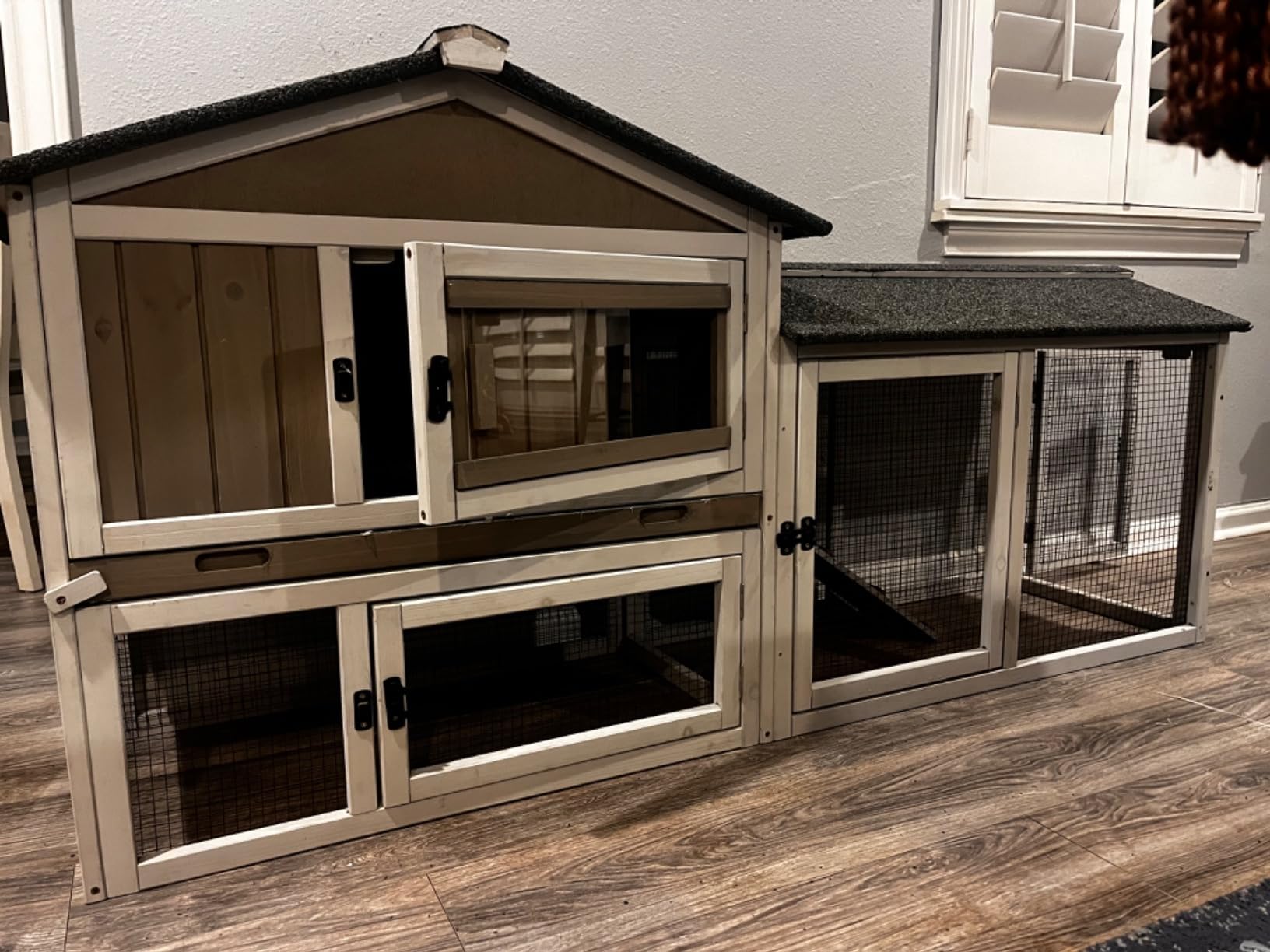
Full-coverage waterproof asphalt roofs sit over both the sleep area and the run, and four access doors with protective wire mesh cover the servicing angles. Reviewers like the size, the acrylic viewing windows and the tray, and the 4.3 average across 163 reviews with 67% five-star reflects a broadly positive picture.
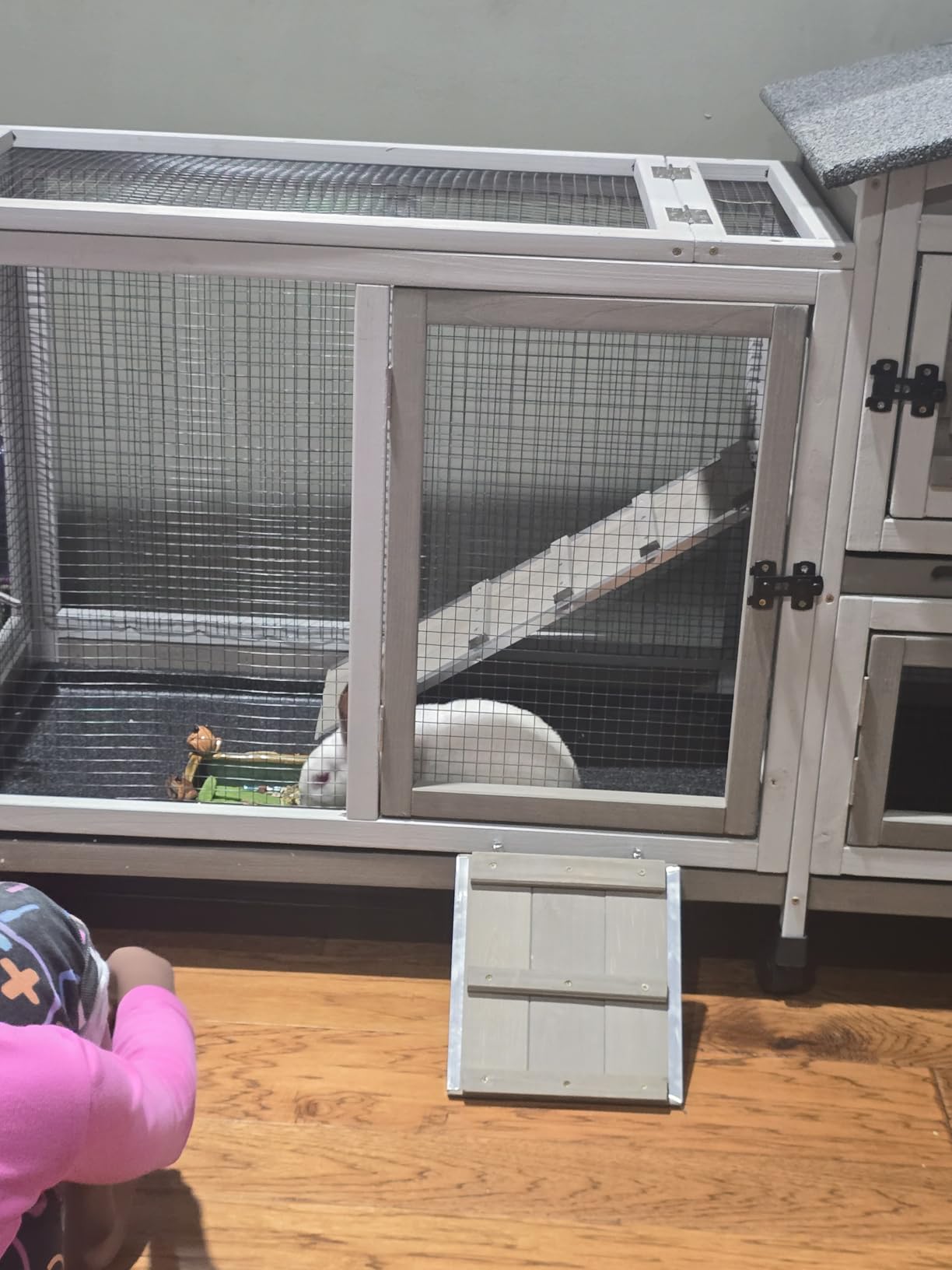
The problems are practical. Casters and short installation screws are described as weak and can detach when the hutch is moved, which is a real risk in a unit this size. The screens are called flimsy and not well attached, and there is no base floor, so a waterproof mat is needed to protect indoor flooring. Assembly is a two-person job of roughly an hour or more.
Who this hutch suits
Large breeds and multiple rabbits where length is the constraint. If your rabbit can only stretch out properly by getting a run of body length, this is the model that physically allows it.
The acrylic windows also suit anyone with a newly rehomed or nervous rabbit, since observation does not require entering the space.
Who this hutch does not suit
Any home or garden that cannot give up 93 inches of wall or fence line. Buyers describe the footprint as dominating a room or a yard.
It is also the wrong choice if you plan to move it regularly. Weak casters and short screws are the most cited mechanical weakness, and there is no base floor for indoor use.
10. PawHut 48 Inch Two-Story: Best Indoor Two-Storey With Feeding Troughs
PawHut 48″ 2-Story Large Rabbit Hutch with Metal Frame, Ramp for Rabbits
48 x 19.75 x 39.75 inch
52.2 pounds
Fir wood with metal frame
Living house 44 L x 16.5 W
Pros
- Solid fir wood and metal frame construction that feels rigid once built
- Weatherproof asphalt roof
- Two-level design with an elevated living area
- Slide-out dropping tray plus an openable roof for cleaning
- Two metal feeding troughs one per level
Cons
- Assembly required
- Heavy at 52.2 pounds
- May be too narrow for larger rabbits to use the ramp
- No wire floor so a litter box is required
The metal frame is what separates this from a typical wooden two-storey. Fir panels in a metal skeleton do not rack the way flat-pack timber does, and at 52.2 pounds the hutch is heavy in a way that tells you it is built rather than glued.
Features are practical: a weatherproof asphalt roof, an elevated living area above a spacious run box, lockable doors with sturdy spray wire, a slide-out dropping tray, an openable roof, and two metal feeding troughs, one per level, so hay does not get trodden into the run.
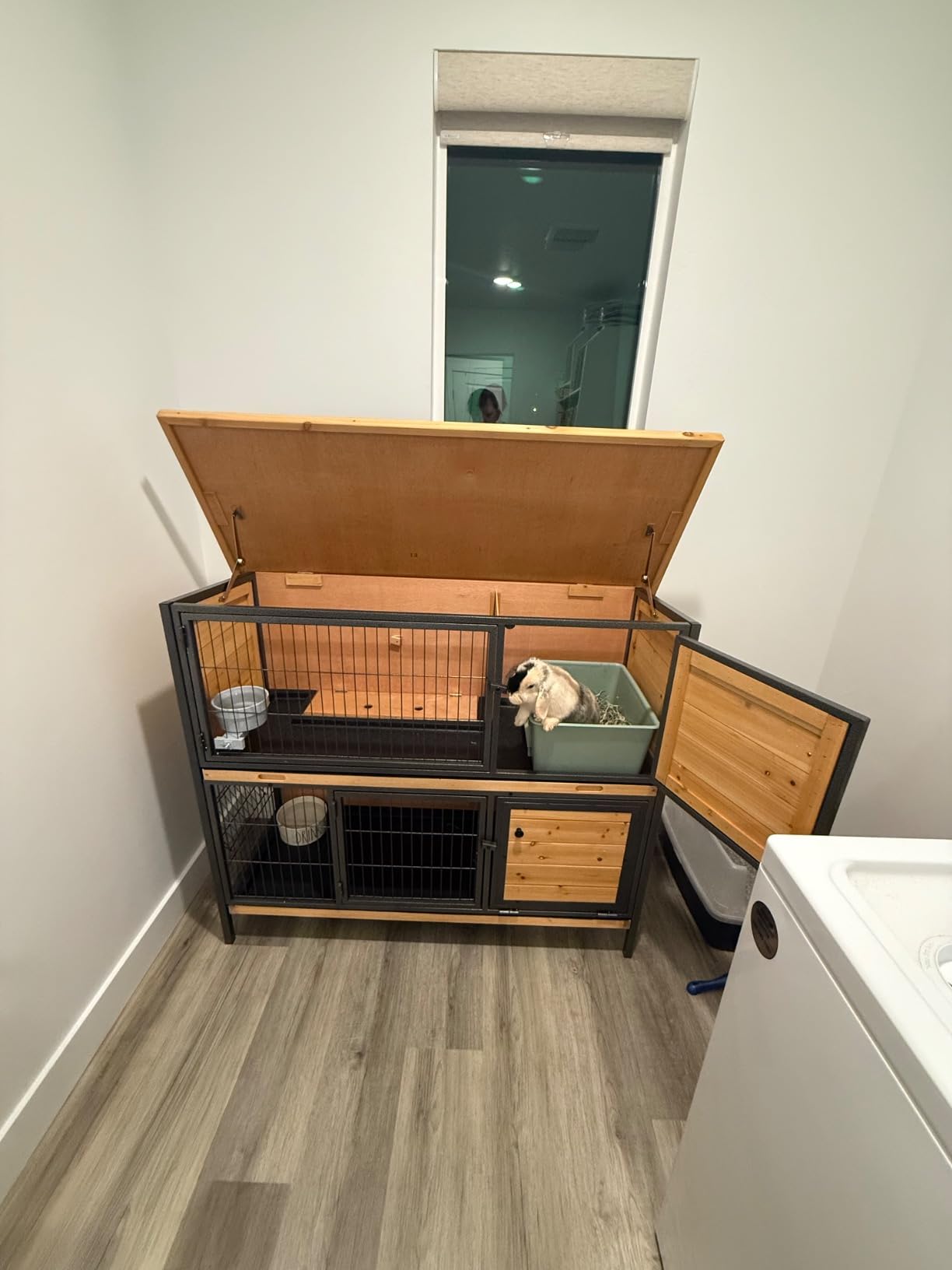
Overall dimension is 48 by 19.75 by 39.75 inches, with the living house at 44 by 16.5 by 17 inches. That interior width is the catch. Buyers note the ramp may be narrow for larger rabbits, and the 19.75 inch overall width makes this a slim profile for an indoor corner.
There is also no wire floor or rack, so waste does not fall away from a litter box the way it does in some designs. If you already use a litter tray this is fine, but if you were expecting a self-cleaning floor you will need to add flooring yourself.
Who this hutch suits
Indoor owners of small to medium rabbits who want a rigid, two-level setup and do not mind a litter box. The per-level feeding troughs are genuinely useful with a rabbit that drags hay everywhere.
It also suits anyone who plans to leave the hutch outside in summer, since the asphalt roof and lockable doors hold up better outdoors than open-mesh indoor models.
Who this hutch does not suit
Large breeds. The narrow ramp and 16.5 inch interior width are the reasons buyers caution against it, and a bigger rabbit needs width to turn around comfortably.
It is also unsuitable for anyone hoping to carry or reposition it regularly at 52.2 pounds, and assembly is required before any of it can be used.
11. Suumerpety Compact Two-Story: Best for Tight Spaces and Small Breeds
Suumerpety 2-Story Wooden Rabbit Hutch with Chew-Proof Ramp, Dual Leak-Proof Pull-Out Trays & 4 Lockable Wheels, Indoor Outdoor Bunny Cage for Rabbits & Guinea Pigs (Grey)
32.48 x 15.35 x 35.39 inch
Two-story 36 inch living space
Dual leak-proof trays, 4 lockable wheels
Escape-resistant latches
Pros
- Chew-proof ramp with reinforced aluminum-alloy edges
- Dual leak-proof pull-out trays for easy cleaning
- Four lockable wheels with two brakes
- Escape-resistant door latches and rounded pet-friendly edges
Cons
- Most compact layout here at 32.48 inches long
- Limited long-term durability data as a recent release
- Wood may weather over time
When space is the constraint, this is the hutch. At 32.48 by 15.35 by 35.39 inches it is the smallest footprint in the roundup, yet it still delivers two levels, two deep leak-proof pull-out trays and a chew-proof ramp with reinforced aluminum-alloy edges.
The smaller details are thoughtful. Rounded edges reduce injury risk on a compact frame where every corner is within reach, and escape-resistant latches mean a rabbit pushing at a door is not immediately loose in a small enclosure.
Four wheels, two of which lock, are unusual at this size and let you move the hutch to fresh grass without dragging it. Early reviews are strong on the chew-proof ramp, the easy-clean trays and the mobility, and the 4.1 average across 139 reviews reflects enthusiasm for a well-judged small design.
The caution is obvious and worth stating: this is a recent release with limited long-term durability data, so there is no multi-year owner history to draw on. The wood may also weather over time, and the compact length suits a small rabbit or guinea pigs rather than anything larger.
Who this hutch suits
Apartment or conservatory rabbit owners with one small breed, and anyone who wants to move a hutch onto fresh grass regularly. The lockable wheels make it the easiest of the compact options to reposition.
Guinea pig and small pet owners benefit from the same two-level layout and deep trays, without paying for run length they cannot place.
Who this hutch does not suit
Large breeds and bonded pairs, since 32.48 inches does not allow two rabbits to share a level. Buyers looking for a run space should look at the 60-plus inch models instead.
Anyone buying for the long term with no tolerance for risk should note the limited long-term durability data, and wood in an outdoor position will need regular checks after wet weather.
12. GUTINNEEN Mobile 44 Inch: Best Hutch for Moving to Fresh Grass
GUTINNEEN Rabbit Hutch Mobile Bunny Cage with Large Wheels, Chewproof Ramp, Leak Proof Trays – Ideal Cage for Rabbits, Guinea Pigs, Indoor/Outdoor Use, 44″ L x 20″ W x 41.5″ H
44 x 20 x 41.5 inch
Four large iron wheels, 2 lockable
Weatherproof asphalt roof
Five front doors plus openable roof
Pros
- Four large durable iron wheels with two lockable for mobility over grass
- Leak-proof trays with wooden baffles that stop corner leaks
- Five front doors
- an openable roof and a second-floor side door
- Weatherproof asphalt roof
- Pre-labeled parts with pre-drilled holes
Cons
- No wire floor or racks so a litter box is needed
- Some reports of soft wood cracking during assembly
- Ramp may be narrow for larger rabbits
- Quality control issues with chipped wood and exposed nails
This is the one built for the practice experienced owners recommend most: moving the hutch to fresh ground regularly to prevent urine burn and keep the setup hygienic. Four large durable iron wheels, two of them lockable, are the reason. At 44 by 20 by 41.5 inches it is heavy enough to be stable and light enough to be wheeled.
Access is unusually generous, with five front doors, an openable roof and a side door on the second floor, so every level is reachable without lifting panels. The trays are leak-proof and fitted with wooden baffles that prevent the pooling in corners that owners complain about most.
Parts arrive pre-labeled with pre-drilled holes and a weatherproof asphalt roof, and the 4.1 average across 112 reviews shows most owners find assembly straightforward even when the instructions are thin. Reviewers like the spacious design, the number of access points and the mobility above everything else.
There is no wire floor or rack, so rabbits step in waste unless you add a litter box. There are reports of soft wood cracking during assembly, quality control problems with chipped or peeling wood and exposed nails, and a ramp that may be narrow for larger rabbits.
Who this hutch suits
Anyone following the move-it-to-fresh-grass routine, or anyone who needs to get a hutch across a lawn, a deck or a gravel path without dragging it. Large iron wheels handle uneven ground far better than small casters.
Multi-level access also suits owners with a reactive or shy rabbit, since you can approach from a chosen door rather than opening a front the animal is watching.
Who this hutch does not suit
Large breeds, because the ramp is reported as narrow for them. It also does not suit buyers who want a self-cleaning wire floor, since none is fitted.
Check each panel on arrival. Quality control complaints about chipped wood and exposed nails are specific enough to be worth inspecting before assembly begins.
How to Choose a Rabbit Hutch: Size, Flooring and Safety
How much floor space does a rabbit need?
As a rule of thumb, one small rabbit needs at least 3 feet by 2 feet of continuous floor space with at least 1.8 feet of head height, and a bonded pair needs a hutch they can both lie in side by side without competing. That is a hiding and sleeping space, not a full living area, and it is the first mistake buyers make: a hutch that is technically compliant for one rabbit will not suit a large breed or a pair.
This is why the hutch-versus-run question comes up constantly in owner forums. Experienced owners on r/Rabbits and binkybunny.com are consistent that a large exercise pen, or x-pen, paired with a separate wooden hide, gives a rabbit more usable space and more value than any small wooden hutch. A hutch is the secure sleeping and hiding box; the run is where the rabbit actually lives for the day.
Are wire bottom cages bad for rabbits?
Yes. Wire mesh floors are the single most criticised feature in this category, and owners report sore hocks, or ulcerative pododermatitis, in rabbits kept on them long term. The reason is mechanical: a rabbit spends much of the day sitting on its heels, and wire concentrates pressure into a small area with no give.
Look for solid floors, whether wood sheet or the solid metal sheet used in the GDLF 62 inch model, and always add a solid resting board, mat or tray liner so there is a continuous non-wire area for sitting. Two of the hutches in this roundup use removable wire floor sections above plastic trays, which is better than bare wire but still not a substitute for a solid rest surface.
What wood is safe for a rabbit hutch?
Firm, untreated or lightly sealed hardwoods such as fir and cedar are the practical choices, finished with a non-toxic water-based varnish and allowed to air out before use. Untreated aromatic softwoods and any finish that smells sharply when the panels arrive are worth avoiding, and a strong chemical odour on delivery is a reason to leave the hutch in a ventilated space for several days.
Beyond the finish, the practical material question is chew resistance. Rabbits chew, and owners routinely report that wooden ramps are consumed within weeks. Aluminum-reinforced ramp edges and metal frames, seen on the GUTINNEEN models, are the durable answer. Plastic mesh and chicken wire are the weak point on the other side of the hutch, since owners report chewing straight through them.
How do you predator-proof an outdoor rabbit hutch?
Six steps make the difference, and owners on forums are blunt that no wooden hutch is predator-proof against a determined raccoon on its own. First, raise the hutch on its legs or a stand so the floor is clear of the ground. Second, bury wire mesh flat in a skirt around the base, extending outward, because raccoons dig rather than chew. Third, use galvanized mesh with a small gauge rather than chicken wire, which a rabbit will chew through and which is flimsy against claws. Fourth, fit bolt-style fasteners and latches rather than sliding clips. Fifth, place the hutch against a solid wall or fence rather than in open lawn, so there is no approach route. Sixth, run a predator-proof electric fence strand or place the hutch inside a secure run overnight, since the night is when most attacks happen.
Add to that a line of sight: a covered top discourages hawks, and burying a wire skirt in a dig-prone area is the single change owners most often say they wish they had made sooner.
How do you winterize a hutch and handle summer heat?
Winter is mostly a condensation problem rather than a cold problem, because a sealed hutch with a rabbit in it can go damp and drip. Line the sides with a washable insulating board, use a clear cover over the roof that does not touch the mesh, and put the hutch somewhere sheltered from wind with a roof overhang. Check the tray daily, since frozen urine and a damp floor are what cause problems.
Summer is more dangerous. Rabbits overheat easily and a solid wooden roof traps heat, so shade matters more than ventilation. Place the hutch in partial shade, provide a second water source in shade, and consider a solid roof panel plus a separate cover you can remove at night to drop the temperature. Never leave a rabbit in an unventilated closed hutch on a hot afternoon.
Is a playpen better than a hutch?
For daily life, usually yes. A large x-pen with a solid floor liner, a hide box and a litter tray gives far more usable floor area, is easier to clean, and costs less per square foot than a timber hutch. Expert guidance repeated in welfare circles favours this setup with the hutch reduced to its proper role as a secure sleeping and hiding space.
The hutch still earns its place outdoors, because a playpen cannot be locked against a determined raccoon or moved against the weather on a schedule. The best setups in practice pair the two, with the hutch as the locked shelter and the pen as the daytime space.
How do you settle a rabbit into a new hutch?
Owners follow the 3-3-3 rule, which is a useful framework for anyone who has just rehomed a rabbit into unfamiliar housing. Give the rabbit three days locked in to decompress and learn the space with minimal interaction, then three weeks of settling where you sit nearby, hand-feed and let the rabbit approach on its own terms, then three months of consistent routine before you consider the bond fully established.
Settling in a hutch means keeping the layout predictable, avoiding sudden moves, and not reaching in to grab. Owners also note that moving the whole hutch to fresh grass every few days is a widely praised practice, and that chew damage to a wooden hutch is normal enough to accept rather than treat as a fault.
Frequently Asked Questions
What are the best quality rabbit hutches available?
The best quality hutches in this roundup are the Aivituvin double house and run for floor space and tray depth, the GDLF 62 inch fir hutch for solid metal sheet floors and a non-toxic varnish, and the GUTINNEEN 61 inch model for bonded pairs. All three have leak-proof pull-out trays, weatherproof roofs and chew-resistant parts, and all three serve as a secure sleeping space rather than a full-time enclosure.
Are wire bottom cages bad for bunnies?
Yes. Wire mesh floors concentrate pressure on a rabbit’s heels during long sits and are the most cited cause of sore hocks, or ulcerative pododermatitis, in owner reports. Choose a hutch with a solid floor, and always add a solid resting board, mat or tray liner so there is a continuous non-wire surface.
How big should a hutch be for three rabbits?
Three rabbits need a hutch and attached run that lets all of them sit side by side without competing, which in practice means the longest layouts available rather than a stacked two-storey design. Check floor area in square feet rather than overall length, and remember that even a generous hutch is a sleeping space that must be paired with a run or exercise pen.
Should a rabbit hutch have a floor?
A rabbit hutch should always have a solid, lined floor with a removable tray underneath. Solid floors protect feet from wire, prevent urine reaching the wood, and stop the smell that owners complain about most. A pull-out plastic tray is the single most useful feature to look for, because it turns a full clean into a two-minute job.
How to protect an outdoor rabbit hutch from predators?
Raise the hutch off the ground, bury a flat wire skirt in a dug-in apron around the base to stop raccoons digging, use galvanized mesh rather than chicken wire, fit bolt fasteners instead of sliding clips, place the hutch against a solid wall or fence, and add a covered top to deter hawks. Overnight is when most attacks occur, so the safest option is a secure run or electric fence strand.
Should rabbits be shut in at night?
For an outdoor rabbit, the safest arrangement is to lock the hutch before dark and use a predator-proof run or fence for protection, since most attacks happen overnight. Simply closing a flimsy wooden door is not enough on its own. Rabbits are crepuscular and active at dawn and dusk, so a secure run should allow movement during those hours.
What is the 3-3-3 rule for rabbits?
The 3-3-3 rule is a settling framework for a newly rehomed rabbit: three days locked in and left alone to decompress, three weeks of sitting nearby and hand-feeding without forcing contact, then three months of consistent routine before the rabbit is considered fully settled. It applies to moving a rabbit into a new hutch, a new pen or a new home.
Is it cheaper to build a rabbit hutch or buy one?
Building is cheaper in materials for a simple box but rarely cheaper in time once you add a leak-proof tray, predator-resistant mesh and a waterproof roof, and a flat-pack hutch already provides those features. Building only makes sense if you already have the tools and want a specific footprint. Buying a hutch plus a separate x-pen and run is usually the cheapest route to enough usable space.
Our Verdict: Which Rabbit Hutch Should You Buy in 2026
The Aivituvin double house and run is our pick as the best rabbit hutch overall, because floor space and tray capacity are the two things that decide whether a hutch works over years rather than months, and it delivers both at 10.4 sq ft with two houses, two runs and no-leak trays throughout. For a bonded pair that needs length rather than vertical space, the GUTINNEEN 61 inch model with its aluminum-reinforced ramp and front-or-back tray access is the stronger buy, and for anyone whose rabbit has already had sore paws, the GDLF 62 inch fir hutch with solid metal sheet floors is the one to shortlist.
Whatever you choose, treat the hutch as the secure sleeping and hiding space it should be, and pair it with an x-pen or run for daytime hours. That is the single biggest upgrade available to a rabbit, and it costs far less than replacing a hutch that was too small from day one. Prices change often, so use the check buttons for current listings, and re-read our 2026 guide before you buy.