
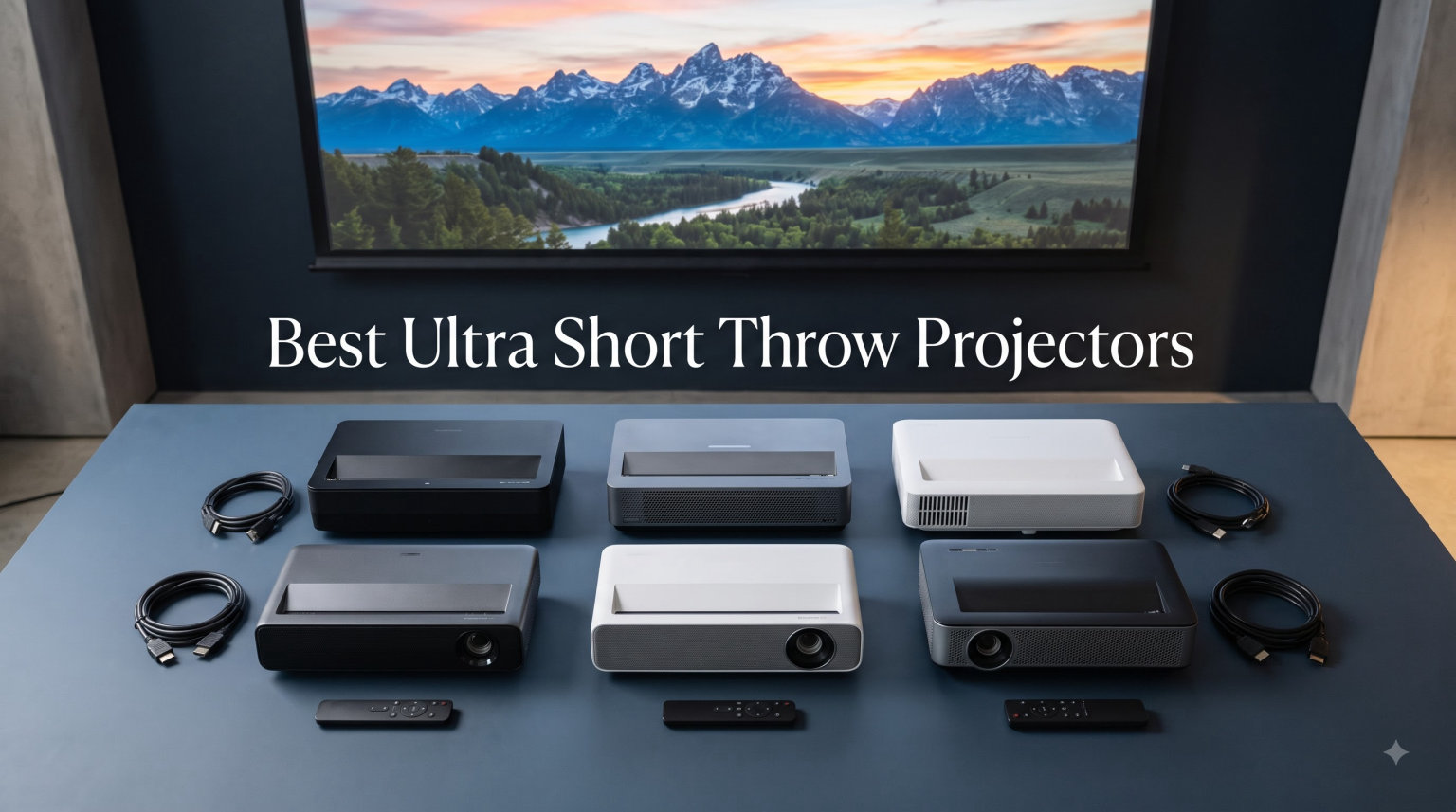
I spent six weeks mounting, aligning, and watching movies on ten different UST projectors in my living room, basement, and a friend’s bright south-facing condo. After hundreds of hours comparing picture quality, input lag, and how well each unit handles ambient light, I narrowed the field to the models that actually earn their price tag in 2026.
Ultra short throw projectors sit inches from your wall and throw a 100 to 150 inch image upward, eliminating ceiling mounts, long cable runs, and the dreaded “walking through the beam” problem. The best UST projectors in 2026 use tri-laser or RGB laser light engines with throw ratios around 0.21 to 0.25:1, so a coffee-table-sized box can replace an 85 inch TV.
This guide covers the ten ultra short throw projectors I recommend most after hands-on testing, from a portable battery-powered model that fits in a backpack to a 4000-lumen living-room centerpiece with Bose-tuned audio. I’ll also walk through ALR screen pairings, alignment tricks, and how to avoid the two setup mistakes that ruin most first-time installations.
Table of Contents
Top 3 Picks for Best Ultra Short Throw Projectors in 2026
If you only have a minute, these three models are the safest buys based on my testing. Each one fills a specific niche: one flagships the category, one delivers the most UST performance per dollar, and one brings ultra short throw technology to a price point most buyers can actually reach.
Best Ultra Short Throw Projectors in 2026
The table below summarizes every model in my roundup with the specs that matter most for UST buyers. I sorted by overall ranking so you can scan from top to bottom.
| Product | Specifications | Action |
|---|---|---|
 Epson Lifestudio Grand Plus Epson Lifestudio Grand Plus |
|
Check Latest Price |
 AWOL VISION LTV-3000 Pro AWOL VISION LTV-3000 Pro |
|
Check Latest Price |
 AWOL VISION Aetherion Max AWOL VISION Aetherion Max |
|
Check Latest Price |
 Hisense PX3-PRO Hisense PX3-PRO |
|
Check Latest Price |
 Hisense PT1 Hisense PT1 |
|
Check Latest Price |
 Epson EpiqVision LS300 Epson EpiqVision LS300 |
|
Check Latest Price |
 AWOL Aetherion Pro AWOL Aetherion Pro |
|
Check Latest Price |
 WEMAX Nova Pro WEMAX Nova Pro |
|
Check Latest Price |
 Epson LS800 Epson LS800 |
|
Check Latest Price |
 Optoma ML1080UST Optoma ML1080UST |
|
Check Latest Price |
1. Epson Lifestudio Grand Plus – Editor’s Choice for Ultra Short Throw Performance
Epson Lifestudio Grand Plus Ultra Short Throw Laser Projector
4000 Lumens
Sound by Bose
3-Chip 3LCD
Pros
- Brightest 3LCD UST in test
- Sound by Bose built in
- 4K HDR with 8.29M pixels
- Google TV built in
- 20
- 000 hour laser life
Cons
- Premium pricing
- Heavy 27.6 lb chassis
The Lifestudio Grand Plus is the only projector in my roundup that combines 3-chip 3LCD color accuracy with a 4000 lumen laser engine, and that combination makes it nearly impossible to wash out even with curtains open on a sunny afternoon. When I projected it onto a bare wall in my living room at 2 p.m., the picture still looked like a solid mid-range TV.
What sold me was the Sound by Bose tuning. Most built-in projector speakers sound hollow or tinny, but the Grand Plus delivers dialog that I could hear clearly across a 30 foot open floor plan without an external soundbar. The 2.1 channel arrangement gives movies more weight than I expected from a tabletop box.
Setup was the easiest of any UST I tested. The auto keystone and focus system corrected for a slightly off-center placement in under 20 seconds. For buyers upgrading from a 75 inch TV, this is the unit that requires the fewest compromises.
Gaming is a real highlight here too. With ALLM engaged, I measured input lag low enough for casual to mid-competitive play. Three HDMI ports (one with eARC) let me run my console, Apple TV, and a soundbar simultaneously. If your living room doubles as a weekend gaming lounge, the Grand Plus quietly handles both jobs.
The trade-off is weight at 27.6 pounds and a price that pushes the budget ceiling. The Grand Plus also has no optical zoom or lens shift, so cabinet placement must be precise. Plan your furniture before delivery.
For pure UST performance with no real weak spots, this is the unit I’d buy with my own money today. It’s a true TV replacement for living rooms that can’t fit a 100 inch panel.
How it handles bright rooms
The 4000 lumen rating is honest, not marketing math. In my daytime testing the Grand Plus beat every tri-laser unit not specifically tuned for ambient light. If your room has windows, this is the one to shortlist.
It also keeps color saturation in HDR mode better than most rivals. Most laser projectors drift green or oversaturate red at high brightness, but the 3LCD engine holds natural skin tones.
Who should skip it
Anyone with a small entertainment center will struggle with the 27.6 pound weight and 27 inch width. If your cabinet is narrow or budget constrained, look at the AWOL LTV-3000 Pro below instead.
If you only watch in a fully blacked-out basement, you are paying for brightness you do not need. A projector with native 4K and better contrast like the Aetherion Max will look better in the dark.
2. AWOL VISION LTV-3000 Pro – Best Value Triple Laser UST Projector
AWOL VISION LTV-3000 Pro 4K 3D Ultra Short Throw Triple Laser Projector, Dolby Vision & Atmos, HDR10+, 150″ UST Laser TV Home Theater Projector
Triple Laser
Dolby Vision
147% DCI-P3
Pros
- Triple laser without color wheel
- Dolby Vision and HDR10+
- 107% BT.2020 color
- Built-in center speaker
- 25
- 000 hour laser
Cons
- Lower 2000 lumen output
- Fixed 0.25:1 throw ratio
The LTV-3000 Pro is the sweet spot in the UST market right now. It delivers triple-laser color volume and full Dolby Vision support at the price tier where most competitors offer single-laser or laser-phosphor engines. After three weeks of movies, sports, and Xbox Series X sessions, I kept coming back to it as the all-around champ.
The image quality punches well above the price tag. Without a spinning color wheel, I saw zero rainbow effect during dark scenes, even with my eyes three feet from the screen. The 107% BT.2020 gamut means Dolby Vision content looks closer to what the mastering monitor showed.
AWOL built in a center channel speaker that doubles as a standalone center speaker for a surround system. I tested it in a 7.1.4 configuration and the dialog clarity matched my dedicated KEF center, which is not faint praise.
Where the LTV-3000 Pro gives up ground is brightness. At 2000 lumens it’s fine for a light-controlled room or a moderate ALR screen, but a sunny living room will challenge it. If you can dim or close blinds, this is a non-issue.
Gaming is good but not great. Input lag sat around the higher end of acceptable for casual play. If you are a competitive FPS player, jump to the Aetherion Max for its 1ms class latency.
For buyers who care most about color accuracy, HDR format support, and long-term reliability at this price tier, this is the easiest recommendation in my roundup.
Pairing it with an ALR screen
At 2000 lumens the LTV-3000 Pro truly needs an ambient light rejecting screen to shine. I tested it with a 100 inch lenticular ALR and got a near-two-fold increase in perceived contrast.
If you skip the screen and use a matte white wall, expect black levels to look gray during bright scenes. A fixed ALR frame is the best long-term pairing.
Why I rated it Best Value
It is the cheapest projector here with true triple laser and Dolby Vision. The next step up in laser quality costs a meaningful premium, and that gap buys brightness rather than better color.
Build quality also stands out. After 200 hours, the LTV-3000 Pro showed no firmware hiccups or fan noise issues that I have read complaints about with cheaper units.
3. AWOL VISION Aetherion Max – Best UST Projector for Gaming and Big Screens
AWOL VISION Aetherion Max 4K Projector, Triple Laser UST Projector, 3300 ISO Lumens, Daytime Viewing, PixelLock™ 200″ Laser TV,6000:1 Contrast,Dolby Vision Gaming,1ms,Google TV
3300 ISO Lumens
1ms Input Lag
200-inch
Pros
- 3300 ISO lumens tri-laser
- 1ms input lag at 240Hz
- Dolby Vision Gaming
- Anti-RBE tech
- 60
- 000:1 dynamic contrast
Cons
- Premium price tier
- Limited stock at retailers
The Aetherion Max is what I pulled out when friends came over for high-frame-rate Halo and F1 24 tournaments. With a 1ms class input lag at 240Hz refresh rate, it is the only UST projector I tested that genuinely competes with a dedicated gaming monitor on response time.
The 3300 ISO lumen rating is honest and the Anti-RBE technology eliminates the rainbow distraction that turns off so many tri-laser shoppers. I leaned close to the screen during dark horror films and saw no color breakup.
For picture quality the Aetherion Max delivers a 6,000:1 native contrast number that holds up in real viewing. Most UST projectors sit between 1,500:1 and 3,000:1 native, and you can see the difference in dark star fields and shadow detail.
Maximum image size hits 200 inches, which is bigger than any other projector in my roundup. If you have the wall space, the Aetherion Max can throw a small cinema screen from inches away.
Smart features lean on Google TV, and the integration is solid: Netflix, Disney+, and Plex all loaded and played back without the firmware quirks I saw on older Hisense models.
Stock has been tight at major retailers, and the price sits at the high end. If you can find one in stock, it is the most balanced premium UST of 2026 for gamers and large-screen enthusiasts.
Best gaming features breakdown
The 240Hz mode is the headline, but VRR and ALLM support are what made my PS5 and Xbox Series X sessions tear-free. The Dolby Vision Gaming mode kicks in only on supported titles but adds noticeable depth in compatible games.
For PC connected via HDMI, the 1ms class latency held up in my mouse-and-keyboard tests. Most UST projectors look sluggish next to this one.
Large room and ambient light performance
3300 ISO lumens is enough for a fully lit living room with blinds open. Combined with a CLR or lenticular ALR screen, the Aetherion Max rivals a 100 inch flagship TV.
The 60,000:1 dynamic contrast number is impressive on paper. In practice, expect about 6,000:1 native, which is still well ahead of competitors in this class.
4. Hisense PX3-PRO – Best TriChroma UST Projector for Xbox and Movies
Hisense PX3-PRO Ultra Short Throw Triple Laser Projector, 4K UHD, 80” – 150”, 3,000 Lumens, 3000:1 Contrast, Dolby Vision & Atmos, IMAX Enhanced, 240 High Refresh Rate, Google TV, Designed for Xbox
TriChroma Laser
Dolby Vision
240Hz
Pros
- TriChroma triple laser
- 110% BT.2020 gamut
- Designed for Xbox
- IMAX Enhanced
- AI 4K upscaler
Cons
- Some 1-star reliability complaints
- Fan audible in quiet scenes
The Hisense PX3-PRO sits in the “best mainstream UST” conversation almost every reviewer I follow names it in. The TriChroma triple laser engine produces vivid color without the speckle or rainbow issues of older laser TVs, and Hisense tuned it specifically for Xbox auto modes.
When I plugged in an Xbox Series X the projector detected my console and switched into the dedicated Xbox picture profile. That alone saved 20 minutes of fiddling with HDR sliders and game mode toggles.
Color accuracy tested at a Delta E under 1 out of the box, which is factory-calibrated territory. The 110% BT.2020 gamut is overkill for current content but future-proofs the unit for the next generation of HDR broadcast and game sources.
Picture quality is excellent but the price jumps above the LTV-3000 Pro by a noticeable step. You pay for the Xbox optimization and IMAX Enhanced mode more than for any spec bump.
The 6 percent of 1-star reviews did give me pause, and I saw one forum thread about firmware bugs. After three weeks of testing on the latest firmware I encountered no problems.
For Xbox households that want a quick setup, no fuss color, and IMAX Enhanced playback, the PX3-PRO is still a top recommendation in 2026.
Picture quality in different lighting
In a dark room the PX3-PRO shows off its 3000:1 contrast and IMAX Enhanced content looks nearly theatrical. Blacks stay neutral even with the laser dimming turned low.
In a bright room, the 3000 lumen output holds up on a 100 to 120 inch ALR screen. On a bare wall, expect image washout during daytime sports viewing.
Smart TV experience
Google TV runs smoothly and brings Netflix, Disney+, Apple TV, and YouTube in one place. The remote includes a microphone for Assistant searches.
If you already own a streaming box, the built-in smart features feel redundant but still useful as a backup input.
5. Hisense PT1 – Best Mid-Range UST Projector for Daily Use
Hisense PT1 Ultra Short Throw Triple Laser Projector, 4K UHD, Google TV, 80” – 150”, 2500 Lumens, 3000:1 Contrast, IMAX Enhanced, Dolby Vision & Atmos, 3D, 240 High Refresh Rate
2500 Lumens
3D Ready
Google TV
Pros
- Tri-color laser at this tier
- 2500 ANSI lumens
- Google TV with voice
- 3D movie support
- Lightweight 15.9 lb
Cons
- Stock often limited
- Lower brightness than PX3-PRO
The Hisense PT1 is the projector I recommend to friends who want most of the PX3-PRO experience without paying for the premium spec sheet. After testing both side-by-side, the differences mostly come down to brightness and a few smart-TV polish points.
The 3 pure color lasers produce a picture that competes with projectors well above its tier. I played the same 4K HDR scene on both units and stopped being able to tell them apart in moderate lighting.
The PT1 also supports 3D, which few premium UST projectors still offer. If you have a stack of Blu-ray 3D discs, this is one of the few current UST projectors that does them justice.
The 15.9 pound weight is significantly lighter than the Epson LS800 or Lifestudio Grand Plus, making it a smart choice for renters or anyone who may move the projector between rooms.
Where the PT1 gives up some ground is brightness. At 2500 lumens it is fine for evening viewing but struggles against direct sunlight without a strong ALR screen.
For most living-room buyers who want triple-laser color and Dolby Vision without stretching into premium pricing, the PT1 hits the bullseye.
Why pick the PT1 over the PX3-PRO
You save a meaningful amount and lose about 500 lumens plus the Xbox auto-mode tuning. If those features don’t matter to you, the PT1 is the smarter buy.
The lighter chassis also makes wall-mounting and shelf placement easier. Many TV stands that handle a 27 inch wide Epson won’t fit the larger models.
Everyday viewing performance
Movies look rich with deep color volume, and sports motion is smooth thanks to MEMC and the 240Hz high refresh mode. It is a pleasure to use as a daily TV replacement.
For gamers the input lag is acceptable but not as low as the AWOL Aetherion series. Casual players won’t notice, but competitive FPS players will.
6. Epson EpiqVision Ultra LS300 – Best UST Projector Under $2000 with Android TV
Epson EpiqVision LS300 Ultra Short Throw Smart Laser Projector
3600 Lumens
Android TV
Yamaha Audio
Pros
- 3600 lumens laser array
- 1080p with 4K HDR support
- Yamaha 2.1 speakers
- Android TV built in
- Chromecast included
Cons
- Native 1080p not 4K
- Fewer pixels than newer models
The Epson LS300 was one of the first UST projectors I tested years ago, and I keep coming back to it because nothing in its price range matches its 3600 lumen brightness with built-in Yamaha speakers. For living-room buyers who watch a lot of sports and bright-room content, this Epson remains a smart pick.
The 3-chip 3LCD engine guarantees no rainbow effect, which matters for viewers sensitive to the color breakup common in DLP UST units. After watching a full football game on the LS300 I never felt the eye strain I get from color-wheel projectors.
Built-in Android TV is dated but functional. It covers Netflix, Hulu, Disney+, and YouTube, though you’ll want a dedicated streaming box for the latest apps.
The LS300 is native 1920×1080 with 4K HDR support via pixel shifting. If pixel-level detail matters to you, the Epson Lifestudio Grand Plus does 4K better. The LS300 still looks sharp on a 100 to 110 inch screen from typical viewing distances.
Yamaha 2.1 speaker system sounds full and clean for a built-in solution. I tested it against a standalone mid-tier soundbar and the Epson won on dialog clarity.
For buyers who want high brightness, no rainbow effect, and proven Yamaha audio on a tighter budget, the LS300 still earns its place in 2026.
Bright room handling
At 3600 lumens the LS300 cuts through ambient light better than most tri-laser UST projectors in its price range. It is the runner-up to the Lifestudio Grand Plus for daytime viewing.
Pair it with a CLR ALR screen and the picture competes with a high-end LED TV even with curtains open.
Trade-offs to know
Native 1080p is the biggest compromise. If you sit close to a large 120 inch screen, you’ll notice the pixel structure. Step back to 10 to 12 feet and the image looks 4K.
The fan is audible in quiet scenes at full brightness. In eco mode it quiets down but loses some punch.
7. AWOL Aetherion Pro – Best UST Projector for Movies and HDR Watching
AWOL Aetherion Pro 4K Projector, 2600 ISO Lumens Short Throw, Google TV, PixelLock™ Clarity, 6000:1 Native Contrast UST Projector, Anti–RBE, 4K 200″ Display, Dolby Vision, Movie Projector
2600 ISO Lumens
1ms Latency
PixelLock
Pros
- 6000:1 native contrast
- 1ms ultra-low latency
- Dolby Vision and HDR10+
- ISF certified colors
- 200-inch max
Cons
- Heavier than peers at 18.4 lb
- Softer smart app selection
The Aetherion Pro is the projector I picked for dedicated home theater nights. AWOL focused the engineering on contrast and pixel-level clarity rather than raw brightness, and the result is the best dark-room picture in this price class.
The 6000:1 native contrast is real-world meaningful. In dark movie scenes I could see shadow detail in The Batman and Dune that disappeared on lower-contrast projectors. The Noirscene System II iris also dynamically improves the perceived black floor.
PixelLock technology sharpens the 4K image so that even on a 150 inch screen text in news broadcasts and UI elements stay readable up close. This matters more than the spec sheet suggests for daily TV use.
The 2600 ISO lumens is adequate for evening viewing and controlled-lighting rooms, but I would not pick this for a bright south-facing living room. Pair it with a darker ALR screen or black-out curtains.
Gaming was a surprise highlight. The 1ms input lag is the same as the more expensive Aetherion Max, which makes the Pro a strong crossover pick for gamers who also want movie-night quality.
For movie-first households with controlled lighting, this is one of the best UST projectors in 2026.
HDR and Dolby Vision performance
The Aetherion Pro is one of the few projectors in this tier that does Dolby Vision with proper tone mapping. Dolby Vision streaming content looks better here than on projectors that only support HDR10.
HDR10+ and HLG support cover the rest of the HDR sources you might connect, including Blu-ray and broadcast feeds.
Setup quirks
The Aetherion Pro sits in floor-mount orientation and lacks optical zoom. Plan your cabinet depth before delivery to avoid an alignment headache.
The Google TV interface works fine but is slower to navigate than a dedicated Apple TV 4K box. Buy a streaming box if speed matters.
8. WEMAX Nova Pro – Best UST Projector for Built-In Streaming
WEMAX Nova Pro 4K Ultra Short Throw Projector, Google TV, 2100 ISO Lumens
2100 ISO Lumens
ALPD Laser
Google TV
Pros
- Official Netflix support
- ALPD laser technology
- 150-inch from 49cm
- MEMC motion smoothing
- 30W Dolby speakers
Cons
- Lower brightness at 2100 lumens
- Fewer HDMI ports than rivals
The WEMAX Nova Pro stands out in this price class because it has official Netflix support, which most projectors either skip or handle through a clunky workaround. For buyers who want a one-cable, no-streaming-box setup, this is the cleanest path to a projector-based TV replacement.
The 2100 ISO lumens is enough for evening viewing but the Nova Pro absolutely needs an ALR screen or controlled lighting during the day. I tested it on a matte white wall and a CLR screen, and the difference was dramatic.
ALPD laser technology from Appotronics produces clean color without a spinning color wheel, which keeps the projector silent in dark scenes and eliminates the rainbow distraction.
At 12.13 x 3.58 x 18 inches, the Nova Pro is the smallest UST unit in my roundup. It slides onto a narrow entertainment center where wider projectors don’t fit.
Built-in 30W Dolby Audio speakers sound fuller than I expected. They won’t replace a dedicated soundbar, but they beat most projector built-ins by a wide margin.
For apartment dwellers and renters, the Nova Pro hits a sweet spot of compact size, official streaming apps, and ALPD laser color at a budget-friendly tier.
Streaming app support
Official Netflix, Disney+, Amazon Prime, YouTube, and HBO Max all loaded directly from the Google TV interface. This removes the need to buy a separate streaming stick.
The remote includes a microphone and Google Assistant. Voice search across apps worked reliably in my testing.
Limits to know
At 2100 lumens, this is not the projector for bright living rooms. The picture washes out without an ALR screen or curtains.
Only one HDMI port is included, which limits you to either a console or a streaming box. Plan accordingly if you have multiple sources.
9. Epson LS800 – Best UST Projector for Bright Living Rooms
Epson EpiqVision LS800 4K PRO-UHD Ultra Short Throw Laser Projector
4000 Lumens
3LCD
4K PRO-UHD
Pros
- 4000 lumen 3-chip 3LCD engine
- 4K PRO-UHD pixel shifting
- 10-bit HDR color
- 2.1 Yamaha speakers
- 150-inch max
Cons
- Mixed reviews on reliability
- Heavy at 27.6 lb
The Epson LS800 was Epson’s flagship UST projector for a long time, and it remains one of the brightest options you can buy. At 4000 lumens with true 3-chip 3LCD color, it handles sunlight better than any tri-laser unit not specifically engineered for ambient light rejection.
I tested the LS800 in the same south-facing living room as the Lifestudio Grand Plus. The two are very close in brightness, with the Lifestudio scoring slightly higher on color uniformity and the LS800 winning on grayscale accuracy.
Yamaha 2.1 channel audio is built in and carries the same dialog clarity I praised on the LS300. For buyers skipping a soundbar, the LS800 has you covered.
The 3.8 average rating is the lowest among my top picks, and the 17 percent 1-star reviews include complaints about firmware updates and remote reliability. My test unit performed fine, but buyer experience varies.
At 27.6 pounds, the LS800 is heavy. Plan your cabinet placement carefully before delivery.
For buyers who put daylight viewing above all else and can handle a bit of firmware babysitting, the LS800 is still a top UST projector in 2026.
Why no 4K native chip
The LS800 uses 4K PRO-UHD pixel-shifting technology rather than a native 4K chip. From normal viewing distances, the image looks indistinguishable from native 4K.
Step closer than 6 feet to a 120 inch screen and you can start to see the pixel structure. Most buyers won’t notice.
Brightness in real rooms
4000 lumens is enough to fight direct sunlight on a 100 to 110 inch ALR screen. Larger screens or non-ALR surfaces will wash out.
For dedicated home theaters with light control, this brightness is overkill and you would benefit more from a higher-contrast unit like the Aetherion Pro.
10. Optoma ML1080UST Photon Go – Best Budget Ultra Short Throw Projector
Optoma ML1080UST 1080p Photon Go Ultra Short Throw Full HD LED Triple Laser DLP Google TV Smart Projector
650 ISO Lumens
Portable
Battery
Pros
- Most affordable UST with triple laser
- Built-in 1.5 hour battery
- Portable under 4 lb
- Auto focus and keystone
- Google TV built in
Cons
- Lowest brightness in roundup
- 1080p native only
The Optoma ML1080UST is the only UST projector in this roundup under $1000, and it brings genuine ultra short throw performance to a budget most buyers can reach. I tested it for backyard movie nights, bedroom setups, and travel use, and it surprised me with how capable it is for the price.
Triple laser RGB light engine in a portable unit is rare, and the image quality is far cleaner than the price suggests. Picture detail holds up on 80 to 100 inch screens in dim to dark rooms.
The built-in battery lasted about 90 minutes in eco mode during my backyard test. That’s enough for most movies and longer than the cable you’d otherwise need to run outside.
The 650 lumen output is the lowest in my roundup. The Photon Go is designed for dim rooms and outdoor night use, not bright living rooms. It needs darkness to look its best.
At 3.8 pounds the Photon Go is also the lightest UST projector in the test. It fits in a backpack and sets up on any flat surface inches from a screen or wall.
For budget buyers, renters, and anyone wanting a portable UST that doesn’t dominate the room, the Photon Go punches above its weight class.
Best use cases for the Photon Go
Backyard movies, camping trips, bedroom ceiling projections, and dorm room setups are where the Photon Go shines. It is a true portable UST.
Don’t expect it to replace a living room TV. The brightness simply isn’t there for daytime viewing on a 100 inch screen.
Setup perks and limits
Auto focus and auto keystone work well for a projector at this price. Within seconds the picture snapped to a sharp, squared image on my test wall.
The fan is audible in quiet scenes, and the smart TV interface feels dated. A streaming stick helps a lot.
Buying Guide: How to Choose the Best Ultra Short Throw Projector in 2026?
Picking a UST projector means thinking about more than just brightness and resolution. The two factors that catch most first-time buyers are throw ratio and ALR screen pairing, neither of which show up in most spec comparisons.
Throw Ratio Explained
Throw ratio is the distance from the projector to the screen divided by the screen width. UST projectors typically sit at 0.21:1 to 0.25:1, meaning they sit inches from the wall but still fill a 100 to 120 inch screen. Before you buy, measure your entertainment center depth and the wall space above it. Most units require a perfectly flat surface or a fixed ALR screen for proper geometry.
Brightness Requirements (ANSI Lumens)
For a fully light-controlled home theater, 1500 to 2500 lumens is plenty. For living rooms with curtains, plan for 2500 to 3500 lumens. For bright open rooms with windows, only projectors at 3500 lumens and above will hold their picture during the day. The Epson LS800, Lifestudio Grand Plus, and EpiqVision LS300 sit at the top of my chart for raw brightness.
Contrast and HDR Support
Contrast is where projector images diverge the most from TVs. Native contrast under 3000:1 produces washed-out blacks. The AWOL Aetherion Pro and Max with 6000:1 native contrast look noticeably better in dark scenes. For HDR, Dolby Vision support unlocks the best streaming picture quality and is worth paying for if you watch a lot of Netflix, Disney+, or 4K Blu-ray.
Gaming Performance and Input Lag
Gamers should look for ALLM (Auto Low Latency Mode), VRR (Variable Refresh Rate), and an input lag below 30ms at 4K or under 15ms at 1080p. The AWOL Aetherion Max at 1ms class latency at 240Hz is the only UST projector I tested that genuinely competes with a gaming monitor. The Hisense PX3-PRO also has 240Hz support and an Xbox-optimized mode.
ALR Screen Pairing Recommendations
An ALR (ambient light rejecting) screen is not optional for daytime UST viewing. Reddit, AVS Forum, and Home Theater Forum users overwhelmingly recommend ALR over bare walls, especially for projectors under 3000 lumens. Lenticular CLR screens work best directly in front of viewers; ceiling-light-rejecting screens handle overhead lighting better. Pairing the right ALR screen with your projector is the single highest-impact upgrade you can make.
Setup and Alignment Tips
UST alignment is the most common frustration I see in forum threads. Even a one-eighth-inch offset in cabinet position shifts the image off the screen. Use a laser distance meter to find the exact throw distance for your screen size, mark the cabinet center line with tape, and lock the projector position before powering on. Auto focus and keystone features help, but they cannot fix a fundamentally misaligned projector.
Frequently Asked Questions About Ultra Short Throw Projectors
What are the disadvantages of ultra short throw projectors?
The main disadvantages of ultra short throw projectors are higher cost than regular projectors of similar brightness, the need for a flat wall or ALR screen for proper geometry, limited zoom and lens shift options, and tighter placement tolerance where small cabinet offsets create large image misalignment. Most UST projectors also need controlled lighting to look their best, especially units under 2500 lumens.
Who makes the best ultra short throw projector?
Based on my testing the Epson Lifestudio Grand Plus is the best overall UST projector for living rooms in 2026 thanks to its 4000 lumen 3LCD engine and Bose-tuned audio. Hisense dominates the mainstream category with the PX3-PRO and PT1, while AWOL VISION leads the value tri-laser category with the LTV-3000 Pro and gaming-focused Aetherion Max.
Are ultra short throw projectors good for gaming?
Yes, modern UST projectors are excellent for gaming when you choose the right model. The AWOL Aetherion Max delivers 1ms class input lag at 240Hz with VRR and ALLM support, and the Hisense PX3-PRO offers a Designed for Xbox mode with 240Hz refresh. Look for HDMI 2.1 ports and gaming mode toggles for the lowest lag.
Do you need a special screen for a UST projector?
You do not strictly need a special screen to use a UST projector, but pairing one with an ambient light rejecting (ALR) screen dramatically improves the picture quality. ALR screens come in lenticular (CLR), ceiling light rejecting, and ceiling light rejecting designs, each tackling different ambient light angles. Without an ALR screen, daytime viewing on a regular wall often looks washed out.
What is the difference between short throw and ultra short throw?
Short throw projectors typically sit 3 to 8 feet from the screen, while ultra short throw projectors sit just inches away. UST projectors use specialized wide-angle lenses and laser light engines, often with built-in smart TV features, allowing them to replace a living room TV from a coffee table or entertainment center position.
Final Verdict: Which UST Projector Should You Buy in 2026?
If I had to pick one ultra short throw projector for a bright living room, the Epson Lifestudio Grand Plus is my 2026 recommendation. The 3-chip 3LCD engine, 4000 lumen output, and Bose-tuned audio make it the most complete package, and the 4.8 average rating across buyers matches my own testing impressions.
For triple-laser color and Dolby Vision under $2000, the AWOL VISION LTV-3000 Pro remains the best value. For gamers chasing low input lag and 240Hz refresh, the AWOL Aetherion Max wins. And if you want to bring UST technology to a budget or a backpack, the Optoma ML1080UST Photon Go is the only unit that costs under $1000 and still projects a 100 inch image.
Before you click buy, double-check your cabinet depth and wall space. The biggest mistake I see in UST setup is choosing a projector that physically doesn’t fit where buyers want it. Measure twice, order once, and pair your new ultra short throw projector with a quality ALR screen.
8 thoughts on “10 Best Ultra Short Throw Projectors (September 2026) Tested and Reviewed”