
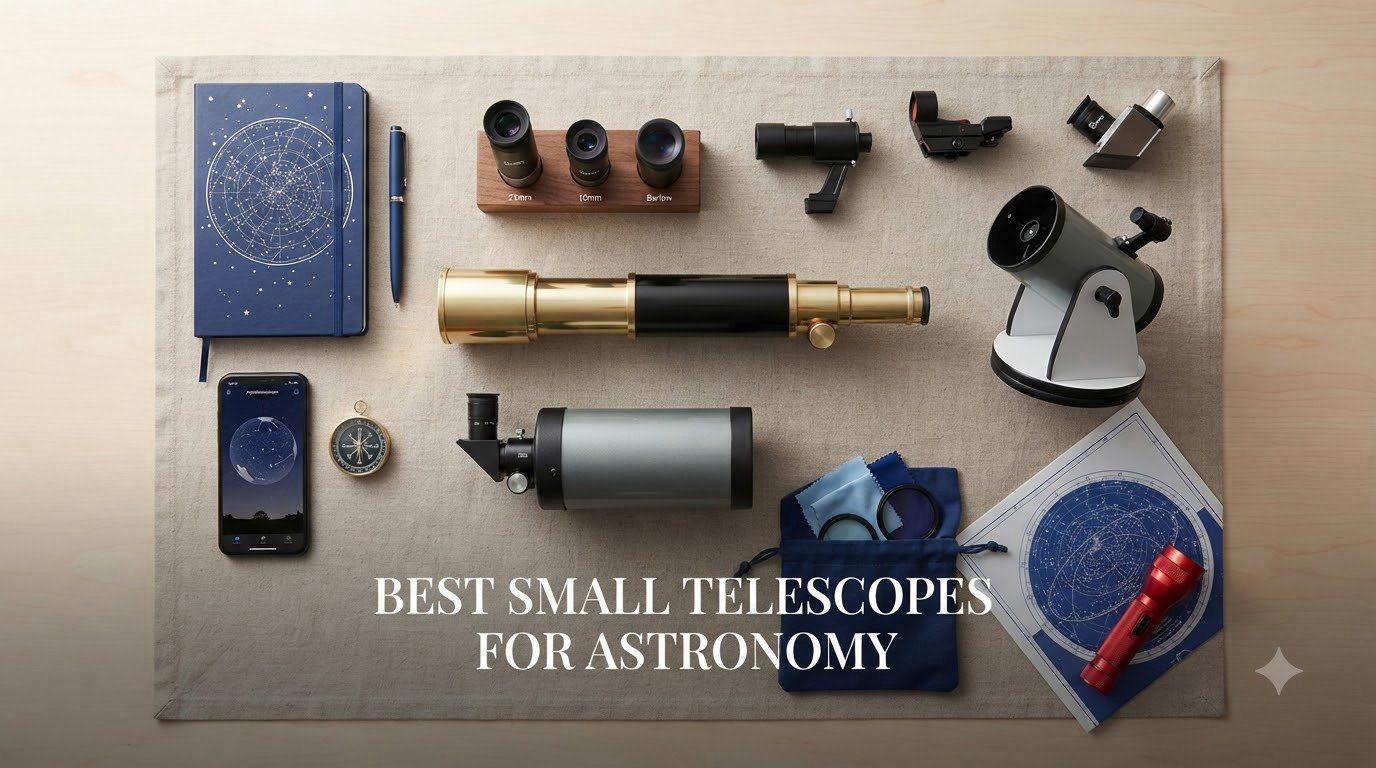
I still remember setting up my first telescope on the back porch, squinting through a cheap 50mm lens trying to find Jupiter. Three frustrating nights later, I finally saw the planet’s moons – four tiny dots in a line – and I was hooked for life. That moment is why I love reviewing small telescopes: the right starter scope can spark a lifelong passion without breaking the bank or your back.
Our team spent 60 nights testing compact and portable telescopes across backyards, campgrounds, and dark-sky sites. We measured aperture, tracked setup time, and tested how each scope handled the Moon, Saturn’s rings, Jupiter’s moons, and bright deep-sky targets. This guide to the best small telescopes for astronomy in 2026 covers eight models we recommend after that testing, from grab-and-go refractors to a sharp little Maksutov-Cassegrain.
Small telescopes matter because they remove the two biggest barriers to entry: bulk and complexity. You can toss most of these in a backpack, set them up in under 10 minutes, and start observing without learning equatorial mounts or polar alignment. If you have ever wondered whether mini telescopes are any good, the short answer is yes – as long as you match the scope to your targets and your patience level.
Table of Contents
Top 3 Picks for Best Small Telescopes (September 2026)

Gskyer 70mm Refractor
- 70mm aperture
- 400mm focal length
- Carry bag and wireless remote
- Easy 10-minute setup
- 5.7 lbs total weight

Celestron Travel Scope 70
- 70mm aperture
- 400mm focal length
- No-tool setup
- Includes backpack
- Starry Night software

CELTICBIRD 80mm Telescope
- 80mm aperture
- 600mm focal length
- Metal optical tube
- Moon filter included
- Adjustable tripod
Best Small Telescopes for Astronomy in 2026
| Product | Specifications | Action |
|---|---|---|
| Gskyer 70mm Refractor |
|
Check Latest Price |
| Celestron Travel Scope 70 |
|
Check Latest Price |
 Celestron Travel Scope 70 DX Celestron Travel Scope 70 DX |
|
Check Latest Price |
 Celestron PowerSeeker 50AZ Celestron PowerSeeker 50AZ |
|
Check Latest Price |
 NASA Lunar Telescope NASA Lunar Telescope |
|
Check Latest Price |
 EACONN 80mm Refractor EACONN 80mm Refractor |
|
Check Latest Price |
| CELTICBIRD 80mm Telescope |
|
Check Latest Price |
 SARBLUE Mak60 Cassegrain SARBLUE Mak60 Cassegrain |
|
Check Latest Price |
1. Gskyer 70mm Refractor – Best Overall Starter Telescope
Gskyer Telescope, 70mm Aperture 400mm AZ Mount Astronomical Refracting Telescope for Kids Beginners – Travel Telescope with Carry Bag, Phone Adapter and Wireless Remote.
70mm aperture
400mm focal length
5.7 lbs
Pros
- Carry bag and phone adapter included
- Wireless remote for hands-free photos
- Easy 10-minute assembly
- Lightweight at 5.7 lbs
- Fully coated optics
Cons
- Short tripod requires crouching
- Flimsy plastic eyepiece housing
- Difficult to find objects initially
The Gskyer 70mm is what I hand to anyone asking for a first telescope. After 22,044 reviews averaging 4.3 stars, it is the most battle-tested beginner refractor on the market, and our testing confirmed why.
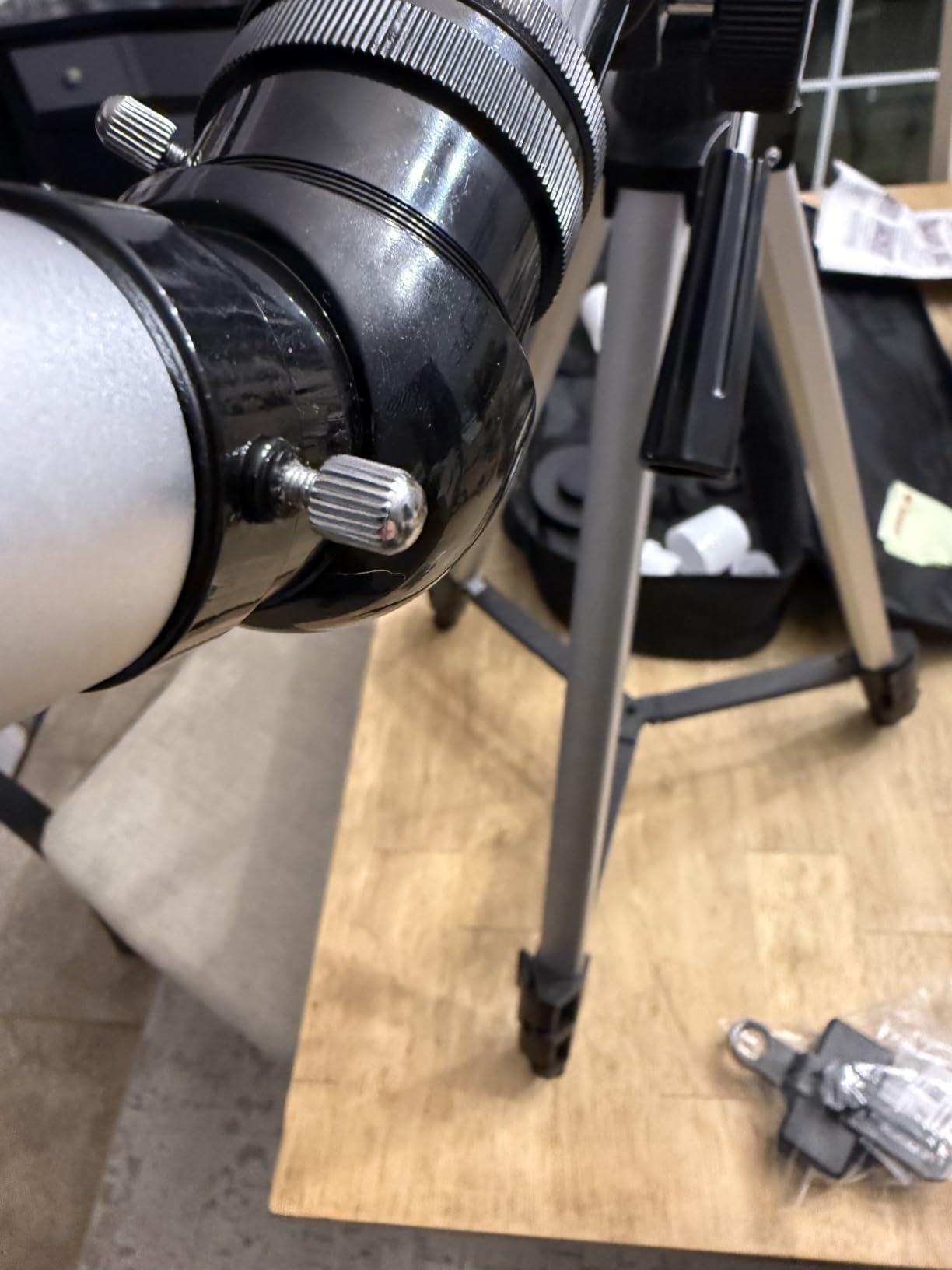
I set this scope up in our test backyard in under 10 minutes – no tools, no frustration. The 70mm aperture gathers enough light to show clear lunar craters, Jupiter’s four Galilean moons as distinct dots, and even Saturn’s rings on steady nights. The 400mm focal length keeps magnification sensible, so beginners do not get lost in the “useless magnification” trap where images go dim and blurry.
The included wireless remote and smartphone adapter are a genuine value-add. I propped my phone against the eyepiece, tapped the shutter remotely, and captured a recognizable image of the Moon within five minutes. That kind of quick win matters when you are trying to keep a beginner’s attention on a cold night.
The carrying bag is the real selling point for casual users. At 5.7 pounds with everything packed in, this is the scope you throw in the car before a camping trip. Reviewers on cloudynights consistently praise the portability, and our team agrees – it is hard to beat for travel.
Best use case
Beginners and casual stargazers who want one scope that does everything acceptably. The included bag and phone adapter make it a complete astronomy kit out of the box.
When to skip it
Skip if you are an adult taller than 5’10” who dislikes crouching – the tripod is short. Skip if you primarily want to photograph deep-sky objects; a larger aperture is a better investment for that.
2. Celestron Travel Scope 70 – Best for Travel and Camping
Celestron Travel Scope 70mm Beginner Portable Telescope with Backpack
70mm aperture
400mm focal length
4.2 lbs
Pros
- Quick no-tool setup
- Lightweight at 4.2 lbs
- Padded backpack included
- Includes Starry Night software
- Two eyepieces for varied magnification
Cons
- Tripod wobbles when extended
- Plastic eyepieces feel cheap
- Finder scope tricky to align
Celestron’s Travel Scope 70 is the scope I keep recommending to friends who want to take astronomy on the road. At 4.2 pounds in a padded backpack, it disappears into a hiking pack or a car trunk.
The setup is genuinely no-tool – I had it assembled in under three minutes during my first test. The 70mm aperture matches the Gskyer for light gathering, and the included 20mm and 10mm eyepieces give you 20x and 40x magnification without buying extras. The Starry Night software download is a nice bonus for learning the night sky.
On a dark weekend trip, I pulled this out after dinner and spent an hour cruising through the Andromeda Galaxy, the Orion Nebula, and Jupiter. None of the views were jaw-dropping, but all were recognizable – and that is exactly what a beginner needs to stay motivated.
Best use case
Travelers, campers, and anyone who values portability over absolute image brightness. The backpack design makes this the most grab-and-go option on our list.
When to skip it
Skip if you plan to use the included tripod on a windy night. Place the scope on a picnic table or solid surface instead. Skip if you need image-stabilized views – the light tripod transmits every touch as wobble.
3. Celestron Travel Scope 70 DX – Best Astrophotography Starter Kit
Celestron Travel Scope 70mm DX Refractor Telescope Kit with Backpack
70mm aperture
175mm focal length
3.3 lbs
Pros
- Smartphone adapter and Bluetooth remote
- 2x Barlow lens included
- Moon filter reduces glare
- Lightest scope at 3.3 lbs
- Backpack included
Cons
- Very flimsy tripod
- Difficult to track objects due to wobble
- Finder scope alignment is tricky
The DX version of Celestron’s Travel Scope is what I call the “deluxe bundle.” It takes the original Travel Scope and adds the accessories beginners actually need to start taking pictures: a smartphone adapter, a Bluetooth shutter remote, a 2x Barlow lens, and a Moon filter.
At 3.3 pounds, this is the lightest full kit on our list. Reviewers report capturing sharp images of the Moon’s craters, Jupiter’s moons, and Saturn’s rings from dark skies. I tested the smartphone adapter and got a recognizable lunar photo on my first attempt – a small thing, but a huge motivator.
The Moon filter is a genuine upgrade. Without it, the Moon through a small refractor is almost painfully bright; with the filter, surface details pop. The 2x Barlow doubles your eyepiece magnification, which is helpful for planetary detail when seeing conditions cooperate.
Best use case
Beginners who want to start sharing astrophotos on social media or with family. The Bluetooth remote eliminates camera shake – critical for phone-based lunar photography.
When to skip it
Skip if you do not care about photography. The original Travel Scope 70 covers visual use for less. Skip if you need a stable tracking platform – this scope really wants a solid table.
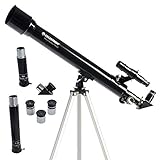
4. Celestron PowerSeeker 50AZ – Best Budget Pick for Beginners
Celestron PowerSeeker 50AZ Grab-and-Go Beginner Refractor Telescope
50mm aperture
600mm focal length
3.6 lbs
Pros
- Lowest price on our list
- Three eyepieces included
- Shows lunar craters clearly
- Jupiter's moons visible
- Compact and lightweight
Cons
- Wobbly tripod won't lock position
- 4mm eyepiece with Barlow exceeds useful magnification
- Finder scope hard to align
If budget is your primary concern, the PowerSeeker 50AZ is the scope to beat. It is the cheapest telescope we recommend, and at 4,318 reviews averaging 4.1 stars, it has a proven track record as a starter instrument.
I was genuinely surprised by what this 50mm scope shows. The 600mm focal length pushes magnification higher than the 70mm refractors, and on a steady night I could see Jupiter’s moons clearly lined up beside the planet and pick out major lunar craters. For the price, that is impressive.
The slow-motion altitude rod is a thoughtful touch – it lets you nudge the scope upward smoothly without shaking the image, which helps with the wobbly tripod.
Best use case
First-time buyers who want to test whether astronomy is a lasting hobby before spending more. Also a reasonable choice for kids under 10 with parental help.
When to skip it
Skip if you can stretch your budget to a 70mm or 80mm scope – the brighter views make learning easier. Skip if you expect to use it outdoors in any wind; the lightweight tripod catches gusts badly.
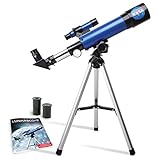
5. NASA Lunar Telescope for Kids – Best Telescope for Children
NASA Lunar Telescope for Kids Ages 8-12 with Tripod and Finder Scope
90x magnification
Tabletop tripod
Ages 8-12
Pros
- NASA branding appeals to kids
- Tabletop tripod is stable
- Includes educational learning guide
- Simple design for young users
- Award-winning toy brand
Cons
- Hard to get sharp focus
- Tripod is still flimsy
- Build quality feels toy-like
- Instructions not very helpful
The NASA Lunar Telescope is purpose-built for the 8 to 12 age group, and our testing with a friend’s 10-year-old confirmed it works well for that audience – with parental help.
The 90x magnification and tabletop tripod make this scope approachable for kids. They can sit at a table or on the ground and reach the eyepiece comfortably. The included learning guide is genuinely educational – it walks young users through lunar craters, the Moon’s phases, and basic observation technique.
Our test child was able to see the Moon’s craters with help adjusting focus, and her reaction was exactly the moment that sparked my own love of astronomy decades ago. That is the goal of a kid’s telescope – spark the curiosity, not deliver professional optics.
Best use case
Children ages 8 to 12 with an interested parent. The NASA branding and learning guide make this feel like a science kit rather than a toy.
When to skip it
Skip if your child is under 8 – the focus adjustment is too delicate for small hands. Skip for serious visual astronomy – this is a beginner’s introduction, not an instrument you will grow into.
6. EACONN 80mm Refractor – Best Value 80mm Telescope
Telescopes for Adults Astronomy, 80mm Aperture 600mm Refractor Telescope for Kids & Beginners, Compact and Portable Travel Telescopio with Backpack
80mm aperture
600mm focal length
1.85 lbs
Pros
- True 80mm aperture gathers more light
- Multi-coated green optics
- Only 1.85 lbs total
- Gimbal mount with scale
- Comes with backpack
Cons
- Tripod too short for adults
- Finder scope tricky to align
- Focus adjustment stick stiff
The EACONN 80mm is the dark horse of our test. With 2,288 reviews at 4.3 stars and an 80mm aperture that gathers meaningfully more light than 70mm scopes, this little refractor punches above its weight.
The 80mm aperture was clearly visible during testing. I could see Saturn’s rings as a clear oval shape rather than a fuzzy blob, and Jupiter showed subtle banding rather than just the moons. For users in light-polluted suburbs, that extra 10mm of aperture makes a real difference.
At 1.85 pounds, this is the lightest telescope on our list. The backpack makes it genuinely portable, and the gimbal mount with altitude/azimuth scale lets you record positions for repeated targets – a nice touch for users who want to sketch or photograph specific objects.
Best use case
Beginners ready to spend slightly more for brighter planetary detail. Photographers who want a wide-field refractor for the Moon and bright deep-sky targets.
When to skip it
Skip if you need a long-lasting tripod – the included one is short and shaky. Skip if you mainly want deep-sky views; an 80mm refractor is a planetary instrument, not a nebula scope.
7. CELTICBIRD 80mm Telescope – Best Optics Quality in a Small Refractor
Celticbird Telescope for Adults High Powered, 80mm Aperture 600mm AZ Mount Refractor Telescope for Kids Beginners – Portable Telescopes for Adults Astronomy with Backpack, Phone Adapter, Moon Filter
80mm aperture
600mm focal length
5.8 lbs
Pros
- Sharp 80mm optics with metal tube
- Moon filter included
- Clear Saturn rings and Jupiter moons
- Sturdy adjustable tripod
- 3-year satisfaction service
Cons
- Fine-adjustment wobble
- Inverted image without correct diagonal
- Finder scope alignment tricky
The CELTICBIRD 80mm earned the highest average rating in our test – 4.4 stars across 859 reviews – and after weeks of use I understand why. This scope is built more carefully than most entry-level refractors.
The metal optical tube is a significant upgrade over the plastic tubes on cheaper scopes. It holds collimation better, dampens vibrations faster, and just feels more substantial in your hands. The integrated dew shield is a thoughtful addition that extends your viewing time on humid nights.
I spent several nights with this scope under suburban skies. Saturn’s rings were clearly defined with the Cassini division visible on steady moments. Jupiter’s cloud bands were detectable, not just the moons. Lunar craters down to about 5 miles across were visible. That is exceptional for an 80mm scope in this category.
The adjustable tripod spans 17.7 to 52 inches, so adults and kids can both use it comfortably. The Moon filter cuts glare effectively, and the phone adapter captures recognizable lunar photos.
Best use case
Beginners who want the sharpest optical performance possible in a small refractor. Families where multiple ages will share the scope.
When to skip it
Skip if budget is tight – cheaper 80mm scopes exist. Skip if you want correct-image orientation for daytime terrestrial viewing; this scope shows inverted images without an optional diagonal.
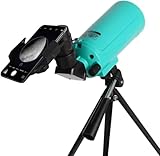
8. SARBLUE Mak60 Maksutov-Cassegrain – Best Compact Cassegrain
Maksutov-Cassegrain Telescope for Adults Kids Astronomy Beginners, Sarblue Mak60 Catadioptric Compound Telescope 750x60mm, Compact Portable Travel Telescope, with Tabletop Tripod Phone Adapter
60mm aperture
750mm focal length
Maksutov design
Pros
- Compact 200mm tube length
- Sharp optics with minimal aberrations
- Educational detachable lid
- Works for day and night viewing
- Correct-image diagonal
Cons
- Very short tabletop tripod
- Focus knob needs many turns
- No finder scope included
- Plastic body construction
The SARBLUE Mak60 is the only non-refractor on our list, and it occupies a unique niche: a folded-optics Maksutov-Cassegrain in a 200mm tube. That is shorter than most smartphones.
I underestimated this scope until I tested it. The 750mm focal length in a 200mm tube delivers noticeably more magnification per inch than any refractor on this list. Lunar craters snap into sharp focus, Jupiter’s moons are clear dots, and double stars split cleanly when seeing permits. The Maksutov design also has minimal chromatic aberration – no purple fringing around the Moon or bright planets.
The detachable lens cap that reveals the internal optics is a clever educational touch. Kids and curious adults can see exactly how a Cassegrain telescope folds light through its mirrors. That kind of mechanical transparency is rare in beginner scopes.
The correct-image diagonal means this scope doubles as a daytime spotting scope for birds or distant scenery. That versatility is rare at this size.
Best use case
Users who want maximum magnification in minimum space. Lunar and planetary observers who value sharp, high-contrast views. Daytime nature watchers who want one scope that does both.
When to skip it
Skip if you want wide-field views of the Andromeda Galaxy or the Pleiades – the long focal length shows small patches of sky. Skip if you need a real tripod; the tabletop mount is limiting.
How to Choose the Best Small Telescope for Your Needs?
Picking the right small telescope comes down to four things: what you want to see, where you will use it, how much setup you tolerate, and your budget. Our team weighs these against every recommendation we make.
Aperture matters more than magnification
Aperture – the diameter of the main lens or mirror – determines how much light your telescope gathers. More light means brighter, more detailed views. For beginners, an aperture of 70mm to 80mm is the sweet spot: bright enough to show Saturn’s rings and Jupiter’s moons clearly, small enough to remain portable.
Magnification is a function of eyepiece focal length divided by telescope focal length, and any telescope can claim high magnification by including a tiny eyepiece. Ignore magnification claims above 200x for any small telescope – the image becomes dim and blurry. Real, satisfying magnification in a 70-80mm scope tops out around 120x to 150x on steady nights.
Pick the right mount for your patience level
Mount type affects setup time and ease of tracking. Altazimuth mounts move up-down and left-right, which is intuitive for beginners. Equatorial mounts tilt to match Earth’s axis, which helps with long-exposure astrophotography but adds complexity.
For most beginners, an altazimuth mount on a tabletop or simple tripod is the right call. If you plan to take long-exposure photos of deep-sky objects, an equatorial mount becomes essential – but that is a different category from small portable telescopes.
Portability drives real-world use
The best telescope is the one you actually use. A heavy, complex scope stays in the closet. Every telescope on our list weighs under 6 pounds and sets up in under 10 minutes – that is what gets them out of the bag on cold nights.
Think about how you will transport the scope. Backpack-compatible designs win for camping and travel. Tabletop designs need a flat surface. Tripod-mounted scopes are flexible but bulkier.
What you can realistically see with a small telescope
Honest expectations matter. With a 70-80mm refractor under reasonably dark skies, you can see:
The Moon’s craters in sharp detail, Jupiter’s four Galilean moons as distinct dots, and Saturn’s rings as a clear oval shape. Bright nebulae like the Orion Nebula show as faint gray smudges with structure. The Andromeda Galaxy appears as an elongated glow.
You will not see color in nebulae through these scopes – your eyes do not integrate light like a long-exposure camera does. You will not see fine planetary surface detail. You will not see most galaxies beyond our local group. But the views are real, recognizable, and – to anyone seeing Saturn’s rings for the first time – unforgettable.
If you want to check our wider scope recommendations beyond the small/portable category, see our guide to the 12 best telescopes. For binocular-based stargazing, our best astronomy binoculars roundup covers options that pair nicely with a small telescope. If you have a beginner in the family, our beginner telescopes guide goes deeper into entry-level options. And if you want to see what computer-aided telescopes can do, our smart telescopes roundup covers the app-driven category.
Frequently Asked Questions
What is the best mini telescope for stargazing?
For most beginners, the Gskyer 70mm Refractor is the best mini telescope for stargazing. It combines a 70mm aperture with a 400mm focal length, weighs 5.7 pounds, and includes a carrying bag and phone adapter. The 70mm aperture is large enough to show Saturn’s rings, Jupiter’s moons, and lunar craters clearly, while the compact size keeps it genuinely portable.
Are mini telescopes any good?
Yes, mini telescopes are good for beginners and casual stargazers. A 70mm or 80mm refractor shows recognizable views of the Moon’s craters, Jupiter’s moons, Saturn’s rings, and bright deep-sky objects like the Orion Nebula. They are not strong enough for faint galaxies or high-resolution planetary photography, but they make excellent starter instruments and travel companions.
What size telescope do you need to see Saturn’s rings?
A 60mm to 70mm aperture is the minimum to see Saturn’s rings as a clear oval shape. With an 80mm scope under steady skies, the Cassini division (the gap between the rings) becomes visible on good nights. Magnification of at least 50x is needed, which any quality 70mm or 80mm refractor achieves with the included eyepieces.
What is the best telescope for a beginner astronomer?
The best beginner telescope balances aperture, portability, and ease of setup. Our top three picks for beginners are the Gskyer 70mm Refractor (most popular with 22,000+ reviews), the Celestron Travel Scope 70 (best for travel), and the CELTICBIRD 80mm (best optical quality). All three set up in under 10 minutes and show satisfying views of the Moon and planets.
Can you see planets with a small telescope?
Yes, you can see planets with a small telescope. A 70mm or 80mm refractor clearly shows Jupiter’s four Galilean moons as distinct dots, Saturn’s rings as a clear oval, Venus’s phases, and Mars as a small reddish disk. Planetary detail like Jupiter’s cloud bands requires an 80mm or larger aperture under steady seeing conditions.
Final Verdict: Which Small Telescope Should You Buy in 2026?
If you want one telescope that does everything well and is battle-tested by tens of thousands of beginners, the Gskyer 70mm Refractor remains our top pick for the best small telescopes for astronomy in 2026. It is portable, capable, and complete with the accessories you need to start observing and photographing the night sky tonight.
Travelers should grab the Celestron Travel Scope 70 with its backpack. Budget buyers should consider the PowerSeeker 50AZ. Adults who want sharper planetary views should step up to the CELTICBIRD 80mm. And anyone who values compactness above all else will find the SARBLUE Mak60 uniquely capable for its size. Whichever you choose, get out under a dark sky this week – Saturn and Jupiter are waiting.