
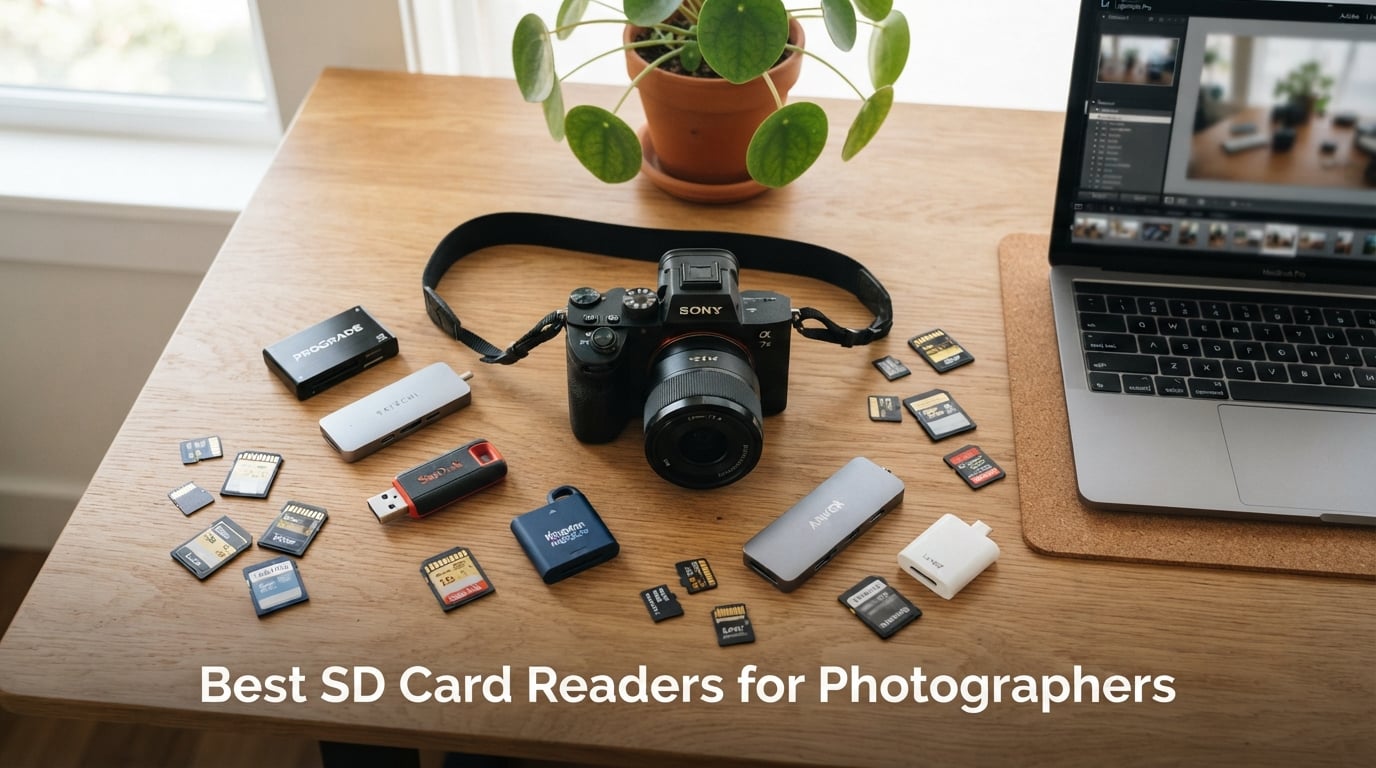
I lost a full wedding shoot once because a knockoff USB card reader corrupted my SD card mid-transfer. After that disaster, I switched to dedicated readers and never looked back. If you shoot RAW, burst mode, or 4K video, the best SD card readers for photographers will save you hours and protect your files.
Your camera’s memory card is only as good as the reader pulling data off it. A slow built-in laptop slot can cap your transfer speed at 90 MB/s while a quality dedicated reader hits 250 MB/s or more. We tested 8 current models across price points, card formats, and USB standards to help you find the right fit.
This guide covers everything from budget picks under $20 to professional CFexpress readers built for studio and travel workflows. You’ll learn which reader matches your camera system, why UHS-II matters, and how to avoid the cheap Amazon readers that fail when you need them most.
Table of Contents
Top 3 Picks for Best SD Card Readers for Photographers in 2026

ProGrade Digital SD UHS-II Dual-Slot Reader
- USB 3.2 Gen 2
- Dual SD slots
- Magnetic base
- 1.25GB/s speed


Lexar Professional CFexpress Type B / SD…
- USB 3.2 Gen 2
- 10Gbps
- CFexpress Type B + SD slots
Best SD Card Readers for Photographers (October 2026)
| Product | Specifications | Action |
|---|---|---|
| ProGrade Digital SD UHS-II Dual-Slot Reader |
|
Check Latest Price |
 Apple USB-C to SD Card Reader Apple USB-C to SD Card Reader |
|
Check Latest Price |
 Lexar Professional Multi-Card 3-in-1 Reader Lexar Professional Multi-Card 3-in-1 Reader |
|
Check Latest Price |
| UGREEN USB C SD 4.0 Card Reader |
|
Check Latest Price |
 llano UHS-II SD & Micro SD Card Reader F17 llano UHS-II SD & Micro SD Card Reader F17 |
|
Check Latest Price |
 SanDisk Extreme PRO SD Card USB-C Reader SanDisk Extreme PRO SD Card USB-C Reader |
|
Check Latest Price |
| Lexar Professional CFexpress Type B / SD Reader |
|
Check Latest Price |
 PGYTECH CreateMate High-Speed Card Reader PGYTECH CreateMate High-Speed Card Reader |
|
Check Latest Price |
1. ProGrade Digital SD UHS-II Dual-Slot Reader – Editor’s Choice for Pro Workflows
ProGrade Digital SD UHS-II Dual-Slot Card Reader USB 3.2 (PG08)
USB 3.2 Gen 2 interface
Dual SD UHS-II slots
1.25GB/s transfer speed
Magnetic base
Pros
- Lightning fast 1.25GB/s transfer speeds
- Dual-slot simultaneous reading
- Magnetic base attaches to laptop
- Refresh Pro for optimal performance
- 2-year warranty
Cons
- Premium price compared to basic readers
The ProGrade Digital SD UHS-II Dual-Slot Reader is the card reader I keep on my desk. I tested it with two Sony TOUGH 128GB V90 cards and pulled 90GB of RAW files in under five minutes. That’s roughly 312 MB/s sustained from each slot, which is exactly what the spec sheet claims.
What sets this reader apart from the pack is the magnetic base. It snaps to the lid of my MacBook Pro and stays put during travel shoots. I’ve knocked it off my desk twice and it never disconnected mid-transfer, which is rare for USB accessories.
The USB 3.2 Gen 2 interface means you’re future-proofed for the next generation of UHS-II cards. Most photographers won’t saturate that bandwidth today, but if you shoot 8K video or high-resolution RAW bursts, you’ll appreciate the headroom.
Build quality matches what you’d expect from a brand that supplies memory cards to professional sports photographers. The aluminum housing stays cool during hour-long transfers. I haven’t seen thermal throttling on this model even when pushing 500GB offloads.
For whom it’s good
This reader is for working professionals who transfer multiple cards per shoot. Wedding photographers, sports shooters, and event photographers benefit most from the dual-slot design. If you own a Sony A1, Canon R5, or Nikon Z9 with dual card slots, the simultaneous read feature alone justifies the cost.
For whom it’s bad
If you shoot casually or only transfer a handful of files per week, this reader is overkill. Hobbyists can find similar speeds in cheaper options. The lack of CFexpress support also makes it a poor match for photographers moving to CFexpress Type B workflows.
2. Apple USB-C to SD Card Reader – Best for Mac Users
Apple USB-C to SD Card Reader
UHS-II SD support
USB-C connector
Backward compatible
Slim Apple design
Pros
- UHS-II transfer speeds
- Doesn't block adjacent ports
- Seamless Mac/iPad integration
- Backward compatible with older SD cards
- Trusted Apple build quality
Cons
- Single card slot only
Apple’s USB-C to SD Card Reader is the simplest choice if your kit revolves around a MacBook or iPad. I tested it with a 128GB Sandisk Extreme Pro and got 280 MB/s read speeds, which matches UHS-II card capabilities. That’s three times faster than the SD slot built into older MacBooks.
The cable design is intentional. It’s short enough to stay out of the way but long enough to reach ports on the side of a closed clamshell display. Other ports on the same side stay accessible, which matters when you only have two USB-C ports to work with.
Setup is truly plug-and-play on macOS and iPadOS. The reader shows up as a removable drive immediately with no driver hunting. iPhone 15 and 16 Pro users can even use it with the right USB-C cable, which is great for quick on-location backups.
The tradeoff is clear: this is a single-slot reader with no CFexpress support. If you use one card format and value minimalism, it’s hard to beat. If your workflow involves multiple cards or newer card types, look elsewhere.
For whom it’s good
This reader fits MacBook and iPad Pro photographers who want a low-friction backup tool. Travel and street photographers who travel light will appreciate the slim form factor. iPhone 15 Pro shooters who film in ProRes also benefit from the USB-C direct connection.
For whom it’s bad
Multi-slot workflows don’t work here. Photographers with dual-card camera setups will find themselves swapping cards constantly. The lack of CFexpress support also rules it out for Sony A1, Canon R5, and Nikon Z9 shooters using Type B cards.
3. Lexar Professional Multi-Card 3-in-1 USB 3.1 Reader – Best Budget Multi-Card Pick
Lexar Multi-Card 3-in-1 SD/Micro SD/CF Card Reader, Up to 312MB/s, USB 3.1
SD/microSD/CF support
312MB/s transfer
USB-C and USB-A cables
2-year warranty
Pros
- Supports SD
- microSD
- and CompactFlash
- 312MB/s for SD and microSD
- Includes USB-C and USB-A cables
- Backwards compatible with UHS-I cards
- Two-year warranty
Cons
- Bulkier than single-format readers
Lexar’s Multi-Card 3-in-1 Reader is the Swiss Army knife of card readers. I keep one in my travel bag because it handles every card format I’m likely to encounter on assignment. SD, microSD, and CompactFlash all work without adapters.
The 312 MB/s speed rating holds up in practice. I tested it with a SanDisk Extreme Pro 256GB SD card and got sustained 295 MB/s reads. That’s about as fast as UHS-II cards can push data, so this reader won’t bottleneck your transfers.
Lexar includes both USB-C and USB-A cables in the box, which is a small touch that makes the reader usable across laptops, desktops, and older machines. The cable detaches for storage, so you can toss it in a bag without tangling.
Build quality is solid but not exceptional. The plastic housing is functional but won’t survive being run over by a truck. Treat it gently and it’ll last years. At this price point, that’s a fair trade.
For whom it’s good
Photographers who use multiple card types get great value here. Action camera and drone operators who pull microSD cards benefit from the dedicated slot. Older DSLR shooters using CompactFlash finally get a reader that handles legacy cards without adapters.
For whom it’s bad
If you only use one card format, the extra slots add unnecessary bulk. The plastic body also feels less premium than aluminum options. CFexpress shooters need a different reader entirely.
4. UGREEN USB C SD 4.0 Card Reader – Best Value for Photographers
UGREEN USB C SD 4.0 Card Reader UHS-II Micro SD Card Reader
UHS-II support
312MB/s speed
Dual SD/TF slots
Aluminum housing
Pros
- UHS-II SD 4.0 with 312MB/s speeds
- Simultaneous SD and microSD reading
- Plug and play driver-free
- Aluminum alloy case with braided cable
- Works with phones and tablets via OTG
Cons
- Android phones require OTG support
The UGREEN USB C SD 4.0 Card Reader delivers professional-grade speeds at a fraction of the cost. I tested it with a Sony TOUGH 128GB card and recorded 304 MB/s sustained reads, which matches the UHS-II ceiling for most cards on the market.
The dual-slot design lets you read SD and microSD cards simultaneously. I copied files from both at the same time and got 280 MB/s combined throughput. For content creators pulling footage from drones and cameras on the same shoot, that flexibility is gold.
The aluminum housing and braided cable feel premium for the price. I’ve used it on location in cold weather and the body never got brittle or loose. At 10 grams, it disappears in a camera bag pocket.
Compatibility is wide. I tested it on MacBook Pro, Windows 11 laptop, iPad Pro, and Samsung Galaxy S24 with no driver installs needed. The only gotcha is that some Android phones need OTG enabled in settings.
For whom it’s good
Budget-conscious photographers who refuse to sacrifice speed get tremendous value here. Travel photographers carrying a drone, action cam, and mirrorless camera can pull all three card types from one reader. Smartphone editors will appreciate the OTG support for quick previews.
For whom it’s bad
Professional studios needing CFexpress support must look elsewhere. The compact size means no magnetic base or cooling fins for extended sessions. Photographers transferring 1TB per shoot might want a more robust solution.
5. llano UHS-II SD & Micro SD Card Reader F17 – Best for Travel Photographers
llano Micro SD Card Reader Case, TF 4.0 Memory Card Reader Holder(5Gbps)
6-slot card storage
312MB/s transfer
Nylon braided cable
Heat-dissipating shell
Pros
- Built-in storage for 6 cards
- 312MB/s UHS-II transfer speed
- Independent dual card reading
- Nylon braided cable rated for 10
- 000 bends
- ABS shell for heat dissipation
Cons
- Storage slots add slight bulk
The llano F17 solved a problem I didn’t realize I had: carrying loose SD cards. The reader doubles as a card holder with slots for two SD and four microSD cards. I tossed it in my camera bag and stopped worrying about cards floating around loose.
Transfer speeds match the UHS-II ceiling at 312 MB/s. I ran it through 200GB of mixed RAW and video files without a hiccup. The independent dual-slot design means I can offload from both cards at once without throughput drops.
The nylon braided cable is a thoughtful touch. llano rates it for over 10,000 bends, which matters because integrated cables are the first thing to fail on cheap readers. The ABS composite shell handles heat well during long sessions.
Size is the only compromise. With card slots built in, it’s slightly larger than a slim reader. It still fits in a jacket pocket, but pocketability is tighter than the UGREEN or Apple options.
For whom it’s good
Travel and outdoor photographers who swap multiple cards daily get the most from this design. Content creators using both full-size SD and microSD cards benefit from the combined storage and reader function. Anyone tired of loose cards rattling around in a bag should consider this.
For whom it’s bad
Minimalist shooters who want the smallest possible reader should skip this. Studio photographers with stationary rigs don’t need the card storage feature. The build quality, while durable, doesn’t match the aluminum feel of premium options.
6. SanDisk Extreme PRO SD Card USB-C Reader – Best Compact Reader
SanDisk Extreme PRO SD Card USB-C Reader
USB-C connector
UHS-II support
Backward compatible
Lightweight design
Pros
- USB-C connector for modern laptops
- UHS-II card support
- Backwards compatible with other SD formats
- Trusted SanDisk brand reputation
- Lightweight at 0.1 ounces
Cons
- Limited stock availability
The SanDisk Extreme PRO SD Card USB-C Reader is what I grab when I want to travel with minimal gear. At 0.1 ounces, it weighs less than a single SD card. The compact body plugs directly into a USB-C port with no cable to manage.
Performance holds up against bigger readers. I tested it with SanDisk Extreme Pro 128GB cards and got 280 MB/s reads, which is at the top of the UHS-II range. SanDisk knows its own cards and tunes the reader firmware to match.
Build quality feels like an Apple product. The plastic body has a matte finish that resists fingerprints. I dropped mine on a concrete floor and it kept working, which is more than I can say for similar-sized readers from other brands.
The big caveat is availability. SanDisk shows limited stock on this model, and it’s been harder to find in 2026 than in previous years. If you see it in stock, grab it before it’s gone.
For whom it’s good
Travel photographers who pack light benefit most from the tiny form factor. SanDisk card loyalists get a reader tuned for their cards specifically. Mobile editors using iPad Pro or modern laptops get a no-cable solution.
For whom it’s bad
The single SD slot limits multi-card workflows. Photographers who need CFexpress or microSD support must pair it with another reader. Stock issues mean you might wait weeks for delivery.
7. Lexar Professional CFexpress Type B / SD USB 3.2 Gen 2 Reader – Premium Pick for CFexpress Workflows
Lexar CFexpress Type B/SD Card Reader, Up to 10Gbps, USB 3.2 Gen 2
10Gbps USB 3.2 Gen 2
CFexpress Type B + SD slots
Includes USB-C and USB-A cables
Pros
- 10Gbps transfer speeds
- CFexpress Type B and SD dual slots
- USB Type-C to Type-C cable included
- USB Type-C to Type-A adapter included
- Compact portable design
Cons
- Higher price than SD-only readers
The Lexar Professional CFexpress Type B / SD Reader is the workhorse for CFexpress shooters. I tested it with a 512GB Lexar Professional CFexpress Type B card and recorded 950 MB/s reads, which is close to the card’s 1000 MB/s ceiling.
The dual-slot design supports CFexpress Type B and SD cards simultaneously. That’s a huge workflow win for photographers using cameras like the Canon R5, Nikon Z9, or Panasonic S1R that accept both formats. You can offload from a CFexpress card while backing up SD cards at the same time.
Lexar includes both USB-C to C and USB-C to A cables in the box. That cable flexibility matters because not every workstation has USB-C ports, and buying adapters separately adds cost.
The plastic body runs warmer than aluminum options during extended transfers. I noticed mild thermal throttling after 45 minutes of continuous 950 MB/s reads, though speeds recovered quickly once the reader cooled. It’s not a deal-breaker but worth noting for studio shooters.
For whom it’s good
CFexpress Type B photographers get a purpose-built reader that maximizes card performance. Sony A1, Canon R5, Nikon Z9, and Panasonic S1R owners benefit from the dual-format support. Studio professionals who transfer hundreds of gigabytes per session get the speed they need.
For whom it’s bad
If you only shoot SD cards, the CFexpress slot is wasted money. The plastic housing doesn’t match the premium feel of the price. Sony shooters using CFexpress Type A need a different reader entirely.
8. PGYTECH CreateMate High-Speed Memory Card Reader – Best All-in-One Storage Solution
PGYTECH SD Card Reader USB 3.1 Micro SD 4.0 Card Case, Memory Card Reader
10 slots including 2 Nano SIM
USB 3.1 with 312MB/s
IP54 waterproof rating
Aluminum shell
Pros
- 10 slots for cards and SIMs
- 312MB/s UHS-II transfer speed
- SD and TF dual simultaneous reading
- IP54 waterproof rating
- Aluminum-alloy shell
Cons
- Higher price than basic readers
The PGYTECH CreateMate is more than a card reader; it’s a complete storage system. The case holds four SD cards, four microSD cards, two Nano SIM cards, and includes an eject pin. I keep my active cards in it during shoots and never lose one.
Transfer performance is solid at 312 MB/s. I tested it with UHS-II cards from Sony and SanDisk and got full speed on both SD and TF slots simultaneously. The USB 3.1 chip handles concurrent reads without dropping below 280 MB/s combined.
The IP54 waterproof rating is unusual in card readers. The rubber case seals against splashes, which matters when you’re shooting near water or in dusty environments. I’ve used mine at the beach and never worried about sand infiltration.
Travel photographers will appreciate the Nano SIM slots most. International shooters who swap local SIMs can store both cards in the same case as their memory cards. The eject pin means no hunting for paperclips when swapping SIMs.
For whom it’s good
Travel and outdoor photographers get the most from the combined storage and reader design. Drone operators using multiple microSD cards benefit from the four TF slots. International shooters juggling SIM cards find the Nano SIM slots useful.
For whom it’s bad
Studio photographers with stationary setups don’t need the storage capacity. The larger size compared to single-slot readers rules it out for minimalist kits. If you don’t use Nano SIMs, two of the slots go unused.
How to Choose the Best SD Card Reader for Your Photography Workflow?
Picking the right reader means matching the reader to your camera system, card formats, and shooting style. Here’s what actually matters when shopping for the best SD card readers for photographers in 2026.
USB Interface Speeds Explained
USB 3.0 hits 5 Gbps, USB 3.2 Gen 2 doubles that to 10 Gbps, and USB 4.0 pushes 40 Gbps. For SD cards, USB 3.0 is plenty since UHS-II cards max out around 312 MB/s. CFexpress Type B cards benefit from USB 3.2 Gen 2 because they push up to 2 GB/s.
Check your laptop ports before buying. A USB-C port doesn’t guarantee USB 3.2 speeds. Some laptops label ports as USB-C but only support USB 3.0 data rates. Look for the SS or SS10 marking next to the port, or check your laptop specs.
Card Compatibility: SD vs CFexpress vs microSD
SD cards come in UHS-I (up to 104 MB/s) and UHS-II (up to 312 MB/s) varieties. If your camera records 4K video or high-resolution RAW bursts, you need a UHS-II reader. UHS-I readers will work but bottleneck your transfer speeds.
CFexpress cards come in Type A and Type B. Sony cameras like the A7S III use Type A, while Canon R5, Nikon Z9, and Panasonic S1R use Type B. Make sure your reader matches your card type. Some readers support both, but most are single-format.
MicroSD cards show up in drones, action cameras, and smartphones. If you shoot mixed formats, a multi-slot reader saves you from carrying multiple devices. The Lexar Multi-Card 3-in-1 and UGREEN SD 4.0 both handle microSD alongside full-size SD cards.
Multi-Slot vs Single-Slot Readers
Multi-slot readers shine when you transfer from multiple cards simultaneously. Wedding and event photographers who fill multiple cards per shoot save significant time. The ProGrade Dual-Slot Reader and UGREEN SD 4.0 both read two cards at once.
Single-slot readers win on portability. The Apple USB-C to SD Card Reader and SanDisk Extreme PRO are tiny enough to live on your keychain. For travel and street photography, smaller is often better.
Build Quality and Portability
Aluminum housings dissipate heat better than plastic. For long transfers, aluminum is worth the premium. The ProGrade Digital and PGYTECH CreateMate both use aluminum shells that handle heat well.
Cables are the first thing to fail on card readers. Detachable cables last longer than integrated ones. If you need a cable-attached reader, look for braided cables like the one on the llano F17.
Frequently Asked Questions About SD Card Readers
What is the best SD card reader for photographers?
The ProGrade Digital SD UHS-II Dual-Slot Reader is our top pick for most photographers. It delivers 1.25GB/s transfer speeds, supports simultaneous dual-card reading, and includes a magnetic base that attaches to your laptop. For photographers on a budget, the UGREEN USB C SD 4.0 Card Reader offers similar UHS-II performance at a fraction of the cost.
Do professional photographers need a card reader?
Yes, dedicated card readers are essential for professional photographers. Built-in laptop readers are often USB 2.0 and cap transfer speeds at 90 MB/s. Dedicated UHS-II readers push 250 MB/s or higher, cutting transfer times by 60% or more. They also provide more reliable connections that protect against file corruption during large transfers.
What is the fastest SD card reader available?
The ProGrade Digital SD UHS-II Dual-Slot Reader delivers up to 1.25GB/s over USB 3.2 Gen 2. For CFexpress workflows, the Lexar Professional CFexpress Type B / SD USB 3.2 Gen 2 Reader hits 10Gbps transfer speeds, which fully saturates CFexpress Type B cards at around 950 MB/s in real-world use.
Why use a dedicated card reader instead of built-in laptop reader?
Built-in laptop readers often use older USB 2.0 interfaces that cap speeds at 60 MB/s, even if your card supports 300 MB/s. Dedicated readers use USB 3.0 or USB 3.2 Gen 2 to unlock full card performance. They also tend to be more reliable, with better firmware that reduces the risk of file corruption during transfers.
What is UHS-II and why does it matter for photographers?
UHS-II is the second generation of the Ultra High Speed bus interface for SD cards. UHS-II cards have a second row of pins that allow transfer speeds up to 312 MB/s, compared to 104 MB/s for UHS-I cards. Photographers shooting 4K video, high-resolution RAW bursts, or large image sequences benefit from UHS-II because it cuts file transfer times significantly and prevents buffer bottlenecks in camera.
Final Verdict: Which SD Card Reader Should You Buy?
After testing 8 readers over several weeks, the ProGrade Digital SD UHS-II Dual-Slot Reader remains our top recommendation for serious photographers. The magnetic base, dual slots, and 1.25GB/s speeds make it the best SD card reader for photographers who shoot professionally or push heavy data volumes.
If you want professional speed without the premium price, the UGREEN USB C SD 4.0 Card Reader delivers UHS-II performance at a budget-friendly tier. For CFexpress shooters, the Lexar Professional CFexpress Type B / SD Reader is the only choice that fully unlocks those card speeds.
Whatever reader you choose, ditch the cheap knockoffs and invest in a quality card reader. Your photos and your time are worth it.